Public Sectors Bank 
& 
It’s Services
History 
• Modern banking in India is said to be developed during 
the British era. In the first half of the 19th century, the 
British East India Company established three banks – the 
Bank of Bengal in 1809, the Bank of Bombay in 1840 and 
the Bank of Madras in 1843. But in the course of time 
these three banks were amalgamated to a new bank 
called Imperial Bank and later it was taken over by the 
State Bank of India in 1955. 
Allahabad Bank was the first fully Indian owned bank. 
The Reserve Bank of India was established in 1935 
followed by other banks like Punjab National Bank, Bank 
of India, Canara Bank and Indian Bank. 
In 1969, 14 major banks were nationalized and in 1980, 
6 major private sector banks were taken over by the 
government.
What is public sectors Bank? 
• Public Sector Banks (PSBs) are banks where a 
majority stake (i.e. more than 50%) is held by a 
government. The shares of these banks are listed 
on stock exchanges. There are a total of 27 PSBs in 
India [19 Nationalized banks + 6 State bank group 
(SBI + 5 associates) + 1 IDBI bank (Other Public 
Sector-Indian Bank) = 26 PSBs + 1 recent Bhartiya 
Mahila Bank].
(A). Deposits 
Banks are also called custodians of public money. Basically, the 
money is accepted as deposit for safe keeping. But since the 
Banks use this money to earn interest from people who need 
money, Banks share a part of this interest with the depositors. 
1. Fixed Deposit Accounts 
2. Demand Deposits: 
Savings Account 
Current account
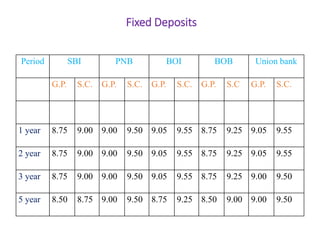
Fixed Deposits 
Period SBI PNB BOI BOB Union bank 
G.P. S.C. G.P. S.C. G.P. S.C. G.P. S.C G.P. S.C. 
1 year 8.75 9.00 9.00 9.50 9.05 9.55 8.75 9.25 9.05 9.55 
2 year 8.75 9.00 9.00 9.50 9.05 9.55 8.75 9.25 9.05 9.55 
3 year 8.75 9.00 9.00 9.50 9.05 9.55 8.75 9.25 9.00 9.50 
5 year 8.50 8.75 9.00 9.50 8.75 9.25 8.50 9.00 9.00 9.50
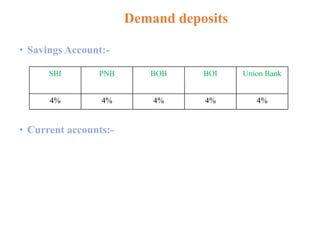
Demand deposits 
• Savings Account:- 
SBI PNB BOB BOI Union Bank 
4% 4% 4% 4% 4% 
• Current accounts:-
(B).Credits 
Bill purchase and discount:- 
• A source of receivables/working capital financing is bill 
discounting arrangement offered by the banks and finance 
companies. 
- Provide short-term finance. 
- Get the account receivables discounted which the client 
would have otherwise received from the buyer at the end 
of credit period.
Cash credit Account:- 
• This account is the primary method in which Banks lend 
money against the security of commodities and debt. 
• It runs like a current account except that the money that can 
be withdrawn from this account is not restricted to the 
amount deposited in the account. 
• Instead, the account holder is permitted to withdraw a certain 
sum called "limit" or "credit facility" in excess of the amount 
deposited in the account.
Overdraft:- 
• The word overdraft means the act of overdrawing from a 
Bank account. 
• In other words, the account holder withdraws more money 
from a Bank Account than has been deposited in it.
Term Loan:- 
• Term Loans are the counter parts of Fixed Deposits in the Bank. 
• Banks lend money in this mode when the repayment is sought 
to be made in fixed, pre-determined instalments. This type of 
loan is normally given to the borrowers for acquiring long term 
assets i.e. assets which will benefit the borrower over a long 
period (exceeding at least one year). 
• Purchases of plant and machinery, constructing building for 
factory, setting up new projects fall in this category. Financing 
for purchase of automobiles, consumer durables, real estate and 
creation of infrastructure also falls in this category.
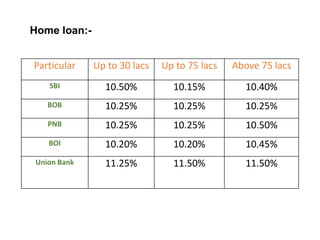
Home loan:- 
Particular Up to 30 lacs Up to 75 lacs Above 75 lacs 
SBI 10.50% 10.15% 10.40% 
BOB 10.25% 10.25% 10.25% 
PNB 10.25% 10.25% 10.50% 
BOI 10.20% 10.20% 10.45% 
Union Bank 11.25% 11.50% 11.50%
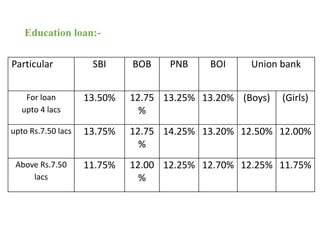
Particular SBI BOB PNB BOI Union bank 
For loan 
upto 4 lacs 
13.50% 12.75 
% 
13.25% 13.20% (Boys) (Girls) 
upto Rs.7.50 lacs 13.75% 12.75 
% 
14.25% 13.20% 12.50% 12.00% 
Above Rs.7.50 
lacs 
11.75% 12.00 
% 
12.25% 12.70% 12.25% 11.75% 
Education loan:-
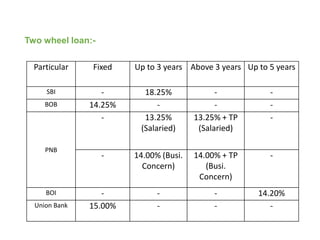
Two wheel loan:- 
Particular Fixed Up to 3 years Above 3 years Up to 5 years 
SBI - 18.25% - - 
BOB 14.25% - - - 
PNB 
- 13.25% 
(Salaried) 
13.25% + TP 
(Salaried) 
- 
- 14.00% (Busi. 
Concern) 
14.00% + TP 
(Busi. 
Concern) 
- 
BOI - - - 14.20% 
Union Bank 15.00% - - -
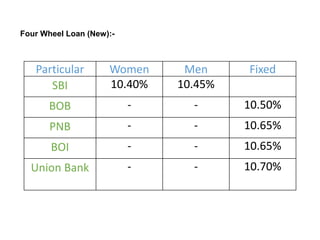
Four Wheel Loan (New):- 
Particular Women Men Fixed 
SBI 10.40% 10.45% 
BOB - - 10.50% 
PNB - - 10.65% 
BOI - - 10.65% 
Union Bank - - 10.70%
(C). General services 
1. Transferring Money From One Place To Another 
• Apart from accepting deposits and lending money, Banks 
also carry out, on behalf of their customers the act of 
transfer of money - both domestic and foreign - from one 
place to another. 
• This activity is known as "remittance business”.
2. Trustee Business:- 
• Banks also act as trustees for various purposes. 
• For example, whenever a company wishes to issue 
secured debentures, it has to appoint a financial 
intermediary as trustee who takes charge of the security 
for the debenture and looks after the interests of the 
debenture holders. Such entities necessarily have to 
expertise in financial matters and also sufficient standing 
in the market/society to generate confidence in the 
minds of potential subscribers
Keeping valuables in safe custody:- 
• Bankers are in the business of providing security to the 
money and valuables of the general public. 
• While security of money is taken care of through offering 
various types of deposit schemes, security of valuables is 
provided through making secured space available to general 
public for keeping these valuables. These spaces are 
available in the shape of LOCKERS.
Government business:- 
• Earlier Government business used to be exclusively 
carried out by Government Treasuries where all type 
of transactions took place. 
• However, now Banks act on behalf of the 
Government to accept its tax and non-tax receipts. 
Most of the Government disbursements like pension 
payments and tax refunds also take place through 
banks. 
• While the Banks carry out this business for a fee to be 
paid by the Government, providing this service 
requires a lot of effort and organisation.
Credit card:- 
• A card issued by a financial company giving the 
holder an option to borrow funds, usually at point of 
sale. 
• Credit cards charge interest and are primarily used 
for short-term financing. 
• Interest usually begins one month after a purchase is 
made and borrowing limits are pre-set according to 
the individual's credit rating
(D).Customized services and product:- 
• Derivative And Treasury Product:- 
Treasury Operations Include Investments In Debt 
Market (Sovereign And Corporate), Equity Market, 
Mutual Funds, Derivatives, And Trading And Forex 
Operations.
Para banking products:- 
1) Hire purchase activities:- 
• Hire purchase is a type of installment credit under 
which the hire purchaser, called the hirer, agrees to 
take the goods on hire at a stated rental, which is 
inclusive of the repayment of principal as well as 
interest, with an option to purchase. 
• Under this transaction, the hire purchaser acquires 
the property (goods) immediately on signing the 
hire purchase agreement but the ownership or title 
of the same is transferred only when the last 
installment is paid.
2) Leasing Business:- 
• Lease is a contract between the owner of the asset (Lessor) and 
the user of the asset called the lessee, whereby the Lessor gives 
the right to use the asset to the lessee over an agreed period of 
time for a consideration called the lease rental.
3) Merchant Banking:- 
• A merchant bank is a financial institution that engages 
in underwriting and business loans, catering primarily 
to the needs of large enterprises and high net 
worth individuals. In the British market, the term 
merchant bank refers to an investment bank.
4)Factoring Activities :- 
• “Factoring means an arrangement between a financial 
intermediary (factor) and a business concern (client) which 
includes at least two of the following services to be provided by 
the factor: 
• Finance 
• Maintenance of accounts 
• Collection of debts 
• Protection against credit risk”
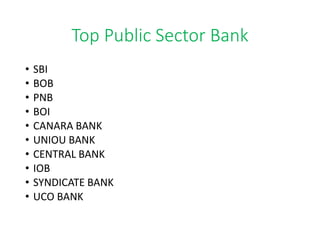
Top Public Sector Bank 
• SBI 
• BOB 
• PNB 
• BOI 
• CANARA BANK 
• UNIOU BANK 
• CENTRAL BANK 
• IOB 
• SYNDICATE BANK 
• UCO BANK
Need of Public sectors bank 
• To protect the safety of the public’s savings. 
• To control the supply of money and credit in order 
to achieve a nation’s broad economic goal. 
• To ensure equal opportunity and fairness in the 
public’s access to credit and other vital financial 
services. 
• To promote public confidence in the financial 
system, so that savings are made speedily and 
efficiently.
• To avoid concentrations of financial power in the 
hands of a few individuals and institutions. 
• Provide the Government with credit, tax revenues 
and other services. 
• To help sectors of the economy that they have 
special credit needs for 
eg. Housing, small business and agricultural loans et
Public Sectors Bank & It’s Services

Public Sectors Bank & It’s Services

  • 1.
    Public Sectors Bank & It’s Services
  • 2.
    History • Modernbanking in India is said to be developed during the British era. In the first half of the 19th century, the British East India Company established three banks – the Bank of Bengal in 1809, the Bank of Bombay in 1840 and the Bank of Madras in 1843. But in the course of time these three banks were amalgamated to a new bank called Imperial Bank and later it was taken over by the State Bank of India in 1955. Allahabad Bank was the first fully Indian owned bank. The Reserve Bank of India was established in 1935 followed by other banks like Punjab National Bank, Bank of India, Canara Bank and Indian Bank. In 1969, 14 major banks were nationalized and in 1980, 6 major private sector banks were taken over by the government.
  • 3.
    What is publicsectors Bank? • Public Sector Banks (PSBs) are banks where a majority stake (i.e. more than 50%) is held by a government. The shares of these banks are listed on stock exchanges. There are a total of 27 PSBs in India [19 Nationalized banks + 6 State bank group (SBI + 5 associates) + 1 IDBI bank (Other Public Sector-Indian Bank) = 26 PSBs + 1 recent Bhartiya Mahila Bank].
  • 4.
    (A). Deposits Banksare also called custodians of public money. Basically, the money is accepted as deposit for safe keeping. But since the Banks use this money to earn interest from people who need money, Banks share a part of this interest with the depositors. 1. Fixed Deposit Accounts 2. Demand Deposits: Savings Account Current account
  • 5.
    Fixed Deposits PeriodSBI PNB BOI BOB Union bank G.P. S.C. G.P. S.C. G.P. S.C. G.P. S.C G.P. S.C. 1 year 8.75 9.00 9.00 9.50 9.05 9.55 8.75 9.25 9.05 9.55 2 year 8.75 9.00 9.00 9.50 9.05 9.55 8.75 9.25 9.05 9.55 3 year 8.75 9.00 9.00 9.50 9.05 9.55 8.75 9.25 9.00 9.50 5 year 8.50 8.75 9.00 9.50 8.75 9.25 8.50 9.00 9.00 9.50
  • 6.
    Demand deposits •Savings Account:- SBI PNB BOB BOI Union Bank 4% 4% 4% 4% 4% • Current accounts:-
  • 7.
    (B).Credits Bill purchaseand discount:- • A source of receivables/working capital financing is bill discounting arrangement offered by the banks and finance companies. - Provide short-term finance. - Get the account receivables discounted which the client would have otherwise received from the buyer at the end of credit period.
  • 8.
    Cash credit Account:- • This account is the primary method in which Banks lend money against the security of commodities and debt. • It runs like a current account except that the money that can be withdrawn from this account is not restricted to the amount deposited in the account. • Instead, the account holder is permitted to withdraw a certain sum called "limit" or "credit facility" in excess of the amount deposited in the account.
  • 9.
    Overdraft:- • Theword overdraft means the act of overdrawing from a Bank account. • In other words, the account holder withdraws more money from a Bank Account than has been deposited in it.
  • 10.
    Term Loan:- •Term Loans are the counter parts of Fixed Deposits in the Bank. • Banks lend money in this mode when the repayment is sought to be made in fixed, pre-determined instalments. This type of loan is normally given to the borrowers for acquiring long term assets i.e. assets which will benefit the borrower over a long period (exceeding at least one year). • Purchases of plant and machinery, constructing building for factory, setting up new projects fall in this category. Financing for purchase of automobiles, consumer durables, real estate and creation of infrastructure also falls in this category.
  • 11.
    Home loan:- ParticularUp to 30 lacs Up to 75 lacs Above 75 lacs SBI 10.50% 10.15% 10.40% BOB 10.25% 10.25% 10.25% PNB 10.25% 10.25% 10.50% BOI 10.20% 10.20% 10.45% Union Bank 11.25% 11.50% 11.50%
  • 12.
    Particular SBI BOBPNB BOI Union bank For loan upto 4 lacs 13.50% 12.75 % 13.25% 13.20% (Boys) (Girls) upto Rs.7.50 lacs 13.75% 12.75 % 14.25% 13.20% 12.50% 12.00% Above Rs.7.50 lacs 11.75% 12.00 % 12.25% 12.70% 12.25% 11.75% Education loan:-
  • 13.
    Two wheel loan:- Particular Fixed Up to 3 years Above 3 years Up to 5 years SBI - 18.25% - - BOB 14.25% - - - PNB - 13.25% (Salaried) 13.25% + TP (Salaried) - - 14.00% (Busi. Concern) 14.00% + TP (Busi. Concern) - BOI - - - 14.20% Union Bank 15.00% - - -
  • 14.
    Four Wheel Loan(New):- Particular Women Men Fixed SBI 10.40% 10.45% BOB - - 10.50% PNB - - 10.65% BOI - - 10.65% Union Bank - - 10.70%
  • 15.
    (C). General services 1. Transferring Money From One Place To Another • Apart from accepting deposits and lending money, Banks also carry out, on behalf of their customers the act of transfer of money - both domestic and foreign - from one place to another. • This activity is known as "remittance business”.
  • 16.
    2. Trustee Business:- • Banks also act as trustees for various purposes. • For example, whenever a company wishes to issue secured debentures, it has to appoint a financial intermediary as trustee who takes charge of the security for the debenture and looks after the interests of the debenture holders. Such entities necessarily have to expertise in financial matters and also sufficient standing in the market/society to generate confidence in the minds of potential subscribers
  • 17.
    Keeping valuables insafe custody:- • Bankers are in the business of providing security to the money and valuables of the general public. • While security of money is taken care of through offering various types of deposit schemes, security of valuables is provided through making secured space available to general public for keeping these valuables. These spaces are available in the shape of LOCKERS.
  • 18.
    Government business:- •Earlier Government business used to be exclusively carried out by Government Treasuries where all type of transactions took place. • However, now Banks act on behalf of the Government to accept its tax and non-tax receipts. Most of the Government disbursements like pension payments and tax refunds also take place through banks. • While the Banks carry out this business for a fee to be paid by the Government, providing this service requires a lot of effort and organisation.
  • 19.
    Credit card:- •A card issued by a financial company giving the holder an option to borrow funds, usually at point of sale. • Credit cards charge interest and are primarily used for short-term financing. • Interest usually begins one month after a purchase is made and borrowing limits are pre-set according to the individual's credit rating
  • 20.
    (D).Customized services andproduct:- • Derivative And Treasury Product:- Treasury Operations Include Investments In Debt Market (Sovereign And Corporate), Equity Market, Mutual Funds, Derivatives, And Trading And Forex Operations.
  • 21.
    Para banking products:- 1) Hire purchase activities:- • Hire purchase is a type of installment credit under which the hire purchaser, called the hirer, agrees to take the goods on hire at a stated rental, which is inclusive of the repayment of principal as well as interest, with an option to purchase. • Under this transaction, the hire purchaser acquires the property (goods) immediately on signing the hire purchase agreement but the ownership or title of the same is transferred only when the last installment is paid.
  • 22.
    2) Leasing Business:- • Lease is a contract between the owner of the asset (Lessor) and the user of the asset called the lessee, whereby the Lessor gives the right to use the asset to the lessee over an agreed period of time for a consideration called the lease rental.
  • 23.
    3) Merchant Banking:- • A merchant bank is a financial institution that engages in underwriting and business loans, catering primarily to the needs of large enterprises and high net worth individuals. In the British market, the term merchant bank refers to an investment bank.
  • 24.
    4)Factoring Activities :- • “Factoring means an arrangement between a financial intermediary (factor) and a business concern (client) which includes at least two of the following services to be provided by the factor: • Finance • Maintenance of accounts • Collection of debts • Protection against credit risk”
  • 25.
    Top Public SectorBank • SBI • BOB • PNB • BOI • CANARA BANK • UNIOU BANK • CENTRAL BANK • IOB • SYNDICATE BANK • UCO BANK
  • 27.
    Need of Publicsectors bank • To protect the safety of the public’s savings. • To control the supply of money and credit in order to achieve a nation’s broad economic goal. • To ensure equal opportunity and fairness in the public’s access to credit and other vital financial services. • To promote public confidence in the financial system, so that savings are made speedily and efficiently.
  • 28.
    • To avoidconcentrations of financial power in the hands of a few individuals and institutions. • Provide the Government with credit, tax revenues and other services. • To help sectors of the economy that they have special credit needs for eg. Housing, small business and agricultural loans et