Methods of training Presentation ByGroup- 3
TRAINING	In simple words it can be defined as equipping employees with required knowledge and skills for the job.
WHY TRAINING?Dynamic  Business EnvironmentTechnological Advances
Advantages of TrainingIncreased ProductivityReduced AccidentsReduced SupervisionHeightened Morale
TYPES OF TRAININGOn the job trainingOff the job training
On the Job TrainingIt  refers to new or inexperienced employees learning through observing peers or managers performing the job and trying to imitate their behavior.
Methods of on the Job TrainingCOACHINGMENTORINGJOB ROTATIONJOB INSTRUCTION TECHNIQUE
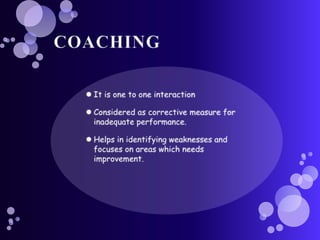
COACHINGIt is one to one interactionConsidered as corrective measure for inadequate performance.Helps in identifying weaknesses and focuses on areas which needs improvement.
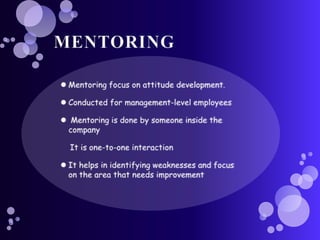
MENTORINGMentoring focus on attitude development.Conducted for management-level employees Mentoring is done by someone inside the company It is one-to-one interactionIt helps in identifying weaknesses and focus on the area that needs improvement
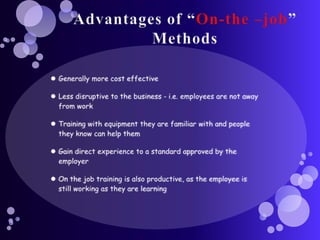
Advantages of “On-the –job” MethodsGenerally more cost effectiveLess disruptive to the business - i.e. employees are not away from workTraining with equipment they are familiar with and people they know can help them Gain direct experience to a standard approved by the employerOn the job training is also productive, as the employee is still working as they are learning
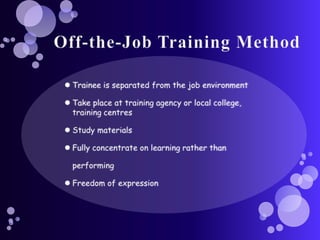
Off-the-Job Training MethodTrainee is separated from the job environmentTake place at training agency or local college, training centresStudy materialsFully concentrate on learning rather than 	performingFreedom of expression
Types of Off the Job methodsVestibule TrainingManagement GamesRole PlayingFilmsLecture MethodsOutbound Training
Vestibule TrainingActual work conditions are simulatedMaterials, files and equipments are usedDuration ranges from few days to a few weeksTheory can be related to practice here
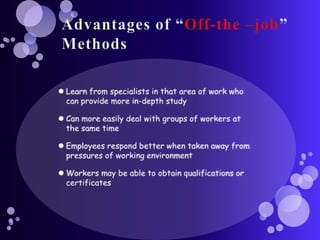
AdvantagesTraining becomes more reality-based.
Directly applies to jobs.
Increases the chances of retention.
Prevents trainees from making costly mistakes or damaging equipment.
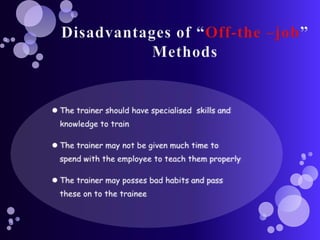
Allows instructors to give more personalized attention to the learners.DisadvantagesTime ConsumingExpensiveTrainer has to be very skilledThere has to be elaborate setups for the same
Management GamesTo improve decision making and analytical skills.To develop awareness of the need to make decisions lacking complete information.To develop an understanding of the interrelationships To develop the ability to function cooperatively and effectively in a small group situation.
Types of management GamesExecutive Games are general management games and cover all functional areas {like planning, decision making, etc} of business and their interactions and dynamics. Executive games are designed to train general executives. Functional Games, on the other hand, focus on middle management decisions and emphasize particular functional areas {like Marketing or HR} of the firm. 
ROLE PLAYINGIs the method of human interaction that involves realistic behavior in imaginary situations.
Benefits of Role playingDeveloping interpersonal skills and communication skillsConflict resolutionGroup decision makingDeveloping insight into one’s own behavior and its impact on others
Types of Role playMultiple role playSingle role playRole rotationSpontaneous role play
Films/Video PresentationsContent for the training experience comes primarily from a videotape or computer-based program.Interest of the audience can be maintained by showing them audio visualsEasy to handle and explainProvides a lot of content to talk about
Advantages & DisadvantagesAdvantages –Easy to train and the trainer can follow up  with questions and discussionsAssured to provide same information to all the traineesDisadvantages–Expensive to developSuch type of training has to be outsourced which may make the training less content specific.
Outbound TrainingOutdoor and action-oriented programs through experiential learningDevelops Leadership, teamwork and risk-taking abilitiesInteresting as compared to classroom leaningConducted by professionals who are very cooperative
AdvantagesTrainees can immediately see the consequences of wrong actionsMaterialistically enhance their thinking and behavior
DisadvantagesWork time has to be allotted for it.Interest of the participants is required.
Lecture MethodLecture is traditional & direct method of instruction.It is a verbal presentation of information by an instructor to a large audience.The lecture must motivate & create interest among the trainees in order to become effectiveIt is presumed to posses a considerable depth of knowledge of subject at hand.This method is used mainly in college and universities
AdvantagesLess time required for preparationProvides lots of information quicklyCost per trainee is very low
DisadvantagesDoes not involve trainees too much.Trainees may forget the teaching as it is presented only orally.
Few Other MethodsIn-Basket Exercise Also known as In-tray method of training. The trainee is presented with a pack of papers & files in a tray containing administrative problems & is asked to take decisions on these problems & are asked to take decisions on these within a stipulated time. The decisions taken by the trainees are compared with one another. The trainees are provided feedback on their performance.
Cont….Experiential ExercisesUsually short, structured learning experiences where individuals learn by doing. For instance, rather than talking about inter-personal conflicts & how to deal with them, an experiential exercise could be used to create a conflict situation where employees have to experience a conflict personally & work out its solutions.

Methods Of Training

  • 1.
    Methods of trainingPresentation ByGroup- 3
  • 2.
    TRAINING In simple wordsit can be defined as equipping employees with required knowledge and skills for the job.
  • 3.
    WHY TRAINING?Dynamic Business EnvironmentTechnological Advances
  • 4.
    Advantages of TrainingIncreasedProductivityReduced AccidentsReduced SupervisionHeightened Morale
  • 5.
    TYPES OF TRAININGOnthe job trainingOff the job training
  • 6.
    On the JobTrainingIt refers to new or inexperienced employees learning through observing peers or managers performing the job and trying to imitate their behavior.
  • 7.
    Methods of onthe Job TrainingCOACHINGMENTORINGJOB ROTATIONJOB INSTRUCTION TECHNIQUE
  • 8.
    COACHINGIt is oneto one interactionConsidered as corrective measure for inadequate performance.Helps in identifying weaknesses and focuses on areas which needs improvement.
  • 9.
    MENTORINGMentoring focus onattitude development.Conducted for management-level employees Mentoring is done by someone inside the company It is one-to-one interactionIt helps in identifying weaknesses and focus on the area that needs improvement
  • 10.
    Advantages of “On-the–job” MethodsGenerally more cost effectiveLess disruptive to the business - i.e. employees are not away from workTraining with equipment they are familiar with and people they know can help them Gain direct experience to a standard approved by the employerOn the job training is also productive, as the employee is still working as they are learning
  • 11.
    Off-the-Job Training MethodTraineeis separated from the job environmentTake place at training agency or local college, training centresStudy materialsFully concentrate on learning rather than performingFreedom of expression
  • 12.
    Types of Offthe Job methodsVestibule TrainingManagement GamesRole PlayingFilmsLecture MethodsOutbound Training
  • 13.
    Vestibule TrainingActual workconditions are simulatedMaterials, files and equipments are usedDuration ranges from few days to a few weeksTheory can be related to practice here
  • 14.
  • 15.
  • 16.
  • 17.
    Prevents trainees frommaking costly mistakes or damaging equipment.
  • 18.
    Allows instructors togive more personalized attention to the learners.DisadvantagesTime ConsumingExpensiveTrainer has to be very skilledThere has to be elaborate setups for the same
  • 19.
    Management GamesTo improvedecision making and analytical skills.To develop awareness of the need to make decisions lacking complete information.To develop an understanding of the interrelationships To develop the ability to function cooperatively and effectively in a small group situation.
  • 20.
    Types of managementGamesExecutive Games are general management games and cover all functional areas {like planning, decision making, etc} of business and their interactions and dynamics. Executive games are designed to train general executives. Functional Games, on the other hand, focus on middle management decisions and emphasize particular functional areas {like Marketing or HR} of the firm. 
  • 21.
    ROLE PLAYINGIs themethod of human interaction that involves realistic behavior in imaginary situations.
  • 22.
    Benefits of RoleplayingDeveloping interpersonal skills and communication skillsConflict resolutionGroup decision makingDeveloping insight into one’s own behavior and its impact on others
  • 23.
    Types of RoleplayMultiple role playSingle role playRole rotationSpontaneous role play
  • 24.
    Films/Video PresentationsContent forthe training experience comes primarily from a videotape or computer-based program.Interest of the audience can be maintained by showing them audio visualsEasy to handle and explainProvides a lot of content to talk about
  • 25.
    Advantages & DisadvantagesAdvantages–Easy to train and the trainer can follow up with questions and discussionsAssured to provide same information to all the traineesDisadvantages–Expensive to developSuch type of training has to be outsourced which may make the training less content specific.
  • 26.
    Outbound TrainingOutdoor andaction-oriented programs through experiential learningDevelops Leadership, teamwork and risk-taking abilitiesInteresting as compared to classroom leaningConducted by professionals who are very cooperative
  • 27.
    AdvantagesTrainees can immediatelysee the consequences of wrong actionsMaterialistically enhance their thinking and behavior
  • 28.
    DisadvantagesWork time hasto be allotted for it.Interest of the participants is required.
  • 29.
    Lecture MethodLecture istraditional & direct method of instruction.It is a verbal presentation of information by an instructor to a large audience.The lecture must motivate & create interest among the trainees in order to become effectiveIt is presumed to posses a considerable depth of knowledge of subject at hand.This method is used mainly in college and universities
  • 30.
    AdvantagesLess time requiredfor preparationProvides lots of information quicklyCost per trainee is very low
  • 31.
    DisadvantagesDoes not involvetrainees too much.Trainees may forget the teaching as it is presented only orally.
  • 32.
    Few Other MethodsIn-BasketExercise Also known as In-tray method of training. The trainee is presented with a pack of papers & files in a tray containing administrative problems & is asked to take decisions on these problems & are asked to take decisions on these within a stipulated time. The decisions taken by the trainees are compared with one another. The trainees are provided feedback on their performance.
  • 33.
    Cont….Experiential ExercisesUsually short,structured learning experiences where individuals learn by doing. For instance, rather than talking about inter-personal conflicts & how to deal with them, an experiential exercise could be used to create a conflict situation where employees have to experience a conflict personally & work out its solutions.