Methods & techniques to improve the design of
Smart Phones with Quality Function Deployment (QFD)
Quality Assurance for Customer Satisfaction
24th February 2017
Prathamesh Mohite and Jimit Shelat
Third Year – B.E. - Production Engineering,
Fr. Conceicao Rodrigues College of Engineering,
Bandra Bandstand, Mumbai, India
International Conference & Workshop on Advances in Mech. Engg. (ICWAME-2017)
Slide 2QFD – by Prathamesh Mohite & Jimit Shelat (Feb.’17)
2
Disclaimer
This presentation has been prepared exclusively for the “International Conference
& Workshop on Advances in Mechanical Engg. (ICWAME-2017)”, organized by
MULTICON-W and Thakur College of Engineering & Technology, 24-25 Feb. 2017.
The presentation is intended solely for the benefit of attendees and its contents and
conclusions are confidential and may not be disclosed to any other persons or
companies without the prior written permission of the Author.
The information upon which this presentation is based from own experience,
knowledge and databases and few other references.
The use of this research content was authorized in advance and any further use or
redistribution of it is strictly prohibited without written permission by the Author.
The opinions expressed herein have been achieved internally and are being shared
for the purpose of discussions at the Conference, which are merely directional and
not for any commercial purpose or decisions, and subject to changes as per market
dynamics.
The Author does not accept any liability or claims for your reliance upon them.
Slide 3QFD – by Prathamesh Mohite & Jimit Shelat (Feb.’17)
1. Quality Function Deployment (QFD) – Introduction
2. QFD Methodology & Benefits
3. Total Quality Management benefits - House of Quality
4. QFD Model – Core Process Design for Smartphones
5. Key Focus Areas for Smartphones Manufacturers
6. Summary Results
Presentation Outline
Slide 4QFD – by Prathamesh Mohite & Jimit Shelat (Feb.’17)
Quality Function Deployment
Key elements :
 Identify customer wants
 Identify how the goods or services will satisfy customers
 Relate customer wants to product specifications
 Develop importance ratings
 Evaluate competing products
 Bench-mark performance to desirable technical parameters
QFD : a method of transferring Customer Needs and Requirements
into Technical Specifications for new product or service development
Slide 5QFD – by Prathamesh Mohite & Jimit Shelat (Feb.’17)
QFD Brief History
 Dr. Yoji Akao and Shigeru Mizuno, Prof. Emeritus
 First implemented at Mitsubishi Heavy Industries
 Kobe Shipyards, 1972
 Toyota Minivans (1977 Base)
 1979 - 20% Reduction in Product Development & Start-Up Costs
 1982 - 38%
 1984 - 61%
 Dr. Clausing, Xerox, 1984
 Can be used for any Manufacturing or Service Industry
Slide 6QFD – by Prathamesh Mohite & Jimit Shelat (Feb.’17)
QFD Methodology
 Customer Driven
 Reduces Implementation Time
 Promotes Teamwork
 Provides Documentation
Slide 7QFD – by Prathamesh Mohite & Jimit Shelat (Feb.’17)
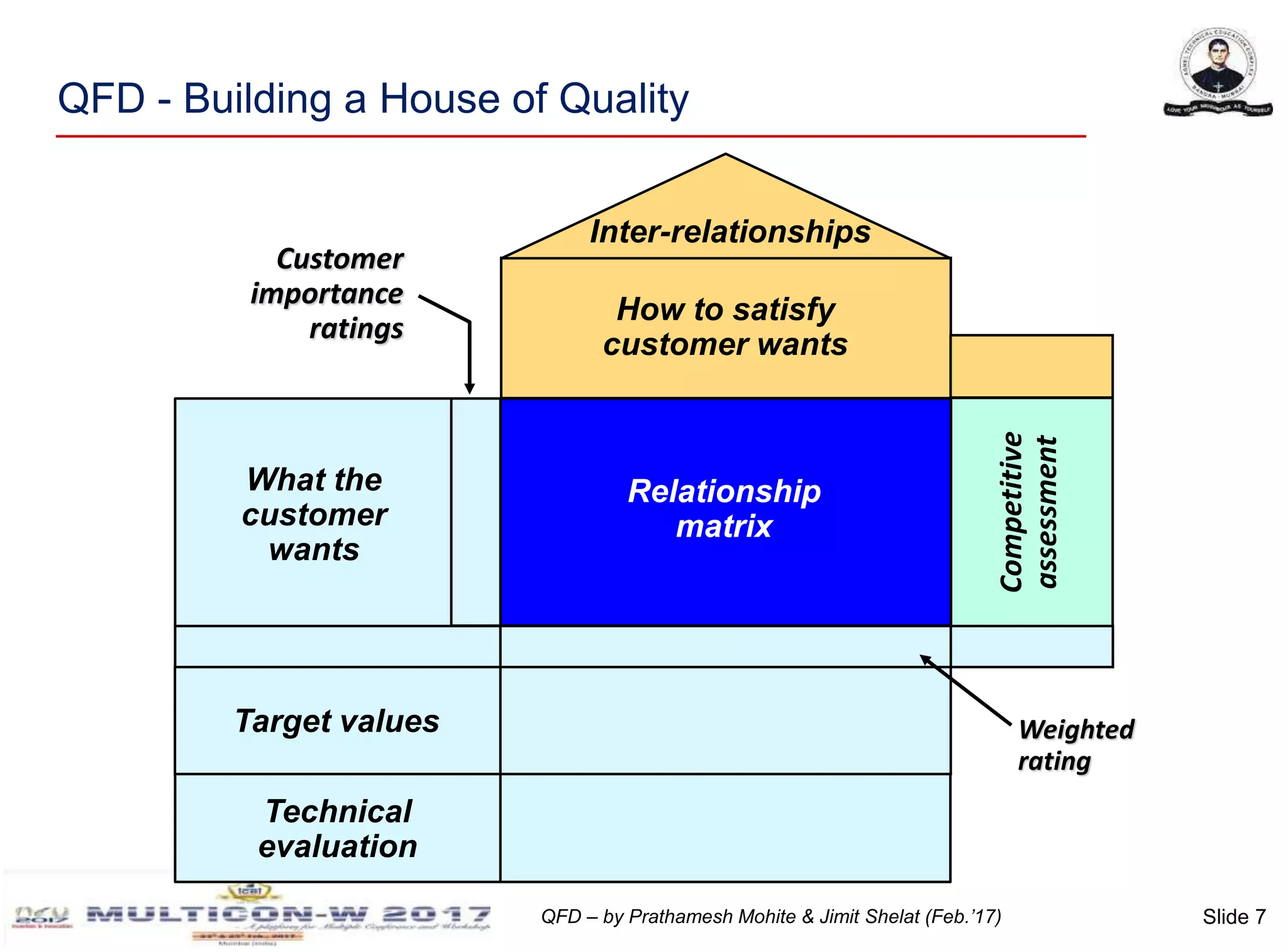
QFD - Building a House of Quality
Relationship
matrix
How to satisfy
customer wants
Inter-relationships
Competitive
assessment
Technical
evaluation
Target values
What the
customer
wants
Customer
importance
ratings
Weighted
rating
Slide 8QFD – by Prathamesh Mohite & Jimit Shelat (Feb.’17)
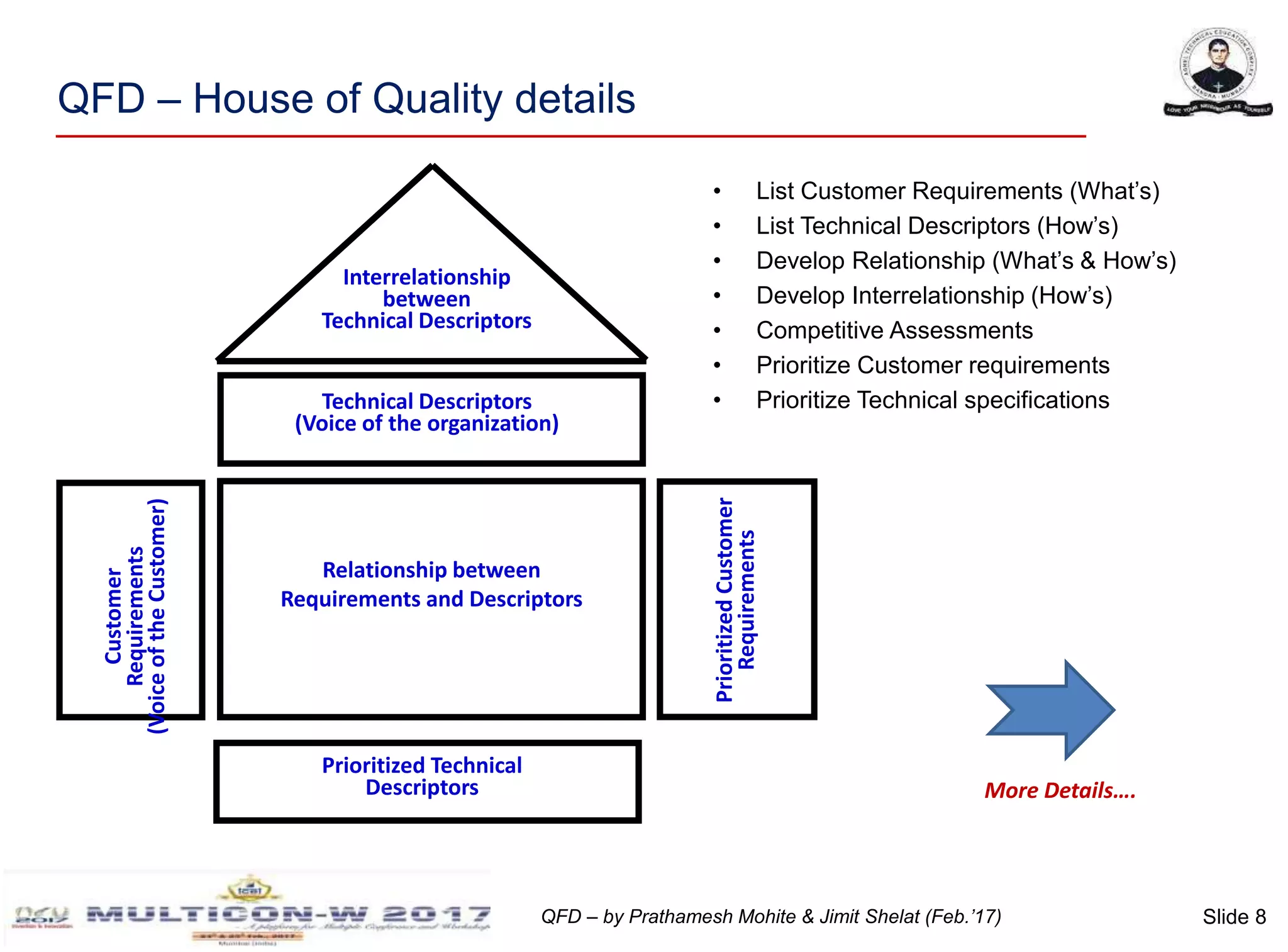
Technical Descriptors
(Voice of the organization)
Prioritized Technical
Descriptors
Interrelationship
between
Technical Descriptors
Customer
Requirements
(VoiceoftheCustomer)
PrioritizedCustomer
Requirements
Relationship between
Requirements and Descriptors
• List Customer Requirements (What’s)
• List Technical Descriptors (How’s)
• Develop Relationship (What’s & How’s)
• Develop Interrelationship (How’s)
• Competitive Assessments
• Prioritize Customer requirements
• Prioritize Technical specifications
QFD – House of Quality details
More Details….
Slide 9QFD – by Prathamesh Mohite & Jimit Shelat (Feb.’17)
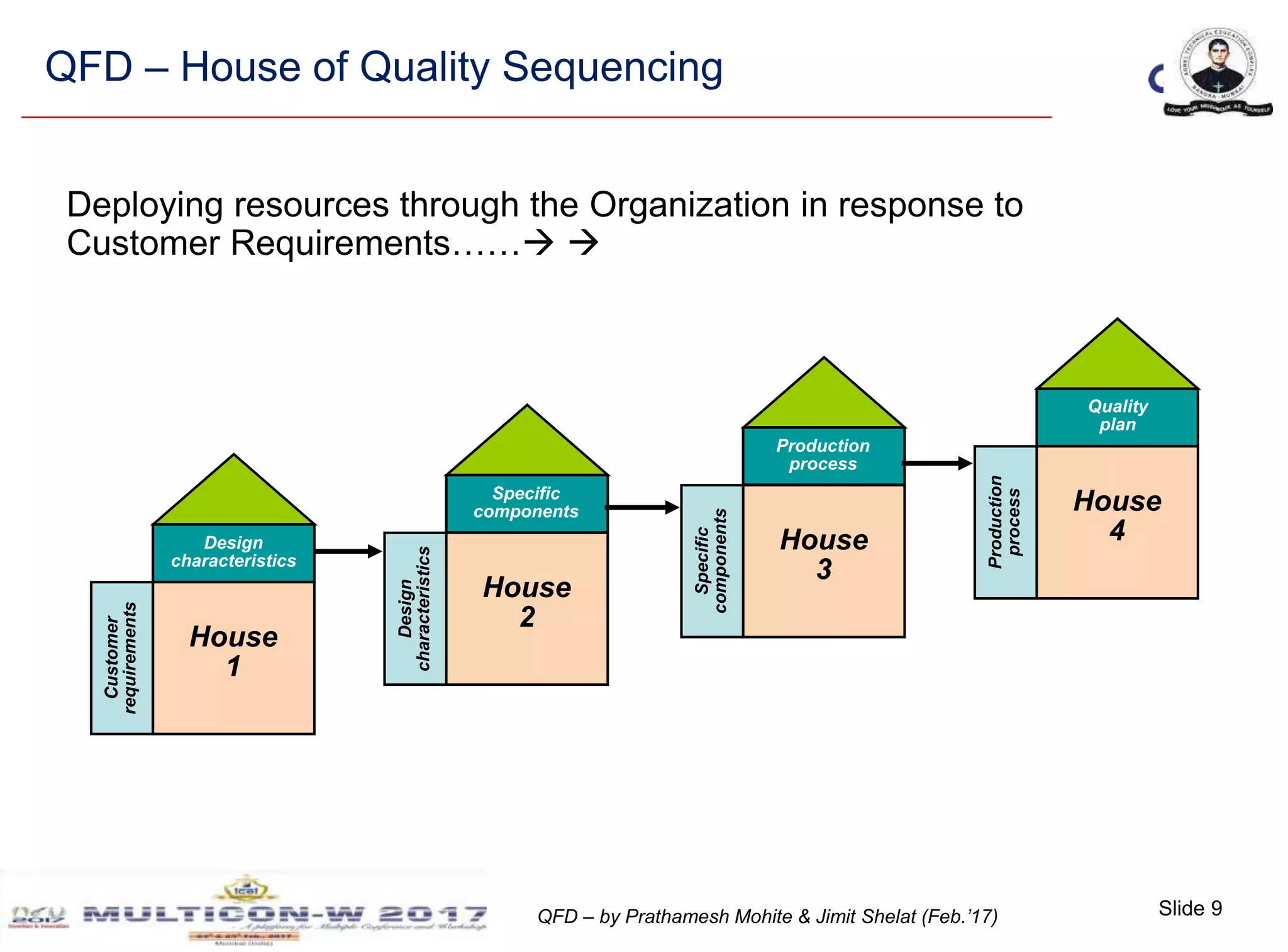
QFD – House of Quality Sequencing
Deploying resources through the Organization in response to
Customer Requirements…… 
Design
characteristics
Specific
components
House
2
Customer
requirements
Design
characteristics
House
1
Specific
components
Production
process
House
3
Production
process
Quality
plan
House
4
Slide 10QFD – by Prathamesh Mohite & Jimit Shelat (Feb.’17)
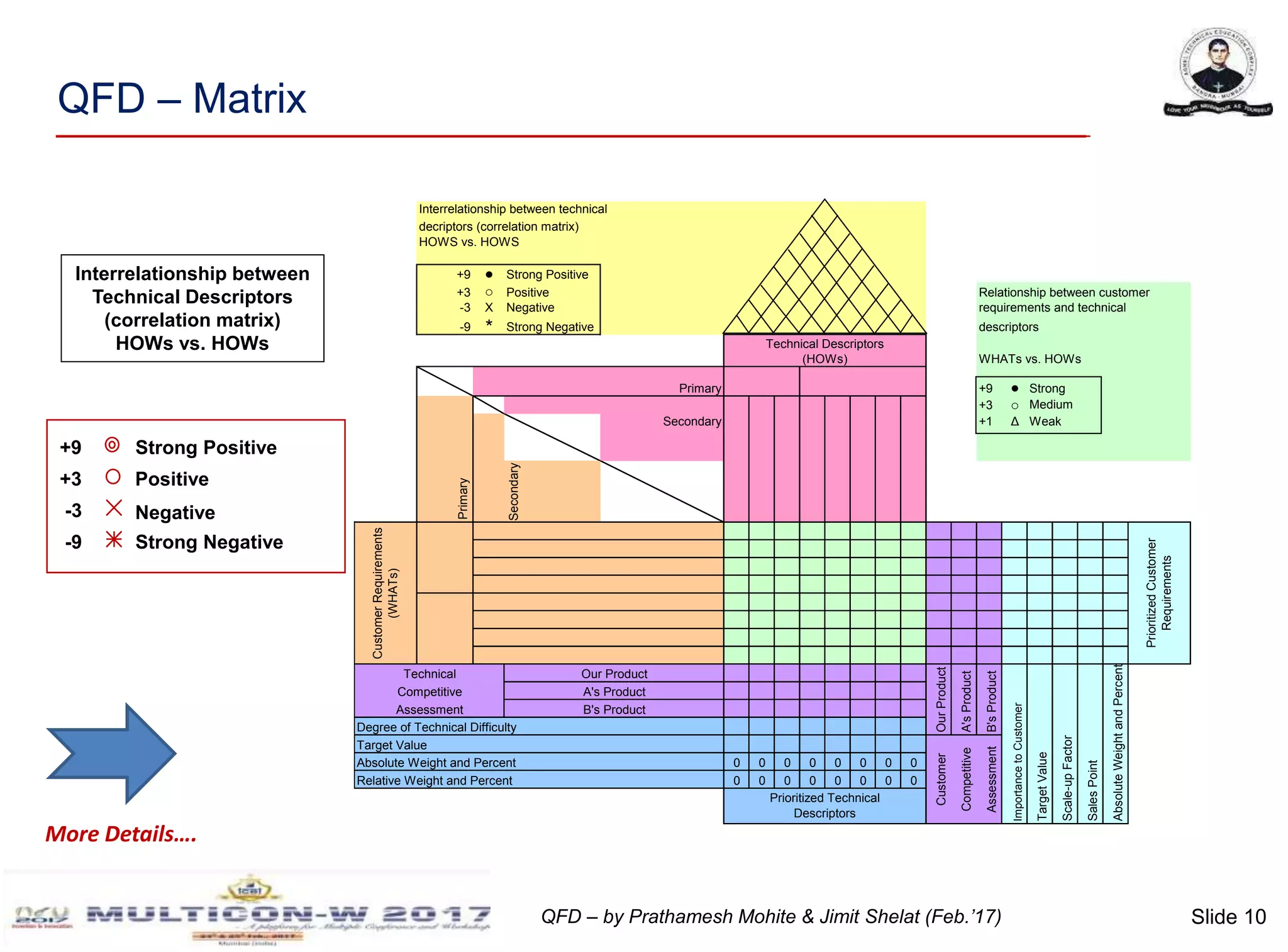
QFD – Matrix
Strong Positive
Positive
Negative
Strong Negative
+9
+3
-3
-9
Interrelationship between
Technical Descriptors
(correlation matrix)
HOWs vs. HOWs
More Details….
Interrelationship between technical
decriptors (correlation matrix)
HOWS vs. HOWS
+9 ● Strong Positive
+3 ○ Positive Relationship between customer
-3 X Negative requirements and technical
-9 * Strong Negative descriptors
WHATs vs. HOWs
+9 ●
+3 ○
Secondary +1 Δ
Secondary
Degree of Technical Difficulty
Target Value
Absolute Weight and Percent 0 0 0 0 0 0 0 0
Relative Weight and Percent 0 0 0 0 0 0 0 0
Strong
Medium
Weak
Scale-upFactor
SalesPoint
Assessment
OurProduct
A'sProduct
B'sProduct
ImportancetoCustomer
TargetValue
Technical Descriptors
(HOWs)
CustomerRequirements
(WHATs)
Customer
Competitive
Primary
Assessment
Prioritized Technical
Descriptors
B's Product
Primary
AbsoluteWeightandPercent
PrioritizedCustomer
Requirements
Our Product
A's Product
Technical
Competitive
Slide 11QFD – by Prathamesh Mohite & Jimit Shelat (Feb.’17)
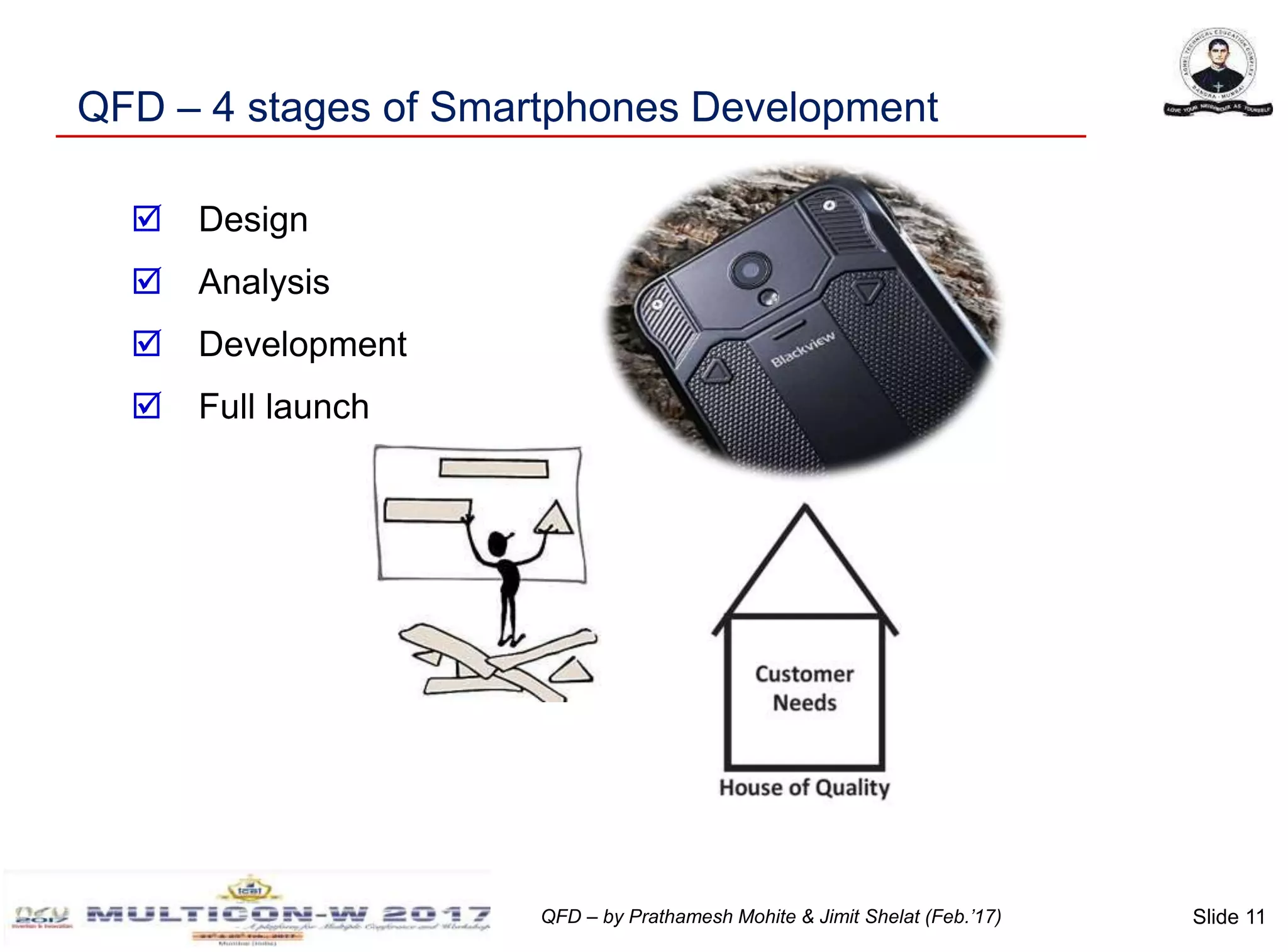
QFD – 4 stages of Smartphones Development
 Design
 Analysis
 Development
 Full launch
Slide 12QFD – by Prathamesh Mohite & Jimit Shelat (Feb.’17)
QFD - Benefits for Smartphones
 Smartphones life cycles are short & dynamic –
QFD provides a fast response on new design changes
 House of Quality - correlates customer requirements & technical specs :
• “Long battery life”  better hardware design (eg. antenna position)
• “Ease of Use”  Processor Power, Bluetooth, WiFi, NFC, A/GPS,
Memory Capacity, etc.
• “Touch-operated Screen Sensibility”  advanced materials
Slide 13QFD – by Prathamesh Mohite & Jimit Shelat (Feb.’17)
Key Focus Areas for Smartphones Manufacturers
 QFD cost analysis can determine which quality characteristics should
be included in the first version and in subsequent generation
 Results will be the cost and time effective Smartphones that best
satisfy both mobile service providers and users (customers)
 Innovative Technical features can be easily rearranged, so that
Production Engineers can effectively satisfy future customer demands
Slide 14QFD – by Prathamesh Mohite & Jimit Shelat (Feb.’17)
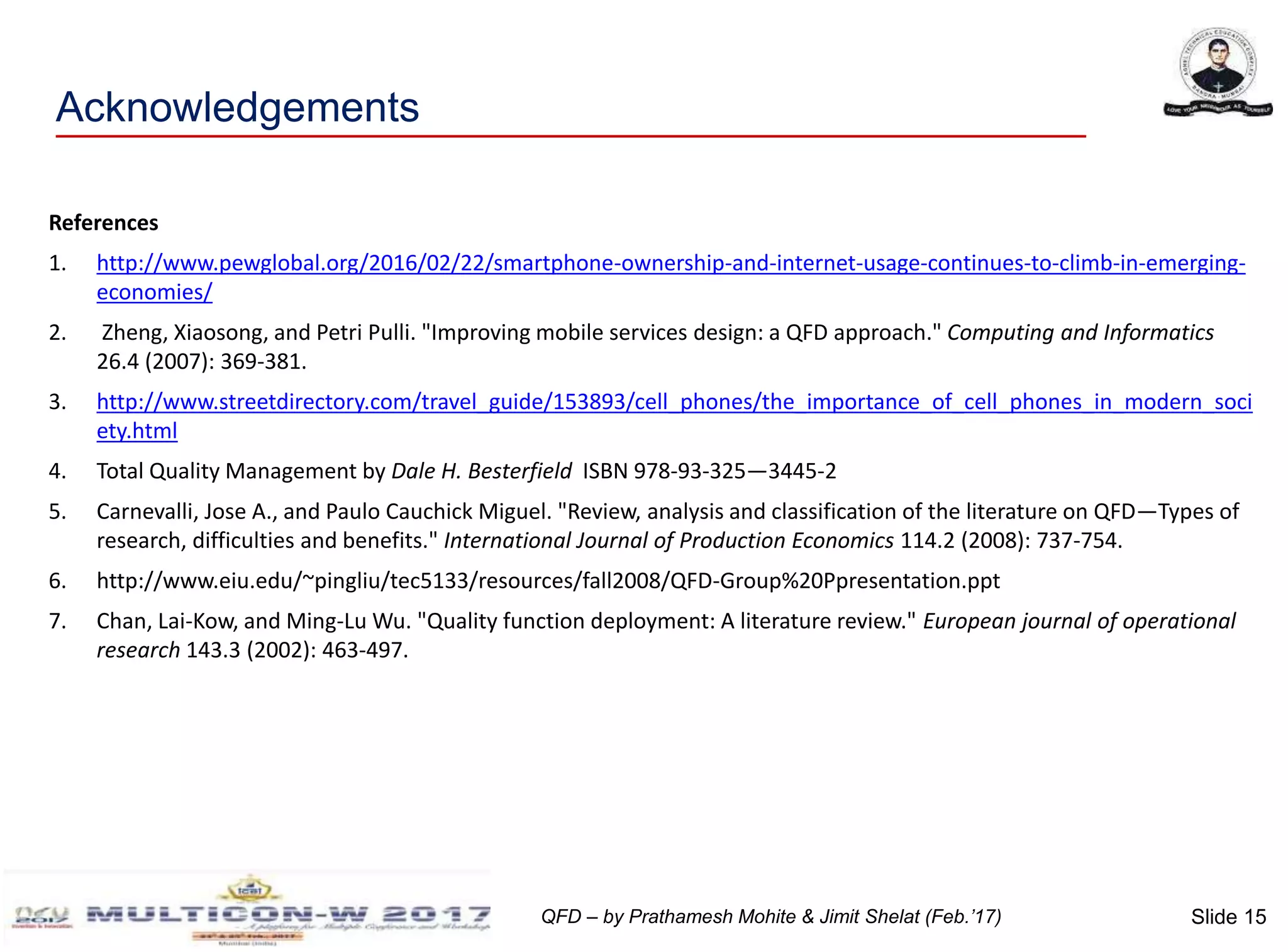
Summary Results
Interrelationship between technical
decriptors (correlation matrix)
HOWS vs. HOWS
+9 ● Strong Positive
+3 ○ Positive Relationship between customer
-3 X Negative requirements and technical
-9 * Strong Negative descriptors
WHATs vs. HOWs
+9 ●
+3 ○
Secondary +1 Δ
Secondary
Mobile Random access memory ○ ○ ○ ○ 4 4 5 8 5 1.2 1.5 14
phone LTE connectivity △ ○ ● 3 4 4 8 4 1.3 1.5 16
specifi - Battery life △ ● ● ○ ○ 3 3 4 7 4 1.3 1.5 14
cation Bluetooth, wifi connectivity ○ 4 4 5 7 4 1 1 7
Mobile Operating system ○ △ ○ 4 4 5 7 4 1 2 14
phone GPS ○ 4 4 4 6 4 1 1 6
features Processor type ○ △ ○ △ 3 3 4 8 5 1.6 1.5 19
Display △ ○ ● ○ ○ 3 5 4 6 3 1 1.5 9
3 4 4 3 4 4 3 3
4 4 3 4 4 2 4 3
4 4 4 5 4 3 3 4
Degree of Technical Difficulty 6 5 7 7 6 6 5 3
Target Value 4 4 5 4 4 4 3 3
Absolute Weight and Percent 76 71 14 18 172 66 182 42
Relative Weight and Percent 155 142 28 27 320 111 334 69
Our Product
A's Product
Technical
Competitive
CustomerRequirements
(WHATs)
Primary
Primary
AbsoluteWeightandPercent
PrioritizedCustomer
Requirements
LCD,LED
IRBlaster
Customer
CompetitiveA'sProduct
B'sProduct
ImportancetoCustomer
TargetValue
Materialquality
B's ProductAssessment
OurProduct
Bootuptime
Standbytime
Keypadtype
Technical Descriptors
(HOWs)
Prioritized Technical
Descriptors
Strong
Medium
Weak
Scale-upFactor
SalesPoint
Assessment
Talktime
Weight
○
○
●
X
○ *
○
○
* X
Slide 15QFD – by Prathamesh Mohite & Jimit Shelat (Feb.’17)
Acknowledgements
References
1. http://www.pewglobal.org/2016/02/22/smartphone-ownership-and-internet-usage-continues-to-climb-in-emerging-
economies/
2. Zheng, Xiaosong, and Petri Pulli. "Improving mobile services design: a QFD approach." Computing and Informatics
26.4 (2007): 369-381.
3. http://www.streetdirectory.com/travel_guide/153893/cell_phones/the_importance_of_cell_phones_in_modern_soci
ety.html
4. Total Quality Management by Dale H. Besterfield ISBN 978-93-325—3445-2
5. Carnevalli, Jose A., and Paulo Cauchick Miguel. "Review, analysis and classification of the literature on QFD—Types of
research, difficulties and benefits." International Journal of Production Economics 114.2 (2008): 737-754.
6. http://www.eiu.edu/~pingliu/tec5133/resources/fall2008/QFD-Group%20Ppresentation.ppt
7. Chan, Lai-Kow, and Ming-Lu Wu. "Quality function deployment: A literature review." European journal of operational
research 143.3 (2002): 463-497.
Slide 16QFD – by Prathamesh Mohite & Jimit Shelat (Feb.’17)
Slide 17QFD – by Prathamesh Mohite & Jimit Shelat (Feb.’17)
Happy to take
Questions

Methods and Techniques to Improve the Design of Cell Phones Using Quality Function Deployment (QFD) for ICWAME 2017)

  • 1.
    Methods & techniquesto improve the design of Smart Phones with Quality Function Deployment (QFD) Quality Assurance for Customer Satisfaction 24th February 2017 Prathamesh Mohite and Jimit Shelat Third Year – B.E. - Production Engineering, Fr. Conceicao Rodrigues College of Engineering, Bandra Bandstand, Mumbai, India International Conference & Workshop on Advances in Mech. Engg. (ICWAME-2017)
  • 2.
    Slide 2QFD –by Prathamesh Mohite & Jimit Shelat (Feb.’17) 2 Disclaimer This presentation has been prepared exclusively for the “International Conference & Workshop on Advances in Mechanical Engg. (ICWAME-2017)”, organized by MULTICON-W and Thakur College of Engineering & Technology, 24-25 Feb. 2017. The presentation is intended solely for the benefit of attendees and its contents and conclusions are confidential and may not be disclosed to any other persons or companies without the prior written permission of the Author. The information upon which this presentation is based from own experience, knowledge and databases and few other references. The use of this research content was authorized in advance and any further use or redistribution of it is strictly prohibited without written permission by the Author. The opinions expressed herein have been achieved internally and are being shared for the purpose of discussions at the Conference, which are merely directional and not for any commercial purpose or decisions, and subject to changes as per market dynamics. The Author does not accept any liability or claims for your reliance upon them.
  • 3.
    Slide 3QFD –by Prathamesh Mohite & Jimit Shelat (Feb.’17) 1. Quality Function Deployment (QFD) – Introduction 2. QFD Methodology & Benefits 3. Total Quality Management benefits - House of Quality 4. QFD Model – Core Process Design for Smartphones 5. Key Focus Areas for Smartphones Manufacturers 6. Summary Results Presentation Outline
  • 4.
    Slide 4QFD –by Prathamesh Mohite & Jimit Shelat (Feb.’17) Quality Function Deployment Key elements :  Identify customer wants  Identify how the goods or services will satisfy customers  Relate customer wants to product specifications  Develop importance ratings  Evaluate competing products  Bench-mark performance to desirable technical parameters QFD : a method of transferring Customer Needs and Requirements into Technical Specifications for new product or service development
  • 5.
    Slide 5QFD –by Prathamesh Mohite & Jimit Shelat (Feb.’17) QFD Brief History  Dr. Yoji Akao and Shigeru Mizuno, Prof. Emeritus  First implemented at Mitsubishi Heavy Industries  Kobe Shipyards, 1972  Toyota Minivans (1977 Base)  1979 - 20% Reduction in Product Development & Start-Up Costs  1982 - 38%  1984 - 61%  Dr. Clausing, Xerox, 1984  Can be used for any Manufacturing or Service Industry
  • 6.
    Slide 6QFD –by Prathamesh Mohite & Jimit Shelat (Feb.’17) QFD Methodology  Customer Driven  Reduces Implementation Time  Promotes Teamwork  Provides Documentation
  • 7.
    Slide 7QFD –by Prathamesh Mohite & Jimit Shelat (Feb.’17) QFD - Building a House of Quality Relationship matrix How to satisfy customer wants Inter-relationships Competitive assessment Technical evaluation Target values What the customer wants Customer importance ratings Weighted rating
  • 8.
    Slide 8QFD –by Prathamesh Mohite & Jimit Shelat (Feb.’17) Technical Descriptors (Voice of the organization) Prioritized Technical Descriptors Interrelationship between Technical Descriptors Customer Requirements (VoiceoftheCustomer) PrioritizedCustomer Requirements Relationship between Requirements and Descriptors • List Customer Requirements (What’s) • List Technical Descriptors (How’s) • Develop Relationship (What’s & How’s) • Develop Interrelationship (How’s) • Competitive Assessments • Prioritize Customer requirements • Prioritize Technical specifications QFD – House of Quality details More Details….
  • 9.
    Slide 9QFD –by Prathamesh Mohite & Jimit Shelat (Feb.’17) QFD – House of Quality Sequencing Deploying resources through the Organization in response to Customer Requirements……  Design characteristics Specific components House 2 Customer requirements Design characteristics House 1 Specific components Production process House 3 Production process Quality plan House 4
  • 10.
    Slide 10QFD –by Prathamesh Mohite & Jimit Shelat (Feb.’17) QFD – Matrix Strong Positive Positive Negative Strong Negative +9 +3 -3 -9 Interrelationship between Technical Descriptors (correlation matrix) HOWs vs. HOWs More Details…. Interrelationship between technical decriptors (correlation matrix) HOWS vs. HOWS +9 ● Strong Positive +3 ○ Positive Relationship between customer -3 X Negative requirements and technical -9 * Strong Negative descriptors WHATs vs. HOWs +9 ● +3 ○ Secondary +1 Δ Secondary Degree of Technical Difficulty Target Value Absolute Weight and Percent 0 0 0 0 0 0 0 0 Relative Weight and Percent 0 0 0 0 0 0 0 0 Strong Medium Weak Scale-upFactor SalesPoint Assessment OurProduct A'sProduct B'sProduct ImportancetoCustomer TargetValue Technical Descriptors (HOWs) CustomerRequirements (WHATs) Customer Competitive Primary Assessment Prioritized Technical Descriptors B's Product Primary AbsoluteWeightandPercent PrioritizedCustomer Requirements Our Product A's Product Technical Competitive
  • 11.
    Slide 11QFD –by Prathamesh Mohite & Jimit Shelat (Feb.’17) QFD – 4 stages of Smartphones Development  Design  Analysis  Development  Full launch
  • 12.
    Slide 12QFD –by Prathamesh Mohite & Jimit Shelat (Feb.’17) QFD - Benefits for Smartphones  Smartphones life cycles are short & dynamic – QFD provides a fast response on new design changes  House of Quality - correlates customer requirements & technical specs : • “Long battery life”  better hardware design (eg. antenna position) • “Ease of Use”  Processor Power, Bluetooth, WiFi, NFC, A/GPS, Memory Capacity, etc. • “Touch-operated Screen Sensibility”  advanced materials
  • 13.
    Slide 13QFD –by Prathamesh Mohite & Jimit Shelat (Feb.’17) Key Focus Areas for Smartphones Manufacturers  QFD cost analysis can determine which quality characteristics should be included in the first version and in subsequent generation  Results will be the cost and time effective Smartphones that best satisfy both mobile service providers and users (customers)  Innovative Technical features can be easily rearranged, so that Production Engineers can effectively satisfy future customer demands
  • 14.
    Slide 14QFD –by Prathamesh Mohite & Jimit Shelat (Feb.’17) Summary Results Interrelationship between technical decriptors (correlation matrix) HOWS vs. HOWS +9 ● Strong Positive +3 ○ Positive Relationship between customer -3 X Negative requirements and technical -9 * Strong Negative descriptors WHATs vs. HOWs +9 ● +3 ○ Secondary +1 Δ Secondary Mobile Random access memory ○ ○ ○ ○ 4 4 5 8 5 1.2 1.5 14 phone LTE connectivity △ ○ ● 3 4 4 8 4 1.3 1.5 16 specifi - Battery life △ ● ● ○ ○ 3 3 4 7 4 1.3 1.5 14 cation Bluetooth, wifi connectivity ○ 4 4 5 7 4 1 1 7 Mobile Operating system ○ △ ○ 4 4 5 7 4 1 2 14 phone GPS ○ 4 4 4 6 4 1 1 6 features Processor type ○ △ ○ △ 3 3 4 8 5 1.6 1.5 19 Display △ ○ ● ○ ○ 3 5 4 6 3 1 1.5 9 3 4 4 3 4 4 3 3 4 4 3 4 4 2 4 3 4 4 4 5 4 3 3 4 Degree of Technical Difficulty 6 5 7 7 6 6 5 3 Target Value 4 4 5 4 4 4 3 3 Absolute Weight and Percent 76 71 14 18 172 66 182 42 Relative Weight and Percent 155 142 28 27 320 111 334 69 Our Product A's Product Technical Competitive CustomerRequirements (WHATs) Primary Primary AbsoluteWeightandPercent PrioritizedCustomer Requirements LCD,LED IRBlaster Customer CompetitiveA'sProduct B'sProduct ImportancetoCustomer TargetValue Materialquality B's ProductAssessment OurProduct Bootuptime Standbytime Keypadtype Technical Descriptors (HOWs) Prioritized Technical Descriptors Strong Medium Weak Scale-upFactor SalesPoint Assessment Talktime Weight ○ ○ ● X ○ * ○ ○ * X
  • 15.
    Slide 15QFD –by Prathamesh Mohite & Jimit Shelat (Feb.’17) Acknowledgements References 1. http://www.pewglobal.org/2016/02/22/smartphone-ownership-and-internet-usage-continues-to-climb-in-emerging- economies/ 2. Zheng, Xiaosong, and Petri Pulli. "Improving mobile services design: a QFD approach." Computing and Informatics 26.4 (2007): 369-381. 3. http://www.streetdirectory.com/travel_guide/153893/cell_phones/the_importance_of_cell_phones_in_modern_soci ety.html 4. Total Quality Management by Dale H. Besterfield ISBN 978-93-325—3445-2 5. Carnevalli, Jose A., and Paulo Cauchick Miguel. "Review, analysis and classification of the literature on QFD—Types of research, difficulties and benefits." International Journal of Production Economics 114.2 (2008): 737-754. 6. http://www.eiu.edu/~pingliu/tec5133/resources/fall2008/QFD-Group%20Ppresentation.ppt 7. Chan, Lai-Kow, and Ming-Lu Wu. "Quality function deployment: A literature review." European journal of operational research 143.3 (2002): 463-497.
  • 16.
    Slide 16QFD –by Prathamesh Mohite & Jimit Shelat (Feb.’17)
  • 17.
    Slide 17QFD –by Prathamesh Mohite & Jimit Shelat (Feb.’17) Happy to take Questions