METAMORPHOSIS OF 
INDONESIAN CRISIS SINCE 1998* 
Prof. Dr. Hamdy Hady, DEA** 
*) Presentation for International Seminar, Jakarta, August 24th 2013 
**) Professor of Post Graduate Program of Management Science, 
Universitas Persada Indonesia Y.A.I, Jakarta 
Metamorphosis of Indonesian Financial Crisis 1
LIST OF PRESENTATION 
1. Background of Asian Financial Crisis 
2. Phenomena of Indonesian Crisis 
Source Of Indonesian Monetary And Economic Crisis 
Metamorphosis Crisis 
Trilogy Of Development 
History Of Reformation 
Fact & Figure 
3. Strategy of Development 
The Troubled Position Of Indonesia 
Possibility Solution 
Good Governance Of Government 
Metamorphosis of Indonesian Financial Crisis 2
1 BACKGROUND OF ASIAN FINANCIAL CRISIS 
Metamorphosis of Indonesian Financial Crisis 3
I. BACKGROUND OF ASIAN FINANCIAL CRISIS 1997 - 1998 
We first deal with the Asian crisis which broke out in July 1997 
	 	 
Source : Google, Asian Crisis 1997 
Metamorphosis of Indonesian Financial Crisis 4
I. BACKGROUND OF ASIAN FINANCIAL CRISIS 1997 - 1998 
The Lessons of Asian Crisis (1997-1998) 
A. The Macro Economic Lessons 
B. Financial Lessons 
C. The Structural Lessons 
Metamorphosis of Indonesian Financial Crisis 5
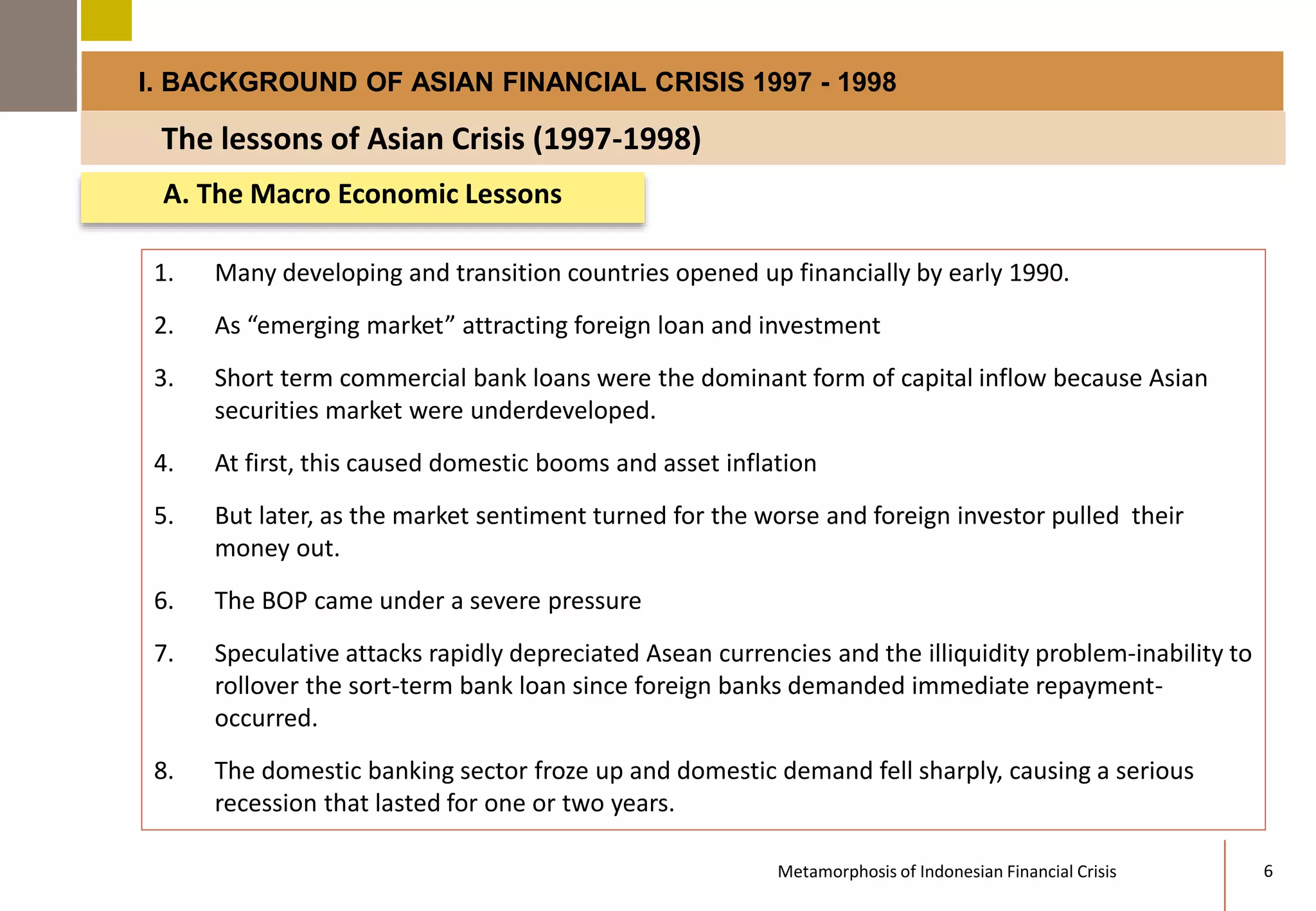
I. BACKGROUND OF ASIAN FINANCIAL CRISIS 1997 - 1998 
The lessons of Asian Crisis (1997-1998) 
A. The Macro Economic Lessons 
1. Many developing and transition countries opened up financially by early 1990. 
2. As “emerging market” attracting foreign loan and investment 
3. Short term commercial bank loans were the dominant form of capital inflow because Asian 
securities market were underdeveloped. 
4. At first, this caused domestic booms and asset inflation 
5. But later, as the market sentiment turned for the worse and foreign investor pulled their 
money out. 
6. The BOP came under a severe pressure 
7. Speculative attacks rapidly depreciated Asean currencies and the illiquidity problem-inability to 
rollover the sort-term bank loan since foreign banks demanded immediate repayment-occurred. 
8. The domestic banking sector froze up and domestic demand fell sharply, causing a serious 
recession that lasted for one or two years. 
Metamorphosis of Indonesian Financial Crisis 6
I. BACKGROUND OF ASIAN FINANCIAL CRISIS 1997 - 1998 
The Lessons of Asian Crisis (1997-1998) 
B. The Financial Lessons 
1. Macro shock was amplified by the balance-sheet vulnerability caused by the weakness of Asian 
banks, non-banks and corporations 
2. Firms in developing East Asia mostly are highly dependent on indirect finance (bank loans) for 
working and investment capital and had high debt/equity ratio 
3. Moreover, the local banks and non-banks were exposed to two kind of balance-sheet 
mismatches : 
a. Currency mismatch (borrows in USD and lend to domestic project in local 
currency) 
b. Maturity mismatch (borrows in short term loans but lend to long term domestic 
project) 
Metamorphosis of Indonesian Financial Crisis 7
I. BACKGROUND OF ASIAN FINANCIAL CRISIS 1997 - 1998 
The Lessons of Asian Crisis (1997-1998) 
B. The Financial Lessons 
Balance Sheet Vulnerability in East Asia 
Commercial banks 
Assets & non banks Liablilities 
USD assets 
L/C 
Long term 
lending 
Bad debt 
USD 
Short term 
borrowing 
L/C 
deposits 
(1) Currency mismatch 
“short” position; 
debt rises with 
depreciation 
(2) Maturity mismatch 
(inability to rollover once 
the crisis hits, leading to 
iliquidity) 
(3) Collapsing demand & 
credit crunch 
(increasing NPLs) 
Metamorphosis of Indonesian Financial Crisis 8
I. BACKGROUND OF ASIAN FINANCIAL CRISIS 1997 - 1998 
The Lessons of Asian Crisis (1997-1998) 
B. The Financial Lessons 
4. China, India, Vietnam, Myanmar and Cambodia were not affected by the Asian crisis as much as 
Korea and ASEAN4 (Thailand, Indonesia, Philippines Malaysia). This is not because of the 
productivity and financial institutions of the first group were superior. In many ways, their 
domestic systems are much worse than Korea or ASEAN 4. They were not directly hit because 
they did not open up financially. 
Metamorphosis of Indonesian Financial Crisis 9
I. BACKGROUND OF ASIAN FINANCIAL CRISIS 1997 - 1998 
The Lessons of Asian Crisis (1997-1998) 
C. The Structural Lessons 
On the surface, it is true that the phenomena of the crisis were macro and financial involving banks, 
non-banks and borrowers. But the real cause was the structural weaknesses of the developing 
economies in East Asia. As long as this weaknesses remain, similar crises can occur in the future. So, 
the real solution must be the removal of this structural weaknesses, among others : 
1. The banking problem and the lack of proper bank supervision 
2. Pre-modern corporate sector : non transparency, family dominance, non-separation 
of ownership and management, archaic accounting, etc. 
3. Unhealthy relationship between the government and big business (Korean Chaebol, 
Corporate Groups in Indonesia, Thailand, etc.) 
4. Real sector problems in productivity and competitiveness 
5. Political backwardness and lack of un-true democracy 
Metamorphosis of Indonesian Financial Crisis 10
2 THE PHENOMENA OF INDONESIAN CRISIS 
Metamorphosis of Indonesian Financial Crisis 11
II. THE BIG QUESTION IS HOW IS THE DEVELOPMENT OF THE CRISIS IN INDONESIA 
AND WHY IT SEEMS THAT THE CRISIS IS NOT FINISHED YET 
Source of Indonesian Monetary Crisis 
1. Thailand’s Balance of Payment deficit 
2. Domino Effect 
External Factors: 
1. Moral Hazard 
2. Currency collaps  Financial Panic (i.e. BLBI or Credit Liquidity 
of Indonesian Central Bank using for Forex speculation) 
3. Corporate Socialism  State Company (BUMN) acting as Social 
Company and most of them become source of Nepotism, 
Collution & Corruption practices. Profitable State Company sold 
to foreigner but Lost Ones still existing. 
4. Corporate Governance Cronism Company  High Cost 
Economy 
5. Mismatch Bank Liquidity (Mismatch Currency & Maturity) & 
Mismanagement Not Prudent and High Speculation 
6. Lack of Democracy  Ineffective Control System 
Internal Factors: 
Metamorphosis of Indonesian Financial Crisis 12
II. THE BIG QUESTION IS HOW DO THE DEVELOPMENT OF CRISIS IN INDONESIA 
AND WHY IT SEEMS THE CRISIS IS NOT FINISH YET 
Metamorphosis Phenomena of Indonesian Crisis 
MONETARY CRISIS (July 1997) 
ECONOMY CRISIS (1998) 
SOCIAL CRISIS 
POLITICAL CRISIS 
TOTAL CRISIS 
MORAL CRISIS MENTAL CRISIS LEADERSHIP CRISIS 
Metamorphosis of Indonesian Financial Crisis 13
II. THE BIG QUESTION IS HOW IS THE DEVELOPMENT OF THE CRISIS IN INDONESIA 
AND WHY IT SEEMS THAT THE CRISIS IS NOT FINISHED YET 
MONETARY CRISIS (1997) 
Marked by: 
1. Appreciation of Forex Rate Mainly USD by around 300% 
2. Increase of Inflation Rate by around 50% 
3. Increase of Deposite Rate (60%) And Credit Rate (70%) 
Metamorphosis of Indonesian Financial Crisis 14 
ECONOMY CRISIS (1998) 
Economy crisis or Economic Recession marked by negative economy growth in 1998 by 
minus 13% . 
Due to the increase of the three indicators of monetary crisis mentioned 
above, there are escalation of business risk that have its implicatiopn to economic activity 
either for macro unit (government sector) or micro unit of economy (private sectors). The 
further consequences are the decrease of production & operation activities, decrease of 
trade activitiess and mainly invesment activities especially for foreign investment. 
Then the economy activity slows down & many companies were closed and as consequences 
unemployement increase dramatically. The final result was the decrease of income/capita 
and economic experiences contraction of -13% in 1998.
II. THE BIG QUESTION IS HOW IS THE DEVELOPMENT OF CRISIS IN INDONESIA 
AND WHY IT SEEMS THAT THE CRISIS IS NOT FINISHED YET 
SOCIAL CRISIS (12 -14 May 1998) 
Social crisis is marked by Social Gap, Riots and Racial Unrest 
POLITICAL CRISIS (21 MEI 1998) 
Political crisis is marked by the step down of the new orde government which replaced by 
reformation orde and then a change of role of the parliament (DPR/DPRD) to become more 
powerful then before 
TOTAL CRISIS 
Total crisis (cristal), morally, mentally, and leadership crisis, happens almost in all sectors of 
government (Executive, Legislative & Yudicative) and private (mainly business sector). 
Metamorphosis of Indonesian Financial Crisis 15
Metamorphosis of Crisis Mechanism 
MICRO ECONOMY UNITS 
(PRIVATE & BUSINESS SECTOR) 
MONETARY CRISIS 
1. CURRENCY COLLAPS 2. HIGH INFLATION 3. HIGH INTEREST RATE 
UNCERTAIN CONDITION FOR ECONOMY UNITS 
MACRO ECONOMY UNITS 
(GOVERNMENT SECTOR) 
COST CALCULATION & 
FINANCIAL REPORT 
GOVERNMENT BUDGET & BOP 
DECREASE of GOVERNMENT & PRIVATE ACTIVITY 
DECREASE OF INVESTMENT 
DECREASE OF PRODUCTION & 
OPERATION 
DECREASE OF TRADE 
INCREASE OF UNEMPLOYMENT 
{1 of 3 (continue)} 
Metamorphosis of Indonesian Financial Crisis 16
Metamorphosis of Crisis Mechanism {2 of 3 (continue)} 
INCREASE OF UNEMPLOYMENT 
DECREASE OF INCOME PER CAPITA 
GNP =< 0 (in 1998 – 13%) 
ECONOMIC CRISIS (RECESSION) 
INCREASE OF SOCIAL GAP & UNREST 
SOCIAL CRISIS 
RIOTS & RACIAL UNREST (MAY 12 -14, 1998) 
POLITICAL CRISIS 
Metamorphosis of Indonesian Financial Crisis 17
Metamorphosis of Crisis Mechanism {3 of 3 (end)} 
POLITICAL CRISIS 
CHANGEMENT OF GOVERNMENT (May 21, 1998) 
POLITICAL REFORMATION 
(LEGISLATIVE BECOME MORE POWERFUL THAN BEFORE) 
TOTALLY CRISIS ( MULTI DIMENSIONAL CRISIS ) 
MORALLY MENTALLY LEADERSHIP 
Metamorphosis of Indonesian Financial Crisis 18
THE FORMER CONCEPT OF NEW ORDE (ORDE BARU) 
TRILOGY OF DEVELOPMENT 
STABILITY 
MONETARY 
TRILOGY OF DEVELOPMENT IS A REAL CONCEPT BASED ON THE MACRO ECONOMY THEORY 
as follows 
DEVELOPMENT 
GROWTH 
EQUAL 
DISTRIBUTION 
1. If There Is A Stability Moneter, The Investment Will Increase 
2. Increase of Investment It Means Growth of Economy 
3. Growth of Economy Should Be Equal Distribution In Order To Maintain The Stability 
Metamorphosis of Indonesian Financial Crisis 19
THE FORMER CONCEPT OF NEW ORDE (ORDE BARU) 
TRILOGY OF DEVELOPMENT 
Note : 
1. During The New Orde Government, Indonesian Monetary Relatively Stable, Indicated By Low of 
Inflation Rate and Stable Exchange Rate 
2. Economic Development Growth by Arround 7% Per Year 
3. But During This Periode, There Was Unequal Distribution of Economy And Development Growth 
4. That’s Why Due To The Crisis 1997-1998, The People Ask Government of New Orde (Suharto) To 
Step Down 
5. But In Malaysia, Singapore And Thailand, Their People Did Not Ask The Leader of Government To 
Step Down, Because There Is Relatively Exist The Equal Distribution of Economy Development 
Metamorphosis of Indonesian Financial Crisis 20
RELATIONSHIP BETWEEN PROSPERITY AND EQUALITY(JUSTICE) 
EQUALITY/JUSTICE 
POVERTY PROSPERITY 
DISEQUALITY/UNJ 
Metamorphosis of Indonesian Financial Crisis 21 
USTICE 
1. EQUALITY IN 
PROSPERITY 
(IDEAL CONDITION) 
UP COMING 
3. EQUALITY/JUSTICE 
WITHOUT PROSPERITY 
(SELF SUFFICIENT CONDITION) 
PERIODE 1950-1965 
2. PROSPERITY 
WITHOUT 
EQUALITY/JUSTICE 
(AUTHORITY CONDITION) 
PERIODE 1966-1997 
4. NO PROSPERITY 
NEITHER 
EQUALITY/JUSTICE 
(THE WORST CONDITION) 
PERIODE 1998-PRESENT
WHY EQUALITY OF DISTRIBUTION AND JUSTICE IS VERY IMPORTANT FOR HUMAN WELFARE 
1. Equality of distribution and justice in all aspect of human life will create stability 
2. Stability will push development and growth of welfare 
Metamorphosis of Indonesian Financial Crisis 22 
According to macro economy theory : 
Income = consumption + Saving or Y = C + S 
Saving (S) is transformed to investment in order to create goods and services 
If Y < C it means that S  0 , that’s why expenses for goods and services  0 
In general, in developed country the rich people will be given higher tax progressively. 
But on the contrary, in developing or less developed country the rich people pay relatively less tax. So 
we call there exist an inequality of distribution or injustice. In consequences, it will create instability 
and less development and growth. 
That’s why if rich people or developed countries want to become richer and to get more profit and 
benefit, they should enrich the poor people and developing or less developed countries.
HISTORY OF REFORMATION IN THE WORLD SINCE 1980 
1. Glasnost & Perestroika or reformation simultaneus of politic & economy in Soviet Union, leading 
by Gorbachev 
Consequencies : Soviet Union be divided become 17 states 
2. Reformation of Economy in China from socialist economy to become market oriented economy but 
political remain comunist, leading by Deng Xiao Ping. 
Economy of China increase by arround 10 % per year. In 30 years Economy of China multiple by 
around 300% 
3. Reformation of Politic in Indonesia. 
The main crisis in Indonesia is Monetary & Economy Crisis, but the solution is Political Reformation 
which marked by the Dominant Role of Parlement (legislative ) then before . 
Main problem of crisis in Indonesia is mal diagnosis of crisis 1998 where monetary & economy crisis 
solved only by Political Reformation instead of Monetary-Economy reformation etc. 
Or in other word, a man who had headache was given a treatment for stomachache. The man still had 
a headache and followed by a diarhea. So remain on the closet and there are bad smell everywhere, 
like what we are experiencing now. (Many cases of nepotism, collusion, and corruption are being 
revealed) 
Metamorphosis of Indonesian Financial Crisis 23
FACT & FIGURE of ECONOMIC DEVELOPMENT in EAST ASIA SINCE 1980 
DEVELOPMENT OF INCOME PER CAPITA OF SEVERAL EAST ASIA COUNTRY (in USD current) 
COUNTRIES 1980 1990 2000 2010 2012 
INDONESIA $. 536 $. 641 $. 790 $. 2.947 $. 3.557 
MALAYSIA $. 1.803 $. 2.417 $. 4.005 $. 8.729 $. 10.381 
PHILIPINES $. 685 $. 715 $. 1.043 $. 2.136 $. 2.588 
THAYLAND $. 683 $. 1.508 $. 1.969 $. 4.803 $. 5.474 
VIETNAM $. --- $. 98 $. 402 $. 1.224 $. 1.596 
SINGAPORE $. 4.913 $. 11.845 $. 42.784 $. 42.784 $. 51.709 
CHINA $. 193 $. 314 $. 949 $. 4.433 $. 6.091 
SOUTH KOREA $. 1.674 $. 6.153 $. 11.347 $. 20.540 $. 22.590 
SOURCE :www.data.worldbank.org 
PHENOMENA OF CORRELATION BETWEEN ECONOMY DEVELOPMENT and LEADERSHIP in 
SEVERAL EAST ASIA COUNTRIES 
COUNTRIES 1980 2012 LEADERSHIP MULTIPLE BY 
INDONESIA $. 536 $. 3.557 SOEHARTO ETC 6,63 X 
MALAYSIA $. 1.803 $. 10.381 MAHATHIR 5,75 X 
PHILIPINES $. 685 $. 2.588 MARCOS 3,75 X 
THAILAND $. 683 $. 5.474 BHUMIBOL A. 8,01 X 
VIETNAM $. --- $. 1.596 HO CHIN MIN 16,28 X 
SINGAPORE $. 4.913 $. 51.709 LEE KUAN YEW 10,52 X 
CHINA $. 193 $. 6.091 DENG XIAO PING 31,55 X 
SOUTH KOREA $. 1.674 $. 22.590 PARK CHUNG HEE 13,49 X 
Note : For Vietnam based on y/capita 1990 
Metamorphosis of Indonesian Financial Crisis 24
3 STRATEGIC OF DEVELOPMENT 
Metamorphosis of Indonesian Financial Crisis 25
This Position Trouble of Indonesia Obtained due to : 
Good In Planning Formulation Strategy indicated by : 
1. Using Trilogy of Development Since Government of New Orde In 1968 
2. Regulery of Balance Budget System 
3. Regulery of Five Year Planning Program 
4. Always Based on Four Pillars of Indonesian State Known as Pancasila, UUD 1945, 
Bhineka Tunggal Ika & United State of Indonesia 
But due to Bad Implementation Strategy, mainly caused of : 
1. Lack of Value Chain of Human Resource Leadership Outcome 
2. Lack of Value Chain of Information System And Technology 
3. Lack of Equal Development 
4. Lack of Law Enforcement 
5. Lack of Good & Adequate Leadership 
Metamorphosis of Indonesian Financial Crisis 26
COMBINATION OF STRATEGY BETWEEN PLANNING FORMULATION & IMPLEMENTATION 
PLANNING FORMULATION STRATEGY 
IMPLEMENTATION 
STRATEGY 
GOOD BAD 
GOOD 1. SUCCESS 3. ROULETTE 
BAD 2. TROUBLE 4. FAILURE 
As Showing On Matrix Above About The Strategy Combination Between Planning 
Formulation And Implementation Strategy, We Know Why Some Countries Get Succes 
But Some Countries Get Roullet Or Trouble Even Failure In Their Strategy Of 
Development 
Based On Matrix Above We Can Conclude That Position Of Indonesia As Developing 
Country Most Of Time Is In The Cell No. 2 Or Trouble Caused Of Good In Planning 
Formulation Strategy But Bad In Implementation Strategy. 
Metamorphosis of Indonesian Financial Crisis 27
WHY IN CERTAIN COUNTRY SO MANY THE ACT TERRORIST ? 
THIS PHENOMENA MAY BE COULD BE EXPLAINED BY GRAPH BELOW : 
PEOPLE CLASSIFICATION BASED ON SATISFACTION & LOYALTY RELATIONSHIP 
LOYALTY 
UNSATISFIED SATISFIED 
DISLOYALTY 
ADVOCATE 
(PEOPLE SATISFIED & LOYAL) 
HOSTAGE 
(PEOPLE LOYAL BUT NOT SATISFIED ) 
MERCENARIES 
(PEOPLE SATISFIED BUT NOT LOYAL ) 
TERRORIST 
(PEOPLE NOT LOYAL & NOT SATISFIED ) 
Metamorphosis of Indonesian Financial Crisis 28
POSSIBILITY SOLUTION 
THE SUCCES KEY IS DEPENDED ON : 
1. Value Chain of Human Resouce Outcome 
2. Value Chain of Information System & Information Technology 
3. Public Services & Goods Excelent 
Metamorphosis of Indonesian Financial Crisis 29
VALUE CHAIN OF HUMAN RESOURCE OUTCOME 
HUMAN RESOURCES OUTCOME 
1. ATTITUDE 
2. BEHAVIOR 
3. COMMUNICATION 
ORGANIZATIONAL / 
MANAGERIAL OUTCOME 
1. PRODUCTIVITY 
2. EFFICIENCY 
3. EFFECTIVITY 
4. QUALITY 
PRODUCTION / MARKETING 
OUTCOME 
1. CUSTOMER / PEOPLE SATISFACTION 
2. CUSTOMER / PEOPLE LOYALTY 
3. PRODUCTION & SALES INCREASE 
4. MARKET SHARE INCREASE 
FINANCIAL / ACCOUNTING 
OUTCOME 
1. REVENUE INCREASE 
2. EXPENSES CONTROLABLE 
3. PROFIT & BENEFIT INCREASE 
MARKET BASED OUTCOME 
1. COMPANY or STATE VALUE INCREASE 
2. HUMAN BEING VALUE INCREASE 
Metamorphosis of Indonesian Financial Crisis 30
VALUE CHAIN OF INFORMATION SYSTEM (IS) & INFORMATION TECHNOLOGY (IT) 
Note Problem Solving Note 
Correct 
Step I. 
Data Collection 
(Facts) 
Fault 
Correct 
Step II. 
Information Analysis 
(Facts Structured) 
Fault 
Correct 
Step III. 
Knowledge as Power 
Fault 
Correct 
Step IV. 
Decision / Policy Making 
Fault 
Correct 
Step V. 
Actions 
Fault 
Profits & Benefits Result Loss 
Metamorphosis of Indonesian Financial Crisis 31
R.O.S.E CYCLE STRATEGIC OF GOOD GOVERNANCE OF GOVERNMENT 
RETURN ON SERVICE & GOODS EXCELLENT CYCLE STRATEGIC 
PUBLIC SERVICES & 
GOODS EXCELLENT 
PEOPLE 
SATISFACTION 
PEOPLE 
LOYALTY 
PEOPLE 
SUPPORT 
NATIONAL 
STABILITY 
GOVERNMENT 
PERFORMANCE 
EXCELLENT 
EMPLOYEE 
SATISFACTION 
WELFARE 
INCREASE 
GDP & 
GOVERNMENT 
BUDGET 
INCREASE 
DEVELOPMENT 
INCREASE 
Metamorphosis of Indonesian Financial Crisis 32
Source : 
1. Google, Asian Crisis 1997 
2. Internasional Financial Management , Hamdy Hady, 2012 
3. Management Strategy , Hamdy Hady, 2012 
4. www.dataworldbank.org 
5. Taufik Kiemas, Four Pillars, 2012 
Metamorphosis of Indonesian Financial Crisis 33

Metamorphosis of Indonesian Crisis Since 1978

  • 1.
    METAMORPHOSIS OF INDONESIANCRISIS SINCE 1998* Prof. Dr. Hamdy Hady, DEA** *) Presentation for International Seminar, Jakarta, August 24th 2013 **) Professor of Post Graduate Program of Management Science, Universitas Persada Indonesia Y.A.I, Jakarta Metamorphosis of Indonesian Financial Crisis 1
  • 2.
    LIST OF PRESENTATION 1. Background of Asian Financial Crisis 2. Phenomena of Indonesian Crisis Source Of Indonesian Monetary And Economic Crisis Metamorphosis Crisis Trilogy Of Development History Of Reformation Fact & Figure 3. Strategy of Development The Troubled Position Of Indonesia Possibility Solution Good Governance Of Government Metamorphosis of Indonesian Financial Crisis 2
  • 3.
    1 BACKGROUND OFASIAN FINANCIAL CRISIS Metamorphosis of Indonesian Financial Crisis 3
  • 4.
    I. BACKGROUND OFASIAN FINANCIAL CRISIS 1997 - 1998 We first deal with the Asian crisis which broke out in July 1997 Source : Google, Asian Crisis 1997 Metamorphosis of Indonesian Financial Crisis 4
  • 5.
    I. BACKGROUND OFASIAN FINANCIAL CRISIS 1997 - 1998 The Lessons of Asian Crisis (1997-1998) A. The Macro Economic Lessons B. Financial Lessons C. The Structural Lessons Metamorphosis of Indonesian Financial Crisis 5
  • 6.
    I. BACKGROUND OFASIAN FINANCIAL CRISIS 1997 - 1998 The lessons of Asian Crisis (1997-1998) A. The Macro Economic Lessons 1. Many developing and transition countries opened up financially by early 1990. 2. As “emerging market” attracting foreign loan and investment 3. Short term commercial bank loans were the dominant form of capital inflow because Asian securities market were underdeveloped. 4. At first, this caused domestic booms and asset inflation 5. But later, as the market sentiment turned for the worse and foreign investor pulled their money out. 6. The BOP came under a severe pressure 7. Speculative attacks rapidly depreciated Asean currencies and the illiquidity problem-inability to rollover the sort-term bank loan since foreign banks demanded immediate repayment-occurred. 8. The domestic banking sector froze up and domestic demand fell sharply, causing a serious recession that lasted for one or two years. Metamorphosis of Indonesian Financial Crisis 6
  • 7.
    I. BACKGROUND OFASIAN FINANCIAL CRISIS 1997 - 1998 The Lessons of Asian Crisis (1997-1998) B. The Financial Lessons 1. Macro shock was amplified by the balance-sheet vulnerability caused by the weakness of Asian banks, non-banks and corporations 2. Firms in developing East Asia mostly are highly dependent on indirect finance (bank loans) for working and investment capital and had high debt/equity ratio 3. Moreover, the local banks and non-banks were exposed to two kind of balance-sheet mismatches : a. Currency mismatch (borrows in USD and lend to domestic project in local currency) b. Maturity mismatch (borrows in short term loans but lend to long term domestic project) Metamorphosis of Indonesian Financial Crisis 7
  • 8.
    I. BACKGROUND OFASIAN FINANCIAL CRISIS 1997 - 1998 The Lessons of Asian Crisis (1997-1998) B. The Financial Lessons Balance Sheet Vulnerability in East Asia Commercial banks Assets & non banks Liablilities USD assets L/C Long term lending Bad debt USD Short term borrowing L/C deposits (1) Currency mismatch “short” position; debt rises with depreciation (2) Maturity mismatch (inability to rollover once the crisis hits, leading to iliquidity) (3) Collapsing demand & credit crunch (increasing NPLs) Metamorphosis of Indonesian Financial Crisis 8
  • 9.
    I. BACKGROUND OFASIAN FINANCIAL CRISIS 1997 - 1998 The Lessons of Asian Crisis (1997-1998) B. The Financial Lessons 4. China, India, Vietnam, Myanmar and Cambodia were not affected by the Asian crisis as much as Korea and ASEAN4 (Thailand, Indonesia, Philippines Malaysia). This is not because of the productivity and financial institutions of the first group were superior. In many ways, their domestic systems are much worse than Korea or ASEAN 4. They were not directly hit because they did not open up financially. Metamorphosis of Indonesian Financial Crisis 9
  • 10.
    I. BACKGROUND OFASIAN FINANCIAL CRISIS 1997 - 1998 The Lessons of Asian Crisis (1997-1998) C. The Structural Lessons On the surface, it is true that the phenomena of the crisis were macro and financial involving banks, non-banks and borrowers. But the real cause was the structural weaknesses of the developing economies in East Asia. As long as this weaknesses remain, similar crises can occur in the future. So, the real solution must be the removal of this structural weaknesses, among others : 1. The banking problem and the lack of proper bank supervision 2. Pre-modern corporate sector : non transparency, family dominance, non-separation of ownership and management, archaic accounting, etc. 3. Unhealthy relationship between the government and big business (Korean Chaebol, Corporate Groups in Indonesia, Thailand, etc.) 4. Real sector problems in productivity and competitiveness 5. Political backwardness and lack of un-true democracy Metamorphosis of Indonesian Financial Crisis 10
  • 11.
    2 THE PHENOMENAOF INDONESIAN CRISIS Metamorphosis of Indonesian Financial Crisis 11
  • 12.
    II. THE BIGQUESTION IS HOW IS THE DEVELOPMENT OF THE CRISIS IN INDONESIA AND WHY IT SEEMS THAT THE CRISIS IS NOT FINISHED YET Source of Indonesian Monetary Crisis 1. Thailand’s Balance of Payment deficit 2. Domino Effect External Factors: 1. Moral Hazard 2. Currency collaps  Financial Panic (i.e. BLBI or Credit Liquidity of Indonesian Central Bank using for Forex speculation) 3. Corporate Socialism  State Company (BUMN) acting as Social Company and most of them become source of Nepotism, Collution & Corruption practices. Profitable State Company sold to foreigner but Lost Ones still existing. 4. Corporate Governance Cronism Company  High Cost Economy 5. Mismatch Bank Liquidity (Mismatch Currency & Maturity) & Mismanagement Not Prudent and High Speculation 6. Lack of Democracy  Ineffective Control System Internal Factors: Metamorphosis of Indonesian Financial Crisis 12
  • 13.
    II. THE BIGQUESTION IS HOW DO THE DEVELOPMENT OF CRISIS IN INDONESIA AND WHY IT SEEMS THE CRISIS IS NOT FINISH YET Metamorphosis Phenomena of Indonesian Crisis MONETARY CRISIS (July 1997) ECONOMY CRISIS (1998) SOCIAL CRISIS POLITICAL CRISIS TOTAL CRISIS MORAL CRISIS MENTAL CRISIS LEADERSHIP CRISIS Metamorphosis of Indonesian Financial Crisis 13
  • 14.
    II. THE BIGQUESTION IS HOW IS THE DEVELOPMENT OF THE CRISIS IN INDONESIA AND WHY IT SEEMS THAT THE CRISIS IS NOT FINISHED YET MONETARY CRISIS (1997) Marked by: 1. Appreciation of Forex Rate Mainly USD by around 300% 2. Increase of Inflation Rate by around 50% 3. Increase of Deposite Rate (60%) And Credit Rate (70%) Metamorphosis of Indonesian Financial Crisis 14 ECONOMY CRISIS (1998) Economy crisis or Economic Recession marked by negative economy growth in 1998 by minus 13% . Due to the increase of the three indicators of monetary crisis mentioned above, there are escalation of business risk that have its implicatiopn to economic activity either for macro unit (government sector) or micro unit of economy (private sectors). The further consequences are the decrease of production & operation activities, decrease of trade activitiess and mainly invesment activities especially for foreign investment. Then the economy activity slows down & many companies were closed and as consequences unemployement increase dramatically. The final result was the decrease of income/capita and economic experiences contraction of -13% in 1998.
  • 15.
    II. THE BIGQUESTION IS HOW IS THE DEVELOPMENT OF CRISIS IN INDONESIA AND WHY IT SEEMS THAT THE CRISIS IS NOT FINISHED YET SOCIAL CRISIS (12 -14 May 1998) Social crisis is marked by Social Gap, Riots and Racial Unrest POLITICAL CRISIS (21 MEI 1998) Political crisis is marked by the step down of the new orde government which replaced by reformation orde and then a change of role of the parliament (DPR/DPRD) to become more powerful then before TOTAL CRISIS Total crisis (cristal), morally, mentally, and leadership crisis, happens almost in all sectors of government (Executive, Legislative & Yudicative) and private (mainly business sector). Metamorphosis of Indonesian Financial Crisis 15
  • 16.
    Metamorphosis of CrisisMechanism MICRO ECONOMY UNITS (PRIVATE & BUSINESS SECTOR) MONETARY CRISIS 1. CURRENCY COLLAPS 2. HIGH INFLATION 3. HIGH INTEREST RATE UNCERTAIN CONDITION FOR ECONOMY UNITS MACRO ECONOMY UNITS (GOVERNMENT SECTOR) COST CALCULATION & FINANCIAL REPORT GOVERNMENT BUDGET & BOP DECREASE of GOVERNMENT & PRIVATE ACTIVITY DECREASE OF INVESTMENT DECREASE OF PRODUCTION & OPERATION DECREASE OF TRADE INCREASE OF UNEMPLOYMENT {1 of 3 (continue)} Metamorphosis of Indonesian Financial Crisis 16
  • 17.
    Metamorphosis of CrisisMechanism {2 of 3 (continue)} INCREASE OF UNEMPLOYMENT DECREASE OF INCOME PER CAPITA GNP =< 0 (in 1998 – 13%) ECONOMIC CRISIS (RECESSION) INCREASE OF SOCIAL GAP & UNREST SOCIAL CRISIS RIOTS & RACIAL UNREST (MAY 12 -14, 1998) POLITICAL CRISIS Metamorphosis of Indonesian Financial Crisis 17
  • 18.
    Metamorphosis of CrisisMechanism {3 of 3 (end)} POLITICAL CRISIS CHANGEMENT OF GOVERNMENT (May 21, 1998) POLITICAL REFORMATION (LEGISLATIVE BECOME MORE POWERFUL THAN BEFORE) TOTALLY CRISIS ( MULTI DIMENSIONAL CRISIS ) MORALLY MENTALLY LEADERSHIP Metamorphosis of Indonesian Financial Crisis 18
  • 19.
    THE FORMER CONCEPTOF NEW ORDE (ORDE BARU) TRILOGY OF DEVELOPMENT STABILITY MONETARY TRILOGY OF DEVELOPMENT IS A REAL CONCEPT BASED ON THE MACRO ECONOMY THEORY as follows DEVELOPMENT GROWTH EQUAL DISTRIBUTION 1. If There Is A Stability Moneter, The Investment Will Increase 2. Increase of Investment It Means Growth of Economy 3. Growth of Economy Should Be Equal Distribution In Order To Maintain The Stability Metamorphosis of Indonesian Financial Crisis 19
  • 20.
    THE FORMER CONCEPTOF NEW ORDE (ORDE BARU) TRILOGY OF DEVELOPMENT Note : 1. During The New Orde Government, Indonesian Monetary Relatively Stable, Indicated By Low of Inflation Rate and Stable Exchange Rate 2. Economic Development Growth by Arround 7% Per Year 3. But During This Periode, There Was Unequal Distribution of Economy And Development Growth 4. That’s Why Due To The Crisis 1997-1998, The People Ask Government of New Orde (Suharto) To Step Down 5. But In Malaysia, Singapore And Thailand, Their People Did Not Ask The Leader of Government To Step Down, Because There Is Relatively Exist The Equal Distribution of Economy Development Metamorphosis of Indonesian Financial Crisis 20
  • 21.
    RELATIONSHIP BETWEEN PROSPERITYAND EQUALITY(JUSTICE) EQUALITY/JUSTICE POVERTY PROSPERITY DISEQUALITY/UNJ Metamorphosis of Indonesian Financial Crisis 21 USTICE 1. EQUALITY IN PROSPERITY (IDEAL CONDITION) UP COMING 3. EQUALITY/JUSTICE WITHOUT PROSPERITY (SELF SUFFICIENT CONDITION) PERIODE 1950-1965 2. PROSPERITY WITHOUT EQUALITY/JUSTICE (AUTHORITY CONDITION) PERIODE 1966-1997 4. NO PROSPERITY NEITHER EQUALITY/JUSTICE (THE WORST CONDITION) PERIODE 1998-PRESENT
  • 22.
    WHY EQUALITY OFDISTRIBUTION AND JUSTICE IS VERY IMPORTANT FOR HUMAN WELFARE 1. Equality of distribution and justice in all aspect of human life will create stability 2. Stability will push development and growth of welfare Metamorphosis of Indonesian Financial Crisis 22 According to macro economy theory : Income = consumption + Saving or Y = C + S Saving (S) is transformed to investment in order to create goods and services If Y < C it means that S  0 , that’s why expenses for goods and services  0 In general, in developed country the rich people will be given higher tax progressively. But on the contrary, in developing or less developed country the rich people pay relatively less tax. So we call there exist an inequality of distribution or injustice. In consequences, it will create instability and less development and growth. That’s why if rich people or developed countries want to become richer and to get more profit and benefit, they should enrich the poor people and developing or less developed countries.
  • 23.
    HISTORY OF REFORMATIONIN THE WORLD SINCE 1980 1. Glasnost & Perestroika or reformation simultaneus of politic & economy in Soviet Union, leading by Gorbachev Consequencies : Soviet Union be divided become 17 states 2. Reformation of Economy in China from socialist economy to become market oriented economy but political remain comunist, leading by Deng Xiao Ping. Economy of China increase by arround 10 % per year. In 30 years Economy of China multiple by around 300% 3. Reformation of Politic in Indonesia. The main crisis in Indonesia is Monetary & Economy Crisis, but the solution is Political Reformation which marked by the Dominant Role of Parlement (legislative ) then before . Main problem of crisis in Indonesia is mal diagnosis of crisis 1998 where monetary & economy crisis solved only by Political Reformation instead of Monetary-Economy reformation etc. Or in other word, a man who had headache was given a treatment for stomachache. The man still had a headache and followed by a diarhea. So remain on the closet and there are bad smell everywhere, like what we are experiencing now. (Many cases of nepotism, collusion, and corruption are being revealed) Metamorphosis of Indonesian Financial Crisis 23
  • 24.
    FACT & FIGUREof ECONOMIC DEVELOPMENT in EAST ASIA SINCE 1980 DEVELOPMENT OF INCOME PER CAPITA OF SEVERAL EAST ASIA COUNTRY (in USD current) COUNTRIES 1980 1990 2000 2010 2012 INDONESIA $. 536 $. 641 $. 790 $. 2.947 $. 3.557 MALAYSIA $. 1.803 $. 2.417 $. 4.005 $. 8.729 $. 10.381 PHILIPINES $. 685 $. 715 $. 1.043 $. 2.136 $. 2.588 THAYLAND $. 683 $. 1.508 $. 1.969 $. 4.803 $. 5.474 VIETNAM $. --- $. 98 $. 402 $. 1.224 $. 1.596 SINGAPORE $. 4.913 $. 11.845 $. 42.784 $. 42.784 $. 51.709 CHINA $. 193 $. 314 $. 949 $. 4.433 $. 6.091 SOUTH KOREA $. 1.674 $. 6.153 $. 11.347 $. 20.540 $. 22.590 SOURCE :www.data.worldbank.org PHENOMENA OF CORRELATION BETWEEN ECONOMY DEVELOPMENT and LEADERSHIP in SEVERAL EAST ASIA COUNTRIES COUNTRIES 1980 2012 LEADERSHIP MULTIPLE BY INDONESIA $. 536 $. 3.557 SOEHARTO ETC 6,63 X MALAYSIA $. 1.803 $. 10.381 MAHATHIR 5,75 X PHILIPINES $. 685 $. 2.588 MARCOS 3,75 X THAILAND $. 683 $. 5.474 BHUMIBOL A. 8,01 X VIETNAM $. --- $. 1.596 HO CHIN MIN 16,28 X SINGAPORE $. 4.913 $. 51.709 LEE KUAN YEW 10,52 X CHINA $. 193 $. 6.091 DENG XIAO PING 31,55 X SOUTH KOREA $. 1.674 $. 22.590 PARK CHUNG HEE 13,49 X Note : For Vietnam based on y/capita 1990 Metamorphosis of Indonesian Financial Crisis 24
  • 25.
    3 STRATEGIC OFDEVELOPMENT Metamorphosis of Indonesian Financial Crisis 25
  • 26.
    This Position Troubleof Indonesia Obtained due to : Good In Planning Formulation Strategy indicated by : 1. Using Trilogy of Development Since Government of New Orde In 1968 2. Regulery of Balance Budget System 3. Regulery of Five Year Planning Program 4. Always Based on Four Pillars of Indonesian State Known as Pancasila, UUD 1945, Bhineka Tunggal Ika & United State of Indonesia But due to Bad Implementation Strategy, mainly caused of : 1. Lack of Value Chain of Human Resource Leadership Outcome 2. Lack of Value Chain of Information System And Technology 3. Lack of Equal Development 4. Lack of Law Enforcement 5. Lack of Good & Adequate Leadership Metamorphosis of Indonesian Financial Crisis 26
  • 27.
    COMBINATION OF STRATEGYBETWEEN PLANNING FORMULATION & IMPLEMENTATION PLANNING FORMULATION STRATEGY IMPLEMENTATION STRATEGY GOOD BAD GOOD 1. SUCCESS 3. ROULETTE BAD 2. TROUBLE 4. FAILURE As Showing On Matrix Above About The Strategy Combination Between Planning Formulation And Implementation Strategy, We Know Why Some Countries Get Succes But Some Countries Get Roullet Or Trouble Even Failure In Their Strategy Of Development Based On Matrix Above We Can Conclude That Position Of Indonesia As Developing Country Most Of Time Is In The Cell No. 2 Or Trouble Caused Of Good In Planning Formulation Strategy But Bad In Implementation Strategy. Metamorphosis of Indonesian Financial Crisis 27
  • 28.
    WHY IN CERTAINCOUNTRY SO MANY THE ACT TERRORIST ? THIS PHENOMENA MAY BE COULD BE EXPLAINED BY GRAPH BELOW : PEOPLE CLASSIFICATION BASED ON SATISFACTION & LOYALTY RELATIONSHIP LOYALTY UNSATISFIED SATISFIED DISLOYALTY ADVOCATE (PEOPLE SATISFIED & LOYAL) HOSTAGE (PEOPLE LOYAL BUT NOT SATISFIED ) MERCENARIES (PEOPLE SATISFIED BUT NOT LOYAL ) TERRORIST (PEOPLE NOT LOYAL & NOT SATISFIED ) Metamorphosis of Indonesian Financial Crisis 28
  • 29.
    POSSIBILITY SOLUTION THESUCCES KEY IS DEPENDED ON : 1. Value Chain of Human Resouce Outcome 2. Value Chain of Information System & Information Technology 3. Public Services & Goods Excelent Metamorphosis of Indonesian Financial Crisis 29
  • 30.
    VALUE CHAIN OFHUMAN RESOURCE OUTCOME HUMAN RESOURCES OUTCOME 1. ATTITUDE 2. BEHAVIOR 3. COMMUNICATION ORGANIZATIONAL / MANAGERIAL OUTCOME 1. PRODUCTIVITY 2. EFFICIENCY 3. EFFECTIVITY 4. QUALITY PRODUCTION / MARKETING OUTCOME 1. CUSTOMER / PEOPLE SATISFACTION 2. CUSTOMER / PEOPLE LOYALTY 3. PRODUCTION & SALES INCREASE 4. MARKET SHARE INCREASE FINANCIAL / ACCOUNTING OUTCOME 1. REVENUE INCREASE 2. EXPENSES CONTROLABLE 3. PROFIT & BENEFIT INCREASE MARKET BASED OUTCOME 1. COMPANY or STATE VALUE INCREASE 2. HUMAN BEING VALUE INCREASE Metamorphosis of Indonesian Financial Crisis 30
  • 31.
    VALUE CHAIN OFINFORMATION SYSTEM (IS) & INFORMATION TECHNOLOGY (IT) Note Problem Solving Note Correct Step I. Data Collection (Facts) Fault Correct Step II. Information Analysis (Facts Structured) Fault Correct Step III. Knowledge as Power Fault Correct Step IV. Decision / Policy Making Fault Correct Step V. Actions Fault Profits & Benefits Result Loss Metamorphosis of Indonesian Financial Crisis 31
  • 32.
    R.O.S.E CYCLE STRATEGICOF GOOD GOVERNANCE OF GOVERNMENT RETURN ON SERVICE & GOODS EXCELLENT CYCLE STRATEGIC PUBLIC SERVICES & GOODS EXCELLENT PEOPLE SATISFACTION PEOPLE LOYALTY PEOPLE SUPPORT NATIONAL STABILITY GOVERNMENT PERFORMANCE EXCELLENT EMPLOYEE SATISFACTION WELFARE INCREASE GDP & GOVERNMENT BUDGET INCREASE DEVELOPMENT INCREASE Metamorphosis of Indonesian Financial Crisis 32
  • 33.
    Source : 1.Google, Asian Crisis 1997 2. Internasional Financial Management , Hamdy Hady, 2012 3. Management Strategy , Hamdy Hady, 2012 4. www.dataworldbank.org 5. Taufik Kiemas, Four Pillars, 2012 Metamorphosis of Indonesian Financial Crisis 33