Presented by G.Vijayalakshmi B.Sc.,M.Sc.,
20PY10
Ayya Nadar Janaki Ammal college
Sivakasi
© 2005 Prentice Hall Inc. / A Pearson Education Company / Upper Saddle River, New Jersey 07458
What is Metagenomics?
 Traditional microbial genomics
 Sequence the genome of one organism at a time
 Use cultures to isolate microbe of interest
 Metagenomics
 Extract sequence data from microbial
communities as they exist in nature
 Bypass the need for culture techniques
 Sequence all DNA in sample
 Select DNA based on universal sequences
© 2005 Prentice Hall Inc. / A Pearson Education Company / Upper Saddle River, New Jersey 07458
Techniques in Metagenomics
 Isolate DNA
 Depends on sample
type
 Clone DNA
 Insert into plasmid
 Develop sample library
 Screen or sequence
From Figure 2 in Daniel, R. (2005) "The
Metagenomics of Soil" Nature Reviews Microbiology
3: 470-478.
© 2005 Prentice Hall Inc. / A Pearson Education Company / Upper Saddle River, New Jersey 07458
Analysis of Metagenomics Data
 Metagenomes are big
 Soil has as many as 40,000 individual microbial species
 Soil metagenome orders of magnitude bigger than
human genome
 Analyzing the metagenome
 Screens
 Phylogenetic studies
 Sequencing uncultivated organisms
 Studying metagenome under different conditions
© 2005 Prentice Hall Inc. / A Pearson Education Company / Upper Saddle River, New Jersey 07458
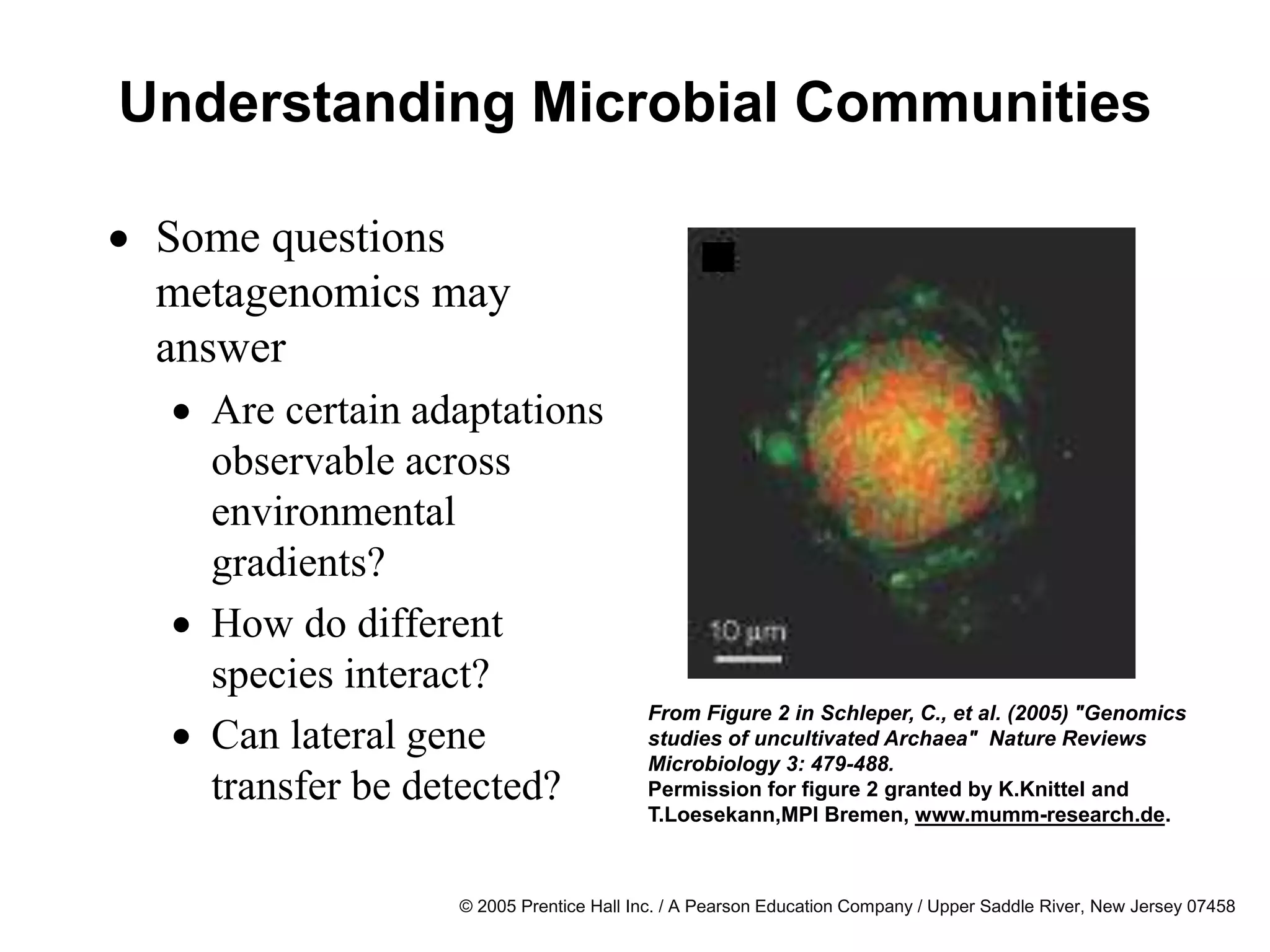
Understanding Microbial Communities
 Some questions
metagenomics may
answer
 Are certain adaptations
observable across
environmental
gradients?
 How do different
species interact?
 Can lateral gene
transfer be detected?
From Figure 2 in Schleper, C., et al. (2005) "Genomics
studies of uncultivated Archaea" Nature Reviews
Microbiology 3: 479-488.
Permission for figure 2 granted by K.Knittel and
T.Loesekann,MPI Bremen, www.mumm-research.de.
© 2005 Prentice Hall Inc. / A Pearson Education Company / Upper Saddle River, New Jersey 07458
Applications
 $2.3 billion in sales of industrial enzymes in
2003
 Discovery of novel enzymes and catalysts with
industrial uses by screening thousands of
microbial species simultaneously
 Look for pharmacologically interesting genes
(e.g. antibiotics) that exist in organisms that
cannot be cultured
© 2005 Prentice Hall Inc. / A Pearson Education Company / Upper Saddle River, New Jersey 07458
Caveats
 Problems with DNA purification
 Sample contamination
 Issues with sequencing
 Immensity of metagenome (gigabases)
 Errors in assembly due to inter-species
similarities
 Difficulties in sequencing less well-represented
genomes

Metagenomics analysis

  • 1.
    Presented by G.VijayalakshmiB.Sc.,M.Sc., 20PY10 Ayya Nadar Janaki Ammal college Sivakasi © 2005 Prentice Hall Inc. / A Pearson Education Company / Upper Saddle River, New Jersey 07458
  • 2.
    © 2005 PrenticeHall Inc. / A Pearson Education Company / Upper Saddle River, New Jersey 07458 What is Metagenomics?  Traditional microbial genomics  Sequence the genome of one organism at a time  Use cultures to isolate microbe of interest  Metagenomics  Extract sequence data from microbial communities as they exist in nature  Bypass the need for culture techniques  Sequence all DNA in sample  Select DNA based on universal sequences
  • 3.
    © 2005 PrenticeHall Inc. / A Pearson Education Company / Upper Saddle River, New Jersey 07458 Techniques in Metagenomics  Isolate DNA  Depends on sample type  Clone DNA  Insert into plasmid  Develop sample library  Screen or sequence From Figure 2 in Daniel, R. (2005) "The Metagenomics of Soil" Nature Reviews Microbiology 3: 470-478.
  • 4.
    © 2005 PrenticeHall Inc. / A Pearson Education Company / Upper Saddle River, New Jersey 07458 Analysis of Metagenomics Data  Metagenomes are big  Soil has as many as 40,000 individual microbial species  Soil metagenome orders of magnitude bigger than human genome  Analyzing the metagenome  Screens  Phylogenetic studies  Sequencing uncultivated organisms  Studying metagenome under different conditions
  • 5.
    © 2005 PrenticeHall Inc. / A Pearson Education Company / Upper Saddle River, New Jersey 07458 Understanding Microbial Communities  Some questions metagenomics may answer  Are certain adaptations observable across environmental gradients?  How do different species interact?  Can lateral gene transfer be detected? From Figure 2 in Schleper, C., et al. (2005) "Genomics studies of uncultivated Archaea" Nature Reviews Microbiology 3: 479-488. Permission for figure 2 granted by K.Knittel and T.Loesekann,MPI Bremen, www.mumm-research.de.
  • 6.
    © 2005 PrenticeHall Inc. / A Pearson Education Company / Upper Saddle River, New Jersey 07458 Applications  $2.3 billion in sales of industrial enzymes in 2003  Discovery of novel enzymes and catalysts with industrial uses by screening thousands of microbial species simultaneously  Look for pharmacologically interesting genes (e.g. antibiotics) that exist in organisms that cannot be cultured
  • 7.
    © 2005 PrenticeHall Inc. / A Pearson Education Company / Upper Saddle River, New Jersey 07458 Caveats  Problems with DNA purification  Sample contamination  Issues with sequencing  Immensity of metagenome (gigabases)  Errors in assembly due to inter-species similarities  Difficulties in sequencing less well-represented genomes