MetaProgramming With Groovy
Agenda
What is MetaProgramming
MetaProgramming in Groovy
Simple Demo
Objects In Groovy
MOP Method Injection
MOP Method Synthesis
Method Mixins
What is MetaProgramming
From Wikipedia:
Metaprogramming is the writing of computer programs that
write or manipulate other programs (or themselves) as their
data.
“Writing code that writes code”
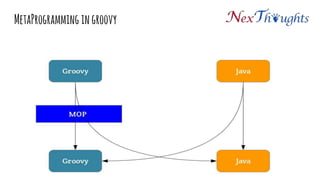
MetaProgramming in groovy
● Groovy provides this capability through the Meta-Object Protocol
(MOP).
● We can use MOP to invoke methods dynamically and also synthesize
classes and methods on the fly
MetaProgramming in groovy
In Groovy Language, every object has an object of MetaClass class with name
metaClass. This metaClass object is responsible for holding all the information
related to that object. Whenever you perform any operation on that object,
Groovy’s dispatch mechanism routes the call through that Metaclass
object(metaClass). So if you want to change the behaviour of any object/class,
you will have to alter the MetaClass object attached to that class/object, and it will
alter the behaviour of that class/object at run time.
Metaprogramming is to extend the syntax and vocabulary of program at runtime
as we please dynamically that is exactly what metaprogramming really is all about
Gradle and grails are great example of metaprogramming in groovy
Demo of MetaProgramming
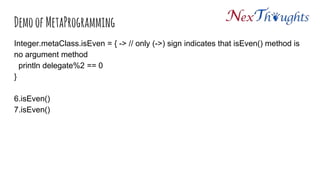
Integer.metaClass.isEven = { -> // only (->) sign indicates that isEven() method is
no argument method
println delegate%2 == 0
}
6.isEven()
7.isEven()
Demo of MetaProgramming
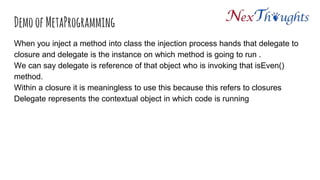
When you inject a method into class the injection process hands that delegate to
closure and delegate is the instance on which method is going to run .
We can say delegate is reference of that object who is invoking that isEven()
method.
Within a closure it is meaningless to use this because this refers to closures
Delegate represents the contextual object in which code is running
MetaProgramming in groovy
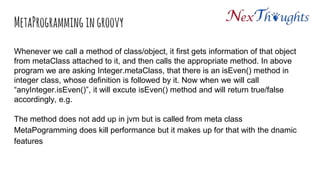
Whenever we call a method of class/object, it first gets information of that object
from metaClass attached to it, and then calls the appropriate method. In above
program we are asking Integer.metaClass, that there is an isEven() method in
integer class, whose definition is followed by it. Now when we will call
“anyInteger.isEven()”, it will excute isEven() method and will return true/false
accordingly, e.g.
The method does not add up in jvm but is called from meta class
MetaPogramming does kill performance but it makes up for that with the dnamic
features
Objects in Groovy
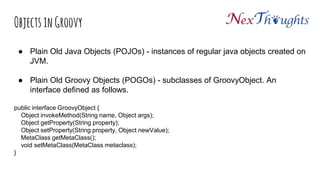
● Plain Old Java Objects (POJOs) - instances of regular java objects created on
JVM.
● Plain Old Groovy Objects (POGOs) - subclasses of GroovyObject. An
interface defined as follows.
public interface GroovyObject {
Object invokeMethod(String name, Object args);
Object getProperty(String property);
Object setProperty(String property, Object newValue);
MetaClass getMetaClass();
void setMetaClass(MetaClass metaclass);
}
Objects in Groovy
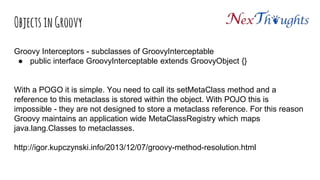
Groovy Interceptors - subclasses of GroovyInterceptable
● public interface GroovyInterceptable extends GroovyObject {}
With a POGO it is simple. You need to call its setMetaClass method and a
reference to this metaclass is stored within the object. With POJO this is
impossible - they are not designed to store a metaclass reference. For this reason
Groovy maintains an application wide MetaClassRegistry which maps
java.lang.Classes to metaclasses.
http://igor.kupczynski.info/2013/12/07/groovy-method-resolution.html
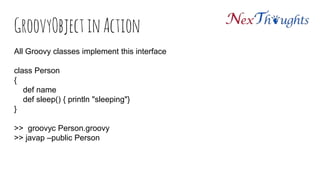
GroovyObject in Action
All Groovy classes implement this interface
class Person
{
def name
def sleep() { println "sleeping"}
}
>> groovyc Person.groovy
>> javap –public Person
Intercepting methods using MetaClass
● Groovy maintains a meta class of type MetaClass for each class.
● If we can't modify the class source code or if it's a Java class we can
modify the meta-class.
● We can intercept methods by implementing the invokeMethod()
method on the MetaClass.
Demo Of Invoke Method
This demo shows the working of invoke Method which is quite similar of how after
before and around advices work
MOP Method Injection
In Groovy we can “open” a class at any time.
 Method Injection at code-writing time, we know the names of
methods we want to add.
Different techniques:
● MetaClass
● Categories
● Extensions
● Mixins
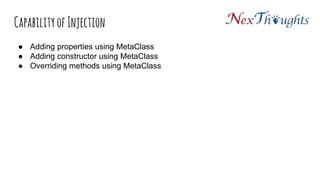
Capability of Injection
● Adding properties using MetaClass
● Adding constructor using MetaClass
● Overriding methods using MetaClass
}
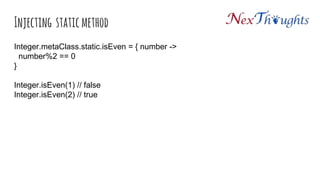
Injecting static method
Integer.metaClass.static.isEven = { number ->
number%2 == 0
}
Integer.isEven(1) // false
Integer.isEven(2) // true
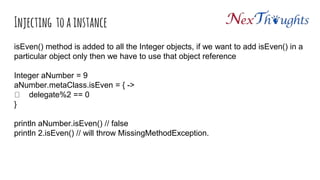
Injecting to a instance
isEven() method is added to all the Integer objects, if we want to add isEven() in a
particular object only then we have to use that object reference
Integer aNumber = 9
aNumber.metaClass.isEven = { ->
delegate%2 == 0
}
println aNumber.isEven() // false
println 2.isEven() // will throw MissingMethodException.
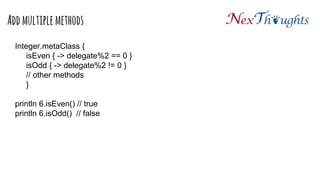
Integer.metaClass {
isEven { -> delegate%2 == 0 }
isOdd { -> delegate%2 != 0 }
// other methods
}
println 6.isEven() // true
println 6.isOdd() // false
Add multiple methods
MOP Method Synthesis
● Dynamically figure out the behaviour for methods upon invocation.
● A synthesized method may not exist as a separate method until we
call it.
● invokeMethod, methodMissing and propertyMissing.
● “Intercept, Cache, Invoke” pattern.
Demo of MethodMissing
Method Mixins
● Inject methods from other types
● Works on classes and interfaces
● Doesn’t not work on instances
● Easier to use than Categories
Demo of Method Mixins
Applications
● Dynamic finders
● Builders
● Custom DSL
● Dependency Injection
● Method injection
● Interceptors
● Generate mock objects for unit testing
MetaClasses in groovy
MetaClassImpl: Default meta class, it's used in the vast majority of
case.
● ExpandoMetaClass: allow the addition or replacement of methods,properties
and constructors on the fly.
● ProxyMetaClass: Can decorate a meta class with interceptioncapabilities.
● Other meta classes used internally and for testing.
Questions
References
http://groovy-lang.org/metaprogramming.html
http://igor.kupczynski.info/2013/12/07/groovy-method-resolution.html
http://www.slideshare.net/zenMonkey/metaprogramming-techniques-in-groovy-
and-grails
https://www.youtube.com/watch?v=UJhlp5P7Ec0
http://www.slideshare.net/ilopmar/metaprogramming-with-groovy
Thank You
Presented By:- Chetan Khare
For demo project please visit https://github.com/NexThoughts/groovy-
meta-programming

Meta Programming in Groovy

  • 1.
  • 2.
    Agenda What is MetaProgramming MetaProgrammingin Groovy Simple Demo Objects In Groovy MOP Method Injection MOP Method Synthesis Method Mixins
  • 3.
    What is MetaProgramming FromWikipedia: Metaprogramming is the writing of computer programs that write or manipulate other programs (or themselves) as their data. “Writing code that writes code”
  • 4.
    MetaProgramming in groovy ●Groovy provides this capability through the Meta-Object Protocol (MOP). ● We can use MOP to invoke methods dynamically and also synthesize classes and methods on the fly
  • 5.
  • 6.
    MetaProgramming in groovy InGroovy Language, every object has an object of MetaClass class with name metaClass. This metaClass object is responsible for holding all the information related to that object. Whenever you perform any operation on that object, Groovy’s dispatch mechanism routes the call through that Metaclass object(metaClass). So if you want to change the behaviour of any object/class, you will have to alter the MetaClass object attached to that class/object, and it will alter the behaviour of that class/object at run time. Metaprogramming is to extend the syntax and vocabulary of program at runtime as we please dynamically that is exactly what metaprogramming really is all about Gradle and grails are great example of metaprogramming in groovy
  • 7.
    Demo of MetaProgramming Integer.metaClass.isEven= { -> // only (->) sign indicates that isEven() method is no argument method println delegate%2 == 0 } 6.isEven() 7.isEven()
  • 8.
    Demo of MetaProgramming Whenyou inject a method into class the injection process hands that delegate to closure and delegate is the instance on which method is going to run . We can say delegate is reference of that object who is invoking that isEven() method. Within a closure it is meaningless to use this because this refers to closures Delegate represents the contextual object in which code is running
  • 9.
    MetaProgramming in groovy Wheneverwe call a method of class/object, it first gets information of that object from metaClass attached to it, and then calls the appropriate method. In above program we are asking Integer.metaClass, that there is an isEven() method in integer class, whose definition is followed by it. Now when we will call “anyInteger.isEven()”, it will excute isEven() method and will return true/false accordingly, e.g. The method does not add up in jvm but is called from meta class MetaPogramming does kill performance but it makes up for that with the dnamic features
  • 10.
    Objects in Groovy ●Plain Old Java Objects (POJOs) - instances of regular java objects created on JVM. ● Plain Old Groovy Objects (POGOs) - subclasses of GroovyObject. An interface defined as follows. public interface GroovyObject { Object invokeMethod(String name, Object args); Object getProperty(String property); Object setProperty(String property, Object newValue); MetaClass getMetaClass(); void setMetaClass(MetaClass metaclass); }
  • 11.
    Objects in Groovy GroovyInterceptors - subclasses of GroovyInterceptable ● public interface GroovyInterceptable extends GroovyObject {} With a POGO it is simple. You need to call its setMetaClass method and a reference to this metaclass is stored within the object. With POJO this is impossible - they are not designed to store a metaclass reference. For this reason Groovy maintains an application wide MetaClassRegistry which maps java.lang.Classes to metaclasses. http://igor.kupczynski.info/2013/12/07/groovy-method-resolution.html
  • 12.
    GroovyObject in Action AllGroovy classes implement this interface class Person { def name def sleep() { println "sleeping"} } >> groovyc Person.groovy >> javap –public Person
  • 13.
    Intercepting methods usingMetaClass ● Groovy maintains a meta class of type MetaClass for each class. ● If we can't modify the class source code or if it's a Java class we can modify the meta-class. ● We can intercept methods by implementing the invokeMethod() method on the MetaClass.
  • 14.
    Demo Of InvokeMethod This demo shows the working of invoke Method which is quite similar of how after before and around advices work
  • 15.
    MOP Method Injection InGroovy we can “open” a class at any time.  Method Injection at code-writing time, we know the names of methods we want to add. Different techniques: ● MetaClass ● Categories ● Extensions ● Mixins
  • 16.
    Capability of Injection ●Adding properties using MetaClass ● Adding constructor using MetaClass ● Overriding methods using MetaClass }
  • 17.
    Injecting static method Integer.metaClass.static.isEven= { number -> number%2 == 0 } Integer.isEven(1) // false Integer.isEven(2) // true
  • 18.
    Injecting to ainstance isEven() method is added to all the Integer objects, if we want to add isEven() in a particular object only then we have to use that object reference Integer aNumber = 9 aNumber.metaClass.isEven = { -> delegate%2 == 0 } println aNumber.isEven() // false println 2.isEven() // will throw MissingMethodException.
  • 19.
    Integer.metaClass { isEven {-> delegate%2 == 0 } isOdd { -> delegate%2 != 0 } // other methods } println 6.isEven() // true println 6.isOdd() // false Add multiple methods
  • 20.
    MOP Method Synthesis ●Dynamically figure out the behaviour for methods upon invocation. ● A synthesized method may not exist as a separate method until we call it. ● invokeMethod, methodMissing and propertyMissing. ● “Intercept, Cache, Invoke” pattern.
  • 21.
  • 22.
    Method Mixins ● Injectmethods from other types ● Works on classes and interfaces ● Doesn’t not work on instances ● Easier to use than Categories
  • 23.
  • 24.
    Applications ● Dynamic finders ●Builders ● Custom DSL ● Dependency Injection ● Method injection ● Interceptors ● Generate mock objects for unit testing
  • 25.
    MetaClasses in groovy MetaClassImpl:Default meta class, it's used in the vast majority of case. ● ExpandoMetaClass: allow the addition or replacement of methods,properties and constructors on the fly. ● ProxyMetaClass: Can decorate a meta class with interceptioncapabilities. ● Other meta classes used internally and for testing.
  • 26.
  • 27.
  • 28.
    Thank You Presented By:-Chetan Khare For demo project please visit https://github.com/NexThoughts/groovy- meta-programming