Wardrobe 
{ 
Style Best for Success
What to Wear 
My Style 
What are the Parts of my Wardrobe? 
How use my Wardrobe Parts Properly? 
Choosing the Right Piece 
Good Choice, Good Buy 
 Bling it On! 
Dress Up or Down 
Formal vs. Informal Wear 
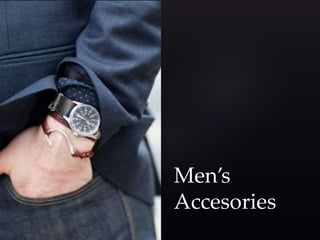
 Men’s Accessories
Although style is something 
personal and no one should tell 
you how to dress, there are 
certain rules of conventions that 
must be followed in order to 
mix in society.
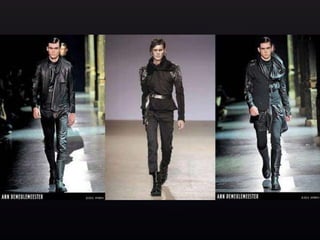
“Powerful Men” have 
“Signature Looks” – their own 
individual style.
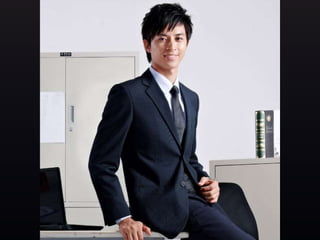
When you are dressing, be sure 
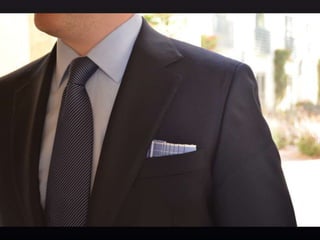
to consider the whole look
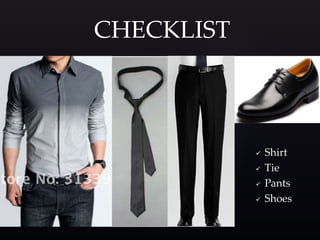
 Shirt 
 Tie 
 Pants 
 Shoes 
CHECKLIST
Styling is having a professional 
over all effect.
What to wear?
In this age of hiring and 
promoting, some managers are 
making decisions on people in the 
first seconds of a meeting.
“When you dress appropriately, 
people know that you know the 
rules. Dressing well earns people’s 
respect more than you realize.”
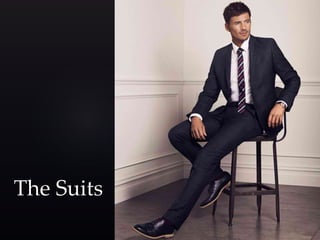
The Suits
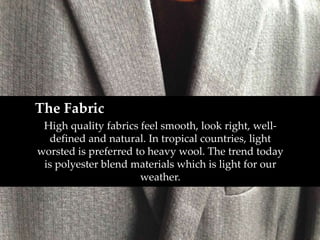
The Fabric 
High quality fabrics feel smooth, look right, well-defined 
and natural. In tropical countries, light 
worsted is preferred to heavy wool. The trend today 
is polyester blend materials which is light for our 
weather.
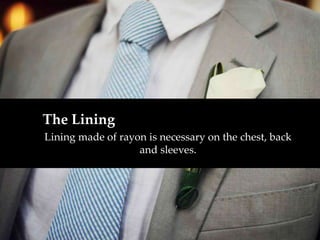
The Lining 
Lining made of rayon is necessary on the chest, back 
and sleeves.
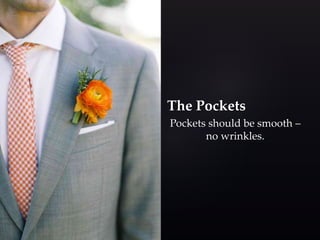
The Pockets 
Pockets should be smooth – 
no wrinkles.
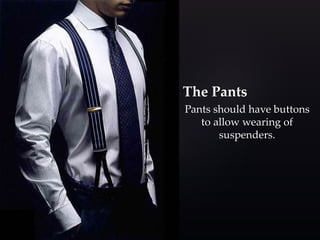
The Pants 
Pants should have buttons 
to allow wearing of 
suspenders.
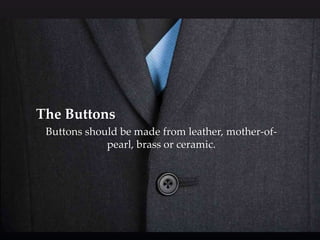
The Buttons 
Buttons should be made from leather, mother-of-pearl, 
brass or ceramic.
CHECKLIST: The Way to 
the Right Suit
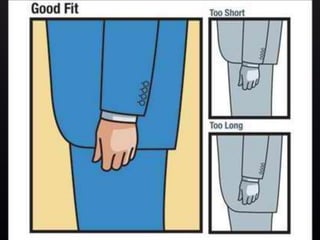
1. Coat Length 
the bottom of the coat should be long 
enough to cover the seat of your pants. 
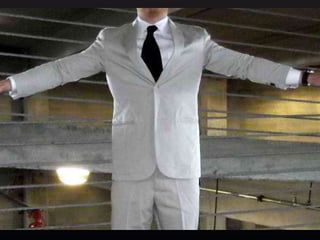
The top bottom should sit just below 
your waist.
2. Sleeves 
the shirt’s sleeve cuffs ending at your 
wrist bone but extend from your jacket 
sleeve by about ½ inch. This is important 
if you are wearing cuff links.
3. Collar 
the back of your coat collar should 
rest about ½ inch below the back of the 
shirt collar.
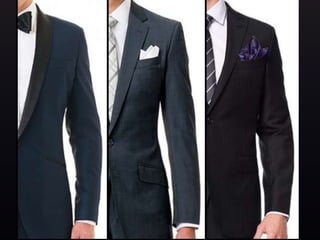
4. Lapels 
should not extend no more than 
halfway to the shoulder.
5. Shoulders 
padding on the shoulders go in and 
out of style so just stay where it is 
comfortable for your size and shape.
6. Armholes 
be sure that they are cut high enough.
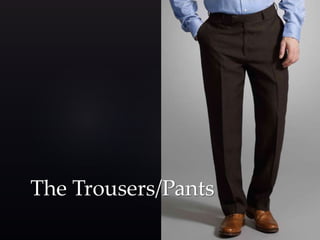
The Trousers/Pants
The Waist 
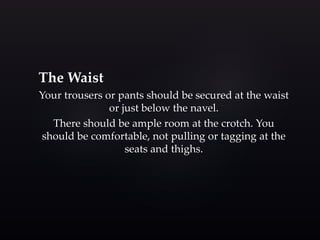
Your trousers or pants should be secured at the waist 
or just below the navel. 
There should be ample room at the crotch. You 
should be comfortable, not pulling or tagging at the 
seats and thighs.
The Length 
They should be long enough so that the crease is 
about 4 inches above the top of the shoes and ½ inch 
above the shoe’s heels.
Caring for Your Suit: 
Jacket and Pants
1. Do not wear your suit on 2 consecutive 
days. Let it rest. 
2. Brush – give it a quick brushing to take 
out the lint and dust. 
3. Hang properly – Before hanging, 
empty the pockets and fasten buttons. 
Hang the pants upside down by the 
cuffs to prevent creases. 
4. Avoid dry cleaning often. Wash by 
hand and steam cleaned every 10 
usage.
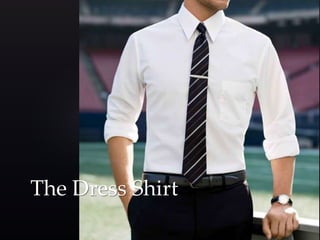
The Dress Shirt
A shirt with a crisp well-shaped 
collar and material does not 
wrinkle shows the world that 
your good taste does not end 
with your suit.
When buying a shirt, pay special 
attention to the two most noticed 
features – the shape and the size of the 
collar and the material.
Keep your collar point 3 inches long 
and the width of the spread from 
being too narrow or too wide.
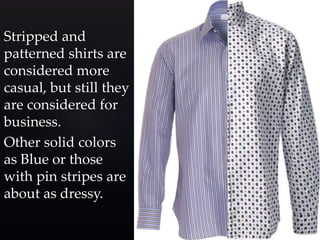
Stripped and 
patterned shirts are 
considered more 
casual, but still they 
are considered for 
business. 
Other solid colors 
as Blue or those 
with pin stripes are 
about as dressy.
It is better to select sleeves of a longer 
size because shirts shrink after 3 
washes.
The shirt should be long enough to 
allow movement and cuff snug enough 
to keep it at the wrist. 
The shirt-tail hem should reach to your 
crotch or it may pull free from your 
pants when you sit or bend over.
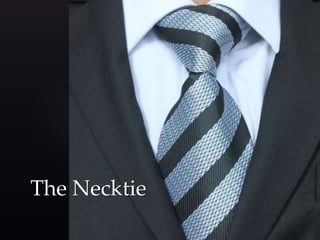
The Necktie
The necktie is like the first violin in an 
orchestra: it occupies the center stage, 
and when a mistake is made, it is 
noticed. So select you ties with care.
It allows you to express your 
personality through indulgence in 
sumptuous hues and designs in an 
otherwise staid business wardrobe. 
Wear the tie as it meant to be worn: as a 
sort of personal signature.
Ties offer almost unlimited freedom for 
self-expression. In fact, there is a tie to 
match the subtlest nuance of one’s 
mood. In fact, there is a tie that matches 
the subtlest nuance of one’s mood.
The trick is to make certain that your 
tie’s “statement” not only reflects your 
taste, but is also appropriate to the 
office, the wedding or whatever the 
occasion.
What’s best to know about 
Buying a Tie
Your tie should not only strike your 
fancy but should also be appropriate 
for the occasion at which you will be 
wearing it.
Your tie should coordinate well with 
our suits and jackets, therefore it 
should consider how the tie’s color, 
design, fabric and width would 
complement a specific suit or jacket.
Types of Ties
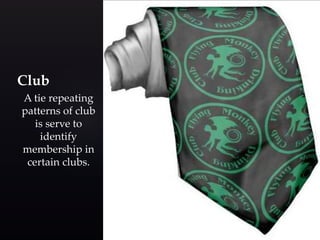
Club 
A tie repeating 
patterns of club 
is serve to 
identify 
membership in 
certain clubs.
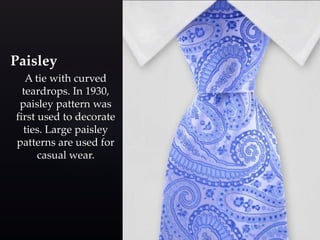
Paisley 
A tie with curved 
teardrops. In 1930, 
paisley pattern was 
first used to decorate 
ties. Large paisley 
patterns are used for 
casual wear.
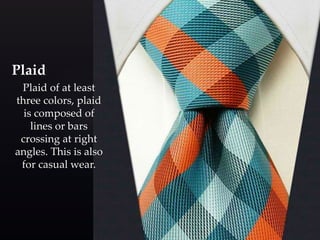
Plaid 
Plaid of at least 
three colors, plaid 
is composed of 
lines or bars 
crossing at right 
angles. This is also 
for casual wear.
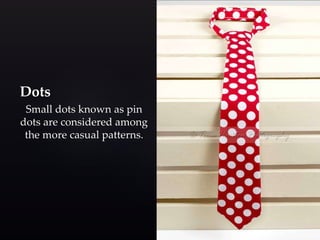
Dots 
Small dots known as pin 
dots are considered among 
the more casual patterns.
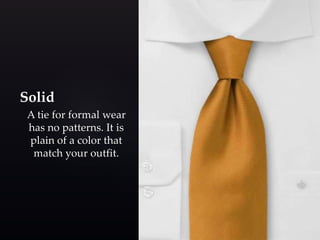
Solid 
A tie for formal wear 
has no patterns. It is 
plain of a color that 
match your outfit.
How to Tie a Knot
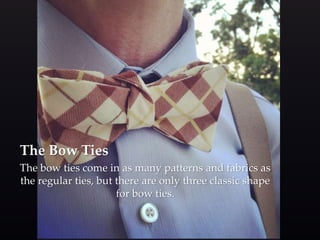
The Bow Ties 
The bow ties come in as many patterns and fabrics as 
the regular ties, but there are only three classic shape 
for bow ties.
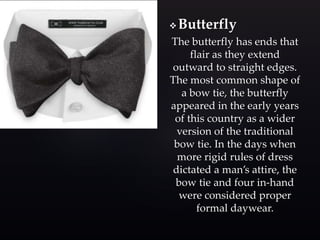
Butterfly 
The butterfly has ends that 
flair as they extend 
outward to straight edges. 
The most common shape of 
a bow tie, the butterfly 
appeared in the early years 
of this country as a wider 
version of the traditional 
bow tie. In the days when 
more rigid rules of dress 
dictated a man’s attire, the 
bow tie and four in-hand 
were considered proper 
formal daywear.
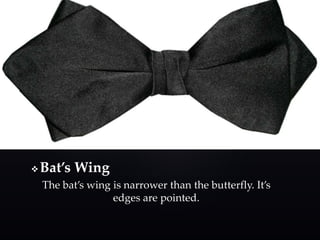
 Bat’s Wing 
The bat’s wing is narrower than the butterfly. It’s 
edges are pointed.
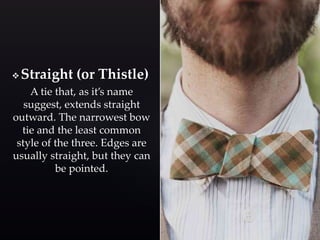
Straight (or Thistle) 
A tie that, as it’s name 
suggest, extends straight 
outward. The narrowest bow 
tie and the least common 
style of the three. Edges are 
usually straight, but they can 
be pointed.
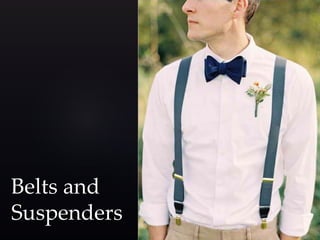
Belts and 
Suspenders
Never wear both a belt and 
suspenders at the same time. 
There is no need to. It’s 
redundant.
Early in the century, dressy 
trousers rarely had belt loops. 
Belts were worn by blue-collar 
workers while suspenders were 
worn with business and formal 
attire.
After World War I, belts gained 
in popularity and through the 
decades increasingly replaced 
suspenders.
In the 1980’s, suspenders 
became fashionable again 
especially on Wall Street, and 
the fashion spread through the 
United States. They have 
remained widely worn.
A belt is as appropriate as 
suspenders for wearing with a 
suit or sport jacket, although 
suspenders remain the only 
choice for black or white tie.
Aside from the advice that you 
should not wear belts and 
suspenders together, there are 
only two additional aesthetic 
points to keep in mind.
1. Never wear a belt if you wear a 
vest. 
A belt creates a bulge, and a buckle ruins the look of 
simplicity of a vest and trouser.
2. Wear a tie if you wear suspenders 
A four-in-hand provides aesthetic balance by adding 
to the vertical suspender lines, and helps create the 
dressier look that suspenders have come to convey.
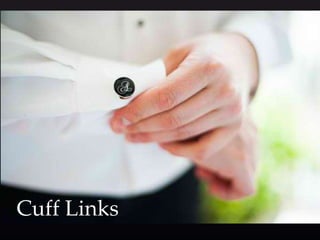
Cuff Links
When should a man wear cuff links? 
Since the 19th century, when cuff links became 
widely used, they have been commonly worn with 
business suits and with formal attire. However, with 
fashion trending more casual, some fashion experts 
suggest that cuff links may be appropriately worn 
with a sport jacket and even without a tie.
Cuff links were traditionally connected by a small 
chain, and were usually made of black onyx, a stone 
that remains a popular choice for daywear. Others 
are made of gold, silver, enamel or mother-of-pearl.
You must wear cuff links when you are wearing 
tuxedo, and you should wear them with matching 
shirt studs.
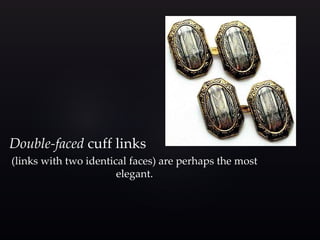
Double-faced cuff links 
(links with two identical faces) are perhaps the most 
elegant.
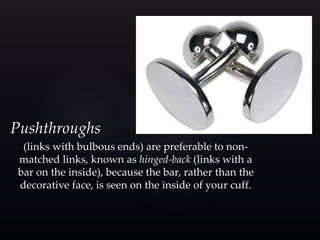
Pushthroughs 
(links with bulbous ends) are preferable to non-matched 
links, known as hinged-back (links with a 
bar on the inside), because the bar, rather than the 
decorative face, is seen on the inside of your cuff.
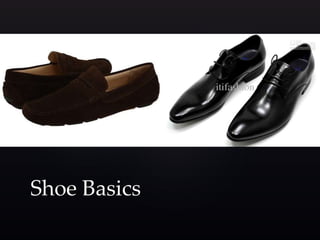
Shoe Basics
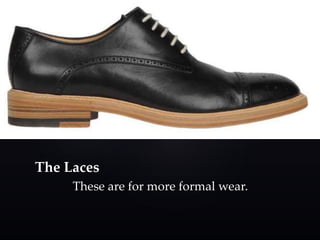
The Laces 
These are for more formal wear.
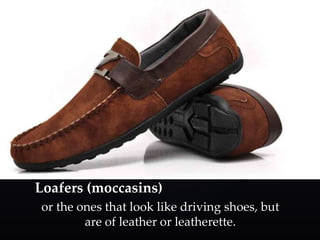
Loafers (moccasins) 
or the ones that look like driving shoes, but 
are of leather or leatherette.
Men’s 
Accesories
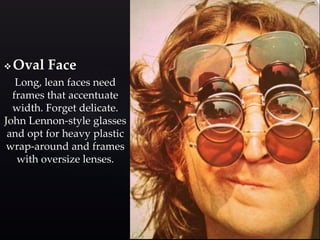
Oval Face 
Long, lean faces need 
frames that accentuate 
width. Forget delicate. 
John Lennon-style glasses 
and opt for heavy plastic 
wrap-around and frames 
with oversize lenses.
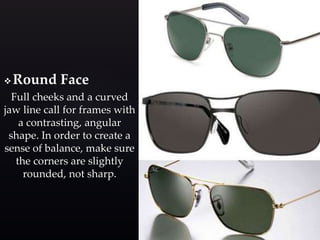
Round Face 
Full cheeks and a curved 
jaw line call for frames with 
a contrasting, angular 
shape. In order to create a 
sense of balance, make sure 
the corners are slightly 
rounded, not sharp.
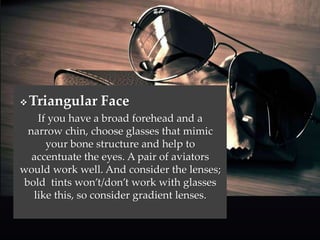
Triangular Face 
If you have a broad forehead and a 
narrow chin, choose glasses that mimic 
your bone structure and help to 
accentuate the eyes. A pair of aviators 
would work well. And consider the lenses; 
bold tints won’t/don’t work with glasses 
like this, so consider gradient lenses.
Points to Remember
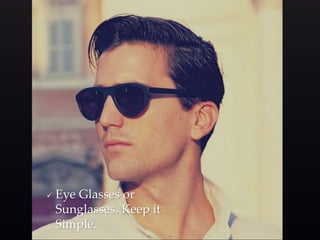
 Eye Glasses or 
Sunglasses. Keep it 
Simple.
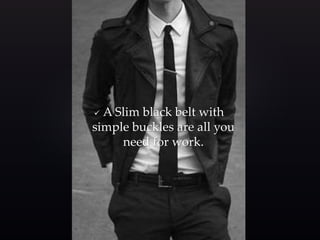
 A Slim black belt with 
simple buckles are all you 
need for work.
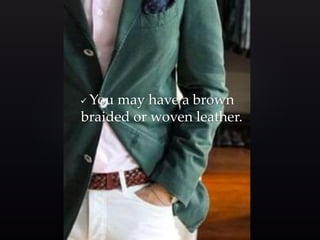
You may have a brown 
braided or woven leather.
 Cloth belts are worn with khakis.
 Watches – metal ones for work and leather strapped ones for 
evening.
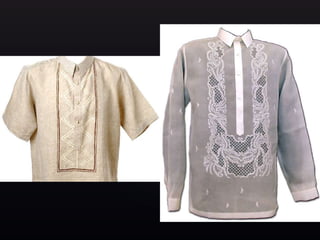
 Cuff links are used for more formal barongs or shirts. There are 
different ones in department stores, choose simple ones
 Bags, necklaces and earrings are not for work. A briefcase is 
necessary to hold papers. The different types are the leather or 
canvas carryall, work bags that are sturdier (for executives) and 
so weekend bag.
 Backpacks are now in vogue and the rolling bag for travelling.
 Wallets, are billfold wallets and the travelling wallets to hold 
passports and tickets, are available at department stores.

Men's Wardrobe

  • 1.
    Wardrobe { StyleBest for Success
  • 2.
    What to Wear My Style What are the Parts of my Wardrobe? How use my Wardrobe Parts Properly? Choosing the Right Piece Good Choice, Good Buy  Bling it On! Dress Up or Down Formal vs. Informal Wear  Men’s Accessories
  • 5.
    Although style issomething personal and no one should tell you how to dress, there are certain rules of conventions that must be followed in order to mix in society.
  • 8.
    “Powerful Men” have “Signature Looks” – their own individual style.
  • 9.
    When you aredressing, be sure to consider the whole look
  • 10.
     Shirt Tie  Pants  Shoes CHECKLIST
  • 11.
    Styling is havinga professional over all effect.
  • 15.
  • 16.
    In this ageof hiring and promoting, some managers are making decisions on people in the first seconds of a meeting.
  • 19.
    “When you dressappropriately, people know that you know the rules. Dressing well earns people’s respect more than you realize.”
  • 20.
  • 21.
    The Fabric Highquality fabrics feel smooth, look right, well-defined and natural. In tropical countries, light worsted is preferred to heavy wool. The trend today is polyester blend materials which is light for our weather.
  • 22.
    The Lining Liningmade of rayon is necessary on the chest, back and sleeves.
  • 23.
    The Pockets Pocketsshould be smooth – no wrinkles.
  • 24.
    The Pants Pantsshould have buttons to allow wearing of suspenders.
  • 25.
    The Buttons Buttonsshould be made from leather, mother-of-pearl, brass or ceramic.
  • 26.
    CHECKLIST: The Wayto the Right Suit
  • 27.
    1. Coat Length the bottom of the coat should be long enough to cover the seat of your pants. The top bottom should sit just below your waist.
  • 29.
    2. Sleeves theshirt’s sleeve cuffs ending at your wrist bone but extend from your jacket sleeve by about ½ inch. This is important if you are wearing cuff links.
  • 30.
    3. Collar theback of your coat collar should rest about ½ inch below the back of the shirt collar.
  • 31.
    4. Lapels shouldnot extend no more than halfway to the shoulder.
  • 33.
    5. Shoulders paddingon the shoulders go in and out of style so just stay where it is comfortable for your size and shape.
  • 35.
    6. Armholes besure that they are cut high enough.
  • 37.
  • 38.
    The Waist Yourtrousers or pants should be secured at the waist or just below the navel. There should be ample room at the crotch. You should be comfortable, not pulling or tagging at the seats and thighs.
  • 39.
    The Length Theyshould be long enough so that the crease is about 4 inches above the top of the shoes and ½ inch above the shoe’s heels.
  • 40.
    Caring for YourSuit: Jacket and Pants
  • 41.
    1. Do notwear your suit on 2 consecutive days. Let it rest. 2. Brush – give it a quick brushing to take out the lint and dust. 3. Hang properly – Before hanging, empty the pockets and fasten buttons. Hang the pants upside down by the cuffs to prevent creases. 4. Avoid dry cleaning often. Wash by hand and steam cleaned every 10 usage.
  • 42.
  • 43.
    A shirt witha crisp well-shaped collar and material does not wrinkle shows the world that your good taste does not end with your suit.
  • 44.
    When buying ashirt, pay special attention to the two most noticed features – the shape and the size of the collar and the material.
  • 45.
    Keep your collarpoint 3 inches long and the width of the spread from being too narrow or too wide.
  • 46.
    Stripped and patternedshirts are considered more casual, but still they are considered for business. Other solid colors as Blue or those with pin stripes are about as dressy.
  • 47.
    It is betterto select sleeves of a longer size because shirts shrink after 3 washes.
  • 48.
    The shirt shouldbe long enough to allow movement and cuff snug enough to keep it at the wrist. The shirt-tail hem should reach to your crotch or it may pull free from your pants when you sit or bend over.
  • 49.
  • 50.
    The necktie islike the first violin in an orchestra: it occupies the center stage, and when a mistake is made, it is noticed. So select you ties with care.
  • 51.
    It allows youto express your personality through indulgence in sumptuous hues and designs in an otherwise staid business wardrobe. Wear the tie as it meant to be worn: as a sort of personal signature.
  • 52.
    Ties offer almostunlimited freedom for self-expression. In fact, there is a tie to match the subtlest nuance of one’s mood. In fact, there is a tie that matches the subtlest nuance of one’s mood.
  • 53.
    The trick isto make certain that your tie’s “statement” not only reflects your taste, but is also appropriate to the office, the wedding or whatever the occasion.
  • 54.
    What’s best toknow about Buying a Tie
  • 55.
    Your tie shouldnot only strike your fancy but should also be appropriate for the occasion at which you will be wearing it.
  • 56.
    Your tie shouldcoordinate well with our suits and jackets, therefore it should consider how the tie’s color, design, fabric and width would complement a specific suit or jacket.
  • 57.
  • 58.
    Club A tierepeating patterns of club is serve to identify membership in certain clubs.
  • 59.
    Paisley A tiewith curved teardrops. In 1930, paisley pattern was first used to decorate ties. Large paisley patterns are used for casual wear.
  • 60.
    Plaid Plaid ofat least three colors, plaid is composed of lines or bars crossing at right angles. This is also for casual wear.
  • 61.
    Dots Small dotsknown as pin dots are considered among the more casual patterns.
  • 62.
    Solid A tiefor formal wear has no patterns. It is plain of a color that match your outfit.
  • 63.
    How to Tiea Knot
  • 64.
    The Bow Ties The bow ties come in as many patterns and fabrics as the regular ties, but there are only three classic shape for bow ties.
  • 65.
    Butterfly The butterflyhas ends that flair as they extend outward to straight edges. The most common shape of a bow tie, the butterfly appeared in the early years of this country as a wider version of the traditional bow tie. In the days when more rigid rules of dress dictated a man’s attire, the bow tie and four in-hand were considered proper formal daywear.
  • 66.
     Bat’s Wing The bat’s wing is narrower than the butterfly. It’s edges are pointed.
  • 67.
    Straight (or Thistle) A tie that, as it’s name suggest, extends straight outward. The narrowest bow tie and the least common style of the three. Edges are usually straight, but they can be pointed.
  • 68.
  • 69.
    Never wear botha belt and suspenders at the same time. There is no need to. It’s redundant.
  • 70.
    Early in thecentury, dressy trousers rarely had belt loops. Belts were worn by blue-collar workers while suspenders were worn with business and formal attire.
  • 71.
    After World WarI, belts gained in popularity and through the decades increasingly replaced suspenders.
  • 72.
    In the 1980’s,suspenders became fashionable again especially on Wall Street, and the fashion spread through the United States. They have remained widely worn.
  • 73.
    A belt isas appropriate as suspenders for wearing with a suit or sport jacket, although suspenders remain the only choice for black or white tie.
  • 74.
    Aside from theadvice that you should not wear belts and suspenders together, there are only two additional aesthetic points to keep in mind.
  • 75.
    1. Never weara belt if you wear a vest. A belt creates a bulge, and a buckle ruins the look of simplicity of a vest and trouser.
  • 76.
    2. Wear atie if you wear suspenders A four-in-hand provides aesthetic balance by adding to the vertical suspender lines, and helps create the dressier look that suspenders have come to convey.
  • 77.
  • 78.
    When should aman wear cuff links? Since the 19th century, when cuff links became widely used, they have been commonly worn with business suits and with formal attire. However, with fashion trending more casual, some fashion experts suggest that cuff links may be appropriately worn with a sport jacket and even without a tie.
  • 79.
    Cuff links weretraditionally connected by a small chain, and were usually made of black onyx, a stone that remains a popular choice for daywear. Others are made of gold, silver, enamel or mother-of-pearl.
  • 80.
    You must wearcuff links when you are wearing tuxedo, and you should wear them with matching shirt studs.
  • 81.
    Double-faced cuff links (links with two identical faces) are perhaps the most elegant.
  • 82.
    Pushthroughs (links withbulbous ends) are preferable to non-matched links, known as hinged-back (links with a bar on the inside), because the bar, rather than the decorative face, is seen on the inside of your cuff.
  • 83.
  • 84.
    The Laces Theseare for more formal wear.
  • 85.
    Loafers (moccasins) orthe ones that look like driving shoes, but are of leather or leatherette.
  • 86.
  • 87.
    Oval Face Long,lean faces need frames that accentuate width. Forget delicate. John Lennon-style glasses and opt for heavy plastic wrap-around and frames with oversize lenses.
  • 88.
    Round Face Fullcheeks and a curved jaw line call for frames with a contrasting, angular shape. In order to create a sense of balance, make sure the corners are slightly rounded, not sharp.
  • 89.
    Triangular Face Ifyou have a broad forehead and a narrow chin, choose glasses that mimic your bone structure and help to accentuate the eyes. A pair of aviators would work well. And consider the lenses; bold tints won’t/don’t work with glasses like this, so consider gradient lenses.
  • 90.
  • 91.
     Eye Glassesor Sunglasses. Keep it Simple.
  • 92.
     A Slimblack belt with simple buckles are all you need for work.
  • 93.
    You may havea brown braided or woven leather.
  • 94.
     Cloth beltsare worn with khakis.
  • 95.
     Watches –metal ones for work and leather strapped ones for evening.
  • 96.
     Cuff linksare used for more formal barongs or shirts. There are different ones in department stores, choose simple ones
  • 97.
     Bags, necklacesand earrings are not for work. A briefcase is necessary to hold papers. The different types are the leather or canvas carryall, work bags that are sturdier (for executives) and so weekend bag.
  • 98.
     Backpacks arenow in vogue and the rolling bag for travelling.
  • 99.
     Wallets, arebillfold wallets and the travelling wallets to hold passports and tickets, are available at department stores.

Editor's Notes

  • #3 Wear Properly at all times Develop your own style Identify the parts of a man’s wardrobe Use each part of a man’s clothing properly Choose the proper style of each piece of a man’s wardrobe. Choose, buy, each piece of clothing properly. Identify proper accessories Dress up or down Identify and choose men’s formal and informal wear Identify men’s accessories