http://www.iaeme.com/IJCET/index.asp 53 editor@iaeme.com
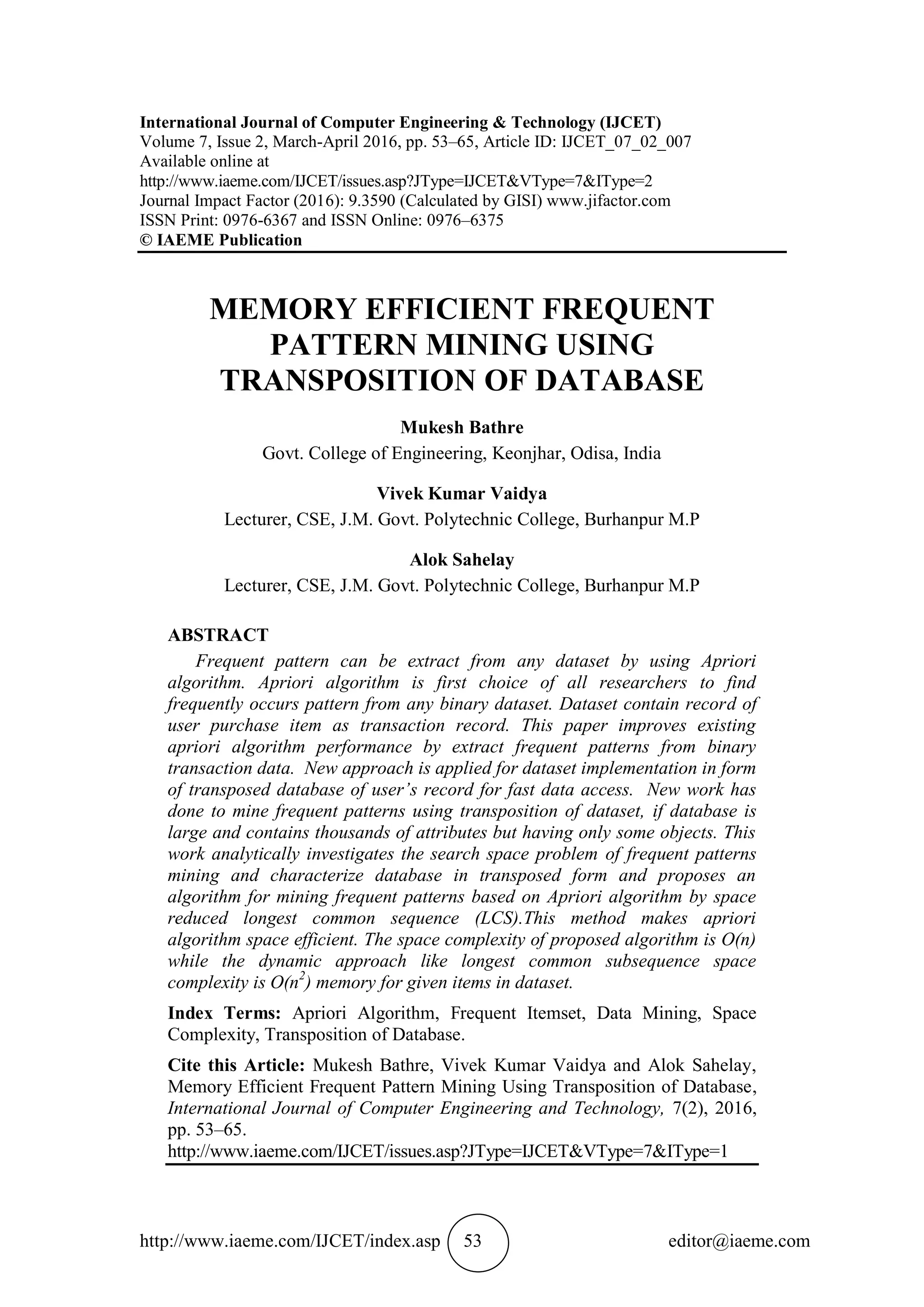
International Journal of Computer Engineering & Technology (IJCET)
Volume 7, Issue 2, March-April 2016, pp. 53–65, Article ID: IJCET_07_02_007
Available online at
http://www.iaeme.com/IJCET/issues.asp?JType=IJCET&VType=7&IType=2
Journal Impact Factor (2016): 9.3590 (Calculated by GISI) www.jifactor.com
ISSN Print: 0976-6367 and ISSN Online: 0976–6375
© IAEME Publication
MEMORY EFFICIENT FREQUENT
PATTERN MINING USING
TRANSPOSITION OF DATABASE
Mukesh Bathre
Govt. College of Engineering, Keonjhar, Odisa, India
Vivek Kumar Vaidya
Lecturer, CSE, J.M. Govt. Polytechnic College, Burhanpur M.P
Alok Sahelay
Lecturer, CSE, J.M. Govt. Polytechnic College, Burhanpur M.P
ABSTRACT
Frequent pattern can be extract from any dataset by using Apriori
algorithm. Apriori algorithm is first choice of all researchers to find
frequently occurs pattern from any binary dataset. Dataset contain record of
user purchase item as transaction record. This paper improves existing
apriori algorithm performance by extract frequent patterns from binary
transaction data. New approach is applied for dataset implementation in form
of transposed database of user’s record for fast data access. New work has
done to mine frequent patterns using transposition of dataset, if database is
large and contains thousands of attributes but having only some objects. This
work analytically investigates the search space problem of frequent patterns
mining and characterize database in transposed form and proposes an
algorithm for mining frequent patterns based on Apriori algorithm by space
reduced longest common sequence (LCS).This method makes apriori
algorithm space efficient. The space complexity of proposed algorithm is O(n)
while the dynamic approach like longest common subsequence space
complexity is O(n2
) memory for given items in dataset.
Index Terms: Apriori Algorithm, Frequent Itemset, Data Mining, Space
Complexity, Transposition of Database.
Cite this Article: Mukesh Bathre, Vivek Kumar Vaidya and Alok Sahelay,
Memory Efficient Frequent Pattern Mining Using Transposition of Database,
International Journal of Computer Engineering and Technology, 7(2), 2016,
pp. 53–65.
http://www.iaeme.com/IJCET/issues.asp?JType=IJCET&VType=7&IType=1
Mukesh Bathre, Vivek Kumar Vaidya and Alok Sahelay
http://www.iaeme.com/IJCET/index.asp 54 editor@iaeme.com
1. INTRODUCTION
Apriori is a classic algorithm for learning association rules. Apriori is designed to
operate on databases containing transactions in binary format. Many other techniques
are there to extract association rules from no transaction or no timestamps. Main work
of apriori algorithm is to find association rules between different data sets of itmes
this also known as “Market basket problem”. Each set of data has a number of items
and is called a transaction. The output of Apriori is sets of rules that tell us how often
items are contained in sets of data. Frequent item set mining and association rule
induction are powerful methods for so-called market basket analysis, which aims at
finding regularities in the shopping behavior of customers of supermarkets, mail-order
companies, online shops etc. With the induction of frequent item sets and association
rules one tries to find sets of products that are frequently bought together, so that from
the presence of certain products in a shopping cart one can infer (with a high
Probability) that certain other products are present. Such information, especially if
expressed in the form of rules, can often be used to increase the number of items sold,
for instance, by appropriately arranging the products on the shelves of a supermarket
or on the pages of a mail-order catalog (they may, for example, be placed adjacent to
each other in order to invite even more customers to buy them together) or by directly
suggesting items to a customer, which may be of interest for him/her.
2. RELATED WORKS
Determination of association rule mining, e-mail (emails about criminal activity) is
suspected. Negative emotion words betray theory, a new person pronoun, in addition
to simple words, the high-frequency words and special words were written in the body
is characterized by deceptive e-mail writing pre-processed. Terms of apriori algorithm
[1] is used to make. Data generated in the mail soon. It is used for automated analysis
and evaluation to identify criminal activities and the announcement. Apriori algorithm
for association rule mining, and all e-mail messages using the action verbs, past tense,
using futures and evaluated. It's an action verb, such kind of emails in the future tense
suffix and another with a message by e-mail if you are suspicious. Warning email to
"“kill and bomb” future tense of words such as "“will and shall," which refers to such
terms. Step number.
In order to classify the e-mail box, all HTML from the text element, header, body,
etc removed, before the words are stop words tokenizing. After separation of the
body, begins to move e-mail classification. Training data “Bomb/Blast/Kill " key and
" will/may " they, important that the class information, e-mails, a move
“attacked/terrorist” and tense “was” in them using apriori algorithm.. The training set
apriori algorithm to find the e-mail database of words frequently used in the mining
frequent item sets. Apriori algorithm for association rules and the rules used to set this
item as follows.
Tense=past, Attack= Y, Bomb =Y ->Email = Suspicious informative Email.
Tense=future, Attack= Y, Bomb =Y-> Email =Suspicious alert Email.
Tense=future, Attack= N, Bomb =N->Email =Normal Email.
An improved frequent pattern tree based on the technique named dynamic
frequent pattern tree is proposed by Gyorodi [2]. The new method is efficiently
applied on real world size database. A comparison between classical frequent pattern
mining algorithms that are candidate set generation, test and without candidate
generation is proposed in paper. Apriori algorithm, frequent pattern growth, dynamic
frequent pattern growth are compared and presented together. Apriori algorithm in
Memory Efficient Frequent Pattern Mining Using Transposition of Database
http://www.iaeme.com/IJCET/index.asp 55 editor@iaeme.com
used to rule mining in huge transaction database and Apriori algorithm is a bottom up
approach. Frequent pattern growth is used to novel, compact data structure, referred to
as frequent pattern tree, fp tree based ones are partition based, divide and conquer
methods.
Optimization of association rule mining and apriori algorithm Using Ant colony
optimization [3].This paper is on Apriori algorithm and association rule mining to
improved algorithm based on the Ant colony optimization algorithm. ACO was
introduced by dorigo and has evolved significantly in the last few years. Many
organizations have collected massive amount data. This data set is usually stored on
storage database systems. Two major problems arise in the analysis of the information
system. One is reducing unnecessary objects and attributes so as to get the minimum
subset of attributes ensuring a good approximation of classes and an acceptable
quality of classification. Another one is representing the information system as a
decision table which shows dependencies between the minimum subset of attributes
and particular class numbers without redundancy. In Apriori algorithm, is working
process explained in steps. Two step processes is used to find the frequent item set to
join and prune. ACO algorithm was inspired from natural behavior of ant colonies.
ACO is used to solve to numerous hard optimizations including the traveling
salesman problem. ACO system contains two rules .One is local pheromone update
rule, which is applied in constructing solution. Another one is global pheromone
update rule which is applied in ant construction.ACO algorithm includes two more
mechanisms, namely trail evaporation and optionally deamonactions.ACO algorithm
is used for the specific problem of minimizing the number of association rules.
Association rule mining template is guided from XML document. XML is used in all
areas of Internet application programming and is giving large amount of data encoded
in XML [4]. With the continuous growth in XML data sources, the ability to extract
knowledge from them for decision support becomes increasingly important and
desirable. Due to the inherent flexibilities of XML, in both structure and semantics,
mining knowledge in the XML Era is faced with more challenges than in the
traditional structured world. This paper is a practical model for mining association
rules from XML document.XML enabled association rule frame work that was
introduced by Feng.XML AR frame works better than simple structured tree. The
framework is flexible and powerful enough to represent simple and difficult
structured association rules in XML document. But the best level of XML document
model which is not yet implemented in has been proposed. The problem of mining
XML association rules from the content of XML documents is based on user provided
rule template. An implementation model is already introduced by Feng. practical
model consists of the following steps Filtering, Generating Virtual Transactions,
Database reverse engineering association rule mining [5] is based on.
Classification of the document database system could not be found in the poorly
written, or even a particularly difficult task. The concept design of database reverse
engineering to recover the database in an attempt to exit. Mining technique uses to
detect the concept plan proposing a strategy paper. They used the normal form.
Classical database is a valuable asset to the organization. New technologies were
developed in 1970 as a COBOL and the database, and mini - computer platforms, file
systems using older programming languages. Even some of the databases are outdated
concepts such as the hierarchical data model, designed, and maintained and adjusted
to serve the current needs of modern companies was difficult for them. Classical
databases, messaging systems and their structures are related to the contents of the
move and changing. This document is no longer in my approach to system design,
Mukesh Bathre, Vivek Kumar Vaidya and Alok Sahelay
http://www.iaeme.com/IJCET/index.asp 56 editor@iaeme.com
however, is hard to achieve; most companies in general are rising. Problems of
migrating legacy databases to retrieve and database structures, database reverse
engineering has been proposed. Reverse engineering process design and
manufacturing process from the first to explore the objective devices and other
hardware.
Generalized association rule mining based on tree structure. Into account [6] the
use of specific information useful knowledge than ordinary flat association rules
mining to detect this possibility. It employs a tree structure to compress the database
Fp-line method, based on the paradigm proposing to mine development. There are
two methods to the study of tree structure below and above are below. There are only
a few studies have given way to common rules. Even some of the SQL queries and
reports to the general association rule proposed parallel machine performance ratings.
Apriori algorithm is a level-wise approach. A frequent pattern mining paradigm in the
field of research has become a new trend.
Efficient association rules mining properties by using the apriori algorithm.
Apriori algorithm to obtain the means of association rules from the dataset. It's [7] the
case of a large dataset is a time consuming procedure apriori algorithm is an efficient
algorithm. Time changes many long-term activities to increase the number of paths
apriori and the proposed database. Disadvantages and apriori algorithm apriori
algorithm can improve performance; this paper describes the application properties.
Customers who buy products at the beginning of an association rule mining is market
basket analysis to find out how. Minimum support of all frequent items finding all
association rules at uvallatu.
1. 1. Find they considered the two-stage process. Enumeration of all frequent item sets
the size of the search space is 2n
.
2. 2. To create strong rules. Used to create an association rule that satisfies any of the
gate. Apriori and apriori algorithm using data mining tool and then running to write
pseudo code. Association rule mining is the limit. ARM algorithm encounters a
problem that does not return by the end user in a reasonable time. Activity in the
presence and absence of an item is the only database that tells us a lot of
shortcomings, and it is not efficient in the case of large dataset.ARM. The weight and
size can be removed using such properties. Some of the limitations associated with
large database apriori algorithm Searches. Its easy to implement using apriori exists.
Association rule mining as well as potential customers for commercial gain valuable
information, much improved by the use of such properties.
Association rule mining has wide applicability in many areas, efficient algorithm
as it is a time consuming algorithm in case of large dataset [7]. With the time a
number of changes are proposed in Apriori to enhance the performance in term of
time and number of database passes. This paper illustrates the apriori algorithm
disadvantages and utilization of attributes which can improve the efficiency of apriori
algorithm. Association rule mining is initially used for Market Basket Analysis to find
how items purchased by customers are related. The problem of finding association
rules can be stated as follows: Given a database of sales transactions, it is desirable to
discover the important associations among different items such the presence of some
items in a transaction will imply the presence of other items in the same transaction.
Discovering all association rules is considered as two-phase processes which are
Association rule mining efficiency can be improved by using attributes like profit,
quantity which will give the valuable information to the customer as well as the
business. Association rule mining has a wide range of applicability in many areas.
Memory Efficient Frequent Pattern Mining Using Transposition of Database
http://www.iaeme.com/IJCET/index.asp 57 editor@iaeme.com
3. TRANSPOSITION OF DATABASE
To avoid confusion between rows (or columns) of the original database and rows
(columns) of the “transposed” database, this work define a database as a relation
between original and transposed representations of a database in Table 3.1.
Table 1 Transposition of Database
Database D
Object Attribute Pattern
O1 a1a2a3
O2 a1a2a3
O3 a2a3a4
Transposed Database DT
Attribute Object Pattern
a1 O1O2
a2 O1O2O3
a3 O1O2O3
a4 O3
The attributes are A = {a1, a2, a3, a4} and the objects are O = {o1, o2, o3}. Here
use a string notation for object sets or itemsets, e.g., a1a3a4 denotes the itemset {a1,
a3, a4} and o2o3 denotes the object set {o2, o3}. This dataset is used in all the
examples between two sets: a set of attributes and a set of objects.
4. DYNAMIC APPROACH
The longest common subsequence problem is one of the common problems which can
be solved efficiently using dynamic programming. “The Longest common
subsequence problem is, this work are given two sequences X=<x1,x2----------xn>
and Y=<y1,y2---------ym> and wish to find a maximum length common subsequence
of X and Y” for example : if X=<A,B,C,B,D,A,B> and Y=<B,D,C,A,B,A> then The
sequence <B, C, B, A> longest common subsequence. Let us define C [i, j] to be the
length of an LCS of the sequences xi and yj. If either i=0 or j=0, one of the sequence
has length 0, so the LCS has length 0. The Optimal substructure of the LCS Problem
gives the recursive formula in equation-1.
4.1. DAPS and DFPMT Approach
The mining algorithm works over the entire database file, first transpose the database
and count the number of item and transaction string generated for each item. Sort the
item numbers. Now apply Apriori like Algorithm in which first now calculate
Mukesh Bathre, Vivek Kumar Vaidya and Alok Sahelay
http://www.iaeme.com/IJCET/index.asp 58 editor@iaeme.com
frequent pattern C1.it reduces un-frequent pattern and its transaction details also. For
each pass now apply following sequence of operation until condition occurred. First
generate the candidate pattern and prune by Apriori method. To count the support ,
instead of whole database for each pruned pattern now find longest common
subsequence and length of transaction string of pattern’s item and also stored new
pattern and its transaction string so that next iteration now trace above string. To find
longest common subsequence this work used dynamic programming approach which
faster than traditional approach. Write pruned pattern list with transaction string. So
that in next pass this work used this pattern list instead of all pattern list. An
advantage of this approach is in each iteration database filtering and reduces, so each
iteration is faster than previous iteration
4.2. DAPS Algorithm
1. Compute k-1 Subset of k-itemset
2. Generate Itemset Transition string from Filter Transposed Database
3. Computer LCS for each item in itemset using Transition string.
4. If length of LCS >∂then itemset is frequent.
4.3. DFPMT Algorithm (Dynamic Approach for Frequent Patterns Mining
Using
Transposition of Database)
5. Convert Database in Transpose Form DT
6. Compute F1 of all Frequent Items
7. C1:= DT
(Only Frequent Item row with Transition id string )
8. K: =2.
9. While Lk-1≠{ } do
10. Compute Ck of all candidate k-1 Itemsets
/* New Algorithm which prune and count support using LCS */
11. Compute Lk=DAPS (Ck)
12. K:=K+1
Back bone of this algorithm is finding LCS from dataset which is perform by
dynamic algorithm in above work proposed Heuristic space efficient algorithm But it
can also be thought of as a way of computing the entries in the array L. The recursive
algorithm controls what order this work fill them in, but this work get the same results
if now filled them in some other order. This work might as well use something
simpler, like a nested loop that visits the array systematically. The only thing have to
worry about is that when fill in a cell L[i,j], need to already know the values it
depends on, namely in this case L[i+1,j], L[i,j+1], and L[i+1,j+1]. For this reason
have to traverse the array backwards, from the last row working up to the first and
from the last column working up to the first. This is iterative (because it uses nested
loops instead of recursion) or bottom up (because the order fill in the array is from
smaller simpler sub problems to bigger more complicated ones).
Advantages of this method include the fact that iteration is usually faster than
recursion, this work don't need to initialize the matrix to all -1's, and this work save
three if statements per iteration since this work don't need to test whether L[i,j],
Memory Efficient Frequent Pattern Mining Using Transposition of Database
http://www.iaeme.com/IJCET/index.asp 59 editor@iaeme.com
L[i+1,j], and L[i,j+1] have already been computed (this work know in advance that
the answers will be no, yes, and yes). One disadvantage over memorizing is that this
fills in the entire array even when it might be possible to solve the problem by looking
at only a fraction of the array's cells.
5. PROPOSED WORK
One disadvantage of the dynamic programming methods this work've described,
compared to the original recursion, is that they use a lot of space: O(mn) for the array
L (the recursion only uses O(n+m). But the iterative version can be easily modified to
use less space -- the observation is that once this work have computed row i of array
L, this work no longer need the values in row i+1.
5.1. Space Efficient LCS Algorithm (SELCS)
1. Store string to A and B array, Allocate storage for one-dimensional arrays X and Y
and initialize with 0 length of first string is i and second is j.
2. While m ≠ 0 do following
3. While n ≠ 0 do
4. Compare A[m] with B[n] and do
If A[m] or B[n] having null value store X[n] = 0.
Otherwise if A[m] equal to B[n] store X[n] to 1 + Y[n+1].
Above two condition not true then store to X[n] = larger (Y[n] and X[n+1]).
5. Before update value of m replace array Y to X.
6. Return length of LCS with common string.
5.2. APS Algorithm
1. Compute k-1 Subset of k-itemset
2. Generate Itemset Transition string from Filter Transposed Database
3. Computer LCS for each item in itemset using Transition string and SELCS algorithm.
4. If length of LCS > ∂ then itemset is frequent.
5.3. Efficient Method for Frequent Patterns using Transposition of
Database
1. Convert Database in Transpose Form DT
2. Compute F1 of all Frequent Items
3. C1:= DT
(Only Frequent Item row with Transition id string)
4. K: =2.
5. While Lk-1≠{ } do
6. Compute Ck of all candidate k-1 Itemsets
/* New Algorithm which prune and count support using SELCS */
7. Compute Lk=APS (Ck)
8. K:=K+1
This takes roughly the same amount of time as before, O(mn) or O(n2) it uses a
little more time to copy X into Y but this only increases the time by a constant (and
Mukesh Bathre, Vivek Kumar Vaidya and Alok Sahelay
http://www.iaeme.com/IJCET/index.asp 60 editor@iaeme.com
can be avoided with some more care). The space is either O(m) or O(n), whichever is
smaller (switch the two strings if necessary so there are more rows than columns).
Unfortunately, this solution does not leave you with enough information to find the
subsequence itself, just its length.
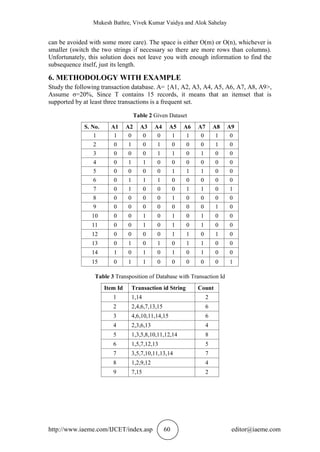
6. METHODOLOGY WITH EXAMPLE
Study the following transaction database. A= {A1, A2, A3, A4, A5, A6, A7, A8, A9>,
Assume σ=20%, Since T contains 15 records, it means that an itemset that is
supported by at least three transactions is a frequent set.
Table 2 Given Dataset
S. No. A1 A2 A3 A4 A5 A6 A7 A8 A9
1 1 0 0 0 1 1 0 1 0
2 0 1 0 1 0 0 0 1 0
3 0 0 0 1 1 0 1 0 0
4 0 1 1 0 0 0 0 0 0
5 0 0 0 0 1 1 1 0 0
6 0 1 1 1 0 0 0 0 0
7 0 1 0 0 0 1 1 0 1
8 0 0 0 0 1 0 0 0 0
9 0 0 0 0 0 0 0 1 0
10 0 0 1 0 1 0 1 0 0
11 0 0 1 0 1 0 1 0 0
12 0 0 0 0 1 1 0 1 0
13 0 1 0 1 0 1 1 0 0
14 1 0 1 0 1 0 1 0 0
15 0 1 1 0 0 0 0 0 1
Table 3 Transposition of Database with Transaction Id
Item Id Transaction id String Count
1 1,14 2
2 2,4,6,7,13,15 6
3 4,6,10,11,14,15 6
4 2,3,6,13 4
5 1,3,5,8,10,11,12,14 8
6 1,5,7,12,13 5
7 3,5,7,10,11,13,14 7
8 1,2,9,12 4
9 7,15 2
Memory Efficient Frequent Pattern Mining Using Transposition of Database
http://www.iaeme.com/IJCET/index.asp 61 editor@iaeme.com
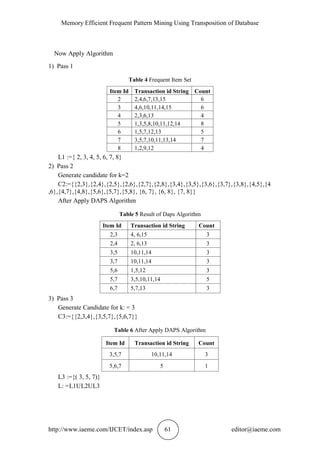
Now Apply Algorithm
1) Pass 1
Table 4 Frequent Item Set
Item Id Transaction id String Count
2 2,4,6,7,13,15 6
3 4,6,10,11,14,15 6
4 2,3,6,13 4
5 1,3,5,8,10,11,12,14 8
6 1,5,7,12,13 5
7 3,5,7,10,11,13,14 7
8 1,2,9,12 4
L1 :={ 2, 3, 4, 5, 6, 7, 8}
2) Pass 2
Generate candidate for k=2
C2:={{2,3},{2,4},{2,5},{2,6},{2,7},{2,8},{3,4},{3,5},{3,6},{3,7},{3,8},{4,5},{4
,6},{4,7},{4,8},{5,6},{5,7},{5,8}, {6, 7}, {6, 8}, {7, 8}}
After Apply DAPS Algorithm
Table 5 Result of Daps Algorithm
Item Id Transaction id String Count
2,3 4, 6,15 3
2,4 2, 6,13 3
3,5 10,11,14 3
3,7 10,11,14 3
5,6 1,5,12 3
5,7 3,5,10,11,14 5
6,7 5,7,13 3
3) Pass 3
Generate Candidate for k: = 3
C3:={{2,3,4},{3,5,7},{5,6,7}}
Table 6 After Apply DAPS Algorithm
Item Id Transaction id String Count
3,5,7 10,11,14 3
5,6,7 5 1
L3 :={( 3, 5, 7)}
L: =L1UL2UL3
Mukesh Bathre, Vivek Kumar Vaidya and Alok Sahelay
http://www.iaeme.com/IJCET/index.asp 62 editor@iaeme.com
7. RESULTS
This chapter demonstrates the experiments that this work have performed to evaluate
the new scheme. For the evaluation purpose this work has conducted several
experiments using the existing data set. Those experiments performed on computer
with Core 2 Duo 2.0 GHZ CPU, 2.0 GB memory and hard disk 80 GB. Both the
algorithms have developed in JAVA language. For unit of measurement this work
considers time in seconds and memory in bytes respectively.
7.1. Datasets used for Results
This section introduced data sets taken from the UCI machine learning repository [26]
and discretised using the KDD dataset [26] have been made available. Discretisation
has been carried out assuming a maximum of 5 "divisions". Note that all their files
have been "zipped" using .gzip. The files are intended for use with frequent pattern
mining and frequent itemset extraction from dataset which require binary valued input
data.
These dataset files can be describe as follow: anneal.D73.N898.C6.num with 898
records, heart.D52.N303.C5.num contains 303 records, pima.D38.N768.C2.num
having 768 records, ticTacToe.D29.N958.C2.num with 958 records and
horseColic.D85.D368.C2.num has 368 records.
7.2. Comparisons of Proposed work in terms of Memory
Following table and figure1.shows the comparison between dynamic and efficient
LCS algorithm. Here dataset size is measured according to items in respective dataset
for generating frequent patterns.
Memory comparisons of algorithm SELCS and dynamic LCS algorithm
7.3. Comparisons of Proposed work in terms of Time
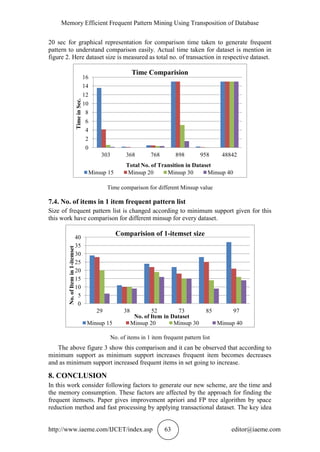
The experimental result of time is shown in Figure 2 reveals that the proposed scheme
outperforms the efficient Apriori approach for different minimum support (MS) value.
Our algorithm takes minimum 0.016 sec time during pattern generation also takes
more than 300 secs to generate frequent pattern for dataset size 48842 transitions so
it’s difficult to show graph in this range, hence here this work show maximum limit
0
5000
10000
15000
20000
25000
58 78 104 146 170 194
MemoryinBytes
No. of Items in Dataset
Memory Comparison
Dynamic LCS Efficient LCS
Memory Efficient Frequent Pattern Mining Using Transposition of Database
http://www.iaeme.com/IJCET/index.asp 63 editor@iaeme.com
20 sec for graphical representation for comparison time taken to generate frequent
pattern to understand comparison easily. Actual time taken for dataset is mention in
figure 2. Here dataset size is measured as total no. of transaction in respective dataset.
Time comparison for different Minsup value
7.4. No. of items in 1 item frequent pattern list
Size of frequent pattern list is changed according to minimum support given for this
this work have comparison for different minsup for every dataset.
No. of items in 1 item frequent pattern list
The above figure 3 show this comparison and it can be observed that according to
minimum support as minimum support increases frequent item becomes decreases
and as minimum support increased frequent items in set going to increase.
8. CONCLUSION
In this work consider following factors to generate our new scheme, are the time and
the memory consumption. These factors are affected by the approach for finding the
frequent itemsets. Paper gives improvement apriori and FP tree algorithm by space
reduction method and fast processing by applying transactional dataset. The key idea
0
2
4
6
8
10
12
14
16
303 368 768 898 958 48842
TimeinSec.
Total No. of Transition in Dataset
Time Comparision
Minsup 15 Minsup 20 Minsup 30 Minsup 40
0
5
10
15
20
25
30
35
40
29 38 52 73 85 97
No.ofItemin1-itemset
No. of Item in Dataset
Comparision of 1-itemset size
Minsup 15 Minsup 20 Minsup 30 Minsup 40
Mukesh Bathre, Vivek Kumar Vaidya and Alok Sahelay
http://www.iaeme.com/IJCET/index.asp 64 editor@iaeme.com
behind finding frequent pattern is to get common string between current combinations
of itemset with every transition in transition dataset. Traditional algorithm such as
dynamic algorithm is used 2 dimensional array for computing common sequence
present in dataset which consumes O(n2
) memory space, here this work proposed
algorithm for LCS problem which takes O(n) memory space for computing LCS for
current items sequence with transition dataset. This proposed algorithm reduces space
complexity a lot. Simulation work supports this statement. The proposed algorithm is
efficient to reduced memory space almost 80% in compare to tradition algorithm
without increasing time complexity for calculating frequent pattern. Overall time
complexity can be observed by given time comparison in result and discussion result
section. Therefore this work employed it in our scheme to guarantee the memory
saving without effecting time in the case of transpositionalstructure of dense data sets.
Thus this algorithm produces frequent itemsets completely. Thus it saves much space
and time and considered as an efficient method as proved from the results.
REFERENCES
[1] S.Appavu alias Balamurugan, Aravind, Athiapppan, Barathiraja, MuthuPandian
and Dr.R.Rajaram, Association rules mining for suspicious Email detection: A
data mining approach, IEEE, 2007.
[2] Cornelia Győrödi, Robert Győrödi, T. Cofeey& S. Holban – Mining association
rules using Dynamic FP-trees –în proceedings of The Irish Signal and Systems
Conference, University of Limerick, Limerick, Ireland, 30th June-2nd
, page 76-
82, July 2003.
[3] Badripatel ,Vijay K Chaudahri, Rajneesh K Karan, YK Rana, Optimization of
association rule mining apriori algorithm using Ant Conoly optimization”
International Journal of Soft Computing and Engineering (IJSCE) ISSN: 2231-
2307, 1(1), March 2011.
[4] RahmanAliMohammadzadeh, SadeghAoltan, MasoudRahgozar, Template
Guided Association Rule Mining from XML Documents, WWW 2006, May 23–
26, 2006, Edinburgh, Scotland.ACM.
[5] NattaponPannurat, NittayaKerdprasop, KittisakKerdprasop, Database Reverse
Engineering based on Association Rule Mining, IJCSI International Journal of
Computer Science Issues, 7(2)–3, PP-1694-0814, March 2010.
[6] IkoPramudiono and masaruKitsuregawa, FP-tax: Tree structure Generalized
Association Rule Mining, DMKD 04, June 13, 2004.
[7] MamtaDhanda, sonaliGuglani and gauravgupta, Mining Efficient Association
Rules through Apriori Algorithm Using Attributes, IJCST 2(3), September 2011.
[8] J. Han, M. Kamber, Data Mining Concepts and Techniques, Morgan Kaufmann
Publishers, San Francisco, USA, 2001.
[9] L. Cristofor, Mining Rules in Single-Table and Multiple-Table Databases, PhD
thesis, University of Massachusetts, 2002.
[10] AshokaSavasere, Edward Omiencinski, and Shamkant B. Navathe. An Efficient
Algorithm for Mining Association Rules in Large Databases.” In Proceedings of
the 21st International Conference on Very Large Databases, pag432 - 444, 1995.
[11] B. Jeudy and F. Rioult, Database transposition for constrained closed pattern
mining, in: Proceedings of Third International Workshop on Knowledge
Discovery in Inductive Databases (KDID) co-located with ECML/PKDD, 2004.
[12] R. Agrawal, R. Srikant, Fast algorithms for mining association rules, In
Proceedings of the 20th International Conference on Very Large Data Bases,
1994, pp. 487–499.
Memory Efficient Frequent Pattern Mining Using Transposition of Database
http://www.iaeme.com/IJCET/index.asp 65 editor@iaeme.com
[13] J. Han, Research challenges for data mining in science and engineering. In
NGDM 2007.
[14] R. Agrawal, R. Srikant, Mining sequential patterns, In Proceedings of the 11th
International Conference on Data Engineering, 1995, pp. 3.
[15] A fast APRIORI implementation FerencBodon, Informatics Laboratory,
Computer and Automation Research Institute, Hungarian Academy of Sciences
H-1111 Budapest, L´agym´anyosi u. 11, Hungary.
[16] B. Goethals. Survey on frequent pattern mining. Technical report, Helsinki
Institute for Information Technology, 03.
[17] Ms. Trupti Phutane and Prof. Apashabi Pathan, Intrusion Detection System
Using Decision Tree and Apriori Algorithm, International Journal of Computer
Engineering and Technology, 6(7), 2015, pp. 10–19.
[18] Bikramjit Kaur, Shanu Verma and Anumati Thakur, Pre-Processing of Server
Log File Along with Mac Address Using Apriori and Decision Tree,
International Journal of Computer Engineering and Technology, 5(5), 2014, pp.
49–55.
[19] Mr. Ajay M. Patel, Dr. A. R. Patel and Ms. Hiral R. Patel, A Comparative
Analysis of Data Mining Tools For Performance Mapping of WLAN Data,
International Journal of Computer Engineering and Technology, 4(2), 2013, pp.
241–251.
[20] R. Agrawal and R. Srikant. Fast algorithms for mining association rules. The
International Conference on Very Large Databases, pages 487–499, 1994.

MEMORY EFFICIENT FREQUENT PATTERN MINING USING TRANSPOSITION OF DATABASE

  • 1.
    http://www.iaeme.com/IJCET/index.asp 53 editor@iaeme.com InternationalJournal of Computer Engineering & Technology (IJCET) Volume 7, Issue 2, March-April 2016, pp. 53–65, Article ID: IJCET_07_02_007 Available online at http://www.iaeme.com/IJCET/issues.asp?JType=IJCET&VType=7&IType=2 Journal Impact Factor (2016): 9.3590 (Calculated by GISI) www.jifactor.com ISSN Print: 0976-6367 and ISSN Online: 0976–6375 © IAEME Publication MEMORY EFFICIENT FREQUENT PATTERN MINING USING TRANSPOSITION OF DATABASE Mukesh Bathre Govt. College of Engineering, Keonjhar, Odisa, India Vivek Kumar Vaidya Lecturer, CSE, J.M. Govt. Polytechnic College, Burhanpur M.P Alok Sahelay Lecturer, CSE, J.M. Govt. Polytechnic College, Burhanpur M.P ABSTRACT Frequent pattern can be extract from any dataset by using Apriori algorithm. Apriori algorithm is first choice of all researchers to find frequently occurs pattern from any binary dataset. Dataset contain record of user purchase item as transaction record. This paper improves existing apriori algorithm performance by extract frequent patterns from binary transaction data. New approach is applied for dataset implementation in form of transposed database of user’s record for fast data access. New work has done to mine frequent patterns using transposition of dataset, if database is large and contains thousands of attributes but having only some objects. This work analytically investigates the search space problem of frequent patterns mining and characterize database in transposed form and proposes an algorithm for mining frequent patterns based on Apriori algorithm by space reduced longest common sequence (LCS).This method makes apriori algorithm space efficient. The space complexity of proposed algorithm is O(n) while the dynamic approach like longest common subsequence space complexity is O(n2 ) memory for given items in dataset. Index Terms: Apriori Algorithm, Frequent Itemset, Data Mining, Space Complexity, Transposition of Database. Cite this Article: Mukesh Bathre, Vivek Kumar Vaidya and Alok Sahelay, Memory Efficient Frequent Pattern Mining Using Transposition of Database, International Journal of Computer Engineering and Technology, 7(2), 2016, pp. 53–65. http://www.iaeme.com/IJCET/issues.asp?JType=IJCET&VType=7&IType=1
  • 2.
    Mukesh Bathre, VivekKumar Vaidya and Alok Sahelay http://www.iaeme.com/IJCET/index.asp 54 editor@iaeme.com 1. INTRODUCTION Apriori is a classic algorithm for learning association rules. Apriori is designed to operate on databases containing transactions in binary format. Many other techniques are there to extract association rules from no transaction or no timestamps. Main work of apriori algorithm is to find association rules between different data sets of itmes this also known as “Market basket problem”. Each set of data has a number of items and is called a transaction. The output of Apriori is sets of rules that tell us how often items are contained in sets of data. Frequent item set mining and association rule induction are powerful methods for so-called market basket analysis, which aims at finding regularities in the shopping behavior of customers of supermarkets, mail-order companies, online shops etc. With the induction of frequent item sets and association rules one tries to find sets of products that are frequently bought together, so that from the presence of certain products in a shopping cart one can infer (with a high Probability) that certain other products are present. Such information, especially if expressed in the form of rules, can often be used to increase the number of items sold, for instance, by appropriately arranging the products on the shelves of a supermarket or on the pages of a mail-order catalog (they may, for example, be placed adjacent to each other in order to invite even more customers to buy them together) or by directly suggesting items to a customer, which may be of interest for him/her. 2. RELATED WORKS Determination of association rule mining, e-mail (emails about criminal activity) is suspected. Negative emotion words betray theory, a new person pronoun, in addition to simple words, the high-frequency words and special words were written in the body is characterized by deceptive e-mail writing pre-processed. Terms of apriori algorithm [1] is used to make. Data generated in the mail soon. It is used for automated analysis and evaluation to identify criminal activities and the announcement. Apriori algorithm for association rule mining, and all e-mail messages using the action verbs, past tense, using futures and evaluated. It's an action verb, such kind of emails in the future tense suffix and another with a message by e-mail if you are suspicious. Warning email to "“kill and bomb” future tense of words such as "“will and shall," which refers to such terms. Step number. In order to classify the e-mail box, all HTML from the text element, header, body, etc removed, before the words are stop words tokenizing. After separation of the body, begins to move e-mail classification. Training data “Bomb/Blast/Kill " key and " will/may " they, important that the class information, e-mails, a move “attacked/terrorist” and tense “was” in them using apriori algorithm.. The training set apriori algorithm to find the e-mail database of words frequently used in the mining frequent item sets. Apriori algorithm for association rules and the rules used to set this item as follows. Tense=past, Attack= Y, Bomb =Y ->Email = Suspicious informative Email. Tense=future, Attack= Y, Bomb =Y-> Email =Suspicious alert Email. Tense=future, Attack= N, Bomb =N->Email =Normal Email. An improved frequent pattern tree based on the technique named dynamic frequent pattern tree is proposed by Gyorodi [2]. The new method is efficiently applied on real world size database. A comparison between classical frequent pattern mining algorithms that are candidate set generation, test and without candidate generation is proposed in paper. Apriori algorithm, frequent pattern growth, dynamic frequent pattern growth are compared and presented together. Apriori algorithm in
  • 3.
    Memory Efficient FrequentPattern Mining Using Transposition of Database http://www.iaeme.com/IJCET/index.asp 55 editor@iaeme.com used to rule mining in huge transaction database and Apriori algorithm is a bottom up approach. Frequent pattern growth is used to novel, compact data structure, referred to as frequent pattern tree, fp tree based ones are partition based, divide and conquer methods. Optimization of association rule mining and apriori algorithm Using Ant colony optimization [3].This paper is on Apriori algorithm and association rule mining to improved algorithm based on the Ant colony optimization algorithm. ACO was introduced by dorigo and has evolved significantly in the last few years. Many organizations have collected massive amount data. This data set is usually stored on storage database systems. Two major problems arise in the analysis of the information system. One is reducing unnecessary objects and attributes so as to get the minimum subset of attributes ensuring a good approximation of classes and an acceptable quality of classification. Another one is representing the information system as a decision table which shows dependencies between the minimum subset of attributes and particular class numbers without redundancy. In Apriori algorithm, is working process explained in steps. Two step processes is used to find the frequent item set to join and prune. ACO algorithm was inspired from natural behavior of ant colonies. ACO is used to solve to numerous hard optimizations including the traveling salesman problem. ACO system contains two rules .One is local pheromone update rule, which is applied in constructing solution. Another one is global pheromone update rule which is applied in ant construction.ACO algorithm includes two more mechanisms, namely trail evaporation and optionally deamonactions.ACO algorithm is used for the specific problem of minimizing the number of association rules. Association rule mining template is guided from XML document. XML is used in all areas of Internet application programming and is giving large amount of data encoded in XML [4]. With the continuous growth in XML data sources, the ability to extract knowledge from them for decision support becomes increasingly important and desirable. Due to the inherent flexibilities of XML, in both structure and semantics, mining knowledge in the XML Era is faced with more challenges than in the traditional structured world. This paper is a practical model for mining association rules from XML document.XML enabled association rule frame work that was introduced by Feng.XML AR frame works better than simple structured tree. The framework is flexible and powerful enough to represent simple and difficult structured association rules in XML document. But the best level of XML document model which is not yet implemented in has been proposed. The problem of mining XML association rules from the content of XML documents is based on user provided rule template. An implementation model is already introduced by Feng. practical model consists of the following steps Filtering, Generating Virtual Transactions, Database reverse engineering association rule mining [5] is based on. Classification of the document database system could not be found in the poorly written, or even a particularly difficult task. The concept design of database reverse engineering to recover the database in an attempt to exit. Mining technique uses to detect the concept plan proposing a strategy paper. They used the normal form. Classical database is a valuable asset to the organization. New technologies were developed in 1970 as a COBOL and the database, and mini - computer platforms, file systems using older programming languages. Even some of the databases are outdated concepts such as the hierarchical data model, designed, and maintained and adjusted to serve the current needs of modern companies was difficult for them. Classical databases, messaging systems and their structures are related to the contents of the move and changing. This document is no longer in my approach to system design,
  • 4.
    Mukesh Bathre, VivekKumar Vaidya and Alok Sahelay http://www.iaeme.com/IJCET/index.asp 56 editor@iaeme.com however, is hard to achieve; most companies in general are rising. Problems of migrating legacy databases to retrieve and database structures, database reverse engineering has been proposed. Reverse engineering process design and manufacturing process from the first to explore the objective devices and other hardware. Generalized association rule mining based on tree structure. Into account [6] the use of specific information useful knowledge than ordinary flat association rules mining to detect this possibility. It employs a tree structure to compress the database Fp-line method, based on the paradigm proposing to mine development. There are two methods to the study of tree structure below and above are below. There are only a few studies have given way to common rules. Even some of the SQL queries and reports to the general association rule proposed parallel machine performance ratings. Apriori algorithm is a level-wise approach. A frequent pattern mining paradigm in the field of research has become a new trend. Efficient association rules mining properties by using the apriori algorithm. Apriori algorithm to obtain the means of association rules from the dataset. It's [7] the case of a large dataset is a time consuming procedure apriori algorithm is an efficient algorithm. Time changes many long-term activities to increase the number of paths apriori and the proposed database. Disadvantages and apriori algorithm apriori algorithm can improve performance; this paper describes the application properties. Customers who buy products at the beginning of an association rule mining is market basket analysis to find out how. Minimum support of all frequent items finding all association rules at uvallatu. 1. 1. Find they considered the two-stage process. Enumeration of all frequent item sets the size of the search space is 2n . 2. 2. To create strong rules. Used to create an association rule that satisfies any of the gate. Apriori and apriori algorithm using data mining tool and then running to write pseudo code. Association rule mining is the limit. ARM algorithm encounters a problem that does not return by the end user in a reasonable time. Activity in the presence and absence of an item is the only database that tells us a lot of shortcomings, and it is not efficient in the case of large dataset.ARM. The weight and size can be removed using such properties. Some of the limitations associated with large database apriori algorithm Searches. Its easy to implement using apriori exists. Association rule mining as well as potential customers for commercial gain valuable information, much improved by the use of such properties. Association rule mining has wide applicability in many areas, efficient algorithm as it is a time consuming algorithm in case of large dataset [7]. With the time a number of changes are proposed in Apriori to enhance the performance in term of time and number of database passes. This paper illustrates the apriori algorithm disadvantages and utilization of attributes which can improve the efficiency of apriori algorithm. Association rule mining is initially used for Market Basket Analysis to find how items purchased by customers are related. The problem of finding association rules can be stated as follows: Given a database of sales transactions, it is desirable to discover the important associations among different items such the presence of some items in a transaction will imply the presence of other items in the same transaction. Discovering all association rules is considered as two-phase processes which are Association rule mining efficiency can be improved by using attributes like profit, quantity which will give the valuable information to the customer as well as the business. Association rule mining has a wide range of applicability in many areas.
  • 5.
    Memory Efficient FrequentPattern Mining Using Transposition of Database http://www.iaeme.com/IJCET/index.asp 57 editor@iaeme.com 3. TRANSPOSITION OF DATABASE To avoid confusion between rows (or columns) of the original database and rows (columns) of the “transposed” database, this work define a database as a relation between original and transposed representations of a database in Table 3.1. Table 1 Transposition of Database Database D Object Attribute Pattern O1 a1a2a3 O2 a1a2a3 O3 a2a3a4 Transposed Database DT Attribute Object Pattern a1 O1O2 a2 O1O2O3 a3 O1O2O3 a4 O3 The attributes are A = {a1, a2, a3, a4} and the objects are O = {o1, o2, o3}. Here use a string notation for object sets or itemsets, e.g., a1a3a4 denotes the itemset {a1, a3, a4} and o2o3 denotes the object set {o2, o3}. This dataset is used in all the examples between two sets: a set of attributes and a set of objects. 4. DYNAMIC APPROACH The longest common subsequence problem is one of the common problems which can be solved efficiently using dynamic programming. “The Longest common subsequence problem is, this work are given two sequences X=<x1,x2----------xn> and Y=<y1,y2---------ym> and wish to find a maximum length common subsequence of X and Y” for example : if X=<A,B,C,B,D,A,B> and Y=<B,D,C,A,B,A> then The sequence <B, C, B, A> longest common subsequence. Let us define C [i, j] to be the length of an LCS of the sequences xi and yj. If either i=0 or j=0, one of the sequence has length 0, so the LCS has length 0. The Optimal substructure of the LCS Problem gives the recursive formula in equation-1. 4.1. DAPS and DFPMT Approach The mining algorithm works over the entire database file, first transpose the database and count the number of item and transaction string generated for each item. Sort the item numbers. Now apply Apriori like Algorithm in which first now calculate
  • 6.
    Mukesh Bathre, VivekKumar Vaidya and Alok Sahelay http://www.iaeme.com/IJCET/index.asp 58 editor@iaeme.com frequent pattern C1.it reduces un-frequent pattern and its transaction details also. For each pass now apply following sequence of operation until condition occurred. First generate the candidate pattern and prune by Apriori method. To count the support , instead of whole database for each pruned pattern now find longest common subsequence and length of transaction string of pattern’s item and also stored new pattern and its transaction string so that next iteration now trace above string. To find longest common subsequence this work used dynamic programming approach which faster than traditional approach. Write pruned pattern list with transaction string. So that in next pass this work used this pattern list instead of all pattern list. An advantage of this approach is in each iteration database filtering and reduces, so each iteration is faster than previous iteration 4.2. DAPS Algorithm 1. Compute k-1 Subset of k-itemset 2. Generate Itemset Transition string from Filter Transposed Database 3. Computer LCS for each item in itemset using Transition string. 4. If length of LCS >∂then itemset is frequent. 4.3. DFPMT Algorithm (Dynamic Approach for Frequent Patterns Mining Using Transposition of Database) 5. Convert Database in Transpose Form DT 6. Compute F1 of all Frequent Items 7. C1:= DT (Only Frequent Item row with Transition id string ) 8. K: =2. 9. While Lk-1≠{ } do 10. Compute Ck of all candidate k-1 Itemsets /* New Algorithm which prune and count support using LCS */ 11. Compute Lk=DAPS (Ck) 12. K:=K+1 Back bone of this algorithm is finding LCS from dataset which is perform by dynamic algorithm in above work proposed Heuristic space efficient algorithm But it can also be thought of as a way of computing the entries in the array L. The recursive algorithm controls what order this work fill them in, but this work get the same results if now filled them in some other order. This work might as well use something simpler, like a nested loop that visits the array systematically. The only thing have to worry about is that when fill in a cell L[i,j], need to already know the values it depends on, namely in this case L[i+1,j], L[i,j+1], and L[i+1,j+1]. For this reason have to traverse the array backwards, from the last row working up to the first and from the last column working up to the first. This is iterative (because it uses nested loops instead of recursion) or bottom up (because the order fill in the array is from smaller simpler sub problems to bigger more complicated ones). Advantages of this method include the fact that iteration is usually faster than recursion, this work don't need to initialize the matrix to all -1's, and this work save three if statements per iteration since this work don't need to test whether L[i,j],
  • 7.
    Memory Efficient FrequentPattern Mining Using Transposition of Database http://www.iaeme.com/IJCET/index.asp 59 editor@iaeme.com L[i+1,j], and L[i,j+1] have already been computed (this work know in advance that the answers will be no, yes, and yes). One disadvantage over memorizing is that this fills in the entire array even when it might be possible to solve the problem by looking at only a fraction of the array's cells. 5. PROPOSED WORK One disadvantage of the dynamic programming methods this work've described, compared to the original recursion, is that they use a lot of space: O(mn) for the array L (the recursion only uses O(n+m). But the iterative version can be easily modified to use less space -- the observation is that once this work have computed row i of array L, this work no longer need the values in row i+1. 5.1. Space Efficient LCS Algorithm (SELCS) 1. Store string to A and B array, Allocate storage for one-dimensional arrays X and Y and initialize with 0 length of first string is i and second is j. 2. While m ≠ 0 do following 3. While n ≠ 0 do 4. Compare A[m] with B[n] and do If A[m] or B[n] having null value store X[n] = 0. Otherwise if A[m] equal to B[n] store X[n] to 1 + Y[n+1]. Above two condition not true then store to X[n] = larger (Y[n] and X[n+1]). 5. Before update value of m replace array Y to X. 6. Return length of LCS with common string. 5.2. APS Algorithm 1. Compute k-1 Subset of k-itemset 2. Generate Itemset Transition string from Filter Transposed Database 3. Computer LCS for each item in itemset using Transition string and SELCS algorithm. 4. If length of LCS > ∂ then itemset is frequent. 5.3. Efficient Method for Frequent Patterns using Transposition of Database 1. Convert Database in Transpose Form DT 2. Compute F1 of all Frequent Items 3. C1:= DT (Only Frequent Item row with Transition id string) 4. K: =2. 5. While Lk-1≠{ } do 6. Compute Ck of all candidate k-1 Itemsets /* New Algorithm which prune and count support using SELCS */ 7. Compute Lk=APS (Ck) 8. K:=K+1 This takes roughly the same amount of time as before, O(mn) or O(n2) it uses a little more time to copy X into Y but this only increases the time by a constant (and
  • 8.
    Mukesh Bathre, VivekKumar Vaidya and Alok Sahelay http://www.iaeme.com/IJCET/index.asp 60 editor@iaeme.com can be avoided with some more care). The space is either O(m) or O(n), whichever is smaller (switch the two strings if necessary so there are more rows than columns). Unfortunately, this solution does not leave you with enough information to find the subsequence itself, just its length. 6. METHODOLOGY WITH EXAMPLE Study the following transaction database. A= {A1, A2, A3, A4, A5, A6, A7, A8, A9>, Assume σ=20%, Since T contains 15 records, it means that an itemset that is supported by at least three transactions is a frequent set. Table 2 Given Dataset S. No. A1 A2 A3 A4 A5 A6 A7 A8 A9 1 1 0 0 0 1 1 0 1 0 2 0 1 0 1 0 0 0 1 0 3 0 0 0 1 1 0 1 0 0 4 0 1 1 0 0 0 0 0 0 5 0 0 0 0 1 1 1 0 0 6 0 1 1 1 0 0 0 0 0 7 0 1 0 0 0 1 1 0 1 8 0 0 0 0 1 0 0 0 0 9 0 0 0 0 0 0 0 1 0 10 0 0 1 0 1 0 1 0 0 11 0 0 1 0 1 0 1 0 0 12 0 0 0 0 1 1 0 1 0 13 0 1 0 1 0 1 1 0 0 14 1 0 1 0 1 0 1 0 0 15 0 1 1 0 0 0 0 0 1 Table 3 Transposition of Database with Transaction Id Item Id Transaction id String Count 1 1,14 2 2 2,4,6,7,13,15 6 3 4,6,10,11,14,15 6 4 2,3,6,13 4 5 1,3,5,8,10,11,12,14 8 6 1,5,7,12,13 5 7 3,5,7,10,11,13,14 7 8 1,2,9,12 4 9 7,15 2
  • 9.
    Memory Efficient FrequentPattern Mining Using Transposition of Database http://www.iaeme.com/IJCET/index.asp 61 editor@iaeme.com Now Apply Algorithm 1) Pass 1 Table 4 Frequent Item Set Item Id Transaction id String Count 2 2,4,6,7,13,15 6 3 4,6,10,11,14,15 6 4 2,3,6,13 4 5 1,3,5,8,10,11,12,14 8 6 1,5,7,12,13 5 7 3,5,7,10,11,13,14 7 8 1,2,9,12 4 L1 :={ 2, 3, 4, 5, 6, 7, 8} 2) Pass 2 Generate candidate for k=2 C2:={{2,3},{2,4},{2,5},{2,6},{2,7},{2,8},{3,4},{3,5},{3,6},{3,7},{3,8},{4,5},{4 ,6},{4,7},{4,8},{5,6},{5,7},{5,8}, {6, 7}, {6, 8}, {7, 8}} After Apply DAPS Algorithm Table 5 Result of Daps Algorithm Item Id Transaction id String Count 2,3 4, 6,15 3 2,4 2, 6,13 3 3,5 10,11,14 3 3,7 10,11,14 3 5,6 1,5,12 3 5,7 3,5,10,11,14 5 6,7 5,7,13 3 3) Pass 3 Generate Candidate for k: = 3 C3:={{2,3,4},{3,5,7},{5,6,7}} Table 6 After Apply DAPS Algorithm Item Id Transaction id String Count 3,5,7 10,11,14 3 5,6,7 5 1 L3 :={( 3, 5, 7)} L: =L1UL2UL3
  • 10.
    Mukesh Bathre, VivekKumar Vaidya and Alok Sahelay http://www.iaeme.com/IJCET/index.asp 62 editor@iaeme.com 7. RESULTS This chapter demonstrates the experiments that this work have performed to evaluate the new scheme. For the evaluation purpose this work has conducted several experiments using the existing data set. Those experiments performed on computer with Core 2 Duo 2.0 GHZ CPU, 2.0 GB memory and hard disk 80 GB. Both the algorithms have developed in JAVA language. For unit of measurement this work considers time in seconds and memory in bytes respectively. 7.1. Datasets used for Results This section introduced data sets taken from the UCI machine learning repository [26] and discretised using the KDD dataset [26] have been made available. Discretisation has been carried out assuming a maximum of 5 "divisions". Note that all their files have been "zipped" using .gzip. The files are intended for use with frequent pattern mining and frequent itemset extraction from dataset which require binary valued input data. These dataset files can be describe as follow: anneal.D73.N898.C6.num with 898 records, heart.D52.N303.C5.num contains 303 records, pima.D38.N768.C2.num having 768 records, ticTacToe.D29.N958.C2.num with 958 records and horseColic.D85.D368.C2.num has 368 records. 7.2. Comparisons of Proposed work in terms of Memory Following table and figure1.shows the comparison between dynamic and efficient LCS algorithm. Here dataset size is measured according to items in respective dataset for generating frequent patterns. Memory comparisons of algorithm SELCS and dynamic LCS algorithm 7.3. Comparisons of Proposed work in terms of Time The experimental result of time is shown in Figure 2 reveals that the proposed scheme outperforms the efficient Apriori approach for different minimum support (MS) value. Our algorithm takes minimum 0.016 sec time during pattern generation also takes more than 300 secs to generate frequent pattern for dataset size 48842 transitions so it’s difficult to show graph in this range, hence here this work show maximum limit 0 5000 10000 15000 20000 25000 58 78 104 146 170 194 MemoryinBytes No. of Items in Dataset Memory Comparison Dynamic LCS Efficient LCS
  • 11.
    Memory Efficient FrequentPattern Mining Using Transposition of Database http://www.iaeme.com/IJCET/index.asp 63 editor@iaeme.com 20 sec for graphical representation for comparison time taken to generate frequent pattern to understand comparison easily. Actual time taken for dataset is mention in figure 2. Here dataset size is measured as total no. of transaction in respective dataset. Time comparison for different Minsup value 7.4. No. of items in 1 item frequent pattern list Size of frequent pattern list is changed according to minimum support given for this this work have comparison for different minsup for every dataset. No. of items in 1 item frequent pattern list The above figure 3 show this comparison and it can be observed that according to minimum support as minimum support increases frequent item becomes decreases and as minimum support increased frequent items in set going to increase. 8. CONCLUSION In this work consider following factors to generate our new scheme, are the time and the memory consumption. These factors are affected by the approach for finding the frequent itemsets. Paper gives improvement apriori and FP tree algorithm by space reduction method and fast processing by applying transactional dataset. The key idea 0 2 4 6 8 10 12 14 16 303 368 768 898 958 48842 TimeinSec. Total No. of Transition in Dataset Time Comparision Minsup 15 Minsup 20 Minsup 30 Minsup 40 0 5 10 15 20 25 30 35 40 29 38 52 73 85 97 No.ofItemin1-itemset No. of Item in Dataset Comparision of 1-itemset size Minsup 15 Minsup 20 Minsup 30 Minsup 40
  • 12.
    Mukesh Bathre, VivekKumar Vaidya and Alok Sahelay http://www.iaeme.com/IJCET/index.asp 64 editor@iaeme.com behind finding frequent pattern is to get common string between current combinations of itemset with every transition in transition dataset. Traditional algorithm such as dynamic algorithm is used 2 dimensional array for computing common sequence present in dataset which consumes O(n2 ) memory space, here this work proposed algorithm for LCS problem which takes O(n) memory space for computing LCS for current items sequence with transition dataset. This proposed algorithm reduces space complexity a lot. Simulation work supports this statement. The proposed algorithm is efficient to reduced memory space almost 80% in compare to tradition algorithm without increasing time complexity for calculating frequent pattern. Overall time complexity can be observed by given time comparison in result and discussion result section. Therefore this work employed it in our scheme to guarantee the memory saving without effecting time in the case of transpositionalstructure of dense data sets. Thus this algorithm produces frequent itemsets completely. Thus it saves much space and time and considered as an efficient method as proved from the results. REFERENCES [1] S.Appavu alias Balamurugan, Aravind, Athiapppan, Barathiraja, MuthuPandian and Dr.R.Rajaram, Association rules mining for suspicious Email detection: A data mining approach, IEEE, 2007. [2] Cornelia Győrödi, Robert Győrödi, T. Cofeey& S. Holban – Mining association rules using Dynamic FP-trees –în proceedings of The Irish Signal and Systems Conference, University of Limerick, Limerick, Ireland, 30th June-2nd , page 76- 82, July 2003. [3] Badripatel ,Vijay K Chaudahri, Rajneesh K Karan, YK Rana, Optimization of association rule mining apriori algorithm using Ant Conoly optimization” International Journal of Soft Computing and Engineering (IJSCE) ISSN: 2231- 2307, 1(1), March 2011. [4] RahmanAliMohammadzadeh, SadeghAoltan, MasoudRahgozar, Template Guided Association Rule Mining from XML Documents, WWW 2006, May 23– 26, 2006, Edinburgh, Scotland.ACM. [5] NattaponPannurat, NittayaKerdprasop, KittisakKerdprasop, Database Reverse Engineering based on Association Rule Mining, IJCSI International Journal of Computer Science Issues, 7(2)–3, PP-1694-0814, March 2010. [6] IkoPramudiono and masaruKitsuregawa, FP-tax: Tree structure Generalized Association Rule Mining, DMKD 04, June 13, 2004. [7] MamtaDhanda, sonaliGuglani and gauravgupta, Mining Efficient Association Rules through Apriori Algorithm Using Attributes, IJCST 2(3), September 2011. [8] J. Han, M. Kamber, Data Mining Concepts and Techniques, Morgan Kaufmann Publishers, San Francisco, USA, 2001. [9] L. Cristofor, Mining Rules in Single-Table and Multiple-Table Databases, PhD thesis, University of Massachusetts, 2002. [10] AshokaSavasere, Edward Omiencinski, and Shamkant B. Navathe. An Efficient Algorithm for Mining Association Rules in Large Databases.” In Proceedings of the 21st International Conference on Very Large Databases, pag432 - 444, 1995. [11] B. Jeudy and F. Rioult, Database transposition for constrained closed pattern mining, in: Proceedings of Third International Workshop on Knowledge Discovery in Inductive Databases (KDID) co-located with ECML/PKDD, 2004. [12] R. Agrawal, R. Srikant, Fast algorithms for mining association rules, In Proceedings of the 20th International Conference on Very Large Data Bases, 1994, pp. 487–499.
  • 13.
    Memory Efficient FrequentPattern Mining Using Transposition of Database http://www.iaeme.com/IJCET/index.asp 65 editor@iaeme.com [13] J. Han, Research challenges for data mining in science and engineering. In NGDM 2007. [14] R. Agrawal, R. Srikant, Mining sequential patterns, In Proceedings of the 11th International Conference on Data Engineering, 1995, pp. 3. [15] A fast APRIORI implementation FerencBodon, Informatics Laboratory, Computer and Automation Research Institute, Hungarian Academy of Sciences H-1111 Budapest, L´agym´anyosi u. 11, Hungary. [16] B. Goethals. Survey on frequent pattern mining. Technical report, Helsinki Institute for Information Technology, 03. [17] Ms. Trupti Phutane and Prof. Apashabi Pathan, Intrusion Detection System Using Decision Tree and Apriori Algorithm, International Journal of Computer Engineering and Technology, 6(7), 2015, pp. 10–19. [18] Bikramjit Kaur, Shanu Verma and Anumati Thakur, Pre-Processing of Server Log File Along with Mac Address Using Apriori and Decision Tree, International Journal of Computer Engineering and Technology, 5(5), 2014, pp. 49–55. [19] Mr. Ajay M. Patel, Dr. A. R. Patel and Ms. Hiral R. Patel, A Comparative Analysis of Data Mining Tools For Performance Mapping of WLAN Data, International Journal of Computer Engineering and Technology, 4(2), 2013, pp. 241–251. [20] R. Agrawal and R. Srikant. Fast algorithms for mining association rules. The International Conference on Very Large Databases, pages 487–499, 1994.