Cell Transport:Cell Transport:
Membrane StructureMembrane Structure
and Functionand Function
Chapter ObjectivesChapter Objectives
1.1. Describe the fluid mosaic model of membrane structure andDescribe the fluid mosaic model of membrane structure and
explain the underlying reasons for this structure.explain the underlying reasons for this structure.
2.2. Outline the roles of phospholipids, cholesterol, glycolipids,Outline the roles of phospholipids, cholesterol, glycolipids,
proteins and glycoproteins in membranes.proteins and glycoproteins in membranes.
3.3. Outline the roles of the plasma membrane, and the roles ofOutline the roles of the plasma membrane, and the roles of
membranes within cells.membranes within cells.
4.4. Describe and explain how molecules can get in and out ofDescribe and explain how molecules can get in and out of
cells (cross cell membranes) by the processes of diffusion,cells (cross cell membranes) by the processes of diffusion,
facilitated diffusion, osmosis, active transport, endocytosisfacilitated diffusion, osmosis, active transport, endocytosis
and exocytosis.and exocytosis.
5.5. Describe the effects on animal and plant cells of immersionDescribe the effects on animal and plant cells of immersion
in solutions of different “water potential”.in solutions of different “water potential”.
Chapter – Key VocabularyChapter – Key Vocabulary
SelectivelySelectively
permeablepermeable
PhospholipidPhospholipid
HydrophobicHydrophobic
HydrophilicHydrophilic
Passive TransportPassive Transport
Active TransportActive Transport
DiffusionDiffusion
OsmosisOsmosis
ConcentrationConcentration
GradientGradient
HypertonicHypertonic
HypotonicHypotonic
IsotonicIsotonic
 TurgorTurgor
 PlasmolysisPlasmolysis
 Facilitated diffusionFacilitated diffusion
 ExocytosisExocytosis
 EndocytosisEndocytosis
 PhagocytosisPhagocytosis
 PinocytosisPinocytosis
 Fluid Mosaic ModelFluid Mosaic Model
 EquilibriumEquilibrium
 Membranes organize theMembranes organize the
chemical activities of cells.chemical activities of cells.
– They separate cells from their outsideThey separate cells from their outside
environments.environments.
– They control the passage of moleculesThey control the passage of molecules
from one side of the membrane to thefrom one side of the membrane to the
other.other.
– Membranes areMembranes are selectively permeableselectively permeable ;;
that is, they allow some substances tothat is, they allow some substances to
cross more easily than others and blockscross more easily than others and blocks
passage of some substances altogether.passage of some substances altogether.
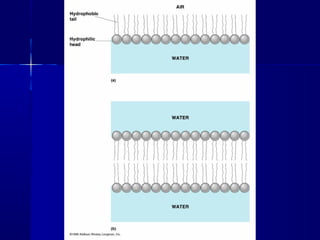
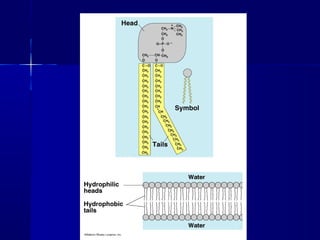
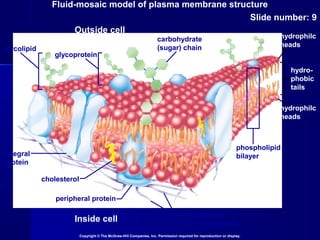
 Membrane phospholipids form a bilayer.Membrane phospholipids form a bilayer.
 PhospholipidsPhospholipids are:are:
– fats with two nonpolar fatty acid “tails”fats with two nonpolar fatty acid “tails”
– one polar phosphate “head”one polar phosphate “head”
– attached to glycerol.attached to glycerol.
 In water, thousands of individualIn water, thousands of individual
molecules form a “stable bilayer”, aimingmolecules form a “stable bilayer”, aiming
their heads out and their tails in.their heads out and their tails in.
 TheThe hydrophobichydrophobic interior of this bilayerinterior of this bilayer
offers an effective barrier to the flow ofoffers an effective barrier to the flow of
mostmost hydrophilichydrophilic molecules.molecules.
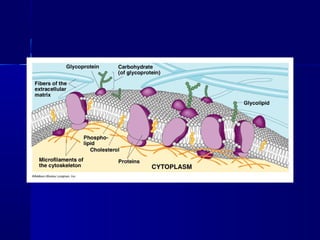
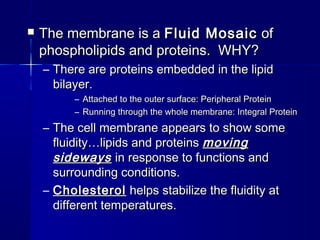
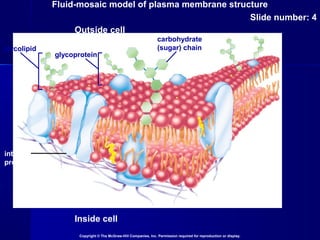
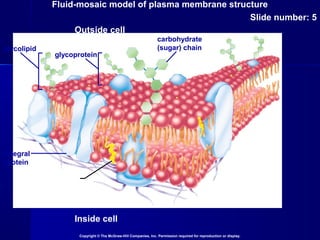
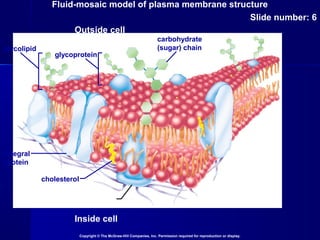
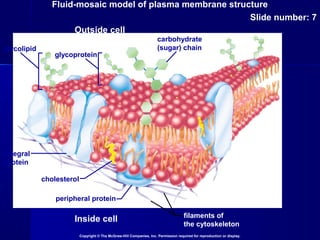
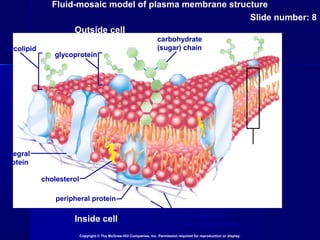
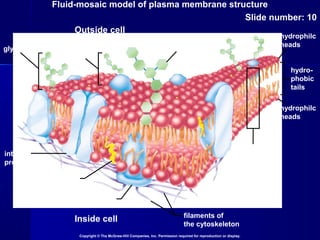
 The membrane is aThe membrane is a Fluid MosaicFluid Mosaic ofof
phospholipids and proteins. WHY?phospholipids and proteins. WHY?
– There are proteins embedded in the lipidThere are proteins embedded in the lipid
bilayer.bilayer.
– Attached to the outer surface: Peripheral ProteinAttached to the outer surface: Peripheral Protein
– Running through the whole membrane: Integral ProteinRunning through the whole membrane: Integral Protein
– The cell membrane appears to show someThe cell membrane appears to show some
fluidity…lipids and proteinsfluidity…lipids and proteins movingmoving
sidewayssideways in response to functions andin response to functions and
surrounding conditions.surrounding conditions.
– CholesterolCholesterol helps stabilize the fluidity athelps stabilize the fluidity at
different temperatures.different temperatures.
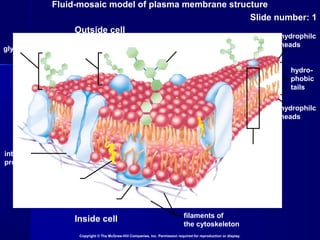
Fluid-mosaic model of plasma membrane structure
Slide number: 1
Copyright © The McGraw-Hill Companies, Inc. Permission required for reproduction or display.
Inside cell
Outside cell
glycolipid
glycoprotein
carbohydrate
(sugar) chain
phospholipid
bilayerintegral
protein
cholesterol
peripheral protein
filaments of
the cytoskeleton
hydro-
phobic
tails
hydrophilc
heads
hydrophilc
heads
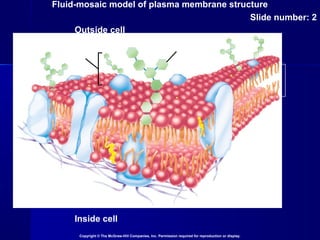
Fluid-mosaic model of plasma membrane structure
Slide number: 2
Copyright © The McGraw-Hill Companies, Inc. Permission required for reproduction or display.
Inside cell
Outside cell
glycoprotein
carbohydrate
(sugar) chain
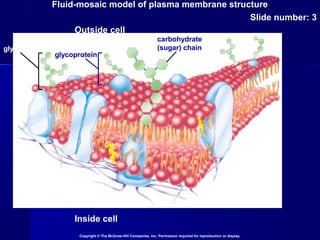
Fluid-mosaic model of plasma membrane structure
Slide number: 3
Copyright © The McGraw-Hill Companies, Inc. Permission required for reproduction or display.
Inside cell
Outside cell
glycolipid
glycoprotein
carbohydrate
(sugar) chain
Fluid-mosaic model of plasma membrane structure
Slide number: 4
Copyright © The McGraw-Hill Companies, Inc. Permission required for reproduction or display.
Inside cell
Outside cell
glycolipid
glycoprotein
carbohydrate
(sugar) chain
integral
protein
Fluid-mosaic model of plasma membrane structure
Slide number: 5
Copyright © The McGraw-Hill Companies, Inc. Permission required for reproduction or display.
Inside cell
Outside cell
glycolipid
glycoprotein
carbohydrate
(sugar) chain
integral
protein
cholesterol
Fluid-mosaic model of plasma membrane structure
Slide number: 6
Copyright © The McGraw-Hill Companies, Inc. Permission required for reproduction or display.
Inside cell
Outside cell
glycolipid
glycoprotein
carbohydrate
(sugar) chain
integral
protein
cholesterol
peripheral protein
Fluid-mosaic model of plasma membrane structure
Slide number: 7
Copyright © The McGraw-Hill Companies, Inc. Permission required for reproduction or display.
Inside cell
Outside cell
glycolipid
glycoprotein
carbohydrate
(sugar) chain
integral
protein
cholesterol
peripheral protein
filaments of
the cytoskeleton
Fluid-mosaic model of plasma membrane structure
Slide number: 8
Copyright © The McGraw-Hill Companies, Inc. Permission required for reproduction or display.
Inside cell
Outside cell
glycolipid
glycoprotein
carbohydrate
(sugar) chain
phospholipid
bilayerintegral
protein
cholesterol
peripheral protein
filaments of
the cytoskeleton
Fluid-mosaic model of plasma membrane structure
Slide number: 9
Copyright © The McGraw-Hill Companies, Inc. Permission required for reproduction or display.
Inside cell
Outside cell
glycolipid
glycoprotein
carbohydrate
(sugar) chain
phospholipid
bilayerintegral
protein
cholesterol
peripheral protein
filaments of
the cytoskeleton
hydro-
phobic
tails
hydrophilc
heads
hydrophilc
heads
Fluid-mosaic model of plasma membrane structure
Slide number: 10
Copyright © The McGraw-Hill Companies, Inc. Permission required for reproduction or display.
Inside cell
Outside cell
glycolipid
glycoprotein
carbohydrate
(sugar) chain
phospholipid
bilayerintegral
protein
cholesterol
peripheral protein
filaments of
the cytoskeleton
hydro-
phobic
tails
hydrophilc
heads
hydrophilc
heads
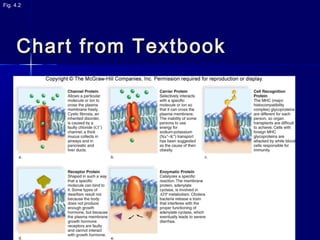
Functions of Membrane ProteinsFunctions of Membrane Proteins
 Channel – moves materialsChannel – moves materials
 Carrier – combines with a substance toCarrier – combines with a substance to
movemove
 Cell Recognition – glycoproteins – helpsCell Recognition – glycoproteins – helps
cells find moleculescells find molecules
 Receptor – specific to a certain moleculeReceptor – specific to a certain molecule
 Enzyme – carries out metabolic functionsEnzyme – carries out metabolic functions
Chart from TextbookChart from Textbook
Fig. 4.2
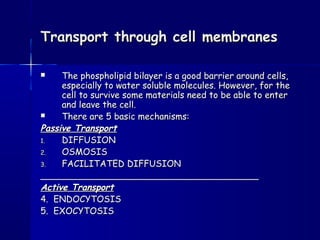
Transport through cell membranesTransport through cell membranes
 The phospholipid bilayer is a good barrier around cells,The phospholipid bilayer is a good barrier around cells,
especially to water soluble molecules. However, for theespecially to water soluble molecules. However, for the
cell to survive some materials need to be able to entercell to survive some materials need to be able to enter
and leave the cell.and leave the cell.
 There are 5 basic mechanisms:There are 5 basic mechanisms:
Passive TransportPassive Transport
1.1. DIFFUSIONDIFFUSION
2.2. OSMOSISOSMOSIS
3.3. FACILITATED DIFFUSIONFACILITATED DIFFUSION
______________________________________________________________________________
Active TransportActive Transport
4. ENDOCYTOSIS4. ENDOCYTOSIS
5. EXOCYTOSIS5. EXOCYTOSIS
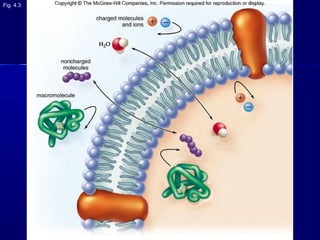
Fig. 4.3
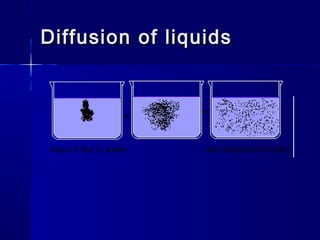
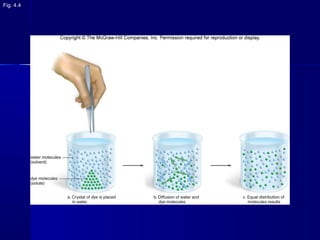
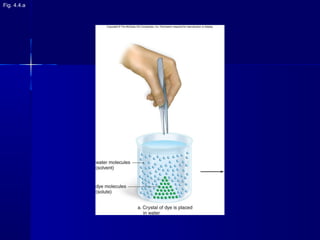
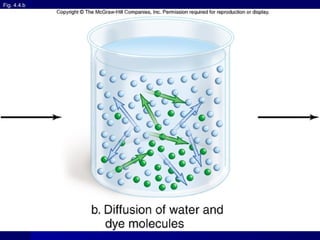
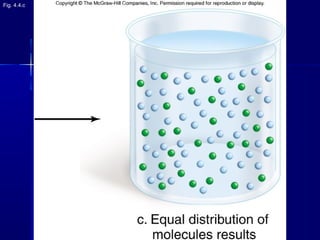
Diffusion of liquidsDiffusion of liquids
Fig. 4.4
Fig. 4.4.a
Fig. 4.4.b
Fig. 4.4.c
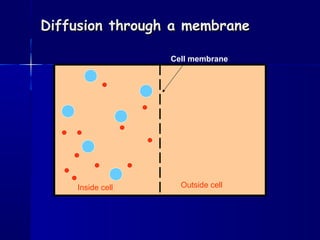
Diffusion through a membraneDiffusion through a membrane
Cell membrane
Inside cell Outside cell
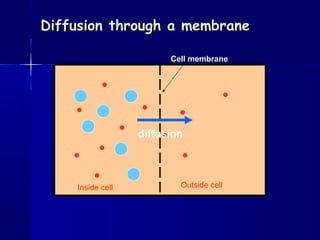
Diffusion through a membraneDiffusion through a membrane
Cell membrane
Inside cell Outside cell
diffusion
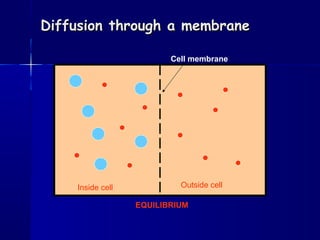
Diffusion through a membraneDiffusion through a membrane
Cell membrane
Inside cell Outside cell
EQUILIBRIUM
Simple DiffusionSimple Diffusion
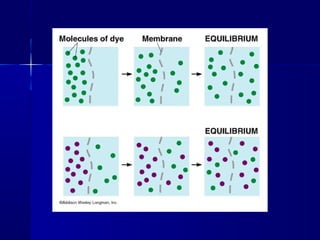
• Diffusion is the net movement of molecules (orDiffusion is the net movement of molecules (or
ions) from a region of their high concentration toions) from a region of their high concentration to
a region of their lower concentration.a region of their lower concentration.
• The molecules move down aThe molecules move down a concentrationconcentration
gradient.gradient.
• Molecules haveMolecules have kinetic energykinetic energy, which makes, which makes
them move about randomly.them move about randomly.
• As a result of diffusion, molecules reach anAs a result of diffusion, molecules reach an
equilibriumequilibrium where they are evenly spread out.where they are evenly spread out.
• This is when there isThis is when there is no net movementno net movement ofof
molecules from either side.molecules from either side.
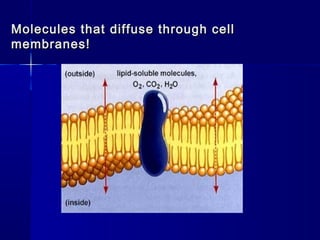
Molecules that diffuse through cellMolecules that diffuse through cell
membranes!membranes!
Passage Through ThePassage Through The
Phospholipid BilayerPhospholipid Bilayer
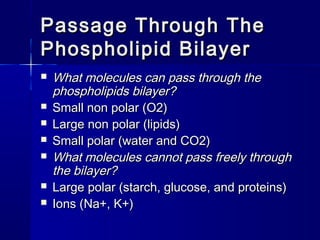
 What molecules can pass through theWhat molecules can pass through the
phospholipids bilayer?phospholipids bilayer?
 Small non polar (O2)Small non polar (O2)
 Large non polar (lipids)Large non polar (lipids)
 Small polar (water and CO2)Small polar (water and CO2)
 What molecules cannot pass freely throughWhat molecules cannot pass freely through
the bilayer?the bilayer?
 Large polar (starch, glucose, and proteins)Large polar (starch, glucose, and proteins)
 Ions (Na+, K+)Ions (Na+, K+)
OSMOSISOSMOSIS
OsmosisOsmosis
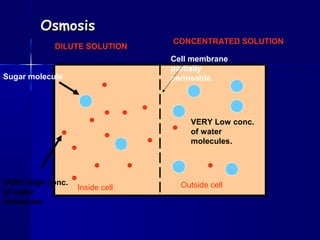
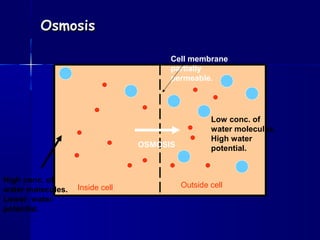
‘‘TheThe diffusiondiffusion of water from anof water from an
area of high concentration ofarea of high concentration of
water molecules to an area ofwater molecules to an area of
low concentration of waterlow concentration of water
across aacross a semi permeablesemi permeable
membrane.membrane.
OsmosisOsmosis
Cell membrane
partially
permeable.
Inside cell Outside cellVERY High conc.
of water
molecules.
VERY Low conc.
of water
molecules.
Sugar molecule
DILUTE SOLUTION
CONCENTRATED SOLUTION
OsmosisOsmosis
Cell membrane
partially
permeable.
Inside cell Outside cell
High conc. of
water molecules.
Lower water
potential.
Low conc. of
water molecules.
High water
potential.OSMOSIS
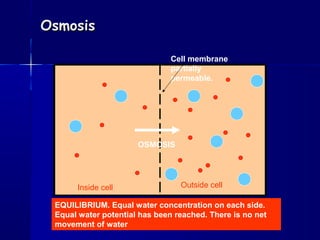
OsmosisOsmosis
Cell membrane
partially
permeable.
Inside cell Outside cell
OSMOSIS
EQUILIBRIUM. Equal water concentration on each side.
Equal water potential has been reached. There is no net
movement of water
Water Movement in theWater Movement in the
CellCell
 This is an Osmosis tutorial…for theThis is an Osmosis tutorial…for the
smart board….smart board….
osmosis#Osmosis#Osmosis#Osmosisosmosis#Osmosis#Osmosis#Osmosis
 The cell can concentrate solutes that are notThe cell can concentrate solutes that are not
permeable to the phospholipid bilayer on onepermeable to the phospholipid bilayer on one
side of the membrane.side of the membrane.
 Which way will water move?Which way will water move?
– Water will follow the solutes.Water will follow the solutes.
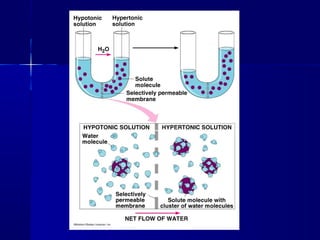
 What do the terms hypotonic, hypertonic andWhat do the terms hypotonic, hypertonic and
isotonic mean?isotonic mean?
– Hypotonic = lower solute concentrationHypotonic = lower solute concentration
– Hypertonic = greater solute concentrationHypertonic = greater solute concentration
– Isotonic = equal solute concentrationIsotonic = equal solute concentration
Osmosis TutorialOsmosis Tutorial
??
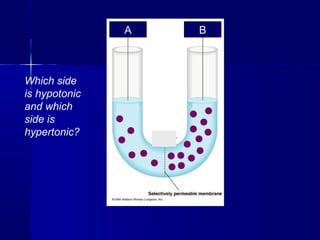
Which side
is hypotonic
and which
side is
hypertonic?
A B
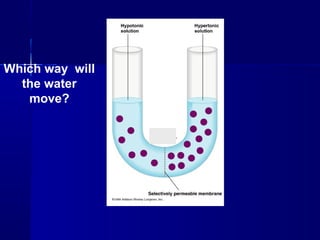
Which way will
the water
move?
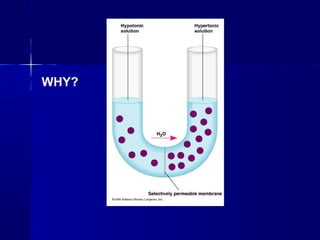
WHY?
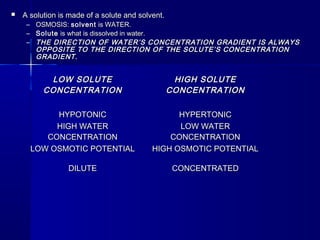
 A solution is made of a solute and solvent.A solution is made of a solute and solvent.
– OSMOSIS:OSMOSIS: solventsolvent is WATER.is WATER.
– SoluteSolute is what is dissolved in water.is what is dissolved in water.
– THE DIRECTION OF WATER’S CONCENTRATION GRADIENT IS ALWAYSTHE DIRECTION OF WATER’S CONCENTRATION GRADIENT IS ALWAYS
OPPOSITE TO THE DIRECTION OF THE SOLUTE’S CONCENTRATIONOPPOSITE TO THE DIRECTION OF THE SOLUTE’S CONCENTRATION
GRADIENTGRADIENT..
LOW SOLUTELOW SOLUTE
CONCENTRATIONCONCENTRATION
HIGH SOLUTEHIGH SOLUTE
CONCENTRATIONCONCENTRATION
HYPOTONICHYPOTONIC HYPERTONICHYPERTONIC
HIGH WATERHIGH WATER
CONCENTRATIONCONCENTRATION
LOW WATERLOW WATER
CONCENTRATIONCONCENTRATION
LOW OSMOTIC POTENTIALLOW OSMOTIC POTENTIAL HIGH OSMOTIC POTENTIALHIGH OSMOTIC POTENTIAL
DILUTEDILUTE CONCENTRATEDCONCENTRATED
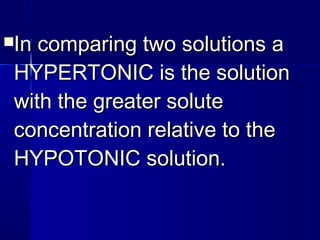
In comparing two solutions aIn comparing two solutions a
HYPERTONIC is the solutionHYPERTONIC is the solution
with the greater solutewith the greater solute
concentration relative to theconcentration relative to the
HYPOTONIC solution.HYPOTONIC solution.
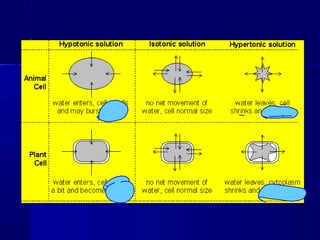
 Water balance between cells and theirWater balance between cells and their
surroundings issurroundings is crucialcrucial to organisms.to organisms.
– Cell membranes act asCell membranes act as selectively permeableselectively permeable
membranesmembranes between the cell contents and itsbetween the cell contents and its
surroundings.surroundings.
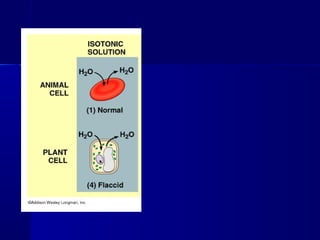
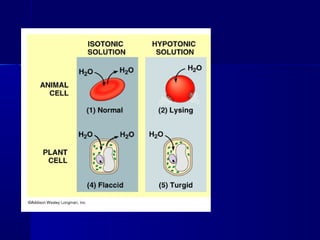
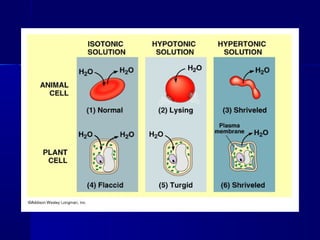
– If a plant or an animal cell isIf a plant or an animal cell is isotonicisotonic with itswith its
surroundings, no osmosis occurs, and thesurroundings, no osmosis occurs, and the
cells do not changecells do not change..
– Cells in a hypotonic environmentCells in a hypotonic environment
 An animal cell will gain water andAn animal cell will gain water and lyselyse (pop).(pop).
 A plant cell will swell and becomeA plant cell will swell and become turgidturgid (stiff).(stiff).
– Cells in a hypertonic environment………Cells in a hypertonic environment………
 An animal cell in a hypertonic solutionAn animal cell in a hypertonic solution
will lose water and shrivel.will lose water and shrivel.
 A plant cell in aA plant cell in a hypertonic solutionhypertonic solution will:will:
– lose water past the cell membrane but notlose water past the cell membrane but not
the cell wallthe cell wall
– plasma membrane pulls away from the insideplasma membrane pulls away from the inside
of the cell wall andof the cell wall and
– cell as a whole losingcell as a whole losing turgorturgor..
– This process is calledThis process is called PLASMOLYSISPLASMOLYSIS..
Do Water Molecules Stop MovingDo Water Molecules Stop Moving
in Isotonic Conditionsin Isotonic Conditions ??
 No.No.
 They continue to diffuse,They continue to diffuse,
however there is nohowever there is no netnet
movement!movement!
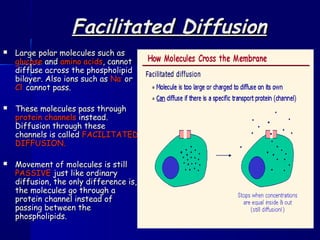
Facilitated DiffusionFacilitated Diffusion
 Large polar molecules such asLarge polar molecules such as
glucoseglucose andand amino acidsamino acids, cannot, cannot
diffuse across the phospholipiddiffuse across the phospholipid
bilayer. Also ions such asbilayer. Also ions such as NaNa++
oror
ClCl--
cannot pass.cannot pass.
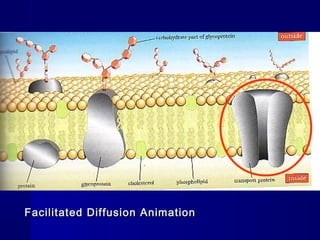
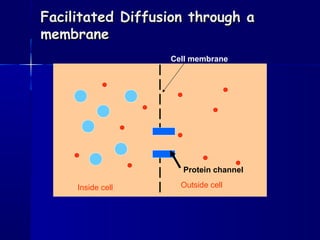
 These molecules pass throughThese molecules pass through
protein channelsprotein channels instead.instead.
Diffusion through theseDiffusion through these
channels is calledchannels is called FACILITATEDFACILITATED
DIFFUSION.DIFFUSION.
 Movement of molecules is stillMovement of molecules is still
PASSIVEPASSIVE just like ordinaryjust like ordinary
diffusion, the only difference is,diffusion, the only difference is,
the molecules go through athe molecules go through a
protein channel instead ofprotein channel instead of
passing between thepassing between the
phospholipids.phospholipids.
Facilitated Diffusion AnimationFacilitated Diffusion Animation
Facilitated Diffusion through aFacilitated Diffusion through a
membranemembrane
Cell membrane
Inside cell Outside cell
Protein channel
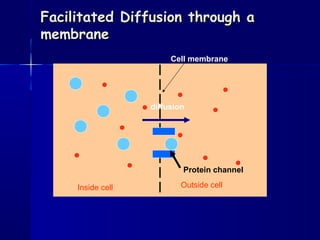
Facilitated Diffusion through aFacilitated Diffusion through a
membranemembrane
Cell membrane
Inside cell Outside cell
Protein channel
diffusion
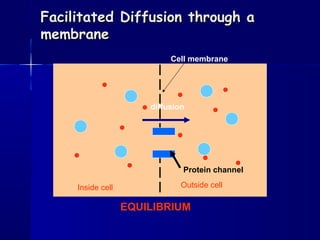
Facilitated Diffusion through aFacilitated Diffusion through a
membranemembrane
Cell membrane
Inside cell Outside cell
Protein channel
diffusion
EQUILIBRIUM
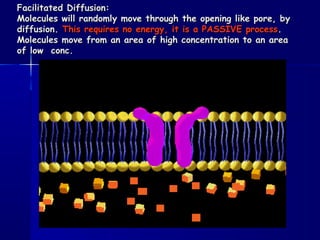
Facilitated Diffusion:Facilitated Diffusion:
Molecules will randomly move through the opening like pore, byMolecules will randomly move through the opening like pore, by
diffusion.diffusion. This requires no energy, it is a PASSIVE processThis requires no energy, it is a PASSIVE process..
Molecules move from an area of high concentration to an areaMolecules move from an area of high concentration to an area
of low conc.of low conc.
ActiveActive
TransportTransport
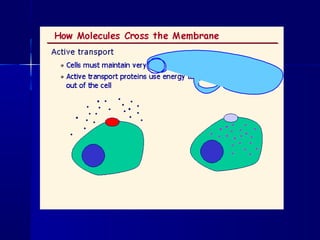
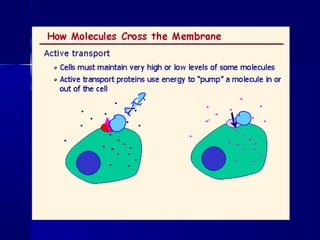
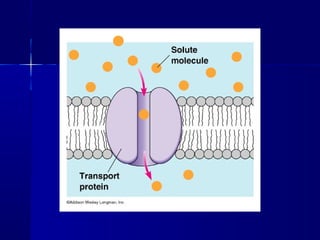
 Cells expend energy forCells expend energy for active transportactive transport..
– Active transportActive transport involves the aid of ainvolves the aid of a
transport protein or a vesicletransport protein or a vesicle
– moves a solutemoves a solute upup a concentrationa concentration
gradientgradient
– from an area of low concentration tofrom an area of low concentration to
an area of high concentration.an area of high concentration.
– Energy is requiredEnergy is required to help the proteinto help the protein
to move the solute molecule.to move the solute molecule.
– What molecular form does thisWhat molecular form does this
energy usually have?energy usually have?
– ATP – usable cellular energy!ATP – usable cellular energy!
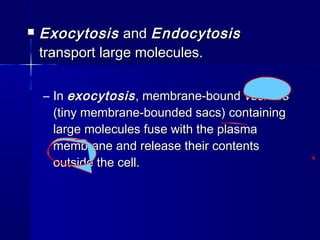
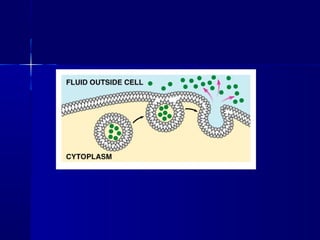
 ExocytosisExocytosis andand EndocytosisEndocytosis
transport large molecules.transport large molecules.
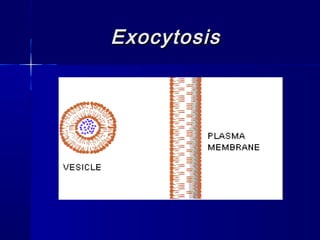
– InIn exocytosisexocytosis, membrane-bound, membrane-bound vesiclesvesicles
(tiny membrane-bounded sacs) containing(tiny membrane-bounded sacs) containing
large molecules fuse with the plasmalarge molecules fuse with the plasma
membrane and release their contentsmembrane and release their contents
outside the cell.outside the cell.
ExocytosisExocytosis
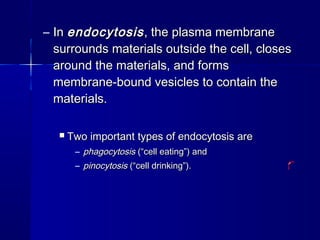
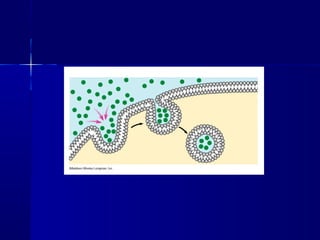
– InIn endocytosisendocytosis, the plasma membrane, the plasma membrane
surrounds materials outside the cell, closessurrounds materials outside the cell, closes
around the materials, and formsaround the materials, and forms
membrane-bound vesicles to contain themembrane-bound vesicles to contain the
materials.materials.
 Two important types of endocytosis areTwo important types of endocytosis are
– phagocytosisphagocytosis (“cell eating”) and(“cell eating”) and
– pinocytosispinocytosis (“cell drinking”).(“cell drinking”).
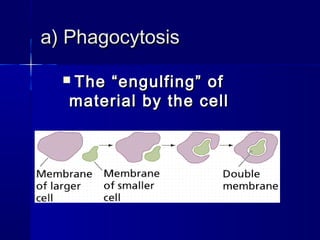
a) Phagocytosisa) Phagocytosis
 The “engulfing” ofThe “engulfing” of
material by the cellmaterial by the cell
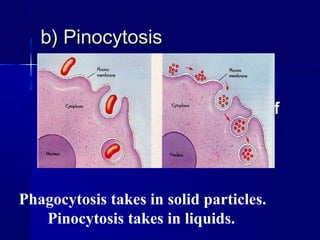
b) Pinocytosisb) Pinocytosis
 The “cell drinking” ofThe “cell drinking” of
material by the cellmaterial by the cell
Phagocytosis takes in solid particles.
Pinocytosis takes in liquids.
Active transport is used to:
1. Generate charge gradients. Ex. In the
mitochondrion, hydrogen ion pumps, pump
hydrogen ions into the “intermembrane” space of
the organelle as part of making ATP. 
2. Concentrate ions, minerals and nutrients inside
the cell that are in low concentration outside. 
3. Move sodium and potassium ions in and out of the
cell. VERY important for nerve function.
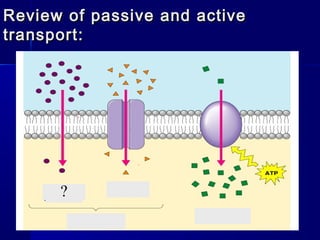
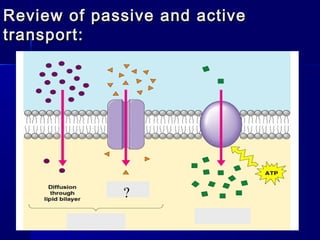
Review of passive and activeReview of passive and active
transport:transport:
?
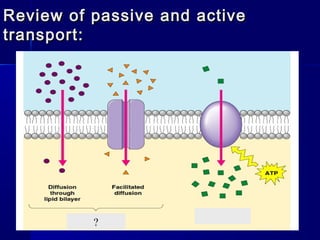
Review of passive and activeReview of passive and active
transport:transport:
?
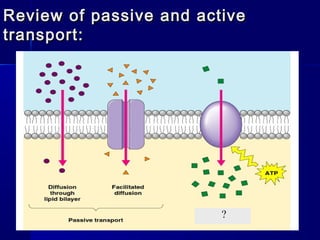
Review of passive and activeReview of passive and active
transport:transport:
?
Review of passive and activeReview of passive and active
transport:transport:
?
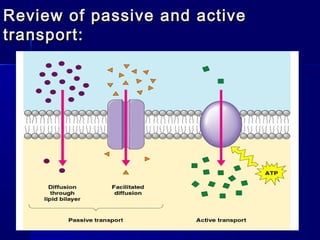
Review of passive and activeReview of passive and active
transport:transport:
MEMBRANE STRUCTURE
MEMBRANE STRUCTURE
MEMBRANE STRUCTURE
MEMBRANE STRUCTURE
MEMBRANE STRUCTURE
MEMBRANE STRUCTURE
MEMBRANE STRUCTURE

MEMBRANE STRUCTURE

  • 1.
    Cell Transport:Cell Transport: MembraneStructureMembrane Structure and Functionand Function
  • 2.
    Chapter ObjectivesChapter Objectives 1.1.Describe the fluid mosaic model of membrane structure andDescribe the fluid mosaic model of membrane structure and explain the underlying reasons for this structure.explain the underlying reasons for this structure. 2.2. Outline the roles of phospholipids, cholesterol, glycolipids,Outline the roles of phospholipids, cholesterol, glycolipids, proteins and glycoproteins in membranes.proteins and glycoproteins in membranes. 3.3. Outline the roles of the plasma membrane, and the roles ofOutline the roles of the plasma membrane, and the roles of membranes within cells.membranes within cells. 4.4. Describe and explain how molecules can get in and out ofDescribe and explain how molecules can get in and out of cells (cross cell membranes) by the processes of diffusion,cells (cross cell membranes) by the processes of diffusion, facilitated diffusion, osmosis, active transport, endocytosisfacilitated diffusion, osmosis, active transport, endocytosis and exocytosis.and exocytosis. 5.5. Describe the effects on animal and plant cells of immersionDescribe the effects on animal and plant cells of immersion in solutions of different “water potential”.in solutions of different “water potential”.
  • 3.
    Chapter – KeyVocabularyChapter – Key Vocabulary SelectivelySelectively permeablepermeable PhospholipidPhospholipid HydrophobicHydrophobic HydrophilicHydrophilic Passive TransportPassive Transport Active TransportActive Transport DiffusionDiffusion OsmosisOsmosis ConcentrationConcentration GradientGradient HypertonicHypertonic HypotonicHypotonic IsotonicIsotonic  TurgorTurgor  PlasmolysisPlasmolysis  Facilitated diffusionFacilitated diffusion  ExocytosisExocytosis  EndocytosisEndocytosis  PhagocytosisPhagocytosis  PinocytosisPinocytosis  Fluid Mosaic ModelFluid Mosaic Model  EquilibriumEquilibrium
  • 7.
     Membranes organizetheMembranes organize the chemical activities of cells.chemical activities of cells. – They separate cells from their outsideThey separate cells from their outside environments.environments. – They control the passage of moleculesThey control the passage of molecules from one side of the membrane to thefrom one side of the membrane to the other.other. – Membranes areMembranes are selectively permeableselectively permeable ;; that is, they allow some substances tothat is, they allow some substances to cross more easily than others and blockscross more easily than others and blocks passage of some substances altogether.passage of some substances altogether.
  • 8.
     Membrane phospholipidsform a bilayer.Membrane phospholipids form a bilayer.  PhospholipidsPhospholipids are:are: – fats with two nonpolar fatty acid “tails”fats with two nonpolar fatty acid “tails” – one polar phosphate “head”one polar phosphate “head” – attached to glycerol.attached to glycerol.  In water, thousands of individualIn water, thousands of individual molecules form a “stable bilayer”, aimingmolecules form a “stable bilayer”, aiming their heads out and their tails in.their heads out and their tails in.  TheThe hydrophobichydrophobic interior of this bilayerinterior of this bilayer offers an effective barrier to the flow ofoffers an effective barrier to the flow of mostmost hydrophilichydrophilic molecules.molecules.
  • 9.
     The membraneis aThe membrane is a Fluid MosaicFluid Mosaic ofof phospholipids and proteins. WHY?phospholipids and proteins. WHY? – There are proteins embedded in the lipidThere are proteins embedded in the lipid bilayer.bilayer. – Attached to the outer surface: Peripheral ProteinAttached to the outer surface: Peripheral Protein – Running through the whole membrane: Integral ProteinRunning through the whole membrane: Integral Protein – The cell membrane appears to show someThe cell membrane appears to show some fluidity…lipids and proteinsfluidity…lipids and proteins movingmoving sidewayssideways in response to functions andin response to functions and surrounding conditions.surrounding conditions. – CholesterolCholesterol helps stabilize the fluidity athelps stabilize the fluidity at different temperatures.different temperatures.
  • 10.
    Fluid-mosaic model ofplasma membrane structure Slide number: 1 Copyright © The McGraw-Hill Companies, Inc. Permission required for reproduction or display. Inside cell Outside cell glycolipid glycoprotein carbohydrate (sugar) chain phospholipid bilayerintegral protein cholesterol peripheral protein filaments of the cytoskeleton hydro- phobic tails hydrophilc heads hydrophilc heads
  • 11.
    Fluid-mosaic model ofplasma membrane structure Slide number: 2 Copyright © The McGraw-Hill Companies, Inc. Permission required for reproduction or display. Inside cell Outside cell glycoprotein carbohydrate (sugar) chain
  • 12.
    Fluid-mosaic model ofplasma membrane structure Slide number: 3 Copyright © The McGraw-Hill Companies, Inc. Permission required for reproduction or display. Inside cell Outside cell glycolipid glycoprotein carbohydrate (sugar) chain
  • 13.
    Fluid-mosaic model ofplasma membrane structure Slide number: 4 Copyright © The McGraw-Hill Companies, Inc. Permission required for reproduction or display. Inside cell Outside cell glycolipid glycoprotein carbohydrate (sugar) chain integral protein
  • 14.
    Fluid-mosaic model ofplasma membrane structure Slide number: 5 Copyright © The McGraw-Hill Companies, Inc. Permission required for reproduction or display. Inside cell Outside cell glycolipid glycoprotein carbohydrate (sugar) chain integral protein cholesterol
  • 15.
    Fluid-mosaic model ofplasma membrane structure Slide number: 6 Copyright © The McGraw-Hill Companies, Inc. Permission required for reproduction or display. Inside cell Outside cell glycolipid glycoprotein carbohydrate (sugar) chain integral protein cholesterol peripheral protein
  • 16.
    Fluid-mosaic model ofplasma membrane structure Slide number: 7 Copyright © The McGraw-Hill Companies, Inc. Permission required for reproduction or display. Inside cell Outside cell glycolipid glycoprotein carbohydrate (sugar) chain integral protein cholesterol peripheral protein filaments of the cytoskeleton
  • 17.
    Fluid-mosaic model ofplasma membrane structure Slide number: 8 Copyright © The McGraw-Hill Companies, Inc. Permission required for reproduction or display. Inside cell Outside cell glycolipid glycoprotein carbohydrate (sugar) chain phospholipid bilayerintegral protein cholesterol peripheral protein filaments of the cytoskeleton
  • 18.
    Fluid-mosaic model ofplasma membrane structure Slide number: 9 Copyright © The McGraw-Hill Companies, Inc. Permission required for reproduction or display. Inside cell Outside cell glycolipid glycoprotein carbohydrate (sugar) chain phospholipid bilayerintegral protein cholesterol peripheral protein filaments of the cytoskeleton hydro- phobic tails hydrophilc heads hydrophilc heads
  • 19.
    Fluid-mosaic model ofplasma membrane structure Slide number: 10 Copyright © The McGraw-Hill Companies, Inc. Permission required for reproduction or display. Inside cell Outside cell glycolipid glycoprotein carbohydrate (sugar) chain phospholipid bilayerintegral protein cholesterol peripheral protein filaments of the cytoskeleton hydro- phobic tails hydrophilc heads hydrophilc heads
  • 20.
    Functions of MembraneProteinsFunctions of Membrane Proteins  Channel – moves materialsChannel – moves materials  Carrier – combines with a substance toCarrier – combines with a substance to movemove  Cell Recognition – glycoproteins – helpsCell Recognition – glycoproteins – helps cells find moleculescells find molecules  Receptor – specific to a certain moleculeReceptor – specific to a certain molecule  Enzyme – carries out metabolic functionsEnzyme – carries out metabolic functions
  • 21.
    Chart from TextbookChartfrom Textbook Fig. 4.2
  • 22.
    Transport through cellmembranesTransport through cell membranes  The phospholipid bilayer is a good barrier around cells,The phospholipid bilayer is a good barrier around cells, especially to water soluble molecules. However, for theespecially to water soluble molecules. However, for the cell to survive some materials need to be able to entercell to survive some materials need to be able to enter and leave the cell.and leave the cell.  There are 5 basic mechanisms:There are 5 basic mechanisms: Passive TransportPassive Transport 1.1. DIFFUSIONDIFFUSION 2.2. OSMOSISOSMOSIS 3.3. FACILITATED DIFFUSIONFACILITATED DIFFUSION ______________________________________________________________________________ Active TransportActive Transport 4. ENDOCYTOSIS4. ENDOCYTOSIS 5. EXOCYTOSIS5. EXOCYTOSIS
  • 23.
  • 24.
  • 25.
  • 26.
  • 27.
  • 28.
  • 29.
    Diffusion through amembraneDiffusion through a membrane Cell membrane Inside cell Outside cell
  • 30.
    Diffusion through amembraneDiffusion through a membrane Cell membrane Inside cell Outside cell diffusion
  • 31.
    Diffusion through amembraneDiffusion through a membrane Cell membrane Inside cell Outside cell EQUILIBRIUM
  • 32.
    Simple DiffusionSimple Diffusion •Diffusion is the net movement of molecules (orDiffusion is the net movement of molecules (or ions) from a region of their high concentration toions) from a region of their high concentration to a region of their lower concentration.a region of their lower concentration. • The molecules move down aThe molecules move down a concentrationconcentration gradient.gradient. • Molecules haveMolecules have kinetic energykinetic energy, which makes, which makes them move about randomly.them move about randomly. • As a result of diffusion, molecules reach anAs a result of diffusion, molecules reach an equilibriumequilibrium where they are evenly spread out.where they are evenly spread out. • This is when there isThis is when there is no net movementno net movement ofof molecules from either side.molecules from either side.
  • 33.
    Molecules that diffusethrough cellMolecules that diffuse through cell membranes!membranes!
  • 34.
    Passage Through ThePassageThrough The Phospholipid BilayerPhospholipid Bilayer  What molecules can pass through theWhat molecules can pass through the phospholipids bilayer?phospholipids bilayer?  Small non polar (O2)Small non polar (O2)  Large non polar (lipids)Large non polar (lipids)  Small polar (water and CO2)Small polar (water and CO2)  What molecules cannot pass freely throughWhat molecules cannot pass freely through the bilayer?the bilayer?  Large polar (starch, glucose, and proteins)Large polar (starch, glucose, and proteins)  Ions (Na+, K+)Ions (Na+, K+)
  • 35.
  • 36.
    OsmosisOsmosis ‘‘TheThe diffusiondiffusion ofwater from anof water from an area of high concentration ofarea of high concentration of water molecules to an area ofwater molecules to an area of low concentration of waterlow concentration of water across aacross a semi permeablesemi permeable membrane.membrane.
  • 37.
    OsmosisOsmosis Cell membrane partially permeable. Inside cellOutside cellVERY High conc. of water molecules. VERY Low conc. of water molecules. Sugar molecule DILUTE SOLUTION CONCENTRATED SOLUTION
  • 38.
    OsmosisOsmosis Cell membrane partially permeable. Inside cellOutside cell High conc. of water molecules. Lower water potential. Low conc. of water molecules. High water potential.OSMOSIS
  • 39.
    OsmosisOsmosis Cell membrane partially permeable. Inside cellOutside cell OSMOSIS EQUILIBRIUM. Equal water concentration on each side. Equal water potential has been reached. There is no net movement of water
  • 40.
    Water Movement intheWater Movement in the CellCell  This is an Osmosis tutorial…for theThis is an Osmosis tutorial…for the smart board….smart board…. osmosis#Osmosis#Osmosis#Osmosisosmosis#Osmosis#Osmosis#Osmosis
  • 41.
     The cellcan concentrate solutes that are notThe cell can concentrate solutes that are not permeable to the phospholipid bilayer on onepermeable to the phospholipid bilayer on one side of the membrane.side of the membrane.  Which way will water move?Which way will water move? – Water will follow the solutes.Water will follow the solutes.  What do the terms hypotonic, hypertonic andWhat do the terms hypotonic, hypertonic and isotonic mean?isotonic mean? – Hypotonic = lower solute concentrationHypotonic = lower solute concentration – Hypertonic = greater solute concentrationHypertonic = greater solute concentration – Isotonic = equal solute concentrationIsotonic = equal solute concentration Osmosis TutorialOsmosis Tutorial
  • 42.
    ?? Which side is hypotonic andwhich side is hypertonic? A B
  • 43.
    Which way will thewater move?
  • 44.
  • 46.
     A solutionis made of a solute and solvent.A solution is made of a solute and solvent. – OSMOSIS:OSMOSIS: solventsolvent is WATER.is WATER. – SoluteSolute is what is dissolved in water.is what is dissolved in water. – THE DIRECTION OF WATER’S CONCENTRATION GRADIENT IS ALWAYSTHE DIRECTION OF WATER’S CONCENTRATION GRADIENT IS ALWAYS OPPOSITE TO THE DIRECTION OF THE SOLUTE’S CONCENTRATIONOPPOSITE TO THE DIRECTION OF THE SOLUTE’S CONCENTRATION GRADIENTGRADIENT.. LOW SOLUTELOW SOLUTE CONCENTRATIONCONCENTRATION HIGH SOLUTEHIGH SOLUTE CONCENTRATIONCONCENTRATION HYPOTONICHYPOTONIC HYPERTONICHYPERTONIC HIGH WATERHIGH WATER CONCENTRATIONCONCENTRATION LOW WATERLOW WATER CONCENTRATIONCONCENTRATION LOW OSMOTIC POTENTIALLOW OSMOTIC POTENTIAL HIGH OSMOTIC POTENTIALHIGH OSMOTIC POTENTIAL DILUTEDILUTE CONCENTRATEDCONCENTRATED
  • 47.
    In comparing twosolutions aIn comparing two solutions a HYPERTONIC is the solutionHYPERTONIC is the solution with the greater solutewith the greater solute concentration relative to theconcentration relative to the HYPOTONIC solution.HYPOTONIC solution.
  • 49.
     Water balancebetween cells and theirWater balance between cells and their surroundings issurroundings is crucialcrucial to organisms.to organisms. – Cell membranes act asCell membranes act as selectively permeableselectively permeable membranesmembranes between the cell contents and itsbetween the cell contents and its surroundings.surroundings. – If a plant or an animal cell isIf a plant or an animal cell is isotonicisotonic with itswith its surroundings, no osmosis occurs, and thesurroundings, no osmosis occurs, and the cells do not changecells do not change.. – Cells in a hypotonic environmentCells in a hypotonic environment  An animal cell will gain water andAn animal cell will gain water and lyselyse (pop).(pop).  A plant cell will swell and becomeA plant cell will swell and become turgidturgid (stiff).(stiff).
  • 50.
    – Cells ina hypertonic environment………Cells in a hypertonic environment………  An animal cell in a hypertonic solutionAn animal cell in a hypertonic solution will lose water and shrivel.will lose water and shrivel.  A plant cell in aA plant cell in a hypertonic solutionhypertonic solution will:will: – lose water past the cell membrane but notlose water past the cell membrane but not the cell wallthe cell wall – plasma membrane pulls away from the insideplasma membrane pulls away from the inside of the cell wall andof the cell wall and – cell as a whole losingcell as a whole losing turgorturgor.. – This process is calledThis process is called PLASMOLYSISPLASMOLYSIS..
  • 51.
    Do Water MoleculesStop MovingDo Water Molecules Stop Moving in Isotonic Conditionsin Isotonic Conditions ??  No.No.  They continue to diffuse,They continue to diffuse, however there is nohowever there is no netnet movement!movement!
  • 52.
    Facilitated DiffusionFacilitated Diffusion Large polar molecules such asLarge polar molecules such as glucoseglucose andand amino acidsamino acids, cannot, cannot diffuse across the phospholipiddiffuse across the phospholipid bilayer. Also ions such asbilayer. Also ions such as NaNa++ oror ClCl-- cannot pass.cannot pass.  These molecules pass throughThese molecules pass through protein channelsprotein channels instead.instead. Diffusion through theseDiffusion through these channels is calledchannels is called FACILITATEDFACILITATED DIFFUSION.DIFFUSION.  Movement of molecules is stillMovement of molecules is still PASSIVEPASSIVE just like ordinaryjust like ordinary diffusion, the only difference is,diffusion, the only difference is, the molecules go through athe molecules go through a protein channel instead ofprotein channel instead of passing between thepassing between the phospholipids.phospholipids.
  • 53.
  • 54.
    Facilitated Diffusion throughaFacilitated Diffusion through a membranemembrane Cell membrane Inside cell Outside cell Protein channel
  • 55.
    Facilitated Diffusion throughaFacilitated Diffusion through a membranemembrane Cell membrane Inside cell Outside cell Protein channel diffusion
  • 56.
    Facilitated Diffusion throughaFacilitated Diffusion through a membranemembrane Cell membrane Inside cell Outside cell Protein channel diffusion EQUILIBRIUM
  • 57.
    Facilitated Diffusion:Facilitated Diffusion: Moleculeswill randomly move through the opening like pore, byMolecules will randomly move through the opening like pore, by diffusion.diffusion. This requires no energy, it is a PASSIVE processThis requires no energy, it is a PASSIVE process.. Molecules move from an area of high concentration to an areaMolecules move from an area of high concentration to an area of low conc.of low conc.
  • 58.
  • 59.
     Cells expendenergy forCells expend energy for active transportactive transport.. – Active transportActive transport involves the aid of ainvolves the aid of a transport protein or a vesicletransport protein or a vesicle – moves a solutemoves a solute upup a concentrationa concentration gradientgradient – from an area of low concentration tofrom an area of low concentration to an area of high concentration.an area of high concentration. – Energy is requiredEnergy is required to help the proteinto help the protein to move the solute molecule.to move the solute molecule. – What molecular form does thisWhat molecular form does this energy usually have?energy usually have? – ATP – usable cellular energy!ATP – usable cellular energy!
  • 62.
     ExocytosisExocytosis andandEndocytosisEndocytosis transport large molecules.transport large molecules. – InIn exocytosisexocytosis, membrane-bound, membrane-bound vesiclesvesicles (tiny membrane-bounded sacs) containing(tiny membrane-bounded sacs) containing large molecules fuse with the plasmalarge molecules fuse with the plasma membrane and release their contentsmembrane and release their contents outside the cell.outside the cell.
  • 63.
  • 64.
    – InIn endocytosisendocytosis,the plasma membrane, the plasma membrane surrounds materials outside the cell, closessurrounds materials outside the cell, closes around the materials, and formsaround the materials, and forms membrane-bound vesicles to contain themembrane-bound vesicles to contain the materials.materials.  Two important types of endocytosis areTwo important types of endocytosis are – phagocytosisphagocytosis (“cell eating”) and(“cell eating”) and – pinocytosispinocytosis (“cell drinking”).(“cell drinking”).
  • 65.
    a) Phagocytosisa) Phagocytosis The “engulfing” ofThe “engulfing” of material by the cellmaterial by the cell
  • 66.
    b) Pinocytosisb) Pinocytosis The “cell drinking” ofThe “cell drinking” of material by the cellmaterial by the cell Phagocytosis takes in solid particles. Pinocytosis takes in liquids.
  • 67.
    Active transport isused to: 1. Generate charge gradients. Ex. In the mitochondrion, hydrogen ion pumps, pump hydrogen ions into the “intermembrane” space of the organelle as part of making ATP.  2. Concentrate ions, minerals and nutrients inside the cell that are in low concentration outside.  3. Move sodium and potassium ions in and out of the cell. VERY important for nerve function.
  • 68.
    Review of passiveand activeReview of passive and active transport:transport: ?
  • 69.
    Review of passiveand activeReview of passive and active transport:transport: ?
  • 70.
    Review of passiveand activeReview of passive and active transport:transport: ?
  • 71.
    Review of passiveand activeReview of passive and active transport:transport: ?
  • 72.
    Review of passiveand activeReview of passive and active transport:transport: