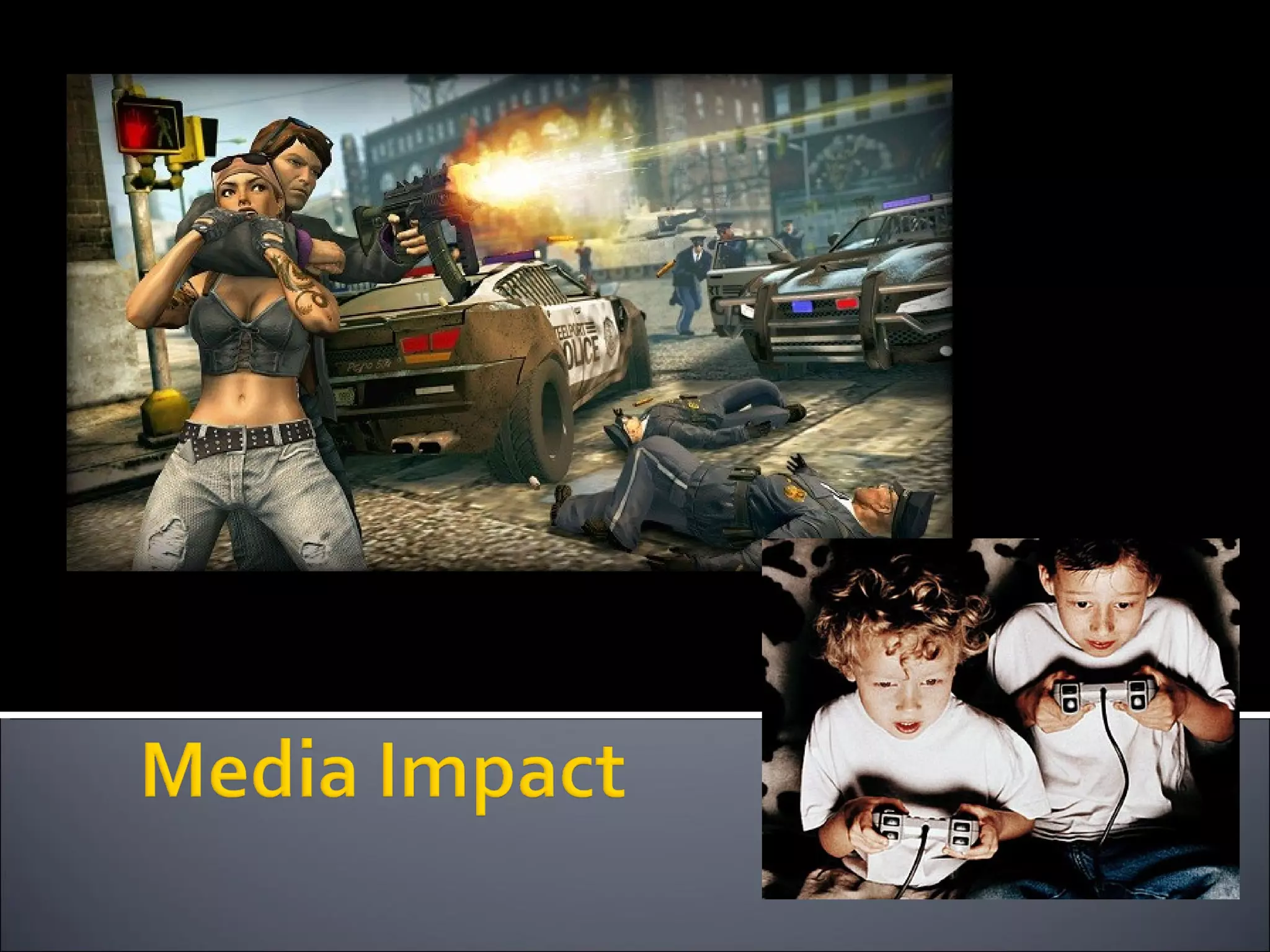
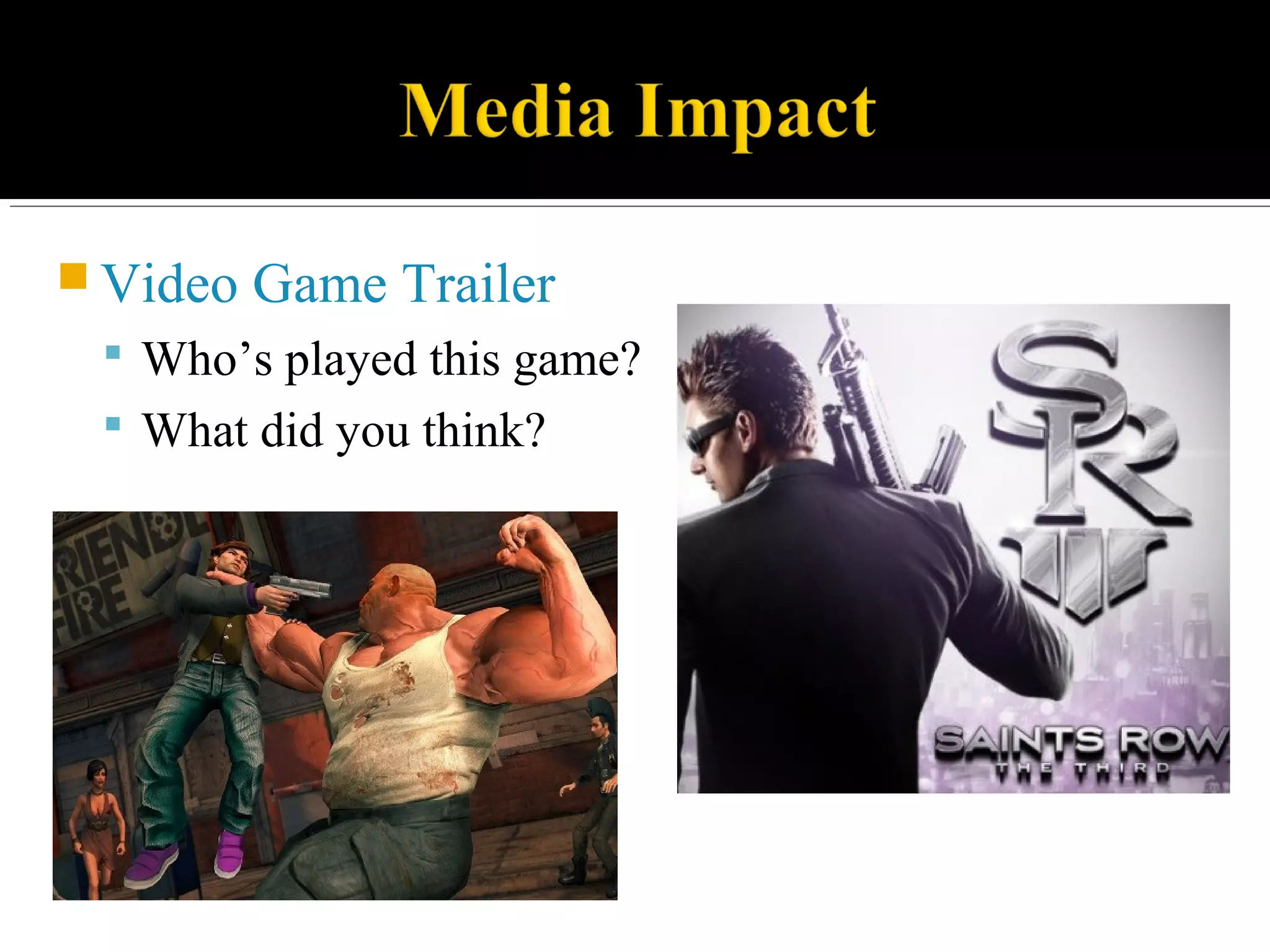
 Video Game Trailer
 Who’s played this game?
 What did you think?
Chapter Outline
History
Theory and Research
Controversies
MEDIA IMPACT:
Understanding Research and Effects
Why would anyone care
about or even do research on
the effects media have on
society?
Early Studies
 Concerns about media are as old as media themselves.
▪ Church leaders thought bibles would corrupt society
▪ Parents felt the same about the first novels.
▪ Consistent research on media begin in the 1920s.
 Payne Fund Studies conducted
▪ 13 separate investigations on the influence movies had on youth behavior
 Modeling (Payne Fund Study)
▪ The imitation of behavior from media examples
▪ Parents worry children may pick up antisocial habits from media consumption
▪ Video Clip Clip 2 Clip 3
▪ Do violent games
Increase Violence in Society?
▪ Why/Why not
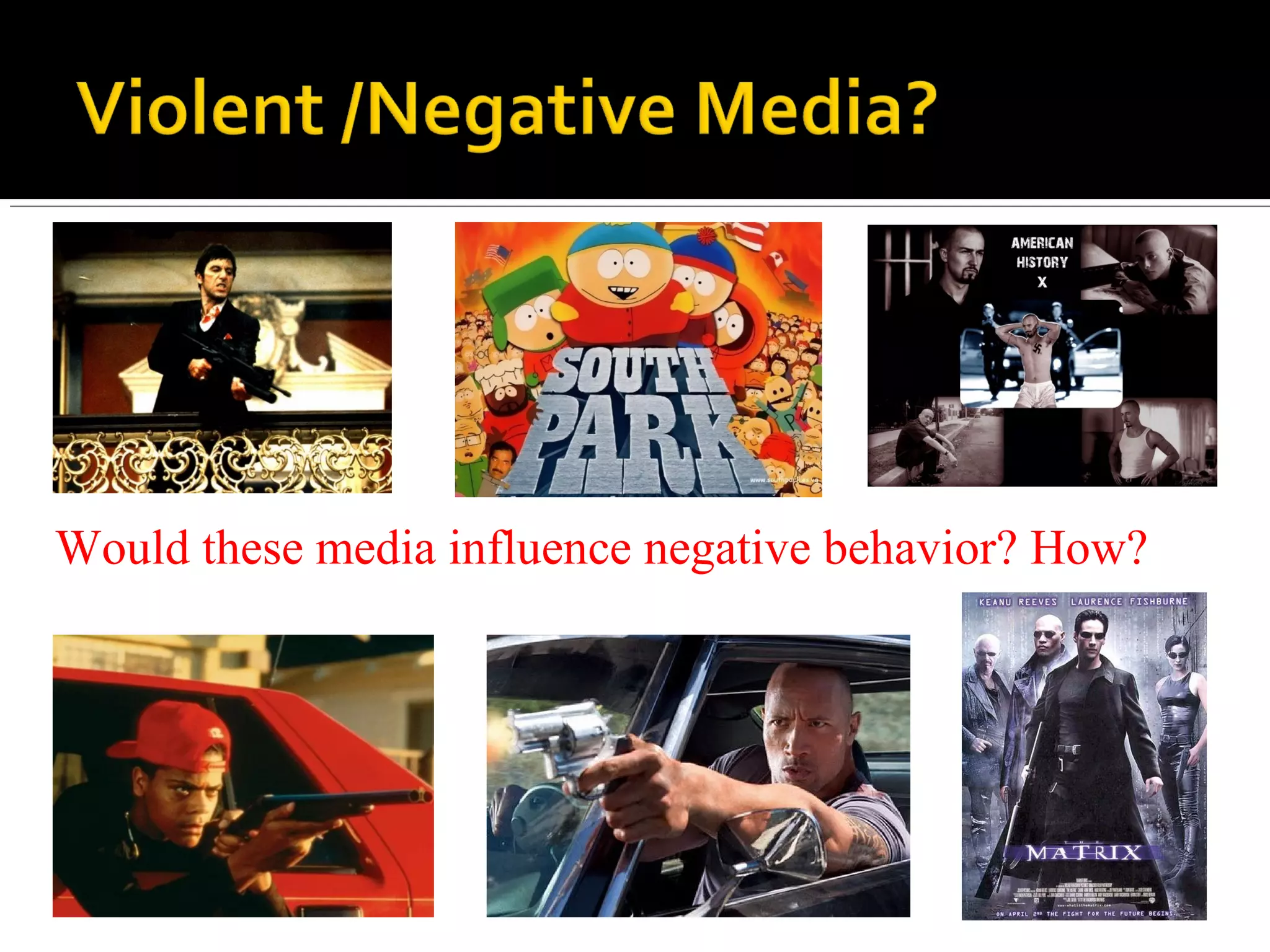
Would these media influence negative behavior? How?
 Content analyses (Payne Fund Study)
▪ Observers analyze media subject matter
▪ (TV, Magazines, Radio, Web, Newspaper)
 Laboratory experiment (Payne Fund Study)
▪ Variables are isolated and observed in a controlled environment
 Survey methods (Payne Fund Study)
▪ Research that relies on questionnaires to collect data
 Payne Fund studies as a whole
▪ Instrumental in developing public support for the 1930 Motion
Picture Production code
 Random sample
▪ When members of population have equal chance of being selected
 Selective exposure
▪ When people seek out messages that are consistent with their attitudes
▪ Where do you get your News, What is your favorite TV show, What type of
movies do you like?
 People’s Choice
study
▪ Selective perception
▪ When people with different
attitudes interpret the same
messages differently
 Selective retention
▪ When people with different
views remember the same
event differently
▪ Opinion leaders
▪ Certain well-informed members of families and neighborhoods
▪ Two-step flow
▪ Process where media effects travel through opinion leaders
▪ From radio and print to the opinion leaders and from them to the less
active sections of the population.
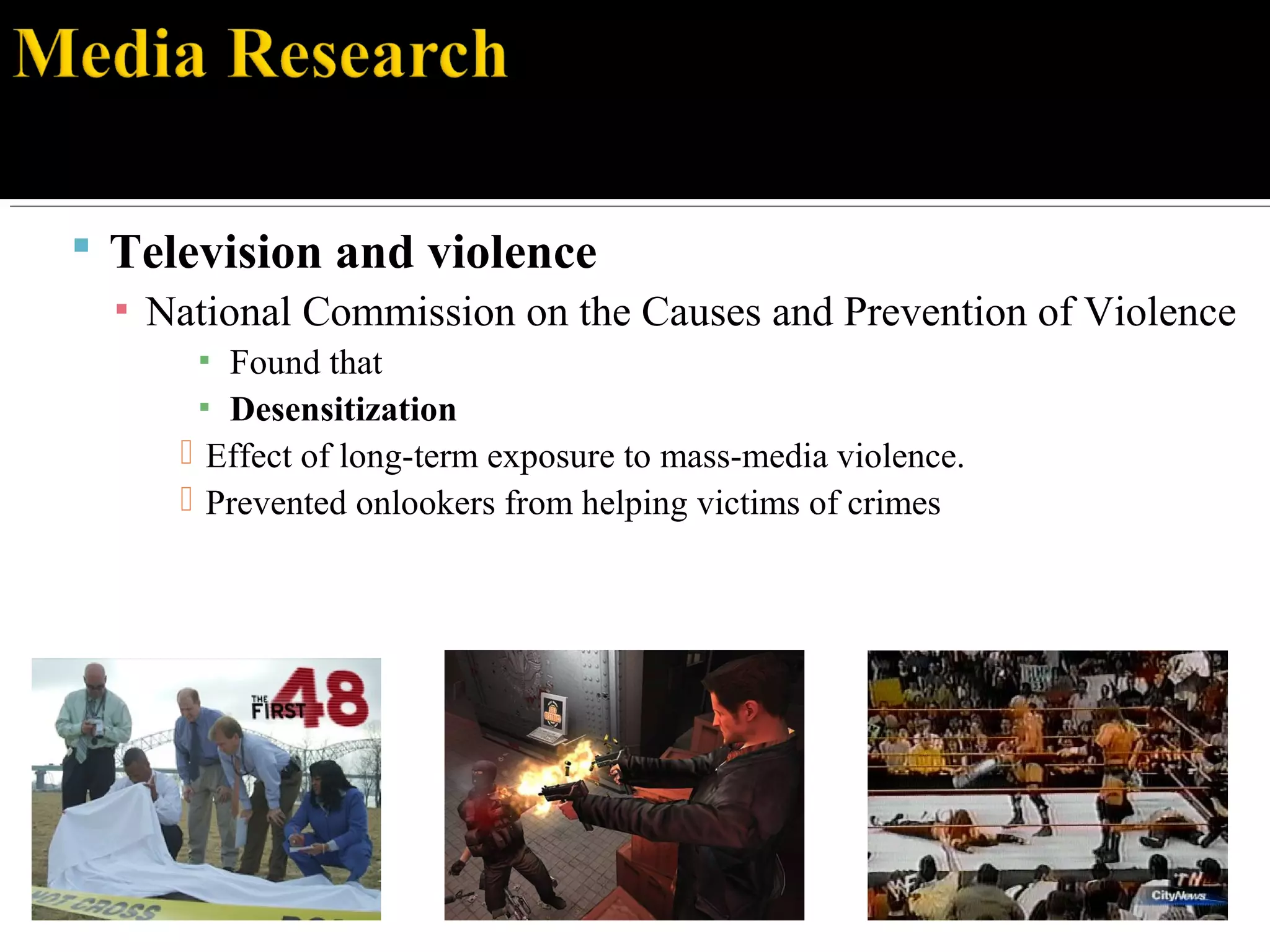
 Television and violence
▪ National Commission on the Causes and Prevention of Violence
▪ Found that
▪ Desensitization
 Effect of long-term exposure to mass-media violence.
 Prevented onlookers from helping victims of crimes
 Powerful effects model,
 Media will have an immediate & potent influence on audiences.
(Youth acting out scenes after violent movie)
 Minimal effects model
 Media will have little influence on behavior.
▪ People not changing voting behavior
 Researchers today accept
▪ Mixed effects model,
▪ Sometimes media will have
 Powerful effects,
 Minimal effects,
▪ Sometimes
 A mixture of both.
 The mixed-effects model makes the
most sense.
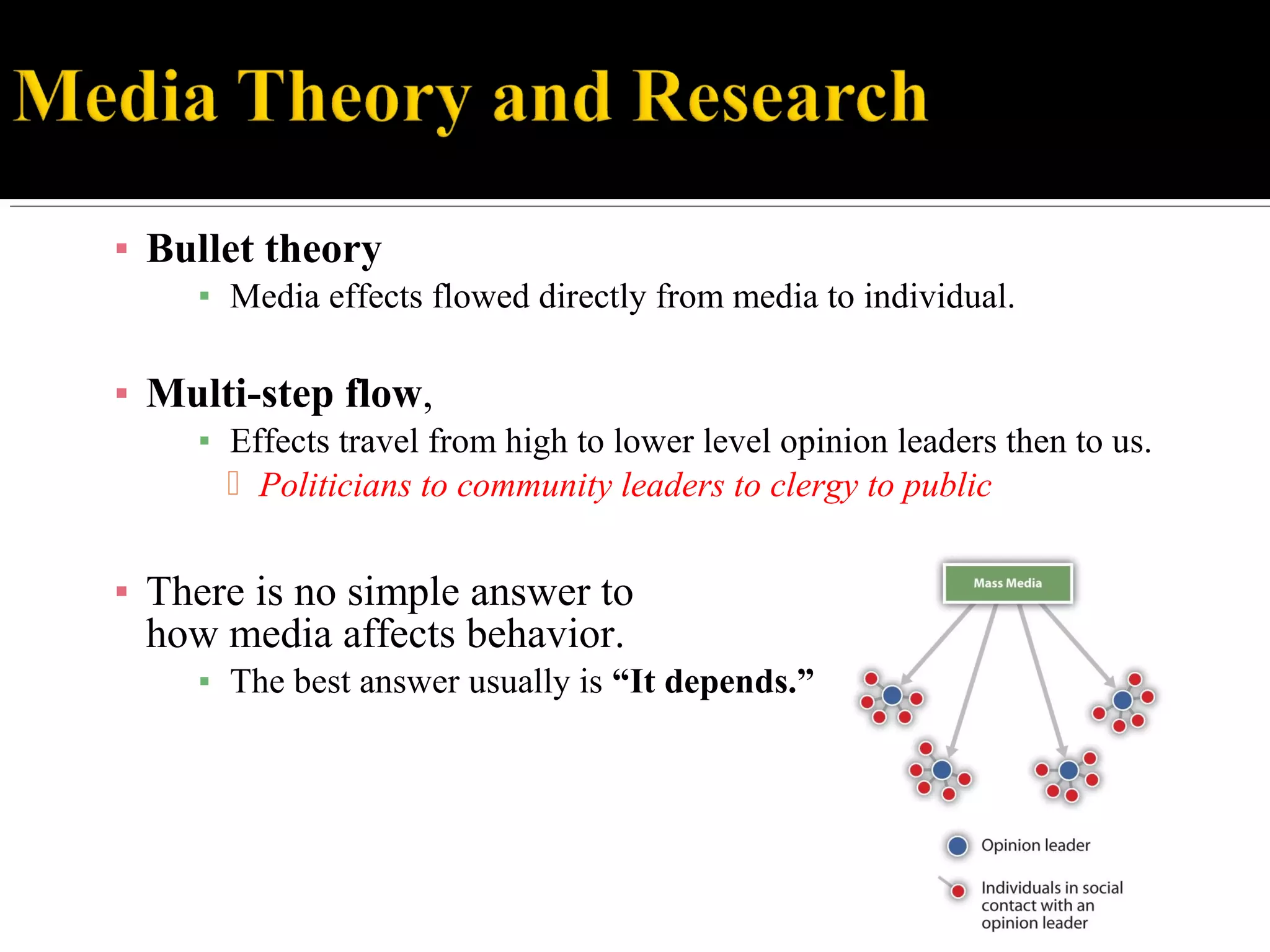
▪ Bullet theory
▪ Media effects flowed directly from media to individual.
▪ Multi-step flow,
▪ Effects travel from high to lower level opinion leaders then to us.
 Politicians to community leaders to clergy to public
▪ There is no simple answer to
how media affects behavior.
▪ The best answer usually is “It depends.”
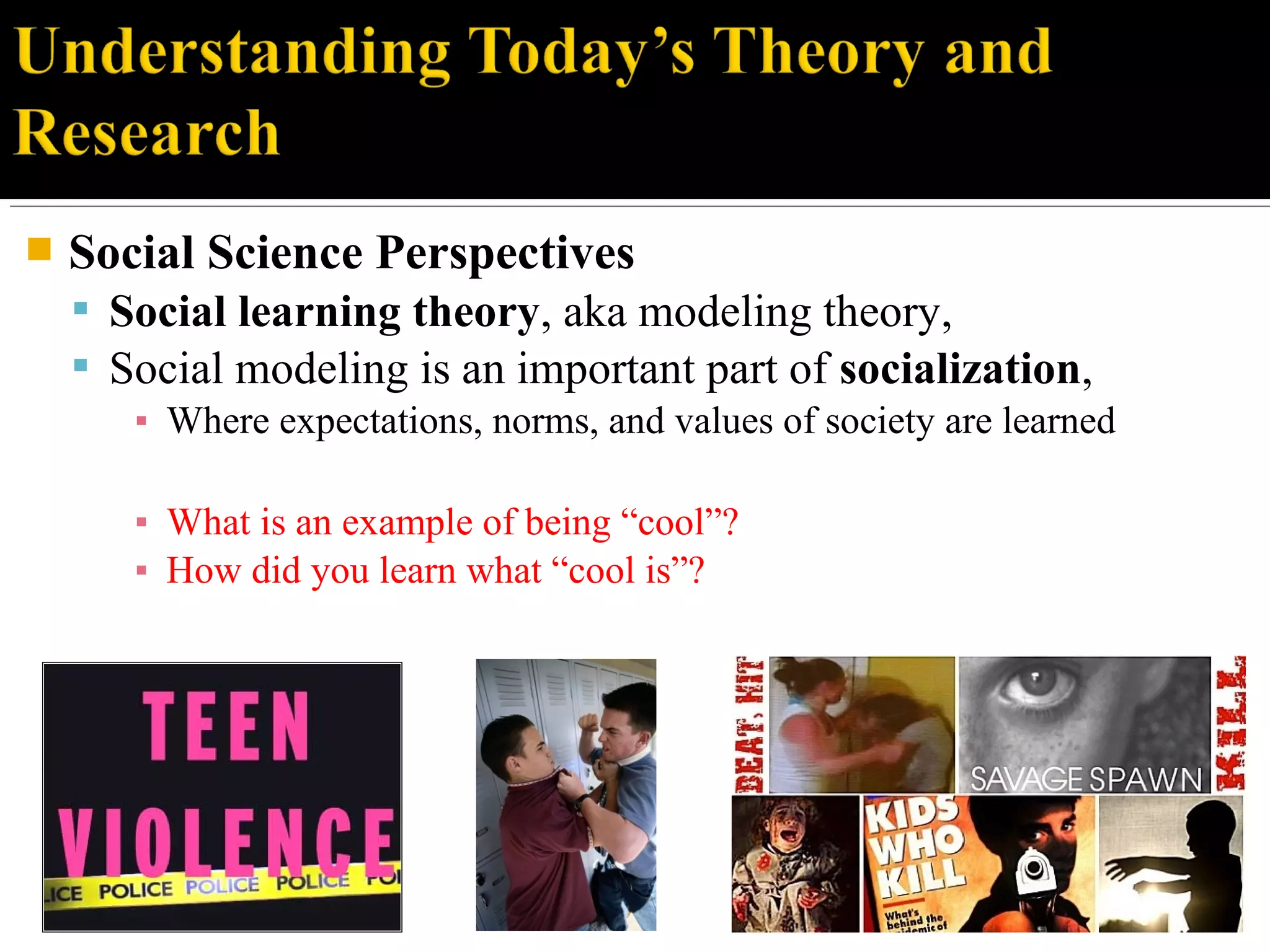
 Social Science Perspectives
 Social learning theory, aka modeling theory,
 Social modeling is an important part of socialization,
▪ Where expectations, norms, and values of society are learned
▪ What is an example of being “cool”?
▪ How did you learn what “cool is”?
 Diffusion of innovations theory
▪ Five types of people have different levels of willingness to accept new
ideas from the media:
1. Innovators tend to be politically liberal extroverts who are venturesome
and eager to try new ideas.
2. Early adopters make quick but informed choices.
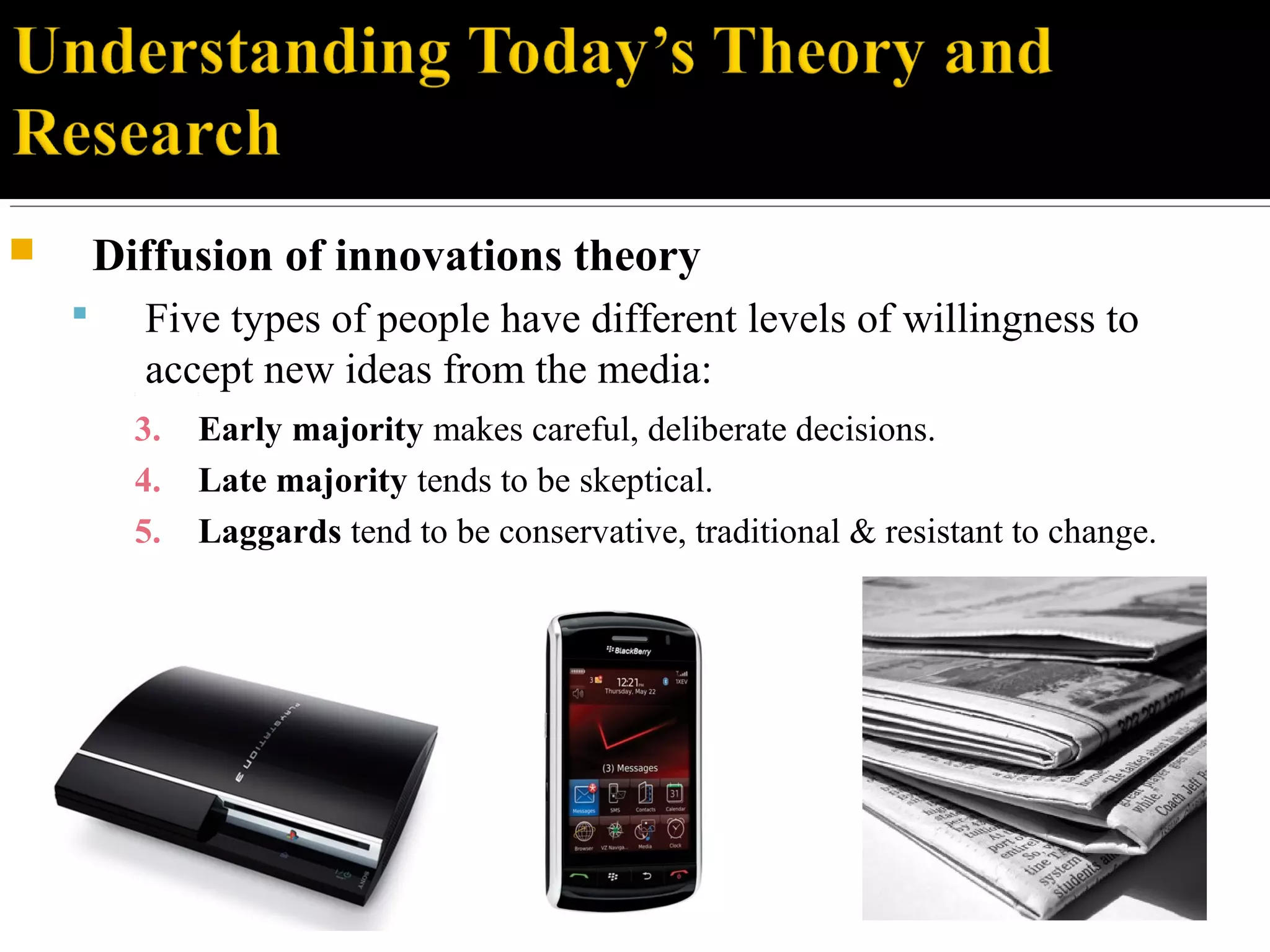
 Diffusion of innovations theory
 Five types of people have different levels of willingness to
accept new ideas from the media:1. -
2. -
3. Early majority makes careful, deliberate decisions.
4. Late majority tends to be skeptical.
5. Laggards tend to be conservative, traditional & resistant to change.
 George Gerbner’s cultivation theory
▪ States media use will “cultivate” a particular view of the world within users.
 Agenda-setting,
▪ Not telling people what to think, but what to think about
▪ Is the main effect of media.
Homicide report
 Cumulative effects theory
▪ Media messages are driven home through redundancy
 Uses and gratification theory
▪ Based on how consumers choose & use media to meet their own needs.

Media Impact

  • 2.
     Video GameTrailer  Who’s played this game?  What did you think?
  • 3.
    Chapter Outline History Theory andResearch Controversies MEDIA IMPACT: Understanding Research and Effects
  • 4.
    Why would anyonecare about or even do research on the effects media have on society?
  • 5.
    Early Studies  Concernsabout media are as old as media themselves. ▪ Church leaders thought bibles would corrupt society ▪ Parents felt the same about the first novels. ▪ Consistent research on media begin in the 1920s.
  • 6.
     Payne FundStudies conducted ▪ 13 separate investigations on the influence movies had on youth behavior  Modeling (Payne Fund Study) ▪ The imitation of behavior from media examples ▪ Parents worry children may pick up antisocial habits from media consumption ▪ Video Clip Clip 2 Clip 3 ▪ Do violent games Increase Violence in Society? ▪ Why/Why not
  • 7.
    Would these mediainfluence negative behavior? How?
  • 8.
     Content analyses(Payne Fund Study) ▪ Observers analyze media subject matter ▪ (TV, Magazines, Radio, Web, Newspaper)  Laboratory experiment (Payne Fund Study) ▪ Variables are isolated and observed in a controlled environment
  • 9.
     Survey methods(Payne Fund Study) ▪ Research that relies on questionnaires to collect data  Payne Fund studies as a whole ▪ Instrumental in developing public support for the 1930 Motion Picture Production code
  • 10.
     Random sample ▪When members of population have equal chance of being selected  Selective exposure ▪ When people seek out messages that are consistent with their attitudes ▪ Where do you get your News, What is your favorite TV show, What type of movies do you like?
  • 11.
     People’s Choice study ▪Selective perception ▪ When people with different attitudes interpret the same messages differently  Selective retention ▪ When people with different views remember the same event differently
  • 12.
    ▪ Opinion leaders ▪Certain well-informed members of families and neighborhoods ▪ Two-step flow ▪ Process where media effects travel through opinion leaders ▪ From radio and print to the opinion leaders and from them to the less active sections of the population.
  • 13.
     Television andviolence ▪ National Commission on the Causes and Prevention of Violence ▪ Found that ▪ Desensitization  Effect of long-term exposure to mass-media violence.  Prevented onlookers from helping victims of crimes
  • 14.
     Powerful effectsmodel,  Media will have an immediate & potent influence on audiences. (Youth acting out scenes after violent movie)  Minimal effects model  Media will have little influence on behavior. ▪ People not changing voting behavior
  • 15.
     Researchers todayaccept ▪ Mixed effects model, ▪ Sometimes media will have  Powerful effects,  Minimal effects, ▪ Sometimes  A mixture of both.  The mixed-effects model makes the most sense.
  • 16.
    ▪ Bullet theory ▪Media effects flowed directly from media to individual. ▪ Multi-step flow, ▪ Effects travel from high to lower level opinion leaders then to us.  Politicians to community leaders to clergy to public ▪ There is no simple answer to how media affects behavior. ▪ The best answer usually is “It depends.”
  • 17.
     Social SciencePerspectives  Social learning theory, aka modeling theory,  Social modeling is an important part of socialization, ▪ Where expectations, norms, and values of society are learned ▪ What is an example of being “cool”? ▪ How did you learn what “cool is”?
  • 18.
     Diffusion ofinnovations theory ▪ Five types of people have different levels of willingness to accept new ideas from the media: 1. Innovators tend to be politically liberal extroverts who are venturesome and eager to try new ideas. 2. Early adopters make quick but informed choices.
  • 19.
     Diffusion ofinnovations theory  Five types of people have different levels of willingness to accept new ideas from the media:1. - 2. - 3. Early majority makes careful, deliberate decisions. 4. Late majority tends to be skeptical. 5. Laggards tend to be conservative, traditional & resistant to change.
  • 20.
     George Gerbner’scultivation theory ▪ States media use will “cultivate” a particular view of the world within users.  Agenda-setting, ▪ Not telling people what to think, but what to think about ▪ Is the main effect of media. Homicide report
  • 21.
     Cumulative effectstheory ▪ Media messages are driven home through redundancy  Uses and gratification theory ▪ Based on how consumers choose & use media to meet their own needs.