2-1
• For a rigid body in static equilibrium, the external forces and
  moments are balanced and will impart no translational or rotational
  motion to the body.

• The necessary and sufficient condition for the static equilibrium of a
  body are that the resultant force and couple from all external forces
  form a system equivalent to zero,
                           
     ∑ F = 0 ∑ M O = ∑ (r × F ) = 0

• Resolving each force and moment into its rectangular components
  leads to 6 scalar equations which also express the conditions for
  static equilibrium,

     ∑ Fx = 0 ∑ Fy = 0 ∑ Fz = 0
     ∑Mx = 0 ∑M y = 0 ∑Mz = 0

                                                                           4-2
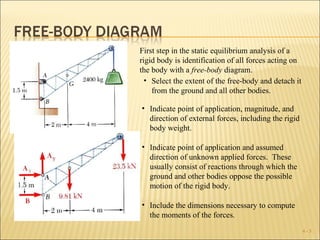
First step in the static equilibrium analysis of a
rigid body is identification of all forces acting on
the body with a free-body diagram.
  • Select the extent of the free-body and detach it
    from the ground and all other bodies.

• Indicate point of application, magnitude, and
  direction of external forces, including the rigid
  body weight.

• Indicate point of application and assumed
  direction of unknown applied forces. These
  usually consist of reactions through which the
  ground and other bodies oppose the possible
  motion of the rigid body.

• Include the dimensions necessary to compute
  the moments of the forces.
                                                       4-3
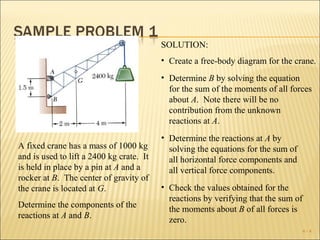
SOLUTION:
                                          • Create a free-body diagram for the crane.
                                          • Determine B by solving the equation
                                            for the sum of the moments of all forces
                                            about A. Note there will be no
                                            contribution from the unknown
                                            reactions at A.
                                          • Determine the reactions at A by
A fixed crane has a mass of 1000 kg         solving the equations for the sum of
and is used to lift a 2400 kg crate. It     all horizontal force components and
is held in place by a pin at A and a        all vertical force components.
rocker at B. The center of gravity of
the crane is located at G.                • Check the values obtained for the
                                            reactions by verifying that the sum of
Determine the components of the             the moments about B of all forces is
reactions at A and B.                       zero.
                                                                                     4-4
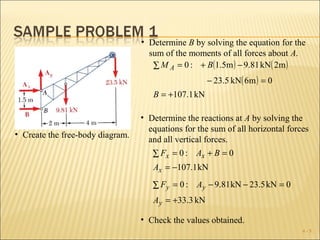
• Determine B by solving the equation for the
                                    sum of the moments of all forces about A.
                                     ∑ M A = 0 : + B(1.5m ) − 9.81 kN( 2m )
                                                     − 23.5 kN( 6m ) = 0
                                     B = +107.1 kN

                                  • Determine the reactions at A by solving the
                                    equations for the sum of all horizontal forces
• Create the free-body diagram.
                                    and all vertical forces.
                                     ∑ Fx = 0 : Ax + B = 0
                                     Ax = −107.1 kN

                                     ∑ Fy = 0 : Ay − 9.81 kN − 23.5 kN = 0
                                     Ay = +33.3 kN

                                  • Check the values obtained.
                                                                                4-5
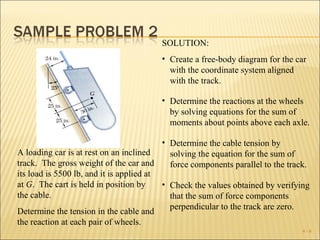
SOLUTION:
                                         • Create a free-body diagram for the car
                                           with the coordinate system aligned
                                           with the track.

                                         • Determine the reactions at the wheels
                                           by solving equations for the sum of
                                           moments about points above each axle.

                                          • Determine the cable tension by
A loading car is at rest on an inclined     solving the equation for the sum of
track. The gross weight of the car and      force components parallel to the track.
its load is 5500 lb, and it is applied at
at G. The cart is held in position by     • Check the values obtained by verifying
the cable.                                  that the sum of force components
                                            perpendicular to the track are zero.
Determine the tension in the cable and
the reaction at each pair of wheels.
                                                                                4-6
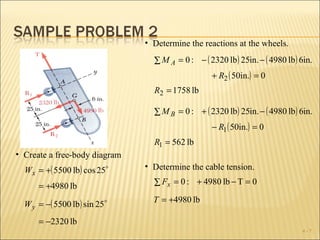
• Determine the reactions at the wheels.
                                 ∑ M A = 0 : − ( 2320 lb ) 25in. − ( 4980 lb ) 6in.
                                                   + R2 ( 50in.) = 0
                                 R2 = 1758 lb

                                 ∑ M B = 0 : + ( 2320 lb ) 25in. − ( 4980 lb ) 6in.
                                                   − R1 ( 50in.) = 0
                                 R1 = 562 lb
• Create a free-body diagram
  W x = +( 5500 lb ) cos 25   • Determine the cable tension.

      = +4980 lb                 ∑ Fx = 0 : + 4980 lb − T = 0
                                 T = +4980 lb
  W y = −( 5500 lb ) sin 25
      = −2320 lb
                                                                               4-7
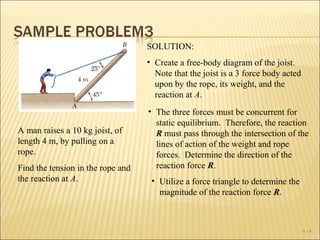
SOLUTION:
                                   • Create a free-body diagram of the joist.
                                     Note that the joist is a 3 force body acted
                                     upon by the rope, its weight, and the
                                     reaction at A.
                                   • The three forces must be concurrent for
                                     static equilibrium. Therefore, the reaction
A man raises a 10 kg joist, of       R must pass through the intersection of the
length 4 m, by pulling on a          lines of action of the weight and rope
rope.                                forces. Determine the direction of the
Find the tension in the rope and     reaction force R.
the reaction at A.                  • Utilize a force triangle to determine the
                                      magnitude of the reaction force R.


                                                                                   4-8
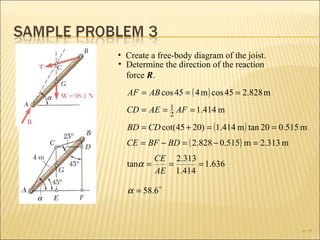
• Create a free-body diagram of the joist.
• Determine the direction of the reaction
  force R.
  AF = AB cos 45 = ( 4 m ) cos 45 = 2.828 m
  CD = AE = 1 AF = 1.414 m
            2
  BD = CD cot(45 + 20) = (1.414 m ) tan 20 = 0.515 m
  CE = BF − BD = ( 2.828 − 0.515) m = 2.313 m
           CE 2.313
  tanα =     =      = 1.636
           AE 1.414

  α = 58.6 


                                                  4-9
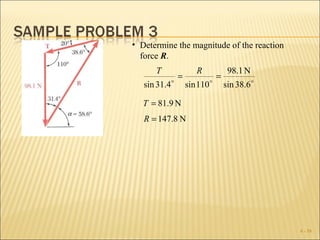
• Determine the magnitude of the reaction
  force R.
      T          R      98.1 N
            =         =
   sin 31.4 sin 110  sin 38.6 

  T = 81.9 N
   R = 147.8 N


                                            4 - 10
THANK YOU……….

                2 - 11

MECHANICS ENGINEERING - Equilibrium

  • 1.
  • 2.
    • For arigid body in static equilibrium, the external forces and moments are balanced and will impart no translational or rotational motion to the body. • The necessary and sufficient condition for the static equilibrium of a body are that the resultant force and couple from all external forces form a system equivalent to zero,     ∑ F = 0 ∑ M O = ∑ (r × F ) = 0 • Resolving each force and moment into its rectangular components leads to 6 scalar equations which also express the conditions for static equilibrium, ∑ Fx = 0 ∑ Fy = 0 ∑ Fz = 0 ∑Mx = 0 ∑M y = 0 ∑Mz = 0 4-2
  • 3.
    First step inthe static equilibrium analysis of a rigid body is identification of all forces acting on the body with a free-body diagram. • Select the extent of the free-body and detach it from the ground and all other bodies. • Indicate point of application, magnitude, and direction of external forces, including the rigid body weight. • Indicate point of application and assumed direction of unknown applied forces. These usually consist of reactions through which the ground and other bodies oppose the possible motion of the rigid body. • Include the dimensions necessary to compute the moments of the forces. 4-3
  • 4.
    SOLUTION: • Create a free-body diagram for the crane. • Determine B by solving the equation for the sum of the moments of all forces about A. Note there will be no contribution from the unknown reactions at A. • Determine the reactions at A by A fixed crane has a mass of 1000 kg solving the equations for the sum of and is used to lift a 2400 kg crate. It all horizontal force components and is held in place by a pin at A and a all vertical force components. rocker at B. The center of gravity of the crane is located at G. • Check the values obtained for the reactions by verifying that the sum of Determine the components of the the moments about B of all forces is reactions at A and B. zero. 4-4
  • 5.
    • Determine Bby solving the equation for the sum of the moments of all forces about A. ∑ M A = 0 : + B(1.5m ) − 9.81 kN( 2m ) − 23.5 kN( 6m ) = 0 B = +107.1 kN • Determine the reactions at A by solving the equations for the sum of all horizontal forces • Create the free-body diagram. and all vertical forces. ∑ Fx = 0 : Ax + B = 0 Ax = −107.1 kN ∑ Fy = 0 : Ay − 9.81 kN − 23.5 kN = 0 Ay = +33.3 kN • Check the values obtained. 4-5
  • 6.
    SOLUTION: • Create a free-body diagram for the car with the coordinate system aligned with the track. • Determine the reactions at the wheels by solving equations for the sum of moments about points above each axle. • Determine the cable tension by A loading car is at rest on an inclined solving the equation for the sum of track. The gross weight of the car and force components parallel to the track. its load is 5500 lb, and it is applied at at G. The cart is held in position by • Check the values obtained by verifying the cable. that the sum of force components perpendicular to the track are zero. Determine the tension in the cable and the reaction at each pair of wheels. 4-6
  • 7.
    • Determine thereactions at the wheels. ∑ M A = 0 : − ( 2320 lb ) 25in. − ( 4980 lb ) 6in. + R2 ( 50in.) = 0 R2 = 1758 lb ∑ M B = 0 : + ( 2320 lb ) 25in. − ( 4980 lb ) 6in. − R1 ( 50in.) = 0 R1 = 562 lb • Create a free-body diagram W x = +( 5500 lb ) cos 25 • Determine the cable tension. = +4980 lb ∑ Fx = 0 : + 4980 lb − T = 0 T = +4980 lb W y = −( 5500 lb ) sin 25 = −2320 lb 4-7
  • 8.
    SOLUTION: • Create a free-body diagram of the joist. Note that the joist is a 3 force body acted upon by the rope, its weight, and the reaction at A. • The three forces must be concurrent for static equilibrium. Therefore, the reaction A man raises a 10 kg joist, of R must pass through the intersection of the length 4 m, by pulling on a lines of action of the weight and rope rope. forces. Determine the direction of the Find the tension in the rope and reaction force R. the reaction at A. • Utilize a force triangle to determine the magnitude of the reaction force R. 4-8
  • 9.
    • Create afree-body diagram of the joist. • Determine the direction of the reaction force R. AF = AB cos 45 = ( 4 m ) cos 45 = 2.828 m CD = AE = 1 AF = 1.414 m 2 BD = CD cot(45 + 20) = (1.414 m ) tan 20 = 0.515 m CE = BF − BD = ( 2.828 − 0.515) m = 2.313 m CE 2.313 tanα = = = 1.636 AE 1.414 α = 58.6  4-9
  • 10.
    • Determine themagnitude of the reaction force R. T R 98.1 N = = sin 31.4 sin 110  sin 38.6  T = 81.9 N R = 147.8 N 4 - 10
  • 11.