Assignment on
Meat borne intoxications
By: Safier Ahmad Ganiee
(M-5849)
Food – Poisoning
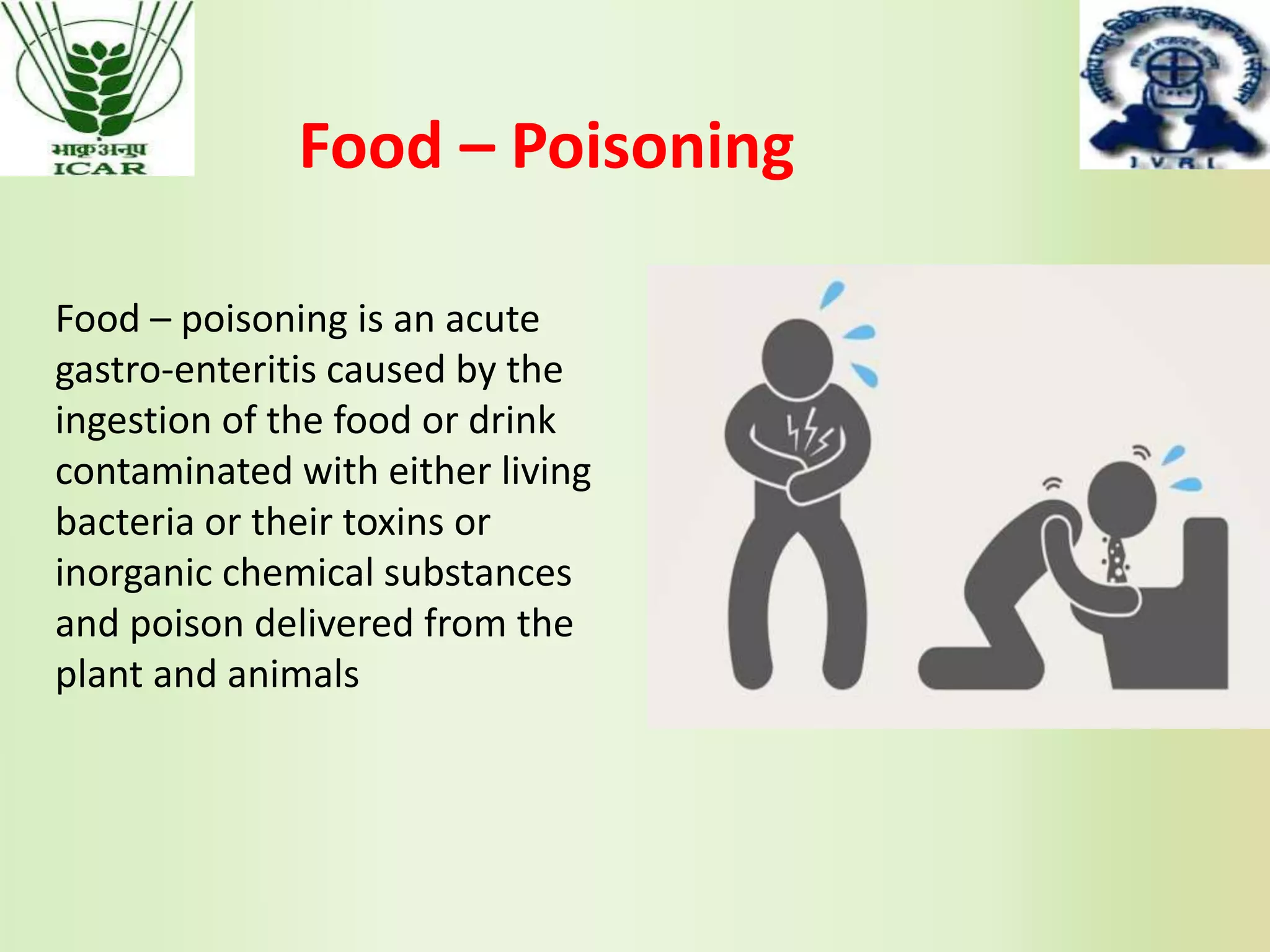
Food – poisoning is an acute
gastro-enteritis caused by the
ingestion of the food or drink
contaminated with either living
bacteria or their toxins or
inorganic chemical substances
and poison delivered from the
plant and animals
Food – Poisoning
s.no.
Types of Food-borne Illness
Infection
eating food contaminated with pathogens
Intoxication
eating food contaminated with the toxins (poisons) formed by
bacteria
eating food contaminated with other biological or chemical
toxins (poisons)
Toxin-mediated infection
eating food contaminated with pathogens that grow in the
body and form toxins (poisons)
Risk of meat borne diseases
Meat is well recognized nutritious medium for microbial growth,
therefore high risk of meat borne diseases.
Risk of illness increases with increased processing, improper handling
and inefficient storage.
The risk of illness will increase substantially when:
Meat and offal are consumed raw.
Meat and offal are improperly cooked.
Contamination with pathogens from other sources such as
water, raw ingredients, environment, food handler etc.
Meat and offal which are time and/or temperature abused.
Meat borne intoxication is when the meat contains toxins,
i.e. bacterially produced exotoxins , which can happen even
when the microbe that produced the toxin is no longer
present or able to cause infection.
i.e. ingestion of preformed toxins within the meat.
Food borne intoxications have short incubation periods
(minutes to hours) and are characterized by lack of fever.
MEAT BORNE INTOXICATIONS
Clostridium botulinum
Gram positive rods
Saprophytic
Spore forming
Toxin producing
Gas forming
Anaerobic
Prefer low acid environment
History
An outbreak of “sausage poisoning” occurred in 1973 in
Wildbad Wurttemberg, Germany, with 13 cases and 6 deaths.
It was traced to blood sausage (pig gut filled with blood and
other ingredients ). The filled gut was tied, boiled, briefly
smoked and stored in room temperature.
Between 1820-1822, Justinius Kerner studied 230
cases of “sausage poisoning” in Wurttemberg and
noted that the product did not become toxic if air
pockets were left in casing
History
In 1896, music club members in Ellezelles ate raw
salted ham; 23 became ill and 3 died.
E.P.M. Van Ermengen of the University of Ghent
studied the outbreak. He found that the ham was
neither cooked nor smoked and the same organism
was recovered from the ham and the spleen of the
victim.
Van Ermengen named the causative organism
Bacillus botulinus (botulus- latin “sausage”)
Clostridium botulinum
Seven types are distinguished on the basis of serological
specificity of their toxins:
1. Type A - cause human botulism in western part of United
States. More toxic than B.
2. Type B - found more often than A in most parts of world. Less
toxic to humans.
3. Type C - botulism of fowls, cattle, mink and other animals.
4. Type D - forage poisoning of cattle, especially in South Africa.
5. Type E - toxic to humans. Obtained chiefly from fish and fish
products.
6. Type F - cause of human botulism. Isolated in Denmark.
7. Type G - not implicated in human botulism. Isolated from
Argentina.
Group I
• Type A
strains and
proteolytic
strains of
types B &
F
Group ΙΙ
• All type E
strains and
non-
proteolytic
strains of
B & f
Group III
• Includes
type C &
D. they are
non-
proteolytic
Clostridium botulinum
C. botulinum strains are frequently divided into three
groups:
Spores are occurring in soil .
The non-proteolytic types are associated more with waters
than soils.
Clostridium botulinum toxins
BoNT A most common and most potent
Clostridium botulinum toxin
Potent neurotoxin.
Formed within the organism and released upon autolysis.
Botulinal toxin ins heat sensitive and may be destroyed
by heating at 80⁰C(176⁰C) for 10 minutes, or boiling
temperature for few minutes.
Botulinal toxin is produced as single polypeptide chain.
Post translationally it is nicked to form two chains held
together by a disulphide bond;
--100 kDa heavy chain
--50 kDa light chain
 Toxin inhibits the release of acetylinecholine from nerve celss
and leads to flaccid paralysis
Even 1-2 μg of toxin can be lethal to humans.
Extreme potency and lethality
• One of top 6 potential biological warfare agents
• Listed as Category A agent by CDC
i.e. Highest priority
• The most toxic substance known
toxic dose ~0.001mg/Kg body weight
15,000 times more toxic than nerve agent VX
100,000 times more toxic than sarin
• 1 gram of crystalline toxin can kill >1 million
people if dispersed and inhaled evenly
Clostridium botulinum toxin
as bio-weapon
Staphylococcus aureus is a bacterium that is commonly found on the
skin and in the noses of up to 25% of healthy people.
Staphylococcus aureus
General Characteristics
• Gram positive cocci
Arranged in grape like clusters
• Facultative anaerobic
• Catalase-positive
• Grow in ordinary culture media
(Nutrient agar and broth)
• Can grow in 7.5% NaCl
• Heat resistant (80°C for 1 hour)
• Water activity of 0.86 - 0.88
Food workers who carry Staphylococcus and then handle
food without washing their hands contaminate foods by direct
contact.
The bacterium can also be found in unpasteurized milk and
cheese products, sliced meat, puddings, pastries, and
sandwiches.
 Staphylococcus is salt tolerant and can grow extremely
abundantly in salty foods like ham.
 Staphylococcal toxins are resistant to heat and cannot be
destroyed by cooking.
Risk factors
Potent gastrointestinal exotoxins
Synthesized throughout the logarithmic phase of growth or
during the transition from exponential to stationary phase.
Enterotoxins
• Resist boiling for 30 min.
• Resist gastrointestinal enzymes.
• Act on neuronal receptors in upper GIT
• Cause gastroenteritis in 1-5 hours after ingestion
Active in nanograms to micrograms of quantity
S. aureus enterotoxins
Molecular sizes ranging from 22 – 29 kDa
Unusually resistant to heat (biologically active despite boiling for 1 h)
Generally resistant to proteolysis (trypsin and pepsin) and acids (such
as stomach acid) and slightly resistant to desiccation.
They are secreted by all human-pathogenic S. aureus
Currently S. aureus strains can secrete from 1 to 23 of at least 23
serologically distinct enterotoxins
SEs are defined by emetic activity when ingested by humans or when
given orally to nonhuman primates
Characteristics of
Staphylococcal enterotoxins (SE)
The SIX common enterotoxins are:
1. Staphylococcal enterotoxin A(SEA), ( no. 1 in food poisoning outbreaks)
2. Staphylococcal enterotoxin B (SEB),
3. Staphylococcal enterotoxin C₁, C₂ (SEC),
4. Staphylococcal enterotoxin D (SED), ( 2nd in f.p. outbreaks)
5. Staphylococcal enterotoxin E (SEE)
Individual strains of S. aureus may produce one or more of
enterotoxin types while growing in food
Toxin production occurs at growth temperature 12-44oC, pH 4.2
and salt concentration of ≤10%.
No toxin production occurs at temperatures below 12oC, pH < 4.2
and > 10 % salt.
Enterotoxins
( no. 1 in food poisoning outbreaks)
( no. 2 in food poisoning outbreaks)
Most heat resistant
Disease symptoms in
man
Incubation period is 1-6 hrs after consumption of food
contaminated with at least 1.0 µg of enterotoxin.
Clinical signs include
salvation,
nausea,
vomiting,
abdominal cramps,
sometimes diarrhea .
Duration of illness is 24-72 hrs.
Dose of 1.0 µg or more is needed to cause disease.
Bacillus cereus
•Gram positive large (width > 1 um) rod,
•spore forming
•grows aerobically
•beta hemolytic
•usually motile
The organism produces the enterotoxins which
are involved in a food borne intoxication
Pre-formed heat and acid stable toxin
(Emetic syndrome)
Heat labile enterotoxin
(Diarrheal disease)
Incubation period < 6 hours
Severe vomiting
Lasts 8-10 hours
Incubation period > 6 hours
Diarrhea
Lasts 20-36 hours
EMETIC FORM DIARRHEAL FORM
Bacillus cereus
During the slow cooling, spores germinate and vegetative bacteria multiply, then
they sporulate again.
Sporulation is also associated with toxin production. The toxin is heat-stable, and can
easily with stand the brief high temperatures used to cook fried rice.
Diarrheal vs.Emetic Disease
Characteristic Diarrheal Emetic
Toxin produced: In small
intestine
In food
Toxin type Protein-
enterotoxin
Cyclic peptide
Incubation
period
8-16 hours 30 min-5 hours
Duration 1 to several days 6-24 hours
Bacillus cereus
Clostridium perfringens intoxication
 There are five types (A to E) but only A are food-borne pathogen
 The organism is found in the soil, dust, water, sewage marine
sediments, decaying materials, intestinal tracts of humans and other
animals.
 This organism is a spore-forming, anaerobic, gram positive bacillus.
 Spores produced by these organisms can resist boiling for 4 or more
hours.
 Clostridium perfringens enterotoxin may be pre-formed in
food, and once the food is consumed, symptoms may occur within
1-2 hours.
Clostridium perfringens enterotoxin
Clostridium perfringens enterotoxin (CPE) is synthesized during
sporulation.
CPE is heat labile (destroyed at 60oC for 10 min) and its activity is
enhanced by trypsin.
 The food poisoning strains are heat resistant and survive
heating at 100oC for 1 hr).
Vehicle foods
The food involved are those that are prepared one day and served the next day.
 Foods that have been involved include red meats, chickens, fish, pork, fruits,
vegetables, spices etc.
 The heating of such foods is inadequate to destroy heat resistant
endospores, upon cooling and warming the endospores germinate ,grow &
produce toxins.
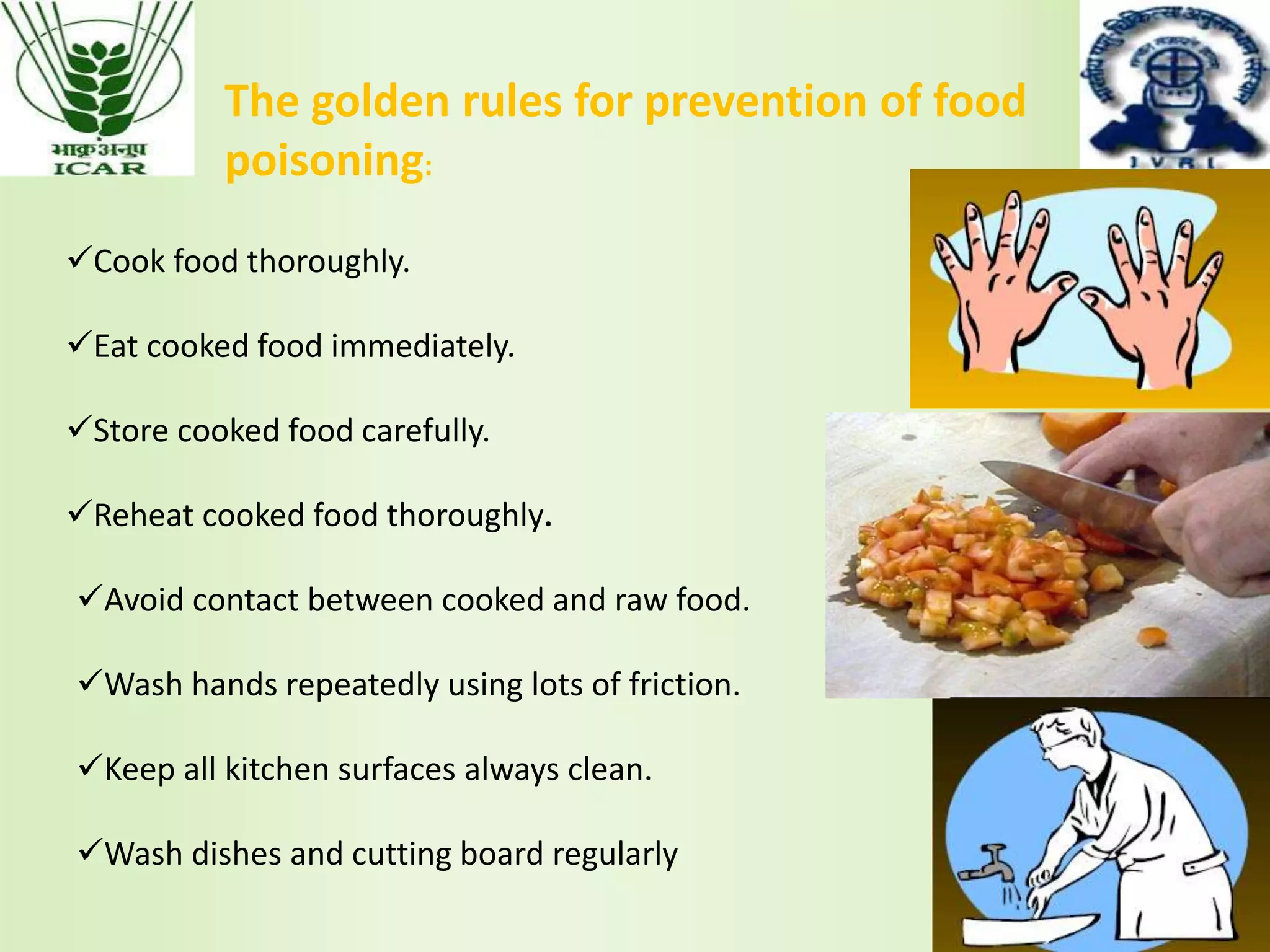
Cook food thoroughly.
Eat cooked food immediately.
Store cooked food carefully.
Reheat cooked food thoroughly.
The golden rules for prevention of food
poisoning:
Avoid contact between cooked and raw food.
Wash hands repeatedly using lots of friction.
Keep all kitchen surfaces always clean.
Wash dishes and cutting board regularly
protect foods from insects, rodents and
other animals.
use safe water.
Keep hot food hot
cold food cold.
meat borne Intoxications

meat borne Intoxications

  • 1.
    Assignment on Meat borneintoxications By: Safier Ahmad Ganiee (M-5849)
  • 2.
    Food – Poisoning Food– poisoning is an acute gastro-enteritis caused by the ingestion of the food or drink contaminated with either living bacteria or their toxins or inorganic chemical substances and poison delivered from the plant and animals
  • 3.
  • 4.
    Types of Food-borneIllness Infection eating food contaminated with pathogens Intoxication eating food contaminated with the toxins (poisons) formed by bacteria eating food contaminated with other biological or chemical toxins (poisons) Toxin-mediated infection eating food contaminated with pathogens that grow in the body and form toxins (poisons)
  • 5.
    Risk of meatborne diseases Meat is well recognized nutritious medium for microbial growth, therefore high risk of meat borne diseases. Risk of illness increases with increased processing, improper handling and inefficient storage. The risk of illness will increase substantially when: Meat and offal are consumed raw. Meat and offal are improperly cooked. Contamination with pathogens from other sources such as water, raw ingredients, environment, food handler etc. Meat and offal which are time and/or temperature abused.
  • 6.
    Meat borne intoxicationis when the meat contains toxins, i.e. bacterially produced exotoxins , which can happen even when the microbe that produced the toxin is no longer present or able to cause infection. i.e. ingestion of preformed toxins within the meat. Food borne intoxications have short incubation periods (minutes to hours) and are characterized by lack of fever. MEAT BORNE INTOXICATIONS
  • 7.
    Clostridium botulinum Gram positiverods Saprophytic Spore forming Toxin producing Gas forming Anaerobic Prefer low acid environment
  • 8.
    History An outbreak of“sausage poisoning” occurred in 1973 in Wildbad Wurttemberg, Germany, with 13 cases and 6 deaths. It was traced to blood sausage (pig gut filled with blood and other ingredients ). The filled gut was tied, boiled, briefly smoked and stored in room temperature. Between 1820-1822, Justinius Kerner studied 230 cases of “sausage poisoning” in Wurttemberg and noted that the product did not become toxic if air pockets were left in casing
  • 9.
    History In 1896, musicclub members in Ellezelles ate raw salted ham; 23 became ill and 3 died. E.P.M. Van Ermengen of the University of Ghent studied the outbreak. He found that the ham was neither cooked nor smoked and the same organism was recovered from the ham and the spleen of the victim. Van Ermengen named the causative organism Bacillus botulinus (botulus- latin “sausage”)
  • 10.
    Clostridium botulinum Seven typesare distinguished on the basis of serological specificity of their toxins: 1. Type A - cause human botulism in western part of United States. More toxic than B. 2. Type B - found more often than A in most parts of world. Less toxic to humans. 3. Type C - botulism of fowls, cattle, mink and other animals. 4. Type D - forage poisoning of cattle, especially in South Africa. 5. Type E - toxic to humans. Obtained chiefly from fish and fish products. 6. Type F - cause of human botulism. Isolated in Denmark. 7. Type G - not implicated in human botulism. Isolated from Argentina.
  • 11.
    Group I • TypeA strains and proteolytic strains of types B & F Group ΙΙ • All type E strains and non- proteolytic strains of B & f Group III • Includes type C & D. they are non- proteolytic Clostridium botulinum C. botulinum strains are frequently divided into three groups: Spores are occurring in soil . The non-proteolytic types are associated more with waters than soils.
  • 12.
    Clostridium botulinum toxins BoNTA most common and most potent
  • 13.
    Clostridium botulinum toxin Potentneurotoxin. Formed within the organism and released upon autolysis. Botulinal toxin ins heat sensitive and may be destroyed by heating at 80⁰C(176⁰C) for 10 minutes, or boiling temperature for few minutes. Botulinal toxin is produced as single polypeptide chain. Post translationally it is nicked to form two chains held together by a disulphide bond; --100 kDa heavy chain --50 kDa light chain  Toxin inhibits the release of acetylinecholine from nerve celss and leads to flaccid paralysis Even 1-2 μg of toxin can be lethal to humans.
  • 14.
    Extreme potency andlethality • One of top 6 potential biological warfare agents • Listed as Category A agent by CDC i.e. Highest priority • The most toxic substance known toxic dose ~0.001mg/Kg body weight 15,000 times more toxic than nerve agent VX 100,000 times more toxic than sarin • 1 gram of crystalline toxin can kill >1 million people if dispersed and inhaled evenly Clostridium botulinum toxin as bio-weapon
  • 15.
    Staphylococcus aureus isa bacterium that is commonly found on the skin and in the noses of up to 25% of healthy people. Staphylococcus aureus General Characteristics • Gram positive cocci Arranged in grape like clusters • Facultative anaerobic • Catalase-positive • Grow in ordinary culture media (Nutrient agar and broth) • Can grow in 7.5% NaCl • Heat resistant (80°C for 1 hour) • Water activity of 0.86 - 0.88
  • 16.
    Food workers whocarry Staphylococcus and then handle food without washing their hands contaminate foods by direct contact. The bacterium can also be found in unpasteurized milk and cheese products, sliced meat, puddings, pastries, and sandwiches.  Staphylococcus is salt tolerant and can grow extremely abundantly in salty foods like ham.  Staphylococcal toxins are resistant to heat and cannot be destroyed by cooking. Risk factors
  • 17.
    Potent gastrointestinal exotoxins Synthesizedthroughout the logarithmic phase of growth or during the transition from exponential to stationary phase. Enterotoxins • Resist boiling for 30 min. • Resist gastrointestinal enzymes. • Act on neuronal receptors in upper GIT • Cause gastroenteritis in 1-5 hours after ingestion Active in nanograms to micrograms of quantity S. aureus enterotoxins
  • 18.
    Molecular sizes rangingfrom 22 – 29 kDa Unusually resistant to heat (biologically active despite boiling for 1 h) Generally resistant to proteolysis (trypsin and pepsin) and acids (such as stomach acid) and slightly resistant to desiccation. They are secreted by all human-pathogenic S. aureus Currently S. aureus strains can secrete from 1 to 23 of at least 23 serologically distinct enterotoxins SEs are defined by emetic activity when ingested by humans or when given orally to nonhuman primates Characteristics of Staphylococcal enterotoxins (SE)
  • 19.
    The SIX commonenterotoxins are: 1. Staphylococcal enterotoxin A(SEA), ( no. 1 in food poisoning outbreaks) 2. Staphylococcal enterotoxin B (SEB), 3. Staphylococcal enterotoxin C₁, C₂ (SEC), 4. Staphylococcal enterotoxin D (SED), ( 2nd in f.p. outbreaks) 5. Staphylococcal enterotoxin E (SEE) Individual strains of S. aureus may produce one or more of enterotoxin types while growing in food Toxin production occurs at growth temperature 12-44oC, pH 4.2 and salt concentration of ≤10%. No toxin production occurs at temperatures below 12oC, pH < 4.2 and > 10 % salt. Enterotoxins ( no. 1 in food poisoning outbreaks) ( no. 2 in food poisoning outbreaks) Most heat resistant
  • 20.
    Disease symptoms in man Incubationperiod is 1-6 hrs after consumption of food contaminated with at least 1.0 µg of enterotoxin. Clinical signs include salvation, nausea, vomiting, abdominal cramps, sometimes diarrhea . Duration of illness is 24-72 hrs. Dose of 1.0 µg or more is needed to cause disease.
  • 21.
    Bacillus cereus •Gram positivelarge (width > 1 um) rod, •spore forming •grows aerobically •beta hemolytic •usually motile The organism produces the enterotoxins which are involved in a food borne intoxication Pre-formed heat and acid stable toxin (Emetic syndrome) Heat labile enterotoxin (Diarrheal disease)
  • 22.
    Incubation period <6 hours Severe vomiting Lasts 8-10 hours Incubation period > 6 hours Diarrhea Lasts 20-36 hours EMETIC FORM DIARRHEAL FORM Bacillus cereus During the slow cooling, spores germinate and vegetative bacteria multiply, then they sporulate again. Sporulation is also associated with toxin production. The toxin is heat-stable, and can easily with stand the brief high temperatures used to cook fried rice.
  • 23.
    Diarrheal vs.Emetic Disease CharacteristicDiarrheal Emetic Toxin produced: In small intestine In food Toxin type Protein- enterotoxin Cyclic peptide Incubation period 8-16 hours 30 min-5 hours Duration 1 to several days 6-24 hours Bacillus cereus
  • 24.
    Clostridium perfringens intoxication There are five types (A to E) but only A are food-borne pathogen  The organism is found in the soil, dust, water, sewage marine sediments, decaying materials, intestinal tracts of humans and other animals.  This organism is a spore-forming, anaerobic, gram positive bacillus.  Spores produced by these organisms can resist boiling for 4 or more hours.  Clostridium perfringens enterotoxin may be pre-formed in food, and once the food is consumed, symptoms may occur within 1-2 hours.
  • 25.
    Clostridium perfringens enterotoxin Clostridiumperfringens enterotoxin (CPE) is synthesized during sporulation. CPE is heat labile (destroyed at 60oC for 10 min) and its activity is enhanced by trypsin.  The food poisoning strains are heat resistant and survive heating at 100oC for 1 hr). Vehicle foods The food involved are those that are prepared one day and served the next day.  Foods that have been involved include red meats, chickens, fish, pork, fruits, vegetables, spices etc.  The heating of such foods is inadequate to destroy heat resistant endospores, upon cooling and warming the endospores germinate ,grow & produce toxins.
  • 26.
    Cook food thoroughly. Eatcooked food immediately. Store cooked food carefully. Reheat cooked food thoroughly. The golden rules for prevention of food poisoning: Avoid contact between cooked and raw food. Wash hands repeatedly using lots of friction. Keep all kitchen surfaces always clean. Wash dishes and cutting board regularly
  • 27.
    protect foods frominsects, rodents and other animals. use safe water. Keep hot food hot cold food cold.