MEANINGFUL USE
  FOR NYU USING
       EPIC


Presentation online at:   http://bit.ly/NYUMUEPIC
AGENDA
•   Welcome
    o   Review of agenda and goals for the session
•   History of Meaningful Use
•   Define Meaningful Use
•   Demo Epic Workflow MU Allergy objective
•   Demo Epic Workflow MU Smoking objective
•   Review Key Points
•   Answer questions
•   Next Steps
    o   Review homework
DISCLAIMER


 • All characters, data,
 examples that appearing
in this work are fictitious.
 Any resemblance to real
persons, living or dead, is
    purely coincidental.
SITUATION: POOR
   ADOPTION OF H.I.T.
• US lags behind other in industry
  sectors and developed countries.
BACKGROUND:
  REASONS
 Cost
 Software Quality and
  Usability
 Standards
ASSESSMENT: POOR
      H.I.T.:
     • Medical Errors
     • Increased
       healthcare cost
     • Decreased quality
       of care
     • Increase
       paperwork
• Increase the adoption of
  the Electronic Medical
  Record (EMR)
• Advance Health
  Information
  Technology(HIT)
SOLUTION: HITECH
      ACT
  • Signed into Law Feb 17,2009 by
    President Obama with a Goal by
    2015 to:
    o   reduce the -cost of care
    o   Improve patient-health
        centered care
    o   Enhance patient safety
    o   Improve population care
WHAT IS
      MEANINGFUL USE?
• Meaningful Use (MU) =
  Objective measures
  that hospital report as a
  result of HITECH act.
MEANINGFUL USE -
     REPORT CARD
Hospital Reports on 21 Different
                     Objectives
EXAMPLE FINAL HOSPITAL
               REPORT
STILL AWAKE?
MEANINGFUL USE:
  THE RELIGION
  • GIGO
  • Adoption of
    technology
  • “Information
    wants to be free”
WHY CHANGE?
    •    Voluntary program and you attest to being a
                           MU.
•       I don’t need an EHR to be a good clinician?
•       Where do I find time to learn a new system?
•       How do I find time to see patients and enter
        my own data?
•       It will slow me down?
•       It so uncaring and not patient friendly.
•       I like paper records!
INCENTIVE: IMPROVE
               PATIENT CARE
o   MU supports evidence based objectives to
    improve patient outcome.
o   MU supports patient-centric care that
    engages patients and families
o   MU helps reduce health disparities and
    improve Population and Public Health
o   MU improves care coordination
o   DSS supports safe patient care
INCENTIVE: REVENUE

• $31 Billion Dollars available
  for meaningful users of
  electronic health systems.
• Hospital can receive
  substantial income for
  “meaningful use”
INCENTIVE: NON USE
              PENALTY

• Penalties start in
  2015
NEXT UP:
    EXAMPLES
• Any Questions
  before we
  move to
  examples?
21 COMPONENTS OF
    “MEANINGFUL USE”
• 1. Interoperability objectives
• 2. Objectives that measure clinical
  use of EHR
MU OBJECTIVES:
                         MEASURE
                 INTEROPERABILITY


•   Report hospital quality measures to CMS (Stoke, ED
    throughput)
•   Exchange clinical information with other institutions
•   Submit electronic data to immunization registries
MU OBJECTIVES:
                MEASURE CLINICAL USE
                              OF EHR
                •   Computerized Practitioner Order Entry
                    (CPOE)
                •   Record demographics
                •   Maintain active medication list
Every Patient
 Encounter      •   Maintain active problem list
                •   *Maintain active Allergy list
                •   *Record smoking status for patients 13
                    years or older
                •   Medication Reconciliation
MU RULE: ALLERGY LIST

                 • Objective :Maintain active
                   medication allergy list.
                 •     Measure : More than 80 percent of all
                       unique patients admitted to the eligible
                       hospital’s have at least one entry (or an
                       indication that the patient has no known
                       medication allergies) recorded as structured
                       data.
Evidence:
  Adverse drug events in hospitalized patients. Excess
length of stay, extra costs, and attributable mortality.
JAMA. 1997 Jan 22-29;277(4):301-6.
WORKFLOW TO MEET MU
            OR ITEM

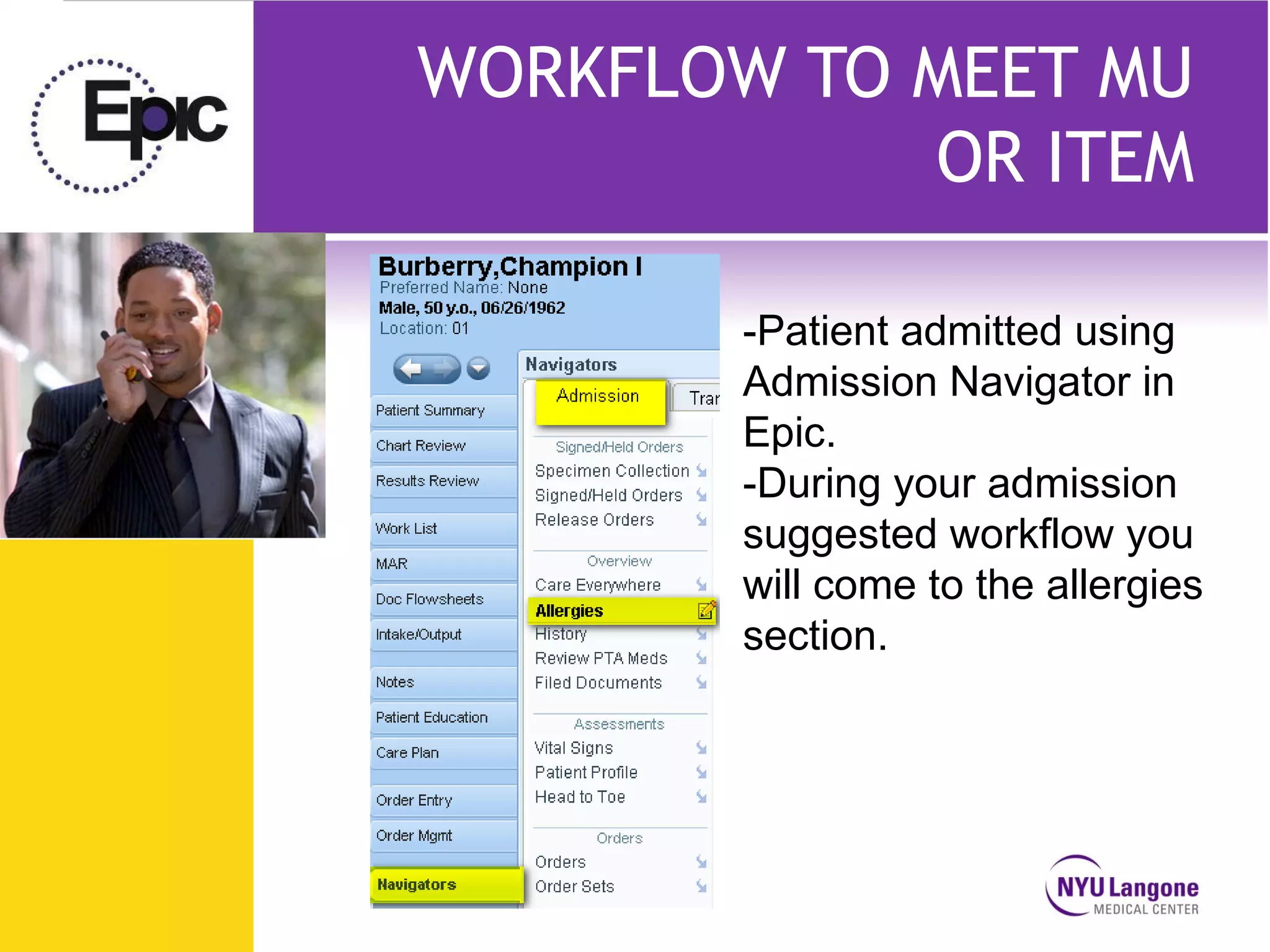
       -Patient admitted using
       Admission Navigator in
       Epic.
       -During your admission
       suggested workflow you
       will come to the allergies
       section.
WORKFLOW TO MEET MU
                    OR ITEM


-Select No known allergies check box
-Select Mark as Reviewed.


-If patient leaves the hospital with no
data in the No known allergies measure
Fails.
RECORD ALLERGY
     OBJECTIVE
EXAMPLE FINAL HOSPITAL
                                REPORT
Allergy
Objective
(80%):

Out of 1287
patients seen:
92% (passed)


8% (failed)
MU RULE: SMOKING
                              STATUS
           • Objective :Record smoking
             status for patients 13 years old
             or older.
           •    Measure : More than 50 percent of all
                unique patients 13 years old or older or
                admitted to the eligible hospital’s inpatient
                or emergency department have smoking
                status recorded as structured data.
Evidence:
 Smoking cessation counseling should be provided.
Smokers are 2 to 3 times more likely to get pneumonia than
nonsmokers and are at risk of more severe disease
Cleve Clin J Med. 2005 Oct;72(10):916-20.
WORKFLOW TO MEET MU
                     OR ITEM
   -Select Tobacco use status of patient.


-If patient leaves the hospital Never Assessed measure
Fails. All other sections give credit. Including Unknown
If Ever Smoked.
RECORD SMOKING
     OBJECTIVE
END OF YEAR RESULTS FOR
     SMOKING OBJECTIVE

     Record Smoking
 -End of the reporting
 period
 -For the entire Hospital
 -Inpatient and ER
 admissions
KEY TAKEAWAYS

•   Key: Start with education of users on correct
    workflow – Minimize Work Around
•   Key: Real Time Documentation - Minimize Batch
    Documentation & Mark as reviewed
•   Key: Utilize reports / Best Practice Advisories –
    Reports and Advisories are your friend.
SOURCE READING

•   Centers for Medicare & Medicaid Services
    https://www.cms.gov


•   The Meaningful Use Attestation Calculator
    https://www.cms.gov/apps/ehr/
MEANINGFUL USE:


• Questions?
Thank you for your
                      Time!


This entire presentation can be found online at:

   http://bit.ly/NYUMUEPIC

Meaningful use for NYU using Epic

  • 1.
    MEANINGFUL USE FOR NYU USING EPIC Presentation online at: http://bit.ly/NYUMUEPIC
  • 2.
    AGENDA • Welcome o Review of agenda and goals for the session • History of Meaningful Use • Define Meaningful Use • Demo Epic Workflow MU Allergy objective • Demo Epic Workflow MU Smoking objective • Review Key Points • Answer questions • Next Steps o Review homework
  • 3.
    DISCLAIMER • Allcharacters, data, examples that appearing in this work are fictitious. Any resemblance to real persons, living or dead, is purely coincidental.
  • 4.
    SITUATION: POOR ADOPTION OF H.I.T. • US lags behind other in industry sectors and developed countries.
  • 5.
    BACKGROUND: REASONS Cost  Software Quality and Usability  Standards
  • 6.
    ASSESSMENT: POOR H.I.T.: • Medical Errors • Increased healthcare cost • Decreased quality of care • Increase paperwork
  • 7.
    • Increase theadoption of the Electronic Medical Record (EMR) • Advance Health Information Technology(HIT)
  • 8.
    SOLUTION: HITECH ACT • Signed into Law Feb 17,2009 by President Obama with a Goal by 2015 to: o reduce the -cost of care o Improve patient-health centered care o Enhance patient safety o Improve population care
  • 9.
    WHAT IS MEANINGFUL USE? • Meaningful Use (MU) = Objective measures that hospital report as a result of HITECH act.
  • 10.
    MEANINGFUL USE - REPORT CARD Hospital Reports on 21 Different Objectives
  • 11.
  • 12.
  • 13.
    MEANINGFUL USE: THE RELIGION • GIGO • Adoption of technology • “Information wants to be free”
  • 14.
    WHY CHANGE? • Voluntary program and you attest to being a MU. • I don’t need an EHR to be a good clinician? • Where do I find time to learn a new system? • How do I find time to see patients and enter my own data? • It will slow me down? • It so uncaring and not patient friendly. • I like paper records!
  • 15.
    INCENTIVE: IMPROVE PATIENT CARE o MU supports evidence based objectives to improve patient outcome. o MU supports patient-centric care that engages patients and families o MU helps reduce health disparities and improve Population and Public Health o MU improves care coordination o DSS supports safe patient care
  • 16.
    INCENTIVE: REVENUE • $31Billion Dollars available for meaningful users of electronic health systems. • Hospital can receive substantial income for “meaningful use”
  • 17.
    INCENTIVE: NON USE PENALTY • Penalties start in 2015
  • 18.
    NEXT UP: EXAMPLES • Any Questions before we move to examples?
  • 19.
    21 COMPONENTS OF “MEANINGFUL USE” • 1. Interoperability objectives • 2. Objectives that measure clinical use of EHR
  • 20.
    MU OBJECTIVES: MEASURE INTEROPERABILITY • Report hospital quality measures to CMS (Stoke, ED throughput) • Exchange clinical information with other institutions • Submit electronic data to immunization registries
  • 21.
    MU OBJECTIVES: MEASURE CLINICAL USE OF EHR • Computerized Practitioner Order Entry (CPOE) • Record demographics • Maintain active medication list Every Patient Encounter • Maintain active problem list • *Maintain active Allergy list • *Record smoking status for patients 13 years or older • Medication Reconciliation
  • 22.
    MU RULE: ALLERGYLIST • Objective :Maintain active medication allergy list. • Measure : More than 80 percent of all unique patients admitted to the eligible hospital’s have at least one entry (or an indication that the patient has no known medication allergies) recorded as structured data. Evidence: Adverse drug events in hospitalized patients. Excess length of stay, extra costs, and attributable mortality. JAMA. 1997 Jan 22-29;277(4):301-6.
  • 23.
    WORKFLOW TO MEETMU OR ITEM -Patient admitted using Admission Navigator in Epic. -During your admission suggested workflow you will come to the allergies section.
  • 24.
    WORKFLOW TO MEETMU OR ITEM -Select No known allergies check box -Select Mark as Reviewed. -If patient leaves the hospital with no data in the No known allergies measure Fails.
  • 25.
    RECORD ALLERGY OBJECTIVE
  • 26.
    EXAMPLE FINAL HOSPITAL REPORT Allergy Objective (80%): Out of 1287 patients seen: 92% (passed) 8% (failed)
  • 27.
    MU RULE: SMOKING STATUS • Objective :Record smoking status for patients 13 years old or older. • Measure : More than 50 percent of all unique patients 13 years old or older or admitted to the eligible hospital’s inpatient or emergency department have smoking status recorded as structured data. Evidence: Smoking cessation counseling should be provided. Smokers are 2 to 3 times more likely to get pneumonia than nonsmokers and are at risk of more severe disease Cleve Clin J Med. 2005 Oct;72(10):916-20.
  • 28.
    WORKFLOW TO MEETMU OR ITEM -Select Tobacco use status of patient. -If patient leaves the hospital Never Assessed measure Fails. All other sections give credit. Including Unknown If Ever Smoked.
  • 29.
    RECORD SMOKING OBJECTIVE
  • 30.
    END OF YEARRESULTS FOR SMOKING OBJECTIVE Record Smoking -End of the reporting period -For the entire Hospital -Inpatient and ER admissions
  • 31.
    KEY TAKEAWAYS • Key: Start with education of users on correct workflow – Minimize Work Around • Key: Real Time Documentation - Minimize Batch Documentation & Mark as reviewed • Key: Utilize reports / Best Practice Advisories – Reports and Advisories are your friend.
  • 32.
    SOURCE READING • Centers for Medicare & Medicaid Services https://www.cms.gov • The Meaningful Use Attestation Calculator https://www.cms.gov/apps/ehr/
  • 33.
  • 34.
    Thank you foryour Time! This entire presentation can be found online at: http://bit.ly/NYUMUEPIC

Editor's Notes

  • #5 Health Information Technology( HIT ): framework management of health information across computerized systems Includes: -Electronic Medical Record ( EMR ) -Computerized Provider Order Entry (CPOE) - Secure health information Exchange and its secure exchange between consumers, providers, government and quality entities, and insurers. Patient
  • #6 -Paper is cheap
  • #7 Poor transfer of information outside of hospital
  • #9 Improve health care quality; Prevent medical errors; Reduce health care costs; Increase administrative efficiencies Decrease paperwork; and Expand access to affordable care.
  • #11 MU attestation is a report showing that an EH or EP is using a certified EHR technology to meet all the MU objectives. The system must compute and produce the report and can be audited at any time.
  • #14 ‘ meaningful use,’ of HIT we recognize that better healthcare does not come solely from the adoption of technology itself, but through the exchange and use health information to best inform clinical decisions at the point of care. Not on paper on a clipboard or in someone pocket or head.
  • #16 Noble / Tradition / First do no harm
  • #20 1. Objectives that measure clinical use of EHR : Measure use of Use of certified EHR in a meaningful manner (e.g., e-prescribing, CPOE). 2. Interoperability objectives: Use of EHR technology for electronic exchange of health information to improve quality of health care and public health. (Immunization, EMR to other institution ) 3. Objectives that show improved Quality Care of patients: Use of EHR technology to submit clinical quality measures (CQM) (Stroke, ED throughput).
  • #21 To send the data, it must be structured. Write information in the write place. Information in notes or on paper can not be transmitted or used for DSS.
  • #28 Smokers who quit after myocardial infarction lower their risk of death (compared with ongoing smokers) by up to 40%. Combined results from 12 studies with 2 to 10 years of follow up indicate that one life is saved for every 13 patients who can stop smoking (29).
  • #32 -Abstracted and integrated the MU elements into the workflow. -Workflows-Utilize NYU approved best practice Epic workflows. -Always document “as it happens” -Work with your leadership to idenitfy key paper documents and confirm that they are on the crosswalk process for inclusion in Epic