Extended Reality in Automobile and
Medical Education
0.3”
MTL - Confidential
1
Extended Reality or XR is an umbrella term
for Virtual Reality (VR), Augmented Reality
(AR) and Mixed Reality (MR)
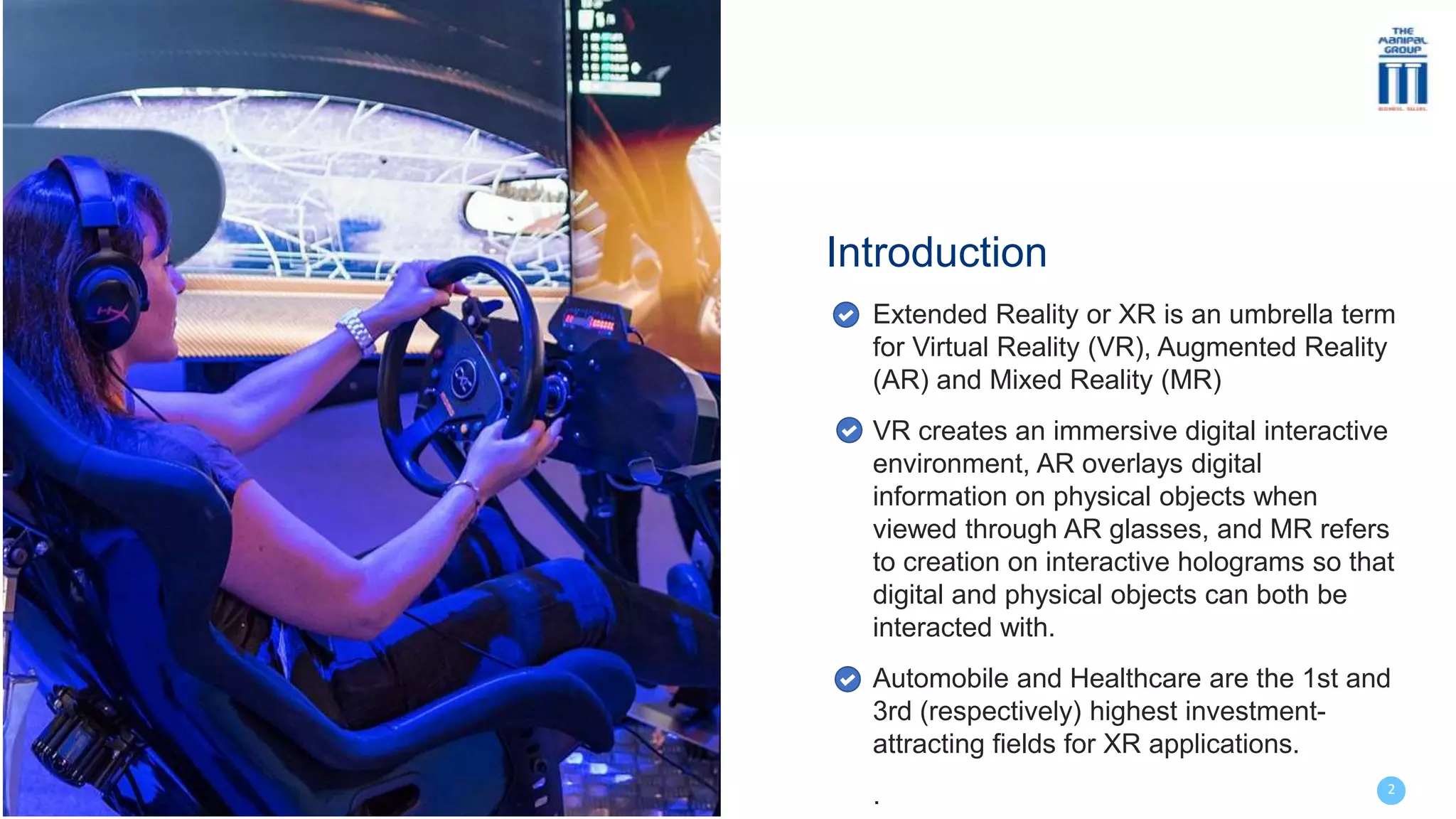
VR creates an immersive digital interactive
environment, AR overlays digital
information on physical objects when
viewed through AR glasses, and MR refers
to creation on interactive holograms so that
digital and physical objects can both be
interacted with.
Automobile and Healthcare are the 1st and
3rd (respectively) highest investment-
attracting fields for XR applications.
.
Introduction
MTL - Confidential
2
3
XR in Automobile has applications on OEM side (before, during and after
manufacturing), dealer side and customer side.
OEM applications are industrial, from R&D environments and simulations in VR to
manufacturing management with AR to monitor and analyse ongoing processes and
MR for feature creation, training and similar.
Dealerships use partial and total immersive experiences to allow potential customers to
customize, visualize and test-drive cars virtually. The experience can be as simple as a
smartphone app and as elaborate as an experience center with 360 holographic
projectors, surround sound and even haptic incorporation to simulate reality.
Customers increasingly expect real engagement with companies and dealers when
making significant purchases. XR seems like the right technology to foster than feeling
of participation.
XR in Automobile
MTL - Confidential
4
XR is used extensively in healthcare. In particular VR programs are widely used to
simulate and visualize procedures including those done via robot.
However healthcare training still relies on classroom training, and limited exposure to
practical experience. This limits access to quality healthcare education for all but a
select few. This is a new, promising area and we expect it to grow fast.
XR in Healthcare training
MTL - Confidential
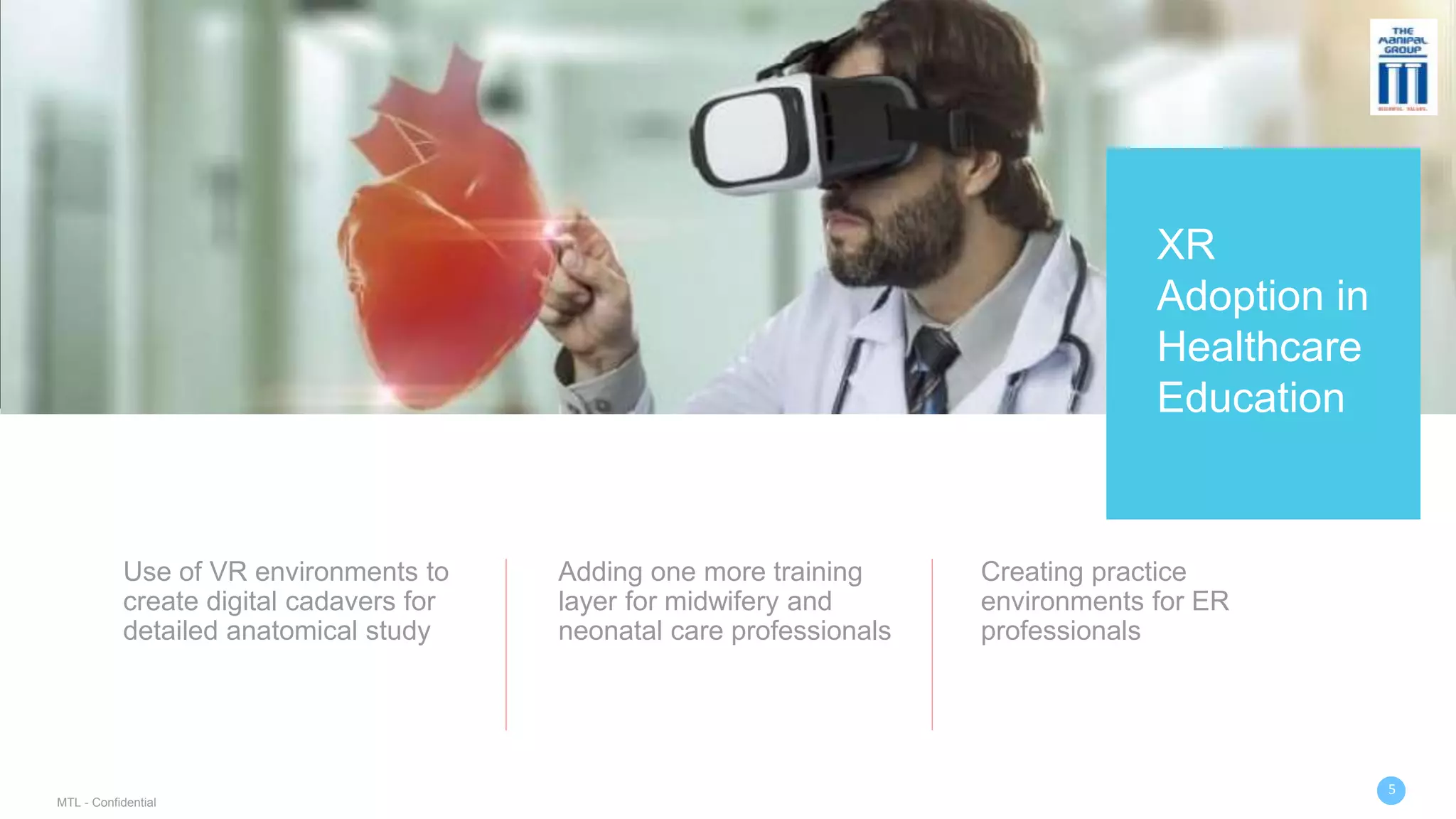
Use of VR environments to
create digital cadavers for
detailed anatomical study
Adding one more training
layer for midwifery and
neonatal care professionals
Creating practice
environments for ER
professionals
MTL - Confidential
5
XR
Adoption in
Healthcare
Education
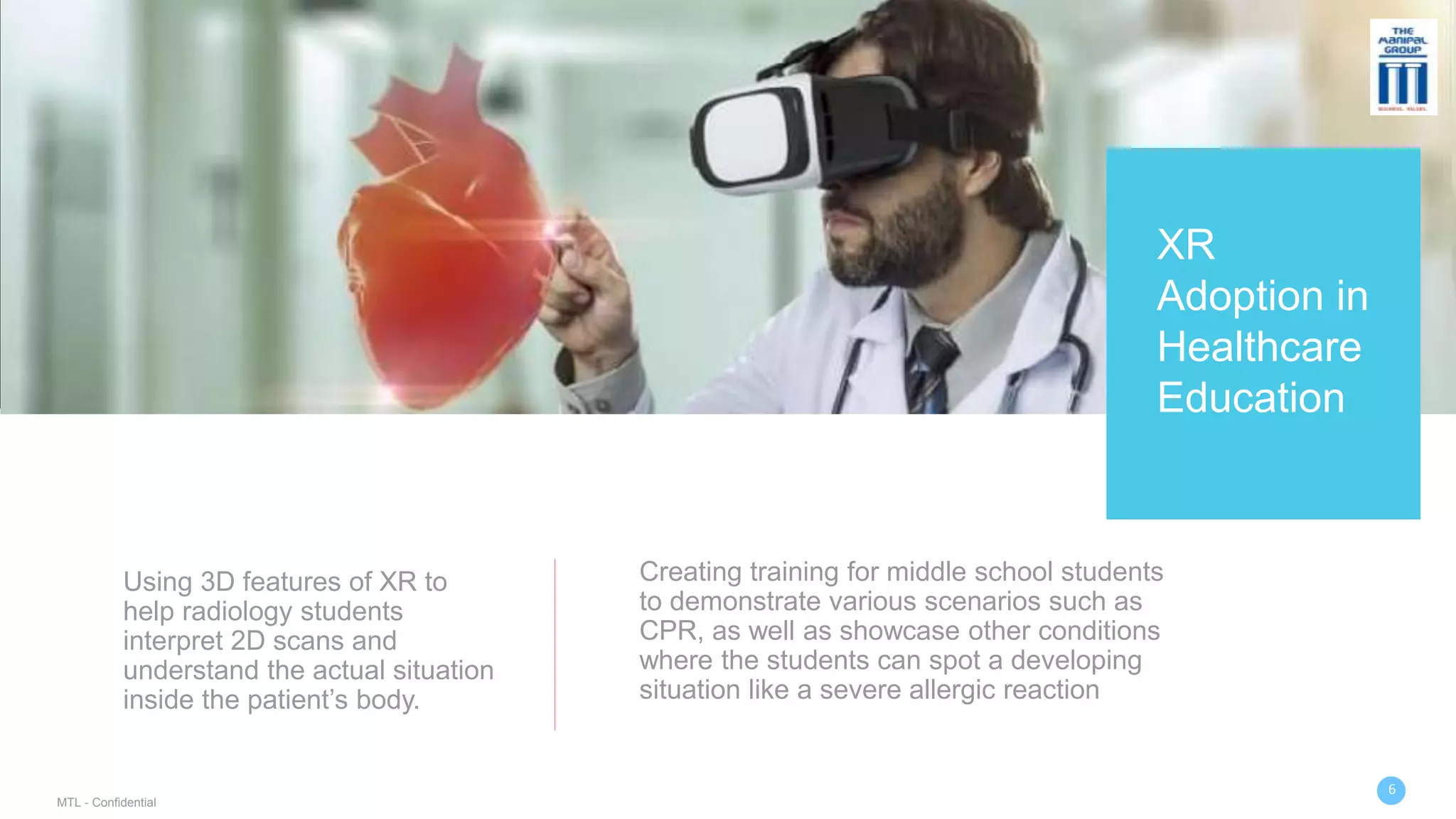
Using 3D features of XR to
help radiology students
interpret 2D scans and
understand the actual situation
inside the patient’s body.
Creating training for middle school students
to demonstrate various scenarios such as
CPR, as well as showcase other conditions
where the students can spot a developing
situation like a severe allergic reaction
MTL - Confidential
6
XR
Adoption in
Healthcare
Education
Conclusion
XR is converging with VR gaming to solve significant healthcare
challenges.
MTL - Confidential
7
XR is the key to Industry 4.0- at the least it is a visualization tool that
will help companies make sense of their data. At most it is a paradigm
shift in the way the manufacturing industry, retail stores and even
individuals will interact with each other as a new matter of course.

Extended Reality in the Automobile and Medical Education Sectors

  • 1.
    Extended Reality inAutomobile and Medical Education 0.3” MTL - Confidential 1
  • 2.
    Extended Reality orXR is an umbrella term for Virtual Reality (VR), Augmented Reality (AR) and Mixed Reality (MR) VR creates an immersive digital interactive environment, AR overlays digital information on physical objects when viewed through AR glasses, and MR refers to creation on interactive holograms so that digital and physical objects can both be interacted with. Automobile and Healthcare are the 1st and 3rd (respectively) highest investment- attracting fields for XR applications. . Introduction MTL - Confidential 2
  • 3.
    3 XR in Automobilehas applications on OEM side (before, during and after manufacturing), dealer side and customer side. OEM applications are industrial, from R&D environments and simulations in VR to manufacturing management with AR to monitor and analyse ongoing processes and MR for feature creation, training and similar. Dealerships use partial and total immersive experiences to allow potential customers to customize, visualize and test-drive cars virtually. The experience can be as simple as a smartphone app and as elaborate as an experience center with 360 holographic projectors, surround sound and even haptic incorporation to simulate reality. Customers increasingly expect real engagement with companies and dealers when making significant purchases. XR seems like the right technology to foster than feeling of participation. XR in Automobile MTL - Confidential
  • 4.
    4 XR is usedextensively in healthcare. In particular VR programs are widely used to simulate and visualize procedures including those done via robot. However healthcare training still relies on classroom training, and limited exposure to practical experience. This limits access to quality healthcare education for all but a select few. This is a new, promising area and we expect it to grow fast. XR in Healthcare training MTL - Confidential
  • 5.
    Use of VRenvironments to create digital cadavers for detailed anatomical study Adding one more training layer for midwifery and neonatal care professionals Creating practice environments for ER professionals MTL - Confidential 5 XR Adoption in Healthcare Education
  • 6.
    Using 3D featuresof XR to help radiology students interpret 2D scans and understand the actual situation inside the patient’s body. Creating training for middle school students to demonstrate various scenarios such as CPR, as well as showcase other conditions where the students can spot a developing situation like a severe allergic reaction MTL - Confidential 6 XR Adoption in Healthcare Education
  • 7.
    Conclusion XR is convergingwith VR gaming to solve significant healthcare challenges. MTL - Confidential 7 XR is the key to Industry 4.0- at the least it is a visualization tool that will help companies make sense of their data. At most it is a paradigm shift in the way the manufacturing industry, retail stores and even individuals will interact with each other as a new matter of course.