Download as PDF, PPTX
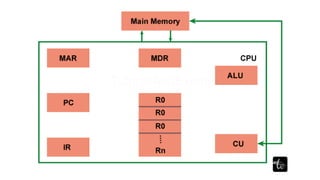
One essential element of contemporary processor architecture is the Memory Data Register (MDR). It is in charge of keeping the data that has to be processed and transferring it to the various processor components so that it can be altered. In this post, we'll go into more detail about MDR so you can better understand how your computer processes data. The function and workings of the Memory Data Register (MDR) are essential to comprehend when exploring the fundamentals of computer architecture. A crucial part of computer architecture is the Memory Data Register or MDR. Data is momentarily stored in this internal register before being read from or written to main memory. The main memory (MDR) and the central processor unit (CPU) are connected using the MDR. The CPU loads data into the MDR first then moves it between the MDR and main memory when it needs to read or write to memory. The computer's design determines the length of the MDR, a fixed-size register. The MDR is 32- or 64-bit on the majority of contemporary PCs.


