The College at Brockport: State University of New York
Digital Commons @Brockport
McNair Summer Research Journal
2013
McNair Summer Research Journal 2013
Herma Volpe-van Dijk
The College at Brockport, hvolpeva@brockport.edu
Follow this and additional works at: http://digitalcommons.brockport.edu/mcnair_journal
Part of the Education Commons
This Book is brought to you for free and open access by Digital Commons @Brockport. It has been accepted for inclusion in McNair Summer Research
Journal by an authorized administrator of Digital Commons @Brockport. For more information, please contact kmyers@brockport.edu.
Recommended Citation
Volpe-van Dijk, Herma, "McNair Summer Research Journal 2013" (2013). McNair Summer Research Journal. Book 11.
http://digitalcommons.brockport.edu/mcnair_journal/11
Ronald E. McNair
2013
Volume 18
Summer Research Journal
2013
Ronald E. McNair
For more information, contact the program at:
C-18 Cooper Hall
350 New Campus Drive
Brockport, New York 14420
Phone: (585) 395-2460
Fax: (585) 395-5410
Email: cstep-mcnair@brockport.edu
About TRiO Programs
	 TRiO refers to six programs funded by the Title IV of the
Higher Education Act of 1965. The original TRiO Programs
are Upward Bound, Talent Search, and Student Support
Services. The name TRiO was retained even though
more programs were added. The additional programs are
Educational Opportunity Centers, the Ronald E. McNair
Post-Baccalaureate Achievement Program, and a training
program for TRiO staff. In general, TRiO programs are
focused on providing educational opportunities to first-
generation college students who come from low-income
families and students with disabilities.
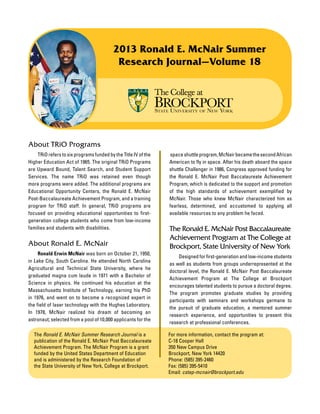
About Ronald E. McNair
	 Ronald Erwin McNair was born on October 21, 1950,
in Lake City, South Carolina. He attended North Carolina
Agricultural and Technical State University, where he
graduated magna cum laude in 1971 with a Bachelor of
Science in physics. He continued his education at the
Massachusetts Institute of Technology, earning his PhD
in 1976, and went on to become a recognized expert in
the field of laser technology with the Hughes Laboratory.
In 1978, McNair realized his dream of becoming an
astronaut; selected from a pool of 10,000 applicants for the
space shuttleprogram,McNairbecamethesecondAfrican
American to fly in space. After his death aboard the space
shuttle Challenger in 1986, Congress approved funding for
the Ronald E. McNair Post Baccalaureate Achievement
Program, which is dedicated to the support and promotion
of the high standards of achievement exemplified by
McNair. Those who knew McNair characterized him as
fearless, determined, and accustomed to applying all
available resources to any problem he faced.
The Ronald E. McNair Post Baccalaureate
Achievement Program at The College at
Brockport, State University of New York
	 Designed for first-generation and low-income students
as well as students from groups underrepresented at the
doctoral level, the Ronald E. McNair Post Baccalaureate
Achievement Program at The College at Brockport
encourages talented students to pursue a doctoral degree.
The program promotes graduate studies by providing
participants with seminars and workshops germane to
the pursuit of graduate education, a mentored summer
research experience, and opportunities to present this
research at professional conferences.
The Ronald E. McNair Summer Research Journal is a
publication of the Ronald E. McNair Post Baccalaureate
Achievement Program. The McNair Program is a grant
funded by the United States Department of Education
and is administered by the Research Foundation of
the State University of New York, College at Brockport.
2013 Ronald E. McNair Summer
Research Journal—Volume 18
8	 Mackenzie Meyer
	TbLpn, Trypanosoma brucei protein and
phospholipid synthesis
10	 Roslyn M. Phillips
	Do Philanthropic Foundations Make a Difference?
11	 Amen Ptah
	The Power of Emotional Images
12	 Jordan S Stenzel
	Sleep Quality and Negative Associated Behaviors
of College Students: A Cross-Sectional Study
Introduction and Acknowledgements
Barbara J. Thompson
Abstracts:
3	 Hakeem Daquan Banks
	Cloning the Kita Gene from
Zebrafish Gastrointestinal Tissues
4	 Theotis Daniels
	Metabolic Flexibility: Fat Loss Solved?
5	 Lesondra Dawkins
	The Economic Measurements of Youth Self-
Determination through Psychological Capital
6	 Jourdan Giambona
	The College at Brockport Admissions:
Financial Leveraging Model
7	 Lisa D. Jones
	A Review of Outreach and Preventive Programs
for At-risk Inner City Youth
Table of Contents
1
2
Barbara J. Thompson
Project Director, Ronald E. McNair
Post Baccalaureate Achievement Program
Introduction and
Acknowledgements
Dear Readers:
	 I am pleased to introduce you to the 18th volume
of the Ronald E. McNair Summer Research Journal.
This journal is a compilation of the work our scholars
complete each summer as they learn to conduct
research in their chosen field. Under the guidance
of dedicated faculty members, McNair scholars
design and implement projects that teach them the
fundamentals of creating and using knowledge and
provide them with their first taste of the graduate
and professional world they are preparing to enter.
The Summer Research Program takes our students
beyond the average undergraduate experience,
setting them apart from their peers as it elevates
their education to a level not usually available to
students pursuing a bachelor’s degree. I am sincerely
grateful to the 40 faculty members who invest so
much of themselves in moving our students forward.
The expertise and encouragement they provide is
critical to the success of our McNair scholars, not
only during their undergraduate years, but most
importantly when they enter the competitive world
of graduate school. The fact that 263 of our 705
McNair alumni have successfully earned master’s
degrees, 25 professional degrees and 38 doctoral
degrees is a tribute to the quality of the work our
mentors expect and elicit from their students. Those
involved in nurturing our future professionals in this
manner deserve to be highly recommended. I look
forward to seeing our scholars enter the ranks of
academia and continue the process of personally
investing in future generations, passing on what
they have received through the dedication of our
mentors, program staff, and campus community.
Acknowledgements
	 The McNair staff would like to take this
opportunity to thank Dr. John Halstead, Dr. Douglas
M. Scheidt, and Dr. Michael Fox who have assisted in
strengthening our program this past year. While the
Office of Academic Affairs administers the program,
the support base represents a university-wide
commitment to achieving our program goals. The
US Department of Education, other TRiO Programs,
the Research Foundation and the entire institution
collectively lend their efforts to the program’s
success.
Gastrointestinal (GI) motility is the muscular
contractions that mix and propel intestinal content.
Although the process is complex, most people
take motility for granted until it does not work.
Approximately 40% of all visits to the doctor are
motivated by discomfort resulting from motility
disorders, and treatment options are limited. This
research contributes to understanding GI motility.
The Kit gene is expressed on interstitial cells of Cajal
(ICC) in the mammalian GI tract and is functionally
important for ICC development and growth. ICC act as
pacemaker cells and initiate rhythmic GI contractions.
A reduced ICC density is associated with GI motility
disorders, and therefore understanding ICC growth
and development is important. The zebrafish has
two Kit orthologues, kita and kitb. The function of
kita in zebrafish supports development of pigment
cells, and the development of gastrointestinal motility.
However, the function of kita in ICC development
in zebrafish is unknown. This research focuses
on cloning a fragment of the kita that will be
used to construct a probe for in situ hybridization
experiments. Developing zebrafish are transparent
and the gastrointestinal tract can be viewed in
intact animals, providing an opportunity to visualize
gene expression and ultimately ICC development in
intact tissues. Methods include isolating total RNA,
making cDNA, testing quality using PCR and using
PCR to amplify kita, purifying PCR products, cloning
reaction, transfect E-Coli, grow cells on agar plate/
choose single colonies, and isolated plasmids using a
miniprep. Sequencing the isolated kita clone showed
a 99% match to the known sequence for the kita
gene. Future experiments use this PCR product as a
probe for in situ hybridization.
3
Hakeem Daquan Banks, Biological Studies
Mentor: Adam Rich, PhD
Cloning the Kita Gene from
Zebrafish Gastrointestinal Tissues
Theotis Daniels, Biological Sciences/
Mathematics
Mentor: Barbara J. Thompson, MA
Metabolic Flexibility:
Fat Loss Solved?
	 The human body is highly adaptive, enabling
humans to live in a broad spectrum of environmental
conditions. Our bodies are capable of utilizing
two types of energy sources obtained from food:
glucose and triglycerides, or, in other words, sugars
and fats in their simplest form. As the first law of
thermodynamics states: all energy can neither be
created nor destroyed. Therefore, too many calories
will result in weight gain. There are some truths and
fallacies with this concept, however. Obesity is a
problem with fat tissue accumulation. There are many
examples of people who eat the same amount of
calories but with very different body composition. It is
not how many calories people eat; it is really what the
body does with those calories that counts. Genetics
and metabolism play a role, but fundamentally the
act of the body storing energy rather than expending
it is ultimately the responsibility of insulin. Insulin
is the hormone responsible for nutrient absorption
and fat storage and it is secreted in response to
carbohydrates and in some cases protein. Therefore,
limiting the secretion of insulin can impair fat storage
since it is a secondary characteristic of insulin.
Ever since the low fat, high carbohydrate diet was
believed to prevent heart disease in the late 1970s,
the world has only seen an increase in the very
problems the diet was supposed to prevent. Certainly
it has produced positive effects on some people, but
as a whole it has done more damage. Experts today
still fail to acknowledge the detrimental effects of
carbohydrates on the body, especially for diabetics,
and demonize fats because of the common dogmatic
belief that fats cause heart disease.
	 It is true that all diets work, but not all diets work
in the same manner. In order to burn fat, the body
has to deplete its glycogen stores first, and once it
reaches a low amount then the body taps into fats as
an energy source in a state called ketosis. However,
it does not make sense to eat a high carb diet to lose
fat because this restores glycogen stores and takes
the subject out of a fat burning state. Why not stay
in a fat burning state all the time when people are
trying to lose fat? Current research has confirmed
low carbohydrates work much more efficiently in all
aspects of a diet including improved cardiovascular
risk factors, lipid profiles, blood pressure, amount of
weight loss, and even compliance. However, as with
all diets, even those on low carbohydrate diets do not
seem to lose weight after a period of time which can
be attributed to the decrease in metabolic rate.
	 Thisresearchtakesalookatutilizingbothsources
of energy in a seasonal way to optimize the energy
sources in our favor. There are many beneficial effects
of carbohydrates including improving metabolism;
however, it seems tapping into both extremes
of dieting seems to produce many physiological
problems. In order to avoid these problems I have
devised a theoretical diet scheme which can reverse
type 2 diabetes, improve cardiovascular risk factors,
increase fat loss, and more importantly provide the
ability to eat a broad spectrum of food without
consequences. At the conclusion of this diet, each
dieter assumes a perfectly balanced diet according
to their bodies.
4
Lesondra Dawkins, Accounting/Economics
Mentors: Karen M. Podsiadly, MS
Kari A. Smoker, JD
The Economic Measurements
of Youth Self-Determination
through Psychological Capital
	 This research looks at the determinants of
underrepresented youth resulting from the highest
unemployment rate in the US Psychological Capital’s
(PsyCap) correlation of self-efficacy and economic
stability, and the lasting effect in conjunction with
educational opportunity programs. Employers measure
their assets through tangible and intangible assets
of the following factors: human capital through
combinations of intellectual property, products of
research and innovation, and future expenditures. Low
motivation, reliability, and negative attitudes elude the
developmental experiences or accomplishments of
educational preparation through higher education and
readiness programs.
	 This research project examines the reports of
the Bureau of Economic Analysis, US Department
of Commerce’s measurement of innovations role in
GDP, and Productivity Growth in 2008. Research and
Development (RD) accounted for 1/6 of Total-Factor
Productivity(TFP),of“AdvanceinKnowledge,”thecost
directly related to Human Capital, that employers spend
on employee training and development. Psychological
Capital trends are widespread throughout business,
institutions and private associations. Several reviews
on the topics are being formed; one such review,
“Labor-Market Consequences of Poor Attitude and
Low Self-Esteem in Youths,” is located in the Economic
Inquiry (Waddell 2006) literature review. I used the
national survey provided by Bowles et al. (2000) on
the importance of employers' ranking of particular
applicants’ traits for nonsupervisory and production
positions and “applicants attitude” (Waddell 2006).
Why is behavior so profound? Simply, our attitudes
inhibit talents and abilities or transform them into
paths of perception into identities. Development and
relationships are formed around those principles.
	 Their discoveries showed the importance of the
traits of individual/youth relevance on maintaining
employment readiness from high school to early
adulthood. I examined the High School Longitudinal
Study of 2009 (HSLS: 09) and the steps of the
Executive Order: White House Initiative on Educational
Excellence for African Americans (President Obama,
2012). These measures are focused on increasing
education, public, private, philanthropic and nonprofit
stakeholders’ relationships with African American
students and their contributions towards our economy.
When underutilization occurs within a sector of its
citizens (youth), it inhibits all the members of its
society. Harms  Luthans Implicit Psychological
Capital Questionnaire (I-PCQ) shows the determinants
that organizations apply as a measurement on the
employability, supervisory and work-outcomes. The
United Nations Development Program, using the
International Human Development Indicators for the
United States from 1980 through 2012, shows results on
the overall stability criteria of economic contributors to
the continuation of growth.
	 PysCap bridges human capital and traditional
economic capital through social capitalism. Although
furtherstudiesareongoinginPsyCap,thereisanoverly
reflective aspect where employment opportunities,
career connections and networking play a heavy
role towards the success in a country’s competitive
advantages. It is done through the urge of outsourcing,
recruitment globally for ingenuity, to gather employees
who possess the skill sets to allow corporations the
advancement towards the future. As a final thought,
competitive edge divides the weaker organizations
from the strongest and gives those corporations added
niches and vast intellectual property products in a
market economy.
5
Jourdan Giambona, Mathematics, Finance
Mentor: Pierangela Veneziani, PhD
The College at Brockport Admissions:
Financial Leveraging Model
	 Colleges and universities worldwide face the
same problem each year: how to select the most
proficient applicant pool for their freshman class. In
other words, the growth and success of institutions
rely almost directly upon the types of students
which they enroll. First and foremost, institutions
prefer students with the highest retention rates,
thus ensuring four solid years of tuition income
as well as sustaining the institutions’ brand with
perceived student success. However, drawing in the
best of the best students does not come cheap.
	 In order to entice the highest caliber of students,
colleges award scholarships in addition to need-
based aid. More sophisticated methods of doing
so include the development of financial leveraging
models to efficiently distribute these funds in a
way that maximizes gains and minimizes losses. In
particular, this project will look at the parameters
that will affect The College at Brockport directly,
thus creating a custom financial leveraging model
for Admissions personnel to apply in the future.
	 There are several steps that go along with this
research project. First, a survey was sent to all of
the students who received this scholarship last
year, regardless of whether they chose to enroll
in The College at Brockport or not. This additional
information will help refine the model by helping
us understand which factors are most important
to incoming freshmen in their college decision-
making process as well as the types of students
who are drawn to our school. Next, we will track
the students who received this scholarship and
enrolled with The College at Brockport during the
fall 2013 semester to get insight on how well they are
performing and engaging in The College at Brockport’s
community. Using this information, combined with
historical information from The College at Brockport’s
Admissions team, we will run a regression analysis
to determine which students are best estimated
to succeed. We will cluster these predetermined
“types” of students based on similar characteristics
and distribute the funds accordingly. The College at
Brockport’s main intention is to enhance its student
academic profile, thus creating a more attractive
image for the school.
	 The expected findings are that students who have
applied to local colleges, applied to colleges with
similar or lower academic reputations, live closer
to The College at Brockport’s campus, visited the
campus, and have low to average family incomes will
be more likely to enroll in The College at Brockport.
However, these results are not yet proven and there
are several other factors that we will consider such
as SAT score, high school grade average, etc. Also,
it is extremely probable that the model will separate
the clusters of students into different tiers and
assign different amounts to each tier. This method
is expected to be less risky and therefore more
efficient than awarding a flat amount ($1,000) to all
clusters of students as seen in the fall 2012 financial
leveraging model.
6
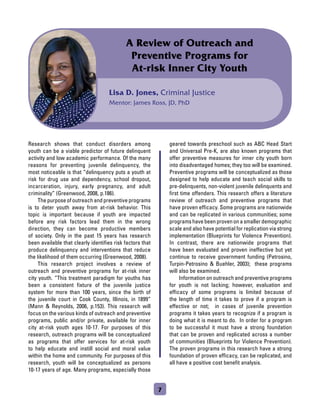
Lisa D. Jones, Criminal Justice
Mentor: James Ross, JD, PhD
A Review of Outreach and
Preventive Programs for
At-risk Inner City Youth
Research shows that conduct disorders among
youth can be a viable predictor of future delinquent
activity and low academic performance. Of the many
reasons for preventing juvenile delinquency, the
most noticeable is that “delinquency puts a youth at
risk for drug use and dependency, school dropout,
incarceration, injury, early pregnancy, and adult
criminality” (Greenwood, 2008, p.186).
	 The purpose of outreach and preventive programs
is to deter youth away from at-risk behavior. This
topic is important because if youth are impacted
before any risk factors lead them in the wrong
direction, they can become productive members
of society. Only in the past 15 years has research
been available that clearly identifies risk factors that
produce delinquency and interventions that reduce
the likelihood of them occurring (Greenwood, 2008).
	 This research project involves a review of
outreach and preventive programs for at-risk inner
city youth. “This treatment paradigm for youths has
been a consistent fixture of the juvenile justice
system for more than 100 years, since the birth of
the juvenile court in Cook County, Illinois, in 1899”
(Mann  Reynolds, 2006, p.153). This research will
focus on the various kinds of outreach and preventive
programs, public and/or private, available for inner
city at-risk youth ages 10-17. For purposes of this
research, outreach programs will be conceptualized
as programs that offer services for at-risk youth
to help educate and instill social and moral value
within the home and community. For purposes of this
research, youth will be conceptualized as persons
10-17 years of age. Many programs, especially those
geared towards preschool such as ABC Head Start
and Universal Pre-K, are also known programs that
offer preventive measures for inner city youth born
into disadvantaged homes; they too will be examined.
Preventive programs will be conceptualized as those
designed to help educate and teach social skills to
pre-delinquents, non-violent juvenile delinquents and
first time offenders. This research offers a literature
review of outreach and preventive programs that
have proven efficacy. Some programs are nationwide
and can be replicated in various communities; some
programshavebeenprovenonasmallerdemographic
scale and also have potential for replication via strong
implementation (Blueprints for Violence Prevention).
In contrast, there are nationwide programs that
have been evaluated and proven ineffective but yet
continue to receive government funding (Petrosino,
Turpin-Petrosino  Buehler, 2003); these programs
will also be examined.
	 Information on outreach and preventive programs
for youth is not lacking; however, evaluation and
efficacy of some programs is limited because of
the length of time it takes to prove if a program is
effective or not; in cases of juvenile prevention
programs it takes years to recognize if a program is
doing what it is meant to do. In order for a program
to be successful it must have a strong foundation
that can be proven and replicated across a number
of communities (Blueprints for Violence Prevention).
The proven programs in this research have a strong
foundation of proven efficacy, can be replicated, and
all have a positive cost benefit analysis.
7
Mackenzie Meyer, Biological Sciences
Mentors: Michel Pelletier, PhD
TbLpn, Trypanosoma brucei protein
and phospholipid synthesis
	 African sleeping sickness is an insect-borne
devastating disease caused by the parasitic protozoan,
Trypanosoma brucei. African sleeping sickness
threatens over 60 million people and 70 million livestock
in 36 countries of sub-Saharan Africa. Over 70,000
humans and 3 million cattle die every year; the disease
is always fatal unless it is treated. Unfortunately, the
current treatment is very toxic and can also be fatal.
Trypanosomes have a protein coat armor consisting
of variant surface glycoproteins (VSG). Although there
are over 1,500 genes encoding VSG proteins, only one
is expressed at a time, allowing Trypanosoma to keep
hiding in the body and build tolerance to current drugs.
Since there are so many potential VSG sequences, no
vaccine can be developed to prevent this disease from
spreading. In trypanosomes, a large number of surface
proteins with critical role in virulence such as VSGs
are anchored to the plasma membrane via a molecule
known as glycosylphosphatidylinositol (GPI). In addition,
phoshatidylethanolamine (PE) and phosphatidylinositol
(PI) are key phospholipids involved in the biosynthesis
of GPI. Of great importance is the fact that, as opposed
to other parasitic organisms, trypanosomes synthesize
phospholipids de novo. This makes the trypanosome
phospholipidsbiosynthesismachineryveryattractivefor
new drug design. When investigating protein function,
a lipin TbLpn was discovered. In trypanosome lipin
catalyzes the dephosphorylation of phosphatidic acid
(PA) to diacylglycerol (DAG), with a potential role in
phospholipid biosynthesis.
	 When testing TbLpn protein interactions, a protein
arginine methyltransferase (PRMT) known as TbPTMT1
was found to interact with TbLpn. As predicted from this
in vivo interaction, it was also found that TbLpn contains
methylated arginine residues. As there are five different
PRMTs expressed in T. brucei, we wanted to determine
whether TbPRMT1 was the enzyme responsible for
TbLpn methylation. To address this question, both
TbLpn and TbPRMT1 were expressed in the bacterium
Escherichia coli and purified. The two proteins were
then incubated with S-adenosyl-L-methionine (SAM),
the methyl source PRMTs use. Following incubation
at 30ºC for 30 min to 18 h, the samples were run
on a polyacrylamide gel, then transferred onto a
membrane. The presence of methylation on TbLpn
was determined by using antibodies that specifically
recognize methylated arginines. Once exposed to film,
increasing signals were shown to correlate with the
incubation time. In the absence of TbPRMT1, no methyl
groups were detected. These results clearly show that
TbPRMT1 is able to methylate TbLpn in vitro.
	 The next step will be to assess whether any
of the other four PRMTs are also able to methylate
TbLpn. Understanding how proteins function within
Trypanosoma is just one step in understanding how
the parasite evolves so we can stop this disease from
spreading. The United States has tripled business with
the Sub-Sahara in the past 10 years. Exposure to this
disease is putting Americans and their cattle at risk, and
there have already been reported cases. A homologous
disease, Trypanosoma cruzi, already exists here.
Knowing how Trypanosoma brucei disease functions
allows knowledge to be applied to Trypanosoma cruzi
and other similar diseases.
8
This research project was conducted with the
purpose of finding an answer to the research
topic Do Foundations Make a Difference? The
project included a literature review of the current
scholarship on philanthropic foundations with
special attention to the historical development of
philanthropy by foundations in the United States.
To explore the changing nature of foundations, I
assembled case studies of two foundations: the
Rosenwald Foundation and the Bill and Melinda
Gates Foundation. These two cases reflect the
shift described in the literature to a more modern
business model for philanthropic work. In the past,
many philanthropic organizations intended their
endowments to ultimately be exhausted while
working towards some cause. Their primary goals
focused on assisting members of society that
were less fortunate. Most foundations of today are
seeking to remain relevant by becoming more in
tune in evaluating the causes they are committed to
supporting. This involves establishing mechanisms
for accountability and transparency for community
organizations. Modern philanthropy addresses not
only social problems related to poverty but also
an array of problems that affect all citizens, such
as cures for major illnesses or new educational
policies to improve student outcomes. They are true
agents of change, seeking to make society a better
place for all members.
	 Theliteraturereviewreveals,however,agrowing
concern with the actual effects of foundation money
and the kind of community organizations and social
movements that foundations support. This concern
serves as a basis to consider implementation of more
governmental supervision. Government oversight
can insure that true social or public good is being
delivered with foundation funds. This would mean
that foundations are going to be held to standards
of accountability and transparency they now require
of the organizations they support. A system of
auditing should be implemented as an obligated
task to show proof of monies being applied directly
for community actions that seek to support targeted
issues and concerns that foundations are supporting
through their connections with community action
organizations and movements. The information
achieved through this research will hopefully serve
to help to democratically improve the standings
of those foundations already in existence, while
it could also serve as a catalyst to establish new
philanthropic foundations which could undoubtedly
serve to combat the many ails and social injustices
that occur in this nation’s many communities.
9
Roslyn M. Phillips, Sociology
Mentor: Eric Kaldor, PhD
Do Philanthropic Foundations
Make a Difference?
Amen Ptah, Psychology
Mentor: James E. Witnauer, PhD
The Power of Emotional Images
	 Think about early childhood and the sound of a
school bell; what does this automatically mean to young
students? What about drivers hearing a siren and
pulling over to the side of the road to allow a patrol car,
ambulance, or fire truck to pass? How do human beings
reach this level of response—just by having a mental
representation of a stimulus—and does this type of
learning involve physiological reflexes?
	 Since the classical experimentation performed by
Ivan Pavlov (1927), associative learning has come to be
a known phenomenon widely used across biological
species. In 1927, Pavlov was credited for discovering
a process involving changes in the associations
between mental representations, where an antecedent
stimulus (i.e. conditioned stimulus) activates a mental
representation of an absent stimulus (i.e. unconditioned
stimulus). This procedure is recognized as classical
conditioning.
	 In classical conditioning situations, animals learn
an association between a cognitive representative of
a conditioned stimulus and a biologically important
unconditioned stimulus. This can result in avoidance
or acceptance, depending on the fear or pleasure
response the animal has regarding the unconditioned
stimulus. Therefore, by association, phobias are capable
of coming into fruition. Just by the site or sound of a
conditioned stimulus, it can elicit a fearful conditioned
response without the unconditioned stimulus being
present.
	 With all this in mind, how is it possible to help others
conquer their fears? And by studying the physiological
response to emotional stimuli, is there a way to create
a paradigm in human learning that could assist in the
challenges of overcoming phobias?
	 The purpose of this study is to replicate classical
conditioning of a pupillary response using an emotional
image unconditioned stimulus. Two stimuli (X and Y)
were paired with images that varied in emotional
content. X was paired with an emotional (fearful) image.
Y was paired with a control image that was matched to
the fearful image with respect to luminance. An Applied
Science Laboratories eye tracking device measured
the pupil diameters of 40 undergraduate participants.
After X-US pairings, pupil diameter during exposure to
X should be greater than pupil diameter after exposure
to Y, reflecting a pupillary conditioned response.
	 In order to examine the results, a quantitative
analysis was demanded on preexisting data already
collected by the experimenter. Using the software
“Matlab,” an algorithm had to be produced to process
and analyze the data. Because this is aggregate
information, the program should speed up the task. The
results are still inconclusive.
	 Hopefully this research will lead to the discovery
of a new manifestation of associative learning. There
aren’t any preexisting theories that can support the
experimenters’ hypothesis, therefore this work attempts
to break ground. The use of innovative technology
will assist in coming up with logical explanations, and
probable determinations for future learning techniques
and/or programming.
10
Jordan S Stenzel, Health Science
Mentor: Michael J Ray, MPH, MS, CHES
Sleep Quality and Negative Associated
Behaviors of College Students:
A Cross-Sectional Study
Abstract
Objective: The purpose of this study was to
ascertain what negative behaviors college students
are engaging in that could be causing them to have
poor sleep.
Participants: A total of 134 students completed the
online surveys.
Methods: An online sleep survey was emailed to
health science students at The College at Brockport.
Survey questions included demographics, sleep
patterns, and living situation, and asked them to self-
report their negative sleep behaviors.
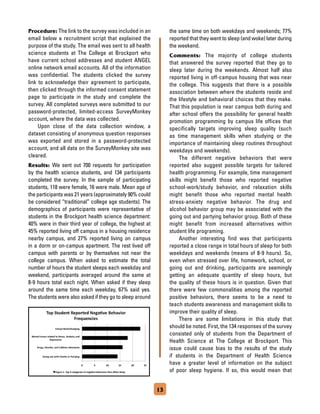
Results: Most students reported to live near campus
in off-campus housing. Students claimed to average
8-9 hours of sleep each weekday and weekend night.
Of the top negative self-reported behaviors students
submitted, 23 students claimed their sleep loss was
due to school work and studying. 18 students claimed
poor sleep due to mental issues like stress and
depression and 16 students claimed drugs, alcohol,
and caffeine related stimulants led to their poor sleep.
Lastly 14 students reported going out with friends or
partying led to their poor sleep quality. The 64 other
collected student surveys had a mix of answers that
did not lend themselves to a particular larger theme
or category.
Conclusions: There are many college students
that suffer from poor sleep quality overall. This study
attempted to shed light on what may be causing these
students' poor sleep in general. College administrators
and school related faculty could use these results in
forming prevention strategies to help college students
improve their sleep. This better quality of sleep could
help improve overall academic performance.
	 In the United States, sleep has been shown to be
a problem within the realm of public health. Sleep is
an essential part of life for several reasons. When we
sleep the brain regains energy and is able to boost
the human immune system to deal with illness and
fatigue. Proper sleep also allows individuals to think
more clearly and objectively. Sleep is also important
for memory, and performance growth (University
Health Center, 2013). Individuals who get quality,
uninterrupted sleep are typically more positive during
the day. That is why the issue of poor sleep quality is
very important to study.
	 One group of individuals who has been identified
with trouble sleeping is college students. Over the
last few decades there has been increased research
into the importance of a good night’s sleep and its
relation to academic performance. According to
Clete A. Kushida, MD, PhD, director of the Stanford
University Center for Human Sleep Research and a
member of the American Academy of Sleep Medicine
(AASM) board of directors, “There are data that sleep
loss leads to learning and memory impairment, as
well as decreased attention and vigilance” (College
students, 2007, para. 4.). Another physician-scientist,
Lawrence Epstein, MD, the medical director of Sleep
Health Centers in Brighton, Mass., says “that sleep
deprivation effects [sic] not only whether a student
can stay awake in class but how they perform as
11
12
well” (College students, 2007, para. 2.).
	 Throughout the typical college experience,
students deal with an array of complex academic,
social, and personal daily situations which shape
them into who they will become. It is these daily
experiences that may also be having an impact on
their individual sleeping patterns. Therefore research
into the area of sleep quality is necessary because
sleep is important to active learning in the college
environment.
	 One example of research into poor sleep quality
was conducted by Forquer, Camden, Gabriau, and
Johnson at the Department of Psychology at Central
Michigan University in Mount Pleasant. Their study
examined college students’ sleep patterns at a
public university to identify problems and possible
influencing factors. The investigators found that of
313 students surveyed, more than 33% of the students
took longer than 30 minutes to fall asleep, 43% woke
more than once nightly, and more than 33% reported
being tired during the day. The researchers found no
differences between undergraduate students and
graduate students (Forquer et al, 2008). The study
concluded that many college students have problems
that can negatively impact academic performance
and driving abilities.
	 Another sleep study conducted by Buboltz,
Brown, and Soper (2001) of the Counseling Psychology
Department at Louisiana Tech University used a
quantitative based approach to find indications of
students’ sleep problems. The researchers did this
to help address deficiencies in the literature. In the
study, a sample of 191 undergraduates at a rural
southern university found that most of the students
exhibited some form of sleep disturbance. Women,
in general, reported more sleep disturbances than
men did. In the end, the researchers concluded that
universities and college authorities should look into
sleep habits of college students to reduce the effects
of sleep issues on overall academic performance.
	 The study conducted by Gilbert and Weaver (2010)
looked into sleep quality and its relation to academic
performance in college undergraduates. The study
examined the relationship between sleep deprivation,
sleep quality, and academic performance. The results
found a significant negative correlation between
global sleep quality (GSQ) on the Pittsburgh Sleep
Quality Index and grade point average (GPA). This
finding supported the researchers’ initial hypothesis
that poor sleep quality is associated with lower
academic performance for non-depressed students.
However, one of the limitations of their study was
that they could not determine the underlying cause of
the poor sleep quality, and the resultant lower grade
point average. Gilbert and Weaver (2010) suggested,
“Because this was correlational research, we cannot
infer directionality of effect (i.e., that poor sleep
quality caused lower grade point average). It is
possible that students with academic difficulties
engage in other behaviors that in turn cause poor
sleep (e.g., substance abuse)” (p.303).
	 It is the Gilbert and Weaver study limitations and
the lack of behavioral information that gave cause
for further investigation. This study seeks to address
this gap in the literature by asking: What specific
behaviors do college undergraduates engage in that
affect their sleep quality? It is hoped that the current
study will allow for characterization of the behaviors
themselves along with evaluation of the impact of
individual and synergistic combinations of behaviors.
This valuable information may provide insight into key
factors behind the poor sleep epidemic.
Methods
Participants: Both undergraduate and graduate
students who are majoring in a field from the
Department of Health Science at The College at
Brockport, State University of New York, were invited
through email to participate in this institutional review
board (IRB) approved survey. Invitations were sent to
approximately 700 students.
Measures: To examine and determine the other
specific behaviors causing poor sleep quality, we
conducted an online survey generated through
surveymonkey.com. The survey asked basic
demographic questions about gender, age, year of
schooling and the students’ current housing situation.
The survey also asked about sleep duration (how many
hours a day/night they sleep) and variability (if they
sleep more or less on a weekday or a weekend). The
final two survey questions asked the participant to list
in rank order of importance their own negative and
positive sleep behaviors that they believe affect their
sleep quality.
Procedure: The link to the survey was included in an
email below a recruitment script that explained the
purpose of the study. The email was sent to all health
science students at The College at Brockport who
have current school addresses and student ANGEL
online network email accounts. All of the information
was confidential. The students clicked the survey
link to acknowledge their agreement to participate,
then clicked through the informed consent statement
page to participate in the study and complete the
survey. All completed surveys were submitted to our
password-protected, limited-access SurveyMonkey
account, where the data was collected.
	 Upon close of the data collection window, a
dataset consisting of anonymous question responses
was exported and stored in a password-protected
account, and all data on the SurveyMonkey site was
cleared.
Results: We sent out 700 requests for participation
by the health science students, and 134 participants
completed the survey. In the sample of participating
students, 118 were female, 16 were male. Mean age of
the participants was 21 years (approximately 90% could
be considered “traditional” college age students). The
demographics of participants were representative of
students in the Brockport health science department:
40% were in their third year of college, the highest at
45% reported living off campus in a housing residence
nearby campus, and 27% reported living on campus
in a dorm or on-campus apartment. The rest lived off
campus with parents or by themselves not near the
college campus. When asked to estimate the total
number of hours the student sleeps each weekday and
weekend, participants averaged around the same at
8-9 hours total each night. When asked if they sleep
around the same time each weekday, 67% said yes.
The students were also asked if they go to sleep around
the same time on both weekdays and weekends; 77%
reported that they went to sleep (and woke) later during
the weekend.
Comments: The majority of college students
that answered the survey reported that they go to
sleep later during the weekends. Almost half also
reported living in off-campus housing that was near
the college. This suggests that there is a possible
association between where the students reside and
the lifestyle and behavioral choices that they make.
That this population is near campus both during and
after school offers the possibility for general health
promotion programming by campus life offices that
specifically targets improving sleep quality (such
as time management skills when studying or the
importance of maintaining sleep routines throughout
weekdays and weekends).
	 The different negative behaviors that were
reported also suggest possible targets for tailored
health programming. For example, time management
skills might benefit those who reported negative
school-work/study behavior, and relaxation skills
might benefit those who reported mental health
stress-anxiety negative behavior. The drug and
alcohol behavior group may be associated with the
going out and partying behavior group. Both of these
might benefit from increased alternatives within
student life programing.
	 Another interesting find was that participants
reported a close range in total hours of sleep for both
weekdays and weekends (means of 8-9 hours). So,
even when stressed over life, homework, school, or
going out and drinking, participants are seemingly
getting an adequate quantity of sleep hours, but
the quality of these hours is in question. Given that
there were few commonalities among the reported
positive behaviors, there seems to be a need to
teach students awareness and management skills to
improve their quality of sleep.
	 There are some limitations in this study that
should be noted. First, the 134 responses of the survey
consisted only of students from the Department of
Health Science at The College at Brockport. This
issue could cause bias to the results of the study
if students in the Department of Health Science
have a greater level of information on the subject
of poor sleep hygiene. If so, this would mean that
13
these results are probably conservative and the level
of negative behaviors among the general college
population may be worse. There may also be other
negative behaviors that have yet to be identified
among other groups on campus.
	 Secondly, the main question in the survey asked
the student to self-report what they believe is the
negative behavior impacting their quality of sleep.
These responses may be affected by the participants’
current social, personal, or cultural situations. In
addition, the geographic location of this college in
a Western New York suburban area may not allow
for generalizing to other college students across the
United States.
Recommendations: Based on the high frequencies
of stress/school work, mental issues, drugs/alcohol,
andpartyingfoundandthenegativereportedbehaviors,
it is not surprising that students at The College at
Brockport also report suffering from some form of
poor sleep quality. Poor sleep quality is an issue that
has seen several studies yet relatively little preventive
action. Action on this issue must be taken in order
to achieve a positive impact on the college student
population at large. At The College at Brockport, stress
and anxiety along with time requirements for studying
and assignments appear to play a role in a majority of
the poor sleep quality cases that students are facing.
Perhaps more large-scale studies looking at potential
interventions toward the reported negative behaviors
will prompt improvement in students’ overall quality
of sleep. Faculty and administrative leadership of
colleges and universities across the country need
greater awareness of how important sleep is. Students’
outside lives are complicated, with pressures from
peers and jobs competing with long assignments,
presentations and test preparation. More emphasis
on time management skills training seems like a novel
target for health promotion programming to indirectly
improve sleep quality among college students.
References
University health center sleep. (2013, April 16). Retrieved from
https://www.uhs.uga.edu/sleep/index.html
College students: Getting enough sleep is vital to academic
success. (2007, November 30). Retrieved from http://www.
aasmnet.org/articles.aspx?id=659
Buboltz Jr, W. C., Brown, F.,  Soper, B. (2001). Sleep Habits and
Patterns of College Students: A Preliminary Study. Journal Of
American College Health, 50(3), 131.
Forquer, L. M., Camden, A. E., Gabriau, K. M.,  Johnson, C. (2008).
Sleep Patterns of College Students at a Public University. Journal
Of American College Health, 56(5), 563-565.
Vail-Smith, K., Felts, W.,  Becker, C. (2009). Relationship between
sleep quality and health risk behaviors in undergraduate college
students. College Student Journal, 43(3), 924-930.
Gilbert, S., Weaver C. (2010). Sleep quality and academic
performance in university students: A wake-up call for college
psychologists. Journal of College Student Psychotherapy,
24(4), 295-306. Retrieved from http://psychdweeb.weebly.com/
uploads/3/5/2/0/350924/sleep_and_academics.pdf
14
15
Barbara J. Thompson
Project Director
Herma Volpe-van Dijk
Associate Project Director
Melissa L. Browning
Academic Coordinator
Serene R. Drakes
Office Assistant
Megan Swan
Office Assistant
Program Staff
Betsy Balzano
Mark Chadsey
Helen Cheves
Denise Copelton
Carl Davila
Marcy Elser
Michael Fox
Joel Frater
James Georger
Barbara LeSavoy
Isabella Mark
Betty Mathewson-Garcia
Ken O’Brien
Karen Podsiadly
Adam Rich
Advisory Board
Herma Volpe-van Dijk
Executive Editor
Brian Robbins
Designer
Katie McNamara
Photographer
Contributors
Herma Volpe-van Dijk
Associate Project Director
Barbara J. Thompson
Project Director
Melissa L. Browning
Academic Coordinator
Lisa D. Jones
Administrative Assistant
TRiO Program Staff
(from left to right)
McNair Summer Research Journal 2013

McNair Summer Research Journal 2013

  • 1.
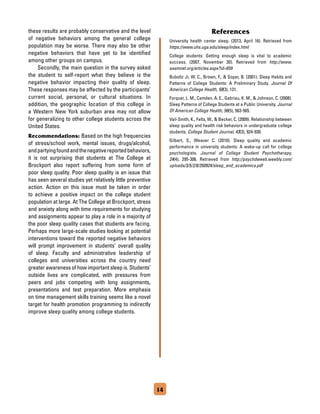
    The College atBrockport: State University of New York Digital Commons @Brockport McNair Summer Research Journal 2013 McNair Summer Research Journal 2013 Herma Volpe-van Dijk The College at Brockport, hvolpeva@brockport.edu Follow this and additional works at: http://digitalcommons.brockport.edu/mcnair_journal Part of the Education Commons This Book is brought to you for free and open access by Digital Commons @Brockport. It has been accepted for inclusion in McNair Summer Research Journal by an authorized administrator of Digital Commons @Brockport. For more information, please contact kmyers@brockport.edu. Recommended Citation Volpe-van Dijk, Herma, "McNair Summer Research Journal 2013" (2013). McNair Summer Research Journal. Book 11. http://digitalcommons.brockport.edu/mcnair_journal/11
  • 2.
    Ronald E. McNair 2013 Volume18 Summer Research Journal 2013 Ronald E. McNair
  • 4.
    For more information,contact the program at: C-18 Cooper Hall 350 New Campus Drive Brockport, New York 14420 Phone: (585) 395-2460 Fax: (585) 395-5410 Email: cstep-mcnair@brockport.edu About TRiO Programs TRiO refers to six programs funded by the Title IV of the Higher Education Act of 1965. The original TRiO Programs are Upward Bound, Talent Search, and Student Support Services. The name TRiO was retained even though more programs were added. The additional programs are Educational Opportunity Centers, the Ronald E. McNair Post-Baccalaureate Achievement Program, and a training program for TRiO staff. In general, TRiO programs are focused on providing educational opportunities to first- generation college students who come from low-income families and students with disabilities. About Ronald E. McNair Ronald Erwin McNair was born on October 21, 1950, in Lake City, South Carolina. He attended North Carolina Agricultural and Technical State University, where he graduated magna cum laude in 1971 with a Bachelor of Science in physics. He continued his education at the Massachusetts Institute of Technology, earning his PhD in 1976, and went on to become a recognized expert in the field of laser technology with the Hughes Laboratory. In 1978, McNair realized his dream of becoming an astronaut; selected from a pool of 10,000 applicants for the space shuttleprogram,McNairbecamethesecondAfrican American to fly in space. After his death aboard the space shuttle Challenger in 1986, Congress approved funding for the Ronald E. McNair Post Baccalaureate Achievement Program, which is dedicated to the support and promotion of the high standards of achievement exemplified by McNair. Those who knew McNair characterized him as fearless, determined, and accustomed to applying all available resources to any problem he faced. The Ronald E. McNair Post Baccalaureate Achievement Program at The College at Brockport, State University of New York Designed for first-generation and low-income students as well as students from groups underrepresented at the doctoral level, the Ronald E. McNair Post Baccalaureate Achievement Program at The College at Brockport encourages talented students to pursue a doctoral degree. The program promotes graduate studies by providing participants with seminars and workshops germane to the pursuit of graduate education, a mentored summer research experience, and opportunities to present this research at professional conferences. The Ronald E. McNair Summer Research Journal is a publication of the Ronald E. McNair Post Baccalaureate Achievement Program. The McNair Program is a grant funded by the United States Department of Education and is administered by the Research Foundation of the State University of New York, College at Brockport. 2013 Ronald E. McNair Summer Research Journal—Volume 18
  • 5.
    8 Mackenzie Meyer TbLpn,Trypanosoma brucei protein and phospholipid synthesis 10 Roslyn M. Phillips Do Philanthropic Foundations Make a Difference? 11 Amen Ptah The Power of Emotional Images 12 Jordan S Stenzel Sleep Quality and Negative Associated Behaviors of College Students: A Cross-Sectional Study Introduction and Acknowledgements Barbara J. Thompson Abstracts: 3 Hakeem Daquan Banks Cloning the Kita Gene from Zebrafish Gastrointestinal Tissues 4 Theotis Daniels Metabolic Flexibility: Fat Loss Solved? 5 Lesondra Dawkins The Economic Measurements of Youth Self- Determination through Psychological Capital 6 Jourdan Giambona The College at Brockport Admissions: Financial Leveraging Model 7 Lisa D. Jones A Review of Outreach and Preventive Programs for At-risk Inner City Youth Table of Contents 1
  • 6.
    2 Barbara J. Thompson ProjectDirector, Ronald E. McNair Post Baccalaureate Achievement Program Introduction and Acknowledgements Dear Readers: I am pleased to introduce you to the 18th volume of the Ronald E. McNair Summer Research Journal. This journal is a compilation of the work our scholars complete each summer as they learn to conduct research in their chosen field. Under the guidance of dedicated faculty members, McNair scholars design and implement projects that teach them the fundamentals of creating and using knowledge and provide them with their first taste of the graduate and professional world they are preparing to enter. The Summer Research Program takes our students beyond the average undergraduate experience, setting them apart from their peers as it elevates their education to a level not usually available to students pursuing a bachelor’s degree. I am sincerely grateful to the 40 faculty members who invest so much of themselves in moving our students forward. The expertise and encouragement they provide is critical to the success of our McNair scholars, not only during their undergraduate years, but most importantly when they enter the competitive world of graduate school. The fact that 263 of our 705 McNair alumni have successfully earned master’s degrees, 25 professional degrees and 38 doctoral degrees is a tribute to the quality of the work our mentors expect and elicit from their students. Those involved in nurturing our future professionals in this manner deserve to be highly recommended. I look forward to seeing our scholars enter the ranks of academia and continue the process of personally investing in future generations, passing on what they have received through the dedication of our mentors, program staff, and campus community. Acknowledgements The McNair staff would like to take this opportunity to thank Dr. John Halstead, Dr. Douglas M. Scheidt, and Dr. Michael Fox who have assisted in strengthening our program this past year. While the Office of Academic Affairs administers the program, the support base represents a university-wide commitment to achieving our program goals. The US Department of Education, other TRiO Programs, the Research Foundation and the entire institution collectively lend their efforts to the program’s success.
  • 7.
    Gastrointestinal (GI) motilityis the muscular contractions that mix and propel intestinal content. Although the process is complex, most people take motility for granted until it does not work. Approximately 40% of all visits to the doctor are motivated by discomfort resulting from motility disorders, and treatment options are limited. This research contributes to understanding GI motility. The Kit gene is expressed on interstitial cells of Cajal (ICC) in the mammalian GI tract and is functionally important for ICC development and growth. ICC act as pacemaker cells and initiate rhythmic GI contractions. A reduced ICC density is associated with GI motility disorders, and therefore understanding ICC growth and development is important. The zebrafish has two Kit orthologues, kita and kitb. The function of kita in zebrafish supports development of pigment cells, and the development of gastrointestinal motility. However, the function of kita in ICC development in zebrafish is unknown. This research focuses on cloning a fragment of the kita that will be used to construct a probe for in situ hybridization experiments. Developing zebrafish are transparent and the gastrointestinal tract can be viewed in intact animals, providing an opportunity to visualize gene expression and ultimately ICC development in intact tissues. Methods include isolating total RNA, making cDNA, testing quality using PCR and using PCR to amplify kita, purifying PCR products, cloning reaction, transfect E-Coli, grow cells on agar plate/ choose single colonies, and isolated plasmids using a miniprep. Sequencing the isolated kita clone showed a 99% match to the known sequence for the kita gene. Future experiments use this PCR product as a probe for in situ hybridization. 3 Hakeem Daquan Banks, Biological Studies Mentor: Adam Rich, PhD Cloning the Kita Gene from Zebrafish Gastrointestinal Tissues
  • 8.
    Theotis Daniels, BiologicalSciences/ Mathematics Mentor: Barbara J. Thompson, MA Metabolic Flexibility: Fat Loss Solved? The human body is highly adaptive, enabling humans to live in a broad spectrum of environmental conditions. Our bodies are capable of utilizing two types of energy sources obtained from food: glucose and triglycerides, or, in other words, sugars and fats in their simplest form. As the first law of thermodynamics states: all energy can neither be created nor destroyed. Therefore, too many calories will result in weight gain. There are some truths and fallacies with this concept, however. Obesity is a problem with fat tissue accumulation. There are many examples of people who eat the same amount of calories but with very different body composition. It is not how many calories people eat; it is really what the body does with those calories that counts. Genetics and metabolism play a role, but fundamentally the act of the body storing energy rather than expending it is ultimately the responsibility of insulin. Insulin is the hormone responsible for nutrient absorption and fat storage and it is secreted in response to carbohydrates and in some cases protein. Therefore, limiting the secretion of insulin can impair fat storage since it is a secondary characteristic of insulin. Ever since the low fat, high carbohydrate diet was believed to prevent heart disease in the late 1970s, the world has only seen an increase in the very problems the diet was supposed to prevent. Certainly it has produced positive effects on some people, but as a whole it has done more damage. Experts today still fail to acknowledge the detrimental effects of carbohydrates on the body, especially for diabetics, and demonize fats because of the common dogmatic belief that fats cause heart disease. It is true that all diets work, but not all diets work in the same manner. In order to burn fat, the body has to deplete its glycogen stores first, and once it reaches a low amount then the body taps into fats as an energy source in a state called ketosis. However, it does not make sense to eat a high carb diet to lose fat because this restores glycogen stores and takes the subject out of a fat burning state. Why not stay in a fat burning state all the time when people are trying to lose fat? Current research has confirmed low carbohydrates work much more efficiently in all aspects of a diet including improved cardiovascular risk factors, lipid profiles, blood pressure, amount of weight loss, and even compliance. However, as with all diets, even those on low carbohydrate diets do not seem to lose weight after a period of time which can be attributed to the decrease in metabolic rate. Thisresearchtakesalookatutilizingbothsources of energy in a seasonal way to optimize the energy sources in our favor. There are many beneficial effects of carbohydrates including improving metabolism; however, it seems tapping into both extremes of dieting seems to produce many physiological problems. In order to avoid these problems I have devised a theoretical diet scheme which can reverse type 2 diabetes, improve cardiovascular risk factors, increase fat loss, and more importantly provide the ability to eat a broad spectrum of food without consequences. At the conclusion of this diet, each dieter assumes a perfectly balanced diet according to their bodies. 4
  • 9.
    Lesondra Dawkins, Accounting/Economics Mentors:Karen M. Podsiadly, MS Kari A. Smoker, JD The Economic Measurements of Youth Self-Determination through Psychological Capital This research looks at the determinants of underrepresented youth resulting from the highest unemployment rate in the US Psychological Capital’s (PsyCap) correlation of self-efficacy and economic stability, and the lasting effect in conjunction with educational opportunity programs. Employers measure their assets through tangible and intangible assets of the following factors: human capital through combinations of intellectual property, products of research and innovation, and future expenditures. Low motivation, reliability, and negative attitudes elude the developmental experiences or accomplishments of educational preparation through higher education and readiness programs. This research project examines the reports of the Bureau of Economic Analysis, US Department of Commerce’s measurement of innovations role in GDP, and Productivity Growth in 2008. Research and Development (RD) accounted for 1/6 of Total-Factor Productivity(TFP),of“AdvanceinKnowledge,”thecost directly related to Human Capital, that employers spend on employee training and development. Psychological Capital trends are widespread throughout business, institutions and private associations. Several reviews on the topics are being formed; one such review, “Labor-Market Consequences of Poor Attitude and Low Self-Esteem in Youths,” is located in the Economic Inquiry (Waddell 2006) literature review. I used the national survey provided by Bowles et al. (2000) on the importance of employers' ranking of particular applicants’ traits for nonsupervisory and production positions and “applicants attitude” (Waddell 2006). Why is behavior so profound? Simply, our attitudes inhibit talents and abilities or transform them into paths of perception into identities. Development and relationships are formed around those principles. Their discoveries showed the importance of the traits of individual/youth relevance on maintaining employment readiness from high school to early adulthood. I examined the High School Longitudinal Study of 2009 (HSLS: 09) and the steps of the Executive Order: White House Initiative on Educational Excellence for African Americans (President Obama, 2012). These measures are focused on increasing education, public, private, philanthropic and nonprofit stakeholders’ relationships with African American students and their contributions towards our economy. When underutilization occurs within a sector of its citizens (youth), it inhibits all the members of its society. Harms Luthans Implicit Psychological Capital Questionnaire (I-PCQ) shows the determinants that organizations apply as a measurement on the employability, supervisory and work-outcomes. The United Nations Development Program, using the International Human Development Indicators for the United States from 1980 through 2012, shows results on the overall stability criteria of economic contributors to the continuation of growth. PysCap bridges human capital and traditional economic capital through social capitalism. Although furtherstudiesareongoinginPsyCap,thereisanoverly reflective aspect where employment opportunities, career connections and networking play a heavy role towards the success in a country’s competitive advantages. It is done through the urge of outsourcing, recruitment globally for ingenuity, to gather employees who possess the skill sets to allow corporations the advancement towards the future. As a final thought, competitive edge divides the weaker organizations from the strongest and gives those corporations added niches and vast intellectual property products in a market economy. 5
  • 10.
    Jourdan Giambona, Mathematics,Finance Mentor: Pierangela Veneziani, PhD The College at Brockport Admissions: Financial Leveraging Model Colleges and universities worldwide face the same problem each year: how to select the most proficient applicant pool for their freshman class. In other words, the growth and success of institutions rely almost directly upon the types of students which they enroll. First and foremost, institutions prefer students with the highest retention rates, thus ensuring four solid years of tuition income as well as sustaining the institutions’ brand with perceived student success. However, drawing in the best of the best students does not come cheap. In order to entice the highest caliber of students, colleges award scholarships in addition to need- based aid. More sophisticated methods of doing so include the development of financial leveraging models to efficiently distribute these funds in a way that maximizes gains and minimizes losses. In particular, this project will look at the parameters that will affect The College at Brockport directly, thus creating a custom financial leveraging model for Admissions personnel to apply in the future. There are several steps that go along with this research project. First, a survey was sent to all of the students who received this scholarship last year, regardless of whether they chose to enroll in The College at Brockport or not. This additional information will help refine the model by helping us understand which factors are most important to incoming freshmen in their college decision- making process as well as the types of students who are drawn to our school. Next, we will track the students who received this scholarship and enrolled with The College at Brockport during the fall 2013 semester to get insight on how well they are performing and engaging in The College at Brockport’s community. Using this information, combined with historical information from The College at Brockport’s Admissions team, we will run a regression analysis to determine which students are best estimated to succeed. We will cluster these predetermined “types” of students based on similar characteristics and distribute the funds accordingly. The College at Brockport’s main intention is to enhance its student academic profile, thus creating a more attractive image for the school. The expected findings are that students who have applied to local colleges, applied to colleges with similar or lower academic reputations, live closer to The College at Brockport’s campus, visited the campus, and have low to average family incomes will be more likely to enroll in The College at Brockport. However, these results are not yet proven and there are several other factors that we will consider such as SAT score, high school grade average, etc. Also, it is extremely probable that the model will separate the clusters of students into different tiers and assign different amounts to each tier. This method is expected to be less risky and therefore more efficient than awarding a flat amount ($1,000) to all clusters of students as seen in the fall 2012 financial leveraging model. 6
  • 11.
    Lisa D. Jones,Criminal Justice Mentor: James Ross, JD, PhD A Review of Outreach and Preventive Programs for At-risk Inner City Youth Research shows that conduct disorders among youth can be a viable predictor of future delinquent activity and low academic performance. Of the many reasons for preventing juvenile delinquency, the most noticeable is that “delinquency puts a youth at risk for drug use and dependency, school dropout, incarceration, injury, early pregnancy, and adult criminality” (Greenwood, 2008, p.186). The purpose of outreach and preventive programs is to deter youth away from at-risk behavior. This topic is important because if youth are impacted before any risk factors lead them in the wrong direction, they can become productive members of society. Only in the past 15 years has research been available that clearly identifies risk factors that produce delinquency and interventions that reduce the likelihood of them occurring (Greenwood, 2008). This research project involves a review of outreach and preventive programs for at-risk inner city youth. “This treatment paradigm for youths has been a consistent fixture of the juvenile justice system for more than 100 years, since the birth of the juvenile court in Cook County, Illinois, in 1899” (Mann Reynolds, 2006, p.153). This research will focus on the various kinds of outreach and preventive programs, public and/or private, available for inner city at-risk youth ages 10-17. For purposes of this research, outreach programs will be conceptualized as programs that offer services for at-risk youth to help educate and instill social and moral value within the home and community. For purposes of this research, youth will be conceptualized as persons 10-17 years of age. Many programs, especially those geared towards preschool such as ABC Head Start and Universal Pre-K, are also known programs that offer preventive measures for inner city youth born into disadvantaged homes; they too will be examined. Preventive programs will be conceptualized as those designed to help educate and teach social skills to pre-delinquents, non-violent juvenile delinquents and first time offenders. This research offers a literature review of outreach and preventive programs that have proven efficacy. Some programs are nationwide and can be replicated in various communities; some programshavebeenprovenonasmallerdemographic scale and also have potential for replication via strong implementation (Blueprints for Violence Prevention). In contrast, there are nationwide programs that have been evaluated and proven ineffective but yet continue to receive government funding (Petrosino, Turpin-Petrosino Buehler, 2003); these programs will also be examined. Information on outreach and preventive programs for youth is not lacking; however, evaluation and efficacy of some programs is limited because of the length of time it takes to prove if a program is effective or not; in cases of juvenile prevention programs it takes years to recognize if a program is doing what it is meant to do. In order for a program to be successful it must have a strong foundation that can be proven and replicated across a number of communities (Blueprints for Violence Prevention). The proven programs in this research have a strong foundation of proven efficacy, can be replicated, and all have a positive cost benefit analysis. 7
  • 12.
    Mackenzie Meyer, BiologicalSciences Mentors: Michel Pelletier, PhD TbLpn, Trypanosoma brucei protein and phospholipid synthesis African sleeping sickness is an insect-borne devastating disease caused by the parasitic protozoan, Trypanosoma brucei. African sleeping sickness threatens over 60 million people and 70 million livestock in 36 countries of sub-Saharan Africa. Over 70,000 humans and 3 million cattle die every year; the disease is always fatal unless it is treated. Unfortunately, the current treatment is very toxic and can also be fatal. Trypanosomes have a protein coat armor consisting of variant surface glycoproteins (VSG). Although there are over 1,500 genes encoding VSG proteins, only one is expressed at a time, allowing Trypanosoma to keep hiding in the body and build tolerance to current drugs. Since there are so many potential VSG sequences, no vaccine can be developed to prevent this disease from spreading. In trypanosomes, a large number of surface proteins with critical role in virulence such as VSGs are anchored to the plasma membrane via a molecule known as glycosylphosphatidylinositol (GPI). In addition, phoshatidylethanolamine (PE) and phosphatidylinositol (PI) are key phospholipids involved in the biosynthesis of GPI. Of great importance is the fact that, as opposed to other parasitic organisms, trypanosomes synthesize phospholipids de novo. This makes the trypanosome phospholipidsbiosynthesismachineryveryattractivefor new drug design. When investigating protein function, a lipin TbLpn was discovered. In trypanosome lipin catalyzes the dephosphorylation of phosphatidic acid (PA) to diacylglycerol (DAG), with a potential role in phospholipid biosynthesis. When testing TbLpn protein interactions, a protein arginine methyltransferase (PRMT) known as TbPTMT1 was found to interact with TbLpn. As predicted from this in vivo interaction, it was also found that TbLpn contains methylated arginine residues. As there are five different PRMTs expressed in T. brucei, we wanted to determine whether TbPRMT1 was the enzyme responsible for TbLpn methylation. To address this question, both TbLpn and TbPRMT1 were expressed in the bacterium Escherichia coli and purified. The two proteins were then incubated with S-adenosyl-L-methionine (SAM), the methyl source PRMTs use. Following incubation at 30ºC for 30 min to 18 h, the samples were run on a polyacrylamide gel, then transferred onto a membrane. The presence of methylation on TbLpn was determined by using antibodies that specifically recognize methylated arginines. Once exposed to film, increasing signals were shown to correlate with the incubation time. In the absence of TbPRMT1, no methyl groups were detected. These results clearly show that TbPRMT1 is able to methylate TbLpn in vitro. The next step will be to assess whether any of the other four PRMTs are also able to methylate TbLpn. Understanding how proteins function within Trypanosoma is just one step in understanding how the parasite evolves so we can stop this disease from spreading. The United States has tripled business with the Sub-Sahara in the past 10 years. Exposure to this disease is putting Americans and their cattle at risk, and there have already been reported cases. A homologous disease, Trypanosoma cruzi, already exists here. Knowing how Trypanosoma brucei disease functions allows knowledge to be applied to Trypanosoma cruzi and other similar diseases. 8
  • 13.
    This research projectwas conducted with the purpose of finding an answer to the research topic Do Foundations Make a Difference? The project included a literature review of the current scholarship on philanthropic foundations with special attention to the historical development of philanthropy by foundations in the United States. To explore the changing nature of foundations, I assembled case studies of two foundations: the Rosenwald Foundation and the Bill and Melinda Gates Foundation. These two cases reflect the shift described in the literature to a more modern business model for philanthropic work. In the past, many philanthropic organizations intended their endowments to ultimately be exhausted while working towards some cause. Their primary goals focused on assisting members of society that were less fortunate. Most foundations of today are seeking to remain relevant by becoming more in tune in evaluating the causes they are committed to supporting. This involves establishing mechanisms for accountability and transparency for community organizations. Modern philanthropy addresses not only social problems related to poverty but also an array of problems that affect all citizens, such as cures for major illnesses or new educational policies to improve student outcomes. They are true agents of change, seeking to make society a better place for all members. Theliteraturereviewreveals,however,agrowing concern with the actual effects of foundation money and the kind of community organizations and social movements that foundations support. This concern serves as a basis to consider implementation of more governmental supervision. Government oversight can insure that true social or public good is being delivered with foundation funds. This would mean that foundations are going to be held to standards of accountability and transparency they now require of the organizations they support. A system of auditing should be implemented as an obligated task to show proof of monies being applied directly for community actions that seek to support targeted issues and concerns that foundations are supporting through their connections with community action organizations and movements. The information achieved through this research will hopefully serve to help to democratically improve the standings of those foundations already in existence, while it could also serve as a catalyst to establish new philanthropic foundations which could undoubtedly serve to combat the many ails and social injustices that occur in this nation’s many communities. 9 Roslyn M. Phillips, Sociology Mentor: Eric Kaldor, PhD Do Philanthropic Foundations Make a Difference?
  • 14.
    Amen Ptah, Psychology Mentor:James E. Witnauer, PhD The Power of Emotional Images Think about early childhood and the sound of a school bell; what does this automatically mean to young students? What about drivers hearing a siren and pulling over to the side of the road to allow a patrol car, ambulance, or fire truck to pass? How do human beings reach this level of response—just by having a mental representation of a stimulus—and does this type of learning involve physiological reflexes? Since the classical experimentation performed by Ivan Pavlov (1927), associative learning has come to be a known phenomenon widely used across biological species. In 1927, Pavlov was credited for discovering a process involving changes in the associations between mental representations, where an antecedent stimulus (i.e. conditioned stimulus) activates a mental representation of an absent stimulus (i.e. unconditioned stimulus). This procedure is recognized as classical conditioning. In classical conditioning situations, animals learn an association between a cognitive representative of a conditioned stimulus and a biologically important unconditioned stimulus. This can result in avoidance or acceptance, depending on the fear or pleasure response the animal has regarding the unconditioned stimulus. Therefore, by association, phobias are capable of coming into fruition. Just by the site or sound of a conditioned stimulus, it can elicit a fearful conditioned response without the unconditioned stimulus being present. With all this in mind, how is it possible to help others conquer their fears? And by studying the physiological response to emotional stimuli, is there a way to create a paradigm in human learning that could assist in the challenges of overcoming phobias? The purpose of this study is to replicate classical conditioning of a pupillary response using an emotional image unconditioned stimulus. Two stimuli (X and Y) were paired with images that varied in emotional content. X was paired with an emotional (fearful) image. Y was paired with a control image that was matched to the fearful image with respect to luminance. An Applied Science Laboratories eye tracking device measured the pupil diameters of 40 undergraduate participants. After X-US pairings, pupil diameter during exposure to X should be greater than pupil diameter after exposure to Y, reflecting a pupillary conditioned response. In order to examine the results, a quantitative analysis was demanded on preexisting data already collected by the experimenter. Using the software “Matlab,” an algorithm had to be produced to process and analyze the data. Because this is aggregate information, the program should speed up the task. The results are still inconclusive. Hopefully this research will lead to the discovery of a new manifestation of associative learning. There aren’t any preexisting theories that can support the experimenters’ hypothesis, therefore this work attempts to break ground. The use of innovative technology will assist in coming up with logical explanations, and probable determinations for future learning techniques and/or programming. 10
  • 15.
    Jordan S Stenzel,Health Science Mentor: Michael J Ray, MPH, MS, CHES Sleep Quality and Negative Associated Behaviors of College Students: A Cross-Sectional Study Abstract Objective: The purpose of this study was to ascertain what negative behaviors college students are engaging in that could be causing them to have poor sleep. Participants: A total of 134 students completed the online surveys. Methods: An online sleep survey was emailed to health science students at The College at Brockport. Survey questions included demographics, sleep patterns, and living situation, and asked them to self- report their negative sleep behaviors. Results: Most students reported to live near campus in off-campus housing. Students claimed to average 8-9 hours of sleep each weekday and weekend night. Of the top negative self-reported behaviors students submitted, 23 students claimed their sleep loss was due to school work and studying. 18 students claimed poor sleep due to mental issues like stress and depression and 16 students claimed drugs, alcohol, and caffeine related stimulants led to their poor sleep. Lastly 14 students reported going out with friends or partying led to their poor sleep quality. The 64 other collected student surveys had a mix of answers that did not lend themselves to a particular larger theme or category. Conclusions: There are many college students that suffer from poor sleep quality overall. This study attempted to shed light on what may be causing these students' poor sleep in general. College administrators and school related faculty could use these results in forming prevention strategies to help college students improve their sleep. This better quality of sleep could help improve overall academic performance. In the United States, sleep has been shown to be a problem within the realm of public health. Sleep is an essential part of life for several reasons. When we sleep the brain regains energy and is able to boost the human immune system to deal with illness and fatigue. Proper sleep also allows individuals to think more clearly and objectively. Sleep is also important for memory, and performance growth (University Health Center, 2013). Individuals who get quality, uninterrupted sleep are typically more positive during the day. That is why the issue of poor sleep quality is very important to study. One group of individuals who has been identified with trouble sleeping is college students. Over the last few decades there has been increased research into the importance of a good night’s sleep and its relation to academic performance. According to Clete A. Kushida, MD, PhD, director of the Stanford University Center for Human Sleep Research and a member of the American Academy of Sleep Medicine (AASM) board of directors, “There are data that sleep loss leads to learning and memory impairment, as well as decreased attention and vigilance” (College students, 2007, para. 4.). Another physician-scientist, Lawrence Epstein, MD, the medical director of Sleep Health Centers in Brighton, Mass., says “that sleep deprivation effects [sic] not only whether a student can stay awake in class but how they perform as 11
  • 16.
    12 well” (College students,2007, para. 2.). Throughout the typical college experience, students deal with an array of complex academic, social, and personal daily situations which shape them into who they will become. It is these daily experiences that may also be having an impact on their individual sleeping patterns. Therefore research into the area of sleep quality is necessary because sleep is important to active learning in the college environment. One example of research into poor sleep quality was conducted by Forquer, Camden, Gabriau, and Johnson at the Department of Psychology at Central Michigan University in Mount Pleasant. Their study examined college students’ sleep patterns at a public university to identify problems and possible influencing factors. The investigators found that of 313 students surveyed, more than 33% of the students took longer than 30 minutes to fall asleep, 43% woke more than once nightly, and more than 33% reported being tired during the day. The researchers found no differences between undergraduate students and graduate students (Forquer et al, 2008). The study concluded that many college students have problems that can negatively impact academic performance and driving abilities. Another sleep study conducted by Buboltz, Brown, and Soper (2001) of the Counseling Psychology Department at Louisiana Tech University used a quantitative based approach to find indications of students’ sleep problems. The researchers did this to help address deficiencies in the literature. In the study, a sample of 191 undergraduates at a rural southern university found that most of the students exhibited some form of sleep disturbance. Women, in general, reported more sleep disturbances than men did. In the end, the researchers concluded that universities and college authorities should look into sleep habits of college students to reduce the effects of sleep issues on overall academic performance. The study conducted by Gilbert and Weaver (2010) looked into sleep quality and its relation to academic performance in college undergraduates. The study examined the relationship between sleep deprivation, sleep quality, and academic performance. The results found a significant negative correlation between global sleep quality (GSQ) on the Pittsburgh Sleep Quality Index and grade point average (GPA). This finding supported the researchers’ initial hypothesis that poor sleep quality is associated with lower academic performance for non-depressed students. However, one of the limitations of their study was that they could not determine the underlying cause of the poor sleep quality, and the resultant lower grade point average. Gilbert and Weaver (2010) suggested, “Because this was correlational research, we cannot infer directionality of effect (i.e., that poor sleep quality caused lower grade point average). It is possible that students with academic difficulties engage in other behaviors that in turn cause poor sleep (e.g., substance abuse)” (p.303). It is the Gilbert and Weaver study limitations and the lack of behavioral information that gave cause for further investigation. This study seeks to address this gap in the literature by asking: What specific behaviors do college undergraduates engage in that affect their sleep quality? It is hoped that the current study will allow for characterization of the behaviors themselves along with evaluation of the impact of individual and synergistic combinations of behaviors. This valuable information may provide insight into key factors behind the poor sleep epidemic. Methods Participants: Both undergraduate and graduate students who are majoring in a field from the Department of Health Science at The College at Brockport, State University of New York, were invited through email to participate in this institutional review board (IRB) approved survey. Invitations were sent to approximately 700 students. Measures: To examine and determine the other specific behaviors causing poor sleep quality, we conducted an online survey generated through surveymonkey.com. The survey asked basic demographic questions about gender, age, year of schooling and the students’ current housing situation. The survey also asked about sleep duration (how many hours a day/night they sleep) and variability (if they sleep more or less on a weekday or a weekend). The final two survey questions asked the participant to list in rank order of importance their own negative and positive sleep behaviors that they believe affect their sleep quality.
  • 17.
    Procedure: The linkto the survey was included in an email below a recruitment script that explained the purpose of the study. The email was sent to all health science students at The College at Brockport who have current school addresses and student ANGEL online network email accounts. All of the information was confidential. The students clicked the survey link to acknowledge their agreement to participate, then clicked through the informed consent statement page to participate in the study and complete the survey. All completed surveys were submitted to our password-protected, limited-access SurveyMonkey account, where the data was collected. Upon close of the data collection window, a dataset consisting of anonymous question responses was exported and stored in a password-protected account, and all data on the SurveyMonkey site was cleared. Results: We sent out 700 requests for participation by the health science students, and 134 participants completed the survey. In the sample of participating students, 118 were female, 16 were male. Mean age of the participants was 21 years (approximately 90% could be considered “traditional” college age students). The demographics of participants were representative of students in the Brockport health science department: 40% were in their third year of college, the highest at 45% reported living off campus in a housing residence nearby campus, and 27% reported living on campus in a dorm or on-campus apartment. The rest lived off campus with parents or by themselves not near the college campus. When asked to estimate the total number of hours the student sleeps each weekday and weekend, participants averaged around the same at 8-9 hours total each night. When asked if they sleep around the same time each weekday, 67% said yes. The students were also asked if they go to sleep around the same time on both weekdays and weekends; 77% reported that they went to sleep (and woke) later during the weekend. Comments: The majority of college students that answered the survey reported that they go to sleep later during the weekends. Almost half also reported living in off-campus housing that was near the college. This suggests that there is a possible association between where the students reside and the lifestyle and behavioral choices that they make. That this population is near campus both during and after school offers the possibility for general health promotion programming by campus life offices that specifically targets improving sleep quality (such as time management skills when studying or the importance of maintaining sleep routines throughout weekdays and weekends). The different negative behaviors that were reported also suggest possible targets for tailored health programming. For example, time management skills might benefit those who reported negative school-work/study behavior, and relaxation skills might benefit those who reported mental health stress-anxiety negative behavior. The drug and alcohol behavior group may be associated with the going out and partying behavior group. Both of these might benefit from increased alternatives within student life programing. Another interesting find was that participants reported a close range in total hours of sleep for both weekdays and weekends (means of 8-9 hours). So, even when stressed over life, homework, school, or going out and drinking, participants are seemingly getting an adequate quantity of sleep hours, but the quality of these hours is in question. Given that there were few commonalities among the reported positive behaviors, there seems to be a need to teach students awareness and management skills to improve their quality of sleep. There are some limitations in this study that should be noted. First, the 134 responses of the survey consisted only of students from the Department of Health Science at The College at Brockport. This issue could cause bias to the results of the study if students in the Department of Health Science have a greater level of information on the subject of poor sleep hygiene. If so, this would mean that 13
  • 18.
    these results areprobably conservative and the level of negative behaviors among the general college population may be worse. There may also be other negative behaviors that have yet to be identified among other groups on campus. Secondly, the main question in the survey asked the student to self-report what they believe is the negative behavior impacting their quality of sleep. These responses may be affected by the participants’ current social, personal, or cultural situations. In addition, the geographic location of this college in a Western New York suburban area may not allow for generalizing to other college students across the United States. Recommendations: Based on the high frequencies of stress/school work, mental issues, drugs/alcohol, andpartyingfoundandthenegativereportedbehaviors, it is not surprising that students at The College at Brockport also report suffering from some form of poor sleep quality. Poor sleep quality is an issue that has seen several studies yet relatively little preventive action. Action on this issue must be taken in order to achieve a positive impact on the college student population at large. At The College at Brockport, stress and anxiety along with time requirements for studying and assignments appear to play a role in a majority of the poor sleep quality cases that students are facing. Perhaps more large-scale studies looking at potential interventions toward the reported negative behaviors will prompt improvement in students’ overall quality of sleep. Faculty and administrative leadership of colleges and universities across the country need greater awareness of how important sleep is. Students’ outside lives are complicated, with pressures from peers and jobs competing with long assignments, presentations and test preparation. More emphasis on time management skills training seems like a novel target for health promotion programming to indirectly improve sleep quality among college students. References University health center sleep. (2013, April 16). Retrieved from https://www.uhs.uga.edu/sleep/index.html College students: Getting enough sleep is vital to academic success. (2007, November 30). Retrieved from http://www. aasmnet.org/articles.aspx?id=659 Buboltz Jr, W. C., Brown, F., Soper, B. (2001). Sleep Habits and Patterns of College Students: A Preliminary Study. Journal Of American College Health, 50(3), 131. Forquer, L. M., Camden, A. E., Gabriau, K. M., Johnson, C. (2008). Sleep Patterns of College Students at a Public University. Journal Of American College Health, 56(5), 563-565. Vail-Smith, K., Felts, W., Becker, C. (2009). Relationship between sleep quality and health risk behaviors in undergraduate college students. College Student Journal, 43(3), 924-930. Gilbert, S., Weaver C. (2010). Sleep quality and academic performance in university students: A wake-up call for college psychologists. Journal of College Student Psychotherapy, 24(4), 295-306. Retrieved from http://psychdweeb.weebly.com/ uploads/3/5/2/0/350924/sleep_and_academics.pdf 14
  • 19.
    15 Barbara J. Thompson ProjectDirector Herma Volpe-van Dijk Associate Project Director Melissa L. Browning Academic Coordinator Serene R. Drakes Office Assistant Megan Swan Office Assistant Program Staff Betsy Balzano Mark Chadsey Helen Cheves Denise Copelton Carl Davila Marcy Elser Michael Fox Joel Frater James Georger Barbara LeSavoy Isabella Mark Betty Mathewson-Garcia Ken O’Brien Karen Podsiadly Adam Rich Advisory Board Herma Volpe-van Dijk Executive Editor Brian Robbins Designer Katie McNamara Photographer Contributors Herma Volpe-van Dijk Associate Project Director Barbara J. Thompson Project Director Melissa L. Browning Academic Coordinator Lisa D. Jones Administrative Assistant TRiO Program Staff (from left to right)