





A
DISSERTATION REPORT
ON
A STUDY OF CHANGING CONSUMER
PREFERENCE TOWARDS ORGANIZED
RETAILING FROM UN-ORGANIZED RETAIL
Submitted by:
MAYANK
Roll. NO.-130360500074
Supervised by-:
prof. Navjyoti singh Negi
In partial fulfilment for the award of the degree
MASTER OF BUSINESS ADMINISTRATION
(2013-2015)
DOON BUSINESS SCHOOL;DEHRADUN
1
DECLARATION
I hereby that I have worked on the topic “ A study of changing consumer preference toward
organized retailing from un-organized retail”
All the information that has been collected, analyzed and documented for the project is authentic
possession to me.
I would like to categorically mention that the work here has neither been purchased nor acquired by
any other unfair means. The data and information existing in this report are accurate and update to the
current data, to the best of our knowledge.
However, for this purpose of the project, information already compiled in many sources have been
utilized. I extend my sincere thanks to Prof. Navjyoti singh negi sir,. All information in this report
is true representation of what I have experienced during the project.
2
AA CC KK NN OO WW LL EE DD GG EE MM EE NN TT
I would like to take this opportunity to express my sincere gratitude to our respected
mentor for her valuable guidance.
I extend my sincere thanks to Prof. Navjyoti singh Negi of for their support and
help in the completion of the project.
I would like to thanks almost everybody at the office for his/her friendliness and
helpful nature.
With sincere thanks
3
BONAFIDE CERTIFICATE
Certified that this Report titled " A STUDY OF CHANGING CONSUMER
PREFERENCE TOWARD ORGANIZED RETAILING FROM UN
ORGANIZED RETAIL" is the bonafide work of MAYANK ( Roll No-130360500074)
who carried out the workundermy supervision.Certifiedfurtherthattothe best of my knowledge
the work reportedhereindoesnotformpart of any otherthesisordissertationonthe basisof which
a degree or award was conferred on an earlier occasion on this or any
Signature of the HOD Signature of theSupervisor
Date date
4
TABLE OF CONTENTS
SR. NO. PARTICULAR
PAGE
NO.
 Declaration
 Certificate of Institute
 Preface
 Acknowledgements
 Bonafide certificate
Part 1 GENERAL INFORMATION
1.  Overview of Indian Retail Industry
2.  Major players of Retail Industry in India
3.  Type of retail industry in India
4.  Growth Indian retailing industry
PART 2 PRIMARY STUDY
4. Introduction of Study
4.1 Literature Review
4.2 Background of the Study
4.3 Objectives of the Study
5
5. ResearchMethodology
5.1 Research Design
5.2 Sources of Data
5.3 Data Collection Method
5.4 Population
5.5 Sampling Method
5.6 Sampling Frame
6
7
8
9
10
11
12
5.7 Date Collection Instruments
 Annexure
 Questionnaire for
 Bibliography& References
 Remarks
13
ABSTRACT
Retail is currently a flourishing sector of the Indian economy. The Indian Retail
industry has grown at a 14.6% CAGR during FY07-12. This growth can be directly credited to
the emergent Indian economy as Retailing is one of the largest sectors in the global economy and is
going through an evolutionary well as increase in Private Final Consumption Expenditure
(PFCE) and bring revolution in Indian peoples‟ consumption pattern. This tendency is expected
to continue for at least the next two-three decades, magnetizing huge attention from
entrepreneurs, business heads, investors as well as real estate owners and builders segments of
the economy. Despite this growth, the Indian retail industry is highly fragmented, with the
organized retailing still at a nascent stage which accounts for far less percentage than the
unorganized retailing of the total Indian retail market. It is estimated that organized retailing
accounts for less than 5% of today‟s market, but is expected to develop between14% to 18% by
2015. During FY07- 12, the organized retailing in India has grown at a CAGR of 26.4%; higher
that the total growth of Indian retailing. The sector is the largest source of employment after
agriculture, and has deep access into rural India generating more than 10 per cent of India‟s
GDP. This study aims to identify the factors influencing the perception towards organized retailing
from unorganized retailers. The primary data was gathered by administering a prearranged
questionnaire with 100 customers selected purposively from Udaipur District. The data analysis
of customer attitude towards unorganized and organized retailers shows that there is a difference
between the consumers‟ perception towards both organized retailers and unorganized retailers
regarding their store image, range of products, brand choices, price, store atmosphere, credit
availability, and shop proximity. The data has been collected with the help of structured
questionnaire containing close and open ended questions. Statistical software and MS excel were
extensively used for analyzing the data collected. The rationale of the study is twofold: First, to
examine the shift in perception in the retail sector taking place due to organized form of retailing.
14
CHAPTER 1
INTRODUCITON INDIAN RETAIL INDUSTRY
The word "Retail" originates from a French-Italian word "retailer"
meaning “someone who cuts off or shreds a small piece from something”.
Retailing includes activities of marketing and selling products or services to
end consumers for their own household or personal use. Retailer is a Person or
Agent or Company or Organization who is instrumental in reaching the Goods
or Merchandise or Services to the End User or Ultimate Consumer.
 What is retailing?
Retailing is a distribution channel function, where one organisation
buys products from supplying firms or manufactures products
themselves, and then sells these directly to consumers.
In majority of retail situations, the organisation, from whom a
consumer buys, is a reseller of products obtained from others, and not the
product manufacturer. However, some manufacturers do operate their own
retail outlets in a corporate channel arrangement.
Retailers offer many benefits to suppliers and customers as resellers.
Consumers, for instance, are able to purchase small quantities of an assortment
of products at a reasonably affordable price. Similarly, suppliers get an
opportunity to reach their target market, build product demand through retail
promotions, and provide consumer feedback to the product marketer.
Most Indian shopping happens in open markets or numerous small
grocery and retail shops. Shoppers typically wait outside the shop, ask for
what they want, and cannot pick or examine a product from the shelf.Access to
the shelf or product storage area is limited. Once the shopper requests the food
staple or household product they are looking for, the shopkeeper goes to the
container or shelf or to the back of the store, brings it out and offers it for sale
15
to the shopper. Often the shopkeeper may substitute the product, claiming that
it is similar or equivalent to the product the consumer is asking for.
The product typically has no price label in these small retail shops;
although some products do have a manufactured suggested retail price
(MSRP) pre-printed on the packaging. The shopkeeper prices the food staple
and household products arbitrarily, and two consumers may pay different
prices for the same product on the same day. Price is sometimes negotiated
between the shopper and shopkeeper. The shoppers do not have time to
examine the product label, and do not have a choice to make an informed
decision between competitive products.
India's retail and logistics industry, organized and unorganized in
combination, employs about 40 million Indians (3.3% of Indian population).
The typical Indian retail shops are very small. Over 14 million outlets operate
in the country and only 4% of them being larger than 500 sq. ft. (46 m2) in
size. India has about 11 shop outlets for every 1000 people.
Vast majority of the unorganized retail shops in India employ family
members, do not have the scale to procure or transport products at high
volume wholesale level, have limited to no quality control or fake-versus-
authentic product screening technology and have no training on safe and
hygienic storage, packaging or logistics. The unorganized retail shops source
their products from a chain of middlemen who mark up the product as it
moves from farmer or producer to the consumer. The unorganized retail shops
typically offer no after-sales support or service. Finally, most transactions at
unorganized retail shops are done with cash, with all sales being final.
Until the 1990s, regulations prevented innovation and entrepreneurship
in Indian retailing. Some retails faced complying with over thirty regulations
such as "signboard licenses" and "anti-hoarding measures" before they could
open doors. There are taxes for moving goods to states, from states, and even
within states in some cases. Farmers and producers had to go through
middlemen monopolies. The logistics and infrastructure was very poor, with
losses exceeding 30 percent.
16
Through the 1990s, India introduced widespread free market reforms,
including some related to retail. In between 2000 to 2010, consumers in select
Indian cities have gradually begun to experience the quality, choice,
convenience and benefits of organized retail industry.
 Major retail sector in India
 There are many sectors in retail industry in India and there are established in
various company at specific sectors.
1. Food and grocery:
 Food Bazaar
 Aditya Birla Retail Ltd
 Trinethra Super Market Ltd
 Reliance Retail
2. Fashion and accessories
 Pantaloons
 Shoppers Stop
3. Koutons:
4. Footwear
 Reebok
 Bata
5. Khadim’s:
6. Home and office improvement
 Godrej Lifespace
 Home Stop
 Home Town
7. Electronics
 eZone:
 Viveks:
8. Catering services
 Yum! Restaurants:
17
 McDonald’s
 Café Coffee Day
9. Telecom
 The Mobile Store:
 MobileNXT:
10. Pharmaceuticals
 Apollo Pharmacy
 MedPlus:
11. Beauty and wellness
 Reliance Wellness
 Himalaya Drugs
12. Jewellery
 Gitanjali:
 Tanishq:
 Reliance Jewels
13. Timewear
 Citizen:
 Titan
 Books, music and gifts
14. Crossword
15. Entertainment
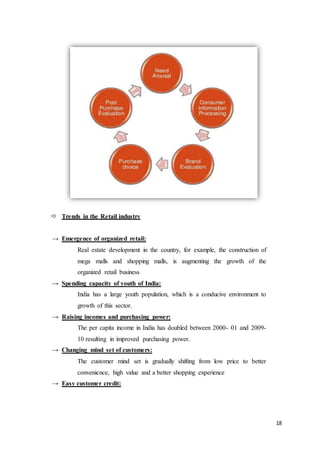
 How does the retail sector consumer think?
18
 Trends in the Retail industry
→ Emergence of organized retail:
Real estate development in the country, for example, the construction of
mega malls and shopping malls, is augmenting the growth of the
organized retail business
→ Spending capacity of youth of India:
India has a large youth population, which is a conducive environment to
growth of this sector.
→ Raising incomes and purchasing power:
The per capita income in India has doubled between 2000- 01 and 2009-
10 resulting in improved purchasing power.
→ Changing mind set of customers:
The customer mind set is gradually shifting from low price to better
convenience, high value and a better shopping experience
→ Easy customer credit:
19
Emergence of concepts such as quick and easy loans, EMIs, loan
through credit cards, has made purchasing possible for Indian
consumers, for products such as consumer durables
→ Higher brand consciousness:
There is high brand consciousness among the youth; 60% of India‘s
population is below the age of 30 leading to popularization of brands
and products
 Global Retail Scenario
→ Retailing has played a major role in the global economy. In developed
markets, retailing is one of the most prominent industries. In 2008, the US
retail sector contributed 31% to the GDP at current market prices. In
developed economies, organized retail has a 75-80% share in total retail as
compared with developing economies, where un-organized retail has a
dominant share.
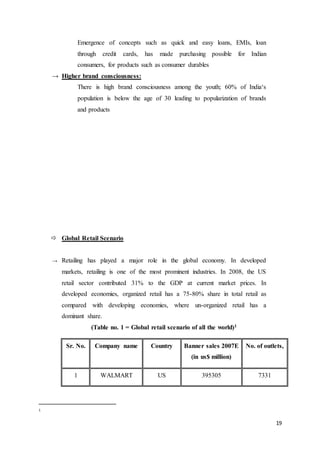
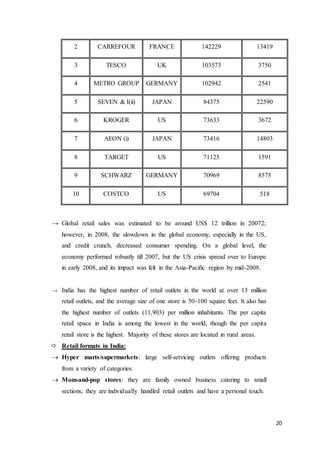
(Table no. 1 = Global retail scenario of all the world)1
Sr. No. Company name Country Banner sales 2007E
(in us$ million)
No. of outlets,
1 WALMART US 395305 7331
1
20
2 CARREFOUR FRANCE 142229 13419
3 TESCO UK 103573 3750
4 METRO GROUP GERMANY 102942 2541
5 SEVEN & I(ii) JAPAN 84375 22590
6 KROGER US 73633 3672
7 AEON (i) JAPAN 73416 14803
8 TARGET US 71125 1591
9 SCHWARZ GERMANY 70969 8575
10 COSTCO US 69704 518
→ Global retail sales was estimated to be around US$ 12 trillion in 20072;
however, in 2008, the slowdown in the global economy, especially in the US,
and credit crunch, decreased consumer spending. On a global level, the
economy performed robustly till 2007, but the US crisis spread over to Europe
in early 2008, and its impact was felt in the Asia-Pacific region by mid-2008.
→ India has the highest number of retail outlets in the world at over 13 million
retail outlets, and the average size of one store is 50-100 square feet. It also has
the highest number of outlets (11,903) per million inhabitants. The per capita
retail space in India is among the lowest in the world, though the per capita
retail store is the highest. Majority of these stores are located in rural areas.
 Retail formats in India:
 Hyper marts/supermarkets: large self-servicing outlets offering products
from a variety of categories.
 Mom-and-pop stores: they are family owned business catering to small
sections; they are individually handled retail outlets and have a personal touch.
21
 Departmental stores: are general retail merchandisers offering quality
products and services.
 Convenience stores: are located in residential areas with slightly higher prices
goods due to the convenience offered.
 Shopping malls: the biggest form of retail in India, malls offers customers a
mix of all types of products and services including entertainment and food
under a single roof.
 E-trailers: are retailers providing online buying and selling of products and
services.
 Discount stores: these are factory outlets that give discount on the MRP.
 Vending: it is a relatively new entry, in the retail sector. Here beverages,
snacks and other small items can be bought via vending machine.
 Category killers: small specialty stores that offer a variety of categories. They
are known as category killers as they focus on specific categories, such as
electronics and sporting goods. This is also known as Multi Brand Outlets or
MBO's.
 Specialty stores: are retail chains dealing in specific categories and provide
deep assortment Mumbai's Crossword Book Store and RPG's Music World are
a couple of example.
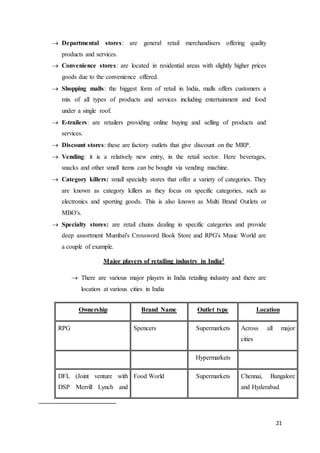
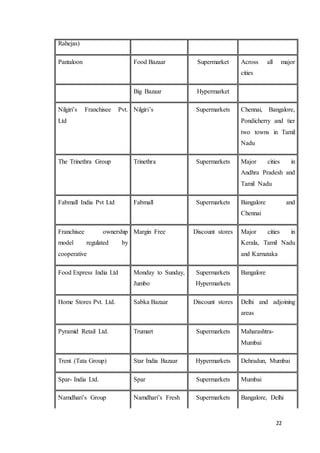
Major players of retailing industry in India2
 There are various major players in India retailing industry and there are
location at various cities in India
Ownership Brand Name Outlet type Location
RPG Spencers Supermarkets Across all major
cities
Hypermarkets
DFL (Joint venture with
DSP Merrill Lynch and
Food World Supermarkets Chennai, Bangalore
and Hyderabad
22
Rahejas)
Pantaloon Food Bazaar Supermarket Across all major
cities
Big Bazaar Hypermarket
Nilgiri’s Franchisee Pvt.
Ltd
Nilgiri’s Supermarkets Chennai, Bangalore,
Pondicherry and tier
two towns in Tamil
Nadu
The Trinethra Group Trinethra Supermarkets Major cities in
Andhra Pradesh and
Tamil Nadu
Fabmall India Pvt Ltd Fabmall Supermarkets Bangalore and
Chennai
Franchisee ownership
model regulated by
cooperative
Margin Free Discount stores Major cities in
Kerala, Tamil Nadu
and Karnataka
Food Express India Ltd Monday to Sunday,
Jumbo
Supermarkets
Hypermarkets
Bangalore
Home Stores Pvt. Ltd. Sabka Bazaar Discount stores Delhi and adjoining
areas
Pyramid Retail Ltd. Trumart Supermarkets Maharashtra-
Mumbai
Trent (Tata Group) Star India Bazaar Hypermarkets Dehradun, Mumbai
Spar- India Ltd. Spar Supermarkets Mumbai
Namdhari’s Group Namdhari’s Fresh Supermarkets Bangalore, Delhi
23
Adani Group Adanis Supermarkets Gujarat
Department of Food and
Public Distribution (Govt.
of India Coop.)
Super Bazaar Supermarkets Delhi
Department of Food and
Public Distribution (Govt.
of India Coop.)
Kendriya Bhandar Supermarkets Delhi
Vishal Mega Mart Food Mart Hyper Market Across all major
cities
Reliance India Ltd. Reliance Fresh Discount Stores Across all major
cities
Rei Agro Ltd. 6Ten Discount Stores North India
Kind of Indian retail industry
The Indian retail industry is divided into organized and unorganized
sectors. The Indian retail sector is highly fragmented, with a major share of its
business is being run by unorganized retailers like the traditional family run
stores and corner stores. The organized retail however is at a very nascent
stage, though attempts are being made to increase its proportion bringing in a
huge opportunity for prospective new players.
There are two types of Retailing:
 Organized Retailing
 Unorganized Retailing
→ Organized Retailing
24
Organized retailing refers to trading activities undertaken by licensed retailers,
that is, those who are registered for sales tax, income tax, etc. These include
the corporate-backed hypermarkets and retail chains, and also the privately
owned large retail businesses.
→ Unorganized Retailing
Indian retail is dominated by a large number of small retailers consisting of the
local kirana shops, owner-manned general stores, chemists, footwear shops,
apparel shops, paan and beedi (local betel leaf and tobacco) shops, hand-cart
hawkers, pavement vendors, etc. which together make up the so-called
"unorganized retail" or traditional retail.
Difference between Organized Retailing &Unorganized Retailing
Organized Retailing Unorganized Retailing
Organized retailing refers to trading
activities undertaken by licensed retailers,
that is, those who are registered for sales
tax, income tax, etc
Unorganized retailing, on the other hand,
refers to the traditional formats of low-cost
retailing
There are include the corporate-backed
hypermarkets and retail chains, and also the
privately owned large retail businesses.
There are include the local kirana shops,
owner-manned general stores, chemists,
footwear shops, apparel shops, paan and
beedi (local betel leaf and tobacco) shops,
hand-cart hawkers, pavement vendors, etc
25
Multi storied malls and huge complexes
that offer a large variety of products in
terms of quality, value for money and
makes shopping a memorable experience.
Low cost retailing. These are highly
competitive outlets, with negligible rental
costs (unregistered kiosks or traditional
property), cheap workers (work is shared by
members of family) and low taxes and
overheads.
The ownership and management rest with
two or more person.
The ownership and management rest with
one person only
The organized stores are not having number
of options to cut their costs
The unorganized stores are having number
of options to cut their costs
The customersare want to change in
many shopping malls.
This is one of the good reasons which
the customer doesn't want to change
their old loyal kirana shop.
ORGANISED RETAILING
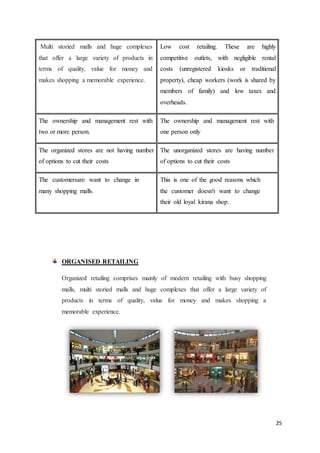
Organized retailing comprises mainly of modern retailing with busy shopping
malls, multi storied malls and huge complexes that offer a large variety of
products in terms of quality, value for money and makes shopping a
memorable experience.
26
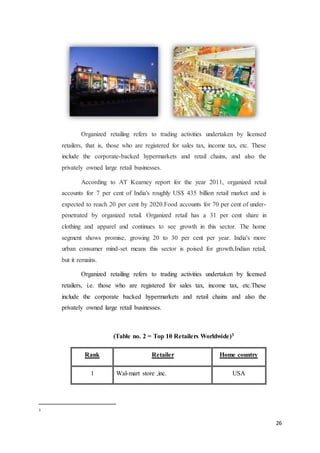
Organized retailing refers to trading activities undertaken by licensed
retailers, that is, those who are registered for sales tax, income tax, etc. These
include the corporate-backed hypermarkets and retail chains, and also the
privately owned large retail businesses.
According to AT Kearney report for the year 2011, organized retail
accounts for 7 per cent of India's roughly US$ 435 billion retail market and is
expected to reach 20 per cent by 2020.Food accounts for 70 per cent of under-
penetrated by organized retail. Organized retail has a 31 per cent share in
clothing and apparel and continues to see growth in this sector. The home
segment shows promise, growing 20 to 30 per cent per year. India's more
urban consumer mind-set means this sector is poised for growth.Indian retail,
but it remains.
Organized retailing refers to trading activities undertaken by licensed
retailers, i.e. those who are registered for sales tax, income tax, etc.These
include the corporate backed hypermarkets and retail chains and also the
privately owned large retail businesses.
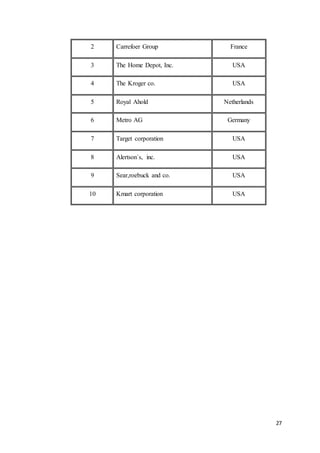
(Table no. 2 = Top 10 Retailers Worldwide)3
Rank Retailer Home country
1 Wal-mart store ,inc. USA
3
27
2 Carrefoer Group France
3 The Home Depot, Inc. USA
4 The Kroger co. USA
5 Royal Ahold Netherlands
6 Metro AG Germany
7 Target corporation USA
8 Alertson`s, inc. USA
9 Sear,roebuck and co. USA
10 Kmart corporation USA
28
0
5
10
15
20
25
30
35
40
45
50
1
45.6
37.8
18.9
12.6
10.6
10.4
9.1 6.9
4.1
2.8 2.6 0.8
PERCENTAGE
DIFFERENT RETAIL SECTOR
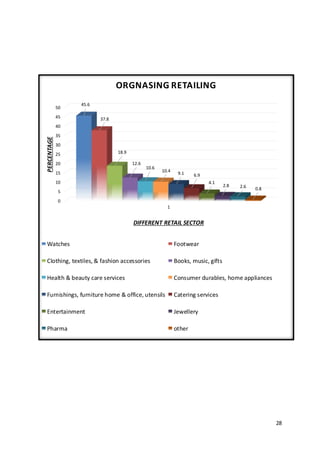
ORGNASING RETAILING
Watches Footwear
Clothing, textiles, & fashion accessories Books, music, gifts
Health & beauty care services Consumer durables, home appliances
Furnishings, furniture home & office, utensils Catering services
Entertainment Jewellery
Pharma other
29
 CHALLENGES TO RETAIL DEVELOPMENT IN INDIA
Organized retail in India is little over a decade old. It is largely an
urban phenomenon and the pace of growth is still slow. Some of the reasons
for this slow growth are: -
→ The Kiranas Continue
The very first challenge facing the organized retail industry in India is
competition from the unorganized sector. Traditionally retailing has
established in India for centuries. It is a low cost structure, mostly owner
operated, has negligible real estate and labor costs and little or no taxes to pay.
Consumer familiarity that runs from generation to generation is one big
advantage for the traditional retailing sector.
On the other hand, organized sector have big expenses to meet and yet have to
keep prices low enough to compete with the traditional sector.
→ Retail not beingrecogning as an industry in India
Lack of recognition as an industry hampers the availability of finance to the
existing and new players. This affects growth and expansion plans.
→ The High cost of Real estate
Real estate prices in some cities in India are amongst the highest in the world.
The lease or rent of property is one of the major areas of expenditure; a high
lease rental reduces the profitability of a project.
→ High Stamp duties
In addition to the high cost of real estate the sector also faces very high stamp
duties on transfer of property, which varies from state to state (12.5% in
Gujarat and 8% in Delhi). The problem is compounded by problems of clear
titles to ownership, while at the same time land use conversion is time
consuming and complex as is the legal process for settling of property
disputes.
30
→ Lack of adequate infrastructure–
Poor roads and the lack of a cold chain infrastructure hampers the
development of food and grocery retail in India. The existing supermarkets
and foods retailers have to invest a substantial amount of money and time in
building a cold chain network.
→ Multiple and complex taxation system –
The sales tax rates vary from state to state, while organized players have to
face a multiple point control and system there is considerable sales tax evasion
by small stores. In many locations, retailers have to face a multi-point octroi
with the introduction of value Added Tax (VAT) in 2005, certain anomalies in
the existing sales tax system causing disruption in the supply chain are likely
to get corrected over a period of time.
→ There is price war between different retail organizations. Each and every one
is saying to provide goods at low cost and offers various promotional schemes.
In such a case it is difficult to keep one’s customers with oneself.
31
 OPPORTUNITIES TO RETAIL DEVELOPMENT IN INDIA
Retail marketing gets various opportunities to grow up in the Indian
market. Not only retailing but Manufacturers as well as suppliers, and buyers
have various opportunities, some of which are mentioned below
→ What is in store
Organized retail provides brands much needed visibility and platform for
customer interaction. It also helps in launching of new product or product
variant and in market penetration. It has wider product range and more
frequent, speedier deliveries.
→ Urbanization
Increased urbanization has shifted consumers to one place and thus a single
retail can catch more customers.
→ Nuclear family
As the time passed away joint families came in a new form i.e. nuclear family.
Again the income level of these nuclear families increases because both
members started earning. This results into increased power of purchase and
lack of time. Now they want everything under one roof. This brought the
concept of organized retailing.
Plasticrevolution
Increased use of credit cards is in favour of retail marketing. It creates
requirement even when it is not necessary.
→ Jo Dikata Hai Woh Bikta Hai
Organized retail stores put stress on proper infrastructure like well-maintained
building, air conditioning, trained employees, electronic machine, parking
facilities and proper display of goods category wise. Here customers feel
comfort, joy and entertainment. Purchasing becomes joy for him. Self-
selection saves time and gives more opportunities and satisfaction. Fix cost
removes the threat of misleading. They avail various discounts and
32
promotional schemes presented by the manufacturers. They also get product of
different varieties and of proper quality.
→ Employment
Retail marketing is one of the largest employments generating industry. It
provides employment to skilled, semi-skilled as well as to unskilled persons.
Thus it helps in the socio- economic development of the society.
→ Price war
Increase in the no of retail outlets increases competition among these retailers.
To attract customers they give various promotional schemes as various
discounts, buy one get one free, another product with any particular product,
festival special, etc.
→ Contract farming
The retail marketers directly purchase from farmers and reducing middlemen,
thus provide proper cost to farmers and also set proper price for consumers.
They also make contract with farmers to get proper amount of crops and
vegetables.
→ Reduces supply chain management
The big players of retail marketing and the manufacturing companies directly
come in contact thus reducing many intermediary chains. Manufacturers also
give many promotional schemes for their product that is beneficial for
consumers.
33
UNORGANISED RETAILING
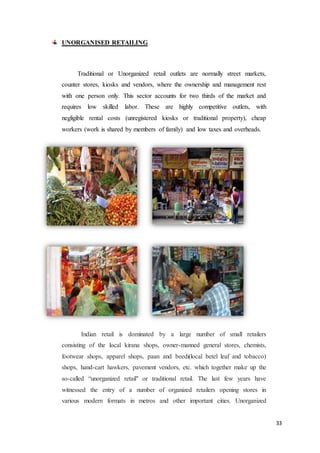
Traditional or Unorganized retail outlets are normally street markets,
counter stores, kiosks and vendors, where the ownership and management rest
with one person only. This sector accounts for two thirds of the market and
requires low skilled labor. These are highly competitive outlets, with
negligible rental costs (unregistered kiosks or traditional property), cheap
workers (work is shared by members of family) and low taxes and overheads.
Indian retail is dominated by a large number of small retailers
consisting of the local kirana shops, owner-manned general stores, chemists,
footwear shops, apparel shops, paan and beedi(local betel leaf and tobacco)
shops, hand-cart hawkers, pavement vendors, etc. which together make up the
so-called “unorganized retail" or traditional retail. The last few years have
witnessed the entry of a number of organized retailers opening stores in
various modern formats in metros and other important cities. Unorganized
34
retailers normally do not pay taxes and most of them are not even registered
for sales tax, VAT, or income tax.
Unorganized retailing, on the other hand, refers to the traditional
formats of low-cost retailing, for example, hand cart and pavement vendors, &
mobile vendors, the local kirana shops, owner manned general
stores, paan/beedi shops, convenience stores, hardware shop at the corner of
your street selling everything from bathroom fittings to paints and small
construction tools; or the slightly more organized medical store and a host of
other small retail businesses in apparel, electronics, food etc.
35
The reasons might be obtain by unorganised retailing:-
→ In smaller towns and urban areas, there are many families who are traditionally
using these kiranashops/ ‘mom and pop’ stores offering a wide range of
merchandise mix. Generally these kirana shops are the family business of
these small retailers which they are running for more than one generation.
→ These kirana shops are having their own efficient management system and
with this they are efficiently fulfilling the needs of the customer. This is one of
the good reasons why the customer doesn't want to change their old loyal
kirana shop.
→ A large number of working class in India is working as daily wage basis, at the
end of the day when they get their wage, they come to this small retail shop to
purchase wheat flour, rice etc. for their supper. For them this the only place to
have those food items because purchase quantity is so small that no big retail
store would entertain this.
→ Similarly there is another consumer class who are the seasonal worker. During
their unemployment period they use to purchase from this kirana store in credit
and when they get their salary they clear their dues. Now this type of credit
facility is not available in corporate retail store, so this kirana stores are the
only place for them to fulfill their needs.
→ Another reason might be the proximity of the store. It is the convenience store
for the customer. In every corner the street an unorganized retail shop can be
found that is hardly a walking distance from the customer's house. Many times
customers prefer to shop from the nearby kirana shop rather than to drive a
long distance organized retail stores.
→ This unorganized stores are having number of options to cut their costs. They
incur little to no real-estate costs because they generally operate from their
residences.
36
Growth of Indian Retail industry
→ An increasing number of people in India are turning to the services sector for
employment due to the relative low compensation offered by the traditional
agriculture and manufacturing sectors.
→ The organized retail market is growing at 3.5 percent annually while growth of
unorganized retail sector is pegged at 6 percent.
→ The Retail Business in India is currently at the point of inflection. Rapid
change with investments to the tune of US $ 25 billion is being planned by
several Indian and multinational companies in the next 5 years.
→ It is a huge industry in terms of size and according to management consulting
firm Techno Park Advisors Pvt. Ltd., it is valued at about US $ 350 billion.
Organized retail is expected to garner about 16-18 percent of the total retail
market (US $ 65-75 billion) in the next 5 years.
→ According to the tenth report of GRDI of AT Kearney, India is having a very
favourable retail environment and it is placed at 4th spot in the GRDI.
→ The main reasons behind that is the 9% real GDP growth in 2010, forecasted
yearly growth of 8.7% through 2016, high saving and investment rate and
increased consumer spending.
→ According to report, organized retail accounts for 7% of India’s roughly $435
billion retail market and is expected to reach 20% by 2020. Food accounts for
70% of Indian retail, but it remains under penetrated by organized retail.
Organized retail has a 31% share in clothing and apparel and continues to see
growth in this sector.
→ A report by Boston Consulting Group has revealed that the country’s
organized retail is estimated at US $ 28 billion with around 7% penetration.
→ It is projected to become a US $ 260 billion business over the net decade with
around 21% penetration.
→ The analysts believe that the sector is likely to show significant growth of over
9% over the next ten years and also see rapid development in organized retail
format with proportion likely to reach more respectable 25%by 2018.
→ The BMI India Report for the first quarter of 2012 released forecasts that total
retail sales with growth from US $ 422.09 billion in 2011 to US $ 825.46
billion by 2015.
37
→ The report highlights strongly underlying economic growth, population
expansion, increasing disposable income and rapid emergence of organized
retail infrastructure as major factors behind the forecast growth.
→ According to department of Industry Policy and Promotion Cumulative, FDI
inflows in single brand retail trading stood at US$ 44.45 million during April
2000 to September 2011.
→ Indian retail sector is wearing new clothes and with a three year compounded
annual growth rate of46-64%, retail is the fastest growing sector in the Indian
economy.
→ The sector is the second largest employer after agriculture, employing more
than 35 million people with wholesale trade generating an additional
employment to 5.5 million crore.The enormous growth of retail industry has
created a huge demand for real estate. Property developers are creating retail
real estate at an aggressive pace.
→ According to report titled “India Organized Retail Market 2010”, published by
Knight Frank, during 2010- 12,around 55 million square feet of retail space
will be ready in Mumbai, NCR, Bangalore, Kolkata, Chennai, Hyderabad and
Pune.
→ Besides between 2010 and 2012 the organized retail real estate will be grown
from existing 41 million square feet to 95 million square feet.
→ The total no. of shopping mall is expected to expand at CAGR of 18.9% by
2015.
→ Hypermarket, currently accounting for 14% of mall space is expected to
witness high growth.
→ Industry experts predict that the next phase of growth in the retail sector will
emerge from the rural market.
→ By 2012, the rural retail market is projected to have a total of more than 50%
market share.
→ India's retail market is expected to be worth about US$ 410 billion, with 5 per
cent ofsales through organised retail, meaning that the opportunity in India
remains immense.
→ Retail should continue to grow rapidly—up to US$ 535 billion in 2013, with
10 per cent coming from organised retail, reflecting a fast-growing middle
38
class, demanding higher quality shopping environments and stronger brands,
according to the report ‘Expanding Opportunities for Global
39
CHPATER 2
LITERATURE REVIEWS
→ According to Dholakia (1999),i the rationale for shopping is making physical
visits to a shopping site. It is considered as a household task as well as a form
of recreation, relaxation and entertainment. Shopping is also considered to
have the most positive attribute of being a leisure activity along with work
(Dholakia, 1999).
→ Sinha & Banerjee (2004)ii studied the drivers of store choice in various
product categories, in the context of evolving retail industry in India and found
that the distinct store features as perceived by respondents with true
motivations of various consumers in patronizing various stores. Study suggests
that consumers of Indian unorganized retail market do not require the service
paraphernalia offered by many retailers. Store environment plays a vital role
for store patronage and repeat purchases which includes convenience, value
for money products, etc.
→ Backstrom & Johansson (2006)iii studied factors that influence consumers'
in-store experiences. In-store experiences are constituted by traditional values
such as the behavior of the personnel, a satisfactory selection of products,
price and a layout that facilitates the store visit.
→ Terblanche & Boshoff (2006)iv suggested that retailers will have to accept
that it is not only what they are marketing but also how it is done. The personal
(face-to-face) interaction between retail staff and shoppers is of critical
importance.
→ Kalhan (2007)v studies the impact of organized retail on unorganized retail
shops. Major findings reveal that 70 % of unorganized retailers reported
falling sales. This fall in sales is due to superior shopping environment,
convenience, availability of variety, ambience of shop, and availability of
parking space and perception of quality of products sold in organized retail
setup.
→ Goswami (2008)vi studied the shopping experiences in kirana stores and in
modern stores. The major findings suggest Kirana stores to improve or to
enrich shopping experiences. Kiranas also have to stay alert, try to upgrade
40
and have to improve on service quality while concentrating on innovation and
efficiency.
→ Das & Kumar (2009)vii studied the impact of sales promotion on consumers
shopping experiences. A major finding reveals that keeping product
satisfaction constant, sales can be improved by enhancing shopping experience
which includes convenience of shopping, ease of locating products, easy check
in and checkouts, customer friendly sales people and customer friendly
policies. Secondly finding reveals that purchase decision for the same product
under same promotion at different stores may vary because difference in
shopping experiences provided by different stores. Further this study shows
that promotion plays a limited role on consumers buying behavior where only
small percentage of people are attracted to such sales promotion and wait for
it. Study lastly emphasizes on the importance of shopping experience (ease of
shopping, parking space, convenience etc.) for positively impacting consumer
buying behavior.
→ Goswami & Mishra (2009)viii seek to understand whether Indian consumers
are likely to move from traditional Kirana stores to large organized retailers
while shopping for groceries. The research finding reveals that customer
patronage to grocery stores was found to be positively related to location,
helpful, trustworthy salespeople, and home shopping, cleanliness, and offers,
quality and negatively related to travel convenience. Kiranas do well on
location but poorly on cleanliness, offers, quality, and helpful trustworthy
salespeople. The converse is true for organized retailers. Study also finds that
Kiranas have major disadvantages on all customer perception scores except
location. These scores being less important determinants of patronage
compared with location, in the short run kiranas may not be ousted out of
customers' flavor. However, in the long run if they do not work on these other
factors, they would face oblivion. Kiranas need to upgrade their facilities to be
able to compete with the organized retailers to provide consumers better
shopping experiences, whereas organized retailers which are expected to
improve their location scores rapidly in the near future will grow rapidly.
→ Inside store (2009)ix studied the shopping experiences at traditional Indian
retail stores. Major findings reveal that 70% of purchases are made at the point
of purchase, so store environment can impact the 70% of purchases which is
41
one of the important constituent of shopping experience in unorganized retail
setup.
→ Mittal and Parashar (2010)x explained that irrespective of area, people prefer
grocery stores to be nearby, product assortment is important for grocery.
Ghosh & Srivastava (2010) in his research found that service quality has
become vital for service firms to pay attention due to increased competition.
→ Sivaraman (2010)xianalyzed customer attitude toward unorganized retailers
on the attributes of store image, range of products, brand choices, price, store
ambience, credit availability, shop proximity and complements. However there
were no perceived difference on product freshness and customer care. This
study clearly point out that the unorganized retailers are facing stiff
competition from the organized retailers. This has reduced their sales, profit,
and employment considerably. The operational cost, consumer credit also
increased due to the presence of organized retailers.
→ Kumar (2011)xiistudied on the strategies of unorganized retailers with
reference to consumer durables and found that a product strategy which means
merchandise is the most important factor followed by price, distribution and
promotion.
→ Kushwaha (2011)xiii compared the perception of consumers in organized and
unorganized retail market and found that factors like cleanliness, distance,
price, quality, safety and space for shopping are the determinant factors for
unorganized retail.
→ Purohit and Kavita(2013) according to their studies that the traditional
retailers are not very much clear about the consequences of the modern
retailing the traditional retailers are neutral or undecided, modern retailing will
cut the profit margin of the traditional retailers; the modern retailing will lead
healthy competition in the market, modern retailing will reduce the sales
volume of the traditional retailers and traditional retailers should improve
customer care services in the era of modern retailing.
→ Shaoni Shabnam (2013): It is important to highlight that in organized retail,
the status of employment is much better than that in unorganized retail. Hence
it is definitely desirable that more and more labor gets absorbed in this sector
of retail. In the current context, the labor employed in unorganized retail
42
stands unfit for finding employment in organized retail. If appropriate training
and skills could be imparted to them, it is possibly feasible to offer better
forms of employment to them in the organized retail sector. The status of
employment is much better than that in unorganized retail. Hence it is
definitely desirable that more and more labor gets absorbed in this sector of
retail. In the current context, the labor employed in unorganized retail stands
unfit for finding employment in organized retail. If appropriate training and
skills could be imparted to them, it is possibly feasible to offer better forms of
employment to them in the organized retail sector.
→ Meeta Punjabi (2013): According to their study they suggest that the
development efforts in this area are based on three grounds: First, farmers
associated with the modern value chains earn higher returns than selling to the
traditional markets. Second, the modern supply chains have specific quality
requirements which are easier to meet by the large and medium farmers and
the small farmers tend to get left out of these markets.Third, there are several
successful examples of linking small farmers to these modern value chains
with effort from government agencies, NGOs and development agencies. This
knowledge presents strong grounds for a closer look at the emerging sector in
India.
→ Mathew Joseph (2013): Unorganized retailers in the vicinity of organized
retailers experienced a decline in their volume of business and profit in the
initial years after the entry of large organized retailers. The adverse impact on
sales and profit weakens over time. There was no evidence of a decline in
overall employment in the unorganized sector as a result of the entry of
organized retailers. There is some decline in employment in the North and
West regions which, however, also weakens over time. The rate of closure of
unorganized retail shops in gross terms is found to be 4.2% per annum which
is much lower than the international rate of closure of small businesses. The
rate of closure on account of competition from organized retail is lower still at
1.7% per annum. There is competitive response from traditional retailers
through improved business practices and technology up gradation. A majority
of unorganized retailers is keen to stay in the business and compete, while also
wanting the next generation to continue likewise. Small retailers have been
extending more credit to attract and retain customers.
43
BACKGROUND OF THE STUDY
The Indian Retail Industry is the fifth largest in the world. Comprising
of organized and unorganized sectors, Indian retail industry is one of the
fastest growing industries in India, especially over the last few years. Though
initially the retail industry in India was mostly unorganized, however with the
change of taste and preferences of consumers, the Industry is getting more
popular these days and getting organized as well. The Indian Retail Industry is
expected to grow from US$330 billion in 2007 to US$640 billion by 2015.
According to the 10th Annual Global Retail Development Index
(GRDI) of A.T. Kearney,India is having a very strong growth fundamental
base that’s why it’s the perfect time to enter into Indian Retail Market. Indian
Retail Market accounts for 22% of country’s GDP and it contributes to 8% of
the total employment. The total retail spending is estimated to double in the
next five years. Of this, organized retail –currently growing at a CAGR of
22%- is estimated to be 21% of total expenditure. The unorganized retail
sector is expected to grow at about 10% per annum with sales expected to rise
from $309 billion in 2006-07 to $496 billion in 2011-12. This paper focused
on changing face of Retail Industry, organized or unorganized retail industry,
major players in retail industry and also highlights the challenges faced by the
industry in near future.
 Indian Retail Industry
India’s Retailing Boom has acquired further momentum, dynamism
and vibrancy with international players experimenting in the Indian market
and the country’s existing giants taking bold innovative steps to woo the
consumer. At the same time, the early entrants are redefining their strategies to
stay competitive and suit the new market landscape.
The next few years are liking to witness rapid growth in the organized
retailing sector with several leading international players establishing their
presence in India by adjusting their formats to suit local tastes and buying
behaviour while regional players have stepped up their defences and are
striving to gain edge over global players by using their knowledge of local
markets. Clearly the next wave of the retail boom is upon us. Retailing is one
44
of the pillars of the economy in India. Over the past few years, the retail sale in
India is hovering around 33-35% of GDP as compare to 20% in the US.
The Indian retail industry is the fifth largest in the world. Comprising
of organized and unorganized sectors, Indian retail industry is one of the
fastest growing industries in India, especially over the last few years. Though
initially, the retail industry in India was mostly unorganized, however with the
tastes and preferences of the consumers, the industry is getting more popular
these days and getting organized as well. Now with growing market demand,
the industry is expected to grow at pace of 25-30% annually.
The Indian retail industry is currently growing at a great pace and is
expected to go up to US $ 833 billion by the year 2013. In the last four years
consumer spending in India has climbed up to 75%. In India though, organized
retail accounts for app. 5-6% of total retail revenues, however, with a young
population, increasingdisposable income, changing life styles and a robust
economy India is set to emerge as one of the fastest growing organized retail
markets in the world.
Retailing is one of the biggest sectors and it is witnessing revolution in
India. The new entrant in retailing in India signifies the beginning of retail
revolution. India's retail market is expected to grow tremendously in next few
years. According to AT Kearney, The Windows of Opportunity shows
thatRetailing in India was at opening stage in 1995 and now it is in peaking
stage in 2006. The origins of retailing in India can be traced back to the
emergence of Kirana stores and mom-and-pop stores. These stores used to
cater to the local people. Eventually the government supported the rural retail
and many indigenous franchise stores came up with the help of Khadi &
Village Industries Commission. The economy began to open up in the 1980s
resulting in the change of retailing. The first few companies tocome up with
retail chains were in textile sector, for example, Bombay Dyeing, S Kumar's,
Raymond’s, etc. Later Titan launched retail showrooms in the organized retail
sector. With the passage of time new entrants moved on from manufacturing to
pure retailing.
45
Retail outlets such as Food world in FMCG, Planet M and Music world
in Music, Crossword in books entered the market before 1995. Shopping malls
emerged in the urban areas giving a world-class experience to the customers.
Eventually hypermarkets and supermarkets emerged. The evolution of the
sector includes the continuous improvement in the supply chain management,
distribution channels, technology, back-end operations, etc. this would finally
lead to more of consolidation, mergers and acquisitions and huge investments.
India's retail market is expected to grow tremendously in next few years. India
shows US$330 billion retail market that is expected to grow 10% a year, with
modern retailing just beginning.
In India, the most of the retail sector is unorganized. The main
challenge facing the organized sector is the competition from unorganized
sector. Unorganized retailing has been there in India for centuries. The main
advantage in unorganized retailing is consumer familiarity that runs from
generation to generation. It is a low cost structure; they are mostly operated by
owners, have very low real estate and labor costs and have low taxes to pay.
Organized retail business in India is very small but has tremendous scope.
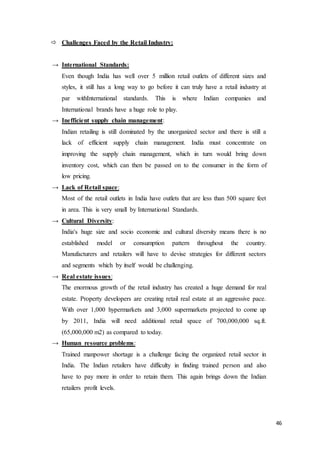
 Customer Attribute affecting choice of format
46
 Challenges Faced by the Retail Industry:
→ International Standards:
Even though India has well over 5 million retail outlets of different sizes and
styles, it still has a long way to go before it can truly have a retail industry at
par withInternational standards. This is where Indian companies and
International brands have a huge role to play.
→ Inefficient supply chain management:
Indian retailing is still dominated by the unorganized sector and there is still a
lack of efficient supply chain management. India must concentrate on
improving the supply chain management, which in turn would bring down
inventory cost, which can then be passed on to the consumer in the form of
low pricing.
→ Lack of Retail space:
Most of the retail outlets in India have outlets that are less than 500 square feet
in area. This is very small by International Standards.
→ Cultural Diversity:
India's huge size and socio economic and cultural diversity means there is no
established model or consumption pattern throughout the country.
Manufacturers and retailers will have to devise strategies for different sectors
and segments which by itself would be challenging.
→ Real estate issues:
The enormous growth of the retail industry has created a huge demand for real
estate. Property developers are creating retail real estate at an aggressive pace.
With over 1,000 hypermarkets and 3,000 supermarkets projected to come up
by 2011, India will need additional retail space of 700,000,000 sq.ft.
(65,000,000 m2) as compared to today.
→ Human resource problems:
Trained manpower shortage is a challenge facing the organized retail sector in
India. The Indian retailers have difficulty in finding trained person and also
have to pay more in order to retain them. This again brings down the Indian
retailers profit levels.
47
→ Frauds in Retail:
It is one of the primary challenges the companies would have to face. Frauds,
including vendor frauds, thefts, shoplifting and inaccuracy in supervision and
administration are the challenges that are difficult to handle. This is so even
after the use of security techniques, such as CCTVs and POS systems. As the
size of the sector would increase, this would increase the number of thefts,
frauds and discrepancies in the system.
→ Challenges with Infrastructure and Logistics:
The lack of proper infrastructure and distribution channels in the country
results in inefficient processes. This is a major hindrance for retailers as a non-
efficient distribution channel is very difficult to handle and can result in huge
losses. Infrastructure does not have a strong base in India. Urbanization and
globalization are compelling companies to develop infrastructure facilities.
Transportation, including railway systems, has to be more efficient. Highways
have to meet global standards. Airport capacities and power supply have to be
enhanced. Warehouse facilities and timely distribution are other areas of
challenge. To fully utilize India's potential in retail sector, these major
obstacles have to be removed.
48
 SWOT Analysis of Retail Sector:
1. Strengths:
 Major contribution to GDP
 High Growth Rate:
 High Potential:
 High Employment Generator:
2. Weaknesses (limitation):
 Lack of Competitors
 Highly Unorganized
 Low Productivity
 Shortage of Talented Professionals
 No Industry‘ status,
3. Opportunities (benefits):
 Healthy Competition will be boosted and there will be a check on the
prices (inflation).
 Create transparency in the system.
 Intermediaries and mandi system will be evicted, hence directly
benefiting the farmers and producers.
 Quality Control and Control over Leakage and Wastage.
 Heavy flow of capital will help in building up the infrastructure for
the growing population.
 There will be sustainable development and many other economic
issues will be focused upon.
4. Threats:
 Current Independent Stores will be compelled to close
 Big players can knock-out competition.
 India does not need foreign retailers.
 Remember East India Company it entered India as trader and then
took over politically.
 The government hasn‘t able to build consensus.
49
 In view of the above analysis, if we try to balance opportunities and prospects
attached to the given economic reforms, it will definitely cause good to Indian
economy and consequently to public at large, if once implemented. Thus the
period for which we delay these reforms will be loss for government only, since
majority of the public is in favour of reforms. All the above mentioned
drawbacks are mostly politically created. With the implementation of this policy
all stakeholders will benefit whether it is consumer through quality products at
low price, farmers through more transparency in trading or Indian corporates
with 49% profit share remaining with Indian companies only.
50
CHPATER 3
OBJECTIVE OF THE STUDY
 Indian retailers are providing creditworthiness to their customers and also
providing good relation to their customers while the organized retailers are
good space for visiting and parking.
 To study the strategy using by Organized and Unorganized sector to survive in
this competitive market.
 To present the future constraints of retail sector in Ahmedabad city.
 The aim of the study is to identify the factors affecting consumer preference
related to shopping at organized retail store and unorganized retail stores.
 To identify the reason for people select unorganized retailing for shopping
(local market).
 To know about the selling technique through which the consumer are attracted
towards the organized retail’s (shopping malls) products & services.
 To know about the situation for present retailing industry in Ahmedabad city.
 To find out Does Festival season’s advertising has any impact in the minds of
consumers.
 To understand the nature of merchandise budgeting and unit planning.
 To understand the concept of relationship marketing and how does it apply to
the Organized retail and unorganized retail sector.
 To find out, what attributes consumers are looking for in retailing product,
51
SIGNIFICANCE OF STUDY
The following are the Significances of the Study:-
→ This study report will help to Retailing Companies in improving their selling
strategy
→ The report contains the suggestions and findings of the product of the
company which will help them to improve their quality of the product.
→ The study work did on the basis of the retailer viewpoints which will help the
company to understand the customer needs, requirement, perception and many
more things.
→ The report’s conclusion and suggestion will help the companies to understand
the coverage of the market with the use of sales strategy and also provide the
idea to the company in findings the necessary field where the product is highly
demanding.
→ This report will help to the society or in commercial sector who wants to go
for research work in future on Retailing industry.
52
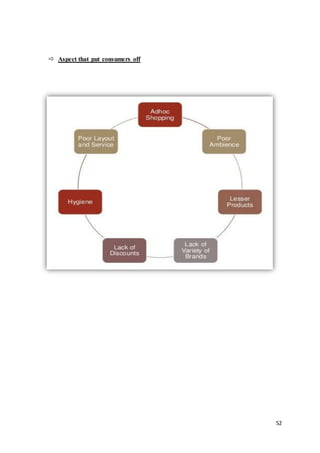
 Aspect that put consumers off
53
CHAPTER 4
RESERACH METHODOLOGY
Research design
 Research design is a one kind of framework or blueprint upon which whole
process going on. In this we have to clearly define that which method of the
research we have to follow. It may be based on the judgment or situational
objectives.
 A research design specifies that method and procedures for conducting a
particular study. The researcher should specify the approach be intends to use
with respect to the proposed study broadly speaking research can be groped in
to three categories.
i. Exploratory (ambiguous problem),
ii. Descriptive (aware of problem),
iii. Explanatory (clearly defined problem).
Exploratory Research Design
An exploratory research design focuses on the discovery of ideas and is
generally based on secondary data.
Descriptive Research Design
A descriptive study is undertaken when the researcher want to know
the characteristics of certain group such as age, sex, income, education
level etc.
Explanatory Research Design
A casual researcher is under taken when the researcher is interested
knowing a cause and effect relationship between two or more variables.
Sampling Procedure
For collecting the data from the population I have used simple random
sampling method to get the sample from the population. This enables us to
make the study easy and create fewer disturbances, and study work can be
completed in the less time.
54
Sample location
I am choosing different areas of Dehradun city for the research to be carried
out.
Sampling Method
Any organization whether big or small, private or public need different types
of information are to know its popularity. I have gathered secondary data and
primary data and collected information from the combination of these two
data.
 Secondary data:-
Secondary data consist of information that already exists
somewhere, having been collected for another purpose. I have
gathered secondary data from website of different operators,
different magazines, newspapers and libraries.
 Primary data:-
I have taken great care while collecting primary data to answer that
it is relevant, accurate, current and unbiased. I have taken a sample
of 200 people. I have visited them personally to get data.
Sample Size:
Sample size is to be taken to make the study easy in a shorter Time, period in
less and effective timing two hundred questionnaires are to be taken for
gathering the Information from the population of the Ahmedabad. The sample
size taken in this study is 384 and the data are gathered through questionnaire.
Data collection
Data collection is one of the important tasks in research on the basis of
collected data analysis is done upon which Take effective decision. For
collecting the data various types of Instruments are used like, questionnaire,
telephone interview, Mail interview, here in this study we are using
questionnaire.
55
Types of data used in data collection
Primary data
Preparing a Questionnaire is collecting the primary source of data & it
as collected by interviewing the investors. These are the data which are
not collected before by any of the competent person. This are the data
collected by the researcher himself for the study purpose
Secondary data
These are the data which already exist. For having the detailed study
about this topic, it is necessary to have some of the secondary
information, which is collected from the following:-
 Books.
 Magazines & Journals.
 Websites.
 Newspapers,
 Ebscohost, etc.
In this study I have used Questionnaire for the primary data collection
and for secondary data collection I have used internet, magazines, reference
books and articles which are necessary for my project completion
Data collection instrument
To come at the particular result we have to collect the data from the
respondents through various ways. In this report work I have used the
questionnaire to collect the data from the respondents.
56
SUMMARY OF RESEARCH METHODOLOGY
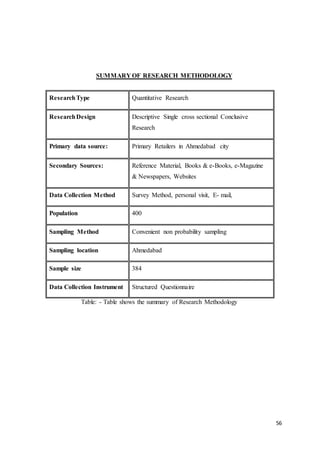
Table: - Table shows the summary of Research Methodology
ResearchType Quantitative Research
ResearchDesign Descriptive Single cross sectional Conclusive
Research
Primary data source: Primary Retailers in Ahmedabad city
Secondary Sources: Reference Material, Books & e-Books, e-Magazine
& Newspapers, Websites
Data Collection Method Survey Method, personal visit, E- mail,
Population 400
Sampling Method Convenient non probability sampling
Sampling location Ahmedabad
Sample size 384
Data Collection Instrument Structured Questionnaire
57
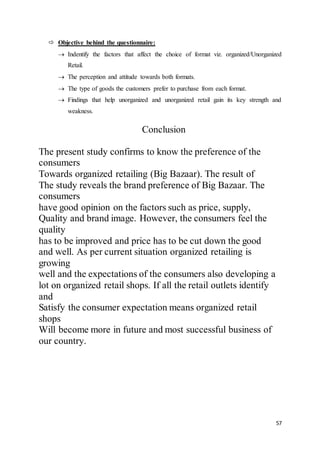
 Objective behind the questionnaire:
 Indentify the factors that affect the choice of format viz. organized/Unorganized
Retail.
 The perception and attitude towards both formats.
 The type of goods the customers prefer to purchase from each format.
 Findings that help unorganized and unorganized retail gain its key strength and
weakness.
Conclusion
The present study confirms to know the preference of the
consumers
Towards organized retailing (Big Bazaar). The result of
The study reveals the brand preference of Big Bazaar. The
consumers
have good opinion on the factors such as price, supply,
Quality and brand image. However, the consumers feel the
quality
has to be improved and price has to be cut down the good
and well. As per current situation organized retailing is
growing
well and the expectations of the consumers also developing a
lot on organized retail shops. If all the retail outlets identify
and
Satisfy the consumer expectation means organized retail
shops
Will become more in future and most successful business of
our country.
58
CHAPTER 5
DATA ANALYSIS AND INTERPRETATION
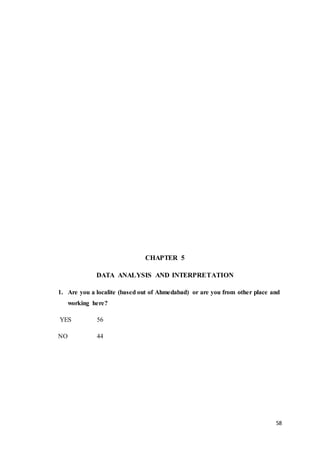
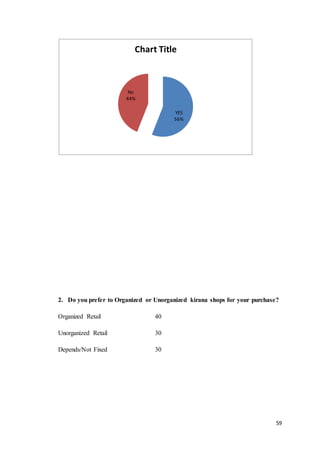
1. Are you a localite (based out of Ahmedabad) or are you from other place and
working here?
YES 56
NO 44
59
2. Do you prefer to Organized or Unorganized kirana shops for your purchase?
Organized Retail 40
Unorganized Retail 30
Depends/Not Fixed 30
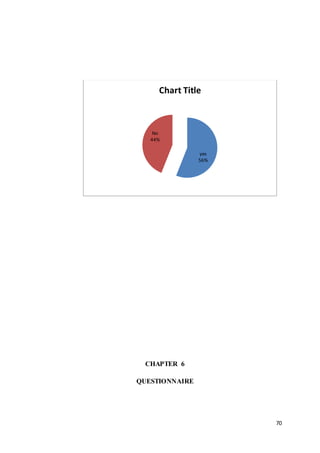
YES
56%
No
44%
Chart Title
60
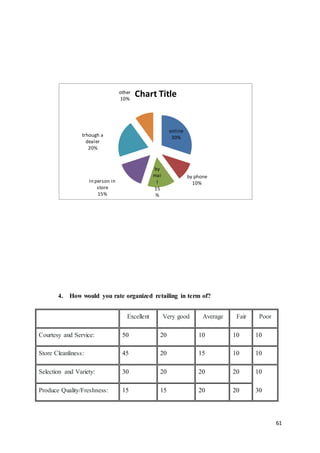
3. How did you make your most recent purchase?
[ ] Online 30
[ ] By phone 10
[ ] By mail/catalogue 15
[ ] In-person/in-store 15
[ ]Through a dealer 20
[ ] Other (please specify) 10
organized
retail
40%
Unorganized
retail
30%
Depends
not fixed
30%
Chart Title
61
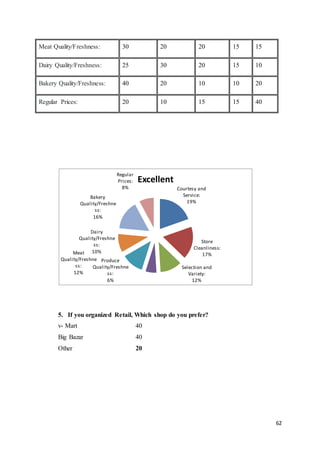
4. How would you rate organized retailing in term of?
Excellent Very good Average Fair Poor
Courtesy and Service: 50 20 10 10 10
Store Cleanliness: 45 20 15 10 10
Selection and Variety: 30 20 20 20 10
Produce Quality/Freshness: 15 15 20 20 30
online
30%
by phone
10%
by
mai
l
15
%
In person in
store
15%
trhough a
dealer
20%
other
10%
Chart Title
62
Meat Quality/Freshness: 30 20 20 15 15
Dairy Quality/Freshness: 25 30 20 15 10
Bakery Quality/Freshness: 40 20 10 10 20
Regular Prices: 20 10 15 15 40
5. If you organized Retail, Which shop do you prefer?
v- Mart 40
Big Bazar 40
Other 20
Courtesy and
Service:
19%
Store
Cleanliness:
17%
Selection and
Variety:
12%
Produce
Quality/Freshne
ss:
6%
Meat
Quality/Freshne
ss:
12%
Dairy
Quality/Freshne
ss:
10%
Bakery
Quality/Freshne
ss:
16%
Regular
Prices:
8%
Excellent
63
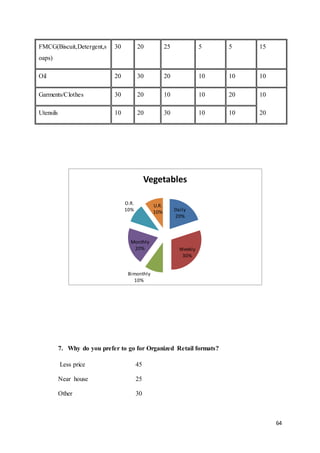
6. What do you shop, how often from where?
[Organized Retail: - o.r. Unorganized Retail: - U.R.]
Daily Weekly Bimonthly Monthly O.R. U.R.
Vegetables 20 30 10 20 10 10
Grocery(DalRice,Wheat) 20 10 15 5 20 30
v- mart
40%
bigbazar
40%
other
20%
Chart Title
64
FMCG(Biscuit,Detergent,s
oaps)
30 20 25 5 5 15
Oil 20 30 20 10 10 10
Garments/Clothes 30 20 10 10 20 10
Utensils 10 20 30 10 10 20
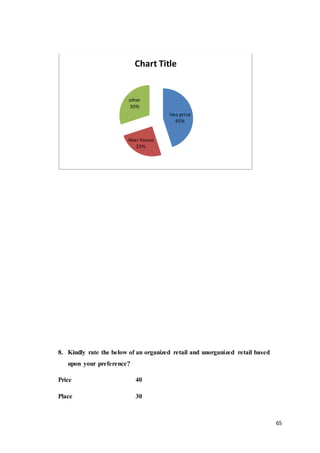
7. Why do you prefer to go for Organized Retail formats?
Less price 45
Near house 25
Other 30
Daily
20%
Weekly
30%
Bimonthly
10%
Monthly
20%
O.R.
10%
U.R.
10%
Vegetables
65
8. Kindly rate the below of an organized retail and unorganized retail based
upon your preference?
Price 40
Place 30
less price
45%
Near house
25%
other
30%
Chart Title
66
Other 30
9. What is your gender?
[ ]Male 64
[ ]Female 36
price
40%
place
30%
other
30%
Chart Title
67
10. What is your age?
[ ] 18 as under 20
[ ] 19-35 50
[ ] 36-50 20
[ ] 50 or more 10
male
64%
Female
36%
Chart Title
68
11. What is your annual household income?
[ ]Under 25000 pm. 30
[ ]25000-50000 20
[ ]50000-75000 20
<18
20%
19-35
50%
36-50
20%
> 50
10%
Chart Title
69
[ ]75000-100000 15
[ ]100000 or More 15
12. Do you plan to continue to buy organized/unorganized retail?
[ ] Yes 54 [ ] No 46
35%
23%
24%
18%
Chart Title
<25000 25000-50000 50000-75000 75000-100000
70
CHAPTER 6
QUESTIONNAIRE
yes
56%
No
44%
Chart Title
71
13. Are you a localite (based out of Dehradun) or are you from other place and
working here?
YES 56
NO 44
14. Do you prefer to Organized or Unorganized kirana shops for your purchase?
Organized Retail 40
Unorganized Retail 30
Depends/Not Fixed 30
15. How did you make your most recent purchase?
[ ] Online 30
[ ] By phone 10
[ ] By mail/catalogue 15
[ ] In-person/in-store 15
[ ]Through a dealer 20
[ ] Other (please specify) 10
16. How would you rate organized retailing in term of?
Excellent Very good Average Fair Poor
Courtesy and Service: 50 20 10 10 10
72
Store Cleanliness: 45 20 15 10 10
Selection and Variety: 30 20 20 20 10
Produce Quality/Freshness: 15 15 20 20 30
Meat Quality/Freshness: 30 20 20 15 15
Dairy Quality/Freshness: 25 30 20 15 10
Bakery Quality/Freshness: 40 20 10 10 20
Regular Prices: 20 10 15 15 40
17. If you organized Retail, Which shop do you prefer?
v- Mart 40
Big Bazar 40
Other 20
18.What do you shop, how often from where?
[Organized Retail: - o.r. Unorganized Retail: - U.R.]
Daily Weekly Bimonthly Monthly O.R. U.R.
Vegetables 20 30 10 20 10 10
Grocery(DalRice,Wheat) 20 10 15 5 20 30
FMCG(Biscuit,Detergent,s
oaps)
30 20 25 5 5 15
Oil 20 30 20 10 10 10
Garments/Clothes 30 20 10 10 20 10
73
Utensils 10 20 30 10 10 20
18. Why do you prefer to go for Organized Retail formats?
Less price 45
Near house 25
Other 30
19. Kindly rate the below of an organized retail and unorganized retail based
upon your preference?
Price 40
Place 30
Other 30
20. What is your gender?
[ ]Male 64
[ ]Female 36
21. What is your age?
[ ] 18 as under 20
[ ] 19-35 50
[ ] 36-50 20
[ ] 50 or more 10
22. What is your annual household income?
[ ]Under 25000 pm. 30
[ ]25000-50000 20
74
[ ]50000-75000 20
[ ]75000-100000 15
[ ]100000 or More 15
23. Do you plan to continue to buy organized/unorganized retail?
[ ] Yes 54 [ ] No 46
CHAPTER 7
BIBLIOGRAPHY
Websites:
1. http://www.dnb.co.in/IndianRetailIndustry/issues.asp
2. http://digitalcommons.kennesaw.edu/cgi/viewcontent.cgi?article=1098&co
ntext=jekem
3. http://web.yonsei.ac.kr/dslab/Journal/Journal%20of%20International%20C
onsumer%20Marketing%20%202011.pdf
75
4. http://www.abesit.in/pdfs/a-study-of-diversity-in-retail-purchases-
behaviour-in-food-prof-manish-kumar.pdf
5. http://www.iosrjournals.org/iosr-jbm/papers/Vol8-issue3/A0830105.pdf
6. http://indianresearchjournals.com/pdf/IJMFSMR/2013/June/7.pdf
7. http://www.abhinavjournal.com/images/Commerce_%26_Management/Au
g12/7.pdf
References:-
i
Dholakia, R. R. (1999). Going shopping: key determinants of shopping behaviour
and motivations. InternationalJournal of Retail and Distribution Management
Bradford, 27, 154–165.
iiSinha, P. K. and Banerjee, A. (2004). Store choice behaviour in an evolving market.
International Journal of Retail & Distribution Management, 32(10), 482- 494.
iii
Backstrom, K & Johansson, U (2006). Creating and consuming experiences in retail
store environments: Comparing retailer and consumer perspectives. Journal of
Retailing and Consumer Services, 13, 417–430.
iv
Terblanche, N. S. and Boshoff, C. (2006). The relationship between a satisfactory
in-store shopping experience and retailer loyalty. South African Journal of Business
Management, 37(2), 33-43.
v
Kalhan, A. (2007). Impact of Malls on Small Shops and Hawkers. Economic
Political Weekly, 6, 2063-2066.
vi
Goswami, P. (2008). Would Kiranas in Urban India Survive the Modern Trade
Onslaught? Insight from Efficiency Perspective. Advances in Consumer
Research, 8(3), 44-67.
vii
Das, G. & Kumar, R. V. (2009). Impact of Sales Promotion on Buyers Behaviour:
An Empirical Study of Indian Retail Customers. Global Marketing Journal, 3(1), 11-
24.
76
viii
Goswami, P., Mridula, S. Mishra, (2009). Would Indian consumers move from
kirana stores to organized retailers when shopping for groceries? Asia Pacific Journal
of Marketing and Logistics, 21(1), 127 – 143.
ixInside store (2009). Unplanned Buying at Traditional Retail in India. A Research
Report Insight in store, Research report USA.
x
Mittal, K. C., Arora, M. and Parashar, A. (2011). An Empirical Study on factors
affecting consumer preferences of shopping at organized retail stores in Punjab. KAIM
journal of management and research, 3(2), 38-40.
xi
Sivaraman. P. (2010). The future of unorganized retailing in Kanyakumari district.
Asian Journal of Management Research, 2(1), 434 – 442.
xii
Kumar, K. S. (2011). A study on the strategies of unorganized retailers with
reference to consumer durables. International Journal of Business and Management
Tomorrow, 1(1), 1-13
xiii
Kushwaha, S. and Gupta, M. K. (2011). Customer perception in Indian retail
industry: A comparative study of organized and unorganized retail industry. Research
Journal of Economics and Business studies, 1(1), 61-73.

mayank dissertation

  • 1.
    A DISSERTATION REPORT ON A STUDYOF CHANGING CONSUMER PREFERENCE TOWARDS ORGANIZED RETAILING FROM UN-ORGANIZED RETAIL Submitted by: MAYANK Roll. NO.-130360500074 Supervised by-: prof. Navjyoti singh Negi In partial fulfilment for the award of the degree MASTER OF BUSINESS ADMINISTRATION (2013-2015) DOON BUSINESS SCHOOL;DEHRADUN
  • 2.
    1 DECLARATION I hereby thatI have worked on the topic “ A study of changing consumer preference toward organized retailing from un-organized retail” All the information that has been collected, analyzed and documented for the project is authentic possession to me. I would like to categorically mention that the work here has neither been purchased nor acquired by any other unfair means. The data and information existing in this report are accurate and update to the current data, to the best of our knowledge. However, for this purpose of the project, information already compiled in many sources have been utilized. I extend my sincere thanks to Prof. Navjyoti singh negi sir,. All information in this report is true representation of what I have experienced during the project.
  • 3.
    2 AA CC KKNN OO WW LL EE DD GG EE MM EE NN TT I would like to take this opportunity to express my sincere gratitude to our respected mentor for her valuable guidance. I extend my sincere thanks to Prof. Navjyoti singh Negi of for their support and help in the completion of the project. I would like to thanks almost everybody at the office for his/her friendliness and helpful nature. With sincere thanks
  • 4.
    3 BONAFIDE CERTIFICATE Certified thatthis Report titled " A STUDY OF CHANGING CONSUMER PREFERENCE TOWARD ORGANIZED RETAILING FROM UN ORGANIZED RETAIL" is the bonafide work of MAYANK ( Roll No-130360500074) who carried out the workundermy supervision.Certifiedfurtherthattothe best of my knowledge the work reportedhereindoesnotformpart of any otherthesisordissertationonthe basisof which a degree or award was conferred on an earlier occasion on this or any Signature of the HOD Signature of theSupervisor Date date
  • 5.
    4 TABLE OF CONTENTS SR.NO. PARTICULAR PAGE NO.  Declaration  Certificate of Institute  Preface  Acknowledgements  Bonafide certificate Part 1 GENERAL INFORMATION 1.  Overview of Indian Retail Industry 2.  Major players of Retail Industry in India 3.  Type of retail industry in India 4.  Growth Indian retailing industry PART 2 PRIMARY STUDY 4. Introduction of Study 4.1 Literature Review 4.2 Background of the Study 4.3 Objectives of the Study
  • 6.
    5 5. ResearchMethodology 5.1 ResearchDesign 5.2 Sources of Data 5.3 Data Collection Method 5.4 Population 5.5 Sampling Method 5.6 Sampling Frame
  • 7.
  • 8.
  • 9.
  • 10.
  • 11.
  • 12.
  • 13.
    12 5.7 Date CollectionInstruments  Annexure  Questionnaire for  Bibliography& References  Remarks
  • 14.
    13 ABSTRACT Retail is currentlya flourishing sector of the Indian economy. The Indian Retail industry has grown at a 14.6% CAGR during FY07-12. This growth can be directly credited to the emergent Indian economy as Retailing is one of the largest sectors in the global economy and is going through an evolutionary well as increase in Private Final Consumption Expenditure (PFCE) and bring revolution in Indian peoples‟ consumption pattern. This tendency is expected to continue for at least the next two-three decades, magnetizing huge attention from entrepreneurs, business heads, investors as well as real estate owners and builders segments of the economy. Despite this growth, the Indian retail industry is highly fragmented, with the organized retailing still at a nascent stage which accounts for far less percentage than the unorganized retailing of the total Indian retail market. It is estimated that organized retailing accounts for less than 5% of today‟s market, but is expected to develop between14% to 18% by 2015. During FY07- 12, the organized retailing in India has grown at a CAGR of 26.4%; higher that the total growth of Indian retailing. The sector is the largest source of employment after agriculture, and has deep access into rural India generating more than 10 per cent of India‟s GDP. This study aims to identify the factors influencing the perception towards organized retailing from unorganized retailers. The primary data was gathered by administering a prearranged questionnaire with 100 customers selected purposively from Udaipur District. The data analysis of customer attitude towards unorganized and organized retailers shows that there is a difference between the consumers‟ perception towards both organized retailers and unorganized retailers regarding their store image, range of products, brand choices, price, store atmosphere, credit availability, and shop proximity. The data has been collected with the help of structured questionnaire containing close and open ended questions. Statistical software and MS excel were extensively used for analyzing the data collected. The rationale of the study is twofold: First, to examine the shift in perception in the retail sector taking place due to organized form of retailing.
  • 15.
    14 CHAPTER 1 INTRODUCITON INDIANRETAIL INDUSTRY The word "Retail" originates from a French-Italian word "retailer" meaning “someone who cuts off or shreds a small piece from something”. Retailing includes activities of marketing and selling products or services to end consumers for their own household or personal use. Retailer is a Person or Agent or Company or Organization who is instrumental in reaching the Goods or Merchandise or Services to the End User or Ultimate Consumer.  What is retailing? Retailing is a distribution channel function, where one organisation buys products from supplying firms or manufactures products themselves, and then sells these directly to consumers. In majority of retail situations, the organisation, from whom a consumer buys, is a reseller of products obtained from others, and not the product manufacturer. However, some manufacturers do operate their own retail outlets in a corporate channel arrangement. Retailers offer many benefits to suppliers and customers as resellers. Consumers, for instance, are able to purchase small quantities of an assortment of products at a reasonably affordable price. Similarly, suppliers get an opportunity to reach their target market, build product demand through retail promotions, and provide consumer feedback to the product marketer. Most Indian shopping happens in open markets or numerous small grocery and retail shops. Shoppers typically wait outside the shop, ask for what they want, and cannot pick or examine a product from the shelf.Access to the shelf or product storage area is limited. Once the shopper requests the food staple or household product they are looking for, the shopkeeper goes to the container or shelf or to the back of the store, brings it out and offers it for sale
  • 16.
    15 to the shopper.Often the shopkeeper may substitute the product, claiming that it is similar or equivalent to the product the consumer is asking for. The product typically has no price label in these small retail shops; although some products do have a manufactured suggested retail price (MSRP) pre-printed on the packaging. The shopkeeper prices the food staple and household products arbitrarily, and two consumers may pay different prices for the same product on the same day. Price is sometimes negotiated between the shopper and shopkeeper. The shoppers do not have time to examine the product label, and do not have a choice to make an informed decision between competitive products. India's retail and logistics industry, organized and unorganized in combination, employs about 40 million Indians (3.3% of Indian population). The typical Indian retail shops are very small. Over 14 million outlets operate in the country and only 4% of them being larger than 500 sq. ft. (46 m2) in size. India has about 11 shop outlets for every 1000 people. Vast majority of the unorganized retail shops in India employ family members, do not have the scale to procure or transport products at high volume wholesale level, have limited to no quality control or fake-versus- authentic product screening technology and have no training on safe and hygienic storage, packaging or logistics. The unorganized retail shops source their products from a chain of middlemen who mark up the product as it moves from farmer or producer to the consumer. The unorganized retail shops typically offer no after-sales support or service. Finally, most transactions at unorganized retail shops are done with cash, with all sales being final. Until the 1990s, regulations prevented innovation and entrepreneurship in Indian retailing. Some retails faced complying with over thirty regulations such as "signboard licenses" and "anti-hoarding measures" before they could open doors. There are taxes for moving goods to states, from states, and even within states in some cases. Farmers and producers had to go through middlemen monopolies. The logistics and infrastructure was very poor, with losses exceeding 30 percent.
  • 17.
    16 Through the 1990s,India introduced widespread free market reforms, including some related to retail. In between 2000 to 2010, consumers in select Indian cities have gradually begun to experience the quality, choice, convenience and benefits of organized retail industry.  Major retail sector in India  There are many sectors in retail industry in India and there are established in various company at specific sectors. 1. Food and grocery:  Food Bazaar  Aditya Birla Retail Ltd  Trinethra Super Market Ltd  Reliance Retail 2. Fashion and accessories  Pantaloons  Shoppers Stop 3. Koutons: 4. Footwear  Reebok  Bata 5. Khadim’s: 6. Home and office improvement  Godrej Lifespace  Home Stop  Home Town 7. Electronics  eZone:  Viveks: 8. Catering services  Yum! Restaurants:
  • 18.
    17  McDonald’s  CaféCoffee Day 9. Telecom  The Mobile Store:  MobileNXT: 10. Pharmaceuticals  Apollo Pharmacy  MedPlus: 11. Beauty and wellness  Reliance Wellness  Himalaya Drugs 12. Jewellery  Gitanjali:  Tanishq:  Reliance Jewels 13. Timewear  Citizen:  Titan  Books, music and gifts 14. Crossword 15. Entertainment  How does the retail sector consumer think?
  • 19.
    18  Trends inthe Retail industry → Emergence of organized retail: Real estate development in the country, for example, the construction of mega malls and shopping malls, is augmenting the growth of the organized retail business → Spending capacity of youth of India: India has a large youth population, which is a conducive environment to growth of this sector. → Raising incomes and purchasing power: The per capita income in India has doubled between 2000- 01 and 2009- 10 resulting in improved purchasing power. → Changing mind set of customers: The customer mind set is gradually shifting from low price to better convenience, high value and a better shopping experience → Easy customer credit:
  • 20.
    19 Emergence of conceptssuch as quick and easy loans, EMIs, loan through credit cards, has made purchasing possible for Indian consumers, for products such as consumer durables → Higher brand consciousness: There is high brand consciousness among the youth; 60% of India‘s population is below the age of 30 leading to popularization of brands and products  Global Retail Scenario → Retailing has played a major role in the global economy. In developed markets, retailing is one of the most prominent industries. In 2008, the US retail sector contributed 31% to the GDP at current market prices. In developed economies, organized retail has a 75-80% share in total retail as compared with developing economies, where un-organized retail has a dominant share. (Table no. 1 = Global retail scenario of all the world)1 Sr. No. Company name Country Banner sales 2007E (in us$ million) No. of outlets, 1 WALMART US 395305 7331 1
  • 21.
    20 2 CARREFOUR FRANCE142229 13419 3 TESCO UK 103573 3750 4 METRO GROUP GERMANY 102942 2541 5 SEVEN & I(ii) JAPAN 84375 22590 6 KROGER US 73633 3672 7 AEON (i) JAPAN 73416 14803 8 TARGET US 71125 1591 9 SCHWARZ GERMANY 70969 8575 10 COSTCO US 69704 518 → Global retail sales was estimated to be around US$ 12 trillion in 20072; however, in 2008, the slowdown in the global economy, especially in the US, and credit crunch, decreased consumer spending. On a global level, the economy performed robustly till 2007, but the US crisis spread over to Europe in early 2008, and its impact was felt in the Asia-Pacific region by mid-2008. → India has the highest number of retail outlets in the world at over 13 million retail outlets, and the average size of one store is 50-100 square feet. It also has the highest number of outlets (11,903) per million inhabitants. The per capita retail space in India is among the lowest in the world, though the per capita retail store is the highest. Majority of these stores are located in rural areas.  Retail formats in India:  Hyper marts/supermarkets: large self-servicing outlets offering products from a variety of categories.  Mom-and-pop stores: they are family owned business catering to small sections; they are individually handled retail outlets and have a personal touch.
  • 22.
    21  Departmental stores:are general retail merchandisers offering quality products and services.  Convenience stores: are located in residential areas with slightly higher prices goods due to the convenience offered.  Shopping malls: the biggest form of retail in India, malls offers customers a mix of all types of products and services including entertainment and food under a single roof.  E-trailers: are retailers providing online buying and selling of products and services.  Discount stores: these are factory outlets that give discount on the MRP.  Vending: it is a relatively new entry, in the retail sector. Here beverages, snacks and other small items can be bought via vending machine.  Category killers: small specialty stores that offer a variety of categories. They are known as category killers as they focus on specific categories, such as electronics and sporting goods. This is also known as Multi Brand Outlets or MBO's.  Specialty stores: are retail chains dealing in specific categories and provide deep assortment Mumbai's Crossword Book Store and RPG's Music World are a couple of example. Major players of retailing industry in India2  There are various major players in India retailing industry and there are location at various cities in India Ownership Brand Name Outlet type Location RPG Spencers Supermarkets Across all major cities Hypermarkets DFL (Joint venture with DSP Merrill Lynch and Food World Supermarkets Chennai, Bangalore and Hyderabad
  • 23.
    22 Rahejas) Pantaloon Food BazaarSupermarket Across all major cities Big Bazaar Hypermarket Nilgiri’s Franchisee Pvt. Ltd Nilgiri’s Supermarkets Chennai, Bangalore, Pondicherry and tier two towns in Tamil Nadu The Trinethra Group Trinethra Supermarkets Major cities in Andhra Pradesh and Tamil Nadu Fabmall India Pvt Ltd Fabmall Supermarkets Bangalore and Chennai Franchisee ownership model regulated by cooperative Margin Free Discount stores Major cities in Kerala, Tamil Nadu and Karnataka Food Express India Ltd Monday to Sunday, Jumbo Supermarkets Hypermarkets Bangalore Home Stores Pvt. Ltd. Sabka Bazaar Discount stores Delhi and adjoining areas Pyramid Retail Ltd. Trumart Supermarkets Maharashtra- Mumbai Trent (Tata Group) Star India Bazaar Hypermarkets Dehradun, Mumbai Spar- India Ltd. Spar Supermarkets Mumbai Namdhari’s Group Namdhari’s Fresh Supermarkets Bangalore, Delhi
  • 24.
    23 Adani Group AdanisSupermarkets Gujarat Department of Food and Public Distribution (Govt. of India Coop.) Super Bazaar Supermarkets Delhi Department of Food and Public Distribution (Govt. of India Coop.) Kendriya Bhandar Supermarkets Delhi Vishal Mega Mart Food Mart Hyper Market Across all major cities Reliance India Ltd. Reliance Fresh Discount Stores Across all major cities Rei Agro Ltd. 6Ten Discount Stores North India Kind of Indian retail industry The Indian retail industry is divided into organized and unorganized sectors. The Indian retail sector is highly fragmented, with a major share of its business is being run by unorganized retailers like the traditional family run stores and corner stores. The organized retail however is at a very nascent stage, though attempts are being made to increase its proportion bringing in a huge opportunity for prospective new players. There are two types of Retailing:  Organized Retailing  Unorganized Retailing → Organized Retailing
  • 25.
    24 Organized retailing refersto trading activities undertaken by licensed retailers, that is, those who are registered for sales tax, income tax, etc. These include the corporate-backed hypermarkets and retail chains, and also the privately owned large retail businesses. → Unorganized Retailing Indian retail is dominated by a large number of small retailers consisting of the local kirana shops, owner-manned general stores, chemists, footwear shops, apparel shops, paan and beedi (local betel leaf and tobacco) shops, hand-cart hawkers, pavement vendors, etc. which together make up the so-called "unorganized retail" or traditional retail. Difference between Organized Retailing &Unorganized Retailing Organized Retailing Unorganized Retailing Organized retailing refers to trading activities undertaken by licensed retailers, that is, those who are registered for sales tax, income tax, etc Unorganized retailing, on the other hand, refers to the traditional formats of low-cost retailing There are include the corporate-backed hypermarkets and retail chains, and also the privately owned large retail businesses. There are include the local kirana shops, owner-manned general stores, chemists, footwear shops, apparel shops, paan and beedi (local betel leaf and tobacco) shops, hand-cart hawkers, pavement vendors, etc
  • 26.
    25 Multi storied mallsand huge complexes that offer a large variety of products in terms of quality, value for money and makes shopping a memorable experience. Low cost retailing. These are highly competitive outlets, with negligible rental costs (unregistered kiosks or traditional property), cheap workers (work is shared by members of family) and low taxes and overheads. The ownership and management rest with two or more person. The ownership and management rest with one person only The organized stores are not having number of options to cut their costs The unorganized stores are having number of options to cut their costs The customersare want to change in many shopping malls. This is one of the good reasons which the customer doesn't want to change their old loyal kirana shop. ORGANISED RETAILING Organized retailing comprises mainly of modern retailing with busy shopping malls, multi storied malls and huge complexes that offer a large variety of products in terms of quality, value for money and makes shopping a memorable experience.
  • 27.
    26 Organized retailing refersto trading activities undertaken by licensed retailers, that is, those who are registered for sales tax, income tax, etc. These include the corporate-backed hypermarkets and retail chains, and also the privately owned large retail businesses. According to AT Kearney report for the year 2011, organized retail accounts for 7 per cent of India's roughly US$ 435 billion retail market and is expected to reach 20 per cent by 2020.Food accounts for 70 per cent of under- penetrated by organized retail. Organized retail has a 31 per cent share in clothing and apparel and continues to see growth in this sector. The home segment shows promise, growing 20 to 30 per cent per year. India's more urban consumer mind-set means this sector is poised for growth.Indian retail, but it remains. Organized retailing refers to trading activities undertaken by licensed retailers, i.e. those who are registered for sales tax, income tax, etc.These include the corporate backed hypermarkets and retail chains and also the privately owned large retail businesses. (Table no. 2 = Top 10 Retailers Worldwide)3 Rank Retailer Home country 1 Wal-mart store ,inc. USA 3
  • 28.
    27 2 Carrefoer GroupFrance 3 The Home Depot, Inc. USA 4 The Kroger co. USA 5 Royal Ahold Netherlands 6 Metro AG Germany 7 Target corporation USA 8 Alertson`s, inc. USA 9 Sear,roebuck and co. USA 10 Kmart corporation USA
  • 29.
    28 0 5 10 15 20 25 30 35 40 45 50 1 45.6 37.8 18.9 12.6 10.6 10.4 9.1 6.9 4.1 2.8 2.60.8 PERCENTAGE DIFFERENT RETAIL SECTOR ORGNASING RETAILING Watches Footwear Clothing, textiles, & fashion accessories Books, music, gifts Health & beauty care services Consumer durables, home appliances Furnishings, furniture home & office, utensils Catering services Entertainment Jewellery Pharma other
  • 30.
    29  CHALLENGES TORETAIL DEVELOPMENT IN INDIA Organized retail in India is little over a decade old. It is largely an urban phenomenon and the pace of growth is still slow. Some of the reasons for this slow growth are: - → The Kiranas Continue The very first challenge facing the organized retail industry in India is competition from the unorganized sector. Traditionally retailing has established in India for centuries. It is a low cost structure, mostly owner operated, has negligible real estate and labor costs and little or no taxes to pay. Consumer familiarity that runs from generation to generation is one big advantage for the traditional retailing sector. On the other hand, organized sector have big expenses to meet and yet have to keep prices low enough to compete with the traditional sector. → Retail not beingrecogning as an industry in India Lack of recognition as an industry hampers the availability of finance to the existing and new players. This affects growth and expansion plans. → The High cost of Real estate Real estate prices in some cities in India are amongst the highest in the world. The lease or rent of property is one of the major areas of expenditure; a high lease rental reduces the profitability of a project. → High Stamp duties In addition to the high cost of real estate the sector also faces very high stamp duties on transfer of property, which varies from state to state (12.5% in Gujarat and 8% in Delhi). The problem is compounded by problems of clear titles to ownership, while at the same time land use conversion is time consuming and complex as is the legal process for settling of property disputes.
  • 31.
    30 → Lack ofadequate infrastructure– Poor roads and the lack of a cold chain infrastructure hampers the development of food and grocery retail in India. The existing supermarkets and foods retailers have to invest a substantial amount of money and time in building a cold chain network. → Multiple and complex taxation system – The sales tax rates vary from state to state, while organized players have to face a multiple point control and system there is considerable sales tax evasion by small stores. In many locations, retailers have to face a multi-point octroi with the introduction of value Added Tax (VAT) in 2005, certain anomalies in the existing sales tax system causing disruption in the supply chain are likely to get corrected over a period of time. → There is price war between different retail organizations. Each and every one is saying to provide goods at low cost and offers various promotional schemes. In such a case it is difficult to keep one’s customers with oneself.
  • 32.
    31  OPPORTUNITIES TORETAIL DEVELOPMENT IN INDIA Retail marketing gets various opportunities to grow up in the Indian market. Not only retailing but Manufacturers as well as suppliers, and buyers have various opportunities, some of which are mentioned below → What is in store Organized retail provides brands much needed visibility and platform for customer interaction. It also helps in launching of new product or product variant and in market penetration. It has wider product range and more frequent, speedier deliveries. → Urbanization Increased urbanization has shifted consumers to one place and thus a single retail can catch more customers. → Nuclear family As the time passed away joint families came in a new form i.e. nuclear family. Again the income level of these nuclear families increases because both members started earning. This results into increased power of purchase and lack of time. Now they want everything under one roof. This brought the concept of organized retailing. Plasticrevolution Increased use of credit cards is in favour of retail marketing. It creates requirement even when it is not necessary. → Jo Dikata Hai Woh Bikta Hai Organized retail stores put stress on proper infrastructure like well-maintained building, air conditioning, trained employees, electronic machine, parking facilities and proper display of goods category wise. Here customers feel comfort, joy and entertainment. Purchasing becomes joy for him. Self- selection saves time and gives more opportunities and satisfaction. Fix cost removes the threat of misleading. They avail various discounts and
  • 33.
    32 promotional schemes presentedby the manufacturers. They also get product of different varieties and of proper quality. → Employment Retail marketing is one of the largest employments generating industry. It provides employment to skilled, semi-skilled as well as to unskilled persons. Thus it helps in the socio- economic development of the society. → Price war Increase in the no of retail outlets increases competition among these retailers. To attract customers they give various promotional schemes as various discounts, buy one get one free, another product with any particular product, festival special, etc. → Contract farming The retail marketers directly purchase from farmers and reducing middlemen, thus provide proper cost to farmers and also set proper price for consumers. They also make contract with farmers to get proper amount of crops and vegetables. → Reduces supply chain management The big players of retail marketing and the manufacturing companies directly come in contact thus reducing many intermediary chains. Manufacturers also give many promotional schemes for their product that is beneficial for consumers.
  • 34.
    33 UNORGANISED RETAILING Traditional orUnorganized retail outlets are normally street markets, counter stores, kiosks and vendors, where the ownership and management rest with one person only. This sector accounts for two thirds of the market and requires low skilled labor. These are highly competitive outlets, with negligible rental costs (unregistered kiosks or traditional property), cheap workers (work is shared by members of family) and low taxes and overheads. Indian retail is dominated by a large number of small retailers consisting of the local kirana shops, owner-manned general stores, chemists, footwear shops, apparel shops, paan and beedi(local betel leaf and tobacco) shops, hand-cart hawkers, pavement vendors, etc. which together make up the so-called “unorganized retail" or traditional retail. The last few years have witnessed the entry of a number of organized retailers opening stores in various modern formats in metros and other important cities. Unorganized
  • 35.
    34 retailers normally donot pay taxes and most of them are not even registered for sales tax, VAT, or income tax. Unorganized retailing, on the other hand, refers to the traditional formats of low-cost retailing, for example, hand cart and pavement vendors, & mobile vendors, the local kirana shops, owner manned general stores, paan/beedi shops, convenience stores, hardware shop at the corner of your street selling everything from bathroom fittings to paints and small construction tools; or the slightly more organized medical store and a host of other small retail businesses in apparel, electronics, food etc.
  • 36.
    35 The reasons mightbe obtain by unorganised retailing:- → In smaller towns and urban areas, there are many families who are traditionally using these kiranashops/ ‘mom and pop’ stores offering a wide range of merchandise mix. Generally these kirana shops are the family business of these small retailers which they are running for more than one generation. → These kirana shops are having their own efficient management system and with this they are efficiently fulfilling the needs of the customer. This is one of the good reasons why the customer doesn't want to change their old loyal kirana shop. → A large number of working class in India is working as daily wage basis, at the end of the day when they get their wage, they come to this small retail shop to purchase wheat flour, rice etc. for their supper. For them this the only place to have those food items because purchase quantity is so small that no big retail store would entertain this. → Similarly there is another consumer class who are the seasonal worker. During their unemployment period they use to purchase from this kirana store in credit and when they get their salary they clear their dues. Now this type of credit facility is not available in corporate retail store, so this kirana stores are the only place for them to fulfill their needs. → Another reason might be the proximity of the store. It is the convenience store for the customer. In every corner the street an unorganized retail shop can be found that is hardly a walking distance from the customer's house. Many times customers prefer to shop from the nearby kirana shop rather than to drive a long distance organized retail stores. → This unorganized stores are having number of options to cut their costs. They incur little to no real-estate costs because they generally operate from their residences.
  • 37.
    36 Growth of IndianRetail industry → An increasing number of people in India are turning to the services sector for employment due to the relative low compensation offered by the traditional agriculture and manufacturing sectors. → The organized retail market is growing at 3.5 percent annually while growth of unorganized retail sector is pegged at 6 percent. → The Retail Business in India is currently at the point of inflection. Rapid change with investments to the tune of US $ 25 billion is being planned by several Indian and multinational companies in the next 5 years. → It is a huge industry in terms of size and according to management consulting firm Techno Park Advisors Pvt. Ltd., it is valued at about US $ 350 billion. Organized retail is expected to garner about 16-18 percent of the total retail market (US $ 65-75 billion) in the next 5 years. → According to the tenth report of GRDI of AT Kearney, India is having a very favourable retail environment and it is placed at 4th spot in the GRDI. → The main reasons behind that is the 9% real GDP growth in 2010, forecasted yearly growth of 8.7% through 2016, high saving and investment rate and increased consumer spending. → According to report, organized retail accounts for 7% of India’s roughly $435 billion retail market and is expected to reach 20% by 2020. Food accounts for 70% of Indian retail, but it remains under penetrated by organized retail. Organized retail has a 31% share in clothing and apparel and continues to see growth in this sector. → A report by Boston Consulting Group has revealed that the country’s organized retail is estimated at US $ 28 billion with around 7% penetration. → It is projected to become a US $ 260 billion business over the net decade with around 21% penetration. → The analysts believe that the sector is likely to show significant growth of over 9% over the next ten years and also see rapid development in organized retail format with proportion likely to reach more respectable 25%by 2018. → The BMI India Report for the first quarter of 2012 released forecasts that total retail sales with growth from US $ 422.09 billion in 2011 to US $ 825.46 billion by 2015.
  • 38.
    37 → The reporthighlights strongly underlying economic growth, population expansion, increasing disposable income and rapid emergence of organized retail infrastructure as major factors behind the forecast growth. → According to department of Industry Policy and Promotion Cumulative, FDI inflows in single brand retail trading stood at US$ 44.45 million during April 2000 to September 2011. → Indian retail sector is wearing new clothes and with a three year compounded annual growth rate of46-64%, retail is the fastest growing sector in the Indian economy. → The sector is the second largest employer after agriculture, employing more than 35 million people with wholesale trade generating an additional employment to 5.5 million crore.The enormous growth of retail industry has created a huge demand for real estate. Property developers are creating retail real estate at an aggressive pace. → According to report titled “India Organized Retail Market 2010”, published by Knight Frank, during 2010- 12,around 55 million square feet of retail space will be ready in Mumbai, NCR, Bangalore, Kolkata, Chennai, Hyderabad and Pune. → Besides between 2010 and 2012 the organized retail real estate will be grown from existing 41 million square feet to 95 million square feet. → The total no. of shopping mall is expected to expand at CAGR of 18.9% by 2015. → Hypermarket, currently accounting for 14% of mall space is expected to witness high growth. → Industry experts predict that the next phase of growth in the retail sector will emerge from the rural market. → By 2012, the rural retail market is projected to have a total of more than 50% market share. → India's retail market is expected to be worth about US$ 410 billion, with 5 per cent ofsales through organised retail, meaning that the opportunity in India remains immense. → Retail should continue to grow rapidly—up to US$ 535 billion in 2013, with 10 per cent coming from organised retail, reflecting a fast-growing middle
  • 39.
    38 class, demanding higherquality shopping environments and stronger brands, according to the report ‘Expanding Opportunities for Global
  • 40.
    39 CHPATER 2 LITERATURE REVIEWS →According to Dholakia (1999),i the rationale for shopping is making physical visits to a shopping site. It is considered as a household task as well as a form of recreation, relaxation and entertainment. Shopping is also considered to have the most positive attribute of being a leisure activity along with work (Dholakia, 1999). → Sinha & Banerjee (2004)ii studied the drivers of store choice in various product categories, in the context of evolving retail industry in India and found that the distinct store features as perceived by respondents with true motivations of various consumers in patronizing various stores. Study suggests that consumers of Indian unorganized retail market do not require the service paraphernalia offered by many retailers. Store environment plays a vital role for store patronage and repeat purchases which includes convenience, value for money products, etc. → Backstrom & Johansson (2006)iii studied factors that influence consumers' in-store experiences. In-store experiences are constituted by traditional values such as the behavior of the personnel, a satisfactory selection of products, price and a layout that facilitates the store visit. → Terblanche & Boshoff (2006)iv suggested that retailers will have to accept that it is not only what they are marketing but also how it is done. The personal (face-to-face) interaction between retail staff and shoppers is of critical importance. → Kalhan (2007)v studies the impact of organized retail on unorganized retail shops. Major findings reveal that 70 % of unorganized retailers reported falling sales. This fall in sales is due to superior shopping environment, convenience, availability of variety, ambience of shop, and availability of parking space and perception of quality of products sold in organized retail setup. → Goswami (2008)vi studied the shopping experiences in kirana stores and in modern stores. The major findings suggest Kirana stores to improve or to enrich shopping experiences. Kiranas also have to stay alert, try to upgrade
  • 41.
    40 and have toimprove on service quality while concentrating on innovation and efficiency. → Das & Kumar (2009)vii studied the impact of sales promotion on consumers shopping experiences. A major finding reveals that keeping product satisfaction constant, sales can be improved by enhancing shopping experience which includes convenience of shopping, ease of locating products, easy check in and checkouts, customer friendly sales people and customer friendly policies. Secondly finding reveals that purchase decision for the same product under same promotion at different stores may vary because difference in shopping experiences provided by different stores. Further this study shows that promotion plays a limited role on consumers buying behavior where only small percentage of people are attracted to such sales promotion and wait for it. Study lastly emphasizes on the importance of shopping experience (ease of shopping, parking space, convenience etc.) for positively impacting consumer buying behavior. → Goswami & Mishra (2009)viii seek to understand whether Indian consumers are likely to move from traditional Kirana stores to large organized retailers while shopping for groceries. The research finding reveals that customer patronage to grocery stores was found to be positively related to location, helpful, trustworthy salespeople, and home shopping, cleanliness, and offers, quality and negatively related to travel convenience. Kiranas do well on location but poorly on cleanliness, offers, quality, and helpful trustworthy salespeople. The converse is true for organized retailers. Study also finds that Kiranas have major disadvantages on all customer perception scores except location. These scores being less important determinants of patronage compared with location, in the short run kiranas may not be ousted out of customers' flavor. However, in the long run if they do not work on these other factors, they would face oblivion. Kiranas need to upgrade their facilities to be able to compete with the organized retailers to provide consumers better shopping experiences, whereas organized retailers which are expected to improve their location scores rapidly in the near future will grow rapidly. → Inside store (2009)ix studied the shopping experiences at traditional Indian retail stores. Major findings reveal that 70% of purchases are made at the point of purchase, so store environment can impact the 70% of purchases which is
  • 42.
    41 one of theimportant constituent of shopping experience in unorganized retail setup. → Mittal and Parashar (2010)x explained that irrespective of area, people prefer grocery stores to be nearby, product assortment is important for grocery. Ghosh & Srivastava (2010) in his research found that service quality has become vital for service firms to pay attention due to increased competition. → Sivaraman (2010)xianalyzed customer attitude toward unorganized retailers on the attributes of store image, range of products, brand choices, price, store ambience, credit availability, shop proximity and complements. However there were no perceived difference on product freshness and customer care. This study clearly point out that the unorganized retailers are facing stiff competition from the organized retailers. This has reduced their sales, profit, and employment considerably. The operational cost, consumer credit also increased due to the presence of organized retailers. → Kumar (2011)xiistudied on the strategies of unorganized retailers with reference to consumer durables and found that a product strategy which means merchandise is the most important factor followed by price, distribution and promotion. → Kushwaha (2011)xiii compared the perception of consumers in organized and unorganized retail market and found that factors like cleanliness, distance, price, quality, safety and space for shopping are the determinant factors for unorganized retail. → Purohit and Kavita(2013) according to their studies that the traditional retailers are not very much clear about the consequences of the modern retailing the traditional retailers are neutral or undecided, modern retailing will cut the profit margin of the traditional retailers; the modern retailing will lead healthy competition in the market, modern retailing will reduce the sales volume of the traditional retailers and traditional retailers should improve customer care services in the era of modern retailing. → Shaoni Shabnam (2013): It is important to highlight that in organized retail, the status of employment is much better than that in unorganized retail. Hence it is definitely desirable that more and more labor gets absorbed in this sector of retail. In the current context, the labor employed in unorganized retail
  • 43.
    42 stands unfit forfinding employment in organized retail. If appropriate training and skills could be imparted to them, it is possibly feasible to offer better forms of employment to them in the organized retail sector. The status of employment is much better than that in unorganized retail. Hence it is definitely desirable that more and more labor gets absorbed in this sector of retail. In the current context, the labor employed in unorganized retail stands unfit for finding employment in organized retail. If appropriate training and skills could be imparted to them, it is possibly feasible to offer better forms of employment to them in the organized retail sector. → Meeta Punjabi (2013): According to their study they suggest that the development efforts in this area are based on three grounds: First, farmers associated with the modern value chains earn higher returns than selling to the traditional markets. Second, the modern supply chains have specific quality requirements which are easier to meet by the large and medium farmers and the small farmers tend to get left out of these markets.Third, there are several successful examples of linking small farmers to these modern value chains with effort from government agencies, NGOs and development agencies. This knowledge presents strong grounds for a closer look at the emerging sector in India. → Mathew Joseph (2013): Unorganized retailers in the vicinity of organized retailers experienced a decline in their volume of business and profit in the initial years after the entry of large organized retailers. The adverse impact on sales and profit weakens over time. There was no evidence of a decline in overall employment in the unorganized sector as a result of the entry of organized retailers. There is some decline in employment in the North and West regions which, however, also weakens over time. The rate of closure of unorganized retail shops in gross terms is found to be 4.2% per annum which is much lower than the international rate of closure of small businesses. The rate of closure on account of competition from organized retail is lower still at 1.7% per annum. There is competitive response from traditional retailers through improved business practices and technology up gradation. A majority of unorganized retailers is keen to stay in the business and compete, while also wanting the next generation to continue likewise. Small retailers have been extending more credit to attract and retain customers.
  • 44.
    43 BACKGROUND OF THESTUDY The Indian Retail Industry is the fifth largest in the world. Comprising of organized and unorganized sectors, Indian retail industry is one of the fastest growing industries in India, especially over the last few years. Though initially the retail industry in India was mostly unorganized, however with the change of taste and preferences of consumers, the Industry is getting more popular these days and getting organized as well. The Indian Retail Industry is expected to grow from US$330 billion in 2007 to US$640 billion by 2015. According to the 10th Annual Global Retail Development Index (GRDI) of A.T. Kearney,India is having a very strong growth fundamental base that’s why it’s the perfect time to enter into Indian Retail Market. Indian Retail Market accounts for 22% of country’s GDP and it contributes to 8% of the total employment. The total retail spending is estimated to double in the next five years. Of this, organized retail –currently growing at a CAGR of 22%- is estimated to be 21% of total expenditure. The unorganized retail sector is expected to grow at about 10% per annum with sales expected to rise from $309 billion in 2006-07 to $496 billion in 2011-12. This paper focused on changing face of Retail Industry, organized or unorganized retail industry, major players in retail industry and also highlights the challenges faced by the industry in near future.  Indian Retail Industry India’s Retailing Boom has acquired further momentum, dynamism and vibrancy with international players experimenting in the Indian market and the country’s existing giants taking bold innovative steps to woo the consumer. At the same time, the early entrants are redefining their strategies to stay competitive and suit the new market landscape. The next few years are liking to witness rapid growth in the organized retailing sector with several leading international players establishing their presence in India by adjusting their formats to suit local tastes and buying behaviour while regional players have stepped up their defences and are striving to gain edge over global players by using their knowledge of local markets. Clearly the next wave of the retail boom is upon us. Retailing is one
  • 45.
    44 of the pillarsof the economy in India. Over the past few years, the retail sale in India is hovering around 33-35% of GDP as compare to 20% in the US. The Indian retail industry is the fifth largest in the world. Comprising of organized and unorganized sectors, Indian retail industry is one of the fastest growing industries in India, especially over the last few years. Though initially, the retail industry in India was mostly unorganized, however with the tastes and preferences of the consumers, the industry is getting more popular these days and getting organized as well. Now with growing market demand, the industry is expected to grow at pace of 25-30% annually. The Indian retail industry is currently growing at a great pace and is expected to go up to US $ 833 billion by the year 2013. In the last four years consumer spending in India has climbed up to 75%. In India though, organized retail accounts for app. 5-6% of total retail revenues, however, with a young population, increasingdisposable income, changing life styles and a robust economy India is set to emerge as one of the fastest growing organized retail markets in the world. Retailing is one of the biggest sectors and it is witnessing revolution in India. The new entrant in retailing in India signifies the beginning of retail revolution. India's retail market is expected to grow tremendously in next few years. According to AT Kearney, The Windows of Opportunity shows thatRetailing in India was at opening stage in 1995 and now it is in peaking stage in 2006. The origins of retailing in India can be traced back to the emergence of Kirana stores and mom-and-pop stores. These stores used to cater to the local people. Eventually the government supported the rural retail and many indigenous franchise stores came up with the help of Khadi & Village Industries Commission. The economy began to open up in the 1980s resulting in the change of retailing. The first few companies tocome up with retail chains were in textile sector, for example, Bombay Dyeing, S Kumar's, Raymond’s, etc. Later Titan launched retail showrooms in the organized retail sector. With the passage of time new entrants moved on from manufacturing to pure retailing.
  • 46.
    45 Retail outlets suchas Food world in FMCG, Planet M and Music world in Music, Crossword in books entered the market before 1995. Shopping malls emerged in the urban areas giving a world-class experience to the customers. Eventually hypermarkets and supermarkets emerged. The evolution of the sector includes the continuous improvement in the supply chain management, distribution channels, technology, back-end operations, etc. this would finally lead to more of consolidation, mergers and acquisitions and huge investments. India's retail market is expected to grow tremendously in next few years. India shows US$330 billion retail market that is expected to grow 10% a year, with modern retailing just beginning. In India, the most of the retail sector is unorganized. The main challenge facing the organized sector is the competition from unorganized sector. Unorganized retailing has been there in India for centuries. The main advantage in unorganized retailing is consumer familiarity that runs from generation to generation. It is a low cost structure; they are mostly operated by owners, have very low real estate and labor costs and have low taxes to pay. Organized retail business in India is very small but has tremendous scope.  Customer Attribute affecting choice of format
  • 47.
    46  Challenges Facedby the Retail Industry: → International Standards: Even though India has well over 5 million retail outlets of different sizes and styles, it still has a long way to go before it can truly have a retail industry at par withInternational standards. This is where Indian companies and International brands have a huge role to play. → Inefficient supply chain management: Indian retailing is still dominated by the unorganized sector and there is still a lack of efficient supply chain management. India must concentrate on improving the supply chain management, which in turn would bring down inventory cost, which can then be passed on to the consumer in the form of low pricing. → Lack of Retail space: Most of the retail outlets in India have outlets that are less than 500 square feet in area. This is very small by International Standards. → Cultural Diversity: India's huge size and socio economic and cultural diversity means there is no established model or consumption pattern throughout the country. Manufacturers and retailers will have to devise strategies for different sectors and segments which by itself would be challenging. → Real estate issues: The enormous growth of the retail industry has created a huge demand for real estate. Property developers are creating retail real estate at an aggressive pace. With over 1,000 hypermarkets and 3,000 supermarkets projected to come up by 2011, India will need additional retail space of 700,000,000 sq.ft. (65,000,000 m2) as compared to today. → Human resource problems: Trained manpower shortage is a challenge facing the organized retail sector in India. The Indian retailers have difficulty in finding trained person and also have to pay more in order to retain them. This again brings down the Indian retailers profit levels.
  • 48.
    47 → Frauds inRetail: It is one of the primary challenges the companies would have to face. Frauds, including vendor frauds, thefts, shoplifting and inaccuracy in supervision and administration are the challenges that are difficult to handle. This is so even after the use of security techniques, such as CCTVs and POS systems. As the size of the sector would increase, this would increase the number of thefts, frauds and discrepancies in the system. → Challenges with Infrastructure and Logistics: The lack of proper infrastructure and distribution channels in the country results in inefficient processes. This is a major hindrance for retailers as a non- efficient distribution channel is very difficult to handle and can result in huge losses. Infrastructure does not have a strong base in India. Urbanization and globalization are compelling companies to develop infrastructure facilities. Transportation, including railway systems, has to be more efficient. Highways have to meet global standards. Airport capacities and power supply have to be enhanced. Warehouse facilities and timely distribution are other areas of challenge. To fully utilize India's potential in retail sector, these major obstacles have to be removed.
  • 49.
    48  SWOT Analysisof Retail Sector: 1. Strengths:  Major contribution to GDP  High Growth Rate:  High Potential:  High Employment Generator: 2. Weaknesses (limitation):  Lack of Competitors  Highly Unorganized  Low Productivity  Shortage of Talented Professionals  No Industry‘ status, 3. Opportunities (benefits):  Healthy Competition will be boosted and there will be a check on the prices (inflation).  Create transparency in the system.  Intermediaries and mandi system will be evicted, hence directly benefiting the farmers and producers.  Quality Control and Control over Leakage and Wastage.  Heavy flow of capital will help in building up the infrastructure for the growing population.  There will be sustainable development and many other economic issues will be focused upon. 4. Threats:  Current Independent Stores will be compelled to close  Big players can knock-out competition.  India does not need foreign retailers.  Remember East India Company it entered India as trader and then took over politically.  The government hasn‘t able to build consensus.
  • 50.
    49  In viewof the above analysis, if we try to balance opportunities and prospects attached to the given economic reforms, it will definitely cause good to Indian economy and consequently to public at large, if once implemented. Thus the period for which we delay these reforms will be loss for government only, since majority of the public is in favour of reforms. All the above mentioned drawbacks are mostly politically created. With the implementation of this policy all stakeholders will benefit whether it is consumer through quality products at low price, farmers through more transparency in trading or Indian corporates with 49% profit share remaining with Indian companies only.
  • 51.
    50 CHPATER 3 OBJECTIVE OFTHE STUDY  Indian retailers are providing creditworthiness to their customers and also providing good relation to their customers while the organized retailers are good space for visiting and parking.  To study the strategy using by Organized and Unorganized sector to survive in this competitive market.  To present the future constraints of retail sector in Ahmedabad city.  The aim of the study is to identify the factors affecting consumer preference related to shopping at organized retail store and unorganized retail stores.  To identify the reason for people select unorganized retailing for shopping (local market).  To know about the selling technique through which the consumer are attracted towards the organized retail’s (shopping malls) products & services.  To know about the situation for present retailing industry in Ahmedabad city.  To find out Does Festival season’s advertising has any impact in the minds of consumers.  To understand the nature of merchandise budgeting and unit planning.  To understand the concept of relationship marketing and how does it apply to the Organized retail and unorganized retail sector.  To find out, what attributes consumers are looking for in retailing product,
  • 52.
    51 SIGNIFICANCE OF STUDY Thefollowing are the Significances of the Study:- → This study report will help to Retailing Companies in improving their selling strategy → The report contains the suggestions and findings of the product of the company which will help them to improve their quality of the product. → The study work did on the basis of the retailer viewpoints which will help the company to understand the customer needs, requirement, perception and many more things. → The report’s conclusion and suggestion will help the companies to understand the coverage of the market with the use of sales strategy and also provide the idea to the company in findings the necessary field where the product is highly demanding. → This report will help to the society or in commercial sector who wants to go for research work in future on Retailing industry.
  • 53.
    52  Aspect thatput consumers off
  • 54.
    53 CHAPTER 4 RESERACH METHODOLOGY Researchdesign  Research design is a one kind of framework or blueprint upon which whole process going on. In this we have to clearly define that which method of the research we have to follow. It may be based on the judgment or situational objectives.  A research design specifies that method and procedures for conducting a particular study. The researcher should specify the approach be intends to use with respect to the proposed study broadly speaking research can be groped in to three categories. i. Exploratory (ambiguous problem), ii. Descriptive (aware of problem), iii. Explanatory (clearly defined problem). Exploratory Research Design An exploratory research design focuses on the discovery of ideas and is generally based on secondary data. Descriptive Research Design A descriptive study is undertaken when the researcher want to know the characteristics of certain group such as age, sex, income, education level etc. Explanatory Research Design A casual researcher is under taken when the researcher is interested knowing a cause and effect relationship between two or more variables. Sampling Procedure For collecting the data from the population I have used simple random sampling method to get the sample from the population. This enables us to make the study easy and create fewer disturbances, and study work can be completed in the less time.
  • 55.
    54 Sample location I amchoosing different areas of Dehradun city for the research to be carried out. Sampling Method Any organization whether big or small, private or public need different types of information are to know its popularity. I have gathered secondary data and primary data and collected information from the combination of these two data.  Secondary data:- Secondary data consist of information that already exists somewhere, having been collected for another purpose. I have gathered secondary data from website of different operators, different magazines, newspapers and libraries.  Primary data:- I have taken great care while collecting primary data to answer that it is relevant, accurate, current and unbiased. I have taken a sample of 200 people. I have visited them personally to get data. Sample Size: Sample size is to be taken to make the study easy in a shorter Time, period in less and effective timing two hundred questionnaires are to be taken for gathering the Information from the population of the Ahmedabad. The sample size taken in this study is 384 and the data are gathered through questionnaire. Data collection Data collection is one of the important tasks in research on the basis of collected data analysis is done upon which Take effective decision. For collecting the data various types of Instruments are used like, questionnaire, telephone interview, Mail interview, here in this study we are using questionnaire.
  • 56.
    55 Types of dataused in data collection Primary data Preparing a Questionnaire is collecting the primary source of data & it as collected by interviewing the investors. These are the data which are not collected before by any of the competent person. This are the data collected by the researcher himself for the study purpose Secondary data These are the data which already exist. For having the detailed study about this topic, it is necessary to have some of the secondary information, which is collected from the following:-  Books.  Magazines & Journals.  Websites.  Newspapers,  Ebscohost, etc. In this study I have used Questionnaire for the primary data collection and for secondary data collection I have used internet, magazines, reference books and articles which are necessary for my project completion Data collection instrument To come at the particular result we have to collect the data from the respondents through various ways. In this report work I have used the questionnaire to collect the data from the respondents.
  • 57.
    56 SUMMARY OF RESEARCHMETHODOLOGY Table: - Table shows the summary of Research Methodology ResearchType Quantitative Research ResearchDesign Descriptive Single cross sectional Conclusive Research Primary data source: Primary Retailers in Ahmedabad city Secondary Sources: Reference Material, Books & e-Books, e-Magazine & Newspapers, Websites Data Collection Method Survey Method, personal visit, E- mail, Population 400 Sampling Method Convenient non probability sampling Sampling location Ahmedabad Sample size 384 Data Collection Instrument Structured Questionnaire
  • 58.
    57  Objective behindthe questionnaire:  Indentify the factors that affect the choice of format viz. organized/Unorganized Retail.  The perception and attitude towards both formats.  The type of goods the customers prefer to purchase from each format.  Findings that help unorganized and unorganized retail gain its key strength and weakness. Conclusion The present study confirms to know the preference of the consumers Towards organized retailing (Big Bazaar). The result of The study reveals the brand preference of Big Bazaar. The consumers have good opinion on the factors such as price, supply, Quality and brand image. However, the consumers feel the quality has to be improved and price has to be cut down the good and well. As per current situation organized retailing is growing well and the expectations of the consumers also developing a lot on organized retail shops. If all the retail outlets identify and Satisfy the consumer expectation means organized retail shops Will become more in future and most successful business of our country.
  • 59.
    58 CHAPTER 5 DATA ANALYSISAND INTERPRETATION 1. Are you a localite (based out of Ahmedabad) or are you from other place and working here? YES 56 NO 44
  • 60.
    59 2. Do youprefer to Organized or Unorganized kirana shops for your purchase? Organized Retail 40 Unorganized Retail 30 Depends/Not Fixed 30 YES 56% No 44% Chart Title
  • 61.
    60 3. How didyou make your most recent purchase? [ ] Online 30 [ ] By phone 10 [ ] By mail/catalogue 15 [ ] In-person/in-store 15 [ ]Through a dealer 20 [ ] Other (please specify) 10 organized retail 40% Unorganized retail 30% Depends not fixed 30% Chart Title
  • 62.
    61 4. How wouldyou rate organized retailing in term of? Excellent Very good Average Fair Poor Courtesy and Service: 50 20 10 10 10 Store Cleanliness: 45 20 15 10 10 Selection and Variety: 30 20 20 20 10 Produce Quality/Freshness: 15 15 20 20 30 online 30% by phone 10% by mai l 15 % In person in store 15% trhough a dealer 20% other 10% Chart Title
  • 63.
    62 Meat Quality/Freshness: 3020 20 15 15 Dairy Quality/Freshness: 25 30 20 15 10 Bakery Quality/Freshness: 40 20 10 10 20 Regular Prices: 20 10 15 15 40 5. If you organized Retail, Which shop do you prefer? v- Mart 40 Big Bazar 40 Other 20 Courtesy and Service: 19% Store Cleanliness: 17% Selection and Variety: 12% Produce Quality/Freshne ss: 6% Meat Quality/Freshne ss: 12% Dairy Quality/Freshne ss: 10% Bakery Quality/Freshne ss: 16% Regular Prices: 8% Excellent
  • 64.
    63 6. What doyou shop, how often from where? [Organized Retail: - o.r. Unorganized Retail: - U.R.] Daily Weekly Bimonthly Monthly O.R. U.R. Vegetables 20 30 10 20 10 10 Grocery(DalRice,Wheat) 20 10 15 5 20 30 v- mart 40% bigbazar 40% other 20% Chart Title
  • 65.
    64 FMCG(Biscuit,Detergent,s oaps) 30 20 255 5 15 Oil 20 30 20 10 10 10 Garments/Clothes 30 20 10 10 20 10 Utensils 10 20 30 10 10 20 7. Why do you prefer to go for Organized Retail formats? Less price 45 Near house 25 Other 30 Daily 20% Weekly 30% Bimonthly 10% Monthly 20% O.R. 10% U.R. 10% Vegetables
  • 66.
    65 8. Kindly ratethe below of an organized retail and unorganized retail based upon your preference? Price 40 Place 30 less price 45% Near house 25% other 30% Chart Title
  • 67.
    66 Other 30 9. Whatis your gender? [ ]Male 64 [ ]Female 36 price 40% place 30% other 30% Chart Title
  • 68.
    67 10. What isyour age? [ ] 18 as under 20 [ ] 19-35 50 [ ] 36-50 20 [ ] 50 or more 10 male 64% Female 36% Chart Title
  • 69.
    68 11. What isyour annual household income? [ ]Under 25000 pm. 30 [ ]25000-50000 20 [ ]50000-75000 20 <18 20% 19-35 50% 36-50 20% > 50 10% Chart Title
  • 70.
    69 [ ]75000-100000 15 []100000 or More 15 12. Do you plan to continue to buy organized/unorganized retail? [ ] Yes 54 [ ] No 46 35% 23% 24% 18% Chart Title <25000 25000-50000 50000-75000 75000-100000
  • 71.
  • 72.
    71 13. Are youa localite (based out of Dehradun) or are you from other place and working here? YES 56 NO 44 14. Do you prefer to Organized or Unorganized kirana shops for your purchase? Organized Retail 40 Unorganized Retail 30 Depends/Not Fixed 30 15. How did you make your most recent purchase? [ ] Online 30 [ ] By phone 10 [ ] By mail/catalogue 15 [ ] In-person/in-store 15 [ ]Through a dealer 20 [ ] Other (please specify) 10 16. How would you rate organized retailing in term of? Excellent Very good Average Fair Poor Courtesy and Service: 50 20 10 10 10
  • 73.
    72 Store Cleanliness: 4520 15 10 10 Selection and Variety: 30 20 20 20 10 Produce Quality/Freshness: 15 15 20 20 30 Meat Quality/Freshness: 30 20 20 15 15 Dairy Quality/Freshness: 25 30 20 15 10 Bakery Quality/Freshness: 40 20 10 10 20 Regular Prices: 20 10 15 15 40 17. If you organized Retail, Which shop do you prefer? v- Mart 40 Big Bazar 40 Other 20 18.What do you shop, how often from where? [Organized Retail: - o.r. Unorganized Retail: - U.R.] Daily Weekly Bimonthly Monthly O.R. U.R. Vegetables 20 30 10 20 10 10 Grocery(DalRice,Wheat) 20 10 15 5 20 30 FMCG(Biscuit,Detergent,s oaps) 30 20 25 5 5 15 Oil 20 30 20 10 10 10 Garments/Clothes 30 20 10 10 20 10
  • 74.
    73 Utensils 10 2030 10 10 20 18. Why do you prefer to go for Organized Retail formats? Less price 45 Near house 25 Other 30 19. Kindly rate the below of an organized retail and unorganized retail based upon your preference? Price 40 Place 30 Other 30 20. What is your gender? [ ]Male 64 [ ]Female 36 21. What is your age? [ ] 18 as under 20 [ ] 19-35 50 [ ] 36-50 20 [ ] 50 or more 10 22. What is your annual household income? [ ]Under 25000 pm. 30 [ ]25000-50000 20
  • 75.
    74 [ ]50000-75000 20 []75000-100000 15 [ ]100000 or More 15 23. Do you plan to continue to buy organized/unorganized retail? [ ] Yes 54 [ ] No 46 CHAPTER 7 BIBLIOGRAPHY Websites: 1. http://www.dnb.co.in/IndianRetailIndustry/issues.asp 2. http://digitalcommons.kennesaw.edu/cgi/viewcontent.cgi?article=1098&co ntext=jekem 3. http://web.yonsei.ac.kr/dslab/Journal/Journal%20of%20International%20C onsumer%20Marketing%20%202011.pdf
  • 76.
    75 4. http://www.abesit.in/pdfs/a-study-of-diversity-in-retail-purchases- behaviour-in-food-prof-manish-kumar.pdf 5. http://www.iosrjournals.org/iosr-jbm/papers/Vol8-issue3/A0830105.pdf 6.http://indianresearchjournals.com/pdf/IJMFSMR/2013/June/7.pdf 7. http://www.abhinavjournal.com/images/Commerce_%26_Management/Au g12/7.pdf References:- i Dholakia, R. R. (1999). Going shopping: key determinants of shopping behaviour and motivations. InternationalJournal of Retail and Distribution Management Bradford, 27, 154–165. iiSinha, P. K. and Banerjee, A. (2004). Store choice behaviour in an evolving market. International Journal of Retail & Distribution Management, 32(10), 482- 494. iii Backstrom, K & Johansson, U (2006). Creating and consuming experiences in retail store environments: Comparing retailer and consumer perspectives. Journal of Retailing and Consumer Services, 13, 417–430. iv Terblanche, N. S. and Boshoff, C. (2006). The relationship between a satisfactory in-store shopping experience and retailer loyalty. South African Journal of Business Management, 37(2), 33-43. v Kalhan, A. (2007). Impact of Malls on Small Shops and Hawkers. Economic Political Weekly, 6, 2063-2066. vi Goswami, P. (2008). Would Kiranas in Urban India Survive the Modern Trade Onslaught? Insight from Efficiency Perspective. Advances in Consumer Research, 8(3), 44-67. vii Das, G. & Kumar, R. V. (2009). Impact of Sales Promotion on Buyers Behaviour: An Empirical Study of Indian Retail Customers. Global Marketing Journal, 3(1), 11- 24.
  • 77.
    76 viii Goswami, P., Mridula,S. Mishra, (2009). Would Indian consumers move from kirana stores to organized retailers when shopping for groceries? Asia Pacific Journal of Marketing and Logistics, 21(1), 127 – 143. ixInside store (2009). Unplanned Buying at Traditional Retail in India. A Research Report Insight in store, Research report USA. x Mittal, K. C., Arora, M. and Parashar, A. (2011). An Empirical Study on factors affecting consumer preferences of shopping at organized retail stores in Punjab. KAIM journal of management and research, 3(2), 38-40. xi Sivaraman. P. (2010). The future of unorganized retailing in Kanyakumari district. Asian Journal of Management Research, 2(1), 434 – 442. xii Kumar, K. S. (2011). A study on the strategies of unorganized retailers with reference to consumer durables. International Journal of Business and Management Tomorrow, 1(1), 1-13 xiii Kushwaha, S. and Gupta, M. K. (2011). Customer perception in Indian retail industry: A comparative study of organized and unorganized retail industry. Research Journal of Economics and Business studies, 1(1), 61-73.