Introduction
Maven, a Yiddish word meaning accumulator of knowledge, was originally started
as an attempt to simplify the build processes in the Jakarta Turbine project. There
were several projects each with their own Ant build files that were all slightly
different and JARs were checked into CVS. They wanted a standard way to build
the projects, a clear definition of what the project consisted of, an easy way to
publish project information and a way to share JARs across several projects.
The result is a tool that can now be used for building and managing any Java-based
project. We hope that we have created something that will make the day-to-day
work of Java developers easier and generally help with the comprehension of any
Java-based project.
What is Maven?
Maven is a project management and comprehension tool. Maven provides
developers a complete build lifecycle framework. Development team can automate
the project's build infrastructure in almost no time as Maven uses a standard
directory layout and a default build lifecycle.
In case of multiple development teams environment, Maven can set-up the way to
work as per standards in a very short time. As most of the project setups are simple
and reusable, Maven makes life of developer easy while creating reports, checks,
build and testing automation setups.
Maven provides developers ways to manage following:
● Builds
● Documentation
● Reporting
● Dependencies
● SCMs
● Releases
● Distribution
● mailing list
To summarize, Maven simplifies and
standardizes the project build process.
It handles compilation, distribution,
documentation, team collaboration and
other tasks seamlessly. Maven
increases reusability and takes care of
most of build related tasks.
Maven History
Maven was originally designed to simplify building processes in Jakarta
Turbine project. There were several projects and each project contained
slightly different ANT build files. JARs were checked into CVS.
Apache group then developed Maven which can build multiple projects
together, publish projects information, deploy projects, share JARs across
several projects and help in collaboration of teams.
Maven’s Objectives
Maven’s primary goal is to allow a developer to
comprehend the complete state of a development
effort in the shortest period of time. In order to
attain this goal there are several areas of concern
that Maven attempts to deal with:
Making the build process easy
While using Maven doesn’t eliminate the
need to know about the underlying
mechanisms, Maven does provide a lot of
shielding from the details
Providing a uniform build system
Maven allows a project to build using its project object model (POM)
and a set of plugins that are shared by all projects using Maven,
providing a uniform build system. Once you familiarize yourself with
how one Maven project builds you automatically know how all Maven
projects build saving you immense amounts of time when trying to
navigate many projects.
Providing quality project information
Maven provides plenty of useful project information that is in part
taken from your POM and in part generated from your project’s
sources. For example, Maven can provide:
 Change log document created directly from source control
 Cross referenced sources
 Mailing lists
 Dependency list
 Unit test reports including coverage
As Maven improves the information set provided will improve, all of which
will be transparent to users of Maven.
Other products can also provide Maven plugins to allow their set of project
information alongside some of the standard information given by Maven, all
still based on the POM.
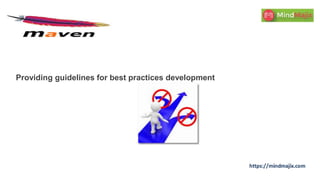
Providing guidelines for best practices development
Maven aims to gather current principles for best practices development, and
make it easy to guide a project in that direction.
For example, specification, execution, and reporting of unit tests are part of the
normal build cycle using Maven. Current unit testing best practices were used
as guidelines:
 Keeping your test source code in a separate, but parallel source tree
 Using test case naming conventions to locate and execute tests
 Have test cases setup their environment and don’t rely on customizing
the build for test preparation.
Maven also aims to assist in project workflow such as release
management and issue tracking.
Maven also suggests some guidelines on how to layout your project’s
directory structure so that once you learn the layout you can easily
navigate any other project that uses Maven and the same defaults.
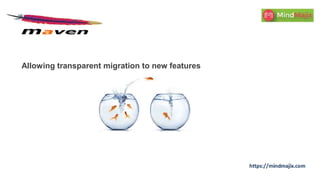
Allowing transparent migration to new features
Maven provides an easy way for Maven clients to update their installations so
that they can take advantage of any changes that been made to Maven itself.
Installation of new or updated plugins from third parties or Maven itself has
been made trivial for this reason.
Source: https://maven.apache.org
For more information and Maven training online
visit: mindmajix/Maven training
Contact Info:
Mindmajix Technologies Inc
USA : +1-201 3780 518
IND : +91 9246333245
Email: INFO@MINDMAJIX.COM
Maven ppt

Maven ppt

  • 2.
    Introduction Maven, a Yiddishword meaning accumulator of knowledge, was originally started as an attempt to simplify the build processes in the Jakarta Turbine project. There were several projects each with their own Ant build files that were all slightly different and JARs were checked into CVS. They wanted a standard way to build the projects, a clear definition of what the project consisted of, an easy way to publish project information and a way to share JARs across several projects. The result is a tool that can now be used for building and managing any Java-based project. We hope that we have created something that will make the day-to-day work of Java developers easier and generally help with the comprehension of any Java-based project.
  • 3.
  • 4.
    Maven is aproject management and comprehension tool. Maven provides developers a complete build lifecycle framework. Development team can automate the project's build infrastructure in almost no time as Maven uses a standard directory layout and a default build lifecycle. In case of multiple development teams environment, Maven can set-up the way to work as per standards in a very short time. As most of the project setups are simple and reusable, Maven makes life of developer easy while creating reports, checks, build and testing automation setups.
  • 5.
    Maven provides developersways to manage following: ● Builds ● Documentation ● Reporting ● Dependencies
  • 6.
    ● SCMs ● Releases ●Distribution ● mailing list To summarize, Maven simplifies and standardizes the project build process. It handles compilation, distribution, documentation, team collaboration and other tasks seamlessly. Maven increases reusability and takes care of most of build related tasks.
  • 7.
  • 8.
    Maven was originallydesigned to simplify building processes in Jakarta Turbine project. There were several projects and each project contained slightly different ANT build files. JARs were checked into CVS. Apache group then developed Maven which can build multiple projects together, publish projects information, deploy projects, share JARs across several projects and help in collaboration of teams.
  • 9.
    Maven’s Objectives Maven’s primarygoal is to allow a developer to comprehend the complete state of a development effort in the shortest period of time. In order to attain this goal there are several areas of concern that Maven attempts to deal with:
  • 10.
    Making the buildprocess easy While using Maven doesn’t eliminate the need to know about the underlying mechanisms, Maven does provide a lot of shielding from the details
  • 11.
    Providing a uniformbuild system Maven allows a project to build using its project object model (POM) and a set of plugins that are shared by all projects using Maven, providing a uniform build system. Once you familiarize yourself with how one Maven project builds you automatically know how all Maven projects build saving you immense amounts of time when trying to navigate many projects.
  • 12.
  • 13.
    Maven provides plentyof useful project information that is in part taken from your POM and in part generated from your project’s sources. For example, Maven can provide:  Change log document created directly from source control  Cross referenced sources  Mailing lists  Dependency list  Unit test reports including coverage
  • 14.
    As Maven improvesthe information set provided will improve, all of which will be transparent to users of Maven. Other products can also provide Maven plugins to allow their set of project information alongside some of the standard information given by Maven, all still based on the POM.
  • 15.
    Providing guidelines forbest practices development
  • 16.
    Maven aims togather current principles for best practices development, and make it easy to guide a project in that direction. For example, specification, execution, and reporting of unit tests are part of the normal build cycle using Maven. Current unit testing best practices were used as guidelines:  Keeping your test source code in a separate, but parallel source tree  Using test case naming conventions to locate and execute tests  Have test cases setup their environment and don’t rely on customizing the build for test preparation.
  • 17.
    Maven also aimsto assist in project workflow such as release management and issue tracking. Maven also suggests some guidelines on how to layout your project’s directory structure so that once you learn the layout you can easily navigate any other project that uses Maven and the same defaults.
  • 18.
  • 19.
    Maven provides aneasy way for Maven clients to update their installations so that they can take advantage of any changes that been made to Maven itself. Installation of new or updated plugins from third parties or Maven itself has been made trivial for this reason.
  • 20.
    Source: https://maven.apache.org For moreinformation and Maven training online visit: mindmajix/Maven training Contact Info: Mindmajix Technologies Inc USA : +1-201 3780 518 IND : +91 9246333245 Email: INFO@MINDMAJIX.COM