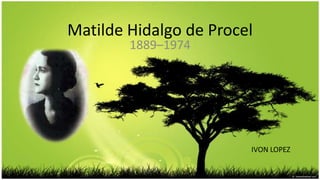

Matilde Hidalgo de Procel
        1889–1974


                        IVON LOPEZ
• Matilde Hidalgo de Procel became the first
  woman to graduate from a high school in
  Ecuador, the first woman to vote in an election
  in South America and the first woman to hold
  elected office in her country.
First years of life
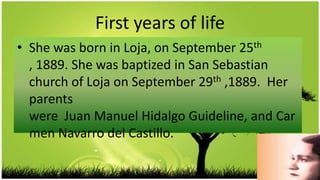
• She was born in Loja, on September 25th
  , 1889. She was baptized in San Sebastian
  church of Loja on September 29th ,1889. Her
  parents
  were Juan Manuel Hidalgo Guideline, and Car
  men Navarro del Castillo.
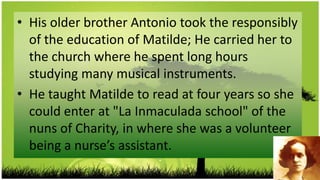
• His older brother Antonio took the responsibly
  of the education of Matilde; He carried her to
  the church where he spent long hours
  studying many musical instruments.
• He taught Matilde to read at four years so she
  could enter at "La Inmaculada school" of the
  nuns of Charity, in where she was a volunteer
  being a nurse’s assistant.
• When she finished the school , she wanted to
  continue her studies and Matilde and Her
  mother had an interview with the Dr. Ojeda
  the director of Bernardo Valdivieso high
  school after of a month He agreed.
• Reaction in the community was not very good:
  mothers prohibited their daughters have a
  friendship with her; the local priest forced her
  listen the mass two steps outside the church’s
  entrance. However her mother defended
  staunchly her daughter. Eventually Matilde
  graduated with honors.
• She try to enter at Faculty of Medicine, Central
  University and made ​an appointment with the
  Rector, who said that medicine was not
  a career for a woman and she said that should
  study Obstetrics or pharmacy, believing
  that professions were more favorable.
• She returned to Cuenca and continued her
  studies at the local university, obtaining a
  Doctorate in Medicine in 1923, being the first
  Ecuadorian woman in receive a title. Two
  years later, Matilde married with the lawyer
  Fernando Procel, and they had two children
  named: Fernando and Gonzalo
  Procel, Fernando was a doctor while Gonzalo
  was an architect.
• During the presidency of José Luis
  Tamayo, Matilde announced that she was
  going to vote in the next presidential
  elections. The issue was put under ministerial
  consultation, eventually ruling in her
  favor, and in 1924, Matilde Hidalgo becomes
  the first woman in Latin America to exercise
  her constitutional right to vote in an election.
• Matilde opened many more doors: she
  became the first elected councilwoman of
  Machala and, the first vice-president of the
  Council of Machala. In 1941, she became the
  first woman candidate and the first elected
  woman public administrator in Loja, the city
  that was once horrified by her ambitions.
• The 71 received the Merit Award of Public
  Health. On July 30, 1973 was widowed, her
• In 1954 was designed and Lifetime Honorary
  President of the Red Cross of El Oro, 1956
  received the National Order of Merit in
  the grade of Grand Officer and represented
  the Medical Federation of Ecuador at the
  Third Congress of the Pan American Medical
  Women's Alliance meeting in Santiago, Chile.
• In 1871 received the Merit Award of Public
  Health. On July 30, 1973 was widowed, her
  husband died of a heart attack. After his
  strong spiritual texture, crushed by
  loneliness and pain, he
  declared conquered, had a stroke that
  paralyzed his body and left her unconscious.
• She was brought to Guayaquil on a plane, he
  joined the Social Security Regional Hospital
  where his son Fernando was a doctor and
  began to improve, but complication by her
  age, forced to suffer the amputation of a
  leg and died on 20 February1974, at age 85.
Matilde hidalgo de procel

Matilde hidalgo de procel

  • 1.
    Matilde Hidalgo deProcel 1889–1974 IVON LOPEZ
  • 2.
    • Matilde Hidalgode Procel became the first woman to graduate from a high school in Ecuador, the first woman to vote in an election in South America and the first woman to hold elected office in her country.
  • 3.
    First years oflife • She was born in Loja, on September 25th , 1889. She was baptized in San Sebastian church of Loja on September 29th ,1889. Her parents were Juan Manuel Hidalgo Guideline, and Car men Navarro del Castillo.
  • 4.
    • His olderbrother Antonio took the responsibly of the education of Matilde; He carried her to the church where he spent long hours studying many musical instruments. • He taught Matilde to read at four years so she could enter at "La Inmaculada school" of the nuns of Charity, in where she was a volunteer being a nurse’s assistant.
  • 5.
    • When shefinished the school , she wanted to continue her studies and Matilde and Her mother had an interview with the Dr. Ojeda the director of Bernardo Valdivieso high school after of a month He agreed.
  • 6.
    • Reaction inthe community was not very good: mothers prohibited their daughters have a friendship with her; the local priest forced her listen the mass two steps outside the church’s entrance. However her mother defended staunchly her daughter. Eventually Matilde graduated with honors.
  • 7.
    • She tryto enter at Faculty of Medicine, Central University and made ​an appointment with the Rector, who said that medicine was not a career for a woman and she said that should study Obstetrics or pharmacy, believing that professions were more favorable.
  • 8.
    • She returnedto Cuenca and continued her studies at the local university, obtaining a Doctorate in Medicine in 1923, being the first Ecuadorian woman in receive a title. Two years later, Matilde married with the lawyer Fernando Procel, and they had two children named: Fernando and Gonzalo Procel, Fernando was a doctor while Gonzalo was an architect.
  • 9.
    • During thepresidency of José Luis Tamayo, Matilde announced that she was going to vote in the next presidential elections. The issue was put under ministerial consultation, eventually ruling in her favor, and in 1924, Matilde Hidalgo becomes the first woman in Latin America to exercise her constitutional right to vote in an election.
  • 10.
    • Matilde openedmany more doors: she became the first elected councilwoman of Machala and, the first vice-president of the Council of Machala. In 1941, she became the first woman candidate and the first elected woman public administrator in Loja, the city that was once horrified by her ambitions. • The 71 received the Merit Award of Public Health. On July 30, 1973 was widowed, her
  • 11.
    • In 1954was designed and Lifetime Honorary President of the Red Cross of El Oro, 1956 received the National Order of Merit in the grade of Grand Officer and represented the Medical Federation of Ecuador at the Third Congress of the Pan American Medical Women's Alliance meeting in Santiago, Chile.
  • 12.
    • In 1871received the Merit Award of Public Health. On July 30, 1973 was widowed, her husband died of a heart attack. After his strong spiritual texture, crushed by loneliness and pain, he declared conquered, had a stroke that paralyzed his body and left her unconscious.
  • 13.
    • She wasbrought to Guayaquil on a plane, he joined the Social Security Regional Hospital where his son Fernando was a doctor and began to improve, but complication by her age, forced to suffer the amputation of a leg and died on 20 February1974, at age 85.