POWER POINT
PRESENTATION
FOR
CLASS X MATHEMATICS
RANJITH B S
CLASS 10th B
ROLL NO 26
CHAPTER 1
REAL NUMBERS
TOPICS
The fundamental theorem of
Arithmetic.
Revisiting irrational numbers.
Revisiting rational numbers and
their decimal representation.
HIGHEST COMMON FACTOR(HCF)
HCF of (two positive
integers a and b)is the
largest positive integer that
divides both a and b
THE FUNDAMENTAL THEOREM
OF ARITHMETIC
Every composite
number can be
expressed (factorised)
as a product of primes,
and this factorization
is unique.
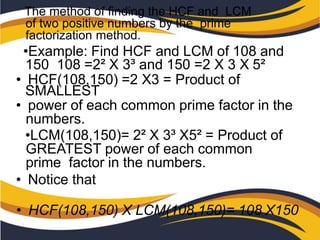
The method of finding the HCF and LCM
of two positive numbers by the prime
factorization method.
•Example: Find HCF and LCM of 108 and
150 108 =2² X 3³ and 150 =2 X 3 X 5²
• HCF(108,150) =2 X3 = Product of
SMALLEST
• power of each common prime factor in the
numbers.
•LCM(108,150)= 2² X 3³ X5² = Product of
GREATEST power of each common
prime factor in the numbers.
• Notice that
• HCF(108,150) X LCM(108,150)= 108 X150
For any two positive integers a
and b,
HCF (a,b) X LCM(a,b) = a X b
This result can be used to find
the LCM of two numbers.
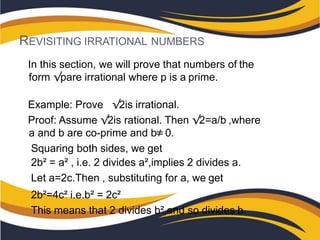
REVISITING IRRATIONAL NUMBERS
In this section, we will prove that numbers of the
form √pare irrational where p is a prime.
Example: Prove √2is irrational.
Proof: Assume √2is rational. Then √2=a/b ,where
a and b are co-prime and b≠0.
Squaring both sides, we get
2b² = a² , i.e. 2 divides a²,implies 2 divides a.
Let a=2c.Then , substituting for a, we get
2b²=4c² i.e.b² = 2c²
This means that 2 divides b²,and so divides b.
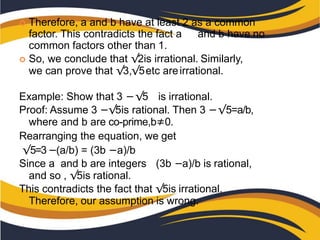
 Therefore, a and b have at least 2 as a common
factor. This contradicts the fact a and b have no
common factors other than 1.
 So, we conclude that √2is irrational. Similarly,
we can prove that √3,√5etc areirrational.
Example: Show that 3 −√5 is irrational.
Proof: Assume 3 −√5is rational. Then 3 −√5=a/b,
where and b are co-prime,b≠0.
Rearranging the equation, we get
√5=3−(a/b) = (3b −a)/b
Since a and b are integers (3b −a)/b is rational,
and so , √5is rational.
This contradicts the fact that √5is irrational.
Therefore, our assumption is wrong.
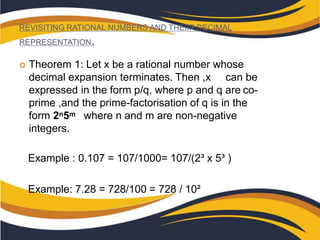
REVISITING RATIONAL NUMBERS AND THEIIR DECIMAL
REPRESENTATION.
 Theorem 1: Let x be a rational number whose
decimal expansion terminates. Then ,x can be
expressed in the form p/q, where p and q are co-
prime ,and the prime-factorisation of q is in the
form 2n5m where n and m are non-negative
integers.
Example : 0.107 = 107/1000= 107/(2³ x 5³ )
Example: 7.28 = 728/100 = 728 / 10²
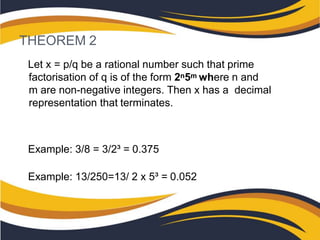
THEOREM 2
Let x = p/q be a rational number such that prime
factorisation of q is of the form 2n5m where n and
m are non-negative integers. Then x has a decimal
representation that terminates.
Example: 3/8 = 3/2³ = 0.375
Example: 13/250=13/ 2 x 5³ = 0.052
THEOREM 3
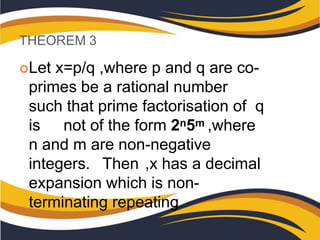
Let x=p/q ,where p and q are co-
primes be a rational number
such that prime factorisation of q
is not of the form 2n5m ,where
n and m are non-negative
integers. Then ,x has a decimal
expansion which is non-
terminating repeating.
THANK YOU

Maths class 10th ppt.pptx

  • 1.
    POWER POINT PRESENTATION FOR CLASS XMATHEMATICS RANJITH B S CLASS 10th B ROLL NO 26
  • 2.
  • 3.
    TOPICS The fundamental theoremof Arithmetic. Revisiting irrational numbers. Revisiting rational numbers and their decimal representation.
  • 4.
    HIGHEST COMMON FACTOR(HCF) HCFof (two positive integers a and b)is the largest positive integer that divides both a and b
  • 5.
    THE FUNDAMENTAL THEOREM OFARITHMETIC Every composite number can be expressed (factorised) as a product of primes, and this factorization is unique.
  • 6.
    The method offinding the HCF and LCM of two positive numbers by the prime factorization method. •Example: Find HCF and LCM of 108 and 150 108 =2² X 3³ and 150 =2 X 3 X 5² • HCF(108,150) =2 X3 = Product of SMALLEST • power of each common prime factor in the numbers. •LCM(108,150)= 2² X 3³ X5² = Product of GREATEST power of each common prime factor in the numbers. • Notice that • HCF(108,150) X LCM(108,150)= 108 X150
  • 7.
    For any twopositive integers a and b, HCF (a,b) X LCM(a,b) = a X b This result can be used to find the LCM of two numbers.
  • 8.
    REVISITING IRRATIONAL NUMBERS Inthis section, we will prove that numbers of the form √pare irrational where p is a prime. Example: Prove √2is irrational. Proof: Assume √2is rational. Then √2=a/b ,where a and b are co-prime and b≠0. Squaring both sides, we get 2b² = a² , i.e. 2 divides a²,implies 2 divides a. Let a=2c.Then , substituting for a, we get 2b²=4c² i.e.b² = 2c² This means that 2 divides b²,and so divides b.
  • 9.
     Therefore, aand b have at least 2 as a common factor. This contradicts the fact a and b have no common factors other than 1.  So, we conclude that √2is irrational. Similarly, we can prove that √3,√5etc areirrational. Example: Show that 3 −√5 is irrational. Proof: Assume 3 −√5is rational. Then 3 −√5=a/b, where and b are co-prime,b≠0. Rearranging the equation, we get √5=3−(a/b) = (3b −a)/b Since a and b are integers (3b −a)/b is rational, and so , √5is rational. This contradicts the fact that √5is irrational. Therefore, our assumption is wrong.
  • 10.
    REVISITING RATIONAL NUMBERSAND THEIIR DECIMAL REPRESENTATION.  Theorem 1: Let x be a rational number whose decimal expansion terminates. Then ,x can be expressed in the form p/q, where p and q are co- prime ,and the prime-factorisation of q is in the form 2n5m where n and m are non-negative integers. Example : 0.107 = 107/1000= 107/(2³ x 5³ ) Example: 7.28 = 728/100 = 728 / 10²
  • 11.
    THEOREM 2 Let x= p/q be a rational number such that prime factorisation of q is of the form 2n5m where n and m are non-negative integers. Then x has a decimal representation that terminates. Example: 3/8 = 3/2³ = 0.375 Example: 13/250=13/ 2 x 5³ = 0.052
  • 12.
    THEOREM 3 Let x=p/q,where p and q are co- primes be a rational number such that prime factorisation of q is not of the form 2n5m ,where n and m are non-negative integers. Then ,x has a decimal expansion which is non- terminating repeating.
  • 13.