MINISTRY OF EDUCATION MALAYSIA


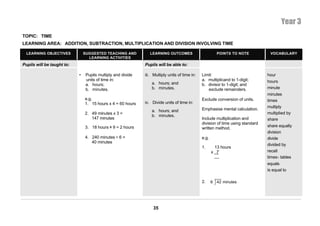
Integrated Curriculum for Primary Schools

           Curriculum Specifications


              MATHEMATICS
                 YEAR 3


              Curriculum Development Centre
              Ministry of Education Malaysia
                           2003
MINISTRY OF EDUCATION MALAYSIA


Integrated Curriculum for Primary Schools

           Curriculum Specifications


              MATHEMATICS
                 YEAR 3


              Curriculum Development Centre
              Ministry of Education Malaysia
                           2003
Copyright (C) 2003 Curriculum Development Centre
Ministry of Education Malaysia
Pesiaran Duta Off Jalan Duta
50604 Kuala Lumpur


First published 2003


Copyright reserved. Except for use in a review, the
reproduction or utilisation of this work in any form or by any
electronic, mechanical, or other means, now known or hereafter
invented, including photocopying, and recording is forbidden
without the prior written permission from the Director of the
Curriculum Development Centre, Ministry of Education Malaysia.
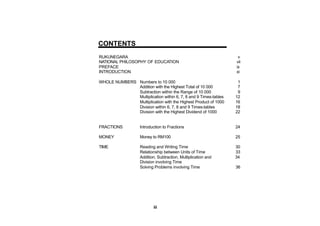
CONTENTS
RUKUNEGARA                                                        v
NATIONAL PHILOSOPHY OF EDUCATION                                 vii
PREFACE                                                          ix
INTRODUCTION                                                     xi

WHOLE NUMBERS Numbers to 10 000                                   1
              Addition with the Highest Total of 10 000           7
              Subtraction within the Range of 10 000              9
              Multiplication within 6, 7, 8 and 9 Times-tables   12
              Multiplication with the Highest Product of 1000    16
              Division within 6, 7, 8 and 9 Times-tables         18
              Division with the Highest Dividend of 1000         22


FRACTIONS           Introduction to Fractions                    24

MONEY               Money to RM100                               25

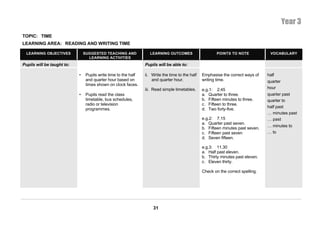
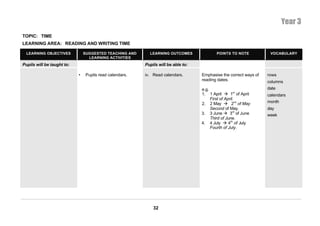
TIME                Reading and Writing Time                     30
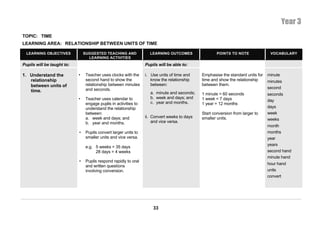
                    Relationship between Units of Time           33
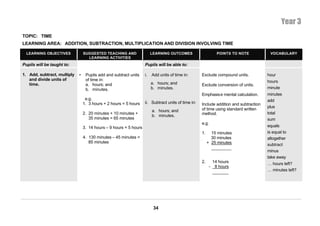
                    Addition, Subtraction, Multiplication and    34
                    Division involving Time
                    Solving Problems involving Time              36


                           iii
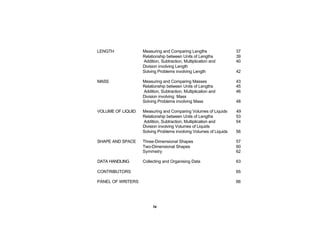
LENGTH             Measuring and Comparing Lengths                 37
                   Relationship between Units of Lengths           39
                   Addition, Subtraction, Multiplication and       40
                   Division involving Length
                   Solving Problems involving Length               42

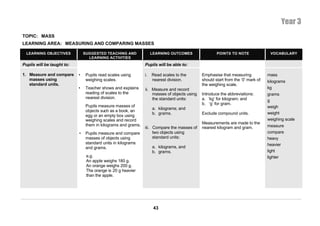
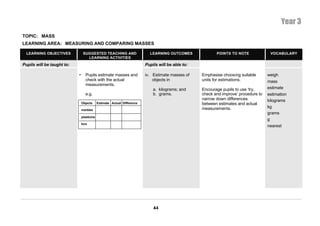
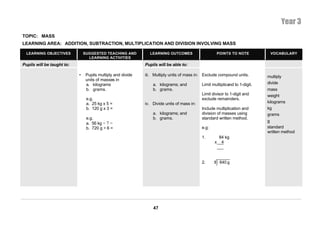
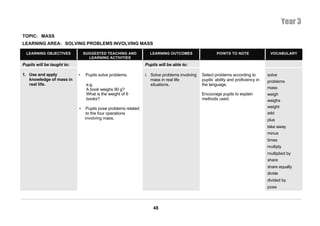
MASS               Measuring and Comparing Masses                  43
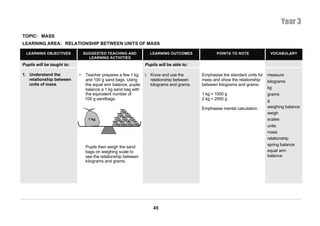
                   Relationship between Units of Lengths           45
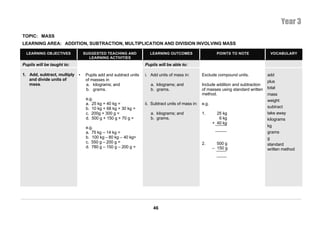
                   Addition, Subtraction, Multiplication and       46
                   Division involving Mass
                   Solving Problems involving Mass                 48

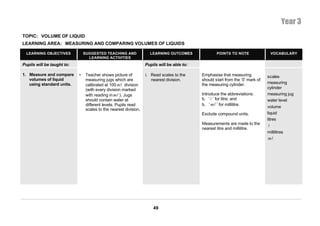
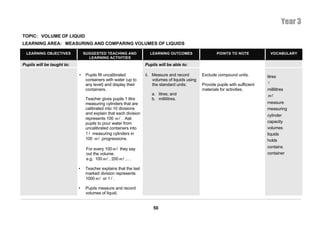
VOLUME OF LIQUID   Measuring and Comparing Volumes of Liquids      49
                   Relationship between Units of Lengths           53
                   Addition, Subtraction, Multiplication and       54
                   Division involving Volumes of Liquids
                   Solving Problems involving Volumes of Liquids   56

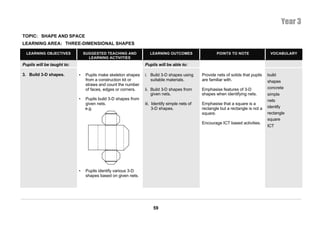
SHAPE AND SPACE    Three-Dimensional Shapes                        57
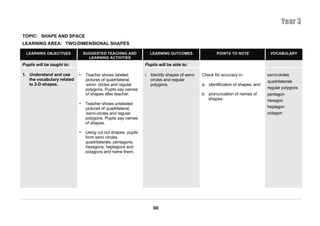
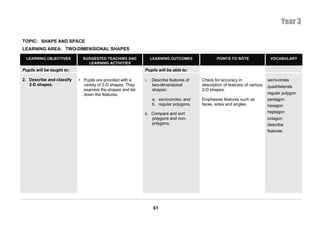
                   Two-Dimensional Shapes                          60
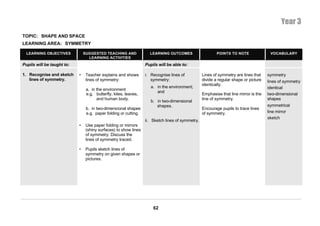
                   Symmetry                                        62

DATA HANDLING      Collecting and Organising Data                  63

CONTRIBUTORS                                                       65

PANEL OF WRITERS                                                   66


                        iv
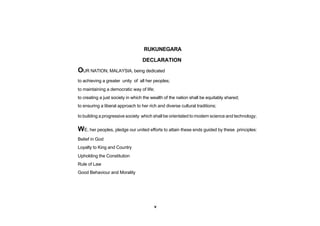
RUKUNEGARA

                                   DECLARATION
OUR NATION, MALAYSIA, being dedicated
to achieving a greater unity of all her peoples;
to maintaining a democratic way of life;
to creating a just society in which the wealth of the nation shall be equitably shared;
to ensuring a liberal approach to her rich and diverse cultural traditions;

to building a progressive society which shall be orientated to modern science and technology;

WE, her peoples, pledge our united efforts to attain these ends guided by these      principles:

Belief in God
Loyalty to King and Country
Upholding the Constitution
Rule of Law
Good Behaviour and Morality


                                         v
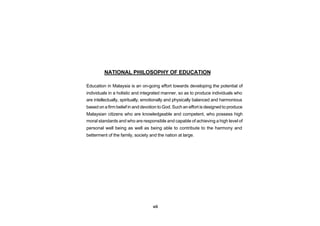
NATIONAL PHILOSOPHY OF EDUCATION

Education in Malaysia is an on-going effort towards developing the potential of
individuals in a holistic and integrated manner, so as to produce individuals who
are intellectually, spiritually, emotionally and physically balanced and harmonious
based on a firm belief in and devotion to God. Such an effort is designed to produce
Malaysian citizens who are knowledgeable and competent, who possess high
moral standards and who are responsible and capable of achieving a high level of
personal well being as well as being able to contribute to the harmony and
betterment of the family, society and the nation at large.


                                   vii
PREFACE
Science and technology plays a crucial role in           greater opportunities for pupils to enhance
meeting Malaysia’s aspiration to achieve developed       their knowledge and skills because they are able to
nation status. Since mathematics is instrumental in      source the various repositories of knowledge written in
developing scientific and technological knowledge, the   mathematical English whether in electronic or print
provision of quality mathematics education from an       forms. Pupils will be able to communicate
early age in the education process is critical.          mathematically in English not only in the immediate
                                                         enviroment but also with pupils from other countries
The primary school Mathematics curriculum as             thus increasing their overall English proficiency and
outlined in the syllabus has been designed to provide    mathematical competence in the process.
opportunities for pupils to acquire mathematical
knowledge and skills and develop the higher order        The development of a set of Curriculum Specifications
problem solving and decision making skills that they     as a supporting document to the syllabus is the work
can apply in their everyday lives. But, more             of many individuals and experts in the field. To those
importantly, together with the other subjects in the     who have contributed in one way or another to this
primary school curriculum, the mathematics               effort, on behalf of the Ministry of Education, I would
curriculum seeks to inculcate noble values and love      like to thank them and express my deepest
for the nation towards the final aim of developing the   appreciation.
holistic person who is capable of contributing to the
harmony and prosperity of the nation and its people.

Beginning in 2003, science and mathematics will be
taught in English following a phased implementation
schedule, which will be completed by 2008.               (Dr. SHARIFAH MAIMUNAH SYED ZIN)
Mathematics education in English makes use of            Director
ICT in its delivery. Studying mathematics in the         Curriculum Development Centre
medium of English assisted by ICT will provide           Ministry of Education Malaysia


                                                   ix
INTRODUCTION

Our nation’s vision can be achieved through a society         later in life and in the process, benefit the society and
that is educated and competent in the application of          the nation.
mathematical knowledge. To achieve this vision,
society must be inclined towards mathematics.                 Several factors have been taken into account when
                                                              designing the curriculum and these are: mathematical
Therefore, problem solving and communicational skills
in mathematics have to be nurtured so that decisions          concepts and skills, terminology and vocabulary used,
can be made effectively.                                      and the level of proficiency of English among teachers
                                                              and pupils.
Mathematics is integral in the development of science
                                                              The Mathematics Curriculum at the primary level
and technology. As such, the acquisition of
                                                              (KBSR) emphasises the acquisition of basic concepts
mathematical knowledge must be upgraded
periodically to create a skilled workforce in preparing       and skills. The content is categorised into four
                                                              interrelated areas, namely, Numbers, Measurement,
the country to become a developed nation. In order to
create a K-based economy, research and development            Shape and Space and Statistics.
skills in Mathematics must be taught and instilled at         The learning of mathematics at all levels involves more
school level.                                                 than just the basic acquisition of concepts and skills. It
                                                              involves, more importantly, an understanding of the
Achieving this requires a sound mathematics
                                                              underlying mathematical thinking, general strategies of
curriculum, competent and knowledgeable teachers
who can integrate instruction with assessment,                problem solving, communicating mathematically and
                                                              inculcating positive attitudes towards an appreciation
classrooms with ready access to technology, and a
commitment to both equity and excellence.                     of mathematics as an important and powerful tool in
                                                              everyday life.
The Mathematics Curriculum has been designed to
                                                              It is hoped that with the knowledge and skills acquired
provide knowledge and mathematical skills to pupils
                                                              in Mathematics, pupils will discover, adapt, modify and
from various backgrounds and levels of ability.
                                                              be innovative in facing changes and future challenges.
Acquisition of these skills will help them in their careers


                                                        xi
AIM

The Primary School Mathematics Curriculum aims               4.   master basic mathematical skills, namely:
to build pupils’ understanding of number concepts                  • making estimates and approximates,
and their basic skills in computation that they can                • measuring,
apply in their daily routines effectively and responsibly          • handling data
in keeping with the aspirations of a developed society             • representing information in the form
and nation, and at the same time to use this                           of graphs and charts;
knowledge to further their studies.
                                                             5.   use mathematical skills and knowledge to
OBJECTIVES                                                        solve problems in everyday life effectively
                                                                  and responsibly;
The Primary School Mathematics Curriculum will
enable pupils to:                                            6.   use the language of mathematics correctly;
  1. know and understand the concepts,
                                                             7.   use suitable technology in concept building,
     definition, rules sand principles related to
                                                                  acquiring mathematical skills and solving
     numbers, operations, space, measures and
                                                                  problems;
      data representation;
                                                             8.   apply the knowledge of mathematics
  2. master the basic operations of mathematics:                  systematically, heuristically, accurately and
         •   addition,                                            carefully;
         •   subtraction,
         •   multiplication,                                 9.   participate in activities related to mathematics;
         •   division;                                            and

  3. master the skills of combined operations;               10. appreciate the importance and beauty of
                                                                 mathematics.


                                                       xii
CONTENT ORGANISATION
The Mathematics Curriculum at the primary level            4.   Statistics
encompasses four main areas, namely, Numbers,                     • Average;
Measures, Shape and Space and Statistics. The                     • Data Representation.
topics for each area have been arranged from the
basic to the abstract. Teachers need to teach the          The Learning Areas outline the breadth and depth of
basics before abstract topics are introduced to pupils.    the scope of knowledge and skills that have to be
Each main area is divided into topics as follows:          mastered during the allocated time for learning. These
                                                           learning areas are, in turn, broken down into more
1.    Num b r
           es
                                                           manageable objectives. Details as to teaching-learning
        • Whole Numbers;                                   strategies, vocabulary to be used and points to note
        • Fractions;                                       are set out in five columns as follows:
        • Decimals;
        •   Money;                                         Column 1:    Learning Objectives.
        • Percentage.                                      Column 2:    Suggested Teaching and
2.   Measures                                                           Learning Activities.
        • Time;                                            Column 3:    Learning Outcomes.
        • Length;                                          Column 4:    Points To Note.
        • Mass;                                            Column 5:    Vocabulary.
        • Volume of Liquid.
                                                           The purpose of these columns is to illustrate, for a
3.    Shape and Space                                      particular teaching objective, a list of what pupils
        • Two-dimensional Shapes;                          should know, understand and be able to do by the
        • Three-dimensional Shapes.                        end of each respective topic.


                                                    xiii
The Learning Objectives define clearly what should        The Vocabulary column consists of standard
be taught. They cover all aspects of the Mathematics      mathematical terms, instructional words and phrases
curriculum and are presented in a developmental           that are relevant when structuring activities, asking
sequence to enable pupils to grasp concepts and           questions and in setting tasks. It is important to pay
master skills essential to a basic understanding of       careful attention to the use of correct terminology.
mathematics.                                              These terms need to be introduced systematically to
                                                          pupils and in various contexts so that pupils get to know
The Suggested Teaching and Learning Activities            of their meaning and learn how to use
list some examples of teaching and learning activities.   them appropriately.
These include methods, techniques, strategies and
resources useful in the teaching of a specific
concepts and skills. These are however not the only
approaches to be used in classrooms.

The Learning Outcomes define specifically what
pupils should be able to do. They prescribe the
knowledge, skills or mathematical processes and
values that should be inculcated and developed at
the appropriate levels. These behavioural objectives
are measurable in all aspects.

In Points To Note, attention is drawn to the more
significant aspects of mathematical concepts and
skills. These aspects must be taken into accounts
so as to ensure that the concepts and skills are taught
and learnt effectively as intended.


                                                    xiv
EMPHASIS IN TEACHING AND LEARNING                           1.       Problem Solving in Mathematics

The Mathematics Curriculum is ordered in such a way         Problem solving is the main focus in the teaching and
so as to give flexibility to the teachers to create an      learning of mathematics. Understanding mathematical
environment that is enjoyable, meaningful, useful and       procedures          and      solving       problems
challenging for teaching and learning. At the same time     are two skills that emerge naturally when relational
it is important to ensure that pupils show progression      understanding is focussed upon. As a result, problem
in acquiring the mathematical concepts and skills.          solving approaches should be used to investigate and
                                                            understand mathematical content. The teaching-
On completion of a certain topic and in deciding to
                                                            learning process must include exercises on problem
progress to another learning area or topic, the following
                                                            solving skills which are comprehensive and cover the
need to be taken into accounts:
                                                            whole curriculum. The development of these skills
   •   The skills or concepts acquired in the new           must to be emphasised so that pupils are able to solve
       learning area or topics;                             various problems effectively.             The skills
   •   Ensuring that the hierarchy or relationship          involved are:
       between learning areas or topics have been
       followed through accordingly; and                         •     Interpreting problems;
   •   Ensuring the basic learning areas have or                 •     Planning the strategy;
       skills have been acquired or mastered before              •     Carrying out the strategy; and
       progressing to the more abstract areas.                   •     Looking back at the solutions.

The teaching and learning processes emphasise               Various strategies and steps are used to solve
                                                            problems and these can be applied to other learning
concept building, skill acquisition as well as the
inculcation of positive values. Besides these, there        areas. In solving these problems, pupils learn to apply
                                                            mathematics and gradually become confident in facing
are other elements that need to be taken into account
and learnt through the teaching and learning                new challenging situations. Among the problem solving
processes in the classroom. The main emphasis are           strategies to consider are:
as follows:


                                                       xv
•   Trying a simple case;                             and concise mathematical terms during oral
     •   Trial and improvement;                            presentation and written work. This is also expanded
     •   Draw a diagram;                                   to the listening skills involved.
     •   Identifying patterns and sequences;
                                                           Communication in mathematics through the listening
     •   Make a table, chart or a systematic list;
                                                           process occurs when individuals respond to what
     •   Simulation;
                                                           they hear and this encourages them to think using
     •   Make analogy; and
                                                           their mathematical knowledge in making decisions.
     •   Working backwards.
                                                           Communication in mathematics through the reading
2.   Communication in Mathematics                          process takes place when an individual collects
                                                           information or data and rearranges the relationship
Communication is one way to share ideas and clarify        between ideas and concepts.
the understanding of Mathematics. Through talking
and questioning, mathematical ideas can be reflected       Communication in mathematics through the
upon, discussed and modified. The process of               visualization process takes place when an individual
reasoning analytically and systematically can help         makes observation, analyses it, interprets and
reinforce and strengthen pupils’ knowledge and             synthesises the data into graphic forms, such as
understanding of mathematics to a deeper level.            pictures, diagrams, tables and graphs.
Through effective communications pupils will become
efficient in problem solving and be able to explain        The following methods can create an effective
concepts and mathematical skills to their peers and        communication environment:
teachers.
                                                              •   Identifying relevant contexts associated
Pupils who have developed the above skills will                   with environment and everyday life
become more inquisitive gaining confidence in the                 experiences of pupils;
process. Communicational skills in mathematics                •   Identifying interests of pupils;
include reading and understanding problems,                   •   Identifying teaching materials;
interpreting diagrams and graphs, and using correct           •   Ensuring active learning;


                                                     xvi
•   Stimulating meta-cognitive skills;                    Written communication is the process whereby
    •   Inculcating positive attitudes; and                   mathematical ideas and information are
    •   Creating a conducive learning environment.            shared with others through writing. The written work
                                                              is usually the result of discussions, contributions and
Oral communication is an interactive process that
                                                              brain-storming activities when working on
involves activities like listening, speaking, reading and
                                                              assignments. Through writing, the pupils will be
observing. It is a two-way interaction that takes place
                                                              encouraged to think more deeply about the
between teacher-pupil, pupil-pupil, and pupil-object.
                                                              mathematics content and observe the relationships
When pupils are challenged to think and reason about
                                                              between concepts.
mathematics and to tell others the results of their
thinking, they learn to be clear and convincing. Listening
                                                              Examples of written communication activities are:
to others’ explanations gives pupils the opportunities
                                                                 • Doing exercises;
to develop their own understanding. Conversations in
                                                                 • Keeping scrap books;
which mathematical ideas are explored from multiple
                                                                 • Keeping folios;
perspectives help sharpen pupils thinking and help
                                                                 • Undertaking projects; and
make connections between ideas. Such activity helps
                                                                 • Doing written tests.
pupils develop a language for expressing mathematical
ideas and appreciation of the need for precision in the
language. Some effective and meaningful oral                  Representation is a process of analysing a
communication techniques in mathematics are as                mathematical problem and interpreting it from one
follows:                                                      mode to another. Mathematical representation enables
                                                              pupils to find relationship between mathematical ideas
    •   Story-telling, question and answer sessions           that are informal, intuitive and abstract using their
        using own words;                                      everyday language. Pupils will realise that some
    •   Asking and answering questions;                       methods of representation are more effective and
    •   Structured and unstructure interviews;                useful if they know how to use the elements of
    •   Discussions during forums, seminars                   mathematical representation.
        debates and brain-storming sessions; and
    •   Presentation of findings of assignments.


                                                       xvii
3.   Mathematical Reasoning                                 The mathematics curriculum consists of several
                                                            areas such as arithmetic, geometry, measures and
Logical reasoning or thinking is the basis for              problem solving. Without connections between these
understanding and solving mathematical problems.
                                                            areas, pupils will have to learn and memorise too many
The development of mathematical reasoning is closely        concepts and skills separately. By making connections
related to the intellectual and communicative               pupils are able to see mathematics as an integrated
development of the pupils. Emphasis on logical
                                                            whole rather than a jumble of unconnected ideas.
thinking during mathematical activities opens up pupils’    Teachers can foster connections in a problem-oriented
minds to accept mathematics as a powerful tool in
                                                            classrooms by having pupils to communicate, reason
the world today.                                            and present their thinking. When these mathematical
                                                            ideas are connected with real life situations and the
Pupils are encouraged to predict and do guess work
                                                            curriculum, pupils will become more conscious in the
in the process of seeking solutions. Pupils at all
                                                            application of mathematics. They will also be able to
levels have to be trained to investigate their
                                                            use mathematics contextually in different learning
predictions or guesses by using concrete                    areas in real life.
materials, calculators, computers, mathematical
representation and others. Logical reasoning has to
be infused in the teaching of mathematics so that           5.   Application of Technology
pupils can recognise, construct and evaluate
predictions and mathematical arguments.                     The application of technology helps pupils to
                                                            understand mathematical concepts in depth,
4.   Mathematical Connections                               meaningfully and precisely enabling them to explore
                                                            mathematical concepts. The use of calculators,
In the mathematics curriculum, opportunities for            computers, educational software, websites in the
making connections must be created so that pupils           internet and available learning packages can help to
can link conceptual to procedural knowledge and             upgrade the pedagogical skills in the teaching and
relate topics in mathematics with other learning            learning of mathematics.
areas in general.


                                                    xviii
The use of teaching resources is very important in        attitudes and personalities, the intrinsic mathematical
mathematics. This will ensure that pupils absorb          values of exactness, confidence and thinking
abstract ideas, be creative, feel confident and be able   systematically have to be absorbed through the
to work independently or in groups. Most of these         learning areas.
resources are designed for self-access learning.
Through self-access learning, pupils will be able to      Good moral values can be cultivated through suitable
access knowledge or skills and informations               context. For example, learning in groups can help
independently according to their pace. This will serve    pupils develop social skills and encourage cooperation
to stimulate pupils’ interests and responsibility in      and self-confidence in the subject. The element of
learning mathematics.                                     patriotism can also be inculcated through the teaching-
                                                          learning process in the classroom using planned
                                                          topics. These values should be imbibed throughout
APPROACHES IN TEACHING AND LEARNING                       the process of teaching and learning mathematics.
Various changes occur that influence the content and      Among the approaches that can be given consideration
pedagogy in the teaching of mathematics in primary        are:
schools. These changes require variety in the way of
teaching mathematics in schools. The use of teaching        •   Pupil centered learning that is interesting;
resources is vital in forming mathematical concepts.        •   The learning ability and styles of learning;
Teachers can use real or concrete objects in teaching       •   The use of relevant, suitable and effective
and learning to help pupils gain experience, construct          teaching materials; and
abstract ideas, make inventions, build self confidence,     •   Formative evaluation to determine the
encourage independence and inculcate cooperation.                effectiveness of teaching and learning.

The teaching and learning materials that are used
should contain self-diagnostic elements so that pupils
can know how far they have understood the concepts
and skills. To assist the pupils in having positive


                                                    xix
The choice of an approach that is suitable will stimulate
the teaching and learning environment in the classroom
or outside it. The approaches that are suitable include
the following:
    •   Cooperative learning;
    •   Contextual learning;
    •   Mastery learning;
    •   Constructivism;
    •   Enquiry-discovery; and
    •   Futures Study.

ASSESSMENT
Assessment is an integral part of the teaching and learning
process. It has to be well-structured and carried out
continuously as part of the classroom activities. By
focusing on a broad range of mathematical tasks, the
strengths and weaknesses of pupils can be assessed.
Different methods of assessment can be conducted using
multiple assessment techniques, including written and
oral work as well as demonstration. These may be in
the form of interviews, open-ended questions,
observations and assignments. Based on the results,
the teachers can rectify the pupils’ misconceptions and
weaknesses and at the same time improve their teaching
skills. As such, teachers can take subsequent effective
measures in conducting remedial and enrichment
activities to upgrade pupils’ performance.


                                                         xx
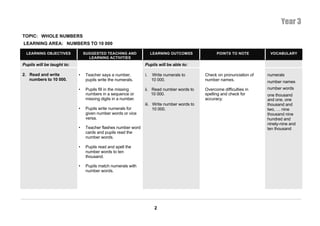
Year 3
TOPIC: WHOLE NUMBERS
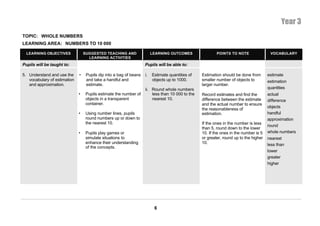
LEARNING AREA: NUMBERS TO 10 000

  LEARNING OBJECTIVES           SUGGESTED TEACHING AND                LEARNING OUTCOMES              POINTS TO NOTE               VOCABULARY
                                  LEARNING ACTIVITIES
Pupils will be taught to:                                        Pupils will be able to:

1. Say and use the          •    Pupils recite number            i.   Say the number names   Encourage pupils to pronounce       number
   number names in               sequence in tens, hundreds           to 10 000.             the number names correctly.         numerals
   familiar contexts.            and thousands up to 10 000.
                                                                 ii. Recognise numerals to   Check on pronunciation of           recite
                            •    Pupils sing number song to          10 000.                 number names.                       one thousand,
                                 count systematically.                                                                           one thousand
                                 e.g. From 5000 to 5100.         iii. Count up to 10 000     Overcome difficulties and           and one, one
                                                                      objects by grouping    recognise recitation errors.        thousand and
                            •    Teacher shows different              them in thousands,                                         two, … ten
                                 representation of numbers up         hundreds and tens.     Pupils should count                 thousand
                                 to 10 000 using multi-based                                 systematically to keep track of
                                 blocks or Cuisenaire rods and                               the count.                          count
                                 pupils say the numbers.                                                                         thousands
                                                                                             Count a larger collection of        hundreds
                            •    Pupils count up to 10 000                                   objects by grouping them in
                                 using concrete and                                          thousands, hundreds, and tens.
                                 manipulative materials such
                                 as Cuisenaire rods or multi-                                Emphasise skip counting in
                                 based blocks.                                               thousands, hundreds, tens, fives,
                                                                                             twos and ones.

                                                                                             Check for accuracy.


                                                                       1
Year 3
TOPIC: WHOLE NUMBERS
LEARNING AREA: NUMBERS TO 10 000

  LEARNING OBJECTIVES           SUGGESTED TEACHING AND              LEARNING OUTCOMES             POINTS TO NOTE         VOCABULARY
                                  LEARNING ACTIVITIES
Pupils will be taught to:                                      Pupils will be able to:

2. Read and write           •    Teacher says a number,        i.   Write numerals to       Check on pronunciation of   numerals
   numbers to 10 000.            pupils write the numerals.         10 000.                 number names.               number names
                            •    Pupils fill in the missing    ii. Read number words to     Overcome difficulties in    number words
                                 numbers in a sequence or          10 000.                  spelling and check for      one thousand
                                 missing digits in a number.                                accuracy.                   and one, one
                                                               iii. Write number words to                               thousand and
                            •    Pupils write numerals for          10 000.                                             two, … nine
                                 given number words or vice                                                             thousand nine
                                 versa.                                                                                 hundred and
                                                                                                                        ninety-nine and
                            •    Teacher flashes number word                                                            ten thousand
                                 cards and pupils read the
                                 number words.

                            •    Pupils read and spell the
                                 number words to ten
                                 thousand.

                            •    Pupils match numerals with
                                 number words.


                                                                     2
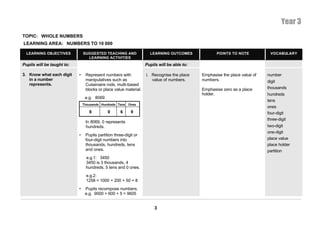
Year 3
TOPIC: WHOLE NUMBERS
LEARNING AREA: NUMBERS TO 10 000

  LEARNING OBJECTIVES           SUGGESTED TEACHING AND               LEARNING OUTCOMES              POINTS TO NOTE           VOCABULARY
                                  LEARNING ACTIVITIES
Pupils will be taught to:                                          Pupils will be able to:

3. Know what each digit     •    Represent numbers with            i. Recognise the place    Emphasise the place value of   number
   in a number                   manipulatives such as                value of numbers.      numbers.                       digit
   represents.                   Cuisenaire rods, multi-based
                                 blocks or place value material.                             Emphasise zero as a place      thousands
                                                                                             holder.                        hundreds
                                 e.g. 8069
                                                                                                                            tens
                                Thousands Hundreds Tens   Ones
                                                                                                                            ones
                                   8          0      6      9                                                               four-digit
                                                                                                                            three-digit
                                 In 8069, 0 represents
                                 hundreds.                                                                                  two-digit
                                                                                                                            one-digit
                            •    Pupils partition three-digit or
                                 four-digit numbers into                                                                    place value
                                 thousands, hundreds, tens                                                                  place holder
                                 and ones.                                                                                  partition
                                 e.g.1: 3450
                                 3450 is 3 thousands, 4
                                 hundreds, 5 tens and 0 ones.
                                 e.g.2:
                                 1258 = 1000 + 200 + 50 + 8
                            •    Pupils recompose numbers.
                                 e.g. 9000 + 600 + 5 = 9605


                                                                        3
Year 3
TOPIC: WHOLE NUMBERS
LEARNING AREA: NUMBERS TO 10 000

  LEARNING OBJECTIVES           SUGGESTED TEACHING AND            LEARNING OUTCOMES               POINTS TO NOTE              VOCABULARY
                                  LEARNING ACTIVITIES
Pupils will be taught to:                                    Pupils will be able to:

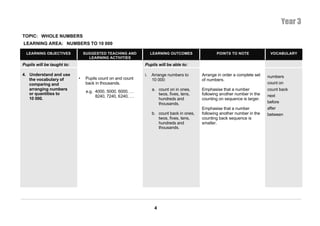
4. Understand and use                                        i.   Arrange numbers to       Arrange in order a complete set   numbers
   the vocabulary of        •    Pupils count on and count        10 000:                  of numbers.
   comparing and                 back in thousands.                                                                          count on
   arranging numbers                                              a. count on in ones,     Emphasise that a number           count back
                                 e.g. 4000, 5000, 6000, …
   or quantities to                                                  twos, fives, tens,    following another number in the   next
                                      8240, 7240, 6240, …
   10 000.                                                           hundreds and          counting on sequence is larger.
                                                                     thousands.                                              before
                                                                                           Emphasise that a number           after
                                                                  b. count back in ones,   following another number in the   between
                                                                     twos, fives, tens,    counting back sequence is
                                                                     hundreds and          smaller.
                                                                     thousands.


                                                                   4
Year 3
TOPIC: WHOLE NUMBERS
LEARNING AREA: NUMBERS TO 10 000

  LEARNING OBJECTIVES           SUGGESTED TEACHING AND               LEARNING OUTCOMES                   POINTS TO NOTE            VOCABULARY
                                  LEARNING ACTIVITIES
Pupils will be taught to:                                          Pupils will be able to:

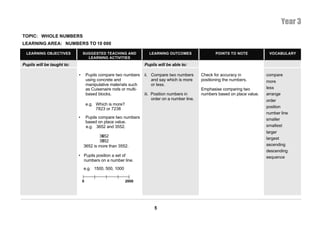
                            •       Pupils compare two numbers     ii. Compare two numbers        Check for accuracy in           compare
                                    using concrete and                 and say which is more      positioning the numbers.        more
                                    manipulative materials such        or less.
                                    as Cuisenaire rods or multi-                                  Emphasise comparing two         less
                                    based blocks.                  iii. Position numbers in       numbers based on place value.   arrange
                                                                        order on a number line.                                   order
                                    e.g. Which is more?
                                         7823 or 7238                                                                             position
                                                                                                                                  number line
                            •       Pupils compare two numbers                                                                    smaller
                                    based on place value.
                                    e.g. 3652 and 3552.                                                                           smallest
                                                                                                                                  larger
                                        3652
                                                                                                                                  largest
                                        3552
                                3652 is more than 3552.                                                                           ascending
                                                                                                                                  descending
                            • Pupils position a set of                                                                            sequence
                              numbers on a number line.
                                e.g. 1500, 500, 1000

                                0                         2000


                                                                        5
Year 3
TOPIC: WHOLE NUMBERS
LEARNING AREA: NUMBERS TO 10 000

  LEARNING OBJECTIVES             SUGGESTED TEACHING AND                 LEARNING OUTCOMES                POINTS TO NOTE                VOCABULARY
                                    LEARNING ACTIVITIES
Pupils will be taught to:                                           Pupils will be able to:

5. Understand and use the     •    Pupils dip into a bag of beans   i.   Estimate quantities of   Estimation should be done from       estimate
   vocabulary of estimation        and take a handful and                objects up to 1000.      smaller number of objects to         estimation
   and approximation.              estimate.                                                      larger number.
                                                                    ii. Round whole numbers                                            quantities
                              •    Pupils estimate the number of        less than 10 000 to the   Record estimates and find the        actual
                                   objects in a transparent             nearest 10.               difference between the estimate      difference
                                   container.                                                     and the actual number to ensure
                                                                                                                                       objects
                                                                                                  the reasonableness of
                              •    Using number lines, pupils                                     estimation.                          handful
                                   round numbers up or down to                                                                         approximation
                                   the nearest 10.                                                If the ones in the number is less
                                                                                                                                       round
                                                                                                  than 5, round down to the lower
                              •    Pupils play games or                                           10. If the ones in the number is 5   whole numbers
                                   simulate situations to                                         or greater, round up to the higher   nearest
                                   enhance their understanding                                    10.                                  less than
                                   of the concepts.
                                                                                                                                       lower
                                                                                                                                       greater
                                                                                                                                       higher


                                                                          6
Year 3
TOPIC: WHOLE NUMBERS
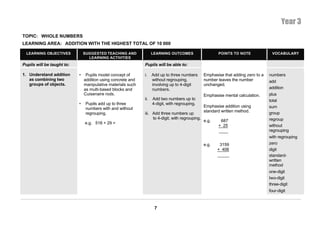
LEARNING AREA: ADDITION WITH THE HIGHEST TOTAL OF 10 000

  LEARNING OBJECTIVES           SUGGESTED TEACHING AND              LEARNING OUTCOMES                    POINTS TO NOTE              VOCABULARY
                                  LEARNING ACTIVITIES
Pupils will be taught to:                                     Pupils will be able to:

1. Understand addition      •    Pupils model concept of      i.    Add up to three numbers       Emphasise that adding zero to a   numbers
   as combining two             addition using concrete and         without regrouping,           number leaves the number          add
   groups of objects.           manipulative materials such         involving up to 4-digit       unchanged.
                                as multi-based blocks and           numbers.                                                        addition
                                Cuisenaire rods.                                                  Emphasise mental calculation.     plus
                                                              ii.   Add two numbers up to                                           total
                            •    Pupils add up to three             4-digit, with regrouping.
                                                                                                  Emphasise addition using          sum
                                 numbers with and without
                                                                                                  standard written method.          group
                                 regrouping.                  iii. Add three numbers up
                                                                   to 4-digit, with regrouping.                                     regroup
                                                                                                  e.g.    687
                                e.g. 516 + 29 =
                                                                                                         + 25                       without
                                                                                                                                    regrouping
                                                                                                                                    with regrouping
                                                                                                  e.g.    3159                      zero
                                                                                                         + 406                      digit
                                                                                                                                    standard-
                                                                                                                                    written
                                                                                                                                    method
                                                                                                                                    one-digit
                                                                                                                                    two-digit
                                                                                                                                    three-digit
                                                                                                                                    four-digit


                                                                     7
Year 3
TOPIC: WHOLE NUMBERS
LEARNING AREA: ADDITION WITH THE HIGHEST TOTAL OF 10 000

 LEARNING OBJECTIVES            SUGGESTED TEACHING AND            LEARNING OUTCOMES                       POINTS TO NOTE                VOCABULARY
                                  LEARNING ACTIVITIES
Pupils will be taught to:                                     Pupils will be able to:

2. Use and apply            •    Pupils solve problems by     i. Solve problems involving          Use and apply knowledge of          add
   knowledge of addition         simulating or modelling         addition in real life situations. addition in a variety of contexts   plus
   in real life.                 situation.
                                                                                                  Emphasise mental calculation.        sum
                            •    Pupils pose problems based                                                                            total
                                 on given information                                             Select problems according to         number
                                 involving addition.                                              pupils’ ability and proficiency in
                                                                                                  language.                            sentence
                                                                                                                                       solve
                                                                                                  Encourage pupils to express          problems
                                                                                                  ideas and opinions clearly.
                                                                                                                                       modelling


                                                                     8
Year 3
TOPIC: WHOLE NUMBERS
LEARNING AREA: SUBTRACTION WITHIN THE RANGE OF 10 000

  LEARNING OBJECTIVES           SUGGESTED TEACHING AND              LEARNING OUTCOMES                    POINTS TO NOTE              VOCABULARY
                                  LEARNING ACTIVITIES
Pupils will be taught to:                                        Pupils will be able to:

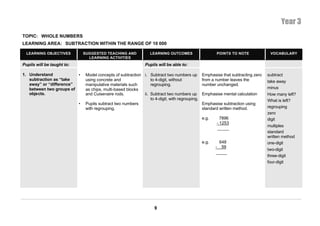
1. Understand            •       Model concepts of subtraction i. Subtract two numbers up         Emphasise that subtracting zero   subtract
   subtraction as “take          using concrete and                to 4-digit, without            from a number leaves the          take away
   away” or “difference”         manipulative materials such       regrouping.                    number unchanged.
   between two groups of         as chips, multi-based blocks                                                                       minus
   objects.                      and Cuisenaire rods.          ii. Subtract two numbers up        Emphasise mental calculation      How many left?
                                                                   to 4-digit, with regrouping.                                     What is left?
                            •    Pupils subtract two numbers                                      Emphasise subtraction using
                                 with regrouping.                                                 standard written method.          regrouping
                                                                                                                                    zero
                                                                                                  e.g.     7896                     digit
                                                                                                         - 1253
                                                                                                                                    multiples
                                                                                                                                    standard
                                                                                                                                    written method
                                                                                                  e.g.       648                    one-digit
                                                                                                         -    59
                                                                                                                                    two-digit
                                                                                                                                    three-digit
                                                                                                                                    four-digit


                                                                      9
Year 3
TOPIC: WHOLE NUMBERS
LEARNING AREA: SUBTRACTION WITHIN THE RANGE OF 10 000

  LEARNING OBJECTIVES         SUGGESTED TEACHING AND            LEARNING OUTCOMES                   POINTS TO NOTE        VOCABULARY
                                LEARNING ACTIVITIES
Pupils will be taught to:                                     Pupils will be able to:

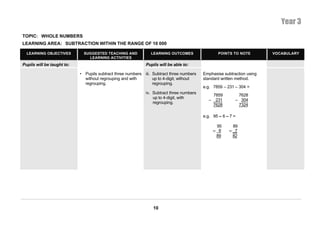
                            • Pupils subtract three numbers   iii. Subtract three numbers   Emphasise subtraction using
                              without regrouping and with          up to 4-digit, without   standard written method.
                              regrouping.                          regrouping.
                                                                                            e.g. 7859 – 231 – 304 =
                                                              iv. Subtract three numbers
                                                                                                  7859       7628
                                                                  up to 4-digit, with
                                                                                              –    231      – 304
                                                                  regrouping.
                                                                                                  7628       7324

                                                                                            e.g. 95 – 6 – 7 =

                                                                                                   95     89
                                                                                                  – 6    – 7
                                                                                                   89     82


                                                                  10
Year 3
TOPIC: WHOLE NUMBERS
LEARNING AREA: SUBTRACTION WITHIN THE RANGE OF 10 000

  LEARNING OBJECTIVES              SUGGESTED TEACHING AND              LEARNING OUTCOMES                  POINTS TO NOTE                VOCABULARY
                                     LEARNING ACTIVITIES
Pupils will be taught to:                                            Pupils will be able to:

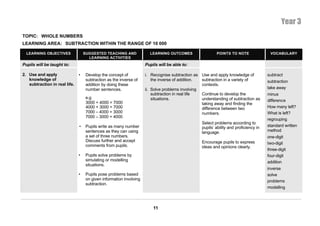
2. Use and apply               •    Develop the concept of           i. Recognise subtraction as Use and apply knowledge of            subtract
   knowledge of                     subtraction as the inverse of        the inverse of addition. subtraction in a variety of          subtraction
   subtraction in real life.        addition by doing these                                       contexts.
                                    number sentences.                ii. Solve problems involving                                      take away
                                                                         subtraction in real life Continue to develop the              minus
                                    e.g                                  situations.              understanding of subtraction as
                                    3000 + 4000 = 7000                                                                                 difference
                                                                                                  taking away and finding the
                                    4000 + 3000 = 7000                                            difference between two               How many left?
                                    7000 – 4000 = 3000                                            numbers.                             What is left?
                                    7000 – 3000 = 4000
                                                                                                                                       regrouping
                                                                                                  Select problems according to
                               •    Pupils write as many number                                   pupils’ ability and proficiency in   standard written
                                    sentences as they can using                                   language.                            method
                                    a set of three numbers.                                                                            one-digit
                                    Discuss further and accept                                    Encourage pupils to express          two-digit
                                    comments from pupils.                                         ideas and opinions clearly.
                                                                                                                                       three-digit
                               •    Pupils solve problems by                                                                           four-digit
                                    simulating or modelling                                                                            addition
                                    situations.
                                                                                                                                       inverse
                               •    Pupils pose problems based                                                                         solve
                                    on given information involving                                                                     problems
                                    subtraction.
                                                                                                                                       modelling


                                                                         11
Year 3
TOPIC: WHOLE NUMBERS
LEARNING AREA: MULTIPLICATION WITHIN 6, 7, 8 AND 9 TIMES-TABLES

  LEARNING OBJECTIVES           SUGGESTED TEACHING AND               LEARNING OUTCOMES                POINTS TO NOTE           VOCABULARY
                                  LEARNING ACTIVITIES
Pupils will be taught to:                                       Pupils will be able to:

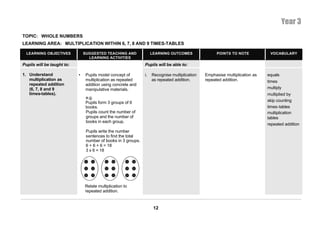
1. Understand               •    Pupils model concept of        i.   Recognise multiplication   Emphasise multiplication as   equals
   multiplication as             multiplication as repeated          as repeated addition.      repeated addition.            times
   repeated addition             addition using concrete and
   (6, 7, 8 and 9                manipulative materials.                                                                      multiply
   times-tables).                                                                                                             multiplied by
                                 e.g.
                                 Pupils form 3 groups of 6                                                                    skip counting
                                 books.                                                                                       times-tables
                                 Pupils count the number of                                                                   multiplication
                                 groups and the number of                                                                     tables
                                 books in each group.
                                                                                                                              repeated addition
                                 Pupils write the number
                                 sentences to find the total
                                 number of books in 3 groups.
                                 6 + 6 + 6 = 18
                                 3 x 6 = 18


                                Relate multiplication to
                                repeated addition.


                                                                      12
Year 3
TOPIC: WHOLE NUMBERS
LEARNING AREA: MULTIPLICATION WITHIN 6, 7, 8 AND 9 TIMES-TABLES

  LEARNING OBJECTIVES           SUGGESTED TEACHING AND                  LEARNING OUTCOMES                    POINTS TO NOTE               VOCABULARY
                                  LEARNING ACTIVITIES
Pupils will be taught to:                                            Pupils will be able to:

                            •    Pupils write number                 ii. Write number sentences      Emphasise ‘x’ and ‘=’ signs in      times
                                 sentences for multiplication.           for multiplication.         number sentences.                   multiply
                                e.g.1                                iii. Build up the               Relate ‘x’ to times and multiply.   multiplied by
                                                                          multiplication tables of                                       equals
                                                                          6, 7, 8 and 9.             Read number sentence                is equal to
                                                                                                     6 x 4 = 24 as “six times four
                                              2 x 7 = 14             iv. Multiply two 1-digit        equals twenty-four” or “six         skip counting
                                                                         numbers.                    multiplied by four is equal to      times-tables
                            e.g.2                                                                    twenty-four.”                       number sentence
                                    0     6      12        18   24                                                                       multiplication
                                                                                                     Include activities such as making
                                           3 x 6 = 18                                                                                    multiplication
                                                                                                     number patterns using
                            •    Pupils build up multiplication
                                                                                                     manipulatives or ICT to build up    tables
                                 tables of 6, 7, 8 and 9 using
                                                                                                     multiplication tables.              build up
                                 concrete objects, manipulative
                                 materials or pictorial                                                                                  standard written
                                 representations.                                                    Emphasise multiplication using
                                                                                                                                         method
                                                                                                     standard written method.
                                                                                                     e.g.   7                            one-digit number
                                         1x8=8
                                                                                                           x6

                                                 2 x 8 = 16


                                                       3 x 8 = 24


                                                                         13
Year 3
TOPIC: WHOLE NUMBERS
LEARNING AREA: MULTIPLICATION WITHIN 6, 7, 8 AND 9 TIMES-TABLES

  LEARNING OBJECTIVES           SUGGESTED TEACHING AND               LEARNING OUTCOMES                     POINTS TO NOTE             VOCABULARY
                                  LEARNING ACTIVITIES
Pupils will be taught to:                                          Pupils will be able to:

2. Know by heart the        •    Pupils list all possible          i. Recall rapidly the           Pupils should know by heart the   times
   multiplication tables of      combinations of two numbers          multiplication facts of 6,   basic facts of multiplication     multiply
   6, 7, 8 and 9.                that equals to a given product.      7, 8 and 9 times-tables.     involving 6, 7, 8 and 9 times-
                                                                                                   tables.                           multiplied by
                                 e.g. Product is 72                                                                                  equals
                                      12 x 6 = 72                                                  Relate skip counting by sixes,    is equal to
                                      9 x 8 = 72                                                   sevens, eights and nines to
                                      8 x 9 = 72                                                   multiplication.                   multiplication
                                      6 x 12 = 72                                                                                    recall
                                                                                                   Emphasise mental calculation.     skip count
                            •    Pupils use flash cards and say
                                 aloud multiplication facts.

                            •    Pupils memorise multiplication
                                 tables by singing or chanting.

                            •    Pupils respond rapidly to oral
                                 and written questions such as:

                                e.g. 8 times 7.
                                     Multiply 9 by 6.


                                                                       14
Year 3
TOPIC: WHOLE NUMBERS
LEARNING AREA: MULTIPLICATION WITHIN 6, 7, 8 AND 9 TIMES-TABLES

  LEARNING OBJECTIVES           SUGGESTED TEACHING AND               LEARNING OUTCOMES                       POINTS TO NOTE               VOCABULARY
                                  LEARNING ACTIVITIES
Pupils will be taught to:                                         Pupils will be able to:

3. Use and apply            •    Pupils find unknown numbers      i. Find unknown numbers           Use and apply knowledge of           unknown
   knowledge of                  in number sentences.                in number sentences.           multiplication in a variety of       numbers
   multiplication in real                                                                           contexts.                            times
   life.                         e.g.       x 8 = 56              ii. Solve problems involving
                                                                      multiplication in real life   Emphasise finding unknown            multiply
                                            x       = 81              situations.                   numbers in number sentences          multiplied by
                                                                                                    as follows:
                                                                                                                                         equals
                            •    Pupils solve problems by                                               a. 2 x 6 =                       is equal to
                                 simulating or modelling                                                a. 9 x        = 63               number sentence
                                 situations.
                                                                                                        b.       x 8 = 24                solve
                            •    Pupils pose problems based
                                 on given information involving                                         c.       x        = 49
                                 multiplication.                                                        d.    = =8x7
                                                                                                        e. 72 = 9 x
                                                                                                        f.   64 =     x8
                                                                                                        g. 54 =       x

                                                                                                    Emphasise mental calculation.

                                                                                                    Select problems according to
                                                                                                    pupils’ ability and proficiency in
                                                                                                    language.


                                                                      15
Year 3
TOPIC: WHOLE NUMBERS
LEARNING AREA: MULTIPLICATION WITH THE HIGHEST PRODUCT OF 1000

  LEARNING OBJECTIVES           SUGGESTED TEACHING AND                 LEARNING OUTCOMES                  POINTS TO NOTE                 VOCABULARY
                                  LEARNING ACTIVITIES
Pupils will be taught to:                                        Pupils will be able to:

1. Understand and use       •    Pupils use concrete materials   i.    Multiply 2-digit numbers   Emphasise that any number             times
   the operation of              and pictorial representations         by 1-digit numbers         multiplied by zero results in zero.   multiply
   multiplication.               to develop the concept of             without regrouping.        e.g.
                                 multiplication.                                                  6x0=0                                 multiplied by
                                                                 ii.   Multiply 2-digit numbers   0x6=0                                 equals
                            •    Pupils multiply two numbers           by 10.
                                 without regrouping.                                                                                    is equal to
                                                                                                  Emphasise that a number
                                                                 iii. Multiply 2-digit numbers    multiplied by one will give an        without
                                 e.g.
                                 1. 14 x 2 = 28                       by 1-digit numbers with     answer the same as the number.        regrouping
                                 2. 80 x 10 = 800                     regrouping.                 e.g.                                  with regrouping
                                 3. 213 x 3 = 639                                                 18 x 1 = 18                           multiplication
                                                                 iv. Multiply 3-digit numbers     1 x 18 = 18
                            •    Pupils multiply two numbers         by 1-digit numbers                                                 product
                                 with regrouping.                    without regrouping.          Emphasis e multiplication using
                                 e.g.                                                             standard written method.
                                                                 v. Multiply 3-digit numbers
                                 1. 57 x 6 = 342
                                                                    by 1-digit numbers with
                                 2. 438 x 4 = 1752                                                Emphasise mental calculation.
                                                                    regrouping.
                            •    Pupils multiply two numbers
                                 mentally by partitioning the
                                 multiplier.
                                 e.g.   23 x 4 =
                                        20 x 4 = 80
                                         3 x 4 = 12
                                        23 x 4 = 92


                                                                        16
Year 3
TOPIC: WHOLE NUMBERS
LEARNING AREA: MULTIPLICATION WITH THE HIGHEST PRODUCT OF 1000

  LEARNING OBJECTIVES           SUGGESTED TEACHING AND              LEARNING OUTCOMES                     POINTS TO NOTE                VOCABULARY
                                  LEARNING ACTIVITIES
Pupils will be taught to:                                         Pupils will be able to:

                            •    Pupils solve problems by         vi. Solve problems involving Use and apply knowledge of              times
                                 simulating or modelling              multiplication in real life multiplication in a variety of       multiply
                                 situations.                          situations.                 contexts.
                                                                                                                                       multiplied by
                            •    Pupils pose problems based                                       Continue to develop the              equals
                                 on given information involving                                   understanding of multiplication      is equal to
                                 multiplication.                                                  as repeated addition.
                                                                                                                                       without
                                                                                                  Select problems according to         regrouping
                                                                                                  pupils’ ability and proficiency in   with regrouping
                                                                                                  language.                            multiplication
                                                                                                  Encourage pupils to express          product
                                                                                                  ideas and opinions clearly.          solve
                                                                                                                                       problems


                                                                      17
Year 3
TOPIC: WHOLE NUMBERS
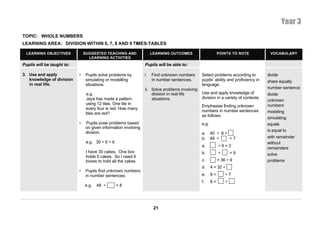
LEARNING AREA: DIVISION WITHIN 6, 7, 8 AND 9 TIMES-TABLES

  LEARNING OBJECTIVES        SUGGESTED TEACHING AND               LEARNING OUTCOMES                POINTS TO NOTE               VOCABULARY
                               LEARNING ACTIVITIES
Pupils will be taught to:                                       Pupils will be able to:

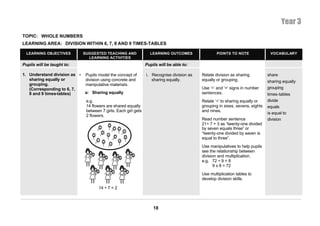
1. Understand division as • Pupils model the concept of         i. Recognise division as   Relate division as sharing          share
   sharing equally or       division using concrete and            sharing equally.        equally or grouping.                sharing equally
   grouping.                manipulative materials.
   (Corresponding to 6, 7,                                                                 Use ‘÷’ and ‘=’ signs in number     grouping
   8 and 9 times-tables)    a: Sharing equally                                             sentences.                          times-tables
                              e.g.                                                         Relate ‘÷’ to sharing equally or    divide
                              14 flowers are shared equally                                grouping in sixes, sevens, eights   equals
                              between 7 girls. Each girl gets                              and nines.
                                                                                                                               is equal to
                              2 flowers.
                                                                                           Read number sentence                division
                                                                                           21÷ 7 = 3 as “twenty-one divided
                                                                                           by seven equals three” or
                                                                                           “twenty-one divided by seven is
                                                                                           equal to three”.
                                                                                           Use manipulatives to help pupils
                                                                                           see the relationship between
                                                                                           division and multiplication.
                                                                                           e.g. 72 ÷ 9 = 8
                                                                                                  9 x 8 = 72
                                                                                           Use multiplication tables to
                                                                                           develop division skills.

                                    14 ÷ 7 = 2


                                                                    18
Year 3
TOPIC: WHOLE NUMBERS
LEARNING AREA: DIVISION WITHIN 6, 7, 8 AND 9 TIMES-TABLES

  LEARNING OBJECTIVES           SUGGESTED TEACHING AND       LEARNING OUTCOMES                      POINTS TO NOTE      VOCABULARY
                                  LEARNING ACTIVITIES
Pupils will be taught to:                                  Pupils will be able to:

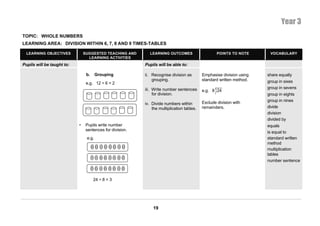
                                 b.     Grouping           ii. Recognise division as        Emphasise division using   share equally
                                                               grouping.                    standard written method.   group in sixes
                                 e.g. 12 ÷ 6 = 2
                                                           iii. Write number sentences                                 group in sevens
                                                                                            e.g. 8 24
                                                                for division.                                          group in eights
                                                                                            Exclude division with      group in nines
                                                           iv. Divide numbers within
                                                               the multiplication tables.   remainders.                divide
                                                                                                                       division
                                                                                                                       divided by
                            •    Pupils write number                                                                   equals
                                 sentences for division.
                                                                                                                       is equal to
                                 e.g.                                                                                  standard written
                                                                                                                       method
                                                                                                                       multiplication
                                                                                                                       tables
                                                                                                                       number sentence


                                      24 ÷ 8 = 3


                                                               19
Year 3
TOPIC: WHOLE NUMBERS
LEARNING AREA: DIVISION WITHIN 6, 7, 8 AND 9 TIMES-TABLES

  LEARNING OBJECTIVES          SUGGESTED TEACHING AND                 LEARNING OUTCOMES                POINTS TO NOTE              VOCABULARY
                                 LEARNING ACTIVITIES
Pupils will be taught to:                                        Pupils will be able to:

2. Derive quickly division •    Pupils use flash cards and       i.   Derive quickly division   Pupils should know by heart the   divide
   facts.                       say division facts aloud.             facts of 6, 7, 8 and 9    division facts of 6, 7, 8 and 9   division
   (Corresponding to 6, 7,                                            times-tables.             times-tables.
   8 and 9 times-tables)   •    Pupils respond rapidly to oral                                                                    share equally
                                and written questions.                                          Emphasise mental calculation.     group
                                                                                                                                  number sentence
                                e.g.   Share 25 among 5.
                                       Divide 30 by 6.                                                                            derive


                                                                       20
Year 3
TOPIC: WHOLE NUMBERS
LEARNING AREA: DIVISION WITHIN 6, 7, 8 AND 9 TIMES-TABLES

  LEARNING OBJECTIVES           SUGGESTED TEACHING AND                 LEARNING OUTCOMES                     POINTS TO NOTE            VOCABULARY
                                  LEARNING ACTIVITIES
Pupils will be taught to:                                         Pupils will be able to:

3. Use and apply            •    Pupils solve problems by         i.   Find unknown numbers      Select problems according to         divide
   knowledge of division         simulating or modelling               in number sentences.      pupils’ ability and proficiency in   share equally
   in real life.                 situations.                                                     language.
                                                                  ii. Solve problems involving                                        number sentence
                                 e.g.                                 division in real life      Use and apply knowledge of           divide
                                 Jeya has made a pattern              situations.                division in a variety of contexts.
                                                                                                                                      unknown
                                 using 12 tiles. One tile in                                                                          numbers
                                                                                                 Emphasise finding unknown
                                 every four is red. How many
                                                                                                 numbers in number sentences          modeling
                                 tiles are red?
                                                                                                 as follows.
                                                                                                                                      simulating
                            •    Pupils pose problems based                                      e.g:                                 equals
                                 on given information involving
                                 division.                                                                                            is equal to
                                                                                                 a.     40 ÷ 8 =
                                                                                                 b.     49 ÷     =7                   with remainder
                                 e.g. 30 ÷ 5 = 6                                                                                      without
                                                                                                 a.          ÷9=3
                                                                                                                                      remainders
                                 I have 30 cakes. One box                                        b.          ÷       =9               solve
                                 holds 5 cakes. So I need 6
                                 boxes to hold all the cakes.                                    c.          = 36 ÷ 9                 problems
                                                                                                 d.     4 = 32 ÷
                            •    Pupils find unknown numbers
                                 in number sentences.                                            e.     9=       ÷7
                                                                                                 f.     8=       ÷
                                e.g.   48 ÷        =8


                                                                        21
Year 3
TOPIC: WHOLE NUMBERS
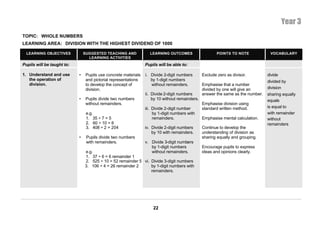
LEARNING AREA: DIVISION WITH THE HIGHEST DIVIDEND OF 1000

  LEARNING OBJECTIVES           SUGGESTED TEACHING AND             LEARNING OUTCOMES                     POINTS TO NOTE            VOCABULARY
                                  LEARNING ACTIVITIES
Pupils will be taught to:                                        Pupils will be able to:

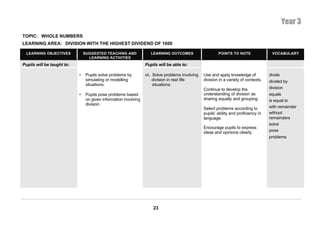
1. Understand and use       •    Pupils use concrete materials   i. Divide 2-digit numbers       Exclude zero as divisor.         divide
   the operation of              and pictorial representations      by 1-digit numbers                                            divided by
   division.                     to develop the concept of          without remainders.          Emphasise that a number
                                 division.                                                       divided by one will give an      division
                                                                 ii. Divide 2-digit numbers      answer the same as the number.   sharing equally
                            •    Pupils divide two numbers           by 10 without remainders.                                    equals
                                 without remainders.                                             Emphasise division using
                                                                 iii. Divide 2-digit number      standard written method.         is equal to
                                 e.g.                                 by 1-digit numbers with                                     with remainder
                                 1. 35 ÷ 7 = 5                        remainders.                Emphasise mental calculation.    without
                                 2. 60 ÷ 10 = 6                                                                                   remainders
                                 3. 408 ÷ 2 = 204                iv. Divide 2-digit numbers      Continue to develop the
                                                                     by 10 with remainders.      understanding of division as
                            •    Pupils divide two numbers                                       sharing equally and grouping.
                                 with remainders.                v. Divide 3-digit numbers
                                                                    by 1-digit numbers           Encourage pupils to express
                                e.g.                                without remainders.          ideas and opinions clearly.
                                1. 37 ÷ 6 = 6 remainder 1
                                2. 525 ÷ 10 = 52 remainder 5 vi. Divide 3-digit numbers
                                3. 106 ÷ 4 = 26 remainder 2      by 1-digit numbers with
                                                                 remainders.


                                                                     22
Year 3
TOPIC: WHOLE NUMBERS
LEARNING AREA: DIVISION WITH THE HIGHEST DIVIDEND OF 1000

  LEARNING OBJECTIVES           SUGGESTED TEACHING AND               LEARNING OUTCOMES                    POINTS TO NOTE                VOCABULARY
                                  LEARNING ACTIVITIES
Pupils will be taught to:                                         Pupils will be able to:

                            •    Pupils solve problems by         vii. Solve problems involving   Use and apply knowledge of           divide
                                 simulating or modelling               division in real life      division in a variety of contexts.   divided by
                                 situations.                           situations.
                                                                                                  Continue to develop the              division
                            •    Pupils pose problems based                                       understanding of division as         equals
                                 on given information involving                                   sharing equally and grouping.        is equal to
                                 division.
                                                                                                  Select problems according to         with remainder
                                                                                                  pupils’ ability and proficiency in   without
                                                                                                  language.                            remainders
                                                                                                                                       solve
                                                                                                  Encourage pupils to express
                                                                                                  ideas and opinions clearly.          pose
                                                                                                                                       problems


                                                                      23
Year 3
TOPIC: FRACTIONS
LEARNING AREA: INTRODUCTION TO FRACTIONS

  LEARNING OBJECTIVES           SUGGESTED TEACHING AND                LEARNING OUTCOMES                POINTS TO NOTE                  VOCABULARY
                                  LEARNING ACTIVITIES
Pupils will be taught to:                                        Pupils will be able to:

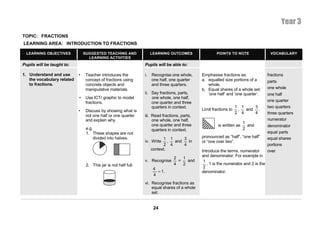
1. Understand and use       •    Teacher introduces the          i.   Recognise one whole,     Emphasise fractions as:                fractions
   the vocabulary related        concept of fractions using           one half, one quarter    a. equalled size portions of a         parts
   to fractions.                 concrete objects and                 and three quarters.         whole.
                                 manipulative materials.                                       b. Equal shares of a whole set:        one whole
                                                                 ii. Say fractions, parts,        ‘one half’ and ‘one quarter’.       one half
                            •    Use ICT/ graphic to model           one whole, one half,
                                 fractions.                          one quarter and three                                            one quarter
                                                                     quarters in context.                           1 1    3          two quarters
                            •    Discuss by showing what is                                    Limit fractions to    ,  and .
                                                                                                                    2 4    4          three quarters
                                 not one half or one quarter     iii. Read fractions, parts,
                                 and explain why.                     one whole, one half,                                            numerator
                                                                                                                        1
                                                                      one quarter and three             is written as     and         denominator
                                 e.g.                                 quarters in context.                              2
                                 1. These shapes are not                                                                              equal parts
                                     divided into halves.                   1 1      3         pronounced as “half”, “one half”       equal shares
                                                                 iv. Write     , and   in      or “one over two”.
                                                                            2 4      4                                                portions
                                                                      context.                 Introduce the terms, numerator         over
                                                                                               and denominator. For example in
                                                                                 2   1
                                                                 v. Recognise      =   and      1
                                 2. This jar is not half full.                   4   2            , 1 is the numerator and 2 is the
                                                                       4                        2
                                                                         = 1.                  denominator.
                                                                       4
                                                                 vi. Recognise fractions as
                                                                     equal shares of a whole
                                                                     set.


                                                                       24
Year 3
TOPIC: MONEY
LEARNING AREA: MONEY TO RM100

  LEARNING OBJECTIVES           SUGGESTED TEACHING AND            LEARNING OUTCOMES                POINTS TO NOTE             VOCABULARY
                                  LEARNING ACTIVITIES
Pupils will be taught to:                                       Pupils will be able to:

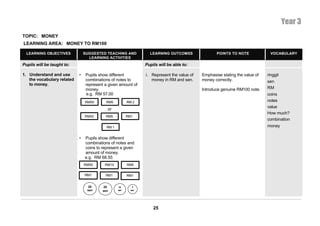
1. Understand and use       •    Pupils show different          i. Represent the value of   Emphasise stating the value of   ringgit
   the vocabulary related        combinations of notes to          money in RM and sen.     money correctly.                 sen
   to money.                     represent a given amount of
                                 money.                                                     Introduce genuine RM100 note.    RM
                                 e.g. RM 57.00                                                                               coins
                                RM50       RM5          RM 2                                                                 notes
                                                                                                                             value
                                            or
                                                                                                                             How much?
                                RM50       RM5          RM1
                                                                                                                             combination
                                           RM 1                                                                              money

                            •   Pupils show different
                                combinations of notes and
                                coins to represent a given
                                amount of money.
                                e.g. RM 68.55
                                RM50       RM10         RM5

                                RM1        RM1          RM1


                                 20      20        10      5
                                 sen     sen      sen     sen


                                                                    25
Year 3
TOPIC: MONEY
LEARNING AREA: MONEY TO RM100

  LEARNING OBJECTIVES         SUGGESTED TEACHING AND            LEARNING OUTCOMES                  POINTS TO NOTE               VOCABULARY
                                LEARNING ACTIVITIES
Pupils will be taught to:                                    Pupils will be able to:

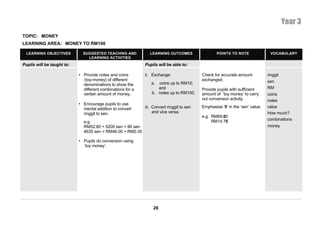
                            • Provide notes and coins        ii. Exchange:                 Check for accurate amount           ringgit
                              (toy-money) of different                                     exchanged.                          sen
                              denominations to show the         a.  coins up to RM10;
                              different combinations for a          and                    Provide pupils with sufficient      RM
                              certain amount of money.           b. notes up to RM100.     amount of ‘toy money’ to carry      coins
                                                                                           out conversion activity.            notes
                            • Encourage pupils to use
                              mental addition to convert     iii. Convert ringgit to sen   Emphasise ‘0’ in the ‘sen’ value.   value
                              ringgit to sen.                     and vice versa.                                              How much?
                                                                                           e.g. RM69.05
                                                                                                RM14.70                        combinations
                              e.g.
                              RM52.80 = 5200 sen + 80 sen                                                                      money
                              4635 sen = RM46.00 + RM0.35

                            • Pupils do conversion using
                              ‘toy money’.


                                                                 26
Year 3
TOPIC: MONEY
LEARNING AREA: MONEY TO RM100

  LEARNING OBJECTIVES           SUGGESTED TEACHING AND              LEARNING OUTCOMES                    POINTS TO NOTE            VOCABULARY
                                  LEARNING ACTIVITIES
Pupils will be taught to:                                         Pupils will be able to:

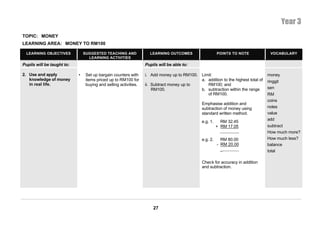
2. Use and apply            •    Set up bargain counters with     i. Add money up to RM100. Limit:                                money
   knowledge of money            items priced up to RM100 for                               a. addition to the highest total of   ringgit
   in real life.                 buying and selling activities.   ii. Subtract money up to     RM100; and
                                                                      RM100.                b. subtraction within the range       sen
                                                                                               of RM100.                          RM
                                                                                                                                  coins
                                                                                               Emphasise addition and
                                                                                               subtraction of money using         notes
                                                                                               standard written method.           value
                                                                                                                                  add
                                                                                               e.g. 1.     RM 32.45
                                                                                                         + RM 17.05               subtract
                                                                                                           ________               How much more?
                                                                                               e.g. 2.     RM 80.00               How much less?
                                                                                                         - RM 20.00               balance
                                                                                                            _______               total

                                                                                               Check for accuracy in addition
                                                                                               and subtraction.


                                                                      27
Year 3
TOPIC: MONEY
LEARNING AREA: MONEY TO RM100

  LEARNING OBJECTIVES           SUGGESTED TEACHING AND           LEARNING OUTCOMES                     POINTS TO NOTE            VOCABULARY
                                  LEARNING ACTIVITIES
Pupils will be taught to:                                      Pupils will be able to:

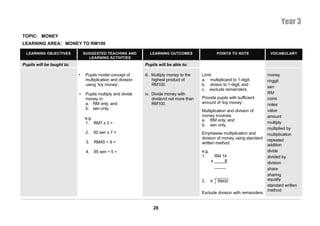
                            •    Pupils model concept of       iii. Multiply money to the   Limit:                              money
                                 multiplication and division        highest product of      a. multiplicand to 1-digit;         ringgit
                                 using ‘toy money’.                 RM100.                  b. divisor to 1-digit; and
                                                                                                                                sen
                                                                                            c. exclude remainders.
                            •    Pupils multiply and divide    iv. Divide money with                                            RM
                                 money in:                         dividend not more than   Provide pupils with sufficient      coins
                                 a. RM only; and                   RM100.                   amount of ‘toy money’.              notes
                                 b. sen only.                                                                                   value
                                                                                            Multiplication and division of
                                                                                            money involves:                     amount
                                e.g.                                                        a. RM only; and
                                1. RM7 x 3 =                                                                                    multiply
                                                                                            b. sen only.
                                                                                                                                multiplied by
                                 2.   50 sen x 7 =                                          Emphasise multiplication and        multiplication
                                                                                            division of money using standard    repeated
                                 3.   RM45 ÷ 9 =                                            written method.                     addition
                                 4.   85 sen ÷ 5 =                                          e.g.                                divide
                                                                                            1.         RM 14                    divided by
                                                                                                   x       8                    division
                                                                                                                                share
                                                                                                                                sharing
                                                                                            2.     6    RM30                    equally
                                                                                                                                standard written
                                                                                                                                method
                                                                                            Exclude division with remainders.


                                                                   28
Year 3
TOPIC: MONEY
LEARNING AREA: MONEY TO RM100

  LEARNING OBJECTIVES           SUGGESTED TEACHING AND                LEARNING OUTCOMES               POINTS TO NOTE                VOCABULARY
                                  LEARNING ACTIVITIES
Pupils will be taught to:                                           Pupils will be able to:

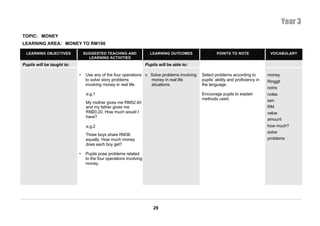
                            •    Use any of the four operations v. Solve problems involving   Select problems according to         money
                                 to solve story problems           money in real life         pupils’ ability and proficiency in   Ringgit
                                 involving money in real life.     situations.                the language.
                                                                                                                                   coins
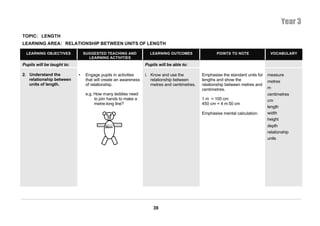
                                 e.g.1                                                        Encourage pupils to explain          notes
                                                                                              methods used.                        sen
                                 My mother gives me RM52.40
                                 and my father gives me                                                                            RM
                                 RM20.20. How much would I                                                                         value
                                 have?
                                                                                                                                   amount
                                 e.g.2                                                                                             how much?
                                                                                                                                   solve
                                 Three boys share RM36
                                 equally. How much money                                                                           problems
                                 does each boy get?

                            •    Pupils pose problems related
                                 to the four operations involving
                                 money.


                                                                        29
Year 3
TOPIC: TIME
LEARNING AREA: READING AND WRITING TIME

  LEARNING OBJECTIVES           SUGGESTED TEACHING AND              LEARNING OUTCOMES                  POINTS TO NOTE               VOCABULARY
                                  LEARNING ACTIVITIES
Pupils will be taught to:                                      Pupils will be able to:

1. Understand, read and     •   Teacher uses a clock face to   i.   Read time to the half or   Use analogue and digital clocks.   half
   write the vocabulary         show half hour and quarter          quarter hour on a clock.                                      quarter
   related to time.             hour. Pupils say time                                          Emphasise the correct ways of
                                accordingly after teacher.                                     reading time.                      hour
                                                                                               e.g.1: 4:15                        quarter past
                                                                                               a. “Quarter past four.”            quarter to
                                                                                               b. “Fifteen minutes past four.”    half past
                                                                                               c. “Fifteen past four.”
                                                                                                                                  … minutes past
                                                                                               d. “Four fifteen.”
                                                                                                                                  … past
                                                                                               e.g.2: 10:45                       … minutes to
                                                                                               a. “Quarter to eleven.”
                                                                                               b. “Fifteen minutes to eleven.”    … to
                                                                                               c. “Fifteen to eleven.”
                                                                                               d. “Ten forty-five.”

                                                                                               e.g.3: 2:30
                                                                                               a. “Half past two.”
                                                                                               b. “Thirty minutes past two.”
                                                                                               c. “Two thirty.”


                                                                     30
Year 3
TOPIC: TIME
LEARNING AREA: READING AND WRITING TIME

  LEARNING OBJECTIVES           SUGGESTED TEACHING AND             LEARNING OUTCOMES                      POINTS TO NOTE            VOCABULARY
                                  LEARNING ACTIVITIES
Pupils will be taught to:                                        Pupils will be able to:

                            •    Pupils write time to the half   ii. Write the time to the half   Emphasise the correct ways of    half
                                 and quarter hour based on           and quarter hour.            writing time.                    quarter
                                 times shown on clock faces.
                                                                 iii. Read simple timetables.     e.g.1: 2:45                      hour
                            •    Pupils read the class                                            a. Quarter to three.             quarter past
                                 timetable, bus schedules,                                        b. Fifteen minutes to three.     quarter to
                                 radio or television                                              c. Fifteen to three.
                                                                                                                                   half past
                                 programmes.                                                      d. Two forty-five.
                                                                                                                                   … minutes past
                                                                                                  e.g.2: 7.15                      … past
                                                                                                  a. Quarter past seven.
                                                                                                                                   … minutes to
                                                                                                  b. Fifteen minutes past seven.
                                                                                                  c. Fifteen past seven            … to
                                                                                                  d. Seven fifteen.

                                                                                                  e.g.3: 11.30
                                                                                                  a. Half past eleven.
                                                                                                  b. Thirty minutes past eleven.
                                                                                                  c. Eleven thirty.

                                                                                                  Check on the correct spelling.


                                                                     31
Year 3
TOPIC: TIME
LEARNING AREA: READING AND WRITING TIME

  LEARNING OBJECTIVES           SUGGESTED TEACHING AND      LEARNING OUTCOMES                POINTS TO NOTE          VOCABULARY
                                  LEARNING ACTIVITIES
Pupils will be taught to:                                 Pupils will be able to:

                            •    Pupils read calendars.   iv. Read calendars.       Emphasise the correct ways of   rows
                                                                                    reading dates.                  columns
                                                                                    e.g.                            date
                                                                                    1. 1 April       1st of April   calendars
                                                                                         First of April.
                                                                                    2. 2 May          2nd of May    month
                                                                                         Second of May.             day
                                                                                    3. 3 June        3rd of June    week
                                                                                         Third of June.
                                                                                    4. 4 July       4th of July
                                                                                         Fourth of July.


                                                              32
Year 3
TOPIC: TIME
LEARNING AREA: RELATIONSHIP BETWEEN UNITS OF TIME

  LEARNING OBJECTIVES           SUGGESTED TEACHING AND              LEARNING OUTCOMES                 POINTS TO NOTE              VOCABULARY
                                  LEARNING ACTIVITIES
Pupils will be taught to:                                         Pupils will be able to:

1. Understand the           •    Teacher uses clocks with the     i. Use units of time and    Emphasise the standard units for   minute
   relationship                  second hand to show the             know the relationship    time and show the relationship     minutes
   between units of              relationship between minutes        between:                 between them.
                                 and seconds.                                                                                    second
   time.                                                            a. minute and seconds;    1 minute = 60 seconds              seconds
                            •    Teacher uses calendar to           b. week and days; and     1 week = 7 days
                                                                    c. year and months.                                          day
                                 engage pupils in activities to                               1 year = 12 months
                                 understand the relationship                                                                     days
                                 between:                                                     Start conversion from larger to    week
                                 a. week and days; and            ii. Convert weeks to days   smaller units.                     weeks
                                 b. year and months.                  and vice versa.
                                                                                                                                 month
                            •    Pupils convert larger units to                                                                  months
                                 smaller units and vice versa.                                                                   year
                                                                                                                                 years
                                 e.g. 5 weeks = 35 days
                                      28 days = 4 weeks                                                                          second hand
                                                                                                                                 minute hand
                            •    Pupils respond rapidly to oral
                                                                                                                                 hour hand
                                 and written questions
                                 involving conversion.                                                                           units
                                                                                                                                 convert


                                                                      33
Year 3
TOPIC: TIME
LEARNING AREA: ADDITION, SUBTRACTION, MULTIPLICATION AND DIVISION INVOLVING TIME

  LEARNING OBJECTIVES            SUGGESTED TEACHING AND                 LEARNING OUTCOMES                       POINTS TO NOTE          VOCABULARY
                                   LEARNING ACTIVITIES
Pupils will be taught to:                                          Pupils will be able to:

1. Add, subtract, multiply   •    Pupils add and subtract units    i.   Add units of time in:       Exclude compound units.            hour
   and divide units of            of time in:                                                                                          hours
   time.                          a. hours; and                         a. hours; and               Exclude conversion of units.
                                  b. minutes.                           b. minutes.                                                    minute
                                                                                                    Emphasis e mental calculation.     minutes
                                  e.g.                                                                                                 add
                                 1. 3 hours + 2 hours = 5 hours    ii. Subtract units of time in:   Include addition and subtraction
                                                                                                                                       plus
                                                                        a. hours; and               of time using standard written
                                 2. 20 minutes + 10 minutes +                                       method.                            total
                                                                        b. minutes.
                                    35 minutes = 65 minutes                                                                            sum
                                                                                                    e.g.
                                 3. 14 hours – 9 hours = 5 hours                                                                       equals
                                                                                                    1.     15 minutes                  is equal to
                                 4. 130 minutes – 45 minutes =                                             30 minutes                  altogether
                                    85 minutes                                                           + 25 minutes                  subtract
                                                                                                                                       minus
                                                                                                                                       take away
                                                                                                    2.        14 hours                 … hours left?
                                                                                                          -    8 hours
                                                                                                                                       … minutes left?


                                                                         34
Year 3
TOPIC: TIME
LEARNING AREA: ADDITION, SUBTRACTION, MULTIPLICATION AND DIVISION INVOLVING TIME

  LEARNING OBJECTIVES           SUGGESTED TEACHING AND           LEARNING OUTCOMES                       POINTS TO NOTE            VOCABULARY
                                  LEARNING ACTIVITIES
Pupils will be taught to:                                     Pupils will be able to:

                            •    Pupils multiply and divide   iii. Multiply units of time in:   Limit:                            hour
                                 units of time in:                                              a. multiplicand to 1-digit;       hours
                                 a. hours;                        a. hours; and                 b. divisor to 1-digit; and
                                 b. minutes.                      b. minutes.                      exclude remainders.            minute
                                                                                                                                  minutes
                                e.g.                                                            Exclude conversion of units.      times
                                1. 15 hours x 4 = 60 hours    iv. Divide units of time in:
                                                                                                                                  multiply
                                                                  a. hours; and                 Emphasise mental calculation.
                                2. 49 minutes x 3 =                                                                               multiplied by
                                                                  b. minutes.
                                   147 minutes                                                  Include multiplication and        share
                                                                                                division of time using standard
                                3. 18 hours ÷ 9 = 2 hours                                                                         share equally
                                                                                                written method.
                                                                                                                                  division
                                4. 240 minutes ÷ 6 =                                            e.g.                              divide
                                   40 minutes
                                                                                                                                  divided by
                                                                                                1.      13 hours
                                                                                                       x 7                        recall
                                                                                                                                  times- tables
                                                                                                                                  equals
                                                                                                                                  is equal to

                                                                                                2.     6 42 minutes


                                                                   35
Year 3
TOPIC: TIME
LEARNING AREA: SOLVING PROBLEMS INVOLVING TIME

  LEARNING OBJECTIVES           SUGGESTED TEACHING AND               LEARNING OUTCOMES                       POINTS TO NOTE                VOCABULARY
                                  LEARNING ACTIVITIES
Pupils will be taught to:                                         Pupils will be able to:

1. Use and apply            •    Pupils solve problems            i. Solve problems involving        Select problems according to         hour
   knowledge of time in          involving time in real life         time in real life situations.   pupils’ ability and proficiency in
   real life.                    situations.                                                         language.                            hours
                                                                                                                                          minute
                                 e.g.                                                                Exclude conversion of units.         minutes
                                 1. Shanti got into the pool at
                                     3 o’clock. She came out                                                                              add
                                     at 5 o’clock. How long did                                                                           plus
                                     she swim?
                                                                                                                                          take away
                                 2. Hon Meng takes 15                                                                                     minus
                                    minutes to answer 5                                                                                   times
                                    questions. How long does
                                                                                                                                          multiply
                                    he take to answer 1
                                    question?                                                                                             multiplied by
                                                                                                                                          share
                            •    Pupils pose problems related
                                 to the four operations                                                                                   share equally
                                involving time.                                                                                           divide
                                                                                                                                          divided by
                                                                                                                                          equals
                                                                                                                                          is equal to
                                                                                                                                          solve
                                                                                                                                          pose


                                                                       36
Year 3
TOPIC: LENGTH
LEARNING AREA: MEASURING AND COMPARING LENGTHS

  LEARNING OBJECTIVES           SUGGESTED TEACHING AND                              LEARNING OUTCOMES                 POINTS TO NOTE               VOCABULARY
                                  LEARNING ACTIVITIES
Pupils will be taught to:                                                      Pupils will be able to:

1. Measure and              • Teacher shows and explains                       i.   Read scales to the        Emphasise that measuring            read
   compare lengths            reading of scales to the                              nearest division.         should start from the ‘0’ mark of   scales
   using standard units.      nearest division.                                                               the ruler.
                                                                               ii. Measure and record                                             measure
                            • Pupils read scales on metre                          lengths of objects using   Introduce the abbreviations:     metres
                              and centimetre rulers.                               the standard units         a. ‘m’ for metre; and            m
                                                                                                              b. ‘cm’ for centimetre.
                            •    Pupils measure and record                                                                                     centimetres
                                                                                    a. metres; and
                                 lengths of objects using
                                                                                    b. centimetres.           Ensure that diagrams or pictures cm
                                 metre or centimetre rulers.
                                                                                                              given are of exact measurements, length
                                                                               iii. Compare the lengths of    for example 3 m, 10 cm and
                            •    Pupils measure and compare                         two objects using         18 cm.                           height
                                 lengths of objects using                           standard units                                             width
                                 standard units.                                                              Exclude compound units.          depth
                                                                                    a. metres; and
                                e.g.                                                                                                           measure
                                                                                    b. centimetres.           Measurements are made to
                                                                                                              the nearest metre and            compare
                                                                                                              centimetre.                      measurement
                                     I I I I I I I I I I I I I I I I I I I I
                                    0        5         10       15        20                                  Emphasise that depth is
                                                                                                              equivalent to height.
                                The pencil is 15 cm long.
                                The crayon is 10 cm long.
                                The pencil is 5 cm longer than
                                the crayon.


                                                                                     37
Year 3
TOPIC: LENGTH
LEARNING AREA: MEASURING AND COMPARING LENGTHS

LEARNING OBJECTIVES         SUGGESTED TEACHING AND                              LEARNING OUTCOMES                  POINTS TO NOTE           VOCABULARY
                              LEARNING ACTIVITIES
Pupils will be taught to:                                                      Pupils will be able to:

                            •      Pupils estimate lengths of                  iv. Estimate the lengths of   Emphasise choosing suitable   estimate
                                   objects then check with the                     objects in:               units for estimations.        estimation
                                   actual measurements.
                                                                                  a. metres; and             Encourage pupils to analyse how actual
                                 Objects      Estimate   Actual   Difference      b. centimetres.            close their estimates were.     measure
                                Height of
                                door
                                                                                                                                             measurements
                                                                                                                                           metres
                                Length of
                                pupil’s arm                                                                                                m
                                Width of
                                room
                                                                                                                                           centimetres
                                                                                                                                           cm
                                Depth of
                                pail                                                                                                       height
                                                                                                                                           length
                                                                                                                                           depth
                                                                                                                                           width
                                                                                                                                           record
                                                                                                                                           check
                                                                                                                                           difference


                                                                                   38
Year 3
TOPIC: LENGTH
LEARNING AREA: RELATIONSHIP BETWEEN UNITS OF LENGTH

  LEARNING OBJECTIVES           SUGGESTED TEACHING AND             LEARNING OUTCOMES                 POINTS TO NOTE               VOCABULARY
                                  LEARNING ACTIVITIES
Pupils will be taught to:                                        Pupils will be able to:

2. Understand the           •    Engage pupils in activities     i. Know and use the          Emphasise the standard units for   measure
   relationship between          that will create an awareness      relationship between      lengths and show the               metres
   units of length.              of relationship.                   metres and centimetres.   relationship between metres and
                                                                                              centimetres.                       m
                                 e.g. How many teddies need                                                                      centimetres
                                      to join hands to make a                                 1 m = 100 cm                       cm
                                      metre-long line?                                        450 cm = 4 m 50 cm
                                                                                                                                 length
                                                                                              Emphasise mental calculation.      width
                                                                                                                                 height
                                           20cm                                                                                  depth
                                                                                                                                 relationship
                                                                                                                                 units


                                                                     39
Year 3

TOPIC: LENGTH
LEARNING AREA: ADDITION, SUBTRACTION, MULTIPLICATION AND DIVISION INVOLVING LENGTH

  LEARNING OBJECTIVES            SUGGESTED TEACHING AND               LEARNING OUTCOMES                      POINTS TO NOTE              VOCABULARY
                                   LEARNING ACTIVITIES
Pupils will be taught to:                                           Pupils will be able to:

1. Add, subtract, multiply   •    Pupils add units of length in     i. Add units of length in:      Exclude compound units.             metres
   and divide units of            metres and centimetres.                                                                               m
   length.                                                            a. metres; and                Include addition and subtraction
                             •    Pupils subtract units of length     b. centimetres.               of lengths using standard written   centimetres
                                  in metres and centimetres.                                        method.                             cm
                                                                                                                                        add
                                                                    ii. Subtract units of length in: e.g.
                                                                                                                                        subtract
                                                                      a. metres; and                1.        12 m                      units
                                                                      b. centimetres.                       + 13 m                      lengths
                                                                                                                                        take away
                                                                                                                                        minus
                                                                                                                                        total
                                                                                                    2.       150 cm
                                                                                                                                        sum
                                                                                                            − 80 cm
                                                                                                                                        altogether
                                                                                                                                        difference
                                                                                                                                        What is left?
                                                                                                                                        standard
                                                                                                                                        written method


                                                                        40
Year 3
TOPIC: LENGTH
LEARNING AREA: ADDITION, SUBTRACTION, MULTIPLICATION AND DIVISION INVOLVING LENGTH

  LEARNING OBJECTIVES           SUGGESTED TEACHING AND                 LEARNING OUTCOMES                     POINTS TO NOTE            VOCABULARY
                                  LEARNING ACTIVITIES
Pupils will be taught to:                                           Pupils will be able to:

                            •    Pupils multiply units of length    iii. Multiply units of length    Exclude compound units.          metres
                                 in metres and centimetres.              in:                                                          m
                                                                                                     Limit multiplicand to 1-digit.
                                e.g. 78 m x 5 =                         a. metres; and                                                centimetres
                                                                        b. centimetres.              Limit divisor to 1-digit and     cm
                            •    Pupils divide units of length in                                    exclude remainders.              multiply
                                 metres and centimetres.
                                                                    iv. Divide units of length in:   Include multiplication and       divide
                                e.g. 200 cm ÷ 4 =                                                    division of lengths using        lengths
                                                                        a. metres; and               standard written method.         units
                                                                        b. centimetres.
                                                                                                     e.g.                             standard
                                                                                                                                      written method
                                                                                                     1.         37 m
                                                                                                            x    4


                                                                                                     2.     8 72 cm


                                                                        41
Year 3
TOPIC: LENGTH
LEARNING AREA: SOLVING PROBLEMS INVOLVING LENGTH

  LEARNING OBJECTIVES           SUGGESTED TEACHING AND            LEARNING OUTCOMES                   POINTS TO NOTE                VOCABULARY
                                  LEARNING ACTIVITIES
Pupils will be taught to:                                       Pupils will be able to:

1. Use and apply            •    Pupils solve problems by       i. Solve problems involving   Select problems according to         solve
   knowledge of length           simulating and modelling the      length in real life        pupils’ ability and proficiency in   problems
   in real life.                 situation.                        situations.                language.
                                                                                                                                   length
                                 e.g.                                                         Encourage pupils to explain          How many left?
                                 A child throws a bean bag.                                   methods used.                        add
                                 1st throw = 3 m
                                 2nd throw = 5 m                                                                                   plus
                                 What is the difference                                                                            take away
                                 between the two throws?
                                                                                                                                   minus
                            •    Pupils pose problems related                                                                      times
                                 to the four operations                                                                            multiply
                                involving length.
                                                                                                                                   multiplied by
                                                                                                                                   share
                                                                                                                                   share equally
                                                                                                                                   divide
                                                                                                                                   divided by
                                                                                                                                   pose


                                                                    42
Year 3
TOPIC: MASS
LEARNING AREA: MEASURING AND COMPARING MASSES

  LEARNING OBJECTIVES           SUGGESTED TEACHING AND               LEARNING OUTCOMES                POINTS TO NOTE               VOCABULARY
                                  LEARNING ACTIVITIES
Pupils will be taught to:                                       Pupils will be able to:

1. Measure and compare      •    Pupils read scales using       i.   Read scales to the       Emphasise that measuring            mass
   masses using                  weighing scales.                    nearest division.        should start from the ‘0’ mark of   kilograms
   standard units.                                                                            the weighing scale.
                            •    Teacher shows and explains     ii. Measure and record                                            kg
                                 reading of scales to the           masses of objects using   Introduce the abbreviations:        grams
                                 nearest division.                  the standard units:       a. ‘kg’ for kilogram; and           g
                                                                                              b. ‘g’ for gram.
                                 Pupils measure masses of                                                                         weigh
                                                                     a. kilograms; and
                                 objects such as a book, an
                                                                     b. grams.                Exclude compound units.             weight
                                 egg or an empty box using
                                 weighing scales and record                                                                       weighing scale
                                 them in kilograms and grams.                                 Measurements are made to the
                                                                iii. Compare the masses of    nearest kilogram and gram.          measure
                            •    Pupils measure and compare          two objects using                                            compare
                                 masses of objects using             standard units:                                              heavy
                                 standard units in kilograms                                                                      heavier
                                 and grams.                          a. kilograms, and
                                                                     b. grams.                                                    light
                                 e.g.                                                                                             lighter
                                 An apple weighs 180 g.
                                 An orange weighs 200 g.
                                 The orange is 20 g heavier
                                 than the apple.


                                                                      43
Year 3
TOPIC: MASS
LEARNING AREA: MEASURING AND COMPARING MASSES

  LEARNING OBJECTIVES            SUGGESTED TEACHING AND                     LEARNING OUTCOMES              POINTS TO NOTE              VOCABULARY
                                   LEARNING ACTIVITIES
Pupils will be taught to:                                                 Pupils will be able to:

                            •      Pupils estimate masses and             iv. Estimate masses of    Emphasise choosing suitable       weigh
                                   check with the actual                      objects in            units for estimations.            mass
                                   measurements.
                                                                              a. kilograms; and     Encourage pupils to use ‘try,     estimate
                                   e.g.                                       b. grams.             check and improve’ procedure to   estimation
                                                                                                    narrow down differences           kilograms
                                Objects      Estimate Actual Difference                             between estimates and actual
                                                                                                    measurements.                     kg
                                marbles
                                                                                                                                      grams
                                plasticine
                                                                                                                                      g
                                box
                                                                                                                                      nearest


                                                                              44
Year 3
TOPIC: MASS
LEARNING AREA: RELATIONSHIP BETWEEN UNITS OF MASS

  LEARNING OBJECTIVES           SUGGESTED TEACHING AND                         LEARNING OUTCOMES              POINTS TO NOTE               VOCABULARY
                                  LEARNING ACTIVITIES
Pupils will be taught to:                                                    Pupils will be able to:

1. Understand the           •   Teacher prepares a few 1 kg                  i. Know and use the       Emphasise the standard units for   measure
   relationship between         and 100 g sand bags. Using                      relationship between   mass and show the relationship     kilograms
   units of mass.               the equal arm balance, pupils                   kilograms and grams.   between kilograms and grams.
                                balance a 1 kg sand bag with                                                                              kg
                                the equivalent number of                                               1 kg = 1000 g                      grams
                                100 g sandbags.                                                        2 kg = 2000 g                      g
                                                                                                       Emphasise mental calculation.      weighing balance
                                                        100g
                                                                                                                                          weigh
                                                      100g    100g
                                  1 kg          100g     100g    100g                                                                     scales
                                               100g    100g    100g   100g
                                                                                                                                          units
                                                                                                                                          mass
                                                                                                                                          relationship
                                                                                                                                          spring balance
                                 Pupils then weigh the sand
                                 bags on weighing scale to                                                                                equal arm
                                 see the relationship between                                                                             balance
                                 kilograms and grams.


                                                                                 45
Year 3
TOPIC: MASS
LEARNING AREA: ADDITION, SUBTRACTION, MULTIPLICATION AND DIVISION INVOLVING MASS

  LEARNING OBJECTIVES            SUGGESTED TEACHING AND             LEARNING OUTCOMES                       POINTS TO NOTE              VOCABULARY
                                   LEARNING ACTIVITIES
Pupils will be taught to:                                         Pupils will be able to:

1. Add, subtract, multiply   •    Pupils add and subtract units   i. Add units of mass in:         Exclude compound units.            add
   and divide units of            of masses in                                                                                        plus
   mass.                          a. kilograms; and                  a. kilograms; and             Include addition and subtraction
                                  b. grams.                          b. grams.                     of masses using standard written   total
                                                                                                   method.                            mass
                                  e.g.                                                                                                weight
                                  a. 25 kg + 40 kg =              ii. Subtract units of mass in:   e.g.
                                  b. 10 kg + 68 kg + 30 kg =                                                                          subtract
                                  c. 200g + 300 g =                  a. kilograms; and             1.       25 kg                     take away
                                  d. 500 g + 150 g + 70 g =          b. grams.                               6 kg                     kilograms
                                                                                                          + 40 kg
                                  e.g.                                                                                                kg
                                  a. 75 kg – 14 kg =                                                                                  grams
                                  b. 100 kg – 80 kg – 40 kg=                                                                          g
                                  c. 550 g – 200 g =                                               2.       500 g                     standard
                                  d. 780 g – 150 g – 200 g =                                              − 150 g                     written method


                                                                      46
Year 3
TOPIC: MASS
LEARNING AREA: ADDITION, SUBTRACTION, MULTIPLICATION AND DIVISION INVOLVING MASS

  LEARNING OBJECTIVES           SUGGESTED TEACHING AND          LEARNING OUTCOMES                    POINTS TO NOTE            VOCABULARY
                                  LEARNING ACTIVITIES
Pupils will be taught to:                                     Pupils will be able to:

                            •    Pupils multiply and divide   iii. Multiply units of mass in: Exclude compound units.         multiply
                                 units of masses in
                                 a. kilograms                     a. kilograms; and          Limit multiplicand to 1-digit.   divide
                                 b. grams.                        b. grams.                                                   mass
                                                                                             Limit divisor to 1-digit and     weight
                                 e.g.                                                        exclude remainders.
                                 a. 25 kg x 5 =               iv. Divide units of mass in:                                    kilograms
                                 b. 120 g x 3 =                                              Include multiplication and       kg
                                                                  a. kilograms; and          division of masses using         grams
                                 e.g.                             b. grams.                  standard written method.
                                                                                                                              g
                                 a. 56 kg ÷ 7 =
                                 b. 720 g ÷ 6 =                                              e.g:                             standard
                                                                                                                              written method
                                                                                             1.         84 kg
                                                                                                    x    4


                                                                                             2.     8 640 g


                                                                  47
Year 3
TOPIC: MASS
LEARNING AREA: SOLVING PROBLEMS INVOLVING MASS

  LEARNING OBJECTIVES           SUGGESTED TEACHING AND            LEARNING OUTCOMES                   POINTS TO NOTE                VOCABULARY
                                  LEARNING ACTIVITIES
Pupils will be taught to:                                       Pupils will be able to:

1. Use and apply            •    Pupils solve problems.         i. Solve problems involving   Select problems according to         solve
   knowledge of mass in                                            mass in real life          pupils’ ability and proficiency in   problems
   real life.                    e.g.                              situations.                the language.
                                 A book weighs 90 g?                                                                               mass
                                 What is the weight of 6                                      Encourage pupils to explain          weigh
                                 books?                                                       methods used.                        weighs
                            •    Pupils pose problems related                                                                      weight
                                 to the four operations                                                                            add
                                involving mass.                                                                                    plus
                                                                                                                                   take away
                                                                                                                                   minus
                                                                                                                                   times
                                                                                                                                   multiply
                                                                                                                                   multiplied by
                                                                                                                                   share
                                                                                                                                   share equally
                                                                                                                                   divide
                                                                                                                                   divided by
                                                                                                                                   pose


                                                                    48
Year 3
TOPIC: VOLUME OF LIQUID
LEARNING AREA: MEASURING AND COMPARING VOLUMES OF LIQUIDS

  LEARNING OBJECTIVES           SUGGESTED TEACHING AND               LEARNING OUTCOMES               POINTS TO NOTE                VOCABULARY
                                  LEARNING ACTIVITIES
Pupils will be taught to:                                          Pupils will be able to:

1. Measure and compare      •    Teacher shows picture of          i. Read scales to the     Emphasise that measuring            scales
   volumes of liquid             measuring jugs which are             nearest division.      should start from the ‘0’ mark of
                                                                                                                                 measuring
   using standard units.         calibrated at 100 ml division                               the measuring cylinder.
                                 (with every division marked                                                                     cylinder
                                 with reading in ml ). Jugs                                  Introduce the abbreviations:        measuring jug
                                 should contain water at                                     b. ‘ l ’ for litre; and             water level
                                 different levels. Pupils read                               b. ‘ ml ’ for millilitre.
                                                                                                                                 volume
                                 scales to the nearest division.
                                                                                             Exclude compound units.             liquid
                                                                                                                                 litres
                                                                                             Measurements are made to the         l
                                                                                             nearest litre and millilitre.
                                                                                                                                 millilitres
                                                                                                                                 ml


                                                                       49
Year 3
TOPIC: VOLUME OF LIQUID
LEARNING AREA: MEASURING AND COMPARING VOLUMES OF LIQUIDS

  LEARNING OBJECTIVES           SUGGESTED TEACHING AND              LEARNING OUTCOMES                    POINTS TO NOTE             VOCABULARY
                                  LEARNING ACTIVITIES
Pupils will be taught to:                                         Pupils will be able to:

                            •    Pupils fill uncalibrated         ii. Measure and record         Exclude compound units.          litres
                                 containers with water (up to         volumes of liquids using
                                 any level) and display their         the standard units:        Provide pupils with sufficient    l
                                 containers.                                                     materials for activities.        millilitres
                                                                     a. litres; and                                               ml
                                 Teacher gives pupils 1 litre        b. millilitres.
                                 measuring cylinders that are                                                                     measure
                                 calibrated into 10 divisions                                                                     measuring
                                 and explain that each division                                                                   cylinder
                                 represents 100 ml . Ask
                                 pupils to pour water from                                                                        capacity
                                 uncalibrated containers into                                                                     volumes
                                 1 l measuring cylinders in                                                                       liquids
                                 100 ml progressions.                                                                             holds

                                 For every 100 ml they say                                                                        contains
                                 out the volume.                                                                                  container
                                 e.g. 100 ml , 200 ml ,…

                            •    Teacher explains that the last
                                 marked division represents
                                 1000 ml or 1 l .

                            •    Pupils measure and record
                                 volumes of liquid.


                                                                      50
Year 3
TOPIC: VOLUME OF LIQUID
LEARNING AREA: MEASURING AND COMPARING VOLUMES OF LIQUIDS

  LEARNING OBJECTIVES           SUGGESTED TEACHING AND                LEARNING OUTCOMES                  POINTS TO NOTE               VOCABULARY
                                  LEARNING ACTIVITIES
Pupils will be taught to:                                           Pupils will be able to:

                            •    Pupils compare the volumes         iii. Compare the volumes of Compare and record the              litres
                                 of two liquids using standard           two liquids using      volumes of two liquids.
                                 units.                                  standard units:                                             l
                                                                                                1 l measuring cylinders can be      millilitres
                                 e.g.                                    a. litres; and         replaced by any other containers    ml
                                 Pupils pour 1 l of water into           b. millilitres.        that would accurately contain the
                                 the first container and 2 l into                               volume of 1 l .                     measuring
                                 the second container.                                                                              cylinder
                                                                                                                                    volumes
                                                                                                                                    liquids
                                                                                                                                    more
                                                                                                                                    less
                                                                                                                                    lesser
                                                                                                                                    How much?
                                      1l          2l

                            •    Repeat activity with smaller
                                 containers and 100 ml
                                 measuring cylinders.


                                                                        51
Year 3

TOPIC: VOLUME OF LIQUID
LEARNING AREA: MEASURING AND COMPARING VOLUMES OF LIQUIDS

  LEARNING OBJECTIVES           SUGGESTED TEACHING AND              LEARNING OUTCOMES              POINTS TO NOTE             VOCABULARY
                                  LEARNING ACTIVITIES
Pupils will be taught to:                                         Pupils will be able to:

                            •    Pupils are given plastic cups    iv. Estimate volumes of   Emphasise choosing suitable     estimate
                                 and rubber bands. Pupils             liquids in            units for estimations.          uncalibrated jug
                                 place a rubber band around
                                 the plastic cup and move it to      a. litres; and         Encourage pupils to analyse how volumes
                                 estimate the ‘line’ where the       b. millilitres.        close their estimates were.     capacity
                                 volume of 100 ml would                                                                     liquids
                                 reach. Check the closest
                                                                                                                            litres
                                 estimate.
                                                                                                                             l
                            •   Pupils are given a large                                                                    millilitres
                                uncalibrated jug. Pupils
                                                                                                                            ml
                                estimate the line where the
                                volume of 1 l would reach.
                                Check the closest estimate.


                                                                      52
Year 3
TOPIC: VOLUME OF LIQUID
LEARNING AREA: RELATIONSHIP BETWEEN UNITS OF VOLUME OF LIQUID

  LEARNING OBJECTIVES           SUGGESTED TEACHING AND              LEARNING OUTCOMES               POINTS TO NOTE                VOCABULARY
                                  LEARNING ACTIVITIES
Pupils will be taught to:                                        Pupils will be able to:

1. Understand the           •    Pupils are given containers of i. Know and use the          Emphasise the standard units for   litre
   relationship between          100 ml and 1 l capacities.        relationship between      volume and show the
   units of volume of                                              litres and millilitres.   relationship between litres and     l
                                 Pupils fill up 100 ml container
   liquid.                       with water and pour it into the                             millilitres.                       millilitres
                                 1 l container.                                                                                 ml
                                 (Do not reveal the capacities                               1 l = 1000 ml
                                                                                             3 l = 3000 ml                      capacity
                                 of the containers).
                                                                                                                                volume
                                 Pupils report how many                                      Emphasise mental calculation.      liquid
                                 100 ml containers are
                                 needed to fill up the 1 l
                                 container.

                                Pupils repeat activity for
                                       1
                                2l , 1 l , …
                                       2


                                                                      53
Year 3
TOPIC: VOLUME OF LIQUID
LEARNING AREA: ADDITION, SUBTRACTION, MUTIPLICATION AND DIVISION INVOLVING VOLUME OF LIQUID

  LEARNING OBJECTIVES            SUGGESTED TEACHING AND                 LEARNING OUTCOMES                  POINTS TO NOTE               VOCABULARY
                                   LEARNING ACTIVITIES
Pupils will be taught to:                                         Pupils will be able to:

1. Add, subtract, multiply   •    Pupils add and subtract units   i.     Add units of volume of    Exclude compound units.            add
   and divide units of            of volume of liquids in               liquid in:                                                    volume
   volume of liquid.              a. litres; and                                                   Emphasise mental calculation.
                                  b. millilitres                        a. litres; and                                                capacity
                                                                        b. millilitres             Check on accuracy in adding        liquid
                                  e.g.1                                                            units of volume of liquid.         litre
                                  a. 1 l + 2 l =
                                                                  ii.   Subtract units of volume   Include addition and subtraction    l
                                  b. 500 ml + 250 ml =
                                                                        of liquid in:              of volumes of liquid using         millilitres
                                  e.g.2                                                            standard written method.           ml
                                  a. 60 l - 15 l =                      a. litres; and
                                                                        b. millilitres             e.g.                               subtract
                                  b. 750 ml - 30 ml =
                                                                                                                                      How much?
                                                                                                   1.      14 l                       How much left?
                                                                                                          + 5l
                                                                                                                                      remainder


                                                                                                   2.       420 ml
                                                                                                          + 280 ml


                                                                         54
Year 3
TOPIC: VOLUME OF LIQUID
LEARNING AREA: ADDITION, SUBTRACTION, MUTIPLICATION AND DIVISION INVOLVING VOLUME OF LIQUID

  LEARNING OBJECTIVES           SUGGESTED TEACHING AND             LEARNING OUTCOMES                     POINTS TO NOTE             VOCABULARY
                                  LEARNING ACTIVITIES
Pupils will be taught to:                                        Pupils will be able to:

                            •    Pupils multiply units volume    iii. Multiply units of volume   Limit multiplicand to 1-digit.   volume
                                 of liquid in:                        of liquid in:                                               capacity
                                 a. litres                                                       Limit divisor to 1-digit and
                                 b. millilitres                      a. litres; and              exclude remainders.              liquid
                                                                     b. millilitres                                               litre
                                 e.g.                                                            Emphasise on accuracy.            l
                                 40 l x 2 =
                                                                 iv. Divide units of volume      Encourage mental calculation.    millilitres
                                 165 ml x 3 =
                                                                     of liquid in:                                                ml
                                                                                                 Include multiplication and       multiplication
                            •    Pupils divide units of volume       a. litres; and              division of volumes of liquid
                                 of liquid:                          b. millilitres              using standard written method.
                                 a. litres
                                 b. millilitres                                                  e.g.

                                 e.g.                                                            1.     3 60l
                                 60 l ÷ 3 =
                                 175 ml ÷ 5 =
                                                                                                 2.     5 175m l


                                                                     55
Year 3
TOPIC: VOLUME OF LIQUID
LEARNING AREA: SOLVING PROBLEMS INVOLVING VOLUME OF LIQUID

  LEARNING OBJECTIVES            SUGGESTED TEACHING AND              LEARNING OUTCOMES                   POINTS TO NOTE                VOCABULARY
                                   LEARNING ACTIVITIES
Pupils will be taught to:                                          Pupils will be able to:

1. Use and apply             •    Pupils solve problems.           i. Solve problems involving   Check for accuracy in                solve
   knowledge of volume                                                volume of liquid in real   calculation.                         problems
   of liquid in real life.        e.g.                                life situations.
                                                                                                 Select problems according to         volume
                                  A bottle holds 1 l of mango                                    pupils’ ability and proficiency in   liquid
                                  juice. Imran and his 3 friends                                 the language.                        capacity
                                  share the amount of mango
                                                                                                 Encourage pupils to explain          How much?
                                  juice equally. How much does
                                  each one get to drink?                                         methods used.                        add
                                                                                                                                      plus
                             •   Pupils pose problems related
                                 to the four operations                                                                               take away
                                 involving volume of liquid.                                                                          minus
                                                                                                                                      times
                                                                                                                                      multiply
                                                                                                                                      multiplied by
                                                                                                                                      share equally
                                                                                                                                      divide
                                                                                                                                      divided by
                                                                                                                                      pose


                                                                       56
Year 3

TOPIC: SHAPE AND SPACE
LEARNING AREA: THREE-DIMENSIONAL SHAPES

  LEARNING OBJECTIVES           SUGGESTED TEACHING AND                LEARNING OUTCOMES                  POINTS TO NOTE              VOCABULARY
                                  LEARNING ACTIVITIES
Pupils will be taught to:                                        Pupils will be able to:

1. Understand and use       •    Pupils are shown various        i.   Identify various types of   Emphasise that a prism has the     prisms
   the vocabulary related        types of prisms and they say         prisms.                     same cross-section along its       hemisphere
   to 3-D shapes.                out the names accordingly.                                       length, and that its two end faces
                                                                 ii. Label parts of prisms.       are identical.                     models
                            •    Pupils label parts of prisms.                                                                       face
                                                                                                  Emphasise that each prism is       surface
                                                vertex                                            named according to the shape of
                                                                                                  its base:                          vertex
                                                                                                  a. triangular prism              edge
                                                                                                  b. rectangular prism             base
                                                                                                  c. square prism

                                face                edge


                                         base

                                 e.g. A triangular prism.


                                                                       57
Year 3
TOPIC: SHAPE AND SPACE
LEARNING AREA: THREE-DIMENSIONAL SHAPES

  LEARNING OBJECTIVES           SUGGESTED TEACHING AND               LEARNING OUTCOMES              POINTS TO NOTE               VOCABULARY
                                  LEARNING ACTIVITIES
Pupils will be taught to:                                       Pupils will be able to:

2. Describe and classify    •    Pupils examine prisms and      i.   Describe features of   Emphasise that all prisms have      prisms
   3-D shapes.                   describe their features.            prisms.                at least five faces, two bases of   end faces
                                                                                            the same shape and all other
                            •    Pupils sort out a variety of   ii. Compare prisms and      faces are rectangular.              identical
                                 solid shapes into prisms and       non-prisms.                                                 flat surface
                                 non-prisms.                                                                                    non-prisms


                                                                      58
Year 3
TOPIC: SHAPE AND SPACE
LEARNING AREA: THREE-DIMENSIONAL SHAPES

  LEARNING OBJECTIVES           SUGGESTED TEACHING AND            LEARNING OUTCOMES                   POINTS TO NOTE                VOCABULARY
                                  LEARNING ACTIVITIES
Pupils will be taught to:                                      Pupils will be able to:

3. Build 3-D shapes.        •    Pupils make skeleton shapes   i. Build 3-D shapes using      Provide nets of solids that pupils   build
                                 from a construction kit or       suitable materials.         are familiar with.                   shapes
                                 straws and count the number
                                 of faces, edges or corners.   ii. Build 3-D shapes from      Emphasise features of 3-D            concrete
                                                                   given nets.                shapes when identifying nets.        simple
                            •   Pupils build 3-D shapes from                                                                       nets
                                given nets.                    iii. Identify simple nets of   Emphasise that a square is a
                                e.g.                                3-D shapes.               rectangle but a rectangle is not a   identify
                                                                                              square.                              rectangle
                                                                                                                                   square
                                                                                              Encourage ICT based activities.
                                                                                                                                   ICT


                            •    Pupils identify various 3-D
                                 shapes based on given nets.


                                                                   59
Year 3
TOPIC: SHAPE AND SPACE
LEARNING AREA: TWO-DIMENSIONAL SHAPES

  LEARNING OBJECTIVES           SUGGESTED TEACHING AND            LEARNING OUTCOMES                   POINTS TO NOTE              VOCABULARY
                                  LEARNING ACTIVITIES
Pupils will be taught to:                                       Pupils will be able to:

1. Understand and use       •    Teacher shows labeled          i. Identify shapes of semi-   Check for accuracy in:             semi-circles
   the vocabulary related        pictures of quadrilateral,        circles and regular                                           quadrilaterals
   to 2-D shapes.                semi- circles and regular         polygons.                  a. identification of shapes; and
                                 polygons. Pupils say names                                                                      regular polygons
                                 of shapes after teacher.                                     b. pronunciation of names of       pentagon
                                                                                                 shapes.                         hexagon
                            •    Teacher shows unlabeled
                                 pictures of quadrilateral,                                                                      heptagon
                                 semi-circles and regular                                                                        octagon
                                 polygons. Pupils say names
                                 of shapes.

                            •    Using cut out shapes, pupils
                                 form semi circles,
                                 quadrilaterals, pentagons,
                                 hexagons, heptagons and
                                 octagons and name them.


                                                                    60
Year 3

TOPIC: SHAPE AND SPACE
LEARNING AREA: TWO-DIMENSIONAL SHAPES

  LEARNING OBJECTIVES         SUGGESTED TEACHING AND             LEARNING OUTCOMES              POINTS TO NOTE                VOCABULARY
                                LEARNING ACTIVITIES
Pupils will be taught to:                                   Pupils will be able to:

2. Describe and classify    • Pupils are provided with a    i.   Describe features of   Check for accuracy in                semi-circles
   2-D shapes.                variety of 2-D shapes. They        two-dimensional        description of features of various   quadrilaterals
                              examine the shapes and list        shapes:                2-D shapes.
                              down the features.                                                                             regular polygon
                                                                 a. semi-circles; and   Emphasise features such as           pentagon
                                                                 b. regular polygons.   faces, sides and angles.             hexagon
                                                            ii. Compare and sort                                             heptagon
                                                                polygons and non-                                            octagon
                                                                polygons.                                                    describe
                                                                                                                             features


                                                                  61
Year 3
TOPIC: SHAPE AND SPACE
LEARNING AREA: SYMMETRY

  LEARNING OBJECTIVES           SUGGESTED TEACHING AND              LEARNING OUTCOMES                     POINTS TO NOTE               VOCABULARY
                                  LEARNING ACTIVITIES
Pupils will be taught to:                                         Pupils will be able to:

1. Recognise and sketch     •    Teacher explains and shows       i. Recognise lines of           Lines of symmetry are lines that    symmetry
   lines of symmetry.            lines of symmetry:                  symmetry:                    divide a regular shape or picture   lines of symmetry
                                                                                                  identically.
                                                                     a. in the environment;                                           identical
                                 a. in the environment
                                                                        and
                                 e.g. butterfly, kites, leaves,                                   Emphasise that line mirror is the   two-dimensional
                                       and human body.                                            line of symmetry.                   shapes
                                                                     b. in two-dimensional
                                                                        shapes.                                                       symmetrical
                                 b. in two-dimensional shapes                                     Encourage pupils to trace lines
                                 e.g. paper folding or cutting.                                   of symmetry.                        line mirror
                                                                                                                                      sketch
                                                                  ii. Sketch lines of symmetry.
                            •    Use paper folding or mirrors
                                 (shiny surfaces) to show lines
                                 of symmetry. Discuss the
                                 lines of symmetry traced.

                            •    Pupils sketch lines of
                                 symmetry on given shapes or
                                 pictures.


                                                                      62
Year 3
TOPIC: DATA HANDLING
LEARNING AREA: COLLECTING AND ORGANISING DATA

  LEARNING OBJECTIVES           SUGGESTED TEACHING AND                   LEARNING OUTCOMES                  POINTS TO NOTE            VOCABULARY
                                  LEARNING ACTIVITIES
Pupils will be taught to:                                          Pupils will be able to:

1. Collect and organise     •    Pupils collect data by carrying   i.    Collect data based on      Use situations that pupils are   collect
   data.                         out simple surveys such as:             given situations.          familiar with.                   data
                                 a. modes of transport to
                                     school.                       ii.   Sort and classify data.    Emphasise making and             sort
                                 b. favourite cartoon shows.                                        organising a table.              list
                                 c. birth months.                  iii. Organise data in a table.                                    count
                                                                                                    Emphasise the use of tally in
                                                                                                    organising data and table.       label
                                                                                                                                     organise
                                                                                                                                     information
                                                                                                                                     classify
                                                                                                                                     tally


                                                                          63
CONTRIBUTORS

Advisors    Dr. Sharifah Maimunah bt Syed Zin      Director
                                                   Curriculum Development Centre

            Dr. Rohani Abdul Hamid                 Deputy Director
                                                   Curriculum Development Centre

Editorial   Rusnani Mohd Sirin                     Assistant Director
Advisors                                           (Head of Mathematics Unit)
                                                   Curriculum Development Centre

            S. Sivagnanachelvi                     Assistant Director
                                                   (Head of English Language Unit)
                                                   Curriculum Development Centre

Editors     Sugara Abd Latif                       Curriculum Officer
                                                   (Mathematics Unit)
                                                   Curriculum Development Centre

            B. Jagdeesh Kaur Gill                  Assistant Director
                                                   (English LanguageUnit)
                                                   Curriculum Development Centre

            Helen Henry Sarjit                     SK Bukit Damansara, Kuala Lumpur

            Lee Tan Yen Peng                       SK St. Anthony, Penampang, Sabah


                                       65
PANEL OF WRITERS
Rusnani Mohd Sirin                 Assistant Director
                                   (Head of Mathematics Unit)
                                   Curriculum Development Centre

Sugara Abd Latif                   Curriculum Officer
                                   (Mathematics Unit)
                                   Curriculum Development Centre

Dr. Lim Chap Sum                   Universiti Sains Malaysia, Pulau Pinang

Jeya Velu                          Institut Bahasa Melayu Malaysia, Kuala Lumpur

Shanti Periasamy                   Maktab Perguruan Ilmu Khas, Kuala Lumpur

Lee Gik Lean                       SK (P) Treacher Methodist, Taiping, Perak

Rohana Puteh                        SK Putrajaya (2), Kuala Lumpur

Ragu Ramasamy                       SK Bukit Bandaraya, Kuala Lumpur

Tan Swee Hong                      SK Convent St. Jesus (2), Melaka

Koh Sok Wah                        SJK (C) Puay Chai, Petaling Jaya, Selangor


                     LAYOUT & ILLUSTRATIONS

Sugara Abd Latif                   Mathematics Unit
                                   Curriculum Development Centre

Mohd Razif Hashim                  Mathematics Unit
                                   Curriculum Development Centre


                           66

MATHEMATICS YEAR 3

  • 1.
    MINISTRY OF EDUCATIONMALAYSIA Integrated Curriculum for Primary Schools Curriculum Specifications MATHEMATICS YEAR 3 Curriculum Development Centre Ministry of Education Malaysia 2003
  • 2.
    MINISTRY OF EDUCATIONMALAYSIA Integrated Curriculum for Primary Schools Curriculum Specifications MATHEMATICS YEAR 3 Curriculum Development Centre Ministry of Education Malaysia 2003
  • 3.
    Copyright (C) 2003Curriculum Development Centre Ministry of Education Malaysia Pesiaran Duta Off Jalan Duta 50604 Kuala Lumpur First published 2003 Copyright reserved. Except for use in a review, the reproduction or utilisation of this work in any form or by any electronic, mechanical, or other means, now known or hereafter invented, including photocopying, and recording is forbidden without the prior written permission from the Director of the Curriculum Development Centre, Ministry of Education Malaysia.
  • 4.
    CONTENTS RUKUNEGARA v NATIONAL PHILOSOPHY OF EDUCATION vii PREFACE ix INTRODUCTION xi WHOLE NUMBERS Numbers to 10 000 1 Addition with the Highest Total of 10 000 7 Subtraction within the Range of 10 000 9 Multiplication within 6, 7, 8 and 9 Times-tables 12 Multiplication with the Highest Product of 1000 16 Division within 6, 7, 8 and 9 Times-tables 18 Division with the Highest Dividend of 1000 22 FRACTIONS Introduction to Fractions 24 MONEY Money to RM100 25 TIME Reading and Writing Time 30 Relationship between Units of Time 33 Addition, Subtraction, Multiplication and 34 Division involving Time Solving Problems involving Time 36 iii
  • 5.
    LENGTH Measuring and Comparing Lengths 37 Relationship between Units of Lengths 39 Addition, Subtraction, Multiplication and 40 Division involving Length Solving Problems involving Length 42 MASS Measuring and Comparing Masses 43 Relationship between Units of Lengths 45 Addition, Subtraction, Multiplication and 46 Division involving Mass Solving Problems involving Mass 48 VOLUME OF LIQUID Measuring and Comparing Volumes of Liquids 49 Relationship between Units of Lengths 53 Addition, Subtraction, Multiplication and 54 Division involving Volumes of Liquids Solving Problems involving Volumes of Liquids 56 SHAPE AND SPACE Three-Dimensional Shapes 57 Two-Dimensional Shapes 60 Symmetry 62 DATA HANDLING Collecting and Organising Data 63 CONTRIBUTORS 65 PANEL OF WRITERS 66 iv
  • 6.
    RUKUNEGARA DECLARATION OUR NATION, MALAYSIA, being dedicated to achieving a greater unity of all her peoples; to maintaining a democratic way of life; to creating a just society in which the wealth of the nation shall be equitably shared; to ensuring a liberal approach to her rich and diverse cultural traditions; to building a progressive society which shall be orientated to modern science and technology; WE, her peoples, pledge our united efforts to attain these ends guided by these principles: Belief in God Loyalty to King and Country Upholding the Constitution Rule of Law Good Behaviour and Morality v
  • 7.
    NATIONAL PHILOSOPHY OFEDUCATION Education in Malaysia is an on-going effort towards developing the potential of individuals in a holistic and integrated manner, so as to produce individuals who are intellectually, spiritually, emotionally and physically balanced and harmonious based on a firm belief in and devotion to God. Such an effort is designed to produce Malaysian citizens who are knowledgeable and competent, who possess high moral standards and who are responsible and capable of achieving a high level of personal well being as well as being able to contribute to the harmony and betterment of the family, society and the nation at large. vii
  • 8.
    PREFACE Science and technologyplays a crucial role in greater opportunities for pupils to enhance meeting Malaysia’s aspiration to achieve developed their knowledge and skills because they are able to nation status. Since mathematics is instrumental in source the various repositories of knowledge written in developing scientific and technological knowledge, the mathematical English whether in electronic or print provision of quality mathematics education from an forms. Pupils will be able to communicate early age in the education process is critical. mathematically in English not only in the immediate enviroment but also with pupils from other countries The primary school Mathematics curriculum as thus increasing their overall English proficiency and outlined in the syllabus has been designed to provide mathematical competence in the process. opportunities for pupils to acquire mathematical knowledge and skills and develop the higher order The development of a set of Curriculum Specifications problem solving and decision making skills that they as a supporting document to the syllabus is the work can apply in their everyday lives. But, more of many individuals and experts in the field. To those importantly, together with the other subjects in the who have contributed in one way or another to this primary school curriculum, the mathematics effort, on behalf of the Ministry of Education, I would curriculum seeks to inculcate noble values and love like to thank them and express my deepest for the nation towards the final aim of developing the appreciation. holistic person who is capable of contributing to the harmony and prosperity of the nation and its people. Beginning in 2003, science and mathematics will be taught in English following a phased implementation schedule, which will be completed by 2008. (Dr. SHARIFAH MAIMUNAH SYED ZIN) Mathematics education in English makes use of Director ICT in its delivery. Studying mathematics in the Curriculum Development Centre medium of English assisted by ICT will provide Ministry of Education Malaysia ix
  • 9.
    INTRODUCTION Our nation’s visioncan be achieved through a society later in life and in the process, benefit the society and that is educated and competent in the application of the nation. mathematical knowledge. To achieve this vision, society must be inclined towards mathematics. Several factors have been taken into account when designing the curriculum and these are: mathematical Therefore, problem solving and communicational skills in mathematics have to be nurtured so that decisions concepts and skills, terminology and vocabulary used, can be made effectively. and the level of proficiency of English among teachers and pupils. Mathematics is integral in the development of science The Mathematics Curriculum at the primary level and technology. As such, the acquisition of (KBSR) emphasises the acquisition of basic concepts mathematical knowledge must be upgraded periodically to create a skilled workforce in preparing and skills. The content is categorised into four interrelated areas, namely, Numbers, Measurement, the country to become a developed nation. In order to create a K-based economy, research and development Shape and Space and Statistics. skills in Mathematics must be taught and instilled at The learning of mathematics at all levels involves more school level. than just the basic acquisition of concepts and skills. It involves, more importantly, an understanding of the Achieving this requires a sound mathematics underlying mathematical thinking, general strategies of curriculum, competent and knowledgeable teachers who can integrate instruction with assessment, problem solving, communicating mathematically and inculcating positive attitudes towards an appreciation classrooms with ready access to technology, and a commitment to both equity and excellence. of mathematics as an important and powerful tool in everyday life. The Mathematics Curriculum has been designed to It is hoped that with the knowledge and skills acquired provide knowledge and mathematical skills to pupils in Mathematics, pupils will discover, adapt, modify and from various backgrounds and levels of ability. be innovative in facing changes and future challenges. Acquisition of these skills will help them in their careers xi
  • 10.
    AIM The Primary SchoolMathematics Curriculum aims 4. master basic mathematical skills, namely: to build pupils’ understanding of number concepts • making estimates and approximates, and their basic skills in computation that they can • measuring, apply in their daily routines effectively and responsibly • handling data in keeping with the aspirations of a developed society • representing information in the form and nation, and at the same time to use this of graphs and charts; knowledge to further their studies. 5. use mathematical skills and knowledge to OBJECTIVES solve problems in everyday life effectively and responsibly; The Primary School Mathematics Curriculum will enable pupils to: 6. use the language of mathematics correctly; 1. know and understand the concepts, 7. use suitable technology in concept building, definition, rules sand principles related to acquiring mathematical skills and solving numbers, operations, space, measures and problems; data representation; 8. apply the knowledge of mathematics 2. master the basic operations of mathematics: systematically, heuristically, accurately and • addition, carefully; • subtraction, • multiplication, 9. participate in activities related to mathematics; • division; and 3. master the skills of combined operations; 10. appreciate the importance and beauty of mathematics. xii
  • 11.
    CONTENT ORGANISATION The MathematicsCurriculum at the primary level 4. Statistics encompasses four main areas, namely, Numbers, • Average; Measures, Shape and Space and Statistics. The • Data Representation. topics for each area have been arranged from the basic to the abstract. Teachers need to teach the The Learning Areas outline the breadth and depth of basics before abstract topics are introduced to pupils. the scope of knowledge and skills that have to be Each main area is divided into topics as follows: mastered during the allocated time for learning. These learning areas are, in turn, broken down into more 1. Num b r es manageable objectives. Details as to teaching-learning • Whole Numbers; strategies, vocabulary to be used and points to note • Fractions; are set out in five columns as follows: • Decimals; • Money; Column 1: Learning Objectives. • Percentage. Column 2: Suggested Teaching and 2. Measures Learning Activities. • Time; Column 3: Learning Outcomes. • Length; Column 4: Points To Note. • Mass; Column 5: Vocabulary. • Volume of Liquid. The purpose of these columns is to illustrate, for a 3. Shape and Space particular teaching objective, a list of what pupils • Two-dimensional Shapes; should know, understand and be able to do by the • Three-dimensional Shapes. end of each respective topic. xiii
  • 12.
    The Learning Objectivesdefine clearly what should The Vocabulary column consists of standard be taught. They cover all aspects of the Mathematics mathematical terms, instructional words and phrases curriculum and are presented in a developmental that are relevant when structuring activities, asking sequence to enable pupils to grasp concepts and questions and in setting tasks. It is important to pay master skills essential to a basic understanding of careful attention to the use of correct terminology. mathematics. These terms need to be introduced systematically to pupils and in various contexts so that pupils get to know The Suggested Teaching and Learning Activities of their meaning and learn how to use list some examples of teaching and learning activities. them appropriately. These include methods, techniques, strategies and resources useful in the teaching of a specific concepts and skills. These are however not the only approaches to be used in classrooms. The Learning Outcomes define specifically what pupils should be able to do. They prescribe the knowledge, skills or mathematical processes and values that should be inculcated and developed at the appropriate levels. These behavioural objectives are measurable in all aspects. In Points To Note, attention is drawn to the more significant aspects of mathematical concepts and skills. These aspects must be taken into accounts so as to ensure that the concepts and skills are taught and learnt effectively as intended. xiv
  • 13.
    EMPHASIS IN TEACHINGAND LEARNING 1. Problem Solving in Mathematics The Mathematics Curriculum is ordered in such a way Problem solving is the main focus in the teaching and so as to give flexibility to the teachers to create an learning of mathematics. Understanding mathematical environment that is enjoyable, meaningful, useful and procedures and solving problems challenging for teaching and learning. At the same time are two skills that emerge naturally when relational it is important to ensure that pupils show progression understanding is focussed upon. As a result, problem in acquiring the mathematical concepts and skills. solving approaches should be used to investigate and understand mathematical content. The teaching- On completion of a certain topic and in deciding to learning process must include exercises on problem progress to another learning area or topic, the following solving skills which are comprehensive and cover the need to be taken into accounts: whole curriculum. The development of these skills • The skills or concepts acquired in the new must to be emphasised so that pupils are able to solve learning area or topics; various problems effectively. The skills • Ensuring that the hierarchy or relationship involved are: between learning areas or topics have been followed through accordingly; and • Interpreting problems; • Ensuring the basic learning areas have or • Planning the strategy; skills have been acquired or mastered before • Carrying out the strategy; and progressing to the more abstract areas. • Looking back at the solutions. The teaching and learning processes emphasise Various strategies and steps are used to solve problems and these can be applied to other learning concept building, skill acquisition as well as the inculcation of positive values. Besides these, there areas. In solving these problems, pupils learn to apply mathematics and gradually become confident in facing are other elements that need to be taken into account and learnt through the teaching and learning new challenging situations. Among the problem solving processes in the classroom. The main emphasis are strategies to consider are: as follows: xv
  • 14.
    Trying a simple case; and concise mathematical terms during oral • Trial and improvement; presentation and written work. This is also expanded • Draw a diagram; to the listening skills involved. • Identifying patterns and sequences; Communication in mathematics through the listening • Make a table, chart or a systematic list; process occurs when individuals respond to what • Simulation; they hear and this encourages them to think using • Make analogy; and their mathematical knowledge in making decisions. • Working backwards. Communication in mathematics through the reading 2. Communication in Mathematics process takes place when an individual collects information or data and rearranges the relationship Communication is one way to share ideas and clarify between ideas and concepts. the understanding of Mathematics. Through talking and questioning, mathematical ideas can be reflected Communication in mathematics through the upon, discussed and modified. The process of visualization process takes place when an individual reasoning analytically and systematically can help makes observation, analyses it, interprets and reinforce and strengthen pupils’ knowledge and synthesises the data into graphic forms, such as understanding of mathematics to a deeper level. pictures, diagrams, tables and graphs. Through effective communications pupils will become efficient in problem solving and be able to explain The following methods can create an effective concepts and mathematical skills to their peers and communication environment: teachers. • Identifying relevant contexts associated Pupils who have developed the above skills will with environment and everyday life become more inquisitive gaining confidence in the experiences of pupils; process. Communicational skills in mathematics • Identifying interests of pupils; include reading and understanding problems, • Identifying teaching materials; interpreting diagrams and graphs, and using correct • Ensuring active learning; xvi
  • 15.
    Stimulating meta-cognitive skills; Written communication is the process whereby • Inculcating positive attitudes; and mathematical ideas and information are • Creating a conducive learning environment. shared with others through writing. The written work is usually the result of discussions, contributions and Oral communication is an interactive process that brain-storming activities when working on involves activities like listening, speaking, reading and assignments. Through writing, the pupils will be observing. It is a two-way interaction that takes place encouraged to think more deeply about the between teacher-pupil, pupil-pupil, and pupil-object. mathematics content and observe the relationships When pupils are challenged to think and reason about between concepts. mathematics and to tell others the results of their thinking, they learn to be clear and convincing. Listening Examples of written communication activities are: to others’ explanations gives pupils the opportunities • Doing exercises; to develop their own understanding. Conversations in • Keeping scrap books; which mathematical ideas are explored from multiple • Keeping folios; perspectives help sharpen pupils thinking and help • Undertaking projects; and make connections between ideas. Such activity helps • Doing written tests. pupils develop a language for expressing mathematical ideas and appreciation of the need for precision in the language. Some effective and meaningful oral Representation is a process of analysing a communication techniques in mathematics are as mathematical problem and interpreting it from one follows: mode to another. Mathematical representation enables pupils to find relationship between mathematical ideas • Story-telling, question and answer sessions that are informal, intuitive and abstract using their using own words; everyday language. Pupils will realise that some • Asking and answering questions; methods of representation are more effective and • Structured and unstructure interviews; useful if they know how to use the elements of • Discussions during forums, seminars mathematical representation. debates and brain-storming sessions; and • Presentation of findings of assignments. xvii
  • 16.
    3. Mathematical Reasoning The mathematics curriculum consists of several areas such as arithmetic, geometry, measures and Logical reasoning or thinking is the basis for problem solving. Without connections between these understanding and solving mathematical problems. areas, pupils will have to learn and memorise too many The development of mathematical reasoning is closely concepts and skills separately. By making connections related to the intellectual and communicative pupils are able to see mathematics as an integrated development of the pupils. Emphasis on logical whole rather than a jumble of unconnected ideas. thinking during mathematical activities opens up pupils’ Teachers can foster connections in a problem-oriented minds to accept mathematics as a powerful tool in classrooms by having pupils to communicate, reason the world today. and present their thinking. When these mathematical ideas are connected with real life situations and the Pupils are encouraged to predict and do guess work curriculum, pupils will become more conscious in the in the process of seeking solutions. Pupils at all application of mathematics. They will also be able to levels have to be trained to investigate their use mathematics contextually in different learning predictions or guesses by using concrete areas in real life. materials, calculators, computers, mathematical representation and others. Logical reasoning has to be infused in the teaching of mathematics so that 5. Application of Technology pupils can recognise, construct and evaluate predictions and mathematical arguments. The application of technology helps pupils to understand mathematical concepts in depth, 4. Mathematical Connections meaningfully and precisely enabling them to explore mathematical concepts. The use of calculators, In the mathematics curriculum, opportunities for computers, educational software, websites in the making connections must be created so that pupils internet and available learning packages can help to can link conceptual to procedural knowledge and upgrade the pedagogical skills in the teaching and relate topics in mathematics with other learning learning of mathematics. areas in general. xviii
  • 17.
    The use ofteaching resources is very important in attitudes and personalities, the intrinsic mathematical mathematics. This will ensure that pupils absorb values of exactness, confidence and thinking abstract ideas, be creative, feel confident and be able systematically have to be absorbed through the to work independently or in groups. Most of these learning areas. resources are designed for self-access learning. Through self-access learning, pupils will be able to Good moral values can be cultivated through suitable access knowledge or skills and informations context. For example, learning in groups can help independently according to their pace. This will serve pupils develop social skills and encourage cooperation to stimulate pupils’ interests and responsibility in and self-confidence in the subject. The element of learning mathematics. patriotism can also be inculcated through the teaching- learning process in the classroom using planned topics. These values should be imbibed throughout APPROACHES IN TEACHING AND LEARNING the process of teaching and learning mathematics. Various changes occur that influence the content and Among the approaches that can be given consideration pedagogy in the teaching of mathematics in primary are: schools. These changes require variety in the way of teaching mathematics in schools. The use of teaching • Pupil centered learning that is interesting; resources is vital in forming mathematical concepts. • The learning ability and styles of learning; Teachers can use real or concrete objects in teaching • The use of relevant, suitable and effective and learning to help pupils gain experience, construct teaching materials; and abstract ideas, make inventions, build self confidence, • Formative evaluation to determine the encourage independence and inculcate cooperation. effectiveness of teaching and learning. The teaching and learning materials that are used should contain self-diagnostic elements so that pupils can know how far they have understood the concepts and skills. To assist the pupils in having positive xix
  • 18.
    The choice ofan approach that is suitable will stimulate the teaching and learning environment in the classroom or outside it. The approaches that are suitable include the following: • Cooperative learning; • Contextual learning; • Mastery learning; • Constructivism; • Enquiry-discovery; and • Futures Study. ASSESSMENT Assessment is an integral part of the teaching and learning process. It has to be well-structured and carried out continuously as part of the classroom activities. By focusing on a broad range of mathematical tasks, the strengths and weaknesses of pupils can be assessed. Different methods of assessment can be conducted using multiple assessment techniques, including written and oral work as well as demonstration. These may be in the form of interviews, open-ended questions, observations and assignments. Based on the results, the teachers can rectify the pupils’ misconceptions and weaknesses and at the same time improve their teaching skills. As such, teachers can take subsequent effective measures in conducting remedial and enrichment activities to upgrade pupils’ performance. xx
  • 19.
    Year 3 TOPIC: WHOLENUMBERS LEARNING AREA: NUMBERS TO 10 000 LEARNING OBJECTIVES SUGGESTED TEACHING AND LEARNING OUTCOMES POINTS TO NOTE VOCABULARY LEARNING ACTIVITIES Pupils will be taught to: Pupils will be able to: 1. Say and use the • Pupils recite number i. Say the number names Encourage pupils to pronounce number number names in sequence in tens, hundreds to 10 000. the number names correctly. numerals familiar contexts. and thousands up to 10 000. ii. Recognise numerals to Check on pronunciation of recite • Pupils sing number song to 10 000. number names. one thousand, count systematically. one thousand e.g. From 5000 to 5100. iii. Count up to 10 000 Overcome difficulties and and one, one objects by grouping recognise recitation errors. thousand and • Teacher shows different them in thousands, two, … ten representation of numbers up hundreds and tens. Pupils should count thousand to 10 000 using multi-based systematically to keep track of blocks or Cuisenaire rods and the count. count pupils say the numbers. thousands Count a larger collection of hundreds • Pupils count up to 10 000 objects by grouping them in using concrete and thousands, hundreds, and tens. manipulative materials such as Cuisenaire rods or multi- Emphasise skip counting in based blocks. thousands, hundreds, tens, fives, twos and ones. Check for accuracy. 1
  • 20.
    Year 3 TOPIC: WHOLENUMBERS LEARNING AREA: NUMBERS TO 10 000 LEARNING OBJECTIVES SUGGESTED TEACHING AND LEARNING OUTCOMES POINTS TO NOTE VOCABULARY LEARNING ACTIVITIES Pupils will be taught to: Pupils will be able to: 2. Read and write • Teacher says a number, i. Write numerals to Check on pronunciation of numerals numbers to 10 000. pupils write the numerals. 10 000. number names. number names • Pupils fill in the missing ii. Read number words to Overcome difficulties in number words numbers in a sequence or 10 000. spelling and check for one thousand missing digits in a number. accuracy. and one, one iii. Write number words to thousand and • Pupils write numerals for 10 000. two, … nine given number words or vice thousand nine versa. hundred and ninety-nine and • Teacher flashes number word ten thousand cards and pupils read the number words. • Pupils read and spell the number words to ten thousand. • Pupils match numerals with number words. 2
  • 21.
    Year 3 TOPIC: WHOLENUMBERS LEARNING AREA: NUMBERS TO 10 000 LEARNING OBJECTIVES SUGGESTED TEACHING AND LEARNING OUTCOMES POINTS TO NOTE VOCABULARY LEARNING ACTIVITIES Pupils will be taught to: Pupils will be able to: 3. Know what each digit • Represent numbers with i. Recognise the place Emphasise the place value of number in a number manipulatives such as value of numbers. numbers. digit represents. Cuisenaire rods, multi-based blocks or place value material. Emphasise zero as a place thousands holder. hundreds e.g. 8069 tens Thousands Hundreds Tens Ones ones 8 0 6 9 four-digit three-digit In 8069, 0 represents hundreds. two-digit one-digit • Pupils partition three-digit or four-digit numbers into place value thousands, hundreds, tens place holder and ones. partition e.g.1: 3450 3450 is 3 thousands, 4 hundreds, 5 tens and 0 ones. e.g.2: 1258 = 1000 + 200 + 50 + 8 • Pupils recompose numbers. e.g. 9000 + 600 + 5 = 9605 3
  • 22.
    Year 3 TOPIC: WHOLENUMBERS LEARNING AREA: NUMBERS TO 10 000 LEARNING OBJECTIVES SUGGESTED TEACHING AND LEARNING OUTCOMES POINTS TO NOTE VOCABULARY LEARNING ACTIVITIES Pupils will be taught to: Pupils will be able to: 4. Understand and use i. Arrange numbers to Arrange in order a complete set numbers the vocabulary of • Pupils count on and count 10 000: of numbers. comparing and back in thousands. count on arranging numbers a. count on in ones, Emphasise that a number count back e.g. 4000, 5000, 6000, … or quantities to twos, fives, tens, following another number in the next 8240, 7240, 6240, … 10 000. hundreds and counting on sequence is larger. thousands. before Emphasise that a number after b. count back in ones, following another number in the between twos, fives, tens, counting back sequence is hundreds and smaller. thousands. 4
  • 23.
    Year 3 TOPIC: WHOLENUMBERS LEARNING AREA: NUMBERS TO 10 000 LEARNING OBJECTIVES SUGGESTED TEACHING AND LEARNING OUTCOMES POINTS TO NOTE VOCABULARY LEARNING ACTIVITIES Pupils will be taught to: Pupils will be able to: • Pupils compare two numbers ii. Compare two numbers Check for accuracy in compare using concrete and and say which is more positioning the numbers. more manipulative materials such or less. as Cuisenaire rods or multi- Emphasise comparing two less based blocks. iii. Position numbers in numbers based on place value. arrange order on a number line. order e.g. Which is more? 7823 or 7238 position number line • Pupils compare two numbers smaller based on place value. e.g. 3652 and 3552. smallest larger 3652 largest 3552 3652 is more than 3552. ascending descending • Pupils position a set of sequence numbers on a number line. e.g. 1500, 500, 1000 0 2000 5
  • 24.
    Year 3 TOPIC: WHOLENUMBERS LEARNING AREA: NUMBERS TO 10 000 LEARNING OBJECTIVES SUGGESTED TEACHING AND LEARNING OUTCOMES POINTS TO NOTE VOCABULARY LEARNING ACTIVITIES Pupils will be taught to: Pupils will be able to: 5. Understand and use the • Pupils dip into a bag of beans i. Estimate quantities of Estimation should be done from estimate vocabulary of estimation and take a handful and objects up to 1000. smaller number of objects to estimation and approximation. estimate. larger number. ii. Round whole numbers quantities • Pupils estimate the number of less than 10 000 to the Record estimates and find the actual objects in a transparent nearest 10. difference between the estimate difference container. and the actual number to ensure objects the reasonableness of • Using number lines, pupils estimation. handful round numbers up or down to approximation the nearest 10. If the ones in the number is less round than 5, round down to the lower • Pupils play games or 10. If the ones in the number is 5 whole numbers simulate situations to or greater, round up to the higher nearest enhance their understanding 10. less than of the concepts. lower greater higher 6
  • 25.
    Year 3 TOPIC: WHOLENUMBERS LEARNING AREA: ADDITION WITH THE HIGHEST TOTAL OF 10 000 LEARNING OBJECTIVES SUGGESTED TEACHING AND LEARNING OUTCOMES POINTS TO NOTE VOCABULARY LEARNING ACTIVITIES Pupils will be taught to: Pupils will be able to: 1. Understand addition • Pupils model concept of i. Add up to three numbers Emphasise that adding zero to a numbers as combining two addition using concrete and without regrouping, number leaves the number add groups of objects. manipulative materials such involving up to 4-digit unchanged. as multi-based blocks and numbers. addition Cuisenaire rods. Emphasise mental calculation. plus ii. Add two numbers up to total • Pupils add up to three 4-digit, with regrouping. Emphasise addition using sum numbers with and without standard written method. group regrouping. iii. Add three numbers up to 4-digit, with regrouping. regroup e.g. 687 e.g. 516 + 29 = + 25 without regrouping with regrouping e.g. 3159 zero + 406 digit standard- written method one-digit two-digit three-digit four-digit 7
  • 26.
    Year 3 TOPIC: WHOLENUMBERS LEARNING AREA: ADDITION WITH THE HIGHEST TOTAL OF 10 000 LEARNING OBJECTIVES SUGGESTED TEACHING AND LEARNING OUTCOMES POINTS TO NOTE VOCABULARY LEARNING ACTIVITIES Pupils will be taught to: Pupils will be able to: 2. Use and apply • Pupils solve problems by i. Solve problems involving Use and apply knowledge of add knowledge of addition simulating or modelling addition in real life situations. addition in a variety of contexts plus in real life. situation. Emphasise mental calculation. sum • Pupils pose problems based total on given information Select problems according to number involving addition. pupils’ ability and proficiency in language. sentence solve Encourage pupils to express problems ideas and opinions clearly. modelling 8
  • 27.
    Year 3 TOPIC: WHOLENUMBERS LEARNING AREA: SUBTRACTION WITHIN THE RANGE OF 10 000 LEARNING OBJECTIVES SUGGESTED TEACHING AND LEARNING OUTCOMES POINTS TO NOTE VOCABULARY LEARNING ACTIVITIES Pupils will be taught to: Pupils will be able to: 1. Understand • Model concepts of subtraction i. Subtract two numbers up Emphasise that subtracting zero subtract subtraction as “take using concrete and to 4-digit, without from a number leaves the take away away” or “difference” manipulative materials such regrouping. number unchanged. between two groups of as chips, multi-based blocks minus objects. and Cuisenaire rods. ii. Subtract two numbers up Emphasise mental calculation How many left? to 4-digit, with regrouping. What is left? • Pupils subtract two numbers Emphasise subtraction using with regrouping. standard written method. regrouping zero e.g. 7896 digit - 1253 multiples standard written method e.g. 648 one-digit - 59 two-digit three-digit four-digit 9
  • 28.
    Year 3 TOPIC: WHOLENUMBERS LEARNING AREA: SUBTRACTION WITHIN THE RANGE OF 10 000 LEARNING OBJECTIVES SUGGESTED TEACHING AND LEARNING OUTCOMES POINTS TO NOTE VOCABULARY LEARNING ACTIVITIES Pupils will be taught to: Pupils will be able to: • Pupils subtract three numbers iii. Subtract three numbers Emphasise subtraction using without regrouping and with up to 4-digit, without standard written method. regrouping. regrouping. e.g. 7859 – 231 – 304 = iv. Subtract three numbers 7859 7628 up to 4-digit, with – 231 – 304 regrouping. 7628 7324 e.g. 95 – 6 – 7 = 95 89 – 6 – 7 89 82 10
  • 29.
    Year 3 TOPIC: WHOLENUMBERS LEARNING AREA: SUBTRACTION WITHIN THE RANGE OF 10 000 LEARNING OBJECTIVES SUGGESTED TEACHING AND LEARNING OUTCOMES POINTS TO NOTE VOCABULARY LEARNING ACTIVITIES Pupils will be taught to: Pupils will be able to: 2. Use and apply • Develop the concept of i. Recognise subtraction as Use and apply knowledge of subtract knowledge of subtraction as the inverse of the inverse of addition. subtraction in a variety of subtraction subtraction in real life. addition by doing these contexts. number sentences. ii. Solve problems involving take away subtraction in real life Continue to develop the minus e.g situations. understanding of subtraction as 3000 + 4000 = 7000 difference taking away and finding the 4000 + 3000 = 7000 difference between two How many left? 7000 – 4000 = 3000 numbers. What is left? 7000 – 3000 = 4000 regrouping Select problems according to • Pupils write as many number pupils’ ability and proficiency in standard written sentences as they can using language. method a set of three numbers. one-digit Discuss further and accept Encourage pupils to express two-digit comments from pupils. ideas and opinions clearly. three-digit • Pupils solve problems by four-digit simulating or modelling addition situations. inverse • Pupils pose problems based solve on given information involving problems subtraction. modelling 11
  • 30.
    Year 3 TOPIC: WHOLENUMBERS LEARNING AREA: MULTIPLICATION WITHIN 6, 7, 8 AND 9 TIMES-TABLES LEARNING OBJECTIVES SUGGESTED TEACHING AND LEARNING OUTCOMES POINTS TO NOTE VOCABULARY LEARNING ACTIVITIES Pupils will be taught to: Pupils will be able to: 1. Understand • Pupils model concept of i. Recognise multiplication Emphasise multiplication as equals multiplication as multiplication as repeated as repeated addition. repeated addition. times repeated addition addition using concrete and (6, 7, 8 and 9 manipulative materials. multiply times-tables). multiplied by e.g. Pupils form 3 groups of 6 skip counting books. times-tables Pupils count the number of multiplication groups and the number of tables books in each group. repeated addition Pupils write the number sentences to find the total number of books in 3 groups. 6 + 6 + 6 = 18 3 x 6 = 18 Relate multiplication to repeated addition. 12
  • 31.
    Year 3 TOPIC: WHOLENUMBERS LEARNING AREA: MULTIPLICATION WITHIN 6, 7, 8 AND 9 TIMES-TABLES LEARNING OBJECTIVES SUGGESTED TEACHING AND LEARNING OUTCOMES POINTS TO NOTE VOCABULARY LEARNING ACTIVITIES Pupils will be taught to: Pupils will be able to: • Pupils write number ii. Write number sentences Emphasise ‘x’ and ‘=’ signs in times sentences for multiplication. for multiplication. number sentences. multiply e.g.1 iii. Build up the Relate ‘x’ to times and multiply. multiplied by multiplication tables of equals 6, 7, 8 and 9. Read number sentence is equal to 6 x 4 = 24 as “six times four 2 x 7 = 14 iv. Multiply two 1-digit equals twenty-four” or “six skip counting numbers. multiplied by four is equal to times-tables e.g.2 twenty-four.” number sentence 0 6 12 18 24 multiplication Include activities such as making 3 x 6 = 18 multiplication number patterns using • Pupils build up multiplication manipulatives or ICT to build up tables tables of 6, 7, 8 and 9 using multiplication tables. build up concrete objects, manipulative materials or pictorial standard written representations. Emphasise multiplication using method standard written method. e.g. 7 one-digit number 1x8=8 x6 2 x 8 = 16 3 x 8 = 24 13
  • 32.
    Year 3 TOPIC: WHOLENUMBERS LEARNING AREA: MULTIPLICATION WITHIN 6, 7, 8 AND 9 TIMES-TABLES LEARNING OBJECTIVES SUGGESTED TEACHING AND LEARNING OUTCOMES POINTS TO NOTE VOCABULARY LEARNING ACTIVITIES Pupils will be taught to: Pupils will be able to: 2. Know by heart the • Pupils list all possible i. Recall rapidly the Pupils should know by heart the times multiplication tables of combinations of two numbers multiplication facts of 6, basic facts of multiplication multiply 6, 7, 8 and 9. that equals to a given product. 7, 8 and 9 times-tables. involving 6, 7, 8 and 9 times- tables. multiplied by e.g. Product is 72 equals 12 x 6 = 72 Relate skip counting by sixes, is equal to 9 x 8 = 72 sevens, eights and nines to 8 x 9 = 72 multiplication. multiplication 6 x 12 = 72 recall Emphasise mental calculation. skip count • Pupils use flash cards and say aloud multiplication facts. • Pupils memorise multiplication tables by singing or chanting. • Pupils respond rapidly to oral and written questions such as: e.g. 8 times 7. Multiply 9 by 6. 14
  • 33.
    Year 3 TOPIC: WHOLENUMBERS LEARNING AREA: MULTIPLICATION WITHIN 6, 7, 8 AND 9 TIMES-TABLES LEARNING OBJECTIVES SUGGESTED TEACHING AND LEARNING OUTCOMES POINTS TO NOTE VOCABULARY LEARNING ACTIVITIES Pupils will be taught to: Pupils will be able to: 3. Use and apply • Pupils find unknown numbers i. Find unknown numbers Use and apply knowledge of unknown knowledge of in number sentences. in number sentences. multiplication in a variety of numbers multiplication in real contexts. times life. e.g. x 8 = 56 ii. Solve problems involving multiplication in real life Emphasise finding unknown multiply x = 81 situations. numbers in number sentences multiplied by as follows: equals • Pupils solve problems by a. 2 x 6 = is equal to simulating or modelling a. 9 x = 63 number sentence situations. b. x 8 = 24 solve • Pupils pose problems based on given information involving c. x = 49 multiplication. d. = =8x7 e. 72 = 9 x f. 64 = x8 g. 54 = x Emphasise mental calculation. Select problems according to pupils’ ability and proficiency in language. 15
  • 34.
    Year 3 TOPIC: WHOLENUMBERS LEARNING AREA: MULTIPLICATION WITH THE HIGHEST PRODUCT OF 1000 LEARNING OBJECTIVES SUGGESTED TEACHING AND LEARNING OUTCOMES POINTS TO NOTE VOCABULARY LEARNING ACTIVITIES Pupils will be taught to: Pupils will be able to: 1. Understand and use • Pupils use concrete materials i. Multiply 2-digit numbers Emphasise that any number times the operation of and pictorial representations by 1-digit numbers multiplied by zero results in zero. multiply multiplication. to develop the concept of without regrouping. e.g. multiplication. 6x0=0 multiplied by ii. Multiply 2-digit numbers 0x6=0 equals • Pupils multiply two numbers by 10. without regrouping. is equal to Emphasise that a number iii. Multiply 2-digit numbers multiplied by one will give an without e.g. 1. 14 x 2 = 28 by 1-digit numbers with answer the same as the number. regrouping 2. 80 x 10 = 800 regrouping. e.g. with regrouping 3. 213 x 3 = 639 18 x 1 = 18 multiplication iv. Multiply 3-digit numbers 1 x 18 = 18 • Pupils multiply two numbers by 1-digit numbers product with regrouping. without regrouping. Emphasis e multiplication using e.g. standard written method. v. Multiply 3-digit numbers 1. 57 x 6 = 342 by 1-digit numbers with 2. 438 x 4 = 1752 Emphasise mental calculation. regrouping. • Pupils multiply two numbers mentally by partitioning the multiplier. e.g. 23 x 4 = 20 x 4 = 80 3 x 4 = 12 23 x 4 = 92 16
  • 35.
    Year 3 TOPIC: WHOLENUMBERS LEARNING AREA: MULTIPLICATION WITH THE HIGHEST PRODUCT OF 1000 LEARNING OBJECTIVES SUGGESTED TEACHING AND LEARNING OUTCOMES POINTS TO NOTE VOCABULARY LEARNING ACTIVITIES Pupils will be taught to: Pupils will be able to: • Pupils solve problems by vi. Solve problems involving Use and apply knowledge of times simulating or modelling multiplication in real life multiplication in a variety of multiply situations. situations. contexts. multiplied by • Pupils pose problems based Continue to develop the equals on given information involving understanding of multiplication is equal to multiplication. as repeated addition. without Select problems according to regrouping pupils’ ability and proficiency in with regrouping language. multiplication Encourage pupils to express product ideas and opinions clearly. solve problems 17
  • 36.
    Year 3 TOPIC: WHOLENUMBERS LEARNING AREA: DIVISION WITHIN 6, 7, 8 AND 9 TIMES-TABLES LEARNING OBJECTIVES SUGGESTED TEACHING AND LEARNING OUTCOMES POINTS TO NOTE VOCABULARY LEARNING ACTIVITIES Pupils will be taught to: Pupils will be able to: 1. Understand division as • Pupils model the concept of i. Recognise division as Relate division as sharing share sharing equally or division using concrete and sharing equally. equally or grouping. sharing equally grouping. manipulative materials. (Corresponding to 6, 7, Use ‘÷’ and ‘=’ signs in number grouping 8 and 9 times-tables) a: Sharing equally sentences. times-tables e.g. Relate ‘÷’ to sharing equally or divide 14 flowers are shared equally grouping in sixes, sevens, eights equals between 7 girls. Each girl gets and nines. is equal to 2 flowers. Read number sentence division 21÷ 7 = 3 as “twenty-one divided by seven equals three” or “twenty-one divided by seven is equal to three”. Use manipulatives to help pupils see the relationship between division and multiplication. e.g. 72 ÷ 9 = 8 9 x 8 = 72 Use multiplication tables to develop division skills. 14 ÷ 7 = 2 18
  • 37.
    Year 3 TOPIC: WHOLENUMBERS LEARNING AREA: DIVISION WITHIN 6, 7, 8 AND 9 TIMES-TABLES LEARNING OBJECTIVES SUGGESTED TEACHING AND LEARNING OUTCOMES POINTS TO NOTE VOCABULARY LEARNING ACTIVITIES Pupils will be taught to: Pupils will be able to: b. Grouping ii. Recognise division as Emphasise division using share equally grouping. standard written method. group in sixes e.g. 12 ÷ 6 = 2 iii. Write number sentences group in sevens e.g. 8 24 for division. group in eights Exclude division with group in nines iv. Divide numbers within the multiplication tables. remainders. divide division divided by • Pupils write number equals sentences for division. is equal to e.g. standard written method multiplication tables number sentence 24 ÷ 8 = 3 19
  • 38.
    Year 3 TOPIC: WHOLENUMBERS LEARNING AREA: DIVISION WITHIN 6, 7, 8 AND 9 TIMES-TABLES LEARNING OBJECTIVES SUGGESTED TEACHING AND LEARNING OUTCOMES POINTS TO NOTE VOCABULARY LEARNING ACTIVITIES Pupils will be taught to: Pupils will be able to: 2. Derive quickly division • Pupils use flash cards and i. Derive quickly division Pupils should know by heart the divide facts. say division facts aloud. facts of 6, 7, 8 and 9 division facts of 6, 7, 8 and 9 division (Corresponding to 6, 7, times-tables. times-tables. 8 and 9 times-tables) • Pupils respond rapidly to oral share equally and written questions. Emphasise mental calculation. group number sentence e.g. Share 25 among 5. Divide 30 by 6. derive 20
  • 39.
    Year 3 TOPIC: WHOLENUMBERS LEARNING AREA: DIVISION WITHIN 6, 7, 8 AND 9 TIMES-TABLES LEARNING OBJECTIVES SUGGESTED TEACHING AND LEARNING OUTCOMES POINTS TO NOTE VOCABULARY LEARNING ACTIVITIES Pupils will be taught to: Pupils will be able to: 3. Use and apply • Pupils solve problems by i. Find unknown numbers Select problems according to divide knowledge of division simulating or modelling in number sentences. pupils’ ability and proficiency in share equally in real life. situations. language. ii. Solve problems involving number sentence e.g. division in real life Use and apply knowledge of divide Jeya has made a pattern situations. division in a variety of contexts. unknown using 12 tiles. One tile in numbers Emphasise finding unknown every four is red. How many numbers in number sentences modeling tiles are red? as follows. simulating • Pupils pose problems based e.g: equals on given information involving division. is equal to a. 40 ÷ 8 = b. 49 ÷ =7 with remainder e.g. 30 ÷ 5 = 6 without a. ÷9=3 remainders I have 30 cakes. One box b. ÷ =9 solve holds 5 cakes. So I need 6 boxes to hold all the cakes. c. = 36 ÷ 9 problems d. 4 = 32 ÷ • Pupils find unknown numbers in number sentences. e. 9= ÷7 f. 8= ÷ e.g. 48 ÷ =8 21
  • 40.
    Year 3 TOPIC: WHOLENUMBERS LEARNING AREA: DIVISION WITH THE HIGHEST DIVIDEND OF 1000 LEARNING OBJECTIVES SUGGESTED TEACHING AND LEARNING OUTCOMES POINTS TO NOTE VOCABULARY LEARNING ACTIVITIES Pupils will be taught to: Pupils will be able to: 1. Understand and use • Pupils use concrete materials i. Divide 2-digit numbers Exclude zero as divisor. divide the operation of and pictorial representations by 1-digit numbers divided by division. to develop the concept of without remainders. Emphasise that a number division. divided by one will give an division ii. Divide 2-digit numbers answer the same as the number. sharing equally • Pupils divide two numbers by 10 without remainders. equals without remainders. Emphasise division using iii. Divide 2-digit number standard written method. is equal to e.g. by 1-digit numbers with with remainder 1. 35 ÷ 7 = 5 remainders. Emphasise mental calculation. without 2. 60 ÷ 10 = 6 remainders 3. 408 ÷ 2 = 204 iv. Divide 2-digit numbers Continue to develop the by 10 with remainders. understanding of division as • Pupils divide two numbers sharing equally and grouping. with remainders. v. Divide 3-digit numbers by 1-digit numbers Encourage pupils to express e.g. without remainders. ideas and opinions clearly. 1. 37 ÷ 6 = 6 remainder 1 2. 525 ÷ 10 = 52 remainder 5 vi. Divide 3-digit numbers 3. 106 ÷ 4 = 26 remainder 2 by 1-digit numbers with remainders. 22
  • 41.
    Year 3 TOPIC: WHOLENUMBERS LEARNING AREA: DIVISION WITH THE HIGHEST DIVIDEND OF 1000 LEARNING OBJECTIVES SUGGESTED TEACHING AND LEARNING OUTCOMES POINTS TO NOTE VOCABULARY LEARNING ACTIVITIES Pupils will be taught to: Pupils will be able to: • Pupils solve problems by vii. Solve problems involving Use and apply knowledge of divide simulating or modelling division in real life division in a variety of contexts. divided by situations. situations. Continue to develop the division • Pupils pose problems based understanding of division as equals on given information involving sharing equally and grouping. is equal to division. Select problems according to with remainder pupils’ ability and proficiency in without language. remainders solve Encourage pupils to express ideas and opinions clearly. pose problems 23
  • 42.
    Year 3 TOPIC: FRACTIONS LEARNINGAREA: INTRODUCTION TO FRACTIONS LEARNING OBJECTIVES SUGGESTED TEACHING AND LEARNING OUTCOMES POINTS TO NOTE VOCABULARY LEARNING ACTIVITIES Pupils will be taught to: Pupils will be able to: 1. Understand and use • Teacher introduces the i. Recognise one whole, Emphasise fractions as: fractions the vocabulary related concept of fractions using one half, one quarter a. equalled size portions of a parts to fractions. concrete objects and and three quarters. whole. manipulative materials. b. Equal shares of a whole set: one whole ii. Say fractions, parts, ‘one half’ and ‘one quarter’. one half • Use ICT/ graphic to model one whole, one half, fractions. one quarter and three one quarter quarters in context. 1 1 3 two quarters • Discuss by showing what is Limit fractions to , and . 2 4 4 three quarters not one half or one quarter iii. Read fractions, parts, and explain why. one whole, one half, numerator 1 one quarter and three is written as and denominator e.g. quarters in context. 2 1. These shapes are not equal parts divided into halves. 1 1 3 pronounced as “half”, “one half” equal shares iv. Write , and in or “one over two”. 2 4 4 portions context. Introduce the terms, numerator over and denominator. For example in 2 1 v. Recognise = and 1 2. This jar is not half full. 4 2 , 1 is the numerator and 2 is the 4 2 = 1. denominator. 4 vi. Recognise fractions as equal shares of a whole set. 24
  • 43.
    Year 3 TOPIC: MONEY LEARNINGAREA: MONEY TO RM100 LEARNING OBJECTIVES SUGGESTED TEACHING AND LEARNING OUTCOMES POINTS TO NOTE VOCABULARY LEARNING ACTIVITIES Pupils will be taught to: Pupils will be able to: 1. Understand and use • Pupils show different i. Represent the value of Emphasise stating the value of ringgit the vocabulary related combinations of notes to money in RM and sen. money correctly. sen to money. represent a given amount of money. Introduce genuine RM100 note. RM e.g. RM 57.00 coins RM50 RM5 RM 2 notes value or How much? RM50 RM5 RM1 combination RM 1 money • Pupils show different combinations of notes and coins to represent a given amount of money. e.g. RM 68.55 RM50 RM10 RM5 RM1 RM1 RM1 20 20 10 5 sen sen sen sen 25
  • 44.
    Year 3 TOPIC: MONEY LEARNINGAREA: MONEY TO RM100 LEARNING OBJECTIVES SUGGESTED TEACHING AND LEARNING OUTCOMES POINTS TO NOTE VOCABULARY LEARNING ACTIVITIES Pupils will be taught to: Pupils will be able to: • Provide notes and coins ii. Exchange: Check for accurate amount ringgit (toy-money) of different exchanged. sen denominations to show the a. coins up to RM10; different combinations for a and Provide pupils with sufficient RM certain amount of money. b. notes up to RM100. amount of ‘toy money’ to carry coins out conversion activity. notes • Encourage pupils to use mental addition to convert iii. Convert ringgit to sen Emphasise ‘0’ in the ‘sen’ value. value ringgit to sen. and vice versa. How much? e.g. RM69.05 RM14.70 combinations e.g. RM52.80 = 5200 sen + 80 sen money 4635 sen = RM46.00 + RM0.35 • Pupils do conversion using ‘toy money’. 26
  • 45.
    Year 3 TOPIC: MONEY LEARNINGAREA: MONEY TO RM100 LEARNING OBJECTIVES SUGGESTED TEACHING AND LEARNING OUTCOMES POINTS TO NOTE VOCABULARY LEARNING ACTIVITIES Pupils will be taught to: Pupils will be able to: 2. Use and apply • Set up bargain counters with i. Add money up to RM100. Limit: money knowledge of money items priced up to RM100 for a. addition to the highest total of ringgit in real life. buying and selling activities. ii. Subtract money up to RM100; and RM100. b. subtraction within the range sen of RM100. RM coins Emphasise addition and subtraction of money using notes standard written method. value add e.g. 1. RM 32.45 + RM 17.05 subtract ________ How much more? e.g. 2. RM 80.00 How much less? - RM 20.00 balance _______ total Check for accuracy in addition and subtraction. 27
  • 46.
    Year 3 TOPIC: MONEY LEARNINGAREA: MONEY TO RM100 LEARNING OBJECTIVES SUGGESTED TEACHING AND LEARNING OUTCOMES POINTS TO NOTE VOCABULARY LEARNING ACTIVITIES Pupils will be taught to: Pupils will be able to: • Pupils model concept of iii. Multiply money to the Limit: money multiplication and division highest product of a. multiplicand to 1-digit; ringgit using ‘toy money’. RM100. b. divisor to 1-digit; and sen c. exclude remainders. • Pupils multiply and divide iv. Divide money with RM money in: dividend not more than Provide pupils with sufficient coins a. RM only; and RM100. amount of ‘toy money’. notes b. sen only. value Multiplication and division of money involves: amount e.g. a. RM only; and 1. RM7 x 3 = multiply b. sen only. multiplied by 2. 50 sen x 7 = Emphasise multiplication and multiplication division of money using standard repeated 3. RM45 ÷ 9 = written method. addition 4. 85 sen ÷ 5 = e.g. divide 1. RM 14 divided by x 8 division share sharing 2. 6 RM30 equally standard written method Exclude division with remainders. 28
  • 47.
    Year 3 TOPIC: MONEY LEARNINGAREA: MONEY TO RM100 LEARNING OBJECTIVES SUGGESTED TEACHING AND LEARNING OUTCOMES POINTS TO NOTE VOCABULARY LEARNING ACTIVITIES Pupils will be taught to: Pupils will be able to: • Use any of the four operations v. Solve problems involving Select problems according to money to solve story problems money in real life pupils’ ability and proficiency in Ringgit involving money in real life. situations. the language. coins e.g.1 Encourage pupils to explain notes methods used. sen My mother gives me RM52.40 and my father gives me RM RM20.20. How much would I value have? amount e.g.2 how much? solve Three boys share RM36 equally. How much money problems does each boy get? • Pupils pose problems related to the four operations involving money. 29
  • 48.
    Year 3 TOPIC: TIME LEARNINGAREA: READING AND WRITING TIME LEARNING OBJECTIVES SUGGESTED TEACHING AND LEARNING OUTCOMES POINTS TO NOTE VOCABULARY LEARNING ACTIVITIES Pupils will be taught to: Pupils will be able to: 1. Understand, read and • Teacher uses a clock face to i. Read time to the half or Use analogue and digital clocks. half write the vocabulary show half hour and quarter quarter hour on a clock. quarter related to time. hour. Pupils say time Emphasise the correct ways of accordingly after teacher. reading time. hour e.g.1: 4:15 quarter past a. “Quarter past four.” quarter to b. “Fifteen minutes past four.” half past c. “Fifteen past four.” … minutes past d. “Four fifteen.” … past e.g.2: 10:45 … minutes to a. “Quarter to eleven.” b. “Fifteen minutes to eleven.” … to c. “Fifteen to eleven.” d. “Ten forty-five.” e.g.3: 2:30 a. “Half past two.” b. “Thirty minutes past two.” c. “Two thirty.” 30
  • 49.
    Year 3 TOPIC: TIME LEARNINGAREA: READING AND WRITING TIME LEARNING OBJECTIVES SUGGESTED TEACHING AND LEARNING OUTCOMES POINTS TO NOTE VOCABULARY LEARNING ACTIVITIES Pupils will be taught to: Pupils will be able to: • Pupils write time to the half ii. Write the time to the half Emphasise the correct ways of half and quarter hour based on and quarter hour. writing time. quarter times shown on clock faces. iii. Read simple timetables. e.g.1: 2:45 hour • Pupils read the class a. Quarter to three. quarter past timetable, bus schedules, b. Fifteen minutes to three. quarter to radio or television c. Fifteen to three. half past programmes. d. Two forty-five. … minutes past e.g.2: 7.15 … past a. Quarter past seven. … minutes to b. Fifteen minutes past seven. c. Fifteen past seven … to d. Seven fifteen. e.g.3: 11.30 a. Half past eleven. b. Thirty minutes past eleven. c. Eleven thirty. Check on the correct spelling. 31
  • 50.
    Year 3 TOPIC: TIME LEARNINGAREA: READING AND WRITING TIME LEARNING OBJECTIVES SUGGESTED TEACHING AND LEARNING OUTCOMES POINTS TO NOTE VOCABULARY LEARNING ACTIVITIES Pupils will be taught to: Pupils will be able to: • Pupils read calendars. iv. Read calendars. Emphasise the correct ways of rows reading dates. columns e.g. date 1. 1 April 1st of April calendars First of April. 2. 2 May 2nd of May month Second of May. day 3. 3 June 3rd of June week Third of June. 4. 4 July 4th of July Fourth of July. 32
  • 51.
    Year 3 TOPIC: TIME LEARNINGAREA: RELATIONSHIP BETWEEN UNITS OF TIME LEARNING OBJECTIVES SUGGESTED TEACHING AND LEARNING OUTCOMES POINTS TO NOTE VOCABULARY LEARNING ACTIVITIES Pupils will be taught to: Pupils will be able to: 1. Understand the • Teacher uses clocks with the i. Use units of time and Emphasise the standard units for minute relationship second hand to show the know the relationship time and show the relationship minutes between units of relationship between minutes between: between them. and seconds. second time. a. minute and seconds; 1 minute = 60 seconds seconds • Teacher uses calendar to b. week and days; and 1 week = 7 days c. year and months. day engage pupils in activities to 1 year = 12 months understand the relationship days between: Start conversion from larger to week a. week and days; and ii. Convert weeks to days smaller units. weeks b. year and months. and vice versa. month • Pupils convert larger units to months smaller units and vice versa. year years e.g. 5 weeks = 35 days 28 days = 4 weeks second hand minute hand • Pupils respond rapidly to oral hour hand and written questions involving conversion. units convert 33
  • 52.
    Year 3 TOPIC: TIME LEARNINGAREA: ADDITION, SUBTRACTION, MULTIPLICATION AND DIVISION INVOLVING TIME LEARNING OBJECTIVES SUGGESTED TEACHING AND LEARNING OUTCOMES POINTS TO NOTE VOCABULARY LEARNING ACTIVITIES Pupils will be taught to: Pupils will be able to: 1. Add, subtract, multiply • Pupils add and subtract units i. Add units of time in: Exclude compound units. hour and divide units of of time in: hours time. a. hours; and a. hours; and Exclude conversion of units. b. minutes. b. minutes. minute Emphasis e mental calculation. minutes e.g. add 1. 3 hours + 2 hours = 5 hours ii. Subtract units of time in: Include addition and subtraction plus a. hours; and of time using standard written 2. 20 minutes + 10 minutes + method. total b. minutes. 35 minutes = 65 minutes sum e.g. 3. 14 hours – 9 hours = 5 hours equals 1. 15 minutes is equal to 4. 130 minutes – 45 minutes = 30 minutes altogether 85 minutes + 25 minutes subtract minus take away 2. 14 hours … hours left? - 8 hours … minutes left? 34
  • 53.
    Year 3 TOPIC: TIME LEARNINGAREA: ADDITION, SUBTRACTION, MULTIPLICATION AND DIVISION INVOLVING TIME LEARNING OBJECTIVES SUGGESTED TEACHING AND LEARNING OUTCOMES POINTS TO NOTE VOCABULARY LEARNING ACTIVITIES Pupils will be taught to: Pupils will be able to: • Pupils multiply and divide iii. Multiply units of time in: Limit: hour units of time in: a. multiplicand to 1-digit; hours a. hours; a. hours; and b. divisor to 1-digit; and b. minutes. b. minutes. exclude remainders. minute minutes e.g. Exclude conversion of units. times 1. 15 hours x 4 = 60 hours iv. Divide units of time in: multiply a. hours; and Emphasise mental calculation. 2. 49 minutes x 3 = multiplied by b. minutes. 147 minutes Include multiplication and share division of time using standard 3. 18 hours ÷ 9 = 2 hours share equally written method. division 4. 240 minutes ÷ 6 = e.g. divide 40 minutes divided by 1. 13 hours x 7 recall times- tables equals is equal to 2. 6 42 minutes 35
  • 54.
    Year 3 TOPIC: TIME LEARNINGAREA: SOLVING PROBLEMS INVOLVING TIME LEARNING OBJECTIVES SUGGESTED TEACHING AND LEARNING OUTCOMES POINTS TO NOTE VOCABULARY LEARNING ACTIVITIES Pupils will be taught to: Pupils will be able to: 1. Use and apply • Pupils solve problems i. Solve problems involving Select problems according to hour knowledge of time in involving time in real life time in real life situations. pupils’ ability and proficiency in real life. situations. language. hours minute e.g. Exclude conversion of units. minutes 1. Shanti got into the pool at 3 o’clock. She came out add at 5 o’clock. How long did plus she swim? take away 2. Hon Meng takes 15 minus minutes to answer 5 times questions. How long does multiply he take to answer 1 question? multiplied by share • Pupils pose problems related to the four operations share equally involving time. divide divided by equals is equal to solve pose 36
  • 55.
    Year 3 TOPIC: LENGTH LEARNINGAREA: MEASURING AND COMPARING LENGTHS LEARNING OBJECTIVES SUGGESTED TEACHING AND LEARNING OUTCOMES POINTS TO NOTE VOCABULARY LEARNING ACTIVITIES Pupils will be taught to: Pupils will be able to: 1. Measure and • Teacher shows and explains i. Read scales to the Emphasise that measuring read compare lengths reading of scales to the nearest division. should start from the ‘0’ mark of scales using standard units. nearest division. the ruler. ii. Measure and record measure • Pupils read scales on metre lengths of objects using Introduce the abbreviations: metres and centimetre rulers. the standard units a. ‘m’ for metre; and m b. ‘cm’ for centimetre. • Pupils measure and record centimetres a. metres; and lengths of objects using b. centimetres. Ensure that diagrams or pictures cm metre or centimetre rulers. given are of exact measurements, length iii. Compare the lengths of for example 3 m, 10 cm and • Pupils measure and compare two objects using 18 cm. height lengths of objects using standard units width standard units. Exclude compound units. depth a. metres; and e.g. measure b. centimetres. Measurements are made to the nearest metre and compare centimetre. measurement I I I I I I I I I I I I I I I I I I I I 0 5 10 15 20 Emphasise that depth is equivalent to height. The pencil is 15 cm long. The crayon is 10 cm long. The pencil is 5 cm longer than the crayon. 37
  • 56.
    Year 3 TOPIC: LENGTH LEARNINGAREA: MEASURING AND COMPARING LENGTHS LEARNING OBJECTIVES SUGGESTED TEACHING AND LEARNING OUTCOMES POINTS TO NOTE VOCABULARY LEARNING ACTIVITIES Pupils will be taught to: Pupils will be able to: • Pupils estimate lengths of iv. Estimate the lengths of Emphasise choosing suitable estimate objects then check with the objects in: units for estimations. estimation actual measurements. a. metres; and Encourage pupils to analyse how actual Objects Estimate Actual Difference b. centimetres. close their estimates were. measure Height of door measurements metres Length of pupil’s arm m Width of room centimetres cm Depth of pail height length depth width record check difference 38
  • 57.
    Year 3 TOPIC: LENGTH LEARNINGAREA: RELATIONSHIP BETWEEN UNITS OF LENGTH LEARNING OBJECTIVES SUGGESTED TEACHING AND LEARNING OUTCOMES POINTS TO NOTE VOCABULARY LEARNING ACTIVITIES Pupils will be taught to: Pupils will be able to: 2. Understand the • Engage pupils in activities i. Know and use the Emphasise the standard units for measure relationship between that will create an awareness relationship between lengths and show the metres units of length. of relationship. metres and centimetres. relationship between metres and centimetres. m e.g. How many teddies need centimetres to join hands to make a 1 m = 100 cm cm metre-long line? 450 cm = 4 m 50 cm length Emphasise mental calculation. width height 20cm depth relationship units 39
  • 58.
    Year 3 TOPIC: LENGTH LEARNINGAREA: ADDITION, SUBTRACTION, MULTIPLICATION AND DIVISION INVOLVING LENGTH LEARNING OBJECTIVES SUGGESTED TEACHING AND LEARNING OUTCOMES POINTS TO NOTE VOCABULARY LEARNING ACTIVITIES Pupils will be taught to: Pupils will be able to: 1. Add, subtract, multiply • Pupils add units of length in i. Add units of length in: Exclude compound units. metres and divide units of metres and centimetres. m length. a. metres; and Include addition and subtraction • Pupils subtract units of length b. centimetres. of lengths using standard written centimetres in metres and centimetres. method. cm add ii. Subtract units of length in: e.g. subtract a. metres; and 1. 12 m units b. centimetres. + 13 m lengths take away minus total 2. 150 cm sum − 80 cm altogether difference What is left? standard written method 40
  • 59.
    Year 3 TOPIC: LENGTH LEARNINGAREA: ADDITION, SUBTRACTION, MULTIPLICATION AND DIVISION INVOLVING LENGTH LEARNING OBJECTIVES SUGGESTED TEACHING AND LEARNING OUTCOMES POINTS TO NOTE VOCABULARY LEARNING ACTIVITIES Pupils will be taught to: Pupils will be able to: • Pupils multiply units of length iii. Multiply units of length Exclude compound units. metres in metres and centimetres. in: m Limit multiplicand to 1-digit. e.g. 78 m x 5 = a. metres; and centimetres b. centimetres. Limit divisor to 1-digit and cm • Pupils divide units of length in exclude remainders. multiply metres and centimetres. iv. Divide units of length in: Include multiplication and divide e.g. 200 cm ÷ 4 = division of lengths using lengths a. metres; and standard written method. units b. centimetres. e.g. standard written method 1. 37 m x 4 2. 8 72 cm 41
  • 60.
    Year 3 TOPIC: LENGTH LEARNINGAREA: SOLVING PROBLEMS INVOLVING LENGTH LEARNING OBJECTIVES SUGGESTED TEACHING AND LEARNING OUTCOMES POINTS TO NOTE VOCABULARY LEARNING ACTIVITIES Pupils will be taught to: Pupils will be able to: 1. Use and apply • Pupils solve problems by i. Solve problems involving Select problems according to solve knowledge of length simulating and modelling the length in real life pupils’ ability and proficiency in problems in real life. situation. situations. language. length e.g. Encourage pupils to explain How many left? A child throws a bean bag. methods used. add 1st throw = 3 m 2nd throw = 5 m plus What is the difference take away between the two throws? minus • Pupils pose problems related times to the four operations multiply involving length. multiplied by share share equally divide divided by pose 42
  • 61.
    Year 3 TOPIC: MASS LEARNINGAREA: MEASURING AND COMPARING MASSES LEARNING OBJECTIVES SUGGESTED TEACHING AND LEARNING OUTCOMES POINTS TO NOTE VOCABULARY LEARNING ACTIVITIES Pupils will be taught to: Pupils will be able to: 1. Measure and compare • Pupils read scales using i. Read scales to the Emphasise that measuring mass masses using weighing scales. nearest division. should start from the ‘0’ mark of kilograms standard units. the weighing scale. • Teacher shows and explains ii. Measure and record kg reading of scales to the masses of objects using Introduce the abbreviations: grams nearest division. the standard units: a. ‘kg’ for kilogram; and g b. ‘g’ for gram. Pupils measure masses of weigh a. kilograms; and objects such as a book, an b. grams. Exclude compound units. weight egg or an empty box using weighing scales and record weighing scale them in kilograms and grams. Measurements are made to the iii. Compare the masses of nearest kilogram and gram. measure • Pupils measure and compare two objects using compare masses of objects using standard units: heavy standard units in kilograms heavier and grams. a. kilograms, and b. grams. light e.g. lighter An apple weighs 180 g. An orange weighs 200 g. The orange is 20 g heavier than the apple. 43
  • 62.
    Year 3 TOPIC: MASS LEARNINGAREA: MEASURING AND COMPARING MASSES LEARNING OBJECTIVES SUGGESTED TEACHING AND LEARNING OUTCOMES POINTS TO NOTE VOCABULARY LEARNING ACTIVITIES Pupils will be taught to: Pupils will be able to: • Pupils estimate masses and iv. Estimate masses of Emphasise choosing suitable weigh check with the actual objects in units for estimations. mass measurements. a. kilograms; and Encourage pupils to use ‘try, estimate e.g. b. grams. check and improve’ procedure to estimation narrow down differences kilograms Objects Estimate Actual Difference between estimates and actual measurements. kg marbles grams plasticine g box nearest 44
  • 63.
    Year 3 TOPIC: MASS LEARNINGAREA: RELATIONSHIP BETWEEN UNITS OF MASS LEARNING OBJECTIVES SUGGESTED TEACHING AND LEARNING OUTCOMES POINTS TO NOTE VOCABULARY LEARNING ACTIVITIES Pupils will be taught to: Pupils will be able to: 1. Understand the • Teacher prepares a few 1 kg i. Know and use the Emphasise the standard units for measure relationship between and 100 g sand bags. Using relationship between mass and show the relationship kilograms units of mass. the equal arm balance, pupils kilograms and grams. between kilograms and grams. balance a 1 kg sand bag with kg the equivalent number of 1 kg = 1000 g grams 100 g sandbags. 2 kg = 2000 g g Emphasise mental calculation. weighing balance 100g weigh 100g 100g 1 kg 100g 100g 100g scales 100g 100g 100g 100g units mass relationship spring balance Pupils then weigh the sand bags on weighing scale to equal arm see the relationship between balance kilograms and grams. 45
  • 64.
    Year 3 TOPIC: MASS LEARNINGAREA: ADDITION, SUBTRACTION, MULTIPLICATION AND DIVISION INVOLVING MASS LEARNING OBJECTIVES SUGGESTED TEACHING AND LEARNING OUTCOMES POINTS TO NOTE VOCABULARY LEARNING ACTIVITIES Pupils will be taught to: Pupils will be able to: 1. Add, subtract, multiply • Pupils add and subtract units i. Add units of mass in: Exclude compound units. add and divide units of of masses in plus mass. a. kilograms; and a. kilograms; and Include addition and subtraction b. grams. b. grams. of masses using standard written total method. mass e.g. weight a. 25 kg + 40 kg = ii. Subtract units of mass in: e.g. b. 10 kg + 68 kg + 30 kg = subtract c. 200g + 300 g = a. kilograms; and 1. 25 kg take away d. 500 g + 150 g + 70 g = b. grams. 6 kg kilograms + 40 kg e.g. kg a. 75 kg – 14 kg = grams b. 100 kg – 80 kg – 40 kg= g c. 550 g – 200 g = 2. 500 g standard d. 780 g – 150 g – 200 g = − 150 g written method 46
  • 65.
    Year 3 TOPIC: MASS LEARNINGAREA: ADDITION, SUBTRACTION, MULTIPLICATION AND DIVISION INVOLVING MASS LEARNING OBJECTIVES SUGGESTED TEACHING AND LEARNING OUTCOMES POINTS TO NOTE VOCABULARY LEARNING ACTIVITIES Pupils will be taught to: Pupils will be able to: • Pupils multiply and divide iii. Multiply units of mass in: Exclude compound units. multiply units of masses in a. kilograms a. kilograms; and Limit multiplicand to 1-digit. divide b. grams. b. grams. mass Limit divisor to 1-digit and weight e.g. exclude remainders. a. 25 kg x 5 = iv. Divide units of mass in: kilograms b. 120 g x 3 = Include multiplication and kg a. kilograms; and division of masses using grams e.g. b. grams. standard written method. g a. 56 kg ÷ 7 = b. 720 g ÷ 6 = e.g: standard written method 1. 84 kg x 4 2. 8 640 g 47
  • 66.
    Year 3 TOPIC: MASS LEARNINGAREA: SOLVING PROBLEMS INVOLVING MASS LEARNING OBJECTIVES SUGGESTED TEACHING AND LEARNING OUTCOMES POINTS TO NOTE VOCABULARY LEARNING ACTIVITIES Pupils will be taught to: Pupils will be able to: 1. Use and apply • Pupils solve problems. i. Solve problems involving Select problems according to solve knowledge of mass in mass in real life pupils’ ability and proficiency in problems real life. e.g. situations. the language. A book weighs 90 g? mass What is the weight of 6 Encourage pupils to explain weigh books? methods used. weighs • Pupils pose problems related weight to the four operations add involving mass. plus take away minus times multiply multiplied by share share equally divide divided by pose 48
  • 67.
    Year 3 TOPIC: VOLUMEOF LIQUID LEARNING AREA: MEASURING AND COMPARING VOLUMES OF LIQUIDS LEARNING OBJECTIVES SUGGESTED TEACHING AND LEARNING OUTCOMES POINTS TO NOTE VOCABULARY LEARNING ACTIVITIES Pupils will be taught to: Pupils will be able to: 1. Measure and compare • Teacher shows picture of i. Read scales to the Emphasise that measuring scales volumes of liquid measuring jugs which are nearest division. should start from the ‘0’ mark of measuring using standard units. calibrated at 100 ml division the measuring cylinder. (with every division marked cylinder with reading in ml ). Jugs Introduce the abbreviations: measuring jug should contain water at b. ‘ l ’ for litre; and water level different levels. Pupils read b. ‘ ml ’ for millilitre. volume scales to the nearest division. Exclude compound units. liquid litres Measurements are made to the l nearest litre and millilitre. millilitres ml 49
  • 68.
    Year 3 TOPIC: VOLUMEOF LIQUID LEARNING AREA: MEASURING AND COMPARING VOLUMES OF LIQUIDS LEARNING OBJECTIVES SUGGESTED TEACHING AND LEARNING OUTCOMES POINTS TO NOTE VOCABULARY LEARNING ACTIVITIES Pupils will be taught to: Pupils will be able to: • Pupils fill uncalibrated ii. Measure and record Exclude compound units. litres containers with water (up to volumes of liquids using any level) and display their the standard units: Provide pupils with sufficient l containers. materials for activities. millilitres a. litres; and ml Teacher gives pupils 1 litre b. millilitres. measuring cylinders that are measure calibrated into 10 divisions measuring and explain that each division cylinder represents 100 ml . Ask pupils to pour water from capacity uncalibrated containers into volumes 1 l measuring cylinders in liquids 100 ml progressions. holds For every 100 ml they say contains out the volume. container e.g. 100 ml , 200 ml ,… • Teacher explains that the last marked division represents 1000 ml or 1 l . • Pupils measure and record volumes of liquid. 50
  • 69.
    Year 3 TOPIC: VOLUMEOF LIQUID LEARNING AREA: MEASURING AND COMPARING VOLUMES OF LIQUIDS LEARNING OBJECTIVES SUGGESTED TEACHING AND LEARNING OUTCOMES POINTS TO NOTE VOCABULARY LEARNING ACTIVITIES Pupils will be taught to: Pupils will be able to: • Pupils compare the volumes iii. Compare the volumes of Compare and record the litres of two liquids using standard two liquids using volumes of two liquids. units. standard units: l 1 l measuring cylinders can be millilitres e.g. a. litres; and replaced by any other containers ml Pupils pour 1 l of water into b. millilitres. that would accurately contain the the first container and 2 l into volume of 1 l . measuring the second container. cylinder volumes liquids more less lesser How much? 1l 2l • Repeat activity with smaller containers and 100 ml measuring cylinders. 51
  • 70.
    Year 3 TOPIC: VOLUMEOF LIQUID LEARNING AREA: MEASURING AND COMPARING VOLUMES OF LIQUIDS LEARNING OBJECTIVES SUGGESTED TEACHING AND LEARNING OUTCOMES POINTS TO NOTE VOCABULARY LEARNING ACTIVITIES Pupils will be taught to: Pupils will be able to: • Pupils are given plastic cups iv. Estimate volumes of Emphasise choosing suitable estimate and rubber bands. Pupils liquids in units for estimations. uncalibrated jug place a rubber band around the plastic cup and move it to a. litres; and Encourage pupils to analyse how volumes estimate the ‘line’ where the b. millilitres. close their estimates were. capacity volume of 100 ml would liquids reach. Check the closest litres estimate. l • Pupils are given a large millilitres uncalibrated jug. Pupils ml estimate the line where the volume of 1 l would reach. Check the closest estimate. 52
  • 71.
    Year 3 TOPIC: VOLUMEOF LIQUID LEARNING AREA: RELATIONSHIP BETWEEN UNITS OF VOLUME OF LIQUID LEARNING OBJECTIVES SUGGESTED TEACHING AND LEARNING OUTCOMES POINTS TO NOTE VOCABULARY LEARNING ACTIVITIES Pupils will be taught to: Pupils will be able to: 1. Understand the • Pupils are given containers of i. Know and use the Emphasise the standard units for litre relationship between 100 ml and 1 l capacities. relationship between volume and show the units of volume of litres and millilitres. relationship between litres and l Pupils fill up 100 ml container liquid. with water and pour it into the millilitres. millilitres 1 l container. ml (Do not reveal the capacities 1 l = 1000 ml 3 l = 3000 ml capacity of the containers). volume Pupils report how many Emphasise mental calculation. liquid 100 ml containers are needed to fill up the 1 l container. Pupils repeat activity for 1 2l , 1 l , … 2 53
  • 72.
    Year 3 TOPIC: VOLUMEOF LIQUID LEARNING AREA: ADDITION, SUBTRACTION, MUTIPLICATION AND DIVISION INVOLVING VOLUME OF LIQUID LEARNING OBJECTIVES SUGGESTED TEACHING AND LEARNING OUTCOMES POINTS TO NOTE VOCABULARY LEARNING ACTIVITIES Pupils will be taught to: Pupils will be able to: 1. Add, subtract, multiply • Pupils add and subtract units i. Add units of volume of Exclude compound units. add and divide units of of volume of liquids in liquid in: volume volume of liquid. a. litres; and Emphasise mental calculation. b. millilitres a. litres; and capacity b. millilitres Check on accuracy in adding liquid e.g.1 units of volume of liquid. litre a. 1 l + 2 l = ii. Subtract units of volume Include addition and subtraction l b. 500 ml + 250 ml = of liquid in: of volumes of liquid using millilitres e.g.2 standard written method. ml a. 60 l - 15 l = a. litres; and b. millilitres e.g. subtract b. 750 ml - 30 ml = How much? 1. 14 l How much left? + 5l remainder 2. 420 ml + 280 ml 54
  • 73.
    Year 3 TOPIC: VOLUMEOF LIQUID LEARNING AREA: ADDITION, SUBTRACTION, MUTIPLICATION AND DIVISION INVOLVING VOLUME OF LIQUID LEARNING OBJECTIVES SUGGESTED TEACHING AND LEARNING OUTCOMES POINTS TO NOTE VOCABULARY LEARNING ACTIVITIES Pupils will be taught to: Pupils will be able to: • Pupils multiply units volume iii. Multiply units of volume Limit multiplicand to 1-digit. volume of liquid in: of liquid in: capacity a. litres Limit divisor to 1-digit and b. millilitres a. litres; and exclude remainders. liquid b. millilitres litre e.g. Emphasise on accuracy. l 40 l x 2 = iv. Divide units of volume Encourage mental calculation. millilitres 165 ml x 3 = of liquid in: ml Include multiplication and multiplication • Pupils divide units of volume a. litres; and division of volumes of liquid of liquid: b. millilitres using standard written method. a. litres b. millilitres e.g. e.g. 1. 3 60l 60 l ÷ 3 = 175 ml ÷ 5 = 2. 5 175m l 55
  • 74.
    Year 3 TOPIC: VOLUMEOF LIQUID LEARNING AREA: SOLVING PROBLEMS INVOLVING VOLUME OF LIQUID LEARNING OBJECTIVES SUGGESTED TEACHING AND LEARNING OUTCOMES POINTS TO NOTE VOCABULARY LEARNING ACTIVITIES Pupils will be taught to: Pupils will be able to: 1. Use and apply • Pupils solve problems. i. Solve problems involving Check for accuracy in solve knowledge of volume volume of liquid in real calculation. problems of liquid in real life. e.g. life situations. Select problems according to volume A bottle holds 1 l of mango pupils’ ability and proficiency in liquid juice. Imran and his 3 friends the language. capacity share the amount of mango Encourage pupils to explain How much? juice equally. How much does each one get to drink? methods used. add plus • Pupils pose problems related to the four operations take away involving volume of liquid. minus times multiply multiplied by share equally divide divided by pose 56
  • 75.
    Year 3 TOPIC: SHAPEAND SPACE LEARNING AREA: THREE-DIMENSIONAL SHAPES LEARNING OBJECTIVES SUGGESTED TEACHING AND LEARNING OUTCOMES POINTS TO NOTE VOCABULARY LEARNING ACTIVITIES Pupils will be taught to: Pupils will be able to: 1. Understand and use • Pupils are shown various i. Identify various types of Emphasise that a prism has the prisms the vocabulary related types of prisms and they say prisms. same cross-section along its hemisphere to 3-D shapes. out the names accordingly. length, and that its two end faces ii. Label parts of prisms. are identical. models • Pupils label parts of prisms. face Emphasise that each prism is surface vertex named according to the shape of its base: vertex a. triangular prism edge b. rectangular prism base c. square prism face edge base e.g. A triangular prism. 57
  • 76.
    Year 3 TOPIC: SHAPEAND SPACE LEARNING AREA: THREE-DIMENSIONAL SHAPES LEARNING OBJECTIVES SUGGESTED TEACHING AND LEARNING OUTCOMES POINTS TO NOTE VOCABULARY LEARNING ACTIVITIES Pupils will be taught to: Pupils will be able to: 2. Describe and classify • Pupils examine prisms and i. Describe features of Emphasise that all prisms have prisms 3-D shapes. describe their features. prisms. at least five faces, two bases of end faces the same shape and all other • Pupils sort out a variety of ii. Compare prisms and faces are rectangular. identical solid shapes into prisms and non-prisms. flat surface non-prisms. non-prisms 58
  • 77.
    Year 3 TOPIC: SHAPEAND SPACE LEARNING AREA: THREE-DIMENSIONAL SHAPES LEARNING OBJECTIVES SUGGESTED TEACHING AND LEARNING OUTCOMES POINTS TO NOTE VOCABULARY LEARNING ACTIVITIES Pupils will be taught to: Pupils will be able to: 3. Build 3-D shapes. • Pupils make skeleton shapes i. Build 3-D shapes using Provide nets of solids that pupils build from a construction kit or suitable materials. are familiar with. shapes straws and count the number of faces, edges or corners. ii. Build 3-D shapes from Emphasise features of 3-D concrete given nets. shapes when identifying nets. simple • Pupils build 3-D shapes from nets given nets. iii. Identify simple nets of Emphasise that a square is a e.g. 3-D shapes. rectangle but a rectangle is not a identify square. rectangle square Encourage ICT based activities. ICT • Pupils identify various 3-D shapes based on given nets. 59
  • 78.
    Year 3 TOPIC: SHAPEAND SPACE LEARNING AREA: TWO-DIMENSIONAL SHAPES LEARNING OBJECTIVES SUGGESTED TEACHING AND LEARNING OUTCOMES POINTS TO NOTE VOCABULARY LEARNING ACTIVITIES Pupils will be taught to: Pupils will be able to: 1. Understand and use • Teacher shows labeled i. Identify shapes of semi- Check for accuracy in: semi-circles the vocabulary related pictures of quadrilateral, circles and regular quadrilaterals to 2-D shapes. semi- circles and regular polygons. a. identification of shapes; and polygons. Pupils say names regular polygons of shapes after teacher. b. pronunciation of names of pentagon shapes. hexagon • Teacher shows unlabeled pictures of quadrilateral, heptagon semi-circles and regular octagon polygons. Pupils say names of shapes. • Using cut out shapes, pupils form semi circles, quadrilaterals, pentagons, hexagons, heptagons and octagons and name them. 60
  • 79.
    Year 3 TOPIC: SHAPEAND SPACE LEARNING AREA: TWO-DIMENSIONAL SHAPES LEARNING OBJECTIVES SUGGESTED TEACHING AND LEARNING OUTCOMES POINTS TO NOTE VOCABULARY LEARNING ACTIVITIES Pupils will be taught to: Pupils will be able to: 2. Describe and classify • Pupils are provided with a i. Describe features of Check for accuracy in semi-circles 2-D shapes. variety of 2-D shapes. They two-dimensional description of features of various quadrilaterals examine the shapes and list shapes: 2-D shapes. down the features. regular polygon a. semi-circles; and Emphasise features such as pentagon b. regular polygons. faces, sides and angles. hexagon ii. Compare and sort heptagon polygons and non- octagon polygons. describe features 61
  • 80.
    Year 3 TOPIC: SHAPEAND SPACE LEARNING AREA: SYMMETRY LEARNING OBJECTIVES SUGGESTED TEACHING AND LEARNING OUTCOMES POINTS TO NOTE VOCABULARY LEARNING ACTIVITIES Pupils will be taught to: Pupils will be able to: 1. Recognise and sketch • Teacher explains and shows i. Recognise lines of Lines of symmetry are lines that symmetry lines of symmetry. lines of symmetry: symmetry: divide a regular shape or picture lines of symmetry identically. a. in the environment; identical a. in the environment and e.g. butterfly, kites, leaves, Emphasise that line mirror is the two-dimensional and human body. line of symmetry. shapes b. in two-dimensional shapes. symmetrical b. in two-dimensional shapes Encourage pupils to trace lines e.g. paper folding or cutting. of symmetry. line mirror sketch ii. Sketch lines of symmetry. • Use paper folding or mirrors (shiny surfaces) to show lines of symmetry. Discuss the lines of symmetry traced. • Pupils sketch lines of symmetry on given shapes or pictures. 62
  • 81.
    Year 3 TOPIC: DATAHANDLING LEARNING AREA: COLLECTING AND ORGANISING DATA LEARNING OBJECTIVES SUGGESTED TEACHING AND LEARNING OUTCOMES POINTS TO NOTE VOCABULARY LEARNING ACTIVITIES Pupils will be taught to: Pupils will be able to: 1. Collect and organise • Pupils collect data by carrying i. Collect data based on Use situations that pupils are collect data. out simple surveys such as: given situations. familiar with. data a. modes of transport to school. ii. Sort and classify data. Emphasise making and sort b. favourite cartoon shows. organising a table. list c. birth months. iii. Organise data in a table. count Emphasise the use of tally in organising data and table. label organise information classify tally 63
  • 82.
    CONTRIBUTORS Advisors Dr. Sharifah Maimunah bt Syed Zin Director Curriculum Development Centre Dr. Rohani Abdul Hamid Deputy Director Curriculum Development Centre Editorial Rusnani Mohd Sirin Assistant Director Advisors (Head of Mathematics Unit) Curriculum Development Centre S. Sivagnanachelvi Assistant Director (Head of English Language Unit) Curriculum Development Centre Editors Sugara Abd Latif Curriculum Officer (Mathematics Unit) Curriculum Development Centre B. Jagdeesh Kaur Gill Assistant Director (English LanguageUnit) Curriculum Development Centre Helen Henry Sarjit SK Bukit Damansara, Kuala Lumpur Lee Tan Yen Peng SK St. Anthony, Penampang, Sabah 65
  • 83.
    PANEL OF WRITERS RusnaniMohd Sirin Assistant Director (Head of Mathematics Unit) Curriculum Development Centre Sugara Abd Latif Curriculum Officer (Mathematics Unit) Curriculum Development Centre Dr. Lim Chap Sum Universiti Sains Malaysia, Pulau Pinang Jeya Velu Institut Bahasa Melayu Malaysia, Kuala Lumpur Shanti Periasamy Maktab Perguruan Ilmu Khas, Kuala Lumpur Lee Gik Lean SK (P) Treacher Methodist, Taiping, Perak Rohana Puteh SK Putrajaya (2), Kuala Lumpur Ragu Ramasamy SK Bukit Bandaraya, Kuala Lumpur Tan Swee Hong SK Convent St. Jesus (2), Melaka Koh Sok Wah SJK (C) Puay Chai, Petaling Jaya, Selangor LAYOUT & ILLUSTRATIONS Sugara Abd Latif Mathematics Unit Curriculum Development Centre Mohd Razif Hashim Mathematics Unit Curriculum Development Centre 66