
Reflections on OER Practices: UK
perspective


Kyriaki Anagnostopoulou, Head of e-Learning
University of Bath
Incentives for OER development

• Significant government funding available internationally
   • USA: $2 billion to create OER resources in
     community colleges (2011)
     (http://creativecommons.org/weblog/entry/26100)
   • UK: recommended investment of £5 million per year
     for 5 years (2011)
      (http://www.hefce.ac.uk/pubs/year/2011/201101/)
• Funding body requirements
   • JISC, HEA and others
• SCORE: support and capacity building (2009-12)
Reasons to engage in OER development

• Improving access to learning materials and
  opportunities
• Marketing, brand extension and improving public
  relations
• Improving effectiveness and achieving economies of
  scale
The University of Bath’s experience

• We create lots of content (lecture capture, Moodle
  courses, etc,) only small percentage is OER
• OSTRICH ( JISC funded) – collaborative, 1 year project
      • Universities of Leicester, Bath and Derby
      • Workflow model and processes
      • http://ostrich.bath.ac.uk/
• Disciplinary Thinking (HEA and JISC funded)
• Departmental based projects
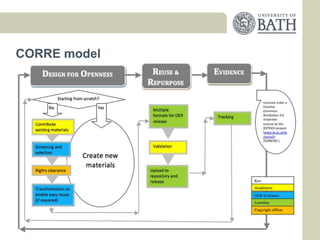
CORRE model
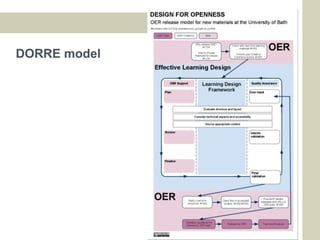
DORRE model
Reflections
Engaging in OER development is…


           …a highly cultural experience

• Identity and pedagogy (content and learning design of
  resources).
• Language and semantics
• Organisational structures and relationships (home of
  resources, assumptions, parent-child relationship)
Reflections
Engaging in OER development is…


                  …a balancing act

• Open Vs commercial educational offerings (what/how
  you release, who)
• Centralised Vs decentralised models for development
• Core business Vs additional work (workload, incentives)
• Top-down Vs bottom-up engagement
• Funding Vs Timing/readiness
Reflections
Engaging in OER development is…


            …an educational experience

• Highlighted issues with current
  practice, misconceptions, gaps
• IPR and copyright issues
• Collaborative learning experience
• Capacity building = sustainability
Reflections on Impact

• Initiated processes, built capacity internally, overcome
  learning curves
   • Increase in support resources (copyright, lecture
      capture, etc) and ‘contracts’
    • Development of expertise (i.e. Drupal, copyright
       licenses)
    • Awareness raising – potential marketing tool/’taster
       sessions’ for module choices
Challenges for institutions

• Intellectual property and copyright
• Sustainability of OER initiatives
   • New business models emerging
      • ‘Conversion’ model
      • ‘Segmentation’ model
      • ‘Contributor-pay’ model and others
• Discoverability and quality of resources
Please feel free to ask your questions.


 K.Anagnostopoulou@bath.ac.uk

Instruction Design for e-Content Development

  • 1.
    Reflections on OERPractices: UK perspective Kyriaki Anagnostopoulou, Head of e-Learning University of Bath
  • 2.
    Incentives for OERdevelopment • Significant government funding available internationally • USA: $2 billion to create OER resources in community colleges (2011) (http://creativecommons.org/weblog/entry/26100) • UK: recommended investment of £5 million per year for 5 years (2011) (http://www.hefce.ac.uk/pubs/year/2011/201101/) • Funding body requirements • JISC, HEA and others • SCORE: support and capacity building (2009-12)
  • 3.
    Reasons to engagein OER development • Improving access to learning materials and opportunities • Marketing, brand extension and improving public relations • Improving effectiveness and achieving economies of scale
  • 4.
    The University ofBath’s experience • We create lots of content (lecture capture, Moodle courses, etc,) only small percentage is OER • OSTRICH ( JISC funded) – collaborative, 1 year project • Universities of Leicester, Bath and Derby • Workflow model and processes • http://ostrich.bath.ac.uk/ • Disciplinary Thinking (HEA and JISC funded) • Departmental based projects
  • 6.
  • 7.
  • 8.
    Reflections Engaging in OERdevelopment is… …a highly cultural experience • Identity and pedagogy (content and learning design of resources). • Language and semantics • Organisational structures and relationships (home of resources, assumptions, parent-child relationship)
  • 9.
    Reflections Engaging in OERdevelopment is… …a balancing act • Open Vs commercial educational offerings (what/how you release, who) • Centralised Vs decentralised models for development • Core business Vs additional work (workload, incentives) • Top-down Vs bottom-up engagement • Funding Vs Timing/readiness
  • 10.
    Reflections Engaging in OERdevelopment is… …an educational experience • Highlighted issues with current practice, misconceptions, gaps • IPR and copyright issues • Collaborative learning experience • Capacity building = sustainability
  • 11.
    Reflections on Impact •Initiated processes, built capacity internally, overcome learning curves • Increase in support resources (copyright, lecture capture, etc) and ‘contracts’ • Development of expertise (i.e. Drupal, copyright licenses) • Awareness raising – potential marketing tool/’taster sessions’ for module choices
  • 12.
    Challenges for institutions •Intellectual property and copyright • Sustainability of OER initiatives • New business models emerging • ‘Conversion’ model • ‘Segmentation’ model • ‘Contributor-pay’ model and others • Discoverability and quality of resources
  • 13.
    Please feel freeto ask your questions. K.Anagnostopoulou@bath.ac.uk