Mathematics
Mathematics is not about numbers,
equations, computations, or algorithms: it
is about understanding.
— William Paul Thurston, American
mathematician
ELAM JETHER A. TABILOG
Subject Teacher
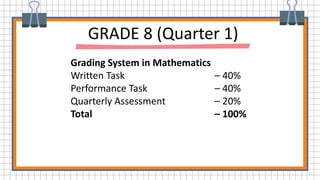
GRADE 8 (Quarter 1)
Grading System in Mathematics
Written Task – 40%
Performance Task – 40%
Quarterly Assessment – 20%
Total – 100%
GRADE 8 (Quarter 1)
Written Task
• Long Test
• Quizzes
• Notebook(Additional Points)
Performance Task
• Portfolio
• Index card( Recitation)
• Group Activity
• Reporting
Quarterly Assessment
• Exam
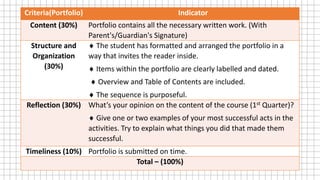
Criteria(Portfolio) Indicator
Content (30%) Portfolio contains all the necessary written work. (With
Parent's/Guardian's Signature)
Structure and
Organization
(30%)
 The student has formatted and arranged the portfolio in a
way that invites the reader inside.
 Items within the portfolio are clearly labelled and dated.
 Overview and Table of Contents are included.
 The sequence is purposeful.
Reflection (30%) What’s your opinion on the content of the course (1st Quarter)?
 Give one or two examples of your most successful acts in the
activities. Try to explain what things you did that made them
successful.
Timeliness (10%) Portfolio is submitted on time.
Total – (100%)
Factoring Completely Different Types of Polynomials
I. INTRODUCTION:
A polynomial is one of the basic concepts in algebra.
In Math 7, you learned how to multiply two polynomials to
get another polynomial. In most of our future work in
algebra, it is often necessary to express a polynomial as a
product of other polynomials. Factoring is the reverse
process of multiplying polynomials.
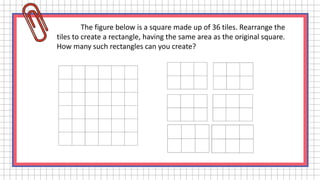
The figure below is a square made up of 36 tiles. Rearrange the
tiles to create a rectangle, having the same area as the original square.
How many such rectangles can you create?
This topic is made up of five lessons:
Lesson 1: Factoring Polynomials with Common Monomial Factor
Lesson 2: Factoring Difference of Two Squares
Lesson 3: Factoring Sum or Difference of Two Cubes
Lesson 4: Factoring Perfect Square Trinomial
Lesson 5: Factoring General Trinomial
II. Objectives:
After performing the activities in this topic, you should be able to
factor:
• polynomials with common monomial factor
• difference of two squares
• sum and difference of two cubes
• perfect square trinomial
• general trinomial
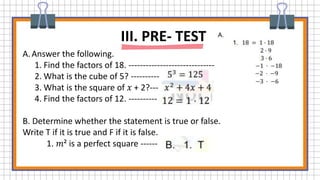
A.Answer the following.
1. Find the factors of 18. ------------------------------
2. What is the cube of 5? ----------
3. What is the square of 𝑥 + 2?---
4. Find the factors of 12. ----------
B. Determine whether the statement is true or false.
Write T if it is true and F if it is false.
1. 𝑚² is a perfect square ------
III. PRE- TEST
Lesson 1 : Factoring Polynomials with Common
Monomial Factor
Vocabulary List:
a. Binomial – is an algebraic expression consisting of two terms.
b. Common Factor – factor that repeatedly occurs in each term
c. Factor – an exact divisor of a number
d. Factors – terms to be multiplied to give the polynomial
e. Factoring – process of finding the factors of a polynomial
f. Greatest Common Factor (GCF) – is the greatest integer that is a factor of all the
given integers
g. Greatest Common Monomial Factor (GCMF) – the greatest factor contained in
every term of an algebraic expression
h. Monomial – an algebraic expression consisting of one term
i. Polynomial – a finite sum of terms each of which is a real number or the
product of a numerical factor and one or more variable factors raised to a whole
number power
j. Prime Number – is a number greater than one which has only two positive
factors: 1 and itself
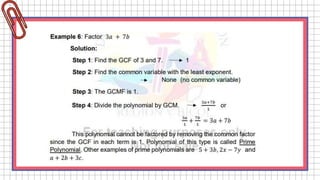
k. Prime Polynomial – an irreducible polynomial with integral coefficient whose
greatest monomial factor is 1.
l. Trinomial – an algebraic expression consisting of three terms.
IV. OBJECTIVES(LESSON 1)
At the end of this lesson, you should be able
to:
• find the greatest common monomial factor
(GCMF) of polynomials
• factor polynomials with greatest common
monomial factor (GCMF)
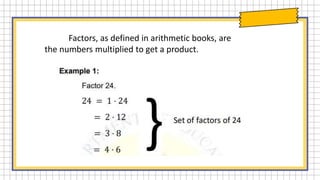
Factors, as defined in arithmetic books, are
the numbers multiplied to get a product.
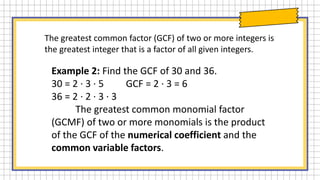
The greatest common factor (GCF) of two or more integers is
the greatest integer that is a factor of all given integers.
Example 2: Find the GCF of 30 and 36.
30 = 2 · 3 · 5 GCF = 2 · 3 = 6
36 = 2 · 2 · 3 · 3
The greatest common monomial factor
(GCMF) of two or more monomials is the product
of the GCF of the numerical coefficient and the
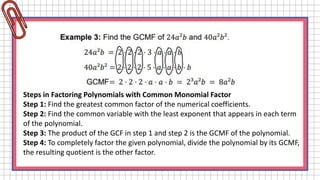
common variable factors.
Steps in Factoring Polynomials with Common Monomial Factor
Step 1: Find the greatest common factor of the numerical coefficients.
Step 2: Find the common variable with the least exponent that appears in each term
of the polynomial.
Step 3: The product of the GCF in step 1 and step 2 is the GCMF of the polynomial.
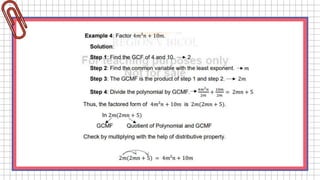
Step 4: To completely factor the given polynomial, divide the polynomial by its GCMF,
the resulting quotient is the other factor.
Example 5: Factor 12𝑥𝑦² − 16𝑥²𝑦 + 24𝑥³𝑦³
Example 6: Factor 3𝑎 + 7b
PRACTICE EXERCISE 1:
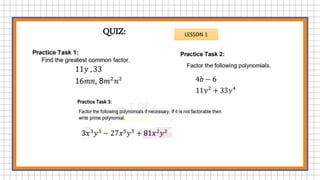
QUIZ: LESSON 1
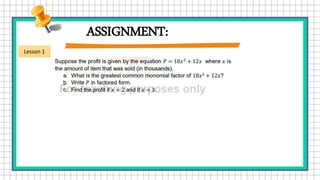
ASSIGNMENT:
Lesson 1
Thank you!

MATH-8-M1.1-L1-L2-ppt.-Copy.pptx

  • 1.
    Mathematics Mathematics is notabout numbers, equations, computations, or algorithms: it is about understanding. — William Paul Thurston, American mathematician ELAM JETHER A. TABILOG Subject Teacher
  • 2.
    GRADE 8 (Quarter1) Grading System in Mathematics Written Task – 40% Performance Task – 40% Quarterly Assessment – 20% Total – 100%
  • 3.
    GRADE 8 (Quarter1) Written Task • Long Test • Quizzes • Notebook(Additional Points) Performance Task • Portfolio • Index card( Recitation) • Group Activity • Reporting Quarterly Assessment • Exam
  • 4.
    Criteria(Portfolio) Indicator Content (30%)Portfolio contains all the necessary written work. (With Parent's/Guardian's Signature) Structure and Organization (30%)  The student has formatted and arranged the portfolio in a way that invites the reader inside.  Items within the portfolio are clearly labelled and dated.  Overview and Table of Contents are included.  The sequence is purposeful. Reflection (30%) What’s your opinion on the content of the course (1st Quarter)?  Give one or two examples of your most successful acts in the activities. Try to explain what things you did that made them successful. Timeliness (10%) Portfolio is submitted on time. Total – (100%)
  • 5.
    Factoring Completely DifferentTypes of Polynomials I. INTRODUCTION: A polynomial is one of the basic concepts in algebra. In Math 7, you learned how to multiply two polynomials to get another polynomial. In most of our future work in algebra, it is often necessary to express a polynomial as a product of other polynomials. Factoring is the reverse process of multiplying polynomials.
  • 6.
    The figure belowis a square made up of 36 tiles. Rearrange the tiles to create a rectangle, having the same area as the original square. How many such rectangles can you create?
  • 7.
    This topic ismade up of five lessons: Lesson 1: Factoring Polynomials with Common Monomial Factor Lesson 2: Factoring Difference of Two Squares Lesson 3: Factoring Sum or Difference of Two Cubes Lesson 4: Factoring Perfect Square Trinomial Lesson 5: Factoring General Trinomial II. Objectives: After performing the activities in this topic, you should be able to factor: • polynomials with common monomial factor • difference of two squares • sum and difference of two cubes • perfect square trinomial • general trinomial
  • 8.
    A.Answer the following. 1.Find the factors of 18. ------------------------------ 2. What is the cube of 5? ---------- 3. What is the square of 𝑥 + 2?--- 4. Find the factors of 12. ---------- B. Determine whether the statement is true or false. Write T if it is true and F if it is false. 1. 𝑚² is a perfect square ------ III. PRE- TEST
  • 9.
    Lesson 1 :Factoring Polynomials with Common Monomial Factor Vocabulary List: a. Binomial – is an algebraic expression consisting of two terms. b. Common Factor – factor that repeatedly occurs in each term c. Factor – an exact divisor of a number d. Factors – terms to be multiplied to give the polynomial e. Factoring – process of finding the factors of a polynomial
  • 10.
    f. Greatest CommonFactor (GCF) – is the greatest integer that is a factor of all the given integers g. Greatest Common Monomial Factor (GCMF) – the greatest factor contained in every term of an algebraic expression h. Monomial – an algebraic expression consisting of one term i. Polynomial – a finite sum of terms each of which is a real number or the product of a numerical factor and one or more variable factors raised to a whole number power j. Prime Number – is a number greater than one which has only two positive factors: 1 and itself k. Prime Polynomial – an irreducible polynomial with integral coefficient whose greatest monomial factor is 1. l. Trinomial – an algebraic expression consisting of three terms.
  • 11.
    IV. OBJECTIVES(LESSON 1) Atthe end of this lesson, you should be able to: • find the greatest common monomial factor (GCMF) of polynomials • factor polynomials with greatest common monomial factor (GCMF)
  • 12.
    Factors, as definedin arithmetic books, are the numbers multiplied to get a product.
  • 14.
    The greatest commonfactor (GCF) of two or more integers is the greatest integer that is a factor of all given integers. Example 2: Find the GCF of 30 and 36. 30 = 2 · 3 · 5 GCF = 2 · 3 = 6 36 = 2 · 2 · 3 · 3 The greatest common monomial factor (GCMF) of two or more monomials is the product of the GCF of the numerical coefficient and the common variable factors.
  • 15.
    Steps in FactoringPolynomials with Common Monomial Factor Step 1: Find the greatest common factor of the numerical coefficients. Step 2: Find the common variable with the least exponent that appears in each term of the polynomial. Step 3: The product of the GCF in step 1 and step 2 is the GCMF of the polynomial. Step 4: To completely factor the given polynomial, divide the polynomial by its GCMF, the resulting quotient is the other factor.
  • 17.
    Example 5: Factor12𝑥𝑦² − 16𝑥²𝑦 + 24𝑥³𝑦³ Example 6: Factor 3𝑎 + 7b
  • 19.
  • 20.
  • 21.
  • 22.