ATTENDANCE SHEET
 Attendance sheets can be found on the desk by the
  door.
 Every class you need to sign in on your attendance
  sheet.
 Our Class code is 12014
ORIENTATION
ABOUT ME
 Florida Girl
 Crafts and Photography

 Bachelor of Science in Math

 High-school struggle with math

 Especially enjoy helping those who have found
  math difficult
 Getting married this year
WHY I LOVE MATH
“We all use math every day-
to predict weather, to tell time,
to handle money.
Math is more than formulas and equations.

It's logic. It's rationality. It's using your mind to solve
the biggest mysteries we know.”

                               -Numb3rs introduction
HOW TO SUCCEED
   Time Investment
     Come to every class. Be on time.
     Do class work.
     Faithfully do homework.
     Make learning a priority.

   Emotional Investment
     Be positive & cooperative.
     Have confidence.
     Bounce back.

   Learn something new everyday and review
    something everyday
MATERIALS YOU NEED FOR CLASS
 3-ring Binder
 Notebook

 Pens

 Pencils

 Paper


   Bring materials to every class!
GUIDELINES FOR CLASS
o   Come prepared to learn.
       o Bring materials and be mentally prepared to
         learn
o   Be on time.
       o 15 mins after class starts you will not be
         allowed to attend the class.
o   Attend faithfully
       o You only have 1 absence for every 4 weeks.
o   No cell phone use in class, please silence them
       o No calls or texting
STRUCTURE FOR CLASS
   Review homework

   Go over some of the homework problems

   Attendance Sheet

   Lesson

   Break

   Lesson
EXPECTATIONS..
   What do you expect from a teacher?

   What do you expect from this math class?
I EXPECT…
   You to respect me, and I will in turn respect you.

   You to respect others in the class and allow
    everyone a chance to learn
BRUSH UP ON NEEDED SKILLS
Not knowing a skill can hinder your ability to take the
GED test. It may take longer to figure out a problem.

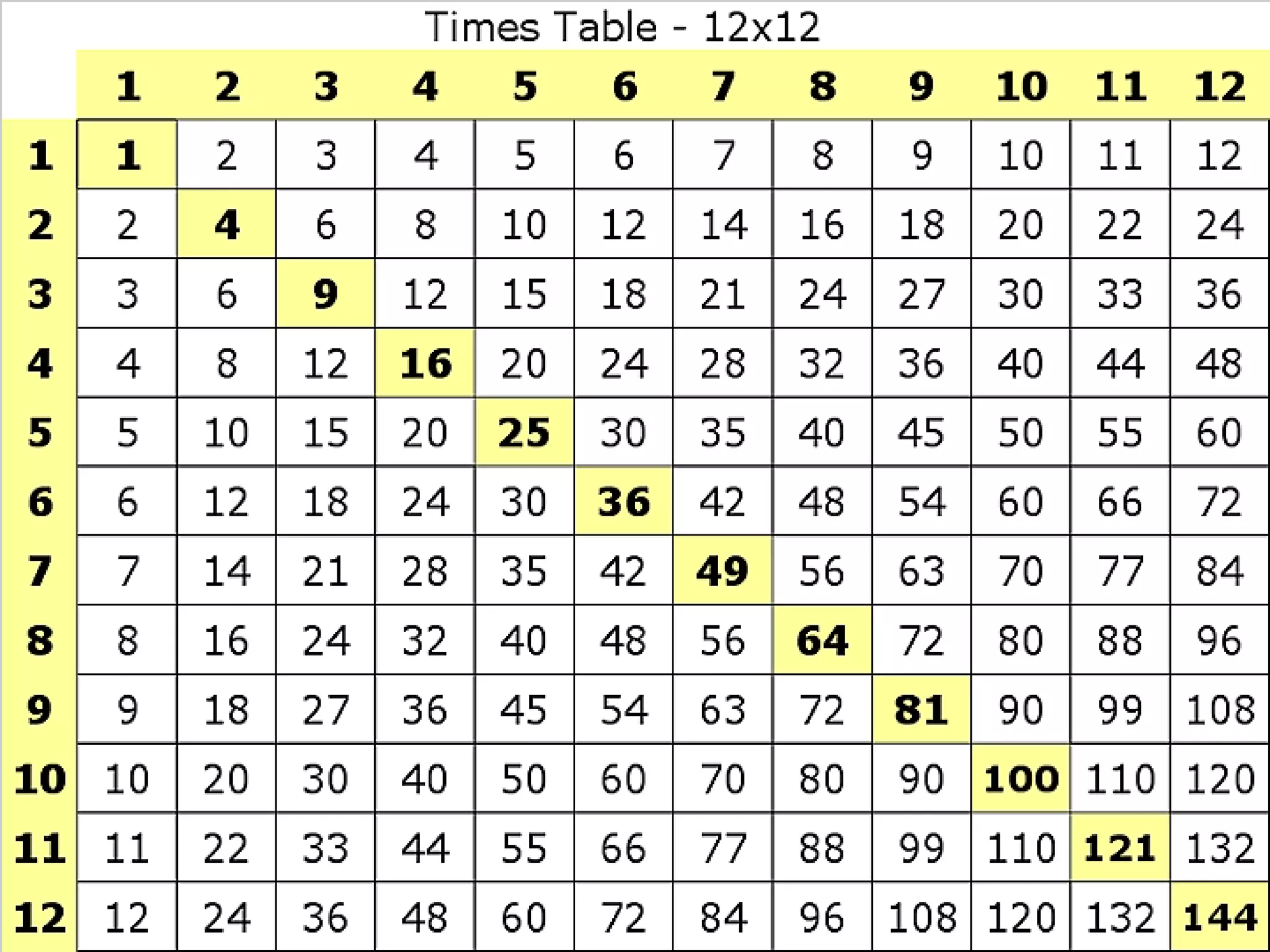
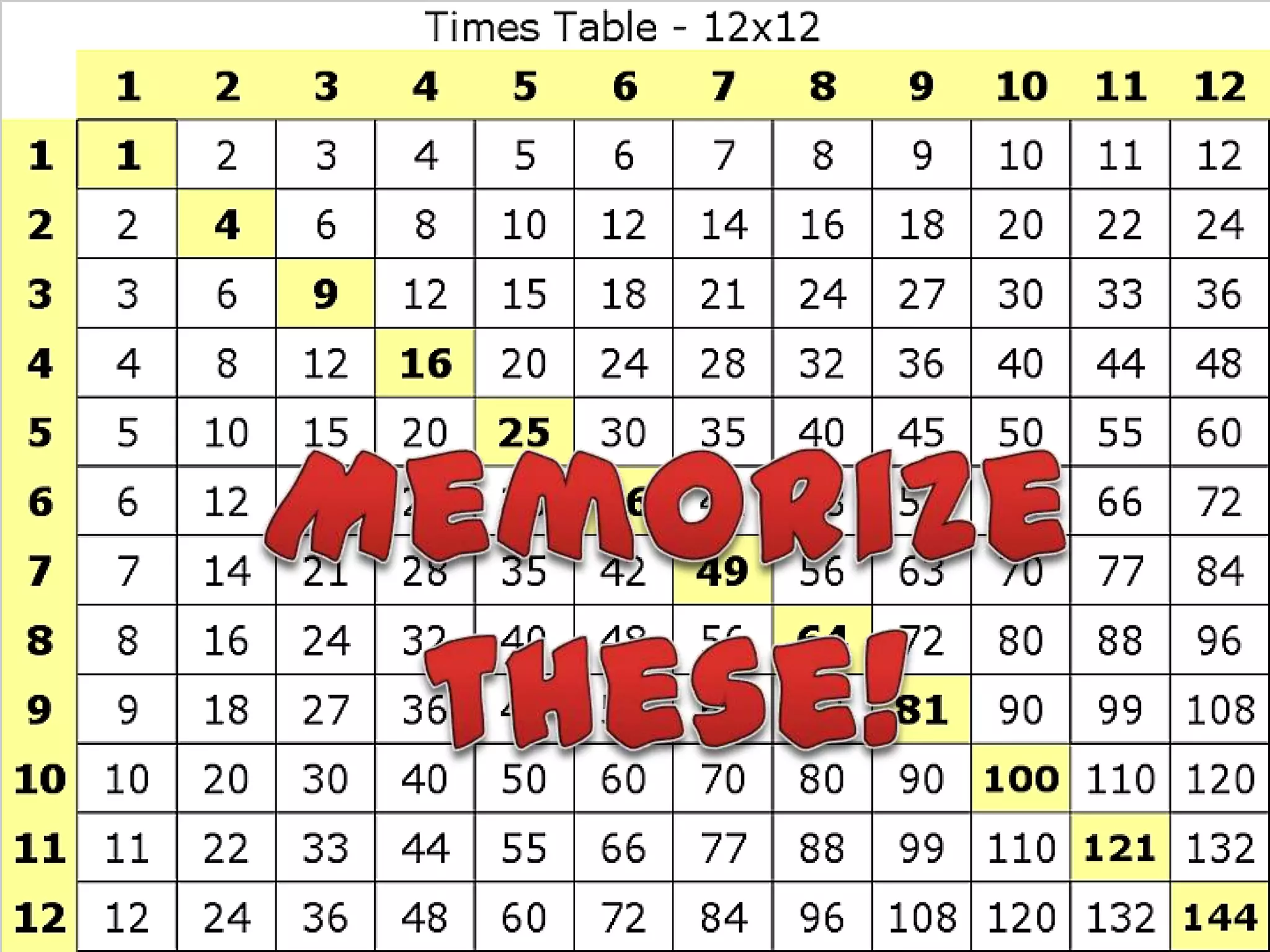
For example: multiplication facts

One way to brush up on this skill is make some flash
cards and practice daily!
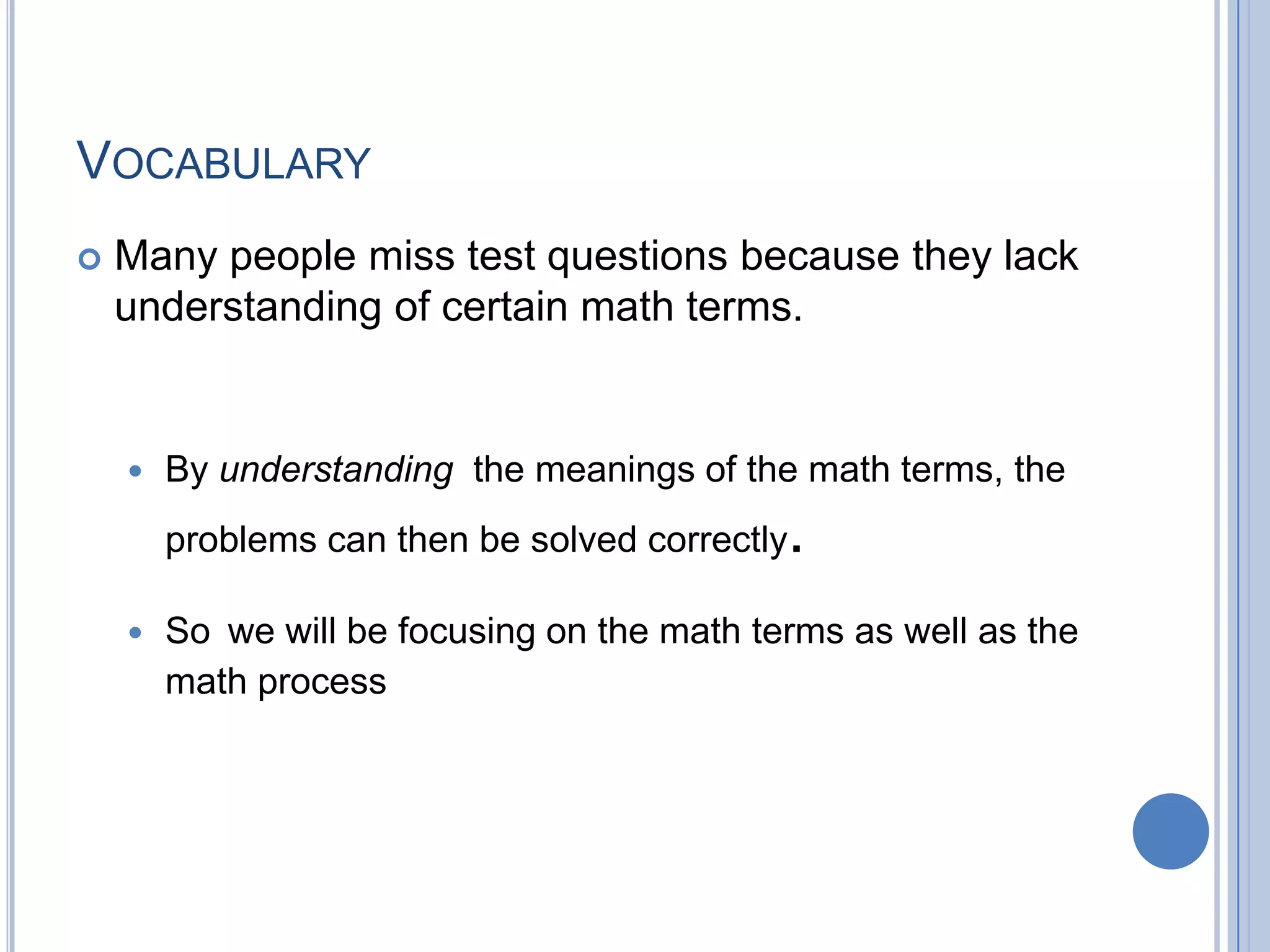
VOCABULARY
   Many people miss test questions because they lack
    understanding of certain math terms.


       By understanding the meanings of the math terms, the
        problems can then be solved correctly   .
       So we will be focusing on the math terms as well as the
        math process
LESSON
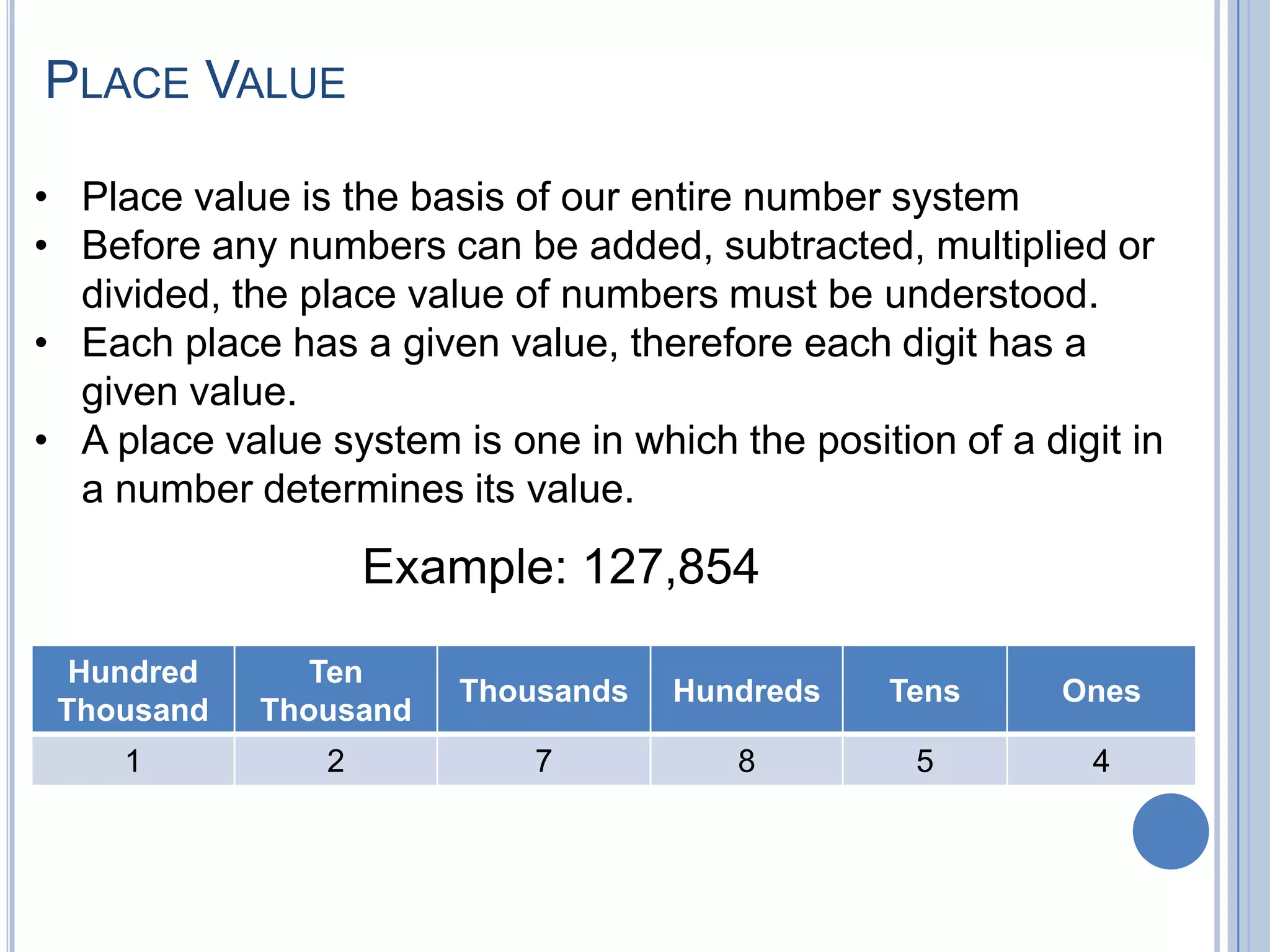
PLACE VALUE

• Place value is the basis of our entire number system
• Before any numbers can be added, subtracted, multiplied or
  divided, the place value of numbers must be understood.
• Each place has a given value, therefore each digit has a
  given value.
• A place value system is one in which the position of a digit in
  a number determines its value.
                    Example: 127,854

  Hundred       Ten
                        Thousands   Hundreds     Tens      Ones
 Thousand    Thousand
     1          2           7           8         5         4
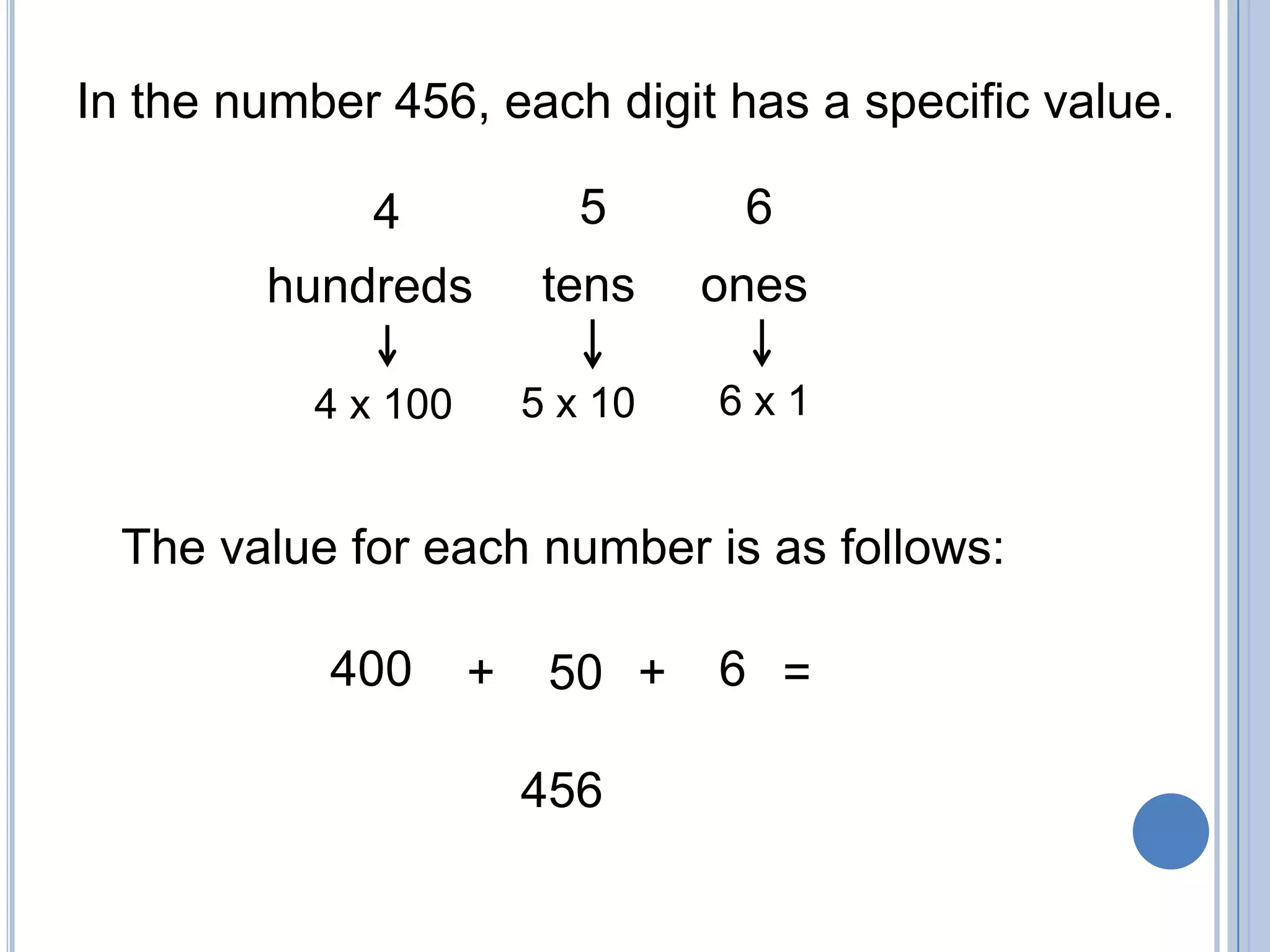
In the number 456, each digit has a specific value.

            4               5      6
        hundreds          tens    ones

           4 x 100       5 x 10   6x1


  The value for each number is as follows:

           400       +    50 +    6 =

                         456
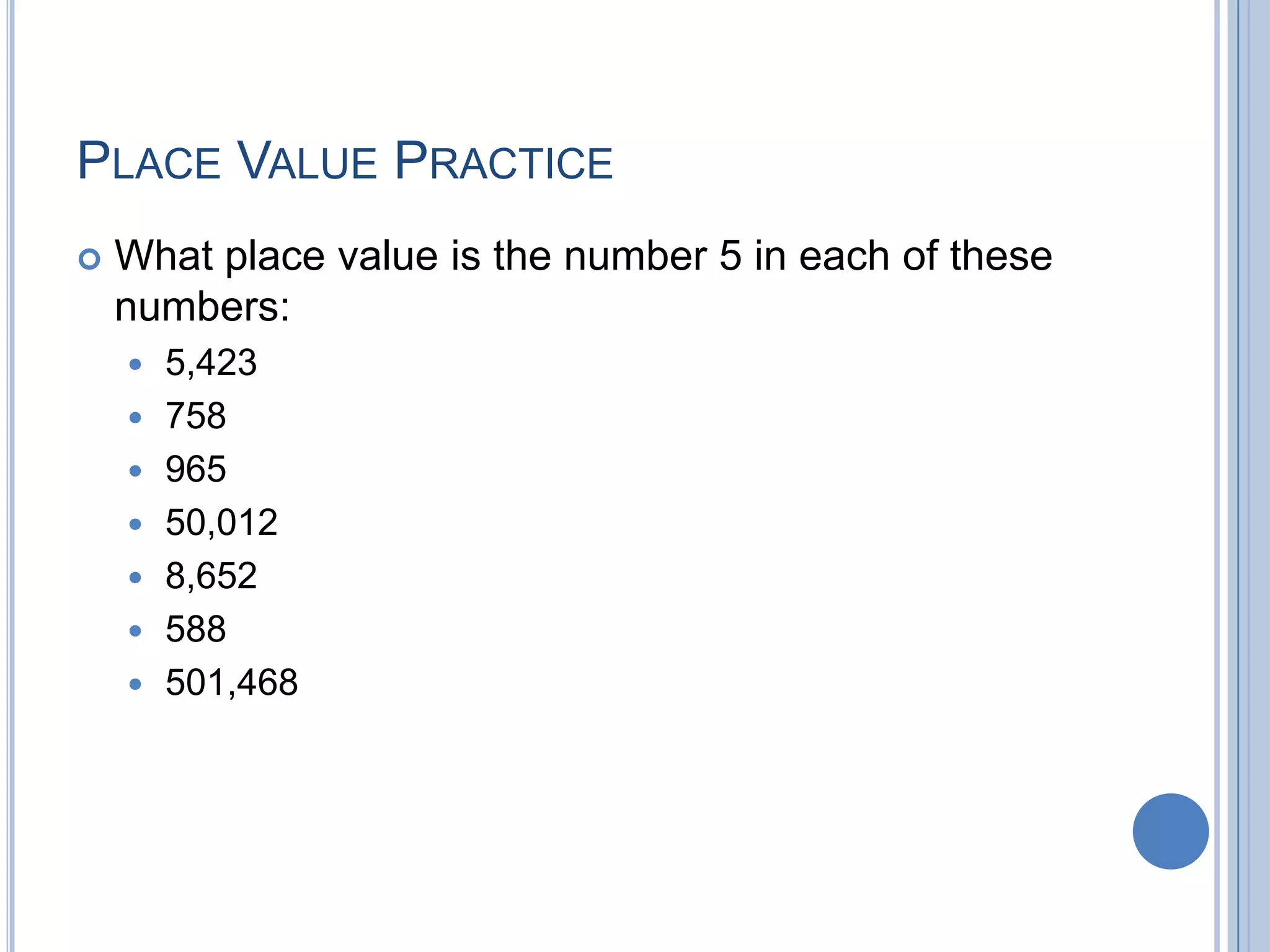
PLACE VALUE PRACTICE
   What place value is the number 5 in each of these
    numbers:
       5,423
       758
       965
       50,012
       8,652
       588
       501,468
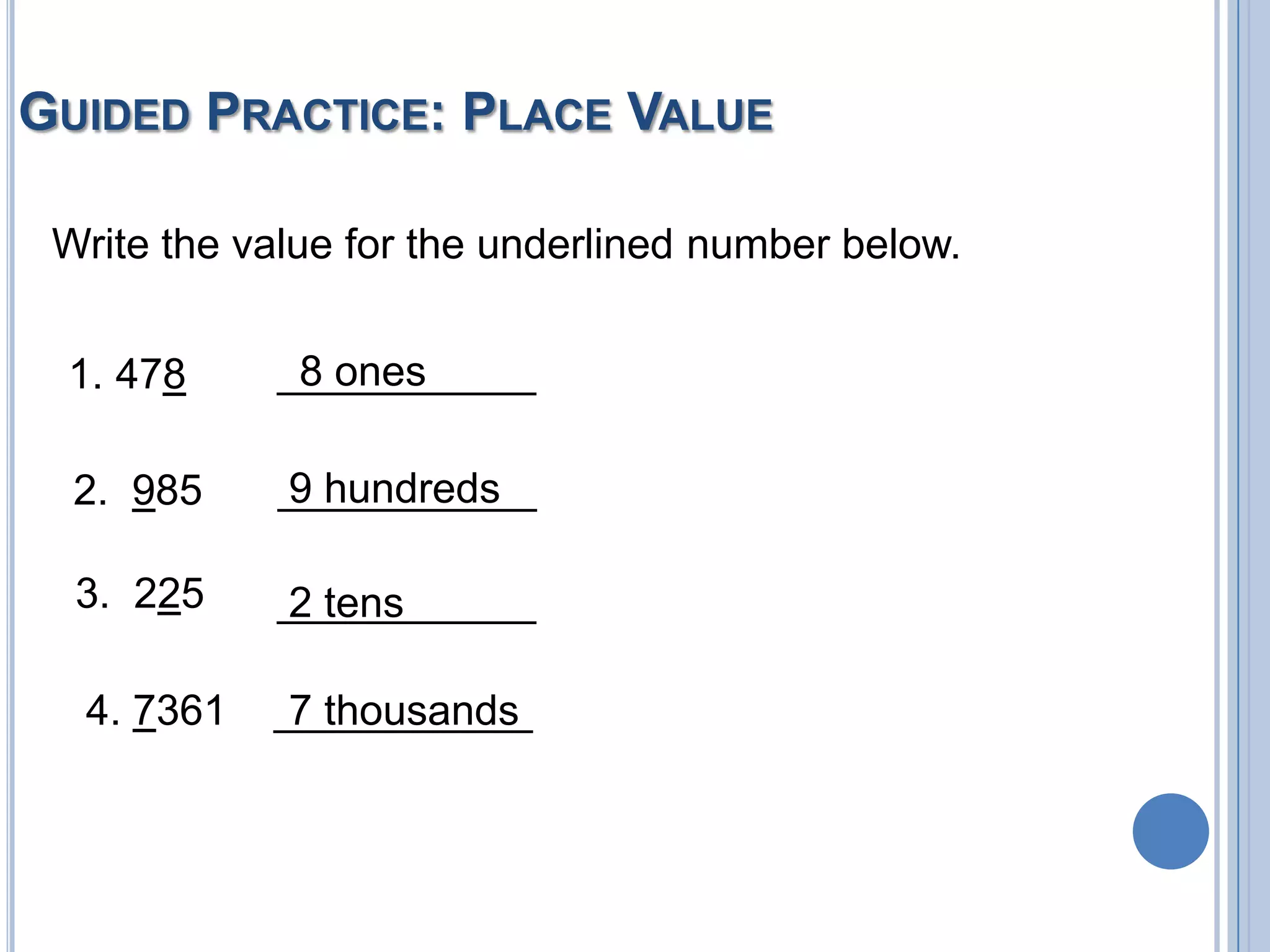
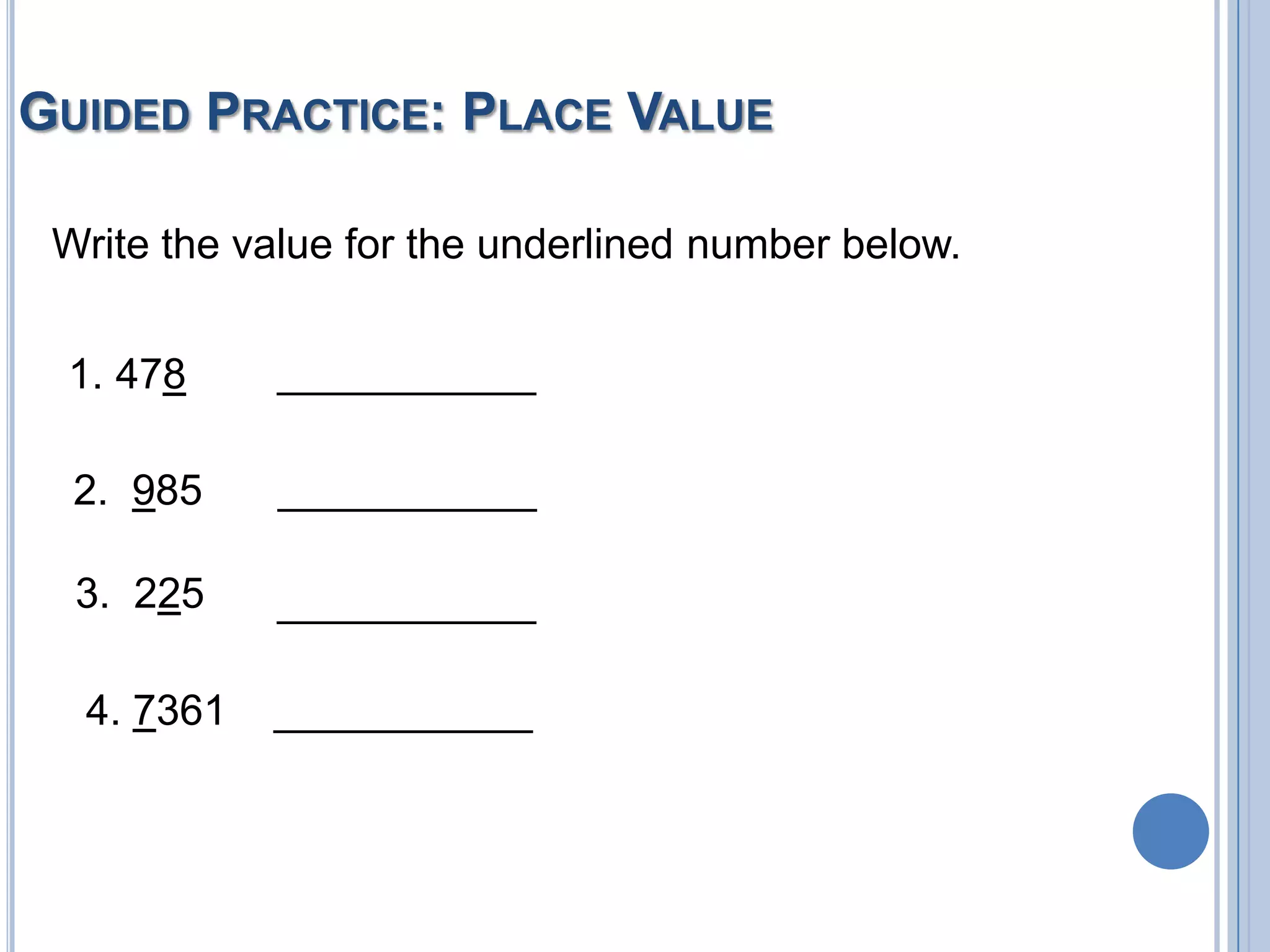
GUIDED PRACTICE: PLACE VALUE

 Write the value for the underlined number below.


 1. 478     ___________

  2. 985    ___________

  3. 225    ___________

  4. 7361   ___________
GUIDED PRACTICE: PLACE VALUE

 Write the value for the underlined number below.


 1. 478      8 ones
            ___________

  2. 985    9 hundreds
            ___________

  3. 225    ___________
            2 tens

  4. 7361   ___________
             7 thousands
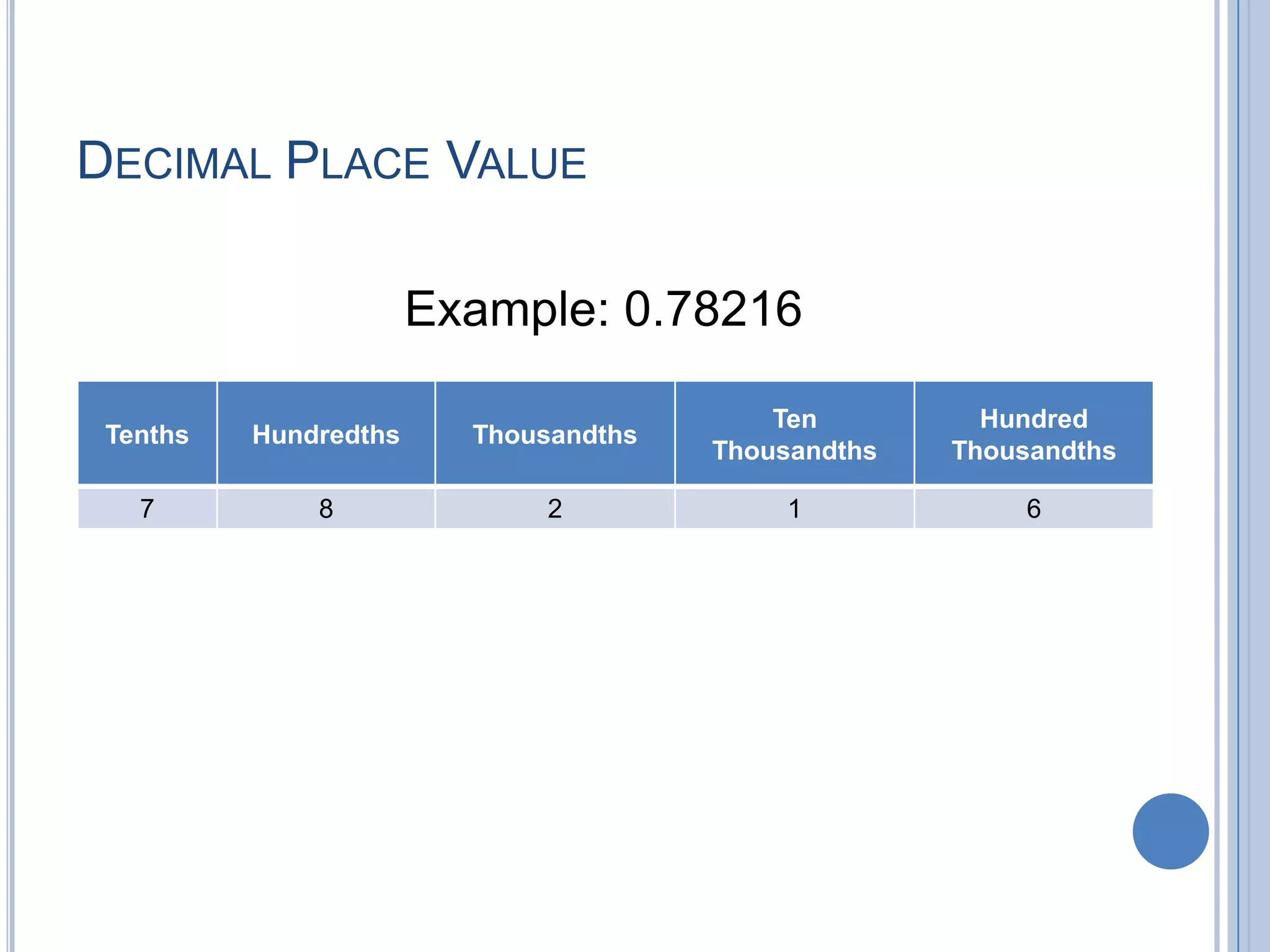
DECIMAL PLACE VALUE

                       Example: 0.78216

                                           Ten         Hundred
 Tenths   Hundredths     Thousandths
                                       Thousandths   Thousandths

   7          8               2             1             6
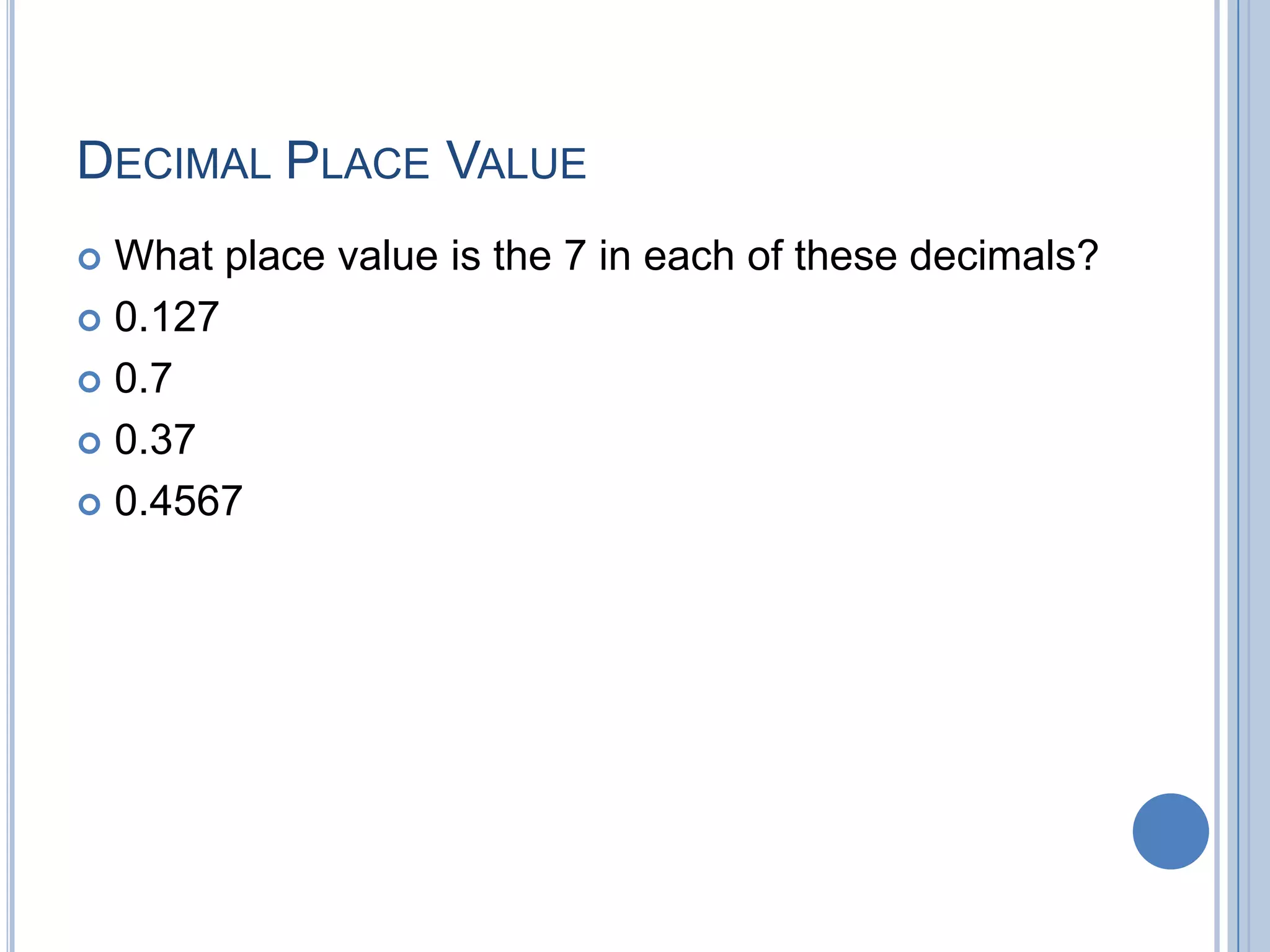
DECIMAL PLACE VALUE
 What place value is the 7 in each of these decimals?
 0.127

 0.7

 0.37

 0.4567
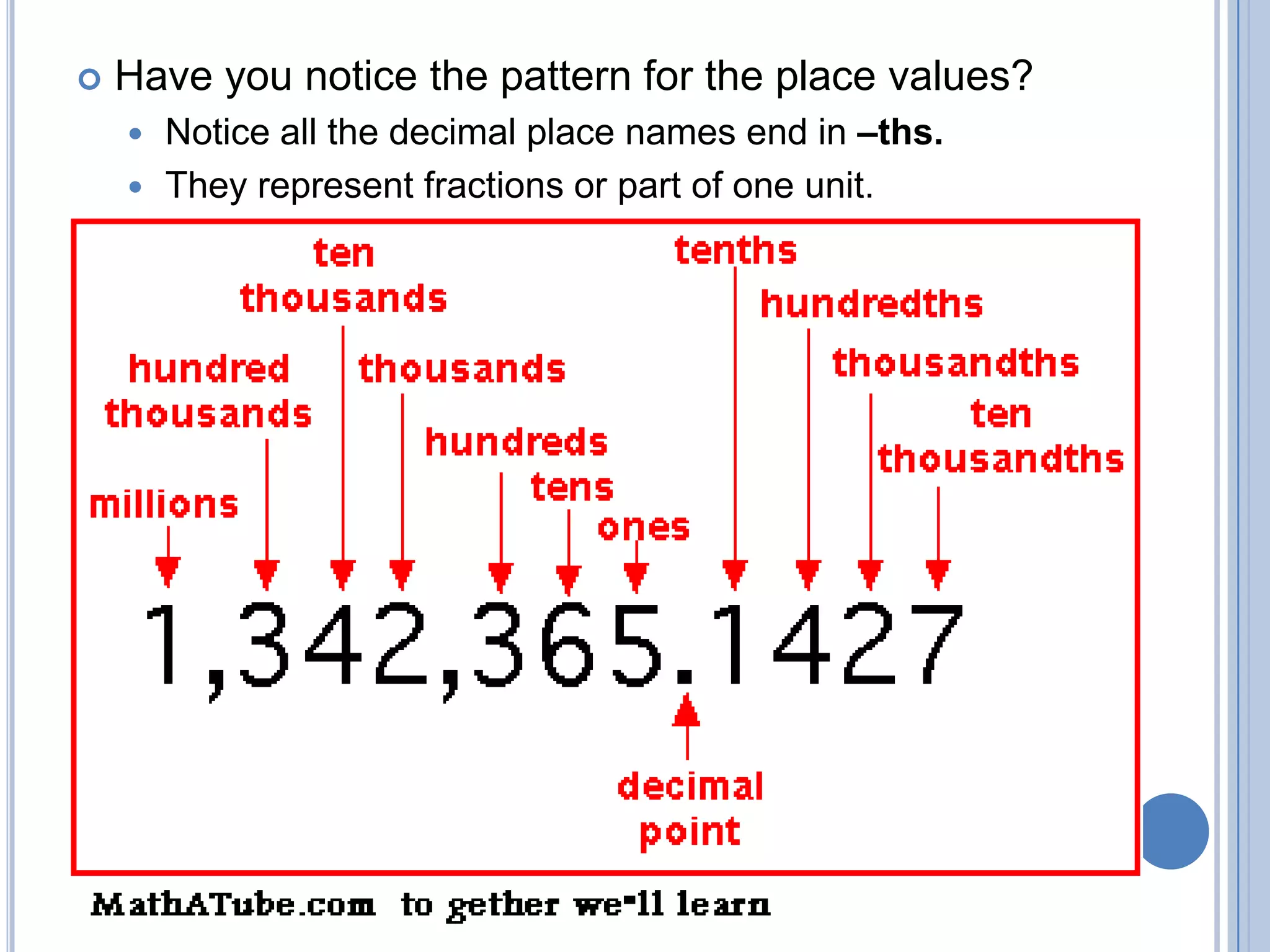
   Have you notice the pattern for the place values?
       Notice all the decimal place names end in –ths.
       They represent fractions or part of one unit.
ESTIMATION
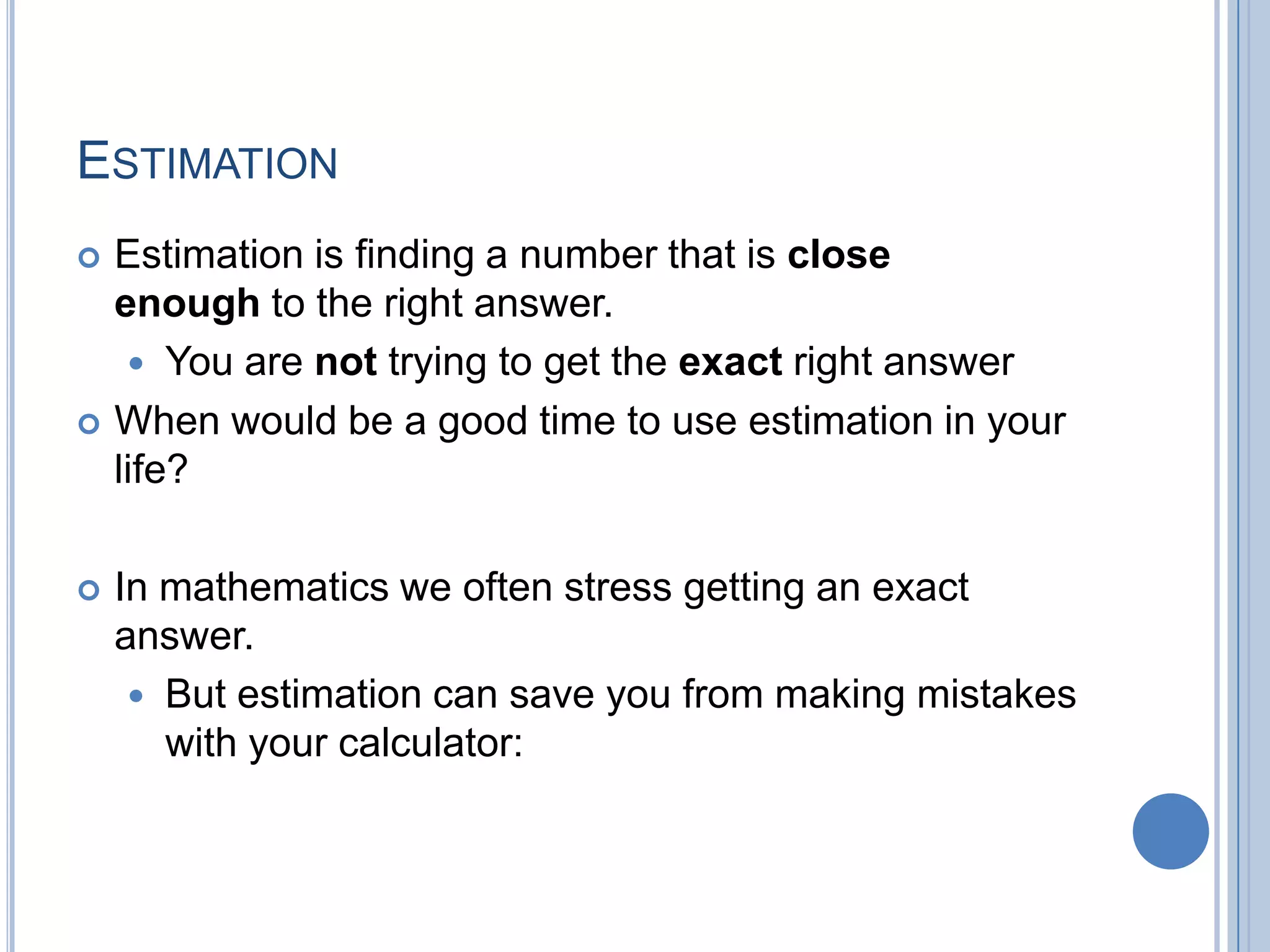
   Estimation is finding a number that is close
    enough to the right answer.
      You are not trying to get the exact right answer
   When would be a good time to use estimation in your
    life?

   In mathematics we often stress getting an exact
    answer.
      But estimation can save you from making mistakes
       with your calculator:
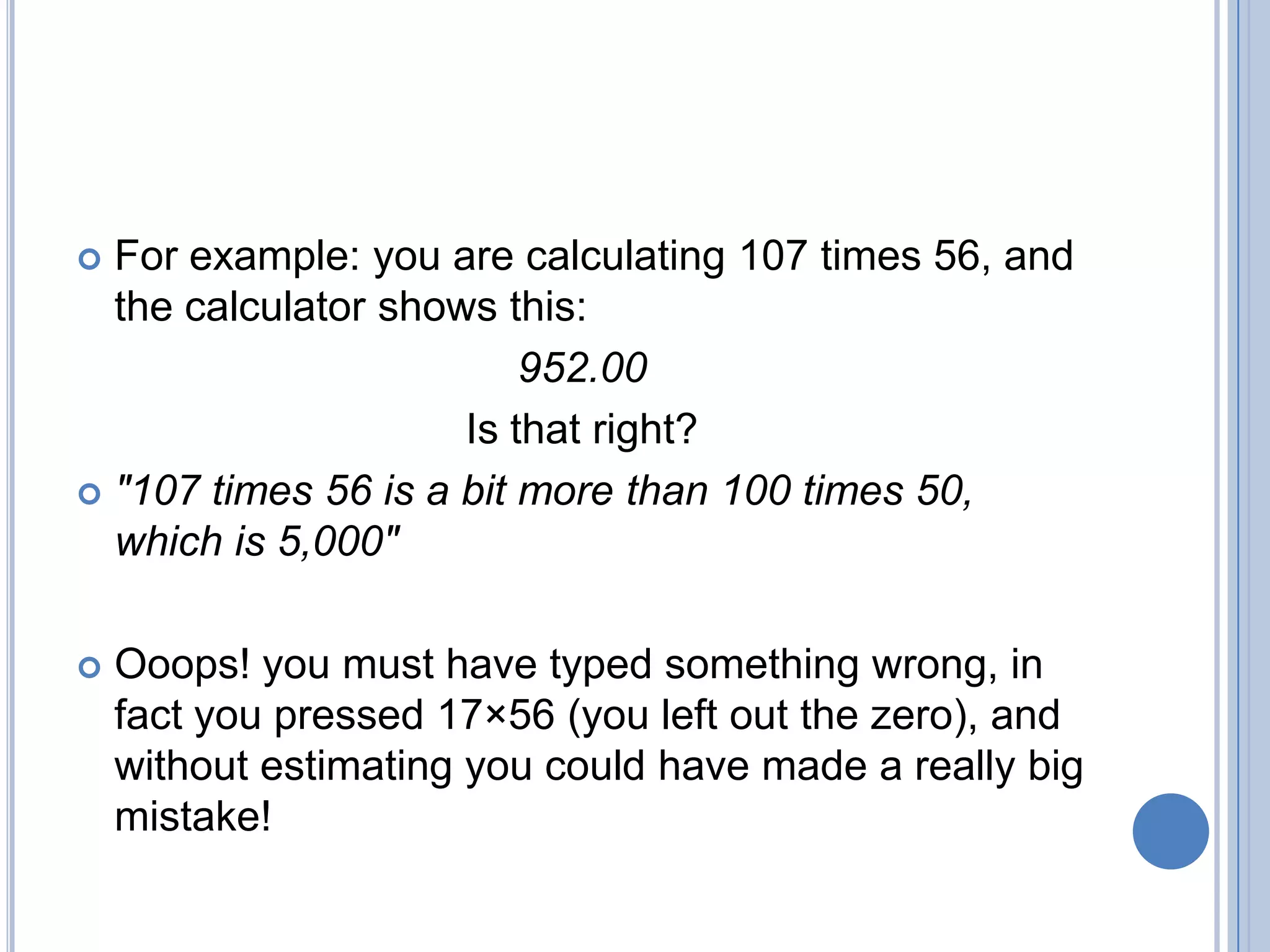
 For example: you are calculating 107 times 56, and
  the calculator shows this:
                         952.00
                     Is that right?
 "107 times 56 is a bit more than 100 times 50,
  which is 5,000"

   Ooops! you must have typed something wrong, in
    fact you pressed 17×56 (you left out the zero), and
    without estimating you could have made a really big
    mistake!
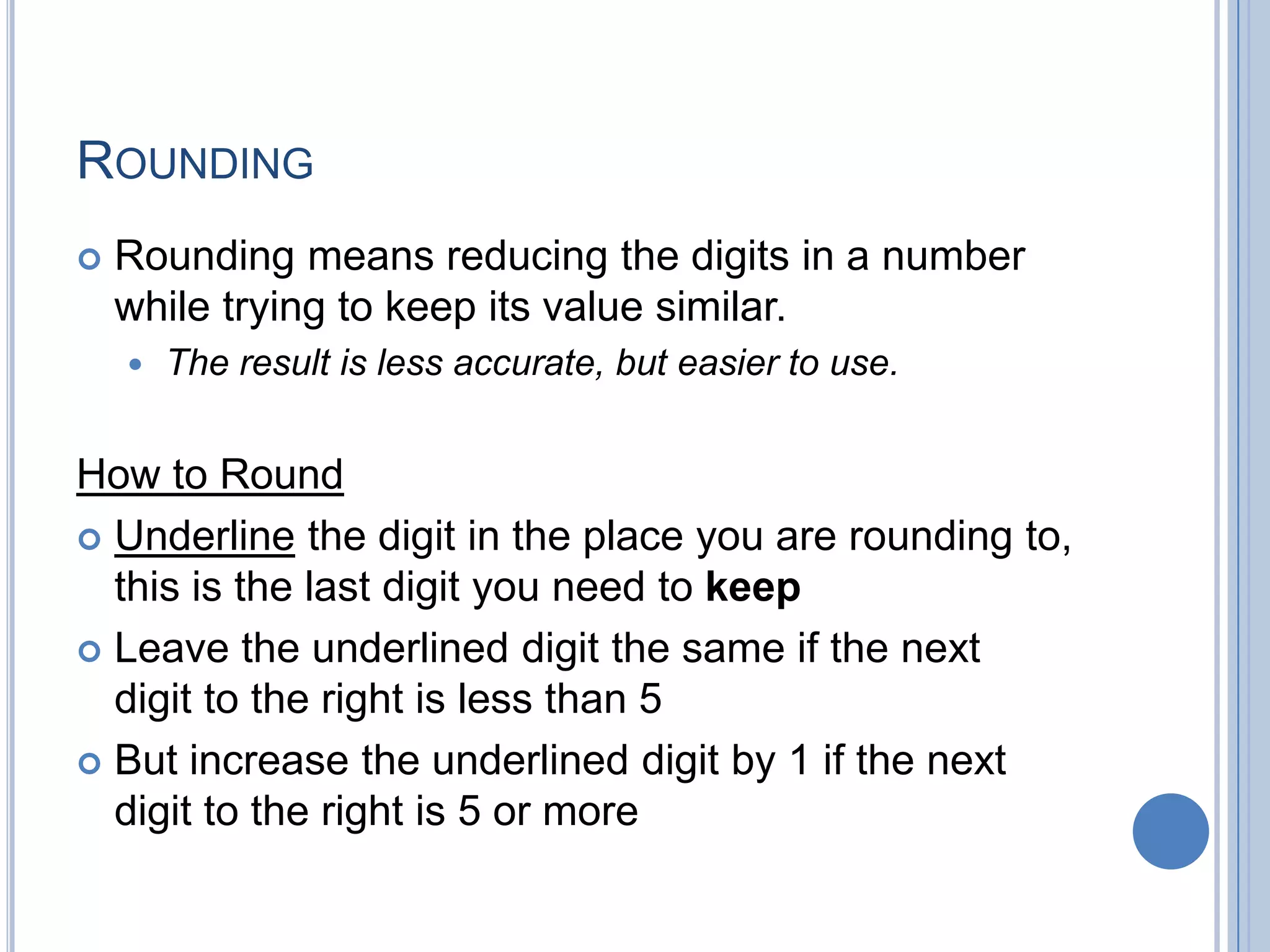
ROUNDING
   Rounding means reducing the digits in a number
    while trying to keep its value similar.
       The result is less accurate, but easier to use.


How to Round
 Underline the digit in the place you are rounding to,
  this is the last digit you need to keep
 Leave the underlined digit the same if the next
  digit to the right is less than 5
 But increase the underlined digit by 1 if the next
  digit to the right is 5 or more
EXAMPLES OF ROUNDING
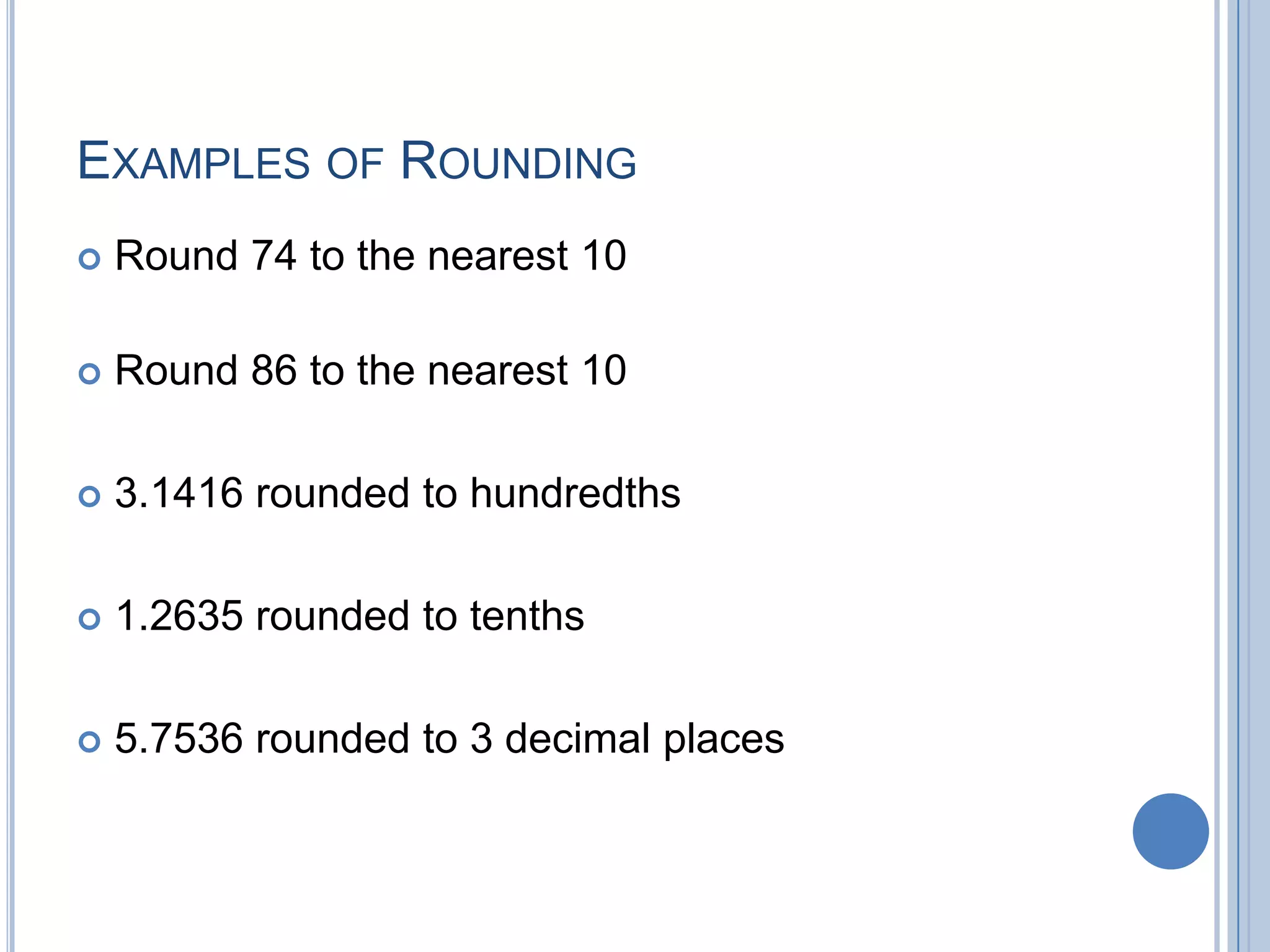
   Round 74 to the nearest 10

   Round 86 to the nearest 10

   3.1416 rounded to hundredths

   1.2635 rounded to tenths

   5.7536 rounded to 3 decimal places
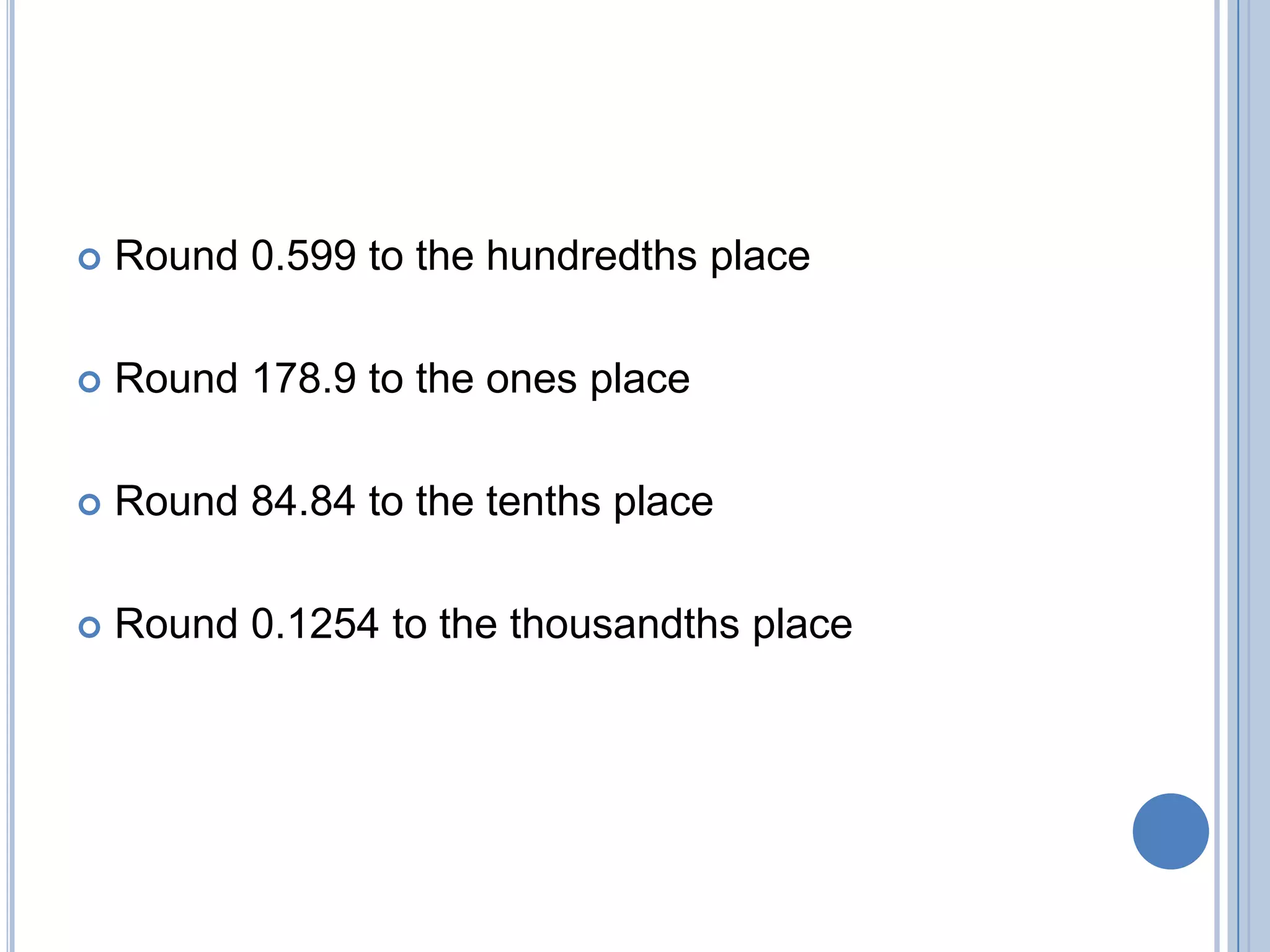
   Round 0.599 to the hundredths place

   Round 178.9 to the ones place

   Round 84.84 to the tenths place

   Round 0.1254 to the thousandths place
IXL.COM
   Rounding
       Level H: B.7
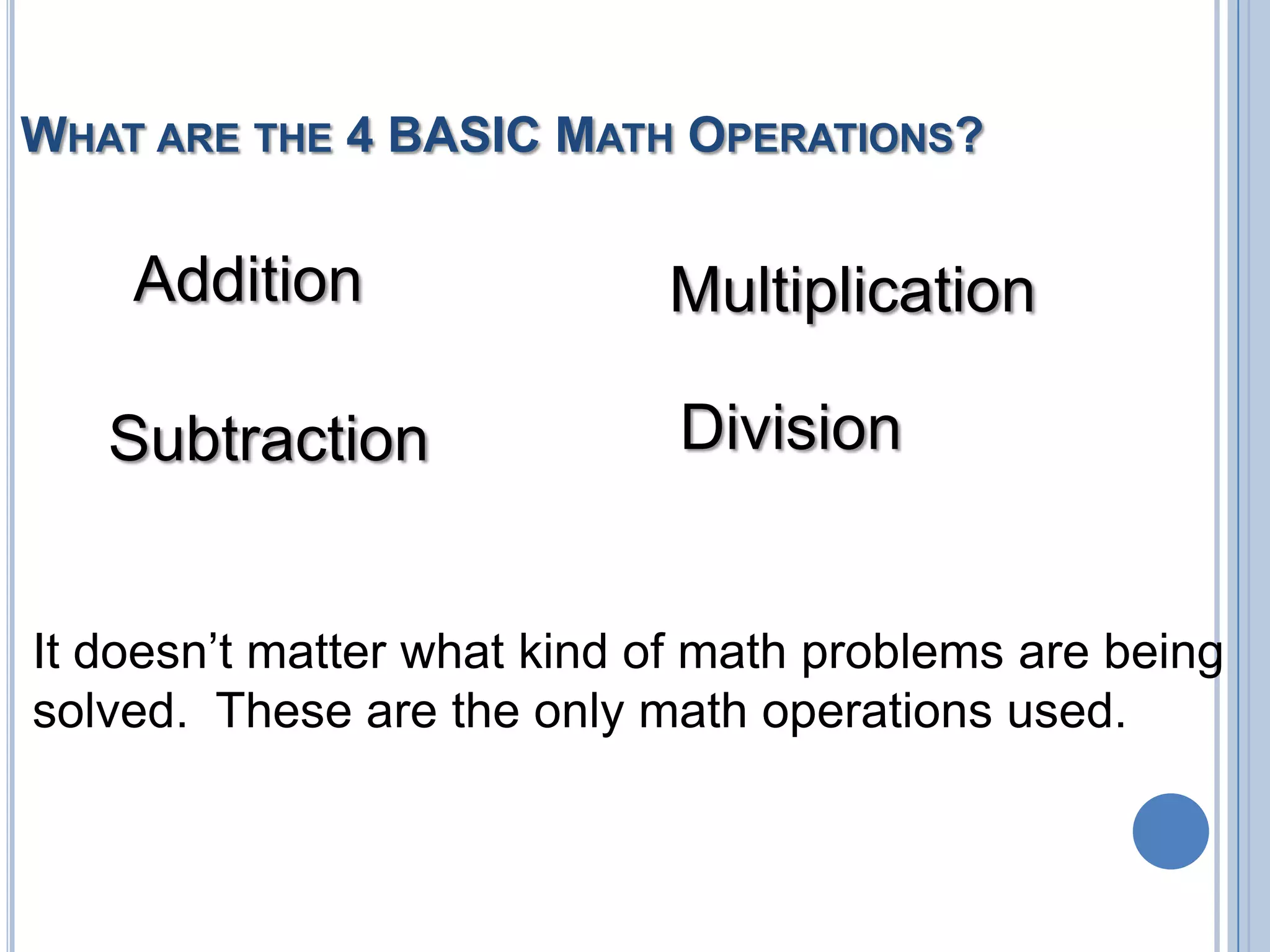
WHAT ARE THE 4 BASIC MATH OPERATIONS?


    Addition                Multiplication

   Subtraction               Division


It doesn’t matter what kind of math problems are being
solved. These are the only math operations used.
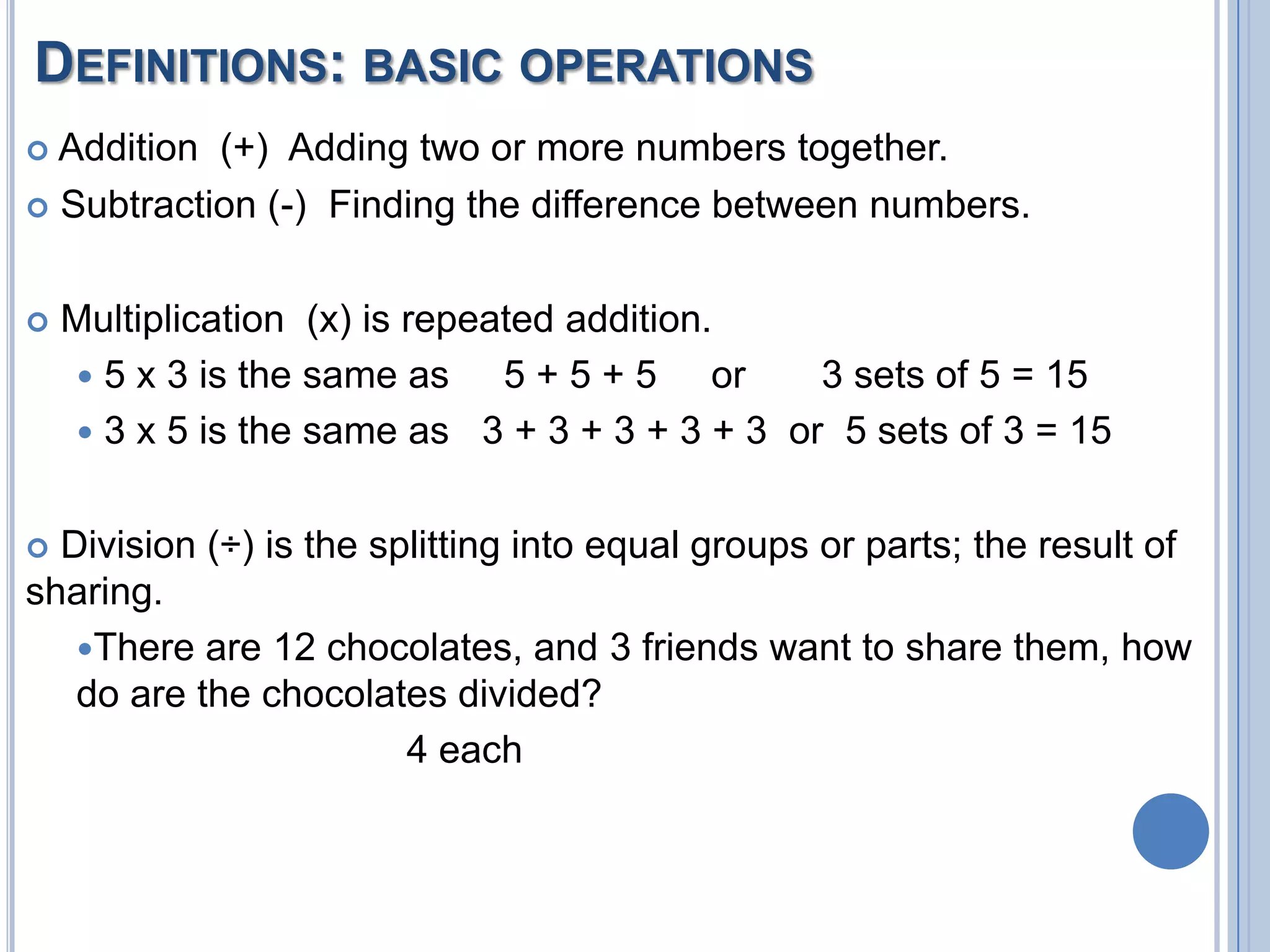
DEFINITIONS: BASIC OPERATIONS
 Addition (+) Adding two or more numbers together.
 Subtraction (-) Finding the difference between numbers.


   Multiplication (x) is repeated addition.
     5 x 3 is the same as     5 + 5 + 5 or    3 sets of 5 = 15
     3 x 5 is the same as 3 + 3 + 3 + 3 + 3 or 5 sets of 3 = 15


 Division (÷) is the splitting into equal groups or parts; the result of
sharing.
   There are 12 chocolates, and 3 friends want to share them, how
   do are the chocolates divided?
                        4 each
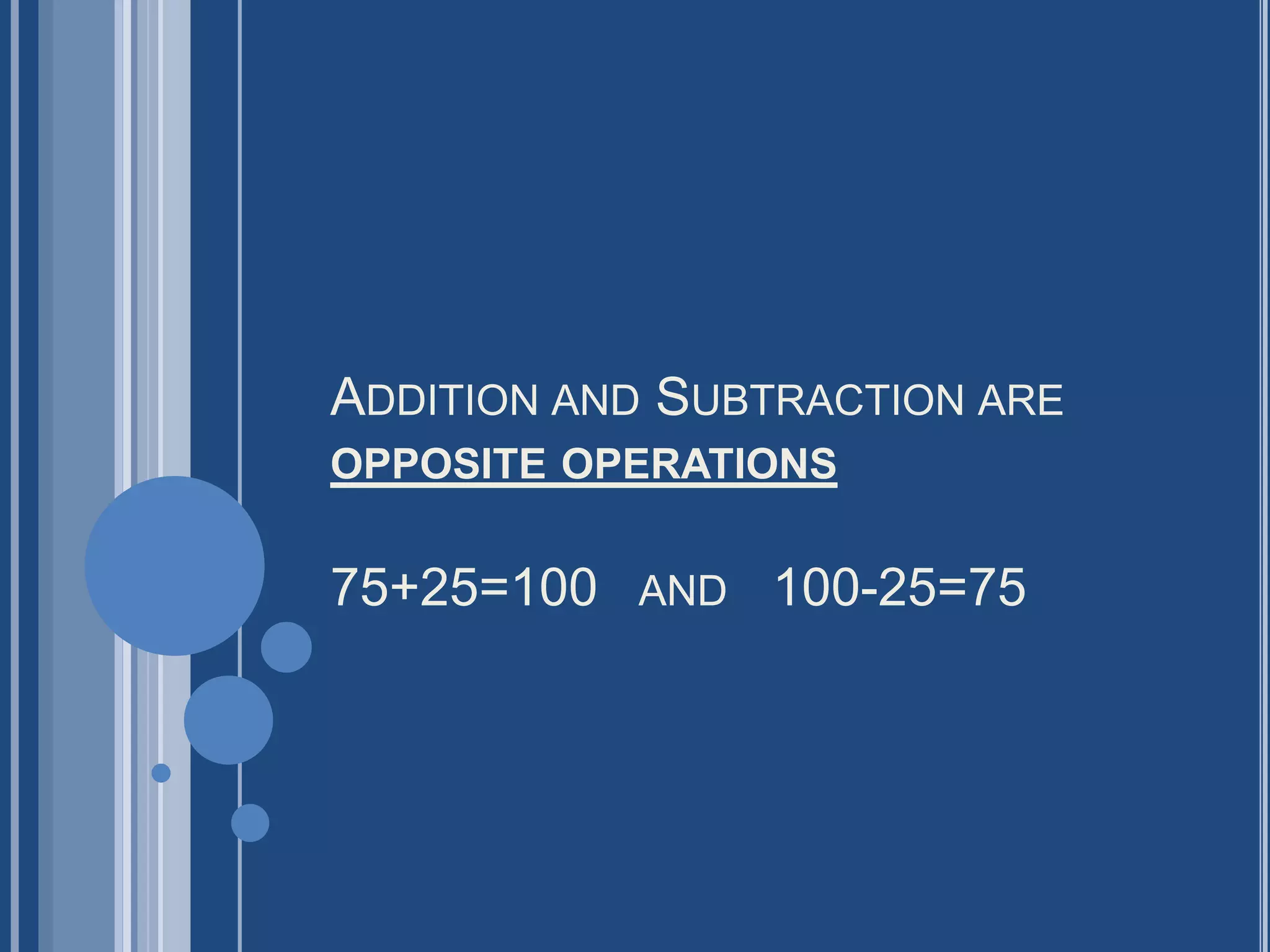
ADDITION AND SUBTRACTION ARE
OPPOSITE OPERATIONS


75+25=100 AND 100-25=75
MULTIPLICATION
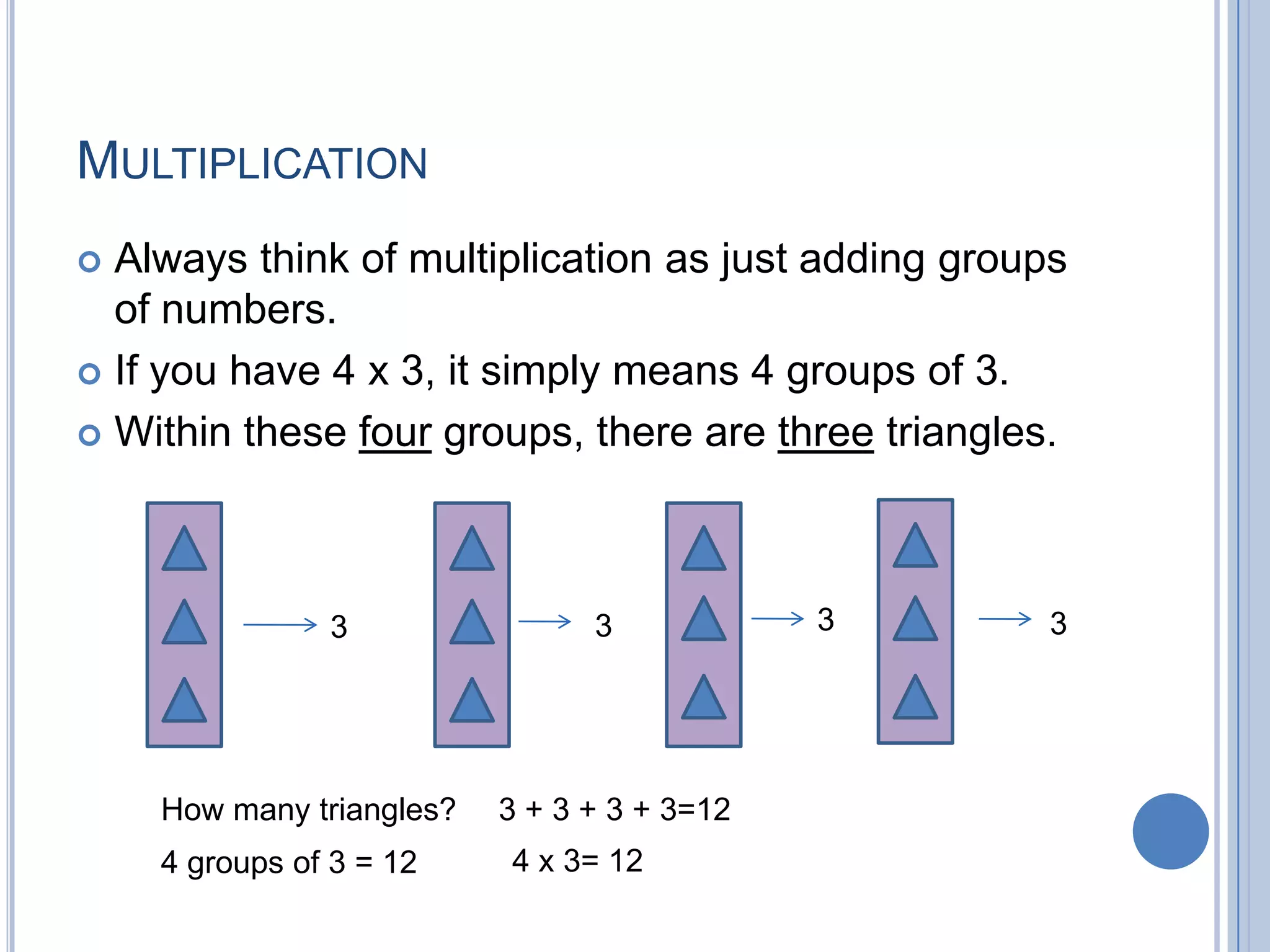
 Always think of multiplication as just adding groups
  of numbers.
 If you have 4 x 3, it simply means 4 groups of 3.

 Within these four groups, there are three triangles.


               3                3            3       3


    How many triangles?   3 + 3 + 3 + 3=12
    4 groups of 3 = 12    4 x 3= 12
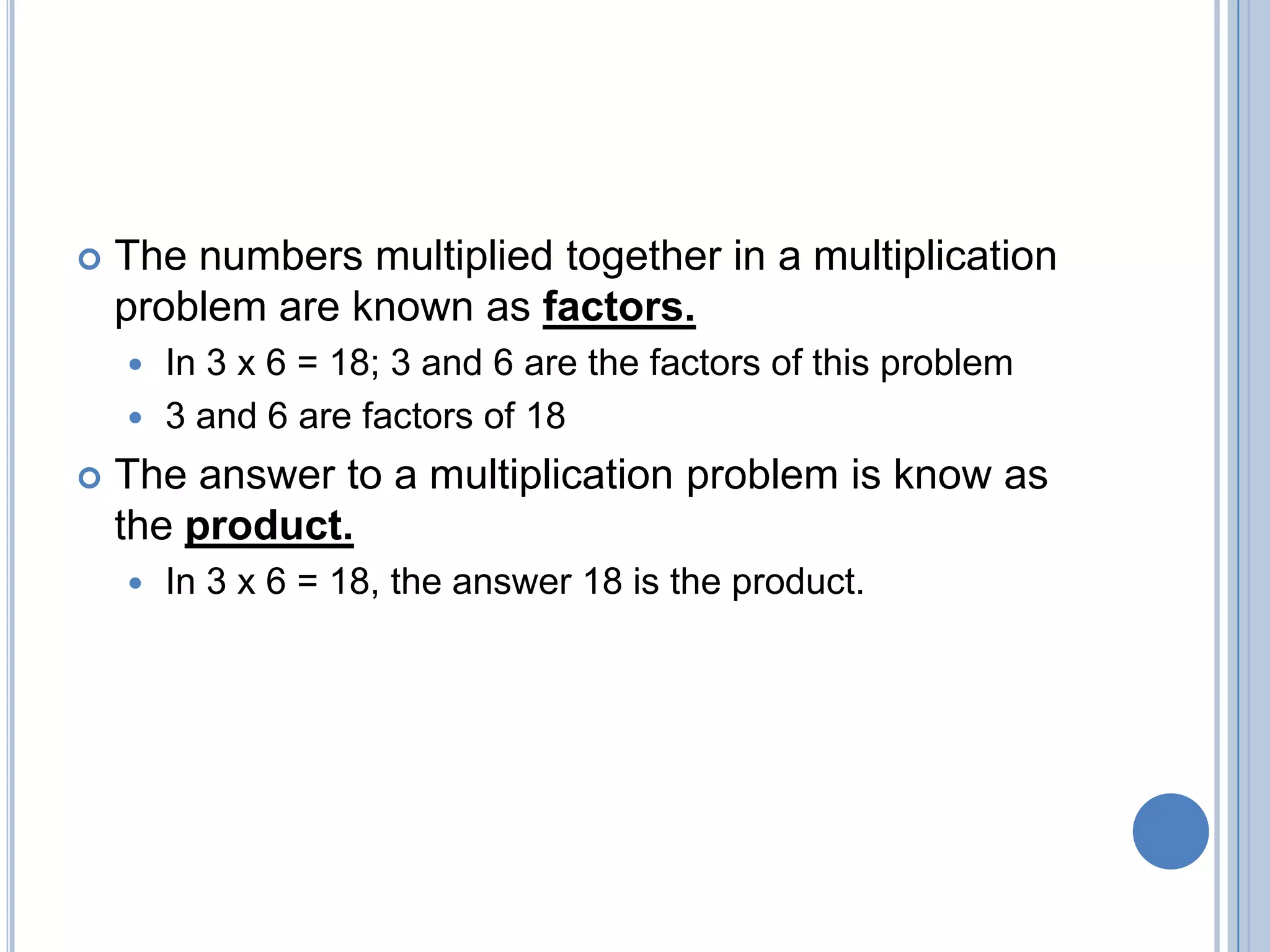
   The numbers multiplied together in a multiplication
    problem are known as factors.
     In 3 x 6 = 18; 3 and 6 are the factors of this problem
     3 and 6 are factors of 18

   The answer to a multiplication problem is know as
    the product.
       In 3 x 6 = 18, the answer 18 is the product.
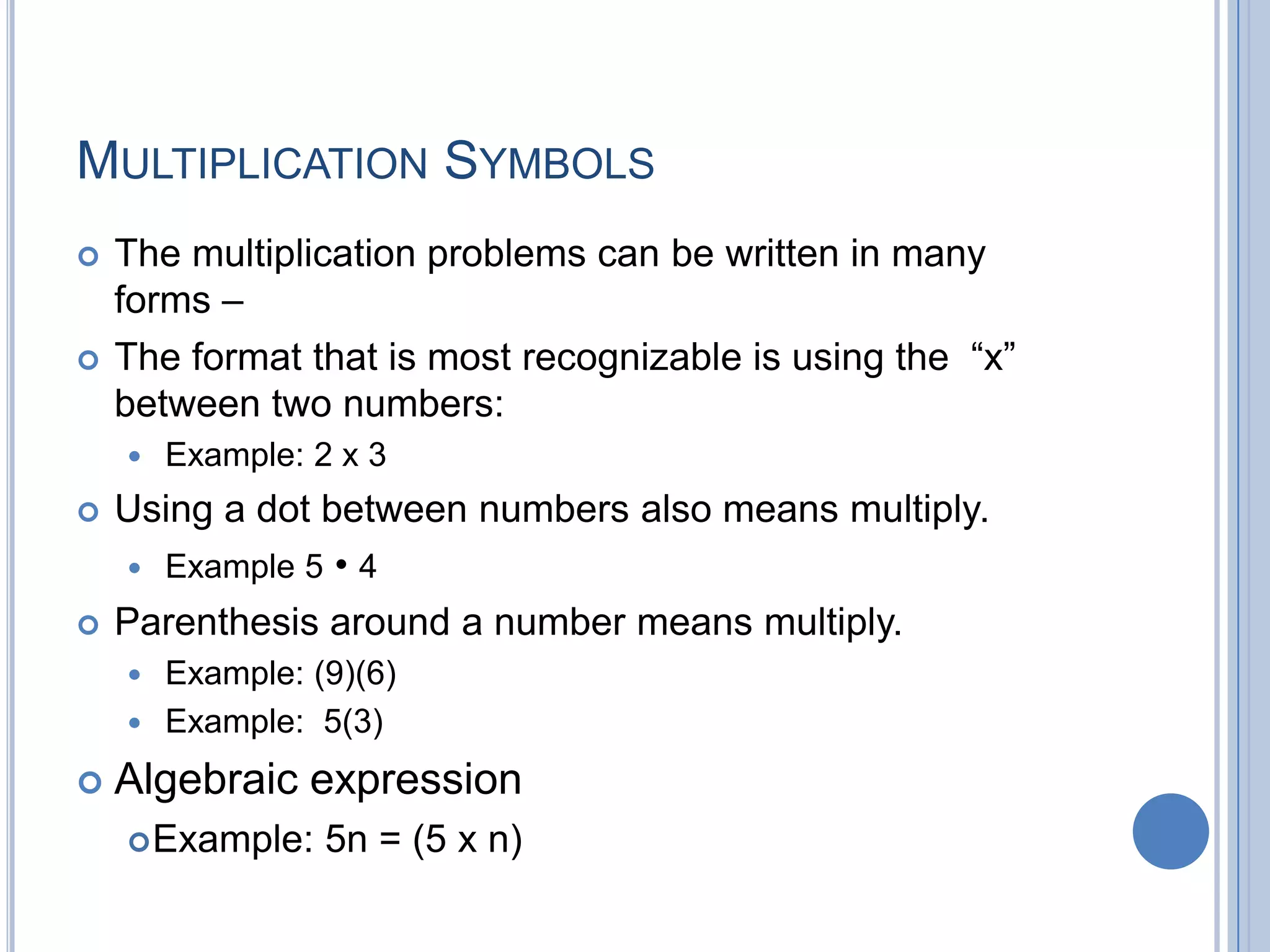
MULTIPLICATION SYMBOLS
   The multiplication problems can be written in many
    forms –
   The format that is most recognizable is using the “x”
    between two numbers:
       Example: 2 x 3
   Using a dot between numbers also means multiply.
     Example 5 • 4

   Parenthesis around a number means multiply.
     Example: (9)(6)
     Example: 5(3)

   Algebraic expression
     Example:    5n = (5 x n)
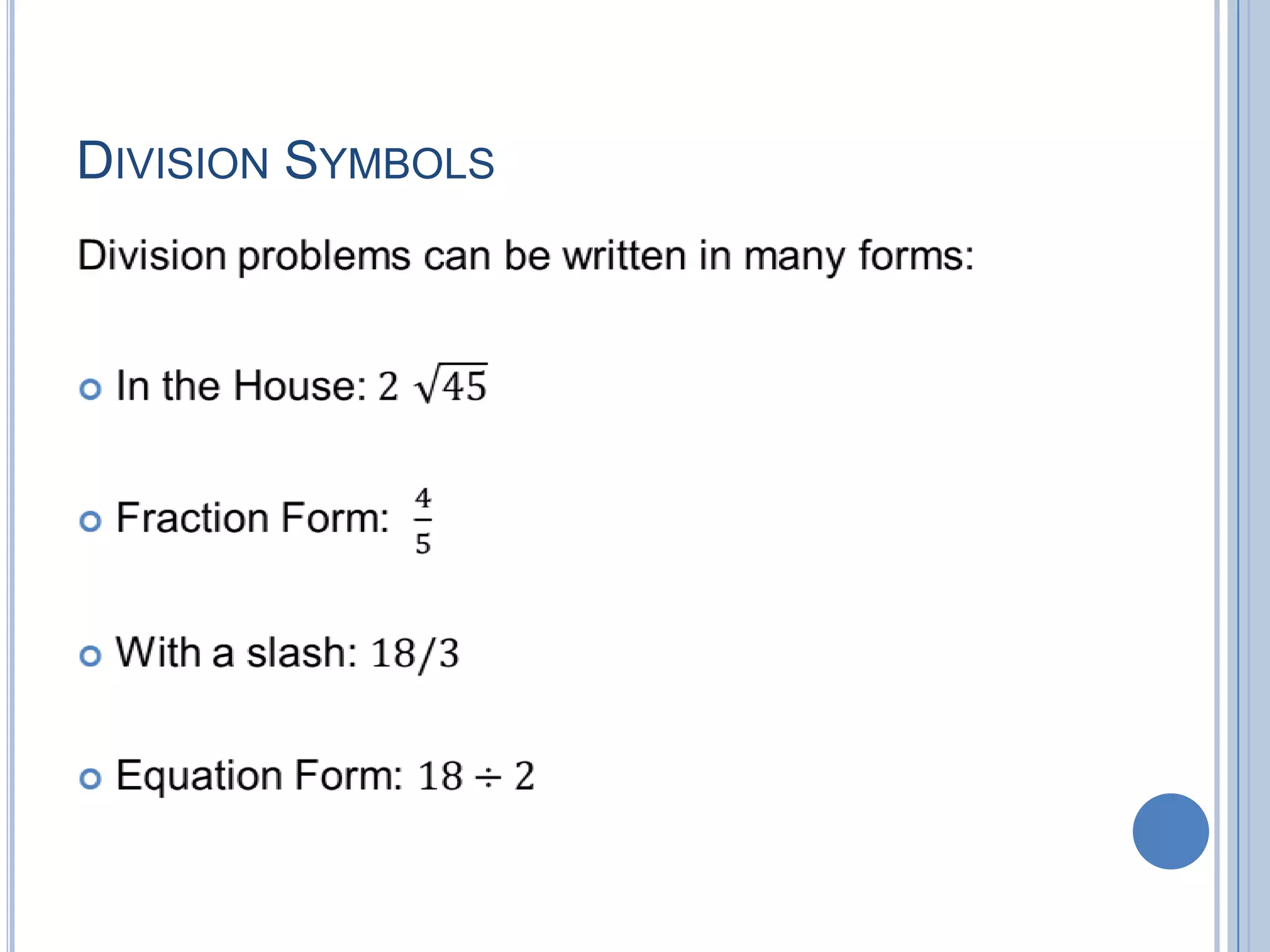
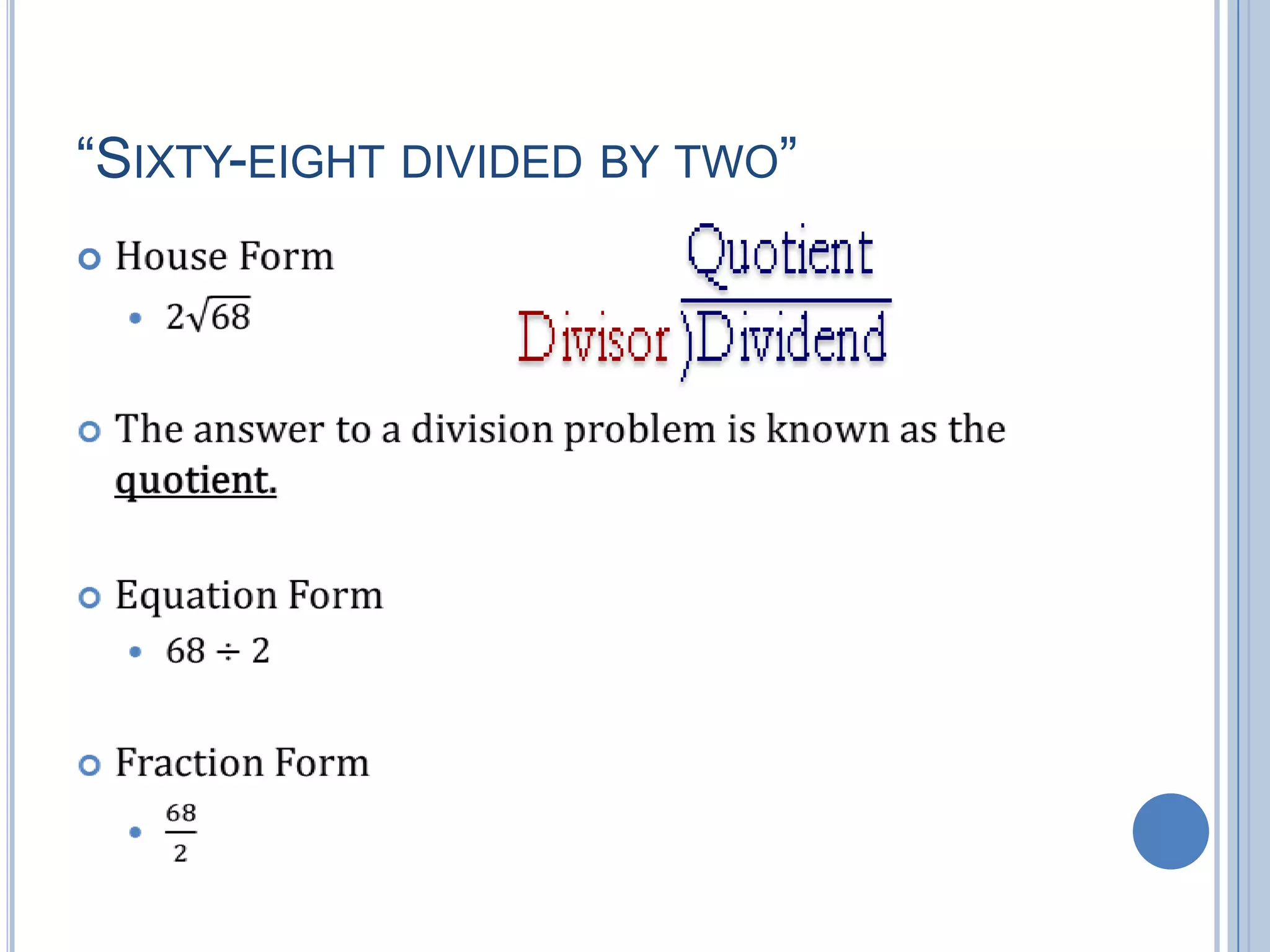
DIVISION SYMBOLS
“SIXTY-EIGHT DIVIDED BY TWO”


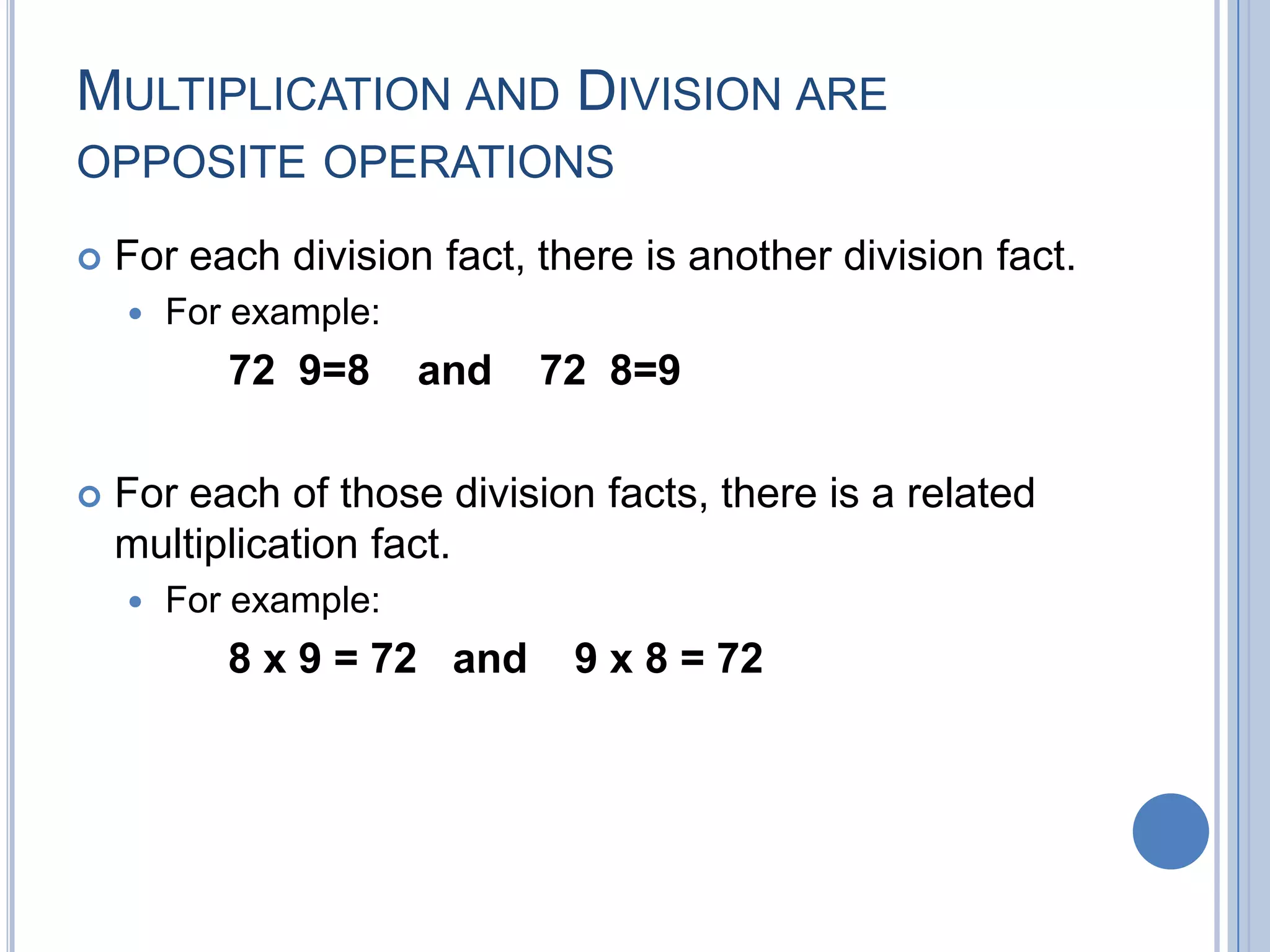
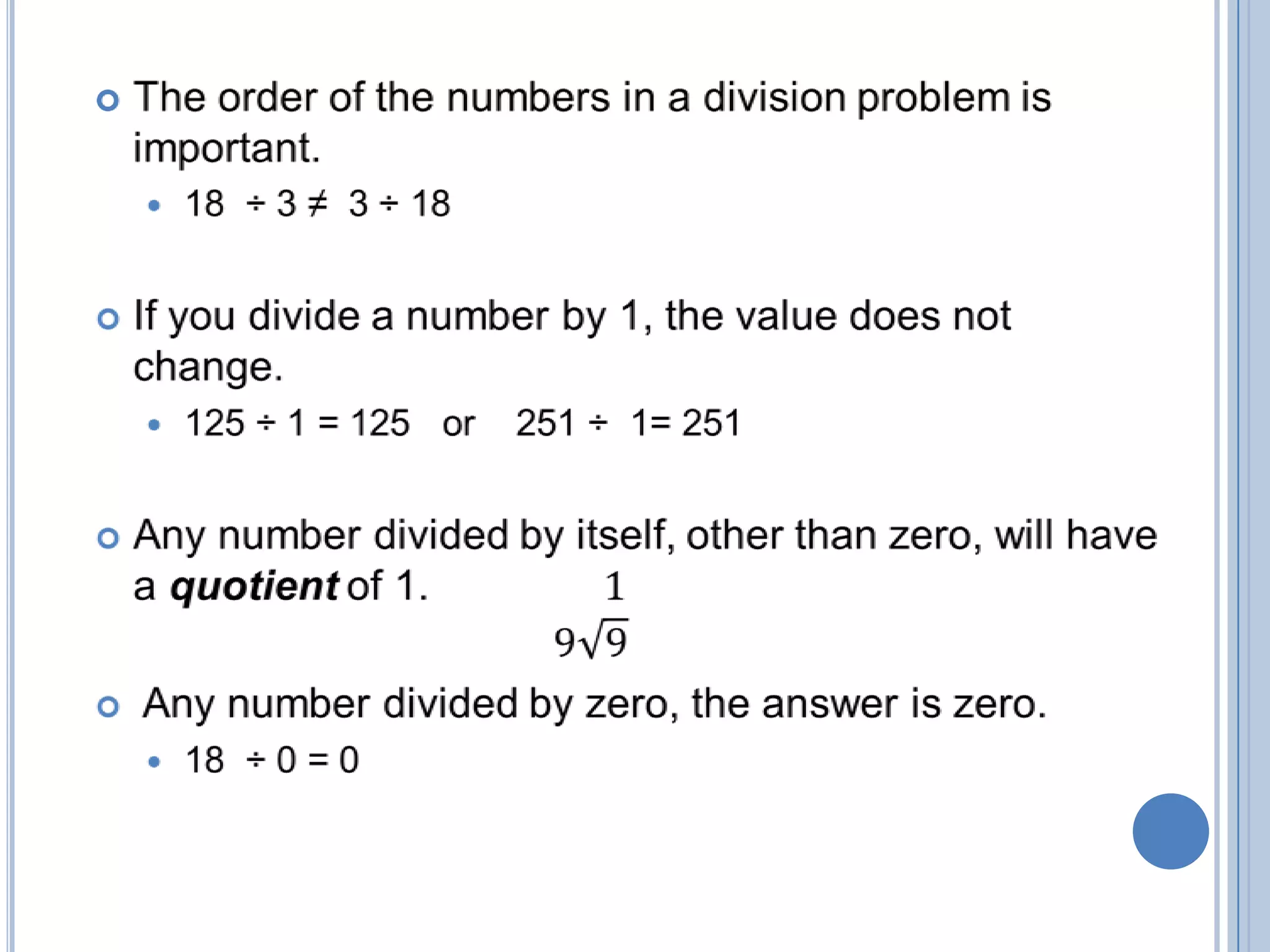
MULTIPLICATION AND DIVISION ARE
OPPOSITE OPERATIONS

   For each division fact, there is another division fact.
       For example:
           72 9=8      and   72 8=9

   For each of those division facts, there is a related
    multiplication fact.
       For example:
           8 x 9 = 72 and     9 x 8 = 72
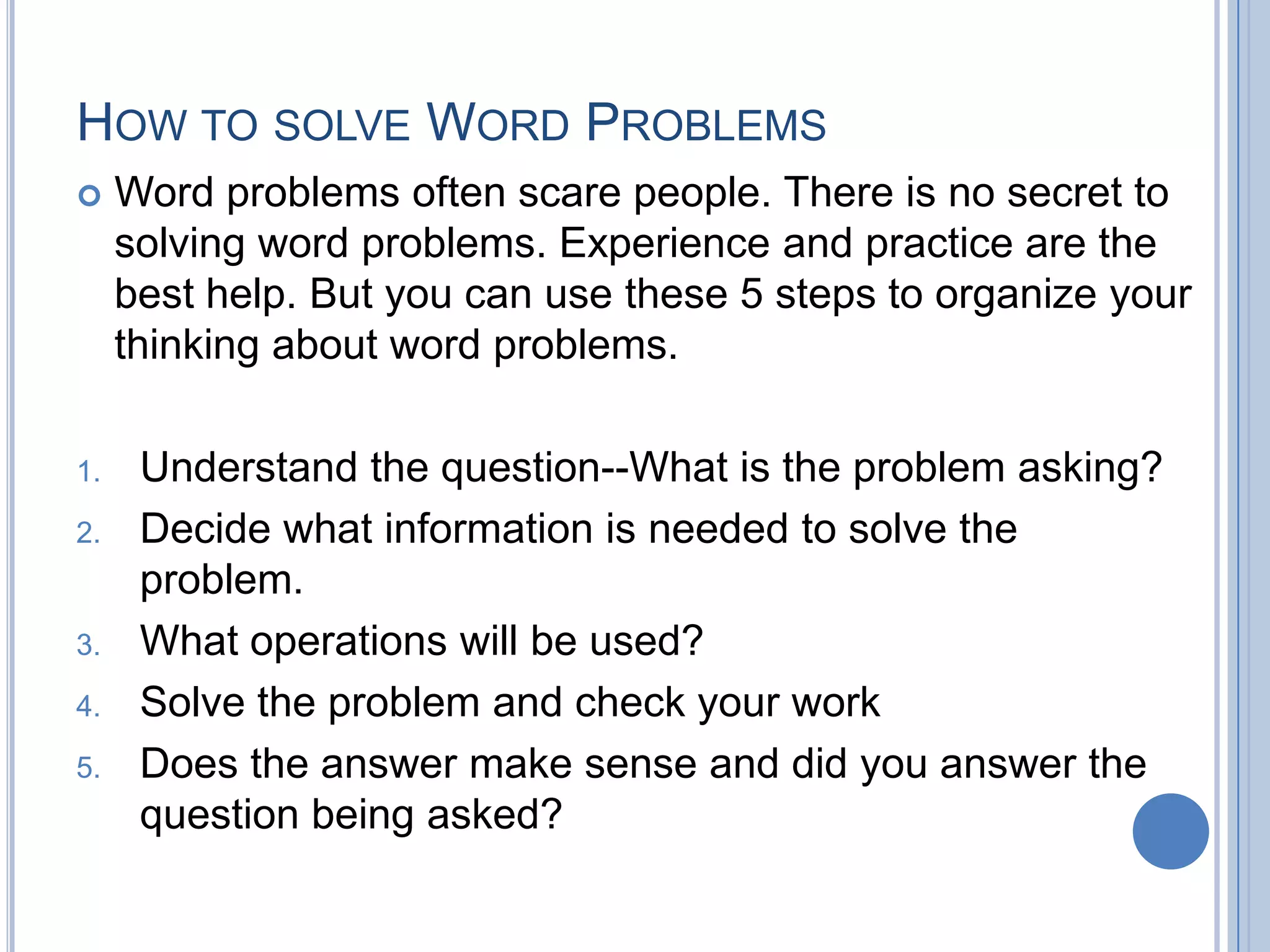
HOW TO SOLVE WORD PROBLEMS
    Word problems often scare people. There is no secret to
     solving word problems. Experience and practice are the
     best help. But you can use these 5 steps to organize your
     thinking about word problems.

1.    Understand the question--What is the problem asking?
2.    Decide what information is needed to solve the
      problem.
3.    What operations will be used?
4.    Solve the problem and check your work
5.    Does the answer make sense and did you answer the
      question being asked?
SOLVING WORD PROBLEMS
   There are 3 main tools for solving word problems:

    1. Knowing the definitions or main idea behind the different
      operations.

    2. Knowing the Key Words for choosing the correct operation.


    3. Asking the right questions when solving the word problem.
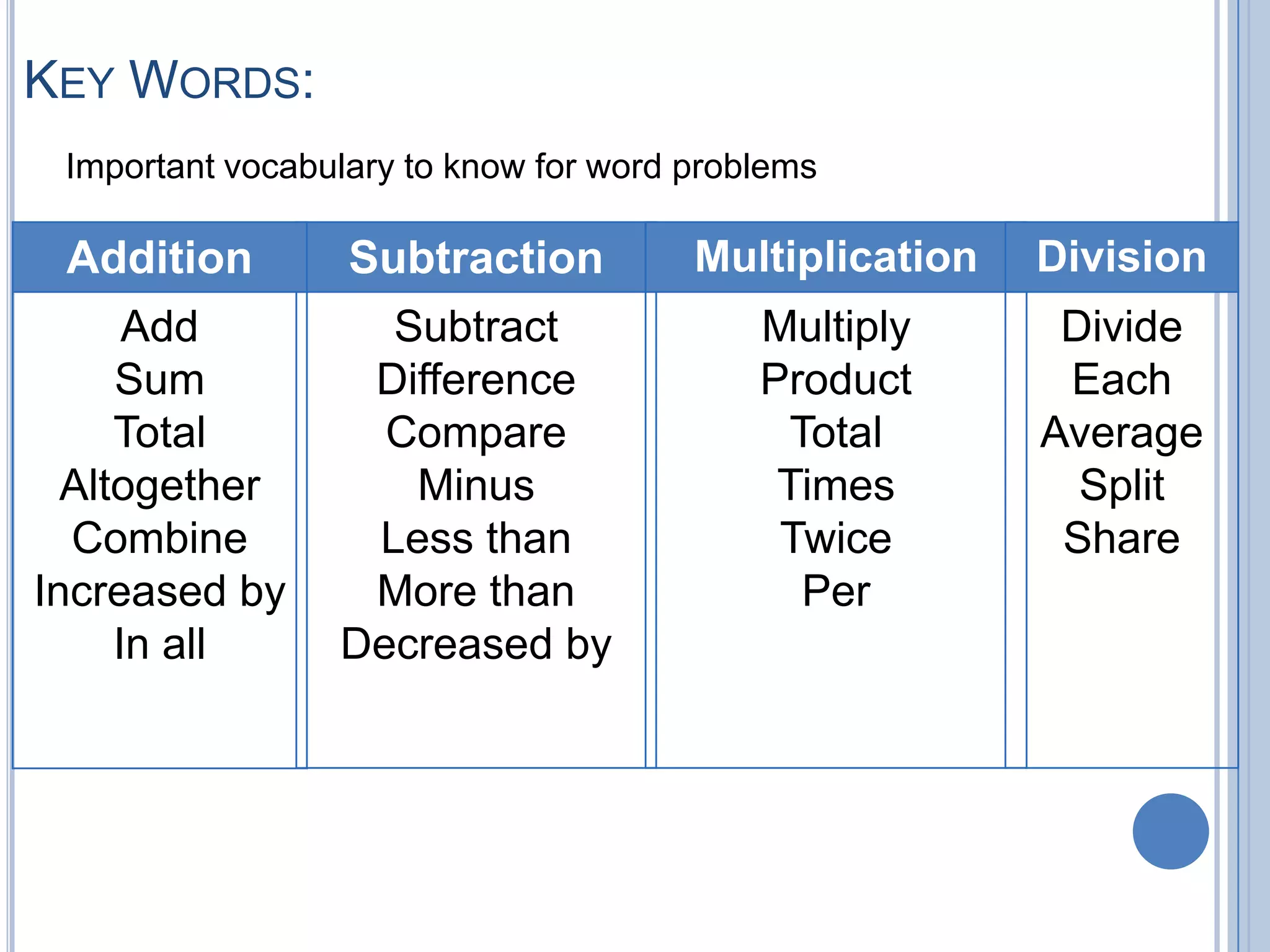
KEY WORDS:
 Important vocabulary to know for word problems

  Addition       Subtraction           Multiplication   Division
      Add          Subtract                Multiply      Divide
     Sum          Difference               Product       Each
     Total         Compare                  Total       Average
  Altogether        Minus                   Times         Split
  Combine         Less than                 Twice        Share
Increased by      More than                  Per
     In all      Decreased by
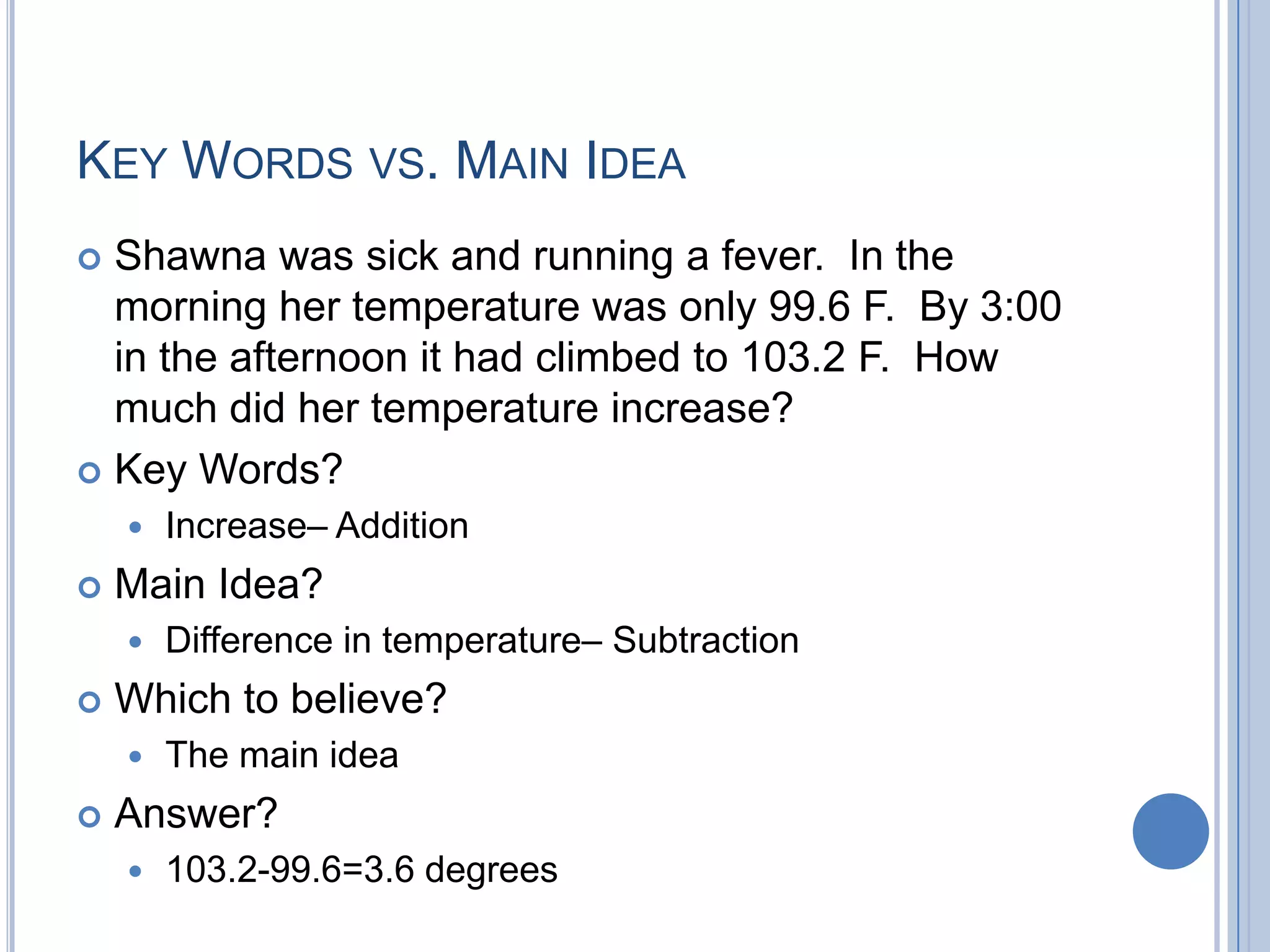
KEY WORDS VS. MAIN IDEA
 Shawna was sick and running a fever. In the
  morning her temperature was only 99.6 F. By 3:00
  in the afternoon it had climbed to 103.2 F. How
  much did her temperature increase?
 Key Words?
       Increase– Addition
   Main Idea?
       Difference in temperature– Subtraction
   Which to believe?
       The main idea
   Answer?
       103.2-99.6=3.6 degrees
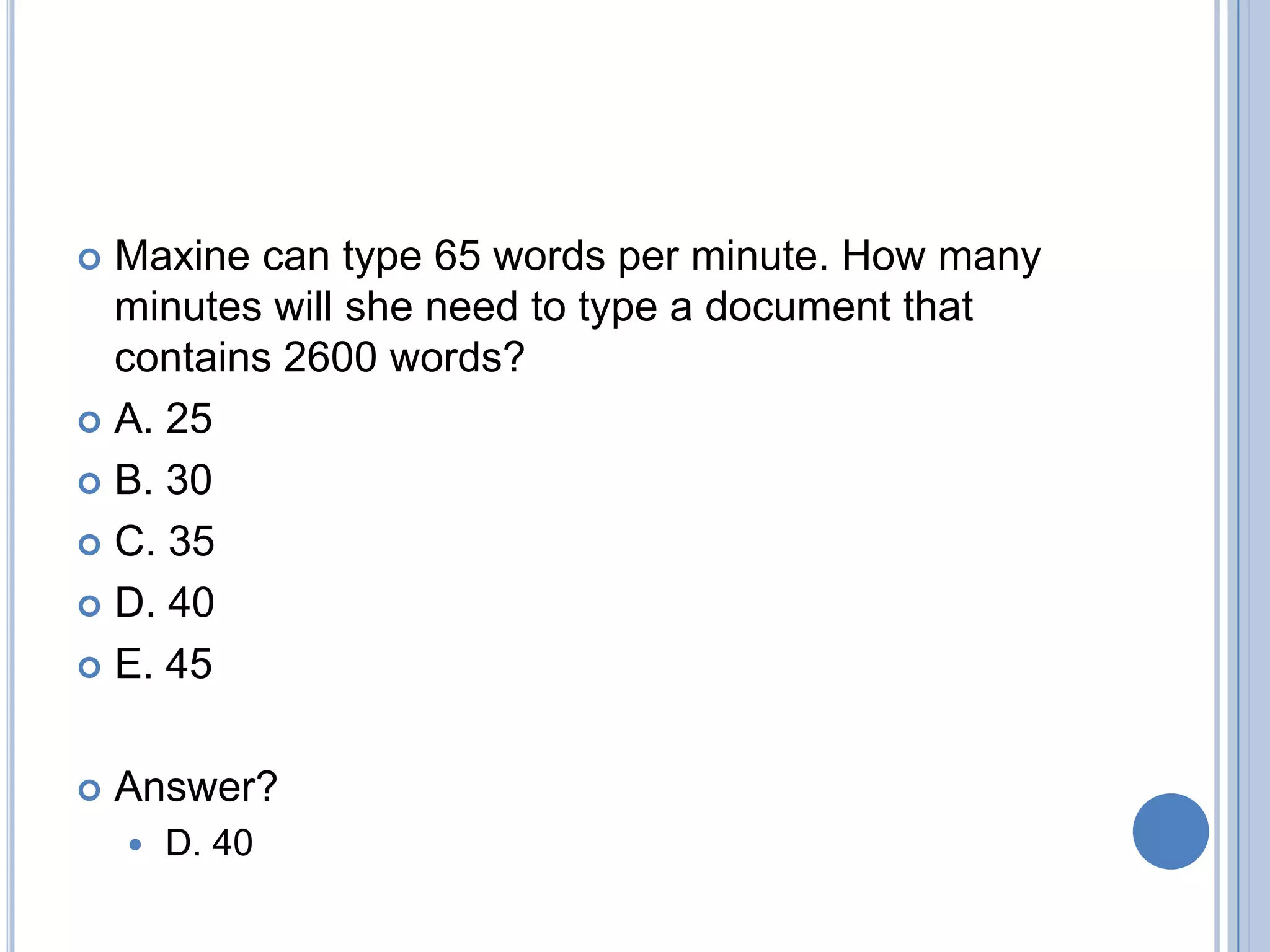
 Maxine can type 65 words per minute. How many
  minutes will she need to type a document that
  contains 2600 words?
 A. 25

 B. 30

 C. 35

 D. 40

 E. 45


   Answer?
       D. 40
MULTI-STEP WORD PROBLEM
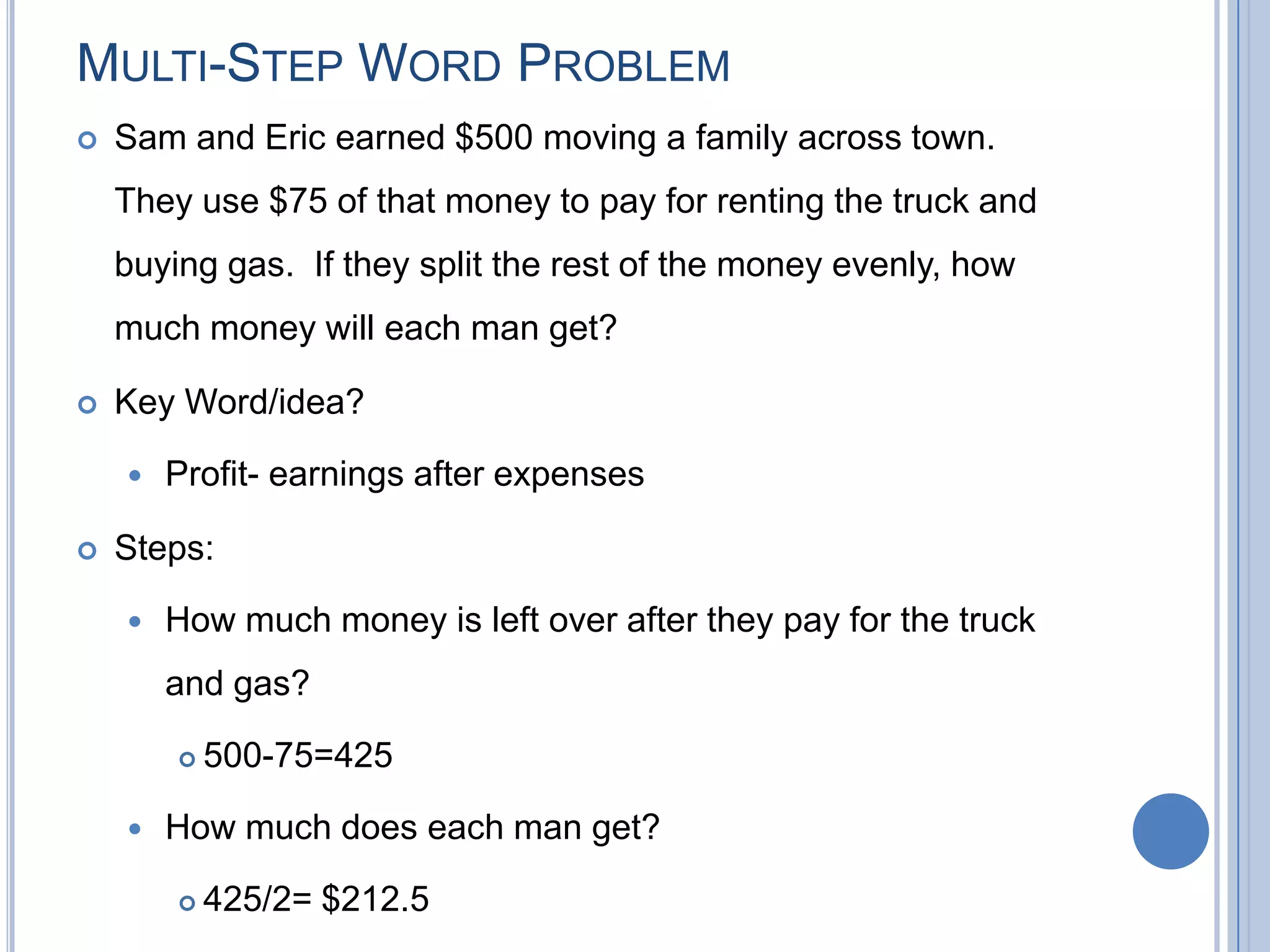
   Sam and Eric earned $500 moving a family across town.
    They use $75 of that money to pay for renting the truck and
    buying gas. If they split the rest of the money evenly, how
    much money will each man get?

   Key Word/idea?

       Profit- earnings after expenses

   Steps:

       How much money is left over after they pay for the truck
        and gas?

           500-75=425

       How much does each man get?

           425/2= $212.5
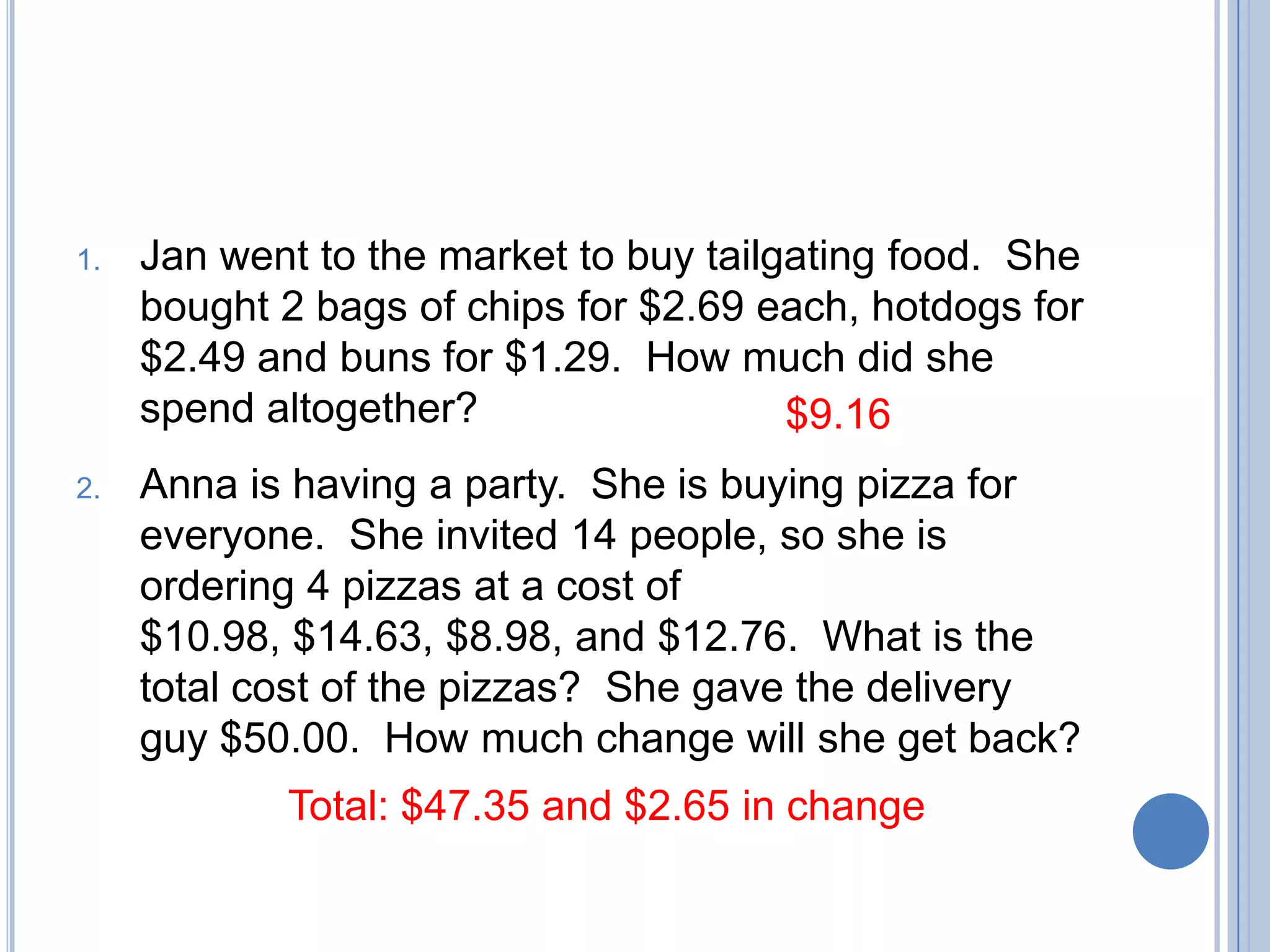
1.   Jan went to the market to buy tailgating food. She
     bought 2 bags of chips for $2.69 each, hotdogs for
     $2.49 and buns for $1.29. How much did she
     spend altogether?                  $9.16
2.   Anna is having a party. She is buying pizza for
     everyone. She invited 14 people, so she is
     ordering 4 pizzas at a cost of
     $10.98, $14.63, $8.98, and $12.76. What is the
     total cost of the pizzas? She gave the delivery
     guy $50.00. How much change will she get back?
            Total: $47.35 and $2.65 in change
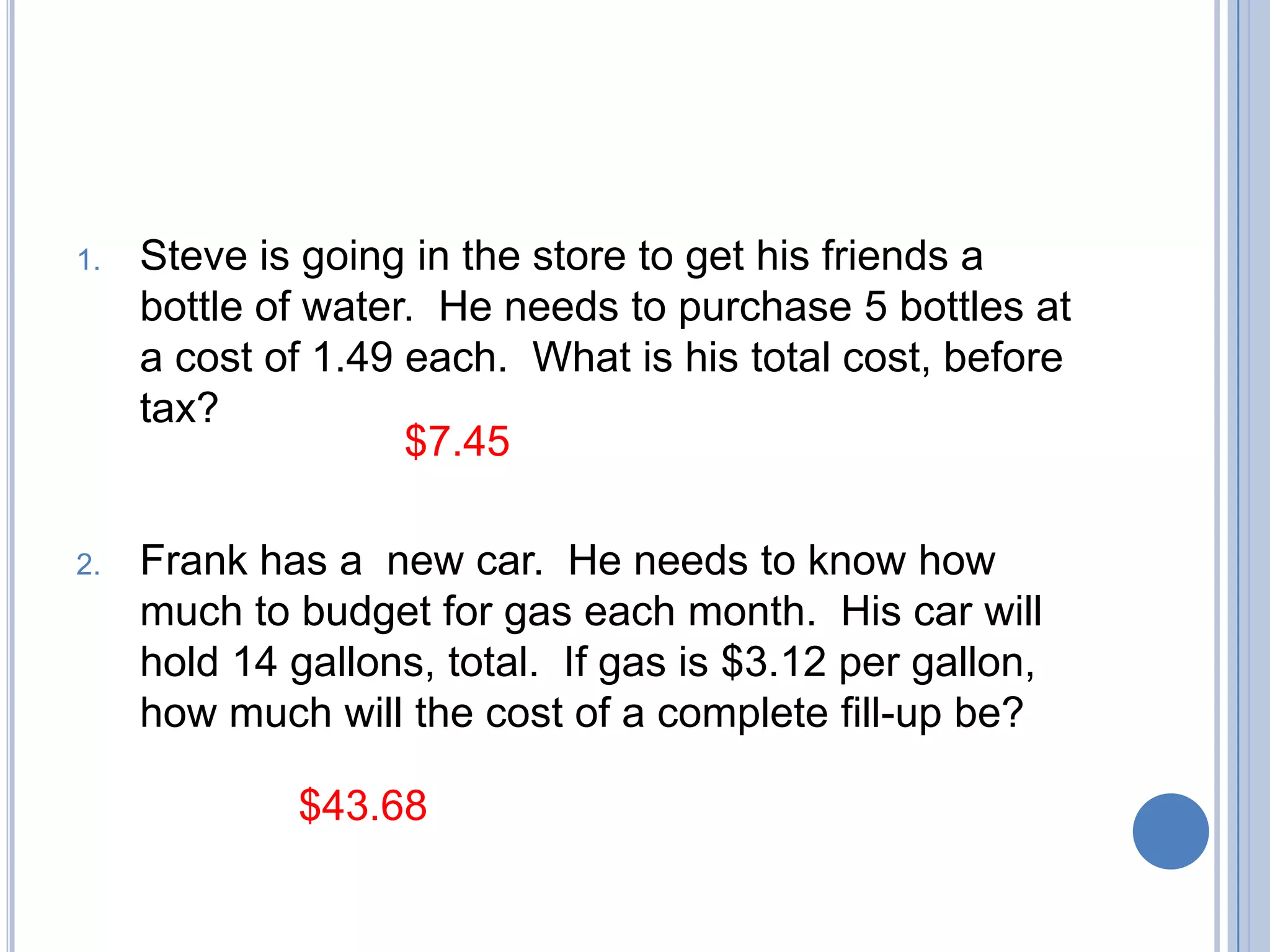
1.   Steve is going in the store to get his friends a
     bottle of water. He needs to purchase 5 bottles at
     a cost of 1.49 each. What is his total cost, before
     tax?
                    $7.45

2.   Frank has a new car. He needs to know how
     much to budget for gas each month. His car will
     hold 14 gallons, total. If gas is $3.12 per gallon,
     how much will the cost of a complete fill-up be?

             $43.68


IN CLASS WORKSHEET
   Page 51
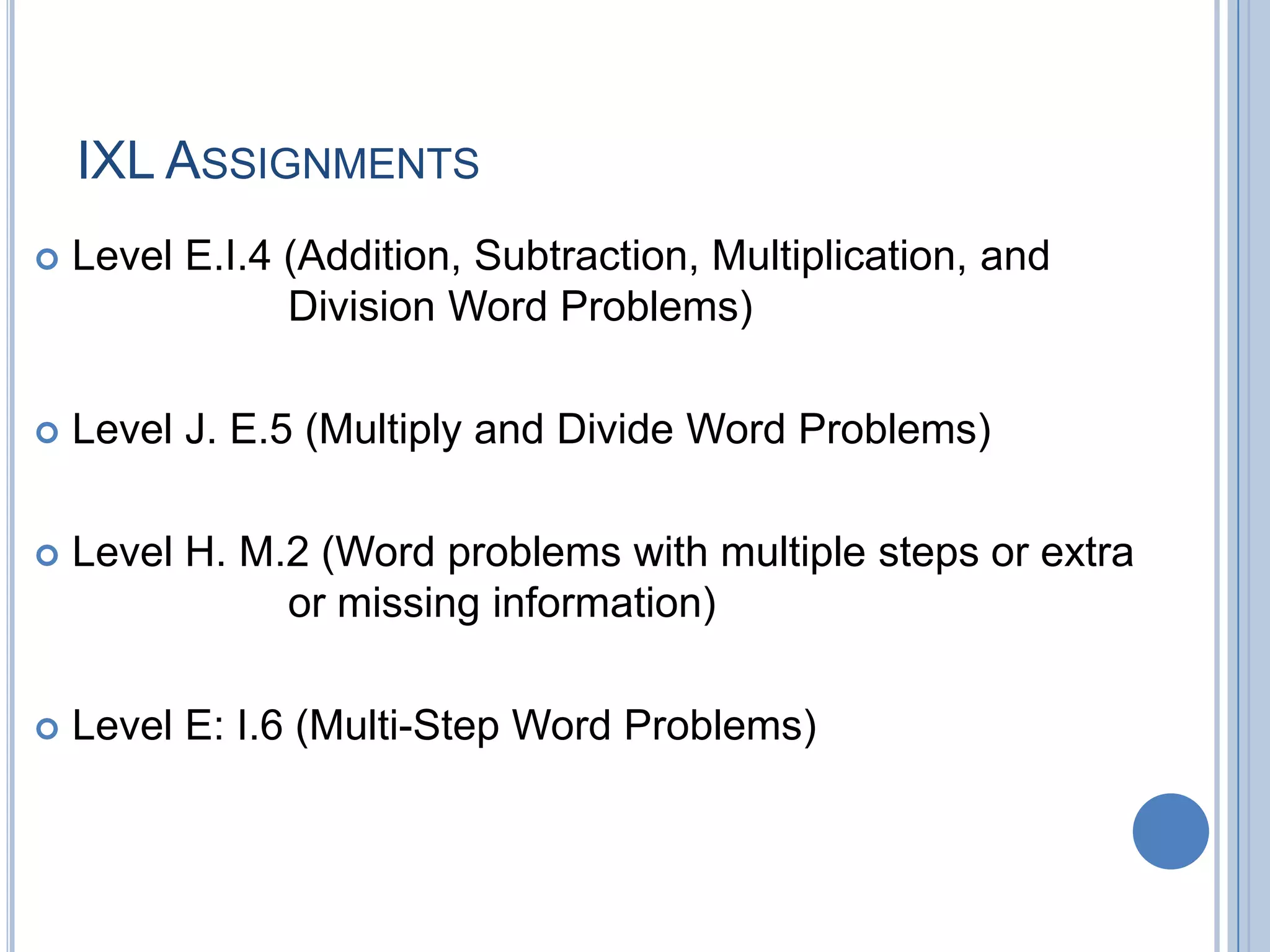
IXL ASSIGNMENTS
   Level E.I.4 (Addition, Subtraction, Multiplication, and
                Division Word Problems)

   Level J. E.5 (Multiply and Divide Word Problems)

   Level H. M.2 (Word problems with multiple steps or extra
               or missing information)

   Level E: I.6 (Multi-Step Word Problems)

Math orientation, place value, estimation, rounding, basic ops word problems

  • 2.
    ATTENDANCE SHEET  Attendancesheets can be found on the desk by the door.  Every class you need to sign in on your attendance sheet.  Our Class code is 12014
  • 3.
  • 4.
    ABOUT ME  FloridaGirl  Crafts and Photography  Bachelor of Science in Math  High-school struggle with math  Especially enjoy helping those who have found math difficult  Getting married this year
  • 5.
    WHY I LOVEMATH “We all use math every day- to predict weather, to tell time, to handle money. Math is more than formulas and equations. It's logic. It's rationality. It's using your mind to solve the biggest mysteries we know.” -Numb3rs introduction
  • 6.
    HOW TO SUCCEED  Time Investment  Come to every class. Be on time.  Do class work.  Faithfully do homework.  Make learning a priority.  Emotional Investment  Be positive & cooperative.  Have confidence.  Bounce back.  Learn something new everyday and review something everyday
  • 7.
    MATERIALS YOU NEEDFOR CLASS  3-ring Binder  Notebook  Pens  Pencils  Paper  Bring materials to every class!
  • 8.
    GUIDELINES FOR CLASS o Come prepared to learn. o Bring materials and be mentally prepared to learn o Be on time. o 15 mins after class starts you will not be allowed to attend the class. o Attend faithfully o You only have 1 absence for every 4 weeks. o No cell phone use in class, please silence them o No calls or texting
  • 9.
    STRUCTURE FOR CLASS  Review homework  Go over some of the homework problems  Attendance Sheet  Lesson  Break  Lesson
  • 10.
    EXPECTATIONS..  What do you expect from a teacher?  What do you expect from this math class?
  • 11.
    I EXPECT…  You to respect me, and I will in turn respect you.  You to respect others in the class and allow everyone a chance to learn
  • 12.
    BRUSH UP ONNEEDED SKILLS Not knowing a skill can hinder your ability to take the GED test. It may take longer to figure out a problem. For example: multiplication facts One way to brush up on this skill is make some flash cards and practice daily!
  • 13.
    VOCABULARY  Many people miss test questions because they lack understanding of certain math terms.  By understanding the meanings of the math terms, the problems can then be solved correctly .  So we will be focusing on the math terms as well as the math process
  • 14.
  • 15.
    PLACE VALUE • Placevalue is the basis of our entire number system • Before any numbers can be added, subtracted, multiplied or divided, the place value of numbers must be understood. • Each place has a given value, therefore each digit has a given value. • A place value system is one in which the position of a digit in a number determines its value. Example: 127,854 Hundred Ten Thousands Hundreds Tens Ones Thousand Thousand 1 2 7 8 5 4
  • 16.
    In the number456, each digit has a specific value. 4 5 6 hundreds tens ones 4 x 100 5 x 10 6x1 The value for each number is as follows: 400 + 50 + 6 = 456
  • 17.
    PLACE VALUE PRACTICE  What place value is the number 5 in each of these numbers:  5,423  758  965  50,012  8,652  588  501,468
  • 18.
    GUIDED PRACTICE: PLACEVALUE Write the value for the underlined number below. 1. 478 ___________ 2. 985 ___________ 3. 225 ___________ 4. 7361 ___________
  • 19.
    GUIDED PRACTICE: PLACEVALUE Write the value for the underlined number below. 1. 478 8 ones ___________ 2. 985 9 hundreds ___________ 3. 225 ___________ 2 tens 4. 7361 ___________ 7 thousands
  • 20.
    DECIMAL PLACE VALUE Example: 0.78216 Ten Hundred Tenths Hundredths Thousandths Thousandths Thousandths 7 8 2 1 6
  • 21.
    DECIMAL PLACE VALUE What place value is the 7 in each of these decimals?  0.127  0.7  0.37  0.4567
  • 22.
    Have you notice the pattern for the place values?  Notice all the decimal place names end in –ths.  They represent fractions or part of one unit.
  • 23.
    ESTIMATION  Estimation is finding a number that is close enough to the right answer.  You are not trying to get the exact right answer  When would be a good time to use estimation in your life?  In mathematics we often stress getting an exact answer.  But estimation can save you from making mistakes with your calculator:
  • 24.
     For example:you are calculating 107 times 56, and the calculator shows this: 952.00 Is that right?  "107 times 56 is a bit more than 100 times 50, which is 5,000"  Ooops! you must have typed something wrong, in fact you pressed 17×56 (you left out the zero), and without estimating you could have made a really big mistake!
  • 25.
    ROUNDING  Rounding means reducing the digits in a number while trying to keep its value similar.  The result is less accurate, but easier to use. How to Round  Underline the digit in the place you are rounding to, this is the last digit you need to keep  Leave the underlined digit the same if the next digit to the right is less than 5  But increase the underlined digit by 1 if the next digit to the right is 5 or more
  • 26.
    EXAMPLES OF ROUNDING  Round 74 to the nearest 10  Round 86 to the nearest 10  3.1416 rounded to hundredths  1.2635 rounded to tenths  5.7536 rounded to 3 decimal places
  • 27.
    Round 0.599 to the hundredths place  Round 178.9 to the ones place  Round 84.84 to the tenths place  Round 0.1254 to the thousandths place
  • 28.
    IXL.COM  Rounding  Level H: B.7
  • 29.
    WHAT ARE THE4 BASIC MATH OPERATIONS? Addition Multiplication Subtraction Division It doesn’t matter what kind of math problems are being solved. These are the only math operations used.
  • 30.
    DEFINITIONS: BASIC OPERATIONS Addition (+) Adding two or more numbers together.  Subtraction (-) Finding the difference between numbers.  Multiplication (x) is repeated addition.  5 x 3 is the same as 5 + 5 + 5 or 3 sets of 5 = 15  3 x 5 is the same as 3 + 3 + 3 + 3 + 3 or 5 sets of 3 = 15  Division (÷) is the splitting into equal groups or parts; the result of sharing. There are 12 chocolates, and 3 friends want to share them, how do are the chocolates divided? 4 each
  • 31.
    ADDITION AND SUBTRACTIONARE OPPOSITE OPERATIONS 75+25=100 AND 100-25=75
  • 32.
    MULTIPLICATION  Always thinkof multiplication as just adding groups of numbers.  If you have 4 x 3, it simply means 4 groups of 3.  Within these four groups, there are three triangles. 3 3 3 3 How many triangles? 3 + 3 + 3 + 3=12 4 groups of 3 = 12 4 x 3= 12
  • 33.
    The numbers multiplied together in a multiplication problem are known as factors.  In 3 x 6 = 18; 3 and 6 are the factors of this problem  3 and 6 are factors of 18  The answer to a multiplication problem is know as the product.  In 3 x 6 = 18, the answer 18 is the product.
  • 34.
    MULTIPLICATION SYMBOLS  The multiplication problems can be written in many forms –  The format that is most recognizable is using the “x” between two numbers:  Example: 2 x 3  Using a dot between numbers also means multiply.  Example 5 • 4  Parenthesis around a number means multiply.  Example: (9)(6)  Example: 5(3)  Algebraic expression  Example: 5n = (5 x n)
  • 37.
  • 38.
  • 39.
  • 40.
    MULTIPLICATION AND DIVISIONARE OPPOSITE OPERATIONS  For each division fact, there is another division fact.  For example: 72 9=8 and 72 8=9  For each of those division facts, there is a related multiplication fact.  For example: 8 x 9 = 72 and 9 x 8 = 72
  • 41.
    HOW TO SOLVEWORD PROBLEMS  Word problems often scare people. There is no secret to solving word problems. Experience and practice are the best help. But you can use these 5 steps to organize your thinking about word problems. 1. Understand the question--What is the problem asking? 2. Decide what information is needed to solve the problem. 3. What operations will be used? 4. Solve the problem and check your work 5. Does the answer make sense and did you answer the question being asked?
  • 42.
    SOLVING WORD PROBLEMS  There are 3 main tools for solving word problems: 1. Knowing the definitions or main idea behind the different operations. 2. Knowing the Key Words for choosing the correct operation. 3. Asking the right questions when solving the word problem.
  • 43.
    KEY WORDS: Importantvocabulary to know for word problems Addition Subtraction Multiplication Division Add Subtract Multiply Divide Sum Difference Product Each Total Compare Total Average Altogether Minus Times Split Combine Less than Twice Share Increased by More than Per In all Decreased by
  • 44.
    KEY WORDS VS.MAIN IDEA  Shawna was sick and running a fever. In the morning her temperature was only 99.6 F. By 3:00 in the afternoon it had climbed to 103.2 F. How much did her temperature increase?  Key Words?  Increase– Addition  Main Idea?  Difference in temperature– Subtraction  Which to believe?  The main idea  Answer?  103.2-99.6=3.6 degrees
  • 45.
     Maxine cantype 65 words per minute. How many minutes will she need to type a document that contains 2600 words?  A. 25  B. 30  C. 35  D. 40  E. 45  Answer?  D. 40
  • 46.
    MULTI-STEP WORD PROBLEM  Sam and Eric earned $500 moving a family across town. They use $75 of that money to pay for renting the truck and buying gas. If they split the rest of the money evenly, how much money will each man get?  Key Word/idea?  Profit- earnings after expenses  Steps:  How much money is left over after they pay for the truck and gas?  500-75=425  How much does each man get?  425/2= $212.5
  • 47.
    1. Jan went to the market to buy tailgating food. She bought 2 bags of chips for $2.69 each, hotdogs for $2.49 and buns for $1.29. How much did she spend altogether? $9.16 2. Anna is having a party. She is buying pizza for everyone. She invited 14 people, so she is ordering 4 pizzas at a cost of $10.98, $14.63, $8.98, and $12.76. What is the total cost of the pizzas? She gave the delivery guy $50.00. How much change will she get back? Total: $47.35 and $2.65 in change
  • 48.
    1. Steve is going in the store to get his friends a bottle of water. He needs to purchase 5 bottles at a cost of 1.49 each. What is his total cost, before tax? $7.45 2. Frank has a new car. He needs to know how much to budget for gas each month. His car will hold 14 gallons, total. If gas is $3.12 per gallon, how much will the cost of a complete fill-up be? $43.68
  • 49.
  • 50.
  • 51.
  • 52.
    IXL ASSIGNMENTS  Level E.I.4 (Addition, Subtraction, Multiplication, and Division Word Problems)  Level J. E.5 (Multiply and Divide Word Problems)  Level H. M.2 (Word problems with multiple steps or extra or missing information)  Level E: I.6 (Multi-Step Word Problems)