Material Development
for Language
Learning and
Teaching
Dina Fauziah
Dwi Firly Azhari
Dwi Novita Sari
Erma Agus Setyaningsih
Laranti Salaz
Ponco Prakoso Agung Purwanto
Vivi Nur Akmalia
Outline
• History of publications on materials
development
• Materials Evaluation
• Materials Adaptation
• Materials Production
• Materials Exploitation
• Issues in materials Development
• Ideology in Materials
• The roles of new technologies (The use of
CALL)
• Research in Materials Developments
• Conclusion
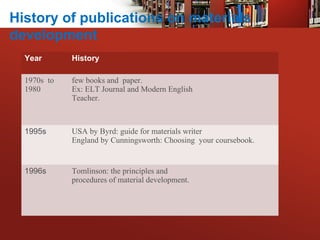
Year History
1970s to
1980
few books and paper.
Ex: ELT Journal and Modern English
Teacher.
1995s USA by Byrd: guide for materials writer
England by Cunningsworth: Choosing your coursebook.
1996s Tomlinson: the principles and
procedures of material development.
History of publications on materials
development
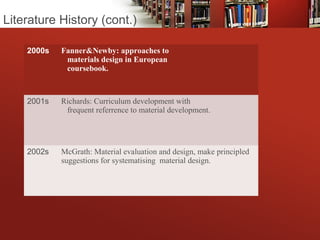
2000s Fanner&Newby: approaches to
materials design in European
coursebook.
2001s Richards: Curriculum development with
frequent referrence to material development.
2002s McGrath: Material evaluation and design, make principled
suggestions for systematising material design.
Literature History (cont.)
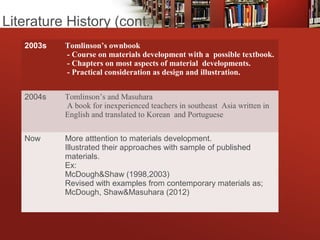
2003s Tomlinson’s ownbook
- Course on materials development with a possible textbook.
- Chapters on most aspects of material developments.
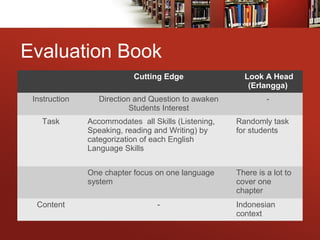
- Practical consideration as design and illustration.
2004s Tomlinson’s and Masuhara
A book for inexperienced teachers in southeast Asia written in
English and translated to Korean and Portuguese
Now More atttention to materials development.
Illustrated their approaches with sample of published
materials.
Ex:
McDough&Shaw (1998,2003)
Revised with examples from contemporary materials as;
McDough, Shaw&Masuhara (2012)
Literature History (cont.)
Material Evaluation
• A procedure that involves measuring the
value (or potential value) of a set of
learning materials. It involves making
judgements about the effect of the
materials on the people using them.”
Early literature on
Material Development
• Tucker (1975) propose a four-component scheme for measuring the
internal and external value of beginners’ text book.
• Davidson (1976) propose proposed a five-category scheme for the
evaluation and selection of textbooks.
• Dauod & Celce-Murcia (1979) provided checklists of criteria for evaluating
coursebooks.
• Candlin&Breen (1980) proposed criteria for evaluating materials and, unlike
many of their contemporaries, also proposed the use of these criteria when
developing materials.
• Rivers (1981) provided categories and criteria for evaluating materials.
• Mariani (1983) wrote about evaluation and supplementation,
• Williams (1983) developed criteria for textbook evaluation
• Cunningsworth (1984) provided a very detailed checklist of
evaluation criteria ‘for evaluating teaching material’ (p. 74).
• Breen & Candlin (1987) published a principled guide for both
evaluators and producers of materials
• Sheldon (1987, 1988) suggested criteria for both evaluating
and developing textbook material.
• Skierso (1991) provided probably the most comprehensive
checklist of criteria for textbooks
• and teachers’ books by combining checklists from various
sources.
• Cunningsworth (1995), Harmer (1991, 1998), Roberts (1996),
Ur (1996), Brown (1997), Hemsley (1997) and Gearing (1999)
also proposed checklists for evaluating materials
Tomlinson & Masuhara (2004: 7) propose these
questions for evaluating criteria:
a) Is each question an evaluation question?
‘Are there any material for testing?’ (Cunningsworth
1984)
‘are the learning activities in the course material likely
appeal to the laerners?’
b) Does each question only ask one question?
‘is it attractive? Given the average age of your
students, would they enjoy using it? (Grant 1987: 122)
c) Is each question answerable?
“Does the writer use current everyday language,
and sentences structure that follow normal word
order?” (Daoud & Celce-Murcia 1979: 304)
to what extent is the level of abstractness
appropriate? (Skierso 1991:446)
d) Is each question free of dogma?
‘are the various stages in a teaching unit (what
you would probably called presentation, practice
and production) adequately develop?’ (Mariani
1983: 29)
e) Is each question reliable in the sense
that other evaluators would interpret it in
the same.
“is it foolproof (i.e sufficiently methodical
to guide the inexperienced teacher
through a lesson)?”(Dougill 1987: 32)
Reporting Evaluation
• Evaluation reports which has been published
- Focusing on principles and procedures in conducting the evaluation (mostly)
- The effectiveness of course book
• Evaluation reports which focus on course book
– Tomlinson et al. (2001) - a review of eight currently popular UK course books
for adults
– Masuhara et al. (2008) – a review of eight course books for adults to a rigorous
criterion-referenced review
Both conclude the same view on how course book needs to be humanized and
personalized.
Result analysis:
- The neglect of literature as a source of potentially engaging text
- The lack of intelligent content in lower level
- The lack extensive reading and listening
- The scarcity of real task which has intended outcome than just practicing on
language forms
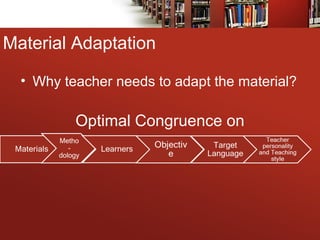
Material Adaptation
• Why teacher needs to adapt the material?
Optimal Congruence on
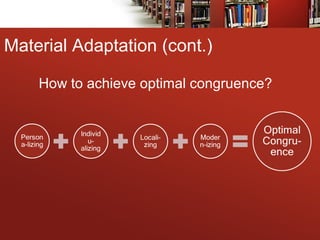
Material Adaptation (cont.)
How to achieve optimal congruence?
Several Tips for Material Adaptation
McGrath (2002)’s ways to adapt
Keep some material unchanged
Reject partially or completely sections of
material
Add extension
Further exploitation
• Saraceni (2003)’s way for material
adaptation
• Involves learner
• Aiming to be learner-centered, open-
ended, universal and authentic, flexible
giving choice for learner
McDonough et al. (2012)’s way to make adaptation
contextual:
Using familiar material and suitable situation for your
teaching
Islam & Mares (2003)’s way to solve congruence
problem
-Borrow objectives and categories from existing book
-Provide all learning style
-Provide learning autonomy
-Developing high-level cognitive skill
-Making the input more accessible and engaging
References about Material Adaptation
Other early publications which provided help to teachers when
adapting materials include;
• Candlin & Breen (1980), who criticise published
communicative materials and suggest ways of adapting them
so as to offer more opportunities for communication,
• Cunningsworth (1984), who focuses on how to change
materials so that they get the learners to do what the teacher
wants them to do
• Grant (1987), who suggests and illustrates ways of making
materials more communicative.
Experts who have given advice about
adaptation in the nineties include;
• Willis (1996), on ways of changing classroom
management and sequencing to maximise
the value of taskbased materials,
• Nunan (1999), on procedures for making
materials more interactive and
• White (1998), on ways of increasing student
participation when using listening materials.
Material Production
5.1 How writers write
•Repertoire
•Cloning successful publications
•Spontaneous ‘inspiration’
Research about how writers write
• Johnson (2003) doing a research
between some experts and some
students and get results if the experts,
they designed in opportunistic ways,
instantiated as they wrote, showed
learner/context sensitivity and used
repertoire a lot.
Interestingly, there was no explicit reference
by the experts to theory-driven principles
• Prowse (2011), some of writers of course book
focus on the creative, inspirational aspect of
materials writing (‘coursebook writing is a
creative rather than a mechanical process’ and
on making use of prior experience of teaching
and writing.
Research about how writers write (cont.)
• Tomlimson (2012): approach to materials
writing in which the ongoing evaluation of
the developing materials is driven by :
1.a set of agreed principles, both universal
principles applicable to any learning
context .
2.local criteria specific to the target learning
context(s).
Research about how writers write (cont.)
The principles proposed include:
•the language experience needs to be
contextualized and comprehensible.
•the learner needs to be motivated, relaxed,
positive and engaged.
•the language and discourse features available
for potential acquisition need to be salient,
meaningful and frequently encountered.
5.2 Principled development of materials
• the learner needs to achieve deep and
multi-dimensional processing of the
language.
(Tomlinson 2008b: 4)
Principled development of materials (cont.)
5.3 Practical guidance to writers
• Johnson (2003) gives his informed
opinion on the expertise needed to be a
good task designer and Spiro (2006)
provides advice on how to become an L2
storywriter.
• Tomlinson (2003b, 2003c) proposes a
flexible text-driven framework for
developing materials and puts forward
ways of ensuring that materials are
humanistic.
• Tomlinson & Masuhara (2004) provide
practical advice on developing materials,
writing instructions, using illustrations and
layout and design.
• Van Avermaet & Gysen (2006) and Duran &
Ramaut (2006) give advice on writing tasks for
young learners.
• 5.3 Practical guidance to writers (cont.)
Folio has been publishing articles providing
information, advice and stimulus to materials
writers twice a year since 1993.
Practical guidance to writers (cont.)
Materials exploitation
• Teachers use their textbooks as
resources rather than as scripts
• how they use their course book depends
both on their experience and their view of
the course book’s value in their teaching
context
Issues in materials development
• The value of textbooks
– The textbook is the best medium for delivering language-
learning materials.
– Proponents : it is a cost-effective way of providing the
learner with security, system, progress and revision, whilst
at the same time saving precious time and offering
teachers the resources they need to base their lessons
on.
– Opponents : they can disempowered both teacher and
learners, cannot cater for the needs and wants of their
actual and provide only an illusion of system and progress
Tomlinson’s own view
I
that they need textbooks to save time and
money and many teachers want a course
book which provides everything they need
in one source.
The need for published materials
• Published materials - home-made materials
– to achieve greater relevance and engagement.
• For example, Tomlinson (2003d) describes how
a teacher in Jakarta made each group of students
responsible in one term for bringing her a
reading passage on which she then based a
reading lesson, and in the next term made each
group responsible for actually teaching a reading
lesson.
Tomlinson’s View
• My position is that most teachers and
students welcome published materials
and can gain from them as facilitative in
providing the personalized, relevant and
engaging experience of language in use
for meaningful communication.
Pedagogic approaches
• The methodologies course books claim to
be using, but very little change in the
pedagogy they actually use.
• PPP approaches:
– listen and repeat,
– dialogue repetition,
– matching picture or sentences and,
– filling in the blanks.
Tomlinson’s own preference is the text-
driven approach, in which an engaging
written or spoken text drives to activate
the learners’ minds in relation to the text,
to stimulate engagement whilst
experiencing the text, input response
activities invite exploration of features of
the text and development activities
encourage learner production (Tomlinson
2003c).
Authenticity of texts and tasks
The benefits of using authentic material
•Provide meaningful exposure to the
language
•Motivate learner and help to develop
communicative competence
•Enhance positive attitude to the target
language
Tomlinson’s view on authentic material
• Produced to communicate rather than to
practice the language
Acceptability
Debates on the sexism and racism issue used in
textbook
Pro: Material published on Namibian course book
“ON TARGET” – marital violence and drug abuse
included as it is requested by students on
nationwide survey
Cons: Most publisher avoid sexism and racism
issue used in textbook (consider it as taboo topic)
Humanizing Material
It relates to Learning theory and the need to
help learners to:
–Personalize
–Localize
–Make meaningful their experience of target
language
–Make material affectively engaging all learning
style preferences
Ideology in materials
Ferguson (2003) uses the
term‘Angloglobalisation’ to identify what he
sees as a positive connection between the
British Empire, English and globalisation
According to Tomlinson’s opinion, it is
inevitable that coursebooks communicate a
view of teaching and learning, a view of the
target language and the culture(s) they
represent and the worldview of their
producer.
The roles of new technologies in
language-learning materials
1. There have been radical developments
in the use of new technologies to deliver
language-learning materials.
• CALL Materials
• ICT Applications
2. The use of new technologies in language
learning, for teachers’ flexibility in
delivering the material
9. Research in materials
development
Richards (2005) stressed that all materials
reflect the writers’ theories of language,
language use and language acquisition. He
admitted that very few materials producers
are also academic theorists and researchers
and that there is very little research into the
design and effects of materials, going on to
suggest ways of connecting research and
materials development.
So there is already quite an extensive
literature on research and materials
development but regrettably little of it
provides empirical evidence of the
effects of materials on their users.
Interestingly, none of the projects
reported was conducting research on
the effects of global coursebooks,
though many were reporting on
projects to find replacements for them.
Chapelle (2008) argued that we need
to take materials evaluation forward
into a more research-oriented
framework, which will enable us to
make claims about the effects of
materials on the basis of evidence
from research.
Conclusion
10.1 The current situation
Materials development has progressed
dramatically for building our awareness
and creativity to develop the material.
> Teachers also seem to be more
constructively critical of their coursebooks
and to be more willing, confident and able
to localise and personalise their
coursebooks for their learners..
10.2 Gaps in the literature
How to encourage teachers and learners
to try new types of materials, about ways
in which commercial publishers can
achieve face validity whilst introducing
principled innovative approaches or about
approaches which help learners to
develop their own learning materials.
10.3 The future of materials
development
> Edelivered electronically through
computers and smart phones, that
commercially produced materials will
continue to provide users with the materials
they expect and that more and more
institutions and countries will decide that
the only way to develop locally appropriate
materials is to do it themselves.
Evaluation Book
Cutting Edge Look A Head
(Erlangga)
Instruction Direction and Question to awaken
Students Interest
-
Task Accommodates all Skills (Listening,
Speaking, reading and Writing) by
categorization of each English
Language Skills
Randomly task
for students
One chapter focus on one language
system
There is a lot to
cover one
chapter
Content - Indonesian
context
Thank You :3

Material Development for Language Learning and Teaching

  • 1.
    Material Development for Language Learningand Teaching Dina Fauziah Dwi Firly Azhari Dwi Novita Sari Erma Agus Setyaningsih Laranti Salaz Ponco Prakoso Agung Purwanto Vivi Nur Akmalia
  • 2.
    Outline • History ofpublications on materials development • Materials Evaluation • Materials Adaptation • Materials Production • Materials Exploitation • Issues in materials Development • Ideology in Materials • The roles of new technologies (The use of CALL) • Research in Materials Developments • Conclusion
  • 3.
    Year History 1970s to 1980 fewbooks and paper. Ex: ELT Journal and Modern English Teacher. 1995s USA by Byrd: guide for materials writer England by Cunningsworth: Choosing your coursebook. 1996s Tomlinson: the principles and procedures of material development. History of publications on materials development
  • 4.
    2000s Fanner&Newby: approachesto materials design in European coursebook. 2001s Richards: Curriculum development with frequent referrence to material development. 2002s McGrath: Material evaluation and design, make principled suggestions for systematising material design. Literature History (cont.)
  • 5.
    2003s Tomlinson’s ownbook -Course on materials development with a possible textbook. - Chapters on most aspects of material developments. - Practical consideration as design and illustration. 2004s Tomlinson’s and Masuhara A book for inexperienced teachers in southeast Asia written in English and translated to Korean and Portuguese Now More atttention to materials development. Illustrated their approaches with sample of published materials. Ex: McDough&Shaw (1998,2003) Revised with examples from contemporary materials as; McDough, Shaw&Masuhara (2012) Literature History (cont.)
  • 6.
    Material Evaluation • Aprocedure that involves measuring the value (or potential value) of a set of learning materials. It involves making judgements about the effect of the materials on the people using them.”
  • 7.
    Early literature on MaterialDevelopment • Tucker (1975) propose a four-component scheme for measuring the internal and external value of beginners’ text book. • Davidson (1976) propose proposed a five-category scheme for the evaluation and selection of textbooks. • Dauod & Celce-Murcia (1979) provided checklists of criteria for evaluating coursebooks. • Candlin&Breen (1980) proposed criteria for evaluating materials and, unlike many of their contemporaries, also proposed the use of these criteria when developing materials. • Rivers (1981) provided categories and criteria for evaluating materials. • Mariani (1983) wrote about evaluation and supplementation, • Williams (1983) developed criteria for textbook evaluation
  • 8.
    • Cunningsworth (1984)provided a very detailed checklist of evaluation criteria ‘for evaluating teaching material’ (p. 74). • Breen & Candlin (1987) published a principled guide for both evaluators and producers of materials • Sheldon (1987, 1988) suggested criteria for both evaluating and developing textbook material. • Skierso (1991) provided probably the most comprehensive checklist of criteria for textbooks • and teachers’ books by combining checklists from various sources. • Cunningsworth (1995), Harmer (1991, 1998), Roberts (1996), Ur (1996), Brown (1997), Hemsley (1997) and Gearing (1999) also proposed checklists for evaluating materials
  • 9.
    Tomlinson & Masuhara(2004: 7) propose these questions for evaluating criteria: a) Is each question an evaluation question? ‘Are there any material for testing?’ (Cunningsworth 1984) ‘are the learning activities in the course material likely appeal to the laerners?’ b) Does each question only ask one question? ‘is it attractive? Given the average age of your students, would they enjoy using it? (Grant 1987: 122)
  • 10.
    c) Is eachquestion answerable? “Does the writer use current everyday language, and sentences structure that follow normal word order?” (Daoud & Celce-Murcia 1979: 304) to what extent is the level of abstractness appropriate? (Skierso 1991:446) d) Is each question free of dogma? ‘are the various stages in a teaching unit (what you would probably called presentation, practice and production) adequately develop?’ (Mariani 1983: 29)
  • 11.
    e) Is eachquestion reliable in the sense that other evaluators would interpret it in the same. “is it foolproof (i.e sufficiently methodical to guide the inexperienced teacher through a lesson)?”(Dougill 1987: 32)
  • 12.
    Reporting Evaluation • Evaluationreports which has been published - Focusing on principles and procedures in conducting the evaluation (mostly) - The effectiveness of course book • Evaluation reports which focus on course book – Tomlinson et al. (2001) - a review of eight currently popular UK course books for adults – Masuhara et al. (2008) – a review of eight course books for adults to a rigorous criterion-referenced review Both conclude the same view on how course book needs to be humanized and personalized. Result analysis: - The neglect of literature as a source of potentially engaging text - The lack of intelligent content in lower level - The lack extensive reading and listening - The scarcity of real task which has intended outcome than just practicing on language forms
  • 13.
    Material Adaptation • Whyteacher needs to adapt the material? Optimal Congruence on
  • 14.
    Material Adaptation (cont.) Howto achieve optimal congruence?
  • 15.
    Several Tips forMaterial Adaptation McGrath (2002)’s ways to adapt Keep some material unchanged Reject partially or completely sections of material Add extension Further exploitation
  • 16.
    • Saraceni (2003)’sway for material adaptation • Involves learner • Aiming to be learner-centered, open- ended, universal and authentic, flexible giving choice for learner
  • 17.
    McDonough et al.(2012)’s way to make adaptation contextual: Using familiar material and suitable situation for your teaching Islam & Mares (2003)’s way to solve congruence problem -Borrow objectives and categories from existing book -Provide all learning style -Provide learning autonomy -Developing high-level cognitive skill -Making the input more accessible and engaging
  • 18.
    References about MaterialAdaptation Other early publications which provided help to teachers when adapting materials include; • Candlin & Breen (1980), who criticise published communicative materials and suggest ways of adapting them so as to offer more opportunities for communication, • Cunningsworth (1984), who focuses on how to change materials so that they get the learners to do what the teacher wants them to do • Grant (1987), who suggests and illustrates ways of making materials more communicative.
  • 19.
    Experts who havegiven advice about adaptation in the nineties include; • Willis (1996), on ways of changing classroom management and sequencing to maximise the value of taskbased materials, • Nunan (1999), on procedures for making materials more interactive and • White (1998), on ways of increasing student participation when using listening materials.
  • 20.
    Material Production 5.1 Howwriters write •Repertoire •Cloning successful publications •Spontaneous ‘inspiration’
  • 21.
    Research about howwriters write • Johnson (2003) doing a research between some experts and some students and get results if the experts, they designed in opportunistic ways, instantiated as they wrote, showed learner/context sensitivity and used repertoire a lot. Interestingly, there was no explicit reference by the experts to theory-driven principles
  • 22.
    • Prowse (2011),some of writers of course book focus on the creative, inspirational aspect of materials writing (‘coursebook writing is a creative rather than a mechanical process’ and on making use of prior experience of teaching and writing. Research about how writers write (cont.)
  • 23.
    • Tomlimson (2012):approach to materials writing in which the ongoing evaluation of the developing materials is driven by : 1.a set of agreed principles, both universal principles applicable to any learning context . 2.local criteria specific to the target learning context(s). Research about how writers write (cont.)
  • 24.
    The principles proposedinclude: •the language experience needs to be contextualized and comprehensible. •the learner needs to be motivated, relaxed, positive and engaged. •the language and discourse features available for potential acquisition need to be salient, meaningful and frequently encountered. 5.2 Principled development of materials
  • 25.
    • the learnerneeds to achieve deep and multi-dimensional processing of the language. (Tomlinson 2008b: 4) Principled development of materials (cont.)
  • 26.
    5.3 Practical guidanceto writers • Johnson (2003) gives his informed opinion on the expertise needed to be a good task designer and Spiro (2006) provides advice on how to become an L2 storywriter. • Tomlinson (2003b, 2003c) proposes a flexible text-driven framework for developing materials and puts forward ways of ensuring that materials are humanistic.
  • 27.
    • Tomlinson &Masuhara (2004) provide practical advice on developing materials, writing instructions, using illustrations and layout and design. • Van Avermaet & Gysen (2006) and Duran & Ramaut (2006) give advice on writing tasks for young learners. • 5.3 Practical guidance to writers (cont.) Folio has been publishing articles providing information, advice and stimulus to materials writers twice a year since 1993. Practical guidance to writers (cont.)
  • 28.
    Materials exploitation • Teachersuse their textbooks as resources rather than as scripts • how they use their course book depends both on their experience and their view of the course book’s value in their teaching context
  • 29.
    Issues in materialsdevelopment • The value of textbooks – The textbook is the best medium for delivering language- learning materials. – Proponents : it is a cost-effective way of providing the learner with security, system, progress and revision, whilst at the same time saving precious time and offering teachers the resources they need to base their lessons on. – Opponents : they can disempowered both teacher and learners, cannot cater for the needs and wants of their actual and provide only an illusion of system and progress
  • 30.
    Tomlinson’s own view I thatthey need textbooks to save time and money and many teachers want a course book which provides everything they need in one source.
  • 31.
    The need forpublished materials • Published materials - home-made materials – to achieve greater relevance and engagement. • For example, Tomlinson (2003d) describes how a teacher in Jakarta made each group of students responsible in one term for bringing her a reading passage on which she then based a reading lesson, and in the next term made each group responsible for actually teaching a reading lesson.
  • 32.
    Tomlinson’s View • Myposition is that most teachers and students welcome published materials and can gain from them as facilitative in providing the personalized, relevant and engaging experience of language in use for meaningful communication.
  • 33.
    Pedagogic approaches • Themethodologies course books claim to be using, but very little change in the pedagogy they actually use. • PPP approaches: – listen and repeat, – dialogue repetition, – matching picture or sentences and, – filling in the blanks.
  • 34.
    Tomlinson’s own preferenceis the text- driven approach, in which an engaging written or spoken text drives to activate the learners’ minds in relation to the text, to stimulate engagement whilst experiencing the text, input response activities invite exploration of features of the text and development activities encourage learner production (Tomlinson 2003c).
  • 35.
    Authenticity of textsand tasks The benefits of using authentic material •Provide meaningful exposure to the language •Motivate learner and help to develop communicative competence •Enhance positive attitude to the target language
  • 36.
    Tomlinson’s view onauthentic material • Produced to communicate rather than to practice the language
  • 37.
    Acceptability Debates on thesexism and racism issue used in textbook Pro: Material published on Namibian course book “ON TARGET” – marital violence and drug abuse included as it is requested by students on nationwide survey Cons: Most publisher avoid sexism and racism issue used in textbook (consider it as taboo topic)
  • 38.
    Humanizing Material It relatesto Learning theory and the need to help learners to: –Personalize –Localize –Make meaningful their experience of target language –Make material affectively engaging all learning style preferences
  • 39.
    Ideology in materials Ferguson(2003) uses the term‘Angloglobalisation’ to identify what he sees as a positive connection between the British Empire, English and globalisation According to Tomlinson’s opinion, it is inevitable that coursebooks communicate a view of teaching and learning, a view of the target language and the culture(s) they represent and the worldview of their producer.
  • 40.
    The roles ofnew technologies in language-learning materials 1. There have been radical developments in the use of new technologies to deliver language-learning materials. • CALL Materials • ICT Applications 2. The use of new technologies in language learning, for teachers’ flexibility in delivering the material
  • 41.
    9. Research inmaterials development Richards (2005) stressed that all materials reflect the writers’ theories of language, language use and language acquisition. He admitted that very few materials producers are also academic theorists and researchers and that there is very little research into the design and effects of materials, going on to suggest ways of connecting research and materials development.
  • 42.
    So there isalready quite an extensive literature on research and materials development but regrettably little of it provides empirical evidence of the effects of materials on their users. Interestingly, none of the projects reported was conducting research on the effects of global coursebooks, though many were reporting on projects to find replacements for them.
  • 43.
    Chapelle (2008) arguedthat we need to take materials evaluation forward into a more research-oriented framework, which will enable us to make claims about the effects of materials on the basis of evidence from research.
  • 44.
    Conclusion 10.1 The currentsituation Materials development has progressed dramatically for building our awareness and creativity to develop the material. > Teachers also seem to be more constructively critical of their coursebooks and to be more willing, confident and able to localise and personalise their coursebooks for their learners..
  • 45.
    10.2 Gaps inthe literature How to encourage teachers and learners to try new types of materials, about ways in which commercial publishers can achieve face validity whilst introducing principled innovative approaches or about approaches which help learners to develop their own learning materials.
  • 46.
    10.3 The futureof materials development > Edelivered electronically through computers and smart phones, that commercially produced materials will continue to provide users with the materials they expect and that more and more institutions and countries will decide that the only way to develop locally appropriate materials is to do it themselves.
  • 47.
    Evaluation Book Cutting EdgeLook A Head (Erlangga) Instruction Direction and Question to awaken Students Interest - Task Accommodates all Skills (Listening, Speaking, reading and Writing) by categorization of each English Language Skills Randomly task for students One chapter focus on one language system There is a lot to cover one chapter Content - Indonesian context
  • 48.

Editor's Notes

  • #21 Repertoire: the entire range of skills or aptitudes or devices used in a particular field or occupation