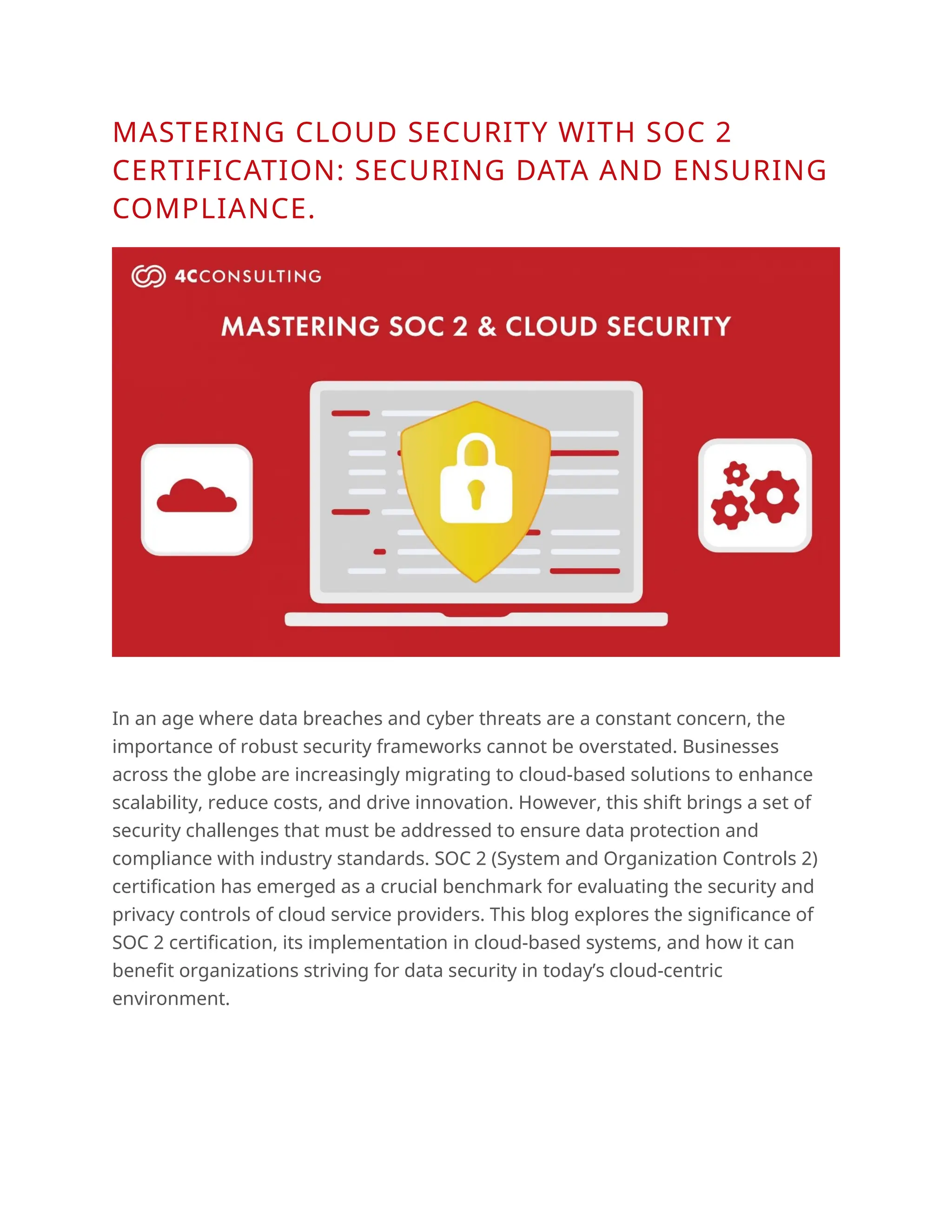
MASTERING CLOUD SECURITY WITH SOC 2
CERTIFICATION: SECURING DATA AND ENSURING
COMPLIANCE.
In an age where data breaches and cyber threats are a constant concern, the
importance of robust security frameworks cannot be overstated. Businesses
across the globe are increasingly migrating to cloud-based solutions to enhance
scalability, reduce costs, and drive innovation. However, this shift brings a set of
security challenges that must be addressed to ensure data protection and
compliance with industry standards. SOC 2 (System and Organization Controls 2)
certification has emerged as a crucial benchmark for evaluating the security and
privacy controls of cloud service providers. This blog explores the significance of
SOC 2 certification, its implementation in cloud-based systems, and how it can
benefit organizations striving for data security in today’s cloud-centric
environment.
.
OVERVIEW OF SOC 2
SOC 2 certification, developed by the American Institute of CPAs (AICPA), is
specifically designed for service providers storing customer data in the cloud.
Unlike other frameworks, SOC 2 focuses on five “trust service criteria”—security,
availability, processing integrity, confidentiality, and privacy. These criteria
provide a comprehensive assessment of how well a service provider’s systems
protect data, ensuring that only authorized users have access and that the data
remains intact and confidential 2 is not a one-size-fits-all standard but rather a
customizable framework that allows organizations to tailor their controls to suit
their specific operational environment. This flexibility makes SOC 2 particularly
relevant in the ever-evolving landscape of cloud computing, where different
businesses may have unique security needs based on the nature of their data and
services.
.
IMPLEMENTING SOC 2 COMPLIANCE IN CLOUD-BASED SYSTEMS
Achieving SOC 2 compliance involves a rigorous assessment of a company’s
internal controls and processes related to data security. This process requires
collaboration between different departments, including IT, legal, and compliance
teams, to develop a comprehensive set of policies and procedures. The
implementation of SOC 2 compliance can be broken down into several key steps:
1. Risk Assessment and Analysis: Before implementing SOC 2, organizations
must conduct a thorough risk assessment to identify potential vulnerabilities in
their cloud infrastructure. This step involves evaluating existing security
measures and determining how they align with the SOC 2 trust service criteria.
The assessment should focus on identifying potential threats, such as
unauthorized access, data breaches, and service disruptions.
2. Developing and Implementing Controls: Based on the risk assessment,
organizations need to develop specific controls to mitigate identified risks.
These controls should align with the SOC 2 criteria and address areas such as
access management, data encryption, intrusion detection, and incident
response. Implementing these controls requires collaboration across different
teams to ensure that security measures are integrated into the company’s
cloud infrastructure and day-to-day operations.
3. Monitoring and Continuous Improvement: SOC 2 compliance is not a one-
time effort but an ongoing process. Organizations must continuously monitor
their systems for potential security threats and ensure that controls remain
effective over time. This involves regular audits, vulnerability assessments, and
updates to security policies and procedures. By maintaining a proactive
approach to security, companies can quickly adapt to emerging threats and
changes in the cloud computing landscape.
4. Engaging Third-Party Auditors: To achieve SOC 2 certification, organizations
must undergo an audit by an independent third-party firm. The auditor will
review the company’s controls and processes to ensure they meet the SOC 2
criteria. This external validation is essential for building trust with customers
and demonstrating a commitment to data security.
.
STEPS FOR EFFECTIVE SOC 2 IMPLEMENTATION
Implementing SOC 2 certification can be a complex and resource-intensive
process, but following a structured approach can help organizations achieve
compliance more effectively:
1. Define the Scope of the Audit: Organizations should clearly define the scope
of the SOC 2 audit, including the specific systems, processes, and services to be
evaluated. This helps ensure that all relevant areas are covered and that the
audit focuses on the most critical aspects of the company’s operations.
2. Establish a Cross-Functional Team: Successful SOC 2 implementation requires
collaboration across different departments, including IT, compliance, legal, and
operations. Establishing a cross-functional team with representatives from each
department ensures that all aspects of the organization’s security posture are
considered.
3. Develop and Document Policies and Procedures: Organizations should
develop detailed policies and procedures that outline how data security is
managed within their cloud environment. These documents should include
guidelines for access control, data encryption, incident response, and other key
security measures. Proper documentation is essential for demonstrating
compliance during the SOC 2 audit.
4. Conduct Internal Audits and Training: Regular internal audits help
organizations identify potential gaps in their security controls and ensure that
employees are following established policies and procedures. Training
programs should also be implemented to educate staff on the importance of
data security and their role in maintaining compliance.
5. Engage with a SOC 2 Consultant: Working with a SOC 2 consultant can provide
valuable expertise and guidance throughout the implementation process.
Consultants can help organizations navigate the complexities of SOC 2
compliance, conduct readiness assessments, and provide recommendations for
improving security controls.
6. Leverage Automation Tools: To streamline SOC 2 compliance efforts,
organizations can use automation tools for monitoring, auditing, and reporting
security practices. These tools help in real-time tracking of compliance metrics,
generate necessary reports, and reduce the manual workload associated with
maintaining security standards.
7. Prepare for the External Audit: Before the external audit, organizations
should conduct a thorough review of their controls and documentation to
ensure they meet the SOC 2 criteria. This may involve conducting mock audits,
testing security measures, and addressing any identified issues. Proper
preparation helps ensure a smooth and successful audit process.
.
BENEFITS OF SOC 2 CERTIFICATION
Achieving SOC 2 certification offers several key benefits for organizations,
particularly those operating in the cloud:
1. Enhanced Trust and Credibility: SOC 2 certification demonstrates to
customers, partners, and stakeholders that an organization is committed to
maintaining high standards of data security and privacy. This certification builds
trust and credibility, which is essential for attracting and retaining customers in
an increasingly competitive market.
2. Compliance with Industry Standards: SOC 2 certification helps organizations
meet industry standards and regulatory requirements related to data security
and privacy. This is particularly important for companies operating in regulated
industries, such as finance, healthcare, and technology, where compliance with
strict security guidelines is mandatory.
3. Improved Risk Management: The SOC 2 framework provides a structured
approach to identifying and mitigating security risks within an organization’s
cloud environment. By implementing SOC 2 controls, companies can proactively
address potential vulnerabilities and reduce the likelihood of data breaches and
cyberattacks.
4. Competitive Advantage: SOC 2 certification can serve as a differentiator in the
marketplace, setting certified companies apart from competitors that lack
similar security credentials. Customers are more likely to choose service
providers that have demonstrated a commitment to protecting their data.
5. Operational Efficiency: The process of achieving SOC 2 compliance often leads
to improved internal processes and operational efficiency. By implementing
standardized controls and procedures, organizations can streamline their
security practices, reduce redundancy, and enhance overall system
performance.
6. Customer Satisfaction: SOC 2 certification provides assurance to customers
that their data is being handled securely and responsibly. This can lead to
increased customer satisfaction and loyalty, as clients feel confident in the
security measures in place to protect their information.
7. Facilitates Business Growth: As organizations expand their operations, SOC 2
certification can facilitate business growth by enabling entry into new markets
and industries that require stringent security standards. SOC 2 certification can
also streamline the process of gaining trust with new partners and customers,
accelerating business development opportunities.
8. Supports Incident Response and Recovery: SOC 2 compliance includes robust
measures for incident response and recovery. By adhering to these standards,
organizations are better prepared to respond quickly and effectively to security
incidents, minimizing potential damage and ensuring continuity of operations.
In today’s cloud-driven era, data security is a top priority for organizations and
their customers. SOC 2 certification provides a robust framework for evaluating
and improving the security controls of cloud service providers. By implementing
SOC 2 compliance, companies can demonstrate their commitment to data
protection, enhance trust with customers, and gain a competitive edge in the
marketplace. As the cloud computing landscape continues to evolve, achieving and
maintaining SOC 2 certification will be essential for organizations that prioritize
security, compliance, and customer satisfaction. For businesses looking to
safeguard their cloud environments, SOC 2 certification is not just a milestone—it
is a strategic investment in building a secure and resilient digital future.
.
HOW 4C CAN HELP YOUR ORGANIZATION IN SOC 2 COMPLIANCE
CERTIFICATION?
4C Consulting aids your organization in building credibility and trust with clients,
employees, and stakeholders while reaping the benefits of SOC 2 compliance. Our
experts provide complete SOC 2 implementation support, including training and
consulting. Our IRCA-certified auditors, boasting 15+ years of experience, have
assisted over 100 IT and ITES companies with risk assessment and continuity
planning. Through our services, companies globally have bolstered profitability
and credibility. With a proven track record of 5000+ training hours in IT Security
Management System (ISMS), we enable continual benefits. To embrace ISO
standards and achieve SOC 2 compliance seamlessly, Contact us today.

MASTERING CLOUD SECURITY WITH SOC 2 CERTIFICATION: SECURING DATA AND ENSURING COMPLIANCE

  • 1.
    MASTERING CLOUD SECURITYWITH SOC 2 CERTIFICATION: SECURING DATA AND ENSURING COMPLIANCE. In an age where data breaches and cyber threats are a constant concern, the importance of robust security frameworks cannot be overstated. Businesses across the globe are increasingly migrating to cloud-based solutions to enhance scalability, reduce costs, and drive innovation. However, this shift brings a set of security challenges that must be addressed to ensure data protection and compliance with industry standards. SOC 2 (System and Organization Controls 2) certification has emerged as a crucial benchmark for evaluating the security and privacy controls of cloud service providers. This blog explores the significance of SOC 2 certification, its implementation in cloud-based systems, and how it can benefit organizations striving for data security in today’s cloud-centric environment.
  • 2.
    . OVERVIEW OF SOC2 SOC 2 certification, developed by the American Institute of CPAs (AICPA), is specifically designed for service providers storing customer data in the cloud. Unlike other frameworks, SOC 2 focuses on five “trust service criteria”—security, availability, processing integrity, confidentiality, and privacy. These criteria provide a comprehensive assessment of how well a service provider’s systems protect data, ensuring that only authorized users have access and that the data remains intact and confidential 2 is not a one-size-fits-all standard but rather a customizable framework that allows organizations to tailor their controls to suit their specific operational environment. This flexibility makes SOC 2 particularly relevant in the ever-evolving landscape of cloud computing, where different businesses may have unique security needs based on the nature of their data and services. . IMPLEMENTING SOC 2 COMPLIANCE IN CLOUD-BASED SYSTEMS Achieving SOC 2 compliance involves a rigorous assessment of a company’s internal controls and processes related to data security. This process requires collaboration between different departments, including IT, legal, and compliance teams, to develop a comprehensive set of policies and procedures. The implementation of SOC 2 compliance can be broken down into several key steps: 1. Risk Assessment and Analysis: Before implementing SOC 2, organizations must conduct a thorough risk assessment to identify potential vulnerabilities in their cloud infrastructure. This step involves evaluating existing security measures and determining how they align with the SOC 2 trust service criteria. The assessment should focus on identifying potential threats, such as unauthorized access, data breaches, and service disruptions. 2. Developing and Implementing Controls: Based on the risk assessment, organizations need to develop specific controls to mitigate identified risks. These controls should align with the SOC 2 criteria and address areas such as access management, data encryption, intrusion detection, and incident response. Implementing these controls requires collaboration across different teams to ensure that security measures are integrated into the company’s cloud infrastructure and day-to-day operations.
  • 3.
    3. Monitoring andContinuous Improvement: SOC 2 compliance is not a one- time effort but an ongoing process. Organizations must continuously monitor their systems for potential security threats and ensure that controls remain effective over time. This involves regular audits, vulnerability assessments, and updates to security policies and procedures. By maintaining a proactive approach to security, companies can quickly adapt to emerging threats and changes in the cloud computing landscape. 4. Engaging Third-Party Auditors: To achieve SOC 2 certification, organizations must undergo an audit by an independent third-party firm. The auditor will review the company’s controls and processes to ensure they meet the SOC 2 criteria. This external validation is essential for building trust with customers and demonstrating a commitment to data security. . STEPS FOR EFFECTIVE SOC 2 IMPLEMENTATION Implementing SOC 2 certification can be a complex and resource-intensive process, but following a structured approach can help organizations achieve compliance more effectively: 1. Define the Scope of the Audit: Organizations should clearly define the scope of the SOC 2 audit, including the specific systems, processes, and services to be evaluated. This helps ensure that all relevant areas are covered and that the audit focuses on the most critical aspects of the company’s operations. 2. Establish a Cross-Functional Team: Successful SOC 2 implementation requires collaboration across different departments, including IT, compliance, legal, and operations. Establishing a cross-functional team with representatives from each department ensures that all aspects of the organization’s security posture are considered. 3. Develop and Document Policies and Procedures: Organizations should develop detailed policies and procedures that outline how data security is managed within their cloud environment. These documents should include guidelines for access control, data encryption, incident response, and other key security measures. Proper documentation is essential for demonstrating compliance during the SOC 2 audit. 4. Conduct Internal Audits and Training: Regular internal audits help organizations identify potential gaps in their security controls and ensure that employees are following established policies and procedures. Training programs should also be implemented to educate staff on the importance of data security and their role in maintaining compliance.
  • 4.
    5. Engage witha SOC 2 Consultant: Working with a SOC 2 consultant can provide valuable expertise and guidance throughout the implementation process. Consultants can help organizations navigate the complexities of SOC 2 compliance, conduct readiness assessments, and provide recommendations for improving security controls. 6. Leverage Automation Tools: To streamline SOC 2 compliance efforts, organizations can use automation tools for monitoring, auditing, and reporting security practices. These tools help in real-time tracking of compliance metrics, generate necessary reports, and reduce the manual workload associated with maintaining security standards. 7. Prepare for the External Audit: Before the external audit, organizations should conduct a thorough review of their controls and documentation to ensure they meet the SOC 2 criteria. This may involve conducting mock audits, testing security measures, and addressing any identified issues. Proper preparation helps ensure a smooth and successful audit process. . BENEFITS OF SOC 2 CERTIFICATION Achieving SOC 2 certification offers several key benefits for organizations, particularly those operating in the cloud: 1. Enhanced Trust and Credibility: SOC 2 certification demonstrates to customers, partners, and stakeholders that an organization is committed to maintaining high standards of data security and privacy. This certification builds trust and credibility, which is essential for attracting and retaining customers in an increasingly competitive market. 2. Compliance with Industry Standards: SOC 2 certification helps organizations meet industry standards and regulatory requirements related to data security and privacy. This is particularly important for companies operating in regulated industries, such as finance, healthcare, and technology, where compliance with strict security guidelines is mandatory. 3. Improved Risk Management: The SOC 2 framework provides a structured approach to identifying and mitigating security risks within an organization’s cloud environment. By implementing SOC 2 controls, companies can proactively address potential vulnerabilities and reduce the likelihood of data breaches and cyberattacks. 4. Competitive Advantage: SOC 2 certification can serve as a differentiator in the marketplace, setting certified companies apart from competitors that lack
  • 5.
    similar security credentials.Customers are more likely to choose service providers that have demonstrated a commitment to protecting their data. 5. Operational Efficiency: The process of achieving SOC 2 compliance often leads to improved internal processes and operational efficiency. By implementing standardized controls and procedures, organizations can streamline their security practices, reduce redundancy, and enhance overall system performance. 6. Customer Satisfaction: SOC 2 certification provides assurance to customers that their data is being handled securely and responsibly. This can lead to increased customer satisfaction and loyalty, as clients feel confident in the security measures in place to protect their information. 7. Facilitates Business Growth: As organizations expand their operations, SOC 2 certification can facilitate business growth by enabling entry into new markets and industries that require stringent security standards. SOC 2 certification can also streamline the process of gaining trust with new partners and customers, accelerating business development opportunities. 8. Supports Incident Response and Recovery: SOC 2 compliance includes robust measures for incident response and recovery. By adhering to these standards, organizations are better prepared to respond quickly and effectively to security incidents, minimizing potential damage and ensuring continuity of operations. In today’s cloud-driven era, data security is a top priority for organizations and their customers. SOC 2 certification provides a robust framework for evaluating and improving the security controls of cloud service providers. By implementing SOC 2 compliance, companies can demonstrate their commitment to data protection, enhance trust with customers, and gain a competitive edge in the marketplace. As the cloud computing landscape continues to evolve, achieving and maintaining SOC 2 certification will be essential for organizations that prioritize security, compliance, and customer satisfaction. For businesses looking to safeguard their cloud environments, SOC 2 certification is not just a milestone—it is a strategic investment in building a secure and resilient digital future. . HOW 4C CAN HELP YOUR ORGANIZATION IN SOC 2 COMPLIANCE CERTIFICATION? 4C Consulting aids your organization in building credibility and trust with clients, employees, and stakeholders while reaping the benefits of SOC 2 compliance. Our experts provide complete SOC 2 implementation support, including training and
  • 6.
    consulting. Our IRCA-certifiedauditors, boasting 15+ years of experience, have assisted over 100 IT and ITES companies with risk assessment and continuity planning. Through our services, companies globally have bolstered profitability and credibility. With a proven track record of 5000+ training hours in IT Security Management System (ISMS), we enable continual benefits. To embrace ISO standards and achieve SOC 2 compliance seamlessly, Contact us today.