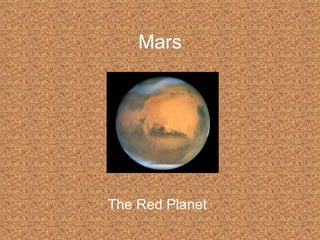
Mars The Red Planet
Planet Composition/Size Composition composed primarily of basalt much of the surface is deeply covered by a fine iron oxide dust that has the consistency of talcum powder gives Mars its red color Size Mars has approximately half the radius of Earth and only one-tenth the mass its surface area is only slightly less than the total area of Earth's dry land
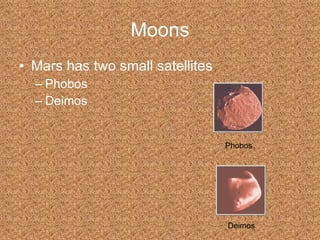
Moons Mars has two small satellites Phobos Deimos Phobos Deimos
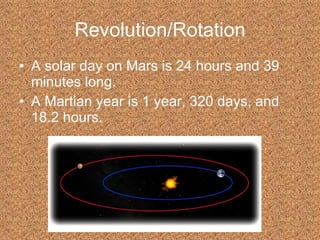
Revolution/Rotation A solar day on Mars is 24 hours and 39 minutes long. A Martian year is 1 year, 320 days, and 18.2 hours.
Temperatures Martian surface temperatures vary from lows of about   −140 °C (-220 °F)   during the polar winters to highs of up to   20 °C (68 °F)   in summers. Mars also has the largest dust storms in the Solar System. can vary from a storm over a small area, to gigantic storms that cover the entire planet  tend to occur when Mars is closest to the Sun
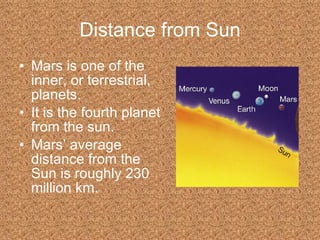
Distance from Sun Mars is one of the inner, or terrestrial, planets. It is the fourth planet from the sun. Mars’ average distance from the Sun is roughly 230 million km.
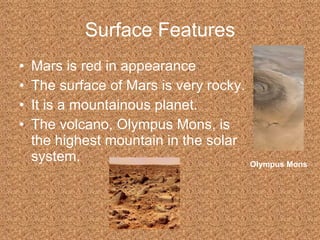
Surface Features Mars is red in appearance The surface of Mars is very rocky. It is a mountainous planet. The volcano, Olympus Mons, is the highest mountain in the solar system. Olympus Mons
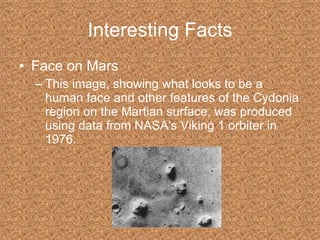
Interesting Facts Face on Mars This image, showing what looks to be a human face and other features of the Cydonia region on the Martian surface, was produced using data from NASA's Viking 1 orbiter in 1976.
Resources Wikipedia http://en.wikipedia.org/wiki/Mars The Nine Planets http:// www.nineplanets.org /

Mars About

  • 1.
  • 2.
    Planet Composition/Size Compositioncomposed primarily of basalt much of the surface is deeply covered by a fine iron oxide dust that has the consistency of talcum powder gives Mars its red color Size Mars has approximately half the radius of Earth and only one-tenth the mass its surface area is only slightly less than the total area of Earth's dry land
  • 3.
    Moons Mars hastwo small satellites Phobos Deimos Phobos Deimos
  • 4.
    Revolution/Rotation A solarday on Mars is 24 hours and 39 minutes long. A Martian year is 1 year, 320 days, and 18.2 hours.
  • 5.
    Temperatures Martian surfacetemperatures vary from lows of about −140 °C (-220 °F) during the polar winters to highs of up to 20 °C (68 °F) in summers. Mars also has the largest dust storms in the Solar System. can vary from a storm over a small area, to gigantic storms that cover the entire planet tend to occur when Mars is closest to the Sun
  • 6.
    Distance from SunMars is one of the inner, or terrestrial, planets. It is the fourth planet from the sun. Mars’ average distance from the Sun is roughly 230 million km.
  • 7.
    Surface Features Marsis red in appearance The surface of Mars is very rocky. It is a mountainous planet. The volcano, Olympus Mons, is the highest mountain in the solar system. Olympus Mons
  • 8.
    Interesting Facts Faceon Mars This image, showing what looks to be a human face and other features of the Cydonia region on the Martian surface, was produced using data from NASA's Viking 1 orbiter in 1976.
  • 9.
    Resources Wikipedia http://en.wikipedia.org/wiki/MarsThe Nine Planets http:// www.nineplanets.org /