Marketing matters for language
schools: Tips and tricks for
generating interest in your
language courses

          Wednesday, April 27, 2005
                  3:00 EDT
        Sponsored by: Horizon Wimba
       Presented by: Sarah Elaine Eaton
Acknowledgements


    Thanks to Horizon Wimba, and especially to
•   Matt Wasowski
•   Scott Josephson
•   Jody Wexler
•   and all the rest of the team, too!
Agenda


•   Welcome
•   Survey (Who’s here today?)
•   Introduction to marketing
•   Low-cost tips and tricks
•   A few bonus ideas
•   Conclusions
Welcome


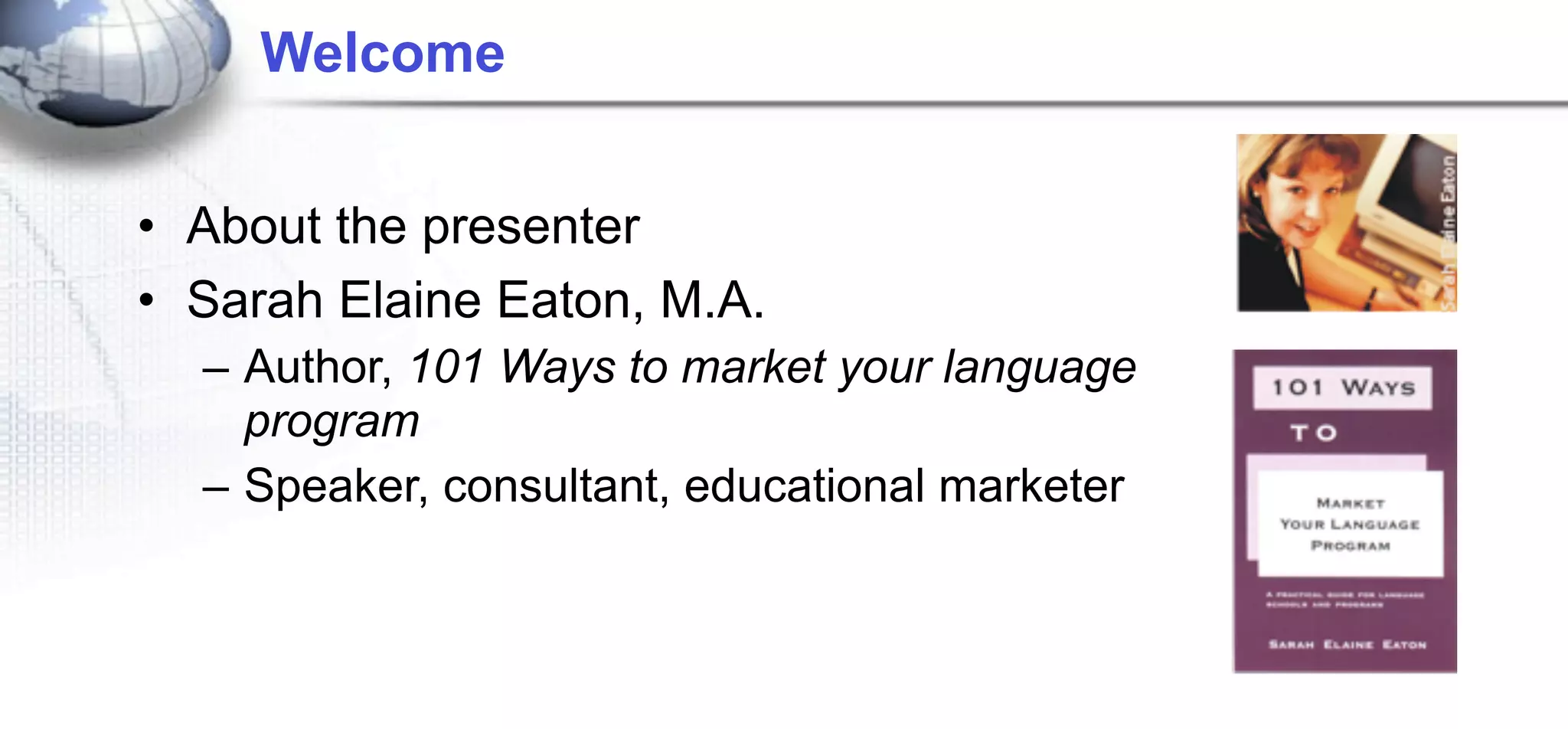
• About the presenter
• Sarah Elaine Eaton, M.A.
  – Author, 101 Ways to market your language
    program
  – Speaker, consultant, educational marketer
Now it’s your turn


• We have a brief survey, designed by Horizon Wimba. We’re going
  to ask you:

  – Who’s here today?

  – What would you like to get out of today’s presentation?
Agenda - Review


•   Welcome
•   Survey (Who’s here today?)
•   Introduction to marketing
•   Low-cost tips and tricks
•   A few bonus ideas
•   Conclusions
Introduction to Marketing

School marketing includes such things as:

• Awareness raising and education

• Public relations

• Cultivating a school image

• Creating a positive feeling about the schools with students, teachers and
  others
Introduction to marketing


School marketing does not mean:

• Giving up traditional values

• Trading education for big business
Introduction to marketing

The idea of marketing educational programs has been around for a
  long time, we just haven’t called it that.

• Today, schools that follow more of a business model (e.g. private
  language schools) are much more comfortable with marketing
  concepts.
• Public education programs prefer to call it “promotion”.
• The idea is the same – getting people interested in and excited
  about your programs.
Introduction to marketing

Target market
• Who is your “target market”? (The people making the final
  decision or paying for the course.)
   – Parents?
   – Students?
   – Both?

• Who are your end users? (The people who ultimately enroll in your
  program)
   – Students?
Introduction to marketing

Target market

• Language programs often have two groups that they need to promote to, their
  target market and their end-users.

• These groups may or may not be the same.

• In many cases, it is the parents who make, or at least influence, the final
  decision of what courses their children take, and where they take them.

• You want to target both groups.
Introduction to marketing

• Marketing is one aspect of business that appeals to some
  educators because it is creative.

• Remember, this is based on business principles.

• The three R’s of marketing:
  – Research, re-visit, re-vise.
Introduction to marketing

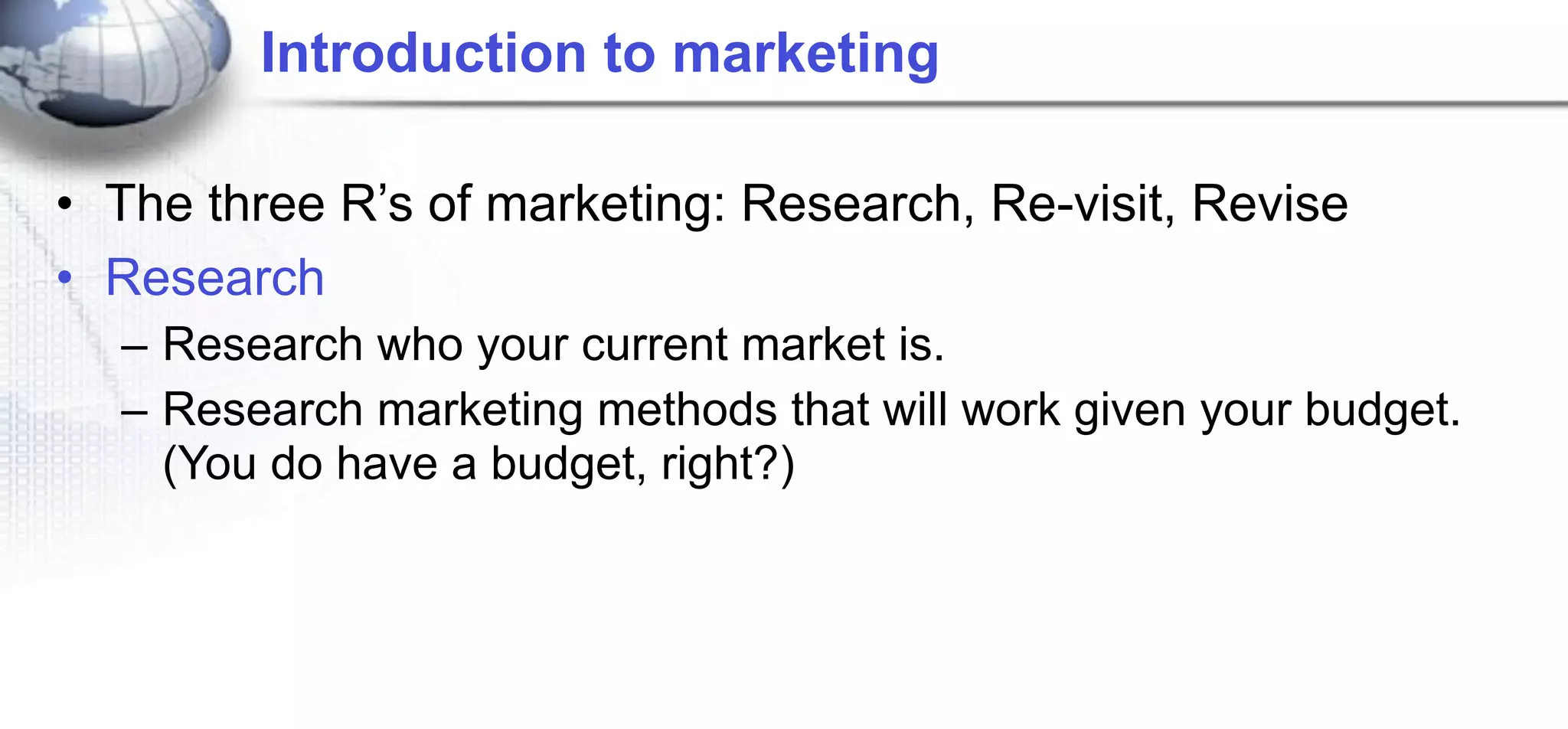
• The three R’s of marketing: Research, Re-visit, Revise
• Research
  – Research who your current market is.
  – Research marketing methods that will work given your budget.
    (You do have a budget, right?)
Introduction to marketing

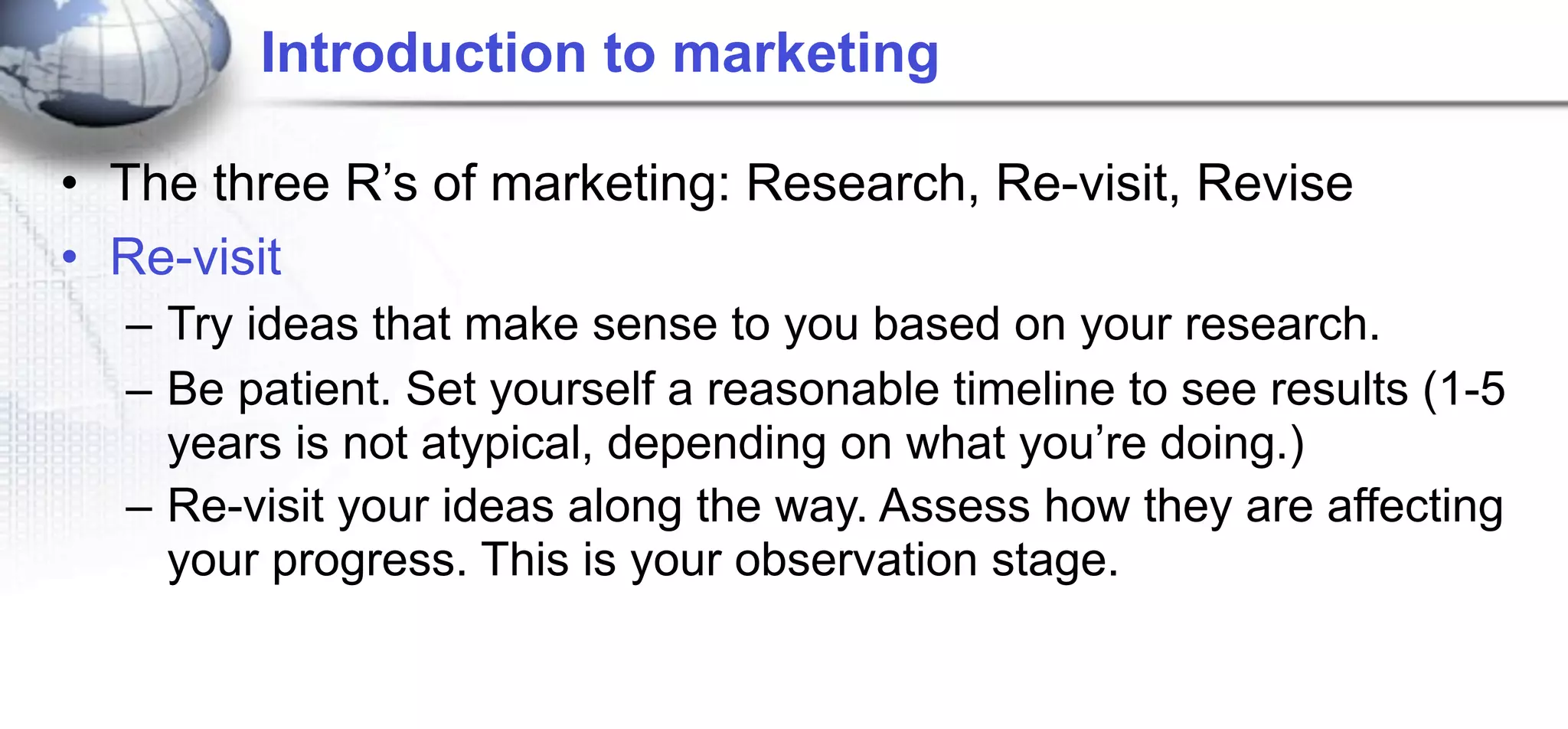
• The three R’s of marketing: Research, Re-visit, Revise
• Re-visit
  – Try ideas that make sense to you based on your research.
  – Be patient. Set yourself a reasonable timeline to see results (1-5
    years is not atypical, depending on what you’re doing.)
  – Re-visit your ideas along the way. Assess how they are affecting
    your progress. This is your observation stage.
Introduction to marketing

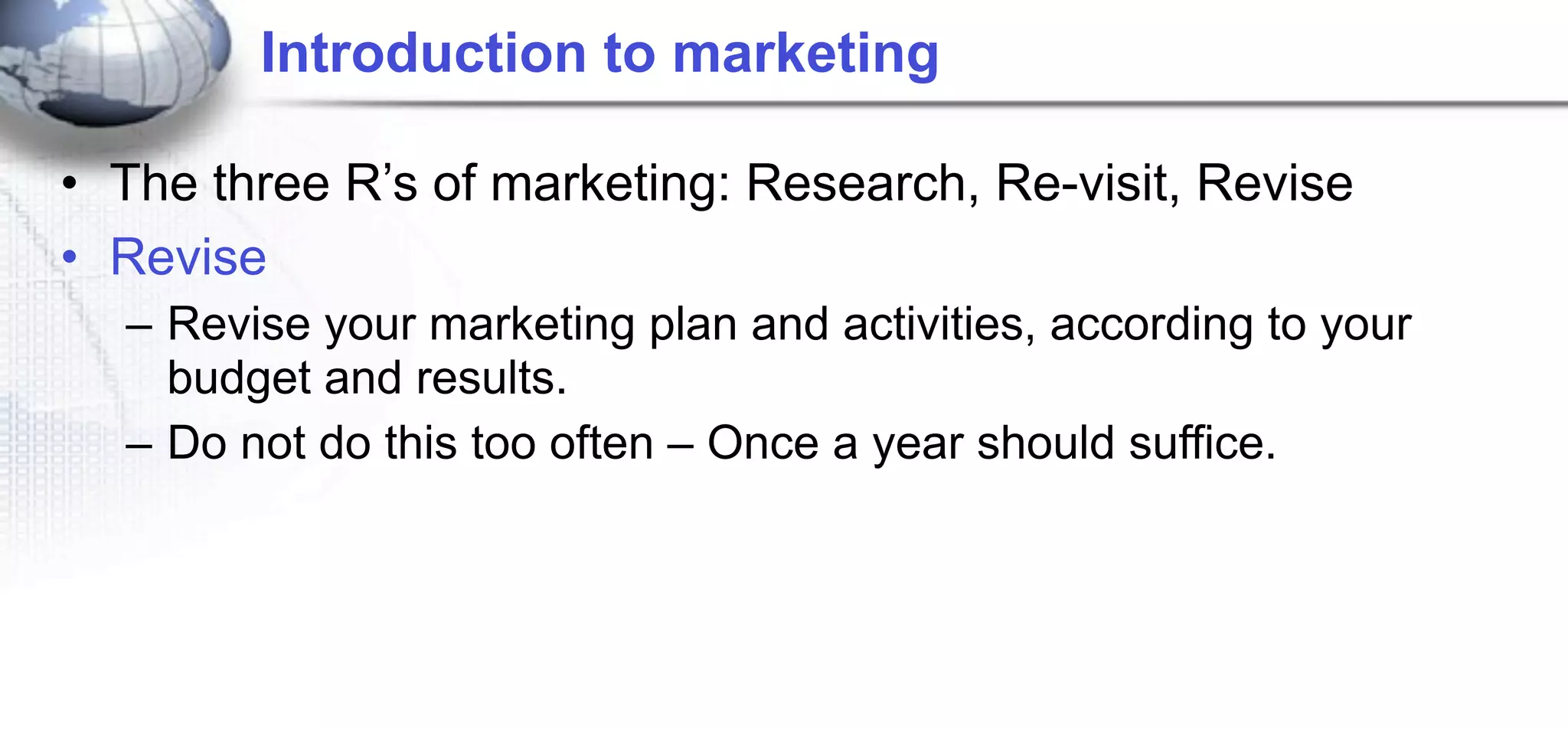
• The three R’s of marketing: Research, Re-visit, Revise
• Revise
  – Revise your marketing plan and activities, according to your
    budget and results.
  – Do not do this too often – Once a year should suffice.
Introduction to marketing

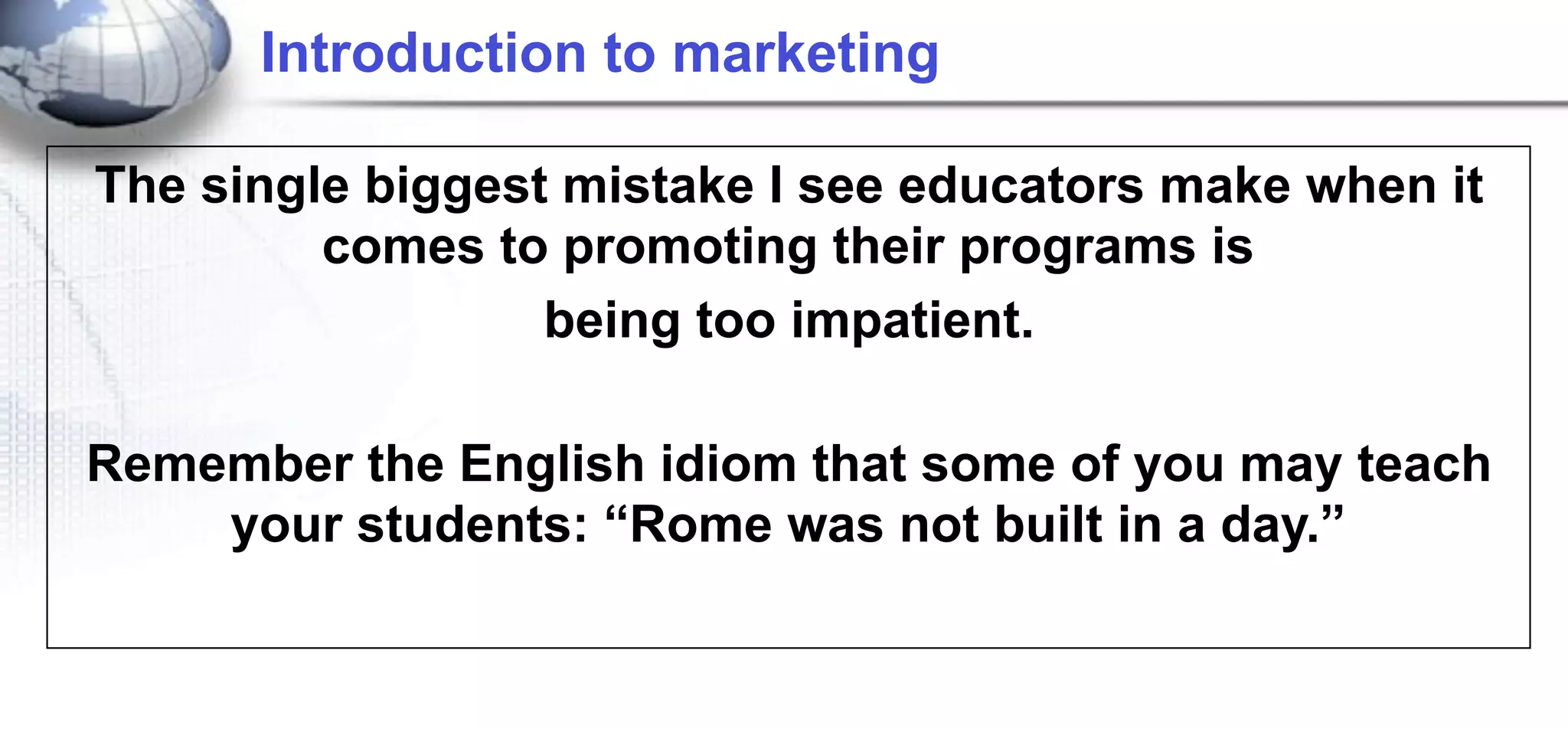
The single biggest mistake I see educators make when it
         comes to promoting their programs is
                  being too impatient.

Remember the English idiom that some of you may teach
    your students: “Rome was not built in a day.”
Agenda


•   Welcome
•   Survey (Who’s here today?)
•   Introduction to marketing
•   Low-cost tips and tricks
•   A few bonus ideas
•   Conclusions
Low-cost tips and tricks


• A grass-roots approach to marketing works for many
  educators and schools.

• Ideas from 101 Ways to market your language program: A
  practical guide for language schools and programs:
Low-cost tips and tricks

• Idea # 10: Use the KISS principle in all your marketing
  materials
  – Keep It Short and Simple
  – Marketing materials should be written at a grade six (or “6th
    grade”, for our friends in the U.S.) level
  – MS Word can track the grade level for you.
     • Tools > Spelling and Grammar
     • Note: You may have to set this under Tools > Options > Spelling and
       Grammar > Show readability statistics
Low-cost tips and tricks

• Idea # 11: Write your marketing materials using “you”.
  – You want to “talk” to your prospects directly.
  – Consider the difference between these two statements:

  “Students will be taken on interesting excursions every Friday
    afternoon.”

  “You will go on interesting excursions every Friday afternoon.”
Low-cost tips and tricks

• Idea # 13: Focus on the benefits

   – Talk about the benefits of your program, not what features it offers.
   – Here’s an example. Let’s compare these two statements:

“Our program is 13 weeks long and we offer classes at the beginner,
  intermediate and advanced levels.”

“Whether your level is beginner, intermediate or advanced, we have a
  13-week comprehensive program to fit your needs.”
Low-cost tips and tricks

• Idea # 20: Give your staff their own business cards
  – Yes, you can afford it.
  – Turn your staff into ambassadors for your program.
  – Give everyone at the school the feeling that they are important –
    because they are!
  – Giving business cards to everyone helps to build a team and
    build relationships – both inside and outside the program.
Low-cost tips and tricks

• Idea # 39: Put your program on the map to bring
  business home
  – Put your program in perspective in a global and local sense.
  – Maps on brochures and on your website.
  – www.mapquest.com or http://maps.google.com/
Agenda

•   Welcome
•   Survey (Who’s here today?)
•   Introduction to marketing
•   Low-cost tips and tricks
•   A few bonus ideas
•   Conclusions
A few bonus ideas

• Increase the “cool” factor for students.
• The idea that students can get better jobs by learning another
  language has been flogged to death. Try something new.
• Associate “heroes” and “idols” with other languages. (E.g. Did you
  know that Catherine Zeta-Jones has enrolled her children in Welsh
  classes, so they know their “heritage language”?)
• Have students do an “language idol” project, so it opens their
  minds and expands their awareness of the world around them.
A few bonus ideas

• Marketing should be natural and fun
  – Don’t be “rah rah” if it’s not natural for you. (You’ll come across
    as a stereotypical “used car salesman”.)
  – Infect others with your sincere interest.
  – Remember what made you study another language in the first
    place. Try to re-capture the enthusiasm and wonder that you
    had. Pass that feeling on to your staff and students.
A few bonus ideas


                        Remember!

One of the best qualities a marketer can have is patience and
                         perseverance.
Agenda


•   Welcome
•   Survey (Who’s here today?)
•   Introduction to marketing
•   Low-cost tips and tricks
•   A few bonus ideas
•   Conclusions
Conclusions

• Marketing basics – Marketing is not new to education. We
  just use different names for it sometimes.
• Marketing does not have to be expensive.
• A few simple tricks can boost your marketing power. (Ideas
  from 101 Ways to market your language program.)
• The three R’s of marketing: Research, re-visit, revise.
• Patience is key!
Conclusions

• Resources:
  – www.eatonintl.com
  – http://ca.groups.yahoo.com/group/marketinglanguageprograms/
    - A free weekly e-newsgroup dedicated to the topic of marketing
    and promoting language programs.

  Stay in touch! If you have questions or want more information.
  saraheaton@eatonintl.com
Conclusions


Thanks to Horizon Wimba for sponsoring this Desktop Lecture!

                  www.horizonwimba.com

Marketing Matters for Language Schools: Tips and tricks for generating interest in your language courses

  • 1.
    Marketing matters forlanguage schools: Tips and tricks for generating interest in your language courses Wednesday, April 27, 2005 3:00 EDT Sponsored by: Horizon Wimba Presented by: Sarah Elaine Eaton
  • 2.
    Acknowledgements Thanks to Horizon Wimba, and especially to • Matt Wasowski • Scott Josephson • Jody Wexler • and all the rest of the team, too!
  • 3.
    Agenda • Welcome • Survey (Who’s here today?) • Introduction to marketing • Low-cost tips and tricks • A few bonus ideas • Conclusions
  • 4.
    Welcome • About thepresenter • Sarah Elaine Eaton, M.A. – Author, 101 Ways to market your language program – Speaker, consultant, educational marketer
  • 5.
    Now it’s yourturn • We have a brief survey, designed by Horizon Wimba. We’re going to ask you: – Who’s here today? – What would you like to get out of today’s presentation?
  • 6.
    Agenda - Review • Welcome • Survey (Who’s here today?) • Introduction to marketing • Low-cost tips and tricks • A few bonus ideas • Conclusions
  • 7.
    Introduction to Marketing Schoolmarketing includes such things as: • Awareness raising and education • Public relations • Cultivating a school image • Creating a positive feeling about the schools with students, teachers and others
  • 8.
    Introduction to marketing Schoolmarketing does not mean: • Giving up traditional values • Trading education for big business
  • 9.
    Introduction to marketing Theidea of marketing educational programs has been around for a long time, we just haven’t called it that. • Today, schools that follow more of a business model (e.g. private language schools) are much more comfortable with marketing concepts. • Public education programs prefer to call it “promotion”. • The idea is the same – getting people interested in and excited about your programs.
  • 10.
    Introduction to marketing Targetmarket • Who is your “target market”? (The people making the final decision or paying for the course.) – Parents? – Students? – Both? • Who are your end users? (The people who ultimately enroll in your program) – Students?
  • 11.
    Introduction to marketing Targetmarket • Language programs often have two groups that they need to promote to, their target market and their end-users. • These groups may or may not be the same. • In many cases, it is the parents who make, or at least influence, the final decision of what courses their children take, and where they take them. • You want to target both groups.
  • 12.
    Introduction to marketing •Marketing is one aspect of business that appeals to some educators because it is creative. • Remember, this is based on business principles. • The three R’s of marketing: – Research, re-visit, re-vise.
  • 13.
    Introduction to marketing •The three R’s of marketing: Research, Re-visit, Revise • Research – Research who your current market is. – Research marketing methods that will work given your budget. (You do have a budget, right?)
  • 14.
    Introduction to marketing •The three R’s of marketing: Research, Re-visit, Revise • Re-visit – Try ideas that make sense to you based on your research. – Be patient. Set yourself a reasonable timeline to see results (1-5 years is not atypical, depending on what you’re doing.) – Re-visit your ideas along the way. Assess how they are affecting your progress. This is your observation stage.
  • 15.
    Introduction to marketing •The three R’s of marketing: Research, Re-visit, Revise • Revise – Revise your marketing plan and activities, according to your budget and results. – Do not do this too often – Once a year should suffice.
  • 16.
    Introduction to marketing Thesingle biggest mistake I see educators make when it comes to promoting their programs is being too impatient. Remember the English idiom that some of you may teach your students: “Rome was not built in a day.”
  • 17.
    Agenda • Welcome • Survey (Who’s here today?) • Introduction to marketing • Low-cost tips and tricks • A few bonus ideas • Conclusions
  • 18.
    Low-cost tips andtricks • A grass-roots approach to marketing works for many educators and schools. • Ideas from 101 Ways to market your language program: A practical guide for language schools and programs:
  • 19.
    Low-cost tips andtricks • Idea # 10: Use the KISS principle in all your marketing materials – Keep It Short and Simple – Marketing materials should be written at a grade six (or “6th grade”, for our friends in the U.S.) level – MS Word can track the grade level for you. • Tools > Spelling and Grammar • Note: You may have to set this under Tools > Options > Spelling and Grammar > Show readability statistics
  • 20.
    Low-cost tips andtricks • Idea # 11: Write your marketing materials using “you”. – You want to “talk” to your prospects directly. – Consider the difference between these two statements: “Students will be taken on interesting excursions every Friday afternoon.” “You will go on interesting excursions every Friday afternoon.”
  • 21.
    Low-cost tips andtricks • Idea # 13: Focus on the benefits – Talk about the benefits of your program, not what features it offers. – Here’s an example. Let’s compare these two statements: “Our program is 13 weeks long and we offer classes at the beginner, intermediate and advanced levels.” “Whether your level is beginner, intermediate or advanced, we have a 13-week comprehensive program to fit your needs.”
  • 22.
    Low-cost tips andtricks • Idea # 20: Give your staff their own business cards – Yes, you can afford it. – Turn your staff into ambassadors for your program. – Give everyone at the school the feeling that they are important – because they are! – Giving business cards to everyone helps to build a team and build relationships – both inside and outside the program.
  • 23.
    Low-cost tips andtricks • Idea # 39: Put your program on the map to bring business home – Put your program in perspective in a global and local sense. – Maps on brochures and on your website. – www.mapquest.com or http://maps.google.com/
  • 24.
    Agenda • Welcome • Survey (Who’s here today?) • Introduction to marketing • Low-cost tips and tricks • A few bonus ideas • Conclusions
  • 25.
    A few bonusideas • Increase the “cool” factor for students. • The idea that students can get better jobs by learning another language has been flogged to death. Try something new. • Associate “heroes” and “idols” with other languages. (E.g. Did you know that Catherine Zeta-Jones has enrolled her children in Welsh classes, so they know their “heritage language”?) • Have students do an “language idol” project, so it opens their minds and expands their awareness of the world around them.
  • 26.
    A few bonusideas • Marketing should be natural and fun – Don’t be “rah rah” if it’s not natural for you. (You’ll come across as a stereotypical “used car salesman”.) – Infect others with your sincere interest. – Remember what made you study another language in the first place. Try to re-capture the enthusiasm and wonder that you had. Pass that feeling on to your staff and students.
  • 27.
    A few bonusideas Remember! One of the best qualities a marketer can have is patience and perseverance.
  • 28.
    Agenda • Welcome • Survey (Who’s here today?) • Introduction to marketing • Low-cost tips and tricks • A few bonus ideas • Conclusions
  • 29.
    Conclusions • Marketing basics– Marketing is not new to education. We just use different names for it sometimes. • Marketing does not have to be expensive. • A few simple tricks can boost your marketing power. (Ideas from 101 Ways to market your language program.) • The three R’s of marketing: Research, re-visit, revise. • Patience is key!
  • 30.
    Conclusions • Resources: – www.eatonintl.com – http://ca.groups.yahoo.com/group/marketinglanguageprograms/ - A free weekly e-newsgroup dedicated to the topic of marketing and promoting language programs. Stay in touch! If you have questions or want more information. saraheaton@eatonintl.com
  • 31.
    Conclusions Thanks to HorizonWimba for sponsoring this Desktop Lecture! www.horizonwimba.com