Identifying Market Segments and Targets
Effective Targeting Requires… Identify and profile distinct groups of buyers who differ in their needs and preferences. Select one or more market segments to enter. Establish and communicate the distinctive benefits of the market offering.
Four Levels of Micromarketing Segments Niches Local areas Individuals
Segment Marketing Targeting a group of customers who share a similar set of needs and wants.
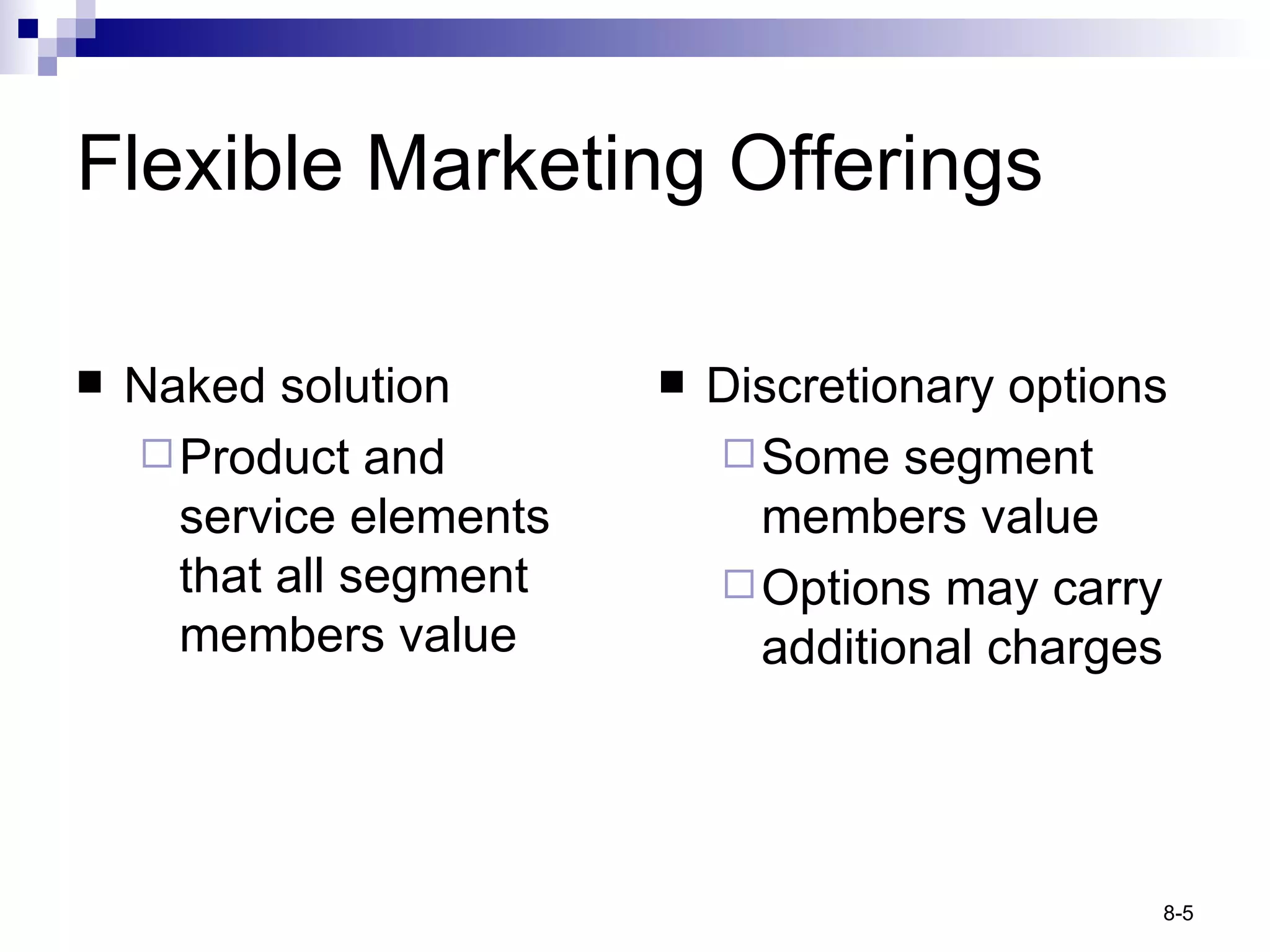
Flexible Marketing Offerings Naked solution Product and service elements that all segment members value Discretionary options Some segment members value Options may carry additional charges
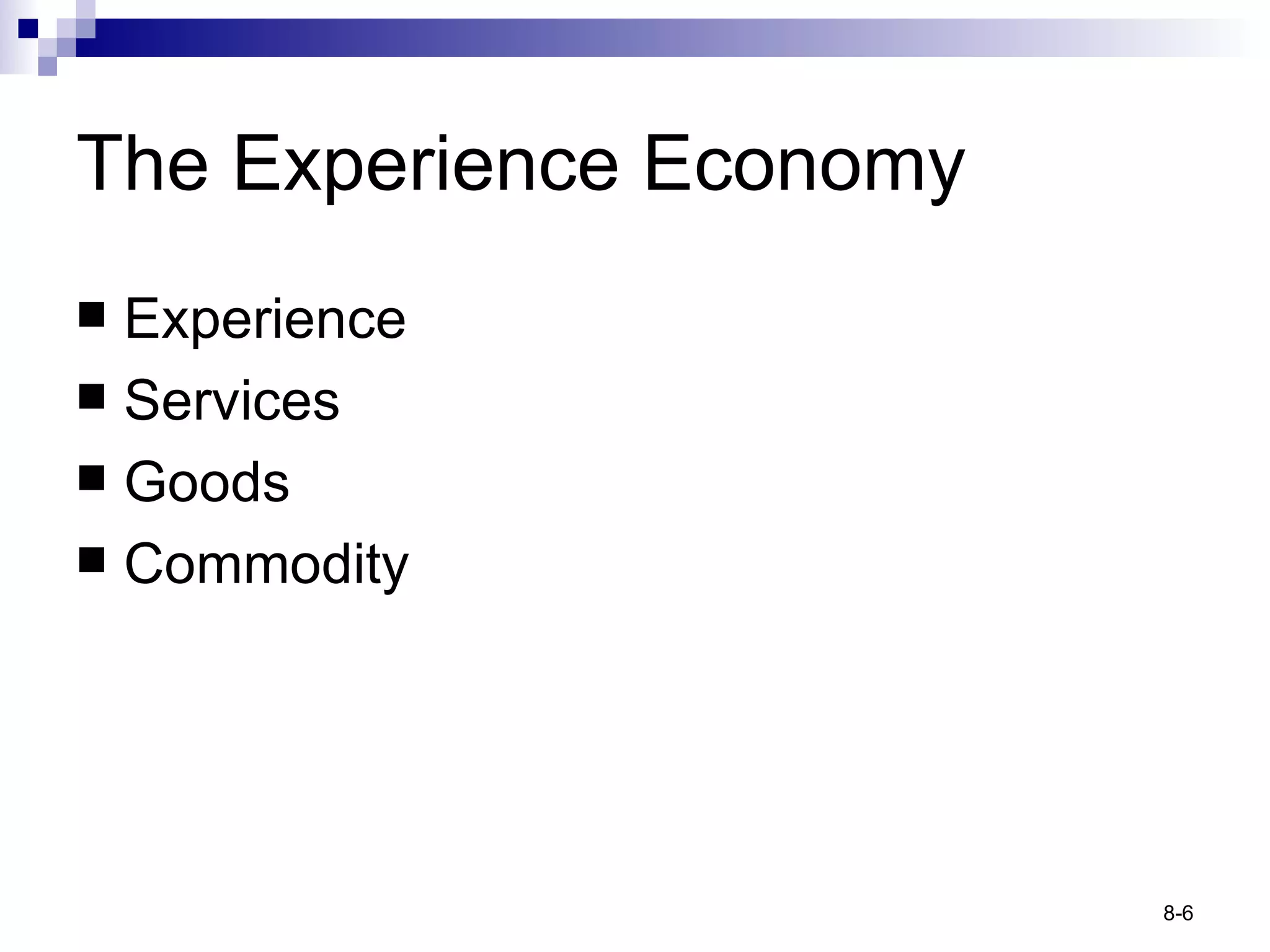
The Experience Economy Experience Services Goods Commodity
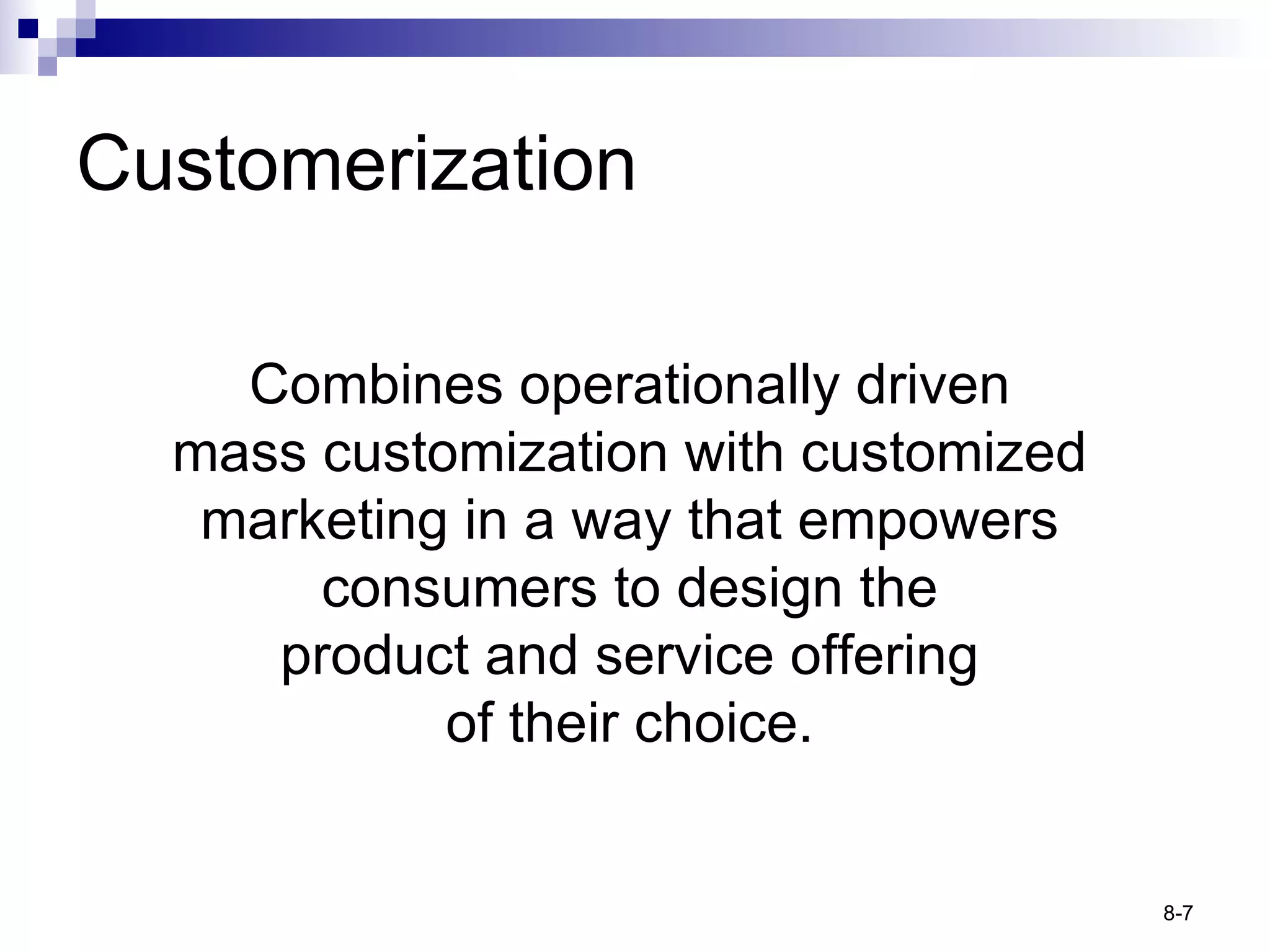
Customerization Combines operationally driven mass customization with customized marketing in a way that empowers consumers to design the product and service offering of their choice.
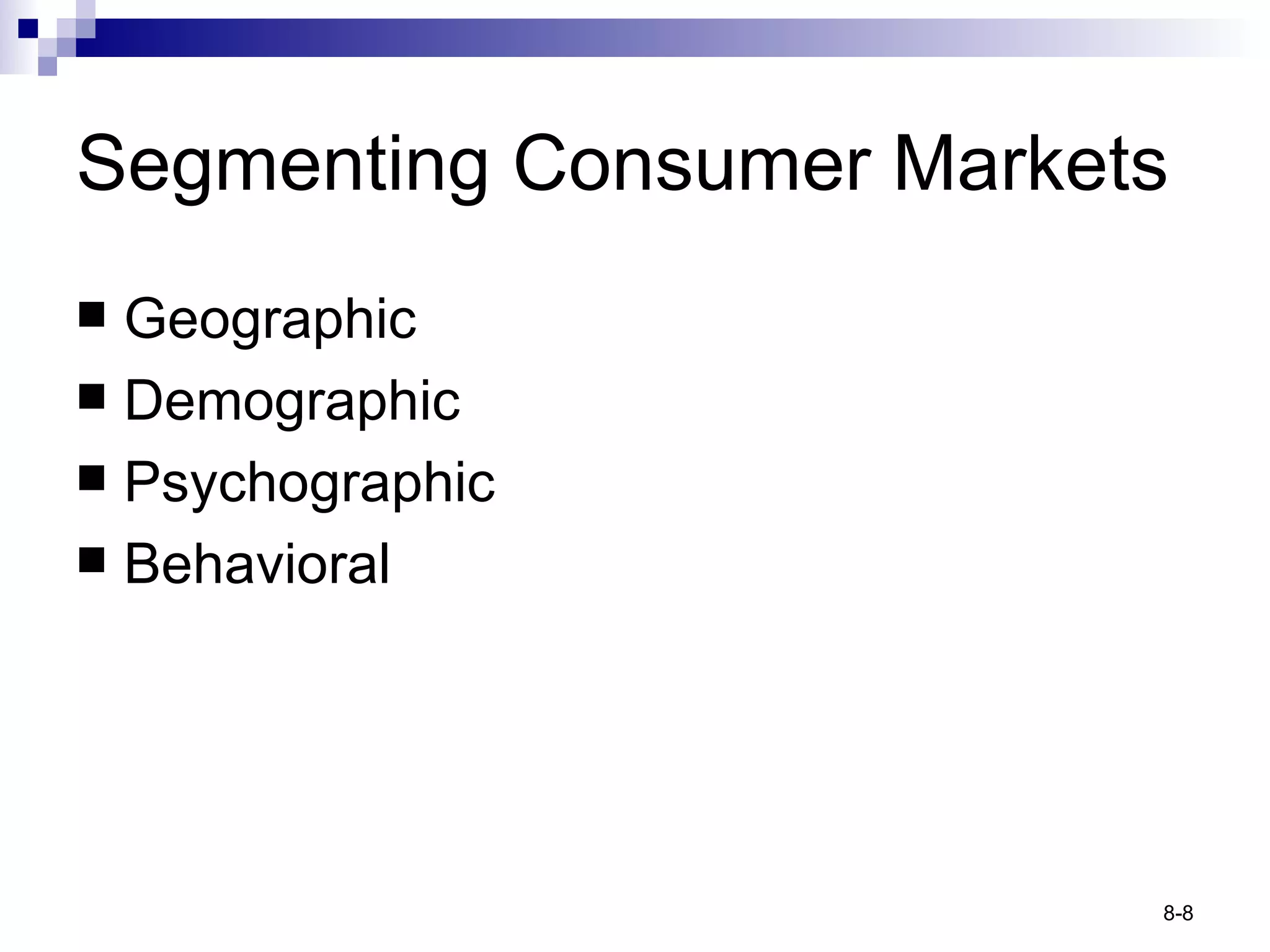
Segmenting Consumer Markets Geographic Demographic Psychographic Behavioral
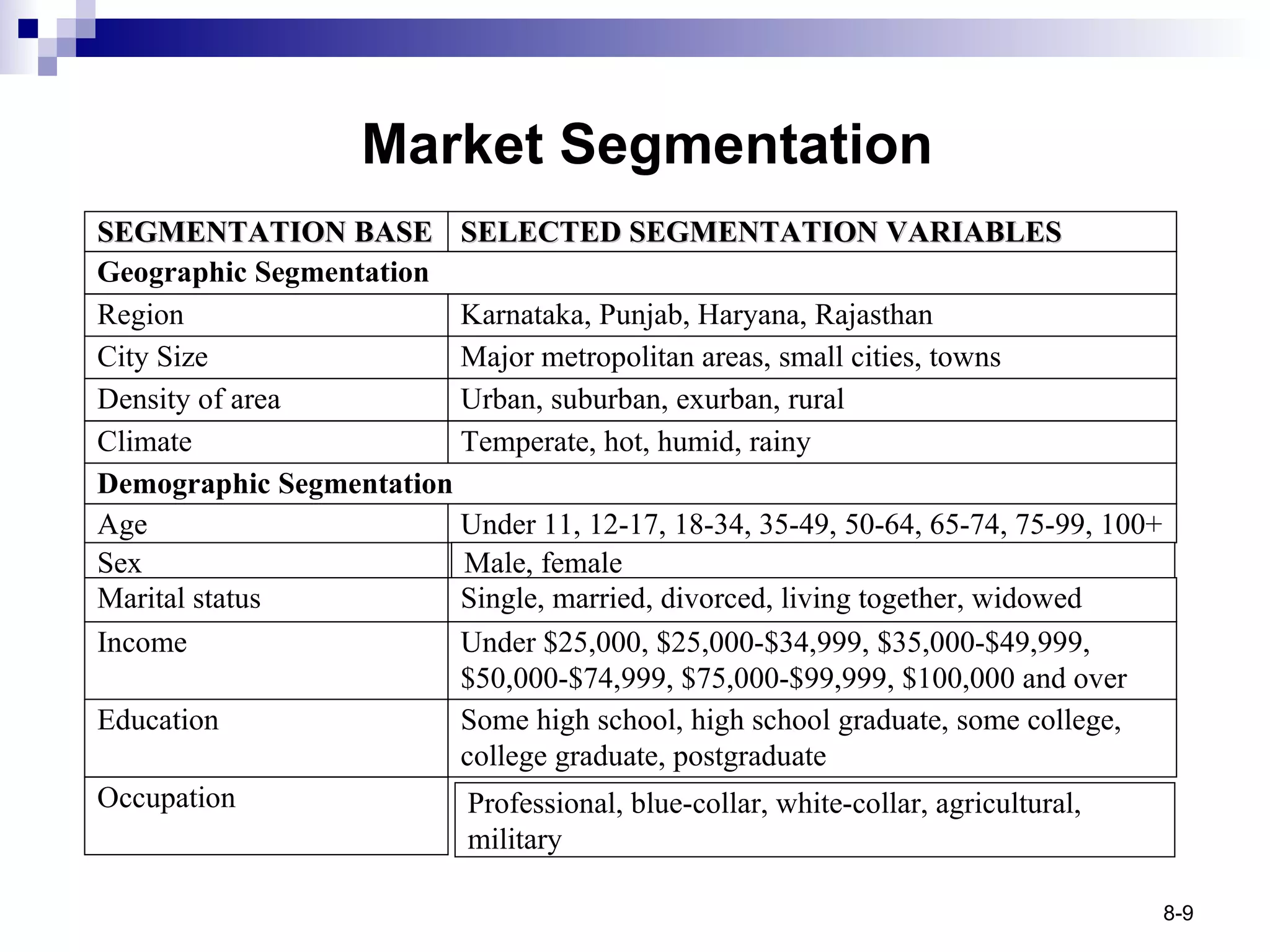
Market Segmentation Occupation SEGMENTATION BASE SELECTED SEGMENTATION VARIABLES Geographic Segmentation Climate Density of area City Size Region Karnataka, Punjab, Haryana, Rajasthan Major metropolitan areas, small cities, towns Urban, suburban, exurban, rural Temperate, hot, humid, rainy Demographic Segmentation Income Marital status Sex Age Under 11, 12-17, 18-34, 35-49, 50-64, 65-74, 75-99, 100+ Male, female Single, married, divorced, living together, widowed Under $25,000, $25,000-$34,999, $35,000-$49,999, $50,000-$74,999, $75,000-$99,999, $100,000 and over Education Some high school, high school graduate, some college, college graduate, postgraduate Professional, blue-collar, white-collar, agricultural, military
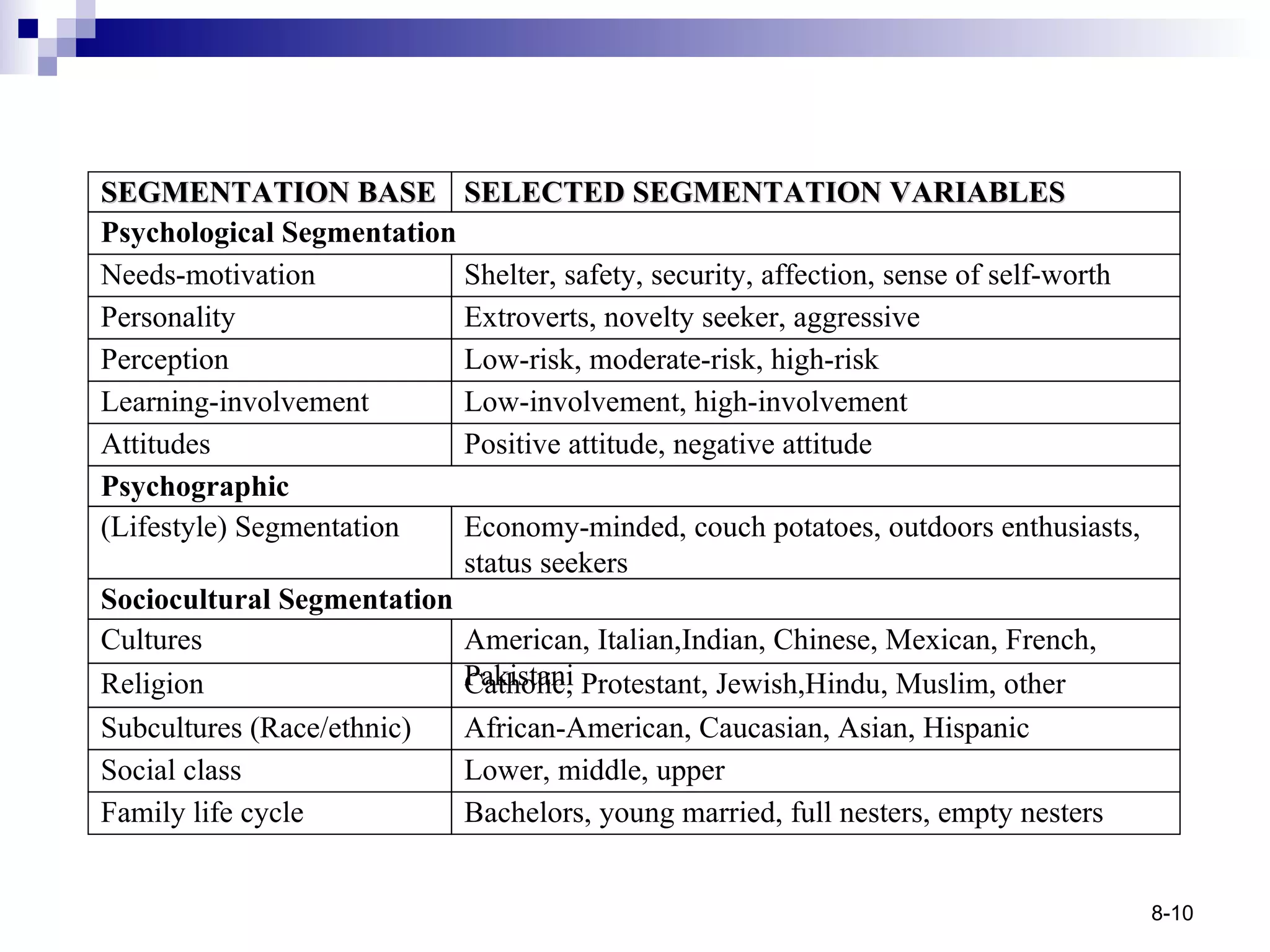
SEGMENTATION BASE SELECTED SEGMENTATION VARIABLES Psychological Segmentation Learning-involvement Perception Personality Needs-motivation Shelter, safety, security, affection, sense of self-worth Extroverts, novelty seeker, aggressive Low-risk, moderate-risk, high-risk Low-involvement, high-involvement Psychographic Subcultures (Race/ethnic) Religion Cultures (Lifestyle) Segmentation Economy-minded, couch potatoes, outdoors enthusiasts, status seekers American, Italian,Indian, Chinese, Mexican, French, Pakistani Catholic, Protestant, Jewish,Hindu, Muslim, other African-American, Caucasian, Asian, Hispanic Family life cycle Social class Lower, middle, upper Bachelors, young married, full nesters, empty nesters Attitudes Positive attitude, negative attitude Sociocultural Segmentation
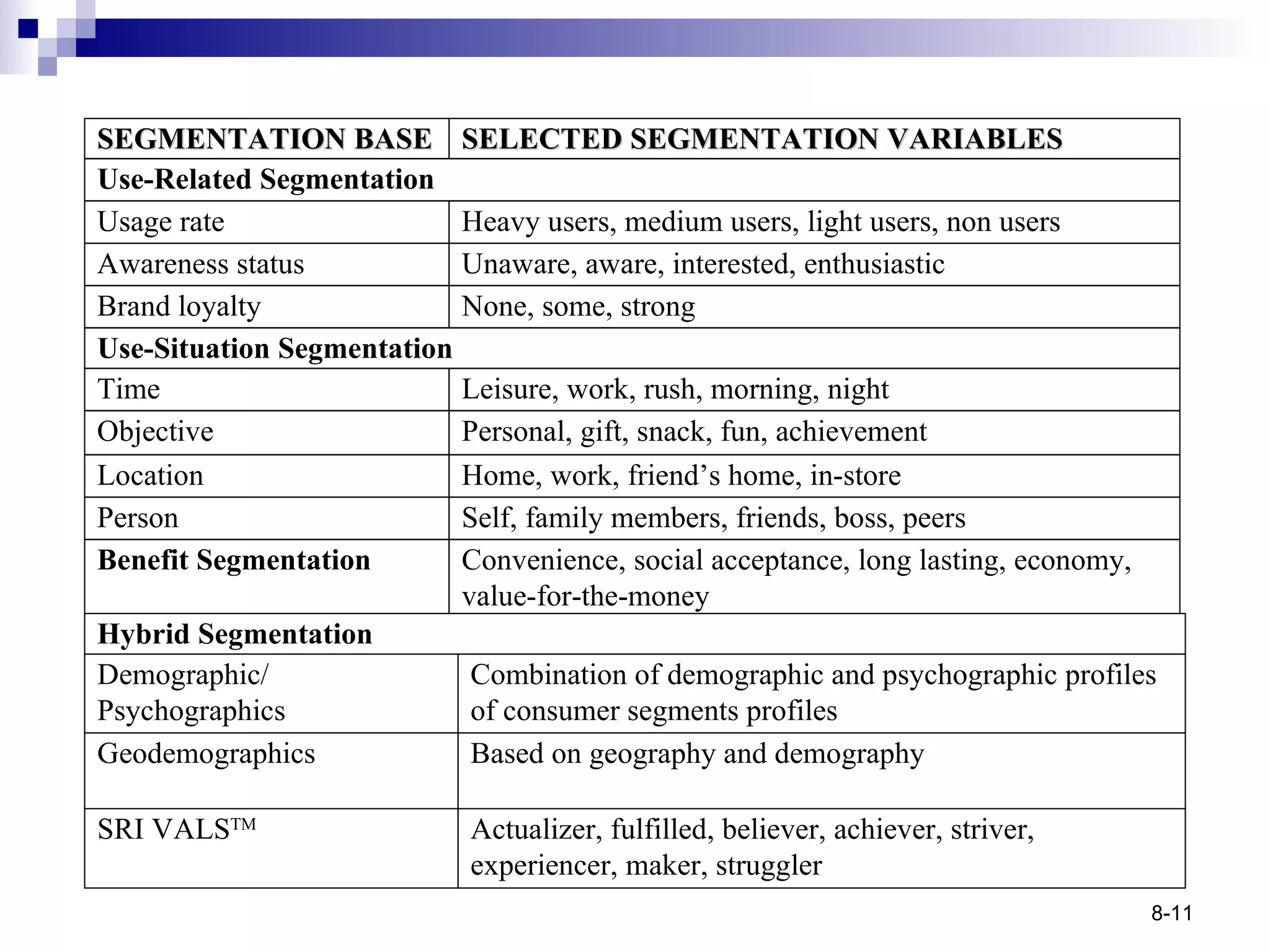
SEGMENTATION BASE SELECTED SEGMENTATION VARIABLES Use-Related Segmentation Brand loyalty Awareness status Usage rate Heavy users, medium users, light users, non users Unaware, aware, interested, enthusiastic None, some, strong Use-Situation Segmentation Location Objective Time Leisure, work, rush, morning, night Personal, gift, snack, fun, achievement Home, work, friend’s home, in-store Person Self, family members, friends, boss, peers Benefit Segmentation Convenience, social acceptance, long lasting, economy, value-for-the-money Geodemographics Based on geography and demography Demographic/ Psychographics Combination of demographic and psychographic profiles of consumer segments profiles SRI VALS TM Actualizer, fulfilled, believer, achiever, striver, experiencer, maker, struggler Hybrid Segmentation
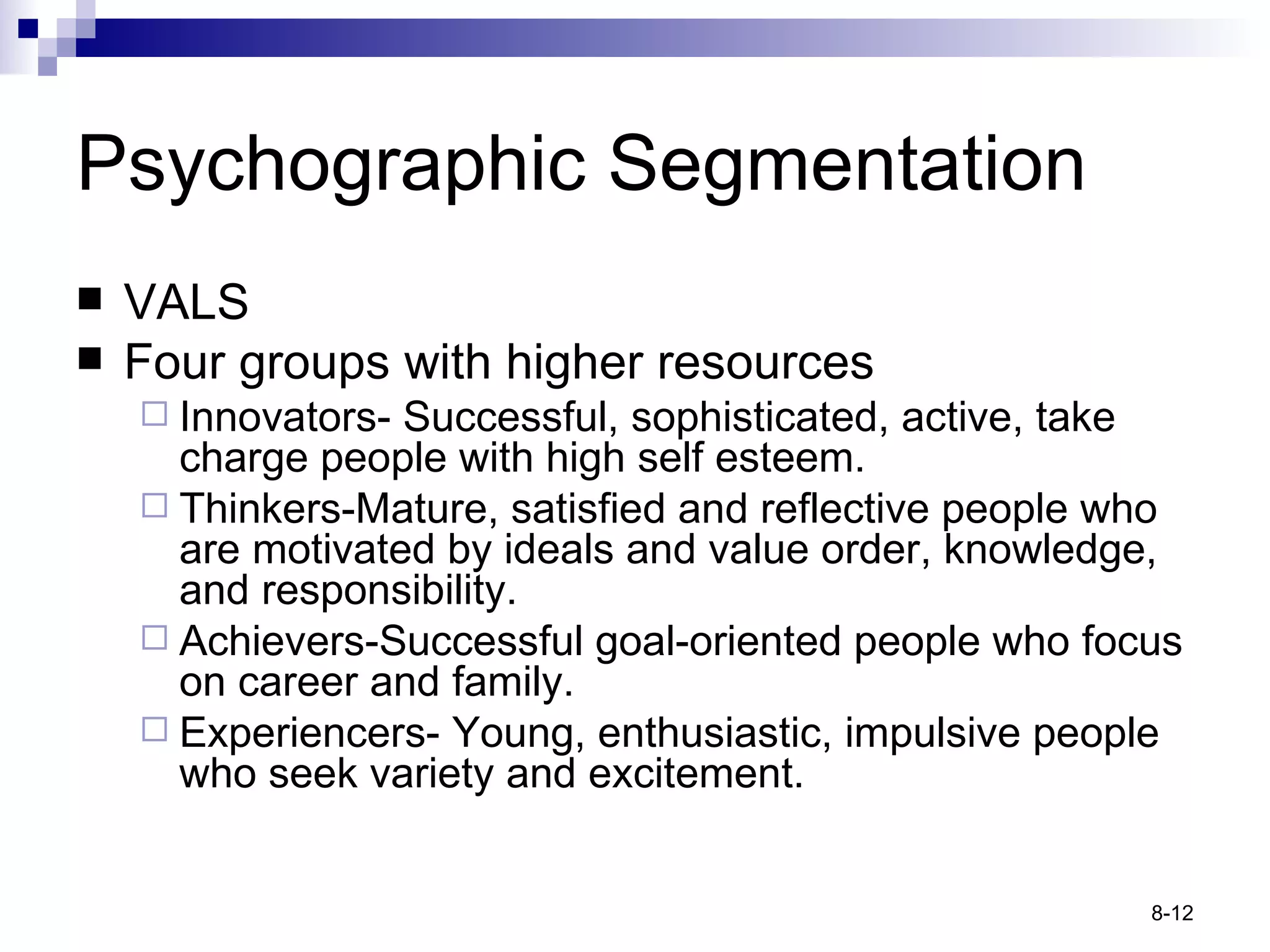
Psychographic Segmentation VALS Four groups with higher resources Innovators - Successful, sophisticated, active, take charge people with high self esteem. Thinkers -Mature, satisfied and reflective people who are motivated by ideals and value order, knowledge, and responsibility. Achievers -Successful goal-oriented people who focus on career and family. Experiencers-  Young, enthusiastic, impulsive people who seek variety and excitement.
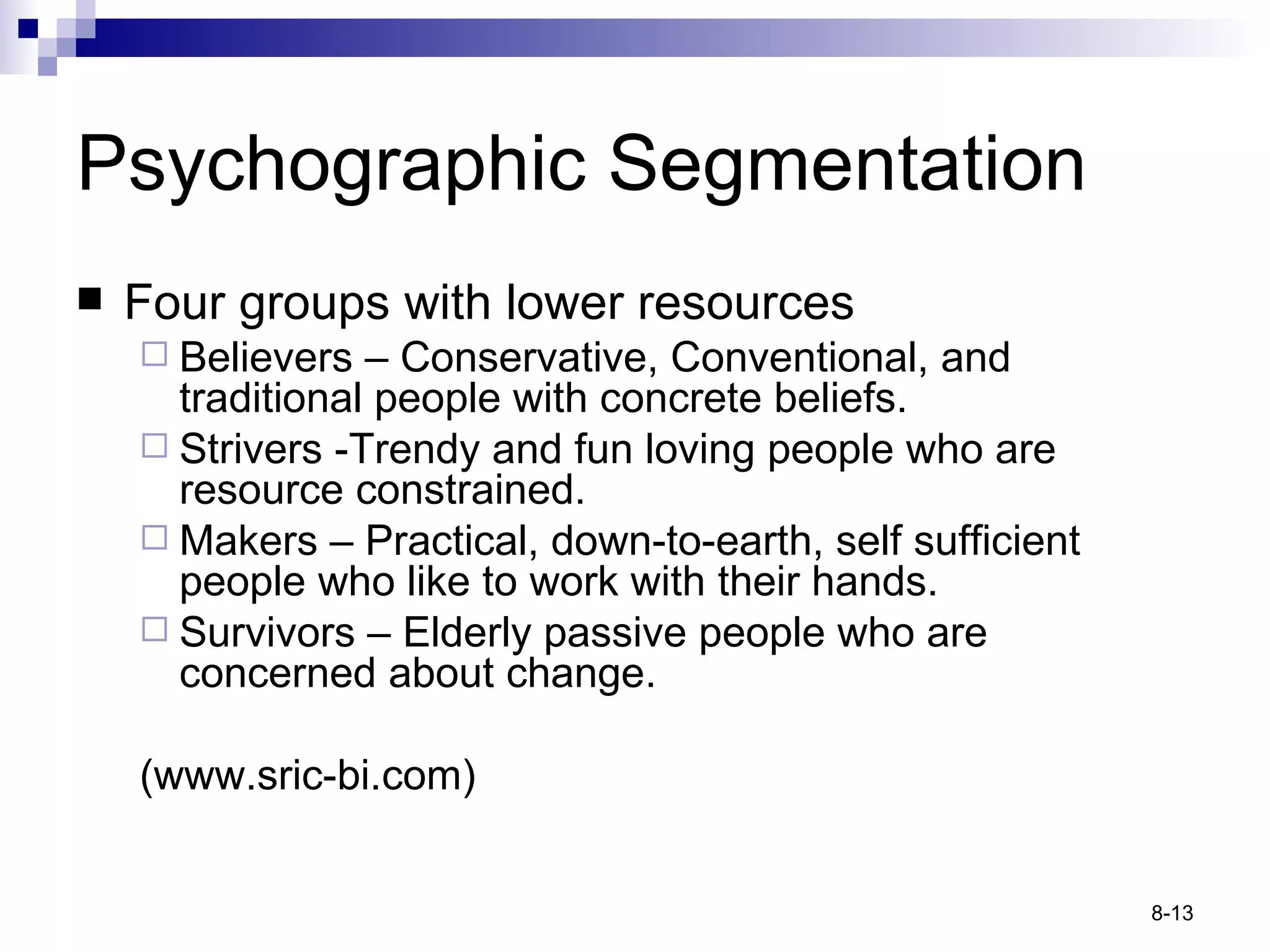
Four groups with lower resources Believers  – Conservative, Conventional, and traditional people with concrete beliefs. Strivers - Trendy and fun loving people who are resource constrained. Makers –  Practical, down-to-earth, self sufficient people who like to work with their hands. Survivors  – Elderly passive people who are concerned about change. (www.sric-bi.com) Psychographic Segmentation
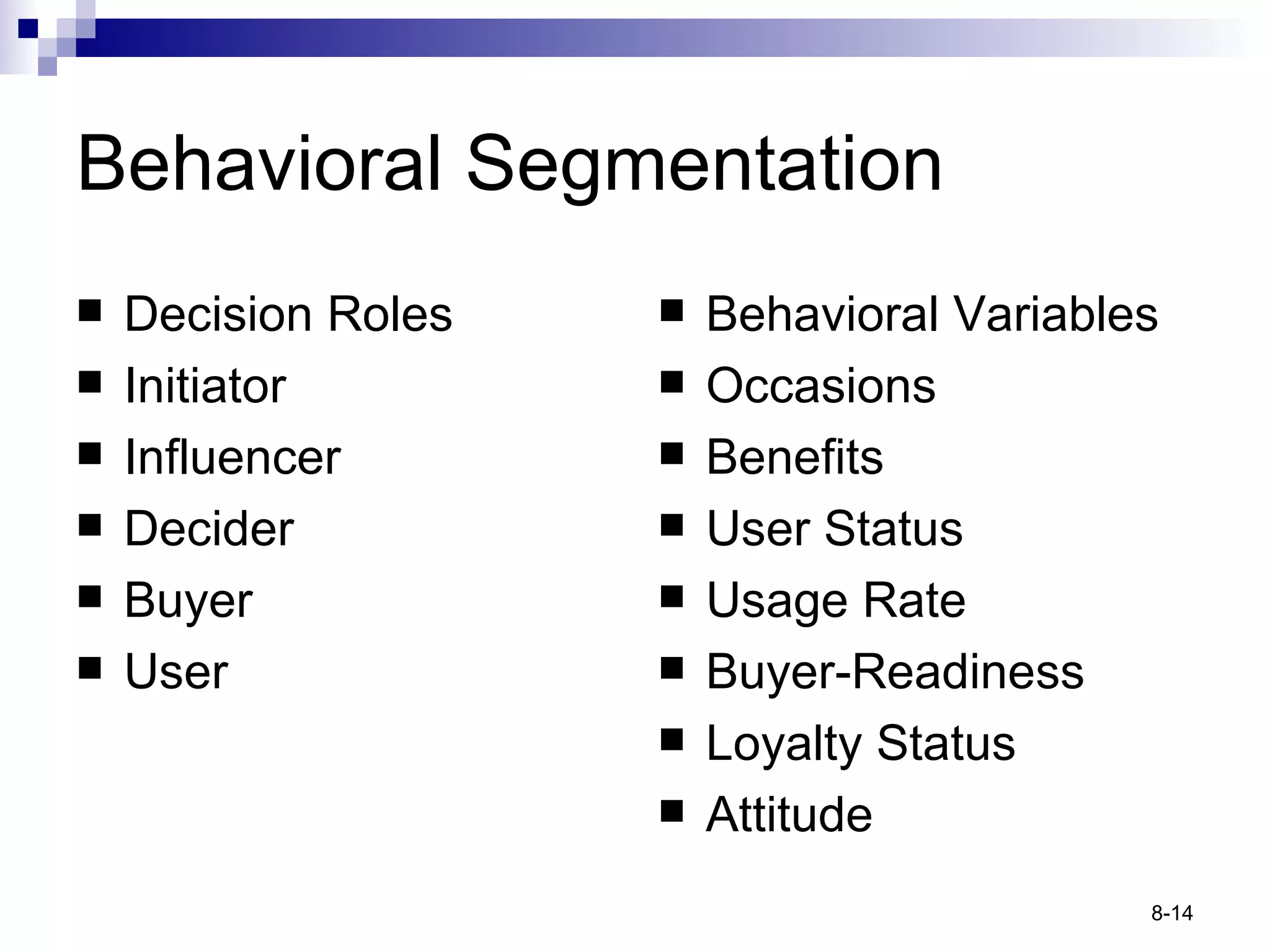
Behavioral Segmentation Decision Roles Initiator Influencer Decider Buyer User Behavioral Variables Occasions Benefits User Status Usage Rate Buyer-Readiness Loyalty Status Attitude
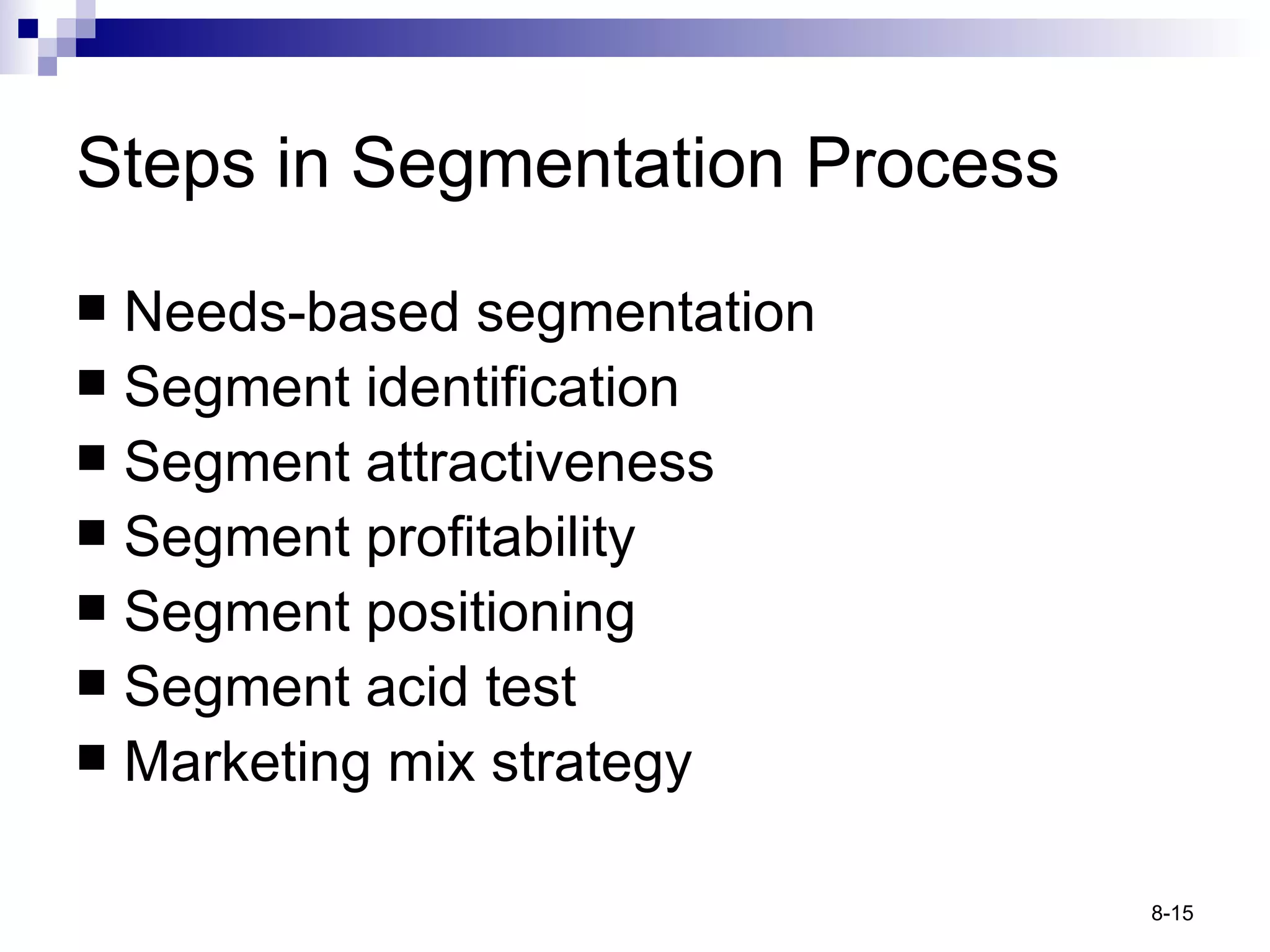
Steps in Segmentation Process Needs-based segmentation Segment identification Segment attractiveness Segment profitability Segment positioning Segment acid test Marketing mix strategy
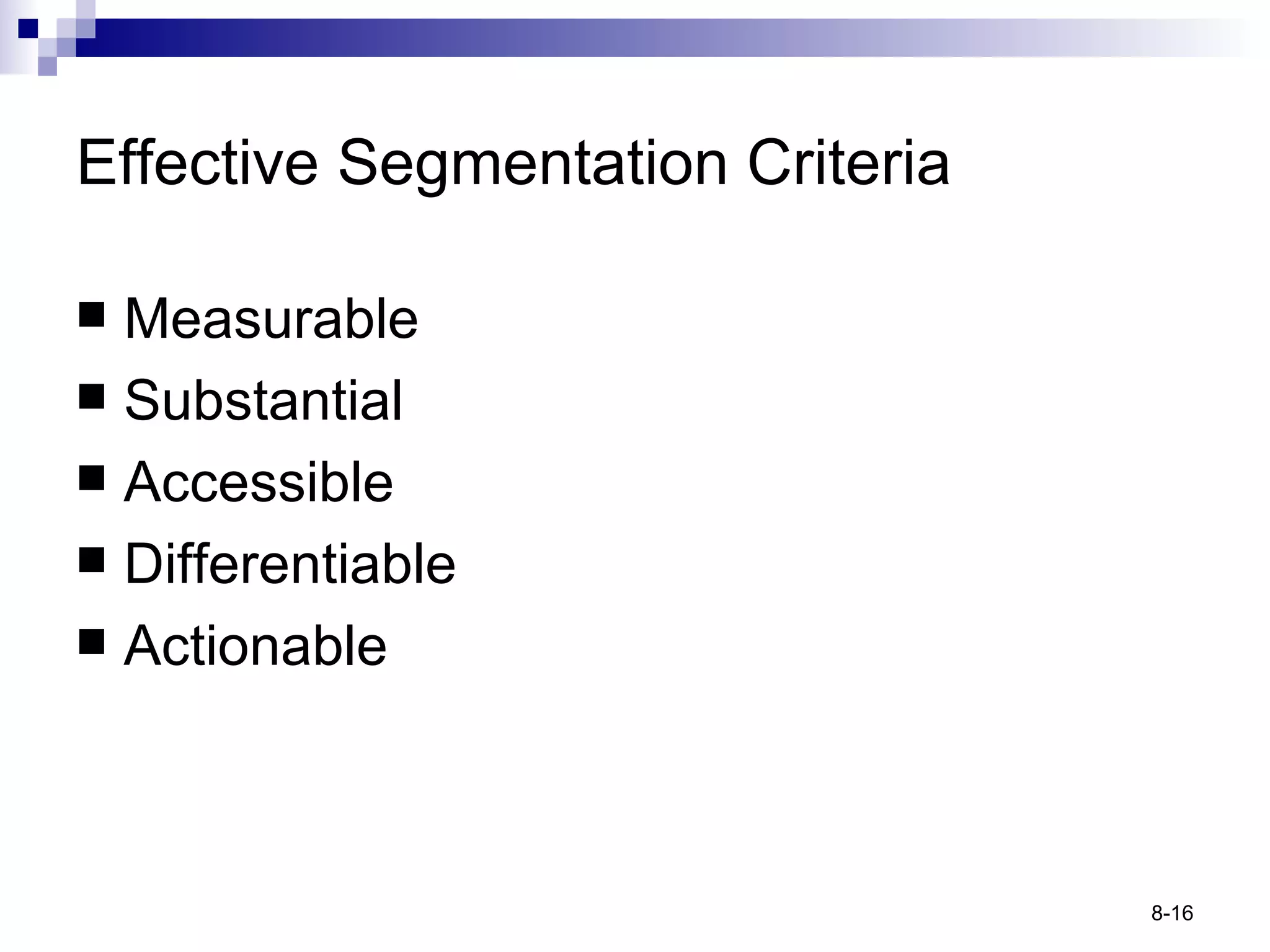
Effective Segmentation Criteria Measurable Substantial Accessible Differentiable Actionable
DISCUSSION Is Mass Marketing dead?
DISCUSSION Think of various product categories. How would you classify yourself in terms of the various segmentation schemes? How would marketing be more or less effective for you depending on the segment involved? How would you contrast demographic versus behavioral segment schemes? Which ones do you think would be most effective for marketers trying to sell to you?
HSBC HSBC is known as world’s local bank. Established in 1865 to finance the trade between China and the United Kingdom. Second largest bank in the world. Serves 100 million customers through 9,500 branches in 79 countries.
HSBC The company is organised by business line: Personal financial services Consumer finance Commercial banking Corporate investment banking and markets Private banking
HSBC HSBC is organized by the geographic segment: Asia-Pacific UK/Eurozone North America/NAFTA South America Middle East
HSBC Sir John Bond in November 2003: Our position as the world’s local bank enables us to approach each country uniquely, blending local knowledge with a world wide operating platform.
HSBC in New York HSBC held a “New York City’s most knowledgeable Cabbie” contest. The winning cabbie gets paid to drive full time for HSBC for the year and HSBC’s customers win too. And they get a free ride in the HSBC branded Bankcab.
HSBC in Hong Kong During the Severe Acute Respiratory Syndrome(SARS) outbreak, HSBC launched a program to revitalise the local economy.
HSBC’s niche marketing venture Proides Pet Insurance which in 2003 was growing at the rate of 125% per year.
Dealing with Competition
Five Forces Determining Segment Structural Attractiveness Potential entrants Suppliers Buyers Industry competitors Substitutes
Industry Concept of Competition Number of sellers and degree of differentiation Entry, mobility, and exit barriers Cost structure Degree of vertical integration Degree of globalization
Industry Concept of Competition Pure monopoly Oligopoly Monopolistic competition Pure competition
Analyzing Competitors Share of market Share of mind Share of heart
Expanding the Total Market New customers More usage
Six Types of  Defense Strategies Defender Flank Preemptive Counteroffensive Mobile Contraction
Other Competitive Strategies Market challengers Market followers Market nichers
Market Challenger Strategies Define the strategic objective and opponents Choose a general attack strategy Choose a specific attack strategy
General Attack Strategies Frontal attack Flank attack Encirclement attack Bypass attack Guerrilla warfare
Specific Attack Strategies Price discounts Lower-priced goods Value-priced goods Prestige goods Product proliferation Product innovation Improved services Distribution innovation Manufacturing-cost reduction Intensive advertising promotion
Market Follower Strategies Counterfeiter Cloner Imitator Adaptor
EXERCISE Pick an industry. Classify firms according to the four different roles they might play: leader, challenger, follower and nicher. How would you characterize the nature of competition? Do the firms follow the principles described above?
ACCENTURE Stareted as the consulting arm of the accounting firm Arthur Andersen. They were called “Administrative Accouting Group” and then became Management Information Consulting Division.
ACCENTURE In 1989, Andersen Consulting separated from Arthur Andersen in order to position itself against its IT services competitors. At the time Andersen Consulting already doing a $1 billion a year in business, but it was mistakenly associated with accounting.
ACCENTURE The IT consulting marketplace was crowded with competitors ranging from nuts-and-bolts hardware/software providers like IBM to leading strategy firms like Mckinsey and Boston Consulting Group. Came out with an advertising campaign.
ACCENTURE In 2000, following arbitration against its former parent, Andersen Consulting was granted full independence. It had three months to find, implement, and introduce the world to a new corporate name. This effort went on to become one of the largest and most successful re-branding campaigns in corporate history.
ACCENTURE A consultant from the Oslo office coined the Accenture name because it rhymed with adventure and connoted an “accent on the future”. The name emerged as the winner because it was catchy and distinctive and embodied bold growth and innovation.
ACCENTURE In 2002, Accenture launched the “Innovation Delivered” campaign to distinguish itself from the commpetition. Competitors in the IT arena, such as IBM lacked broader business consulting expertise and weren’t seen as knowledgeable in business strategies and processes. They tended the firms from the IT level. Competitors like McKinsey had brand strength associated with strategic thinking.
ACCENTURE Accenture saw its differentiator as the ability to provide both innovative ideas and execute them too. “ Unless you can provide both transformational consulting and outsourcing capability, you are not going to win”
ACCENTURE “ Innovation Delivered” campaign. “from innovation to execution, Accenture helps accelerate your vision”.
ACCENTURE In 2002, the climate changed, after the dot-com crash and the economic downturn, innovation was no longer enough. “High performance Delivered” campaign with Tiger Woods as the spokesperson.

Marketing Management Session 12

  • 1.
  • 2.
    Effective Targeting Requires…Identify and profile distinct groups of buyers who differ in their needs and preferences. Select one or more market segments to enter. Establish and communicate the distinctive benefits of the market offering.
  • 3.
    Four Levels ofMicromarketing Segments Niches Local areas Individuals
  • 4.
    Segment Marketing Targetinga group of customers who share a similar set of needs and wants.
  • 5.
    Flexible Marketing OfferingsNaked solution Product and service elements that all segment members value Discretionary options Some segment members value Options may carry additional charges
  • 6.
    The Experience EconomyExperience Services Goods Commodity
  • 7.
    Customerization Combines operationallydriven mass customization with customized marketing in a way that empowers consumers to design the product and service offering of their choice.
  • 8.
    Segmenting Consumer MarketsGeographic Demographic Psychographic Behavioral
  • 9.
    Market Segmentation OccupationSEGMENTATION BASE SELECTED SEGMENTATION VARIABLES Geographic Segmentation Climate Density of area City Size Region Karnataka, Punjab, Haryana, Rajasthan Major metropolitan areas, small cities, towns Urban, suburban, exurban, rural Temperate, hot, humid, rainy Demographic Segmentation Income Marital status Sex Age Under 11, 12-17, 18-34, 35-49, 50-64, 65-74, 75-99, 100+ Male, female Single, married, divorced, living together, widowed Under $25,000, $25,000-$34,999, $35,000-$49,999, $50,000-$74,999, $75,000-$99,999, $100,000 and over Education Some high school, high school graduate, some college, college graduate, postgraduate Professional, blue-collar, white-collar, agricultural, military
  • 10.
    SEGMENTATION BASE SELECTEDSEGMENTATION VARIABLES Psychological Segmentation Learning-involvement Perception Personality Needs-motivation Shelter, safety, security, affection, sense of self-worth Extroverts, novelty seeker, aggressive Low-risk, moderate-risk, high-risk Low-involvement, high-involvement Psychographic Subcultures (Race/ethnic) Religion Cultures (Lifestyle) Segmentation Economy-minded, couch potatoes, outdoors enthusiasts, status seekers American, Italian,Indian, Chinese, Mexican, French, Pakistani Catholic, Protestant, Jewish,Hindu, Muslim, other African-American, Caucasian, Asian, Hispanic Family life cycle Social class Lower, middle, upper Bachelors, young married, full nesters, empty nesters Attitudes Positive attitude, negative attitude Sociocultural Segmentation
  • 11.
    SEGMENTATION BASE SELECTEDSEGMENTATION VARIABLES Use-Related Segmentation Brand loyalty Awareness status Usage rate Heavy users, medium users, light users, non users Unaware, aware, interested, enthusiastic None, some, strong Use-Situation Segmentation Location Objective Time Leisure, work, rush, morning, night Personal, gift, snack, fun, achievement Home, work, friend’s home, in-store Person Self, family members, friends, boss, peers Benefit Segmentation Convenience, social acceptance, long lasting, economy, value-for-the-money Geodemographics Based on geography and demography Demographic/ Psychographics Combination of demographic and psychographic profiles of consumer segments profiles SRI VALS TM Actualizer, fulfilled, believer, achiever, striver, experiencer, maker, struggler Hybrid Segmentation
  • 12.
    Psychographic Segmentation VALSFour groups with higher resources Innovators - Successful, sophisticated, active, take charge people with high self esteem. Thinkers -Mature, satisfied and reflective people who are motivated by ideals and value order, knowledge, and responsibility. Achievers -Successful goal-oriented people who focus on career and family. Experiencers- Young, enthusiastic, impulsive people who seek variety and excitement.
  • 13.
    Four groups withlower resources Believers – Conservative, Conventional, and traditional people with concrete beliefs. Strivers - Trendy and fun loving people who are resource constrained. Makers – Practical, down-to-earth, self sufficient people who like to work with their hands. Survivors – Elderly passive people who are concerned about change. (www.sric-bi.com) Psychographic Segmentation
  • 14.
    Behavioral Segmentation DecisionRoles Initiator Influencer Decider Buyer User Behavioral Variables Occasions Benefits User Status Usage Rate Buyer-Readiness Loyalty Status Attitude
  • 15.
    Steps in SegmentationProcess Needs-based segmentation Segment identification Segment attractiveness Segment profitability Segment positioning Segment acid test Marketing mix strategy
  • 16.
    Effective Segmentation CriteriaMeasurable Substantial Accessible Differentiable Actionable
  • 17.
    DISCUSSION Is MassMarketing dead?
  • 18.
    DISCUSSION Think ofvarious product categories. How would you classify yourself in terms of the various segmentation schemes? How would marketing be more or less effective for you depending on the segment involved? How would you contrast demographic versus behavioral segment schemes? Which ones do you think would be most effective for marketers trying to sell to you?
  • 19.
    HSBC HSBC isknown as world’s local bank. Established in 1865 to finance the trade between China and the United Kingdom. Second largest bank in the world. Serves 100 million customers through 9,500 branches in 79 countries.
  • 20.
    HSBC The companyis organised by business line: Personal financial services Consumer finance Commercial banking Corporate investment banking and markets Private banking
  • 21.
    HSBC HSBC isorganized by the geographic segment: Asia-Pacific UK/Eurozone North America/NAFTA South America Middle East
  • 22.
    HSBC Sir JohnBond in November 2003: Our position as the world’s local bank enables us to approach each country uniquely, blending local knowledge with a world wide operating platform.
  • 23.
    HSBC in NewYork HSBC held a “New York City’s most knowledgeable Cabbie” contest. The winning cabbie gets paid to drive full time for HSBC for the year and HSBC’s customers win too. And they get a free ride in the HSBC branded Bankcab.
  • 24.
    HSBC in HongKong During the Severe Acute Respiratory Syndrome(SARS) outbreak, HSBC launched a program to revitalise the local economy.
  • 25.
    HSBC’s niche marketingventure Proides Pet Insurance which in 2003 was growing at the rate of 125% per year.
  • 26.
  • 27.
    Five Forces DeterminingSegment Structural Attractiveness Potential entrants Suppliers Buyers Industry competitors Substitutes
  • 28.
    Industry Concept ofCompetition Number of sellers and degree of differentiation Entry, mobility, and exit barriers Cost structure Degree of vertical integration Degree of globalization
  • 29.
    Industry Concept ofCompetition Pure monopoly Oligopoly Monopolistic competition Pure competition
  • 30.
    Analyzing Competitors Shareof market Share of mind Share of heart
  • 31.
    Expanding the TotalMarket New customers More usage
  • 32.
    Six Types of Defense Strategies Defender Flank Preemptive Counteroffensive Mobile Contraction
  • 33.
    Other Competitive StrategiesMarket challengers Market followers Market nichers
  • 34.
    Market Challenger StrategiesDefine the strategic objective and opponents Choose a general attack strategy Choose a specific attack strategy
  • 35.
    General Attack StrategiesFrontal attack Flank attack Encirclement attack Bypass attack Guerrilla warfare
  • 36.
    Specific Attack StrategiesPrice discounts Lower-priced goods Value-priced goods Prestige goods Product proliferation Product innovation Improved services Distribution innovation Manufacturing-cost reduction Intensive advertising promotion
  • 37.
    Market Follower StrategiesCounterfeiter Cloner Imitator Adaptor
  • 38.
    EXERCISE Pick anindustry. Classify firms according to the four different roles they might play: leader, challenger, follower and nicher. How would you characterize the nature of competition? Do the firms follow the principles described above?
  • 39.
    ACCENTURE Stareted asthe consulting arm of the accounting firm Arthur Andersen. They were called “Administrative Accouting Group” and then became Management Information Consulting Division.
  • 40.
    ACCENTURE In 1989,Andersen Consulting separated from Arthur Andersen in order to position itself against its IT services competitors. At the time Andersen Consulting already doing a $1 billion a year in business, but it was mistakenly associated with accounting.
  • 41.
    ACCENTURE The ITconsulting marketplace was crowded with competitors ranging from nuts-and-bolts hardware/software providers like IBM to leading strategy firms like Mckinsey and Boston Consulting Group. Came out with an advertising campaign.
  • 42.
    ACCENTURE In 2000,following arbitration against its former parent, Andersen Consulting was granted full independence. It had three months to find, implement, and introduce the world to a new corporate name. This effort went on to become one of the largest and most successful re-branding campaigns in corporate history.
  • 43.
    ACCENTURE A consultantfrom the Oslo office coined the Accenture name because it rhymed with adventure and connoted an “accent on the future”. The name emerged as the winner because it was catchy and distinctive and embodied bold growth and innovation.
  • 44.
    ACCENTURE In 2002,Accenture launched the “Innovation Delivered” campaign to distinguish itself from the commpetition. Competitors in the IT arena, such as IBM lacked broader business consulting expertise and weren’t seen as knowledgeable in business strategies and processes. They tended the firms from the IT level. Competitors like McKinsey had brand strength associated with strategic thinking.
  • 45.
    ACCENTURE Accenture sawits differentiator as the ability to provide both innovative ideas and execute them too. “ Unless you can provide both transformational consulting and outsourcing capability, you are not going to win”
  • 46.
    ACCENTURE “ InnovationDelivered” campaign. “from innovation to execution, Accenture helps accelerate your vision”.
  • 47.
    ACCENTURE In 2002,the climate changed, after the dot-com crash and the economic downturn, innovation was no longer enough. “High performance Delivered” campaign with Tiger Woods as the spokesperson.