
by Mario Fusco
mario.fusco@gmail.com
@mariofusco
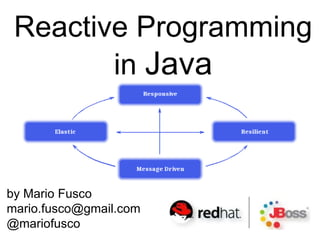
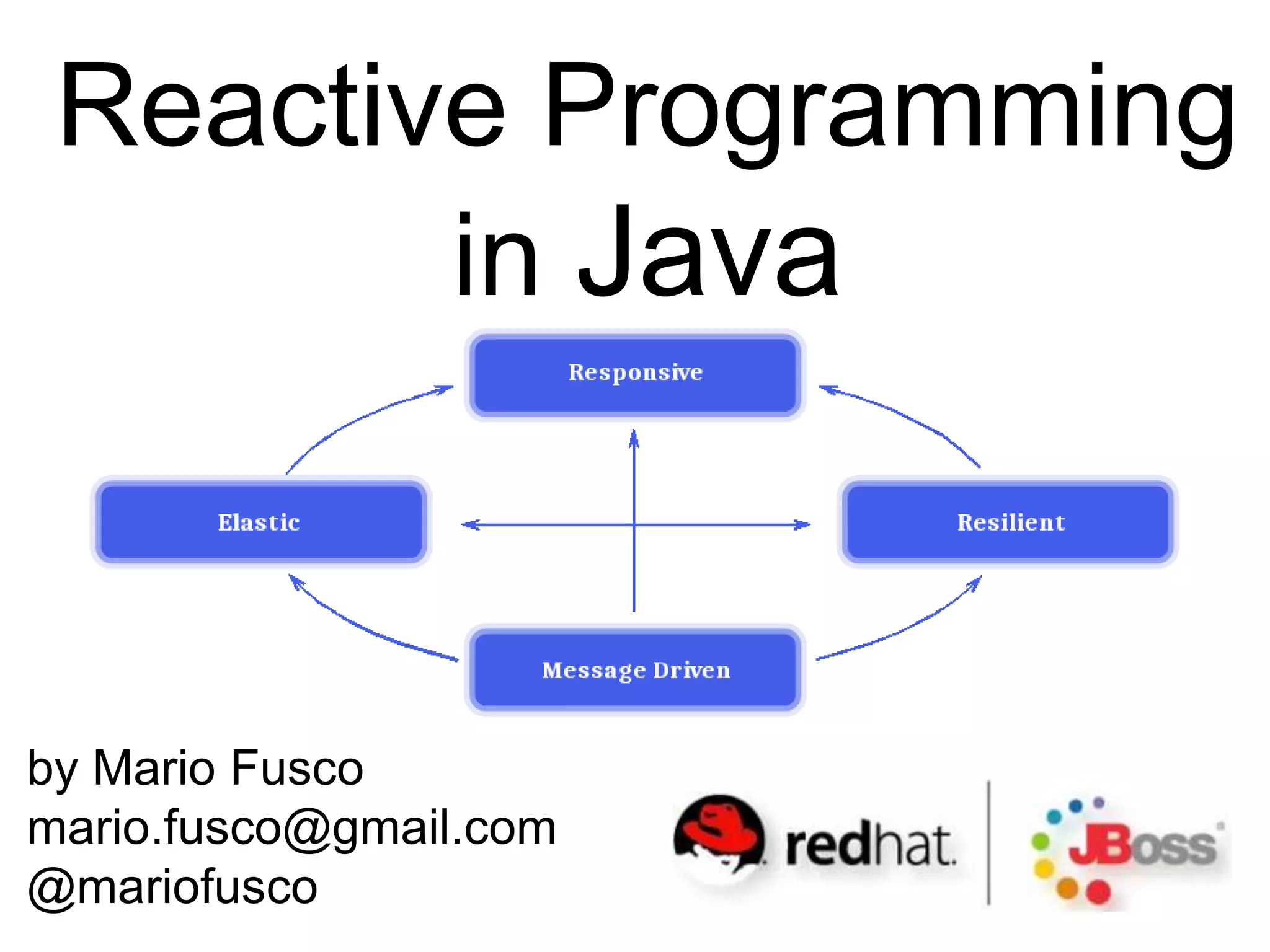
Reactive Programming
in Java
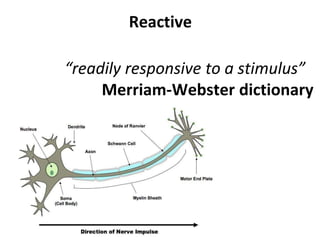
Reactive
“readily responsive to a stimulus”
Merriam-Webster dictionary
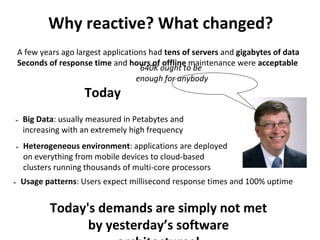
Why reactive? What changed?
➢ Usage patterns: Users expect millisecond response times and 100% uptime
A few years ago largest applications had tens of servers and gigabytes of data
Seconds of response time and hours of offline maintenance were acceptable
Today
➢ Big Data: usually measured in Petabytes and
increasing with an extremely high frequency
➢ Heterogeneous environment: applications are deployed
on everything from mobile devices to cloud-based
clusters running thousands of multi-core processors
Today's demands are simply not met
by yesterday’s software
640K ought to be
enough for anybody
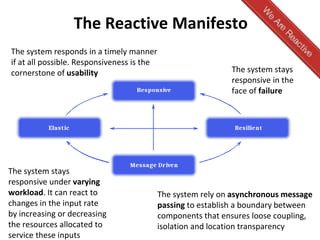
The Reactive Manifesto
The system responds in a timely manner
if at all possible. Responsiveness is the
cornerstone of usability The system stays
responsive in the
face of failure
The system stays
responsive under varying
workload. It can react to
changes in the input rate
by increasing or decreasing
the resources allocated to
service these inputs
The system rely on asynchronous message
passing to establish a boundary between
components that ensures loose coupling,
isolation and location transparency
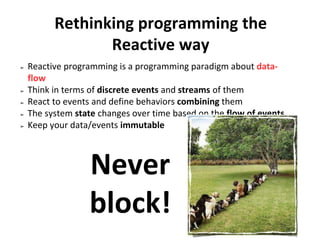
Rethinking programming the
Reactive way
➢ Reactive programming is a programming paradigm about data-
flow
➢ Think in terms of discrete events and streams of them
➢ React to events and define behaviors combining them
➢ The system state changes over time based on the flow of events
➢ Keep your data/events immutable
Never
block!
Reactive programming is
programming with
asynchronous data streams
➢ A stream is a sequence
of ongoing events
ordered in time
➢ Events are processed
asynchronously, by
defining a function
that will be executed
when an event arrives
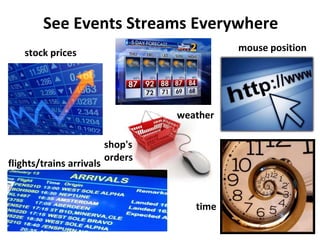
See Events Streams Everywhere
stock prices
weather
shop's
orders
flights/trains arrivals
time
mouse position
Reactive Programming Mantra
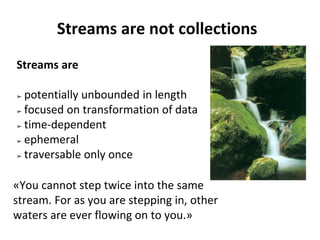
Streams are not collections
Streams are
➢ potentially unbounded in length
➢ focused on transformation of data
➢ time-dependent
➢ ephemeral
➢ traversable only once
«You cannot step twice into the same
stream. For as you are stepping in, other
waters are ever flowing on to you.»
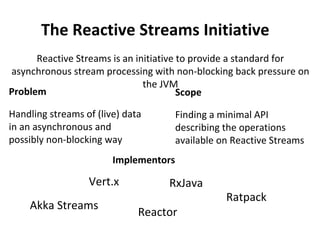
The Reactive Streams Initiative
Reactive Streams is an initiative to provide a standard for
asynchronous stream processing with non-blocking back pressure on
the JVM
Problem
Handling streams of (live) data
in an asynchronous and
possibly non-blocking way
Scope
Finding a minimal API
describing the operations
available on Reactive Streams
Implementors
Akka Streams
Reactor
RxJava
Ratpack
Vert.x
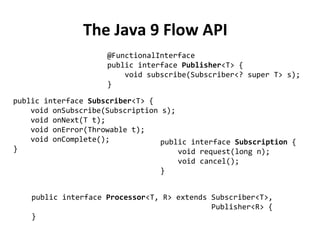
The Java 9 Flow API
@FunctionalInterface
public interface Publisher<T> {
void subscribe(Subscriber<? super T> s);
}
public interface Subscriber<T> {
void onSubscribe(Subscription s);
void onNext(T t);
void onError(Throwable t);
void onComplete();
}
public interface Subscription {
void request(long n);
void cancel();
}
public interface Processor<T, R> extends Subscriber<T>,
Publisher<R> {
}
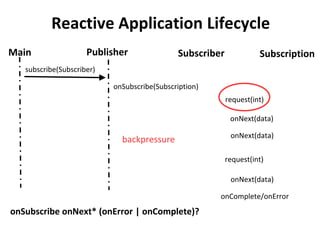
Reactive Application Lifecycle
Publisher Subscriber
subscribe(Subscriber)
Main
onSubscribe(Subscription)
Subscription
onNext(data)
onNext(data)
request(int)
onNext(data)
onComplete/onError
onSubscribe onNext* (onError | onComplete)?
backpressure
request(int)
Enough speaking
Show me the code!
RxJava
Reactive Extension for async
programming➢ A library for composing asynchronous and event-based
programs using observable sequences for the Java VM
➢ Supports Java 6 or higher and JVM-based languages such as
Groovy, Clojure, JRuby, Kotlin and Scala
➢ Includes a DSL providing extensive operations for streams
transformation, filtering and recombination
➢ Implements pure “push” model
➢ Decouple events production from consumption
➢ Allows blocking only for back pressure
➢ First class support for error handling,
➢ scheduling & flow control
➢ Used by Netflix to make the entire service
➢ layer asynchronous
http://reactivex.io
http://github.com/ReactiveX/RxJava
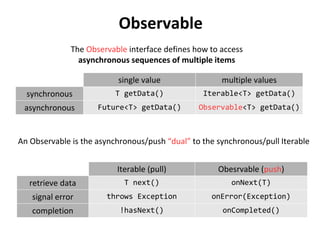
Observable
The Observable interface defines how to access
asynchronous sequences of multiple items
single value multiple values
synchronous T getData() Iterable<T> getData()
asynchronous Future<T> getData() Observable<T> getData()
An Observable is the asynchronous/push “dual” to the synchronous/pull Iterable
Iterable (pull) Obesrvable (push)
retrieve data T next() onNext(T)
signal error throws Exception onError(Exception)
completion !hasNext() onCompleted()
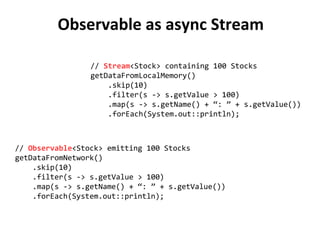
Observable as async Stream
// Stream<Stock> containing 100 Stocks
getDataFromLocalMemory()
.skip(10)
.filter(s -> s.getValue > 100)
.map(s -> s.getName() + “: ” + s.getValue())
.forEach(System.out::println);
// Observable<Stock> emitting 100 Stocks
getDataFromNetwork()
.skip(10)
.filter(s -> s.getValue > 100)
.map(s -> s.getName() + “: ” + s.getValue())
.forEach(System.out::println);
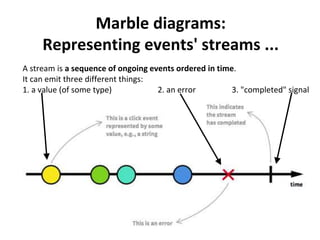
Marble diagrams:
Representing events' streams ...
A stream is a sequence of ongoing events ordered in time.
It can emit three different things:
1. a value (of some type) 2. an error 3. "completed" signal
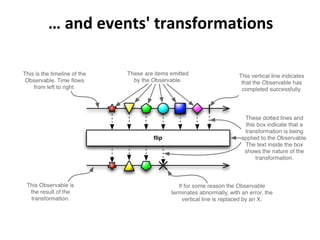
… and events' transformations
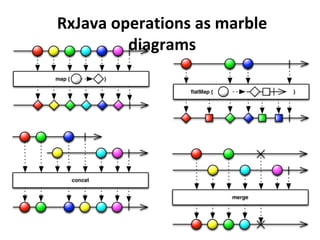
RxJava operations as marble
diagrams
What do you want? More code!
When do you it? Now!
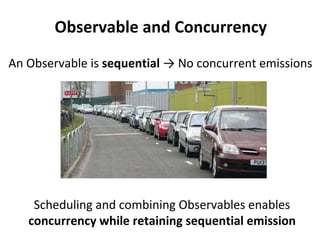
Observable and Concurrency
An Observable is sequential → No concurrent emissions
Scheduling and combining Observables enables
concurrency while retaining sequential emission
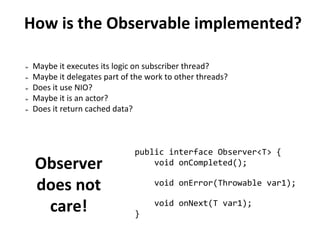
How is the Observable implemented?
➢ Maybe it executes its logic on subscriber thread?
➢ Maybe it delegates part of the work to other threads?
➢ Does it use NIO?
➢ Maybe it is an actor?
➢ Does it return cached data?
Observer
does not
care!
public interface Observer<T> {
void onCompleted();
void onError(Throwable var1);
void onNext(T var1);
}
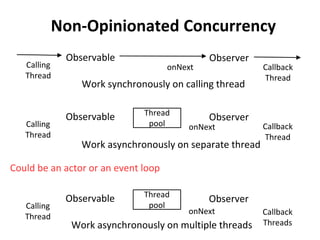
Non-Opinionated Concurrency
Observable Observer
Calling
Thread
Callback
Thread
onNext
Work synchronously on calling thread
Observable Observer
Calling
Thread
Callback
Thread
onNext
Work asynchronously on separate thread
Thread
pool
Observable Observer
Calling
Thread
Callback
Threads
onNext
Work asynchronously on multiple threads
Thread
pool
Could be an actor or an event loop
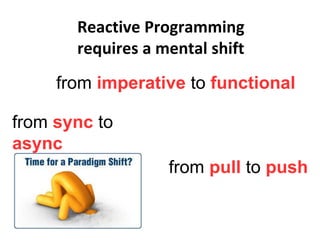
Reactive Programming
requires a mental shift
from sync to
async
from pull to push
from imperative to functional
Mario Fusco
Red Hat – Senior Software
Engineer
mario.fusco@gmail.com
twitter: @mariofusco
Q A
Thanks … Questions?

Mario Fusco - Reactive programming in Java - Codemotion Milan 2017

  • 1.
  • 2.
    Reactive “readily responsive toa stimulus” Merriam-Webster dictionary
  • 3.
    Why reactive? Whatchanged? ➢ Usage patterns: Users expect millisecond response times and 100% uptime A few years ago largest applications had tens of servers and gigabytes of data Seconds of response time and hours of offline maintenance were acceptable Today ➢ Big Data: usually measured in Petabytes and increasing with an extremely high frequency ➢ Heterogeneous environment: applications are deployed on everything from mobile devices to cloud-based clusters running thousands of multi-core processors Today's demands are simply not met by yesterday’s software 640K ought to be enough for anybody
  • 4.
    The Reactive Manifesto Thesystem responds in a timely manner if at all possible. Responsiveness is the cornerstone of usability The system stays responsive in the face of failure The system stays responsive under varying workload. It can react to changes in the input rate by increasing or decreasing the resources allocated to service these inputs The system rely on asynchronous message passing to establish a boundary between components that ensures loose coupling, isolation and location transparency
  • 5.
    Rethinking programming the Reactiveway ➢ Reactive programming is a programming paradigm about data- flow ➢ Think in terms of discrete events and streams of them ➢ React to events and define behaviors combining them ➢ The system state changes over time based on the flow of events ➢ Keep your data/events immutable Never block!
  • 6.
    Reactive programming is programmingwith asynchronous data streams ➢ A stream is a sequence of ongoing events ordered in time ➢ Events are processed asynchronously, by defining a function that will be executed when an event arrives
  • 7.
    See Events StreamsEverywhere stock prices weather shop's orders flights/trains arrivals time mouse position
  • 8.
  • 9.
    Streams are notcollections Streams are ➢ potentially unbounded in length ➢ focused on transformation of data ➢ time-dependent ➢ ephemeral ➢ traversable only once «You cannot step twice into the same stream. For as you are stepping in, other waters are ever flowing on to you.»
  • 10.
    The Reactive StreamsInitiative Reactive Streams is an initiative to provide a standard for asynchronous stream processing with non-blocking back pressure on the JVM Problem Handling streams of (live) data in an asynchronous and possibly non-blocking way Scope Finding a minimal API describing the operations available on Reactive Streams Implementors Akka Streams Reactor RxJava Ratpack Vert.x
  • 11.
    The Java 9Flow API @FunctionalInterface public interface Publisher<T> { void subscribe(Subscriber<? super T> s); } public interface Subscriber<T> { void onSubscribe(Subscription s); void onNext(T t); void onError(Throwable t); void onComplete(); } public interface Subscription { void request(long n); void cancel(); } public interface Processor<T, R> extends Subscriber<T>, Publisher<R> { }
  • 12.
    Reactive Application Lifecycle PublisherSubscriber subscribe(Subscriber) Main onSubscribe(Subscription) Subscription onNext(data) onNext(data) request(int) onNext(data) onComplete/onError onSubscribe onNext* (onError | onComplete)? backpressure request(int)
  • 13.
  • 14.
    RxJava Reactive Extension forasync programming➢ A library for composing asynchronous and event-based programs using observable sequences for the Java VM ➢ Supports Java 6 or higher and JVM-based languages such as Groovy, Clojure, JRuby, Kotlin and Scala ➢ Includes a DSL providing extensive operations for streams transformation, filtering and recombination ➢ Implements pure “push” model ➢ Decouple events production from consumption ➢ Allows blocking only for back pressure ➢ First class support for error handling, ➢ scheduling & flow control ➢ Used by Netflix to make the entire service ➢ layer asynchronous http://reactivex.io http://github.com/ReactiveX/RxJava
  • 15.
    Observable The Observable interfacedefines how to access asynchronous sequences of multiple items single value multiple values synchronous T getData() Iterable<T> getData() asynchronous Future<T> getData() Observable<T> getData() An Observable is the asynchronous/push “dual” to the synchronous/pull Iterable Iterable (pull) Obesrvable (push) retrieve data T next() onNext(T) signal error throws Exception onError(Exception) completion !hasNext() onCompleted()
  • 16.
    Observable as asyncStream // Stream<Stock> containing 100 Stocks getDataFromLocalMemory() .skip(10) .filter(s -> s.getValue > 100) .map(s -> s.getName() + “: ” + s.getValue()) .forEach(System.out::println); // Observable<Stock> emitting 100 Stocks getDataFromNetwork() .skip(10) .filter(s -> s.getValue > 100) .map(s -> s.getName() + “: ” + s.getValue()) .forEach(System.out::println);
  • 17.
    Marble diagrams: Representing events'streams ... A stream is a sequence of ongoing events ordered in time. It can emit three different things: 1. a value (of some type) 2. an error 3. "completed" signal
  • 18.
    … and events'transformations
  • 19.
    RxJava operations asmarble diagrams
  • 20.
    What do youwant? More code! When do you it? Now!
  • 21.
    Observable and Concurrency AnObservable is sequential → No concurrent emissions Scheduling and combining Observables enables concurrency while retaining sequential emission
  • 22.
    How is theObservable implemented? ➢ Maybe it executes its logic on subscriber thread? ➢ Maybe it delegates part of the work to other threads? ➢ Does it use NIO? ➢ Maybe it is an actor? ➢ Does it return cached data? Observer does not care! public interface Observer<T> { void onCompleted(); void onError(Throwable var1); void onNext(T var1); }
  • 23.
    Non-Opinionated Concurrency Observable Observer Calling Thread Callback Thread onNext Worksynchronously on calling thread Observable Observer Calling Thread Callback Thread onNext Work asynchronously on separate thread Thread pool Observable Observer Calling Thread Callback Threads onNext Work asynchronously on multiple threads Thread pool Could be an actor or an event loop
  • 24.
    Reactive Programming requires amental shift from sync to async from pull to push from imperative to functional
  • 25.
    Mario Fusco Red Hat– Senior Software Engineer mario.fusco@gmail.com twitter: @mariofusco Q A Thanks … Questions?