





J Neurol Neurosurg Psychiatry

Diagnosis and management of Marchiafava–Bignami disease: a
review of CT/MRI confirmed cases

Matti Hillbom, Pertti Saloheimo, Shinsuke Fujioka,, Zbigniew K
Wszolek ,Seppo Juvela, Maurizio A Leone
J Neurol Neurosurg Psychiatry 2014;85:168-173
doi:10.1136/jnnp-2013-305979
BACKGROUND
• Marchiafava–Bignami disease (MBD) a rare, fatal disease
affecting wine drinkers.
• Characterised by demyelination and necrosis of the corpus
callosum,
• Either a toxic or nutritional etiology
• Non-fatal outcomes and other entities closely mimicking the
disease have also been described
• Some non-alcoholics also have phenotypic and radiological
findings that are typical of MBD
• The accuracy of the diagnosis and outcome influenced by
stage of disease
OBJECTIVES
• To define essential features for correct diagnosis
of MBD
• To identify features for differential diagnosis
from mimicking conditions of MBD
• To find efficient treatment
STUDY DESIGN
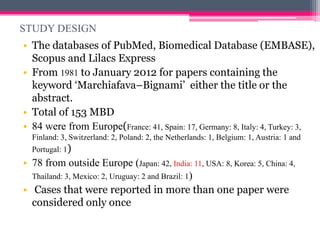
• The databases of PubMed, Biomedical Database (EMBASE),
Scopus and Lilacs Express
• From 1981 to January 2012 for papers containing the
keyword ‘Marchiafava–Bignami’ either the title or the
abstract.
• Total of 153 MBD
• 84 were from Europe(France: 41, Spain: 17, Germany: 8, Italy: 4, Turkey: 3,
Finland: 3, Switzerland: 2, Poland: 2, the Netherlands: 1, Belgium: 1, Austria: 1 and

Portugal: 1)

• 78 from outside Europe (Japan: 42, India: 11, USA: 8, Korea: 5, China: 4,
Thailand: 3, Mexico: 2, Uruguay: 2 and Brazil: 1)
• Cases that were reported in more than one paper were
considered only once
Patients and Methods
• A total of 153 MBD cases ,all of which had been diagnosed
using either head MRI or CT ante mortem.
• Associated with alcoholism, malnutrition or both.
• Alcoholics include subjects described either to be chronic
current alcoholics (n=82) or dependent on alcohol (n=6)
and others (n=54) who were reported to be chronic
excessive alcohol consumers with a long history of alcohol
abuse or heavy drinking habits
MBD mimicking lesion
MRI-verified, reversible, callosal lesions
which not associated with alcoholism or malnutrition
keywords: corpus callosum, reversible lesion
53 Total case
23 subjects with a cerebral infection, 14 with epilepsy, 5 with
hypoglycaemia and 11 with miscellaneous conditions
Data extraction
Signs and symptoms on admission and during the course of the disease
Time from symptom onset to the last clinical observation
Outcome attributable to MBD (Glasgow Outcome Scale (GOS))
Delay from the onset of symptoms to admission, acute (≤2 weeks) or
sub-acute (>2 weeks)
Location of the corpus callosum lesions that were observed at the first
and second examinations post admission and those observed during the
chronic phase (>3 months after admission)
OTHER INVESTIGATION:

MRI features; positron emission tomography (PET); single photon
emission CT (SPECT); MRI spectroscopy
Laboratory tests, including blood thiamine and cerebrospinal
fluid, drug treatment (thiamine, other vitamins and steroids); drug
doses, timing and mode of drug administration (parenteral or oral)
Wernicke's disease (diagnosed either clinically, by radiology or at
autopsy); and diabetes.
If data on given signs, symptoms or other items of information were
missing from the report, then the feature concerned was considered
absent.
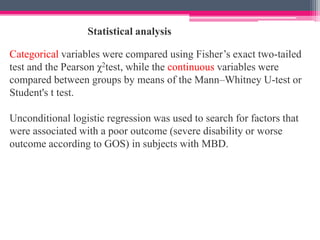
Statistical analysis
Categorical variables were compared using Fisher’s exact two-tailed
test and the Pearson χ2test, while the continuous variables were
compared between groups by means of the Mann–Whitney U-test or
Student's t test.

Unconditional logistic regression was used to search for factors that
were associated with a poor outcome (severe disability or worse
outcome according to GOS) in subjects with MBD.
RESULT
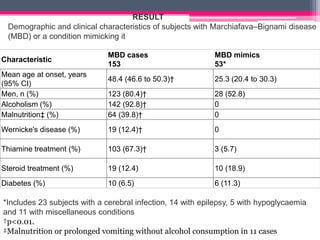
Demographic and clinical characteristics of subjects with Marchiafava–Bignami disease
(MBD) or a condition mimicking it
MBD cases
153

MBD mimics
53*

Mean age at onset, years
(95% CI)
Men, n (%)
Alcoholism (%)
Malnutrition‡ (%)

48.4 (46.6 to 50.3)†

25.3 (20.4 to 30.3)

123 (80.4)†
142 (92.8)†
64 (39.8)†

28 (52.8)
0
0

Wernicke's disease (%)

19 (12.4)†

0

Thiamine treatment (%)

103 (67.3)†

3 (5.7)

Steroid treatment (%)

19 (12.4)

10 (18.9)

Diabetes (%)

10 (6.5)

6 (11.3)

Characteristic

*Includes 23 subjects with a cerebral infection, 14 with epilepsy, 5 with hypoglycaemia
and 11 with miscellaneous conditions
†p<0.01.
‡Malnutrition or prolonged vomiting without alcohol consumption in 11 cases
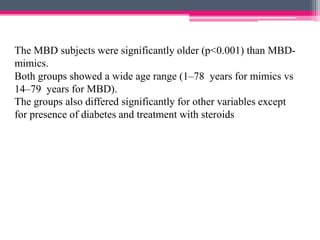
The MBD subjects were significantly older (p<0.001) than MBDmimics.
Both groups showed a wide age range (1–78 years for mimics vs
14–79 years for MBD).
The groups also differed significantly for other variables except
for presence of diabetes and treatment with steroids
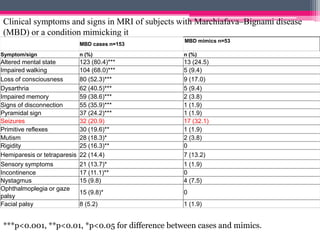
Clinical symptoms and signs in MRI of subjects with Marchiafava–Bignami disease
(MBD) or a condition mimicking it
MBD cases n=153

MBD mimics n=53

Symptom/sign

n (%)

n (%)

Altered mental state
Impaired walking
Loss of consciousness
Dysarthria
Impaired memory
Signs of disconnection
Pyramidal sign
Seizures
Primitive reflexes
Mutism
Rigidity
Hemiparesis or tetraparesis

123 (80.4)***
104 (68.0)***
80 (52.3)***
62 (40.5)***
59 (38.6)***
55 (35.9)***
37 (24.2)***
32 (20.9)
30 (19.6)**
28 (18.3)*
25 (16.3)**
22 (14.4)

13 (24.5)
5 (9.4)
9 (17.0)
5 (9.4)
2 (3.8)
1 (1.9)
1 (1.9)
17 (32.1)
1 (1.9)
2 (3.8)
0
7 (13.2)

Sensory symptoms
Incontinence
Nystagmus
Ophthalmoplegia or gaze
palsy
Facial palsy

21 (13.7)*
17 (11.1)**
15 (9.8)

1 (1.9)
0
4 (7.5)

15 (9.8)*

0

8 (5.2)

1 (1.9)

***p<0.001, **p<0.01, *p<0.05 for difference between cases and mimics.
Signs and symptoms
The MBD patients frequently showed an altered mental state, which included
confusion, delirium, unconsciousness, impaired memory and/or disorientation
on admission.
Impaired walking, dysarthria, mutism, signs of disconnection or split brain
syndrome, pyramidal signs, primitive reflexes, rigidity, incontinence, sensory
symptoms and gaze palsy or diplopia were also more frequently found in the
MBD cases than in the MBD mimics.
Hemiparesis or tetraparesis and nystagmus were almost as frequent, and
seizures were more frequent among the mimics.
CSF data were available for 62 MBD subjects and 25 mimics which showed
CSF proteins 5/62 (8.1%) and cells in and 0/62 of the MBD Subjects
CSF proteins in 2/25 (8.0%) and cells in 9/25 (36.0%) of the mimics.
Elevated CSF cell content was always due to central nervous system infection.
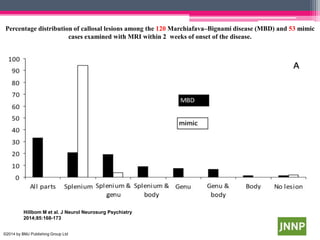
Percentage distribution of callosal lesions among the 120 Marchiafava–Bignami disease (MBD) and 53 mimic
cases examined with MRI within 2 weeks of onset of the disease.

Hillbom M et al. J Neurol Neurosurg Psychiatry
2014;85:168-173
©2014 by BMJ Publishing Group Ltd
Lesions
Only 17/61 (27.9%) of those visible in the acute phase disappeared completely
23/61 (37.7%) disappeared partially in the follow-up MRIs in MBD.
Lesions outside the splenium very rare in the mimicking cases (2/53,3.8%)
The MBD mimic lesions usually disappeared within a week; residual MRI lesions
were seen in only 2/47 (4.3%)
Callosal atrophy (n=36) or necrosis (n=45) was frequently reported among the
subjects with MBD, whereas no such findings among mimics
Deep white matter lesions (60/121, 49.6% (p=0.007) and cortical lesions 32/104,
30.8%) (p=0.003) were significantly more frequent in the subjects MBD compared
with the mimics (6/28, 21.4% and 1/27, 3.7%)
Lesions that were enhanced by gadolinium were frequently reported in the
subjects with MBD (16/90, 17.8%), but this was not found in the mimics.
Demographic features of alcoholic versus non-alcoholic
MBD subjects
11 subjects in this series (7.2%) non alcoholics and have MBD
The non-alcoholic subjects with MBD were younger and were
more frequently women
The non-alcoholics always suffering from malnutrition or
prolonged vomiting.
Nutritional state was reported for only 66/142 alcoholics; 53
(80.3%) of whom were said to be suffering from malnutrition.
The nutritional state of the alcoholics with MBD did not differ
significantly from the non-alcoholics.
Outcome for 144 patients with Marchiafava–Bignami disease (MBD), by mode of
treatment
Treated with
Not treated with Treated with
thiamine n=103 thiamine n=41* steroids n=19

Not treated with
steroids n=125*

n (%)
17 (16.5)

n (%)
4 (8.0)

n (%)
4 (21.1)

n (%)
17 (13.6)

24 (23.3)

6 (12.0)

1 (5.3)

29 (23.2)

29 (28.2)

12 (24.0)

5 (26.3)

36 (28.8)

Severe disability 18 (17.5)

7 (14.0)

5 (26.3)

20 (16.0)

Vegetative state

3 (2.9)

2 (4.0)

1 (5.3)

4 (3.2)

Dead

12 (11.7)

10 (20.0)

3 (15.8)

19 (15.2)

Outcome
Normal
Minimal
disability
Moderate
disability

p=0.027 for the difference in linear trend between the thiamine and outcome groups.
*Not treated or information on treatment not available.
Effect of treatment on the outcome for MBD subjects
Data available for 144/153 MBD subjects
Better outcomes among those who were treated with thiamine (p=0.027)
Treatment with steroids not show any significant trend.
The outcome of the subjects who receive thiamine in the acute phase of
the disease have significantly better (p=0.026) than those treated in the
chronic phase.
Blood thiamine levels on admission reported 20/153 (13.1%) subjects
with MBD and for 5/53 (9.4%) of those with a condition mimicking
MBD.
Below normal were observed in 16/20 (80.0%) MBD cases and 1/5
(20.0%) MBD mimic cases, respectively (p=0.023).
Thiamine given by infusion in 60/103 MBD subjects and orally to 3
MBD
Data not available for 40 MBD patients.
Duration of thiamine treatment ranged from 1 to 105 days.
Outcome
The outcome not reported in 15 MBD patients.
More than half of the non-alcoholics (7/11, 63.6%) recovered completely
Only one alcoholic in every 10 (14/142, 9.9%) showed a good outcome.
Death equal in both groups.
The outcome of MBD mimics good, most (45, 84.9%) normal or having
minimal disability after recovering from the acute phase of disease.
25 MBD subjects with a solitary lesion in the splenium, 3 (12%) had poor
outcome (severe disability), while of 105 subjects with other lesions, 39
(37.1%) had poor outcome (19 with severe disability, five with vegetative state
and 15 died) (p=0.016).
Discussion
MBD and MBD mimics had different clinical features and radiological findings.
Outcome in MBD extremely variable and influenced by lesion location and by the
timing of thiamine treatment.
MBD observed with alcoholism, malnutrition or Wernicke's disease
MBD mimics are usually not associated with these factors, but rather with
cerebral infection, epilepsy, antiepileptic drug withdrawal, hypoglycaemia,high altitude
sickness and systemic lupus erythematosus
Subjects with MBD often show severe signs and symptoms, including an altered
mental state, impaired walking, deficient memory, dysarthria, pyramidal signs and
disconnection lasting for several weeks.
MBD also show slow recovery, whereas the signs and symptoms of mimicking
conditions are usually mild and disappear within a week.
Delirious behaviour, disturbed consciousness and seizures are common features of
both MBD and the MBD mimics; however, seizures seem to occur even more
frequently in the MBD mimics.
The lesions in the MBD mimics are usually located in the splenium, whereas single
splenial lesions are seen only in one third of the MBD subjects.
MBD lesions enhanced by gadolinium, but no lesion enhancement in the MBD
mimics.
Solitary splenial lesions were associated with better outcome than lesions located in
other parts or across the entire corpus callosum.
MR spectroscopy has revealed an increase in choline/creatine, indicating
demyelination during the early phase of the disease followed by a decrease in Nacetylaspartate/creatine, indicating axonal damage.
Diffusion tensor imaging (DTI) employed for clinical course of MBD and the
recovery process
Thiamine therapy justified and recommendable as a first line of treatment for cases of
MBD associated with alcoholism, malnutrition or prolonged vomiting and even for
MBD mimics in case their thiamine levels are below normal.
LACUNAE
• The major limitation of this study lack of complete data.
• Many of the case reports included incomplete data on the
clinical status, the treatment and the outcome of cases.
• Case reports on MBD mimics not in a systematic manner, the
results no more than suggestive.
• There are a growing number of diseases and conditions that
have transient lesions in the splenium of the corpus callosum
associated with them, but the pathophysiology of these lesions
unclear.
• Difficult to prove the efficacy of therapy, whether combined
with steroids or not in a placebo-controlled randomised trial,
because the condition is very rare
TAKE HOME MESSAGE
• First: Choice of imaging in MBD is DWI, and recovery monitored
DTI and fibre tracking.

• Second:high frequency of thiamine deficiency among alcoholics
(even not suffering caloric malnutrition) and malnourished people
(who have prolonged vomiting),therapy with parenteral thiamine
indicated.
• The dose of thiamine should be the same as recommended for
Wernicke's disease and the therapy should continue for as long as
recovery is going on.
Applicability and application
• Is the study population relevant to my practice
and patients?
Yes
• Are the patients in my practice similar to those
in the study?
Yes
Relevance
• Is this problem common in my practice?
Yes/No

• Will this information require to change my
current practice?
• Yes/No
CRITICAL APPRAISAL
• Did study address the focused question ?
yes
• Was there a comparision group?
yes
• Were the groups comparable at baseline ?
No
• Was outcome measured by blind assessors ?
no
CRITICAL APPRAISAL
• How precise were the results ?
Precise enough.
• Are all clinically relevant outcome considered?
yes
• Can results be applied on our population ?
yes
Marchiafava–Bignami disease (MBD)

Marchiafava–Bignami disease (MBD)

  • 1.
    J Neurol NeurosurgPsychiatry Diagnosis and management of Marchiafava–Bignami disease: a review of CT/MRI confirmed cases Matti Hillbom, Pertti Saloheimo, Shinsuke Fujioka,, Zbigniew K Wszolek ,Seppo Juvela, Maurizio A Leone J Neurol Neurosurg Psychiatry 2014;85:168-173 doi:10.1136/jnnp-2013-305979
  • 2.
    BACKGROUND • Marchiafava–Bignami disease(MBD) a rare, fatal disease affecting wine drinkers. • Characterised by demyelination and necrosis of the corpus callosum, • Either a toxic or nutritional etiology • Non-fatal outcomes and other entities closely mimicking the disease have also been described • Some non-alcoholics also have phenotypic and radiological findings that are typical of MBD • The accuracy of the diagnosis and outcome influenced by stage of disease
  • 3.
    OBJECTIVES • To defineessential features for correct diagnosis of MBD • To identify features for differential diagnosis from mimicking conditions of MBD • To find efficient treatment
  • 4.
    STUDY DESIGN • Thedatabases of PubMed, Biomedical Database (EMBASE), Scopus and Lilacs Express • From 1981 to January 2012 for papers containing the keyword ‘Marchiafava–Bignami’ either the title or the abstract. • Total of 153 MBD • 84 were from Europe(France: 41, Spain: 17, Germany: 8, Italy: 4, Turkey: 3, Finland: 3, Switzerland: 2, Poland: 2, the Netherlands: 1, Belgium: 1, Austria: 1 and Portugal: 1) • 78 from outside Europe (Japan: 42, India: 11, USA: 8, Korea: 5, China: 4, Thailand: 3, Mexico: 2, Uruguay: 2 and Brazil: 1) • Cases that were reported in more than one paper were considered only once
  • 5.
    Patients and Methods •A total of 153 MBD cases ,all of which had been diagnosed using either head MRI or CT ante mortem. • Associated with alcoholism, malnutrition or both. • Alcoholics include subjects described either to be chronic current alcoholics (n=82) or dependent on alcohol (n=6) and others (n=54) who were reported to be chronic excessive alcohol consumers with a long history of alcohol abuse or heavy drinking habits
  • 6.
    MBD mimicking lesion MRI-verified,reversible, callosal lesions which not associated with alcoholism or malnutrition keywords: corpus callosum, reversible lesion 53 Total case 23 subjects with a cerebral infection, 14 with epilepsy, 5 with hypoglycaemia and 11 with miscellaneous conditions
  • 7.
    Data extraction Signs andsymptoms on admission and during the course of the disease Time from symptom onset to the last clinical observation Outcome attributable to MBD (Glasgow Outcome Scale (GOS)) Delay from the onset of symptoms to admission, acute (≤2 weeks) or sub-acute (>2 weeks) Location of the corpus callosum lesions that were observed at the first and second examinations post admission and those observed during the chronic phase (>3 months after admission)
  • 8.
    OTHER INVESTIGATION: MRI features;positron emission tomography (PET); single photon emission CT (SPECT); MRI spectroscopy Laboratory tests, including blood thiamine and cerebrospinal fluid, drug treatment (thiamine, other vitamins and steroids); drug doses, timing and mode of drug administration (parenteral or oral) Wernicke's disease (diagnosed either clinically, by radiology or at autopsy); and diabetes. If data on given signs, symptoms or other items of information were missing from the report, then the feature concerned was considered absent.
  • 9.
    Statistical analysis Categorical variableswere compared using Fisher’s exact two-tailed test and the Pearson χ2test, while the continuous variables were compared between groups by means of the Mann–Whitney U-test or Student's t test. Unconditional logistic regression was used to search for factors that were associated with a poor outcome (severe disability or worse outcome according to GOS) in subjects with MBD.
  • 10.
    RESULT Demographic and clinicalcharacteristics of subjects with Marchiafava–Bignami disease (MBD) or a condition mimicking it MBD cases 153 MBD mimics 53* Mean age at onset, years (95% CI) Men, n (%) Alcoholism (%) Malnutrition‡ (%) 48.4 (46.6 to 50.3)† 25.3 (20.4 to 30.3) 123 (80.4)† 142 (92.8)† 64 (39.8)† 28 (52.8) 0 0 Wernicke's disease (%) 19 (12.4)† 0 Thiamine treatment (%) 103 (67.3)† 3 (5.7) Steroid treatment (%) 19 (12.4) 10 (18.9) Diabetes (%) 10 (6.5) 6 (11.3) Characteristic *Includes 23 subjects with a cerebral infection, 14 with epilepsy, 5 with hypoglycaemia and 11 with miscellaneous conditions †p<0.01. ‡Malnutrition or prolonged vomiting without alcohol consumption in 11 cases
  • 11.
    The MBD subjectswere significantly older (p<0.001) than MBDmimics. Both groups showed a wide age range (1–78 years for mimics vs 14–79 years for MBD). The groups also differed significantly for other variables except for presence of diabetes and treatment with steroids
  • 12.
    Clinical symptoms andsigns in MRI of subjects with Marchiafava–Bignami disease (MBD) or a condition mimicking it MBD cases n=153 MBD mimics n=53 Symptom/sign n (%) n (%) Altered mental state Impaired walking Loss of consciousness Dysarthria Impaired memory Signs of disconnection Pyramidal sign Seizures Primitive reflexes Mutism Rigidity Hemiparesis or tetraparesis 123 (80.4)*** 104 (68.0)*** 80 (52.3)*** 62 (40.5)*** 59 (38.6)*** 55 (35.9)*** 37 (24.2)*** 32 (20.9) 30 (19.6)** 28 (18.3)* 25 (16.3)** 22 (14.4) 13 (24.5) 5 (9.4) 9 (17.0) 5 (9.4) 2 (3.8) 1 (1.9) 1 (1.9) 17 (32.1) 1 (1.9) 2 (3.8) 0 7 (13.2) Sensory symptoms Incontinence Nystagmus Ophthalmoplegia or gaze palsy Facial palsy 21 (13.7)* 17 (11.1)** 15 (9.8) 1 (1.9) 0 4 (7.5) 15 (9.8)* 0 8 (5.2) 1 (1.9) ***p<0.001, **p<0.01, *p<0.05 for difference between cases and mimics.
  • 13.
    Signs and symptoms TheMBD patients frequently showed an altered mental state, which included confusion, delirium, unconsciousness, impaired memory and/or disorientation on admission. Impaired walking, dysarthria, mutism, signs of disconnection or split brain syndrome, pyramidal signs, primitive reflexes, rigidity, incontinence, sensory symptoms and gaze palsy or diplopia were also more frequently found in the MBD cases than in the MBD mimics. Hemiparesis or tetraparesis and nystagmus were almost as frequent, and seizures were more frequent among the mimics. CSF data were available for 62 MBD subjects and 25 mimics which showed CSF proteins 5/62 (8.1%) and cells in and 0/62 of the MBD Subjects CSF proteins in 2/25 (8.0%) and cells in 9/25 (36.0%) of the mimics. Elevated CSF cell content was always due to central nervous system infection.
  • 14.
    Percentage distribution ofcallosal lesions among the 120 Marchiafava–Bignami disease (MBD) and 53 mimic cases examined with MRI within 2 weeks of onset of the disease. Hillbom M et al. J Neurol Neurosurg Psychiatry 2014;85:168-173 ©2014 by BMJ Publishing Group Ltd
  • 15.
    Lesions Only 17/61 (27.9%)of those visible in the acute phase disappeared completely 23/61 (37.7%) disappeared partially in the follow-up MRIs in MBD. Lesions outside the splenium very rare in the mimicking cases (2/53,3.8%) The MBD mimic lesions usually disappeared within a week; residual MRI lesions were seen in only 2/47 (4.3%) Callosal atrophy (n=36) or necrosis (n=45) was frequently reported among the subjects with MBD, whereas no such findings among mimics Deep white matter lesions (60/121, 49.6% (p=0.007) and cortical lesions 32/104, 30.8%) (p=0.003) were significantly more frequent in the subjects MBD compared with the mimics (6/28, 21.4% and 1/27, 3.7%) Lesions that were enhanced by gadolinium were frequently reported in the subjects with MBD (16/90, 17.8%), but this was not found in the mimics.
  • 16.
    Demographic features ofalcoholic versus non-alcoholic MBD subjects 11 subjects in this series (7.2%) non alcoholics and have MBD The non-alcoholic subjects with MBD were younger and were more frequently women The non-alcoholics always suffering from malnutrition or prolonged vomiting. Nutritional state was reported for only 66/142 alcoholics; 53 (80.3%) of whom were said to be suffering from malnutrition. The nutritional state of the alcoholics with MBD did not differ significantly from the non-alcoholics.
  • 17.
    Outcome for 144patients with Marchiafava–Bignami disease (MBD), by mode of treatment Treated with Not treated with Treated with thiamine n=103 thiamine n=41* steroids n=19 Not treated with steroids n=125* n (%) 17 (16.5) n (%) 4 (8.0) n (%) 4 (21.1) n (%) 17 (13.6) 24 (23.3) 6 (12.0) 1 (5.3) 29 (23.2) 29 (28.2) 12 (24.0) 5 (26.3) 36 (28.8) Severe disability 18 (17.5) 7 (14.0) 5 (26.3) 20 (16.0) Vegetative state 3 (2.9) 2 (4.0) 1 (5.3) 4 (3.2) Dead 12 (11.7) 10 (20.0) 3 (15.8) 19 (15.2) Outcome Normal Minimal disability Moderate disability p=0.027 for the difference in linear trend between the thiamine and outcome groups. *Not treated or information on treatment not available.
  • 18.
    Effect of treatmenton the outcome for MBD subjects Data available for 144/153 MBD subjects Better outcomes among those who were treated with thiamine (p=0.027) Treatment with steroids not show any significant trend. The outcome of the subjects who receive thiamine in the acute phase of the disease have significantly better (p=0.026) than those treated in the chronic phase. Blood thiamine levels on admission reported 20/153 (13.1%) subjects with MBD and for 5/53 (9.4%) of those with a condition mimicking MBD. Below normal were observed in 16/20 (80.0%) MBD cases and 1/5 (20.0%) MBD mimic cases, respectively (p=0.023). Thiamine given by infusion in 60/103 MBD subjects and orally to 3 MBD Data not available for 40 MBD patients. Duration of thiamine treatment ranged from 1 to 105 days.
  • 19.
    Outcome The outcome notreported in 15 MBD patients. More than half of the non-alcoholics (7/11, 63.6%) recovered completely Only one alcoholic in every 10 (14/142, 9.9%) showed a good outcome. Death equal in both groups. The outcome of MBD mimics good, most (45, 84.9%) normal or having minimal disability after recovering from the acute phase of disease. 25 MBD subjects with a solitary lesion in the splenium, 3 (12%) had poor outcome (severe disability), while of 105 subjects with other lesions, 39 (37.1%) had poor outcome (19 with severe disability, five with vegetative state and 15 died) (p=0.016).
  • 20.
    Discussion MBD and MBDmimics had different clinical features and radiological findings. Outcome in MBD extremely variable and influenced by lesion location and by the timing of thiamine treatment. MBD observed with alcoholism, malnutrition or Wernicke's disease MBD mimics are usually not associated with these factors, but rather with cerebral infection, epilepsy, antiepileptic drug withdrawal, hypoglycaemia,high altitude sickness and systemic lupus erythematosus Subjects with MBD often show severe signs and symptoms, including an altered mental state, impaired walking, deficient memory, dysarthria, pyramidal signs and disconnection lasting for several weeks. MBD also show slow recovery, whereas the signs and symptoms of mimicking conditions are usually mild and disappear within a week. Delirious behaviour, disturbed consciousness and seizures are common features of both MBD and the MBD mimics; however, seizures seem to occur even more frequently in the MBD mimics.
  • 21.
    The lesions inthe MBD mimics are usually located in the splenium, whereas single splenial lesions are seen only in one third of the MBD subjects. MBD lesions enhanced by gadolinium, but no lesion enhancement in the MBD mimics. Solitary splenial lesions were associated with better outcome than lesions located in other parts or across the entire corpus callosum. MR spectroscopy has revealed an increase in choline/creatine, indicating demyelination during the early phase of the disease followed by a decrease in Nacetylaspartate/creatine, indicating axonal damage. Diffusion tensor imaging (DTI) employed for clinical course of MBD and the recovery process Thiamine therapy justified and recommendable as a first line of treatment for cases of MBD associated with alcoholism, malnutrition or prolonged vomiting and even for MBD mimics in case their thiamine levels are below normal.
  • 22.
    LACUNAE • The majorlimitation of this study lack of complete data. • Many of the case reports included incomplete data on the clinical status, the treatment and the outcome of cases. • Case reports on MBD mimics not in a systematic manner, the results no more than suggestive. • There are a growing number of diseases and conditions that have transient lesions in the splenium of the corpus callosum associated with them, but the pathophysiology of these lesions unclear. • Difficult to prove the efficacy of therapy, whether combined with steroids or not in a placebo-controlled randomised trial, because the condition is very rare
  • 23.
    TAKE HOME MESSAGE •First: Choice of imaging in MBD is DWI, and recovery monitored DTI and fibre tracking. • Second:high frequency of thiamine deficiency among alcoholics (even not suffering caloric malnutrition) and malnourished people (who have prolonged vomiting),therapy with parenteral thiamine indicated. • The dose of thiamine should be the same as recommended for Wernicke's disease and the therapy should continue for as long as recovery is going on.
  • 24.
    Applicability and application •Is the study population relevant to my practice and patients? Yes • Are the patients in my practice similar to those in the study? Yes
  • 25.
    Relevance • Is thisproblem common in my practice? Yes/No • Will this information require to change my current practice? • Yes/No
  • 26.
    CRITICAL APPRAISAL • Didstudy address the focused question ? yes • Was there a comparision group? yes • Were the groups comparable at baseline ? No • Was outcome measured by blind assessors ? no
  • 27.
    CRITICAL APPRAISAL • Howprecise were the results ? Precise enough. • Are all clinically relevant outcome considered? yes • Can results be applied on our population ? yes

Editor's Notes

  • #11 The MBD subjects were significantly older (p&lt;0.001) than MBD-mimics. Both groups showed a wide age range (1–78 years for mimics vs 14–79 years for MBD). The groups also differed significantly for other variables except for presence of diabetes and treatment with steroids
  • #25 Relevance- available, affordable, acceptable, feasible