Manufacturing Technology
Course Contents:
Engineering Materials, Manufacturing Processes: Casting and
molding processes, metal forming, forming of plastics, powder
metallurgy; Material Joining processes: welding, soldering,
brazing, riveting, joining by mechanical elements; Material
removal processes, metal cutting and finishing processes;
Practical training.
References:
• Serape Kalpak Jian, Steven Schmid, Manufacturing
Engineering & Technology, Prentice Hall, 8th Ed., 2020.
• Connie L Dotson, Fundamentals of dimensional
Metrology, Delmar Cengage Learning, 6th Ed., 2016.
• William Dalton, Modern Materials &Manufacturing
Processes, Prentice Hall college Div, 4th Ed., 2011
Assessment:
Final Exam : 40 %
Course work (Mid-term - Quizzes, …) : 60%
Manufacturing Technology
 Introduction
 Engineering Materials
 Manufacturing Processes:
 Casting and molding processes,
 metal forming,
 forming of plastics,
 powder metallurgy;
 Material Joining processes:
 welding, soldering, brazing,
 riveting,
 joining by mechanical elements;
 Material removal processes, metal cutting and finishing processes;
Course Outline
Manufacturing Technology
• Manufacturing Technology is a field of engineering that deals with
the application of scientific principles to the creation of products.
• It includes: processes, techniques, and equipment used to transform
raw materials into finished goods.
• This course provides overview of the manufacturing industry,
exploring the various techniques and technologies employed in
modern production.
• Students will understand of the fundamental of manufacturing
processes, as well as the practical skills necessary to design, plan,
and optimize manufacturing operations.
Manufacturing Technology
Throughout the course, the topics include:
• Manufacturing processes: Traditional and modern techniques such
as machining, casting, forming, and ….
• Materials: Properties, selection, and processing of different
materials used in manufacturing.
By the end of this course,
• Students will be equipped with the knowledge and skills to
contribute effectively to the manufacturing industry.
• They will be able to analyze and evaluate manufacturing processes,
optimize production systems, and make informed decisions
regarding materials, equipment, and quality control.
Manufacturing Technology
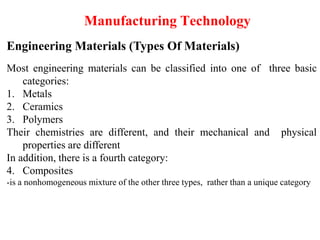
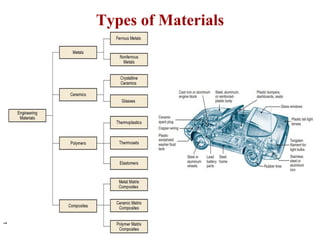
Engineering Materials (Types Of Materials)
Most engineering materials can be classified into one of three basic
categories:
1. Metals
2. Ceramics
3. Polymers
Their chemistries are different, and their mechanical and physical
properties are different
In addition, there is a fourth category:
4. Composites
-is a nonhomogeneous mixture of the other three types, rather than a unique category
1
1
Types of Materials
Metals
Metallic bonds
– Strong, ductile, resistant to fracture
– High thermal & electrical conductivity
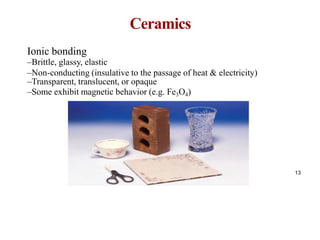
Ceramics
13
Ionic bonding
–Brittle, glassy, elastic
–Non-conducting (insulative to the passage of heat & electricity)
–Transparent, translucent, or opaque
–Some exhibit magnetic behavior (e.g. Fe3O4)
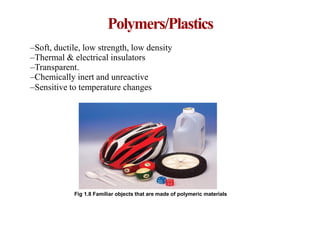
Polymers/Plastics
Fig 1.8 Familiar objects that are made of polymeric materials
–Soft, ductile, low strength, low density
–Thermal & electrical insulators
–Transparent.
–Chemically inert and unreactive
–Sensitive to temperature changes
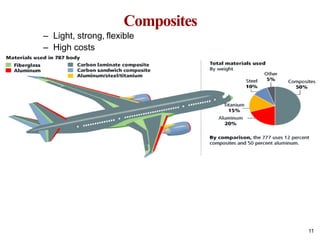
Composites
11
– Light, strong, flexible
– High costs
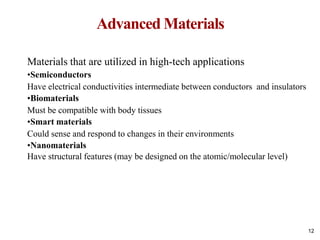
Advanced Materials
12
Materials that are utilized in high-tech applications
•Semiconductors
Have electrical conductivities intermediate between conductors and insulators
•Biomaterials
Must be compatible with body tissues
•Smart materials
Could sense and respond to changes in their environments
•Nanomaterials
Have structural features (may be designed on the atomic/molecular level)
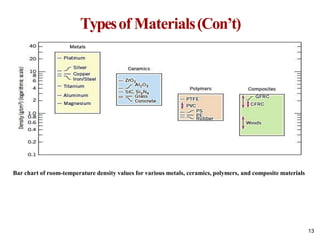
Typesof Materials(Con’t)
13
Bar chart of room-temperature density values for various metals, ceramics, polymers, and composite materials
Typesof Materials(Con’t)
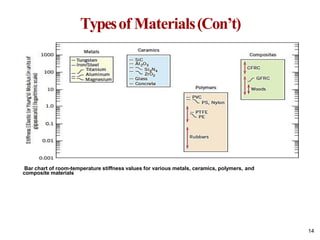
14
Bar chart of room-temperature stiffness values for various metals, ceramics, polymers, and
composite materials
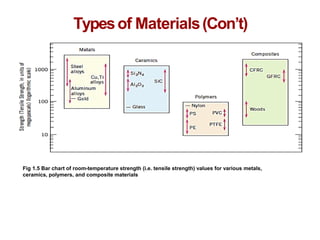
Typesof Materials(Con’t)
Fig 1.5 Bar chart of room-temperature strength (i.e. tensile strength) values for various metals,
ceramics, polymers, and composite materials
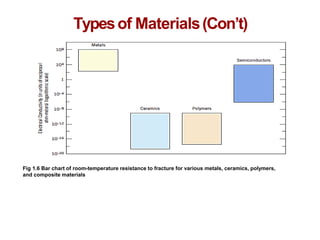
Typesof Materials(Con’t)
Fig 1.6 Bar chart of room-temperature resistance to fracture for various metals, ceramics, polymers,
and composite materials
17
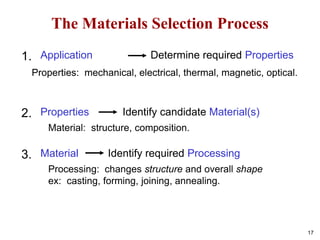
1. Application Determine required Properties
Processing: changes structure and overall shape
ex: casting, forming, joining, annealing.
Properties: mechanical, electrical, thermal, magnetic, optical.
Material: structure, composition.
2. Properties Identify candidate Material(s)
3. Material Identify required Processing
The Materials Selection Process

Manufacturing technology Engineerung material

  • 1.
    Manufacturing Technology Course Contents: EngineeringMaterials, Manufacturing Processes: Casting and molding processes, metal forming, forming of plastics, powder metallurgy; Material Joining processes: welding, soldering, brazing, riveting, joining by mechanical elements; Material removal processes, metal cutting and finishing processes; Practical training.
  • 2.
    References: • Serape KalpakJian, Steven Schmid, Manufacturing Engineering & Technology, Prentice Hall, 8th Ed., 2020. • Connie L Dotson, Fundamentals of dimensional Metrology, Delmar Cengage Learning, 6th Ed., 2016. • William Dalton, Modern Materials &Manufacturing Processes, Prentice Hall college Div, 4th Ed., 2011 Assessment: Final Exam : 40 % Course work (Mid-term - Quizzes, …) : 60% Manufacturing Technology
  • 3.
     Introduction  EngineeringMaterials  Manufacturing Processes:  Casting and molding processes,  metal forming,  forming of plastics,  powder metallurgy;  Material Joining processes:  welding, soldering, brazing,  riveting,  joining by mechanical elements;  Material removal processes, metal cutting and finishing processes; Course Outline
  • 4.
    Manufacturing Technology • ManufacturingTechnology is a field of engineering that deals with the application of scientific principles to the creation of products. • It includes: processes, techniques, and equipment used to transform raw materials into finished goods. • This course provides overview of the manufacturing industry, exploring the various techniques and technologies employed in modern production. • Students will understand of the fundamental of manufacturing processes, as well as the practical skills necessary to design, plan, and optimize manufacturing operations.
  • 5.
    Manufacturing Technology Throughout thecourse, the topics include: • Manufacturing processes: Traditional and modern techniques such as machining, casting, forming, and …. • Materials: Properties, selection, and processing of different materials used in manufacturing. By the end of this course, • Students will be equipped with the knowledge and skills to contribute effectively to the manufacturing industry. • They will be able to analyze and evaluate manufacturing processes, optimize production systems, and make informed decisions regarding materials, equipment, and quality control.
  • 6.
    Manufacturing Technology Engineering Materials(Types Of Materials) Most engineering materials can be classified into one of three basic categories: 1. Metals 2. Ceramics 3. Polymers Their chemistries are different, and their mechanical and physical properties are different In addition, there is a fourth category: 4. Composites -is a nonhomogeneous mixture of the other three types, rather than a unique category
  • 7.
  • 8.
    Metals Metallic bonds – Strong,ductile, resistant to fracture – High thermal & electrical conductivity
  • 9.
    Ceramics 13 Ionic bonding –Brittle, glassy,elastic –Non-conducting (insulative to the passage of heat & electricity) –Transparent, translucent, or opaque –Some exhibit magnetic behavior (e.g. Fe3O4)
  • 10.
    Polymers/Plastics Fig 1.8 Familiarobjects that are made of polymeric materials –Soft, ductile, low strength, low density –Thermal & electrical insulators –Transparent. –Chemically inert and unreactive –Sensitive to temperature changes
  • 11.
    Composites 11 – Light, strong,flexible – High costs
  • 12.
    Advanced Materials 12 Materials thatare utilized in high-tech applications •Semiconductors Have electrical conductivities intermediate between conductors and insulators •Biomaterials Must be compatible with body tissues •Smart materials Could sense and respond to changes in their environments •Nanomaterials Have structural features (may be designed on the atomic/molecular level)
  • 13.
    Typesof Materials(Con’t) 13 Bar chartof room-temperature density values for various metals, ceramics, polymers, and composite materials
  • 14.
    Typesof Materials(Con’t) 14 Bar chartof room-temperature stiffness values for various metals, ceramics, polymers, and composite materials
  • 15.
    Typesof Materials(Con’t) Fig 1.5Bar chart of room-temperature strength (i.e. tensile strength) values for various metals, ceramics, polymers, and composite materials
  • 16.
    Typesof Materials(Con’t) Fig 1.6Bar chart of room-temperature resistance to fracture for various metals, ceramics, polymers, and composite materials
  • 17.
    17 1. Application Determinerequired Properties Processing: changes structure and overall shape ex: casting, forming, joining, annealing. Properties: mechanical, electrical, thermal, magnetic, optical. Material: structure, composition. 2. Properties Identify candidate Material(s) 3. Material Identify required Processing The Materials Selection Process