People's Union forCivil Liberties (PUCL)
presents the report of the
Independent People’s Tribunal
On
The Ongoing Ethnic Conflict
in Manipur
August 2025
2.
2
Publishing History
For PrivateCirculation only.
First Edition: August 2025, 300 copies
Published by: People’s Union for Civil Liberties
Address: 332, Ground Floor, Patpar Ganj, Opposite Anand Lok Apartments
(Gate No.2) Mayur Vihar-I, Delhi-110091
Email Address: puclnat@gmail.com
Website: www.pucl.org
Contact persons: Kavita Srivastava and V. Suresh
Cover page by: Sakshi Yadav
Any part of this report may be freely reproduced, copied or transmitted as
necessary, with attribution to the authors.
3.
3
Table of Contents
Glossaryof Abbreviations and Terms used in this Report ...........................8
Acknowledgements............................................................................................13
Executive Summary...........................................................................................15
Preface.................................................................................................................40
About the PUCL ...........................................................................................41
About the Independent People’s Tribunal on Manipur..........................42
Chapter 1: Setting the context..........................................................................45
1.1. A State at War Within............................................................................45
1.2. Immediate reasons for the conflict: Retracing the mainstream media
version.............................................................................................................50
1.3. Rumours galore and snowballing violence.........................................51
1.4. Search for the Truth: Going beyond the mainstream narrative......54
1.5. Role of the Central Government: Reluctance to act or Complicity
in Conflict? .....................................................................................................56
1.6. What makes this conflict different from earlier conflicts ................58
Chapter 2: Manipur, The State.........................................................................62
2.1. Demographic Structure.........................................................................62
2.2. Religious affiliations...............................................................................65
2.3. The urban- rural divide .........................................................................66
2.4. Political power........................................................................................77
2.5. State of Manipur v Rest of India and particularly the Northeast....78
2.6. Application of land and forest laws.....................................................85
4.
4
Chapter 3: Theconstitutional status of the State, its history and basis of
claims to ST status for its people.....................................................................90
3.1. Accession of Manipur to India & Constituent Assembly Debates 90
3.2. Special Status to Manipur .....................................................................92
3.3. Scheduled Castes and Scheduled Tribes, the basis............................94
3.4. The Meiteis and Kukis, the principal contenders for claiming
reservation......................................................................................................95
3.5. Manipur High Court orders on ST status for Meiteis ....................101
Chapter 4: Events of violence........................................................................105
4.1. Immediate antecedents........................................................................105
4.2. Where was the Government?.............................................................131
4.3. Protest against the ST Demand.........................................................148
4.4. Beginning of Violence from May 3...................................................158
4.5. Testimonies of murder, rape, arson, looting and others................177
4.6. Desecration of places of worship......................................................209
4.7. Economic blockades and restrictions/ regulation of movement .225
4.8. Violence impacting education............................................................227
Chapter 5: Gender Based Violence...............................................................240
5.1. History of women organizing in Manipur........................................242
5.3. Political representation:.......................................................................248
5.4. Sexual violence .....................................................................................249
5.5. Impact on family ties, inter community/religious
marriages/relationships ..............................................................................256
5.6. Women in conflict zone......................................................................260
5.7. Role of religion in conflict:.................................................................261
5.
5
5.8. Violence bywomen.............................................................................262
5.9. Other difficulties faced by Women...................................................268
5.10. Role of various organizations...........................................................274
5.11. What role can women play in the future peace building process?
........................................................................................................................279
5.12. Justice to victims of sexual violence and Command Responsibility
........................................................................................................................281
Chapter 6: Tracing the Causes .......................................................................283
6.1. Refugees from Myanmar.....................................................................283
6.2. Geo-Political Considerations..............................................................292
6.3. Patterns of State Failure and Complicity emerging from testimonies
........................................................................................................................300
6.4. Poppy Cultivation and drug trade......................................................322
6.5. Disruption of inter-community / inter-religious harmony in
Manipur: The narratives fueling conflict..................................................331
6.6. Emergence of new militias and arming the radical groups and
citizen groups...............................................................................................340
Chapter 7: Popular writings in the print and electronic media .................350
7. 1. Overview..............................................................................................350
7. 2. Politics of Media and Violence: An Explanatory Framework......350
7. 4. Quality of Media Reporting (ref. Editors Guild Report)..............359
7. 5. Summary of media testimonies before the Jury.............................362
Chapter 8: Relief, Rehabilitation and Rebuilding Lives..............................367
8.1. Extent of State Aid..............................................................................367
8.2. Early Response, Management & Assessment of the Crisis ...........375
6.
6
8.3. State ofRelief Camps: Observations ................................................382
8.4. State of Relief Camps: Findings and Analysis..................................402
8.5. Gita Mittal Committee Report: Findings and Analysis ..................411
8.6. State of Relief Camps: Under President’s Rule ...............................416
Chapter 9: Navigating Health and Mental Well-Being Amidst Ethnic
Conflict in Manipur.........................................................................................423
9.1. The Pre-Conflict Health and Mental Health Landscape................423
9.2. The Health and Mental Health Impact of the Conflict..................438
9.3. Health Fallout of Relief Camps .........................................................478
9.4. Pre-Conflict Health and Mental Health Landscape........................486
9.5. Conflict and Mental Health: The Human Toll and Resilience......494
Chapter 10: Justice and Accountability.........................................................521
10.1. Breakdown of rule of law .................................................................521
10.2. Multi pronged Failure........................................................................526
10.3. Security Services role.........................................................................545
10.4. Actions and inactions of the security forces..................................554
10.5. Civil Society: Mixed Degree of Culpability ....................................601
10.6. Reports of the Supreme Court appointed Committee.................602
10.7. Judicial Commission set up by the Home Ministry......................608
10.8. Operational Challenges.....................................................................609
10.9. Land and resource conflicts .............................................................612
Chapter 11: Strategies for Justic and Peace..................................................614
11.1. Political interventions........................................................................614
11.2. Inadequate response from Central Government ..........................617
7.
7
11.3. Complete distrustof State players...................................................619
11.4. Designing system for conflict resolution........................................620
11.5. Global Examples................................................................................630
11.6. Court Interventions...........................................................................635
11.7. Financial & Legal Aids......................................................................640
11.8. Promoting Peace and Social Cohesion in Manipur ......................641
Chapter 12: Summing Up...............................................................................652
12.1. Manufacturing hatred and sowing the seeds of violence.............653
12.2. Abdication of State responsibility and continuation of violence 657
12.3. Normalizing hopelessness and accountability of state agencies .660
12.4. Restoring hope and building bridges towards peace & harmony
........................................................................................................................664
Recommendations by the Tribunal...............................................................669
Regarding Gender-based Violence ...........................................................669
Regarding the narrative of hate.................................................................669
Regarding Relief and Rehabilitation .........................................................672
Regarding health..........................................................................................680
Regarding justice and accountability.........................................................684
Epilogue: The Way Forward..........................................................................686
8.
8
Glossary of Abbreviationsand Terms used in this
Report
Abbreviation/
Term
Full Form Description
AFSPA Armed Forces
Special Powers
Act, 1958
A Central law which allows for the
government grants special powers to the
armed forces in designated "disturbed
areas". It allows them to use force,
including firing upon or arresting
individuals, even without a warrant, and
provides them with legal protection for
actions taken under the act. It’s a very
controversial law
AR Assam Rifles The Assam Rifles is a paramilitary force
of India responsible for border security,
counter-insurgency, and maintaining law
and order in Northeast India and in
Jammu & Kashmir.
AT Arambai Tenggol An organisation of Meiteis. AT means
`Dart wielding cavalry’. It was formed
around 2020 by Manipur's titular king and
Rajya Sabha member Leishemba
Sanajaoba. AT was reportedly supported
by former CM, Biren Singh. It presented
itself as a revivalist organisation seeking to
re-establish pre-Hindu Sanamahi religion.
The group was heavily armed and media
reports spoke of the AT cadres moving
about in many parts of the violence hit
areas of the state with modern weapons.
ATSUM All Tribal Apex body of all tribal students in
9.
9
Students Unions
of Manipur
Manipurstate.
COCOMI Coordination
Committee of
Meitei
Organizations
An umbrella organisation of Meitei
organizations.
CRPF Central Reserve
Police Force
The Central Reserve Police Force (CRPF)
is the largest central armed police force in
India.
DC or DM District Collector
or District
Magistrate
Every state in India is sub-divided into
Districts for revenue and administration
purposes. The DC or DMs are the
administrative heads of the District.
DoPT Department of
Personnel and
Training
DoPT refers to the department of the
Government of India.
FIR First Information
Report
Refers to a criminal complaint accepted by
the police and registered as a crime.
FMR Free Movement
Regime
The Free Movement Regime (FMR) refers
to an agreement between India and
Myanmar that allows individuals residing
within a certain distance of the border to
cross without needing a visa or passport.
FRA Forest Rights Act FRA is an abbreviated form for Forest
Rights Act, or the `Scheduled Tribes and
Other Forest Dwellers (Recognition of
Forest Rights) Act, 2006’.
IDP Internally
Displaced People
Refers to people forced out of their
homes due to violence and seek refuge/
housing in Camps set up by the State
Government.
ITLF Indigenous Tribal
Leader’s Forum
Established in June, 2022, comprising of
recognised tribes in the district.
KCP Kangleipak Kangleipak is the ancient name for
10.
10
Communist Party,
Manipur
Manipur. TheKCP is a Maoist separatist
militant group in Manipur engaged with
armed conflict with the Government of
India.
There are several factions known as KCP
– with the name of the faction.
KKL Kangleipak
Kanba Lup
Meitei group.
KIM Kuki – INPI
Manipur
Apex body of Kuki organizations in
Manipur
Kuki – Zo
or
Kuki-Zou
Members of the
Kuki – Zo tribal
communities in
Manipur
In the context of Manipur, Kuki-Zou and
Kuki-Zo are generally used
interchangeably to refer to the same group
of communities. These communities are
part of the broader Kuki-Chin-
Mizo linguistic and ethnic group. While
some within these communities prefer the
term "Zomi" or other specific tribal
names, "Kuki-Zo" is a common umbrella
term encompassing various tribes within
this broader group
MP Meira Paibis An exclusive organisation of Meitei
women.
Meitei Members of the Meitei community which
forms the majority of the population of
Manipur
ML Meitei Lipun or
Meitei Leepun
An organisation of Meiteis seeking to
revive old Meitei Sanamahi religion.
During the 2023 conflict, the ML were
accused of being heavily armed militia
group of people belonging to the majority
involved with the violence against Kukis
in Imphal Valley and other parts of the
state. It is headed by Pramot Singh
11.
11
NRC National Register
ofCitizens
The National Register of Citizens (NRC)
is a record of Indian citizens. Its primary
purpose is to identify and document all
legal citizens of India, potentially leading
to the identification and deportation of
illegal immigrants.
Pangal There are Meitei Pangals, and Muslim
Pangals as well.
RIMS Regional Institute
of Medical
Sciences, Imphal,
Manipur
A public institution operating as a
teaching hospital in Imphal
RSS Rashtriya
Swayamsevak
Sangh
A Hindu nationalist organisation
SC Scheduled Castes The Indian Constitution lists all castes
who face untouchability caste
discrimination in a special Schedule called
the SCs.
In Manipur, xx% of Meiteis are listed as
SCs
ST Scheduled Tribes The Indian Constitution lists all
recognised Tribal Communities in a
Schedule to the Constitution.
The demand for inclusion of Meiteis in
ST list was one of the core issues which
sparked the violence of 3rd May, 2023.
STDCM Scheduled Tribe
Demand
Committee of
Manipur
A Committee formed demanding ST
status for Meiteis.
Sanamahi A Meitei
community
A section of the Meitei community who
practice indigenous faith practices,
claimed to be distinct from Hindu
12.
12
religion.
SoO Suspension of
Operations
Agreement
Anagreement between the Government
of India with 3 hill-based insurgent
groups (of Kukis) by which the groups
agreed to confine themselves to notified
camps and suspend their operations.
UNLF United National
Liberation Front
(of Manipur)
A separatist group of Meiteis formed with
the aim of establishing a sovereign and
socialist state of Manipur.
13.
13
Acknowledgements
The Tribunal reporton the ethnic violence in Manipur of 2023 - 2024 is
finally in our hands. The herculean effort of putting it together has to be
credited to a large number of people, whose names we are withholding for
reasons of confidentiality and security.
The most important contributors of this report are the survivors of the
ethnic violence, who braved their way to come and meet us when we we
held the tribunal hearings in Churachandpur, Kangpokpi and
Saikul, Moirang, Bishnupur, Kwakta, Kakching district and those we met
in the various colonies of the different Imphal districts. We would also like
to thank those who met us and talked to us in the various relief camps,
despite crying children, cramped spaces and in some places flood waters.
As we conclude this report we would like to acknowledge and pay our
respects to the families of all those who lost lives, the injured and the
violated, and those who continue to be in relief camps or living in the
neighbouring states of Mizoram, Nagaland, Assam and Delhi, the security
of the farms, homes and hearths still seem far.
We also need to thank all the representatives of the various organisations
of the Kuki, Meitei and Naga communities in the districts of
Churachandpur, Kangpokpi and Saikul, Senapati, Kakching and the
various districts of Imphal. A special acknowledgement to all the
independent activists, lawyers, scholars, intellectuals and journalists, most
of whom organised these hearings voluntarily and also gave their valuable
time to share their wisdom with us. A special thanks to the serving and ex-
officials, in the paramilitary, administration and police, who were fearless
and frank when they shared their views.
14.
14
It would bealso fitting to thank the staff and management of the hotels
we stayed including one, who helped us navigate the flood waters to reach
a safe place. We are grateful to the staff and management of the various
hotels we stayed in Manipur, who cooperated with us and let us convert
the lounge into meeting rooms. Had we not got the support of the
Pangals in taking us across in jeeps, our travel across districts would not
have happened. A special thanks to them.
Our gratitude to all those who joined us online and deposed over various
sittings, and a special thanks to all those who joined us in Delhi, survivors
and intellectuals, and helped us understand the politics behind the violence
and the steps that could be undertaken to build peace.
Last but not the least there are no words to thank all our esteemed jury
members, and specialists, who under the leadership of the former SC
judge Justice Kurien Joseph, Former Punjab and Haryana High Court
judge Justice Kannan and former Patna High Court judge Justice Anjana
Prakash, were the driving force of this Tribunal. It is important to put on
record that several of our jury and expert members also came to Manipur
and chaired the Tribunal hearings. The major effort of report writing was
theirs, assisted by the members of Tribunal secretariat, for whom no task
was small.
We hope this report will help in a small way in forcing the authorities to
be accountable towards the people, build mechanisms of reconciliation
between communities, restore peace and the loss incurred by families and
ensure Justice to the violated.
Kavita Srivastava V. Suresh
(President) (General Secretary)
People’s Union for Civil Liberties
15.
15
Executive Summary
The People’sTribunal on the Ethnic Conflict in Manipur documents the
origins, nature, and consequences of the devastating violence that began
on May 3, 2023, between the Meitei and Kuki-Zo communities. It
identifies the roots of the conflict in deep-seated ethnic divisions, socio-
political marginalization, land disputes, and a series of provocative state
actions—including the Manipur High Court’s directive recommending
Scheduled Tribe (ST) status for Meiteis. This order, perceived as a threat
by tribal groups, catalyzed protests that were met with violent counter-
mobilization. The report emphasizes that the violence was not
spontaneous but orchestrated, enabled by armed Meitei vigilante groups
like Arambai Tenggol and Meitei Leepun, and facilitated by state
complicity and law enforcement failures.
The Tribunal presents overwhelming evidence of targeted killings,
destruction of homes and places of worship, sexual violence, and the
forced displacement of over 60,000 people. It describes the emergence of
ethnic enclaves, mass looting of weapons from police armories, and the
breakdown of governance, law enforcement, and judicial accountability.
Relief efforts were marked by discrimination and neglect, especially in
tribal camps. Meanwhile, the health and mental well-being of displaced
persons—particularly women, children, and the elderly—remain severely
compromised. The media and segments of civil society often acted in a
partisan manner, spreading misinformation and inflaming hostilities rather
than fostering peace.
In response, the report lays out a framework for justice and reconciliation
grounded in constitutional safeguards, restorative justice, and global
peacebuilding models. It calls for urgent legal accountability, including
independent investigations and a Supreme Court-monitored Special
16.
16
Investigation Team (SIT).Long-term peace strategies include stakeholder-
based dialogues, the dismantling of armed groups, reparations for victims,
and civic education to counter hate. The report concludes that Manipur’s
crisis represents not just a regional tragedy, but a national constitutional
failure that demands urgent political, legal, and moral redress.
Chapter 1: Setting the Context
This chapter introduces the onset of one of the most serious ethnic
conflicts in recent Indian history, beginning on May 3, 2023, in Manipur.
The conflict primarily involves the Meitei community, which constitutes
the majority in the valley (53% of the population), and the Kuki-Zo
community, a minority largely based in the hills (16%). The Nagas (24%)
are largely uninvolved but deeply affected.
The conflict's root causes go beyond immediate triggers. It is embedded in
long-standing ethnic rivalries, unresolved land rights issues, demographic
anxieties, and political disenfranchisement. The report highlights the
failure of both state and central governments to fulfill constitutional
obligations. Particularly egregious is the partisan role allegedly played by
former Chief Minister N. Biren Singh and the complicity of state security
forces in arming non-state actors and allowing widespread violence to
occur unchecked.
Militant Meitei groups such as Arambai Tenggol and Meitei Leepun were
reportedly instrumental in organizing attacks on Kuki-Zo settlements.
Simultaneously, the Kuki-Zo groups also retaliated in the hills. Entire
populations have been ethnically cleansed from regions: Meiteis are absent
from hill areas, and Kukis are no longer present in the valley. Over 60,000
people have been displaced and now live in under-resourced relief camps.
17.
17
The chapter documentshow sexual violence, including gang rapes, and
desecration of religious places have been used as tools of domination. The
role of digital media in inflaming tensions through viral videos is
emphasized. Political leadership, especially the Prime Minister’s prolonged
silence and the Home Minister’s ineffective responses, has contributed to
the deepening of the crisis. The tribunal was set up to provide an
independent platform to investigate these systemic failures and document
the lived experiences of victims.
Chapter 2: Manipur – The State
This chapter delves into the demographic, geographical, and socio-
economic structure of Manipur to contextualize the conflict. Manipur is
divided into valley and hill regions, with 90% of the land being hilly but
inhabited by only 41% of the population. The Meiteis, primarily Hindu,
dominate the valley and control political power, while the hill regions are
home to Christian-majority tribal groups like Kukis and Nagas.
Census data from 2011 and projected figures illustrate how the population
is unevenly distributed along ethnic and religious lines. The Meiteis are not
classified as Scheduled Tribes (ST), unlike the Kukis and Nagas. This
differential classification has implications for land ownership, access to
affirmative action, and political representation.
Economic indicators challenge the narrative that Meiteis are significantly
more privileged. While the valley is more urbanized and has slightly better
infrastructure, data on poverty levels, literacy rates, and employment
suggest that the socio-economic gap between Kukis and Meiteis is not as
stark as commonly perceived.
A critical insight from this chapter is the urban-rural divide. While the
urban population is mostly Meitei and slightly more advantaged, rural
18.
18
areas, where Kukisdominate, are underdeveloped but not dramatically
worse in terms of access to education or services. The complexity of
inequality in Manipur defies simplistic ethnic explanations and underscores
how the perception of injustice may fuel inter-community tensions.
Chapter 3: Constitutional Status, History, and ST Claims
This chapter explores the legal and historical background of Manipur’s
integration into the Indian Union. Manipur had its own constitution and
elected assembly even before it formally merged with India in 1949. This
unique constitutional history fuels contemporary Meitei nationalism and
underlines a long-standing friction with the Indian state.
The chapter scrutinizes the contentious Meitei demand for Scheduled
Tribe status. While the Meiteis argue historical deprivation, tribal groups
like the Kukis and Nagas see this as a threat to their constitutional
protections and land rights. The High Court order of March 2023
directing the government to recommend ST status for Meiteis acted as a
catalyst for mass tribal protests and subsequent violence.
The chapter also evaluates how SC, ST, and OBC reservations function in
Manipur, highlighting the uneven distribution of resources and political
influence. It critiques the High Court’s order for lacking data-based
justification and analyses the volatile aftermath, suggesting that this judicial
intervention triggered ethnic insecurities and acted as a flashpoint for
conflict.
Chapter 4: Events of Violence
This chapter provides a comprehensive and detailed account of the build-
up, eruption, and escalation of ethnic violence in Manipur starting on May
3, 2023. It captures both the long-standing tensions and the immediate
19.
19
sequence of eventsthat led to what the report describes as a state-enabled
campaign of ethnic violence.
Drawing from survivor testimonies, civil society documentation, and
media reports, this chapter lays bare the systematic nature of the violence,
the role of radical groups, the failures of state institutions, and the
immense humanitarian fallout that followed.
The seeds of the 2023 violence were sown over several months, even
years, through a toxic mix of political agitation, judicial overreach,
administrative actions, and hate propaganda.
a. Meitei Demand for Scheduled Tribe (ST) Status
• A long-standing demand by sections of the Meitei community to
be granted ST status escalated in 2022–2023.
• The claim was fiercely opposed by tribal communities—
particularly the Kuki-Zo and Naga groups—who argued that
granting ST status to the dominant Meiteis (already enjoying OBC
benefits and controlling political and economic levers) would
dilute tribal protections and enable Meitei access to reserved forest
and hill lands.
b. March 27, 2023 – Manipur High Court Order
• The tipping point came when the Manipur High Court directed
the State Government to recommend ST status for Meiteis to the
Centre.
• The order was passed without robust anthropological data or tribal
consultation, and was widely perceived as judicial overreach.
• It triggered immediate protest from tribal communities, who
viewed it as a direct threat to their constitutional safeguards.
20.
20
c. Other EscalatingFactors
• Illegal eviction drives in tribal areas and forest lands were
aggressively carried out by the State Government under Chief
Minister N. Biren Singh. These were perceived by tribal groups as
anti-Kuki moves, particularly when they coincided with aerial
surveys and bulldozing of villages alleged to be encroachments.
• A series of hate campaigns labeling Kuki-Zo people as “illegal
immigrants,” “narco-terrorists,” and “foreigners” created a hostile
atmosphere. These narratives were amplified by Meitei nationalist
groups and echoed by state officials.
• Communal media content, including YouTube channels and
Facebook pages, spread alarmist and dehumanizing messages.
• Tribal protests were often met with state repression, and peaceful
gatherings faced arrests or use of force.
This background created a volatile environment, where ethnic mistrust
had peaked and institutional mediation had failed. Against this backdrop,
the events of May 3 served as the match that lit the fire.
A peaceful protest march organized by the All Tribal Students’ Union of
Manipur (ATSUM) in Churachandpur turned into a flashpoint:
• Meant to oppose the High Court’s ST order, the rally drew
thousands from hill communities.
• Violent counter-mobilization erupted, especially in the valley,
where armed Meitei youth groups began targeting Kuki homes and
churches.
Within hours, the state plunged into communal violence:
• Mobs rampaged through Kuki settlements in Imphal and nearby
areas.
• In Churachandpur and Kangpokpi, retaliatory violence emerged
against Meitei homes and properties.
21.
21
The violence spreadrapidly across 10 districts, marked by:
• Targeted arson, lynching, and house destruction.
• Destruction of over 250 churches and other minority institutions
in the valley.
• Killings of civilians, including women and children, some burned
alive or shot at close range.
• Displacement of entire neighborhoods—often pre-marked or
identified using voter records and community surveillance.
This was not random mob action, but organized ethnic cleansing,
executed with precision and enabled by access to arms, vehicles, and
coordination.
Two groups stood out in planning and executing violence:
• Arambai Tenggol: A radical group of Meitei men dressed in black,
equipped with arms, who led attacks and checkpoint surveillance.
• Meitei Leepun: A group with similar ideology, responsible for
inciting valley youth, training vigilantes, and spreading hate
narratives.
Both operated with what survivors described as “state protection or non-
interference”. There were accounts of police handing over looted guns to
these groups or standing by during attacks.
More than 4,000 firearms and lakhs of rounds of ammunition were looted
from police armories—most in full public view:
• Police and Home Department officials failed to protect these
stores.
• There was no immediate effort to recover arms, and few arrests
were made even months later.
• State officials offered inconsistent accounts about how the looting
occurred.
22.
22
Security forces, includingstate police, often appeared ethnically partisan,
protecting Meitei mobs while ignoring Kuki appeals for help.
The violence led to the forced displacement of over 60,000 people:
• Kuki-Zo communities were driven out of the valley.
• Meitei communities left tribal-dominated hill areas.
The outcome was a de facto ethnic partition:
• Valley districts became Meitei strongholds, patrolled by armed
youth groups.
• Hill districts became Kuki-Zo strongholds, inaccessible to Meitei
police or politicians.
No official policy supported this division, but it was effectively enforced
on the ground through fear and arms.
Chief Minister N. Biren Singh did not step down, despite mounting calls
from tribal MLAs and civil society. The state government:
• Downplayed the violence as “clashes” or “disturbances.”
• Made no significant arrests of radical group leaders.
• Denied the scale of displacement and suffering.
The Prime Minister and Home Minister remained silent during the most
critical days, while the Supreme Court delayed hearings. By the time relief
arrived, entire communities had been uprooted.
The conflict has continued, evolving into a protracted war of attrition,
with:
• Shootouts across buffer zones.
• New violence in mixed-ethnicity areas like Jiribam.
• Constant tension in relief camps, where arms are feared to be
circulating.
23.
23
There is noroadmap for reintegration or restitution. Communities remain
trapped in ethnic enclosures, with trust completely eroded.
Chapter 4 is a critical exposé of the systematic ethnic violence that
unfolded in Manipur, rooted in long-standing grievances but triggered by
political and judicial insensitivity, and enabled by organized militias and
state complicity.
It concludes that the violence was:
• Planned, not spontaneous.
• Ethnically targeted,
• Facilitated by state failures.
Chapter 5: Gender-Based Violence
This chapter presents the gendered impact of the conflict. It begins with a
historical overview of women’s roles in Manipur’s public life, noting how
women's groups like Meira Paibi have been instrumental in peace
movements but are now divided along ethnic lines.
The report documents widespread sexual violence during the conflict,
including cases of gang rapes and parading of naked women. Many
incidents went unreported due to fear, trauma, and lack of institutional
support. Victims have received little justice, and the police have often
been complicit.
The chapter also examines how women have been both victims and
perpetrators. In some instances, women actively participated in looting
and violence, while in others, they protected their communities and helped
in negotiations. It analyzes the disproportionate burden faced by displaced
women in relief camps—lack of nutrition, reproductive care, trauma
support, and safety.
24.
24
It concludes byemphasizing the need to include women in peacebuilding
efforts and ensure gender-sensitive justice and rehabilitation mechanisms.
Chapter 6: Tracing the Causes
This chapter systematically investigates the multitude of historical,
geopolitical, and socio-political causes that triggered and prolonged the
conflict. It emphasizes that the violence is not merely a product of
spontaneous communal hatred, but rather the result of layered narratives,
state failures, and long-term systemic issues.
Refugees from Myanmar and the Free Movement Regime (FMR):
The chapter outlines how demographic anxieties were exacerbated by the
steady flow of refugees, mainly from the Chin-Kuki-Zo community,
fleeing military repression in Myanmar. While Meitei groups and some
Naga voices described this influx as “infiltration,” the tribal communities
saw it as a humanitarian crisis. The absence of a clear refugee policy and
the existence of the outdated FMR—allowing limited movement across
borders without documentation—worsened tensions by blurring the line
between asylum-seekers and illegal immigrants.
Geo-Political Considerations:
Manipur’s proximity to international borders (Myanmar, Bangladesh)
makes it a geopolitical hotspot. The state's instability is further influenced
by regional insurgent groups, arms smuggling, and alleged Chinese
strategic interests. The militarized border region allows non-state actors to
exploit cross-border ethnic linkages, complicating peace enforcement.
State Failure and Complicity:
25.
25
Testimonies reveal adeep-rooted belief among victims that the state either
allowed the violence to happen or actively participated in it. Many victims
and observers attribute the flare-up of violence to the political and
administrative decisions of former Chief Minister Biren Singh. There are
claims that the state chose to act in the interests of Meitei majoritarianism,
weaponized narratives of "illegal migrants," and ignored early signs of
violence.
Poppy Cultivation and the Drug Trade:
The chapter connects the expanding drug economy in Manipur—
particularly poppy cultivation—with political patronage. Kukis are often
vilified as “drug mafias,” but evidence shows that cultivation is driven by
poverty, lack of alternatives, and sometimes encouraged by local political
or militant networks. This narrative has been used to demonize the entire
Kuki population and justify military-style policing.
Disruption of Inter-Community Harmony and Propaganda:
Propaganda through social media and communal messaging has fueled
hate. Both Kuki and Meitei narratives have dehumanized each other,
invoking histories of violence, betrayal, and religious difference. Rumors
and manipulated information have led to paranoia and mob justice.
Rise of Armed Militias:
New radicalized groups, especially Arambai Tenggol and Meitei Leepun,
have emerged, armed, and seemingly protected by state forces. Their role
in orchestrating violence, with direct access to weapons and impunity, is
deeply concerning.
Chapter 7: Popular writings in the media
26.
26
This chapter analysesthe complex role of media—traditional, digital, and
social—in the escalation and narrative framing of the Manipur conflict.
The media is not just a passive observer in this conflict—it actively shaped
public perception and escalated tensions. The report introduces two key
frameworks:
• Information Disorder Theory: Differentiates between
misinformation (false but not harmful), disinformation (false and
harmful), and malinformation (true but used maliciously).
• Media Effects Theory: Emphasizes how media impacts societal
beliefs, behaviors, and policy responses, especially in crisis
contexts.
The Manipur media landscape, especially in the valley, was deeply
embedded in ethno-political affiliations. Local print and YouTube media
disproportionately favoured Meitei narratives and vilified the Kuki-Zo
community. State-controlled narratives branded Kukis as “illegal
immigrants,” “narco-terrorists,” or “drug mafias”.
• Print Media: Continued to play a dominant role, but suffered from
partisan bias and lacked investigative rigor.
• YouTube and Digital Channels: These gained massive popularity
for real-time updates, often spreading unverified or inflammatory
content. Some channels became echo chambers for communal
hatred.
• Social Media: Platforms like Facebook and WhatsApp were used
to organize protests, circulate hate messages, and amplify one-
sided accounts.
The Editors Guild and testimonies before the Tribunal confirm
widespread media bias. Inflammatory reporting and misinformation
contributed significantly to public panic and inter-communal hostility.
Journalists who attempted neutral or critical reporting were intimidated.
Veteran journalists revealed a chilling uniformity in stating that the
violence was orchestrated and could have been curtailed in days had the
27.
27
state government actedresponsibly. Their accounts pointed to the
complicity of the state and media in fueling and sustaining the crisis.
Chapter 8: Relief, Rehabilitation, and Rebuilding Lives
This chapter evaluates the humanitarian response to the crisis, focusing on
the quality of aid, living conditions in relief camps, and long-term recovery
efforts. Relief and rehabilitation are framed not just as administrative
challenges but as human rights obligations. The report assesses state
performance against:
• The Disaster Management Act, 2005
• The National Guidelines for Temporary Shelters (2019)
• International disaster relief standards.
Over 60,000 displaced people were housed in 350+ camps. Initial state aid
included ex-gratia payments, ration kits, and temporary shelters. However,
these measures were grossly inadequate, delayed, and unevenly distributed.
Relief camps suffered from:
• Poor sanitation and hygiene
• Inadequate healthcare
• Absence of mental health support
• Lack of education and livelihood restoration
The Tribunal also observes a stark disparity between Meitei and Kuki
camps. Camps in the valley (mainly Meitei) received more consistent
support than those in the hills (mainly Kuki).
The Joint Rapid Needs Assessment (JRNA) and Gita Mittal Committee
found severe deficiencies in state efforts. Their recommendations—
covering shelter, nutrition, sanitation, education, and psychosocial
support—were largely unimplemented.
Chapter 9: Navigating Health and Mental Well-Being
28.
28
This chapter providesa comprehensive analysis of the public health and
mental well-being crisis that has unfolded as a result of the ongoing ethnic
conflict in Manipur. It highlights the stark failures in healthcare delivery,
the collapse of mental health support systems, and the deep psychosocial
trauma experienced by survivors—particularly among displaced and
vulnerable groups such as women, children, and the elderly.
Even before the outbreak of violence in May 2023, Manipur's healthcare
landscape was marked by regional disparities and systemic neglect,
especially in tribal-dominated hill areas. The state's health indicators—
such as maternal mortality, immunization rates, and access to institutional
deliveries—were significantly worse in districts inhabited by the Kuki-Zo
and Naga communities. Infrastructure in the hill districts suffered from:
• Inadequate numbers of Primary Health Centres (PHCs) and Sub-
Centres.
• Shortage of doctors, nurses, and essential medicines.
• Geographic inaccessibility and underfunded mobile health units.
This legacy of health inequity formed the backdrop against which the
conflict-induced humanitarian emergency unfolded. Once violence
erupted, the fragile healthcare system crumbled completely in affected
regions. Several critical developments were noted:
• Targeted attacks on hospitals and clinics, particularly in tribal
areas.
• Evacuation or flight of medical staff due to safety concerns.
• Looting and destruction of medical supplies and ambulances.
• Complete breakdown in referral networks and transport
infrastructure.
As thousands of people were displaced and forced into relief camps,
healthcare access became even more limited. Many people died not
29.
29
directly due toviolence but from preventable and treatable conditions
such as:
• Diarrhoea, respiratory infections, and fever due to overcrowding
and poor sanitation.
• Lack of access to insulin, antiretrovirals, and chronic disease
medication.
• Inability to access pregnancy-related care, leading to stillbirths and
maternal mortality.
In some cases, patients were denied treatment on communal lines,
highlighting how the conflict undermined the ethics of medical neutrality.
Relief camps—where over 60,000 people now reside—were found to be
grossly underprepared to manage even basic health needs. Field
investigations and testimonies reveal:
• No structured healthcare system or stationed doctors in most
camps.
• Irregular medical visits by government teams and NGOs.
• Acute shortages of medicines, hygiene products, and clean water.
• Lack of screening and quarantine for communicable diseases.
• Absence of maternal and neonatal care.
The state's failure to follow its own Disaster Management protocols has
led to secondary health disasters. Women have given birth in unsanitary
tents without skilled birth attendants, and the elderly often go without
essential medications.
While the physical health toll was visible, the mental health crisis remains
an under-addressed and potentially longer-lasting consequence of the
conflict. Key psychological impacts include:
• Post-Traumatic Stress Disorder (PTSD) among survivors who
witnessed extreme violence, including killings, rape, and arson.
30.
30
• Acute anxietyand depression among displaced individuals facing
uncertainty, loss of livelihood, and family separation.
• Children suffering from sleep disturbances, emotional withdrawal,
bedwetting, aggression, and learning disabilities.
• Women survivors of sexual violence experiencing shame, silence,
and lack of safe spaces for redressal or care.
There is no systematic mental health intervention currently in place. Relief
camps lacked even basic counselling services. Psychiatrists and trauma
specialists are either unavailable or not integrated into emergency health
responses.
A major theme in this chapter is the invisibility of health suffering in
public and political discourse. Despite widespread suffering:
• Government reports often omit or underplay health crises.
• Relief allocations prioritize security and logistics over public
health.
• Official media and political speeches rarely mention trauma or
long-term rehabilitation.
This silence around health, especially mental health, reinforces cycles of
abandonment and undercuts the dignity of survivors. The chapter argues
that healing must be at the heart of recovery, and not merely infrastructure
rebuilding. Despite systemic failures, the chapter also documents acts of
community resilience:
• Informal support networks organized by women’s groups and
NGOs have provided first-aid, emotional support, and food.
• Mobile health units set up by faith-based groups have reached
some isolated camps.
• Local doctors and nurses in non-conflict zones have volunteered
to support displaced populations.
31.
31
These efforts, whilecommendable, remain insufficient without
institutional backing and sustained resources. Chapter 9 paints a sobering
picture of how the ethnic conflict in Manipur has devastated the health
infrastructure, especially for those already marginalized. It emphasizes that
any meaningful recovery must address not only homes and schools, but
bodies and minds—with dignity, care, and commitment.
Chapter 10: Justice and Accountability
This chapter presents a searing indictment of the breakdown of legal,
judicial, and constitutional mechanisms in Manipur during the 2023–24
ethnic conflict. It analyzes how justice was systematically denied, dissent
criminalized, and constitutional safeguards ignored—resulting in a
widespread crisis of impunity.
Drawing from field testimonies, legal records, government responses, and
independent findings, the chapter explores the failures of courts, police,
investigative agencies, and civil society. It paints a picture of not just
institutional collapse, but also state complicity and political capture.
The chapter begins with a striking observation: no significant legal
deterrence was placed in the path of those committing violence, looting
weapons, or spreading hate. Rather than upholding the rule of law, the
justice system in Manipur appeared paralyzed or partisan.
Key symptoms of this collapse include:
• Courts failing to issue urgent directives to protect life and
property.
• Delayed or absent investigations into serious crimes like gang
rapes and arson.
• FIRs being selectively filed, often against members of minority
communities.
32.
32
• Law enforcementofficers actively participating in violence or
protecting only one ethnic group.
Testimonies confirm that victims were too afraid to approach police
stations, and even when they did, their complaints were often ignored or
redirected.
While the conflict was triggered in part by a controversial Manipur High
Court order in March 2023 directing the State to consider granting
Scheduled Tribe (ST) status to Meiteis, the judiciary’s post-conflict
engagement was marked by:
• Silence or inaction on habeas corpus petitions and public interest
litigations.
• Delayed response from the Supreme Court, which intervened only
after national outcry over viral footage of women being paraded
naked.
• Lack of effort to monitor compliance with court orders on relief,
rehabilitation, and investigation.
Several lawyers and human rights defenders testified that they feared filing
cases locally due to threats, lack of access, and erosion of judicial
independence. Some recounted how judges themselves had to flee or were
under pressure from the executive.
Instead of addressing public grievances, the state deployed coercive tools
to silence protest and control information. These included:
• Internet shutdowns lasting months—disrupting communication,
access to information, and relief coordination.
• Use of sedition and UAPA against activists, journalists, and tribal
protestors.
• Surveillance and intimidation of civil society groups and
independent media.
33.
33
The chapter arguesthat these acts violated not only domestic laws but also
international human rights obligations under the International Covenant
on Civil and Political Rights (ICCPR).
The most disturbing aspect of this chapter is the extensive documentation
of police complicity and failure of security forces to maintain neutrality.
Key observations include:
• Selective deployment of police and paramilitary forces, favoring
valley (Meitei) regions over hill (Kuki-Zo) regions.
• Failure to prevent the looting of over 4,000 weapons from police
armories—despite advance warnings and ongoing tension.
• Visual and testimonial evidence of uniformed personnel escorting
or failing to stop violent mobs.
• Absence of arrests in high-profile crimes, including mob lynchings
and sexual violence.
In contrast, tribal protestors and survivors were often criminalized, evicted
from relief camps, or arrested under vague charges. These dual standards
undermined any semblance of impartial policing.
Despite mounting evidence of atrocities, there was no serious attempt to
investigate or prosecute those responsible. The State Government:
• Failed to constitute impartial Special Investigation Teams (SITs).
• Did not seek external judicial oversight.
• Ignored requests for protection from witnesses and survivors.
• Rejected calls for the former Chief Minister’s resignation or
accountability.
Although the Supreme Court eventually appointed a committee led by
Justice Gita Mittal and ordered CBI oversight in specific rape cases, these
interventions were narrow in scope and lacked follow-through.
34.
34
The Commission ofInquiry set up under a retired Chief Justice of the
Gauhati High Court also faced delays, limited cooperation, and withheld
evidence.
The chapter critiques not only the state, but also sections of the legal and
civil society ecosystem:
• Bar associations in the valley discouraged or obstructed legal aid to
Kuki-Zo survivors.
• Meitei-dominated lawyers’ forums boycotted commissions
perceived to be neutral.
• Some rights organizations took ethnocentric stances, undermining
their credibility.
However, a few courageous voices—including independent journalists,
women’s groups, and lawyers—continued documenting abuses and
providing legal support, often at great personal risk.
The impunity and breakdown of justice in Manipur, the chapter warns,
could set a dangerous precedent:
• Normalization of vigilante justice, including ethnic militias
operating without legal consequence.
• Permanent alienation of tribal communities, who no longer trust
state institutions.
• Institutional erosion in a conflict-ridden federal democracy where
law enforcement is communalized.
The report stresses that restoring the rule of law is not just about
punishment—but about truth, accountability, reparation, and confidence-
building.
35.
35
Chapter 10 makesit clear that without justice, there can be no peace in
Manipur. The absence of legal redress and the collapse of constitutional
mechanisms have not only worsened the humanitarian crisis, but also
deepened ethnic divisions.
Accountability is not optional—it is foundational to rebuilding trust,
democracy, and coexistence. The report calls on India’s judiciary,
Parliament, and civil society to reclaim this duty and ensure that Manipur
does not become a template for future impunity.
Chapter 11: Strategies for Justice, Peace and Accountability
This chapter moves beyond diagnosis to prescription. It articulates a
comprehensive roadmap to address the multi-dimensional crisis in
Manipur—a conflict that has laid bare the erosion of the rule of law, the
fragility of democratic institutions, and the need for inclusive
peacebuilding. Drawing from constitutional principles, comparative global
models, and grassroots insights, the chapter lays out strategies for justice,
reconciliation, institutional reform, and social healing.
It underscores a central thesis: lasting peace in Manipur cannot be
imposed by force or settled through short-term administrative fixes. It
requires structural changes, community dialogue, legal accountability, and
sustained moral leadership.
The chapter begins by outlining the existing constitutional mechanisms
available to address the breakdown of governance in Manipur. These
include:
• Article 355: Mandates the Union Government to protect a state
against internal disturbance and ensure compliance with the
Constitution.
36.
36
• Article 356:Empowers the President to impose President’s Rule
when there is a breakdown of constitutional machinery.
• Article 263: Allows for the creation of inter-state councils for
coordination.
• Articles 256 and 257: Enable the Centre to direct state
governance when constitutional obligations are not met.
Despite the clear eligibility of Manipur’s crisis for such interventions, the
Union Government failed to act, even as constitutional order visibly
disintegrated. The Tribunal views this inaction as dereliction of
constitutional responsibility.
The chapter calls for urgent activation of these provisions, not as punitive
tools, but as mechanisms to restore democratic governance, civilian safety,
and institutional credibility.
Any meaningful peace process must begin with the identification and
inclusion of all stakeholders. The chapter proposes a three-phase dialogue
architecture:
Phase 1: Enumeration and Mapping
• Identify all formal and informal actors: tribal and Meitei
communities, civil society organizations, religious leaders, women's
groups, student unions, displaced persons, and victims’ collectives.
• Ensure proportional representation from affected districts and
ethnic groups.
Phase 2: Dialogue and Trust-Building
• Establish multi-tiered platforms for intra-group, inter-group, and
state-level discussions.
37.
37
• Facilitate confidence-buildingmeasures such as safe return
agreements, resource-sharing negotiations, and joint
memorialization efforts.
• Involve neutral peacebuilders and mediators, including human
rights institutions, faith-based organizations, and international
peace experts where needed.
Phase 3: Implementation and Monitoring
• Create Peacebuilding Task Forces in each district with judicial,
administrative, and civil society members.
• Track commitments on justice, reparation, and rehabilitation.
• Monitor hate speech, communal violence indicators, and early-
warning signs of escalation.
The chapter draws heavily on comparative transitional justice models,
showing how other deeply divided societies have moved from conflict to
reconciliation. Key examples include:
• South Africa: Truth and Reconciliation Commission (TRC),
which emphasized truth-telling, amnesty in exchange for
confession, and national healing.
• Rwanda: Gacaca courts for community-based justice post-
genocide.
• Northern Ireland: The Good Friday Agreement that
institutionalized shared governance and power devolution.
• Colombia: Transitional justice processes for FARC militants,
emphasizing victim participation and land restitution.
• Bosnia and Herzegovina: Role of the International Criminal
Tribunal for the former Yugoslavia (ICTY) in post-conflict
accountability.
The report emphasizes that Manipur must adapt—not import—such
mechanisms. The local context, including India's federal structure, cultural
38.
38
diversity, and constitutionalframework, requires homegrown innovations
in restorative justice.
Building on Chapter 10, this section outlines concrete legal and
institutional reforms, including:
• Special Investigative Teams (SITs) for high-profile crimes,
monitored by the Supreme Court.
• Independent Prosecution Units to prevent political interference in
trials.
• Victim and Witness Protection Programs, especially for survivors
of gender-based violence.
• Fast-track courts for conflict-related crimes.
• Truth-telling processes: Public hearings, survivor testimonies, and
community documentation initiatives.
It also advocates for restorative justice, which prioritizes acknowledgment
of harm, reparations, and reintegration over mere punishment. This could
take the form of apology ceremonies, symbolic reparations, or
community-led resolution boards.
Justice alone cannot heal the social rupture in Manipur. The chapter
stresses civic rebuilding through:
• Peace Education: Introduce curricula that promote empathy,
constitutional literacy, and inter-community dialogue.
• Countering Hate Speech: Establish monitoring cells to identify,
report, and respond to online and offline hate.
• Media Literacy: Promote critical thinking and digital awareness,
particularly among youth.
• Youth Engagement: Mobilize youth leadership in peacebuilding
and create employment programs that bridge ethnic divides.
39.
39
It also emphasizesthe central role of women and faith leaders as agents of
peace, drawing from feminist peacebuilding traditions and interfaith
reconciliation models.
To ensure sustainability, the chapter recommends:
• Setting up a National Peace Commission with a multi-year
mandate.
• Funding long-term research on ethnic violence, post-conflict
trauma, and institutional reform.
• Creating a Manipur Peace Index to track indicators of safety,
integration, and justice delivery.
It argues that ad hoc or episodic interventions will not suffice. Only
systematic, monitored, and resourced processes can rebuild trust between
the state and its citizens.
Chapter 11 is a call to reimagine Manipur’s future—not just through trials
and compensation, but through dialogue, inclusion, truth-telling, and civic
revival. It insists that peace must be built with the people, not just for
them, and that the Indian state must fulfill its constitutional obligation to
protect all its citizens equally.
The strategies proposed in this chapter are ambitious but not utopian.
They draw from global lessons, local resilience, and constitutional values.
If implemented sincerely, they can help transform Manipur from a site of
ethnic rupture to a model of democratic recovery.
40.
40
Preface
The PUCL hasbeen deeply concerned over the state of continuing
violence in Manipur ever since 3rd May, 2023, when the first incident of
ethnic conflict broke out. The violence, which soon thereafter engulfed
Manipur, has continued unabated for the last twenty-four months. The
outbreak of violence has resulted in tremendous loss of life and seriously
affected the everyday existence of people of Manipur.
The reports of unabated violence in Manipur shock the human
conscience. Apart from the steadily growing number of people killed
(which has crossed over 260 people as of December 2024), close to about
60,000 people remain displaced from their homes and fields, forced to
seek shelter in relief camps where they have languished for many months,
still hoping to return to their homes, hearths and fields. Livelihoods have
been shattered, education of children and youth, seriously impaired and
health access remains a matter of serious concern. There have been
numerous horrific incidents including mass killings, rapes, forcible
displacement and ethnic cleansing in parts of Manipur. The effect of such
ethnic violence is that there are no Kukis living in the Imphal valley just as
there are no Meiteis in the hill areas today.
What is perhaps most striking about the prolonged State-wide violence is
the total breakdown of constitutional governance in Manipur State. There
appears to be a partisan role played by the State Government, and the
Central Government refuses to call for a just solution. There is a deep
suspicion that the State security forces are not playing a neutral role, and
the Army and paramilitary have also been criticised by the contending
groups for not being neutral. The armouries of the security forces have
been raided several times resulting in the theft of significant quantities of
modern arms, weapons, ammunition and explosives which have reportedly
41.
41
been used inethnic conflict. Weapons-carrying vigilante groups and well-
armed militants of the warring communities are alleged to freely move
about without apprehension. Despite twenty-four months having passed,
till today the situation of continuing violence persists, with peace
seemingly a distant prospect.
Keeping in mind the fact that constitutional governance had been all but
impossible and that deep faults and fissures have opened up in the social
and cultural fabric of Manipur, in the month of March, 2024 it was felt by
the members of the PUCL that an independent tribunal was required
which could give a hearing to all sides, put together a consolidated picture
of what happened, document people’s suffering, ascertain the causes of
the current constitutional breakdown as well as come up with
recommendations to restore the rule of law and constitutional governance
in Manipur. Considering the deep polarization and precarious law and
order situation prevailing in Manipur, it was also felt that such an
independent people’s Tribunal will help restore a sense of confidence and
trust in the constitutional order and public institutions.
About the PUCL
The People’s Union for Civil Liberties (PUCL) is one of the oldest and
largest Human Rights organisations in the country, with a central office in
Delhi and units in several States and districts. The main objective is to
bring together all those who are committed to the defence and promotion
of civil liberties in India irrespective of any difference which they may
have in regard to political and economic aims. Its main aim is to uphold
and promote by peaceful means, civil liberties and the democratic way of
life throughout India. PUCL works through peaceful, non-violent actions
including all forms of satyagraha to highlight issues of rights violations and
demand for justice to the public and government. It uses dialogic and
democratic tools of human rights and undertakes enquiry mechanisms like
42.
42
Fact Finding Teamsand Tribunals to expose the truth related to
violations. PUCL also approaches courts whenever necessary and also
reaches out to media and social media to inform people about issues.
PUCL organises seminars, workshops and training programmes pertaining
to human rights issues. More details can be obtained at our website
www.pucl.org.
About the Independent People’s Tribunal on Manipur
The PUCL announced the constitution of an ‘Independent People’s
Tribunal’in the month of March, 2024, ten months into the ethnic
violence in Manipur. The objectives of the Tribunal were the following:
1. Document the violations suffered by the people of Manipur with a
specific attention to loss of life, sexual violence and violence
suffered by children, women including pregnant women and the
elderly.
2. Examine and analyse the performance and responsibilities of the
constitutional authorities by documenting the action taken to
prevent the violence, provide access to remedy and justice,
investigate and prosecute crimes, and in all other ways to provide
redressal of violations and make efforts to establish the rule of law.
3. Examine the role of all security agencies as well as government
functionaries at all levels of the State and central governments in
ensuring law and order and also examine the role of independent
national and State based institutions in protecting human rights.
4. Examine existing documentation on the Manipur situation and
analyse the reasons for the continuing violence
5. Propose recommendations to repair the torn social, cultural and
political fabric of the State.
Some of the jury members and members of the secretariat spent about
two weeks in Manipur between May and June, 2024, visiting a few
43.
43
disturbed areas onboth sides and talking to the affected people of all
communities, at their homes, in market places, in relief camps, in Tribunal
Sittings in the Hall and the camps, meeting a few police and administrative
authorities and security forces personnel who were willing to talk, meeting
members of the bar, women, youth and other civil society groups,
journalists, political leaders. We also met the communities who were not
directly involved in the conflict. Since we could not meet everyone in
Manipur and since a large number of people were displaced, we also did a
three-day sitting in Delhi and several online hearings of affected people
and thinkers on the subject, that went up till September, 2024.
Members of the Jury
1. Justice (Retd) Kurian Joseph, former Judge, Supreme Court of
India – Chairperson
2. Justice (Retd) K. Kannan, former Judge, Punjab and Haryana High
Court
3. Justice (Retd) Anjana Prakash, former Judge, Patna High Court
4. Mr. MG Devasahayam, IAS (Retd), former Addl. Chief Secy,
Haryana
5. Dr. Swaraj Bir Singh, IPS (Retd), former DGP, Meghalaya
6. Prof. Uma Chakravarti, Feminist Historian
7. Prof. Virginius Xaxa, Social Scientist and Author
8. Dr. Rosemary Dzuvichu, Peace and human rights activist, former
Prof and Head of Department, Department of English, Nagaland
University
9. Prof. Tanweer Fazal, Academic and Historian
10. Dr. Sandeep Pandey, Peace Activist
11. Ms. Manjula Pradeep, Feminist Activist and Scholar
12. Dr. Navsharan Singh, Writer, Researcher and Activist
13. Mr. Henri Tiphagne, Advocate, Madras High Court
14. Mr. Aakar Patel, Journalist and Author
44.
44
Experts on thepanel
1. Brinelle D’souza, Academic and Activist
2. Prof. Apoorvanand, Author and Activist
3. Sandhya Gokhale, Feminist Activist
Secretariat, mainly of PUCL members and public-spirited people
1. Kavita Srivastava, President
2. Advocate V. Suresh, General Secretary
3. Advocate Mihir Desai, Vice President
4. Advocate Lara Jesani, National Secretary
5. Prasad Chacko, National council member
6. Chayanika Shah, PUCL member
7. Aishwarya Ravikumar, PUCL member
8. Sayantan Chowdhury, PUCL member
9. Advocate Pritha Paul
10. Advocate Gaurav Cyclewala
11. Dr. Syed Zulfi, Scientist
45.
45
Chapter 1: Settingthe context
1.1. A State at War Within
An unprecedented ethnic conflict has been raging in the Northeastern part
of India, in the State of Manipur. The last twenty-four months have seen
the subnational majority Meitei – mostly Hindu and Sanamahi,
constituting 53% of the population – pitted against the subnational
minority Kuki Zou (a conglomerate of 8 tribes) – mostly Christians, who
constitute 16% of the population. The other element in this mosaic of
ethnic groups is the Naga Tribes, mostly Christians constituting 24% of
the population. Though they are an important party in the cultural and
political landscape in Manipur and the Northeast, they are not involved in
this conflict.
What has been unprecedented in this conflict, is the ethnicization of the
State apparatus including law enforcement agencies, as the then Chief
Minister and State Governmentpolitically supported a section of the
majority Meitei community. It is widely believed that the State also assisted
in the arming of non-State actors by looking the other way to the looting
of arms from State armouries and allowing the violence to go unabated,
fanning the insecurities of the majority community and not addressing the
issues of the minority Kuki Zou. It failed to take steps to resolve the issue
by refusing to call for any dialogue between all communities.
In the initial twelve months, non-State actor armed groups from the
majority community, the Arambai Tenggol and Meitei Leepun, snuffed all
dissent within the community and started the process of ethnic cleansing
of Kuki Zous from their territories by vandalisingthe latter’s properties,
setting them on fire, indulging in killings, terrorisingthem and forcibly and
violently displacing the Kuki Zous from the valley. Similarly, while the
46.
46
violence against theMeiteis in the hill areas inhabited predominantly by
the Kuki Zou resulted in fewer lives lost as compared to the valley, the
forced displacement there too was complete, along with demolitions of
settlements and places of worship.
It is deeply troubling that the Central Government completely failed in its
constitutional responsibility to ensure that Manipur remained under the
regime of rule of law and within the purview of the Constitution. The
Central Government has the power and the responsibility under Articles
355 and 356 to ensure that the governance of every State is carried out in
accordance with the provisions of the Indian Constitution. However,
while the right to bodily integrity, life and shelter were being violated, the
Central Government stood as a mute spectator to this desecration of the
promise of the Constitution.
Brutality of the worst kinds on the “other” was at open display through
pictures and videos on social media, provoking more violence. Sexual
violence was used to express domination and victory of one group over
another. The Supreme Court did intervene finally, when these videos were
circulated widely through WhatsApp networks, but set up a committee
with a narrow mandate to address justice for survivors and victims of
sexual violence through rehabilitation, reliefs of compensation and shelter.
It did not make the Central and State Governments accountable to take
steps to stop the violence or to bring the perpetrators to justice. A
commission of enquiry led by former Chief Justice of Guwahati High
Court was set up under the Commission of Enquiry Act, 1956 on 4th
June,
2023 requiring it to submit its findings in six months. The deadline was
extended to 20th
November, 2024 and now it has been further extended to
20th
May, 2025. The Union Home Minister Amit Shah made some half-
hearted attempts at putting together some unsuccessful dialogues, but the
Prime Minister decided not to visit Manipur and meet the suffering
people, uncharacteristic of any PM of a country. In twenty-fourmonths,
47.
47
there has beenno effort to reassure the people that the Government and
the country stands with them and that justice and peace will prevail.
The violence refuses to stop, except when it did for a short period in the
run up to the Lok Sabha elections that concluded on 4th
June, 2024. With
territorial demarcations and buffer zones, armed militia and vigilante
forces on both sides, the division of the hearts and minds has only
widened. With the Kuki Zou demanding separate administration like an
autonomous council for their territory and the Meiteis declaring that the
territorial integrity of the State would not be compromised, the differences
seem unbridgeable.
Despite an average deployment of more than 1,00,000 paramilitary,
military forces and the internal State police, violence once again erupted in
June 2024, this time in the western district of Jiribam, bordering Cachar
district in Assam. Earlier on 17th
May, 2024, a Kuki man’s body was found
in Vengnua village, Jiribam district. Thereafter, on 6th
June, 2024 a Meitei
man’s body was found in Jiribam. This town, which had largely been
unaffected by the ethnic conflict which erupted on 3rd
May, 2023, suddenly
started experiencing tensions after the May and June incidents. The
simmering tensions broke out in a set of brutal killings including of a
Hmar woman teacher in Zairawn who was found raped, shot and set on
fire on 7th
November, 2024. Simultaneously, a number of houses of the
Hmars were set on fire. Thereafter, there were rising incidents of burning
of homes and churches of Kukis. On 11th
November, 2024, six people
from the Meitei community including three women, and three children
were found missing in Jiribam. Their dead bodies were found on 17th
November, 2024. On 11th
November, 2024, ten Kuki insurgents were shot
dead by the CRPF, and autopsy reports suggested that the eyes of four of
the men were gouged.1
1https://www.newsreel.asia/articles/autopsy-reports-indicate-crpf-misconduct-in-manipur
48.
48
The Jiribam violencehighlighted a shift in the site and context of ethnic
violence in Manipur. Jiribam, often described as a cultural melting pot
consisting of Meiteis, Kukis, Hmars and Bengalis, is also important for the
economy of the area. Located on the Western border of Manipur, Jiribam
is also home to an upcoming new railway head. Jiribam remained largely
free of ethnic violence from 3rd
May, 2023 till mid-2024, until the breakout
of very brutal forms of violence in November, 2024. This marks a shift in
the ethnic violence towards territorial control of economically important
regions, where both Kukis and Meiteis have been displaced to camps.
According to the Security Advisor, Kuldeep Singh, as of 22nd
November,
2024 the official death toll since the violence began on 3rd
May, 2023 was
258 persons, with more than 50,000 people in relief camps and several
injured seriously. Sanjib Baruah in an important paper titled ‘When
Civilizational Nationalism meets Subnationalism: A Crisis in Manipur’
published on 25th
March, 2024 quotes Donald L. Horowitz that “an ethnic
riot might last anywhere from a few days to several weeks depending on
several factors, particularly the effectiveness of law enforcement agencies.
49.
49
It can belimited to one location or spread across an entire State. Once
under control, it might stay that way; or it might smoulder and then pick
up again at another opportunity (Horowitz, 2003, 1–2).”
Despite twenty-four months into the conflict, there seems not even a
glimmer of hope for a return to normalcy for the kin of the 258 people
who lost their lives, for the innumerable injured, for over 50,000+
`Internally Displaced People’ (IDPs) who live miserable lives in relief
camps. Belonging to the two main conflicting communities, they have
been awaiting some relief with respect to the rebuilding of their lives,
wishing to restart and put behind the destruction of their home, habitats
and belongings.
More than 50,000 IDPs, have been abandoned by the State and forgotten
by the political parties. No one – not even the Chief Minister of the State,
or the Union Home Minister and also the Prime Minister of India – seems
to be concerned about their plight, or to work to bring back peace to the
beleaguered people of the State. In a total violation of all constitutional
norms and propriety, the State seemingly lives in two zones, with the
Imphal valley and its surrounding districts closed to entry of Kuki – Zou
community and roads passing through the Hill areas barred to the Meitei
community. Hatred and anger were allowed to fester suspicion and
hostility, allowed to permeate all narratives and discourse between and
amongst the two ethnic communities – the Meiteis and the Kuki-Zos.
Reconciliation, peace building and building harmonious relations appear
asalien concepts.
While the political establishment in the State as also the Centre remains
unbothered and unmoved by the continuing saga of violence, impunity
from accountability and a sense of hopelessness haunt and pervade the
people of Manipur. In all this, should we, in the rest of India remain mute
spectators to what many commentators are calling`acts of ethnic
50.
50
cleansing’, `human catastrophe’and `crimes against humanity’? As
concerned citizens, do we all, in the rest of India, not own up to our
responsibility for what is happening to our own people, in Manipur, and
intervene to help build peace and harmony in the State?
It was to address these human rights concerns as well as other
humanitarian concerns that the `Independent People’s Tribunal on
Manipur’ was constituted, comprising of persons drawn from different
fields from all across India – amongst whom are former judges of the
Supreme Court and High Courts, former bureaucrats, academics, women’s
rights, Dalit rights and human rights activistsand advocates. As a group,
the jury and secretariat went on to visit and meet family members of the
victims and survivors, talked to children, women, men, elderly and the
displaced people living in camps, citizen’s groups, media professionals,
academics and experts, officials and ordinary people in Manipur, to inquire
into the question of what truly happened and what can be done to bring
back peace and promote reconciliation among the people of Manipur.
1.2. Immediate reasons for the conflict: Retracing the
mainstream media version
Mainstream media narratives stress that the immediate trigger to the ethnic
conflict that engulfed Manipur seems to be an order of a single Judge
bench of the Manipur High Court dated 27th
March, 2023 in a Writ
Petition filed in March 2023. The said order directed the State
Government to consider the Meitei community’s demand to be listed as
Scheduled Tribe and to send recommendations within four weeks to the
Central Government regarding the same.
The demand for Meiteis’ inclusion in the ST list is not a new one. It has all
along been opposed by other communities already listed asScheduled
Tribes, like the Nagas and Kuki-Zo communities, as weakening their
51.
51
status. The immediateimpact of the HC order was an announcement by
the All-Tribal Students Union of Manipur (ATSUM), an influential
students’ body in the state, for statewide demonstrations in all the tribal
districts of Manipur on 3rd
May, 2023.
The hill districts of the state, including the nine tribes, the Kuki Zo and
the Nagas, organised a peaceful rally on 3rd
May, 2023, protesting that the
order should not be acted upon. The rally by the Kukis Zo and the Naga
Tribal groups all over the hill regions ended peacefully by mid-day of 3rd
May, 2023. In Churachandpur, a historically and administratively
important city, more than 15,000 to 20,000 Kukis marched, and by all
accounts, the march ended peacefully by early afternoon.
1.3. Rumours galore and snowballing violence
But following the march, a series of incidents happened which triggered
violence. According to ATSUM, even as many of the rally participants
were dispersing, a rumour spread that some members of the Meitei radical
groups, like the ArambaiTengol and Meitei Leepun, had set fire to a
portion of the Anglo-Kuki War Memorial Gate situated in one area of
Churachandpur. The situation in Churachandpur on 3rd
May, 2023 was
already very tense since a forest office in the district had already been
burnt in the intervening night of 28-29th
April 2023.
On hearing that the Memorial Gate had been set on fire allegedly by the
Meitei radicals, agitated Kuki community members rushed to the area to
find out what happened and to put out the fire. At that time, it is reported
that members of Meitei vigilante groups – the ArambaiTengol and Meitei
Leepun– were standing with the State police at the Memorial Gate. Soon a
clash erupted between the Kuki and the Meitei groups and resulted in
widespread violence and arson of Meitei settlements in Churachandpur.
As a result, Meiteis living in settlements in Churachandpur moved into the
52.
52
camps of theAssam Rifles in the city, fearing attacks. At the end of the
day, a number of people were killed in the clashes.
Meanwhile, rumours spread amongst the Meitei community in Imphal that
some Meitei women had been gangraped and killed in Churachandpur.
Enraged groups of Meitei youth and members of the two vigilante groups
of Meiteis, the Arambai Tengol (AT) and Meitei Leepun (ML), went
around Imphal attacking Kuki settlements and neighbourhoods in Imphal.
This led to the burning down of the homes of many Kuki Zo families in
the valley along with the desecration of churches in the city. Fearing for
their life, the Kuki Zo residents of Imphal fled to CRPF and Assam Rifle
camps in the valley. In the ensuing violence, many Kuki women were gang
raped and killed in Imphal city, videos of which surfaced many months
later causing a national furore.
Brutality of the worst kinds on the “other” was at open display through
pictures and videos on social media, provoking more violence. As always
in such a situation, women’s bodies became the sites for the expression of
the aggressive Manipur sub-nationalisms, contestations and assertion of
ethnic identities. Sexual violence was used to express domination and
victory of one group over another.
There are heartbreaking stories on both sides, with many people living
with the trauma even today. With the AT and ML – assisted by the Meira
Paibi women – taking control of the city of Imphal and other Meitei
majority districts and parading the Valley, the Valley was in full control of
the Meiteis. Similarly, with the Kuki Women’s association and the Kuki
Students’Organisation and other groups taking charge in the hills, the hill
regions came under the control of the Kukis.
Over the days and weeks after 3rd
May, 2023, the ethnic violence spread
across many districts, leaving in its wake hundreds of people killed in the
53.
53
most brutal fashion.Houses were burnt, crops were destroyed, belongings
were looted, ransacked and destroyed and communities were made
homeless.
More than 60,000 people fled their villages in the initial days and moved
into one of the 302 camps for safety, which hardly had any basic facilities.
The conflict resulted in disruption of people’s livelihoods, children’s
education, health, loss of social security entitlements and simply being
denied access to their home and hearth. Many people lost their lives due
to lack of access to healthcare during and in the immediate aftermath of
the conflict, including as a result of territorial demarcation. The conflict
has also seriously affected the mental health of the people of Manipur with
numerous suicides reported in the fall out. The numbers of both the
camps and IDPs reduced a little but not substantially. As of November
2024, there were 50,000 people in relief camps.
In all this, the Nagas, who constitute a substantial part of the population
of Manipur, have had to bear the consequence of this ethnic conflict in
terms of territorial demarcation, through buffer zones, manning borders
by either community, which affect their access and mobility to various
regions. However, they have tried to remain neutral as far as possible and
not enter the fray. Whether the ST status is granted to the Meiteis, or a
separate administration and formation of an autonomous council is
granted to the Kuki Zou community in the hill region, it will affect the
Naga community in Manipur, since they are STs themselves and residents
of the hill areas. They feel threatened by the demand of both the Meiteis
and the Kukis.
54.
54
1.4. Search forthe Truth: Going beyond the mainstream
narrative
As observed above, even after twenty-four months since the conflict
started, the violence refuses to stop, except for a short period in the run
up to the Lok Sabha elections that concluded on 4th
June, 2024. Even in
this, soon after the results of the Lok Sabha elections were announced,
ethnic violence broke out in a totally new district previously untouched by
the violence – the district of Jiribam, bordering Assam, where from the 2nd
week of June, major clashes have erupted between the Meiteis, Kuki-Zos,
and the security forces.
The sheer scale of cruel savagery and depravity exhibited in the violence
by both communities, is both staggering and saddening. It raises the issue
of what could have caused such extreme brutality, including dismembering
of dead bodies and stringing body parts into necklaces and sharing them
through videos which are widely viewed.
A careful scrutiny of the depositions of many victims, survivors,
eyewitnesses and others clearly reveals a pattern of incidents which raises
doubts about the mainstream media’s version of events as being very
superficial. This can be expressed in the form of the following concerns:
1. Can the violence of 3rd
May, 2023 be explained merely as
spontaneous or incidental eruptions of hatred pursuant to the
Manipur HC order on inclusion of Meiteis in the ST list? Or is it
the manifestation or culmination of a long process of ethnic
hostility, suspicion and animosity which has been systematically
built up using a variety of media including social media, print and
audio-visual media and so on, especially in the days leading to 3rd
May, 2023.
55.
55
2. Put differently,is there factual material to show that some of the
groups had already started planning to use the occasion of the
Protest announced by the Tribal Groups on 3rd
May, 2023, to
unleash violence on the “other” community? Were some of these
armed, vigilante groups present in places which witnessed
violence, on 3rd
May, and other days and did they play a role in
organising attacks leading to looting, ransacking, injuring, killing,
raping and other violent acts?
3. On 3rd
May, 2023 the Vice-President of India was to visit Manipur,
and security protocols in the normal course, would not permit
mass protest events to be organised or conducted. Was the
permission to the tribal groups to conduct the Statewide protests
on 3rd
May, 2023, including in places like Churachandpur, given
only to use the occasion to attack the minority Kuki groups? This
is especially so considering that a gym the CM was to inaugurate in
Churachandpur on 28th April, 2023 had been burnt down by Kuki
militants and there were other incidents of mass protests and
violence.
4. What is the veracity of the allegation that the two non-State actor
armed groups – the ArambaiTengol and Meitei Leepun –were
formed, supported and/ or patronised by then Chief Minister,
Biren Singh? And that, therefore they were found standing next to
the State police in Churachandpur? And that, the police were
directed to be indifferent to the looting of arms from the State
armoury, and the State allowed the violence to go unabated by
fanning the insecurities of the majority community?
5. To what extent have the State security forces – the police,
Commandos and other special forces – been `ethnicised’ or
divided on ethnic lines of Meitei and Kuki-Zo, Naga and other
identities? Has this played a role during the violence of the last
twenty-four months by way of action or inaction during times of
mass crimes? Is `ethnicisation’ reflected in other administrative
56.
56
processes like allocationof funds and resources, human power
allocations, rolling out of Central Government and State
Government schemes?
6. Is the contention correct that the Manipur police / security forces
having a long history of confronting and controlling conflicts,
could easily control the outbreak of violence within a short period
of time following the outbreak on 3rd
May, 2023? Is there validity
in the allegation that they stood as bystanders when the violence
engulfed the State and did nothing to prevent violent crimes
happening in their presence and at times even participated in the
crimes?
With territorial demarcations and buffer zones, armed militia and vigilante
forces on both sides, the division of the hearts and minds has only
widened. On the one hand is the demand of the Kuki Zo communities for
separate administration like an autonomous council for their territory
which is vigorously opposed by the Meiteis declaring that the territorial
integrity of the State would not be compromised. On the other hand, the
Nagas are opposing the demand for Separate Administration put up by the
Kukis while also opposing the Meitei demand for inclusion in the ST list.
With so much simmering conflict, the differences seem unbridgeable.
1.5. Role of the Central Government: Reluctance to act or
Complicity in Conflict?
It is deeply troubling that the Central government completely failed in its
constitutional responsibility to ensure that Manipur remained under the
regime of both rule of law and the Constitution. The Central government
had the power and the responsibility under Articles 355 and 356 to ensure
that the ‘government of every State is carried out in accordance with the
provisions of the Constitution.’ The rights to life, property and bodily
57.
57
integrity have beenviolated and the Central government has stood as a
mute spectator.
Despite the demand by many political parties, including from within the
ruling BJP party that the handling of the crisis by the Chief Minister was
itself part of the problem, the Central government and the BJP leaders
have shown a marked reluctance to make changes. The efforts of the
Home Minister, Amit Shah, have not had any effect in helping to calm the
tempers in the conflict prone State and to bring peace to the State. He has
made some half-hearted attempts at putting together a dialogue process.
More noticeably, the Prime Minister decided not to visit Manipur and
meet the suffering people, uncharacteristic of any PM of a country, given
the scale of violence suffered by the State. It is incumbent upon the
supreme executive authority to make clear that unconstitutional actions
will not be tolerated, to console the people who have suffered grievous
loss, to ensure security of life to all the residents of Manipur and to
promise to rebuild the broken lives of the people of Manipur. Most vitally
the Prime Minister should have guaranteed that the people of Manipur are
entitled to the Preambular promise of justice. An important element of
leadership is to be able to console people in distress. The Prime Minister
showed himself incapable of being such a leader. For several months after
violence burst out, the Prime Minister was silent. He only broke his
months-long silence after a video of two women being paraded naked and
subjected to blatant acts of sexual assault by a group of men went viral in
July 2023. He said the incident shamed India and that the guilty will not be
spared. But since then, the PM has gone back to being silent and has not
visited the State even twenty-four months after the outbreak of violence.
The silence of the Prime Minister further marginalizes the suffering people
of Manipur and implicitly denies their constitutional status as equal
citizens of India.
58.
58
The parliamentary oppositiongot the Prime Minister to speak only after
they tabled a no confidence motion about the crisis on 10th
August, 2023.
The PM was mainly focused on narrating the accomplishments of his
government and criticising the opposition, also adding that "there would
soon be peace in Manipur" and that the whole country would get behind
resolution efforts. But peace evades Manipur even aftertwenty-four
months.
1.6. What makes this conflict different from earlier
conflicts
In order to understand today’s conflict, it is important to see how Manipur
has existed over the last seventy-five years being a part of the Indian
Union.
The Manipur Maharaja had declared the kingdom of Manipur a
constitutional Monarchy, about the same time as India became
Independent in 1947, and gave itself a Constitution in 1947 itself. They
had their first election by 1948 with the formation of a State assembly and
a Council of Ministers and a Chief Minister. The accession treaty and
merger with the Indian Union was only signed in 1949. This treaty was
protested by a section of Meiteis and the sentiment never died out. The
territory that came with the merger was the territory that the British and
Burmese recognised in their various treaties and put down on their maps.
A small section disputed what comprised the territory of merger, asserting
that the merger was restricted only to the valley.
The relationship between Meiteis and the Indian State has always been
very contentious, very different from that of the Kuki Zou community
and the Indian State. The latter were active in the Independence
movement, by being members of the Indian National Army and many also
laid down their lives. Several also joined the Indian National Congress
59.
59
which led theindependence struggle and felt connected to the Indian State
and country as their own.
The armed secessionist movement by a section of the Meitei community
since 1964, with the formation of the United National Liberation Front
(UNLF) continues. Although many other subnational secessionistgroups
also sprang up, the defining feature has been the draconian Armed Forces
Special Powers Act (AFSPA), 1958, which has been in use against the
people of the Northeast since pre-independence, when the Britishers
enacted it in another name in 1942, to check the protests of the Quit India
movement but expanded it to the North East region. This law gives
exceptional powers to the Indian Army and paramilitary against the Indian
people, wherever it is notified. For the last six decades, the Indian military
and paramilitary have been at the core of State violence in the entire
northeast including the valley region of Manipur. Encounters, rapes,
disappearances, women being rendered ‘half widows’, have been the story
of ordinary people’s lives. Challenging AFSPA through long periods of
fasts, like the historic satyagraha of Irom Sharmila for 15 years, and
demanding its repeal defined the priority of civil society. Litigation in
hundreds of ‘encounter deaths’ and disappearances are still ongoing in the
Supreme Court. What is striking is that this time it is not about State
violence against any community wanting to secede, but ethnic violence
between two communities.
It is important to ask whether shifts have taken place in the Meitei
nationalist discourse. From secession and autonomy, whether the
dominant discourse now is seeking adjustment with the nationalist
discourse of Hindutva and Hindu Rashtra and wanting space in the Indian
elite spectrum. Or is it mere exhaustion of being a rebellious group, which
has resulted in a decline for the demand for secession and sovereignty, as
several groups, including the UNLF (P) and the KCP (People’s War
60.
60
Group) have surrenderedto the Indian State whileeight groups remain
banned under the UAPA?
At this juncture it is important to note that the Kuki Zo tribes have felt
very safe with the Indian security forces, particularly the paramilitary
Assam Rifles and other wings of the military and have frequently argued
for imposition of AFSPA for their security.
The contentious issues and the jingoism this time was built around the
fault lines that have existed for a long time between the Meiteis and the
Kuki Zous. The Meitei rhetoric is one that portrays the Kuki Zous as the
outsiders, as tenants in their country, while the Meiteis were the original
settlers of Manipur. It is one that propagates that the Meiteis would
become a minority if the open borders and infiltration from Myanmar of
the Kuki-Chin are not checked. The narrative is that the Kuki-Zou
communities were involved in the illegal narcotics trade, with poppy
cultivation and trans-border drug trafficking, and have developed a parallel
economy, leading to narco-terrorism, which was a cause of concern for
the entire society.And finally,they portray that the Kuki-Zou population
was encroaching on as much as 90% of the forest lands on the hills and
expanding their population through infiltration. However, the
fundamental concern of theMeitei was their inability to buy land for
cultivation in the hill regions, being non-tribals. The other grievance is that
the Kukis and Nagas were present at all levels of the bureaucracy,
including the higher echelons, which the Meiteis felt was due to
reservation for STs.
It is important to ask as to why these prejudices have suddenly erupted
and have led to a situation of intractable violence. The Meiteis and Kukis,
in their 150 years history or longer, have never had such an ethnic war,
they have lived together as neighbours with their differences and
prejudices, with a spirit of fraternity. The Meiteis, Nagas, Kuki-Zousand
61.
61
the MeiteiPangals (theMeitei Muslims), have been part of conflicts,
leaving behind a horrific past. It is important to ask who is facilitating this
present conflict when the State has the complete capacity to contain it.
What is the State’s interest in it continuing?Who is gaining from it? These
are important issues that need to be addressed, as it is through these
questions that the vital and fundamental question of achieving a political
solution for peace and coexistence will emerge.
It has been well established in the visits by Tribunal members to the relief
camps and by news reports that the ordinary people, both Meitei and
Kuki, donot want this conflict to continue any more. It is in this context
that the proposal of forming an ‘Independent People’s Tribunal’ was
initiated by the People’s Union for Civil Liberties (PUCL) to probe into
the history and context of the ethnic crisis that has engulfed Manipur and
to propose measures to help heal the scars and wounds of the horrific
violence suffered by people of all the various communities in Manipur.
The scheme of the report is not merely to document the beginnings of the
conflict and the ineffable human sufferings that have resulted but also to
ask the hard questions on the state of non-governance and mis-
governance. The report ends with an overview of the tragedy and possible
ways forward.
62.
62
Chapter 2: Manipur,The State
2.1. Demographic Structure
The State of Manipur is spread over an area of 22, 237 sq km. It
constitutes 0.7% of the total geographic area of India. The State shares
about 355 km of the international boundary with Myanmar. Manipur like
all other Northeastern States is a landlocked State. It is marked principally
by two distinct physical features- the valley and the hills. The valley
stretches about 60 km north to south and 30 km east to west. The hills
form 90 percent of the total geographical area of the State and the rest 10
percent comprises the valley.
The population of Manipur as per the 2011 census (provisional) was 23.89
lakh constituting 0.23 percent of the total population of India. The hill
areas account for 41.20% of the total population of the State while the
valley of 58.90 per cent. The density of the population is 107 persons per
sq. km. for the State. However, it varies across the valley and the hills.
Whereas the density is 730 per sq, km in the valley it is approximately 61
per sq.km for the hills.2
However, often such comparison is misleading as
much of the hills are unsuitable for habitation and cultivation leading to a
relatively high density of population over the area under cultivation or
habitation. The population inhabiting Manipur comprises majorly of three
distinct ethnic groups- the Meiteis in the valley and the Naga and Kuki-
Chin tribes in the hills. The Meitei Muslims referred to as Pangals form a
small minority. Besides these, other ethnic groups are hailing from
different States of India who have settled in the State forming a tiny
minority.
2 Conflict Studies Quarterly, Issue 48, July 2024, pp 72-95.
63.
63
As per 2011census, there were 33 Scheduled Tribes in Manipur which fell
broadly into distinct ethnic and linguistic family groups of Naga and Kuki-
Chin. TheScheduled Tribes population in Manipur was enumerated at 7.4
lakh (3.79 lakh males and 4.67 females) as against 6.32 lakh in 2001. There
are 7 Scheduled Caste communities in Manipur.
The population in Manipur as mentioned earlier is unevenly distributed
over its territory. The uneven distribution is further characterized by
distinct ethnic, religious as well as caste, and tribe configurations. In other
words, the territory inhabited by the population is not mere geographical
territory but it also overlaps with distinct ethnic, religious, caste, and tribe
divisions. This is best illustrated in the table below showing district-wise
population alongside caste and tribe distribution. This in turn assumes
distinct ethnicity and religious affiliation. The district-wise scheduled tribe
and scheduled caste population is presented in Table 13
.
3https://slbcne.nic.in/manipur/booklet/72th%20SLBC%20Booklet%20September%20%202022.
pdf, last accessed on 21st April, 2025
SL
NO
DISTRICT Populatio
n
Sex
Ratio
per
1000
males
Densit
y per
Sq.
Km
Scheduled Caste Scheduled Tribe
Total Male Female Total Male Female
1. KAKCHING
4,22,168 998 708
33,969 16,640 17,329 4,274 2,200 2,074
2. THOUBAL
3. TENGNOUPAL 1,44,182 981 36 210 107 103 1,08,779 54,692 54,087
4. CHANDEL
5 PHERZAWL 2,74,143 944 50 205 179 26 2,12,482 1,07,002 1,05,480
6. CHURACHAND
PUR
7. KANGPOKPI 4,79,148 935 87 238 143 95 1,22,791 61,785 61,006
8. SENAPATI
9. IMPHAL WEST 5,14,683 1004 856 13,276 6,646 6,630 21,118 10,478 10,640
10. JIRIBAM 4,56,113 991 557 10,409 5,374 5,035 24,712 12,382 12330
11. IMPHAL EAST
64.
64
Table 1 -District-wise Population, sex ratio, Density, etc. (As per the 2011 Census)
Language and religion are important markers of social identity in India.
This is amply true. The reorganization of the Northeastern region in 1972
resulting in the creation of new States, has been a manifestation of it. The
States in the region point to two distinct patterns. Whereas Arunachal
Pradesh, Nagaland, Meghalaya, and Manipur are predominantly tribal
inhabited States, Assam, Tripura, and Sikkim which were added into
Northeast in 2002, have a minority tribal population giving rise to distinct
problems of identity and development. Manipur is linguistically divided
into three distinct groups the Meiteis, Nagas, and Kuki-Zous. Each of
these linguistic families is divided along religious lines. Hinduism is the
majority religion in the State of Manipur with 41.39% followers.
Christianity is the second most popular religion in Manipur State with
41.29 % following it. In Manipur, Islam is followed by 8.40 %, Jainism by
0.06 %, Sikhism by 0.05 % and Buddhism by 0.05 %. Around 8.19 %
Stated 'Other Religion', approximately 0.38 % Stated 'No Particular
Religion'. The table below presents the religious profile of the population
of Manipur.
2.1.1. Their respective geographical distribution
While the valley region of Manipur is predominantly inhabited by the
Meitei community, some Scheduled Tribes are also found in the
peripheries and mixed areas. The majority of the SC population in
Manipur resides in the Imphal Valley, which includes the districts of
Imphal East, Imphal West, Thoubal, and Bishnupur. The Meitei
12. BISHNUPUR 2,40,363 993 420 1,727 842 885 6,143 3,064 3,079
13. NONEY 1,40,651 922 25 3 X 3 1,06,349 54,020 52,329
14. TAMENGLONG
15 KAMJONG 1,83,998 916 31 210 X X 1,34,493 68,696 65,797
16 UKHRUL
Total
28,55,794 8684 2770 60,247 29,931 30,106 56,247 2,67,317 2,61,342
65.
65
community, including itsSC sub-groups, is concentrated in these areas.
Most of the Scheduled Tribes in Manipur are primarily concentrated in the
hill districts of the State. These districts include:(1) Churachandpur
District: Home to tribes like the Paite, Simte, Zou, Gangte, and others. (2)
Senapati District: Inhabited by tribes such as Mao, Maram, and the Kacha
Naga (Liangmai, Zeme, Rongmei, and Inpui). (3) Tamenglong District:
Predominantly inhabited by Kabui (Rongmei) and Zeme tribes; (4) Ukhrul
District: Mainly inhabited by the Tangkhul tribe; (5) Chandel District: This
district is home to tribes like the Anal, Lamkang, Moyon, and Monsang.
2.2. Religious affiliations
The distribution of population through religious affiliation gives a telling
account of the demographics4
.
Religious
Communities
1971 1981 1991 2001 2011
Hindu 6,32,597 8,53,180 10,59,470 9,96,894 11,81,876
Muslim 70,969 99,327 1,33,535 1,90,939 2,39,836
Christian 2,79,243 4,21,702 6,26,669 7,37,578 11,79,043
Sikh 1,028 992 1,301 1,653 1,527
Buddhist 495 473 711 1,926 7,084
Jain 1,408 975 1,337 1,461 1,692
4 The table is excluding Mao Maram, Paomata and Purul Sub-division of Senapati District.
66.
66
Others 83,167 35,49014,066 2,35,280 23,3767
Religion not
Stated
3,846 8,814 60 1,057 10,969
Total 10,72,753 14,20,953 18,37,149 21,66,788 28,55,794
Table 2 - Distribution of Population by Religion in Manipur (1971-2011)
For the hilly districts, the total Hindu population (2011) is 77,225 and the
Christian population is 11,19,719. The Christians constitute 92% of the
total hilly population of 12,22,122. For the valley the population details are
as under: Hindus- 11,04,651 (68%); Muslims- 2,30,511 (14%); Christians-
59,324 (3%); Others- 2,28,661 (14%); Total- 16,33,672
The projected population figures (keeping the same decadal growth rate
for 2001-2011) for hilly and valley regions are 18,04,683 and 19,86,023,
giving a total population for the State as 37,90,706.
SC ST
Hill 2253 1110509
Valley 95075 56913
Total 97328 1167422
Table 3 - Social group wise population as per 2011 census
2.3. The urban- rural divide
Further, urbanisation, marked by improved consumption levels, education
and employment through the presence of economic opportunities,
marketing centres, government offices, concentration of infrastructural
facilities, is slower in the Northeastern parts than the rest of India. The
2011 Census shows for the rest of India, it is 31.14% of the entire
67.
67
population, while forManipur, it stands at 29.21%. Wide intra-State
disparities in the level of development exist between the valleys and the
Hills, and widespread migration has taken place to the Imphal region for
better employment opportunities, healthcare facilities and educational
institutions. People in hilly areas have only limited occupations and are
deficient in infrastructural development. Given the relatively higher
population distribution among Meiteis and Kukis in Urban and rural areas
respectively, the Planning Commission has recorded in 2011-12, 32.59%
of the urban population and 38.80% of the rural population live below the
poverty line in Manipur.
The present information on rural and urban performance with respect to a
number of social indicators.They are concerned with some relevant
educational indicators, provide information on access to certain basic
amenities; deal with aspects of women’s well-being; one deals with aspects
of child welfare and health; and the other deals with aspects of adult
nutrition, health and health-care. The contents of the tables require little
elaboration: across the tables, information has been presented on some 28
social/developmental indicators, and in all but one case, rural Manipur is
seen to be relatively disadvantaged vis-à-vis its urban counterpart which,
as argued in the earlier section, offers some support for the view that
Kukis are relatively disadvantaged vis-à-vis the Meitei community; only
relatively.
Indicator Urban
%
Rural
%
Ratio of Rural
% to Urban %
Population living in households with
improved drinking water source
90.4 68.9 0.76
68.
68
Population living inhouseholds that
had an improved sanitation facility
60.6 67.5 1.11
Women who have ever used the
internet
50.8 40.4 0.80
Men who have ever used the internet 81.5 68.2 0.84
Table 4 - Rural and Urban Performance with Respect to Access to Select Amenities: Manipur, 2019-20
2.3.1. Matters of education
In terms of percentages, the total literates (excluding 0-6 age group) is
7,65,549 which constitutes 63% of the rural population. The total number
of literates (excluding 0-6 age group) in urban Manipur is 11,42,927
constituting 70% of the urban population. The difference between the
rural literacy rates and the urban literacy rates is not too wide. In fact, in
Churachandpur which is dominated by Kukis the literacy rates are quite
high. Even if the infrastructure development in rural Manipur is less, the
literacy rates are on a higher side.
Indicator Urban
%
Rural
%
Ratio of Rural
% to Urban %
Female Population age 6 years and
above who ever attended school
88.4 81.2 0.92
Children aged 5 years who attended
pre-primary school during the school
year 2009-20
31.3 21.8 0.70
69.
69
Women who areliterate 92.1 84.8 0.92
Women with 10 or more years of
schooling
60.0 40.6 0.68
Men with 10 or more years of
schooling
66.9 52.7 0.79
Table 5 - Rural and Urban Performance with Respect to Select Educational Indicators: Manipur, 2019-205
2.3.2.Inequality dynamics in Urban Manipur
An interesting study has been undertaken (i) to decompose the total urban
inequality to examine the importance of special factors (within and
between-districts) in terms of theirrespective contribution to the change in
total urban consumption inequality in the State and (ii) to analyse the
inequality decomposition based on the regression approach at the
household level to understand the role of household characteristics in
explaining the consumption inequality dynamics in urban Manipur6
. The
authors observe that the existence of large inequality in any economy
depends on how the opportunities, especially employment associated with
economic growth, are shared among different sections of the population.
Also, no significant study is made with respect to the regression-based
inequality decomposition based on various household characteristics such
as caste, household type, education, etc, in North-East India, particularly
in Manipur. It is another way of saying that there is no hard data available
on the level of distribution of wealth among Meiteis and Kukis or of
education. Socio-economic indicators do not support the statement that
Meiteis are far too well off as compared to Kukis. Other indicators could
be agricultural holdings and the number of business establishments but
5 Source: Based on data in ‘Manipur – Key Indicators,’ National Family Health Survey – 5 2019-20,
State Fact Sheet: Manipur, International Institute of Population Sciences
6 Inequality Dynamics in Urban Manipur, India: A decomposition analysis, Utpal Kumar De
&Loitongbam Hena Devi, Social Indicators Research (2023), https://doi.org/10.1007/s 11205-
023-03096-8 accessed on 25.8.24
70.
70
the district-wise datafor these two indicators are not available. The
relative prosperity and command over resources are also gathered through
per capita expenditure. The Monthly Per Capita Expenditure is Rs. 4360
for Rural Manipur while it is Rs. 4880 for Urban Manipur as of 2022-23.
After taking into consideration the imputed value for free distribution
under social welfare schemes, these figures are Rs. 4370 for Rural Manipur
and Rs. 4902 for Urban Manipur. It is clearly seen that the difference
between rural and urban MPCEs is not significant.
2.3.3. Income criteria
As per the Economic Survey, the per capita income in Manipur for the
year 2019-20 is Rs. 85307 at current prices and Rs.54119 at constant
prices. This information cannot be used as a measure of wealth. Instead,
Monthly Per Capita Expenditure ( MPCE ) is used to measure the
standard of living/level of poverty. As per the latest survey conducted by
the National Sample Survey Office under the Ministry of Statistics and
Programme Implementation, the monthly per capita expenditure for
Manipur for the year 2022-23 is Rs.4360 (for rural) and Rs.4880 (urban).
From this it is seen, the rural folk are relatively disadvantaged, but it must
be observed that there is not much difference between the MPCE in rural
and MPCE in urban areas implying that the standard of living does not
differ too much between Meiteis and Kukis.
2.3.4. Employment status
Decadal census gives the figures of workers and non-workers and these
two add up to the total population which means that the population of all
age groups is included in this. Instead, the data from Periodic Labour
Force Surveys (PLFS) by the Ministry of Statistics and Programme
Implementation are used for measuring the employment status. Here two
concepts are used: the Labour Force Participation Rate (LFPR) and the
Worker Population Ratio(WPR). LFPR is defined as the percentage of
persons in the labour force that is working or seeking or available for
71.
71
work in thepopulation. WPR is defined as the percentage of employed
persons in the population. These data are available for Manipur for the
year 2020-21 and these are with regard to age 15 yrs and above at usual
status.The activity status, determined on the basis of either the usual
principal economic activity or the usual subsidiary economic activity is
called the usual activity status of the person implying a worker who
performs some activity either in the principal status or in the subsidiary
status during the year.
Rural
Male Female Total
LFPR 65.4 19.5 42.7
WPR 63.0 18.8 41.1
Urban
Male Female Total
LFPR 65.2 25.7 45.0
WPR 58.6 23.3 40.6
From the above, it is observed that the employment situation is more or
less the same both in urban (dominated by Meiteis) and in rural
(dominated by Kukis). In fact, the employment position in rural areas is
slightly better than urban. However, it should be noted that rural Manipur
has a very large proportion of those employed in the so-called ‘self-
employed’ category which accounts for as much as 73 per cent of all
categories of employment (including those engaged in salaried/wage work
and casual labour), as compared to a corresponding figure of 56.5 per cent
for urban Manipur. The ‘self-employed’ category is perhaps the most
vulnerable category of employment, and its large relative presence in rural
Manipur is probably indicative of nothing more than substantial
informality and underemployment.
72.
72
2.3.5. Poverty levels
Asfar as one can tell, the one piece of work that analyses poverty in
Manipur with respect to its Valley and Hill populations is that due to
Rakhee Bhattacharya (2021).7
The author has made use of National
Sample Survey (NSS) unit data on consumption expenditure at the regional
level, which is a level of disaggregation that is not available in the
quinquennial NSS surveys on consumption spending. Unfortunately, the
regional level survey dates back to 2009-10, but this appears to be the
latest year for which disaggregated data are available.
While the precise poverty line employed in Bhattacharya’s paper has not
been explicitly mentioned, it appears from the surrounding discussion that
she has employed the rural and urban poverty lines recommended by the
Tendulkar Committee (these are commonly referred to as the ‘Tendulkar
lines’). Combining Bhattacharya’s estimates of the headcount ratio of
poverty for the Valley and Hill Districts, as well as for the urban and rural
areas, with the corresponding Valley, Hill, rural and urban population
estimates, one can generate the profile of poverty by region (Valley/Hill)
and by sector of residence (rural/urban)8
. (The assumption is that the
relevant 2011 Census population proportions are also valid for 2009-10.)
Sector of Residence→
Category of Districts↓
Rural Urban Rural+Urban
Valley Districts 43.6% 45.1% 44.28%
Hill Districts 51.4% 87.4% 54.00%
7 Bhattacharya, Rakhee (2021): ‘Number and Beyond: Poverty Debate and India’s North Eastern
Region,’ The Heritage, Volume XI, Issue 1.
8 Source: Based on poverty estimates in Table 8 of Bhattacharya (2021) and population estimates in
Census of India 2011
73.
73
Valley+Hill 47.97% 49.60%48.45%
Table 6 - Headcount Ratio of Poverty for the Tendulkar Poverty Lines by Region (Valley/Hills) and by Sector of
Residence (Rural/Urban): Manipur, 2009-10
2.3.6. Land Distribution
Aggregating district level data on population and population-density
available in the Manipur Handbook, one can construct land statistics for
the Valley and Hill Districts, as presented in the Table below. It indicates
that in terms of population density, the Valley Districts are about 12-times
as congested as the Hill Districts; and while the former account for about
57% of Manipur’s total population, they account for just about 10% of the
total land area.
District Population
(in Lakhs)
Population
Density
(Persons per
square
kilometre)
Implied Land Area
(Population/Density) in
squarekilometres
Imphal East 4.56 643 709.18
Imphal West 5.18 998 519.04
Bishnupur 2.38 479 496.87
Thoubal 4.22 821 514.01
Sub-total for
Valley
16.34 729 2239.16
Senapati 4.79 146 3280.82
Ukhrul 1.84 40 4600.00
74.
74
Chandel 1.44 443272.73
Churachandpur 2.74 60 4566.67
Tengnoupal 1.40 32 4375.00
Sub-total for
Hills
12.21 61 20095.22
Combined Statistics for Valley and Hills Districts
District Category Land Area in
square
kilometres
Land share
Valley 2239.16 10.03%
Hills 20095.22 89.97%
Total 22334.38 100.00%
Table 7 - Land disposition in the Valley and Hill Districts of Manipur: 20119
2.3.7.Access to healthcare
Access to healthcare at the time of birth and infant mortality rates are
significant markers of development.
Indicator Urban % Rural % Ratio
of
Rural
% to
9 Constructed from data in Statistical Handbook of Manipur 2017
75.
75
Urban
%
Women age 20-24years married before
age 18 years
14.2 17.6 1.24
Men age 25-29 years married before age 21
years
11.9 17.8 1.44
Total Fertility Rate (children per woman) 1.8 2.4 1.33
Women age 15-19 years who were already
mothers or pregnant at the time of the
survey
7.6 9.1 1.20
Any modern method of family planning 19.3 17.5 0.91
Health Workers ever talked to female non-
users about family planning
7.0 5.2 0.74
Mothers who had at least 4 ante-natal care
visits
88.8 74.5 0.84
Mothers who received post-natal care
from a
doctor/nurse/LHV/ANM/midwife/other
health personnel within 2 days of delivery
86.2 66.8 0.78
Children – ditto - 82.6 63.9 0.77
Institutional Births 92.5 73.9 0.80
76.
76
Table 8 -Rural and Urban Performance with Respect to Select Aspects of Reproductive Well-being and Maternal
Care: Manipur, 2019-2010
Indicator Urban
%
Rural
%
Ratio of
Rural % to
Urban %
Children age 12-13 months fully
vaccinated based on information from
either vaccination card or mother’s recall
75.1 65.9 0.88
Children under 5 years who are stunted
(height-for-age)
20.1 25.1 1.25
Children under 5 years who are severely
wasted (weight for height)
2.6 3.8 1.46
Table 9 - Rural and Urban Performance with Respect to Children, Children’s Health, Child Nutrition: Manipur,
2019-2011
Indicator Urban
%
Rural
%
Ratio of
Rural % to
Urban %
Women whose Body Mass Index is below
normal
6.1 7.9 1.30
Men whose Body Mass Index is below
normal
7.6 8.3 1.09
Women age 15-19 who are anaemic 30.4 26.7 1.14
10 Based on data in ‘Manipur – Key Indicators,’ National Family Health Survey – 5 2019-20, State Fact
Sheet: Manipur, International Institute of Population Sciences
11 Based on data in ‘Manipur – Key Indicators,’ National Family Health Survey – 5 2019-20, State Fact
Sheet: Manipur, International Institute of Population Sciences
77.
77
Men age 15-49who are anaemic 5.3 6.5 1.23
Women undergone a screening for
cervical cancer, or breast examination for
breast cancer, or oral cavity examination
for oral cancer
2.3 1.1 0.48
Men ever undergone an oral cavity
examination for oral cancer
1.1 0.6 0.55
Table 10 - Rural and Urban Performance with Respect to Adult Health and Nutrition: Manipur, 2019-2012
2.4. Political power
Kukis have 10 members in the 60-member Manipur Legislative Assembly,
while the Meiteis have 40 members: in terms of 2011 Census population
estimates, this suggests that Kuki representation in the Assembly is about
on par with its population share (around 16 per cent), while Meitei
representation in the assembly, at 66 per cent, exceeds its share of the
population (53 per cent). There are two Meitei Members of Parliament in
the Lok Sabha, and one in the Rajya Sabha. The Kukis have no
Parliamentary representation.
If the Manipur Hill Areas District Councils Act of 1971 is perceived as a
source of political autonomy and source of power, as it provides for the
creation of Autonomous District Councils (ADCs) in the hill areas of
Manipur, it must be observed that the Act divides the hill areas into up to
six autonomous districts. Unlike the autonomous District Councils under
the 6th schedule of the Indian Constitution, the District Council in
Manipur has no legislative, judicial, and financial powers. Thus, the
Councils have been ineffective in securing the interest of the tribal people
12 Based on data in ‘Manipur – Key Indicators,’ National Family Health Survey – 5 2019-20, State Fact
Sheet: Manipur, International Institute of Population Sciences
78.
78
in the Stateleading to long-standing demand for an extension of the 6th
schedule provision. The council in its present form has hardly been
effective operative. Either it has been the State of dissolution or elections
have either been not held or it has been boycotted.
2.5. State of Manipur v Rest of India and particularly the
Northeast
The State of Manipur remains backward in both physical and social
infrastructure trailing behind in almost all the indicators from the rest of
the country. It is the poorest State in North-East India in terms of per-
capita income (PCI). The PCI, which is an important indicator of
development, is 43% lower than the all-India average (INR 54,119 as
against INR 94,954 all-India average at 2011-2012 prices) in 2019-2020.
Till now, Manipur has attained the highest growth rate of PCI (8.61%) in
the year 2017-2018 and it dramatically declined to -0.06% in 2018-2019.
Manipur experienced a much lower economic performance during 1999-
2000 to 2002-2003 than that of all India average, which registered a
negative growth rate of- 8.31 in 2000-2001. However, the State economy
showed an improvement with a growth rate of 5.74% in 2019-2020, which
is much higher than the all-India figure of 3.11%. Despite this, the per-
capita Net State Domestic Product (NSDP) in Manipur is not only lower
than the national average per-capita Net National Product (NNP), but the
gap has also been widening over the years. This signifies the inconsistent
growth of per capita NSDP and Manipur has been lagging behind the All-
India average continuously.
State Socio-religious group
Row
%
HST CST OST ST SC HOBC HHC Muslim Rest Total
Manipur
0.4 30.6 0.3 31.3 4.4 38.8 8.5 10.4 6.5 100
Col
%
0.2 11.4 0.7 6.1 2.4 10.9 3.1 2.6 16.5 5.7
79.
79
Table 11 -Distribution of Population by Socio-religious group in Manipur (in %) 2011-12
(HST=Hindu Scheduled Tribes, CST=Christian Scheduled Tribes,
OST=Other Scheduled Tribes, ST=Scheduled Tribes, SC=Scheduled
Caste, HOBC=Hindu Other Backward Classes, HHC=Hindu High
Castes, Muslims)
Like other States in Northeast India, Manipur also suffers from poor
development infrastructure such as roads, railways, electricity, industry
(large, medium, small), and institutions (educational, health, and others.)
Yet within the poor infrastructure, there is a great divide with respect to its
distribution between hills and the valley. This is most evident from the
data presented in the following tables13
.
Indicator
Area
IW IE TBL BPR UKL TML SPT CCP CDL
Road
length per
100 sq km
120 120 144 84.68 24.47 22.77 24.73 21.23 19.32
Surface
road as per
cent of
total road
85 93.9 92.16 88.81 70.56 68.21 77.65 70.01 71.53
Village
electrified
84.33 95.59 84.47 87.76 91.41 81.87 77.92 73.08 82.27
Household
Having tap
water
connection
per cent
44.63 25.32 10.84 17.75 20.53 12.24 50.7 16.84 11.77
School per
1,000
1.42 1.56 1.37 1.55 2.33 2.48 1.91 1.91 2.35
13 Reproduced from Ziipao, R. R. (2021). Infrastructure of injustice, State and politics in Manipur and
Northeast India, London and New York: Routledge.
80.
80
population
School per
100 sqkm
121.97 86.74 97.28 65.32 7.22 6.29 16.6 9.52 8.39
Hospital
beds per
10,000
population
16.60 16.60 3.9 5.38 9.52 9.87 5.04 7.99 6.25
Hospital
beds per
100 sq km
142.12 92.44 27.63 22.58 2.95 2.51 4.37 3.98 2.23
Bank
branches
Per 10,000
Population
0.72 0.28 0.27 0.38 0.28 0.36 0.42 0.22 0.42
Banks per
100 sq km
6.17 1.55 1.95 1.61 0.09 0.09 0.37 0.11 0.15
Table 12 - District-wise infrastructure index of Manipur
(IW= Imphal West, IE =Imphal East, TBL=Thoubal, BPR= Bishnupur,
UKL=Ukhrul, TML=Tamenglong, SPT=Senapati, CCP=Churachandpur,
CDL=Chandel)
82
2.5.1. Status ofland distribution
Land is one of the important resources for rural livelihood and land
distribution plays a very significant role in the development of the rural
households. Since the introduction of land reform in pre-independence to
date, a continuous effort has been made to make the land distribution
equal. The situation assessment survey and land and livestock holding of
NSSO (2018-19) in India reveal a distinct trend of land distribution across
different land types in Manipur.
Land Classification (All
Land)
Percentage of
HHs
Percentage of land
Owned
Marginal (0.00 to 1.00
Hect.) 52.07 13.78
Small (1.00 to 2.00 Hect) 29.77 38.24
Semi-medium (2.00 to 4.00
Hect) 14.4 32.42
Medium (4.00 to 10.00
Hect) 3.76 15.57
Large (10.00 Hect and
Above) 0 0.00
Total 100 100.00
Table 13 - Land Distribution in Manipur (incorporates all types of land including homestead land).
This shows the distribution of land ownership in Manipur. Overall,
52.07% of households (HHs) have marginal landholdings (0.00 to 1.00
hectares), which comprise only 13.78% of the total land owned. Small
landholders (1.00 to 2.00 hectares) represent 29.77% of households but
hold a larger share of 38.24% of the land. Semi-medium landholders (2.00
to 4.00 hectares) account for 14.4% of households and own 32.42% of the
land. Medium landholders (4.00 to 10.00 hectares) are 3.76% of
households and own 15.57% of the land, while there are no large
83.
83
landholders (10.00 hectaresand above). The data reveals inequality in
landownership.
A similarly unequal distribution of land is also found when only Jhum
Land and Other than Jhum land were considered. The data for the two
types of land is presented in the tables below:
Land Classification (Jhum
Land)
Percentage of
HHs
Percentage of land
owned
Landless (0.00 Hect) 78.32 0.00
Marginal (0.01 to 1.00 Hect.) 12.54 16.09
Small (1.00 to 2.00 Hect) 4.56 26.51
Semi-medium (2.00 to 4.00
Hect) 3.25 32.17
Medium (4.00 to 10.00
Hect) 1.33 25.23
Large (10.00 Hect and
Above) 0 0.00
Total 100 100.00
Table 14 - Distribution of Jhum Land in Manipur
Land Classification (Other than
Jhum Land)
Percentage of
HHs
Percentage of land
owned
Landless (0.00 Hect) 39.31 0.0
Marginal (0.01 to 1.00 Hect.) 26.29 14.5
Small (1.00 to 2.00 Hect) 27.52 56.3
Semi-medium (2.00 to 4.00
Hect) 5.64 20.9
Medium (4.00 to 10.00 Hect) 1.24 8.3
Large (10.00 Hect and Above) 0 0.0
Total 100 100.0
Table 15 - Distribution of land other than Jhum in Manipur
84.
84
When considering Jhum(shifting cultivation) land specifically, the data
shows that 78.32% of households are landless, with no ownership
recorded for this category. Among those who do own Jhum land, marginal
landholders make up 12.54% of households and hold 16.09% of the land,
while small landholders are 4.56% of households owning 26.51% of the
land. Semi-medium landholders (3.25% of households) control 32.17% of
Jhum land, and medium landholders (1.33% of households) own 25.23%
of the land. There are no large landholders in the Jhum land category.
For other types of land (excluding Jhum), 39.31% of households are
landless, while 26.29% of households have marginal landholdings, owning
14.5% of the land. Small landholders make up 27.52% of households and
possess 56.3% of the land. Semi-medium landholders (5.64% of
households) own 20.9% of the land, and medium landholders (1.24% of
households) hold 8.3% of the land. Again, there are no large landholders
in this category.
This data highlights the predominance of small and marginal landholders
across different land types, with significant landlessness among Jhum
cultivators and a notable share of land held by smallholders outside of
Jhum areas.
The economic status of Manipur from the lens of people falling below the
poverty line presents an interesting picture if one is to compare the status
of the region as a whole. From 1970 to the 1990s Manipur had a lower
share of the people below poverty as compared to the figure for the region
as a whole. Since 2004-05 onwards, however, the trend has been reversed.
In 2004 -05, the number of people below the poverty line was 39.3 and
34.5 respectively for rural and urban populations. By 2019 -10, the figure
was 47.4 for the rural and 46.4 for the urban whereas the average figure
was 26.8 and 21.6 respectively for the rural and urban populations.
85.
85
Table 16 -Economic Survey 2008-08 Manipur and MoDoNER14
Year Area Manipur Northeast All India
1973-74 Rural 52.67 54.09 56.44
Urban 36.92 36.92 49.01
Combined 49.96 50.79 54.88
1983-84 Rural 42.60 - 45.06
Urban 26.38 - 42.2
Combined 38.08 - 44.8
1993-94 Rural 45.01 45.01 37.27
Urban 7.73 7.73 32.36
Combined 33.78 34.60 35.97
1990-00 Rural 40.04 40.04 27.09
Urban 7.47 7.47 23.62
Combined 28.54 29.16 26.10
2004-05 Rural 39.3 28.9 42
Urban 34.5 20.6 25.5
Combined 37.9 26.8 37.2
2009-10 Rural 47.4 26.8 33.8
Urban 46.4 21.6 20.9
Combined 47.1 25.1 29.8
2.6. Application of land and forest laws
It is widely believed that the forest laws in Manipur are protective to
people in hill areas, who have exclusive control over their resources, while
the persons in the valley are denied equal access. Forest laws and land
ownership, especially concerning tribal communities like the Kukis, are
14 Reproduced from Ziipao, R. R. (2021). Infrastructure of injustice, State and politics in Manipur and
Northeast India, London and New York: Routledge.
86.
86
shaped by acombination of Central and State-specific regulations. While
there is not a specific "forest law" that grants exclusive ownership rights to
the Kukis or any other tribe, several legal frameworks and customary laws
play a role in how tribal land is managed and protected.
2.6.1. Key Legal Frameworks:
1. The Indian Forest Act, 1927: -
This central law governs the administration of forests in India, including
Manipur. It defines different categories of forests such as Reserved
Forests, Protected Forests, and Village Forests. The Act provides a
framework for forest conservation but does not directly deal with tribal
ownership rights. Of the 22,327 sq. km area of Manipur, the forest area is
recorded at 17418 sq. km. constituting 78.1 percent of the total area of
the State. Of the total forest area, 11,780 sq. km, that is, 67.63 percent is
unclassed forest, meaning other than reserved and protected forest. The
unclassed forest includes those tracts of land that are ownedby tribals; and
those forests that are accessed,controlled, and managed by the tribal
communities as per their traditional system of governance and customary
laws. According to the Manipur government, “tribal communities and
tribal chiefs are already holding ownership [4] of forestland as their
ancestral land in non-reserved forest areas. Notwithstanding this, there
are considerable areas in Manipur under reserved or protected forest. Such
a category of forest in Manipur has come about through the extension of
the Indian Forest Act over forest which was already under the control of
the tribal communities. Thus, even under reserved forests, tribes have
been dwelling in the forest and are engaged in various economic activities.
As per the Forest Rights Act 2006, the prior rights of the tribes are
supposed to be recognized rather than treated as illegal occupants and
infiltrators. However, the tribal communities in most of the North East
enjoy unbridled authority over forests, free from State control unlike the
rest of the country, where the debilitating impact of the colonial-era Indian
87.
87
Forest Act, of1927 prevailed. Therefore, the Forest Rights Act of 2006 is
generally perceived as irrelevant in the Northeast. However, the sweeping
expansion of how “forest” is defined in law by the Supreme Court and its
proposed incorporation into the Indian Forest Act (Amendment) Bill
2019 threatens the customary forest rights of these people. The Supreme
Court defined ‘forest land’ in Section 2 of the FCA (Forest Conservation
Act) to mean that it ‘will not only include ‘forest’ as understood in the
dictionary sense but also any area recorded as forest in the government
record irrespective of the ownership of the land.
2. Manipur Land Revenue and Land Reforms Act
The Manipur Land Revenue and Land Reforms Act (MLR&LRA) 1960
extends to the whole area of Manipur except the hill areas. This resulted
in two distinct forms of land governance in the State which was based on
the distinct geography of hill and valley. This allowed the tribal people to
govern their land through their traditional customary practices. However,
there has been a persistent effort made by valley-based groups and
organizations for a uniform policy.
The MLR & LRA saw several amendments that were intended to
incrementally extend the law to the hill areas. In 2015, the Manipur Land
Revenue and Land Reforms Bill (Seventh Amendment) (MLR & LR –
7thA)was passed leading to massive protests against it by the tribal people
of Manipur. This Act defines the Hill Areas as those areas in the hilly
tracts of the State, declared to be hill areas by the State government
through an official notification in the gazette. Thus, while the MLR & LR
– 7thA does not clearly specify what makes the hills, the mandate given to
the State to designate the hills now forms the basis of the applicability and
non-applicability of the act. It is worth noting that even before this
amendment was passed, its provisions were already extended to the hill
areas by a gazette notification. The passing of the MLR & LR – 7thA only
legalized the incremental extensions of the MLR and LRA that had been
88.
88
going on sinceits enactment in 1960. The MLR & LR – 7thA brings to
fore the contending demands to erase the hill-valley divide and ease the
overcrowding in the valley, and the tribal people’s concern of securing
their land, identity and rights. All the same, even now a major part of the
hill areas remain outside of the purview of this act.
3. The Manipur (Hill Areas) District Council Act, 1971: -
This Act provides for the creation of Autonomous District Councils
(ADCs) in the hill areas of Manipur. These councils have the power to
manage and regulate land, forests, and other natural resources within their
jurisdictions, based on local customs and traditions. This gives the tribal
communities, including the Kukis, significant control over their lands.
4. The Scheduled Tribes and Other Traditional Forest Dwellers
(Recognition of Forest Rights) Act, 2006 (FRA):
Although this Act is more commonly associated with central India, it
applies nationwide, including Manipur. The FRA recognizes the rights of
forest-dwelling Scheduled Tribes and other traditional forest dwellers to
land and resources they have been dependent on for their livelihood. It
allows these communities to claim ownership, access, and management
rights over forest lands traditionally used by them.
5. Customary Law:
In addition to statutory laws, tribal customary laws play a crucial role in
land ownership and forest management among the Kukis and other tribes
in Manipur. These customary practices often recognize communal
ownership of land, where the village or clan has collective rights over land
and resources. This form of land management is vital for the protection of
tribal land rights against encroachment or external claims.
89.
89
6. Exclusive Ownership:
Thecombination of the above laws and the recognition of customary
practices allows the Kuki and other tribal communities in Manipur to
maintain exclusive ownership and control over their traditional lands,
including forests. This is particularly important in the hill areas, where
these communities have historically lived and managed their resources.
90.
90
Chapter 3: Theconstitutional status of the State, its
history and basis of claims to ST status for its
people
3.1. Accession of Manipur to India & Constituent
Assembly Debates
The Maharaja of Manipur Bodhchandra Singh signed the Instrument of
Accession on August 11, 1947, shortly before India gained independence
from British rule on August,15, 1947. Despite signing the Instrument of
Accession in 1947, Manipur retained a degree of internal autonomy until it
was fully merged with the Indian Union in 1949. Maharaja Bodhchandra
Singh was constrained to signing the Manipur Merger Agreement on
September 21, 1949, which led to the dissolution of the independent
government of Manipur and its formal integration into India on October
15, 1949. This marked the end of Manipur’s status as an independent
princely State and its incorporation into the Republic of India.
At the Constituent Assembly, there was an Advisory Committee on
Fundamental Rights, Minorities, Tribal Areas, etc., and under it was
formed the North-East Frontier (Assam) Tribal & Excluded Areas Sub
Committee.15
The hill districts of Manipur at the time of the Constituent
Assembly debates included Ukhrul, Tamenglong, Churachandpur,
Chandel, Senapati, Noney, and Kangpokpi. These districts were
recognized for their distinct tribal populations and cultural heritage,
playing a significant role in discussions around autonomy and governance
during the Constituent Assembly debates. The hill districts were part of
the State of Manipur and had unique cultural, social, and administrative
characteristics compared to the plains regions of the State. The person
15 Constituent Assembly Debates, Official Report, Vol VII, 4.11.48 to 8.1.49
91.
91
who had authorityto choose the representatives in the Constituent
Assembly was the Ruler of Tripura. In 2016, these districts were re-
organised into 6 additional districts, that is, Kamjong, Kangpokpi, Jiribam,
Noney, Tengnoupal and Pherzawl.
The first report of the Sub Committee gathered that the hill people feared
that if suitable provisions are not made to prevent the people of the plains
from acquiring land in the hill areas, large numbers of them will settle
down and not only occupy land belonging to the hill people but will also
exploit them in the non-agricultural professions. Thus, the hill people
seemed to attach special value to the present system of an ‘Inner Line’ to
cross which non-tribals entering the area required a pass, and the
provisions prohibiting non-tribals from settling down or carrying on
business without the approval of the district-officer. It was felt that even
industries should not be started in the hill areas by non-tribals because that
might mean exploitation of the people and the land by the non-tribals. In
addition to these main points there was the question of preserving their
ways of life and language, and method of cultivation etc. Opinions were
expressed that there could be adequate protection in these matters only by
transferring the government of the area entirely into the hands of the hill
people themselves.
As part of the question of occupation of land, the transfer of the
management of land classed as reserved forest had also been raised. The
Sub Committee recommended that the legislative powers of the Local
Councils should not cover reserved forests. While accepting the need for
centralised management of the forests, the Sub Committee strongly
emphasised that in questions of actual management, including the
appointment of forest staff and the granting of contracts and leases, the
susceptibilities and the legitimate desires and needs of the hill people
should be considered, and commended that the Provincial Government
should accept this principle as a part of its policy. The Hill People were
92.
92
extremely nervous ofoutsiders, particularly non-tribals, and felt that they
were greatly in need of protection against their encroachment and
exploitation. It was on account of this fear that they attached considerable
value to regulations under which an outsider could be required to possess
a pass to enter the Hills territory beyond the Inner Line and an undesirable
person could be expelled. The Provincial Government, in their view, could
not be the proper custodian of such powers since they would be
susceptible to the influence of plains/ valley people.
3.2. Special Status to Manipur
At the commencement of the Constitution, Manipur remained to be
characterised as a former princely State as Part B State. By the 13th
amendment, Part 21 was introduced after an agreement was reached by
the Government of India with the leaders of the Naga People's
Convention in July 1960 under which it was decided that Naga Hills-
Tuensang Area (Nagaland), which was at that time also a Part 'B' tribal
area within the State of Assam, would be formed into a separate State in
the Union of India by introduction of Art 371A. Part 21 temporary and
transitional provisions for the Central Government to frame laws for the
subject in State List as though it was in concurrent list. Under the same
part, by the 27th amendment, Art 371C was introduced on 15.2.1972 with
the following provision:
371-C. Special provision with respect to the State of Manipur.—
(1) Notwithstanding anything in this Constitution, the President may, by order made
with respect to the State of Manipur, provide for the constitution and functions of a
committee of the Legislative Assembly of the State consisting of members of that
Assembly elected from the Hill Areas of that State, for the modifications to be made in
the rules of business of the Government and in the rules of procedure of the Legislative
Assembly of the State and for any special responsibility of the Governor in order to
secure the proper functioning of such committee.
93.
93
(2) The Governorshall annually, or whenever so required by the President, make a
report to the President regarding the administration of the Hill Areas in the State of
Manipur and the executive power of the Union shall extend to the giving of directions to
the State as to the administration of the said areas.
Explanation.—In this article, the expression “Hill Areas” means such areas
as the President may, by order, declare to be Hill Areas.]
The then President V.V.Giri issued the Manipur Legislative Assembly
(Hill Areas Committee) Order, 1972 constituting a Hill Areas Committee
with members of the Assembly from the Hill areas constituencies. The
functions delineated included framing of questions of policy and all
matters concerning Hill areas covered under a schedule and their special
needs, and promote unity between the people of the Hill Areas and other
areas of the State by aiming at an integrated and evenly based economic
growth of those areas and augment the resources of the State as a whole.
The schedule included management of any forest not being a reserved
forest, establishment of village committees or councils with powers
relating to village administration, social customs, etc. The declared Hill
areas were:
(1) Manipur North, Manipur East, Manipur West and Manipur South
revenue districts;
(2) Chandel, Chakpikarong and Tengnoupal revenue sub-divisions of the
Manipur Central revenue district.
Explanation:- Any reference to a revenue district or revenue sub-division in
this schedule shall be construed as a reference to the areas comprised
within that district or sub-division, as the case may be, on the 1st day of
April, 1972.
94.
94
3.3. Scheduled Castesand Scheduled Tribes, the basis
The Constitutional provisions relating to reservation in the field of
education and public employment are significant in that equality assured
under Art 14 is achieved by making possible special provisions by way of
reservation of certain percentage of seats in educational institutions and
public employment. This is done through provisions contained in Part 16
that deals with special provisions relating to certain classes, through Art
335, where the claims of the members of the Scheduled Castes and the
Scheduled Tribes shall be taken into consideration for making
appointments to services and posts in connection with affairs of the
Union or of State and enable a level playing field by relaxation in
qualifying marks in any examination or relaxing standards of evaluation for
the purpose of promotion in service. Articles 341 and 342 are significant
in that they empower the President to specify castes, races or tribes to be
notified as falling within the Schedule, after consultation with the
Governor of State. The notification, issued under Constitution (scheduled
caste) order, 1950 confers scheduled caste status only to the Hindus.
The tribes are often characterised by distinctive cultural traits such as
language, customs, traditions, and rituals. This includes their way of life,
economic patterns, and social organisation. Certain tribes are recognized
for maintaining traditional modes of livelihood like hunting, gathering, and
subsistence agriculture. Unique cultural practices, including marriage
customs, festivals, and other societal norms, are considered as markers of
tribal identity. Tribes often inhabit geographically isolated regions like
forests, hills, and rural areas. Their relative isolation from the mainstream
population is a factor in their classification. Many tribes are characterised
by a reluctance or shyness to interact with outsiders. This feature reflects
their self-contained and insular communities. Economic and educational
backwardness are key indicators of tribal status. This includes low levels of
literacy, primitive technology, and reliance on subsistence economy. Tribes
95.
95
are often engagedin menial occupations or those not requiring specialised
skills. The process of identifying Scheduled Tribes is primarily conducted
by the government through legal mechanisms. The President of India, in
consultation with State governments, has the authority to specify
Scheduled Tribes in various States and Union territories. The Constitution
(Scheduled Tribes) Order, 1950, and subsequent amendments list the
recognized Scheduled Tribes
The notifications once issued under the respective orders cannot be varied
by any subsequent notification, but the list could be modified only
through a law passed by Parliament through law.16
The list issued through
the notification is exhaustive and it has to be given effect punctiliously.
Even the State does not have legislative competence to alter the same.17
3.4. The Meiteis and Kukis, the principal contenders for
claiming reservation
3.4.1. The data constraints, a caveat
In understanding the historical and on-going conflict between the Meiteis
and the Kukis in Manipur, it would be of considerable assistance to have
information on the relative status of the two communities, in terms of
levels of development as measured by standard socio-economic indicators.
Unfortunately, much of the data on aspects of Manipur’s demography is
more than a decade out of date: for such meagre information as is
available, one still has to hark back to Census of India 2011. More
frustratingly, there is little or no information to be had at the disaggregated
level of specific communities. Regrettably, there is no help for it but to
infer what one can about possible community-wise differentials in
development status from various indirect methods based on specific
16 Constitution 7th amendment Act, 1956.
17Shree Surat Valsad Jilla KMG Parishad v Union of India (2007) 5 SCC 2056
96.
96
assumptions and proxies.This is profoundly unsatisfactory, but something
to be going along with in the absence of happier alternatives to hand.
What follows in these notes is an account constrained by the
considerations just mentioned.
3.4.2. An Indirect Approach to Ascertaining Inter-group Relative
Disadvantage.
Suppose we have two groups, call these A and B respectively, and suppose
further that we do not have data (or access to these data if they exist) on
group-specific indicators of well-being or ill-being. Suppose further that
Group A, unlike Group B, is predominantlycharacterised by a demographic
feature that is commonly associated with relative disadvantage. Then, in an
indirect way, it would appear to be fair to suggest that other things being
equal, the likelihood of Group A being relatively disadvantaged vis-à-vis
Group B is larger than the likelihood of the matter being the other way
around.
Think of Group A as the Kukis and of Group B as the Meiteis. Suppose
also that the demographic feature of relevance is that of rurality. It has long
been held that in most societies, rural populations in comparison with
their urban counterparts have poorer access to amenities and resources
conducive to improved living standards, and worse records of overall
development. This notion is encompassed, for example, in the well-known
concept of what the economist Michael Lipton18
called ‘urban bias’. (He in
fact went so far as to suggest that ‘…[the] most important class conflict in
the poor countries of the world today is…between the rural and the urban
classes’: Lipton, 1977, p.1).
18 Lipton, Michael (1977): Why Poor People Stay Poor: Urban Bias in World Development.
Harvard University Press: Cambridge, Mass
97.
97
Kukis belong tothe Hill Districts of Manipur which, as we have seen in
the previous section, are predominantly rural in their population
composition, while Meiteis mainly inhabit the Valley Districts which are
more urban than rural in their composition. An indirect means of
ascertaining the relative levels of disadvantage of the two groups would be
to look at the values of selected social indicators for the rural and urban
areas of Manipur: if the rural areas turn out to be worse off than the urban
ones in terms of these indicators, then this would be an indirect means of
inferring that the Kukis as a group are worse off than the Meiteis. It is not
suggested that this is an entirely satisfactory way of viewing the problem,
but it may have the virtue of being the second-best option in a data-
constrained world.
In what follows we look at the rural and urban profiles of achievement
with respect to a number of social indicators, based on National Family
Health Survey-5 (NFHS-5) data for Manipur in the year 2019-20. For the
most part, we will not do much more than present a number of tables
whose data should speak for themselves and will therefore not require
much in the way of commentary. For each of a number of indicators, we
present the proportions of the rural and urban populations satisfying the
criterion described by the indicator in question. We then compute the
ratios of rural to the urban proportions. For an indicator of ‘ill-being’, if
the ratio is greater than one, the inference would be that the rural sector is
relatively disadvantaged; if the ratio is less than one, the inference would
be that the rural sector is relatively advantaged; and these inferences would
be reversed for a ‘well-being’ indicator. Relative rural disadvantage
(advantage) will be taken to point to relative Kuki disadvantage
(advantage). A necessary condition for including an indicator is that if the
ratio of rural-to-urban proportions exceeds one, it should have a value of
at least 1.08, and if the ratio is less than one, it should have a value of at
most 0.93 (the idea being to include an indicator only if the rural-urban
98.
98
difference with respectto it is of some significance, as captured in the –
admittedly arbitrary – limit values of 1.08 and 0.93).
3.4.3. SCs, STs and OBCs and Reservations for each category
The 2011 census determined the geographical area of Manipur to be
22,327 sq km and the population in numbers is split through division by
rural and urban, the former being 20,21,640 and the latter being 9,34,154.
(Rural and urban ought not to be confused as synonymous to hilly and
valley areas). The scheduled caste population is 97,328 and the scheduled
tribe population is at 11,67,422. The percentage of reservation for STs is
notified as at 31%, while the SC reservation is 2% and the OBC
reservation being 27% that includes 10% reservation of economically
weaker sections (EWS). SCs among the Meiteis in Manipur include
specific sub-castes within the Meitei community that have been historically
marginalised. The major SC groups in Manipur are:1. Chamar; 2. Dhobi; 3.
Madhesiya; 4. Moirang; 5. Namasudra; 6. Patni; 7. Sutradhar; 8. Yathibi.
The majority of the SC population in Manipur resides in the Imphal
Valley, which includes the districts of Imphal East, Imphal West, Thoubal,
and Bishnupur. The Meitei community, including its SC sub-groups, is
concentrated in these areas. The OBCs among them are the Lois, Yaithibi
and some specific occupational groups within the Meitei community such
as blacksmiths (Lairikyengbham) weavers (salam), and other artisans. The
Meitis, however, do not have the exclusive claim to OBC status within the
State. The Muslim population native to the State are called Pangals or
Meitei-Pangals, who have a distinct cultural identity, blending elements of
Islamic and local Meitei traditions. They speak Manipuri (Meiteilon) and
follow Islam. They fall within the OBC category.
The 31% reservation for STs in Manipur are predominantly claimed by
Kukis, if not exclusively because the Nagas in Hill areas also fall within
99.
99
notified tribes inManipur. The ST status is accorded to 28 named tribes,
which are:
1. Aimol;
2. Anal*;
3. Angami;
4. Chiru*;
5.Chothe*;
6. Gangte;
7.Hmar;
8. Kabui (Rongmei);
9. Kacha Naga (Liangmai, Zeme, Rongmei, and Inpui);
10. Koirao (Thangal*);
11.Koireng;
12. Kom;
13.Lamkang*;
14. Maring*;
15.Mao*;
16.Mizo (Lushai);
17.Monsang;
18.Moyon*;
19. Paite;
20. Purum;
21. Ralte;
22. Sema*;
23.Simte;
24.Sukte;
25. Tangkhul*;
26.Thadou;
27. Vaiphei and
28. Zou.
(The ST names with asterix (*) include Nagas too.)
100.
100
3.4.4. The reservationdynamics
At present Manipur has 2% reservation for SCs, 31% reservation for STs,
17 % reservation for OBCs and 10% for EWS making a total of 60%
reservation. The following are the details of State-wise reservations of
various social groups in Northeastern States19
.
Table 17 - State-wise reservations of social groups in Northeastern States
State SC ST OBC EWS Total
Arunachal Pradesh - 80 - - 80
Manipur 2 31 17 10 60
Meghalaya - 80 - - 80
Mizoram - 80 - - 80
Nagaland - 80 - - 80
Sikkim 7 18 40 20 85
Tripura 17 31 2 10 60
Except Manipur and Tripura, the rest of States have 80-85% reservation.
The National Sample Survey Office vide its report number 563 estimated
the OBC population in Manipur as 52.7% during 2011-12. The Meiteis
constitute 41% Hindus and 8% Muslims. The Hindus have the sub-caste
SCs and OBCs and among the Hindus, 19 % is reserved for these two
categories whereas Kukis being STs have 31% reservation. As 53% is the
OBC population as per NSSO estimate, one possibility is to increase the
percentage of reservation under OBC for Meitis and increase the total
percentage of reservation as many of other States in the North east, except
Tripura, have 80% reservation.
19 Individual State Government websites
101.
101
3.4.5. Drawing theright inferences for reservation among the diverse groups
Reservation shall be inversely proportional to the development parameters
that indicate the relative standing of the various identifiable groups within
the population. The matter, as mentioned earlier, is severely complicated
by the considerable scarcity of group-specific data on development
indicators that might throw light on questions of group-specific relative
disadvantage. In order to achieve some informed awareness of the inter-
group disputes and violence that have long been a feature of Manipur’s
history, one must have data on a number of pertinent variables
disaggregated at the level of groups and communities. It is a pity that such
data is very scanty. Having said this, on the basis of an admittedly quick
and elementary review of such information as could be garnered, and on
the basis of such indirect procedures for ascertaining group differentials as
have been resorted to in this report, we arrive at the following ‘minimalist’
conclusion: there is a strong case for placing these data and analysis, as we
have gathered in the previous chapter in the public domain.
3.5. Manipur High Court orders on ST status for Meiteis
Within the Constitutional framework, reservation is an important tool for
improving the socio-economic status of SCs and STs in educational
institutions and government employment. The SC reservation is 2% which
is predominantly bagged by Meiteis, while ST reservation is predominantly
claimed by Kukis. We have outlined the Constitutional provision relating
to the pre-eminence of the Executive at the Union through the President
to declare the order of inclusion of different castes among the SCs and
different tribes among the STs. A writ petition had been filed by some
named representatives of the Meitei community (Shri.
MutumChuramaniMeetei and 7 others) in W.P. (c) 299 of 2023 on the file
of the High Court of Manipur to consider the representation dated
24.1.2023 and submit recommendation in reply to the letter dated
102.
102
29.5.2021 of theGovernment of India. The orders of the High Court were
the flashpoint for much of the violence that erupted in Manipur.
On March 27, 2023, Justice M.V. Muralidaran of the Manipur High Court
issued an order directing the State government to consider the inclusion of
the Meitei community in the list of Scheduled Tribes (STs) under the
Indian Constitution. The Court purportedly considered four issues, while
directing a consideration of the petitioners’ request:
1. Consideration of ST Status: The court directed the Manipur
government to submit a recommendation to the Central government
regarding the demand for the inclusion of the Meitei community in
the Scheduled Tribes list. The court instructed that this process
should be done expeditiously.
2. Historical Context: The Meitei community, which primarily inhabits
the Imphal Valley, had previously been recognized as a tribe before
the merger of the Kingdom of Manipur with India in 1949. However,
they were not included in the ST list after the merger. The petitioners
argued that this omission had led to their marginalisation, especially in
terms of access to resources and opportunities reserved for STs.
3. Rationale for ST Status: The petitioners contended that despite being
the majority community in the State, the Meiteis are facing challenges
similar to those of the recognized Scheduled Tribes in Manipur, such
as land rights and socio-economic disadvantages. They argued that ST
status would help in preserving their culture and ensure their
protection under the Constitution.
4. Government’s Role: The court emphasised that it is within the
powers of the State government to consider the inclusion of a
community in the ST list and make recommendations to the Central
government. The court urged the State to act on this matter promptly.
103.
103
3.5.1. Flawed directions,without adequate data?
The assertions before the Court by the writ petitioners required detailed
consideration of the data that we have brought out in the previous chapter
on the demographics and development indicators. Before the court could
call upon the State government to consider the claims of the writ
petitioners, there was a duty for the court to record a finding justifying the
consideration. There lies the problem about a popular judicial practice
amongst some judges in deflecting what is essential to be considered to
the executive. There is no doubt that the pre-eminence of determination
of entitlement of any one or the other among the population as required
to be brought under the Schedule rests constitutionally only with the
executive. If the writ petition had been dismissed holding that it was not
the remit of the judiciary to decide on the categorisation and entitlement,
it was completely understandable. On the other hand, if the judiciary was
holding that it had kept in mind the claims of the writ petitioners in its
historical context and rationale for reservation demands and hence kept a
timeline for the State to make its recommendations to the Central
government, the direction was loaded and beyond what the plain
provisions of the Constitution made possible. It was surely not an
‘innocuous direction’, as the court had observed later. However, it was
pre-determined and done without any examination of data.
3.5.2. Aftermath and Controversy
The order sparked significant controversy and tensions within Manipur.
The State's hill tribes, who already have ST status, opposed the move,
fearing that the inclusion of the Meiteis, who are the majority community,
could lead to encroachments on their lands and resources. These tensions
contributed to unrest and conflicts in the State. The Manipur government
was asked to submit its recommendation to the Central government, but
the process involved consultations with various stakeholders, including the
104.
104
State's existing ScheduledTribes. The order has brought to the forefront
the complex socio-political dynamics in Manipur, highlighting the
challenges of balancing the interests of different communities within the
State.
While the State was burning, the State Government moved the High
Court to extend the time of four weeks granted to it for consideration of
representation on a plea that there had been a serious law and order
problem created and that the State must consult all stakeholders including
NGOs, CSOs, religious leaders of all communities and that, further, it was
imperative that the State Government must complete all technical
formalities before the representations could be considered. The Court said
on 9.5.2023 that the “language of the order dated 27.3.2023 in para (iii)
(referring to the representation for consideration for inclusion of Meiteis
expeditiously within a period of 4 weeks) is only an innocuous order”. It
found the prayer of the State for extension of time to be bona fide and
extended the time for a period of one year.
The Chairman of the Hills Area Committee DinganglungGangmei has
filed a SLP to the Supreme Court. The limited information analysed in this
report, as just stated, does not support an objective basis for the Meitei
demand. In the light of this, the High Court order is, at the least,
inexplicable. This is more so in the context of a long pre-existing history
of inter-community dispute. When one adds to this the underlying
demographics of the situation, and a ‘double-engine’ political dispensation
with distinctive views on religion and citizenship—and the perceived
relationship between the two—it is hard to see the High Court order as
anything but a version of taking a lighted match to a tinder-box. Events in
the wake of the judgment only confirm the tragic truth of this observation.
105.
105
Chapter 4: Eventsof violence
This chapter aims to trace the events leading up to the violence which
erupted in Manipur on 3rd
May, 2023. While some speculate that the
Manipur High Court order directing the State Government to consider
inclusion of the Meitei community in the ST list triggered the violence,
many others narrated a much more complex web of narratives pre-dating
the High Court order. The present chapter focuses on these narratives in a
detailed manner; the aim to establish a timeline of events leading up to the
event of 3rd
May, 2023, and thereafter following through the violence in
Manipur which continues unabated till the writing of this report.
4.1. Immediate antecedents
Before the violence erupted on 3rd
May, 2023, there were four parallel
sequences of events taking place from February to April 2023:
1. Evictions and forceful demolitions of tribal villages followed by
protests organised by ITLF
2. Agitations, protests and advocacy by Meiteis demanding inclusion
of Meiteis and Meitei Pangals in the ST list
3. Protests against the violation of reservation norms for recruitment
at RIMS.
4. Protests, meetings and advocacy by tribal groups opposing the
Meiteis’ demand
This chapter traces all four sequences of events relying on press
statements by tribal organisations, media reports, government
notices/circulars and court documents and the testimonies of witnesses
who appeared before this Tribunal. While one of the main threads
connecting the four sequences is the demand by Meiteis and Meitei
Pangals for ST status and the environment of opposition and fear that it
106.
106
created within tribalcommunities, it is important to note the other events
that backdrop the violence.
The incidents of violence themselves are narrated in a chronological
manner, primarily relying on testimonies of survivors, along with the
documents they submitted to the tribunal and corroborated with legal
documents and media reports wherever available.
4.1.1. Protests against evictions of tribal villages, land surveys and declaration of
tribal lands as protected areas
Before the Meitei Tribes
Union approached the
High Court demanding the
court’s intervention in
including Meiteis as STs,
there was another sequence
of events that preceded the
May 3 violence. A report by
Land Conflict Watch
narrates that on 15th
February, 2023, the DC of
Churachandpur ordered a
verification drive in
Churachandpur and
Mualnuam sub-divisions in
South Manipur to identify
the villagers, whom they termed to be ‘illegal immigrants' from Myanmar20
.
20https://www.landconflictwatch.org/conflicts/declaration-of-village-land-as-protected-forest-
areas-in-the-hill-district-of-manipur-triggers-statewide-protests# ,
https://www.eastmojo.com/opinion/2023/03/10/understanding-the-ongoing-crisis-in-some-
areas-of-manipur/
107.
107
The report statesthat on 20th
February, 2023, the Noney Forest Division
and police teams from Noney, Kangpokpi, and Bishnupur districts,
evicted the residents of K. Songjang, a Kuki tribal village in
Churachandpur, 30 kilometres from the Bishnupur district headquarters:
“The state government notified and carried out the eviction drive,
deploying hundreds of police personnel and paramilitary forces to evict
around 12 families at K. Songjang, saying the village was recently set up
and was encroaching on the Churachandpur-Khoupum protected forest
stretch”.
A social media post on 20th
February, 2023 from a local news agency
suggested that there was a clash between the police force which had
arrived with six bulldozers, and the villagers, due to which some villagers
sustained minor injuries21
. Houses, farmlands and a church were
demolished by the officials. A detailed report of the demolition by The
Print suggested, “these events at K. Songjang set off a chain of profound
consequences — for the government as well as the local population,
feeding into Manipur’s struggle with resentment among different
communities on various issues”22
.
This incident must be understood in the context of the allegation that
there is increasing illegal migration from Burma and Bangladesh into
Manipur. The demand for strong administrative action against illegal
immigrants was made mainly by valley-based groups; a number of Naga
groups joined them in the demand for the implementation of NRC23
.
21https://m.facebook.com/story.php?story_fbid=1152754528622964&id=188089755089451&m_e
ntstream_source=permalink
22https://theprint.in/ground-reports/they-came-with-6-jcbs-how-eviction-of-a-tiny-village-
sparked-fires-across-manipur/
23https://thefrontiermanipur.com/manipur-from-demand-for-nrc-blasphemy-arms-looting-to-
miss-india-pageant/
108.
108
Following the clashon 20th
February, 2023, the Indigenous Tribal Leaders'
Forum (ITLF) and the Kuki Students’ Organisation (KSO) called for mass
protest rallies in the tribal-majority hill districts of Churachandpur, Ukhrul,
Kangpokpi, Tengnoupal and Jiribam24
as well as Delhi’s Jantar Mantar25
.
Local media reported that the protest was proposed to be held on 10th
March, 2023, to resist the forceful eviction and demolition of homes
without rehabilitation, and to oppose the declaration of tribal lands as
protected areas such as reserved forests and wetlands26
.
Prohibitory orders were issued under Sec. 144 Cr.PC on March 9, 2023 by
the District Magistrate, Churachandpur27
and Kangpokpi districts. Despite
that, KSO28
and ITLF29
issued statements urging tribal communities to
gather in large numbers on 9th
March, 2023, in exercise of the fundamental
right to freedom of assembly without arms.
However, this was not met with solidarity from all tribal communities.
Groups representing other tribal communities denounced this call for
protest, and distanced themselves from the ITLF too. In fact, a Naga
group called Rongmei Naga Students Association issued a Statement on
24https://scroll.in/article/1045527/in-manipur-the-kukis-are-up-in-arms-against-the-majoritarian-
bjp-government
25https://groundreport.in/declaring-tribal-inhabited-hills-in-manipur-as-reserved-forests/
26https://www.indiatodayne.in/manipur/story/manipur-kuki-students-organisation-carries-out-
rally-against-eviction-in-churachandpur-524726-2023-03-10
27https://drive.google.com/file/d/1Oadg_qeTWHRU2v1AYyzdxZPYR1Jfuksy/view?usp=drive_l
ink
28https://drive.google.com/file/d/1cdbWa4G3UbY-
wX7AkLRHnyF2TmUn2fbT/view?usp=drive_link
29https://drive.google.com/file/d/1ABJZ6EqImPWAEqi0zxFc_21I7U3DdMlW/view?usp=drive
_link
109.
109
22nd
February, 2023 immediatelyafter the eviction drive welcoming and
“lauding” the government’s initiative to identify “illegal encroachers”30
.
Additionally, the Thangal Union representing the Thangal tribe said that
ITLF was a ‘self-styled group’ which called for a protest without consent
of ‘actual indigenous tribes’, and that the indigenous Thangal tribes are in
no way related to the ITLF31
. In their Statement on 10th
March, 2023, they
also alleged that the sole agenda of ITLF was to mislead the general
public. Similar Statements were issued by the Maram Community, the
Thadous, the Rongmei Naga Council and the All Tribal Chiefs' Forum
(ATCF).
The protest rally on 10th
March was held peacefully, with thousands of
people taking to the streets in Churachandpur, Moreh and Tengnoupal.
However, in Kangpokpi the protest turned violent, when the police
especially came down hard on the protestors for defying the prohibitory
orders. A Statement by KSO alleged that the high handedness of the
district police resulted in the injuries of civilians and police forces, as well
as breach of law and order32
.
On the same day as the violence erupted in Kangpokpi, in a late-night
Cabinet meeting, the State Government withdrew from tripartite talks or
SoO(Suspension of Operation) Agreements with three hill-based insurgent
groups, which was announced through a press note33
. Ironically, this move
30https://drive.google.com/file/d/1C44cRQZzVxBeDv_LAM3YVsr3sqvxSvJ7/view?usp=drive_l
ink
31https://drive.google.com/file/d/1vXYUt1z0XTsDWRw72Ny4JuXrsK0hnD27/view?usp=drive
_link
32https://drive.google.com/file/d/1B1ja6y86NOkdSz5Z7FBJdbNEOMfYvHrK/view?usp=drive
_link
33https://drive.google.com/file/d/1KEYd67wlzPDlvKq99R9TMltmnwXDDd-
D/view?usp=drive_link,https://www.ifp.co.in/manipur/manipur-cabinet-resolves-to-withdraw-
from-soo
110.
110
of the StateGovernment contradicted the decision of the Central
Government, which only ten days previously had extended the SoO
agreement with Kuki militants in New Delhi34
. The SoO agreement with
the UG groups was due to expire on 28th
February, 2023 and the extension
was to come into effect from 1st
March, 2023 till 29th
February, 2024.
As per a report by Border Lens, the SDO Churachandpur issued an order
on 4th
April, 2023 announcing land surveys in Bungmual, Pearsonmun,
HQ Veng, and Sielmat villages scheduled to take place from 10th
to 13th
April35
. They were reportedly conducting a survey to verify the geo-
coordinates of Churachandpur-Khoupum Protected Forest area. The
34https://ukhrultimes.com/manipur-center-extends-soo-agreement-with-kuki-militants-for-12-
months/
35https://www.borderlens.com/2023/04/15/land-survey-in-manipur-run-into-hurdles-villagers-
oppose-move/
111.
111
report narrates thatvillage authorities and leaders of the Kuki Students’
Organization (KSO) and Zomi Students’ Federation found out only after
planning a protest against these surveys that some areas had already been
surveyed and geo-tagged without informing or taking consent from village
authorities36
. An article dated 15th
April, 2023 in the Imphal Free Press
reported that on 12th
April, 2023, following heated exchanges, villagers of
Sielmat village objected and stopped officials from conducting land
survey37
.
MLA Paolienlal Haokip wrote to the Environment, Forest and Climate
Change Minister Biswajit Singh, questioning the legitimacy and legality of
the surveys38
. He pointed out that unless such surveys are undertaken in all
protected areas, it will be perceived to be selective and targeted in nature,
causing public anger 39
.
On 27th
April, 2023, the ITLF called for an eight-hour shutdown on 28th
April, 2023 in Churachandpur district from 8 AM to 4 PM. In a press
release they issued on 27th
April, they said, “The ITLF has submitted
several memoranda to the Government of Manipur to voice our
grievances and apprehensions…in light of the situation, the ITLF has
heeded the cry of the people and to show our dejection and dissatisfaction
with the unlawful activities of the Government of Manipur, the ITLF is
compelled to resort to non-cooperation of all Government-related
programmes…40
” This call was also endorsed by other Churachandpur-
based organisations such as All Lamka United Youth, Zou
36https://themorningbell.in/index.php/2023/04/12/kso-zsf-block-land-survey-in-churachandpur/
37https://www.ifp.co.in/manipur/manipur-government-to-conduct-survey-at-khoupum-reserve-
forest
38https://www.ifp.co.in/manipur/mla-asks-government-to-stop-surveys-seeks-clarification
39https://youtu.be/-E_EkIp03g0?feature=shared
40https://drive.google.com/file/d/1u7vytuHNeMDTQmcasMYXTn3DybtJhuKt/view?usp=drive
_link
112.
112
SangnaupangPawlpi and KukiStudents’ Organisation (Churachandpur)
District Headquarters.
Independent of the call for protest by ITLF on 27th
April, 2023, it is
particularly important to note that it was already announced and
confirmed that Chief Minister N. Biren Singh would be visiting the district
to inaugurate an Open Gym at PT Sport Complex on 28th
April, 2023.
However, it was reported that suspected volunteers of the ITLF and
supporters vandalised the open gym at around 830 pm on 27th
April, 2023.
This incident led the Commissioner (Home) to issue a Memo
No.1/1(3)/2008-H on 27th
April, 2023 imposing a suspension of mobile
data services for 5 days in Churachandpur and Pherzawl districts41
. The
memo stated that apart from the vandalism incident that occurred at
around 8:30 PM, there was also opposition to the land and forest survey
carried out by the concerned authority.
Additionally, the venue in which the CM was to address a public rally,
Sadbhavana Bhavan, was also vandalised and torched on the previous
evening by youth ahead of his visit. As per a report by the Indian Express,
the Chief Minister called off his visit and clashes between the police and
protestors continued till 28th
April night42
. On the same night, some
people set a Forest Range Office in Tuibhung area on fire. The arson
attack prompted the authorities to impose a night curfew from 5 PM to 5
AM in the entire Churachandpur district and prohibitory orders under
41https://drive.google.com/file/d/1IttzLT3c7n6F26a3DX2EkeLPOYOYPkHS/view?usp=drive_l
ink.
A point to be noted here is that this government order dated 27th April, 2023 referred to the
incident that occurred at 830 pm on the same day, i.e. 27th April and within the next 3.5 hours itself
the order suspending operation of internet facilities came to be passed by the government of
Manipur after obtaining the assent of the governor.
42https://indianexpress.com/article/explained/violence-manipur-churachandpur-biren-singh-cm-
kuki-8585138/
113.
113
section 144 CriminalProcedure Code from 5 am to 5 pm until further
orders.
On 29th
April, 2023 the ATSUM issued a press Statement which has been
covered in multiple news websites (Ukhrul, The Hills Journal, E-Pao,
Northeast Live) saying that the violent “street protest (are) not a
spontaneous phenomenon" but an outburst of growing dissent against the
adverse and regressive policies of the present N. Biren Singh-led
Government of Manipur. The Statement also responded to media reports
by ISTV which alleged that protestors were speaking in Myanmarese
language, and branded them as illegal immigrants, by calling such
comments outrageous. The ATSUM statement pointed out that the
people were speaking Paitei language, one of the languages spoken by the
Kuki-Zo-Chin tribes. ATSUM, in this Statement, appealed for peace and
calm in the State, and valley-based organisations such as World Meitei
Council and KKL must refrain playing divisive policies.
Hmar Students’ Association also issued a Statement on 29th
April, saying
that they were deeply pained that innocent civilians were injured in the
incident43
. They called for peaceful resolution of issues including
contentious forest and village land and reiterated that the State
Government must strive to maintain utmost restraint while pursuing its
noble cause of conserving forests and natural resources.
These incidents highlight the growing discontent amongst the tribal
communities, and rising anxieties amongst them. The outbreak of violence
in May, 2023 will have to be seen in the context of these incidents that
occurred prior to 3rd
May, 2023.44
43https://drive.google.com/file/d/1GzHQopJ8MlS9_dUmRKA1nGMe1SiLv1Iz/view?usp=drive
_link
44CCpur limping back to normalcy, DGP assesses : 30th apr23 ~ E-Pao! Headlines, https://e-
pao.net/GP.asp?src=27..300423.apr2 accessed on 22nd Dec 2024
114.
114
4.1.2. The MeiteiDemand for the ST Status
Multiple media reports suggest that for several decades the Meitei Tribes
Union (MTU) and other Meitei organisations have been demanding that
the Meitei community be included in the Scheduled Tribes List. Over ten
years ago, the Scheduled Tribe Demand Committee of Manipur (STDCM)
filed a representation with the Union Ministry of Tribal Affairs (MTA)
which was forwarded to the Government of Manipur (No. 1902005/2012-
C&IM) on 29th
May, 2013, requesting for specific recommendations along
with the latest socio-economic survey and ethnographic report.
The STDCM continued to press for a reply from the State Government,
and wrote to the Union of India again on 18th
April, 2022. The Ministry of
Home Affairs forwarded their letter to the Ministry of Tribal Affairs,
which wrote again (Letter No. 12026/09/2013-C&LM) to the Home
Department, Government of Manipur on 31st
May, 2022. The STDCM
continued pressing for the demand for ST status during the 2022 Manipur
Assembly elections45
.
The STDCM continued submitting representations to MPs and MLAs
even while putting pressure on the State Government to conduct an
ethnographic survey and submit their recommendations to the Central
Government. They also continued regular protests and gathered support
from Meitei organisations in various districts like the SugnuApunbaLup
(United Body of People in Sugnu)46
and in Thoubal. Protests were
organised in February, 2023 in association with Meira Paibi women47
.
45https://www.newindianexpress.com/nation/2022/Feb/25/manipurelections-scheduled-tribe-
tag-demand-formeitei-community-remains-hot-potato-2423502.html
46https://www.thesangaiexpress.com/Encyc/2023/2/5/By-Our-Staff-ReporterIMPHAL-Feb-4-
Boosted-by-the-immense-support-they-received-from-lawmakers-i.html
47https://www.thesangaiexpress.com/Encyc/2023/2/12/By-Our-Staff-ReporterIMPHAL-Feb-11-
The-Scheduled-Tribe-Demand-Committee-Manipur-STDCM-continu.html
115.
115
On 13th
March, 2023,Mutum Churamani and 7 other petitioners filed a
fresh writ petition, in the Manipur High Court which relied upon the
details of the aforementioned correspondence. The petitioners sought
directions from the Court to the State Government to reply to the 2013
letter sent by the Ministry of Tribal Affairs, Government of India within a
period of two months. The second demand was of course, the inclusion of
Meitei and Meitei Pangals to the Scheduled Tribes List of the Indian
Constitution.
The key contention in the new Writ petition was that before the execution
of the Merger Agreement of 1949, Meiteis were “a tribe among tribes”
who lost their tribal identity after Manipur merged with the Union of
India48
.
On 27th
March, 2023, a single judge bench of Justice MV Muralidharan,
then Acting Chief Justice of Manipur High Court directed the State
Government to submit their reply to the 2013 letter, and consider the case
of including the Meetei/Meitei in the ST List expeditiously, within four
weeks. This order was uploaded on the High Court website on 19th
April,
2023, and thus made accessible to the public49
.
This was met with widespread opposition from organisations representing
the 36 existing ST communities, especially from student organisations like
the All Tribal Students’ Union, Manipur (ATSUM) and the All Naga
Students Association, Manipur (ANSAM). They argued that this move
48The point to be noted here is that this fresh Writ Petition was filed even when several older writ
petitions seeking similar remedies were already pending before the Manipur High Court.
49 W.P.(C) No. 229 of 2023 - Shri MutumChuramaniMeetei& Ors. v. The State of Manipur & Ors
NOTE: IF the affidavit of the WP is available, please provide the web link here.
116.
116
would defeat thepurpose of protecting tribal communities through
reservations50
.
S Andria, General Secretary of (ATSUM), representing Naga and Kuki
communities, declared April 19th
as a Black Letter Day for the tribal
people of Manipur. A media report dated 24th
April, 202351
quotes the
president of ATSUM to say, “Non-tribals cannot buy land in the hill areas.
But if the Meiteis get ST status, they can own and purchase land in the
hills. If our land is taken away, what will we have? Nothing.”
On the next day itself, i.e., 20th
April, 2023, the Hill Areas Committee
(HAC) of the Manipur Legislative Assembly said it was ‘aggrieved or
perturbed’ by the court directive which was passed despite strong
opposition from the State’s tribal groups. They said that as a
Constitutional Body, the HAC was neither made a party to the case, nor
consulted.
50https://www.thehindu.com/news/national/other-States/manipur-high-court-directs-State-to-
consider-inclusion-of-meitei-community-in-scheduled-tribes-list/article66756719.ece
51https://scroll.in/article/1047865/why-manipurs-tribes-are-alarmed-by-court-push-for-scheduled-
tribe-status-for-the-meitei-community
118
In Resolution No.55/2023dated 20th
April, 2023, they also pointed out
that the Meiteis were already protected and categorised as OBCs, SCs and
General. The HAC thus resolved to urge the State and Central
Government to appeal against the order taking into account the
sentiments and interests/rights of the STs of Manipur.
Following this resolution, on 3rd
May, 2023 as per a report by The Hindu52
,
the Manipur High Court issued notices to the Chairman of HAC and the
president of ATSUM for appearance “for instigating innocent hill people
against the court judgment.” The High Court asked them to show cause
on why contempt of court proceedings should not be initiated against
them53
.
It must be noted that the paragraph of the High Court order passed on
19th
April, 2023 was deleted almost a year later on February 21, 2024 when
Review Petition No. 12 of 2023 was filed in the High Court on 21st
December, 202354
.
4.1.3. Flouting of Reservation norms during recruitment in RIMS
Another set of events that led to tensions between the Kuki and Meitei
communities was regarding the number of seats reserved -for ST category
in RIMS. On March 3rd
, 2023, the Regional Institute of Medical Sciences
(RIMS) declared recruitment results for the appointment of nine Lower
Division Clerks (LDC)55
, the job being of a clerical staff member who
52https://www.thehindu.com/news/national/other-States/manipur-violence-government-issues-
shoot-at-sight-orders-in-extreme-cases/article66812131.ece
53https://economictimes.indiatimes.com/news/politics-and-nation/manipur-viloence-a-clash-
between-valley-and-hills/articleshow/99996095.cms?from=mdr
54https://drive.google.com/file/d/1ffQM7iqx8bcOyiBcF61XA-0xJGtAek0_/view?usp=drive_link
55 Break up of seats as per 2005 notification – 50% of 9 = 4.5 ~ 5 for UR; 13% of 9 = 1.17 ~ 2 for
OBC; 3% of 9 = 0/27 ~ 1 for SC; 34% of 9 = 3.06 ~ 3 for ST.
https://www.rims.edu.in/secure/wp-content/uploads/result-LDC-3-3-2023.pdf
119.
119
performs routine officetasks in a government agency or department.
According to a 2005 notification, which is further explained below,
reserved seats for STs should have been 34%, which amounts to 3 seats.
However, only one seat was allocated to a ST candidate.
Tribal bodies alleged on 4th
March 2023, that RIMS flouted the reservation
quantum prescribed by the Department of Personnel and Training
(DoPT) by prescribing lesser seats for ST candidates.56
Speaking to the
media in Imphal on that day, ATSUM General Secretary SR Andria
condemned the results announced and demanded the nullification of the
recruitment results with immediate effect.57
This however has a longer
history before 2023.
The 2005 Order
These allegations and demands must be understood in the context of the
reservation norms stipulated by a notification dated 05.07.2005, the DoPT
OM No. 36017/2/2004, wherein the DoPT fixed reservation quantum of
SC, ST, and OBC for Manipur with respect to direct recruitment of
Group C and Group D posts of central institutions, 3% for SC, 34% for
ST and 13% for OBC.58
Therefore, for nine LDC positions, it would
56
https://ukhrultimes.com/atsum-to-agitate-against-reservation-norms-of-recruitment-in-rims/
57
https://www.thesangaiexpress.com/Encyc/2023/3/5/By-Our-Staff-ReporterIMPHAL-Mar-4-
The-ATSUM-has-alleged-that-the-recent-recruitment-of-LDCs-in-R.html
58
https://ukhrultimes.com/atsum-to-agitate-against-reservation-norms-of-recruitment-in-
rims/#google_vignette
https://www.ifp.co.in/manipur/rims-recruitment-atsum-to-launch-stir-from-april-
3#google_vignette
https://imphalreviews.in/controversy-over-the-recruitment-reservation-norms-in-rims-may-add-
another-communal-dimension-to-communally-charged-environment-of-manipur/#google_vignette
https://northeastlivetv.com/around-ne/manipur/atsum-calls-for-12-hour-bandh-in-hill-districts-
of-manipur-on-april-4/
120.
120
amount to 5seats for the unreserved category, 2 for OBCs, 1 for SCs and
3 for STs.
On 16th
January, 2016,59
RIMS advertised notifications for vacancies for
134 Multi-tasking Staff (MTS) positions. The comparison between the
reservation quantum in this notification, viz. the 2005 stipulated norms is
shown in the table below:
As is
visible in
the table,
the
reserved
seats for
STs was significantly reduced from 46 to 10. On 5th
March, 2021, they
issued a letter revising the MTS reservation roster, advertising posts for 67
UR, 4 SC, 46 ST and 17 OBC meeting the quantum as per the 2005
notification.60
On 1st
June, 2019, RIMS advertised notifications for vacancies for 9 LDC
positions.61
In this notification, the reserved seats for STs should have
been 3, but they were allocated only 1.
https://e-pao.net/GP.asp?src=4..190323.mar23
https://e-pao.net/GP.asp?src=28..190323.mar23
59
https://www.rims.edu.in/secure/wp-content/uploads/Advt-16-1-2016.pdf
60
https://www.ifp.co.in/manipur/rims-recruitment-atsum-to-launch-stir-from-april-
3#:~:text=Further%2C%20a%20joint%20meeting%20of,respect%20of%20134%20post%20of
https://ukhrultimes.com/atsum-to-agitate-against-reservation-norms-of-recruitment-in-rims/
https://www.rims.edu.in/secure/wp-content/uploads/Notification-5-2-2021.pdf
61
https://www.rims.edu.in/secure/wp-content/uploads/Advt-LDC-post.pdf
Category 2016 notification Rules as per 2005
UR 68 67 (50%)
OBC 36 17 (13%)
SC 20 4 (3%)
ST 10 46 (34%)
121.
121
Negotiations and agitationsfrom tribal bodies
On 23rd
July, 2019, ATSUM called for different forms of agitations with 48
hours National Highways bandh which was to begin from 28th
July, 2019 as
the State government had kept pending the various demands pertaining to
education sectors, health sectors, Scheduled Tribes reservation policy and
Tribal affairs and hills that was made by ATSUM for couple of years but
no action was taken62
.
On 25th
July, 2019, the Director of RIMS, A. Santa Singh invited the
leaders of ATSUM and had a discussion on the violation of the ST
reservation policy63
. The RIMS authorities gave assurance to rectify the ST
reservation policy and to provide the seats accordingly to 2005 ST
reservation policy and as well as MBBS course reservation64
. According to
The Morning Bell’s post, ATSUM lauded the RIMS hospital authority for
taking up such kinds of measures and expressed belief that RIMS
authority will rectify the reservation policy and announce the results of the
post at the earliest.65
62https://www.facebook.com/themorningbellnewspaper/posts/atsum-temporarily-suspends-its-
48-hour-nhs-bandhtmb-reportimphal-the-all-tribal-/375253926373032/
63https://www.facebook.com/themorningbellnewspaper/posts/atsum-temporarily-suspends-its-
48-hour-nhs-bandhtmb-reportimphal-the-all-tribal-/375253926373032/
64https://www.facebook.com/themorningbellnewspaper/posts/atsum-temporarily-suspends-its-
48-hour-nhs-bandhtmb-reportimphal-the-all-tribal-/375253926373032/
65https://www.facebook.com/themorningbellnewspaper/posts/atsum-temporarily-suspends-its-
48-hour-nhs-bandhtmb-reportimphal-the-all-tribal-/375253926373032/
Category 2019 notification Rules as per 2005
UR 5 4.5 ~ 4 (50%)
OBC 1 1.17 ~ 1 (13%)
SC 2 0.27 ~ 1 (3%)
ST 1 3.06 ~ 3 (34%)
122.
122
On 27th
July, 2019,ATSUM, KSO-GHQ, ANSAM with the Minister of
Agriculture V. Hangkhanlian held a meeting at Imphal wherein they
extensively discussed various issues brought out by tribal organisations,
wherein one of the issues discussed was with regards to the Scheduled
Tribes Reservation Policy66
. RIMS issued an order No. M/1/2019 – RIMS
(49) dated 21st
May, 2022, on the reservation quantum to be followed in
RIMS as 3% for SC, 34% for ST, 13% for OBC and 50% for UR in case
of direct recruitment to Group C and Group D posts.67
From 3rd
March, 2023 till 27th
March, 2023 there have been several reports
on ATSUM lodging complaints to the RIMS authority, the Ministry of
Home and Family Welfare and the National Commission for Scheduled
Tribes to streamline the reservation as per the DoPT guidelines.68
The
same news reports also reported that there were multiple discussions held
66https://www.facebook.com/themorningbellnewspaper/posts/atsum-temporarily-suspends-its-
48-hour-nhs-bandhtmb-reportimphal-the-all-tribal-/375253926373032/
67
https://imphalreviews.in/controversy-over-the-recruitment-reservation-norms-in-rims-may-add-
another-communal-dimension-to-communally-charged-environment-of-manipur/
https://ukhrultimes.com/atsum-to-agitate-against-reservation-norms-of-recruitment-in-rims/
https://thehillstimes.in/northeast/agitation-by-tribal-students-from-april-3
68
https://imphalreviews.in/controversy-over-the-recruitment-reservation-norms-in-rims-may-add-
another-communal-dimension-to-communally-charged-environment-of-manipur/
https://www.ifp.co.in/manipur/rims-recruitment-atsum-to-launch-stir-from-april-3
https://ukhrultimes.com/atsum-to-agitate-against-reservation-norms-of-recruitment-in-
rims/#:~:text=The%20ATSUM%20claimed%20that%20it,tribal%20student%20body%20also%20
said.
https://e-pao.net/GP.asp?src=35..010423.apr23
https://www.thesangaiexpress.com/Encyc/2023/3/31/Newmai-News-NetworkIMPHAL-MAR-
30-The-All-Tribal-Students-Union-Manipur-ATSUM-has-announced-t.html
https://northeastlivetv.com/around-ne/manipur/atsum-calls-for-12-hour-bandh-in-hill-districts-
of-manipur-on-april-4/
https://e-pao.net/GP.asp?src=4..190323.mar23
https://e-pao.net/GP.asp?src=28..190323.mar23
123.
123
between ATSUM andRIMS authority on the matter of rectification of the
reservation policy.69
It has also been reported that a joint meeting between
a Parliamentary Committee, National Commission for Scheduled Tribes
(NCST) and RIMS authority for necessary rectification of the reservation
quantum was held.70
Further, ATSUM filed complaints and memoranda in repeated attempts to
rectify the disparity within the reservation quantum. On 27th
March, 2023,
ATSUM held its 3rd
General Assembly71
and resolved to resort to various
69
https://e-pao.net/GP.asp?src=35..010423.apr23
https://ukhrultimes.com/atsum-to-agitate-against-reservation-norms-of-recruitment-in-
rims/#:~:text=The%20ATSUM%20claimed%20that%20it,tribal%20student%20body%20also%20
said.
https://www.ifp.co.in/manipur/rims-recruitment-atsum-to-launch-stir-from-april-3
https://imphalreviews.in/controversy-over-the-recruitment-reservation-norms-in-rims-may-add-
another-communal-dimension-to-communally-charged-environment-of-manipur/
https://northeastlivetv.com/around-ne/manipur/atsum-calls-for-12-hour-bandh-in-hill-districts-
of-manipur-on-april-4/
https://e-pao.net/GP.asp?src=4..190323.mar23
https://e-pao.net/GP.asp?src=28..190323.mar23
70
https://e-pao.net/GP.asp?src=35..010423.apr23
https://www.ifp.co.in/manipur/rims-recruitment-atsum-to-launch-stir-from-april-3
https://ukhrultimes.com/atsum-to-agitate-against-reservation-norms-of-recruitment-in-rims/
https://northeastlivetv.com/around-ne/manipur/atsum-calls-for-12-hour-bandh-in-hill-districts-
of-manipur-on-april-4/
https://e-pao.net/GP.asp?src=4..190323.mar23
https://e-pao.net/GP.asp?src=28..190323.mar23
71
https://www.thesangaiexpress.com/Encyc/2023/2/23/Mungchan-ZimikUKHRUL-Feb-22-The-
All-Tribal-Students-Union-Manipur-ATSUM-is-set-to-hold-the-3.html
https://e-pao.net/GP.asp?src=Snipp4..230223.feb23
https://imphalreviews.in/controversy-over-the-recruitment-reservation-norms-in-rims-may-add-
another-communal-dimension-to-communally-charged-environment-of-manipur/
https://www.ifp.co.in/manipur/rims-recruitment-atsum-to-launch-stir-from-april-3
https://ukhrultimes.com/atsum-to-agitate-against-reservation-norms-of-recruitment-in-rims/
124.
124
forms of agitationsfrom 3rd
April, 2023 to demand the nullification of the
declaration of results for the appointment of LDCs by RIMS.72
ATSUM alleged that the RIMS administration was depriving reservation
rights of the tribals in the direct recruitment to Group C and Group D
posts.73
Despite ATSUM’s calls for rectification of reservation
discrepancies, the RIMS administration did not relent.74
ATSUM further
alleged that they learnt that RIMS was trying to aggravate the pain of
tribals by processing Departmental Promotion Committees (DPC) for
other posts before the reservation quota of SC, ST and OBC is
streamlined.75
On 2nd
April, 2023, ATSUM issued a press release calling for a 12-hour
State-wide shutdown from 6 AM to 6 PM on 4th
April 2023 because of the
failure of RIMS to rectify the reservation discrepancies and failure to
72
https://ukhrultimes.com/atsum-to-agitate-against-reservation-norms-of-recruitment-in-rims/
https://www.ifp.co.in/manipur/rims-recruitment-atsum-to-launch-stir-from-april-3
73
https://ukhrultimes.com/atsum-to-agitate-against-reservation-norms-of-recruitment-in-
rims/#:~:text=B%2F3222%2F2018%20%E2%80%93%20RIMS,RIMS%20Director%20vide%20l
etter%20No.
74
https://thefrontiermanipur.com/atsum-alleges-quota-discrepancy-in-rims-ldc-recruitment-
threatens-
stir/#:~:text=Despite%20repeated%20fervent%20appeals%20of%20ATSUM%20to,the%20Regio
nal%20Institute%20of%20Medical%20Sciences%20(RIMS)
https://imphalreviews.in/controversy-over-the-recruitment-reservation-norms-in-rims-may-add-
another-communal-dimension-to-communally-charged-environment-of-manipur/
https://ukhrultimes.com/atsum-to-agitate-against-reservation-norms-of-recruitment-in-rims/
https://www.ifp.co.in/manipur/rims-recruitment-atsum-to-launch-stir-from-april-3
75
https://ukhrultimes.com/atsum-to-agitate-against-reservation-norms-of-recruitment-in-
rims/#:~:text=B%2F3222%2F2018%20%E2%80%93%20RIMS,RIMS%20Director%20vide%20l
etter%20No.
125.
125
nullify the LDCresults.76
Further, on 3rd
April, 2023, a Memorandum of
Agreement (MoA) was signed between ATSUM and RIMS in the presence
of Minister of Health and Family Welfare Dr. Sapam Ranjan, Minister of
Tribal Affairs Letpao Haokip and Chairman of the Hills Area Committee
DinganglungGangmei.77
Accordingly, RIMS was to declare fresh results
within 1 week with reservation for SC (3%), OBC (13%) and ST (34%)
based on DPC already conducted. RIMS further agreed to cancel the
results of LDC recruitment that was notified without following the
prescribed norms and DoPT guidelines.78
RIMS also agreed to follow the
reservation norms in the recruitment of Group C and D posts.79
To this,
ATSUM announced the suspension of the total shutdown for 4th
April,
2023.80
76
https://e-pao.net/GP.asp?src=6..030423.apr23
https://www.ifp.co.in/manipur/manipur-atsum-calls-12-hour-Statewide-shutdown-from-6-am-of-
april-4
https://www.hoten.life/p/12-hours-total-shutdown-from-6am-to-6-pm-on-4th-april-2023-will-be-
enforced-in-all-the-hill-districts-of-manipur-x59b8fs8pd94lma
https://imphalreviews.in/controversy-over-the-recruitment-reservation-norms-in-rims-may-add-
another-communal-dimension-to-communally-charged-environment-of-manipur/
https://themorningbell.in/index.php/2023/04/03/atsum-calls-12-hr-shutdown-over-rims-
imbroglio/
https://www.indiatodayne.in/manipur/story/manipur-kuki-students-organization-endorses-
atsums-12-hour-bandh-call-on-april-4-536829-2023-04-03
77
https://www.hoten.life/p/atsum-agrees-to-keep-in-abeyance-the-total-shutdown-called-by-them-
7j5npezpd8y0pek
78
https://www.hoten.life/p/atsum-agrees-to-keep-in-abeyance-the-total-shutdown-called-by-them-
7j5npezpd8y0pek
79
https://www.hoten.life/p/atsum-agrees-to-keep-in-abeyance-the-total-shutdown-called-by-them-
7j5npezpd8y0pek
80
https://www.hoten.life/p/atsum-agrees-to-keep-in-abeyance-the-total-shutdown-called-by-them-
7j5npezpd8y0pek
126.
126
Meitei Response
On April5th
, 2023, KangleipakKanbaLup (KKL), a Meitei group known
to be radical, submitted a memorandum to the Chief Minister, RIMS and
the Additional Chief Secretary of the Ministry of Health and Family
Welfare, Government of Manipur, demanding to nullify the MoA signed
by RIMS, ATSUM and the Government.81
KKL in a press release termed
the MoA as ‘illegal’ and denounced the demand raised by ATSUM.82
KKL
alleged that the agreements signed in the backdrop of ATSUM’s call for a
State-wide shutdown was unacceptable.83
They also questioned the
authority of ATSUM to sign the agreement and the Government’s
approval.84
KKL also cautioned that it will take up the matter to the High
https://e-pao.net/GP.asp?src=7..040423.apr23
https://ukhrultimes.com/atsum-calls-off-april-4-proposed-12-hour-total-shutdown-in-hill-dists-of-
manipur/
81
https://www.thesangaiexpress.com/Encyc/2023/4/6/IMPHAL-Apr-5Kangleipak-Kanba-Lup-
KKL-submitted-a-memorandum-to-the-Chief-Minister-RIMS-and-Add.html
https://e-pao.net/GP.asp?src=18..060423.apr23
https://imphalreviews.in/controversy-over-the-recruitment-reservation-norms-in-rims-may-add-
another-communal-dimension-to-communally-charged-environment-of-manipur/
82
https://e-pao.net/GP.asp?src=18..060423.apr23
https://imphalreviews.in/controversy-over-the-recruitment-reservation-norms-in-rims-may-add-
another-communal-dimension-to-communally-charged-environment-of-manipur/
https://www.thesangaiexpress.com/Encyc/2023/4/6/IMPHAL-Apr-5Kangleipak-Kanba-Lup-
KKL-submitted-a-memorandum-to-the-Chief-Minister-RIMS-and-Add.html
83
https://imphalreviews.in/controversy-over-the-recruitment-reservation-norms-in-rims-may-add-
another-communal-dimension-to-communally-charged-environment-of-manipur/
https://e-pao.net/GP.asp?src=18..060423.apr23
https://www.thesangaiexpress.com/Encyc/2023/4/6/IMPHAL-Apr-5Kangleipak-Kanba-Lup-
KKL-submitted-a-memorandum-to-the-Chief-Minister-RIMS-and-Add.html
84
https://imphalreviews.in/controversy-over-the-recruitment-reservation-norms-in-rims-may-add-
another-communal-dimension-to-communally-charged-environment-of-manipur/
https://e-pao.net/GP.asp?src=18..060423.apr23
127.
127
Court if RIMSauthority fails to comply with the demands of KKL to
follow the recruitment process as per the reservation policies Stated in the
previous recruitment notice of RIMS.85
According to the memorandum
addressed to the Chief Minister of Manipur, the KKL said the
application/implementation of DoPT Office memorandum issued on July
5, 2005 in the recruitment of Lower Division Clerk the result of which
was declared on March 3, 2023 does not arise at all as it goes against the
notification of vacancies to employment exchange issued on June 1, 2019
and over and above the notification precedes order dated 21/05/2022.86
As such, the retrospective application of the same is ultra vires. It urged
the government to revoke the agreement and to not to implement and
operationalise the illegal memorandum of agreement.87
KKL also said that
it will take up intense form of agitation along with the support of the
masses if their demands are not fulfilled.88
https://www.thesangaiexpress.com/Encyc/2023/4/6/IMPHAL-Apr-5Kangleipak-Kanba-Lup-
KKL-submitted-a-memorandum-to-the-Chief-Minister-RIMS-and-Add.html
85
https://imphalreviews.in/controversy-over-the-recruitment-reservation-norms-in-rims-may-add-
another-communal-dimension-to-communally-charged-environment-of-manipur/
https://e-pao.net/GP.asp?src=18..060423.apr23
https://www.thesangaiexpress.com/Encyc/2023/4/6/IMPHAL-Apr-5Kangleipak-Kanba-Lup-
KKL-submitted-a-memorandum-to-the-Chief-Minister-RIMS-and-Add.html
86
https://imphalreviews.in/controversy-over-the-recruitment-reservation-norms-in-rims-may-add-
another-communal-dimension-to-communally-charged-environment-of-manipur/
https://e-pao.net/GP.asp?src=18..060423.apr23
https://www.thesangaiexpress.com/Encyc/2023/4/6/IMPHAL-Apr-5Kangleipak-Kanba-Lup-
KKL-submitted-a-memorandum-to-the-Chief-Minister-RIMS-and-Add.html
87
https://imphalreviews.in/controversy-over-the-recruitment-reservation-norms-in-rims-may-add-
another-communal-dimension-to-communally-charged-environment-of-manipur/
https://e-pao.net/GP.asp?src=18..060423.apr23
https://www.thesangaiexpress.com/Encyc/2023/4/6/IMPHAL-Apr-5Kangleipak-Kanba-Lup-
KKL-submitted-a-memorandum-to-the-Chief-Minister-RIMS-and-Add.html
88
128.
128
Protests before 3rd
May
OnApril 17th
, 2023, ATSUM through a press release called for resuming
the suspended agitation from 24th
April 2023, against the violation of MoA
by RIMS in recruitment of Group C and D posts.89
ATSUM information
and publicity secretary KhaiminlenDoungel alleged that apart from not
notifying fresh results, another 15 LDC posts were recruited through
backdoor without any advertisement by RIMS. He demanded action
against the officials, materialisation of the MoA and nullification of
recruitment results conducted without following DoPT guidelines.90
On 22nd
April, 2023, the All Naga Students’ Association, Manipur
(ANSAM), along with, Kuki Students’ Organisation, Moreh Block (KSO-
https://imphalreviews.in/controversy-over-the-recruitment-reservation-norms-in-rims-may-add-
another-communal-dimension-to-communally-charged-environment-of-manipur/
https://e-pao.net/GP.asp?src=18..060423.apr23
https://www.thesangaiexpress.com/Encyc/2023/4/6/IMPHAL-Apr-5Kangleipak-Kanba-Lup-
KKL-submitted-a-memorandum-to-the-Chief-Minister-RIMS-and-Add.html
89
https://ukhrultimes.com/atsum-to-resume-agitation-from-april-24-onwards-as-rims-fail-to-meet-
agreed-terms/
https://www.thehillsjournal.com/atsum-resolves-to-resume-its-suspended-agitation-over-rims/
https://morungexpress.com/rims-issue-atsum-to-resume-agitation-on-april-24
https://www.thesangaiexpress.com/Encyc/2023/4/19/OSR-NNNIMPHAL-Apr-18-A-12-hour-
bandh-will-be-imposed-in-all-hill-districts-from-6-am-of-April-24.html
https://nagalandtribune.in/atsum-calls-12-hr-bandh-in-manipurs-hill-districts-over-rims-
recruitment-issues/
https://thehillstimes.in/northeast/atsum-to-resume-suspended-agitation
https://e-pao.net/ge.asp?heading=5&mx=&src=240423
https://morungexpress.com/atsum-calls-for-12-hr-total-shut-down-on-april-24
https://themorningbell.in/index.php/2023/04/19/atsum-to-resume-stir-over-rims-recruitment/
90
https://nagalandtribune.in/atsum-calls-12-hr-bandh-in-manipurs-hill-districts-over-rims-
recruitment-issues/
https://www.ifp.co.in/manipur/rims-recruitment-atsum-firm-on-april-24-total-shutdown
https://www.ifp.co.in/undefined/rims-recruitment-atsum-to-go-ahead-with-strike
129.
129
MB), and ZeliangrongStudents’ Union (ZSUM) endorsed the April 24th
bandh.91
Meanwhile, in a joint release, Meitei dominated groups such as
All Manipur Students’ Union (AMSU), Manipur Students’ Federation
(MSF), Democratic Students’ Association of Manipur (DESAM),
Kangleipak Students’ Association (KSA), Student’s Union of Kangleipak
(SUK) and ApunbaImagiMaschasing (AIMS) appealed to ATSUM to call
off the 12 hour shut down in public interest.92
The ATSUM shutdown began at 6:00 AM, on 24th
April, 2023, in
Kangpokpi district like the rest of hill districts. All business establishments
in Kangpokpi District Headquarters were seen closed for the day while
educational institutions as well were seen shut down except those
conducting examinations.93
The bandh primarily affected National
Highway 2 and Churachandpur district.94
The shutdown was peaceful with
no reported incidents. Major student groups KSO-CCP and ZSF
supported the shutdown in Churachandpur.95
Essential services like
91
https://www.thesangaiexpress.com/Encyc/2023/4/24/Newmai-News-NetworkIMPHAL-Apr-
23-The-All-Tribal-Students-Union-Manipur-ATSUM-has-announced-t.html
https://northeastlivetv.com/topnews/ansam-kso-backs-atsums-12-hour-bandh-in-manipur/
https://thehillstimes.in/northeast/naga-students-support-bandh
92
https://www.ifp.co.in/manipur/six-student-bodies-appeal-atsum-to-call-off-shutdown
93
https://www.thehillsjournal.com/rims-director-appeals-an-appeasement-policy-mohfw-directives-
not-a-solution-to-atsum-demands-atsum/
https://e-pao.net/GP.asp?src=5..250423.apr23
94
https://www.thehillsjournal.com/rims-director-appeals-an-appeasement-policy-mohfw-directives-
not-a-solution-to-atsum-demands-atsum/
https://e-pao.net/GP.asp?src=5..250423.apr23
95
https://www.thehillsjournal.com/rims-director-appeals-an-appeasement-policy-mohfw-directives-
not-a-solution-to-atsum-demands-atsum/
https://e-pao.net/GP.asp?src=5..250423.apr23
130.
130
hospitals remained functional.RIMS Director had appealed to postpone
the protest, but ATSUM considered it a late "appeasement policy.”96
The
MoHFW had asked RIMS to provide details about the April 3rd tripartite
agreement and advised against making precipitate decisions.97
ATSUM
indicated this was their "first phase of resentment" and plans to continue
their struggle until their demands are met.98
ATSUM has stated they will
announce their next course of action after discussions with their
subordinate units.99
There have been no news reports about the bandh on 24th
turning violent.
While speaking live on a news channel, a member of ATSUM reported the
bandh to be going smoothly.100
Further, on April 24th
, 2023, Zomi
Student’s Federation (ZSF) General Headquarters issued letter of gratitude
to all tribal people in Manipur and Churachandpur District for
participating wholeheartedly in ATSUM’s 12-hour total shut down.101
96
https://www.thehillsjournal.com/rims-director-appeals-an-appeasement-policy-mohfw-directives-
not-a-solution-to-atsum-demands-atsum/
https://e-pao.net/GP.asp?src=5..250423.apr23
97
https://www.thehillsjournal.com/rims-director-appeals-an-appeasement-policy-mohfw-directives-
not-a-solution-to-atsum-demands-atsum/
https://e-pao.net/GP.asp?src=5..250423.apr23
98
https://www.thehillsjournal.com/rims-director-appeals-an-appeasement-policy-mohfw-directives-
not-a-solution-to-atsum-demands-atsum/
https://e-pao.net/GP.asp?src=5..250423.apr23
99
https://www.thehillsjournal.com/rims-director-appeals-an-appeasement-policy-mohfw-directives-
not-a-solution-to-atsum-demands-atsum/
https://e-pao.net/GP.asp?src=5..250423.apr23
100
https://www.youtube.com/watch?v=2pBcyb8Tp1s
101
https://www.ifp.co.in/manipur/rims-recruitment-atsum-shutdown-paralyses-normal-life-in-hill-
districts
131.
131
The issue onreservations was particularly sensitive to ATSUM and tribal
communities, as this was an expression of long-standing concerns about
tribal representation in government institutions. ATSUM’s initial
diplomatic approaches through official channels and discussions attempts
reflected their hope for an administrative solution. However, RIMS’
perceived reluctance to address these concerns and alleged backdoor
appointments, struck as systematic exclusion of tribals from government
positions. This context helps explain why ATSUM viewed the situation
not just as procedural oversight but as a fundamental threat to their rights.
4.2. Where was the Government?
Before we begin tracing incidents of violence from May 3, we must also
closely examine the environment created by the State Government.
Political leaders and State authorities were already playing a critical role in
the issues detailed in the previous sections. However, this section focuses
on activities and actions undertaken by State authorities, and how they
affected the tensions between Kuki and Meitei communities before the
violence burst out on May 3.
4.2.1. Resignation of BJP MLAs
In the weeks preceding the violence, there was growing discontent among
BJP MLAs against the Biren Singh government. On 17th
April, 2023, The
Hindu reported that at least 10-12 MLAs were camping in Delhi, raising
grievances against Biren Singh and demanded a change in leadership or at
least a rejig in the State cabinet102
. “BJP in Manipur and the North East
https://www.thehillsjournal.com/rims-director-appeals-an-appeasement-policy-mohfw-directives-
not-a-solution-to-atsum-demands-atsum/
https://www.youtube.com/watch?v=2pBcyb8Tp1s
102https://www.thehindu.com/news/national/manipur-bjp-mlas-camp-in-delhi-trouble-brews-for-
n-biren-singh/article66747651.ece
132.
132
has gained groundbecause of the national leadership of Prime Minister
Narendra Modi and Home Minister Amit Shah but of late because of State
BJP and leadership of the State Government we are facing some issues.
Leadership in Manipur is not democratic, more like a monarchy and as
2024 approaches we want these issues sorted out,” said one MLA to The
Hindu, on condition of anonymity. The news report also confirmed from
BJP office bearers that most of the MLAs were Kukis.
A report by The Quint quoted a BJP MLA in Imphal, who on the
condition of anonymity, said that “there is a demand for a change of guard
owing to a multitude of factors.” He alleged that the Chief Minister is
"running the party like a family show, and no MLA or ministers have a say
in it"103
. Another grievance raised by MLAs was that the Manipur
government withdrew from the Suspension of Operations (SoO) with
Kuki militant organisations. The MLAs said that “this withdrawal has
resulted in crackdowns that are having an impact on everyday life in Kuki
areas.” As written in the first section of this chapter, the Manipur
government had withdrawn from SoO with Kuki militant organisations,
after a protest by Kuki youth had turned violent in Kangpokpi on 10th
March, 2023.
Between 13th
April and 25th
April, 2023, four BJP MLAs (all of them
Meiteis) had resigned from various administrative posts. MLA Thokchom
Radheshyam Singh, who resigned from his position on 13th
April, as Chief
Minister N. Biren Singh’s advisor, alleged that a dictatorial style of
leadership has been prevailing in Manipur which has left many legislators
disgruntled104
. On 17th
April, MLA (Langthabal) Karam Shyam resigned
from his post as head of Manipur Tourism Corporation, claiming that he
103https://www.thequint.com/explainers/bjp-mlas-resign-in-manipur-party-in-crisis#read-more
104https://www.indiatodayne.in/manipur/story/manipur-another-bjp-mla-tenders-resignation-
from-chief-minister-n-biren-singhs-led-government-545846-2023-04-20
133.
133
was not assignedany responsibility since his chairmanship began in
November 2022, and that none of his proposed plans were met with a
positive reply. On 20th
April, MLA (WangjingTentha) PaonamBrojen
Singh resigned from his posts as head of the Manipur Development
Society and Kh Raghumani Singh, a retired IAS officer, tendered his
resignation as the chairman of the Manipur Renewable Energy
Development Agency (MANIREDA) on 24th
April.
The Quint report also mentions that on April 21, the BJP’s State unit
convened a meeting of party legislators in Imphal. On the same day, in a
Facebook post, BJP MLA Rajkumar Imo Singh, who is the Chief
Minister’s son-in-law, warned of “disciplinary action against member of…
political party/MLA” for “acting or carrying on propaganda against any
programme or decision of the government/party”, or taking a party or
government dispute to “any other agency including the print and
electronic media”.
4.2.2. Hate Speech by Political Leaders
While Chapter 6 delves into the propagation of hateful narratives in a
detailed manner, this section sheds some light on the public discourse
created in the months preceding the violence. Tensions between Kuki and
Meitei groups were furthered by the proliferation of hate speech and
divisive rhetoric, furthering stereotypes based on false information. The
increasing use of social media platforms to spread inflammatory messages
and foster distrust between the two groups created a volatile environment.
Between the period of January 2023 and 2nd
May, 2023, there were many
instances of hate speech, furthering of stereotypes and false information
that was spread against the Kuki communities. Members of Kuki Inpi
Manipur, the apex body representing the Kuki community, said to the
Tribunal:
134.
134
“Fifteen days priorto 3rd May, there was lot of propaganda being spread
in Imphal and loudspeakers promoted violence against Kukis, saying they
are infiltrators, narco-terrorists, etc. The HC order is not the sole reason
behind the conflict, the aim is to take our land.”
A citizen journalist, IGD6, based out of Imphal shared with the Tribunal
that it was not just 15 days, but the propaganda must be traced back to
much longer:
“The Meitei-Kuki conflict was not built up in a day but engineered over
months and years. Trouble was stirred up from October or November
2022 by the BJYM (Bharatiya Janata Yuva Morcha) president, Barish
Sharma. Though Barish is just the Youth President, he acts as though he is
like the BJP President of Manipur, going around in convoys of cars. Barish
does everything under Biren Singh. Barish was going to Kuki villages in
the hills during that time to plant tree saplings for an environmental drive,
but the Kuki chiefs stopped him and a gun-showdown happened.
That is when the divisive propaganda between Kukis and Meiteis started,
with Barish alleging that poppy was being cultivated in those lands so they
did not allow us to pass. The propaganda was built up in a big way, with
Meitei Pangal peasants alleged to be peddling drugs, and then slowly
shifting entirely to the Kukis growing and peddling drugs. A false urgency
to act against these miscreants started getting built.”
During the months before the violence began, the then Chief Minister
Biren Singh, has on multiple occasions made several inflammatory
comments insinuating that the Kuki communities are illegal immigrants,
poppy cultivators and drug dealers.
135.
135
4.2.3. Biren Singhstereotyping of Kukis as poppy cultivators and illegal
migrants
On 9th
January, 2023, Biren Singh posted a photo105
on Facebook of a
person who made a comment about Meitei people being ‘jealous’ of Kukis
‘earning money from poppy’ (cultivation) along with the caption: ‘We have
already warned the people not to support poppy planters, drug smugglers,
forest destroyers and also corruption. We have started taking stringent
action(s) against those involved.’
Thereafter, on January 11th
, 2023, Biren Singh again posted in his
Facebook in connection with the ‘war on drugs’ declaring the arrest of the
chief of the M Songpijang village, which is a Kuki village, for illegal poppy
cultivation106
. Very interestingly, the message of the then CM seems to
have worked like a dog whistle in terms of the responses it elicited from
people, who from their names appear to be Meitei. To illustrate, there are
comments under this post that talk about how all the poppy cultivators
reside in the hill areas, how they illegally come into Manipur from Burma
and how Burmese migrants taught Kukis to cultivate, and other such
comments, furthering a stereotype that paints Kuki as drug dealers, poppy
cultivators and illegal immigrants. For example, a comment left under the
post:
105https://www.facebook.com/NongthombamBirensingh/posts/pfbid02FmFDtassCp6dkEH3XK
WvKNntSUynYFLdTrvHNcazsJ6gThYc1Jr7Z18DxbFyHZ5Kl?rdid=3e1tB97BUUKSKRp7
106https://www.facebook.com/story.php?story_fbid=pfbid0Ysr4Mjvzktwwp4Xoh1mcL3Rn4ymE
G7Ezvfgq6zCGb4NvftEv3ofLFzY2C7KTLtyCl&id=100044170312445&post_id=1000441703124
45_pfbid0Ysr4Mjvzktwwp4Xoh1mcL3Rn4ymEG7Ezvfgq6zCGb4NvftEv3ofLFzY2C7KTLtyCl
136.
136
On February 5th
,2023, through another Facebook post107
, Biren Singh
posted pictures of people who are suspected of being “illegal
Myanmarese” and said that legal actions will be initiated against the house
owners who are “hiding illegal immigrants.” Comments under this post
are further examples of continued hatred and communal distrust against
Kukis.
On March 2nd
, 2023, Biren Singh tweeted108
about a meeting on
verification drives to identify illegal immigrants to protect “indigenous
people from the influx of illegal immigrants.”
107
https://www.facebook.com/NongthombamBirensingh/posts/some-more-illegal-myanmarese-
nationals-are-found-in-vaal-veng-new-laamkachuracha/744784420337228/
108
137.
137
On March 15th
,2023, the Print reported that six student organizations
representing the Meitei communities, namely, MSF, DESAM, KSA, SUK,
AIM, and one other, protested109
outside Biren Singh’s house against the
illegal immigration from Myanmar, Nepal and Bangladesh which is
marginalizing the “indigenous people of Manipur.” The Print, in the same
article, reported that the six student organizations alleged that new villages
were emerging and that the poppy plantations are spreading to newer
areas.
To this, on March 18th
, 2023, Biren Singh lauded the sentiment for the
implementation of the NRC stating,110
“It is a positive sign of the
indigenous people’s concern regarding the escalating infiltration of
outsiders in the State. I feel now the indigenous people of Manipur have
started knowing the gravity of the seriousness of influx.”
Indian Express111
reported that in March, Kuki Inpi Manipur called for a
peaceful rally in tribal areas against the forceful evictions. However, the
rally in Kangpokpi turned violent, to which Biren Singh and his
government alleged that the protests were organised for “unconstitutional
purposes and that the encroachers were using the land for poppy
plantation and drugs business.”
https://x.com/NBirenSingh/status/1631158551904415745
109
https://theprint.in/india/flow-of-refugees-from-myanmar-reignites-ethnic-strains-in-insurgency-
battered-manipur/1443271/
110
https://www.hindustantimes.com/cities/others/cm-biren-singh-lauds-people-s-voice-demanding-
nrc-implementation-in-manipur-101679141097370.html
111https://indianexpress.com/article/explained/violence-manipur-churachandpur-biren-singh-cm-
kuki-8585138/, https://indianexpress.com/article/explained/explained-politics/soo-agreement-
kuki-tribal-manipur-bjp-8493734/
138.
138
Biren Singh alsosaid that the protestors were propped up by the Zomi
Revolutionary Army and Kuki National Army and withdrew from the
ceasefire agreements with the two groups. The comment of “encroachers
using the land for poppy plantation” alludes to the people from Kuki
communities.
These statements and actions of Biren Singh demonstrate a consistent
narrative of associating the Kuki communities with criminal activity,
poppy cultivation, drug trafficking and being illegal immigrants. This
rhetoric has not only reinforced harmful stereotypes but also deepened
communal divisions and fostered an environment of distrust and hatred.
Public platforms like Facebook and Twitter have amplified these
narratives, further perpetuating prejudice through comments and
discourse that scapegoat the Kuki communities. Biren Singh also openly
welcomed the aggravated responses of the Meitei community, whose
claims were that the Kukis threatened their status and lives as the
‘indigenous people of Manipur’.
4.2.4. Widespread Hate Speech against Kuki communities
A series of incidents involving hate speech against the Kuki community
fueled communal divisions in Manipur from January 2023 to 2nd
May,
2023.
139.
139
On January 28th
,2023, Northeast Live reported an arrest of 80 illegal
Myanmar immigrants that was made in Manipur. Northeast Live in its
article stated that Manipur and Mizoram are facing illegal immigrants and
refugees, wherein Mizoram is facing the influx of Kuki-Chin refugees
from Myanmar and Bangladesh while Manipur is facing the problem of
refugees coming in from Myanmar.112
112
https://northeastlivetv.com/around-ne/manipur/80-illegal-myanmar-immigrants-arrested-in-
manipur/#google_vignette
140.
140
On March 6th
,2023, KKL through a Facebook post, exclaimed that the
poppy cultivation should stop.113
The comments clearly show anti-Kuki
sentiments. For example:
On March 15th
, 2023, the Print reported that in a Statement released by
the MSF, DESAM, KSA, SUK, and AIM demanding for the updating and
implementation of the NRC in the State, they alleged that “there was an
unnatural population growth in the hills, new villages were emerging in
reserved forest lands, and poppy plantations had spread to newer areas.”114
The further claimed that “the outsiders coming from the other side of
Indian boundaries, especially Myanmar, are taking full advantage of
113
https://www.facebook.com/KangleipakKanbaLup/posts/ngasi-ngasisu-date-5th-march-2023-
thangjing-chingda-poppy-paktaknana-thahouriman/178118568306062/
114
https://theprint.in/india/flow-of-refugees-from-myanmar-reignites-ethnic-strains-in-insurgency-
battered-manipur/1443271/
141.
141
possessing similar facialcomposition, skin colour, and language as they
create and expand their own villages, encroaching land which is owned by
the State on the hills of Manipur,” adding that there was a “never-ending
threat to the “indigenous people” of Manipur.115
On April 1st
, 2023, Ukhrul Times reported that the Konsakhul Village
Authority claimed that the standing order of the President, Manipur State
Darbar issued by T.A. Sharp called Kukis in the Naga areas in Manipur
“aliens and refugees.”116
On April 5th
, 2023, Asia News reported that the STDCM (Scheduled Tribe
Demand Committee Manipur) called for the inclusion of Meitei in the
Scheduled Tribes category for an added “protection of ancestral land,
culture and identity which is being threatened by illegal immigration from
Myanmar, Bangladesh and by people from outside the State117
.” This
rhetoric, the non-Meitei groups say is being used as a pretext to strip the
hill tribes of lands.118
On April 27th
, 2023, Ukhrul Times reported that the World Meitei Council
is amused over the joining between Naga and Kuki-Chin communities
over the Meitei ST inclusion issue, the WMC Stated that they do not
equate indigenous Naga people with the “immigrant communities.”119
115
https://theprint.in/india/flow-of-refugees-from-myanmar-reignites-ethnic-strains-in-insurgency-
battered-manipur/1443271/
116
https://ukhrultimes.com/konsakhul-village-authority-counters-leilon-village/
117
https://www.asianews.it/news-en/Serious-interethnic-clashes-in-Manipur,-15-churches-set-on-fire-
58317.html
118
https://www.asianews.it/news-en/Serious-interethnic-clashes-in-Manipur,-15-churches-set-on-fire-
58317.html
119
142.
142
On April 29th
,2023, East Mojo reported that the KLA-L (Kuki Liberation
Army-Letkholun) demanded an apology from ISTV for calling the
protestors Myanmarese and illegal immigrants in a news report and further
stating that the promotion of false narratives and propagandas advocate
communal tensions.
The series of statements, reports, and social media posts highlighted above
reflect a pattern of rhetoric that associates the Kuki community with illegal
activities, immigration issues, and land encroachment. This narrative,
coupled with public statements and demands for measures such as the
implementation of NRC and the inclusion of Meitei in the Scheduled
Tribes category, appear to have contributed to growing mistrust and
division between ethnic communities in Manipur. The framing of Kukis as
"immigrants," "aliens," or "refugees," and the portrayal of their activities
as a threat to indigenous identities, suggests a targeted discourse that may
have fuelled communal tensions during this period.
4.2.5. Widespread Misinformation
On March 14th
, 2023, the Sangai Express reported that All Manipur Youth
Protection Committee (AMYPC) questioned the circumstances under
which the Kukis were inserted into the Scheduled Tribe list for Manipur in
1976.120
It reported that AMYPC on the basis of a census report of
Myanmar, claims that the total population of Burmese Kukis significantly
declined in 1990. The committee further stated that due to the “advent of
some nomadic/illegal migrants, the State’s environment and ecology has
been destroyed.” The committee claimed that large tracts of hill/mountain
https://ukhrultimes.com/world-meetei-council-amused-with-naga-joining-hands-with-kuki-chin-
on-meetei-st-inclusion/#google_vignette
120
https://www.thesangaiexpress.com/Encyc/2023/3/15/By-Our-Staff-ReporterIMPHAL-Mar-14-
The-All-Manipur-Youth-Protection-Committee-AMYPCO-has-quest.html#/google_vignette
143.
143
ranges were “renderedbarren and extensive poppy cultivation was
launched” with the aim to “exterminate all people.” The AMYPC further
claims that because of the poppy cultivation and deforestation done by the
“illegal immigrants” the rivers and streams have dried up and instead of
“paying attention to the people’s voice” they started forest fires.
On March 20th
, 2023, Kuki Hills on their Facebook page posted a
screenshot of a comment wherein the person commented anti-Kuki
sentiments.121
On March 26th
, 2023, Liangmai Post through its Facebook page posted
about a clash between Leilon and Konsaram/Konsakhul villages after an
excavator (JCB) was vandalised by unknown persons.122
In another post
on Liangmai Post’s Facebook page,123
there are a slew of comments
talking about how “Kuki’s need to realise that they are not the landowners
but the refugees” and other comments of similar nature. For example:
121
https://www.facebook.com/KukiHills/photos/manipur-has-reached-this-level-of-communal-
hatred-lets-see-whether-the-law-of-th/590201969798528/?_rdr
122https://www.facebook.com/photo.php?fbid=600309585447669&id=100064058978466&set=a.
411935184285111&locale=hr_HR
123https://www.facebook.com/watch/?v=1691647294623740
144.
144
In response tothe incident, the Konsakhul (Konsaram) Village Authority
in a press release dated 29th
March, 2023, alleged that violent acts were
“perpetrated by the illegal immigrants at LeilonVaiphei” on March 26th
,
2023 and March 27th
, 2023 wherein “two innocent civilians were brutally
assaulted/attempted to murder and kidnapped by the illegal
immigrants.”124
The Authority claimed that the root cause for this was the
“uncontrolled influx of illegal immigrants from Myanmar being facilitated
124
https://www.hoten.life/p/konsakhul-village-authority-condemned-the-savage-act-perpetrated-by-
the-illegal-immigrants-at-leilon-vaiphei-n8fk56lnk45y0vq
145.
145
for the votebank politics and electoral gain in Manipur.”125
In the press
release, Konsakhul (Konsaram) Village Authority Stated as a matter of fact
that LeilonBillage was a tenant of Konsakhulbillage and that there was a
lease agreement signed which still stands today between them.126
The Ukhrul Times reported on April 1st
, 2023 that The Konsakhul Village
Authority (Kangkokpi district) is asserting that LeilonVaiphei was
historically a tenant of Konsakhul.127
They cited alleged tenancy
agreements, tax records, and court orders from the early 20th century as
evidence.128
The Chairman of Konsakhul Village Authority accused
LeilonVaiphei villagers of distorting historical facts, fabricating
documents, and engaging in environmental degradation, illegal activities,
and communal tensions.129
They also alleged incidents of violence,
harassment, and land encroachment by LeilonVaiphei villagers.130
The Konsakhul Village Authority reiterated that standing orders from the
President of the Manipur State Darbar historically classified Kukis in Naga
areas as "aliens and refugees" and required Kukis to seek permission from
Naga chiefs to settle.131
They linked these historical orders to their current
125
https://www.hoten.life/p/konsakhul-village-authority-condemned-the-savage-act-perpetrated-by-
the-illegal-immigrants-at-leilon-vaiphei-n8fk56lnk45y0vq
126
https://www.hoten.life/p/konsakhul-village-authority-condemned-the-savage-act-perpetrated-by-
the-illegal-immigrants-at-leilon-vaiphei-n8fk56lnk45y0vq
127
https://ukhrultimes.com/konsakhul-village-authority-counters-leilon-village/
128
https://ukhrultimes.com/konsakhul-village-authority-counters-leilon-village/
129
https://ukhrultimes.com/konsakhul-village-authority-counters-leilon-village/
130
https://ukhrultimes.com/konsakhul-village-authority-counters-leilon-village/
131
https://ukhrultimes.com/konsakhul-village-authority-counters-leilon-village/
146.
146
stance, arguing thatthe rapid growth of Kuki villages in the area reflects
unchecked migration and threatens regional stability.132
The Chairan of
Konsakhul urged the government to address what they described as the
issue of “illegal immigrants” and prevent further escalation of communal
tensions.133
The Sangai Express on April 1st
, 2023 reported that the LeilonVaiphei
Village Authority refuted claims by the Konsakhul Village Authority,
denying any historical tenancy or land lease agreement between the villages
and dismissing the alleged 1920 document as fabricated, even calling for
forensic testing to prove its inauthenticity.134
They highlighted their
established historical presence in the region, citing records from 1917-18
that documented 62 tax-paying households in LeilonVaiphei compared to
16 in Konsakhul. The authority also emphasized that five Kuki/Kom
villages existed in the area before the 1950s, countering the claim of the
Chairman, KVA that only one Kuki village existed at that time. Labeling
LeilonVaiphei villagers as "illegal immigrants," despite their deep historical
roots and larger population in the area, was described as unjust and
misleading.
The recent tensions, according to LeilonVaiphei, stemmed from
misunderstandings over fence destruction related to Mithun rearing, which
involved members from both communities.They denied allegations of
abduction, assault, obstructing pilgrims, and polluting water sources,
instead asserting that Konsakhul villagers attacked their village on March
132
https://ukhrultimes.com/konsakhul-village-authority-counters-leilon-village/
133
https://ukhrultimes.com/konsakhul-village-authority-counters-leilon-village/
134
https://www.thesangaiexpress.com/Encyc/2023/4/1/By-Our-Staff-ReporterIMPHAL-Mar-31-
Reacting-to-the-several-claims-and-allegations-made-by-the-Ko.html#/google_vignette
147.
147
28, 2023, causinginjuries and property damage, including an attempt on
the village chief’s residence.The Statement criticized Konsakhul and
certain Liangmai civil bodies for escalating communal tensions through
unfounded claims and divisive rallies. Emphasizing their historical roots
and peaceful intentions, LeilonVaiphei urged the government to address
these issues responsibly, counter misleading narratives, and foster peaceful
co-existence while appreciating ongoing mediation efforts.
4.2.6. Visit of Governor to border town Moreh
A news report on April 27, 2023 by Northeast Live said that Prime
Minister Narendra Modi requested the Governor, Anusuiya Uikey, to visit
the border town Moreh in Tengnoupal district. During the visit, officers
of Assam Rifles briefed the Governor about the security preparedness
along the border to check infiltration, smuggling of various contrabands
including drugs and numerous border crimes135
. Border Roads
Organisation (BRO) tweeted about the visit of the Governor and
inspection undertaken136
. A former member of the BJP who spoke to the
Tribunal said: “On 27th April 2023, the Hon. Governor Sushri Anusuiya
Uikey visited the Myanmar border fencing in Moreh and issued a
statement in the press that drug traffickers, illegal immigrants and
infiltrators and anti-social elements are trying to infiltrate into Manipur.”
4.2.7. Vice President in Imphal on May 3
The Vice President of India, Shri Jagdeep Dhankar, visited Manipur to
participate in two interactive programmes with faculty, students and
scientists in Dhanamanjuri University and Manipur University in Imphal
135https://economictimes.indiatimes.com/news/defence/govt-erecting-barbed-wire-fencing-along-
400-km-manipur-myanmar-
border/articleshow/99821767.cms?utm_source=contentofinterest&utm_medium=text&utm_cam
paign=cppst
136https://x.com/BROindia/status/1651631468693831683
148.
148
on May 3137
.A former IPS officer, IGD8, who testified to the Tribunal
said:
“He is a VVIP in a border State. Over 27 intelligence agencies were
working through various establishments and organisations of the State.
There is a standard protocol when a VVIP is expected to visit. The Chief
Minister should be informed about security threats and communicate the
same to the office of the VVIP. Just the previous week on April 27, the
Chief Minister had cancelled plans to inaugurate the open gym because of
violent protests by Kukis, who vandalised and arsoned the gym. How is it
that the May 3 rally was not understood as a threat?
On 3 May when the VP was visiting - for any VVIP security, State police
is sufficient. Sometimes for the PM we may use paramilitary or central
forces. But on 3 May, Rapid Action Force which is a specialty force to
deal with riots were deployed in Imphal.”
In their testimony, they raised questions about the preparedness of the
State forces, and the reason behind the granting of the permit for the rally
by the DC.
4.3. Protest against the ST Demand
Tribal leaders and student organisations registered their strong opposition
to the Meitei and Meitei Pangals’ demand even before the High Court
issued directions to the State Government on March 27, 2023. This was in
response to the increasingly frequent protests by Meitei groups across the
State, demanding that the Manipur State Government pushes for their
inclusion in the ST list.
137https://pib.gov.in/PressReleaseIframePage.aspx?PRID=1921420-
,https://x.com/VPIndia/status/1653693303014174721
https://youtu.be/V_D1mFC5ai4?feature=shared
149.
149
ATSUM called fora consultative meeting on March 23, 2024 in Imphal,
inviting leaders from tribal communities, CSOs, political leaders,
academics, intellectuals and all stakeholders of the tribal regions, as per a
Statement by S. Andria on March 21, 2023 to Northeast Live, a TV news
channel138
. The report further States that various tribal organisations had
already been raising objection to the ST demand in their own capacities,
and ATSUN said the objective of the meeting was to pass a resolution on
a common way forward to deal with the matter.
ATSUM reported that two resolutions were adopted in the meeting139
.
Firstly, they reaffirmed the opposition to the ST status demand, secondly,
they endorsed the ATSUM to continue lobbying the matter and chalk out
action plans to consolidate the voice of the people140
. They also stated that
they will hold talks, which must be “reasonable and respectful to the
aspirations and rights of all communities.” A statement by ATSUM was
that during the discussion, members from different hill districts expressed
their well-founded fear and anxiety if ST status is given to the Meiteis.141
In a press conference, ATSUM leaders said, “We hope the government
will take a decision based on facts and circumstances and procedures laid
out by the Indian Constitution and not due to pressure by any
community142
.” ATSUM President PaotinthangLupheng said, “This
demand has been creating fear and insecurity in the minds of hill area
communities. Everyone knows that the motive behind this demand is to
138https://www.youtube.com/watch?v=cEuZ7kofh4A
139https://youtu.be/yywjXy1RL04?feature=shared
140https://ukhrultimes.com/atsum-meet-reaffirms-to-oppose-meetei-meitei-meitei-pangal-st-status-
demand/
141https://drive.google.com/file/d/1vVUMWQJQdd0R2hSYYG-
566bL5OQybkWe/view?usp=drive_link
142https://youtu.be/yywjXy1RL04?feature=shared
150.
150
grab land. EvenMLAs from the valley have said it, along with the
proponents of the STDCM. Therefore, this is a land issue. Land is the
only valuable commodity that the tribal people of the State has.”
4.3.1. Solidarity March called by ATSUM
It is in the backdrop of all the above sequence of agitations and existing
unrest within the State, that the Tribal Solidarity March was announced
for May 3, 2023.
On April 21, 2023, a meeting of tribal students’ organisations resolved to
organise a tribal solidarity march on May 3, 2023. This meeting had
representatives from both Naga and Kuki communities in all districts.
This was endorsed and further planned on April 27, 2023, as per an office
memorandum released by ATSUM143
, which assigned coordinating teams
in Senapati, Ukhrul, Kangpokpi, Tamenglong, Churachandpur, Chandel
and Tengnoupal districts. The announcement for this march started
getting covered by all media channels and went viral on social media from
April 30, 2023.
The theme of the march was announced to be “Come now, let us reason
together”. The Delhi Tribal Students’ Forum, Sadar Hills Tribals Union
on Land and Forest (SHITULF) and Tribal Churches Leaders Forum144
(TCLF), Manipur, also expressed their support for the march. Similarly,
Churachandpur-based Students organisations like the ZSF, KSO, HSA
have also extended their support145
. Churachandpur District Private
Schools and Colleges Association (CDPSCA) also issued a circular
143https://drive.google.com/file/d/1UC04_Plr7DelKxtkwv5wKoCIRwPsygtk/view?usp=drive_li
nk
144https://drive.google.com/file/d/1IhdFuxIAuAJzkjdJstY0uB0Thn2NScxT/view?usp=drive_link
145https://www.borderlens.com/2023/05/02/atsum-calls-tribal-solidarity-march-in-manipurs-hill-
districts-on-may-3/
151.
151
declaring a holidayon May 3 and urging schools to send students from
Class 10 and above with their teachers, to participate in the rally146
.
Thousands of people took to the streets in hill districts to participate in
the May 3 rally. A record crowd, estimated to be more than one lakh,
including students, youth as well as community elders started the march
from Lamka Public Ground, Hiangtam Lamka and culminated at Peace
Ground, Tuibong in Churachandpur district, said a report by Imphal Free
Press147
. This news report also said that there were no reports of any
untoward incident till 1 PM. It also describes in detail the memorandums
to the President of India that were submitted to District Deputy
Commissioners and rallies that took place in Tamenglong, Chandel and
Kangpokpi too. A report by The Print also mentions similar reports from
Naga-dominated Senapati district, Noney, Tengnoupal and Ukhrul
districts. It also reports that about how villagers from interior areas in the
hills came in open trucks and buses to their nearest district headquarters.
4.3.2. Signs of impending conflict as shared by Meiteis
MeMD27-1 was a 38-year-old Meitei man who deposed before the
Tribunal along with his sister. They narrated that they were born and
raised in Churachandpur, a Kuki-dominated district, in a village called
KhugaTampak. He indicated that, while communities lived together with
no issues to the most extent, there were existing tensions they felt as a
minority in the area:
“We have been living with all communities without any issues. In my
childhood, because we are a minority, there were some incidents. All the
146https://drive.google.com/file/d/1iR68VpFUNOXCX10trK4CVX6UR8oLgaX4/view?usp=dri
ve_link
147https://www.ifp.co.in/manipur/thousands-march-against-st-demand-in-manipur-hill-districts
152.
152
people here arenot bad, but some people do not like us as Meiteis and did
not want us to live here.”
He also narrated seeing that there appeared to be threats to safety before
the rally:
“On May 2nd so many people gathered to get their T Shirt printed. All the
people from communities who don’t like Meiteis were saying to us, that
we should be careful and be safe. My wife is also Kuki.”
Kukis allegedly destroyed a Meitei temple in their house. He said:
“On 27 April, in Thingkangphai village, 4-5 km away from the police
station, where there is a majority Christian (implied that they were Kukis)
community, a Meitei temple in a house was burnt down. We did not say
anything but the Kukis themselves condemned the incident. The village
authority condemned a notice issued by the local (Kuki) chief saying that
such vandalism should not take place.”
4.3.3. Threats faced by Kukis and marking of Kuki houses in Imphal before
May 3
Several Kuki people testified to the marking of their houses before the
violence began. For example, KMS15, a 63-year-old man, who has been
living in a relief camp with his family since he escaped on May 7, 2023,
shared that Meitei mobs attacked his area in Imphal on May 3, 2023. He
also said that he had noticed that many Kuki houses had been marked
with red colour. KMD23, a 66-year-old Kuki man, and resided in Imphal
shared:
“People kept visiting home, saying they were from the government but it
did not look like it. You can smell people from the government. They
153.
153
came 2 or3 times. They were collecting data such as tribe name, family
name etc. I asked what is this for. They said it was a survey for building a
smart city. They also came towards the end of 2019, and even the next
year.
They also visited a property in Mantripukhri, in which I was investing my
retirement funds. When they asked how I got this property, I said my wife
inherited it from her father, (they were Muslims) but after she had passed
away due to illness, the land came to me. I was not sure whose name did
the land belong to. They also appeared unsure. They went to their office,
and returned to re-verify. Then they put a mark, which appeared like a
slash, on my gate. I was already suspicious. Why would they be mapping
the ethnicity of the owners of properties?”
KMD15, a 56-year old Kuki man who was residing in Imphal shared, “If
not more, 4-5 generations of my family were born and raised in Imphal.”
He also said that his father was one of the first tribal IPS officers in the
Manipur Tripura cadre. “He was also part of the Indo-Pakistan war in
1965 till the liberation of Bangladesh.” He reported to the Tribunal:
“6 or 7 months before, there was a survey conducted by the Imphal
Municipal Council, saying that the pattas will be computerised so they
came to verify properties. We shared the details with them, as asked. That
could have been the basis on which they identified our homes. For
example, in New Lambolen in Imphal, Meiteis, Kukis, Nagas and Muslims
reside together - how would the mob know which is whose house? How
were they able to single out the houses of the Kukis? Kuki intellectuals
said that the State was complicit.”
KFK4, a 55 year old Kuki woman, resided in a village on the outskirts of
Imphal. She said:
154.
154
Some houses werealready marked. Some survey was going on a few
months ago under its pretext, and that is when houses were being marked.
In a meeting with the Tribunal, members of a Kuki body shared
(CCPurGD1):
“Speaking of houses, Kuki houses in Imphal were marked in red in the
guise of a geological survey, weeks before the violence erupted. After
violence erupted on May 3rd, each of those marked houses were looted
and burnt to the ground.”
The Tribunal also met with a senior official of the Assam Rifles, IGD13,
who said:
“In villages, you often know which house belongs to a Meitei and which
belongs to a Kuki but the same is not known in the cities. However, in
Imphal, all Kuki houses were marked from before the conflict which
made them easily identifiable. So, the Meiteis were prepared and better
organized initially. Later, however, the Kukis organized themselves and
were much better prepared than the Meiteis, and they were equally brutal
in their treatment of the Meiteis.”
KFD20, a Kuki woman who was raised in Churachandpur, deposed
before the tribunal sharing:
“My relative’s home in Imphal was marked with red marks. They said to
show the land paper. Their last question was about their ethnicity. They
said it was a smart city survey, which took place 3-4 months before the
conflict happened. Something was brewing.
Again in my mama’s [uncle] village, they came to collect the mountain and
hill paper- saying they are from the government. They submitted all
155.
155
property papers, whenasked. They heard the office which had the papers
was burned down. Most village chiefs did not have papers, my uncle said.
He does not have the documents anymore. Licensed guns given by the
British were also collected.”
Another testimony by a former IFS officer, NmMD19 also echoed the
allegation that houses were marked under the guise of a survey weeks
before the conflict:
“There is considerable circumstantial evidence to suggest that this was
pre-planned, but it is also true that much of it has been whipped up since
May 3, 2023… first…second…third, the systematic targeting of Kuki-Zo
localities and houses many of whom had been marked in the weeks before
by ‘surveys’ conducted under some official guise.”
There were also signs of impending conflict, in the threats faced by Kukis.
KFC10-1 and KFC10-2 were Kuki women from Churachandpur, one of
whom was the mother, and the other, the sister of the deceased
Hanglalmuan Vaiphei. Their story was one in which the police, on April
30, 2023, abducted a person accused of inciting hatred by sharing a
Facebook post. Hanglalmuan was later killed by a mob, while being
transported by the police in a private vehicle.
“On April 29, 2023, he shared someone's Facebook post to a jokes group.
The gist of the post was:
‘Dear Indians, Please note that Meiteis are evil and racist. They have raped
so many tribal women. They are using poppy plantation as an excuse to
steal tribal lands while they are the biggest investors in poppy. Even Biren
Singh. They are using BJP and Congress leaders. They are also anti-India
156.
156
as they donot respect the Indian flag, and have banned the Hindi
language. Do not fall for the lies by anti-Indians.’
By the morning of the 30th, he had already deleted the post. On April
30th night, the police came at 10 PM and questioned him about whether
he had posted it on Facebook. The police knew he had not written it, but
said they needed to take him to the police station. They took him to a
Meitei-run police station instead of the nearest one. Within 5 minutes of
reaching the police station, they said they will take him to the SP's office.
Instead of taking him to the SP, they took him to Imphal. Throughout the
night we waited at the SP’s office. Someone told us he was taken to the
Cybercrime Unit.
On the next day we visited him in Imphal. They had interrogated him and
he had explained the same thing multiple times. They beat him very badly,
also on his buttocks. They let us meet him just for a few minutes. We had
reached the police station at 10 AM and stayed till around 7 PM. They
kept trying to take him in different vehicles and didn't allow him to meet
us.
The police kept trying to ask me (the mother) to sign some papers. I said I
am illiterate and that I won’t sign anything until they explain to me what is
written. They threatened me and blackmailed me until I signed. My son
said he had not eaten anything.
On May 1, we returned home around 7:30 PM. There was a court hearing
that day and we were asked to furnish surety. Then they took him from
the court to Imphal Police Station. On May 4, they took him to another
judge and he was told that he has to appear in the High Court after 10
days.
157.
157
After the violencebegan on 3rd, we couldn't even visit him. He was then
taken in the Investigating Officer's private car, when they came across lots
of Meitei mobs. One mob started demanding that they hand over the
prisoner to them. The police tried their best to protect him, and were even
injured in the process. We found out about all this only on May 5th at 5
PM. We could not even get to identify his body. His body was given to us
in December along with other Kukis’ and was buried in the Martyrs
cemetery.”
KFC4, a 27-year old Kuki woman, who resided in National Games
Village, Imphal, shared a story about how her mother went missing after
she left the house on May 2 morning. In her written testimony, she shared
that her mother, who was from Sekmai, Imphal, visited her house on May
1, 2023. She reportedly went missing when she left her daughter’s house to
return to Sekmai, and nobody was able to contact her as she did not
possess a phone.
“My mother who is 63 years old went missing after she left my house early
morning at 6 AM on May 2, 2023. I went checking most of the relief
camps in the district. I am a very shy. So I wasn’t able to visit leaders for
help. I have searched for her everywhere. My sister advised me to register
an FIR. It has been more than a year. I think she might be dead.”
158.
158
4.4. Beginning ofViolence from May 3
As is clearly indicated in the sections
above, the situation in the State was
already volatile, especially the tension
felt by tribal communities, growing
instances of hate speech against
Kukis, increasing pressure by Meitei
groups for the ST demand and other
factors. It can be easily inferred that
the violence which began on May 3,
2023, was neither a spontaneous and
abrupt beginning, nor a conflict taking place in isolation. There were a
number of signs of impending conflict. The incidents narrated in this
section rely on the testimonies of survivors and witnesses, and those who
have direct knowledge of the conflict with the approximate timelines and
sequence of incidents and the severity of the violence.
159.
159
The first setof events of violence were traced to the border between
Churachandpur and Bishnupur districts, denoted by the red square in the
map on top. The map on the right zooms in for a closer look to the
coordinates of the Anglo-Kuki War Centenary Gate (24°24’15.4”N,
93°42’27.2”E) and the nearby towns and villages, Kangvai and Torbung
where the first instances of violence were reported.
4.4.1. Anglo Kuki War Centenary Gate and Counter-Blockade by Meiteis
On National Highway 2, in
Leisang village, Churachandpur
district, the Anglo Kuki War
Centenary Gate was inaugurated
in 2019 to commemorate the
1917-19 war fought by Kukis
against the British. An article
from The Hills Journal reporting
on the 107th anniversary of the
war in 2024 said that Kuki
intellectuals discussed the significance of the war in shaping Kuki identity
and the importance of preserving this critical chapter in history148
.
“…Leaders called on all Kuki-Zo people and their supporters to recognize
the importance of this historical event as a reminder of their journey
toward self-determination and justice. The commemoration served not
only as a remembrance of past struggles but also as a beacon of hope for
future generations.”
In a statement published on May 10, 2023, ATSUM recalled, “On May 2,
at 6 pm the Meitei Leepun in order to thwart the democratic rally of the
148https://www.thehillsjournal.com/107th-anniversary-of-anglo-kuki-war-observed-with-national-
seminar-in-churachandpur-moreh/
160.
160
tribals, started enforcing"Counter Blockade" on roads and highways
leading to hill areas though there was no blockade or bandh enforced by
ATSUM. Many tribal people were met with harassment and threats in the
hands of Meitei Leepun through selective targeting of a particular tribal
community.”
This can be corroborated by a
Facebook post by Meitei Leepun
alleging that people may use
different names for a “blockade”,
but the official position to counter
the blockade still stands. They
called on Meitei groups to enforce
a counter-blockade starting from
May 2 night, within and outside
Manipur.
In a news report published on May 3, 2023, a Statement by ATSUM is
shared in which they said a counter-blockade was imposed by Meitei
Leepun in the valley areas the previous day149
. They termed this as
‘unjustified’ and that it will worsen the already volatile situation in the
State. They also stated that there was no call for bandh or blockades by
tribal organisations. Members of a Kuki organisation, CCPurGD1, also
said to the Tribunal that:
“On 2nd May, the Meiteis started restricting movement of ATSUM-led
rallies, amongst other groups.”
An ex-IPS officer who met the Tribunal said that the chief of Arambai
Tenggol foolishly admitted to the media that he was in Churachandpur.
149https://www.ifp.co.in/manipur/counter-blockade-unjustified-atsum
161.
161
She also sharedthat the BJYM president Barish Sharma also had made it
public that he was in Churachandpur. A Meitei journalist who met the
Tribunal shared that Meitei Leepun’s Chief, Pramot Singh said on record
that they were prepared for an attack in Churachandpur before the
conflict started. Meitei Leepun people were present near the police forces
in Churachandpur.
However, how and where the violence began, which group instigated it,
has been an extremely contentious question. It has been difficult for any
non-partisan report and even experts who testified to the Tribunal, to
ascertain the accurate chain of events.
A statement by ATSUM150
said, “… At around 2 pm in the afternoon
Meitei volunteers came and set fire to the Centenary Gate at Leisang in
Churachandpur and beat up rally participants who were returning home at
Kangvai. This agitated the tribal people of Churachandpur and instigated a
violent scuffle between the Meitei volunteers and tribals who gathered at
Kangvai. A fight broke out between the two groups at around 4 PM at
Kangvai and escalated to burning of houses belonging to both sides in
Torbung and Kangvai area.”
A statement by Kuki Students’ Organisation dated October 3, 2024151
stated that Meitei Leepun had conspired to derail the rally called by
ATSUM against the ST demand by Meitei communities. The Statement
said, “On May 3, 2023, after the Tribal Solidarity March, rallyists from
Churachandpur who returned home were confronted by Meitei youths
150https://drive.google.com/file/d/1vEBlyBX3tXIshKagKMhsD_U3cg9Ob0k5/view?usp=drive_
link and
https://drive.google.com/file/d/1rlpGsAogfuVtU2F2ETHCzi6LUtxMpPw1/view?usp=drive_lin
k
151https://drive.google.com/file/d/1zEQmcAJicZwF3tXBiKv3AmHrKBLfs6M3/view?usp=drive
_link
162.
162
allegedly affiliated withMeitei Leepun, in the Kangvai area bordering
Churachandpur and Bishnupur…Moreover, Anglo-Kuki War 1917-1919
Centenary Commemoration Gate at Leisang was indeed burned using old
tires. While the Kuki-Zo community did not claim that the gate was
reduced to ashes, some Meitei miscreants attempted to raze it to the
ground and had started burning the gate using old tires. The perpetrators
understood well that the gate is held dear by the Kuki-Zo people, and
burning it would definitely provoke the community152
.”
A Kuki organisation, in their meeting with the Tribunal (CCPurGD1) said,
“On 3rd
May, members of Arambai Tenggol came to Churachandpur, and
tried to burn the 100-year old Anglo-Kuki (1917-19 war) Centenary gate.
Mass hysteria and panic spread amongst everyone, including Kuki
protesters, and full-fledged violence broke out”.
A senior officer of the Assam Rifles in Churachandpur, CCPurGD2,
shared:
“The violence mainly started in Imphal valley on the 3rd of May, and that
is also where the police got separated (police from Meitei and Kuki
communities respectively) …Initially reports of killings started coming
from the valley, but as the days prolonged, similar killings started taking
place in the hills as well.
While tensions were in the air on the 3rd of May, what really triggered the
violence was the act of piling tires and setting them on fire near the base
of the Kuki Centenary Gate. This was a premeditated attack. Within
moments rumours started spreading that the gate was being burnt down
152https://e-pao.net/GP.asp?src=29..041024.oct24
163.
163
by Meiteis, anda huge Kuki mob started gathering in Churachandpur,
armed with guns. After that the violence really broke out in the area.
No one really investigated the burning of the Gate, which began the entire
conflict. It was shoved under the rug”.
An artist and youth activist, IGD10, who met the Tribunal in Imphal
shared:
“It is difficult to say what is the truth now. We know that Arambai and
Meitei Leepun were already present in Kuki areas. We were predicting that
a conflict would erupt between Meiteis and Meitei Pangals. The tribal
march was announced on 1 May for May 3. Tensions were brewing since
27th April when the Forest office in Churachandpur was burnt down by
Kukis. The government didn’t do anything to stop what was already on
the boil.
“The ATSUM rally was supposed to be from different communities. It
was held in different districts but violence broke out in Churachandpur.
Many people question why the violence erupted only in Churachandpur.
But it also started in Moreh. Nothing happened in Naga dominated areas.
Only in Kuki dominated areas. The rally was called by ATSUN – both
Nagas and Kuki, but many people assume that Kukis instigated.”
A Bihari trader in Churachandpur deposed before the Tribunal to share
what he witnessed:
“I took part in the rally on 3rd May and also distributed water. I
participated to express solidarity and that we are all independent. The rally
was peaceful. I also went to the DC’s office along with the protesters, and
then left the rally to come back home.
164.
164
After the rallywas over, I went back and opened my shop. Later I heard
rumours about the Anglo-Kuki gate being burnt with tyres and kerosene.
Some people from the Meitei community tried to burn down the gate.
Shortly afterwards, there was news of violence having erupted. Had the
government wanted, they could have imposed Section 144 in the area and
enforced curfew, cut off all communications and prevented the spreading
of panic and rumour and solved everything. But instead, they encouraged
the violence.”
The tribunal has accessed government orders in which curfew was
imposed, and mobile internet was shut down after the violence seems to
have begun.
On May 3, 2023, the Home Department, Government of Manipur issued
an order (No. H-3607/4/2022-HD-HD) stating that there were incidents
of “fighting amongst volunteers/youths of different communities” and
that the “situation is tense and volatile in the districts of Bishnupur and
Churachandpur153
.” In this order, the government suspended mobile data
services in the entire State for 5 days.
In an order by the District Magistrate, Imphal West District (Crl. Misc
Case No. 6 of 2023) under Sec. 144 CrPC, movement of any person
outside of their residence was prohibited from 7 PM, May 3, 2023 until
further orders154
.
The District Magistrate, Churachandpur also passed an order (No.
4/28/2020-DC/CCP) imposing a total public curfew, with no time
153https://drive.google.com/file/d/1HHIhL1IKI8LzSBVyBGVWOH-
18v8_76BZ/view?usp=drive_link
154https://drive.google.com/file/d/1LZUpUyreIuaTCLhbu0kDfZN_nCfbrmO0/view?usp=drive
_link
165.
165
specified, in thedistrict, specifically mentioning Kangvai, Tuibong and
Churachandpur sub-divisions155
.
Few testimonies from Meitei survivors in Kuki-dominated areas, as shared
in the next section, narrated that Kukis also resorted to violence against
Meitei homes that afternoon. The following sections trace the instances of
violence based on victims, survivors and people who had direct knowledge
of incidents, who deposed before the Tribunal.
4.4.2. Churachandpur and Bishnupur border
The previous section quotes an ATSUM Statement that said that the
Centenary gate, Leisang, Churachandpur was burnt at 2 PM. The towns
nearby were Churachandpur, PhougakchaoIkhai, Kangvai and Torbung.
The first three testimonies here narrate that the rally had finished
peacefully, and the violence had only erupted in Kangvai after the rally was
completed.
MeMD27-1, a Meitei man from Churachandpur, narrated what he saw
before the rally began on the morning of May 3, 2023:
“On May 3rd we were not allowed to open our shops because of a rally. I
have a shop near the Police station. When anything like a rally happens,
we go to the main road to see. So, I was sitting on the road to see what
was happening. Lot of rallies have happened in the past, but this one was
very different. So many vehicles were ferrying people to the rally.
I was waiting for the rally to start. People started chanting abusive words
about Meiteis. I was not feeling good so I went back. In the afternoon, so
many ambulances started going up and down, and all rally participants
155https://drive.google.com/file/d/1q4tD6Pfr41CNb-
eUY2X_MucydFBb7blx/view?usp=drive_link
166.
166
were being ferriedto the Imphal side of the Churachandpur district… We
started receiving messages on Whatsapp about the violence that had
begun. We started getting videos of what the Kukis were doing. Because I
have so many friends among the Kukis and my wife is a Kuki herself, we
even started getting videos from the Kuki side about what was happening
to them. Violence started around the Torbung Bangla area, where Kuki
and Meitei settlements were located.
We thought it was still ok to stay in the town area. I was born and raised
there, and have so many Kuki friends. Despite some biases, we still had
good friends in the Kuki communities. But that night we started getting
messages. A Kuki friend of mine told Kukis, ‘Any Meitei person, anything
belonging to Meiteis, whatever you get in front of yourself - just finish.’
Messages on Whatsapp showed that in the Tuibong side and
Khumujamba side also houses were burning. News that clashes were
happening around the Kangwai area. We started seeing burning houses in
the Khumu Jamba village. At night, we can see the light, fire. In our
village, men and youngsters gathered to safeguard the village entry and
exits. All the women and children - gathered in the centre of the village.
My home is right next to Kuki village. We started getting a message that
our village is next. We never thought they would come and burn our
homes.
We were guarding the villages when they came with guns and started
attacking us. I was the one standing closest to the road. They started
shouting that they will finish us off. I shouted back saying that we will not
run away and we will defend our village. When they started shooting we
started to hide.
Since the road was a kachha road, there were stones around. We started
pelting stones at them. They ran away on the other side and started
167.
167
burning houses. Ialmost got hit by a bullet. My younger brother got shot
in the chest but he survived.”
A 30-year-old Kuki woman, KFC1, deposed before the Tribunal to share
a story from Kangvai. She said that her husband, a railway worker, had
finished participating in the rally, and returned home. In her written
testimony, she said that he heard about the news of violence perpetrated
by Meiteis and insisted on leaving the house. She wrote that he remained
in contact with the family until the period of severe violence. She said:
“When news started spreading about the escalation of violence, I called
him and told him to come home immediately. I also prepared meals for
our dinner. When he had left the house, my youngest child cried a lot
asking him not to go. He told me not to worry and went. People in my
village started shifting to safer places and I was getting worried. My
husband's phone was already unreachable. We got to know when a photo
was sent of a dead body and a video, and my brother identified it. He was
wearing the same T-shirt to the rally.”
She also submitted the videos, photographs and a copy of the FIR to the
Tribunal. A 43 year old Kuki woman, KFC9, deposed before the tribunal
to share another harrowing story indicating that the violence began in
Kangvai:
“On May 3, 2023, the violence started in a nearby village, Kangvai. Our
village chief said we all need to evacuate. I have 4 children, a daughter -
2.5 years, 2 other daughters (12, 9) and a son (13). We sat in a car and
went to Lamka / CCPur. Others came by foot. The chief told them not to
take the road so they took the route of forests and fields. Men stayed back
and stayed near the houses because the mob would come to attack the
homes. My husband went towards the house to get some of the livestock.
The mob started to burn the houses down then and all our houses were
168.
168
burnt down. Myhusband was attacked and they burnt him alive. They also
mutilated his body. The remaining men who went searching for him
found his body and they took photos of it and left.”
A Kuki survivor, KMD11, shared his story with the Tribunal, saying that
he heard that the Centenary Gate was set on fire after lunch hour:
“I was there when the rally happened. I was in Churachandpur, in the
march. I came down to Imphal right after. I didn't finish the march and
came to Imphal on May 3, post lunch hour. Then I heard that the
Centenary gate was set on fire by unknown Meitei people. This angered
people from Churachandpur. We in Imphal did not know anything.”
Based on all the above testimonies, it can be inferred that violence erupted
in Kangvai after the rally had concluded.
Meitei survivors in Kangvai testified that the violence against their homes
began at 2:30 PM. MeMMo2, a 59-year-old Meitei man, narrated how
Meira Paibi women, collectives of Meitei women, helped them stay in a
safe place.
“On May 3, 2:30 PM, we were in our homes. We heard that Kukis were
coming towards Bishnupur with weapons. Immediately, we went and
informed a nearby police station. They came inside Bishnupur district in
large numbers and with guns in their hands. They started throwing tear gas
shells and burning homes. There were 3-4 police jeeps that also ran away.
We started running with our families through our fields and farmlands.
We did not know where we will go, but on the way, Meira Paibi women
and some youth met us. They took us to this land, which is now this relief
camp. The next day, with just the men of our village, we went back to see
the village and get our livestock and goods.
169.
169
My house wasburnt not once, but twice or thrice. There is an Assam
Rifles camp nearby our house. They burnt houses right next to that. One
of my relatives even suffered burns.”
MeFMo5, a 27-year-old Meitei woman from the same village, implied that
Arambai Tenggol members were there too:
“On 3rd May, 2023 afternoon around 2.30 PM, Kuki people holding
weapons marched till Torbung. Suddenly they started burning houses. At
that time, I was taking my child for tuition classes. Since the number of
Kuki people increased, we left our houses and with the help of my sister
and her vehicle (Bike/Car) fled for our life towards Keinou. After
travelling around for some time looking for shelter, we reached Santhong
Community Hall (which is now a Relief Camp).
At that time due to the pelting by the Kuki people even the State Force
fled for their lives. Looking at the difficult situation at that time, Arambai
came to help us. At that time if the State forces had done their duty, this
kind of situation wouldn’t have reached.”
Another 60-year-old Meitei woman, MeFMo23 from the same village
reported how the Arambai Tenggol ‘helped’ the State forces:
“On the 3rd of May 2023 in the afternoon around 2.30 PM, Kuki people
holding weapons were going on a rally till Torbung and suddenly they
started burning houses. When I was at home, our villagers tried to fight
the Kuki people with whatever weapons available. The State forces did not
use weapons against the Kuki people, and they ran to save their lives. The
Arambai Tenggol saw the difficulty faced by the State forces and helped
them hence we are a bit safe.
170.
170
The number ofKuki people in the mob increased hence we ran though
the paddy fields and went towards Saiton. I sat in the vehicle of MLA
Premchandra who helped me reach Saiton. My family members and I
thereafter found our way to Santhong community hall.”
MeFMo3, a 50 year old woman, originally lived in PhougakchaoIkhai too.
“On May 3, around at 3 PM, a large number of Kukis came and they had
started to burn houses. We heard blasts when gas cylinders caught fire and
when tear gas shells were thrown. My 7-year-old granddaughter also got
lost, and we found her only the next day. We were taking shelter in
another village and had a very difficult time trying to search for her and
other missing people. Then we were all brought here by a vehicle. We did
not know about this village. Some people were injured, because of stones
pelted using catapults.”
Twelve other Meitei people who fled from the same village, (MeFMo6,
MeFMo7, MeFMo8, MeFMo9, MeFMo11, MeFMo12, MeFMo13,
MeFMo14, MeFMo16, MeFMo18, MeMMo19 and MeFMo21, MeFMo22)
and sought safety at the same relief camp, shared similar stories that
reported armed Kuki mobs attacking homes around 3 PM to 4 PM.
MeFMo11’s story was particularly tragic. She is a 75 year old woman,
whose brother was locked insider a house before it was torched by a Kuki
mob. He survived, but his treatment costs have become hard for the
family to bear.
“As we were running for our lives, from a distance we began to see houses
being burnt around the neighbourhood I lived in. We were taken aback
with what was happening around us as we were running for our lives, with
tears in our eyes. We reached Santhong. Amongst the people who we fled
together with, there were so many people who fainted and had fractured
their legs.
171.
171
Around 10 pm,when we couldn’t hear any more noises of the Kukis
attacking our villages, some people started going to check the houses that
were burnt and found my brother who was locked inside the house that
was burnt by the Kukis. Immediately after he was found, the members of
our local club took the body of my brother to the nearest hospital. After
seeing the critical condition of my brother, the doctors gave him first aid
and referred him to another hospital.
As my brother’s body was severely burnt, even after a year he is still being
treated medically. As so much money has been spent on his treatment, we
don’t know if we can even afford further treatment for him.”
In his written testimony, MeMMo19, a 28 year old man from the same
village referred to Kuki mobs as narco-terrorists:
“On May 3rd 2023 after I finished working, I reached back home. It was
not even 3 PM and I was taking rest in my house. I heard gun sounds
from the back side and I thought the police were firing tear gas to control
the mob. But as the gun sound was getting louder and closer I realized it
was not the tear gas sound but actual gun sounds.
When I heard people screaming, I went out and saw the houses in front of
my house getting burnt. So, I went and asked those who were burning
down the houses who gave you the permission to burn somebody’s house.
The Kuki narco-terrorist pointed the gun at me and said, ‘do you want to
die?’ Since they were all holding weapons, in order to save my life I ran
along with my sister’s daughter and my father.
When we reached the street, the police, instead of stopping the Kuki
narco-terrorists from entering and attacking the civilians, were standing
and doing nothing. They said that they did not get any orders and they
172.
172
were just watching.As the Kuki narco-terrorists were approaching, the
police were the first ones to run away.”
Therefore, from the testimonies of Meitei survivors who resided in the
area between Churachandpur and Bishnupur, it may be inferred that the
violence by Kuki mobs started around 2:30 PM to 3 PM. However, one
Meitei teacher, MeMB3, who lived 5 minutes walking distance from
Kangvai, shared:
“I thought nothing would happen, but when violence started in Kangvai,
the entire village started sounding alarms. I was 5-minutes walking
distance from that place, and around 6.30pm I heard loud horrible sounds,
Of bells, pipes on poles, etc. Even now when I hear the sound of bells, it
still scares me. We were all hiding in our house, when the Kukis started
throwing molotov cocktails (bottles full of inflammables with a fire lit at
the top).
Our 3-year baby was crying throughout. We tried to muffle her cries in the
bathroom, where me, my wife and two sisters (19, 23 respectively) hid.
After the molotovs, they started shooting at our house with guns. Amidst
the fire, we carried the baby and jumped fences and hid in the
neighbouring houses.
Everybody was fleeing, and finally we hid in the Don Bosco school.”
iii. Imphal
173.
173
KMS15, a 63-year-oldKuki
man shared that he was living
in East Imphal in a Kuki
locality. He said from the
afternoon till evening, he
started receiving warnings
over social media.
“By the afternoon of 3rd
May, 2023, I received
warnings over social media
that mobs of Meitei groups
were gathering to attack Kuki
settlements and houses. Soon,
big armed mobs of Meiteis
started attacking our areas. In the evening, I was hiding in the neighbour’s
house when one Muslim family saved us. The Muslim man helped me, my
wife and two grand-daughters to shift to the Assam Rifles camp.”
He shared that some of his Meitei and Pangal friends took videos of the
house, showing that it was looted, vandalised and occupied by a Meitei
person. In his oral testimony to the Tribunal, he estimated that he lost
property worth Rupees 8 to 10 lakhs.
KFK2, a Kuki woman who resided in New Lambulane, Imphal with her
husband and children, said that they got to know about the news at
around 5 PM on May 3.
“We lived near some Meitei households too. We thought of moving to a
safer place because things didn't seem to be getting better. My husband
tried to assure me and say that there are many police and security forces.
174.
174
He also saidthere are many Kuki households nearby and that we will be
safe. When we went out and saw, all shops in the market area were closed.
I came home and fed my children. By then the mob had reached our
locality. The mob started hitting gates made of tin sheets. I took my
children and fled into a nearby building. I hid my children and went back
out to see and I found my husband and another boy who was a tenant
badly beaten up. The mob was from Arambai Tenggol.
I started begging them to stop and they started beating me up too. My
clothes were torn in the process. They stopped for a while and the whole
place had filled with blood. They slashed my husband’s back with knives
and demanded him to say 'I am a Kuki refugee'. I pleaded and said agreed,
but still they dragged the boy outside the compound but my husband and
I tried to drag him back inside. We managed to drag the boy back and he
was unconscious.
Outside the gate, the Manipur Police commandos were standing and not
doing anything. I kept saying to the mob that I am sorry! We are wrong.
Please stop beating us. I didn’t recognise anyone in the mob.
They stopped for a bit. But they were on a destruction spree. They
destroyed all belongings in our compound, including our tree, our car. I
think our house was the first to be attacked in Imphal. The fencing was
becoming loose.
We went to a (Kuki) neighbours house and switched off all the lights. It
was more secure. We called up all emergency numbers including those for
health, but nobody came to help us. One of the boy's relatives, who
worked in the police came and took him to the hospital. But left my
husband behind because they could not lift him up.”
175.
175
When she wasrescued, she said she was forced to leave her husband
behind temporarily, “as he was more or less dead.” In her written
testimony, she also mentions that after their rescue they went to Kohima
for his treatment, where he was admitted for more than two months. She
submitted photographs of her husband’s deep wounds from knives, as
well as a copy of the FIR. She said that her husband has not been able to
get back to work after the incident.
A citizen journalist, IGD6, who testified before the Tribunal said,
On May 3 evening, I was coming back from an interview. I saw news of
houses burning in Churachandpur and at the same time I saw huge Meitei
mobs here in Imphal. They stopped our car, but they recognised me and
let me go. I was afraid despite being a Meitei among my own community.
KMD21, a 34 year old Kuki man testified:
“Around 7 PM on May 3, there was a lot of ruckus. We have an area
WhatsApp group and a family WhatsApp group. There are four zones, the
school is situated in Zone 2. It is a residential area. I received a message
from that group around 7 PM saying there was a lot of ruckus. Around
7:30 - 8, another update was given in the family WhatsApp group that a
church in Zone 3 was burnt down - the Evangelical church. The people
living opposite that church had shared this update.
Even around 8 / 9 PM the violence continued, and I received messages
about houses being burnt in Zone 4, etc.. Everyone made calls. It is a
government residential area, so we made calls to ask for security forces to
be sent to protect the residents. There were rumours that they were being
deployed. In a brief while, we received an update that the police and
security forces were posted around that time.
176.
176
Sadly, even afterthat, the violence continued, and we don't know where
the security forces had disappeared. We kept on receiving updates that
houses were being burnt down. Around 2 AM that night, there was an
update that sounds of tear gas could be heard.”
Therefore, it may be inferred that the violence hit Imphal around the
afternoon and evening of May 3.
4.4.3. Moreh, Tengnoupal District
MeFI1, a 53-year-old woman in
Moreh was out for the Lehrouba
festival, a traditional wrestling
sport. Moreh is a border town
on the India-Myanmar border,
located in the Tengnoupal
district (red square on the map
on the left). She shared with the
Tribunal that historically,
whenever there was violence in
Churachandpur, it usually spread
to Moreh.
“And sure enough, there were
firings in the bazaar soon, where we were celebrating Lehrouba. The
Kukis started piling clothes together and burning them at hotels in the
area. People staying in those hotels started fleeing and could take only
what they had on them. The rest of their belongings all had to be left
behind. In between the hotel and my house there is a river, and on seeing
the burning hotels on the other side, I had fainted. I have a heart
condition. All Meities who were escaping gathered at Eastern Science
English School. There was a hospital nearby and shots were fired in the air
177.
177
in front ofthe PS as well. The 5th Reg. of the Assam Rifles picked people
up from there and two trucks carried 35-40 people to a nearby temple, the
Ima KondongLairembiKsubam temple in Morei (supposedly the most
imp. temple for Meiteis).
She also shared that after being kept in the camp till May 11:
“Before we could be safely taken to Imphal, we Meiteis from Morei had to
be exchanged with the Kukis from Imphal.”
4.5. Testimonies of murder, rape, arson, looting and others
It would be unfair to compare the impact of the violence on different
people’s lives. Some have died brutal deaths, many have gone missing
leaving families without any closure or opportunity to bid their farewells
and most have been displaced from their homes and are living in relief
camps with uncertain futures and facing dire conditions and material
losses. While some of these losses can be quantified, and relief can be
provided to address health and food crises, it may be fair to point out that
ordinary people belonging to both Kuki and Meitei communities continue
to reel from immeasurable loss and destruction caused by the conflict.
This section of the chapter hopes to capture stories of victims of some of
the most brutal murders, arson or other types of assault. Many reports
have narrated how the Kuki community suffered more in the initial days.
A senior official in the Assam Rifles in Churachandpur told the
Tribunal156
:
“Initially reports of killings started coming from the valley, but as the days
prolonged, similar killings started taking place in the hills as well. So how
156 CCPurGD2
178.
178
can someone blameonly the Meiteis? The Kukis were on the defensive
initially, but as the violence prolonged, they responded in a tit-for-tat
fashion.”
Another senior Assam Rifles official in Imphal told the Tribunal157
:
“In the first three days of the conflict, 133 persons were killed out of
which 115 were Kukis. Till the day of the meeting, 225 had been killed out
of which 140 were Kukis. In the first 48 hours, Kukis suffered immensely.
In villages, you often know which house belongs to a Meitei and which
belongs to a Kuki but the same is not known in the cities. However, in
Imphal, all Kuki houses were marked from before the conflict which
made them easily identifiable. So, the Meiteis were prepared and better
organized initially. Later, however, the Kukis organized themselves and
were much better prepared than the Meiteis, and they were equally brutal
in their treatment of the Meiteis.”
When the Tribunal met with members of the Naga community, they
said158
:
“We have maintained neutrality and extended any possible help to both
communities. In their fight with each other they have disturbed us terribly.
We have faced intimidation, threats, burning of houses, Many Naga
houses were also burnt down. Many Nagas were beaten by Kukis. Nagas
have also been killed by Meiteis. Even women.”
A report in The Wire which tried to dispel myths regarding the Manipur
conflict pointed out in a portion titled, “Non-Manipuri Hindus in Kuki
157 IGD13
158 KGD2
179.
179
areas attacked”159
, highlighteda myth that “Allegations about Kukis who
are predominantly Christians, attacking Hindu temples in tribal-dominated
areas were circulated in social media since May 3.” The Report pointed out
that in a joint Statement was published on 9th
May, 2023 on behalf of the
Bengali, Bengali-Muslim, Bihari and Marwari communities to clarify that
“there was no difficulty, persecution or attack on any individual or on any
place of worship based on origin, caste, creed or religion from the local
people residing in the town and district [Churachandpur]160
.”
The Tribunal spoke to several victims and survivors from Meitei and Kuki
communities. Their testimonies, as shared below, narrated a range of
violent and gruesome acts of terror by armed and unarmed mobs. Solely
based on whether their identity was Kuki or Meitei, they faced threats of
the following types of violence:
1. Murder – Mobs have killed people by beating them to death,
shooting with bullets, or in other extremely painful ways such as
burning them alive. Several times, the bodies of the murder victim
were burnt by the mob, and in some cases, they were mutilated
and photographed.
2. Arson and looting of villages – Villages inhabited by either
community in an area dominated by the other have faced large
mobs, usually hundreds of people, who have vandalised homes,
set them on fire and looted people’s belongings. Kuki survivors
who have escaped such incidents narrated that such mobs usually
banged on the electric poles with rods, before entering a village.
In such attacks, Kukis who were unable to escape were often
killed by the mob in brutal ways. Most people escaped such
159https://thewire.in/rights/manipur-violence-claims-counterclaims-meitei-kuki
160https://drive.google.com/file/d/1KBMC4sTvKi36YeL9ATmxG2rdZfpTnROo/view?usp=sha
ring
180.
180
attacks and areliving in relief camps. They have spoken about the
losses they have faced, of land, livestock, ancestral belongings,
crops and their homes, with great detail to the Tribunal.
3. Mob lynching and abuse - Verbal abuse and slurs by mobs had
become normalised, while a narrative of hate was continuously
propagated on social media, from both communities.
4. Missing persons – both Kukis and Meitei survivors spoke about
family members and local villagers whose whereabouts are still
not known and who are presumed missing, though the reality may
be that they may have been killed.
5. Sexual violence – In such attacks by mobs, women were especially
vulnerable to threats of sexual violence at the hands of mobs.
Mobs resorted to parading women while abusing them, and even
claimed that such acts were in retaliation. For example, when
there were rumours spread that Meitei women were raped in
Churachandpur, Kuki women were told in Imphal that the
Meiteis want revenge.
Below are narrations of some of the most gruesome incidents of murder,
rape and arson inflicted on civilians by armed mobs.
4.5.1. Murder
Two young women, Olivia (aged 21) and Florence (aged 24), originally
from KhopibungKangpokpi Village worked in a car wash facility in
Imphal. When KMK6-1, Florence’s father, called on 4th
May, the phone
was picked up by a woman, who asked him if he wants the girls to be dead
or alive. In an interview with dw.com her mother, KFK6-2, said, “Both
Olivia and her friend Florence Hangshing were raped and brutally
murdered by marauding mobs on 5th
May. The rooms the two were
renting were reportedly surrounded by men belonging to the Meitei group.
181.
181
Then, the womenwere dragged into a different room and assaulted.” In a
conversation with the Tribunal, KMK6-2, Olivia’s mother said:
“We never expected this
day to come, because
we have been very close
with Meiteis all our
lives. We never thought
that things could
escalate this way. Our
daughters worked in a
car wash in Imphal. On
May 3rd, my daughter said the manager said everything will be alright. He
had assured the girls and they assured me about their safety. I was worried,
and I didn’t sleep the entire night. When I called her at 5 PM on May 4th
there was no answer. Then, someone else answered the phone and said,
“Do you want your daughter dead or alive?” And they hung up the phone.
I didn’t know how to react, whom to call, what to do, whether to cry. All
my children were in different boarding schools. I was so worried, I
accepted in my heart that my daughter was dead. Even if things became
violent, I never thought girls would be treated this way. I thought they
would be spared. Since we had good relations with Meiteis, we never
imagined this day would come.
All our people got the news about my daughters. but nobody got the
courage to tell us, the parents. Their coffins also came, but we don’t know
what was inside the coffin. People who were once our friends, were the
ones who looted and burnt our homes in our village on June 12th. We left
the village in the morning and the mob came that day itself in very big
numbers. Men who were guarding the village said they burnt down the
village.”
182.
182
MeFC8, a 32-year-old
Meiteiwoman was
married to a Kuki
man, who was a
construction worker.
She shared that her
husband had
returned to work to
Imphal on May 2,
2023:
“I had spoken to him on the phone on May 3 in the morning and
afternoon, even after the violence had begun. On May 4, when I spoke to
him in the afternoon, he was angry that I had slept through his calls early
in the morning. His voice had completely changed. He said they were
surrounded and he kept calling out my name.”
In her written testimony and the documents submitted to the Tribunal,
she also said that she filed a missing person complaint reporting that he
had not been in contact, since 5 PM on 4th
May, after a large mob of
“Meitei goons armed with deadly sophisticated weapons had entered their
work site and tried to attack them.” In her written testimony she added,
“two among the five workers managed to escape, while her husband was
dragged, beaten to death and his body was left unattended in the middle of
the road.” In her deposition, she said:
“I found out about his death on 7th
May, 2023. The aunt of another
person who had died called me up and told me. His body was brought to
us only in December along with others. [KMC7] was one of the workers
who survived, but the two others died.”
183.
183
She also submitteda photograph of his body, which was covered by
multiple media outlets. She continues to live in a Kuki-dominated area.
She said:
“I stay in Churachandpur now and look after my 5 children as well as my
sister's 2 children in a rented house. Even though I am a Meitei, I will
never live among them again. I am in full support of the demand for a
separate administration for Kukis. How can it be moral? My husband was
an ordinary man. How is this reality?”
One of the workers, KMC7, who survived the same mob attack narrated:
“When we were starting from Imphal to Churachandpur, the mob
stormed where we were staying. We locked the door and stayed inside the
building. 100-200 people wearing black attire came. 2 of the mob
members pulled us out of our room and asked for our ID cards. They saw
our surname was Zhou and thought we were not Kuki at first. Then
someone ran to them and told them Zhou is a Kuki name.
We were immediately dragged outside and beaten. Out of the 5 of us, my
father and one more person escaped and hid under a cupboard. The
contractor, who was Meitei helped them. 3 of us were taken downstairs
and thrashed with iron rods. I told my friend then that we were going to
die. I was pushed down the stairs, got injured on my head and had to have
seven stitches later. My jaw was also severely injured. They beat me on my
ear too. They targetted my head so that I die instantly.
The mob tried to burn me and I still have those scars. Then a Naga person
came and tried to help and fired his gun on the mob. If he didn’t come I
would have been burnt alive. I was left unconscious on the road and I
gained consciousness only when I was in the morgue. People in the army
took me there because they must have thought I was dead. A nurse saw
184.
184
that I wasalive so they took me to the ICU. For the next 7 days I barely
conscious. I hadn’t eaten or drank water.”
He said that he is now a youth volunteer protecting Kuki areas. He said, “I
do not want revenge, but I want to protect my people. I will not have any
peace of mind if I stay at home.” A particularly harrowing testimony was
of KFO7, who testified from London, on behalf of her cousin who was
an eye witness to an incident in the valley where she lost two people of
their family – KFO7’s aunt (58 years old) and KFO7’s brother (28 years
old). She was testifying on behalf of her cousin sister because she was
unable to speak about the incident anymore, after having spoken on
multiple platforms.
“From May 3rd they could hear a lot disturbance at night, from far they
could see that some houses were on fire. Electric poles being banged and
hit. They were scared and so for their safety The family decided to walk
over to the area where the ministers houses are because it is close to the
District Commissioner’s Office. So, at 10 pm they all went from their
home, there was no light and they did not want to make any noise. It is a
five-minute walk. There were two other family members and there were
20 to 25 of them that stayed there.
Next morning on May 4th at around 5 am they all came back. At 6 am my
cousin Goulalsang heard that at the CRPF camp there were arrangements
to escort people who want to go to Churachandpur. This area Lamfel is
full of government quarters and most of the tribal communities who are
living there are there because of work at the offices in Imphal valley. So
around 6 am my cousin Goulalsang took his two-wheeler to verify this
information. The way was very quiet but he reached the camp and
confirmed that there was escort available. He came back and they packed
up and were ready to go by 10 am.
185.
185
There were twocars. The first car was driven by my cousin Goulalsang. In
that car there are seven members including him – he, his mother, his
young wife Nancy, younger sister, another cousin and an aunt with a one-
year old baby. There was another car also driven by my other cousin
brother – 30 years. Him and his pregnant wife over eight months pregnant
and other family members – the first car drove first. Second car went to
pick up something they left behind. There was a big gap between them.
They were two mins away from CRPF camp - I have lived in Imphal so I
know - there were over 200 people in a mob – women, older men and
teenagers. As soon as they saw the crowd they tried to go back but more
mob surrounded the car so they were stuck. All were pulled out of the car.
Someone brought kerosene and set the car on fire. Have a picture of that I
will send later.
And after that everything was very loud around them. One of the first
things the sister said they were asked about was their identity and ethnicity
– and they asked for Aadhar and ID card as proof. They were asked what
tribe they were. My family said they are Mizo – they said Mizo Kuki all are
same – we will kill you all. They were beaten with iron rods and bamboo
sticks, bricks and stones. It was all very chaotic. Someone in the crowd
moved them to a bench and made them sit down. By that time, they were
already bruised and the younger sister told me that by this time Goulalsang
was already bleeding. My aunt showed them her id card – office card – she
was the under-secretary in Manipur secretariat and worked at the
veterinary dept. Someone said yes, she is speaking the truth. Someone said
either we kill them or let them go.
By this time there were other families coming there as well. There was
another car that came and the mob got distracted. In that distraction, one
Meitei guy took them to a nearby crudely made house. He took them
inside and they locked the door. The sister said they were there for five
mins until the mob found out. The mom and younger sister stopped at the
186.
186
door because theythought that the mob was only after the men and not
the women. But then the house was not properly built and the owner was
scared that his house would be burned down so he asked them to leave.
So they forced the door open and went out. The younger sister was also
beaten with iron rods. She was pulled by the hair out of the house by a
really big man. The mob chased my cousin. At this time everyone was
separated and they lost each other.
The sister said she was pulled by this man by her hair all the way out to
the main road while the blows keep happening from the mob. On her
right, she could see her brother was running, he fell near electric pole, and
then the blows started raining down on him. She also saw her mom
covering the son from the blows, but he was already unconscious. On the
other side to her left she saw her aunt who had the baby. The women
were slapping the baby’s head, pushing and shoving and the aunt was
trying to protect the baby and she was on the ground.
During this time the young bride of Goulasang was taken to a separate
area and (there is a viral video of this) the women were shouting to the
men we give you permission to rape this Kuki woman because of what
they did to our women in CCPur. Some rumour about this was floating
around. She was taken to a separate area and from her account, (I will
send you the link to her testimony) she lost sight of her family. She begged
them to take her back to her family, but they kept parading her. They kept
asking her to walk faster, beating her at the same time. She got really weak.
One woman took a wooden bark of a tree and she went to hit her on the
head and the bride moved a bit so it hit her shoulder. Another man hit her
on the head and so she fell unconscious.
The younger sister tried to reach her brother and her mom. One person in
the mob whispered to her, if you don’t want to die today, run away. He
pointed her to another colony and she ran in the opposite direction. There
187.
187
she met hercousin and they both went to get the aunt and the baby. The
crowd was by then celebrating, whistling and clapping at what they had
done to my cousin. This was a little diversion and my aunt with the baby
managed to escape. Two young Meitei men took them to their place and
they locked the gate and told them don’t make any noise. We will find a
way to get you to a relief camp. It is not safe now because the cars are
being stopped and everyone is being asked for identity cards. They stayed
in the locked place for over five hours.
In the evening, these two Meitei men, they also have been trying to find
ways to save my family. In the night they said, we will bring our car and try
to get you to safety. If you stay here, they will come and you will be dead
anyway so lets try and escape and see if we make it. So they brought the
car, shoved the three and the baby in the car boot. The driver played really
loud music and baby was crying the whole time. From that place to the
first Manipur Rifle camp, it was a 15 min drive. They didn’t meet any large
mob and reached the camp where they rejoined the other cousins in the
second car. The second car were far away and could see the first car was
surrounded. They took a U turn and took the longer route to the AR
camp. They reached 4 May. We didn’t know where the bride was until
later at 1 am we heard that the police had got her and she was admitted to
RIMs hospital. The young bride Nancy had blood clot in her brain,
fractured arms and fingers and was unconscious, was in ICU for 10 days.
After that we flew her out to Dehi and she got treatment in AIIMS for
three months before she could go home. Golalsang and the mom we came
to know through other police men that they did not survive. This is also
second hand info. The sister had been trying to call 112 and other
emergency numbers being shared online. No one had been picking up.
One police picked up and said even they cant come out because the
situation is very bad and the CM sent an instruction telling the police not
to go out on the street.
188.
188
The young bride– I found some things really odd. She was saying when
they made her walk out to the main street, she could see the DC office,
she was made to walk upto the DC office, and she was holding the gate
and shouting asking for help. The security could see her being beaten but
they did not do anything. We don’t have any evidence that she was raped.
She is still quite traumatized.”
On 3rd
May, 2023, at around 9:30 PM, a mob of around 800 Meitei people
were seen attacking a village P. Thianzawl. A 55-year-old Kuki man,
KMS2, testified to narrate how his brother was killed:
“My brother was in paralysis. Our village was so close to a Meitei village
that they could hear the sound if I shout from my village. After dinner,
when it was getting dark, we heard sounds of lots of people. Muslims near
our locality told us that they are coming and told us to leave immediately
and save ourselves. We ran away and when we were closeby, we could
hear gunshots. We kept walking in the jungle and they started burning our
villages. Our full village was burnt down. We stayed in the jungle all night,
with no food or water.
My brother had started to crawl to try and leave the house. They had
already begun to burn houses. The mob saw him, and shot him dead. His
body was taken by police and informed through our local police station.
Police sent a photo of the body and asked whose brother is this, and that
is how they knew he was tortured and killed. Next morning, the village
chief called the Saikul PS and Assam Rifles and brought us here to
Kangpokpi district.”
In his written testimony, he said that his brother was tortured mercilessly,
beaten and shot to death.
189.
189
A 45-year-old Kukiman, KMC21, shared another harrowing story of the
murder of his nephew on 4th
May, 2023:
“He was my elder brother's
son and 30 years old. On May
3, 2023, at 8 PM we were
ready to leave the village. We
left without taking anything
with us. We spent the night in
the forest. Around 9 PM the
Meiteis came to our village
and burnt it down. Next
morning, Nehminlun said he
will go to the nearby police
station and the villagers
proceeded to a nearby
Thingkai village. He went with
few of his Aimol friends in a
Scorpio jeep to the police
station. After 1.5 km, the
Meiteis caught him - around
11 AM. According to one of the friends who was with him, he was pulled
out because he was Kuki. He was tortured and burnt alive. His friends
witnessed it but could not do anything. They saw him getting beaten and
tortured but they had to keep driving. He was tied up,tyres were put on
him and set on fire.
We got to know at 3 PM when his friends called us. They had gone to the
police station and left their vehicle there. The next day they went along
with the police and got his bones. Near his body, they found scrap metal
and half burnt tyres too.”
190.
190
Another story on4th
May, 2023 was of a tax assistant who worked in the
IT department in Imphal. His 55-year-old aunt, KFC3, shared with the
Tribunal:
“On May 4, 2023 around 8 AM, we started hearing about the news. We
told him to look for ways to return home. There were many helpline
numbers. So, I forwarded them to him. WhatsApp messages were not
reaching him so I was calling him and read the numbers aloud to him. He
said that those numbers were completely useless, and were either busy or
not reachable. His sister also tried her best to share other phone numbers.
I spoke to him around 1 PM and he told us not to worry because the army
had begun to rescue people. We contacted an army relative who went to
the wrong address and could not end up helping. He was then dragged out
by the Meitei mob around 2:45 PM, suspected to be Arambai Tenggol as
they were wearing black and they starting beating him.
I saw the video that went viral which couldn’t be recovered later on. His
face and body were tortured beyond recognition. The last conversation
with him was so promising. I found out at 4 PM about his death. His
sister (now in Pune) spoke to him just before he was dragged out and he
told her that he is scared and surrounded.”
She shared that the story of this atrocity had only warranted a tweet from
Union Finance Minister Nirmala Sitharaman, and a visit by the IT
department to the victim’s sister in Pune.
A 45-year-old Kuki mother, KFS4, from Govajung, Kangpokpi, narrated
about the tragic and brutal death of her son in Imphal on 4th
May, 2023:
“My son, LetgunchonTouthang (18) was working in Chingarel doing work
with Iron and Steel in Imphal. He was our youngest child. My husband is
191.
191
blind, and Ihave had a difficult life caring for four children on my own.
On May 3rd we were going through the news and we knew it was getting
worse. I called the head of his company and requested him to please do
something to protect my son. It was not possible for us to go, so we
requested him to arrange for him to be dropped home. He assured us that
he will drop. I called my son and told him he will be dropped the next day.
I told him to hide in the room and not show his face anywhere. I didn’t
sleep the whole night.
On May 4th, my son called and asked me when I am picking him up. He
begged me to do something fast! I can still hear his voice: “Please do
something. please. mummy please, I will die if you don’t. Why can’t you
sacrifice your life?” I wanted to go but I knew I would not be able to
reach him. I would have done anything for him, but I would have been
kidnapped, raped or not survived the way towards him. My other son also
stopped me. We really blame the owner of the place he was renting. He
didn’t do anything to protect my son.
One of his friends witnessed what happened and narrated the whole story
to us. The mob came, took our son, tied one leg to one bike, another leg
to another bike and pulled him apart. And then they chopped him to
pieces.
He was someone who was willing to die for his people. But this is how his
life ended. His body was given to us only in December. We fled our village
on 28th May, the day it was burnt. I have been almost a single mother,
trying to keep hope up, but every time I eat I remember him, every time I
wash clothes I remember that his clothes are not there.”
The village chief, of the same village, Govajung, also corroborated the
story of this brutal death while narrating how the villagers had to flee a
mob attack on 14th
June, 2023.
192.
192
A Kuki woman,KFC13, shared a story about her nephew, who was a 21-
year-old, who was killed on 14th
May, 2024:
“My brother’s son was
killed. He was working
in Chennai before but
had come back home
and it had only been 2
or 3 days. On the night
of May 14, 2024,
around 8 PM he left
the house and did not
return. He had stopped
picking up everyone's
calls, and his phone
eventually stopped
working. His mother,
along with other
villagers searched for
her son throughout the
village. On May 15, a
'missing person' FIR
was filed. On May 17,
some Bengalis
informed the family that they found his body in the Jheri River, near
another village, Muljho. With the help of the police, his father took his
body to Silchar for post-mortem.
193.
193
He had nevermade any enemies or bad relationships with anyone. That is
why we all suspect that it was the Meiteis. When the body was found, the
eyes were removed from his body. His arms looked like they were boiled.”
A 38-year-old Kuki man, KMC17, shared a tragic story of the murder of
his friend on 2nd
July, 2023, the video of which went viral on social media:
“On July 2, 2023 at 4:30
AM in Langza village,
Churachandpur, a Meitei
mob came to our village
and surrounded us from
all directions. They first
looted items from the
houses and started
burning them. Only
David and I were the last
two people remaining in
the village. They started
shooting and firing.
When we were briefly
separated, there was a lot
of noise of guns firing. I
tried to run and hide, but
David got caught. The
Meiteis captured him,
abused him, beat him. I
heard them also say that they do not want to shoot him, but to keep him
alive. After that I only saw the videos that went viral. David was beheaded,
and his head was being carried by a Meitei person. That person can also be
identified but is roaming free till date. They put his head on a fence and
recorded themselves hurling abuses at his head. They then burnt the body
194.
194
and only thebones were left. The FIR which was filed because of his
father’s complaint, mentions that the culprits were members of the
Arambai Tenggol.”
KFK15, a 15-year-old woman, narrated the story of her brother-in-law’s
murder in Kangpokpi, on 31st
May, 2023:
“On May 31, 2023, Meitei groups attacked the village S. Phailenkot in
large numbers. They were armed with automatic weapons and came from
up the hills. During a lull in the shooting, my brother-in-law went back
into his house to take a bag left behind. His friend, LeithangKipgen,
accompanied him.
Suddenly and unexpectedly, a group of armed Meitei people saw him and
caught him. The accompanying friend stood hidden but was a witness to
the whole incident. He later informed the family that the Meitei group
killed him in a very cruel manner. They beat him up and even before he
died, he was burnt alive.
Sometime after the group left, the friend came out, checked if her brother
in law was dead, and thereafter ran out of the village to save himself. The
next day after the killing, the village Chief and some others went to the
village, recovered the burnt body of Nehmang and buried him in a
graveyard where they normally bury their dead. There was no time to
make a coffin and they just dumped him in a deep pit they dug, and
covered him up.”
KMC20, a 44 year old Kuki man spoke about the murder of his mother
on 9th
June, 2023. This murder was also widely reported in the news161
:
161https://timesofindia.indiatimes.com/city/imphal/men-dressed-in-khaki-kill-67-year-old-woman-
2-others-in-manipur-village/articleshow/100884971.cms,
195.
195
“On June 9,2023, my mother who was 67
years went to the church to hide and pray
when the Meitei mob came at 4 AM. The
Meiteis went house to house and searched
for Kukis.
Then they went to the church and they
found her. They shot her dead. The army
brought her body to another village where I
was with my pregnant wife.”
On 5th
August, 2023, at 2:30 AM, a Meitei
man was brutally killed by Kuki armed insurgents in Kwakta. His wife,
MeFB2, shared with the Tribunal:
“On 5th August, Kukis attacked my husband (Prem Kumar) and father-in-
law (Pishak) at 2.30 am in the night. First, they were stabbed with knives
then shot with guns. My father-in-law was killed with a headshot and my
husband was tortured and killed. I was not at home when this happened.
All I know is that both of them were out with friends till as late as 1 AM,
then were attacked after they returned home. 3 people were killed with
same surname. When I got to know, I was devastated, and had to leave
that place. Now I live with my husband's brother in Bishnupur.”
One of the most recent stories, was a gruesome incident shared by
KMS14-1, his wife, his mother and son’s wife, about the death of another
son, KamnimlalLupheng, on 13th April, 2024. The video of this incident
also went viral after the perpetrators posted it online.
https://www.thehindu.com/news/national/other-States/elderly-woman-among-three-killed-in-
attack-on-kuki-village/article66950387.ece
196.
196
“Our 22-year-old sonwas murdered on 13.04.2024, his body was
dismembered, recorded on video and widely shared on social media. But
his body has not been physically recovered yet. We have eight children.
This boy was our second son.
In a Kuki village, on the 13th, in the morning at about 7:30 AM I got a
phone call from my 2nd
son. Our son was part of a volunteer group of 20-
30 people (villagers) formed to defend their village from attacks by groups
of Meitei members of Arambai Tenggol. He told me that a 1000-member
Meitei group, fully armed, was attacking. Some police commandos were
also seen amongst the attackers.
After that call he lost contact with his son. Later that afternoon/ evening,
he received a WhatsApp video showing the killing of the son. The video
displayed his son’s palm cut off and nailed to the tree. The killer gang took
photographs of it and then removed it from the tree. (In the video police
in uniform can be seen.)
Along with his son, another villager, a 25-year-old man was also killed.
From the video the deponent came to know that the bodies of both the
deceased persons were taken to the Imphal valley where the mutilated
bodies were dragged on the road and on a field.”
4.5.2. Arson and looting
A Kuki woman, KFD6, narrated how she was chased out of Imphal:
“They chased me out at around 8:30 PM on 3 May 2023. They chased me
out. Around 500 people in a mob came into our colony at 8:30 and
brought kerosene, rocks, rods and shouted saying Kill the Kukis (Kuki
Hatlo). We heard the crowd surging into the colony. It was so sudden,
197.
197
unexpected. We thoughtthey will just throw stones and go. I was busy
calling police and army friends to ask for help and reinforcements. We
were hiding inside. Then we heard police teargas. Then 15 mins later again
we heard them running and shouting - burn them down, burn the house.
Then my son who went up to the second storey, said that the church is on
fire. A Meitei colony was right next to the church so they didn’t
completely burn the church down. We realised that we were the next
target as they were approaching. When our neighbour’s house was burnt,
we were also watching from the window, we realised we needed to run out
of the house. They overturned the car in front of the house and started
hitting the car with rods.
They brought mashaals. We had four big houses - we came to know they
burned the first house. My nephew (17 years) was reporting to us, he was
running around to see everything. It lasted from 8:30 am till 3:30 pm. We
had to rush out of the house. They systematically burned down my house
and my brother’s house. CM’s car showroom Samaru fencing was close to
my house so my house was not totally burned, because the fencing of my
window and the car showroom of the CM was very close. If they burned
my house, his car showroom would also get destroyed. But they totally
gutted my brother’s house. We rushed out. We went to a hotel. People
came and told us we have to leave the hotel as well because that also
belonged to a Kuki. We went to the road. They did not harm us because
my mother is a Meitei, and my sisters-in-law are also Meiteis. Others were
harmed and even killed. Fortunately, we were not harmed. My mother is
87 years old. My nephew was 2 years old. My nephew came out with his
puppy and dog. And we went and stood on the road. The crowd was so
busy burning and destroying our house, our furniture, gas cylinder. They
didn’t even notice us. There were not only men in the mob, but also
women. Women had come to steal things from our houses. As soon as my
sister came out of the gate, her luggage was snatched by the women in the
198.
198
mob. We hadto leave empty handed. I saw my brother’s house in flames.
I looked back and thought - will I be able to go back and see my brother’s
house again? I didn’t even know I was crying.”
4.5.3. Mob Lynching
A Kuki survivor shared her experience with the Tribunal, (KFD14) who
has sustained an injury too. She also shared about how Kuki women
prevented security personnel from rescuing Meitei people until Kukis are
sent back from Imphal, and also protected them from the Kuki mobs:
“I was in Churachandpur. On May 5, 2023 in the evening at around 5 PM,
people started giving out messages that women should come out and stop
security personnel who were trying to rescue Meiteis. We were afraid that
if they took all the Meiteis out of Churachandpur, then our Kukis will not
be sent back from Imphal. Meiteis were taken to a safe place in
Churachandpur, and Kuki women also formed human chains to protect
them from the mob.
Slowly more people gathered to block the road, to stop the security forces
who were supposedly there to rescue Meiteis. At around 8 - 9 PM, many
women were in the frontline. One young lady died that day too. One man
was paralysed, the bullet went into his spine, and now he is in a
wheelchair. The doctors are saying that a splinter is still in my lungs. I was
bedridden for almost a year. I can’t walk for long, and I have a lot of
breathlessness. I survive on pain relief which is almost Rs. 10,000 per
month. 3 rib bones had broken. I was taken by the army helicopter. I
woke up and realised that I was on the bed in a district hospital.”
199.
199
KMK5, a 48-year-old
Kukiman and his wife
testified to an incident
when a large mob had
attacked their village on
4th
May, 2023. While
trying to escape, he was
caught by the mob,
stripped off his clothes
and beaten till he lost
consciousness:
“The village next to our
village was attacked on
May 3rd. Next day
afternoon at 3 PM, there
were attacks on our
village. A big number of
people came and attacked. We tried our best to guard our village. We are
about 30 houses and surrounded by bigger Meitei villages. On May 4th
around 4:30 PM we ran out near the river bank and paddy fields. The mob
was too large, with sticks. I fled in another direction, and my wife fled the
other way. They found me and beat me badly. I fell unconscious after
three beatings.”
Wife shared:
“We never expected this. We were always friendly with Meiteis. I thought
I should wait it out. I never imagined that they would burn houses and
commit the atrocities they did. Most of us fled to the next village. I was
one of the last to leave the village. After the number in the mob had gone
down, i started searching for him. Some of them shouted at me. Saw one
chappal here, and other belongings here and there. Then i found his body
200.
200
in a ditchand i thought he was dead. They had taken off his clothes. He
was bleeding profusely. i was trying to call people from the village to help
me retrieve his body. I was praying that if even he dies, let him die amidst
relatives. He is still suffering, from being beaten up so badly. The pain was
there for so long. There was one boy around, he helped me take the body
out. One van was passing, so i took their help to go to the village. We
stayed the night there and he received first aid.
He wasn't responding well to the treatment. Next day, we went to the
Assam Rifles army camp near Somre. From there he was taken to a
hospital in Senapati and spent one night there. Then from there we took
him to Kohima where he was admitted for 3 days.”
A horrifying incident when a family was burnt alive along with the
ambulance they were in was narrated by KMK8, the father:
“On 4th June 2023, the Meiteis started attacking the Assam Rifles camp.
On that day there was not heavy firing, but there were snipers. I went to
fetch water and left behind my wife and youngest son - 7 years old - on
201.
201
the first floorof the water supply building next door. As I was getting
water my son was at the window, a sniper shot my son. It was a deliberate
attack. After my son was shot, we rushed him to the MI room in the
Assam Rifles camp. There were 3 Meitei officers, the Commanding officer
was not there. They called the Commanding Officer. Since we were living
at the Assam Rifles Camp, the army decided to take the risk to take him to
the hospital. The CO called the SP to arrange ambulance to take my son
to RIMS. The Manipur police came with the ambulance and took the
injured child to the hospital. My wife went along with her sister Lydia
since they were Meiteis. After 30 mins I called my wife to check on them,
but my wife did not pick up the phone, other Meitei people picked up the
phone. No one told me what happened on 5th June 2023. I had no
information about them after that until the morning of 6th June 2023
when I got a call. I was informed that the ambulance was stopped at
Lamsang, where there was a block, but they were let go. But at the next
village, Iroisemba the ambulance was blocked again and here they did not
let them go and set the ambulance on fire. My child, wife Meena and
sister-in-law Lydia were all burnt alive. My brother in law was following
behind the ambulance, however he could not save them since the mob
would have killed him as well. The Manipur police was escorting them
with 3 escort vehicles but when the mob came they did nothing, they did
not stop the mob.
I was not in a position to take any action after getting to know all this as
my mental health was badly affected. But people asked me to take action
and so I finally filed FIR on 14th June 2023. Witnesses informed that
ArambaiTengbol, Meitei Leepun, Meera Peibi were part of the mob that
killed my family. I contacted Lamphel OC with regard to my complaint.
After the Supreme Court order, they brought the coffin back with the
remains.
202.
202
I have twomore children, eldest son 17 years in class 10 and younger
daughter 15 years in class 9. No one has contacted me for the case, all I
know is NIA has taken over the case. No update on whether people have
been arrested. Got 2.5 Lakhs compensation for my wife, only after court
procedure. For Lydia also they got 2.5 Lakhs. However I have not
received any compensation for my son. CM Biren on the other hand gave
Meitei people 10 lakh on the spot.”
4.5.4. Missing
A 51-year-old Kuki man, KMC2, spoke to the Tribunal about his son who
went missing in November 2023:
“On November 7, 2023 he left at around 4 AM. We received a call around
8 AM from the in-laws that he and those who were with him went
missing. Till date, I haven’t received a photo or the dead body. A video
shows that he was chased in the street, beaten in a Meitei dominated place.
I did not want to see the video. But there is no news about what
happened, whether he is dead or alive.
We filed a police complaint and they said they registered an FIR for a
missing person in Churachandpur PS.
He was my eldest son (of two children). He was a driver, and 25 years old.
I am really sad that i didn’t get to see even a strand of hair. If I cry, I feel
like I am crying for nobody. I didn’t get to even see him. I feel empty.”
4.5.5. Sexual Violence
A testimony by Kuki activists highlighted that sexual violence had become
rampant in the conflict. They also quoted Annie Raja, Secretary National
Federation of Indian Women (NFIW) who visited Manipur on a fact
finding and said, “Women have been used as instruments to exact revenge
203.
203
on the othercommunity and all this is happening in a modern society and
this has to be stopped.” They said:
“In the past and present days, tribal women and girls in NE especially in
Manipur has been subjected to sexual violence within and outside their
communities. We have witnessed a number of sexual violence experienced
by tribal girls and women in many Indian cities, in their work place ,
rented house and in the streets.
The situation of tribal girls and women is heightened in Manipur. The
State being in conflict zone for many decades that manifested in different
faces and discourse, violence, suppression and injustice have become like a
normal. Sexual violence in conflict situation has a devastating and coercive
effect on society intimidating and terrorizing not just the victim but the
family and the entire community. It is an act of domination, grounded in a
complex web of gender. It is also a means to torture, humiliate or to
punish an enemy – also consider as a symbol of victory over enemy.
We documented 33 cases of violence against tribal women and girls during
this current conflict. Out of the 33 cases 8 were raped, 18 were murdered
in cold blood, 2 missing and others are survivors of violence and torture.”
A Kuki member of a women’s rights organisation spoke about the plight
of women, and the impact of the violence being especially more for
women (CCPurGD9):
“While everybody is suffering in the wake of the ethnic violence since 3rd
May, 2023, the plight of women is especially worse. Not only because of
the targetted sexual violence but also because of the spirit of unity
amongst women groups across ethnic line, which has been a casualty of
the war. The Meira Paibis whom we fought beside, shoulder to shoulder
against the AFSPA are now our sworn enemies.
204.
204
Nothing can exemplifythis fact more than the videos of Meria Paibi
women instigating young Metei men to torture, rape and kill Kuki-Zo
women in an Imphal market.
The women in CCPur made human chains to save Meitei women. We
guided them to the national security forces and even made human chain in
front of the gate. I saved three Meitei boys. They came running into my
clinic, I shut the door to keep them safe. In the morning, I opened the
door and asked them to run to the police station. I was afraid I would be
condemned by my own community. On 3, 4, 5 May, the Meiteis in CCPur
reached Imphal safely because we made human chains till we reached the
security forces.
The Kukis wanted revenge on the Meiteis after the 3rd of May, but the
Kuki women (especially from the Maar community) saved the Meiteis
from the Kuki mob whenever they could, often in collaboration with the
army and the Assam Rifles. Why was there no such mercy and solidarity
from the Meitei women? How did they become so polarized? They
attacked our churches and our people.
In the past, when the Meira Paibi stood against the INA for repealing
AFSPA, they were the women for humanity, now when they stand against
Kukis and demand for ethnic cleansing, they are women against humanity.
How can we hope for reconciliation?
Kuki women were raped and killed not because they were women, but
because they were Kukis. And the violence meted out to them was twice
as bad. The sense of betrayal is so deep that we don’t see ourselves sitting
with the Meira Paibis till justice is served. We told Rekha Sharma, National
Commission for Women, the same.”
205.
205
When Meira Paibiwomen spoke to the Tribunal (KgGD2), they said:
“We never said women should be raped, no matter which side or which
lady. We do not stand rape against women. The two girls were taken
captive and tortured and handed over to the mob. But when we found
out, we took action. We wrapped the girls and cared for them. The girl
thanked us. Even Kuki women are our daughters. We also protested and
condemned the act.
War is war – the youth were angry, they wanted revenge, they took
revenge – how could we stop them? But when we found out, we protested
in this very same spot, and also sent letters to the Governor.”
On 3rd
May, 2023, a woman, KFK2, was abused when a mob attacked
their home in Imphal, and her husband was attacked. Her testimony was:
“We lived in New Lambolem, Imphal and got to know about the news
around 5 PM. We were very worried. We thought of moving to a safer
place because things didn't seem to be getting better. My husband tried to
assure me and say that there are many police and security forces. He also
said there are many Kuki households nearby and that we will be safe.
When we went out and saw, the market area all shops were closed. I came
home and fed my children. By then the mob had reached our locality. The
mob started hitting gates made of tin sheets. We lived near some Meitei
households too. I took my children and fled into a nearby building. I hid
my children and went back out to see - I found my husband and another
boy who was a tenant badly beaten up. The mob was from Arambai
Tenggol. I started begging them to stop and they started beating me up
too. My clothes were torn in the process. They stopped for a while and the
whole place had filled with blood. They slashed his back with knives and
demanded him to say ' I am a Kuki refugee ' . I pleaded and said "Ok ok!"
They dragged the boy outside the compound but me and my husband
206.
206
tried to draghim back inside. Outside the gate, the Manipur Police
commandos were standing and not doing anything. We managed to drag
the boy back and he was unconscious. I kept saying I am sorry! We are
wrong. please stop beating us. I didn't recognise anyone in the mob.
They stopped for a bit. But they were on a destruction spree. They
destroyed all belongings in our compound, including our tree, our car. I
think our house was the first to be attacked in Imphal. The fencing was
becoming loose. We went to a (Kuki) neighbours house and switched off
all the lights. It was more secure. We called up all emergency numbers
including for health, but nobody came to help us. One of the boy's relative
who worked in police came and took him to the hospital. But left my
husband behind because they could not lift him up.
The next morning, a Nepali pharmacist came to clean my husband's
wound and wiped his blood. My husband was more or less dead. I told my
husband, "i am sorry i can't help you more. I will take the children and
have to save ourselves." I couldn't even think clearly. Close to us, there
was a Kuki locality, where I wanted to take my children to an army camp.
A call came from our relatives telling us to just wait. They said the Army
will come and rescue. But the mob was coming back to attack. While we
waited for the army, an old woman told me to take her children and rescue
them. The army came and took me, and all the children. They took us to a
camp which was a Transit camp by the Assam Rifles / army and we stayed
there for 5 days. We were moved to another Assam Rifles camp in Imphal
near IGAR South. While transporting us, they would hide us. When they
asked us where we want to go we said Kangkokpi, so they brought us
here. After taking shelter at an office Kangpokpi, we then moved to a
rented house. My husband cannot work anymore. He was in the hospital
for 2 months in Kohima. We have 4 children and relatives are taking care
of us. In Imphal, we had house and property. We lost everything. Both
parents were even government employees.”
207.
207
On May 4,2023, a student, KFC18, was paraded on the streets by a mob,
while being abused:
“On May 4, 2023 around 4:45 PM we were in the hostel in Porompat,
Imphal in Nightingale Nursing Institute. I was charging my phone when I
looked outside the window, and saw 5-7 men running towards our hostel.
They banged on the electric poles and called everyone together outside.
The hostel warden and seniors opened the gate. Lot of people were there.
We were all very scared, all girls. They ordered us to wear our ID cards
and took us to the grounds. I am Kuki and I knew they were searching for
Kukis. I called my brother and told him, 'Meiteis are coming! They are
coming to our hostel!' I started crying and said I don’t know what to do.
He was speechless.
I went to the washroom inside the room and called my mom and cried to
her, “I don’t know what to do and I may die.” I told her that it might be
my last call. When I was searching for a place to hide, the mob found me.
Two Meitei women held my wrists and asked me if I am Kuki or not.
They went back to the room to search for my friends.
They were saying that because in Churachandpur, Meitei women were
being raped, that is why we will face the consequences. Two of us were
taken by the mob and made to walk on the street. They beat us and
verbally abused us a lot while making us walk. I fell down, because of their
beating. I was told by one of the women that if I hide from them then
they will beat me more, and I should just follow their orders. They said
they will keep us at a Meera Paibi house. One woman asked the mob why
they were keeping us alive. She told them to chop us up and burn our
bodies. They held knives and pointed guns at us. Some of them were
holding stones. I was sure that I would not survive that day.
208.
208
Suddenly I wasunconscious and woke up only at JNIMS. They gave me
first aid, did MRI scans. They gave me medicines which were expired.
They allowed us to go outside the room for one hour a day. I talked to my
parents and begged them to come and get me. After many tries, they got
an army official to pick me up from JNIMS and drop me at KCC hospital
[Churachandpur].”
In another testimony, activists reported that the two young women
including KFC18, were raped, beaten with sticks, punched in the head and
face until their teeth fell out, kicked on the stomach and back, till they lost
consciousness in the hospital and managed to reached Lamka after few
days.
On 31st
May, 2024, KFC14, a victim’s sister-in-law, shared another
harrowing tale of sexual violence of a woman taken by a mob from a relief
camp. The shocking and condemnable detail of this story is that the mob
had members of the Manipur Police as well, and that the FIR only
reported that she was killed, and not raped as the family was informed.
“Hatbem was a Kuki woman, who worked as a waitress, married to a
Meitei man and they have one son. She felt that she was Meitei, so stayed
with him. After the violence began, we begged her to come home but she
said no. They were staying at Kumbi Relief Camp for a while after which
her husband stayed somewhere else (Napat village). Both of them were
staying in Meitei areas. Their Meitei neighbours also tried to persuade
them to send Hatbem away because she was being targeted.
On May 31, 2024, I got a call telling me that she was no more. Her
husband tried to explain that the Manipur Police Commandos came to the
relief camp and forced him to point out who his wife was. They pushed
him aside and took her into the jeep.
209.
209
Their son (3-4years old) was screaming and crying. And they threw him
aside too.
The Manipur Police who were Meiteis had already said the previous night
that she should be killed. When her husband called, he said that he found
her lying completely naked in a paddy field. Her body was swollen. An eye
witness had heard her call out for her mother and said that she was gang-
raped by the police. But in his complaint to the police, her husband did
not mention that she was found naked and that she was allegedly raped.
The FIR only reported that she was killed.
Their child has been very depressed and did not stop crying. When he was
told that she was taken away by her grandmother, he called her up and
begged her to take him along with his mother too. Her husband has been
warned that he will be targeted if he tries to contact Kukis or pursue the
case. Even now if we have to go forward to include the rape charges,
keeping him safe will be very difficult.”
4.6. Desecration of places of worship
Outwardly, the violence in Manipur seems to be an ethnic clash between
two communities. However, a closer view of the same reveals religious
elements in the conflict. Particularly, the widespread attacks on religious
places of worship reveal underlying religious animosity between the Meitei
community which historically follows the Sanamahi faith which has over
the years been assimilated into Hinduism and the Kuki community which
largely follows Christianity.
One Meitei scholar and author that the Tribunal heard over a video
conference, denied that the violence is a religious one. He stated as
follows:
210.
210
“To clarify, theconflict in Manipur is not between Hindus and Christians.
There has been no widespread attack on Christians. For example, the
Nagas, who are predominantly Christian, have not been involved in this
conflict. I also want to mention that some public representations of the
crisis have been misleading. For instance, a well-known activist posted a
picture on social media, claiming there were no more churches left in
Imphal, which is completely false. There are dozens of churches still
standing, so such claims distort the reality of the situation.”
However, the others who deposed before the Tribunal highlighted the
concerted attacks on religious places of worship. Especially, between the
two communities, Meiteis and Kukis, are trapped the Meitei Christians
who are ethnically Meitei but follow the Christian faith and are doubly
affected by the conflict due to their unique identity. They have faced
violence from both the Meiteis due to their religious affiliation and the
Kukis due to their ethnicity.
The Tribunal met with a few representatives of the Meitei Christian
Community (IGD14) in Imphal on 30.05.2024 to understand their
experience of the violence. They narrated the events that unfolded on 3
May 2023:
“We were in the office close to Imphal airport and could not go back in
the evening. We received phone calls in the night that Meitei churches
have been attacked. We went to the police station but we were told that
there are not enough police officials. They told us to hide and that
individuals will not be attacked, only churches will be attacked. On 4th
May, we got phone calls from all corners of Manipur – churches were
burned, bulldozed. Caretakers of churches demanded money to demolish
the churches. Between 4th
and 5th
, more than 100 churches were destroyed,
not just in Imphal. Bishnupur was the most affected, with over 90
211.
211
churches being destroyed.They did not attack individuals at that time, but
just demolished churches.”
They said that they were attacked both by Meiteis and by Kukis, and that
though majority of the churches were attacked by Meitei mobs, there were
some which were in fact attacked by Kuki mobs:
“In bordering areas and Kuki dominated areas (Kangpokpi and Thoubal
district borders), Kukis also destroyed churches. 1st
church was destroyed
very close to CCPur in Bishnupur district. The destruction continued till
9th
when the last church was destroyed. We got report of 9 churches being
destroyed by Kukis but only 4 are verified among which 3 were in the
borders of Kangpokpi and Thoubal and the fourth was in Sugnu which is
between Kakching and Chandel. 249 churches were destroyed in all.
Therefore, the rest of the churches (apart from the 4), were destroyed by
the Meiteis. In the first five days, 90% of Meitei churches were destroyed.
Complaints were filed for some churches but no one was named. One of
our pastors complained but he was threated so he had to take back the
complaint. Cannot tell for sure who were threatening. In the bigger
picture, we see Arambai Tenggol, but it is very difficult to say.”
They told the Tribunal that due to their shared religion with the Kukis,
they are looked upon by their ethnic community as outsiders. They said
that they were also labelled as “informers for Kukis”. They explained that
majority of the Meitei churches were destroyed by the Meitei radicals and
many of the churches which were destroyed had been sponsored by Kuki
communions, while the churches sponsored by Naga communions were
left intact. This level of meticulousness in identifying the affiliation of
churches and attacking only particular ones indicates detailed prior
planning behind the attacks. In fact, the representatives said:
212.
212
“We have alsoheard that the attack on Christians was pre-planned and
some big leaders were here for a long time collecting information about
churches.
This may also be a result of the baseless assumption that Meitei Christians
have exceeded the Meitei Sanamahi population. There was an incident,
some old videos of a pastor was circulating on social media where only
portions of his speech were shared and his words looked like he was
insulting the Meitei culture. He was then attacked and then rescued. We
are not sure if an FIR was filed against him, but he was picked up by the
police. He is in hiding, most likely. If FIR had been registered, maybe the
reactions would not have been so violent.
On 4th
March, there was a rally by the Christian community against poppy
plantation and deforestation. Meitei Christians decided to support the
policy on war against drugs because drugs hurt all communities. From
Pukhao, you can see the poppy plantation which is done by the Nagas and
Kukis and Meiteis and also by the State and Centre. Before poppy, other
plantations were being carried out. At the end of the rally, some senior
officials gave speech about strength of Meitei Christians, this also incited
the allegation that we have exceeded the Sanamahi Meiteis. Anti-
conversion sentiments and ghar-wapsi campaigns were also implemented
here. In Sarek, two families were forced to re-convert to Sanamahism and
forced to take a vow. One family did it and converted. The other did not
want to, so we went to the Police station where the SP was kind enough.”
The representatives stated that in the valley, most of the churches which
were destroyed were Meitei churches since there weren’t many Kuki
churches in the valley and the churches in the hills were not attacked.
However, according to them, the Kuki community has included Meitei
churches sponsored by Kuki communions in their list of Kuki churches
destroyed in the conflict. Meitei Christians raised a grievance against this
213.
213
and sought fortheir churches to be removed from the Kuki churches’ list
stating that such association poses a threat to them. The representatives
told the Tribunal that the Meitei Christians have faced religious
persecution at the hands of the Meitei radicals while the Kuki mobs have
also not spared them due to their ethnicity while also destroying temples
in the hills. Therefore, while between the Kukis and the Meiteis, the
conflict is an ethnic one, Meitei Christians have suffered two-fold due to
their religion.
A former IAS officer, IGD16, who belongs to the Meitei community
spoke to the Tribunal in Imphal about the religious tensions underlining
the conflict. His reasoning behind Meitei Christians being targeted by their
own community was the same as the representatives of the Meitei
Christians. He explained:
“There is a belief that because of religious ethnicity, the Meitei Christians
are providing information to Kukis. But later it was discovered that all
Meiteis are one. In the first three days, Meitei churches were destroyed.
Kukis also destroyed churches. When other houses were burning, the
churches also burned.”
Regarding destruction of religious places, he stated:
“The Shiv temple in Kangpokpi was desecrated on the night of 3rd
May. In
the second Shiv temple in Ingourak, there was a sitting Buddha. The first
to be attacked was the purohit in the Shiv temple. We belong to the royal
family. My father was looking after the Shiv temple. The purohit narrated
how he escaped. Most churches were destroyed on 4th
/5th
.”
His testimony also provided an insight into the role of religion in the
conflict between the Sanamahist Meiteis and the Christian Kukis. The IAS
officer explained how Sanamahism and Hinduism, though the two are
different religions, are similar in many aspects. Most importantly, both are
214.
214
polytheistic. On theother hand, the Abrahamic religions like Christianity
are monotheistic and stand as a stark contrast to Sanamahism. In the
recent days, many Meiteis have experienced a desire to return to
Sanamahism. In order for Hindus to re-convert, all they have to do is stop
visiting the Hindu temples. However, Christianity is being viewed as a
serious threat to the Sanamahi faith.
This also explains some of the allegations that the re-conversion processes
for Hindu Meiteis and Christian Meiteis are very different, the latter being
subject to stricter conditions. One news report published in New Lines
Magazine wrote as follows:
“Meitei pastors have alleged that the terms of conversion and its
enforcement have been different for Hindus and Christians. Hindus don’t
have to sign an affidavit; they just need to keep the southwest corner of
their home empty, dedicating it to LainingthouSanamahi, alongside Hindu
deities. But for Meitei Christians, the conversion entails personally burning
the Bible, removing all signs of Christianity from their homes, joining
meetings and signing a legal affidavit declaring that they have converted to
Sanamahism, said the pastor from Imphal Valley. Senjam told New
Lines the reason for the difference was because most Meitei Hindus
practice certain rituals of Sanamahism, unlike the Abrahamic faiths.
Several leaders in Manipur have told New Lines that the BJP leadership
has applied pressure on Meitei Christian leaders to convert to
Sanamahism. At least two public personalities said they were summoned
to meet the Chief Minister in 2022 after videos of them speaking about
their faith went viral. One of them alleged that in a meeting where Meitei
Leepun chief Pramot Singh was present, they were indirectly pressured to
abandon their Christian faith.
A member of the Legislative Assembly (MLA) who belongs to BJP and
did not want to be identified told New Lines that the Chief Minister had
215.
215
pressured PaonamBrojen Singh,a Meitei Christian politician and BJP
MLA, to convert to Sanamahism through his aides. “Both Sanajaoba and
LeishanthemSusindro Meitei [another BJP MLA] were also present,” they
said. Another pastor alleged that MLA Mayanglambam Rameshwar Singh,
who belongs to the National People’s Party, offered him money to
convert in 2022.
Meanwhile, the names of Biren Singh, Sanajaoba and Yasobanta Sharma,
the acting President of the Manipur chapter of Vishwa Hindu Parishad, a
prominent Hindu right-wing organization, on the plaque of a new building
within the Sanamahi Temples complex in Imphal further showed a close
working relationship between Meitei leaders and Hindu nationalist
organizations.”
One pastor who fled from Imphal to West Bengal said that the Meitei
mobs threatened to kill him like Jesus. It has been reported that pastors
and Meitei churches are trying to distance themselves from the Kuki
community in order to be accepted by the Meitei Community.
While the IAS officer stated that the Meitei radicals such as Arambai
Tenggol who are part of the Sanamahi revivalist movement have no
connection with the Hindu right wingorganisation RSS, other experts
seem to disagree on this point, supporting the narrative that the Sanamahi
radicals and the Hindu radicals are working in tandem against the religious
and ethnic minorities.
MeMD1, a Meitei human rights activist and lawyer, spoke to the Tribunal
in Delhi on 06.07.2024. When asked about the relation and contradiction
between the Sanamahi Meitei radicals like Arambai Tenggol and the
Hindu radical group RSS, he stated:
“We clearly mention that it is Meitei Leepun - they are a known entity -
functioning in official government properties - their identity is well
216.
216
known. In termsof the connection between RSS and AT and ML - the
new formulations are that as long as you are not a Christian or Muslim,
they want to adopt religions like Sanamahi-ism as a part of Sanatan.
…
The understanding became that Meiteis can also be incorporated into the
larger Hindu faith because there has been an effort to incorporate the
Sanamahi faith into the Sanatan Dharm.”
Regarding the attack on churches, he said:
“This is not the kind of violence I have seen in all these years. There are
new formations - named AT, ML etc. that have come up in the last 5-6
years. What is wrong is the policy of the government. We should direct
our anger at the govt, not the people. This time, the government was
being protected by the militants. And targeting one community. This is
completely unbecoming of Manipur. Churches were being burnt down. In
the matter of two days, almost 300 churches were dismantled.
Naga churches were not touched. In fact, groups of Nagas also said -
don’t burn this, this is a Naga church, go burn other churches. I don’t
know how these have been identified. Because there was definitely a level
of planning.
Many Meitei Christians were forced to dismantle their own churches.
From the Kuki side also many Meitei churches were burned. There is an
overtone of ethnicity, but a sentiment of religion is definitely there. There
has been an effort to wash out that and paint this only as an ethnic
conflict.”
It is pertinent to note that the more recent Sanamahi revivalist groups,
such as the Arambai Tenggol and the Meitei Leepun were founded by BJP
Rajya Sabha MP Sanajaoba and former ABVP member Pramot Singh,
respectively. Hence, the allegations that these Sanamahi revivalist
217.
217
organisations are influencedby and in close connection with the Hindu
right wing radicals are not entirely improbable.
A Meitei politician (IGD2) spoke to the Tribunal in Imphal on 29 May
2023. He said that the Kuki mobs had destroyed a temple at the time
when they had attacked the Forest Range Office, prior to the
commencement of the conflict on 3 May 2023.162
He stated that the Kuki
mobs had also destroyed the Meitei Devi Temple called Ima
KondongLairembi in Moreh163
and the Shiva temple called KoubruLeikha
in Kangpokpi164
on 3rd
May 2023. The latter is the same temple that the
IAS officer referred to in his deposition before the Tribunal.
The temple destroyed at the time of the attack on the Forest Range
Office, that the Meitei politician spoke of, was a temple in Thingkangphai
village in Churachandpur desecrated on 29 April 2023 by Kuki mobs.165
The Chairman of the village issued a press note condemning the
desecration. MeMD27-1, a 38-year-old Meitei man from KhugaTampak
village in Churachandpur, also referred to the destruction of this temple in
his testimony before the Tribunal at Delhi.
In Churachandpur, the Tribunal
visited one of the demolished sites
of Meitei settlement called Zou
Veng on 29 May 2023. The locals
informed the Tribunal that the
residents had left around 10-20
May 2023 and that the local Kukis
162 https://imphalreviews.in/the-violent-conflict-between-kuki-zomi-and-meitei-erupted-on-may-3-
in-manipurs-churachandpur-district-was-not-spontaneous-and-without-early-warnings/
163 https://x.com/ahanthemx/status/1687517329754914816
164 https://m.facebook.com/watch/?v=6516457621766226&vanity=100064467261439
165 https://x.com/Gooner_Homer/status/1751859761216364551
218.
218
helped them toshift to the Mini
Secretariat when violence broke
out in Imphal on 3rd
May, 2023,
by forming human chains around
them to prevent attacks by Kuki
mobs. However, all the houses
and other structures were
destroyed after they left. The
Tribunal saw a destroyed
structure which resembled a prayer hall. The locals informed that the hall
was destroyed around four months after the settlement was destroyed.
The Tribunal also visited the Kwakta Sericulture Relief Camp in Moirang,
Bishnupur which was a Government relief camp with well-built, coloured,
brick houses. It consisted of 146 families and the residents were from Zou
Veng and Khumujamba villages in Churachandpur. A 70-year-old disabled
Meitei woman who fled from Zou Veng, KhugaTampak on 3 May 2023
told the Tribunal that she fled from her home when the Kuki mobs
attacked them and started razing their houses. She told the Tribunal that
there was one village worship place in Zou Veng, an Umang Lai temple of
the Sanamahi faith in the name of IbudhouMaikeiNgakpa which had been
destroyed. However, the residents had left the village before the temple
was broken. Another Meitei man in the camp, from Timurkon,
Churachandpur, that there was a big temple in MandopLaikai, about 7-8
km away from Timurkon. It is an Umang Lai temple of the Sanamahi faith
in the name of SalairelShidaba where he used to go to for prayers and
religious ceremonies. He stated that this temple was destroyed.
MeFI1, a 53-year-old Meitei woman told the Tribunal at Imphal that on 3
May 2023, they were going for the Lehrouba festival at Moreh when the
violence started and Kuki mobs started fires in the area. The Meiteis were
219.
219
picked up bythe Assam Rifles and taken to the nearby temple, known as
the Ima KondongLairembiKsubam temple in Moreh. She said:
“On 4th May, twice we saw the burning of temples and saw our Deity
being kicked by the attackers Most of the area around the Deity was burnt,
including garlands and the Garbha-griha.”
KMC5, a 58-year-old Kuki male from Haokongchin village, Kangpokpi
deposed before the Tribunal at Churachandpur regarding the attack on
their church. On 4 May 2023, the Meitei mob that attacked also had
participants from the neighbouring villages. They first attacked the church
in the village and then burned the houses. Everyone who was left behind
escaped except for his son-in-law who was burned to death.
KMC6, a 42-year-old Kuki male also from Haokhongchin village,
Kangpokpi, told the Tribunal at Churachandpur that their village was
already destroyed on 3 May 2023. At that time, the villagers had fled to the
hills. On 4 May 2023, they came back thinking the violence had ended.
However, at around 1:30 pm, the Meitei mobs came in large numbers and
started attacking the village church. They burnt it down and then the
houses.
KFK4, a 55-year-old Kuki woman living on the outskirts of Imphal in
Langol. Her village was around the quarters of Langol Housing Complex
and was occupied by Kukis. She told the Tribunal at Kangpokpi that the
violence had started on 3 May 2023. On 4 May 2023, her locality was
attacked and the Meitei mobs burnt down the mill, the church and the
pharmacy. KFK10, a 36 year old Kuki woman who was also living in the
Langol Housing Complex, Imphal West testified before the Tribunal at
Kangpokpi that on 3 May 2023, when the violence started, she came to
know that churches were being burnt.
220.
220
KMK12-1 and KMK12-2,are two Kuki brothers from the Khongsai
village which falls under the Chief Minister’s constituency Heingang,
Imphal East. They told the Tribunal that the Meitei mobs were successful
at entering their village on 4 May 2023 at around 2-4pm and their village
church, Khongsai Veng Christian Church, was burnt down.
KMS7 is a 71 year old Kuki male from Jordanphai village, Saikul,
Kangpokpi. KMS7 was the chief of the village. He told the Tribunal at
Saikul that on 12 June 2023, the Meitei mobs attacked their village and
everyone fled. On 12 January 2024, the mobs came back and destroyed
their churches. He said, “They brought JCBs and bulldozed whatever was
still standing.”
KMS11 is a 73 year old Kuki male from Govajang village, Saikul,
Kangpokpi. He is the village chief. His village was burnt on 14 June 2023
at 2 pm by the Meitei mobs. The mobs came back on 12 January 2024 and
burnt the remaining houses, schools, churches:
“They burnt the Govajang Christian Church. In the neighbouring village,
Aigijang Baptist Church was bulldozed on the same day.”
KMS19 is a 32-year-old Kuki male from L. Langnom village, Saikul,
Kangpokpi which is located near Pukhao, a Meitei dominated area. He
told the Tribunal at Saikul that his village was attacked on 4 May 2023 by
Meitei radical forces and the State forces who later returned to the village
on 9 May 2023 to destroy and burn their church.
KFD10 is a 40-year-old Kuki female from Langol, Imphal West. She told
the Tribunal at Delhi that her locality was attacked on 4 May 2023. The
Meitei mobs started burning the Evangelical Baptist Convention churches
around the survivor’s house. After fleeing to the nearby CRPF camp, she
could see the houses, churches, trees which had been completely burned.
221.
221
KMD11 is a39-year-old Kuki male who used to live in Imphal prior to
the conflict but was displaced and had to shift to Delhi due to the
violence. He deposed before the Tribunal at Delhi regarding attacks on
churches:
“The first thing we heard is that my church in Kuki Baptist Convention
got burned at around 7 - 8 pm on 3 May 2023. We heard about another
church in Paitei Veng - close to Little Flower School in Imphal - that got
burned. We heard, the people from the next locality were trying to flock
into our locality. They came to our locality. Two blocks away, one locality
got attacked, one person from that locality shot somebody. On 4 May
2023 morning they attacked again. My locality is right next to Manipur
Baptist Convention. Meiteis started burning the church of KCC (Kuki
Christian Church). It also affected the Thankul church.”
KFD12, a 65-year-old Kuki woman from Geljang village, Kangchup,
Kangpokpi, owned a shop in Langol, Imphal and also witnessed the
burning of the church of Evangelical Church Alliance. She told the
Tribunal at Delhi,
“I had gone in the morning next day to check - all was burned to the
ground.”
KMD16, a 56 year old Kuki male from Lamlonggei, Mantripukhri, Imphal
also told the Tribunal at Delhi that the church he used to go to in Imphal
was also destroyed.
KFD20 is a Kuki woman from Churachandpur who shifted to Delhi in
1993. However, her family lived in Manipur. She came to testify before the
Tribunal at Delhi regarding the experiences of her family. When she was
asked whether the churches destroyed were Kuki or Meitei, she said:
“I surveyed my people’s area, I did not survey the Meitei churches. I
believe some of the Meitei churches also burned but I could not enter
Meitei areas.”
222.
222
She stated thatthe allegations that the Kukis also burned churches in
Imphal is incorrect, that it would be impossible for them to do so when
they were the ones getting attacked. When asked about the burning of
temples, she explained:
“I grew up in Manipur. Hinduism in Manipur is very different. Most of the
Meitei houses have small 3 ft by 3 ft elevated land with tulsi - these are the
temples which may have been destroyed when the houses were destroyed.
In Churachandpur we have one mandir - Hare Krishna Mandir - no one
attacked it.”
KMD21, a 34-year-old Kuki man from Zone 2, Games Village in Imphal
told the Tribunal at Delhi that there are four zones in Games Village. At
around 7 pm on 3rd
May 2023, he was notified of the chaos on a
WhatsApp group of residents of the area. At around 7:30-8:30 pm,
another update was given in the family WhatsApp group that a church in
Zone 3 was burnt down - the Evangelical church. The people living
opposite that church had shared this update.
In a newspaper report published by the Indian Express on 18 June 2023,
the Archbishop of Imphal recorded 10 alleged instances of Catholic
churches being attacked during the conflict, although Kukis largely belong
to Protestant denominations.166
This shows that the target was not only
Kuki churches but also Meitei churches. He said that 249 churches
belonging to Meitei Christians had been destroyed within 36 hours. He
was quoted saying:
“The wonder is in the midst of the fight between the Kukis and the
Meiteis, why did the Meitei mob burn down and destroy 249 churches
166 https://indianexpress.com/article/india/archbishop-imphal-claims-249-churches-burnt-in-
manipur-8669677/
223.
223
located in theMeitei heartland? How is it that there was almost a natural
attack on the church in the Meitei localities itself and how did the mob
know where the churches were located if not previously planned?
…
Some pastors have been indicated not to rebuild the churches. There is
systemic silencing of the minorities. Is this not another ‘Ghar Wapsi’?”
He connected the attacks on the churches with the newly growing
Sanamahi revivalist movement and the Meitei radical groups like Arambai
Tenggol and Meitei Leepun and stated that the Meitei Christians are being
threatened to re-convert to Sanamahism.
Some of the attacks which have been reported are as follows167
:
i. 3 May 2023: Holy Redeemer Parish in Canchipur, Imphal
ii. 3 – 4 May 2023: St. Paul’s Parish Church in Sangaiprou,
Imphal
iii. 3 - 4 May 2024, morning: Pastoral Training Centre in
Sangaiprou, Imphal
iv. 4 May 2023: Holy Cross Church in Kakching Khunou
v. 4 May 2023: Mary Immaculate Church, Games Village
vi. St. Mary’s Church in Salungpham, Thoubal
vii. Sacred Heart Parish Church, Yairipok
viii. 4 – 5 May 2023: St. George High School in Wangkhei, Imphal
ix. 5 May 2023: St. Joseph’s Higher Secondary School in
Sangaiprou, Imphal
x. 28 May 2023 – 4 June 2023: St. Joseph’s Parish in Sugnu,
Kakching
The religiosity of the ethnic conflict has also raised serious debate in the
House of Commons in the British Parliament, with one British MP calling
167https://hubnetwork.in/a-look-at-recent-attacks-against-churches-in-manipur-timeline/;
https://www.pillarcatholic.com/p/manipur-archbishop-249-churches-destroyed
224.
224
the conflict “asilent attack on Christians in India.”168
Democratic Unionist
Party MP Jim Shannon who is also the chair of the All PartyParliamentary
Group (APPG) for International Freedom of Religion or Belief (APPG –
IFRB) said:
“The events in Manipur might be classed as originating in tribal or ethnic
tensions, but the Manipur violence has silently been an attack on
Christians in India. It is striking that local police and State government sat
by as arson destroyed the properties, homes and lives of minority and
religious groups. The perpetrators of the violence are understood to be
from Hindu extremist backgrounds whereas the victims are predominantly
Christians. Some 230 churches were destroyed over a four-day period.
Many perpetrators of the violence did not act in a random manner; their
violence was deliberately targeted at Christians, and they wanted them to
flee their lands.”
It is clear from the testimonies that there was widespread desecration of
religious places of worship. While Meitei temples were destroyed in the
Kuki areas, churches, both Kuki and Meitei, were destroyed in the Meitei
areas. Therefore, there is a strong religious element underlining the ethnic
conflict. It is pertinent to note that deliberate attacks on religious sites by
armed groups during a conflict amounts to serious violation of
international humanitarian law. However, the State, as several survivors
and experts have pointed out, has failed to address the issue. As the
Tribunal was informed by the representatives of the Meitei Christians, the
State failed to make a mention of their grievances in its status report filed
before the Supreme Court. It is evident that every effort has been made by
the State to `invisibilise’ the communal element underlying the conflict,
but the effects of the same are glaring – in the form of burnt, destroyed
and charred religious structures – and cannot be hidden by rhetoric alone.
168 https://timesofindia.indiatimes.com/world/uk/violence-in-manipur-is-a-silent-attack-on-
christians-in-india-british-mp/articleshow/103822051.cms
225.
225
4.7. Economic blockadesand restrictions/ regulation of
movement
One of the most devastating impacts of the conflict is the complete
segregation of Meitei and Kuki areas, divided by ‘buffer zones’ manned by
security forces as well as militants from Meitei and Kuki militant outfits.
This segregation has led to the displacement of around 60,000 people,
most of whom continue to languish in relief camps. This has also led to
the imposition of blockades by militant groups from both communities,
policing and restricting movements between the two areas.
Now, Meiteis reside in the valley, Imphal and its surrounding foothills.
Kukis reside in the hill areas, which surround the valley from all sides. No
person from either community can travel to the area inhabited by the
other, without facing imminent danger. This has impacted ordinary people
from both communities, especially the poor.
Infrastructure, development and commerce are all concentrated in the
valley. This leaves no choice to the Kukis, but to travel much farther to
Mizoram or Nagaland by road. This has affected their economy,
education, access to essential commodities as well as healthcare. Poorer
members of the Meitei communities who cannot afford to travel by
flights, have no way of leaving the valley at all. This section specifically
looks at testimonies of victims and survivors who have shared with the
Tribunal about how the restriction on movement has affected them.
A 14-year-old Kuki girl, KFC16, testified to the Tribunal about the story
of her brother:
“I was studying in Radhakrishna Foundation School. I was in my village
but now I have shifted to a relief camp. My brother was 18 years old and
226.
226
was now volunteeringto guard the village. There is no military to defend
us. When he needed medical attention, we were taking him to Mizoram on
October 29, by road. Doctors said he got leukemia. He died in the
ambulance itself on the way…”
Another testimony was by a civil society group comprising of Kuki youth,
KMO3-1, KMO3-2 and KMO3-3, who worked on rescuing people
trapped in the violence, and providing relief materials for those in relief
camps:
“Meanwhile, transport costs became very high. From Lamka to Mizoram,
hiring a vehicle would cost 25k, while previously the same passenger
vehicle would cost 2-3k. Accessing healthcare became a big issue. People
were compelled to travel to Mizoram and Assam at heavy costs. Those
who could not bear the costs hope that the worst does not happen.There
was a massive population spike in Churachandpur after the violence. The
district hospital had not received regular healthcare supplies they were
previously receiving, along with limited capacity of healthcare workers.
With Meiteis leaving Lamka, most expert healthcare, lab professors,
businesses (jewelry and other trades), and other skill/tech based
requirements were deeply affected.”
In a group discussion in a relief camp in Churachandpur, CCPurGD6,
members of the Kuki community said:
“Petrol pumps around Churachandpur are largely inaccessible and short
on fuel, following the closing off of the Imphal border to Kukis.”
A member of the Kuki Students Organisation, CCpurGD3, also
highlighted:
227.
227
“Kukis in Kangpokpican still go to the hospital in Dimapur, but for us,
it’s almost 15 hours travel on one side, across perilous roads. The
government had commissioned private helicopters for medical
emergencies, but even then the KSO president could not get the
helicopter for a medical emergency.
Every supply, be it food, medicine, raw materials for construction has to
be rerouted through Silchar and Aizawl because of the conflict. This has
increased the costs to go up manifold and the government has to
intervene as a 3rd party to resolve the economic side of this crisis.
Currently, all DGPs, IGs, SPs, IAS/IPSs who are Kukis have been
transferred from Meitei-dominated areas. No Kukis can enter Imphal, so
nobody is getting government employment anymore despite having ST
certificates, while all Meitei DSOs cannot enter Churachandpur. We have
to mail all the letters that need his signature and then they have to mail it
back to the DC’s office. There is already a separate administration that is
going on indirectly.”
4.8. Violence impacting education
Since infrastructure and development are highly concentrated in the valley,
students from tribal communities hailing from hill areas also went to
Imphal for higher education. While authorities facilitated online
classrooms and examinations in other centres, such efforts were barely
sufficient to meet the needs of the thousands of displaced young people.
Meitei households in hill areas or their foothills have also been displaced
to relief camps deprived of access to education.
All displaced people who have been living in relief camps reported to the
Tribunal that while some younger people managed to resume education in
nearby NGOs or government schools and colleges, others had been
228.
228
forced to quiteducation altogether. The violence had also impacted the
hopes of many young people to resume education in the future: their
forced displacement has led to the loss of important documents and
certificates required by authorities.
In this section, the chapter specifically focusses on such events of violence
that impacted people’s education. Some instances are of incidents of
violence that took place within the campuses of educational institutions,
some are of those that led to a loss of access to education due to
displacement and some are of hopeful stories, where philanthropic
initiatives have helped people continue education.
4.8.1. Violence within institutions
On 4th
May, 2023, a student, KFC18, was paraded on the streets by a mob,
while being abused. Another story of violence that took within the
Manipur University was shared with Tribunal by KFK10, a 36 year old
Kuki woman:
“My sister was studying BE in Manipur University; she had called and she
was crying. She was at Manipur University hostel, her friend locked her
inside the room and she was hiding under the bed. My sister asked me to
help and to call officials. I tried calling some officers, Kuki officers,
including IPS Clay Khongsai, but they were not helping, asking me to call
someone else, saying they don't have guns. Some others switched off the
phone or were not picking up the phone. In the night there was no light
or network, no whatsapp also.
We thought government would help, but no one came to our rescue. Our
expectation that we would receive help from someone also did not
happen. I finally contacted my uncle who works in the government. He
managed to talk to some officer who went to MU and picked up my sister
229.
229
and one morefriend. Those who were left behind and could not get
rescued, were beaten to death. Some of the students jumped out of the
hostel to escape and died. My other sister was studying at RIMS in the 2nd
semester, she has lost a year of her education since she has not got any
seat for her outside the State, so her studies have got halted.”
KMC15, a 23-year-old Kuki man, was a student in Manipur University,
Imphal. In his written testimony he shared that a mob of armed Meitei
radicals entered the campus in the evening and attacked students,
especially Kuki students:
“I heard the news in the evening that a Meitei mob came to Manipur
University searching for Kuki students. Around 20-30 people came inside
and I couldn’t escape from the mob. I recognised some of the people in
the mob who were students of Manipur University. They made me stand
outside the hostel along with 4 of my Kuki friends, they tied our hands
with ropes and shouted slogans calling to kill us all.
When I got a call from my parents, they did not let me talk in my mother
tongue and forced me to talk in Manipuri language. They took away our
phones and locked us inside a hostel room.
After some time, the hostel warden who was also our teacher was with
another faculty (Ranjit and Ajit). They were Meitei. We asked them to help
us and told them that we were there to study and build our careers. They
knew us very well. We begged them but both of them left without saying
anything to us. We decided to try and escape, and we made our way to the
nearest Assam Rifles camp by hiding in bushes till 2 AM. We were
escorted to the Manipur Rifles Camp the next day. We got a call that our
documents and belongings in our rooms were burnt to ashes.
230.
230
I had plannedto continue my higher studies in Manipur University. But I
completed my Masters and now am still studying. Last exam was
conducted online. Other students who had spent 5 years lost all that time
and cannot continue their higher studies. Transfer of students of Manipur
University to other States has been a demand but there has been no action
from the State. The Vice Chancellor has even denied that this incident has
happened. Only a separate administration for Kukis can resolve this. If
India is a democratic country, and if Manipur is a part of the union of
States, then why is a community's right to education being denied?”
4.8.2. Loss of education because of displacement
A Kuki man in a relief camp in Saikul, KMS5, shared with the Tribunal:
There are no proper schools for children. Even though admission fees are
exempted we cannot afford travel, books etc. We want to work and
support our family.
A group of Kuki medical students from RIMS met with the Tribunal to
share their challenges in particular:
“Many of us are from the RIMS college, which comes under the central
government. Others are from JNIMS and other colleges. We are totally
120 students studying our MBBS, Post-graduation and Dental (BDS).
Since May 3, 2023, we were unable to attend classes in our institute. Some
of us have also been displaced multiple times. Since July, classes had
begun in Imphal, but neither was there arrangements for our travel, nor
for classes to continue for us. Such arrangements were however made for
the Meitei students. They are also giving their exams as scheduled. But
there isn't a single Kuki student left in Imphal. We have tried a lot to
convince the university administrations to help us continue our classes.
231.
231
We even reachedout to National Medical Commission. After a few
months, we gathered near the CMC to demand classes for us. We wrote to
the Deputy Commissioner and Chief Secretary as well. Displaced teachers
and faculties began starting some offline classes unofficially for us.
We wrote to Chief Secretary, NMC, DC. The government on November
29 (Issued letter) to start online classes. It started in mid-January and went
on for a week and stopped again. NMC gave an order to Manipur
University to organise our exams here, but they still haven't done it. Some
exams were held one year late. The problem is with the Manipur
University. They have been given powers but they are not doing anything.
Practical exams were held 2 months after theory classes. Quality education
and being taught in real time is crucial for medical education.”
Members of the (Kuki) Parents Body for Displaced Medical Students also
met with the Tribunal to share169
:
“There are totally 120 medical students who are displaced. 75 of them are
MBBS students, 19 of them are Post Graduate students and 16 of them
are Dental (BDS) students. Even though a centre has been allotted and
National Medical Council has issued an order saying that displaced
medical students can continue their education in CMC, no action has been
taken. Why are minority tribal students being ignored? Why is nothing
being done to help them continue their education. When Government of
Manipur has proposed and made alternative arrangements for Meitei
students to continue their education why not our tribal students? NMC
has also written to the Government of Manipur saying they have no
objections, yet, Manipur University refused to conduct examinations.
After a lot of pressure from students, they conducted it 3 months late and
169https://drive.google.com/drive/folders/1fcsCZxuJZEV99AHEQUnYTWs3wOCMJhRo?usp=
drive_link
232.
232
in a disorganisedway. Students who had already applied and paid fees for
exams were not given the opportunity to write their exams.
In WP No 576-2023 on 11 July 2023, the Supreme Court issued an order
saying that arrangements must be made for tribal students (Manipur Tribal
Forum went and tried to appeal for justice.) NMC came to Imphal and
issued an order saying that classes for displaced students should be
continued using online and hybrid classes. Yet, it was only done for a few
days. Federation for Civil Society Organisations (Manipur based
association) objected to this and they stopped. Another big problem is
that there is a shortage of faculty. Nothing is being done about this. We
demand immediate action. No point giving an order that says classes can
be held if there is no faculty. Finally, there is no Dental college nearby. So
even if MBBS students can resume their education, nothing can be done
about the education of BDS students. Similarly PG students will also
suffer from a lack of faculty and education infrastructure required.”
In a relief camp for Meiteis, a community volunteer shared (BpurGD2):
“There are several problems – students’ matriculation exams have been
announced, but they have no financial assistance for their admission in
class XI. Govt. has told the student to go to govt. institutes but these
institutes are not good. Students also have difficulty understanding
Manipuri which is the language in most schools. Books are expensive
(class 1 to 8 books should be provided but are not given to children in the
relief camps). After class 12, their dreams of higher education have been
crushed as they have no money even for transportation, books and other
materials. They are only living here for survival.”
MeMB1, a Meitei man who met the Tribunal with his family said:
233.
233
“I have twochildren, my son is 15 years old in class 10, and my daughter
is 11 years old in class 6. Almost all our needs are taken care of at the
Relief camp except my children’s education. There are nearby schools they
can go to. But the children can't concentrate and study at the relief camp.
We want resettlement soon. With the attack on our village, not only was
our home destroyed, but all hope and expectations for the future.”
KFD10, a 40-year-old Kuki woman who worked as a nurse at a hospital
was one of the many Kukis who fled Imphal fearing violence. She has two
sons and one daughter, and among other things she shared with the
Tribunal, she spoke about how the violence impacted her children’s
education:
“On 3 May, there was a rally happening in all tribal places in Manipur. I
was taking care of one patient and was asked to stay back at the hospital.
But I went home at around 5 PM because my son had school on 4 May,
my daughter had exam in NIT Manipur, and my other son was also home.
I had to prepare for dinner, so I went home instead of staying at the
hospital to care for the patient.
While I was advised to leave and go to my brother-in-law’s house after
violence erupted, my daughter wanted to stay and study for NIT exam
which was in a few days. At around 9 PM in a small part in Langol, where
we lived, houses started to be burned by Meitei mobs, who came in
hundreds. Dinner was prepared but no one had courage to eat food. We
were unable to go to the washroom, because we were scared the Meiteis
would hear the toilet flush and attack us.”
Though their house was attacked and they hid inside the entire night, they
escaped when the CRPF were patrolling and went to a CRPF relief camp.
234.
234
“Once we reachedthe CRPF camp, we were given food, and asked where
we want to go. I thought I will go to Lamka for a week and after that I will
go back home. The whole time that I was in the camp, every time the
Meitei mob would attack the camp and hit the poles. And even the army
put up barricades.
My daughter’s friends from NIT were sending pictures and videos of
Meitei mobs coming into hostels and looking for Kukis.
More than 6000 people were there in the relief camp. They were unable to
provide food for everyone, because there were so many people. I only had
one stole with me. At night, my younger son would use the stole to cover
himself. By 9 May, we left Imphal and are staying in Delhi now. My eldest
daughter is studying online in NIT, Manipur, younger just completed his
12th and the other child is doing B.Sc. Nursing in Shillong. My younger
daughter is unable to continue her studies while her friends are able to.”
Members of a Kuki youth led civil society group worked extensively in
providing relief and meeting the needs of displaced people, including
education. They shared that the conflict has had devastating impacts on
education (Onl3):
“Exam centers are located only in Lamka and Imphal. Post conflict, all
access to the latter has been cut off. Students now have to travel to
Aizawl, Guwahati, Mizoram to appear for any major examination. During
the rainy season, both travel and construction work becomes risky. One
can get stuck for almost 5-10 hours if a landslide happens.
Exam centers in Aizawl for NEET, SBC etc, are not equipped to house
many students in one center. With the limited time for entering
verification numbers before the examination, the situation is further
complicated. Many Kuki-Zo students had applied to give their exams from
235.
235
there, but witha crunch in both staff and resources, many lost valuable
time during the test. It would’ve made sense to have examination centers
in Churachandpur, but instead the Manipur govt choses to reimburse
travel expenses. But now the travel is not to Imphal but to Aizawl. It's 15
hours of travel through accident prone roads. Young aspirants have been
subjected to tensions regarding travel, money, time, safety on top of the
exam pressure, ever since conflict broke out.
Concept of mental health is new to Churachandpur. Many are unable to
express or are even aware that they are going through mental illnesses.
People have lost the will to live, aspire towards a career, etc. There is a
lack of enthusiasm in even retrieving personal documents.
We need help in retrieving documents from Manipur University (MU). We
have to resort to using the address of another person to apply for them
and recover them through Naga staff. All Kukis who had to leave Manipur
Univ. had to pay extra money for certificates. The certificates were sent to
Guwahati, or some other mainland India address and the even number
had to be forged to retrieve them. The certificate issue with nursing
students is still going on. Students are constantly harassed for documents.
She had to flee because of the conflict and the nursing institute has not
told her how to retrieve certificates, charged her academic fees, hostel fee,
mess fee even after she fled. The institute demanded extra money in
exchange for the certificates. We are trying to resort to other options,
including filing petitions in the court to resolve this.”
A Kuki man in Churachandpur, KMC5, shared with the Tribunal:
My son-in-law has 4 children. They are all living in a relief camp. The loss
of a human being cannot be compensated. I don’t have a job, I don’t
know how to raise the children. We are suffering from a lot of financial
problems. Education is difficult to afford. In the relief camp, food is free,
236.
236
and we aregiven box for our luggage. No medical facilities. Diapers are
given for children, that’s it. No milk. No separate toilet for women.
A Meitei man, MeMMo1 shared the dire conditions in the relief camp:
There are 430 inmates in this relief camp. 96 of them are currently
students who face many issues:
1. Access to education is almost nil. The government is saying that the
students should go to government schools and colleges, but they are
sparse and not good at all. In the hills, they have education in English. But
in the valley here, it is in Manipuri/native language.
2. Our volunteers cannot arrange for exercise books, textbooks and
essential commodities. Government has given the right to free and
compulsory education up until Class 8. But if we cannot afford transport,
textbooks and are not provided any assistance, what becomes of their
future?
3. Scholarships are given but because of loss of documents they cannot
access.
4.8.3. Educators
KMC6, a Kuki deponent in Churachandpur shared:
“Our area has 17 villages. 11 villages were gazetted villages and other small
hamlets. We have paperwork for our land. But the Meiteis have started
cultivating in the paddy fields of our village. They have cut down our
trees. One of the villages has been occupied too. We have our documents
too. We have not only lost our property, but we are struggling for survival.
We have no source of income now. Philanthropic organisations like the
Young Vaiphei Association have helped with relief camps and schools. I
could not send my children to school last year. I am now staying in a relief
camp in Kangpokpi district. I used to be the administrator of a school and
worked in the church as the Finance Secretary, also the Youth President
237.
237
of Christian YouthFellowship. I am a leader of around 30 people from
my village and they trust me a lot to fight for them. We cannot go back to
our own village. We also submitted a complaint through the Central
Public Redressal System of the PMGSY.”
KMK9, ran a school in Kangpokpi. He shared:
“State government had objected 1 week after we got CBSE affiliation, so
we have been disaffiliated. Total of 26 schools disaffiliated, 15 in
Churchandpur, 11 in Kangkopki. District officials in charge of education,
Nodal education officers were suspended. State government can give an
NOC, we had applied for NOC to the State government by email on the
website. When there was no response from the State government, we
went to the Zonal Education Officer since CBSE, Delhi said they will
accept ZEO's go-ahead. It is on that basis that the affiliation was accepted.
CBSE affiliation takes place in couple of phases, starting with KYC. CBSE
has filed caveat in the Manipur High Court, however we have not
instituted any challenge yet. State govt asked us to apply through Deputy
Commissioner, they put a long list of documents. We have given all
documents except Fire Safety document which we were unable to get. So,
we have applied without it, it is currently pending.”
KFO1-1, a Kuki woman, who deposed in front of the Tribunal online,
shared:
“I used to teach but I had to stop because of the violence – I do not have
access to the school anymore due to having been displaced. I am
employed with the govt of Manipur, but the day I can put in my
resignation, I will do so because I do not have any intention to travel back
to Manipur as of now. I did not follow my husband to his postings
because of my work. I still have the job but I can't go back. My employer
knows I am displaced from Imphal, I had medical issues, I told them I am
238.
238
not mentally andphysically fit, so I can resign. They said they will get in
touch with me but did not. The communication was through WhatsApp
and phone calls, so there is no official communication. Most schools are
also destroyed, I believe, because it was in the Kangpokpi-Imphal border
area in the buffer zone.”
4.8.4. Philanthropy supported education
KMC11, a Kuki man in Churachandpur shared one such story:
My family escaped along with the other villagers are now staying in a relief
camp. I am a student now pursuing my Diploma in Theology (first year).
A philanthropist from Korea, Dr. Paul, has agreed to sponsor my
education.
Members of a Kuki youth led civil society group whose testimony is
included in the previous sub-section said:
“Most IDPs are completely helpless and couldn’t support their children’s
private education in Lamka. Therefore, with the help of Christian
missionaries, we were able to support some of them in Christian
institutions like ITI Monfort (Chennai), BSc, GnM in St John, 9 in
NIAGE, Darjeeling, and 5 GnM, St Joseph College of nursing.
Additionally, we support 40+ young students to continue their education
outside Manipur. Their travelling costs, safety and security has been
supported very well. We would like to thank all our donors for that.”
The violence in Manipur has left deep scars on its people, impacting lives
in myriad ways—murder, sexual violence, arson, desecration of places of
worship, economic blockades, and the disruption of education. The
testimonies reveal the devastating human cost of the conflict,
compounded by the State's apathy and failure to address the crisis
239.
239
effectively. The lackof timely intervention, inadequate support for
displaced communities, and the invisibilization of critical issues have
exacerbated the suffering of both Meitei and Kuki communities. As the
State continues to falter in its responsibilities, the hope for reconciliation
and justice remains distant, leaving the victims to grapple with the
consequences of a conflict that has upended their lives and futures.
240.
240
Chapter 5: GenderBased Violence
The striking feature of the systematic and organised gendered violence
brings forth the stark normalization of violence in Manipur society and the
impossibility of getting justice in the absence of command responsibility.
Since the spate of violence started on 3rd
May 2023, 24 months have
passed but the violence seems unabated. Thousands of students staged
demonstrations in Imphal on 9th
September 2024against renewed violence
in Manipur, 170
wherein elderly Meitei man shot dead on 7th
September
2024, in his sleep at Nungchappi village at about 5:30 a.m. Five members
of armed groups – four from the Kuki-Zo community and one from the
Meitei community – were killed in a retaliatory gunfight171
. Exactly one
year back thousands of students protested on 26th
and 27th
September
2023, after the pictures of dead bodies of two Manipuri students, who
were reported missing on July 6th
, 2023, surfaced on social media. In June
2024, until now the unaffected area of Jiribam district was engulfed in
ethnic violence, when Kuki-Zo community had to take refuge in Assam.
On 9thNovember 2024 once again one 31 years old woman of Hmar
community, a schoolteacher from Zairawn village of Jiribam district was
tortured, sexually assaulted and killed. Hours later a 27 years old Meitei
woman farmer from Saiton area of Meitei dominated Bishnupur district
was targeted and killed.172
It needs to be noted that the Supreme Court as well as the whole of India
woke up to notice the targeted nature of the brutal violence inflicted on
women in Manipur, when in July 2023 a video (of 4th
May 2023) surfaced
170 https://www.thehindu.com/news/national/manipur/manipur-students-protest-renewed-
violence-pelt-stones-outside-raj-bhavan/article68622707.ece
171 https://www.thehindu.com/news/national/manipur/fresh-violence-in-manipurs-jiribam-on-
september-7-2024/article68616791.ece
172https://www.deccanherald.com/india/manipur/raped-burnt-alive-and-shot-dead-women-
targeted-in-meitei-kuki-conflict-of-manipur-3270690
241.
241
showing a largemob of Meitei men parading and sexually assaulting two
stripped naked Kuki women which went viral. The day after, one of the
survivors told The Indian Express that they had been “left to the mob by
the police”.173
During the testimonies quite a few persons, including
parents of the killed Kuki village volunteer and the parent of a missing
Meitei student, told us that they came to know about the death of their
dear ones, through gruesome videos uploaded on social media. They
received very little or no help from the police or other authorities.
There is something extremely disturbing about the brutality of violence in
which people were killed, butchered, tortured, dismembered, disrobed,
sexually assaulted in public and then through social media displayed before
the whole world. It indicates how violence is valorised and further
normalized in society. There is every possibility that the display of terror
and violence is to deter the other side from mounting attacks, precisely
because neither side can rely on State forces or Military power to provide
them protection. 174
The structured nature of violence, including sexual
violence, can be foregrounded by looking at realities on ground, where
instead of controlling the violence, the State Machinery has only fostered
it further. What is of utmost importance is that even when women sought
protection from police, the police not only refused to help them but also
handed them over to violent mobs. There are recorded incidents when
affected women, instead of reaching out to police stations,175
due to
complete loss of trust with State machinery, have turned back and sought
protection from their own communities. It is hard to imagine that in
Manipur, where apart from the state police forces, over 40,000 Central
173 https://indianexpress.com/article/india/manipur-sexual-assault-mob-video-women-police-
8849995/
174 https://indianexpress.com/article/india/manipur-chargesheet-women-paraded-naked-made-it-
to-police-gypsy-but-told-no-key-left-to-the-mob-9297812/
175 https://www.hindustantimes.com/india-news/ethnic-clashes-in-manipur-eleven-grisly-crime-
cases-against-women-revealed-in-status-report-101691087858752.html
242.
242
Security forces, includingthe army, have been deployed, 176
people are
forced to defend themselves. Manipur has experienced armed conflicts
over many decades, but nothing like the kind of brutal, widespread, long
lasting, targeted and armed conflict since 3rd
May, 2023. What stands out is
that the State, and even the Judiciary, refuses to take any resolute steps to
end the conflict but in contrast, it fuels and allows the violence to go on
unchecked.
5.1. History of women organizing in Manipur
5.1.1. In the valley area, predominantly occupied by Meitei community
Historically, there has been a long tradition of Women’s social movement
in Manipur valley to protect the interest of the community. Two such
movements in the Meitei community, collectively known
as `Nupilan’ (Women's War; Women's Uprising), preceded the
contemporary `Meira Paibi’ (Women torch bearer) movement. The first
one dates to 1904 when women of the Imphal valley protested against
the Assistant Superintendent of British Authority in Manipur because of
his directive to collect teak wood from Kabas to build his house. A second
movement occurred in 1939 as a protest against forced rice exportation,
which was causing starvation among the local people. They protested
peacefully. The movement forced the closure of rice mills and eventually
proved successful in halting the exportation of rice.177
The `Nisha Bandis’ women's movement developed in the late 1970s. Its
origins are attributed to Meitei women's activism combating alcoholism
and drug addiction. The women held night marches in the streets of
176 Other than the State police, around 40,000 Central security forces, including the army, have
been deployed in the State
177 https://www.thesangaiexpress.com/Encyc/2022/12/10/Milan-Luwang-Manipur-lost-in-
Anglo-Manipur-war-1891-in-the-hands-of-mighty-British-Accordingly-i.html
243.
243
Imphal and elsewherein Manipur carrying lanterns, chastising the
intoxicated, and setting fire to liquor shops.178
The `Meira Paibi’ movement was established in 1977
in Kakching, Manipur, India. The women activists carry flaming torches
and march through city streets, frequently at night doing a patrol duty, and
as a way of protest seeking redress against human rights violations
committed by paramilitary and armed forces units against innocent people.
The movement evolved at a time when the people of Manipur were
fighting for self-determination, political autonomy, and independence and
against abuse of AFSPA which was operating in the whole of Manipur.
The entire world was made to take note of the army excesses and
encounter killing, including sexual violence by the Security Forces, when
on 15 July 2004 12 ‘Imas’ (Meitei mothers) disrobed in public in front of
the Assam Rifles HQ in Imphal to protest against the rape and killing of a
Meitei woman activist. The women protestors who went about protesting
with banners that read “Indian Army rape us” and “Indian Army take our
flesh” were successful in removing the army camp from that location.179
KFO14, freelance Manipuri Journalist told the Tribunal:
“Meira Paibi is exclusively a Meitei women’s organisation. Every woman is
automatically a member of the group by birth. Married women come out
as Meira Paibis. They see themselves as protectors of their sons and hence
their communities. When there are combing operations, they will come
and protect their men. Even in communal conflict they are coming out to
protect their men. Women of the enemy are also their enemies. They are
not feminist. They are the army of the community protecting and being
178 https://www.trp.org.in/wp-content/uploads/2021/01/ARSS-Vol.9-No.2-July-December-2020-
pp.20-23.pdf
179 https://www.amazon.com/Mothers-Manipur-Twelve-Women-History/dp/9384757764
244.
244
aggressive. They willcome out against the State and the army.” (Note:
Meira Paibi will abide by community and come out even against women
who belong to “enemy” community)
5.1.2. In the hill area, predominantly occupied by tribal communities.
Many ethnic groups in India fought against the British administration to
claim their rights. The women of Chandel district were at the forefront of
the Kuki tribal struggle in Manipur in 1918–1919. Kuki women's
participation in the war gradually transcended male dominance in crucial
tasks such as carrying weapons, delivering messages, gathering materials
needed for endurance, and scouting the area. Women used to carry the
bullets. They were also skilled in the procedure of making gunpowder,
keeping an eye on the apprehensive movements of the enemy, and raising
the alarm. During the army's journey, it was the women who did the work
of collecting rations from villages and preparing rice dishes, meat, and
beer. Moreover, they used to treat the wounded and nurse them.
Interestingly, many of them composed songs to give courage to the tribal
army fighting the British administration.180
Conversion of Hill tribes into Christianity since the early 20th century led
the traditional tribal society towards westernization or modernization.
However, the changes affected by Christianity did not mean a complete
change of the social life of tribals. Great care was taken to preserve some
aspects of traditional culture which were not in variance with the new
religion. As far as women are concerned their conversion was dependent
on the head of the family. The women had no role to play. The main
teaching of the missionaries to women in the church was to be more
180https://indianculture.gov.in/digital-district-repository/district-repository/role-kuki-women-
anglo-kuki-war-1918-19
245.
245
submissive to theirhusbands.181
Every church and community have a
women’s society/union connected with it.
Kuki Women’s Union (KWU) was formed in October 1993, to help
people displaced due to conflict between Naga and Kuki communities in
1992. It functioned at three levels: village, district and central. The KWU’s
aims are to safeguard rights and dignity of Kuki women, to promote
peace, education, social and economic development and to promote
peaceful existence with other communities. They had submitted a
memorandum to then Prime Minister Mr. Narasimha Rao.
Kuki Mothers Association (KMA) was formed in 1995 in Imphal, to
provide facilities for displaced persons, provide counseling, to look after
deserted women, and to prevent prostitution, with a long-term perspective
of bringing communal harmony, peace and peaceful co-existence, and
promote welfare of Kuki women. In 2007 both KMA and KWU merged.
Zomi Mother’s Association was formed in 1991 but became active only
after ethnic clashes in Churachandpur in 1997. It’s key aims were to help
in relief and education of orphaned children.
Hmar Women’s Association was formed in 1998, linked to agitation for a
separate district for Hmar in Mizoram, with the objective of protecting
women against violence, for rights of women and economic
empowerment.
Women have no say in village administration. The chief of the village is
always a male, it is an inherited position. They are denied a share in their
181 Position of women in kuki society of Manipur :A historical study by Arfina Haokip 2012
Manipur University
246.
246
father's property. Thoughsome as wives and daughters of village chiefs
could have some influence.
KFO14, a freelance woman journalist from the Kuki community of
Manipur, told us about women organizing in tribal areas: “Naga women
organizations are very active. Kuki women too are active. So also, Kuki
Zo community women as well. These are traditional women’s groups. Sort
of working for the welfare of society. They mobilise money, running
camps, looking after, educating children giving support to civil society
organisations. I did a workshop in Churachandpur with women and felt
they were not aware of their legal rights. When conflict happens, women
suffer more because they are not able to make decisions.
These are traditional organisations limited to welfare and taking care of
orphans. Helping the widows. These are ways traditional bodies
contribute. They do this in tandem with the tribe's apex bodies. They will
not do anything against the community’s decisions. They will not oppose
the decisions made by Kuki community bodies. That is how they work.
They do empowerment work and contribute to society. They do share
their opinions in certain areas but not against the community. Women do
not have property rights. Only if they can buy land will they own it.
Traditionally sons become chief, in some cases wives or daughters of the
chief.”
5.2. Socio economic status of women182
[All this information is from NFHS-5 survey for all Manipur and does not
provide community specific data.] In Manipur, there is a strong preference
for sons with nearly one-quarter of women and one-third of men wanting
more sons than daughters
182https://dhsprogram.com/pubs/pdf/FR374/FR374_Manipur.pdf
247.
247
5.2.1. Education:
Gender disparityis almost negligible in school attendance among children
in the 6–14-year age group and in the age group 15-17 years. Ninety-five
percent of children aged 6-17 years in Manipur attend school (96% in
urban areas and 94% in rural areas).
5.2.2. Income and decision making:
Only 49 percent of all women aged 15-49, compared with 82 percent of
men, were employed in the 12 months preceding the survey. Among
employed women, 86 percent earned cash, including 18 percent who
earned both cash and in-kind. A large majority (95%) of employed women
work in non-agricultural occupations, compared with 72 percent of
employed men. In Manipur 40% of women (rural as well as urban) have
money which they can decide how to use, much higher among women
with 12 or more years of schooling (46%), and is highest among women
who are employed for cash (56%) than any other group of women.
5.2.3. Familial Violence:
Over two-fifths (44%) of ever-married (Married/Divorced/Widowed)
women aged 18-49 in Manipur have experienced physical or sexual
violence. In all, 37 percent of women experienced physical or sexual
violence and 4 percent experienced both physical and sexual violence. For
ever-married women who experienced physical violence since age 15, the
most common perpetrator was the current husband. More than half of
women (54%) who say they are afraid of their husband most of the time
have experienced spousal violence. Spousal violence prevails across all
groups. Although spousal violence is much lower among more educated
women, over one-third women who have at least 12 years of schooling
have experienced emotional, physical, or sexual spousal violence. The
experience of spousal violence is higher among women in rural areas
(45%) than in urban areas (37%); and among women who are employed
for cash (52%) than women who are not employed (31%). At all India
248.
248
level 32% womenexperience domestic violence, and Manipur appears to
be the third highest State, the statistics being: Karnataka (48%), Bihar
(43%), Manipur (42%).183
5.3. Political representation:184
The Valley has 33% reservations for women in the local bodies. However,
in the tribal regions which come under the Autonomous District Council
(ADCs), reservation for women in local bodies is not yet a reality. There
has only ever been one woman MLA from the hill constituencies–
HangmilaShaiza, who is also the first woman ever elected to the Manipur
legislature, 18 years after Manipur got its Statehood. (The wife of
Manipur’s first tribal chief minister YangmasoShaiza, who was
assassinated in 1989). Independent documentary filmmaker Meena
Longjam believes that: “When it comes to important positions of decision
making, we women in Manipur have not been given an opportunity or
platform. We live in total hypocrisy”. Journalist Chitra Ahenthem writes
that romanticisation of the role of women in the Manipuri society,
whether as those running the markets which are a ‘remnant of the old
feudal system in which the more privileged occupy the market space and
the lesser privileged women are made to fight for space on the pavements
or the protests against AFSPA, overlooks the inherent embedded
patriarchy of the society, which might explain the low political
participation of women in politics.
This was most evident in the electoral loss of Irom Sharmila in the 2017
elections to the State legislative assembly, say observers. Sharmila, who
fasted for 16 years to demand the repeal of the AFSPA, contested
183https://dhsprogram.com/pubs/pdf/FR375/FR375.pdf
184https://behanbox.com/2022/02/25/why-manipurs-women-remain-underrepresented-in-
electoral-politics/
249.
249
elections under herparty, People’s Resurgence and Justice Alliance
(PRJA).
“She gave us (Manipuris) 16 years of her life. Had it been a man, it would
have been so different”, says Longjam on Sharmila’s defeat in the
elections.
5.4. Sexual violence
5.4.1. State Machinery fails survivors; police complicit with militant groups
NmMD24, a researcher, writer in Northeast India, armed conflict and
foreign policy told us that
“When we talk about the creation of a militia State in the form of Arambai
Tenggol (AT), what do we mean by militia State? Simply the existence of
armed groups? No. The Northeast for many decades has had armed
groups. We mean a direct nexus between armed groups and a State and
incontrovertible evidence to prove that there is a connection between the
State govt and the AT. The Chief Minister gave a speech on AT about
why they are holding onto their arms. He said they are doing it for
defense, till the other side is disarmed.185
This is rationalization of the
existence of AT and justification of their armed status. This reaffirms the
belief that there is a relation between the Meitei political elite and the AT.
There have also been instances of the AT riding Manipur police jeeps and
using their assets. During the Kangla Fort event of 24 Jan 2023, they
forced politicians to take a certain oath. The security cover was withdrawn.
AT has gone from a ragtag militia to a State in waiting. This brings us to
the question, as to why New Delhi isn’t acting on AT. This needs deeper
scrutiny.”
185 https://caravanmagazine.in/conflict/biren-singh-gives-a-free-hand-to-arambai-tenggol-militia-
imphal-manipur
250.
250
KMD13, survivor, aman from Kuki community, who worked in Imphal,
spoke about some sort of collusion between the militant groups and
police.
“In our area it started around 7-8 PM on 3rd May 2023. Rumours had
started that Meitei women were raped in Churachandpur. A mob filled
with people wearing black T-shirts had started to approach, along with 2
jeeps and one Maruti 800 car. Meitei women tried to stop the youth and
reason with them to prevent them from coming to our houses. But they
had weapons. And the jeeps also looked like Manipur police vehicles, with
some people wearing uniforms. The conversations began escalating in
front of us. If they raped our women in Churachandpur, how can we
spare them here?”
KMD16, survivor, a man from Kuki community who worked in Manipur
police told us:
“My police commander, who is Meitei, did not take my calls. No one from
the police helped. The police came but they did not do anything. I also
contacted my colleagues and friends (Meitei) but they did not do anything.
They said we cannot help you. I called some of my officers for help, but
they had no means to help. They were also busy like us, the Kuki officers
were also running away. The police present also did not control the mob.”
KFO7, a woman relative of survivors from the Kuki community, testified
on behalf of her cousin who was an eyewitness to an incident in the valley
where they lost two people from their family. On 4th May 2023, the
survivors staying near the District Commissioner’s Office in Imphal
narrated as here.
“The young bride was saying when they made her walk out to the main
street, she could see the DC office, she was made to walk up to the DC
office, and she was holding the gate and shouting asking for help. The
security could see her being beaten but they did not do anything. The
sister had been trying to call 112 and other emergency numbers being
shared online. No one had been picking up. One police officer picked up
251.
251
and said eventhey cannot come out because the situation is very bad, and
the Chief Minister sent an instruction telling the police not to go out on
the street.”
In testimonies people spoke of hostage exchange, that itself indicates that
people did not trust the State. They had to protect themselves on their
own.
KFD6, a woman from the Paitei, who has been chairperson of ST
commission also told us:
“On 3rd May around 500 people in a mob came into our colony at 8:30
pm and brought kerosene, rocks, rods and shouted saying Kill the Kukis
(Kuki Hatlo). When we went to the police station. Police said they cannot
protect us from the mob and told us to go anywhere else. Then from the
police station, we went to a Kuki woman’s house. Her colony was safe.
Just because she was the wife of the son of ex-CM of Manipur, her
locality, the Old Lambulane was not attacked. By 2-3:30 am in the
morning of 4th
May 2023, we were taken to the army camp.”
5.4.3. Role of social media in violence:
KFO14, a freelance woman journalist from Kuki community of Manipur,
told us:
“During the Naga Kuki conflict we did not hear about sexual violence.
Nothing came out in the public domain. Women were also killed even
during the Muslim Hindu riot (Pangals and Meiteis in 1992) but have not
heard about sexual violence. This time it started with social media when
some mischievous information was circulated about Meitei women being
raped and so incidents followed.”
252.
252
KFO9, another womanjournalist from Kuki community of Manipur, who
has done a lot of work in different areas, added
“Until the viral video came out, for national and international media, they
didn't understand what was going on because they don't have any
understanding about Manipur and its community dynamics. They did not
really understand if someone is really a majority or a minority, whether
Meitei are tribal or not. They just essentially had this very blanket
understanding of the entire northeast, thought in Manipur everyone's a
tribal and everyone's just alike.
The humiliation that the Kuki women faced, and the kind of power
dynamics also gets very clearly reflected through that video. Even if you
think this is a war on an equal footing then you wonder why something of
this sort hasn’t happened with, Meitei women or the fact that the sheer
number of complaints or incidents that have been reported involving
Meitei women are almost next to nil, except for the one case?”
NmMD24, researcher in Northeast India, armed conflict and foreign
policy told us:
“One was sexual violence and sexual aggression, digital violence on
women’s bodies, especially on Kuki Zo women where their bodies were
sexualized using online rhetoric. One was the naked parade. But I’ll give
you one example beyond that. Certain Meitei accounts used pictures to
indicate that Kuki women sleep with Assam Rifle officers. This was
distinct. These were used to provoke retaliatory attacks. “They raped our
women so we must rape them back.” We saw digital space as a weapon of
war leading to rape as a weapon of war.”
KFO14, a freelance woman journalist from the Kuki community of
Manipur, when asked: “Is the violence and impact on women any
different this time as compared to before?”
“One is the presence of social media. For example, in the Kuki Naga
conflict, it did not reach the capital. It stayed in the hills and there was no
253.
253
social media. Theconflict was mostly on land issues. Nagas were
collecting tax and saying if you do not pay tax, you cannot stay there. Also,
the State government was not involved, and other communities tried to
mediate and bring peace. Both insurgent groups were involved, and it was
between them. It did not disturb the whole State. Disinformation and
misinformation were not there to this extent”.
[Note: We met with a Meitei woman survivor of sexual assault, wherein an
FIR was lodged after three months. She had refrained from filing
complaint fearing stigma. The survivor has preferred to stay away from
any media interaction186
.]
5.4.4. Reported and unreported cases of violence against women:
As reported to the SC in a compiled report dated 16th
May 2023: there
are11 FIRs cases of violence against women and children. National Kuki
Women’s Human Rights Organisation, Naga Kuki Mothers representative
in Churachandpur told us that they have submitted to the Prime Minister’s
office and the Women's Commission 36 cases of gender-based violence.
We met with sexual assault survivor X, from Meitei community,
(Scheduled Caste) at undisclosed location. Even though she was assaulted
on 3rd
May 2023, she went to JNIMS hospital only on 8th
August 2023.
And then the FIR was filed on 9th
August 2023.
KFC18 a 20-year-old woman student from the Kuki community, now in a
relief camp, was staying in a hostel at the time of violence, she told us that
they were attacked by the mob, which included women, on 4th May 2023,
at around 4.45 pm. She faced threat of rape, parading, abuse, physical
violence. She regained consciousness in JNIMS. She needs long term
treatment including for memory loss.
186 https://www.thehindu.com/news/national/woman-alleges-gang-rape-in-manipurs-
churachandpur-police-register-case/article67179096.ece
254.
254
KMO3-1, KMO3-2, KMO3-3,all three young men from Kuki-Zo
communities, ex-student bodies (KJP, Zomi Students Federation) told us:
“Many women IDPs report instances of sexual violence. So many of
sexual assault cases, rape cases, have still not been taken up. Documenting
all the sexual violence took a toll on me. I had to take a break. I started
getting nightmares while transcribing interviews of victims. There are too
many cases to recount individually.”
“There was a tribal woman who had a Meitei husband. She was raped and
killed according to the reports of an army officer. Her corpse was without
clothes. A zero FIR was lodged on 31st
May in Sugnu, Lanzing, and
Imphal. There was another woman married to a Meitei man. A CRPF
camp was near their shop, yet the woman was shot and killed. A woman
had to be left behind in RIMS, Imphal because she was sick and in ICU.”
KFO8, a woman researcher and activist from Kuki community of
Manipur told us:
“For example, the number of women who were raped we had 20 as the
number till March 2024 but now the number is 29. So, the numbers have
been increasing. People are so traumatized but slowly, slowly, the counting
has started again.
On 8th
of March because by then we had come to know that 20 Kuki Zo
women have been raped and killed we organized a press conference and
we gave a letter to the President of India, and copy to the NHRC, the
NCST, Smriti Irani, and two three copies to other departments. We in
fact, got replies from NCST and NHRC.”
There have been some cases reported in newspapers.187
187https://www.thehindu.com/news/national/manipur-may-4-sexual-violence-survivors-recount-
horrific-ordeal-including-begging-policemen-for-help-in-their-Statements-to-the-
255.
255
5.4.5. Sexual violencegoes unreported in most cases
In the current conflict there is a strong possibility of many sexual assaults
being not reported by women from both communities. It is observed that
the cases which were reported were either due to social media exposure
long after the incident, or where the victims had perished or so severely
injured that they had been admitted to hospitals.
When we discussed with some leaders of Meira Paibi in Imphal they told
us:
“We met with 10-12 rape survivors, but only one of them came out.
Others want to hide because of fear. Nursing students in Churachandpur
complained about sexual violence. In a relief camp in Mekhola, women
submitted a Statement without hesitation. Though we have met them, we
don’t want to say more.”
In Bishnupur Relief camp BPurGD3, a volunteer/coordinator at the relief
camp told us,
“Meitei in the border or interim areas could not survive the attack by the
Kuki till the Army arrived. There are also plenty of cases of Meitei women
being raped, but they do not want to come out and confess because of the
stigma.”
All Tribal Student’s Union Manipur (ATSUM) representatives told us
almost 36 cases of gender-based violence have been recorded since 8th
March 2023.
police/article67143037.ece&https://www.thehindu.com/news/national/video-of-sexual-
violence-on-women-in-manipur-emerges-police-promise-arrests-soon/article67098429.ece
256.
256
5.5. Impact onfamily ties, inter community/religious
marriages/relationships
KFD6 a woman from the Paite community, who is a high-ranking
government official, who had to leave Imphal on 3rd
May 2023, as violence
spread told us:
“Though my mother is a Meitei, she has not gone back to Imphal, she has
gone to Churachandpur but she longs to go back to Imphal. Her house is
gone, and no Meitei relatives will house us. If the Arambai Tenggol (AT)
find out, they will cause trouble for the Meitei relatives if they house my
mother. Meitei relatives will not take care of my mother either. My mother
is very safe. My two Sisters-In-Laws are Meitei, but they are safe with us.
They are part of the family. My elder sister-in-law is a widow, we are
taking care of her and her son. Kuki women who are married to Meitei
had to flee their homes. Could not stay in Imphal. They had to run
away. Another lady - an IAS officer - is also living in Delhi; her husband is
a Meitei. My good friend, Director General of Police (DGP), is in Delhi,
because her house is not safe. AT kidnapped her husband asking for 50
lakhs (INR 5 million) because the wife is a Kuki. She is still executing her
duty as a Kuki police officer married to a Meitei. No Kuki woman married
to a Meitei is protected. All of them had to return to maternal homes.”
KMD15, a man survivor from the Kuki community, whose wife is Meitei,
when asked about his relationship with his wife told us:
“The majority of them don’t like what is happening. But the authorities
who are speaking on their behalf are in power. They are goondas towards
their own community also. Arambai and such groups threaten people of
their own community.”
257.
257
MeMD27-1 and MeMD27-2,two young brothers, survivors from the
Meitei community, who faced violence in one of the villages in
Churachandpur, 4-5 km away from the police station, told us:
“I belong to the Meitei community. I was born and raised in
Churachandpur. We have been living with all communities without any
issues. My wife is from the Zomi community. My wife and children are
still there back in their home in Churachandpur. My house has been
destroyed. I think about my wife and children. I live with my brother in
Delhi. Mom, dad, and sister all live in relief camps. I was depressed there.
Sometimes I feel like committing suicide. My children are being asked by
their Kuki friends – who do you support? My daughter said she has
nothing to do with me. Even my wife’s sister does not want my children
to go to that school because everyone there knows that they are the
children of a Meitei. Now, their names are also changed to my wife’s
surname. So, they don’t know that their father is a Meitei. Others asked
them what their father’s name was. They only say my first name.
Our house was completely flattened. We were living together but my
mother-in-law is physically disabled, so we used to take care of her. We
still talk on the phone but not for too long. Because Kuki women who are
married to Meitei guys are called to the office by the ITLF (Indigenous
Tribal Leader’s Forum) and their phone is checked. Lot of things are
going on in my mind which are taking me to places I am not supposed to
go. I am suicidal.”
KFO14, a freelance woman journalist from the Kuki community of
Manipur told us:
“Some Kuki women who are older, still stay within the Meitei community
now and live like other Meitei women. Wearing their dress, speaking their
dialect and being restricted to their house. The ones who have had to
leave are visible and out on the streets. They were not comfortable staying
there in Meitei dominated areas, so they had to come out. Otherwise,
258.
258
Meitei women marriedto Kuki men are more accepted as Kuki. They are
accepted and living like the Kuki women. Some Kuki women, who get
noticed clearly, think it is not safe for them. My friend, who is Christian
she is well known. She moved out until things cooled down. Her husband
continues to stay there. Kuki women are not necessarily separated (from
Meitei husbands) but have moved out.”
We spoke to MeFC8, a Meitei woman in Churachandpur, who was
married to a Kuki man who was killed in Imphal in the violence after 3rd
May 2023. She said,
“I found out about his death on May 7, 2023. The aunt of another person
who had died called me up and told me. His body was brought to us only
in December along with others. Even though I am a Meitei, I will never
live among them again. I am in full support of the demand for a separate
administration for Kukis.”
She stayed back in Churachandpur with her 5 children and 2 of her
sister’s.
KFC14, a Kuki woman, gave her testimony in Churachandpur. She was
sister-in-law of a Kuki woman married to a Meitei man, who was killed by
the police. They were staying in a relief camp. She was forced to leave her
home in Meitei village. Manipur Police Commandos came to the relief
camp and forced the husband to point out who his wife was. They pushed
him aside and took her into the jeep. Their son (3-4 years old) was
screaming and crying. And they threw him aside too. Later the husband
found her lying completely naked in a paddy field. Her body was swollen.
An eyewitness had heard her call out for her mother and said that she was
gang-raped by the police. But in the FIR, her husband did not mention
that she was found naked and that she was allegedly raped. They only
reported that she was killed.
259.
259
KMS10, an elderlyKuki person, who had survived a brutal attack and now
with his family was in a relief camp. He spoke to us: He was injured. He
has a pregnant daughter who was married to a Meitei. When the violence
started the son-in-law came to their house and said he cannot protect the
daughter and left her and went away.
KMK8, 55-year-old survivor, a Kuki man, married to a Meitei woman
spoke to us in a relief camp. Their son was hit by a sniper on 4th June
2023. They took him to Assam Rifle camp, and they organized an
ambulance. The mother of the child and her sister were taking the child in
an ambulance to the hospital on 5th June, when the ambulance was
blocked and set on fire.
5.5.1. Intercommunity relations:
The divide between communities seems to get bitter with many prejudices
and hierarchies built in Society. But outside of Manipur they can work
together. KFD8, a 26-year-old Kuki woman survivor told us: After the
violence and her house being burnt to ashes, she came to Delhi.
“We came to Delhi in August. 2023. I now stay in XXX. My husband and
I opened a canteen called YYY in Noida Sector Z. We also have Meitei
and Naga working under us.”
KMD11, a young Kuki man survivor told us:
“I am spokesperson of KSO, Delhi & NCR. Was in Imphal during
violence, managed to reach Delhi. I am still in touch with Meitei friends,
they are still in Imphal. We want to talk to the other side as well. But we
do not want Biren (then Chief Minister of Manipur) on this table.”
KMD16, a Kuki man, Christian, survivor of the violence, who worked as
driver with Manipur police in Imphal told us: (When his house was
attacked on 3rd May 2023)
260.
260
“Some of ourMeitei neighbours helped me. My unit consists of Kuki and
Meitei. but Meitei were more. Before 3rd May there were no problems.
When the violence started, I also contacted my colleagues and friends
(Meitei) but they did not do anything. Then from the back door we
reached the nearby Assam Rifle camp. I am now transferred to
Churachandpur, there are 4-5 like me I know. I think there are 40-50 here
like me. Some are also going back. Sometimes when we call my wife, she
gets startled. When we touch her from the back, she gets scared. My
children are quiet, they do not talk at all. The small one when he plays, he
says he will beat Meitei people - hits the pillow and says I will hit the
Meitei people like this”.
KFD18, a Kuki woman survivor, who was in CRPF relief camp, with very
inadequate food told us:
“We were not properly fed, and we were given only a little dal and rice. It
was not sufficient for everyone, so they let the older and younger ones eat
first. Since I did not get proper food, my BP was very low. When I told
some of my old Meitei neighbours, they came to the camp and gave food
to us in tiffin. Then we came to Delhi”.
5.6. Women in conflict zone
KFO8, from Kuki Women's Forum, researcher and activist from the Kuki
community of Manipur when asked about conflict with army personnel
and AFSPA, said:
“The first thing is that AFSPA has to be re-enforced in the Imphal valley.
AFSPA was withdrawn in 2, 3 police stations before March 2023. But
after the violence, in the whole of Imphal Valley, in 93 stations AFSPA
was withdrawn, but still imposed in the hill districts. To tell you frankly,
for the Kuki women we never knew about all this. The Manorama case
and all the protests we have just heard about it. But then we never faced
atrocities of that sort, because in our area, if anything is there, we sort it
261.
261
out somehow, it'slike people fighting in a family. So, it's sorted out. So,
we don't get into so many things like that. So, we have never faced things
like this encounter. Also, because our underground groups are in
agreement with the government of India, they have the SOO agreement.
For the Meiteis they have had so many banned terrorist organizations. So,
in that case, I think they have faced lots of things because they had
separatist movement a long time ago. And then that's where they started
having encounters, killings and everything. For us within our group we
used to have problems but then we never faced problems of this sort. So
we have never realized about human rights.”
5.7. Role of religion in conflict:
KFO14, a freelance woman journalist from the Kuki community of
Manipur, told us:
“In Manipur ethnic identity is more dominant than religious. This time
there were a lot of Meitei Christians who were also threatened, and they
had to leave the State. They were also low profile and tried not to get any
attention to them. There is tension amongst the Meitei communities
around religion which is not coming out.
In other religions also there might be other frictions around religion, but
they are under wraps right now. But Meitei Christians are in difficult
situations. Usually, it has been tribal and non-tribal, not religion based.”
5.7.1. Response to sexual violence by Church
KFO14, a freelance woman journalist from the Kuki community of
Manipur, told us:
“From local churches I do not see any public statement and they are quite
silent about sexual assaults. Even the Naga churches have been quite quiet
and not doing anything with sexual violence.”
262.
262
[There has beencondemnation of violence in Manipur by The National
Council of Churches in India (NCCI) and Archbishop Thomas J. Netto
but there is no reference to sexual violence in their statements188189
]
5.8. Violence by women
5.8.1. On occasions women specifically have been involved in physical violence
National Kuki Women’s Human Rights Organisation spoke to us:
“While everybody is suffering in the wake of the ethnic violence since 3rd
May 2023, the plight of women is especially worse. Not only because of
the targeted sexual violence but also because of the spirit of unity amongst
women groups across ethnic line, has been a casualty of the war. The
Meira Paibis whom we fought besides, shoulder to shoulder against the
AFSPA are now our sworn enemies.
Nothing can exemplify this fact more than the videos of Meria Paibi
women instigating young Meitei men to torture, rape and kill Kuki-Zo
women in an Imphal market.”
KMD21, a 34-year-old Kuki man, who had graduated from NUJS,
Kolkata, whose family members are survivors of the violence has filed a
case in the Supreme Court, on behalf of two persons who were beaten to
death. He said:
“One woman was a graduate in our school; she was beaten to death. Our
prayer was for an investigation into their death and to apprehend the
perpetrators. The names of persons involved were not available; but we
mentioned that it was a Meitei mob attacking from the valley side. There is
188https://www.nationalheraldindia.com/national/manipur-14-million-indian-christians-deplore-
inadequate-govt-response
189 https://www.thehindu.com/news/national/kerala/church-leaders-slam-attacks-on-christians-
in-manipur-and-north-india/article68006295.ece
263.
263
a video tosupport, where a Meira Paibi was saying “you have the right to
rape this woman”.
KFO7 a woman relative of survivors from the Kuki community told us
about the assault on her relatives in Imphal on 4th
May 2023. On 4th
May
2023, her relatives found out that they could be accommodated in AR
camp, so they started in two cars, which were intercepted and attacked by
a mob, people were pulled out and assaulted. She further added about a
young bride who was also in the car.
“During this time the young bride of the village was taken to a separate
area and (there is a viral video of this) the women were shouting to the
men, ‘we give you permission to rape this Kuki woman because of what
they did to our women in Churachandpur.’ Some rumour about this was
floating around. She was taken to a separate area and from her account,
she lost sight of her family. She begged them to take her back to her
family, but they kept parading her. They kept asking her to walk faster,
beating her at the same time. She got weak. One woman took a wooden
bark of a tree, and she went to hit her on the head and the bride moved a
bit, so it hit her shoulder. Another man hit her on the head and so she fell
unconscious.
“The others from family reached AR camp on 4th May. We didn’t know
where the bride was until later at 1 am we heard that the police had got
her, and she was admitted to RIMS hospital. The young bride Nancy had
blood clot in her brain, fractured arms and fingers and was unconscious,
was in ICU for 10 days. After that we flew her out to Dehi, and she got
treatment in AIIMS for three months before she could go home.”
KMS1, a 48-year-old Kuki male survivor, told us:
264.
264
“On May 4th
,2023, Meira Paibis came to
our house. Some men in the mob
accompanying them forcefully opened
the gates. Usually, they try to attack the
men, so I was convinced that my
brother and I would be killed. But they
pulled out my two elder sisters and in
front of us, mercilessly beat them. My
mother was inside the house, and she
was crying loudly hearing what was
happening. They went inside and also
beat up my mother very brutally. That
was the last time I saw my mother (86
years) and my sisters (53 and 51 years).
Before we knew it, the photos of my mother and sisters were circulated all
over the internet. Even relatives and friends outside the State sent the
photos to us (photo attached).”
KFK10 a 36-year-old Kuki woman survivor staying in a relief camp told
us:
“On 4th May we rushed to CRPF camp, there were many people running
to reach there, including sick people, infants. It was overcrowded, there
was water scarcity, only dal and rice were being given. There were rumours
that Meitei people would attack the CRPF camp. Meira Peibi attacked the
camp, however the CRPF defended”.
5.8.2. On other accounts women have been protectors of armed militia of the
community
One of the responsible officers of Assam rifle relayed an incident to us
wherein the Assam Rifles caught 11 cadres from the Meitei community
openly roaming with weapons in Bishnupur.
265.
265
“As soon aswe caught them, they informed the Meira Paibis, who came
and tried to manhandle the army men. First, the army tried to reason with
them, then on the order of the Commanding Officer, a gun was shot in
the air. However, the Meira Paibis kept on insisting on the release of the
cadres. Finally, we kept the arms and released the cadres. We are
negotiating for peace, that does not mean we are weak.”
Women have been creating blockade for movement of goods
One of the Convenors of Kakching area unit, which guards the road, gave
us a schedule followed by women:
“Women stand vigil here all day, they take turns. From 6 am to 1 pm, the
first colony’s Meira Paibis stand vigil. From 1 to 9, second colonies and
from 9 to 6, third colonies. We stopped Assam Rifles for 2.5 months. We
only allowed BSF with the company of State forces. The IGAR (South)
came and negotiated but Meira Paibis did not want them. Assam Rifles
never force us to pass through when we block the road. If they try to pass,
we block the road by sitting in front of their vehicles. After 2.5 months,
we allowed essential items and movement for the army but only with our
permission. The AR reports to us and we coordinate with the police.”
What strikes from this conversation is that there is a complete withdrawal
of the State and the Union when it comes to administration of
maintenance of law and order. Buffer zones have been created which are
being controlled by the local organisations or communities. The State is
not acting as the State anymore.
5.8.3. Women response in hostage exchange
The hostage exchange issue has cropped in some of the testimonies. Kuki
or Meitei people were held as hostages, until people from the other
community were released from the other side of the buffer zone. This
indicates complete failure on part of State machinery where people have to
266.
266
resort to suchtechniques, to ensure the safety of people from their own
communities who have sought refuge in military camps in the hostile
region.
KFD10, a 40-year-old Kuki, a woman survivor from Imphal, told us:
“I stayed in Imphal, worked in a hospital as a Nurse, my husband is in the
army stationed in Kashmir. When the violence started –My husband’s
friend from Kashmir called us asking where we were. He advised me that
the Meiteis have brought all their people from Lamka and are starting a
war, so you have to evacuate.”
KFD14, a 30-year-old Kuki woman survivor, told us:
“I was in Churachandpur. On May 5, 2023, in the evening at around 5
PM, people started giving out messages that women should come out and
stop security personnel who were trying to take away Meitei. We were
afraid that if they took all the Meitei out of Churachandpur, then our Kuki
people would not be sent back from Imphal. Just before this the Meitei
people were taken to a safe place in Churachandpur and at that time Kuki
women formed human chains to protect them from the mob.
Slowly more people gathered to block the road, to stop the security forces
from taking away the Meitei people. At around 8 - 9 PM, many women
were in the frontline. A security personnel member started firing shots at
us. I was also hit by a bullet. One young lady died that day. One man was
paralysed, the bullet went into his spine, and now he is in a wheelchair. I
was flown to Delhi and admitted to AIIMS trauma centre. I started having
hallucinations etc. I can’t sleep, I keep hearing sounds, and even panic a
lot when I hear fireworks etc.”
267.
267
5.8.4. Women involvedin looting of houses
KFD6, a woman from the Paitei community who has been high ranking
government officer, told us:
“It was not only men in the mob, but also women. Women had come to
steal things from our houses. As soon as my sister came out of the gate,
her luggage was snatched from her by the women in the mob.”
KFD10 40 years old Kuki, a woman survivor from Imphal told us:
“House in Langol is not burned, but everything is stolen and destroyed. I
asked my friends in Imphal to send me some stuff, but the Meira Paibis
have captured my house, and my friends were unable to enter the house”
5.8.5. Discriminatory treatment met with by tribal women
We met with three older leaders of Meira Paibi, they openly spoke with us
that
“The character of Meitei women and Kuki women are very different.
Whenever such an atrocity happens, Kuki women never come out. But
Meitei women are speaking out against atrocities. They do dharnas and
protests. Kuki women are having congenial relations with Assam Rifles.
Such is their character.”
KFD12 a Kuki woman survivor told us:
“I escaped from Games Village in Imphal, I stayed there because my
children were going to school there. There was no fight as such before the
burning of the church. But just before the violence broke out, they
behaved very badly towards us. They used degrading names like Haothu,
minaimacha for us. Although we are poor, the standard of living, hygiene,
cleanliness, and comfort is very nice for us. This is out of jealousy. Meitei
do not care about the standard of living.”
268.
268
[Meiteis had thename “Hao” to mean the hill people. Oftentimes, the
word “Thu” was added to make it “Haothu” which is extremely
derogatory, [Hao-Hill People; Thu-Women Private Part]. In a slightly less
vulgar term, “Haomacha” [Hao-Hill People; Macha-Children] is also often
used but carries the same derogatory tone.]190
KFO14, a freelance woman journalist from the Kuki community of
Manipur told us:
“Looking down on tribals has very much been there. In the younger
people it is not so much. But in earlier generations it was there. My
colleague married a Kuki woman, and his father would not eat the food
cooked by the tribal woman. So, it depends and varies from family to
family.”
5.9. Other difficulties faced by Women
5.9.1. Difficulties in Relief Camp:
At Sangai relief camp, we were told, one woman gave birth in the forests,
while fleeing, from Sugnu.There is no private bathroom or urinal for the
women. Women take a shawl or a wraparound to cover themselves when
they urinate. There is one ring well near the 8 toilets where they can take a
bath. There is also one canal through which water flows into a pond
where the water is stored. The women wrap themselves and take a bath.
The water is not clean in the pond; when it rains it gets polluted. And
during summer the ring well does not have sufficient water. The women
either change their pads in their rooms or in the toilets.
190 https://www.thingkholemalcha.com/everything-seems-to-be-fair-in-war-the-misconceptions-
that-destroyed-the-fabric-of-manipur-as-a-political-entity/
269.
269
5.9.2. No nutritionfor pregnant and lactating women
RWUS and other NGOs supply 2 to 3 boxes of Stayfree sanitary napkins
which are stored in the godowns in the camps. The State government also
provides sanitary napkins, but it is not much. The government provides
106 packets. One packet of 8 packs per family per week. There is no one
supplying pads right now, so they buy from their own money. Even when
they get sanitary napkins, it is not sufficient. The residents use stored
rainwater for washing. Women have many problems like vaginal itching,
lots of white discharge, etc.
KFD20, a Kuki woman while speaking about relief camps on behalf of
survivors said,
“There were about 3000 persons in the camp- no toilet - no food except
boiled dal and rice. We said we cannot be silent; I went to the Member of
Parliament’s house, I stood up - I was the only lady. I said my bhabhi is
menstruating, there are some young girls. It is easy for you to just talk.
How do they hide their shame in an army camp with 3000 people.”
KFO14, a freelance woman journalist from the Kuki community of
Manipur, when asked about the impact on women told us:
“In relief camps there are maternal health issues. Many women are
uprooted from their livelihood, government servants are somewhat better
off. Otherwise, the economy in the hills is dependent on Imphal. Pangals
and Meiteis would come to Moirang with fish etc. Now they cannot come.
So small business of food done with Meitei women is not happening.
Now only some Marwaris get some items and goods from Imphal or
Aizawl. Some people are trying to sell vegetables. Weavers are not able to
function because yarns are not coming and where to sell the products.
They also must be village volunteers and also make sure that there is food
for them. There is a lot of fear and mental stress.”
270.
270
5.9.3. The gruesomenessof the violence and living with the memories:
KFC13: A 35-year-old Kuki woman survivor told us her nephew went
missing on 14th May 2023, on 17th May his body was found, with eyes
removed with arms boiled!
KFK1: A 23-year-
old Kuki woman
survivor, who was
then in an advanced
stage of pregnancy,
told us:
“The mob from
Arambai Tenggol
was too large and
we all had to flee
farther away on the
5th of May 2023.
They burnt down
our village. On the
7th I couldn't walk
anymore, and my
husband had to
carry me. It was
between life and
death and the pain
was really bad. We
didn't know if I
would survive. I was
feeling guilty about
my condition, in the
middle of such a
271.
271
difficult time forothers. Even my brother helped my husband to lift me
up. There was a small hut in the mountain. They had to help me give birth
in a hut in the forest. We managed with very little food.
There were no midwives, and no one could help. But by God's grace I
could give birth. We still had to continue our journey. My mother-in-law
carried the baby, and I was carried in a plastic sheet. We came across a
village on the way, and we were given shelter. The baby was also cared for.
We had climbed a mountain before we reached a motorable road. We left
in the night and reached a relief camp (Keithelmanbi Relief Camp) in a
school early in the morning.”
KFK2: A Kuki woman survivor from Imphal told us,
“We lived near some Meitei households. I took my children and fled to a
nearby building. I hid my children and went back out to see - I found my
husband and another boy who was a tenant badly beaten up. The mob was
from Arambai Tenggol. I started begging them to stop and they started
beating me up too. My clothes were torn in the process. They stopped for
a bit. But they were on a destruction spree. We went to a (Kuki)
neighbours house and switched off all the lights. The next morning, a
Nepali pharmacist came to clean my husband's wound and wiped his
blood. My husband was more or less dead. I told my husband, "I am sorry
I can't help you more. I will take the children and have to save ourselves."
I couldn't even think clearly”
Finally, they all survived and escaped. They were government employees
and also owned a car.
KFK3: A 34-year-old Kuki woman survivor told us:
272.
272
“On 28-29 MayMeitei came in big numbers to burn down the village. The
army station in the village did nothing to protect the village. There was
firing between Meiteis and our villagers in which my husband was shot.
On 30th May, our village was burnt down. They couldn't bring back my
husband's body. They just buried him there near our village. My husband
was known around the village. The mob wanted to verify whether it was
him. They had
dug it up,
chopped up
the body and
thrown it
around. When
some of our
youth went
back to where
we had buried
the body, they
found his body
parts.”
KMK5 a Kuki male survivor and his wife told us:
“The village next to our village was attacked on May 3rd. Next day
afternoon at 3 PM, there were attacks on our village.”
Her husband had gone missing,
“After the number in the mob had gone down, I started searching for him.
Some of them shouted at me. Saw one chappal here, and other belongings
here and there. Then I found his body in a ditch and I thought he was
dead. They had taken off his clothes. He was bleeding profusely. I was
trying to call people from the village to help me retrieve his body. I was
praying that if he dies, let him die amidst relatives. He is still suffering
from being beaten up so badly. The pain was there for so long. There was
273.
273
one boy around,he helped me take the body out. One van was passing, so
I took their help to go to the village. We stayed the night there and he
received first aid.”
MeFB2: A 32 year old Meitei woman survivor, from Bishnupur relief
camp told us, her husband was deployed in the Village Defense-Force:
”On 5th August, 2023 the Kukis attacked my husband and father-in-law at
2.30 am in the night. First, they were stabbed with knives then shot with
guns. My father-in-law was killed with a headshot and my husband was
tortured and killed. I was devastated and had to leave that place. Now I
live with my husband's brother. Did not name the suspect informer in the
FIR so that we don't get retaliation. So now, I have no home, no husband,
no kids, and no future”
MeMB3: A 30-year-old Meitei man survivor told us:
“I worked as a teacher in a private school before the conflict broke out.”
On 3rd May when the violence broke out in the village “We were all
hiding in our house, when the Kukis started throwing Molotov cocktails
(bottles full of inflammables with a fire lit at the top). Our 3-year-old baby
was crying throughout. We tried to muffle her cries in the bathroom,
where me, my wife and two sisters (19, 23 respectively) hid.
After the Molotov, they started shooting at our house with guns. Amidst
the fire, we carried the baby and jumped fences and hid in the neighboring
houses. Everybody was fleeing, and finally we hid in the Don Bosco
school. The army, BSF, nobody came to rescue us from there. We had to
walk to the Assam Rifles camp ourselves. The future looks very dark to us.
We did not receive any compensation for our house that was destroyed
(which we had built with so much hope). My mother has been depressed
ever since. For all the elderly, they have almost no hopes left. I had just
one picture of dad... That also had been burnt.”
274.
274
5.10. Role ofvarious organizations
5.10.1. Participation of RSS:
KFD6, a woman from the Paitei community, who has been high ranking
Government officer told the Tribunal:
“The RSS has entered Imphal - I have visited the camp in Pangei there in
2022. Surprised to see young boys undergoing training for 3 months, 6
months there. People who ran the camps were from Karnataka. They were
trained in various issues. I didn't exactly discuss what it was, but they were
radicalised, taught about Hinduism, culture of India. There were training
for women as well. Only Meitei were participating, not the tribals.
It had gaushala there, and the food was vaishnavi. I asked my friend - what
is the purpose of establishing such a camp here? They said Meitei are also
Hindus, they are converted Hindus. They follow the Sanamahi faith and
can be assimilated into Hinduism, but they wanted them to really become
the real Hindus.
They have already established the International University of Manipur
which was run by the chairman of RSS - very close to the airport -
established right before COVID. They bought some land in the hill areas
of Manipur.”
5.10.2. Meira Paibi
The role of Meira Paibi has been much in discussion since the current
spate of violence broke out in Manipur. The role played in perpetuating
violence by some Meira Paibi has been documented by the Kuki-Zo
community, encouraging men to attack and even sexually assault
women.191
When a fact-finding team of the National Federation of Indian
Women (NFIW) went to Imphal in 2023 and blamed the Meira Paibis of
191 Crimes Against Kuki-Zo Women by The Meiteis_Since May 3, 2023_Vol01_ITLF_Media_Cell
275.
275
being a partof the violence, Liben Singh filed a case of defamation against
the NFIW team. An FIR was lodged on July 9, 2024 against the NFIW
members at the Imphal police station on the charge of hurting the
sentiments of Meira Paibis and terming the violence as State-sponsored
without understanding the situation.
Unfortunately, the Meira Paibis have not played their usual role as
peacekeepers, and they too have been pulled into the violence and seem to
be complicit in it. They were the one group with the moral and political
clout which could have played the role of peace makers.192
5.10.2.1. Meira Paibis on Geopolitics:
We spoke with senior leaders of Meira Paibi in Imphal. They seemed to
have definite political views, even views on the geopolitical international
front.
“There is geopolitics involved. The Indian government's interest in
Manipur is that. Kuki people have got lots of people in Myanmar. India
needs to appease people in Burma. Kukis are immigrants who came from
there. India's policy favours Kuki. Therefore, they have a soft corner for
the Kuki.
By Geopolitics we mean the relationship between India and foreign
countries, and the way those relationships have consequences etc.
For the success of the Kaladan project, India must have a good
relationship with Burma. The Kaladan Multi-Modal Transit Transport
Project passes through the Chin State which has Kuki population. So, for
the sake of this project, India is nice with the Kuki.
192 https://forceindia.net/cover-story/save-manipur/
276.
276
Along the hills,Kuki revolutionary groups are in Soo, they are friends with
the Assam Rifles. Only for the sake of Kaladan project193
government has
to dominate all the hill areas. Meiteis also have revolutionary groups. But
Kukis and Assam rifles have driven out the Meitei revolutionary groups.
The Kaladan project is not the only cause - it is one of the many causes.”
Even the younger Meira Paibis from Kakching also had their political
analysis of the situation. They told us:
“We complain against Amit Shah as well. This is a result of geo-politics by
Modi. He wants something. If there’s trouble in Myanmar, there’s trouble
in Manipur. He can’t make the army make Meitei and Kukis fight so, the
Centre provides weapons to the Kuki. The Chief Minister has no power,
Central Govt has power. The Chief Minister has no power to order the
State Security Forces, he did not punish the Kuki MLAs. Most people
think that Biren is on the side of the Meitei, but we think that he has not
done anything for us.”
5.10.2.2. Meira Paibi on sexual violence:
Meira Paibis told us,
“We never said women should be raped, no matter which side or which
lady. We do not accept rape of women. The two girls were taken captive
and tortured and handed over to the mob. But when we found out, we
took action. We wrapped the girls and cared for them. The girl thanked us.
Even Kuki women are our daughters. We also protested and condemned
the act. War is war – the youth were angry, they wanted revenge, they took
revenge – how could we stop them?
When we found out about the women being sexually assaulted, we
protested in this very same spot, and also sent letters to the governor.”
193https://www.northeasttoday.in/2024/12/21/kaladan-multi-modal-project-set-for-2025-
completion-mizoram-mp-highlights-regional-concerns-in-parliament/
277.
277
5.10.2.3. View aboutMeira Paibi from within Meitei community:
MEFD4 a Meitei woman activist told us:
“Identity of women who are sexually assaulted should be protected. It was
said that the women were instigating the violence. Meira Paibis saved the
lives of Kuki women in many cases. But the boys were uncontrollable -
they said we will also rape Kuki women. My own cousin, who has two
grown-up sons, went with their hockey sticks to participate in violence.
This incident cannot blacken the entire Meira Paibis and the entire
community. The Meira Paibis went and burnt down the houses of the
culprits of that violence. In one area the Meira Paibis were condemning
the violence, but in some other places, they were supporting. So, it was
area wise. In each area where there are different threats, they respond
accordingly.”
When asked about Meira Paibis preventing security forces from
intervening and taking any action. She answered,
“I am not aware. I know there were road blockages. But whether they are
rumours, or true information - we don't know. Let the investigation take
place. Let the law of land take its course.”
5.10.2.4. Views of other communities about Meira Paibi:
KFO14, a freelance woman journalist from Kuki community of Manipur
told us:
“Meira Paibi is exclusively a Meitei women’s organization. You are
automatically a member of the group by birth. Similarly for all the tribal
groups. Married women come out as Meira Paibis. They see themselves as
protectors of their sons and hence their communities. When there are
combing operations, they will come and protect their men. So even in
communal conflict they are coming out to protect their men. Women of
the enemy are also their enemies. Meira Paibis are torch holders. They are
not feminist. They are an army of the community protecting and being
aggressive. They will come out against the State and the army”.
278.
278
NmMD22, an advocate,who practices in Delhi and other HC of the
country told us:
“I have had a long association with Manipur, for more than 10 years now.
There is a Ladies' organisation called Meira Paibis who have obstructed
Assam Rifles from discharging their duties. Forced army personnel to
hand over arrested militants back to the villages. They have played such
roles that attract various penal laws.”
5.10.3. National Kuki Women’s Human Rights Organisation
Some of the Organisation spoke to us. Talking about May 2023 violence, a
member said:
“The Kuki women in Churachandpur made human chains to save Meitei
women. We guided them to the national security forces and even made a
human chain in front of the gate. I saved three Meitei boys. They came
running into my clinic, I shut the door to keep them safe. In the morning,
I opened the door and asked them to run to the police station. I was afraid
I would be condemned by my own community. On 3, 4, 5 May, the Meitei
in Churachandpur reached Imphal safely because we had human chains till
the security arrived.
The Kuki wanted revenge on the Meitei after the 3rd of May, but the Kuki
women (especially from the Hmar community) saved the Meiteis from the
Kuki mob whenever they could, often in collaboration with the army and
the Assam Rifles. Why was there no such mercy and solidarity from the
Meitei women? How did they become so polarized? They attacked our
churches and our people.”
This was narrated also to us by MeFD4, a Meitei woman activist. All
Manipuri Tribal Student’s Union (ATSUN) representative told us the Kuki
boys were angry with those who tried to burn down the gate, but the
279.
279
National Kuki Women’sHuman Rights Organisation stopped them and
released the Meitei boys who had been caught.
5.10.4. Kuki Women Organization for Human Rights (KWOHR)
This organization held a mammoth rally in July 2023 and put forward
three demands:
1. The establishment of a special investigation team to be
monitored by the Supreme Court to bring swift justice to all
those involved in atrocities since May 3.
2. Deployment of army personnel in the buffer zones for safety
and security.
3. And establishing a separate administration for the Kuki-Zo
tribes under the provisions mentioned in the Constitution of
India.194
KFO14, a freelance woman journalist from the Kuki community of
Manipur, while speaking about organizations of Kuki women said:
“These are traditional organisations, limited to welfare and taking care of
orphans. Helping the widows. They will do it in tandem with the tribe
apex bodies. They will not do anything against the community’s decisions.
No opposing the decisions made by Kuki Inpi. That is how they work.
They do empowerment work and contribute to society. They do share
their opinions but not against the community.”
5.11. What role can women play in the future peace
building process?
This is as much a rhetorical question as a worrying query, for it is
disturbing that they have not already deployed their resources to work in
194 https://prathamkhabartv.com/en/kuki-women-organization-for-human-rights-kwohr-
organizes-a-massive-rally-with-3-charters-of-demand/
280.
280
the direction ofpeace, which everyone wants. MeFD4, a Meitei woman
activist, told us:
“During the Naga-Kuki conflict(1992), Manipur government sat with
some of the leaders for three hours. Some of the Kuki women leaders and
Naga women groups sat together to bring about peace. Now because the
momentum is in the middle stage - Kukis are raising certain issues from
their side. What they want from the government, till that is fixed, this time
talk will not happen. The same happened in the conflict between Dimasa
and Hmar. Till leader level talks didn’t happen, the women refused to sit.
Women are not coming out as women but as women who are members of
the community.”
In most part the armed militants are deciding the fate of people of
Manipur and the State does not seem to be bothered about it. Social media
and print media too, have played a role in adding fuel to the conflict. For
some decades now women’s organizations/associations/unions set up in
Manipur have identified distinct roles to work for welfare of society, for
peace and peaceful co-existence. These organizations have been formed
due to ethnic conflict, as well as against violence perpetrated by State
Authorities. It is most pertinent that these women’s organizations take the
lead in establishing communication between the communities in conflict.
But at this juncture they must be willing to listen to each other about the
issues foremost in their mind, before putting down any conditionalities. It
is most evident that both communities have hardened their stands
regarding separate administration.
The extremely irresponsible role played by State and Central governments,
as well as some officers in the Indian Army have created a situation
wherein no one believes anything given as the official position either by
the State or by the army. While both communities have lost faith in the
Government administration in terms of curtailing the proliferating
vigilante armed groups, there is a great divide and complete distrust
281.
281
towards each other.The situation of women is especially devastating,
uprooted as they are from their own homes and livelihoods, with families
torn apart.
The complete segregation of communities has resulted in further
disempowering women. Women from different communities used to trade
in markets, regardless of ethnic or religious differences – that has come to
a complete halt. Women who have fought against repression by State and
security forces are forced into a situation where there is community level
polarization. The Government, as well as male leadership within the
communities leave no space for women in the decision-making process.
Outside of the State of Manipur, same communities, especially women
have come together at workplaces and are working together195
. Women
from Meitei, as well as Kuki communities are protesting against the
Government raising the main demand of peace in Manipur.
5.12. Justice to victims of sexual violence and Command
Responsibility
How are cases of sexual violence to be redressed, when the perpetrators
cannot be individually identified in the context of rioting mobs? In
Manipur in 2023 a key moment in the violence in Imphal and other towns
of the State came when two women were handed over to the rampaging
mobs by the policemen. In the cases, there is only one way to both
acknowledge and legally redress the harm done to the women who were
assaulted in connivance with State police and that is to take recourse to
the broad principle of command responsibility, which is laid out in the
Akeyesu Judgment196
of the ICC (1998) wherein the principle of command
responsibility was evoked to acknowledge and redress the harm done to
195 https://timesofindia.indiatimes.com/city/delhi/scent-of-coexistence-manipurs-women-find-
hope-and-empowerment-in-delhi/articleshow/111269355.cms
196 https://www.legal-tools.org/doc/b8d7bd/pdf/
282.
282
the survivors ofsexual violence in Rwanda. At the very least the chain of
command in the police will be able to identify the policemen on duty from
the police diary and proceed administratively to hold them accountable for
the violence perpetrated on the two women in the viral video and take
suitable action against them. The policemen on duty who handed over the
women to the mob clearly failed both in their duty to protect all citizens in
a non-partisan manner and constitutionally sworn duty to prevent harm to
vulnerable citizens endangered by the violent mobs taking recourse to
violence. That is the very minimum that should be demanded of the
administrative and legal apparatus that exists in the country.
283.
283
Chapter 6: Tracingthe Causes
From the depositions of victims in the earlier chapters, we have gathered
enough grist to make appropriate inferences in tracing the predominant
causes for the Manipur conflict and continuing violence. This chapter
attempts to look into the multitude of historical questions, contesting
claims and contemporary narratives fueled in large part by an active and
unchecked propaganda machinery, that may have caused the violence and
contributed to its escalation over a prolonged period and at an
unprecedented scale.
6.1. Refugees from Myanmar
From the testimonies recorded by the tribunal, it emerges that the
continuous immigration from neighbouring Myanmar is held out to be
one of the major causes of the dispute between Meiteis and the hill tribes
of Manipur. Notably, it was the testimonials of Meitei representative
organisations and individuals (like MeMD27-2) that unequivocally laid
stress on the problem of ‘illegal’ immigration or ‘infiltration’ of primarily
Kuki and Zo people from across the border. The submissions by Naga
activists (KGD2) too advance a similar argument. Members of the hill
tribes, on the other hand, consider the current inflow of migrants from
across the border as typically a matter of people seeking asylum to escape
humanitarian crisis in the neighbouring regions of Myanmar where a long-
drawn civil war is raging. This according to them is precipitated by the
persecution of Chin people (a conglomerate of different ethnic groups
including Kukis and Zos) in Myanmar under the Junta regime. The lack of
a refugee policy that could identify, segregate and rehabilitate them in
separately earmarked camps further aggravates the situation. This view is
also shared by the human rights activists from the valley.
284.
284
India and Myanmarshare a 1643 km border which runs across the States
of Manipur, Nagaland, Mizoram and Arunachal Pradesh. The cultural and
political boundaries do not coincide and as a result, communities with
shared ethnicities, kinship ties and tribal affinity live on either side of the
divide. This realization prompted the Government of India to permit free
movement across the border with certain restrictions. Accordingly, an
amendment introduced in 1950 in the Passport Rules allowed the ‘hill
tribes’ residing within 40 kms of either side of the ‘Indo-Burmese frontier’
to travel without passport and other necessary documents. This
pronouncement followed the 1948 Burmese (Myanmar) decision to allow
tribes people from across the border to enter the country freely and stay
up to 24 hours. In the GoI decision, the tribesmen could stay up till 72
hours. A Free Movement Regime (FMR) thus emerged, purportedly to
enable cross border trade.
6.1.1. Free Movement Regime (FMR)
The FMR recognized the ethnic and cultural ties between tribes on either
side of the border. Strategic considerations following the rise of Naga,
Meitei and Mizo insurgencies in the 1950s and 60s, led GoI to revise FMR
provisions. New restrictions were introduced that made securing a permit
mandatory before embarking on crossing the border. Further restrictions
were imposed in 2004 when cross-border movement of tribal people was
restricted to merely 16 kms. Further entry and exit points were limited to
three—one each in Manipur, Mizoram and Arunachal Pradesh. A formal
FMR came into being through a bipartite agreement between India and
Myanmar in 2018. The Agreement on Land Border Crossing (2018),
formalised the hitherto informal nature of FMR between the two
countries. According to the press release, ‘the Agreement’ would ‘advance
connectivity and promote interaction of the people’, ‘energize the
economy’ by leveraging on the geographical connections with Myanmar by
285.
285
boosting trade andpeople-to-people ties’, and ‘safeguard the traditional
rights of the largely tribal communities.197
In 2021 however, the Manipur
government unilaterally suspended the FMR touting fears of illegal
immigration, smuggling of arms and ammunitions, trafficking of drugs,
environmental destruction and fomenting insurgency in the region. In
agreement with the State government, the Ministry of Home Affairs,
Government of India has recommended total scrapping of the
FMR.198
Expectedly, the Nagaland and Mizoram governments have
expressed their disagreement with any move to obliterate the FMR.
There are recorded cases of individuals and groups finding refuge in
certain border districts of the State that the government has furnished. In
August 2024, in response to an unstarred question in the Legislative
Assembly, the Ministry of Home disclosed the presence of 10,675 ‘illegal
immigrants’, out of which merely 2,480 had their origins in Myanmar
while others belonged to Bangladesh, Nepal, China and Norway. The fear
that Manipur is inundated with massive cross-border migration from
Myanmar, appears unfounded in the light of facts on record. District-wise
distribution of detected ‘foreigners’/immigrants too lends support to the
above point. It is interesting that among the hill-districts, Churachandpur,
despite its Kuki-Zo numerical dominance, seems to have attracted the
least number of these immigrants. On the other hand, Chandel,
Tengnoupal and Kamjong, with either predominantly Naga or mixed
ethnic population have been preferred destinations for them.
197 Land Border Crossing Agreement between India and Myanmar Approved | News | South Asia
Subregional Economic Cooperation (sasec.asia)
https://www.sasec.asia/index.php?page=news&nid=811&url=ind-myn-land-border-crossing
accessed on 4.10.24
198After Mizoram, Nagaland opposes Centre's move to fence Indo-Myanmar border, end FMR
(deccanherald.com), https://www.deccanherald.com/india/nagaland/after-mizoram-nagaland-
opposes-centres-move-to-fence-indo-myanmar-border-end-fmr-2841720, accessed on 4.10.24
286.
286
Table (1): District-wisedistribution of the illegal immigrants*
Sl.No.District Number
1. Imphal West 11
2. Imphal East 1
3. Bishnupur 1
4. Thoubal 1
5. Kakching 6
6. Churachandpur150
7. Chandel 1895
8. Tengnoupal 2406
9. Ukhrul 3
10 Kangpokpi 2
11. Kamjong 6199
*question no. 83, Manipur Legislative Assembly, 02.08.2024
Thus, the question of immigration is far more complex than it appears as
it is generally linked to the preponderance of poppy cultivation in the hills,
the encroachment of forest land and now to the prolonged ethnic violence
in the State. The Naga and the Meitei nativists view the entire Kuki and
Zo population settled on the hills as illegal occupants, not indigenous to
the hills of Manipur. In March 2023, two months prior to the eruption of
violence, students of several student clubs of Meitei origin protested
against immigration induced ‘unnatural’ population growth in the hill areas
of the State. This, for them, was a threat to the land, culture and
livelihoods of the State’s ‘indigenous’ population (read Meiteis). In line
with the exercise of National Register of Citizens (NRC) in Assam, the
students’ groups demanded its immediate implementation in the State. It
did not matter that the NRC – Assam exercise resulted in rendering close
to 1.9 million people virtually stateless. Indeed, the demand for NRC
reverberated in the depositions made before the Tribunal.
287.
287
6.1.2. Indigeneity andcontestation over history
The allegation of ‘immigration’ is often associated with illegality as much
as with the question of indigeneity. This in turn is fused with more
intricate questions of nationhood and citizenship. Thus, in the dominant
narrative, the hill tribes are held to be ‘aliens’ who, through successive
waves of immigration, came to occupy the hills and the forests of
Manipur. This account has often received support from the State through
its various attempts at writing and re-writing of history. The tribal
intelligentsia, on the contrary, vehemently disputes all such claims by citing
the long history of Kuki and Zo residence in the hills and forests of
present Manipur. History is frequently invoked in this clash over nativity
and recognition, and the struggle for recognition has often led to conflicts
over memory and memorializing. The re-naming of Kuki-Zomi populated
Churachandpur as ‘Lamka’ by the tribal organisations, and the State
government’s decree against any change signifies this symbolic battle over
past and present existence being fought along with the physical violence
between ethnic groups.199
6.1.3. Shifting demography and migration
Unprecedented rise in population in certain tribal districts is frequently
cited as evidence of an unconstrained flow of immigrants from Myanmar.
The Manipur State Population Commission, for instance, drew the
attention of the State towards the ‘abnormal’ trend of population growth
in the State. The State Home Commissioner cited ethnically segregated
199 Guha, Sukrita, Amid ongoing violence, why there is an open challenge to the name of Manipur’s
Churachandpur | Explained, The Indian Express, July 10, 2023,
https://indianexpress.com/article/explained/explained-history/manipur-churachandpur-lamka-
kuki-zomi-meitei-history-8820659/ , accessed on 4.10.2024
288.
288
population data overthe last 130 years to suggest, how compared to the
Meiteis, the growth rate amongst the tribals had reached ‘unnatural’ levels.
Thus, over a course of 130 years, Meitei population grew from 1.3 lakh in
1881 to 12.5 lakh in 2011. The corresponding rise in the Naga population
was from 60,000 initially to 6.04 lakhs in 2011, while the Kuki-Zo
population grew from 17,000 in 1881 to 4.48 lakh in 2011.200
Inevitably,
the population growth was supposedly associated with an influx of tribal
population from the neighbouring country. The Home Commissioner’s
population estimates aggravated Naga and Meitei nativism, and bolstered
demands for expulsion of immigrants and implementing NRC (National
Register of Citizens) in the State of Manipur.
The argument that population explosion is impelled by the Chin-Kuki-
Zomi migration into the hill areas of Manipur is countered fervently by
the tribals. The district-wise figures on population growth in the hills are
revealing. The Decadal Growth Rate (DGR) of the various districts
indicates a declining trend in Kuki-Zomi dominated districts. The surge in
population, if at all, is noticeable in the districts inhabited largely by the
Nagas.
Table 18 - Decadal Growth Rate of District Population in Manipur
2001(Po) 2011(Pn) DGR
Po —Pn/ Po
*100
Churachandpur 212482 254787 19.91
Ukhrul 134493 173606 29.08
Senapati 1,22,791 4,19,210 241.40
200 Correcting Population data, Imphal Free Press, Correcting population data (ifp.co.in)data
(ifp.co.in): https://www.ifp.co.in/editorial/correcting-population-data#google_vignette , accessed
on 4.10.2024
289.
289
Tamenglong 1,06,349 1,34,62626.58
Chandel 1,08,779 1,28,280 17.92
Manipur 2293869 2855794 24.49
Source: Scheduled tribe population by religious community, Manipur
(Census India)201
Among the above-mentioned districts, the recorded DGR for Senapati
stood at a staggering 241 percent which does not match-up with trends of
natural growth in population. However, Senapati district is primarily
inhabited by different Naga tribes. In 2011, the total population of the
district was 419,210 of which nearly 80 percent belonged to one or the
other Naga tribes such as Poumai Naga, Marom, Mao and the Kancha
Nagas. The likelihood of Kuki-Chin migration into Senapati district, a
predominantly Naga area, defies logic.
Decennial Growth Rate (DGR), 1901-2011
Table 19 - Decadal Variation in Manipur’s Population
Year Total population Decennial Growth Rate
MANIPUR 1901 284,465 -----
1911 346,222 +21.71
1921 384,016 +10.92
1931 445,606 +16.04
1941 512,069 +14.92
1951 577,635 +12.80
1961 780,037 +35.04
201India - ST-14: Scheduled tribe population by religious community, Manipur, District Senapati –
2001,URL: https://censusindia.gov.in/nada/index.php/catalog/44857/study-description
290.
290
1971 1,072,753 +37.53
19811,420,953 +32.46
1991 1,837,149 +29.29
2001 * 2,293,896 +24.86
2011 2,855,794 +24.50
Source : Decadal Variation in Manipur’s Population, Census 2011202
Besides, for over a century (1901-2011), the state’s population has grown
steadily. The DGR peaked in 1971 (37.53%), and thereafter, there is a
gradual decline. Further, historical records and census data suggest that
there has been little alteration in the spatial and ethnic distribution of
population in the State. In 1886, for instance, the population of Manipur
was 2,21,070, of which 61.04 percent lived in the Meitei dominated
Imphal valley; and the rest 38.6 percent comprised various Naga and
Kuki-Zo tribes residing in the Hills. At this point of time, Churachandpur
and Pherzawl, the two tribal dominated districts, were yet to be integrated
with the State of Manipur.
The 1961 Census, held a decade or so after Manipur’s merger with India
(1949), recorded a significant increase in the population of the valley (66
percent). Consequently, the share of the hill population shrunk to 34
percent. In 2011, about a century and a quarter after the first enumeration,
the size of the State's population multiplied more than ten times to 28,55,
794. There were still 57 percent of the people living in the valley and the
rest 43 percent in the hills. It is to be noted however, that the proportion
of language speakers who returned Manipuri or Meitei language as their
mother tongue is on a downward slide since its merger with India.
202India - A-02: Decadal variation in population 1901-2011, Manipur, URL :
https://censusindia.gov.in/nada/index.php/catalog/43347
291.
291
Table 20 -Manipuri mother-tongue speakers: State and All-India share
1951 1961 1971 1991 2001 2011
Manipuri/Meitei speakers in
Manipur
65.3 64.7 63.2 60.4 58.43 53.30
Manipuri/Meitei speakers All-
India
-- -- 0.14 0.15 0.14 0.15
Source: Population by Mother tongue, Census 2011203
The declining share of Manipuri language speakers which is more or less
analogous to the share of Meitei population in the State, purportedly,
feeds into the Meitei anxiety against ‘population influx’. But the paradox is
that the Census records since 1971 onwards suggest that the share of
Manipuri speakers at the all-India plane has either remained constant, or
has not registered significant increase (Table above).
A closer scrutiny of the population data offers a different explanation. In
the wake of a declining DGR and district level analysis, it is evident that
there is no mass inflow of Kuki-Chin-Zo population from across the
State. The fear generated among the valley population appears to be
unfounded and pernicious. But how do we then explain the declining ratio
of Meitei/Manipuri speakers in the State? In our understanding, there
could be a combination of factors contributing to the given scenario,
amongst which two reasons standout. One, the extent of out-migration
from the State. The State records outflow to inflow ratio of migration at
203India - C-16: Population by mother tongue, India – 2011, URL
:https://censusindia.gov.in/nada/index.php/catalog/10191
292.
292
3.32, highest amongall the seven States of the North-east204
. This suggests
that the number of people migrating out of Manipur is three times more
than those immigrating into it. Two, the disparity between the TFR (total
fertility rate) of the Valley and Hill districts of Manipur. The TFR is
inversely proportional to the extent of socio-economic development of a
given region. As per the NFHS-5 (National Family Health Survey), the
TFR of the State stands at 2.2 which is almost identical with the national
average (2.2). However, the fertility rate, owing to the better development
indices of the valley districts, is noticeably lower (1.7 to 2) than that of the
Hill districts (2.5-3.3). The two factors, greater out-flow of population and
lower TFR in the Imphal area vis-vis the hill districts, probably lead to
declining ratio of Meitei population in Manipur. Their share in population
at the all-India level has either remained constant, or registers increase.
It is evident from a study of the data that the clamour of population
influx, mainly raised by Meitei nativists and Manipur’s ruling regime, holds
little ground.
6.2. Geo-Political Considerations
During the course of tribunal hearings, a recurring theme came up
through narrations of those testifying, especially from the Meitei side.
Citing a larger agenda behind the violence, the deponents stated that the
central government wanted greater control in the region due to geo-
political considerations. The continuance of the violence for so long is
also why the larger agenda of the government behind the conflict appears
to be arousing strong suspicion.
204 (Computed from Table D-2, Census of India 2011, also see Table 11 in Lusome and Bhagat,
Migration in North-east India, Indian Journal of Labour Economics, 2020 Oct 24;63(4):1125–
1141), URL : https://pmc.ncbi.nlm.nih.gov/articles/PMC7585351/
293.
293
A Meitei professor(MeMD2) while talking to the Tribunal, expressed that
at the core of the violence that has engulfed Manipur state, are agendas far
beyond the ethnic and communal issues that are being spoken about. In
his view, ordinary people, whether Kuki or Meitei, want an end to the
violence and want to be assured peace and safety. However, if in spite of it
the violence is continuing, it is on account of the geo-political agenda of
the central government and the role played by the insurgent groups, who
have been granted impunity. He said that the narcotic trade and teak trade
are also reasons behind the continuation of the conflict. He emphasised
that it isn’t any particular community, but bureaucrats and officials from
all communities that are involved, with the major role being played by the
government and politicians.
Two activists from a Meitei group (MeMD3-1 and MeMD3-2) also
reiterated that the Central Government has a geopolitical agenda.
Indicating that the government is using Kukis for their agenda, they
claimed that while the “Burmese army is fighting with Kuki militants, Bangladesh
is fighting with Kuki militants but India is making friends with them.” Blaming the
state’s ulterior motive behind the violence, they said that before this
conflict for the first time in 10 years Manipur was witnessing the advent of
peace, with no police everywhere and people joining mainstream instead
of the insurgents. However they said that the government has interests in
the ongoing war in Burma, where they are aiding Kuki militants even as
they diplomatically side with the Myanmar government. A Meitei political
scientist (MeMO11)also said that it was a theory floating around that the
Indian government has lent support to rebel groups in Burma and radical
groups in Manipur, however one cannot ascertain the veracity of these
claims. However, he was also of the opinion that if it were not for some
oblique motive, the conflict would have been put to an end in the initial
stages itself.
294.
294
A Meitei politician,IGD2, stated in no uncertain terms that the
government is exploiting its own agenda in the name of the Kuki-Meitei
conflict. He also cited Myanmar as being a core geopolitical agenda, where
India is trying to protect its interests in Myanmar through the rebels
instead of the military junta / government. According to him, India’s
interests lie in Kaladan Multi-Modal Transit Transport Project which
passes through Paletwa on Mizoram border, and the Asian highways
(India-Myanmar-Thailand trilateral highway project), which are both
pending completion. He said that 80,000 troops were brought by the
Indian Government to Manipur in the name of the conflict, however the
conflict has not stopped since the real purpose was always geopolitical and
the conflict is the perfect excuse to increase military presence and control
in the region. He also cited the interest of the government at both the
centre and state in the drug trade, which could not flourish without
governmental support. Pointing to the divisive role played by the State to
fuel the conflict, he said that a narrative was allowed to be built against
Kukis for over a year before the conflict, which led to the spread of a
divisive narrative and fuelled the ethnic divide.
This was also observed by a Meitei professor, IGD1, who said that
important players in the state government and ruling party were involved
in building a narrative against Kukis, calling them drug peddlers,
infiltrators / illegal immigrants, encroachers of forest and land grabbers.
This hateful narrative was peddled through mainstream media and social
media, pointing to a concerted effort made to create societal tensions and
incite hate and violence, according to him with an ulterior motive.
However, he said that what is even more striking, is the complete lack of
attempt on the part of the state to stop the conflict and restore peace in
over a year. He also said that the lack of intent to stop the violence, is
clear from the fact that even with the influx and presence of a high
number of security forces, they haven’t been able to stop the conflict with
a population of only 30 lakh people in the state. In particular, he pointed
295.
295
to the impunitygranted to groups to continue the violence, by not taking
strict action against them. He said that it was almost as though the
government and elites have more to gain from the violence continuing
than from stopping it.
While analysing this charge, the professor claimed that there is a strong
connection between the historical and current ethnic conflict, and the
geopolitical situation created on account of Manipur's geographical
location. He claimed that – “the frequent Military coup in Myanmar since 1962
had a distinct impact on the borderland. The Military coup that unfolded in Myanmar
in February 2021 had significant implication for Manipur and other neighbouring
areas. There is long history of cultural, economic and strategic exchanges between India
and Myanmar. Indian security depends critically on Myanmar which shares border of
1643 kms long (Manipur shares 400 kms border). With a focus of improving
connectivity trade and energy cooperation, India has made investment through programs
like Kaladan Multi-Model Transit Transport project and others. Myanmar’s Chin
State has strong connections with tribes from Mizoram and Manipur.”
Another Meitei scholar (MeMO11) shared the talks he had heard doing
the rounds, with skepticism. “Some security analysts suggest that India’s
need to counter China’s strategic moves—what they call the "string of
pearls"—has influenced the situation. The Chin state of Myanmar, which
borders Manipur, is seen as key to India’s ambitions. The Kuki - Zo
people, who live across these borders, are crucial to this strategic
calculation. However, it’s unclear how much weight this theory holds.”
The narrative of geo-political considerations behind the continuing
conflict has spread among the Meiteis and was also heard from different
groups during the course of the tribunal. A group of Meira Paibi women,
IGD4, shared their strong views on the subject, that –
296.
296
“- There isgeopolitics involved. Indian government's interest in Manipur
is that. Kuki people have got lots of people in Myanmar. India needs to
appease people in Burma. Kukis are immigrants who came from there.
India's policy favours Kukis. Therefore they have a soft corner for the
Kukis. By Geopolitics we mean the relationship between India and foreign
countries, and the way those relationships have consequences etc.
- For the success of the Kaladan project, India must have good
relationship with Burma. Kaladan passes through the Chin state which has
Kukis. So for the sake of this project, India is nice with the Kukis.
- Along the hills, Kuki revolutionary groups are in SoO, they are friends
with the Assam Rifles. Only for Kaladan project they try to dominate all
the hill areas. Meiteis also have revolutionary groups. But Kukis and
Assam rifles have driven out the Meitei revolutionary groups.”
A Meitei journalist, Onl13, claimed that Manipur is the last frontier that
needs to be controlled. “In order to control them, they have to keep them
separated and fighting. It is always easier to control the people who are
divided.” The journalist claimed that the interests lie in trade between
India and Burma, to facilitate corporations. According to the journalist,
there is an economic, geopolitical agenda and the resources to be exploited
are a wide range, including resources of Burma like Bromide which India,
China and U.S. are competing to control, also “3 trillion cubic tons of
petrol”, natural resources like gold, gas, supari, teakwood, semi-precious
gems, which is attracting corporate interests.
Members of a Naga group (NMD5-1 and NMD5-2) who testified before
the tribunal also felt that the governments at the centre and state were
influenced by geopolitical considerations. They said that there is incentive
given to Kukis to flush out Meitei and Naga insurgents. They said that if it
wants, the government can bring peace in a week but they have done
297.
297
nothing to stopthe violence. Arambai Tenggol has been used in the
violence and militants are allowed to roam freely with weapons.
Meanwhile, the Kukis are demanding separate administration – Kukiland
Zalengam, infringing upon the rights of Nagas. They also stated that while
all communities are suffering on account of the violence, Kukis have
suffered more displacement and deaths.
A Kuki journalist (KFO9) pointed out that since Kukis made a demand
for separate administration in light of the violence, there is propaganda
doing the rounds that Kukis started the violence to make a demand for
separate administration or that this is part of a larger aim of Kukis or Chin
Mizos to form a greater homeland consisting of areas in Mizoram,
adjoining areas of Myanmar, parts of Manipur as well perhaps even parts
of Nagaland. However, the hate propaganda against Kukis, calling them
infiltrators and drug peddlers played a big role in inciting hate and violence
against the community; it was his view that the continuance of the
violence and the conflict led to the demand for separate administration in
the first place.
Meanwhile a Meitei journalist (MeMD28) claimed that the state’s larger
agenda in continuing the violence is to separate the communities and lead
to trifurcation of the state – “If you want to take out the petroleum in the
hills - you have to agree with the Kukis, if you want to mine in the valley -
you have to agree with the Meiteis, if you want chromite, limestone,
bauxite - you have to agree with the Nagas.” The journalist stated that
Manipur was like a small shop where so many resources were available,
and also pointed to the geopolitical importance of Manipur as it was a
gateway to East-China, Myanmar, Thailand etc. Another Meitei journalist
(MeFD25) based in Delhi also spoke of the geopolitical importance of
Manipur because the eastern corridor connects from there. He said that
the Adani gas pipeline and land interests are also factors. He also pointed
to the drug trade being an important reason. According to him, drug trade
298.
298
has been goingon despite the conflict, indicative that the drug business is
going on as usual despite the security checkposts and movement
restrictions. It was reported in Hindustan Times in July 2024, that 50 kgs
of drugs from Manipur were seized in Delhi on June 25, 2024205
.
A Meitei human rights activist also claimed that the drug trade and
relations with Myanmar for the purpose of drug trade is also an important
reason for ensuring constant instability in the state. He however attributed
the state agenda to the growing business interest in natural resources,
minerals and palm oil cultivation in Manipur. He said that with the ST
Status (to Meiteis) they want to unlock tribal land and push the corporate
agenda. He informed that there are also plans underway for a Special
Economic Zone (SEZ) in the hills. Moreover, the Trans Asian
Railway206
plan, the proposed railway network connecting Europe and
Asia, with Manipur in India being a key part of the project, will also make
it feasible to extract in the region.
A researcher who has worked extensively on Manipur state, Onl12(m2),
stressed that one of the main agendas is enabling exploitation of resources
and free trade. He shared that until Covid, internal trade, and by that grey
area trade, was exploding and the cronies of the ruling party were
benefiting - “Started with betel nuts. But also timber, also drugs and gold.
Everybody is involved. Question is of the percentage that people get and
what parties and individuals get.” However, according to him, the real
205 Hindustan Times, 7 July 2024, URL : https://www.hindustantimes.com/cities/delhi-news/4-
held-in-delhi-for-smuggling-drugs-worth-50-cr-from-manipur-
101720291360172.html#:~:text=On%20June%2025%2C%20their%20search,a%20cavity%20unde
r%20the%20taillight
206 Trans-Asian railway network provides a coordinated plan for developing a regional rail network
to support intra and inter-regional trade and transport. The 128,000-kilometer long rail network
passes through 28 countries and was formalized through an Inter-governmental Agreement on
Trans-Asian Railway network that entered into force in 2009. Source :
https://pib.gov.in/PressReleaseIframePage.aspx?PRID=1914709
299.
299
objective is tocontrol land without people, to enable resources for their
cronies that are extractive. He said, “They want this border unoccupied.
They may do border fencing but this (illegal trade) will not stop. Now it
will be official. (They will) gain immense wealth. Gujarat model of 2002
now being tried in Manipur.”
It was reported in September 2024207
, that the thrust to expand oil palm
plantations under the Oil Palm Mission Manipur and increasing influence
of the Golden Triangle's drug trade is threatening the future of the
region’s forests and the livelihood systems of its indigenous populations.
As per the news report, the Oil Palm Mission Manipur aims to bring at
least 65,000 hectares of area under oil palm plantations only in Manipur,
through contract farming. Big companies such as Godrej Agrovet and
Ruchi Soya Industries – part of Patanjali group are reportedly leading the
project. Such large-scale farm cultivation would prove highly unsustainable
and would destroy not only forests, but also traditional farming,
indigenous knowledge systems, water sources and food sovereignty.
Moreover, the 2023 amendments to the Forest Conservation Act, 1980,
ease deforestation by narrowing the protection to forests, by excluding
unclassified forest land from its purview. As much as 76% forest cover in
Manipur is unclassified, making it easy to divert the same208
.
The head of a Kuki organisation, CCPurGD3, stated that there is a tug of
war between the government and the community for access and control
over forest resources. The state government is misusing forest laws and
the forest survey to evict tribals and is taking unconstitutional measures
such as cordoning off forest areas from adjoining tribal villages under the
207Vygr News Bureau, 14 September 2024, URL : https://vygrnews.com/india-
news/fromethnicviolencetoenvironmentaldevastationhowoilpalmexpansioncoulddeepenmanipur’sc
onflict
208https://india.mongabay.com/2023/08/commentary-what-does-the-forest-conservation-
amendment-act-mean-for-northeast-india/
300.
300
justification of protectingreserved forests from illegal timber felling and
poppy plantations by locals. Another leader from a Kuki organisation,
CCPurGD1, also expressed similar concerns that under the garb of forest
conservation and wetland protection, access to forest areas was being
taken away from the indigenous community. He stated that the
propaganda has made it easy to target Kukis in this fashion. It is also
claimed that the process of declaration of reserved forest, protected forest,
wetlands itself has been weaponized against the indigenous community by
denying their rights and inheritance209
.
In the absence of explanation to justify the State failure and inaction to
arrest the violence in a timely manner, in spite of people’s aggravated
discontent and distress, and the literal division of society in Manipur that
has taken place on account of the same, representative members of the
communities communicated their strong suspicions of a larger agenda at
play on account of which solutions for peace and integrity were not being
presented and normalcy was not being restored.
6.3. Patterns of State Failure and Complicity emerging
from testimonies
1. The mala fide intention of the state in altering the status of forests
leading to serious apprehensions and polarization
There has been seething discontent among the people in Hill areas that
many of their established habitations have been notified without following
the procedure established by law to be treated as Protected Forests (PF) or
Reserved Forests (RF). Among others, Churachandpur-Khoupum
Protected Forest notification dated 17.9.1966 was modified later over a
209https://www.landconflictwatch.org/conflicts/declaration-of-village-land-as-protected-forest-
areas-in-the-hill-district-of-manipur-triggers-statewide-protests#
301.
301
period of timebetween 1972 to 1988, upon representations from
inhabitants of some of the villages but all those orders have been annulled
by the Principal Chief Conservator of Forests &HoFF on 7.11.2022
setting aside 38 orders issued by ASOs (Forest)/ FSOs trampling “the
existing rights” in 38 villages and has made a facade of fairness by
directing fresh enquiries of the nature and extent of the rights of private
person/ individual/ community prior to the notifications.
Five hamlet villages in Kungpinosen have been notified as PF, when there
are documents from 1892 about the existence of these villages. On the
basis of the orders issued on 7.11.2022, several of the villagers have been
forcibly evicted from their settled lands. This is only to highlight that
people of hill areas are constantly under threat of losing possession of
even the lands of what are assured to them and village councils’ powers
are seriously curtailed. The National Commission for Scheduled Tribes
has expressed shock that the constitutional protections to the STs are
being flouted and empowerment of Autonomous District Councils are still
a distant dream. The Hill Areas Committees (HACs) are left powerless.
The expert testimony NmMO10 points out how the above orders created
distrust regarding the intentions of the government.It did not seem to be a
very logical decision, because these forests would eventually become
prime real estate, being close to the valley. That's where the hill tribes
would want to live in order to have access to the valley facilities like
schools, hospitals etc. Recently controversies have erupted over it because
the Meiteis claim that Thangjing hill is a sacred hill for them, and hence
they would not want the Kukis to live there.
Certain seemingly partisan actions of the government – declaring the land
surveys done in 1966 as null and void and ordering new surveys to be
done, seem to have exacerbated matters. Expert deponent NmMO10 also
mentions the incident that took place about six or seven months before
302.
302
the violence. BharatiyaJanta Yuva Morcha (of the BJP) sent volunteers to
do reforestation tree plantation on the Thangjing hill. This was a
provocative act to which the Kukis objected and insisted that no one
could come in there without the permission of their chief, because “all this
land belongs to our chief210
”. Then the Meiteis said that “this is our sacred
hill; and it doesn't belong to any Kuki chief. We can do what we please”. It
is under these circumstances that the matter was referred to the
government; which was inclined to treat all forests as ‘reserved forests’.
This had serious implications, since reserved forests did not permit human
habitations; and hence it meant that the communities living in almost 38
villages could be evicted. This also jeopardized the future expansion of
those villages when each of them got saturated, requiring creation of new
villages to accommodate the natural growth of existing population, when
required over a period of time.
These concerns were also strongly articulated by a Kuki organisation,
CCPurGD5, to the Tribunal:
“In 2015, the Manipur govt introduced a series of Bills and Acts that
started undermining the autonomy and sovereignty of tribals in matters
regarding the protection and management of forest lands indigenous to
them for thousands of years.
This included declaring large tracts of tribal land as Protected Forests,
Reserved Forests, Wetland Protection areas, Wildlife Sanctuaries, and
Proposed Forest Reserves, all governed by the Forest Act of 1927.
However, many of the amendments, clauses and standard procedures,
including public notification, public hearing and taking consent of the
210Refer Chapter 3 which describes community land ownership through the Chief in Kuki
settlements under Kuki tribal / customary laws.
303.
303
village chief andthe Hill Area Committee were vagrantly ignored and
bypassed.”
It is abundantly clear that the Government of Manipur has been engaging
in legislative and policy level actions that definitely led to disruption of the
delicate balance and peace that prevailed. The May 3rd
2023 rally in CCPur
was not only to protest the scheduled tribe status demand of the Meiteis,
but also about the ongoing/potential evictions and restrictions that would
affect the existence, leave alone expansion of Kuki villages.
2. The role of the State in maintaining the rule of law and as a mediator in
times of conflict
A significant number of people from both communities, particularly
women, expressed their desire for peace, in their depositions to the
Tribunal. It is inconceivable that a State that has experienced and
contended with insurgency and violence over several decades would not
have developed its intelligence and law enforcement machinery in such a
way as to anticipate violence from the elements that were intent on
creating hatred through misinformation and false propaganda. The
warning signs were all there in the public domain, but there did not seem
to have been any concerted preventive action taken; no sincere efforts
towards peace were undertaken. Deponent MeFD4 repeatedly harked
back to the peace efforts by women of all communities during different
episodes of conflict – especially the Naga-Kuki conflict.
The testimony of KFO8 went back in history to see the role that the state
had played in the recent past:
“…One thing we have to know is that if you go back, the State was never
part of all the ethnic conflicts, it always acted as a mediator. In 1993 more
than 300 Pangal Muslims were killed but then they were not
displaced…..”“…..the State was there acting as a mediator between the
304.
304
Meiteis and thePangals and that's how the violence subsided within a
week. And then somehow the people started living together again. There
was not nothing like this. Even in the case of the Nagas and Kukis which
the Meiteis have been telling, I can say that the State was never partisan. It
was always acting as a mediator. In this case I feel that it (the violence)
could never stop because it is state sponsored. The State doesn't want it
to get over. It doesn't want it to stop. In 1997 also we witnessed some
form of conflict but people's houses were not burned, I know, like people
were killed, but then, it was never like that. So yeah it's very surprising, the
way the State has acted. That's what I've been always saying in any forum
where the Meiteis are also there. The Meiteis will always bring up this
earlier violence so I always tell them exactly this point…”
Deponent MeFD4 also pointed to the refusal on the part of the
government to have earnest and intense negotiations with the students
when they were agitated, refusal to even meet them, followed by
disproportionate use of force by the police. Firing without warning or use
of non-fatal force such as water cannon, resulting in death and debilitating
injuries have been reported by both sides.
3. The government failed or refused to mediate peace and reconciliation
While many testimonies were clearly pro-Meitei, they did express a
yearning for peace and harmonious coexistence, towards which the state
did not take adequate efforts. The words of deponent MeFD4 reveal this
powerfully:
“….I know that people will see Meitei society has different voices, we are
also critical of Meitei. This is something we need to carry forward to go
ahead. When I was working in Guwahati for a peace project, we wanted to
sit together with the women belonging to the Dimasa and the Hmar group
who were the conflicting communities. They were hesitant to do that and
305.
305
said they wantedto ask their men and student community. To ask women,
civil society and the student community is the need of the hour. Women
are becoming very vocal against such violence. From common people to
common people - we do not see this hatred….”.
Despite all the misinformation and hate propaganda that influenced the
Meiteis in the hill districts, the Meitei victims of Kuki violence still
expressed a strong desire for peace. The fact that the state government
and the CM never tried to leverage this yearning for peace by facilitating
dialogue and countering disinformation and hate propaganda makes the
intentions of the state government and its functionaries suspect.
“…Meiteis do not feel that Kukis should not return because we think they
are part of us. We still want to live together. Imphal is like Delhi. But
Kukis wanted to ethnically cleanse the hill areas of the Meiteis, and they
did it in front of the Assam Rifles. The security advisor did everything, he
was controlled by the Centre. The CM was not involved at all.
In the Sugnu area, people were not involved in the war and Kukis and
Meiteis decided to live peacefully. But militants from outside came and
attacked. The Kukis released 19 Meiteis without any attacks. Because
Meitei were released, the Meitei side also released Kukis. The PM or
Home Ministers have to answer why they do not want Meiteis and Kukis
to live together…” (MeMD3-1 and MeMD3-2)”
This testimony of a Kuki person (KFD14) also, as that of the Meitei
MeFD4 above highlights a total lack of state interventions to ensure
peace.
“I was in Churachandpur. On May 5, 2023 in the evening at around 5 PM,
people started giving out messages that women should come out and stop
306.
306
security personnel whowere trying to rescue Meiteis. We were afraid that
if they took all the Meiteis out of CCPur, then our Kukis will not be sent
back from Imphal. Meiteis were taken to a safe place in CCPur, and Kuki
women also formed human chains to protect them from the mob….”
A situation where different communities had to resort to hostage taking
and hostage exchange could have happened only due to a total failure of
governance and the lack of faith of the conflicting communities in the
impartiality of the law-and-order mechanism.
Meira Paibis (KgGD2) also clearly stated that they wanted peace.
Although they believe that the Kukis are not indigenous as the Meiteis are
and were given to the rumours about the conflict being fuelled by illegal
immigrants and narco-terrorists, they still felt that ‘geo-political interests
of the senior leaders of the Central Government were key to this conflict.
There were perceptions that the Kukis were being supplied arms to fight
the Meiteis for some ulterior motive.
Kuki Women’s Organizations (CcpurGD9)
Depositions of Kuki women’s organisations were also indicative of their
desire for peace; although they were distressed by how they felt the
Meiteis now saw them as their ‘sworn enemies’.
“…The Kukis wanted revenge on the Meiteis after the 3rd of May, but the
Kuki women (especially from the Maar community) saved the Meiteis
from the Kuki mob whenever they could, often in collaboration with the
army and the Assam Rifles. The women in CCPur made human chains to
save Meitei women. We guided them to the national security forces and
even made human chain in front of the gate. I saved three Meitei boys.
They came running into my clinic, I shut the door to keep them safe. In
the morning, I opened the door and asked them to run to the police
station. I was afraid I would be condemned by my own community. On 3,
307.
307
4, 5 May,the Meiteis in CCPur reached Imphal safely because we need
human chains till the securities….”.
The deponent from CCPurGD1, also reconfirmed the fact that it was the
National Kuki Women’s Human Rights Organisation that stopped the
Kuki men from holding the Meitei youth, and released the Meitei boys
who had been caught, in Churachandpur, on 3rd, 4th, and 5th of May,
2023. . This too, despite the serious provocation by the Meiteis who tried
to burn the Anglo-Kuki Centenary Gate.
4. Denial of Rehabilitation and pathetic conditions of the camps
Total lack of efforts by the government to rehabilitate the IDPs living in
relief camps renders the intention of the government suspect. It appears as
if the government has no intention to rehabilitate; rather wants those in
the camps to languish.
5. Emergence of divisive politics, and State complicity
Strands of political thinking characterising Kukis as not being native to
Manipur had started earlier on. In 2012, a retired army major called R. K.
Rajendro proposed that Kukis were not native to Manipur and were all
immigrants from Myanmar. Eventually this became the dominant thinking
among the Meiteis and the Nagas. For the Meiteis this alleged non-
indigeneity of the Kukis became the rallying point that helped strengthen
the present conflict (Expert Testimony of NmN010).
“…ArambaiTengol and Meitei Lipun seem to enjoy State patronage.
Meitei Lipun is most certainly a Sangh Parivar type of organisation
whereas AT is a native Meitei revivalist organization. It's not entirely clear
what all they want. At the extreme case they might just want to reinstate
the traditional Meitei kingdom there. That's the kind of ideology they
308.
308
profess. So bothAT and ML consider Christians as a threat to Meitei
society. They call themselves Hindus and they believe that Hindus are
reducing, and Hinduism is in danger in Manipur” (Expert Testimony of
NmN010).
“…These different entities federated into the Kokomi Coordinating
Committee for Manipur Integrity. in June 2023, one month after the
conflict started they declared a Manipuri National war on the Kukis which
I suppose, meant that all Meiteis had to sign up to fight this war, and every
kind of sacrifice and every kind of offense would be perfectly
legitimate…” (Expert Testimony of NmN010).
The utterances of the then CM, especially since his re-election in 2022,
appear to have contributed majorly to strengthening the dangerous and
divisive narrative. In this report, the messages sent by the former CM have
been recounted at length all of which make it clear that the former CM
consciously and deliberately stoked the narrative of the Kukis being
poppy cultivators, illegal immigrants, and narco-terrorists.
6. The Militias and the seeming government complicity in giving them a
free hand
The role of the Arambai Tenggol (AT) in fomenting violence needs to be
investigated. There have been instances of the AT personnel riding
Manipur police jeeps. The AT ‘summoning’ the MLAs and MPs of
Manipur to the Kangla Fort211
with 37 MLAs & 2 MPs responding to the
‘summons’ and attending the meeting and allegedly signing the demands
that the AT had put forward, could be cited as conclusive proof of the
nexus that the authorities have with the AT. This reaffirms the belief that
211https://indianexpress.com/article/india/manipur-meitei-mlas-mps-kangla-fort-summons-
arambai-tenggol-9125520/
309.
309
there is arelation between the Meitei political elite and the AT. The fact
that the state government neither stopped this meeting nor took action
against a meeting organized by an armed militia arouses suspicion of
complicity. The Manipur CM saying that “they are doing it for defence, till
the other side is disarmed” is nothing but justifying the existence and the
armed status of the armed militia (AT). (Expert Testimony of NmMD24)
An expert testimony by a High Court Advocate (NmMD22) also
highlights the belief that the Chief Minister himself seemed to have been
closely associated with the formation of such militia:
“….The State govt led by Biren, and he is said to be one of the people
who has been instrumental in raising the private militia called AT and ML
- Meitei extremist groups.
The Chief Minister has been instrumental in arranging the surrender of
banned secessionist terror organisations in Myanmar. CM has been
instrumental in arranging the surrender of the banned terror group called
UNLF (United national liberation front). The surrendered cadres of the
UNLF have been assimilated with AT and together have been launching
attacks against tribal villages in hills….”
“…Yes it smacks of an agenda for two or three reasons - it is the result of
a premeditated agenda. Central govt and local admin failed to seek
assistance of army under section 371 CrPC.
I have been told by army officers that there has been no instructions from
the state or central govt. I have been told that there are unwritten
instructions that they should not act.
These private militias were in the process of being raised for the last 4-5
years and everyone was aware - the state, the centre, etc. - raising of large
force is not a matter of months. They were allowed to loot state
armories…Army has been regularly issuing statements and carrying out
small tasks - apprehended and arrested 6 terror orgs with huge weapons
but Meira Paibis forced them to release….”(NmMD22)
310.
310
The Naga leaderswho deposed had concerns regarding the Kuki demand
for a separate autonomous administration; but the ongoing conflict was
‘state-sponsored’ according to them. Their neutral status could be
instrumental in mediating for peace, but it required that the state and
central governments have an intention to bring in peace.
“…The state government has been branded as — May 3 is branded as
state sponsored. They are using Arambai Tenggol, and militants freely
roaming with weapons. There is no more rule of law. We have also sent a
representation to Home Minister to deal with this with an iron hand. But
they have done nothing...” (NMD5-2)
The Kuki perception, (On12 Kukis+G)is that the Meitei separatist
insurgent groups that are part of the CorCom coordination committee
having a free hand in fuelling the violence exposes the partisan nature of
both the state and the central governments. This is corroborated by
certain media reports too:
“…Military intelligence seems to bear out the claims. An intelligence
officer in the Indian Army said they believe around 100-odd cadres of the
KYKL and PLA had crossed over through the Taret Lok river corridor
that spans the districts of Kamjong and Tengnoupal areas of eastern
Manipur.
On June 24, the Army said it had intercepted 12 KYKL cadres with
“arms, ammunition and war-like stores” in Imphal’s Itham village, but
were forced to release them as a large number of Meitei protesters, most
of them women, gathered in the area demanding they be let go…”212
212https://scroll.in/article/1055257/the-return-of-meitei-insurgents-marks-a-new-turn-in-manipur-
conflict
311.
311
The state governmentis in denial as to the involvement of radical
insurgents in the violence. The strident Meitei demand for withdrawal of
the Assam Rifles, which has historically kept insurgency under check, and
the removal of AR from key conflict areas, also seem to fit into a pattern
of the State and Central governments in taking steps that do not seem to
inspire confidence. The looting of over 4500 guns from the state
armouries which are understood to be now with Meitei insurgents and
militias and the Manipur police perceived as being hands in gloves with
them, the Kukis see the demand for suspension of SoO also as a ploy to
facilitate large-scale operations against them which could only exacerbate
the situation further. The Kukis maintain that they have only been making
a fully constitutional demand for a separate UT with administrative
controls over the hill regions they occupy; but the state and central
governments seem to be giving in to separatist, insurgent Meitei groups to
perpetuate the conflict.
One of the experts, Onl12-m2, who testified talked about a security review
meeting called by the Union Home minister where “The Army gave a
blunt briefing. If there were 4000 Meitei radicals on May 23, the estimated
ones now are 50 to 60K. Plus 6K weapons, 6 lakhs ammunition. Army
asked the security command to be under them. And that they be allowed
to use AFSPA.”
The depositions of the representatives of a Meitei group (MeMD3-1) also
emphases the failure or complicity of the government in perpetuation of
this conflict:
“….But Meitei groups like Arambai Tenggol and others - we did not know
Arambai Tenggol before this violence - after this violence we were told
that 50-60,000 people are being trained and are a part of the AT. They
have also looted armoury. Kukis also have arms but we do not know
where their arms come from. German guns etc. We don’t know. Meiteis
get their weapons by looting armouries….”
312.
312
The division ofthe Manipur police along ethnic lines has made the force
incapable of non-partisan action in this conflict. When the army and
paramilitary forces are deployed, it is the local police that assist the forces
in every respect, However with the police getting ethnically divided the
paramilitary forces also find it difficult to act in a manner that could
effectively counter and defuse the violence.
Be it reality or perceptions, the measures of state and central governments
have failed to inspire confidence; rather, they have led to an erosion of the
faith in the government to contain the conflict and usher in peace.
7. Uneven imposition of AFSPA
Ever since the SoO agreement, most Kuki militant groups have
relinquished their arms, while the Meitei militant groups keep raiding state
armouries and equipping themselves with more and more advanced
weapons. Meanwhile AFSPA has been removed from the plains, where
the Meitei groups dominate, but has been kept intact in the hills. In such a
scenario, without protection of the CRPF and the Assam Rifles, the Kukis
would not stand a chance against attacks by Meitei groups.
A Kuki deponent, KFO8, also highlighted the danger of selectively and
differentially imposing or lifting AFSPA in Manipur.
If AFSPA has been continuously revoked in the valley areas & renewed
even after the ArambaiTengol militia has forced the state's legislators to
agree to their demands (at Kangla Fort, Imphal on 24th January, 2024)
then, why is there a need to impose AFSPA in the hills but not in the
valley? That too, after more than 6,000 arms were looted in the Imphal
valley and continue to remain in the militias' hands. If at all AFSPA is
required to be imposed, the Imphal valley areas are where it is needed the
313.
313
most, because theMeitei insurgent groups have a history of secessionist
demands from the Indian Union.
The 1st thing is that in the Imphal valley AFSPA has to be re-enforced.
For the information of the panel AFSPA was withdrawn in 2, 3 police
stations before March 2023. But after the violence, in the whole of Imphal
Valley, in 93 stations AFSPA was withdrawn, but still imposed in the hill
districts. So I think the first point is that AFSPA has to be imposed
uniformly in Manipur. We talk of the hills as unsafe but that is so on the
front line otherwise I think the hills are relatively very peaceful, But
Imphal is totally in chaos and I think people are robbing with their guns
and we have seen on the 24th of January, But AFSPA has not been
reimposed there again and these are questions that need to be raised. and
everything, and I don't know why it's not imposed again – if AFSPA is
there in the hills, why not in Imphal. I have been saying that Imphal has to
be calmed down first. If Imphal is calm the other parts will also be calm”.
8. Prior identification and marking of Kuki houses in Imphal; and planned
attacks – vandalism and burning of those houses
Almost all depositions by Kukis mention mob attacks on Kuki houses in
Imphal city beginning the 3rd
of May, 2023. There were also many who
mention prior identification and marking of their houses through surveys
conducted by ‘government officials’.
KMD15, in his testimony stated: “ …. 6 or 7 months prior, there was a
survey conducted by the Imphal Municipal Council, saying that the pattas
will be computerised so they came to verify properties. We shared the
details. Apparently, that was the basis they identified. For eg. In New
Lambolen in Imphal, Meiteis , Kukis, Nagas and Muslims reside together -
how would the mob know which is whose house? How were they able to
314.
314
single out thehouses of the kukis? Kuki intellectuals said that the state was
complicit.
It was obvious that the entire attack was pre-planned and not
spontaneous. The deponent KMD15, the son of one of the earliest tribal
IPS officers of the Manipur-Tripura cadre, was categorical in stating:
“….They had come prepared with half litre petrol bombs and started
sprinkling petrol all over our furniture. They broke the tv, computer set,
destroyed his medals and accolades. The fire was lit, the curtains, ceiling
was all on fire. I tried to stop them from damaging further when they were
trying to burn the cars and outhouse in the front. They were trying to
destroy anything in front of them. The leader of the mob said, ‘I'm sorry,
dada. We have to do so.’ Now in retrospect, I realise that they were
definitely following orders. It was completely preplanned….”
Even the privileged social position of this Kuki family in Imphal, with
several Meitei members married into the family, could not ensure the
security of their residential properties.
Another important dimension of the issue is the total lack of action on the
part of the state to provide compensation to the victims in spite of orders
by the Supreme Court appointed Gita Mittal Committee.
9. The State’s failure in countering hate propaganda and disinformation
It is well known that disinformation campaigns in the media were on since
as early as 2014. Internet ban seemed to be the only step that the state had
resorted to in order to prevent the spread of disinformation. However, it
has been observed that the state as a preventer of the spread of
disinformation either failed or was biased. The social media and even the
mainstream media carried hate messages that were designed to provoke
rage and violence. The law enforcement donot seem to have taken
315.
315
effective action bypromptly tracing, exposing and apprehending those
who were engaging in disinformation and hate messages in time to prevent
violence from erupting. It could only have been governance failure and in
certain circumstances, complicity with the vested interests that provoked
such violence. NmMD24 said:
“…There were two main clusters of disinformation. One was sexual
violence and sexual aggression, digital violence on women’s bodies,
especially on Kuki - Zo women where their bodies were sexualized using
online rhetoric. One was the naked parade. But I’ll give you one example
beyond that. Certain Meitei accounts used pictures to indicate that kuki
women sleep with AR officers. This was distinct. These were used to
provoke retaliatory attacks. “They raped our women so we must rape
them back.” We saw digital space as a weapon of war leading to rape as a
weapon of war.
The second was xenophobia. There was imagery of Kukis being savages
and drug peddlers. There was a video where a Kuki is crossing a fragile
bamboo bridge, it was used in the context of illegal immigration. Later it
was found out that it did not belong to Manipur. Very sophisticated
disinformation had moved beyond the borders of Manipur and reached
the national platform…”
Disinformation intended to create panic and demonized imaginations of
the ‘enemy’ is also dangerous. This leads to offensive and pre-emptive
responses which adds to the sense of hate and further aggravates the
conflict. It is important for any government to debunk false news and
distortion of facts, especially during times of conflict. There has been a
narrative created that the Kukis have been using sophisticated weapons
like drones and rockets. The media interviews of the ex-DG (P.C. Nair)213
Assam Rifles established that the ‘drones’ were only surveillance drones
213https://www.youtube.com/watch?v=knctf0w5cJc
316.
316
and not thosethat dropped ammunition; and that the ‘rockets’ were
actually only primitive local weapons – just metallic barrels filled with
TNT. The media had kept on propagating these false stories that created
panic, furthering a dangerous false narrative that endangered all
possibilities of peace. This certainly is a serious failure of the government
that could even be perceived as complicity with the elements that
propagate such false stories.
10. ‘Demonizing and othering’ narratives legitimized by the State
Expert testimony by NmMD24 focused on how it could be dangerous for
State functionaries to create or lend credence to narratives that ‘demonize
and otherize’ certain communities.
“….Drugs and guns are just the outside shell of the conflict. The core is
something else.The construction of the ‘other’, the ‘outsider’ with specific
political ends - Kuki Zo - is key to this conflict. We often see the narrative
of “Kuki-Zo illegal” - like a weed in the garden, dispensable, that should
be thrown out. A lot of this is based on alarmism and numerical
exaggerations wherein small batches of refugees and undocumented
migrants are inflated into a critical mass that supposedly threatens the
majority. Wild figures are thrown around to alarm the people. We see the
same process happening in Assam. Hyperbolic exaggeration of refugee
numbers, or outsider numbers which threaten the demographic profile of
the society….”
“…Biren Singh through repeated accusations created a threat perception
of external aggression by illegal migrants. I stop short of blaming the
Meitei society for this perception. An average Meitei does not have the
wherewithal to fact check these claims thus constructing a rationale for the
hatred towards Kuki-Zo….”
“…CM himself blamed the conflict on Kuki Zo, the narco-terrorists from
Myanmar. Kuki Democratic Front (non-existent) was blamed for the
conflict in Manipur by Amit Shah last year. The conflict did not begin on
317.
317
3rd May, buton 10th March when the protests across the hill district
turned violent. CM went on national TV and gave a statement saying he
attributed the violence to poppy planters and foreign plot to destabilize
the country - no further explanation - remark during Independence Day
speech last year - conflict by those engaging in poppy plantation and drug
business…”
11. Deployment/Non-deployment of the paramilitary forces with political
intentions
Paramilitary forces like the Assam Rifles have been operational in Manipur
since years; this gives them the cumulative institutional memory and
information that enable them to deal with violence, and control conflicting
armed militias or insurgents. It would be a costly mistake to deploy
another force, or to send the paramilitary forces to support the usually
politically biased state police in their operations. This seriously
compromises the neutrality of the paramilitary forces and also leads to the
erosion of confidence of communities on either or both sides of an
ongoing conflict. For instance in Jiribam the state police and CRPF were
deployed on the ground together. Expert NmMD24 in his testimony
stated:
“….Now we see a new sort of thing where the CRPF was attached with
the Manipuri commandos in Jiribam. State police is often target of Kukis
but paramilitary are not. If paramilitary are attached to state police, we will
see escalation and aggravation of violence. These small micro patterns
should be watched out for. We are seeing a pattern where both the
paramilitary and the police are engaged in tactical collaboration and go on
the ground together. The paramilitary are providing shield to the state
police because police is open to attack by the Kukis. The Jiribam incident
indicates there might be a strategy to do this. There have been 3-4
incidents where the paramilitary forces took a hit because of this and we
saw how there was a narrative that the Kukis are attacking paramilitary
318.
318
forces and thekukis came out to say that they were not the target, the
target were the police. The CRPF were collateral damage….”
Expert NmMD24 had this to say regarding the reports of
disproportionate violence by the Rapid Action Force: “…RAF, in the very
first days, did not anticipate what would happen. SOPs were not in place,
so we saw this sort of over-reaction. Before the conflict also, RAF was
deployed in parts and has had a very bad reputation of extra judicial
killings or violence against Meiteis also. Both communities placed blame
on RAF, but gradually their role was replaced by other forces. Particularly
BSF is not equipped to handle violence on the streets, particularly this
level of violence. We saw overreaction, but it is not an innocent
overreaction. The training they receive to operate in sensitive areas is very
different from their training to operate in other areas like maybe
Delhi….”.
12.The dubious role of the State and Central government functionaries
The deposition of On12 dealt with thedubious role of the state and central
government functionaries in perpetuating the conflict.
A number of people consider the then CM Biren Singh to be responsible
– through his partisan role in the conflict. The leaked tape with his voice
in it, videos that are attributed to him, his open defence of the AT, how
the Meiteis are under attack and outfits like the AT are forced to defend
the Meiteis have eroded the faith in his administration, thus fuelling
insecurity and violence. There are apprehensions among certain experts
about how the insurgent Meitei groups have been allowed to function
freely in the valley. The following excerpt from an expert’s deposition
articulates this concern lucidly:
“….Kolcom coordination committee comprises seven insurgent Meitei
groups that are fighting for separation from India. This student body has a
319.
319
connection with them.Any kind of protest the reactionary agenda is taken
up by the student body. For them we are a kingly state and so will fight for
sovereignty and independence. They have killed many army people. Many
have been participating in this. They have pulled down India flags from
Dy collector office and put up the SALED flag. These students are being
used for a revolutionary agenda. This is not new.
Even the student body is saying that we don't want to be part of India.
They are declared as a terrorist group but they are given free hand in
Imphal valley and go with police in their vehicles. I cannot understand
why this is being allowed and given free hand….”
“…Now the central government is using them for what we do not know.
Students are now demanding Assam Rifles and the CRPF also leave. They
chased the CRPF and also the unified command…”
The distinction between the Meitei insurgent/separatist groups’ demands
for a separate kingdom and that of Kukis for administrative control
(which is constitutional) has to be crystal clear. There have been efforts to
blur that distinction and misinterpret the Kuki demand as separatist, and
misconstruing this as one of the causes of the conflict. The present regime
would appear to be blatantly partisan towards the Meitei militias; allowing
them a free hand to go on the rampage.
Interview with a senior (serving) officer of a security force:
The State government, especially the CM, is seen as partisan and has lost
all credibility with the tribes residing in the hill districts. The officer’s
observation that “The chief minister is administering only 45% of the
population and 10% of the land mass of Manipur” explains how the State
was destined to fail with the most important functionary having shown no
political will to end the conflict and usher in peace.
320.
320
Although there arepeople on both sides who want peace, the Central
Government has not made efforts to facilitate dialogue between the two
sides.
The premeditated attack on the Kuki Centenary gate, burning of tyres
directly under it, was a serious provocation. Even to this day this has not
been investigated and the offenders brought to book. This false
propaganda also was not countered by the state firmly in time to prevent
sentiments from being hurt and protests becoming violent.
The officer said that in the initial days of the violence weapons were
surrendered and kept in the custody of the state. The looting of armouries
that happened subsequently led to the spurt of violence, and this was a
serious failure of the state and its security establishment. The officer said:
“Everyone knows where the weapons are. We can only hope that when
ceasefire is called for, the weapons will be returned. But if not the army
will have to step in.”
13. Policy and Governance failures: Ownership and control of the Hills
and Forests –
The Manipur government has been perceived by the tribal communities as
trying to undermine the tribal ownership and control of the forested hill
regions, which has hitherto been protected through various constitutional
and legislative provisions.
The amendments introduced by the Manipur Government in 2015 led to
declaring large tracts of tribal land as Protected Forests, Reserved Forests,
Wetland Protection areas, Wildlife Sanctuaries, and Proposed Forest
Reserves, that were all governed by the Forest Act of 1927. The
government did not seem to have followed due process of duly notified
321.
321
public hearings, andbypassed the village chiefs and Hill Area Committees
while bringing in these amendments, which has caused serious misgivings
among the tribes. The recent cordoning off of 135 Sq.Km of forest land
from the adjoining tribal villages is one instance which makes the intention
of the government suspect; the Kukis see this as an effort to deprive them
of their constitutionally granted access and control of the forests.
Expert testimony of NmMO10 describes this pre-existing dimension of
the conflict comprehensively.
“….there was a protected forest called the ChurachandpurKhoupum
Protected Forest ((CCPurKhoupum protected Forest). It's at the
southwest of the valley that is, around Thangjing hill. It was declared as a
protected forest around 1966, when Manipur was still a Union territory,
but it had a legislative assembly and the chief minister. We have no
information about how that decision was made. It's not a very logical
decision, because these are areas that are close to the valley. So this is
prime real estate. That's where people would want to live. The hill tribes
would want to live in order to have access to the valley facilities like access
to schools, hospitals, etc, etc. It does not make sense to make that part of
the hills as a protected forest but it was done way back when Manipur was
the Union Territory. Recently controversies have erupted over it because
the Meiteis have said that Thangjing hill is a sacred hill for us, and we
cannot let Kukis live on it essentially. That started a cycle of, you know,
governmental actions which resulted in the government declaring that all
the surveys that were done in t1966 are invalid and new surveys will be
done. This means that some 38 large villages are now at the peril of getting
axed. This was one of the largest grievances that the Kukis had on May 3rd
.
The May 3rd rally in CCPur was not only about the scheduled tribe status
demand, it was also about these evictions and deregulations of the
protected forest. So they're all forest dwellers and they live in the forest.
322.
322
But a protectedforest in principle means that people who already live in
the forest can continue to live, and only new people cannot come…”214
.
Under Art-371(c), tribal lands are protected from being purchased by non-
tribals; but there have been concerted efforts by the state to undermine
this protective provision. The amendment to forest legislation mentioned
above is also part of the strategy to weaken this provision. The demand to
recognize Meiteis as ST is the latest ploy to make tribal land accessible to
the Meiteis. It is in this context that the HC order led to widespread
protests and disturbances.
The position stated by the UNC is indicative of serious unresolved ethnic
issues. The position of the UNC regarding Kukis as ‘immigrants’ brought
in by the British and hence having no claim to land, the hills and the
forests, have flared up in the past, and could trigger off dangerous
conflicts. In normal times this would be a perception simmering in the
back-burner; but in times of conflict, they flare up causing irreversible
damage to the socio-political fabric. There should have been extensive
consultations that should have resulted in a fair allocation of land and
access to forest rights among the various tribes, and systems of vigilance
and maintenance.
6.4. Poppy Cultivation and drug trade
6.4.1. The suspected political connections
Information obtained on drug trafficking involving Myanmar and Manipur
from news reports and experts points to a multi-million-dollar drug
production and trafficking industry that is thriving, presumably enjoying
patronage at high levels. This has been going on since decades, and some
of the drug hauls and investigation in recent years establish the
214Testimony of NmMO10
323.
323
involvement of evendefence personnel, an MLA’s son and large-scale
drug traffickers from outside Manipur. In February 2013, Manipur Police
commandos arrested defence spokesman Colonel Ajay Chowdhry, Indigo
Airlines staff N Brojendro, Territorial Army sepoy RK Babloo and three
tribal youths for carrying pseudoephedrine hydrochloride drugs worth
over Rs 20 crore in three jeeps at Pallel in in Thoubal district215
.
It is a fact that Manipur is one among the many conduits for drugs, and
that the principal actors in this entire illegal business operate much beyond
Manipur. A news report of 2024 indicates the multi-State nature of drug
trafficking and trade216
.
Four major drug trafficking operatives were arrested in June 2024 -
Ramawtar Jat (42), Tejpal Beniwal (29), Ramniwas Lega (26) and Kishana
Ram (47), (all belonging to Rajasthan’s Churu district) - and have allegedly
been smuggling drugs from Rajasthan, Manipur, Madhya Pradesh and
Punjab since 2019.
“To expand their operations, they worked with residents in Manipur by
posing as officials from road construction companies. Few of the
associates would stay in Manipur for weeks to get access to fine quality
opium which was smuggled from Myanmar by suppliers. The gang has
been active for years and have active clients in Mumbai and Delhi where
they approach people at clubs in posh areas and sell them the drugs,”217
215https://timesofindia.indiatimes.com/city/guwahati/manipur-govt-hands-over-pallel-drug-haul-
case-to-cbi/articleshow/18819129.cms
216https://www.hindustantimes.com/cities/delhi-news/4-held-in-delhi-for-smuggling-drugs-worth-
50-cr-from-manipur-
101720291360172.html#:~:text=On%20June%2025%2C%20their%20search,a%20cavity%20unde
r%20the%20taillight.
217https://www.hindustantimes.com/cities/delhi-news/4-held-in-delhi-for-smuggling-drugs-worth-
50-cr-from-manipur-
324.
324
6.4.2. The driversof poppy cultivation
The decreasing income from regular agriculture and lack of alternative
means of livelihood has exacerbated poverty in the hills. Manipur already
had been reeling from recurrent violence over the decades therefore
lacking a peaceful environment required for economic development. The
failure of the State in rendering effective rural development programmes
and adequate social security has perpetuated poverty and created
conditions that push local villagers to take up poppy cultivation. The hills
and the cover of the forests are favourable for the viability and invisibility
of poppy cultivation; and as is the experience in many Asian countries like
Afghanistan where poppy cultivation is prevalent, excessive coercive
action by the State has pushed the poppy cultivators further and further
away to areas that are inaccessible to the State forces. Poppy cultivation,
impoverished farmers have seen, could help earn significantly to facilitate
social mobility, secure a higher standard of life and provide a good
education to their children. The cultivation of poppy acts like a “magic
potion” for rural households to pull themselves out of poverty, within a
short time span. It proves to be rewarding in providing financial and food
security and access to credit/loans218
.
Studies on poppy cultivation in Asia have shown that providing alternative
livelihood measures to the cultivators is the only way out. In Manipur
although certain options like lemongrass have been considered, there is no
certainty of a market for lemongrass even today. In the absence of a well-
planned backward and forward linkage in terms of inputs, assistance,
market, and value addition, the policies implemented to wean people from
poppy cultivation seem to have only minuscule impact. Lemongrass as a
101720291360172.html#:~:text=On%20June%2025%2C%20their%20search,a%20cavity%20unde
r%20the%20taillight.
218https://www.epw.in/engage/article/quest-end-illicit-poppy-cultivation-manipur
325.
325
crop is yetto find a market, and values from other crops fall short to meet
the demands of the farmers’ families and aspiration to lead a better life.
The central question is: Who does not want to move out of poverty?219
6.4.3. The contending narratives
6.4.3.1. Two contending narratives: The Meitei and State narrative:
Illegal infiltration, poppy cultivation – the root cause of the violence
One narrative is that of the Meiteis which also seem to coincide with that
of the State. The basic contours of that narrative are very well explained in
an FIR filed by a Meitei organization against two reputed Kuki activists,
one of whom had given an interview to a national channel. The interview
was seen as divisive and potentially capable of exacerbating the situation
and hence a complaint was filed against them by a Meitei activist. Some
excerpts from the FIR are given below:
“….during the regimes of all previous governments in Manipur there were
no process of identification of illegal immigrants, prosecution against large
scale destruction of poppy cultivations, large scale seizure of narcotics
substances, and eviction of illegal encroachments in forest area in the State
of Manipur. But since the month of March 2017, this government started
identifying illegal immigrants from Myanmar and other countries who are
mainly labourers who have been brought in Manipur as labourers by big
investors businessman in narcotic substances….Many leaders of the Kuki
militants are the direct beneficiaries of these cartel and poppy is one of the
main sources of terror funding of these Kuki terrorists who have mostly
come from Myanmar. Therefore large scale destruction of poppy
cultivation in the hill range measuring about 8000 acre, seizure of narcotic
substances over the past 5 years; crackdown against Myanmarese
immigrants, eviction of illegal encroachments in forest areas are some of
the reasons why these narco-terrorists are up in arms against the State
219https://www.epw.in/engage/article/quest-end-illicit-poppy-cultivation-manipur
326.
326
Government of Manipurand all these narco-terrorists have been
instigating the innocent Kuki community to attack against the Meitei
villages in foothills across all districts. Moreover strict actions are been
taken up by the present BJP led State government against all the illegal
encroachments in the reserve and protected forest areas across all
communities including the Meiteis/Kukis and also numerous actions have
been taken against illegal construction in paddy fields. These are also the
main reasons for the violence being instigated as the vested interested
people as many illegal immigrants have started settling in the reserve and
protected forests, they will forthwith start poppy cultivation as a main
source of livelihood under the finance and control of these Kuki
militants..”
“…We must also recall the information being made available to the public
by the State government officials that the previous State government of
Manipur destroyed only 66 acres of illegal poppy cultivation from 2013 to
2016. But the present State government under the leadership of Shri N.
Biren Singh destroyed 18,664 acres of illegal poppy cultivation from 2017
to March 2023. And precisely more than 2699 acres of illegal poppy was
destroyed in Churachandpur alone and as such armed narco-terrorists and
their supporters in Churachandpur have every reason to wage war against
the State...”
“…7.3 Thus the opium poppy is the key source for many narcotics
including morphine, codeine and heroine. And, since 1972 it has been
widely planted in the Hill Areas of Manipur especially in the Kuki
dominated areas.
….7.4 That however the allegations are being made as if only the Kuki
community has been prosecuted under the law of the land for illegal large
scale cultivation of Poppy in the hill areas clearing of large tracts of
Reserve/Protected Forest for Poppy cultivation, settlement of immigrants
327.
327
of foreign countriesetc. But the fact is that the Government of Manipur
has taken serious actions under the ND&PS act and such related
legislations and prosecuted everyone who has infringed the law of the land
regardless of community affiliations and without differentiating caste,
creed or religion i.e. is against those persons who are part of poppy
plantations, forest encroachments and such illegalities. Hence the
allegation of targeting the Kuki community by the State government is
baseless and wrong. It is also reported in the many newspapers that the
destruction of the illegal poppy plantations is carried out all over the State
of Manipur and the same is not confined only to a specific area or
community. The complainants have tried everything to obtain relevant
documents from SP NAB, Forest Department, Police Department etc. as
relevant to the present case but they refused to provide the details.
Therefore the complainants crave leave of this Hon’ble Court to direct the
State authorities to disclose the correct documents and the police may
seize the same as part of the case record in the interest of justice…..”
The key ingredients of this narrative are illegal (Kuki) immigrants who
have infiltrated into Manipur from Myanmar, engaging in poppy
cultivation and drug trafficking under the patronage of Kuki extremist
groups that foment terror and insurgency in Manipur. Key to this narrative
is the construction of the category: ‘illegal infiltrators linked to narco-
terror’. Depending on the position in the ideological spectrum, different
actors takes positions vis-à-vis the State government – supporting it as
they see the violence as a reaction to the war on drugs that this
government has declared since 2017, thus triggering violence by the narco-
terrorist Kuki outfit; or criticizing the government for being too soft on
narco-terror, instead of exterminating them, necessitating vigilante groups
such as Arambai Tenggol and Meitei Lipun.
Statements of leaders
328.
328
The Statements ofthe top leadership – then Manipur CM Biren Singh in
particular – seem to be in line with this narrative. While announcing the
achievements of the ‘war on drugs’ campaign his government had
launched, reportedly claiming to have destroyed over 19000 acres of
poppy fields and 297 drug traffickers convicted, he said that the on-going
crisis in the State is related to drugs and illegal poppy cultivation220
. He had
spoken along the same lines on national TV during the Independence Day
speech in 2023, attributing the violence to poppy planters being part of a
foreign plot to destabilize the country - conflict by those engaging in
poppy plantation and drug business.221
The Meitei depositions before the Tribunal reveal the manner in which
this narrative finds expression among the common people.
“…Maximum number of poppy cultivation is in Kuki areas. There are a
lot of journalists defending poppy cultivation….”222
“…I have a friend who is Kuki. Who still goes to office with me in
Gurgaon. We know that in my town - they plant poppies in the hills.
There is a saying (Kuki song) - saying even if we don’t have money or a
government job, we will do poppy plantation so get wooed by me. It is a
recent song….”223
6.4.3.2. The Kuki-Zo Counter: A conspiracy to criminalize and
demonize the Kuki-Zo and take control of the Hills
Some of the Kuki depositions before the Jury more or less concur with
the view that people belonging to all communities (Tangkhul, Nagas,
220Manipur crisis co-related with war on drugs campaign: CM Biren Singh | Latest News India -
Hindustan Times
221NmMD24
222Deposition of MeMD27-1
223Deposition of MeMD27-2
329.
329
Kukis and Meiteis)are engaged in poppy cultivation; Kuki-Zo alone
cannot be singled out as the ones responsible for the same. At the same
time, they also point to the large scale drug trafficking that goes on, which
has patronage at the highest levels, thus demolishing the argument that the
violence is the handiwork of the ‘poppy cultivators’ and narco-terrorists.
The following Statements by the Kuki deponents amply illustrate this:
“Everybody is involved. We are the cultivators because we are living in the
hills. Tangkhul, Nagas, Kukis, and Meiteis, who are settled in the hills, are
all involved. We are cultivators. We are peddlers. But we are not the ones
actually dealing with it.”224
“…I had a farm. My father, during his off time, goes and cultivates poppy.
He gets a per day wage. He is not selling the poppy. Drug cases have
always been from the other community. The CM’s second wife has a
pending case, ex-CM’s nephew (roughly around 2017-18 - he joined BJP
and the case was caput). There are cases, but we are not the ones doing
it….”225
“….Biren Singh was warned in 2022 that this demand for ST status will
lead to a communal war but didn't listen. Because we have land, and they
are at the top of the poppy trade business. We are poor, and we are given
money to cultivate, but they are the financiers. We have very weak
education and health etc. They are blaming us for being poppy cultivators.
Kukis are not the only cultivators, and we are not the ones who run the
trade, it is Biren. If they are against the poppy trade, why do they not
target the top of the business….”226
Thus it appears that the Kuki-Zo narrative is more of a counter-narrative,
a defence against the stereo-type of the ‘illegal infiltrators’, ‘poppy
224Deposition of KMD11
225Deposition of KMD11
226Deposition of KMD13
330.
330
cultivators’ and ‘narco-terrorist’image that the Meitei-State narrative has
been seeking to disseminate. They repeatedly stress that while the poor
and marginalized Kuki-Zo farmers may find poppy cultivation a
convenient way out of poverty, it has been the powerful drug traffickers
who enjoy political patronage who have been creating the demand for
poppy, and those at the helm of this illegal narcotics trade were certainly
not Kuki-Zos.
An expert deponent also raised questions on the veracity of the purported
increase in poppy cultivation. As per the UNODC - Myanmar opium
survey of 2022 - among the areas bordering Manipur - no spike in poppy
plantation is visible except in one small part in Churachandpur and
Chandel districts. There has been no spike in poppy plantations at the
scale that it has been made out to be.227
Moreover, news reports and other evidence points to the fact that the
Kuki-Zo farmers were also cooperating with the State government in
checking out the alternatives to poppy such as lemongrass and cardamom.
On 25 February 2021 representatives from 33 communities in Manipur
took a pledge to end poppy cultivation under the banner “All
Communities Convention for a Pledge against Illegal Poppy Plantation” as
a response to the Chief Minister’s call to support the “War on Drugs”
(Morung Express 2021).228
It is also pertinent to note that in a deposition
to the Jury representatives of the United Naga Council stated that even
Kuki organisations are against drugs as much as the Nagas are.
The counter-narrative of the Kuki-Zo thus seeks to demolish the
constructed image of them being illegal immigrants, poppy cultivators and
narco-terrorists; while highlighting the fact that the illegal international
227NmMD24 Delhi Tribunal 24
228https://www.epw.in/engage/article/quest-end-illicit-poppy-cultivation-manipur
331.
331
narcotics trade iscontrolled by powerful politicians and drug traffickers
that extend beyond the boundaries of Manipur. The demonization of the
Kuki-Zo in this manner was required to evoke hatred in the minds of the
Meiteis, thus giving them an emotional justification for the violence that
was and still continues to be perpetrated against the Kuki-Zo. The real
agenda behind this demonization and targeted violence against the Kuki-
Zo is to dispossess them of the Hills and thus enabling the State to take
over those resources. The demand for inclusion of the Meiteis in the ST
should be seen from this perspective, which is what really triggered the
violence more than any other factor. It is this core issue that is being
diverted through the demonization of the Kuki-Zo and the violence
unleashed against them.
6.5. Disruption of inter-community / inter-religious
harmony in Manipur: The narratives fueling conflict
From the testimonies received by the Tribunal, it is evident that the
violence in Manipur was waiting to happen, or there was sufficient
indication that there was a preparation going on for violence. The history
of intercommunity violence shows that it is always preceded by organised
hate propaganda leading to suspicion, fear and alienation between
communities. The communities involved in the violence are turned into
enemies of each other. One’s existence is then seen as a threat to the
other. The propaganda convinces the target people that the other is
conspiring to steal or capture their resources and destroy them physically.
All this makes the social ground fertile for violence. Long held prejudices
about each other are whipped up and given new life which can then act as
justification for violence. You invent a reason to attack the other.
‘Historical’ accounts which have become part of the common sense are
weaponized. When violence starts, we see in some cases both sides get
involved. But the nature of the violence changes when the state starts
acting on behalf of one community.
332.
332
This is exactlywhat happened in Manipur. It becomes starkly clear from
the testimonies and other sources that the functionaries of the ruling party
in Manipur from the Meitei community took the role of the guardian or
friend of the Meitei community, while instigating violence against the
Kukis by actively spreading hatred and mistrust against the Kuki people.
Apart from them there were organised groups like Meitei Lupun and
Arambai Tenggol which indulged in hate propaganda against the Kuki
people. With them were the media and hate-mongering people who
through different channels continued spreading lies and hate against
Kukis.
In addition to the ‘historical’ myth propagated in the Meitei society that
Kukis are outsiders allowing their portrayal as illegal immigrants, a
systematic campaign was launched to describe Kukis as narco terrorists:
criminals engaged in poppy cultivation which work against the national
interests. As one of the testimonies of an independent journalist in the
online medium, IGD6, states:
“The Meitei-Kuki conflict was not built up in a day, but engineered over
months and years.
● Trouble was stirred up from Oct-Nov 2022 near Brinda
Thounaojam’s constituency by the BJYM (Bharatiya Janata Yuva
Morcha) president, Barish Sharma.
● Though Barish is just the Youth President, he acts as though he is
like the BJP President of Manipur, going around in convoys of
cars. Barish does everything under Biren Singh.
● Barish was going to Kuki villages in the hills during that time to
plant tree saplings for an environmental drive, but the Kuki chiefs
stopped him and a gun-showdown happened.
333.
333
● That iswhen the divisive propaganda between Kukis and Meiteis
started, with Barish alleging that poppy was being cultivated in
those lands so they did not allow us to pass.
● The propaganda was built up in a big way, with Meitei Pangal
peasants being touted to peddle drugs, and then slowly shifting
entirely to the Kukis growing and peddling drugs.
● A false urgency to act against these miscreants started getting
built.”
The name of the BJP functionary Barish Sharma appears frequently on
social media platforms and elsewhere but it was not only him who alleged
that Kukis were doing poppy cultivation. The then Chief Minister Biren
Singh himself, on several occasions made this allegation implying that
violence against Kukis was somehow justified as it was part of an anti-
terrorist drive. In the initial phase of violence it was reported that Biren
Singh himself called Kukis illegal migrants. The Wire reported,
"Since the outbreak of the ethnic violence, the chief minister has tried to
push the blame on insurgents, and a narrative of Kuki community
harbouring “illegal migrants” from a civil war-affected Myanmar and
accusing the Kuki SCO groups of indulging in ‘narco terrorism’. Chief of
the Defence Staff Gen Anil Chauhan on May 31 has contradicted the
chief minister’s claims and said that the violence in Manipur was not
linked to “insurgency” but “a conflict involving people from two
ethnicities.” (Wire229
)
Biren Singh claimed that “The current crisis in Manipur is not a clash
between ethnic groups and not a law-and-order issue of the state, but
purely a war against the Indian Union by Myanmar and Bangladesh based
229https://thewire.in/government/special-days-before-mha-was-to-finalise-kuki-accord-not-
supported-by-cm-violence-broke-out-in-manipur
334.
334
Kuki militants incollaboration with militant groups operating in
Manipur.” (Deccan Herald230
)
This allegation was reinforced by think tanks which are seen as
sympathetic to the present government sitting in Delhi also made similar
indications:
“Some analysts have also pointed to the role of narcoterrorism in the
recent unrest in Manipur, where Kuki militants and a drug mafia have
allegedly incited violence against Meitei communities.” (ORF231
. )
The role of Biren Singh as the fountain head of the hate campaign and
violence is substantiated by an audio tape which has his voice, as strongly
suggested by the Truth Lab (which says that there is a 93% match between
the voice sample of the tape and Biren Singh.232
). As claimed, he is heard
as saying,
“So, now…how has this issue started from/originated? I saw all of
these…When I saw all of these, I started operations [unclear]. We started
seeking governmental land over reserved forest land, protected forest land.
The incidents that have followed…haven’t you seen on the map? Don’t
you feel like crying? I have been studying all of these for the past 10-15
years now. Something like this was bound to happen…But the number of
Naga villages have not increased…check the areas inhabited by the Naga
indigenous people and even within Imphal. The areas in Imphal, Nagaram,
Tangkhul avenue, there has been no increase in villages and they (Kuki)
just spread through Veng…Veng (village or colony).”
230https://www.deccanherald.com/india/manipur/its-a-war-against-indian-union-says-manipur-
cm-biren-singh-on-the-ongoing-violence-in-state-2708582
231https://www.orfonline.org/research/the-narcoterrorism-challenge-to-india-s-national-security
232https://m.thewire.in/article/law/supreme-court-truth-lap-manipur-tapes-biren-singh-audio
335.
335
“At the secretariat,we don’t have our people because of their quota, they
have filled up the IPS, IAS. They are all there in the IAS service. Our
Naga brethren are not too interested in this side, they are concentrated on
their independence. There might be just 5-10 out of a 100 and so, they
[Kukis] have a total capture.”
“In the Secretariat, there are 12 secretariat officers and of the 12, there are
11 of them [Kukis].”
What is said in this conversation is an understanding that has become a
common sense in the Meitei community: that Kukis are occupying all high
posts in the government and they are expanding their territory.
On 9th
February, 2025, Chief Minister Biren Singh tendered his resignation
after presiding over the violence for more than 900 days. But even in his
resignation letter he persists with his propaganda. The Wire reports233
:
"While resigning from his post , Biren Singh asked the Union government
to “maintain the territorial integrity of Manipur which has a rich and
diverse civilisational history over thousands of years”. He also requested a
crackdown “on border infiltration”, for the formulation of a policy to
deport “illegal immigrants”, and “to continue the fight against drugs and
narco-terrorism.”.
In the testimony given by a Meitei politician, IGD2, the claim of Kukis
being outsiders is thus explained:
“- Kukis are unreliable and untrustworthy. During the Sepoy Mutiny in
1857, they joined rebellion. It is said they killed freedom fighters and
surrendered their arms to British. As reward they were armed by British.
233https://thewire.in/politics/biren-singh-tenders-resignation
336.
336
This happened inSylhet Area of Northern Bangladesh. Lt. Col. Rajendra
has said in video.
- Between 1910 to 1917 a house tax of Rs. 3/- was being levied, which had
to be paid to Maharaja. However, the Kuki rebelled against it between
1917 to 1919, the Maharaja and the British suppressed this rebellion. It
was not a rebellion against the Crown/King but against Maharaja, it is
wrongly represented 1 . Kukis were put in Kohima jail, however pursuant
to them writing a mercy petition, they were released without punishment,
they were let off by terming them ‘wild tribals’.
- The Sadar hills of Manipur are inhabited by Kukis. Kukis were planted
there initially by British to control the King.
- Kukis are immigrants who came from Myanmar in large numbers. Kukis
have been conducting highway blockades for 20 years. Kuki militants have
been looting trucks, engaging in extortion, beating people. However the
Central / State government has not done anything to stop this.
- Kukis have been making their own roads, highways and bridges. They
have heavy machinery and fuel. They are very rich and have amassed a lot
of wealth. They have grand and beautiful European-looking houses in
their villages.”
We can conclude from this testimony that in the popular Meitei mind,
Kukis are not only intruders but they are also seen as illegal people who
have cornered huge wealth which should have been with the Meiteis. It
creates envy against them in Meitei minds. This is what was done with
Jews who were portrayed as people who had stolen wealth from the
Germans. We also see it being used as a trope against Muslims which are
sought to be shown as being favoured as against Hindus by the secular
parties.
The Tribunal’s interaction with a group of Meira Paibi women, (IGD4),
revealed the influence these narratives have had. The Meira Paibi women
shared strong views about Kukis, including–
337.
337
“- Now theyare demanding a separate administration, and autonomous
state (Jalengam).
- We are fighting for peace. But Kukis objective is the other way from the
beginning - by smuggling drugs, cultivating poppies, having lots of arms.
- It is not a religious conflict. We also have Christians. They are trying to
portray that Meiteis are against Christianity. Kukis started to burn down
Meiteis' churches and temples. This is very emotional. And here Meiteis
burnt down Kuki churches.
- Kuki women are having congenial relations with Assam Rifles. Such is
their character.”
Several deponents gave testimonies explaining how this propaganda led to
the creation of a mass resentment against Kukis. We often encountered
during the tribunal hearings, the narrative of “Kuki – Zo illegal” - like a
weed in the garden, dispensable, that should be thrown out.
A Kuki deponent (KFO8) informed that while one after the other, areas
were burning they used to sit till 2 in the morning looking at videos that
were uploaded accusing Kukis of doing different things on social media
and trying to create a whole false narrative. He recalled that when former
Chief Minister Biren Singh came out in the media saying that he has
waged a war against the Kukis - the narco-terrorists, was the day when the
whole night the Sukmo area was burning. He said that since long, Biren
Singh had been trying to somehow indoctrinate people that all Kukis are
narco-terrorists, they are illegal immigrants, poppy planters.
Anthropologist Arjun Appadurai describes this as, “a dominant majority,
believes that the continuing existence of a minority will be a threat to their
society”. This is a theoretical framework based on the ‘fear of small
numbers’. A lot of this is based on alarmism and numerical exaggerations
wherein small batches of refugees and undocumented migrants are
338.
338
inflated into acritical mass that supposedly threatens the majority. Wild
figures are thrown around to alarm the people. We see the same process
happening in Assam. Hyperbolic exaggeration of refugee numbers, or
outsider numbers which threaten the demographic profile of the society.
At a meeting held with youth activists in Imphal, IGD10, the activists
shared their disappointment at the growing hatred. They said that, “the
hatred between communities in Manipur has been there for many years.
The demand for ST status was just an excuse. Everyone has their own
interests. It could have taken one week to stop the violence everywhere.
But why is it taking so long? Any person who questions the state is
targeted.” They felt that the anti-drug campaign was just an eyewash. “So
far no drug kingpin has been arrested. No sincere effort has been put by
the government for an anti-drug campaign.”
They conveyed that an impetus to hate was given, “When the Chief
Minister himself started spewing hatred against his own people, it
provided a boost to an already existing hate narrative.” They said that
social media has played a huge role in spreading hate. They lamented that
it has been impossible for them to do anything to building peace. “We
have lots of Kuki friends, who had completely lost touch with us.”
The propaganda in Manipur was on the familiar lines: demographic
anxiety was ignited in the mind of the majority community, which in this
case is the Meitei community. All this then got amplified by hundreds of
twitter handles and other social media platforms.
NmMD24, a researcher, writer and expert on North East India, Myanmar
and armed conflicts, informed the Tribunal of the extent of
disinformation in Manipur on and around the conflict. He shared that
“There was imagery of Kukis being savages and drug peddlers. There was
a video where a Kuki is crossing a fragile bamboo bridge, it was used in
339.
339
the context ofillegal immigration. Later it was found out that it did not
belong to Manipur. Very sophisticated disinformation had moved beyond
the borders of Manipur and reached the national platform.” He said this
disinformation continued during the violence. Rape as a weapon of war
was amplified in the digital space with the messaging of “They raped our
women so we must rape them back.” He said that the lines between
misinformation and disinformation are blurred. Citing as an example, he
shared that, “The incident (naked parade) itself was triggered by a
WhatsApp message of a supposed rape of a Meitei woman. So
disinformation was circulating not just on social media but also on private
apps like WhatsApp, which were used to mobilise masses to attack the
other community.”
The hate being spread also has a communal colour. A professor
(NmMO10) shared about the anti-Christian sentiment amongst the Meitei
groups like Arambai Tenggol and Meitei Leepun, which was also displayed
during the conflict which saw the burning and destruction of Churches. At
a meeting with the Meitei Christian community, IGD14, in Imphal, the
members described the extent of attacks on Churches. They shared that
they were attacked because of their religion. They also shared that they
have been tagged as informers for Kukis and that has also led to the
hatred against them. They said that “When a Hindu does something
wrong, he is blamed individually. But Meitei Christians are blamed as a
community.”
Providing testimony of the growing communalism in the region, a
member of the Pangal community, IGD11, also shared that their
community was victim of communalism and communal violence. “There
is an element of discrimination against our community. Before this ethnic
violence, we were also targetted by the ultra-nationalist group of the Meitei
majority.” He also recalled the anti-Muslim communal riots that took
place in Manipur in 1993, in which within 2 days they lost 300 people and
340.
340
the violence tookplace like a pogrom. “There was a claim that Ciengaichin
was a holy place of the Meiteis. It was a communal tense time. It started
on 3 May 1993. Some underground activists were engaged with the local
Muslim community to buy guns. When they refused, the violence erupted
and it was definitely pre-planned.” He conveyed that 30 years to that day
the conflict has erupted between Meiteis and Kukis, and with the general
atmosphere of growing communalism, the insecurity can also be felt
within their minority community.
6.6. Emergence of new militias and arming the radical
groups and citizen groups
The role played by armed militias in the Manipur conflict is glaring. Two
relatively new militant groups which stand in the eye of the tornado – with
numerous allegations against them including active participation in the
conflict to looting of arms from state armouries – are Arambai Tenggol
(AT) and Meitei Leepun (ML). Both these organisations, which are
engaged in the Sanamahi revivalist movement, have close connections to
Hindu right wingorganisations such as the BJP and the RSS. Arambai
Tenggol was founded by the titular Meitei king of Manipur,
LeishembaSanajaoba, who is also the Rajya Sabha member from the BJP.
Sanajaoba also remains the chairman of Arambai Tenggol till this date and
a video posted by Sanajaoba captured the oath taking ceremony of
Arambai Tenggol being conducted at his residence.234
Apart from Sanajaoba, Arambai Tenggol also enjoys the patronage of the
former BJP Chief Minister Biren Singh who has photographs with the
234https://www.facebook.com/HHSanajaoba.Leishemba/videos/430995689136627/
341.
341
members of theorganisation which were posted by the organisation on
their Facebook page235
.
On the other hand, Pramot Singh who is the leader of Meitei Leepun, was
a member of Akhil Bharatiya Vidyarthi Parishad, the student’s wing of
Rashtriya Swayamsevak Sangh which is the parent organisation of BJP. A
person who had till recently held a senior position in a statutory body
recalled having witnessed a training camp run by RSS cadres in Pangei
which she visited in 2022. She told the Tribunal:
“I was surprised to see young boys undergoing training for 3 months, 6
months there. People who ran the camps were from Karnataka.
They were trained on various issues. I didn’t exactly discuss what it was
but they were radicalised, taught about Hinduism, culture of India. There
were training sessions for women as well. Only Meiteis were participating,
not the tribals.
They had gaushala there, food was vaishnavian. I asked my friend - what is
the purpose of establishing such a camp here? They said Meiteis are also
Hindus, they are converted Hindus. They follow the Sanamahi faith and
can be assimilated into Hinduism but they wanted them to really become
the real hindus.
They have already established the International University of Manipur
which was run by the chairman of RSS - it was very close to the airport
and was established right before COVID. They bought some land in the
hill areas of Manipur.”
235https://www.itlfmediacell.com/the-rise-of-arambai-tenggol/ (We can take the relevant pictures
from the article since the article is by ITLF)
342.
342
NmMO10, a professorwho has studied the two groups, in his deposition
mentions the context in which the AT and ML were formed. The politics
of ‘indigeneity’ which has been going on for about 20 years has in a
significant manner fostered extreme views that made conditions
favourable to the formation of AT and MT. NmMO10 also believes that
the rhetoric of Kukis being ‘illegal immigrants’ from Myanmar moved
from being a fringe idea into a mainstream idea over a decade from 2012;
the Sanamahi revivalism that also instilled a growing perception of
Christianity being a threat to the ‘Hindu’ Sanamahi tradition of the Meiteis
with its own demographic myth of the depleting population of Hindus
(Meiteis); and the strengthening of Meitei nationalism that yearned to
revive the traditional Meitei Kingdom (Kangleipak) – all created
conditions favourable to the formation of extremist militias such as the
AT and the MS.
NmMO10 also opined that it is obvious that the two groups enjoy state
patronage, when “.. you see a State policeman standing next to somebody
carrying this stolen gun, you wonder how this is allowed to happen? So
there's several, you know, hundreds of pictures of that kind on Twitter.”
NmMD24, a researcher and writer whose expertise lies in the topics of
North East India, Myanmar and armed conflicts, deposed before the
Tribunal regarding the creation and escalation of a militia state in the state
of Manipur. He stated as follows:
“When we talk about the creation of a militia state in the form of AT,
what do we mean by militia state? Simply the existence of armed groups?
No. The NE since many decades has had armed groups. We mean a direct
nexus between armed group and a state and incontrovertible evidence to
prove that there is a connection between the state govt and the AT. The
CM gave a speech on AT about why they are holding onto their arms. He
said they are doing it for defence, till the other side is disarmed. This is
rationalization of the existence of AT and justification of their armed
343.
343
status. This reaffirmsthe belief that there is a relation between the Meitei
political elite and the AT. There have also been instances of the AT riding
Manipur police jeeps and using their assets. During the Kangla Fort event
of 24 January, 2024, they forced politicians to take a certain oath. Security
cover was withdrawn. AT has gone from a rag tag militia to a state in
waiting.”
NmMD24 made the above observation in the context of several cases of
robberies in state armouries allegedly carried out by the Arambai Tenggol
and Meitei Leepun. In one suo moto FIR filed by the Porompat Police
Station under section 25(1-A) of Arms Act, Barish Sharma, the former
President of BJYM, was reported as concealing illegal arms and
ammunitions and the following weapons were recovered from his
possession at his house:
i. One Glock 17 gun along with a magazine bearing no. LDK328
ii. One Glock gun along with a magazine bearing no. SNM885
iii. One Glock empty magazine
iv. One Steyr Mannlicher Pistol along with a magazine
However, Sharma was released on bail merely a week after his arrest236
.
Instances of impunity enjoyed by these militias are rampant and the state
has deliberately turned a blind eye to the complaints raised against these
actors. Human rights activists, lawyers as well as journalists have
repeatedly raised alarm against the conduct of these organisations, while
many prominent individuals engaged in advocacy for peace between the
conflicting communities in Manipur has faced serious threats as well as
full-fledged attacks by these militant organisations237
. Despite continuous
appeals made to the government, no significant progress has been made
236https://imphaleast.dcourts.gov.in/case-status-search-by-petitioner-respondent/; Cross reference
to chapter 10 of this report.
237Cross refer to chapter 10. (NOTE: WHAT DOES THIS MEAN???)
344.
344
towards ensuring justiceand accountability. Police officials in the valley
refuse to cooperate to bring these militant outfits to justice, and it is
pertinent to note that the NHRC too, has failed to efficiently and
adequately address the grave situation brought about by these groups238
On 31st
May, 2024, members of the Tribunal during a meeting with the
Inspector General of Assam Rifles/Major General asked about the future
of Manipur. Clearly expressing his concerns regarding the robbed and
unrecovered arms and ammunitions he stated:
“One of the worries is de-weaponisation of society since everyone is freely
using weapons. Arambai Tenggol, Meitei Leepun, etc hold around 6000-
7000 weapons in 600 sq. km. and most of these weapons are automatic
weapons which have been looted from the police armoury….Moreover,
the perpetrators should be taken to task. Investigation and rule of law
must prevail. De-weaponisation is required to remove romanticization of
war.”
In a report released in December, 2023 [UK3] by the Indigenous Tribal
Leaders’ Forum (ITLF) titled ‘#MANIPURMAYHEM – Key Players and
Events’ the rise of Arambai Tenggol and its newfound prominence has
been linked to the ethnic violence that broke out in the state on May 3,
2023. The report claims that the Arambai Tenggol conducts recruitment
drives among the young and disaffected youths and that before the
violence erupted in the state, the group used social media and other online
platforms to spread propaganda in an effort to radicalise the Meitei
population and recruit young people. The report asserts that Meitei linked
outfits like KYKL, PLA and the UNLF which are banned under the
UAPA, are supporting Arambai Tenggol as it enjoys patronage from the
ruling party. The report, while claiming a significant role for Arambai
Tenggol in the violence, reported that 4000 weapons were looted by the
238Cross refer to chapter 10
345.
345
group in May2023 alone from state armouries. As per a recent India
Today report239
Arambai Tenggol surrendered 246 weapons looted from
the state armouries to the security forces on the last day of the deadline
fixed to return arms and ammunition by Governor Ajay Bhalla. The report
goes on to lament that,
“Despite a plethora of evidence of Arambai Tenggol’s leading role in the
violence – witness testimonies, social media posts and quotes from
security officers deployed in the state – the government and the chief
minister has not said a word condemning the group. No action has been
taken to arrest their members or curb their activities.”
The Tribunal also witnessed the growing militancy and radicalisation of
the general populace in Manipur. On 30.05.2024, the Tribunal visited
Kakching district to meet the Convenor and members of a Meitei youth
forum called the LangsaiThouna as well as the Meira Paibis. The Tribunal
was informed that the Meira Paibis along with Meitei youths have
successfully carried out a road blockade at the entrance to the town of
Moreh which is Kuki dominated. They ensure that no Kuki can either
enter or exit Moreh, and also ensure that no essential items are delivered
into Moreh. The women and youth groups keep a close eye on and
regulate every person and every vehicle crossing the blockade, including
the army and the Assam Rifles. The convenor of the organisation told the
Tribunal:
“There is a refugee camp in Moreh for Burmese Kukis – it is called a relief
camp and houses around 5000 people. The Kuki MLA in Tengnoupal,
managed to open a relief camp. Most protests in Moreh are by these
Kukis. Youths are trained in this relief camp to become militants. Meitei
population is about 7000-8000 in Moreh. There are two relief camps in
Thoubal, 32 relief camps in Kakching with around 6000 population. No
239https://www.indiatoday.in/india/story/manipur-arm-surrender-deadline-meitei-group-arambai-
tenggol-return-firearms-2686623-2025-02-27
346.
346
Meitei can travelon road through Moreh, so we also do not let them pass.
We are not an armed group, but we are waging a war. We are waging a war
against Kukis, we do not let essential commodities and food pass this road
to Moreh. No trucks were allowed to pass through here for 6-7 months
from both sides. Now, we allow Pangals to pass. We entered into
agreement that only items for the Muslims will be carried. Earlier we
stopped all transport of items from and to Moreh. The Kukis in Moreh
are not in a good position but there are other roads through CCPur, etc.
Everyday, more than 400 trucks travel from outside to Imphal through
Moreh. For one truck, Kukis are charging 15-20 thousand depending on
the item. We caught one truck of Topaz Blades which Kukis use to cut
poppy.”
“The women stand vigil here all day, they take turns. From 6 am to 1 pm,
first colony’s Meira Paibis stand vigil. From 1 to 9, second colony’s and
from 9 to 6, third colony’s. We stopped Assam Rifles for 2.5 months. We
only allowed BSF with company of State forces. The IGAR (South) came
and negotiated but Meira Paibis do not want them. Assam Rifles never
force us to pass through when we block the road. If they try to pass, we
block the road by sitting in front of their vehicles. After 2.5 months, we
allowed essential items and movement for the army but only with our
permission. The Assam Rifles report to us and we coordinate with the
police.”
The above account by the convenor of LangsaiThouna reveals the anger
of the Meitei youth regarding the danger to the lives of 7000-8000 Meiteis
in Moreh and disturbed about the 32 relief camps for Meitei in Kakching
and other places where the Kukis are in majority. The expression “we are
waging a war against Kukis” shows the seriousness of the situation, and
the perceptions of the Meiteis regarding the Kukis. The perception that
the violence has been spearheaded by the Burmese Kukis who are trained
347.
347
in militancy inthe refugee camps is strong, and serves as a justification of
Meitei violence – retaliatory or in the defence of their people.
In the above accounts, the absence of state control was as striking as the
claims of cooperation between the youth organisation and the state forces.
The civilian groups showed the Tribunal tickets or passes which they issue
to those who they allow to pass to or from Moreh, and these passes are
issued against a fixed amount of fee. In short, these civilian groups, often
armed, have replaced the state forces in certain parts of Manipur and are
running, unabashedly and without hindrance, a parallel administration.
The convenor of LangsaiThouna also informed the Tribunal that many
youths have taken up arms, like the Arambai Tenggol.
Several survivors’ accounts reveal how civilian mobs were accompanied by
these radical and extremist organisations. On both sides, radicalised
civilian populations also engaged in looting and killing240
. The
radicalisation of the population was also revealed through testimonies of
experts and commentators. The Major General [UK5] relayed an incident
wherein the Assam Rifles caught 11 cadres from the Meitei community
openly roaming with weapons in Bishnupur:
“As soon as we caught them, they informed the Meira Paibis, who came
and tried to manhandle the army men. First, the army tried to reason with
them, then on the order of the Commanding Officer, gun was shot in the
air. However, the Meira Paibis kept on insisting for the release of the
cadres. Finally, we kept the arms and released the cadres. We are
negotiating for peace, that does not mean we are weak. Barring two acts of
violence, no loss of life has occurred in the last four months. We accept
restrictions imposed by the people in order to maintain peace.”
240Cross refer to chapter 5
348.
348
Even though theMajor General stated that the army negotiates with the
militants in order to maintain peace, it seems unlikely that it is the only
reason. It was clear from the narration of the incident that the Assam
Rifles was overpowered by the militants and the Meira Paibis, and had to
give in to their illegal demands.
The Tribunal also noted with grave concern that many of the survivors
spoke of their relatives being village volunteers who are assigned the duty
of protecting their villages from the other community. A report titled
‘Manufacturing Ethnic Segregation and Conflict: A Report on the
Violence in Manipur’, published by the CPI(ML), AIPWA and AILAJ,
discusses the issue of arming civilian population:
“Both communities admitted to being armed and said this was necessary
for self-defence. A volunteer at the Relief Camp in Moirang told the Team
that the Meiteis had no choice but to arm themselves and the only place
where weapons were available were the armouries. Faced with armed Kuki
militants, they were compelled to arm themselves to safeguard their
villages. Similarly, in Churachandpur, the Team was informed by a CSO
representative that, given the manner in which the Meiteis have armed
themselves, Kukis are now being forced to carry guns and guard their
borders and villages, and they cannot be called militants. She said that the
community has been forced to start buying guns and bullets to defend
themselves. Both in the Valley and the Hills, most villages in and around
the buffer zone have constituted armed village defence forces tasked with
protecting their village and people. It is a war out there, with the belief
that lack of arms cannot guarantee safety.241
”
241https://drive.google.com/file/d/1Fg9FM_WmJGM5MgUfjaUCEH8qso8wxwQL/view?usp=dr
ive_link
349.
349
It is evidentthat the distrust between the two communities has led them
to feel the need to protect themselves and to pick up arms. Manipur is
grasped not only by militant organisations who have their own vested
interests in continuing the conflict, but it is also witnessing radicalisation
of its population which will have long lasting effects that will outlive the
conflict. It is not only essential to de-weaponise but also to de-radicalise
the population, and to build trust between the different communities to
enable them to live harmoniously.
350.
350
Chapter 7: Popularwritings in the print and
electronic media
7. 1. Overview
Media plays a crucial role during any violence. Often as a mitigating force,
spreading awareness and safeguarding bystanders from the violence. But
more often than not, as an agent of aggravation and escalation, spreading
misinformation and stoking bystanders into participating in the violence.
The Manipur ethnic conflict had a deliberate and polarizing nature to it,
almost as if it was a civil conflict that was live-streamed as it unfolded.
This is a well-known page taken out of the playbook of weaponizing the
media to shock and provoke bystanders, triggering fresh violence and
intensifying the actual conflict. Numerous reports speak of how digital
violence has broken through the screen and contributed to actual violence
on the ground. In fact, the Manipur violence is amongst the first episodes
of mass violence in India where the entire outbreak of violence can be
directly traced to how incidents and events were covered by the media –
both by mainstream as also the social media. Depending on the purpose
for which the message was sought to be conveyed, participants, survivors,
and victims were depicted to either show the actuality of an event as it
played out or to spread fake news, mis-information and dis-information. It
therefore becomes crucial to examine the role played by the media critical
in understanding the nature and extent of the ongoing conflict.
7. 2. Politics of Media and Violence: An Explanatory
Framework
Before we look at anecdotes and facts that highlight the role that media
played in the conflict, it will be useful to construct a framework that will
serve as a context to examine these facts. This is important for two
351.
351
reasons. The firstreason is so that one can appreciate the different
nuances and types of news that aggravate a conflict, and the second is so
that one can account for the direct correlation between the news that is
disseminated and the action, or more accurately, the reaction seen on the
ground in the aftermath of the news. For this, we build upon and
reference some concepts laid out in a paper by VanlalhruaiiKhawlhring
(2024) titled `Exploring the Ethical Implications of Fake News with
special reference to Manipur, India’.
7.2.1. Definitions
In their work "Defining 'Fake news'," Tandoc, Lim and Ling (2017) offer
a thorough analysis of the phrase "fake news." The authors define fake
news as information that lacks the journalistic procedures and
moral/ethical standards that distinguish real news sources, and offers
inaccurate, misleading or sensationalizing material in a style that looks like
real news and masquerades similar credibility.
Fake news can be further categorized as propaganda, satire, parody,
fabrication, manipulation, and advertising. The degree of factuality,
purpose and target audience differs throughout each category. For
example, parody and satire frequently aim to indignify or mock rather than
to trick, but fabrication and manipulation include purposeful lies meant to
mislead and gaslight viewers.
Tandoc et al. not only classify fake news but also point out that it is most
prevalent on digital platforms and social media handles since there is no
editorial control or gatekeeping, which makes it easy for false information
to spread. The authors stress the significance of comprehending the varied
definitions and categories of fake news in order to effectively address its
consequences on individuals, communities and state governance itself.
352.
352
7.2.2. Few prominentMedia Theories
7.2.2.1. Information Disorder Theory
Claire Wardle (2017) developed the Information Disorder Theory, a
thorough framework for comprehending the different kinds of
problematic information that are disseminated in media ecosystems.
Disinformation, misinformation, and mal-information are the three main
categories into which the theory divides misinformation.
Disinformation: False information that is intentionally spread to cause
harm to an individual, social group, organization, or nation is referred to
as disinformation. This kind of content is purposefully false and is
frequently created to trick or influence viewers for financial, ideological, or
political motives.
Example- On May 5th, 2023, there was a false report that said the bodies
of 37 Meitei women and a Meitei child, aged 7, were being held for post-
mortem examinations at Shija Hospital, a private medical college in
Imphal, after they had been raped and murdered. The news was untrue
though people spread the news in texts and on Twitter. According to Shija
Hospital, the incident never happened as they are not allowed to perform
post-mortems since they are a private hospital.
Misinformation: False information that is not meant to be harmful but
nevertheless has the potential to do a great deal of harm is referred to as
misinformation. People who really think the information is true but do not
want to mislead or hurt others are frequently the ones disseminating this
kind of information.
Example- A video from a national television news show (India Today) had
been making the rounds on X (previously Twitter) since July 26th, 2023,
amid the political impasse over the Manipur crisis. It purports that the
Congress chairman in Manipur has blamed his own party for the violence
in the northeastern state. According to the post, the president of the
Manipur Congress wrote to Rahul Gandhi, accusing him of being
responsible for the problem by pushing for the illegal immigration of
353.
353
Bangladeshis and Rohingyasinto Manipur for political reasons. On closer
examination of the video, though, it becomes clear that the letter's author
was not a member of the Congress but rather a local party. The author of
the social media post mistook the anchor of the video's initial reference to
“a Manipur regional party leader” for the Manipur Congress leader.
Malinformation: Genuine information disseminated with malicious
intent is referred to as malinformation. This kind of information involves
presenting accurate but deceptive information in an inappropriate setting
or purposefully disclosing personal information to destroy someone's
reputation.
Example- On 20th
July, 2023, the arrest of a person from a minority group
for his role in the attack was disseminated supposedly by one of the
lawmakers for the ruling party. The individual was called the "primary
accused of [the] Manipur case" as per the lawmaker's tweet, which
received thousands of shares and over twenty thousand retweets. But this
was a false statement. That day, a person from a minority group was
indeed taken into custody by Manipur police, but for a completely
different reason. The arrests, according to the police, happened in various
places and had nothing to do with the women's attack. The mistake was
addressed by news agency ANI, which had originally linked the arrest to
the mob attack. They attributed it to a misinterpretation of police tweets.
Thus, we see how the Information Disorder Theory is pertinent to the
investigation of fake news in Manipur by helping us categorize and
qualitatively distinguish between the different kinds of fake news peddled
by both sides. This aids in tracing both the intent and impact of such
news, especially when it is further used in conjunction with hate speech.
7.2.2.2 Media Effect Theory
Basing itself in the tradition of social cognitive theory, Albert Bandura
(2001) developed the Media Effect Theory, which looks at how exposure
to media material affects attitudes, behaviours, and beliefs. According to
354.
354
the notion, peoplepick up knowledge by watching other people, and the
media can be a very effective tool for this kind of observational learning.
The Media Effect Theory is composed of various essential elements, such
as:
Observational learning: Through seeing media representations, people
pick up new attitudes or behaviour. This may result in people copying
what they see or hear in the media or forming new opinions as a result.
Example- In the section titled, ‘4.2.2. Hate Speech by Political Leaders’ in
Chapter 4 above, the example of BJYM (Bharatiya Janata Yuva Morcha)
President, Barish Sharma’s visit to some Kuki villages in the hills during
October-November 2022 is a prime example. “Barish was going to the
hills during that time to plant tree saplings for an environmental drive, but
the Kuki chiefs stopped him and a gun-showdown happened. That is
when the divisive propaganda between Kukis and Meiteis started, with
Barish alleging that poppy was being cultivated in those lands so they did
not allow us to pass. The propaganda was built up in a big way, with
Meitei Pangal peasants being touted to peddle drugs, and then slowly
shifting entirely to the Kukis growing and peddling drugs. A false urgency
to act against these miscreants started getting built”.
Priming: Exposure to the media might affect people's interpretations of
information or events that happen later. Priming gives people a context
for comprehending linked concerns, which might shape their perceptions.
Example - In the section titled, ‘4.2.3. Biren Singh stereotyping of Kukis
as poppy cultivators and illegal migrants’, there are numerous instances
where Biren Singh’s repeated posts “demonstrate a consistent narrative of
associating the Kuki communities with criminal activity, poppy cultivation,
drug trafficking and being illegal immigrants. This rhetoric has not only
reinforced harmful stereotypes but also deepened communal divisions and
fostered an environment of distrust and hatred. Public platforms like
Facebook and Twitter have amplified these narratives, further
perpetuating prejudice through comments and discourse that scapegoat
355.
355
the Kuki communities.Biren Singh also openly welcomed the aggravated
responses of the Meitei community, whose claims were that the Kukis
threatened their status and lives as the ‘indigenous people of Manipur”.
Framing: People's understanding or comprehension and interpretation
of information can be influenced by the way it is presented in the media.
The focus of framing is on how the media highlights and chooses which
parts of reality to emphasize.
Example - In the section titled, ‘4.2.4. Widespread Hate Speech against
Kuki communities’, “the series of statements, reports, and social media
posts highlighted above reflect a pattern of rhetoric that associates the
Kuki community with illegal activities, immigration issues, and land
encroachment. This narrative, coupled with public statements and
demands for measures such as the implementation of NRC and the
inclusion of Meitei in the Scheduled Tribes category, appear to have
contributed to growing mistrust and division between ethnic communities
in Manipur. The framing of Kukis as "immigrants," "aliens," or "refugees,"
and the portrayal of their activities as a threat to indigenous identities,
suggests a targeted discourse that may have fuelled communal tensions
during this period”.
Thus, we see how a counter-narrative is built in a logical, coordinated,
planned and systematic process of dissemination of fake news over a long
period of time. In the Observational Learning stage, a subconscious link
started getting made between poppy cultivators and Kukis. In this stage,
associations were largely anecdotal or circumstantial, usually lacking
substantive proof or legitimacy. In the Priming stage, the same
associations were reinforced through a series of posts that not only
generalized these anecdotes to the entire population but clearly legitimized
these subconscious associations and articulated them to the entire world.
Therefore, the moment one heard Kuki, they were likely to immediately
think of them as ‘poppy cultivators’ and ‘illegal immigrants’. The key to
356.
356
this stage wasthe constant and consistent contorting of facts to reinforce
a certain narrative. In the final stage of Framing, the mistrust, hate and
othering that was already established and legitimized is now normalized.
Calls for urgent action to safeguard against these ‘aliens’,’infiltrators’ and
‘narco-terrorists’ can be safely and effectively made now. This call for
action is not merely in defence but in active offense, as if any compassion
or mercy might make the Meiteis vulnerable to some evil plot of the
Kukis. It is behind this narrative that a renewed push towards granting ST-
status to Meiteis emerged and culminated in the highly contentious High
Court order of March, 27th, 2023. After this, any escalation promoted by
inflammatory posts from either side, only added more fuel to an already
towering pile of dynamite stacked over time. This was seen in the run-up
of the final few weeks to the violence that erupted on 3rd
May, 2023. The
kind of hate-speech and dog-whistling that ran rampant on the day of the
ATSUM rally finally ignited a full-scale ethnic war with which the Manipur
ethnic conflict officially began.
To conclude this section, we can see how the Media Effect Theory
provides a useful framework to trace the different stages of escalation and
a similar pattern can be traced out in posts that went viral during and after
the initial round of violence. People's impressions of the opposing group,
for instance, had been continuously shaped by media portrayals of the
clashes, which would have heightened fear or hate in both groups. Fake
news reports had primed people to see future events in a specific manner,
which would have exacerbated the clashes. As disinformation ran rampant
in the aftermath of the violence, one can see how the media continued to
be weaponized to influence people's attitudes and perceptions, provoking
fresh rounds of violence (like Jiribam in June 2024) and continue to fester
irreconcilable fissures within communities on geographic, ethnic,
economic and political lines.
357.
357
7. 3. Popularityof Media Channels in Manipur
With a population last recorded of 27 lakh242
Manipur is served by a
multitude of media outlets catering to the interests of different
communities. Historically speaking, though the development of media was
slow in Manipur, there is significant increase in recent years, particularly in
digital media and social media. This has been reflected in the growing
popularity of YouTube news channels, whose subscription numbers
indicate high engagement of Manipuris with the news. It appears that the
Imphal Valley is much more developed and there are many more daily
newspapers, television channels and digital platforms in Imphal than in the
rest of the State243
. The landscape of the media looks as follows:
7.3.1. Print Media
1. The Sangai Express (English/ Meitei)
2. E-pao (English)
3. Imphal Times (English)
4. Imphal Free Press (English)
5. Poknapham (Meitei)
6. People’s Chronicle (English)
7. HueiyenLanpao (Meitei)
8. NaharolgiThoudang (Meitei)
7.3.2. Youtube Channels
1. Tom TV (9 lakh subscribers)
2. Impact TV (8 lakh subscribers)
3. ISTV Live (5 lakh subscribers)
4. Elite TV (2.8 lakh subscribers)
5. RK Production (2.6 lakh subscribers)
6. MAMI TV Network (2 lakh subscribers)
7. Hornbill Cable Network (1.7 lakh subscribers)
242https://mdoner.gov.in/about-north-east/manipur
243https://dipr.mn.gov.in/infoApp.aspx?par=list%20of%20media%20at%20dipr;
358.
358
8. TC NewsNetwork (1 lakh subscribers)
7.3.3. Social Media
Given the relative lack of interest from national media, particularly after
the initial episodes of mass violence appeared to be over, it was on social
media that news about Manipur could be accessed. Some of the Twitter
handles which generated the most amount of engagement have been listed
here.
1. LicpriyaKangujam, @licypriyaK
2. Meitei Heritage Society, @meiteiheritage
3. Christopher Hijam, @ChristopherHij2
4. Adu-Oirasu, @themeiteitweets
5. BinalakshmiNepram, @BinaNepram
6. Annie, @annieNgashepam
7. MoirangthemAsnikumar, @asnikumarmoira1
8. KhuraijamAthouba, @Paari_Athouba
9. Sangeeta Barooah Pisharoty, @sangbarooahpish
10. SS Kim, @KimHaokipINC
11. AbeimaLisham, @AbeimaLisham
12. Sanajaoba, @Sana10Meitei
The list also includes journalists in and outside Manipur, members of
parliament and politicians, and activists and others
1. Vijaita Singh, @vijaita
2. Makepeace Sitlhou, @makesyoucakes
3. Greeshma Kuthar, @jeegujja
4. Tamal Saha, @Tamal0401
5. Manish Prasad, @manishindiatv
6. Bhavika Kapoor, @BhavikaKapoor5
7. Ananya Bhardwaj, @BhardwajAnanya
8. Ravinder Kapur, @RavinderKapur2
359.
359
9. Ankit Mayank,@mr_mayank
10. Pieter Freidrich, @FriedrichPieter
11. Anshuman Sail Nehru, @AnshumanSail
12. Ashok Swain, @ashoswai
13. Hindu Post, @hindupost
14. Samirul Islam, @Samirul65556476
7. 4. Quality of Media Reporting (ref. Editors Guild
Report)
The role of the media during episodes of mass violence has been
examined in India before.244
A few similar patterns emerge here, including
the attribution of part of the problem to the media.
On 12 July 2023, two months after violence broke out in Manipur, the
Indian Army wrote a letter to the Editors Guild of India on the subject of
the ‘Unethical and ex-parte reporting of incidents of Manipur by
vernacular media’.245
The letter said media outlets in the Imphal valley have been "indulging in
outright misrepresentation of facts that violate all norms of journalistic
ethics and in the process may be one of the major contributors to the
instigation of further violence.” It added that the "bias of the media in
favour of one community and against the other community emerges
clearly in their reportage."
Three examples of reporting were cited in the letter as examples of the
‘large scale’ and ‘unethical’ reporting. Signed by Col Anurag Pandey of 3
244 'Rights and Wrongs: Ordeal by Fire in the Killing Fields of Gujarat', 3 May 2002, Editors Guild
of India
245 'Report on the fact-finding mission of media's reportage of the ethnic violence in Manipur', 2
September 2023, Editors Guild of India
360.
360
Corps on behalfof the General Commanding Officer, the letter asked the
Editors Guild to examine these reports and "ascertain whether the
guidelines for journalists and media houses have been violated”.
The examples referred to reports in the Sangai Express, Imphal Free Press
and People’s Chronicle on 4th
June, 9th
June and 15th
June, 2023. The army
refers to them in its letter as ‘vernacular media’ though all three publish in
English so presumably what was meant was local media.
The first of the reports was, according to the army’s letter, about a mob in
Khamenlok which was blocking troops from preventing arson in villages.
This mob was then attacked in what was said to be retaliatory action (“it
was a clear case of the attackers being attacked” the army wrote). The
army took offence to the manner in which the incident was reported, with
such headlines as ‘At least 9 civilians killed in Kuki militants’ attack’.
The second instance cited was about an attack on a Kuki village of
Khoken by “armed miscreants dressed in police uniforms”. Three people
were killed. The army letter says that reporting of this incident as being
“between suspected Kuki militants and armed villagers” “well serve to be
another, (sic) black moment in journalism”.
The third example, according to the army, was “the nadir of journalism in
Imphal”. The incident concerned a seven-year old boy with a Kuki father
and Meitei mother. The boy and his mother were burnt alive by a mob.
The army says the incident was “completely blacked out by Imphal media,
because it would project one community in poor light.” After being
reported by national media, there followed what the army said was a
“failed attempt was made to attribute responsibility of the burning to a
Kuki mob. Reputed media outlet (sic) which carried an incorrect version
was forced to amend the story, only after an angry backlash across social
media.”
361.
361
The Editors Guildof India’s report said that “Imphal media transformed
into Meitei media” after the onset of violence. It concluded that Manipur’s
journalists “wrote one-sided reports” which under normal circumstances
“would be cross-checked and monitored by their editors or Chiefs of
Bureaus from the local administration, police and security forces.
However, this was not possible during the conflict.” The internet ban
exacerbated the problem, having “a deleterious effect on journalism as it
directly impacted the ability of journalists to communicate with each
other, their editors and their sources.”
In its conclusions and recommendations, the Guild report said: “The
Meitei media, for that is what Manipur media seemed to have become
during the conflict, acted collectively with editors consulting each other
and agreeing on a common narrative e.g., agreeing on common language
to report an incident, referring to certain use of language or even not
reporting an event.”
Apparently, the practice originated from the days when insurgent groups
were active in the Valley and threatened newspaper editors for any
“adverse reporting.”
After the report was published, the Manipur government through its
police filed an FIR against the Guild246
. Two cases were filed, accusing the
body of promoting enmity and defamation. The Supreme Court of India
heard this matter and referred to the cases as being a “counter-
narrative”247
by the State government.
246 'Press freedom concerns as India editors’ body charged over Manipur report', 5 September 2023,
Aj Jazeera
247 'Supreme Court calls complaint against Editors Guild a “counter narrative” of the Manipur
Government', 15 September 2023, Supreme Court Observer
362.
362
The EGI reportwas met with a furious response from some Manipuri
groups, two instances of which it has posted248
on its website249
.
7. 5. Summary of media testimonies before the Jury
7.5.1. Testimonies related to role of Media
Some of the journalists who deposed seemed to indicate that the findings
of the armed forces as represented in their letter and of the EGI were
broadly true. Meaning that there was a certain consensus in the media
about being partisan, and about how to report stories where there was an
interest involved, whether linked to the government or community.
A Meitei journalist said: “We have a journalists union – All Manipur
Working Journalists Union. This union has a decisive role – on how to
carry a story, how to kill a story. It operates like Godi media and they are
pro-Biren Singh.”
Another spoke of the restrictions under which journalistic work was
carried out, indicating that not all journalists accepted working under a
consensus: “I have been warned, threatened, a gun has been put on my
head. I have no problem with professional hazards. I have faced those
things in the past but we have families, children and loved ones. If it is our
own lives, we are ready to sacrifice for the truth. I have been arrested
twice, (cases were) slapped on our organisation.”
Ownership patterns also influenced the manner in which the journalists
operated: “There is lack of independent media, and they do not treat us as
members of the association though we are journalists. Private Ltd
248 'All Manipur Working Journalists Union, AMWJU and Editors Guild Manipur, EGM, strongly
deny Editor Guild of India’s Motivated Allegation based on Hearsay', 3 September 2023
249 'Rebuttal on the Report of fact-finding mission on media’s reportage of the ethnic violence in
Manipur', 6 September 2023
363.
363
companies (meaning corporationsas opposed to, say, unions) alone can
run TV channels and digital media.”
Another aspect was the shock and the confusion even in the media as the
violence exploded like a thunderclap. One editor was quoted as saying that
“the local media in Imphal were left in total confusion. This would be the
scenario in Churachandpur as well.”
Most testimonies referred to the price paid by journalists for working in
such an ethnically hostile space: “It has been a total mess since last year,
and takes a heavy physical, psychological and mental emotional toll on
each one of us.”
Some of the deponents from the media felt that the framing of the
conflict as being against ‘illegal immigrants’ was done through the use of
language promoted and pushed by both Imphal-based Meitei media and
the mainstream media outside Manipur.
Refugee vs Illegal Immigrant: Non-recognition of refugee law and
its implication in the use of terminology
“In India we do not have a refugee law; hence anyone who enters India
automatically becomes an illegal migrant.” This then came to be reflected
in the media’s output and “certain headlines from Manipur and
mainstream media and the editorials published by Imphal based media
completely pinned the blame entirely on the ‘illegal immigrants’ for the
conflict.”
The use of this phrasing by the media without context or qualification was
problematic both in the present instance in Manipur and the longer term.
364.
364
“It is incumbenton the media to avoid using this term without an
adequate context to qualify it. It is not fair to call the people seeking
shelter as illegal immigrants. The legal term may be illegal immigrant, but
this term has been used recklessly. At the least this term should be used
within quotes or they should say that they are refugees seeking shelter.”
Deponents from the national media spoke of the difficulty in accessing
information right up to the middle of May, 2023 when some material
began to come out. One spoke of seeing the first FIR only on 17th
May,
2023. There was “a general lack of information but also lack of interest to
report from Manipur” in newsrooms and with an internet blockade, the
“only information was that coming out of the chief minister’s office.”
7.5.2. Testimonies related to role of State
‘A Mad Max situation’250
Even in a State accustomed to violence, individuals in the media felt that
the crisis of the present was unprecedented. They also poignantly pointed
out that given its experience of tackling armed conflicts over the decades,
the State should have been able to control the violence, but chose not to.
“All paramilitary, army forces are there. Even the police have enough
experience. Their hands are tied. They are compromised in a way that
even if they wanted to help, they couldn't. Some orders were given,
maybe.”
250 The reference is to a series of movies set in dystopian Australia where the government no longer
has the capacity to effectively protect its citizens, Max Rockatansky is a skilled policeman trying to
keep order on the highways
365.
365
A second said:“This crisis in Manipur is a big failure of the State. In my
25 years as a journalist, I have seen various conflict situations that the
government can solve in a timely manner. I know that. I have seen
operation of AFSPA, rape and killings - all these can be resolved. This
conflict is different. There is no law and order in Manipur. Dogs of war
are let loose. It is up to the government to control the situation.”
A third looked at the manner in which the State interacted with the Union
government and speculated that “something is going on with the national
security advisor, CBI, SIB and the other agencies like the NIA, CBI.”
Yet another said that the conflict “could have been controlled in 24 hours
but Biren wanted to teach Kukis a lesson, but it backfired. He lost control
of the situation and allowed it to escalate on 4th and 5th May. Arambai
Tenggol also became rogue and completely out of hand.” Several of the
deponents were despondent about the future given the apparent lack of
effort in bringing about a lasting peace.
“I don’t know if a peace process is possible. The solution is to either take
illegal arms away or give everyone a weapon, every single child. Today, I
will be shot if I go to the streets and talk about peace.”
Far from inching towards a meaningful normalcy, “arms are increasing in
both Kuki and Meitei sides. Whoever is supplying arms on one side is
supplying on the other side.” A stage had reached where “almost anybody
in Manipur can buy an AK-47 for Rs 1.5 lakhs. Many are engaged in war-
profiteering by selling guns on both sides. The only way to defuse this
situation is to take off arms from everybody or give everyone arms.”
Most of the media professionals the Tribunal spoke to are very senior,
experienced professionals with a long history of covering the many
conflicts that have characterised Manipur politics over the last several
366.
366
decades. They requestedthat their identities not be made public as the
threat of retribution and elimination is very real. It is for this reason that
their identities are not being revealed. Most of them spoke with sadness at
the huge cost of the present ethnic conflict saying that the brutality of the
violence on various sides will not be easily forgotten by the younger
generation. They also pointed out to the consciously planned and
deliberate nature by which the violence was planned, executed and
prolonged, the deliberate abdication of responsibilities by the state police
and administration controlled by the political executive which did not
want the conflict to be resolved quickly and the impunity and protection
granted to non-state players like the ArambaiTengol, Meitei Lipun and
Meira Paibis from the Meitei side.
Very interestingly, and in a curious manner, a common phrase heard from
most media professionals was: “If the state government wanted, they
could have easily controlled the violent outbreak within 3 days or a week
at the maximum after 3rd
May, 2023 But they didn’t. Why? Who stands to
gain?”. These experienced journalists who have covered and witnessed
many conflict situations in the last 30 years and more, were unequivocal
about the fact that the entire ethnic conflict that has engulfed Manipur
since 3rd
May, 2023, was not spontaneous or organic, but reflected the
results of deliberate stoking of fear, anger, hostility and sense of revenge
or retribution and a planned outbreak of violence. A common refrain
from many of them are worth repeating: “The clue to understanding the
current conflict lies in asking the hard questions: `Who gains by allowing
the conflict to keep festering? Who benefits by the non-resolution of the
conflict? What is the advantage by forcing tens of thousands of Manipuris
from various sides, to live in IDP camps? What does the Central
Government gain by allowing the present leadership (under Biren Singh)
to continue and not seriously do anything to stop the conflict? The
answers to these questions will provide the clue to understanding the
present conflict”.
367.
367
Chapter 8: Relief,Rehabilitation and Rebuilding
Lives
8.1. Extent of State Aid
8.1.1. Review of standard protocol for rehabilitation under laws
More than 60,000 people, including women, children, orphans, persons
with disabilities, and senior citizens have been displaced since violence
erupted in Manipur on the 3rd of May, 2023. More than two years have
passed since these Internally Displaced Persons (IDPs) have been left
without a home, without a livelihood and more importantly, without hope.
More than 350 relief camps have been in operation since May, 2023. With
fresh violence erupting as recently as June 2025, following the arrest of a
top leader of Arambai Tenggol251
, one can only assume that more people
are forced into relief camps than are able to leave them. Relief and
Rehabilitation are concepts traditionally associated with casualties arising
from natural disasters, but in the case of the Manipur conflict, which is
not only a man-made disaster, but a State-sponsored war on its people, a
much broader, human-rights framework has to be considered.
We begin by reviewing existing laws and institutions that lay down
standard protocol for relief and rehabilitation during a crisis. We then
examine whether the State machinery had any level of readiness to
respond swiftly and effectively to the outbreak of violence, especially in
the context of rescue, relief and rehabilitation. Next, we adopt different
frameworks of analysis from the National Guidelines for Temporary
Shelters, 2019. This will help us map the shifting needs of affected
communities as they go through each phase of post-violence recovery and
place observations in subsequent sections against objective standards.
251 https://www.thehindu.com/news/national/meitei-leaders-arrest-protests-continue-in-manipur-
defying-prohibitory-orders/article69673628.ece (last accessed: 11th June, 2025)
368.
368
Then we examinethe type and level of aid declared by the Central and
State governments and compare it with the actual aid received by the
IDPs. This is supplemented by a detailed account of some of the relief
camps in Manipur which a few members of the Tribunal had visited in
May, 2024. Subsequent visits were made by one member to several
different relief camps in November, 2024. In this context, we also look at
the role of civil society and the State in closing the deficit in aid by
providing relief to the IDPs, either through mobilizing resources,
volunteering directly or helping with rehabilitation.
The next part recounts the observations made by the Gita Mittal
Committee appointed by the Supreme Court to investigate the ongoing
violence. This is useful in corroborating our findings as well as
highlighting points of divergences wherever they arise.
8.1.2. Existing Policies & Institutions: The Disaster Management Act, 2005
In the aftermath of a disaster always lies a story and context of dislocation
and misery of a vast section of the local population who are forcibly
displaced from their homes made to live in camps that provide basic safety
and shelter with access to food, water, sanitation, medicines and daily
necessities. In such circumstances, it is not enough to simply provide relief
and mitigate losses, given the sheer scale and pace of loss in human lives
and property. Proactive steps have to be taken to predict the onset of such
crises as well as build institutional capacity to heighten crisis management.
The National Disaster Management Act or Disaster Management Act
(DMA), 2005252
was passed precisely to lay down a comprehensive
framework for disaster management, relief and rehabilitation.
252 Disaster Management Act (DMA), 2005
(https://ndma.gov.in/Reference_Material/DMAct2005)
369.
369
The DMA, 2005constitutes and empowers various bodies at the national,
State and district levels to oversee and coordinate disaster management
efforts along with relief and rehabilitation. These bodies are the National,
State, and District Disaster Management Authorities (NDMA, SDMA,
DDMA respectively). The Act also constitutes a National and State
Disaster Response Fund (NDRF, SDRF respectively) for efficient and
effective resource mobilization for executing various Disaster
Management Plans at each level.
This highlights the basic level of disaster-readiness at State and district
levels as part of standard policy within Manipur. While far from perfect,
such measures do indicate a considerable amount of institutional
preparedness, in addition to having clear protocols in place for immediate
and sustained multi-stakeholder response in the event of a disaster. Even
though an unprecedented disaster might catch the administration off-
guard, it is apparent that such an event won’t blindside or paralyze the
administration from responding swiftly and effectively.
8.1.3. Readiness in providing Relief during Civilian Conflicts
Before examining the State’s immediate response to the 3rd
May, 2023
violence in Manipur, it is crucial to note a fundamental gap in the Disaster
Management Act, 2005 (DMA): its definition of “disaster”—a catastrophe
arising from natural or man-made causes— does not explicitly encompass
armed civilian conflict, mass riots or ethnic clashes. Conflict situations
inherently involve political actors and considerations that shape relief,
rehabilitation and resolution efforts—factors the DMA does not address.
This raises two questions. First, is there any legislation prescribing national
or State-level protocols for readiness, response, relief, recovery and
rehabilitation in armed conflict? The answer is no. The absence of such a
law represents a serious lacuna, both from disaster-management and
370.
370
human-rights perspectives, especiallygiven the rise in communal and
ethnic violence across India over the past decade.
Second, in the absence of a framework specific to conflict, to what extent
could the administration have invoked the DMA to manage armed
conflict effectively? Under the DMA, the State Disaster Management
Authority (SDMA) is chaired by the Chief Minister (in Manipur’s case,
formerly Biren Singh), and Section 18 empowers the Chairperson, under
emergency conditions, to exercise all SDMA functions, subject to later
ratification. Thus, at the outbreak of violence on May 3, 2023, Biren Singh
and his Council of Ministers possessed full executive authority to apply
the DMA’s relief and rehabilitation provisions.
Yet, as earlier chapters show, they failed to contain the violence, alleviate
its aftermath or assist those affected. This raises a prima facie question of
“willful negligence,” if not “political motivation”. Even within the DMA’s
limited scope, the Act could—and should—have provided a framework to
ensure that internally displaced persons in relief camps received dignified,
rights-upholding treatment.
8.1.4. Frameworks for Analysis: National Guidelines for Temporary Shelters,
2019
In 2019, the National Disaster Management Authority (NDMA) released
the ‘National Guidelines on Temporary Shelters for the Disaster-Affected
Families (NGTS)’253
, a document that was drafted to assist States in
managing post-disaster shelter needs effectively. ‘Shelters’ form a critical
part of any relief and rehabilitation effort for they become the refuge of
the first resort for people displaced because of any kind of crisis. Most
importantly, shelters become the secondary home of affected communities
253 National Guidelines on Temporary Shelters for the Disaster-Affected Families (NGTS), 2019
(https://nidm.gov.in/PDF/pubs/NDMA/24.pdf)
371.
371
for a considerableamount of time, sometimes extending into months, if
not years. Therefore, the design and construction of shelters needs to
consider multiple factors like accessibility, functionality, familiarity, etc. in
addition to being efficient in resource-use and swift in assembly. Such
measures ensure affected communities are not just passively recuperating
but are actively regaining their autonomy and agency while having a sense
of dignity and ownership while inhabiting these shelters. Only then can
communities move from a state of rescue and relief to a state of recovery
and rehabilitation. The NGTS, 2019 lays out guidelines and frameworks
that take into consideration many of these aspects. We cite these directly
in the following subsections and use them as benchmarks for evaluating
the state of relief and rehabilitation.
8.1.5. The Disaster Management Cycle
Before one starts planning the construction of shelters, they must be able
to identify the phase of recovery the community is in because that phase
will determine what needs should be accounted for while designing
shelters. In this regard, theDisaster Management Cycle (DMC) offers a
simple framework to visualize different stages of response that go beyond
relief and rehabilitation to build capacity and increase institutional
readiness before the next disaster. The DMC takes the outbreak of disaster
as the starting point for looking at different phases of recovery and
capacity-building for communities and systems respectively. A visual
representation of the DMC from the NGTS, 2019 is shown below. While
DMCs in other documents might start from a different phase than ‘Rescue
& Relief’, what is important is to remember the sequence of phases, which
remains the same across all documents and is a central part of looking at
both the emergence and transition of community needs from one phase to
another.
372.
372
For the purposesof this chapter, the first three phases are of particular
interest. This is because we see different types of shelter appropriate for
each phase of disaster management. We expand on this in the next
subsection.
8.1.6. Typologies of Shelter
As a community transitions through different phases of the DMC,
different pathways towards rebuilding their homes and lives become
available to them depending on their context, needs, capacities and
available support. So, while a disaster or crisis might affect a community in
the same way, different subgroups (or individuals within the same
community) might be able to avail different pathways towards recovery
based on their socio-economic, cultural, religious, ethnic contexts. A
simple example can be of a displaced family that has the means to travel to
a different State and take refuge with their contacts there. Another
Figure 1: Disaster Management Cycle (ref. NGTS, 2019)
373.
373
example can beof a family that has the means of renting out an apartment
or shifting in with relatives at a nearby area. Families like these may have
the option of leaving a relief camp or temporary shelter earlier than most
or may not even need to relocate to a temporary shelter despite losing
their homes to the crisis.
To account for all the different pathways that may be available to people
impacted by a disaster or crisis, we outline a simple flowchart below, the
contents of which are largely derived and consolidated from the NGTS,
2019 document.
8.1.7 Guiding Principles of Temporary Shelters
Building the optimal shelter for a displaced community is a tailored
process that requires identifying and stratifying the affected community
using the right criteria, surveying available land, mobilizing resources and
allocating them in the most efficient manner such that dignity, agency and
ownership of the community is ensured during the process of relocating
and settling into such shelters. While the first two can be achieved through
guidelines, the later can only be ensured through a set of principles and
perspectives that go beyond the technical realm of engineering and
economics and tap into a moral and legal framework of rights and
entitlements.
The following points summarize the principles laid out in the NGTS, 2019
that dictates the scope, objectives and strategy around providing
temporary shelter:
1. Support for recovery from a disaster is an entitlement of the
affected people.
2. Affected people should not be treated as hapless passive recipients
of relief but as resourceful and with agency.
3. The most vulnerable community members tend to be invisible or
at the margins and unable to access support. Therefore, targeted
374.
374
attention should ensuretheir inclusion. No one should be left
behind.
4. Temporary shelters should be disaster resistant and not cause any
further injury or loss of life.
5. Use of materials and technologies that involve self-help should be
encouraged. This also includes building materials and components
that can be retrieved, salvaged, recycled and reused from rubble or
damaged houses.
6. One design doesn’t fit all. A bouquet of design and technology
options is necessary to ensure that people can have a shelter that’s
appropriate for their needs.
7. Temporary shelters should be durable at least until a permanent
house is reconstructed.
8. Socio-technical facilitation of shelter process is not just a matter of
certain tools and techniques but requires a mind-set and
perspective of enabling the community
9. If collective community efforts are facilitated well and in a timely
manner, the early recovery shelter process can become an active
precursor to an effective owner-driven housing reconstruction
program later.
While such principles can certainly be expanded and improved upon, it
helps to treat this as a baseline for assessing the State of shelters available
to the IDPs, since these are standards set by the Central Government
themselves. From the aforementioned points, one can arrive at a 5-
indicator metric:- a) Targeted attention to most vulnerable groups, b)
Need-appropriate shelters, c) Disaster-resistant shelters, d) Self-reliance of
communities, e) Entitlement-based approach. Apart from these, one can
also create a quantitative measure using the maximum response time
ascribed to different types of shelters considered in the previous
subsection.
375.
375
8.2. Early Response,Management & Assessment of the
Crisis
8.2.1. Immediate State Response and Declared State Aid
With the escalation of violence since 3rd
May 2023, more casualties and
displacements were being reported every day. By 25th May, almost 50,000
people were displaced and almost 8,000 people had fled to the
neighboring states of Assam and Mizoram. On 17th
May, the Supreme
Court intervened and pushed the Manipur government to submit status
reports of its efforts to contain the violence and step up rescue and relief
efforts.
Sphere India, a national coalition of Humanitarian, Development and
Resilience actors in India published a set of reports during the first week
of the violence, documenting some of the following key steps taken by the
government from some of their status reports254:
● The army and the Assam Rifles were deployed to contain the
violence and rescued almost 13,000 IDPs in addition to leading
them to safety in respective Kuki and Meitei camps, as of 6th May.
The central government also sent reserve forces to aid the army.
● As of 9th
May, 2023, the army relocated 23,000 people from various
districts. About 10,000 of the displaced were Kukis, 9,500 Meiteis
and the rest from other communities
● The Chief Minister had announced an ex-gratia of Rs 5 lakh to the
next of kin of the deceased, Rs 2 lakh to those seriously injured &
Rs 25,000 to those with minor injuries.
● 40 MT rice was issued from Food Storage Department (FSD)
Sawombung for Imphal East and West districts and 7.5 MT rice
was issued from FSD Tamenglong for Tamenglong district.
254Sphere India Status-Reports – Manipur Conflict (https://www.sphereindia.org.in/situation-
reports?page=10)
376.
376
● Several Stategovernments, particularly those of Nagaland, West
Bengal, Assam and Tripura started evacuating their residents
through special flights amidst army cover.
● By the end of the month, the State government had released a
contingency fund of Rs. 3 crores, out of which relief was provided
to 47,914 people across 318 relief camps.
While such efforts deserve praise, they have to be measured against the
index of preparedness and responsiveness the State machinery should
have had in the context of the policies and institutions mentioned in the
first section. Similarly, the quantum of aid declared by both the central and
State governments have to be measured against the budgetary allocation in
other activities undertaken during the same time, often unrelated to relief
and rehabilitation. We will revisit this analysis after summarizing below,
the major aid packages declared by the government in subsequent months
after the violence:
● By June 2023, the Ministry of Home Affairs (MHA) had
sanctioned a Rs 101.75 crore relief package255
to IDPs. This came
at the heels of Union Home Minister Amit Shah's visit to Manipur
and his joint conference with government officials, security forces
and civil society.
● An additional amount256 of Rs 10 lakh (Rs 5 lakh each from the
Manipur government and Union home ministry) was announced
after the same conference. This was to be provided through direct
benefit transfer to the next of kin of those who have lost their
lives in the violence.
255https://economictimes.indiatimes.com/news/india/mha-sanctions-rs-101-75-cr-relief-package-
for-people-displaced-due-to-manipur-violence/articleshow/100857002.cms (last accessed: 21st
October, 2024)
256https://thewire.in/rights/mha-yet-to-disburse-full-compensation-for-manipur-violence-victims-
rti
(last accessed: 21st October, 2024)
377.
377
● As of27th
June, Biren Singh declared that his government would
provide a one-time assistance257
of Rs 1000 to all those living in
relief camps. This financial assistance would help IDPs buy
clothes, rations etc that would replace belongings lost in the
violence.
● By then Biren Singh had also declared the construction258
of 4,000
prefabricated temporary homes within two months in line with the
NDMA guidelines around temporary shelters. Though constructions had
begun by then, no announcements for allotments were declared at the
time.
● As of 9th
August 2024, the Central Government informed the Lok
Sabha that almost Rs 400 crore had been disbursed259
to pregnant
women and lactating mothers and children under the age of 8
residing across all relief camps in Manipur. Such funds were
specially mobilized under schemes like the Pradhan Mantri Matru
Vandana Yojana, Mission Shakti, Mission Vatsalya, etc.
Furthermore, the Nirbhaya Fund was also used to mobilize
resources for women who were raped, faced sexual abuse during
the conflict etc.
8.2.2 Early Assessments: Joint Rapid Needs Assessment Report (JRNA)
By 31st
May 2023, a Joint Rapid Needs Assessments Report (JRNA)260 was
released by Sphere India, in collaboration with multiple humanitarian and
civil society organizations in Manipur. Its methodology included data
257https://www.thehindu.com/news/national/other-states/manipur-violence-victims-staying-in-
relief-camps-to-get-1000-assistance-cm-biren-singh/article67015582.ece (last accessed: 21st
October, 2024)
258https://www.morungexpress.com/manipur-cm-asks-officials-to-expedite-construction-of-
prefabricated-houses-for-displaced (last accessed: 24th October, 2024)
259https://www.hindustantimes.com/india-news/400-crore-given-to-manipur-under-special-
assistance-package-centre-tell-ls-101723208589589.html (last accessed: 24th October, 2024)
260 Joint Rapid Needs Assessment – Manipur Humanitarian Crisis -- 2023 by Sphere India
https://sphereindia.org.in/sites/default/files/2023-
09/JRNA%20Version%201_June%2002_11AM.pdf
378.
378
collection conducted throughsecondary sources, field visits, personal
interviews, key informant interviews, observations, information provided
by the local organizations and volunteers. The main objective of the JRNA
was to gather information on the impact of the crisis on community
members, and understand their recovery needs in addition to collating,
analyzing and disseminating the findings to State, National and
International agencies. Given the urgent nature of the report, the first
inter-agency coordination meeting was held within 5 days of the violence,
and both data collection and analysis were completed within 29th May,
leading to the release of this report on 31st May itself. Therefore, this
serves as a credible benchmark of the needs of affected communities right
after the violence and one can expect this data to have been available with
the Central & State governments at the time of its publication.
In the following section, we adopt the framework laid out in the JRNA in
terms of the different sectors or aspects of living in a relief camp. These
include the following:
1. Food Security and Nutrition, Livelihood
2. Water, Sanitation and Hygiene (WASH)
3. Health
4. Shelter, Settlements and Non-food items
5. Protection
6. Education
These findings have been made in the context of the following camps and
their residents:
379.
379
We directly quotethe following findings on these sectors from the
Executive Summary of the JRNA, 2023 report. While the first paragraph
in each section highlights the current status, the second one in italics talks
about the urgent needs of the community.
8.2.2.1. Food Security and Nutrition, Livelihood
‘The crisis has led to low stocks of stored food grains in villages and
inadequate food supplies in camps, impacting the affected population's
access to essential nutrition. Livestock deaths, road closures, and train
service suspensions have further exacerbated the situation.’
‘Assessments reveal that most camps have only one to two weeks' worth
of food supplies, with limited meals provided and insufficient support for
pregnant and lactating mothers. Challenges include insufficient food stock,
imbalanced diets, water scarcity, inadequate storage facilities, and limited
market access. Pregnant and lactating mothers, as well as children over six
months old, face particular difficulties in accessing nutritious food.
Addressing these challenges is crucial to support the well-being of the
affected population.’
Figure 3: Number of Camps and Residents in 7 districts of Manipur (ref. JRNA, 2023)
380.
380
8.2.2.2. Water, Sanitationand Hygiene (WASH)
‘The analysis revealed that the provision of hygiene kits in camps varies,
with some lacking essential items like dustbins with lids, blankets,
bedsheets, and undergarments. Toilet facilities are predominantly for men,
and while most camps have proper toilets, some are unsafe for women
and children due to location. Waste disposal facilities are available, but
running water is lacking in most camp toilets. Access to hygiene and
sanitation products varies across camps, with some relying on cloth during
menstruation. Challenges in meeting sanitation and hygiene needs include
inadequate provisions, limited access to water and hygiene kits, insufficient
sanitary pads, and scarcity of resources.’
‘Urgent needs include menstrual hygiene products, clean drinking water,
essential supplies, safe toilet facilities, and separate toilets for men and
women.’
8.2.2.3. Health
‘The crisis has impacted access to holistic healthcare services. The
assessment reveals urgent requirements for emergency medications for
various health conditions, including diabetes, high blood pressure, and
cancer. The crisis has significantly impacted the mental health and
psychosocial well-being of the affected population, necessitating
immediate psychosocial support. Adequate quantities of menstrual hygiene
products are needed in the camps, and health issues related to unhygienic
water and mosquito bites require assistance with cleaning supplies. Safe
drinking water is a critical need for the community.’
‘Access to healthcare services is challenging in some camps due to
distances from health centers and hospitals. Mental health issues,
particularly anxiety, panic, and sleeping problems, are prevalent among
camp residents. The assistance provided so far includes medicine, financial
381.
381
support, and accessto ambulances, but challenges remain, such as
insufficient availability of medicines and lack of immunization facilities.
Psychosocial support, improved hygiene practices, immunizations for
infants, and access to medical needs and facilities are urgent requirements
for the affected population.’
8.2.2.4. Shelter, Settlements and Non-food Items
‘The surveyed camps in Manipur are primarily set up in schools,
community centers, halls, colleges, churches, and other buildings. The
condition of the camps is generally fine, but challenges exist in housing.
Lack of separate rooms for each family affects privacy, and government
assistance has been insufficient. Destruction of houses during the violence
worsens the housing crisis. In Assam, shelters are provided in government
and private schools, but challenges include inadequate essential items and
safety concerns. In Mizoram, community halls serve as temporary shelters,
but vulnerability to weather conditions is a major issue.’
‘Urgent needs include protected shelters, assistance in rebuilding houses,
employment opportunities, and government support to restore lives.
Comprehensive efforts are necessary to address housing, employment, and
property-related concerns for the affected population.’
8.2.2.5. Protection
‘The respondents reported that the recent unrest in Manipur and
neighboring States has led to safety concerns for the displaced population
seeking shelter in camps. While some camps provide a sense of security,
others face challenges in privacy, especially for pregnant and lactating
women. General safety and security are identified as the most critical
protection needs, followed by mental health support, access to protection
services, and safety for women and children. Lack of protection services
and staff, privacy issues, language barriers, and trust issues hinder access to
382.
382
protection services. Mostcamps maintain peace and order, but isolated
incidents of antisocial behavior and discrimination have been reported.’
‘Urgent needs include a focus on peace, communal harmony, and the
desire to return to their own villages, child-friendly spaces, psycho-social
support for children, separate toilets for genders, privacy for pregnant and
lactating women, and provisions for transgender individuals in camps.’
8.2.2.6. Education
‘The population affected by the Manipur violence faces significant
challenges in accessing education for children. While some areas receive
assistance, others lack support, resulting in disrupted schooling and limited
resources. In Assam and Mizoram, education needs have not been
addressed, with children feeling unsafe in camps.’
‘Urgent needs include prioritizing education, skill development training for
livelihood, financial support, and provision of recreational materials.
Games, sports, and education assistance are crucial for empowering the
affected population and promoting their well-being. Efforts should be
made to provide educational opportunities and address the pressing needs
to foster resilience and empowerment.’
8.3. State of Relief Camps: Observations
8.3.1 Context of Manipur during the Tribunal’s Visit
Members of the People’s Tribunal visited Manipur once inbetween 27th
May and 3rd June, 2024, and again in November 2023. More than a year
had passed since the initial eruption of violence on 3rd May, when the first
visit had taken place. This time period should constantly be kept in mind
while examining the findings presented in the following sections for they
provide a sharp contrast to both the immediacy and the wholesomeness of
relief prescribed by the various acts and frameworks laid out previously.
383.
383
The Lok Sabhaelections of 2024 were still underway during the time of
the visit. So while polling in Manipur had been completed almost a month
back, the election results had not yet been declared. While it is difficult to
determine whether this context contributed to more calm or more unrest
in Manipur, it should be kept in mind that pre-election conditions or
pending election results do influence the state of affairs in a given
geography, and the same applies for Manipur.
During this timeframe, members of the Tribunal visited 2 Kuki and 5
Meitei relief camps. Later in the month of November, 2024 a member of
the jury visited a fresh set of 5 Meitei relief camps in and around Imphal.
The demographics of these camps as on the date of visit are outlined in
the next subsection. A brief summary of the state of facilities in these
camps are presented in the subsection after that. This is presented using
similar parameters as highlighted in the JRNA report above so that we
have a common baseline for comparing the State of amenities and needs
in the camps between when the violence first broke out and one year later.
Both of these are categorized in terms of Kuki and Meitei camps to help
us analyse whether there is qualitative difference in the standard of living
in between the two sets of camps. It should be mentioned at the outset
that there is no particular rationale for visiting 2 Kuki camps in contrast to
10 Meitei camps. Given their accessibility and proximity to Imphal, it can
be said that Meitei camps were easier to visit, however other logistical
constraints (including meeting officials in Imphal) prevented the Jury from
visiting more Kuki camps.
8.3.2 Demographics of Relief Camps
8.3.2.1. Kuki Camps
Sangai University relief camp in Churachandpur had 102 families and 612
IDPs, 239 of whom were below 18 years of age. The camp is being run in
an under-construction building of Sangai University where IDPs from 6 or
384.
384
7 camps previouslybeing run in government or private schools in
Kangpokpi, Chandel, Sugnu, in Kakching and Churachandpur districts
were brought in February, 2024 when the schools were to open. This relief
camp is being run by KKL (Kuki Khangloi Lompi), a philanthropic
organisation.
At Motbung relief camp in Kangpokpi 170 families were staying, with 50
more who were likely to arrive for whom houses are being constructed
nearby.
8.3.2.2. Meitei Camps
ApunbaTengbangLup relief camp in Bishnupur was started by camp
inchargeMoirangthemBilkee Singh, 69 yrs. old, who volunteered on a call
given by the DC and local MLA to take responsibility for this camp. This
was started on 9th
May, 2023. Initially, in the first 3 months it ran on
community support. There are 87 families, 319 IDPs who had arrived
from 4 different relief camps. About 100 affected persons are living
outside with relatives or on rent.
At Indoor Stadium, Kakching, there were 58 families and 173 IDPs, of
whom 102 were females, 50 of them below 18 years of age. The camp was
set up on 11th
May, 2023 at the Higher Secondary School across from
Stadium and on 20 June shifted to Stadium.
Kwakta Sericulture relief camp in Bishnupur was a government-run relief
camp where residents hailed from Zou Veng and Khumujamba villages in
Churachandpur district. This relief camp had well-built, coloured brick
houses and housed 146 families.
Santhong relief camp in Moirang had 413 inmates, 96 of whom were
students. They were residents from Torbung, Bangla (border areas of
385.
385
Churachandpur and Bishnupur),Churachandpur, and Kanpai
(bufferzone). The President of this camp was Bimol Singh.
Thongju relief camp in Imphal East, Tilananda, the camp incharge,
informed that a total families 226 and 886 people from Moreh and
Churachandpur were staying there since 10 May. Local MLA T.H.
BSinceiswajit Singh provided the support till September 2023. Then the
District Collector of Imphal East had took charge.
8.3.2.3. Meitei Camps (visited in November 2024)
Phayeng High School in Imphal West has been housing 68 families in a
portion of the school premises. All of them belong to a village merely 1
km away called KangchupChingkhong also falling in Imphal West. This
relief camp was established on 28th
May, 2023.
Manipur Trade and Export Centre in Lamboikhongnangkhong had 160
families which comprised of 708 IDPs from Kangpokpi, Churachandpur,
Serou in Kakching and Moreh in Tengnoupal.
Samurou Government High School relief camp in Imphal West has been
housing 69 IDPs of whom 35 are male and 34 female with 35 IDPs below
18 years of age. IDPs have come from Churachandpur, Moreh in
Tengnoupal, Sugnu in Kakching and Torbungbangla in Bishnupur. This
camp has been organised by All SamurouNaoremChaprou Club and the
Meira Paibi.
Pravabati College relief camp in Mayang, Imphal has 51 families,
comprising 174 inmates from Moreh in Tengnoupal district. They first
came to a camp run by the `Universal Friendship Organisation’, which has
a campus in Mayang Imphal, in mid May 2023 and a month later were
moved to the College campus on the advice of local MLA.
386.
386
At Biramangol CollegeHostel relief camp in Sawombung there are 136
inmates who belong to 55 families, of whom 56 are male, 80 are female
and there are 63 students among them. This relief camp has been
organised by Sawombung Students’ Club, Sawombung, Semgat Sagat
Marup and the Meira Painibi of Sawombung. The inmates have come
from Sugnu, Kakching, Moirang-Purel, Thampokpi, Thumukhong in
Imphal East. The first batch of inmates came to the camp on 28 May,
2023.
8.3.3 State of Facilities inside Relief Camps
In this subsection, we record the observations of the jury under the
aforementioned categories: (1) Food Security and Nutrition, (2)
Livelihood, (3) Water, Sanitation and Hygiene (WASH), (4) Health, (5)
Shelter, Settlements and Non-food items, (6) Protection, and (6)
Education. Within each category, we maintain the distinction between
Kuki and Meitei camps to draw out the contrast between the two.
Food Security and Nutrition
Main source of food in all camps is the food grains provided as part of the
Public Distribution System (PDS). However, there is a discrepancy
between the people’s and officials’ versions.
Kuki Camps
At the Sangai University camp, people informed that they get rice, dal and
potato meals two times a day cooked out of a common kitchen. They do
not get any milk or tea. They get meat once in two months. The DC’s
office also provides items of daily needs like soaps, detergents, toothpaste,
etc. The camp-in-charge mentioned that they regularly need potatoes and
sugar to supplement what they get from the government. The ADC in
Churachandpur had claimed that people get clothing, diapers, and
nutrients for lactating women. This was at odds with what the IDPs in the
camp recounted as well as what was observed during the visit.
387.
387
There were manypregnant women in the camp and most lacked access to
even basic care. A small fraction of them could afford prenatal support.
The rest of them were entirely depended on nonprofits for their nutrition.
There were more than 10 lactating mothers in the relief camps. Given the
long sleepless nights, trauma and lack of nutritious food, almost 8 of them
did not have sufficient breast milk to feed their babies. Poor nutrition and
lack of vitamins had left many mothers weak and most births occurred in
camps with the support of local midwives. There have already been infant
deaths from complications like asthma, diarrhea, etc. The Rural Women
Upliftment Society would support the women IDPs in all issues related to
pregnancy and postnatal care. The administration would provide sanitary
napkins but were not sufficient for all the menstruating women in the
camp. Many such women used old clothes as pads because they did not
have sufficient money to buy sanitary pads from the market.
At Motbung relief camp in Kangpokpi, KFK1, a 23-year-old female said
that they don't get rations in relief camps. Meanwhile rice, dal, potato, oil,
onion and firewood were being supplied by the DC office.
Meitei Camps
At ApunbaTengbangLup in Bishnupur, the DC’s office provides rice, dal,
oil, items of day to day need and Rs. 40 for ten days per person to buy
onion, etc. out of which Rs. 20 is utilised for collective needs and Rs. 20 is
given to the inmates. Meals are provided 3 times a day. There are some
families who stay outside in rented houses but come to take their share of
supplies. MeFB7, a 29-year old woman shared that rice, dal, potato and
eggs (occasionally) are served by the government, but there is irregularity
in supplies.
At the Indoor Stadium camp in Kakching, inmates get rice, dal, butter, oil,
cerelac. They get egg once a week. However, they do not get milk, meat or
388.
388
vegetables. For theinitial 3-4 months the camp ran on community support
before the government aid started arriving. Rs. 100 weekly per person is
also provided by the government. 20 packets, each containing 6 sanitary
napkins, are made available weekly, which are more or less sufficient for
the time being.
At Sanjamai relief camp, MeFI1, a 51-year-old female reported that food
in the camp is limited, even though the government provides rations and 2
meals per day. Mostly rice and dal, and sometimes vegetables.
At Thongju, Imphal East, rice, dal, oil, breakfast for babies and other
items of daily need are provided. At Motbung kitchen is common, where
families take turns to cook, but those who want additional cooking can do
it in their homes. The supplies consist of rice, dal, oil, and potatoes. Each
person also gets one egg per week.
Meitei Camps (visited in November 2024)
At Phayeng High School relief camp inmates get rice, dal, sugar, potato,
oil, soap. They also get egg two or three times a week and milk every day.
So far they have also got Rs. 1,000 on five occasions since the camp was
set up on 28 May, 2023.
At Manipur Trade and Export Centre in Lamboikhongnangkhong,
inmates get rice, dal and oil. In addition, they get Rs. 80 cash per day per
head, two times a month to buy other essential items. Here the kitchen
was common earlier but now every family cooks their own food. They use
induction stoves for cooking. At most other camps common kitchens use
wood as fuel.
At Samurou Government High School relief camp inmates get only rice
and Rs. 80 per day per head to buy other essential items. In June 2023 they
once got plates, blankets and milk for a month.
389.
389
At Pravabati Collegerelief camp in Mayang Imphal inmates get rice, dal,
potato, onion, oil, soap, shampoo, detergent and Rs. 15 per day per head
for breakfast twice in a month on behalf of the Deputy Commissioner.
At Biramangol College Hostel relief camp in Sawombung inmates get rice,
dal, oil, soap, shampoo, detergent, toothpaste and Rs. 80 per day per head
for those whose houses have been burned and Rs. 10 per day per head for
those whose houses still stand. They used to get egg and milk earlier but
now it has stopped. Inmates use their own money to buy vegetables
frequently and meat once in a while.
8.3.3.2. Livelihood
Kuki Camps
At Sangai University relief camp some people go out to work as
agricultural and construction workers and earn Rs. 200-300 per day but
regular employment is not available. Rural Women Upliftment Society
provided Rs. 3,000 to 160 women to strengthen their livelihood in areas
such as weaving, modha (bamboo stools) making, sugarcane juice counter,
pan shop, fish shop, second hand goods shop, chicken shop and petrol
shop. KFC29, aged 34 years was one of the women who received the Rs.
3000 grant and says there was no follow-up or additional reimbursement
after that. She was earning her livelihood selling vegetables and clearing
weeds in nearby farms. Through this she had to feed 4 children, all below
10 years of age. One woman at the relief camp, KFC32, aged 34 from
Nazareth, Sugnu was weaving Khamtangpuon, a Kuki shawl. Earlier she
used to weave Phenek, a Meitei shawl which she can’t do now as
economic relations between Kuki and Meitei have also broken.
At Motbung relief camp in Kangpokpi, KFK1, a 29 year old female
commented that she had only received a small amount of money when she
entered the camp, and after that there has been no means of livelihood.
390.
390
KFK3, a 31year old woman from the same camp remarked that she is
forced to learn sowing seeds and weaving in order to earn a livelihood at a
nearby agricultural field. She used to run a shop before but now all that is
lost, and there has been no response from the government. She claimed
that she was entitled to Rs. 8 lakhs worth of compensation from the State
under various schemes like Rural Livelihood Mission, Skill Development
Loans, Welfare Schemes and Legal Training under the SC-ST Prevention
Act, etc, but so far, she has not received anything. Many IDPs had started
eating, earning small income through different activities such as selling
vegetables, selling petrol in the black market, bamboo walk and
handicrafts. They also set up tea stalls, sold cooked meatand sugarcane
juice beside the streets. Second-hand clothes and essential commodities
were also sold for a commission. Many were forced to work as domestic
workers, daily wage worker in farms and construction sites. However,
such opportunities were seldom available. The same was true for getting
reliable and consistent buyers for all the produce. RUS, in collaboration
with other local nonprofits had started a small project of rebuilding
livelihood for 1000 women IDPs through material support and setting up
of IDP Women Market known as KinepNa bazar which means ‘Market of
Hope’ in New Bazaar.
Meitei Camps
At ApunbaTengbangLup in Bishnupur, MeFB2, a 32-year old widow said
that she got paid employment from the government for 10 days, but then
it was discontinued without any reason. She also said that she had not got
any compensation from the state government for the loss of her kin’s
lives. MeMB3, a 30-year old man from the same camp recalled how
government officials had promised skill-development training in the camp,
but that never took place. MeMB4, a 48 year old man, who is wheelchair
bound said that any kind of livelihood is difficult for him. And in the
absence of any scheme from the government, one of his daughters is
helping at a local stitching shop, while another goes to school. Two more
391.
391
women, MeFB6 andMeFB7, aged 49 and 29 respectively also shared how
their whole livelihoods are dependent on the MGNREGS since they
started living in the camp. They shared that for the first 15 days, they got
work as sweepers, but after that there has been no update or development
of the situation. They also shared how CM Biren Singh had promised Rs.
1 lakhs ex-gratia amount for those who lost a member of their family, but
no such amount has been disbursed yet.
At Indoor Stadium relief camp, Kakching, inmates are making handicraft
items which will be sold to the DC who will then organise an exhibition of
these items. Some men have gone back to work on agricultural fields
which also explains the smaller number of men compared to women in
camp.
In Santhong relief camp, Moirang, 70 year old MeFB9 lives with her
elderly sister and takes care of her 3 year old grandson since his mother
died during childbirth and his father had left for Manipur to fight. They
have no means of earning any livelihood and are entirely dependent on the
camp supplies. Both of them still have nightmares from the night of the
violence.
Meitei Camps (visited in November 2024)
At Phayeng High School relief camp some women make plastic bags and
some make candles but the problem is to find a market to sell these items.
In the Manipur Trade and Export Centre in Lamboikhongnangkhong,
some inmates have taken advantage of the spacious campus to have
cultivated their kitchen gardens. Most people go out to work as daily wage
workers.
From Samurou Government High School relief camp most people go to
cottage industry units to package incense sticks, candles, bakery items, dry
392.
392
fish to earntheir wages. Women are engaged in some handicraft and
uncovering Supari work.
At Pravabati College relief camp in Mayang Imphal three handlooms have
been provided by the community on which some women inmates work.
On a number of occasions government officials have promised them to
give sewing machines, etc. or training in some skills but nothing has come
out of it. Only one training in mushroom cultivation was imparted but the
inmates were not provided the necessary material to take up this work.
At Biramangol College Hostel relief camp in Sawombung, four handlooms
have been provided by the government but the women at this camp think
that the requirement is much bigger, about 15 more looms. Men find it
difficult to get work because of the adverse effect on the economy due to
ongoing violence.
8.3.3.3. Water, Sanitation and Hygiene (WASH)
Kuki Camps
In Sangai University relief camp, there is a tank for drinking water, but the
water for washing and bathing had to be drawn from a small river nearby.
As of 27th May 2024, the IDPs were seen collecting rainwater in their
buckets and containers. 12 toilets have been built by MSF (Doctors
without Borders) but they are used only during night time lest they might
get dirty. IDPs prefer to go out in the open to relieve themselves. There is
a ringwell near the toilets where women take bath by wrapping a cloth
around them. Camp in-charge T. Solenmang Haokip on behalf of Kuki
Khangloi Lompi mentioned that at least 10 more toilets are required for
this relief camp. KFC32, who was weaving traditional Kuki shawls, stayed
with her 3 children on a makeshift bed covered by a mosquito net. She
does not have a room and the space is dark, dingy and prone to water-
logging.
393.
393
In Motbung reliefcamp in Kangpokpi, families have access to separate,
attached toilets to their rooms, which are prefabricated constructions.
Water supply was fairly adequate.
Meitei Camps
In ApunbaTengbangLup in Bishnupur as the camp is being run out of a
properly constructed government building so people had access to the
normal water supply and separate toilets.
At Santhong relief camp in Moirang women had to use dirty water from a
nearby to wash their clothes.
In Thongju in Imphal East again the camp is functioning in a government
set up so there is regular water supply. In Motbung there was a
submersible pump installed. Separate , functional toilets are available for
the IDPs.
Meitei Camps (visited in November 2024)
At Phayeng High School, there is proper water supply since the camp is
housed inside an institutional building. However, there are only two
toilets. The school toilets are also available for use during non-school
hours. However, people have to take baths in the open, and women use
enclosures set up with pieces of cloth.
At Manipur Trade and Export Centre in Lamboikhongnangkhong, there is
adequate water supply. There are five blocks in the camp each with 32-33
families. Each block has ten toilets, five each for men and women.
In Samurou Government High School, there are provisions for adequate
water and there are 6 toilets for women and 2 for men. However, people
have to take baths in the open.
394.
394
In Pravabati Collegein Mayang Imphal, water has to be brought in from
outside sometimes despite the camp being in an institutional building.
Additionally, there are 8 toilets and 2 bathrooms.
Since the Biramangol College Hostel in Sawombung is a relief camp set up
in a hostel building, there is proper water supply, with 8 toilets and 5
bathrooms.
8.3.3.4 Health
Kuki Camps
The nearest hospital to Sangai University relief camp is the District
Hospital in Churachandpur and a private Christian hospital about 5 km
away. Immunization of children is being done here. Young Vaiphei
Association and Rural Women Upliftment Society have arranged for
medical camps and ambulances when needed. Medical camps were
conducted by Doctors without Borders or Medico Friends Circle. No
government doctor came. More than 86 deaths were recorded in the relief
camp as per records maintained by KKL youth groups from the Kuki
community. Causes of death included chronic illnesses such as cancer,
kidney ailments, hearts problem, tuberculosis, diabetes etc.Many IDPs
died on the way to Mizoram or Guwahati for medical treatments. Children
suffered from measles, smallpox, chickenpox, tape worms, dysentery,
common cold and fever. There was a pregnant woman, KFC26, who
received some iron and calcium tablets but there was no prenatal or
postnatal care available. For any complication people have to be taken to
Aizawl which is at least 10 hours by road. In some cases patients have died
on the way. One such patient was the mother of an 8-month old infant,
KMC27 who died and is now looked after by the infant’s 50 year old
grandmother, KFC28. KMC30, a 70 year old man said that there is no
medical intervention by the government. Apart from the medical camps,
no doctors from the district hospitals come for inspection. He mentioned
395.
395
outbreak of infectiousdiseases like chickenpox and measles in some
camps, due to poor hygiene. Though the outbreak was controlled, all
interventions are curative in nature, not preventative.
For Motbung relief camp in Kangpokpi, the nearest government hospital
has merely one general medicine doctor. There are no specialist doctors.
Motbung, which is halfway between Imphal and Kangpokpi, also has 2
private hospitals. The government hospitals did not get any medicines
from Imphal. The IDPs were unable to afford the cost of essential
medicines from nearby pharmacies. They would purchase medicines on
credit in the name of KKL youth organisation. One day KKL approached
the Rural Upliftment Society to help in clearing the outstanding medicine
bills of 3 lakhs in the local pharmacy. Thankfully, theMariwala Health
Institute, Mumbai came to aid and cleared the bills. During the crisis
Nagaland CM had provided Rs. 10 lakhs for medicines. KFK1, a 23 year
old woman mentioned that there was a total breakdown of services along
with denial of maternity benefits and institutional delivery. Previously, she
and others would go to the government hospital for delivery, but now she
cannot. She also mentioned that one cancer patient in the camp died
because they could not access the government hospital in Imphal. KMK8,
a 48 year old male living in a nearby camp cannot turn to the right, cannot
walk, cannot stand for long, and cannot sit for long. His vision has also
deteriorated badly. He mentioned some general physicians visit their camp
for fever, cough, and cold, but more serious illnesses do not get any
attention. KMK 11, a 65 year old male had asthma and diabetes. He
mentioned not getting any medicines at relief camp. He said some doctors
came a few times but then stopped coming, so he had to arrange his own
medicines.
Meitei Camps
At ApunbaTengbangLup in Bishnupur, 4 children were born while their
parents were in the camp, all deliveries took place in the government
396.
396
hospital. At thesame camp, MeMB3, a 30-year old man reported that the
district hospital was functional and there was a steady supply of medicines.
MeMB4, a 48 year old man said that his wife was a heart patient and a
transplant was supposed to happen at AIIMS but there has been no
response from the doctors for over 5 months.
At Indoor Stadium relief camp in Kakching there are two pregnant
women who get monthly supplements and periodic medical checkups.
The people in the camps get weekly supply of medicines for headache,
blood pressure, diabetes, hepatitis B, etc, but for serious diseases like piles,
diarrhea or any other serious illness, only prescriptions are given. Sanitary
napkins are provided but it is insufficient. Once a week, only 10 packets
are provided for the whole camp.
At Thongju, in Imphal East, CMO is providing medical facilities. Doctors
visit thrice in a week, Monday, Wednesday, and Friday. They are on call as
well.
At the Sanjamai relief camp in Imphal, MeFI1 reported that they get
medicines regularly at the camp and those who have eye or heart problems
get treated by the doctors from the nearby government hospitals.
Meitei Camps (visited in November 2024)
In Phayeng High School, IDPs have access to the PHC nearby for health
care needs. Doctor also visits the camp once in a month. However, no
ambulance service is available if any patient has to be taken to a hospital in
Imphal.
In the Manipur Trade and Export Centre, Lamboikhongnangkhong relief
camp Medical Officer makes weekly visits to. In case of emergency the
nearest hospital, RIMS is only 1.5 km away. Two inmates, a 65 years old
woman and a 83 years old man have died due to illness at the camp.
397.
397
Doctor visits theSamurou Government High School relief camp twice a
week but doesn’t bring medicines. There is a PHC half a km away and in
case of emergency they can go to JNIMS, 13 km away. One inmate
Ningthoujam Gopal, 57 years, died due to illness in the camp. There is
another 14 years old boy who keeps lying on bed because of paralysis. A
wheelchair has been provided for him by the social welfare department.
Doctor visits the Pravabati College relief camp in Mayang Imphal once a
week. There is a PHC nearby and in case of emergency one has to go to
RIMS which is 22 km away. There is 20 years old mental health patient
Th. Usharani in this camp who finds it difficult to buy her medicines.
Doctor visits the Biramangol College Hostel relief camp in Sawombung
three times a month. In case of emergency, JNIMS is 15-20 km away.
Getting an ambulance can be difficult. Very few inmates have Ayushman
cards.
8.3.3.5 Shelter, Settlements and Non-food items & Protection
Kuki Camps
At Sangai University, tarpaulin sheets tied to pillars of open verandahs of
under-construction University buildings serve as walls. Each family stays
in one such space enclosed by tarpaulin sheets. Few families also stay in
rooms in common setups. There are no doors. The building is open from
all sides. Staircases have no railings and ledges are uncovered making it
dangerous for children and elderly. IDPs from 8-9 relief camps are put
together in this one camp, making the living conditions unbearable. They
have been sleeping on the floor without a mattress for almost two years
now. The government had provided a single mattress, blanket and other
non food items to every family, though there were about 5-8 members in
each family. 30-80 families were sharingjust one room, without any
privacy. KMC31, a 70 year old man said that his house in Gelzang was
398.
398
intact but hecould not return because it is close to Meitei areas and even
though Kuki volunteers patrol the area, it is still unsafe for IDPs to go
there.
At Motbung relief camp in Kangkopki, several adjacent houses consisting
of prefabricated panels in the form of units with separate toilets have been
built as a block. Two rows of blocks constitute this relief camp. KFK1, a
23 year old female mentioned that the government had constructed some
prefabricated houses in January 2024, yet she does not feel safe in the
camp. KFK7, a 42 year old female mentioned that she had nothing when
she came to the camp. She has got only one bedsheet before winter
started. The DC gave foldable mattresses which get worn out and torn
with only a few uses. Many NGOs came, and activists came, but have not
been able to help us, she said.
Meitei Camps
At ApunbaTengbangLup in Bishnupur, MeMB3, a 30-year old man
recalled how he had just one picture of his late father, and even that got
burnt during the violence. “My mother has been in a state of depression
since the incident and there is almost no hope left for the elderly in the
camp.” Though he claimed that all his burnt certificates had been replaced
by the government, he had still not received any compensation or news of
resettlement. ‘Give us resettlement, not merely relief,’ he said.
The Kwakta Sericulture camp has well-built, colored brick-houses where
almost 146 families were housed.
In Sanjamai relief camp in Imphal, MeFI1 reported that there was no
security at the camp, while MeFI3, a 40 year-old woman said that she had
a college-going daughter and with all kinds of people living in the camp,
she felt it was safer to stay at a nearby hostel.
399.
399
Meitei Camps (visitedin November 2024)
At Phayeng High School relief camp 8-10 families are staying in each
classroom of a portion of the school.
At Manipur Trade and Export Centre in Lamboikhongnangkhong, 32-33
families stay in each of the five blocks of a big campus, four of the blocks
being on four corners of a large spacious hall.
At Samurou Government High School,five families stay in one classroom
of the portion of school where relief camp in housed.
At Pravabati College relief camp in Mayang Imphal inmates live in an
indoor stadium in a dormitory like arrangement with men on one side and
women on another. Hence, unlike other relief camps, families don’t stay as
a unit here.
At Biramangol College Hostel relief camp in Sawombung, families stay in
the college hostel rooms.
8.3.3.6 Education
Kuki Camps
In Sangai University, children attend a nearby government school and a
private school St. Mary’s. Children either use public transport or walk to
the school. In December, 2023, 26 schools - 15 in Churachandpur and 11
in Kangpokpi received recognition from CBSE. State government
objected to it after a week. Zonal Education Officer who gave NOCs
required for obtaining recognition were suspended. Affiliation was
withdrawn. State government has asked them to apply again with
documents among which they require a fire safety certificate. The Director
for Fire Safety sits in Imphal and they cannot go to Imphal. The future of
students in these schools hangs in limbo. Kuki students who were
studying at medical institutions like RIMS, JNIMS, SAHS (SHIJA
Academy of Health Sciences) in Imphal prior to 3 May, 2023 are unable to
attend classes. When classes resumed no arrangement was made to attend
online. Complaint was made to the National Medical Commission. 120
400.
400
students of MBBS,Post Graduate and Dental are affected. In spite of
government order for online classes and/or in hybrid mode at
Churachandpur Medical College, they did not happen regularly nor did
examinations take place on time. Manipur University has now been given
power to conduct examinations.
In Motbung relief camp in Kangpokpi there were nearby government
schools that are functioning properly but there are no institutions for
higher learning here. In the beginning of2024, only about 30% of IDP
children were enrolled in schools. 70% of IDP parents were unable to
send back their children to schools. Kuki Students Organisation(KSO)
started community school in three locations for IDP children under the
theme of 'Leave no one behind'.They also started a campaign under the
banner of 'no children must stop going to school because of conflict'. As
of 2025, almost 99% of IDP children are enrolled in community schools
free of cost. This reflects situation where local communities are doing
what the government is supposed to do.
Meitei Camps
MeMB1, a 54-year old man from the ApunbaTengbangLup camp in
Bishnupur said that his two children go to a school nearby, but are unable
to concentrate on studies properly living inside the camp. He said that he
is worried about their children’s education unless resettlement happens
soon.
At the Kwakta Sericulture Government relief camp, MeMB11, a 47 year
old man said that there are difficulties in accessing good schools in the
nearby area and the students have challenges concentrating inside the
camp.
Children from Indoor Stadium relief camp, Kakching, go to the nearest
government school.
In Santhong relief camp in Moirang many students were about to
complete class XI but with no financial assistance from the government,
401.
401
their dreams forhigher education lay shattered. MeMB9, the President of
the relief camp mentioned this is further compounded by lack of good
schools near their relief camp, inaccessibility to government institutions,
no money for books or transportation, and difficulty in understanding
Manipuri language (because of displacement). MeFB10, a single mother
has a 9 year old daughter who missed her exams because they had to flee
their house and only resumed her education after almost a year later. It is
difficult for MeFB10 to tend to her daughter because she has to look after
her 70 year old mother at the camp as well.
Meitei Camps (visited in November 2024)
From Phayeng High School relief camp about 50 children of the families
staying here all go outside to attend private schools whereas some of them
were earlier studying in the school on campus. Parents feel that the quality
of teaching in government schools is not good. Two women Juman and
Chandralekha said they even sell part of the supplies they get from the
government so that they can pay the fees of their children. They became
emotional on this issue and said they are willing to go to any length to
ensure that their children get a good education because they are their hope
for the future.
Children from Manipur Trade and Export Centre in
Lamboikhongnangkhong go to both government and private schools
nearby.
From Samurou Government High School relief camp 4-5 children go to
private schools, remaining study in government schools.
All 30 children from Pravabati College relief camp in Mayang Imphal
attend private schools and based on a certificate from the relief committee
here the private schools don’t charge fees from students who are inmates
402.
402
of the reliefcamp. The parents have to only take care of the transportation
expenses.
Out of the 63 students at Biramangol College Hostel relief camp in
Sawombung some go to government schools and some to private.
Konssam Phalguni, a B.Sc. II year student sells ice-cream to pay for his
college fees.
8.4. State of Relief Camps: Findings and Analysis
In this section, we use the anecdotes mentioned above to analyse the
standard of living in relief camps as against the declared and proclaimed
level of aid by the government. We also compare and contrast the State of
facilities between Kuki and Meitei comps and try to trace the causes for
the same.
8.4.1. Food Security and Nutrition, Livelihood
Compared to the claims made by the Minister of Women and Child
Development (WCD) in the Parliament in response to the question put
forth by Manipur M.P. BimolAkoijam, the situation in relief camps was
woeful. Inmates of two relief camps - one Meitei and one Kuki – were
asked about the 14 points relating to Women and Children by the WCD
Minister. They said that hardly any of the provisions mentioned had been
implemented. Except for the first installment of Rs. 3,000 as part of the
PM Matru Vandana Yojana (PMMVY) to some pregnant women, the
majority of female inmates were not getting any benefit like supplementary
diet or free ambulance services. Orphaned and semi-orphaned children
were not getting any nutritional or financial assistance, and neither was
there any home for them in Kangpokpi. In none of the camps we visited
did we find any Anganwadi centers being run. Therefore, the
government’s claims are Utopian at best, and exaggerated at worst.
403.
403
The case ofnon-operational Anganwadi centers is not merely an
institutional failure, but a gross violation of food security, and in turn the
Right to Life of one of the most vulnerable sections of the population, viz.
infants and children below 8 years of age. During such formative years,
even the slightest neglect leads to permanent damage to the child’s mental,
psychological and physical development, crippling them for life. Healthy,
nutritious and age-appropriate diet for both the mother and child are
critical needs which cannot wait until infrastructural, ethnic and political
roadblocks are resolved. Especially since a large section of children in
India suffer from malnutrition while their mothers suffer from anemia due
to acute deficiency of nutritious food.
In many of the Meitei camps food was adequate but they neither
comprised of a nutritious nor balanced diet. With only rice, dal and
potatoes being regular and legumes or eggs being infrequent at best and
absent at worst, women, children, inmates with disabilities or infirmities,
and the elderly were left in an especially vulnerable state for more than a
year. The situation was particularly dire in the Kuki camps with stocks of
even basic foodgrains not lasting more than 2-3 days at a stretch. While
civil society organizations stepped in fill the gap, they were barely making
ends meet with the limited funds they could raise. In such a scenario, there
is no option of not having consistent, targeted government interventions
towards providing the basic necessities for having a dignified sustenance
inside relief camps.
A similar indispensability of targeted government interventions is seen
with inmates having disabilities since they cannot go outside in search of
other opportunities like their other able-bodied inmates. The number of
women was higher than that of men in camps because the men either
returned to their villages to work on their farms (if their lands had not
been taken over by others) or were on frontline duty defending their
villages from attacks by militant groups.
404.
404
8.4.2. Livelihood
In termsof implementing in-house employment opportunities inside relief
camps, there was a lot of variation both within and across Kuki and Meitei
camps, with there being more opportunities and consistency of work in
the latter than the former. This may be attributed to the difference in
infrastructure and amenities available to Meitei camps versus Kuki camps,
on an average. Implementation of 100-days guaranteed work under the
NREGA also saw many irregularities and inconsistencies, with inmates
from almost all camps complaining of either not receiving full payment for
the work or not being given work for the full 100 days. With intermittent
violence rocking the local economy at regular intervals, there was limited
scope of starting or resuming any form of business or employment
without the active intervention of the state authorities.
Many have been compensated for the loss of life in their families due to
violence but they have not been compensated for the loss of businesses or
homes to arson despite having been given reassurances by the
government. On the surface, the Meiteis seemed to have incurred a greater
amount of economic loss owing to their relatively better financial position
pre-conflict, with losses amounting to crores for some business-owners in
Bishnupur, Morei and Imphal. However, the Kukis were more vulnerable
to any kind of loss of property or means of livelihood. So even if the sheer
magnitude of economic loss is lesser than the Meiteis, the Kukis were left
in a far more deprived and vulnerable state post-violence.
The arbitrariness in the payment of cash per day to inmates in relief camps
depending on whether their houses have been burned or not is both
irrational and inexplicable. For many inmates, their houses may not have
been razed, but amidst widespread looting and restrictions on travel, their
houses Despite this, there is no uniformity in distributing cash or various
supplies in different camps.
405.
405
Those already employedor seeking employment in public sector jobs were
denied their Right to earn a Livelihood because they could not travel to an
area dominated by the other ethnic group. Many entrance examinations
were held in such centrally located intuitions which were in and around
Imphal, so Kukis had to seek other alternatives or travel to neighboring
states to appear for such examinations. The same applied to people who
had qualified for public sector jobs and had received appointment letters,
but could not join them because of restrictions of travel. Though both
Kukis and Meiteis were affected because of this, the former suffered much
more because most of the jobs lay in the developed Meitei dominated
urban areas surrounding Imphal.
8.4.3. Water, Sanitation and Hygiene (WASH)
A similar trend of infrastructural disparities between Kuki and Meitei
camps exist regarding issues of water, sanitation and hygiene. While such
facilities are essential aspects of any settlement, their inadequacy or
absence cause much greater harm than what is usually perceived. Lack of
separate washrooms for men and women, inadequate provision for water
and unhygienic, overcrowded and claustrophobic living spaces not only
make day-to-day living unimaginably difficult but also impacts one
physically, mentallyand psychologically, particularly one’s sense of dignity.
For survivors of violence who lost their family, friends, homes and their
normal way of life, not being able to live in a dignified manner inside relief
camps pushes them to edge of sanity. With soaring ethnic tensions, delay
in serving justice and the complete breakdown of governance and the rule
of law, there is little hope to cling to, and even lesser hope to aspire for in
the near future. In such circumstances, stress, trauma and mental health
ailments often push inmates towards suicide, as is elaborated on in the
next chapter. All of these issues are not only connected, but are deeply
influenced by one’s notion of dignity and their feeling of belonging with
406.
406
the other inmates.Both of which are mediated by the living conditions
inside camps, especially with regards to water, sanitation and hygiene. Lack
of privacy, inadequate water, safe, hygienic and accessible restrooms or
bathing facilities not only impair an individual’s wellbeing and capacity to
cope with stress but also strain relations with other inmates due to the lack
of resources.
Therefore, any form of relief and rehabilitation must go beyond checking
boxes for providing basic necessities and instead focus on all those
amenities which enable and promote individual and collective wellbeing
within relief camps, especially in terms of water, sanitation and hygiene.
8.4.4. Health
Access to overall healthcare was an alarming issue across both Kuki and
Meitei camps. From shortage of medicines to infrequent health check-ups
due unavailability of doctors, the crisis put more strain on the health
system than it could handle. Despite additional help from organizations
like Medico Friends Circle or Doctors without Borders, a large proportion
of inmates had to live through their ailments, ending up with long-term
health-risks at best, and premature death at worst.
The Kuki camps were significantly worse off in terms of getting access to
quality healthcare. While there were obvious infrastructural differences
between the Kuki-dominated hills and the Meitei-dominated plains, these
disparities turned into chronic deprivation because the hills were cut-off
from receiving any kind of medical assistance from Imphal and the
surrounding areas. The unsaid rule of no Kuki being allowed to enter a
Meitei area and vice versa greatly impacted the administrative mechanism,
leaving many relief schemes unimplemented in Kuki and Meitei relief
camps in the hills. Kuki camps being located in more interior parts of the
hills suffered even more because of the conflict. The Additional District
407.
407
Collector (ADC) ofChurachandpur had mentioned that the main reason
for relief not reaching the more remote camps was because the BDOs and
CDPOs in-charge of those areas were Meiteis who had fled from
Churachandpur, a Kuki-dominated district during the 3rd
May conflict and
now could not return because they were Meiteis trying to enter a Kuki
area.
Hospitals, PHCs and medical facilities were geographically inaccessible to
many relief camps so the inmates of those camps had to incur out-of-
pocket expenditures at private healthcare providers. Relief camps would
often receive infrequent supplies of generic medicine or health check-ups
but there was little scope for getting any kind of specialized support at
camps. This meant that for any major treatment or diagnosis, the Kukis
had to travel to Nagaland, Assam or Mizoram, almost tripling costs. In
Kangpokpi, no government or private hospital had a dialysis machine and
patients had to travel outside of the district to avail treatment. Lack of
ambulance services often led to many patient deaths or miscarriages and
this was exacerbated by the remoteness of certain camps and the
restrictions on travel. Some Kuki camps did receive more routine visit
than Meitei camps, but that was primarily due to civil society intervention,
and not government intervention.
8.4.5. Shelter, Settlements and Non-food items & (6) Protection
Based on the visits, one can broadly conceive of the following types of
relief camps:
a) Makeshift/Informal Camps (Tarpaulin shelters, under-construction
buildings, etc),
b) Prefabricated Block Camps (Government-built units with attached
toilets, etc),
c) Institutional Building Camps(Schools, stadiums, college hostels, etc).
408.
408
From the descriptionsit is clear that the safety and habitability provided
by the relief camps to increase as we go down the list. Most Meitei camps,
especially ones near Imphal largely fall under the last two categories.
Meanwhile Kuki camps majorly fall in the first category. Even if they are
housed in school buildings, they are far more overcrowded and under-
resourced than their Meitei counterparts. Thus we see a similar pattern of
disparity between the Kukis and Meiteis, and this can be attributed to
similar economic, social and geographical forces as mentioned in the
previous sections. This is also reflected in how Meitei camps received
more frequent aid and support from State authorities compared to Kuki
camps.
By and large, Kuki camps lacked separate rooms, windows and even
partitions. They did not have proper water supply and lacked hygienic,
separate washrooms for men and women. In terms of medicine, food or
other material possessions like beds, blankets, etc, these camps were on
the edge of sustenance, with inmates languishing from hunger, poverty,
disease and a sense of hopelessness. Meanwhile Meitei camps had separate
rooms and some camps had separate washrooms with a steady supply of
water as well. Food was available and was often nutritious as well. Many
inmates had shifted out of temporary relief camps into pre-fabricated
houses or even rented houses in nearby areas. For those remaining inside
camps, the main concerns were around lack of privacy, occasional security
breaches and losing out on education or employment opportunities.
This sharp contrast is only brought out to show how a one-size-fit-all
approach to rehabilitation will neither be practical or effective for inmates
at such different levels of vulnerability across camps. One common theme
emerged, that no inmate wanted to spend any more time in the relief
camp. Having been stranded in such camps for over a year, they were
showing visible impatience and frustration of still not being relocated to a
safer location or back to their native villages. Inmates from four relief
409.
409
camps in Imphalorganizeda demonstration regarding the issue of
languishing in relief camps for over a year.
8.4.6. Education
Education was severely disrupted for both Meiteis and Kukis as almost all
educational institutions remained shut for at least the first few months
since the violence erupted. But slowly, as such institutions started
resuming operations, the Kukis found it increasingly difficult to continue
their education compared to their Meitei counterparts. As more time
elapsed, the educational gaps between the two groups due to the
disruption started widening significantly and continue to widen to this day.
A particular area of concernwas the sheer number of out-of-school-
children in relief camps. In their formative years, even a year’s worth of
missing school leads to learning gaps that never get addressed throughout
school unless the children are offered remedial programmes. With
government schools largely shut and no income barring a one-time
compensation by the government, parents also found it very difficult to
meet the expenses for continuing their children’s’ education. The
government could haveensured the children were admitted in the nearest
private schools u/s 12(1)(c) of the RTE Act (which fixes the responsibility
of private unaided schools to provide free and compulsory education to
children from weaker and disadvantaged sections by admitting at least
one- fourth of the total strength of class I or pre-school education). The
said private schools could easily have been compensated by the
government. This would’ve been logistically much easier than giving
educational aid to individual families and leaving it to them to get their
children enrolled in a school. The fact that this was considered shows a
clear lack of political will.
410.
410
Geographically, most ofthe premier educational institutions, especially
colleges and high schools were clustered around Imphal. Both Kukis and
Meiteis used to go to these institutions, though Meiteis were much larger
in number in such institutions. Post-violence, all this changed. Kukis could
no longer go to any Meitei area, making such institutions inaccessible to
them. This not only deprived them of the Right to Education, but also
denied them public sector employment opportunities, whose entrance
examinations were held in such centrally located intuitions. The same fate
awaited those who had received appointment letters for posts in
educational institutions but could not join because they lay in an area
dominated by the other ethnic group. Though this applied to both Kukis
and Meiteis, the former suffered much more because most of the jobs lay
in the Meitei dominated areas surrounding Imphal. Many Meitei students
studying in Kuki areas had gone to Imphal and had been accommodated
in educational institutions but the Kuki students returning from Imphal to
Kuki areas had not been so lucky. This was because the resource-poor
Kuki areas found it much harder to resume education in their institutions
than in the plains.
Additionally, many of the colleges adopted unfair and unethical practices
towards students, either trying to economically exploit them or ethnically
discriminate against them. Many students and parents had testified that
they were unfairly charged tuition and lodging fees for the entire duration
their colleges were closed. These fees added up to well beyond lakhs over
a period of more than a year. Other institutions withheld passing
certificates or transfer certificates until extra fees were paid. Many such
cases were taken to the High Court as well by different parents’ bodies
and still await judgment.
Often this economic exploitation was also accompanied by ethnic
discrimination, where ethnicities were identified by either name or address
and such students were either marked poorly, failed or simply expelled due
411.
411
to some technicalreason (often masking the ethnic discrimination). If
Meiteis were expelled from institutions in Kuki areas, they could always
find alternatives in Meitei areas. But the converse does not hold true.
Again, the consequences were disproportionately grave for Kukis than
Meiteis due to the same reasons, as explained above.
This is also reflected in the number of students who have been forced to
go outside the state to continue their education and how long they have
been able to continue in those places. With no means of livelihood, paying
fees for even a year becomes burdensome. More importantly still, having
to migrate to an unfamiliar state amidst the fresh trauma of the violence
along with leaving the rest of the family in relief camps places an even
greater burden on such students who are deprived of education. All this is
in addition to the emotional turmoil of students who had lost more than a
year and were in camps far away from the comfort, safety and privacy of
their homes. This cruel reality is reflected in the story of 7
yearHoineijemVaiphei aka Je Jem, who had joined the Government Model
Lower Primary School at Thycaud in Thiruvananthapuram, Kerala,
thousands of miles away from her family in Manipur261.
All this severely impairs innocent students’ mental health, emotional
wellbeing, educational capabilities, rendering a sense of hopelessness in a
competitive market-driven economy, and a violent, polarized society.
8.5. Gita Mittal Committee Report: Findings and Analysis
The Justice Gita Mittal Committee submitted three initial reports (August
2023) highlighting: (1) widespread loss of essential identity documents
among displaced survivors, (2) significant inadequacies in the Manipur
Victim Compensation Scheme (MVCS) compared with the National Legal
261https://www.deccanherald.com/india/kerala/many-students-from-manipur-coming-down-to-
kerala-to-resume-their-studies-2691501(last accessed: 23th October, 2024)
412.
412
Services Authority (NALSA)framework, and (3) the urgent need to
appoint domain experts to streamline relief operations262. Some
observations made by the Gita Mittal Committee on extent of state relief,
gaps in implementation and subsequent recommendation are listed below.
8.5.1. Relief and Rehabilitation Measures Delivered by the State
Following outbreaks of communal violence from May 3, 2023, the
Manipur government opened numerous relief camps across the valley and
hill districts, providing displaced families with basic shelter and security
oversight by security forces, including the use of drones and helicopters to
monitor volatile areas263.
In affidavits to the Supreme Court, the Chief Secretary of Manipur
reported that there was no shortage of food, medicines, or other essential
supplies in relief camps. Any residual grievances were directed to district
administrations or the Court appointed Committee for redressal264. Relief
camps also received on-site medical arrangements, with critical cases
referred to Army Hospitals and regional medical institutions as needed.
To ensure safe movement of stranded persons, the state organized
helicopter corridors linking hill districts (e.g., Churachandpur, Kangpokpi)
with Imphal, while coordinating with Assam and other neighboring states
to facilitate evacuee transport.
262https://m.economictimes.com/news/india/manipur-violence-sc-to-pass-orders-on-aug-25-to-
facilitate-functioning-of-justice-gita-mittal-panel/articleshow/102897600.cms? (last accessed: 23st
October, 2024)
263https://www.scobserver.in/wp-content/uploads/2023/08/Judgement-Oversight-
Committee.pdf
264https://www.hindustantimes.com/india-news/supreme-court-demands-status-report-on-
recovery-of-stolen-arms-in-manipur-ethnic-clashes-101693995008257.html (last accessed: 23st
October, 2024)
413.
413
By mid-July 2023,the state reported having registered over 6,500 FIRs,
documented 150 deaths and 502 injuries, and opened compensation
schemes for death and injury cases. Preliminary interim payments (e.g.,
₹10 lakhs per death) were directed, pending comprehensive disbursement
plans for home, church reconstruction and mesne-profit arrangements for
encroached properties.
While primarily focused on humanitarian relief, the Committee also
coordinated with SITs headed by retired DIG-rank officers and monitored
the transfer of high profile trial cases (such as the sexual assault of two
women) to courts in Guwahati for timely & impartial adjudication265.
8.5.2. Gaps in State Aid and Relief Efforts
Thousands of displaced survivors lost Aadhaar cards, voter IDs, land
records, and other essential documents during the violence—hindering
access to relief, bank accounts, compensation, and social welfare
schemes266.
The 2019 MVCS disqualifies victims who have received benefits under any
other scheme, unlike NALSA’s pan-India scheme which “tops up”
previous benefits when determining additional compensation. This
exclusionary clause left many survivors without recourse to adequate
financial redress267.
Witnesses faced delays in FIR registration up to 14 days in some sexual
assault cases—and protracted investigation timelines. Families residing in
265https://dainikasam.assamtribune.com/north-east/sc-extends-oversight-on-manipur-violence-
cases-confirms-trails-to-be-held-in-guwahati-1571435 (last accessed: 25th October, 2024)
266https://www.hindustantimes.com/india-news/supreme-court-to-address-plight-of-manipur-
ethnic-clash-victims-mulls-compensation-and-relief-measures-101692642382176.html (last
accessed: 25th October, 2024)
267https://timesofindia.indiatimes.com/india/justice-mittal-panel-flags-inadequacies-in-manipur-
victim-compensation-scheme/articleshow/102919688.cms (last accessed: 25th October, 2024)
414.
414
relief camps encounteredadministrative hurdles in accessing
compensation, medical referrals & school admissions for displaced
children.
Despite high levels of trauma among victims—particularly women and
children—the absence of structured mental-health and psycho-social
services in relief camps compounded survivors’ suffering. Committee
reports noted the need for regular counseling and dedicated One-Stop
Centres for holistic care.
Relief operations also suffered from inconsistent data collection, lack of a
centralized web portal, and insufficient real time monitoring, hampering
resource allocation & accountability across districts.
8.5.3. Key Recommendations of the Gita Mittal Committee
8.5.3.1. Reconstruction of Identity Documents
• Nodal Officer: Appoint a dedicated nodal officer in each district to
oversee reconstructing lost documents.
• UIDAI Coordination: Direct UIDAI to re-issue Aadhaar cards
following biometric verification of displaced persons.
• Bank Account Access: Instruct banks to furnish displaced persons
with details of their existing accounts to prevent financial
exclusion268.
8.5.3.2. Upgrading the MVCS to Align with NALSA
• Inclusive Compensation: Amend MVCS to adopt NALSA’s
approach of “additional benefit” rather than complete exclusion
for those who received other aid.
268https://www.scobserver.in/journal/supreme-court-accepts-expert-committees-
recommendations-to-improve-conditions-of-displaced-persons-in-manipur/ (last accessed: 25th
October, 2024)
415.
415
• Broadening Eligibility:Ensure compensation covers victims of
sexual violence, property loss, and psychological trauma, with
tiered slabs for death, injury, abduction, mental health support.
8.5.3.3. Appointment of Domain Experts
• Multidisciplinary Panel: Recruit at least 12 experts—including
rehabilitation specialists, mental-health professionals, legal policy
analysts (e.g., Vidhi Centre), data scientists, and child-protection
officers—to support field assessments, policy design, and
monitoring269.
8.5.3.4. Procedural Directions and Logistical Support
• Administrative Requisitions & Funding: Secure dedicated
government funding and administrative support to meet the
Committee’s operational costs.
• Office Space & Web Portal: Establish permanent workspace
(courtesy of Delhi HC or Union MHA) and launch a public web
portal for real time updates on relief camp locations,
compensation status, and survivor services.
8.5.3.5. Holistic Relief Camp Management
• Dignity in Camps: Upgrade camp infrastructure—sanitation,
privacy for women, child-friendly areas—and expand camp
numbers where overcrowding persists.
• One-Stop Centres& Counseling: Implement camps to provide
bi-monthly counseling in collaboration with local NGOs &
integrate mental health support into relief services270.
269https://theprint.in/judiciary/doctors-ex-civil-servant-among-12-rehabilitation-experts-sc-
appointed-panel-has-sought-for-manipur/1725643/ (last accessed: 28th October, 2024)
270https://ijels.com/upload_document/issue_files/16IJELS-103202522-Vulnerability.pdf
416.
416
8.5.3.6. Livelihood Restorationand Skill Training
• Youth Skill Programs: Launch large-scale vocational and sports
coach training for youth (e.g., hospitality, table tennis, judo) to
rebuild livelihoods and foster community resilience.
• Health-Center PPPs: Operationalize primary health centers via
PPP (e.g., Apollo Tele-medicine in Imphal) for sustained
healthcare access beyond emergency relief271.
8.5.3.7. Time Bound Monitoring and Review
• Fixed Timelines: Direct state agencies to disburse interim
compensation (e.g., ₹10 lakhs per death, ₹4 lakhs per grievous
injury) within three months of claims.
• Periodic Reporting: Mandate bi-weekly status reports to the
Supreme Court detailing relief camp conditions, compensation
disbursements, arms recovery updates, and resettlement
arrangements.
8.5.3.8. Security and Property Restitution
• Encroachment & Mesne Profits: Complete surveys of destroyed or
encroached properties, determine mesne profits, and implement
restitution schemes for owners.
• Safe-Return Protocols: Coordinate law-and-order measures to
facilitate displaced persons’ safe return, including securing
tribal-majority villages and religious sites.
8.6. State of Relief Camps: Under President’s Rule
After almost 2 years of protests calling for Biren Singh’s resignation by a
large section of Kukis and Meiteis alike, President’s Rule was abruptly
announced by the central government on 13th
February, 2025, followed by
271https://hubnetwork.in/manipur-governments-initiatives-to-rebuild-lives-and-communities-
affected-by-manipur-violence/ (last accessed: 28th October, 2024)
417.
417
Biren Singh steppingdown as Chief Minister. Even then thousands of
IDPs remained stranded in relief camps. Official figures to the Supreme
Court put about 57,000 people in 361 camps as of March 2025out of
~60,000 displaced by the Meitei–Kuki clashes272.
After imposition President’s Rule, authorities have announced large relief
allocations. In March 2025, the Manipur government released ₹161 crore
for camp relief and ₹25 crore for permanent housing. The Home Ministry
provided another ₹217 crore for relief and rehabilitation273. A five-judge
Supreme Court delegation led by Justice BR Gavai, visited camps on 22nd
March 2025, distributed essential supplies, andhelped enroll eligible IDPs
in government welfare schemes274. Civil society and the Education
Department have provided support as well: for example, nonprofits like
Wide Angle and CRY distributed books and learning kits to over 1,300
children in about 15 camps near Imphal in late April 2025275. Governor
Ajay Kumar Bhalla highlighted that new training and skill programs
(“Hunar Se Rozgar”) for displaced youth and other initiatives under way
to improve conditions in relief camps276. Earlier schemes announced by
the state (some in late 2024) including cash payouts (₹1,000 one-time aid),
linking camp students to schools, nutrition and hygiene kits, document
replacement centers and planned prefabricated houses were still
incomplete or unoccupied as of early 2025277.
272https://www.hrw.org/news/2025/03/27/india-ethnic-clashes-restart-manipur(last accessed: 25th
April, 2025)
273https://northeastlivetv.com/topnews/manipur-govt-releases-rs-186-crore-for-idp/(last accessed:
25th April, 2025)
274https://www.newsonair.gov.in/supreme-court-judges-visit-manipur-relief-camps-assess-idp-
conditions/ (last accessed: 26th April, 2025)
275https://e-
pao.net/GP.asp?src=17..220425.apr25#:~:text=The%20initiative%2C%20led%20by%20Sucheta,r
esiding%20in%20these%20relief%20camps(last accessed: 26th April, 2025)
276https://theprint.in/india/significant-efforts-made-to-restore-normalcy-in-manipur-
governor/2600407/ (last accessed: 26th April, 2025)
277https://economictimes.indiatimes.com/news/india/manipur-relief-camps-face-another-winter-
of-struggle-amid-ethnic-violence/articleshow/115538604.cms (last accessed: 26th April, 2025)
418.
418
Despite renewed efforts,reports underscore severe gaps in last mile
delivery of relief on the ground. Human Rights Watch and news
investigations describe overcrowded, austere conditions. One hill camp (run by
the Church) had no running water, just two latrines, no piped water and
minimal rations, so churches and NGOs had to provide most of the food.
Inhabitants say government food is “very limited” and “irregular” to the
point that they would not survive without the help from the Church278. In
valley camps, some state support exists (e.g. holding camps in converted
college buildings or sports complexes), but resources are stretched thin
because of overcrowding. The report notes a Meitei evacuee sharing an
Imphal relief centre with 600 others.Feeding arrangements are still meager
– with analysts finding camps relying on only 400g of rice per person per
day, leading to hunger complaints. Sanitation, healthcare and education are
still inadequate. Local critics point out that very little official relief has
actually reached remote hill areas. An Imphal legislator observed in
Parliament that “scarcely any government relief is going to the Kuki-
inhabited areas of Kangpokpi and Churachandpur,” and that the state
budget has failed to address the historic Imphal-valley vs. hill disparity279.
Many displaced families (from both communities) continue to live in
limbo – fearful to return home without security guarantees, and struggling
with lost homes, jobs and documents.
Meitei-majority camps (Imphal/valley) residing in government facilities
continue to receive more visible state assistance (security patrols, regular
rice distribution, etc.), but are increasingly getting overcrowded with
looming uncertainty on shifting into permanent settlements. Meanwhile
Kuki camps, though not as overcrowded, suffer from systemic neglect and
survive on minimum rations and amenities. However, since both groups
278https://www.hrw.org/news/2025/03/27/india-ethnic-clashes-restart-manipur(last accessed: 27th
April, 2025)
279https://indianexpress.com/article/opinion/columns/in-parliament-manipur-is-let-down-again-
9928753/
419.
419
are cut-off fromeach other, a perception that the other group is better off
and is receiving more support has steadily built up in both Kukis and
Meiteis over the past few months. This creates a simmering distrust
among the two groups fosters a polarized and volatile environment that
can once again open the doors to ethnic violence in the wake of an event
like the rally on 3rd
May.
To summarize, some relief efforts have begun under central rule – big
fund releases, camp visits by officials and judges, educational support, etc.
– but many critical shortfalls remain. Shortfalls that have been plaguing
the lives of IDPs since the violence began. Restoring normalcy will not
just require restoration of documents and livelihoods, but rebuilding
homes alongside confidence-restoring and peace-building measures for
both Kuki and Meitei survivors.
The chapter on “Relief, Rehabilitation and Rebuilding Lives” lays bare a
grim picture of the state’s response to the ongoing ethnic violence that
broke out in May 2023. Initially, the review of state aid and existing
disaster management frameworks revealed that while policies like the
Disaster Management Act, 2005 and the National Guidelines on
Temporary Shelters, 2019 were in place to ensure swift action, these
protocols were rendered ineffective in the face of a man-made, state-
sponsored crisis. The State apparatus, despite possessing the requisite
authority and resources, displayed a marked lack of preparedness and an
alarming reluctance to deploy them, raising serious questions about willful
neglect and even collusion at various levels of administration.
The chapter then systematically examined the early response and the
declared aid packages—from ex-gratia payments and contingency funds to
the construction of temporary shelters. However, juxtaposing these
declarations with on-ground realities, it becomes evident that the promised
support was both insufficient and inconsistently distributed. Detailed
420.
420
analysis through theJoint Rapid Needs Assessment Report (JRNA)
underscored critical deficiencies across essential sectors such as food
security, nutrition, water, sanitation, healthcare, shelter, protection, and
education. These deficits were exacerbated by the chronic under-delivery
of promised services and material aid. Despite such findings being made
public in almost a month’s time since the first outbreak of violence, it cuts
a very sorry figure for the State, when almost a year later, the same
deficiencies (further exacerbated in the meantime) were found in the
camps visited by the Tribunal almost a year later.
A comparative assessment of relief camps exposed a stark differential
treatment between the Meitei and Kuki communities. While Meitei camps,
by virtue of their proximity to administrative hubs, managed to secure
marginally better facilities and more regular services, the Kuki camps were
left grappling with dire shortages, dilapidated shelters, and erratic support.
Such disparities are symptomatic of deeper issues—political favoritism,
collusion between state agencies, and a systemic neglect that has left the
most vulnerable bereft of dignity, essential rights, and guaranteed material
entitlements and livelihood opportunities.
Today, the situation in the relief camps still remains precarious. With
many families still languishing in temporary setups that barely meet basic
human needs, the current framework of aid appears to have been a
stopgap measure rather than a genuine pathway to recovery. The camps
continue to operate under conditions that reinforce dependency, while the
promise of a dignified, long-term rehabilitation remains unfulfilled. Every
camp houses a whole range of especially vulnerable people: Women,
children, the elderly, those with disabilities, and those suffering from
chronic illnesses. Additionally, survivors have different economic needs.
While some aspire for regular work or steady supply of rations, others
dream of completing their education, retrieving copies of burnt
documents or relocating back to their ancestral lands. Any serious attempt
421.
421
towards recovery hasto keep these intersectionalities and diversities in
mind while designing targeted interventions, by either civil society or the
government.
Rehabilitation and Recovery must be looked at as a necessary first step
towards Relief and not as the end point. A notion of ‘Relief’ from a
human rights perspective has to help ‘rebuild lives’, and not just stop at
‘recovery’. To achieve that, our focus has to shift eventually towards
Reconciliation and Restoration. The same can be imagined in the form of
a three-pronged approach in the short-medium-long run respectively.
In the short run, Recovery of Lost Property and Reclaiming the Dignity of
Individuals must be of paramount importance. This can be achieved by
establishing transparent and decentralized mechanisms for adequate
allocation and distribution of compensation and restoration of property.
Additionally, specialized medical practitioners can be deployed to help
survivors deal with bereavement, trauma and other mental, physical and
emotional impact from not just the violence but also from subsisting in
unlivable conditions in relief camps. Ensuring these basic material and
psychological needs first is crucial to start a slow but gradual journey
towards rebuilding their lives.
In the short-medium run, the priority must shift to Reconstructing
permanent homes for survivors and helping them Recover economic
security through livelihood guarantees. This can be done through a
staggered program that starts with the transition of IDPs from temporary
relief camps to permanent settlements and leads to investment in
sustainable livelihood programs, skill development, and monetary
entitlements. It is essential that these employment schemes are
implemented in the form of guarantees so that the survivors do not have
to worry about finding their footing in the job market after having lost
considerable time and opportunity due to the violence, compared to their
422.
422
peers from otherareas. These kinds of economic guarantees offer a
tangible route to self-sufficiency, thereby helping survivors to begin
rebuilding their lives without undue stress and hardship.
Finally, in the medium-long run, Reconciliation of Ethnic Hatred and
Restoration of Community Resilience has to be focussed on as part of
rebuilding lives. Using interventions like community dialogue, reparative
justice measures, and trust-building initiatives can help heal the deep-
seated mistrust, hatred and divisions between Kukis and Meiteis. This kind
of ethnic-reconciliation and peace-building is a crucial, but often
overlooked step since inter-community harmony and collective living is
the bedrock of individual wellbeing and long-term security for both
groups. It is also an invaluable step to make sure community resilience is
built over time so that similar violence does not erupt in the future, and
even if it does, both communities are better equipped to respond instead
of being left to the mercy of the State.
To sum up, while the chapter documents a host of well-intentioned, if
mismanaged, relief measures, it also exposes the alarming gaps between
policy and practice. The onus now lies on both state institutions and civil
society to rectify these disparities and to work together towards a holistic
and equitable rehabilitation that not only rebuilds physical structures but
also restores trust and communal harmony.
423.
423
Chapter 9: NavigatingHealth and Mental Well-
Being Amidst Ethnic Conflict in Manipur
This chapter examines the impact of the ethnic conflict in Manipur on
health and mental well-being, drawing on survivor testimonies as well as
insights from health professionals, civil society actors, and journalists
gathered through both offline and onyine depositions. These accounts are
supplemented with government data and academic literature. The chapter
begins by outlining the pre-conflict health landscape, underscoring the
structural limitations and service deficits that shaped access to care. This
context is critical to understanding how the conflict has further deepened
the vulnerabilities of individuals and communities, especially those already
facing social and economic marginalization.
9.1. The Pre-Conflict Health and Mental Health
Landscape
9.1.1. Spatial Disparities in Health and Healthcare Access
While Manipur’s aggregate health indicators such as life expectancy and
infany mortality often meet or exceed national averages, they obscure stark
disparities in access, infrastructure, and, for some indicators, even health
outcomes between the valley and hill districts.280,281,282
These inequities
280 Veda Yumnam, ‘Health Systems Strengthening for Manipur, India: A Critical Examination of
Gaps and Contradictions’, International Journal of Science and Research (IJSR) Vol. 12, no. No. 4 (2023):
246–50, https://doi.org/DOI: 10.21275/SR23402205406.
281 Esther Ngaihte and Anushruti, ‘SDG 3 in Manipur: A Story of Hill-Valley Divide?’, in Sustainable
Development Goals in Northeast India, ed. Subhash Anand et al., Advances in Geographical and
Environmental Sciences (Springer Nature Singapore, 2023), https://doi.org/10.1007/978-981-19-
6478-7_27.
282 Prem Shankar Mishra et al., ‘Geographical Divide Led Inequality in Accessing Maternal
Healthcare Services between Hills and Valley Regions of Manipur State, India’, Clinical Epidemiology
and Global Health 11 (July 2021): 100744, https://doi.org/10.1016/j.cegh.2021.100744.
424.
424
stem not onlyfrom longstanding structural disadvantages but have also
been exacerbated by decades of political instability.283
This section draws
on key maternal and child health indicators and district-level data on
public health infrastructure to highlight the persistent urbay–rural and
hill–valley divides—gaps that have only deepened amid the ongoing
conflict.
Table 21 - Key Maternal and Child Health Indicators
NFHS 5
(2019-2020)
NFHS 4
(2015-
2016)
Urban Rural Total Total
Neonatal Mortality Rate (NNMR) -
per 1000 live births
5.7 22.7 17.2 15.6
Infant Mortality Rate (IMR) - per
1000 live births
12.2 31.1 25.0 21.7
Under Five Mortality Rate (U5MR) -
per 1000 live births
17.1yy 36.2 30.0 25.9
Mothers who had atleast 4 antenatal
care visits (%)
88.8 74.5 79.4 69.0
Mothers who received post-natal
care from a
doctor/nurse/LHV/ANM/Midwife
86.2 66.8 73.4 64.6
283 Veda Yumnam, ‘Manipur’s Journey Towards the Health SDGS: What’s Achieved and What
More Is Needed?’, Indian Journal of Community Medicine: Official Publication of Indian Association of
Preventive & Social Medicine 49, no. 1 (2024): 18–21, https://doi.org/10.4103/ijcm.ijcm_196_23.
425.
425
/other health personnelwithin 2
days of delivery (%)
Institutional Births in Public Facility
(%)
64.5 56.9 59.4 45.7
Children who received post-natal
care from a
doctor/nurse/LHV/ANM/Midwife
/other health personnel within 2
days of delivery (%)
82.6 63.9 70.3 NA
Children age 12-23 months fully
vaccinated based on information
from either vaccination card or
mother’s recall (%)
75.1 65.9 68.8 65.8
Children under 5 years who are
stunted (height-for-age) (%)
20.1 25.1 23.4 28.9
Children under 5 years who are
wasted (weight for height) (%)
9.8 10.0 9.9 6.8
Children who are under 5 who are
severely wasted (weight for height)
(%)
2.6 3.8 3.4 2.2
Children under 5years who are
underweight (weight for age) (%)
12.9 13.5 13.3 13.8
Source: NFHS 5 (2019-2021), Manipur
Maternal and child health indicators serve as crucial measures of the
overall performance and equity of health systems. They also reflect the
broader socio-economic development in a region and a government’s
commitment to addressing health inequities. Table 1 highlights the
426.
426
disparities in maternaland child health outcomes across urban and rural
areas in Manipur, as well as the mixed progress the state has made
between the two NFHS survey rounds.
Neonatal, Infant, and Under-Five Mortality: The data indicates
markedly higher mortality rates in rural regions across all three indicators,
with neonatal mortality standing at 22.7 per 1,000 live births in contrast to
5.7 in urban areas and under-five mortality at 36.2 compared to 17.1 in
urban counterparts. Moreover, all three indicators show an upward
trajectory since NFHS-4, a deeply worrying trend.
Maternal Care: Antenatal care coverage has seen an improvement—from
69.0% in NFHS-4 to 79.4%—but rural areas continue to show lower
uptake, reflecting persistent disparities. Postnatal care within two days of
delivery has also increased, yet rural coverage (66.8%) still lags behind
urban areas (86.2%). Comprehensive and equitable postpartum care is
crucial to reducing preventable deaths and promoting long-term well-
being of mothers and babies.
Institutional Deliveries: While institutional births in public facilities have
increased since NFHS-4, indicating progress, significant disparities
between urban and rural areas persist, reflecting inequities in healthcare
infrastructure. Disaggregated data by caste and tribal affiliation show that
only 41.5% of Scheduled Tribe women access public health facilities for
deliveries, as against 67.5% among Scheduled Castes and 70.4% among
Other Backward Classes—underscoring persistent gaps in maternal health
services in the hill districts.284
284 International Institute for Population Sciences (IIPS) and ICF, National Family Health Survey
(NFHS-5), India, 2019–21: Manipur (Mumbai: IIPS, 2021), 98
427.
427
Child Vaccination: Therehas been progress in full vaccination coverage
(65.8% to 68.8%), though rural areas (65.9%) still lag behind urban areas
(75.1%). Vaccination coverage is a significant challenge in remote rural
and tribal areas due to limited accessibility and inadequate healthcare
infrastructure.
Child Nutrition: While stunting, caused by chronic malnutrition, has
modestly declined in NFHS-5, rural children continue to exhibit higher
rates compared to their urban counterparts. Wasting rates in Manipur have
risen in rural areas—from 6.8% to 10.0%—while remaining stable in
urban areas. Severe wasting has also increased in rural areas, from 2.2% to
3.8%, even as it declined slightly in urban settings. This points to a
growing rural burden, though acute malnutrition remains a concern across
both contexts.
The data shows that maternal and child health outcomes in Manipur—
much like elsewhere in India—are closely linked to geographic and social
location. Rural areas, especially the hill districts, face persistent barriers to
timely and quality care due to entrenched gaps in infrastructure and
human resources. These challenges, rooted in systemic neglect and
decades of conflict, have been further exacerbated by the recent ethnic
violence, threatening to undo past gains and widen existing disparities.
Table 2: District Wise Public Health Infrastructure (number functional as
on 31st
March 2022)
District SC PH
C
CH
C
SDH DH
Medical
College
Valley
Districts
Bishnupur 33 7 2 0 DH 0
429
The table highlightsthe distribution of public health infrastructure across
the valley and hill districts of Manipur as of March 31, 2022. Valley
districts such as Imphal West and Imphal East benefit from relatively
stronger health infrastructure, including three medical colleges—
Jawaharlal Nehru Institute of Medical Sciences (JNIMS), the Regional
Institute of Medical Sciences (RIMS), and Shija Medical College, a private
institution. In contrast, the hill districts have only one medical college,
located in Churachandpur.
However, despite these relative advantages, significant gaps persist even in
the valley districts. The 2021 Performance Audit of Select District
Hospitals in Manipur by the Comptroller and Auditor General (CAG)
highlighted serious deficiencies in infrastructure and human resources in
Bishnupur and Thoubal—two valley districts. At the District Hospital in
Thoubal, 53% of doctor posts were vacant, while 17% of nursing
positions remained unfilled in Bishnupur. Notably, Bishnupur lacked a
functional blood bank, and the blood bank in Thoubal operated without
the required license.285
At JNIMS which serves both as a district hospital
and a tertiary referral hospital, 36% of doctor posts and 48% of specialist
positions were vacant during the audit period.286
These shortfalls raise
concerns about the availability and quality of healthcare services, even in
the state’s higher-level referral faciltiies located in the valley.
The situation in the hill districts is considerably more precarious,287,288,289
prompting court interventions,290
public protests, and, in some cases, the
285 Comptroller and Auditor General of India. Performance Audit of Select District Hospitals in Manipur
for the Year Ended 31 March 2019. Report No. 1 of 2021. Imphal: Government of Manipur, 2021.
Accessed September 27, 2024.
https://cag.gov.in/webroot/uploads/download_audit_report/2021/Manipur-2018-19-Report-
No.-1-of-2021-0640eda22d15086.41412230.pdf.
286Ibid., vi.
287 ‘Dearth of Staff, Facilities Cripples District Hospital, Chandel : 18th Oct20 ~ E-Pao! Headlines’,
accessed 24 July 2024, https://e-pao.net/GP.asp?src=11..181020.oct20.
430.
430
complete shutdown ofhealth facilities as a form of resistance.291
The 2021
CAG report highlighted the state government's failure to adopt effective
strategies to incentivize healthcare professionals to serve in remote areas,
particularly in the hill districts. At the District Hospital in Chandel, 53% of
doctor positions and 55% of nursing positions were vacant. Moreover, the
availability of essential medical equipment, as per Indian Public Health
Standards (IPHS), stood at only 31%.292
Among the six new hill districts created in 2016, only Kangpokpi has a
district hospital, which was upgraded from a Community Health Centre
(CHC) in 2018. Yet it remains poorly equipped and understaffed, lacking
essential facilities such as an operation theatre and a blood storage unit
limiting its capacity to serve as a referral center for specialist and critical
care—a gap that became especially apparent during the early phase of the
conflict.293,294
Primary and secondary healthcare services in Manipur remain unevenly
distributed, with valley districts having a significantly higher number of
functional Sub-Centres (SCs), Primary Health Centres (PHCs), and
288 ‘Tamenglong District Hospital in Grave Shortage of Manpowers (Doctors)... : 08th Oct18 ~ E-
Pao! Headlines’, accessed 12 December 2024, https://e-pao.net/GP.asp?src=2..081018.oct18.
289 TMNL: The State Government Must Stop Neglecting the Pathetic Public Healthcare System in Ukhrul,
Headlines, 23 August 2020, https://ukhrultimes.com/tmnl-the-state-government-must-stop-
neglecting-the-pathetic-public-healthcare-system-in-ukhrul/
290 ‘Fill Vacant Posts or the Purpose of Establishing a District Hospital Rendered Meaningless:
Manipur HC - The Frontier Manipur’, accessed 24 July 2024, https://thefrontiermanipur.com/fill-
vacant-posts-or-the-purpose-of-establishing-a-district-hospital-rendered-meaningless-manipur-hc/.
291 Yumnam, ‘Health Systems Strengthening for Manipur, India: A Critical Examination of Gaps
and Contradictions’.
292 Comptroller and Auditor General of India, Performance Audit of Select District Hospitals in Manipur,
vi-vii.
293 Physician from Kangpokpi, meeting with members of the Independent Citizen’s Tribunal,
Manipur, 2 June 2024
294 ‘Team of Doctors Visits Manipur, Raises Concerns over Health Situation in Relief Camps’,
accessed 14 November 2024, https://www.deccanherald.com/india/manipur/team-of-doctors-
visits-manipur-raises-concerns-over-health-situation-in-relief-camps-2672613.
431.
431
Community Health Centres(CHCs) compared to the hill districts. In the
latter, even the officially reported number of functional facilities often
masks ground realities—for instance, only four PHCs are operational in
Senapati district.295
Moreover, many of these ‘functional’ facilities in tribal
areas are severely under-resourced, limiting their ability to provide even
basic services.296
In addition to infrastructure gaps, there is a critical shortage of human
resources,297
particularly medical specialists. While this reflects broader
national trends,298
the shortfall is especially acute in Manipur’s hill districts,
where CHCs face a specialist vacancy rate of up to 81%.299
As a result,
patients are frequently referred to higher-level public and private facilities,
most of which are concentrated in Imphal. This over-reliance on tertiary
institutions such as RIMS and JNIMS has historically led to delays in
treatment, increased out-of-pocket expenditure, and significant strain on
an already overburdened system.300
The central government’s sanction of ₹104.66 crore in November 2024—
more than a year and a half into the ongoing conflict—for strengthening
critical health infrastructure in underserved districts such as Chandel,
Ukhrul, Senapati, and Tamenglong in the hills, as well as Jiribam in the
295 Physician associated with a humanitarian agency from outside the state, email message to
tribunal member, January 22, 2024. He was involved in relief and health interventions in affected
areas following the outbreak of violence on May 3.
296 Yumnam, ‘Manipur’s Journey Towards the Health SDGS’.
297 ‘Team of Doctors Visits Manipur, Raises Concerns over Health Situation in Relief Camps’.
298‘An Alarming Shortage of Specialist Doctors’, accessed 14 November 2024,
https://www.deccanherald.com/opinion/editorial/an-alarming-shortage-of-specialist-doctors-
3186949.
299 Rural Health Statistics, 2021-22 (2023), https://ruralindiaonline.org/en/library/resource/rural-
health-statistics-2021-22/.
300 Yumnam, ‘Health Systems Strengthening for Manipur, India: A Critical Examination of Gaps
and Contradictions’.
432.
432
valley, is along-overdue step.301
While the allocation acknowledges the
pressing need to invest in remote and tribal regions, the complex health
challenges facing Manipur—particularly in the hill districts—require more
than reactive measures. What is urgently needed is a sustained, long-term
commitment anchored in region-sensitive governance and an equity-
oriented public health framework.
9.1.2 The Mental Health Conundrum
Manipur’s mental health crisis is deeply rooted in the state’s long-standing
socio-political instability—shaped by decades of armed insurgency,
militarization under the Armed Forces Special Powers Act (AFSPA), and
recurring ethnic violence.302
These structural and political stressors have
significantly contributed to widespread psychological distress across
communities.303, 304
9.1.2.1 Mental Health Burden and Treatment Seeking
According to the National Mental Health Survey (2016), Manipur faces a
disproportionately high burden of mental illness. The current prevalence
of mental morbidity is 13.9% (national average: 10.5%), while lifetime
prevalence stands at 19.9% (national: 13.9%). Neurotic and stress-related
disorders account for 6.3%, ranking Manipur third among surveyed states.
301 ‘Centre Allocates ₹104 Crore to Enhance Healthcare in Manipur’s Hill Districts | Guwahati
News - Times of India’, accessed 24 July 2025,
https://timesofindia.indiatimes.com/city/guwahati/centre-allocates-104-crore-to-enhance-
healthcare-in-manipurs-hill-districts/articleshow/115537658.cms.
302 Seema Kazi, ‘Conflict in Kashmir and Manipur: History, Ethnicity, Gender’, Journal of Aggression,
Conflict and Peace Research 15, no. 1 (2022): 39–50, world, https://doi.org/10.1108/JACPR-01-2022-
0667.
303 Prashant Kesharvani and Kalpana Sarathy, “Mental Health Services in Protracted Conflict Area
of Manipur, India: Understanding the Challenges for Policy Makers,” in Proceedings of the 2nd
International Conference on Public Health, vol. 2 (Colombo: TIIKM, 2016), 52–59.
304 Prashant Kesharvani and Kalpana Sarathy, “Living in a Protracted Conflict Area: Mental Health
Burden of Women in Manipur, India,” Psychological Studies 65, no. 4 (October–December 2020):
445–454, https://doi.org/10.1007/s12646-020-00581-9.
433.
433
Lifetime prevalence includes2.4% for schizophrenia and other psychotic
disorders, and 9.4% for mood disorders (9.1% depressive, 0.4% bipolar).
Suicidal risk is reported at 10.3%, significantly higher than the national
average of 6.4% and the reported suicide incidence rate in Manipur is 2
per 100,000 population—among the lowest in the country possibly due to
underreporting or other contextual factors.305
According to the Keshav Desiraju India Mental Health Observatory (2023),
which draws on ADSI 2022 data, reported suicide cases declined from 49
in 2021 to 26 in 2022—a 47% decrease.306
While this appears to be a
positive trend, media reports and testimonies from mental health
professionals and civil society actors suggest a likely increase in suicide
cases following the outbreak of ethnic violence on May 3, 2023—pointing
to a serious and evolving mental health crisis (explored further in Section
2.4).
Illicit drug use is another major concern.307
Manipur’s proximity to
international drug trafficking routes has facilitated access to heroin and
synthetic opioids, particularly among youth.308
Injection drug use
continues to be a major driver of the state’s high HIV prevalence,
305 Gururaj G, et al., National Mental Health Survey of India, 2015-16: Prevalence, Patterns, and Outcomes
(Bengaluru: National Institute of Mental Health and Neuro Sciences, NIMHANS Publication No.
129, 2016),
306‘Takeaways from the NCRB Data on Suicide for 2022’, CMHLP, accessed 18 October 2024,
https://cmhlp.org/imho/blog/takeaways-from-the-ncrb-data-on-suicide-for-2022/.
307 ‘Drug Abuse and Illicit Trafficking in Manipur By Ashem Regina’, accessed 21 October 2024,
https://e-
pao.net/epSubPageExtractor.asp?src=education.Health_Issue.Drug_Awareness_Education.Drug_
abuse_and_illicit_trafficking_in_Manipur_By_Ashem_Regina.
308 ‘From Poppy Fields to Black Markets: Understanding the Drug Trade Across India and
Myanmar’, Orfonline.Org, accessed 21 October 2024, https://www.orfonline.org/research/from-
poppy-fields-to-black-markets-understanding-the-drug-trade-across-india-and-myanmar.
434.
434
compounded by structuralvulnerabilities such as poverty, unemployment,
and underdevelopment.309
The mental health landscape in Manipur is constrained by underdeveloped
infrastructure and a critical shortage of trained professionals, despite a
high burden of mental illness.310
According to the National Mental Health
Survey (NMHS) 2016, the state has only 0.31 psychiatric beds per 10,000
population,311
below the national average of 0.47312
and and far short of
the commonly accepted international benchmark of at least 3.0 beds per
10,000 population.313
Although the NMHS is nearly a decade old, it
continues to offer valuable insights into the persistent gap between mental
health needs and available services.
A senior Meitei psychiatrist from Imphal, speaking to tribunal members,
noted that Manipur currently has about 30 psychiatrists, with most
concentrated in the valley. In Churachandpur—one of the districts most
affected by the conflict—four psychiatrists are posted, two at the District
Hospital and two at Churachandpur Medical College, though the latter
were relocated in response to the ongoing conflict.314
Kangpokpi, another
conflict-affected district, currently has no psychiatrist, as the previous
309 A. L. Sharma et al., ‘Understanding of HIV/AIDS in the International Border Area, Manipur:
Northeast India’, Epidemiology & Infection 147 (January 2019): e113,
https://doi.org/10.1017/S0950268818003564.
310 Nuzhat Khan and Zoya Hussain, ‘Manipur’s Mental Health Crisis, a Year after Violence’, BMJ, 2
August 2024, q1672, https://doi.org/10.1136/bmj.q1672.
311 National Mental Health Survey of India, 2015–16: Manipur, Mental Health Systems Assessment Fact
Sheet. Bengaluru: National Institute of Mental Health and Neurosciences (NIMHANS), Ministry of
Health and Family Welfare, 2016, 123
312 Suresh Bada Math et al., ‘Cost Estimation for the Implementation of the Mental Healthcare Act
2017’, Indian Journal of Psychiatry 61, no. Suppl 4 (2019): S650–59,
https://doi.org/10.4103/psychiatry.IndianJPsychiatry_188_19.
313 Adrian P. Mundt et al., ‘Need Estimates of Psychiatric Beds: A Systematic Review and Meta-
Analysis’, Psychological Medicine 54, no. 14 (n.d.): 3795–808,
https://doi.org/10.1017/S0033291724002307.
314 Medical professional from Churachandpur Medical College, Churachandpur. WhatsApp
message to a tribunal member.
435.
435
appointee was transferredbefore the violence.315
Reliable data on clinical
psychologists and psychiatric social workers is unavailable, further
obscuring the extent of the human resource gap. The absence of a
dedicated mental health hospital316
and the need for judicial intervention to
implement the Mental Healthcare Act, 2017,317
together highlight the
systemic neglect of mental health in the state.
Treatment-seeking for mental health concerns in the state as elsewhere is
shaped not only by infrastructural and workforce limitations but also by
geographic and sociocultural barriers. Inadequate transport infrastructure
in hilly and remote areas significantly restricts access to care. These
structural constraints are compounded by pervasive stigma, which often
frames mental illness as a moral, spiritual, or intellectual failing. As a 35-
year-old Kuki-Zo male, co-founder of a youth-led mental health NGO in
Churachandpur, explained:
The Psychiatry Department at the district hospital is perceived as a place for mentally
retarded individuals. The community prioritizes spending on physical health over
mental health—people go into debt for physical ailments but hesitate to pay
for counselling and mental health services.
Thus, given the above factors, the treatment gap in Manipur remains high,
with only about 20% of those affected receiving care despite a significant
mental health burden.318
315 Physician from Kangpokpi, meeting with members of the Independent Citizen’s Tribunal,
Kangpokpi, Manipur, 2 June 2024.
316 ‘What Is Hindering Construction of Mental Health Hospital in Manipur?’, Imphal Free Press,
accessed 29 September 2024, https://www.ifp.co.in/ifp-breaking-point/what-is-hindering-
construction-of-mental-health-hospital-in-manipur.
317 Sparsh Upadhyay, ‘Implement Provisions Of Mental Healthcare Act In Letter And Spirit Within
6 Months : Manipur HC Directs State Government [Read Order]’, 13 September 2020,
https://www.livelaw.in/news-updates/implement-provisions-of-mental-healthcare-act-in-letter-
and-spirit-within-6-months-manipur-hc-directs-state-government-162862.
318 Khan and Hussain, ‘Manipur’s Mental Health Crisis, a Year after Violence’.
436.
436
9.1.2.2 District MentalHealth Programme
The District Mental Health Programme (DMHP), launched in 1996 to
integrate mental health into primary care and expand services to rural and
tribal areas, holds particular relevance in Manipur. While the state
government reports that the DMHP is operational across all 16 districts,
the concentration of mental health professionals and infrastructure in the
valley districts raises equity concerns.319
The National Mental Health Survey
(2016) found that only 37.4% of the tribal population in Manipur was
covered under the programme,320
indicating substantial gaps in outreach.
Mental health professionals from both the valley and the hills who
engaged with the tribunal identified several factors limiting the
programme’s effectiveness. These include low budgetary prioritization,
high vacancy rates, limited availability of trained personnel, and logistical
constraints—all of which mirror broader national trends.321
The following
table shows fund allocation and utilization for the DMHP in Manipur.
While some improvements are visible in later years, earlier periods reflect
significant underutilization pointing to administrative and institutional
challenges.
Table 22: Funds Allocated and Utilized for DMHP in Manipur (in ₹ Lakhs)
319 Government of India, Ministry of Health and Family Welfare, Rajya Sabha Unstarred Question No.
3132 to Be Answered on 23rd March, 2021: District Mental Health Programme, answered by Shri Ashwini
Kumar Choubey, March 23, 2021, https://pqars.nic.in.
320NIMHANS, National Mental Health Survey of India, 2015–16: Manipur Fact Sheet, 122.
321 Vivek Kirpekar et al., ‘District Mental Health Program: Then and Now’, Indian Journal of
Psychiatry 66, no. 7 (2024): 603–13,
https://doi.org/10.4103/indianjpsychiatry.indianjpsychiatry_974_23.
437.
437
Year Approved Expenditure
2015–20160.00 0.00
2016–2017 306.01 0.00
2017–2018 179.10 0.00
2018–2019 64.28 150.34
2019–2020 157.15 85.43
2020–2021* 288.96 24.18
*Till 30/12/2020
Source: Ministry of Health and Family Welfare, Government of India
(2021)
Strengthening the DMHP will require sustained financial and technical
support, improved implementation mechanisms, and greater attention to
underserved districts, particularly in the hills.
9.1.2.3 The Role of Private Mental Health Providers
In the absence of adequate public provision, non-state actors—including
NGOs and faith-based organizations—have played a limited but
important role in responding to mental health needs. Several drug
rehabilitation centres, some supported by government funding, operate in
response to the region’s high rates of substance use. In the hill districts,
faith-based counselling remains the most accessible form of psychosocial
support, reflecting both community reliance on religious institutions and
the absence of formal mental health services.
A growing number of psychology and social work graduates are entering
private practice. However, demand for their services remains limited—
438.
438
constrained by stigma,affordability concerns, and low levels of mental
health awareness. While some community-based mental health initiatives
have emerged, they continue to be modest in scale and unevenly
distributed.
These intersecting challenges—including infrastructural deficits,
workforce shortages, stigma, and regional disparities—underscore the
need for a comprehensive and context-sensitive mental health strategy for
Manipur. Such a strategy must address the cumulative impact of the
ongoing conflict, the historical neglect of tribal and remote populations,
and the structural barriers that continue to shape the state’s mental health
landscape.
9.2. The Health and Mental Health Impact of the Conflict
This central section examines the multifaceted impact of the conflict on
health and mental health, drawing on testimonies from survivors, families,
health professionals, civil society actors, and field observations. The
findings are organized into four interrelated themes: Targeted Violence
Against Healthcare, A Fragile Health System in Deep Crisis, The
Health Fallout of Relief Camps, and Conflict and Mental Health:
Human Toll and Resilience. Together, these themes highlight the
complexity and interdependence of the conflict’s effects on health and
well-being.
9.2.1 Targeted Violence Against Healthcare.
The Safeguarding Health in Conflict Coalition (SHCC)—an international
network committed to protecting health workers and facilities in conflict
439.
439
settings322
—documented at least24 incidents of violence and obstruction
targeting healthcare in Manipur between May and November 2023.
Notably, one-third of these incidents occurred in May alone.323
Of the recorded cases, 12 were attributed to Meiteis, 5 to Kukis, and 3 to
security forces or police, while others involved unidentified assailants.
Incidents included the looting of medical supplies, destruction of health
infrastructure, obstruction of care due to blockades, the killing of a nurse
and an ambulance driver, and physical assaults on Kuki nursing students
in Imphal.
Although the SHCC acknowledges that its documentation is neither
exhaustive nor fully representative, several incidents have been
corroborated by domestic media, which has also reported additional
episodes of violence. For instance, on November 6, 2023, armed assailants
fired multiple rounds at the residence of Dr. Laishram Deben, Director of
JNIMS, in Kakwa Asem Leikai, Imphal.324
While disruptions to healthcare have occurred in previous periods of
unrest in Manipur,325
the current conflict has escalated both the frequency
and severity of these disruptions. Earlier, such delays were typically
sporadic and geographically contained. Healthcare providers too
occasionally faced violence, extortion, and even abductions or fatalities,
often undocumented. Bandhs, boycotts, and shutdowns contributed to
322 ‘Safeguarding Health in Conflict Coalition’, Safeguarding Health in Conflict Coalition, 10
December 2024, https://safeguarding-health.com/.
323 Safeguarding Health in Conflict Coalition, Critical Condition: Violence Against Health Care in
Conflict – India (Manipur State) (Baltimore: Safeguarding Health in Conflict Coalition, 2023),
https://data.humdata.org/dataset/shcchealthcare-dataset.
324 ‘Residences Of MLA K Robindro And JNIMS Director L Deben Attacked | Ukhrul Times’,
accessed 19 April 2025, https://ukhrultimes.com/residences-of-mla-k-robindro-and-jnims-
director-l-deben-attacked/.
325 Kesharvani and Sarathy, ‘Mental Health Services in Protracted Conflict Area.’
440.
440
further access barriers.326
However,the ongoing ethnic conflict marks a
qualitative shift, characterised by three intersecting development:-
A) The Role of Social Media
The widespread dissemination of misinformation, doctored videos, and
inflammatory rumours on social media intensified violence.327,328
These
digital provocations have incited physical attacks, including sexual
violence, and fuelled cycles of retaliation and brutality. In some instances,
healthcare workers, patients (including those with mental illness),
accompanying caregivers, and ambulances were directly targeted—leading
to serious injuries and fatalities.
B) Women’s Active Participation in Violence and Healthcare
Blockades
Women have played a visible and active role in instigating violence—
including sexual violence—and, in some cases, in attacks on patients,
health workers, and caregivers. They have also been involved in
obstructing the delivery of essential medical supplies, including vaccines
for children,329
to areas perceived as “enemy territory.” This gendered
participation in exclusionary violence marks a significant shift in the
dynamics of the conflict.
326 Yumnam, ‘Health Systems Strengthening for Manipur, India: A Critical Examination of Gaps
and Contradictions’.
327 ‘How Disinformation Sparked The Ethnic Violence In A Remote Area Of India - Media
Diversity Institute’, Articles, Media Diversity Institute - Media Diversity Institute, 1 September 2023,
https://www.media-diversity.org/how-disinformation-sparked-the-ethnic-violence-in-a-remote-
area-of-india/.
328 ‘Manipur Violence’, accessed 17 November 2024, https://www.reporters-collective.in/twitter-
threads/manipur-violence.
329 ‘Manipur: Supplies Hit by Blockades by Tribals, Meitei Women’, Deccan Herald, accessed 20
April 2025, https://www.deccanherald.com//india/manipur-supplies-hit-by-blockades-by-tribals-
meitei-women-1228348.html.
441.
441
C) Ethnic TerritorialDivisions and Disruption of Referral Pathways
One of the most critical consequences of the conflict has been the
hardening of ethnic boundaries, which has fractured healthcare referral
networks across the state. Previously, despite ethnic conflicts and
intermittent disruptions, residents of the hill districts were able to access
tertiary care in Imphal’s public and private hospitals —pathways essential
given the limited specialist infrastructure in the hills. The present conflict
has rendered many of these routes inaccessible, for the Kuki community,
who now rely on under-resourced district hospitals (as detailed in Section
1) or are forced to travel outside the state for care. This has resulted in
treatment delays, deterioration of otherwise manageable conditions,
avoidable morbidity and mortality, and a sharp increase in out-of-pocket
health expenditures discussed in detail in subsequent sections.
The following narrative provides a detailed account of the targeted attack
on healthcare facilities, providers, and patients, as well as the obstruction
of medical supplies
9.2.1.1 Destruction of Health Care Infrastructure
An analysis of zero FIRs registered at Saikul Police Station in Kangpokpi
district—shared by civil society activists during the tribunal’s visit to
Manipur (May 27–June 3)—indicates that at least 10 Anganwadi centres
and 4 Sub-Centres or Health and Wellness Centres were destroyed during
attacks on villages, disrupting essential community-level health services. It
is important to note that this data is limited to FIRs filed at a single police
station; similar incidents may have occurred in other parts of Kangpokpi
district as well as in other affected areas.
442.
442
In September 2024,as violence resurfaced in Jiribam, unknown assailants
set fire to a Primary Health Centre in the Borobekra area.330
Although the
facility was unoccupied and no injuries were reported—the attack took
place early in the morning just 200 meters from a police outpost—it
highlights the ongoing vulnerability of healthcare infrastructure in conflict-
affected districts. The targeting of this facility more than a year into the
conflict reflects a serious violation of the principle of medical neutrality
and points to a troubling disregard for essential health services.
Civil society actors noted that, despite the substantial deployment of
police and security forces in conflict zones, the state government has been
unable to ensure the safety and protection of health facilities.
9.2.1.2 Obstructions to Essential Medical Supplies and Services
Highway blockades—particularly along NH2 and NH37—and disruptions
to arterial roads during the early months of the conflict in Manipur
severely disrupted the distribution of essential commodities, including
mediyines (most of which are routed through Imphal),331
vaccines, baby
food, and diagnostic reagents critical for laboratory services.
Women from both sides of the ethnic divide were reported to have
actively participated in enforcing these blockades. A convenor from the
Meitei-majority Kakching district described the organized nature of this
enforcement:
Women stand vigil here all day, they take turns. From 6 a.m. to 1 p.m., the
first colony’s Meira Paibis stand vigil. From 1 p.m. to 9 p.m. the second
330 ‘Primary Health Centre Set On Fire In Manipur’s Jiribam’, Www.Ndtv.Com, accessed 15
December 2024, https://www.ndtv.com/india-news/primary-health-centre-set-on-fire-in-
manipurs-jiribam-6549872.
331 Personal communication with the physician from Kangpokpi by a tribunal member, December
15, 2024.
443.
443
colony’s, and from9 p.m. to 6 a.m., the third colony’s. We stopped Assam
Rifles for 2.5 months. After that, we allowed essential items and
movement for the army, but only with our permission.
In Manipur, highways have long served not only as vital lifelines but also
as symbolic battlegrounds.332
Various ethnic and civil society groups have
used highway blockades to articulate political grievances and assert
territorial control, making them deeply politicized spaces.
A 35-year-old Kuki public health professional from Churachandpur,
working with a youth-led mental health and development NGO, described
the early impact:
“The blockades caused major disruptions to medical and essential services.
Prices of commodities, including medicines, skyrocketed. Lamka
(Churachandpur) was reeling under a health crisis. The district hospital
was overwhelmed, with limited supplies and personnel. A massive influx
of internally displaced persons (IDPs), most of them destitute, made the
situation worse. Private pharmacies were also running low. We prioritized
baby food, nutritional supplements for pregnant and lactating women, and
essential medicines for relief camps—sourced directly from Aizawl. The
internet shutdown made coordination and resource mobilization
extremely difficult.”
When the tribunal visited a year later, it found that territorial
fragmentation and ongoing blockades continued to impede supply chains
and access to care. Many of those who testified expressed frustration over
the failure of both state and central authorities to ensure safe passage for
life-saving commodities, despite the presence of security forces—raising
332 Raile Rocky Ziipao, Infrastructure of Injustice: State and Politics in Manipur and Northeast India
(Routledge, 2020).
444.
444
serious concerns aboutpolitical will. According to the NGO’s co-founder
and director, who maintained close engagement with Churachandpur
District Hospital:
Over a year later, essential drugs and vaccines still have to be transported
discreetly by neutral actors or security forces. Deliveries remain
inconsistent in timing and quantity. The hospital depends heavily on
donations from NGOs, churches, medical associations, and private
healthcare professionals—particularly from the Kuki community within
and outside Manipur. Supplies via Aizawl face delays due to poor road
conditions, and vaccines are especially difficult to transport given cold
chain requirements. The journey to Lamka takes a minimum of 15 hours.
These challenges have significantly increased out-of-pocket expenditures,
making healthcare unaffordable for many.
Hospitals in the valley, including JNIMS in Imphal East, also experienced
supply disruptions during the initial months of the conflict. In particular,
medications for chronic conditions such as hypertension, diabetes, and
cancer were in short supply due to interruptions along routes from
Guwahati.333
Though no fatalities were reported, emergency procurement
from nearby institutions highlighted the fragility of the system. In the hill
districts, the situation was considerably more severe. Continued shortages
of essential medical supplies and limited access to specialist care
disproportionately affected local communities and internally displaced
persons. These concerns are explored in greater depth in Sections 9.2.2
and 9.2.3.
333 Tanushree Pandey, ‘Death Toll Mounts As Manipur Conflict Stretches Healthcare To Breaking
Point’, 2 September 2023, https://www.indiaspend.com/health/death-toll-mounts-as-manipur-
conflict-stretches-healthcare-to-breaking-point-875261.
445.
445
9.2.1.3 Violence againstHealth Personnel, Patients and Care Givers
The following testimonies highlight the brutal violence perpetrated during
the conflict—often incited by rumours and misinformation—where even
women with mental illness were not spared.
One such account was by a 20-year-old Kuki nursing student who was
studying at a private nursing college in Imphal when the conflict erupted.
She deposed before the tribunal in Churachandpur. She and a fellow
student were brutally attacked and left for dead — a horrifying act of
retaliation driven by false rumours that Meitei nurses were sexually
assaulted in Churachandpur. Her harrowing testimony lays bare the
violence she endured:
On May 4, 2023, around 4:45 PM, we were in the hostel in Porompat,
Imphal, at Nightingale Nursing Institute. I was charging my phone when I
looked outside the window and saw 5-7 men running towards our hostel.
They banged on the electric poles and called everyone together outside.
The hostel warden and seniors opened the gate. A lot of people were
there. We were all very scared. All of us were girls. They ordered us to
wear our ID cards and took us to the grounds. I am Kuki, and I knew they
were searching for Kukis. I called my brother and told him that the
Meiteis mobs were coming towards our hostel! I started crying and told
him that I didn’t know what to do. He was speechless. Immediately
afterwards, I called my mom and weeping told her that it might be my last
call. When I was searching for a place to hide, the mob found me. Two
Meitei women held my wrists and asked me if I was Kuki. They went back
to the room to search for my friends. They kept saying that in
Churachandpur, Meitei, women were being raped, that is why we will face
the consequences.Two of us were taken by the mob and made to walk on
the street. They beat us and verbally abused us. I fell down because of
their beating. I was told by one of the women that if I tried to run away
446.
446
they would beatme more. They said they would keep us at the house a
Meera Paibis. One woman even asked the mob why they were keeping us
alive. She told them to chop us up and burn our bodies. The mod held
knives and pointed guns at us. Some of them were holding stones. I was
sure that I would not survive that day. Suddenly, I was unconscious and
woke up only at JNIMS.
Another tragic incident, fuelled by rumours, occurred on June 4, 2023,
when a seven-year-old boy, his mother, and her aunt lost their lives. The
boy’s father is Kuki, and his mother Meitei. The boy, who had sustained a
bullet injury on the head, was being transported in an ambulance to RIMS
for emergency care. En route, the ambulance was attacked by a mob in
Iroisemba, Imphal, and set on fire despite the presence of a police escort.
The mother, her sister, and the child were burnt to death. The violence
was reportedly incited by rumours that the ambulance was carrying an
injured Kuki militant. This incident, which was also reported in the media,
deeply shocked the nation’s conscience. With tears in his eyes, the father
recounted the events to the tribunal at Kangpokpi:
I was informed that the ambulance was stopped at Lamsang, where there
was a block, but they were let go. But at the next village, Iroisemba, the
ambulance was blocked again, and here they did not let them go and set
the ambulance on fire. My child, wife and sister-in-law were all burnt alive.
My brother-in-law was following behind the ambulance. However, he
could not save them since the mob would have killed him as well. The
Manipur police were escorting them with 3 escort vehicles, but when the
mob came, they did nothing; they did not stop the mob. I was not in a
position to take any action after getting to know all this, as my mental
health was badly affected. But people asked me to take action, and so I
finally filed an FIR on 14th June 2023. Witnesses informed me that
Arambai Tenggol, Meitei Leepun, and Meera Paibis were part of the mob
that killed my family.
447.
447
A young Meiteiman in his late thirties, married to a Kuki woman and
residing in Churachandpur, recounted during his testimony in Delhi the
hostility and threats he encountered while trying to transfer his injured
brother from Churachandpur District Hospital to Imphal:
The next day after my brother's operation – he was shot on the chest, I
arranged for an army-escorted ambulance to take him to Imphal. As we
were preparing to board, a group of Kuki youths tried to attack us, but
army personnel intervened. Later, our ambulance was pelted with stones.
The roads were blocked with bamboo, and armed individuals were
everywhere. I had never expected to face such hostility and violence in my
life.
Representatives of the United Naga Council (UNC), who testified before
the tribunal in Senapati District on June 1, spoke about the brutal murder
of Lucy Maring, a 55-year-old Naga woman with mental illness, which
occurred in Imphal East in July 2023. She was shot in the head, and her
face disfigured. The representatives stated that she was forcefully
apprehended by a women’s group in a case of mistaken identity believing
her to be Kuki and handed over to a private militia that subsequently
killed her. The UNC immediately called for a 12-hour shutdown in all
Naga-inhabited areas of Manipur to condemn the incident. Nine
individuals, including five women, were subsequently arrested in
connection with the case. The killing was reported in both local and
national media.334
334‘Takeaways fro‘Naga Woman among Two Killed in Manipur Violence’, accessed 19 October
2024, https://scroll.in/latest/1052733/two-killed-in-separate-incidents-of-violence-in-manipur.
448.
448
9.2.1.4. Extortion asa Form of Violence
The protracted conflict has led to a sharp rise in extortion by armed
groups. Widespread media reports from educational institutions,
government employees, and other sectors point to escalating threats linked
to extortion. While extortion has long been a challenge in the state335
—
including for healthcare professionals336
—the current conflict has
markedly intensified its occurrence, contributing to an atmosphere of fear
and insecurity.
The senior Meitei psychiatrist from Imphal who spoke to members of the
tribunal described how healthcare professionals have increasingly become
targets of threats. In a confidential off-the-record conversation with two
tribunal members, he stated:
In addition to everything else we are going through; we face extortion
threats from armed militia—you know what I mean. It’s not that we
haven’t had extortion threats in the past—we did. However, the frequency
is now greater, and the demands are much higher. There is nothing we can
do because our lives and those of our families are at stake. This is causing
immense mental stress. Yet, we must maintain a calm and normal front
and carry on with our lives and work.
Targeted attacks on patients, caregivers, healthcare workers, and
facilities—as well as the obstruction of medical supplies, disruption of
healthcare delivery, and extortion—constitute serious violations of
335 Manipur | Extortion “Epidemic” in Manipur amid Ethnic Conflict: At Least 380 People
Arrested by Police - Telegraph India’, accessed 19 December 2024,
https://www.telegraphindia.com/north-east/extortion-epidemic-in-manipur-amid-ethnic-conflict-
at-least-380-people-arrested-by-police/cid/2055756.
336 ‘Extortion Rerun Spurs Sit-in - Agitation to Follow, Warn Manipur Health Employees’, accessed
17 December 2024, https://www.telegraphindia.com/north-east/extortion-rerun-spurs-sit-in-
agitation-to-follow-warn-manipur-health-employees/cid/683892.
449.
449
Articles 14, 15,and 21 of the Indian Constitution. They also undermine
the principle of medical neutrality and contravene Common Article 3 of
the 1949 Geneva Conventions, to which India is a signatory, along with
other protections under international humanitarian and human rights law.
Comprehensive documentation of these violations is essential to establish
their nature and scale, identify those responsible, and critically examine the
role of state institutions in either enabling or failing to prevent such
abuses. These efforts are crucial not only for ensuring accountability but
also for informing legal and policy reforms aimed at safeguarding
healthcare systems in conflict settings and upholding the right to health of
affected population
9.2.2 A Fragile Health System in Deep Crisis
This section outlines the collapse of Manipur’s already fragile health and
mental health systems, drawing on field observations and testimonies. It
highlights mounting strain on public health faciltiies, disruptions to
medical education, shifts in health system dynamics, ethnic
homogenization, rising out-of-pocket costs, limited access to insurance
schemes, and instances of profiteering—exacerbated by the absence of
effective redress mechanisms.
9.2.2.1 Public Healthcare Facilities Under Pressure
A) Community Health Centre, Saikul:
Kangpokpi, established as a district in 2016,337
faces persistent challenges
in health infrastructure338
—similar to those encountered in other newly
337 ‘7 New Districts Formed in Manipur amid Opposition by Nagas’, India Today, 9 December
2016, https://www.indiatoday.in/india/story/manipur-7-new-districts-united-naga-council-okram-
ibobi-singh-sadar-hills-nagas-356658-2016-12-09.
450.
450
created districts, asnoted in Section 1. It has only one Community Health
Centre (CHC), located in the Saikul subdivision, approximately two hours
from the district headquarters. This CHC serves a large population spread
across three sub-divisional blocks, including several Kuki villages in the
neighbouring Ukhrul district.
The facility has long struggled with the absence of essential diagnostic
equipment, limited laboratory services, and a severe shortage of healthcare
staff. During the initial months of the conflict, Saikul—being among the
most severely affected areas—witnessed a large influx of injured
individuals and internally displaced persons, overwhelming the CHC. It
continues to face immense challenges in meeting the healthcare needs of
the community.
A Kuki research scholar (male, 35 years) who testified online spoke about
the challenges CHC Saikul faced in managing critically injured patients
during the peak of the violence:
Even with limited staff and facilities, the doctors—all MBBS as there are
no specialists at the CHC—managed critical cases of serious gunshot
wounds, pellet injuries, and burns, offering first aid and initial care before
referring patients to higher centres for specialized treatment. Nearly half
of the seriously injured had to be referred to higher referral centres, such
as District Hospital Kangpokpi, which however functions more like a
CHC; the Mission Hospital in Kangpokpi, and District Hospital Senapati
for advanced care, at a time when every second was critical for their
survival.
338 Bimal Khadka, ‘Health of the Internally Displaced Residents in Relief Camps in the Conflict
Zones of Manipur State’, Medicine, Conflict and Survival 40, no. 4 (2024): 359–65,
https://doi.org/10.1080/13623699.2024.2412574.
451.
451
The Kuki doctor(male 40 years) in a meeting with some members of the
tribunal at Kangpokpi described the ongoing challenges faced by the
CHC:
People of the area, particularly pregnant women and IDPs, are severely
affected by the absence of essential diagnostic equipment like a USG
machine at CHC Saikul. They have to travel long distances for more than
five hours over difficult terrain to access ultrasound services. The USG
machine, even at the District Hospital, was not functioning even before
the conflict. Otherwise, too, people from Saikul often travelled to Imphal
for USG and other diagnostic services, as the roads are much better and
the services more accessible. In addition to this, the lack of basic
laboratory tests at the CHCs, have also complicated healthcare delivery.
The previous system of sending blood samples to Krishna Diagnostic
Laboratory in Imphal, under a public-private partnership model, for
testing became impossible due to the conflict. Patients requiring blood
transfusions, including IDPs, are forced to travel to Kohima, as blood
requisitions cannot be processed in Imphal. There is no blood transfusion
facility in Kangpokpi District. These barriers are placing an additional
financial burden on the local population, including displaced persons.
He also highlighted how long-standing staffing shortages, worsened by the
conflict, are impacting the delivery of both clinical and public health
services:
Although Saikul PHC was upgraded to a CHC in 2018, there have been no
sanctioned posts allocated to support its full functioning. It does not have
specialist positions of a surgeon, obstetrician/gynaecologist, paediatrician,
or general physician, which every CHC should have as per IPHS norms. It
is operating with even fewer staff than the sanctioned posts for a PHC.
We have only three medical officers against the sanctioned posts of five
medical officers and only two staff nurses at present who have been
452.
452
relocated from JNIMS.When the conflict erupted, 28 Meitei staff
members who were posted at CHC Saikul and the health and wellness
centres under it reported to the valley, but there has been no replacement
since then. The CHC is rendering 24/7 services (OPD, emergency, and
IPD) with very limited staff. The two staff nurses are managing services
round the clock. The four health and wellness centres have no staff at
present. There is no auxiliary nurse midwife. Primary health services have
been halted since May 2021. Despite these intense challenges, the
authorities have yet to come up with an alternative arrangement to prevent
the collapse of the health systems. Locally trained staff can be hired on a
temporary basis to address the huge human resource gap in the healthcare
delivery system by giving the authority of hiring or recruitment to the
concerned chief medical officer/district collector. The state government
had done so during the COVID-19 pandemic. There are trained nurses
locally who can be hired. Moreover, these challenges are not limited to
just the Saikul CHC but are experienced by public health facilities across
the district.
He further described the severe challenges faced by vulnerable groups in
accessing tertiary care, given the lack of tertiary care services within the
district:
There are cancer patients in Saikul and various other parts of Kangpokpi
District including internally displaced persons (IDPs) in relief camps, who
were receiving treatment in Imphal but have been unable to resume it due
to the conflict. This creates a significant financial strain on local residents,
especially IDPs, who now have to travel to Guwahati for cancer
treatment. There are atleast three cancer patients in relief camps at Saikul
who have discontinued their treatment because of their financial
condition. The lack of dialysis facilities in the district also meant that some
IDPs with chronic kidney diseases died as they were unable to get even
453.
453
minimum required dialysisslots at the nearest government dialysis centre
which is Senapati District Hospital.
He concluded his testimony by emphasizing the profound and often
overlooked human toll of the ongoing health crisis, urging the Central
Government to take immediate and decisive action.
Health is a state subject; hence, it is the bounden duty of the state
government to ensure that comprehensive healthcare services are
accessible and affordable to its people irrespective of caste, creed, and
religion. Lack of access to medical care services is resulting in several
deaths, which are no lesser than deaths due to bullets fired from the other
side. This is undeniably a public health crisis that has remained unnoticed
over the last year since the conflict erupted. The state of Manipur appears
to deliberately ignore its constitutional obligation towards the health of the
Kuki. If this continues, it will result in more severe forms of public health
crises. We hope the Central Government and our fellow citizens in other
parts of the country will listen and act before it’s too late for many of us.
B) District Hospital, Churachandpur
Churachandpur, among the districts worst affected by the ethnic conflict,
saw intense violence and the displacement of nearly 20,000 people after
May 3, 2023. This surge overwhelmed local infrastructure, particularly the
District Hospital—the largest public health facility outside the valley, with
307 sanctioned beds.
At the time of the conflict, only 69 of the 104 sanctioned medical
positions were filled. Key specialist roles in oncology, cardiology,
nephrology, urology, and gastroenterology remained vacant, weakening its
454.
454
referral capabilities. Thedisplacement of 15 Meitei doctors, six nurses, and
11 technicians further compounded the hospital’s staffing crisis.339
With private healthcare options limited, the district hospital serves as the
primary healthcare provider for much of the local population.
Interestingly, despite severe constraints, Manipur's public health system
continues to be a key source of care, with 82-84% of rural and 72-83% of
urban populations depending on it for outpatient and inpatient services—
figures that exceed national averages.340
This reliance stems from multiple
factors: in remote rural and tribal areas, public facilities are often the only
available source of healthcare, including specialist care, as private options
are both scarce and frequently unaffordable for low-income and
marginalized populations.
Following the outbreak, the hospital faced critical shortages of medicines
and personnel. Essential drugs for dialysis, TB, cancer, HIV, and
hypertension were unavailable, as were basic medications for common
illnesses such fever and stomach ailments. The lack of a cardiothoracic
surgeon forced the evacuation of patients with bullet injuries to Aizawl or
other distant centres. Prior to the conflict, superspecialists from Imphal
provided weekly services, and patients could access tertiary care in the
capital both of which have since become unviable.341,342,343
Now, patients
339 Data on posts/vacancies was shared by the co-founder and director of the local youth-led NGO
focused on mental health and community development, based on inputs from sources familiar with
the facility.
340 Government of India. NSS 75th Round: Key Indicators of Social Consumption in India – Health. New
Delhi: Ministry of Statistics and Programme Implementation, 2019, accessed 18 December 2024.
http://www.mospi.gov.in/unit-level-data-report-nss-75th-round-july-2017-june-2018-schedule-
250social-consumption-health.
341 Business Standard, ‘Lack of Essential Items, Medicines Leads to Desperation in Manipur Hills’,
10 July 2023, https://www.business-standard.com/india-news/lack-of-essential-items-medicines-
leads-to-desperation-in-manipur-hills-123071000446_1.html.
455.
455
must travel toMizoram or Assam for advanced treatment, often at
prohibitive cost.
A high-ranking army official spoke of how the Assam Rifles stepped in to
support the District Hospital in the initial months of the violence:
People were dependent on the Army. The district hospital has limited
facilities. We stepped in by organizing blood donation camps, helping with
army medical supplies and providing ambulances to transport patients to
Aizawl. The people in the hills did not have access to Imphal airport as
district borders were closed since the conflict erupted. It was our duty to
ensure the well-being of civilians, not any particular group. The Assam
Riffle regiment posted in Imphal Valley would have done likewise.
A 32-year-old Kuki social worker, consulting with the youth-led mental
health and development organization, described how the conflict
deepened constraints at the district hospital, severely limiting access to
care. She said,
There was a massive surge in population...accessing healthcare became a
major issue. The district hospital was no longer receiving supplies as it did
before the conflict, and healthcare workers were limited. People were
forced to travel to Mizoram and Assam for treatment at considerable
expense. Those who couldn’t afford it had to hope for the best. The
nearest quality healthcare facilities are in Guwahati, which is extremely far
and costly. There was no special provision for air transport of patients
other than the twice-a-week helicopter service, which is always booked
months in advance.
342 ‘“I’ve Left It to God”: Imphal out of Reach for Many, Manipur’s Healthcare System Is
Faltering’, The Indian Express, 12 August 2023, https://indianexpress.com/article/india/imphal-
manipur-healthcare-system-8888877/.
343 Pandey, ‘Death Toll Mounts As Manipur Conflict Stretches Healthcare To Breaking Point’.
456.
456
The co-founder anddirector of the organization, previously cited, outlined
the longstanding and deepening systemic challenges at the District
Hospital:
Critical specialist positions in Oncology, Cardiology, Nephrology,
Urology, and Gastroenterology were vacant even before the conflict, so
most cases requiring tertiary care were referred to Imphal—which is now
out of bounds. Doctors at the district hospital are doing their best to treat
patients locally, managing cases within their capacity to avoid the high
costs and accessibility issues associated with referrals. As mentioned by my
colleague, critical cases continue to be referred to cities with better
facilities, like Aizawl, Guwahati, or Delhi. The only lifeline for Lamka
(Churachandpur) District is NH 102B connecting Mizoram, which takes
15–20 hours and is highly vulnerable to landslides and extreme weather.
The cost of hiring an ambulance from Lamka to Lengpui Airport in
Mizoram is around ₹60,000 per trip for those unable to secure a spot on
the helicopter service, which is in high demand and dependent on weather
and other factors.
He further described how the conflict severely disrupted medical and
nursing services:
Dialysis and OT (operation theatre) services have been among the most
affected. Of the 28 sanctioned posts for various medical technicians, 18
were filled when the conflict began. After the outbreak, 11 Meitei
technicians were displaced. Elective surgeries had to be postponed. The
situation with nursing is also concerning. Out of the 52 sanctioned
positions for staff nurses, only 38 were filled when the conflict erupted.
Six Meitei nurses were displaced, so now the district hospital is short of
around 20 nurses. Human resource shortages are straining the hospital's
staff, hindering the delivery of optimal healthcare services. Existing nurses
457.
457
are stretched betweenhospital duties and national programme
responsibilities, with limited staffing affecting the performance and reach
of these programmes.
The testimonies from Saikul and Churachandpur highlight the severe
strain on Manipur’s fragile public health system—particularly in the hill
districts—due to chronic shortages of personnel, equipment, and specialist
care. Facilities already struggling before the conflict are now critically
overstretched by the displacement of health workers and disruptions in
tertiary care access, exacerbating existing health inequities. The broader
implications for displaced populations are addressed in Section 2.3, Health
Fallout of Relief Camps.
9.2.2.2. Disruption to Medical Education in the Hills
Churachandpur Medical College (CMC), established in 2022, marked a
significant milestone in improving access to medical education and tertiary
healthcare in Manipur’s hill districts. The first medical college in the hill
districts, it has an intake capacity of 100 MBBS students344
—85 through
state nominations and 15 via the all-India quota.345
It operates from the
Churachandpur District Hospital, which was approved for upgradation to
a medical college under a Central Scheme346
The construction of its
344 cmcmanipur.nic.in/aboutuspage
345Project coordinator, local youth-led NGO working on mental health and community
development, based on information from a medical professional at Churachandpur Medical
College, October 18, 2024.
346‘Rs 325 Cr Marked for CCpur Medical College - The Sangai Express - Largest Circulated
NewsPaper in Manipur’, accessed 21 April 2025,
https://www.thesangaiexpress.com/Encyc/2021/2/13/Staff-Reporter-DIPRIMPHAL-Feb-12-
Chief-Minister-N-Biren-has-stated-that-the-State-Government-has-been-working-to-set-up-a-
medical-college-at-Churachandpur-at-the-cost-of-Rs-325-crore-under-a-Centr.html.
458.
458
permanent campus, whichhad begun prior to the conflict, has remained
stalled since its onset.347
The outbreak of violence severely disrupted CMC’s operations, especially
in the initial months. Teaching faculty strength dropped from around 50
to 20 due to the departure of 15 Meitei faculty members and the
reassignment of others to the district hospital to manage the influx of
displaced persons.348
The first batch of 91 students—comprising Meiteis,
Nagas, and out-of-state candidates was relocated to CMC’s Imphal
campus, attached primarily to JNIMS in Imphal East. Over time, Kuki
medical professionals with the State Medical Services serving in Meitei-
dominated areas or teaching at JNIMS and RIMS were reassigned to
CMC, but faculty shortages persist.349
The conflict had also displaced approximately 120 Kuki medical students,
including 75 MBBS students, 19 postgraduate students, and 16 BDS
students, who were previously enrolled in valley-based institutions such as
RIMS, JNIMS, and Shija Hospital.350,351
These students were later attached
to CMC in Churachandpur. Some of these students, along with
347 Project Coordinator, local youth-led NGO, information based on certain sources, October 18,
2024.
348‘Stuck in Strife, PG Medical Students Chip in as Hospital Faculty, Treat Violence-Hit | India
News - Times of India’, accessed 21 December 2024,
https://timesofindia.indiatimes.com/india/stuck-in-strife-pg-medical-students-chip-in-as-hospital-
faculty-treat-violence-hit/articleshow/102045218.cms.
349Project coordinator, local youth-led NGO, citing a medical professional at Churachandpur
Medical College, October 18, 2024.
350‘“Sometimes I Forget I’m a Student”: From Medicine to Engineering, Manipur Violence Takes a
Toll on Higher Education’, The Indian Express, 6 September 2023,
https://indianexpress.com/article/india/from-medicine-to-engineering-manipur-violence-takes-
toll-on-higher-education-8925766/.
351 The breakup of numbers — 75 MBBS students, 19 postgraduate students, and 16 BDS students
was provided by the president and secretary of the Parents' Body for Displaced Medical Students
during their testimony before the Independent Citizens’ Tribunal in Churachandpur.
459.
459
representatives of theParents' Body for Displaced Medical Students,
presented their grievances before the tribunal in Churachandpur. They
shared concerns about delayed classes and examinations,352
attributing
them to discriminatory policies and inaction by the state government.
They also pointed to the limited infrastructure and faculty shortages at
CMC, a newly established institution, emphasizing how these challenges
could undermine the quality of medical education for displaced Kuki
students who were earlier studying in premier institutions in the valley.
The Secretary of the Parents' Body stated:
Another big problem is that there is a shortage of faculty. Nothing is being
done about it. We demand immediate action. No point giving an order
that says classes can be held if there is no faculty. So even if MBBS
students can resume their education, PG students also suffer from a lack
of faculty and infrastructure.
The Churachandpur campus of CMC is now exclusive to Kuki students,
while students from other ethnic communities and those admitted through
the all-India quota in subsequent batches continue their education at the
Imphal campus. The conflict has infact effectively barred Kuki medical
and nursing aspirants from accessing premier valley-based institutions like
RIMS and JNIMS, despite meeting eligibility criteria – a violation of their
right to pursue education at an institution of their choice.
Concerns about the future of the medical college at Churachandpur
prevail. Expressing disappointment over the halt in construction, the
project coordinator of the local mental health and community
development organization in an online interaction stated:
352‘Churachandpur Medical College | Kuki-Zo Medical Students Protest against Manipur
University over Bar on MBBS Examination - Telegraph India’, accessed 21 December 2024,
https://www.telegraphindia.com/north-east/kuki-zo-medical-students-protest-against-manipur-
university-over-bar-on-mbbs-examination/cid/1981624.
460.
460
It was amatter of pride for the local people that the district hospital was being
upgraded to a medical college. The halt in construction is now a major concern as it
will affect CMC’s progress toward becoming a fully operational medical college and a
much-needed tertiary care facility for the hill districts of Manipur.
9.2.2.3 The Reshaping of Health System Dynamics
A) Medical Settings: Sites of Mistrust?
Hospitals—typically spaces of care and healing—became sites of tension
and mistrust during the conflict. Media reports and survivor testimonies
indicate that hostilities between Kukis and Meiteis surfaced within medical
settings in the initial days of violence, before large-scale population
exchanges began. In Imphal, the admission of injured Kuki patients
reportedly caused discomfort among some Meitei healthcare staff,
particularly due to the presence of accompanying family members.353
Testimonies presented before the tribunal also underscore the profound
sense of insecurity experienced by individuals receiving care in hospitals
where the dominant ethnic community was from the opposing side. For
instance, a Kuki nursing student—who had been brutally assaulted and
left for dead by Meitei mobs—recounted her fear while undergoing
treatment at JNIMS in Imphal:
As soon as I gained consciousness, I began to feel very insecure. All the
medical and nursing staff around me were Meitei. There was so much
awkwardness. I talked to my parents and begged them to come and get
me. After being dragged out and brutally beaten, I feared for my safety.
353Prajwal Bhat, Raju Maria Teresa, ‘Manipur Ground Report: In Hospitals, Doctors Witness the
Tragedy of the Violence’, The News Minute, 13 August 2023,
https://www.thenewsminute.com/news/manipur-ground-report-hospitals-doctors-witness-
tragedy-violence-180986.
461.
461
After many tries,my parents got an army official to pick me up from
JNIMS and drop me at KCC Hospital. From there, I was taken to Delhi
and admitted to AIMS on 7th
May. My parents met me in Delhi. I had to
go for regular follow-ups at the hospital, so we stayed in Delhi till the 24th
of May.
A Meitei man residing in Churachandpur and married to a Kuki woman
described the profound helplessness he felt while seeking emergency care
for his brother, who had been shot during the violence that had broken
out in the district on May 3. Although the District Hospital provided
treatment without prejudice, he remained anxious about his brother’s
safety. Concerned about a potential threat to his brother’s life, he made
urgent efforts to relocate him to what he perceived as a “more secure
location”. His account highlights the deep anxiety and fear that influenced
healthcare decisions during the conflict:
My brother was admitted to Churachandpur Hospital. Knowing the local
language, he managed to communicate... When I learned that his
operation was scheduled, I contacted the Chief Medical Officer. I then
went to the police station, where an officer advised me not to disclose my
location to anyone, even friends. I spent the night there, feeling anxious
and tried to contact the SP (Superintendent of Police) and DC (District
Collector) to arrange an ambulance, but nothing worked. Early in the
morning, around 6am I sought help again to move my brother to a safer
location. A police official, a Kuki woman who had been my brother’s
teacher, was very supportive and offered immense assistance. With her
help, I arranged a vehicle to transfer my brother from the hospital to the
police station. From there, we approached an army officer for an
ambulance. Within two hours, two army vehicles arrived and escorted us
to Imphal.
462.
462
These accounts demonstratehow conflict zones foster mistrust in
healthcare environments, even in hospitals designed to be neutral and safe
spaces. While there was no evidence in both situations of medical
professionals on either side breaching medical neutrality or the
fundamental ethical principle of humanity, the polarized and volatile
environment had significantly heightened fear and unease among patients
and even medical staff.
B) Ethnic Homogeneity Within Health Workforce: Health care in the
state like many other aspects of life has become divided along ethnic lines.
In the affected hill districts, particularly the Kuki-dominated areas, and the
valley (to a lesser extent), the health workforce remains largely
homogenous, with limited ethnic diversity. This physical and psychological
divide has restricted people’s choice of providers and disrupted
longstanding relationships of trust and familiarity between clinicians and
patients across ethnicities that had developed over time. Reflecting on this,
the senior Meitei psychiatrist based in Imphal noted:
I stayed there (Churachandpur) for more than one year. I know many
people there. Some of them (patients) I have been treating for years. They
used to also come to Imphal to consult with me. Since the conflict, a few
of them (Kuki patients) or their family members still call me. They have
been consulting with me for a while and don’t wish to seek treatment
elsewhere. I advise them about their treatment through WhatsApp. They
are innocent people. I don’t have any grudge against them. They are also
victims. How can I not help them? They are also suffering because they
don’t have a proper home or proper food. They are the local people. But
these people (Kuki infiltrators) who are attacking us mercilessly- they are
not our local people.
The ethnic alignment within the healthcare workforce has also created
significant disparities in the distribution of health professionals. While
some areas, particularly the valley districts, report a surplus of healthcare
463.
463
staff, other regions,such as the hill districts, face critical understaffing. As
highlighted by the doctor from Kangpokpi who had testified before the
tribunal:
Staff, including nurses and paramedic were relocated from Kangpokpi to
valley districts. I learned that one of the urban primary health centres (in
the valley) has 12 nurses, while we are left with only few and no plans for
assigning additional nurses.
Such disparities are severely limiting access to care in underserved regions,
placing additional strain on the remaining staff and increasing the risk of
burnout. This imbalance not only compromises the quality and continuity
of healthcare services but also deepens existing health inequities.
Additionally, the ethnic divide is limiting healthcare workers' exposure to
diverse cultural contexts and health needs—an essential component of
culturally competent practice. For instance, the student body, faculty, and
patients at Churachandpur Medical College (CMC) are now almost entirely
Kuki, while medical colleges in the valley continue to have relatively
greater diversity among both healthcare providers and patients. This is
partly because valley-based institutions also receive patients from other
northeastern states. If this lack of cross-cultural exposure persists, students
at CMC may have fewer opportunities to engage with a broader spectrum
of medical conditions, treatment approaches, and socio-cultural
determinants of health—key elements in developing the cultural
competence necessary for delivering inclusive and effective healthcare in a
multi-ethnic society.
Recruitment in the health sector—both public and private—may get
increasingly shaped by ethnic lines, with Meiteis largely occupying
positions in the valley and Kukis staffing health facilities in the Kuki-
dominated hill districts. While this may be viewed as inevitable under the
464.
464
current circumstances itrisks entrenching an ethnically divided healthcare
system, potentially undermining the willingness and ability of practitioners
to work across communities once peace is restored. It may also normalize
ethnic segregation in healthcare employment, complicating future efforts
to reintegrate the workforce and equitably distribute health resources
across the state.
There are also serious concerns that ethnic segregation may severely
restrict public employment opportunities for Kukis in healthcare and
other sectors. Government recruitment processes often require candidates
to travel to Imphal for documentation and interviews—an option that has
remained inaccessible to Kukis since 2023. The project coordinator of the
youth-led mental health and community development organization in
Churachandpur, stated in a follow-up conversation with a tribunal
member:
Any advantages of even having an ST certificate has been nullified due to
this (ethnic segregation). Since 2023, government positions have largely
been filled by Nagas and Meiteis, leaving Kukis excluded from
opportunities such as consultant roles at RIMS, LDC (lower division
clerk) positions in the High Court, or primary teacher roles through MPSC
(Manipur Public Service Commission). There is also growing concern that
even recruitment for the newly established Churachandpur Medical
College may disproportionately benefit Meiteis and Nagas if positions get
allocated to the CMC- Imphal campus, further marginalizing Kukis in
public employment.
Finally, with healthcare providers and patients predominantly belonging to
the same ethnic group, opportunities for inter-ethnic interaction and trust-
building within healthcare settings are limited. In regions marked by ethnic
tension, a diverse health workforce could play a pivotal role in bridging
465.
465
divides by creatingneutral and inclusive spaces for care and fostering
dialogue.
9.2.2.4 Mental Health: Post-Conflict Challenges and State Response
Mental health professionals who engaged with the tribunal highlighted
how the conflict has intensified longstanding weaknesses in Manipur’s
mental healthcare system—particularly in the hill districts, where
infrastructure is either minimal or non-existent. Territorial divides have
further restricted mobility and disrupted referral pathways, limiting access
to services that remain concentrated in the valley.
They specifically referred to Kangpokpi, one of the worst-affected
districts, where the mental health situation is especially dire. The transfer
of the district hospital’s only psychiatrist shortly before the outbreak of
violence left the area without any clinical mental health services.
Testimonies from residents described widespread psychological distress—
including anxiety, depression, and trauma symptoms—underscoring the
urgent need for accessible, culturally sensitive, and trauma-informed care.
To address this gap, the state government had arranged for psychiatrists
from AIIMS Guwahati to be deputed on a rotational basis. Dr. Ramdas
Raising, Associate Professor, Department of Psychiatry at AIIMS
Guwahati, was posted to the district. In a virtual meeting with the Gita
Mittal Committee on 11 September 2023, he reported acute shortages of
psychologists, counsellors, and essential psychiatric medications in
Kangpokpi.354
The senior Meitei psychiatrist based in Imphal described the situation in
the valley:
354 Committee Constituted by the Order Dated 07.08.2023 in SLP (Civil) Diary No. 19206 of 2023
and Connected Matters Passed by the Supreme Court of India, Minutes of the 10th Meeting,
September 11, 2023, 4:00 p.m., via Video Conferencing.
466.
466
Services in thevalley are comparatively better, primarily due to the
presence of institutions such as RIMS, JNIMS, and Shija Hospital.
However, the rising outpatient load following the conflict, coupled with
staff shortages—particularly in public hospitals—has significantly
hindered efforts to extend community mental health services, especially to
relief camps in remote areas. The government envisions the DMHP as a
mechanism for addressing the mental health consequences of the conflict;
however, the programme is already constrained by serious deficits in
infrastructure, personnel, and coverage. As a result, it is ill-equipped to
respond to the scale and complexity of the current mental health crisis.
A similar concern was raised by the co-founder and director of a local
mental health and community development organisation based in
Churachandpur:
The DMHP, with its predominantly biomedical approach, lacks the
flexibility to address the multifaceted needs arising from trauma, grief, and
psychosocial distress stemming from the conflict. Trauma-informed and
community-based approaches are urgently needed to respond effectively
to these challenges.
In a written reply to Unstarred Question No. 918 in the Rajya Sabha on 30
July 2024, the state government listed several initiatives to address mental
health needs since May 2023.355
These included visits by DMHP teams to
relief camps, follow-up care by medical officers and OPDs, services via
the 24/7 Tele-MANAS helpline, and a range of psychosocial interventions
such as outreach camps, awareness programmes, suicide prevention
counselling, stress management sessions, and yoga therapy in selected
camps. Individuals deemed high risk were reportedly given targeted
355 Government of India, Ministry of Health and Family Welfare, Department of Health and
Family Welfare, Rajya Sabha Unstarred Question No. 918: Impact of the Conflict on the Mental Health of the
Population in Manipur, answered on 30 July 2024 (New Delhi: Government of India, 2024)
467.
467
counselling and follow-upcare. However, the government did not provide
disaggregated data on the locations or population coverage of these
interventions.
Survivors, civil society actors, and mental health professionals challenge
these claims, pointing to major gaps in access and service delivery,
particularly in relief camps and remote hill districts. The Gita Mittal
Committee too has highlighted acute shortages of psychiatrists,
psychologists, and essential medicines, underscoring the scale of the
conflict’s mental health burden.356,357
These challenges are not surprising
given the state’s limited mental health workforce and the systemic neglect
of mental health within public health planning, as discussed in Section 1.
Although the government has announced plans to train grassroots
workers and non-specialists in basic counselling and psychosocial
support,358
the details remain unclear, leaving a persistent gap between
policy commitments and ground realities and hampering the development
of an adequate, inclusive mental health response.
9.2.2.5. Economic Barriers to Health Care Post Conflict
A) Rising Out-of-Pocket Expenditure:
356 Committee Constituted by Order Dated August 7, 2023, in SLP (Civil) Diary No. 19206 of 2023
and Connected Matters, passed by the Supreme Court of India, Minutes of the Fourth Meeting, held on
August 18, 2023, at 1:30 p.m., via video conference.
356In the Supreme Court of India, Extraordinary Appellate/Original Jurisdiction, Special Leave
Petition (Civil Diary) No. 19206 of 2023, in the matter of DinganglungGangmei v. Mutum
Churamani Meitei & Others. Report No. 10: Re. Issues Relating to Mental Health, September 13,
2023
357
358 Government of Manipur, Updated Status Report on Behalf of the State of Manipur in
Compliance of Order Dated 03.07.2023, in DinganglungGangmei v. MutumChuramani Meitei &
Others, SLP (Civil) Diary Nos. 19206 and 19210 of 2023 with WP (Civil) No. 540 of 2023,
Supreme Court of India, p. 8.
468.
468
Those who deposedbefore the tribunal highlighted how the ongoing
healthcare crisis—particularly in conflict-affected districts—is driving high
out-of-pocket expenditures (OOPE) for families. This burden stems from
disruptions in primary and secondary care, territorial divisions forcing
patients to seek treatment outside their districts or even outside the state,
and injuries requiring long-term management—all unfolding amid acute
economic distress. Manipur has historically reported high OOPE for
health services, reflecting persistent gaps in public healthcare financing
and accessibility. The average expenditure per delivery in public health
facilities, for example, rose from ₹10,348 in NFHS-4 (2015–16) to
₹14,518 in NFHS-5 (2019–21), with costs remaining consistently high
across both rural and urban areas. The average OOPE for deliveries in
private facilities is even higher, at ₹36,906 (NFHS-5).359
The rising cost of healthcare is likely to pose serious barriers to post-
conflict recovery, deepening poverty and limiting access to essential
services—especially for marginalized groups. While those with financial
means travel to urban centres such as Guwahati, Chennai, or Delhi for
specialist care,360
others are left to navigate cycles of unmet health needs
and worsening economic vulnerability.
A 75-year-old Meitei housewife in a relief camp in Bishnupur shared her
anguish with the tribunal:
Immediately after he was found, members of our local club rushed my
brother to the nearest hospital. Seeing the severity of his condition, the
359 International Institute for Population Sciences (IIPS) and ICF. National Family Health Survey
(NFHS-5), India, 2019–21: Manipur. Mumbai: IIPS, March 2021. https://rchiips.org/nfhs/NFHS-
5Reports/Manipur.pdf.
360 Anvi Maria Joy Gunnal Megha P. K,Akhil P. M,Gaurav Suresh, ‘Less Out-of-Pocket
Expenditure for Births in Public Facilities in Rural Areas, NFHS-5 Finds’, Down To Earth, 31
December 2020, https://www.downtoearth.org.in/health/less-out-of-pocket-expenditure-for-
births-in-public-facilities-in-rural-areas-nfhs-5-finds-74848.
469.
469
doctors administered firstaid and referred him to another hospital. My
brother's body was severely burned, and even after a year, he is still
undergoing treatment. We have already spent so much money on his
medical care that we don't know if we can afford to continue his treatment
further. The financial burden is too much!
Similarly, a 27-year-old Kuki village volunteer from Kangpokpi recounted
his ordeal:
I was shot in five places—once in the leg, twice in the chest, and twice in
my hands. I was initially taken to the district hospital in Senapati for first
aid and then transferred to a private hospital in Kohima, where I was
treated for one month and spent Rs 4 lakh on my treatment. After
Kohima, I spent another month at Kangpokpi Mission Hospital, which
cost Rs 50,000. Now, I go for periodic check-ups to Dimapur in Nagaland
which also costs money. Back home in the village, I am mostly confined to
bed rest. I can’t walk normally; putting any pressure on my injured leg
causes severe pain, even a year later. My leg has been infected three times,
requiring three operations, and I need yet another surgery because a bone
has improperly healed—it would be my fourth surgery but I don’t know if
I can afford it.
He also explained the financial strain his injuries placed on his family:
We are a poor family and have already spent so much on my treatment.
Half of the medical expenses were covered by us, while the other half
came from the COTU medical team and crowdfunding in my area. I even
had confrontations with my parents because of the financial burden my
injuries have placed on them.
These testimonies shed light on the intertwined economic and mental
health toll of Manipur’s ongoing healthcare crisis. The gendered
470.
470
dimensions of financialdistress and rising out-of-pocket expenditures
(OOPE) also warrant attention. In situations of acute household resource
constraints, women’s healthcare is often deprioritized in favour of other
family members, leading to significant unmet health needs. Similar
vulnerabilities may also be observed among persons with disabilities and
the elderly, who face compounded barriers to accessing timely and
adequate care.
B) Health Insurance Schemes for the Poor – Challenges Post Conflict
Launched in January 2018, the Chief Minister-gi Hakshelgi Tengbang
(CMHT) health assurance scheme was introduced to promote universal
health coverage in Manipur by providing cashless treatment of up to ₹5
lakh per family annually.361
The scheme targets vulnerable groups,
including SECC-identified households, persons with disabilities, widows,
ASHA and Anganwadi workers, and Ima Market vendors. It covers seven
critical ailments—cardiovascular, kidney, neurological, and liver
conditions, cancer, neonatal diseases, and burn injuries—across
government hospitals, health centres, and select private hospitals in
Manipur and Guwahati. Beneficiaries are also entitled to transport and
subsistence allowances.362
As of November 2024, 3.53 lakh individuals
were enrolled, and 2.32 lakh treatments had been provided, amounting to
a total expenditure of ₹287.10 crore.363
On 23 September 2018, the Pradhan Mantri Jan Arogya Yojana (PM-JAY)
was rolled out in Manipur, offering similar annual coverage for secondary
361 Business Standard, ‘CM Launches Health Assurance Scheme for Poor & Disabled People’, 21
January 2018, https://www.business-standard.com/article/pti-stories/cm-launches-health-
assurance-scheme-for-poor-disabled-people-118012100778_1.html.
362 CMHT’, accessed 20 September 2024, https://cmhtmanipur.gov.in/cmht/scheme-details.html.
363 Government of Manipur, CMHT Fortnightly and Cumulative Report as on November 2024 (Imphal:
Department of Health and Family Welfare, Government of Manipur), accessed December 4, 2024,
https://www.cmhtmanipur.gov.in/cmht/data-
notice/CMHT_fortnightly_and_cumulative_as_on_November_2024.pdf
471.
471
and tertiary care.Based on SECC 2011 data, PM-JAY places no restriction
on family size, age, or gender. As of August 4, 2024, over 6.15 lakh
beneficiaries had been registered under the scheme, with 1.72 lakh
hospitalisations and nearly all treated.364
A review of CMHT and State Health Agency data, however, reveals
significant spatial disparities in the location of empanelled facilities.365
Most hospitals—including those offering specialist and tertiary care—are
concentrated in the valley, particularly in Imphal West. The bar chart
below illustrates this disparity:
Source: CMHT and State Health Agency, Government of Manipur, 2024
364‘PMJAY-Home’, accessed 14 September 2024, https://www.shamanipur.mn.gov.in/.
365 ‘PMJAY-STATE EMPANELLED HOSPITALS’, accessed 24 September 2024
,https://www.shamanipur.mn.gov.in/Static/StateEmpanelledHosp.
472.
472
With the ongoingconflict and resultant territorial divides, access to
facilities under both CMHT and PM-JAY has become severely restricted
for members of the Kuki community. The physician from Saikul who
spoke to some tribunal members stated:
Several children with congenital anomalies, who were beneficiaries of the
Rashtriya Bal Swasthya Karyakram (RBSK), have been unable to resume
or receive treatment. This is because tertiary centres empanelled by the
State Health Society under the National Health Mission are located in
Imphal and are now inaccessible to the Kuki community.
While some public facilities in the hill districts are technically empanelled
under the insurance schemes, many remain severely under-resourced as
detailed in Section 1. The lack of functional referral infrastructure leaves
enrolled beneficiaries—especially those from conflict-affected
communities—with few viable options, resulting in increased out-of-
pocket expenditure (OOPE). This underscores a key limitation: insurance
coverage, in the absence of geographically accessible and
adequately equipped facilities, does not guarantee meaningful
access to care or financial protection.
Survivors, health professionals, and civil society activists reported that
many individuals lost essential documents—including Aadhaar cards and
health cards (CMHT and PM-JAY)—either due to the destruction of their
homes or the urgency with which they fled. This loss has significantly
hindered access to healthcare benefits, particularly for displaced persons
living in relief camps, including both Meiteis and Kukis. In the absence of
these documents, many have been compelled to pay out of pocket for
healthcare services, exacerbating financial distress.
In its updated status report to the Supreme Court, submitted in
compliance with the order dated 3 July 2023, the Government of Manipur
473.
473
stated that effortshad been initiated to reconstruct lost documents such as
Aadhaar cards, health cards, and bank passbooks.366
However, during the
visit of the Independent Citizens’ Tribunal, multiple stakeholders
confirmed that more than a year into the conflict, many displaced
individuals still did not have access to their health cards. The Gita Mittal
Committee, in its reports, repeatedly emphasized the urgent need to
reissue essential documents to ensure uninterrupted access to healthcare,
irrespective of a person’s place of residence.367
The loss of essential documents and limited access to functional
healthcare facilities appear to have had a direct impact on the utilisation of
the CMHT scheme. Data from the official website show a steady increase
in cases treated before the ethnic violence—from 4,502 in May 2022 to
5,997 by April 2023—followed by a sharp spike after the violence began in
May 2023, peaking at 6,815 cases in August 2023, likely linked to conflict-
related injuries and morbidity. However, from December 2023 onwards,
utilisation declined sharply, falling to 3,157 cases in January 2024 and
remaining below pre-violence levels through May 2024 (3,670 cases).368
This reversal of the conflict-related surge suggests underutilisation of the
scheme despite continuing humanitarian and health needs among
displaced and vulnerable population and needs immediate investigation
and corrective action.
366 Government of Manipur, Updated Status Report, 8.
367 367www.ETLegalWorld.com, ‘Justice Gita Mittal Panel Files Reports on Loss of ID Proofs of
Victims in Manipur Violence, Compensation Scheme to SC - ET LegalWorld’,
ETLegalWorld.Com, accessed 25 April 2025,
https://legal.economictimes.indiatimes.com/news/litigation/justice-gita-mittal-panel-files-reports-
on-loss-of-id-proofs-of-victims-in-manipur-violence-compensation-scheme-to-sc/102916665.
368 Government of Manipur. CMHT Fortnightly and Cumulative as of November 2024. Imphal: CMHT
Manipur, November 2024. Accessed [30 November, 2024].
https://www.cmhtmanipur.gov.in/cmht/index.html.
Government of Manipur, CMHT Fortnightly and Cumulative as on November 2024 (Imphal: CMHT
Manipur, November 2024), accessed via CMHT Manipur website.
https://www.cmhtmanipur.gov.in/cmht/index.html
474.
474
The reissuing healthcards alone however will not be sufficient if structural
and financial challenges continue to impede the effective implementation
of CMHT and PMJAY. In January 2024, media reports highlighted that a
coalition of private hospitals appealed to the Manipur government to clear
substantial payment backlogs under both schemes.369
With dues reportedly
amounting to several crores of rupees, hospital were reportedly facing
challenges in covering operational costs, including vendor payments and
staff salaries.
These delays in reimbursement reflect broader systemic issues within
India’s social insurance framework,370,371
where deferred payments by the
state to compromise service delivery and shift the burden onto patients. In
conflict-affected areas, where access to healthcare is already limited, such
delays deepen existing vulnerabilities. Economically disadvantaged patients
often resort to borrowing money or selling assets to afford treatment—
pushing them further into financial precarity, impacting their mental well-
being, or leading them to forgo care altogether.
The impact of delayed payments also began to be felt at empanelled public
health facilities. A senior nursing professional from Churachandpur, a
Kuki woman in her early 50s, shared the following in a confidential
WhatsApp message to a tribunal member:
369 IT Web Admin, “CMHT Health Scheme Faces Challenges: Fund Crunch, Delayed
Reimbursements, and Unprecedented Hurdles Impacting Patients,” Imphal Times (blog), January 29,
2024, https://www.imphaltimes.com/news/cmht-health-scheme-faces-challenges-fund-crunch-
delayed-reimbursements-and-unprecedented-hurdles-impacting-patients/.
370 Sumi Sukanya Dutta, ‘“Inordinate Delay”: Private Hospitals Seek Interest from Govt on
Ayushman Bharat Reimbursement’, ThePrint, 1 May 2024, https://theprint.in/health/inordinate-
delay-private-hospitals-seek-interest-from-govt-on-ayushman-bharat-reimbursement/2065124/.
371 Priyanka Sharma, ‘Private Hospitals Pull Back on Ayushman Bharat amid Low State Funding’,
Mint, 8 May 2024, https://www.livemint.com/industry/private-hospitals-pull-back-on-ayushman-
bharat-amid-low-state-funding-11715151502802.html.
475.
475
Since June orJuly, eligible patients have been unable to use their CMHT
cards at Churachandpur District Hospital due to substantial pending dues
from the state government. This has intensified hardships for patients,
forcing many to pay out of pocket for essential medicines and treatments.
In August 2024, the state cabinet decided to delist private hospitals from
the CMHT scheme, effective September 30, to encourage greater use of
public health services.372,373
While the goal of strengthening public health
services is commendable, it must be accompanied by efforts to address
structural and operational gaps, particularly in the hill districts. Without
such improvements, delisting private providers risks reducing access to
essential care for low-income families across ethnicities—Meiteis, Nagas,
Kukis, and others—who often rely on private facilities for specialized
services due to constraints within the public health system.
The above complexities highlight the limitations of insurance-based
healthcare models, such as CMHT and PM-JAY, during periods of
systemic disruption and prolonged crisis. They underscore the need for a
more robust and adaptable public health infrastructure capable of ensuring
continuity of care and equitable access to essential services during
emergencies.
372 ‘Delisting Private Hospitals from CMHT PC 20240902’, accessed 4 November 2024, https://e-
pao.net/epSubPageExtractor.asp?src=news_section.editorial.editorial_2024.Delisting_private_hosp
itals_from_CMHT_PC_20240902.
373 ‘CMHT Not to Cover Pvt Hospitals from Sep 30 - The Sangai Express - Largest Circulated
NewsPaper in Manipur’, accessed 26 April 2025,
https://www.thesangaiexpress.com/Encyc/2024/8/31/By-Our-Staff-ReporterIMPHAL-Aug-30-
From-September-30-and-the-health-insurance-given-under-Chief-Minister-.html.
476.
476
9.2.2.5. Profiteering andWeak Accountability – A Case Study374
This case highlights the ordeal of an 18-year-old Kuki nursing student
from Kangpokpi district in Manipur, exposing exploitative institutional
practices and the inadequacy of grievance redressal mechanisms, despite
Supreme Court-mandated processes.
The student, enrolled in a General Nursing and Midwifery (GNM)
programme at a private nursing college in Imphal in November 2022,
found herself in grave danger when ethnic violence erupted on May 3,
2023. She and other Kuki students were specifically targeted by Meitei
mobs when their hostel was attacked and narrowly escaped before being
relocated to safety.
Through a Christian network, she secured admission to a nursing college
in Bengaluru, where her fees were waived as a humanitarian gesture.
However, to complete her admission and register with the Karnataka
Nursing Council, she required her original Class X and XII certificates,
which were being withheld by her previous institution in Imphal. Despite
repeated requests, the college refused to release the documents unless she
paid ₹2,20,000—covering the full three-year programme. This demand
was both legally and ethically questionable, as she had already paid the
first-year fees up to April 2023. Her family was prepared to pay the
remaining ₹32,000 for the academic year, but not the amount demanded
for the entire course, which she was no longer attending.
374 The NGO working in the field of mental health and community development in
Churachandpur shared this case with the written consent of the young woman and her family. The
organization had been supporting her in retrieving her Class X and XII certificates after connecting
with her through an activist. The relevant documents were shared by the young woman in
confidence.
477.
477
The student soughthelp from the Karnataka State Legal Services
Authority (KSLSA), one of the eighteen State Legal Services Authorities
established under the Supreme Court's directives through the Gita Mittal
Committee to support conflict-affected students from Manipur.375
KSLSA
reached out to the Manipur Legal Services Authority (MALSA), which
visited the nursing college but failed to communicate with the student, her
family, or KSLSA. The college later proposed a settlement of ₹70,000–
₹80,000. Eventually, the student was able to continue her studies after
obtaining duplicate certificates from the respective education boards—but
only after enduring considerable emotional and logistical hardship.
This case underscores several concerns: the unethical conduct of the
private nursing institution in withholding educational documents, the
failure of statutory bodies to ensure accountability, and the lack of
effective grievance redressal or appeal mechanisms for survivors of the
conflict. Courts in India have consistently held that institutions cannot
withhold student documents to recover dues and must use lawful means
to settle accounts.376,377
The episode reveals the urgent need for better
enforcement of legal protections and compassionate institutional
responses in times of crisis.
375 Government of Manipur, Public Notice on Contact Persons for Displaced Persons, Home Department,
December 4, 2023. PDF file. Issued by the Home Department, Government of Manipur, this
public notice lists designated contact persons across Indian states to assist students displaced
376‘A. Bharath vs The Chairman on 1 April 2021’, accessed 24 December 2024,
https://indiankanoon.org/doc/43295835/?type=print.
377 ‘Educational Institutions Can’t Hold Back Student’s Certificates over Fee Dues: HC | Madurai
News - Times of India’, accessed 24 April 2025,
https://timesofindia.indiatimes.com/city/madurai/colleges-cant-hold-back-students-certificates-
over-fee-dues-hc/articleshow/71811928.cms.
478.
478
9.3. Health Falloutof Relief Camps
Research on internally displaced persons (IDPs), both in camps and
outside378
, consistently shows that they experience worse health outcomes
than other conflict-affected populations.379,380,381
These include higher rates
of communicable and vector-borne diseases, reproductive health
complications, mental health disorders, malnutrition, and elevated
mortality. Such health impacts are often intergenerational, shaped by
intersecting factors such as class, gender, age, ethnicity, disability, and
religion. The tribunal’s visit to three Kuki and four Meitei relief camps
between May 27 and June 3, 2024, revealed serious physical and mental
health concerns, echoing patterns observed in other contexts of protracted
displacement.
9.3.1 Precarious Living Conditions
The tribunal observed that IDPs across multiple relief camps continue to
live in severely inadequate conditions marked by overcrowding, poor
ventilation, and lack of privacy—factors that significantly compromise
physical health and contribute to psychological distress. Basic necessities
such as mosquito nets, blankets, and mattresses were either inadequate or
altogether unavailable. Residents often sleep on thin foam or cloth laid
378 Many IDPs live outside camps - staying with relatives, renting rooms, or in informal settlements
within or outside the state—making them less visible to authorities and aid agencies. This
invisibility hampers access to services, documentation, and recognition, and complicates efforts to
estimate their numbers
379 Jina Swartz et al., ‘Researching Health and Internal Displacement: Introduction to the Special
Series’, Journal of Migration and Health, 20 December 2023, 100208,
https://doi.org/10.1016/j.jmh.2023.100208.
380 David Cantor et al., ‘Understanding the Health Needs of Internally Displaced Persons: A
Scoping Review’, Journal of Migration and Health 4 (January 2021): 100071,
https://doi.org/10.1016/j.jmh.2021.100071.
381 Franξ̧oise Girard and Wilhelmina Waldman, ‘Ensuring the Reproductive Rights of Refugees and
Internally Displaced Persons: Legal and Policy Issues’, International Family Planning Perspectives 26, no.
4 (2000): 167–73, https://doi.org/10.2307/2648254.
479.
479
directly on theground. The absence of mosquito control measures such as
fogging heightened the risk of vector-borne diseases.
Drinking water was primarily supplied through tankers; however, the
absence of water quality testing raised concerns about its safety. Camp
officials informed the tribunal that the state government had issued
advisories to boil water before consumption, but limited access to fuel and
cooking facilities made this impractical. Residents in at least three camps
reported persistent shortages of water for bathing and washing. Women at
the Santhong Relief Camp in Moirang said they were forced to wash
clothes with “dirty water,” while those at the Sangai University Relief Camp
in Churachandpur relied on a nearby river for daily bathing and washing
needs.
9.3.2 Inadequate Sanitation and Hygiene
Sanitation and bathing facilities were grossly inadequate, with
disproportionate impacts on women and girls. In some camps, women
bathed in the open using makeshift cloth enclosures, severely
compromising privacy and dignity. The absence of disability-friendly
toilets and bathing areas raised concerns about accessibility and inclusivity.
At the Sangai University Relief Camp, residents relieved themselves in
open spaces during the day and used the 12 toilets built by Médecins Sans
Frontières only at night due to limited water availability. The camp in-
charge stated that at least 10 additional toilets were needed.
In several camps, women and girls reported irregular and insufficient
supplies of sanitary napkins. A young woman in one camp told tribunal
members that many women and adolescent girls “we have problems like
vaginal itching, lots of white discharge etc.”
480.
480
9.3.3 Gender-Based Risksand Safety Concerns
The 32-year-old Kuki social worker from Churachandpur, engaged with
the youth-led mental health and community development CBO, was also
involved in the documentation of gender-based and sexual violence
against Kuki women. She shared that “a few cases of sexual harassment in
camps have been reported and addressed by the camp-in-charge.” She
expressed concern that such incidents may be occurring in camps across
the state, given the heightened risk of gender-based violence faced by
internally displaced women in conflict situations. She emphasized the
importance of creating safe environments for women and girls to report
such incidents and called for immediate and decisive action to prevent and
address such violations.
9.3.4 Exposure to Environmental Hazards
Relief camps also lacked adequate protection from harsh weather. At the
Sangai University Relief Camp, heavy rains made living spaces damp and
uninhabitable, with puddles forming where children were seen playing—
exposing them to waterborne diseases. Water leaking onto exposed
electrical wiring posed electrocution risks, while the lack of guardrails on
upper floors created safety hazards for children and older residents.
9.3.5 Health Implications of Camp Conditions
Overcrowding and poor ventilation significantly increase the risk of
respiratory infections, including TB - the state has a high prevalence of
both drug-sensitive and drug-resistant TB,382,383
influenza, and other
infectious diseases. Unsafe water and inadequate sanitation heighten the
382 ‘Delivering Specialist Care for HIV, TB, and Hepatitis in Manipur’, Médecins Sans
Frontières(MSF), accessed 28 December 2024, https://msfinindia.in/project/delivering-specialist-
care-for-hiv-tb-and-hepatitis-in-manipur/.
383 ‘Manipur: Incidence rate of tuberculosis only reduced to 142 per lakh population in 2020’, India
Today NE, 18 January 2023, https://www.indiatodayne.in/manipur/story/manipur-incidence-rate-
tuberculosis-only-reduced-142-lakh-population-2020-499552-2023-01-18.
481.
481
risk of waterbornediseases such as cholera, typhoid, and diarrhoea. Poor
access to water for bathing and washing has led to skin conditions, as
reported in Sangai University Relief Camp.
Women and girls face greater risk of UTIs and reproductive health
problems due to inadequate WASH facilities. Sleeping on hard surfaces
worsens musculoskeletal discomfort, especially for children, pregnant
women, elderly individuals, and persons with disabilities. Exposed
electrical wiring and poor drainage increase injury risks and disease
exposure.
Psychologically, overcrowding, lack of privacy, and persistent insecurity
contribute to stress, anxiety, and feelings of helplessness. Incidents of
sexual violence create further psychological harm, leaving women feeling
unsafe and eroding trust within the camp community.
The Gita Mittal Committee, recognising the precarious conditions in relief
camps, has repeatedly directed the government to undertake necessary
measures to prevent outbreaks of waterborne diseases such as cholera,
typhoid, and amoebiasis, as well as vector-borne diseases like malaria,
dengue, and chikungunya.384
—risks exacerbated by inadequate sanitation,
stagnant water, and overcrowding within the camps. It has also
consistently urged the state government to ensure the availability of
potable water across all relief camps and to strengthen security measures
to protect the well-being and safety of camp residents.
Yet, a little over a year later, when the Independent Citizens’ Tribunal
visited the state, it observed that conditions in the relief camps were
grossly inadequate and failed to meet the minimum living standards
384 Committee Constituted by Order Dated August 7, 2023, in SLP (Civil) Diary No. 19206 of 2023
and Connected Matters, Minutes of the Seventh Meeting, September 1, 2023
482.
482
prescribed under theNational Disaster Management Authority (NDMA)
guidelines for disaster relief.385,386
These guidelines outline essential
requirements such as adequate living space, ventilation, access to safe
drinking water, functional sanitation facilities, and protection measures for
vulnerable groups, including women, children, older persons, and persons
with disabilities. This is particularly concerning given that the Office
Memorandum on Guidelines for Setting Up and Operation of Semi-Permanent Relief
Camps for the Displaced Persons Due to Large Scale Violence in the State on 3rd
May 2023, issued by the Government of Manipur, had explicitly
committed to constructing temporary shelters in accordance with the
NDMA’s minimum standards.387
The NDMA framework, unfortunately,
is geared mainly toward natural disasters and certain human-made
emergencies, offering little explicit guidance on conflict-induced
displacement. Consequently, state governments often fail to implement
these provisions in letter and spirit. This normative gap is significant, as
NDMA guidelines and their operational structures at the state and district
levels could otherwise play a crucial role in responding to complex
humanitarian crises arising from internal conflict. The absence of a
dedicated national policy on conflict-induced displacement further
compounds this challenge. More broadly, protection frameworks for
385National Disaster Management Authority. Guidelines on Minimum Standards of Relief. New Delhi:
Ministry of Home Affairs, Government of India, September 2019. Accessed December 24, 2024.
https://ndma.gov.in/sites/default/files/PDF/Guidelines/guideline-on-minimum-standard-of-
relief.pdf.
386 National Disaster Management Authority. National Guidelines on Temporary Shelters for Disaster-
Affected Families. New Delhi: Ministry of Home Affairs, Government of India, September 2019.
Accessed December 24, 2024.
https://ndma.gov.in/sites/default/files/PDF/Guidelines/Temporary-Shelters-Disaster-Affected-
families.pdf.
387 Government of Manipur, Home Department. Office Memorandum No. H-1701/114/2023:
Guidelines for Setting Up and Operation of Semi-Permanent Relief Camps for the Displaced Persons Due to Large
Scale Violence in the State on 3rd May 2023 and Thereafter. Imphal: Government of Manipur, June 9,
2023.
483.
483
internally displaced persons(IDPs) remain underdeveloped at both
national and international levels.
9.3.6. Nutrition Insecurity
“We get dal and rice in the morning and rice and dal in the evening,"
remarked a woman at the Sangai University Relief Camp, capturing with
dry humour the monotony of meals provided to internally displaced
persons. This sentiment reflects the broader issue of nutritional
inadequacy and the unbalanced, insufficient food access faced in crisis
settings.388,389 ,390
In its status report to
the Supreme Court on
9th
July 2023, the
Government of
Manipur assured the
Court that items such
as rice, dal, vegetables,
and milk/fruits/food
supplements, as
available, would be
provided in all camps
for two meals a day.391
However, the report
388Internal Displacement Monitoring Centre (IDMC). Global Report on Internal Displacement 2023:
Internal Displacement and Food Security. Geneva: IDMC, 2023. Accessed December 24, 2024.
https://www.internal-displacement.org/global-report/grid2023/.
389Claire Gooding et al., ‘Nutritional Challenges among African Refugee and Internally Displaced
Children: A Comprehensive Scoping Review’, Children 11, no. 3 (2024): 318,
https://doi.org/10.3390/children11030318.
390‘An Assessment of the Nutritional Status of Internally Displaced School Children in the West
and Littoral Regions of Cameroon - Ejoh - 2024 - Food Science & Nutrition - Wiley Online
Library’, accessed 25 April 2025, https://onlinelibrary.wiley.com/doi/full/10.1002/fsn3.4068.
391Government of Manipur, Updated Status Report, Annexure A–ii, p. 12.
484.
484
(see Figure 4)does not clarify how the specific dietary needs of infants,
children, pregnant and lactating women, patients with special needs, and
the elderly would be met. Addressing the nutritional needs of vulnerable
groups is a critical component of any relief programme.
Despite these assurances, serious food and nutrition challenges persisted,
as reflected in public interest litigations filed regarding poor food quality
and other deficiencies in relief camps.392
During the visit of the
Independent Citizen’s Tribunal to Manipur between May 27 and June 3,
2024, residents in several camps reported that rice and dal were the only
consistent staples provided. Vegetables too were generally limited to
potatoes, which were irregularly available in some camps, and fruits were
entirely absent, highlighting a severe lack of dietary diversity. The type of
food items and the number of meals varied significantly across camps. For
instance, milk and eggs were not universally provided, even to vulnerable
groups such as children, pregnant women, and lactating mothers. In one
camp, breakfast was provided to babies; in another, Cerelac was
distributed for infants, although the frequency of distribution was unclear.
Meanwhile, residents in a third camp reported receiving three meals a
day—a rare exception.
In a few camps in the valley, families used the small allowances received
from the government at regular intervals to supplement their diet through
their own cooking. However, high prices of vegetables and other food
items in the open market made this option challenging and unsustainable.
The food provided also failed to meet culturally appropriate standards, a
392Women in Governance-India v. State of Manipur & Another, Writ Petition (Criminal) No. _ of 2023,
with I.A. No. ___ of 2023, Application for Concealment and Protection of Identity of the Victims
of Sexual Offence, filed as Public Interest Litigation, Supreme Court of India (Extraordinary Writ
Jurisdiction), 2023.
485.
485
fundamental principle ofhumanitarian assistance.393
Essential local staples
such as leafy vegetables, fish, and meat integral to both Meitei and Kuki
dietswere absent. Residents of the Sangai University Relief Camp shared
that meat was provided only once in two months, usually when a local
benefactor wished to celebrate a family event. The absence of green leafy
vegetables and animal proteins significantly raises the risk of nutrient
deficiencies, including Vitamin A deficiency in children and anaemia
among women and girls.
In response to Unstarred Question No. 3086 in the Lok Sabha on August
9, 2024, the Minister of Women and Child Development reported that
6,164 children (aged six months to six years), 2,638 adolescent girls, 232
pregnant women, and 753 lactating mothers in relief camps had been
linked to 272 nearby Anganwadi centres under the Saksham Anganwadi
and Mission Poshan 2.0 initiatives. Supplementary nutrition—including
eggs, milk, and other food items—was reportedly being provided weekly.
However, given the scale of displacement (57,000 people in 280 camps as
of 4 July 2025, according to the Department of Home, Manipur),394
the
relatively low numbers raise concerns about the adequacy and reach of
these services. The response also lacked clarity on whether these were
conflict-specific interventions or part of routine service delivery and did
not disaggregate data by district or displacement status, limiting
meaningful assessment of coverage, equity, and responsiveness to conflict-
related needs.
The nutrition insecurity faced by displaced populations—particularly
infants, children, and pregnant and lactating mothers further poses serious
393 Lorenzo Cotula and Margaret Vidar, The Right to Adequate Food in Emergencies, FAO Legislative
Study 77 (Rome: Food and Agriculture Organization of the United Nations, 2002),
https://www.fao.org/3/y4430e/y4430e.pdf.
394 ‘In Manipur, Extending President’s Rule Is Not a Solution | The Indian Express’, accessed 27
July 2025, https://indianexpress.com/article/opinion/editorials/in-manipur-extending-presidents-
rule-is-not-a-solution-10150229/.
486.
486
risks to childhealth and nutrition in the state. Combined with economic
distress and disruptions to health services, it threatens to reverse the
progress achieved since NFHS-4 in reducing stunting and may worsen
other critical indicators such as wasting and severe wasting among
children.
9.4. Pre-Conflict Health and Mental Health Landscape
The situation is particularly alarming in districts like Churachandpur,
Imphal East, and Imphal West, which are among the worst affected by the
conflict and host large concentrations of displaced populations. Notably,
these districts, along with Senapati (from which Kangpokpi, another
severely affected district, was carved out in 2016), were already identified
in the State Nutrition Profile: Manipur, 2021395
as having a high prevalence of
stunting, wasting, and anaemia among children and pregnant women.
The intersection of conflict and pre-existing nutritional vulnerabilities
underscores the urgent need for targeted and coordinated interventions by
both the state government and the Centre to address immediate
nutritional needs and longer-term challenges to food security, especially in
districts facing a double burden of pre-existing vulnerabilities and conflict-
induced displacement.
9.4.1. Challenges in Accessing Healthcare
Visits to relief camps revealed the acute challenges faced by residents in
accessing health and mental health care. Forced to flee their homes under
life-threatening circumstances, often without essential belongings, many
endured immense hardships. Individuals with serious health conditions,
the elderly, persons with disabilities, and pregnant women suffered
395‘State Nutrition Profile: Manipur’, accessed 25 November 2024,
https://poshan.ifpri.info/2021/09/30/state-nutrition-profile-manipur/.
487.
487
greatly—travelling long andarduous stretches on foot or in overcrowded
vehicles, often without food, medications, assistive devices, or the
prospect of medical care even in emergencies.
A Kuki woman survivor from Imphal recounted the harrowing ordeal her
husband endured. Brutally beaten by a mob allegedly linked to the
Arambai Tenggol, he was left gravely injured. The couple sought refuge in
the home of a Kuki neighbour. Trapped in a Meitei-dominated locality
and fearing for their lives, they were unable to access medical assistance.
She recalled, "The next morning, a Nepali pharmacist came to clean my
husband’s wounds and wipe his blood. My husband was more or less
dead."
A 23-year-old Kuki woman, in her ninth month of pregnancy when forced
to flee, described giving birth under precarious conditions:
The mob from Arambai Tenggol was too large, and we had to flee further
away on May 5, 2023. They burnt down our village. On 7th
May, I couldn’t
walk anymore, and my husband had to carry me. It was a matter of life
and death; the pain was unbearable. I felt guilty about my condition amidst
such hardship. My brother helped my husband lift me. We found a small
hut in the mountains and survived with very little food. There were no
midwives, no help—but by God’s grace, I gave birth in that hut in the
forest. We still had to continue our journey. My mother-in-law carried the
baby, and I was carried on a plastic sheet.
A senior feminist activist with an NGO engaged in women’s economic
empowerment in Churachandpur recounted the ordeal of a pregnant
woman who was forced to flee her village during an attack near a Meitei-
dominated area. She gave birth on a truck while traversing hilly terrain,
with only one litre of drinking water available, which was used to clean the
newborn. Upon arriving at a relief camp, both mother and child lacked
basic necessities such as baby clothes, towels, soap, and a proper bathing
488.
488
tub. In theabsence of these, the newborn was bathed in a bucket typically
used for toilet purposes. It was only after the NGO’s intervention that
essential supplies were provided and medical check-ups were arranged for
the mother and infant.
Several testimonies highlighted that relief camps were largely ill-equipped
to meet the specific needs of pregnant women, particularly those nearing
childbirth. A 50-year-old Meitei woman from a relief camp in Moirang
described how, in the early months, women were forced to give birth in
unhygienic conditions without trained birth attendants or healthcare
professionals, placing both mothers and newborns at considerable risk.
In contrast, responding to Unstarred Question No. 3086 in the Lok Sabha
on 9 August 2024396
—over a year into the conflict—the Minister of
Women and Child Development stated that “pregnant women are given free
routine health check-ups and free medicines through dedicated medical officers and staff
nurses. Any pregnant woman requiring a visit to a health centre or consultation with a
gynaecologist, or immunization, is provided ambulance pick-up to and from the relief
camps.”
However, the government’s account diverges sharply from the lived
experiences shared by displaced persons from both communities and
other stakeholders during the Independent Citizen’s Tribunal hearings.
Moreover, the parliamentary response did not specify the districts where
these services were delivered or provide disaggregated data on the ethnic
profile or displacement status of service users—details essential for
assessing the reach, adequacy, and equity of government interventions in a
context marked by ethnic conflict.
396 Ministry of Women and Child Development, Unstarred Question No. 308
489.
489
Geographical remoteness compoundedaccess challenges. Many camps
were located more than five kilometres from the nearest Primary or
Community Health Centre and over ten kilometres from the nearest
government hospital.397
In one tragic case, a nine-month-old infant with
diarrhoea died en route to Churachandpur District Hospital, being
transported at night from the Muay Thai Village camp, 12 kilometres
away, in an ambulance provided by a voluntary organisation. Women in
remote camps reported severe difficulties accessing routine antenatal and
postnatal care, compounded by irregular supplies of essential medicines
and supplements. Ambulances were often unavailable during emergencies,
and in the absence of public transport, residents relied on expensive
private vehicles or undertook long, hazardous walks—often across
treacherous terrain. The lack of all-weather motorable roads worsened
access during the monsoon, resulting in delays, catastrophic health
expenditure, and treatment discontinuation.
Access to care has been especially challenging for individuals living with
non-communicable diseases (NCDs) such as asthma, diabetes, and heart
conditions, due to treatment interruptions, lack of follow-up care - with in
some cases, life-threatening consequences. A 48-year-old man from a
relief camp in Bishnupur shared that his wife, a heart patient awaiting a
transplant at an AIIMS institution (location unspecified) before the
conflict, had not received any communication from doctors in Imphal for
over five months regarding the next steps in her treatment. He expressed
deep anxiety about her condition and the uncertainty surrounding her
care. In the Motbung Relief Camp in Kangpokpi, a female cancer patient
tragically passed away after being unable to continue treatment due to
397 Sphere India. Joint Rapid Needs Assessment (JRNA) Manipur: Sharing Findings – A Rapid Appraisal of
the Humanitarian Situation as of 2 June 2023. New Delhi: Sphere India, 2023.
https://sphereindia.org.in/sites/default/files/2023-
09/JRNA%20Version%201_June%2002_11AM.pdf.
490.
490
unaffordable travel costs.Similarly, three cancer patients in Saikul,
Kangpokpi, were forced to discontinue treatment altogether because of
the financial burden of travel and care.
The disruption of routine immunization services has increased the risk of
vaccine-preventable diseases among children in relief camps. Reported
cases of measles and chickenpox in Ukhrul and Kangpokpi districts398
point to poor immunization coverage, especially in hard-to-reach camps.
Other essential child health services—such as growth monitoring,
nutritional support, and disease control programmes—have also been
severely impacted due to the lack of accessible primary health facilities and
limited public health outreach. The ongoing conflict has exacerbated pre-
existing structural deficiencies in the health system particularly in conflict
affected districts, significantly compromising child health outcomes
among displaced populations.
Healthcare access in relief camps located in the valley districts was
relatively better due to the greater concentration of health services.
Residents reported periodic visits by health teams and improved access to
antenatal care, with most deliveries taking place in hospitals. However,
access to medicines remained uneven—some received basic drugs, while
others had to purchase essential medications out-of-pocket, exacerbating
financial distress. A middle-aged woman in Moirang relief camp noted,
“Medicines are not given to everyone. Sometimes, with the little money we have, we buy
medicines for cough and cold, but we can’t afford more important medicines. Many
people come and visit us, and we are tired of repeating the same concerns.” In contrast,
displaced persons in remote camps had virtually no access to mental
health care.
398 Committee Constituted by Order Dated August 7, 2023, in SLP (Civil) Diary No. 19206 of 2023
and Connected Matters, Minutes of the Seventh Meeting, September 1, 2023.
491.
491
These disparities betweenthe valley and hill districts are likely to worsen
existing health inequities, especially in areas such as Churachandpur and
Kangpokpi, which have seen a substantial influx of displaced populations.
The modest gains recorded in Manipur since NFHS-4—including
reductions in stunting, improved maternal and child health services, and
expanded immunization coverage—now face serious risk of reversal
especially in rural and tribal areas. Particularly concerning is the potential
deterioration of neonatal, infant, and under-five mortality rates, which had
already shown troubling trends after NFHS-4, as discussed in Section 1.
Civil society organizations—including faith-based and community-based
groups, local churches, professional associations, medical institutions,
humanitarian agencies, and women’s collectives—have played a vital role
in addressing the health needs of displaced communities. Their
contributions have ranged from organizing medical camps and mental
health support to facilitating immunizations, ambulance services, and the
distribution of essential medicines and nutrition supplements for pregnant
and lactating women. These efforts have been especially critical in remote
areas where public healthcare is limited or absent. However, as donor
fatigue sets in and resources dwindle, these interventions—while
indispensable—remain supplementary. The responsibility for ensuring
sustained, equitable, and accountable access to healthcare and relief
ultimately rests with the state as the primary duty-bearer.
Acknowledging Manipur’s deep health crisis, the Gita Mittal Committee
called for strengthening primary health care, addressing workforce
shortages, and improving accountability,399
alongside targeted measures for
internally displaced persons (IDPs). It directed the state to ensure free
399 Supreme Court of India, Minutes of the Seventh Meeting of the Committee Constituted by Order Dated
August 7, 2023, in SLP (Civil) Diary No. 19206 of 2023 and Connected Matters, meeting held on
September 1, 2023, at 5:00 p.m., via video conference.
492.
492
maternal health services(including access to gynaecologists, pregnancy test
kits, sanitary pads, and contraceptives), nutritional support for pregnant
and lactating women, essential medicines, trauma counselling for survivors
of violence (including sexual violence), and mental health support for
children, adolescents, and displaced persons in relief camps. Additional
directives included routine immunisation for children under five, potable
water provision, preventive measures against waterborne and vector-borne
diseases, deployment of medical specialists, daily transport to health
facilities, continuity of treatment for cancer, tuberculosis, HIV/AIDS
(including ART) and dialysis, care for chronic conditions such as
hypertension, diabetes, and epilepsy, expedited disability certification, and
support for those in de-addiction treatment.400,401,402
Yet, even these basic
interventions required continuous judicial oversight, revealing deep
structural and governance gaps in the state’s health response.
Chief Secretary Vineet Joshi’s December 5, 2024, directives403
—issued
more than a year into the conflict—acknowledged the longstanding
neglect of the hill districts and proposed staff deployment, ambulance
services, blood banks, infrastructure upgrades, new PHSCs, PHCs, and
CHCs, and a review of Public–Private Partnership (PPP) institutions.
However, as noted in Section 1, meaningful reform will depend on
sustained investment and the political will to redress entrenched inequities
between the valley and the hills.
400 Committee Constituted by Order Dated August 7, 2023, in SLP (Civil) Diary No. 19206 of 2023
and Connected Matters, passed by the Supreme Court of India, Minutes of the Meeting, held on
August 16, 2023, at 5:00 p.m., via video conference.
401 Committee Constituted by Order Dated August 7, 2023, in SLP (Civil) Diary No. 19206 of 2023
and Connected Matters, Minutes of the Fourth Meeting, August 18, 2023
402 Committee Constituted by Order Dated August 7, 2023, in SLP (Civil) Diary No. 19206 of 2023
and Connected Matters, Minutes of the Seventh Meeting, September 1, 2023
403 PTI, ‘Manipur Chief Secretary Reviews Health Infrastructure in Hill Districts’, ThePrint, 4
December 2024, https://theprint.in/india/manipur-chief-secretary-reviews-health-infrastructure-
in-hill-districts/2387592/.
493.
493
The Government ofManipur has repeatedly assured the Committee of its
commitment to addressing the health, relief, and rehabilitation needs of
IDPs. In June 2024, it constituted a cabinet sub-committee to oversee the
rehabilitation and relocation of IDPs404
following renewed violence in
Jiribam district that displaced over 1,000 people. The sub-committee’s
mandate includes identifying grievances of IDPs in relief camps, assessing
their needs, supervising resettlement and rehabilitation efforts, and
facilitating land identification for temporary relocation.
Despite these formal steps, there is little evidence of a coherent strategy to
address the complex and evolving humanitarian challenges triggered by
the conflict. Nearly two years since its onset, thousands remain in relief
camps, enduring precarious living conditions and facing persistent barriers
to healthcare, mental health support, and nutrition security. Allegations of
corruption and political partisanship in relief delivery have further
undermined public trust. Status reports submitted to the Committee and
responses to parliamentary questions were often perfunctory, citing
pre-existing health, mental health, and nutrition schemes405,406,407
as
evidence of “action taken” without explaining how these were adapted to
meet the specific needs of conflict-affected populations. The Committee
also highlighted a striking gap in comprehensive and reliable data on the
humanitarian impact of the conflict.408
It is deeply concerning that district-
and displacement-disaggregated data, as well as even basic information on
relief camps, remain unavailable in the public domain. This lack of
transparency hinders meaningful assessment of the coverage, adequacy,
404 The Hindu Bureau, ‘Manipur Cabinet Panel to Oversee Rehabilitation of Internally Displaced
Persons’, India, The Hindu, 13 June 2024, https://www.thehindu.com/news/national/manipur-
cabinet-panel-to-oversee-rehabilitation-of-internally-displaced-persons/article68286735.ece.
405 Government of India, Ministry of Women and Child Development, Conditions of Women and
Children in Manipur, Rajya Sabha Unstarred Question No. 1598, answered on August 2, 2023.
406 Ministry of Health and Family Welfare, Impact of the Conflict on Mental Health.
407 Ministry of Women and Child Development, Relief Camps for Women and Children
408 Committee Constituted by Order Dated August 7, 2023, in SLP (Civil) Diary No. 19206 of 2023
and Connected Matters, Minutes of the Eighth Meeting, September 4, 2023
494.
494
and equity ofhumanitarian assistance. Without such data, it is difficult to
determine whether relief efforts are reaching all affected populations,
whether support is commensurate with actual needs, and whether
assistance is being provided in an equitable and accountable manner.
A senior government official from Churachandpur, in discussions with
tribunal members, attributed the persistent inadequacies in relief,
rehabilitation, healthcare, and essential services—particularly in the hill
districts—“to the overall breakdown of governance, the ethnicization of public
administration, and territorial divisions.”
9.5. Conflict and Mental Health: The Human Toll and
Resilience
Armed conflict inflicts deep psychological and social distress through
trauma, bereavement, displacement, and loss of livelihoods and support
networks.409
Populations exposed to violence—especially women,410,411
children, and internally displaced persons (IDPs)412
—face heightened risks
of anxiety, depression, post-traumatic stress disorder (PTSD), and suicide.
Prolonged uncertainty, broken social ties, and economic instability
compound these stressors, while access to mental health care is severely
409 Bernardo Carpiniello, ‘The Mental Health Costs of Armed Conflicts—A Review of Systematic
Reviews Conducted on Refugees, Asylum-Seekers and People Living in War Zones’, International
Journal of Environmental Research and Public Health 20, no. 4 (2023): 2840,
https://doi.org/10.3390/ijerph20042840.
410 Prashant Kesharvani and Kalpana Sarathy, “Living in a Protracted Conflict Area: Mental Health
Burden of Women in Manipur, India,” Psychological Studies 65, no. 4 (October–December 2020):
445–454, https://doi.org/10.1007/s12646-020-00581-9.
411 Kalpana Sarathy and Prashant Kesharvani, “Caregiving in the Context of Protracted Conflict in
Manipur, India: Understanding the Strains, Pains, and Gains,” in Contextualizing Peace, ed. Asok
Kumar Sarkar and Subhrangshu Dhar (New Delhi: Manak Publications Pvt. Ltd., 2020), 225–239.
412 Marie Louise D. Østergaard et al., ‘Vulnerability Factors in Conflict-Related Mental Health’,
Medicine, Conflict, and Survival 39, no. 1 (2023): 63–80,
https://doi.org/10.1080/13623699.2022.2156232.
495.
495
constrained. Yet, amidthese hardships, survivors also demonstrate
remarkable resilience, drawing strength from kinship ties, cultural
practices, and collective coping strategies. This section focuses on the
lived experiences of survivors in Manipur, highlighting both the enduring
psychological toll of conflict and the diverse ways individuals adapt and
rebuild their lives.
9.5.1. Rising Mental Health Burden in the State
Survivor testimonies, reports from civil society organisations, and mental
health professionals, as well as emerging research, indicate a sharp rise in
mental health conditions, including acute stress reactions, post-traumatic
stress disorder (PTSD), depression, anxiety, psychosomatic symptoms,
substance use disorders, suicidal ideation, and suicide. Preliminary
estimates suggest that around one in eight individuals in Manipur may be
living with a mental illness.413
This is likely an underestimate given the
scale of violence, mass displacement, and prolonged humanitarian
disruption in the state. While prevalence estimates are important, they
capture only part of the reality, masking both the depth of psychological
suffering and the systemic barriers that limit access to care. Moreover,
according to WHO, one in five people (22%) who have experienced war
or conflict in the previous 10 years lives with depression, anxiety, PTSD,
bipolar disorder, or schizophrenia,414
highlighting the heightened mental
health burden in conflict settings.
The senior psychiatrist from Imphal, in conversation with tribunal
members, expressed concern over the rising caseload and the long-term
psychological toll of the conflict:
413 Bikash Singh, ‘1 out of 8 Has Mental Health Issues in Manipur: World Mental Health Day’, The
Economic Times, 10 October 2023, https://economictimes.indiatimes.com/news/india/1-out-of-8-
has-mental-health-issues-in-manipur-world-mental-health-day/articleshow/104322238.cms.
414 ‘Mental Health in Emergencies’, accessed 11 January 2025, https://www.who.int/news-
room/fact-sheets/detail/mental-health-in-emergencies.
496.
496
One is definitelyseeing an increase in cases of common mental disorders, such as
anxiety, depression, and substance use disorders. Trauma-related conditions,
including PTSD, are also on the rise. The mental health consequences of this conflict
are likely to persist for a long time, which is deeply worrying given the state's pre-
existing mental health challenges. The situation in relief camps, where thousands are
displaced, is particularly concerning, though one also sees remarkable resilience.
Similar concerns were echoed in Churachandpur, where a psychiatrist at
the District Hospital reported a sharp rise in psychiatric consultations:
Before the conflict, the Psychiatry OPD saw few patients, largely due to the stigma
surrounding mental illness. However, after the conflict, they are seeing 30–40
patients daily, many presenting with anxiety and depressive symptoms. While some
patients are brought in by their families, others—more aware of mental health
issues—come on their own. However, not all continue with treatment; some
discontinue after one or two visits.
In an interview for Global Health Now dated 3 January 2024, Dr. Nelson
Loitongbam, a psychiatrist at JNIMS, Imphal East, stated that prior to the
conflict, his department encountered only one or two PTSD cases per
month. Following the escalation of violence, this number rose to five to
seven cases daily.415
He noted an initial surge in acute stress reactions—
typically within the first month of trauma exposure—which, over time,
progressed to PTSD, often marked by social withdrawal and
disengagement from family and community life.
A 2024 study titled Psychological Effects of Manipur Violence Among Internally
Displaced Persons Residing in Relief Camps Across the Imphal Valley found that
over half of the respondents had been diagnosed with PTSD.416
415‘PTSD: A Legacy of Manipur’s Enduring Conflict | Global Health NOW’, accessed 9 October
2024, https://globalhealthnow.org/2024-01/ptsd-legacy-manipurs-enduring-conflict.
416Bishwalata Rajkumari et al., ‘Psychological Effects of Manipur Violence among the Internally
Displaced Persons Residing in Relief Camps across Imphal Valley of Manipur – A Cross-Sectional
Study’, Journal of Family Medicine and Primary Care 13, no. 10 (2024): 4354–62,
https://doi.org/10.4103/jfmpc.jfmpc_341_24.
497.
497
Additionally, 24.8% reportedmoderate anxiety and 15.2% experienced
severe anxiety. PTSD prevalence was significantly associated with gender
(female), age (20–59 years), marital status, and post-conflict employment
disruption. Generalized Anxiety Disorder (GAD) was notably linked to
marital status and the destruction of property. Strikingly, 75.8% of
participants had witnessed the destruction or burning of property, and
9.4% had witnessed the death of a family member or friend.
These accounts underscore the rising mental health burden in Manipur,
with one of the most alarming manifestations being the reported increase
in suicide cases since the onset of the conflict.
Rising Suicide Rates: As noted in Section 1.4, official data from the
Accidental Deaths and Suicides in India (ADSI) 2022 report recorded a 47%
decline in reported suicide cases in Manipur—from 49 cases in 2021 to 26
in 2022.417
The 2023 report is not yet out418
however, emerging accounts
following the outbreak of ethnic violence suggest that this downward
trend may be reversing. Media reports419,420
and testimonies presented to
the Independent Citizens’ Tribunal point to a rise in suicide cases among
both displaced persons residing in relief camps and members of the
broader community. Civil society actors have expressed concern that, in
417 CMHLP, ‘Takeaways from the NCRB Data on Suicide for 2022’.
418 Dipak K. Dash, “NCRB Report for 2023 Not Out Yet, Coming Soon, Says Centre,” Times of
India, March 20, 2025, https://timesofindia.indiatimes.com/india/ncrb-report-for-2023-
not-out-yet-coming-soon-says-centre/articleshow/118038333.cms. The Union home
ministry stated in the Rajya Sabha that the 2023 NCRB reports are delayed because the
data validation process—covering submissions from 36 states/UTs and 53 metropolitan
cities—is still underway, involving multiple verification and revalidation stages.
419 The Hindu Bureau, ‘Man Displaced in Conflict Dies by Suicide in Manipur Relief Camp,
Say Police’, India, The Hindu, 7 July 2024,
https://www.thehindu.com/news/national/man-displaced-in-conflict-dies-by-suicide-
in-manipur-relief-camp-say-police/article68379296.ece.
420 NE NOW NEWS, ‘Manipur: Rising Suicide Cases Alarm Churachandpur’, NorthEast Now,
18 October 2024, https://ftp.nenow.in/north-east-news/manipur/manipur-rising-suicide-cases-
alarm-churachandpur.html.
498.
498
the continued absenceof peace—and amid worsening economic distress
and limited access to reparative measures—the risk of suicide is likely to
escalate, particularly among individuals who are already deeply vulnerable.
A Meitei activist in his late 40s expressing deep concern about the rise in
suicide cases said:
There may be at least 12 to 15 suicide cases on the Meitei side alone since the
violence began. While we have not systematically monitored, reports from our
networks and the media indicate a rising trend. For a small state like ours, this is
deeply concerning and if there is no end to the violence, no peace – the numbers will
only rise.
Suicide in Churachandpur: Churachandpur has long been perceived by
mental health practitioners as having the highest suicide rate in Manipur,
although there is no official or published report to confirm this. The
youth-led mental health and community development organisation based
in the district has been documenting suicide cases over the past decade.
Between 2014 and 2024, the organisation recorded 176 suicides—an
average of 17.6 cases per year. Between 2014 and 2024, the organization
recorded 176 suicides—an average of 17.6 cases per year.421
Since the outbreak of ethnic violence in May 2023, the organization has
documented 29 suicides as of December 31, 2024, averaging around 1.4
cases per month.422
Although this rate remains broadly consistent with
pre-conflict levels, the organization has cautioned that the conflict has
significantly intensified underlying risk factors—such as displacement, loss
of livelihoods, and disruption of social networks—that may heighten the
risk of suicide, particularly among already vulnerable individuals.
421Data shared via email by the co-founder and director of the organization on 5 January
2025
422
Ibid
499.
499
The co-founder anddirector of the organization highlighted three
distressing cases of suicide among displaced males—aged 12, 30, and 70—
that occurred within months of the violence, underscoring how conflict-
related disruptions have deepened pre-existing vulnerabilities and triggered
severe psychosocial distress:
Since the conflict began, three male IDPs, aged 12, 30, and 70 have died
by suicide. The 12-year-old had a history of school bullying and multiple
previous suicide attempts. Before the conflict, the bullying incidents were
informally handled between the school and parents through customary
law. However despite such intervention, the bullying persisted, sometimes
leaving him with bruises. After the conflict, the distress became
unbearable. The 30-year-old had a history of drug abuse and struggled
with de-addiction and withdrawal symptoms. His displacement added to
his distress, leaving him unable to cope. The 70-year-old, previously well-
off, found it difficult to adapt to life in a relief centre after displacement.
After three failed suicide attempts, he succeeded on his fourth.
Wider Economic Distress and Suicide Risk
He also highlighted the growing distress among individuals who have not
been displaced but continue to bear the economic and social brunt of the
conflict. Rising inflation, loss of livelihoods, family breakdown, and, in
some cases, substance dependence are driving people into acute
psychological distress. He recounted the case of a 27-year-old daily wage
earner and father of three who died by suicide:
As the sole provider for his family, he struggled after his father’s accident
left him unable to work. The conflict worsened his financial situation,
making work scarce. Already unable to pay rent and feed his children, he
was left alone to care for his infant after his wife left. On October 30,
2023, his father woke to the sound of the baby crying—only to find his
son hanging in the kitchen, with a barely legible suicide note expressing his
despair.
500.
500
While the aboveaccounts offer valuable insights, the broader picture of
suicide in Manipur remains highly fragmented. Although some
documentation is available from Churachandpur, data from the valley and
several other conflict-affected hill districts is limited—and in some areas,
entirely absent. This invisibility risks obscuring the true scale of the crisis,
particularly in contexts where suicide deaths are underreported due to
stigma or cultural silence. As the conflict continues, the cumulative effects
of displacement, disrupted care systems, and chronic precarity are likely to
deepen mental health distress and increase suicide vulnerability.
9.5.2. Disrupted Lives, Enduring Strength
This subsection explores how violence and displacement have fractured
lives, ruptured interethnic families, and forced survivors into constrained
choices under duress, often leading to long-term psychosocial
consequences. Drawing on firsthand accounts, it highlights not only these
disruptions and the secondary trauma they generate but also the coping
strategies and resilience displayed by survivors as they navigate uncertain
futures.
A) Exposure to Traumatic Events and Violence: Survivors described
extreme acts of violence, including rape, physical assault, and the anguish
of being unable to recover the bodies of loved ones—leaving many
without closure. The targeted violence against women has been
particularly devastating, with sexual and physical assaults resulting in deep
psychological, social, and physical consequences. The testimonies that
follow offer insight into these lived experiences and their enduring toll.
A 48-year-old cultivator from a relief camp in Saikul recounted the
harrowing experience of witnessing the brutal killing of his two sisters—
an event that left both him and his brother deeply traumatized:
501.
501
The Arambai Tenggolwith the Meira Paibis pulled out my two elder
sisters- manhandled them beat and tortured them: both of them were also
allegedly raped and then butchered in front of our gate. Both of us (myself
and brother) experienced even traumatic life mentally. The cries for help
of my two sisters before they were killed always ring in my ears.
A Kuki woman, injured by a bullet when security forces opened fire to
disperse crowds, shared her testimony about the devastating impact of the
incident. On May 5th, Kuki women had blocked security forces who were
attempting to evacuate Meiteis, fearing that if all Meiteis were removed
from Churachandpur, Kukis stranded in Imphal would not be allowed to
return. Reflecting on the incident, she described the profound effect it has
had on her physical and mental health:
I was bedridden for almost a year. I can’t walk for long, and I have a lot of
breathlessness.The doctors are saying that a splinter is still in my lungs I
survive on pain relief which is almost Rs. 10,000 per month. Three rib
bones had broken. I was taken by the army helicopter to Health City
Hospital, Guwahati. Travel expenses were covered through a lot of
community funds from ITLF and other such organisations. The pain
continued to persist so I was flown to Delhi and admitted to AIIMS
trauma centre. I started having hallucinations etc. I can’t sleep, I keep
hearing sounds, and even panic a lot when I hear fireworks etc. Until last
December, I needed help from my family members even for bathing. But
from this year, I have been receiving counselling and therefore am able to
take care of myself. My father passed away when I was very young. My
mother passed away in June 2023 while I was undergoing treatment. She
was a heart patient. I was not able to go see my mother or go for her last
rites.
The following testimony captures the devastating experience of a Hmar
woman who witnessed and survived mob violence in Imphal. Her
502.
502
narrative reveals thedeep psychological and emotional scars left behind by
the violence, illustrating the trauma experienced by women and children in
the face of ethnic conflict. She said:
The mob started banging on the gate of my Mom’s residence. She stays
opposite to my house. I had fled to her place with my children once we
heard the banging of electoral poles. I was alone with my children and
house help. My husband is posted outside the state. My brother thought
it’s better to go and talk to them(the mob) so he opened the door. Many
people came in. We begged them to spare us and told them there were
children and sick people. They told us to bring them out. They let us leave
so we moved out of the house.When we left, we left everything behind,
even our documents. I could see my house was already burning on the
other side of the road.
My children and I met a clinical psychologist in GNRC Guwahati – a
multi-speciality hospital. I had nightmares and problems sleeping. In sleep,
I would see those people in black T- shirts climbing the fence. It was like a
horror movie. I would wake up at 3-4am and then would not be able to
back to sleep. I was so disturbed – even the children had behavioural
changes. I met with a neurologist as due to stress, my blood pressure
would keep falling. I still have phobia. I went to Beltola in Guwahati to
buy vegetables and heard some Meitei vendors selling veggies and I
couldn’t breathe. My heart was racing, and I pleaded with my husband to
immediately leave from there. He said don’t be scared, but when I heard
their language, I ran away, I could not bear to face them. My mother just
completed her physiotherapy but she is still on medication.
The brutal assault and public humiliation of a 29-year-old Kuki woman,
which left her with severe injuries, was recounted by her husband's cousin,
who testified online from London on behalf of the family. Her husband
and mother-in-law, an Under-Secretary in the Agriculture and Veterinary
503.
503
Department, were killedby the same mob. The cousin shared the ordeal
the woman went through:
During this time the young bride of my cousin (she was married for only 5
months before becoming a widow) was taken to a separate area and (there
is a viral video of this) the women were shouting to the men we give you
permission to rape this Kuki woman because of what they did to our
women in Churachandpur. Some rumour about this was floating around.
She was taken to a separate area and from her account, she lost sight of
her family. She begged them to take her back to her family, but they kept
parading her. They kept asking her to walk faster, beating her at the same
time. She got really weak. One woman took a wooden bark of a tree and
she went to hit her on the head and the bride moved a bit so it hit her
shoulder. Another man hit her on the head and so she fell unconscious.
We didn’t know where the bride was until later at 1 am we heard that the
police had got her and she was admitted to RIMS. The young bride had
blood clots in her brain, fractured arms and fingers and was unconscious.
She was in ICU for 10 days. After that we flew her out to Delhi and she
got treatment in AIIMS for three months before she could go home. She
is still very traumatized and grieving for her husband.
The father of 20-year-old Phijam Hemjit, one of the two Meitei students
who went missing and were later found murdered, was devastated by his
son's brutal death. Their fate remained unknown until September, when
photos of their bodies surfaced online—just days after mobile internet was
restored—sparking widespread protests in Imphal. Weeping, the father
told tribunal members:
My son went missing along with his friend, and for over two and a half
months, we waited to understand what had transpired. Their phone and
motorbike were never recovered. In Septembers 2023, photos of the
bodies of both students surfaced and went viral. The phone's last known
location was traced to Laimaton, near the winter flower tourist spot in
Churachandpur district, and it was reactivated 15–16 days later. This led to
504.
504
the NIA arrestingsix individuals, including two minors. However, their
bodies remain unrecovered. We know that they were abducted by the
Kukis and killed. My wife is totally devastated and inconsolable. We want
the bodies of our son and the girl. We want justice and closure.
A Scheduled Caste Meitei woman from Churachandpur, married with
three children, shared her harrowing account of sexual assault with a
couple of tribunal members in Imphal. She recounted:
On 3rd May 2023, Kuki miscreants started burning down Meitei houses.
My neighbour’s house was also set on fire. I carried my niece on my back
and held my two sons as I started running from my house along with my
sister-in-law. She was carrying her baby on her back and running ahead of
me. Then I stumbled and fell on the road. I couldn’t get up—I must have
run nearly half a kilometre by then. My sister- in- law came to pick me up.
I insisted she go ahead with my niece and sons while I stayed behind.
When I finally managed to stand up, some 5–6 Kuki miscreants caught
hold of me. They started abusing and assaulting me. They sexually
assaulted me. There was no help coming. After some time, more men
joined them, and they too sexually assaulted me. Eventually, I lost
consciousness. When I regained consciousness, I found myself in a house
surrounded by Meitei people. Later, I was able to reunite with my family,
and we shifted to a relief camp. I didn’t disclose the incident to anyone
because I feared being stigmatized. But my health kept deteriorating. I
once went to RIMS hospital, but I lacked the courage to meet the doctor
and returned. My condition worsened further. On 8th August 2023, I
finally went to JNIMS hospital. It was only after that visit that an FIR was
filed on 9th August 2023. A year later, I still get nightmares, I tremble and
faint on hearing loud noises and scary images flash before me. I don’t go
out of my house.
505.
505
The testimonies presentedexpose the devastating human cost of ethnic
conflict, illustrating the depth of trauma endured by survivors and the
potential long-lasting impact on their mental and physical well-being.
These narratives expose the systemic failure of institutional mechanisms to
safeguard vulnerable populations, raising critical questions about
accountability, protection, and the role of the state in the conflict.
A) Uncertain Futures in Relief Camps: The chaos and uncertainty of
displacement have exacted a profound mental and emotional toll on
individuals residing in relief camps. Many grapple with feelings of
hopelessness, anxiety, and a loss of control over their futures. For women
IDPs who have experienced sexual violence, their trauma is compounded
by the lack of resolution in many cases, with little to no progress being
made toward justice.
A 45-year-old Meitei labourer from a Bishnupur relief camp voiced
despair over his children’s future:
Both my son and daughter are still students aiming big for their future, but
I will not be able to do anything for my children as we are staying in such
conditions (relief camp). This is not the dream I had aimed for their
future. I feel very hopeless and am unable to sleep as I am deeply anxious
about what will be.
A 75-year-old woman in a Moirang relief camp spoke of her family’s deep
anxiety for the future and economic distress the family is currently
experiencing:
Living in the relief camp, we don’t know when we will be able to go back
home—neither can we sleep nor eat well as we are constantly anxious
about what lies in the future. My brother was sustained burn injuries all
over and is still undergoing treatment. I don’t know how we are going to
afford the cost of treatment beyond a point. We have no money left.
506.
506
For a 30-year-oldmale resident in a camp in Bishnupur, relief is a
temporary measure that meets immediate survival needs but fails to
uphold dignity and foster a sense of independence:
We have our basic needs taken care of in this camp, but we want privacy.
We want rehabilitation, not relief. Teach us how to catch a fish, not just
give us fish. From the government, we need employment. They
(government officials who visited the camp) had said that some
skilldevelopment training wouldbe given to us, but they never came back.
We did not receive any compensation for our house that was destroyed
which we had built with so much hope My mother has been in depression
ever since. For all the elderly, they have almost no hopes left. I had just
one picture of father - that also was also burnt!
A 58-year-old Kuki man, now in a relief camp in Churachandpur, spoke of
the conflict’s devastating toll on his family. His son-in-law was burned to
death when a Meitei mob attacked their village. Reflecting on his loss and
ongoing struggles, he said
My son in law had 4 children. He died in the fire when the Meitie mob
attacked our village and burnt our houses. We are all living in a relief
camp. We received some compensation but this is not justice. The loss of
a human being cannot be compensated. I don’t have a job. I don’t know
how to raise the children. We are suffering from a lot of financial
problems. Education is difficult to afford. In the relief camps food is free
but are no medical facilities.
B) The pervasive uncertainty about the future is deepened by systemic
inaction—especially in cases of sexual violence as observed by the female
social worker consulting with youth-led mental health and community
development organisation:
Many women IDPs report instances of sexual violence, including cases of
sexual assault and rape, that remain unaddressed. Many FIRs and forensic
reports are still pending action in Imphal. Typically, there is one official
507.
507
report on paperand another shared with the families. Even when FIRs
and forensic reports are available, they have not led to any action from the
police. Victims of sexual violence wonder if they will ever see justice,
especially when swift action is taken in the case of the other side. They are
concerned about what the future holds for them and their families.
While relief efforts provide basic sustenance, they fail to address the
deeper wounds of displacement—mental health struggles, economic
precarity, lack of justice, and profound uncertainty about the future.
Prolonged instability and systemic neglect have not only undermined the
sense of security for those in relief camps but also diminished hope for
long-term recovery.
C) Inter-ethnic Families Under Strain: Armed conflict profoundly disrupts
families, leaving lasting psychological and social consequences. In
Manipur, the prolonged violence has forcibly separated Meitei-Kuki
families along ethnic lines, creating physical distance, fracturing
relationships, and deepening mistrust. For some, this rupture has also led
to fears that their children will lose touch with their interethnic identity.
The following testimonies illustrate how conflict is reshaping family
dynamics in irreversible ways -
The Meitei man, who was displaced and separated from his wife and
children, shared his anguish during his deposition in Delhi on 6th
July
2024:
My wife is from the Zomi community. She and my children are in
Churachandpur. My house there has been destroyed. I have two daughters
and a son—aged 13, 10, and 5. I think about them every day. My wife and
I speak about twice a week, but our conversations are brief because she
may be under surveillance by certain groups there. Sometimes, I feel like
ending my life. My children are being asked by their Kuki friends about
who they support. My daughter told them that it has nothing to do with
her. Even my wife’s sister does not want them to attend the same school
508.
508
because everyone thereknows they are the children of a Meitei. Their
names have now been changed to my wife’s surname. I fear that one day,
they may forget their father is a Meitei.
Kuki women married to Meitei men have faced displacement, unable to
return to their homes or physically reconnect with their families. One such
Kuki woman, who had previously held a senior government position,
described the precarious situation:
Kuki women who are married to Meiteis had to flee their homes - they
could not stay in Imphal. They ran away. A female IAS officer is living in
Delhi even though her husband is a Meitei and is living in Imphal.
Another good friend is a DGP. She is in Delhi, because she is not safe in
Imphal. The Arambai Tenggol kidnapped her husband and demanded a
ransom of Rs 50 lakhs because she is a Kuki. Such separation is not only
very painful but also straining family ties in some cases.
She also spoke about how the conflict has fractured relationships with
extended family, drawing on her own experience:
Though my mother is a Meitei, she has not gone back to Imphal. She went
to Churachandpur instead but longs to return home (Imphal). Her house
is gone, and no Meitei relative will house her. If the Arambai Tenggol find
out that they have housed my mother, they will cause trouble for the
Meitei relatives. And the Meitei relatives will not take care of my mother
either.
A 32-year-old Meitei woman, married to a Kuki man, spoke of her
husband's brutal killing and how it led to her severing ties with her ethnic
community. Weeping she said:
My husband returned to Imphal on May 2 for work. I spoke to him on
May 3 morning and in the afternoon when I had called him his voice
completely changed. He said that he was surrounded and kept calling out
my name. I found out about his death on May 7. His body was brought to
509.
509
us in Decemberalong with the others. I stay in Churchandpur now in a
rented house and look after my 5 children. Even though I am Meitie I will
never live among them again. My husband was an ordinary man. How
could they have killed him so brutally?How can it be moral?
The conflict has profoundly ruptured interethnic families, forcing painful
separations that extend beyond physical displacement to lasting emotional
and identity fractures. Violence and deepening mistrust have not only
severed familial bonds but have also reshaped identities in ways that may
be irreparable. As divisions harden and communities retreat into ethnic
enclaves, interethnic families find themselves navigating a fragile space,
struggling to preserve both their relationships and their sense of belonging
in an increasingly polarized society.
D) Burden of Guilt: The psychological toll of surviving conflict extends
beyond displacement and material loss, often rooted in the anguish of
impossible choices—fleeing while leaving behind vulnerable relatives,
being unable to prevent loved ones’ deaths, or taking up arms to defend
one’s community. Such experiences leave deep moral and emotional scars,
marked by guilt, helplessness, and unresolved grief.
A 55-year-old man from Saikul weeping recounted before the tribunal:
Muslims near our locality warned us that the Meitei mob was approaching
and urged us to flee immediately to save ourselves. We ran without
hesitation, hearing gunshots as we escaped. By the time we learned what
had happened the next day, it was too late. My brother, who was suffering
from paralysis, had tried to crawl out of the house but was seen by the
mob and shot dead.
A 45-year-old female cultivator also from Saikul shared the overwhelming
guilt she carries over her son’s tragic fate:
510.
510
My 18-year-old son,our youngest child, was working in Chirgarel with
iron and steel in Imphal. My husband is blind, and I have struggled to care
for our four children alone. On May 3, as we followed the worsening
news, I called the head of his company, pleading for him to protect my
son. Since we could not reach him ourselves, we requested that he arrange
for my son to be dropped home. He assured us he would. I called my son
and told him to stay hidden in his room and not to show his face
anywhere. I did not sleep that night.
On May 4, he called, desperate,“When are you picking me up?” He begged
me to do something fast. I can still hear his voice—"Please do something.
Please, mummy, please. I will die if you don’t. Why can’t you sacrifice your
life for me?”I wanted to go. I would have done anything for him. But I
knew I would not survive the journey. I could have been kidnapped,
raped, or killed on the way. My other son stopped me. We blame the
owner of the place where he was renting—he did nothing to protect my
son. One of my son’s friends, who witnessed everything, later told us what
happened.The mob came, took my son—tied one leg to one bike, the
other to another bike—and tore him apart. Then they chopped him to
pieces.
A Kuki youth from Kangpokpi in his mid 30’s who served as a village
volunteer recalled the first time he was compelled to take up arms to
defend his village—a decision that left him permanently wounded:
This was the first time I went as a volunteer—only because we were
compelled to defend our village. I had never used a gun before, nor had I
practiced. I had no choice. Now, I am paralyzed on my right side where I
was injured, and whenever the weather is bad, I experience pain. I cant
afford any more treatment.
The testimonies in this section illustrate how survivor’s guilt, moral injury,
and forced inaction are embedded in both personal and collective
511.
511
memory. These experiencesnot only intensify psychological distress but
also complicate pathways to healing and resilience, underscoring the need
for trauma-informed mental health interventions.
E) Coping and Resilience: Amid the protracted conflict and displacement,
survivors attempt to navigate psychological distress through diverse
coping mechanisms, including substance use, self-healing, faith, and
humanitarian engagement. While some turn to alcohol and drugs as
immediate but potentially harmful responses to trauma, others find
strength in spirituality, community solidarity, or purposeful activity. This
subsection examines the complex interplay between distress, resilience,
and agency, highlighting both the vulnerabilities and adaptive strategies of
those affected by conflict.
A 30-year-old male residing in a relief camp at Moirang described the
increasing reliance on substance use as a coping mechanism for deep
psychological distress, shedding light on its devastating consequences:
Alcoholism is increasingly becoming the main problem. People are deeply
affected mentally. To cope, they are drinking regularly. Men get drunk in
the evenings and fight both within and outside the relief camp. This has
led to complaints from the locals.Heroin has reached our poor people,
even marijuana. People have begun to die from drug overdoses. Young
men are mostly the victims of such cases.
Similarly, the project coordinator of a youth-led mental health and
community development organisation described the escalating drug crisis
in Churachandpur, particularly among the youth:
Cases of drug overdoses have increased among youth have increased since
the conflict began. Many young people were already struggling with
addiction, but the situation has worsened, and more youth are now
succumbing to drug overdose. The quality of drugs is also very poor
because of the widespread economic distress.
512.
512
He went onto speak about the limited awareness of mental health in
Churachandpur and the challenges people face in seeking psychological
support:
Concept of mental health is new to Churachandpur. Many are unable to
express or are even aware that they are going through mental health
conditions. There are quite a few who are suffering from PTSD and are
uncomfortable with counselling, which is like a new concept to them.
Instead, they ask for sleeping pills. People also believe in the power of
prayer and spiritual healing through prayers to be able to cope with the
chaos around them. Their faith is a source of deep strength.
A Kuki survivor in his late 30s, who testified online, reflected on his
struggle with trauma and coping, sharing his experience of navigating
distress and seeking ways to heal:
From time to time, I get flashbacks – thinking about my home, how things
turned out – after first few months, I started drinking heavily. During my
stay in Mumbai, I decided I cannot go on like this so I took a tattoo
course in Malad. That helped me to move on. I try to find things to
distract myself – if I am idle I start to think about all that happened.
During my stay in Mumbai, my aunt who is a doctor was a great support. I
try to do self-healing. I had chest pain and visited a doctor and took
physiotherapy. Other than my faith and self-healing, I am not taking any
professional help regarding my mental state. I don’t even know if I want
to take therapy because I have mixed feelings – sometimes I feel that I do
not want to forget this – there is a lot of anger.
The female social worker, working as a consultant with the mental health
and community development organization, shared her experience of
secondary trauma while documenting cases of sexual violence in
Churachandpur. She spoke about the emotional toll of the work and the
need to take a break for self-care as a means of coping.
513.
513
There were morethan 27 cases of violence against women. Documenting
them have been traumatic. I had to go to Guwahati, Shillong, Mumbai for
this. The documentation of the sexual violence cases especially took a toll
on me. I had to take a break. I started getting nightmares while
transcribing interviews of victims.
The Director of an NGO at Kangpokpi District, a 45-year-old man (Kuki-
Zo) spoke of the profound emotional toll of witnessing violence and
displacement. Yet, amid the devastation, he finds strength in his faith and
a sense of purpose in serving his community, anchoring resilience in
conviction and duty. He shared:
The sight of innocent people brutally assaulted, sparing no one—not even
babies, children, women, or the aged—gives me sleepless nights. Life
planning fades when you don't know if your house will burnt or your
village will turn to ashes. Peace of mind feels distant as I think of children,
women, the elderly, and the sick in relief camps. Our only hope is in God.
My biggest resilience is in His infallible word—I know He never failed me.
I find strength in His comforting words, and my passion to help people
keeps the flame in me alive.
The Co-founder and Director of the mental health and community
development organization shared how the resilience and solidarity of
displaced communities serve as a source of strength and motivation
despite the emotional and physical toll of humanitarian work:
As a social worker in such a humanitarian crisis, it is extremely stressful
mentally and physically to navigate humanitarian support to so many in
distress while resources are uncertain and always limited. The burden of
responsibility has been overwhelming, at the same time, most satisfying.
Support has been received from all corners physically, technically and the
opportunity to be on the ground to execute such support has been a huge
privilege and experience. However, there are times we find ourselves
drained out and exhausted mentally. To me, it is practically impossible to
514.
514
imagine living insuch situations in the camps, yet, it is also motivating and
challenging to see the resilience and solidarity of the displaced people who
have left behind the life they once had, and are quietly bearing their losses
in makeshift tents, appreciating every little ounce of help we so humbly
provide.
The testimonies reflect the complex interplay between vulnerability and
resilience in coping with conflict-related distress. Secondary trauma among
humanitarian workers further illustrates the wide-ranging psychological
toll of the prolonged violence. Although resilience remains a critical
resource for navigating the aftermath of conflict, it cannot be valorized in
isolation from the political and structural conditions that are currently
shaping suffering in the state. Sustained, culturally responsive mental
health interventions—alongside meaningful efforts toward peace, justice,
and institutional accountability—are essential for long-term recovery,
collective healing, and reconciliation.
The ethnic conflict in Manipur has deepened pre-existing structural
inequities in health and mental health systems, particularly along spatial
and ethnic lines. As this chapter has shown, longstanding disparities
between the hill and valley districts rooted in historical neglect, resource
asymmetries, and persistent human resource shortages—have been further
exacerbated by the violence. The destruction of health facilities, targeted
attacks on personnel, patients, and caregivers, and the disruption of
medical supply chains have severely weakened service delivery, rendering
healthcare both a casualty of the conflict and, at times, an instrument
within it. These developments not only violate medical neutrality and
undermine the principle of universal healthcare access, but also contravene
Common Article 3 of the Geneva Conventions, which explicitly prohibits
attacks on medical personnel and facilities and the denial of care in
situations of armed conflict and Articles 21, 14 and 15 of the Indian
Constitution.
515.
515
The fragmentation ofthe health system along ethnic lines has deepened
disparities. The displacement of health personnel has disrupted care, while
the resulting ethnic consolidation of health services in conflict-affected
districts has altered patterns of access posing serious challenges to future
reintegration efforts. Limited in-state access to tertiary care has compelled
Kuki patients to seek treatment outside the region, often resulting in
delays, heightened out-of-pocket expenditures, and, in some cases, a
complete lack of care. Nearly two years into the conflict, the continued
displacement of thousands of individuals has contributed to growing
health vulnerabilities—particularly in relief camps, where access to
adequate medical and mental health support remains limited due to
persistent service gaps.
The effects of displacement, bereavement, livelihood loss, and ongoing
intermittent violence have also had profound consequences on mental
health. Rising levels of depression, anxiety, and suicidality reflect a broader
psychosocial crisis. Yet, existing mental health services anchored in a
narrow biomedical model remain limited in their capacity to respond to
the layered nature of trauma, which is deeply embedded in experiences of
violence, including sexual violence, economic precarity, othering and
systemic bias. Addressing this crisis demands a shift away from
individualised clinical approaches toward mental health responses that are
structurally informed, culturally relevant, and embedded in community-
based care, while ensuring sustained access to trained mental health
professionals.
The Gita Mittal Committee, constituted by the Supreme Court to monitor
relief and rehabilitation efforts, has underscored a range of urgent health
and mental health challenges—including the need for timely psychosocial
support and equitable service provision. However, its functioning has
been constrained by reliance on official sources, state-generated data, and
select expert inputs, in the absence of robust independent mechanisms for
516.
516
verification or enforcement.While its recommendations are significant,
they often fail to contend with the structural constraints of Manipur’s
health system and the wider context of resource scarcity . Many directives
remain only partially implemented, pointing to deeper failures in
governance, institutional responsiveness, and public accountability.
Crucially, there appears to be no coherent strategy on the part of the state
government to address the layered humanitarian, health, and mental health
consequences of the conflict. This is evident in the state’s status reports to
the Committee and in its replies to parliamentary questions, which are
perfunctory and fragmented, reflecting limited engagement with the depth
of the crisis. In the absence of disaggregated data, it is not possible to
assess the adequacy, reach, or equity of official interventions. Such
information deficits continue to obscure a comprehensive understanding
of the conflict’s full impact.
Justice and accountability are central to any meaningful recovery process.
The absence of legal redress for loss of life, bodily harm, destruction of
property, and attacks on places of worship has contributed to a prevailing
climate of impunity. Similarly, the limited response to extrajudicial killings
and gender-based violence has denied survivors meaningful avenues for
justice, perpetuating cycles of trauma and exclusion. Women, in particular,
have borne a disproportionate burden in the conflict—experiencing
gender-based violence, including sexual violence, displacement, and loss,
while also shouldering the responsibility of rebuilding fractured families
and communities with little institutional support. Nearly two years later,
legal, institutional, and policy mechanisms remain inadequate in addressing
the diverse needs arising from the conflict—whether in ensuring
accountability for violations, supporting access to reparations, or enabling
recovery and rehabilitation.
A meaningful recovery process must be anchored in a clear political
commitment to end violence and the ethnicization of the state, uphold the
517.
517
rule of law,restore constitutional governance, and work toward an
acceptable political resolution. Without such measures, the mental health
crisis will deepen, entrenching long-term distress and exclusion that is
often intergenerational. Yet, the resilience demonstrated by affected
communities, along with emerging instances of cross-ethnic solidarity and
rescue efforts, provides a vital foundation for developing sustainable
mental health responses and broader peacebuilding initiatives.
Rebuilding the health system in this context, while a challenge, is also an
opportunity to reimagine a more equitable and resilient public health
infrastructure. Restoring pre-conflict arrangements may temporarily
improve access; however, such measures alone will not address the
entrenched spatial and structural disparities laid bare by the conflict. A
meaningful recalibration of health governance—anchored in sustained
public investment (supported by the Central Government), more equitable
resource distribution, and renewed trust through engagement with civil
society and local communities—is essential. Reintegrating displaced health
personnel and depoliticising service delivery are critical steps toward
restoring institutional legitimacy and access. Repositioning healthcare as a
fundamental right and a public good—rather than a privilege shaped by
ethnicity or class—offers a path toward equity, and long-term recovery.
These elements provide the foundations for reconstructing a health
system that is just, inclusive, and critical to the restoration of peace,
recovery and constitutional governance in Manipur.
518.
518
Hospitals Empanelled UnderCMHT & PMJAY
Districts Name of Hospital Public/ Private
Valley
1 Bishnupur Community Health Centre,
Moirang
Community Health Centre
Nambol
District Hospital Bishnupur
Public
Public
Public
2 Imphal East Jawaharlal Nehru Institute of
Medical Sciences
Advanced Speciality Hospital
and Research Institute
Cancer Treatment Services
Hyderabad Pvt. Limited at
Babina Speciality Hospital
Community Health Centre
Sagolmang
Christian Hospital
Catholic Medical Centre,
Koirengei
Public
Private
Private
Public
Private
Private
3 Imphal West Regional Institute of Medical
Sciences
Shija Hospitals and Research
Institute
Raj Medicity
Sky Hospital and Research
Centre Pvt Ltd
Iboyaima Hospital and
Public
Private
Private
Private
Private
Private
Private
519.
519
Research Centre
Imphal HeartInstitute
Lamjingba Hospital and
Medical Research Institute Pvt
Ltd
CHC Wangoi
Sekmai Community Health
Centre
Urban Health Centre Singjamei
Asian Hospital & Research
Institute
Yaima Eye Hospital And
Research Centre Pvt. Ltd -
Imphal
Hillside Charitable Hospital and
Research Institute
Mangal Life Care
Superspeciality Hospital
Public
Public
Public
Private
Private
Private
Private
4 Jiribam Jiribam District Hospital Public
5 Kakching Jivan Hospital
Kakching Community Health
Centre
Sub District Hospital, Kakching
Private
Public
Public
6 Thoubal Community Health Centre,
Heoreibi
District Hospital Thoubal
PHC Lilong
Community Health Centre
Heirok
Community Health Centre
Yairipok
Public
Public
Public
Public
Public
520.
520
Hill Districts
7 ChandelDistrict Hospital Chandel
Community Health Centre
Chakpikarong
Public
Public
8 Churachandpur Churachandpur District
Hospital
Samaritan Nursing Home
Singhat PHC
Public
Private
Public
9 Kamjong Community Health Centre,
Kamjong
Public
10 Kangpokpi CHC Kangpokpi (upgraded to
District Hospital, Kagpokpi)423
CHC Saikul
Public
Public
11 Noney
12 Pherzawl Community Health Centre
Parbung
Public
13 Senapati Community Health Centre Mao
PHC Maram
Senapati District Hospital
Public
Public
Public
14 Tamenglong District Hospital Tamenglong
Community Health Centre
Nungba
Public
Public
15 Tengnoupal Moreh Hospital
PHC Moreh
Public
Public
16 Ukhrul Ukhrul District Hospital Public
Source: State Health Agency and CMHT, Government of Manipur
423District Hospital Kangpokpi does not feature on the website of the State Health Agency,
Government of Manipur
521.
521
Chapter 10: Justiceand Accountability
10.1. Breakdown of rule of law
10.1.1. The logic of reckoning Scheduled Tribe status - the role of Judiciary
We have already observed that the outburst of violence in Manipur
following the 3rd
May, 2023 incidents was not a spontaneous outbreak and
was carefully planned and orchestrated by certain groups allied with the
State government. The evidence on the ground also points to the fact that
the conflict has roots in long-standing ethnic tensions and political
disputes over land, forests, natural resources and other issues.
In mainstream media discourse and popular narratives, the specific
incident that sparked the recent violence is ascribed to events that
occurred on 3rd
May, 2023 in Churachandpur district during a tribal
solidarity march organised by the All Tribal Students' Union of Manipur
(ATSUM) to protest the order of the Manipur HC directing the Manipur
government to include the Meiteis in the list of STs. While certainly there
were clashes between Kuki and Meitei groups in Churachandpur, two
important aspects need to be pointed out:
(a) firstly, the clashes broke out about one to two hours after the rally
participants had dispersed after the protest march ended peacefully
in Churachandpur and occurred after rumours spread that Meitei
groups had burnt the Anglo-Kuki Centenary Gate at Leisang;
(b) secondly, the protest rallies were organised by all the different
tribal communities – Nagas, Kuki-Zo, Hmar and other smaller
tribal communities - across all the tribal districts of Manipur and
all of them ended peacefully barring in Churachandpur.
While it is clear that the immediate impetus for the protests of all the tribal
communities was the High Court order of 28th
March, 2023 directing the
522.
522
Manipur Government torecommend to the Central Government
inclusion of Meiteis in the list of STs, it is equally clear that the State and
the majority Meitei groups like the ArambaiTengol and Meitei Leepun
used the context arising from the announced protests of tribal
communities on 3rd
May, 2023 as an occasion to launch concerted violence
against the Kukis.
While perhaps the court failed to consider the potential consequences of
the March 2023 Order on inter-ethnic relations in the State, there has been
criticism of the judiciary's inaction or lack of timely intervention to address
the violence which escalated after 3rd
May, 2023, across the state. The
courts have been accused of failing to provide clear guidance or to hold
the executive accountable for its actions or inactions during the crisis.
10.1.2. Courts’ failure to make the State accountable for violence
To start with, the High Court at Manipur completely failed to take
cognizance of the violence that erupted in the State, despite it being well
within its rights to do so. Ordinarily, whenever there is a breakdown of
law and order in the country, the people turn to the courts for reassurance
and remedy. When the ordinary citizen is not in a position to do so and
yet the issue remains of public importance, Courts, especially
Constitutional Courts which have a higher degree of accountability to the
people of India, have time and again stepped in and stepped up to take
suo motu cognizance of State failure. However, the Manipur High Court
completely failed in its constitutional duty to hold the State government
accountable especially considering the scale of violence and the division of
the state into 2 parts: the valley areas inhabited by the majority Meitei
community and the hills, in which the Kukis are predominant. Not only
the High Court, but also the Supreme Court remained unmoved about the
violence in Manipur for over two months till the video of two Kuki
women being paraded naked went viral on 20th
July 2023, despite news of
523.
523
violence being circulatedwidely and despite various fact-finding
committees shedding light on the dire situation of the State. The inaction
of the courts in reining in the perpetrators led to the worsening of the
situation in Manipur as the perpetrators got a free hand.
Even as the conflict intensified, the Courts failed to take note of the
complicity of the state government with the armed militia who were
brazenly moving about fully armed in state owned security/ police
vehicles. A suo motu FIR was filed by the Porompat Police Station against
Barish Sharma, the former President of BJYM, under section 25(1-A) of
Arms Act on the basis of information received by the police on 27th
May,
2023 at 12:30 am that Barish Sharma is concealing illegal arms and
ammunitions at his house after which his house was searched and the
following weapons were recovered from his possession:
i. One Glock 17 gun along with a magazine bearing no. LDK328
ii. One Glock gun along with a magazine bearing no. SNM885
iii. One Glock empty magazine
iv. One Steyr Mannlicher Pistol along with a magazine
The recovered arms were seized and Barish Sharma was arrested.424
However, on 01.06.2023, the accused filed a bail application vide BA No.
87/2023 before the Chief Judicial Magistrate, Imphal East and on
03.06.2023, merely a week after his arrest, the court granted him bail.425
After around four months of Sharma’s release, another FIR was filed in
Imphal Police Station on 15th
October, 2023 under sections 188, 307, 326,
364, 506 and 34 of IPC and 25(1-B) of Arms Act. The complainant
reported that on 14th
October, 2023, around twenty people attempted a
kidnapping which was thwarted by the intervention of the police.
However, the perpetrators began shooting at the public and injured five
424https://manipurpolice.gov.in/wp-content/uploads/2024/01/Fir-4495-2023-Prt-Ps.pdf;
425https://imphaleast.dcourts.gov.in/case-status-search-by-petitioner-respondent/;
524.
524
individuals before fleeingthe spot.426
A “joint action committee”
consisting of a group of activists said that the attempted kidnapping could
be a result of an argument the victim had with Sharma on social media.427
The wife of the victim revealed that Sharma had earlier approached her
husband to post a clarification on social media.428
On 22nd
October, 2023,
Sharma was arrested.429
His bail application was rejected by the Chief
Judicial Magistrate, Imphal West on 28th
November, 2023. However, on
18th
December, 2023, the Sessions Court granted him interim medical bail
for one month which was extended for another month and then
indefinitely. On 18th
March, 2024, the accused was finally granted medical
bail.
In FIR No. 684(6) of 2023 registered in Churachandpur Police Station on
19th
June, 2023 under sections 153A, 153B, 500, 505 IPC, the complainant
LetjapaoKipgen has accused Pramot Singh, the Chief of Meitei Leepun, of
hate speech against the Kuki community in an interview with Karan
Thapar on The Wire dated 06th
June, 2023 as well as in a tweet dated 28th
April, 2023 where he called for the annihilation of Kukis. After the
Churachandpur Police expressed their inability to secure the presence of
the accused who is based in Imphal West, and after the Lamphel Police
Station failed to respond to their request for assistance, the Chief Judicial
Magistrate, Churachandpur issued a non-bailable warrant against Singh.430
426https://manipurpolice.gov.in/wp-content/uploads/2023/11/FIR-NO.-814102023-IMPHAL-
PS.pdf
427https://scroll.in/latest/1057991/manipur-former-bjp-youth-wing-leader-arrested-for-shooting-
incident-in-imphal
428https://www.thehillsjournal.com/manipur-five-including-women-injured-as-mask-men-
allegedly-fired-upon-locals-in-imphal/
429https://x.com/manipur_police/status/1716141248627818671?ref_src=twsrc%5Etfw%7Ctwca
mp%5Etweetembed%7Ctwterm%5E1716141248627818671%7Ctwgr%5E6482b580eb7cd80c0438
3712517f1c028503c8d1%7Ctwcon%5Es1_&ref_url=https%3A%2F%2Fscroll.in%2Flatest%2F105
7991%2Fmanipur-former-bjp-youth-wing-leader-arrested-for-shooting-incident-in-imphal
430https://www.thesangaiexpress.com/Encyc/2023/10/15/Guwahati-Oct-14-A-local-Court-in-
Manipur-s-Churachandpur-district-has-issued-a-non-bailable-warrant-of-arre.html;
525.
525
However, the ManipurHigh Court granted Singh interim protection
which continues.431
10.1.3. HC’s failure to protect its own officers
The Manipur High Court has even failed to protect its own officers. Even
when advocates of the Manipur High Court were threatened to withdraw
their names from particular cases disliked by the majority community and
their residences and offices were vandalized by violent mobs, the High
Court did not take cognizance of the situation; nor did it provide
protection to the advocates, nor condemned the attacks on its officers
who are dutybound to represent anyone who approach them for
assistance.432
One of the consequences of the blockade of national
highways and the confinement of the Meiteis to the Imphal valley and the
Kukis to the Hill areas, has been the difficulty of access to the Manipur
High Court by the Kuki community. Since the High Court is situated in
Imphal, a Meitei majority area, Kukis cannot travel to Imphal to consult
lawyers and have to depend on the good will of such lawyers in Imphal
who are willing to take up their cases. The difficulty, however, is that the
lawyers in Imphal, who are mostly Meiteis, are not willing to represent
Kukis either because of bias or because of threats to their own well-being.
Despite knowing this the High Court, however, did little to intervene and
therefore lost the opportunity to re-kindle the faith of the people in the
impartiality of the judiciary and equal access to all citizens to the judiciary.
The courts act as a check to the failures of the executive. It seems from
the above incidents, that in Manipur, there has been a two-fold failure of
https://scroll.in/latest/1057609/manipur-court-issues-non-bailable-warrant-against-meitei-group-
chief
431https://hcservices.ecourts.gov.in/ecourtindiaHC/cases/display_pdf.php?filename=tuqye3PhFs
%2BBDn75ghiOpMyDI%2Fl%2BjykXGg7jsyLKGZLeZYKpSoCYjjvK%2FisbeqK5&caseno=M
C(WP(C))/319/2023&cCode=1&appFlag=&cino=MNHC010022702023&State_code=25
432 Elaborated in 10.2.1
526.
526
the executive andthe judiciary which has led to a complete collapse of the
people’s faith in the rule of law and also the State.
10.2. Multi pronged Failure
10.2.1. Silencing dissent by State
Accusations that the State machinery in Manipur has been used to silence
dissent during the violence in 2023 are serious and have been raised by
various groups, activists and observers. These concerns stem from several
actions and omissions by the State and Central governments that have
been perceived as either suppressive or biased or both! There have been
allegations that the State machinery, including the police and local
administration, favoured certain communities over others. The Meitei
dominated Imphal valley reportedly saw a different level of policing
compared to the hill areas dominated by tribal communities like the Kuki
and Naga.
The State Government achieved this end through various means,
including imposition of internet shutdowns, filing of criminal cases and
complaints against dissenting voices and even protecting perpetrators of
violence against human rights defenders.
10.2.2. Internet Shutdown
One of the most criticised actions by the State was the imposition of
prolonged internet shutdowns in Manipur. The government justified these
shutdowns as necessary to prevent the spread of rumours and
inflammatory content. However, these measures effectively silenced voices
from affected communities, hindered the free flow of information, and
prevented the outside world from fully understanding the situation on the
ground. There were also allegations that local media was pressured to
avoid reporting on certain aspects of the violence or to downplay the
severity of the situation. National and international media faced challenges
527.
527
in accessing andreporting on the conflict due to restrictions and therefore
could not verify about the veracity of news, especially fake news433
.
On 29th
May, 2023, an advocate and a proprietor of a brand
communications company filed a writ petition before the Supreme Court
challenging the complete and indefinite shutdown of internet in the State
of Manipur for more than 24 days. The matter was dismissed as
withdrawn vide order dated 06th
July, 2023 in light of similar matters
pending before the division bench of the Manipur HC.434
Five PILs and a
Writ Petition were already filed before the Manipur High Court by a
journalist and lawyers, among others, seeking restoration of internet
services in the State. All the matters finally came to be disposed of on 10th
January, 2024 after internet services were resumed in Manipur.435
The Editors Guild of India, in its report published on 02nd
September,
2023, wrote that the ban on internet in Manipur adversely affected
journalism in the State.436
In response to the worsening of the violence, the
State government first shut down mobile data followed by broad band
cable lines. The report states that the State Government did not follow the
433For example, on 17th September, 2024, a new item emanated reportedly from the Manipur Chief
Minister’s Office (CMO) that over 900 Kuki militants had sneaked into Manipur from Myanmar by
crossing the border. These Kuki militants were allegedly to have been trained in drone warfare and
use of modern weapons. The news item also warned that these Kuki militants were planning to
attack Meitei villages on 28th September, 2024. Soon thereafter however, a statement was jointly
issued by Security Adviser appointed by the Central Government, Kuldiep Singh and the Director
General of Police, Rajiv Singh, refuting this news as false. Subsequently the CMO retracted the
story. See https://thedailyguardian.com/india/manipur-security-officials-refute-cmos-claim-of-
900-kuki-militants-retract-statement-amid-backlash/
434 https://api.sci.gov.in/supremecourt/2023/22941/22941_2023_1_17_44790_Order_06-Jul-
2023.pdf
435
https://hcservices.ecourts.gov.in/ecourtindiaHC/cases/display_pdf.php?filename=tuqye3PhFs%2
BBDn75ghiOpJjd9FxEfmSh3nCqlscl6Ip%2F3WsNEn1a8vCEC%2BqxyJC6&caseno=PIL/25/20
23&cCode=1&appFlag=&cino=MNHC010013062023&State_code=25
436 https://editorsguild.in/wp-content/uploads/2023/09/EGI-report-on-Manipur.pdf
528.
528
guideline laid downby the Supreme Court in the Anuradha Bhasin
judgment and details how the internet shutdown left the journalists as well
as the public incapable of distinguishing between facts and rumours,
especially since the valley-based newspapers were unable to reach their
correspondents in the hills. The report refers to the rumours that
circulated on 4th
May, 2023 regarding rapes of Meitei women in
Churachandpur:
“On May 4, rumours began circulating in the Valley that Meitei women
doctors/students in Churachandpur Medical College hospital had been
raped and that several women from the Valley were molested by angry
Kuki mobs. These rumours were accepted as the gospel truth, and led to
retaliatory action in the Imphal Valley.
It is not known if it was the rumours that propelled the mob to tear off
the clothes and parade three Kuki women naked, and rape the young girl
in the video clip that went viral. However, the Meitei journalists the EGI
team met claimed that they did not know about the terrible incident till it
went public on the eve of the Monsoon Session of the Parliament.
As it turned out, no Meitei doctor or any other Meitei women/ girl was
raped or molested in the Churachandpur Medical College was confirmed
by the Assam Rifles as well as the family members of the women. While
Meitei houses were set on fire and there was looting and destruction of
Meitei property, no physical harm came to the Meiteis residing in
Churachandpur.
Later when the two sides were shooting at each other, Kukis and Meites
were killed but in the first cycle of mob violence there was no physical
harm done to the Meiteis living in Kuki-dominated areas. Although now
one Meitei woman has claimed that she was raped in Churachandpur, this
had not been firmly established till the time of writing this report.
529.
529
It is alsoa fact that the Meitei journalists have condemned the Kuki
women’s molestation. They are ashamed that the miscreants had tarnished
the image of all Meiteis.”
The report also justifies that the building of a majoritarian narrative took
place simply because majority of the newspapers in Manipur are based in
Imphal. A majoritarian narrative shaped the news during the entire
conflict.
“During the ethnic violence, journalists of Manipur wrote one-sided
reports. In normal circumstances, they would be cross-checked and
monitored by their editors or Chiefs of Bureaus from the local
administration, police and security forces. However, this was not possible
during the conflict.
With the internet suspended, and communication and transport in
disarray, the media had to rely almost entirely on the narrative of the State
government. This narrative under the N. Biren Singh dispensation became
a narrow ethnic one playing up to the biases of the majority Meitei
community.
The State made a mistake in banning the internet. An internet ban only
feeds rumours and blocks the views of the disadvantaged community as
has clearly happened in Manipur.
The State has to be careful while imposing an internet ban. If ban
becomes absolutely necessary, then news platforms should be exempted
from the ban and a committee comprising the media representatives, civil
society organisations and government representatives should monitor the
ban and its duration. In no circumstances should the State government go
530.
530
against the guidelineslaid down by the Supreme Court in the Anuradha
Basin case.
If curfew is imposed, the government should make provision for the
distribution of credible news through newspapers, TV channels and online
publications.”
NmMO10, a professor at the University of Birmingham, England who
closely followed the events of Manipur and began posting about them on
Twitter, appeared before the Tribunal online and stated that the bias
referred to in the report of the Editors Guild of India with respect to
Imphal media was also prevalent in the national media, albeit with a slight
difference. Similar to the report, NmMO10 also attributed the bias to the
State. The latter said that the bias was propagated by police officials who
formed the source of most of the reported news. However, while Imphal
media quoted the narrative as fact, national media would mention their
source. The Twitter account of NmMO10 was withheld in India starting
26th
June, 2024 because of a legal removal demand from the Central
Government. He was advised by the social media platform to contact the
Ministry of Electronic and Information Technology at
cyberlaw@meity.gov.in.437
Upon mailing the email address, he was
informed that the legal removal demand was issued on the basis of a
blocking request from a Government nodal agency, according to which
the tweets of NmMO10 are:
“Anti-National that challenges the integrity and sovereignty of India. In
the midst of the Manipur ethnic violence between communities, the said X
account plays a major role in fueling the violence by posting communal,
sensitive and objectionable/instigating posts in order to escalate further
437
https://drive.google.com/file/d/1HcANiHKyMEpigGpxaB7wJwJZZLwY2zFO/view?usp=drive
_link
531.
531
violence. The handlehas been continuously spreading hatred against one
community with the intention of keeping the ethnic tensions alive.”438
NmMO10 replied to the mail seeking information regarding which of his
posts were problematic but received no response and his account
continues to be withheld in India.439
On 11th
August, 2023, Internet Freedom Foundation issued a statement
on the indefinite extension of internet shutdown in the State of Manipur
stating that “it contributes to propagation of misinformation without any
means for verification and hinders the accountability process for human
rights violations.”440
It stated that the “information blackhole” has
adversely affected the right to access information and right to freedom of
speech and expression of the people of Manipur and has also isolated
them from the rest of the world which remains completely unaware of the
ground realities in the State. The statement also addresses the impact of
internet shutdown on dissenting voices:
“The consequent information disorder and absence of internet access also
throttles voices, especially those of marginalised communities, and takes
away their ability to document the violations they have faced.
These egregious violations of human rights and the shocking contempt for
Supreme Court’s ruling in Anuradha Bhasin v. Union of India are
concerning. It reveals a pattern of paternalistic governance transpiring in
the country while attempting to obscure the government’s failures in
preventing law and order problems.”441
In the wake of violence, protests erupted both in support of and against
the demands of various communities. Reports emerged of security forces
438 https://drive.google.com/file/d/1HcpsejiKzQEZ4SSF5XbvjVUB-
9BP9Ddq/view?usp=drive_link
439 https://x.com/Kautilya33
440 https://internetfreedom.in/manipur-100-days-internet-shutdown/
441 https://internetfreedom.in/manipur-100-days-internet-shutdown/
532.
532
using force todisperse protests, detaining activists, and imposing curfews
that disproportionately affected certain groups. There was no attempt to
initiate meaningful dialogue with all the affected communities. While the
State machinery’s actions in Manipur have been framed by authorities as
efforts to restore order, the perception among many affected groups is
that these measures have done little to quell violence and the conflict.
10.2.3. Targeting of dissenters
Prior to the Supreme Court taking cognizance of the violence in Manipur
on 20th
July, 2023, civil society groups and activists had already moved to
form fact finding teams. One such fact-finding team was organised by
National Federation of Indian Women (NFIW) consisting of Annie Raja,
CPI leader and General Secretary of the National Federation of Indian
Women (NFIW), Nisha Siddhu, National Secretary of NFIW and
Deeksha Dwivedi, an independent Delhi-based lawyer. The NFIW team
along with Dwivedi visited Manipur between 28th
June, 2023 and 01st
July,
2023 and interacted with officials and affected women and children
residing in 6 makeshift relief camps. On 08th
July, 2023, an FIR numbered
585(7) of 2023 was filed by the Imphal Police Station on the complaint of
one S. Liben Singh under sections 121A, 124, 153, 153A, 153B, 499, 504,
505(2), and 34 of IPC against all three of the members of the fact-finding
report. On 11th
July, 2023, the Supreme Court protected Adv. Dwivedi
from coercive steps till 14th
July, 2023. The interim protection was
extended by the Supreme Court on 17th
July, 2023, allowing her to
approach the Manipur High Court for appropriate remedy. Deeksha
Dwivedi thereafter filed a quash petition before the Manipur HC on 28th
July, 2023 averring that she was invited to the team in her capacity as a
lawyer and participated only to provide legal inputs. However, till date,
Adv. Dwivedi’s writ petition in the High Court for quashing has not been
decided and stands pending.
533.
533
The Editors Guildof India too published a fact-finding report on 02nd
September, 2023 regarding the conflict in Manipur in which it criticized
the role that the State government played and held the biased actions of
the Chief Minister responsible for the exacerbation of the situation. On
03rd
September, 2023 at 4:19 pm, the EGI took to Twitter to inform that
one of the burning houses shown in the report as a Kuki house is actually
the residence of a forest department official. They stated that the same will
be rectified and the corrected report will be uploaded.442
On 03rd
September, 2023, two FIRs came to be lodged against the EGI.
The first FIR was filed by one Ngangom Sarat Singh on 03rd
September,
2023 at 9:30 pm at Imphal Police Station under sections 153A, 200, 295,
298, 500, 505(1)(b), 505(2), 120B IPC against the members of the fact-
finding team, Seema Guha, Sanjay Kapoor and Bharat Bhushan, as well as
against Seema Mustafa, the President of the EGI. The allegations in the
FIR are of promoting enmity between different groups, hurting religious
sentiments and intentionally making false declarations among other things.
Initially sec. 66A of the Information Technology Act was also invoked,
but it was later removed, in view of the fact that the Supreme Court had
struck down the provision in an earlier judgment. The police stated that
the mistake occurred as the FIR was “hurriedly written”. Despite the EGI
acknowledging and correcting their mistake, Singh relied on the same to
claim that the report was entirely false and “sponsored by the Kuki
militants”. On 04th
September, 2023, the Chief Minister of Manipur made
a Statement that the State Government has filed FIRs against the EGI
because it is “trying to create more clashes in the State of Manipur”
through its report.443
The second complaint was made by
442 https://x.com/IndEditorsGuild/status/1698287099265561025?s=20
443https://x.com/ani/status/1698582733273088015?s=46&t=J1VjQNDTFWrXclPML16-LA;
https://thewire.in/media/egi-condemns-manipur-police-fir-against-its-members
534.
534
SorokhaibamThoudam Sangita fromImphal East.444
On 06th
September,
2023, the Supreme Court granted interim relief to the EGI against any coercive
action in connection to the FIRs filed. The matter before the Supreme Court was
finally disposed of on 21.02.2025 after the Solicitor General informed the
Supreme Court that closure report had been filed in the said case, making the
petition infructuous.
Several cases have also been filed against individuals who have attempted
to voice their independent opinions, differing from the narrative presented
by the State government. One such person is Dr. Kham Khan Suan
Hausing, a Kuki professor of Political Science of Hyderabad University,
who gave an interview to Karan Thapar on The Wire on 17th
June, 2023
regarding the conflict in Manipur. In the interview, Dr. Hausing focused
on the actions and inactions of the State Government of Manipur,
particularly of the Chief Minister of Manipur, which led to the emergence
of the conflict. On 10th
July, 2023, a complaint petition was filed under
section 190(1)(a) of CrPC against Dr. Hausing before the Court of the
Chief Judicial Magistrate, Imphal East under sections 153(A), 200, 295(A),
298, 505(i) and 120(B) of the IPC, alleging that the accused hurt the
religious sentiments of the Meitei community with the statements made in
the interview. On 6th
July, 2023, the CJM took cognizance of the case and
directed the accused to appear before the court on 28th
July, 2023.445
On
02nd
August, 2023, another FIR was also filed against Dr. Hausing at the
Imphal Police Station on the complaint of Khomdram Manikanta Singh
under sections 420, 468, 471 and 120B of the IPC, alleging that the
accused is not a citizen of India but of Myanmar and he entered his name
in the electoral roll of Churachandpur in 2005 through fraud, forgery and
manipulation. Dr. Hausing sought relief before the Supreme Court in both
444https://scroll.in/latest/1055363/fir-in-manipur-against-editors-guild-for-report-on-media-
coverage-of-conflict
445https://www.hindustantimes.com/india-news/meitei-lawyers-residences-vandalised-in-imphal-
over-representation-of-kuki-professor-in-court-101693679355389.html
535.
535
the cases. On14th
August, 2023, the Supreme Court granted two weeks’
interim protection from coercive steps to Dr Hausing, allowing him to
approach the Manipur High Court.
In the Manipur High Court, on 29th
August, 2023, Dr. Hausing moved a
Criminal Petition seeking quashing of the summons issued to him by the
Chief Judicial Magistrate in the private complaint. He was being
represented by Senior Advocate, Anand Grover. On the latter’s request,
four local lawyers agreed to represent Dr. Hausing before the High Court.
The lawyers, Chongtham Victor Khaba, Soraisham Chittaranjan, Th.
Zingo, and Priyokumar Sharma, who happened to be Meiteis, were
threatened by their own community for representing someone from the
“other” community. As a result, the lawyers were compelled to file an
application seeking withdrawal of their representation of Dr. Hausing by
citing “personal difficulties” on 31st
August, 2023 and their application
came to be accepted on the same day. However, despite their withdrawal
from the case, the residences and chambers of Chittaranjan and Victor
Khaba were attacked and vandalised.446
In a news report dated 03rd
September, 2023 published in the Hindustan Times, S. Chittaranjan was
quoted saying447
:
“On Friday, around 2.15pm, a large mob came to my residence at
SingjameiChingamakhaMaibamLeirak locality in Imphal West district and
started damaging the house and my chamber. The entire house and its
contents were damaged.
…
446https://sabrangindia.in/2-meitei-lawyers-representing-kuki-professor-hausing-targeted-by-mob-
houses-and-chambers-vandalised-in-retaliation-attack/
447https://www.hindustantimes.com/india-news/meitei-lawyers-residences-vandalised-in-imphal-
over-representation-of-kuki-professor-in-court-101693679355389.html
536.
536
Though my familymembers were lucky to have escaped without any
physical harm, police haven’t provided us with any security. At present, we
are taking shelter in a CRPF guest house.”
A mob of around 300-400 persons destroyed his office which is annexed
to his residential building. He said, “under the present circumstances, legal
professionals feel hesitation in handling cases involving threat to personal
liberty and security. Though an FIR was filed by the Singjamei Police
Station under sections 147, 149, 448, 445 and 427 of the IPC, no accused
came to be arrested in the matter.
Five hours after the attack on Chittaranjan’s house, a mob attacked the
residence and office of Victor Khaba, located at Khonghampat Awang
Leikai locality in Imphal West. Khaba was in Agartala at the time of the
attack. The mob pelted stones and damaged the walls and windows of his
house. Khaba was quoted saying:
“The attack took place between 7pm and 10pm on Friday. Most members
of the mob were residents of the area. There were some women too. The
police had visited my place after the incident, but I am not aware if a case
has been lodged.”
While the threats made to the lawyers acted as a deterrent for them, the
attacks on them acted as a warning and deterrent for other lawyers as well.
An article published on The Leaflet reported that after the withdrawal of
the advocates, the Manipur High Court directed a legal aid lawyer to
represent Dr. Hausing. However, the lawyer’s terms were not acceptable
to Dr. Hausing and hence he was left without a counsel of his choice. Due
to the prevailing atmosphere of political persecution, not only was Dr.
Hausing facing criminal charges due to the exercise of his right to freedom
of speech and expression, but he was also being denied his fundamental
537.
537
right to berepresented by a lawyer.448
The Supreme Court Bar Association
and the All India Lawyers' Union (AILU) have condemned the attacks on
the lawyers, stating that the same amounts to an infringement of their
right to practice their profession freely and fearlessly.449
Dr. Hausing’s case
for quashing before the Manipur High Court remains pending to this day.
An FIR was also filed against Mary Grace Zou, the convenor of the Kuki
Women Forum, and Wilson L. Hangshing, the General Secretary of the
Kuki People Alliance in the Porompat Police State by Lourembam Cha
Somerendro on 30th July, 2023 under sections 153A, 200, 295A, 298,
505(1) and 120B of IPC. The two accused persons had given interviews
with Karan Thapar on The Wire regarding the demands of the Kuki
community and their distrust in the Chief Minister of Manipur, which
were cited by the complainant to allege that the accused are promoting
enmity between communities and hurting religious sentiments and
beliefs.450
The complainant had also filed a criminal complaint case against
the accused on the same subject matter before the Chief Judicial
Magistrate, Imphal East which came to be dismissed vide order dated 22nd
August, 2023 on the ground that an FIR on the same subject matter
already subsists.451
Another FIR numbered 769(9) of 2023 was filed against
Makepeace Sitlhou, a Kuki journalist, in Imphal Police Station by
Lairenlakpam Sandeep on 14th
September, 2023 under sections 120B,
153A, 500, 505(2) of IPC, alleging that she is guilty of defamation and
promoting enmity through her posts on Twitter, where she would share
news on Manipur and her opinions on the ongoing conflict.
448https://theleaflet.in/criminal-justice/how-bad-are-things-in-manipur-advocates-are-under-
attack-for-representing-clients-that-bad
449https://www.thehindu.com/news/national/andhra-pradesh/ailu-condemns-attacks-on-
advocates-in-manipur/article67266709.ece;
https://x.com/TheLeaflet_in/status/1699345631603736930
450 https://manipurpolice.gov.in/wp-content/uploads/2024/02/FIR-91972023PRT-PS.pdf
451https://drive.google.com/file/d/119aJq6_wrg_m5Jmgdw8EBzzJE6X1oGrw/view?usp=drive_li
nk
538.
538
MeMD26 is aMeitei human rights lawyer who has faced threats and
persecution due to his work involving individuals belonging to the Kuki
community. He spoke to the Tribunal at Delhi regarding the situation in
the State. He stated that the Arambai Tenggol are not only a threat to the
Kuki community but also to their own community and that they have
threatened displaced persons living in relief camps to not complain
regarding their condition in the relief camps. He stated that the judiciary is
not taking suo motu cognizance of illegal activities and the Chief Justice
has not taken any steps to address the failure of the State and the police.
He revealed that properties of Kuki persons were being occupied by
militant organisations but nothing has been done regarding the same. He
pointed out that if he tries to file such a case, he will be labelled as a pro-
tribal lawyer which is dangerous for his safety. He explained that his
vakalatnama in one of the cases where he was representing someone from
the Kuki community was leaked on social media which put his life under
serious threat as the Meitei radical groups attacked and vandalised his
house. According to him, there are individuals on both sides who are not
against the other community but he emphasised that there is widespread
silencing of dissenting voices. He said:
“I suggested to one of the CRPF officials to file the case. They
approached and gave aadhar no and became Petitioner in HC or SC but
thereafter they got transferred from Imphal and they were silenced. Now
their place is converted to a place for the army or for opening hotels etc.”
MeMD1 is a Meitei human rights activist and lawyer from Manipur who
worked extensively against AFSPA. He was attacked by Meitei radical
groups like Arambai Tenggol and Meitei Leepun because of his advocacy
for peace. He was first attacked in June 2022 by around 20 young men
from Meitei Leepun because of his support to Myanmar refugees fleeing
the violence in their country to India. He tried to reason with the men but
to no avail. He testified before the Tribunal at Delhi regarding the same:
539.
539
“They were notready to listen to me. They threatened to pick me up if I
continued this work and asked me to stop lecturing them. Four of our
lawyers went to the police station and talked to them about this threat. An
IO was assigned and we cooperated. But the police officials told us later
that instructions have come from the top to not pursue this case.”
On 3rd
May, 2023 when the conflict broke out, MeMD1 was in Delhi for
work. He was warned over call by his wife to not return to Manipur. On
10th
May, 2023, he gave an interview with a news portal regarding the
violence in Manipur and the role of the Arambai Tenggol and the Meitei
Leepun in the conflict. Thereafter, he stated:
“There was a rumour that my house will be burnt down.
My friends in civil society had also tried to control the damage. In May,
nothing happened. I got back home after one month and was even
awarded a human rights award on the birthday of HijamIrabot, for
respecting both sides and working for peace.
Things were still normal.
In the year 2023, initially, we tried to bring some Naga friends, some Kuki
friends and some Meitei friends in Hyderabad - Henry Martin institute.
Groups of friends said why don’t we just come together and try to
dialogue. As soon as this information got out, the IGP of Hyderabad came
to visit us in the Henry Martin Institute and stopped us.
Some friends in Nepal finally agreed to host 4 Nagas, Kukis and Meiteis.
While we were organising our travel, we got a call saying people from
Arambai went to my house. This was in October, first week - 5 months
after the interview - to say that I should apologise for what I said.”
The reason behind the sudden outrage was explained by MeMD1 as the
murder of a young Meitei couple in the hills presumably by Kuki armed
groups. On 4th
September, 2023, after the internet ban was lifted, videos
of the couple started circulating which outrages the Meitei community and
540.
540
a protest wascalled wherein the protesters decided to hand over a
memorandum to the Chief Minister. However, he stated:
“Students came out and protested, and wanted to give a memorandum to
the CM. They were stopped. The next day they came up in much larger
numbers, few of them were allowed to go meet the CM. There was a huge
crackdown on them. Jat regiment and Rapid Action Forces were deployed
to deal with these students who were young, peaceful, unarmed, uniform
wearing. For the first time in Manipur, they used pellet guns. 70-80 pellets
pierced into one person. One of them was blinded. We went and met
many of the students.
On 28th September, they went to the CM’s house and gheraoed. We have
a full report - the protest continued till 2 AM despite tear gas and
crackdown.
End of September 2023, I did an interview, where I said the CM should
step down. It has been 5 months. Not a single community looks up to
him. He should step down honourably.”
He told the Tribunal that after his interview, his house was attacked again
when he was not at home. He stated:
“On 5 October, my house was attacked and dismantled. I asked my
brother to give the phone to the person from Arambai Tenggol. They had
come with sophisticated arms. My entire family was stuck inside the
house, while they were roaming around inside with AK47s.
I tried to speak to them and tell them that we are social workers, and
working for the good of the society. I might have made a mistake or you
might have, why don’t we sit together and find out how to resolve this?
They said how dare you say we have made a mistake. We are sacrificing
our lives. My daughter was held at gunpoint, and asked where CCTV
cameras were. They destroyed the cameras, our car, and broke many
541.
541
things. They saidif I don’t apologise, they will burn down my house. My
wife who is a civil servant came back and she said she spoke to Kuldeep
Singh, the Security Advisor. He had no idea that all this happened. The
police came, looked at everything and went back.
Those groups kept calling my brother’s phone and said that if I don’t post
an apology, they will burn down my house. My 90 year old father called
and said that please, for our safety, post an apology.
The groups were unhappy with the connection I made between RSS and
AT and ML and the factual mistake that no church was standing in
Imphal. So, I posted an apology - and put it up on my Facebook. That is
how my family could have some level of sanity.
Then, a 17 year old took a photo of the family and said “Don’t worry we
are with you”. I wept that day in Kathmandu, seeing that the younger
people are standing up and the elders are crumbling.”
He told the Tribunal that he has not returned to his home since the last
attack and that the threat is still lingering:
“I have not returned home since my house was attacked.
On 10 Dec we usually do a lot of programs because it is the Human
Rights Day. On 9 Dec, three armed men were loitering around my house
trying to see if I try to enter my house. At home, my wife and daughter
saw and told me. Fortunately I was in Arunachal Pradesh, I had no plan to
go back home.
My house was being monitored by the same armed groups openly showing
their weapons. These are the same people who invited 40 Meitei MLAs to
the Kangla Fort, and asked them to sign that NRC should be conducted
and everyone who came after 1960 should be thrown out. The President
542.
542
of Congress partywas beaten black and blue because he had started to ask
some questions. I don’t think there is an FIR for that either.”
On 10th
October, 2023, PUCL had filed a complaint with the National
Human Rights Commission with respect to the attack on MeMD1. In
their complaint, PUCL also recorded that one of the neighbours of
MeMD1 who tried to reason with the group was also beaten up. MeMD1
was told if he does not apologise publicly by 8 pm on 05th
October, 2023,
his house would be burned down. Because of this, MeMD1 was
compelled to issue an apology. But he informed the matter to the Manipur
Security Advisor, Mr. Kuldip Singh, through WhatsApp, who in turn is
said to have asked the DGP, Manipur, to enquire into the matter. The
complaint was filed urging the NHRC to intervene so that a FIR is
registered, the perpetrators are arrested and MeMD1 and his family are
provided protection among other things. Pursuant to the complaint, an
FIR was registered, though no arrests were made. However, on 30th
May,
2024, the case was closed by the NHRC on the ground that MeMD1 was
called to appear before the Imphal Police but he did not. It is pertinent to
note that despite his entire family being in Imphal, MeMD1 has not been
able to enter Imphal since 5th
October, 2023 due to the threat that looms
over him. In such a situation, directing him to appear in person before the
Imphal Police is to put his life in serious danger. Instead of considering
this dire reality, the NHRC hastily disposed of the complaint filed in his
case.
The report of the EGI also refers to a journalist from India Today (NE)
named Afrida Hussain whose reportage dated 29th
May, 2023 on a gun
fight between the security forces and militants belonging to the Arambai
Tenggol at Sugnu to her hotel being surrounded by a mob and her
receiving threatening phone calls, including from someone claiming to be
543.
543
a senior officialwho indirectly warned her of consequences.452
She was
finally rescued by the Assam Rifles.453
However, she noted that she did not
have to face such threats when on 5th
May, 2023, she covered the
involvement of Kuki militants in the conflict and pointed out, “but one thing
against the majority community got me into trouble.”
Another Kuki journalist spoke to the Tribunal regarding the hostile
atmosphere that journalists in Manipur are subject to, but also how they
are overcoming the same in their own ways:
“I think, despite these obstacles of access, I still managed to speak to
individuals or people from the valley for my stories. I would also like to
mention this for the record that despite this sort of atmosphere of
mistrust and distrust, I've really tried to speak to all my regular previous
contacts from the valley, some of whom have flaked out while some
others have maintained those connections. We maintain these connections
on the sly because neither of us are okay to be forced to come out and
compromise each other because of the perception in our communities.
This issue would have been a great opportunity to show that media from
the State are working together despite the differences and the atmosphere
since May 3rd
last year. It's just something that would be much to our own
detriment for us to come out in the open.”
On 24th
May, 2023, the Committee to Protect Journalists issued a
Statement condemning the treatment meted out to three journalists on
22nd
May, 2023. SoramInaoba, Nongthombam Johnson, and
Brahmacharimayum Dayananda were reporting about a fire in the New
Checkon area of Imphal when the soldiers dragged them out from the
452 https://www.newslaundry.com/2023/06/02/arent-we-supposed-to-bring-out-the-truth-india-
today-journo-threatened-over-manipur-reportage
453 https://editorsguild.in/wp-content/uploads/2023/09/EGI-report-on-Manipur.pdf;
https://www.newslaundry.com/2023/06/02/arent-we-supposed-to-bring-out-the-truth-india-
today-journo-threatened-over-manipur-reportage
544.
544
building where theywere reporting, tore off their vests emblazoned with
the word ‘Press’ and beat them with batons.454
The Committee to Protect
Journalists called for a thorough investigation into the incident and called
for action to be taken against the perpetrators.455
These instances reveal that the free voice is a distant reality in the State of
Manipur especially after the conflict erupted on 3rd
May, 2023. Individuals,
organisations as well as journalists are not spared from the wrath of the
State where they express any opinion that is not in line with the official
stand of the State government.
10.2.4. Non-governance and mis-governance
There are three aspects to State’s style of functioning or non-functioning.
1. Policy paralysis: The executive, both at the State and at the Union,
have faced criticism for its (mis)handling of the situation. It did
not surely have an understanding of Meitei’s demand for ST status
that pitched them against the peoples of the hill areas. Its failure to
anticipate the backlash and its inadequate response once violence
erupted are the singular outcomes of lack of policy in dealing with
constitutional governance.
2. Lack of dialogue: The government’s inability or unwillingness to
engage in meaningful dialogue with all affected communities has
exacerbated the situation. The absence of an inclusive process to
address the grievances of the hill tribes has led to a deepening
sense of alienation among these groups.
3. Delayed and Inadequate Response: The slow and insufficient
response to the initial outbreak of violence allowed the situation to
spiral out of control. The deployment of security forces and the
imposition of curfews were reactive rather than proactive, leading
454 https://cpj.org/2023/05/indian-soldiers-beat-3-journalists-in-manipur/
455 https://cpj.org/2023/05/indian-soldiers-beat-3-journalists-in-manipur/
545.
545
to criticism thatthe government failed to protect vulnerable
populations.
10.3. Security Services role
10.3.1. Accusations of bias
The use of armed services to regulate normal life across the states of the
Northeast has been a bane over several decades. The use of force to
contain people and viewing the populace with suspicion regarding their
allegiance to the Indian Union has caused both resentment as also
alienation from the national mainstream. The use of national security laws
through arrests and detentions is perceived as a tactic to intimidate and
silence those who are vocal in their opposition to the government’s
policies and actions. The government has generally denied these
accusations, stating that the measures taken were necessary to maintain
law and order, prevent the escalation of violence, and protect the lives and
property of citizens. They have argued that these actions were not about
silencing dissent but about ensuring peace and stability in a highly volatile
situation.
Security forces have been accused of acting in a biased manner, favouring
certain communities over others. For instance, there have been reports of
disproportionate use of force in tribal areas and insufficient protection
provided to these communities during the violence. Despite being
deployed in large numbers, security forces failed to prevent the violence
from spreading. There were instances where security forces were accused
of standing by while mobs attacked vulnerable communities. The lack of
coordination among different security agencies also contributed to the
failure to restore order quickly.
At the other end of the spectrum, accusations of bias against the Assam
Rifles, one of India's oldest paramilitary forces, in favour of the Kuki
546.
546
community and againstthe Meitei community during the violence in
Manipur have often been made. Although these claims are contentious,
they reflect the deep ethnic divisions within the region. The Meitei
community has accused the Assam Rifles of being biased in favour of the
Kuki community. This perception is rooted in several incidents where the
Assam Rifles' actions, or perceived inactions, were interpreted as
preferential treatment towards the Kukis. For instance, the Meitei
community has alleged that the Assam Rifles allowed Kuki armed groups
more freedom of movement and failed to protect Meitei areas from
attacks. Some Meitei groups have gone so far as to accuse the Assam
Rifles of colluding with Kuki militants, particularly those from Kuki
insurgent groups that are under Suspension of Operations (SoO)
agreements with the Indian government. These allegations suggest that the
Assam Rifles either turned a blind eye to the activities of these groups or
actively supported them in conflicts against the Meitei community.
The Assam Rifles, tasked with maintaining peace in a highly volatile and
ethnically divided region, operates under significant challenges. The force
has to navigate complex local dynamics and work within the framework of
SoO agreements with various insurgent groups, including Kuki groups.
These operational constraints can sometimes create perceptions of bias,
particularly in a context where ethnic tensions are high. The Assam Rifles
and the Indian government have officially denied any bias, emphasising
that the force's mandate is to maintain law and order impartially. They
have pointed out that Assam Rifles personnel have been involved in
protecting civilians from both communities and that their actions are
guided by orders from higher authorities aimed at restoring peace. We will
mind the fact that the situation in Manipur is complicated by the fact that
different security forces, including the Assam Rifles, local police, and
other paramilitary units, have overlapping and sometimes conflicting roles.
Miscommunication, lack of coordination, and the need to adapt to rapidly
547.
547
changing ground realitiescan lead to actions that are perceived as biased
by one community or another.
To bear a balanced and objective perspective, the accusations against the
Assam Rifles cannot be separated from the broader ethnic conflict in
Manipur. Both the Meitei and Kuki communities have deep-seated
grievances, and in such a charged environment, any action by security
forces is likely to be scrutinised and interpreted through the lens of ethnic
affiliation.
A more elaborate analysis of the allegations against security forces by the
survivors and witnesses of the conflict has been made in the next section.
10.3.2. Alleged Partisan Role Of The State Police And The Manipur
Commandos, Military And Paramilitary
Manipur has seen numerous conflicts in the past. However, what sets
them apart from the conflict which began on 3rd
May, 2023 is the role of
the State and the State machinery. Almost all the survivors and witnesses
who testified before the Tribunal revealed that the security forces who
were in charge of maintaining law and order failed to do their duty, and in
some cases actively assisted one community to attack the other. While
recalling the previous conflicts which plagued the State of Manipur in the
not-so-distant past, survivors and witnesses pointed out that unlike in the
past, this time, the State machinery was used to fuel the conflict instead of
curbing it. Apart from the testimonies, the Tribunal also received
documentary evidence which support the testimonies of the survivors.
The actions and inaction of the security forces, which includes the State
Police, the Manipur Commandos, the Military and the Paramilitary in the
State of Manipur, have created a deep sense of distrust and a clear divide
amongst the people. While survivors from the Meitei community have
clearly stated that the State police was unable to and ineffective at
548.
548
controlling the Kukimobs, survivors from the Kuki community have
shared that the State forces were active participants in the conflict and
were aiding and assisting the Meitei mobs in their attacks on the Kuki
community. The Kuki survivors also revealed that the military and
paramilitary, in many instances, were not only mere spectators but also
refused to assist the Kukis who sought help and refuge. Such conduct of
the security forces, whose primary and most important duty is to protect
the people of the land, is extremely disturbing and add to the concerns
that have time and again been raised regarding their allegiance to the
people they are supposed to serve.
10.3.3. Powers and duties of security forces examined
In order to efficiently examine whether the security forces failed to
perform their duties during the conflict, it is pertinent to first examine
what the duties and powers of the security forces are.
A. State Forces
1. Manipur State Police Force
The State police force is tasked with preventing crimes in a State and
maintaining law and order and public peace.
2. Manipur Rifles
On 27th
April, 1891, after the British took over the administration of
Manipur, the British government introduced the State Military Police of
Manipur, which was later renamed as Manipur Rifles on 22nd
October,
1948. The Superintendent of Police also acts as the Commandant of
Manipur Rifles. In 1953, Manipur Rifles came to be merged with the
armed branch of the Civil Police and was declared as the armed wing of
the Manipur Police.456
456 https://manipurpolice.gov.in/?page_id=4
549.
549
3. Manipur Commandos
ManipurCommandos are a specialised counter-insurgency unit manned by
personnel from the Manipur Rifles, local police and the India Reserve
Battalion. It must be noted that in the State law, there is no term such as
“Manipur Commandos”. Their origin can be traced back to 1981-82 and
they were specially trained in weapons and tactics, unarmed combat,
ambush, cordon and search. They can be classified into Police
Commandos and Special Commandos. Their main task was to carry out
counter-insurgency operations but they are also assigned other important
operations as well. However, this is not an official designation, and the
Commandos can be chosen for and relieved from their task as a
Commando at any point of time without much ceremony. The
Commandos also draw their salaries from the units to which they
belong.457
4. Indian Reserve Battalion
There are 11 battalions of India Reserve Battalion in Manipur spread
amongst the districts of Churachandpur, Bishnupur, Thoubal, Imphal
East, Pangei, Jiribam and Imphal. IRB personnel work along with the
police to maintain law and order and internal security in the State. These
battalions act as a reserve force which is deployed whenever and wherever
the manpower of the State police force is insufficient for maintaining law
and order. They are given arms training and given sophisticated arms for
their functioning too. From time to time, in the last 2 years since the
conflict burst out, there have been reports of sophisticated arms and
ammunition being snatched or stolen from IRB posts.458
457 https://theprint.in/india/skilled-hit-units-or-militants-in-uniform-why-unofficial-manipur-
commandos-are-praised-hated/1753263/
458For example, in February, 2025, it was reported that about 8 sophisticated arms were grabbed
from the Kakmayai IRB Outpost in Thoubal district by members of the banned Meitei outfit,
Kangleipak Communist Party (KCP) who came fully armed with sophisticated weapons
themselves. The police report that subsequently 8 out of the 9 weapons were recovered though not
all the ammunition was recovered.
550.
550
In the Stateof Manipur, the actions of the State police force are governed
by the Police Act, 1861, which was made applicable to the State after its
merger with India vide Part C of the States (Laws) Act, 1950. Section 23
deals with the duties of police officers and reads as follows:
“23. Duties of police-officers.—It shall be the duty of every police-officer
promptly to obey and execute all orders and warrants lawfully issued to
him by any competent authority; to collect and communicate intelligence
affecting the public peace; to prevent the commission of offences and
public nuisances; to detect and bring offenders to justice and to apprehend
all persons whom he is legally authorized to apprehend, and for whose
apprehension sufficient ground exists; and it shall be lawful for every
police-officer, for any of the purposes mentioned in this section, without a
warrant, to enter and inspect any drinking-shop, gaming-house or other
place of resort of loose and disorderly characters.”
It is notable that a police officer is duty bound to obey and execute orders
and warrants issued to him by any competent authority when the same
are lawful. It is reasonable to assume that they are not to partake in any
unlawful or illegal act. Hence, where an order or warrant is unlawful, the
police officers are not bound to obey it. On the contract, the other duties
enlisted in the section make it evident that the police officers would be
duty bound to ignore and oppose any such order or warrant that is
unlawful. The primary duty of the police officers is to maintain public
peace, prevent commission of offences and public nuisance and in order
See https://www.deccanherald.com/india/manipur/arms-ammunition-looted-from-india-reserve-
battalion-outpost-in-manipurs-thoubal-3397240.
Similarly, on 16th February, 2024, media reported that 7 IRB personnel were suspended for
`dereliction of duty’ in Chingarel in East Imphal district for the looting of modern arms and
ammunition by a mob. https://assamtribune.com/north-east/7-personnel-suspended-in-looting-
of-arms-from-irb-camp-in-manipur-1521010
551.
551
to do so,they are empowered to make arrests of such persons that they
deem fit, albeit based on the existence of sufficient ground.
Section 31 of the Act also casts a duty on the police officers to maintain
order in public places. It reads as:
“31. Police to keep order in public roads, etc.—It shall be the duty of the
police to keep order on the public roads, and in the public streets,
thoroughfares, ghats and landing-places, and at all other places of public
resort, and to prevent obstructions on the occasions of assemblies and
processions on the public roads and in the public streets, or in the
neighbourhood of places of worship, during the time of public worship,
and in any case when any road, street, thoroughfare, ghat or landing-place
may be thronged or may be liable to be obstructed.”
Therefore, where there is an assembly or procession on the public roads
and streets which is likely to create obstruction, the police are duty bound
and empowered to take steps to restrain the same. Reasonably, this stands
all the more true if the assembly is a violent one, or likely to turn violent,
since the police officers are also duty bound to prevent commission of
offences, which the actions of the assembly would then constitute.
These duties, which are also powers, of the Manipur police officers are
derived directly from the Police Act, which means that the police officers
need not wait for orders before acting in a situation which calls for their
action, as long as their actions are lawful and in accordance with the Act.
The Act also lays down that where an area is found to be disturbed or
dangerous, the State Government is empowered to declare that the area
has been found to be in a disturbed or dangerous State or that the conduct
of all or some of the inhabitants of the area is such that it is expedient to
increase the number of police in the said area. Thereafter, the Inspector
552.
552
General of Policeor any other authorised officer shall employ additional
police force to the area with the sanction of the State government.
Section 29 of the Police Act lays down the punishment to be meted out to
a police officer who fails to do his duty. Section 29 of the Police Act reads
as follows:
“29. Penalties for neglect of duty, etc. —Every police-officer who shall be
guilty of any violation of duty or wilful breach or neglect of any rule or
regulation or lawful order made by competent authority, or who shall
withdraw from the duties of his office without permission, or without
having given previous notice for the period of two months, or who, being
absent on leave shall fail, without reasonable cause to report himself for
duty on the expiration of such leave, or who shall engage without
authority in any employment other than his police-duty, or who shall be
guilty of cowardice, or who shall offer any unwarrantable personal
violence to any person in his custody, shall be liable, on conviction before
a Magistrate, to a penalty not exceeding three months’ pay, or to
imprisonment with or without hard labour, for a period not exceeding
three months, or to both.”
Hence, where the policeman fails to carry out his duties as per the
prescribed rules, regulations and lawful orders from competent authority,
or where the police fails to act or acts in cowardice or engages in
unwarranted personal violence against persons in his custody, in all the
above-mentioned cases, section 29 will be invoked and the police officer
shall be liable to be punished or penalised or both.
Apart from the Police Act, section 41 the Code of Criminal Procedure
(section 35 of the Bharatiya Nagarik Suraksha Sanhita) empower police
officers to make arrest without warrant where any person commits a
cognizable offence in the presence of a police officer. Moreover, policer
553.
553
officers are alsoduty bound under Chapter XI of the CrPC (Chapter XII
of the BNSS) to prevent commission of cognizable offences and injury to
public property.
B. Central Armed Police Forces
The Central Armed Police Forces include the Assam Rifles (AR), Border
Security Force (BSF), Central Industrial Security Force (CISF), Central
Reserve Police Force (CRPF), Indo Tibetan Border Police (ITBP),
National Security Guard (NSG) and Sashastra Seema Bal (SSB). They
function under the administrative control of Ministry of Home Affairs,
New Delhi. Though the AR functions under the administrative control of
the MHA, its operational control rests with the Ministry of Defence. Of
the CAPFs, the AR, BSF, ITBP and SSB are Border Guarding Forces. The
NSG is a commando trained force Organisation in India and are used for
special operations. The CISF provides security and protection to industrial
undertakings and vital installations. The CRPF is deployed in aid of civil
power in matters relating to maintenance of law and order, internal
security and counter-insurgency measures. The CAPF’s are headed by
DGP rank officers.459
The laws that govern them are: Armed Forces (Special Powers Act
(AFSPA) 1958, Assam Rifles Act 1941, Army Act 1950 & CRPF Act 1949.
These enactments draw up elaborate references to the powers and duties
of the security forces. The Act gives powers to use force, including lethal
force, if necessary to maintain public order in a ‘disturbed area, search and
arrest without warrant, power to destroy structures or shelters that are
used to harbour armed groups or militants, seize weapons, explosives,
stop and search any vehicle or person, among other powers.
459 https://eawas.capf.gov.in/about.aspx
554.
554
Assam Rifles Actconfers relatively lesser powers than AFSPA in that the
powers of officers are limited to internal discipline, with scope of
operations focused on border security, counter insurgency and internal
security. Officers do not have sweeping powers of search and arrest but
are limited to apprehending and detaining them. The Army Act 1950
establishes military law and procedures for maintaining discipline. The
operational difference is that it focuses on military personnel and
operations under military law. Use of force is not explicitly provided for
civilian operations. The Central Reserve Police Force under the CRPF
Act, 1949 operates under the supervision of the Ministry of Home Affairs
and works in coordination with State police and civil administration as
well as the Armed Forces in disturbed areas with officers under AFSPA,
1958. Although Manipur is not part of the Naxal belt, the CRPF's
specialized units like Commando Battalion for Resolute Action (CoBRA)
are sometimes engaged in operations against armed groups with similar
guerrilla tactics. The Sashastra Seema Bal Act, 2007, governs the
functioning of the SSB, outlining its duties and operational framework.
When deployed in Manipur, the SSB operates under the mandate of the
Central Government or the State Government, depending on the
situation. The force has limited jurisdiction in terms of civilian law
enforcement unless specifically tasked to aid the civil power.
10.4. Actions and inactions of the security forces
The following subsections document the testimonies of the witnesses and
survivors regarding the conduct of the security forces during and
surrounding the conflict.
10.4.1. Inaction of security forces to prevent or control the violence
Survivors recalled, in shock and disappointment, how the security forces
failed to take action against the mobs to curb violence and protect the
people.
555.
555
KFD6, a seniorresponsible officer is a 59 year old Kuki woman from the
Paitei community who was residing in Imphal prior to the conflict. She
deposed before the Tribunal, about the attack on her house on 3rd
May,
2023 at around 8:30 pm. She stated that her brother’s house was
completely burnt down by the Meitei mobs but her house was only
partially burned because it was adjacent to the car showroom owned by
Chief Minister Biren Singh. The mob that attacked them consisted of both
men and women who snatched the few belongings they were carrying.
The reason the mob spared KFD6 and her family was because her mother
and sister-in-law are Meiteis, but many other victims were injured and
even killed. Regarding the response of the police, she said:
“There was one police jeep there in front of such a large mob. They were
also helpless. They asked us if we can call a relative to come and pick us
up. They must have felt bad because we stood there on the road for one
or two hours.
Then we went to the police station. Police said they cannot protect us
from the mob, and told us to go anywhere else. Then from the police
station, we went to a Kuki woman’s house. Then arrangements were
made. Her colony was safe. Just because she was the wife of the son of ex-
CM of Manipur, her locality, the Old Lambulane was not attacked. By 2-
3:30 a.m., we were taken to the army camp.”
KFD10 is a 40 year old Kuki woman who was residing in Langol, Imphal
West at the time of the conflict. She also told the Tribunal at Delhi how
her brother-in-law and younger brother, despite being in the Manipur
police service, were unable to help her when her family was attacked on 3rd
May, 2023 at around 9 pm. When her locality was attacked by the Meitei
mobs, she called her younger brother to seek his help in evacuating the
area. However, her brother informed her that the Chief Minister Biren
Singh had advised the police personnel to not step out and so he could
556.
556
not come tohelp her. When the mob came to burn her house, a local gym
instructor told the mob that the house was empty, so the mob moved on.
However, her neighbour’s house was burned. Her neighbour had tried
calling many high-ranking officials but they either did not answer the calls
or even if they did, they did not send help. The next morning at around 8
am, when the CRPF were patrolling, KFD10 asked if they can escape.
Instead of helping KFD10 and her family escape, the CRPF told them to
leave during the patrolling. KFD10 and her family fled and took shelter in
the CRPF camp. However, when another of her neighbour attempted to
reach the CRPF camp, their vehicle was burned by the mob. Just opposite
the camp, a young boy was killed by the Meitei mobs. KFD6 Stated that
the sister of one of the MLAs lived in the same locality as hers. When
KFD10 asked her whether the situation in Manipur will improve, the
sister told her that the Chief Minister has not uttered any word on the
conflict and so she thinks the situation will not improve.
KMD21 is a 34 year old Kuki male from Games Village, Imphal. He was
in Thailand when the conflict broke out, but his family was in Manipur.
KMD21 recalled the night of 3rd
May, 2023 before the Tribunal at Delhi,
and Stated as follows:
“Everyone made calls. It is a government residential area, so we made calls
to ask for security forces to be sent to protect the residents. There were
rumours that they are being deployed. In a brief while, we received an
update that the police and security forces were posted around that time.
Sadly, even after that, the violence continued, and we don’t know where
the security forces had disappeared.”
KMD21 informed that people were fleeing and houses were being burnt
down. However, the security forces were nowhere to be seen. KMD21’s
sister-in-law knew someone in the army who made arrangements to
evacuate his family and transport was to arrive at 11 am, but they could
557.
557
not reach thefamily due to road blockades by the Meira Paibis. One
Meitei man tried to plead with the mob and convince them to spare
KMD21’s family, but he was also threatened. KMD21’s family was then
abducted. He described the incident as follows:
“The mob took the abducted people through a route where there was
even a police chowki falling under the Lamphei Police Station, with 4-5
policemen stationed there. They did not lift a little finger despite the
criminal acts of the mob. The abducted people were then taken through
the paddy fields, not the main road. Maybe they wanted to avoid central
forces who were present along the main road.
They made them walk, maybe 5-6 km, and passed through a particular
area - an area where the mob probably had spent the previous night (3rd
night). Then they moved on to an area near Manipur Zoo, passing by
Agricultural University (in Roizemba). The CRPF camp is very close to
that area as well.
After they were being taken, by at least a 1000 people strong mob, they
spat on my family, threatened to rape them with many slurs and racial
abuses being hurled at them. Then they were taken to a hall/club. They
were kept there and interrogated and kept in detention for a few hours.
They were telling them to call people up to negotiate. They heard rumours
that Meitei people were also being abducted on the other side. They made
my mother call people and ask about hostage exchange. Around 6/7 PM
they were handed over to the security forces and transferred to Assam
Rifles Camp.
All along during this time the abducted people were being taken by one
section of the mob to different houses to prevent them being attacked by
the other section of the mob who wanted to kill them. This section of the
mob wanted only a negotiation with the opposite camp (Kuki) so that the
Meitei hostages could be rescued through an exchange. In the other
558.
558
murderous mob too,there were people who were graduates from our
school, secretly trying to help my family.”
When asked about the response of the State, he reiterated:
“The State response was dismal; the State authorities and the police did
absolutely nothing. I also filed a case in the SC in Nov last year (i.e. 2023).
There is no further development after that.
In this case, after the family talked to the army officials, arrangements
were finally made, and the vehicles to transport all people from our
campus were expected to arrive at the campus around 11 AM. But they
could not reach the campus because the roads were being blocked by the
Meira Paibis. So the transportation convoy could not come and pick them
up from the school campus.
Similarly, when the mob took the abducted people through a route where
there was a police chowki falling under the Lamphel Police Station, with
4-5 policemen stationed there, those policemen did not lift a little finger to
save the abducted family nor to stop the criminal acts of the mob.
MeMD27-1 is a 38 year old Meitei man who was born and brought up in
KhugaTampak village of Churachandpur. He deposed before the Tribunal
at Delhi with his sister and father. He told the Tribunal that on 3rd
May,
2023, when the conflict began, the men of his village gathered to guard the
village, and the women and children gathered at the centre of the village.
The Kuki mobs came with guns and started shooting at the villagers, who
started pelting stones. Then, the mob started burning the houses.
MeMD27-1’s younger brother got shot in his chest but he survived. About
the police, he stated:
“There were 3-4 army vehicles, so I asked for help. They dropped us in
the other direction. My elder brother is also a police personnel. One Kuki
policeman who knew me well asked me to not go with the Police when
559.
559
they offered totake my brother to the hospital, He told me not to go in
that vehicle unless I wanted to die. He was trying to save me.
My brother got admitted in Churachandpur hospital, he knew the local
language very well so he managed. I contacted the Chief Medical Officer
when I found out that his operation was going to happen. I then went to
the police station and the police person told me to not reveal my location
to any friend or anyone. I waited there till morning. I was trying to contact
the SP, DC to arrange an ambulance but nothing could be done. In the
morning around 6 am I again asked for help to transfer my brother to a
safer place. The Police OC is a woman who was an ex-teacher of my
brother. She is a Kuki but she helped us a lot.
I finally brought the vehicle and took my brother from the district hospital
to the police station. Approached army officer for an ambulance to get my
brother urgent medical help. Within one or two hours, two vehicles came
and escorted us. When we were waiting to board the vehicle, many Kuki
youths tried to attack us. One of the army personnel caught hold of him
and warned him to not do anything. Kukis were also transporting their
Meitei friends on scooty to the army camp.”
In a newspaper article published in the Indian Express on 18th
June, 2023,
the Archbishop of Imphal who claimed that 249 churches belonging to
Meitei Christians had been destroyed within a period of 36 hours,
questioned the intent of the State government and the security forces,
stating:
“The elected government of the State and the Centre have not been able
to restore the Rule of Law in the State and put a stop to the mad violence
even after one and a half months. It is fit to state that there is collapse of
560.
560
the constitutional machineryin the State. One wonders why the
President’s Rule is still not an option.”460
KFO7 is a Kuki woman who deposed before the Tribunal on 21st
July,
2024 on a conference call from London. She was speaking on behalf of
her cousin who was an eye-witness to the conflict in Imphal, Manipur and
who lost her mother and her brother in the violence on 4th
May, 2023:
Gouzavung, Female, 58 years (KFO7’s aunt) and Goulalsang, Male, 28
years (KFO7’s cousin).
She was deposing instead of her cousin, the daughter and sister of the
deceased, because the latter had spoken about her experience on various
platforms and was unable to relive the traumatic experience any longer, in
which she lost her mother and brother. KFO7 told the Tribunal how her
family was attacked by the mob and two of the family members were
beaten to death, while the deceased man’s young bride was paraded by the
mob and beaten till she was unconscious. The other members of the
family were also attacked by the mob but were able to escape with the
help of two Meitei men who transported them to the nearest Manipur
Rifles camp.
The deceased mother was an undersecretary with the government in
Manipur and her husband was in the police department in Imphal but he
was in Churachandpur when the incident took place. The family lived in
the government quarters in Lamphel, Imphal. KFO7 said that her cousin
was trying to call 112 and other emergency numbers which were being
shared online but no one was receiving her calls. She said:
460 https://indianexpress.com/article/india/archbishop-imphal-claims-249-churches-burnt-in-
manipur-8669677/
561.
561
“One police officerpicked up her call and said even they can’t come out
because the situation is very bad and the CM sent an instruction telling the
police not to go out on the streets.
The young bride – I found something really odd - She was saying when
they made her walk out to the main street, she could see the DC office,
she was made to walk upto the DC office, and she was holding the gate
and shouting, asking for help. The security could see her being beaten but
they did not do anything.”
The incident narrated to the Tribunal by KFO7 has been widely reported
and the survivors have spoken out about their experience on numerous
platforms.461
KMS5 is a 43 year old Kuki man from Nongdam Kuki Village in Ukhrul
District. He narrated his experience to the Tribunal at Saikul on 2nd
June,
2024 as follows:
“On 30th
May, we were in the village. Around 7 am they started burning
the nearby Saichang village and reached our village at 1 pm.Arambai and
State forces came. That day I was there, and being the Chairman in my
church, I stayed till the last minute. Both Arambai and State forces had
joined hands. We told the women and children to leave first. And the men
stayed back to defend our homes. In the last minute we also fled. They
usually hold AK47s and LMG. Around 1 pm we were hiding and seeing
our village burn from the forest. After the mob left, we came back to see
the village and our homes. Oil was used, but since we had thatched
houses, our houses were burnt down. They took our livestock also….
There was a BSF station nearby but they did not do anything.”
461https://www.youtube.com/watch?v=hhXVDAkqkf8;
https://www.newslaundry.com/2023/06/01/can-still-feel-the-blowsimphal-murdered-my-family-
manipur-violence-survivor-recalls-escape
562.
562
The Tribunal receiveda chart of close to 1000 FIRs filed at the Saikul
Police Station alone. One such FIR No. Zero (91)(5) 2023 SKL-PS
mentions that when the B. Phainom village in Island sub-division,
Kangpokpi was attacked by Meitei mobs, five villagers who had fled
towards the forest were rescued by the NonpokSekmai Police team.
However, on the way to the police station, they were obstructed and the
mob took over custody of the five individuals from the police.
SoitinkamVaiphei, a 56 year old Kuki male, was killed on the spot. Three
out of the five individuals were women, who were stripped naked by the
mob. One of them, a young woman, 21 years of age462
, was brutally gang
raped in front of eye-witnesses. Her brother, NengkholunVaiphei, 19 years
old, tried to rescue her but was killed too. The three women were able to
escape with the help of some persons who were known to them, and the
FIR was filed by the husband of one of the survivors.463
KFK2 is a Kuki woman who testified before the Tribunal at Kangpokpi
on 1st
June, 2024 on behalf of her husband who was unable to testify due
to ill-health. KFK2 and her family were attacked on 3rd
May, 2023 at their
residence in T. Tuinom village in New Lambulane, Imphal. As their area
was being attacked, KFK2 hid with her children in the back corridor while
her husband and his tenant tried to reason with the mob. They also
approached the Manipur police present on the spot and pleaded with
them for help. However, the Manipur Police stood there and did not do
anything while the two were beaten till they became unconscious. Seeing
the situation, KFK2 approached the mob to plead with them but she was
beaten, harassed and disrobed before she was able to escape with her
family. They tried calling emergency services, but no help came.
462The name is not being revealed to protect the identity of the victim woman.
463 Sr. no. 91 in the chart
563.
563
KMK12-1 and KMK12-2,are two Kuki brothers from the Khongsai
village which falls under the Chief Minister’s constituency Heingang,
Imphal East. They told the Tribunal that the Arambai Tenggol were
successful at entering their village on 4th
May, 2023 at around 2-4 pm and
started burning their village, the houses as well as their village church,
Khongsai Veng Christian Church. He said that the CRPF was present at
the spot but did not do anything. He told the Tribunal as follows:
“We called DGP Khongsai but he said you try to escape, we cannot help.
Assam Rifles came at around 11 pm in the night, they came with 3 trucks
and brought some people from Nagaram to IGR South. They came again
and took another batch of people to CRPF camp Mantri Pokhri. The third
time they came and took them to CRPF camp Lamphel. After that they
said they would come back to Nagaram to pick up people, but they did
not come back. The security forces and CRPF forces came and guarded
the rest of them while they set off on foot to 2nd MR camp. We stayed
there between 1 - 3 days in different camps and then the army brought
them to Kangpokpi and then we went to relief camp.
…
Khongsai Veng is the entire village/colony of Imphal city Manipur State
capital. 210 household settled in this colony and also assembly
constituency of present chief minister Shri N. Biren Singh. Unfortunately
on the 4th
May, 2023 incident around 1000 Meitei ArambaiTengol with
looted sophisticated weapons attacked the colony in front of 20/30 CRPF
personnel. Unfortunately, not a single bullet was shoot out from the
CRPF side. On the spot 3 people lost their live and 6 people faced
casualty.”
MeMMo2 is a 59-year-old Meitei man from Phougakchao Ikhai which is
situated at the border of Churachandpur and Bishnupur. He used to serve
in the Assam Rifles Regiment. He stated that on 3rd
May, 2023 at around
2:30 pm, his locality was attacked by Kuki mobs who were throwing tear
564.
564
gas shells andburning homes. They approached the nearby police station
but the 3-4 police jeeps which were there fled. He also stated as follows:
“There is an Assam Rifles camp nearby our house. They burnt houses
right next to that. One of my relatives even suffered burns. Assam Rifled
was absolutely useless. They could have done blank firing to back them
off but did not do anything. They did not even let us go back to our
homes. Army officials are now staying in our village. The government
gave us compensation equivalent to one year’s yield.”
MeFMo5 is a 27 year old Meitei woman also from PhougakchaoIkhai. In
her written testimony submitted to the Tribunal, she has mentioned that
on 3rd
May, 2023 at around 2:30 pm, individuals belonging to the Kuki
community were marching towards Torbung when they suddenly started
burning houses. She States that as the number of kuki individuals
increased, she and other from the area fled. She further alleges that the
Kuki mob was pelting stones due to which the State Forces fled from the
scene and Arambai Tenggol came to help them. She believes that the State
forces did not do their duty. MeFMo5 and other from her village had fled
to Santhong relief camp. MeFMo23, a 60 year old woman also from
PhougakchaoIkhai, in her written testimony, supported the testimony of
MeFMo5. She too mentions that on 3rd
May, 2023 at around 2:30 pm,
individuals from the Kuki community participating in a march suddenly
started burning houses but the State forces did not use any weapons
against them and instead ran to save themselves. The Arambai Tenggol
came and helped the State forces. MeFMo23 was transported to Saiton in
the vehicle of MLA Premchandra from where they reached the Santhong
relief camp.
MeFMo7, a 35 year old Meitei woman from the same area, in her written
testimony Stated that the police personnel were unable to control the Kuki
mob. MeFMo12, 30 year old female from PhougakchaoIkhai also Stated in
her written testimony that she saw the Kuki mob standing with the police.
565.
565
Near Trobung, theystarted shooting tear gas rubber bullets and the State
forces fled the scene. The State forces said that they did not have any
orders to intervene and therefore were not able to do anything. The
written testimony of MeFMo18, a 61 year old Meitei woman, supports the
narrative of MeFMo12. She further emphasised that when the Kuki mobs
were attacking them, the State forces instructed them to go inside their
houses. She opines that the conflict escalated because the State forces did
not have orders to act and control the violence and believes that the
violence could be stopped by the State government even before it began if
they had given proper orders. MeMMo19, a 28 year old Meitei man wrote
in his testimony that on 3rd
May, 2023 at around 3 pm, he fled his village
PhougakchaoIkhai when it was attacked by Kuki mobs. However, he
States that the police did nothing to stop the violence and merely stood
there and informed that the police did not have any orders.
MeFMo14, 45 year old Meitei woman from PhougakchaoIkhai Stated that
at around 3:30 pm on 3rd
May, 2023, she heard a loud noise like an
explosion and was informed of the conflict by her daughter. She wrote in
her testimony that she was informed by her daughter that the police could
not control the Kuki mob.
From the written testimonies of the Meitei survivors from
PhougakchaoIkhai, it emerges that on 3rd
May, 2023, at the time of the
conflict, Arambai Tenggol was assisting the State Police in tackling the
Kuki mobs while the State Police itself did not have any orders to
intercept.
MeMB3 is a 30 year old Meitei man who worked as a teacher in a private
school. He testified before the Tribunal at Bishnupur on 29th
May, 2024.
When violence started in his locality, everybody started fleeing and
MeMB3 along with his family hid in a school. He Stated:
566.
566
“The army, BSF,nobody came to rescue us from there. We had to walk to
the Assam Rifles camp ourselves. There was a police station in the North,
IRB and AR in the West, and BSF in the South. Nobody came.”
MeFB8 is a 19 year old Meitei woman, and MeFB11 is a 23 year old Meitei
woman, who were residents of D. Phailien Meitei Leikai, Churachandpur.
They are from the same family and submitted their written testimonies to
the Tribunal at Bishnupur regarding the violence that broke out around
their locality on 3rd
May, 2023 at around 800 - 900 pm and the attack on
them by Kuki mobs. MeFB8 wrote:
“A house started burning at around 8 to 9 pm, we though that we would
lose our lives at that very moment. We were actually waiting for our turn
to be burned. Unfortunately, at around 2 am at midnight suddenly they
started burning using petrol, cocktail, fuel, etc. and round of guns were
shot from outside.
We ran away from back door and hid in the neighbour’s house and spent
the night there with full of fear and fright. The next day we could see all
the houses of the Meiteis were burnt into ashes. Years of struggle,
everything was gone at that moment. On the night of this incident, not a
single policeman was seen to protect the civilians, not a single army, IRB,
BSF, Assam Rifles was seen on duty to protect us.
My home is just 1 km away from BSF, IRB, Assam Rifles and Police
Station but there was none to protect, which makes us feel that they are
not to be trusted.”
The same incident was also narrated by MeFB11 wherein she repeated
that there were no security personnel available to help the civilians even
though their residence is extremely close to the stations of the security
personnel.
567.
567
MeFB16 is a47 year old Meitei female from Khumujamba, Meitei Leikai,
Churachandpur. She submitted her written testimony to the Tribunal at
Bishnupur which contains complaint regarding the inaction of the security
forces on 3rd
May, 2023 when violence broke out in her locality. She stated
that the Kuki mobs had started to burn the villages and had weapons with
them. As a result, the villagers gathered in a building at the centre of the
village. She further wrote:
“As they were in large numbers, it was very difficult, as my husband is a
disabled person. We called the police station of Churachandpur but there
was no response, no security arrangement. Many villagers were injured.”
MeFB18 is 23-year-old Meitei female from KhugaTampakMeiteiLeikai,
Churachandpur who submitted her written testimony to the Tribunal at
Bishnupur. She wrote that she had to flee after her locality was attacked by
Kuki mobs on 3rd
May, 2023 and some of her neighbours got shot. They
were evacuated on 4th
May, 2023 by Central forces at around 2:30 am. She
wrote:
“And during evacuation, we saw burning Meitei houses of MandopLeikai
village on our way and in the presence of uniformed armed central forces,
we were attacked by the miscreants using hard wooden logs.”
However, she wrote in her testimony that the central forces tried to keep
them safe.
MeFB19, a 36-year-old Meitei woman also from KhugaTampak,
MamangLeikai, Churachandpur wrote in her written testimony submitted
to the Tribunal at Bishnupur that the Meiteis in her locality were assured
of safety by their Zou and Paitei (Kuki) neighbours who later started
burning Meitei houses. She wrote:
“They had told us not to get anxious, and that we will together safeguard
the area, but they were the ones who started burning houses. Bread was
soaked with petrol/oil, lit fire and were thrown towards Meitei houses.
568.
568
From this momentwe realised we won’t be safe anymore. People have
been moving to places where everyone were in groups. People were trying
to contact army officer, police to come and safeguard our area but it was
not happening.
…
A lot later, around at 3:00 a.m. on 4th
May, 2023 some soldiers came. They
were trying to guard us but things were not under control. The soldier told
us it will be difficult for them to control. They suggested they will take us
to Mini Secretariat, Tuibong…. On our way to the Mini Secretariat at
Tuibong, particularly from Hmarveng to Tuibong Bazar the Kukis were
throwing stones, metal rods, glasses, burnt tyres& vehicles, Meitei houses
and stores were burnt.”
She wrote that they starved for two days after which the police gave them
some food. She wrote that, “Kukis were still firing gun from outside the
gate every night, they even tried to break the gate. The police were not
able to control so then the paramilitary came.”
MeMI2, a 33 year old Meitei male born and raised in Moreh testified
before the Tribunal at Imphal on 29th
May, 2024. He stated that on 3rd
May, 2023, at around 5:45 pm he heard houses being burned when he and
his wife were at a stall they had put up. He said that the Assam Rifles did
not come to assist the victims even though they were stationed nearby. He
told the Tribunal that he thinks the Assam Rifles are biased.
MeMD28, a Meitei journalist, testified before the Tribunal at Delhi where
he categorically stated:
“This crisis in Manipur is a big failure of the State. In my 25 years as a
journalist, I have seen various conflict situations that the government can
solve in a timely manner. I know that. I have seen operation of AFSPA,
rape and killings - all these can be resolved.
569.
569
This conflict isdifferent. There is no law and order in Manipur. Dogs of
war are let loose. It is up to the government to control the situation.
There is no control over the law and order situation. Arson, crimes and
whatever happened - everyone is let loose.
The situation which could have been controlled, is deliberately not
controlled.
All paramilitary/army/all forces are there. Even the police have enough
experience. Their hands are tied. They are compromised in a way that
even if they wanted to help, they couldn't.”
The testimonies of the survivors have revealed three distinct reasons
behind the failure of the security forces in effectively responding to the
violence that erupted and controlling it.
(1) On the one hand, in certain instances, there was conscious and
deliberate inaction on the part of the State forces who refrained from
taking action which could have controlled or stopped the violence despite
being present at the spot where the offences were taking place. The
Tribunal came across claims by the survivors that prior to the eruption of
the violence in Manipur, Meitei government officials had been transferred
from Kuki majority areas to Meitei majority areas and vice versa. The
situation was the same even when the Tribunal visited Manipur more than
a year after the violence broke out. Therefore, in Kuki majority areas
where Meities were attacked, the police force must have reasonably
consisted of Kuki officers. Similarly, in Meitei majority areas where Kukis
were attacked, the police force must have reasonably consisted of Meitei
officers. Therefore, the deliberate and conscious inaction of the police
may either have been a result of bias against the attacked community or it
could be a method of self-preservation. In either scenario, the inaction of
570.
570
the security forces,particularly the Manipur Police Commandos, in
controlling the violent mobs translates into passive support towards the
same, giving rise to an image of the security forces playing a partisan role
in the conflict in Manipur.
(2) On the other hand, there are instances where the security forces were
unable to respond due to being overpowered because of insufficient
deployment. Such conduct is found both when the Meitei mobs attacked
the Kuki community and when the Kuki mobs attacked the Meitei
community. A crucial difference however is to be pointed out: a
predominant number of the testimonies show that in the violence that
broke out in the Meitei areas, the State forces were accompanied by and
aided by armed cadres of the Arambai Tenggol and meiteiLeepun, who
worked alongside the police forces.
(3) Thirdly, the Tribunal heard substantial number of testimonies of
victims where it was pointed out that the state security forces explicitly
stated that they couldn’t act against the mob due to specific orders from
the higher authorities directing them not to act, and in some instances
being instructed to remain in the polcie stations without going to localities
where violence was erupting. A substantial of such testimonies were heard
from Kuki victims in Imphal areas, who reported being driven away from
their homes and seeing mobs burn their properties, physically attacking
their family members causing injuries and, in a number of instances, death.
A very disturbing trend was the testinony of some witnesses who reported
that they were forcibly abducted and held hostages by Meitei mobs to be
used to bargain for release of Meiteis similarly held as hostages by Kuki
mobs.
It is pertinent to note that the State police forces are tasked with
maintaining law and order in the State. It is their duty, morally and legally,
to act whenever and wherever necessary in order to maintain peace and
571.
571
tranquillity amongst thepublic. However, from various testimonies, it has
emerged that the State police force informed the public that they did not
have orders to act to control the violence. It is evident that under the
Police Act as well as CrPC, the police forces are not required to wait for
orders before taking action where a commission of crime is apparent or
anticipated. Therefore, it can be reasonably inferred that the police force
had received specific orders from higher authorities to not intervene in the
erupting violence. Several survivors have also revealed that they were told
by police officials that instructions had come from the Chief Minister not
to step out on the streets.
All this therefore leads to the inference, that prior to the incidents of 3rd
May, 2023, among the state authorities, there was an expectation or
anticipation of violence breaking out, and an attempt by the State
authorities to escalate it either by way of active collusion with armed
miscreants by allowing them to attack members of the other community
even when the security forces were present on the spot or by conscious
and deliberate inaction or non-response when complaints were received
about the outbreak of violence in different localities or areas.
Was there a failure of intelligence or was `Intelligence’ made to fail?
A moot question that requires to be addressed is about the role of the
`Intelligence Bureau’ and the intelligence departments of both the State
police. Did the widespread violence that broke out on 3rd
May, 2023,
indicate a failure of the intelligence wing to gather prior `intelligence’
indicating the possibility of breakout of violence. Or – and this is the more
troubling issue – was the intelligence wing of the state police made
complicit in the planning of violence by remaining, at best, mute
spectators or at worst, by playing a complicit role when violence actually
broke out.
572.
572
It is importantto point out also that the testimonies of victims in Imphal
valley, the capital of Manipur, highlights a certain pattern of deliberate
police inactiom by being given orders not to intervene alongwith repeated
instances when police remained as spectators not intervening when mobs
were attacking Kukis and their properties. The violence occurred not due
to a `failure of intelligence’ or lack of preparedness on the part of the
police and security forces. Most of the testimonies clearly indicates prior
planning and preparation to use the occasion of the rallies and protests
announced for 3rd
May, 2023, in all the tribal districts of Manipur, as the
situation to attack the Kukis as revealed by marking of Kuki houses. The
positioning of armed cadres of the ArambaiTengol and Meitei Leepun
along with police forces reveals both prior planning and deliberate strategy
on the part of the political leadership, led by the then Chief Minister
himself. The pattern of instructions from higher police officials to
subordinate officers in Imphal not to intervene also clearly indicates that
the collusive role of senior police officers who despite having `prior
knowledge of’ and also after being informed that violence had broken out,
did nothing to instruct their subordinates to impartially play their role and
enforce the law. All this indicates that the incidents occurred not due to a
failure of the Intelligence Bureau but arising from a plan to ensure and
allow violence to break out targeting Kukis in the localities where they
lived.
It is pertinent to note here that, even if such orders of inaction had been
issued by higher authorities, such orders would not be lawful and hence it
would be essential for the police forces to act in accordance with the
Police Act. Any deviation, even in accordance with an unlawful order,
would amount to violation of the law which would attract punishment
under section 29 of the Police Act. Where the police acted or refused to
act out of malice and bias and hence violated their duties laid down in the
Act, they would also be liable to be punished under section 29.
Furthermore, even where the police failed to interfere due to reasons of
573.
573
self-preservation, such restraintamounts to “cowardice” and is also liable
to punishment under this provision.
10.4.2. Inaction in aiding or protecting the victims when they approached the
security forces
Not only did the security forces fail to stop the attackers, but they also
refused to provide assistance and shelter to the people in need.
KMD13 is a 27-year-old Kuki male who lived in Mantripukhri, Imphal
and was displaced to Delhi because of the conflict. He deposed before the
Tribunal at Delhi that on 3rd
May, 2023 there were rumours circulating
that Meitei women had been raped in Churachandpur. A mob began to
gather in his locality. The Meitei women tried to prevent the youth and
reason with them but the mob had weapons. The jeeps in which the mob
came looked like Manipur police vehicles and some of the people were
also wearing uniforms. The mob began burning everything and destroying
the houses. KMD13 states:
“Our house was near the IGAR office, and we ran out through the
backdoor. The children and women were allowed to enter by the army,
but men were not allowed. The army said that they had orders to not
allow men inside because they could be threats. So we stayed outside the
gate for one night. We handed over a Meitei man to the army, even
though we wanted to take revenge. But our elders stopped us from
harming him. When the mob heard that we caught him, a lot of them
came with guns and automatic rifles. After seeing that we were at the army
camp they went away. We also let that man go because the elders told us
to. We stayed awake the whole night. We heard many sounds of blasts.
On May 4th morning we went back to collect some documents around 8
am. Our house was looted, and our vehicles (one car and one scooty) were
burnt down. A neighbour helped in retrieving some more things. On May
574.
574
4th the armyallowed us to enter the camp and gave us some food. They
were not even giving us plates, so I found a plastic sheet in the dustbin
and used it like a plate. I thought if I check the dustbin, at least I will get
some plastic.”
A similar experience was recalled by KMD16, a 38-year-old Kuki man
from Lamlonggei, Maantripukhri, Imphal. He was also displaced to Delhi
and recalled the attacks on 3rd
May, 2023 before the Tribunal at Delhi:
“My house is of two floors. From the terrace, I saw many people coming.
The police should have controlled the mob but they did not do so. We
were running down for our lives. At the back, there was a door, we went
through that to the Assam Rifles camp nearby.
Some of the Meitei neighbours helped me. They told me the road to the
Assam Rifles camp. They did not allow us to enter. We were standing.
They said we don’t have permission to let you enter. We reached the camp
at around 8 pm, we entered at 1 pm. We were all sitting outside the camp.
The Meitei mob came but we started to defend ourselves. We caught two
Meiteis and we even tried to kill them but the Assam Rifles stopped us.
They tried to stop the Meiteis from attacking the Kukis also but there
were many people in the mob. There were many personnel inside but they
did not come out. Outside, there were only four-five personnel.
I was working for the Manipur Police in Imphal. No one from the police
helped me. The police came but they did not do anything. I also contacted
my colleagues and friends, they were Meiteis, but they did not do anything.
They said we cannot help you. I called some of my officers for help but
they had no means to help. The Kuki officers were also running away. The
police present did not control the mob. My unit commander is a Meitei,
did not pick up my calls. I also tried to call my officer (inspector) but he
also did not respond.”
575.
575
KMO2 is aKuki man who lived opposite to the IGAR campus in Imphal.
He spoke to the Tribunal online over video conference to share his
experience of the violence. He said:
“On the night of 3rd May, houses were burning and the army and police
were just staring, they did not do anything. On the 4th of May, the
violence started between 5-6 pm. Suddenly the locality named Lamphelpat
sharing fencing with Indian army was in flames. At first, we thought it was
some natural disaster but then we heard an explosion. We saw that there
were mobs and neighbours coming to watch us. Our neighbours, among
them Tangkhul, Nepali, and mob started coming towards us. We just took
a bag and left with my nieces and mom through the back door. the mob
was with stones and sickles and there was only disruption. We went to
retreat house (the archbishop's house adjacent to the cemetery - it is one
of the church institutions nearby where all the retired priests live) and hid
in the dormitory and saw our neighbours looting our houses. We lived
with them for decades. There were Arambai Tenggol dressed in black in
the mob and they were led by our neighbours to our houses.
We contacted the army. Some of them came. The Lieutenant was asking
us to run, they were not even willing to put the women and children in
their vehicle or to take their custody. I was the one negotiating with them
and trying to explain that if something happened to us they will be
responsible. Finally, they agreed to put the elderly, women and children in
their vehicle but the youth and others were asked to run through the back
gate which is 4-5 km away. On our way, we were beaten and there were
mobs chasing us. The army picked up the women and children and left
them at the front gate. it is the largest army camp in all of IGAR South.
When we reached the gate of the army campus, the army stopped us from
entering through the gates. I wrote my name, spoke to them in hindi.
After 1 hour of the mob chasing us, some of the people started climbing
up the gates. Then, though the army opened the gate, they did not allow
576.
576
anyone to goin. After 3.5 hours, we were allowed to enter the campus
after we gave them all our information.
…
The Manipur police were dressed as AT and they shot my friend who was
a nurse.
…
If a citizen is butchered, as Indian army you do not need AFSPA to
intervene. Army does not need order from Governor to act – army has
taken oath to protect citizens of India.
Even when we got in, the army was pushing out the women and children.
We stayed in the campus for 7 nights and 8 days, there was scarcity of
food, water, etc. They gave us khichdi not even fit for a dog to eat. No
milk was given to children. the army and police should be investigated for
their conduct in the conflict, they did not even try to save any civilian,
even when violence was being committed right in front of them. They
take an oath to protect the Indian people but did nothing to protect us.
Are we not Indian people? Why did they not do anything?”
Even amidst the general condition of chaos that prevailed throughout the
State of Manipur, there was a reasonable expectation amongst the people
that the offices of the security forces would make for safe haven.
However, it appears from the testimonies that these spaces were not, in
fact, welcoming and protective of the people who approached them in
dire need and desperation. Therefore, not only did the security forces fail
to answer the call of the people at the required time and place but they
also turned away the victims and refused to help them, even when they
themselves found their way to the security forces and even when it was
apparent and obvious that it was the last resort for their survival. The
failure of the security forces in providing immediate and effective
protection to the victims has given rise to an impression amongst the
577.
577
people that perhapsthe security forces too had malice against them and
would not extend even basic help – to protect their safety and lives.
10.4.3. Active participation of the security forces in the violence
The most disturbing accusation that came from survivors was against
security personnel participating in the conflict in various ways.
Even prior to the breakout of the conflict, one Kuki youth, 21-year-old
HanglalmuanVaiphei, an undergraduate from the Churachandpur district,
was killed by a Meitei mob in Imphal. KFC10-1, the 20-year-old sister of
the deceased, deposed before the Tribunal during the sitting in
Churachandpur on 27th
– 28th
May, 2024 that the deceased had shared a
social media post condemning the Chief Minister Biren Singh on 29th
April, 2023. He deleted the said post within 24 hours. However, on 30
April 2023, the police came to the deceased’s house and took him into
custody. Instead of taking him to the local police station, they took him to
a Meitei-run police station. Thereafter, they said he will be taken to the SP
office. Instead, he was taken to Imphal, while the family kept waiting at
the SP office. The next day, the family visited the deceased in Imphal and
saw that he was beaten brutally, even on his buttocks. On 1st
May, 2023,
the family returned to Churachandpur as they were asked to furnish surety
for the deceased. On 4th
May, 2023, the deceased was being taken from
the court to the jail. He was accompanied by the sub-inspector in his
private vehicle. However, on their way, in the Porompat area, they were
obstructed and attacked by a Meitei mob who looted the arms and killed
the youth, and he died on the spot. According to a newspaper report
published in The Hindu on 23rd
July, 2023464
, the police officials left Vaiphei
with the mob and fled the scene with their vehicles. The deceased’s father
lodged a complaint with the Churachandpur police against the unknown
464https://www.thehindu.com/news/national/when-a-kuki-college-student-in-police-custody-was-
beaten-to-death-by-mob-in-manipur/article67112812.ece
578.
578
mob and theinvestigating office of the deceased’s case. This was one of
the first instances where the victim’s family alleged involvement of the
police in the violence.
KMC6, a Kuki man, aged 42 years was originally from Haokhongching
village in Thoubal district. He was displaced during the initial days of the
conflict and deposed before the Tribunal at Churachandpur. Thoubal
district is majorly populated by the Meitei community. According to
KMC6, on 3rd
May, 2023, at around 7 pm, Meitei mobs led by Arambai
Tenggol started assembling near his village. Anticipating an attack by the
mob, the villagers contacted the local police station and the commandos,
expecting protection. However, the commandos did not reach the spot
before the violence started and houses were being set ablaze. Even after
they reached, the commandos engaged in drinking and did not intervene
as was expected.465
KMC6 also Stated as follows:
“One Meitei man had married a tribal woman in our village. I think he
informed the Meiteis. They started coming in large numbers near our
paddy fields. By around 8 PM, they attacked the village and burnt the
houses. We tried to protect the homes and reached out to the police and
Assam Rifles. We also tried calling the Chairman of Vaiphei Association.
The police came. So, we trusted they will calm the situation. But they came
and just walked over to the Meitei side. They started shooting tear gas
shells into the village around 3 times. There were blast sounds the whole
night. It could be gas cylinders of the homes or the bombs they were
465https://drive.google.com/file/d/1Sdlg1JzE5p7JvAXJDRXWz29-
vjvQ1Cv_/view?usp=drive_link;
https://drive.google.com/drive/folders/1uA4bd4e13ufDhotXUh_VuPGZtqExlER7 (supporting
docs)
579.
579
throwing. The policejoined the Meiteis in burning our houses. We
watched our village burn the entire night.”
On 3rd
May, 2023, KMC11, a 20 year old Kuki man and his friends were
working at Meitram petrol pump station in Imphal West district when the
mob attacked them He lost consciousness and woke up at the RIMS
hospital and discovered injuries all over his body. He was treated till 9th
May, 2023 and was discharged the next day at 5 pm in the custody of
police.466
He told the Tribunal in Churachandpur the following:
“When the Manipur Police took me out of the hospital, they beat me
again and threatened me. They said, each bullet in my gun will be eaten by
Kukis. The other policeman stopped him. Then they dropped me in a
relief camp in Lamphel and I got further treatment at a CRPF camp.”
KFC14 is a 42-year-old Kuki woman who deposed before the Tribunal at
Churachandpur on behalf of her sister-in-law (husband’s sister). KFC14’s
sister-in-law was a 45-year-old Kuki woman married to a Meitei man. They
had one child together and were living in Napet Palli in Imphal East.
Thereafter, due to the conflict, she along with her husband and child
shifted to the Kumbi Relief Camp on 30th
May, 2023. Both of these places
were Meitei populated areas. However, being married to a Meitei, she
considered herself to be a Meitei and did not anticipate any threat to her.
So, she remained with her husband and child, ignoring the pleas of her
family asking her to flee to them as well as the advice of well-meaning
Meitei neighbours who did not want her to be targeted. On the night of
30th
May, 2023, the Manipur police commandos, who are mostly Meiteis,
had warned that she should be killed. On 31st
May, 2023, at 9.30 pm, the
Manipur Police Commandos came to the relief camp and forced her
husband to point her out. Scared of the Commandos, the husband did so.
466https://drive.google.com/file/d/16opn6haaGMnI_aSX25zCRUJQcg8IsonZ/view?usp=drive_li
nk;
580.
580
The Commandos pushedthe husband and the crying child aside and
dragged her inside their Gypsy and drove off with her. Thereafter, the
Tribunal was told that the husband found her body lying completely naked
in a paddy field. Her body was swollen. KFC14 also informed the
Tribunal that an eye witness had heard her call out for her mother and said
that she was brutally gang raped by the Commandos and then her throat
was slit to ensure she was dead. An FIR was registered by the family
detailing the role of the Manipur commandos. However, it neither records
that she was gang raped nor that she was found naked in the paddy
fields.467
KMD9 is a 31-year-old Kuki male who was displaced from a village
situated 15 km away from Imphal during the conflict and took refuge in
Delhi. He deposed before the Tribunal during the hearing in Delhi and
recounted his experience of the violence. He stated that after the rally on
3rd
May, 2023, the situation had escalated in Imphal. His village was only
15 km away from Imphal and was populated by both Kukis and Meiteis.
On 4th
May, 2023, KMD9 and others from his village could see the smoke
from burning houses in Imphal and he knew something was amiss. At
around 12 noon, a large mob consisting of young Meiteis were led by the
Meitei residents of the village and a few houses were burnt down.
Regarding the role of the security forces, he informed the Tribunal as
follows:
“On 5th
May, 2024, the security forces came. We were happy that they
were taking action. The State police were there too but they just passed
our village and went to the next village. We called our friends who said
467
https://drive.google.com/file/d/1KLpdNpi86xDVEyunjHUQFOqDuyJidxnk/view?usp=drive_li
nk
581.
581
that the policefired on them. They also burnt down houses in their village.
The army did nothing at all. They said they did not receive any orders.
We tried to persuade the army to allow us inside the army camp but they
threatened to shoot at us. Finally, they allowed the women to stay inside
the camp. After that, they took the forest route and walked to nearby
villages. We assisted them for two days and we came back to our village.
On May 20, they burnt down most of the houses in my village. My house
was on the outskirts of Imphal. They targeted my house first. Our village
is at a strategic location for them because there is water supply and a dam
nearby. That day I was shot and the bullet grazed the right side of my
skull. Thankfully, it did not have any serious impact. I dropped my wife
and aunt to Kangpokpi and returned to the village. On June 2 and 3 they
burnt down the neighbouring villages. The mobs were led by State forces.
We think that after 5th
May, 2024, the State forces thought it was no longer
necessary to conceal their involvement.”
KMC17 is a 38-year-old Kuki male from Langza, Churachandpur deposed
before the Tribunal at Churachandpur regarding the death of his friend
David Thiek, a 31-year-old Kuki youth. He told the Tribunal that on 2nd
July, 2023, at 4:30 am, a Meitei mob surrounded their village from all
directions, looted the houses then burnt them. He said:
“Only David and I were the last two people remaining in the village. They
started shooting and firing. When we were briefly separated, there was a
lot of noise of guns firing. I tried to run and hide, but David got caught.
The Meiteis captured him, abused him, beat him. I heard them also say
that they do not want to shoot him, but to keep him alive.
After that I only saw the videos that went viral. David was beheaded, and
his head was being carried by a Meitei person. That person can also be
582.
582
identified but isroaming free till date. They put his head on a fence and
recorded themselves hurling abuses at his head. They then burnt the body
and only the bones were left.”
KMC17 showed the Tribunals pictures of David’s head being carried by a
man in a vest and his remains. The man’s face is clearly visible. David’s
father filed an FIR at the Churachandpur Police Station on 02.07.2023 at
10 pm. It accuses the Manipur Police Commandos and IRB of leading the
Meitei mobs suspected to be members of Arambai Tenggol and Meitei
Leepun to the village.468
468
https://drive.google.com/file/d/1n8tJo7pvv4xIjDXzjudZ5kqm7sKzR9uA/view?usp=drive_link
583.
583
KMC20, a 44-year-oldKuki male from Khoken, Kangpokpi, deposed
before the Tribunal at Churachandpur regarding the murder of his 67 year
old mother in his village on 9th
June, 2023. On that day, the deceased had
gone to the church to pray when the Meitei mobs attacked the village and
started shooting. All the villagers fled to the hills and the nearby forest but
the deceased was still in the church where the mob found her and shot her
to death. An FIR was filed on 10th
June, 2023 which also accused the
Manipur Commandos and the IRB of accompanying the Meitei mobs to
the village.469
KFD18, a 54-year-old Kuki woman from Imphal West, moved to Delhi
on 10th
May, 2023 with her family to escape the conflict. Comparing earlier
incidents of internal disturbances in Manipur to the present conflict, she
stated to Tribunal at Delhi:
“There have been clashes before, but security forces and police have
always been able to calm the situation by the next day. But this time,
commandos and police were with the Arambai Tenggol to attack the Kuki
Zo people living in Imphal. On 3rd
May night, I saw it myself – they were
visibly working together.”
The contention that the present conflict differs from the earlier ones due
to the role played by the security forces is supported by NmMO10. Given
the scale and intensity of the conflict in Manipur, it has been studied by
various experts and scholars in India and abroad, and they have also
studied the role played by the State security forces in the conflict.
NmMO10 is a professor at the University of Birmingham, England who
closely followed the events of Manipur and began posting about them on
Twitter. NmMO10 appeared before the Tribunal online via video
conference and stated as follows:
469 https://drive.google.com/file/d/1UfrHRIl6fAox7N59FVpBre7CD-
tJJUJY/view?usp=drive_link
584.
584
“in reality, thisconflict is not like the earlier ones. This is really an ethnic
persecution rather than conflict, where the majority community is
targeting an ethnic minority….And the second point I would like to make
is also that the violence is pretty definitely State sponsored, and it is State
driven and State managed. So, it's been going on all this time, I think with
the help of the State, and if the State wants to stop it, it can stop it at any
given time…. By "State", I mean mostly the Manipur State government,
because the role of the central government in it is not at all clear.”
NmMO10 explained that the narratives against the Kuki community, of
them being “illegal immigrants” or “poppy cultivators” or “forest
encroachers”, were invented by the State. The Chief Minister termed the
participants of the rally dated 03.05.2023 as “encroachers, poppy
cultivators, drug smugglers, and illegal immigrants”, against which the
Kuki Inpi Manipur organisation took an exception.470
Explaining the ways
in which the State machinery directly steered the conflict, NmMO10
Stated in his written testimony as follows:
“1. It is quite easy to see the hand of the State behind the violence,
because the State is
equipped with enough forces for law & order, not only the regular police,
but police
"commandos" who have been raised to fight insurgencies. In addition,
there are paramilitary forces like Assam Rifles and Border Security Force,
who seem to be permanently stationed in the State.
So the fact that the violence was allowed to escalate on May 3rd, by itself,
points to State complicity. There are several eye witness testimonies, as
470https://frontline.thehindu.com/news/what-is-really-behind-the-violence-in-
manipur/article66820969.ece
585.
585
well as videoevidence, available of police standing by and letting the
rioters operate freely.471
After the violence started, most security experts opine that the State has
enough capability to bring back normalcy within a maximum of 72 hours.
The fact that the State pleads inability to do so points to rather an
unwillingness.
2. There is ample evidence of the militias, Arambai Tenggol and Meitei
Leepun, enjoying State patronage, and punitive action not being taken
against them.472
These militias were allowed to loot police armouries and
acquire 6,000 guns and lakhs of ammunition, which they use to prosecute
their war against Kukis. Once again, the fact that they continue to operate
points to the State's unwillingness to rein in these forces of violence.
In his oral testimony before the Tribunal, NmMO10 emphasized on this
point by citing pictures of the Meitei radical groups with the Chief
Minister and the BJP MP Sanajaoba who is also the titular king of
Manipur. He also cited video evidence on social media which shows the
militias and State police acting together to steal arms and ammunitions
from the State armouries. He Stated that the inaction of police even in the
face of illegality also points to collusion.
3. The Manipur Police were also the source of considerable
misinformation, in fact practically all the misinformation, regarding the
violence. They have briefed the media regularly, absolving the Meitei
groups of all responsibility for the violence, and transferring all the blame
to the Kuki groups.
471https://www.thehindu.com/news/national/other-States/curfew-in-eight-districts-of-manipur-
mobile-internet-services-suspended-over-tribal-stir/article66809376.ece
472https://frontline.thehindu.com/the-nation/arambai-tenggol-manipur-meitei-organisation-militia-
targeting-kuki-zo/article68210312.ece
586.
586
This misinformation, whichI can document quite thoroughly, because it is
all in public domain, fueled tensions between the communities, by making
the Meiteis believe that the Kukis are the perpetrators of the violence and
that the Meitei groups are merely defending the Meitei populace. The truth
is the exact opposite. In short, the Police lied, and they continue to lie, in
favour of the Meiteis.
4. Finally, this is the fourth mechanism, is the direct attack by the Manipur
police on Kuki populations. This was most apparent in the Moreh
incidents. The Kukis of the district complained for months that they are
unable to accept the Manipur commandos into the town, because they
target them. Finally, the commandos used the helipad of Assam Rifles to
air drop the commandos in Moreh, and immediately there were reports of
attacks on women and children. The families immediately fled to the
forest or sat in front of the Assam Rifles camp asking for protection.
There were also instances of the Manipur police burning villages, and the
fire could not be controlled, and fire trucks had to be called in from the
neighbouring Myanmar.473
Arunabh Saikia of Scroll, who covered the clash on site, wrote:
“On one side are the commandos, who I found on the ground are
essentially acting as an ethnic army using State resources for their
fight.”474
”
By citing certain incidents and their reporting, NmMO10 elaborated on
how the Manipur Police generated misinformation. The first example was
473https://theprint.in/india/burnt-houses-schools-manipur-commandos-led-arson-spree-in-moreh-
myanmar-fire-dept-came-to-rescue/1933137/; https://scroll.in/article/1062898/inside-manipurs-
new-battleground-the-border-outpost-of-moreh
474https://scroll.in/article/1062898/inside-manipurs-new-battleground-the-border-outpost-of-
moreh
587.
587
of the rallyheld on 3 May 2023. The PTI news report from Imphal
mentioned that a senior police officer had informed that the violence had
erupted in Torbung area during the rally.475
This information was relied
upon by all other national media. However, in reality, the rally took place
in Churachandpur Town, 10 km to the south of Torbung. The rally started
at 11 am and finished at 1 pm. Several news reporters were present in
Churachandpur who reported that the rally was peaceful and the
participants dispersed at 1 pm.476
The clashes began at around 3 pm, two
hours after the rally concluded, along the border between Churachandpur
and Bishnupur districts. NmMO10 emphasized on the effect of the
misinformation:
“The entire country was misled into thinking that the Churachandpur rally
caused the violence, in fact, even that the rally itself had turned violent
(the wording used by Imphal media), which has no factual basis
whatsoever.
The Police certainly knew all this. The entire route of the rally and its
schedule was available to the police well in advance. And police were also
present at Torbung and knew exactly when the clashes started.
The effect of this misinformation has been to give the public the
impression that the Kuki rally was solely responsible for the onset of
violence. No other factors were considered.
475 https://www.thehindu.com/news/national/other-States/curfew-in-eight-districts-of-manipur-
mobile-internet-services-suspended-over-tribal-stir/article66809376.ece
476https://www.ifp.co.in/manipur/thousands-march-against-st-demand-in-manipur-hill-districts;
https://www.thehindu.com/news/national/other-States/curfew-in-eight-districts-of-manipur-
mobile-internet-services-suspended-over-tribal-stir/article66809376.ece;
https://www.thesangaiexpress.com/Encyc/2023/5/4/OSR-CorrespondentsIMPHAL-May-3-
Thousands-of-people-took-out-the-Tribal-Solidarity-March-in-t.html
588.
588
There were otherfactors, of course. There was a rally in Moirang, the
closest Meitei town to the Churachandpur district border, around the
same time as the Churachandpur rally.477
There was also a "counter-
blockade" at the district border, imposed by Meitei Leepun.478
And,
according to the Imphal-based Sangai Express, "reports about a clash
between people who had imposed a counter-blockade at Torbung and
those returning from the rally started doing the rounds at Torbung."479
A
free-lancer journalist called Lien Chongloi wrote in The Wire that "many
Meitei volunteers who were held up at Kakwa [Kwakta] areas started
moving towards Torbung and Kangvai areas and began torching Kuki
houses".480
NmMO10 cited two more such examples to show how the Manipur police
spread misinformation and provocation.
KFD17 is a 29 year old Kuki woman from Sugnu in Chandel district who
was living in Delhi when the conflict broke out in Manipur. However, her
entire family fell victim to the violence of the conflict, which she
recounted to the Tribunal at Delhi. She expressed deep surprise and
disappointment, stating as follows:
“We lived together with the Meiteis for ages. We went to school together,
shopped together.
3 May 2024 changed our lives. My family would flee and return home
every night to sleep for 2-3 hours. For the rest of the time they would go
to the forests to hide. We heard Arambai was coming to our place.
477https://ukhrultimes.com/manipur-bid-to-block-roads-leading-to-hills-foiled-torch-rally-
organised-in-moirang-kendra/;
478https://www.ifp.co.in/manipur/counter-blockade-unjustified-atsum;
479https://www.thesangaiexpress.com/Encyc/2023/5/4/OSR-CorrespondentsIMPHAL-May-3-
Thousands-of-people-took-out-the-Tribal-Solidarity-March-in-t.html;
480https://thewire.in/rights/manipur-violence-claims-counterclaims-meitei-kuki;
589.
589
So my familytook the babies and closed their mouth to stop the noise
while in hiding. My mom had to take insulin but they did not get the
medicine. Most of the pharmacies were owned by Meiteis.
Sugnu was burnt down on 29 May and till 29 they kept fleeing. The AT
wanted to enter our village. I have a 3 year old niece, another is 2 years
old. My mother is a diabetic patient. My dad retired from the army in 2007
and my younger brother worked in the army as well. Another brother
worked with the youth to guard the village. From the army camp they
could all see our place. They watched the homes burn from there.
Around 400 Zo houses were burnt down out of a total 3000 houses.
Meiteis first attacked a neighbouring place then came to our place. I was
so restless and whenever I could not reach them, I thought they had died.
My family wanted to run to a Naga area, because they were welcoming but
after sometime they said they will not be able to offer protection if the
Meitei mobs come. My family stayed for a few days in the community hall,
the Naga people guarded them as well. But then they had to run from
there also. They went to another place, and then early in the morning at
around 4 am they came to Churachandpur.”
She recounted on behalf of her family and her village, how the security
forces had not only failed to protect them but also helped the Meitei mobs
in attacking her village:
“There was no State intervention. The villagers put up a bunker and the
police said you have to destroy the bunker. All the police were from the
Meitei community. The Kuki police had to flee and the Meitei police said
if you don’t remove the bunker we will fire at you. The police fired at
them, then the AT entered, they were around 800-900 in the mob. They
burnt the whole village, the church, everything turned to ashes. Whatever
590.
590
was left, eventhe bricks, they took. Now my house is like a forest. We
think this is the end of our lives. I was trying to study but I couldn’t.
My Family was in a relief camp for two weeks in Lamka. The Assam Rifles
camp gave us a hall, gave food; the food was not good but they gave us.
Assam Rifles allowed us to stay in their camp. When everything was burnt,
there was no hope. They transported us to Lamka in their vehicle. They
could not stop the conflict - if they had power to intervene, the place
would not burn. They watched the firing and the guns shooting.”
KMS6 is a 45 year old Kuki male from S. Bongjang village in Kangpokpi
district. He spoke to the Tribunal at Saikul regarding the attack on his
village on 29 May 2023 at around 3:45 pm by Meitei mobs consisting of
Arambai Tenggol as well as the Manipur Police Commandos. He said that
the mobs were carrying sophisticated weapons and were being led by the
local Meitei youths. He said that the mobs and the Commandos fired at
the villagers for 15-20 minutes after which they entered the village, looted
and started burning the houses one by one. He further said that they
phoned the Gorkha Regiment which was posted in a nearby village called
Kamu to help them, but the personnel did not do anything to stop the
violence and instead fled the scene. The villagers also called the BSF
which was stationed at Moirangpurel but they also did not do anything. A
complaint was submitted in this regard against the Meitei mob and the
Police Commandos.481
KMS8, a 36 year old Kuki male from C. Zoulen village, Saikul, Kangpokpi
told the Tribunal at Saikul that on 3 May 2023, the Meitei radicals such as
Arambai Tenggol, Meitei Leepun, KangleipakKanbaLup and Meitei
481
https://drive.google.com/file/d/1oH8uhBSjkb6skOFmPB2dY48g_NhuILLd/view?usp=drive_lin
k
591.
591
militants had attackedC. Chajang village. Seeing the mob approaching
their own village, the youth had chased them away with slings, sticks and
single barrel guns. The Meiteis in the area also helped the villagers by
telling the mob to go back. However, the next day the Manipur Police
Commandos, some dressed in their uniform and some dressed in black T-
shirts and cargo pants, entered the village and openly fired at the village.
Due to the retaliation of the village youth, the commandos had to leave.
However, they threatened to return and took refuge in Chanung which is a
Meitei village. The villagers asked the Assam Rifles to guard them, so the
Gurkha Regiment under Brig. Sandeep Kapoor was deployed at Chanung.
On 11th
and 29th
May, the Meitei mobs along with the Manipur police
commandos attacked the village again which was resisted by the village
volunteers along with the Gurkha Regiment. However, on 31st
May 2023,
at around 4 pm, KMS8’s village was surrounded by the Meitei mobs,
Manipur Police Commandos assisted by the Meira Paibis and Col. Oinam
Akash Singh of 18 Assam rifles and supervised by the SP of Imphal East.
According to KMS8:
“on the day of the incident, Mr. Oinam Akash, Col.18 AR and one of his
Meitei subordinates along with Meitei Militants, equipped with
sophisticated weapons, RL etc. were seen ascending through the
Khongbal Tangkhul hill range, which shared the boundary with C. Zoulen,
Thingjang village, Saikul sub-division, Kangpokpidistridt and the firing
begins once they reached the top of the hill range.”
Everyone from the area had fled, except Nekhomang, a 46 year old male
resident of S. Phailengkot village, Saikul, Kangpokpi. He was taken as
captive, his hands and legs were chopped off, he was beheaded and burnt
alive.
Col. Oinam Akash Singh, a Meitei Commanding Officer in the Assam
Rifles, received the military gallantry award “Mentioned in Dispatches” for
services of controlling the violence in Pukhao-Dolaithabi, Imphal East.
592.
592
However, similar allegationshave been made against the Col. by residents
of other Kuki villages. The allegations are that the Col. is biased against
the Kukis due to his identity as a Meitei and he is assisting Meitei militants
to launch attacks on Kuki areas and engaging in unwarranted hostilities
against Kukis. According to the Hills Journal newspaper report dated
27.01.2024, one such village which was allegedly attacked by the UNLF-
MPA and Arambai Tenggol with the support of the Colonel is Satang
village in Saikul, Kangpokpi. The attack in Satang village has led to the
death of a 26 year old Kuki male named TilminlunKhongsai from Ng.
Phainom village who was a village volunteer and on duty in Satang village
at the time of the incident.482
However, the Assam Rifles has denied the
allegations made by the Kuki organisations against Col. Oinam Akash
Singh.483
KMS9, a 27 year old Kuki male from B. Boljang village, Kangpoki also
told the Tribunal at Saikul that he and his friends were attacked by the
Arambai Tenggol together with the Manipur Police when they were
volunteering in Phaimol and Tuichin villages on 28 May 2023. However,
he Stated that sometimes the Meitei militants would dress up as the police.
KMS13, a 53 year old Kuki male from P. Phaimol village, Saikul,
Kangpokpi also told the Tribunal at Saikul that Phaimol, Tuichin and
Molnom Phai villages were attacked on 28 May 2023 by the Arambai
Tenggol, Meitei Leepun, KangleipakKanbaLup along with the Manipur
Police. Initially, the villagers resisted the attacks but the mob retreated and
looted the Pangei Police Station from arms and returned to capture and
burn down the villages and loot the property and the livestock.
482 https://www.thehillsjournal.com/one-kuki-zo-volunteer-killed-in-satang-attack-kukis-top-body-
condemns-demands-neutral-officials-in-the-peripheral-
areas/#:~:text=Notably%2C%20Col.,for%20the%20replacement%20of%20Col.
483 https://www.thesangaiexpress.com/Encyc/2024/1/29/IMPHAL-Jan-28The-Assam-Rifles-has-
strongly-condemned-and-refuted-allegations-Kuki-Inpi-Manipur-made-yesterd.html
593.
593
KMS11, 73 yearsold Kuki man and the village chief of Govajang Village,
Saikul, Kangpokpi also told the Tribunal at Kangpokpi that on 14 June
2023, his village was attacked by the Manipur Police Commandos and the
Arambai Tenggol who used sophisticated weapons for the attack, looted
from the State armouries. He Stated in his testimony as follows:
“The most interesting thing of the day was the presence of the CM and
the MP(LeishembaSanajaoba) in the attack on Kuki villages in Khamenlok
area. The CM, the MP and some cabinet ministers came uptoNongshum,
Meitei village, stationed there and commanded the whole operations
carried out by combined force of Manipur Police, IRBs and Arambai
Tenggol in burning houses, killings and driving away all the Kukis from
their respective villages. The CM and his team returned to Imphal after the
completion of the whole operations against Kuki villagers in the area
including Govajang village.”
KMS16, the 66 year old Kuki chairman of the Happy Valley village,
Kangpokpi told the Tribunal at Saikul that the village was attacked on 3
May 2023 by a mob of 300-400 people who were donning the logos of
Arambai Tenggol and the Manipur Police. The Manipur Police were with
the crowd. The Assam Rifles and the Manipur Police told the villagers not
to record anything and internet was immediately shut down. KMS19, a 32
year old Kuki man from L. Lhangnom village, Saikul, Kangpokpi
recounted to the Tribunal at Saikul how after they were driven out from
their village by the Meitei mobs and the State forces on 4th
May 2023,
Arambai Tenggol and the State forces returned to their village and burnt
down their church on 9 May 2024.
KMS21, a 29 year old Kuki male also deposed before the Tribunal at
Saikul regarding his own experience of the conflict. He Stated that the
residents of his village fled when the neighbouring villages were attacked
by the Meitei mobs on 4 May 2023. On 7 May 2023, the youth who had
volunteered to defend their village returned. Their village had not been
594.
594
burned yet. TheGorkha Regiment was in the area and protected them.
The Gorkha Regiment called a meeting with the Kukis and Meiteis in the
village and told them they will attack whoever starts the violence. A verbal
peace agreement was established. However, when the Meitei mobs started
burning another village which was not party to the peace agreement,
KMS21 Stated that the Gorkha Regiment – instead of stopping the mob –
started firing at KMS21’s village. According to KMS21, people from PLA,
UNLF, Manipur Police, IRB, among others, were part of the mob, and the
Gorkha Regiment did not do anything to stop the mob.
FIR No. Zero (137)(5) 2023 SKL-PS was filed at Saikul Police station by a
20 year old Kuki male from Ekou Mulam village, Saikul, Kangpokpi. It
records an attack on Kuki villagers in the Maibung areas of Saikul on
28.05.2023 at around 6:30 am by Meitei mobs along with Manipur Police
Commandos who opened fire on the villagers. the villagers retaliated and
the BSF personnel of 29 BSF Bn. A-Coy under the command of Shri. P.S.
Pundir intervened in the conflict. The complainant and his friend were
captured along with their firearm but were allowed to walk free by the
BSF commander. However, while they were leaving, the BSF troops shot
at them and the complainant’s friend, Lunminshang Haokip of 24 years
perished in the shootout.484
In another FIR No. Zero (407)(8) 2023 SKL-PS, the complainant, a 33
year old Kuki man from C. Aisan village, Kangpokpi, has reported about
the death of his 20 year old nephew Mangminjoy Haokip. The deceased
had received bullet injuries allegedly fired by Manipur Police Commando,
Imphal East near Leitanpokpi police out post on 04.05.2023 at 3 am.485
484Sr no 137
485Sr. no 407; sr. no. 218 – diff FIRs, same incident
595.
595
At least 30FIRs have been filed in the Saikul Police Station claiming loss
of property due to attacks by the Manipur State force, Arambai Tenggol
and Meitei Leepun.486
KMK13 is a 54 year old Kuki male and the chief of the Kamuching village
in Kangpokpi. He deposed before the Tribunal at Kangpokpi about the
attack on his village on 4 May 2023. He Stated that the attack was carried
out at around 9 am in the morning by Arambai Tenggol armed with
sophisticated weapons and the State armed forces. KMK14 is a 64 year
old Kuki male. He is a dance teacher who was residing in Haokip Veng in
Imphal. He told the Tribunal at Kangpokpi that on 4 May 2023, the
Manipur police approached the residents of his village and told them to
flee. The police said that they cannot help the villagers. When the Meitei
mob attacked the village, the police was accompanying the mob. The
former BJYM President, Barish Sharma, was part of the mob and was
leading the mob. KMK14 Stated that the Manipur police did not help the
villagers. The involvement of Barish Sharma in the violence is also
supported by recovery of illegal arms and ammunition from his house
under another FIR dated 27 May 2023 under section 25(1-A) of Arms Act
KFK16 is a 40 year old Kuki female who lived in Khongsai Veng, Imphal.
She deposed before the Tribunal at Kangpokpi. She Stated that on 3 May
2023, at around 8 pm when she was cooking dinner, she heard the mobs
approach their locality. She told the Tribunal:
“Some policemen who were at the locality started to fire tear gas shells.
When the police started firing tear gas, the residents started applying
toothpaste around the eyes so that they could see.”
All the survivors who testified before the Tribunal and alleged
participation of the security forces in perpetuating violence against them
486Sr. no. 232-262
596.
596
belong to theKuki community. These testimonies are the most damning
as they point towards direct State participation in the violence against the
Kuki community and reveal, without leaving room for inference, the
partisan role of the security forces. Not only is such conduct of the police
punishable under the Police Act, but also under the criminal laws of the
land. Strict action against such erring police officers must be taken in
order to ensure accountability over impunity. The police’s participation in
violence amounts to a greater breach of trust than an ordinary citizen’s
participation, given that the police is tasked with preservation of peace and
protection of the general public, a section of which they ended up
attacking due to their personal biases.
10.4.5. Failure to investigate/prosecute
One common strain that ran through almost all of the testimonies was
that none of the victims and survivors could find justice. Due to
displacement from their native place, which was also the place where the
incidents of violence took place, the survivors were unable to lodge
complaints and register FIRs at the police stations with jurisdiction.
Hence, almost all of the FIRs filed by the survivors are zero FIRs filed at
the place where the displaced persons have sought rehabilitation.
However, most of the FIRs remain uninvestigated or unprosecuted.
Despite serious complaints made by the survivors against security forces,
most of the FIRs do not contain these allegations. Even where the security
forces have been implicated, no disciplinary actions have been taken
against the officers, nor have efforts been made to identify the
perpetrators.
It can also be seen that certain FIRs have not invoked all the relevant
provisions, and serious charges are missing. KFC3 is the 55 year old aunt
of Letminthang, a 26 year old Kuki male who was working as a Tax
Assistant in the Income Tax Department, Ministry of Finance and who
597.
597
was dragged outof his quarter and beaten to death by Meitei mobs on 4
May 2023 at around 3 pm. As both his parents were deceased, KFC3 filed
a complaint at the Churachandpur police station on the basis of which an
FIR was registered. However, the FIR does not contain the provision for
the offence of murder, instead only records section 307 of IPC which
pertains to “attempt to murder”. Similarly, MeFB16, whose house was
attacked and burned, had filed a complained regarding the same. However,
section 436 of IPC pertaining to “mischief by fire or explosive substance
with intent to destroy house, etc” was not invoked in the FIR which was
registered on the basis of her complaint.487
Most of the FIRs do not contain names of the accused persons and only
mention that the attacks were carried out by unknown Meitei/Kuki mobs.
However, many of these incidents have been captured on camera either as
photographs or as videos, and many of the perpetrators can be identified
from them. Despite this, next to no efforts have been made to identify the
accused and prosecute them. It is pertinent to note that some FIRs are
also concerned with public personalities and leaders of well-known
organisations such as Pramot Singh and Barish Sharma. In FIR No. Zero
(46)(01) 2024 SKL-PS filed at the Saikul Police Station by one 50 year old
Kuki woman of Type II, AyingLeikaiLangol, Uripok, Imphal West, the
name of the Landlady of the complainant is given as an accused who
colluded with unknown miscreants and vandalized the complainant’s
rented house and looted items worth about 22 Lakhs in January 2024.
Against the same accused, a similar allegation is made in another FIR No.
Zero (47)(01) 2024 SKL-PS by a 26 year old Kuki woman of Khongsai
Veng, Laipham Khunou, Imphal East. The complainant had left her
rented house due to the violence on around 8 May 2023. The accused,
who is her landlady, had assured the complainant of caring for her
487https://drive.google.com/file/d/17iU8wPqm6tHjM05wtAOR05v-
Pq1DRwRe/view?usp=drive_link
598.
598
belongings but stoppedresponding to her calls from 20.07.2023 onwards.
The FIR is lodged for a loss of property worth around Rs. 1,50,000.488
However, despite names of accused being mentioned in certain FIRs, no
steps have been taken by the police authorities either deliberately or due to
the circumstances or for both reasons. In the FIR against Pramot Singh,
the police in Churachandpur expressed their inability to enter Imphal
where the accused is based. However, according to a news report
published in The Sangai Express dated 15 October 2023,Churachandpur
Police had requested the Officer-in-Charge of the Lamphel Police Station
to take necessary steps in the matter but received no response. A reminder
was sent on 09.09.2023 but again there was no response. On 02.10.2023, a
notice was served on Singh to appear at Churachandpur police station but
Singh did not appear.489
Thereafter, a non-bailable arrest warrant had been
issued by the Chief Judicial Magistrate, Churachandpur but Singh was
granted protection by the Manipur High Court. Singh’s incident shows
that there are multiple complications acting together to hinder prosecution
of FIRs.
In most cases of violence, the complainants have be
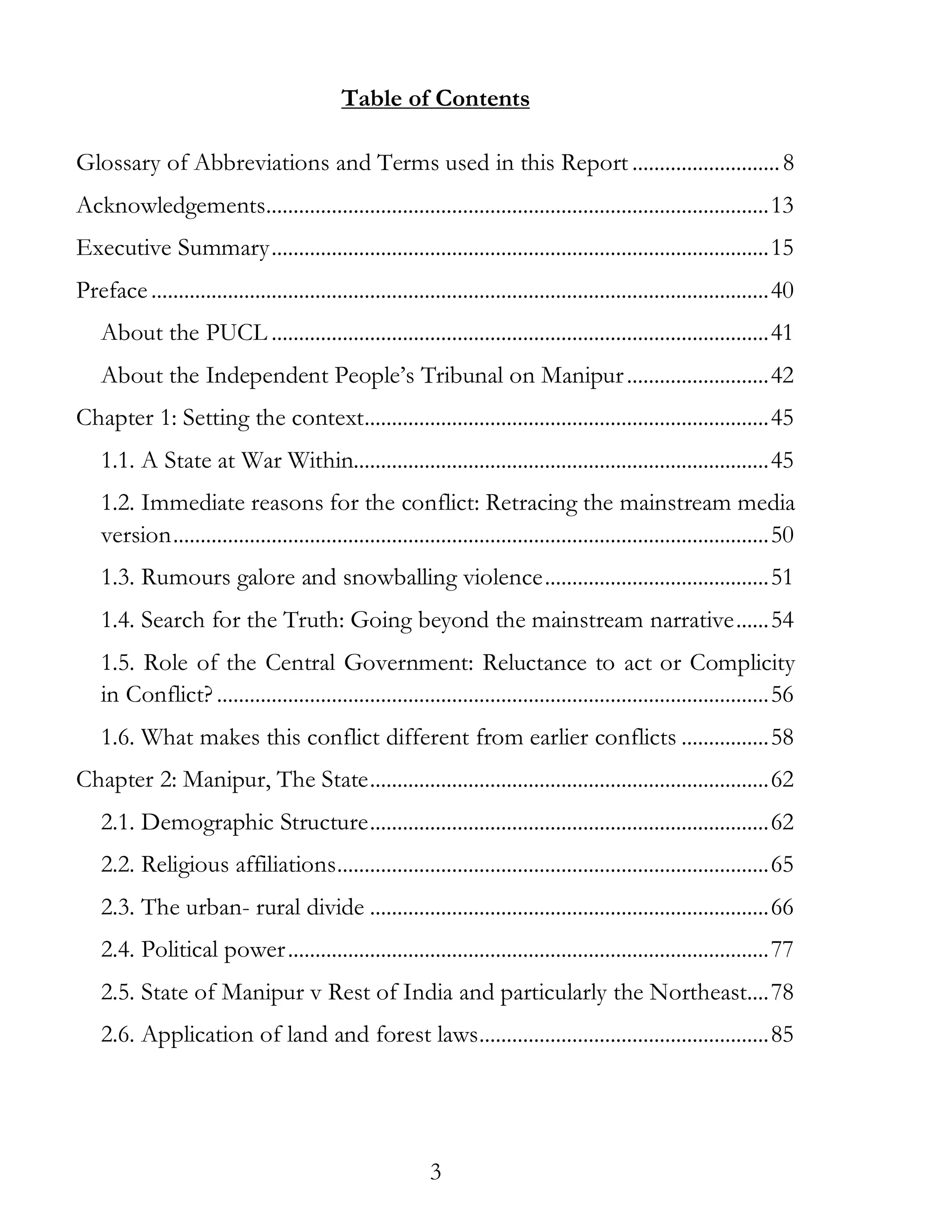
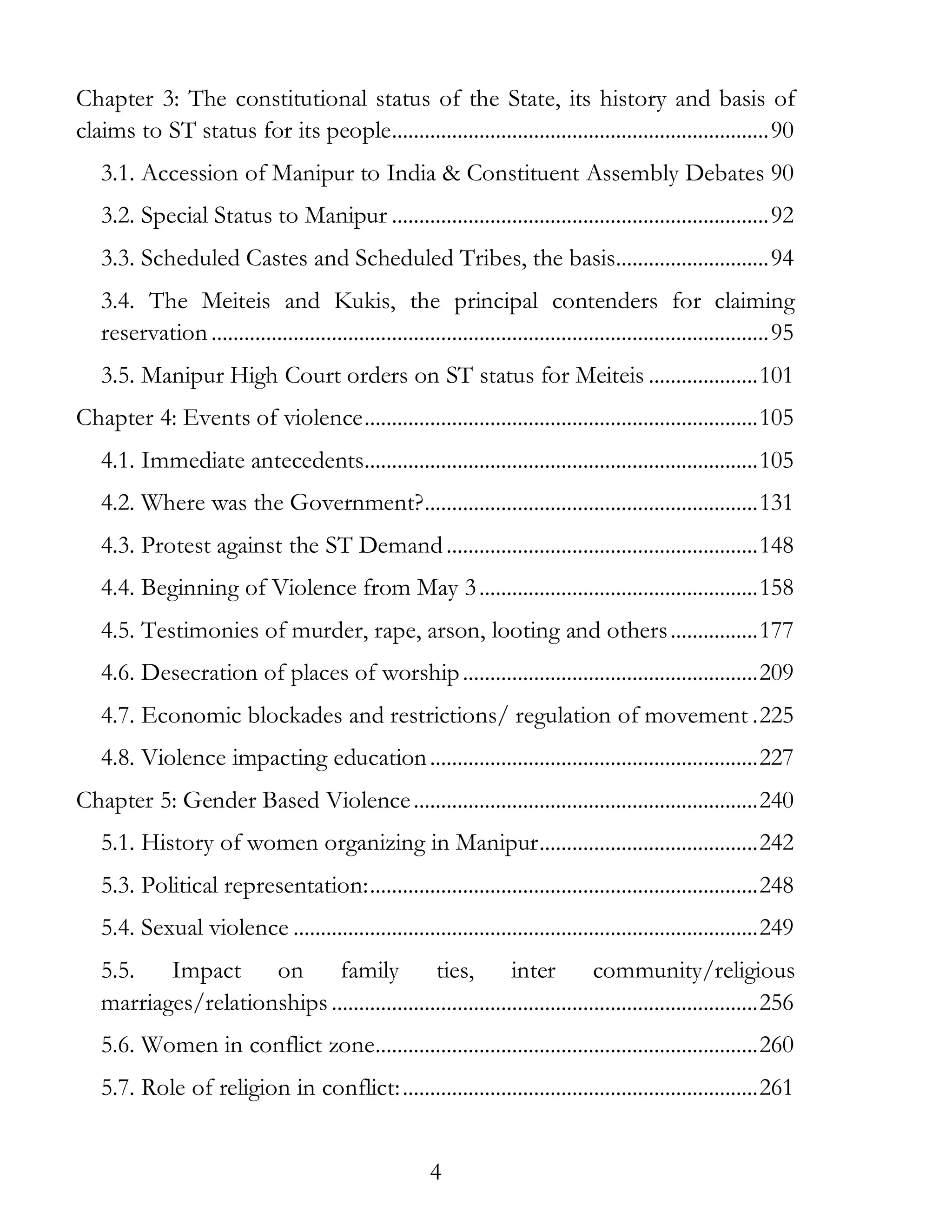
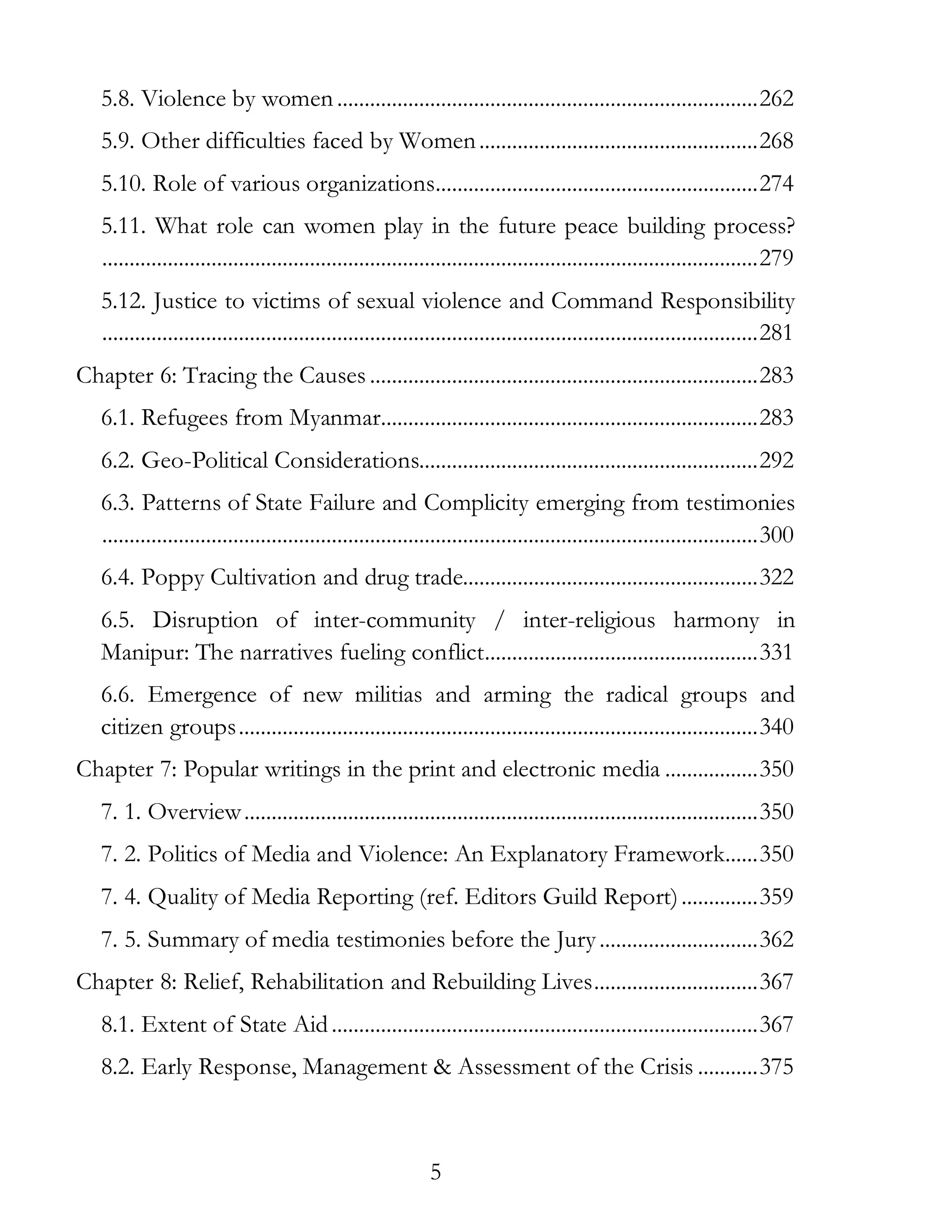
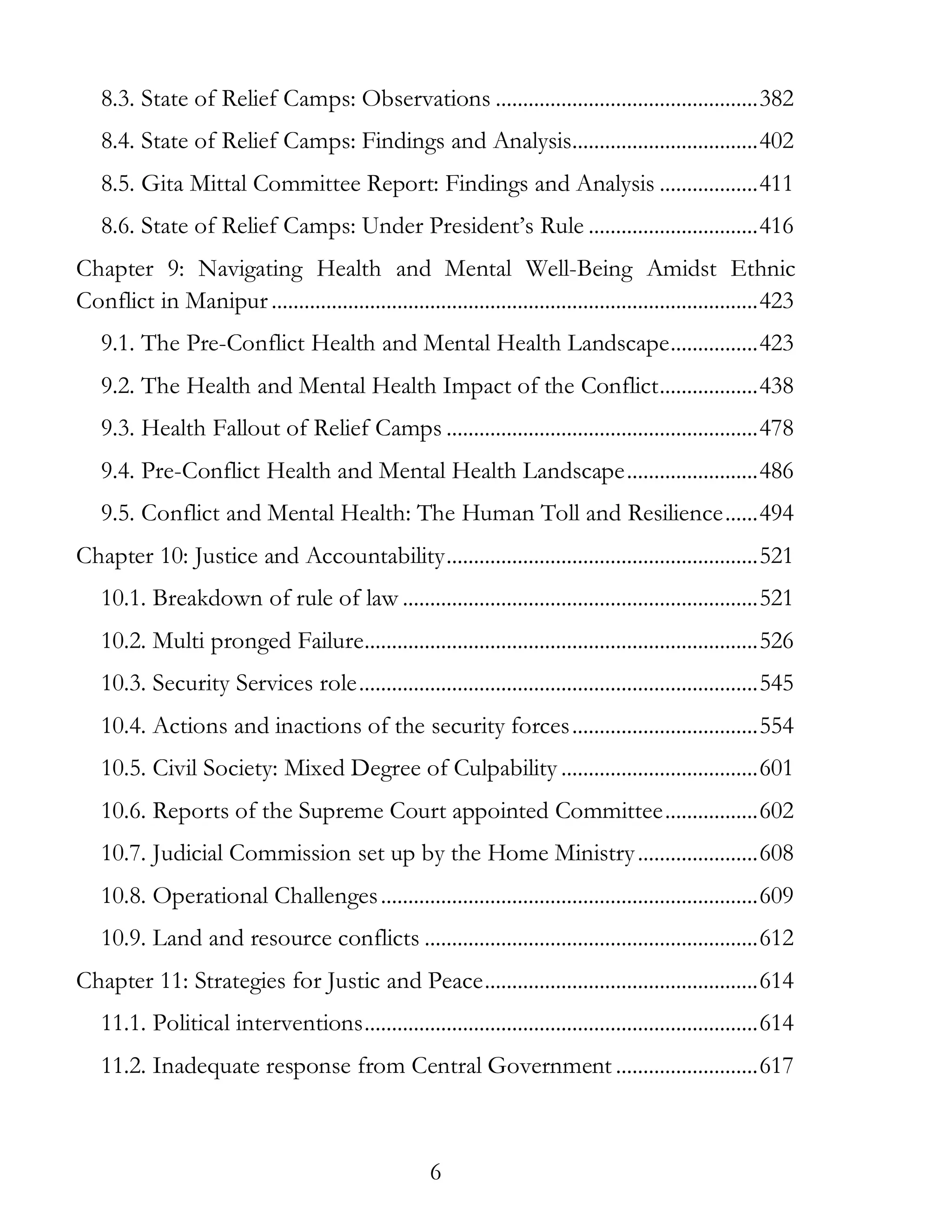
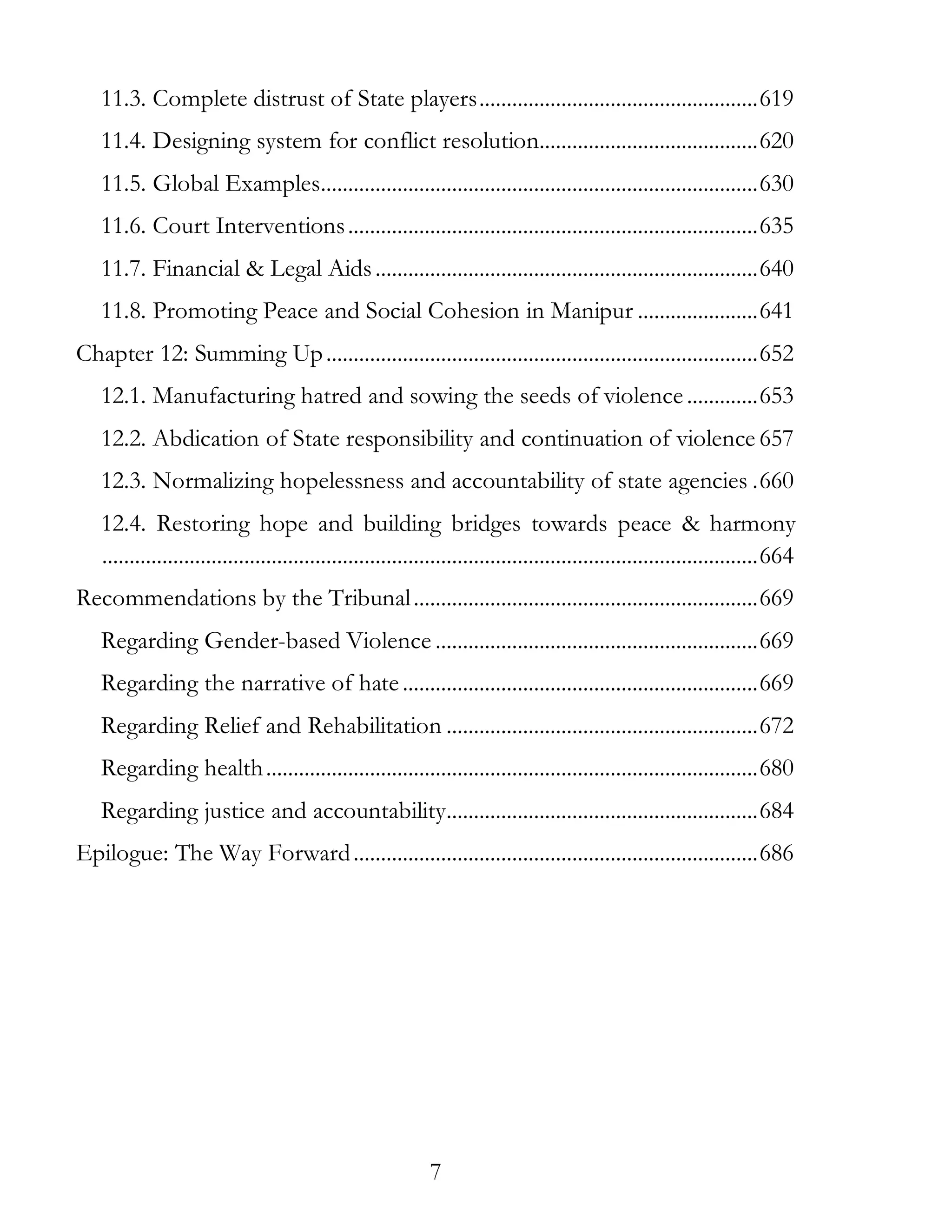
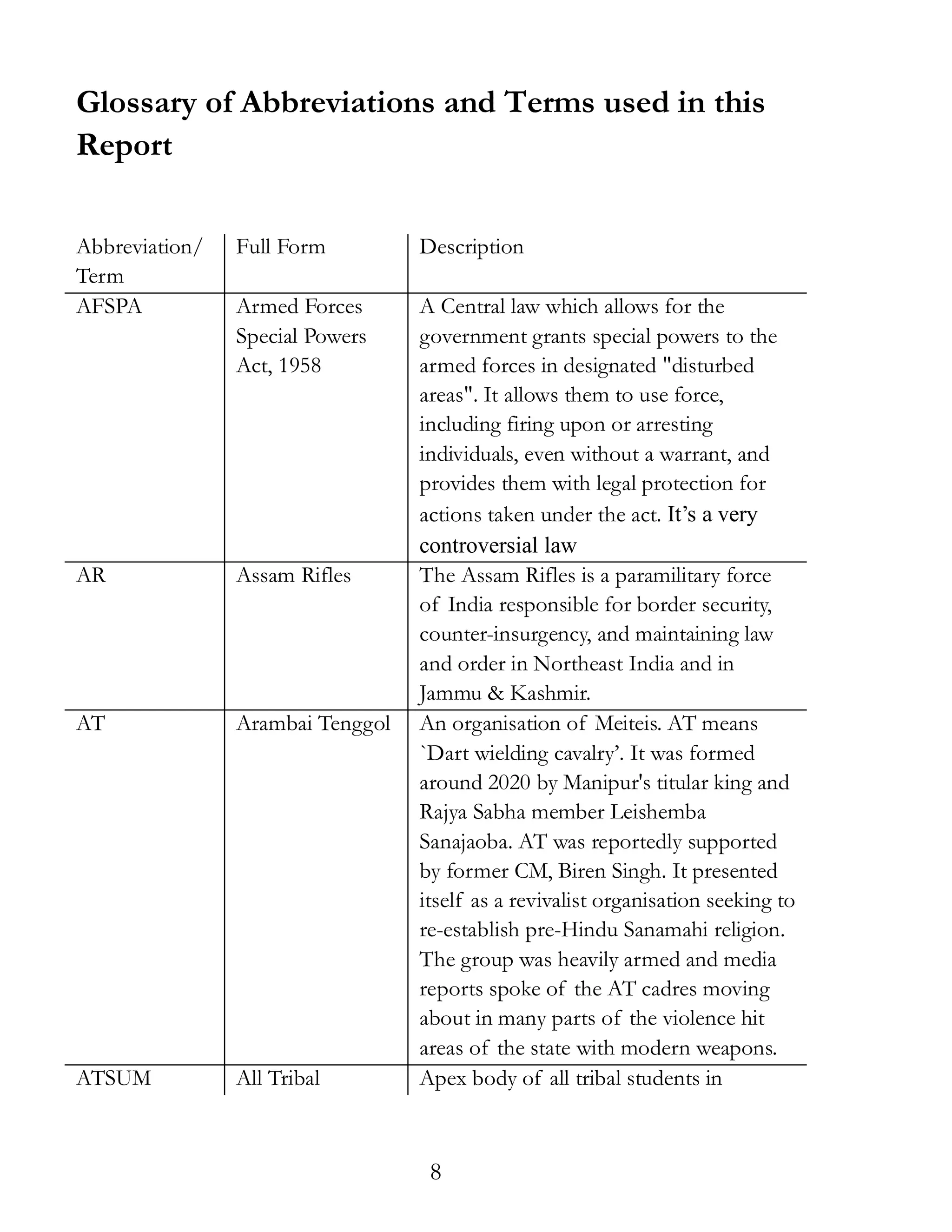
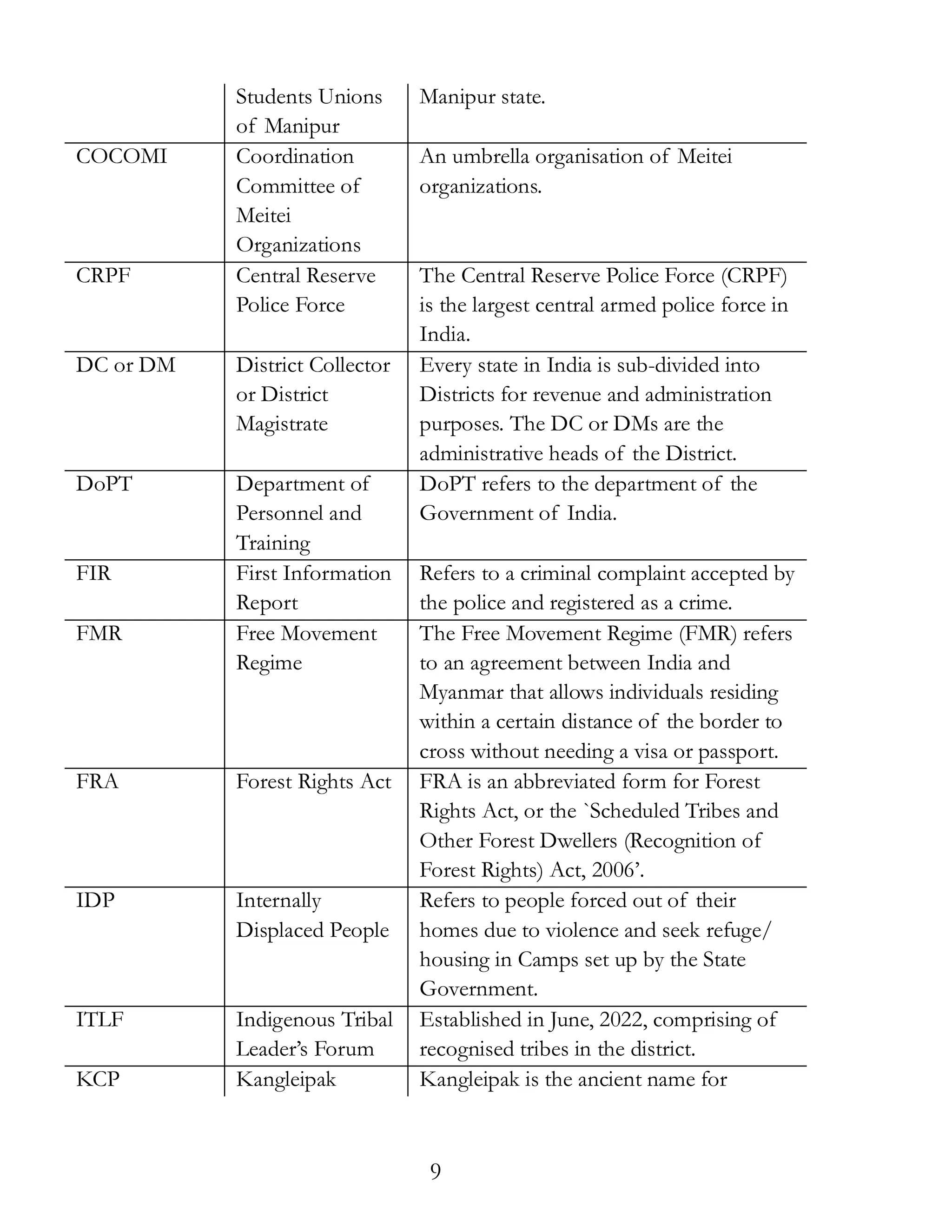
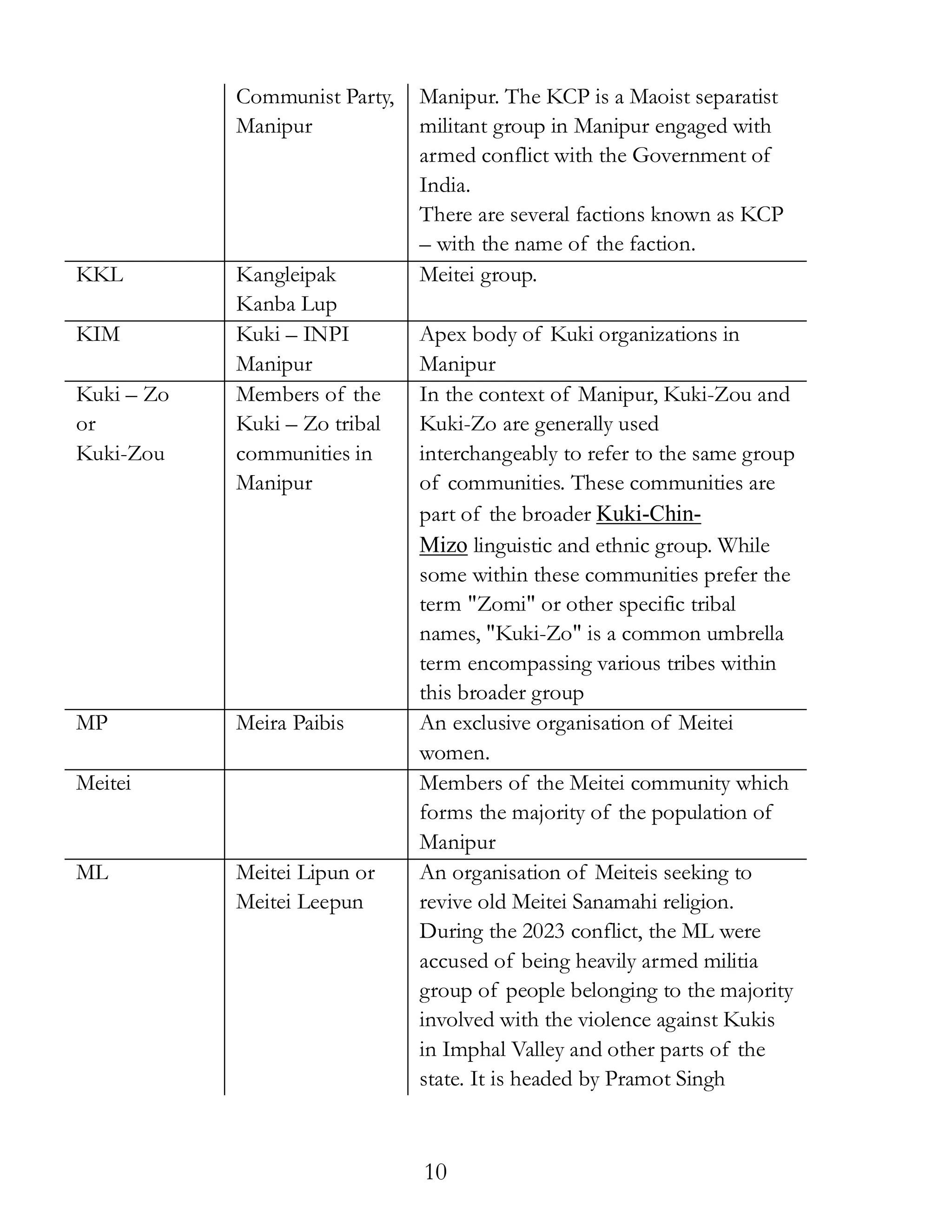
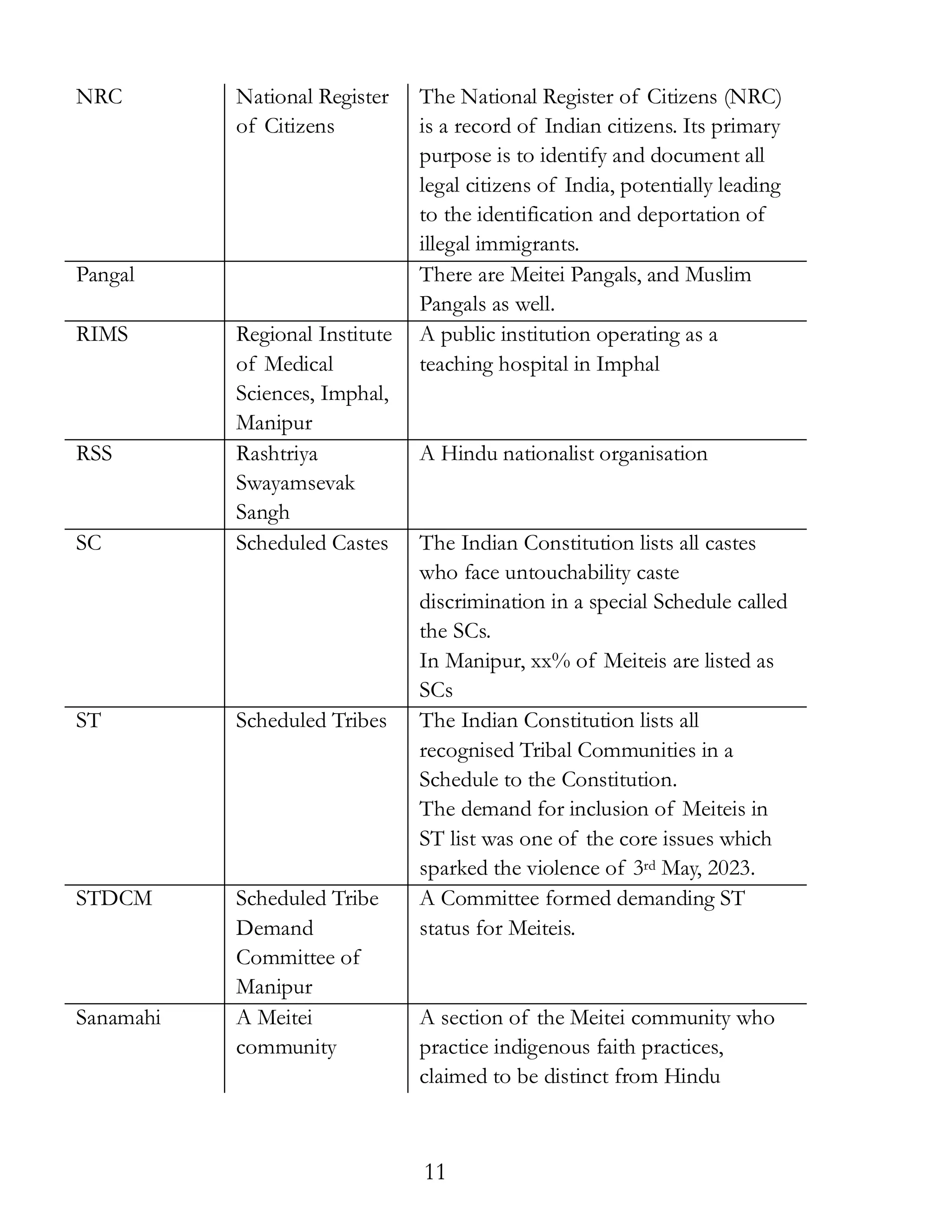
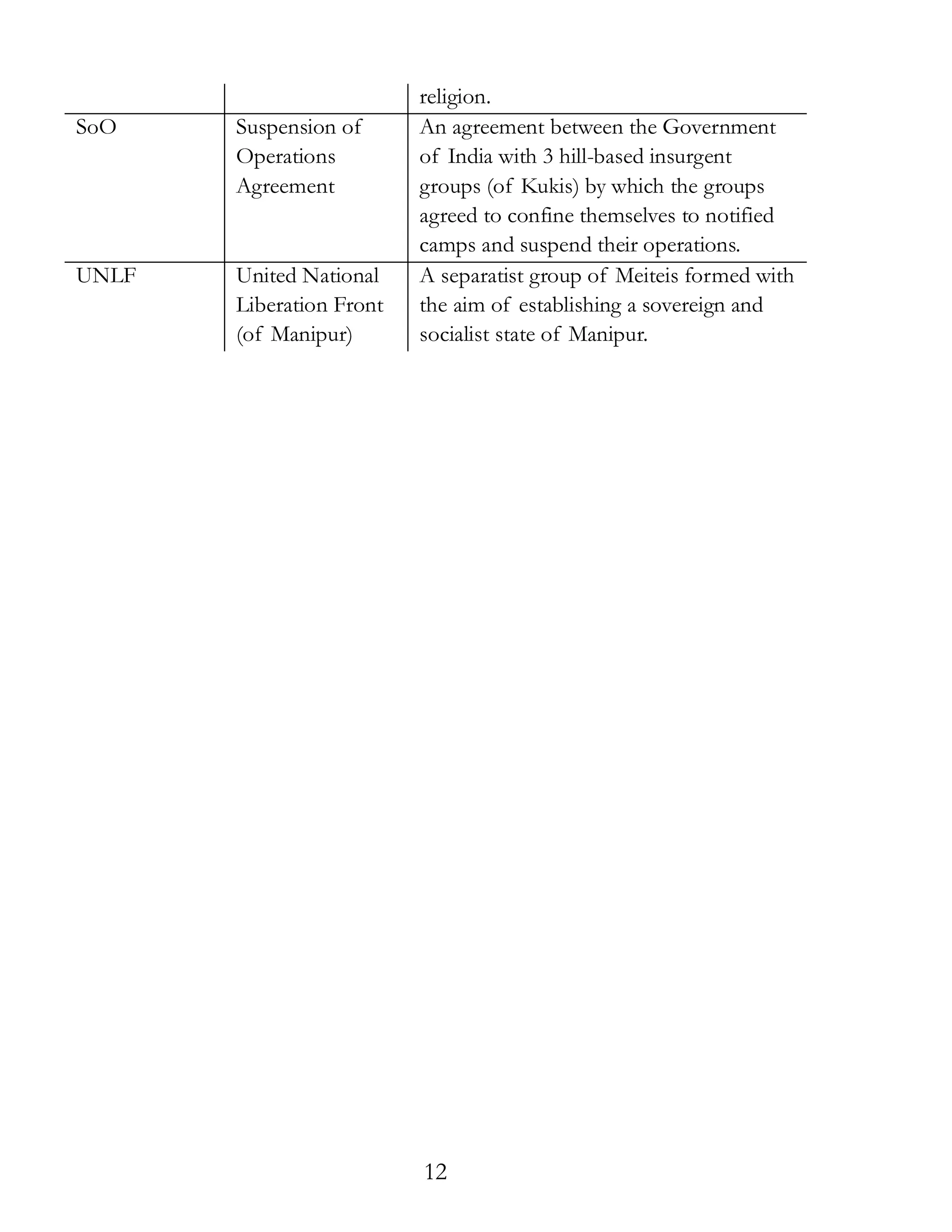
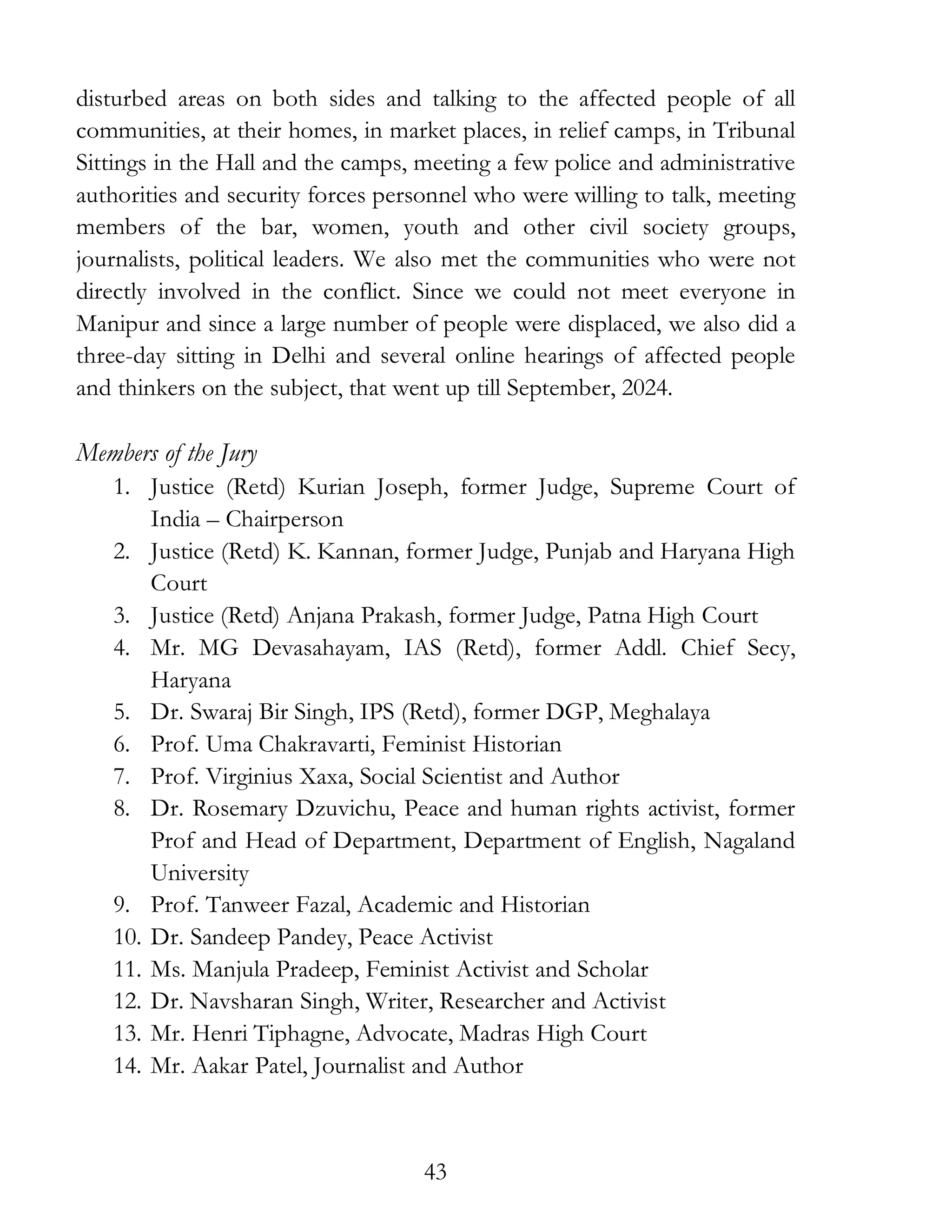
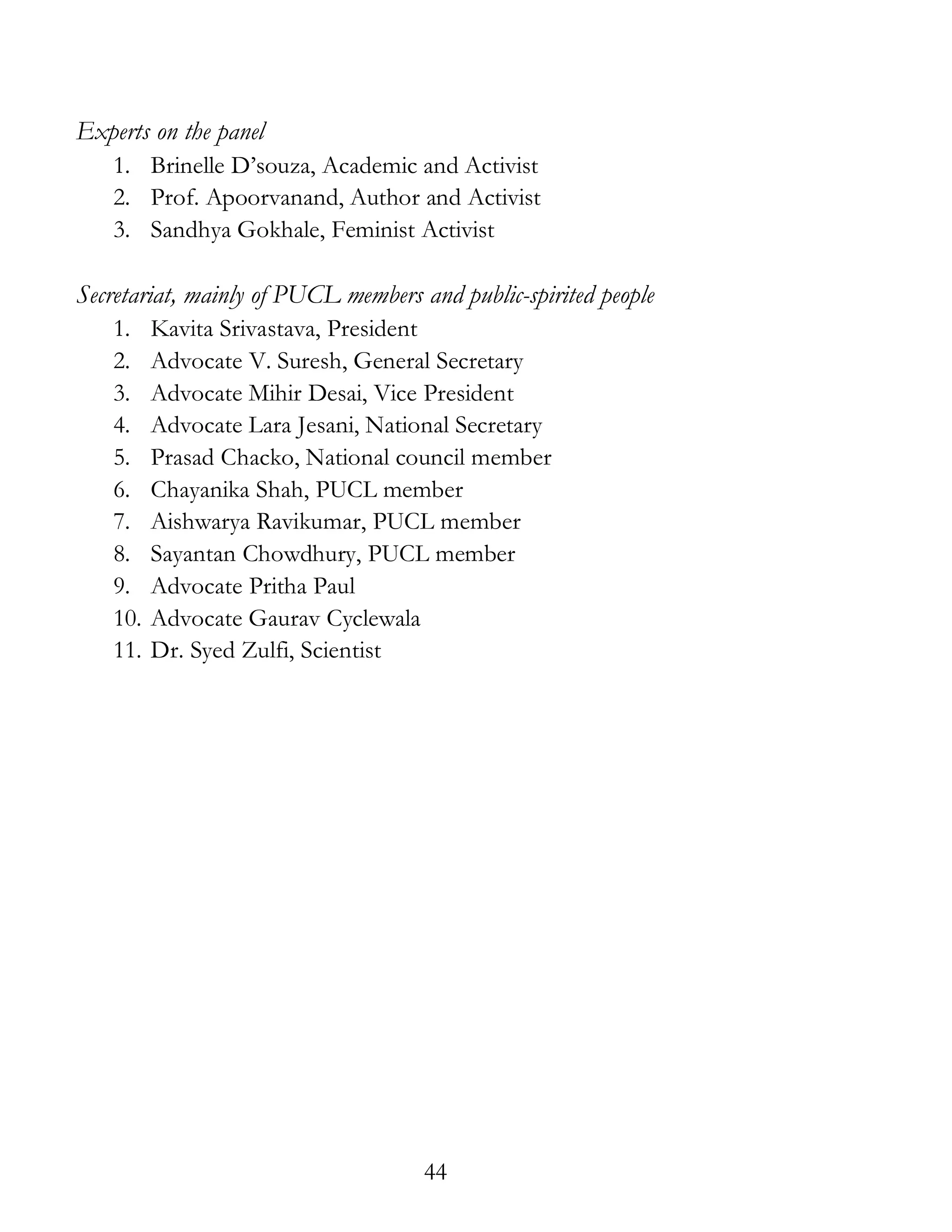
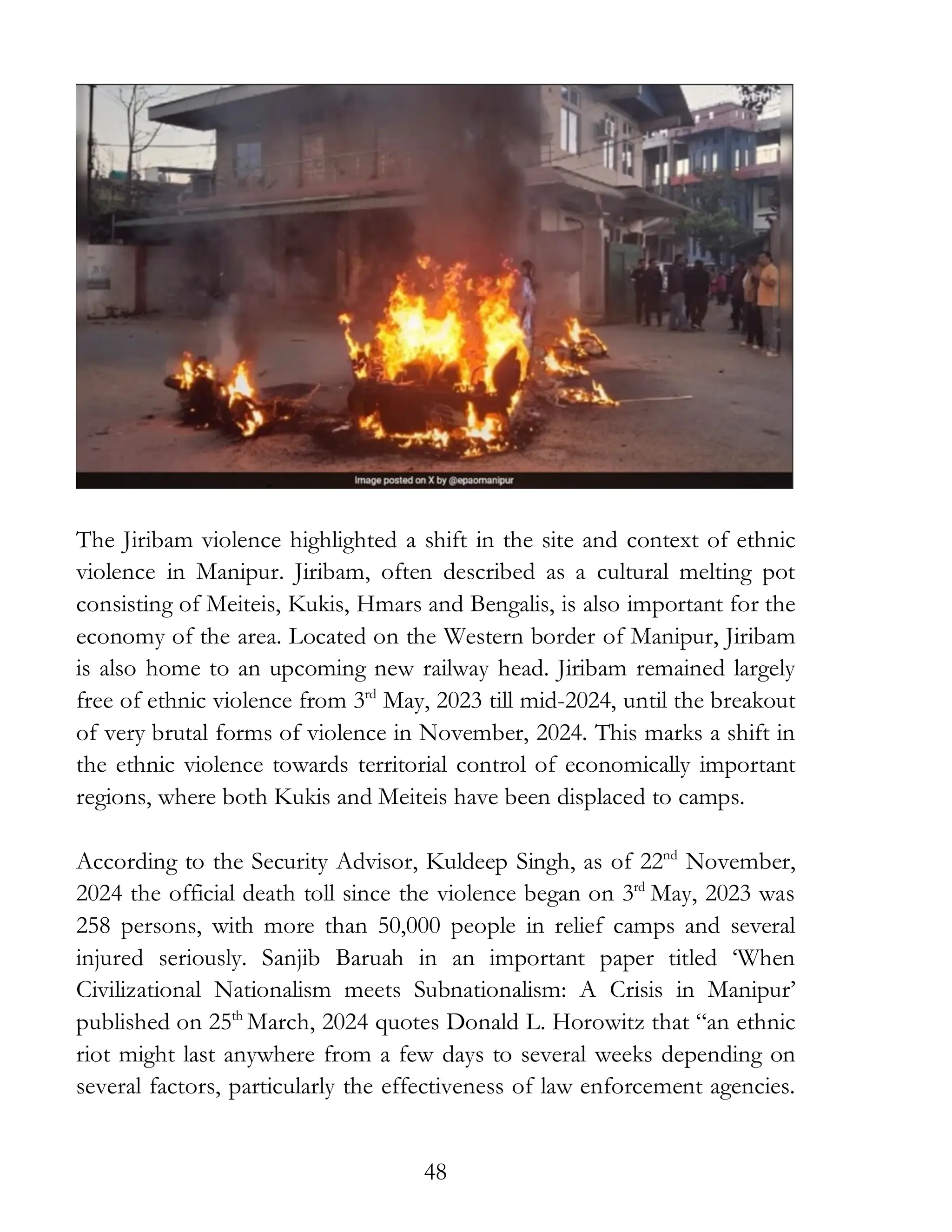
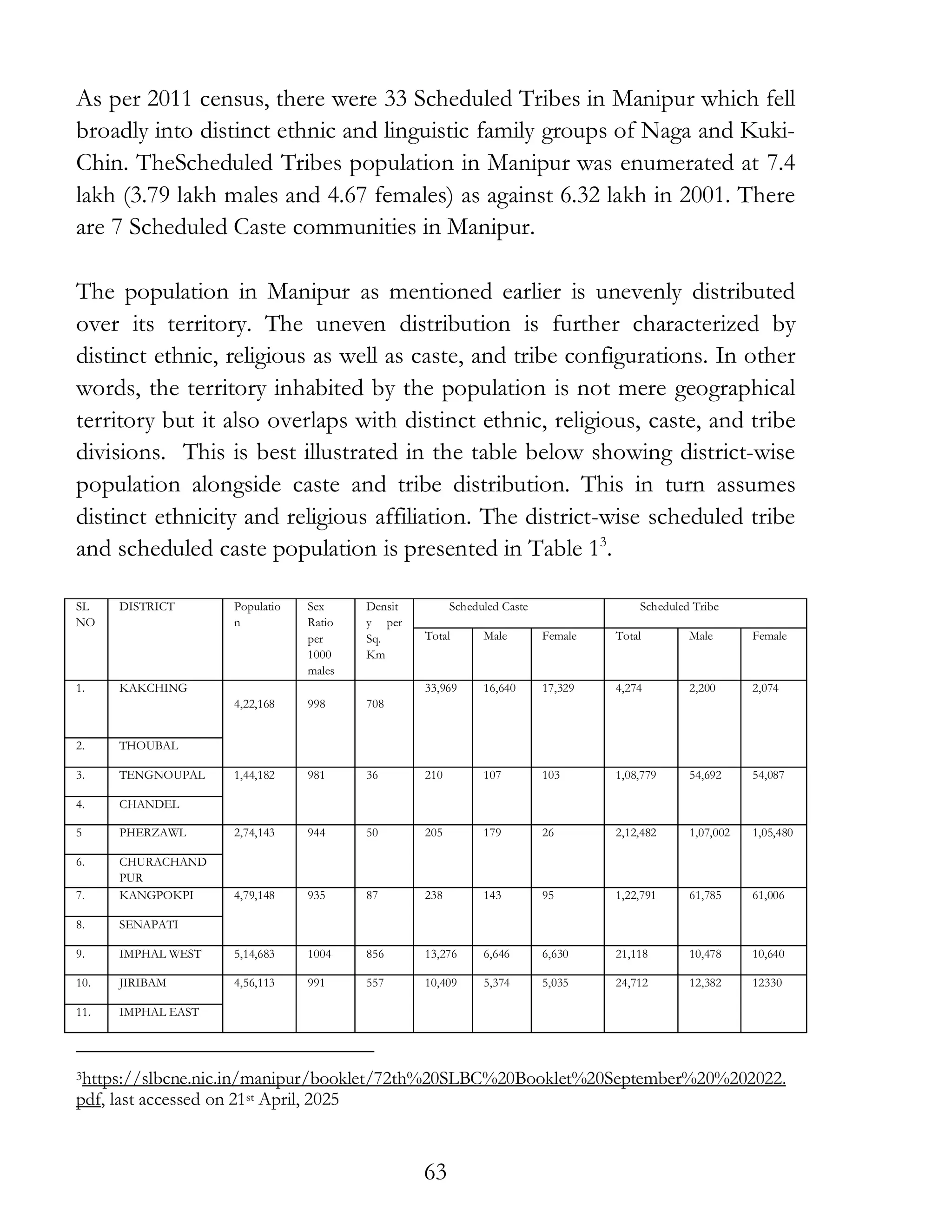
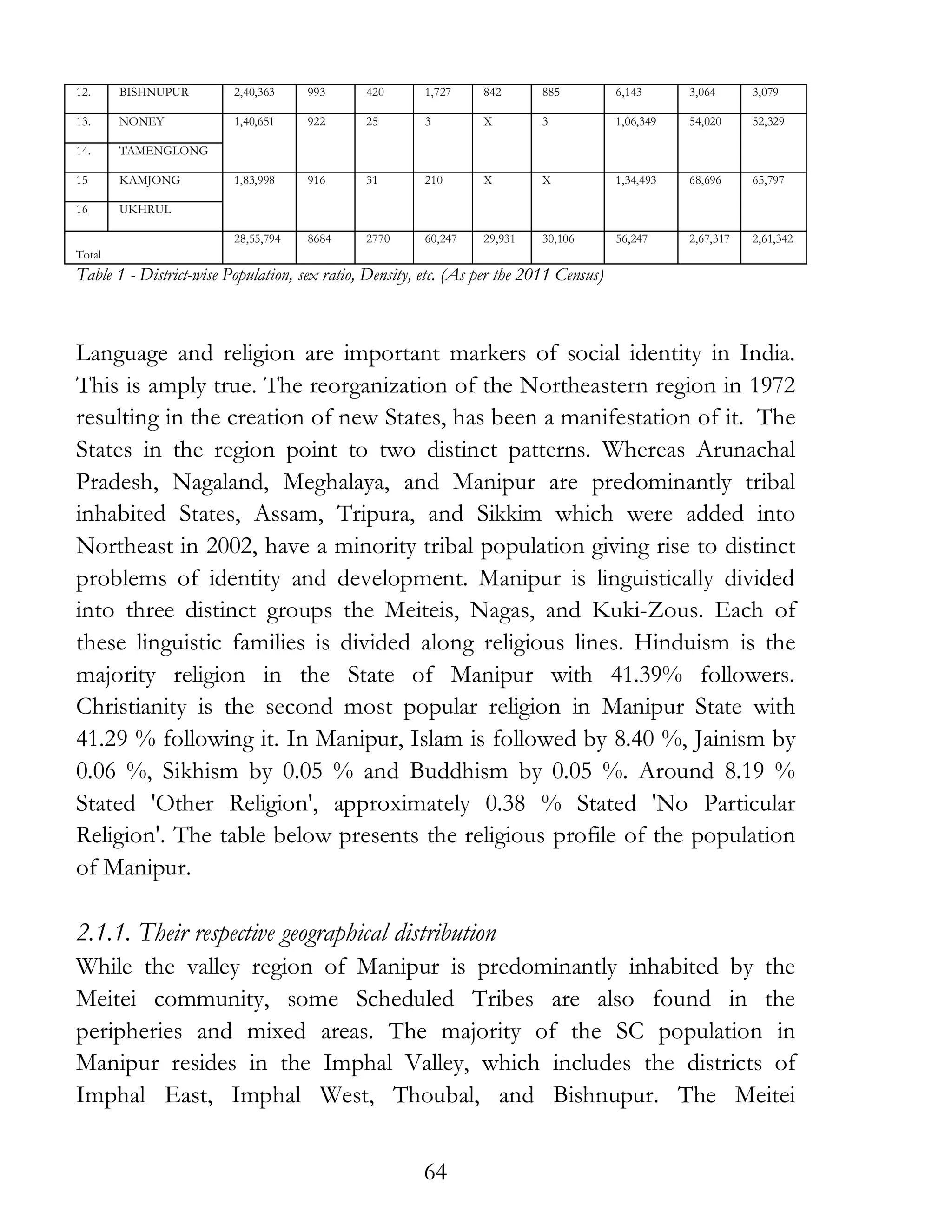
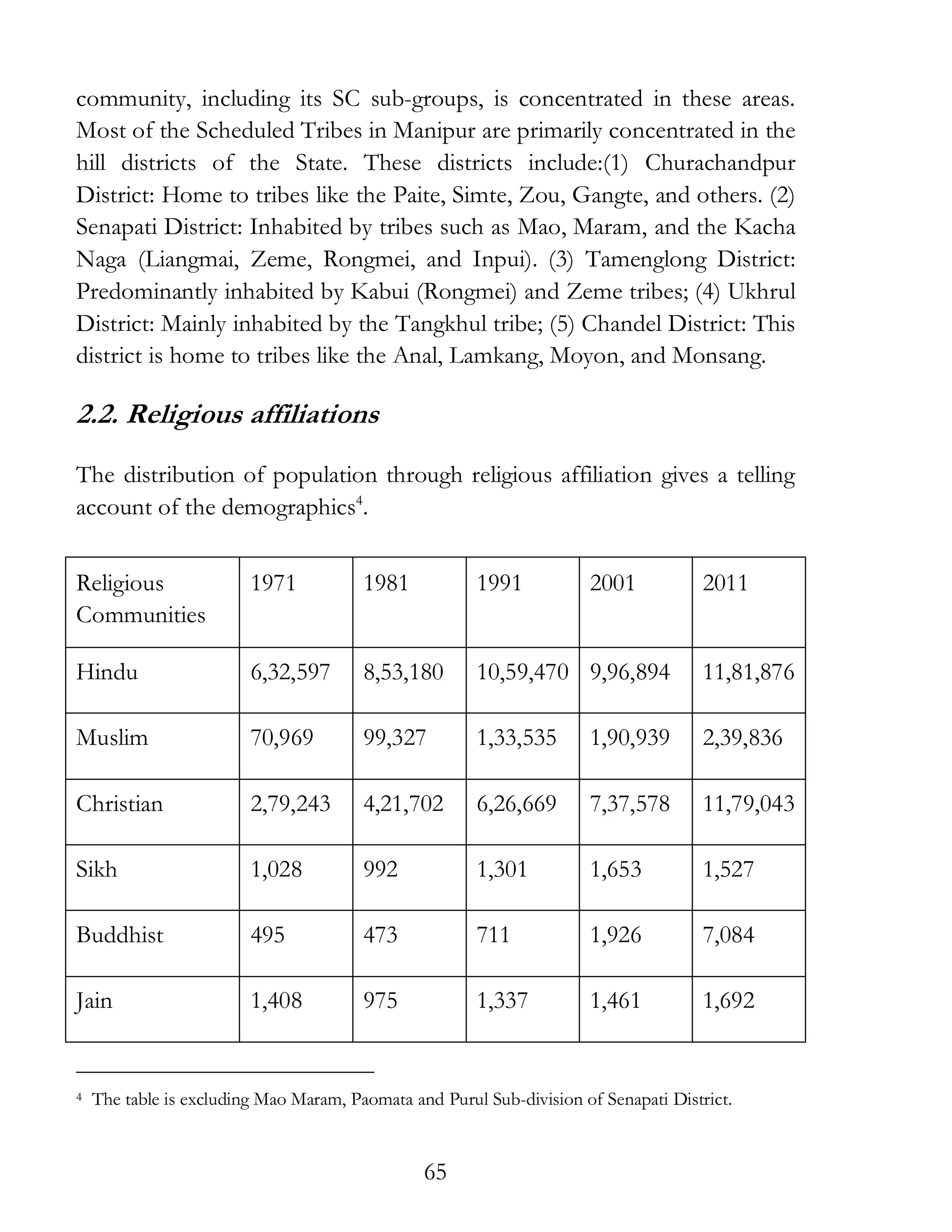
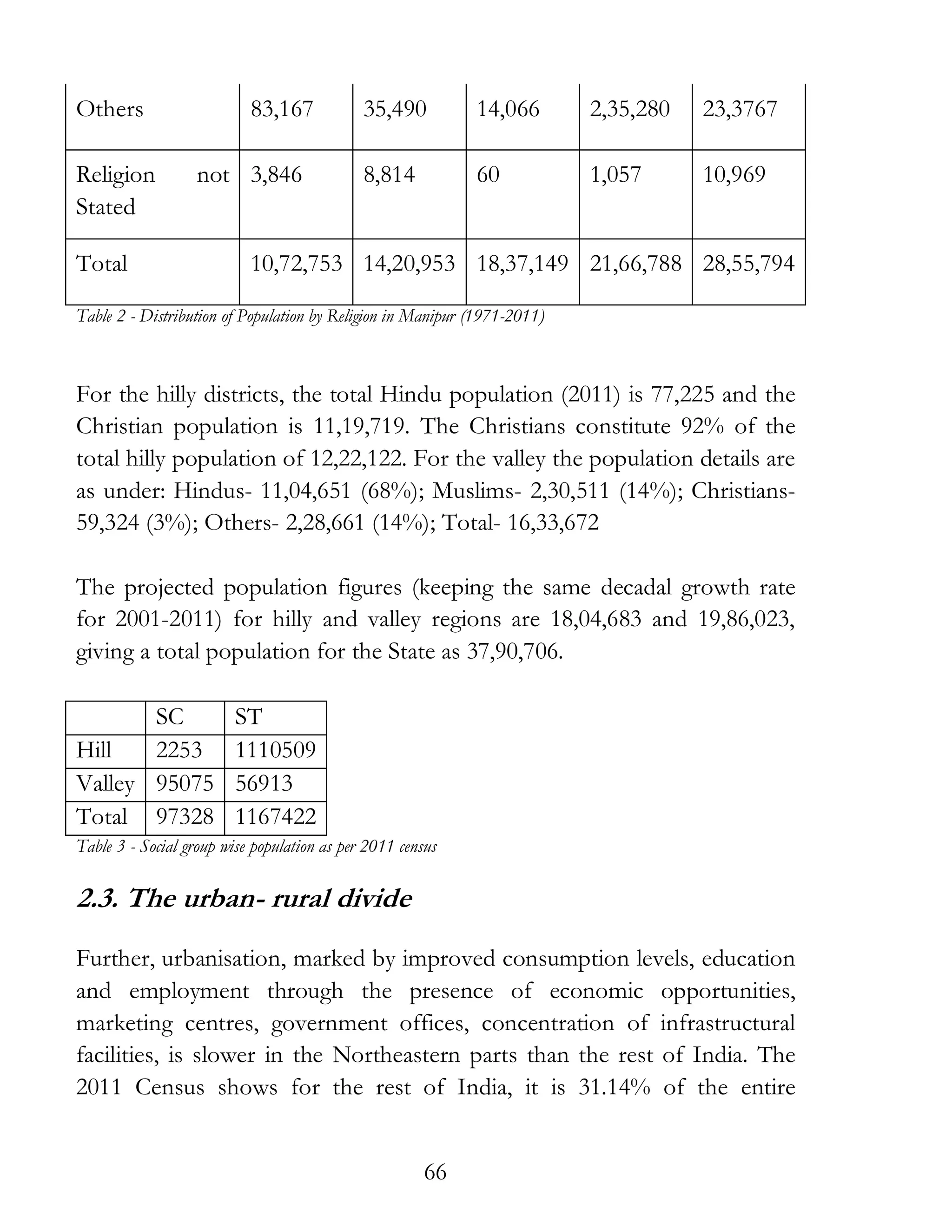
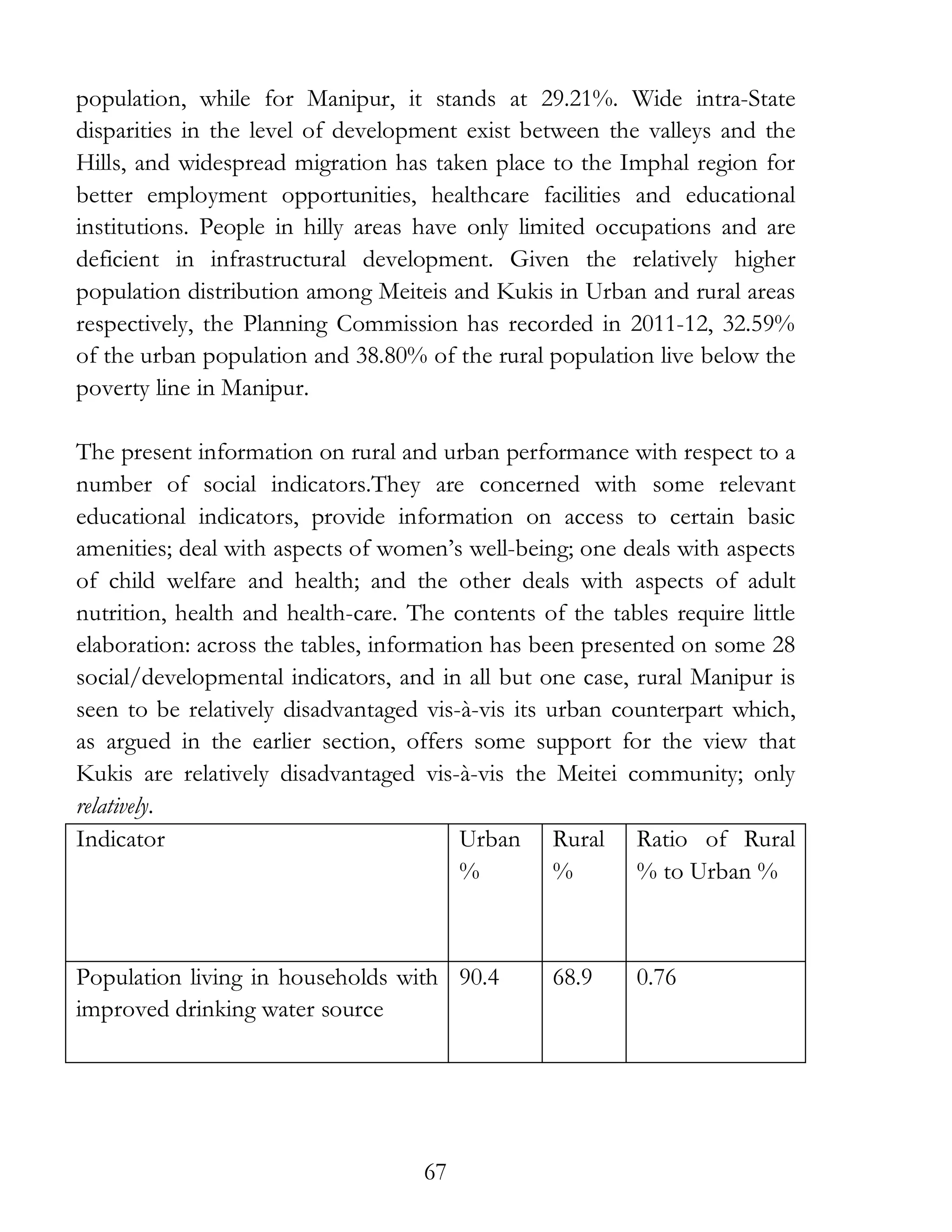
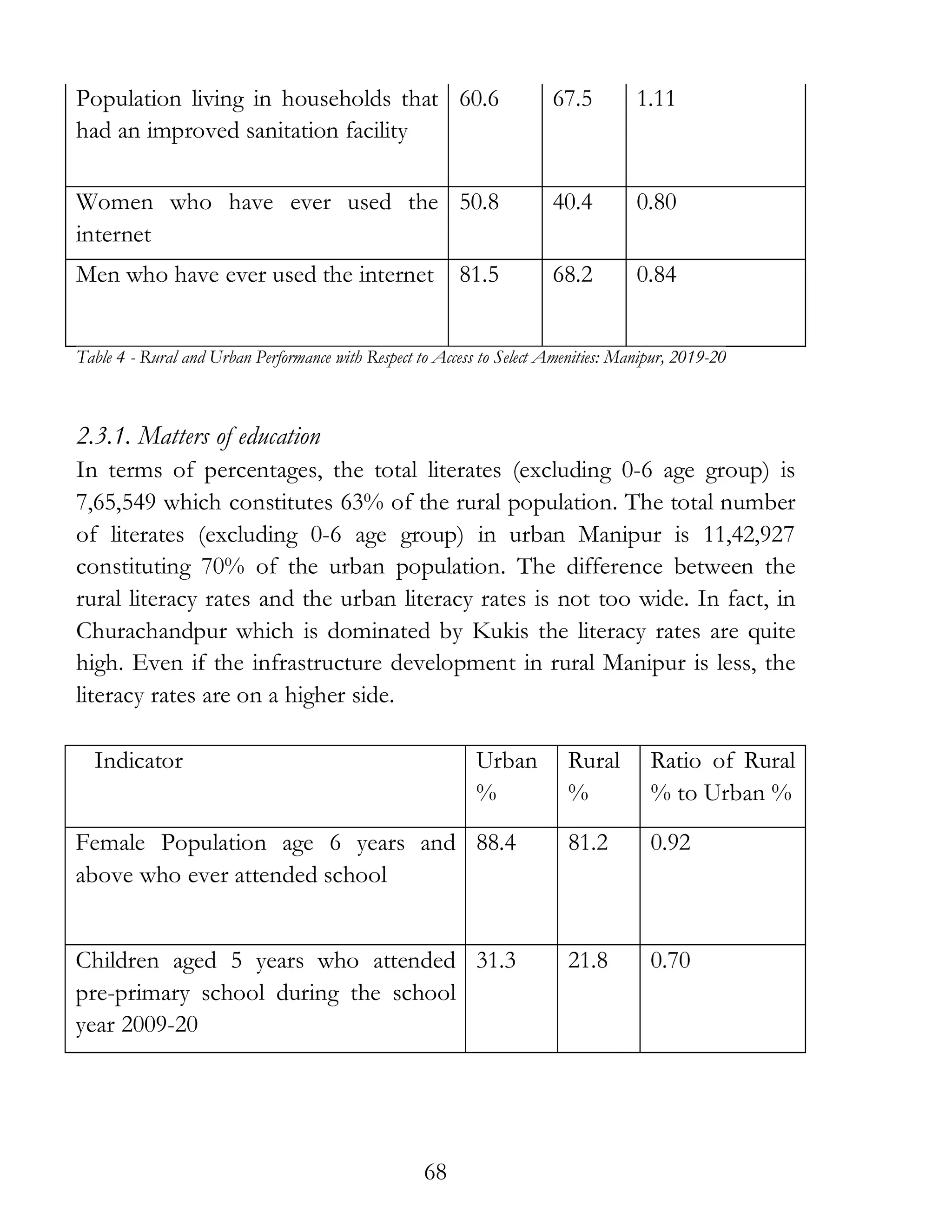
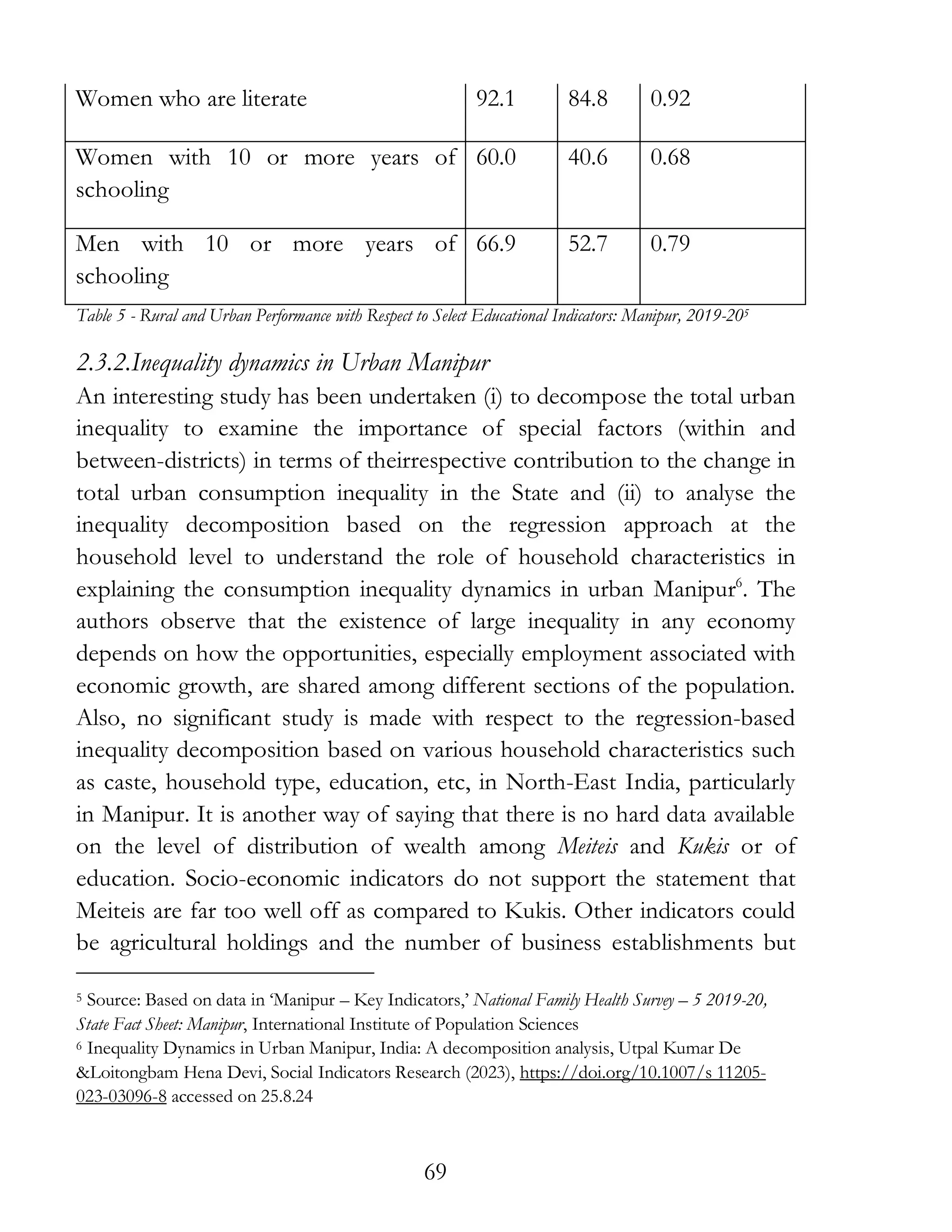
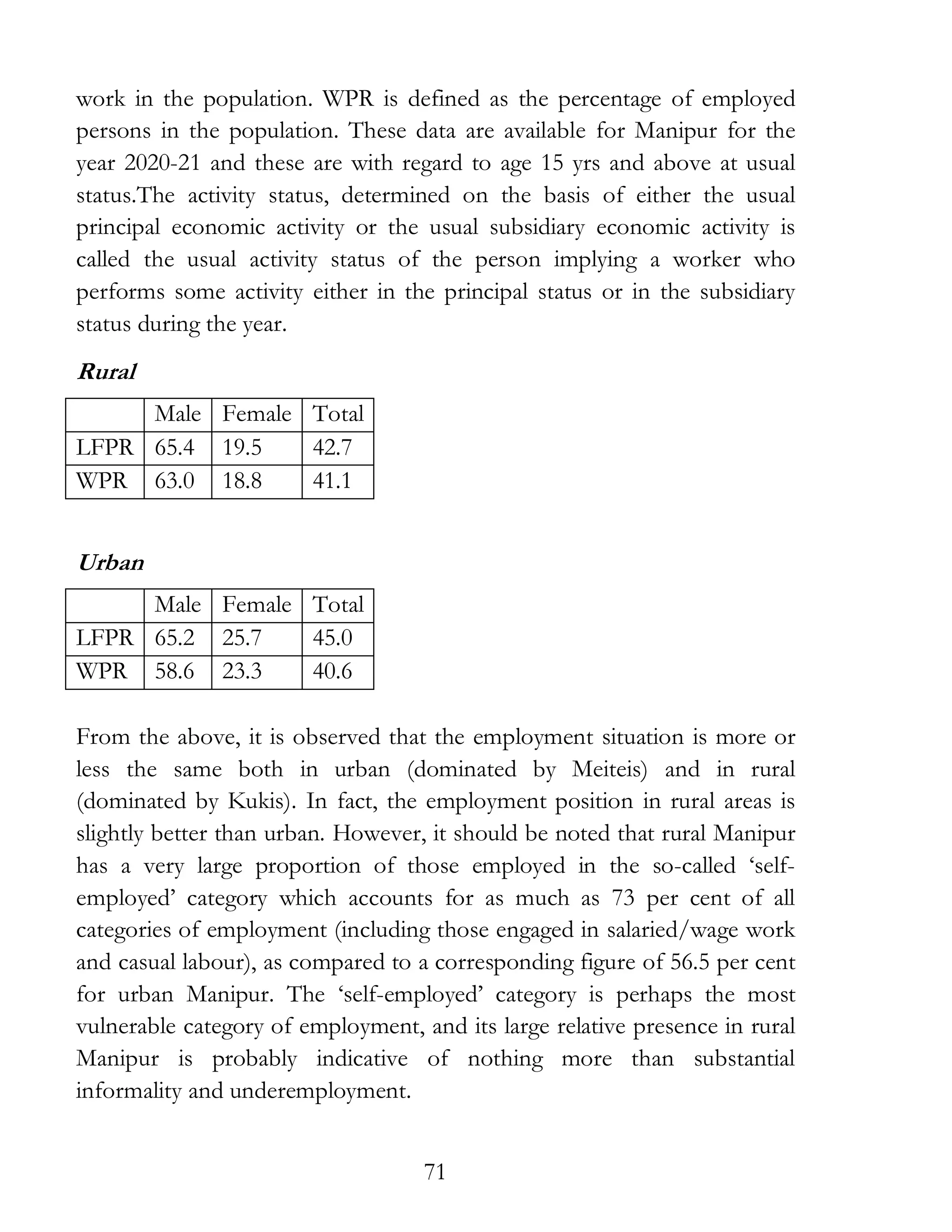
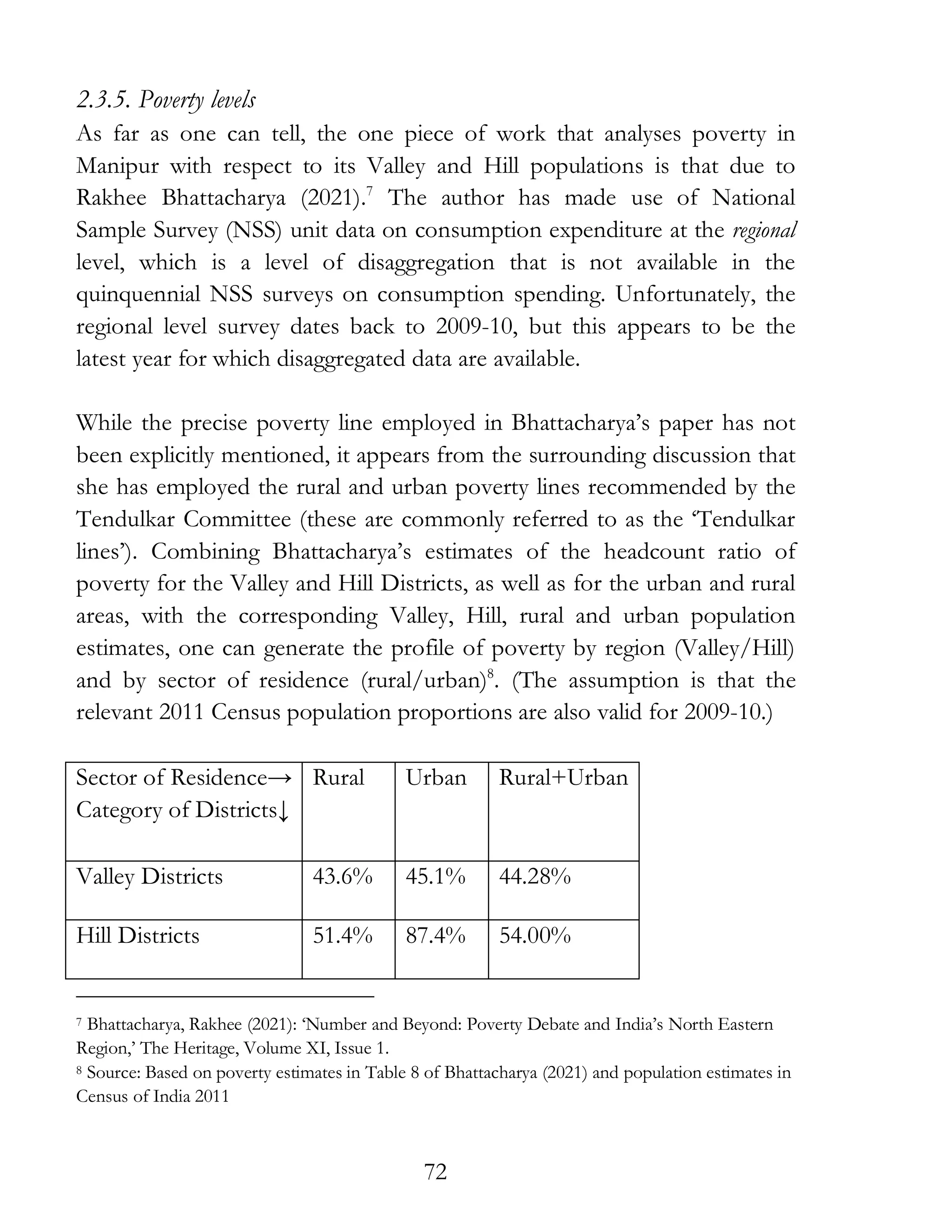
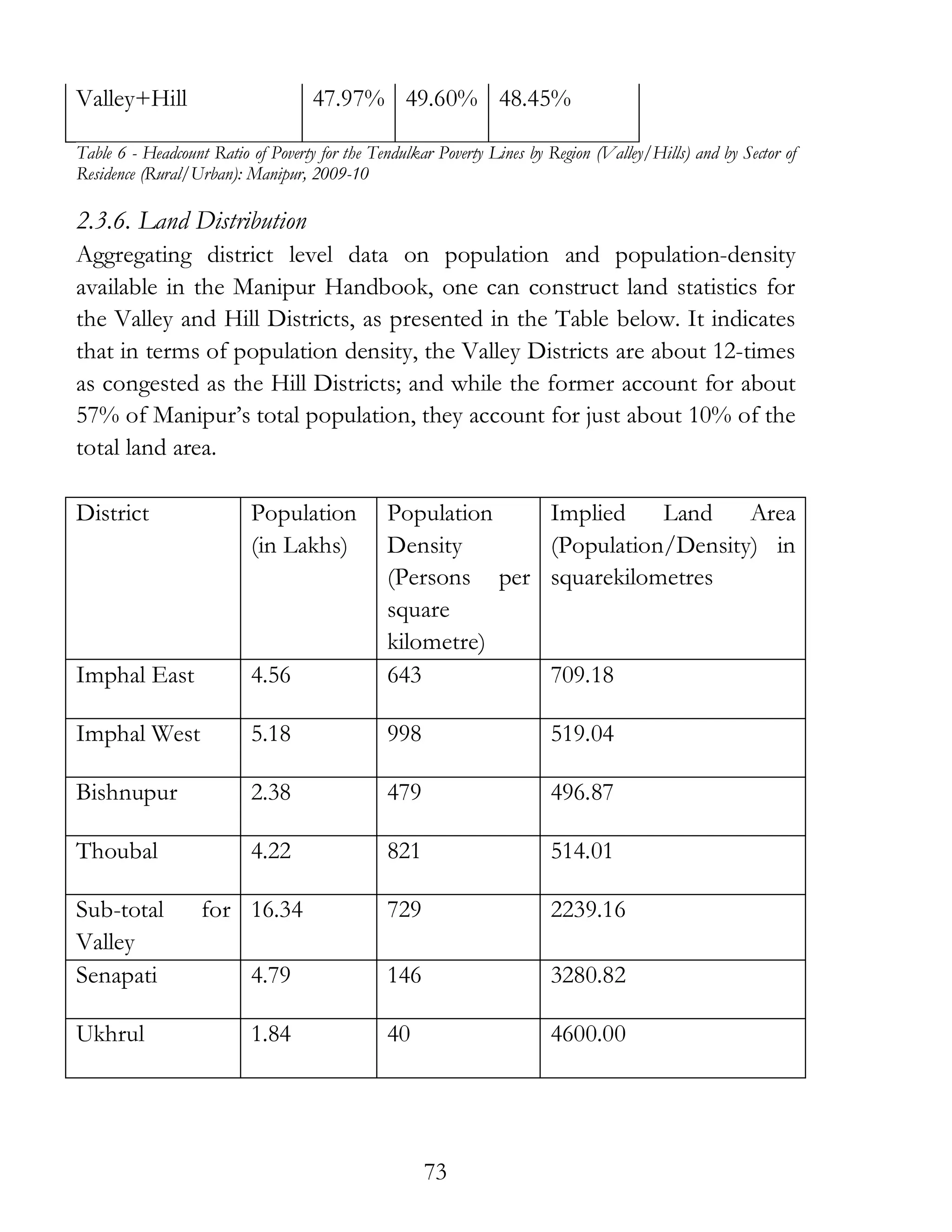
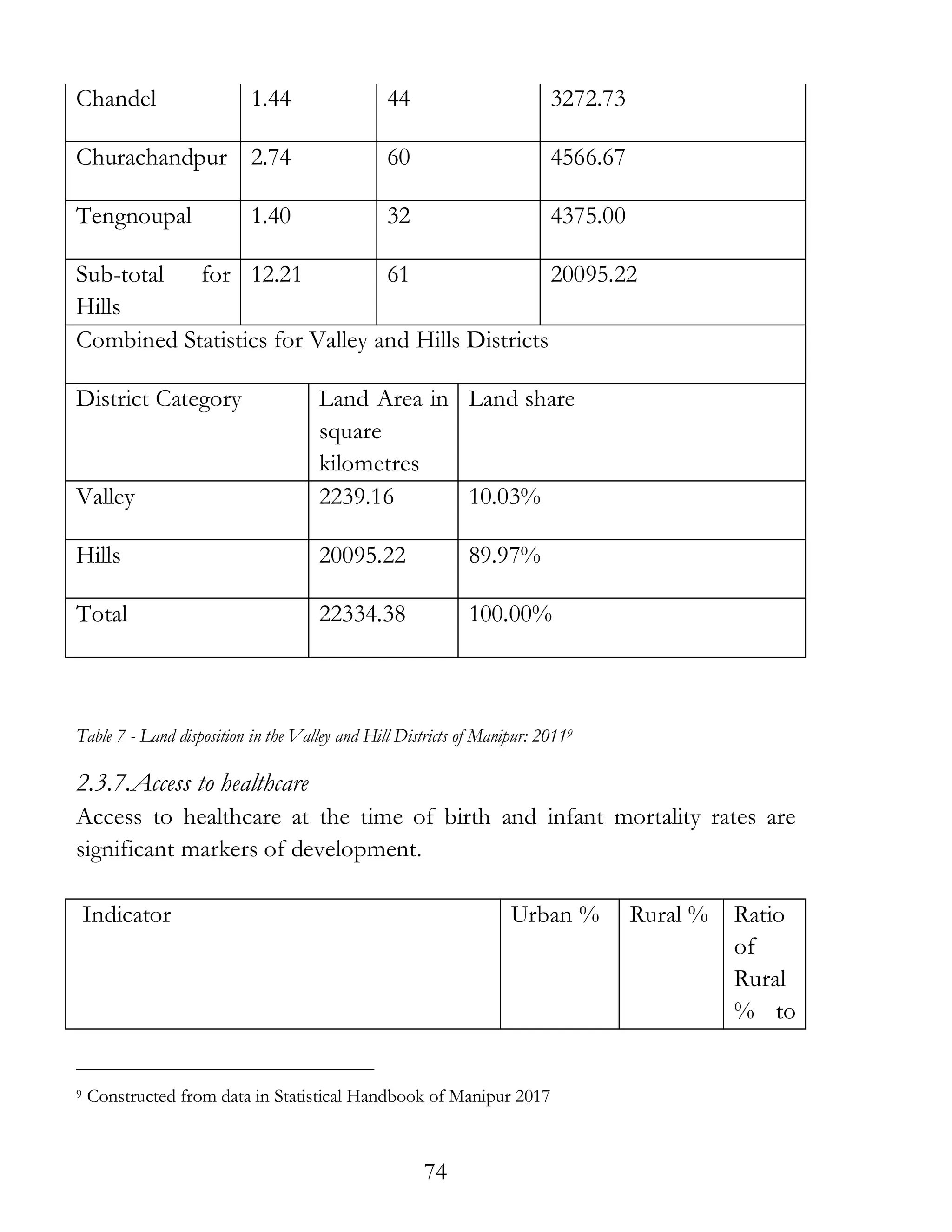
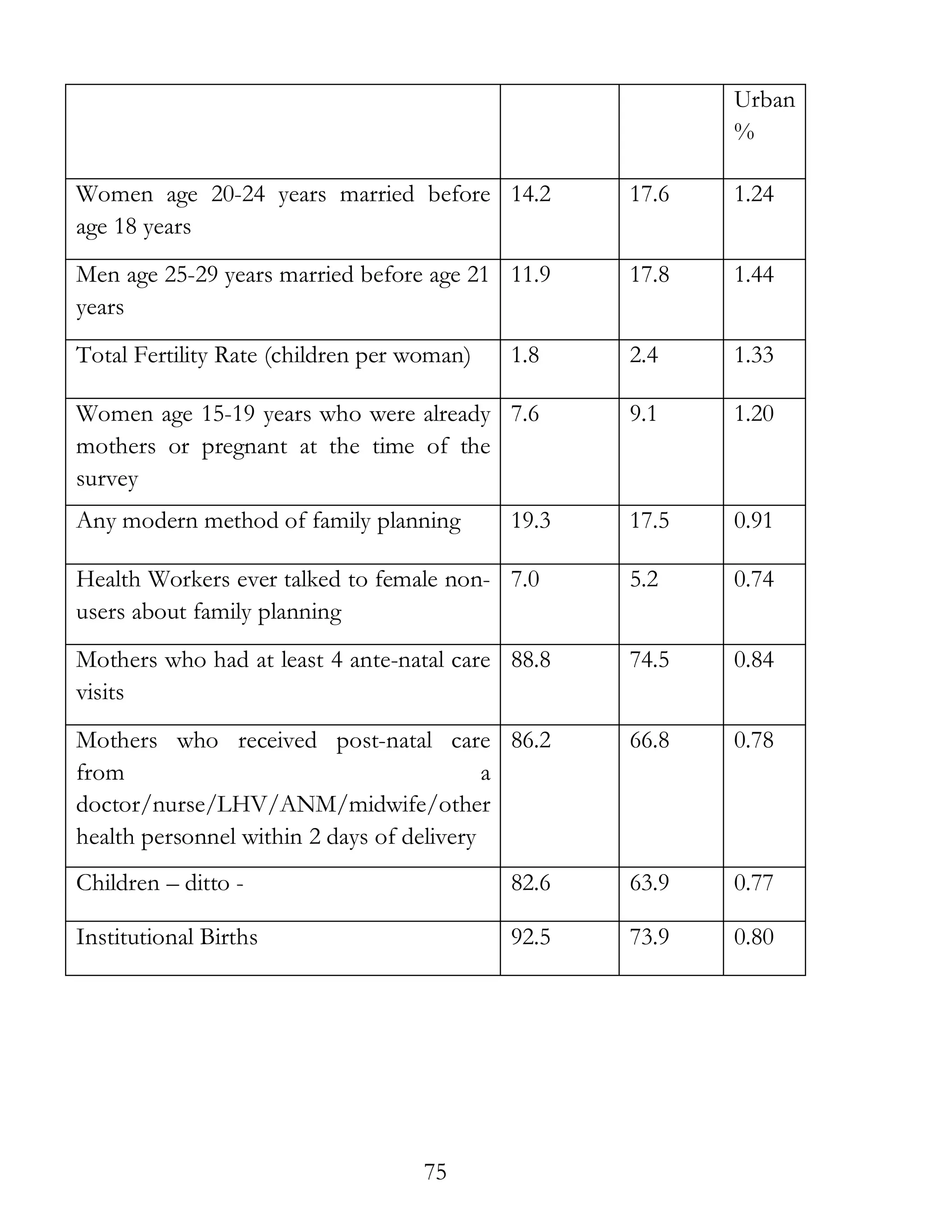
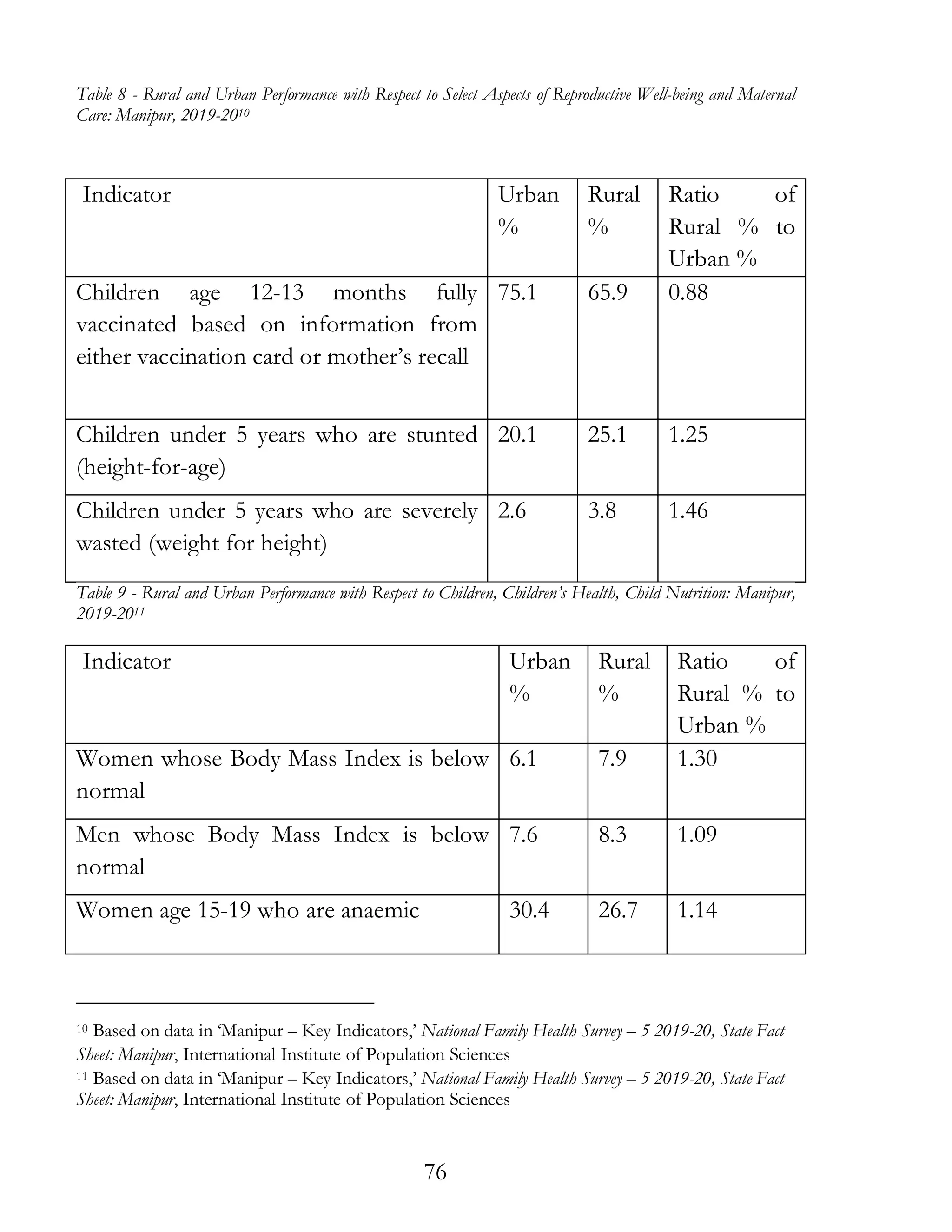
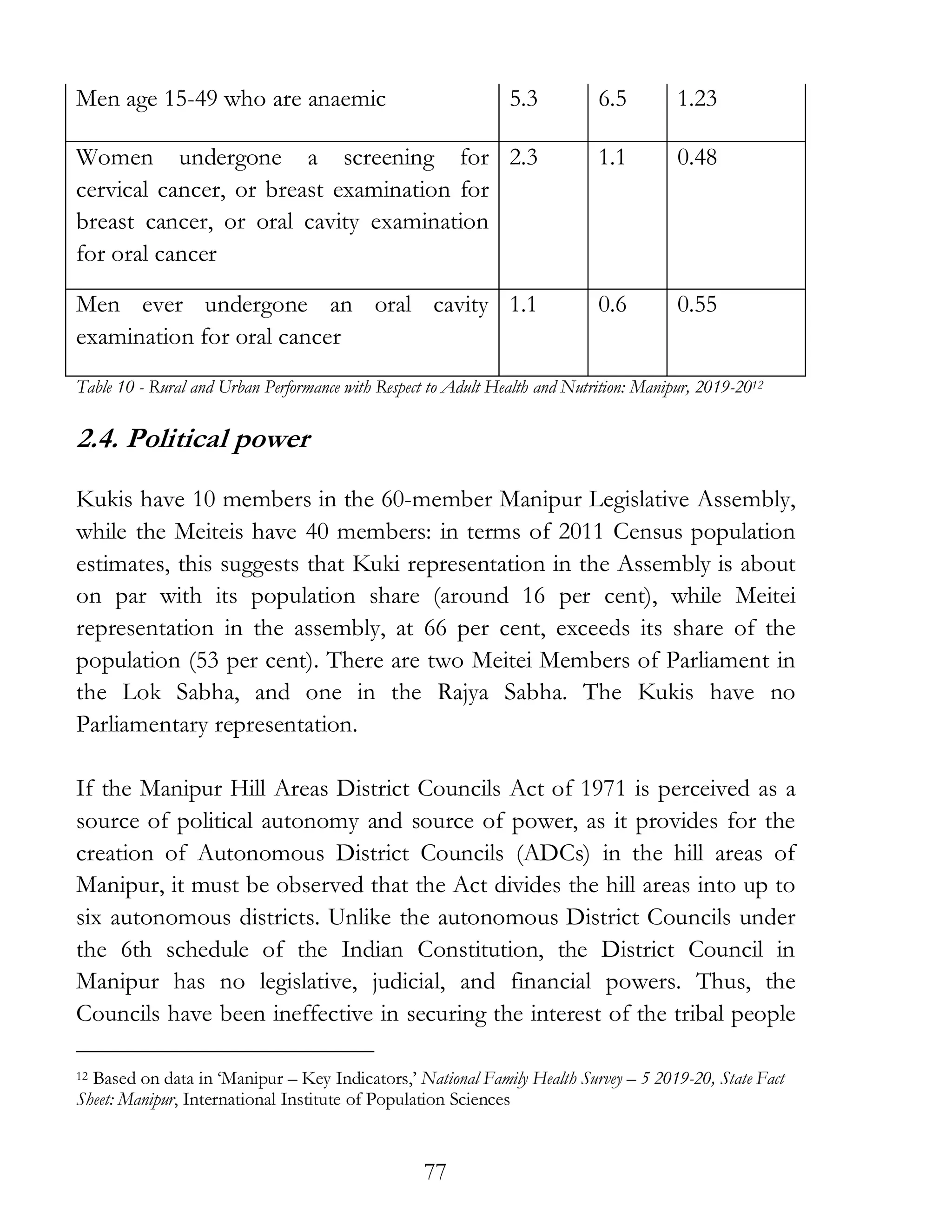
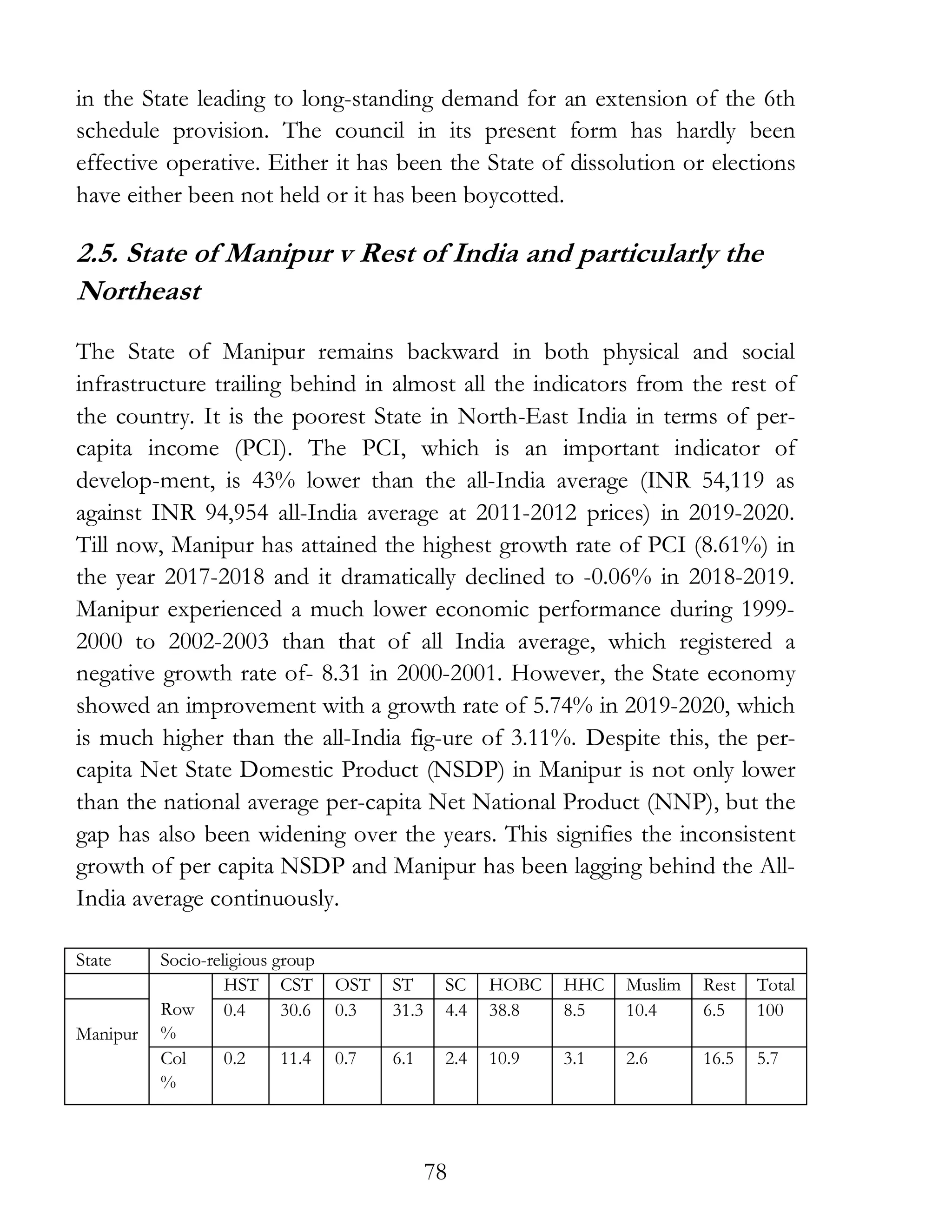
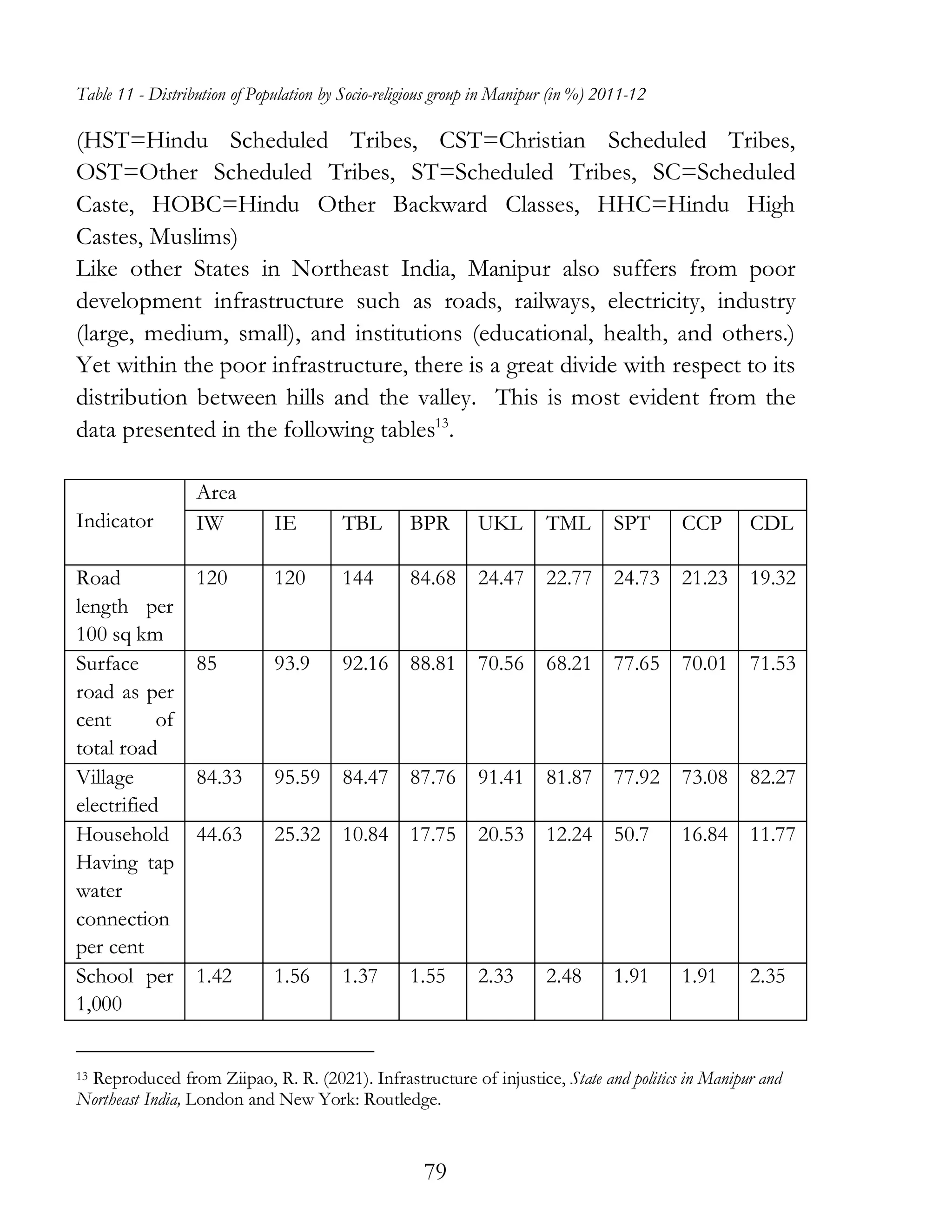
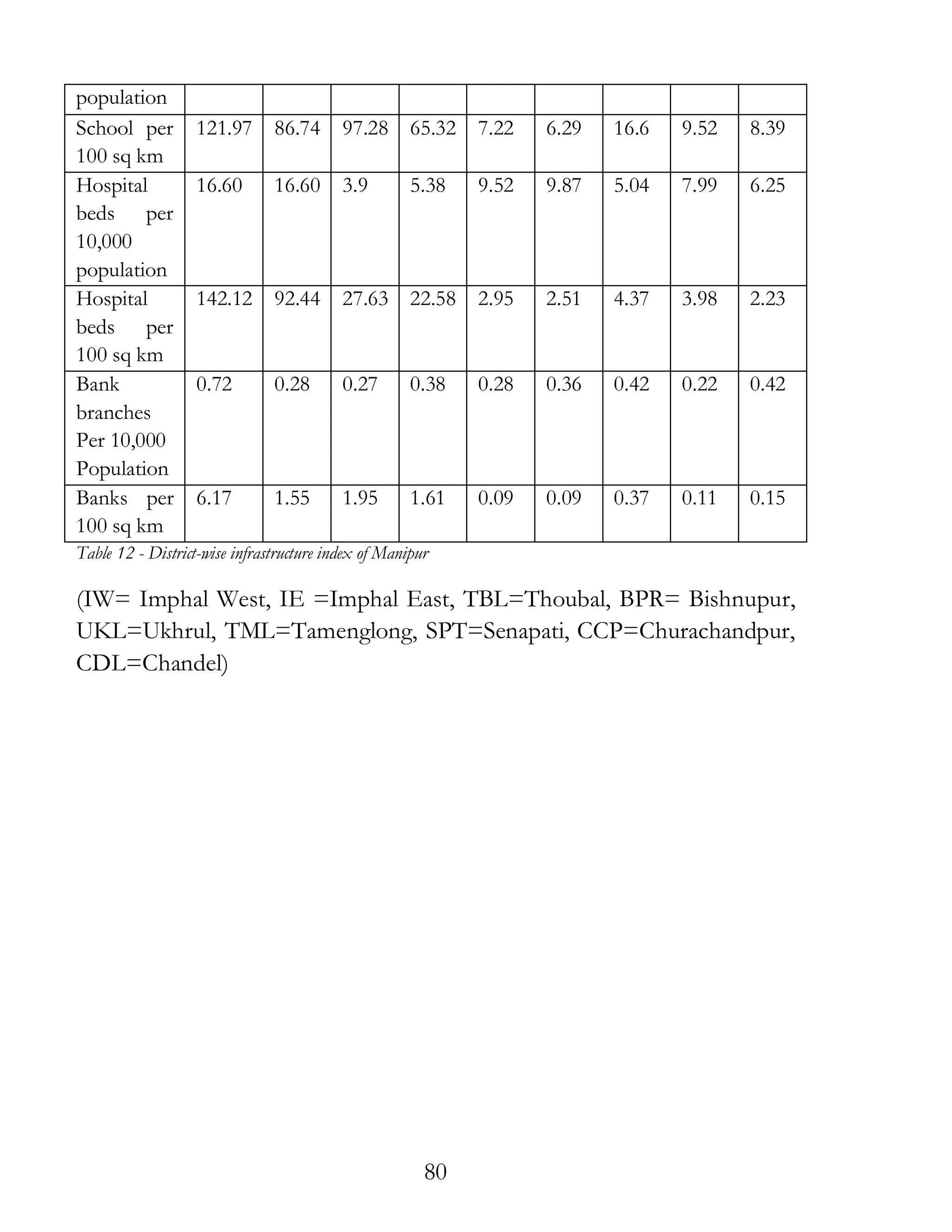
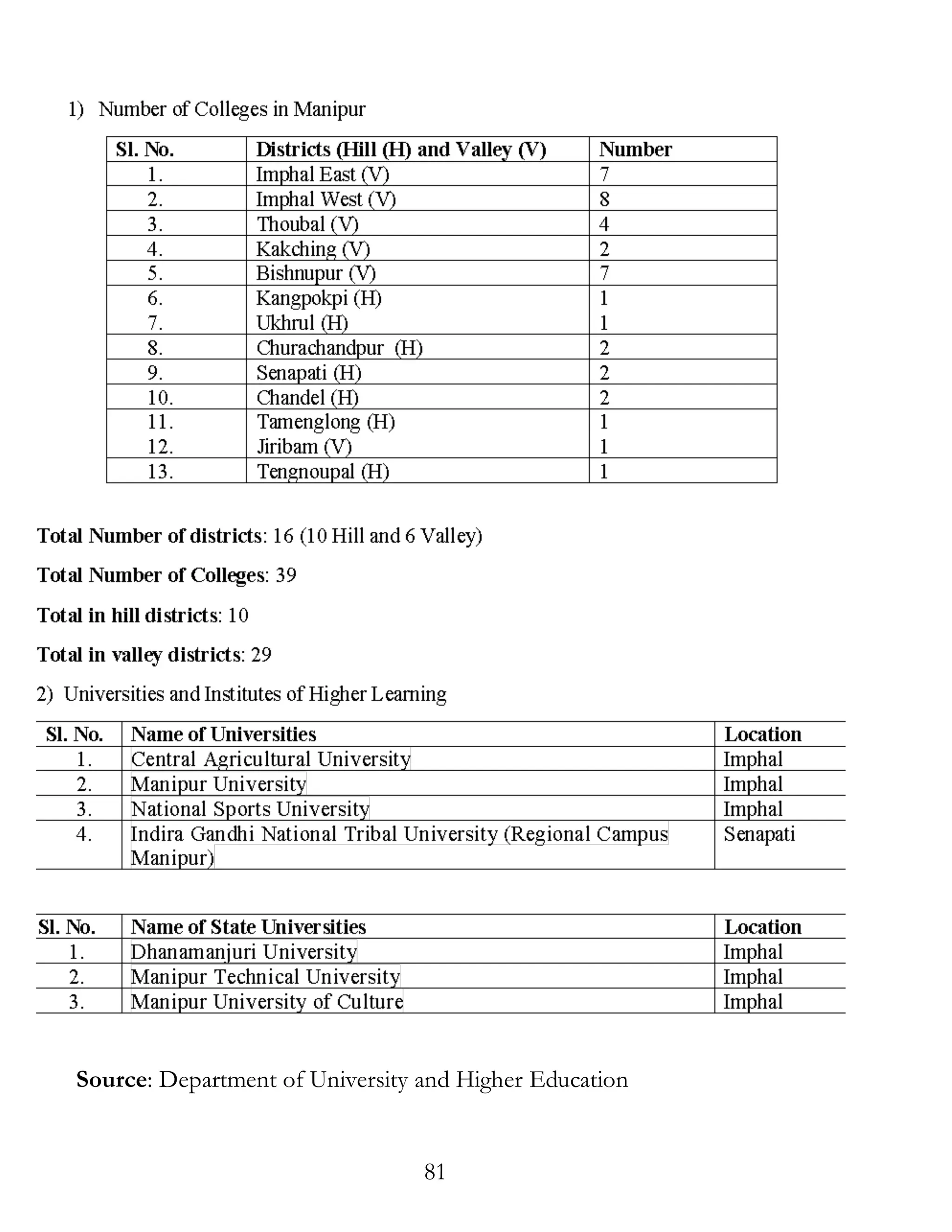
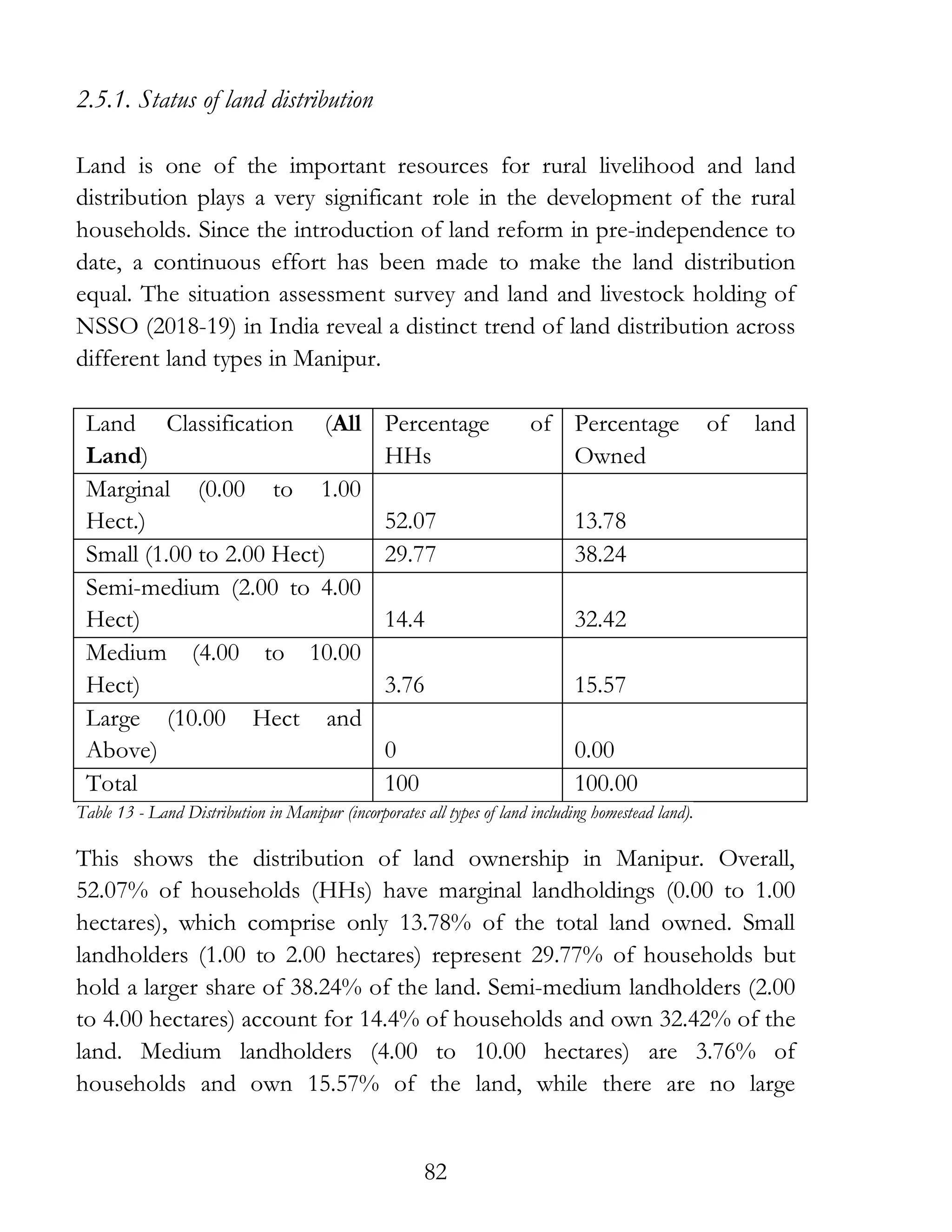
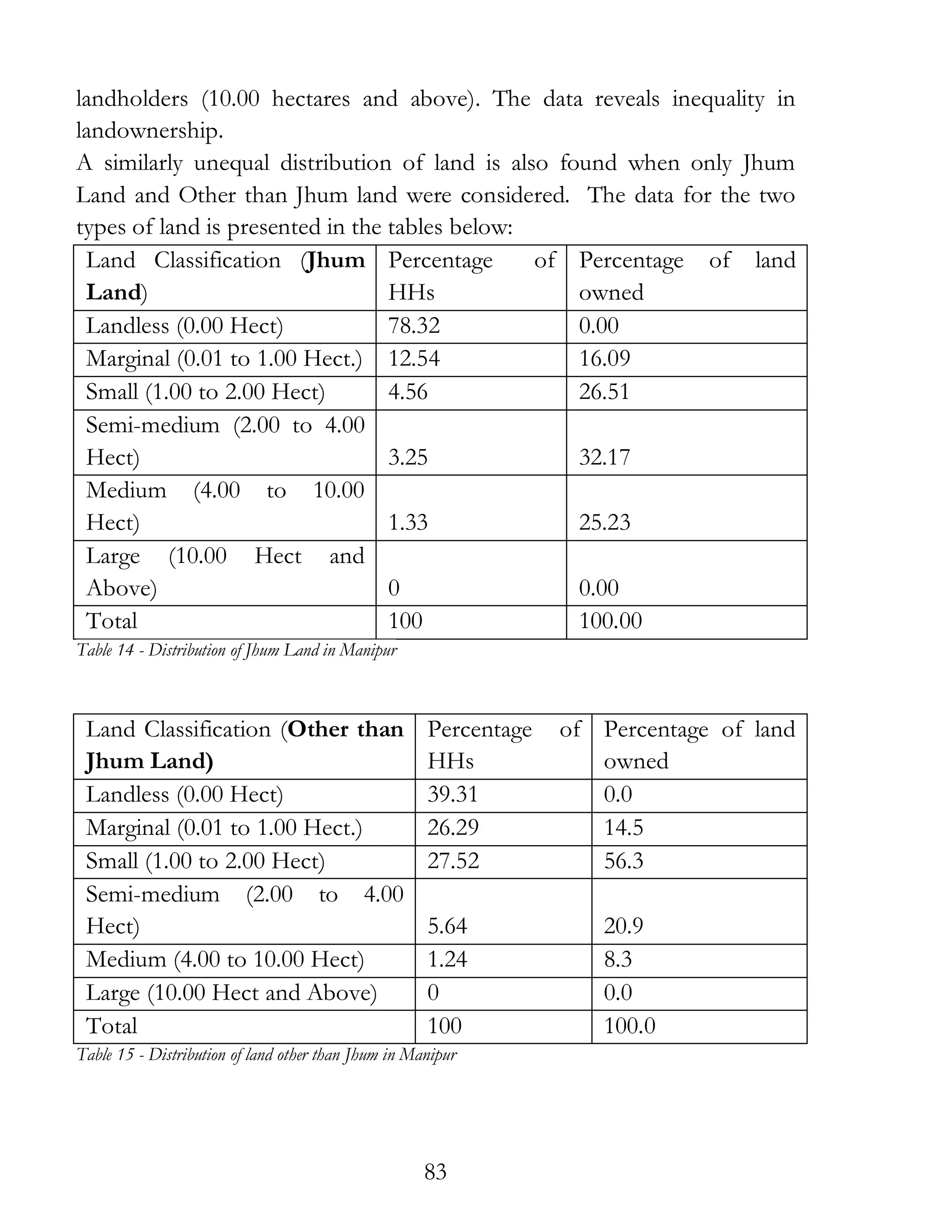
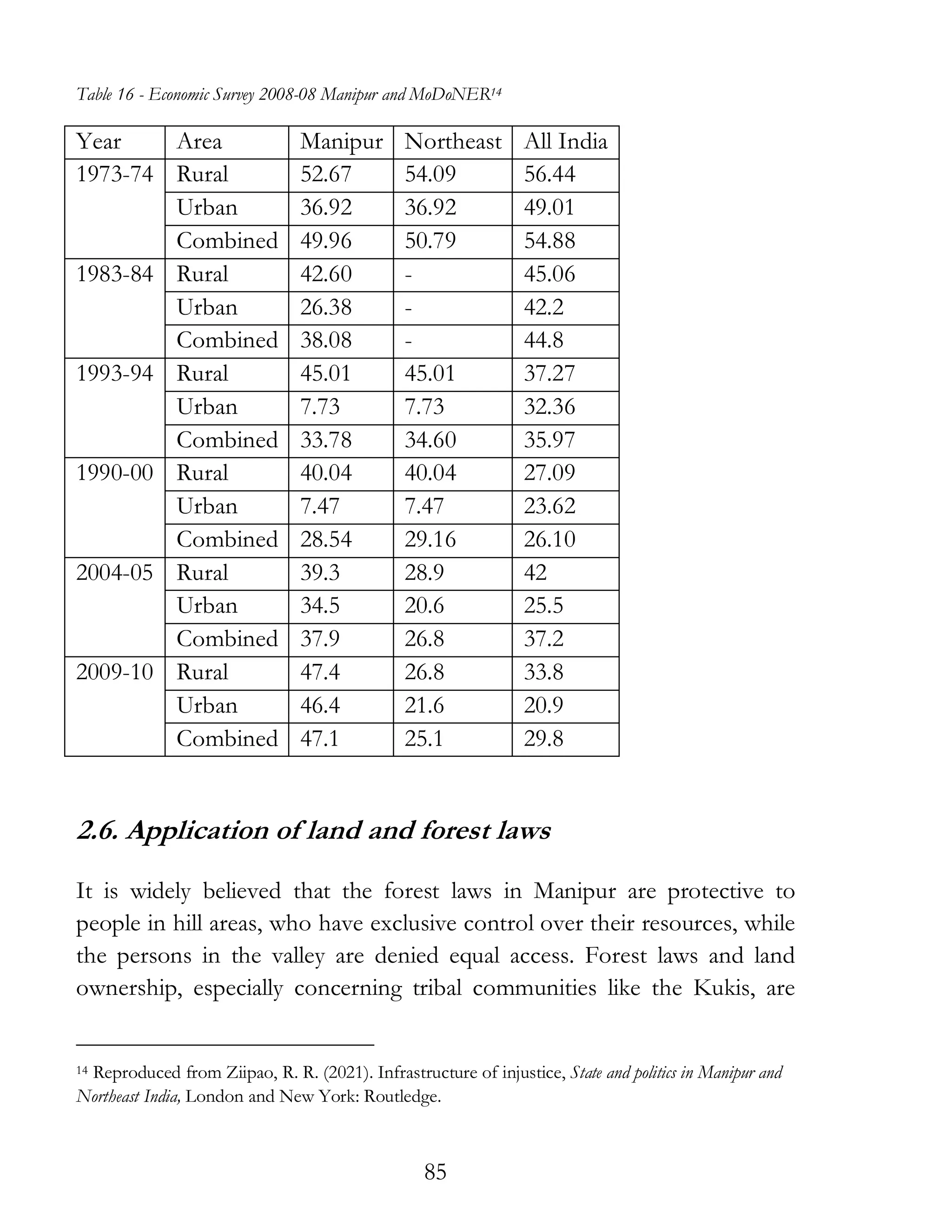
![86
shaped by a combination of Central and State-specific regulations. While
there is not a specific "forest law" that grants exclusive ownership rights to
the Kukis or any other tribe, several legal frameworks and customary laws
play a role in how tribal land is managed and protected.
2.6.1. Key Legal Frameworks:
1. The Indian Forest Act, 1927: -
This central law governs the administration of forests in India, including
Manipur. It defines different categories of forests such as Reserved
Forests, Protected Forests, and Village Forests. The Act provides a
framework for forest conservation but does not directly deal with tribal
ownership rights. Of the 22,327 sq. km area of Manipur, the forest area is
recorded at 17418 sq. km. constituting 78.1 percent of the total area of
the State. Of the total forest area, 11,780 sq. km, that is, 67.63 percent is
unclassed forest, meaning other than reserved and protected forest. The
unclassed forest includes those tracts of land that are ownedby tribals; and
those forests that are accessed,controlled, and managed by the tribal
communities as per their traditional system of governance and customary
laws. According to the Manipur government, “tribal communities and
tribal chiefs are already holding ownership [4] of forestland as their
ancestral land in non-reserved forest areas. Notwithstanding this, there
are considerable areas in Manipur under reserved or protected forest. Such
a category of forest in Manipur has come about through the extension of
the Indian Forest Act over forest which was already under the control of
the tribal communities. Thus, even under reserved forests, tribes have
been dwelling in the forest and are engaged in various economic activities.
As per the Forest Rights Act 2006, the prior rights of the tribes are
supposed to be recognized rather than treated as illegal occupants and
infiltrators. However, the tribal communities in most of the North East
enjoy unbridled authority over forests, free from State control unlike the
rest of the country, where the debilitating impact of the colonial-era Indian](https://image.slidesharecdn.com/manipur-report-250821093300-90785df6/75/Manipur-Report-pdf-governance-failure-in-Manipur-86-2048.jpg)
![93
(2) The Governor shall annually, or whenever so required by the President, make a
report to the President regarding the administration of the Hill Areas in the State of
Manipur and the executive power of the Union shall extend to the giving of directions to
the State as to the administration of the said areas.
Explanation.—In this article, the expression “Hill Areas” means such areas
as the President may, by order, declare to be Hill Areas.]
The then President V.V.Giri issued the Manipur Legislative Assembly
(Hill Areas Committee) Order, 1972 constituting a Hill Areas Committee
with members of the Assembly from the Hill areas constituencies. The
functions delineated included framing of questions of policy and all
matters concerning Hill areas covered under a schedule and their special
needs, and promote unity between the people of the Hill Areas and other
areas of the State by aiming at an integrated and evenly based economic
growth of those areas and augment the resources of the State as a whole.
The schedule included management of any forest not being a reserved
forest, establishment of village committees or councils with powers
relating to village administration, social customs, etc. The declared Hill
areas were:
(1) Manipur North, Manipur East, Manipur West and Manipur South
revenue districts;
(2) Chandel, Chakpikarong and Tengnoupal revenue sub-divisions of the
Manipur Central revenue district.
Explanation:- Any reference to a revenue district or revenue sub-division in
this schedule shall be construed as a reference to the areas comprised
within that district or sub-division, as the case may be, on the 1st day of
April, 1972.](https://image.slidesharecdn.com/manipur-report-250821093300-90785df6/75/Manipur-Report-pdf-governance-failure-in-Manipur-93-2048.jpg)
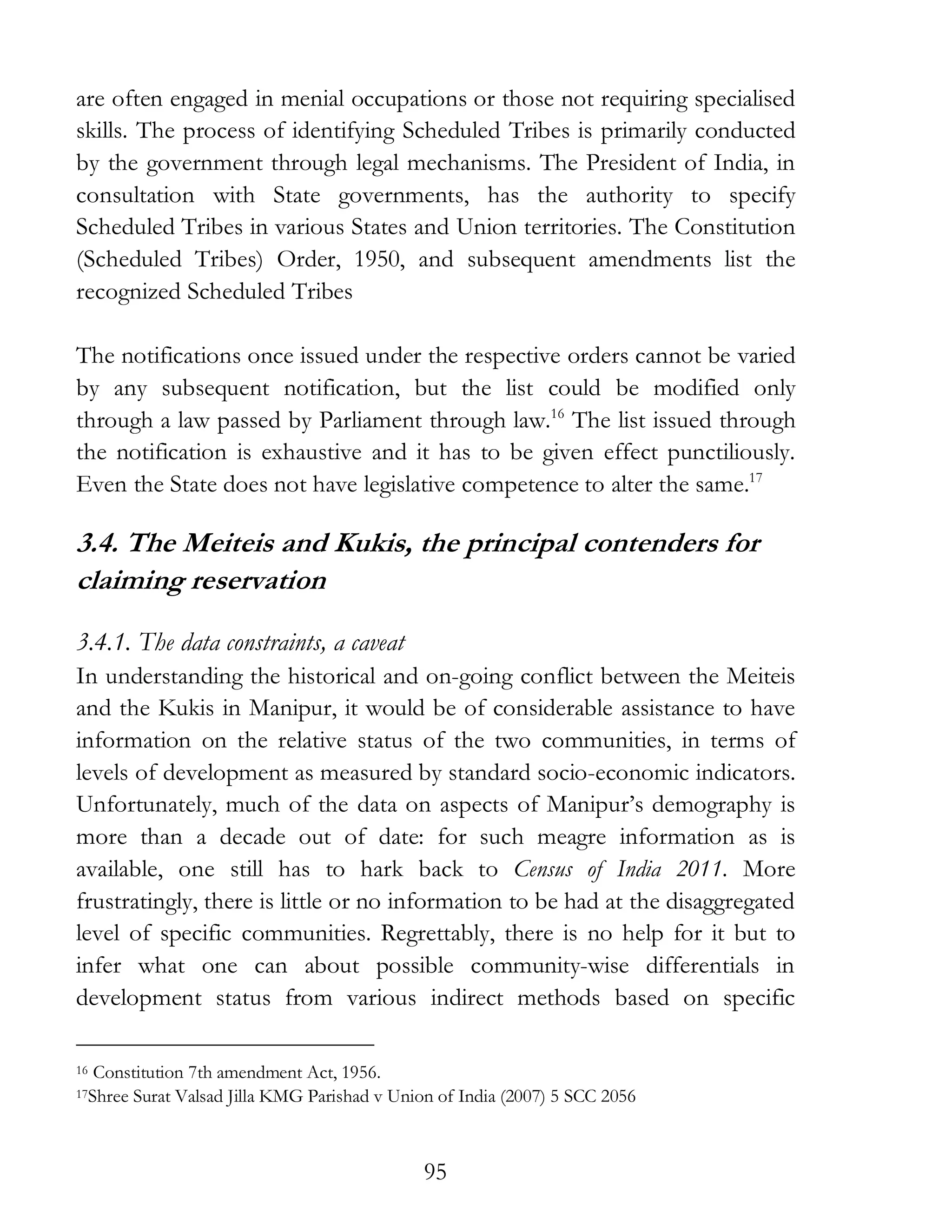
![96
assumptions and proxies. This is profoundly unsatisfactory, but something
to be going along with in the absence of happier alternatives to hand.
What follows in these notes is an account constrained by the
considerations just mentioned.
3.4.2. An Indirect Approach to Ascertaining Inter-group Relative
Disadvantage.
Suppose we have two groups, call these A and B respectively, and suppose
further that we do not have data (or access to these data if they exist) on
group-specific indicators of well-being or ill-being. Suppose further that
Group A, unlike Group B, is predominantlycharacterised by a demographic
feature that is commonly associated with relative disadvantage. Then, in an
indirect way, it would appear to be fair to suggest that other things being
equal, the likelihood of Group A being relatively disadvantaged vis-à-vis
Group B is larger than the likelihood of the matter being the other way
around.
Think of Group A as the Kukis and of Group B as the Meiteis. Suppose
also that the demographic feature of relevance is that of rurality. It has long
been held that in most societies, rural populations in comparison with
their urban counterparts have poorer access to amenities and resources
conducive to improved living standards, and worse records of overall
development. This notion is encompassed, for example, in the well-known
concept of what the economist Michael Lipton18
called ‘urban bias’. (He in
fact went so far as to suggest that ‘…[the] most important class conflict in
the poor countries of the world today is…between the rural and the urban
classes’: Lipton, 1977, p.1).
18 Lipton, Michael (1977): Why Poor People Stay Poor: Urban Bias in World Development.
Harvard University Press: Cambridge, Mass](https://image.slidesharecdn.com/manipur-report-250821093300-90785df6/75/Manipur-Report-pdf-governance-failure-in-Manipur-96-2048.jpg)
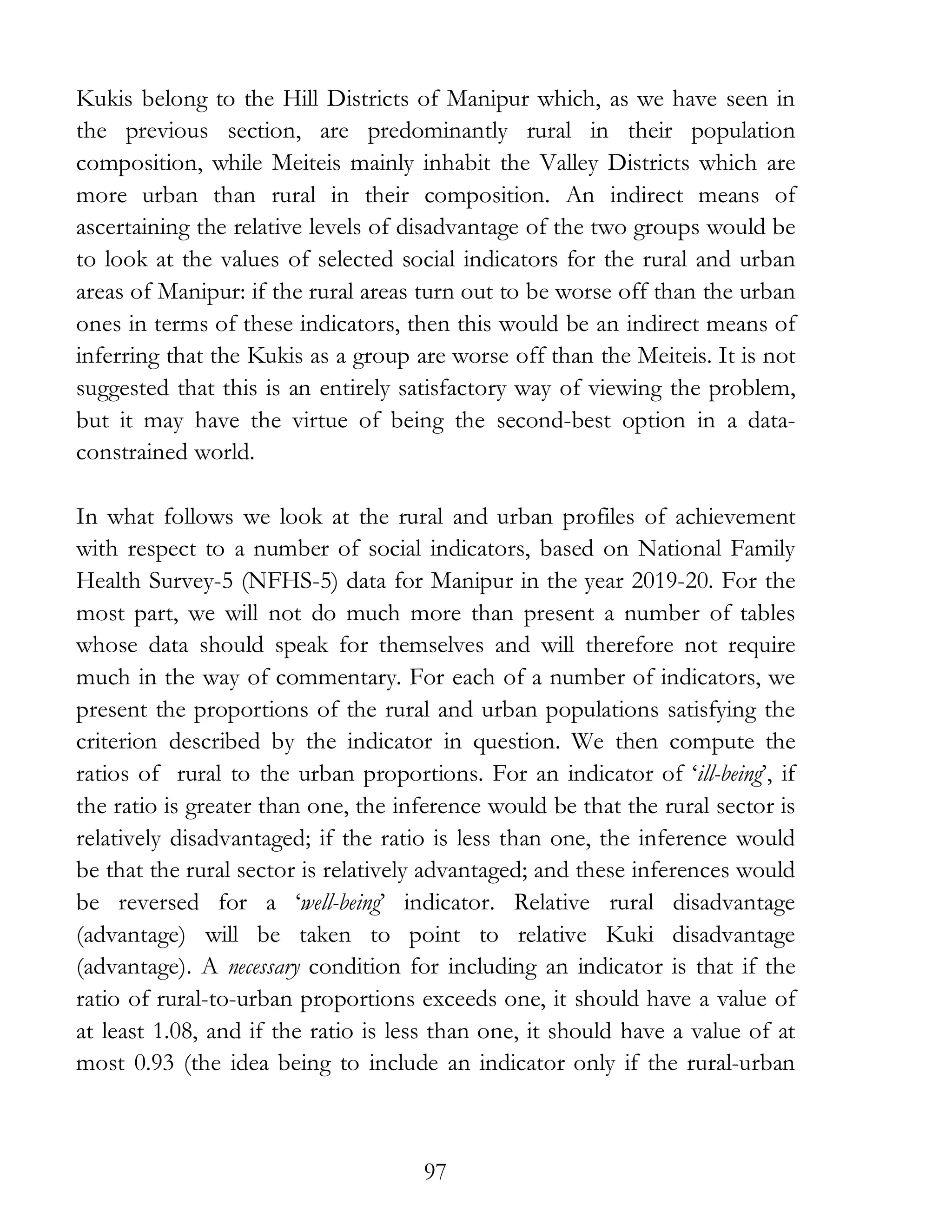
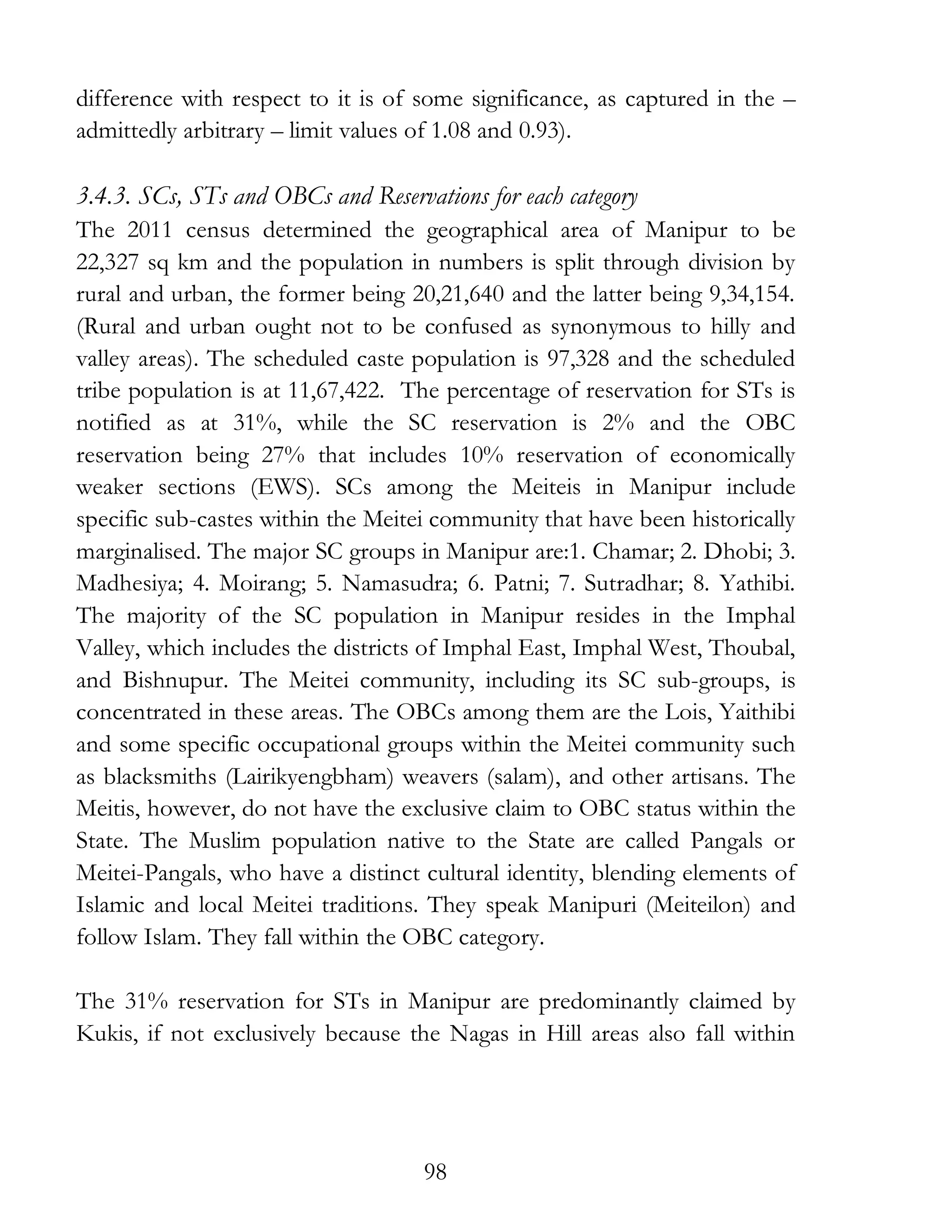
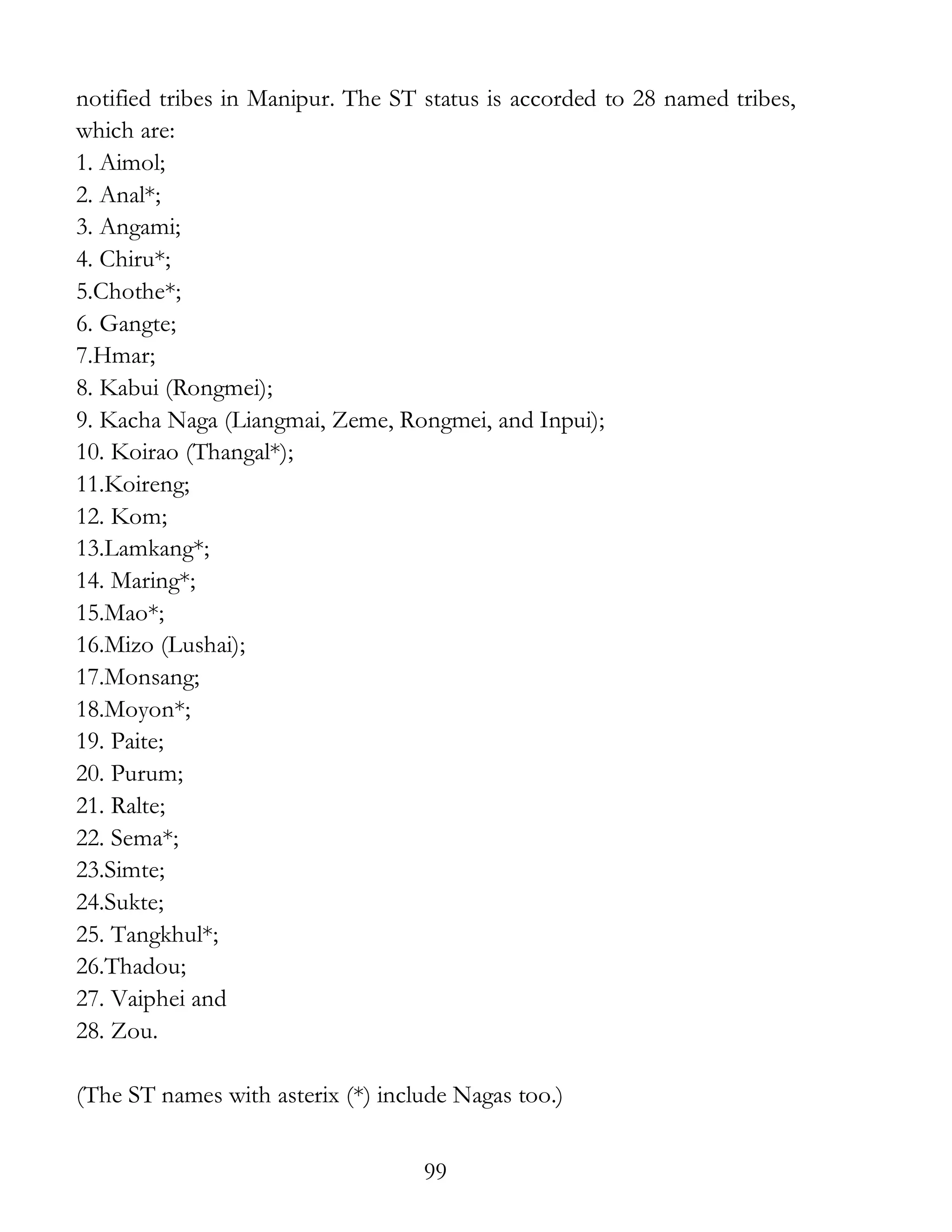
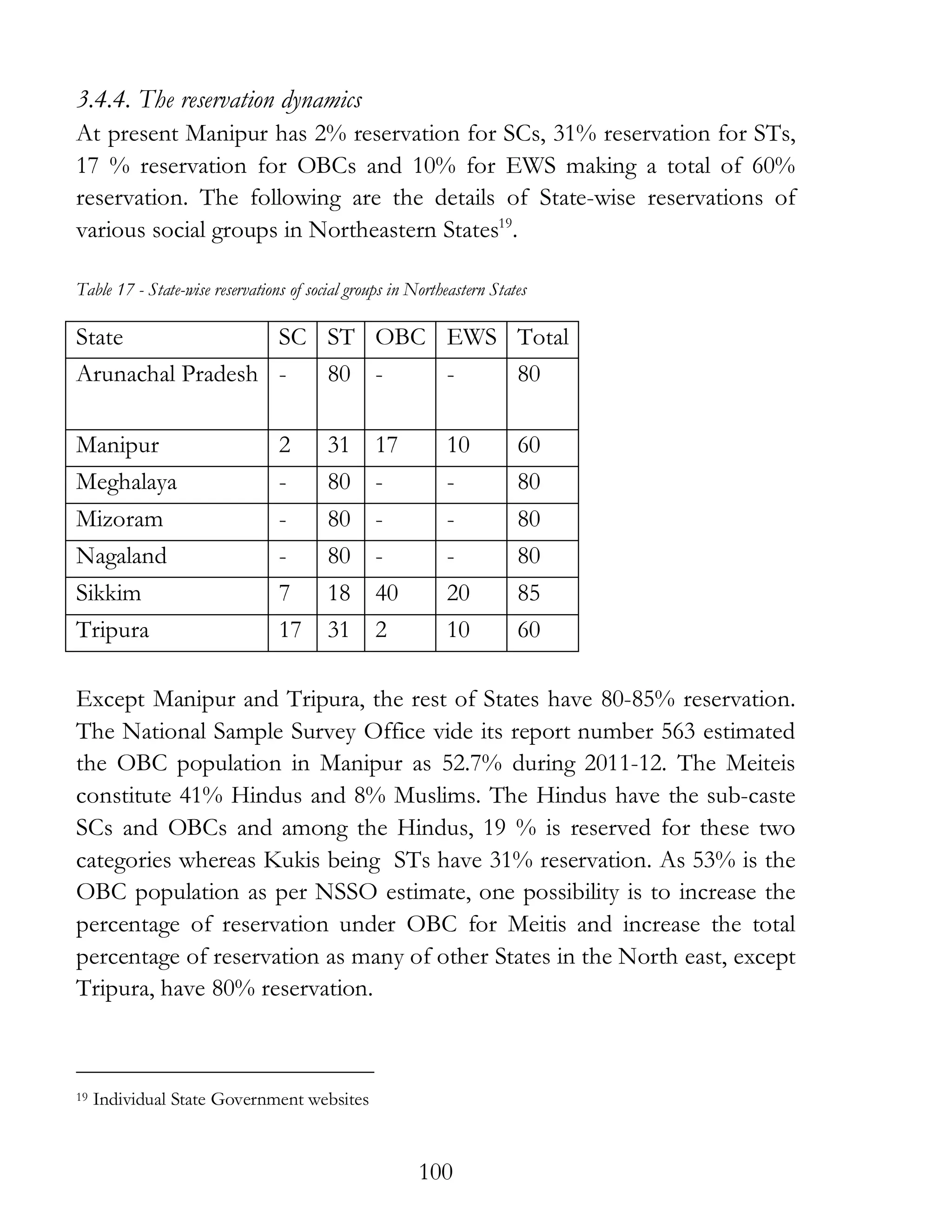
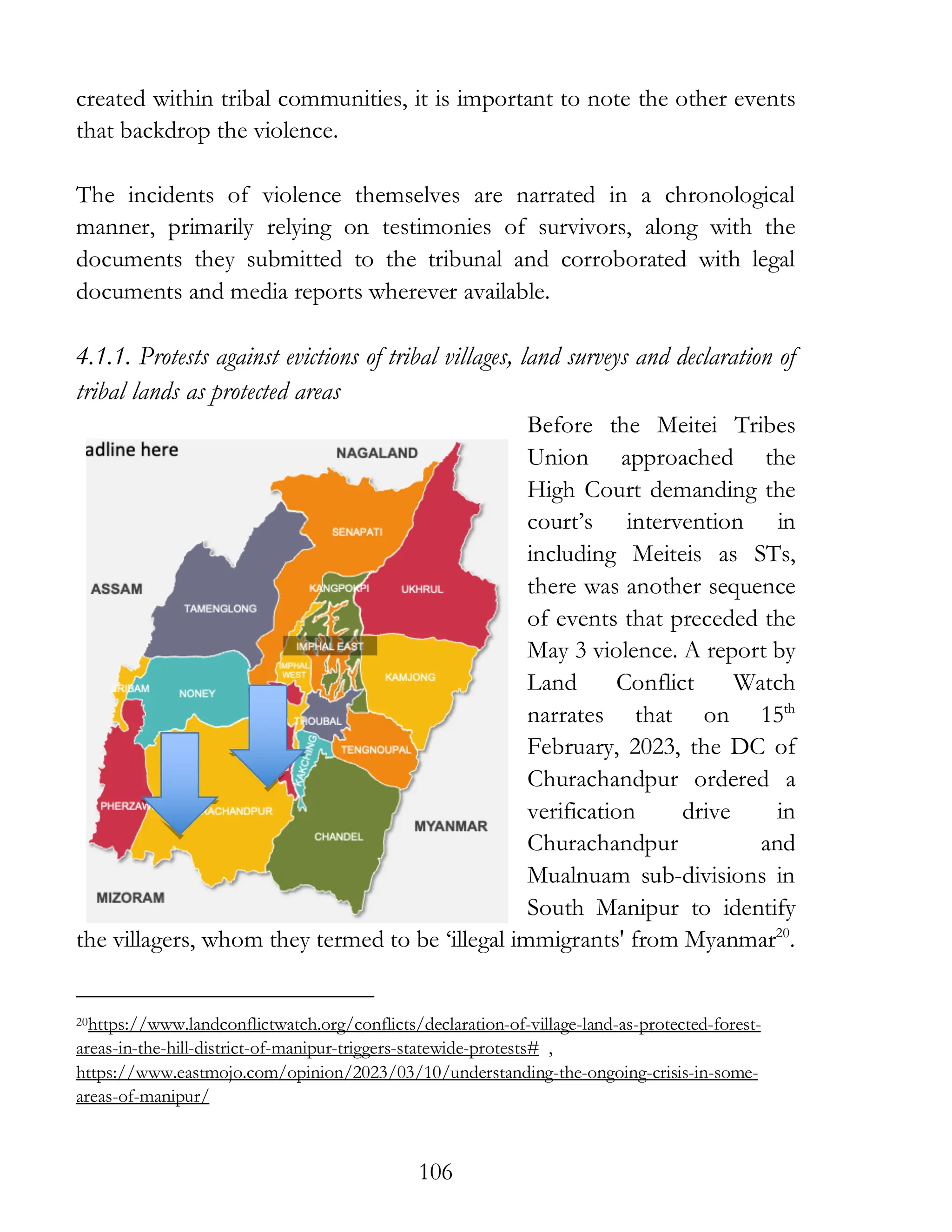
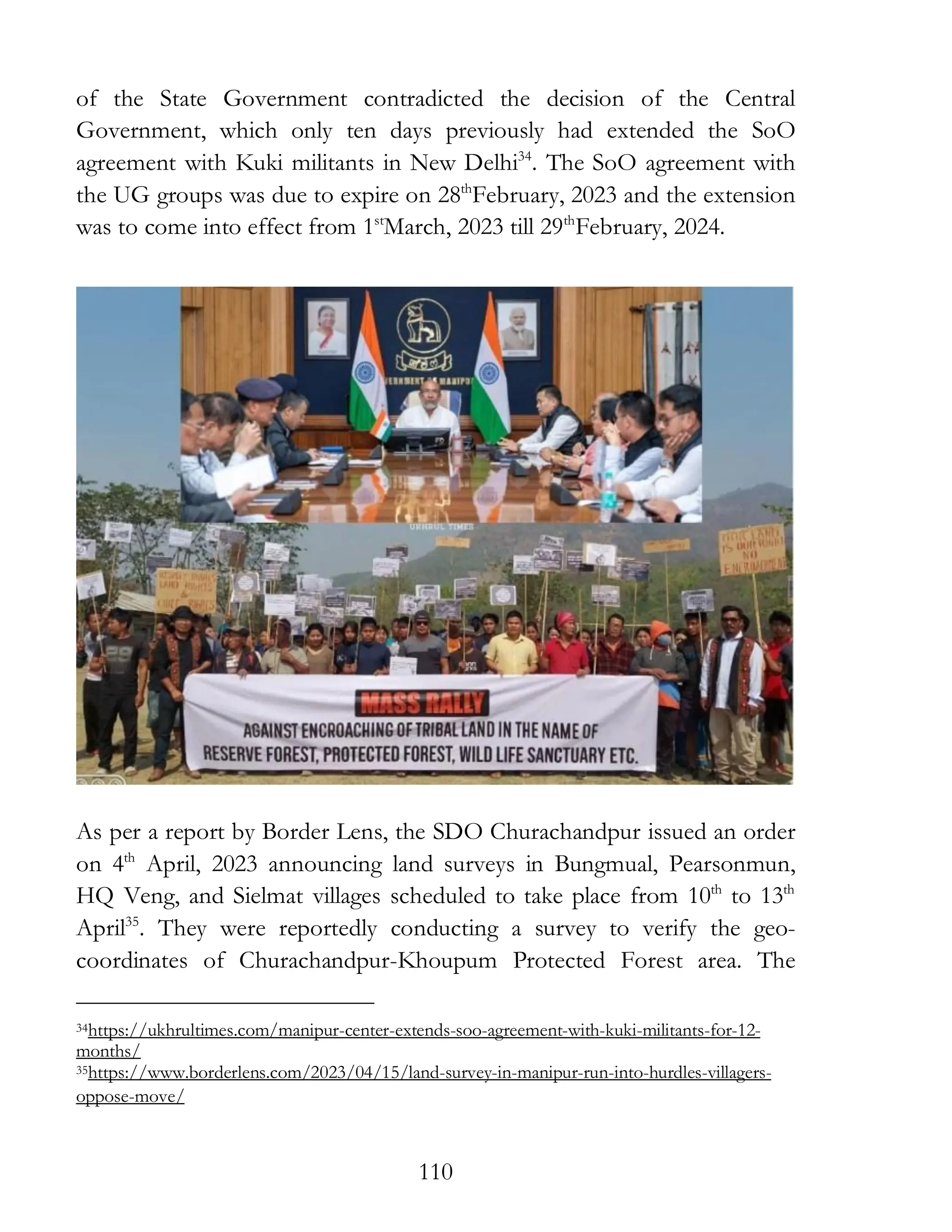
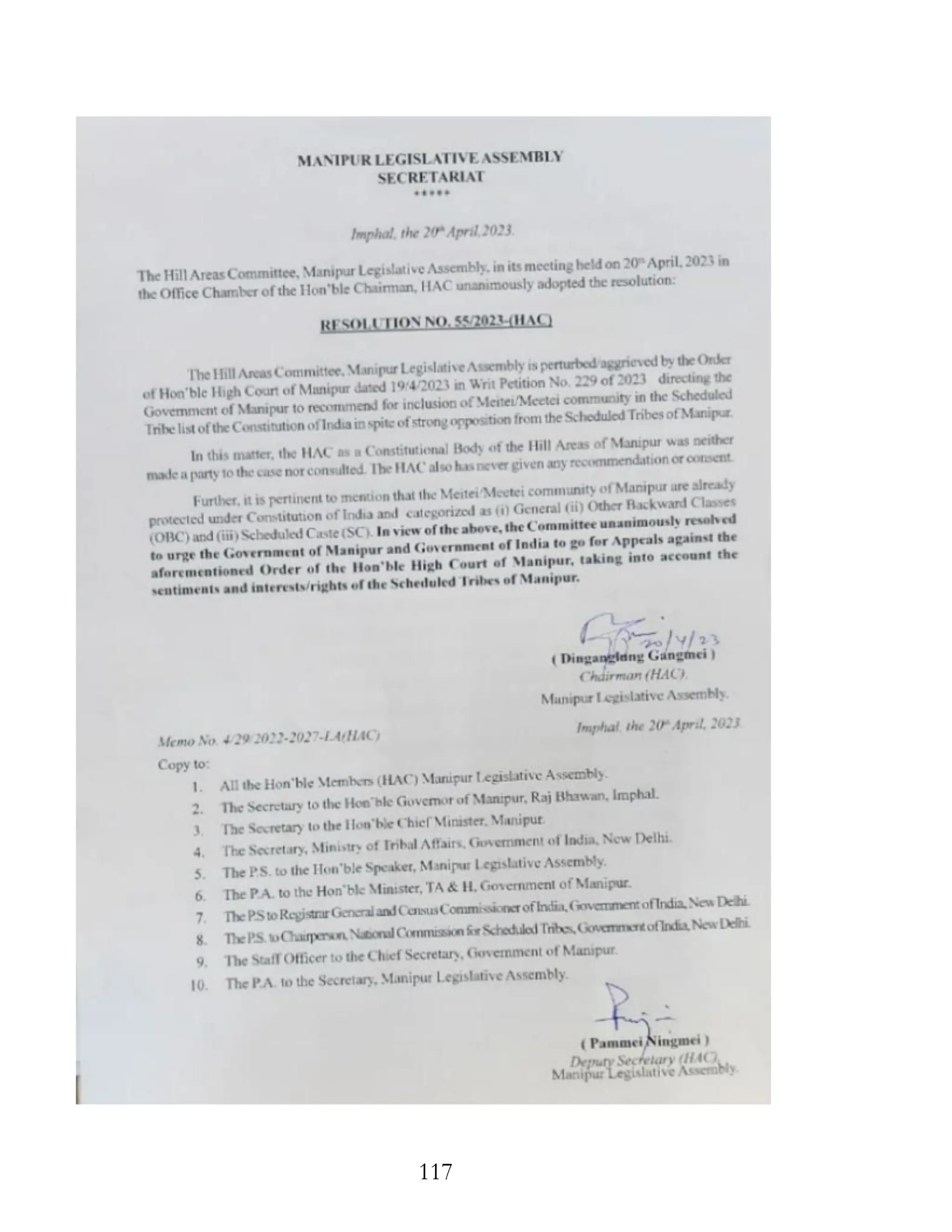
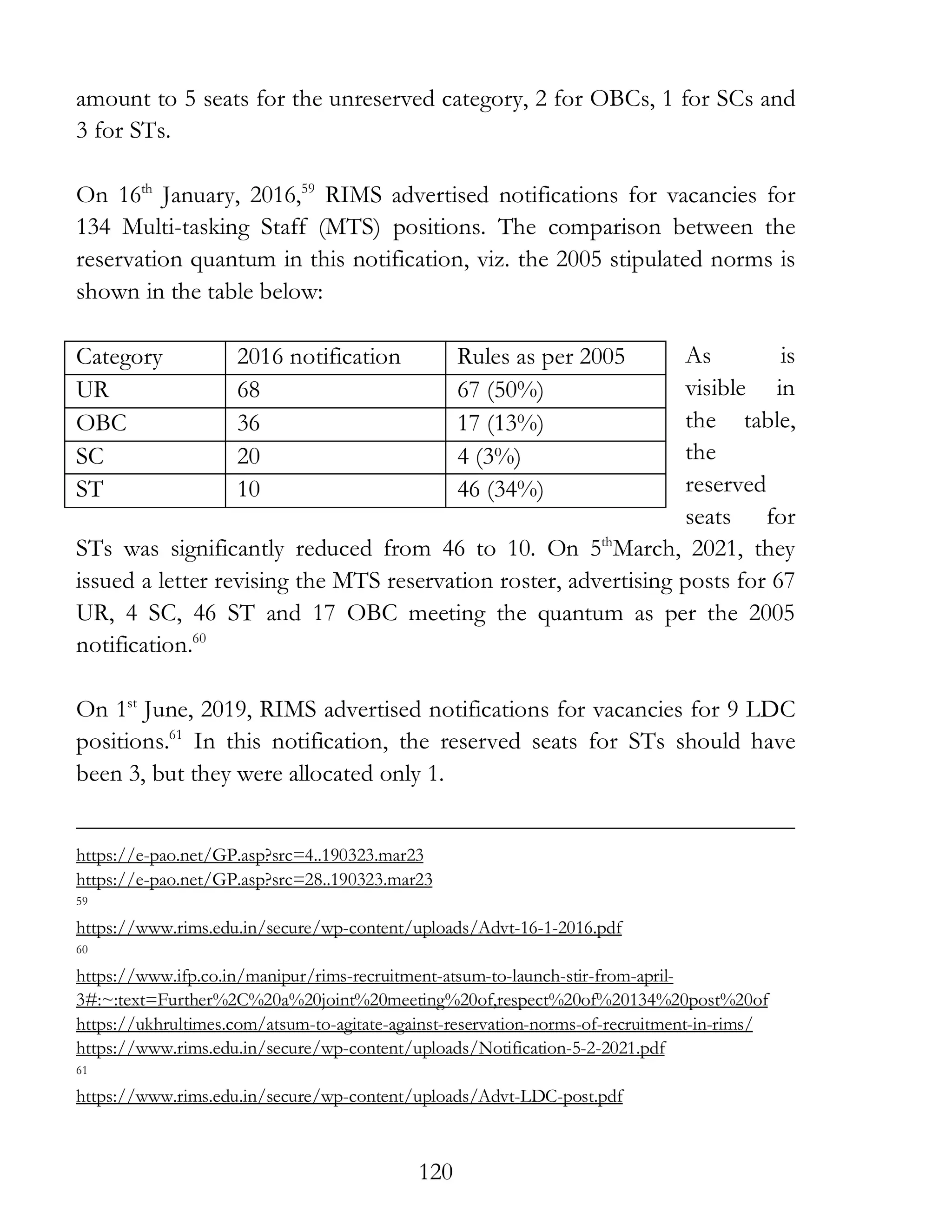
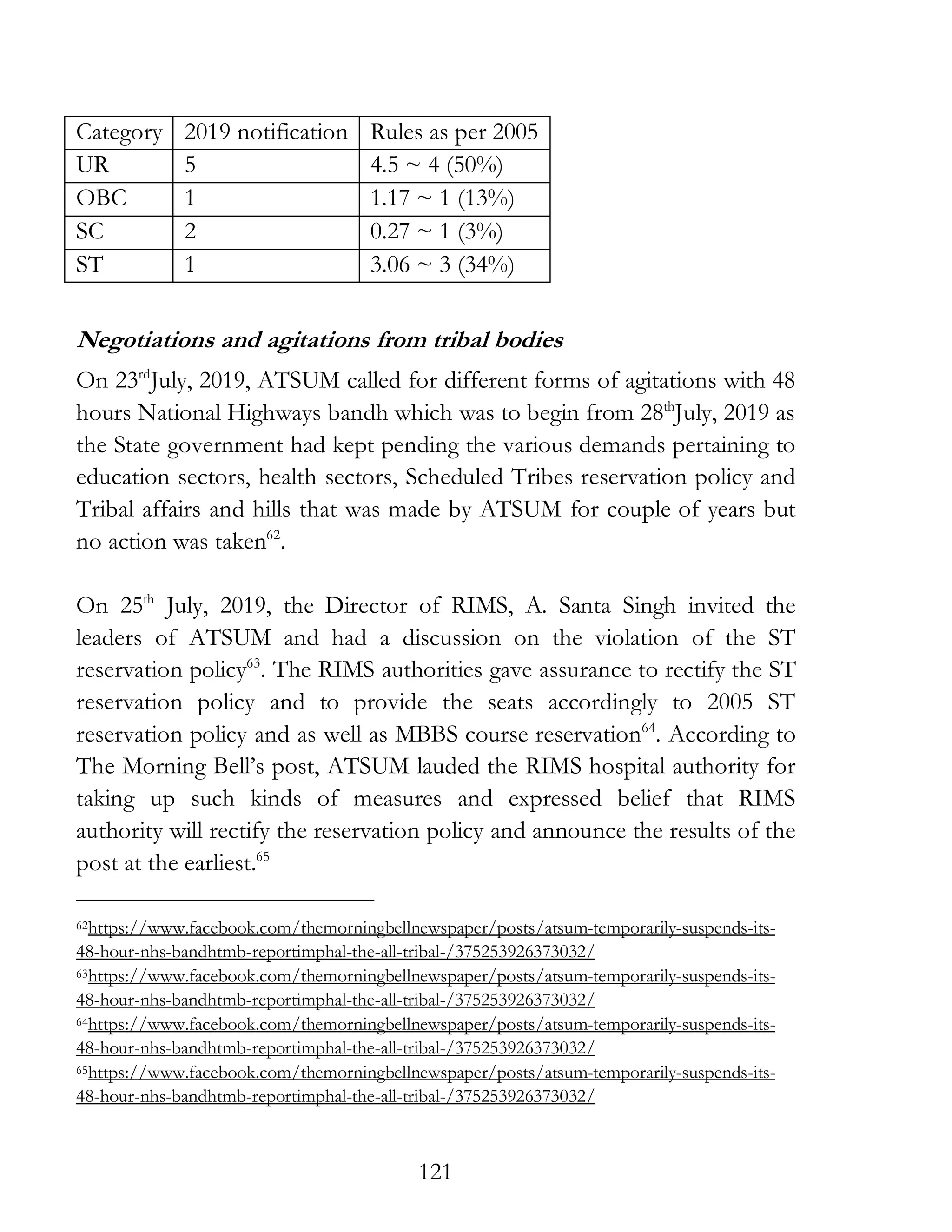
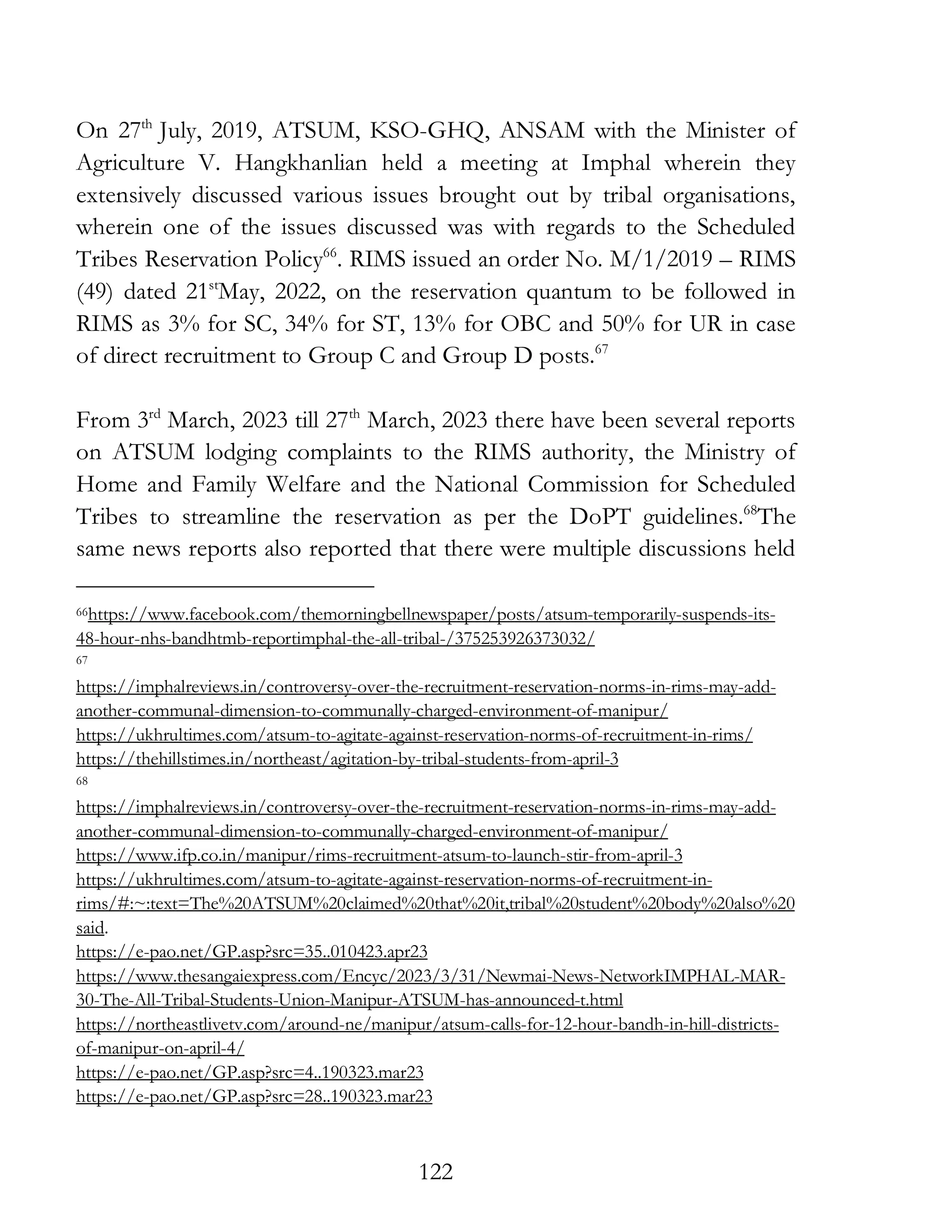
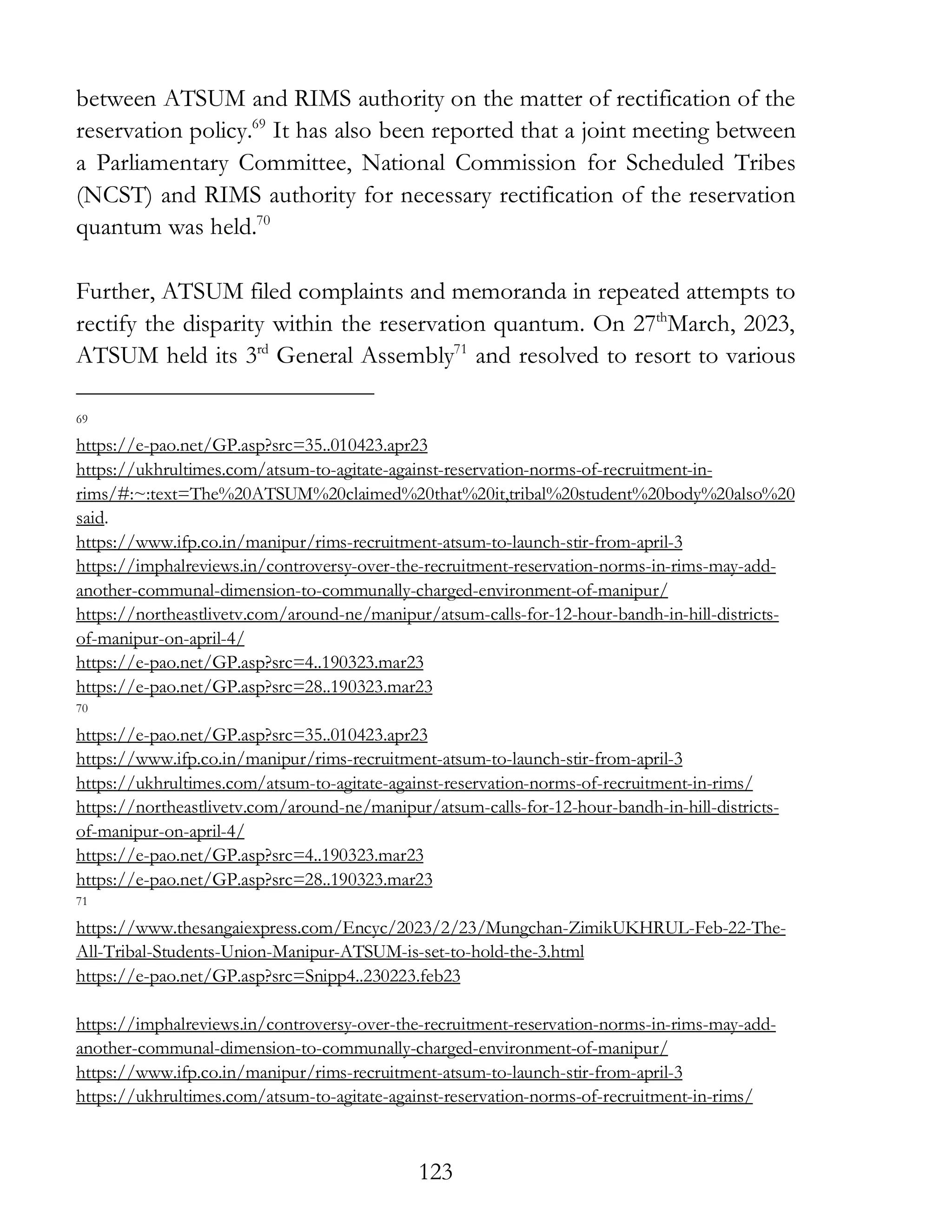
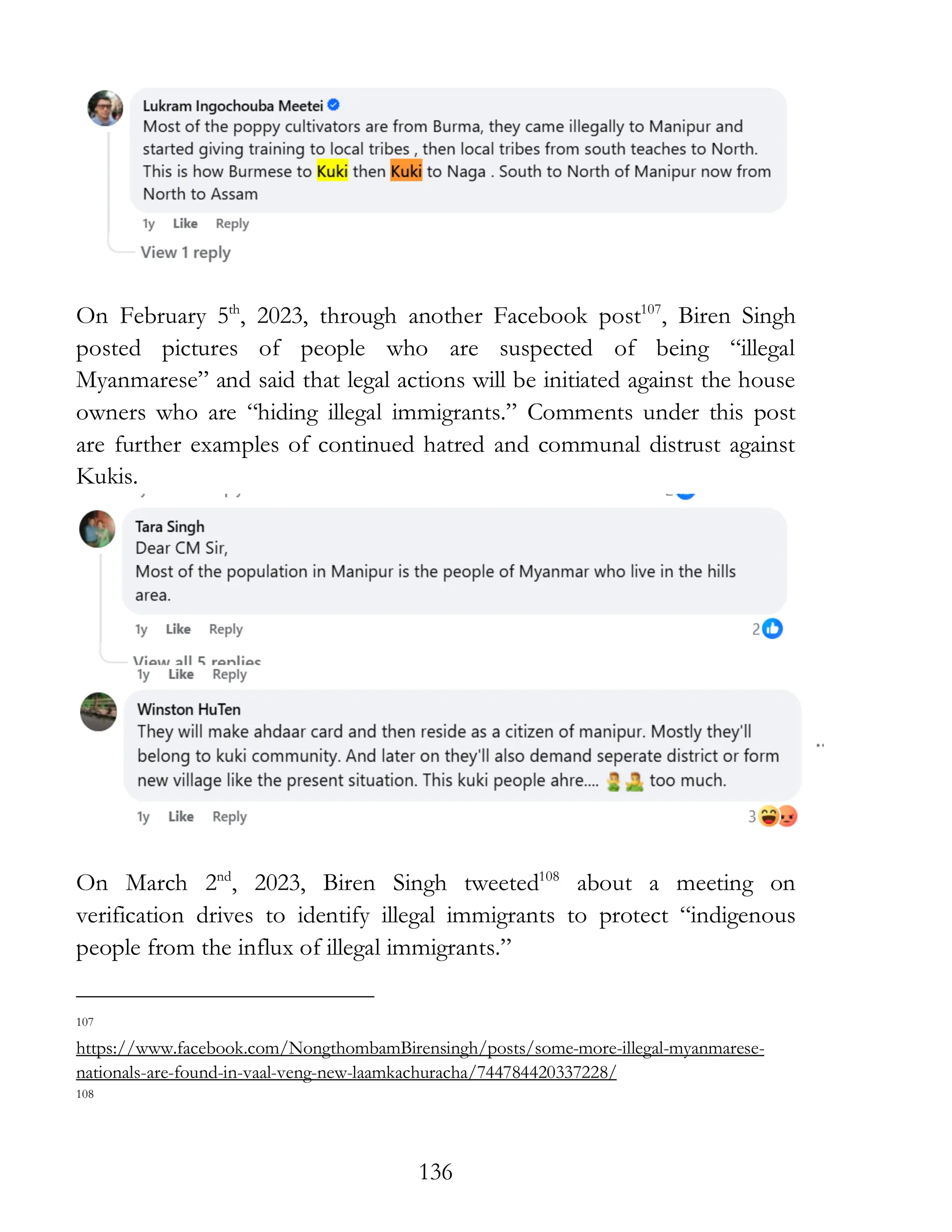
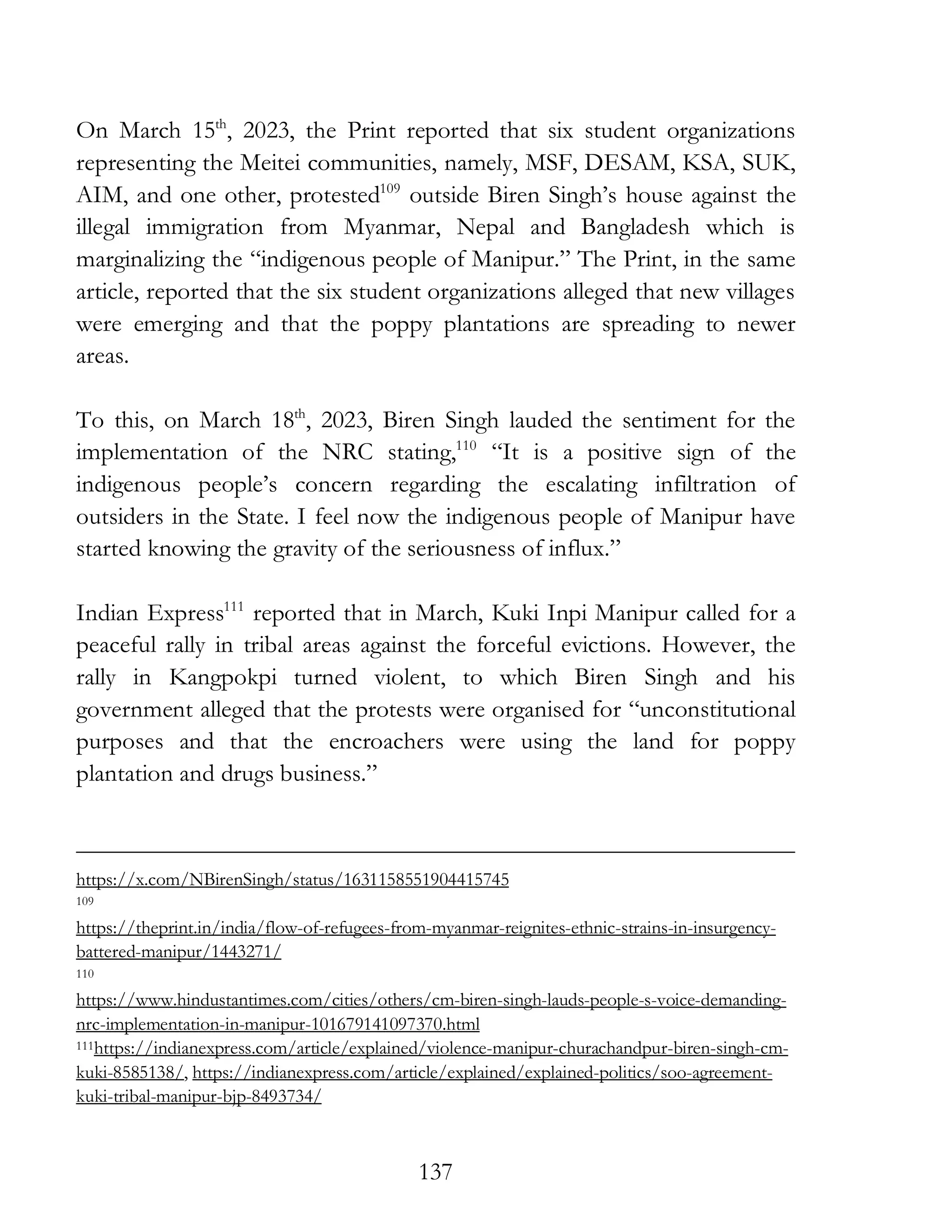
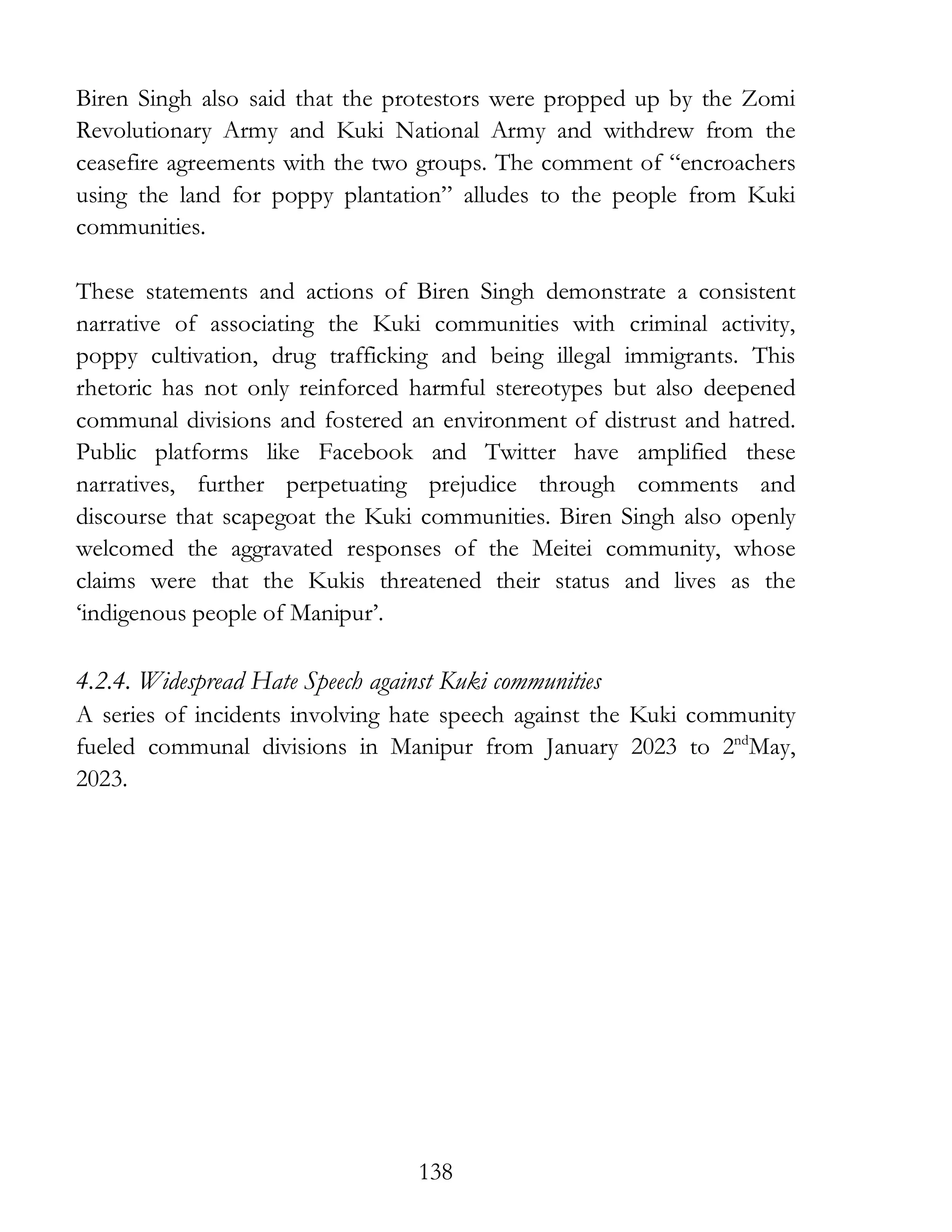
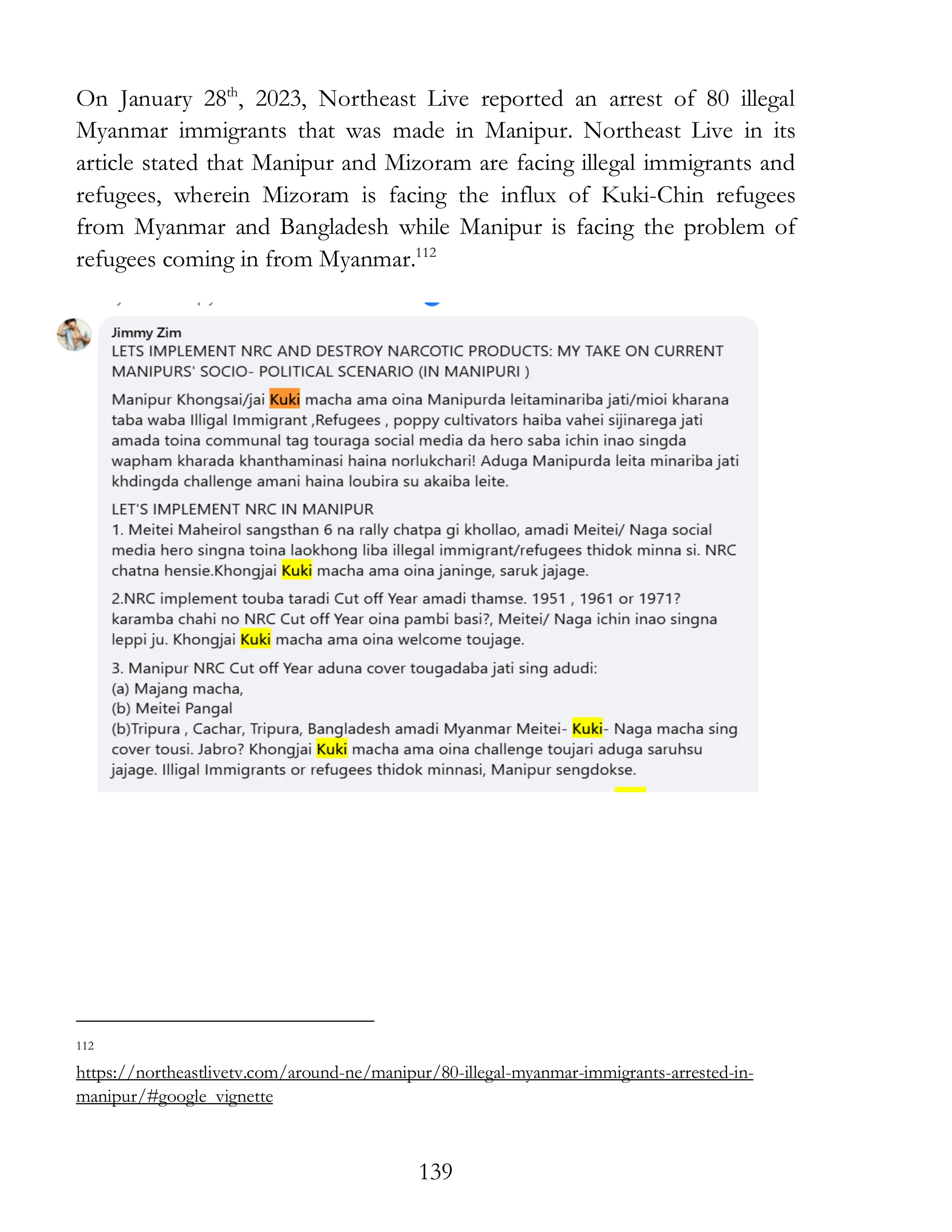
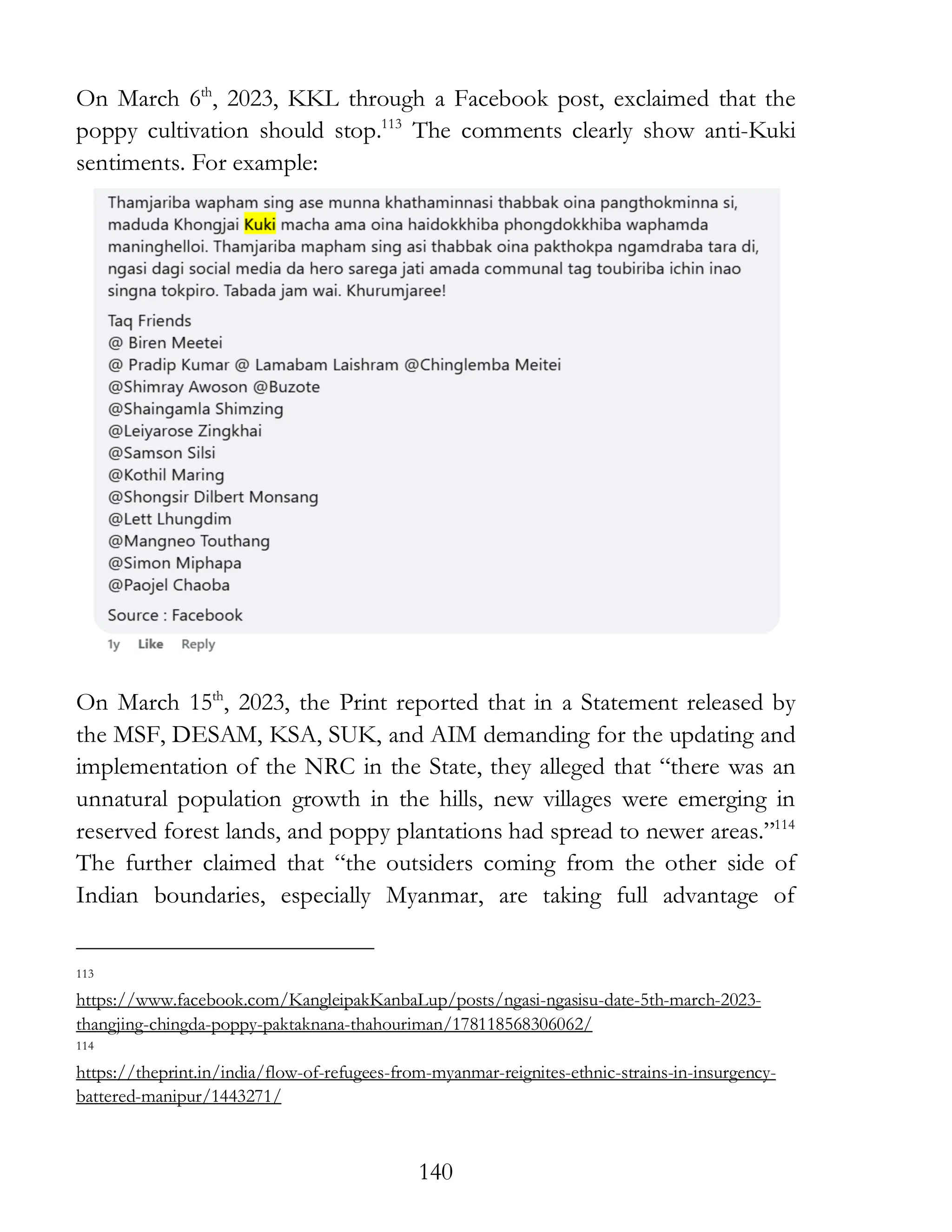
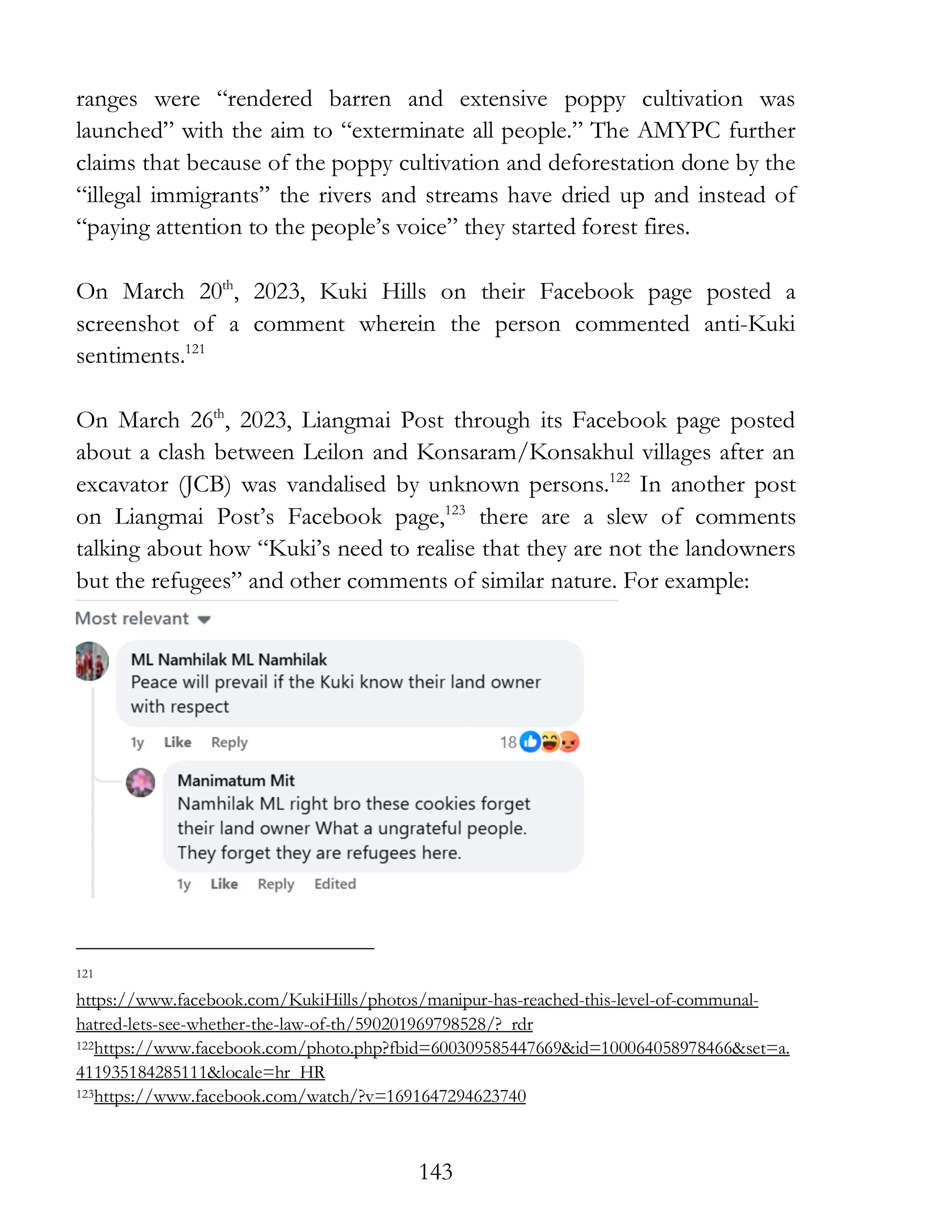
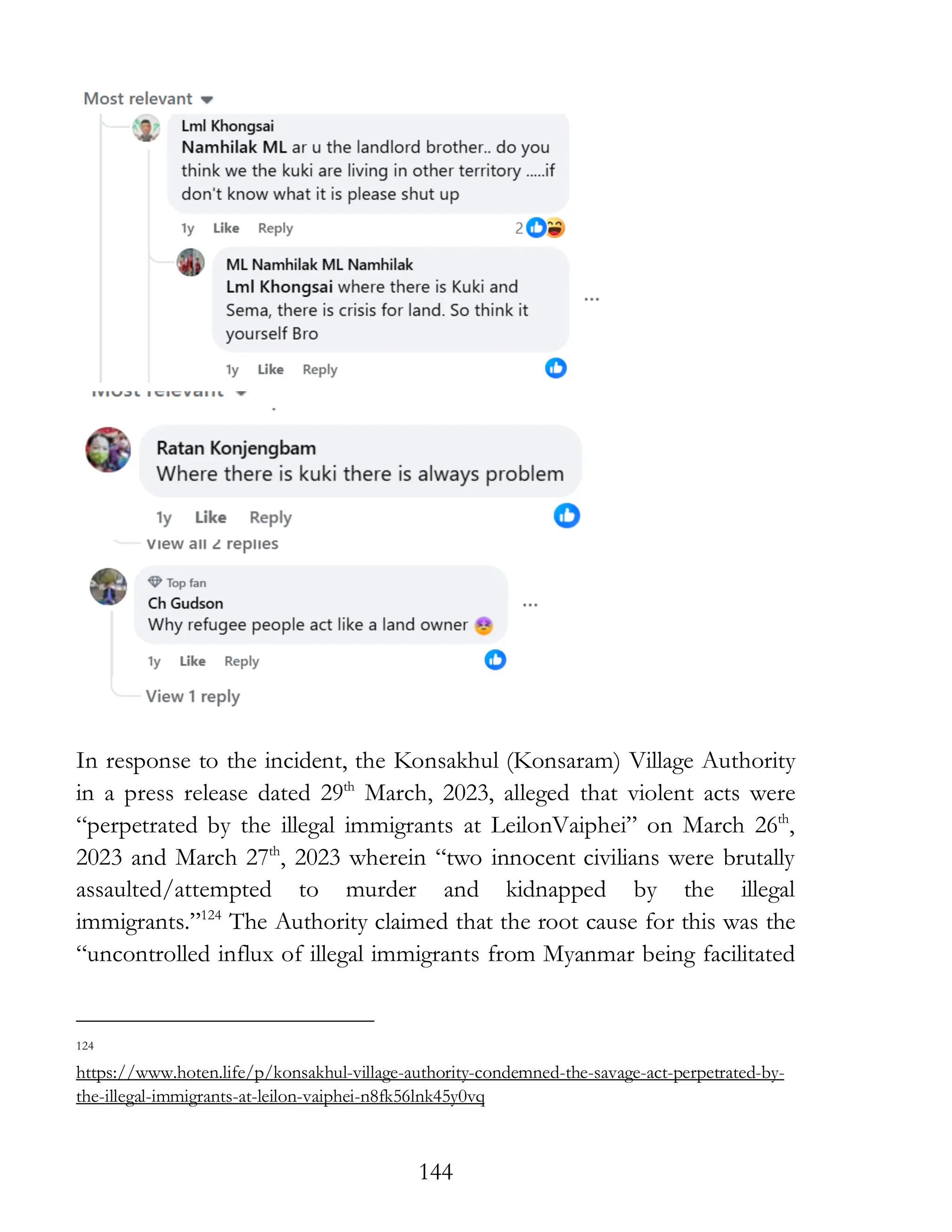
![154
Some houses were already marked. Some survey was going on a few
months ago under its pretext, and that is when houses were being marked.
In a meeting with the Tribunal, members of a Kuki body shared
(CCPurGD1):
“Speaking of houses, Kuki houses in Imphal were marked in red in the
guise of a geological survey, weeks before the violence erupted. After
violence erupted on May 3rd, each of those marked houses were looted
and burnt to the ground.”
The Tribunal also met with a senior official of the Assam Rifles, IGD13,
who said:
“In villages, you often know which house belongs to a Meitei and which
belongs to a Kuki but the same is not known in the cities. However, in
Imphal, all Kuki houses were marked from before the conflict which
made them easily identifiable. So, the Meiteis were prepared and better
organized initially. Later, however, the Kukis organized themselves and
were much better prepared than the Meiteis, and they were equally brutal
in their treatment of the Meiteis.”
KFD20, a Kuki woman who was raised in Churachandpur, deposed
before the tribunal sharing:
“My relative’s home in Imphal was marked with red marks. They said to
show the land paper. Their last question was about their ethnicity. They
said it was a smart city survey, which took place 3-4 months before the
conflict happened. Something was brewing.
Again in my mama’s [uncle] village, they came to collect the mountain and
hill paper- saying they are from the government. They submitted all](https://image.slidesharecdn.com/manipur-report-250821093300-90785df6/75/Manipur-Report-pdf-governance-failure-in-Manipur-154-2048.jpg)
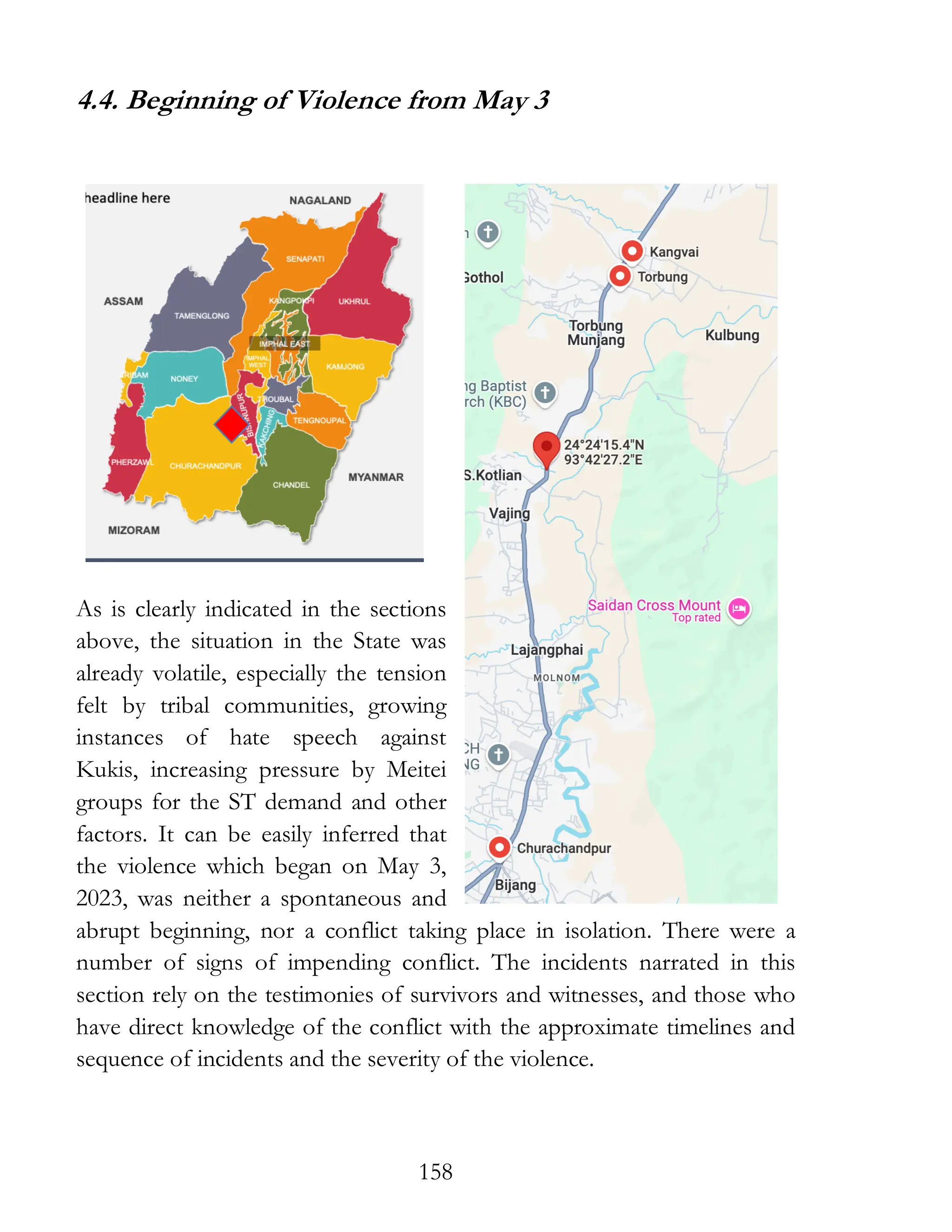
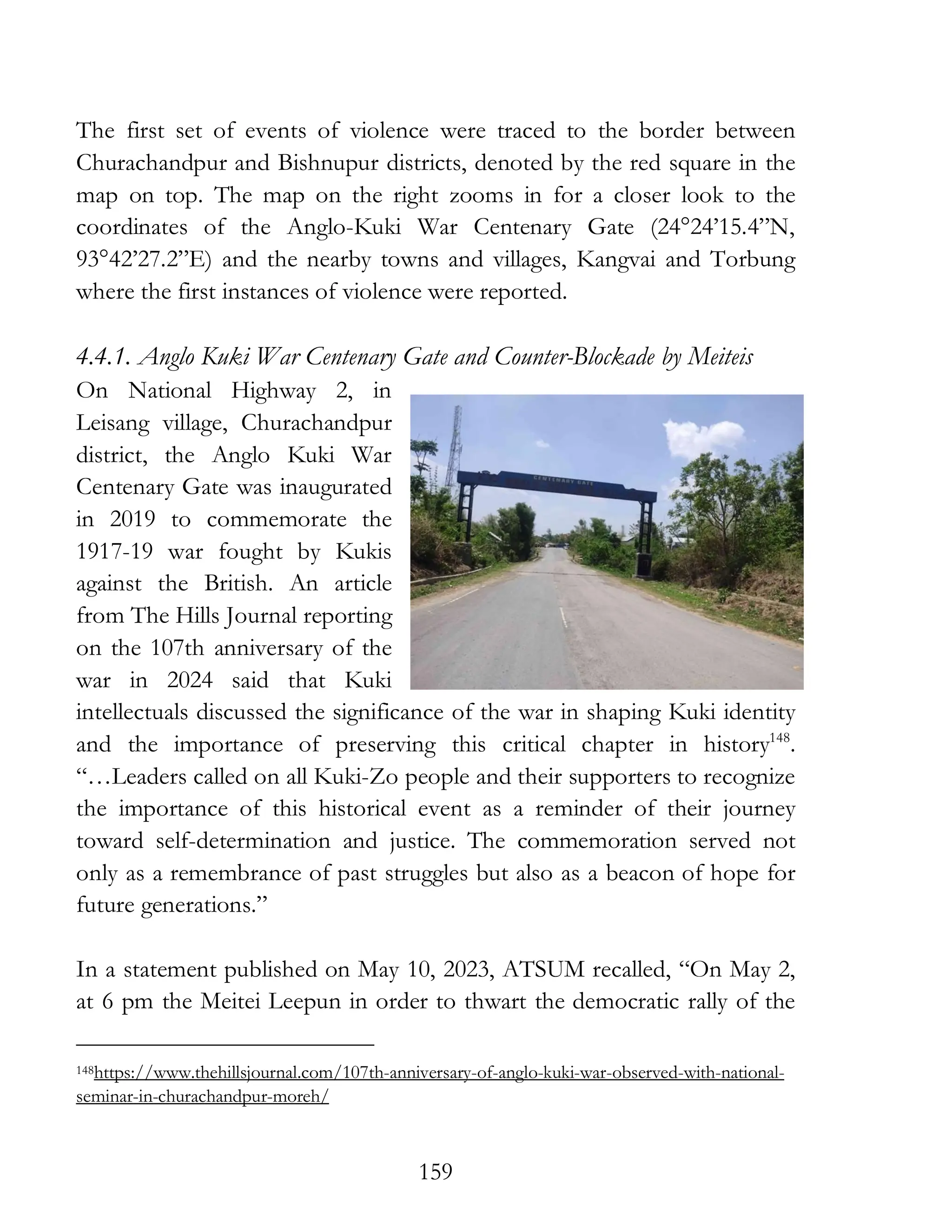
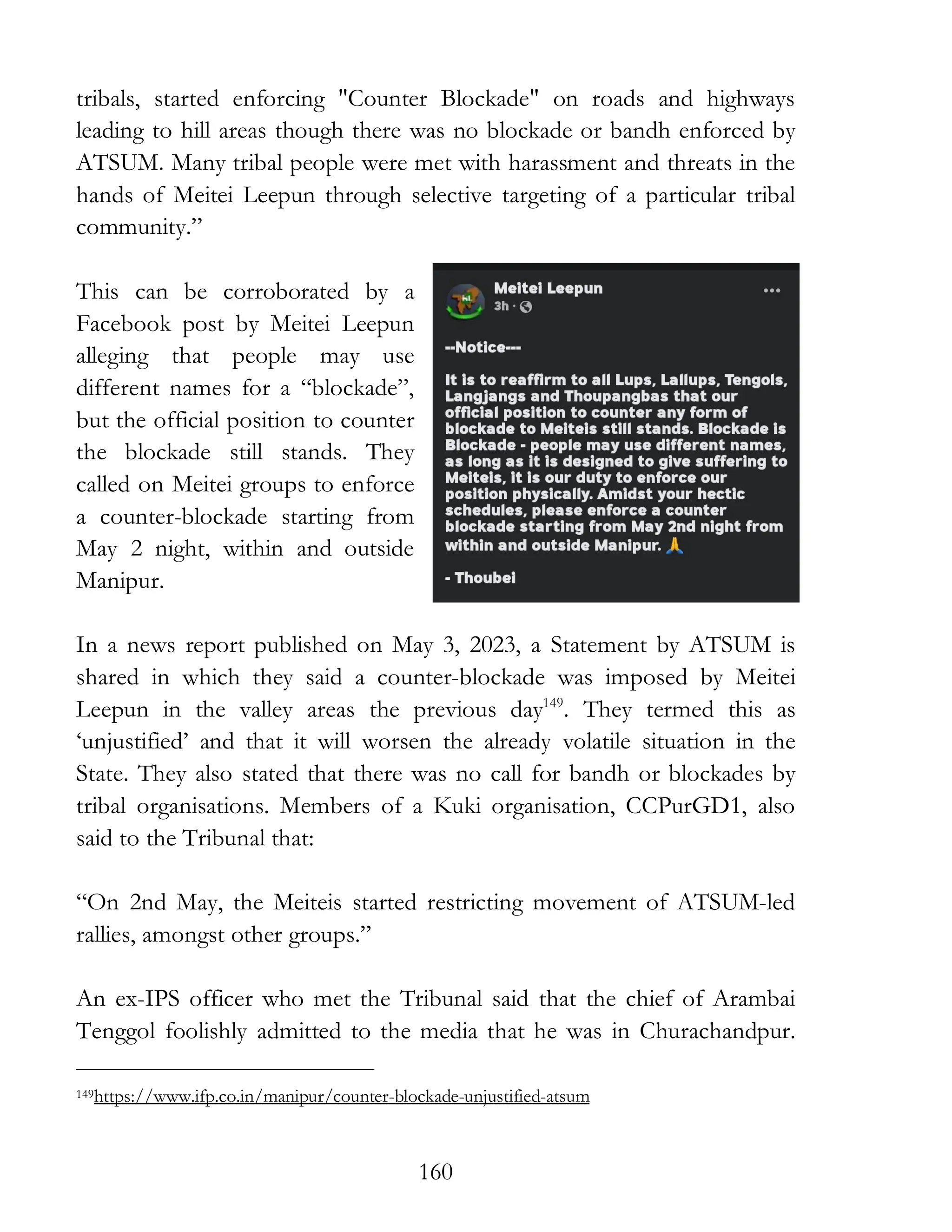
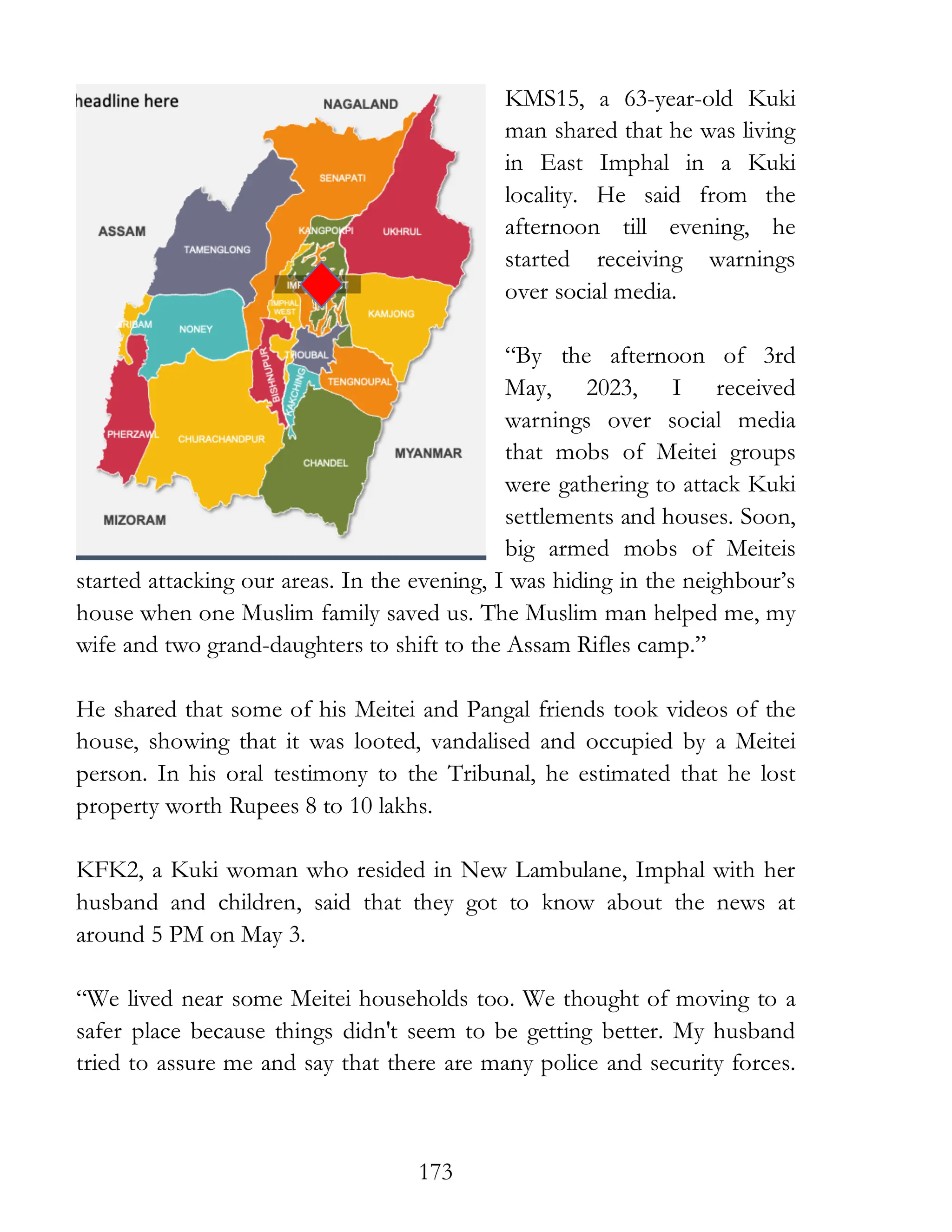
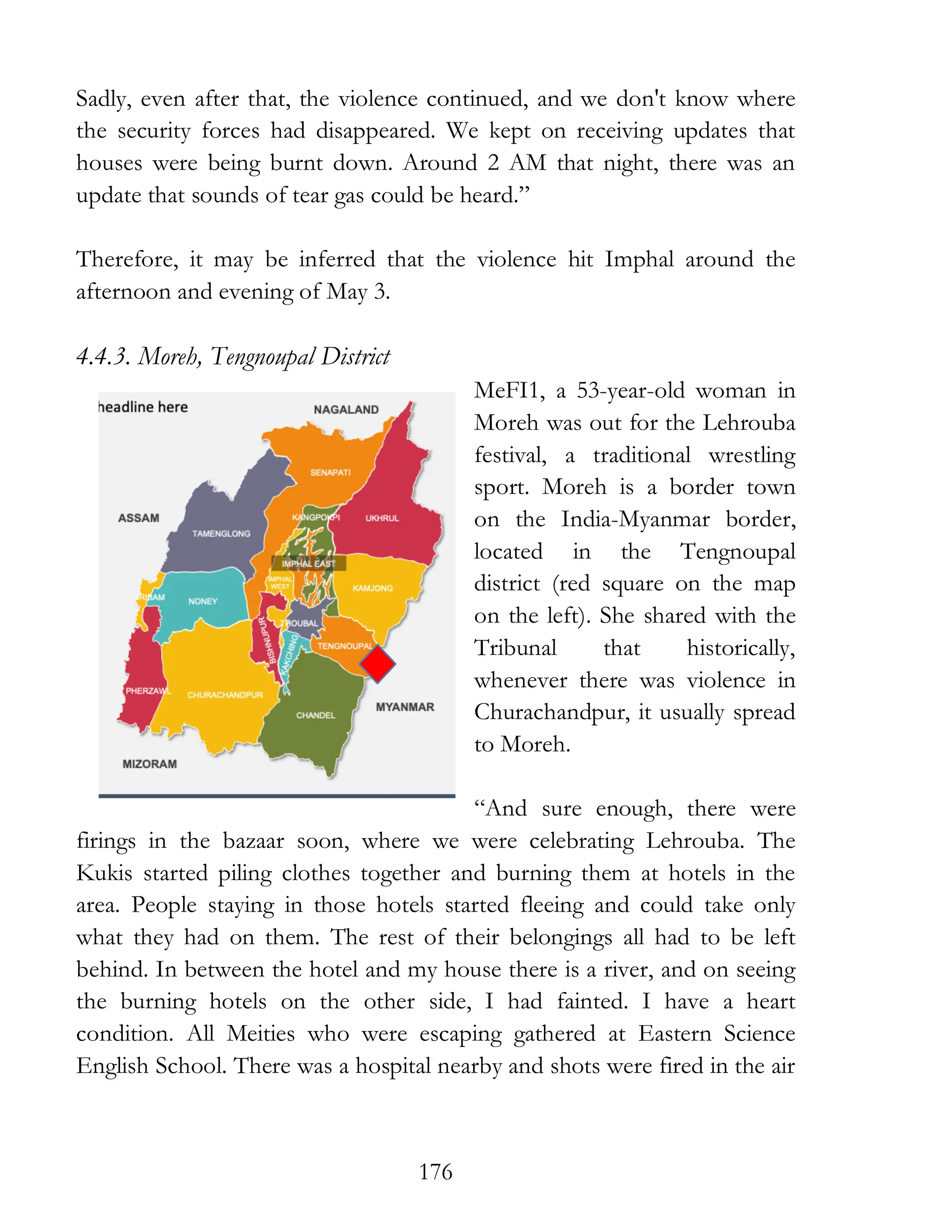
![179
areas attacked”159
, highlighted a myth that “Allegations about Kukis who
are predominantly Christians, attacking Hindu temples in tribal-dominated
areas were circulated in social media since May 3.” The Report pointed out
that in a joint Statement was published on 9th
May, 2023 on behalf of the
Bengali, Bengali-Muslim, Bihari and Marwari communities to clarify that
“there was no difficulty, persecution or attack on any individual or on any
place of worship based on origin, caste, creed or religion from the local
people residing in the town and district [Churachandpur]160
.”
The Tribunal spoke to several victims and survivors from Meitei and Kuki
communities. Their testimonies, as shared below, narrated a range of
violent and gruesome acts of terror by armed and unarmed mobs. Solely
based on whether their identity was Kuki or Meitei, they faced threats of
the following types of violence:
1. Murder – Mobs have killed people by beating them to death,
shooting with bullets, or in other extremely painful ways such as
burning them alive. Several times, the bodies of the murder victim
were burnt by the mob, and in some cases, they were mutilated
and photographed.
2. Arson and looting of villages – Villages inhabited by either
community in an area dominated by the other have faced large
mobs, usually hundreds of people, who have vandalised homes,
set them on fire and looted people’s belongings. Kuki survivors
who have escaped such incidents narrated that such mobs usually
banged on the electric poles with rods, before entering a village.
In such attacks, Kukis who were unable to escape were often
killed by the mob in brutal ways. Most people escaped such
159https://thewire.in/rights/manipur-violence-claims-counterclaims-meitei-kuki
160https://drive.google.com/file/d/1KBMC4sTvKi36YeL9ATmxG2rdZfpTnROo/view?usp=sha
ring](https://image.slidesharecdn.com/manipur-report-250821093300-90785df6/75/Manipur-Report-pdf-governance-failure-in-Manipur-179-2048.jpg)
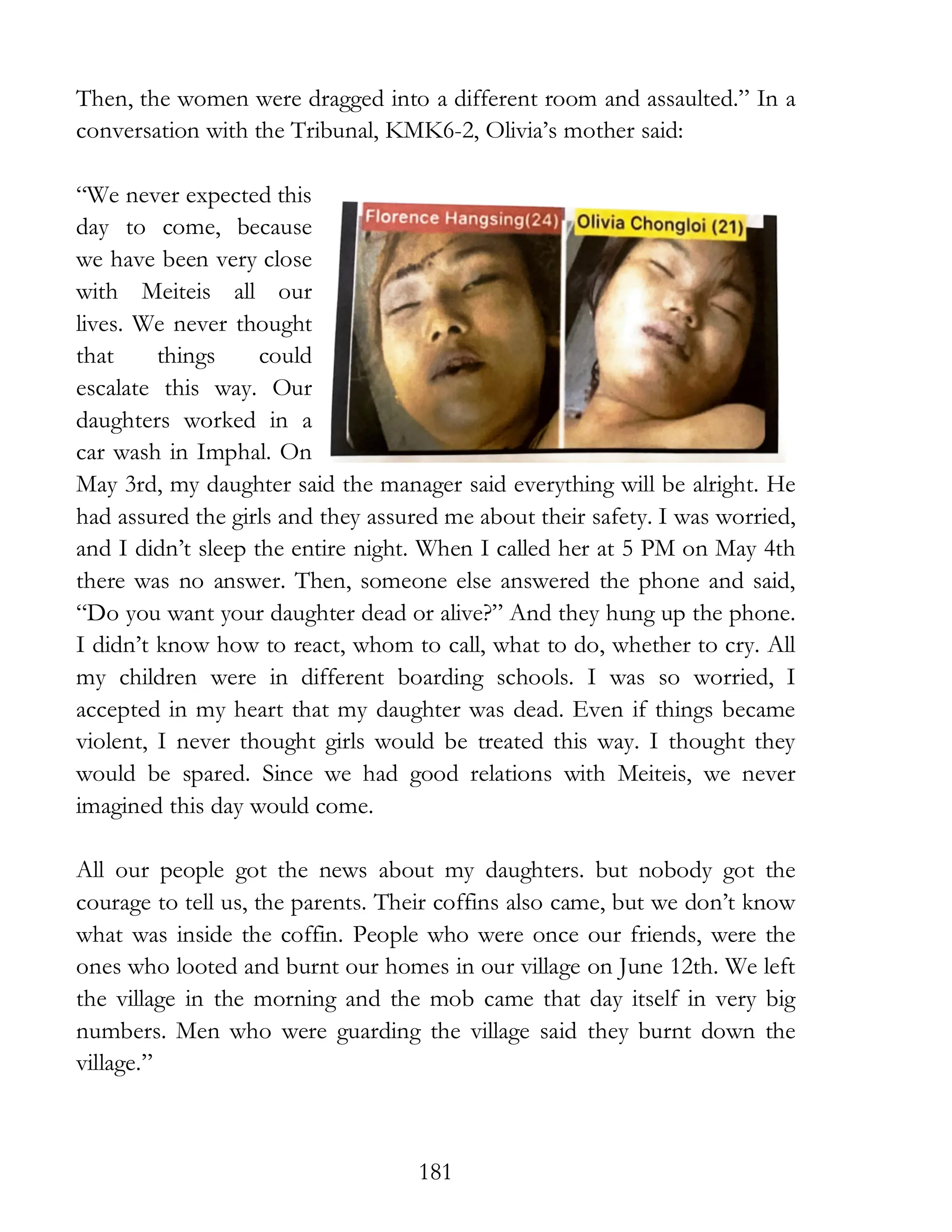
![182
MeFC8, a 32-year-old
Meitei woman was
married to a Kuki
man, who was a
construction worker.
She shared that her
husband had
returned to work to
Imphal on May 2,
2023:
“I had spoken to him on the phone on May 3 in the morning and
afternoon, even after the violence had begun. On May 4, when I spoke to
him in the afternoon, he was angry that I had slept through his calls early
in the morning. His voice had completely changed. He said they were
surrounded and he kept calling out my name.”
In her written testimony and the documents submitted to the Tribunal,
she also said that she filed a missing person complaint reporting that he
had not been in contact, since 5 PM on 4th
May, after a large mob of
“Meitei goons armed with deadly sophisticated weapons had entered their
work site and tried to attack them.” In her written testimony she added,
“two among the five workers managed to escape, while her husband was
dragged, beaten to death and his body was left unattended in the middle of
the road.” In her deposition, she said:
“I found out about his death on 7th
May, 2023. The aunt of another
person who had died called me up and told me. His body was brought to
us only in December along with others. [KMC7] was one of the workers
who survived, but the two others died.”](https://image.slidesharecdn.com/manipur-report-250821093300-90785df6/75/Manipur-Report-pdf-governance-failure-in-Manipur-182-2048.jpg)
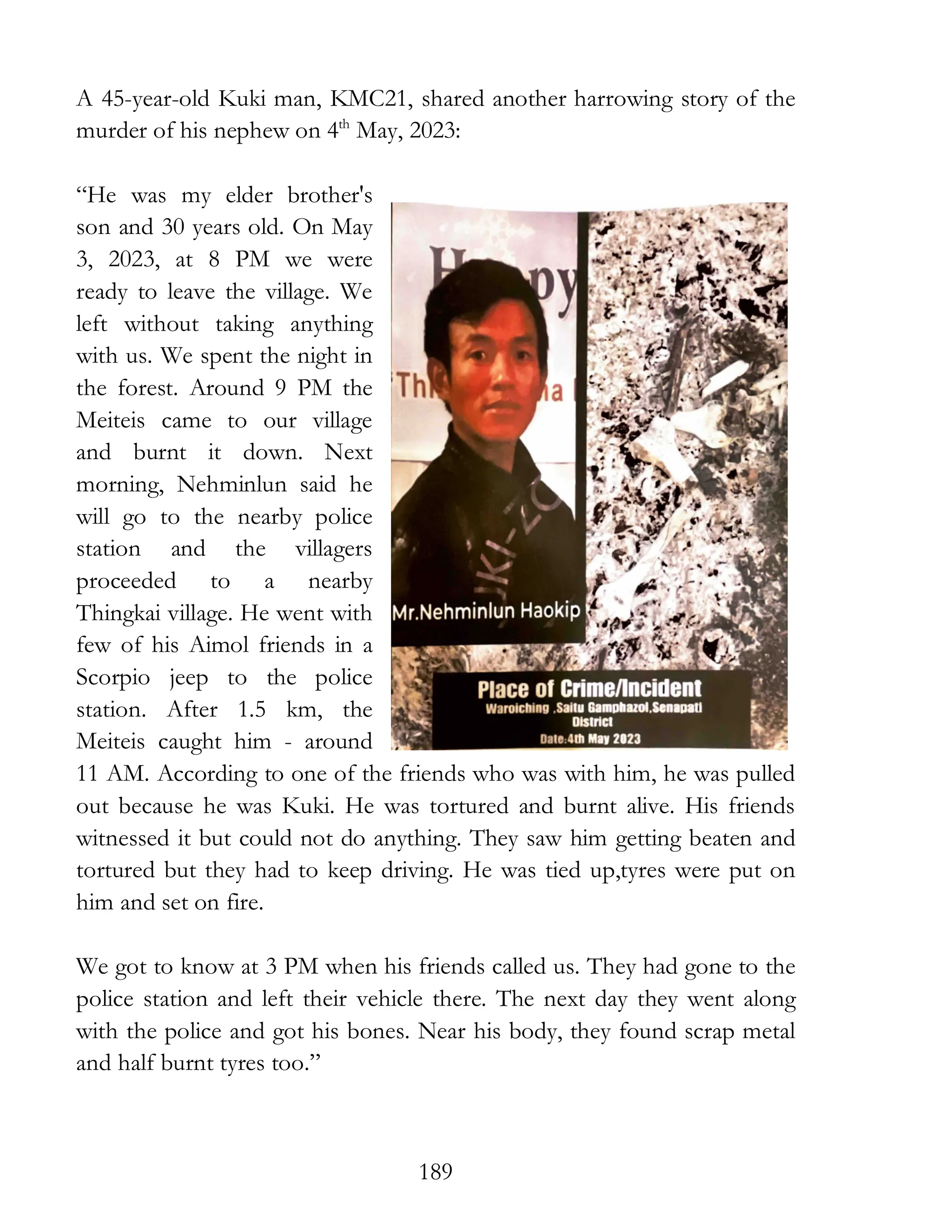
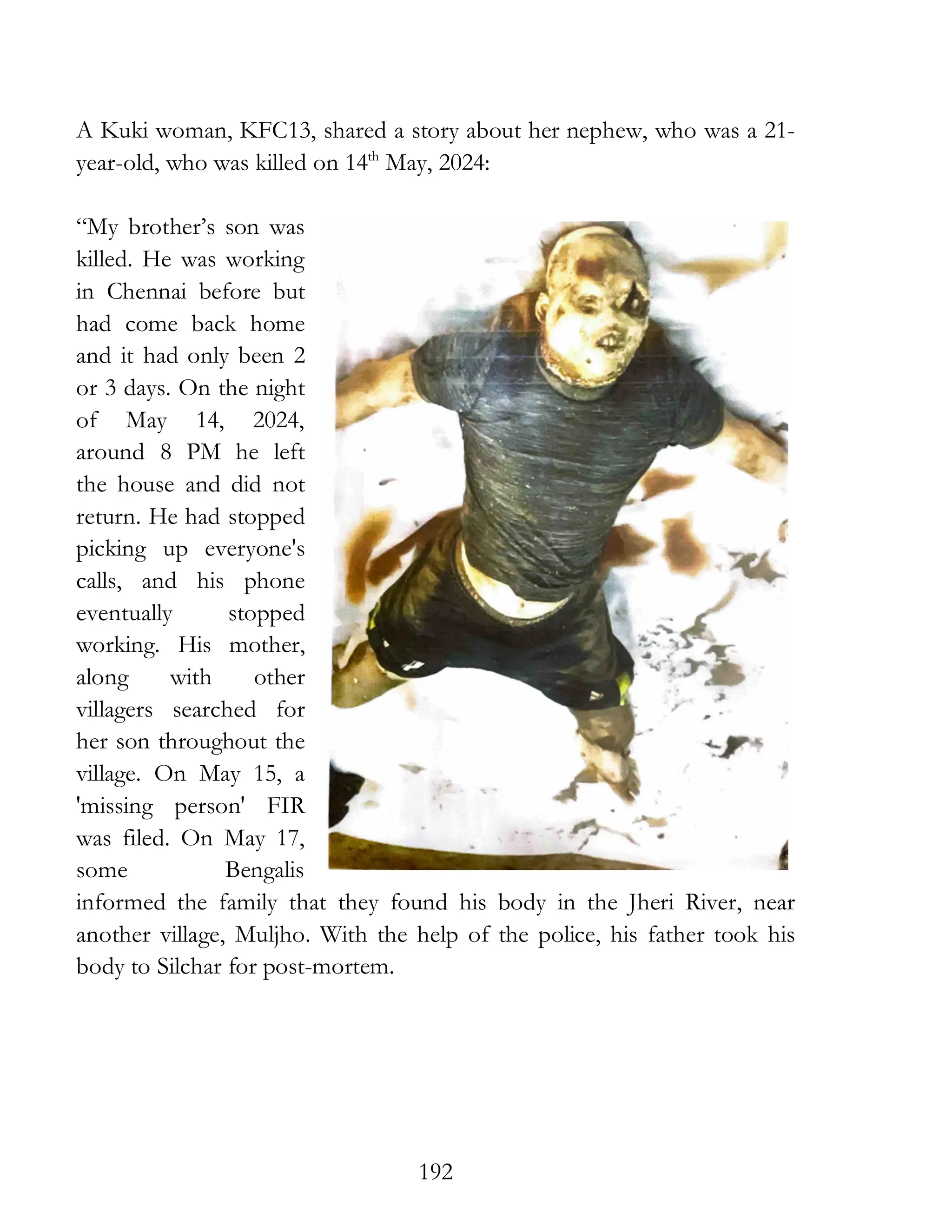
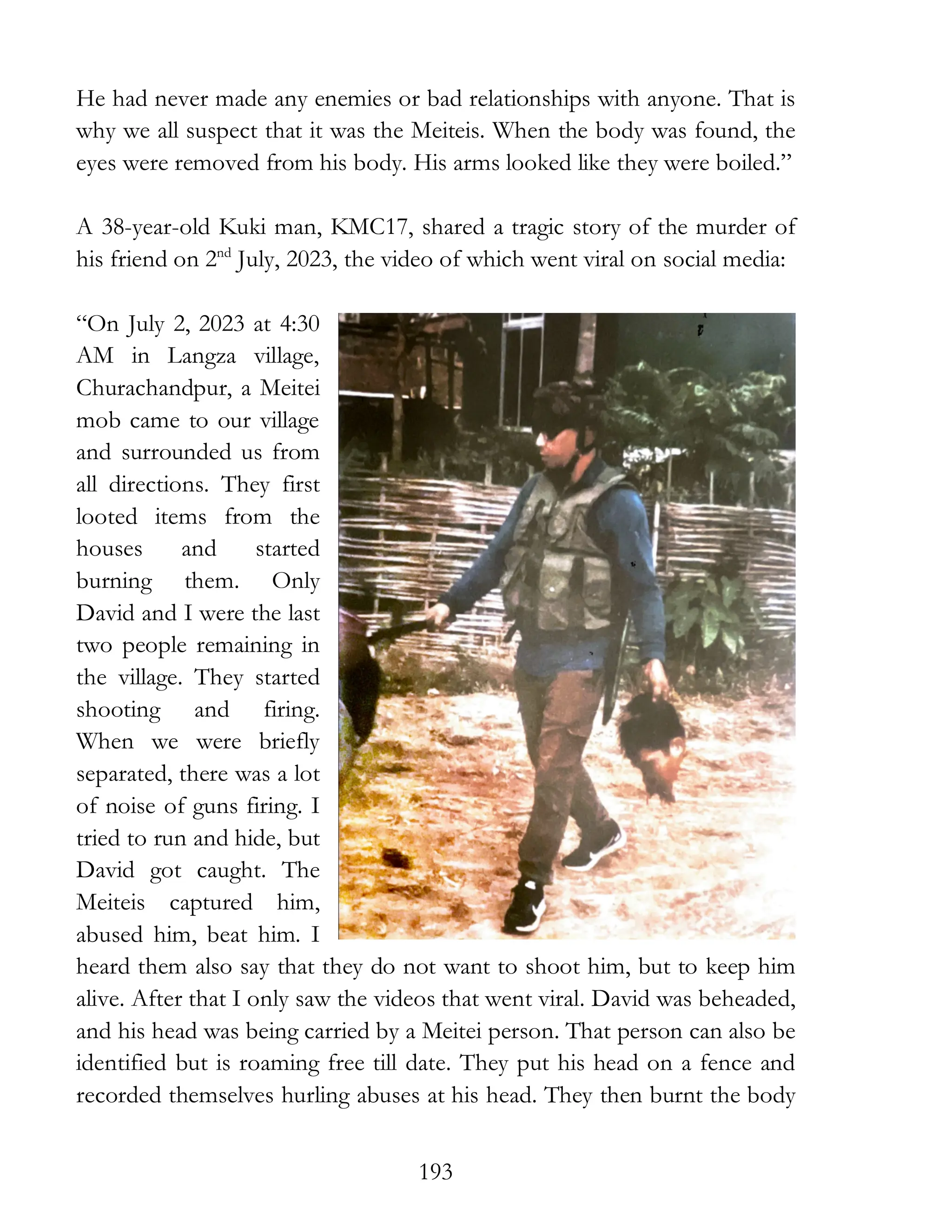
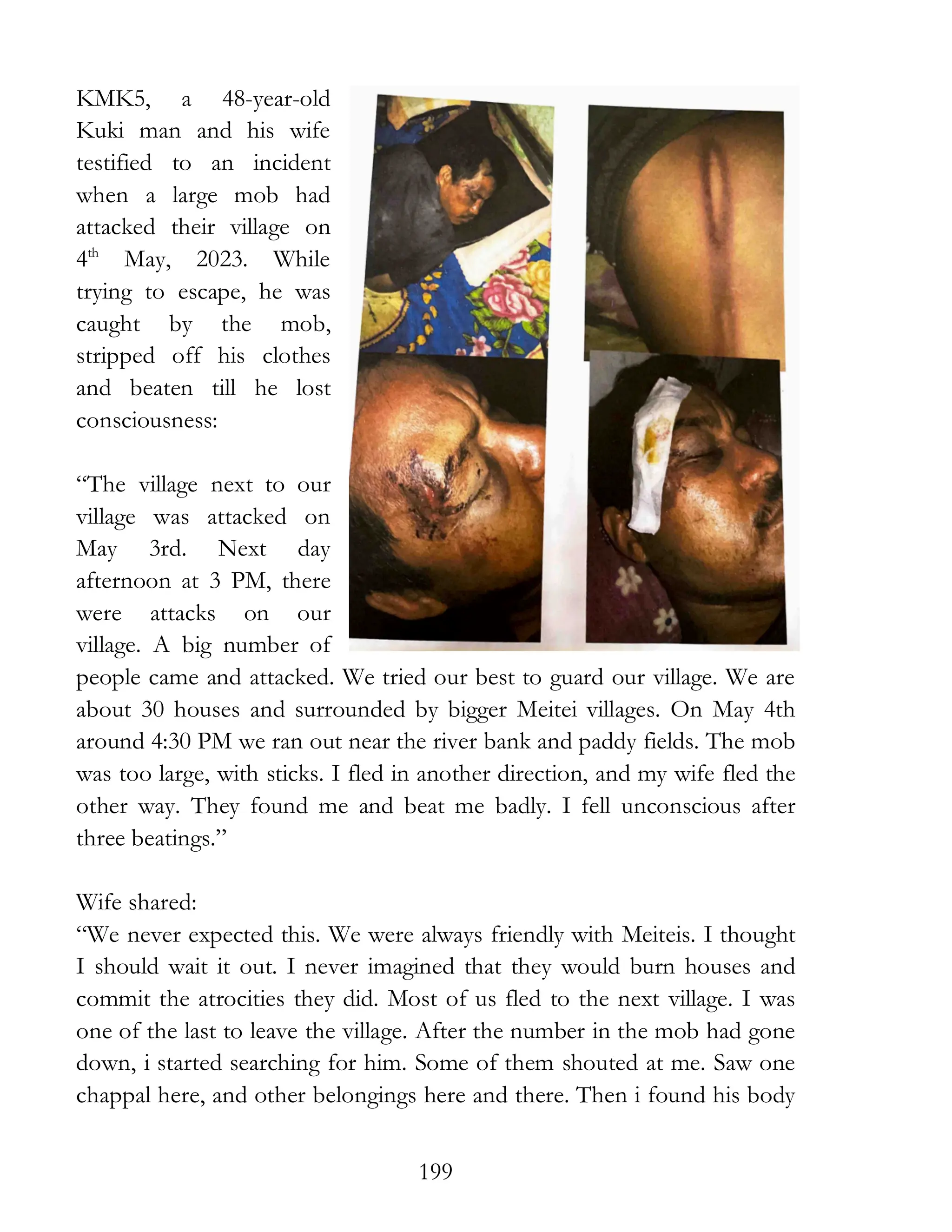
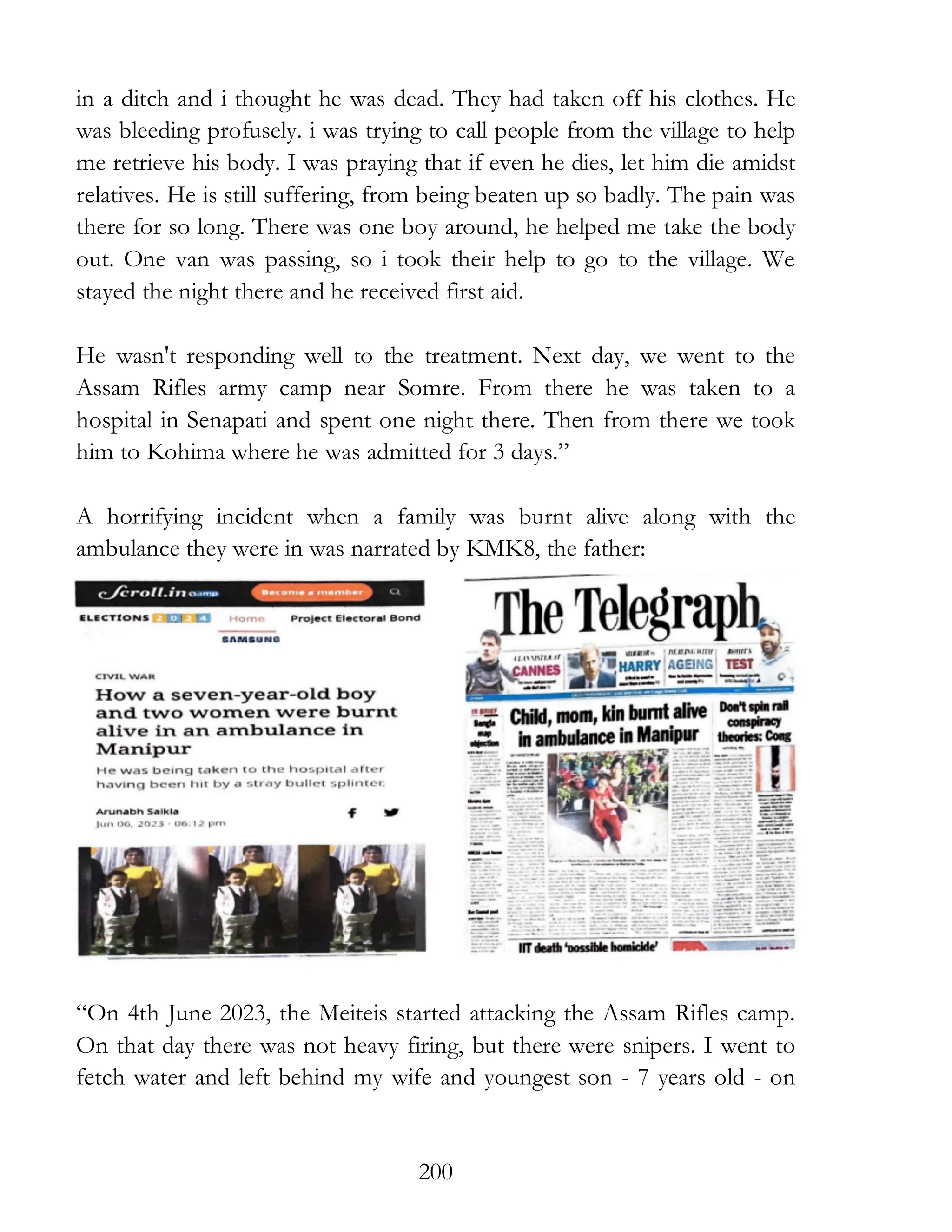
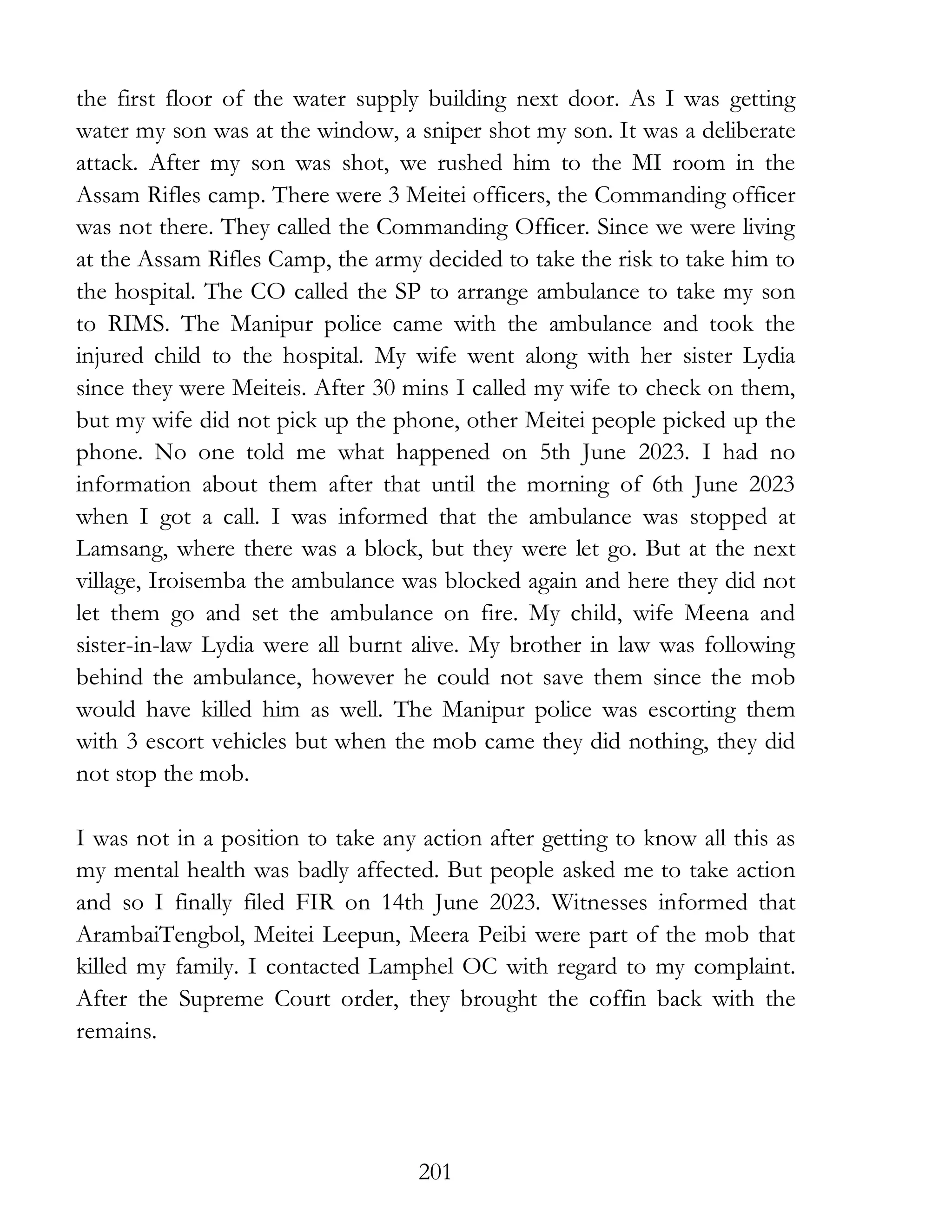
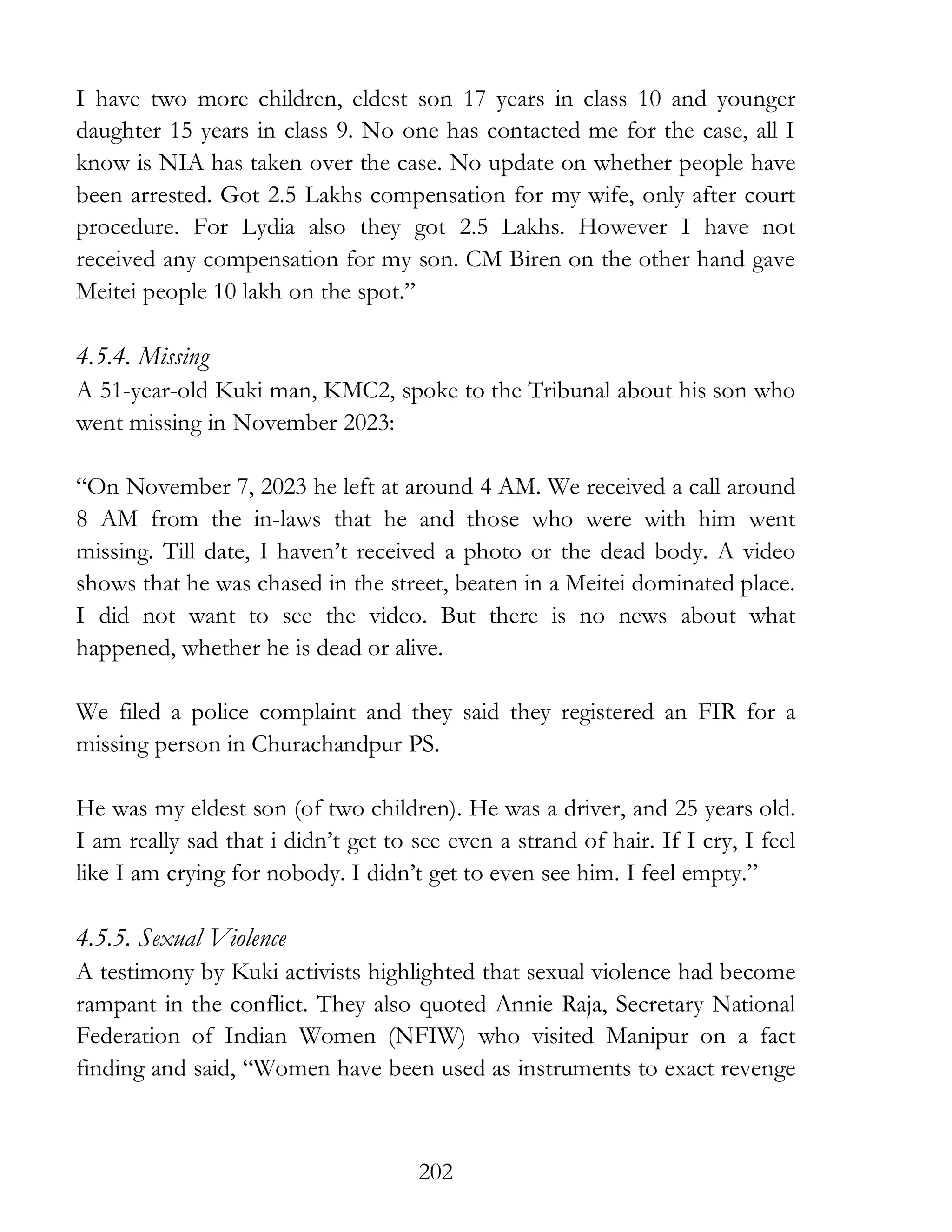
![208
Suddenly I was unconscious and woke up only at JNIMS. They gave me
first aid, did MRI scans. They gave me medicines which were expired.
They allowed us to go outside the room for one hour a day. I talked to my
parents and begged them to come and get me. After many tries, they got
an army official to pick me up from JNIMS and drop me at KCC hospital
[Churachandpur].”
In another testimony, activists reported that the two young women
including KFC18, were raped, beaten with sticks, punched in the head and
face until their teeth fell out, kicked on the stomach and back, till they lost
consciousness in the hospital and managed to reached Lamka after few
days.
On 31st
May, 2024, KFC14, a victim’s sister-in-law, shared another
harrowing tale of sexual violence of a woman taken by a mob from a relief
camp. The shocking and condemnable detail of this story is that the mob
had members of the Manipur Police as well, and that the FIR only
reported that she was killed, and not raped as the family was informed.
“Hatbem was a Kuki woman, who worked as a waitress, married to a
Meitei man and they have one son. She felt that she was Meitei, so stayed
with him. After the violence began, we begged her to come home but she
said no. They were staying at Kumbi Relief Camp for a while after which
her husband stayed somewhere else (Napat village). Both of them were
staying in Meitei areas. Their Meitei neighbours also tried to persuade
them to send Hatbem away because she was being targeted.
On May 31, 2024, I got a call telling me that she was no more. Her
husband tried to explain that the Manipur Police Commandos came to the
relief camp and forced him to point out who his wife was. They pushed
him aside and took her into the jeep.](https://image.slidesharecdn.com/manipur-report-250821093300-90785df6/75/Manipur-Report-pdf-governance-failure-in-Manipur-208-2048.jpg)
![215
pressured PaonamBrojen Singh, a Meitei Christian politician and BJP
MLA, to convert to Sanamahism through his aides. “Both Sanajaoba and
LeishanthemSusindro Meitei [another BJP MLA] were also present,” they
said. Another pastor alleged that MLA Mayanglambam Rameshwar Singh,
who belongs to the National People’s Party, offered him money to
convert in 2022.
Meanwhile, the names of Biren Singh, Sanajaoba and Yasobanta Sharma,
the acting President of the Manipur chapter of Vishwa Hindu Parishad, a
prominent Hindu right-wing organization, on the plaque of a new building
within the Sanamahi Temples complex in Imphal further showed a close
working relationship between Meitei leaders and Hindu nationalist
organizations.”
One pastor who fled from Imphal to West Bengal said that the Meitei
mobs threatened to kill him like Jesus. It has been reported that pastors
and Meitei churches are trying to distance themselves from the Kuki
community in order to be accepted by the Meitei Community.
While the IAS officer stated that the Meitei radicals such as Arambai
Tenggol who are part of the Sanamahi revivalist movement have no
connection with the Hindu right wingorganisation RSS, other experts
seem to disagree on this point, supporting the narrative that the Sanamahi
radicals and the Hindu radicals are working in tandem against the religious
and ethnic minorities.
MeMD1, a Meitei human rights activist and lawyer, spoke to the Tribunal
in Delhi on 06.07.2024. When asked about the relation and contradiction
between the Sanamahi Meitei radicals like Arambai Tenggol and the
Hindu radical group RSS, he stated:
“We clearly mention that it is Meitei Leepun - they are a known entity -
functioning in official government properties - their identity is well](https://image.slidesharecdn.com/manipur-report-250821093300-90785df6/75/Manipur-Report-pdf-governance-failure-in-Manipur-215-2048.jpg)
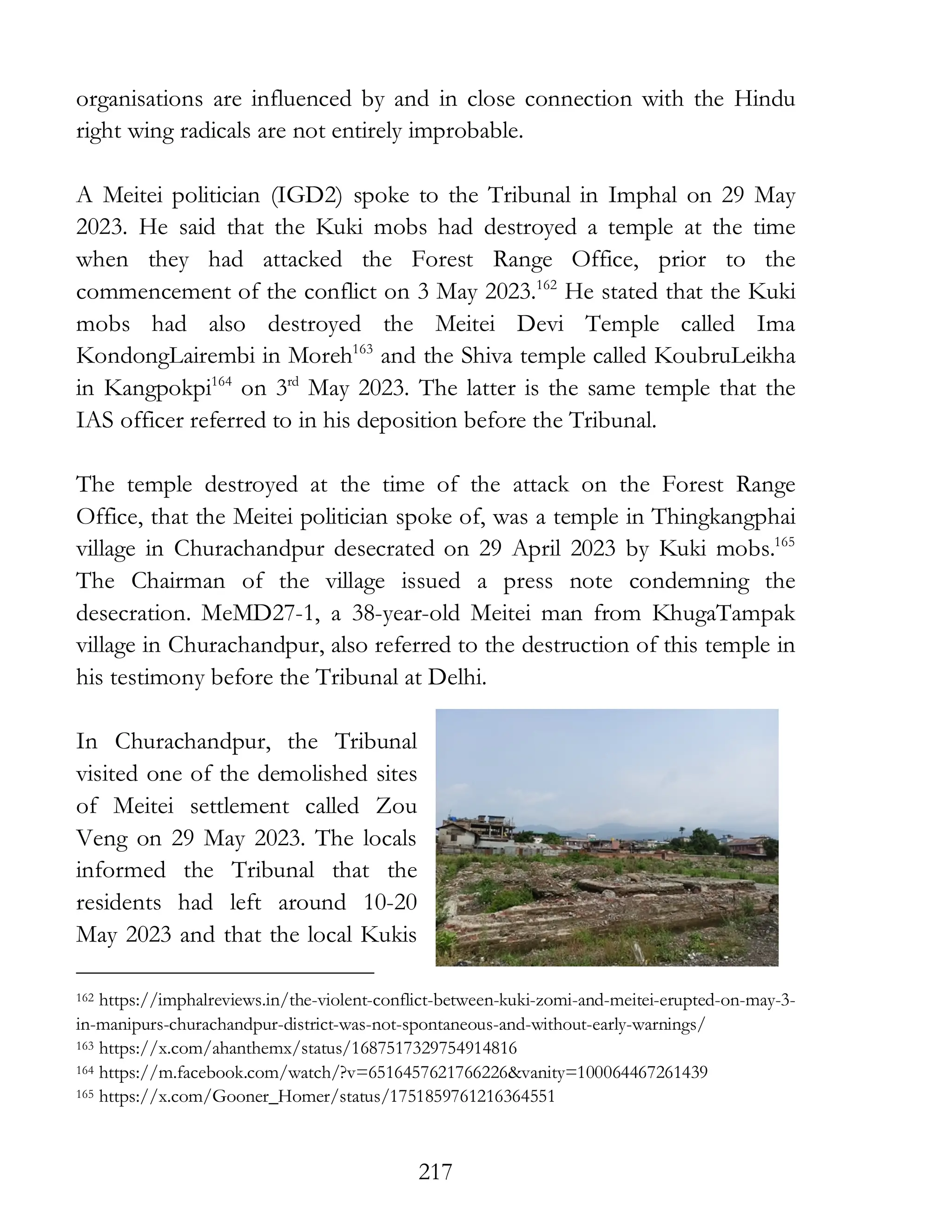
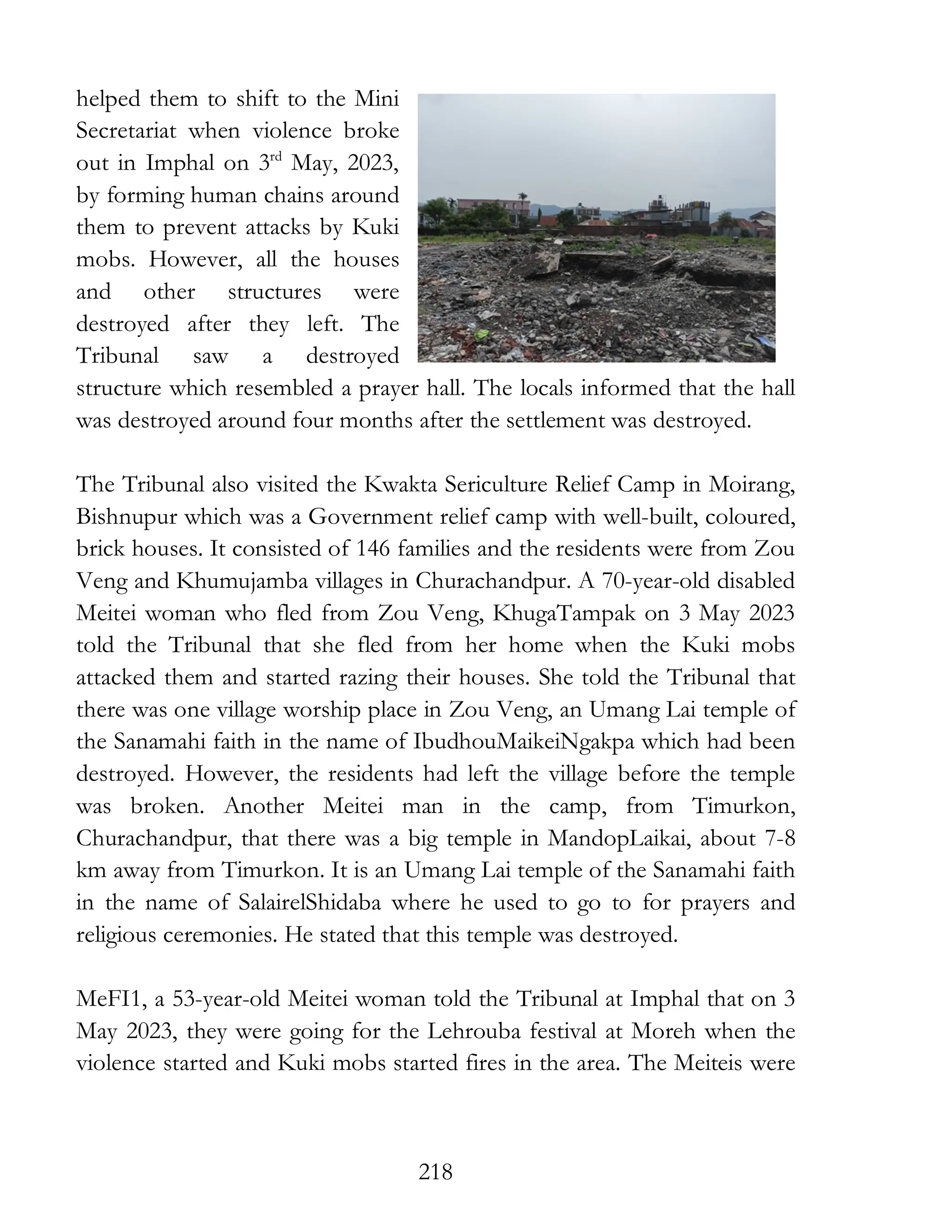

![246
father's property. Though some as wives and daughters of village chiefs
could have some influence.
KFO14, a freelance woman journalist from the Kuki community of
Manipur, told us about women organizing in tribal areas: “Naga women
organizations are very active. Kuki women too are active. So also, Kuki
Zo community women as well. These are traditional women’s groups. Sort
of working for the welfare of society. They mobilise money, running
camps, looking after, educating children giving support to civil society
organisations. I did a workshop in Churachandpur with women and felt
they were not aware of their legal rights. When conflict happens, women
suffer more because they are not able to make decisions.
These are traditional organisations limited to welfare and taking care of
orphans. Helping the widows. These are ways traditional bodies
contribute. They do this in tandem with the tribe's apex bodies. They will
not do anything against the community’s decisions. They will not oppose
the decisions made by Kuki community bodies. That is how they work.
They do empowerment work and contribute to society. They do share
their opinions in certain areas but not against the community. Women do
not have property rights. Only if they can buy land will they own it.
Traditionally sons become chief, in some cases wives or daughters of the
chief.”
5.2. Socio economic status of women182
[All this information is from NFHS-5 survey for all Manipur and does not
provide community specific data.] In Manipur, there is a strong preference
for sons with nearly one-quarter of women and one-third of men wanting
more sons than daughters
182https://dhsprogram.com/pubs/pdf/FR374/FR374_Manipur.pdf](https://image.slidesharecdn.com/manipur-report-250821093300-90785df6/75/Manipur-Report-pdf-governance-failure-in-Manipur-246-2048.jpg)
![253
social media. The conflict was mostly on land issues. Nagas were
collecting tax and saying if you do not pay tax, you cannot stay there. Also,
the State government was not involved, and other communities tried to
mediate and bring peace. Both insurgent groups were involved, and it was
between them. It did not disturb the whole State. Disinformation and
misinformation were not there to this extent”.
[Note: We met with a Meitei woman survivor of sexual assault, wherein an
FIR was lodged after three months. She had refrained from filing
complaint fearing stigma. The survivor has preferred to stay away from
any media interaction186
.]
5.4.4. Reported and unreported cases of violence against women:
As reported to the SC in a compiled report dated 16th
May 2023: there
are11 FIRs cases of violence against women and children. National Kuki
Women’s Human Rights Organisation, Naga Kuki Mothers representative
in Churachandpur told us that they have submitted to the Prime Minister’s
office and the Women's Commission 36 cases of gender-based violence.
We met with sexual assault survivor X, from Meitei community,
(Scheduled Caste) at undisclosed location. Even though she was assaulted
on 3rd
May 2023, she went to JNIMS hospital only on 8th
August 2023.
And then the FIR was filed on 9th
August 2023.
KFC18 a 20-year-old woman student from the Kuki community, now in a
relief camp, was staying in a hostel at the time of violence, she told us that
they were attacked by the mob, which included women, on 4th May 2023,
at around 4.45 pm. She faced threat of rape, parading, abuse, physical
violence. She regained consciousness in JNIMS. She needs long term
treatment including for memory loss.
186 https://www.thehindu.com/news/national/woman-alleges-gang-rape-in-manipurs-
churachandpur-police-register-case/article67179096.ece](https://image.slidesharecdn.com/manipur-report-250821093300-90785df6/75/Manipur-Report-pdf-governance-failure-in-Manipur-253-2048.jpg)
![262
[There has been condemnation of violence in Manipur by The National
Council of Churches in India (NCCI) and Archbishop Thomas J. Netto
but there is no reference to sexual violence in their statements188189
]
5.8. Violence by women
5.8.1. On occasions women specifically have been involved in physical violence
National Kuki Women’s Human Rights Organisation spoke to us:
“While everybody is suffering in the wake of the ethnic violence since 3rd
May 2023, the plight of women is especially worse. Not only because of
the targeted sexual violence but also because of the spirit of unity amongst
women groups across ethnic line, has been a casualty of the war. The
Meira Paibis whom we fought besides, shoulder to shoulder against the
AFSPA are now our sworn enemies.
Nothing can exemplify this fact more than the videos of Meria Paibi
women instigating young Meitei men to torture, rape and kill Kuki-Zo
women in an Imphal market.”
KMD21, a 34-year-old Kuki man, who had graduated from NUJS,
Kolkata, whose family members are survivors of the violence has filed a
case in the Supreme Court, on behalf of two persons who were beaten to
death. He said:
“One woman was a graduate in our school; she was beaten to death. Our
prayer was for an investigation into their death and to apprehend the
perpetrators. The names of persons involved were not available; but we
mentioned that it was a Meitei mob attacking from the valley side. There is
188https://www.nationalheraldindia.com/national/manipur-14-million-indian-christians-deplore-
inadequate-govt-response
189 https://www.thehindu.com/news/national/kerala/church-leaders-slam-attacks-on-christians-
in-manipur-and-north-india/article68006295.ece](https://image.slidesharecdn.com/manipur-report-250821093300-90785df6/75/Manipur-Report-pdf-governance-failure-in-Manipur-262-2048.jpg)
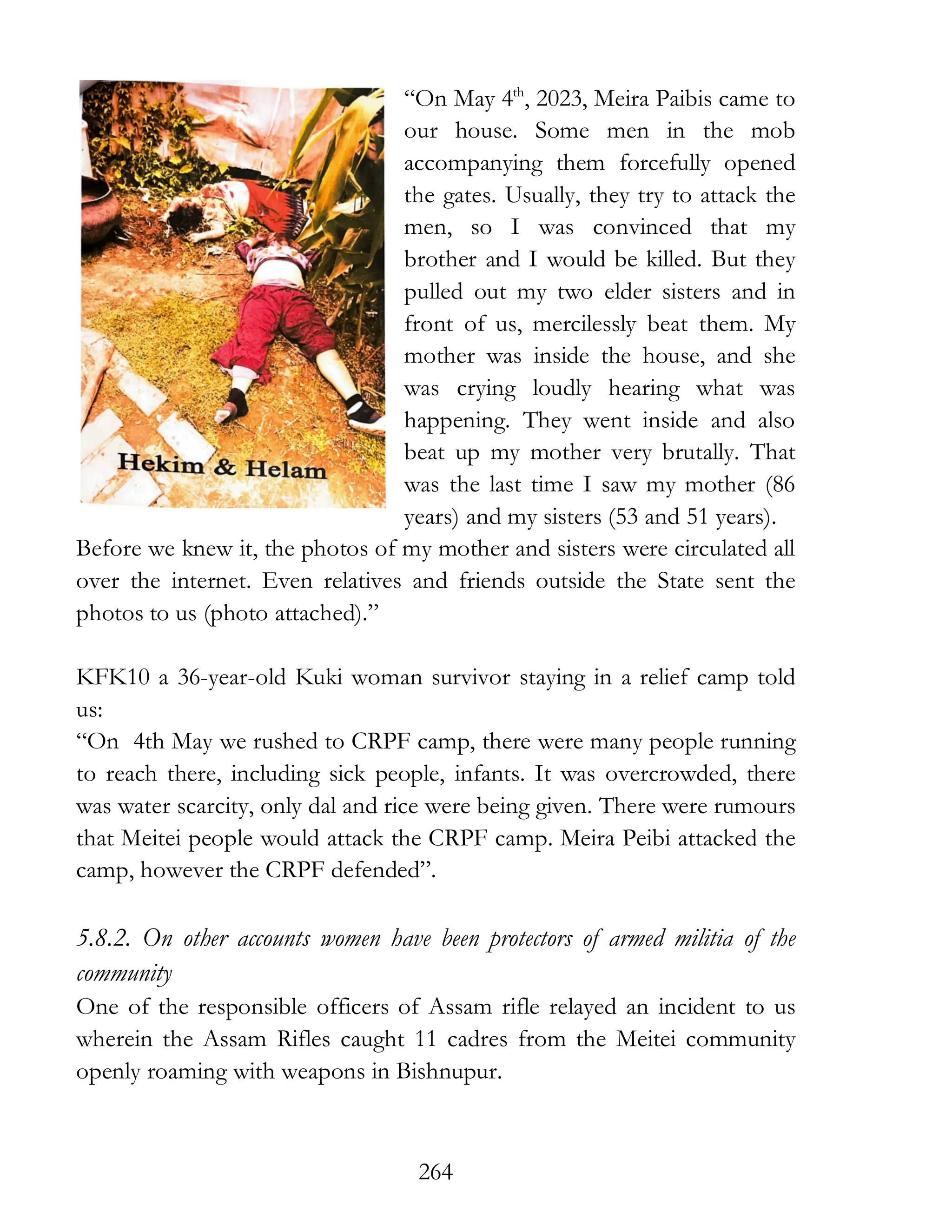
![268
[Meiteis had the name “Hao” to mean the hill people. Oftentimes, the
word “Thu” was added to make it “Haothu” which is extremely
derogatory, [Hao-Hill People; Thu-Women Private Part]. In a slightly less
vulgar term, “Haomacha” [Hao-Hill People; Macha-Children] is also often
used but carries the same derogatory tone.]190
KFO14, a freelance woman journalist from the Kuki community of
Manipur told us:
“Looking down on tribals has very much been there. In the younger
people it is not so much. But in earlier generations it was there. My
colleague married a Kuki woman, and his father would not eat the food
cooked by the tribal woman. So, it depends and varies from family to
family.”
5.9. Other difficulties faced by Women
5.9.1. Difficulties in Relief Camp:
At Sangai relief camp, we were told, one woman gave birth in the forests,
while fleeing, from Sugnu.There is no private bathroom or urinal for the
women. Women take a shawl or a wraparound to cover themselves when
they urinate. There is one ring well near the 8 toilets where they can take a
bath. There is also one canal through which water flows into a pond
where the water is stored. The women wrap themselves and take a bath.
The water is not clean in the pond; when it rains it gets polluted. And
during summer the ring well does not have sufficient water. The women
either change their pads in their rooms or in the toilets.
190 https://www.thingkholemalcha.com/everything-seems-to-be-fair-in-war-the-misconceptions-
that-destroyed-the-fabric-of-manipur-as-a-political-entity/](https://image.slidesharecdn.com/manipur-report-250821093300-90785df6/75/Manipur-Report-pdf-governance-failure-in-Manipur-268-2048.jpg)
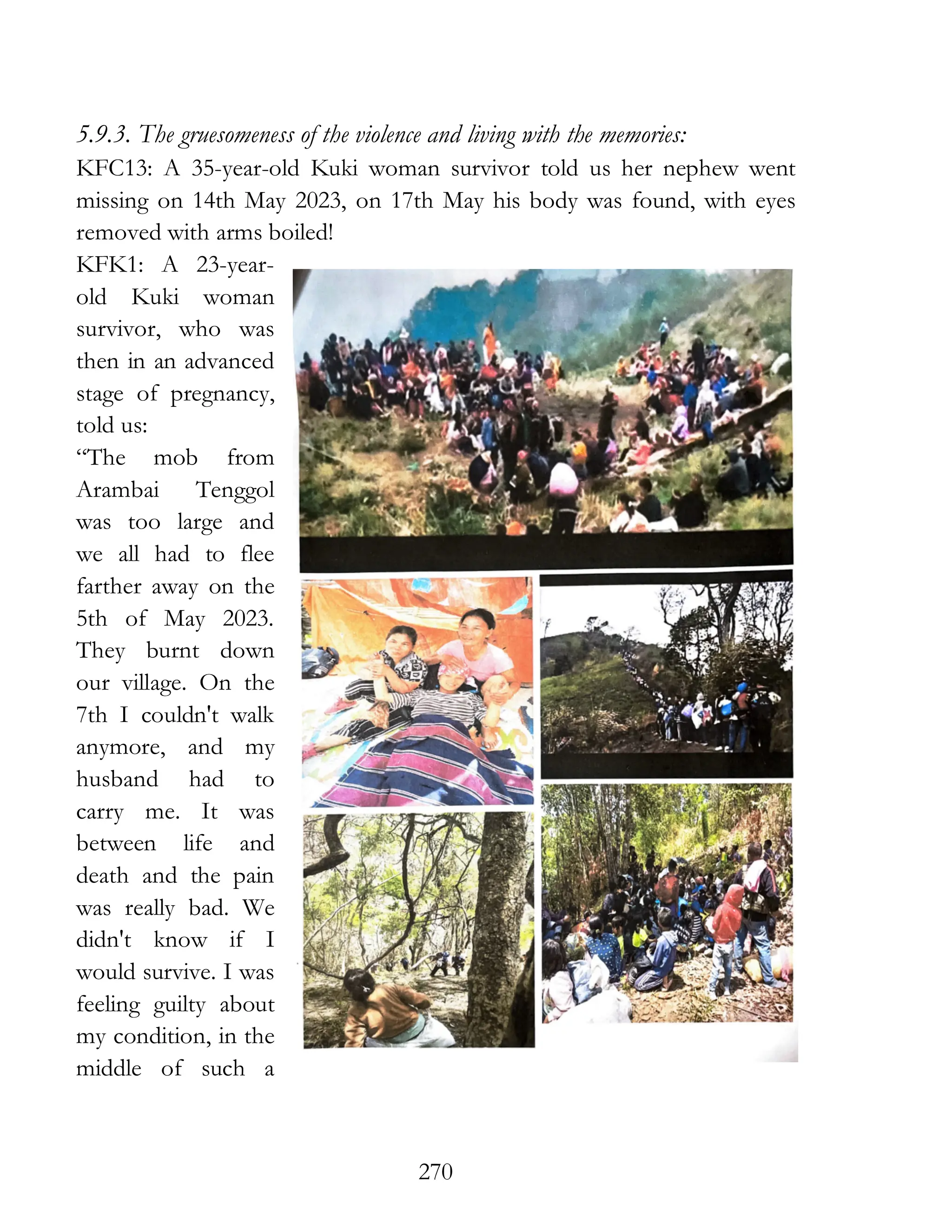
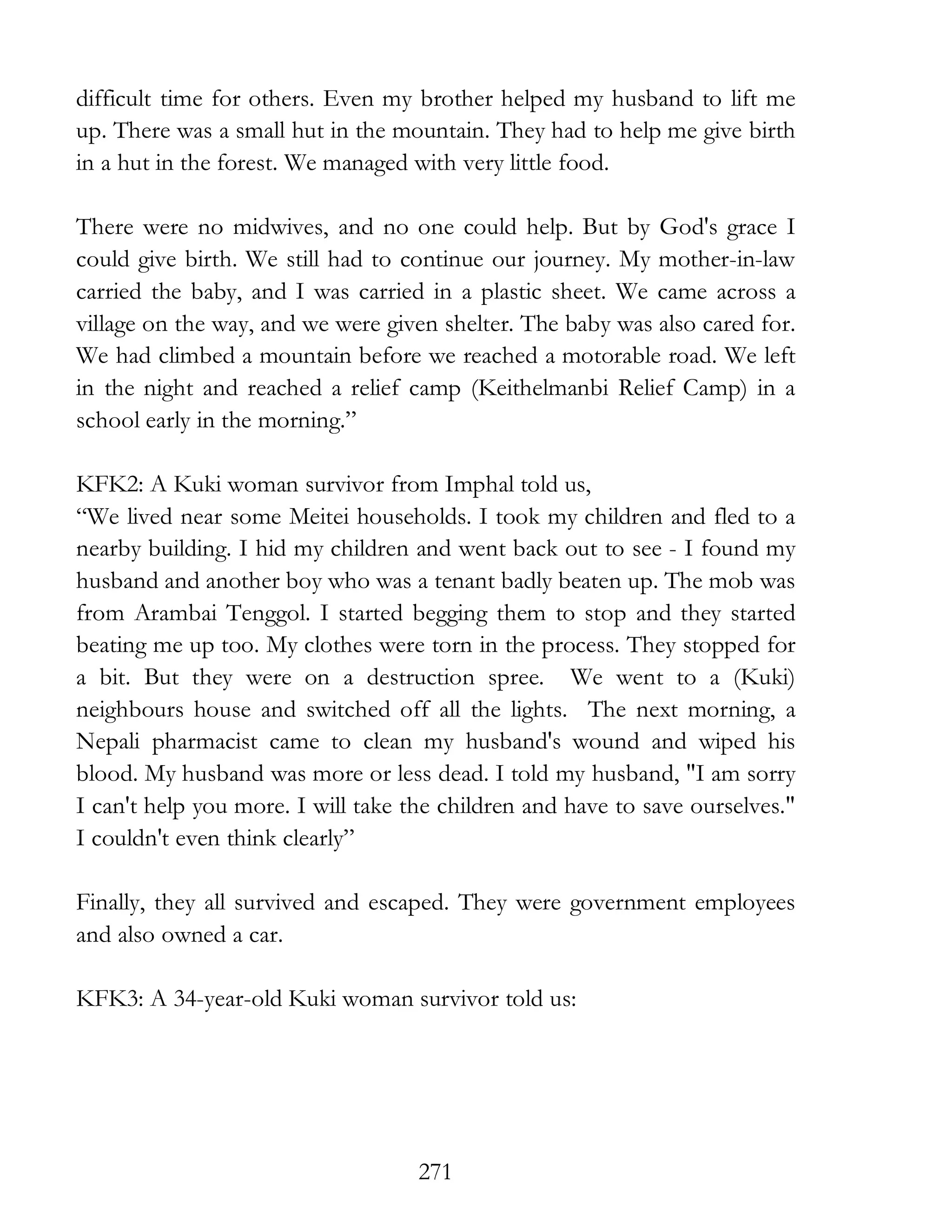
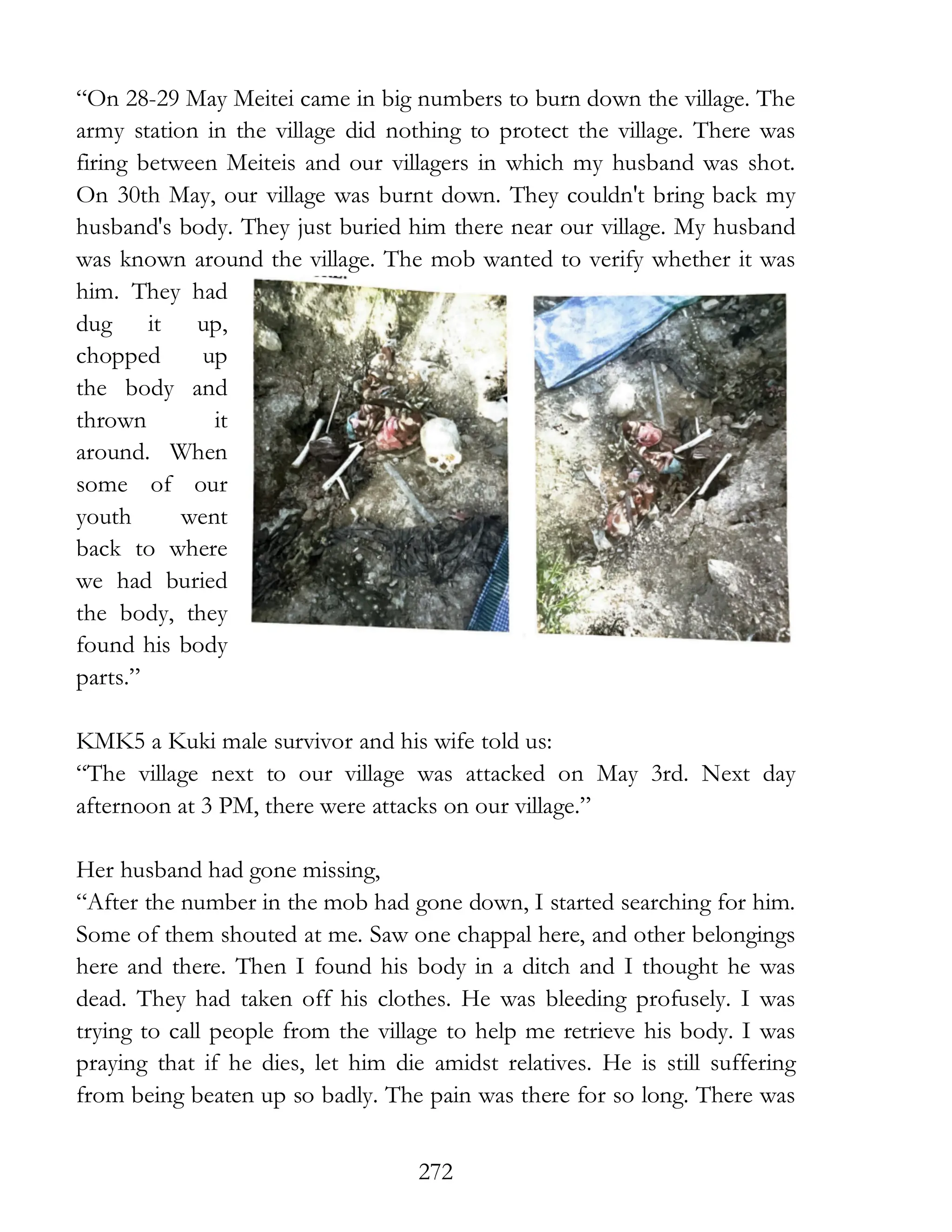
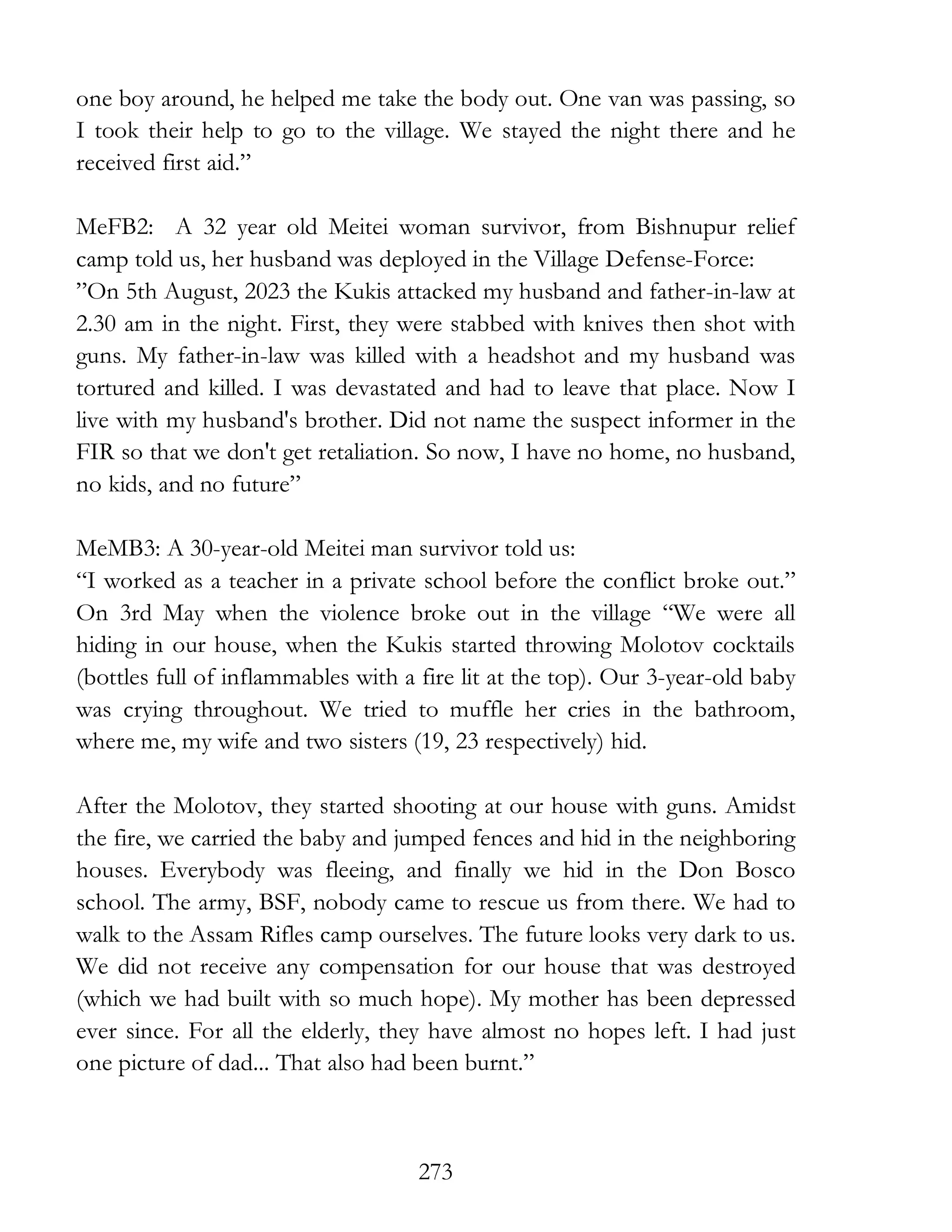
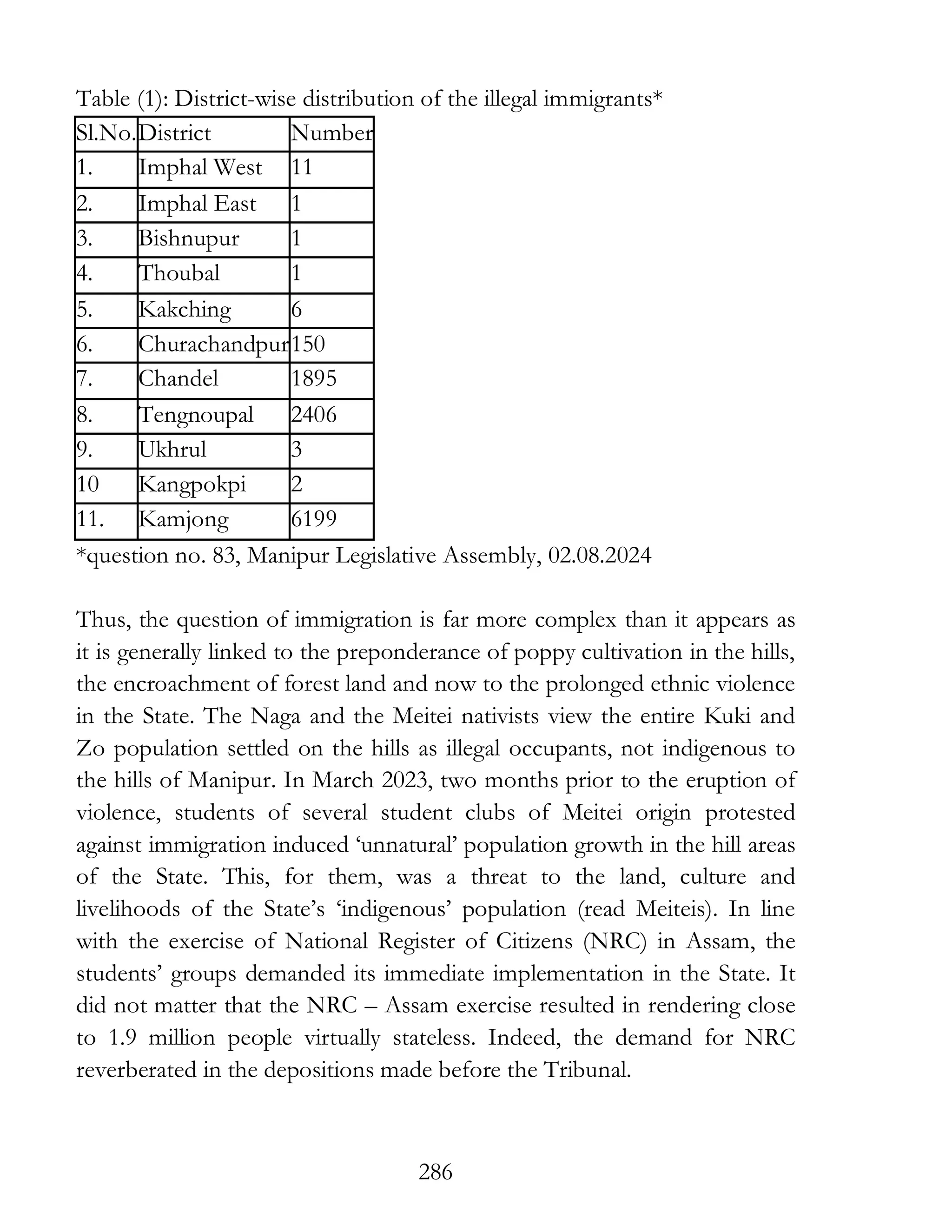
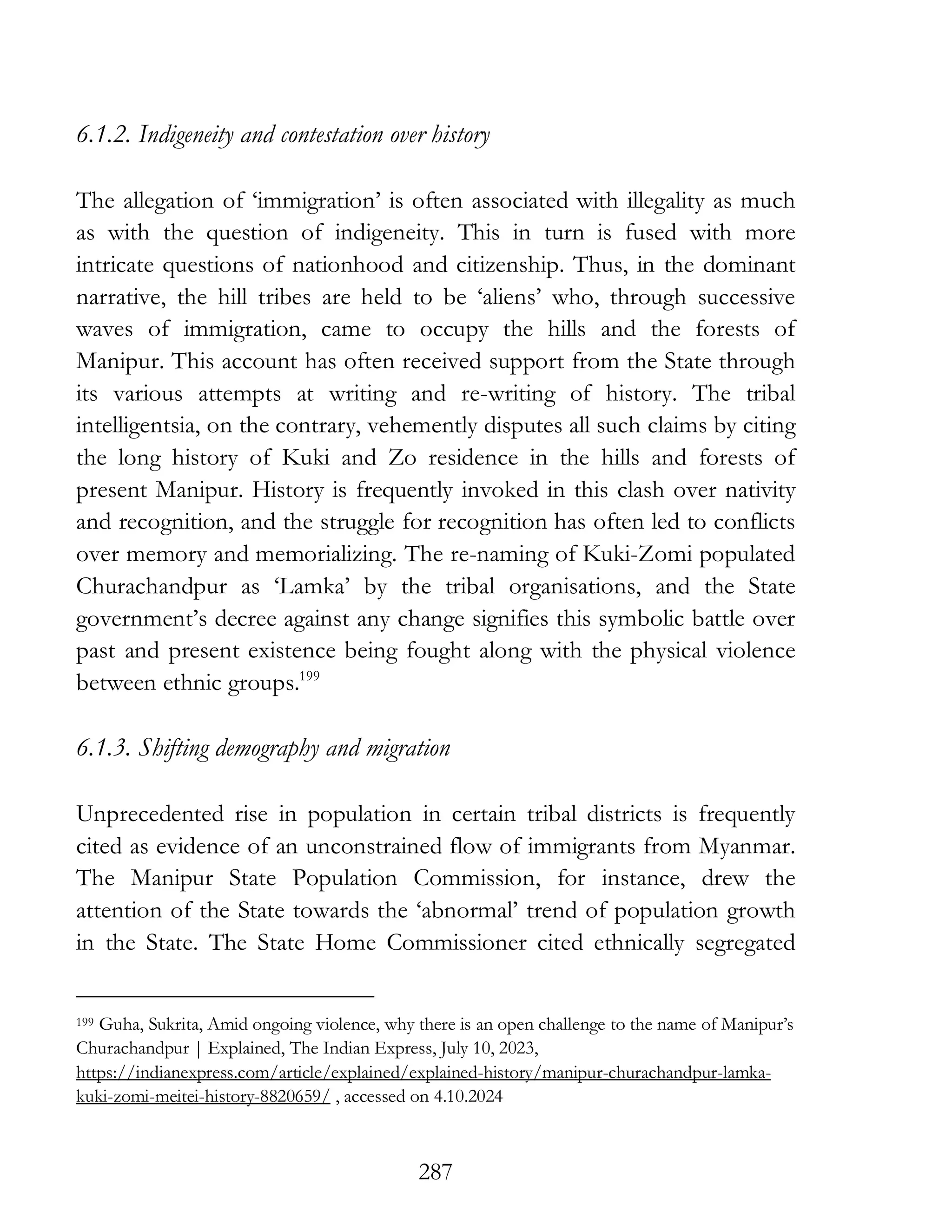
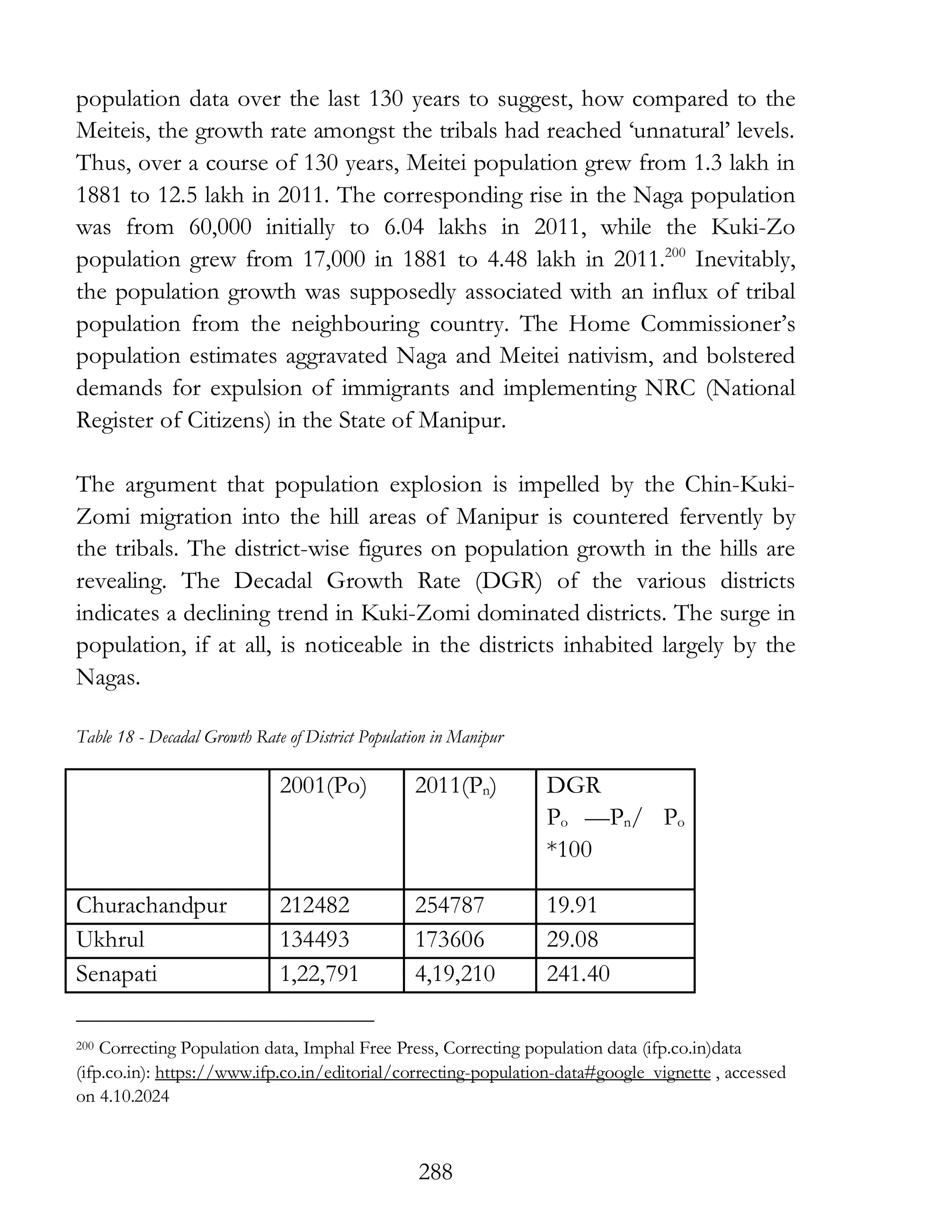
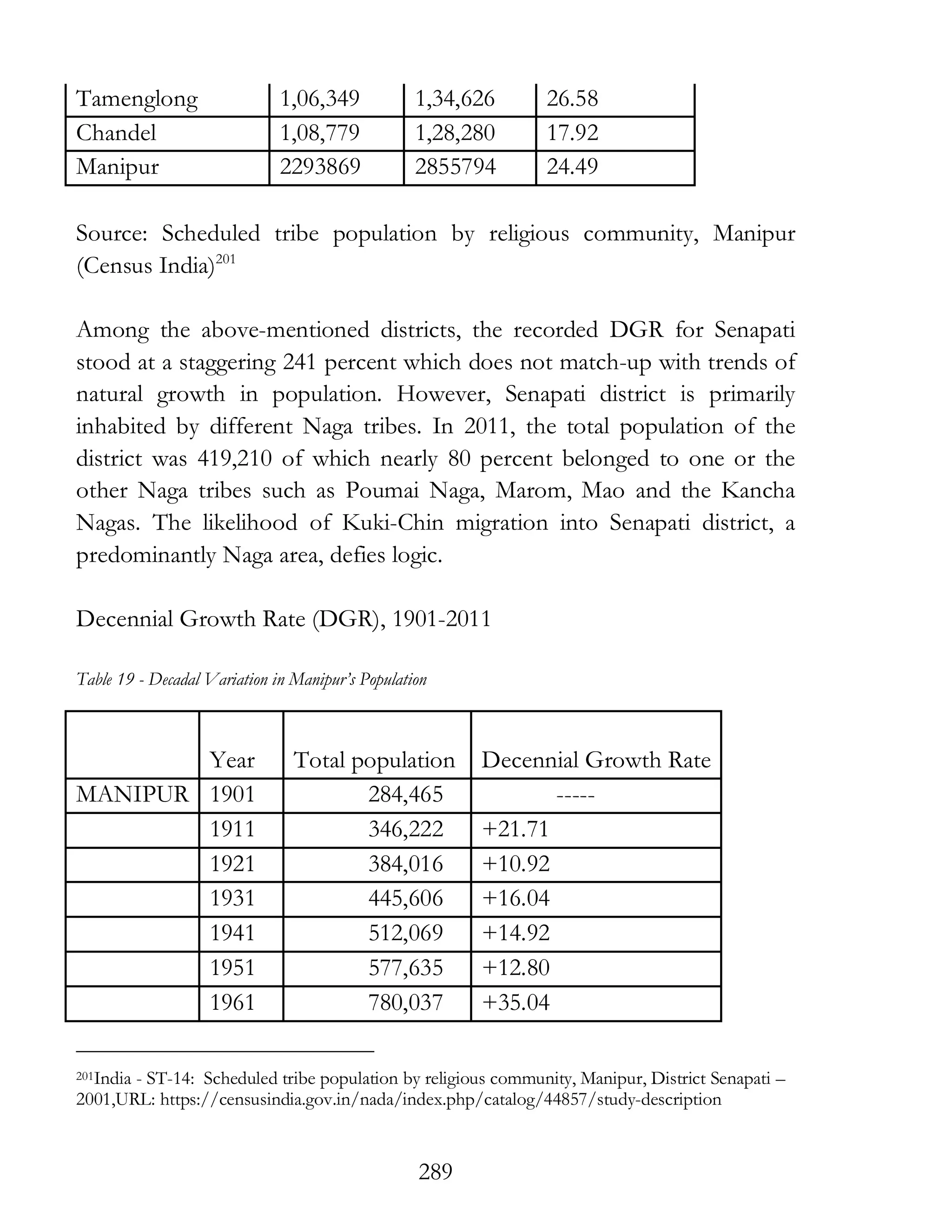
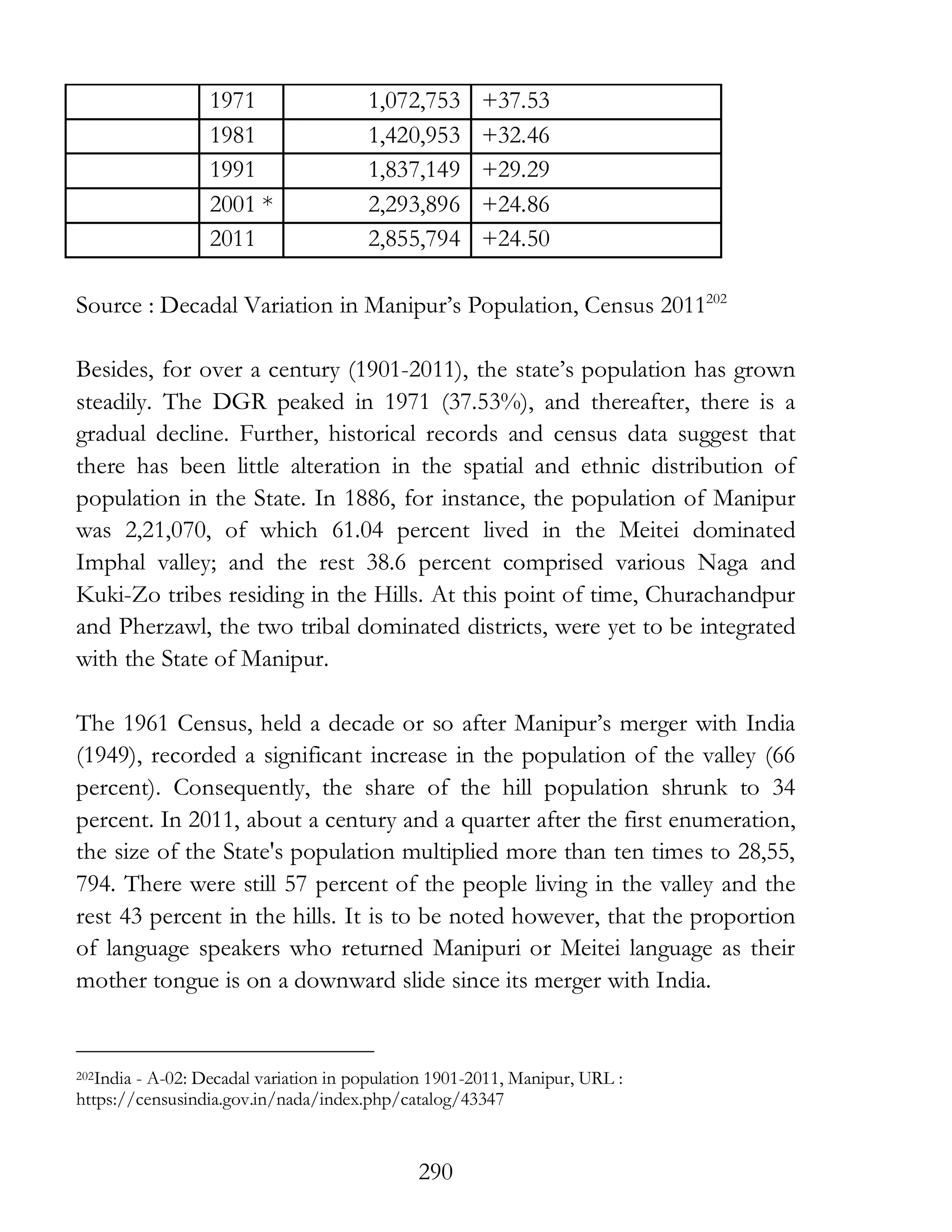
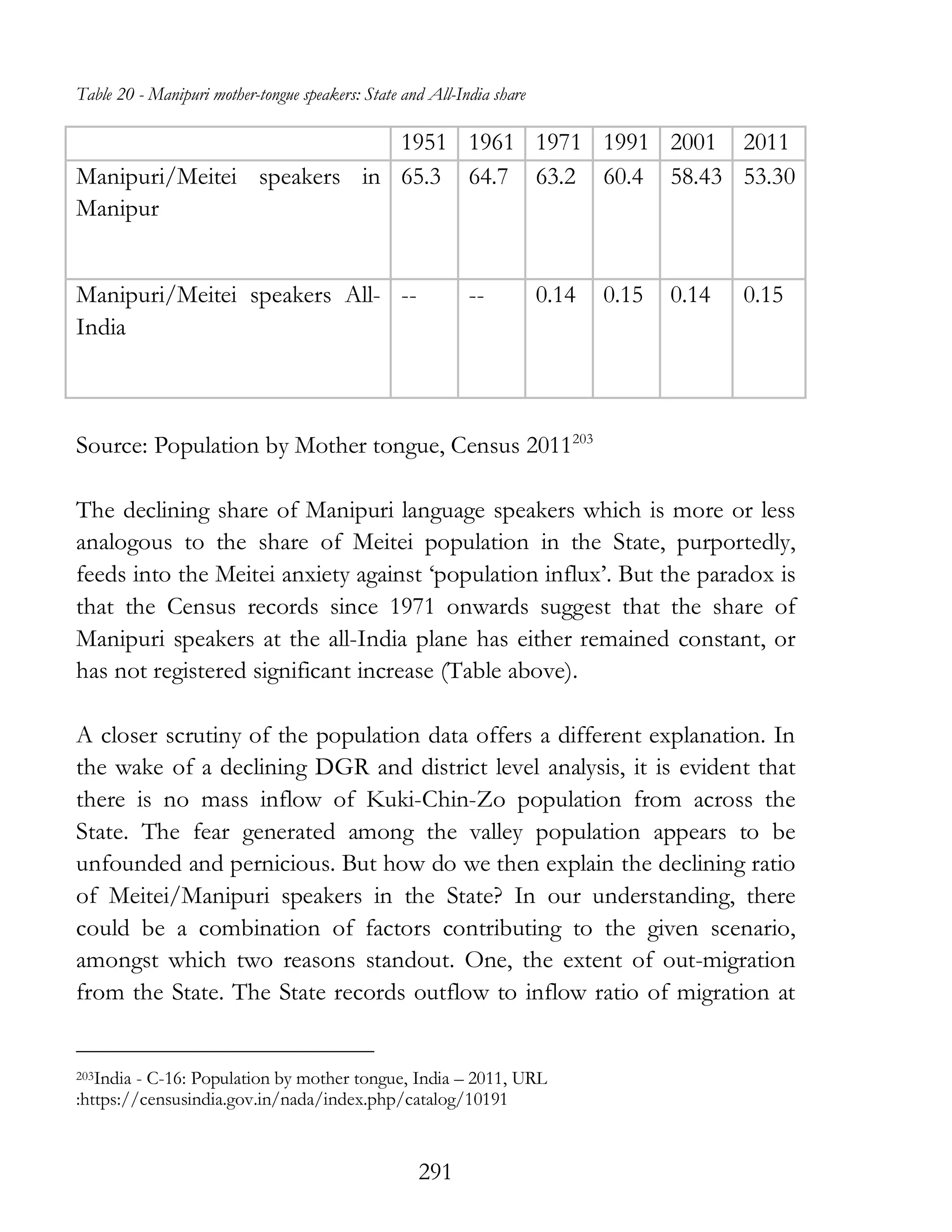
![334
Kuki militants in collaboration with militant groups operating in
Manipur.” (Deccan Herald230
)
This allegation was reinforced by think tanks which are seen as
sympathetic to the present government sitting in Delhi also made similar
indications:
“Some analysts have also pointed to the role of narcoterrorism in the
recent unrest in Manipur, where Kuki militants and a drug mafia have
allegedly incited violence against Meitei communities.” (ORF231
. )
The role of Biren Singh as the fountain head of the hate campaign and
violence is substantiated by an audio tape which has his voice, as strongly
suggested by the Truth Lab (which says that there is a 93% match between
the voice sample of the tape and Biren Singh.232
). As claimed, he is heard
as saying,
“So, now…how has this issue started from/originated? I saw all of
these…When I saw all of these, I started operations [unclear]. We started
seeking governmental land over reserved forest land, protected forest land.
The incidents that have followed…haven’t you seen on the map? Don’t
you feel like crying? I have been studying all of these for the past 10-15
years now. Something like this was bound to happen…But the number of
Naga villages have not increased…check the areas inhabited by the Naga
indigenous people and even within Imphal. The areas in Imphal, Nagaram,
Tangkhul avenue, there has been no increase in villages and they (Kuki)
just spread through Veng…Veng (village or colony).”
230https://www.deccanherald.com/india/manipur/its-a-war-against-indian-union-says-manipur-
cm-biren-singh-on-the-ongoing-violence-in-state-2708582
231https://www.orfonline.org/research/the-narcoterrorism-challenge-to-india-s-national-security
232https://m.thewire.in/article/law/supreme-court-truth-lap-manipur-tapes-biren-singh-audio](https://image.slidesharecdn.com/manipur-report-250821093300-90785df6/75/Manipur-Report-pdf-governance-failure-in-Manipur-334-2048.jpg)
![335
“At the secretariat, we don’t have our people because of their quota, they
have filled up the IPS, IAS. They are all there in the IAS service. Our
Naga brethren are not too interested in this side, they are concentrated on
their independence. There might be just 5-10 out of a 100 and so, they
[Kukis] have a total capture.”
“In the Secretariat, there are 12 secretariat officers and of the 12, there are
11 of them [Kukis].”
What is said in this conversation is an understanding that has become a
common sense in the Meitei community: that Kukis are occupying all high
posts in the government and they are expanding their territory.
On 9th
February, 2025, Chief Minister Biren Singh tendered his resignation
after presiding over the violence for more than 900 days. But even in his
resignation letter he persists with his propaganda. The Wire reports233
:
"While resigning from his post , Biren Singh asked the Union government
to “maintain the territorial integrity of Manipur which has a rich and
diverse civilisational history over thousands of years”. He also requested a
crackdown “on border infiltration”, for the formulation of a policy to
deport “illegal immigrants”, and “to continue the fight against drugs and
narco-terrorism.”.
In the testimony given by a Meitei politician, IGD2, the claim of Kukis
being outsiders is thus explained:
“- Kukis are unreliable and untrustworthy. During the Sepoy Mutiny in
1857, they joined rebellion. It is said they killed freedom fighters and
surrendered their arms to British. As reward they were armed by British.
233https://thewire.in/politics/biren-singh-tenders-resignation](https://image.slidesharecdn.com/manipur-report-250821093300-90785df6/75/Manipur-Report-pdf-governance-failure-in-Manipur-335-2048.jpg)
![344
towards ensuring justice and accountability. Police officials in the valley
refuse to cooperate to bring these militant outfits to justice, and it is
pertinent to note that the NHRC too, has failed to efficiently and
adequately address the grave situation brought about by these groups238
On 31st
May, 2024, members of the Tribunal during a meeting with the
Inspector General of Assam Rifles/Major General asked about the future
of Manipur. Clearly expressing his concerns regarding the robbed and
unrecovered arms and ammunitions he stated:
“One of the worries is de-weaponisation of society since everyone is freely
using weapons. Arambai Tenggol, Meitei Leepun, etc hold around 6000-
7000 weapons in 600 sq. km. and most of these weapons are automatic
weapons which have been looted from the police armoury….Moreover,
the perpetrators should be taken to task. Investigation and rule of law
must prevail. De-weaponisation is required to remove romanticization of
war.”
In a report released in December, 2023 [UK3] by the Indigenous Tribal
Leaders’ Forum (ITLF) titled ‘#MANIPURMAYHEM – Key Players and
Events’ the rise of Arambai Tenggol and its newfound prominence has
been linked to the ethnic violence that broke out in the state on May 3,
2023. The report claims that the Arambai Tenggol conducts recruitment
drives among the young and disaffected youths and that before the
violence erupted in the state, the group used social media and other online
platforms to spread propaganda in an effort to radicalise the Meitei
population and recruit young people. The report asserts that Meitei linked
outfits like KYKL, PLA and the UNLF which are banned under the
UAPA, are supporting Arambai Tenggol as it enjoys patronage from the
ruling party. The report, while claiming a significant role for Arambai
Tenggol in the violence, reported that 4000 weapons were looted by the
238Cross refer to chapter 10](https://image.slidesharecdn.com/manipur-report-250821093300-90785df6/75/Manipur-Report-pdf-governance-failure-in-Manipur-344-2048.jpg)
![347
in militancy in the refugee camps is strong, and serves as a justification of
Meitei violence – retaliatory or in the defence of their people.
In the above accounts, the absence of state control was as striking as the
claims of cooperation between the youth organisation and the state forces.
The civilian groups showed the Tribunal tickets or passes which they issue
to those who they allow to pass to or from Moreh, and these passes are
issued against a fixed amount of fee. In short, these civilian groups, often
armed, have replaced the state forces in certain parts of Manipur and are
running, unabashedly and without hindrance, a parallel administration.
The convenor of LangsaiThouna also informed the Tribunal that many
youths have taken up arms, like the Arambai Tenggol.
Several survivors’ accounts reveal how civilian mobs were accompanied by
these radical and extremist organisations. On both sides, radicalised
civilian populations also engaged in looting and killing240
. The
radicalisation of the population was also revealed through testimonies of
experts and commentators. The Major General [UK5] relayed an incident
wherein the Assam Rifles caught 11 cadres from the Meitei community
openly roaming with weapons in Bishnupur:
“As soon as we caught them, they informed the Meira Paibis, who came
and tried to manhandle the army men. First, the army tried to reason with
them, then on the order of the Commanding Officer, gun was shot in the
air. However, the Meira Paibis kept on insisting for the release of the
cadres. Finally, we kept the arms and released the cadres. We are
negotiating for peace, that does not mean we are weak. Barring two acts of
violence, no loss of life has occurred in the last four months. We accept
restrictions imposed by the people in order to maintain peace.”
240Cross refer to chapter 5](https://image.slidesharecdn.com/manipur-report-250821093300-90785df6/75/Manipur-Report-pdf-governance-failure-in-Manipur-347-2048.jpg)
![353
Bangladeshis and Rohingyas into Manipur for political reasons. On closer
examination of the video, though, it becomes clear that the letter's author
was not a member of the Congress but rather a local party. The author of
the social media post mistook the anchor of the video's initial reference to
“a Manipur regional party leader” for the Manipur Congress leader.
Malinformation: Genuine information disseminated with malicious
intent is referred to as malinformation. This kind of information involves
presenting accurate but deceptive information in an inappropriate setting
or purposefully disclosing personal information to destroy someone's
reputation.
Example- On 20th
July, 2023, the arrest of a person from a minority group
for his role in the attack was disseminated supposedly by one of the
lawmakers for the ruling party. The individual was called the "primary
accused of [the] Manipur case" as per the lawmaker's tweet, which
received thousands of shares and over twenty thousand retweets. But this
was a false statement. That day, a person from a minority group was
indeed taken into custody by Manipur police, but for a completely
different reason. The arrests, according to the police, happened in various
places and had nothing to do with the women's attack. The mistake was
addressed by news agency ANI, which had originally linked the arrest to
the mob attack. They attributed it to a misinterpretation of police tweets.
Thus, we see how the Information Disorder Theory is pertinent to the
investigation of fake news in Manipur by helping us categorize and
qualitatively distinguish between the different kinds of fake news peddled
by both sides. This aids in tracing both the intent and impact of such
news, especially when it is further used in conjunction with hate speech.
7.2.2.2 Media Effect Theory
Basing itself in the tradition of social cognitive theory, Albert Bandura
(2001) developed the Media Effect Theory, which looks at how exposure
to media material affects attitudes, behaviours, and beliefs. According to](https://image.slidesharecdn.com/manipur-report-250821093300-90785df6/75/Manipur-Report-pdf-governance-failure-in-Manipur-353-2048.jpg)
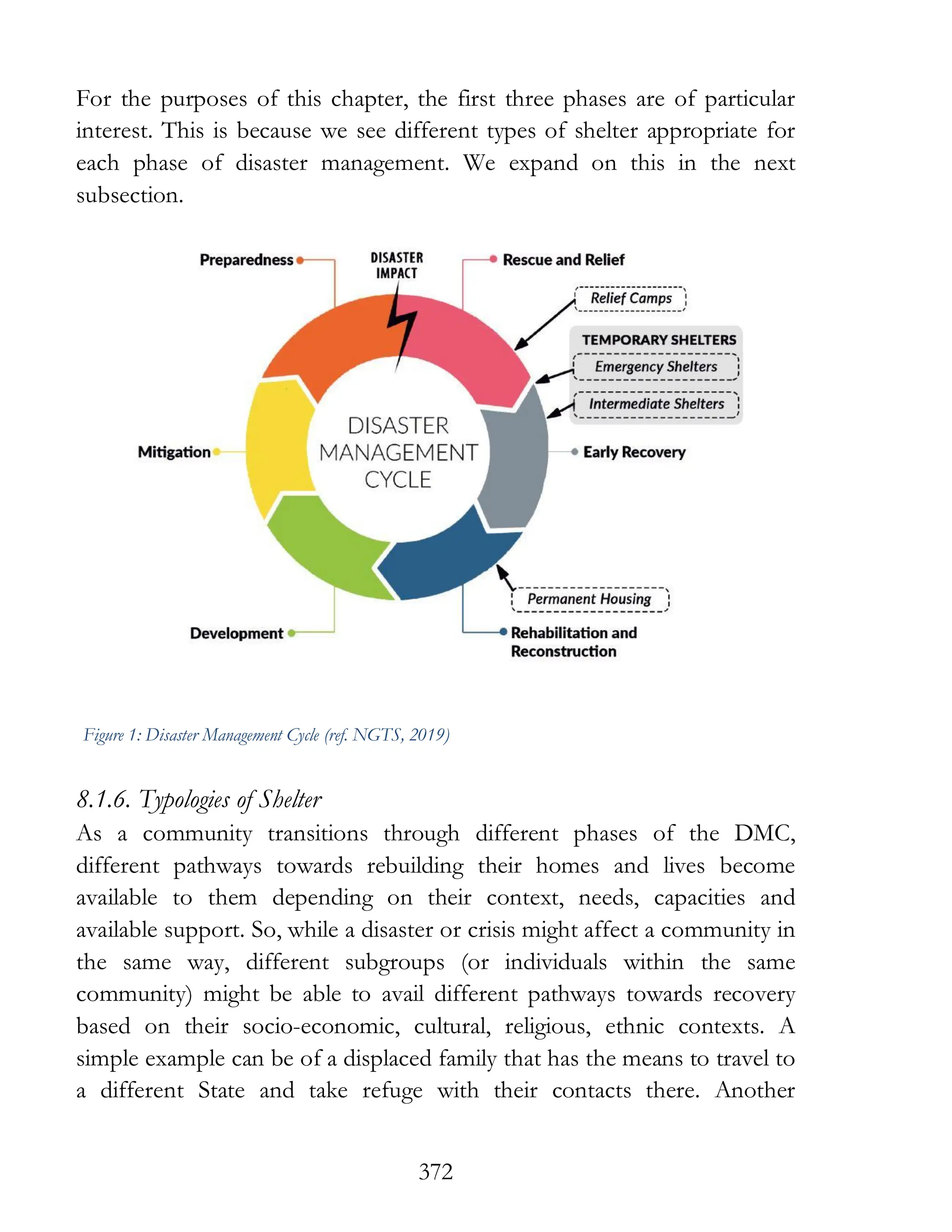
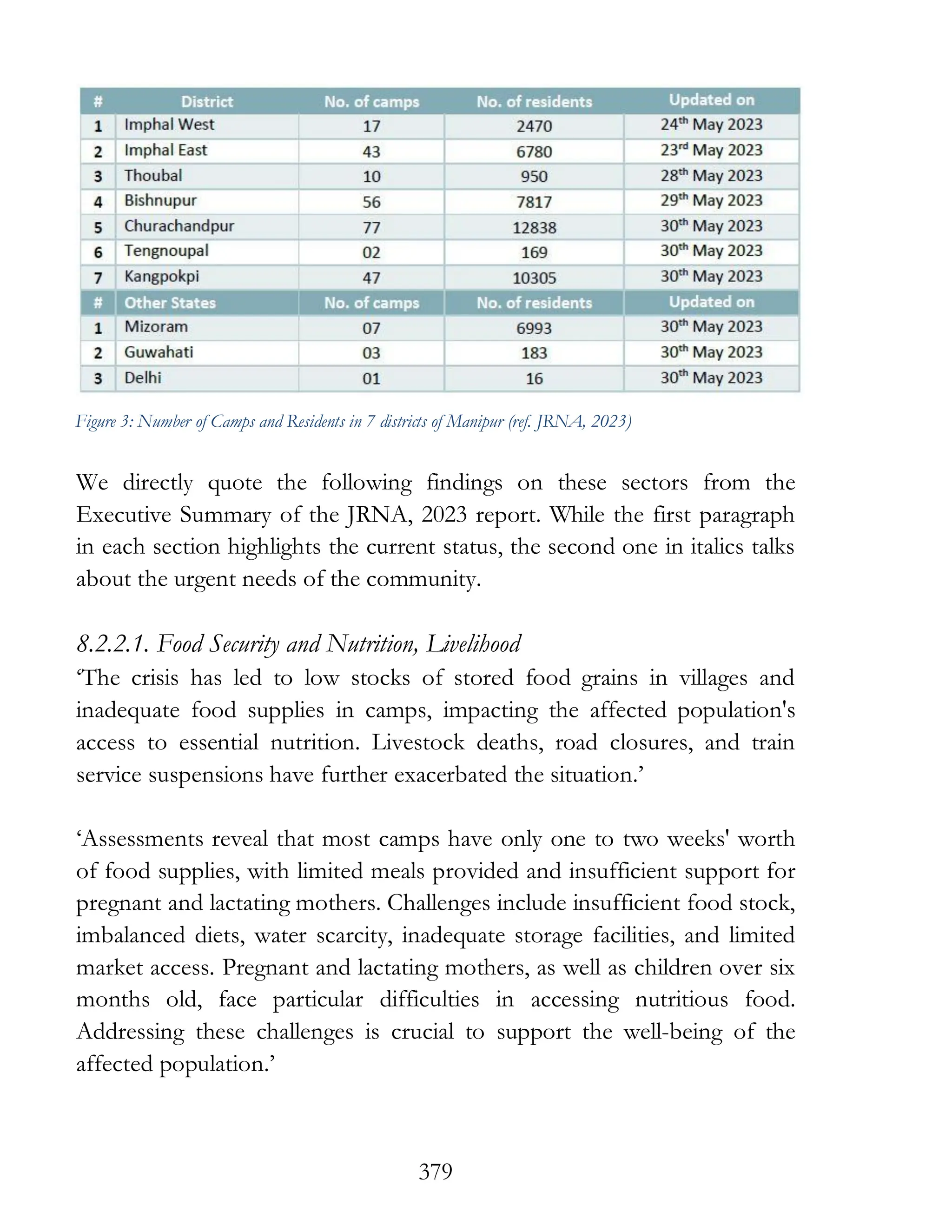
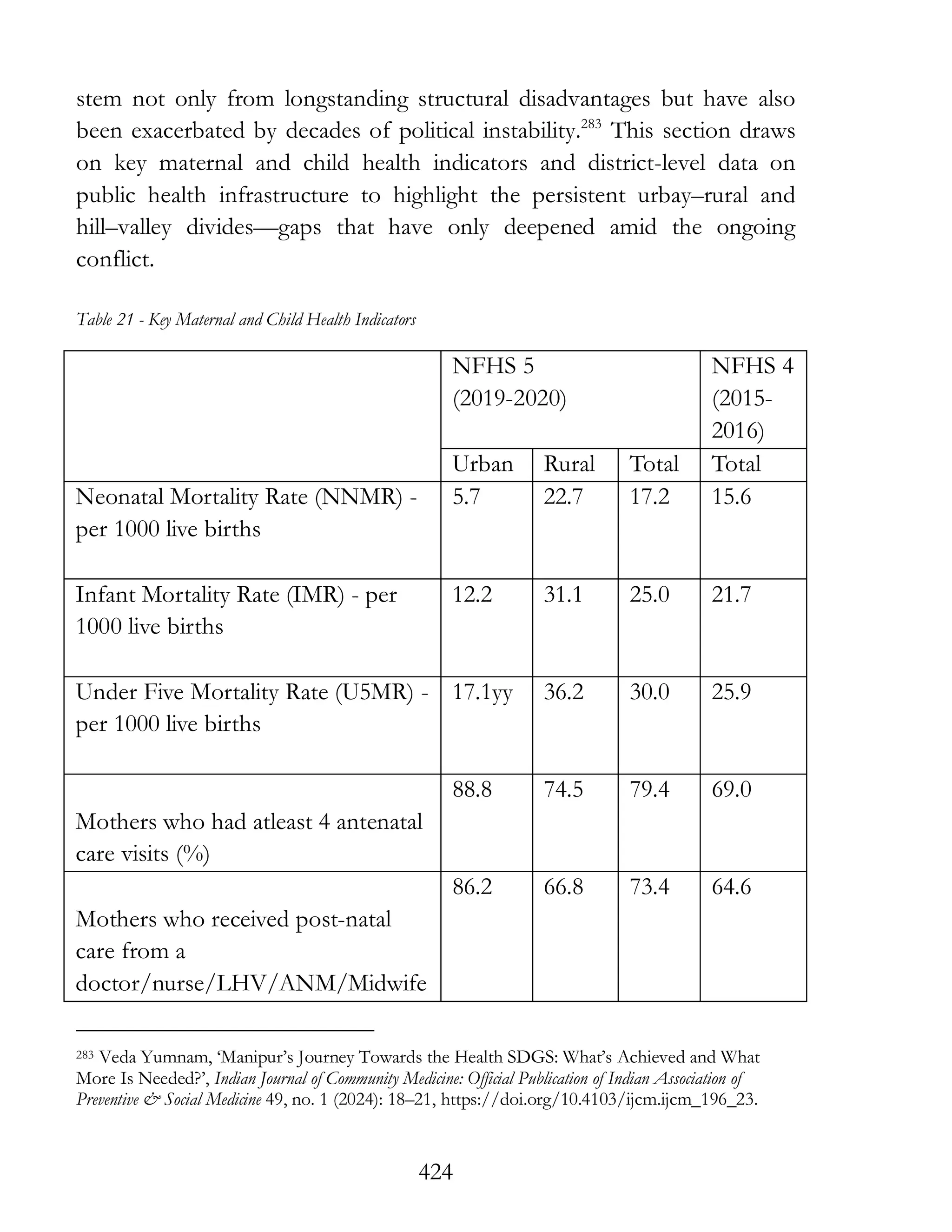
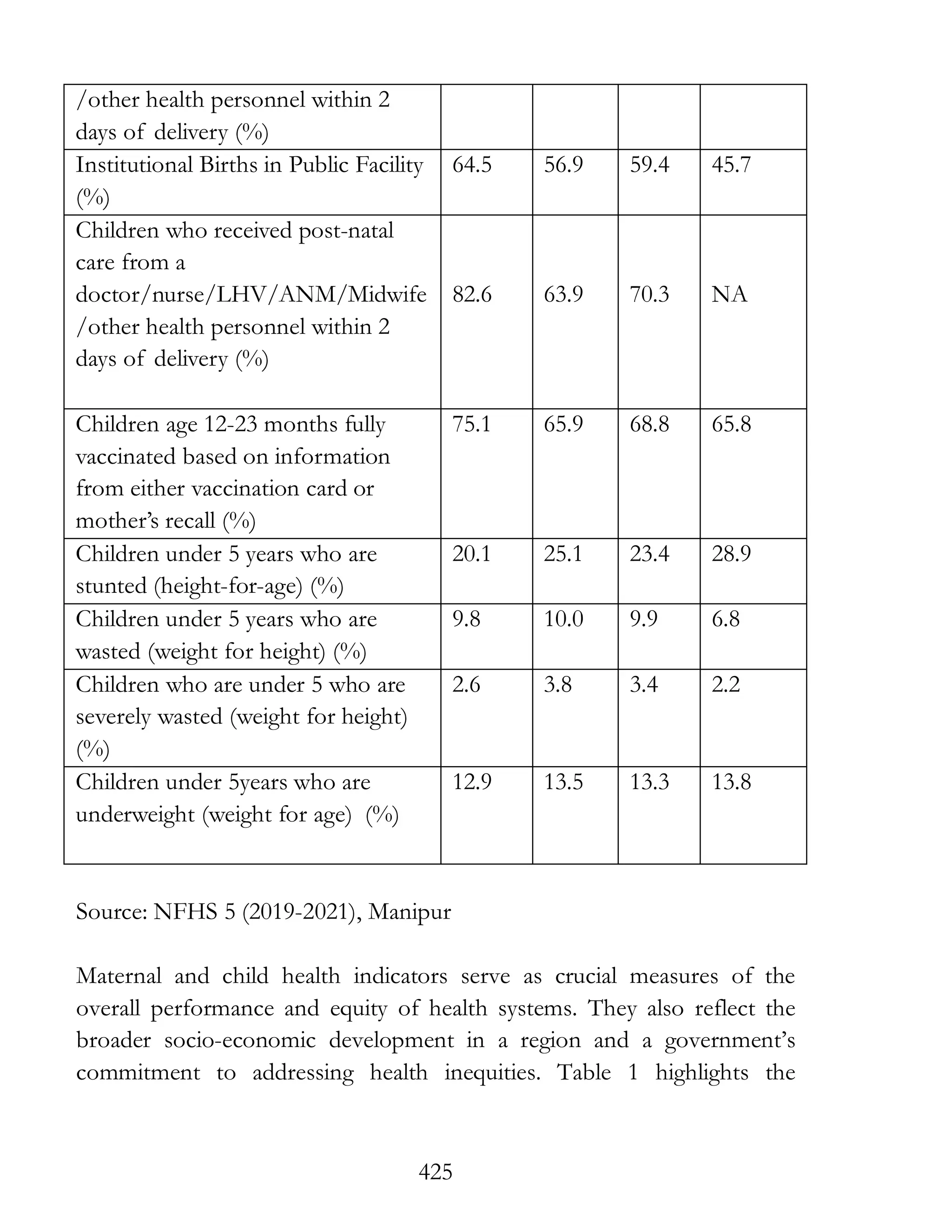
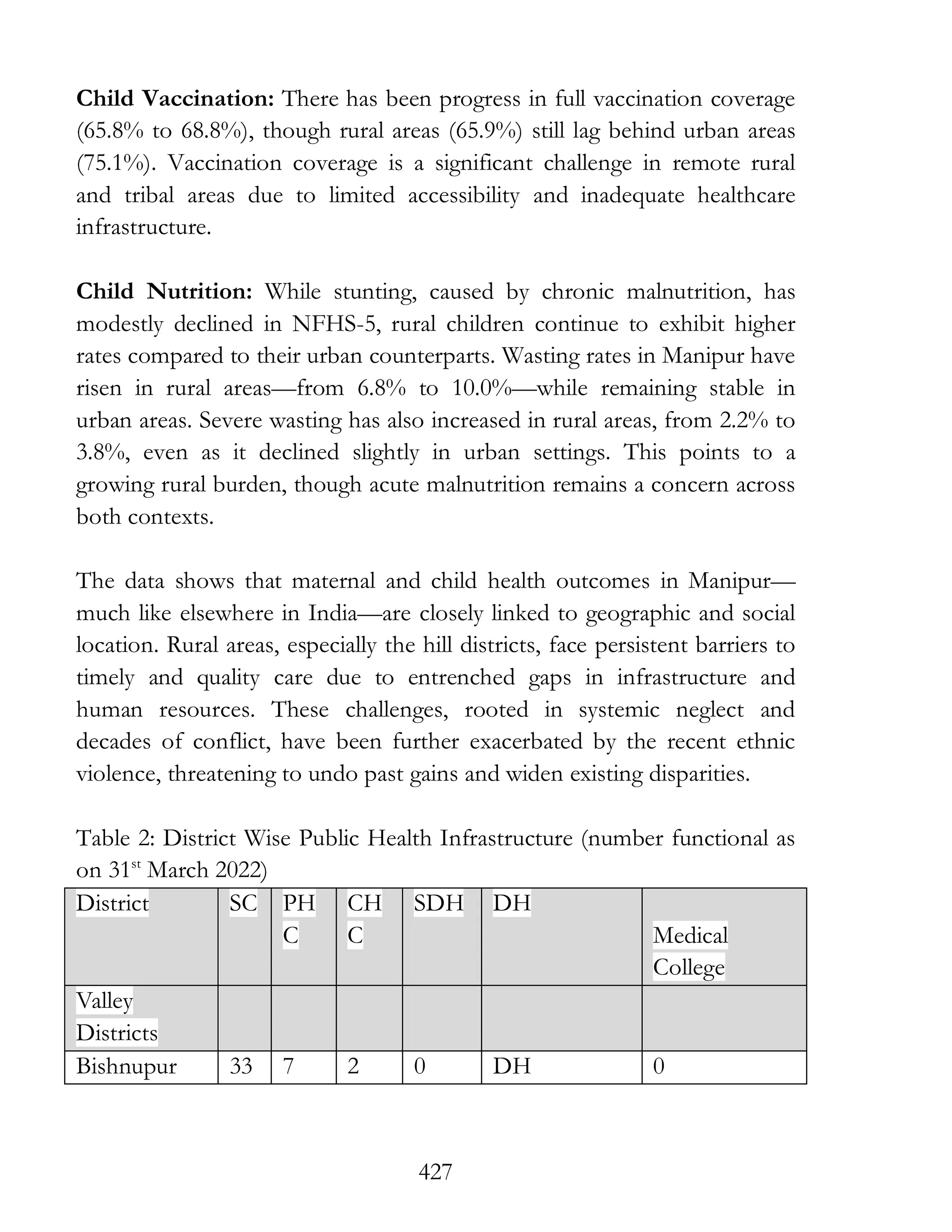
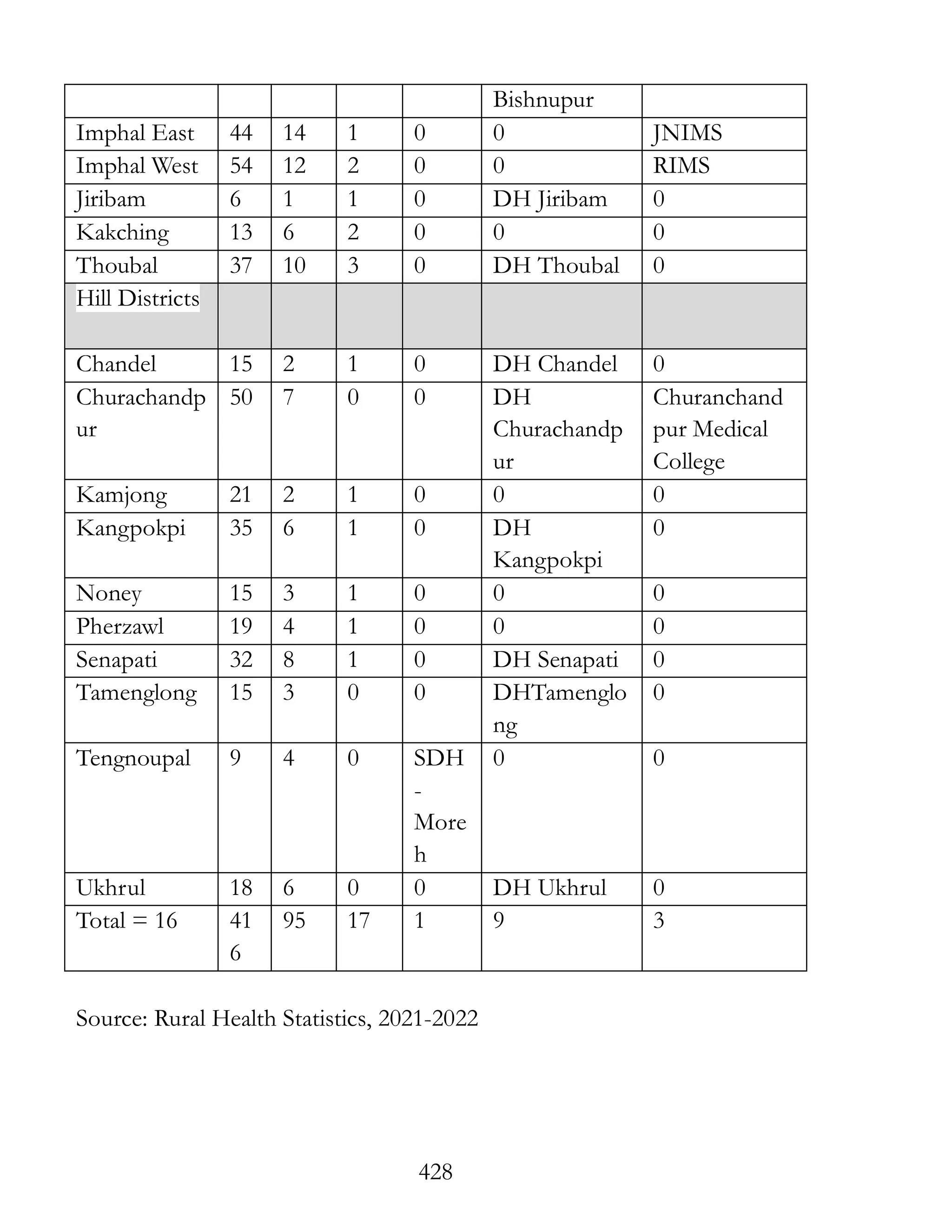
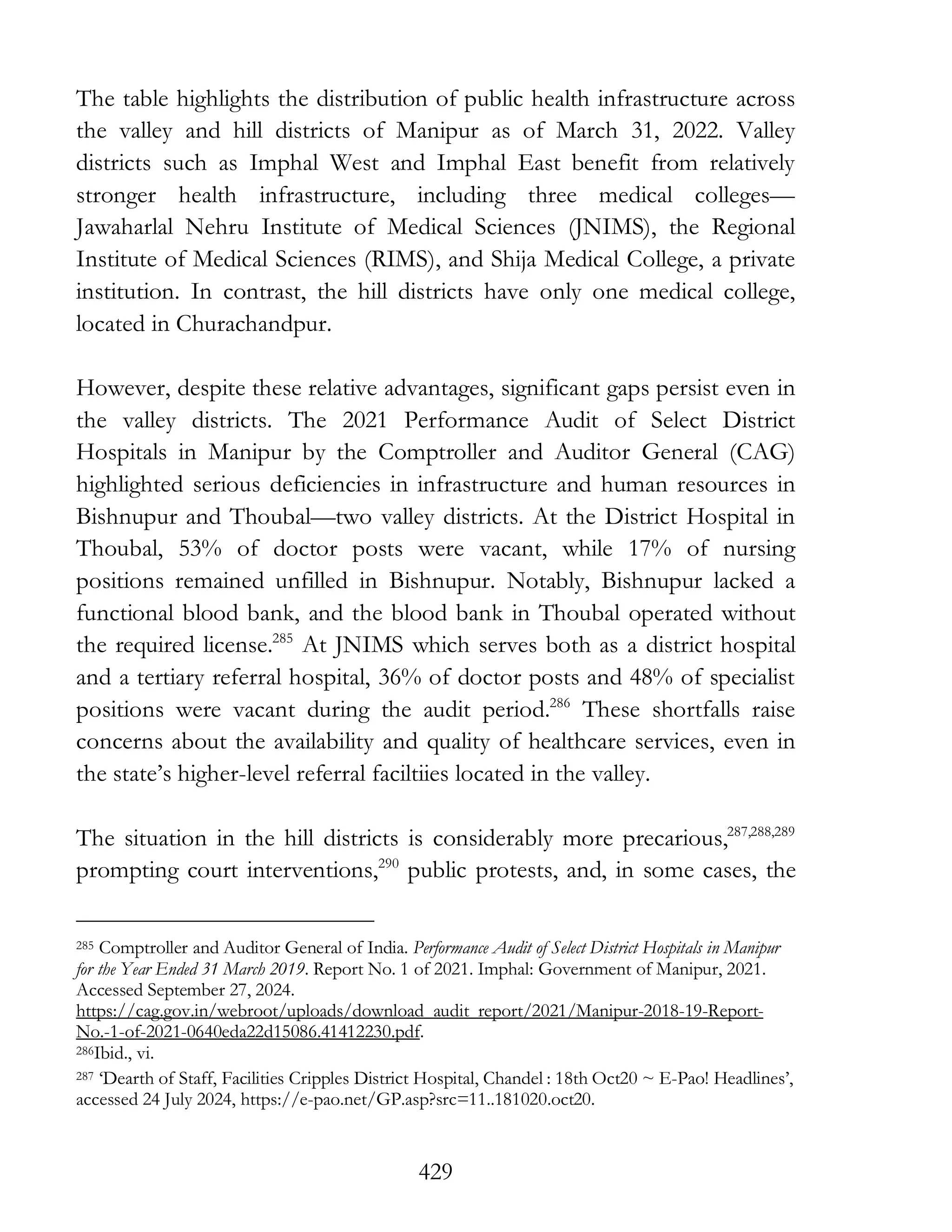
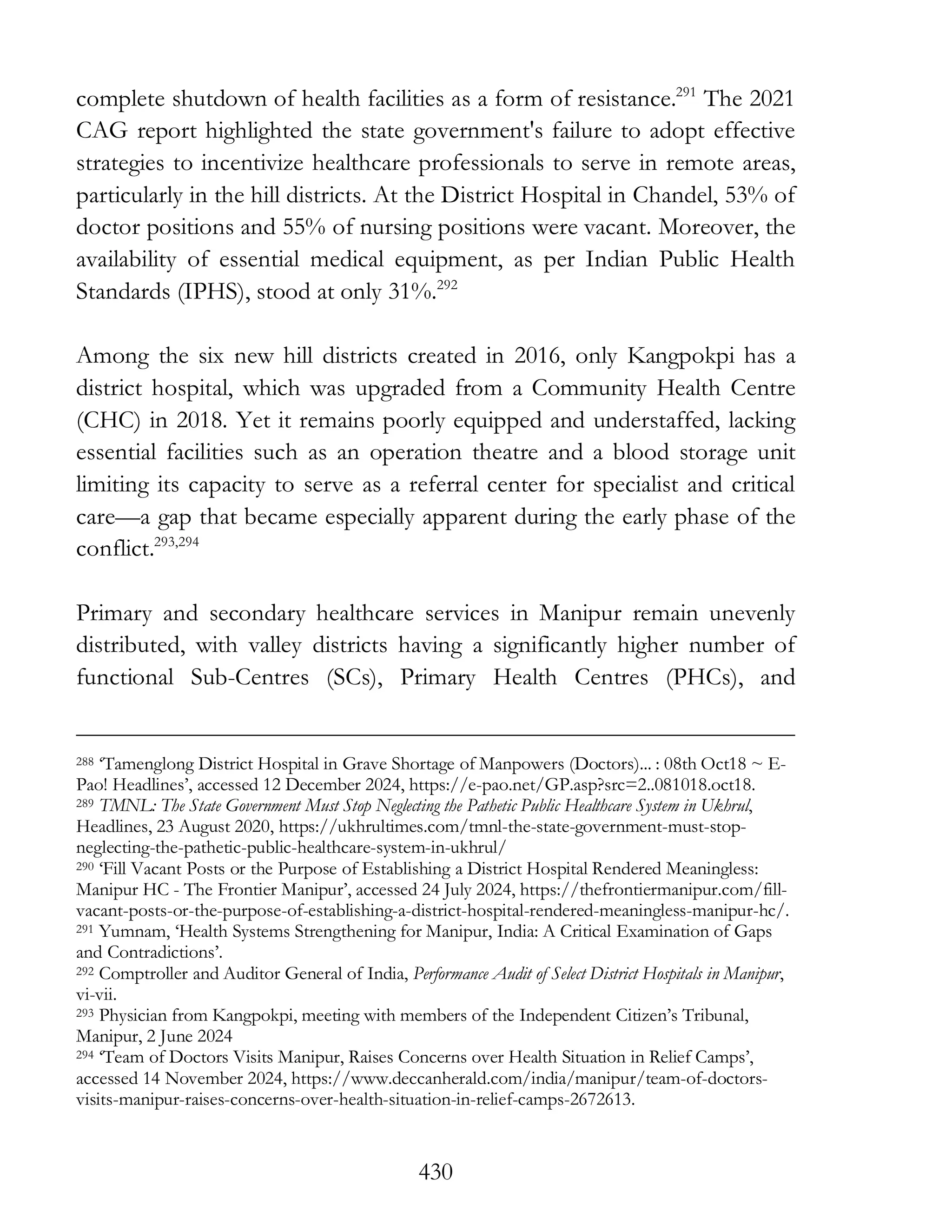
![435
appointee was transferred before the violence.315
Reliable data on clinical
psychologists and psychiatric social workers is unavailable, further
obscuring the extent of the human resource gap. The absence of a
dedicated mental health hospital316
and the need for judicial intervention to
implement the Mental Healthcare Act, 2017,317
together highlight the
systemic neglect of mental health in the state.
Treatment-seeking for mental health concerns in the state as elsewhere is
shaped not only by infrastructural and workforce limitations but also by
geographic and sociocultural barriers. Inadequate transport infrastructure
in hilly and remote areas significantly restricts access to care. These
structural constraints are compounded by pervasive stigma, which often
frames mental illness as a moral, spiritual, or intellectual failing. As a 35-
year-old Kuki-Zo male, co-founder of a youth-led mental health NGO in
Churachandpur, explained:
The Psychiatry Department at the district hospital is perceived as a place for mentally
retarded individuals. The community prioritizes spending on physical health over
mental health—people go into debt for physical ailments but hesitate to pay
for counselling and mental health services.
Thus, given the above factors, the treatment gap in Manipur remains high,
with only about 20% of those affected receiving care despite a significant
mental health burden.318
315 Physician from Kangpokpi, meeting with members of the Independent Citizen’s Tribunal,
Kangpokpi, Manipur, 2 June 2024.
316 ‘What Is Hindering Construction of Mental Health Hospital in Manipur?’, Imphal Free Press,
accessed 29 September 2024, https://www.ifp.co.in/ifp-breaking-point/what-is-hindering-
construction-of-mental-health-hospital-in-manipur.
317 Sparsh Upadhyay, ‘Implement Provisions Of Mental Healthcare Act In Letter And Spirit Within
6 Months : Manipur HC Directs State Government [Read Order]’, 13 September 2020,
https://www.livelaw.in/news-updates/implement-provisions-of-mental-healthcare-act-in-letter-
and-spirit-within-6-months-manipur-hc-directs-state-government-162862.
318 Khan and Hussain, ‘Manipur’s Mental Health Crisis, a Year after Violence’.](https://image.slidesharecdn.com/manipur-report-250821093300-90785df6/75/Manipur-Report-pdf-governance-failure-in-Manipur-435-2048.jpg)
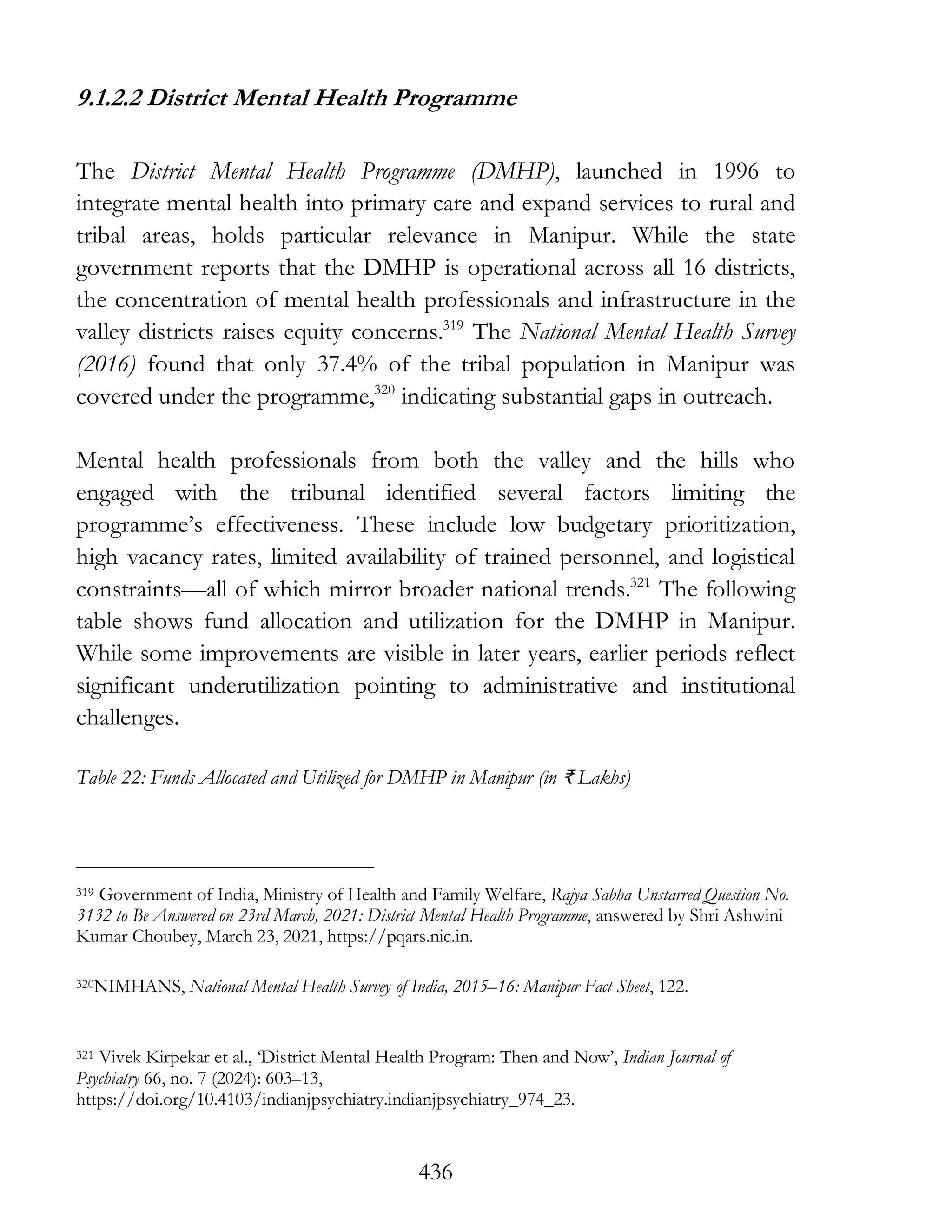
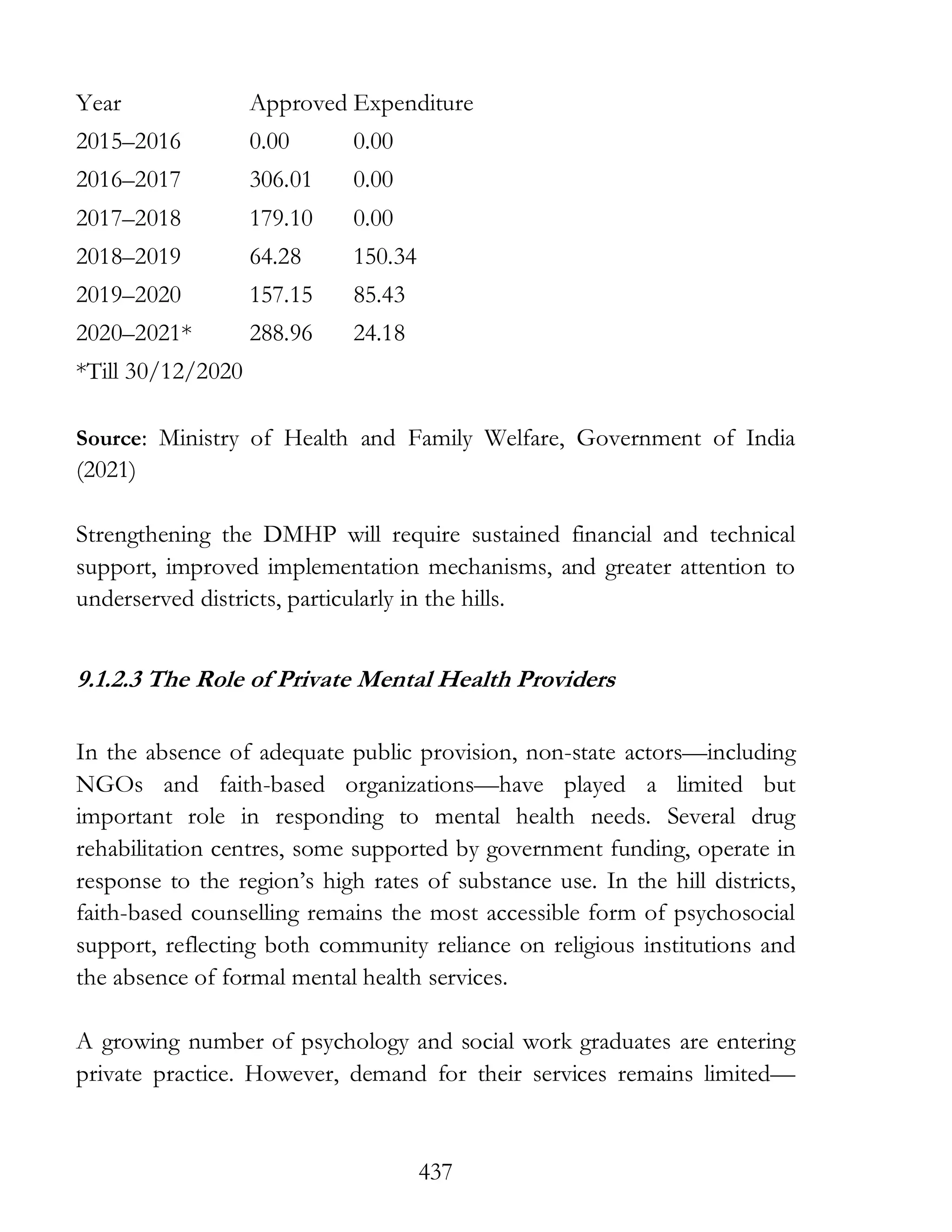
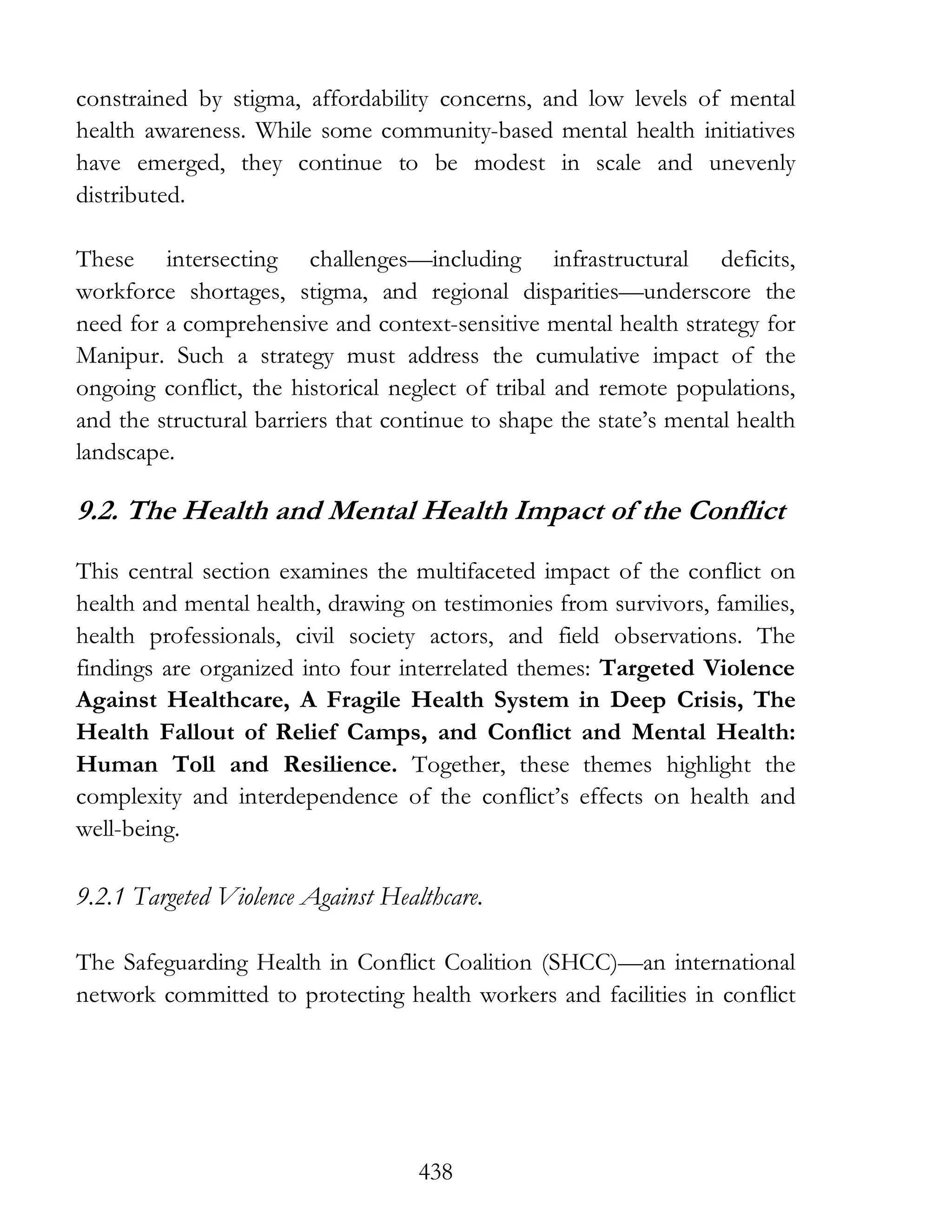
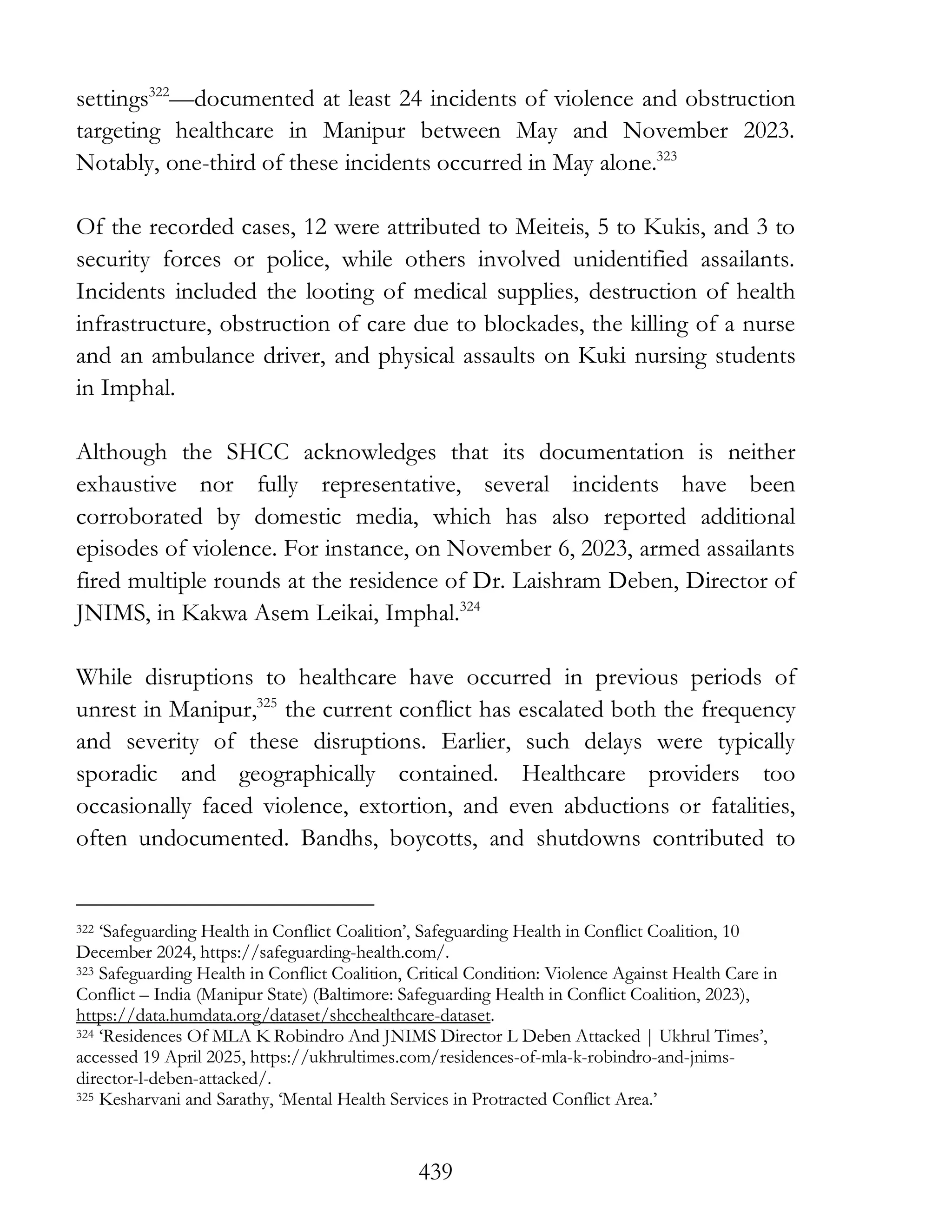
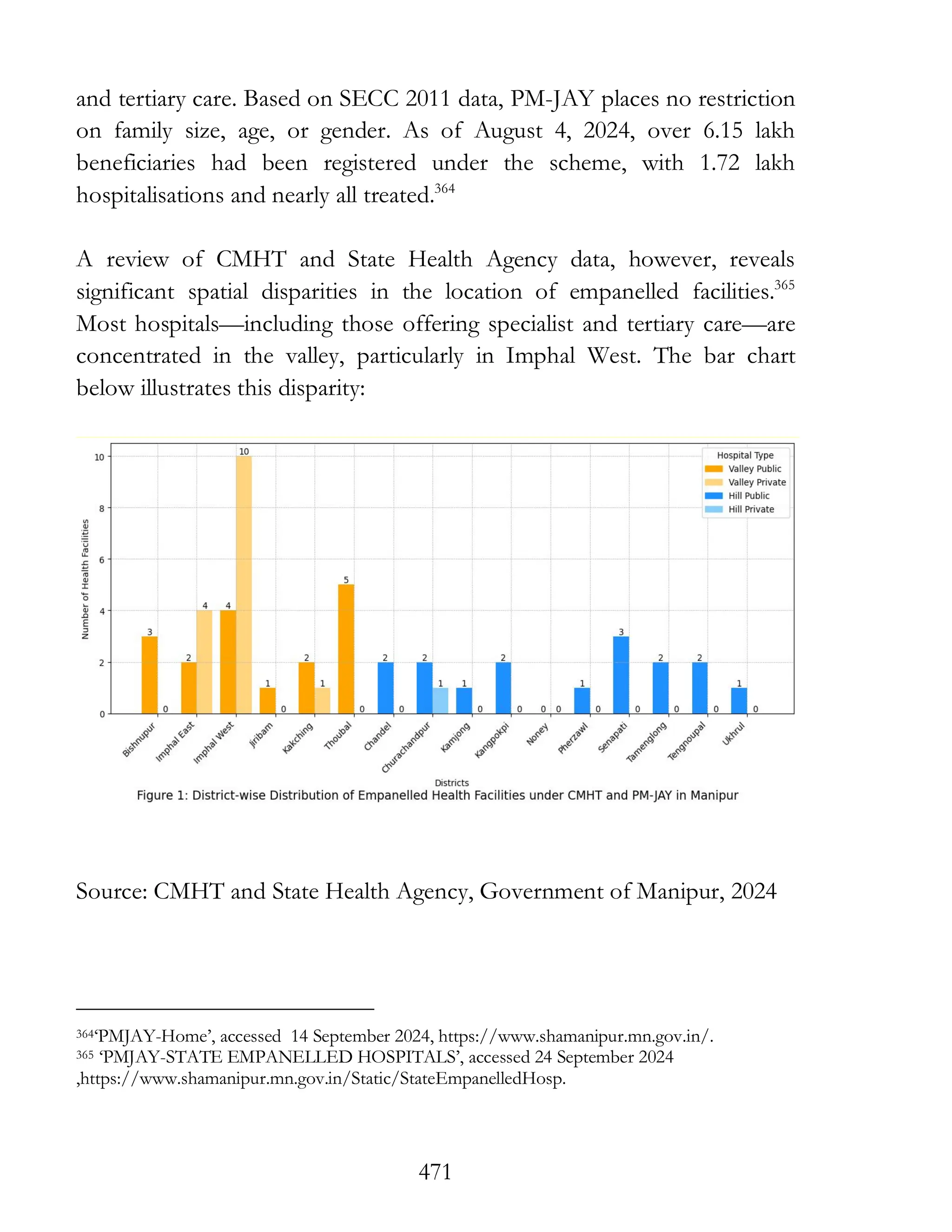
![473
stated that efforts had been initiated to reconstruct lost documents such as
Aadhaar cards, health cards, and bank passbooks.366
However, during the
visit of the Independent Citizens’ Tribunal, multiple stakeholders
confirmed that more than a year into the conflict, many displaced
individuals still did not have access to their health cards. The Gita Mittal
Committee, in its reports, repeatedly emphasized the urgent need to
reissue essential documents to ensure uninterrupted access to healthcare,
irrespective of a person’s place of residence.367
The loss of essential documents and limited access to functional
healthcare facilities appear to have had a direct impact on the utilisation of
the CMHT scheme. Data from the official website show a steady increase
in cases treated before the ethnic violence—from 4,502 in May 2022 to
5,997 by April 2023—followed by a sharp spike after the violence began in
May 2023, peaking at 6,815 cases in August 2023, likely linked to conflict-
related injuries and morbidity. However, from December 2023 onwards,
utilisation declined sharply, falling to 3,157 cases in January 2024 and
remaining below pre-violence levels through May 2024 (3,670 cases).368
This reversal of the conflict-related surge suggests underutilisation of the
scheme despite continuing humanitarian and health needs among
displaced and vulnerable population and needs immediate investigation
and corrective action.
366 Government of Manipur, Updated Status Report, 8.
367 367www.ETLegalWorld.com, ‘Justice Gita Mittal Panel Files Reports on Loss of ID Proofs of
Victims in Manipur Violence, Compensation Scheme to SC - ET LegalWorld’,
ETLegalWorld.Com, accessed 25 April 2025,
https://legal.economictimes.indiatimes.com/news/litigation/justice-gita-mittal-panel-files-reports-
on-loss-of-id-proofs-of-victims-in-manipur-violence-compensation-scheme-to-sc/102916665.
368 Government of Manipur. CMHT Fortnightly and Cumulative as of November 2024. Imphal: CMHT
Manipur, November 2024. Accessed [30 November, 2024].
https://www.cmhtmanipur.gov.in/cmht/index.html.
Government of Manipur, CMHT Fortnightly and Cumulative as on November 2024 (Imphal: CMHT
Manipur, November 2024), accessed via CMHT Manipur website.
https://www.cmhtmanipur.gov.in/cmht/index.html](https://image.slidesharecdn.com/manipur-report-250821093300-90785df6/75/Manipur-Report-pdf-governance-failure-in-Manipur-473-2048.jpg)
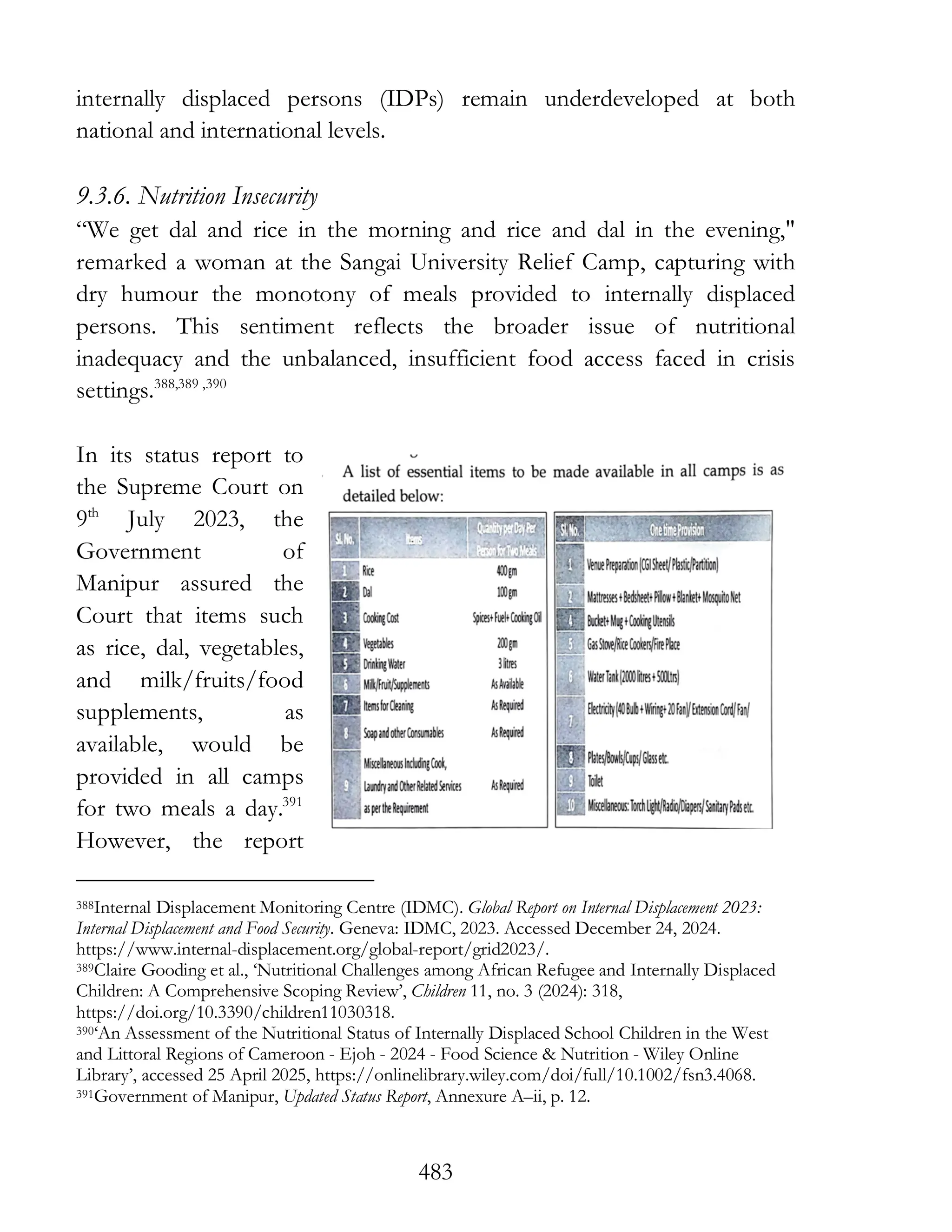
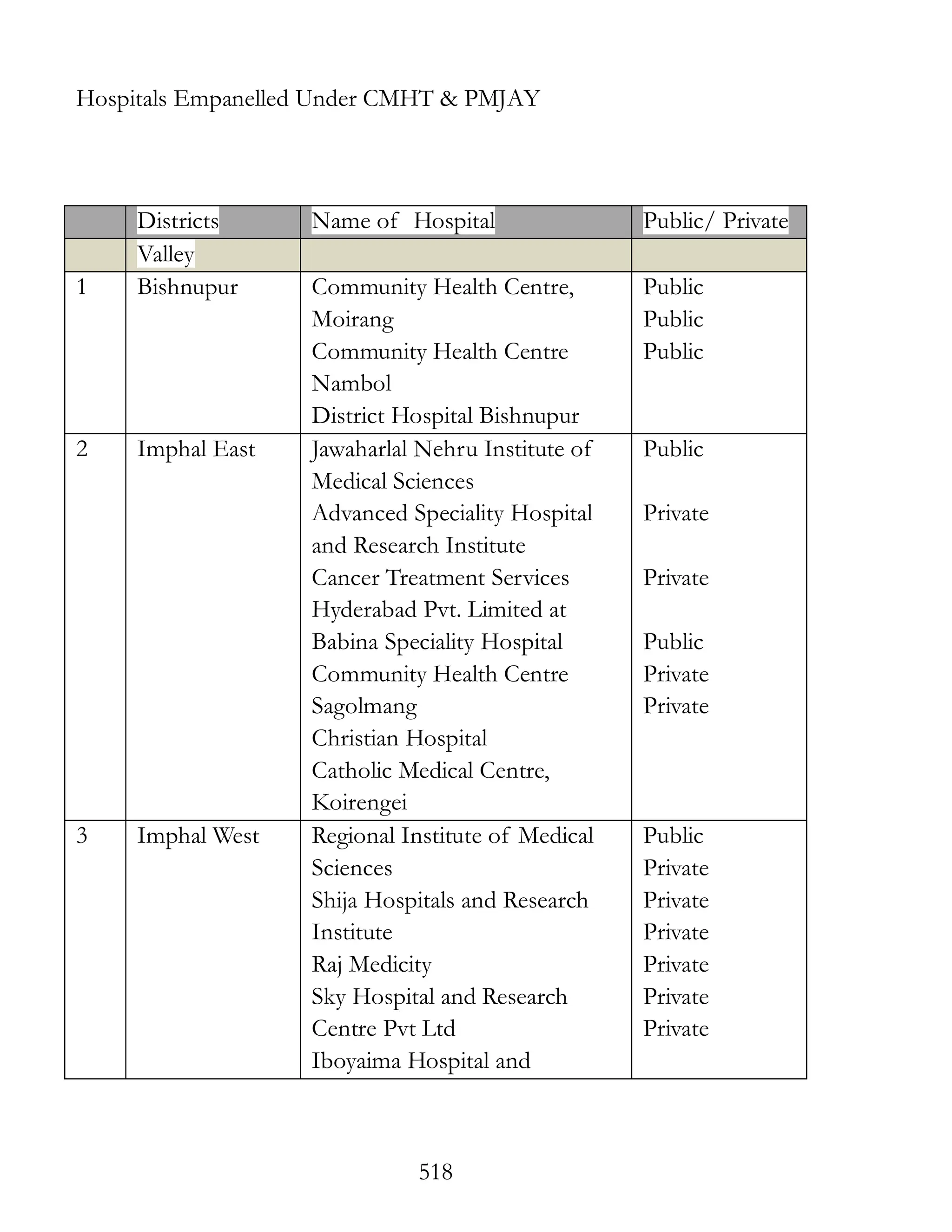
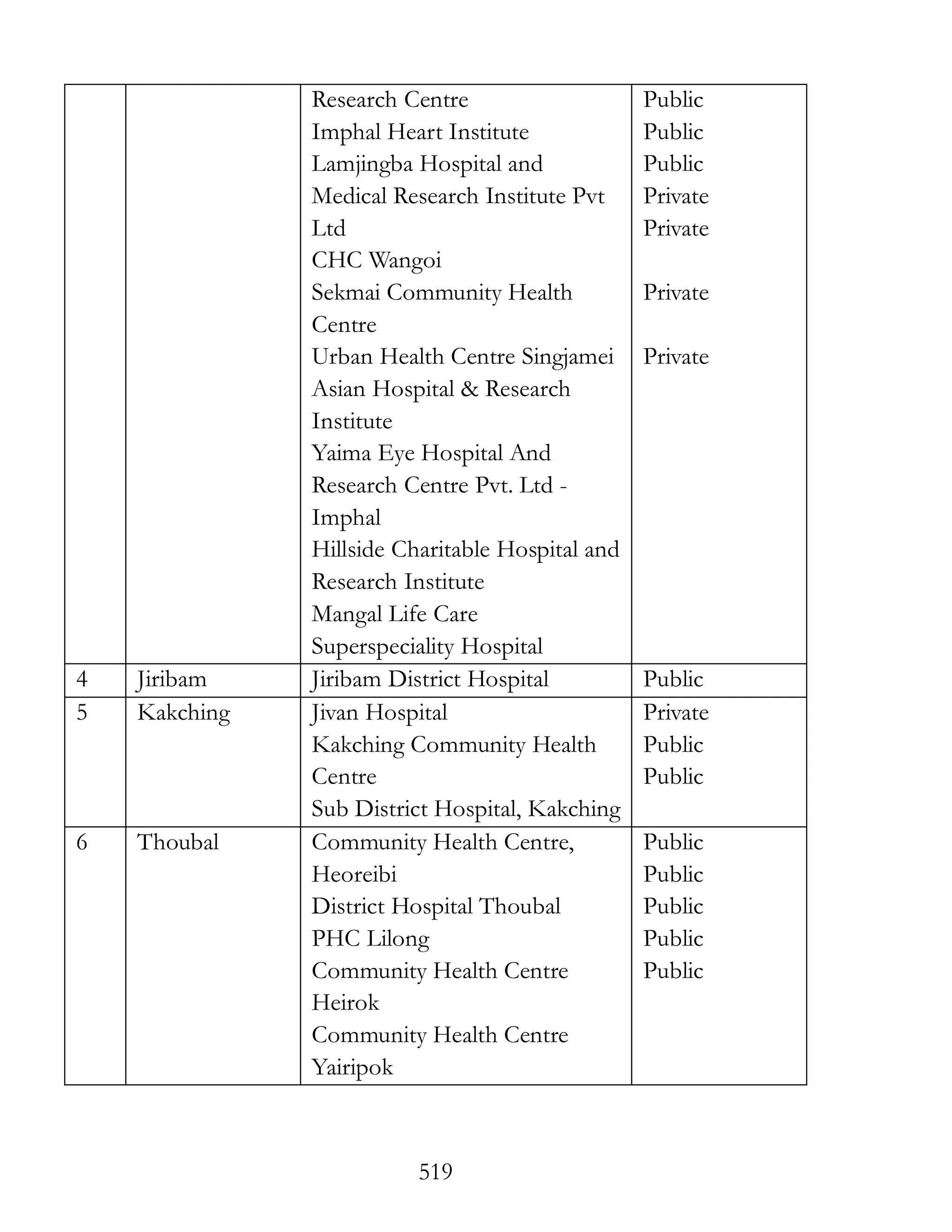
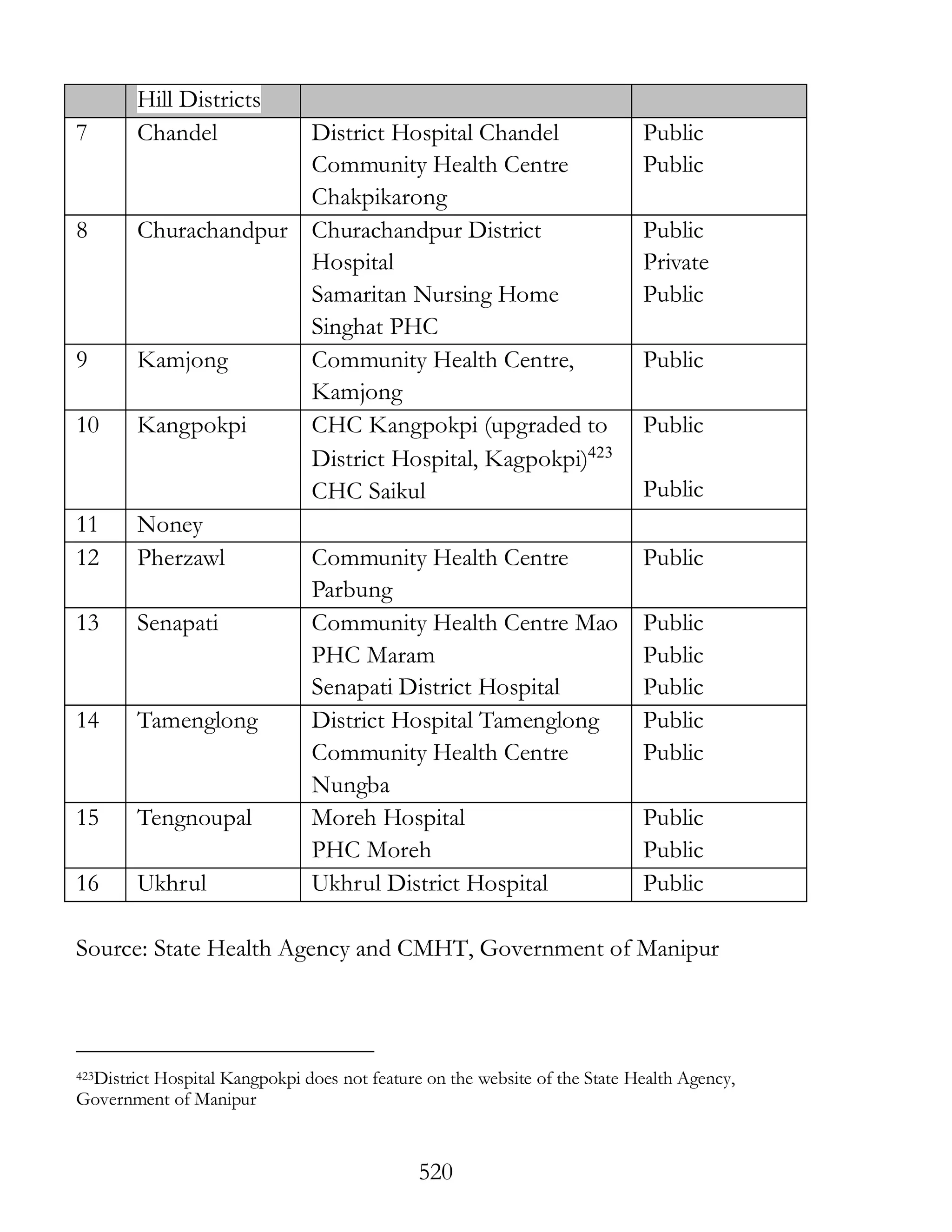
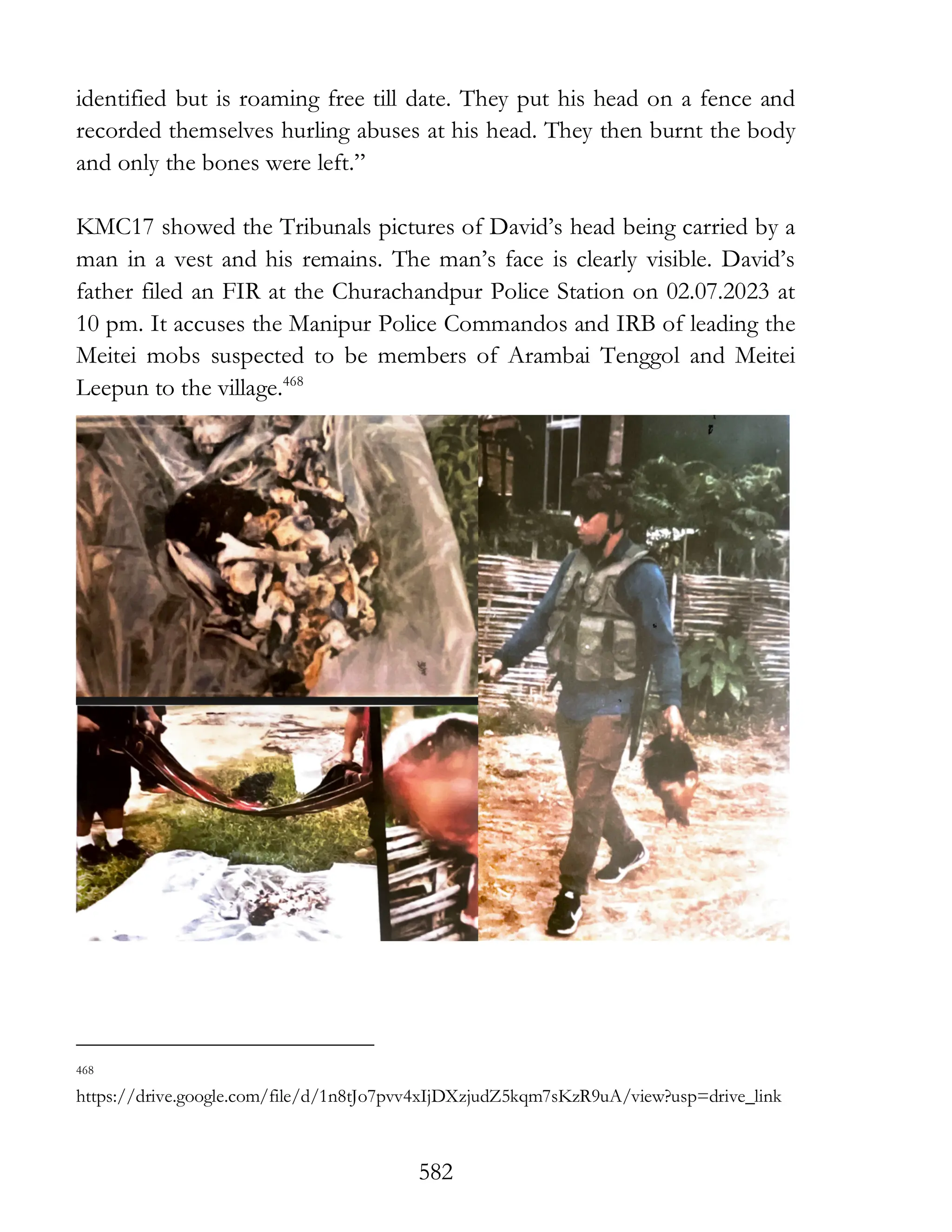
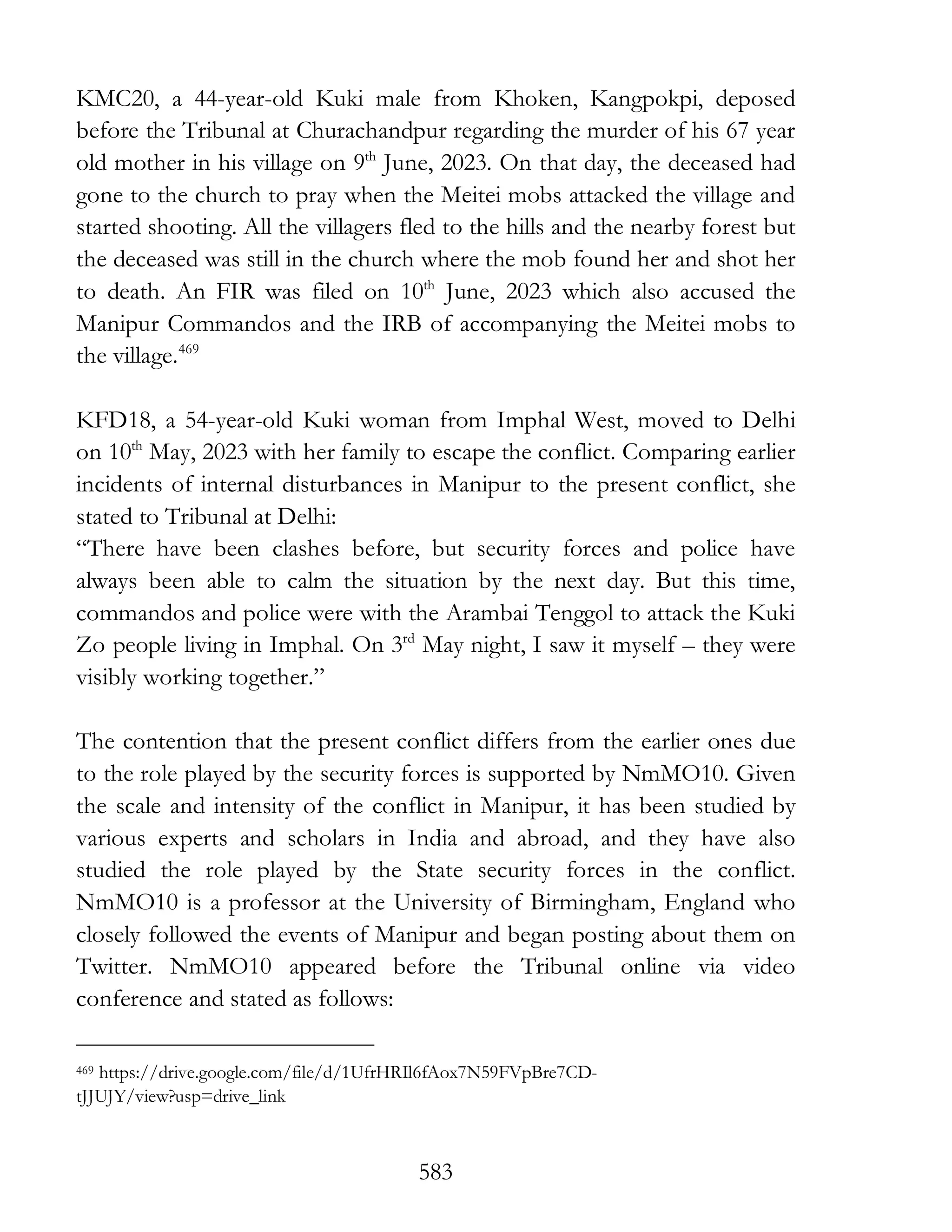
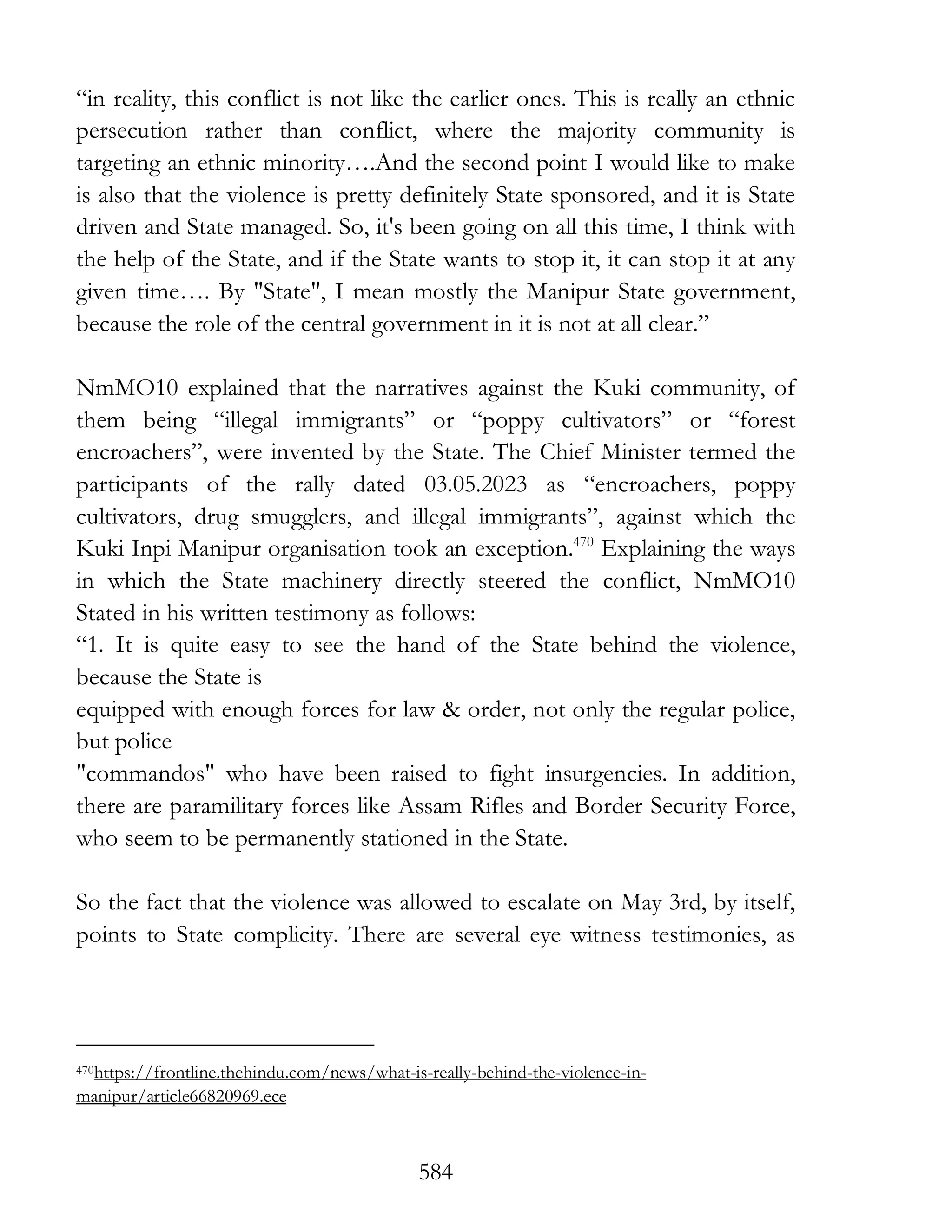
![588
There were other factors, of course. There was a rally in Moirang, the
closest Meitei town to the Churachandpur district border, around the
same time as the Churachandpur rally.477
There was also a "counter-
blockade" at the district border, imposed by Meitei Leepun.478
And,
according to the Imphal-based Sangai Express, "reports about a clash
between people who had imposed a counter-blockade at Torbung and
those returning from the rally started doing the rounds at Torbung."479
A
free-lancer journalist called Lien Chongloi wrote in The Wire that "many
Meitei volunteers who were held up at Kakwa [Kwakta] areas started
moving towards Torbung and Kangvai areas and began torching Kuki
houses".480
NmMO10 cited two more such examples to show how the Manipur police
spread misinformation and provocation.
KFD17 is a 29 year old Kuki woman from Sugnu in Chandel district who
was living in Delhi when the conflict broke out in Manipur. However, her
entire family fell victim to the violence of the conflict, which she
recounted to the Tribunal at Delhi. She expressed deep surprise and
disappointment, stating as follows:
“We lived together with the Meiteis for ages. We went to school together,
shopped together.
3 May 2024 changed our lives. My family would flee and return home
every night to sleep for 2-3 hours. For the rest of the time they would go
to the forests to hide. We heard Arambai was coming to our place.
477https://ukhrultimes.com/manipur-bid-to-block-roads-leading-to-hills-foiled-torch-rally-
organised-in-moirang-kendra/;
478https://www.ifp.co.in/manipur/counter-blockade-unjustified-atsum;
479https://www.thesangaiexpress.com/Encyc/2023/5/4/OSR-CorrespondentsIMPHAL-May-3-
Thousands-of-people-took-out-the-Tribal-Solidarity-March-in-t.html;
480https://thewire.in/rights/manipur-violence-claims-counterclaims-meitei-kuki;](https://image.slidesharecdn.com/manipur-report-250821093300-90785df6/75/Manipur-Report-pdf-governance-failure-in-Manipur-588-2048.jpg)