Managing user resistance when designing, and executing your global Lab Informatics strategy John Trigg phaseFour Informatics Limited www.phasefour-informatics.com www.theintegratedlab.com
Agenda Success criteria for informatics projects  User involvement The principles of technology adoption  Defining strategies to drive up user acceptance
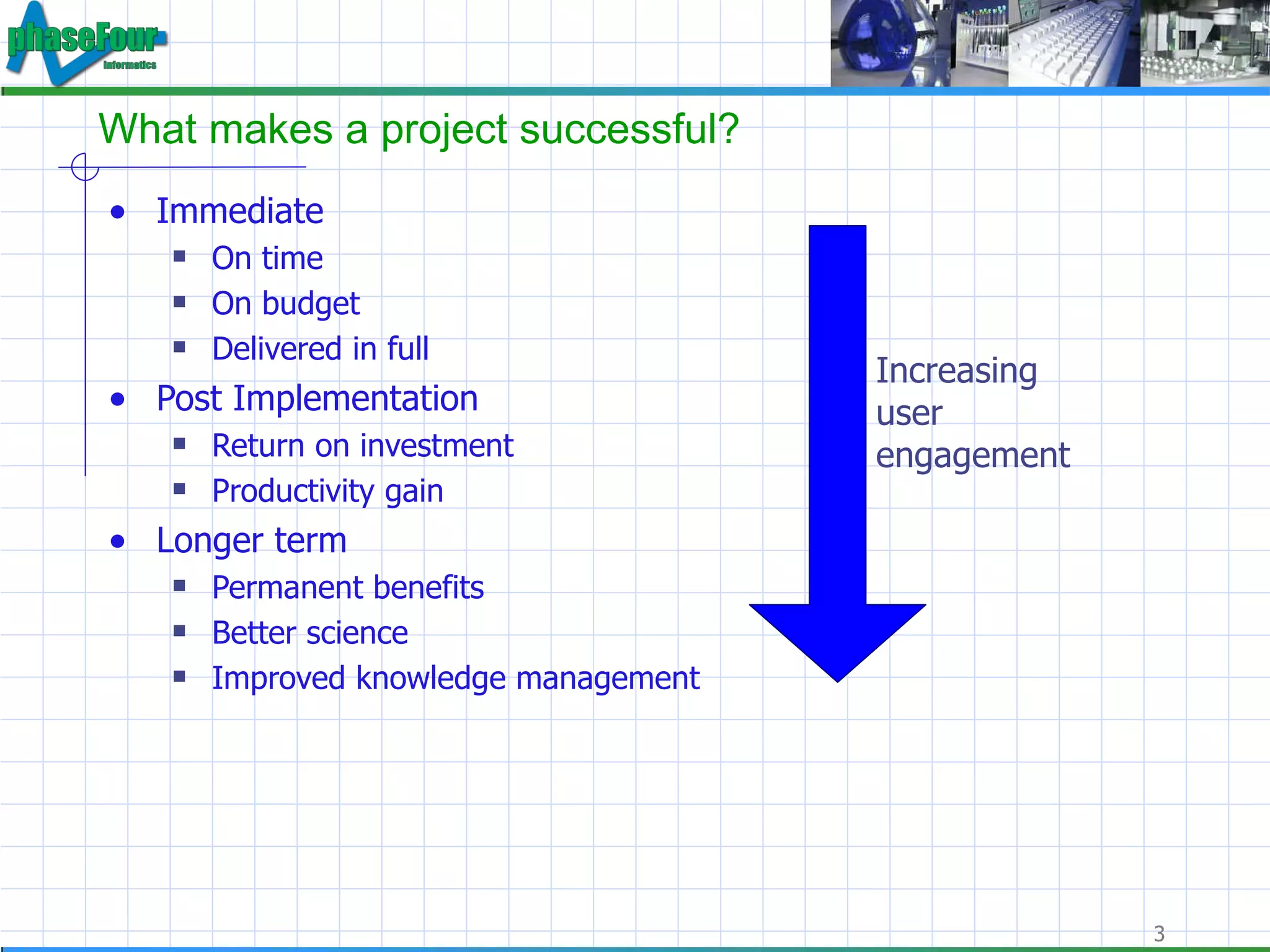
What makes a project successful? Immediate On time On budget Delivered in full Post Implementation Return on investment Productivity gain Longer term Permanent benefits Better science Improved knowledge management Increasing user engagement
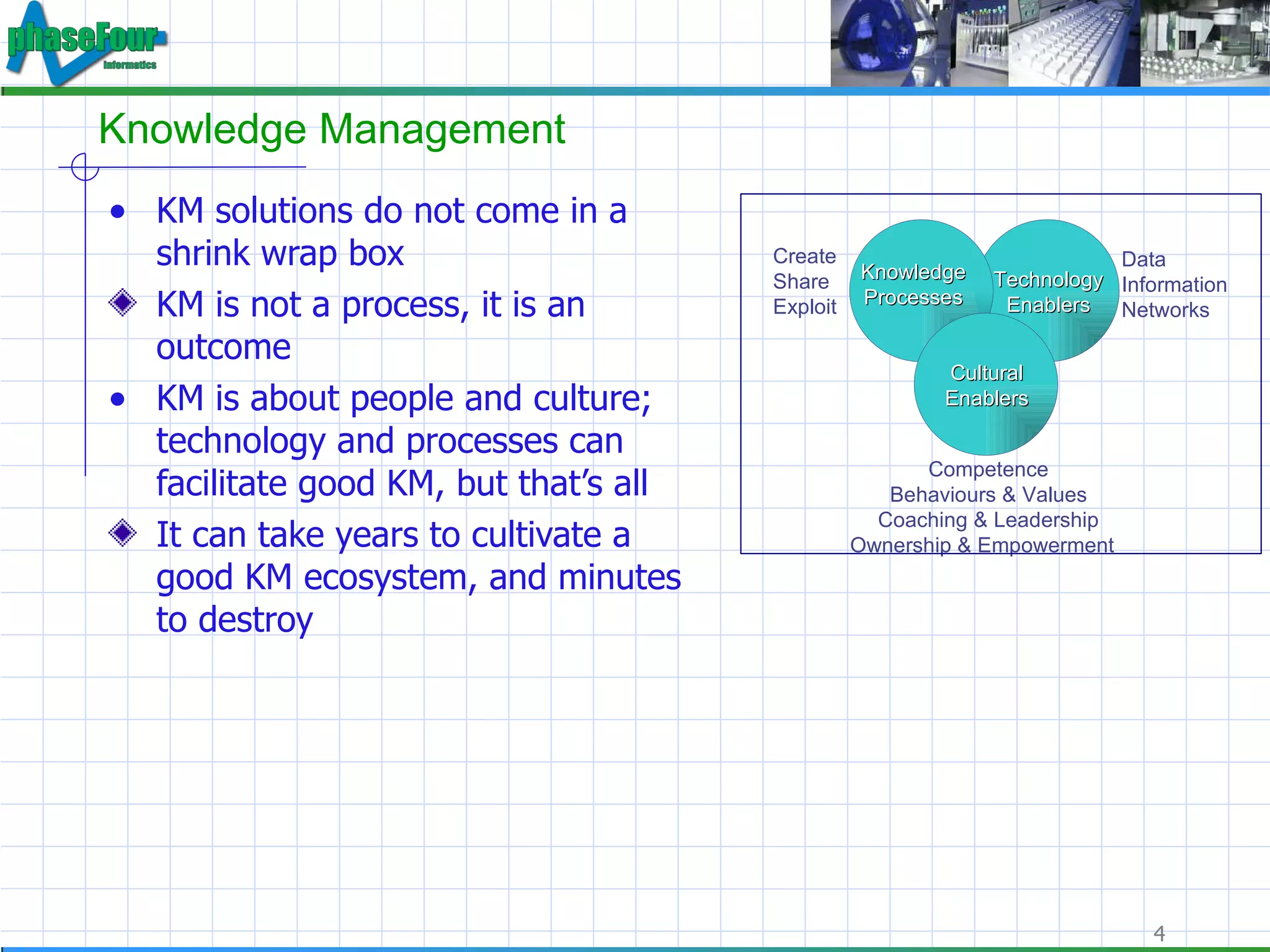
Knowledge Management KM solutions do not come in a shrink wrap box KM is not a process, it is an outcome KM is about people and culture; technology and processes can facilitate good KM, but that’s all It can take years to cultivate a good KM ecosystem, and minutes to destroy Technology Enablers Knowledge Processes Cultural Enablers Create Share Exploit Data Information Networks Competence Behaviours & Values Coaching & Leadership Ownership & Empowerment
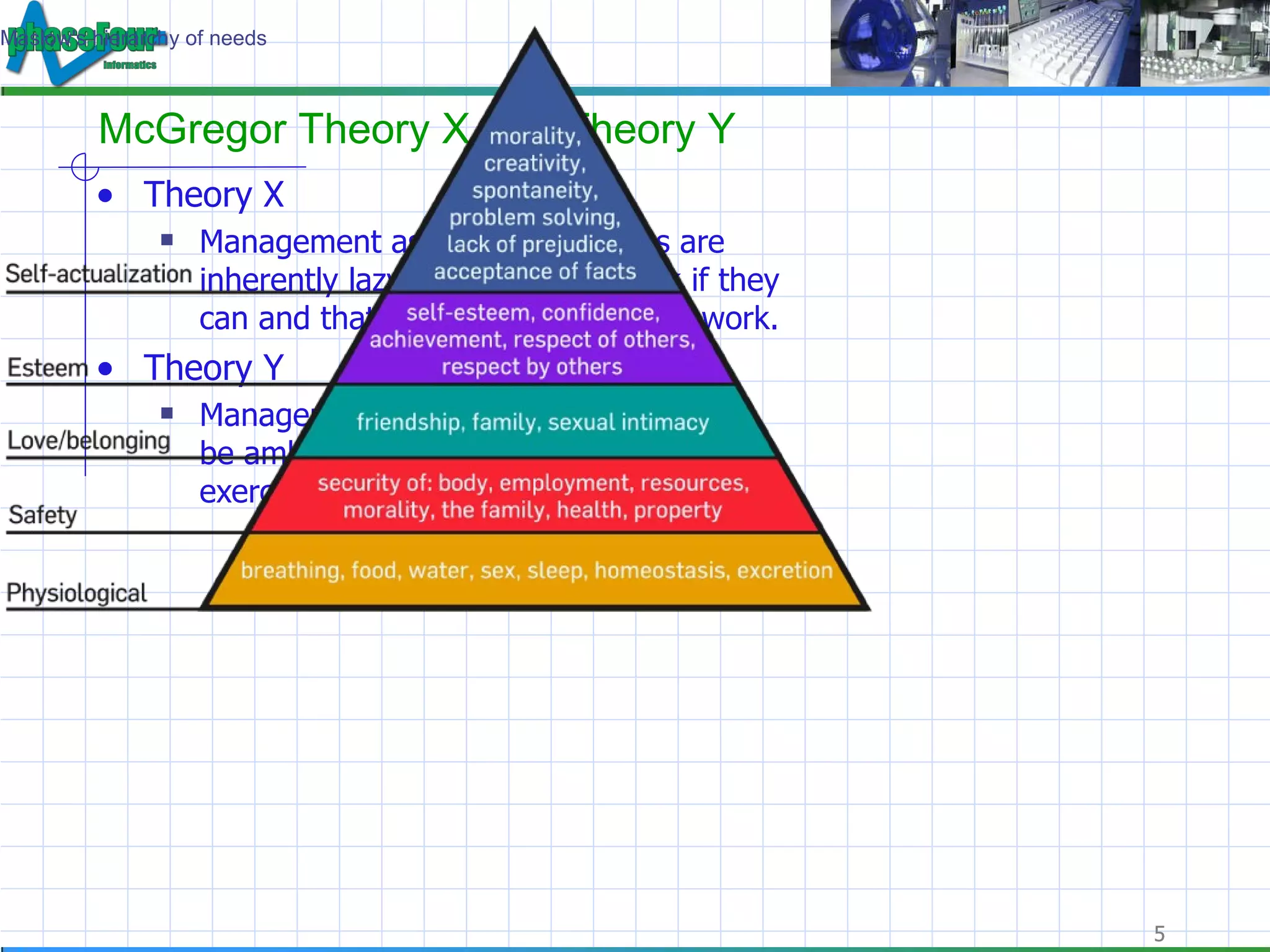
McGregor Theory X and Theory Y Theory X Management assumes employees are inherently lazy and will avoid work if they can and that they inherently dislike work. Theory Y Management assumes employees may be ambitious and self-motivated and exercise self-control. Maslow's hierarchy of needs
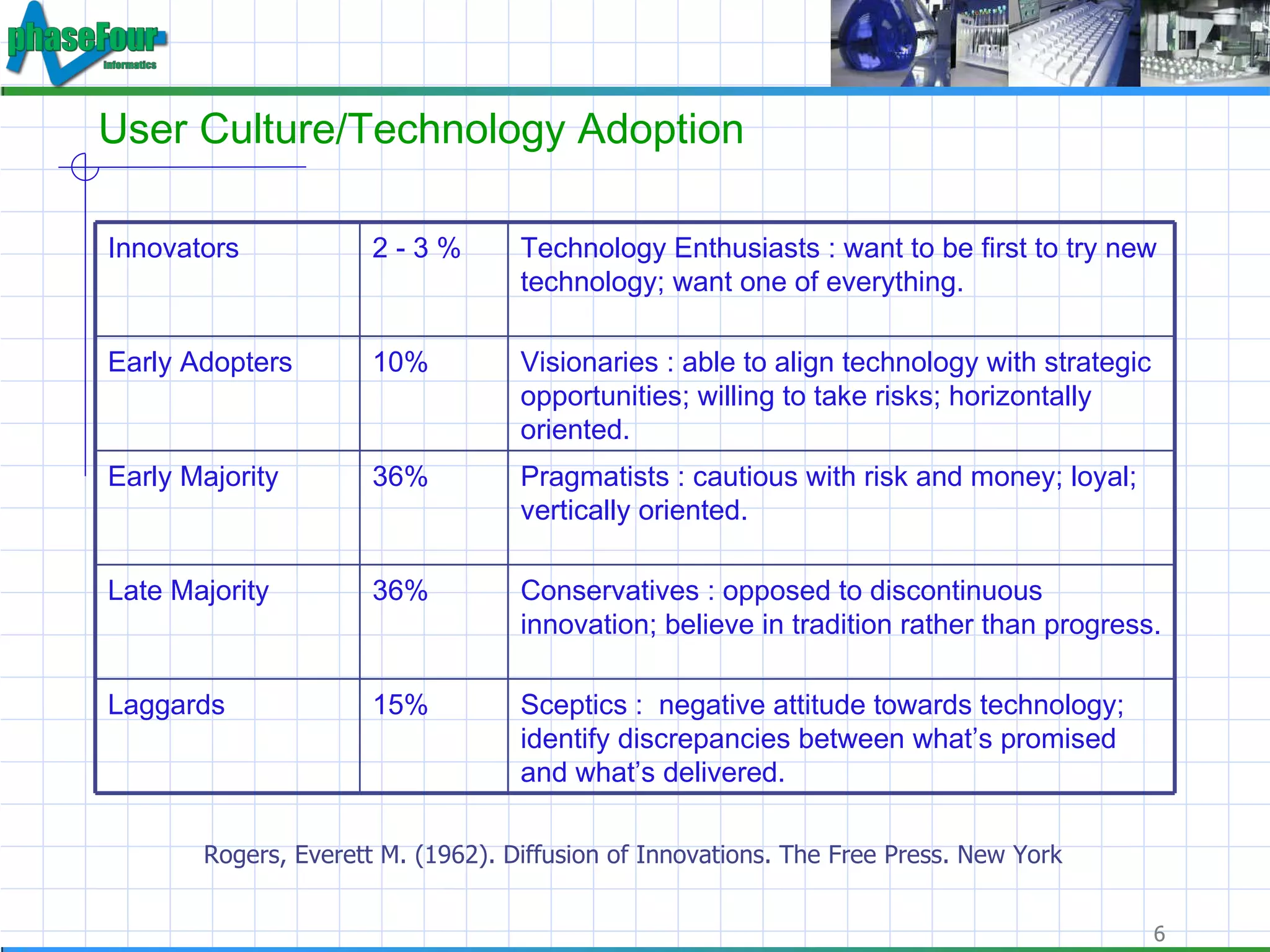
User Culture/Technology Adoption Rogers, Everett M. (1962). Diffusion of Innovations. The Free Press. New York Innovators 2 - 3 % Technology Enthusiasts : want to be first to try new technology; want one of everything. Early Adopters 10% Visionaries : able to align technology with strategic opportunities; willing to take risks; horizontally oriented. Early Majority 36% Pragmatists : cautious with risk and money; loyal; vertically oriented. Late Majority 36% Conservatives : opposed to discontinuous innovation; believe in tradition rather than progress. Laggards 15% Sceptics :  negative attitude towards technology; identify discrepancies between what’s promised and what’s delivered.
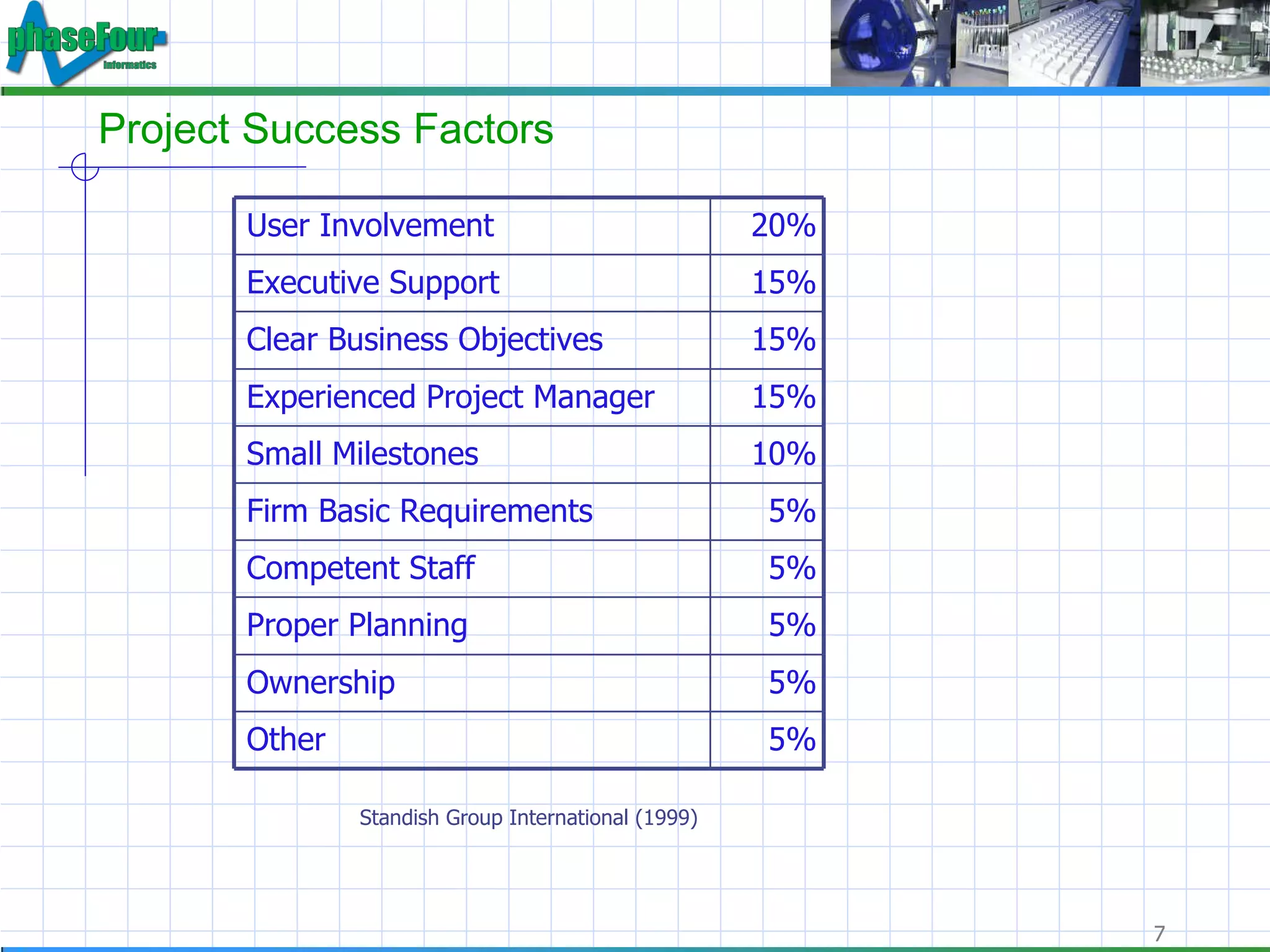
Project Success Factors Standish Group International (1999) User Involvement 20% Executive Support 15% Clear Business Objectives 15% Experienced Project Manager 15% Small Milestones 10% Firm Basic Requirements 5% Competent Staff 5% Proper Planning 5% Ownership 5% Other 5%
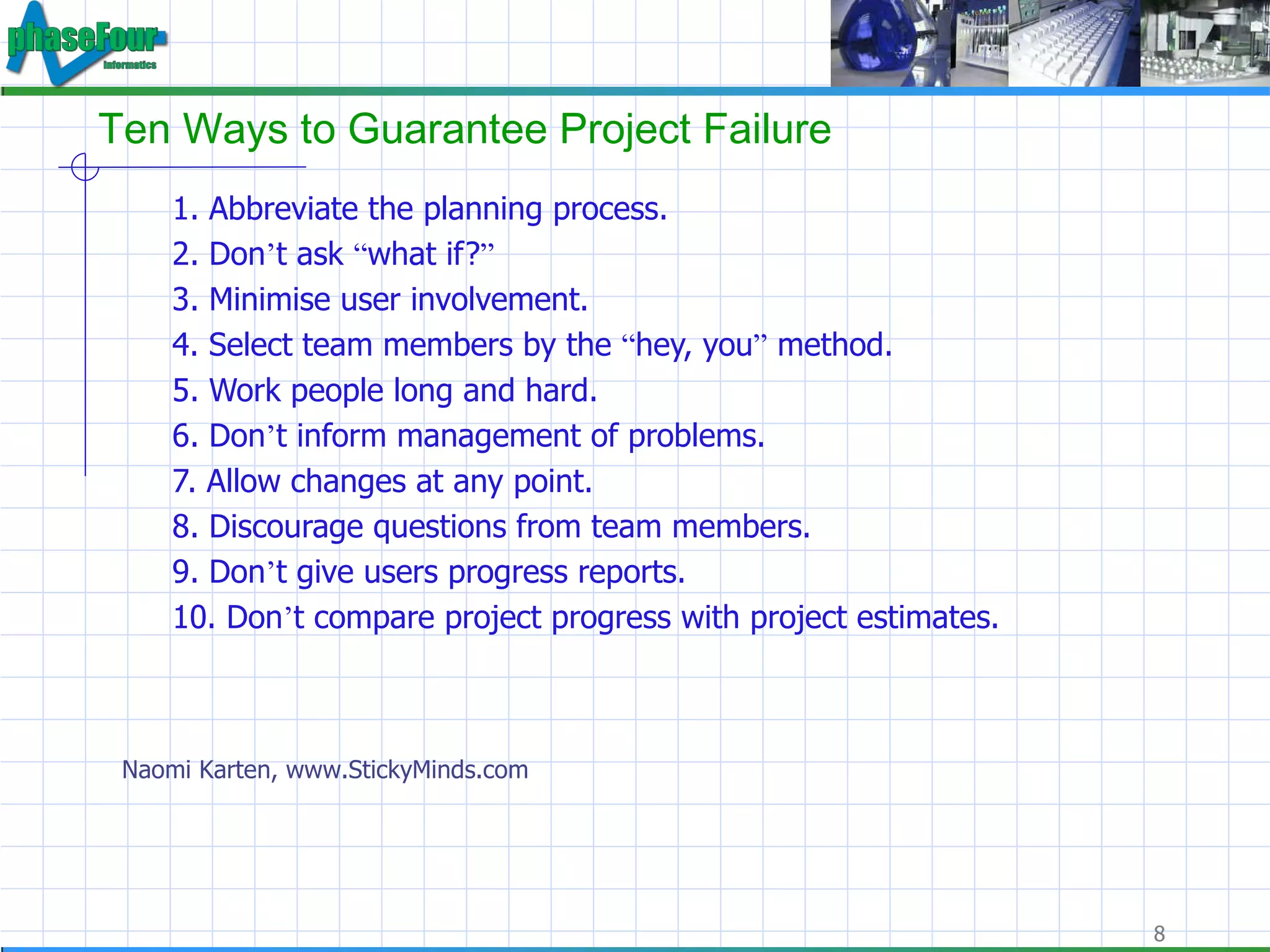
Ten Ways to Guarantee Project Failure 1. Abbreviate the planning process.  2. Don ’ t ask  “ what if? ”   3. Minimise user involvement.  4. Select team members by the  “ hey, you ”  method.  5. Work people long and hard.  6. Don ’ t inform management of problems.  7. Allow changes at any point.  8. Discourage questions from team members.  9. Don ’ t give users progress reports.  10. Don ’ t compare project progress with project estimates.  Naomi Karten, www.StickyMinds.com
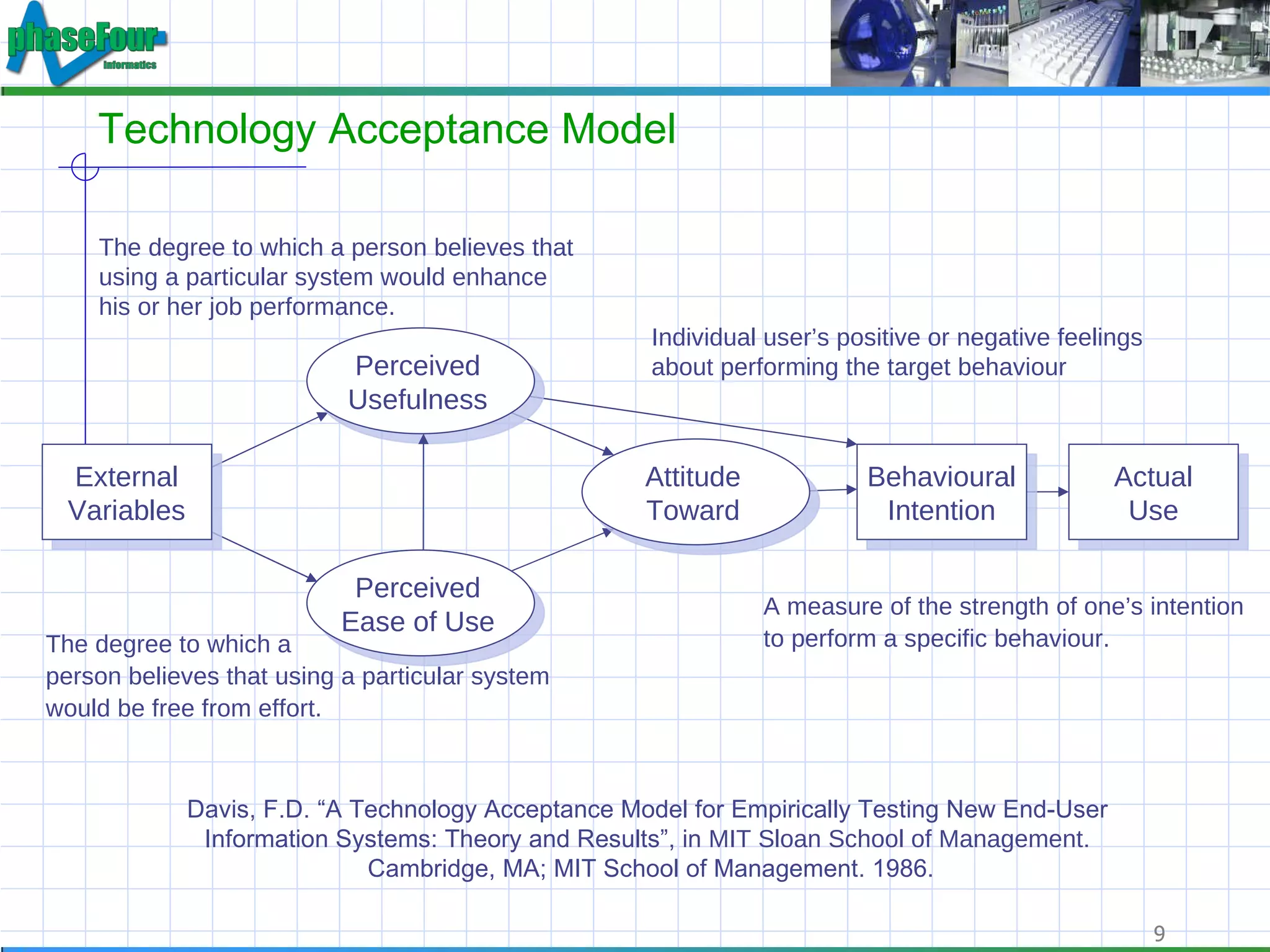
Technology Acceptance Model Davis, F.D. “A Technology Acceptance Model for Empirically Testing New End-User  Information Systems: Theory and Results”, in  MIT Sloan School of Management .  Cambridge, MA; MIT School of Management. 1986. Perceived Usefulness Behavioural Intention External Variables Actual Use Perceived Ease of Use Attitude Toward The degree to which a person believes that  using a particular system would enhance  his or her job performance. The degree to which a  person believes that using a particular system  would be free from effort. Individual user’s positive or negative feelings  about performing the target behaviour A measure of the strength of one’s intention  to perform a specific behaviour.
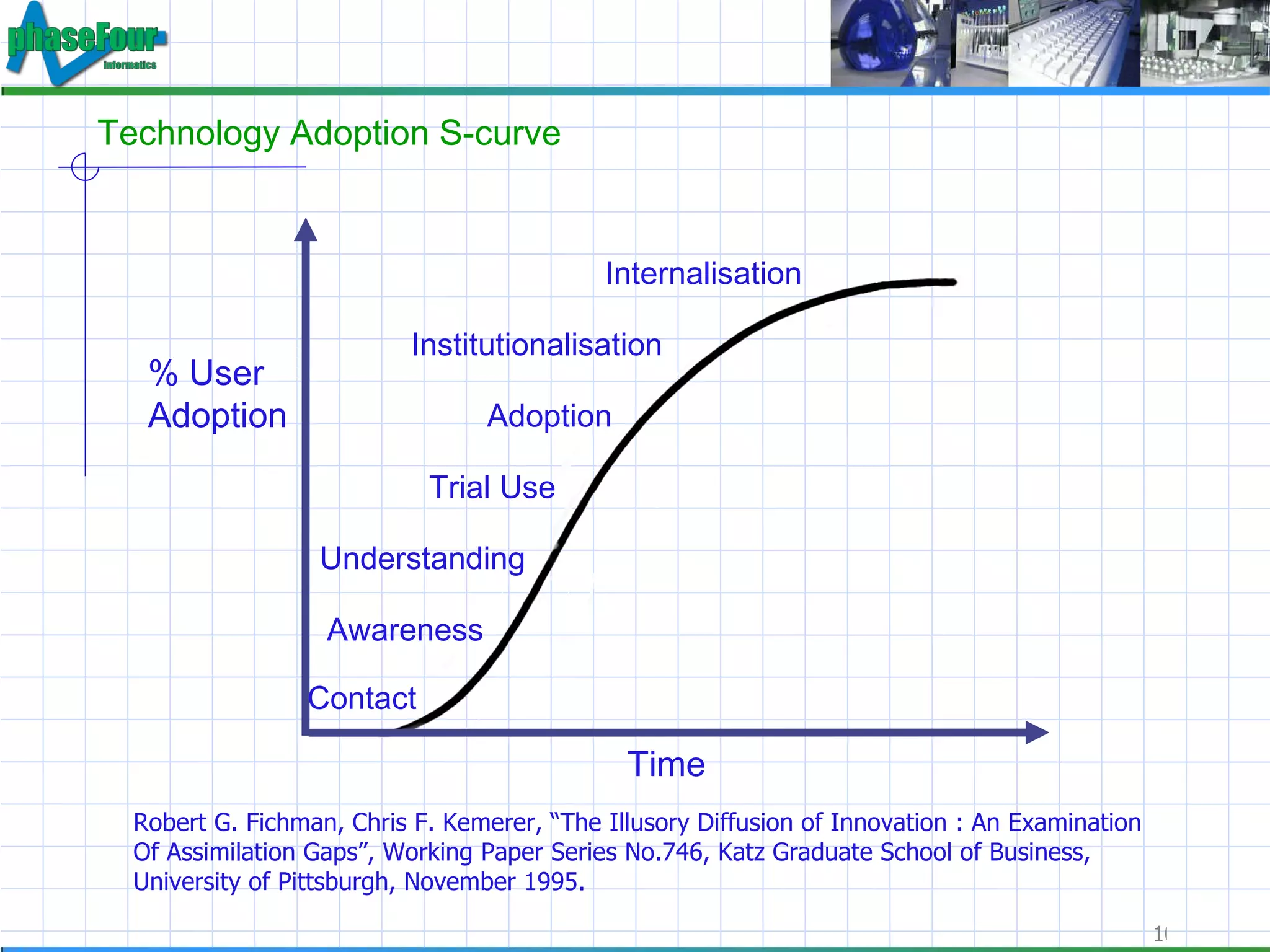
Technology Adoption S-curve Time % User Adoption Contact Awareness Understanding Trial Use Adoption Internalisation Institutionalisation Robert G. Fichman, Chris F. Kemerer, “The Illusory Diffusion of Innovation : An Examination Of Assimilation Gaps”, Working Paper Series No.746, Katz Graduate School of Business, University of Pittsburgh, November 1995.
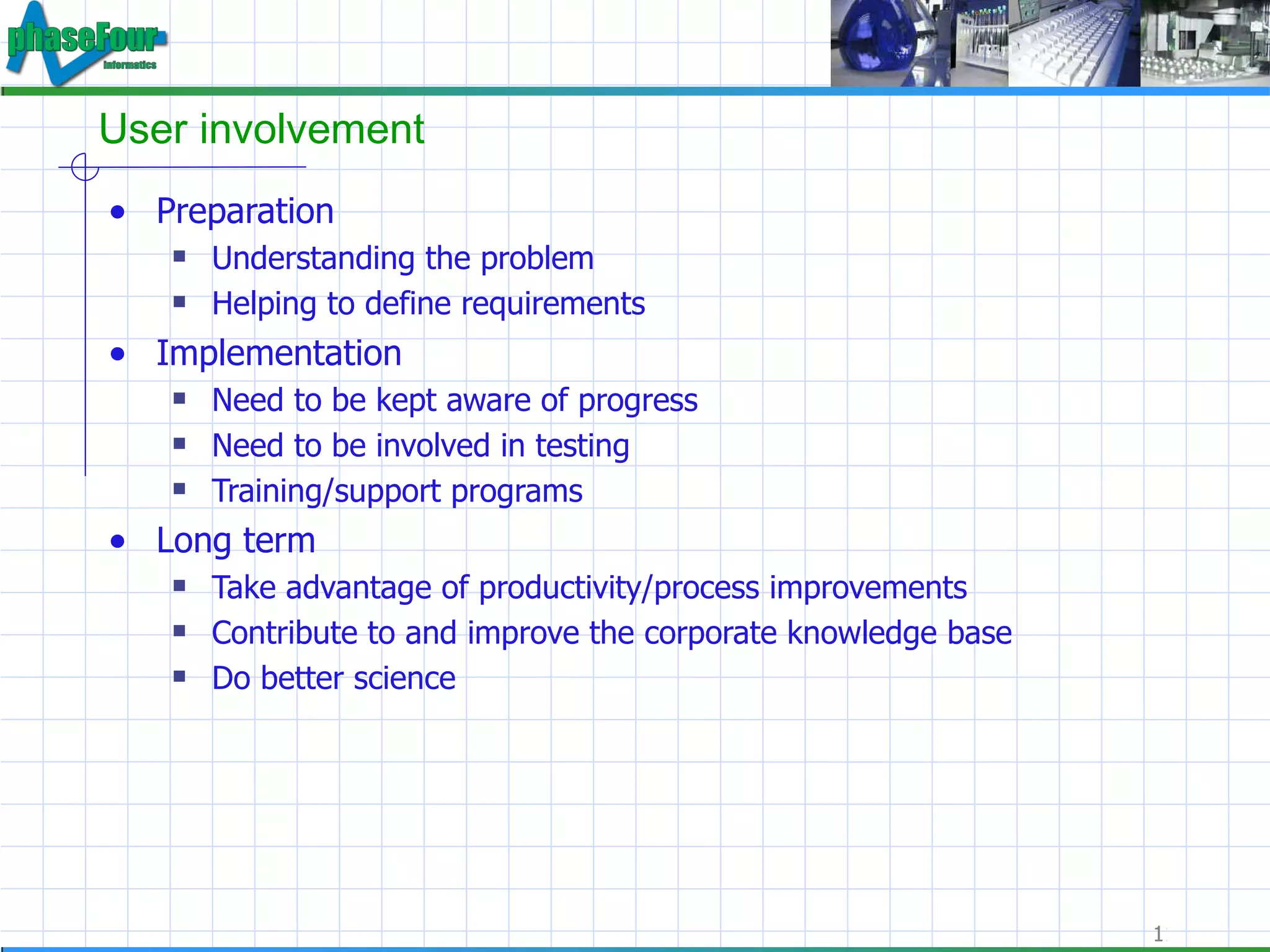
User involvement Preparation Understanding the problem Helping to define requirements Implementation Need to be kept aware of progress Need to be involved in testing Training/support programs Long term Take advantage of productivity/process improvements Contribute to and improve the corporate knowledge base Do better science
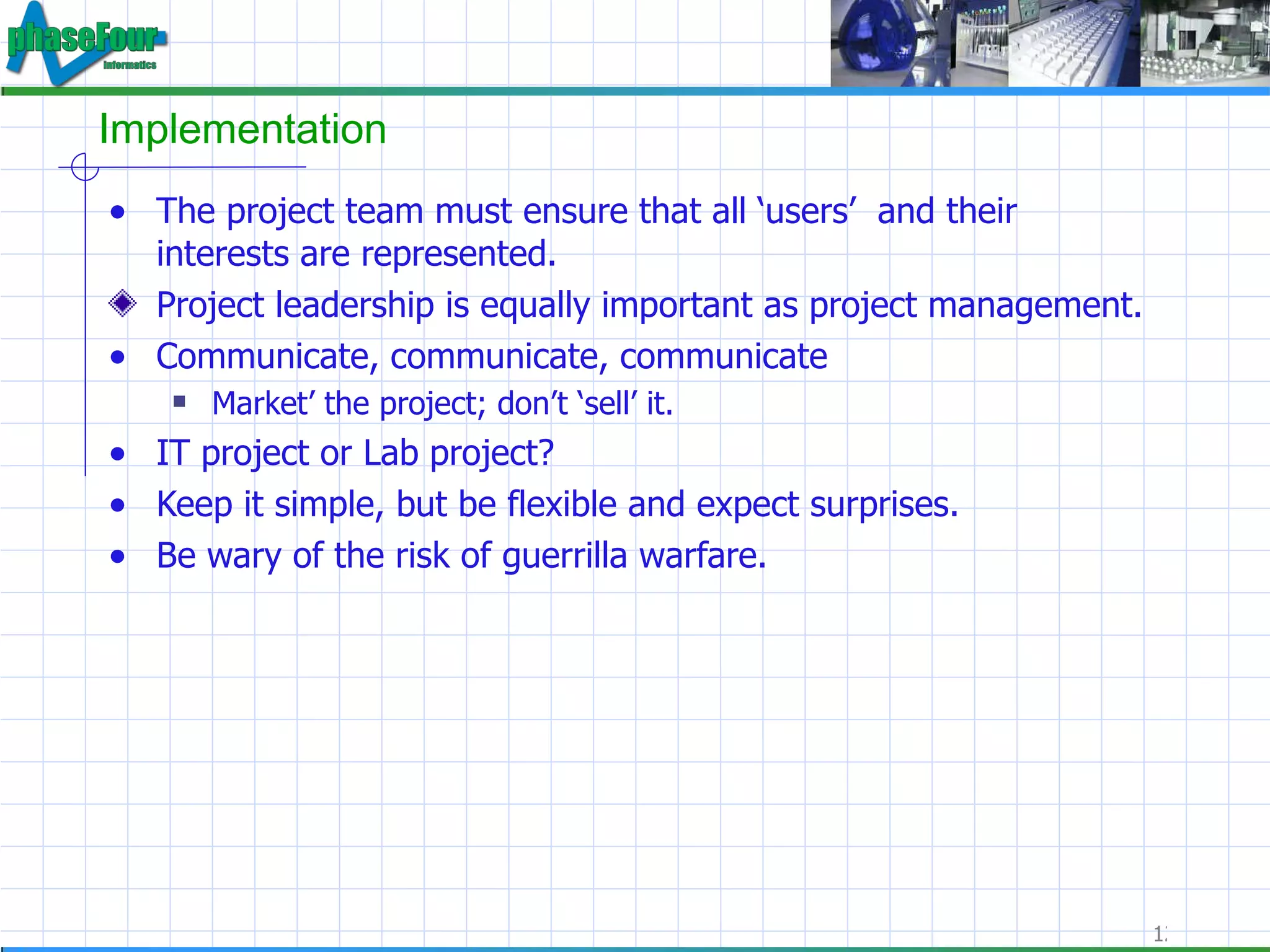
Implementation The project team must ensure that all ‘users’  and their interests are represented.  Project leadership is equally important as project management. Communicate, communicate, communicate Market’ the project; don’t ‘sell’ it. IT project or Lab project? Keep it simple, but be flexible and expect surprises. Be wary of the risk of guerrilla warfare.
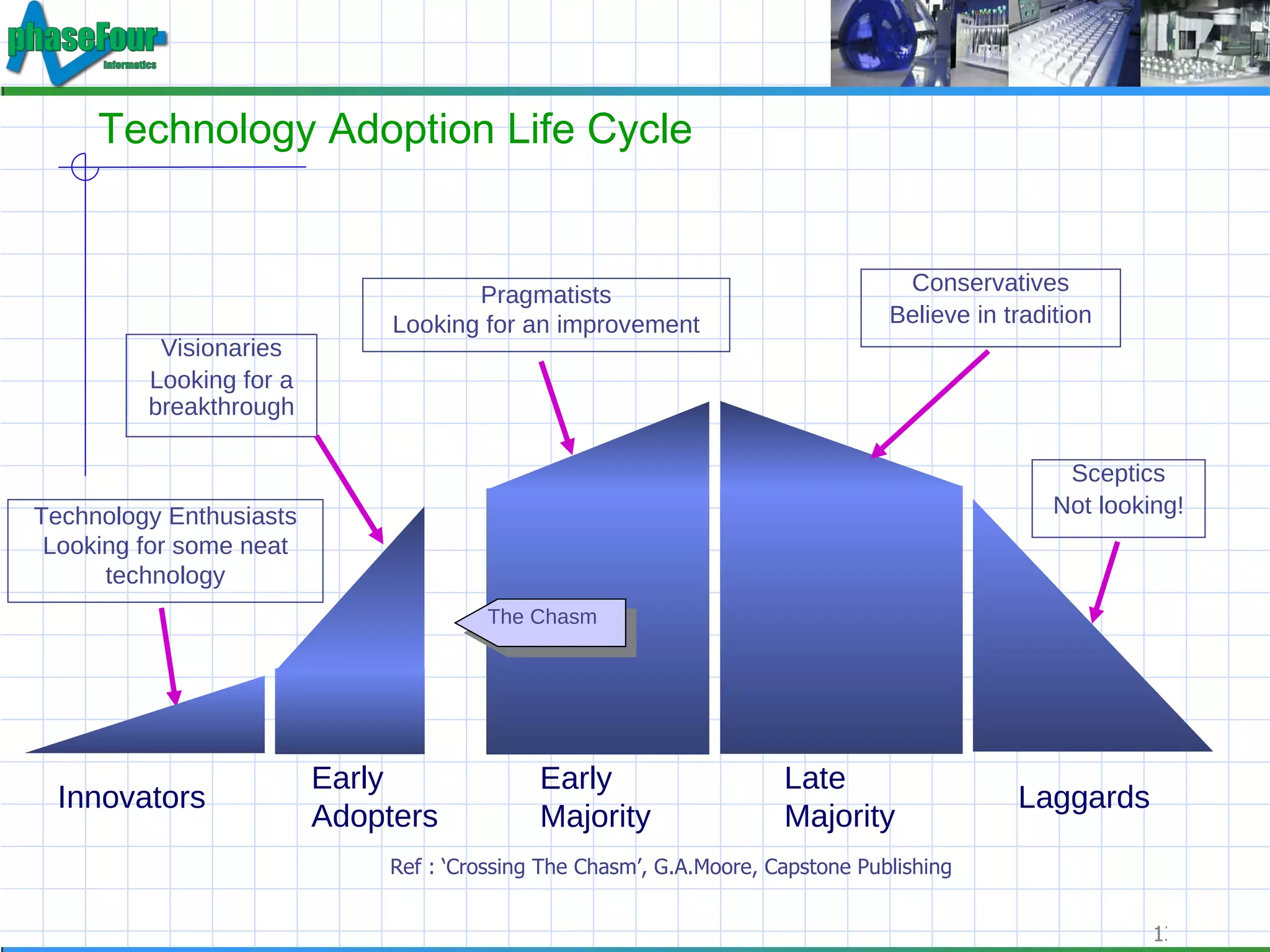
Technology Adoption Life Cycle Ref : ‘Crossing The Chasm’, G.A.Moore, Capstone Publishing Technology Enthusiasts Looking for some neat technology Innovators Early Adopters Early Majority Laggards Late Majority The Chasm Visionaries Looking for a breakthrough Pragmatists Looking for an improvement Conservatives Believe in tradition Sceptics Not looking!
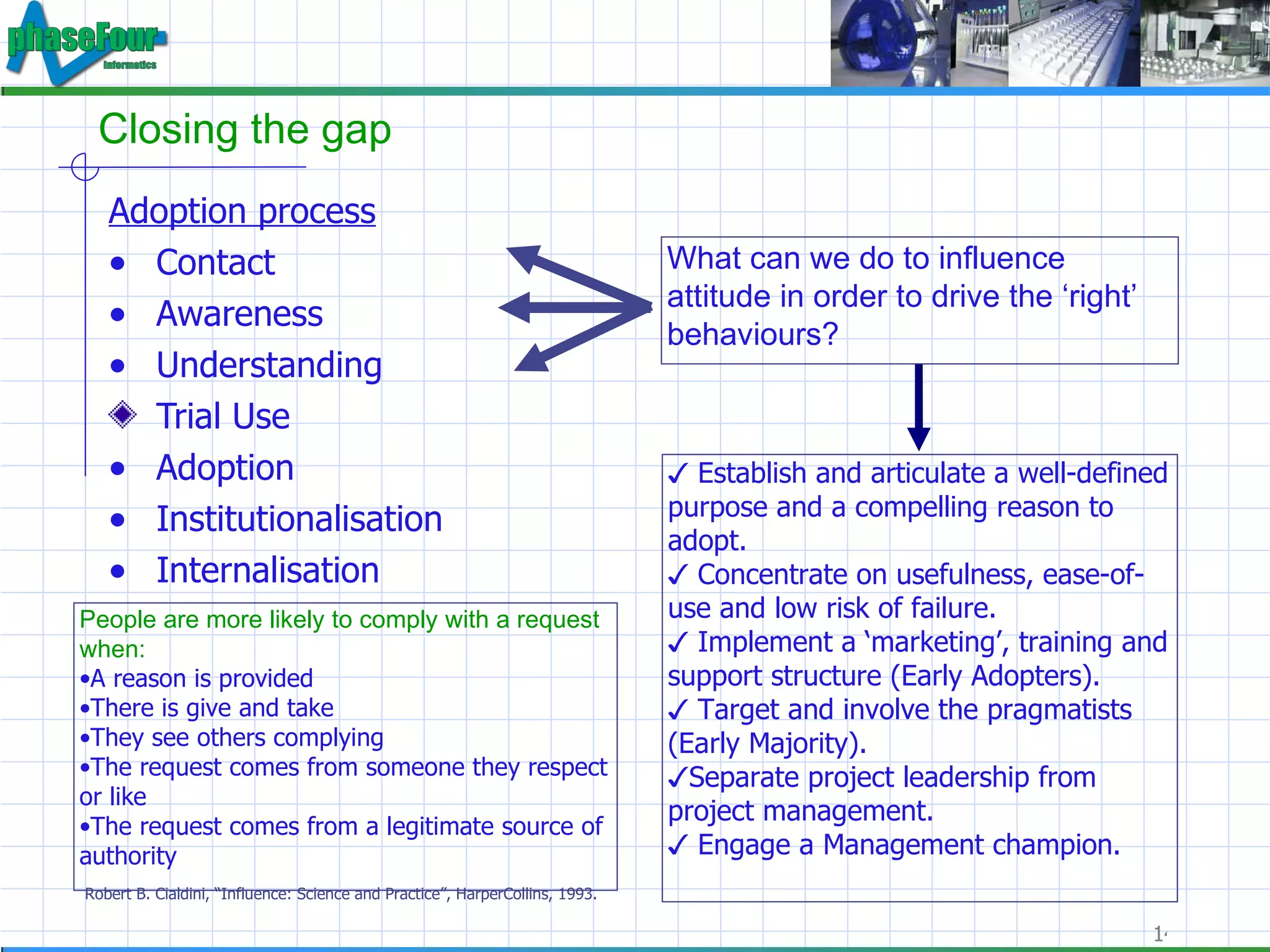
Closing the gap Adoption process Contact Awareness Understanding Trial Use Adoption Institutionalisation Internalisation What can we do to influence attitude in order to drive the ‘right’ behaviours? Establish and articulate a well-defined purpose and a compelling reason to adopt. Concentrate on usefulness, ease-of-use and low risk of failure. Implement a ‘marketing’, training and support structure (Early Adopters). Target and involve the pragmatists (Early Majority). Separate project leadership from project management. Engage a Management champion. People are more likely to comply with a request when: A reason is provided There is give and take They see others complying The request comes from someone they respect or like The request comes from a legitimate source of authority Robert B. Cialdini, “Influence: Science and Practice”, HarperCollins, 1993.

Managing User Resistance

  • 1.
    Managing user resistancewhen designing, and executing your global Lab Informatics strategy John Trigg phaseFour Informatics Limited www.phasefour-informatics.com www.theintegratedlab.com
  • 2.
    Agenda Success criteriafor informatics projects User involvement The principles of technology adoption Defining strategies to drive up user acceptance
  • 3.
    What makes aproject successful? Immediate On time On budget Delivered in full Post Implementation Return on investment Productivity gain Longer term Permanent benefits Better science Improved knowledge management Increasing user engagement
  • 4.
    Knowledge Management KMsolutions do not come in a shrink wrap box KM is not a process, it is an outcome KM is about people and culture; technology and processes can facilitate good KM, but that’s all It can take years to cultivate a good KM ecosystem, and minutes to destroy Technology Enablers Knowledge Processes Cultural Enablers Create Share Exploit Data Information Networks Competence Behaviours & Values Coaching & Leadership Ownership & Empowerment
  • 5.
    McGregor Theory Xand Theory Y Theory X Management assumes employees are inherently lazy and will avoid work if they can and that they inherently dislike work. Theory Y Management assumes employees may be ambitious and self-motivated and exercise self-control. Maslow's hierarchy of needs
  • 6.
    User Culture/Technology AdoptionRogers, Everett M. (1962). Diffusion of Innovations. The Free Press. New York Innovators 2 - 3 % Technology Enthusiasts : want to be first to try new technology; want one of everything. Early Adopters 10% Visionaries : able to align technology with strategic opportunities; willing to take risks; horizontally oriented. Early Majority 36% Pragmatists : cautious with risk and money; loyal; vertically oriented. Late Majority 36% Conservatives : opposed to discontinuous innovation; believe in tradition rather than progress. Laggards 15% Sceptics : negative attitude towards technology; identify discrepancies between what’s promised and what’s delivered.
  • 7.
    Project Success FactorsStandish Group International (1999) User Involvement 20% Executive Support 15% Clear Business Objectives 15% Experienced Project Manager 15% Small Milestones 10% Firm Basic Requirements 5% Competent Staff 5% Proper Planning 5% Ownership 5% Other 5%
  • 8.
    Ten Ways toGuarantee Project Failure 1. Abbreviate the planning process. 2. Don ’ t ask “ what if? ” 3. Minimise user involvement. 4. Select team members by the “ hey, you ” method. 5. Work people long and hard. 6. Don ’ t inform management of problems. 7. Allow changes at any point. 8. Discourage questions from team members. 9. Don ’ t give users progress reports. 10. Don ’ t compare project progress with project estimates. Naomi Karten, www.StickyMinds.com
  • 9.
    Technology Acceptance ModelDavis, F.D. “A Technology Acceptance Model for Empirically Testing New End-User Information Systems: Theory and Results”, in MIT Sloan School of Management . Cambridge, MA; MIT School of Management. 1986. Perceived Usefulness Behavioural Intention External Variables Actual Use Perceived Ease of Use Attitude Toward The degree to which a person believes that using a particular system would enhance his or her job performance. The degree to which a person believes that using a particular system would be free from effort. Individual user’s positive or negative feelings about performing the target behaviour A measure of the strength of one’s intention to perform a specific behaviour.
  • 10.
    Technology Adoption S-curveTime % User Adoption Contact Awareness Understanding Trial Use Adoption Internalisation Institutionalisation Robert G. Fichman, Chris F. Kemerer, “The Illusory Diffusion of Innovation : An Examination Of Assimilation Gaps”, Working Paper Series No.746, Katz Graduate School of Business, University of Pittsburgh, November 1995.
  • 11.
    User involvement PreparationUnderstanding the problem Helping to define requirements Implementation Need to be kept aware of progress Need to be involved in testing Training/support programs Long term Take advantage of productivity/process improvements Contribute to and improve the corporate knowledge base Do better science
  • 12.
    Implementation The projectteam must ensure that all ‘users’ and their interests are represented. Project leadership is equally important as project management. Communicate, communicate, communicate Market’ the project; don’t ‘sell’ it. IT project or Lab project? Keep it simple, but be flexible and expect surprises. Be wary of the risk of guerrilla warfare.
  • 13.
    Technology Adoption LifeCycle Ref : ‘Crossing The Chasm’, G.A.Moore, Capstone Publishing Technology Enthusiasts Looking for some neat technology Innovators Early Adopters Early Majority Laggards Late Majority The Chasm Visionaries Looking for a breakthrough Pragmatists Looking for an improvement Conservatives Believe in tradition Sceptics Not looking!
  • 14.
    Closing the gapAdoption process Contact Awareness Understanding Trial Use Adoption Institutionalisation Internalisation What can we do to influence attitude in order to drive the ‘right’ behaviours? Establish and articulate a well-defined purpose and a compelling reason to adopt. Concentrate on usefulness, ease-of-use and low risk of failure. Implement a ‘marketing’, training and support structure (Early Adopters). Target and involve the pragmatists (Early Majority). Separate project leadership from project management. Engage a Management champion. People are more likely to comply with a request when: A reason is provided There is give and take They see others complying The request comes from someone they respect or like The request comes from a legitimate source of authority Robert B. Cialdini, “Influence: Science and Practice”, HarperCollins, 1993.