Managing Human Resources Personnel Management In
Transition 4th Edition Stephen Bach download
https://ebookbell.com/product/managing-human-resources-personnel-
management-in-transition-4th-edition-stephen-bach-4687246
Explore and download more ebooks at ebookbell.com
Here are some recommended products that we believe you will be
interested in. You can click the link to download.
Managing It Human Resources Considerations For Organizations And
Personnel 1st Edition Jerry Luftman
https://ebookbell.com/product/managing-it-human-resources-
considerations-for-organizations-and-personnel-1st-edition-jerry-
luftman-37161764
Managing Human Resources The New Normal 1st Edition Ingrid L Potgieter
https://ebookbell.com/product/managing-human-resources-the-new-
normal-1st-edition-ingrid-l-potgieter-45333224
Managing Human Resources 17th Edition Scott Snell Shad Morris
https://ebookbell.com/product/managing-human-resources-17th-edition-
scott-snell-shad-morris-49172506
Managing Human Resources 17th Edition Scott Snell Shad Morris
https://ebookbell.com/product/managing-human-resources-17th-edition-
scott-snell-shad-morris-49172558
Managing Human Resources In China The View From Inside Multinationals
Yu Zheng
https://ebookbell.com/product/managing-human-resources-in-china-the-
view-from-inside-multinationals-yu-zheng-51238270
Managing Human Resources In The Global Context 1st Edition Indranil
Mutsuddi
https://ebookbell.com/product/managing-human-resources-in-the-global-
context-1st-edition-indranil-mutsuddi-51348822
Managing Human Resources 19th Edition 19th Edition Scott Snell
https://ebookbell.com/product/managing-human-resources-19th-
edition-19th-edition-scott-snell-56696278
Managing Human Resources 7th Edition 7th Ed Luis Gomezmejia
https://ebookbell.com/product/managing-human-resources-7th-
edition-7th-ed-luis-gomezmejia-2414650
Managing Human Resources Productivity Quality Of Work Life Profits
10th Edition Cascio
https://ebookbell.com/product/managing-human-resources-productivity-
quality-of-work-life-profits-10th-edition-cascio-38309748
Managing Human Resources
MHRA01 15/09/2005 10:49 Page i
MHRA01 15/09/2005 10:49 Page ii
Managing
Human
Resources
FOURTH EDITION
Personnel Management
in Transition
Previously published as Personnel Management
EDITED BY Stephen Bach
MHRA01 15/09/2005 10:49 Page iii
© 2005 by Stephen Bach
BLACKWELL PUBLISHING
350 Main Street, Malden, MA 02148-5020, USA
9600 Garsington Road, Oxford OX4 2DQ, UK
550 Swanston Street, Carlton, Victoria 3053, Australia
The right of Stephen Bach to be identified as the Author of this Work has been asserted
in accordance with the UK Copyright, Designs, and Patents Act 1988.
All rights reserved. No part of this publication may be reproduced, stored in a retrieval system,
or transmitted, in any form or by any means, electronic, mechanical, photocopying, recording
or otherwise, except as permitted by the UK Copyright, Designs, and Patents Act 1988, without
the prior permission of the publisher.
First edition published 1989 as Personnel Management in Britain
Second edition published 1994 as Personnel Management
Third edition published 2000
Fourth edition published 2005 by Blackwell Publishing Ltd
1 2005
Library of Congress Cataloging-in-Publication Data
Managing human resources : personnel management in transition /
edited by Stephen Bach.—4th ed.
p. cm.
Rev. ed. of: Personnel management. 3rd ed. 2000.
Includes bibliographical references and index.
ISBN-13: 978-1-4051-1850-7 (hardcover : alk. paper)
ISBN-10: 1-4051-1850-4 (hardcover : alk. paper)
ISBN-13: 978-1-4051-1851-4 (pbk. : alk. paper)
ISBN-10: 1-4051-1851-2 (pbk. : alk. paper)
1. Personnel management—Great Britain. I. Bach, Stephen, 1963–
II. Personnel management.
HF5549.2.G7M357 2006
658.3′00941—dc22
2005006590
A catalogue record for this title is available from the British Library.
Set in 11/13pt Bembo
by Graphicraft Limited, Hong Kong
Printed and bound in the United Kingdom
by TJ International, Padstow, Cornwall
The publisher’s policy is to use permanent paper from mills that operate a sustainable forestry
policy, and which has been manufactured from pulp processed using acid-free and elementary
chlorine-free practices. Furthermore, the publisher ensures that the text paper and cover board
used have met acceptable environmental accreditation standards.
For further information on
Blackwell Publishing, visit our website:
www.blackwellpublishing.com
MHRA01 15/09/2005 10:49 Page iv
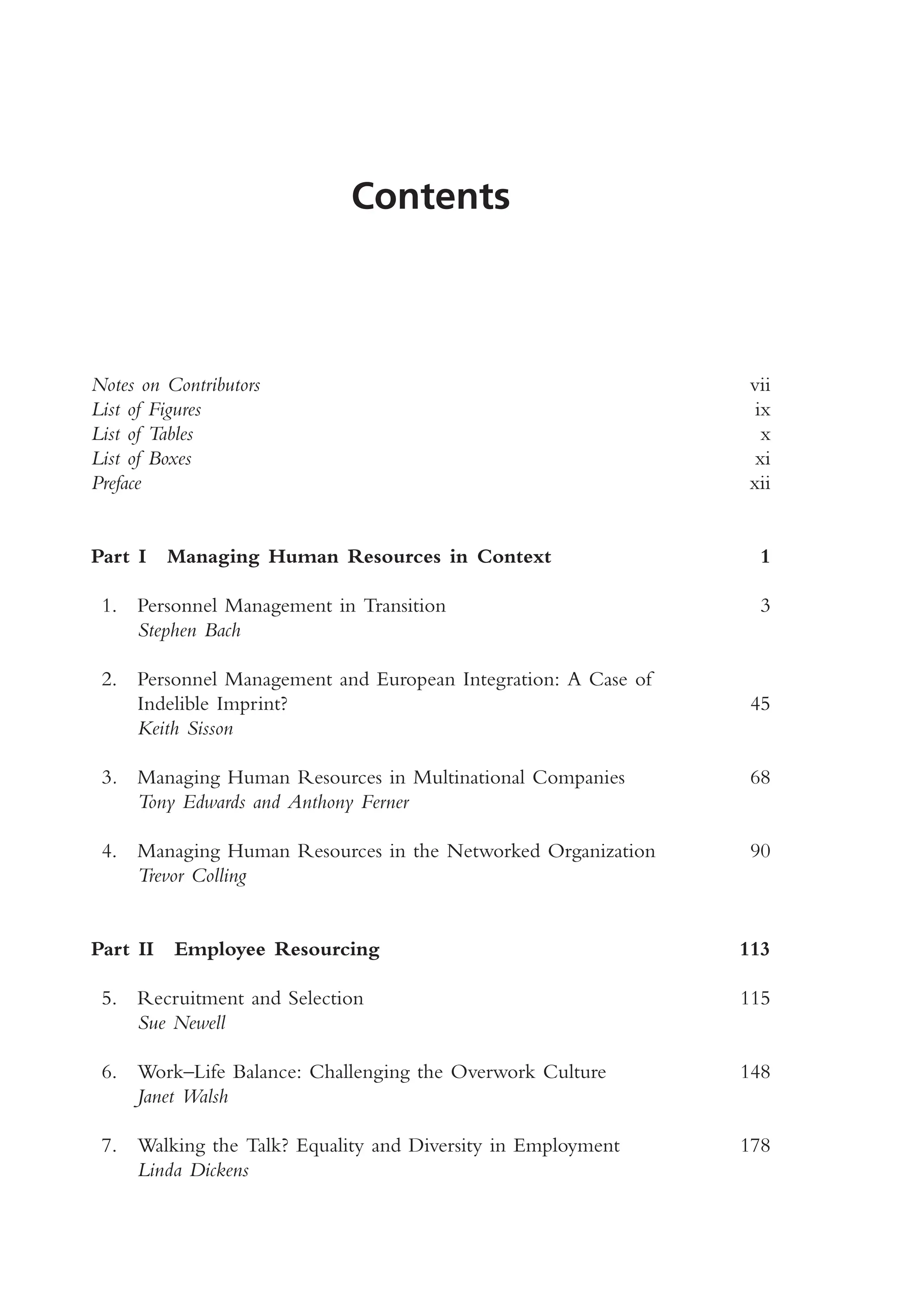
Contents
Notes on Contributors vii
List of Figures ix
List of Tables x
List of Boxes xi
Preface xii
Part I Managing Human Resources in Context 1
1. Personnel Management in Transition 3
Stephen Bach
2. Personnel Management and European Integration: A Case of
Indelible Imprint? 45
Keith Sisson
3. Managing Human Resources in Multinational Companies 68
Tony Edwards and Anthony Ferner
4. Managing Human Resources in the Networked Organization 90
Trevor Colling
Part II Employee Resourcing 113
5. Recruitment and Selection 115
Sue Newell
6. Work–Life Balance: Challenging the Overwork Culture 148
Janet Walsh
7. Walking the Talk? Equality and Diversity in Employment 178
Linda Dickens
MHRA01 15/09/2005 10:49 Page v
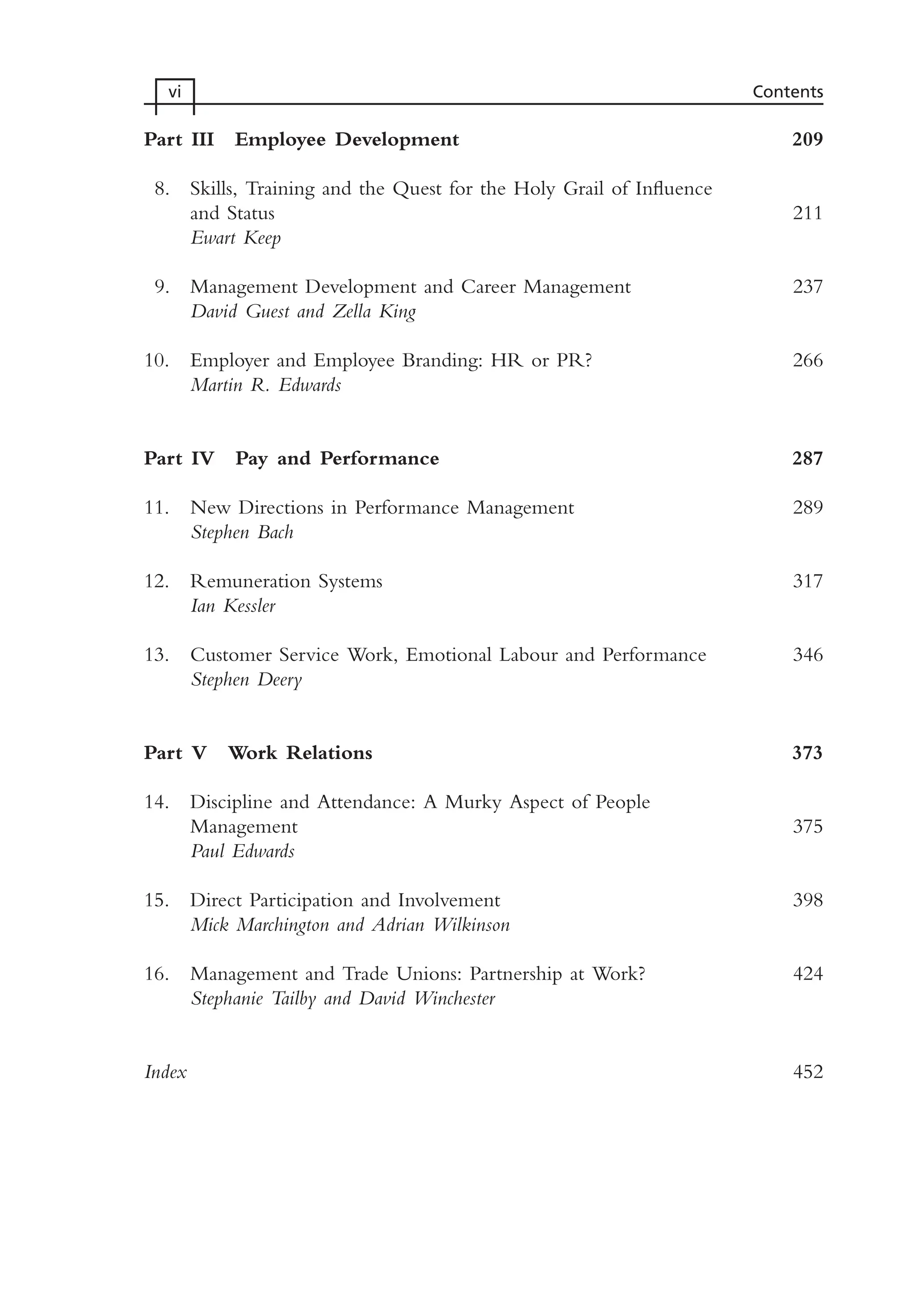
Part III Employee Development 209
8. Skills, Training and the Quest for the Holy Grail of Influence
and Status 211
Ewart Keep
9. Management Development and Career Management 237
David Guest and Zella King
10. Employer and Employee Branding: HR or PR? 266
Martin R. Edwards
Part IV Pay and Performance 287
11. New Directions in Performance Management 289
Stephen Bach
12. Remuneration Systems 317
Ian Kessler
13. Customer Service Work, Emotional Labour and Performance 346
Stephen Deery
Part V Work Relations 373
14. Discipline and Attendance: A Murky Aspect of People
Management 375
Paul Edwards
15. Direct Participation and Involvement 398
Mick Marchington and Adrian Wilkinson
16. Management and Trade Unions: Partnership at Work? 424
Stephanie Tailby and David Winchester
Index 452
vi Contents
MHRA01 15/09/2005 10:49 Page vi
Notes on Contributors
Stephen Bach, Reader in Employment Relations and Management, Department of
Management, King’s College
Trevor Colling, Principal Lecturer, Department of Human Resource Management,
De Montford University
Stephen Deery, Professor of Health Services Management and Human Resource
Management, Department of Management, King’s College
Linda Dickens, Professor of Industrial Relations, University of Warwick Business
School
Martin R. Edwards, Lecturer in Human Resource Management and Organizational
Psychology, Department of Management, King’s College
Paul Edwards, Professor of Industrial Relations, University of Warwick Business School
Tony Edwards, Senior Lecturer in International Human Resource Management,
Department of Management, King’s College
Anthony Ferner, Professor of International HRM, Department of Human Resource
Management, De Montford University
David Guest, Professor of Human Resource Management and Organizational
Psychology, Department of Management, King’s College
Ewart Keep, Professorial Fellow and Deputy Director of the ESRC Centre on Skills,
Knowledge and Organizational Performance, University of Warwick Business
School
Ian Kessler, Lecturer in Management Studies and Fellow of Templeton College,
University of Oxford
Zella King, Director, Centre for Career Management Skills, University of Reading
Mick Marchington, Professor of Human Resource Management, Manchester
Business School, The
Sue Newell, Cammarata Professor of Management, Department of Management,
Bentley College
MHRA01 15/09/2005 10:49 Page vii
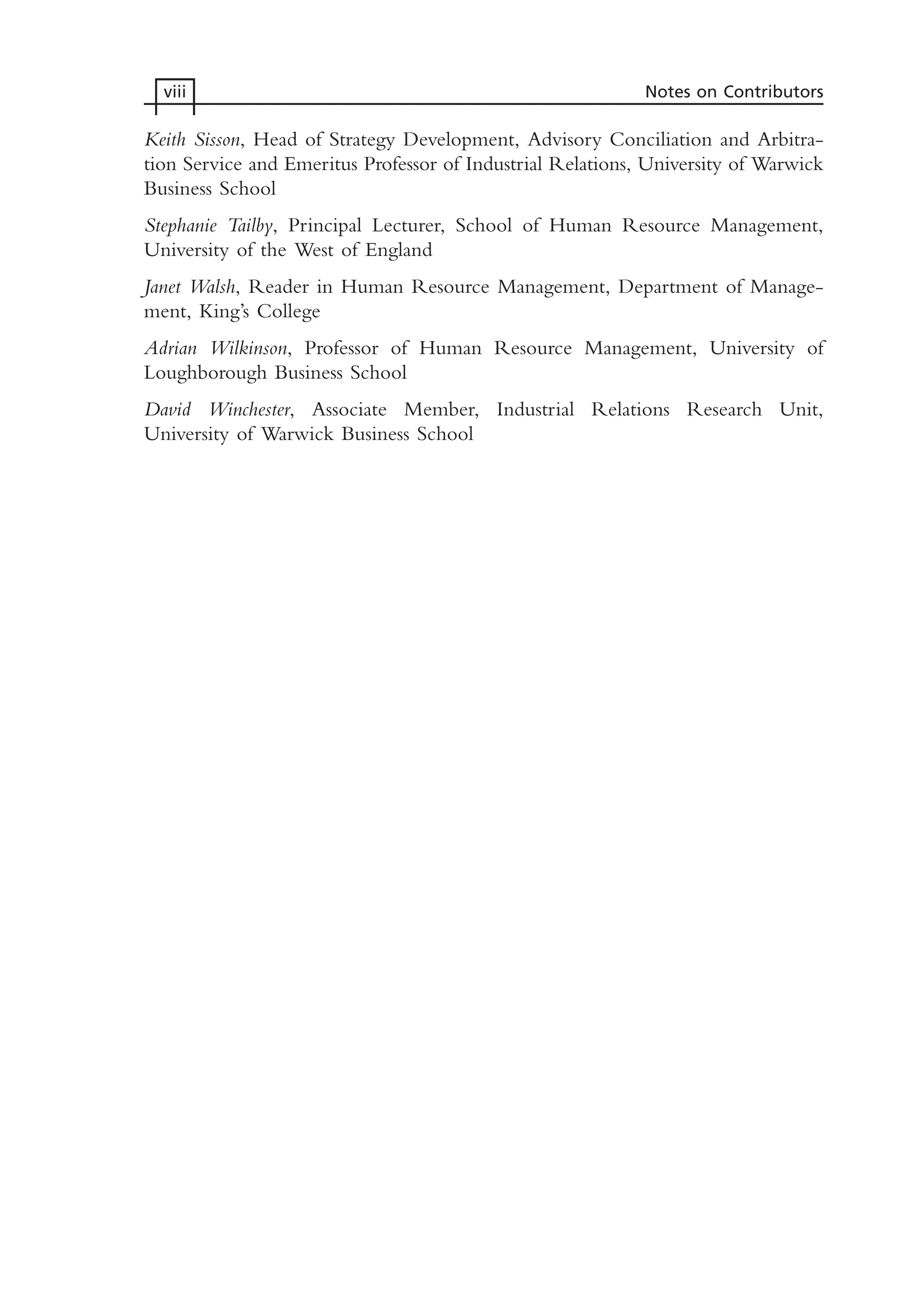
Keith Sisson, Head of Strategy Development, Advisory Conciliation and Arbitra-
tion Service and Emeritus Professor of Industrial Relations, University of Warwick
Business School
Stephanie Tailby, Principal Lecturer, School of Human Resource Management,
University of the West of England
Janet Walsh, Reader in Human Resource Management, Department of Manage-
ment, King’s College
Adrian Wilkinson, Professor of Human Resource Management, University of
Loughborough Business School
David Winchester, Associate Member, Industrial Relations Research Unit,
University of Warwick Business School
viii Notes on Contributors
MHRA01 15/09/2005 10:49 Page viii
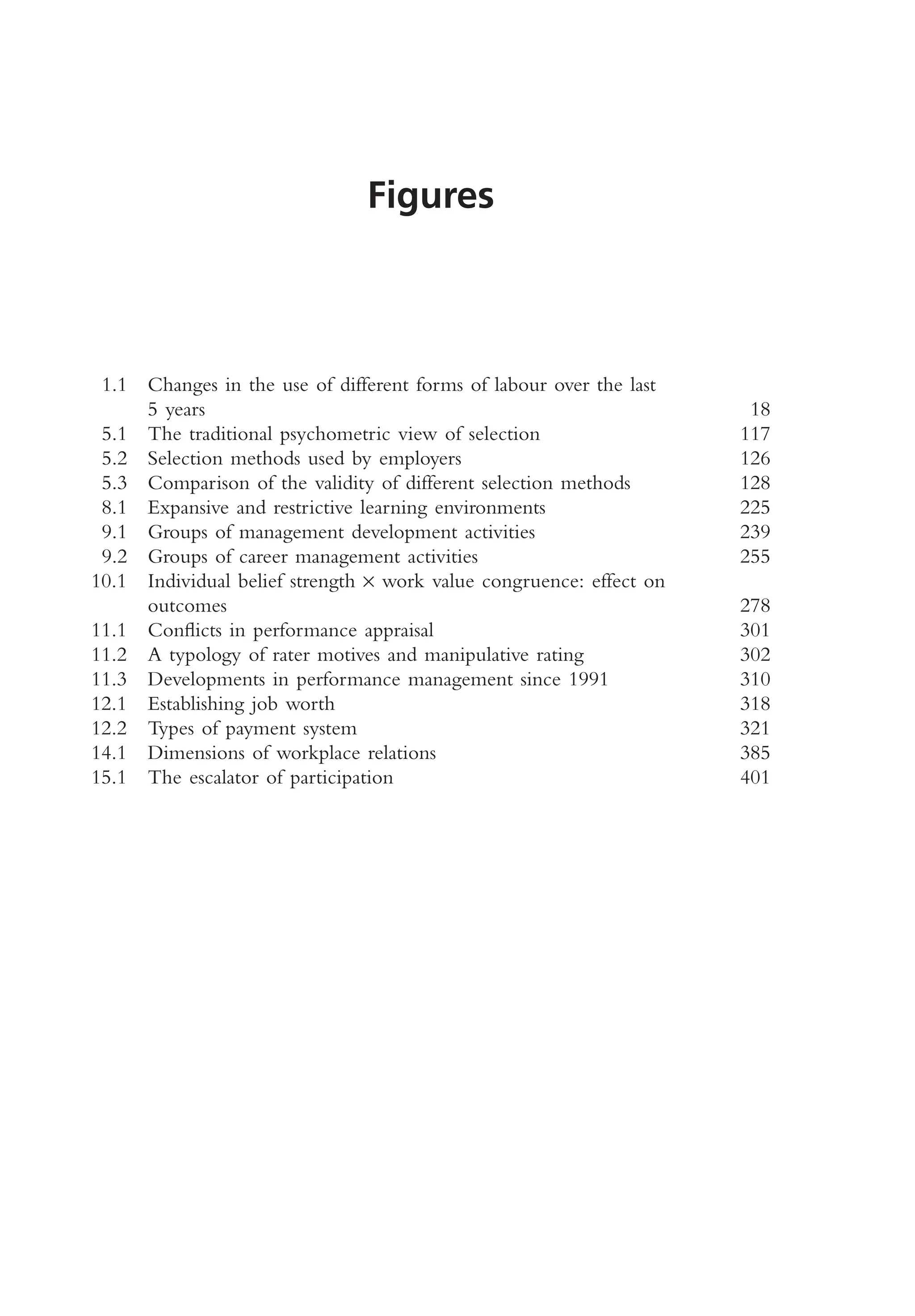
Figures
1.1 Changes in the use of different forms of labour over the last
5 years 18
5.1 The traditional psychometric view of selection 117
5.2 Selection methods used by employers 126
5.3 Comparison of the validity of different selection methods 128
8.1 Expansive and restrictive learning environments 225
9.1 Groups of management development activities 239
9.2 Groups of career management activities 255
10.1 Individual belief strength × work value congruence: effect on
outcomes 278
11.1 Conflicts in performance appraisal 301
11.2 A typology of rater motives and manipulative rating 302
11.3 Developments in performance management since 1991 310
12.1 Establishing job worth 318
12.2 Types of payment system 321
14.1 Dimensions of workplace relations 385
15.1 The escalator of participation 401
MHRA01 15/09/2005 10:49 Page ix
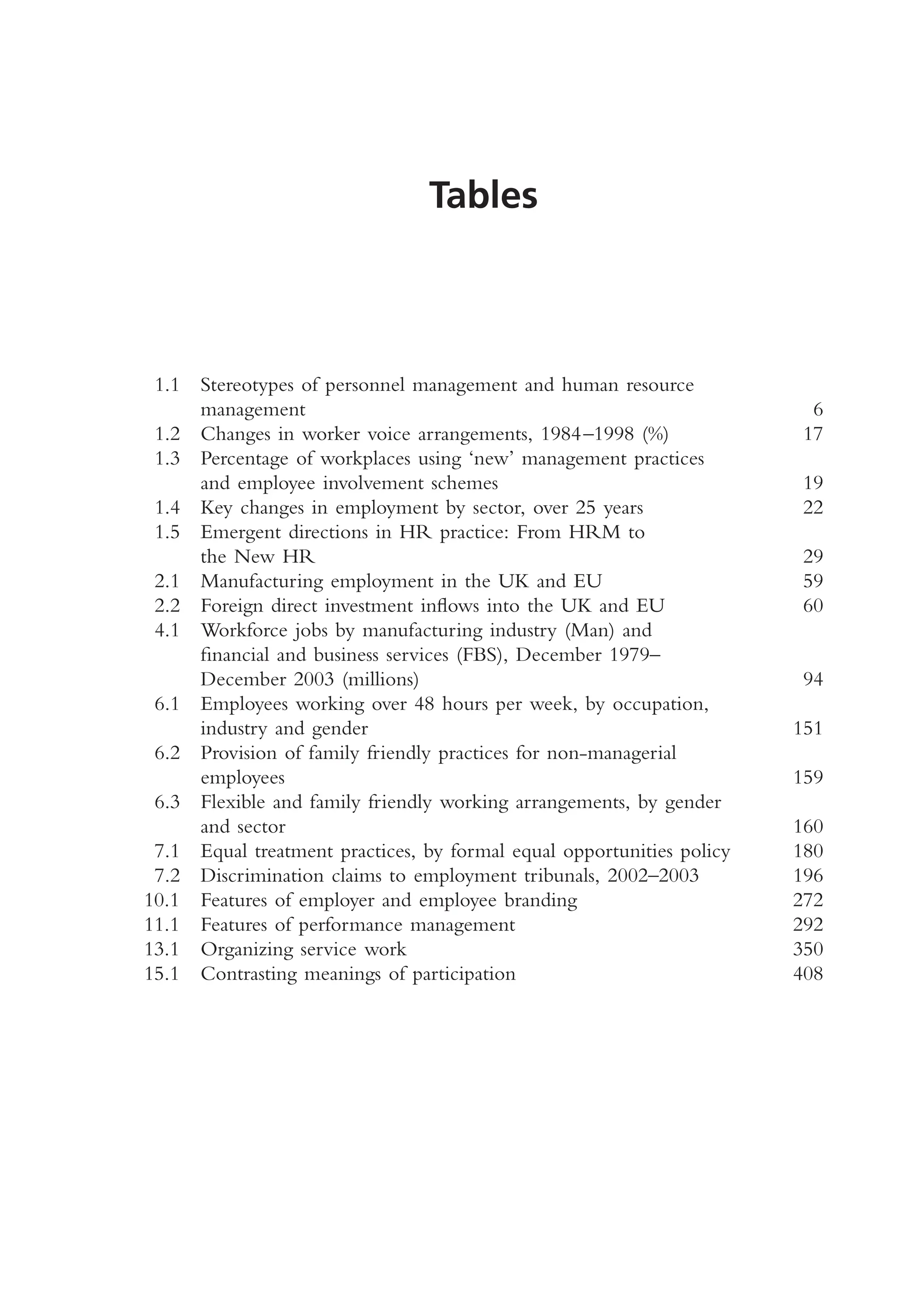
Tables
1.1 Stereotypes of personnel management and human resource
management 6
1.2 Changes in worker voice arrangements, 1984–1998 (%) 17
1.3 Percentage of workplaces using ‘new’ management practices
and employee involvement schemes 19
1.4 Key changes in employment by sector, over 25 years 22
1.5 Emergent directions in HR practice: From HRM to
the New HR 29
2.1 Manufacturing employment in the UK and EU 59
2.2 Foreign direct investment inflows into the UK and EU 60
4.1 Workforce jobs by manufacturing industry (Man) and
financial and business services (FBS), December 1979–
December 2003 (millions) 94
6.1 Employees working over 48 hours per week, by occupation,
industry and gender 151
6.2 Provision of family friendly practices for non-managerial
employees 159
6.3 Flexible and family friendly working arrangements, by gender
and sector 160
7.1 Equal treatment practices, by formal equal opportunities policy 180
7.2 Discrimination claims to employment tribunals, 2002–2003 196
10.1 Features of employer and employee branding 272
11.1 Features of performance management 292
13.1 Organizing service work 350
15.1 Contrasting meanings of participation 408
MHRA01 15/09/2005 10:49 Page x
Boxes
1.1 Pfeffer’s seven practices of successful organizations 8
2.1 Main developments in EU employment regulation 52
5.1 Personnel specification for a secondary-school head of English
(following Rodger’s seven-point plan) 120
5.2 Example of a situational interview technique 132
6.1 Flexible working: DTI guidance 158
7.1 Equal opportunities policy: ten-point plan 185
7.2 The business case for racial equality 188
7.3 Key equality aspects of UK legislation 193
11.1 People manager’s views of impact of performance review processes 303
14.1 Key results from the 2003 Survey of Employment Tribunal
Applications, based on applications made in 2002–2003 380
16.1 The main provisions of the information and consultation
regulations 445
MHRA01 15/09/2005 10:49 Page xi
Preface
This book is a direct descendant of the first edition of Personnel Management pub-
lished in 1989, edited by Keith Sisson. This edition continues the traditions of its
predecessors, while including substantial modifications, to reflect the profound changes
in the context of managing human resources (HR) over recent years. This volume
continues the style of earlier editions in which each chapter, in the words of the fore-
word to the 1989 edition, comprises ‘an original essay that brings together the
relevant theoretical and empirical work. Each is stamped with the views of the authors
who are leading experts in the field.’ The book therefore seeks to move beyond
description of current HR recipes and to assess trends and differing perspec-
tives on contemporary developments. This volume also reflects its origins in the
University of Warwick’s ‘Industrial Relations in Context’ series and it maintains
much of this industrial relations orientation. In contrast to many texts which pro-
vide only cursory analysis of influences on the management of human resources
that lie beyond the boundaries of the firm, this volume places the regulation of
the employment relationship at the heart of the analysis. It considers the variety
of contextual and institutional influences which shape the sectors and employer
units in which people work, and seeks to understand the manner in which people
are actually recruited, developed, appraised, disciplined and involved at work. The
book is therefore not prescriptive as most textbooks in this area tend to be.
In addition, by exploring the particular contexts in which people are managed,
it aims to contribute to debate about the state of HR practice in the UK and to
shed light on a variety of contemporary policy debates. What are the consequences
for HR practice of the increased internationalization and Europeanization of the
UK economy? How far has HR policy altered in response to the growth of ser-
vice sector employment and shifts in organizational boundaries? And have shifts
in national patterns of regulation, implemented by successive Labour governments,
had an impact on the skills, managerial competencies and forms of flexibility pre-
sent in UK workplaces?
These questions reflect the changes that have been made in this edition. I have
modified the book’s title to reflect the evolution of the subject. As I engaged with
authors it was clear that all contributors took HRM as the reference point for
debate and engagement. HRM is considered to be a broad field of inquiry con-
cerned with the practices used to shape the employment relationship rather than
as a narrow and prescriptive set of ‘best practice’ strategies. This is the approach
MHRA01 15/09/2005 10:49 Page xii
I have adopted, which has many similarities with the term ‘Personnel Manage-
ment’, used in previous editions, a term which is now used less frequently. My
analysis of these issues and the debate about HRM is developed in more detail
in Chapter 1.
In terms of the volume’s content, the profound ways in which the context for
managing human resources has altered is captured in the opening section which
highlights the consequences of alterations in organizational structures, changes in
labour and product markets, and international developments for HR practice. Two
new chapters consider the impact of European integration and the role of multi-
national companies in altering the context in which people are managed. The
chapters in the other sections are concerned with more long-standing themes:
employee resourcing; employee development; pay and performance; and work
relations. However, reflecting developments since the last edition there are new
chapters concerned with issues of work–life balance, customer service work, and
the emerging area of HR branding. The chapter on discipline has also been expanded
to take account of the prominence within the HR community of concerns about
the management of absence.
It proved difficult to make space for important new developments and at the
same time keep the volume to manageable proportions. In some cases topics that
were the subject of separate chapters in the previous edition have been integrated
into several chapters. In other cases some of the chapters from the third edition had
a timeless quality to them and consequently there seemed little point in asking
contributors to update them for the sake of it.
A key change which merits special mention relates to editorial roles. When Keith
Sisson invited me to edit jointly the third edition, he made it clear that if a fourth
edition was to be produced, he would bow out of his editorial role. Despite my
attempts to persuade Keith to change his mind, understandably he wished to chan-
nel his energies into other projects, especially his important policy role at the Advisory
Conciliation and Arbitration Service (ACAS). ACAS’s gain has been my loss, not
only because of the self-evident increase in workload that halving the editorial
team brought, but also because of the companionship and intellectual stimulus that
is associated with joint writing and editorship. Nonetheless, Keith has maintained
an active role in the volume by providing valuable guidance on editorial matters, very
helpful comments on the introductory chapter, and contributing a chapter on the
impact of European integration.
This book was written during the period when the obsession within universities
about the forthcoming research assessment exercise (RAE) was reaching its peak.
The RAE has put pressure on academic staff to focus on a narrow set of activities
and has reinforced the self-serving behaviour that lurks just below the surface in
most universities. Textbooks carry little weight in such research exercises, but this
fails to recognize the degree to which texts are a key representation of our sub-
ject to students and other interested parties. It also undervalues the complex task
of analysing and synthesizing a mass of research evidence and presenting it in an
accessible and coherent manner to a non-specialist audience. I am therefore very
Preface xiii
MHRA01 15/09/2005 10:49 Page xiii
grateful not only that all authors approached agreed to contribute, but that they
took the time and trouble to produce high-quality chapters.
As well as the authors many people made this book possible. I have benefited
enormously from the stimulus and support from colleagues in the Department of
Management at King’s College. Over the last four years, it has been rewarding
working with colleagues to establish a Masters’ degree in Human Resource
Management and Organizational Analysis. Special thanks are due to Stephen Deery,
Martin Edwards, Howard Gospel and Ian Kessler for providing me with detailed
comments on the introductory chapter of this book. I am also grateful to the team
at Blackwell – Bridget Jennings, Eloise Keating, Rhonda Pearce, Rosemary Nixon
and Karen Wilson – that helped keep the book on track. As ever I am most appre-
ciative of the encouragement from my wife and children, Caroline, Alexandra and
Richard, who have been a constant source of support as the book moved through
its various stages.
Stephen Bach
xiv Preface
MHRA01 15/09/2005 10:49 Page xiv
PART I
Managing Human Resources
in Context
MHRC01 15/09/2005 10:56 Page 1
MHRC01 15/09/2005 10:56 Page 2
CHAPTER ONE
Personnel Management
in Transition
Stephen Bach
For almost two decades analysis of the employment relationship has focused on
the many uncertainties surrounding the emergence and consequences of human
resource management (HRM). One approach has been to view HRM as invol-
ving particular strategies and approaches towards the management of labour, with
analysis centring on the breadth and scope of HR policy. HRM has also been
defined more broadly as a subject of study. This has raised many questions about
the differences between HRM and personnel management both in terms of the
HR practices used and also whether the underlying values and concerns of HRM
are distinctive and managerialist in their orientation.
These debates have been reflected in the evolution of personnel management
practice as charted in previous editions of this book. At the end of the 1980s there
was a general recognition that competitive pressures were forcing employers to review
personnel practice, but there was only the beginnings of a debate about whether
personnel management was in transition and, if so, where it was going (Sisson 1989).
By the mid 1990s, fundamental changes were afoot, but there were major ques-
tions about the degree to which these changes marked a fundamental break with
past practice in the direction of the emerging HRM models (Millward 1994:
127; Sisson 1994). By the end of the 1990s, it became clearer that there had been
a major reshaping of HR practice in the UK, but many employers appeared to
be following the low road of cost minimization associated with low pay, dis-
posable labour and outsourcing rather than the high road of skill development,
partnership and mutual gains (see Kochan and Ostermann 1994; Bach and Sisson
2000).
In terms of the debate about the definition of HRM it is striking that in com-
parison to a decade ago much of the controversy has dissipated. When HRM emerged
in the late 1980s and 1990s it was the definition of HRM as a specific, high com-
mitment style of HR management, signalling ‘a radically different philosophy and
MHRC01 15/09/2005 10:56 Page 3
approach to the management of people at work’ (Storey 1989: 5) that proved con-
troversial. This normative approach to what managers ‘should do’ was criticized
because it did not reflect actual developments in many workplaces (Bach and Sisson
2000). Increasingly, however, a broader, more encompassing definition of HRM
has gained ground that downplays many of the preoccupations of HRM of the
1980s and 1990s. As an authoritative overview of the field explains:
The notion of human resource management (HRM) is used in this book to refer
to all those activities associated with the management of the employment relation-
ship in the firm. The term ‘employee relations’ will be used as an equivalent term
as will the term ‘labour management’. (Boxall and Purcell 2003: 1)
This definition is on the right lines, but is arguably a little too broad because it
becomes hard to highlight any distinctive features and values underpinning HRM,
to chart changes in HR practice, or to understand why HRM has proved con-
troversial if HRM is associated with all aspects of managing the employment
relationship. HRM can usefully be defined in a generic sense as an approach that
uses a variety of policies and practices related to the management of people, but
it differs from employee relations in its dominant interest in management practice
which tends to ignore employee interests. HRM as a subject of study assumes that
the interests of employees and employers will coincide and is preoccupied with the
end goal of organizational effectiveness that marginalizes the interests of other stake-
holders such as employees. HRM is also predominantly focused on the individual
firm and seeks solutions to HR problems within the firm, with an analytical focus
on the motivations and aspirations of individual employees. This largely precludes
the possibility that HR problems may lie beyond the boundaries of the firm and
that employees may wish to combine together and act collectively to further their
own interests (see Kaufman 2001: 364–6).
This chapter builds on these initial observations to provide a critical overview
of the field to contextualize the detailed analysis of managing human resources
considered in later chapters. First it considers the evolution of the HRM debate
and examines the shift in emphasis from a focus on the meaning of HRM towards
a concentration on the link between HR practice and organizational perform-
ance. Second, the implications for the personnel function are drawn out and the
degree to which it has shifted towards a more strategic role are assessed. Third,
the diverse patterns of HR practice are considered in relation to changes in the
labour market, business restructuring and evolving patterns of corporate govern-
ance. It is the evolving institutional features of the UK employment context that
continues to shape management practice. Finally the emerging ‘New HR’ is sketched
out which arises from changes in the global, national and organizational employ-
ment context. The New HR signals new challenges for HR practice and repres-
ents a significant departure from the focus of the HRM debate over the last two
decades.
4 Stephen Bach
MHRC01 15/09/2005 10:56 Page 4
The Evolution of HRM
Origins
The term ‘human resource management’ crossed the Atlantic in the 1980s and
the UK debate has been shaped in large part by its US heritage. The antecedents
of HRM originated in the study of large non-unionized US companies such as
IBM and Hewlett-Packard. In these companies HRM has been associated with a
particular style of people management that placed a great deal of emphasis on gaining
the commitment of individual employees to organizational goals. In this unitarist
perspective, management is viewed as the sole source of authority that safeguards
the interests of managers and workers; trade unions are regarded as interfering un-
necessarily in the harmonious relationship between employees and managers. UK
employers and policy makers were receptive to this unitarist perspective in the 1980s
and the resonance of HRM can therefore be linked to the political and economic
context and the dominant ideological values prevailing at this time. In particular,
intensified competition made the task of effective personnel management more
urgent. Related pressures in the public sector arising from policies of privatization
and market testing presented similar challenges as public sector managers were encour-
aged to emulate private sector ‘best practice’. The popularity of the term ‘HRM’
came to symbolize not only a belief that major changes in product markets required
a fresh management approach, but also that Conservative government reforms of the
labour market allowed managers to exercise an unprecedented degree of ‘strategic
choice’ in shaping organizational employment practices. With trade unionism in
retreat, employers had an opportunity to decide whether to (de)recognize trade
unions and to develop a more direct relationship with the workforce with the estab-
lishment of new channels of participation and involvement.
Models of HRM
The emergence of HRM was accompanied by controversy about the meaning of
HRM and the degree to which normative models of HRM were reflected in organ-
izational practice. There was recognition of the danger of comparing normative/ideal
models of HRM with a descriptive model of the practice of personnel management,
but Guest (1987: 507) concluded that there were significant differences between the
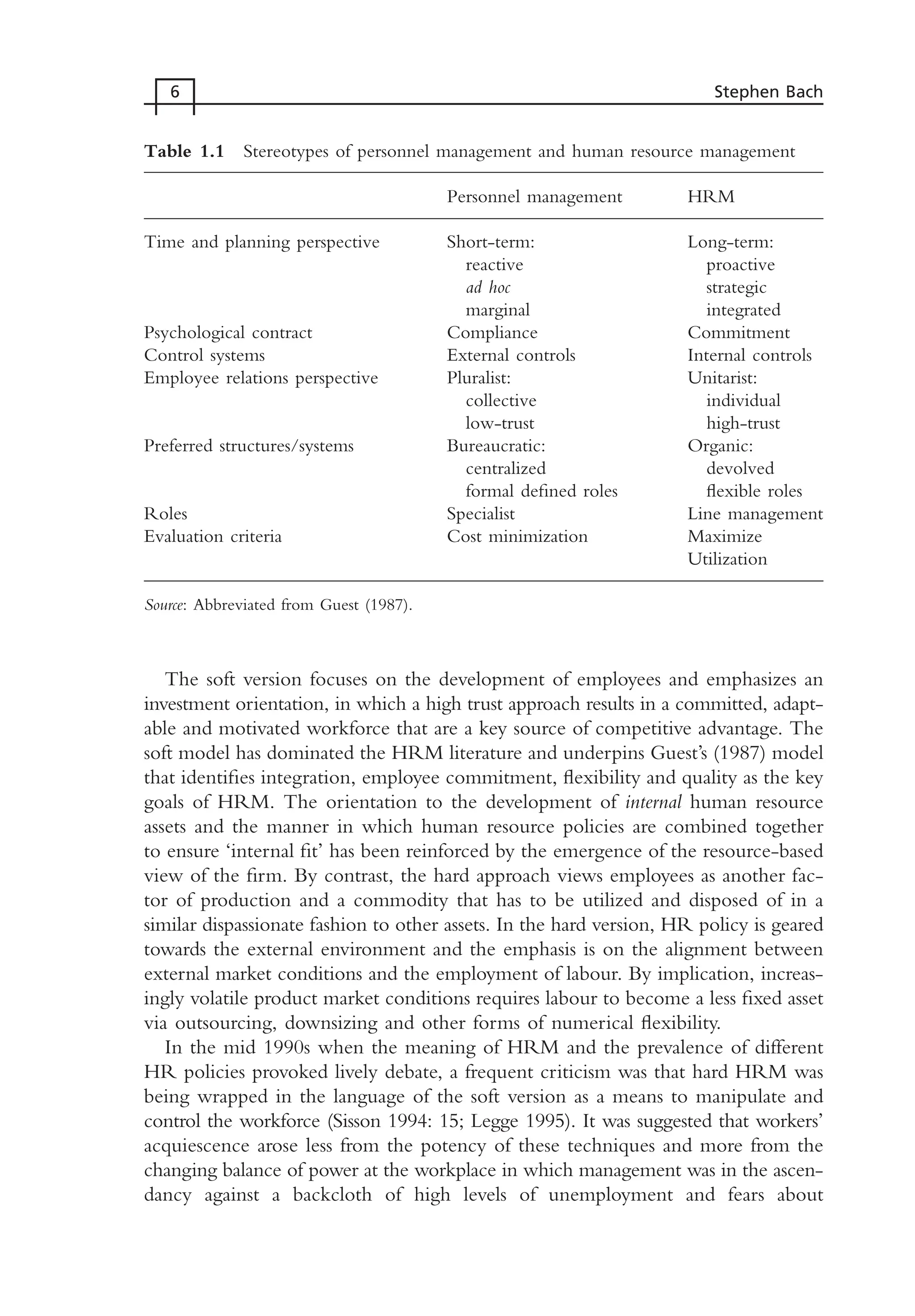
‘stereotypes’ of personnel management (PM) and HRM (Table 1.1). Storey (1989: 8)
argued that interpretations of these developments were hamstrung by the conceptual
elasticity of HRM. He distinguished between a ‘soft’ and ‘hard’ version of HRM
which became the key reference points for debate. Both variants share an emphasis
on the integration of HR policies with business planning but differ in the degree to
which they highlight the ‘human’ or the ‘resource’ aspects of HRM.
Personnel Management in Transition 5
MHRC01 15/09/2005 10:56 Page 5
The soft version focuses on the development of employees and emphasizes an
investment orientation, in which a high trust approach results in a committed, adapt-
able and motivated workforce that are a key source of competitive advantage. The
soft model has dominated the HRM literature and underpins Guest’s (1987) model
that identifies integration, employee commitment, flexibility and quality as the key
goals of HRM. The orientation to the development of internal human resource
assets and the manner in which human resource policies are combined together
to ensure ‘internal fit’ has been reinforced by the emergence of the resource-based
view of the firm. By contrast, the hard approach views employees as another fac-
tor of production and a commodity that has to be utilized and disposed of in a
similar dispassionate fashion to other assets. In the hard version, HR policy is geared
towards the external environment and the emphasis is on the alignment between
external market conditions and the employment of labour. By implication, increas-
ingly volatile product market conditions requires labour to become a less fixed asset
via outsourcing, downsizing and other forms of numerical flexibility.
In the mid 1990s when the meaning of HRM and the prevalence of different
HR policies provoked lively debate, a frequent criticism was that hard HRM was
being wrapped in the language of the soft version as a means to manipulate and
control the workforce (Sisson 1994: 15; Legge 1995). It was suggested that workers’
acquiescence arose less from the potency of these techniques and more from the
changing balance of power at the workplace in which management was in the ascen-
dancy against a backcloth of high levels of unemployment and fears about
6 Stephen Bach
Table 1.1 Stereotypes of personnel management and human resource management
Personnel management HRM
Time and planning perspective Short-term: Long-term:
reactive proactive
ad hoc strategic
marginal integrated
Psychological contract Compliance Commitment
Control systems External controls Internal controls
Employee relations perspective Pluralist: Unitarist:
collective individual
low-trust high-trust
Preferred structures/systems Bureaucratic: Organic:
centralized devolved
formal defined roles flexible roles
Roles Specialist Line management
Evaluation criteria Cost minimization Maximize
Utilization
Source: Abbreviated from Guest (1987).
MHRC01 15/09/2005 10:56 Page 6
job security. Even in so-called ‘leading edge’ companies including BP, Citibank,
Hewlett Packard and Glaxo Pharmaceuticals, Truss (1999: 57) concluded:
even if the rhetoric of HRM is soft, the reality is almost always hard with the inter-
ests of the organization prevailing over those of the individual.
The soft/hard dichotomy has been approached differently by discourse analysts,
These commentators reject positivist assumptions about the existence of an object-
ive reality and argue that language is crucial in framing understanding within
organizations and can be marshalled to legitimize organizational policies. A sharp
distinction between rhetorical language and an empirical reality is rejected because
language is not just rhetorical – that is, seductive but false – but has real effects
by legitimizing managerial actions that result in work intensification and other
detrimental consequences for the workforce. By deconstructing the language of
HRM these writers question the underlying unitarist and neutral assumptions
of HRM. As Bunting (2004: 116) argues:
Human resources . . . has taken on pleasantly democratic overtones as the ‘people
department’; and companies are very fond of instituting ‘communities’ in place of
departments, while ‘positions’, not people are made redundant. Two of the most
ubiquitous and fraudulent words are ‘empowerment’ and ownership.
There is no doubt that the ‘linguistic turn’ and discourse analysis has been highly
influential. Society has become more sensitized to the use of rhetorical language;
‘spin’ in popular parlance. Journalists delight in pointing out how many times poli-
ticians such as Tony Blair mention ‘Modernization’ and ‘New Labour’ in their speeches
and impute the direction of government policy from their choice of language. For
Carter and Jackson (2004: 474) the use of managerial/HRM rhetoric contributes
to the growth of organizational cynicism.
The difficulty with these types of analysis, however, is that in the absence of
detailed empirical evidence, the reader is heavily reliant on the interpretation of the
author. Despite Keenoy’s (1999) suggestion that HRM is a hologram in which
what the viewer sees is an illusion, but one that is constantly shifting depending
on the vantage point of the observer, in practice these writers eschew this plurality
of perspectives and claim the superiority of their own unique insights into
‘HRMism’. Empirical evidence that seeks worker and management responses
to initiatives such as empowerment, for example, often portray a more nuanced
picture. As Edwards and Collinson (2002) highlight in their study of six organiza-
tions, the language of empowerment was not used by managers as an insidious
form of labour control to mislead workers. They report that 70 per cent of workers
were broadly favourable towards these quality programmes and 72 per cent of
workers said that communication and participation had improved. Consequently,
although discourse analysis has proved useful in sensitizing researchers to the use
and abuse of HRM language, it can play only a very limited role in advancing
our understanding of the contemporary workplace.
Personnel Management in Transition 7
MHRC01 15/09/2005 10:56 Page 7
Best practice HRM
By the late 1990s debate about HRM had shifted from a concern with the mean-
ing of HRM and whether HRM was a predominantly a soft or hard phenomenon
towards an emphasis on the link between HRM and performance and the appro-
priate measures to use to capture these links. As Boxall and Purcell (2003) point
out, two broad normative approaches to the HR/strategy link can be distinguished
– best practice and best fit models. The best practice approach advocates a series
of universal practices that are appropriate for all organizations and these practices
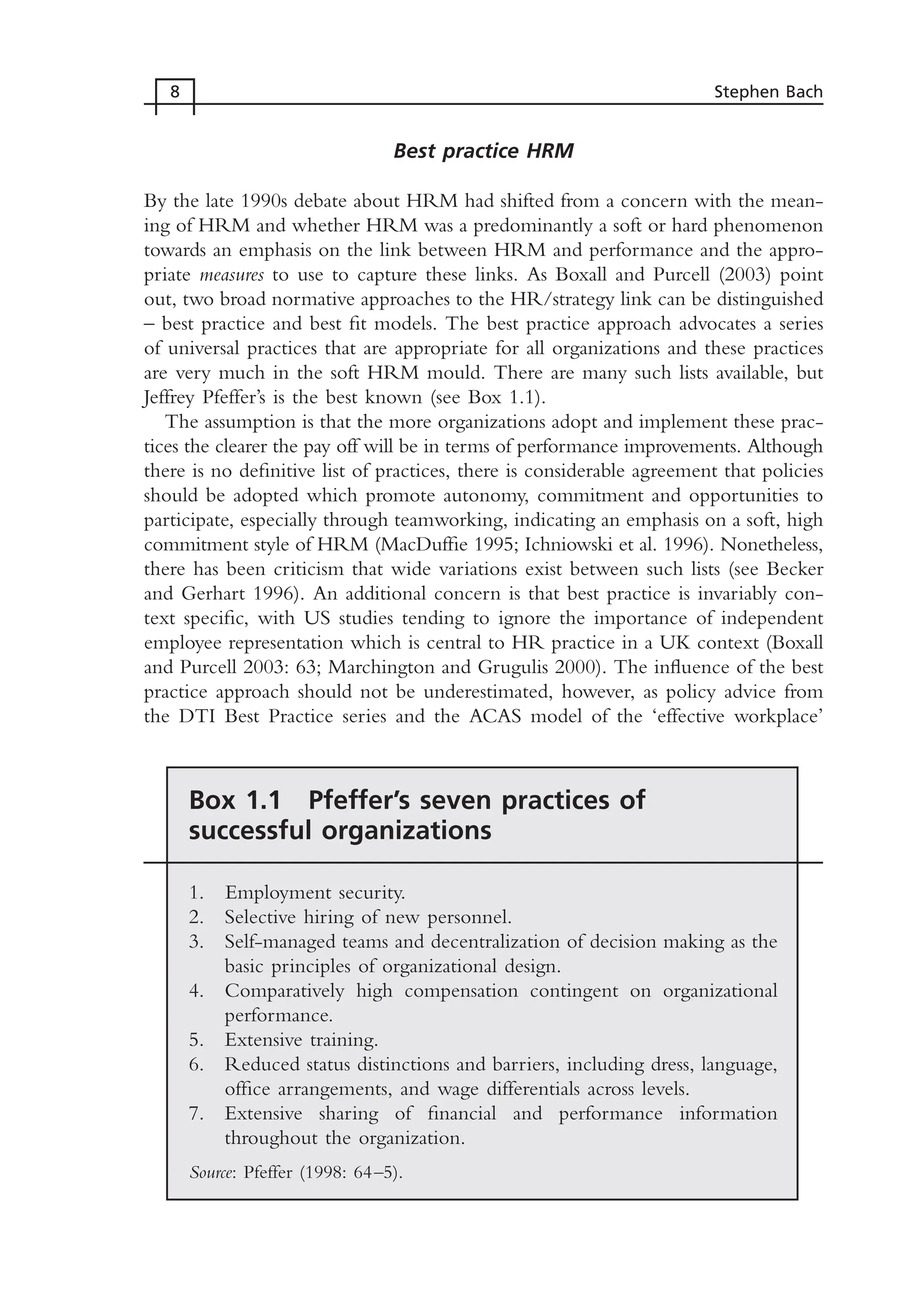
are very much in the soft HRM mould. There are many such lists available, but
Jeffrey Pfeffer’s is the best known (see Box 1.1).
The assumption is that the more organizations adopt and implement these prac-
tices the clearer the pay off will be in terms of performance improvements. Although
there is no definitive list of practices, there is considerable agreement that policies
should be adopted which promote autonomy, commitment and opportunities to
participate, especially through teamworking, indicating an emphasis on a soft, high
commitment style of HRM (MacDuffie 1995; Ichniowski et al. 1996). Nonetheless,
there has been criticism that wide variations exist between such lists (see Becker
and Gerhart 1996). An additional concern is that best practice is invariably con-
text specific, with US studies tending to ignore the importance of independent
employee representation which is central to HR practice in a UK context (Boxall
and Purcell 2003: 63; Marchington and Grugulis 2000). The influence of the best
practice approach should not be underestimated, however, as policy advice from
the DTI Best Practice series and the ACAS model of the ‘effective workplace’
8 Stephen Bach
Box 1.1 Pfeffer’s seven practices of
successful organizations
1. Employment security.
2. Selective hiring of new personnel.
3. Self-managed teams and decentralization of decision making as the
basic principles of organizational design.
4. Comparatively high compensation contingent on organizational
performance.
5. Extensive training.
6. Reduced status distinctions and barriers, including dress, language,
office arrangements, and wage differentials across levels.
7. Extensive sharing of financial and performance information
throughout the organization.
Source: Pfeffer (1998: 64–5).
MHRC01 15/09/2005 10:56 Page 8
indicates (ACAS 2004: 4–5; DTI 2003). A key question, especially for policy
makers and practitioners, however, remains the need to understand why relatively
few firms adopt such measures, rather than become mired in a debate about the
precise HR practices which constitute best practice.
Best fit HRM
In contrast to these universal models, best fit models adopt a contingency approach
focused on the ‘fit’ with the environment. The modelling of the linkage between
HR and strategy is derived from particular aspects of the organizational context.
In the 1980s these studies focused on key components of the firm’s competitive
strategy and aligned HR policies to the external product market circumstances that
confronted the firm; termed ‘external fit’. There was some difference of emphasis
in terms of how HR practices should be aligned to business strategy in these ‘match-
ing models’. The business life-cycle approach linked HR practices to the phase of
the organization’s development with differing HR priorities associated with start-up,
growth, maturity and decline phases (Kochan and Barocci 1985). The dominant
approach, however, was orientated to the firm’s competitive strategy. Miles and
Snow (1984) differentiated between three types of strategic behaviour with differ-
ing implications for HR practice depending on whether a firm was primarily geared
to defending existing product markers (defenders) or was seeking market growth
through innovation (prospectors). Schuler and Jackson (1987) took this type of
analysis further, drawing on Porter’s (1985) well-known model of competitive
advantage, to specify that different competitive strategies required distinct employee
behaviours. HR policies had to be designed to align competitive strategy and
employee behaviour, resulting in favourable HR outcomes.
These type of contingency approaches were criticized as being too crude and
deterministic in the manner in which they sought to align HR to business strat-
egy, underplaying a variety of other contextual factors that influence approaches
to HR as well as overlooking the degree to which employee interests and com-
petencies influence competitive advantage (Boxall and Purcell 2003: 54–6). These
criticisms informed more recent studies that have been more influenced by internal
fit, that is, the degree to which a coherent bundle of HR practices can be consti-
tuted in which complementary HR practices produce superior levels of organiza-
tional performance (MacDuffie 1995). This has led to a focus on the bundle of
HR practices that produces the most favourable organizational outcomes. An import-
ant influence on these studies has been the prominence of the resource-based
theory of the firm which suggests that rather than adopting universal ‘best prac-
tice’ panaceas, firms derive competitive advantage by focusing on developing unique
internal resources that are rare, non-substitutable and hard to imitate (Barney 1991).
Many studies have tested the relationship between specific bundles of HR prac-
tices, associated with high performance work systems, and organizational perform-
ance. The dominant message emerging from a variety of US studies across a number
Personnel Management in Transition 9
MHRC01 15/09/2005 10:56 Page 9
of industries suggests that there is a positive association between HR practice, firm
performance and profitability, especially where HR practices are bundled together
in a coherent and integrated fashion, termed a ‘high performance work system’
(Appelbaum et al. 2000). Practices that provide employees with more information,
enhanced skills, extended opportunities for teamwork and enhanced discretion have
been associated with enhanced organizational performance (Becker and Huselid
1998; Huselid 1995). The US study by Huselid (1995) has been highly influential
because it concluded that the use of particular HR practices was reflected in higher
organizational performance, lower labour turnover and higher labour productivity.
The practices examined, which related to work organization and skill utilization,
included employee participation and communication mechanisms and a focus on
skills training. A second bundle of practices, which he termed a motivation index,
examined data on performance appraisal and merit-based pay plans.
A very widely cited study of three US manufacturing plants by Applebaum et al.
(2000) reinforced these earlier studies reporting that the use of high performance
work systems – that is, a combination of teamworking, employee participation and
sophisticated selection, training and appraisal systems – achieved organizational per-
formance outcomes that were superior to traditional forms of work organization.
High performance work systems elicited greater discretionary effort, more employee
creativity and higher job satisfaction than traditional ‘command and control’
regimes. Some critics, however, suggest that higher discretionary effort may arise
from work intensification rather than higher levels of job satisfaction (Godard 2004).
Although many of the research studies have been US based, in the UK one of
the most striking recent studies reported an association between a bundle of high
performance HR practices and lower death rates in a sample of 61 NHS hospitals
(West et al. 2002). Guest et al. (2003) in their study of 366 organizations also con-
cluded that there was an association between high-commitment HR practices and
higher profitability as well as lower reported levels of labour turnover in manu-
facturing, but not in services. The study did not, however, demonstrate that HRM
practices caused higher performance and the issue of causality has been at the centre
of continuing controversy about the HR/performance link.
Commentators have highlighted a number of measurement and other meth-
odological shortcomings associated with large-scale survey data used in many of
these studies (see Godard 2004; Guest 2001b; Legge 2001; Purcell, 1999). The main
concerns are:
• reliance on financial yardsticks of organizational performance which ignore the
consequences for employees;
• the use of single managerial respondents, often situated at corporate head office,
that are required to have knowledge of HR practice and organizational outcomes;
• the dominance of cross-sectional rather than longitudinal data which makes it
difficult to be confident about the causal relationship linking HR practice to
outcomes. There is scope for reverse causality, that is, that firms with better
organizational performance are able to manage their staff more effectively rather
10 Stephen Bach
MHRC01 15/09/2005 10:56 Page 10
than that organizations become more competitive from the use of bundles of
high performance HR practices;
• evidence which suggests that the low road of cost minimization may be equally
effective in performance terms as the high road of the high performance work-
place approach.
One consequence of this uncertainty is that HR directors are reluctant to use
the evidence as a basis to persuade colleagues, especially CEOs, about the benefits
of investing in high commitment HR practice (Guest and King 2004: 414). A num-
ber of responses, however, are evident, which is continuing to take forward the
research agenda on HR and performance. First, there has been a greater recogni-
tion that more attention needs to be paid to the link between HRM and employee
well-being (Guest 1999; Peccei 2004). This reflects the increased policy attention
directed to issues surrounding the quality of working life. Second, there is increased
sensitivity to context and more emphasis being placed on the institutional settings
which shape strategic HR across industries and between countries. This amounts
to a plea to Europeanize the HR bundles debate to bring employee interests and
institutional context more fully into the analysis (Boxall and Purcell 2003; Paauwe
and Boselie 2003). Third, there has been a recognition that large-scale cross-
sectional survey data in isolation cannot resolve the issue of the relationship between
HR practice and organizational performance and that other research methods which
delve inside the organizational ‘black box’ and focus on how line managers actually
implement HR practice is needed to advance understanding of the processes involved
in sustaining better performance (Purcell et al. 2003). Finally the ambiguities sur-
rounding the linkages between HR and performance also have significant implica-
tions for the status and influence of the personnel function.
The Evolution of the Personnel Function
Personnel management and ambiguity
For personnel specialists the debate about HRM was especially significant because
it held out the prospect of a new dawn. The emphasis on the importance of the
management of human resources to the competitive advantage of the organization
appeared to give the personnel function the strategic dimension and status which
it had been seeking, together with the means to achieve it by devolving respons-
ibilities to line managers and demonstrating a measurable contribution to business
performance. It had long battled to shake off its image as a low status function
and struggled to escape the ambiguities inherent to the personnel role (Tyson and
Fell 1986: 62–6).
A key source of ambiguity is the uncertain boundary between personnel man-
agement as a separate specialist function and as a description of a set of activities
Personnel Management in Transition 11
MHRC01 15/09/2005 10:56 Page 11
undertaken by all managers. From their origins in welfare work, personnel spe-
cialists have acquired a wide range of tasks including industrial relations, human
resource planning and management development activities whose importance
has shifted over time (Hall and Torrington 1998). The aspiration to shift from an
operational to a more strategic conception of the function has encouraged the devolu-
tion of activity to line managers, but the specialist is expected to be the ‘expert’.
Indeed it is only by establishing expertise in operational matters that the personnel
specialist is very often able to persuade senior managers that they have the capab-
ility to make a strategic contribution. The danger, of course, is that the more time
and energy is spent on operational matters, the less they are associated with the
strategic dimension.
A second source of ambiguity is that personnel specialists act in an advisory capa-
city and it is therefore difficult to identify their distinctive and measurable contribu-
tion. Their authority is both mediated and limited by the actions of line managers
who may not share the same aims and priorities. For example, the emphasis the
personnel specialist may put on consistent and standardized rules to reduce the
ambiguities of the employment relationship and ensure procedural fairness, can appear
to line managers to be unnecessary interference limiting their discretion. The other
side of the coin is that managing people is an element of every manager’s job; the
distinct ‘people’ expertise of personnel specialists can be easily discounted by line
managers. This is especially the case because of the difficulties of quantifying the
HR contribution. The search for HR ‘metrics’ has therefore been a key task in
attempting to overcome their ambiguous status.
A third source of ambiguity arises from the position of the personnel function.
It combines a responsibility for the well-being of the workforce, and a set of
pluralist values that view employees as a key organizational asset, while at the same
time remaining an integral part of management whose priorities may differ from
those of the workforce. By contrast mainstream management ideology is essentially
unitarist, in which management and the workforce are viewed as sharing the same
interests and any conflict arises from miscommunication. These frames of reference
lead to differing perspectives on the management of the workforce and in the past
the personnel function has often found itself in an uncomfortable position high-
lighting the consequences for the workforce of downsizing and other measures
designed to maximize shareholder value. The response of the personnel function
to this source of ambiguity has increasingly been to conform to the more strident
managerial unitarism of the last two decades, placing more emphasis on business
requirements. HRM has therefore been viewed as an attempt to escape the wel-
fare straightjacket of personnel management (Townley 1994: 16).
A final source of ambiguity has been attributed to the gender bias of personnel
management and the undervaluing of occupations in which many women work.
This is reflected in the terminology used to describe routine personnel manage-
ment roles such as ‘handmaidens’ and ‘clerk of works’ which have low status
connotations, as does the general label ‘Cinderella’ function. Women make up an
increasing proportion of personnel specialists, comprising almost two-thirds (63 per
12 Stephen Bach
MHRC01 15/09/2005 10:56 Page 12
cent) of specialists in 1998 compared to one-fifth in 1980 (19 per cent). As Kochan
(2004: 144) observes in the case of the USA, as more women entered the HR
profession real wages of HR professionals declined by 8 per cent between 1993
and 2002.
Reinventing the personnel function
There has been no shortage of advice about how to shift towards a more strategic
HR role. The most influential perspective has been Dave Ulrich’s (1997) relent-
lessly upbeat book Human Resource Champions that predicted: ‘the next ten years
will be the HR decade’ (p. viii) with the HRM agenda presenting opportunities
for HR to ‘add value’. This required a radical shift in thinking from a concern
with ‘what HR professionals do and more on what they deliver’ (p. vii). Such an
outcome is possible if HR professionals are able to fulfil four key roles:
• strategic partner;
• administrative expert;
• employee champion;
• change agent.
These roles require HR to balance short-term operational requirements and a
strategic focus and combine the management of HR processes and people man-
agement. This amounts to a restatement of the ambiguities associated with the
personnel function, but by developing new competencies HR professionals ‘can
go to heaven’ (p. viii).
Ulrich’s analysis is couched in unitarist terms with other interest groups, includ-
ing trade unions, barely mentioned. The assumption that the goal of HR is to deliver
value – that is, shareholder value – is seen as non-contentious. Ulrich’s prescrip-
tion has been enthusiastically endorsed by the Chartered Institute of Personnel and
Development (CIPD), but to what extent has the personnel function moved towards
becoming a valued business partner? An indication of the shift towards a strategic
champion role can be gauged by the terminology used. Language, as discussed
above, can be important. The Department of Health (2002: 3), for example, has
lamented the degree to which ‘human resource management in the NHS is still
too often tarnished by its former role as the pejorative “personnel” function’. It
is therefore noteworthy that the 1998 Workplace Employee Relations Survey (WERS)
indicated that there had been a significant increase in the number of management
specialists with ‘human resources’ in their job title. Approximately 7 per cent of
workplaces with 25 or employees had a specialist with HR in their job title com-
pared to 1 per cent in 1990, comprising approximately one-third of specialists
(Millward et al. 2000: 52–4). More significantly, Hoque and Noon (2001) suggest
that specialists using the HR title differ from personnel specialists in terms of being
more likely to hold a formal qualification, are engaged more actively in strategic
Personnel Management in Transition 13
MHRC01 15/09/2005 10:56 Page 13
planning activities, and devolve more activities to line managers. The uptake of
the HR label is therefore associated with a more sophisticated conception of HR
practice and is suggestive of a shift of emphasis towards the strategic champion
role.
This evidence in isolation, however, indicates little about how HR is viewed
by HR professionals themselves or by chief executives and these perspectives reveal
much greater uncertainty about their influence and capacity to develop a ‘value
added’ agenda. Despite the interest in developing ‘balanced scorecards’ of HR
performance the lack of quantifiable HR ‘metrics’ remains a significant barrier for
the HR function in its aspiration to become a strategic partner (Bartlett and Ghoshal
2002: 37; Caldwell 2004: 201). A further dilemma arises from ensuring the appro-
priate balance between operational and strategic concerns. A CIPD survey of 1,188
senior HR practitioners reported that respondents spent relatively little time on
business strategy in comparison to reacting to line managers’ needs (CIPD 2003a:
24; IRS 2004: 11). The focus on operational tasks cannot be solely attributed to
workload pressures; HR specialists recognize that their credibility depends on
managing an effective operational regime. Consequently HR specialists, while espous-
ing the language of strategic champions, focus on ensuring they are administrative
experts. This bias towards an operational role is reinforced by a perception among
CEOs and senior HR practitioners that there is insufficient HR talent available
to fulfil the strategic champion role (Caldwell 2004: 203; Deloitte and Touche
2003: 15; Guest and King 2004: 416).
These challenges are being reinforced by the complexities associated with devolu-
tion of HR responsibilities to line managers, intended to allow specialists to con-
centrate on more strategic concerns. It has proved difficult to devolve a clearly
defined workload and while line managers support devolution in principle they
are often unwilling to undertake enhanced people management responsibilities in
addition to their existing workload (CIPD 2003a: 26). This reluctance is reinforced
by perceptions that HR’s emphasis on procedural fairness can result in complex
administrative procedures that are resented by line managers (Guest and King 2004:
420). The upshot is that a sizeable gap remains between espoused policy and its
implementation which the CIPD (2003a: 6) describes as the ‘Achilles’ heel of con-
temporary HR strategy’. Although there has been much speculation about the degree
to which HR outsourcing, forms of HR shared service centre and eHR can lower
transaction costs and free up senior HR specialists for more strategic activities, man-
agers have proceeded with caution. Outsourcing of HR activities was ranked 18th
(out of 18) as a priority by both HR directors and a matched sample of CEOs
(Deloitte and Touche 2003: 7).
In contrast to the strategic champion and administrative expert role much less
attention has been directed at the employee champion role. It is important to
recognize that Ulrich’s term is misleading because the substance of what he pro-
poses is focused on employee contribution, that is, the degree to which managers
can enlist employees’ efforts as a means to add value rather than being primarily con-
cerned with employee well-being as an end in itself. Even in these more narrowly
14 Stephen Bach
MHRC01 15/09/2005 10:56 Page 14
defined terms than the traditionally welfare orientation of personnel, the evidence
is unequivocal. The HR function appears resistant to viewing itself as an employee
champion and, interestingly, HR specialists have sought to move away from the
welfare tradition more forcibly than CEOs view as appropriate (CIPD 2003a: 27;
Deloitte and Touche 2003: 14; Guest and King 2004: 415). These findings are
reinforced by survey evidence of union representatives that indicated, with the
possible exception of the health service, that HR rarely acted as a buffer between
management and the workforce (Labour Research 2003). Similarly Kochan (2004)
in his analysis of the state of the US HR function attributes its loss of trust and
legitimacy as arising from its disregard of workforce interests, exemplified by the
absence of any serious challenge to soaring CEO pay levels in its failed quest for
a more strategic role. Kochan’s analysis provides a salutary warning about the pre-
occupations of the HR function in recent years.
Summary
The debate on HRM has come a long way since the early 1980s. The controversy
surrounding the meaning of HRM has largely dissipated and HRM has become
defined in broader terms to describe all aspects of personnel practice rather than
associated narrowly with a specific high commitment style of HR. This shift in
emphasis has dampened down the ideological concern that HRM was ‘an indus-
trial version of Thatcherism’ (Strauss 2001: 873). Analysis of HRM, as illustrated
more fully in the next section, has continued to be shaped by the evolving polit-
ical and economic context at the workplace and beyond.
The passion and controversy about HRM has therefore shifted towards the
ongoing debate about the link between bundles of HR practices and performance
and whether the search for the holy grail of an HR-performance link is, in Karen
Legge’s (2001) terms, a silver bullet or a spent cartridge. These changes have had
important consequences for the personnel function as it has sought to become a
more strategic HR partner. Although HR managers are better qualified than their
predecessors and the CIPD has continued to increase membership; achieving char-
tered status for its members, uncertainty about the HR contribution remains a
significant preoccupation.
The Practice of Personnel Management
It is not only the debate about HRM that has moved on significantly, there is also
much more data available about the state of HR/personnel practice. The emer-
gence of large-scale survey work, especially the Workplace Industrial/Employment
Relations Survey series, has provided an authoritative portrait of the changing land-
scape of employment practice since 1980. Its shifting focus from a preoccupation
Personnel Management in Transition 15
MHRC01 15/09/2005 10:56 Page 15
with formal structures of collective bargaining towards a focus on management
practice and its incorporation of smaller workplaces (with more than 10 rather
25 employees) has attempted to keep pace with the changing state of management
practice. There has also been a rapid expansion of surveys undertaken by the CIPD,
DTI and by management consultants and the posting of these surveys on the Internet
has ensured much greater access to this material. The representativeness and sample
sizes differ, but they contribute to the overall sense of where personnel practice
is headed. In addition, the availability of large-scale data sets has encouraged
academics from related disciplines including psychology and economics to focus
more squarely on employment matters.
Case study research remains important in illuminating our understanding of con-
temporary HR practice, but there are many difficulties in gaining high-quality research
access. Edwards and Collinson (2002: 280) in a study of the implementation of
quality initiatives, with direct relevance for the organizations concerned, were only
able to gain agreement to undertake the research from 6 of the 19 organizations
approached. The resource intensive nature of case study research and the inclina-
tion of many leading academic journals to publish predominantly narrow, highly
quantitative survey-based research, has led to a reduction in the availability of high-
quality case study research. As Barley and Kunda (2001) point out, however, it is
only by detailed observation of the workplace that our understanding of the con-
temporary world of work can be advanced and this type of material is also essen-
tial for teaching purposes in galvanizing student interest in HR practice. Although
this knowledge gap is being partially remedied by some of the findings that are
emerging from the ESRC Future of Work Project (Nolan 2004), it is notable that
some of the most compelling, albeit largely anecdotal accounts of recent employee
experience of work, have been written by journalists (Bunting 2004; Toynbee 2003).
State of play
During the last two decades there has been very significant restructuring of
personnel practice and many of the long-standing features of the UK’s employment
relations landscape have been transformed. It is relatively straightforward to identify
the shift in institutional structures and declining union presence. There has also been
the growth of direct communication, employee involvement and increased coverage
of performance appraisal. There is much more scepticism about the extent to which
HR practices are bundled together to form a coherent and integrated HR archi-
tecture and, most contentious of all, differences remain in the interpretation of
employees’ experience of work.
The main trends in personnel practice can be summarized fairly succinctly. First,
there has been a large reduction in traditional employment relations institutions
with a decline in joint regulation by collective bargaining. The WERS series
indicates that union recognition has fallen from 66 per cent in 1984 to 53 per
cent in 1990 to 42 per cent in 1998. This fall in recognition was a private sector
16 Stephen Bach
MHRC01 15/09/2005 10:56 Page 16
phenomenon and was attributed to lower rates of recognition among workplaces
that were less than five years old rather than derecognition in continuing work-
places (Millward et al. 2000: 106–7). Workplace size is also of crucial importance
in explaining the fall in union recognition because of the strong association
between larger workplaces and union presence. Of course the last 5 years has been
a key period for trade unions with the 1999 Employment Relation Act establish-
ing a statutory right to union recognition, but as discussed in the next section this
has slowed, but not reversed, the picture of trade union decline.
In workplaces where unions continue to be recognized their influence has declined
sharply and even if formal negotiation remains in place all the indications suggest
that trade unions are consulted and in many cases merely informed about a range
of pay and non-pay matters (Brown et al. 2000; Oxenbridge and Brown 2004).
WERS data also indicates that there has not been any increase in consultative com-
mittees which were present in 28 per cent of establishments, the same proportion
as 1990.
It has been the growth of direct communication with the workforce, such as
team briefings and meetings between senior managers and the workforce, that
has been the clearest trend. As Table 1.2 indicates, between 1984 and 1998 the pro-
portion of workplaces with just representative voice halved and those with direct
voice nearly trebled. Unionized workplaces added complementary forms of
direct communication while almost all new workplaces favoured direct communi-
cation methods without union recognition (Metcalfe 2003: 174). These trends are
consistent with the WERS 4 finding that 72 per cent of workplace managers expressed
a preference to consult directly with employees rather than with unions and that
Personnel Management in Transition 17
Table 1.2 Changes in worker voice arrangements, 1984–1998 (%)
Type of voice arrangement 1984 1990 1998
Union only 24 14 9
Union and non-union 43 39 33
Non-union only 17 28 40
No voice 16 19 17
Representative voice only 29 18 14
Representative and direct voice 45 43 39
Direct voice only 11 20 30
No voice 16 19 17
Base – all workplaces with 25 or more employees, approximately 2000 workplaces in each year.
Union voice defined as one or more trade unions recognized by employers for pay bargaining or
a joint consultative committee meeting at least once a month with representatives chosen through
union channels. Non-union voice defined as a joint consultative committee meeting at least once
a month with representatives not chosen through union channels, regular meetings between
senior management and the workforce, briefing groups, problem solving groups, or non-union
employee representatives.
Source: Metcalfe (2003: 174), adapted from Millward et al. (2000).
MHRC01 15/09/2005 10:56 Page 17
employers have become less accommodating in providing support and time off to
union representatives (Cully et al. 1999: 88, 206–7).
A second major change is the growth in the different forms of so-called ‘non-
standard forms of employment’, as indicated in Figure 1.1. Most important is the
growth in part-time work which is associated with increased female participation
rates in the labour market (Chapter 7). Part-time employees account for around
a quarter of the workforce and they make up the majority of the workforce in a
similar proportion of workplaces. Significantly, this figure is up from 16 per cent
in 1990 (Cully et al. 1998: 6). A major impetus for this increase arises from the growth
of private sector services which make heavy use of part-time work. More recent
data from the Change in Employer Practices Survey conducted in 2002 also pointed
to the greater use of part-time employees, especially among large establishments
in the public services (Taylor 2003: 8).
Third, there has been the considerable experimentation with new management
practices, but the overall growth in a range of so-called ‘new’ management practices
has been relatively modest. The details are shown in Table 1.3, grouped according
to four main areas of activity: appraisal and reward, involvement and participation,
training and development, and status and security. Although many of these prac-
tices are not new, they have nonetheless come to be associated with change. In the
case of appraisal and reward, it will be seen that just over a half of non-managerial
employees have some form of appraisal. Only one in ten of these employees have
individual performance pay, however, raising major question marks about the amount
of attention such arrangements have received in the prescriptive literature. More
18 Stephen Bach
Figure 1.1 Changes in the use of different forms of labour over the last 5 years
Source: Cully et al. 1998
60
50
40
30
20
10
0
Gone up
Base: all workplaces that are five or more years old with 25 or more employees
Figures are weighted and based on responses from 1,706 managers.
About the same Gone down Never used
5
11
35
31
7
3
8
6
48
60
Employees on fixed-term contracts
Temporary agency employees
Contractors
Part-time employees
40
43
40
26
17
20
Percent
MHRC01 15/09/2005 10:56 Page 18
enjoy the benefits of share ownership (one in seven) and profit sharing (one in three),
but they remain very much a minority. In the case of involvement and participation,
as noted earlier the signs of activity are greater. Thus, 37 per cent of workplaces
reported regular meetings, 42 per cent said they had some kind of problem-solving
group such as quality circles and 45 per cent that they had used staff attitude sur-
veys. Even so, this still means that less than half of workplaces were affected. Only
team briefing, with 61 per cent affected, was practised in a majority of workplaces.
At first sight, the evidence for the incidence of team work looks pretty strong
with around two-thirds of workplaces (65 per cent) in the WERS reported that
employees worked in formally designated teams, only a handful (5 per cent of those
with teams) had something resembling the semi-autonomous team working which
has come to be regarded as the leitmotiv of new forms of work organization, that
is, respondents said team members had to work together, had responsibility for
specific products or services, jointly decided how work was to be done, and appointed
their own teams leaders. Similarly, a striking finding of the 2001 Skills Survey is that
although there had been some increase in team working from 44 per cent in 1992
Personnel Management in Transition 19
Table 1.3 Percentage of workplaces using ‘new’ management practices and employee
involvement schemes
Appraisal and reward
Most non-managerial employees have performance formally appraised 56
Individual PRP scheme for non-managerial employees 11
Employee share ownership scheme for non-managerial employees 15
Profit-sharing scheme operated for non-managerial employees 30
Involvement and participation
Workplace level joint consultative committee 28
Regular meetings of entire workforce 37
Problem-solving groups (e.g. quality circles) 42
Staff attitude survey conducted in last five years 45
Workplace operates a system of team briefing for groups of employees 61
Most employees work in formally designated teams 65
Training and development
Most employees receive minimum of five days training a year 12
Most supervisors trained in employee relations skills 27
Status and security
Guaranteed job security or no compulsory redundancy policy 14
‘Single status’ between managers and non-managerial employees 41
Workplace operates a just-in-time system of inventory control 29
Attitudinal test before making appointments 22
Base: all workplaces with 25 or more employees
Figures are weighted and based on response from 1,926 managers
Source: Cully et al. 1998: table 4.
MHRC01 15/09/2005 10:56 Page 19
to 53 per cent in 2001, there had been a substantial decline in task discretion.
Consequently, whereas in 1992 nearly half of all team workers worked in teams
with significant decision-making powers, this had declined to a quarter by 2001
(Gallie et al. 2004: 256).
The next dimension of Table 1.3 concerns training and development. Here, too,
the evidence is hardly supportive of a major shift. Despite the widespread import-
ance attached to training because of the association between low levels of training
and the UK’s comparatively poor productivity record, only 12 per cent, or one in
eight, said that most employees received a minimum of 5 days’ training per year.
Notably only 27 per cent, or one in four, said they trained most supervisors in
employee relations skills training, but it is the development of people-orientated
skills which is often highlighted as an important element in any shift towards a
high commitment HR approach. The final cluster to be considered involves status
and security. Here it will be seen that less than half of workplaces (41 per cent) had
single status arrangements between managerial and non-managerial employees
and only 14 per cent, or one in seven, guaranteed job security or no compulsory
redundancy policy. This last point is especially significant in terms of the spread
of new forms of work organization and social partnership arrangements as in both
cases it is suggested that guarantees of employment security are integral to the effect-
iveness of these arrangements. These findings are consistent with Kelly’s (2004)
analysis of partnership companies which indicated that job-security provisions
are not widespread and that in sectors in which there is significant job shedding,
partnership agreements may accelerate the rate of job loss.
The overall picture is in many ways even less encouraging if we look at the
WERS figures for the total number of practices. The practices listed in Table 1.3
after all are viewed as standard practices which are repeatedly mentioned by the
‘best fit’ and best practice’ schools of HRM. Moreover, the figures measure incid-
ence only and not scope; as in the case of team working discussed above, there-
fore, they might be thought to exaggerate the significance. In the circumstances,
the finding that only one in five (20 per cent) had half or more of the 16 prac-
tices and only one in fifty (2 per cent) had more than 10 indicates the limited
uptake of high commitment HR practices. Guest’s (2001a: 112) conclusion about
the low levels of adoption of such practices, especially in the private sector, is
stark:
What this implies is that management is not doing a very good job of managing
human resources. The popular cliché that ‘people are our most important asset’ is
patently untrue.
In order to make sense of what is happening it is crucial to disaggregate the
picture. Even taking account of broad sectoral variations between public and pri-
vate sectors only takes us so far. It is variations in product market strategies along-
side differences related to organizational size and patterns of ownership that have
a crucial bearing on personnel practice.
20 Stephen Bach
MHRC01 15/09/2005 10:56 Page 20
Labour Market Change and
Patterns of Corporate Governance
It is necessary therefore to consider changes in the labour market and evolving
business structures/corporate governance arrangements to explain the diversity of
employment practice.
Employment restructuring
In terms of employment restructuring changes in the composition of the work-
force are associated with first, a shift from manufacturing to services and second,
the polarization of the occupational structure.
The dominance of service industries
The UK, like all advanced economies, has become dominated by service indus-
tries, such as retailing and financial services. These trends have drawn attention to
the HR implications of work that is centred on interaction with customers, uses
emotional labour, and is often linked to the growth of call centres (Chapter 13).
Service industries contribute over 70 per cent of GDP, account for 8 out of every
10 jobs, and employment has increased by over 2 million since 1997 alone. As
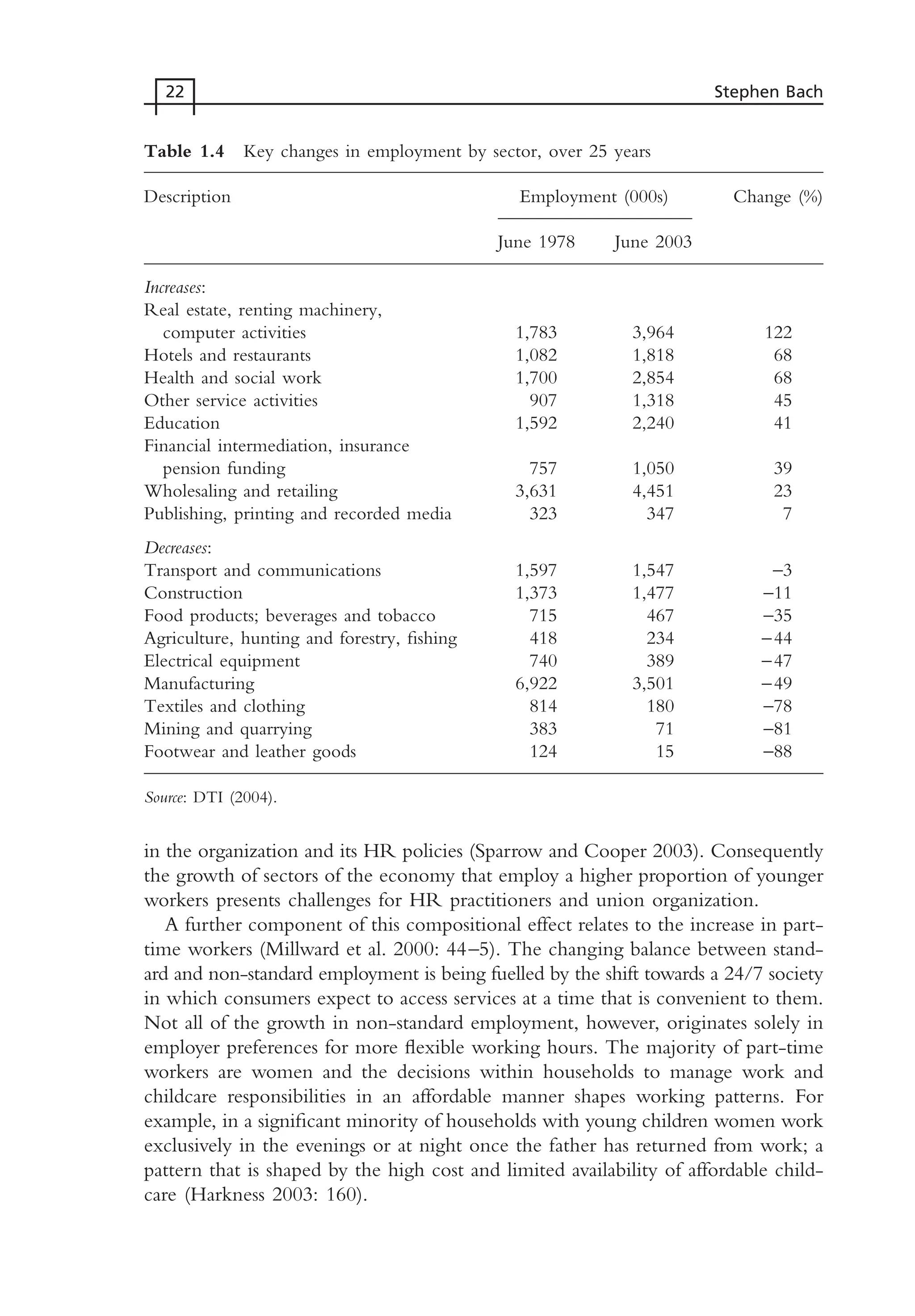
Table 1.4 indicates, alongside the massive increase in service sector jobs there has
been a rapid fall in manufacturing employment. The Department of Trade and
Industry (DTI) suggests that globalization has played a part, with the largest falls
occurring in industries most vulnerable to competition from low-cost producers
in developing countries; accounting for the trend in textiles, clothing and foot-
wear (DTI 2004: 47). More generally, however, successive governments have been
implicated by the lack of concern they have attached to the decline of manu-
facturing industry. The growth of health and education services as well as leisure
and retail services indicate increased demand arising from secular changes in
society – ageing populations and the emergence of a ‘time poor’ society in which
individuals use increased wealth to purchase a wider range of services.
The growth of the private service sector has had a critical effect on the age
structure of the workforce. Industries with the youngest workforces included dis-
tribution, hotels and restaurants, banking, finance and insurance in which at least
40 per cent of the workforce were 16–34 year olds, while by contrast in public
administration, education and health almost 40 per cent of the workforce were
between 45 and pension age (Begum 2004). Trade unions face particular difficulties
in encouraging younger workers to become union members. Many commentators
have suggested that the values of young workers, and the aspirations that they bring
to work, differ from older workers and that they are less likely to place their trust
Personnel Management in Transition 21
MHRC01 15/09/2005 10:56 Page 21
in the organization and its HR policies (Sparrow and Cooper 2003). Consequently
the growth of sectors of the economy that employ a higher proportion of younger
workers presents challenges for HR practitioners and union organization.
A further component of this compositional effect relates to the increase in part-
time workers (Millward et al. 2000: 44–5). The changing balance between stand-
ard and non-standard employment is being fuelled by the shift towards a 24/7 society
in which consumers expect to access services at a time that is convenient to them.
Not all of the growth in non-standard employment, however, originates solely in
employer preferences for more flexible working hours. The majority of part-time
workers are women and the decisions within households to manage work and
childcare responsibilities in an affordable manner shapes working patterns. For
example, in a significant minority of households with young children women work
exclusively in the evenings or at night once the father has returned from work; a
pattern that is shaped by the high cost and limited availability of affordable child-
care (Harkness 2003: 160).
22 Stephen Bach
Table 1.4 Key changes in employment by sector, over 25 years
Description Employment (000s) Change (%)
June 1978 June 2003
Increases:
Real estate, renting machinery,
computer activities 1,783 3,964 122
Hotels and restaurants 1,082 1,818 68
Health and social work 1,700 2,854 68
Other service activities 907 1,318 45
Education 1,592 2,240 41
Financial intermediation, insurance
pension funding 757 1,050 39
Wholesaling and retailing 3,631 4,451 23
Publishing, printing and recorded media 323 347 7
Decreases:
Transport and communications 1,597 1,547 −3
Construction 1,373 1,477 −11
Food products; beverages and tobacco 715 467 −35
Agriculture, hunting and forestry, fishing 418 234 −44
Electrical equipment 740 389 −47
Manufacturing 6,922 3,501 −49
Textiles and clothing 814 180 −78
Mining and quarrying 383 71 −81
Footwear and leather goods 124 15 −88
Source: DTI (2004).
MHRC01 15/09/2005 10:56 Page 22
A further consequence of the shift from manufacturing to services has been the
shrinkage in the size of the workplace. As the WIRS/WERS series has indicated
there is a long-standing association between workplace size and a range of per-
sonnel practices. Smaller workplaces are less likely to have a specialized personnel
manager, less likely to recognize unions and the adoption of ‘new’ management
practices is also less prevalent (Millward et al. 2000).
Occupational structure
The second dimension of labour market change relates to the occupational struc-
ture of the workforce in which a growing polarization is apparent. Over the last
25 years there has been a large rise in the number of well-paid jobs and an increase
in poorly paid jobs with a squeeze in the number of jobs in the middle (Goos
and Manning 2003). This has been described as the emergence of an hourglass
economy in which a strata of highly paid two-earner families can be contrasted
with the growth of an under-class of low wage predominantly women workers
(Nolan 2004). Between 1979 and 1999 the fastest growing ‘bad’ jobs reflected the
growth of employment in service industries (Table 1.4), especially among labour
intensive tasks that are less susceptible to technological change, for example, sales
assistants, waiters, bar staff, cleaners and care assistants. By contrast most of the
increase in ‘good’ jobs has been among managers, with a very rapid growth in
the number of managerial positions across all sectors. The UK stands out in Europe
as having a very high proportion of managerial and supervisory employees. This
picture is consistent with the evidence presented above about the limited spread
of ‘empowering’ new management practices, highlighting the UK ‘management
problem’ (Chapter 9). It almost certainly reflects also the increased pressure on
managers within public and private sectors to demonstrate compliance with a pro-
liferation of targets and regulatory requirements.
This polarization of the job structure is reflected in increased pay inequalities.
Pay levels are closely associated with sector and the Low Pay Commission (2003)
has identified a number of industries – virtually all private sector service industries
– including retail, hospitality, business services, social care, childcare and hairdressing,
in which low pay is prevalent. Consequently more than 20 per cent of jobs in the
hospitality, cleaning and hairdressing sectors benefited from the rise in the October
2001 national minimum wage increase. At the other end of the pay scale top
managers’ compensation has not risen to the stratospheric levels of the USA, in
which by 2000 CEOs were typically earning 500 times the wages of the average
employee – the ratio in the UK is 25 – (Stiglitz 2004: 123–4). Nonetheless, there
has been considerable disquiet that directors of UK FTSE 100 companies have
benefited from an increase in median salary of 92 per cent between 1993 and 2002
(£301,000 to £579,000) compared to an increase in average earnings of 44 per
cent (see Iles 2004). The Labour government expressed concern that executives
have been rewarded for failure as well as success (Chapter 12). For HR practitioners
Personnel Management in Transition 23
MHRC01 15/09/2005 10:56 Page 23
these trends raise sensitive questions about the degree to which employees view
the distribution of rewards as fair and transparent because large variations in pay
are routinely viewed in the HR literature as detrimental to teamwork and a united
sense of organizational purpose.
To summarize there have been fundamental and interrelated changes in the pat-
terns of employment which help to explain much of both the restructuring and
diversity of HR practice which is to be observed in the UK. The decline of joint
regulation, for example, can be associated with the reduction in the manufactur-
ing workforce, along with highly unionized sectors such as coal, and a shrinking
in the size of workplaces more generally. The growth in part-time work, much
of it low paid, and the feminization of the workforce reflects the expansion in the
service sector.
Nonetheless, a word of caution is needed in assuming a straightforward relationship
between changes in the labour market and the practice of HR management from
a single set of structural variables. There are a number of cross-cutting dimensions.
A part-time female employee in a large successful retail chain like Tesco might
enjoy greater de facto security and training and development opportunities than
her counterpart in a small family-owned store. Less expectedly, the same is likely
to be true of the comparison with male full-time employees, including managerial
posts in manufacturing and financial services, that have been subject to constant
rounds of downsizing and merger and acquisition activity. Much depends on the
business systems, strategy and structure of employing organizations and so it is to
these that the analysis now turns.
Corporate governance
Underpinning the changes in both the practice of personnel management and the
patterns of employment are specific business systems, strategies and structures.
A key reference point in interpreting changes in personnel practice has been the
increased interest in distinctive national patterns of corporate governance which
focuses on who controls firms, in whose interests firms are governed and the
ease with which ownership of firms can be altered. Hall and Soskice (2001) who
differentiate between ‘varieties of capitalism’ suggest that financing and ownership
patterns of firms impact on corporate governance which significantly shapes
employment practices. Within the UK, it has long been recognized (Sisson 1989:
16) that the most important features of corporate governance include:
• an overwhelming emphasis on shareholder value as the key business driver as
opposed to the interests of other stake-holders;
• institutional share ownership by investment trusts and pensions funds which
encourages a focus on short-term profitability as the key index of business per-
formance rather than long-term market share or added value;
24 Stephen Bach
MHRC01 15/09/2005 10:56 Page 24
• relative ease of take-over, which not only reinforces the pressure on short-term
profitability to maintain share price and dividend payments, but also encour-
ages expansion by acquisition and merger rather than by internal growth;
• a premium on ‘financial engineering’ as the core organizational competence
and the domination of financial management, both in terms of personnel, activ-
ities and control systems, over other functions.
These characteristics of the UK (and USA) termed ‘liberal market economies’
are contrasted to the co-ordinated market economies of more ‘patient’ capitalism
associated with Germany and Japan. As Gospel and Pendleton (2003) point out,
these differences between market-outsider and insider-relational forms of corporate
governance exert pressure on the management of labour. In liberal market economies
the overriding emphasis on shareholder value, an ideology that has strengthened
markedly in recent years, ensures that labour is treated as a variable cost of pro-
duction to be downsized if the share-price is jeopardized. The dominance of the
market is mirrored inside the firm in which market-type devices – the organiza-
tion of the firm as a series of business units that compete for investment – and the
use of outsourcing are prevalent. Employers may also be reluctant to pursue a range
of investment strategies and forms of employee involvements because it may limit
management prerogatives and their capacity to respond to shareholder demands.
The UK’s poor training record is frequently attributed to a system of corporate
governance that provides an inhospitable environment to invest in HR (Chapter 8).
Similar developments are evident in the public services. For more than two decades
government reforms have encouraged the public services to mimic the organiza-
tional and management structures of the private sector. The diffusion of market-
type mechanisms across the public services has put pressure on managers to alter
employment practices to ensure efficient and effective public service delivery. The
authority of senior managers has increased and managerial responsibilities devolved
from central government to lower levels within semi-autonomous organizational
units (Kessler and Purcell 1996). At the same time, however, central government
has accrued unprecedented levels of control over the funding and management
of nominally independent service providers through strictly enforced cash limits
and demands for annual ‘efficiency gains’. Systems of performance management
have been intensified by the proliferation of government targets that has generated
a form of short-termism. Senior managers manage upwards to fulfil ministerial
targets, which act as proxies for shareholder pressure. These pressures, alongside the
requirement to respond to an unrelenting stream of new initiatives, inhibited man-
agers from developing a longer-term, more strategic conception of HR practice
(Bach 2004).
This analysis needs to be qualified to the extent that employment practices can-
not be assumed to follow in a deterministic fashion from the dominant system of
corporate governance. Variations between firms in the UK indicate that managers
can exercise a degree of strategic choice in responding to shareholder demands (Gospel
Personnel Management in Transition 25
MHRC01 15/09/2005 10:56 Page 25
and Pendleton 2003). As Bunting (2004: 49) illustrates in the case of the budget
hotel chain Travel Inn, shareholder pressure to cut staffing costs led managers to
place more, not less, emphasis on training because as one manager explained:
My labour budget is very tight – I manage that, I don’t complain – the key is to
get people trained. Two people could have managed that situation [a busy bar and
the restaurant] if they had been trained.
There is also a sense that changes are emerging in the UK’s system of corpor-
ate governance that provide counterveiling pressures to arrest short-termism with
employee and other stakeholder interests bolstered by EU driven reforms of
employment law and the changing structure of institutional share ownership
(Armour et al. 2003). At present, however, these developments have not led to a
dilution of the primacy of shareholder value and the increased concentration of
ownership enables investors to force changes on managers, especially when per-
formance is poor, which continue to have dramatic effects on employment and
HR practice (Pendleton and Gospel 2004).
Changing business strategies and structures
The last two decades have witnessed a period of continuous organizational
restructuring that is associated with these underlying features of corporate govern-
ance. The lightly regulated character of the UK economy has encouraged high
levels of inward and outward foreign direct investment. Across the whole of pri-
vate sector manufacturing, the incidence of foreign ownership trebled from 7 per
cent to 19 per cent between 1980 and 1998 and in private sector services the
figure more than doubled from 5 to 11 per cent (Millward et al. 2000: 33–4).
Foreign-owned multinational companies have therefore become an even more import-
ant source of variation and innovation in personnel practice (Chapter 3).
The UK economy has become more open with relatively few regulations, ensur-
ing that competitive pressures have intensified (OECD 2004). These trends have
been reinforced by the expansion of the European Single Market, trade liberaliza-
tion alongside continuing privatization and deregulation. This context has reinforced
the short-term planning horizons of companies and resulted in a continuing high
level of restructuring because firms are less embedded in institutional structures
allowing rapid responses to changing circumstances. One significant trend has been
an increase in sub-contracting within the networked organization (Chapter 4). There
have been two distinctive phases of the debate about sub-contracting. In the 1980s
and 1990s, this trend was closely associated with privatization and programmes of
compulsory competitive tendering in the public services, which led to many ser-
vices being transferred to the private sector. These developments reflected the con-
ventional wisdom that management should focus on its ‘core’ activities and divest
itself of so-called ‘ancillary services’, such as catering, cleaning and distribution.
26 Stephen Bach
MHRC01 15/09/2005 10:56 Page 26
In the second phase of externalization, which has gathered pace since the mid-
1990s, managers have been less concerned about the balance between ‘core’ and
‘periphery’ activities and have focused on more radical divestment of business activ-
ities, which has included the relocation and export of productive capacity abroad,
a trend termed ‘off-shoring’. A survey of Confederation of British Industry (CBI)
members indicates that the pressure to off-shore is increasing and the main ration-
ale is cost driven, with predominantly low added-value manufacturing functions
transferred to Asia and to a lesser extent Central and Eastern Europe. It also appears
that despite the media hype surrounding the off-shoring of call centre work, this
activity is less ‘off-shorable’ than production of industrial goods (CBI 2004: 6).
In the public sector large swathes of public provision, such as housing and social
services have been transferred to the private sector and the Labour government’s
modernization of public services has involved an extended role for the private
sector in the provision of core services (Bach and Givan 2005).
These changes have been accompanied by high levels of organizational upheaval
as firms have divested themselves of businesses and acquired new ones. UK organ-
izations are not only involved in a permanent revolution of minor structural change,
but can expect major restructuring every 3 years, of which 85 per cent involve
redundancies and early retirements (CIPD 2003b). This leads the CIPD to con-
clude that the economy is subject to the ‘3Rs’ effect of simultaneous reorganiza-
tion, redundancy and recruitment (CIPD 2004: 13). Part of the explanation for
this degree of turbulence arises from the divisionalization structures of large UK
companies that are viewed by managers as aggregates of separate cost business units
which have to meet performance targets; set and tightly monitored by the centre.
When divisions do not meet their profitability targets they are sold off and other
more profitable divisions acquired. Ackroyd and Procter (1998) in their analysis of
the largest 200 UK-owned manufacturing firms highlight the consequences for
employment practice in which there is little investment in advanced technology
or multi-skilling, but instead semi-skilled employees compete with sub-contractors
to retain their employment. The upshot is that the increased use of contractors is
significantly associated with work intensification (Green 2004: 731).
Summary
Changes in the labour market, patterns of corporate governance and business strat-
egies are profoundly important in understanding why there has been restructuring,
but only a very limited shift towards high commitment HR practice in the UK. Within
the labour market the growth of part-time employment and the shift to service
industries have been the dominant trends leading to the creation of more relatively
disposable and low value-added ‘bad’ jobs. At the same time there has been a marked
increase in job polarization with an increase in the number of well-paid ‘good’
jobs. These jobs are much better rewarded and include other benefits associated
with higher status work; however, the pressure on managers and professionals to
Personnel Management in Transition 27
MHRC01 15/09/2005 10:56 Page 27
achieve a variety of performance targets, such as absence, has increased (Chapter 14).
The scope to monitor performance has also been enhanced by the spread of per-
formance appraisal (Chapter 11) and the wider use of information technologies has
facilitated increased accountability resulting in work intensification and less task
discretion (Gallie et al. 2004; Green 2004).
These changes are occurring against a backdrop of continuous organizational
restructuring. The sheer pace and extent of the change in business portfolios has
been a consideration in its own right. Not only has it produced massive uncer-
tainty on the part of managers and employees alike, which is inimical to develop-
ing the long-term relationships of the high performance workplace, it has also made
it very difficult to develop a consistent approach towards the management of the
workforce. Indeed, organizations are littered with half-finished initiatives which
have had to be interrupted because of take-over or merger or change of business
direction or divestment, leading to considerable cynicism not only on the part of
employees but also among the senior managers who are supposed to be imple-
menting them.
The Emerging Directions of HR Practice
During the 1980s and 1990s the emergence of HRM was the key reference point
for evaluating the evolution of personnel practice in the UK. By the time the last
edition of this book was published, however, the appeal of the soft model of HRM
was on the wane. The election of a Labour government in 1997 signified a rejec-
tion of the deregulation and anti-collectivism of this period and brought the lan-
guage of fairness, partnership and greater engagement with the European Union
to the fore (Bach and Sisson 2000: 14–15). It was not apparent, however, the extent
to which these emerging currents would solidify into a new approach towards HR.
Five years on, it is much more evident, especially in terms of managerial ideology
and policy, even if not always in terms of HR practice, that a new HR is emerg-
ing that has started to set the debate about HRM on a different trajectory. This
section sketches out the emergent direction of HR practice that is shown in styl-
ized form in Table 1.5.
Globalization
As this chapter has emphasized it is the specific institutional features of the UK
employment context that has shaped personnel practice. Successive Conservative
governments used deregulation, privatization and the contract culture to increase
product market competition and foster changes in personnel practice. Foreign direct
investment was encouraged, increasing the internationalization of the UK eco-
nomy, and it was the practices of Japanese inward investors in particular, such as
28 Stephen Bach
MHRC01 15/09/2005 10:56 Page 28
Nissan, that UK employers were encouraged to emulate (Wickens 1987). As the
1990s progressed this preoccupation with ‘Japanization’ developed into a broader
concern with ‘lean’ production and the high performance workplace.
HRM therefore emerged in a context in which internationalization was con-
strued narrowly as a concern with attracting inward investment and emulating ‘best
practice’. This restricted view of the consequences of internationalization for HRM
practice can be contrasted with the pervasive, but highly contested, impact of glob-
alization (Stiglitz 2004; Wolf 2004). Globalization reflects the increasing inter-
national economic integration of countries arising from the worldwide revolution
in communication technologies, the growth and dominance of international capital
markets, the global reach and influence of multinational corporations and an increase
in labour migration. Three points are relevant in terms of the new HR. First,
employment is becoming more volatile because of the coordination of stock
markets and increased sensitivity to institutional shareholders. Moreover, at the level
of policy and managerial discourse, globalization represents and legitimizes the sense
of risk and uncertainty that pervades the workplace and which has been used to
‘manufacture uncertainty’ and promote more contingent work (Amoore 2004).
Second, globalization is associated with the spread of information and commun-
ication technologies (ICT) that are facilitating global production and distribution
of goods and services. Inter and intranets have enabled rapid communication across
time and space enabling organizations to integrate and centralize control while decen-
tralizing production and distribution. As Frenkel (2003: 139) highlights, ICT is
Personnel Management in Transition 29
Table 1.5 Emergent directions in HR practice: From HRM to the New HR
Dimension
Contexts
Internationalization
Legal
Goals
Methods
Employment relations
Organizational
HR practice
Values
Focus of HR practice
Orientation
The New HR
• Globalization
• Focus on attracting labour
investment (migration)
• Managers as villains
• Enhance competitiveness
• Re-regulation and legal
compliance
• Shallow partnership
• Multi-employer: networks
• Engagement
• Person
• Customer/brand
HRM
• Product market
competition
• Focus on attracting
capital investment
• Managers as heroes
• Strengthen management
prerogatives
• Restrictive labour law
• Union exclusion
• Single employer
• Commitment/loyalty
• Job
• Employer
MHRC01 15/09/2005 10:56 Page 29
having a significant impact on the content of work by reducing the requirement
for manual skills while fostering new kinds of work requiring higher level skills
(e.g. web design) and lower level skills such as forms of customer service work in
call centres. In addition ICT also changes the location of work by facilitating home-
working and work across spatial boundaries with the increased use of forms of
virtual teamworking. For Gratton (2004: 75) the primary impact of technology is
therefore its ability to democratize the workplace:
Software technologies have the capacity to make an enormous amount of previously
restricted information available to individuals. This will ultimately support their capa-
city to be autonomous and insightful.
ICT has contributed to the increased complexity of jobs and the upward bias
of qualifications required of the workforce, but contrary to Gratton’s assumptions
employees’ task discretion has declined (Gallie et al. 2004). Moreover, the degree
to which employers trust employees to be autonomous remains uncertain, reflected
in the small numbers of professional and managerial employees that are able to
choose whether to work at home (Felstead et al. 2003).
A third dimension of globalization is the increased importance of labour migra-
tion. Labour markets remain less integrated than capital markets with considerable
legal, cultural and linguistic barriers inhibiting the free movement of labour. None-
theless the expansion of the EU, labour market shortages and an ageing workforce
has stimulated labour mobility. In the UK the number of inward migrants rose
from approximately 300,000 to 513,000 between 1993 and 2003 resulting in a net
inflow of around 200,000 per annum. The HR implications are more significant
than these figures imply because migrants are predominantly young (15–34), with
one-third concentrated in London, and include a net gain of professional and
managerial workers (Dobson and MacLaughlan 2001; National Statistics 2004).
Consequently internationally recruited labour comprises a very substantial proportion
of the labour force in London and the South East and is being used to remedy
staff shortages among nurses, teachers and social workers. The HR consequences
for training, career progression and pay of managing a more diverse workforce,
has received very little attention (Bach 2003).
Finally, the emergence of a particular form of neo-liberal globalization has become
a lightning rod for a variety of disparate forms of worker and citizen disenchant-
ment with corporations. This has led employers to pay more attention to their
corporate social responsibilities and their brand image (Chapter 10). Nonetheless
a profound sense of unease remains that corporations have become unaccountable
and are primarily concerned to promote the interests of a small strata of top man-
agers and shareholders. These concerns are reinforced by corporate fraud scandals,
most famously the collapse of Enron in the USA, but also in more dilute forms
in Europe (e.g. Parmalat, Shell). There is widespread disquiet about the withdrawal
of final salary pension provision and escalating top managers’ pay. A number of
high profile critiques of corporate behaviour have gained wider currency through
30 Stephen Bach
MHRC01 15/09/2005 10:56 Page 30
the media (e.g. Bakan 2004). Importantly unease about corporate behaviour and
the creed of the market that is pivotal to contemporary forms of globalization has
not been confined to traditional sources of criticism such as trade unions, but
has included eminent economists, industrialists and management gurus (Stiglitz
2004; Turner 2001: 364–70; Mintzberg 2004: 147).
These emergent trends in the workplace associated directly and indirectly with
globalization have the potential to empower the workforce but few commentators
detect a shift towards what Gratton (2004) terms ‘the democratic enterprise’. Instead
there is a growing sense that power in the workplace has become unbalanced,
tilting strongly towards employers and the interests of shareholders to the detri-
ment of the workforce. In this context senior managers are increasingly viewed as
villains rather than corporate heroes as they were in the HRM paradigm. For US
commentators, in which these trends are more stark, the HR function has been
implicated in these changes because in its pursuit of becoming a strategic partner,
the HR function lost sight of its core values and supported top managements’
interests while neglecting the concerns of employees. This has not led to increased
credibility of HR with top managers but it has led to a profound loss of trust in
corporate HR policy and practice which is reflected in a growing concern in the
management literature with issues of trust, organizational justice and organizational
citizenship (Kochan 2004; Peterson 2004). Before accepting such a bleak US-
orientated interpretation of contemporary trends in the workplace, however, it is
necessary to consider whether the harsher consequences of globalization have been
modified in a UK context by the increasingly interventionist role of the state in
shaping personnel practice.
Re-regulation and legal compliance
For most of the twentieth century the UK system of employment regulation has
been characterized as ‘voluntarist’ which ensured that employment regulation was
conducted primarily through collective bargaining between employers and unions
and the state did not intervene to provide a legal framework of individual and col-
lective rights to the same degree as in most other European Union (EU) countries.
The emergence of HRM was premised on a decisive break away from voluntarism
in which successive Conservative governments used the law to restrict the powers
of trade unions and bolster managerial prerogatives (see Dickens and Hall 2003).
The UK’s membership of the EU provided a further stimulus to legal regulation
and the growing importance of EU employment law often conflicted with the
restrictive direction of Conservative government policy. By 1997 the ambitious
domestic agenda of the Labour government in combination with EU initiatives
signalled very far-reaching changes in the UK regulatory framework. The EU agenda
has continued to play a pivotal role in extending employment rights for indi-
viduals and since 1997 EU directives have included the regulation of working time,
rights to information and consultation, equal employment rights for part-time
Personnel Management in Transition 31
MHRC01 15/09/2005 10:56 Page 31
workers, increased protection for employees on fixed-term contracts, new rights
on maternity and parental leave and statutory rights to information and consulta-
tion. The UK government is also in the process of implementing the EU’s Anti-
Discrimination Framework Directive which extends existing provision to prohibit
discrimination on the grounds of religion or belief, sexual orientation, disability
and age.
The Labour government’s approach can be characterized, following Collins (2001),
as regulation for competitiveness which stems directly from their belief in the com-
petitive challenge posed by globalization. The Labour government endorsed much
of the previous Conservative labour law agenda but it views much of this legislat-
ive inheritance (e.g. restrictions on union power) as a necessary but not a sufficient
framework to ensure competitiveness. It has therefore intervened actively to re-
regulate the labour market, establishing a minimum floor of rights via mechanisms
such as the establishment of a statutory minimum wage. This measure is primarily
viewed by the government as a means to enhance competitiveness by encourag-
ing employers to invest in and deploy their workforce more effectively.
The Labour government’s acceptance of an increased role for individual employ-
ment rights has not been matched by its support for collective employment rights,
although there has been a shift from the unitarist union exclusion assumptions of
HRM to an emphasis on partnership in the new HR (Chapter 16). The Labour
government has fostered forms of voluntary partnership working via union recog-
nition provisions and this altered the climate of employment relations, creating
scope for more active engagement with employers, resulting in ‘robust’ and ‘shallow’
forms of partnership (Oxenbridge and Brown 2004). Partnership, however, while
assigning greater legitimacy to trade unions, privileges their role as partners with
employers in bringing about productivity improvements and helping to manage
change in an orderly manner, but underplays the role of trade unions as inde-
pendent actors in the workplace striving to bring about social justice and protect
employee interests. In sectors where trade union density remains high and unions
retain credibility with employers, partnership working can bring benefits for union
members as national agreements in health and education on complex pay and work-
ing conditions indicates.
In vast swathes of the private sector, however, and in many public service
workplaces in which unions lack influence, partnership agreements yield limited
benefits for the workforce or employers. As Terry (2003: 500) argues, weak trade
unions serve no useful function because they have little legitimacy with the
workforce and are unable to help employers manage and legitimate change. Many
of the more recently elected union leaders view partnership as an acknowledge-
ment of weakness because it highlights the degree to which unions are engaged
in a process of continuous concession bargaining with employers (Murray 2003).
Union support for partnership is equivocal. The fragility of partnership is also
reinforced by the difficulties that many employers have in keeping their side of
the bargain, given the degree of restructuring noted above. For these reasons, while
the term partnership signals a greater willingness on the behalf of employers to
32 Stephen Bach
MHRC01 15/09/2005 10:56 Page 32
consult with the workforce, reinforced by the imminent arrival of the informa-
tion and consultation directive, employers continue to favour the expansion of direct
channels of communication and involvement with the workforce (Chapter 15).
Employers therefore remain reluctant social partners and forms of shallow partner-
ship predominate.
To summarize, the New HR signifies a subtle shift away from the primary em-
phasis on restrictive labour law and the strengthening of management prerogatives,
which was the context in which HRM emerged. Instead the Labour government,
while supportive of the overall balance of power in the workplace, has sought to
establish minimum safeguards for employees to ensure managers are accountable
for their actions and use labour effectively rather than simply as an asset to be sweated.
However, because the Labour government has a largely benign view of the employ-
ment relationship, influenced strongly by the view that the economy is increas-
ingly reliant on knowledge workers, and partly because of its reluctance to alienate
employer interests, it has pursued a very cautious agenda of re-regulation which
has led to a minimalist interpretation of the EU social dimension (Chapter 2). In
the past trade unions have played a crucial role in publicizing and enforcing rights
at work, but in a context of reduced union presence and the growth of individual
employment rights it is not surprising that HR managers confront an increase in
individualistic responses to employment problems. This is reflected in the growing
number of inquiries to ACAS and the growth of cases being taken to employment
tribunals which rose in the last year from 98,616 applications to 115,042 in 2003–4
(Employment Tribunal Service 2004).
For HR practitioners, the growth of legal regulation will continue to be a
dominant feature of their working lives. It is necessary, nonetheless, to differenti-
ate between the volume and effort required by employers to get to grips with new
employment rights and their actual effects in terms of the protection they provide
for employees. Consequently, particularly for small firms that are much less likely
to have specialist in-house HR expertise, getting to grips with what cumulatively
represents a substantial corpus of employment regulation contributes to a sense of
burden even if the effects of regulation are more modest than they anticipate. This
process is illustrated by the degree to which employment regulations, such as a
statutory minimum wage, have been vigorously opposed by employers prior to
their implementation, but broadly accepted after implementation as the regulatory
effects are accepted as having only a small effect on employer behaviour.
Shifting organizational boundaries:
towards the permeable organization
A pivotal element within HRM has been the emphasis placed on developing
employees’ commitment to the organization. Individual commitment arises from
establishing integrated and coherent bundles of HR practice with a strong cor-
porate culture used as the glue to bind individuals to the organization. Some workers
Personnel Management in Transition 33
MHRC01 15/09/2005 10:56 Page 33
are excluded from the ‘core’ and consigned to the ‘periphery’ employed on a
temporary basis or outsourced, but the assumption of HRM is that these differing
segments of the workforce are managed separately, delivering differing sources of
value added for the firm (see Kalleberg 2001).
This view of the firm has been increasingly questioned. There is a shift away
from an emphasis on the management of the employment relationship by a single
employer who exercises control over HR practice and promotes commitment to
the enterprise. Instead within the New HR there is increased recognition of the
diversity of employment relationships that exist in multi-employer, networked organ-
izations. The blurring of organizational boundaries results in a variety of employers
exerting an influence on all aspects of HR practice including pay, labour deploy-
ment, skills acquisition and performance management, but in a contradictory and
ambiguous manner raising many HR challenges and great uncertainty about the
capacity of employers to sustain organizational commitment (Rubery et al. 2002).
There are a variety of inter-organizational relationships emerging and in manu-
facturing considerable attention has been directed at the HR consequences of sup-
ply chains. In the public services forms of public-private partnerships and statutory
requirements to work across organizational boundaries has been an integral
component of the Labour government’s modernization agenda, while call centre
employees frequently undertake work for a variety of clients with differing
requirements of staff, creating complex HR management challenges.
The first relates to employment status, which distinguishes between employees
and workers that are supplied by another employer on a temporary or agency basis.
The assumption of the core and periphery type model, that workers employed
under different employment regimes can co-exist harmoniously and their labour
deployed effectively, has been questioned. In the health service the use of agency
nurses to stem staff shortages has created resentment among existing staff that received
less pay and had less discretion over the hours that they worked in comparison to
agency staff (Bach 2004). More often agency staff are employed on worse terms
and conditions of employment than directly employed staff. As Rubery et al. (2004)
highlight in a call centre they studied, differences in pay and conditions did not
reflect different skill or job requirements, creating resentment among agency staff
that were often assigned to more intensive work.
A second dimension concerns the presence of multiple employers rather than a
single employer within a workplace. This arises from outsourcing, the transfer of
staff in mergers and acquisitions, the growth of hybrid forms of partnership work-
ing and joint ventures. These arrangements result in employees and managers being
subject to a variety of management controls from many employers which also
creates uncertainty about employee identification and commitment to their formal
employer. Take the case of a large regional airport in which many employers are
present. The airlines do not employ the passenger handling agents but indirectly
exert a great deal of influence over their working practices because of their expecta-
tions about how passengers should be checked in, the timing of the process, and
by monitoring passenger handlers’ appearance and interaction with passengers. These
34 Stephen Bach
MHRC01 15/09/2005 10:56 Page 34
staff wore the uniform of the airline they were checking in and frequently sought
to transfer to employment with the airline, creating HR difficulties for passenger
handling firms (Rubery et al. 2003).
The third dimension relates to the influence of the client in shaping the employ-
ment relationship, which highlights the degree to which customers can exert influence
over staff management irrespective of whether they are the formal employer.
Scarbrough (2000: 14), in his analysis of supply chain management in three engin-
eering companies, coined the phrase ‘corporate colonization’ to capture this pro-
cess. In one case, a car parts manufacturer (Compco), benefited from the expertise
of a major car manufacturer (Carco) in improving the production line dedicated
to the production of parts destined for Carco. However, Carco insisted on the
implementation of a no-redundancy policy to accompany these changes which was
not applied to other parts of the plant and which reduced the autonomy of Comco
in shaping its HR practices. Client requirements are not necessarily accepted,
however, if the employer has sufficient power to dilute client demands. In the call
centre case referred to above, the main employer (TCS) refused to allow their staff
to wear the uniform of their client (TruckCo) precisely because they wished to
maintain control of their HR practices and wanted their staff to retain their
identification with TCS (Rubery et al. 2004: 1216). Overall, the rise of the net-
worked enterprise creates tensions in the employment relationship, increasing
the complexity of managing and monitoring performance and makes it harder
to sustain employee commitment.
From commitment to the employer to engagement
with the customer
The final change in emphasis away from the assumptions embedded in HRM
models concerns a shift from employers’ concern to gain the commitment of
employees’ towards an emphasis on ensuring that employees are engaged and derive
emotional meaning from work. The New HR therefore does not attempt to impose
a set of managerially defined values which employees are expected to accept unques-
tioningly. Instead the starting point is a bottom-up focus on the personality of
individuals at selection stage, which is then reinforced to ensure that the organ-
ization understand its employees and what shapes their engagement with the
organization and how these personal values can be harnessed for organizational
success. Understanding this shift in practice is linked to the experience of culture
change programmes that were a prominent feature of HRM practice in the 1980s
and 1990s.
The starting point of organizational programmes of culture change was an attempt
by senior managers to instill in employees the importance of core organizations
beliefs and values in a predominantly top-down manner. These initiatives had
very uneven results, which is not surprising, taking account of the degree to which
senior managers found it difficult to adhere to these values in a context of
Personnel Management in Transition 35
MHRC01 15/09/2005 10:56 Page 35
continuous organizational change and downsizing (Thompson 2003). Many of these
trends have intensified in recent years, reflected in the degree to which there has
been a continuing fall in job satisfaction in the UK since the mid 1990s. Moreover,
although perceptions of job insecurity have decreased as unemployment has fallen
many employees still feel insecure in the sense that valued aspects of the benefits
of employment are being withdrawn, such as pensions, which reinforces a sense
of distrust of employers (Burchell et al. 2002). In these circumstances, employees
have proved unreceptive to senior managers’ espousal of corporate values and there
has been an erosion of trust and commitment to organizational values (Sennett
1998: 141). Simultaneously, many studies have shown only a weak link between
affective organizational commitment and performance (Sparrow and Cooper 2003:
188), leading to a cooling among HR practitioners of the emphasis on sustaining
organizational commitment.
The implications are that the New HR places more emphasis on measuring
the attributes of the person and the degree to which their values and emotions
‘fit’ the requirements of the job (Chapter 5). In service industries, such as airlines,
selection is based on ensuring staff are empathetic to customer values which are
then reinforced by processes of socialization, training and appraisal (Bolton and
Boyd 2003: 300–1). There is a tendency for employers to place more emphasis
on the appearance, dress sense, tone and accent of voice of their employees and
in some cases, for example, fashionable bars and hotels to specify appropriate body
shape and size. The increased importance of emotional and aesthetic labour has
contributed to the shifting definition of skill (Grugulis et al. 2004: 7).
Employers such as Tesco, the largest private sector employer and dominant UK
retailer, has taken this process a stage further by identifying ‘a retail gene’, derived
from the skills of their existing employees, and applicants are measured on the degree
to which this gene is present (Overell 2003: 2). Tesco has also transferred the meth-
odologies used to understand their customers to their employees to gain insight into
their personalities and identities. This has resulted in employees being categorized
into five attitudinal segments: work–life balancers; want it all; pleasure seekers; live
to work; and work to live with HR practices geared towards the different motiva-
tions and aspirations of these employee groups (Gratton 2004: 119–24).
A related component of this shift in HR practice has been to reshape employee
expectations focusing not on bland corporate mission statements as in the 1990s,
but rather using customer expectations and values to shape the requirements of
staff (see Rosenthal 2004). In the NHS, for example, the emphasis on servicing
internal and external customers is reflected in job titles such as ward hostess.
This development of customer-orientated skills is altering job roles away from an
exclusive focus on professionally defined norms. Pay modernization is reinforcing
this process by placing a premium on softer interactive competencies such as oral
communication; which is defined as a core skill for all NHS staff (Bach 2004: 192).
Consequently, attempts to rehabilitate the image of corporations by policies of brand-
ing and corporate social responsibility, which create personalities for companies
and try and ensure that employees become emotionally engaged with them, are
36 Stephen Bach
MHRC01 15/09/2005 10:56 Page 36
Another Random Document on
Scribd Without Any Related Topics
CHAPTER VIII.
GOLDEN DAYS.
O lovely earth! O lovely sky!
I was in love with nature, I;
And nature was in love with me;
O lovely life—when I was free!
Felicia had been surprised, and not altogether pleased, at the
unnecessary cordiality with which Maud had bade their visitor
farewell. There was an excitement, an animation, an eagerness in
her manner which Felicia had not before perceived, and which she
felt at once might be difficult to manage. Desvœux was exactly the
person whom she did not want Maud to like, and the very possibility
of her liking him brought out in Felicia's mind a latent hostility of
which, under an exterior of politeness and even familiarity, she was
always dimly conscious. She did not mind talking to him herself; she
was even amused by him; but then it was always with a kind of
protest; she knew exactly how far she meant to go and felt no
temptation to go any further. But the notion of him in any other
capacity but that of a remote member of society, whose function it
was to say and do absurd things in an amusing way, was strange
and altogether distasteful. Anything like intimacy was not to be
thought of for an instant; the merest approach to close contact
would bring out some discord, the jar of which, by a sort of
instinctive anticipation, Felicia seemed to feel already. So long as he
moved in quite another plane and belonged to a different world, his
eccentricities might be smiled at for their comicality without the
application of any rigid canon of taste or morals. But a person who
was at once irreligious and over-dressed, who constantly had to be
'put down' for fear he should become offensive, and who was a
stranger to all the little Masonic signals by which ladies and
gentlemen can find each other out—the very idea of his presuming
to cross the pale, and to form any other tie than those of the most
indifferent acquaintance, filled Felicia with the strongest repugnance.
It was provoking, therefore, that he seemed to take Maud's fancy
and impress her more than any other of the many men with whom
she was now becoming acquainted. It was more than provoking that
she should let her impressions come so lightly to the surface, and be
read in signs which Desvœux's experienced eye would, Felicia knew,
have not the least trouble in interpreting.
Suppose—but this was one of the disagreeable suppositions which
Felicia's mind put aside at once as too monstrous to be entertained
—suppose he should come to stand in the way of the rightful,
proper, destined lover? She thrust away the notion as absurd. All the
same, it made her uncomfortable, and no doubt justified her to
herself in pushing forward Sutton's interests with more eagerness
than she might otherwise have thought it right to employ about
another person's concerns. When one feels a thing to be the thing
that ought to happen, and sees it in danger of being frustrated by
some thoroughly objectionable interference, it is but natural to do
something more than merely wish for a fortunate result. Felicia, at
any rate, could boast of no such passivity; and, if praising Sutton
would have married him, Felicia's wishes on the subject would have
been speedily realised.
The course of love, however, rarely flows exactly in the channels
which other people fashion for it, and Maud's inclinations required,
her cousin felt, the most judicious handling. There could be no
harm, however, in allowing Sutton's visits to go on with their
accustomed frequency; and since Maud must forthwith learn to ride
and Sutton volunteered to come in the mornings to teach her, no
one could blame Felicia if, in the intervals of instruction, the pupil
and teacher should become unconsciously proficient in any other art
besides that of equitation. Maud used to come in from these rides
with such a bright glow on her cheek and in such rapturous spirits,
that her cousin might well feel reassured.
Sutton had found for her the most perfect pony, whose silky coat,
lean well-chiselled head and generally aristocratic bearing,
pronounced it the inheritor of Arab blood. Maud speedily discovered
that riding was the most enjoyable of all human occupations. Down
by the river's side, or following long woodland paths, where the busy
British rule had planted many an acre with the forests of the future,
or out across the wide plains of corn stretching for miles, broken
only by clumps of palms or villages nestling each in a little grove
under the wing of some ancestral peepul-tree, the moon still shining
overhead and the sun just above the horizon, still shrouded in the
mists of morning—how fresh, how picturesque, how exhilarating
everything looked! How pleasant, too, to go through all these pretty
scenes with a companion who seemed somehow to know her tastes
and wishes, and to have no thought but how to please her! Sutton,
though in public a man of few words and unsatisfactorily taciturn on
the subject of his own exploits, had, Maud presently discovered,
plenty to tell her when they were alone. The power of observation
which made him so nice a judge of character extended itself to all
the scene about him and revealed a hundred touches of interest or
beauty which, to coarser or less careful vision, would have lain
obscure. Maud felt that she had never known how beautiful Nature
was till Sutton told her.
'There,' he would say, 'I brought you round this wood that we might
not miss that pretty bend of the river, with Humayoun's Tomb and
the palms beyond. See what a beautiful blue background the sky
makes to the red dome and that nice old bit of crumbling wall. The
bright Indian atmospheres have their own beauty, have they not?
And see that little wreath of smoke hanging over the village. This is
my pet morning landscape.'
'And those peach-groves,' cried Maud, 'all ablaze with blossom, and
those delicious shady mulberries and the great stretch of green
beyond. It is quite enchanting: a sort of dream of peace.'
'We had a fine gallop across here once,' Sutton said, 'when first we
took the Sandy Tracts.' And then Maud learnt that they were riding
over a battle-field, and that for a long summer's afternoon men had
fought and fallen all along the path where now they stood, and that
a battery of artillery had been posted at the very corner of the
village to which her guide had brought her. 'I remember when they
knocked that hole in the old wall yonder and how all the fellows
behind it took to their heels. Then, afterwards we stormed the Tomb
and had to finish our fighting by moonlight.'
'Was that when you got your Victoria Cross?' asked Maud, who was
possessed by a spirit of insatiable curiosity about Sutton's badges,
which he was slow to gratify.
'Oh no,' said Sutton, laughing; 'I got nothing then but a bullet
through my shoulder and a knock on the head from a musket-stock
which very nearly ended my soldiering then and there. Look now
how quickly the scene changes as the sun gets up—half its beauty is
gone already! Let us have a good canter over this soft ground and
get home before it grows too hot.'
Maud, who had never thought of a battle except as one of the
afflicting details that had to be remembered at an historical class,
and if possible to be hooked on to its proper site and date, felt a
delicious thrill in actually realising with her own eyes the place where
one of the troublesome events took place, and in talking to a person
who had actually taken part in it. 'And what became of the bullet in
your shoulder?' she asked.
'It was a very troublesome bullet,' said Sutton, 'and a great deal
harder to dislodge than the people from the Tomb. But I was
unlucky when I was a lad and never came out of action without a
souvenir of some sort or other.'
When Maud got home she asked Felicia about this storming of the
Tomb, and learnt that Sutton's account was not as truthful as it
might have been. He and half-a-dozen others had, Felicia told her,
volunteered for the storming-party, had made a rush for the walls
through a shower of bullets; and Sutton and two companions,
getting separated from the others, had been left for some seconds
to hold their own as best they could against the angry, frightened
mob within. No one, perhaps scarcely Sutton himself, knew exactly
what had happened. The rest of the party, however, when they
made their way in, found him standing at bay over a dead comrade's
body, and his antagonists too completely taken aback at his audacity
to venture, at any odds, within reach of his sword. In the scuffle
which ensued Sutton received the wounds of which Maud had been
informed; but his exploits on that day were for ever after quoted by
his followers as a proof that there is nothing which a man may not
do, if only he have pluck and will enough to do it.
Maud felt all this very impressive and Sutton's society more and
more delightful. Her enjoyment of it, however—by this time by no
means small—began to be seriously qualified by an anxiety,
increasingly present to her mind, as to her fitness for the dignified
companionship thus thrust upon her. She felt passionately anxious to
please Sutton, and more and more distrustful of her power to do so.
He was good, noble, chivalrous, everything that Felicia had said, and
how hopelessly above herself! What must he think of one who was,
as Miss Goodenough had often told her, a mere congeries of
defects? True, he never seemed shocked or annoyed at anything she
said, and professed to like the rides as much as she did; but might
not this be from mere good-nature, or the charm of novelty, or the
wish to oblige Felicia, or any transitory or accidental cause?
Terrifying thought, if some day he should find her wanting, and
banish her from his regards! Meanwhile, happy, happy mornings,
and sweet, bright world, in which such pleasure can be found, even
if haunted by a doubt as to whether it is really ours or not!
CHAPTER IX.
THE FIRST BALL.
Il est amiable, car on se sent toujours en
danger avec lui.
Before Maud had been many weeks with the Vernons there was a
Garrison Ball, and at this it was fated that she should make her first
public appearance in Dustypore society. That night was certainly the
most eventful and exciting one that she had ever passed. To wake
and find one's self famous is no doubt an agreeable sensation; but
to put on for the first time in one's life a lovely ball-dress, bright,
cloudlike, ambrosial—to be suddenly elevated to a pinnacle to
receive the homage of mankind—to exercise a pleasant little
capricious tyranny in the selection of partners—to be seized upon by
one anxious adorer after another, all striving to please, each with a
little flattering tale of his own—to read in a hundred eyes that one is
very pretty—to find at last a partner who, from some mysterious
reason, is not like other partners, but just perfection—to know that
one's views about him are entirely reciprocated—it was, as Maud, on
going to bed, acknowledged to herself with a sigh, which was half
fatigue and half the utterance of an over-excited temperament, too
much enjoyment for a single human soul to carry!
In the first place, Sutton, all ablaze with medals, tall, majestic,
impressive, and as Maud had come to think with Felicia, undeniably
handsome, had begged her in the morning to keep several dances
for him. The prospect of this among other things had put her in a
flutter. She would have preferred some of the ensigns. It seemed a
sort of alarming familiarity. Could such a being valse and bend, as
ordinary mortals do, to the commonplace movements of a mere
quadrille? It was one thing to go spinning round with another
school-girl, under the superintendence of Madame Millville, to the
accompaniment of her husband's violin: but to be taken possession
of by a being like Sutton—to have to write his name down for two
valses and a set of Lancers—to know that in five minutes one will be
whirling about under his guidance—the idea was delightful, but not
without a touch of awe! Sutton, however, quieted these alarms by
dancing in a rather ponderous and old-fashioned manner, and finally
tearing her dress with his spur. Maud had accordingly to be carried
off, in order that the damage might be repaired; and—her mind
somewhat lightened by the sense of responsibility discharged and
the ice satisfactorily broken—looked forward to the rest of the
evening with ummingled pleasure. While her torn dress was being
set to rights she scanned her card, saw Sutton's name duly
registered for his promised dances, and made up her mind, as she
compared him with the rest, that there was no one in the room she
liked one-half as well.
But then she had not danced with Desvœux; and Desvœux was now
waiting at the door and imploring her not to curtail the rapture of a
valse, the first notes of which had already sounded. Desvœux's
dancing, Maud speedily acknowledged to herself, bore about the
same relation to Sutton's that her Arab pony's canter did to the
imposing movements of the latter gentleman's first charger. His
tongue, too, seemed as nimble as his feet. He was in the highest
possible spirits, and the careless, joyous extravagance of his talk
struck a sympathetic chord in his companion's nature.
'There!' he cried, as the last notes of the music died away and he
brought his companion to a standstill at a comfortable sofa, 'Such a
valse as that is a joy for ever—a thing to dream of, is it not? Some
ladies, you know, Miss Vernon, dance in epic poems, some in the
sternest prose—Carlyle, for instance—some in sweet-flowing,
undulating, rippling lyrics: Yours is (what shall I say?) an ode of
Shelley's or a song from Tennyson, a smile from Paradise! Where can
you have learnt it?'
'Monsieur Millville taught us all at my school,' said Maud, prosaically
mindful of the many battles she had had in former days with that
gentleman: 'a horrid little wizened Frenchman, with a fiddle. We all
hated him. He was always going on at me about my toes.'
'Your toes!' cried Desvœux, with effusion: 'He wanted to adore them,
as I do—sweet points where all the concentrated poetry of your
being gathers. Put out that fairy little satin shoe and let me adore
them too!'
'No, thank you!' cried Maud, greatly taken aback at so unexpected a
request, gathering her feet instinctively beneath her; 'it's not the
fashion!'
'You will not?' Desvœux said, with a tone of sincere disappointment.
'Is not that unkind? Suppose it was the fashion to cover up your
hands in tulle and satin and never to show them?'
'Then,' Maud said, laughing, 'you would not be able to adore them
either; as it is, you see, you may worship them as much as you
please!'
'I have been worshipping them all the evening. They are lovely—a
little pair of sprites.'
'Stop!' cried Maud, 'and let me see. My shoes are fairies, and my
dancing a poem, and my fingers sprites! How very poetical! And,
pray, is this the sort of way that people always talk at balls?'
'Not most people,' said Desvœux, unabashed, 'because they are
geese and talk in grooves—about the weather and the last
appointment and the freshest bit of stale gossip; but it is the way I
talk, because I only say what I feel and am perfectly natural.'
'Natural!' said Maud, in a tone of some surprise, for her companion's
romantic extravagance seemed to her to be the very climax of
unreality.
'Yes,' said Desvœux, coolly, 'and that is one reason why all women
like me; partly it is for my good looks, of course, and partly for my
dancing, but mostly because I am natural and tell the truth to them.'
'And partly, I suppose,' said Maud, who began to think her
companion was in great need of setting down, 'because you are so
modest?'
'As to that, I am just as modest as my neighbours, only I speak out.
One knows when one is good-looking, does one not? and why
pretend to be a simpleton? You know, for instance, how very, very
pretty you are looking to-night!'
'We were talking about you, if you please,' said Maud, blushing
scarlet, and conscious of a truth of which her mirror had informed
her.
'Agreeable topic,' said the other gaily; 'let us return to it by all
means! Well, now, I pique myself on being natural. When I am
bored I yawn or go away; when I dislike people I show my teeth and
snarl; and when I lose my heart I don't suffer in silence, but inform
the fair purloiner of that valuable organ of the theft without
hesitation. That is honest, at any rate. For instance, I pressed your
hand to-night, when you came in first, to tell you how delighted I
was that you were come to be the belle of the party. You did not
mind it, you know!'
'I thought you very impertinent,' said Maud, laughing in spite of
herself; 'and so I think you now, and very conceited into the
bargain. Will you take me to have some tea, please?'
'With all my heart,' said the other; 'but we can go on with our talk.
How nice it is that we are such friends, is it not?'
'I did not know that we were friends,' said Maud, 'and I have not
even made up my mind if I like you.'
'Hypocrite!' answered her companion; 'you know you took a great
fancy to me the first morning I came to call on you, and Mrs. Vernon
scolded you for it after my departure.'
'It is not true,' said Maud, with a stammer and a blush, for
Desvœux's shot was, unfortunately, near the mark; 'and anyhow,
first impressions are generally wrong.'
'Wrong!' cried the other, 'never, never! always infallible. Mrs. Vernon
abused me directly I was gone. She always does; it is her one fault,
that prevents her from being absolute perfection. She does not like
me, and is always putting me down. It is a great shame, because
she has been till now the one lady in India whom I really admire.
But let us establish ourselves on this nice ottoman, and I will show
you some of our celebrities. Look at that handsome couple talking so
mysteriously on the sofa: that is General Beau and Mrs. Vereker, and
they are talking about nothing more mysterious than the weather;
but it is the General's fancy to look mysterious. Do you see how he is
shrugging his shoulders? Well, to that shrug he owes everything in
life. Whatever happens, he either shrugs his shoulders, or arches his
eyebrows, or says "Ah!" Beyond these utterances he never goes; but
he knows exactly when to do each, and does it so judiciously that he
has become a great man. He is great at nothing, however, but
flirtation; and Mrs. Vereker is just now the reigning deity.'
'No wonder,' cried Maud. 'How lovely she is! such beautiful violet
eyes!'
'Yes,' said the other, with a most pathetic air, 'most dangerous eyes
they are, I assure you. You don't feel it, not being a man, but they
go through and through me. She always has a numerous following,
especially of boys, and has broken a host of hearts, which is all the
more unfair, as she does not happen to possess one of her own.'
'She must have a heart, with those eyes and such a smile,' objected
Maud.
'Not the least atom, I assure you,' said the other. 'Nature, in
lavishing every other grace and charm upon her, made this single
omission, much, no doubt, to the lady's own peace of mind. It is all
right in the present instance, because Beau does not happen to have
any heart either.'
'I don't believe you in the least,' said Maud, 'and I shall get my
cousin to take me to call upon her.'
'You are fascinated, you see, already,' said Desvœux, 'though you
are a woman. You will find her a perfect Circe. Her drawing-room is
an enchanted cell hung round with votive offerings from former
victims. She lives on the gifts of worshippers, and will accept
everything, from a sealskin jacket to a pair of gloves. I used to be an
adorer once, but I could not afford it. Now I will introduce you.'
Thereupon he presented Maud in due form.
General Beau arched his handsome brow, and said, 'Ah! how dy'e
do, Miss Vernon?' in his inscrutable way; and Mrs. Vereker, who, as a
reigning beauty, felt an especial interest in one who seemed likely to
endanger her ascendency, was bent on being polite. She gave Maud
the sweetest of smiles, scolded Desvœux with the prettiest little pout
for not having been to see her for an age; and, if she felt jealous,
was determined, at any rate, not to show it. She observed, however,
with the eye of a connoisseur, how Maud's hair was done, and took a
mental note of a little mystery of lace and feathers, just then the
fashionable head-dress, which she thought would be immensely
becoming to herself. She pressed Maud affectionately to come some
day to lunch and inwardly resolved to spoil the pretty ingénue of her
novelty.
Mrs. Vereker was a type of character which Indian life brings into
especial prominence and develops into fuller perfection than is to be
found in less artificial communities. Herself the child of Indian
parents, whom she had scarcely ever seen, with the slenderest
possible stock of home associations, accustomed from the outset to
have to look out for herself, she had come to India while still almost
a child, and in a few months, long before thought or feeling had
approached maturity, had found herself the belle of a Station, and
presently a bride. Then circumstances separated her frequently from
her husband, and she learnt to bear separation heroically. The sweet
incense of flattery was for ever rising about her, and she learnt to
love it better every day. Any number of men were for ever ready to
throw themselves at her feet and proclaim her adorable, and she
came to feel it right that they should do so. She found that she could
conjure with her eyes and mouth and exercise a little despotism by
simply using them as Nature told her. The coldness of her heart
enabled her to venture with impunity into dangers where an ardent
temperament could scarcely but have gone astray: she, however,
was content so long as she lived in a stream of flattery and half-a-
dozen men declared themselves heartbroken about her; strict people
called her a flirt, but friends and foes alike declared her innocence
itself.
Beau was devoting himself to her partly because her good looks
gave him a slight sense of gratification, partly because he considered
it the proper thing to be seen on confidential terms with the
handsomest woman in the room, partly to have the pleasure of
holding his own against the younger men.
Desvœux, delighted with his new-found treasure, was only too
happy to leave a quondam rival in possession of the field, and to
have a decent excuse for abandoning a shrine at which it was no
longer convenient to worship.
CHAPTER X.
THE WOES OF A CHAPERON.
The time is out of joint—O cursed spite,
That ever I was born to set it right!
Felicia came home from the ball in far less high spirits than her
protégée. Things had not gone as she wished, nor had Maud
behaved at all in the manner which Felicia had pictured to herself as
natural and appropriate to a young lady making her début in polite
society. Instead of displaying an interesting timidity and clinging to
her chaperon for guidance and protection, Maud had taken wing
boldly at once, as in a congenial atmosphere, had been far too
excited to be in the least degree shy and had lent herself with
indiscreet facility to a very pronounced flirtation. Felicia began to
realise how hard it is to make the people about one be what one
wants them to be, and how full of disappointment is the task of
managing mankind, even though the fraction operated upon be no
larger than a wayward school-girl's heart. Maud, whose rapidly-
increasing devotion to Sutton had for days past been a theme of
secret congratulation in Felicia's thoughts, had been behaving all the
evening just in the way which Sutton would, she knew, most dislike,
and showing the most transparent liking for the person of whom, of
all others, he especially disapproved. Sutton, too, Felicia considered,
was not comporting himself at all as she would have had him: he
lavished every possible kindness on Maud, but then it was less for
Maud's sake than her own; he would have done, she felt an
annoying conviction, exactly the same for either of her little girls;
and though he agreed with her in thinking Maud decidedly
picturesque, and in being amused and interested in the fresh, eager,
childlike impulsiveness of her character, his thoughts about her, alas!
appeared to go no further.
'Why that profound sigh, Felicia?' her husband asked, when Maud
had gone away to bed, leaving the two together for the first time
during the evening. 'Does it mean that some one has been boring
you or what?'
'It means,' said Felicia, 'that I am very cross and that Mr. Desvœux is
a very odious person.'
'And Maud a very silly one, n'est-ce pas? Did not I tell you what a
deal of trouble our good-nature in having her out would be sure to
give us? Never let us do a good-natured act again! I tell you Maud is
already a finished coquette and, I believe, would be quite prepared
to flirt with me.'
'I am sure I wish she would,' said Felicia in a despairing tone. 'Do
you know, George, I do not like these balls at all?'
'Come, come, Felicia, how many valses did you dance to-night?' her
husband asked incredulously, for Felicia was an enthusiastic
Terpsichorean.
'That has nothing to do with it,' she said. 'All the people should be
nice, and so many people are not nice at all. It is too close quarters.
There are some men whose very politeness one resents.'
'Courtesy with a touch of traitor in it,' said her husband, 'for
instance?'
'For instance, General Beau,' said Felicia. 'He looks up in the pauses
of his devotions to Mrs. Vereker and turns his eyes upon one as if to
say, "Poor victim! your turn will be the next."'
'I saw you playing "Lady Disdain" to him with great success to-
night,' her husband answered. And indeed it must be confessed that
Beau's advances to Felicia, with whom he was always anxious to
stand well, were received by that lady with a slightly contemptuous
dignity, very unlike her usual joyous cordiality.
'Yes,' said Felicia; 'General Beau's compliments are more than I can
stand. But, George, what can I do with Maud? Is not Mr. Desvœux
insufferable?'
'Well,' said her husband, 'if a man's ambition is to be thought a
mauvais sujet, and to dress like a shopboy endimanché, it does not
hurt us.'
'But it may hurt Maud,' said Felicia, 'if, indeed, it has not hurt her
already. Oh dear, how I wish she was safely married!'
From the above conversation it may be inferred that the
responsibilities of her new charge were beginning to weigh upon
Felicia's spirits. Sutton too slow, and Desvœux too prompt, and
Maud's fickle fancies inclining now this way, now that—what
benevolent custodian of other people's happiness had ever more
harassing task upon her hands?
It is probable, however, that had Felicia's insight or experience been
greater, the position of affairs would have seemed less fraught with
anxiety. Maud's liking for Desvœux was a sentiment of the lightest
possible texture; its very lightness was, perhaps, its charm. With him
she was completely at her ease and experienced the high spirits
which being at one's ease engenders. She was certain of pleasing
him, but careless whether she did so or not. His extravagant
protestations amused her and were flattering in a pleasant sort of
way, and his high spirits made him an excellent companion; but
nothing about him touched her with the keen deep interest that
every word or look of Sutton's inspired, or with the same strong
anxiety to retain his friendship. Desvœux might come and go, and
Maud would have treated either event with the same indifference;
but if Sutton should ever begin to neglect her, she was already
conscious of a sort of pang which the very idea inflicted.
Upon the whole it is probable that Felicia's apprehensions were
groundless. Not the less, however, did she feel disconcerted and
aggrieved when the very next morning after the ball Desvœux made
his appearance, in the highest possible spirits, evidently on the best
terms with Maud and politely ignoring all Felicia's attempts to put
him down. He was, as it seemed to her, in his very most
objectionable mood, and she felt glad that, at any rate, her husband
was at home and that she was not left to do battle by herself. She
resolved to be as unconciliatory as possible. As for Maud it never
occurred to her to conceal the pleasure which Desvœux's arrival
gave her, and she soon let out the secret that his visit had been
prearranged.
'I did not think that you really would come, Mr. Desvœux; it is so
nice of you, because we are both of us far too tired to do anything
but be idle, and you can amuse us.'
'You forget, Maud,' said Vernon, 'that Desvœux may be too tired to
be amusing.'
'And I,' said Felicia, with a slight shade of contempt in her tones, 'am
too tired even to be amused. I feel that Mr. Desvœux's witticisms
would only fatigue me. I intend to give up balls.'
'Then,' said Desvœux, with an air of admiring deference which
Felicia felt especially irritating, 'balls will have to give up me. I should
not think it in the least worth while to be a steward and to do all the
horrid things one has to do—polish the floor and audit the accounts
and dance official quadrilles with Mrs. Blunt—if our chief patroness
chose to patronise no more. A ball without Mrs. Vernon would be a
May morning without the sunshine.'
'Or a moonlight night without the moon,' said Felicia: 'Allow me to
help you to a simile.'
'You see he is tired,' said Vernon, 'poor fellow, and for the first time
in his life in need of a pretty phrase.'
'Not at all,' said Desvœux, with imperturbable good-nature; 'I am
constantly at a loss, like the rest of the world, for words to tell Mrs.
Vernon how much we all admire her. It is only fair that the person
who inspires the sentiment should assist us to express it.'
'But,' cried Maud, 'you are forgetting poor me. Who is to take care of
me, if you please, in the balls of the future?'
'Yes, Felicia,' said Vernon, 'you cannot abdicate just yet, I fear. As for
me, I feel already far too old.'
'Then,' cried Desvœux, 'you must look at General Beau and learn
that youth is eternal. How nice it is to see him adoring Mrs. Vereker,
and to remember that we, too, may be adored some thirty years to
come!'
'Beau's manner is very compromising,' said Vernon; 'it is a curious
trick. His first object, when he likes a lady, is to endanger her
reputation.'
'Yes,' answered Desvœux, 'he leads her with a serious air to a sofa
or hides himself with her in a balcony; looks gravely into her eyes
and says, "How hot it has been this afternoon!" or something equally
interesting; and all the world thinks that he is asking her to elope at
least.'
'His manners appear to me to be insufferable,' Felicia said, in her
loftiest style; 'just the sort of familiarity that breeds contempt.'
'Poor fellow!' said Desvœux, who knew perfectly that Felicia's
observations were half-intended for himself, 'it is all his enthusiasm.
He is as proud of every fresh flirtation as if it were a new experience
—like a young hen that has just laid its first egg. He always seems to
me to be chuckling and crowing to the universe, "Behold! heaven
and earth! I have hatched another scandal." Now,' he added, 'Miss
Vernon, if ever you and I had a flirtation we should not wish all the
world to "assist," as the French people say, should we? People might
suspect our devotion, and guess and gossip; but there would not be
this revolting matter-of-fact publicity; and we should be for ever
putting people off the scent: I should still look into the Misses Blunt's
eyes, still dance a state quadrille with their mamma, still talk to Mrs.
Vereker about the stars, still feel the poetry of Miss Fotheringham's
new Paris dresses: you would continue to fascinate mankind at
large; only we two between ourselves should know how mutually
broken-hearted we had become.'
'That is a contingency,' Felicia said, in a manner which Desvœux
understood as a command to abandon the topic, which, happily,
there is no need to discuss.' The conversation turned to something
else; but Felicia made up her mind more than ever that their visitor
was a very impertinent fellow, and more than ever resolved to guard
Maud's heart from every form of attack which he could bring to bear
against it. No protection could, she felt, be half so satisfactory as the
counter-attraction of a lover who would be everything that Desvœux
was not, and whom all the world acknowledged to be alike sans peur
and sans reproche.
CHAPTER XI.
FRIENDS IN COUNCIL.
After short silence then,
And summons sent, the great debate began.
A body constituted of as discordant elements as the three members
of the Salt Board was not likely to remain very long at peace with
itself; and for weeks past, Blunt's increasing truculence of
deportment had warned his colleagues of an approaching outbreak.
Since his successful raid upon the Board's accounts this gentleman
had made the lives of Fotheringham and Cockshaw a burden to
them. His insatiable curiosity plunged in the most ruthless manner
into matters which the others knew instinctively would not bear
investigation. He proposed reforms in an offhand manner which
made poor Fotheringham's hair stand on end; and the very perusal
of his memoranda was more than Cockshaw's industry could
achieve. He had a sturdy cob on which he used to ride about in the
mornings, acquiring health and strength to be disagreeable the
entire day, and devising schemes of revolution as he went. Poor
Cockshaw's application for the Carraways had been refused; General
Beau had got the appointment and was actually in course of a series
of valedictory visits to various ladies whom he believed broken-
hearted at his departure. Fotheringham grew greyer and sadder day
by day and prepared himself as best he might to meet the blows of
fate in an attitude of dignified martyrdom. Matters at last reached a
crisis in a proposal of Blunt's, brought out in his usual
uncompromising fashion and thrust upon the Board, as
Fotheringham acknowledged with a shudder, with a horrid point-
blank directness which rendered evasion and suppression (the only
two modes of dealing with questions which his experience had
taught him) alike impossible. In the first place Blunt demonstrated
by statistics that not enough salt was produced at the Rumble
Chunder quarries to enable the inhabitants to get enough to keep
them healthy. Nothing could be more convincing than his figures: so
many millions of people—so many thousands of tons of salt—so
much salt necessary per annum for each individual, and so forth.
Then Blunt went on to show that the classes of diseases prevalent in
the Sandy Tracts were precisely those which want of salt produces;
then he demonstrated that there was wholesale smuggling. From all
this it followed obviously that the great thing wanted was to buy up
existing interests, develop the quarries, improve the roads, and
increase the production. If this were done salt might be sold at a
rate which would bring it within the reach of all classes, and yet the
gains of Government would be increased. This was Blunt's view. The
opposite party urged that to vary the salt-supply would interfere with
the laws of political economy, would derange the natural interaction
of supply and demand (this was one of Fotheringham's favourite
phrases), would depress internal trade, paralyse existing industries,
cause all sorts of unlooked-for results and not benefit the consumer
a whit; and that, even if it would, ready money was not to be had at
any price. Blunt, however, was not to be put off with generalities and
claimed to record his opinions, that his colleagues should record
theirs, and that the whole matter should be submitted to the Agent.
Cockshaw gave a suppressed groan, lit a cheroot, and mentally
resolved that nothing should tempt him into writing a memorandum,
or, if possible, into allowing anybody else to do so. 'For God's sake,'
he said, 'don't let us begin minuting upon it; if the matter must go to
Empson, let us ask him to attend the Board, and have it out once for
all.' Now Mr. Empson was at this time Agent at Dustypore. The
custom was that he came to the Board only on very solemn
occasions, and only when the division of opinion was hopeless; then
he sat as Chairman and his casting-vote decided the fortunes of the
day.
The next Board day, accordingly, Empson appeared, and it soon
became evident that Blunt was to have his vote.
Fotheringham was calm, passive, and behaved throughout with the
air of a man who thought it due to his colleagues to go patiently
through with the discussion, but whose mind was thoroughly made
up. The fight soon waxed vehement.
'Look,' said Blunt, 'at the case of cotton in the Kutchpurwanee
District.'
'Really,' said Fotheringham, 'I fail to see the analogy between cotton
and salt.' This was one of Fotheringham's stupid remarks, which
exasperated both Empson and Blunt and made them flash looks of
intelligence across the table at each other.
'Then,' Blunt said with emphasis, 'I'll explain the analogy. Cotton was
twopence-halfpenny per pound and hard to get at that. What did we
do? We laid out ten lakhs in irrigation, another five lakhs in roads, a
vast deal more in introducing European machinery and supervision;
raised the whole sum by an average rate on cotton cultivation—and
what is the result? Why, last year the outcome was more than
double what it was before, and the price a halfpenny a pound lower
at least.'
'And what does that prove?' asked Fotheringham, who never could
be made to see anything that he chose not to see; 'As I said before,
where is the analogy?' Blunt gave a cough which meant that he was
uttering execrations internally, and took a large pinch of snuff.
Fotheringham looked round with the satisfied air of a man who had
given a clencher to his argument, and whose opponents could not
with decency profess any longer to be unconvinced.
'I am against it,' said Cockshaw, 'because I am against everything.
We are over-governing the country. The one thing that India wants
is to be let alone. We should take a leaf out of the books of our
predecessors—collect our revenue, as small an one as possible, shun
all changes like the devil—and let the people be.'
'That is out of the question,' said Empson, whom thirty years of
officialdom had still left an enthusiast at heart; '"Rest for India" is
the worst of all the false cries which beset and bewilder us; it
means, for one thing, a famine every ten years at least; and
famines, you know, mean death to them and insolvency to us.'
'Of course,' said Fotheringham, sententiously, with the grand air of
Æolus soothing the discordant winds; 'when Cockshaw said he was
against everything, he did not mean any indifference to the country.
But we are running up terrible bills; you know, Empson, we got an
awful snubbing from home about our deficit last year.'
'Well, but now about the Salt,' put in Blunt, whose task seemed to
be to keep everybody to the point in hand; 'this is no question of
deficit. I say it will pay, and the Government of India will lend us the
money fast enough if they can be made to think so too.'
'Well,' said Cockshaw, stubbornly lighting another cheroot, and
getting out his words between rapid puffs of smoke, 'it won't pay,
you'll see, and Government will think as I do.'
'Then,' replied Blunt, 'you will excuse me for saying Government will
think wrong, and you will have helped them. Have you examined the
figures?'
'Yes,' said Cockshaw, with provoking placidity, 'and I think them, like
all other statistics, completely fallacious. You have not been out
here, Blunt, as long as we have.'
'No; but the laws of arithmetic are the same, whether I am here or
not.'
'Well,' observed Fotheringham, 'I really do not see—forgive me, pray,
for saying it—but, as senior member, I may perhaps be allowed the
observation—I really do not see how Blunt can pretend to know
anything about our Salt.'
'There is one thing I know about it,' said Blunt to Empson as they
drove home together from the Board; 'whatever it is, it is not Attic!'
While thus the battle raged within, Desvœux, who had come with
the Agent to the Board, took an afternoon's holiday, and found
himself, by one of those lucky accidents with which Fortune favours
Welcome to our website – the perfect destination for book lovers and
knowledge seekers. We believe that every book holds a new world,
offering opportunities for learning, discovery, and personal growth.
That’s why we are dedicated to bringing you a diverse collection of
books, ranging from classic literature and specialized publications to
self-development guides and children's books.
More than just a book-buying platform, we strive to be a bridge
connecting you with timeless cultural and intellectual values. With an
elegant, user-friendly interface and a smart search system, you can
quickly find the books that best suit your interests. Additionally,
our special promotions and home delivery services help you save time
and fully enjoy the joy of reading.
Join us on a journey of knowledge exploration, passion nurturing, and
personal growth every day!
ebookbell.com

Managing Human Resources Personnel Management In Transition 4th Edition Stephen Bach

  • 1.
    Managing Human ResourcesPersonnel Management In Transition 4th Edition Stephen Bach download https://ebookbell.com/product/managing-human-resources-personnel- management-in-transition-4th-edition-stephen-bach-4687246 Explore and download more ebooks at ebookbell.com

  • 2.
    Here are somerecommended products that we believe you will be interested in. You can click the link to download. Managing It Human Resources Considerations For Organizations And Personnel 1st Edition Jerry Luftman https://ebookbell.com/product/managing-it-human-resources- considerations-for-organizations-and-personnel-1st-edition-jerry- luftman-37161764 Managing Human Resources The New Normal 1st Edition Ingrid L Potgieter https://ebookbell.com/product/managing-human-resources-the-new- normal-1st-edition-ingrid-l-potgieter-45333224 Managing Human Resources 17th Edition Scott Snell Shad Morris https://ebookbell.com/product/managing-human-resources-17th-edition- scott-snell-shad-morris-49172506 Managing Human Resources 17th Edition Scott Snell Shad Morris https://ebookbell.com/product/managing-human-resources-17th-edition- scott-snell-shad-morris-49172558
  • 3.
    Managing Human ResourcesIn China The View From Inside Multinationals Yu Zheng https://ebookbell.com/product/managing-human-resources-in-china-the- view-from-inside-multinationals-yu-zheng-51238270 Managing Human Resources In The Global Context 1st Edition Indranil Mutsuddi https://ebookbell.com/product/managing-human-resources-in-the-global- context-1st-edition-indranil-mutsuddi-51348822 Managing Human Resources 19th Edition 19th Edition Scott Snell https://ebookbell.com/product/managing-human-resources-19th- edition-19th-edition-scott-snell-56696278 Managing Human Resources 7th Edition 7th Ed Luis Gomezmejia https://ebookbell.com/product/managing-human-resources-7th- edition-7th-ed-luis-gomezmejia-2414650 Managing Human Resources Productivity Quality Of Work Life Profits 10th Edition Cascio https://ebookbell.com/product/managing-human-resources-productivity- quality-of-work-life-profits-10th-edition-cascio-38309748
  • 5.
    Managing Human Resources MHRA0115/09/2005 10:49 Page i
  • 6.
  • 7.
    Managing Human Resources FOURTH EDITION Personnel Management inTransition Previously published as Personnel Management EDITED BY Stephen Bach MHRA01 15/09/2005 10:49 Page iii
  • 8.
    © 2005 byStephen Bach BLACKWELL PUBLISHING 350 Main Street, Malden, MA 02148-5020, USA 9600 Garsington Road, Oxford OX4 2DQ, UK 550 Swanston Street, Carlton, Victoria 3053, Australia The right of Stephen Bach to be identified as the Author of this Work has been asserted in accordance with the UK Copyright, Designs, and Patents Act 1988. All rights reserved. No part of this publication may be reproduced, stored in a retrieval system, or transmitted, in any form or by any means, electronic, mechanical, photocopying, recording or otherwise, except as permitted by the UK Copyright, Designs, and Patents Act 1988, without the prior permission of the publisher. First edition published 1989 as Personnel Management in Britain Second edition published 1994 as Personnel Management Third edition published 2000 Fourth edition published 2005 by Blackwell Publishing Ltd 1 2005 Library of Congress Cataloging-in-Publication Data Managing human resources : personnel management in transition / edited by Stephen Bach.—4th ed. p. cm. Rev. ed. of: Personnel management. 3rd ed. 2000. Includes bibliographical references and index. ISBN-13: 978-1-4051-1850-7 (hardcover : alk. paper) ISBN-10: 1-4051-1850-4 (hardcover : alk. paper) ISBN-13: 978-1-4051-1851-4 (pbk. : alk. paper) ISBN-10: 1-4051-1851-2 (pbk. : alk. paper) 1. Personnel management—Great Britain. I. Bach, Stephen, 1963– II. Personnel management. HF5549.2.G7M357 2006 658.3′00941—dc22 2005006590 A catalogue record for this title is available from the British Library. Set in 11/13pt Bembo by Graphicraft Limited, Hong Kong Printed and bound in the United Kingdom by TJ International, Padstow, Cornwall The publisher’s policy is to use permanent paper from mills that operate a sustainable forestry policy, and which has been manufactured from pulp processed using acid-free and elementary chlorine-free practices. Furthermore, the publisher ensures that the text paper and cover board used have met acceptable environmental accreditation standards. For further information on Blackwell Publishing, visit our website: www.blackwellpublishing.com MHRA01 15/09/2005 10:49 Page iv
  • 9.
    Contents Notes on Contributorsvii List of Figures ix List of Tables x List of Boxes xi Preface xii Part I Managing Human Resources in Context 1 1. Personnel Management in Transition 3 Stephen Bach 2. Personnel Management and European Integration: A Case of Indelible Imprint? 45 Keith Sisson 3. Managing Human Resources in Multinational Companies 68 Tony Edwards and Anthony Ferner 4. Managing Human Resources in the Networked Organization 90 Trevor Colling Part II Employee Resourcing 113 5. Recruitment and Selection 115 Sue Newell 6. Work–Life Balance: Challenging the Overwork Culture 148 Janet Walsh 7. Walking the Talk? Equality and Diversity in Employment 178 Linda Dickens MHRA01 15/09/2005 10:49 Page v
  • 10.
    Part III EmployeeDevelopment 209 8. Skills, Training and the Quest for the Holy Grail of Influence and Status 211 Ewart Keep 9. Management Development and Career Management 237 David Guest and Zella King 10. Employer and Employee Branding: HR or PR? 266 Martin R. Edwards Part IV Pay and Performance 287 11. New Directions in Performance Management 289 Stephen Bach 12. Remuneration Systems 317 Ian Kessler 13. Customer Service Work, Emotional Labour and Performance 346 Stephen Deery Part V Work Relations 373 14. Discipline and Attendance: A Murky Aspect of People Management 375 Paul Edwards 15. Direct Participation and Involvement 398 Mick Marchington and Adrian Wilkinson 16. Management and Trade Unions: Partnership at Work? 424 Stephanie Tailby and David Winchester Index 452 vi Contents MHRA01 15/09/2005 10:49 Page vi
  • 11.
    Notes on Contributors StephenBach, Reader in Employment Relations and Management, Department of Management, King’s College Trevor Colling, Principal Lecturer, Department of Human Resource Management, De Montford University Stephen Deery, Professor of Health Services Management and Human Resource Management, Department of Management, King’s College Linda Dickens, Professor of Industrial Relations, University of Warwick Business School Martin R. Edwards, Lecturer in Human Resource Management and Organizational Psychology, Department of Management, King’s College Paul Edwards, Professor of Industrial Relations, University of Warwick Business School Tony Edwards, Senior Lecturer in International Human Resource Management, Department of Management, King’s College Anthony Ferner, Professor of International HRM, Department of Human Resource Management, De Montford University David Guest, Professor of Human Resource Management and Organizational Psychology, Department of Management, King’s College Ewart Keep, Professorial Fellow and Deputy Director of the ESRC Centre on Skills, Knowledge and Organizational Performance, University of Warwick Business School Ian Kessler, Lecturer in Management Studies and Fellow of Templeton College, University of Oxford Zella King, Director, Centre for Career Management Skills, University of Reading Mick Marchington, Professor of Human Resource Management, Manchester Business School, The Sue Newell, Cammarata Professor of Management, Department of Management, Bentley College MHRA01 15/09/2005 10:49 Page vii
  • 12.
    Keith Sisson, Headof Strategy Development, Advisory Conciliation and Arbitra- tion Service and Emeritus Professor of Industrial Relations, University of Warwick Business School Stephanie Tailby, Principal Lecturer, School of Human Resource Management, University of the West of England Janet Walsh, Reader in Human Resource Management, Department of Manage- ment, King’s College Adrian Wilkinson, Professor of Human Resource Management, University of Loughborough Business School David Winchester, Associate Member, Industrial Relations Research Unit, University of Warwick Business School viii Notes on Contributors MHRA01 15/09/2005 10:49 Page viii
  • 13.
    Figures 1.1 Changes inthe use of different forms of labour over the last 5 years 18 5.1 The traditional psychometric view of selection 117 5.2 Selection methods used by employers 126 5.3 Comparison of the validity of different selection methods 128 8.1 Expansive and restrictive learning environments 225 9.1 Groups of management development activities 239 9.2 Groups of career management activities 255 10.1 Individual belief strength × work value congruence: effect on outcomes 278 11.1 Conflicts in performance appraisal 301 11.2 A typology of rater motives and manipulative rating 302 11.3 Developments in performance management since 1991 310 12.1 Establishing job worth 318 12.2 Types of payment system 321 14.1 Dimensions of workplace relations 385 15.1 The escalator of participation 401 MHRA01 15/09/2005 10:49 Page ix
  • 14.
    Tables 1.1 Stereotypes ofpersonnel management and human resource management 6 1.2 Changes in worker voice arrangements, 1984–1998 (%) 17 1.3 Percentage of workplaces using ‘new’ management practices and employee involvement schemes 19 1.4 Key changes in employment by sector, over 25 years 22 1.5 Emergent directions in HR practice: From HRM to the New HR 29 2.1 Manufacturing employment in the UK and EU 59 2.2 Foreign direct investment inflows into the UK and EU 60 4.1 Workforce jobs by manufacturing industry (Man) and financial and business services (FBS), December 1979– December 2003 (millions) 94 6.1 Employees working over 48 hours per week, by occupation, industry and gender 151 6.2 Provision of family friendly practices for non-managerial employees 159 6.3 Flexible and family friendly working arrangements, by gender and sector 160 7.1 Equal treatment practices, by formal equal opportunities policy 180 7.2 Discrimination claims to employment tribunals, 2002–2003 196 10.1 Features of employer and employee branding 272 11.1 Features of performance management 292 13.1 Organizing service work 350 15.1 Contrasting meanings of participation 408 MHRA01 15/09/2005 10:49 Page x
  • 15.
    Boxes 1.1 Pfeffer’s sevenpractices of successful organizations 8 2.1 Main developments in EU employment regulation 52 5.1 Personnel specification for a secondary-school head of English (following Rodger’s seven-point plan) 120 5.2 Example of a situational interview technique 132 6.1 Flexible working: DTI guidance 158 7.1 Equal opportunities policy: ten-point plan 185 7.2 The business case for racial equality 188 7.3 Key equality aspects of UK legislation 193 11.1 People manager’s views of impact of performance review processes 303 14.1 Key results from the 2003 Survey of Employment Tribunal Applications, based on applications made in 2002–2003 380 16.1 The main provisions of the information and consultation regulations 445 MHRA01 15/09/2005 10:49 Page xi
  • 16.
    Preface This book isa direct descendant of the first edition of Personnel Management pub- lished in 1989, edited by Keith Sisson. This edition continues the traditions of its predecessors, while including substantial modifications, to reflect the profound changes in the context of managing human resources (HR) over recent years. This volume continues the style of earlier editions in which each chapter, in the words of the fore- word to the 1989 edition, comprises ‘an original essay that brings together the relevant theoretical and empirical work. Each is stamped with the views of the authors who are leading experts in the field.’ The book therefore seeks to move beyond description of current HR recipes and to assess trends and differing perspec- tives on contemporary developments. This volume also reflects its origins in the University of Warwick’s ‘Industrial Relations in Context’ series and it maintains much of this industrial relations orientation. In contrast to many texts which pro- vide only cursory analysis of influences on the management of human resources that lie beyond the boundaries of the firm, this volume places the regulation of the employment relationship at the heart of the analysis. It considers the variety of contextual and institutional influences which shape the sectors and employer units in which people work, and seeks to understand the manner in which people are actually recruited, developed, appraised, disciplined and involved at work. The book is therefore not prescriptive as most textbooks in this area tend to be. In addition, by exploring the particular contexts in which people are managed, it aims to contribute to debate about the state of HR practice in the UK and to shed light on a variety of contemporary policy debates. What are the consequences for HR practice of the increased internationalization and Europeanization of the UK economy? How far has HR policy altered in response to the growth of ser- vice sector employment and shifts in organizational boundaries? And have shifts in national patterns of regulation, implemented by successive Labour governments, had an impact on the skills, managerial competencies and forms of flexibility pre- sent in UK workplaces? These questions reflect the changes that have been made in this edition. I have modified the book’s title to reflect the evolution of the subject. As I engaged with authors it was clear that all contributors took HRM as the reference point for debate and engagement. HRM is considered to be a broad field of inquiry con- cerned with the practices used to shape the employment relationship rather than as a narrow and prescriptive set of ‘best practice’ strategies. This is the approach MHRA01 15/09/2005 10:49 Page xii
  • 17.
    I have adopted,which has many similarities with the term ‘Personnel Manage- ment’, used in previous editions, a term which is now used less frequently. My analysis of these issues and the debate about HRM is developed in more detail in Chapter 1. In terms of the volume’s content, the profound ways in which the context for managing human resources has altered is captured in the opening section which highlights the consequences of alterations in organizational structures, changes in labour and product markets, and international developments for HR practice. Two new chapters consider the impact of European integration and the role of multi- national companies in altering the context in which people are managed. The chapters in the other sections are concerned with more long-standing themes: employee resourcing; employee development; pay and performance; and work relations. However, reflecting developments since the last edition there are new chapters concerned with issues of work–life balance, customer service work, and the emerging area of HR branding. The chapter on discipline has also been expanded to take account of the prominence within the HR community of concerns about the management of absence. It proved difficult to make space for important new developments and at the same time keep the volume to manageable proportions. In some cases topics that were the subject of separate chapters in the previous edition have been integrated into several chapters. In other cases some of the chapters from the third edition had a timeless quality to them and consequently there seemed little point in asking contributors to update them for the sake of it. A key change which merits special mention relates to editorial roles. When Keith Sisson invited me to edit jointly the third edition, he made it clear that if a fourth edition was to be produced, he would bow out of his editorial role. Despite my attempts to persuade Keith to change his mind, understandably he wished to chan- nel his energies into other projects, especially his important policy role at the Advisory Conciliation and Arbitration Service (ACAS). ACAS’s gain has been my loss, not only because of the self-evident increase in workload that halving the editorial team brought, but also because of the companionship and intellectual stimulus that is associated with joint writing and editorship. Nonetheless, Keith has maintained an active role in the volume by providing valuable guidance on editorial matters, very helpful comments on the introductory chapter, and contributing a chapter on the impact of European integration. This book was written during the period when the obsession within universities about the forthcoming research assessment exercise (RAE) was reaching its peak. The RAE has put pressure on academic staff to focus on a narrow set of activities and has reinforced the self-serving behaviour that lurks just below the surface in most universities. Textbooks carry little weight in such research exercises, but this fails to recognize the degree to which texts are a key representation of our sub- ject to students and other interested parties. It also undervalues the complex task of analysing and synthesizing a mass of research evidence and presenting it in an accessible and coherent manner to a non-specialist audience. I am therefore very Preface xiii MHRA01 15/09/2005 10:49 Page xiii
  • 18.
    grateful not onlythat all authors approached agreed to contribute, but that they took the time and trouble to produce high-quality chapters. As well as the authors many people made this book possible. I have benefited enormously from the stimulus and support from colleagues in the Department of Management at King’s College. Over the last four years, it has been rewarding working with colleagues to establish a Masters’ degree in Human Resource Management and Organizational Analysis. Special thanks are due to Stephen Deery, Martin Edwards, Howard Gospel and Ian Kessler for providing me with detailed comments on the introductory chapter of this book. I am also grateful to the team at Blackwell – Bridget Jennings, Eloise Keating, Rhonda Pearce, Rosemary Nixon and Karen Wilson – that helped keep the book on track. As ever I am most appre- ciative of the encouragement from my wife and children, Caroline, Alexandra and Richard, who have been a constant source of support as the book moved through its various stages. Stephen Bach xiv Preface MHRA01 15/09/2005 10:49 Page xiv
  • 19.
    PART I Managing HumanResources in Context MHRC01 15/09/2005 10:56 Page 1
  • 20.
  • 21.
    CHAPTER ONE Personnel Management inTransition Stephen Bach For almost two decades analysis of the employment relationship has focused on the many uncertainties surrounding the emergence and consequences of human resource management (HRM). One approach has been to view HRM as invol- ving particular strategies and approaches towards the management of labour, with analysis centring on the breadth and scope of HR policy. HRM has also been defined more broadly as a subject of study. This has raised many questions about the differences between HRM and personnel management both in terms of the HR practices used and also whether the underlying values and concerns of HRM are distinctive and managerialist in their orientation. These debates have been reflected in the evolution of personnel management practice as charted in previous editions of this book. At the end of the 1980s there was a general recognition that competitive pressures were forcing employers to review personnel practice, but there was only the beginnings of a debate about whether personnel management was in transition and, if so, where it was going (Sisson 1989). By the mid 1990s, fundamental changes were afoot, but there were major ques- tions about the degree to which these changes marked a fundamental break with past practice in the direction of the emerging HRM models (Millward 1994: 127; Sisson 1994). By the end of the 1990s, it became clearer that there had been a major reshaping of HR practice in the UK, but many employers appeared to be following the low road of cost minimization associated with low pay, dis- posable labour and outsourcing rather than the high road of skill development, partnership and mutual gains (see Kochan and Ostermann 1994; Bach and Sisson 2000). In terms of the debate about the definition of HRM it is striking that in com- parison to a decade ago much of the controversy has dissipated. When HRM emerged in the late 1980s and 1990s it was the definition of HRM as a specific, high com- mitment style of HR management, signalling ‘a radically different philosophy and MHRC01 15/09/2005 10:56 Page 3
  • 22.
    approach to themanagement of people at work’ (Storey 1989: 5) that proved con- troversial. This normative approach to what managers ‘should do’ was criticized because it did not reflect actual developments in many workplaces (Bach and Sisson 2000). Increasingly, however, a broader, more encompassing definition of HRM has gained ground that downplays many of the preoccupations of HRM of the 1980s and 1990s. As an authoritative overview of the field explains: The notion of human resource management (HRM) is used in this book to refer to all those activities associated with the management of the employment relation- ship in the firm. The term ‘employee relations’ will be used as an equivalent term as will the term ‘labour management’. (Boxall and Purcell 2003: 1) This definition is on the right lines, but is arguably a little too broad because it becomes hard to highlight any distinctive features and values underpinning HRM, to chart changes in HR practice, or to understand why HRM has proved con- troversial if HRM is associated with all aspects of managing the employment relationship. HRM can usefully be defined in a generic sense as an approach that uses a variety of policies and practices related to the management of people, but it differs from employee relations in its dominant interest in management practice which tends to ignore employee interests. HRM as a subject of study assumes that the interests of employees and employers will coincide and is preoccupied with the end goal of organizational effectiveness that marginalizes the interests of other stake- holders such as employees. HRM is also predominantly focused on the individual firm and seeks solutions to HR problems within the firm, with an analytical focus on the motivations and aspirations of individual employees. This largely precludes the possibility that HR problems may lie beyond the boundaries of the firm and that employees may wish to combine together and act collectively to further their own interests (see Kaufman 2001: 364–6). This chapter builds on these initial observations to provide a critical overview of the field to contextualize the detailed analysis of managing human resources considered in later chapters. First it considers the evolution of the HRM debate and examines the shift in emphasis from a focus on the meaning of HRM towards a concentration on the link between HR practice and organizational perform- ance. Second, the implications for the personnel function are drawn out and the degree to which it has shifted towards a more strategic role are assessed. Third, the diverse patterns of HR practice are considered in relation to changes in the labour market, business restructuring and evolving patterns of corporate govern- ance. It is the evolving institutional features of the UK employment context that continues to shape management practice. Finally the emerging ‘New HR’ is sketched out which arises from changes in the global, national and organizational employ- ment context. The New HR signals new challenges for HR practice and repres- ents a significant departure from the focus of the HRM debate over the last two decades. 4 Stephen Bach MHRC01 15/09/2005 10:56 Page 4
  • 23.
    The Evolution ofHRM Origins The term ‘human resource management’ crossed the Atlantic in the 1980s and the UK debate has been shaped in large part by its US heritage. The antecedents of HRM originated in the study of large non-unionized US companies such as IBM and Hewlett-Packard. In these companies HRM has been associated with a particular style of people management that placed a great deal of emphasis on gaining the commitment of individual employees to organizational goals. In this unitarist perspective, management is viewed as the sole source of authority that safeguards the interests of managers and workers; trade unions are regarded as interfering un- necessarily in the harmonious relationship between employees and managers. UK employers and policy makers were receptive to this unitarist perspective in the 1980s and the resonance of HRM can therefore be linked to the political and economic context and the dominant ideological values prevailing at this time. In particular, intensified competition made the task of effective personnel management more urgent. Related pressures in the public sector arising from policies of privatization and market testing presented similar challenges as public sector managers were encour- aged to emulate private sector ‘best practice’. The popularity of the term ‘HRM’ came to symbolize not only a belief that major changes in product markets required a fresh management approach, but also that Conservative government reforms of the labour market allowed managers to exercise an unprecedented degree of ‘strategic choice’ in shaping organizational employment practices. With trade unionism in retreat, employers had an opportunity to decide whether to (de)recognize trade unions and to develop a more direct relationship with the workforce with the estab- lishment of new channels of participation and involvement. Models of HRM The emergence of HRM was accompanied by controversy about the meaning of HRM and the degree to which normative models of HRM were reflected in organ- izational practice. There was recognition of the danger of comparing normative/ideal models of HRM with a descriptive model of the practice of personnel management, but Guest (1987: 507) concluded that there were significant differences between the ‘stereotypes’ of personnel management (PM) and HRM (Table 1.1). Storey (1989: 8) argued that interpretations of these developments were hamstrung by the conceptual elasticity of HRM. He distinguished between a ‘soft’ and ‘hard’ version of HRM which became the key reference points for debate. Both variants share an emphasis on the integration of HR policies with business planning but differ in the degree to which they highlight the ‘human’ or the ‘resource’ aspects of HRM. Personnel Management in Transition 5 MHRC01 15/09/2005 10:56 Page 5
  • 24.
    The soft versionfocuses on the development of employees and emphasizes an investment orientation, in which a high trust approach results in a committed, adapt- able and motivated workforce that are a key source of competitive advantage. The soft model has dominated the HRM literature and underpins Guest’s (1987) model that identifies integration, employee commitment, flexibility and quality as the key goals of HRM. The orientation to the development of internal human resource assets and the manner in which human resource policies are combined together to ensure ‘internal fit’ has been reinforced by the emergence of the resource-based view of the firm. By contrast, the hard approach views employees as another fac- tor of production and a commodity that has to be utilized and disposed of in a similar dispassionate fashion to other assets. In the hard version, HR policy is geared towards the external environment and the emphasis is on the alignment between external market conditions and the employment of labour. By implication, increas- ingly volatile product market conditions requires labour to become a less fixed asset via outsourcing, downsizing and other forms of numerical flexibility. In the mid 1990s when the meaning of HRM and the prevalence of different HR policies provoked lively debate, a frequent criticism was that hard HRM was being wrapped in the language of the soft version as a means to manipulate and control the workforce (Sisson 1994: 15; Legge 1995). It was suggested that workers’ acquiescence arose less from the potency of these techniques and more from the changing balance of power at the workplace in which management was in the ascen- dancy against a backcloth of high levels of unemployment and fears about 6 Stephen Bach Table 1.1 Stereotypes of personnel management and human resource management Personnel management HRM Time and planning perspective Short-term: Long-term: reactive proactive ad hoc strategic marginal integrated Psychological contract Compliance Commitment Control systems External controls Internal controls Employee relations perspective Pluralist: Unitarist: collective individual low-trust high-trust Preferred structures/systems Bureaucratic: Organic: centralized devolved formal defined roles flexible roles Roles Specialist Line management Evaluation criteria Cost minimization Maximize Utilization Source: Abbreviated from Guest (1987). MHRC01 15/09/2005 10:56 Page 6
  • 25.
    job security. Evenin so-called ‘leading edge’ companies including BP, Citibank, Hewlett Packard and Glaxo Pharmaceuticals, Truss (1999: 57) concluded: even if the rhetoric of HRM is soft, the reality is almost always hard with the inter- ests of the organization prevailing over those of the individual. The soft/hard dichotomy has been approached differently by discourse analysts, These commentators reject positivist assumptions about the existence of an object- ive reality and argue that language is crucial in framing understanding within organizations and can be marshalled to legitimize organizational policies. A sharp distinction between rhetorical language and an empirical reality is rejected because language is not just rhetorical – that is, seductive but false – but has real effects by legitimizing managerial actions that result in work intensification and other detrimental consequences for the workforce. By deconstructing the language of HRM these writers question the underlying unitarist and neutral assumptions of HRM. As Bunting (2004: 116) argues: Human resources . . . has taken on pleasantly democratic overtones as the ‘people department’; and companies are very fond of instituting ‘communities’ in place of departments, while ‘positions’, not people are made redundant. Two of the most ubiquitous and fraudulent words are ‘empowerment’ and ownership. There is no doubt that the ‘linguistic turn’ and discourse analysis has been highly influential. Society has become more sensitized to the use of rhetorical language; ‘spin’ in popular parlance. Journalists delight in pointing out how many times poli- ticians such as Tony Blair mention ‘Modernization’ and ‘New Labour’ in their speeches and impute the direction of government policy from their choice of language. For Carter and Jackson (2004: 474) the use of managerial/HRM rhetoric contributes to the growth of organizational cynicism. The difficulty with these types of analysis, however, is that in the absence of detailed empirical evidence, the reader is heavily reliant on the interpretation of the author. Despite Keenoy’s (1999) suggestion that HRM is a hologram in which what the viewer sees is an illusion, but one that is constantly shifting depending on the vantage point of the observer, in practice these writers eschew this plurality of perspectives and claim the superiority of their own unique insights into ‘HRMism’. Empirical evidence that seeks worker and management responses to initiatives such as empowerment, for example, often portray a more nuanced picture. As Edwards and Collinson (2002) highlight in their study of six organiza- tions, the language of empowerment was not used by managers as an insidious form of labour control to mislead workers. They report that 70 per cent of workers were broadly favourable towards these quality programmes and 72 per cent of workers said that communication and participation had improved. Consequently, although discourse analysis has proved useful in sensitizing researchers to the use and abuse of HRM language, it can play only a very limited role in advancing our understanding of the contemporary workplace. Personnel Management in Transition 7 MHRC01 15/09/2005 10:56 Page 7
  • 26.
    Best practice HRM Bythe late 1990s debate about HRM had shifted from a concern with the mean- ing of HRM and whether HRM was a predominantly a soft or hard phenomenon towards an emphasis on the link between HRM and performance and the appro- priate measures to use to capture these links. As Boxall and Purcell (2003) point out, two broad normative approaches to the HR/strategy link can be distinguished – best practice and best fit models. The best practice approach advocates a series of universal practices that are appropriate for all organizations and these practices are very much in the soft HRM mould. There are many such lists available, but Jeffrey Pfeffer’s is the best known (see Box 1.1). The assumption is that the more organizations adopt and implement these prac- tices the clearer the pay off will be in terms of performance improvements. Although there is no definitive list of practices, there is considerable agreement that policies should be adopted which promote autonomy, commitment and opportunities to participate, especially through teamworking, indicating an emphasis on a soft, high commitment style of HRM (MacDuffie 1995; Ichniowski et al. 1996). Nonetheless, there has been criticism that wide variations exist between such lists (see Becker and Gerhart 1996). An additional concern is that best practice is invariably con- text specific, with US studies tending to ignore the importance of independent employee representation which is central to HR practice in a UK context (Boxall and Purcell 2003: 63; Marchington and Grugulis 2000). The influence of the best practice approach should not be underestimated, however, as policy advice from the DTI Best Practice series and the ACAS model of the ‘effective workplace’ 8 Stephen Bach Box 1.1 Pfeffer’s seven practices of successful organizations 1. Employment security. 2. Selective hiring of new personnel. 3. Self-managed teams and decentralization of decision making as the basic principles of organizational design. 4. Comparatively high compensation contingent on organizational performance. 5. Extensive training. 6. Reduced status distinctions and barriers, including dress, language, office arrangements, and wage differentials across levels. 7. Extensive sharing of financial and performance information throughout the organization. Source: Pfeffer (1998: 64–5). MHRC01 15/09/2005 10:56 Page 8
  • 27.
    indicates (ACAS 2004:4–5; DTI 2003). A key question, especially for policy makers and practitioners, however, remains the need to understand why relatively few firms adopt such measures, rather than become mired in a debate about the precise HR practices which constitute best practice. Best fit HRM In contrast to these universal models, best fit models adopt a contingency approach focused on the ‘fit’ with the environment. The modelling of the linkage between HR and strategy is derived from particular aspects of the organizational context. In the 1980s these studies focused on key components of the firm’s competitive strategy and aligned HR policies to the external product market circumstances that confronted the firm; termed ‘external fit’. There was some difference of emphasis in terms of how HR practices should be aligned to business strategy in these ‘match- ing models’. The business life-cycle approach linked HR practices to the phase of the organization’s development with differing HR priorities associated with start-up, growth, maturity and decline phases (Kochan and Barocci 1985). The dominant approach, however, was orientated to the firm’s competitive strategy. Miles and Snow (1984) differentiated between three types of strategic behaviour with differ- ing implications for HR practice depending on whether a firm was primarily geared to defending existing product markers (defenders) or was seeking market growth through innovation (prospectors). Schuler and Jackson (1987) took this type of analysis further, drawing on Porter’s (1985) well-known model of competitive advantage, to specify that different competitive strategies required distinct employee behaviours. HR policies had to be designed to align competitive strategy and employee behaviour, resulting in favourable HR outcomes. These type of contingency approaches were criticized as being too crude and deterministic in the manner in which they sought to align HR to business strat- egy, underplaying a variety of other contextual factors that influence approaches to HR as well as overlooking the degree to which employee interests and com- petencies influence competitive advantage (Boxall and Purcell 2003: 54–6). These criticisms informed more recent studies that have been more influenced by internal fit, that is, the degree to which a coherent bundle of HR practices can be consti- tuted in which complementary HR practices produce superior levels of organiza- tional performance (MacDuffie 1995). This has led to a focus on the bundle of HR practices that produces the most favourable organizational outcomes. An import- ant influence on these studies has been the prominence of the resource-based theory of the firm which suggests that rather than adopting universal ‘best prac- tice’ panaceas, firms derive competitive advantage by focusing on developing unique internal resources that are rare, non-substitutable and hard to imitate (Barney 1991). Many studies have tested the relationship between specific bundles of HR prac- tices, associated with high performance work systems, and organizational perform- ance. The dominant message emerging from a variety of US studies across a number Personnel Management in Transition 9 MHRC01 15/09/2005 10:56 Page 9
  • 28.
    of industries suggeststhat there is a positive association between HR practice, firm performance and profitability, especially where HR practices are bundled together in a coherent and integrated fashion, termed a ‘high performance work system’ (Appelbaum et al. 2000). Practices that provide employees with more information, enhanced skills, extended opportunities for teamwork and enhanced discretion have been associated with enhanced organizational performance (Becker and Huselid 1998; Huselid 1995). The US study by Huselid (1995) has been highly influential because it concluded that the use of particular HR practices was reflected in higher organizational performance, lower labour turnover and higher labour productivity. The practices examined, which related to work organization and skill utilization, included employee participation and communication mechanisms and a focus on skills training. A second bundle of practices, which he termed a motivation index, examined data on performance appraisal and merit-based pay plans. A very widely cited study of three US manufacturing plants by Applebaum et al. (2000) reinforced these earlier studies reporting that the use of high performance work systems – that is, a combination of teamworking, employee participation and sophisticated selection, training and appraisal systems – achieved organizational per- formance outcomes that were superior to traditional forms of work organization. High performance work systems elicited greater discretionary effort, more employee creativity and higher job satisfaction than traditional ‘command and control’ regimes. Some critics, however, suggest that higher discretionary effort may arise from work intensification rather than higher levels of job satisfaction (Godard 2004). Although many of the research studies have been US based, in the UK one of the most striking recent studies reported an association between a bundle of high performance HR practices and lower death rates in a sample of 61 NHS hospitals (West et al. 2002). Guest et al. (2003) in their study of 366 organizations also con- cluded that there was an association between high-commitment HR practices and higher profitability as well as lower reported levels of labour turnover in manu- facturing, but not in services. The study did not, however, demonstrate that HRM practices caused higher performance and the issue of causality has been at the centre of continuing controversy about the HR/performance link. Commentators have highlighted a number of measurement and other meth- odological shortcomings associated with large-scale survey data used in many of these studies (see Godard 2004; Guest 2001b; Legge 2001; Purcell, 1999). The main concerns are: • reliance on financial yardsticks of organizational performance which ignore the consequences for employees; • the use of single managerial respondents, often situated at corporate head office, that are required to have knowledge of HR practice and organizational outcomes; • the dominance of cross-sectional rather than longitudinal data which makes it difficult to be confident about the causal relationship linking HR practice to outcomes. There is scope for reverse causality, that is, that firms with better organizational performance are able to manage their staff more effectively rather 10 Stephen Bach MHRC01 15/09/2005 10:56 Page 10
  • 29.
    than that organizationsbecome more competitive from the use of bundles of high performance HR practices; • evidence which suggests that the low road of cost minimization may be equally effective in performance terms as the high road of the high performance work- place approach. One consequence of this uncertainty is that HR directors are reluctant to use the evidence as a basis to persuade colleagues, especially CEOs, about the benefits of investing in high commitment HR practice (Guest and King 2004: 414). A num- ber of responses, however, are evident, which is continuing to take forward the research agenda on HR and performance. First, there has been a greater recogni- tion that more attention needs to be paid to the link between HRM and employee well-being (Guest 1999; Peccei 2004). This reflects the increased policy attention directed to issues surrounding the quality of working life. Second, there is increased sensitivity to context and more emphasis being placed on the institutional settings which shape strategic HR across industries and between countries. This amounts to a plea to Europeanize the HR bundles debate to bring employee interests and institutional context more fully into the analysis (Boxall and Purcell 2003; Paauwe and Boselie 2003). Third, there has been a recognition that large-scale cross- sectional survey data in isolation cannot resolve the issue of the relationship between HR practice and organizational performance and that other research methods which delve inside the organizational ‘black box’ and focus on how line managers actually implement HR practice is needed to advance understanding of the processes involved in sustaining better performance (Purcell et al. 2003). Finally the ambiguities sur- rounding the linkages between HR and performance also have significant implica- tions for the status and influence of the personnel function. The Evolution of the Personnel Function Personnel management and ambiguity For personnel specialists the debate about HRM was especially significant because it held out the prospect of a new dawn. The emphasis on the importance of the management of human resources to the competitive advantage of the organization appeared to give the personnel function the strategic dimension and status which it had been seeking, together with the means to achieve it by devolving respons- ibilities to line managers and demonstrating a measurable contribution to business performance. It had long battled to shake off its image as a low status function and struggled to escape the ambiguities inherent to the personnel role (Tyson and Fell 1986: 62–6). A key source of ambiguity is the uncertain boundary between personnel man- agement as a separate specialist function and as a description of a set of activities Personnel Management in Transition 11 MHRC01 15/09/2005 10:56 Page 11
  • 30.
    undertaken by allmanagers. From their origins in welfare work, personnel spe- cialists have acquired a wide range of tasks including industrial relations, human resource planning and management development activities whose importance has shifted over time (Hall and Torrington 1998). The aspiration to shift from an operational to a more strategic conception of the function has encouraged the devolu- tion of activity to line managers, but the specialist is expected to be the ‘expert’. Indeed it is only by establishing expertise in operational matters that the personnel specialist is very often able to persuade senior managers that they have the capab- ility to make a strategic contribution. The danger, of course, is that the more time and energy is spent on operational matters, the less they are associated with the strategic dimension. A second source of ambiguity is that personnel specialists act in an advisory capa- city and it is therefore difficult to identify their distinctive and measurable contribu- tion. Their authority is both mediated and limited by the actions of line managers who may not share the same aims and priorities. For example, the emphasis the personnel specialist may put on consistent and standardized rules to reduce the ambiguities of the employment relationship and ensure procedural fairness, can appear to line managers to be unnecessary interference limiting their discretion. The other side of the coin is that managing people is an element of every manager’s job; the distinct ‘people’ expertise of personnel specialists can be easily discounted by line managers. This is especially the case because of the difficulties of quantifying the HR contribution. The search for HR ‘metrics’ has therefore been a key task in attempting to overcome their ambiguous status. A third source of ambiguity arises from the position of the personnel function. It combines a responsibility for the well-being of the workforce, and a set of pluralist values that view employees as a key organizational asset, while at the same time remaining an integral part of management whose priorities may differ from those of the workforce. By contrast mainstream management ideology is essentially unitarist, in which management and the workforce are viewed as sharing the same interests and any conflict arises from miscommunication. These frames of reference lead to differing perspectives on the management of the workforce and in the past the personnel function has often found itself in an uncomfortable position high- lighting the consequences for the workforce of downsizing and other measures designed to maximize shareholder value. The response of the personnel function to this source of ambiguity has increasingly been to conform to the more strident managerial unitarism of the last two decades, placing more emphasis on business requirements. HRM has therefore been viewed as an attempt to escape the wel- fare straightjacket of personnel management (Townley 1994: 16). A final source of ambiguity has been attributed to the gender bias of personnel management and the undervaluing of occupations in which many women work. This is reflected in the terminology used to describe routine personnel manage- ment roles such as ‘handmaidens’ and ‘clerk of works’ which have low status connotations, as does the general label ‘Cinderella’ function. Women make up an increasing proportion of personnel specialists, comprising almost two-thirds (63 per 12 Stephen Bach MHRC01 15/09/2005 10:56 Page 12
  • 31.
    cent) of specialistsin 1998 compared to one-fifth in 1980 (19 per cent). As Kochan (2004: 144) observes in the case of the USA, as more women entered the HR profession real wages of HR professionals declined by 8 per cent between 1993 and 2002. Reinventing the personnel function There has been no shortage of advice about how to shift towards a more strategic HR role. The most influential perspective has been Dave Ulrich’s (1997) relent- lessly upbeat book Human Resource Champions that predicted: ‘the next ten years will be the HR decade’ (p. viii) with the HRM agenda presenting opportunities for HR to ‘add value’. This required a radical shift in thinking from a concern with ‘what HR professionals do and more on what they deliver’ (p. vii). Such an outcome is possible if HR professionals are able to fulfil four key roles: • strategic partner; • administrative expert; • employee champion; • change agent. These roles require HR to balance short-term operational requirements and a strategic focus and combine the management of HR processes and people man- agement. This amounts to a restatement of the ambiguities associated with the personnel function, but by developing new competencies HR professionals ‘can go to heaven’ (p. viii). Ulrich’s analysis is couched in unitarist terms with other interest groups, includ- ing trade unions, barely mentioned. The assumption that the goal of HR is to deliver value – that is, shareholder value – is seen as non-contentious. Ulrich’s prescrip- tion has been enthusiastically endorsed by the Chartered Institute of Personnel and Development (CIPD), but to what extent has the personnel function moved towards becoming a valued business partner? An indication of the shift towards a strategic champion role can be gauged by the terminology used. Language, as discussed above, can be important. The Department of Health (2002: 3), for example, has lamented the degree to which ‘human resource management in the NHS is still too often tarnished by its former role as the pejorative “personnel” function’. It is therefore noteworthy that the 1998 Workplace Employee Relations Survey (WERS) indicated that there had been a significant increase in the number of management specialists with ‘human resources’ in their job title. Approximately 7 per cent of workplaces with 25 or employees had a specialist with HR in their job title com- pared to 1 per cent in 1990, comprising approximately one-third of specialists (Millward et al. 2000: 52–4). More significantly, Hoque and Noon (2001) suggest that specialists using the HR title differ from personnel specialists in terms of being more likely to hold a formal qualification, are engaged more actively in strategic Personnel Management in Transition 13 MHRC01 15/09/2005 10:56 Page 13
  • 32.
    planning activities, anddevolve more activities to line managers. The uptake of the HR label is therefore associated with a more sophisticated conception of HR practice and is suggestive of a shift of emphasis towards the strategic champion role. This evidence in isolation, however, indicates little about how HR is viewed by HR professionals themselves or by chief executives and these perspectives reveal much greater uncertainty about their influence and capacity to develop a ‘value added’ agenda. Despite the interest in developing ‘balanced scorecards’ of HR performance the lack of quantifiable HR ‘metrics’ remains a significant barrier for the HR function in its aspiration to become a strategic partner (Bartlett and Ghoshal 2002: 37; Caldwell 2004: 201). A further dilemma arises from ensuring the appro- priate balance between operational and strategic concerns. A CIPD survey of 1,188 senior HR practitioners reported that respondents spent relatively little time on business strategy in comparison to reacting to line managers’ needs (CIPD 2003a: 24; IRS 2004: 11). The focus on operational tasks cannot be solely attributed to workload pressures; HR specialists recognize that their credibility depends on managing an effective operational regime. Consequently HR specialists, while espous- ing the language of strategic champions, focus on ensuring they are administrative experts. This bias towards an operational role is reinforced by a perception among CEOs and senior HR practitioners that there is insufficient HR talent available to fulfil the strategic champion role (Caldwell 2004: 203; Deloitte and Touche 2003: 15; Guest and King 2004: 416). These challenges are being reinforced by the complexities associated with devolu- tion of HR responsibilities to line managers, intended to allow specialists to con- centrate on more strategic concerns. It has proved difficult to devolve a clearly defined workload and while line managers support devolution in principle they are often unwilling to undertake enhanced people management responsibilities in addition to their existing workload (CIPD 2003a: 26). This reluctance is reinforced by perceptions that HR’s emphasis on procedural fairness can result in complex administrative procedures that are resented by line managers (Guest and King 2004: 420). The upshot is that a sizeable gap remains between espoused policy and its implementation which the CIPD (2003a: 6) describes as the ‘Achilles’ heel of con- temporary HR strategy’. Although there has been much speculation about the degree to which HR outsourcing, forms of HR shared service centre and eHR can lower transaction costs and free up senior HR specialists for more strategic activities, man- agers have proceeded with caution. Outsourcing of HR activities was ranked 18th (out of 18) as a priority by both HR directors and a matched sample of CEOs (Deloitte and Touche 2003: 7). In contrast to the strategic champion and administrative expert role much less attention has been directed at the employee champion role. It is important to recognize that Ulrich’s term is misleading because the substance of what he pro- poses is focused on employee contribution, that is, the degree to which managers can enlist employees’ efforts as a means to add value rather than being primarily con- cerned with employee well-being as an end in itself. Even in these more narrowly 14 Stephen Bach MHRC01 15/09/2005 10:56 Page 14
  • 33.
    defined terms thanthe traditionally welfare orientation of personnel, the evidence is unequivocal. The HR function appears resistant to viewing itself as an employee champion and, interestingly, HR specialists have sought to move away from the welfare tradition more forcibly than CEOs view as appropriate (CIPD 2003a: 27; Deloitte and Touche 2003: 14; Guest and King 2004: 415). These findings are reinforced by survey evidence of union representatives that indicated, with the possible exception of the health service, that HR rarely acted as a buffer between management and the workforce (Labour Research 2003). Similarly Kochan (2004) in his analysis of the state of the US HR function attributes its loss of trust and legitimacy as arising from its disregard of workforce interests, exemplified by the absence of any serious challenge to soaring CEO pay levels in its failed quest for a more strategic role. Kochan’s analysis provides a salutary warning about the pre- occupations of the HR function in recent years. Summary The debate on HRM has come a long way since the early 1980s. The controversy surrounding the meaning of HRM has largely dissipated and HRM has become defined in broader terms to describe all aspects of personnel practice rather than associated narrowly with a specific high commitment style of HR. This shift in emphasis has dampened down the ideological concern that HRM was ‘an indus- trial version of Thatcherism’ (Strauss 2001: 873). Analysis of HRM, as illustrated more fully in the next section, has continued to be shaped by the evolving polit- ical and economic context at the workplace and beyond. The passion and controversy about HRM has therefore shifted towards the ongoing debate about the link between bundles of HR practices and performance and whether the search for the holy grail of an HR-performance link is, in Karen Legge’s (2001) terms, a silver bullet or a spent cartridge. These changes have had important consequences for the personnel function as it has sought to become a more strategic HR partner. Although HR managers are better qualified than their predecessors and the CIPD has continued to increase membership; achieving char- tered status for its members, uncertainty about the HR contribution remains a significant preoccupation. The Practice of Personnel Management It is not only the debate about HRM that has moved on significantly, there is also much more data available about the state of HR/personnel practice. The emer- gence of large-scale survey work, especially the Workplace Industrial/Employment Relations Survey series, has provided an authoritative portrait of the changing land- scape of employment practice since 1980. Its shifting focus from a preoccupation Personnel Management in Transition 15 MHRC01 15/09/2005 10:56 Page 15
  • 34.
    with formal structuresof collective bargaining towards a focus on management practice and its incorporation of smaller workplaces (with more than 10 rather 25 employees) has attempted to keep pace with the changing state of management practice. There has also been a rapid expansion of surveys undertaken by the CIPD, DTI and by management consultants and the posting of these surveys on the Internet has ensured much greater access to this material. The representativeness and sample sizes differ, but they contribute to the overall sense of where personnel practice is headed. In addition, the availability of large-scale data sets has encouraged academics from related disciplines including psychology and economics to focus more squarely on employment matters. Case study research remains important in illuminating our understanding of con- temporary HR practice, but there are many difficulties in gaining high-quality research access. Edwards and Collinson (2002: 280) in a study of the implementation of quality initiatives, with direct relevance for the organizations concerned, were only able to gain agreement to undertake the research from 6 of the 19 organizations approached. The resource intensive nature of case study research and the inclina- tion of many leading academic journals to publish predominantly narrow, highly quantitative survey-based research, has led to a reduction in the availability of high- quality case study research. As Barley and Kunda (2001) point out, however, it is only by detailed observation of the workplace that our understanding of the con- temporary world of work can be advanced and this type of material is also essen- tial for teaching purposes in galvanizing student interest in HR practice. Although this knowledge gap is being partially remedied by some of the findings that are emerging from the ESRC Future of Work Project (Nolan 2004), it is notable that some of the most compelling, albeit largely anecdotal accounts of recent employee experience of work, have been written by journalists (Bunting 2004; Toynbee 2003). State of play During the last two decades there has been very significant restructuring of personnel practice and many of the long-standing features of the UK’s employment relations landscape have been transformed. It is relatively straightforward to identify the shift in institutional structures and declining union presence. There has also been the growth of direct communication, employee involvement and increased coverage of performance appraisal. There is much more scepticism about the extent to which HR practices are bundled together to form a coherent and integrated HR archi- tecture and, most contentious of all, differences remain in the interpretation of employees’ experience of work. The main trends in personnel practice can be summarized fairly succinctly. First, there has been a large reduction in traditional employment relations institutions with a decline in joint regulation by collective bargaining. The WERS series indicates that union recognition has fallen from 66 per cent in 1984 to 53 per cent in 1990 to 42 per cent in 1998. This fall in recognition was a private sector 16 Stephen Bach MHRC01 15/09/2005 10:56 Page 16
  • 35.
    phenomenon and wasattributed to lower rates of recognition among workplaces that were less than five years old rather than derecognition in continuing work- places (Millward et al. 2000: 106–7). Workplace size is also of crucial importance in explaining the fall in union recognition because of the strong association between larger workplaces and union presence. Of course the last 5 years has been a key period for trade unions with the 1999 Employment Relation Act establish- ing a statutory right to union recognition, but as discussed in the next section this has slowed, but not reversed, the picture of trade union decline. In workplaces where unions continue to be recognized their influence has declined sharply and even if formal negotiation remains in place all the indications suggest that trade unions are consulted and in many cases merely informed about a range of pay and non-pay matters (Brown et al. 2000; Oxenbridge and Brown 2004). WERS data also indicates that there has not been any increase in consultative com- mittees which were present in 28 per cent of establishments, the same proportion as 1990. It has been the growth of direct communication with the workforce, such as team briefings and meetings between senior managers and the workforce, that has been the clearest trend. As Table 1.2 indicates, between 1984 and 1998 the pro- portion of workplaces with just representative voice halved and those with direct voice nearly trebled. Unionized workplaces added complementary forms of direct communication while almost all new workplaces favoured direct communi- cation methods without union recognition (Metcalfe 2003: 174). These trends are consistent with the WERS 4 finding that 72 per cent of workplace managers expressed a preference to consult directly with employees rather than with unions and that Personnel Management in Transition 17 Table 1.2 Changes in worker voice arrangements, 1984–1998 (%) Type of voice arrangement 1984 1990 1998 Union only 24 14 9 Union and non-union 43 39 33 Non-union only 17 28 40 No voice 16 19 17 Representative voice only 29 18 14 Representative and direct voice 45 43 39 Direct voice only 11 20 30 No voice 16 19 17 Base – all workplaces with 25 or more employees, approximately 2000 workplaces in each year. Union voice defined as one or more trade unions recognized by employers for pay bargaining or a joint consultative committee meeting at least once a month with representatives chosen through union channels. Non-union voice defined as a joint consultative committee meeting at least once a month with representatives not chosen through union channels, regular meetings between senior management and the workforce, briefing groups, problem solving groups, or non-union employee representatives. Source: Metcalfe (2003: 174), adapted from Millward et al. (2000). MHRC01 15/09/2005 10:56 Page 17
  • 36.
    employers have becomeless accommodating in providing support and time off to union representatives (Cully et al. 1999: 88, 206–7). A second major change is the growth in the different forms of so-called ‘non- standard forms of employment’, as indicated in Figure 1.1. Most important is the growth in part-time work which is associated with increased female participation rates in the labour market (Chapter 7). Part-time employees account for around a quarter of the workforce and they make up the majority of the workforce in a similar proportion of workplaces. Significantly, this figure is up from 16 per cent in 1990 (Cully et al. 1998: 6). A major impetus for this increase arises from the growth of private sector services which make heavy use of part-time work. More recent data from the Change in Employer Practices Survey conducted in 2002 also pointed to the greater use of part-time employees, especially among large establishments in the public services (Taylor 2003: 8). Third, there has been the considerable experimentation with new management practices, but the overall growth in a range of so-called ‘new’ management practices has been relatively modest. The details are shown in Table 1.3, grouped according to four main areas of activity: appraisal and reward, involvement and participation, training and development, and status and security. Although many of these prac- tices are not new, they have nonetheless come to be associated with change. In the case of appraisal and reward, it will be seen that just over a half of non-managerial employees have some form of appraisal. Only one in ten of these employees have individual performance pay, however, raising major question marks about the amount of attention such arrangements have received in the prescriptive literature. More 18 Stephen Bach Figure 1.1 Changes in the use of different forms of labour over the last 5 years Source: Cully et al. 1998 60 50 40 30 20 10 0 Gone up Base: all workplaces that are five or more years old with 25 or more employees Figures are weighted and based on responses from 1,706 managers. About the same Gone down Never used 5 11 35 31 7 3 8 6 48 60 Employees on fixed-term contracts Temporary agency employees Contractors Part-time employees 40 43 40 26 17 20 Percent MHRC01 15/09/2005 10:56 Page 18
  • 37.
    enjoy the benefitsof share ownership (one in seven) and profit sharing (one in three), but they remain very much a minority. In the case of involvement and participation, as noted earlier the signs of activity are greater. Thus, 37 per cent of workplaces reported regular meetings, 42 per cent said they had some kind of problem-solving group such as quality circles and 45 per cent that they had used staff attitude sur- veys. Even so, this still means that less than half of workplaces were affected. Only team briefing, with 61 per cent affected, was practised in a majority of workplaces. At first sight, the evidence for the incidence of team work looks pretty strong with around two-thirds of workplaces (65 per cent) in the WERS reported that employees worked in formally designated teams, only a handful (5 per cent of those with teams) had something resembling the semi-autonomous team working which has come to be regarded as the leitmotiv of new forms of work organization, that is, respondents said team members had to work together, had responsibility for specific products or services, jointly decided how work was to be done, and appointed their own teams leaders. Similarly, a striking finding of the 2001 Skills Survey is that although there had been some increase in team working from 44 per cent in 1992 Personnel Management in Transition 19 Table 1.3 Percentage of workplaces using ‘new’ management practices and employee involvement schemes Appraisal and reward Most non-managerial employees have performance formally appraised 56 Individual PRP scheme for non-managerial employees 11 Employee share ownership scheme for non-managerial employees 15 Profit-sharing scheme operated for non-managerial employees 30 Involvement and participation Workplace level joint consultative committee 28 Regular meetings of entire workforce 37 Problem-solving groups (e.g. quality circles) 42 Staff attitude survey conducted in last five years 45 Workplace operates a system of team briefing for groups of employees 61 Most employees work in formally designated teams 65 Training and development Most employees receive minimum of five days training a year 12 Most supervisors trained in employee relations skills 27 Status and security Guaranteed job security or no compulsory redundancy policy 14 ‘Single status’ between managers and non-managerial employees 41 Workplace operates a just-in-time system of inventory control 29 Attitudinal test before making appointments 22 Base: all workplaces with 25 or more employees Figures are weighted and based on response from 1,926 managers Source: Cully et al. 1998: table 4. MHRC01 15/09/2005 10:56 Page 19
  • 38.
    to 53 percent in 2001, there had been a substantial decline in task discretion. Consequently, whereas in 1992 nearly half of all team workers worked in teams with significant decision-making powers, this had declined to a quarter by 2001 (Gallie et al. 2004: 256). The next dimension of Table 1.3 concerns training and development. Here, too, the evidence is hardly supportive of a major shift. Despite the widespread import- ance attached to training because of the association between low levels of training and the UK’s comparatively poor productivity record, only 12 per cent, or one in eight, said that most employees received a minimum of 5 days’ training per year. Notably only 27 per cent, or one in four, said they trained most supervisors in employee relations skills training, but it is the development of people-orientated skills which is often highlighted as an important element in any shift towards a high commitment HR approach. The final cluster to be considered involves status and security. Here it will be seen that less than half of workplaces (41 per cent) had single status arrangements between managerial and non-managerial employees and only 14 per cent, or one in seven, guaranteed job security or no compulsory redundancy policy. This last point is especially significant in terms of the spread of new forms of work organization and social partnership arrangements as in both cases it is suggested that guarantees of employment security are integral to the effect- iveness of these arrangements. These findings are consistent with Kelly’s (2004) analysis of partnership companies which indicated that job-security provisions are not widespread and that in sectors in which there is significant job shedding, partnership agreements may accelerate the rate of job loss. The overall picture is in many ways even less encouraging if we look at the WERS figures for the total number of practices. The practices listed in Table 1.3 after all are viewed as standard practices which are repeatedly mentioned by the ‘best fit’ and best practice’ schools of HRM. Moreover, the figures measure incid- ence only and not scope; as in the case of team working discussed above, there- fore, they might be thought to exaggerate the significance. In the circumstances, the finding that only one in five (20 per cent) had half or more of the 16 prac- tices and only one in fifty (2 per cent) had more than 10 indicates the limited uptake of high commitment HR practices. Guest’s (2001a: 112) conclusion about the low levels of adoption of such practices, especially in the private sector, is stark: What this implies is that management is not doing a very good job of managing human resources. The popular cliché that ‘people are our most important asset’ is patently untrue. In order to make sense of what is happening it is crucial to disaggregate the picture. Even taking account of broad sectoral variations between public and pri- vate sectors only takes us so far. It is variations in product market strategies along- side differences related to organizational size and patterns of ownership that have a crucial bearing on personnel practice. 20 Stephen Bach MHRC01 15/09/2005 10:56 Page 20
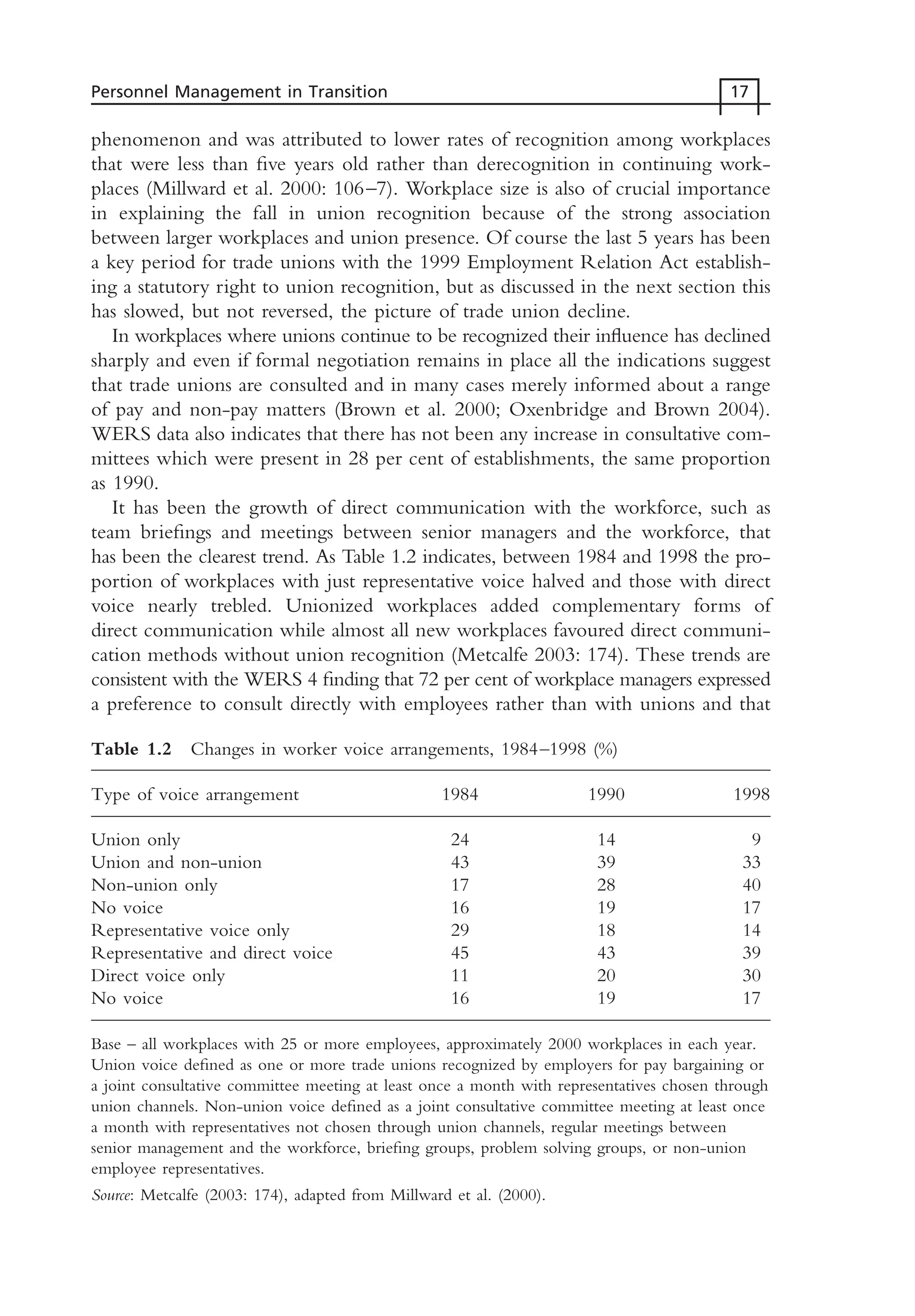
  • 39.
    Labour Market Changeand Patterns of Corporate Governance It is necessary therefore to consider changes in the labour market and evolving business structures/corporate governance arrangements to explain the diversity of employment practice. Employment restructuring In terms of employment restructuring changes in the composition of the work- force are associated with first, a shift from manufacturing to services and second, the polarization of the occupational structure. The dominance of service industries The UK, like all advanced economies, has become dominated by service indus- tries, such as retailing and financial services. These trends have drawn attention to the HR implications of work that is centred on interaction with customers, uses emotional labour, and is often linked to the growth of call centres (Chapter 13). Service industries contribute over 70 per cent of GDP, account for 8 out of every 10 jobs, and employment has increased by over 2 million since 1997 alone. As Table 1.4 indicates, alongside the massive increase in service sector jobs there has been a rapid fall in manufacturing employment. The Department of Trade and Industry (DTI) suggests that globalization has played a part, with the largest falls occurring in industries most vulnerable to competition from low-cost producers in developing countries; accounting for the trend in textiles, clothing and foot- wear (DTI 2004: 47). More generally, however, successive governments have been implicated by the lack of concern they have attached to the decline of manu- facturing industry. The growth of health and education services as well as leisure and retail services indicate increased demand arising from secular changes in society – ageing populations and the emergence of a ‘time poor’ society in which individuals use increased wealth to purchase a wider range of services. The growth of the private service sector has had a critical effect on the age structure of the workforce. Industries with the youngest workforces included dis- tribution, hotels and restaurants, banking, finance and insurance in which at least 40 per cent of the workforce were 16–34 year olds, while by contrast in public administration, education and health almost 40 per cent of the workforce were between 45 and pension age (Begum 2004). Trade unions face particular difficulties in encouraging younger workers to become union members. Many commentators have suggested that the values of young workers, and the aspirations that they bring to work, differ from older workers and that they are less likely to place their trust Personnel Management in Transition 21 MHRC01 15/09/2005 10:56 Page 21
  • 40.
    in the organizationand its HR policies (Sparrow and Cooper 2003). Consequently the growth of sectors of the economy that employ a higher proportion of younger workers presents challenges for HR practitioners and union organization. A further component of this compositional effect relates to the increase in part- time workers (Millward et al. 2000: 44–5). The changing balance between stand- ard and non-standard employment is being fuelled by the shift towards a 24/7 society in which consumers expect to access services at a time that is convenient to them. Not all of the growth in non-standard employment, however, originates solely in employer preferences for more flexible working hours. The majority of part-time workers are women and the decisions within households to manage work and childcare responsibilities in an affordable manner shapes working patterns. For example, in a significant minority of households with young children women work exclusively in the evenings or at night once the father has returned from work; a pattern that is shaped by the high cost and limited availability of affordable child- care (Harkness 2003: 160). 22 Stephen Bach Table 1.4 Key changes in employment by sector, over 25 years Description Employment (000s) Change (%) June 1978 June 2003 Increases: Real estate, renting machinery, computer activities 1,783 3,964 122 Hotels and restaurants 1,082 1,818 68 Health and social work 1,700 2,854 68 Other service activities 907 1,318 45 Education 1,592 2,240 41 Financial intermediation, insurance pension funding 757 1,050 39 Wholesaling and retailing 3,631 4,451 23 Publishing, printing and recorded media 323 347 7 Decreases: Transport and communications 1,597 1,547 −3 Construction 1,373 1,477 −11 Food products; beverages and tobacco 715 467 −35 Agriculture, hunting and forestry, fishing 418 234 −44 Electrical equipment 740 389 −47 Manufacturing 6,922 3,501 −49 Textiles and clothing 814 180 −78 Mining and quarrying 383 71 −81 Footwear and leather goods 124 15 −88 Source: DTI (2004). MHRC01 15/09/2005 10:56 Page 22
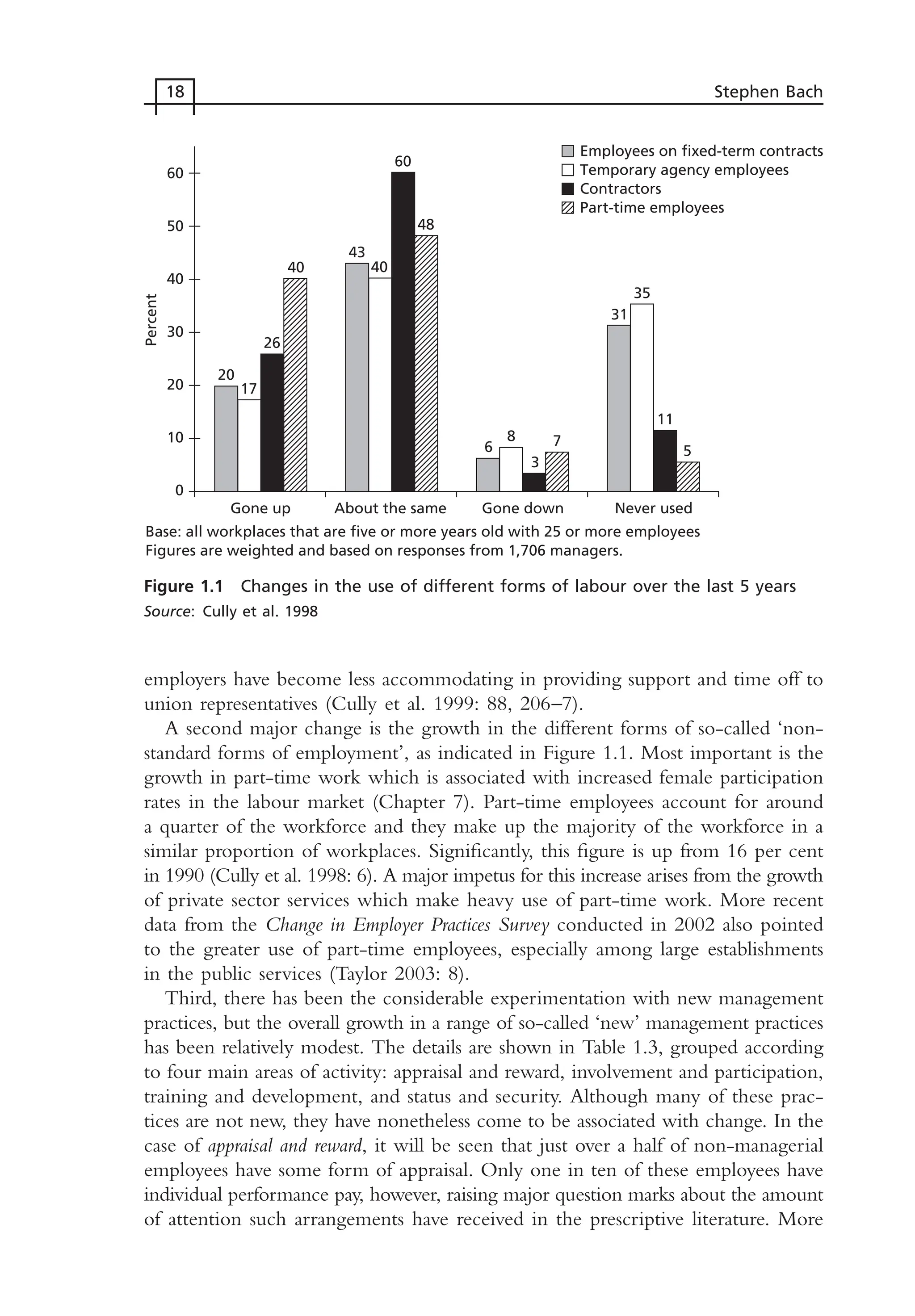
  • 41.
    A further consequenceof the shift from manufacturing to services has been the shrinkage in the size of the workplace. As the WIRS/WERS series has indicated there is a long-standing association between workplace size and a range of per- sonnel practices. Smaller workplaces are less likely to have a specialized personnel manager, less likely to recognize unions and the adoption of ‘new’ management practices is also less prevalent (Millward et al. 2000). Occupational structure The second dimension of labour market change relates to the occupational struc- ture of the workforce in which a growing polarization is apparent. Over the last 25 years there has been a large rise in the number of well-paid jobs and an increase in poorly paid jobs with a squeeze in the number of jobs in the middle (Goos and Manning 2003). This has been described as the emergence of an hourglass economy in which a strata of highly paid two-earner families can be contrasted with the growth of an under-class of low wage predominantly women workers (Nolan 2004). Between 1979 and 1999 the fastest growing ‘bad’ jobs reflected the growth of employment in service industries (Table 1.4), especially among labour intensive tasks that are less susceptible to technological change, for example, sales assistants, waiters, bar staff, cleaners and care assistants. By contrast most of the increase in ‘good’ jobs has been among managers, with a very rapid growth in the number of managerial positions across all sectors. The UK stands out in Europe as having a very high proportion of managerial and supervisory employees. This picture is consistent with the evidence presented above about the limited spread of ‘empowering’ new management practices, highlighting the UK ‘management problem’ (Chapter 9). It almost certainly reflects also the increased pressure on managers within public and private sectors to demonstrate compliance with a pro- liferation of targets and regulatory requirements. This polarization of the job structure is reflected in increased pay inequalities. Pay levels are closely associated with sector and the Low Pay Commission (2003) has identified a number of industries – virtually all private sector service industries – including retail, hospitality, business services, social care, childcare and hairdressing, in which low pay is prevalent. Consequently more than 20 per cent of jobs in the hospitality, cleaning and hairdressing sectors benefited from the rise in the October 2001 national minimum wage increase. At the other end of the pay scale top managers’ compensation has not risen to the stratospheric levels of the USA, in which by 2000 CEOs were typically earning 500 times the wages of the average employee – the ratio in the UK is 25 – (Stiglitz 2004: 123–4). Nonetheless, there has been considerable disquiet that directors of UK FTSE 100 companies have benefited from an increase in median salary of 92 per cent between 1993 and 2002 (£301,000 to £579,000) compared to an increase in average earnings of 44 per cent (see Iles 2004). The Labour government expressed concern that executives have been rewarded for failure as well as success (Chapter 12). For HR practitioners Personnel Management in Transition 23 MHRC01 15/09/2005 10:56 Page 23
  • 42.
    these trends raisesensitive questions about the degree to which employees view the distribution of rewards as fair and transparent because large variations in pay are routinely viewed in the HR literature as detrimental to teamwork and a united sense of organizational purpose. To summarize there have been fundamental and interrelated changes in the pat- terns of employment which help to explain much of both the restructuring and diversity of HR practice which is to be observed in the UK. The decline of joint regulation, for example, can be associated with the reduction in the manufactur- ing workforce, along with highly unionized sectors such as coal, and a shrinking in the size of workplaces more generally. The growth in part-time work, much of it low paid, and the feminization of the workforce reflects the expansion in the service sector. Nonetheless, a word of caution is needed in assuming a straightforward relationship between changes in the labour market and the practice of HR management from a single set of structural variables. There are a number of cross-cutting dimensions. A part-time female employee in a large successful retail chain like Tesco might enjoy greater de facto security and training and development opportunities than her counterpart in a small family-owned store. Less expectedly, the same is likely to be true of the comparison with male full-time employees, including managerial posts in manufacturing and financial services, that have been subject to constant rounds of downsizing and merger and acquisition activity. Much depends on the business systems, strategy and structure of employing organizations and so it is to these that the analysis now turns. Corporate governance Underpinning the changes in both the practice of personnel management and the patterns of employment are specific business systems, strategies and structures. A key reference point in interpreting changes in personnel practice has been the increased interest in distinctive national patterns of corporate governance which focuses on who controls firms, in whose interests firms are governed and the ease with which ownership of firms can be altered. Hall and Soskice (2001) who differentiate between ‘varieties of capitalism’ suggest that financing and ownership patterns of firms impact on corporate governance which significantly shapes employment practices. Within the UK, it has long been recognized (Sisson 1989: 16) that the most important features of corporate governance include: • an overwhelming emphasis on shareholder value as the key business driver as opposed to the interests of other stake-holders; • institutional share ownership by investment trusts and pensions funds which encourages a focus on short-term profitability as the key index of business per- formance rather than long-term market share or added value; 24 Stephen Bach MHRC01 15/09/2005 10:56 Page 24
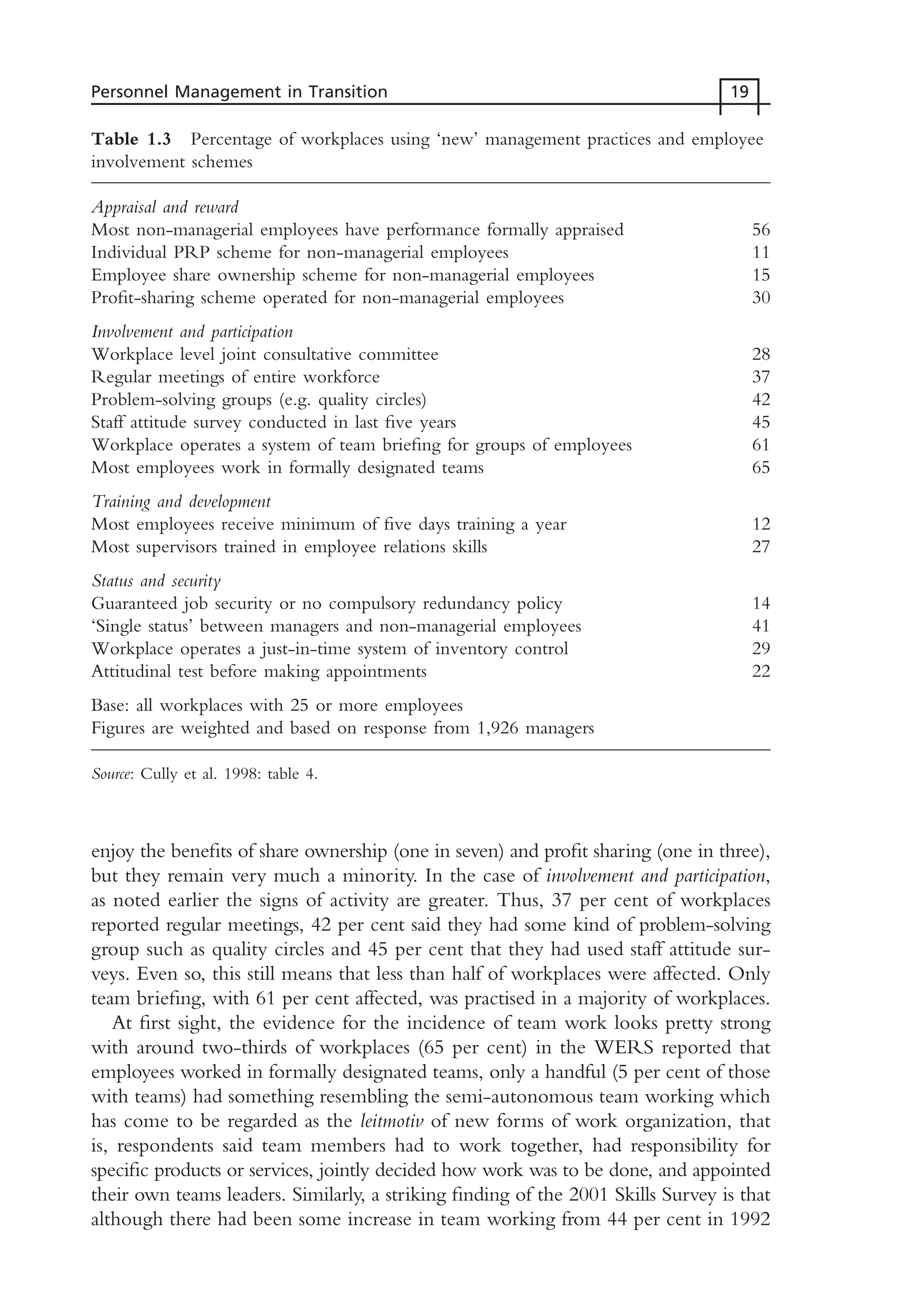
  • 43.
    • relative easeof take-over, which not only reinforces the pressure on short-term profitability to maintain share price and dividend payments, but also encour- ages expansion by acquisition and merger rather than by internal growth; • a premium on ‘financial engineering’ as the core organizational competence and the domination of financial management, both in terms of personnel, activ- ities and control systems, over other functions. These characteristics of the UK (and USA) termed ‘liberal market economies’ are contrasted to the co-ordinated market economies of more ‘patient’ capitalism associated with Germany and Japan. As Gospel and Pendleton (2003) point out, these differences between market-outsider and insider-relational forms of corporate governance exert pressure on the management of labour. In liberal market economies the overriding emphasis on shareholder value, an ideology that has strengthened markedly in recent years, ensures that labour is treated as a variable cost of pro- duction to be downsized if the share-price is jeopardized. The dominance of the market is mirrored inside the firm in which market-type devices – the organiza- tion of the firm as a series of business units that compete for investment – and the use of outsourcing are prevalent. Employers may also be reluctant to pursue a range of investment strategies and forms of employee involvements because it may limit management prerogatives and their capacity to respond to shareholder demands. The UK’s poor training record is frequently attributed to a system of corporate governance that provides an inhospitable environment to invest in HR (Chapter 8). Similar developments are evident in the public services. For more than two decades government reforms have encouraged the public services to mimic the organiza- tional and management structures of the private sector. The diffusion of market- type mechanisms across the public services has put pressure on managers to alter employment practices to ensure efficient and effective public service delivery. The authority of senior managers has increased and managerial responsibilities devolved from central government to lower levels within semi-autonomous organizational units (Kessler and Purcell 1996). At the same time, however, central government has accrued unprecedented levels of control over the funding and management of nominally independent service providers through strictly enforced cash limits and demands for annual ‘efficiency gains’. Systems of performance management have been intensified by the proliferation of government targets that has generated a form of short-termism. Senior managers manage upwards to fulfil ministerial targets, which act as proxies for shareholder pressure. These pressures, alongside the requirement to respond to an unrelenting stream of new initiatives, inhibited man- agers from developing a longer-term, more strategic conception of HR practice (Bach 2004). This analysis needs to be qualified to the extent that employment practices can- not be assumed to follow in a deterministic fashion from the dominant system of corporate governance. Variations between firms in the UK indicate that managers can exercise a degree of strategic choice in responding to shareholder demands (Gospel Personnel Management in Transition 25 MHRC01 15/09/2005 10:56 Page 25
  • 44.
    and Pendleton 2003).As Bunting (2004: 49) illustrates in the case of the budget hotel chain Travel Inn, shareholder pressure to cut staffing costs led managers to place more, not less, emphasis on training because as one manager explained: My labour budget is very tight – I manage that, I don’t complain – the key is to get people trained. Two people could have managed that situation [a busy bar and the restaurant] if they had been trained. There is also a sense that changes are emerging in the UK’s system of corpor- ate governance that provide counterveiling pressures to arrest short-termism with employee and other stakeholder interests bolstered by EU driven reforms of employment law and the changing structure of institutional share ownership (Armour et al. 2003). At present, however, these developments have not led to a dilution of the primacy of shareholder value and the increased concentration of ownership enables investors to force changes on managers, especially when per- formance is poor, which continue to have dramatic effects on employment and HR practice (Pendleton and Gospel 2004). Changing business strategies and structures The last two decades have witnessed a period of continuous organizational restructuring that is associated with these underlying features of corporate govern- ance. The lightly regulated character of the UK economy has encouraged high levels of inward and outward foreign direct investment. Across the whole of pri- vate sector manufacturing, the incidence of foreign ownership trebled from 7 per cent to 19 per cent between 1980 and 1998 and in private sector services the figure more than doubled from 5 to 11 per cent (Millward et al. 2000: 33–4). Foreign-owned multinational companies have therefore become an even more import- ant source of variation and innovation in personnel practice (Chapter 3). The UK economy has become more open with relatively few regulations, ensur- ing that competitive pressures have intensified (OECD 2004). These trends have been reinforced by the expansion of the European Single Market, trade liberaliza- tion alongside continuing privatization and deregulation. This context has reinforced the short-term planning horizons of companies and resulted in a continuing high level of restructuring because firms are less embedded in institutional structures allowing rapid responses to changing circumstances. One significant trend has been an increase in sub-contracting within the networked organization (Chapter 4). There have been two distinctive phases of the debate about sub-contracting. In the 1980s and 1990s, this trend was closely associated with privatization and programmes of compulsory competitive tendering in the public services, which led to many ser- vices being transferred to the private sector. These developments reflected the con- ventional wisdom that management should focus on its ‘core’ activities and divest itself of so-called ‘ancillary services’, such as catering, cleaning and distribution. 26 Stephen Bach MHRC01 15/09/2005 10:56 Page 26
  • 45.
    In the secondphase of externalization, which has gathered pace since the mid- 1990s, managers have been less concerned about the balance between ‘core’ and ‘periphery’ activities and have focused on more radical divestment of business activ- ities, which has included the relocation and export of productive capacity abroad, a trend termed ‘off-shoring’. A survey of Confederation of British Industry (CBI) members indicates that the pressure to off-shore is increasing and the main ration- ale is cost driven, with predominantly low added-value manufacturing functions transferred to Asia and to a lesser extent Central and Eastern Europe. It also appears that despite the media hype surrounding the off-shoring of call centre work, this activity is less ‘off-shorable’ than production of industrial goods (CBI 2004: 6). In the public sector large swathes of public provision, such as housing and social services have been transferred to the private sector and the Labour government’s modernization of public services has involved an extended role for the private sector in the provision of core services (Bach and Givan 2005). These changes have been accompanied by high levels of organizational upheaval as firms have divested themselves of businesses and acquired new ones. UK organ- izations are not only involved in a permanent revolution of minor structural change, but can expect major restructuring every 3 years, of which 85 per cent involve redundancies and early retirements (CIPD 2003b). This leads the CIPD to con- clude that the economy is subject to the ‘3Rs’ effect of simultaneous reorganiza- tion, redundancy and recruitment (CIPD 2004: 13). Part of the explanation for this degree of turbulence arises from the divisionalization structures of large UK companies that are viewed by managers as aggregates of separate cost business units which have to meet performance targets; set and tightly monitored by the centre. When divisions do not meet their profitability targets they are sold off and other more profitable divisions acquired. Ackroyd and Procter (1998) in their analysis of the largest 200 UK-owned manufacturing firms highlight the consequences for employment practice in which there is little investment in advanced technology or multi-skilling, but instead semi-skilled employees compete with sub-contractors to retain their employment. The upshot is that the increased use of contractors is significantly associated with work intensification (Green 2004: 731). Summary Changes in the labour market, patterns of corporate governance and business strat- egies are profoundly important in understanding why there has been restructuring, but only a very limited shift towards high commitment HR practice in the UK. Within the labour market the growth of part-time employment and the shift to service industries have been the dominant trends leading to the creation of more relatively disposable and low value-added ‘bad’ jobs. At the same time there has been a marked increase in job polarization with an increase in the number of well-paid ‘good’ jobs. These jobs are much better rewarded and include other benefits associated with higher status work; however, the pressure on managers and professionals to Personnel Management in Transition 27 MHRC01 15/09/2005 10:56 Page 27
  • 46.
    achieve a varietyof performance targets, such as absence, has increased (Chapter 14). The scope to monitor performance has also been enhanced by the spread of per- formance appraisal (Chapter 11) and the wider use of information technologies has facilitated increased accountability resulting in work intensification and less task discretion (Gallie et al. 2004; Green 2004). These changes are occurring against a backdrop of continuous organizational restructuring. The sheer pace and extent of the change in business portfolios has been a consideration in its own right. Not only has it produced massive uncer- tainty on the part of managers and employees alike, which is inimical to develop- ing the long-term relationships of the high performance workplace, it has also made it very difficult to develop a consistent approach towards the management of the workforce. Indeed, organizations are littered with half-finished initiatives which have had to be interrupted because of take-over or merger or change of business direction or divestment, leading to considerable cynicism not only on the part of employees but also among the senior managers who are supposed to be imple- menting them. The Emerging Directions of HR Practice During the 1980s and 1990s the emergence of HRM was the key reference point for evaluating the evolution of personnel practice in the UK. By the time the last edition of this book was published, however, the appeal of the soft model of HRM was on the wane. The election of a Labour government in 1997 signified a rejec- tion of the deregulation and anti-collectivism of this period and brought the lan- guage of fairness, partnership and greater engagement with the European Union to the fore (Bach and Sisson 2000: 14–15). It was not apparent, however, the extent to which these emerging currents would solidify into a new approach towards HR. Five years on, it is much more evident, especially in terms of managerial ideology and policy, even if not always in terms of HR practice, that a new HR is emerg- ing that has started to set the debate about HRM on a different trajectory. This section sketches out the emergent direction of HR practice that is shown in styl- ized form in Table 1.5. Globalization As this chapter has emphasized it is the specific institutional features of the UK employment context that has shaped personnel practice. Successive Conservative governments used deregulation, privatization and the contract culture to increase product market competition and foster changes in personnel practice. Foreign direct investment was encouraged, increasing the internationalization of the UK eco- nomy, and it was the practices of Japanese inward investors in particular, such as 28 Stephen Bach MHRC01 15/09/2005 10:56 Page 28
  • 47.
    Nissan, that UKemployers were encouraged to emulate (Wickens 1987). As the 1990s progressed this preoccupation with ‘Japanization’ developed into a broader concern with ‘lean’ production and the high performance workplace. HRM therefore emerged in a context in which internationalization was con- strued narrowly as a concern with attracting inward investment and emulating ‘best practice’. This restricted view of the consequences of internationalization for HRM practice can be contrasted with the pervasive, but highly contested, impact of glob- alization (Stiglitz 2004; Wolf 2004). Globalization reflects the increasing inter- national economic integration of countries arising from the worldwide revolution in communication technologies, the growth and dominance of international capital markets, the global reach and influence of multinational corporations and an increase in labour migration. Three points are relevant in terms of the new HR. First, employment is becoming more volatile because of the coordination of stock markets and increased sensitivity to institutional shareholders. Moreover, at the level of policy and managerial discourse, globalization represents and legitimizes the sense of risk and uncertainty that pervades the workplace and which has been used to ‘manufacture uncertainty’ and promote more contingent work (Amoore 2004). Second, globalization is associated with the spread of information and commun- ication technologies (ICT) that are facilitating global production and distribution of goods and services. Inter and intranets have enabled rapid communication across time and space enabling organizations to integrate and centralize control while decen- tralizing production and distribution. As Frenkel (2003: 139) highlights, ICT is Personnel Management in Transition 29 Table 1.5 Emergent directions in HR practice: From HRM to the New HR Dimension Contexts Internationalization Legal Goals Methods Employment relations Organizational HR practice Values Focus of HR practice Orientation The New HR • Globalization • Focus on attracting labour investment (migration) • Managers as villains • Enhance competitiveness • Re-regulation and legal compliance • Shallow partnership • Multi-employer: networks • Engagement • Person • Customer/brand HRM • Product market competition • Focus on attracting capital investment • Managers as heroes • Strengthen management prerogatives • Restrictive labour law • Union exclusion • Single employer • Commitment/loyalty • Job • Employer MHRC01 15/09/2005 10:56 Page 29
  • 48.
    having a significantimpact on the content of work by reducing the requirement for manual skills while fostering new kinds of work requiring higher level skills (e.g. web design) and lower level skills such as forms of customer service work in call centres. In addition ICT also changes the location of work by facilitating home- working and work across spatial boundaries with the increased use of forms of virtual teamworking. For Gratton (2004: 75) the primary impact of technology is therefore its ability to democratize the workplace: Software technologies have the capacity to make an enormous amount of previously restricted information available to individuals. This will ultimately support their capa- city to be autonomous and insightful. ICT has contributed to the increased complexity of jobs and the upward bias of qualifications required of the workforce, but contrary to Gratton’s assumptions employees’ task discretion has declined (Gallie et al. 2004). Moreover, the degree to which employers trust employees to be autonomous remains uncertain, reflected in the small numbers of professional and managerial employees that are able to choose whether to work at home (Felstead et al. 2003). A third dimension of globalization is the increased importance of labour migra- tion. Labour markets remain less integrated than capital markets with considerable legal, cultural and linguistic barriers inhibiting the free movement of labour. None- theless the expansion of the EU, labour market shortages and an ageing workforce has stimulated labour mobility. In the UK the number of inward migrants rose from approximately 300,000 to 513,000 between 1993 and 2003 resulting in a net inflow of around 200,000 per annum. The HR implications are more significant than these figures imply because migrants are predominantly young (15–34), with one-third concentrated in London, and include a net gain of professional and managerial workers (Dobson and MacLaughlan 2001; National Statistics 2004). Consequently internationally recruited labour comprises a very substantial proportion of the labour force in London and the South East and is being used to remedy staff shortages among nurses, teachers and social workers. The HR consequences for training, career progression and pay of managing a more diverse workforce, has received very little attention (Bach 2003). Finally, the emergence of a particular form of neo-liberal globalization has become a lightning rod for a variety of disparate forms of worker and citizen disenchant- ment with corporations. This has led employers to pay more attention to their corporate social responsibilities and their brand image (Chapter 10). Nonetheless a profound sense of unease remains that corporations have become unaccountable and are primarily concerned to promote the interests of a small strata of top man- agers and shareholders. These concerns are reinforced by corporate fraud scandals, most famously the collapse of Enron in the USA, but also in more dilute forms in Europe (e.g. Parmalat, Shell). There is widespread disquiet about the withdrawal of final salary pension provision and escalating top managers’ pay. A number of high profile critiques of corporate behaviour have gained wider currency through 30 Stephen Bach MHRC01 15/09/2005 10:56 Page 30
  • 49.
    the media (e.g.Bakan 2004). Importantly unease about corporate behaviour and the creed of the market that is pivotal to contemporary forms of globalization has not been confined to traditional sources of criticism such as trade unions, but has included eminent economists, industrialists and management gurus (Stiglitz 2004; Turner 2001: 364–70; Mintzberg 2004: 147). These emergent trends in the workplace associated directly and indirectly with globalization have the potential to empower the workforce but few commentators detect a shift towards what Gratton (2004) terms ‘the democratic enterprise’. Instead there is a growing sense that power in the workplace has become unbalanced, tilting strongly towards employers and the interests of shareholders to the detri- ment of the workforce. In this context senior managers are increasingly viewed as villains rather than corporate heroes as they were in the HRM paradigm. For US commentators, in which these trends are more stark, the HR function has been implicated in these changes because in its pursuit of becoming a strategic partner, the HR function lost sight of its core values and supported top managements’ interests while neglecting the concerns of employees. This has not led to increased credibility of HR with top managers but it has led to a profound loss of trust in corporate HR policy and practice which is reflected in a growing concern in the management literature with issues of trust, organizational justice and organizational citizenship (Kochan 2004; Peterson 2004). Before accepting such a bleak US- orientated interpretation of contemporary trends in the workplace, however, it is necessary to consider whether the harsher consequences of globalization have been modified in a UK context by the increasingly interventionist role of the state in shaping personnel practice. Re-regulation and legal compliance For most of the twentieth century the UK system of employment regulation has been characterized as ‘voluntarist’ which ensured that employment regulation was conducted primarily through collective bargaining between employers and unions and the state did not intervene to provide a legal framework of individual and col- lective rights to the same degree as in most other European Union (EU) countries. The emergence of HRM was premised on a decisive break away from voluntarism in which successive Conservative governments used the law to restrict the powers of trade unions and bolster managerial prerogatives (see Dickens and Hall 2003). The UK’s membership of the EU provided a further stimulus to legal regulation and the growing importance of EU employment law often conflicted with the restrictive direction of Conservative government policy. By 1997 the ambitious domestic agenda of the Labour government in combination with EU initiatives signalled very far-reaching changes in the UK regulatory framework. The EU agenda has continued to play a pivotal role in extending employment rights for indi- viduals and since 1997 EU directives have included the regulation of working time, rights to information and consultation, equal employment rights for part-time Personnel Management in Transition 31 MHRC01 15/09/2005 10:56 Page 31
  • 50.
    workers, increased protectionfor employees on fixed-term contracts, new rights on maternity and parental leave and statutory rights to information and consulta- tion. The UK government is also in the process of implementing the EU’s Anti- Discrimination Framework Directive which extends existing provision to prohibit discrimination on the grounds of religion or belief, sexual orientation, disability and age. The Labour government’s approach can be characterized, following Collins (2001), as regulation for competitiveness which stems directly from their belief in the com- petitive challenge posed by globalization. The Labour government endorsed much of the previous Conservative labour law agenda but it views much of this legislat- ive inheritance (e.g. restrictions on union power) as a necessary but not a sufficient framework to ensure competitiveness. It has therefore intervened actively to re- regulate the labour market, establishing a minimum floor of rights via mechanisms such as the establishment of a statutory minimum wage. This measure is primarily viewed by the government as a means to enhance competitiveness by encourag- ing employers to invest in and deploy their workforce more effectively. The Labour government’s acceptance of an increased role for individual employ- ment rights has not been matched by its support for collective employment rights, although there has been a shift from the unitarist union exclusion assumptions of HRM to an emphasis on partnership in the new HR (Chapter 16). The Labour government has fostered forms of voluntary partnership working via union recog- nition provisions and this altered the climate of employment relations, creating scope for more active engagement with employers, resulting in ‘robust’ and ‘shallow’ forms of partnership (Oxenbridge and Brown 2004). Partnership, however, while assigning greater legitimacy to trade unions, privileges their role as partners with employers in bringing about productivity improvements and helping to manage change in an orderly manner, but underplays the role of trade unions as inde- pendent actors in the workplace striving to bring about social justice and protect employee interests. In sectors where trade union density remains high and unions retain credibility with employers, partnership working can bring benefits for union members as national agreements in health and education on complex pay and work- ing conditions indicates. In vast swathes of the private sector, however, and in many public service workplaces in which unions lack influence, partnership agreements yield limited benefits for the workforce or employers. As Terry (2003: 500) argues, weak trade unions serve no useful function because they have little legitimacy with the workforce and are unable to help employers manage and legitimate change. Many of the more recently elected union leaders view partnership as an acknowledge- ment of weakness because it highlights the degree to which unions are engaged in a process of continuous concession bargaining with employers (Murray 2003). Union support for partnership is equivocal. The fragility of partnership is also reinforced by the difficulties that many employers have in keeping their side of the bargain, given the degree of restructuring noted above. For these reasons, while the term partnership signals a greater willingness on the behalf of employers to 32 Stephen Bach MHRC01 15/09/2005 10:56 Page 32
  • 51.
    consult with theworkforce, reinforced by the imminent arrival of the informa- tion and consultation directive, employers continue to favour the expansion of direct channels of communication and involvement with the workforce (Chapter 15). Employers therefore remain reluctant social partners and forms of shallow partner- ship predominate. To summarize, the New HR signifies a subtle shift away from the primary em- phasis on restrictive labour law and the strengthening of management prerogatives, which was the context in which HRM emerged. Instead the Labour government, while supportive of the overall balance of power in the workplace, has sought to establish minimum safeguards for employees to ensure managers are accountable for their actions and use labour effectively rather than simply as an asset to be sweated. However, because the Labour government has a largely benign view of the employ- ment relationship, influenced strongly by the view that the economy is increas- ingly reliant on knowledge workers, and partly because of its reluctance to alienate employer interests, it has pursued a very cautious agenda of re-regulation which has led to a minimalist interpretation of the EU social dimension (Chapter 2). In the past trade unions have played a crucial role in publicizing and enforcing rights at work, but in a context of reduced union presence and the growth of individual employment rights it is not surprising that HR managers confront an increase in individualistic responses to employment problems. This is reflected in the growing number of inquiries to ACAS and the growth of cases being taken to employment tribunals which rose in the last year from 98,616 applications to 115,042 in 2003–4 (Employment Tribunal Service 2004). For HR practitioners, the growth of legal regulation will continue to be a dominant feature of their working lives. It is necessary, nonetheless, to differenti- ate between the volume and effort required by employers to get to grips with new employment rights and their actual effects in terms of the protection they provide for employees. Consequently, particularly for small firms that are much less likely to have specialist in-house HR expertise, getting to grips with what cumulatively represents a substantial corpus of employment regulation contributes to a sense of burden even if the effects of regulation are more modest than they anticipate. This process is illustrated by the degree to which employment regulations, such as a statutory minimum wage, have been vigorously opposed by employers prior to their implementation, but broadly accepted after implementation as the regulatory effects are accepted as having only a small effect on employer behaviour. Shifting organizational boundaries: towards the permeable organization A pivotal element within HRM has been the emphasis placed on developing employees’ commitment to the organization. Individual commitment arises from establishing integrated and coherent bundles of HR practice with a strong cor- porate culture used as the glue to bind individuals to the organization. Some workers Personnel Management in Transition 33 MHRC01 15/09/2005 10:56 Page 33
  • 52.
    are excluded fromthe ‘core’ and consigned to the ‘periphery’ employed on a temporary basis or outsourced, but the assumption of HRM is that these differing segments of the workforce are managed separately, delivering differing sources of value added for the firm (see Kalleberg 2001). This view of the firm has been increasingly questioned. There is a shift away from an emphasis on the management of the employment relationship by a single employer who exercises control over HR practice and promotes commitment to the enterprise. Instead within the New HR there is increased recognition of the diversity of employment relationships that exist in multi-employer, networked organ- izations. The blurring of organizational boundaries results in a variety of employers exerting an influence on all aspects of HR practice including pay, labour deploy- ment, skills acquisition and performance management, but in a contradictory and ambiguous manner raising many HR challenges and great uncertainty about the capacity of employers to sustain organizational commitment (Rubery et al. 2002). There are a variety of inter-organizational relationships emerging and in manu- facturing considerable attention has been directed at the HR consequences of sup- ply chains. In the public services forms of public-private partnerships and statutory requirements to work across organizational boundaries has been an integral component of the Labour government’s modernization agenda, while call centre employees frequently undertake work for a variety of clients with differing requirements of staff, creating complex HR management challenges. The first relates to employment status, which distinguishes between employees and workers that are supplied by another employer on a temporary or agency basis. The assumption of the core and periphery type model, that workers employed under different employment regimes can co-exist harmoniously and their labour deployed effectively, has been questioned. In the health service the use of agency nurses to stem staff shortages has created resentment among existing staff that received less pay and had less discretion over the hours that they worked in comparison to agency staff (Bach 2004). More often agency staff are employed on worse terms and conditions of employment than directly employed staff. As Rubery et al. (2004) highlight in a call centre they studied, differences in pay and conditions did not reflect different skill or job requirements, creating resentment among agency staff that were often assigned to more intensive work. A second dimension concerns the presence of multiple employers rather than a single employer within a workplace. This arises from outsourcing, the transfer of staff in mergers and acquisitions, the growth of hybrid forms of partnership work- ing and joint ventures. These arrangements result in employees and managers being subject to a variety of management controls from many employers which also creates uncertainty about employee identification and commitment to their formal employer. Take the case of a large regional airport in which many employers are present. The airlines do not employ the passenger handling agents but indirectly exert a great deal of influence over their working practices because of their expecta- tions about how passengers should be checked in, the timing of the process, and by monitoring passenger handlers’ appearance and interaction with passengers. These 34 Stephen Bach MHRC01 15/09/2005 10:56 Page 34
  • 53.
    staff wore theuniform of the airline they were checking in and frequently sought to transfer to employment with the airline, creating HR difficulties for passenger handling firms (Rubery et al. 2003). The third dimension relates to the influence of the client in shaping the employ- ment relationship, which highlights the degree to which customers can exert influence over staff management irrespective of whether they are the formal employer. Scarbrough (2000: 14), in his analysis of supply chain management in three engin- eering companies, coined the phrase ‘corporate colonization’ to capture this pro- cess. In one case, a car parts manufacturer (Compco), benefited from the expertise of a major car manufacturer (Carco) in improving the production line dedicated to the production of parts destined for Carco. However, Carco insisted on the implementation of a no-redundancy policy to accompany these changes which was not applied to other parts of the plant and which reduced the autonomy of Comco in shaping its HR practices. Client requirements are not necessarily accepted, however, if the employer has sufficient power to dilute client demands. In the call centre case referred to above, the main employer (TCS) refused to allow their staff to wear the uniform of their client (TruckCo) precisely because they wished to maintain control of their HR practices and wanted their staff to retain their identification with TCS (Rubery et al. 2004: 1216). Overall, the rise of the net- worked enterprise creates tensions in the employment relationship, increasing the complexity of managing and monitoring performance and makes it harder to sustain employee commitment. From commitment to the employer to engagement with the customer The final change in emphasis away from the assumptions embedded in HRM models concerns a shift from employers’ concern to gain the commitment of employees’ towards an emphasis on ensuring that employees are engaged and derive emotional meaning from work. The New HR therefore does not attempt to impose a set of managerially defined values which employees are expected to accept unques- tioningly. Instead the starting point is a bottom-up focus on the personality of individuals at selection stage, which is then reinforced to ensure that the organ- ization understand its employees and what shapes their engagement with the organization and how these personal values can be harnessed for organizational success. Understanding this shift in practice is linked to the experience of culture change programmes that were a prominent feature of HRM practice in the 1980s and 1990s. The starting point of organizational programmes of culture change was an attempt by senior managers to instill in employees the importance of core organizations beliefs and values in a predominantly top-down manner. These initiatives had very uneven results, which is not surprising, taking account of the degree to which senior managers found it difficult to adhere to these values in a context of Personnel Management in Transition 35 MHRC01 15/09/2005 10:56 Page 35
  • 54.
    continuous organizational changeand downsizing (Thompson 2003). Many of these trends have intensified in recent years, reflected in the degree to which there has been a continuing fall in job satisfaction in the UK since the mid 1990s. Moreover, although perceptions of job insecurity have decreased as unemployment has fallen many employees still feel insecure in the sense that valued aspects of the benefits of employment are being withdrawn, such as pensions, which reinforces a sense of distrust of employers (Burchell et al. 2002). In these circumstances, employees have proved unreceptive to senior managers’ espousal of corporate values and there has been an erosion of trust and commitment to organizational values (Sennett 1998: 141). Simultaneously, many studies have shown only a weak link between affective organizational commitment and performance (Sparrow and Cooper 2003: 188), leading to a cooling among HR practitioners of the emphasis on sustaining organizational commitment. The implications are that the New HR places more emphasis on measuring the attributes of the person and the degree to which their values and emotions ‘fit’ the requirements of the job (Chapter 5). In service industries, such as airlines, selection is based on ensuring staff are empathetic to customer values which are then reinforced by processes of socialization, training and appraisal (Bolton and Boyd 2003: 300–1). There is a tendency for employers to place more emphasis on the appearance, dress sense, tone and accent of voice of their employees and in some cases, for example, fashionable bars and hotels to specify appropriate body shape and size. The increased importance of emotional and aesthetic labour has contributed to the shifting definition of skill (Grugulis et al. 2004: 7). Employers such as Tesco, the largest private sector employer and dominant UK retailer, has taken this process a stage further by identifying ‘a retail gene’, derived from the skills of their existing employees, and applicants are measured on the degree to which this gene is present (Overell 2003: 2). Tesco has also transferred the meth- odologies used to understand their customers to their employees to gain insight into their personalities and identities. This has resulted in employees being categorized into five attitudinal segments: work–life balancers; want it all; pleasure seekers; live to work; and work to live with HR practices geared towards the different motiva- tions and aspirations of these employee groups (Gratton 2004: 119–24). A related component of this shift in HR practice has been to reshape employee expectations focusing not on bland corporate mission statements as in the 1990s, but rather using customer expectations and values to shape the requirements of staff (see Rosenthal 2004). In the NHS, for example, the emphasis on servicing internal and external customers is reflected in job titles such as ward hostess. This development of customer-orientated skills is altering job roles away from an exclusive focus on professionally defined norms. Pay modernization is reinforcing this process by placing a premium on softer interactive competencies such as oral communication; which is defined as a core skill for all NHS staff (Bach 2004: 192). Consequently, attempts to rehabilitate the image of corporations by policies of brand- ing and corporate social responsibility, which create personalities for companies and try and ensure that employees become emotionally engaged with them, are 36 Stephen Bach MHRC01 15/09/2005 10:56 Page 36
  • 55.
    Another Random Documenton Scribd Without Any Related Topics
  • 56.
    CHAPTER VIII. GOLDEN DAYS. Olovely earth! O lovely sky! I was in love with nature, I; And nature was in love with me; O lovely life—when I was free! Felicia had been surprised, and not altogether pleased, at the unnecessary cordiality with which Maud had bade their visitor farewell. There was an excitement, an animation, an eagerness in her manner which Felicia had not before perceived, and which she felt at once might be difficult to manage. Desvœux was exactly the person whom she did not want Maud to like, and the very possibility of her liking him brought out in Felicia's mind a latent hostility of which, under an exterior of politeness and even familiarity, she was always dimly conscious. She did not mind talking to him herself; she was even amused by him; but then it was always with a kind of protest; she knew exactly how far she meant to go and felt no temptation to go any further. But the notion of him in any other capacity but that of a remote member of society, whose function it was to say and do absurd things in an amusing way, was strange and altogether distasteful. Anything like intimacy was not to be thought of for an instant; the merest approach to close contact would bring out some discord, the jar of which, by a sort of instinctive anticipation, Felicia seemed to feel already. So long as he moved in quite another plane and belonged to a different world, his eccentricities might be smiled at for their comicality without the application of any rigid canon of taste or morals. But a person who was at once irreligious and over-dressed, who constantly had to be 'put down' for fear he should become offensive, and who was a
  • 57.
    stranger to allthe little Masonic signals by which ladies and gentlemen can find each other out—the very idea of his presuming to cross the pale, and to form any other tie than those of the most indifferent acquaintance, filled Felicia with the strongest repugnance. It was provoking, therefore, that he seemed to take Maud's fancy and impress her more than any other of the many men with whom she was now becoming acquainted. It was more than provoking that she should let her impressions come so lightly to the surface, and be read in signs which Desvœux's experienced eye would, Felicia knew, have not the least trouble in interpreting. Suppose—but this was one of the disagreeable suppositions which Felicia's mind put aside at once as too monstrous to be entertained —suppose he should come to stand in the way of the rightful, proper, destined lover? She thrust away the notion as absurd. All the same, it made her uncomfortable, and no doubt justified her to herself in pushing forward Sutton's interests with more eagerness than she might otherwise have thought it right to employ about another person's concerns. When one feels a thing to be the thing that ought to happen, and sees it in danger of being frustrated by some thoroughly objectionable interference, it is but natural to do something more than merely wish for a fortunate result. Felicia, at any rate, could boast of no such passivity; and, if praising Sutton would have married him, Felicia's wishes on the subject would have been speedily realised. The course of love, however, rarely flows exactly in the channels which other people fashion for it, and Maud's inclinations required, her cousin felt, the most judicious handling. There could be no harm, however, in allowing Sutton's visits to go on with their accustomed frequency; and since Maud must forthwith learn to ride and Sutton volunteered to come in the mornings to teach her, no one could blame Felicia if, in the intervals of instruction, the pupil and teacher should become unconsciously proficient in any other art besides that of equitation. Maud used to come in from these rides with such a bright glow on her cheek and in such rapturous spirits, that her cousin might well feel reassured.
  • 58.
    Sutton had foundfor her the most perfect pony, whose silky coat, lean well-chiselled head and generally aristocratic bearing, pronounced it the inheritor of Arab blood. Maud speedily discovered that riding was the most enjoyable of all human occupations. Down by the river's side, or following long woodland paths, where the busy British rule had planted many an acre with the forests of the future, or out across the wide plains of corn stretching for miles, broken only by clumps of palms or villages nestling each in a little grove under the wing of some ancestral peepul-tree, the moon still shining overhead and the sun just above the horizon, still shrouded in the mists of morning—how fresh, how picturesque, how exhilarating everything looked! How pleasant, too, to go through all these pretty scenes with a companion who seemed somehow to know her tastes and wishes, and to have no thought but how to please her! Sutton, though in public a man of few words and unsatisfactorily taciturn on the subject of his own exploits, had, Maud presently discovered, plenty to tell her when they were alone. The power of observation which made him so nice a judge of character extended itself to all the scene about him and revealed a hundred touches of interest or beauty which, to coarser or less careful vision, would have lain obscure. Maud felt that she had never known how beautiful Nature was till Sutton told her. 'There,' he would say, 'I brought you round this wood that we might not miss that pretty bend of the river, with Humayoun's Tomb and the palms beyond. See what a beautiful blue background the sky makes to the red dome and that nice old bit of crumbling wall. The bright Indian atmospheres have their own beauty, have they not? And see that little wreath of smoke hanging over the village. This is my pet morning landscape.' 'And those peach-groves,' cried Maud, 'all ablaze with blossom, and those delicious shady mulberries and the great stretch of green beyond. It is quite enchanting: a sort of dream of peace.' 'We had a fine gallop across here once,' Sutton said, 'when first we took the Sandy Tracts.' And then Maud learnt that they were riding
  • 59.
    over a battle-field,and that for a long summer's afternoon men had fought and fallen all along the path where now they stood, and that a battery of artillery had been posted at the very corner of the village to which her guide had brought her. 'I remember when they knocked that hole in the old wall yonder and how all the fellows behind it took to their heels. Then, afterwards we stormed the Tomb and had to finish our fighting by moonlight.' 'Was that when you got your Victoria Cross?' asked Maud, who was possessed by a spirit of insatiable curiosity about Sutton's badges, which he was slow to gratify. 'Oh no,' said Sutton, laughing; 'I got nothing then but a bullet through my shoulder and a knock on the head from a musket-stock which very nearly ended my soldiering then and there. Look now how quickly the scene changes as the sun gets up—half its beauty is gone already! Let us have a good canter over this soft ground and get home before it grows too hot.' Maud, who had never thought of a battle except as one of the afflicting details that had to be remembered at an historical class, and if possible to be hooked on to its proper site and date, felt a delicious thrill in actually realising with her own eyes the place where one of the troublesome events took place, and in talking to a person who had actually taken part in it. 'And what became of the bullet in your shoulder?' she asked. 'It was a very troublesome bullet,' said Sutton, 'and a great deal harder to dislodge than the people from the Tomb. But I was unlucky when I was a lad and never came out of action without a souvenir of some sort or other.' When Maud got home she asked Felicia about this storming of the Tomb, and learnt that Sutton's account was not as truthful as it might have been. He and half-a-dozen others had, Felicia told her, volunteered for the storming-party, had made a rush for the walls through a shower of bullets; and Sutton and two companions, getting separated from the others, had been left for some seconds
  • 60.
    to hold theirown as best they could against the angry, frightened mob within. No one, perhaps scarcely Sutton himself, knew exactly what had happened. The rest of the party, however, when they made their way in, found him standing at bay over a dead comrade's body, and his antagonists too completely taken aback at his audacity to venture, at any odds, within reach of his sword. In the scuffle which ensued Sutton received the wounds of which Maud had been informed; but his exploits on that day were for ever after quoted by his followers as a proof that there is nothing which a man may not do, if only he have pluck and will enough to do it. Maud felt all this very impressive and Sutton's society more and more delightful. Her enjoyment of it, however—by this time by no means small—began to be seriously qualified by an anxiety, increasingly present to her mind, as to her fitness for the dignified companionship thus thrust upon her. She felt passionately anxious to please Sutton, and more and more distrustful of her power to do so. He was good, noble, chivalrous, everything that Felicia had said, and how hopelessly above herself! What must he think of one who was, as Miss Goodenough had often told her, a mere congeries of defects? True, he never seemed shocked or annoyed at anything she said, and professed to like the rides as much as she did; but might not this be from mere good-nature, or the charm of novelty, or the wish to oblige Felicia, or any transitory or accidental cause? Terrifying thought, if some day he should find her wanting, and banish her from his regards! Meanwhile, happy, happy mornings, and sweet, bright world, in which such pleasure can be found, even if haunted by a doubt as to whether it is really ours or not!
  • 61.
    CHAPTER IX. THE FIRSTBALL. Il est amiable, car on se sent toujours en danger avec lui. Before Maud had been many weeks with the Vernons there was a Garrison Ball, and at this it was fated that she should make her first public appearance in Dustypore society. That night was certainly the most eventful and exciting one that she had ever passed. To wake and find one's self famous is no doubt an agreeable sensation; but to put on for the first time in one's life a lovely ball-dress, bright, cloudlike, ambrosial—to be suddenly elevated to a pinnacle to receive the homage of mankind—to exercise a pleasant little capricious tyranny in the selection of partners—to be seized upon by one anxious adorer after another, all striving to please, each with a little flattering tale of his own—to read in a hundred eyes that one is very pretty—to find at last a partner who, from some mysterious reason, is not like other partners, but just perfection—to know that one's views about him are entirely reciprocated—it was, as Maud, on going to bed, acknowledged to herself with a sigh, which was half fatigue and half the utterance of an over-excited temperament, too much enjoyment for a single human soul to carry! In the first place, Sutton, all ablaze with medals, tall, majestic, impressive, and as Maud had come to think with Felicia, undeniably handsome, had begged her in the morning to keep several dances for him. The prospect of this among other things had put her in a flutter. She would have preferred some of the ensigns. It seemed a sort of alarming familiarity. Could such a being valse and bend, as ordinary mortals do, to the commonplace movements of a mere quadrille? It was one thing to go spinning round with another
  • 62.
    school-girl, under thesuperintendence of Madame Millville, to the accompaniment of her husband's violin: but to be taken possession of by a being like Sutton—to have to write his name down for two valses and a set of Lancers—to know that in five minutes one will be whirling about under his guidance—the idea was delightful, but not without a touch of awe! Sutton, however, quieted these alarms by dancing in a rather ponderous and old-fashioned manner, and finally tearing her dress with his spur. Maud had accordingly to be carried off, in order that the damage might be repaired; and—her mind somewhat lightened by the sense of responsibility discharged and the ice satisfactorily broken—looked forward to the rest of the evening with ummingled pleasure. While her torn dress was being set to rights she scanned her card, saw Sutton's name duly registered for his promised dances, and made up her mind, as she compared him with the rest, that there was no one in the room she liked one-half as well. But then she had not danced with Desvœux; and Desvœux was now waiting at the door and imploring her not to curtail the rapture of a valse, the first notes of which had already sounded. Desvœux's dancing, Maud speedily acknowledged to herself, bore about the same relation to Sutton's that her Arab pony's canter did to the imposing movements of the latter gentleman's first charger. His tongue, too, seemed as nimble as his feet. He was in the highest possible spirits, and the careless, joyous extravagance of his talk struck a sympathetic chord in his companion's nature. 'There!' he cried, as the last notes of the music died away and he brought his companion to a standstill at a comfortable sofa, 'Such a valse as that is a joy for ever—a thing to dream of, is it not? Some ladies, you know, Miss Vernon, dance in epic poems, some in the sternest prose—Carlyle, for instance—some in sweet-flowing, undulating, rippling lyrics: Yours is (what shall I say?) an ode of Shelley's or a song from Tennyson, a smile from Paradise! Where can you have learnt it?'
  • 63.
    'Monsieur Millville taughtus all at my school,' said Maud, prosaically mindful of the many battles she had had in former days with that gentleman: 'a horrid little wizened Frenchman, with a fiddle. We all hated him. He was always going on at me about my toes.' 'Your toes!' cried Desvœux, with effusion: 'He wanted to adore them, as I do—sweet points where all the concentrated poetry of your being gathers. Put out that fairy little satin shoe and let me adore them too!' 'No, thank you!' cried Maud, greatly taken aback at so unexpected a request, gathering her feet instinctively beneath her; 'it's not the fashion!' 'You will not?' Desvœux said, with a tone of sincere disappointment. 'Is not that unkind? Suppose it was the fashion to cover up your hands in tulle and satin and never to show them?' 'Then,' Maud said, laughing, 'you would not be able to adore them either; as it is, you see, you may worship them as much as you please!' 'I have been worshipping them all the evening. They are lovely—a little pair of sprites.' 'Stop!' cried Maud, 'and let me see. My shoes are fairies, and my dancing a poem, and my fingers sprites! How very poetical! And, pray, is this the sort of way that people always talk at balls?' 'Not most people,' said Desvœux, unabashed, 'because they are geese and talk in grooves—about the weather and the last appointment and the freshest bit of stale gossip; but it is the way I talk, because I only say what I feel and am perfectly natural.' 'Natural!' said Maud, in a tone of some surprise, for her companion's romantic extravagance seemed to her to be the very climax of unreality. 'Yes,' said Desvœux, coolly, 'and that is one reason why all women like me; partly it is for my good looks, of course, and partly for my dancing, but mostly because I am natural and tell the truth to them.'
  • 64.
    'And partly, Isuppose,' said Maud, who began to think her companion was in great need of setting down, 'because you are so modest?' 'As to that, I am just as modest as my neighbours, only I speak out. One knows when one is good-looking, does one not? and why pretend to be a simpleton? You know, for instance, how very, very pretty you are looking to-night!' 'We were talking about you, if you please,' said Maud, blushing scarlet, and conscious of a truth of which her mirror had informed her. 'Agreeable topic,' said the other gaily; 'let us return to it by all means! Well, now, I pique myself on being natural. When I am bored I yawn or go away; when I dislike people I show my teeth and snarl; and when I lose my heart I don't suffer in silence, but inform the fair purloiner of that valuable organ of the theft without hesitation. That is honest, at any rate. For instance, I pressed your hand to-night, when you came in first, to tell you how delighted I was that you were come to be the belle of the party. You did not mind it, you know!' 'I thought you very impertinent,' said Maud, laughing in spite of herself; 'and so I think you now, and very conceited into the bargain. Will you take me to have some tea, please?' 'With all my heart,' said the other; 'but we can go on with our talk. How nice it is that we are such friends, is it not?' 'I did not know that we were friends,' said Maud, 'and I have not even made up my mind if I like you.' 'Hypocrite!' answered her companion; 'you know you took a great fancy to me the first morning I came to call on you, and Mrs. Vernon scolded you for it after my departure.' 'It is not true,' said Maud, with a stammer and a blush, for Desvœux's shot was, unfortunately, near the mark; 'and anyhow, first impressions are generally wrong.'
  • 65.
    'Wrong!' cried theother, 'never, never! always infallible. Mrs. Vernon abused me directly I was gone. She always does; it is her one fault, that prevents her from being absolute perfection. She does not like me, and is always putting me down. It is a great shame, because she has been till now the one lady in India whom I really admire. But let us establish ourselves on this nice ottoman, and I will show you some of our celebrities. Look at that handsome couple talking so mysteriously on the sofa: that is General Beau and Mrs. Vereker, and they are talking about nothing more mysterious than the weather; but it is the General's fancy to look mysterious. Do you see how he is shrugging his shoulders? Well, to that shrug he owes everything in life. Whatever happens, he either shrugs his shoulders, or arches his eyebrows, or says "Ah!" Beyond these utterances he never goes; but he knows exactly when to do each, and does it so judiciously that he has become a great man. He is great at nothing, however, but flirtation; and Mrs. Vereker is just now the reigning deity.' 'No wonder,' cried Maud. 'How lovely she is! such beautiful violet eyes!' 'Yes,' said the other, with a most pathetic air, 'most dangerous eyes they are, I assure you. You don't feel it, not being a man, but they go through and through me. She always has a numerous following, especially of boys, and has broken a host of hearts, which is all the more unfair, as she does not happen to possess one of her own.' 'She must have a heart, with those eyes and such a smile,' objected Maud. 'Not the least atom, I assure you,' said the other. 'Nature, in lavishing every other grace and charm upon her, made this single omission, much, no doubt, to the lady's own peace of mind. It is all right in the present instance, because Beau does not happen to have any heart either.' 'I don't believe you in the least,' said Maud, 'and I shall get my cousin to take me to call upon her.'
  • 66.
    'You are fascinated,you see, already,' said Desvœux, 'though you are a woman. You will find her a perfect Circe. Her drawing-room is an enchanted cell hung round with votive offerings from former victims. She lives on the gifts of worshippers, and will accept everything, from a sealskin jacket to a pair of gloves. I used to be an adorer once, but I could not afford it. Now I will introduce you.' Thereupon he presented Maud in due form. General Beau arched his handsome brow, and said, 'Ah! how dy'e do, Miss Vernon?' in his inscrutable way; and Mrs. Vereker, who, as a reigning beauty, felt an especial interest in one who seemed likely to endanger her ascendency, was bent on being polite. She gave Maud the sweetest of smiles, scolded Desvœux with the prettiest little pout for not having been to see her for an age; and, if she felt jealous, was determined, at any rate, not to show it. She observed, however, with the eye of a connoisseur, how Maud's hair was done, and took a mental note of a little mystery of lace and feathers, just then the fashionable head-dress, which she thought would be immensely becoming to herself. She pressed Maud affectionately to come some day to lunch and inwardly resolved to spoil the pretty ingénue of her novelty. Mrs. Vereker was a type of character which Indian life brings into especial prominence and develops into fuller perfection than is to be found in less artificial communities. Herself the child of Indian parents, whom she had scarcely ever seen, with the slenderest possible stock of home associations, accustomed from the outset to have to look out for herself, she had come to India while still almost a child, and in a few months, long before thought or feeling had approached maturity, had found herself the belle of a Station, and presently a bride. Then circumstances separated her frequently from her husband, and she learnt to bear separation heroically. The sweet incense of flattery was for ever rising about her, and she learnt to love it better every day. Any number of men were for ever ready to throw themselves at her feet and proclaim her adorable, and she came to feel it right that they should do so. She found that she could conjure with her eyes and mouth and exercise a little despotism by
  • 67.
    simply using themas Nature told her. The coldness of her heart enabled her to venture with impunity into dangers where an ardent temperament could scarcely but have gone astray: she, however, was content so long as she lived in a stream of flattery and half-a- dozen men declared themselves heartbroken about her; strict people called her a flirt, but friends and foes alike declared her innocence itself. Beau was devoting himself to her partly because her good looks gave him a slight sense of gratification, partly because he considered it the proper thing to be seen on confidential terms with the handsomest woman in the room, partly to have the pleasure of holding his own against the younger men. Desvœux, delighted with his new-found treasure, was only too happy to leave a quondam rival in possession of the field, and to have a decent excuse for abandoning a shrine at which it was no longer convenient to worship.
  • 68.
    CHAPTER X. THE WOESOF A CHAPERON. The time is out of joint—O cursed spite, That ever I was born to set it right! Felicia came home from the ball in far less high spirits than her protégée. Things had not gone as she wished, nor had Maud behaved at all in the manner which Felicia had pictured to herself as natural and appropriate to a young lady making her début in polite society. Instead of displaying an interesting timidity and clinging to her chaperon for guidance and protection, Maud had taken wing boldly at once, as in a congenial atmosphere, had been far too excited to be in the least degree shy and had lent herself with indiscreet facility to a very pronounced flirtation. Felicia began to realise how hard it is to make the people about one be what one wants them to be, and how full of disappointment is the task of managing mankind, even though the fraction operated upon be no larger than a wayward school-girl's heart. Maud, whose rapidly- increasing devotion to Sutton had for days past been a theme of secret congratulation in Felicia's thoughts, had been behaving all the evening just in the way which Sutton would, she knew, most dislike, and showing the most transparent liking for the person of whom, of all others, he especially disapproved. Sutton, too, Felicia considered, was not comporting himself at all as she would have had him: he lavished every possible kindness on Maud, but then it was less for Maud's sake than her own; he would have done, she felt an annoying conviction, exactly the same for either of her little girls; and though he agreed with her in thinking Maud decidedly picturesque, and in being amused and interested in the fresh, eager,
  • 69.
    childlike impulsiveness ofher character, his thoughts about her, alas! appeared to go no further. 'Why that profound sigh, Felicia?' her husband asked, when Maud had gone away to bed, leaving the two together for the first time during the evening. 'Does it mean that some one has been boring you or what?' 'It means,' said Felicia, 'that I am very cross and that Mr. Desvœux is a very odious person.' 'And Maud a very silly one, n'est-ce pas? Did not I tell you what a deal of trouble our good-nature in having her out would be sure to give us? Never let us do a good-natured act again! I tell you Maud is already a finished coquette and, I believe, would be quite prepared to flirt with me.' 'I am sure I wish she would,' said Felicia in a despairing tone. 'Do you know, George, I do not like these balls at all?' 'Come, come, Felicia, how many valses did you dance to-night?' her husband asked incredulously, for Felicia was an enthusiastic Terpsichorean. 'That has nothing to do with it,' she said. 'All the people should be nice, and so many people are not nice at all. It is too close quarters. There are some men whose very politeness one resents.' 'Courtesy with a touch of traitor in it,' said her husband, 'for instance?' 'For instance, General Beau,' said Felicia. 'He looks up in the pauses of his devotions to Mrs. Vereker and turns his eyes upon one as if to say, "Poor victim! your turn will be the next."' 'I saw you playing "Lady Disdain" to him with great success to- night,' her husband answered. And indeed it must be confessed that Beau's advances to Felicia, with whom he was always anxious to stand well, were received by that lady with a slightly contemptuous dignity, very unlike her usual joyous cordiality.
  • 70.
    'Yes,' said Felicia;'General Beau's compliments are more than I can stand. But, George, what can I do with Maud? Is not Mr. Desvœux insufferable?' 'Well,' said her husband, 'if a man's ambition is to be thought a mauvais sujet, and to dress like a shopboy endimanché, it does not hurt us.' 'But it may hurt Maud,' said Felicia, 'if, indeed, it has not hurt her already. Oh dear, how I wish she was safely married!' From the above conversation it may be inferred that the responsibilities of her new charge were beginning to weigh upon Felicia's spirits. Sutton too slow, and Desvœux too prompt, and Maud's fickle fancies inclining now this way, now that—what benevolent custodian of other people's happiness had ever more harassing task upon her hands? It is probable, however, that had Felicia's insight or experience been greater, the position of affairs would have seemed less fraught with anxiety. Maud's liking for Desvœux was a sentiment of the lightest possible texture; its very lightness was, perhaps, its charm. With him she was completely at her ease and experienced the high spirits which being at one's ease engenders. She was certain of pleasing him, but careless whether she did so or not. His extravagant protestations amused her and were flattering in a pleasant sort of way, and his high spirits made him an excellent companion; but nothing about him touched her with the keen deep interest that every word or look of Sutton's inspired, or with the same strong anxiety to retain his friendship. Desvœux might come and go, and Maud would have treated either event with the same indifference; but if Sutton should ever begin to neglect her, she was already conscious of a sort of pang which the very idea inflicted. Upon the whole it is probable that Felicia's apprehensions were groundless. Not the less, however, did she feel disconcerted and aggrieved when the very next morning after the ball Desvœux made his appearance, in the highest possible spirits, evidently on the best
  • 71.
    terms with Maudand politely ignoring all Felicia's attempts to put him down. He was, as it seemed to her, in his very most objectionable mood, and she felt glad that, at any rate, her husband was at home and that she was not left to do battle by herself. She resolved to be as unconciliatory as possible. As for Maud it never occurred to her to conceal the pleasure which Desvœux's arrival gave her, and she soon let out the secret that his visit had been prearranged. 'I did not think that you really would come, Mr. Desvœux; it is so nice of you, because we are both of us far too tired to do anything but be idle, and you can amuse us.' 'You forget, Maud,' said Vernon, 'that Desvœux may be too tired to be amusing.' 'And I,' said Felicia, with a slight shade of contempt in her tones, 'am too tired even to be amused. I feel that Mr. Desvœux's witticisms would only fatigue me. I intend to give up balls.' 'Then,' said Desvœux, with an air of admiring deference which Felicia felt especially irritating, 'balls will have to give up me. I should not think it in the least worth while to be a steward and to do all the horrid things one has to do—polish the floor and audit the accounts and dance official quadrilles with Mrs. Blunt—if our chief patroness chose to patronise no more. A ball without Mrs. Vernon would be a May morning without the sunshine.' 'Or a moonlight night without the moon,' said Felicia: 'Allow me to help you to a simile.' 'You see he is tired,' said Vernon, 'poor fellow, and for the first time in his life in need of a pretty phrase.' 'Not at all,' said Desvœux, with imperturbable good-nature; 'I am constantly at a loss, like the rest of the world, for words to tell Mrs. Vernon how much we all admire her. It is only fair that the person who inspires the sentiment should assist us to express it.'
  • 72.
    'But,' cried Maud,'you are forgetting poor me. Who is to take care of me, if you please, in the balls of the future?' 'Yes, Felicia,' said Vernon, 'you cannot abdicate just yet, I fear. As for me, I feel already far too old.' 'Then,' cried Desvœux, 'you must look at General Beau and learn that youth is eternal. How nice it is to see him adoring Mrs. Vereker, and to remember that we, too, may be adored some thirty years to come!' 'Beau's manner is very compromising,' said Vernon; 'it is a curious trick. His first object, when he likes a lady, is to endanger her reputation.' 'Yes,' answered Desvœux, 'he leads her with a serious air to a sofa or hides himself with her in a balcony; looks gravely into her eyes and says, "How hot it has been this afternoon!" or something equally interesting; and all the world thinks that he is asking her to elope at least.' 'His manners appear to me to be insufferable,' Felicia said, in her loftiest style; 'just the sort of familiarity that breeds contempt.' 'Poor fellow!' said Desvœux, who knew perfectly that Felicia's observations were half-intended for himself, 'it is all his enthusiasm. He is as proud of every fresh flirtation as if it were a new experience —like a young hen that has just laid its first egg. He always seems to me to be chuckling and crowing to the universe, "Behold! heaven and earth! I have hatched another scandal." Now,' he added, 'Miss Vernon, if ever you and I had a flirtation we should not wish all the world to "assist," as the French people say, should we? People might suspect our devotion, and guess and gossip; but there would not be this revolting matter-of-fact publicity; and we should be for ever putting people off the scent: I should still look into the Misses Blunt's eyes, still dance a state quadrille with their mamma, still talk to Mrs. Vereker about the stars, still feel the poetry of Miss Fotheringham's new Paris dresses: you would continue to fascinate mankind at
  • 73.
    large; only wetwo between ourselves should know how mutually broken-hearted we had become.' 'That is a contingency,' Felicia said, in a manner which Desvœux understood as a command to abandon the topic, which, happily, there is no need to discuss.' The conversation turned to something else; but Felicia made up her mind more than ever that their visitor was a very impertinent fellow, and more than ever resolved to guard Maud's heart from every form of attack which he could bring to bear against it. No protection could, she felt, be half so satisfactory as the counter-attraction of a lover who would be everything that Desvœux was not, and whom all the world acknowledged to be alike sans peur and sans reproche.
  • 74.
    CHAPTER XI. FRIENDS INCOUNCIL. After short silence then, And summons sent, the great debate began. A body constituted of as discordant elements as the three members of the Salt Board was not likely to remain very long at peace with itself; and for weeks past, Blunt's increasing truculence of deportment had warned his colleagues of an approaching outbreak. Since his successful raid upon the Board's accounts this gentleman had made the lives of Fotheringham and Cockshaw a burden to them. His insatiable curiosity plunged in the most ruthless manner into matters which the others knew instinctively would not bear investigation. He proposed reforms in an offhand manner which made poor Fotheringham's hair stand on end; and the very perusal of his memoranda was more than Cockshaw's industry could achieve. He had a sturdy cob on which he used to ride about in the mornings, acquiring health and strength to be disagreeable the entire day, and devising schemes of revolution as he went. Poor Cockshaw's application for the Carraways had been refused; General Beau had got the appointment and was actually in course of a series of valedictory visits to various ladies whom he believed broken- hearted at his departure. Fotheringham grew greyer and sadder day by day and prepared himself as best he might to meet the blows of fate in an attitude of dignified martyrdom. Matters at last reached a crisis in a proposal of Blunt's, brought out in his usual uncompromising fashion and thrust upon the Board, as Fotheringham acknowledged with a shudder, with a horrid point- blank directness which rendered evasion and suppression (the only two modes of dealing with questions which his experience had
  • 75.
    taught him) alikeimpossible. In the first place Blunt demonstrated by statistics that not enough salt was produced at the Rumble Chunder quarries to enable the inhabitants to get enough to keep them healthy. Nothing could be more convincing than his figures: so many millions of people—so many thousands of tons of salt—so much salt necessary per annum for each individual, and so forth. Then Blunt went on to show that the classes of diseases prevalent in the Sandy Tracts were precisely those which want of salt produces; then he demonstrated that there was wholesale smuggling. From all this it followed obviously that the great thing wanted was to buy up existing interests, develop the quarries, improve the roads, and increase the production. If this were done salt might be sold at a rate which would bring it within the reach of all classes, and yet the gains of Government would be increased. This was Blunt's view. The opposite party urged that to vary the salt-supply would interfere with the laws of political economy, would derange the natural interaction of supply and demand (this was one of Fotheringham's favourite phrases), would depress internal trade, paralyse existing industries, cause all sorts of unlooked-for results and not benefit the consumer a whit; and that, even if it would, ready money was not to be had at any price. Blunt, however, was not to be put off with generalities and claimed to record his opinions, that his colleagues should record theirs, and that the whole matter should be submitted to the Agent. Cockshaw gave a suppressed groan, lit a cheroot, and mentally resolved that nothing should tempt him into writing a memorandum, or, if possible, into allowing anybody else to do so. 'For God's sake,' he said, 'don't let us begin minuting upon it; if the matter must go to Empson, let us ask him to attend the Board, and have it out once for all.' Now Mr. Empson was at this time Agent at Dustypore. The custom was that he came to the Board only on very solemn occasions, and only when the division of opinion was hopeless; then he sat as Chairman and his casting-vote decided the fortunes of the day. The next Board day, accordingly, Empson appeared, and it soon became evident that Blunt was to have his vote.
  • 76.
    Fotheringham was calm,passive, and behaved throughout with the air of a man who thought it due to his colleagues to go patiently through with the discussion, but whose mind was thoroughly made up. The fight soon waxed vehement. 'Look,' said Blunt, 'at the case of cotton in the Kutchpurwanee District.' 'Really,' said Fotheringham, 'I fail to see the analogy between cotton and salt.' This was one of Fotheringham's stupid remarks, which exasperated both Empson and Blunt and made them flash looks of intelligence across the table at each other. 'Then,' Blunt said with emphasis, 'I'll explain the analogy. Cotton was twopence-halfpenny per pound and hard to get at that. What did we do? We laid out ten lakhs in irrigation, another five lakhs in roads, a vast deal more in introducing European machinery and supervision; raised the whole sum by an average rate on cotton cultivation—and what is the result? Why, last year the outcome was more than double what it was before, and the price a halfpenny a pound lower at least.' 'And what does that prove?' asked Fotheringham, who never could be made to see anything that he chose not to see; 'As I said before, where is the analogy?' Blunt gave a cough which meant that he was uttering execrations internally, and took a large pinch of snuff. Fotheringham looked round with the satisfied air of a man who had given a clencher to his argument, and whose opponents could not with decency profess any longer to be unconvinced. 'I am against it,' said Cockshaw, 'because I am against everything. We are over-governing the country. The one thing that India wants is to be let alone. We should take a leaf out of the books of our predecessors—collect our revenue, as small an one as possible, shun all changes like the devil—and let the people be.' 'That is out of the question,' said Empson, whom thirty years of officialdom had still left an enthusiast at heart; '"Rest for India" is the worst of all the false cries which beset and bewilder us; it
  • 77.
    means, for onething, a famine every ten years at least; and famines, you know, mean death to them and insolvency to us.' 'Of course,' said Fotheringham, sententiously, with the grand air of Æolus soothing the discordant winds; 'when Cockshaw said he was against everything, he did not mean any indifference to the country. But we are running up terrible bills; you know, Empson, we got an awful snubbing from home about our deficit last year.' 'Well, but now about the Salt,' put in Blunt, whose task seemed to be to keep everybody to the point in hand; 'this is no question of deficit. I say it will pay, and the Government of India will lend us the money fast enough if they can be made to think so too.' 'Well,' said Cockshaw, stubbornly lighting another cheroot, and getting out his words between rapid puffs of smoke, 'it won't pay, you'll see, and Government will think as I do.' 'Then,' replied Blunt, 'you will excuse me for saying Government will think wrong, and you will have helped them. Have you examined the figures?' 'Yes,' said Cockshaw, with provoking placidity, 'and I think them, like all other statistics, completely fallacious. You have not been out here, Blunt, as long as we have.' 'No; but the laws of arithmetic are the same, whether I am here or not.' 'Well,' observed Fotheringham, 'I really do not see—forgive me, pray, for saying it—but, as senior member, I may perhaps be allowed the observation—I really do not see how Blunt can pretend to know anything about our Salt.' 'There is one thing I know about it,' said Blunt to Empson as they drove home together from the Board; 'whatever it is, it is not Attic!' While thus the battle raged within, Desvœux, who had come with the Agent to the Board, took an afternoon's holiday, and found himself, by one of those lucky accidents with which Fortune favours
  • 78.
    Welcome to ourwebsite – the perfect destination for book lovers and knowledge seekers. We believe that every book holds a new world, offering opportunities for learning, discovery, and personal growth. That’s why we are dedicated to bringing you a diverse collection of books, ranging from classic literature and specialized publications to self-development guides and children's books. More than just a book-buying platform, we strive to be a bridge connecting you with timeless cultural and intellectual values. With an elegant, user-friendly interface and a smart search system, you can quickly find the books that best suit your interests. Additionally, our special promotions and home delivery services help you save time and fully enjoy the joy of reading. Join us on a journey of knowledge exploration, passion nurturing, and personal growth every day! ebookbell.com