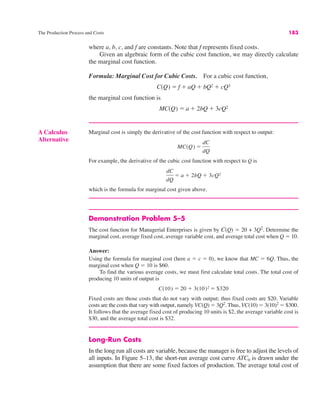
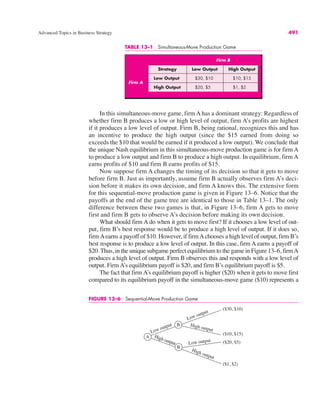
MICHAEL R. BAYE
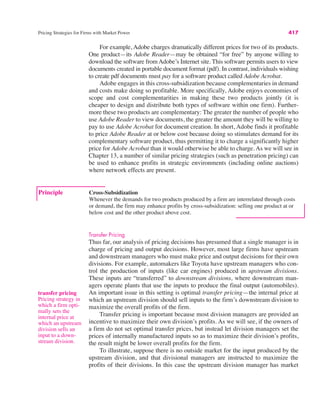
MICHAEL R. BAYE
7e
MANAGERIAL ECONOMICS
AND BUSINESS STRATEGY
MICHAEL R. BAYE
Managerial Economics and
Business Strategy
Nash Equilibrium • Predatory Pricing • Mergers & Acquisitions •
Demand Elasticity • Vertical Foreclosure • Penetration Pricing •
Marginal Cost • Bottlenecks • First-Mover Advantage • Signaling •
Learning Curve • Marginal Revenue • Repeated Games • Microsoft •
Screening • Network Effects • Antitrust • Cost Complementarities •
Two-Part Pricing • Limit Pricing • Tariffs • Bargaining • Cournot
Oligopoly • American Airlines • Raising Rivals’ Costs • Moral Hazard •
eBay • Price Discrimination • Adverse Selection • Economies of Scope
• Auctions • Bundling • Block Pricing • Stackelberg Oligopoly •
Advertising • Perfect Equilibrium • Coordination • General Motors •
Quotas • Extensive Form Games • Economies of Scale • Netscape •
Hold-up Problem • Patents • Bertrand Oligopoly • Commitment •
Economies of Scale • Tariffs • Antitrust • Transfer Pricing • Collusion
• Piece Rates • Profit-Sharing • Sunk Costs • Takeovers • Trigger
Strategies • Low-Price Guarantees • Sony • Time Warner • Five
Forces Framework • AOL • Globalization • Best-Response Function •
Cannibalization • Product Differentiation • Value of Information
SEVENTH EDITION
Managerial Economics and
Business Strategy
Michael R. Baye
Bert Elwert Professor of Business Economics & Public Policy
Kelley School of Business
Indiana University
MANAGERIAL ECONOMICS AND BUSINESS STRATEGY
Published by McGraw-Hill/Irwin, a business unit of The McGraw-Hill Companies, Inc., 1221 Avenue of the
Americas, New York, NY, 10020. Copyright © 2010, 2008, 2006, 2003, 2000, 1997, 1994 by The McGraw-Hill
Companies, Inc. All rights reserved. No part of this publication may be reproduced or distributed in any form or
by any means, or stored in a database or retrieval system, without the prior written consent of The McGraw-Hill
Companies, Inc., including, but not limited to, in any network or other electronic storage or transmission, or
broadcast for distance learning.
Some ancillaries, including electronic and print components, may not be available to customers outside the
United States.
This book is printed on acid-free paper.
1 2 3 4 5 6 7 8 9 0 DOC/DOC 0 9
ISBN 978-0-07-337596-0
MHID 0-07-337596-9
Vice president and editor-in-chief: Brent Gordon
Publisher: Douglas Reiner
Director of development: Ann Torbert
Development editor: Anne E. Hilbert
Vice president and director of marketing: Robin J. Zwettler
Associate marketing manager: Dean Karampelas
Vice president of editing, design and production: Sesha Bolisetty
Senior project manager: Bruce Gin
Senior production supervisor: Debra R. Sylvester
Designer: Matt Diamond
Senior media project manager: Greg Bates
Cover design: Matt Diamond
Interior design: Matt Diamond
Typeface: 10/12 Times Roman
Compositor: Laserwords Private Limited
Printer: R. R. Donnelley
Library of Congress Cataloging-in-Publication Data
Baye, Michael R., 1958-
Managerial economics and business strategy / Michael R. Baye. — 7th ed.
p. cm.
Includes index.
ISBN-13: 978-0-07-337596-0 (alk.paper)
ISBN-10: 0-07-337596-9 (alk. paper)
1. Managerial economics. 2. Strategic planning. I. Title.
HD30.22.B38 2010
338.5024'658—dc22
2009017267
www.mhhe.com
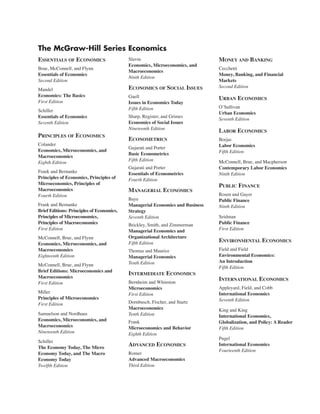
The McGraw-Hill Series Economics
ESSENTIALS OF ECONOMICS
Brue, McConnell, and Flynn
Essentials of Economics
Second Edition
Mandel
Economics: The Basics
First Edition
Schiller
Essentials of Economics
Seventh Edition
PRINCIPLES OF ECONOMICS
Colander
Economics, Microeconomics, and
Macroeconomics
Eighth Edition
Frank and Bernanke
Principles of Economics, Principles of
Microeconomics, Principles of
Macroeconomics
Fourth Edition
Frank and Bernanke
Brief Editions: Principles of Economics,
Principles of Microeconomics,
Principles of Macroeconomics
First Edition
McConnell, Brue, and Flynn
Economics, Microeconomics, and
Macroeconomics
Eighteenth Edition
McConnell, Brue, and Flynn
Brief Editions: Microeconomics and
Macroeconomics
First Edition
Miller
Principles of Microeconomics
First Edition
Samuelson and Nordhaus
Economics, Microeconomics, and
Macroeconomics
Nineteenth Edition
Schiller
The Economy Today, The Micro
Economy Today, and The Macro
Economy Today
Twelfth Edition
Slavin
Economics, Microeconomics, and
Macroeconomics
Ninth Edition
ECONOMICS OF SOCIAL ISSUES
Guell
Issues in Economics Today
Fifth Edition
Sharp, Register, and Grimes
Economics of Social Issues
Nineteenth Edition
ECONOMETRICS
Gujarati and Porter
Basic Econometrics
Fifth Edition
Gujarati and Porter
Essentials of Econometrics
Fourth Edition
MANAGERIAL ECONOMICS
Baye
Managerial Economics and Business
Strategy
Seventh Edition
Brickley, Smith, and Zimmerman
Managerial Economics and
Organizational Architecture
Fifth Edition
Thomas and Maurice
Managerial Economics
Tenth Edition
INTERMEDIATE ECONOMICS
Bernheim and Whinston
Microeconomics
First Edition
Dornbusch, Fischer, and Startz
Macroeconomics
Tenth Edition
Frank
Microeconomics and Behavior
Eighth Edition
ADVANCED ECONOMICS
Romer
Advanced Macroeconomics
Third Edition
MONEY AND BANKING
Cecchetti
Money, Banking, and Financial
Markets
Second Edition
URBAN ECONOMICS
O’Sullivan
Urban Economics
Seventh Edition
LABOR ECONOMICS
Borjas
Labor Economics
Fifth Edition
McConnell, Brue, and Macpherson
Contemporary Labor Economics
Ninth Edition
PUBLIC FINANCE
Rosen and Gayer
Public Finance
Ninth Edition
Seidman
Public Finance
First Edition
ENVIRONMENTAL ECONOMICS
Field and Field
Environmental Economics:
An Introduction
Fifth Edition
INTERNATIONAL ECONOMICS
Appleyard, Field, and Cobb
International Economics
Seventh Edition
King and King
International Economics,
Globalization, and Policy: A Reader
Fifth Edition
Pugel
International Economics
Fourteenth Edition
vi
ABOUT THE AUTHOR
Michael Baye is the Bert Elwert Professor of Business Economics & Public Policy at
Indiana University’s Kelley School of Business. He received his B.S. in economics
from Texas A&M University in 1980 and earned a Ph.D. in economics from Purdue
University in 1983. Prior to joining Indiana University, he taught graduate and under-
graduate courses at The Pennsylvania State University, Texas A&M University, and
the University of Kentucky. Professor Baye served as the Director of the Bureau of
Economics at the Federal Trade Commission from July 2007–December 2008.
Professor Baye has won numerous awards for his outstanding teaching and
research and regularly teaches courses in managerial economics and industrial
organization at the undergraduate, M.B.A., and Ph.D. levels. Professor Baye has
made a variety of contributions to the fields of game theory and industrial organi-
zation. His research on mergers, auctions, and contests has been published in such
journals as the American Economic Review, the Review of Economic Studies, and
the Economic Journal. Professor Baye’s research on pricing strategies in online and
other environments where consumers search for price information has been pub-
lished in economics journals (such as the American Economic Review, Economet-
rica, and the Journal of Political Economy), featured in the popular press
(including The Wall Street Journal, Forbes, and The New York Times), and pub-
lished in leading marketing journals. His research has been supported by the
National Science Foundation, the Fulbright Commission, and other organizations.
Professor Baye has held visiting appointments at Cambridge, Oxford, Erasmus
University, Tilburg University, and the New Economic School in Moscow, Russia.
He has served on numerous editorial boards in economics as well as marketing,
including Economic Theory and the Journal of Public Policy & Marketing. When
he is not teaching or engaged in research, Michael enjoys activities ranging from
camping to shopping for electronic gadgets.
To Natalie and Mitchell—Thanks for teaching me about the buyer side of the
college market.
vii
PREFACE TO THE SEVENTH EDITION
Thanks to feedback from users around the world, Managerial Economics and Busi-
ness Strategy remains the top selling managerial text in the market. I am grateful to
all of you for allowing me to provide this updated and improved product. Before
highlighting some of the new features of the seventh edition, I would like to stress
that the fundamental goal of the book—providing students with the tools from
intermediate microeconomics, game theory, and industrial organization that they
need to make sound managerial decisions—has not changed.
This book begins by teaching managers the practical utility of basic economic
tools such as present value analysis, supply and demand, regression, indifference
curves, isoquants, production, costs, and the basic models of perfect competition,
monopoly, and monopolistic competition. Adopters and reviewers also praise the
book for its real-world examples and because it includes modern topics not con-
tained in any other single managerial economics textbook: oligopoly, penetration
pricing, multistage and repeated games, foreclosure, contracting, vertical and hori-
zontal integration, networks, bargaining, predatory pricing, principal–agent prob-
lems, raising rivals’ costs, adverse selection, auctions, screening and signaling,
search, limit pricing, and a host of other pricing strategies for firms enjoying mar-
ket power. This balanced coverage of traditional and modern microeconomic tools
makes it appropriate for a wide variety of managerial economics classrooms. An
increasing number of business schools are adopting this book to replace (or use
alongside) managerial strategy texts laden with anecdotes but lacking the micro-
economic tools needed to identify and implement the business strategies that are
optimal in a given situation.
This seventh edition of Managerial Economics and Business Strategy has been
thoroughly updated but retains all of the content that made previous editions suc-
cessful. The basic structure of the textbook is unchanged.
KEY PEDAGOGICAL FEATURES
The seventh edition retains all of the class-tested features of previous editions
that enhance students’ learning experiences and make it easy to teach from this
book.
Headlines
As in previous editions, each chapter begins with a Headline that is based on a real-
world economic problem—a problem that students should be able to address after
completing the chapter. These Headlines are essentially hand-picked “mini-cases”
designed to motivate students to learn the material in the chapter. Each Headline is
viii Preface
answered at the end of the relevant chapter—when the student is better prepared to
deal with the complications of real-world problems. Reviewers as well as users of
previous editions praise the Headlines not only because they motivate students to
learn the material in the chapter, but also because the answers at the end of each
chapter help students learn how to use economics to make business decisions.
Learning Objectives
Each chapter includes learning objectives designed to enhance the learning experi-
ence.
Demonstration Problems
The best way to learn economics is to practice solving economic problems. So, in
addition to the Headlines, each chapter contains many Demonstration Problems
sprinkled throughout the text, along with detailed answers. This provides students
with a mechanism to verify that they have mastered the material and reduces the
cost to students and instructors of having to meet during office hours to discuss
answers to problems.
Inside Business Applications
Each chapter contains boxed material (called Inside Business applications) to illus-
trate how theories explained in the text relate to a host of different business situa-
tions. As in previous editions, I have tried to strike a balance between applications
drawn from the current economic literature and the popular press.
Calculus and Noncalculus Alternatives
Users can easily include or exclude calculus-based material without losing content
or continuity. That’s because the basic principles and formulae needed to solve a
particular class of economic problems (e.g., MR ! MC) are first stated without
appealing to the notation of calculus. Immediately following each stated principle
or formula is a clearly marked Calculus Alternative. Each of these calculus alterna-
tives states the preceding principle or formula in calculus notation, and explains the
relation between the calculus and noncalculus formula. More detailed calculus der-
ivations are relegated to Appendices. Thus, the book is designed for use by instruc-
tors who want to integrate calculus into managerial economics and by those who do
not require students to use calculus.
Key Terms and Marginal Definitions
Each chapter ends with a list of key terms and concepts. These provide an easy
way for instructors to glean material covered in each chapter and for students to
check their mastery of terminology. In addition, marginal definitions are provided
throughout the text.
Preface ix
End-of-Chapter Problems
Three types of problems are offered. Highly structured but nonetheless challenging
Conceptual and Computational Questions stress fundamentals. These are followed
by Problems and Applications, which are far less structured and, like real-world deci-
sion environments, may contain more information than is actually needed to solve the
problem. Many of these applied problems are based on actual business events.
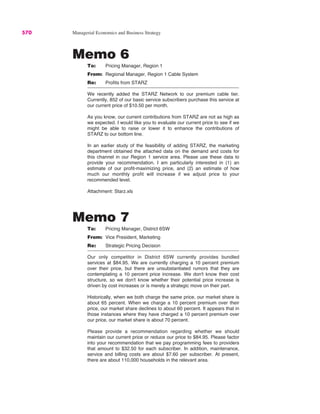
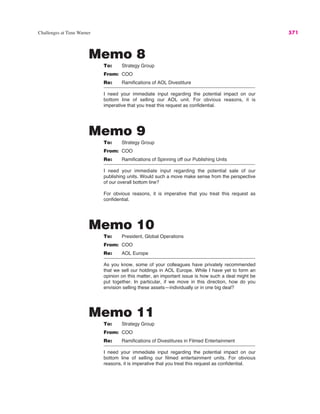
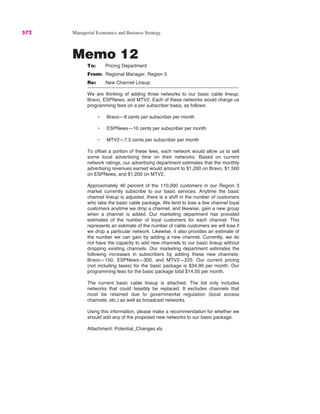
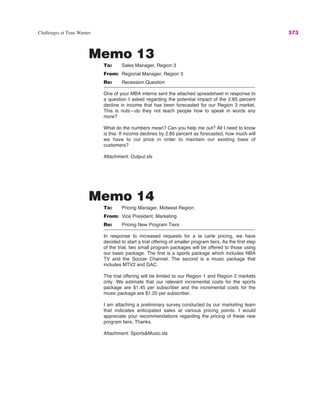
Additionally, the Time Warner case that follows Chapter 14 includes 14 prob-
lems called Memos that have a “real-world feel” and complement the text. All of
these case-based problems may be assigned on a chapter-by-chapter basis as spe-
cific skills are introduced, or as part of a capstone experience. Solutions to all of the
memos are contained online at www.mhhe.com/baye7e.
Answers to selected end-of-chapter Conceptual and Computational Questions
are presented at the end of the book; detailed answers to all problems—including
Problems and Applications and the Time Warner case Memos, are available to
instructors on the password-protected Web site.
Case Study
A case study in business strategy—Challenges at Time Warner—follows Chapter
14 and was prepared by Kyle Anderson, Michael Baye, and Dong Chen especially
for this text. It can be used either as a capstone case for the course or to supplement
individual chapters. The case allows students to apply core elements from manage-
rial economics to a remarkably rich business environment. Instructors can use the
case as the basis for an “open-ended” discussion of business strategy, or they can
assign specific “memos” (contained at the end of the case) that require students to
apply specific tools from managerial economics to the case. Teaching notes, as well
as solutions to all of the memos, are provided on the Web site.
Flexibility
Instructors of managerial economics have genuinely heterogeneous textbook
needs. Reviewers and users continue to praise the book for its flexibility, and assure
us that sections or even entire chapters can be excluded without losing continuity.
For instance, an instructor wishing to stress microeconomic fundamentals might
choose to cover Chapters 2, 3, 4, 5, 8, 9, 10, 11, and 12. An instructor teaching a
more applied course that stresses business strategy might choose to cover Chapters
1, 2, 3, 5, 6, 7, 8, 10, 11, and 13. Each may choose to include additional chapters (for
example, Chapter 14 or the Time Warner case) as time permits. More generally,
instructors can easily omit topics such as present value analysis, regression, indif-
ference curves, isoquants, or reaction functions without losing continuity.
Online Resources at www.mhhe.com/baye7e
A large assortment of student supplements for Managerial Economics and Business
Strategy are available online at www.mhhe.com/baye7e. This includes data for the Time
Warner case Memos, data needed for various end-of-chapter problems, spreadsheet
x Preface
versions of key tables in the text to enable students to see how key economic
concepts—like marginal cost and profit maximization—can be implemented on stan-
dard spreadsheets, and spreadsheet macros that students can use to find the optimum
price and quantity under a variety of market settings, including monopoly, Cournot oli-
gopoly, and Stackelberg oligopoly. Plus, the Web site includes 10 additional full-length
cases (in pdf format) that are described below.
CourseSmart is a new way for faculty to find and review eTextbooks. It’s also a great
option for students who are interested in accessing their course materials digitally.
CourseSmart offers thousands of the most commonly adopted textbooks across hun-
dreds of courses from a wide variety of higher education publishers. It is the only place
for faculty to review and compare the full text of a textbook online. At CourseSmart,
students can save up to 50% off the cost of a print book, reduce their impact on the
environment, and gain access to powerful Web tools for learning including full text
search, notes and highlighting, and email tools for sharing notes between classmates.
Your eBook also includes tech support in case you ever need help.
Finding your eBook is easy. Visit www.CourseSmart.com and search by title,
author, or ISBN.
SUPPLEMENTS
I am pleased to report that the seventh edition of Managerial Economics and Busi-
ness Strategy truly offers adopters the most comprehensive and easily accessible
supplements in the market. Below I discuss popular features of some of the supple-
ments that have been greatly expanded for this edition.
Cases
In addition to the Time Warner case, the Web site contains nearly a dozen full-
length cases that I prepared along with Patrick Scholten to accompany Managerial
Economics and Business Strategy. These cases complement the textbook by show-
ing how real-world businesses use tools like demand elasticities, markup pricing,
third-degree price discrimination, bundling, Herfindahl indices, game theory, and
predatory pricing to enhance profits or shape business strategies. The cases are
based on actual decisions by companies that include Microsoft, Heinz, Visa, Sta-
ples, American Airlines, Sprint, and Kodak. Instructors who adopt the seventh edi-
tion obtain the cases on the Web site.
The Web site for the seventh edition contains expanded teaching notes and
solutions for all of the cases—including the Time Warner case.
PowerPoint Slides
The Web site also contains thoroughly updated and fully editable PowerPoint presen-
tations with animated figures and graphs to make teaching and learning a snap. For
instance, a simple mouse click reveals the firm’s demand curve. Another click reveals
the associated marginal revenue curve.Another click shows the firm’s marginal cost.A
few more clicks, and students see how to determine the profit-maximizing output,
price, and maximum profits.Animated graphs and tables are also provided for all other
Preface xi
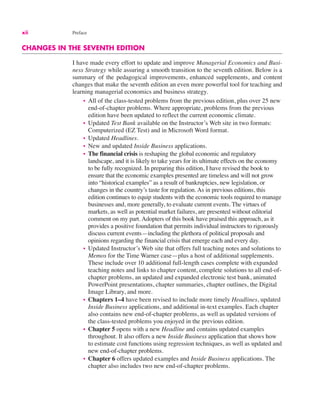
relevant concepts (like Cournot and Stackelberg equilibrium, normal form and exten-
sive form games, and the like).
Instructor’s Manual/Test Bank
A thoroughly updated instructor’s manual and test bank, prepared by Michael R.
Baye and Patrick Scholten, provides a summary of each chapter, a teaching outline
for each chapter, complete answers to all end-of-chapter problems, updated and
class-tested problems (including over 1,000 multiple-choice questions and over 250
problems with detailed solutions). The seventh edition Web site contains teaching
notes for the Time Warner case and solutions to the 14 accompanying Memos, as
well as expanded and improved teaching notes for the additional cases.
EZ Test Version of the Test Bank
The password-protected Web site contains test bank files in both EZ Test software as
well as in Microsoft Word format. EZ Test can reproduce high-quality graphs from
the test bank and allows instructors to generate multiple tests with versions that are
“scrambled” to be distinctive. The software is easy to use and allows optimum cus-
tomization of tests.
Digital Image Library
The Digital Image Library contains all the figures in the textbook in electronic for-
mat. This gives instructors the flexibility to integrate figures from the textbook into
PowerPoint presentations or to directly print the figures on overhead transparencies.
Study Guide
In addition to the numerous problems and answers contained in the textbook, an
updated study guide prepared by yours truly is available to enhance student per-
formance at minimal cost to students and professors.
Student Web Site
Please visit the enhanced Web site for Managerial Economics and Business Strategy
at www.mhhe.com/baye7e. This site provides a host of information for students and
instructors, including online quizzes, PowerPoint presentations, Inside Business
applications from previous editions of the text, sample problems from the Study
Guide, and other material designed to help students and instructors more effectively
use both the textbook and Study Guide.
Instructor Web Site
Electronic versions of all instructor supplements (including the full-length cases
complete with teaching notes, PowerPoint presentations, Digital Image Library, the
electronic test bank, detailed solutions to every end-of-chapter problem and Time
Warner case, chapter outlines, chapter summaries, and more) may be conveniently
accessed on the password-protected Instructor's Web site. This makes it easy for
instructors to use the many supplements designed to make teaching managerial
economics from the seventh edition easy and fun.
xii Preface
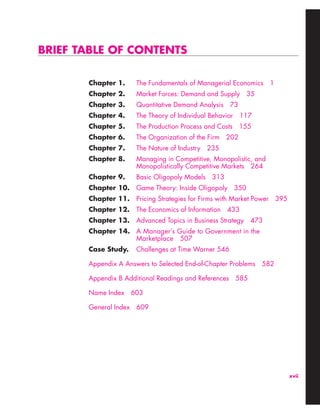
CHANGES IN THE SEVENTH EDITION
I have made every effort to update and improve Managerial Economics and Busi-
ness Strategy while assuring a smooth transition to the seventh edition. Below is a
summary of the pedagogical improvements, enhanced supplements, and content
changes that make the seventh edition an even more powerful tool for teaching and
learning managerial economics and business strategy.
• All of the class-tested problems from the previous edition, plus over 25 new
end-of-chapter problems. Where appropriate, problems from the previous
edition have been updated to reflect the current economic climate.
• Updated Test Bank available on the Instructor’s Web site in two formats:
Computerized (EZ Test) and in Microsoft Word format.
• Updated Headlines.
• New and updated Inside Business applications.
• The financial crisis is reshaping the global economic and regulatory
landscape, and it is likely to take years for its ultimate effects on the economy
to be fully recognized. In preparing this edition, I have revised the book to
ensure that the economic examples presented are timeless and will not grow
into “historical examples” as a result of bankruptcies, new legislation, or
changes in the country’s taste for regulation. As in previous editions, this
edition continues to equip students with the economic tools required to manage
businesses and, more generally, to evaluate current events. The virtues of
markets, as well as potential market failures, are presented without editorial
comment on my part. Adopters of this book have praised this approach, as it
provides a positive foundation that permits individual instructors to rigorously
discuss current events—including the plethora of political proposals and
opinions regarding the financial crisis that emerge each and every day.
• Updated Instructor’s Web site that offers full teaching notes and solutions to
Memos for the Time Warner case—plus a host of additional supplements.
These include over 10 additional full-length cases complete with expanded
teaching notes and links to chapter content, complete solutions to all end-of-
chapter problems, an updated and expanded electronic test bank, animated
PowerPoint presentations, chapter summaries, chapter outlines, the Digital
Image Library, and more.
• Chapters 1–4 have been revised to include more timely Headlines, updated
Inside Business applications, and additional in-text examples. Each chapter
also contains new end-of-chapter problems, as well as updated versions of
the class-tested problems you enjoyed in the previous edition.
• Chapter 5 opens with a new Headline and contains updated examples
throughout. It also offers a new Inside Business application that shows how
to estimate cost functions using regression techniques, as well as updated and
new end-of-chapter problems.
• Chapter 6 offers updated examples and Inside Business applications. The
chapter also includes two new end-of-chapter problems.
Preface xiii
• Chapter 7 contains thoroughly updated examples and industry data, along with
a new Inside Business application that describes the 2007 North American
Industry Classification System (NAICS). Additionally, the in-text discussion
of horizontal mergers has been revised to reflect current practices at the
Federal Trade Commission and Antitrust Division of the U.S. Department of
Justice. The chapter also includes two new end-of-chapter problems.
• Chapter 8 offers a new opening Headline, updated Inside Business
applications and in-text examples, and new content on the pitfalls of brand
myopia. Several new end-of-chapter problems are provided, along with
updated versions of the problems contained in the previous edition.
• Chapter 9 provides improved exposition of a variety of oligopoly models.
The opening Headline and Inside Business applications have been updated,
and the chapter includes two new end-of-chapter problems.
• Chapter 10 opens with a new Headline and includes two new end-of-chapter
problems.
• Chapter 11 now offers some caveats to managers who use markup formulas
to price their products or services, and includes an improved exposition of
price discrimination. Examples have been updated throughout, and two new
end-of-chapter problems are provided.
• Chapters 12–14 include updated Headlines, updated Inside Business
applications, and new end-of-chapter problems. Chapters 13 and 14 now offer
succinct coverage of antitrust issues that can constrain the scope of business
strategies, such as pricing and mergers.
ACKNOWLEDGMENTS
I thank the many users of Managerial Economics and Business Strategy who pro-
vided both direct and indirect feedback that has helped improve your book. This
includes thousands of students at Indiana University’s Kelley School of Business
and instructors worldwide who have used my book in their own classrooms, col-
leagues who unselfishly gave up their own time to provide me with comments and
suggestions, and reviewers who provided detailed suggestions to improve this and
previous editions of the book. I especially thank the following professors for
enlightening me on the market’s diverse needs and for providing suggestions and
constructive criticisms to improve this book:
Fatma Abdel-Raouf, Goldey-Beacom College
Burton Abrams, University of Delaware
Rashid Al-Hmoud, Texas Tech University
Anthony Paul Andrews, Governors State University
Sisay Asefa, Western Michigan University
Simon Avenell, Murdoch University
Joseph P. Bailey, University of Maryland
Dean Baim, Pepperdine University
xiv Preface
Sheryl Ball, Virginia Polytechnic University
Klaus Becker, Texas Tech University
Richard Beil, Auburn University
Barbara C. Belivieu, University of Connecticut
Dan Black, University of Chicago
Louis Cain, Northwestern University
Leo Chan, University of Kansas
Robert L. Chapman, Florida Metropolitan University
Basanta Chaudhuri, Rutgers University-New Brunswick
Kwang Soo Cheong, Johns Hopkins University
Christopher B. Colburn, Old Dominion University
Michael Conlin, Syracuse University
Keith Crocker, Penn State University
Ian Cromb, University of Western Ontario
Dean Croushore, Federal Reserve
Wilffrid W. Csaplar Jr., Bethany College
Shah Dabirian, California State University, Long Beach
George Darko, Tusculum College
Tina Das, Elon University
Ron Deiter, Iowa State University
Casey Dirienzo, Appalachian State University
Eric Drabkin, Hawaii Pacific University
Martine Duchatelet, Barry University
Keven C. Duncan, University of Southern Colorado
Yvonne Durham, Western Washington University
Ibrahim Elsaify, Goldey-Beacom College
Mark J. Eschenfelder, Robert Morris University
David Ely, San Diego State University
David Figlio, University of Florida
Ray Fisman, Graduate School of Business, Columbia University
Silke Forbes, University of California—San Diego
David Gerard, Carnegie Mellon University
Sharon Gifford, Rutgers University
Lynn G. Gillette, Northeast Missouri State University
Otis Gilley, Louisiana Tech University
Roy Gobin, Loyola University
Stephan Gohmann, University of Louisville
Steven Gold, Rochester Institute of Technology
Thomas A. Gresik, Mendoza College of Business (University of Notre Dame)
Andrea Mays Griffith, California State University
Madhurima Gupta, University of Notre Dame
Carl Gwin, Pepperdine University
Preface xv
Gail Heyne Hafer, Lindenwood College
Karen Hallows, George Mason University
William Hamlen Jr., SUNY Buffalo
Shawkat Hammoudeh, Drexel University
Mehdi Harian, Bloomsburg University
Nile W. Hatch, Marriott School (Brigham Young University)
Clifford Hawley, West Virginia University
Ove Hedegaard, Copenhagen Business School
Steven Hinson, Webster University
Hart Hodges, Western Washington University
Jack Hou, California State University—Long Beach
Lowel R. Jacobsen, William Jewell College
Thomas D. Jeitschko, Texas A&M University
Jaswant R. Jindia, Southern University
Paul Kattuman, Judge Business School (Cambridge University)
Brian Kench, University of Tampa
Peter Klein, University of Georgia, University of Missouri-Columbia
Audrey D. Kline, University of Louisville
W. J. Lane, University of New Orleans
Daniel Lee, Shippensburg University
Dick Leiter, American Public University
Canlin Li, University of California-Riverside
Vahe Lskavyan, Ohio University-Athens
Heather Luea, Newman University
Thomas Lyon, University of Michigan
Richard Marcus, University of Wisconsin—Milwaukee
Vincent Marra, University of Delaware
Wade Martin, California State University, Long Beach
Catherine Matraves, Michigan State University-East Lansing
John Maxwell, Indiana University
David May, Oklahoma City University
Alan McInnes, California State University, Fullerton
Christopher McIntosh, University of Minnesota Duluth
Edward Millner, Virginia Commonwealth University
John Moran, Syracuse University
John Morgan, Haas Business School (University of California—Berkeley)
Ram Mudambi, Temple University
Francis Mummery, California State University-Fullerton
Inder Nijhawan, Fayetteville State University
Albert A. Okunade, University of Memphis
Darrell Parker, Georgia Southern University
Stephen Pollard, California State University, Los Angeles
xvi Preface
Dwight A. Porter, College of St. Thomas
Stanko Racic, University of Pittsburgh
Eric Rasmusen, Indiana University
Matthew Roelofs, Western Washington University
Christian Roessler, National University of Singapore
Bansi Sawhney, University of Baltimore
Craig Schulman, University of Arkansas
Karen Schultes, University of Michigan—Dearborn
Peter M. Schwartz, University of North Carolina
Edward Shinnick, University College Ireland
Dean Showalter, Southwest Texas State University
Chandra Shrestha, Virginia Commonwealth University
Karen Smith, Columbia Southern University
John Stapleford, Eastern University
Mark Stegeman, Virginia Polytechnic University
Ed Steinberg, New York University
Barbara M. Suleski, Cardinal Stritch College
Caroline Swartz, University of North Carolina Charlotte
Bill Taylor, New Mexico Highlands University
Roger Tutterow, Kennesaw State College
Nora Underwood, University of Central Florida
Lskavyan Vahe, Ohio University
Lawrence White, Stern School of Business (New York University)
Leonard White, University of Arkansas
Keith Willett, Oklahoma State University-Stillwater
Mike Williams, Bethune Cookman College
Richard Winkelman, Arizona State University
Eduardo Zambrano, University of Notre Dame
Rick Zuber, University of North Carolina, Charlotte
I thank Anne Hilbert, Douglas Reiner, and Bruce Gin at McGraw-Hill for all they
have done to make this project a success, andAlexander V. Borisov and Lan Zhang for
assisting me during various stages of the revision. I once again am indebted to Patrick
Scholten for his efforts to improve this book and its supplements. Also, my thanks to
Philip Powell and Patrick Scholten for their review. Finally, I thank my family—
M’Lissa, Natalie, and Mitchell—for their continued love and support.
As always, I welcome your comments and suggestions for the next edition.
Visit my Web site, http://www.nash-equilibrium.com/, or write to me directly at
mbaye@indiana.edu.
Michael R. Baye
Bloomington, Indiana
xvii
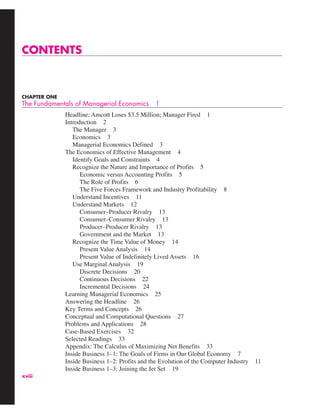
BRIEF TABLE OF CONTENTS
Chapter 1. The Fundamentals of Managerial Economics 1
Chapter 2. Market Forces: Demand and Supply 35
Chapter 3. Quantitative Demand Analysis 73
Chapter 4. The Theory of Individual Behavior 117
Chapter 5. The Production Process and Costs 155
Chapter 6. The Organization of the Firm 202
Chapter 7. The Nature of Industry 235
Chapter 8. Managing in Competitive, Monopolistic, and
Monopolistically Competitive Markets 264
Chapter 9. Basic Oligopoly Models 313
Chapter 10. Game Theory: Inside Oligopoly 350
Chapter 11. Pricing Strategies for Firms with Market Power 395
Chapter 12. The Economics of Information 433
Chapter 13. Advanced Topics in Business Strategy 473
Chapter 14. A Manager’s Guide to Government in the
Marketplace 507
Case Study. Challenges at Time Warner 546
Appendix A Answers to Selected End-of-Chapter Problems 582
Appendix B Additional Readings and References 585
Name Index 603
General Index 609
xviii
CONTENTS
CHAPTER ONE
The Fundamentals of Managerial Economics 1
Headline: Amcott Loses $3.5 Million; Manager Fired 1
Introduction 2
The Manager 3
Economics 3
Managerial Economics Defined 3
The Economics of Effective Management 4
Identify Goals and Constraints 4
Recognize the Nature and Importance of Profits 5
Economic versus Accounting Profits 5
The Role of Profits 6
The Five Forces Framework and Industry Profitability 8
Understand Incentives 11
Understand Markets 12
Consumer–Producer Rivalry 13
Consumer–Consumer Rivalry 13
Producer–Producer Rivalry 13
Government and the Market 13
Recognize the Time Value of Money 14
Present Value Analysis 14
Present Value of Indefinitely Lived Assets 16
Use Marginal Analysis 19
Discrete Decisions 20
Continuous Decisions 22
Incremental Decisions 24
Learning Managerial Economics 25
Answering the Headline 26
Key Terms and Concepts 26
Conceptual and Computational Questions 27
Problems and Applications 28
Case-Based Exercises 32
Selected Readings 33
Appendix: The Calculus of Maximizing Net Benefits 33
Inside Business 1–1: The Goals of Firms in Our Global Economy 7
Inside Business 1–2: Profits and the Evolution of the Computer Industry 11
Inside Business 1–3: Joining the Jet Set 19
Contents xix
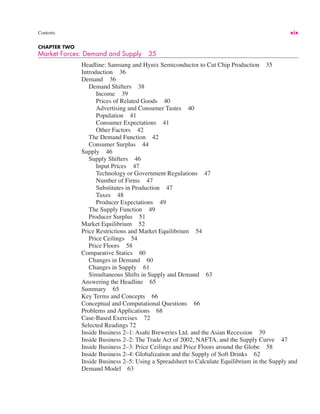
CHAPTER TWO
Market Forces: Demand and Supply 35
Headline: Samsung and Hynix Semiconductor to Cut Chip Production 35
Introduction 36
Demand 36
Demand Shifters 38
Income 39
Prices of Related Goods 40
Advertising and Consumer Tastes 40
Population 41
Consumer Expectations 41
Other Factors 42
The Demand Function 42
Consumer Surplus 44
Supply 46
Supply Shifters 46
Input Prices 47
Technology or Government Regulations 47
Number of Firms 47
Substitutes in Production 47
Taxes 48
Producer Expectations 49
The Supply Function 49
Producer Surplus 51
Market Equilibrium 52
Price Restrictions and Market Equilibrium 54
Price Ceilings 54
Price Floors 58
Comparative Statics 60
Changes in Demand 60
Changes in Supply 61
Simultaneous Shifts in Supply and Demand 63
Answering the Headline 65
Summary 65
Key Terms and Concepts 66
Conceptual and Computational Questions 66
Problems and Applications 68
Case-Based Exercises 72
Selected Readings 72
Inside Business 2–1: Asahi Breweries Ltd. and the Asian Recession 39
Inside Business 2–2: The Trade Act of 2002, NAFTA, and the Supply Curve 47
Inside Business 2–3: Price Ceilings and Price Floors around the Globe 58
Inside Business 2–4: Globalization and the Supply of Soft Drinks 62
Inside Business 2–5: Using a Spreadsheet to Calculate Equilibrium in the Supply and
Demand Model 63
xx Contents
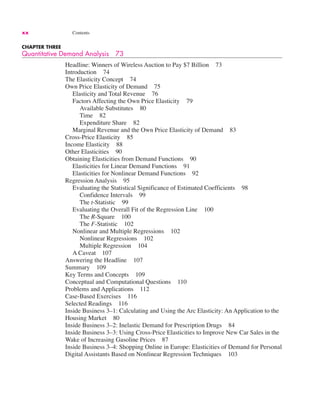
CHAPTER THREE
Quantitative Demand Analysis 73
Headline: Winners of Wireless Auction to Pay $7 Billion 73
Introduction 74
The Elasticity Concept 74
Own Price Elasticity of Demand 75
Elasticity and Total Revenue 76
Factors Affecting the Own Price Elasticity 79
Available Substitutes 80
Time 82
Expenditure Share 82
Marginal Revenue and the Own Price Elasticity of Demand 83
Cross-Price Elasticity 85
Income Elasticity 88
Other Elasticities 90
Obtaining Elasticities from Demand Functions 90
Elasticities for Linear Demand Functions 91
Elasticities for Nonlinear Demand Functions 92
Regression Analysis 95
Evaluating the Statistical Significance of Estimated Coefficients 98
Confidence Intervals 99
The t-Statistic 99
Evaluating the Overall Fit of the Regression Line 100
The R-Square 100
The F-Statistic 102
Nonlinear and Multiple Regressions 102
Nonlinear Regressions 102
Multiple Regression 104
A Caveat 107
Answering the Headline 107
Summary 109
Key Terms and Concepts 109
Conceptual and Computational Questions 110
Problems and Applications 112
Case-Based Exercises 116
Selected Readings 116
Inside Business 3–1: Calculating and Using the Arc Elasticity: An Application to the
Housing Market 80
Inside Business 3–2: Inelastic Demand for Prescription Drugs 84
Inside Business 3–3: Using Cross-Price Elasticities to Improve New Car Sales in the
Wake of Increasing Gasoline Prices 87
Inside Business 3–4: Shopping Online in Europe: Elasticities of Demand for Personal
Digital Assistants Based on Nonlinear Regression Techniques 103
Contents xxi
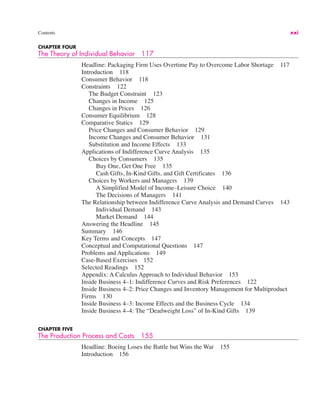
CHAPTER FOUR
The Theory of Individual Behavior 117
Headline: Packaging Firm Uses Overtime Pay to Overcome Labor Shortage 117
Introduction 118
Consumer Behavior 118
Constraints 122
The Budget Constraint 123
Changes in Income 125
Changes in Prices 126
Consumer Equilibrium 128
Comparative Statics 129
Price Changes and Consumer Behavior 129
Income Changes and Consumer Behavior 131
Substitution and Income Effects 133
Applications of Indifference Curve Analysis 135
Choices by Consumers 135
Buy One, Get One Free 135
Cash Gifts, In-Kind Gifts, and Gift Certificates 136
Choices by Workers and Managers 139
A Simplified Model of Income–Leisure Choice 140
The Decisions of Managers 141
The Relationship between Indifference Curve Analysis and Demand Curves 143
Individual Demand 143
Market Demand 144
Answering the Headline 145
Summary 146
Key Terms and Concepts 147
Conceptual and Computational Questions 147
Problems and Applications 149
Case-Based Exercises 152
Selected Readings 152
Appendix: A Calculus Approach to Individual Behavior 153
Inside Business 4–1: Indifference Curves and Risk Preferences 122
Inside Business 4–2: Price Changes and Inventory Management for Multiproduct
Firms 130
Inside Business 4–3: Income Effects and the Business Cycle 134
Inside Business 4–4: The “Deadweight Loss” of In-Kind Gifts 139
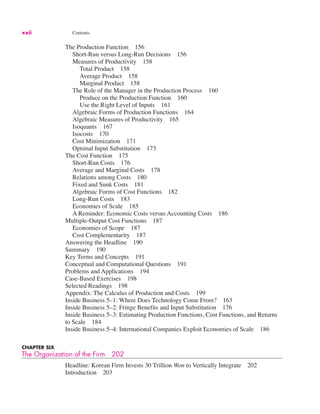
CHAPTER FIVE
The Production Process and Costs 155
Headline: Boeing Loses the Battle but Wins the War 155
Introduction 156
xxii Contents
The Production Function 156
Short-Run versus Long-Run Decisions 156
Measures of Productivity 158
Total Product 158
Average Product 158
Marginal Product 158
The Role of the Manager in the Production Process 160
Produce on the Production Function 160
Use the Right Level of Inputs 161
Algebraic Forms of Production Functions 164
Algebraic Measures of Productivity 165
Isoquants 167
Isocosts 170
Cost Minimization 171
Optimal Input Substitution 173
The Cost Function 175
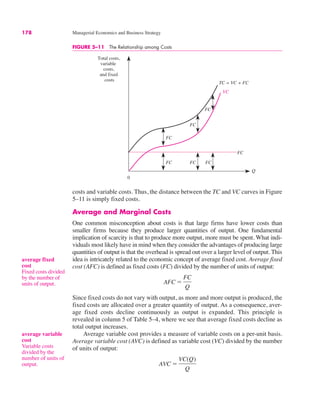
Short-Run Costs 176
Average and Marginal Costs 178
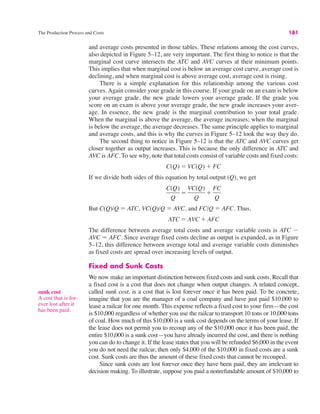
Relations among Costs 180
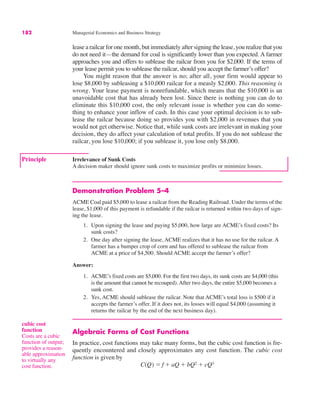
Fixed and Sunk Costs 181
Algebraic Forms of Cost Functions 182
Long-Run Costs 183
Economies of Scale 185
A Reminder: Economic Costs versus Accounting Costs 186
Multiple-Output Cost Functions 187
Economies of Scope 187
Cost Complementarity 187
Answering the Headline 190
Summary 190
Key Terms and Concepts 191
Conceptual and Computational Questions 191
Problems and Applications 194
Case-Based Exercises 198
Selected Readings 198
Appendix: The Calculus of Production and Costs 199
Inside Business 5–1: Where Does Technology Come From? 163
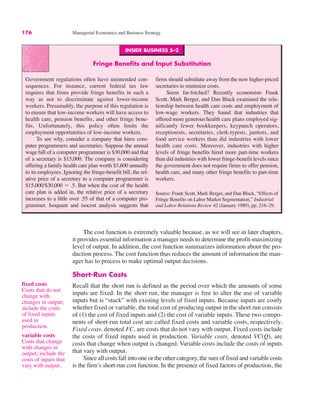
Inside Business 5–2: Fringe Benefits and Input Substitution 176
Inside Business 5–3: Estimating Production Functions, Cost Functions, and Returns
to Scale 184
Inside Business 5–4: International Companies Exploit Economies of Scale 186
CHAPTER SIX
The Organization of the Firm 202
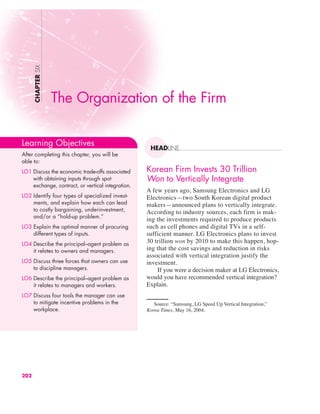
Headline: Korean Firm Invests 30 Trillion Won to Vertically Integrate 202
Introduction 203
Contents xxiii
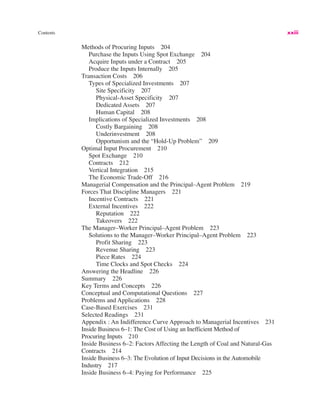
Methods of Procuring Inputs 204
Purchase the Inputs Using Spot Exchange 204
Acquire Inputs under a Contract 205
Produce the Inputs Internally 205
Transaction Costs 206
Types of Specialized Investments 207
Site Specificity 207
Physical-Asset Specificity 207
Dedicated Assets 207
Human Capital 208
Implications of Specialized Investments 208
Costly Bargaining 208
Underinvestment 208
Opportunism and the “Hold-Up Problem” 209
Optimal Input Procurement 210
Spot Exchange 210
Contracts 212
Vertical Integration 215
The Economic Trade-Off 216
Managerial Compensation and the Principal–Agent Problem 219
Forces That Discipline Managers 221
Incentive Contracts 221
External Incentives 222
Reputation 222
Takeovers 222
The Manager–Worker Principal–Agent Problem 223
Solutions to the Manager–Worker Principal–Agent Problem 223
Profit Sharing 223
Revenue Sharing 223
Piece Rates 224
Time Clocks and Spot Checks 224
Answering the Headline 226
Summary 226
Key Terms and Concepts 226
Conceptual and Computational Questions 227
Problems and Applications 228
Case-Based Exercises 231
Selected Readings 231
Appendix : An Indifference Curve Approach to Managerial Incentives 231
Inside Business 6–1: The Cost of Using an Inefficient Method of
Procuring Inputs 210
Inside Business 6–2: Factors Affecting the Length of Coal and Natural-Gas
Contracts 214
Inside Business 6–3: The Evolution of Input Decisions in the Automobile
Industry 217
Inside Business 6–4: Paying for Performance 225
xxiv Contents
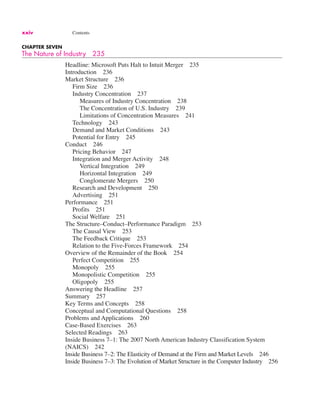
CHAPTER SEVEN
The Nature of Industry 235
Headline: Microsoft Puts Halt to Intuit Merger 235
Introduction 236
Market Structure 236
Firm Size 236
Industry Concentration 237
Measures of Industry Concentration 238
The Concentration of U.S. Industry 239
Limitations of Concentration Measures 241
Technology 243
Demand and Market Conditions 243
Potential for Entry 245
Conduct 246
Pricing Behavior 247
Integration and Merger Activity 248
Vertical Integration 249
Horizontal Integration 249
Conglomerate Mergers 250
Research and Development 250
Advertising 251
Performance 251
Profits 251
Social Welfare 251
The Structure–Conduct–Performance Paradigm 253
The Causal View 253
The Feedback Critique 253
Relation to the Five-Forces Framework 254
Overview of the Remainder of the Book 254
Perfect Competition 255
Monopoly 255
Monopolistic Competition 255
Oligopoly 255
Answering the Headline 257
Summary 257
Key Terms and Concepts 258
Conceptual and Computational Questions 258
Problems and Applications 260
Case-Based Exercises 263
Selected Readings 263
Inside Business 7–1: The 2007 North American Industry Classification System
(NAICS) 242
Inside Business 7–2: The Elasticity of Demand at the Firm and Market Levels 246
Inside Business 7–3: The Evolution of Market Structure in the Computer Industry 256
Contents xxv
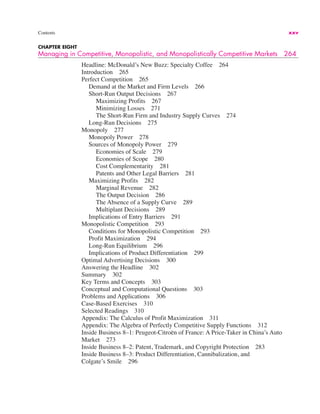
CHAPTER EIGHT
Managing in Competitive, Monopolistic, and Monopolistically Competitive Markets 264
Headline: McDonald’s New Buzz: Specialty Coffee 264
Introduction 265
Perfect Competition 265
Demand at the Market and Firm Levels 266
Short-Run Output Decisions 267
Maximizing Profits 267
Minimizing Losses 271
The Short-Run Firm and Industry Supply Curves 274
Long-Run Decisions 275
Monopoly 277
Monopoly Power 278
Sources of Monopoly Power 279
Economies of Scale 279
Economies of Scope 280
Cost Complementarity 281
Patents and Other Legal Barriers 281
Maximizing Profits 282
Marginal Revenue 282
The Output Decision 286
The Absence of a Supply Curve 289
Multiplant Decisions 289
Implications of Entry Barriers 291
Monopolistic Competition 293
Conditions for Monopolistic Competition 293
Profit Maximization 294
Long-Run Equilibrium 296
Implications of Product Differentiation 299
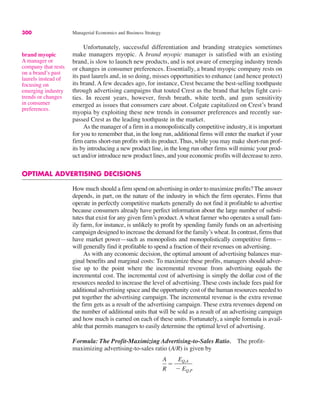
Optimal Advertising Decisions 300
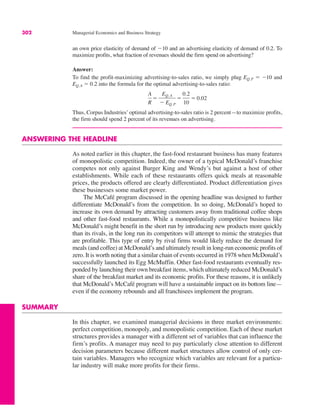
Answering the Headline 302
Summary 302
Key Terms and Concepts 303
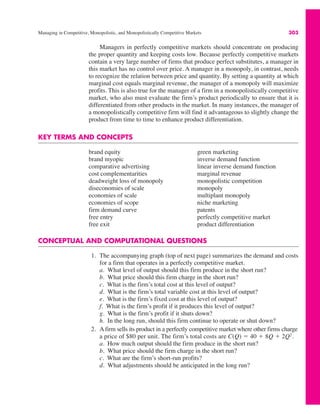
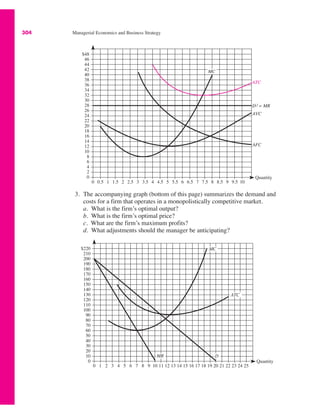
Conceptual and Computational Questions 303
Problems and Applications 306
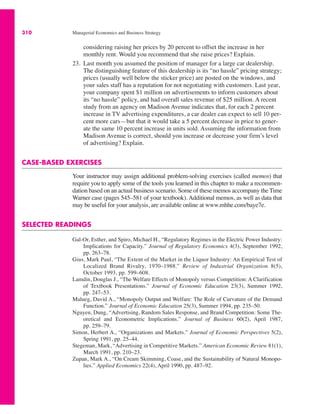
Case-Based Exercises 310
Selected Readings 310
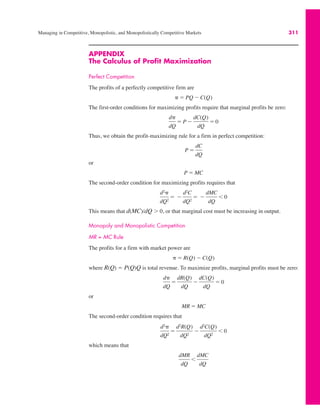
Appendix: The Calculus of Profit Maximization 311
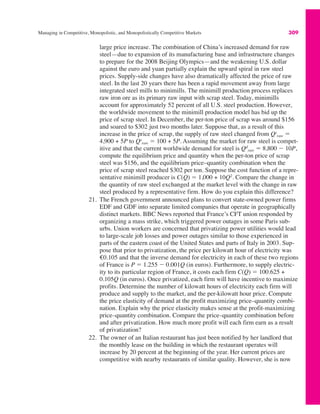
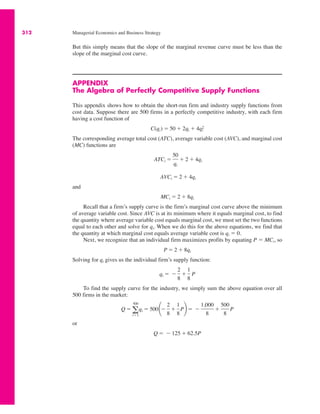
Appendix: The Algebra of Perfectly Competitive Supply Functions 312
Inside Business 8–1: Peugeot-Citroën of France: A Price-Taker in China’s Auto
Market 273
Inside Business 8–2: Patent, Trademark, and Copyright Protection 283
Inside Business 8–3: Product Differentiation, Cannibalization, and
Colgate’s Smile 296
xxvi Contents
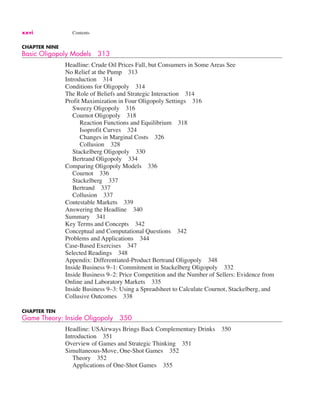
CHAPTER NINE
Basic Oligopoly Models 313
Headline: Crude Oil Prices Fall, but Consumers in Some Areas See
No Relief at the Pump 313
Introduction 314
Conditions for Oligopoly 314
The Role of Beliefs and Strategic Interaction 314
Profit Maximization in Four Oligopoly Settings 316
Sweezy Oligopoly 316
Cournot Oligopoly 318
Reaction Functions and Equilibrium 318
Isoprofit Curves 324
Changes in Marginal Costs 326
Collusion 328
Stackelberg Oligopoly 330
Bertrand Oligopoly 334
Comparing Oligopoly Models 336
Cournot 336
Stackelberg 337
Bertrand 337
Collusion 337
Contestable Markets 339
Answering the Headline 340
Summary 341
Key Terms and Concepts 342
Conceptual and Computational Questions 342
Problems and Applications 344
Case-Based Exercises 347
Selected Readings 348
Appendix: Differentiated-Product Bertrand Oligopoly 348
Inside Business 9–1: Commitment in Stackelberg Oligopoly 332
Inside Business 9–2: Price Competition and the Number of Sellers: Evidence from
Online and Laboratory Markets 335
Inside Business 9–3: Using a Spreadsheet to Calculate Cournot, Stackelberg, and
Collusive Outcomes 338
CHAPTER TEN
Game Theory: Inside Oligopoly 350
Headline: USAirways Brings Back Complementary Drinks 350
Introduction 351
Overview of Games and Strategic Thinking 351
Simultaneous-Move, One-Shot Games 352
Theory 352
Applications of One-Shot Games 355
Contents xxvii
Pricing Decisions 355
Advertising and Quality Decisions 358
Coordination Decisions 359
Monitoring Employees 360
Nash Bargaining 361
Infinitely Repeated Games 363
Theory 363
Review of Present Value 363
Supporting Collusion with Trigger Strategies 364
Factors Affecting Collusion in Pricing Games 367
Number of Firms 367
Firm Size 367
History of the Market 368
Punishment Mechanisms 369
An Application of Infinitely Repeated Games to Product Quality 369
Finitely Repeated Games 370
Games with an Uncertain Final Period 370
Repeated Games with a Known Final Period: The End-of-Period Problem 373
Applications of the End-of-Period Problem 375
Resignations and Quits 375
The “Snake-Oil” Salesman 375
Multistage Games 376
Theory 376
Applications of Multistage Games 379
The Entry Game 379
Innovation 380
Sequential Bargaining 381
Answering the Headline 384
Summary 385
Key Terms and Concepts 385
Conceptual and Computational Questions 386
Problems and Applications 389
Case-Based Exercises 394
Selected Readings 394
Inside Business 10–1: Hollywood’s (not so) Beautiful Mind: Nash or “Opie”
Equilibrium? 356
Inside Business 10–2: Trigger Strategies in the Waste Industry 368
Inside Business 10–3: Entry Strategies in International Markets: Sprinkler or
Waterfall? 380
CHAPTER ELEVEN
Pricing Strategies for Firms with Market Power 395
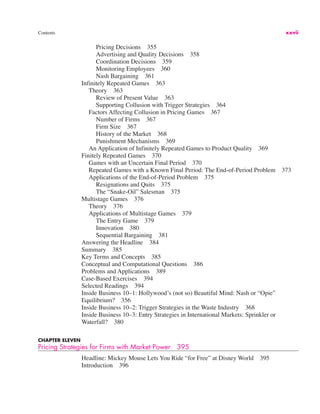
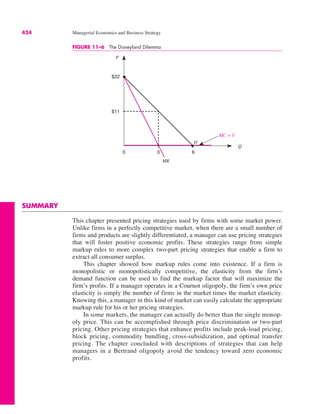
Headline: Mickey Mouse Lets You Ride “for Free” at Disney World 395
Introduction 396
xxviii Contents
Basic Pricing Strategies 396
Review of the Basic Rule of Profit Maximization 396
A Simple Pricing Rule for Monopoly and Monopolistic Competition 397
A Simple Pricing Rule for Cournot Oligopoly 400
Strategies That Yield Even Greater Profits 402
Extracting Surplus from Consumers 402
Price Discrimination 402
Two-Part Pricing 408
Block Pricing 410
Commodity Bundling 412
Pricing Strategies for Special Cost and Demand Structures 415
Peak-Load Pricing 415
Cross-Subsidies 416
Transfer Pricing 417
Pricing Strategies in Markets with Intense Price Competition 419
Price Matching 420
Inducing Brand Loyalty 421
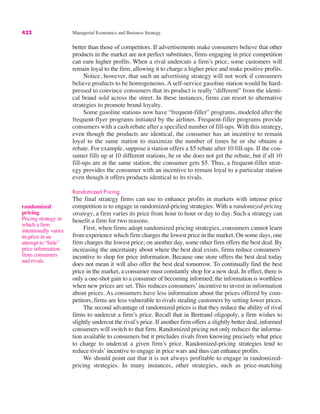
Randomized Pricing 422
Answering the Headline 423
Summary 424
Key Terms and Concepts 425
Conceptual and Computational Questions 425
Problems and Applications 428
Case-Based Exercises 431
Selected Readings 431
Inside Business 11–1: Pricing Markups as Rules of Thumb 398
Inside Business 11–2: Bundling and “Price Frames” in Online Markets 414
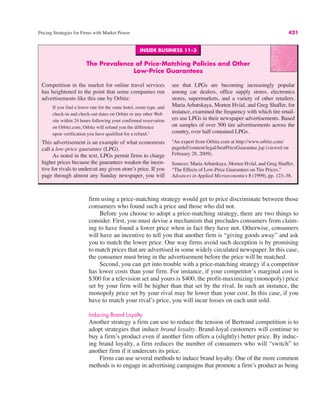
Inside Business 11–3: The Prevalence of Price-Matching Policies and Other Low-
Price Guarantees 421
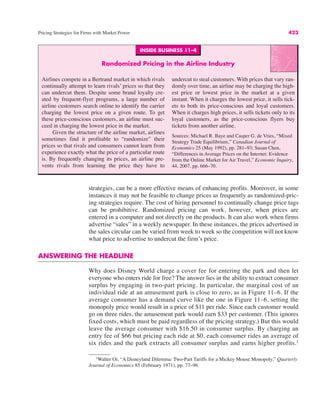
Inside Business 11–4: Randomized Pricing in the Airline Industry 423
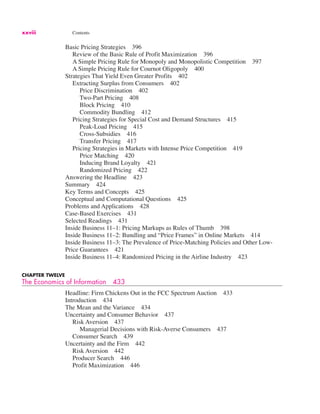
CHAPTER TWELVE
The Economics of Information 433
Headline: Firm Chickens Out in the FCC Spectrum Auction 433
Introduction 434
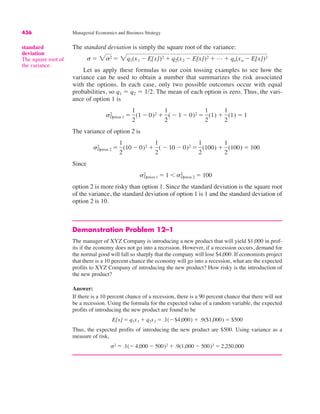
The Mean and the Variance 434
Uncertainty and Consumer Behavior 437
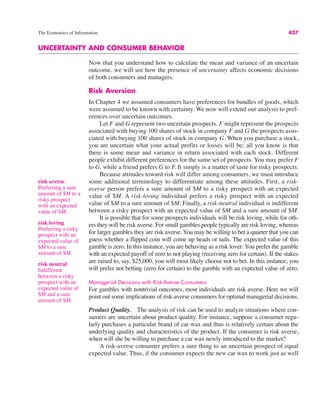
Risk Aversion 437
Managerial Decisions with Risk-Averse Consumers 437
Consumer Search 439
Uncertainty and the Firm 442
Risk Aversion 442
Producer Search 446
Profit Maximization 446
Contents xxix
Uncertainty and the Market 448
Asymmetric Information 448
Adverse Selection 449
Moral Hazard 450
Signaling and Screening 452
Auctions 454
Types of Auctions 455
English Auction 455
First-Price, Sealed-Bid Auction 455
Second-Price, Sealed-Bid Auction 456
Dutch Auction 456
Information Structures 457
Independent Private Values 457
Correlated Value Estimates 458
Optimal Bidding Strategies for Risk-Neutral Bidders 458
Strategies for Independent Private Values Auctions 459
Strategies for Correlated Values Auctions 461
Expected Revenues in Alternative Types of Auctions 463
Answering the Headline 465
Summary 465
Key Terms and Concepts 466
Conceptual and Computational Questions 466
Problems and Applications 469
Case-Based Exercises 472
Selected Readings 472
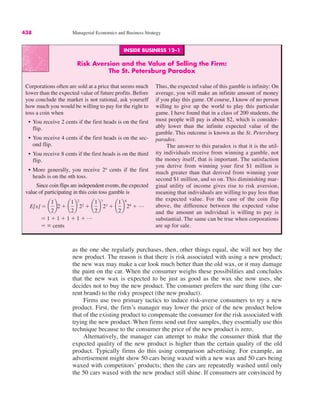
Inside Business 12–1: Risk Aversion and the Value of Selling the Firm: The St.
Petersburg Paradox 438
Inside Business 12–2: The Value of Information in Online Markets 443
Inside Business 12–3: Second-Price Auctions on eBay 456
Inside Business 12–4: Auctions with Risk-Averse Bidders 464
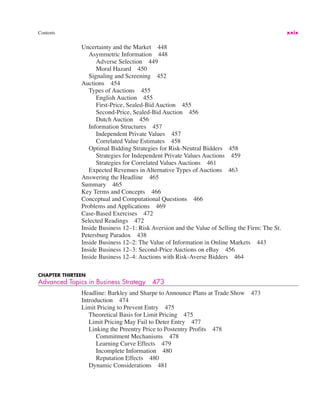
CHAPTER THIRTEEN
Advanced Topics in Business Strategy 473
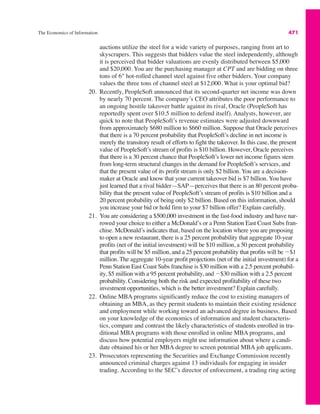
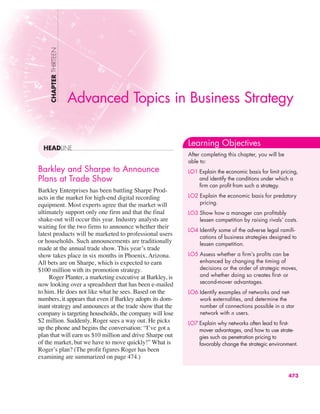
Headline: Barkley and Sharpe to Announce Plans at Trade Show 473
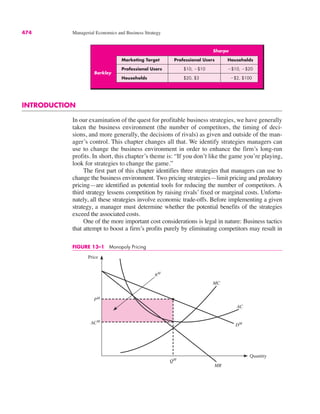
Introduction 474
Limit Pricing to Prevent Entry 475
Theoretical Basis for Limit Pricing 475
Limit Pricing May Fail to Deter Entry 477
Linking the Preentry Price to Postentry Profits 478
Commitment Mechanisms 478
Learning Curve Effects 479
Incomplete Information 480
Reputation Effects 480
Dynamic Considerations 481
xxx Contents
Predatory Pricing to Lessen Competition 483
Raising Rivals’ Costs to Lessen Competition 486
Strategies Involving Marginal Cost 486
Strategies Involving Fixed Costs 487
Strategies for Vertically Integrated Firms 488
Vertical Foreclosure 489
The Price–Cost Squeeze 489
Price Discrimination as a Strategic Tool 489
Changing the Timing of Decisions or the Order of Moves 490
First-Mover Advantages 490
Second-Mover Advantages 493
Penetration Pricing to Overcome Network Effects 493
What Is a Network? 494
Network Externalities 495
First-Mover Advantages Due to Consumer Lock-In 496
Using Penetration Pricing to “Change the Game” 498
Answering the Headline 499
Summary 500
Key Terms and Concepts 500
Conceptual and Computational Questions 500
Problems and Applications 503
Case-Based Exercises 506
Selected Readings 506
Inside Business 13–1: Business Strategy at Microsoft 476
Inside Business 13–2: U.S. Steel Opts against Limit Pricing 482
Inside Business 13–3: First to Market, First to Succeed? Or First to Fail? 492
Inside Business 13–4: Network Externalities and Penetration Pricing by Yahoo!
Auctions 497
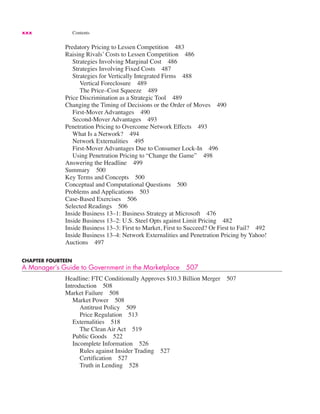
CHAPTER FOURTEEN
A Manager’s Guide to Government in the Marketplace 507
Headline: FTC Conditionally Approves $10.3 Billion Merger 507
Introduction 508
Market Failure 508
Market Power 508
Antitrust Policy 509
Price Regulation 513
Externalities 518
The Clean Air Act 519
Public Goods 522
Incomplete Information 526
Rules against Insider Trading 527
Certification 527
Truth in Lending 528
Contents xxxi
Truth in Advertising 529
Enforcing Contracts 529
Rent Seeking 531
Government Policy and International Markets 532
Quotas 532
Tariffs 534
Lump-Sum Tariffs 535
Excise Tariffs 535
Answering the Headline 536
Summary 537
Key Terms and Concepts 537
Conceptual and Computational Questions 538
Problems and Applications 541
Case-Based Exercises 544
Selected Readings 544
Inside Business 14–1: European Commission Asks Airlines to Explain Price
Discrimination Practices 512
Inside Business 14–2: Electricity Deregulation 517
Inside Business 14–3: Canada’s Competition Bureau 530
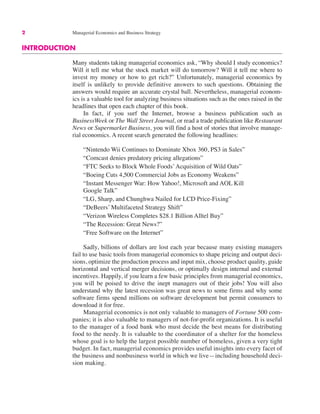
CASE STUDY
Challenges at Time Warner 546
Author’s Note about the Case 545
Headline 546
Background 547
Overview of the Industry and Time Warner’s Operations 548
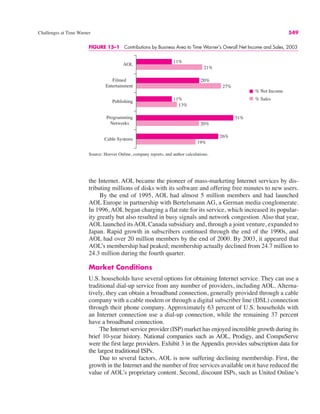
America Online 548
Market Conditions 549
AOL Operations 550
AOL Europe 551
Filmed Entertainment 551
Motion Picture Production and Distribution 552
The Film Industry 552
Competition 554
Television Programming 555
Home Video Distribution 555
Publishing 555
Magazine Publishing 556
Magazines Online 557
Book Publishing 557
Programming Networks 558
Cable Systems 559
Analog and Digital Cable TV 559
High-Speed Internet Service 560
xxxii Contents
Telephone Service 560
Competition 561
Direct Broadcast Satellite Operators 561
Overbuilders 561
Bundling 562
Regulatory Considerations 563
Technological Considerations 563
High-Definition Television (HDTV) 563
Digital Video Recorders (DVRs) 564
Challenges 565
Case-Based Exercises 565
Memos 565
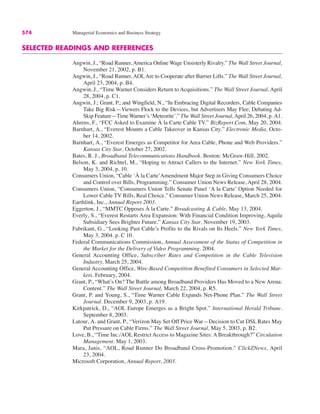
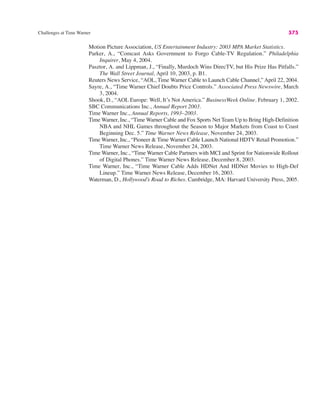
Selected Readings and References 574
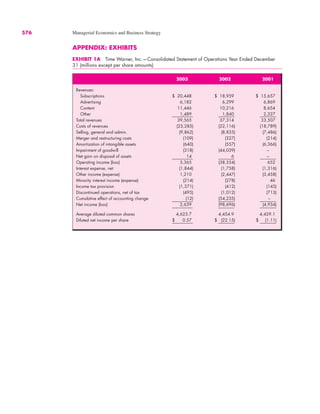
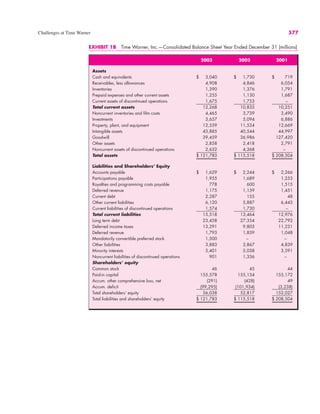
Appendix: Exhibits 576
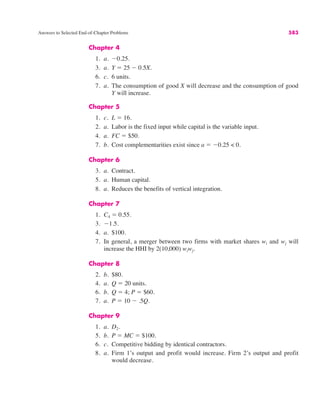
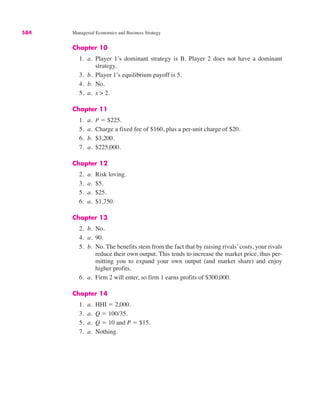
Appendix A Answers to Selected End-of-Chapter Problems 582
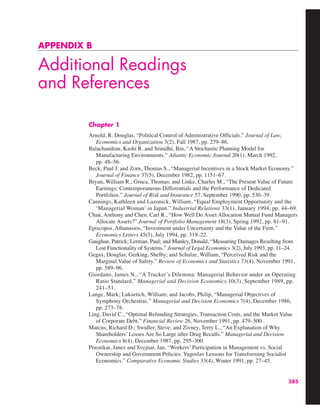
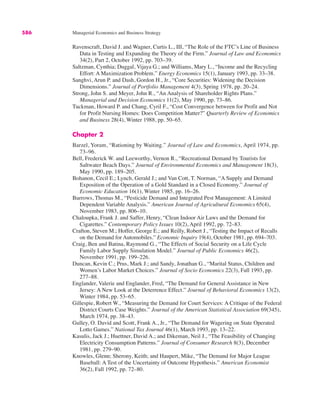
Appendix B Additional Readings and References 585
Name Index 603
General Index 609
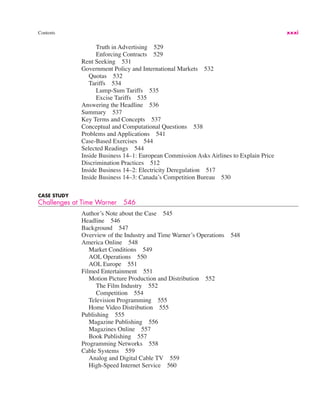
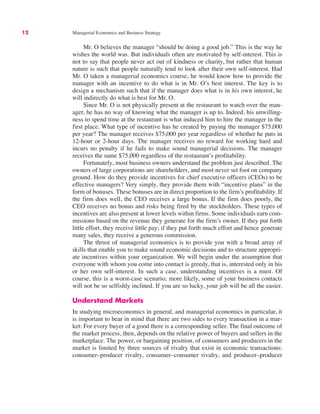
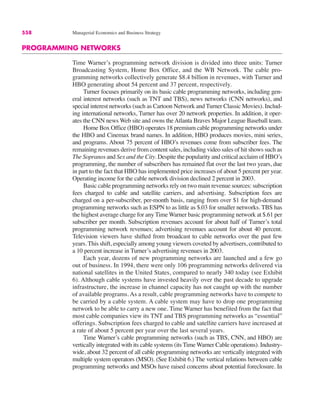
Amcott Loses $3.5 Million;
Manager Fired
On Tuesday software giant Amcott posted a year-end
operating loss of $3.5 million. Reportedly, $1.7 mil-
lion of the loss stemmed from its foreign language
division.
With short-term interest rates at 7 percent,
Amcott decided to use $20 million of its retained
earnings to purchase three-year rights to Magicword,
a software package that converts generic word proces-
sor files saved as French text into English. First-year
sales revenue from the software was $7 million, but
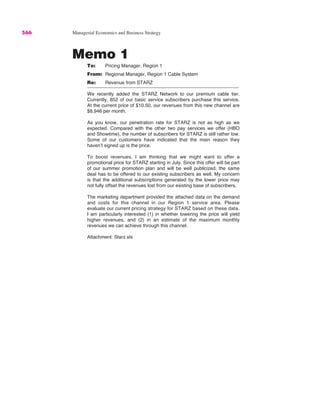
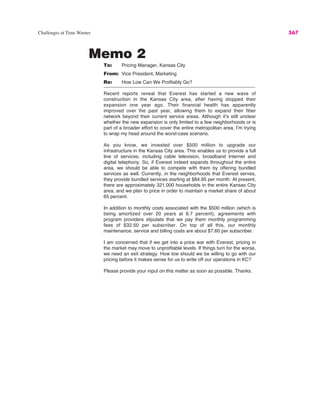
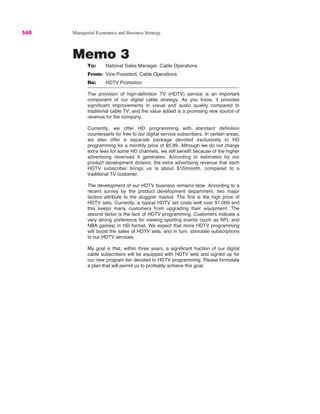
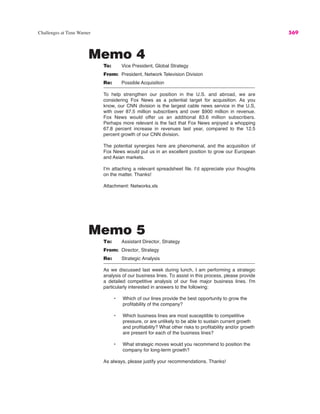
thereafter sales were halted pending a copyright
infringement suit filed by Foreign, Inc. Amcott lost
the suit and paid damages of $1.7 million. Industry
insiders say that the copyright violation pertained to
“a very small component of Magicword.”
Ralph, the Amcott manager who was fired over the
incident, was quoted as saying, “I’m a scapegoat for
the attorneys [at Amcott] who didn’t do their home-
work before buying the rights to Magicword. I pro-
jected annual sales of $7 million per year for three years. My sales forecasts were right on target.”
Do you know why Ralph was fired?1
CHAPTER
ONE
HEADLINE
The Fundamentals of
Managerial Economics
1
1
Each chapter concludes with an answer to the question posed in that chapter's
opening headline. After you read each chapter, you should attempt to solve the opening
headline on your own and then compare your solution to that presented at the end of
the chapter.
Learning Objectives
After completing this chapter, you will be
able to:
LO1 Summarize how goals, constraints, incen-
tives, and market rivalry affect economic
decisions.
LO2 Distinguish economic versus accounting
profits and costs.
LO3 Explain the role of profits in a market
economy.
LO4 Apply the five forces framework to analyze
the sustainability of an industry’s profits.
LO5 Apply present value analysis to make
decisions and value assets.
LO6 Apply marginal analysis to determine
the optimal level of a managerial control
variable.
LO7 Identify and apply six principles of effec-
tive managerial decision making.
2 Managerial Economics and Business Strategy
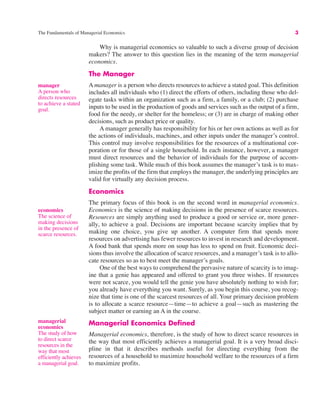
INTRODUCTION
Many students taking managerial economics ask, “Why should I study economics?
Will it tell me what the stock market will do tomorrow? Will it tell me where to
invest my money or how to get rich?” Unfortunately, managerial economics by
itself is unlikely to provide definitive answers to such questions. Obtaining the
answers would require an accurate crystal ball. Nevertheless, managerial econom-
ics is a valuable tool for analyzing business situations such as the ones raised in the
headlines that open each chapter of this book.
In fact, if you surf the Internet, browse a business publication such as
BusinessWeek or The Wall Street Journal, or read a trade publication like Restaurant
News or Supermarket Business, you will find a host of stories that involve manage-
rial economics. A recent search generated the following headlines:
“Nintendo Wii Continues to Dominate Xbox 360, PS3 in Sales”
“Comcast denies predatory pricing allegations”
“FTC Seeks to Block Whole Foods’Acquisition of Wild Oats”
“Boeing Cuts 4,500 Commercial Jobs as Economy Weakens”
“Instant Messenger War: How Yahoo!, Microsoft and AOL Kill
Google Talk”
“LG, Sharp, and Chunghwa Nailed for LCD Price-Fixing”
“DeBeers’ Multifaceted Strategy Shift”
“Verizon Wireless Completes $28.1 Billion Alltel Buy”
“The Recession: Great News?”
“Free Software on the Internet”
Sadly, billions of dollars are lost each year because many existing managers
fail to use basic tools from managerial economics to shape pricing and output deci-
sions, optimize the production process and input mix, choose product quality, guide
horizontal and vertical merger decisions, or optimally design internal and external
incentives. Happily, if you learn a few basic principles from managerial economics,
you will be poised to drive the inept managers out of their jobs! You will also
understand why the latest recession was great news to some firms and why some
software firms spend millions on software development but permit consumers to
download it for free.
Managerial economics is not only valuable to managers of Fortune 500 com-
panies; it is also valuable to managers of not-for-profit organizations. It is useful
to the manager of a food bank who must decide the best means for distributing
food to the needy. It is valuable to the coordinator of a shelter for the homeless
whose goal is to help the largest possible number of homeless, given a very tight
budget. In fact, managerial economics provides useful insights into every facet of
the business and nonbusiness world in which we live—including household deci-
sion making.
The Fundamentals of Managerial Economics 3
manager
A person who
directs resources
to achieve a stated
goal.
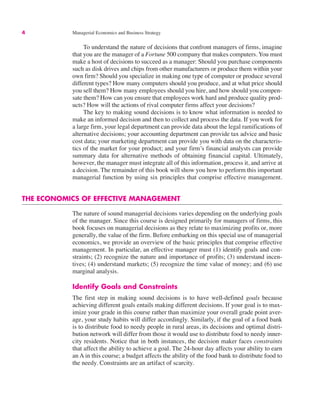
Why is managerial economics so valuable to such a diverse group of decision
makers? The answer to this question lies in the meaning of the term managerial
economics.
The Manager
A manager is a person who directs resources to achieve a stated goal. This definition
includes all individuals who (1) direct the efforts of others, including those who del-
egate tasks within an organization such as a firm, a family, or a club; (2) purchase
inputs to be used in the production of goods and services such as the output of a firm,
food for the needy, or shelter for the homeless; or (3) are in charge of making other
decisions, such as product price or quality.
A manager generally has responsibility for his or her own actions as well as for
the actions of individuals, machines, and other inputs under the manager’s control.
This control may involve responsibilities for the resources of a multinational cor-
poration or for those of a single household. In each instance, however, a manager
must direct resources and the behavior of individuals for the purpose of accom-
plishing some task. While much of this book assumes the manager’s task is to max-
imize the profits of the firm that employs the manager, the underlying principles are
valid for virtually any decision process.
Economics
The primary focus of this book is on the second word in managerial economics.
Economics is the science of making decisions in the presence of scarce resources.
Resources are simply anything used to produce a good or service or, more gener-
ally, to achieve a goal. Decisions are important because scarcity implies that by
making one choice, you give up another. A computer firm that spends more
resources on advertising has fewer resources to invest in research and development.
A food bank that spends more on soup has less to spend on fruit. Economic deci-
sions thus involve the allocation of scarce resources, and a manager’s task is to allo-
cate resources so as to best meet the manager’s goals.
One of the best ways to comprehend the pervasive nature of scarcity is to imag-
ine that a genie has appeared and offered to grant you three wishes. If resources
were not scarce, you would tell the genie you have absolutely nothing to wish for;
you already have everything you want. Surely, as you begin this course, you recog-
nize that time is one of the scarcest resources of all. Your primary decision problem
is to allocate a scarce resource—time—to achieve a goal—such as mastering the
subject matter or earning an A in the course.
Managerial Economics Defined
Managerial economics, therefore, is the study of how to direct scarce resources in
the way that most efficiently achieves a managerial goal. It is a very broad disci-
pline in that it describes methods useful for directing everything from the
resources of a household to maximize household welfare to the resources of a firm
to maximize profits.
economics
The science of
making decisions
in the presence of
scarce resources.
managerial
economics
The study of how
to direct scarce
resources in the
way that most
efficiently achieves
a managerial goal.
4 Managerial Economics and Business Strategy
To understand the nature of decisions that confront managers of firms, imagine
that you are the manager of a Fortune 500 company that makes computers. You must
make a host of decisions to succeed as a manager: Should you purchase components
such as disk drives and chips from other manufacturers or produce them within your
own firm? Should you specialize in making one type of computer or produce several
different types? How many computers should you produce, and at what price should
you sell them? How many employees should you hire, and how should you compen-
sate them? How can you ensure that employees work hard and produce quality prod-
ucts? How will the actions of rival computer firms affect your decisions?
The key to making sound decisions is to know what information is needed to
make an informed decision and then to collect and process the data. If you work for
a large firm, your legal department can provide data about the legal ramifications of
alternative decisions; your accounting department can provide tax advice and basic
cost data; your marketing department can provide you with data on the characteris-
tics of the market for your product; and your firm’s financial analysts can provide
summary data for alternative methods of obtaining financial capital. Ultimately,
however, the manager must integrate all of this information, process it, and arrive at
a decision. The remainder of this book will show you how to perform this important
managerial function by using six principles that comprise effective management.
THE ECONOMICS OF EFFECTIVE MANAGEMENT
The nature of sound managerial decisions varies depending on the underlying goals
of the manager. Since this course is designed primarily for managers of firms, this
book focuses on managerial decisions as they relate to maximizing profits or, more
generally, the value of the firm. Before embarking on this special use of managerial
economics, we provide an overview of the basic principles that comprise effective
management. In particular, an effective manager must (1) identify goals and con-
straints; (2) recognize the nature and importance of profits; (3) understand incen-
tives; (4) understand markets; (5) recognize the time value of money; and (6) use
marginal analysis.
Identify Goals and Constraints
The first step in making sound decisions is to have well-defined goals because
achieving different goals entails making different decisions. If your goal is to max-
imize your grade in this course rather than maximize your overall grade point aver-
age, your study habits will differ accordingly. Similarly, if the goal of a food bank
is to distribute food to needy people in rural areas, its decisions and optimal distri-
bution network will differ from those it would use to distribute food to needy inner-
city residents. Notice that in both instances, the decision maker faces constraints
that affect the ability to achieve a goal. The 24-hour day affects your ability to earn
an A in this course; a budget affects the ability of the food bank to distribute food to
the needy. Constraints are an artifact of scarcity.
The Fundamentals of Managerial Economics 5
economic profits
The difference
between total
revenue and total
opportunity cost.
opportunity cost
The cost of the
explicit and
implicit resources
that are forgone
when a decision is
made.
Different units within a firm may be given different goals; those in a firm’s
marketing department might be instructed to use their resources to maximize sales
or market share, while those in the firm’s financial group might focus on earnings
growth or risk-reduction strategies. Later in this book we will see how the firm’s
overall goal—maximizing profits—can be achieved by giving each unit within the
firm an incentive to achieve potentially different goals.
Unfortunately, constraints make it difficult for managers to achieve goals such
as maximizing profits or increasing market share. These constraints include such
things as the available technology and the prices of inputs used in production. The
goal of maximizing profits requires the manager to decide the optimal price to
charge for a product, how much to produce, which technology to use, how much of
each input to use, how to react to decisions made by competitors, and so on. This
book provides tools for answering these types of questions.
Recognize the Nature and Importance of Profits
The overall goal of most firms is to maximize profits or the firm’s value, and the
remainder of this book will detail strategies managers can use to achieve this goal.
Before we provide these details, let us examine the nature and importance of prof-
its in a free-market economy.
Economic versus Accounting Profits
When most people hear the word profit, they think of accounting profits. Accounting
profit is the total amount of money taken in from sales (total revenue, or price times
quantity sold) minus the dollar cost of producing goods or services. Accounting
profits are what show up on the firm’s income statement and are typically reported to
the manager by the firm’s accounting department.
A more general way to define profits is in terms of what economists refer to as
economic profits. Economic profits are the difference between the total revenue and
the total opportunity cost of producing the firm’s goods or services. The opportunity
cost of using a resource includes both the explicit (or accounting) cost of the resource
and the implicit cost of giving up the best alternative use of the resource. The oppor-
tunity cost of producing a good or service generally is higher than accounting costs
because it includes both the dollar value of costs (explicit, or accounting, costs) and
any implicit costs.
Implicit costs are very hard to measure and therefore managers often overlook
them. Effective managers, however, continually seek out data from other sources
to identify and quantify implicit costs. Managers of large firms can use sources
within the company, including the firm’s finance, marketing, and/or legal depart-
ments, to obtain data about the implicit costs of decisions. In other instances man-
agers must collect data on their own. For example, what does it cost you to read
this book? The price you paid the bookstore for this book is an explicit (or
accounting) cost, while the implicit cost is the value of what you are giving up by
reading the book. You could be studying some other subject or watching TV, and
each of these alternatives has some value to you. The “best” of these alternatives is
6 Managerial Economics and Business Strategy
your implicit cost of reading this book; you are giving up this alternative to read
the book. Similarly, the opportunity cost of going to school is much higher than
the cost of tuition and books; it also includes the amount of money you would earn
had you decided to work rather than go to school.
In the business world, the opportunity cost of opening a restaurant is the best
alternative use of the resources used to establish the restaurant—say, opening a
hairstyling salon. Again, these resources include not only the explicit financial
resources needed to open the business but any implicit costs as well. Suppose you
own a building in New York that you use to run a small pizzeria. Food supplies are
your only accounting costs. At the end of the year, your accountant informs you
that these costs were $20,000 and that your revenues were $100,000. Thus, your
accounting profits are $80,000.
However, these accounting profits overstate your economic profits, because the
costs include only accounting costs. First, the costs do not include the time you
spent running the business. Had you not run the business, you could have worked
for someone else, and this fact reflects an economic cost not accounted for in
accounting profits. To be concrete, suppose you could have worked for someone
else for $30,000. Your opportunity cost of time would have been $30,000 for the
year. Thus, $30,000 of your accounting profits are not profits at all but one of the
implicit costs of running the pizzeria.
Second, accounting costs do not account for the fact that, had you not run the
pizzeria, you could have rented the building to someone else. If the rental value of
the building is $100,000 per year, you gave up this amount to run your own busi-
ness. Thus, the costs of running the pizzeria include not only the costs of supplies
($20,000) but the $30,000 you could have earned in some other business and the
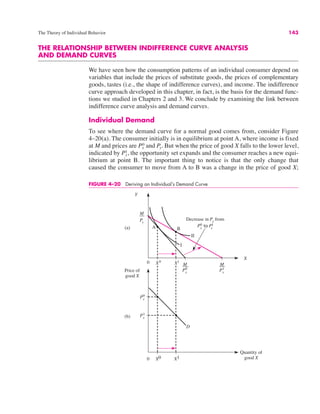
$100,000 you could have earned in renting the building to someone else. The eco-
nomic cost of running the pizzeria is $150,000—the amount you gave up to run
your business. Considering the revenue of $100,000, you actually lost $50,000 by
running the pizzeria.
Throughout this book, when we speak of costs, we mean economic costs. Eco-
nomic costs are opportunity costs and include not only the explicit (accounting)
costs but also the implicit costs of the resources used in production.
The Role of Profits
A common misconception is that the firm’s goal of maximizing profits is necessar-
ily bad for society. Individuals who want to maximize profits often are considered
self-interested, a quality that many people view as undesirable. However, consider
Adam Smith’s classic line from The Wealth of Nations: “It is not out of the benevo-
lence of the butcher, the brewer, or the baker, that we expect our dinner, but from
their regard to their own interest.”2
2
Adam Smith, An Inquiry into the Causes of the Wealth of Nations, ed. Edwin Cannan (Chicago:
University of Chicago Press, 1976).
INSIDE BUSINESS 1–1
The Goals of Firms in Our Global Economy
Recent trends in globalization have forced businesses
around the world to more keenly focus on profitability.
This trend is also present in Japan, where historical
links between banks and businesses have traditionally
blurred the goals of firms. For example, the Japanese
business engineering firm, Mitsui & Co. Ltd., recently
launched “Challenge 21,” a plan directed at helping
the company emerge as Japan’s leading business engi-
neering group. According to a spokesperson for the
company, “[This plan permits us to] create new value
and maximize profitability by taking steps such as
renewing our management framework and prioritizing
the allocation of our resources into strategic areas. We
are committed to maximizing shareholder value
through business conduct that balances the pursuit of
earnings with socially responsible behavior.”
Ultimately, the goal of any continuing company
must be to maximize the value of the firm. This goal is
often achieved by trying to hit intermediate targets, such
as minimizing costs or increasing market share. If you—
as a manager—do not maximize your firm’s value over
time, you will be in danger of either going out of busi-
ness, being taken over by other owners (as in a leveraged
buyout), or having stockholders elect to replace you and
other managers.
Source: “Mitsui & Co., Ltd. UK Regulatory
Announcement: Final Results,” Business Wire,
May 13, 2004.
The Fundamentals of Managerial Economics 7
Smith is saying that by pursuing its self-interest—the goal of maximizing
profits—a firm ultimately meets the needs of society. If you cannot make a living
as a rock singer, it is probably because society does not appreciate your singing;
society would more highly value your talents in some other employment. If you
break five dishes each time you clean up after dinner, your talents are perhaps
better suited for balancing the checkbook or mowing the lawn. Similarly, the
profits of businesses signal where society’s scarce resources are best allocated.
When firms in a given industry earn economic profits, the opportunity cost to
resource holders outside the industry increases. Owners of other resources soon
recognize that, by continuing to operate their existing businesses, they are giving
up profits. This induces new firms to enter the markets in which economic profits
are available. As more firms enter the industry, the market price falls, and eco-
nomic profits decline.
Thus, profits signal the owners of resources where the resources are most
highly valued by society. By moving scarce resources toward the production of
goods most valued by society, the total welfare of society is improved. As Adam
Smith first noted, this phenomenon is due not to benevolence on the part of the
firms’ managers but to the self-interested goal of maximizing the firms’ profits.
Principle Profits Are a Signal
Profits signal to resource holders where resources are most highly valued by society.
FIGURE 1–1 The Five Forces Framework
Sustainable
Industry
Profits
• Entry costs • Sunk costs • Network effects • Switching costs
• Speed of adjustment • Economies of scale • Reputation • Government restraints
Entry
• Supplier concentration
• Price/productivity of
alternative inputs
• Relationship-specific investments
• Supplier switching costs
• Government restraints
Power of Input Suppliers
• Buyer concentration
• Price/value of substitute products
or services
• Relationship-specific investments
• Customer switching costs
• Government restraints
Power of Buyers
• Concentration • Switching costs
• Price, quantity, quality, or • Timing of decisions
service competition • Information
• Degree of differentiation • Government restraints
Industry Rivalry
• Price/value of surrogate • Network effects
products or services • Government restraints
• Price/value of complementary
products or services
Substitutes and Complements
8 Managerial Economics and Business Strategy
3
Michael Porter, Competitive Strategy (New York: Free Press, 1980).
The Five Forces Framework and Industry Profitability
A key theme of this textbook is that many interrelated forces and decisions influ-
ence the level, growth, and sustainability of profits. If you or other managers in the
industry are clever enough to identify strategies that yield a windfall to sharehold-
ers this quarter, there is no guarantee that these profits will be sustained in the long
run. You must recognize that profits are a signal—if your business earns superior
profits, existing and potential competitors will do their best to get a piece of the
action. In the remaining chapters we will examine a variety of business strategies
designed to enhance your prospects of earning and sustaining profits. Before we do
so, however, it is constructive to provide a conceptual framework for thinking
about some of the factors that impact industry profitability.
Figure 1–1 illustrates the “five forces” framework pioneered by Michael Porter.3
This framework organizes many complex managerial economics issues into five
categories or “forces” that impact the sustainability of industry profits: (1) entry, (2)
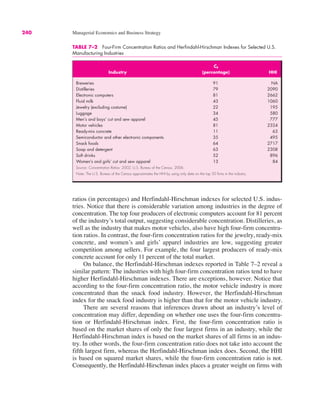
power of input suppliers, (3) power of buyers, (4) industry rivalry, and (5) substi-
tutes and complements. The discussion below explains how these forces influence
industry profitability and highlights the connections among these forces and mate-
rial covered in the remaining chapters of the text.
Entry. As we will see in Chapters 2, 7, and 8, entry heightens competition and
reduces the margins of existing firms in a wide variety of industry settings. For this
reason, the ability of existing firms to sustain profits depends on how barriers to
The Fundamentals of Managerial Economics 9
entry affect the ease with which other firms can enter the industry. Entry can come
from a number of directions, including the formation of new companies (Wendy’s
entered the fast-food industry in the 1970s after its founder, Dave Thomas, left
KFC); globalization strategies by foreign companies (Toyota sold vehicles in Japan
since the 1930s but waited until the middle of the last century to enter the U.S. auto-
mobile market); and the introduction of new product lines by existing firms (the cel-
lular phone industry’s recent entry into the market for personal digital assistants).
As shown in Figure 1–1, a number of economic factors affect the ability of
entrants to erode existing industry profits. In subsequent chapters, you will learn why
entrants are less likely to capture market share quickly enough to justify the costs of
entry in environments where there are sizeable sunk costs (Chapters 5, 9), significant
economies of scale (Chapters 5, 8), or significant network effects (Chapter 13), or
where existing firms have invested in strong reputations for providing value to a size-
able base of loyal consumers (Chapter 11) or to aggressively fight entrants (Chapters
10, and 13). In addition, you will gain a better appreciation for the role that govern-
ments play in shaping entry through patents and licenses (Chapter 8), trade policies
(Chapters 5 and 14), and environmental legislation (Chapter 14). We will also iden-
tify a variety of strategies to raise the costs to consumers of “switching” to would-be
entrants, thereby lowering the threat that entrants erode your profits.
Power of Input Suppliers. Industry profits tend to be lower when suppliers have
the power to negotiate favorable terms for their inputs. Supplier power tends to be
low when inputs are relatively standardized and relationship-specific investments
are minimal (Chapter 6), input markets are not highly concentrated (Chapter 7), or
alternative inputs are available with similar marginal productivities per dollar spent
(Chapter 5). In many countries, the government constrains the prices of inputs
through price ceilings and other controls (Chapters 2 and 14), which limits to some
extent the ability of suppliers to expropriate profits from firms in the industry.
Power of Buyers. Similar to the case of suppliers, industry profits tend to be
lower when customers or buyers have the power to negotiate favorable terms for
the products or services produced in the industry. In most consumer markets, buy-
ers are fragmented and thus buyer concentration is low. Buyer concentration and
hence customer power tend to be higher in industries that serve relatively few
“high-volume” customers. Buyer power tends to be lower in industries where the
cost to customers of switching to other products is high—as is often the case when
there are relationship-specific investments and hold-up problems (Chapter 6),
imperfect information that leads to costly consumer search (Chapter 12), or few
close substitutes for the product (Chapters 2, 3, 4, and 11). Government regulations,
such as price floors or price ceilings (Chapters 2 and 14), can also impact the abil-
ity of buyers to obtain more favorable terms.
Industry Rivalry. The sustainability of industry profits also depends on the nature
and intensity of rivalry among firms competing in the industry. Rivalry tends to be
less intense (and hence the likelihood of sustaining profits is higher) in concentrated
10 Managerial Economics and Business Strategy
4
See, for example, Barry J. Nalebuff andAdam M. Brandenburger, Co-Opetition (New York: Doubleday,
1996) as well as R. Preston McAfee, Competitive Solutions (Princeton: Princeton University Press, 2002).
industries—that is, those with relatively few firms. In Chapter 7 we will take a closer
look at various measures that can be used to gauge industry concentration.
The level of product differentiation and the nature of the game being played—
whether firms’ strategies involve prices, quantities, capacity, or quality/service
attributes, for example—also impact profitability. In later chapters you will learn
why rivalry tends to be more intense in industry settings where there is little prod-
uct differentiation and firms compete in price (Chapters 8, 9, 10, and 11) and where
consumer switching costs are low (Chapters 11 and 12). You will also learn how
imperfect information and the timing of decisions affect rivalry among firms
(Chapters 10, 12, and 13).
Substitutes and Complements. The level and sustainability of industry profits
also depend on the price and value of interrelated products and services. Porter’s
original five forces framework emphasized that the presence of close substitutes
erodes industry profitability. In Chapters 2, 3, 4, and 11 you will learn how to
quantify the degree to which surrogate products are close substitutes by using elas-
ticity analysis and models of consumer behavior. We will also see that government
policies (such as restrictions limiting the importation of prescription drugs from
Canada into the United States) can directly impact the availability of substitutes
and thus industry profits.
More recent work by economists and business strategists emphasizes that com-
plementarities also affect industry profitability.4
For example, Microsoft’s prof-
itability in the market for operating systems is enhanced by the presence of
complementary products ranging from relatively inexpensive computer hardware
to a plethora of Windows-compatible application software. In Chapters 3, 5, 10,
and 13 you will learn how to quantify these complementarities or “synergies” and
identify strategies to create and exploit complementarities and network effects.
In concluding, it is important to recognize that the many forces that impact the
level and sustainability of industry profits are interrelated. For instance, the U.S.
automobile industry suffered a sharp decline in industry profitability during the
1970s as a result of sharp increases in the price of gasoline (a complement to auto-
mobiles). This change in the price of a complementary product enabled Japanese
automakers to enter the U.S. market through a differentiation strategy of marketing
their fuel-efficient cars, which sold like hotcakes compared to the gas-guzzlers
American automakers produced at that time. These events, in turn, have had a pro-
found impact on industry rivalry in the automotive industry—not just in the United
States, but worldwide.
It is also important to stress that the five forces framework is primarily a tool
for helping managers see the “big picture”; it is a schematic you can use to organize
various industry conditions that affect industry profitability and assess the efficacy
of alternative business strategies. However, it would be a mistake to view it as a
comprehensive list of all factors that affect industry profitability. The five forces
INSIDE BUSINESS 1–2
Profits and the Evolution of the Computer Industry
When profits in a given industry are higher than in other
industries, new firms will attempt to enter that industry.
When losses are recorded, some firms will likely leave
the industry. This sort of “evolution” has changed the
global landscape of personal computer markets.
At the start of the PC era, personal computer mak-
ers enjoyed positive economic profits. These higher
profits led to new entry and heightened competition.
Over the past two decades, entry has led to declines in
PC prices and industry profitability despite significant
increases in the speed and storage capacities of PCs.
Less efficient firms have been forced to exit the market.
In the early 2000s, IBM—the company that
launched the PC era when it introduced the IBM PC in
the early 1980s—sold its PC business to China-based
Lenovo. Compaq—an early leader in the market for
PCs—has since been acquired by Hewlett-Packard.
A handful of small PC makers have enjoyed some
success competing against the remaining traditional
players, which include Dell and Hewlett-Packard.
By the late 2000s, Dell's strategy switched from sell-
ing computers directly to consumers to entering into
relationships with retailers such as BestBuy and Sta-
ples. While only time will tell how these strategies
will impact the long-run viability of traditional play-
ers, competitive pressures continue to push PC prices
and industry profits downwards.
The Fundamentals of Managerial Economics 11
framework is not a substitute for understanding the economic principles that under-
lie sound business decisions.
Understand Incentives
In our discussion of the role of profits, we emphasized that profits signal the hold-
ers of resources when to enter and exit particular industries. In effect, changes in
profits provide an incentive to resource holders to alter their use of resources.
Within a firm, incentives affect how resources are used and how hard workers
work. To succeed as a manager, you must have a clear grasp of the role of incen-
tives within an organization such as a firm and how to construct incentives to
induce maximal effort from those you manage. Chapter 6 is devoted to this special
aspect of managerial decision making, but it is useful here to provide a synopsis of
how to construct proper incentives.
The first step in constructing incentives within a firm is to distinguish between
the world, or the business place, as it is and the way you wish it were. Many pro-
fessionals and owners of small establishments have difficulties because they do not
fully comprehend the importance of the role incentives play in guiding the deci-
sions of others.
A friend of mine—Mr. O—opened a restaurant and hired a manager to run the
business so he could spend time doing the things he enjoys. Recently, I asked him
how his business was doing, and he reported that he had been losing money ever
since the restaurant opened. When asked whether he thought the manager was
doing a good job, he said, “For the $75,000 salary I pay the manager each year, the
manager should be doing a good job.”
12 Managerial Economics and Business Strategy
Mr. O believes the manager “should be doing a good job.” This is the way he
wishes the world was. But individuals often are motivated by self-interest. This is
not to say that people never act out of kindness or charity, but rather that human
nature is such that people naturally tend to look after their own self-interest. Had
Mr. O taken a managerial economics course, he would know how to provide the
manager with an incentive to do what is in Mr. O’s best interest. The key is to
design a mechanism such that if the manager does what is in his own interest, he
will indirectly do what is best for Mr. O.
Since Mr. O is not physically present at the restaurant to watch over the man-
ager, he has no way of knowing what the manager is up to. Indeed, his unwilling-
ness to spend time at the restaurant is what induced him to hire the manager in the
first place. What type of incentive has he created by paying the manager $75,000
per year? The manager receives $75,000 per year regardless of whether he puts in
12-hour or 2-hour days. The manager receives no reward for working hard and
incurs no penalty if he fails to make sound managerial decisions. The manager
receives the same $75,000 regardless of the restaurant’s profitability.
Fortunately, most business owners understand the problem just described. The
owners of large corporations are shareholders, and most never set foot on company
ground. How do they provide incentives for chief executive officers (CEOs) to be
effective managers? Very simply, they provide them with “incentive plans” in the
form of bonuses. These bonuses are in direct proportion to the firm’s profitability. If
the firm does well, the CEO receives a large bonus. If the firm does poorly, the
CEO receives no bonus and risks being fired by the stockholders. These types of
incentives are also present at lower levels within firms. Some individuals earn com-
missions based on the revenue they generate for the firm’s owner. If they put forth
little effort, they receive little pay; if they put forth much effort and hence generate
many sales, they receive a generous commission.
The thrust of managerial economics is to provide you with a broad array of
skills that enable you to make sound economic decisions and to structure appropri-
ate incentives within your organization. We will begin under the assumption that
everyone with whom you come into contact is greedy, that is, interested only in his
or her own self-interest. In such a case, understanding incentives is a must. Of
course, this is a worst-case scenario; more likely, some of your business contacts
will not be so selfishly inclined. If you are so lucky, your job will be all the easier.
Understand Markets
In studying microeconomics in general, and managerial economics in particular, it
is important to bear in mind that there are two sides to every transaction in a mar-
ket: For every buyer of a good there is a corresponding seller. The final outcome of
the market process, then, depends on the relative power of buyers and sellers in the
marketplace. The power, or bargaining position, of consumers and producers in the
market is limited by three sources of rivalry that exist in economic transactions:
consumer–producer rivalry, consumer–consumer rivalry, and producer–producer
The Fundamentals of Managerial Economics 13
rivalry. Each form of rivalry serves as a disciplining device to guide the market
process, and each affects different markets to a different extent. Thus, your ability
as a manager to meet performance objectives will depend on the extent to which
your product is affected by these sources of rivalry.
Consumer–Producer Rivalry
Consumer–producer rivalry occurs because of the competing interests of con-
sumers and producers. Consumers attempt to negotiate or locate low prices, while
producers attempt to negotiate high prices. In a very loose sense, consumers
attempt to “rip off” producers, and producers attempt to “rip off” consumers. Of
course, there are limits to the ability of these parties to achieve their goals. If a con-
sumer offers a price that is too low, the producer will refuse to sell the product to
the consumer. Similarly, if the producer asks a price that exceeds the consumer’s
valuation of a good, the consumer will refuse to purchase the good. These two
forces provide a natural check and balance on the market process even in markets in
which the product is offered by a single firm (a monopolist).
Consumer–Consumer Rivalry
A second source of rivalry that guides the market process occurs among consumers.
Consumer–consumer rivalry reduces the negotiating power of consumers in the
marketplace. It arises because of the economic doctrine of scarcity. When limited
quantities of goods are available, consumers will compete with one another for the
right to purchase the available goods. Consumers who are willing to pay the high-
est prices for the scarce goods will outbid other consumers for the right to consume
the goods. Once again, this source of rivalry is present even in markets in which a
single firm is selling a product. A good example of consumer–consumer rivalry is
an auction, a topic we will examine in detail in Chapter 12.
Producer–Producer Rivalry
A third source of rivalry in the marketplace is producer–producer rivalry. Unlike
the other forms of rivalry, this disciplining device functions only when multiple
sellers of a product compete in the marketplace. Given that customers are scarce,
producers compete with one another for the right to service the customers available.
Those firms that offer the best-quality product at the lowest price earn the right to
serve the customers.
Government and the Market
When agents on either side of the market find themselves disadvantaged in the mar-
ket process, they frequently attempt to induce government to intervene on their
behalf. For example, the market for electricity in most towns is characterized by a
sole local supplier of electricity, and thus there is no producer–producer rivalry.
Consumer groups may initiate action by a public utility commission to limit the
power of utilities in setting prices. Similarly, producers may lobby for government
14 Managerial Economics and Business Strategy
assistance to place them in a better bargaining position relative to consumers and
foreign producers. Thus, in modern economies government also plays a role in dis-
ciplining the market process. Chapter 14 explores how government affects manage-
rial decisions.
Recognize the Time Value of Money
The timing of many decisions involves a gap between the time when the costs of a
project are borne and the time when the benefits of the project are received. In
these instances it is important to recognize that $1 today is worth more than $1
received in the future. The reason is simple: The opportunity cost of receiving the
$1 in the future is the forgone interest that could be earned were $1 received today.
This opportunity cost reflects the time value of money. To properly account for the
timing of receipts and expenditures, the manager must understand present value
analysis.
Present Value Analysis
The present value (PV) of an amount received in the future is the amount that would
have to be invested today at the prevailing interest rate to generate the given future
value. For example, suppose someone offered you $1.10 one year from today. What
is the value today (the present value) of $1.10 to be received one year from today?
Notice that if you could invest $1.00 today at a guaranteed interest rate of 10 per-
cent, one year from now $1.00 would be worth $1.00 ! 1.1 " $1.10. In other
words, over the course of one year, your $1.00 would earn $.10 in interest. Thus,
when the interest rate is 10 percent, the present value of receiving $1.10 one year in
the future is $1.00.
A more general formula follows:
Formula (Present Value). The present value (PV) of a future value (FV) received
n years in the future is
(1–1)
where i is the rate of interest.
For example, the present value of $100.00 in 10 years if the interest rate is at 7
percent is $50.83, since
This essentially means that if you invested $50.83 today at a 7 percent interest rate,
in 10 years your investment would be worth $100.
Notice that the interest rate appears in the denominator of the expression in
Equation 1–1. This means that the higher the interest rate, the lower the present value
of a future amount, and conversely. The present value of a future payment reflects the
PV "
$100
(1 # .07)10
"
$100
1.9672
" $50.83
PV "
FV
(1 # i)n
present value
The amount that
would have to be
invested today at
the prevailing
interest rate to
generate the given
future value.
The Fundamentals of Managerial Economics 15
difference between the future value (FV) and the opportunity cost of waiting (OCW):
PV " FV $ OCW. Intuitively, the higher the interest rate, the higher the opportunity
cost of waiting to receive a future amount and thus the lower the present value of the
future amount. For example, if the interest rate is zero, the opportunity cost of waiting
is zero, and the present value and the future value coincide. This is consistent with
Equation 1–1, since PV " FV when the interest rate is zero.
The basic idea of the present value of a future amount can be extended to a
series of future payments. For example, if you are promised FV1 one year in the
future, FV2 two years in the future, and so on for n years, the present value of this
sum of future payments is
Formula (Present Value of a Stream). When the interest rate is i, the present
value of a stream of future payments of FV1, FV2, . . . , FVn is
Given the present value of the income stream that arises from a project, one can
easily compute the net present value of the project. The net present value (NPV) of
a project is simply the present value (PV ) of the income stream generated by the
project minus the current cost (C0) of the project: NPV " PV $ C0. If the net pres-
ent value of a project is positive, then the project is profitable because the present
value of the earnings from the project exceeds the current cost of the project. On the
other hand, a manager should reject a project that has a negative net present value,
since the cost of such a project exceeds the present value of the income stream that
project generates.
Formula (Net Present Value). Suppose that by sinking C0 dollars into a project
today, a firm will generate income of FV1 one year in the future, FV2 two years in
the future, and so on for n years. If the interest rate is i, the net present value of the
project is
Demonstration Problem 1–1
The manager of Automated Products is contemplating the purchase of a new machine that
will cost $300,000 and has a useful life of five years. The machine will yield (year-end) cost
reductions to Automated Products of $50,000 in year 1, $60,000 in year 2, $75,000 in year
3, and $90,000 in years 4 and 5. What is the present value of the cost savings of the machine
if the interest rate is 8 percent? Should the manager purchase the machine?
NPV "
FV1
(1 # i)1
#
FV2
(1 # i)2
#
FV3
(1 # i)3
# L #
FVn
(1 # i)n
$ C0
PV " !
n
t"1
FVt
(1 # i)t
PV "
FV1
(1 # i)1
#
FV2
(1 # i)2
#
FV3
(1 # i)3
# L #
FVn
(1 # i)n
net present value
The present value
of the income
stream generated
by a project minus
the current cost of
the project.
16 Managerial Economics and Business Strategy
Answer:
By spending $300,000 today on a new machine, the firm will reduce costs by $365,000 over
five years. However, the present value of the cost savings is only
Consequently, the net present value of the new machine is
Since the net present value of the machine is negative, the manager should not purchase
the machine. In other words, the manager could earn more by investing the $300,000 at 8
percent than by spending the money on the cost-saving technology.
Present Value of Indefinitely Lived Assets
Some decisions generate cash flows that continue indefinitely. For instance, con-
sider an asset that generates a cash flow of CF0 today, CF1 one year from today, CF2
two years from today, and so on for an indefinite period of time. If the interest rate
is i, the value of the asset is given by the present value of these cash flows:
While this formula contains terms that continue indefinitely, for certain patterns of
future cash flows one can readily compute the present value of the asset. For
instance, suppose that the current cash flow is zero (CF0 " 0) and that all future
cash flows are identical (CF1 " CF2 " . . . ). In this case the asset generates a per-
petual stream of identical cash flows at the end of each period. If each of these
future cash flows is CF, the value of the asset is the present value of the perpetuity:
Examples of such an asset include perpetual bonds and preferred stocks. Each of
these assets pays the owner a fixed amount at the end of each period, indefinitely.
Based on the above formula, the value of a perpetual bond that pays the owner $100
at the end of each year when the interest rate is fixed at 5 percent is given by
Present value analysis is also useful in determining the value of a firm, since the
value of a firm is the present value of the stream of profits (cash flows) generated by
PVPerpetual bond "
CF
i
"
$100
.05
" $2,000
"
CF
i
PVPerpetuity "
CF
(1 # i)
#
CF
(1 # i)2
#
CF
(1 # i)3
# L
PVAsset " CF0 #
CF1
(1 # i)
#
CF2
(1 # i)2
#
CF3
(1 # i)3
# L
NPV " PV $ C0 " $284,679 $ $300,000 " $ $15,321
PV "
50,000
1.08
#
60,000
1.082
#
75,000
1.083
#
90,000
1.084
#
90,000
1.085
" $284,679
The Fundamentals of Managerial Economics 17
Principle Profit Maximization
Maximizing profits means maximizing the value of the firm, which is the present value of
current and future profits.
the firm’s physical, human, and intangible assets. In particular, if p0 is the firm’s cur-
rent level of profits, then p1 is next year’s profit, and so on. Therefore, the value of
the firm is:
In other words, the value of the firm today is the present value of its current and
future profits. To the extent that the firm is a “going concern” that lives on forever
even after its founder dies, firm ownership represents a claim to assets with an
indefinite profit stream.
Notice that the value of a firm takes into account the long-term impact of man-
agerial decisions on profits. When economists say that the goal of the firm is to
maximize profits, it should be understood to mean that the firm’s goal is to maxi-
mize its value, which is the present value of current and future profits.
PVFirm " p0 #
p1
(1 # i)
#
p2
(1 # i)2
#
p3
(1 # i)3
# L
While it is beyond the scope of this book to present all the tools Wall Street analysts
use to estimate the value of firms, it is possible to gain insight into the issues
involved by making a few simplifying assumptions. Suppose a firm’s current prof-
its are p0, and that these profits have not yet been paid out to stockholders as divi-
dends. Imagine that these profits are expected to grow at a constant rate of g percent
each year, and that profit growth is less than the interest rate (g % i). In this case,
profits one year from today will be (1 + g)p0, profits two years from today will be
(1 + g)2
p0, and so on. The value of the firm, under these assumptions, is
For a given interest rate and growth rate of the firm, it follows that maximizing the
lifetime value of the firm (long-term profits) is equivalent to maximizing the firm’s
current (short-term) profits of p0.
You may wonder how this formula changes if current profits have already been
paid out as dividends. In this case, the present value of the firm is the present value
of future profits (since current profits have already been paid out). The value of the
firm immediately after its current profits have been paid out as dividends (called the
ex-dividend date) may be obtained by simply subtracting p0 from the above equation:
PVFirm
Ex-dividend " PVFirm $ p0
" p0 ¢
1 # i
i $ g
≤
PVFirm " p0 #
p0(1 # g)
(1 # i)
#
p0(1 # g)2
(1 # i)2
#
p0(1 # g)3
(1 # i)3
# L
18 Managerial Economics and Business Strategy
This may be simplified to yield the following formula:
Thus, so long as the interest rate and growth rate are constant, the strategy of maxi-
mizing current profits also maximizes the value of the firm on the ex-dividend date.
PVFirm
Ex-dividend " p0 ¢
1 # g
i $ g
≤
Demonstration Problem 1–2
Suppose the interest rate is 10 percent and the firm is expected to grow at a rate of 5 percent
for the foreseeable future. The firm’s current profits are $100 million.
(a) What is the value of the firm (the present value of its current and future earnings)?
(b) What is the value of the firm immediately after it pays a dividend equal to its cur-
rent profits?
Answer:
(a) The value of the firm is
(b) The value of the firm on the ex-dividend date is this amount ($2,200 million) less
the current profits paid out as dividends ($100 million), or $2,100 million. Alter-
natively, this may be calculated as
" ($100)¢
1 # .05
.1 $ .05
≤ " ($100)(21) " $2,100 million
PVFirm
Ex-dividend " p0 ¢
1 # g
i $ g
≤
" $100¢
1 # .1
.1 $ .05
≤ " ($100)(22) " $2,200 million
" p0 ¢
1 # i
i $ g
≤
PVFirm " p0 #
p0(1 # g)
(1 # i)
#
p0(1 # g)2
(1 # i)2
#
p0(1 # g)3
(1 # i)3
# L
Principle Maximizing Short-Term Profits May Maximize Long-Term Profits
If the growth rate in profits is less than the interest rate and both are constant, maximizing
long-term profits is the same as maximizing current (short-term) profits.
INSIDE BUSINESS 1–3
Joining the Jet Set
Recently, a major airline offered a one-year member-
ship in its Air Club for $125. Alternatively, one could
purchase a three-year membership for $300. Many
managers and executives join air clubs because they
offer a quiet place to work or relax while on the road;
thus, productivity is enhanced.
Let’s assume you wish to join the club for three
years. Should you pay the up-front $300 fee for a
three-year membership or pay $125 per year for three
years for total payments of $375? For simplicity, let’s
suppose the airline will not change the annual fee of
$125 over the next three years.
On the surface it appears that you save $75 by
paying for three years in advance. But this approach
ignores the time value of money. Is paying for all
three years in advance profitable when you take the
time value of money into account?
The present value of the cost of membership if
you pay for three years in advance is $300, since all of
that money is paid today. If you pay annually, you pay
$125 today, $125 one year from today, and $125 two
years from today. Given an interest rate of 5 percent,
the present value of these payments is
or
Thus, in present value terms, you save $57.43 if you
pay for three years in advance. If you wish to join for
three years and expect annual fees to either remain
constant or rise over the next three years, it is better to
pay in advance. Given the current interest rate, the air-
line is offering a good deal, but the present value of
the savings is $57.43, not $75.00.
" $357.43
PV " 125 # 119.05 # 113.38
PV " $125 #
$125
1.05
#
$125
(1.05)2
The Fundamentals of Managerial Economics 19
While the notion of the present value of a firm is very general, the simplified
formula presented above is based on the assumption that the growth rate of the
firm’s profits is constant. In reality, however, the investment and marketing strate-
gies of the firm will affect its growth rate. Moreover, the strategies used by com-
petitors generally will affect the growth rate of the firm. In such instances, there is
no substitute for using the general present value formula and understanding the
concepts developed in later chapters in this book.
Use Marginal Analysis
Marginal analysis is one of the most important managerial tools—a tool we will use
repeatedly throughout this text in alternative contexts. Simply put, marginal analysis
states that optimal managerial decisions involve comparing the marginal (or incre-
mental) benefits of a decision with the marginal (or incremental) costs. For example,
the optimal amount of studying for this course is determined by comparing (1) the
improvement in your grade that will result from an additional hour of studying and
(2) the additional costs of studying an additional hour. So long as the benefits of
studying an additional hour exceed the costs of studying an additional hour, it is
profitable to continue to study. However, once an additional hour of studying adds
more to costs than it does to benefits, you should stop studying.
20 Managerial Economics and Business Strategy
TABLE 1–1 Determining the Optimal Level of a Control Variable: The Discrete Case
(1) (2) (3) (4) (5) (6) (7)
Control Total Total Net Marginal Marginal Marginal
Variable Benefits Costs Benefits Benefit Cost Net Benefit
Q B(Q) C(Q) N(Q) MB(Q) MC(Q) MNB(Q)
&(4)
or
Given Given Given (2) – (3) &(2) &(3) (5) – (6)
0 0 0 0 — — —
1 90 10 80 90 10 80
2 170 30 140 80 20 60
3 240 60 180 70 30 40
4 300 100 200 60 40 20
5 350 150 200 50 50 0
6 390 210 180 40 60 $20
7 420 280 140 30 70 $40
8 440 360 80 20 80 $60
9 450 450 0 10 90 $80
10 450 550 $100 0 100 $100
More generally, let B(Q) denote the total benefits derived from Q units of some
variable that is within the manager’s control. This is a very general idea: B(Q) may
be the revenue a firm generates from producing Q units of output; it may be the
benefits associated with distributing Q units of food to the needy; or, in the context
of our previous example, it may represent the benefits derived by studying Q hours
for an exam. Let C(Q) represent the total costs of the corresponding level of Q.
Depending on the nature of the decision problem, C(Q) may be the total cost to a
firm of producing Q units of output, the total cost to a food bank of providing Q
units of food to the needy, or the total cost to you of studying Q hours for an exam.
Discrete Decisions
We first consider the situation where the managerial control variable is discrete. In
this instance, the manager faces a situation like that summarized in columns 1
through 3 in Table 1–1. Notice that the manager cannot use fractional units of Q;
only integer values are possible. This reflects the discrete nature of the problem. In
the context of a production decision, Q may be the number of gallons of soft drink
produced. The manager must decide how many gallons of soft drink to produce (0,
1, 2, and so on), but cannot choose to produce fractional units (for example, one
pint). Column 2 of Table 1–1 provides hypothetical data for total benefits; column
3 gives hypothetical data for total costs.
Suppose the objective of the manager is to maximize the net benefits
which represent the premium of total benefits over total costs of using Q units of
the managerial control variable, Q. The net benefits—N(Q)—for our hypothetical
N(Q) " B(Q) $ C(Q),
The Fundamentals of Managerial Economics 21
5
Actually, net benefits are equal to 200 for either 4 or 5 units of Q. This is due to the discrete nature
of the data in the table, which restricts Q to be selected in one-unit increments. In the next section, we
show that when Q can be selected in arbitrarily small increments (for example, when the firm can
produce fractional gallons of soft drink), net benefits are maximized at a single level of Q. At this level
of Q, marginal net benefits are equal to zero, which corresponds to 5 units of Q in Table 1–1.
marginal benefit
The change in
total benefits
arising from a
change in the
managerial control
variable Q.
example are given in column 4 of Table 1–1. Notice that the net benefits in column
4 are maximized when net benefits equal 200, which occurs when 5 units of Q are
chosen by the manager.5
To illustrate the importance of marginal analysis in maximizing net benefits,
it is useful to define a few terms. Marginal benefit refers to the additional bene-
fits that arise by using an additional unit of the managerial control variable. For
example, the marginal benefit of the first unit of Q is 90, since the first unit of Q
increases total benefits from 0 to 90. The marginal benefit of the second unit of
Q is 80, since increasing Q from 1 to 2 increases total benefits from 90 to 170.
The marginal benefit of each unit of Q—MB(Q)—is presented in column 5 of
Table 1–1.
Marginal cost, on the other hand, is the additional cost incurred by using an
additional unit of the managerial control variable. Marginal costs—MC(Q)—are
given in column 6 of Table 1–1. For example, the marginal cost of the first unit of
Q is 10, since the first unit of Q increases total costs from 0 to 10. Similarly, the
marginal cost of the second unit of Q is 20, since increasing Q from 1 to 2 increases
total costs by 20 (costs rise from 10 to 30).
Finally, the marginal net benefits of Q—MNB(Q)—are the change in net bene-
fits that arise from a one-unit change in Q. For example, by increasing Q from 0 to
1, net benefits rise from 0 to 80 in column 4 of Table 1–1, and thus the marginal net
benefit of the first unit of Q is 80. By increasing Q from 1 to 2, net benefits increase
from 80 to 140, so the marginal net benefit due to the second unit of Q is 60.
Column 7 of Table 1–1 presents marginal net benefits for our hypothetical example.
Notice that marginal net benefits may also be obtained as the difference between
marginal benefits and marginal costs:
Inspection of Table 1–1 reveals a remarkable pattern in the columns. Notice
that by using 5 units of Q, the manager ensures that net benefits are maximized. At
the net-benefit-maximizing level of Q (5 units), the marginal net benefits of Q are
zero. Furthermore, at the net-benefit-maximizing level of Q (5 units), marginal ben-
efits equal marginal costs (both are equal to 50 in this example). There is an impor-
tant reason why MB " MC at the level of Q that maximizes net benefits: So long as
marginal benefits exceed marginal costs, an increase in Q adds more to total bene-
fits than it does to total costs. In this instance, it is profitable for the manager to
increase the use of the managerial control variable. Expressed differently, when
marginal benefits exceed marginal costs, the net benefits of increasing the use of Q
are positive; by using more Q, net benefits increase. For example, consider the use
MNB(Q) " MB(Q) $ MC(Q)
marginal cost
The change in total
costs arising from
a change in the
managerial control
variable Q.
22 Managerial Economics and Business Strategy
of 1 unit of Q in Table 1–1. By increasing Q to 2 units, total benefits increase by 80
and total costs increase by only 20. Increasing the use of Q from 1 to 2 units is prof-
itable, because it adds more to total benefits than it does to total costs.
Principle Marginal Value Curves Are the Slopes of Total Value Curves
When the control variable is infinitely divisible, the slope of a total value curve at a given
point is the marginal value at that point. In particular, the slope of the total benefit curve at
a given Q is the marginal benefit of that level of Q. The slope of the total cost curve at a
given Q is the marginal cost of that level of Q. The slope of the net benefit curve at a given
Q is the marginal net benefit of that level of Q.
Principle Marginal Principle
To maximize net benefits, the manager should increase the managerial control variable to
the point where marginal benefits equal marginal costs. This level of the managerial con-
trol variable corresponds to the level at which marginal net benefits are zero; nothing more
can be gained by further changes in that variable.
Notice in Table 1–1 that while 5 units of Q maximizes net benefits, it does not
maximize total benefits. In fact, total benefits are maximized at 10 units of Q,
where marginal benefits are zero. The reason the net-benefit-maximizing level of Q
is less than the level of Q that maximizes total benefits is that there are costs asso-
ciated with achieving more total benefits. The goal of maximizing net benefits
takes costs into account, while the goal of maximizing total benefits does not. In the
context of a firm, maximizing total benefits is equivalent to maximizing revenues
without regard for costs. In the context of studying for an exam, maximizing total
benefits requires studying until you maximize your grade, regardless of how much
it costs you to study.
Continuous Decisions
The basic principles for making decisions when the control variable is discrete
also apply to the case of a continuous control variable. The basic relationships in
Table 1–1 are depicted graphically in Figure 1–2. The top panel of the figure
presents the total benefits and total costs of using different levels of Q under the
assumption that Q is infinitely divisible (instead of allowing the firm to produce
soft drinks only in one-gallon containers as in Table 1–1, it can now produce
fractional units). The middle panel presents the net benefits, B(Q) $ C(Q), and
represents the vertical difference between B and C in the top panel. Notice that
net benefits are maximized at the point where the difference between B(Q) and
C(Q) is the greatest in the top panel. Furthermore, the slope of B(Q) is &B/&Q,
or marginal benefit, and the slope of C(Q) is &C/&Q, or marginal cost. The
slopes of the total benefits curve and the total cost curve are equal when net ben-
efits are maximized. This is just another way of saying that when net benefits are
maximized, MB " MC.
The Fundamentals of Managerial Economics 23
A Calculus
Alternative
Since the slope of a function is the derivative of that function, the preceding principle
means that the derivative of a given function is the marginal value of that function. For
example,
MNB "
dN(Q)
dQ
MC "
dC(Q)
dQ
MB "
dB(Q)
dQ
FIGURE 1–2 Determining the Optimal Level of a Control Variable: The Continuous Case
0
Marginal
benefits, costs,
and net benefits
0
Net
benefits
0
Total
benefits
and
costs
MC(Q)
N(Q) = B(Q) – C(Q)
Slope = MNB
Maximum
net benefits
Slope = MC
B(Q)
Q
Q
Q
C(Q)
Slope = MB
Maximum total
benefits
MB(Q)
MNB(Q)
The bottom panel of Figure 1–2 depicts the marginal benefits, marginal costs,
and marginal net benefits. At the level of Q where the marginal benefit curve inter-
sects the marginal cost curve, marginal net benefits are zero. That level of Q maxi-
mizes net benefits.
24 Managerial Economics and Business Strategy
incremental
revenues
The additional
revenues that stem
from a yes-or-no
decision.
incremental costs
The additional
costs that stem
from a yes-or-no
decision.
Demonstration Problem 1–3
An engineering firm recently conducted a study to determine its benefit and cost structure.
The results of the study are as follows:
so that MB " 300 – 12Y and MC " 8Y. The manager has been asked to determine the maxi-
mum level of net benefits and the level of Y that will yield that result.
Answer:
Equating MB and MC yields 300 – 12Y " 8Y. Solving this equation for Y reveals that the
optimal level of Y is Y*
" 15. Plugging Y*
" 15 into the net benefit relation yields the max-
imum level of net benefits:
Incremental Decisions
Sometimes managers are faced with proposals that require a simple thumbs up or
thumbs down decision. Marginal analysis is the appropriate tool to use for such
decisions; the manager should adopt a project if the additional revenues that will be
earned if the project is adopted exceed the additional costs required to implement
the project. In the case of yes-or-no decisions, the additional revenues derived from
a decision are called incremental revenues. The additional costs that stem from the
decision are called incremental costs.
To illustrate, imagine that you are the CEO of Slick Drilling Inc. and you must
decide whether or not to drill for crude oil around the Twin Lakes area in Michigan.
You are relatively certain there are 10,000 barrels of crude oil at this location. An
accountant working for you prepared the information in Table 1–2 to help you
decide whether or not to adopt the new project.
While the accountant supplied you with a lot of information in Table 1–2, the
only data relevant for your decision are the incremental revenues and costs of
adopting the new drilling project. In particular, notice that your direct and indi-
rect fixed costs are the same regardless of whether you adopt the project and
therefore are irrelevant to your decision. In contrast, note that your revenues
increase by $183,200 if you adopt the project. This change in revenues stemming
from the adoption of the project represents your incremental revenues. To earn
these additional revenues, however, you must spend an additional $90,000 for
drill augers and $75,000 for additional temporary workers. The sum of these
costs—$165,000—represents the incremental cost of the new drilling project.
Since your incremental revenues of $183,200 exceed the incremental costs of
$165,000, you should give your “thumbs up” to the new project. Doing so adds
$18,200 to your bottom line.
NB " 300(15) $ (6)(152) $ (4)(152) " 2,250
B(Y) " 300Y $ 6Y2
C(Y) " 4Y2
The Fundamentals of Managerial Economics 25
LEARNING MANAGERIAL ECONOMICS
Before we continue our analysis of managerial economics, it is useful to provide
some hints about how to study economics. Becoming proficient in economics is
like learning to play music or ride a bicycle: The best way to learn economics is to
practice, practice, and practice some more. Practicing managerial economics means
practicing making decisions, and the best way to do this is to work and rework the
problems presented in the text and at the end of each chapter. Before you can be
effective at practicing, however, you must understand the language of economics.
The terminology in economics has two purposes. First, the definitions and for-
mulas economists use are needed for precision. Economics deals with very com-
plex issues, and much confusion can be avoided by using the language economists
have designed to break down complex issues into manageable components. Sec-
ond, precise terminology helps practitioners of economics communicate more effi-
ciently. It would be difficult to communicate if, like Dr. Seuss, each of us made
words mean whatever we wanted them to mean. However, the terminology is not
an end in itself but simply a tool that makes it easier to communicate and analyze
different economic situations.
Understanding the definitions used in economics is like knowing the difference
between a whole note and a quarter note in music. Without such an understanding, it
would be very difficult for anyone other than an extremely gifted musician to learn
to play an instrument or to communicate to another musician how to play a new
song. Given an understanding of the language of music, anyone who is willing to
take the time to practice can make beautiful music. The same is true of economics:
Anyone who is willing to learn the language of economics and take the time to prac-
tice making decisions can learn to be an effective manager.
TABLE 1–2 Incremental Costs and Revenues of the New Drilling Project
Current After New Incremental
Situation Drilling Project Revenues and Costs
Total revenue $1,740,400 $1,923,600 $183,200
Variable cost
Drill augers 750,000 840,000 90,000
Temporary workers 500,000 575,000 75,000
Total variable cost 1,250,000 1,415,000 165,000
Direct fixed costs
Depreciation—equipment 120,000 120,000
Total direct fixed cost 120,000 120,000 0
Indirect fixed costs
Supervisors’ salaries 240,000 240,000
Office supplies 30,000 30,000
Total indirect fixed cost 270,000 270,000 0
Profit $ 100,400 $ 118,600 $18,200
26 Managerial Economics and Business Strategy
ANSWERING THE HEADLINE
Why was Ralph fired from his managerial post at Amcott? As the manager of the
foreign language division, he probably relied on his marketing department for sales
forecasts and on his legal department for advice on contract and copyright law. The
information he obtained about future sales was indeed accurate, but apparently his
legal department did not fully anticipate all the legal ramifications of distributing
Magicword. Sometimes, managers are given misinformation.
The real problem in this case, however, is that Ralph did not properly act on the
information that was given him. Ralph’s plan was to generate $7 million per year in
sales by sinking $20 million into Magicword. Assuming there were no other costs
associated with the project, the projected net present value to Amcott of purchasing
Magicword was
which means that Ralph should have expected Amcott to lose over $1.6 million by
purchasing Magicword.
Ralph was not fired because of the mistakes of his legal department but for his
managerial ineptness. The lawsuit publicized to Amcott’s shareholders, among oth-
ers, that Ralph was not properly processing information given to him: He did not
recognize the time value of money.
KEY TERMS AND CONCEPTS
" $ $1,629,788
NPV "
$7,000,000
(1 # .07)1
#
$7,000,000
(1 # .07)2
#
$7,000,000
(1 # .07)3
$ $20,000,000
accounting cost
accounting profits
constraints
consumer–consumer rivalry
consumer–producer rivalry
economic profits
economics
ex-dividend date
explicit cost
five forces framework
future value (FV)
goals
implicit cost
incentives
incremental cost
incremental revenue
manager
managerial economics
marginal analysis
marginal benefit
marginal cost
marginal net benefit
net present value (NPV)
opportunity cost
perpetuity
present value (PV)
producer–producer rivalry
profit
resources
time value of money
value of a firm
The Fundamentals of Managerial Economics 27
CONCEPTUAL AND COMPUTATIONAL QUESTIONS
1. Levi Strauss & Co. paid $46,532 for a 110-year-old pair of Levi’s jeans—the
oldest known pair of blue jeans—by outbidding several other bidders in an
eBay Internet auction. Does this situation best represent producer–producer
rivalry, consumer–consumer rivalry, or producer–consumer rivalry? Explain.
2. What is the maximum amount you would pay for an asset that generates an
income of $150,000 at the end of each of five years if the opportunity cost of
using funds is 9 percent?
3. Suppose that the total benefit and total cost from an activity are, respectively,
given by the following equations: B(Q) " 150 # 28Q $ 5Q2
and C(Q) " 100
# 8Q. (Note: MB(Q) " 28 $ 10Q and MC(Q) " 8.)
a. Write out the equation for the net benefits.
b. What are the net benefits when Q " 1? Q " 5?
c. Write out the equation for the marginal net benefits.
d. What are the marginal net benefits when Q " 1? Q " 5?
e. What level of Q maximizes net benefits?
f. At the value of Q that maximizes net benefits, what is the value of mar-
ginal net benefits?
4. A firm’s current profits are $550,000. These profits are expected to grow
indefinitely at a constant annual rate of 5 percent. If the firm’s opportunity
cost of funds is 8 percent, determine the value of the firm:
a. The instant before it pays out current profits as dividends.
b. The instant after it pays out current profits as dividends.
5. What is the value of a preferred stock that pays a perpetual dividend of $75 at
the end of each year when the interest rate is 4 percent?
6. Complete the following table and answer the accompanying questions.
Marginal
Control Total Total Net Marginal Marginal Net
Variable Benefits Cost Benefits Benefit Cost Benefit
Q B(Q) C(Q) N(Q) MB(Q) MC(Q) MNB(Q)
100 1200 950 210 40
101 1400 50
102 1590 60
103 1770 70
104 1940 80
105 2100 90
106 2250 100
107 2390 110
108 2520 120
109 2640 130
110 2750 140
28 Managerial Economics and Business Strategy
a. At what level of the control variable are net benefits maximized?
b. What is the relation between marginal benefit and marginal cost at this
level of the control variable?
7. It is estimated that over 90,000 students will apply to the top 30 M.B.A.
programs in the United States this year.
a. Using the concept of net present value and opportunity cost, explain when
it is rational for an individual to pursue an M.B.A. degree.
b. What would you expect to happen to the number of applicants if the
starting salaries of managers with M.B.A. degrees remained constant but
salaries of managers without such degrees increased by 15 percent? Why?
8. Jaynet spends $20,000 per year on painting supplies and storage space. She
recently received two job offers from a famous marketing firm—one offer
was for $100,000 per year, and the other was for $90,000. However, she
turned both jobs down to continue a painting career. If Jaynet sells 20
paintings per year at a price of $10,000 each:
a. What are her accounting profits?
b. What are her economic profits?
9. Suppose the total benefit derived from a given decision, Q, is
B(Q) " 25Q $ Q2
and the corresponding total cost is C(Q) " 5 # Q2
, so
that MB(Q) " 25 $ 2Q and MC(Q) " 2Q.
a. What is total benefit when Q " 2? Q " 10?
b. What is marginal benefit when Q " 2? Q " 10?
c. What level of Q maximizes total benefit?
d. What is total cost when Q " 2? Q " 10?
e. What is marginal cost when Q " 2? Q " 10?
f. What level of Q minimizes total cost?
g. What level of Q maximizes net benefits?
10. An owner can lease her building for $100,000 per year for three years. The
explicit cost of maintaining the building is $35,000, and the implicit cost is
$50,000. All revenues are received, and costs are borne, at the end of each year.
If the interest rate is 4 percent, determine the present value of the stream of:
a. Accounting profits.
b. Economic profits.
PROBLEMS AND APPLICATIONS
11. You’ve recently learned that the company where you work is being sold for
$275,000. The company’s income statement indicates current profits of
$10,000, which have yet to be paid out as dividends. Assuming the company
will remain a “going concern” indefinitely and that the interest rate will
remain constant at 10 percent, at what constant rate does the owner believe
that profits will grow? Does this seem reasonable?
12. You are in the market for a new refrigerator for your company’s lounge, and
you have narrowed the search down to two models. The energy efficient
The Fundamentals of Managerial Economics 29
model sells for $500 and will save you $25 at the end of each of the next five
years in electricity costs. The standard model has features similar to the
energy efficient model but provides no future saving in electricity costs. It is
priced at only $400. Assuming your opportunity cost of funds is 5 percent,
which refrigerator should you purchase?
13. You are the human resources manager for a famous retailer, and you are trying
to convince the president of the company to change the structure of employee
compensation. Currently, the company’s retail sales staff is paid a flat hourly
wage of $18 per hour for each eight-hour shift worked. You propose a new
pay structure whereby each salesperson in a store would be compensated $8
per hour, plus five-tenths of 1 percent of that store’s daily profits. Assume
that, when run efficiently, each store’s maximum daily profits are $40,000.
Outline the arguments that support your proposed plan.
14. Tara is considering leaving her current job, which pays $56,000 per year, to start
a new company that manufactures a line of special pens for personal digital
assistants. Based on market research, she can sell about 160,000 units during the
first year at a price of $20 per unit. With annual overhead costs and operating
expenses amounting to $3,160,000, Tara expects a profit margin of 25 percent.
This margin is 6 percent larger than that of her largest competitor, Pens, Inc.
a. If Tara decides to embark on her new venture, what will her accounting
costs be during the first year of operation? Her implicit costs? Her
opportunity costs?
b. Suppose that Tara’s estimated selling price is lower than originally
projected during the first year. How much revenue would she need in order
to earn positive accounting profits? Positive economic profits?
15. Approximately 14 million Americans are addicted to drugs and alcohol. The
federal government estimates that these addicts cost the U.S. economy $300
billion in medical expenses and lost productivity. Despite the enormous potential
market, many biotech companies have shied away from funding research and
development (R&D) initiatives to find a cure for drug and alcohol addiction.
Your firm—DrugAbuse Sciences (DAS)—is a notable exception. It has spent
$170 million to date working on a cure, but is now at a crossroads. It can either
abandon its program or invest another $30 million today. Unfortunately, the
firm’s opportunity cost of funds is 7 percent and it will take another five years
before final approval from the Federal Drug Administration is achieved and the
product is actually sold. Expected (year-end) profits from selling the drug are
presented in the accompanying table. Should DAS continue with its plan to
bring the drug to market, or should it abandon the project? Explain.
Year-End Profit Projections
Year 1 Year 2 Year 3 Year 4 Year 5 Year 6 Year 7 Year 8 Year 9
$0 $0 $0 $0 $15,000,000 $16,500,000 $18,150,000 $19,965,000 $21,961,500
30 Managerial Economics and Business Strategy
16. As a marketing manager for one of the world’s largest automakers, you are
responsible for the advertising campaign for a new energy-efficient sports
utility vehicle. Your support team has prepared the following table, which
summarizes the (year-end) profitability, estimated number of vehicles sold,
and average estimated selling price for alternative levels of advertising. The
accounting department projects that the best alternative use for the funds used
in the advertising campaign is an investment returning 10 percent. In light of
the staggering cost of advertising (which accounts for the lower projected
profits in years 1 and 2 for the high and moderate advertising intensities), the
team leader recommends a low advertising intensity in order to maximize the
value of the firm. Do you agree? Explain.
Profitability by Advertising Intensity
Profits (in millions) Units Sold (in thousands) Average Selling Price
Year 1 Year 2 Year 3 Year 1 Year 2 Year 3 Year 1 Year 2 Year 3
Advertising Intensity
High $15 $ 90 $270 10 60 120 $24,000 $25,500 $26,000
Moderate 30 75 150 5 12.5 25 24,500 24,750 25,000
Low 70 105 126 4 6 7.2 24,800 24,850 24,900
17. The head of the accounting department at a major software manufacturer has
asked you to put together a pro forma statement of the company’s value under
several possible growth scenarios and the assumption that the company’s
many divisions will remain a single entity forever. The manager is concerned
that, despite the fact that the firm’s competitors are comparatively small,
collectively their annual revenue growth has exceeded 50 percent over each of
the last five years. She has requested that the value projections be based on
the firm’s current profits of $2.5 billion (which have yet to be paid out to
stockholders) and the average interest rate over the past 20 years (8 percent)
in each of the following profit growth scenarios:
a. Profits grow at an annual rate of 10 percent. (This one is tricky.)
b. Profits grow at an annual rate of 3 percent.
c. Profits grow at an annual rate of 0 percent.
d. Profits decline at an annual rate of 3 percent.
18. Suppose one of your clients is four years away from retirement and has only
$1,500 in pretax income to devote to either a Roth or a traditional IRA. The
traditional IRA permits investors to contribute the full $1,500 since contribu-
tions to these accounts are tax-deductible, but they must pay taxes on all
future distributions. In contrast, contributions to a Roth IRA are not tax-
deductible, meaning that at a tax rate of 25 percent, an investor is able to con-
tribute only $1,125 after taxes; however, the earnings of a Roth IRA grow
tax-free. Your company has decided to waive the one-time set-up fee of $25 to
The Fundamentals of Managerial Economics 31
open a Roth IRA; however, investors opening a traditional IRA must pay the
$25 set-up fee. Assuming that your client anticipates that her tax rate will
remain at 17 percent in retirement and will earn a stable 8 percent return on
her investments, will she prefer a traditional or a Roth IRA?
19. You are the manager in charge of global operations at BankGlobal—a large
commercial bank that operates in a number of countries around the world.
You must decide whether or not to launch a new advertising campaign in the
U.S. market. Your accounting department has provided the accompanying
statement, which summarizes the financial impact of the advertising cam-
paign on U.S. operations. In addition, you recently received a call from a
colleague in charge of foreign operations, and she indicated that her unit
would lose $6 million if the U.S. advertising campaign were launched. Your
goal is to maximize BankGlobal’s value. Should you launch the new cam-
paign? Explain.
Financial Impact on U.S. Operations
Pre-Advertising Post-Advertising
Campaign Campaign
Total Revenues $20,540,100 $30,347,800
Variable Cost
TV airtime 6,100,000 9,045,700
Ad development labor 2,357,100 3,536,200
Total variable costs 8,457,100 12,581,900
Direct Fixed Cost
Depreciation—computer equipment 1,500,000 1,500,000
Total direct fixed cost 1,500,000 1,500,000
Indirect Fixed Cost
Managerial salaries 8,458,100 8,458,100
Office supplies 2,003,500 2,003,500
Total indirect fixed cost $10,461,600 $10,461,600
20. According to The Wall Street Journal, merger and acquisition activity in the
first quarter rose to $5.3 billion. Approximately three-fourths of the 78 first-
quarter deals occurred between information technology (IT) companies. The
largest IT transaction of the quarter was EMC’s $625 million acquisition of
VMWare. The VMWare acquisition broadened EMC’s core data storage
device business to include software technology enabling multiple operating
systems—such as Microsoft’s Windows, Linux, and Novell Inc.’s netware—to
simultaneously and independently run on the same Intel-based server or work-
station. Suppose that at the time of the acquisition the weak economy led many
analysts to project that VMWare’s profits would grow at a constant rate of
1 percent for the foreseeable future, and that the company’s annual net income
32 Managerial Economics and Business Strategy
was $50.72 million. If EMC’s estimated opportunity cost of funds is 10 per-
cent, as an analyst, how would you view the acquisition? Would your conclu-
sion change if you knew that EMC had credible information that the economy
was on the verge of an expansion period that would boost VMWare’s pro-
jected annual growth rate to 3 percent for the foreseeable future? Explain.
21. Brazil points to its shrimp-farming industry as an example of how it can com-
pete in world markets. One decade ago, Brazil exported a meager 400 tons of
shrimp. Today, Brazil exports more than 58,000 tons of shrimp, with approxi-
mately one-third of that going to the United States. Brazilian shrimp farmers,
however, potentially face a new challenge in the upcoming years. The
Southern Shrimp Alliance—a U.S. organization representing shrimpers—filed
a dumping complaint alleging that Brazil and five other shrimp-producing
countries are selling shrimp below “fair market value.” The organization is
calling for the United States to impose a 300 percent tariff on all shrimp enter-
ing the United States’ borders. Brazilian producers and the other five countries
named in the complaint counter that they have a natural competitive advan-
tage such as lower labor costs, availability of cheap land, and a more favor-
able climate, resulting in a higher yield per acre and permitting three harvests
per year. In what many see as a bold move, the American Seafood Distributors
Association—an organization representing supermarkets, shrimp processors,
and restaurants—has supported Brazilian and other foreign producers, arguing
that it is the Southern Shrimp Alliance that is engaging in unfair trade prac-
tices. Describe the various rivalries depicted in this scenario, and then use the
five forces framework to analyze the industry.
22. You are the manager of Local Electronics Shop (LES), a small brick-and-mortar
retail camera and electronics store. One of your employees proposed a new
online strategy whereby LES lists its products at Pricesearch.com—a price
comparison Web site that allows consumers to view the prices of dozens of
retailers selling the same items. Would you expect this strategy to enable LES
to achieve sustainable economic profits? Explain.
23. Two months ago, the owner of a car dealership (and a current football star) signifi-
cantly changed his sales manager’s compensation plan. Under the old plan, the
manager was paid a salary of $6,000 per month; under the new plan, she receives
2 percent of the sales price of each car sold. During the past two months, the
number of cars sold increased by 40 percent, but the dealership’s margins (and
profits) significantly declined. According to the sales manager, “Consumers are
driving harder bargains and I have had to authorize significantly lower prices to
remain competitive.” What advice would you give the owner of the dealership?
CASE-BASED EXERCISES
Your instructor may assign additional problem-solving exercises (called memos)
that require you to apply some of the tools you learned in this chapter to make a
recommendation based on an actual business scenario. Some of these memos
The Fundamentals of Managerial Economics 33
accompany the Time Warner case (pages 545–581 of your textbook). Additional
memos, as well as data that may be useful for your analysis, are available online at
www.mhhe.com/baye7e.
SELECTED READINGS
Anders, Gary C.; Ohta, Hiroshi; and Sailors, Joel, “A Note on the Marginal Efficiency of
Investment and Related Concepts.” Journal of Economic Studies 17(2), 1990, pp. 50–57.
Clark, Gregory, “Factory Discipline.” Journal of Economic History 54(1), March 1994, pp.
128–63.
Fizel, John L., and Nunnikhoven, Thomas S., “Technical Efficiency of For-profit and Non-
profit Nursing Homes.” Managerial and Decision Economics 13(5), Sept.–Oct. 1992,
pp. 429–39.
Gifford, Sharon, “Allocation of Entrepreneurial Attention.” Journal of Economic Behavior
and Organization 19(3), December 1992, pp. 265–84.
McNamara, John R., “The Economics of Decision Making in the New Manufacturing
Firm.” Managerial and Decision Economics 13(4), July–Aug. 1992, pp. 287–93.
Mercuro, Nicholas; Sourbis, Haralambos; and Whitney, Gerald, “Ownership Structure,
Value of the Firm and the Bargaining Power of the Manager.” Southern Economic Jour-
nal 59(2), October 1992, pp. 273–83.
Parsons, George R., and Wu, Yangru, “The Opportunity Cost of Coastal Land-Use Controls:
An Empirical Analysis.” Land Economics 67, Aug. 1991, pp. 308–16.
Phillips, Owen R.; Battalio, Raymond C.; and Kogut, Carl A., “Sunk Costs and Opportunity
Costs in Valuation and Bidding.” Southern Economic Journal 58, July 1991, pp. 112–28.
Pindyck, Robert S., “Irreversibility, Uncertainty, and Investment.” Journal of Economic
Literature 29, Sept. 1991, pp. 1110–48.
Appendix
The Calculus of Maximizing Net Benefits
This appendix provides a calculus-based derivation of the important rule that to maximize
net benefits, a manager must equate marginal benefits and marginal costs.
Let B(Q) denote the benefits of using Q units of the managerial control variable, and let
C(Q) denote the corresponding costs. The net benefits are N(Q) " B(Q) $ C(Q). The objec-
tive is to choose Q so as to maximize
The first-order condition for a maximum is
But
dB
dQ
" MB
dN
dQ
"
dB
dQ
$
dC
dQ
" 0
N(Q) " B(Q) $ C(Q)
34 Managerial Economics and Business Strategy
is nothing more than marginal benefits, while
is simply marginal costs. Thus, the first-order condition for a maximum implies that
or MB " MC.
The second-order condition requires that the function N(Q) be concave in Q or, in math-
ematical terms, that the second derivative of the net benefit function be negative:
Notice that d2
B/dQ2
" d(MB)/dQ, while d2
C/dQ2
" d(MC)/dQ. Thus, the second-order
condition may be rewritten as
In other words, the slope of the marginal benefit curve must be less than the slope of the
marginal cost curve.
Demonstration Problem 1–4
Suppose B(Q) " 10Q $ 2Q2
and C(Q) " 2 # Q2
. What value of the managerial control
variable, Q, maximizes net benefits?
Answer:
Net benefits are
Taking the derivative of N(Q) and setting it equal to zero gives
Solving for Q gives Q " 10/6. To verify that this is indeed a maximum, we must check that
the second derivative of N(Q) is negative:
Therefore, Q " 10/6 is indeed a maximum.
d2N
dQ2
" $ 4 $ 2 " $ 6 % 0
dN
dQ
" 10 $ 4Q $ 2Q " 0
N(Q) " B(Q) $ C(Q) " 10Q $ 2Q2 $ 2 $ Q2
d2N
dQ2
"
d(MB)
dQ
$
d(MC)
dQ
% 0
d2N
dQ2
"
d2B
dQ2
$
d2C
dQ2
% 0
dB
dQ
"
dC
dQ
dC
dQ
" MC
Samsung and Hynix Semiconductor
to Cut Chip Production
Sam Robbins, owner and CEO of PC Solutions,
arrived at the office and glanced at the front page
of The Wall Street Journal waiting on his desk.
One of the articles contained statements from exec-
utives of two of South Korea’s largest semiconduc-
tor manufacturers—Samsung Electronic Company
and Hynix Semiconductor—indicating that they
would suspend all their memory chip production
for one week. The article went on to say that
another large semiconductor manufacturer was
likely to follow suit. Collectively, these three chip
manufacturers produce about 30 percent of the
world’s basic semiconductor chips.
PC Solutions is a small but growing company that
assembles PCs and sells them in the highly competitive
market for “clones.” PC Solutions experienced 100
percent growth last year and is in the process of inter-
viewing recent graduates in an attempt to double its
workforce.
After reading the article, Sam picked up the phone
and called a few of his business contacts to verify for himself the information contained in the
Journal. Satisfied that the information was correct, he called the director of personnel, Jane
Remak.
What do you think Sam and Jane discussed?
CHAPTER
TWO
HEADLINE
Market Forces: Demand and Supply
Learning Objectives
After completing this chapter, you will be
able to:
LO1 Explain the laws of demand and supply,
and identify factors that cause demand
and supply to shift.
LO2 Calculate consumer surplus and producer
surplus, and describe what they mean.
LO4 Explain price determination in a
competitive market, and show how
equilibrium changes in response to
changes in determinants of demand
and supply.
LO5 Explain and illustrate how excise taxes,
ad valorem taxes, price floors, and
price ceilings impact the functioning of
a market.
LO6 Apply supply and demand analysis as a
qualitative forecasting tool to see the “big
picture” in competitive markets.
35
36 Managerial Economics and Business Strategy
INTRODUCTION
This chapter describes supply and demand, which are the driving forces behind the
market economies that exist in the United States and around the globe. As sug-
gested in this chapter’s opening headline, supply and demand analysis is a tool that
managers can use to visualize the “big picture.” Many companies fail because their
managers get bogged down in the day-to-day decisions of the business without
having a clear picture of market trends and changes that are on the horizon.
To illustrate, imagine that you manage a small retail outlet that sells PCs. A magic
genie appears and says, “Over the next month, the market price of PCs will decline and
consumers will purchase fewer PCs.” The genie revealed the big picture: PC prices
and sales will decline. If you worry about the details of your business without knowl-
edge of these future trends in prices and sales, you will be at a significant competitive
disadvantage. Absent a view of the big picture, you are likely to negotiate the wrong
prices with suppliers and customers, carry too much inventory, hire too many employ-
ees, and—if your business spends money on informative advertising—purchase ads in
which your prices are no longer competitive by the time they reach print.
Supply and demand analysis is a qualitative tool which, like the above genie,
empowers managers by enabling them to see the “big picture.” It is a qualitative
forecasting tool you can use to predict trends in competitive markets, including changes
in the prices of your firm’s products, related products (both substitutes and comple-
ments), and the prices of inputs (such as labor services) that are necessary for your
operations. As we will see in subsequent chapters, after you use supply and demand
analysis to see the big picture, additional tools are available to assist with details—
determining how much the price will change, how much sales and revenues will
change, and so on.
For those of you who have taken a principles-level course in economics, some
parts of this chapter will be a review. However, make sure you have complete mas-
tery of the tools of supply and demand. The rest of this book will assume you have
a thorough working knowledge of the material in this chapter.
DEMAND
Suppose a clothing manufacturer desires information about the impact of its pricing
decisions on the demand for its jeans in a small foreign market. To obtain this infor-
mation, it might engage in market research to determine how many pairs of jeans
consumers would purchase each year at alternative prices per unit. The numbers
from such a market survey would look something like those in Table 2–1. The mar-
ket research reveals that if jeans were priced at $10 per pair, 60,000 pairs of jeans
would be sold per year; at $30 per pair, 20,000 pairs of jeans would be sold annually.
When there is no ambiguity, it is sometimes convenient to say simply "price"
rather than "price per pair" or "price per unit." For instance, if one of your class-
mates says gasoline is priced at $3.99 in Indianapolis, you understand that she
means $3.99 per gallon. Looking at the rows in Table 2-1, notice that the only dif-
ference in the entries is the price of jeans and the quantity of jeans sold. Everything
0
Price ($)
Quantity
(thousands per year)
10 20 30 40 50 60 70 80
5
10
15
20
25
30
35
40
D
FIGURE 2–1 The Demand Curve
Market Forces: Demand and Supply 37
TABLE 2–1 The Demand Schedule for Jeans in a Small Foreign Market
Price Quantity of Average Advertising Average Price
of Jeans Jeans Sold Consumer Income Expenditure of Shirts
$ 0 80,000 $25,000 $50,000 $20
5 70,000 25,000 50,000 20
10 60,000 25,000 50,000 20
15 50,000 25,000 50,000 20
20 40,000 25,000 50,000 20
25 30,000 25,000 50,000 20
30 20,000 25,000 50,000 20
35 10,000 25,000 50,000 20
40 0 25,000 50,000 20
else that might influence buyer decisions, such as consumer income, advertising, and
the prices of other goods such as shirts, is held constant. In effect, the market survey
does not ask consumers how much they would buy at alternative levels of income or
advertising; it simply seeks to determine how much would be purchased at alterna-
tive prices. The market research reveals that, holding all other things constant, the
quantity of jeans consumers are willing and able to purchase goes down as the price
rises. This fundamental economic principle is known as the law of demand: Price and
quantity demanded are inversely related. That is, as the price of a good rises (falls)
and all other things remain constant, the quantity demanded of the good falls (rises).
Figure 2–1 plots the data in Table 2–1. The straight line, called the market
demand curve, interpolates the quantities consumers would be willing and able to
market demand
curve
A curve indicating
the total quantity of
a good all con-
sumers are willing
and able to
purchase at each
possible price,
holding the prices
of related goods,
income,
advertising, and
other variables
constant.
38 Managerial Economics and Business Strategy
change in
quantity
demanded
Changes in the
price of a good lead
to a change in the
quantity demanded
of that good. This
corresponds to a
movement along a
given demand
curve.
purchase at prices not explicitly dealt with in the market research. Notice that the
line is downward sloping, which reflects the law of demand, and that all other fac-
tors that influence demand are held constant at each point on the line.
Demand Shifters
Economists recognize that variables other than the price of a good influence
demand. For example, the number of pairs of jeans individuals are willing and
financially able to buy also depends on the price of shirts, consumer income, adver-
tising expenditures, and so on. Variables other than the price of a good that influ-
ence demand are known as demand shifters.
When we graph the demand curve for good X, we hold everything but the price
of X constant. A representative demand curve is given by D0
in Figure 2–2. The
movement along a demand curve, such as the movement from A to B, is called a
change in quantity demanded. Whenever advertising, income, or the price of related
goods changes, it leads to a change in demand; the position of the entire demand
curve shifts. A rightward shift in the demand curve is called an increase in demand,
since more of the good is demanded at each price. A leftward shift in the demand
curve is called a decrease in demand.
Now that we understand the general distinction between a shift in a demand
curve and a movement along a demand curve, it is useful to explain how five
demand shifters—consumer income, prices of related goods, advertising and con-
sumer tastes, population, and consumer expectations—affect demand.
change in
demand
Changes in
variables other than
the price of a good,
such as income or
the price of another
good, lead to a
change in demand.
This corresponds to
a shift of the entire
demand curve.
0
Price
Quantity
D1
A
B
D0
D2
Decrease
in
demand
Increase
in
demand
FIGURE 2–2 Changes in Demand
INSIDE BUSINESS 2–1
Asahi Breweries Ltd. and the Asian Recession
Recently, recession-plagued Japan saw many business
failures. Even businesses that traditionally do well dur-
ing economic downturns, such as the beer brewing
industry, were hit hard. Analysts blame the downturn in
the beer market on two factors: (1) Japanese incomes
(GDP) declined significantly as a result of the recession,
and (2) Japan’s government imposed a beer tax in an
effort to raise revenue.
As a result of these events, top Japanese breweries
such as Kirin Brewery Company, Ltd., and Sapporo
Breweries Ltd. experienced a sharp decline in domes-
tic beer sales. Meanwhile, their competitor—Asahi
Breweries—touted double-digit growth and increased
its market share. Asahi attributes its growth in sales to
its superior sales network and strong marketing
campaign for its best-selling beer, Asahi Super Dry.
While part of Asahi’s growth and success is
attributable to the company’s sales force and marketing
activities—both create greater consumer awareness—
this does not fully explain why Asahi has done espe-
cially well during the recent Asian recession. One
possibility is that Asahi beer is an inferior good. This
does not mean that Asahi beer is “skunky” or of low
quality; indeed, its Super Dry is the beer of choice for
many Japanese beer drinkers. The term inferior good
simply means that when Japanese incomes decline
due to a recession, the demand for Asahi beer
increases.
Sources: Annual Reports for Asahi Breweries Ltd., Sapporo
Breweries Ltd., and Kirin Brewery Company, Ltd.
Market Forces: Demand and Supply 39
normal good
A good for which
an increase
(decrease) in
income leads to an
increase (decrease)
in the demand for
that good.
inferior good
A good for which
an increase
(decrease) in
income leads to a
decrease (increase)
in the demand for
that good.
Income
Because income affects the ability of consumers to purchase a good, changes in
income affect how much consumers will buy at any price. In graphical terms, a
change in income shifts the entire demand curve. Whether an increase in income
shifts the demand curve to the right or to the left depends on the nature of consumer
consumption patterns. Accordingly, economists distinguish between two types of
goods: normal and inferior goods.
A good whose demand increases (shifts to the right) when consumer incomes
rise is called a normal good. Normal goods may include goods such as steak, airline
travel, and designer jeans: As income goes up, consumers typically buy more of
these goods at any given price. Conversely, when consumers suffer a decline in
income, the demand for a normal good will decrease (shift to the left).
Changes in income tend to have profound effects on the demand for durable
goods, and these effects are typically amplified in developing countries and rural areas.
In 2004, for instance, farmers in India enjoyed higher incomes thanks to the impact on
crops of beneficial monsoons.As a result, the demand in rural areas of India for tractors
and motorcycles surged, almost tripling the level of demand in the previous year. By
2009, this surge in demand reversed due to significant reductions in consumer incomes
stemming from a global economic recession. The demand for durables in developed
countries also declined dramatically, and automakers were especially hard hit.
In some instances, an increase in income reduces the demand for a good. Econ-
omists refer to such a good as an inferior good. Bologna, bus travel, and “generic”
jeans are possible examples of inferior goods. As income goes up, consumers
40 Managerial Economics and Business Strategy
typically consume less of these goods at each price. It is important to point out that
by calling such goods inferior, we do not imply that they are of poor quality; we use
this term simply to define products that consumers purchase less of when their
incomes rise and purchase more of when their incomes fall.
Prices of Related Goods
Changes in the prices of related goods generally shift the demand curve for a good.
For example, if the price of a Coke increases, most consumers will begin to substi-
tute Pepsi, because the relative price of Coke is higher than before. As more and
more consumers substitute Pepsi for Coke, the quantity of Pepsi demanded at each
price will tend to increase. In effect, an increase in the price of Coke increases the
demand for Pepsi. This is illustrated by a shift in the demand for Pepsi to the right.
Goods that interact in this way are known as substitutes.
Many pairs of goods readily come to mind when we think of substitutes: chicken
and beef, cars and trucks, raincoats and umbrellas. Such pairs of goods are substitutes
for most consumers. However, substitutes need not serve the same function; for
example, automobiles and housing could be substitutes. Goods are substitutes when
an increase in the price of one good increases the demand for the other good.
Not all goods are substitutes; in fact, an increase in the price of a good such as
computer software may lead consumers to purchase fewer computers at each price.
Goods that interact in this manner are called complements. Beer and pretzels are
another example of complementary goods. If the price of beer increased, most beer
drinkers would decrease their consumption of pretzels. Notice that when good X is
a complement to good Y, a reduction in the price of Y actually increases (shifts to
the right) the demand for good X. More of good X is purchased at each price due to
the reduction in the price of the complement, good Y.
Advertising and Consumer Tastes
Another variable that is held constant when drawing a given demand curve is the
level of advertising. An increase in advertising shifts the demand curve to the right,
from D1
to D2
, as in Figure 2–3. Notice that the impact of advertising on demand can
be interpreted in two ways. Under the initial demand curve, D1
, consumers would
buy 50,000 units of high-style clothing per month when the price is $40. After the
advertising, the demand curve shifts to D2
, and consumers will now buy 60,000 units
of the good when the price is $40. Alternatively, when demand is D1
, consumers will
pay a price of $40 when 50,000 units are available. Advertising shifts the demand
curve to D2
, so consumers will pay a higher price—$50—for 50,000 units.
Why does advertising shift demand to the right? Advertising often provides
consumers with information about the existence or quality of a product, which in
turn induces more consumers to buy the product. These types of advertising mes-
sages are known as informative advertising.
Advertising can also influence demand by altering the underlying tastes of con-
sumers. For example, advertising that promotes the latest fad in clothing may increase
the demand for a specific fashion item by making consumers perceive it as “the” thing
to buy. These types of advertising messages are known as persuasive advertising.
substitutes
Goods for which
an increase
(decrease) in the
price of one good
leads to an increase
(decrease) in the
demand for the
other good.
complements
Goods for which
an increase
(decrease) in the
price of one good
leads to a decrease
(increase) in the
demand for the
other good.
Market Forces: Demand and Supply 41
0
Price of
high-style
clothing
Quantity of
high-style
clothing
50,000 60,000
$40
D1
D2
$50
Due to an
increase in
advertising
FIGURE 2–3 Advertising and the Demand for Clothing
Population
The demand for a product is also influenced by changes in the size and composition
of the population. Generally, as the population rises, more and more individuals
wish to buy a given product, and this has the effect of shifting the demand curve to
the right. Over the twentieth century, the demand curve for food products shifted to
the right considerably with the increasing population.
It is important to note that changes in the composition of the population can
also affect the demand for a product. To the extent that middle-aged consumers
desire different types of products than retirees, an increase in the number of con-
sumers in the 30- to 40-year-old age bracket will increase the demand for products
like real estate. Similarly, as a greater proportion of the population ages, the
demand for medical services will tend to increase.
Consumer Expectations
Changes in consumer expectations also can change the position of the demand curve
for a product. For example, if consumers suddenly expect the price of automobiles to
be significantly higher next year, the demand for automobiles today will increase. In
effect, buying a car today is a substitute for buying a car next year. If consumers expect
future prices to be higher, they will substitute current purchases for future purchases.
This type of consumer behavior often is referred to as stockpiling and generally occurs
when products are durable in nature. The current demand for a perishable product such
as bananas generally is not affected by expectations of higher future prices.
42 Managerial Economics and Business Strategy
demand function
A function that
describes how
much of a good
will be purchased
at alternative
prices of that good
and related goods,
alternative income
levels, and
alternative values
of other variables
affecting demand.
Other Factors
In concluding our list of demand shifters, we simply note that any variable that
affects the willingness or ability of consumers to purchase a particular good is a
potential demand shifter. Health scares affect the demand for cigarettes. The birth
of a baby affects the demand for diapers.
The Demand Function
By now you should understand the factors that affect demand and how to use
graphs to illustrate those influences. The final step in our analysis of the demand
side of the market is to show that all the factors that influence demand may be sum-
marized in what economists refer to as a demand function.
The demand function for good X describes how much X will be purchased at
alternative prices of X and related goods, alternative levels of income, and alterna-
tive values of other variables that affect demand. Formally, let represent the
quantity demanded of good X, Px the price of good X, Py the price of a related good,
M income, and H the value of any other variable that affects demand, such as the
level of advertising, the size of the population, or consumer expectations. Then the
demand function for good X may be written as
Thus, the demand function explicitly recognizes that the quantity of a good
consumed depends on its price and on demand shifters. Different products will
have demand functions of different forms. One very simple but useful form is the
linear representation of the demand function: Demand is linear if is a linear
function of prices, income, and other variables that influence demand. The follow-
ing equation is an example of a linear demand function:
The ais are fixed numbers that the firm’s research department or an economic con-
sultant typically provides to the manager. (Chapter 3 provides an overview of the
statistical techniques used to obtain these numbers.)
By the law of demand, an increase in leads to a decrease in the quantity
demanded of good X. This means that ax ! 0. The sign of ay will be positive or neg-
ative depending on whether goods X and Y are substitutes or complements. If ay is
a positive number, an increase in the price of good Y will lead to an increase in the
consumption of good X; therefore, good X is a substitute for good Y. If ay is a nega-
tive number, an increase in the price of good Y will lead to a decrease in the con-
sumption of good X; hence, good X is a complement to good Y. The sign of aM also
can be positive or negative depending on whether X is a normal or an inferior good.
If aM is a positive number, an increase in income (M) will lead to an increase in the
consumption of good X, and good X is a normal good. If aM is a negative number,
an increase in income will lead to a decrease in the consumption of good X, and
good X is an inferior good.
Px
Qx
d " a0 # axPx # ayPy # aMM # aHH
Qx
d
Qx
d " f (Px, Py, M, H)
Qx
d
linear demand
function
A representation of
the demand
function in which
the demand for a
given good is a
linear function of
prices, income lev-
els, and other vari-
ables influencing
demand.
Market Forces: Demand and Supply 43
Demonstration Problem 2–1
An economic consultant for X Corp. recently provided the firm’s marketing manager with
this estimate of the demand function for the firm’s product:
where represents the amount consumed of good X, Px is the price of good X, is the price
of good Y, M is income, and Ax represents the amount of advertising spent on good X.
Suppose good X sells for $200 per unit, good Y sells for $15 per unit, the company utilizes
2,000 units of advertising, and consumer income is $10,000. How much of good X do con-
sumers purchase? Are goods X and Y substitutes or complements? Is good X a normal or an
inferior good?
Answer:
To find out how much of good X consumers will purchase, we substitute the given values of
prices, income, and advertising into the linear demand equation to get
Adding up the numbers, we find that the total consumption of X is 5,460 units. Since
the coefficient of Py in the demand equation is 4 > 0, we know that a $1 increase in the price
of good Y will increase the consumption of good X by 4 units. Thus, goods X and Y are sub-
stitutes. Since the coefficient of M in the demand equation is $1 ! 0, we know that a $1
increase in income will decrease the consumption of good X by 1 unit. Thus, good X is an
inferior good.
The information summarized in a demand function can be used to graph a
demand curve. Since a demand curve is the relation between price and quantity, a
representative demand curve holds everything but price constant. This means one
may obtain the formula for a demand curve by inserting given values of the demand
shifters into the demand function, but leaving Px in the equation to allow for various
values. If we do this for the demand function in Demonstration Problem 2–1 (where
Py " $15, M " $10,000, and Ax " 2,000), we get
which simplifies to
(2–1)
Because we usually graph this relation with the price of the good on the vertical
axis, it is useful to represent Equation 2–1 with price on the left-hand side and
everything else on the right-hand side. This relation is called an inverse demand
function. For this example, the inverse demand function is
Px " 2,020 $
1
3
Qx
d
Qx
d " 6,060 $ 3Px
Qx
d " 12,000 $ 3Px # 4(15) $ 1(10,000) # 2(2,000)
Qx
d " 12,000 $ 3(200) # 4(15) $ 1(10,000) # 2(2,000)
Py
Qx
d
Qx
d " 12,000 $ 3Px # 4Py $ 1M # 2Ax
44 Managerial Economics and Business Strategy
0
Price
Quantity
Px = 2,020 – Qx
d
6,060
$2,020
1
3
FIGURE 2–4 Graphing the Inverse Demand Function
It reveals how much consumers are willing and able to pay for each additional unit
of good X. This demand curve is graphed in Figure 2–4.
Consumer Surplus
We now show how a manager can use the demand curve to ascertain the value a
consumer or group of consumers receives from a product. The concepts developed
in this section are particularly useful in marketing and other disciplines that empha-
size strategies such as value pricing and price discrimination.
By the law of demand, the amount a consumer is willing to pay for an additional
unit of a good falls as more of the good is consumed. For instance, imagine that the
demand curve in Figure 2–5(a) represents your demand for water immediately after
participating in a 10K run. Initially, you are willing to pay a very high price—in this
case, $5 per liter—for the first drop of water. As you consume more water, the amount
you are willing to pay for an additional drop declines from $5.00 to $4.99 and so on as
you move down the demand curve. Notice that after you have consumed an entire liter
of water, you are willing to pay only $4 per liter for another drop. Once you have
enjoyed 2 liters of water, you are willing to pay only $3 per liter for another drop.
To find your total value (or benefit) of 2 liters of water, we simply add up the
maximum amount you were willing to pay for each of these drops of water between
0 and 2 liters. This amount corresponds to the area underneath the demand curve in
Figure 2–5(a) up to the quantity of 2 liters. Since the area of this region is $8, the
total value you receive from 2 liters of water is $8.
Fortunately, you don’t have to pay different prices for the different drops of water
you consume. Instead, you face a per-unit price of, say, $3 per liter and get to buy as
many drops (or even liters) as you want at that price. Given the demand curve in Figure
2–5(a), when the price is $3 you will choose to purchase 2 liters of water. In this case,
your total out-of-pocket expense for the 2 liters of water is $6. Since you value 2 liters
of water at $8 and only have to pay $6 for it, you are getting $2 in value over and above
the amount you have to pay for water. This “extra” value is known as consumer
surplus—the value consumers get from a good but do not have to pay for. This concept
consumer surplus
The value con-
sumers get from a
good but do not
have to pay for.
Market Forces: Demand and Supply 45
0
Price per
liter
Quantity
(liters)
Quantity
D
1 2 3 4 5
1
2
3
4
5
0
Price
D
Qx
0
(a) (b)
Px
0
Consumer
surplus
FIGURE 2–5 Consumer Surplus
is important to managers because it tells how much extra money consumers would be
willing to pay for a given amount of a purchased product.
More generally, consumer surplus is the area above the price paid for a good
but below the demand curve. For instance, the shaded triangle in Figure 2–5(b)
illustrates the consumer surplus of a consumer who buys units at a price of .
To see why, recall that each point on the demand curve indicates the value to the
consumer of another unit of the good. The difference between each price on the
demand curve and the price paid represents surplus (the value the consumer
receives but does not have to pay for). When we add up the “surpluses” received for
each unit between 0 and (this sum equals the shaded region), we obtain the con-
sumer surplus associated with purchasing units at a price of each.
Managers can use the notion of consumer surplus to determine the total amount
consumers would be willing to pay for a package of goods. While this will be dis-
cussed in detail in Chapter 11 where we examine pricing strategies, we illustrate the
basic idea in the following problem.
Demonstration Problem 2–2
A typical consumer’s demand for the Happy Beverage Company’s product looks like that
in Figure 2–5(a). If the firm charges a price of $2 per liter, how much revenue will the firm
earn and how much consumer surplus will the typical consumer enjoy? What is the most
a consumer would be willing to pay for a bottle containing exactly 3 liters of the firm’s
beverage?
Answer:
At a price of $2 per liter, a typical consumer will purchase 3 liters of the beverage. Thus, the
firm’s revenue is $6 and the consumer surplus is $4.50 (the area of the consumer surplus tri-
angle is one-half the base times the height, or .5(3)($5 $ $2) " $4.50). The total value of 3
liters of the firm’s beverage to a typical consumer is thus $6 + $4.50, or $10.50. This is also
Px
0
Qx
0
Qx
0
Px
0
Px
0
Qx
0
46 Managerial Economics and Business Strategy
market supply
curve
A curve indicating
the total quantity
of a good that all
producers in a
competitive market
would produce at
each price, holding
input prices, tech-
nology, and other
variables affecting
supply constant.
change in
quantity supplied
Changes in the
price of a good
lead to a change
in the quantity
supplied of that
good. This corre-
sponds to a
movement along a
given supply
curve.
the maximum amount a consumer would be willing to pay for a bottle containing exactly
3 liters of the firm’s beverage. Expressed differently, if the firm sold the product in 3-liter
bottles rather than in smaller units, it could sell each bottle for $10.50 to earn higher rev-
enues and extract all consumer surplus.
SUPPLY
In the previous section we focused on demand, which represents half of the forces
that determine the price in a market. The other determinant is market supply. In a
competitive market there are many producers, each producing a similar product. The
market supply curve summarizes the total quantity all producers are willing and able
to produce at alternative prices, holding other factors that affect supply constant.
While the market supply of a good generally depends on many things, when we
graph a supply curve, we hold everything but the price of the good constant. The
movement along a supply curve, such as the one from A to B in Figure 2–6, is
called a change in quantity supplied. The fact that the market supply curve slopes
upward reflects the inverse law of supply: As the price of a good rises (falls) and
other things remain constant, the quantity supplied of the good rises (falls). Producers
are willing to produce more output when the price is high than when it is low.
Supply Shifters
Variables that affect the position of the supply curve are called supply shifters, and they
include the prices of inputs, the level of technology, the number of firms in the market,
taxes, and producer expectations. Whenever one or more of these variables changes, the
position of the entire supply curve shifts. Such a shift is known as a change in supply.
The shift from S0
to S2
in Figure 2–6 is called an increase in supply since producers sell
more output at each given price. The shift from S0
to S1
in Figure 2–6 represents a
decrease in supply since producers sell less of the product at each price.
change in supply
Changes in vari-
ables other than the
price of a good,
such as input prices
or technological
advances, lead to a
change in supply.
This corresponds to
a shift of the entire
supply curve.
0
A
B
Price
Quantity
S2
S0
S1
Increase in
supply
Decrease in supply
FIGURE 2–6 Changes in Supply
Market Forces: Demand and Supply 47
Input Prices
The supply curve reveals how much producers are willing to produce at alternative
prices. As production costs change, the willingness of producers to produce output
at a given price changes. In particular, as the price of an input rises, producers are
willing to produce less output at each given price. This decrease in supply is
depicted as a leftward shift in the supply curve.
Technology or Government Regulations
Technological changes and changes in government regulations also can affect the
position of the supply curve. Changes that make it possible to produce a given out-
put at a lower cost, such as the ones highlighted in Inside Business 2–2, have the
effect of increasing supply. Conversely, natural disasters that destroy existing tech-
nology and government regulations, such as emissions standards that have an
adverse effect on businesses, shift the supply curve to the left.
Number of Firms
The number of firms in an industry affects the position of the supply curve. As addi-
tional firms enter an industry, more and more output is available at each given
price. This is reflected by a rightward shift in the supply curve. Similarly, as firms
leave an industry, fewer units are sold at each price, and the supply decreases (shifts
to the left).
Substitutes in Production
Many firms have technologies that are readily adaptable to several different products.
For example, automakers can convert a truck assembly plant into a car assembly
INSIDE BUSINESS 2–2
The Trade Act of 2002, NAFTA, and the Supply Curve
Over the past two decades, presidents from both
political parties have signed trade agreements
and laws that include provisions designed to reduce
the cost of producing goods at home and abroad.
These cost reductions translate into increases in
the supply of goods and services available to U.S.
consumers.
The North American Free Trade Agreement
(NAFTA) between the United States, Canada, and
Mexico was signed into law by Bill Clinton and con-
tained provisions to eliminate or phase out tariffs and
other barriers in industrial products (such as textiles
and apparel) and agricultural products. NAFTA also
included provisions designed to reduce barriers to
investment in Mexican petrochemicals and financial
service sectors.
The Trade Act of 2002 was enacted under George
W. Bush and gives the President the ability to negoti-
ate additional international agreements (subject to an
up-or-down vote by Congress). Only time will tell
whether President Obama will continue the course set
by Presidents Clinton and Bush.
Sources: Economic Report of the President, Washington,
D.C.: U.S. Government Printing Office, February 2007, p. 60;
Economic Report of the President, Washington, D.C.: U.S.
Government Printing Office, February 2006, p. 153;
Economic Report of the President, Washington, D.C.: U.S.
Government Printing Office, February 1995, pp. 220-21.
48 Managerial Economics and Business Strategy
plant by altering its production facilities. When the price of cars rises, these firms
can convert some of their truck assembly lines to car assembly lines to increase the
quantity of cars supplied. This has the effect of shifting the truck supply curve to
the left.
Taxes
The position of the supply curve is also affected by taxes. An excise tax is a tax on
each unit of output sold, where the tax revenue is collected from the supplier. For
example, suppose the government levies a tax of $.20 per gallon on gasoline. Since
each supplier must now pay the government $.20 per gallon for each gallon of
gasoline sold, each must receive an additional $.20 per gallon to be willing to sup-
ply the same quantity of gasoline as before the tax. An excise tax shifts the supply
curve up by the amount of the tax, as in Figure 2–7. Note that at any given price,
producers are willing to sell less gasoline after the tax than before. Thus, an excise
tax has the effect of decreasing the supply of a good.
Another form of tax often used by a government agency is an ad valorem tax. Ad
valorem literally means “according to the value.” An ad valorem tax is a percentage
tax; the sales tax is a well-known example. If the price of a good is $1 and a 10 percent
ad valorem tax is attached to that good, the price after the tax is $1.10. Because an ad
valorem tax is a percentage tax, it will be higher for high-priced items.
In Figure 2–8, S0
represents the supply curve for backpacks before the inception
of a 20 percent ad valorem tax. Notice that 1,100 backpacks are offered for sale when
the price of a backpack is $10 and 2,450 backpacks are offered when the price is $20.
0
Price
of
gasoline
Quantity
of
gasoline
per week
S0 + t
t = per unit tax
of 20¢
S0
t =20¢
$1
$1.20
t ⎫
⎬
⎭
FIGURE 2–7 A Per Unit (Excise) Tax
0
Price
of
backpacks
Quantity
of
backpacks
per week
S1
= 1.20 × S0
S0
$10
$20
$24
$12
1,100 2,450
FIGURE 2–8 An Ad Valorem Tax
Market Forces: Demand and Supply 49
Once the 20 percent tax is implemented, the price required to produce each unit goes
up by 20 percent at any output level. Therefore, price will go up by $2 at a quantity of
1,100 and by $4 at a quantity of 2,450. An ad valorem tax will rotate the supply curve
counterclockwise, and the new curve will shift farther away from the original curve
as the price increases. This explains why S1
is steeper than S0
in Figure 2–8.
Producer Expectations
Producer expectations about future prices also affect the position of the supply curve.
In effect, selling a unit of output today and selling a unit of output tomorrow are sub-
stitutes in production. If firms suddenly expect prices to be higher in the future and
the product is not perishable, producers can hold back output today and sell it later at
a higher price. This has the effect of shifting the current supply curve to the left.
The Supply Function
You should now understand the difference between supply and quantity supplied
and recognize the factors that influence the position of the supply curve. The final
step in our analysis of supply is to show that all the factors that influence the supply
of a good can be summarized in a supply function.
The supply function of a good describes how much of the good will be pro-
duced at alternative prices of the good, alternative prices of inputs, and alternative
values of other variables that affect supply. Formally, let represent the quantity
supplied of a good, the price of the good, W the price of an input (such as the
wage rate on labor), the price of technologically related goods, and H the value
Pr
Px
Qx
s
supply function
A function that
describes how
much of a good
will be produced at
alternative prices
of that good,
alternative input
prices, and
alternative values
of other variables
affecting supply.
50 Managerial Economics and Business Strategy
of some other variable that affects supply (such as the existing technology, the num-
ber of firms in the market, taxes, or producer expectations). Then the supply func-
tion for good X may be written as
Thus, the supply function explicitly recognizes that the quantity produced in a
market depends not only on the price of the good but also on all the factors that are
potential supply shifters. While there are many different functional forms for dif-
ferent types of products, a particularly useful representation of a supply function is
the linear relationship. Supply is linear if is a linear function of the variables that
influence supply. The following equation is representative of a linear supply func-
tion:
The coefficients (the bis) represent given numbers that have been estimated by the
firm’s research department or an economic consultant.
Demonstration Problem 2–3
Your research department estimates that the supply function for television sets is given by
where Px is the price of TV sets, Pr represents the price of a computer monitor, and Pw is the
price of an input used to make television sets. Suppose TVs are sold for $400 per unit, com-
puter monitors are sold for $100 per unit, and the price of an input is $2,000. How many tel-
evision sets are produced?
Answer:
To find out how many television sets are produced, we insert the given values of prices into
the supply function to get
Adding up the numbers, we find that the total quantity of television sets produced is 800.
The information summarized in a supply function can be used to graph a sup-
ply curve. Since a supply curve is the relationship between price and quantity, a
representative supply curve holds everything but price constant. This means one
may obtain the formula for a supply curve by inserting given values of the supply
shifters into the supply function, but leaving in the equation to allow for various
values. If we do this for the supply function in Demonstration Problem 2–3 (where
" $100 and " 2,000), we get
Qx
s " 2,000 # 3Px $ 4(100) $ 1(2,000)
Pw
Pr
Px
Qx
s " 2,000 # 3(400) $ 4(100) $ 1(2,000)
Qx
s " 2,000 # 3Px $ 4Pr $ Pw
Qx
s " b0 # bxPx # brPr # bwW # bHH
Qx
s
Qx
s " f(Px, Pr, W, H)
linear supply
function
A representation
of the supply
function in which
the supply of a
given good is a
linear function of
prices and other
variables affecting
supply.
0
Price
Quantity
$400
100 200 300 400 500 600
S
$400
3
700 800
A B
Producer
surplus
900
Px
= 400 + 1
3 3
C
Qx
s
FIGURE 2–9 Producer Surplus
Market Forces: Demand and Supply 51
which simplifies to
(2–2)
Since we usually graph this relation with the price of the good on the vertical axis,
it is useful to represent Equation 2–2 with price on the left-hand side and everything
else on the right-hand side. This is known as an inverse supply function. For this
example, the inverse supply function is
which is the equation for the supply curve graphed in Figure 2–9. This curve
reveals how much producers must receive to be willing to produce each additional
unit of good X.
Producer Surplus
Just as consumers want price to be as low as possible, producers want price to be as
high as possible. The supply curve reveals the amount producers will be willing to
produce at a given price. Alternatively, it indicates the price firms would have to
receive to be willing to produce an additional unit of a good. For example, the sup-
ply curve in Figure 2–9 indicates that a total of 800 units will be produced when
the price is $400. Alternatively, if 800 units are produced, producers will have to
receive $400 to be induced to produce another unit of the good.
Producer surplus is the producer analogue to consumer surplus. It is the
amount of money producers receive in excess of the amount necessary to induce
them to produce the good. More specifically, note that producers are willing to
sell each unit of output below 800 units at a price less than $400. But if the price
Px "
400
3
#
1
3
Qx
s
Qx
s " 3Px $ 400
producer surplus
The amount pro-
ducers receive in
excess of the
amount necessary
to induce them to
produce the good.
52 Managerial Economics and Business Strategy
is $400, producers receive an amount equal to $400 for each unit of output
below 800, even though they would be willing to sell those individual units for a
lower price.
Geometrically, producer surplus is the area above the supply curve but below
the market price of the good. Thus, the shaded area in Figure 2–9 represents the sur-
plus producers receive by selling 800 units at a price of $400—an amount above
what would be required to produce each unit of the good. The shaded area, ABC, is
the producer surplus when the price is $400. Mathematically, this area is one-half of
800 times $266.67, or $106,668.
Producer surplus can be a powerful tool for managers. For instance, suppose
the manager of a major fast-food restaurant currently purchases 10,000 pounds of
ground beef each week from a supplier at a price of $1.25 per pound. The producer
surplus the meat supplier earns by selling 10,000 pounds at $1.25 per pound tells
the restaurant manager the dollar amount that the supplier is receiving over and
above what it would be willing to accept for meat. In other words, the meat sup-
plier’s producer surplus is the maximum amount the restaurant could save in meat
costs by bargaining with the supplier over a package deal for 10,000 pounds of
meat. Chapters 6 and 10 will provide details about how managers can negotiate
such a bargain.
MARKET EQUILIBRIUM
The equilibrium price in a competitive market is determined by the interactions of all
buyers and sellers in the market. The concepts of market supply and market demand
make this notion of interaction more precise: The price of a good in a competitive mar-
ket is determined by the interaction of market supply and market demand for the good.
Since we will focus on the market for a single good, it is convenient to drop
subscripts at this point and let P denote the price of this good and Q the quantity
of the good. Figure 2–10 depicts the market supply and demand curves for such
a good. To see how the competitive price is determined, let the price of the good
be PL
. This price corresponds to point B on the market demand curve; consumers
wish to purchase Q1
units of the good. Similarly, the price of PL
corresponds to
point A on the market supply curve; producers are willing to produce only Q0
units at this price. Thus, when the price is PL
, there is a shortage of the good;
that is, there is not enough of the good to satisfy all consumers willing to pur-
chase it at that price.
In situations where a shortage exists, there is a natural tendency for the price to
rise. As the price rises from PL
to Pe
in Figure 2–10, producers have an incentive
to expand output from Q0
to Qe
. Similarly, as the price rises, consumers are willing
to purchase less of the good. When the price rises to Pe
, the quantity demanded is Qe
.
At this price, just enough of the good is produced to satisfy all consumers willing
and able to purchase at that price; quantity demanded equals quantity supplied.
Suppose the price is at a higher level—say, PH
. This price corresponds to
point F on the market demand curve, indicating that consumers wish to purchase
均衡
0
Price
Quantity
Q0
D
Qe
Q1
A B
F G
S
PL
Pe
PH
Surplus
Shortage
⎫
⎬
⎭
⎫
⎬
⎭
FIGURE 2–10 Market Equilibrium
Market Forces: Demand and Supply 53
Q0
units of the good. The price PH
corresponds to point G on the market supply
curve; producers are willing to produce Q1
units at this price. Thus, when the
price is PH
, there is a surplus of the good; firms are producing more than they can
sell at a price of PH
.
Whenever a surplus exists, there is a natural tendency for the price to fall to
equate quantity supplied with quantity demanded. As the price falls from PH
to
Pe
, producers have an incentive to reduce quantity supplied to Qe
. Similarly, as
the price falls, consumers are willing to purchase more of the good. When the
price falls to Pe
, the quantity demanded is Qe
; quantity demanded equals quantity
supplied.
Thus, the interaction of supply and demand ultimately determines a competi-
tive price, Pe
, such that there is neither a shortage nor a surplus of the good. This
price is called the equilibrium price and the corresponding quantity, Qe
, is called the
equilibrium quantity for the competitive market. Once this price and quantity are
realized, the market forces of supply and demand are balanced; there is no tendency
for prices either to rise or to fall.
Principle Competitive Market Equilibrium
Equilibrium in a competitive market is determined by the intersection of the market demand
and supply curves. The equilibrium price is the price that equates quantity demanded with
quantity supplied. Mathematically, if Qd
(P) and Qs
(P) represent the quantity demanded and
supplied when the price is P, the equilibrium price, Pe
, is the price such that
The equilibrium quantity is simply Qd
(Pe
) or, equivalently, Qs
(Pe
).
Qd(Pe) " Qs(Pe)
54 Managerial Economics and Business Strategy
Demonstration Problem 2–4
According to an article in China Daily, China recently accelerated its plan to privatize tens
of thousands of state-owned firms. Imagine that you are an aide to a senator on the Foreign
Relations Committee of the U.S. Senate, and you have been asked to help the committee
determine the price and quantity that will prevail when competitive forces are allowed to
equilibrate the market. The best estimates of the market demand and supply for the good (in
U.S. dollar equivalent prices) are given by Qd
" 10 $ 2P and Qs
" 2 + 2P, respectively.
Determine the competitive equilibrium price and quantity.
Answer:
Competitive equilibrium is determined by the intersection of the market demand and supply
curves. Mathematically, this simply means that Qd
" Qs
. Equating demand and supply yields
or
Solving this equation for P yields the equilibrium price, Pe
" 2. To determine the equilib-
rium quantity, we simply plug this price into either the demand or the supply function (since,
in equilibrium, quantity supplied equals quantity demanded). For example, using the supply
function, we find that
PRICE RESTRICTIONS AND MARKET EQUILIBRIUM
The previous section showed how prices and quantities are determined in a free mar-
ket. In some instances, government places limits on how much prices are allowed to
rise or fall, and these restrictions can affect the market equilibrium. In this section, we
examine the impact of price ceilings and price floors on market allocations.
Price Ceilings
One basic implication of the economic doctrine of scarcity is that there are not
enough goods to satisfy the desires of all consumers at a price of zero. As a conse-
quence, some method must be used to determine who gets to consume goods and
who does not. People who do not get to consume goods are essentially discrimi-
nated against. One way to determine who gets a good and who does not is to allo-
cate the goods based on hair color: If you have red hair, you get the good; if you
don’t have red hair, you don’t get the good.
The price system uses price to determine who gets a good and who does not.
The price system allocates goods to consumers who are willing and able to pay the
most for the goods. If the competitive equilibrium price of a pair of jeans is $40,
consumers willing and able to pay $40 will purchase the good; consumers unwill-
ing or unable to pay that much for a pair of jeans will not buy the good.
Qe " 2 # 2(2) " 6
8 " 4P
10 $ 2P " 2 # 2P
Market Forces: Demand and Supply 55
It is important to keep in mind that it is not the price system that is “unfair” if one
cannot afford to pay the market price for a good; rather, it is unfair that we live in a
world of scarcity.Any method of allocating goods will seem unfair to someone because
there are not enough resources to satisfy everyone’s wants. For example, if jeans were
allocated to people on the basis of hair color instead of the price system, you would
think this allocation rule was unfair unless you were born with the “right” hair color.
Often individuals who are discriminated against by the price system attempt to
persuade the government to intervene in the market by requiring producers to sell
the good at a lower price. This is only natural, for if we were unable to own a house
because we had the wrong hair color, we most certainly would attempt to get the
government to pass a law allowing people with our hair color to own a house. But
then there would be too few houses to go around, and some other means would
have to be used to allocate houses to people.
Suppose that, for whatever reason, the government views the equilibrium price
of Pe
in Figure 2–11 as “too high” and passes a law prohibiting firms from charging
prices above Pc
. Such a price is called a price ceiling.
Do not be confused by the fact that the price ceiling is below the initial equilib-
rium price; the term ceiling refers to that price being the highest permissible price
in the market. It does not refer to a price set above the equilibrium price. In fact, if
a ceiling were imposed above the equilibrium price, it would be ineffective; the
equilibrium price would be below the maximum legal price.
Given the regulated price of Pc
, quantity demanded exceeds quantity supplied
by the distance from A to B in Figure 2–11; there is a shortage of Qd
$ Qs
units. The
reason for the shortage is twofold. First, producers are willing to produce less at the
lower price, so the available quantity is reduced from Qe
to Qs
. Second, consumers
wish to purchase more at the lower price; thus, quantity demanded increases from
Qe
to Qd
. The result is that there is not enough of the good to satisfy all consumers
willing and able to purchase it at the price ceiling.
How, then, are the goods to be allocated now that it is no longer legal to ration
them on the basis of price? In most instances, goods are rationed on the basis of
“first come, first served.” As a consequence, price ceilings typically result in long
lines such as those created in the 1970s due to price ceilings on gasoline. Thus,
price ceilings discriminate against people who have a high opportunity cost of time
and do not like to wait in lines. If a consumer has to wait in line two hours to buy 10
gallons of gasoline and his or her time is worth $5 per hour, it costs the consumer
2 % $5 " $10 to wait in line. Since 10 gallons of gasoline are purchased, this amounts
to spending $1 per gallon waiting in line to purchase the good.
This basic idea can be depicted graphically. Under the price ceiling of Pc
, only Qs
units of the good are available. Since this quantity corresponds to point F on the
demand curve in Figure 2–11, we see that consumers are willing to pay PF
for another
unit of the good. By law, however, they cannot pay the firm more than Pc
. The differ-
ence, PF
$ Pc
, reflects the price per unit consumers are willing to pay by waiting in
line. The full economic price paid by a consumer (PF
) is thus the amount paid to
the firm (Pc
), plus the implicit amount paid by waiting in line (PF
$ Pc
). The latter
price is paid not in dollars but through opportunity cost and thus is termed the
nonpecuniary price.
price ceiling
The maximum
legal price that can
be charged in a
market.
full economic
price
The dollar amount
paid to a firm under
a price ceiling, plus
the nonpecuniary
price.
56 Managerial Economics and Business Strategy
As Figure 2–11 shows, PF
is greater than the initial equilibrium price, Pe
. When
opportunity costs are taken into account, the full economic price paid for a good is
actually higher after the ceiling is imposed.
Since price ceilings reduce the quantity available in the market, such regulations
reduce social welfare even if they do not result in long lines. The dollar value of the
lost social welfare is given by the shaded triangle in Figure 2–11. Intuitively, each
point on the demand curve represents the amount consumers would be willing to pay
for an additional unit, while each point on the supply curve indicates the amount pro-
ducers would have to receive to induce them to sell an additional unit. The vertical
difference between the demand and supply curves at each quantity therefore repre-
sents the change in social welfare (consumer value less relevant production costs)
associated with each incremental unit of output. Summing these vertical differences
for all units between Qe
and Qs
yields the shaded triangle in Figure 2–11 and thus rep-
resents the total dollar value of the lost social welfare due to a price ceiling. The tri-
angle in Figure 2–11 is sometimes called “deadweight loss.”
Demonstration Problem 2–5
Based on your answer to the Senate Foreign Relations Committee (Demonstration Problem
2–4), one of the senators raises a concern that the free market price might be too high for the
typical Chinese citizen to pay. Accordingly, she asks you to explain what would happen if
the Chinese government privatized the market, but then set a price ceiling at the Chinese
PF " Pc # (PF $ Pc)
Full Dollar Nonpecuniary
economic price price
price
0
Price
Quantity
Qs
D
Qe
Qd
A B
F
S
Pc
Pe
PF
Lost social
welfare due
to a price ceiling
Ceiling
Shortage
FIGURE 2–11 A Price Ceiling
Market Forces: Demand and Supply 57
equivalent of $1.50. How do you answer? Assume that the market demand and supply
curves (in U.S. dollar equivalent prices) are still given by
Answer:
Since the price ceiling is below the equilibrium price of $2, a shortage will result. More
specifically, when the price ceiling is $1.50, quantity demanded is
and quantity supplied is
Thus, there is a shortage of 7 $ 5 " 2 units.
To determine the full economic price, we simply determine the maximum price con-
sumers are willing to pay for the five units produced. To do this, we first set quantity equal
to 5 in the demand formula:
or
Next, we solve this equation for PF
to obtain the full economic price, PF
" $2.50.
Thus, consumers pay a full economic price of $2.50 per unit; $1.50 of this price is in money,
and $1 represents the nonpecuniary price of the good.
Based on the preceding analysis, one may wonder why the government would
ever impose price ceilings. One answer might be that politicians do not understand
the basics of supply and demand. This probably is not the answer, however.
The answer lies in who benefits from and who is harmed by ceilings. When
lines develop due to a shortage caused by a price ceiling, people with high opportu-
nity costs are hurt, while people with low opportunity costs may actually benefit.
For example, if you have nothing better to do than wait in line, you will benefit
from the lower dollar price; your nonpecuniary price is close to zero. On the other
hand, if you have a high opportunity cost of time because your time is valuable to
you, you are made worse off by the ceiling. If a particular politician’s constituents
tend to have a lower than average opportunity cost, that politician naturally will
attempt to invoke a price ceiling.
Sometimes when shortages are created by a ceiling, goods are not allocated
on the basis of lines. Producers may discriminate against consumers on the basis
of other factors, including whether or not consumers are regular customers. Dur-
ing the gasoline shortage of the 1970s, many gas stations sold gas only to cus-
tomers who regularly used the stations. In California during the late 1990s, price
ceilings were imposed on the fees that banks charged nondepositors for using
their automatic teller machines (ATMs). The banks responded by refusing to let
nondepositors use their ATM machines. In other situations, such as ceilings on
2PF " 5
5 " 10 $ 2PF
Qs " 2 # 2(1.50) " 5
Qd " 10 $ 2(1.50) " 7
Qd " 10 $ 2P and Qs " 2 # 2P
INSIDE BUSINESS 2–3
Price Ceilings and Price Floors around the Globe
Federal, state, and local authorities around the world are
often persuaded to enact laws that restrict the prices that
businesses can legally charge their customers. Many
states in the United States have usury laws—price ceil-
ings on interest rates—that restrict the rate that banks
and other lenders can legally charge their customers.
Italy also has usury laws, and the penalties to lenders
breaking the law include fines up to 30 million lire and
six years in jail. Thailand allowed gasoline prices to
be determined by market forces during the 1990s,
but its Commerce Ministry imposed a price ceiling in
an attempt to hold down the rapidly rising gasoline
prices during the early 2000s.
More than 20 states in the United States have
enacted minimum wage legislation—that is, a price
floor on the hourly rate a business can legally pay its
employees. These restrictions are in addition to the
minimum wage set by the federal government, and
they have an effect similar to that shown in Figure
2–12. However, since governments do not hire work-
ers who are unable to find employment at the artifi-
cially high wage, the “surplus” of labor translates into
unemployment. Over a dozen Canadian provinces
also have enacted minimum wage laws. In addition,
Ontario, British Columbia, and Quebec have estab-
lished floor prices (called “minimum retail prices”)
on beer to keep prices artificially high in an attempt
to discourage alcohol consumption and to protect
Canadian brewers from inexpensive U.S. brands.
Sources: “Oil Sales: Ceiling Set on Retail Margin,” The
Nation, June 15, 2002; “An Oil Shock of Our Own
Making,” The Nation, May 20, 2004; “Italian Usury Laws:
Mercy Strain’d” The Economist, November 23, 2000;
“Democrats Look to Keep Minimum Wage on Table,” The
Wall Street Journal, June 20, 2006; “Beer Price War Punishes
Mom-and-Pop Shops,” The Gazette, November 4, 2005.
58 Managerial Economics and Business Strategy
loan interest rates, banks may allocate money only to consumers who are rela-
tively well-to-do.
The key point is that in the presence of a shortage created by a ceiling, man-
agers must use some method other than price to allocate the goods. Depending on
which method is used, some consumers will benefit and others will be worse off.
Price Floors
In contrast to the case of a price ceiling, sometimes the equilibrium competitive
price may be considered too low for producers. In these instances, individuals may
lobby for the government to legislate a minimum legal price for a good. Such a
price is called a price floor. Perhaps the best-known price floor is the minimum
wage, the lowest legal wage that can be paid to workers.
If the equilibrium price is above the price floor, the price floor has no effect on the
market. But if the price floor is set above the competitive equilibrium level, such as Pf
in Figure 2–12, there is an effect. Specifically, when the price floor is set at Pf
, quantity
supplied is Qs
and quantity demanded is Qd
. In this instance, more is produced than
consumers are willing to purchase at that price, and a surplus develops. In the context
of the labor market, there are more people looking for work than there are jobs to go
around at that wage, and unemployment results. In the context of a product market, the
surplus translates into unsold inventories. In a free market, price would fall to alleviate
price floor
The minimum
legal price that can
be charged in a
market.
0
Price
Quantity
Qd
D
Qe
Qs
F G
S
Pe
Pf
Cost of
purchasing
excess supply
Surplus
Floor
⎫
⎬
⎭
FIGURE 2–12 A Price Floor
Market Forces: Demand and Supply 59
the unemployment or excess inventories, but the price floor prevents this mechanism
from working. Buyers end up paying a higher price and purchasing fewer units.
What happens to the unsold inventories? Sometimes the government agrees to
purchase the surplus. This is the case with price floors on many agricultural prod-
ucts, such as cheese. Under a price floor, the quantity of unsold products is given by
the distance from G to F in Figure 2–12, or Qs
$ Qd
. If the government purchases
this surplus at the price floor, the total cost to the government is Pf
(Qs
$ Qd
). Since
the area of a rectangle is its base times its height, the cost to the government of buy-
ing the surplus is given by the shaded area FGQs
Qd
in Figure 2–12.
Demonstration Problem 2–6
One of the members of the Senate Foreign Relations Committee has studied your analysis of
Chinese privatization (Demonstration Problems 2–4 and 2–5) but is worried that the free-
market price might be too low to enable producers to earn a fair rate of return on their
investment. He asks you to explain what would happen if the Chinese government priva-
tized the market, but agreed to purchase the good from suppliers at a floor price of $4. What
do you tell the senator? Assume that the market demand and supply curves (in U.S. dollar
equivalent prices) are still given by
Answer:
Since the price floor is above the equilibrium price of $2, the floor results in a surplus. More
specifically, when the price is $4, quantity demanded is
Qd " 10 $ 2(4) " 2
Qd " 10 $ 2P and Qs " 2 # 2P
60 Managerial Economics and Business Strategy
and quantity supplied is
Thus, there is a surplus of 10 $ 2 " 8 units. Consumers pay a higher price ($4), and
producers have unsold inventories of 8 units. However, the Chinese government must pur-
chase the amount consumers are unwilling to purchase at the price of $4. Thus, the cost to
the Chinese government of buying the surplus of 8 units is $4 % 8 " $32.
COMPARATIVE STATICS
You now understand how equilibrium is determined in a competitive market and
how government policies such as price ceilings and price floors affect the market.
Next, we show how managers can use supply and demand to analyze the impact of
changes in market conditions on the competitive equilibrium price and quantity.
The study of the movement from one equilibrium to another is known as
comparative static analysis. Throughout this analysis, we assume that no legal
restraints, such as price ceilings or floors, are in effect and that the price system is
free to work to allocate goods among consumers.
Changes in Demand
Suppose that The Wall Street Journal reports that consumer incomes are expected
to rise by about 2.5 percent over the next year, and the number of individuals over
25 years of age will reach an all-time high by the end of the year. We can use our
supply and demand apparatus to examine how these changes in market conditions
will affect car rental agencies like Avis, Hertz, and National. It seems reasonable to
presume that rental cars are normal goods: A rise in consumer incomes will most
likely increase the demand for rental cars. The increased number of consumers
aged 25 and older will also increase demand, since at many locations those who
rent cars must be at least 25 years old.
We illustrate the ultimate effect of this increase in the demand for rental cars in
Figure 2–13. The initial equilibrium in the market for rental cars is at point A,
where demand curve D0
intersects the market supply curve S. The changes reported
in The Wall Street Journal suggest that the demand for rental cars will increase over
the next year, from D0
to some curve like D1
. The equilibrium moves to point B,
where car rental companies rent more cars and charge a higher price than before the
demand increase.
The reason for the rise in rental car prices is as follows. The growing number of
consumers aged 25 or older, coupled with the rise in consumer incomes, increases
the demand for rental cars. At the old price of $45 per day, there are only 100,000
cars available. This is less than the 108,000 cars that customers want to rent at that
price. Car rental companies thus find it in their interest to raise their prices and to
increase their quantity supplied of rental cars until ultimately enough cars are avail-
able at the new equilibrium price of $49 to exactly equal the quantity demanded at
this higher price.
Qs " 2 # 2(4) " 10
0
Price
Quantity
(thousands
rented per day)
D0
100 104 108
B
S
$45
$49
D1
A
FIGURE 2–13 Effect of a Change in Demand for Rental Cars
Market Forces: Demand and Supply 61
Demonstration Problem 2–7
The manager of a fleet of cars currently rents them out at the market price of $49 per day,
with renters paying for their own gasoline and oil. In a front-page newspaper article, the
manager learns that economists expect gasoline prices to rise dramatically over the next
year, due to increased tensions in the Middle East. What should she expect to happen to the
price of the cars her company rents?
Answer:
Since gasoline and rental cars are complements, the increase in gasoline prices will decrease
the demand for rental cars. To see the impact on the market price and quantity of rental cars,
let D1
in Figure 2–13 represent the initial demand for rental cars, so that the initial equilib-
rium is at point B. An increase in the price of gasoline will shift the demand curve for rental
cars to the left (to D0
), resulting in a new equilibrium at point A. Thus, she should expect the
price of rental cars to fall.
Changes in Supply
We can also use our supply and demand framework to predict how changes in one or
more supply shifters will affect the equilibrium price and quantity of goods or serv-
ices. For instance, consider a bill before Congress that would require all employers,
small and large alike, to provide health care to their workers. How would this bill
affect the prices charged for goods at retailing outlets?
INSIDE BUSINESS 2–4
Globalization and the Supply of Soft Drinks
In today’s global economy, the number of firms in
the market critically depends on the entry and exit
decisions of foreign firms. For example, Rasna
Ltd.—a leader in the Indian concentrated soft drink
market that sells nearly 3 billion glasses of product
each year—recently announced plans to boost its
exports by 30 percent. The company currently exports
products to nearly 40 countries and is now eyeing
the U.S. and U.K. markets.
Rasna’s entry into U.S. and U.K. soft drink mar-
kets would shift the supply curves in these markets
to the right. Other things equal, this will negatively
impact the bottom lines of firms that currently sell in
these markets: The increase in supply will reduce the
equilibrium prices of soft drinks and the profits of
existing soft drink makers.
Source: “Rasna Plans Exports to US, UK, and Africa,”
Financial Express, India, May 26, 2004.
62 Managerial Economics and Business Strategy
This health care mandate would increase the cost to retailers and other firms of
hiring workers. Many retailers rely on semiskilled workers who earn relatively low
wages, and the cost of providing health insurance to these workers is large relative
to their annual wage earnings. While firms might lower wages to some extent to offset
the mandated health insurance costs paid, the net effect would be to raise the total
cost to the firm of hiring workers. These higher labor costs, in turn, would decrease
the supply of retail goods. The final result of the legislation would be to increase the
prices charged by retailing outlets and to reduce the quantity of goods sold there.
We can see this more clearly in Figure 2–14. The market is initially in equilib-
rium at point A, where demand curve D intersects the market supply curve, S0
.
Higher input prices decrease supply from S0
to S1
, and the new competitive equilibrium
0
Price
Quantity
D
Q1
Q0
S1
P0
P1
B
S0
A
FIGURE 2–14 Effect of a Change in Supply
Market Forces: Demand and Supply 63
moves to point B. In this instance, the market price rises from P0
to P1
, and the equi-
librium quantity decreases from Q0
to Q1
.
Simultaneous Shifts in Supply and Demand
Managers in both the private and public sectors sometimes encounter events that
lead to simultaneous shifts in both demand and supply. A tragic example occurred
at the end of the last century when an earthquake hit Kobe, Japan. The earthquake
did considerable damage to Japan’s sake wine industry, and the nation’s supply of
sake wine decreased as a result. Unfortunately, the stress caused by the earthquake
led many to increase their demand for sake and other alcoholic beverages. We can
use the tools of this chapter to examine how these simultaneous changes in supply
and demand affected the equilibrium price and quantity of sake.
In Figure 2–15, the market is initially in equilibrium at point A, where demand
curve D0
intersects market supply curve S0
. Since the earthquake led to a simulta-
neous decrease in supply and increase in demand for sake, suppose supply
decreases from S0
to S1
and demand increases from D0
to D1
. In this instance, a new
competitive equilibrium occurs at point B; the price of sake increases from P0
to P1
,
and the quantity consumed increases from Q0
to Q1
.
As the curves are drawn in Figure 2–15, the effect of the decrease in supply and
increase in demand was to increase both the price and the quantity. But what if
instead of shifting from S0
to S1
, the supply curve shifted much farther to the left to
S2
so that it intersected the new demand curve at point C instead of B? In this
instance, price would still be higher than the initial equilibrium price, P0
. But the
resulting quantity would be lower than the initial equilibrium (point C implies a
lower quantity than point A). Thus, we have seen that when demand increases and
INSIDE BUSINESS 2–5
Using a Spreadsheet to Calculate Equilibrium in the
Supply and Demand Model
The Web site for the seventh edition of Managerial Eco-
nomics and Business Strategy, www.mhhe.com/baye7e,
contains a file named SupplyandDemandSolver.xls.
With a few clicks of a mouse, you can use this tool to
determine equilibrium in the linear supply and demand
model under different scenarios by accessing different
tabs in the file. You can also use this program to see how
equilibrium prices and quantities change through “real-
time” comparative static exercises.
Additionally, this tool permits you to calculate
both producer and consumer surplus and investigate
how their magnitudes change when demand and
supply parameters change. You can also use it to
examine the quantitative impact of price regula-
tions, such as price ceilings and price floors, and the
resulting lost social welfare (or deadweight loss)
associated with prices that are regulated at levels
above or below the equilibrium price.
It is important to stress that this tool is not a sub-
stitute for being able to perform these tasks without
the aid of the tool. But the tool will help you visualize
how different demand and supply parameters lead to
different quantitative effects. Just as important, you
can create an never-ending number of practice prob-
lems and solve them by hand, and then use this tool to
check your answers.
0
Price
Quantity
Q2 Q0
S2
P1
P2
C
S1
B
P0
Q1
A
S0
D1
D0
FIGURE 2–15 A Simultaneous Increase in Demand and Decrease in Supply Raises the
Equilibrium Price
64 Managerial Economics and Business Strategy
TABLE 2–2 Equilibrium Price and Quantity: The Impact of Simultaneous Shifts in Demand and Supply
Nature of the Change Increase in Demand Decrease in Demand
Increase in Supply Price: Ambiguous Price: Decreases
Quantity: Increases Quantity: Ambiguous
Decrease in Supply Price: Increases Price: Ambiguous
Quantity: Ambiguous Quantity: Decreases
supply decreases, the market price rises, but the market quantity may rise or fall
depending on the relative magnitude of the shifts.
When using supply and demand analysis to predict the effects of simultaneous
changes in demand and supply, you must be careful that the predictions are not artifacts
of how far you have shifted the curves. As shown in Table 2–2, simultaneous changes
in demand and supply generally lead to ambiguities regarding whether the equilibrium
price or quantity will rise or fall. A valuable exercise is to draw various simultaneous
shifts in supply and demand to verify the results summarized in Table 2–2.
Demonstration Problem 2–8
Suppose you are the manager of a chain of computer stores. For obvious reasons you have
been closely following developments in the computer industry, and you have just learned
that Congress has passed a two-pronged program designed to further enhance the U.S. com-
puter industry’s position in the global economy. The legislation provides increased funding
for computer education in primary and secondary schools, as well as tax breaks for firms
that develop computer software. As a result of this legislation, what do you predict will hap-
pen to the equilibrium price and quantity of software?
Price
of PCs
Quantity of PCs
S1
S0
B
A
D
FIGURE 2–16 Rising Chip Prices Decrease the Supply of PCs
Market Forces: Demand and Supply 65
Answer:
The equilibrium quantity certainly will increase, but the market price may rise, remain the same,
or fall, depending on the relative changes in demand and supply. To see this, note that the
increased funding for computer education at primary and secondary schools will lead to an
increase in the demand for computer software, since it is a normal good. The reduction in taxes
on software manufacturers will lead to an increase in the supply of software. You should draw a
figure to verify that if the rightward shift in supply is small compared to the rightward shift in
demand, both the equilibrium price and quantity will increase. If supply increases by the same
amount as demand, there will be no change in the price but the equilibrium quantity will rise.
Finally, if supply increases more than the increase in demand, the resulting equilibrium will entail
a lower price and a greater quantity. In all cases, the equilibrium quantity increases. But the effect
on the market price depends on the relative magnitudes of the increases in demand and supply.
ANSWERING THE HEADLINE
Now that we have developed a formal apparatus for understanding how markets
work, we will return to the story that opened this chapter.
Sam recognized that a cut in chip production will ultimately lead to higher chip
prices. Since chips are a key input in the production of PCs, an increase in the price
of chips would in turn lead to a decrease in the market supply of PCs, as indicated by
the change in supply from S0
to S1
in Figure 2–16. Notice that total quantity of PCs
sold in the market falls as the equilibrium moves from point A to point B. In light of
this anticipated decline in PC sales, Sam and Jane discussed the wisdom of going
ahead with their plan to double PC Solutions’ workforce at this time.
SUMMARY
This chapter provided an overview of supply and demand and the interaction of
these forces. We covered applications of demand, supply, price ceilings, price
floors, and comparative statics. By reading this chapter and working through the
66 Managerial Economics and Business Strategy
CONCEPTUAL AND COMPUTATIONAL QUESTIONS
1. The X-Corporation produces a good (called X) that is a normal good. Its com-
petitor, Y-Corp., makes a substitute good that it markets under the name “Y. ”
Good Y is an inferior good.
a. How will the demand for good X change if consumer incomes increase?
b. How will the demand for good Y change if consumer incomes decrease?
c. How will the demand for good X change if the price of good Y decreases?
d. Is good Y a lower-quality product than good X? Explain.
2. Good X is produced in a competitive market using input A. Explain what
would happen to the supply of good X in each of the following situations:
a. The price of input A increases.
b. An excise tax of $1 is imposed on good X.
ad valorem tax
change in demand
change in quantity demanded
change in quantity supplied
change in supply
comparative static analysis
complements
consumer expectations
consumer surplus
decrease in demand
demand
demand function
demand shifters
equilibrium price
equilibrium quantity
excise tax
full economic price
increase in demand
inferior good
informative advertising
inverse demand function
inverse supply function
law of demand
law of supply
linear demand function
linear supply function
nonpecuniary price
normal good
persuasive advertising
price ceiling
price floor
producer expectations
producer surplus
shortage
stockpiling
substitutes
supply
supply function
supply shifters
surplus
demonstration problems presented, you should have a basic understanding of how
to analyze the workings of a competitive market.
The model of supply and demand is just a starting point for this book. Through-
out the remainder of the book, we assume you have a thorough understanding of the
concepts presented in this chapter. In the next chapter, we will present the concepts
of elasticity and show how to use them in making managerial decisions. We will also
present some additional quantitative tools to help managers make better decisions.
KEY TERMS AND CONCEPTS
Market Forces: Demand and Supply 67
c. An ad valorem tax of 5 percent is imposed on good X.
d. Atechnological change reduces the cost of producing additional units of
good X.
3. Suppose the supply function for product X is given by " $ 50 + 0.5Px $ 5Pz.
a. How much of product X is produced when Px " $500 and Pz " $30?
b. How much of product X is produced when Px " $50 and Pz " $30?
c. Suppose Pz " $30. Determine the supply function and inverse supply func-
tion for good X. Graph the inverse supply function.
4. The demand for good X is given by
Research shows that the prices of related goods are given by Py " $5,900
and Pz " $90, while the average income of individuals consuming this
product is M " $55,000.
a. Indicate whether goods Y and Z are substitutes or complements for good X.
b. Is X an inferior or a normal good?
c. How many units of good X will be purchased when Px " $4,910?
d. Determine the demand function and inverse demand function for good X.
Graph the demand curve for good X.
5. The demand curve for product X is given by " 460 $ 4Px.
a. Find the inverse demand curve.
b. How much consumer surplus do consumers receive when Px " $35?
c. How much consumer surplus do consumers receive when Px " $25?
d. In general, what happens to the level of consumer surplus as the price of a
good falls?
6. Suppose demand and supply are given by Qd
" 50 $ P and Qs
" P $ 10.
a. What are the equilibrium quantity and price in this market?
b. Determine the quantity demanded, the quantity supplied, and the magni-
tude of the surplus if a price floor of $42 is imposed in this market.
c. Determine the quantity demanded, the quantity supplied, and the magni-
tude of the shortage if a price ceiling of $30 is imposed in this market.
Also, determine the full economic price paid by consumers.
7. Suppose demand and supply are given by
a. Determine the equilibrium price and quantity. Show the equilibrium graphically.
b. Suppose a $6 excise tax is imposed on the good. Determine the new equi-
librium price and quantity.
c. How much tax revenue does the government earn with the $6 tax?
8. Use the accompanying graph to answer these questions.
a. Suppose demand is D and supply is S0
. If a price ceiling of $6 is imposed,
what are the resulting shortage and full economic price?
Qx
d " 7 $
1
2
Px and Qx
s "
1
4
Px $
1
2
1
2
Qx
d
Qx
d " 1,200 $
1
2
Px #
1
4
Py $ 8Pz #
1
10
M
Qx
s
0 1 2 3 4 5 6
Price of X ($)
Quantity of Good X
20
18
16
14
12
10
8
6
4
2
0
S1
S0
D
68 Managerial Economics and Business Strategy
b. Suppose demand is D and supply is S0
. If a price floor of $12 is imposed,
what is the resulting surplus? What is the cost to the government of pur-
chasing any and all unsold units?
c. Suppose demand is D and supply is S0
so that the equilibrium price is $10. If
an excise tax of $6 is imposed on this product, what happens to the equilib-
rium price paid by consumers? The price received by producers? The number
of units sold?
d. Calculate the level of consumer and producer surplus when demand and
supply are given by D and S0
respectively.
e. Suppose demand is D and supply is S0
. Would a price ceiling of $2 benefit
any consumers? Explain.
9. The supply curve for product X is given by Q
s
x " $340 # 10Px.
a. Find the inverse supply curve.
b. How much surplus do producers receive when Qx " 350? When Qx "
1,000?
10. Consider a market where supply and demand are given by Q
s
x " $10 # Px
and Q
d
x " 56 $ 2Px. Suppose the government imposes a price floor of $25,
and agrees to purchase any and all units consumers do not buy at the floor
price of $25 per unit.
a. Determine the cost to the government of buying firms’ unsold units.
b. Compute the lost social welfare (deadweight loss) that stems from the $25
price floor.
PROBLEMS AND APPLICATIONS
11. You are the manager of a midsized company that assembles personal computers.
You purchase most components—such as random access memory (RAM)—in
a competitive market. Based on your marketing research, consumers earning
Market Forces: Demand and Supply 69
over $75,000 purchase 1.3 times more RAM than consumers with lower
incomes. One morning, you pick up a copy of The Wall Street Journal and
read an article indicating that a new technological breakthrough will permit
manufacturers to produce RAM at a lower unit cost. Based on this informa-
tion, what can you expect to happen to the price you pay for random access
memory? Would your answer change if, in addition to this technological
breakthrough, the article indicated that consumer incomes are expected to
grow over the next two years as the economy pulls out of recession? Explain.
12. You are the manager of a firm that produces and markets a generic type of soft
drink in a competitive market. In addition to the large number of generic products
in your market, you also compete against major brands such as Coca-Cola and
Pepsi. Suppose that, due to the successful lobbying efforts of sugar producers in
the United States, Congress is going to levy a $0.50 per pound tariff on all
imported raw sugar—the primary input for your product. In addition, Coke and
Pepsi plan to launch an aggressive advertising campaign designed to persuade
consumers that their branded products are superior to generic soft drinks. How
will these events impact the equilibrium price and quantity of generic soft drinks?
13. Some have argued that higher cigarette prices do not deter smoking. While
there are many arguments both for and against this view, some find the follow-
ing argument to be the most persuasive of all: “The laws of supply and demand
indicate that higher prices are ineffective in reducing smoking. In particular,
higher cigarette prices will reduce the demand for cigarettes. This reduction in
demand will push the equilibrium price back down to its original level. Since
the equilibrium price will remain unchanged, smokers will consume the same
number of cigarettes.” Do you agree or disagree with this view? Explain.
14. You are the manager of an organization in America that distributes blood to
hospitals in all 50 states and the District of Columbia. A recent report indicates
that nearly 50 Americans contract HIV each year through blood transfusions.
Although every pint of blood donated in the United States undergoes a battery
of nine different tests, existing screening methods can detect only the antibodies
produced by the body’s immune system—not foreign agents in the blood. Since
it takes weeks or even months for these antibodies to build up in the blood,
newly infected HIV donors can pass along the virus through blood that has
passed existing screening tests. Happily, researchers have developed a series of
new tests aimed at detecting and removing infections from donated blood before
it is used in transfusions. The obvious benefit of these tests is the reduced inci-
dence of infection through blood transfusions. The report indicates that the cur-
rent price of decontaminated blood is $80 per pint. However, if the new
screening methods are adopted, the demand and supply for decontaminated
blood will change to Qd
" 175 $ P and Qs
" 2P $ 200. What price do you
expect to prevail if the new screening methods are adopted? How many units of
blood will be used in the United States? What is the level of consumer and pro-
ducer surplus? Illustrate your findings in a graph.
15. As a result of increased tensions in the Middle East, oil production is down by
1.21 million barrels per day—a 5 percent reduction in the world’s supply of
70 Managerial Economics and Business Strategy
crude oil. Explain the likely impact of this event on the market for gasoline
and the market for small cars.
16. You are an assistant to a senator who chairs an ad hoc committee on reform-
ing taxes on telecommunication services. Based on your research, AT&T has
spent over $15 million on related paperwork and compliance costs. Moreover,
depending on the locale, telecom taxes can amount to as much as 25 percent
of a consumer’s phone bill. These high tax rates on telecom services have
become quite controversial, due to the fact that the deregulation of the tele-
com industry has led to a highly competitive market. Your best estimates indi-
cate that, based on current tax rates, the monthly market demand for
telecommunication services is given by Qd
" 250 $ 5P and the market sup-
ply (including taxes) is Qs
" 4P $ 110 (both in millions), where P is the
monthly price of telecommunication services. The senator is considering tax
reform that would dramatically cut tax rates, leading to a supply function
under the new tax policy of Qs
" 4.171P $ 110. How much money would a
typical consumer save each month as a result of the proposed legislation?
17. G.R. Dry Foods Distributors specializes in the wholesale distribution of dry
goods, such as rice and dry beans. The firm’s manager is concerned about an arti-
cle he read in this morning’s The Wall Street Journal indicating that the incomes
of individuals in the lowest income bracket are expected to increase by 10 per-
cent over the next year. While the manager is pleased to see this group of individ-
uals doing well, he is concerned about the impact this will have on G.R. Dry
Foods. What do you think is likely to happen to the price of the products
G.R. Dry Foods sells? Why?
18. From California to New York, legislative bodies across the United States are
considering eliminating or reducing the surcharges that banks impose on non-
customers who make $10 million in withdrawals from other banks’ATM
machines. On average, noncustomers earn a wage of $20 per hour and pay
ATM fees of $2.75 per transaction. It is estimated that banks would be willing
to maintain services for 4 million transactions at $0.75 per transaction, while
noncustomers would attempt to conduct 16 million transactions at that price.
Estimates suggest that, for every 1 million gap between the desired and avail-
able transactions, a typical consumer will have to spend an extra minute trav-
eling to another machine to withdraw cash. Based on this information, use a
graph to carefully illustrate the impact of legislation that would place a $0.75
cap on the fees banks can charge for noncustomer transactions.
19. Rapel Valley in Chile is renowned for its ability to produce high-quality wine
at a fraction of the cost of many other vineyards around the world. Rapel Val-
ley produces over 20 million bottles of wine annually, of which 5 million are
exported to the United States. Each bottle entering the United States is sub-
jected to a $0.50 per bottle excise tax, which generates about $2.5 million in
tax revenues. Strong La Niña weather patterns have caused unusually cold
temperatures, devastating many of the wine producers in that region of Chile.
How will La Niña affect the price of Chilean wine? Assuming La Niña does
Market Forces: Demand and Supply 71
not impact the California wine-producing region, how will La Niña impact the
market for Californian wines?
20. Viking InterWorks is one of many manufacturers that supplies memory prod-
ucts to original equipment manufacturers (OEMs) of desktop systems. The
CEO recently read an article in a trade publication that reported the projected
demand for desktop systems to be Qd
desktop " 1000 $ 2Pdesktop + .6M (in mil-
lions of units), where Pdesktop is the price of a desktop system and M is con-
sumer income. The same article reported that the incomes of the desktop
systems’ primary consumer demographic would increase 4.2 percent this year
to $52,500 and that the selling price of a desktop would decrease to $940, both
of which the CEO viewed favorably for Viking. In a related article, the CEO
read that the upcoming year’s projected demand for 512 MB desktop memory
modules is Qd
memory " 10,000 $ 80Pmemory $ Pdesktop (in thousands of units),
where Pmemory is the market price for a 512 MB memory module and Pdesktop is
the selling price of a desktop system. The report also indicated that five new,
small start-ups entered the 512 MB memory module market bringing the total
number of competitors to 100 firms. Furthermore, suppose that Viking’s CEO
commissioned an industrywide study to examine the industry capacity for 512
MB memory modules. The results indicate that when the industry is operating
at maximum efficiency, this competitive industry supplies modules according
to the following function: QS
memory " 1000 # 20Pmemory + N (in thousands),
where Pmemory is the price of a 512 MB memory module and N is the number of
memory module manufacturers in the market. Viking’s CEO provides you, the
production manager, with the above information and requests a report contain-
ing the market price for memory modules and the number of units to manufac-
ture in the upcoming year based on the assumption that all firms producing 512
MB modules supply an equal share to the market. How would your report
change if the price of desktops were $1,040? What does this indicate about the
relationship between memory modules and desktop systems?
21. Seventy-two percent of the members of the United Food and Commercial
Workers Local 655 voted to strike against Stop ’n Shop in the St. Louis area.
In fear of similar union responses, two of Stop ’n Shop’s larger rivals in the
St. Louis market—Dierberg’s and Schnuck’s—decided to lock out its union
employees. The actions of these supermarkets, not surprisingly, caused Local
655 union members to picket and boycott each of the supermarkets’ loca-
tions. While the manager of Mid Towne IGA—one of many smaller compet-
ing grocers—viewed the strike as unfortunate for both sides, he was quick to
point out that the strike provided an opportunity for his store to increase mar-
ket share. To take advantage of the strike, the manager of Mid Towne IGA
increased newspaper advertising by pointing out that Mid Towne employed
Local 655 union members and that it operated under a different contract than
“other” grocers in the area. Use a graph to describe the expected impact of
advertising on Mid Towne IGA (how the equilibrium price and quantity
change). Identify the type of advertising in which Mid Towne IGA engaged.
Do you believe the impact of advertising will be permanent? Explain.
72 Managerial Economics and Business Strategy
22. Florida, like several other states, has passed a law that prohibits “price gouging”
immediately before, during, or after the declaration of a state of emergency. Price
gouging is defined as “ . . . selling necessary commodities such as food, gas, ice,
oil, and lumber at a price that grossly exceeds the average selling price for the 30
days prior to the emergency.” Many consumers attempt to stock up on emer-
gency supplies, such as bottled water, immediately before and after a hurricane
or other natural disaster hits an area. Also, many supply shipments to retailers are
interrupted during a natural disaster. Assuming that the law is strictly enforced,
what are the economic effects of the price gouging statute? Explain carefully.
23. In a recent speech, the governor of your state announced: “One of the biggest
causes of juvenile delinquency in this state is the high rate of unemployment
among 16 to 19 year olds. The low wages offered by employers in the state have
given fewer teenagers the incentive to find summer employment. Instead of
working all summer, the way we used to, today’s teenagers slack off and cause
trouble. To address this problem, I propose to raise the state’s minimum wage by
$1.50 per hour. This will give teens the proper incentive to go out and find mean-
ingful employment when they are not in school.” Evaluate the governor’s plan to
reduce juvenile delinquency.
CASE-BASED EXERCISES
Your instructor may assign additional problem-solving exercises (called memos) that
require you to apply some of the tools you learned in this chapter to make a recommen-
dation based on an actual business scenario. Some of these memos accompany the Time
Warner case (pages 545–581 of your textbook). Additional memos, as well as data that
may be useful for your analysis, are available online at www.mhhe.com/baye7e.
SELECTED READINGS
Ault, Richard W.; Jackson, John D.; and Saba, Richard P., “The Effect of Long-Term Rent Con-
trol on Tenant Mobility.” Journal of Urban Economics 35(2), March 1994, pp. 140–58.
Espana, Juan R., “Impact of the NorthAmerican Free TradeAgreement (NAFTA) on U.S.–Mex-
ican Trade and Investment Flows.” Business Economics 28(3), July 1993, pp. 41–47.
Friedman, Milton, Capitalism and Freedom. Chicago: University of Chicago Press, 1962.
Katz, Lawrence F., and Murphy, Kevin M., “Changes in Relative Wages, 1963–1987: Supply
and Demand Factors.” Quarterly Journal of Economics 107(1), February 1992, pp.
35–78.
Olson, Josephine E., and Frieze, Irene Hanson, “Job Interruptions and Part-Time Work: Their
Effect on MBAs’ Income.” Industrial Relations 28(3), Fall 1989, pp. 373–86.
O’Neill, June, and Polachek, Solomon, “Why the Gender Gap in Wages Narrowed in the
1980s.” Journal of Labor Economics 11(1), January 1993, pp. 205–28.
Simon, Herbert A., “Organizations and Markets.” Journal of Economic Perspectives 5(2),
Spring 1991, pp. 25–44.
Smith, Vernon L., “An Experimental Study of Competitive Market Behavior.” Journal of
Political Economy 70(2), April 1962, pp. 111–39.
Williamson, Oliver, The Economic Institutions of Capitalism. New York: Free Press, 1985.
Winners of Wireless Auction to Pay
$7 Billion
The CEO of a regional telephone company picked
up the March 14 New York Times and began reading
on page D1:
The Federal Government completed the biggest auction
in history today, selling off part of the nation’s airwaves
for $7 billion to a handful of giant companies that plan
to blanket the nation with new wireless communications
networks for telephones and computers . . .
The CEO read the article with interest because
his firm is scrambling to secure loans to purchase one
of the licenses the FCC plans to auction off in his
region next year. The region serviced by the firm has
a population that is 7 percent greater than the average
where licenses have been sold before, yet the FCC
plans to auction the same number of licenses. This
troubled the CEO, since in the most recent auction 99
bidders coughed up a total of $7 billion—an average
of $70.7 million for a single license.
Fortunately for the CEO, the New York Times article
contained a table summarizing the price paid per license in 10 different regions, as well as the
number of licenses sold and the population of each region. The CEO quickly entered this data
into his spreadsheet, clicked the regression tool button, and found the following relation
between the price of a license, the quantity of licenses available, and regional population size
(price and population figures are expressed in millions of dollars and people, respectively):
ln P ! 2.23 " 1.2 ln Q # 1.25 ln Pop
HEADLINE
Quantitative Demand Analysis
Learning Objectives
After completing this chapter, you will be
able to:
LO1 Apply various elasticities of demand as a
quantitative tool to forecast changes in
revenues, prices, and/or units sold.
LO2 Illustrate the relationship between the elas-
ticity of demand and total revenues.
LO3 Discuss three factors that influence whether
the demand for a given product is rela-
tively elastic or inelastic.
LO4 Explain the relationship between mar-
ginal revenue and the own price elasticity
of demand.
LO5 Show how to determine elasticities from
linear and log-linear demand functions.
LO6 Explain how regression analysis may be
used to estimate demand functions, and
how to interpret and use the output of a
regression.
73
CHAPTER
THREE
74 Managerial Economics and Business Strategy
Based on the CEO’s analysis, how much money does he expect his company will need to buy a
license? How much confidence do you place in this estimate? (The data required to answer the second
question are available online at www.mhhe.com/baye7e in the file named AUCTION_DATA.XLS.)
INTRODUCTION
In Chapter 2 we saw that the demand for a firm’s product depends on its price
(Px), the prices of substitutes or complements (Py), consumer incomes (M), and
other variables (H ) such as advertising, the size of the population, or consumer
expectations:
Until now, our analysis of the impact of changes in prices and income on consumer
demand has been qualitative rather than quantitative; that is, we focused on the “big pic-
ture” to identify only the directions of the changes and said little about their magnitude.
While seeing the big picture is an important first step to sound managerial deci-
sions, the successful manager is also adept at providing “detailed” quantitative
answers to questions like these:
• How much do we have to cut our price to achieve 3.2 percent sales growth?
• If we cut prices by 6.5 percent, how many more units will we sell? Do we
have sufficient inventories on hand to accommodate this increase in sales? If
not, do we have enough personnel to increase production? How much will
our revenues and cash flows change as a result of this price cut?
• How much will our sales change if rivals cut their prices by 2 percent or a
recession hits and household incomes decline by 2.5 percent?
The first half of this chapter shows how a manager can use elasticities of demand as
a quantitative forecasting tool to answer these and hundreds of other questions
asked each day by managers in charge of pricing decisions, inventory management,
yield (revenue) management, production decisions, strategic (competitor) analysis,
and other operations including human resource management.
The second half of the chapter describes regression analysis, which is the tech-
nique economists use to estimate the parameters of demand functions. The primary
focus is on how a manager can use managerial economics to evaluate information
available in the library or provided by the firm’s research department. Accordingly,
we will explain how to interpret regression results and how managers can use
regression tools contained in spreadsheet programs like Excel to actually estimate
simple demand relationships.
THE ELASTICITY CONCEPT
Suppose some variable, such as the price of a product, increased by 10 percent.
What would happen to the quantity demanded of the good? Based on the analysis in
Chapter 2 and the law of demand, we know that the quantity demanded would fall.
Qx
d ! f(Px, Py, M, H)
(Qx
d)
A Calculus
Alternative
If the variable G depends on S according to the functional relationship G ! f (S), the elastic-
ity of G with respect to S may be found using calculus:
EG, S !
dG
dS
S
G
Quantitative Demand Analysis 75
It would be useful for a manager to know whether the quantity demanded would
fall by 5 percent, 10 percent, or some other amount.
The primary tool used to determine the magnitude of such a change is elasticity
analysis. Indeed, the most important concept introduced in this chapter is elasticity.
Elasticity is a very general concept. An elasticity measures the responsiveness of one
variable to changes in another variable. For example, the elasticity of your grade
with respect to studying, denoted EG,S, is the percentage change in your grade
(%$G) that will result from a given percentage change in the time you spend study-
ing (%$S). In other words,
Since %$G ! $G/G and %$S ! $S/S, we may also write this as EG, S ! ($G/$S)
(S/G). Notice that $G/$S represents the slope of the functional relation between G
and S; it tells the change in G that results from a given change in S. By multiplying
this by S/G, we convert each of these changes into percentages, which means that
the elasticity measure does not depend on the units in which we measure the vari-
ables G and S.
EG, S !
%$G
%$S
Two aspects of an elasticity are important: (1) whether it is positive or negative
and (2) whether it is greater than 1 or less than 1 in absolute value. The sign of the
elasticity determines the relationship between G and S. If the elasticity is positive,
an increase in S leads to an increase in G. If the elasticity is negative, an increase in
S leads to a decrease in G.
Whether the absolute value of the elasticity is greater or less than 1 determines
how responsive G is to changes in S. If the absolute value of the elasticity is greater
than 1, the numerator is larger than the denominator in the elasticity formula, and we
know that a small percentage change in S will lead to a relatively large percentage
change in G. If the absolute value of the elasticity is less than 1, the numerator is
smaller than the denominator in the elasticity formula. In this instance, a given per-
centage change in S will lead to a relatively small percentage change in G. It is useful
to keep these points in mind as we define some specific elasticities.
OWN PRICE ELASTICITY OF DEMAND
We begin with a very important elasticity concept: the own price elasticity of
demand, which measures the responsiveness of quantity demanded to a change in
price. Later in this section we will see that managers can use this measure to determine
elasticity
A measure of the
responsiveness of
one variable to
changes in another
variable; the per-
centage change in
one variable that
arises due to a
given percentage
change in another
variable.
own price
elasticity
A measure of the
responsiveness of
the quantity
demanded of a
good to a change in
the price of that
good; the
percentage change
in quantity
demanded divided
by the percentage
change in the price
of the good.
76 Managerial Economics and Business Strategy
A Calculus
Alternative
The own price elasticity of demand for a good with a demand function
may be found using calculus:
EQx, P
x
!
%Qx
d
%P
x
P
x
Qx
Qx
d ! f(P
x, P
y, M, H)
the quantitative impact of price hikes or cuts on the firm’s sales and revenues. The
own price elasticity of demand for good X, denoted is defined as
If the own price elasticity of demand for a product is "2, for instance, we know that
a 10 percent increase in the product’s price leads to a 20 percent decline in the
quantity demanded of the good, since "20%/10% ! "2.
EQx, Px
!
%$Qx
d
%$P
x
EQx, Px
,
elastic demand
Demand is elastic
if the absolute
value of the own
price elasticity is
greater than 1.
inelastic demand
Demand is inelastic
if the absolute
value of the own
price elasticity is
less than 1.
Recall that two aspects of an elasticity are important: (1) its sign and (2) whether
it is greater or less than 1 in absolute value. By the law of demand, there is an inverse
relation between price and quantity demanded; thus, the own price elasticity of
demand is a negative number. The absolute value of the own price elasticity of demand
can be greater or less than 1 depending on several factors that we will discuss next.
However, it is useful to introduce some terminology to aid in this discussion.
First, demand is said to be elastic if the absolute value of the own price elastic-
ity is greater than 1:
Second, demand is said to be inelastic if the absolute value of the own price
elasticity is less than 1:
Finally, demand is said to be unitary elastic if the absolute value of the own
price elasticity is equal to 1:
Conceptually, the quantity consumed of a good is relatively responsive to a
change in the price of the good when demand is elastic and relatively unresponsive
to changes in price when demand is inelastic. This means that price increases will
reduce consumption very little when demand is inelastic. However, when demand
is elastic, a price increase will reduce consumption considerably.
Elasticity and Total Revenue
Table 3–1 shows the hypothetical prices and quantities demanded of software, the
own price elasticity, and the total revenue (TR ! PxQx) for the linear demand function,
Notice that the absolute value of the own price elasticity gets larger as
Qx
d ! 80 " 2P
x.
!EQx, Px
! ! 1
!EQx, Px
! & 1
!EQx, Px
! ' 1
unitary elastic
demand
Demand is
unitary elastic if
the absolute
value of the own
price elasticity is
equal to 1.
Quantitative Demand Analysis 77
price increases. In particular, the slope of this linear demand function is constant
which implies that increases in absolute
value as Px increases. Thus, the own price elasticity of demand varies along a linear
demand curve.
When the absolute value of the own price elasticity is less than 1 (points A
through D in Table 3–1), an increase in price increases total revenue. For example,
an increase in price from $5 to $10 per unit increases total revenue by $250. Notice
that for these two prices, the corresponding elasticity of demand is less than 1 in
absolute value.
When the absolute value of the own price elasticity is greater than 1 (points F
through I in Table 3–1), an increase in price leads to a reduction in total revenue.
For example, when the price increases from $25 (where the own price elasticity is
"1.67) to $30 (where the own price elasticity is "3), we see that total revenue
decreases by $150. The price–quantity combination that maximizes total revenue in
Table 3–1 is at point E, where the own price elasticity equals "1.
The demand curve corresponding to the data in Table 3–1 is presented in the
top panel of Figure 3–1, while the total revenue associated with each price–quantity
combination on the demand curve is graphed in the lower panel. As we move up the
demand curve from point A to point I, demand becomes increasingly elastic. At
point E, where demand is unitary elastic, total revenue is maximized. At points to
the northwest of E, demand is elastic and total revenue decreases as price increases.
At points to the southeast of E, demand is inelastic and total revenue increases
when price increases. This relationship among the changes in price, elasticity, and
total revenue is called the total revenue test.
EQx, P
x
! ($Qx
d/$P
x)(P
x /Qx)
($Qx
d/$P
x ! "2),
TABLE 3–1 Total Revenue and Elasticity ( )
Qx
d ! 80 " 2Px
Price Quantity of Own Price
of Software Software Sold Elasticity Total Revenue
(Px) (Qx) ( ) (Px Qx)
A $ 0 80 0.00 $ 0
B 5 70 "0.14 350
C 10 60 "0.33 600
D 15 50 "0.60 750
E 20 40 "1.00 800
F 25 30 "1.67 750
G 30 20 "3.00 600
H 35 10 "7.00 350
I 40 0 "( 0
EQx, P
x
Principle Total Revenue Test
If demand is elastic, an increase (decrease) in price will lead to a decrease (increase) in total rev-
enue. If demand is inelastic, an increase (decrease) in price will lead to an increase (decrease) in
total revenue. Finally, total revenue is maximized at the point where demand is unitary elastic.
78 Managerial Economics and Business Strategy
Businesses around the globe use the total revenue test to help manage cash
flows. For instance, Dell recently faced a dilemma regarding its pricing strategy
for computers: Should it increase prices to boost cash flow or adopt a “cut price
and make it up in volume” strategy? Based on a careful analysis of its demand, the
company decided to adopt the latter strategy and reduced prices in order to
increase revenues.
To see why, suppose the research department of a computer company estimates
that the own price elasticity of demand for a particular desktop computer is "1.7. If
the company cuts prices by 5 percent, will computer sales increase enough to
increase overall revenues? We can answer this question by setting
and "5 ! %$Px in the formula for the own price elasticity of demand:
"1.7 !
%$Qx
d
"5
"1.7 ! EQx, Px
0
Total
revenue
$
Quantity
10 20 30 40 50 60 70 80
350
0
Price
Quantity
Elastic
A
10 20 30 40 50 60 70 80
5
10
15
20
25
30
35
40
B
C
D
E
F
G
H
I
Demand
Inelastic
Unitary
elastic
90
600
750
800
Total
revenue
⎫
⎬
⎭
⎫
⎬
⎭
FIGURE 3–1 Demand, Elasticity, and Total Revenue
Quantitative Demand Analysis 79
perfectly elastic
demand
Demand is
perfectly elastic if
the own price
elasticity is
infinite in absolute
value. In this case
the demand curve
is horizontal.
Solving this equation for yields In other words, the quantity of
computers sold will rise by 8.5 percent if prices are reduced by 5 percent. Since the
percentage increase in quantity demanded is greater than the percentage decline in
prices the price cut will actually raise the firm’s sales revenues.
Expressed differently, since demand is elastic, a price cut results in a greater than
proportional increase in sales and thus increases the firm’s total revenues.
In extreme cases the demand for a good may be perfectly elastic or perfectly
inelastic. Demand is perfectly elastic if the own price elasticity of demand is infi-
nite in absolute value. Demand is perfectly inelastic if the own price elasticity of
demand is zero.
When demand is perfectly elastic, a manager who raises price even slightly
will find that none of the good is purchased. In this instance the demand curve is
horizontal, as illustrated in Figure 3–2(a). In contrast, when demand is perfectly
inelastic, consumers do not respond at all to changes in price. In this case the
demand curve is vertical, as shown in Figure 3–2(b).
Usually, however, demand is neither perfectly elastic nor perfectly inelastic. In
these instances knowledge of the particular value of an elasticity can be useful for a
manager. Large firms, the government, and universities commonly hire economists
or statisticians to estimate the demand for products. The manager’s job is to know
how to interpret and use such estimates.
Factors Affecting the Own Price Elasticity
Now that you understand what the own price elasticity is and how it can be used to
assess the impact of price changes on sales volume and revenues, we will discuss
(!EQx, Px
! ' 1),
%$Qx
d ! 8.5.
%$Qx
d
perfectly inelastic
demand
Demand is
perfectly inelastic
if the own price
elasticity is zero.
In this case the
demand curve is
vertical.
FIGURE 3–2 Perfectly Elastic and Inelastic Demand
0
D
Perfectly
Inelastic
(b)
0
Price Price
Quantity Quantity
D
Perfectly
Elastic
(a)
EQ
x
, P
x
= –∞ EQ
x
, P
x
= 0
INSIDE BUSINESS 3–1
Calculating and Using the Arc Elasticity:
An Application to the Housing Market
While in many instances managers can obtain esti-
mates of elasticities from the library or the firm’s
research staff, sometimes managers are confronted
with situations where elasticity estimates are not read-
ily available. Fortunately, all is not lost in these
instances thanks to a concept called the arc elasticity
of demand.
To be specific, suppose a manager has data that
show when the price of some good was P1, consumers
purchased Q1 units of the good, and when the price
changed to P2, Q2 units were purchased. Other things
equal, these data can be used to approximate the own
price elasticity of demand for the good by using the
arc elasticity formula:
In the formula, the average Q is (Q1 # Q2)/2 and the
average P is (P1 # P2)/2.
In order to illustrate how this formula can be used
to compute an elasticity based on real world data, I did
a quick Internet search and learned that the median
sales price of existing single-family homes in the
United States was $127,100 in March, and at this price
4,890,000 homes were sold. Thus, P1 ! $127,100 and
Q1 ! 4,890,000 represent one point on the demand
curve—the price and quantity of existing single-family
homes in March.
Similarly, P2 ! $128,200 and Q2 ! 4,770,000
represent the price and quantity of existing single-
family homes one month later. Interest rates and
income—the two primary determinants of the demand
for housing—were roughly constant between March
and April. Thus, it is reasonable to assume that demand
was stable (did not shift) over this one-month period,
and that this price–quantity pair represents another point
on the demand curve for single-family homes in the
United States.
Based on these two points on the demand curve,
we may approximate the own price elasticity of
demand for existing single-family homes in the United
States by using the arc elasticity formula:
The own price elasticity of demand is greater
than 1 in absolute value, so by the total revenue test
we know that the increase in housing prices over the
period resulted in lower total expenditures on hous-
ing. We might also speculate that the incomes of real
estate agents fell over this period, due to the lower
real estate commissions generated by these reduced
expenditures on housing.
It is important to point out that the arc elasticity
technique described here only approximates the true
elasticity of demand for housing. The accuracy of the
approximation depends crucially on the assumption that
the demand curve did not shift between March and
April. If the demand for single-family housing in the
United States shifted over the period, due to unusually
good house-hunting weather, for instance, then the true
elasticity of demand will differ from our approximation.
! "2.9
)
(127,100 # 128,200)/2
(4,890,000 # 4,770,000)/2
!
4,890,000 " 4,770,000
127,100 " 128,200
EArc !
(Q1 " Q2)(P1 # P2)/2
(P1 " P2)(Q1 # Q2)/2
EArc !
$Qd
$P
)
Average P
Average Q
80 Managerial Economics and Business Strategy
three factors that affect the magnitude of the own price elasticity of a good: avail-
able substitutes, time, and expenditure share.
Available Substitutes
One key determinant of the elasticity of demand for a good is the number of close
substitutes for that good. Intuitively, the more substitutes available for the good, the
Quantitative Demand Analysis 81
TABLE 3–2 Selected Own Price Elasticities
Market Own Price Elasticity
Transportation "0.6
Motor vehicles "1.4
Motorcycles and bicycles "2.3
Food "0.7
Cereal "1.5
Clothing "0.9
Women’s clothing "1.2
Sources: M. R. Baye, D. W. Jansen, and J. W. Lee, “Advertising Effects in
Complete Demand Systems,” Applied Economics 24 (1992), pp. 1087–96;
W. S. Commanor and T. A. Wilson, Advertising and Market Power
(Cambridge, MA: Harvard University Press, 1974).
more elastic the demand for it. In these circumstances, a price increase leads con-
sumers to substitute toward another product, thus reducing considerably the quan-
tity demanded of the good. When there are few close substitutes for a good, demand
tends to be relatively inelastic. This is because consumers cannot readily switch to
a close substitute when the price increases.
A key implication of the effect of the number of close substitutes on the elas-
ticity of demand is that the demand for broadly defined commodities tends to be
more inelastic than the demand for specific commodities. For example, the demand
for food (a broad commodity) is more inelastic than the demand for beef. Short of
starvation, there are no close substitutes for food, and thus the quantity demanded
of food is much less sensitive to price changes than is a particular type of food, such
as beef. When the price of beef increases, consumers can substitute toward other
types of food, including chicken, pork, and fish. Thus, the demand for beef is more
elastic than the demand for food.
Table 3–2 shows some own price elasticities from market studies in the United
States. These studies reveal that broader categories of goods indeed have more
inelastic demand than more specifically defined categories. The own price elastic-
ity of food is slightly inelastic, whereas the elasticity of cereal, a more specific type
of food, is elastic. We would expect this outcome because there are many substi-
tutes for cereal, but no substitutes exist for food. Table 3–2 also reveals that the
demand for women’s clothing is more elastic than the demand for clothing in gen-
eral (a broader category).
Finally, consider the reported estimates of the own price elasticities for motor-
cycles and bicycles, motor vehicles, and transportation. Transportation is the most
broadly defined group, followed by motor vehicles and then motorcycles and bicy-
cles. Therefore, we would expect the demand for motorcycles and bicycles to be
more elastic than the demand for motor vehicles and the demand for motor vehicles
to be more elastic than the demand for transportation. The numbers in Table 3–2 are
consistent with these expectations; market studies support the statement that demand
is more elastic when there are more close substitutes for a product.
82 Managerial Economics and Business Strategy
Time
Demand tends to be more inelastic in the short term than in the long term. The more
time consumers have to react to a price change, the more elastic the demand for the
good. Conceptually, time allows the consumer to seek out available substitutes. For
example, if a consumer has 30 minutes to catch a flight, he or she is much less sen-
sitive to the price charged for a taxi ride to the airport than would be the case if the
flight were several hours later. Given enough time, the consumer can seek alterna-
tive modes of transportation such as a bus, a friend’s car, or even on foot. But in the
short term, the consumer does not have time to seek out the available substitutes,
and the demand for taxi rides is more inelastic.
Table 3–3 presents short-term and long-term own price elasticities for trans-
portation, food, alcohol and tobacco, recreation, and clothing. Notice that all the
short-term elasticities are less (in absolute value) than the corresponding long-term
elasticities. In the short term, all the own price elasticities are less than 1 in absolute
value, with the exception of the own price elasticity for recreation. The absolute
values of the long-term own price elasticities are all greater than 1, except for alco-
hol and tobacco.
Expenditure Share
Goods that comprise a relatively small share of consumers’ budgets tend to be
more inelastic than goods for which consumers spend a sizable portion of their
incomes. In the extreme case, where a consumer spends her or his entire budget
on a good, the consumer must decrease consumption when the price rises. In
essence, there is nothing to give up but the good itself. When a good comprises
only a small portion of the budget, the consumer can reduce the consumption of
other goods when the price of the good increases. For example, most consumers
spend very little on salt; a small increase in the price of salt would reduce quan-
tity demanded very little, since salt constitutes a small fraction of consumers’
total budgets.
Would you expect the own price elasticity of demand for food to be more or
less elastic than that for transportation? Since food is a much greater necessity than
TABLE 3–3 Selected Short- and Long-Term Own Price Elasticities
Short-Term Own Long-Term Own
Market Price Elasticity Price Elasticity
Transportation "0.6 "1.9
Food "0.7 "2.3
Alcohol and tobacco "0.3 "0.9
Recreation "1.1 "3.5
Clothing "0.9 "2.9
Source: M. R. Baye, D. W. Jansen, and J. W. Lee, “Advertising Effects in Complete Demand
Systems,” Applied Economics 24 (1992), pp. 1087–96.
Quantitative Demand Analysis 83
transportation (after all, you cannot live without food), you might expect the demand
for food to be more inelastic than the demand for transportation. However, Table 3–3
reveals that the demand for transportation is more inelastic (in both the short- and
long-term) than the demand for food. How can this be true?
The answer lies in the percentage of income Americans spend on food and
transportation. The average U.S. consumer spends almost four times as much on
food as on transportation. Even though food is more “important” in a biological
sense than transportation, the demand for food tends to be more elastic because a
much larger proportion of people’s budgets is spent on food.
Marginal Revenue and the Own Price Elasticity of Demand
We learned in Chapter 1 that marginal revenue (MR) is the change in total revenue
due to a change in output, and that to maximize profits a firm should produce where
marginal revenue equals marginal cost. We will explore profit-maximizing output and
pricing decisions in detail later in this book, but it is useful at this point to show how
a firm’s marginal revenue is linked to the own price elasticity of demand for the
firm’s product.
The line labeled MR in Figure 3–3 is the marginal revenue associated with
each price–output pair on the demand curve. Notice that for a linear demand
curve, the marginal revenue schedule lies exactly halfway between the demand
curve and the vertical axis. Furthermore, marginal revenue is less than the price
for each unit sold.
Why is marginal revenue less than the price charged for the good? To induce
consumers to purchase more of a good, a firm must lower its price. When the firm
charges the same price for each unit sold, this lower price is received not only on the
FIGURE 3–3 Demand and Marginal Revenue
Price
Elastic
Inelastic
Unitary
3
P
MR
6
D
1 6
MR
Quantity
INSIDE BUSINESS 3–2
Inelastic Demand for Prescription Drugs
Many people perceive the demand for prescription
drugs and other pharmaceutical products to be per-
fectly inelastic. After all, a patient needing an expen-
sive cardiovascular drug might die in the absence of
treatment. Moreover, in many instances the cost of
medication is paid by an insurance company and not by
the patient. These two factors do tend to make the
demand for many pharmaceutical products relatively
inelastic. However, since surgery and life-style changes
are substitutes for many life-saving drugs, economic
theory predicts that the demand for such products is
unlikely to be perfectly inelastic.
The accompanying table summarizes results from
two recent studies that confirm this prediction: The
demand for pharmaceutical products is inelastic, but
not perfectly so. For instance, the own price elasticity
of demand for anti-ulcer drugs is "0.7, while the own
price elasticity of demand for cardiovascular drugs is
slightly more inelastic at "0.4. Consequently, a 10 per-
cent increase in the price of anti-ulcer drugs reduces
their use by 7 percent.A10 percent increase in the price
of cardiovascular drugs results in only a 4 percent
reduction in quantity demanded.
The own price elasticities of demand reported
here are based on the industry demand for each type
of drug. The demand for particular brands within each
industry is even more responsive to price changes.
Sources: M. Baye, R. Maness, and S. Wiggins, “Demand
Systems and the True Subindex of the Cost of Living for
Pharmaceuticals,” Applied Economics 29 (1997),
pp. 1179–89; and E. Berndt, L. Bui, D. Reiley, and G.
Urban, “Information, Marketing, and Pricing in the U.S.
Anti-ulcer Drug Market,” American Economic Review 85,
no. 2 (May 1995), pp. 100–5.
Type of Drug Own Price Elasticity
Cardiovascular "0.4
Anti-infective "0.9
Psychotherapeutic "0.3
Anti-ulcer "0.7
84 Managerial Economics and Business Strategy
last unit sold, but also on those units that could have been sold at a higher price had
the firm not lowered its price. To be concrete, suppose consumers purchase 1 unit of
output at a price of $5 per unit, for total expenditures (revenues to producers) of $5
) 1 ! $5. Consumers will purchase an additional unit of the good only if the price
falls, say from $5 to $4 per unit. Now the firm receives $4 on the first unit sold, and
$4 on the second unit sold. In effect, the firm loses $1 in revenue because the first
unit now brings $4 instead of $5. Total revenue rises from $5 to $8 as output is
increased by 1 unit, so marginal revenue is $8 " $5 ! $3, which is less than price.
Notice in our example that by decreasing price from $5 to $4, quantity demanded
increased from 1 unit to 2 units, and total revenues increased from $5 to $8. By the
total revenue test, this means that demand is elastic over this range. In contrast, had
the price reduction increased quantity demanded but decreased total revenues, demand
would be inelastic over the range and marginal revenue would be negative. In fact,
the more inelastic the demand for a product, the greater the decline in revenue that
results from the increased quantity demanded that results from a price cut.
This intuition leads to the following general relationship between marginal rev-
enue and the elasticity of demand:
MR ! P"
1 # E
E #
Quantitative Demand Analysis 85
This formula, which is formally derived in Chapter 8, simplifies notation by drop-
ping subscripts: P is the price of the good and E is the own price elasticity of demand for
the good. Notice that when "( & E & "1, demand is elastic, and the formula implies
that MR is positive. When E ! "1, demand is unitary elastic, and marginal revenue is
zero.As we learned in Chapter 1, the point where marginal revenue is zero corresponds
to the output at which total revenue is maximized. Finally, when "1 & E & 0, demand
is inelastic, and marginal revenue is negative. These general results are consistent with
what you saw earlier in Table 3–1 for the case of linear demand.
CROSS-PRICE ELASTICITY
Another important elasticity is the cross-price elasticity of demand, which reveals
the responsiveness of the demand for a good to changes in the price of a related
good. This elasticity helps managers ascertain how much its demand will rise or fall
due to a change in the price of another firm’s product. The cross-price elasticity of
demand between goods X and Y, denoted is mathematically defined as
For instance, if the cross-price elasticity of demand between Corel WordPerfect and
Microsoft Word word processing software is 3, a 10 percent hike in the price of
Word will increase the demand for WordPerfect by 30 percent, since 30%/10% ! 3.
This increase in demand for WordPerfect occurs because consumers substitute
away from Word and toward WordPerfect, due to the price increase.
EQx, Py
!
%$Qx
d
%$P
y
EQx, Py
,
cross-price
elasticity
A measure of the
responsiveness of
the demand for a
good to changes in
the price of a
related good; the
percentage change
in the quantity
demanded of one
good divided by
the percentage
change in the price
of a related good.
A Calculus
Alternative
When the demand function is the cross-price elasticity of demand
between goods X and Y may be found using calculus:
EQx, Py
!
%Qx
d
%P
y
Py
Qx
Qx
d ! f(P
x, P
y, M, H),
More generally, whenever goods X and Y are substitutes, an increase in the
price of Y leads to an increase in the demand for X. Thus, whenever
goods X and Y are substitutes. When goods X and Y are complements, an increase in
the price of Y leads to a decrease in the demand for X. Thus, whenever
goods X and Y are complements.
Table 3–4 provides some representative cross-price elasticities. For example,
clothing and food have a cross-price elasticity of "0.18. This means that if the price of
food increases by 10 percent, the demand for clothing will decrease by 1.8 percent;
food and clothing are complements. More important, these data provide a quantitative
measure of the impact of a change in the price of food on the consumption of clothing.
Based on the data summarized in Table 3–4, are food and recreation complements
or substitutes? If the price of recreation increased by 15 percent, what would happen to
the demand for food? These questions are embedded in the following problem.
EQx, Py
& 0
EQx, Py
' 0
86 Managerial Economics and Business Strategy
Demonstration Problem 3–1
You have just opened a new grocery store. Every item you carry is generic (generic beer,
generic bread, generic chicken, etc.). You recently read an article in The Wall Street Journal
reporting that the price of recreation is expected to increase by 15 percent. How will this
affect your store’s sales of generic food products?
Answer:
Table 3–4 reveals that the cross-price elasticity of demand for food and recreation is 0.15. If
we insert the given information into the formula for the cross-price elasticity, we get
Solving this equation for we get
Thus, food and recreation are substitutes. If the price of recreation increases by 15 per-
cent, you can expect the demand for generic food products to increase by 2.25 percent.
Cross-price elasticities play an important role in the pricing decisions of firms
that sell multiple products. Indeed, many fast-food restaurants offer hamburgers for
under $1.00 because their managers realize that hamburgers and sodas are comple-
ments: When consumers buy a hamburger, a soda typically accompanies the pur-
chase. Thus, by lowering the price of burgers, a restaurant affects its revenues from
both burger sales and soda sales. The precise impact on these revenues depends on
the own price and cross-price elasticities of demand.
Specifically, we know from the total revenue test that a reduction in the price of
hamburgers will increase (decrease) revenues from hamburger sales when the own price
elasticity of demand for hamburgers is elastic (inelastic). In addition, since hamburgers
and sodas are complements, reducing the price of hamburgers increases the quantity
demanded of sodas, thus increasing soda revenues.The magnitude of the increase in soda
revenues will depend on the magnitude of the cross-price elasticity of demand between
burgers and soda.
%$Qx
d ! 2.25
%$Qx
d,
0.15 !
%$Qx
d
15
TABLE 3–4 Selected Cross-Price Elasticities
Cross-Price Elasticity
Transportation and recreation "0.05
Food and recreation 0.15
Clothing and food "0.18
Source: M. R. Baye, D. W. Jansen, and J. W. Lee, “Advertising Effects in Complete
Demand Systems,” Applied Economics 24 (1992), pp. 1087–96.
INSIDE BUSINESS 3–3
Using Cross-Price Elasticities to Improve New Car Sales in the
Wake of Increasing Gasoline Prices
At the close of the last century, increases in the price of
gasoline led to decreases in demand for products that
are complements for gasoline, such as automobiles. The
reason was that higher gasoline prices moved con-
sumers to substitute toward public transportation, bicy-
cling, and walking. An econometric study by Patrick
McCarthy provides quantitative information about the
impact of fuel costs on the demand for automobiles.
One of the more important determinants of the demand
for automobiles is the fuel operating cost, defined as the
cost of fuel per mile driven. The study reveals that for
each 1 percent increase in fuel costs, the demand for
automobiles will decrease by 0.214 percent. A 10 per-
cent increase in the price of gasoline increases the cost
of fuel per mile driven by 10 percent and thus reduces
the demand for a given car by 2.14 percent.
What did automakers do during this period to
mitigate the negative impact of rising gasoline
prices on the demand for new automobiles? They
made cars more fuel efficient. The results just sum-
marized imply that for every 10 percent increase in
fuel efficiency (measured by the increase in miles
per gallon), the demand for automobiles increases
by 2.14 percent. Auto manufacturers could com-
pletely offset the negative impact of higher gasoline
prices by increasing the fuel efficiency of new cars
by the same percentage as the increase in gasoline
prices. In fact, by increasing fuel efficiency by a
greater percentage than the increase in gasoline
prices, they would actually increase the demand for
new automobiles.
Source: Patrick S. McCarthy, “Consumer Demand for
Vehicle Safety: An Empirical Study,” Economic Inquiry 28
(July 1990), pp. 530–43.
Quantitative Demand Analysis 87
More generally, suppose a firm’s revenues are derived from the sales of two
products, X and Y. We may express the firm’s revenues as R ! Rx # Ry, where Rx !
PxQx denotes revenues from the sale of product X and Ry ! PyQy represents rev-
enues from product Y. The impact of a small percentage change in the price of
product X (%$Px ! $Px/Px) on the total revenues of the firm is1
To illustrate how to use this formula, suppose a restaurant earns $4,000 per
week in revenues from hamburger sales (product X) and $2,000 per week from soda
sales (product Y). Thus, Rx ! $4,000 and Ry ! $2,000. If the own price elasticity of
demand for burgers is and the cross-price elasticity of demand
between sodas and hamburgers is what would happen to the firm’s
total revenues if it reduced the price of hamburgers by 1 percent? Plugging these
numbers into the above formula reveals
EQy, Px
! "4.0,
EQx, Px
! "1.5
$R ! [Rx(1 # EQx, P
x
) # RyEQy, Px
] ) %$Px
1
This formula is an approximation for large changes in price.
88 Managerial Economics and Business Strategy
In other words, lowering the price of hamburgers 1 percent increases total revenues
by $100. Notice that $20 of this increase comes from increased burger revenues
(the demand for burgers is elastic, so the reduction in the price of burgers increases
hamburger revenues) and $80 of the increase is from additional soda sales (the demand
for soda increases by 4 percent, resulting in additional revenues of $80 from soft
drink sales).
INCOME ELASTICITY
Income elasticity is a measure of the responsiveness of consumer demand to
changes in income. Mathematically, the income elasticity of demand, denoted
is defined as
EQx, M !
%$Qx
d
%$M
EQx, M,
! $100
! $20 # $80
$R ! [$4,000(1 " 1.5) # $2,000( "4.0)]( "1%)
income elasticity
A measure of the
responsiveness of
the demand for a
good to changes in
consumer income;
the percentage
change in quantity
demanded divided
by the percentage
change in income.
A Calculus
Alternative
The income elasticity for a good with a demand function may be found
using calculus:
EQx, M !
%Qx
d
%M
M
Qx
Qx
d ! f(P
x, Py, M, H)
When good X is a normal good, an increase in income leads to an increase in
the consumption of X. Thus, when X is a normal good. When X is an infe-
rior good, an increase in income leads to a decrease in the consumption of X. Thus,
when X is an inferior good.
Table 3–5 presents some recent estimates of income elasticities for various
products. Consider, for example, the income elasticity for transportation, 1.8. This
number gives us two important pieces of information about the relationship
between income and the demand for transportation. First, since the income elastic-
ity is positive, we know that consumers increase the amount they spend on trans-
portation when their incomes rise. Transportation thus is a normal good. Second,
since the income elasticity for transportation is greater than 1, we know that expen-
ditures on transportation grow more rapidly than income.
The second row of Table 3–5 reveals that food also is a normal good, since the
income elasticity of food is 0.8. Since the income elasticity is less than 1, an increase
in income will increase the expenditure on food by a lower percentage than the
EQx, M & 0
EQx, M ' 0
Quantitative Demand Analysis 89
percentage increase in income. When income declines, expenditures on food
decrease less rapidly than income.
The third row of Table 3–5 presents the income elasticity for nonfed ground beef.
Nonfed beef comes from cattle that have not been fed a special diet. Most cattle are fed
corn for 90 to 120 days before going to market and thus produce more tender beef than
nonfed cattle. The income elasticity for nonfed ground beef is negative; hence, we
know that nonfed ground beef is an inferior good. The consumption of nonfed ground
beef will decrease by 1.94 percent for every 1 percent rise in consumer income. There-
fore, managers of grocery stores should decrease their orders of nonfed ground beef
during economic booms and increase their orders during recessions.
Demonstration Problem 3–2
Your firm’s research department has estimated the income elasticity of demand for nonfed
ground beef to be "1.94. You have just read in The Wall Street Journal that due to an
upturn in the economy, consumer incomes are expected to rise by 10 percent over the next
three years. As a manager of a meat-processing plant, how will this forecast affect your pur-
chases of nonfed cattle?
Answer:
Set and %$M ! 10 in the formula for the income elasticity of demand to
obtain
Solving this equation for yields "19.4. Since nonfed ground beef has an
income elasticity of "1.94 and consumer income is expected to rise by 10 percent, you
can expect to sell 19.4 percent less nonfed ground beef over the next three years. There-
fore, you should decrease your purchases of nonfed cattle by 19.4 percent, unless some-
thing else changes.
%$Qx
d
"1.94 !
%$Qx
d
10
EQx, M !"1.94
TABLE 3–5 Selected Income Elasticities
Income Elasticity
Transportation 1.80
Food 0.80
Ground beef, nonfed "1.94
Sources: M. R. Baye, D. W. Jansen, and J. W. Lee, “Advertising
Effects in Complete Demand Systems,” Applied Economics 24
(1992), pp. 1087–96; G. W. Brester and M. K. Wohlsenant,
“Estimating Interrelated Demands for Meats Using New Measures
for Ground and Table Cut Beef,” American Journal of Agricultural
Economics 73 (November 1991), p. 21.
90 Managerial Economics and Business Strategy
Table 3–6 shows estimates of the advertising elasticities for clothing and recre-
ation. Both elasticities are positive and less than 1. The fact that they are positive
reveals, as you might expect, that increases in advertising lead to an increase in the
demand for the products; that is, if clothing manufacturers increase their advertis-
ing, they can expect to sell more clothing at any given price. However, the fact that
the advertising elasticity of clothing is 0.04 means that a 10 percent increase in
advertising will increase the demand for clothing by only .4 percent. As a broad
category, clothing is not very advertising elastic.
To illustrate how managers can use estimates such as these, imagine that you
have just been hired by the U.S. Department of Commerce to help direct the tourist
trade in the United States. Your boss knows you recently took a course in manage-
rial economics and asks you how much she should increase advertising to increase
the demand for recreation in the United States by 15 percent.
From Table 3–6, we know that Plugging this and
into the general formula for the elasticity of with respect to Ax yields
Solving this equation for the percentage change in advertising shows that advertising
must increase by a hefty 60 percent to increase the demand for recreation by 15 percent.
OBTAINING ELASTICITIES FROM DEMAND FUNCTIONS
Now that you understand what elasticities are and how to use them to make
managerial decisions, we will examine how to calculate elasticities from
demand functions. First, we will consider elasticities based on linear demand
0.25 !
%$Qx
d
%$Ax
!
15
%$Ax
Qx
d
%$Qx
d ! 15
EQx, Ax
! 0.25.
TABLE 3–6 Selected Long-Term Advertising
Elasticities
Advertising Elasticity
Clothing 0.04
Recreation 0.25
Source: M. R. Baye, D. W. Jansen, and J. W. Lee,
“Advertising Effects in Complete Demand Systems,”
Applied Economics 24 (1992), pp. 1087–96.
OTHER ELASTICITIES
Given the general notion of an elasticity, it is not difficult to conceptualize how the
impact of changes in other variables, such as advertising, may be analyzed in elas-
ticity terms. For example, the own advertising elasticity of demand for good X
defines the percentage change in the consumption of X that results from a given
percentage change in advertising spent on X. The cross-advertising elasticity
between goods X and Y would measure the percentage change in the consumption
of X that results from a given percentage change in advertising directed toward Y.
Quantitative Demand Analysis 91
functions. Then we will see how to calculate elasticities from particular nonlin-
ear demand functions.
Elasticities for Linear Demand Functions
Given an estimate of a linear demand function, it is quite easy to calculate the vari-
ous elasticities of demand.
Formula: Elasticities for Linear Demand. If the demand function is linear and
given by
the elasticities are
own price elasticity:
cross-price elasticity:
income elasticity: EQx, M ! aM
M
Qx
EQx, Py
! ay
Py
Qx
EQx, Px
! ax
Px
Qx
Qx
d ! a0 # axP
x # ayP
y # aMM # aHH
A Calculus
Alternative
The elasticities for a linear demand curve may be found using calculus. Specifically,
and similarly for the cross-price and income elasticities.
EQx, Px
!
%Qx
d
%Px
Px
Qx
! ax
Px
Qx
Thus, for a linear demand curve, the elasticity of demand with respect to a
given variable is simply the coefficient of the variable multiplied by the ratio of the
variable to the quantity demanded. For instance, the own price elasticity of demand
is simply the coefficient of Px (which is *x in the demand function) multiplied by the
ratio of the price of X to the quantity consumed of X.
For a linear demand curve, the value of an elasticity depends on the particular
price and quantity at which it is calculated. This means that the own price elasticity
is not the same as the slope of the demand curve. In fact, for a linear demand func-
tion, demand is elastic at high prices and inelastic at lower prices. To see this, note
that when In other words, for prices near zero,
demand is inelastic. On the other hand, when prices rise, Qx decreases and the
absolute value of the elasticity increases.
Demonstration Problem 3–3
The daily demand for Invigorated PED shoes is estimated to be
Qx
d ! 100 " 3Px # 4Py " .01M # 2Ax
Px ! 0, !EQx, Px
! ! !ax
0
Qx
! ! 0 & 1.
92 Managerial Economics and Business Strategy
where Ax represents the amount of advertising spent on shoes (X), Px is the price of good
X, Py is the price of good Y, and M is average income. Suppose good X sells at $25 a pair,
good Y sells at $35, the company utilizes 50 units of advertising, and average consumer
income is $20,000. Calculate and interpret the own price, cross-price, and income elastic-
ity of demand.
Answer:
To calculate the own price elasticity for linear demand, we use the formula
Here ax ! "3, and Px ! 25. The only other information we need to calculate the elasticity is
the quantity consumed of X. To find Qx, we substitute the given values of prices, income,
and advertising into the demand equation to get
Hence the own price elasticity of demand is given by
If Invigorated PED raises shoe prices, the percentage decline in the quantity demanded of its
shoes will be greater in absolute value than the percentage rise in price. Consequently, demand
is elastic: Total revenues will fall if it raises shoe prices.
Similarly, the cross-price elasticity of demand is
Since this is positive, good Y is a substitute for Invigorated PED shoes. The income elastic-
ity of demand for Invigorated PED’s shoes is
Invigorated PED’s shoes are inferior goods, since this is a negative number.
Elasticities for Nonlinear Demand Functions
Managers frequently encounter situations where a product’s demand is not a linear
function of prices, income, advertising, and other demand shifters. In this section
we demonstrate that the tools we developed can easily be adapted to these more
complex environments.
Suppose the demand function is not a linear function but instead is given by
where c is a constant. In this case, the quantity demanded of good X is not a lin-
ear function of prices and income but a nonlinear function. If we take the natural
Qd
x ! cPbx
x Pby
y MbMHbH
EQx, M ! "0.01¢
20,000
65
≤ ! "3.08
EQx, Py
! 4¢
35
65
≤ ! 2.15
EQx, Px
! "3¢
25
65
≤ ! "1.15
Qx
d ! 100 " 3(25) # 4(35) " .01(20,000) # 2(50) ! 65 units
EQx, Px
! ax
Px
Qx
Quantitative Demand Analysis 93
log-linear
demand
Demand is log-
linear if the loga-
rithm of demand
is a linear function
of the logarithms
of prices, income,
and other
variables.
2
Here, ln denotes the natural logarithm. In some spreadsheets (such as Excel), this function is
denoted LN.
logarithm of this equation, we obtain an expression that is linear in the logarithms
of the variables:2
where b0 ! ln(c) and the bi’s are arbitrary real numbers. This relation is called a
log-linear demand function.
As in the case of linear demand, the sign of the coefficient of ln Py deter-
mines whether goods X and Y are substitutes or complements, whereas the sign
of the coefficient of ln M determines whether X is a normal or an inferior good.
For example, if by is a positive number, an increase in the price of good Y will
lead to an increase in the consumption of good X; in this instance, X and Y are
substitutes. If by is a negative number, an increase in the price of good Y will
lead to a decrease in the consumption of good X; in this instance, goods X and Y
are complements. Similarly, if bM is a positive number, an increase in income leads
to an increase in the consumption of good X, and X is a normal good. If bM is a neg-
ative number, an increase in income leads to a decrease in the consumption of good
X, and X is an inferior good.
Formula: Elasticities for Log-Linear Demand. When the demand function for
good X is log-linear and given by
the elasticities are
own price elasticity:
cross-price elasticity:
income elasticity: EQx, M ! bM
EQx, Py
! by
EQx, Px
! bx
ln Qx
d ! b0 # bx ln Px # by ln Py # bM ln M # bH ln H
ln Qx
d ! b0 # bx ln Px # by ln Py # bM ln M # bH ln H
A Calculus
Alternative
The above result may also be derived using calculus. Taking the antilogarithm of the equa-
tion for log-linear demand gives
where c is a constant. Using the calculus formula for an elasticity yields
and similarly for the cross-price and income elasticities.
EQx, Px
!
%Qx
d
%P
x
¢
Px
Qx
≤ ! bxcP x
bx"1P y
by M bM H bH ¢
Px
cP x
bx P y
byM bM H bH
≤ ! bx
Qx
d ! cP x
bx P y
by M bM H bH
Notice that when demand is log-linear, the elasticity with respect to a given variable
is simply the coefficient of the corresponding logarithm. The own price elasticity of
94 Managerial Economics and Business Strategy
demand is the coefficient of ln(Px), and in fact, the coefficient of any other logarithm on
the right-hand side of the log-linear demand relation tells us the elasticity of demand
with respect to that demand shifter. Since all of these coefficients are constants, none of
the elasticities depend on the value of variables like prices, income, or advertising.
Table 3–7 shows the results of a statistical study that found the demand for
breakfast cereal to be log-linear. Since this is a log-linear demand relation, we know
that the coefficients may be interpreted as elasticities.
The study summarized in Table 3–7 focused primarily on the effect of advertis-
ing on the demand for breakfast cereal. Other factors affecting the demand for
cereal include its price and the average (per capita) income of consumers. Surpris-
ingly, the study found that the price of milk was not an important determinant of the
demand for breakfast cereal.
In Table 3–7, the coefficient of the logarithm of price is "1.647. This shows that
the demand for cereal is elastic and downward sloping. Furthermore, a decrease of 10
percent in the price of cereal will increase the quantity of cereal demanded by 16.47
percent, and therefore raise the sales revenues of cereal manufacturers. The coeffi-
cient of the logarithm of income is #1.071, indicating that cereal is a normal good. A
10 percent increase in consumers’ per capita income would result in a 10.7 percent
increase in cereal demand. The coefficient of the logarithm of advertising is positive,
indicating that an increase in cereal advertising will increase cereal demand. How-
ever, notice that the advertising elasticity is relatively small. A 10 percent increase in
cereal advertising increases the demand for cereal by only 1.46 percent. Apparently,
cereal advertising does not induce consumers to eat cereal for lunch and dinner.
As a final check of your ability to utilize elasticities, try to work the following
problem.
Demonstration Problem 3–4
An analyst for a major apparel company estimates that the demand for its raincoats is given by
where R denotes the daily amount of rainfall and Ay represents the level of advertising on
good Y. What would be the impact on demand of a 10 percent increase in the daily amount
ln Qx
d ! 10 " 1.2 ln P
x # 3 ln R " 2 ln Ay
TABLE 3–7 The Log-Linear Demand for Breakfast Cereal
ln (Qc) ! "7.256 " 1.647 ln (Pc) + 1.071 ln (M) + 0.146 ln (A)
Qc ! per capita consumption of breakfast cereal
Pc ! price of cereal
M ! per capita income
A ! a measure of advertising by the top four cereal firms
Source: Adapted from Michael R. Baye, The Economic Effects of Proposed
Regulation of TV Advertising Directed at Children: A Theoretical and Empirical
Analysis, senior honors thesis, Texas A&M University, 1980.
Quantitative Demand Analysis 95
of rainfall? What would be the impact of a 10 percent reduction in the amount of advertising
directed toward good Y? Can you think of a good that might be good Y in this example?
Answer:
We know that for log-linear demand functions, the coefficient of the logarithm of a variable
gives the elasticity of demand with respect to that variable. Thus, the elasticity of demand
for raincoats with respect to rainfall is
Furthermore,
Hence,
Solving this equation yields In other words, the 10 percent increase in rainfall
will lead to a 30 percent increase in the demand for raincoats.
To examine the impact on the demand for raincoats of a 10 percent reduction in adver-
tising spent on good Y, again note that for log-linear demand functions, each coefficient
gives the elasticity of demand with respect to that variable. Thus, the elasticity of demand
for raincoats with respect to advertising directed toward good Y is
Furthermore,
Hence,
Solving this equation yields In other words, the 10 percent reduction in
advertising directed toward good Y leads to a 20 percent increase in the demand for rain-
coats. Perhaps good Y is umbrellas, for one would expect the demand for raincoats to increase
whenever fewer umbrella advertisements are made.
REGRESSION ANALYSIS
The preceding analysis assumes the manager knows the demand for the firm’s
product. We pointed out several studies that provide explicit estimates of demand
elasticities and functional forms for demand functions. As a manager, you may
obtain estimates of demand and elasticity from published studies available in the
library or from a consultant hired to estimate the demand function based on the
%$Qx
d ! 20.
"2 !
%$Qx
d
"10
EQx, Ay
! bAy
!
%$Qx
d
%$Ay
EQx, Ay
! bAy
! "2
%$Qx
d ! 30.
3 !
%$Qx
d
10
EQx, R ! bR !
%$Qx
d
%$R
EQx, R ! bR ! 3
96 Managerial Economics and Business Strategy
specifics of your product. Or, you might enter data into a spreadsheet program
and click the regression toolbar to obtain an estimated demand function, along
with some regression diagnostics. Regardless of how the manager obtains the
estimates, it is useful to have a general understanding of how demand functions
are estimated and what the various diagnostic statistics that accompany the
reported output mean. This entails knowledge of a branch of economics called
econometrics.
Econometrics is simply the statistical analysis of economic phenomena. It is far
beyond the scope of this book to teach you how to estimate demand functions, but
it is possible to convey the basic ideas econometricians use to obtain such informa-
tion. Your primary job as a manager is to use the information to make decisions
similar to the examples provided in previous sections of this chapter.
Let us briefly examine the basic ideas underlying the estimation of the demand
for a product. Suppose there is some underlying data on the relation between a
dependent variable, Y, and some explanatory variable, X. Suppose that when the
values of X and Y are plotted, they appear as points A, B, C, D, E, and F in Figure
3–4. Clearly, the points do not lie on a straight line, or even a smooth curve (try
alternative ways of connecting the dots if you are not convinced).
The job of the econometrician is to find a smooth curve or line that does a
“good” job of approximating the points. For example, suppose the econometrician
believes that, on average, there is a linear relation between Y and X, but there is also
some random variation in the relationship. Mathematically, this would imply that
the true relationship between Y and X is
Y ! a # bX # e
FIGURE 3–4 The Regression Line
0
Y
X
A
B
C
E
F
â
êA
êC
êD
êE
Regression line
(slope = b̂)
D
Quantitative Demand Analysis 97
where a and b are unknown parameters and e is a random variable (an error term)
that has a zero mean. Because the parameters that determine the expected relation
between Y and X are unknown, the econometrician must find out the values of the
parameters a and b.
Note that for any line drawn through the points, there will be some discrepancy
between the actual points and the line. For example, consider the line in Figure 3–4,
which does a reasonable job of fitting the data. If a manager used the line to approxi-
mate the true relation, there would be some discrepancy between the actual data and the
line. For example, points A and D actually lie above the line, while points C and E lie
below it. The deviations between the actual points and the line are given by the distance
of the dashed lines in Figure 3–4, namely êA, êC, êD, and êE. Since the line represents the
expected, or average, relation between Y and X, these deviations are analogous to the
deviations from the mean used to calculate the variance of a random variable.
The econometrician uses a regression software package to find the values of a
and b that minimize the sum of the squared deviations between the actual points
and the line. In essence, the regression line is the line that minimizes the squared
deviations between the line (the expected relation) and the actual data points. These
values of a and b, which frequently are denoted â and b̂, are called parameter esti-
mates, and the corresponding line is called the least squares regression.
The least squares regression line for the equation
is given by
The parameter estimates, â and b̂, represent the values of a and b that result in the
smallest sum of squared errors between a line and the actual data.
Spreadsheet software packages, such as Excel, make it easy to use regression
analysis to estimate demand functions. To illustrate, suppose a television manufac-
turer has data on the price and quantity of TVs sold last month at 10 outlets in Pitts-
burgh. Here we use price and quantity as our explanatory and dependent variables,
respectively. When the data are entered into a spreadsheet, it looks like the first 11
rows in Table 3–8. A few clicks of the mouse, and the spreadsheet calculates the
average price and quantity reported in row 12. Furthermore, clicking the regression
toolbar produces the regression output reported in rows 16 through 33. Cell 32-B
shows that the intercept of the estimated demand function for TVs is 1631.47, and
cell 33-B shows that the estimated coefficient of price is "2.60. Thus, the linear
demand function for TVs that minimizes the sum of squared errors between the
actual data points and the line through the points is
Notice that the spreadsheet program also produces detailed information about the
regression and the estimated coefficients as a by-product of the regression. As dis-
cussed below, these statistics enable the manager to test for the statistical significance
of the estimated coefficients and to assess the performance of the overall regression.
Q ! 1631.47 " 2.60P
Y ! â # b
ˆX
Y ! a # bX # e
least squares
regression
The line that mini-
mizes the sum of
squared deviations
between the line
and the actual data
points.
98 Managerial Economics and Business Strategy
Evaluating the Statistical Significance
of Estimated Coefficients
Rows 30 through 33 of the regression output in Table 3–8 provide information about
the precision with which the parameters of the demand function are estimated. The
coefficients reported in cells 32-B and 33-B are merely the parameter estimates—
estimates of the true, unknown coefficients. Given different data generated from the
same true demand relation, different estimates of the true coefficients would be
TABLE 3–8 Using a Spreadsheet to Perform a Regression
A B C D E F G
1 Observation Quantity Price
2 1 180 475
3 2 590 400
4 3 430 450
5 4 250 550
6 5 275 575
7 6 720 375
8 7 660 375
9 8 490 450
10 9 700 400
11 10 210 500
12 Average 450.50 455.00
13
14
15
16 Regression Statistics
17
18 Multiple R 0.87
19 R-Square 0.75
20 Adjusted R-Square 0.72
21 Standard Error 112.22
22 Observations 10.00
23
24 Analysis of Variance
25 df Sum of Squares Mean Square F Significance F
26 Regression 1.00 301470.89 301470.89 23.94 0.0012
27 Residual 8.00 100751.61 12593.95
28 Total 9.00 402222.50
29
30 Coefficients Standard Error t-Statistic P-Value Lower 95% Upper 95%
31
32 Intercept 1631.47 243.97 6.69 0.0002 1068.87 2194.07
33 Price "2.60 0.53 "4.89 0.0012 "3.82 "1.37
Quantitative Demand Analysis 99
obtained. The standard error of each estimated coefficient is a measure of how
much each estimated coefficient would vary in regressions based on the same
underlying true demand relation, but with different observations. The smaller the
standard error of an estimated coefficient, the smaller the variation in the estimate
given data from different outlets (different samples of data).
The least squares parameter estimates are unbiased estimators of the true
demand parameters whenever the errors (the ei’s) in the true demand relation
have a zero mean. If, in addition, the ei’s are independently and identically dis-
tributed normal random variables (in short, iid normal random variables), the
reported standard errors of the estimated coefficients can be used to construct
confidence intervals and to perform significance tests. These techniques are dis-
cussed below.
Confidence Intervals
Given a parameter estimate, its standard error, and the iid normal assumption, the
firm manager can construct upper and lower bounds on the true value of the esti-
mated coefficient by constructing a 95 percent confidence interval. A useful rule of
thumb is presented in the principle below, but fortunately regression packages
compute precise confidence intervals for each coefficient estimated in a regres-
sion. For instance, cells 33-F and 33-G in Table 3–8 indicate that the upper and
lower bounds of the 95 percent confidence interval for the coefficient of price
are "3.82 and "1.37. The parameter estimate for the price coefficient, "2.60,
lies in the middle of these bounds. Thus, we know that the best estimate of the
price coefficient is "2.60, and we are 95 percent confident that the true value
lies between "3.82 and "1.37.
Principle Rule of Thumb for a 95 Percent Confidence Interval
If the parameter estimates of a regression equation are â and b̂, the 95 percent confidence
intervals for the true values of a and b can be approximated by
and
where sâ and are the standard errors of â, and b̂, respectively.
sb̂
b̂ + 2sb̂
â + 2sâ
t-statistic
The ratio of the
value of a
parameter estimate
to the standard
error of the
parameter estimate.
The t -Statistic
The t-statistic of a parameter estimate is the ratio of the value of the parameter esti-
mate to its standard error. For example, if the parameter estimates are â and and
the corresponding standard errors are sâ and the t-statistic for â is
tâ !
â
sâ
sb̂
,
b̂
100 Managerial Economics and Business Strategy
and the t-statistic for b̂, is
When the t-statistic for a parameter estimate is large in absolute value, then you
can be confident that the true parameter is not zero. The reason for this is that when
the absolute value of the t-statistic is large, the standard error of the parameter esti-
mate is small relative to the absolute value of the parameter estimate. Thus, one can
be more confident that, given a different sample of data drawn from the true model,
the new parameter estimate will be in the same ballpark.
Auseful rule of thumb is that if the absolute value of a t-statistic is greater than or
equal to 2, then the corresponding parameter estimate is statistically different from
zero. Regression packages report P-values, which are a much more precise measure
of statistical significance. For instance, in cell 33-E of Table 3–8 we see that the
P-value for the estimated coefficient of price is .0012. This means that there is only a
12 in 10,000 chance that the true coefficient of price is actually 0. Notice that the lower
the P-value for an estimated coefficient, the more confident you are in the estimate.
Usually, P-values of .05 or lower are considered low enough for a researcher to be
confident that the estimated coefficient is statistically significant. If the P-value is .05,
we say that the estimated coefficient is statistically significant at the 5 percent level.
Notice that the P-value reported in Table 3–8 for the coefficient of price implies that it
is statistically significant at the .12 percent level: The estimated coefficient is highly
significant. It is important to note that, like confidence intervals, reported P-values pre-
sume that the errors in the true regression equation are iid normal.
tb̂ !
b̂
sb̂
Evaluating the Overall Fit of the Regression Line
In addition to evaluating the statistical significance of one or more coefficients, one
can also measure the precision with which the overall regression line fits the data.
Two yardsticks frequently used to measure the overall fit of the regression line—
the R-square and the F-statistic—are discussed next.
The R-Square
Rows 18 through 20 of Table 3–8 provide diagnostics that indicate how well the
regression line explains the sample of observations of the dependent variable (in
the example, quantity is the dependent variable and price is the explanatory vari-
able). The R-square (also called the coefficient of determination) tells the frac-
tion of the total variation in the dependent variable that is explained by the
Principle Rule of Thumb for Using t-Statistics
When the absolute value of the t-statistic is greater than 2, the manager can be 95 percent
confident that the true value of the underlying parameter in the regression is not zero.
Quantitative Demand Analysis 101
regression. It is computed as the ratio of the sum of squared errors from the
regression (SSRegression) to the total sum of squared errors (SSTotal):
For instance, in cell 26-C of Table 3–8 we see that the sum of squared errors
from the regression is 301470.89, while cell 28-C reveals that the total sum of
squared errors is 402222.50. Thus, the R-square is .75 (! 301470.89/402222.50).
This means that the estimated demand equation (the regression line) explains 75
percent of the total variation in TV sales across the sample of 10 outlets. Most
spreadsheet regression packages automatically calculate the R-square, as seen in
cell 19-B of Table 3–8.3
The value of an R-square ranges from 0 to 1:
The closer the R-square is to 1, the “better” the overall fit of the estimated regres-
sion equation to the actual data. Unfortunately, there is no simple cutoff that can be
used to determine whether an R-square is close enough to 1 to indicate a “good” fit.
With time series data, R-squares are often in excess of .9; with cross-sectional data,
.5 might be considered a reasonably good fit. Thus, a major drawback of the R-
square is that it is a subjective measure of goodness of fit.
Another problem with the R-square is that it cannot decrease when additional
explanatory variables are included in the regression. Thus, if we included income,
advertising, and other explanatory variables in our regression, but held other things con-
stant, we would almost surely get a higher R-square. Eventually, when the number of
estimated coefficients increased to the number of observations, we would end up with
an R-square of 1. Sometimes, the R-square is very close to 1 merely because the number
of observations is small relative to the number of estimated parameters. This situation is
undesirable from a statistical viewpoint because it can provide a very misleading indi-
cator of the goodness of fit of the regression line. For this reason, many researchers use
the adjusted R-square reported in cell 20-B of Table 3–8 as a measure of goodness of fit.
The adjusted R-square is given by
where n is the total number of observations and k is the number of estimated coef-
ficients. In performing a regression, the number of parameters to be estimated can-
not exceed the number of observations. The difference, n " k, represents the
residual degrees of freedom after conducting the regression. Notice that the
adjusted R-square “penalizes” the researcher for performing a regression with only
R2 ! 1 " (1 " R2)
(n " 1)
(n " k)
0 , R2 , 1
R2 !
Explained Variation
Total Variation
!
SSRegression
SSTotal
3
The square root of the R-square, called the Multiple R, is also reported by most spreadsheet
regression programs. It is given in cell 18-B of Table 3–8.
102 Managerial Economics and Business Strategy
a few degrees of freedom (that is, estimating numerous coefficients from relatively
few observations). In fact, the penalty can be so high that, in some instances, the
adjusted R-square is actually negative.
In our example, cell 22-B in Table 3–8 shows us that n ! 10. Cells 32-B and
33-B indicate that we estimated 2 parameters, so k ! 2. With 8 residual degrees of
freedom, the adjusted R-square of our regression is 1 " (1 " .75) (9/8) ! .72. This
number is reported in cell 20-B. For these data, there is little difference between
the R-square and the adjusted R-square, so it does not appear that the “high” R-
square is a result of an excessive number of estimated coefficients relative to the
sample size.
The F-Statistic
While the R-square and adjusted R-square of a regression both provide a gauge of
the overall fit of a regression, we note that there is no universal rule for determining
how “high” they must be to indicate a good fit. An alternative measure of goodness
of fit, called the F-statistic, does not suffer from this shortcoming. The F-statistic
provides a measure of the total variation explained by the regression relative to the
total unexplained variation. The greater the F-statistic, the better the overall fit of
the regression line through the actual data. In our example, the F-statistic is
reported as 23.94 in cell 26-E of Table 3–8.
The primary advantage of the F-statistic stems from the fact that its statisti-
cal properties are known. Thus, one can objectively determine the statistical
significance of any reported F value. The significance value for our regression,
.0012, is reported in cell 26-F of Table 3–8. This low number means that there
is only a .12 percent chance that the estimated regression model fit the data
purely by accident.
As with P-values, the lower the significance value of the F-statistic, the more
confident you can be of the overall fit of the regression equation. Regressions that
have F-statistics with significance values of 5 percent or less are generally consid-
ered significant. Based on the significance value reported in cell 26-F of Table 3–8,
our regression is significant at the .12 percent level. The regression is therefore
highly significant.
Nonlinear and Multiple Regressions
The techniques described above to estimate a linear demand function with a single
explanatory variable can also be used to estimate nonlinear demand functions.
These same tools can be used to estimate demand functions in which the quantity
demanded depends on several explanatory variables, such as prices, income, adver-
tising, and so on. These issues are discussed below.
Nonlinear Regressions
Sometimes, a plot of the data will reveal nonlinearities in the data, as seen in Figure
3–5. Here, it appears that price and quantity are not linearly related: The demand
function is a curve. The log-linear demand curve we examined earlier in this chap-
ter has such a curved shape.
INSIDE BUSINESS 3–4
Shopping Online in Europe: Elasticities of Demand for Personal
Digital Assistants Based on Nonlinear Regression Techniques
Thanks to the Internet, consumers can let their mouse
do the shopping instead of paying bus fares or filling
their cars with gasoline to visit brick-and-mortar
stores. How responsive are the demands of online
shoppers to the prices charged by online retailers?
Recently, economists working at the Haas School of
Business at Berkeley, Cambridge University, and the
Kelley School of Business at Indiana University used
nonlinear regression techniques and online data from
Europe to answer this question.
The economists estimated demand functions for a
variety of different brands and models of personal digi-
tal assistants (PDAs) sold by different online retailers at
the leading European shopping site, Kelkoo.com. This
site permits shoppers in Europe to purchase a wide array
of products online, ranging from electronic gadgets to
vacuum cleaners and washing machines. While
Kelkoo.com may not be familiar to shoppers on the
American side of the pond, its parent company—
Yahoo!—is a household name worldwide.
The accompanying table summarizes the author’s
econometric estimates of the elasticity of demand facing
firms selling six different models of PDAs. Notice that
an online retailer selling the IPAQ 1940 faces the most
elastic demand ("14.7), while a firm selling the Clié
SJ22 faces the least elastic demand ("3.3). Depending
on the brand and model, an online retailer that reduced
price by 10 percent would enjoy a 33 to 147 percent
increase in online sales. The t-statistics all exceed 2 in
absolute value, which indicates that the estimates are
statistically significant at the 5 percent level.
Source: Michael R. Baye, J. Rupert J. Gatti, Paul Kattuman,
and John Morgan, “Clicks, Discontinuities, and Firm Demand
Online,” Cambridge University Working Paper, 2008.
Quantitative Demand Analysis 103
Brand/Model Elasticity t-statistic
HP Compaq IPAQ 1940 "14.7 "20.39
HP Compaq IPAQ 2210 "11.7 "10.54
Palm Tungsten T2 "6.1 "11.9
Palm Zire 71 "11.1 "11.47
Sony Clié NX73V "5.9 "10.82
Sony Clié SJ22 "3.3 "8.65
FIGURE 3–5 Log-Linear Regression Line
0
Price
Quantity
104 Managerial Economics and Business Strategy
To estimate a log-linear demand function, the econometrician takes the natural
logarithm of prices and quantities before executing the regression routine that min-
imizes the sum of squared errors (e):
In other words, by using a spreadsheet to compute Q- ! ln Q and P- ! ln P, this
demand specification can be viewed equivalently as
which is linear in Q- and P-. Therefore, one can use procedures identical to those
described earlier and regress the transformed Q- on P- to obtain parameter esti-
mates. Recall that the resulting parameter estimate for bP in this case is the own
price elasticity of demand, since this is a log-linear demand function.
Demonstration Problem 3–5
During the 31 days this past March, an online ticket agent offered varying price discounts on
Broadway tickets in order to gather information needed to estimate the demand for its tick-
ets. A file named Demo_3_5.xls is available online at www.mhhe.com/baye7e. If you open
this file and view the tab labeled Data, you will find information about the quantity of
Broadway tickets the company sold at various prices in March. Use these data to estimate a
log-linear demand function. Use an equation to summarize your findings.
Answer:
The first step is to transform the price and quantity data into natural logarithms, using the
relevant spreadsheet command. You can see how to do this step by viewing the tab labeled
Transformed in the Demo_3_5.xls file. The second step is to perform a linear regression on
the transformed data. These regression results are displayed in the Results tab of the file. The
final step is to summarize the regression results in a demand equation. In this case, the esti-
mates in the Results tab imply the following log-linear demand function:
Written in this manner, the logarithm of quantity demanded is a linear function of the
logarithm of price, and the company’s elasticity of demand for tickets is "1.58. Alterna-
tively, one can express the actual quantity demanded as a nonlinear function of price by tak-
ing the exponential of both sides of the above equation:
Multiple Regression
In general, the demand for a good will depend not only on the good’s price, but
also on demand shifters. Regression techniques can also be used to perform mul-
tiple regressions—regressions of a dependent variable on multiple explanatory
Qd ! 4629P"1.58
Qd ! exp [8.44]P"1.58
exp[ln Qd] ! exp[8.44] exp[ "1.58 ln P]
ln Qd ! 8.44 " 1.58 ln P
Q- ! b0 # bPP- # e
ln Q ! b0 # bP ln P # e
Quantitative Demand Analysis 105
variables. For the case of a linear demand relation, one might specify the demand
function as
where the a’s are the parameters to be estimated, Py, M, and H are demand shifters,
and e is the random error term that has a zero mean. Alternatively, a log-linear spec-
ification might be appropriate if the quantity demanded is not linearly related to the
explanatory variables:
Provided the number of observations is greater than the number of parameters
to be estimated, one can use standard regression packages included in spreadsheet
programs to find the values of the parameters that minimize the sum of squared
errors of the regression. The R-square, F-statistic, t-statistics, and confidence inter-
vals for multiple regressions have the same use and interpretations described earlier
for the case of a simple regression with one explanatory variable. The following
demonstration problem illustrates this fact.
Demonstration Problem 3–6
FCI owns 10 apartment buildings in a college town, which it rents exclusively to students.
Each apartment building contains 100 rental units, but the owner is having cash flow prob-
lems due to an average vacancy rate of nearly 50 percent. The apartments in each building
have comparable floor plans, but some buildings are closer to campus than others. The owner
of FCI has data from last year on the number of apartments rented, the rental price (in dol-
lars), and the amount spent on advertising (in hundreds of dollars) at each of the 10 apart-
ments. These data, along with the distance (in miles) from each apartment building to
campus, are presented in rows 1 through 11 of Table 3–9. The owner regressed the quantity
demanded of apartments on price, advertising, and distance. The results of the regression are
reported in rows 16 through 35 of Table 3–9. What is the estimated demand function for
FCI’s rental units? If FCI raised rents at one complex by $100, what would you expect to hap-
pen to the number of units rented? If FCI raised rents at an average apartment building, what
would happen to FCI’s total revenues? What inferences should be drawn from this analysis?
Answer:
Letting P, A, and D represent price, advertising, and distance from campus, the estimated
coefficients imply the following demand for rental units at an apartment building:
Since the coefficient of price is "0.14, a $100 increase in price reduces the quantity
demanded at an apartment building by 14 units. The own price elasticity of demand for
FCI’s rental units, calculated at the average price and quantity, is (".14) (420/53.10) !
"1.11. Since demand is elastic, raising the rent at an average apartment building would
decrease not only the number of units rented, but total revenues as well.
The R-square of .79 indicates that the regression explains 79 percent of the variation in the
quantity of apartments rented across the 10 buildings. The F-statistic suggests that the regression
Qx
d ! 135.15 " 0.14P # 0.54A " 5.78D
ln Qx
d ! b0 # bx ln Px # by ln Py # bM ln M # bH ln H # e
Qx
d ! a0 # axPx # ayPy # aMM # aHH # e
TABLE 3–9 Input and Output from a Multiple Regression
A B C D E F G
1 Observation Quantity Price Advertising Distance
2 1 28 250 11 12
3 2 69 400 24 6
4 3 43 450 15 5
5 4 32 550 31 7
6 5 42 575 34 4
7 6 72 375 22 2
8 7 66 375 12 5
9 8 49 450 24 7
10 9 70 400 22 4
11 10 60 375 10 5
12 Average 53.10 420.00 20.50 5.70
13
14
15
16 Regression Statistics
17
18 Multiple R 0.89
19 R-Square 0.79
20 Adjusted R-Square 0.69
21 Standard Error 9.18
22 Observations 10.00
23
24 Analysis of Variance
25 df Sum of Squares Mean Square F Significance F
26 Regression 3.00 1920.99 640.33 7.59 0.0182
27 Residual 6.00 505.91 84.32
28 Total 9.00 2426.90
29
30 Coefficients Standard Error t-Statistic P-Value Lower 95% Upper 95%
31
32 Intercept 135.15 20.65 6.54 0.0006 84.61 185.68
33 Price "0.14 0.06 "2.41 0.0500 "0.29 0.00
34 Advertising 0.54 0.64 0.85 0.4296 "1.02 2.09
35 Distance "5.78 1.26 "4.61 0.0037 "8.86 "2.71
106 Managerial Economics and Business Strategy
is significant at the 1.82 percent level, so the manager can be reasonably confident that the good
fit of the equation is not due to chance. Notice that all the estimated parameters are statistically
significant at the 5 percent level, except for the coefficient of advertising. Thus, it does not
appear that advertising has a statistically significant effect on the demand for the rental units.
Quantitative Demand Analysis 107
Distance from campus appears to be a very significant determinant of the demand for
apartments. The t-statistic for this coefficient is in excess of 4 in absolute value, and the P-value
is .37 percent. Based on the lower and upper bound of its confidence interval, the owner can be
95 percent confident that for every mile an apartment is away from campus, FCI loses between
2.71 and 8.86 renters.
Since FCI can’t relocate its apartments closer to campus, and advertising does not have
a statistically significant impact on units rented, it would appear that all FCI can do to
reduce its cash flow problems is to lower rents at those apartment buildings where demand
is elastic.
A Caveat
You now know how to interpret the output of a regression and how to use the out-
put to summarize the demand for a product in a simple equation. Demand functions
are not fictitious textbook constructs—they are equations that managers may actu-
ally obtain by using appropriate econometric techniques and data.
It is important to stress, however, that econometrics is a specialized field of
economics that takes years of study to master. For the same reason it would not be
prudent for you to perform LASIK eye surgery after merely reading a section called
“The Eye” in your biology textbook, prudent managers rely on the expertise of
“specialists” (economic experts or consultants) to obtain demand estimates. Unless
you invest in the coursework required to master a host of econometric issues that
are beyond the scope of any managerial economics textbook or spreadsheet pro-
gram (e.g., endogeneity, sample selection, heteroskedacity, autocorrelation, and
unobserved effects), it is probably best for you to use your econometric knowledge
primarily as a tool for communicating with (and interpreting the output provided
by) econometric specialists.
ANSWERING THE HEADLINE
At the beginning of the chapter we asked how much money the CEO of a regional
telephone company would need to win a new license in an FCC auction. Based on
the provided regression, the expected price paid for a license is negatively related to
the number of licenses available and positively related to the size of the population
in the region:
Since this is a log-linear regression, the coefficients are elasticities. In particular, the
coefficient of ln Pop (1.25) tells us the percentage change in price resulting from each
1 percent change in population. Since the population in the relevant region is 7 percent
higher than the average, this means 1.25 ! %$P/7, or %$P ! 8.75. In other words,
the price the CEO expects to pay in his region is 8.75 percent higher than the average
price paid in the March 14th auction. Since that price was $70.7 million, the expected
price needed to win the auction in his region is, other things equal, $76.9 million. The
ln P ! 2.23 " 1.2 ln Q # 1.25 ln Pop
TABLE 3–10 Regression Output Based on Data from the FCC Auction
A B C D E F G
1 Regression Statistics
2
3 Multiple R 0.92
4 R-Square 0.85
5 Adjusted R-Square 0.81
6 Standard Error 0.32
7 Observations 10.00
8
9 Analysis of Variance
10 df Sum of Squares Mean Square F Significance F
11 Regression 2.00 4.02 2.01 19.95 0.0013
12 Residual 7.00 0.71 0.10
13 Total 9.00 4.73
14
15 Coefficients Standard Error t-Statistic P-Value Lower 95% Upper 95%
16
17 Intercept 2.23 0.43 5.24 0.0012 1.23 3.24
18 ln Pop 1.25 0.20 6.11 0.0005 0.77 1.73
19 ln Q "1.20 0.20 "6.10 0.0005 "1.66 "0.73
108 Managerial Economics and Business Strategy
CEO’s model predicts that the demand for licenses will be greater in his region due to
the greater size of the market ultimately serviced by the holders of the licenses.
The CEO should exercise caution in using this estimate, however. The regression
does not include information about regional income and the number of bidders—
two pieces of information that might be useful for predicting the price. One would
expect the average income of a region to have a positive effect on the price firms
are willing to pay, since ultimately higher incomes in a region will translate into
higher prices for wireless communication services. In addition, the greater the num-
ber of bidders for licenses, the greater the competition and thus the higher one
would expect the price to be. If these two variables differ significantly across
regions, then the CEO’s regression estimates will be biased.
Subject to these caveats, however, the regression results summarized in Table
3–10 suggest that the CEO’s model does a good job of explaining the prices of
licenses. The R-square of .85 indicates that 85 percent of the total variation in prices
is explained by the model, and the F-statistic indicates that the regression is highly
significant (at the .13 percent level). The absolute values of the t-statistics are all
well in excess of 2, with P-values all below 5 percent. This suggests that the CEO
can be reasonably confident that the true coefficients are different from zero, and in
fact reasonably close to the estimated ones.
Nonetheless, the predictions based on this regression equation will not per-
fectly reveal the price the CEO’s firm will have to pay next year to win a license.
Since the upper bound of the 95 percent confidence interval for the coefficient of ln
Quantitative Demand Analysis 109
Pop is 1.73, the CEO can be 95 percent confident that $79.3 million will be enough
to win a license. This is because 1.73 ! %$P/7, so %$P ! 12.11. In other words,
he will need 12.11 percent more than the $70.7 million paid for a license during the
March 14th auction to be 95 percent confident. Given the magnitude of the amount
involved, the CEO might want to get his research department or an economic con-
sultant to perform a more detailed analysis of the situation.
SUMMARY
In this chapter we covered quantitative aspects of demand analysis, including the
own price elasticity, income elasticity, and cross-price elasticity of demand. We
examined functional forms for demand functions, including linear and log-linear
specifications, and discussed the regression procedures used to estimate demand
relationships. Armed with these tools, a manager can predict not only the direction
of changes in demand but how far demand will move when one of the determinants
of demand changes. Knowing the concepts of elasticity and the use of t-statistics
and confidence intervals is extremely important when making decisions about how
much inventory to hold, how many employees to schedule, and how many units of
a product to produce when different determinants of demand change.
In this chapter, we saw that increasing price does not always increase revenues.
If the absolute value of own price elasticity is greater than 1, an increase in price
will decrease total revenue. We also covered the magnitude of changes caused by a
change in the price of a substitute or a complement.
Finally, we introduced the concepts of regression and confidence intervals. By
utilizing the elasticities based on an estimated demand function and constructing a
confidence interval, a manager can be 95 percent certain about the amount by
which demand will move when a variable like income or advertising changes.
KEY TERMS AND CONCEPTS
adjusted R-square
confidence interval
cross-advertising elasticity
cross-price elasticity
econometrics
elastic demand
elasticity
F-statistic
iid normal assumption
income elasticity
inelastic demand
least squares regression
linear demand
log-linear demand
multiple regression
nonlinear regression
own advertising elasticity
own price elasticity of demand
P-value
parameter estimates
perfectly elastic demand
perfectly inelastic demand
R-square
regression analysis
regression line
residual degrees of freedom
standard error
t-statistic
total revenue test
unitary elastic demand
110 Managerial Economics and Business Strategy
CONCEPTUAL AND COMPUTATIONAL QUESTIONS
1. Answer the following questions based on the accompanying diagram.
a. How much would the firm’s revenue change if it lowered price from $12 to
$10? Is demand elastic or inelastic in this range?
b. How much would the firm’s revenue change if it lowered price from $4 to
$2? Is demand elastic or inelastic in this range?
c. What price maximizes the firm’s total revenues? What is the elasticity of
demand at this point on the demand curve?
Price ($)
3 4
20
18
16
14
12
10
8
6
4
2
0
1 2
0 5 6
D
Quantity
2. The demand curve for a product is given by
where Pz ! $400.
a. What is the own price elasticity of demand when Px ! $154? Is demand
elastic or inelastic at this price? What would happen to the firm’s revenue
if it decided to charge a price below $154?
b. What is the own price elasticity of demand when Px ! $354? Is demand
elastic or inelastic at this price? What would happen to the firm’s revenue
if it decided to charge a price above $354?
c. What is the cross-price elasticity of demand between good X and good Z
when Px ! $154? Are goods X and Z substitutes or complements?
3. Suppose the demand function for a firm’s product is given by
where
Px ! $10,
Py ! $4,
M ! $20,000, and
A ! $250.
ln Qx
d ! 3 " 0.5 ln Px " 2.5 ln Py # ln M # 2 ln A
Qx
d ! 1,000 " 2Px # .02Pz,
Quantitative Demand Analysis 111
a. Determine the own price elasticity of demand, and state whether demand is
elastic, inelastic, or unitary elastic.
b. Determine the cross-price elasticity of demand between good X and good
Y, and state whether these two goods are substitutes or complements.
c. Determine the income elasticity of demand, and state whether good X is a
normal or inferior good.
d. Determine the own advertising elasticity of demand.
4. Suppose the own price elasticity of demand for good X is "2, its income elas-
ticity is 3, its advertising elasticity is 4, and the cross-price elasticity of
demand between it and good Y is "6. Determine how much the consumption
of this good will change if:
a. The price of good X increases by 5 percent.
b. The price of good Y increases by 10 percent.
c. Advertising decreases by 2 percent.
d. Income falls by 3 percent.
5. Suppose the cross-price elasticity of demand between goods X and Y is "5.
How much would the price of good Y have to change in order to increase the
consumption of good X by 50 percent?
6. You are the manager of a firm that receives revenues of $30,000 per year from
product X and $70,000 per year from product Y. The own price elasticity of
demand for product X is "2.5, and the cross-price elasticity of demand between
product Y and X is 1.1. How much will your firm’s total revenues (revenues
from both products) change if you increase the price of good X by 1 percent?
7. A quant jock from your firm used a linear demand specification to estimate the
demand for its product and sent you a hard copy of the results. Unfortunately,
some entries are missing because the toner was low in her printer. Use the infor-
mation presented at the top of the next page (page 112) to find the missing val-
ues labeled ‘1’–‘7’ (round your answer to the nearest hundredth). Then, answer
the accompanying questions.
a. Based on these estimates, write an equation that summarizes the demand
for the firm’s product.
b. Which regression coefficients are statistically significant at the 5 percent level?
c. Comment on how well the regression line fits the data.
8. Suppose the true inverse demand relation for good X is P ! a # bQ # e, and you
estimated the parameters to be â ! 10, sâ ! 1, and Find
the approximate 95 percent confidence interval for the true values of a and b.
9. The demand function for good X is Qd
x ! a # bPx # cM # e, where Px is the
price of good X and M is income. Least squares regression reveals that â !
5.25, sb̂ ! 0.56, and sĉ ! 0.05. The
R-squared is 0.24.
a. Compute the t-statistic for each of the estimated coefficients.
b. Determine which (if any) of the estimated coefficients are statistically dif-
ferent from zero.
c. Explain, in plain words, what the R-square in this regression indicates.
sâ ! 6.19,
b̂ ! "1.36, ĉ ! "0.14,
sb̂ ! 0.5.
b̂ ! "2.5,
A B C D E F G
1 SUMMARY OUTPUT
2
3 Regression Statistics
4 Multiple R 0.62
5 R-Square ’1’
6 Adjusted R-Square ’2’
7 Standard Error 190.90
8 Observations 100.00
9
10 Analysis of Variance
11 Degrees of
Freedom Sum of Squares Mean Square F Significance F
12 Regression 2.00 ’3’ 1,111,508.88 30.50 0.00
13 Residual 97.00 3,535,019.49 36,443.50
14 Total ’4’ 5,758,037.26
15
16 Coefficients Standard Error t-Statistic P-Value Lower 95% Upper 95%
17 Intercept 187.15 ’5’ 0.35 0.73 "880.56 1,254.86
18 Price of X "4.32 0.69 ’6’ 0.00 "5.69 "2.96
19 Income ’7’ 0.02 4.47 0.00 0.05 0.14
112 Managerial Economics and Business Strategy
10. The demand function good X is ln Qd
x ! a # b ln Px#c ln M#e, where Px is
the price of good X and M is income. Least squares regression reveals that â
! 5.25, and
a. If M ! 45,000 and Px ! 5.69, compute the own price elasticity of demand
based on these estimates. Determine whether demand is elastic or inelastic.
b. If M ! 45,000 and Px ! 5.69, compute the income elasticity of demand
based on these estimates. Determine whether X is a normal or inferior
good.
PROBLEMS AND APPLICATIONS
11. Revenue at a major cellular telephone manufacturer was $1.4 billion for the nine
months ending March 2, up 97 percent over revenues for the same period last
year. Management attributes the increase in revenues to a 137 percent increase in
shipments, despite a 17 percent drop in the average blended selling price of its
line of phones. Given this information, is it surprising that the company’s revenue
increased when it decreased the average selling price of its phones? Explain.
12. You are the manager of a firm that sells a leading brand of alkaline batteries.
A file named Q12.xls with data on the demand for your product is available
online at www.mhhe.com/baye7e. Specifically, the file contains data on the
natural logarithm of your quantity sold, price, and the average income of con-
sumers in various regions around the world. Use this information to perform a
ĉ ! "0.14.
b̂ ! "1.36,
Quantitative Demand Analysis 113
log-linear regression, and then determine the likely impact of a 3 percent
decline in global income on the overall demand for your product.
13. For the first time in two years, Big G (the cereal division of General Mills)
raised cereal prices by 2 percent. If, as a result of this price increase, the vol-
ume of all cereal sold by Big G dropped by 3 percent, what can you infer about
the own price elasticity of demand for Big G cereal? Can you predict whether
revenues on sales of its Lucky Charms brand increased or decreased? Explain.
14. If Starbucks’s marketing department estimates the income elasticity of demand
for its coffee to be 1.75, how will looming fears of a recession (expected to
decrease consumers’ incomes by 4 percent over the next year) impact the quan-
tity of coffee Starbucks expects to sell?
15. You are a division manager at Toyota. If your marketing department estimates that
the semiannual demand for the Highlander is Q ! 100,000 " 1.25P, what price
should you charge in order to maximize revenues from sales of the Highlander?
16. You are a manager in charge of monitoring cash flow at a company that makes
photography equipment. Traditional photography equipment comprises 80 per-
cent of your revenues, which grow about 2 percent annually. You recently
received a preliminary report that suggests consumers take three times more digi-
tal photographs than photos with traditional film, and that the cross-price elastic-
ity of demand between digital and disposable cameras is "0.2. In 2009, your
company earned about $400 million from sales of digital cameras and about
$600 million from sales of disposable cameras. If the own price elasticity of
demand for disposable cameras is "2.5, how will a 1 percent decrease in the
price of disposable cameras affect your overall revenues from both disposable
and digital camera sales?
17. As newly appointed “Energy Czar,” your goal is to reduce the total demand
for residential heating fuel in your state. You must choose one of three legisla-
tive proposals designed to accomplish this goal: (a) a tax that would effec-
tively increase the price of residential heating fuel by $2; (b) a subsidy that
would effectively reduce the price of natural gas by $1; or (c) a tax that would
effectively increase the price of electricity (produced by hydroelectric facili-
ties) by $5. To assist you in your decision, an economist in your office has
estimated the demand for residential heating fuel using a linear demand speci-
fication. The regression results are presented on the next page (page 114).
Based on this information, which proposal would you favor? Explain.
18. As the owner of Barney’s Broilers—a fast-food chain—you see an increase in
the demand for broiled chicken as consumers become more health conscious
and reduce their consumption of beef and fried foods. As a result, you believe
it is necessary to purchase another oven to meet the increased demand. To
finance the oven you go to the bank seeking a loan. The loan officer tells you
that your revenues of $750,000 are insufficient to support additional debt. To
qualify for the loan, Barney’s Broilers’s revenue would need to be $50,000
higher. In developing a strategy to generate the additional revenue, you collect
data on the price (in cents) per pound you charge customers and the related
quantity of chicken consumed per year in pounds. This information is contained
A B C D E F G
1 SUMMARY OUTPUT
2
3 Regression Statistics
4 Multiple R 0.76
5 R-Square 0.57
6 Adjusted R-Square 0.49
7 Standard Error 47.13
8 Observations 25
9
10 Analysis of Variance
11 Degrees of
Freedom Sum of Squares Mean Square F Significance F
12 Regression 4 60936.56 15234.14 6.86 .03
13 Residual 20 44431.27 2221.56
14 Total 24 105367.84
15
16 Coefficients Standard Error t-Statistic P-Value Lower 95% Upper 95%
17 Intercept 136.96 43.46 3.15 0.01 50.60 223.32
18 Price of Residential Heating Fuel "91.69 29.09 "3.15 0.01 "149.49 "33.89
19 Price of Natural Gas 43.88 9.17 4.79 0.00 25.66 62.10
20 Price of Electricity "11.92 8.35 "1.43 0.17 "28.51 4.67
21 Income "0.050 0.3500 "0.14 0.90 "0.75 0.65
114 Managerial Economics and Business Strategy
in the file called Q18.xls available online at www.mhhe.com/baye7e. Use
these data and a log-linear demand specification to obtain least squares esti-
mates of the demand for broiled chicken. Write an equation that summarizes
the demand for broiled chicken, and then determine the percentage price
increase or decrease that is needed in order to boost revenues by $50,000.
19. Suppose the Kalamazoo Brewing Company (KBC) currently sells its micro-
brews in a seven-state area: Illinois, Indiana, Michigan, Minnesota, Missis-
sippi, Ohio, and Wisconsin. The company’s marketing department has
collected data from its distributors in each state. These data consist of the quan-
tity and price (per case) of microbrews sold in each state, as well as the average
income (in thousands of dollars) of consumers living in various regions of each
state. The data for each state are available online at www.mhhe.com/baye7e
under the filename Q19_STATE.xls, where “STATE” refers to one of the seven
states selling the Kalamazoo Brewing Company’s microbrews. For instance,
the data for Michigan are contained in the file named Q19_MI.xls. Assuming
that the underlying demand relation is a linear function of price and income,
use your spreadsheet program to obtain least squares estimates of the state’s
demand for KBC microbrews. Print the regression output and provide an eco-
nomic interpretation of the regression results.
Quantitative Demand Analysis 115
20. According to CNN, two dairy farmers challenged the legality of the funding of
the “Got Milk?” campaigns. They argued that the “Got Milk?” campaigns do
little to support milk from cows that are not injected with hormones and other
sustainable agriculture products, and therefore violate their (and other farm-
ers’) First Amendment rights. The 3rd U.S. Circuit Court of Appeals agreed
and concluded that dairy farmers cannot be required to pay to fund the adver-
tising campaigns. One of the obvious backlashes to the National Dairy Promo-
tion and Research Board is reduced funding for advertising campaigns. To
assess the likely impact on milk consumption, suppose that the National Dairy
Promotion and Research Board collected data on the number of gallons of milk
households consumed weekly (in millions), weekly price per gallon, and
weekly expenditures on milk advertising (in hundreds of dollars). These data,
in forms to estimate both a linear model and log-linear model, are available
online at www.mhhe.com/baye7e in a file named Q20.xls. Use these data to
perform two regressions: a linear regression and a log-linear regression. Com-
pare and contrast the regression output of the two models. Comment on which
model does a better job fitting the data. Suppose that the weekly price of milk
is $3.10 per gallon and the National Dairy Promotion and Research Board’s
weekly advertising expenditures falls 25 percent after the court’s ruling to $100
(in hundreds). Use the best-fitting regression model to estimate the weekly
quantity of milk consumed after the court’s ruling.
21. A few years ago, the Federal Communications Commission (FCC) eliminated a
rule that required Baby Bells to provide rivals access and discounted rates to
current broadband facilities and other networks they may build in the future.
Providers of digital subscriber lines (DSL) that use the local phone loop are par-
ticularly affected. Some argue that the agreement will likely raise many DSL
providers’costs and reduce competition. Providers of high-speed Internet services
utilizing cable, satellite or wireless technologies will not be directly affected,
since such providers are not bound by the same facilities-sharing requirements
as firms using the local phone networks. In light of the FCC ruling, suppose that
News Corp., which controls the United States’ largest satellite-to-TV broad-
caster, is contemplating launching a Spaceway satellite that could provide high-
speed Internet service. Prior to launching the Spaceway satellite, suppose that
News Corp. used least squares to estimate the regression line of demand for
satellite Internet services. The best-fitting results indicate that demand is
(in thousands), where Psat is the
price of satellite Internet service, PDSL is the price of DSL Internet service, and
Pcable is the price of high-speed cable Internet service. Suppose that after the
FCC’s ruling the price of DSL, PDSL, is $30 per month and the monthly price of
high-speed cable Internet, Pcable, is $30. Furthermore, News Corp. has identified
that its monthly revenues need to be at least $14 million to cover its monthly
costs. If News Corp. set its monthly subscription price for satellite Internet serv-
ice at $50, would its revenue be sufficiently high to cover its cost? Is it possible
for News Corp. to cover its cost given the current demand function? Justify
your answer.
Qsat
d ! 152.5 " .9Psat # 1.05PDSL # 1.10Pcable
116 Managerial Economics and Business Strategy
22. Recently, Pacific Cellular ran a pricing trial in order to estimate the elasticity of
demand for its services. The manager selected three states that were representative
of its entire service area and increased prices by 5 percent to customers in those
areas. One week later, the number of customers enrolled in Pacific’s cellular plans
declined 4 percent in those states, while enrollments in states where prices were
not increased remained flat. The manager used this information to estimate the
own-price elasticity of demand and, based on her findings, immediately increased
prices in all market areas by 5 percent in an attempt to boost the company’s 2007
annual revenues. One year later, the manager was perplexed because Pacific Cel-
lular’s 2007 annual revenues were 10 percent lower than those in 2006—the price
increase apparently led to a reduction in the company’s revenues. Did the manager
make an error? Explain.
23. The owner of a small chain of gasoline stations in a large Midwestern town
read an article in a trade publication stating that the own-price elasticity of
demand for gasoline in the United States is "0.2. Because of this highly
inelastic demand in the United States, he is thinking about raising prices to
increase revenues and profits. Do you recommend this strategy based on the
information he has obtained? Explain.
CASE-BASED EXERCISES
Your instructor may assign additional problem-solving exercises (called memos) that
require you to apply some of the tools you learned in this chapter to make a recommen-
dation based on an actual business scenario. Some of these memos accompany the Time
Warner case (pages 545–581 of your textbook). Additional memos, as well as data that
may be useful for your analysis, are available online at www.mhhe.com/baye7e.
SELECTED READINGS
Chiles, Ted W., Jr., and Sollars, David L., “Estimating Cigarette Tax Revenue.” Journal of
Economics and Finance 17(3), Fall 1993, pp. 1–15.
Crandall, R., “Import Quotas and the Automobile Industry: The Cost of Protectionism.”
Brookings Review 2(4), Summer 1984, pp. 8–16.
Houthakker, H., and Taylor, L., Consumer Demand in the United States: Analyses and Pro-
jections, 2nd ed. Cambridge, MA: Harvard University Press, 1970.
Maxwell, Nan L., and Lopus, Jane S., “The Lake Wobegon Effect in Student Self-Reported
Data.” American Economic Review 84(2), May 1994, pp. 201–5.
Pratt, Robert W., Jr., “Forecasting New Product Sales from Likelihood of Purchase Ratings:
Commentary.” Marketing Science 5(4), Fall 1986, pp. 387–88.
Sawtelle, Barbara A., “Income Elasticities of Household Expenditures: A U.S. Cross Section
Perspective.” Applied Economics 25(5), May 1993, pp. 635–44.
Stano, Miron, and Hotelling, Harold, “Regression Analysis in Litigation: Some Overlooked
Considerations.” Journal of Legal Economics 1(3), December 1991, pp. 68–78.
Williams, Harold R., and Mount, Randall I., “OECD Gasoline Demand Elasticities: An
Analysis of Consumer Behavior with Implications for U.S. Energy Policy.” Journal of
Behavioral Economics 16(1), Spring 1987, pp. 69–79.
Packaging Firm Uses Overtime Pay
to Overcome Labor Shortage
Boxes Ltd. produces corrugated paper containers
at a small plant in Sunrise Beach, Texas. Sunrise
Beach is a retirement community with an aging
population, and over the past decade the size of its
working population has shrunk. In 2010, this labor
shortage hampered Boxes Ltd.’s ability to hire
enough workers to meet its growing demand and
production targets. This is despite the fact that it
pays $10 per hour—almost 30 percent more than
the local average—to its workers.
Last year, Boxes Ltd. hired a new manager
who instituted an overtime wage plan at the firm.
Under her plan, workers earn $10 per hour for the
first eight hours worked each day, and $15 per hour
for each hour worked in a day in excess of eight
hours. This plan eliminated the firm’s problems, as
the firm’s production levels and profits are up by
20 percent this year.
Why did the new manager institute the overtime
plan instead of simply raising the wage rate in an
attempt to attract more workers to the firm?
CHAPTER
FOUR
HEADLINE
Learning Objectives
After completing this chapter, you will be
able to:
LO1 Explain four basic properties of a con-
sumer’s preference ordering and their
ramifications for a consumer’s indiffer-
ence curves.
LO2 Illustrate how changes in prices and
income impact an individual’s
opportunities.
LO3 Illustrate a consumer’s equilibrium choice
and how it changes in response to
changes in prices and income.
LO4 Separate the impact of a price change
into substitution and income effects.
LO5 Show how to derive an individual’s
demand curve from indifference curve
analysis and market demand from a
group of individuals’ demands.
LO6 Illustrate how “buy one, get one free”
deals and gift certificates impact a con-
sumer’s purchase decisions.
LO7 Apply the income–leisure choice frame-
work to illustrate the opportunities, incen-
tives, and choices of workers and
managers.
117
The Theory of Individual Behavior
118 Managerial Economics and Business Strategy
INTRODUCTION
This chapter develops tools that help a manager understand the behavior of individ-
uals, such as consumers and workers, and the impact of alternative incentives on
their decisions. This is not as simple as you might think. Human beings use com-
plicated thought processes to make decisions, and the human brain is capable of
processing vast quantities of information. At this very moment your heart is pump-
ing blood throughout your body, your lungs are providing oxygen and expelling
carbon dioxide, and your eyes are scanning this page while your brain processes the
information on it. The human brain can do what even supercomputers and sophisti-
cated “artificial intelligence” technology are incapable of doing.
Despite the complexities of human thought processes, managers need a model that
explains how individuals behave in the marketplace and in the work environment. Of
course, attempts to model individual behavior cannot capture the full range of real-
world behavior. Life would be simpler for managers of firms if the behavior of indi-
viduals were not so complicated. On the other hand, the rewards for being a manager
of a firm would be much lower. If you achieve an understanding of individual behav-
ior, you will gain a marketable skill that will help you succeed in the business world.
Our model of behavior will necessarily be an abstraction of the way individu-
als really make decisions. We must begin with a simple model that focuses on
essentials instead of dwelling on behavioral features that would do little to enhance
our understanding. Keep these thoughts in mind as we begin our study of an eco-
nomic model of consumer behavior.
CONSUMER BEHAVIOR
Now that you recognize that any theory about individual behavior must be an
abstraction of reality, we may begin to develop a model to help us understand how
consumers will respond to the alternative choices that confront them. A consumer is
an individual who purchases goods and services from firms for the purpose of con-
sumption. As a manager of a firm, you are interested not only in who consumes the
good but in who purchases it. A six-month-old baby consumes goods but is not
responsible for purchase decisions. If you are employed by a manufacturer of baby
food, it is the parent’s behavior you must understand, not the baby’s.
In characterizing consumer behavior, there are two important but distinct fac-
tors to consider: consumer opportunities and consumer preferences. Consumer
opportunities represent the possible goods and services consumers can afford to
consume. Consumer preferences determine which of these goods will be con-
sumed. The distinction is very important: While I can afford (and thus have the
opportunity to consume) one pound of beef liver each week, my preferences are
such that I would be unlikely to choose to consume beef liver at all. Keeping this
distinction in mind, let us begin by modeling consumer preferences.
In today’s global economy literally millions of goods are offered for sale. However,
to focus on the essential aspects of individual behavior and to keep things manageable,
The Theory of Individual Behavior 119
we will assume that only two goods exist in the economy. This assumption is made
purely to simplify our analysis: All of the conclusions that we draw from this two-good
setting remain valid when there are many goods. We will let X represent the quantity of
one good and Y the quantity of the other good. By using this notation to represent the
two goods, we have a very general model in the sense that X and Y can be any two goods
rather than restricted to, say, beef and pork.
Assume a consumer is able to order his or her preferences for alternative bun-
dles or combinations of goods from best to worst. We will let ! denote this order-
ing and write A ! B whenever the consumer prefers bundle A to bundle B. If the
consumer views the two bundles as equally satisfying, we will say she or he is
indifferent between bundles A and B and use A ! B as shorthand notation. If A ! B,
then, if given a choice between bundle A and bundle B, the consumer will choose
bundle A. If A ! B, the consumer, given a choice between bundle A and bundle B,
will not care which bundle he or she gets. The preference ordering is assumed to
satisfy four basic properties: completeness, more is better, diminishing marginal
rate of substitution, and transitivity. Let us examine these properties and their
implications in more detail.
Property 4–1: Completeness. For any two bundles—say, A and B—either A ! B,
B ! A, or A ! B.
By assuming that preferences are complete, we assume the consumer is capable
of expressing a preference for, or indifference among, all bundles. If preferences
were not complete, there might be cases where a consumer would claim not to
know whether he or she preferred bundle A to B, preferred B to A, or was indiffer-
ent between the two bundles. If the consumer cannot express her or his own prefer-
ence for or indifference among goods, the manager can hardly predict that
individual’s consumption patterns with reasonable accuracy.
Property 4–2: More Is Better. If bundle A has at least as much of every good as
bundle B and more of some good, bundle A is preferred to bundle B.
If more is better, the consumer views the products under consideration as
“goods” instead of “bads.” Graphically, this implies that as we move in the northeast
direction in Figure 4–1, we move to bundles that the consumer views as being better
than bundles to the southwest. For example, in Figure 4–1 bundle A is preferred to
bundle D because it has the same amount of good X and more of good Y. Bundle C is
also preferred to bundle D, because it has more of both goods. Similarly, bundle B is
preferred to bundle D.
While the assumption that more is better provides important information about
consumer preferences, it does not help us determine a consumer’s preference for all
possible bundles. For example, note in Figure 4–1 that the “more is better” property
does not reveal whether bundle B is preferred to bundle A or bundle A is preferred
to bundle B. To be able to make such comparisons, we will need to make some
additional assumptions.
An indifference curve defines the combinations of goods X and Y that give the
consumer the same level of satisfaction; that is, the consumer is indifferent between
indifference curve
A curve that
defines the
combinations of
two goods that give
a consumer the
same level of
satisfaction.
120 Managerial Economics and Business Strategy
Y
X
A
B
C
I
D
0 1 2 3 4 5 6
1
2
3
4
5
6
FIGURE 4–1 The Indifference Curve
any combination of goods along an indifference curve. A typical indifference curve
is depicted in Figure 4–1. By definition, all combinations of X and Y located on the
indifference curve provide the consumer with the same level of satisfaction. For
example, if you asked the consumer, “Which would you prefer—bundle A, bundle B,
or bundle C?” the consumer would reply, “I don’t care,” because bundles A, B, and
C all lie on the same indifference curve. In other words, the consumer is indifferent
among the three bundles.
The shape of the indifference curve depends on the consumer’s preferences.
Different consumers generally will have indifference curves of different shapes.
One important way to summarize information about a consumer’s preferences is in
terms of the marginal rate of substitution. The marginal rate of substitution (MRS)
is the absolute value of the slope of an indifference curve. The marginal rate of sub-
stitution between two goods is the rate at which a consumer is willing to substitute
one good for the other and still maintain the same level of satisfaction.
The concept of the marginal rate of substitution is actually quite simple. In
Figure 4–1, the consumer is indifferent between bundles A and B. In moving from
A to B, the consumer gains 1 unit of good X. To remain on the same indifference
curve, she or he gives up 2 units of good Y. Thus, in moving from point A to point
B, the marginal rate of substitution between goods X and Y is 2.
The careful reader will note that the marginal rate of substitution associated with
moving from A to B in Figure 4–1 differs from the rate at which the consumer is will-
ing to substitute between the two goods in moving from B to C. In particular, in mov-
ing from B to C, the consumer gains 1 unit of good X. But now he or she is willing to
give up only 1 unit of good Y to get the additional unit of X. The reason is that this
indifference curve satisfies the property of diminishing marginal rate of substitution.
marginal rate of
substitution
(MRS)
The rate at which a
consumer is
willing to
substitute one good
for another good
and still maintain
the same level of
satisfaction.
The Theory of Individual Behavior 121
Property 4–3: Diminishing Marginal Rate of Substitution. As a consumer
obtains more of good X, the amount of good Y he or she is willing to give up to
obtain another unit of good X decreases.
This assumption implies that indifference curves are convex from the origin;
that is, they look like the indifference curve in Figure 4–1. To see how the locations
of various indifference curves can be used to illustrate different levels of consumer
satisfaction, we must make an additional assumption: that preferences are transitive.
Property 4–4: Transitivity. For any three bundles, A, B, and C, if A ! B and B ! C,
then A ! C. Similarly, if A ! B and B ! C, then A ! C.
The assumption of transitive preferences, together with the more-is-better
assumption, implies that indifference curves do not intersect one another. It also
eliminates the possibility that the consumer is caught in a perpetual cycle in which
she or he never makes a choice.
To see this, suppose Billy’s preferences are such that he prefers jelly beans to
licorice, licorice to chocolate, and chocolate to jelly beans. He asks the clerk to fill
a bag with jelly beans, because he prefers jelly beans to licorice. When the clerk
hands him a bagful of jelly beans, Billy tells her he likes chocolate even more than
jelly beans. When the clerk hands him a bagful of chocolate, he tells her he likes
licorice even more than chocolate. When the clerk hands him a bagful of licorice,
Billy tells her he likes jelly beans even more than licorice. The clerk puts back the
licorice and hands Billy a bagful of jelly beans. Now Billy is right back where he
started! He is unable to choose the “best” kind of candy because his preferences for
kinds of candy are not transitive.
The implications of these four properties are conveniently summarized in
Figure 4–2, which depicts three indifference curves. Every bundle on indifference
curve III is preferred to those on curve II, and every bundle on indifference curve II
is preferred to those on curve I. The three indifference curves are convex and do not
cross. Curves farther from the origin imply higher levels of satisfaction than curves
closer to the origin.
Y
X
0
I
II
III
FIGURE 4–2 A Family of Indifference Curves
INSIDE BUSINESS 4–1
Indifference Curves and Risk Preferences
Have you ever wondered why some individuals choose
to undertake risky prospects, such as skydiving and
investing in risky financial assets, while others choose
safer activities? Indifference curve analysis provides an
answer to this question.
The accompanying figures plot three potential
investment options (represented by points A, B, and
C), each with different expected returns and risks.
Option A is the safest investment, but it offers the
lowest return (2.94 percent); option B is of medium
safety, with a moderate return (4.49 percent); and
fund C is the least safe, but it carries the highest
potential return (6.00 percent).
Investors view safety and the level of the return
on an investment as “goods”; investments with higher
returns and higher levels of safety are preferred to
investments with lower returns and lower levels of
safety. Investors are willing to substitute between the
level of return and the level of safety. Given the three
options, from an investor’s viewpoint, there is a tradeoff
between a higher reward (return) and the level of
safety of the investment.
The relatively steep indifference curves drawn in
panel (a) describe an investor who has a high mar-
ginal rate of substitution between return and safety;
she or he must receive a large return to be induced to
give up a small amount of safety. The relatively flat
indifference curves drawn in panel (b) indicate an
investor with a low marginal rate of substitution
between return and safety. This individual is willing
to give up a lot of safety to get a slightly higher return.
An investor with indifference curves such as those in
panel (a) finds investment option A most attractive,
because it is associated with the highest indifference
curve. In contrast, an investor with indifference
curves such as those in panel (b) achieves the highest
indifference curve with investment option C. Both
types of investors are rational, but one investor is
willing to give up some additional financial return for
more safety.
122 Managerial Economics and Business Strategy
0
Return
(a): Safety Chooser
Safety
Low Medium
2.94
4.49
6.00 C
High
B
A
(b): Risk Chooser
0
Return
Safety
Low Medium
2.94
4.49
6.00
C
High
B
A
CONSTRAINTS
In making decisions, individuals face constraints. There are legal constraints, time
constraints, physical constraints, and, of course, budget constraints. To maintain
our focus on the essentials of managerial economics without delving into issues
The Theory of Individual Behavior 123
budget set
The bundles of
goods a consumer
can afford.
beyond the scope of this course, we will examine the role prices and income play in
constraining consumer behavior.
The Budget Constraint
Simply stated, the budget constraint restricts consumer behavior by forcing the
consumer to select a bundle of goods that is affordable. If a consumer has only $30
in his or her pocket when reaching the checkout line in the supermarket, the total
value of the goods the consumer presents to the cashier cannot exceed $30.
To demonstrate how the presence of a budget constraint restricts the con-
sumer’s choice, we need some additional shorthand notation. Let M represent the
consumer’s income, which can be any amount. By using M instead of a particular
value of income, we gain generality in that the theory is valid for a consumer with
any income level. We will let Px and Py represent the prices of goods X and Y,
respectively. Given this notation, the opportunity set (also called the budget set)
may be expressed mathematically as
In words, the budget set defines the combinations of goods X and Y that are afford-
able for the consumer: The consumer’s expenditures on good X, plus her or his
expenditures on good Y, do not exceed the consumer’s income. Note that if the con-
sumer spends his or her entire income on the two goods, this equation holds with
equality. This relation is called the budget line:
In other words, the budget line defines all the combinations of goods X and Y that
exactly exhaust the consumer’s income.
It is useful to manipulate the equation for the budget line to obtain an alterna-
tive expression for the budget constraint in slope-intercept form. If we multiply
both sides of the budget line by 1/Py, we get
Solving for Y yields
Note that Y is a linear function of X with a vertical intercept of M/Py and a slope of
!Px /Py.
The consumer’s budget constraint is graphed in Figure 4–3. The shaded area
represents the consumer’s budget set, or opportunity set. In particular, any combi-
nation of goods X and Y within the shaded area, such as point G, represents an
affordable combination of X and Y. Any point above the shaded area, such as point
H, represents a bundle of goods that is unaffordable.
Y "
M
Py
!
Px
Py
X
Px
Py
X # Y "
M
Py
Px X # PyY " M
Px X # Py Y $ M
budget line
The bundles of
goods that exhaust
a consumer’s
income.
124 Managerial Economics and Business Strategy
FIGURE 4–3 The Budget Set
0
Y
X
H
Y = – X
M
M
Py
M
Py
Px
Py
G
Px
Px
Py
The upper boundary of the budget set in Figure 4–3 is the budget line. If a con-
sumer spent her or his entire income on good X, the expenditures on good X would
exactly equal the consumer’s income:
By manipulating this equation, we see that the maximum affordable quantity of
good X consumed is
This is why the horizontal intercept of the budget line is
Similarly, if the consumer spent his or her entire income on good Y, expenditures on
Y would exactly equal income:
Consequently, the maximum quantity of good Y that is affordable is
The slope of the budget line is given by !Px /Py and represents the market rate of
substitution between goods X and Y. To obtain a better understanding of the market
Y "
M
Py
PyY " M
M
Px
X "
M
Px
PxX " M
market rate of
substitution
The rate at which
one good may be
traded for another
in the market;
slope of the
budget line.
The Theory of Individual Behavior 125
FIGURE 4–4 The Budget Line
0
Y
Budget line
B
5
4
3
2 4
A
10
X
rate of substitution between goods X and Y, consider Figure 4–4, which presents a
budget line for a consumer who has $10 in income and faces a price of $1 for good
X and a price of $2 for good Y. If we substitute these values of Px, Py, and M into the
formula for the budget line, we observe that the vertical intercept of the budget line
(the maximum amount of good Y that is affordable) is M/Py " 10/2 " 5. The hori-
zontal intercept is M/Px " 10/1 " 10 and represents the maximum amount of good X
that can be purchased. The slope of the budget line is !Px /Py " !(1/2).
The reason the slope of the budget line represents the market rate of substitution
between the two goods is as follows. Suppose a consumer purchased bundle A in
Figure 4–4, which represents the situation where the consumer purchases 3 units of
good Y and 4 units of good X. If the consumer purchased bundle B instead of bundle A,
she would gain one additional unit of good Y. But to afford this, she must give up 2
units (4 ! 2 " 2) of good X. For every unit of good Y the consumer purchases, she
must give up 2 units of good X in order to be able to afford the additional unit of
good Y. Thus the market rate of substitution is %Y/%X " (4 ! 3)/(2 ! 4) " !1/2,
which is the slope of the budget line.
Changes in Income
The consumer’s opportunity set depends on market prices and the consumer’s
income. As these parameters change, so will the consumer’s opportunities. Let us
now examine the effects on the opportunity set of changes in income by assuming
prices remain constant.
Suppose the consumer’s initial income in Figure 4–5 is M0
. What happens if
M0
increases to M1
while prices remain unchanged? Recall that the slope of the
budget line is given by !Px /Py. Under the assumption that prices remain
126 Managerial Economics and Business Strategy
unchanged, the increase in income will not affect the slope of the budget line.
However, the vertical and horizontal intercepts of the budget line both increase
as the consumer’s income increases, because more of each good can be pur-
chased at the higher income. Thus, when income increases from M0
to M1
, the
budget line shifts to the right in a parallel fashion. This reflects an increase in
the consumer’s opportunity set, because more goods are affordable after the
increase in income than before. Similarly, if income decreases to M2
from M0
,
the budget line shifts toward the origin and the slope of the budget line remains
unchanged.
Changes in Prices
Now suppose the consumer’s income remains fixed at M, but the price of good X
decreases to . Furthermore, suppose the price of good Y remains
Px
1 & Px
0
FIGURE 4–5 Changes in Income Shrink or Expand Opportunities
0
Y
Increase
in income
X
M1
Py
M1
Px
M0
Py
M0
Px
M2
Py
M2
Px
M2< M0< M1
Decrease
in income
FIGURE 4–6 A Decrease in the Price of Good X
0
Y
Initial
budget line
X
M
M M
New budget line
Py
>
Px
0
Px
0 Px
1
Px
1
The Theory of Individual Behavior 127
unchanged. Since the slope of the budget line is given by !Px /Py, the reduction in
the price of good X changes the slope, making it flatter than before. Since the
maximum amount of good Y that can be purchased is M/Py, a reduction in the
price of good X does not change the Y intercept of the budget line. But the maxi-
mum amount of good X that can be purchased at the lower price (the X intercept
of the budget line) is which is greater than Thus, the ultimate effect
of a reduction in the price of good X is to rotate the budget line counterclockwise,
as in Figure 4–6. Similarly, an increase in the price of good X leads to a clockwise
rotation of the budget line, as the next demonstration problem indicates.
Demonstration Problem 4–1
A consumer has initial income of $100 and faces prices of Px " $1 and Py " $5. Graph the
budget line, and show how it changes when the price of good X increases to
Answer:
Initially, if the consumer spends his entire income on good X, he can purchase M/Px " 100/1
" 100 units of X. This is the horizontal intercept of the initial budget line in Figure 4–7. If the
consumer spends his entire income on good Y, he can purchase M/Py " 100/5 " 20 units of
Y. This is the vertical intercept of the initial budget line. The slope of the initial budget line
is !Px /Py " !1/5.
When the price of good X increases to 5, the maximum amount of X the consumer can
purchase is reduced to M/Px " 100/5 " 20 units of X. This is the horizontal intercept of the
new budget line in Figure 4–7. If the consumer spends his entire income on good Y, he can
purchase M/Py " 100/5 " 20 units of Y. Thus, the vertical intercept of the budget line
remains unchanged; the slope changes to !Px
1 /Py " !5/5 " !1.
Px
1 " $5.
M/Px
0.
M/Px
1,
FIGURE 4–7 An Increase in the Price of Good X
0
Y
Initial budget line
X
20
20 100
New budget
line
128 Managerial Economics and Business Strategy
CONSUMER EQUILIBRIUM
The objective of the consumer is to choose the consumption bundle that maximizes
his or her utility, or satisfaction. If there was no scarcity, the more-is-better property
would imply that the consumer would want to consume bundles that contained
infinite amounts of goods. However, one implication of scarcity is that the con-
sumer must select a bundle that lies inside the budget set, that is, an affordable
bundle. Let us combine our theory of consumer preferences with our analysis of
constraints to see how the consumer goes about selecting the best affordable
bundle.
Consider a bundle such as A in Figure 4–8. This combination of goods X and Y
lies on the budget line, so the cost of bundle A completely exhausts the consumer’s
income. Given the income and prices corresponding to the budget line, can the
consumer do better—that is, can the consumer achieve a higher indifference
curve? Clearly, if the consumer consumed bundle B instead of bundle A, she or he
would be better off since the indifference curve through B lies above the one
through A. Moreover, bundle B lies on the budget line and thus is affordable. In
short, it is inefficient for the consumer to consume bundle A because bundle B
both is affordable and yields a higher level of well-being.
Is bundle B optimal? The answer is no. Bundle B exhausts the consumer’s
budget, but there is another affordable bundle that is even better: bundle C. Note
that there are bundles, such as D, that the consumer prefers more than bundle C,
but those bundles are not affordable. Thus, we say bundle C represents the con-
sumer’s equilibrium choice. The term equilibrium refers to the fact that the con-
sumer has no incentive to change to a different affordable bundle once this point
is reached.
An important property of consumer equilibrium is that at the equilibrium con-
sumption bundle, the slope of the indifference curve is equal to the slope of the
budget line. Recalling that the absolute value of the slope of the indifference curve
FIGURE 4–8 Consumer Equilibrium
Y
X
0
A
B
C
D
Consumer
equilibrium
consumer
equilibrium
The equilibrium
consumption
bundle is the
affordable bundle
that yields the
greatest satis-
faction to the
consumer.
The Theory of Individual Behavior 129
is called the marginal rate of substitution and the slope of the budget line is given
by !Px /Py, we see that at a point of consumer equilibrium,
If this condition did not hold, the personal rate at which the consumer is willing to
substitute between goods X and Y would differ from the market rate at which he or
she is able to substitute between the goods. For example, at point A in Figure 4–8,
the slope of the indifference curve is steeper than the slope of the budget line. This
means the consumer is willing to give up more of good Y to get an additional unit of
good X than she or he actually has to give up, based on market prices. Conse-
quently, it is in the consumer’s interest to consume less of good Y and more of good
X. This substitution continues until ultimately the consumer is at a point such as C
in Figure 4–8, where the MRS is equal to the ratio of prices.
COMPARATIVE STATICS
Price Changes and Consumer Behavior
A change in the price of a good will lead to a change in the equilibrium consump-
tion bundle. To see this, recall that a reduction in the price of good X leads to a
counterclockwise rotation of the budget line. Thus, if the consumer initially is at
equilibrium at point A in Figure 4–9, when the price of good X falls to his or her
opportunity set expands. Given this new opportunity set, the consumer can achieve
Px
1,
MRS "
Px
Py
FIGURE 4–9 Change in Consumer Equilibrium Due to a Decrease in the Price of Good X (Note
that good Y is a substitute for X.)
0
Y
X
Y0
X0
Y1
X1
I
II
A
B
M M
M
Py
<
Px
1 Px
0
Px
0
Px
1
INSIDE BUSINESS 4–2
Price Changes and Inventory Management for Multiproduct Firms
One of the more important decisions a manager must
make is how much inventory to have on hand. Too lit-
tle inventory means an insufficient quantity of prod-
ucts to meet the demand of consumers, in which case
your customers may defect to another store. The
opportunity cost of inventory is the forgone interest
that could be earned on the money tied up in inven-
tory. In performing inventory management, an effec-
tive manager recognizes the relationship that exists
among products in the store and the impact of a
change in the price of one product on the required
inventories of other products. For example, a decline
in the price of video game consoles not only increases
the quantity demanded of game consoles, but also
increases the demand for video games, which are
complementary goods. This result has obvious impli-
cations for inventory management.
Amore subtle aspect of a reduction in the price of a
product is its impact on the demand for, and optimal
inventories of, substitute goods. If a retailer sells many
products, and some of the products are substitutes, a
reduction in the price of one product will lead to a
reduction in the retailer’s sales of these substitute goods.
For instance, when the price of Xbox 360 game con-
soles is reduced, the consumption of Xbox 360 consoles
increases as a direct consequence of the price reduction.
However, note that the consumption of substitutes like
PlayStation3 game consoles will decrease as a result of
the reduction in the price of Xbox 360 game consoles. If
the manager does not account for the impact of a price
reduction on the consumption of substitute goods, he or
she is likely to face a buildup of inventories of PlaySta-
tion3 consoles when the price of Xbox 360 game con-
soles decreases.
130 Managerial Economics and Business Strategy
a higher level of satisfaction. This is illustrated as a movement to the new equilib-
rium point, B, in Figure 4–9.
Precisely where the new equilibrium point lies along the new budget line after
a price change depends on consumer preferences. Accordingly, it is useful to recall
the definitions of substitutes and complements that were introduced in Chapter 2.
First, goods X and Y are called substitutes if an increase (decrease) in the
price of X leads to an increase (decrease) in the consumption of Y. Most con-
sumers would view Coke and Pepsi as substitutes. If the price of Pepsi increased,
most people would tend to consume more Coke. If goods X and Y are substitutes,
a reduction in the price of X would lead the consumer to move from point A in
Figure 4–9 to a point such as B, where less of Y is consumed than at point A.
Second, goods X and Y are called complements if an increase (decrease) in the
price of good X leads to a decrease (increase) in the consumption of good Y. Beer
and pretzels are an example of complementary goods. If the price of beer increased,
most beer drinkers would decrease their consumption of pretzels. When goods X
and Y are complements, a reduction in the price of X would lead the consumer to
move from point A in Figure 4–10 to a point such as B, where more of Y is con-
sumed than before.
From a managerial perspective, the key thing to note is that changes in prices
affect the market rate at which a consumer can substitute among various goods.
Therefore, changes in prices will change the behavior of consumers. Price changes
might occur because of updated pricing strategies within your own firm. Or they
The Theory of Individual Behavior 131
might arise because of price changes made by rivals or firms in other industries.
Ultimately, price changes alter consumer incentives to buy different goods, thereby
changing the mix of goods they purchase in equilibrium. The primary advantage of
indifference curve analysis is that it allows a manager to see how price changes
affect the mix of goods that consumers purchase in equilibrium. As we will see
below, indifference curve analysis also allows us to see how changes in income
affect the mix of goods consumers purchase.
Income Changes and Consumer Behavior
A change in income also will lead to a change in the consumption patterns of con-
sumers. The reason is that changes in income either expand or contract the con-
sumer’s budget constraint, and the consumer therefore finds it optimal to choose a
new equilibrium bundle. For example, assume the consumer initially is at equilib-
rium at point A in Figure 4–11. Now suppose the consumer’s income increases to
M1
so that his or her budget line shifts out. Clearly the consumer can now achieve a
higher level of satisfaction than before. This particular consumer finds it in her or
his interest to choose bundle B in Figure 4–11, where the indifference curve
through point B is tangent to the new budget line.
As in the case of a price change, the exact location of the new equilibrium point
will depend on consumer preferences. Let us now review our definitions of normal
and inferior goods.
Recall that good X is a normal good if an increase (decrease) in income leads to
an increase (decrease) in the consumption of good X. Normal goods include goods
such as steak, airline travel, and designer jeans. As income goes up, consumers typ-
ically buy more of these goods. Note in Figure 4–11 that the consumption of both
goods X and Y increased due to the increase in consumer income. Thus, the con-
sumer views X and Y as normal goods.
FIGURE 4–10 When the Price of Good X Falls, the Consumption of Complementary
Good Y Rises
0
Y
X
Y2
X1
Y1
X2
A
B
>
M M
M
Py
Px
1 Px
2
Px
1 Px
2
132 Managerial Economics and Business Strategy
FIGURE 4–11 An Increase in Income Increases the Consumption of Normal Goods
0
Y
X
A
B
M0
Py
M1
Py
M0
Px
M1
Px
M1
> M0
Recall that good X is an inferior good if an increase (decrease) in income leads to
a decrease (increase) in the consumption of good X. Bologna, bus travel, and generic
jeans are examples of inferior goods. As income goes up, consumers typically con-
sume less of these goods and services. It is important to repeat that by calling the
goods inferior, we do not imply that they are of poor quality; it is simply a term used
to define products consumers purchase less of when their incomes rise.
Figure 4–12 depicts the effect of an increase in income for the case when good
X is an inferior good. When income increases, the consumer moves from point A to
point B to maximize his or her satisfaction given the higher income. Since at point
B the consumer consumes more of good Y than at point A, we know that good Y is
FIGURE 4–12 An Increase in Income Decreases the Equilibrium Consumption of Good X—An
Inferior Good
0
Y
X
M1
Py
M0
Px
M1
Px
M0
Py
M1
>M0
A
Y1
Y 0
X1
X0
B
I
II
The Theory of Individual Behavior 133
a normal good. However, note that at point B less of good X is consumed than at
point A, so we know this consumer views X as an inferior good.
Substitution and Income Effects
We can combine our analysis of price and income changes to gain a better under-
standing of the effect of a price change on consumer behavior. Suppose a consumer
initially is in equilibrium at point A in Figure 4–13, along the budget line connect-
ing points F and G. Suppose the price of good X increases so that the budget line
rotates clockwise and becomes the budget line connecting points F and H. There
are two things to notice about this change. First, since the budget set is smaller due
to the price increase, the consumer will be worse off after the price increase. A
lower “real income” will be achieved, as a lower indifference curve is all that can
be reached after the price increase. Second, the increase in the price of good X leads
to a budget line with a steeper slope, reflecting a higher market rate of substitution
between the two goods. These two factors lead the consumer to move from the ini-
tial consumer equilibrium (point A) to a new equilibrium (point C) in Figure 4–13.
It is useful to isolate the two effects of a price change to see how each effect
individually alters consumer choice. In particular, ignore for the moment the fact
that the price increase leads to a lower indifference curve. Suppose that after the
price increase, the consumer is given enough income to achieve the budget line
connecting points J and I in Figure 4–13. This budget line has the same slope as
budget line FH, but it implies a higher income than budget line FH. Given this
FIGURE 4–13 An Increase in the Price of Good X Leads to a Substitution Effect (A to B) and an
Income Effect (B to C)
0
Y
X
J
F
X1
Xm
X0
I G
B
A
C
H
INSIDE BUSINESS 4–3
Income Effects and the Business Cycle
An important consideration in running a firm is the
impact of changes in prices on the demand for the firm’s
product. Suppose you are the manager of a firm that sells
a product that is a normal good and are considering
expanding your product line to include another good.
There are several things you may wish to consider in
making your decision. Since your product is a normal
good, you will sell more of it when the economy is
booming (consumer incomes are high) than when times
are tough (incomes are low). Your product is a cyclical
product, that is, sales vary directly with the economy.
This information may be useful to you when considering
alternative products to include in your store. If you
expand your offerings to include more normal goods,
you will continue to have an operation that sells more
during an economic boom than during a recession. But if
you include in your operation some inferior goods, the
demand for these products will increase during bad eco-
nomic times (when incomes are low) and perhaps offset
the decline in demand for normal goods. This is not to
say that the optimal mix of products involves a 50–50
mix of normal and inferior goods; indeed, the optimal
mix will depend on your own risk preference. The analy-
sis does suggest that running a gourmet food store will
likely involve a higher level of risk than running a super-
market. In particular, gourmet shops sell almost exclu-
sively normal goods, while supermarkets have a more
“balanced portfolio” of normal and inferior goods. This
explains why, during recessions, many gourmet shops go
out of business while supermarkets do not.
It is also useful to know the magnitude of the
income effect when designing a marketing campaign.
If the product is a normal good, it is most likely in the
firm’s interest to target advertising campaigns toward
individuals with higher incomes. These factors should
be considered when determining which magazines and
television shows are the best outlets for advertising
messages.
134 Managerial Economics and Business Strategy
substitution effect
The movement
along a given
indifference curve
that results from a
change in the rela-
tive prices of
goods, holding real
income constant.
budget line, the consumer will achieve equilibrium at point B, where less of good X
is consumed than in the initial situation, point A. The movement from A to B is
called the substitution effect; it reflects how a consumer will react to a different
market rate of substitution. The substitution effect is the difference X0
! Xm
in
Figure 4–13. Importantly, the movement from A to B leaves the consumer on the
same indifference curve, so the reduction in the consumption of good X implied by
that movement reflects the higher market rate of substitution, not the reduced “real
income,” of the consumer.
The consumer does not actually face budget line JI when the price increases but
instead faces budget line FH. Let us now take back the income we gave to the con-
sumer to compensate for the price increase. When this income is taken back, the
budget line shifts from JI to FH. This shift in the budget line reflects only a reduc-
tion in income; the slopes of budget lines JI and FH are identical. Thus, the move-
ment from B to C is called the income effect. The income effect is the difference
Xm
! X1
in Figure 4–13; it reflects the fact that when price increases, the con-
sumer’s “real income” falls. Since good X is a normal good in Figure 4–13, the
reduction in income leads to a further reduction in the consumption of X.
The total effect of a price increase thus is composed of substitution and income
effects. The substitution effect reflects a movement along an indifference curve, thus
isolating the effect of a relative price change on consumption. The income effect
results from a parallel shift in the budget line; thus, it isolates the effect of reduced
income effect
The movement from
one indifference
curve to another that
results from the
change in real
income caused by a
price change.
The Theory of Individual Behavior 135
“real income” on consumption and is represented by the movement from B to C. The
total effect of a price increase, which is what we observe in the marketplace, is the
movement from A to C. The total effect of a change in consumer behavior results not
only from the effect of a higher relative price of good X (the movement from A to B)
but also from the reduced real income of the consumer (the movement from B to C).
APPLICATIONS OF INDIFFERENCE CURVE ANALYSIS
Choices by Consumers
Buy One, Get One Free
A very popular sales technique at pizza restaurants is to offer the following deal:
Buy one large pizza, get one large pizza free (limit one free pizza per customer).
It is tempting to conclude that this is simply a 50 percent reduction in the price of
pizza so that the budget line rotates as it does for any price decrease. This conclusion
is invalid, however. A price reduction decreases the price of each unit purchased.
The type of deal summarized above reduces only the price of the second unit pur-
chased (in fact, it reduces the price of the second large pizza to zero). The offer does
not change the price of units below one pizza and above two pizzas.
The “buy one, get one free” marketing scheme is quite easy to analyze in our
framework. In Figure 4–14, a consumer initially faces a budget line connecting
points A and B and is in equilibrium at point C. Point C represents one-half of a
large pizza (say, a small pizza), so the consumer decides it is best to buy a small
pizza instead of a large one. Point D represents the point at which she buys one
large pizza, but, as we can see, the consumer prefers bundle C to bundle D, since it
lies on a higher indifference curve.
FIGURE 4–14 A Buy One, Get One Free Pizza Deal
Other
goods
(Y)
Pizza
(X)
B
A
1
2 1 2 F
C
D
E
136 Managerial Economics and Business Strategy
When the consumer is offered the “buy one, get one free” deal, her budget line
becomes ADEF. The reason is as follows: If she buys less than one large pizza, she
gets no deal, and her budget line to the left of one pizza remains as it was, namely
AD. But if she buys one large pizza, she gets a second one free. In this instance, the
budget line becomes DEF as soon as she buys one pizza. In other words, the price
of pizza is zero for units between one and two large pizzas. This implies that the
budget line for pizzas is horizontal between one and two units (recall that the slope
of the budget line is !(Px /Py), and for these units Px is zero). If the consumer wants
to consume more than two large pizzas, she must buy them at regular prices. But
note that if she spent all of her income on pizza, she could buy one more than she
could before (since one of the pizzas is free). Thus, for pizzas in excess of two
units, the budget constraint is the line connecting points E and F. After the deal is
offered, the opportunity set increases. In fact, bundle E is now an affordable bundle.
Moreover, it is clear that bundle E is preferred to bundle C, and the consumer’s
optimal choice is to consume bundle E, as in Figure 4–14. The sales technique has
induced the consumer to purchase more pizza than she would have otherwise.
Cash Gifts, In-Kind Gifts, and Gift Certificates
Along with death and taxes, lines in refund departments after Christmas appear to
be an unpleasant but necessary aspect of life. To understand why, and to be able to
pose a potential solution to the problem, consider the following story.
One Christmas morning, a consumer named Sam is in equilibrium, consuming
bundle A as in Figure 4–15. He opens a package and, to his surprise, it contains a
$10 fruitcake (good X). He smiles and tells Aunt Sarah that he always wanted a
fruitcake. Graphically, when Sam receives the gift his opportunity set expands to
FIGURE 4–15 A Cash Gift Yields Higher Utility than an In-Kind Gift
0
Y
Budget
line
before gift
X
M + $10
Py
M
Py
M
Px
M + $10
Px
A
C
Budget
line with $10
cash gift
Gift of $10
worth of X
B
The Theory of Individual Behavior 137
include point B in Figure 4–15. Bundle B is just like bundle A except that it has one
more fruitcake (good X) than bundle A. Given this new opportunity set, Sam moves
to the higher indifference curve through point B after receiving the gift.
While Sam likes fruitcake and is better off after receiving it, the gift is not what
he would have purchased had Aunt Sarah given him the cash she spent on the fruit-
cake. For concreteness, suppose the cost of the fruitcake was $10. Had Sam been
given $10 in cash, his budget line would have shifted out, parallel to the old budget
line but through point B, as in Figure 4–15. To see why, note that when Sam gets
additional income, prices are not changed, so the slope of the budget line is
unchanged. Note also that if Sam used the money to buy one more fruitcake, he
would exactly exhaust his income. Thus, the budget line after the cash gift must go
through point B—and, given the cash gift, Sam would achieve a higher level of sat-
isfaction at point C compared to the gift of a fruitcake (point B).
Thus, a cash gift generally is preferred to an in-kind gift of equal value, unless
the in-kind gift is exactly what the consumer would have purchased personally.
This explains why refund departments are so busy after the Christmas holidays;
individuals exchange gifts for cash so that they can purchase bundles they prefer.
One way stores attempt to reduce the number of gifts returned is to sell gift cer-
tificates. To see why, suppose Sam received a gift certificate, good for $10 worth of
merchandise at store X, which sells good X, instead of the $10 fruitcake. Further, sup-
pose the certificate is not good at store Y, which sells good Y. By receiving a gift cer-
tificate, Sam cannot purchase any more of good Y than he could before he received
the certificate. But if he spends all his income on good Y, he can purchase $10 worth
of good X, since he has a certificate worth $10 at store X. And if he spends all his
income on good X, he can purchase $10 more than he could before because of the gift
certificate. In effect, the gift certificate is like money that is good only at store X.
Graphically, the effect of receiving a gift certificate at store X is depicted in
Figure 4–16. The straight black line is the budget line before Sam receives the gift
FIGURE 4–16 A Gift Certificate Valid at Store X
0
X
M0
Py
Y2
A
C
Budget
line with $10
gift certificate
at store X
B
Y1
X1 X2 M0
Px
M0
+ $10
Px
Y
138 Managerial Economics and Business Strategy
certificate. When he receives the $10 gift certificate, the budget constraint becomes
the straight red line. In effect, the gift certificate allows the consumer up to $10
worth of good X without spending a dime of his own money.
The effect of gift certificates on consumer behavior depends, among other
things, on whether good X is a normal or inferior good. To examine what happens
to behavior when a consumer receives a gift certificate, let us suppose a consumer
initially is in equilibrium at point A in Figure 4–16, spending $10 on good X. What
happens if the consumer is given a $10 gift certificate good only for items in store
X? If both X and Y are normal goods, the consumer will desire to spend more on
both goods as income increases. Thus, if both goods are normal goods, the con-
sumer moves from A to C in Figure 4–16. In this instance, the consumer reacts to
the gift certificate just as she or he would have reacted to a cash gift of equal value.
Demonstration Problem 4–2
How would the analysis of gift certificates just presented change if good X were an inferior
good?
Answer:
In this instance, a gift of $10 in cash would result in a movement from point A in Figure
4–17 to a point like D, since X is an inferior good. However, when a $10 gift certificate is
received, bundle D is not affordable, and the best the consumer can do is consume bundle E.
In other words, had the consumer been given cash, his or her budget line would have
extended up along the dotted line, and point D would have been an affordable bundle. If
FIGURE 4–17 Here, a Cash Gift Yields Higher Utility than a Gift Certificate of Equal Dollar Value
0
Y
X
A
E
XP X1 M
Px
M + $10
Px
M + $10
Py
M
Py
D
I Cash
I Certificate
Cash equivalent
INSIDE BUSINESS 4–4
The “Deadweight Loss” of In-Kind Gifts
Gift-givers are resorting to gift certificates in record
droves. A recent survey showed that more than two-
thirds of Christmas shoppers plan to give gift certifi-
cates. The total dollar value of these certificates
amounts to a staggering $25 billion. Why are gift cer-
tificates such a popular medium of gift-giving?
Recently, an economist offered one explanation.
Based on data from a group of college students, the
researcher estimated that between 10 and 30 percent of
the monetary value of the typical in-kind gift is “lost.”
This loss stems from the discrepancy between the
amount actually paid for the gift and how much the
recipient values it. These data from the real world indi-
cate that it is indeed difficult to pick a gift that exactly
matches that recipient’s preferences. For this reason,
in-kind gifts create a “deadweight loss” that averages
10 to 30 percent of the amount spent on gifts.
As the text shows, one way of avoiding this
deadweight loss is to give cash rather than an in-kind
gift. Unfortunately, this creates a different type of loss
when there is a stigma associated with giving cash:
The gift is “discounted” because the recipient feels
that little thought went into it. Gift certificates are a
happy medium. Ideally, they are able to eliminate
both the stigma associated with cash gifts and the
deadweight loss that stems from giving a gift that
doesn’t exactly match the recipient’s preferences.
Sources: “Harried Shoppers Turn to Gift Certificates,” New
York Times, January 4, 1997; J. Waldfogel, “The
Deadweight Loss of Christmas,” American Economic
Review 83, no. 5 (December 1993), pp. 1328–36; “National
Retail Federation Gift Card Survey: 2006 Holiday
Consumer Intentions and Actions Survey,” BIGresearch,
December 2006.
The Theory of Individual Behavior 139
given cash, the consumer would have purchased less of good X than she or he did with the
gift certificate. Also, note that the consumer would have achieved a higher indifference
curve with the cash than that achieved with the gift certificate. (An end-of-chapter problem
asks you whether a gift certificate always leads to a lower indifference curve and higher
sales than a cash gift when the good is inferior.)
This analysis reveals two important benefits to a firm that sells gift certificates.
First, as a manager you can reduce the strain on your refund department by offering
gift certificates to customers looking for gifts. This is true for both normal and infe-
rior goods. Second, if you sell an inferior good, offering to sell gift certificates to
those looking for gifts may result in a greater quantity sold than if customers
resorted to giving cash gifts. (This assumes you do not permit individuals to redeem
gift certificates for cash.)
Choices by Workers and Managers
Until now, our analysis of indifference curves has focused on the decisions of con-
sumers of goods and services. Managers and workers also are individuals and there-
fore have preferences among the alternatives that confront them. In this section, we
will see that the indifference curve analysis developed earlier for consumers can
easily be modified to analyze the behavior of managers and other individuals
140 Managerial Economics and Business Strategy
employed by firms. In Chapter 6 we will show how these insights into the behavior
of workers and managers can be used to construct efficient employment contracts.
A Simplified Model of Income–Leisure Choice
Most workers view both leisure and income as goods and substitute between
them at a diminishing rate along an indifference curve. Thus, a typical worker’s
indifference curve has the usual shape in Figure 4–18, where we measure the
quantity of leisure consumed by an employee on the horizontal axis and worker
income on the vertical axis. Note that while workers enjoy leisure, they also
enjoy income.
To induce workers to give up leisure, firms must compensate them. Suppose a
firm offers to pay a worker $10 for each hour of leisure the worker gives up (i.e.,
spends working). In this instance, opportunities confronting the worker or manager
are given by the straight line in Figure 4–18. If the worker chooses to work 24-hour
days, he or she consumes no leisure but earns $10 ' 24 " $240 per day, which is the
vertical intercept of the line. If the worker chooses not to work, he or she consumes
24 hours of leisure but earns no income. This is the horizontal intercept of the line in
Figure 4–18.
Worker behavior thus may be examined in much the same way we analyzed
consumer behavior. The worker attempts to achieve a higher indifference curve
until he or she achieves one that is tangent to the opportunity set at point E in Figure
4–18. In this instance, the worker consumes 16 hours of leisure and works 8 hours
to earn a total of $80 per day.
FIGURE 4–18 Labor–Leisure Choice
Income
(per day)
Leisure
(per day)
$240
$80
E
16 24
Worker
equilibrium
16 hours leisure 8 hours work
III
II
I
Worker
opportunities
(8 hours '
$10)
⎫
⎬
⎭
⎫
⎬
⎭
The Theory of Individual Behavior 141
Demonstration Problem 4–3
Suppose a worker is offered a wage of $5 per hour, plus a fixed payment of $40. What is the
equation for the worker’s opportunity set in a given 24-hour day? What are the maximum
total earnings the worker can earn in a day? The minimum? What is the price to the worker
of consuming an additional hour of leisure?
Answer:
The total earnings (E) of a worker who consumes L hours of leisure in a 24-hour day is
given by
so the combinations of earnings (E) and leisure (L) satisfy
Thus, the most a worker can earn in a 24-hour day is $160 (by consuming no leisure);
the least that can be earned is $40 (by not working at all). The price of a unit of leisure is $5,
since the opportunity cost of an hour of leisure is one hour of work.
The Decisions of Managers
William Baumol1
has argued that many managers derive satisfaction from the
underlying output and profits of their firms. According to Baumol, higher profits
and sales lead to a larger firm, and larger firms provide more “perks” like spacious
offices, executive health clubs, corporate jets, and the like.
Suppose a manager’s preferences are such that she or he views the “profits”
and the “output” of the firm to be “goods” so that more of each is preferred to less.
We are not suggesting that it is optimal for you, as a manager, to have these types of
preferences, but there may be instances in which your preferences are so aligned. In
many sales jobs, for example, individuals receive a bonus depending on the overall
profitability of the firm. But the salesperson’s ability to receive reimbursement for
certain business-related expenses may depend on that individual’s total output (e.g.,
number of cars sold). In this instance, the individual may value both output and
profits. Alternatively, perks such as a company plane, car, and so forth may be allo-
cated to individuals based on the firm’s output. In that case, managerial preferences
may depend on the firm’s profits as well as output.
Panels a, b, and c of Figure 4–19 show the relation between profits and the out-
put of a firm on the curve labeled “firm’s profits.” This curve goes from the origin
through points C, A, and B, and represents the profits of the firm as a function of
output. When the firm sells no output, profits are zero. As the firm expands output,
profits increase, reach a maximum at Qm, and then begin to decline until, at point
Q0, they are again zero.
E " $160 ! $5L
E " $40 # $5(24 ! L)
1
William J. Baumol, Business Behavior, Value, and Growth, rev. ed. (New York: Harcourt, Brace
and World, 1967).
142 Managerial Economics and Business Strategy
Given this relationship between output and profits, a manager who views out-
put and profits as “goods” (the Baumol hypothesis) has indifference curves like
those in Figure 4–19(a). She attempts to achieve higher and higher indifference
curves until she eventually reaches equilibrium at point A. Note that this level of
output, Qu, is greater than the profit-maximizing level of output, Qm. Thus, when
the manager views both profits and output as “goods,” she produces more than the
profit-maximizing level of output.
In contrast, when the manager’s preferences depend solely on output, the indif-
ference curves look like those in Figure 4–19(b), which are vertical straight lines.
One example of this situation occurs when the owner of a car dealership pays the
manager based solely on the number of cars sold (the manager gets nothing if the
company goes bankrupt). Since the manager does not care about profits, his or her
indifference curves are vertical lines, and satisfaction increases as the lines move
farther to the right. A manager with such preferences will attempt to obtain the
indifference curves farther and farther to the right until indifference curve I2 is
reached. Point B represents equilibrium for this manager, where Q0 units of output
are produced. Again, in this instance the manager produces more than the profit-
maximizing level of output.
Finally, suppose the manager cares solely about the profits of the firm. In this
instance, the manager’s indifference curves are horizontal straight lines as shown in
Figure 4–19(c). The manager maximizes satisfaction at point C, where the indiffer-
ence curve I2 is as high as possible given the opportunity set. In this instance, prof-
its are greater and output is lower than in the other two cases.
An important issue for the firm’s owners is to induce managers to care
solely about profits so that the result is the maximization of the underlying value
of the firm, as in Figure 4–19(c). We will examine this issue in more detail in
Chapter 6.
FIGURE 4–19 A Manager’s Preferences Might Depend on:
0
Profits
Output
Manager's
indifference curves
Qm
Qu
Q0
A
C
B
Firm's
profits
(a) Profits and output
I1
I0
(b) Output only
0
Profits
Output
Manager's
indifference curves
Qm Q0
A
C
B
Firm's
profits
I1
I0
I2
(c) Profits only
0
Profits
Output
Qm
Q0
C
Firm's
profits
I2
I1
I0
B
A
The Theory of Individual Behavior 143
THE RELATIONSHIP BETWEEN INDIFFERENCE CURVE ANALYSIS
AND DEMAND CURVES
We have seen how the consumption patterns of an individual consumer depend on
variables that include the prices of substitute goods, the prices of complementary
goods, tastes (i.e., the shape of indifference curves), and income. The indifference
curve approach developed in this chapter, in fact, is the basis for the demand func-
tions we studied in Chapters 2 and 3. We conclude by examining the link between
indifference curve analysis and demand curves.
Individual Demand
To see where the demand curve for a normal good comes from, consider Figure
4–20(a). The consumer initially is in equilibrium at point A, where income is fixed
at M and prices are and Py. But when the price of good X falls to the lower level,
indicated by the opportunity set expands and the consumer reaches a new equi-
librium at point B. The important thing to notice is that the only change that
caused the consumer to move from A to B was a change in the price of good X;
Px
1,
Px
0
FIGURE 4–20 Deriving an Individual’s Demand Curve
0
Price of
good X
Quantity of
good X
X0 X1
Px
1
0
X
X0
X1
M
Px
0
(a)
Py
M
Px
0
M
Px
1
(b)
D
A B
I
II
Decrease in Px
from
Px
to P
x
0 1
Y
144 Managerial Economics and Business Strategy
income and the price of good Y are held constant in the diagram. When the price of
good X is the consumer consumes X0
units of good X; when the price falls to
the consumption of X increases to X1
.
This relationship between the price of good X and the quantity consumed of
good X is graphed in Figure 4–20(b) and is the individual consumer’s demand
curve for good X. This consumer’s demand curve for good X indicates that,
holding other things constant, when the price of good X is the consumer will
purchase X0
units of X; when the price of good X is the consumer will purchase
X1
units of X.
Market Demand
You will usually, in your role as a manager, be interested in determining the total
demand by all consumers for your firm’s product. This information is summarized
in the market demand curve. The market demand curve is the horizontal summation
of individual demand curves and indicates the total quantity all consumers in the
market would purchase at each possible price.
This concept is illustrated graphically in Figures 4–21(a) and 4–21(b). The
curves DA and DB represent the individual demand curves of two hypothetical con-
sumers, Ms.Aand Mr. B, respectively. When the price is $60, Ms.Abuys 0 units and
Mr. B buys 0 units. Thus, at the market level, 0 units are sold when the price is $60,
and this is one point on the market demand curve (labeled DM in Figure 4–21(b)).
When the price is $40, Ms.Abuys 10 units (pointA) and Mr. B buys 20 units (point B).
Thus, at the market level (Figure 4–21(b)), 30 units are sold when the price is $40,
and this is another point (point A + B) on the market demand curve. When the price
Px
1,
Px
0,
Px
1,
Px
0,
FIGURE 4–21 Deriving the Market Demand Curve
0
Price
20
40
$60
A B
DA DB
10 60
30
(a) Individual demand curves
Price
20
A B
DM
A + B
10 90
30
(b) Market demand curve
Quantity Total market
quantity demanded
The Theory of Individual Behavior 145
of good X is zero, Ms. A buys 30 units and Mr. B buys 60 units; thus, at the market
level, 90 units are sold when the price is $0. If we repeat the analysis for all prices
between $0 and $60, we get the curve labeled DM in Figure 4–21(b).
Thus, the demand curves we studied in Chapters 2 and 3 are based on indiffer-
ence curve analysis.
ANSWERING THE HEADLINE
The question posed at the beginning of the chapter asked why Boxes Ltd. paid a
higher overtime wage only on hours in excess of eight hours per day instead of
offering workers a higher wage for every hour worked during a given day.
Figure 4–22 presents the analysis of income–leisure choice for a hypothetical
worker. When the wage is $10 per hour, the worker’s opportunity set is given by
line DF. If the worker consumed no leisure, his earnings would be $10 ' 24 "
$240. However, given a $10 wage, this worker maximizes satisfaction at point A,
where he consumes 16 hours of leisure (works 8 hours per day) to earn $80 in wage
income.
With overtime pay of $15 for each hour worked in excess of 8 hours, the oppor-
tunity set becomes EAF. The reason is simple. If the worker works 8 hours or less,
he does not earn overtime pay, and this part of his budget line (AF) remains the
same. But if he consumes less than 16 hours of leisure, he gets $15 instead of $10
for these hours worked, so the budget line is steeper (EA). When no leisure is consumed
FIGURE 4–22 An Overtime Wage Increases Hours Worked
0
Earnings ($)
Leisure
360
155
E
16 24
8 hours of work
320
240
180
80
12
11
F
A
C
B
H
D
⎫
⎬
⎭
146 Managerial Economics and Business Strategy
(point E), the first 8 hours given up generate $10 ' 8 " $80 in earnings, while the
last 16 hours of leisure given up generate $15 ' 16 " $240 in earnings. Thus, point
E on the overtime budget line corresponds to earnings of $80 + $240 " $320.
Given the overtime option, this worker maximizes satisfaction at point B, where he
works 13 hours to earn $155. Overtime pay increases the amount of work from 8
hours to 13 hours.
Why doesn’t the firm simply increase the wage to $15 instead of initiating the
more complicated overtime system? If this worker were paid a wage of $15 for
every hour worked, his budget line would be HF. This worker would obtain a
higher indifference curve at point C, where 12 hours of leisure are consumed (12
hours of work). When leisure is a normal good, the $15 wage yields fewer hours of
work from each worker than does the overtime system. In addition, labor costs are
lower with overtime pay (point B) than a $15 wage (point C).
To summarize, we have shown that the manager could get workers who view
leisure as a normal good to work longer hours with overtime pay than she could by
simply offering a higher wage on all hours worked.
SUMMARY
In this chapter, we provided a basic model of individual behavior that enables the
manager to understand the impact of various managerial decisions on the actions of
consumers and workers.
After reading and working through the demonstration problems in this chapter,
you should understand what a budget constraint is and how it changes when prices
or income changes. You should also understand that when there is a change in the
price of a good, consumers change their behavior because there is a change in the
ratio of prices (which leads to a substitution effect) and a change in real income
(which leads to the income effect). The model of consumer behavior also articulates
the assumptions underlying the demand curve.
In equilibrium, consumers adjust their purchasing behavior so that the ratio of
prices they pay just equals their marginal rate of substitution. This information,
along with observations of consumer behavior, helps a manager determine when to
use a “buy one, get one free” pricing strategy instead of a half-price offer. During
holiday seasons, the same manager will have a sound basis for determining whether
offering gift certificates is a wise strategy.
Effective managers also use the theory of consumer behavior to direct the
behavior of employees. In this chapter, we examined the benefits to the firm of pay-
ing overtime wages; additional issues will be discussed in Chapter 6.
In conclusion, remember that the models of individual behavior developed in this
chapter are basic tools for analyzing the behavior of your customers and employees.
By taking the time to become familiar with the models and working through the
demonstration and end-of-chapter problems, you will be better equipped to make deci-
sions that will maximize the value of your firm.
The Theory of Individual Behavior 147
KEY TERMS AND CONCEPTS
budget constraint
budget line
budget set
“buy one, get one free” deals
completeness
consumer equilibrium
diminishing marginal rate of substitution
gift certificates
income effect
income–leisure choice
indifference curve
marginal rate of substitution (MRS)
market rate of substitution
more is better
substitution effect
transitivity
CONCEPTUAL AND COMPUTATIONAL QUESTIONS
1. A consumer has $400 to spend on goods X and Y. The market prices of these
two goods are Px " $10 and Py " $40.
a. What is the market rate of substitution between goods X and Y?
b. Illustrate the consumer’s opportunity set in a carefully labeled diagram.
c. Show how the consumer’s opportunity set changes if income increases by
$400. How does the $400 increase in income alter the market rate of sub-
stitution between goods X and Y?
2. A consumer is in equilibrium at point A in the accompanying figure. The price
of good X is $5.
a. What is the price of good Y?
b. What is the consumer’s income?
c. At point A, how many units of good X does the consumer purchase?
Product Y
Product X
20
45
40
35
30
25
20
15
10
5
0
A
B
148 Managerial Economics and Business Strategy
d. Suppose the budget line changes so that the consumer achieves a new
equilibrium at point B. What change in the economic environment led to
this new equilibrium? Is the consumer better off or worse off as a result of
the price change?
3. A consumer must divide $250 between the consumption of product X and prod-
uct Y. The relevant market prices are Px " $5 and Py " $10.
a. Write the equation for the consumer’s budget line.
b. Illustrate the consumer’s opportunity set in a carefully labeled diagram.
c. Show how the consumer’s opportunity set changes when the price of good
X increases to $10. How does this change alter the market rate of substitu-
tion between goods X and Y?
4. In the answer to Demonstration Problem 4–2 in the text, we showed a situation
in which a gift certificate leads a consumer to purchase a greater quantity of an
inferior good than he or she would consume if given a cash gift of equal value.
Is this always the case? Explain.
5. Provide an intuitive explanation for why a “buy one, get one free” deal is not
the same as a “half-price” sale.
6. In the below figure, a consumer is initially in equilibrium at point C. The con-
sumer’s income is $300, and the budget line through point C is given by $300
" $50X + $100Y. When the consumer is given a $50 gift certificate that is
good only at store X, she moves to a new equilibrium at point D.
a. Determine the prices of goods X and Y.
b. How many units of product Y could be purchased at point A?
c. How many units of product X could be purchased at point E?
d. How many units of product X could be purchased at point B?
e. How many units of product X could be purchased at point F?
f. Based on this consumer’s preferences, rank bundles A, B, C, and D in order
from most preferred to least preferred.
g. Is product X a normal or an inferior good?
Product Y
Product X
E F
B
A
C D
I2
I1
The Theory of Individual Behavior 149
7. A consumer must spend all of her income on two goods (X and Y). In each of
the following scenarios, indicate whether the equilibrium consumption of
goods X and Y will increase or decrease. Assume good X is an inferior good
and good Y is a normal good.
a. Income doubles.
b. Income quadruples and all prices double.
c. Income and all prices quadruple.
d. Income is halved and all prices double.
8. Determine which, if any, of Properties 4–1 through 4–4 are violated by the
indifference curves shown in the following diagram.
9. A consumer’s budget set for two goods (X and Y) is 500 ( 2X # 4Y.
a. Illustrate the budget set in a diagram.
b. Does the budget set change if the prices of both goods double and the
consumer’s income also doubles? Explain.
c. Given the equation for the budget set, can you determine the prices of the
two goods? The consumer’s income? Explain.
10. A worker views leisure and income as “goods” and has an opportunity to
work at an hourly wage of $10 per hour.
a. Illustrate the worker’s opportunity set in a given 24-hour period.
b. Suppose the worker is always willing to give up $12 dollars of income for
each hour of leisure. Do her preferences exhibit a diminishing marginal
rate of substitution? How many hours per day will she choose to work?
PROBLEMS AND APPLICATIONS
11. It is common for supermarkets to carry both generic (store-label) and brand-
name (producer-label) varieties of sugar and other products. Many consumers
Product Y
Product X
U3
U2
U1
150 Managerial Economics and Business Strategy
view these products as perfect substitutes, meaning that consumers are always
willing to substitute a constant proportion of the store brand for the producer
brand. Consider a consumer who is always willing to substitute three pounds of a
generic store-brand sugar for two pounds of a brand-name sugar. Do these pref-
erences exhibit a diminishing marginal rate of substitution between store-brand
and producer-brand sugar? Assume that this consumer has $10 of income to
spend on sugar, and the price of store-brand sugar is $1 per pound and the price
of producer-brand sugar is $2 per pound. How much of each type of sugar will
be purchased? How would your answer change if the price of store-brand sugar
was $2 per pound and the price of producer-brand sugar was $1 per pound?
12. The U.S. government spends over $15.8 billion on its Food Stamp Program to
provide millions of Americans with the means to purchase food. These stamps
are redeemable for food at over 160,000 store locations throughout the nation,
and they cannot be sold for cash or used to purchase nonfood items. The average
food stamp benefit is about $170 per month. Suppose that, in the absence of food
stamps, the average consumer must divide $500 in monthly income between
food and “all other goods” such that the following budget constraint holds: $500
" $10A + $5F, where A is the quantity of “all other goods” and F is the quantity
of food purchased. Using the vertical axis for “all other goods,” draw the con-
sumer’s budget line in the absence of the Food Stamp Program. What is the mar-
ket rate of substitution between food and “all other goods”? On the same graph,
show how the Food Stamp Program alters the average consumer’s budget line.
Would this consumer benefit from illegally exchanging food stamps for cash?
Explain.
13. A recent newspaper circular advertised the following special on tires: “Buy
three, get the fourth tire for free—limit one free tire per customer.” If a con-
sumer has $500 to spend on tires and other goods and each tire usually sells
for $50, how does this deal impact the consumer’s opportunity set?
14. Upscale hotels in the United States recently cut their prices by 20 percent in
an effort to bolster dwindling occupancy rates among business travelers. A
survey performed by a major research organization indicated that businesses
are wary of current economic conditions and are now resorting to electronic
media, such as the Internet and the telephone, to transact business. Assume a
company’s budget permits it to spend $5,000 per month on either business
travel or electronic media to transact business. Graphically illustrate how a
20 percent decline in the price of business travel would impact this com-
pany’s budget set if the price of business travel was initially $1,000 per trip
and the price of electronic media was $500 per hour. Suppose that, after the
price of business travel drops, the company issues a report indicating that its
marginal rate of substitution between electronic media and business travel
is !1. Is the company allocating resources efficiently? Explain.
15. Consider an employee who does not receive employer-based health insurance
and must divide her $700 per week in after-tax income between health insur-
ance and “other goods.” Draw this worker’s opportunity set if the price of health
The Theory of Individual Behavior 151
insurance is $100 per week and the price of “other goods” is $100 per week. On
the same graph, illustrate how the opportunity set would change if the employer
agreed to give this employee $100 worth of health insurance per week (under
current tax laws, this form of compensation is nontaxable). Would this
employee be better or worse off if, instead of the health insurance, the employer
gave her a $100 per week raise that was taxable at a rate of 25 percent? Explain.
16. An internal study at Mimeo Corporation—a manufacturer of low-end
photocopiers—revealed that each of its workers assembles three photocopiers
per hour and is paid $3 for each assembled copier. Although the company
does not have the resources needed to supervise the workers, a full-time
inspector verifies the quality of each unit produced before a worker is paid for
his or her output. You have been asked by your superior to evaluate a new
proposal designed to cut costs. Under the plan, workers would be paid a fixed
wage of $8 per hour. Would you favor the plan? Explain.
17. The Einstein Bagel Corp. offers a frequent buyer program whereby a con-
sumer receives a stamp each time she purchases one dozen bagels for $5.
After a consumer accrues 10 stamps, she receives one dozen bagels free. This
offer is an unlimited offer, valid throughout the year. The manager knows her
products are normal goods. Given this information, construct the budget set
for a consumer who has $150 to spend on bagels and other goods throughout
the year. Does Einstein’s frequent buyer program have the same effect on the
consumption of its bagels that would occur if it simply lowered the price of
one dozen bagels by 3 percent? Explain.
18. The average 15-year-old purchases 12 CDs and 15 cheese pizzas in a typical
year. If cheese pizzas are inferior goods, would the average 15-year-old be
indifferent between receiving a $30 gift certificate at a local music store and
$30 in cash? Explain.
19. A common marketing tactic among many liquor stores is to offer their clien-
tele quantity (or volume) discounts. For instance, the second-leading brand of
wine exported from Chile sells in the United States for $8 per bottle if the
consumer purchases up to eight bottles. The price of each additional bottle is
only $4. If a consumer has $100 to divide between purchasing this brand of
wine and other goods, graphically illustrate how this marketing tactic affects
the consumer’s budget set if the price of other goods is $1. Will a consumer
ever purchase exactly eight bottles of wine? Explain.
20. Suppose that a CEO’s goal is to increase profitability and output from her
company by bolstering its sales force and that it is known that profits as a
function of output are ) " 25q ! q2
(in millions of U.S. dollars). Graph the
company’s profit function. Compare and contrast output and profits using the
following compensation schemes based on the assumption that sales managers
view output and profits as “goods”: (a) the company compensates sales man-
agers solely based on output: (b) the company compensates sales managers
solely based on profits: (c) the company compensates sales managers based
on a combination of output and profits.
152 Managerial Economics and Business Strategy
21. Suppose that the owner of Boyer Construction is feeling the pinch of
increased premiums associated with workers’ compensation and has
decided to cut the wages of its two employees (Albert and Sid) from $20
per hour to $18 per hour. Assume that Albert and Sid view income and
leisure as “goods,” that both experience a diminishing rate of marginal sub-
stitution between income and leisure, and that the workers have the same
before- and after-tax budget constraints at each wage. Draw each worker’s
opportunity set for each hourly wage. At the wage of $20 per hour, both
Albert and Sid are observed to consume 14 hours of leisure (and equiva-
lently supply 10 hours of labor). After wages were cut to $18, Albert con-
sumes 12 hours of leisure and Sid consumes 16 hours of leisure. Determine
the number of hours of labor each worker supplies at a wage of $18 per
hour. How can you explain the seemingly contradictory result that the
workers supply a different number of labor hours?
22. A recent study by Web Mystery Shoppers International indicates that holiday
gift cards are becoming increasingly popular at online retailers. Two years ago,
online shoppers had to really hunt at most e-retailers’ sites to purchase a gift cer-
tificate, but today it is easier to purchase gift cards online than at traditional
retail outlets. Do you think online gift cards are merely a fad? Explain carefully.
23. Recently, an Internet service provider in the UK implemented a “no-strings
US-style flat-rate plan” whereby its subscribers receive unlimited dial-up
Internet access for a flat monthly fee of £14.99. Under the old “metered
plan,” Alistair Willoughby Cook spent 1,499 minutes online and paid
£14.99 in usage fees in a typical 30-day month. If all customers are exactly
like Alistair, what is the impact of the flat-rate plan on consumer welfare
and the company’s profits? Explain.
CASE-BASED EXERCISES
Your instructor may assign additional problem-solving exercises (called memos)
that require you to apply some of the tools you learned in this chapter to make a
recommendation based on an actual business scenario. Some of these memos
accompany the Time Warner case (pages 545–581 of your textbook). Additional
memos, as well as data that may be useful for your analysis, are available online at
www.mhhe.com/baye7e.
SELECTED READINGS
Baumol, William J., Business Behavior, Value and Growth. New York: Macmillan, 1959.
Battalio, Raymond C.; Kagel, John H.; and Kogut, Carl A., “Experimental Confirmation
of the Existence of a Giffen Good.” American Economic Review 81(4), September
1991, pp. 961–70.
Davis, J., “Transitivity of Preferences.” Behavioral Science, Fall 1958, pp. 26–33.
Evans, William N., and Viscusi, W. Kip, “Income Effects and the Value of Health.” Journal
of Human Resources 28(3), Summer 1993, pp. 497–518.
The Theory of Individual Behavior 153
Gilad, Benjamin; Kaish, Stanley; and Loeb, Peter D., “Cognitive Dissonance and Utility
Maximization: A General Framework.” Journal of Economic Behavior and Organiza-
tion 8(1), March 1987, pp. 61–73.
Lancaster, Kelvin, Consumer Demand: A New Approach. New York: Columbia University
Press, 1971.
MacKrimmon, Kenneth, and Toda, Maseo, “The Experimental Determination of Indiffer-
ence Curves.” Review of Economic Studies 37, October 1969, pp. 433–51.
Smart, Denise T., and Martin, Charles L., “Manufacturer Responsiveness to Consumer Cor-
respondence: An Empirical Investigation of Consumer Perceptions.” Journal of Con-
sumer Affairs 26(1), Summer 1992, pp. 104–28.
Appendix
A Calculus Approach to Individual Behavior
The Utility Function
Suppose the preferences of a consumer are represented by a utility function U (X, Y). Let
A " (XA
, YA
) be the bundle with XA
units of good X and YA
units of good Y, and let B " (XB
, YB
)
be a different bundle of the two goods. If bundle A is preferred to bundle B, then U (A) * U (B);
the consumer receives a higher utility level from bundle A than from bundle B. Similarly, if
U (B) * U (A), the consumer views bundle B as “better” than bundle A. Finally, if U (A) " U (B),
the consumer views the two bundles to be equally satisfying; she or he is indifferent between
bundles A and B.
Utility Maximization
Given prices of Px and Py and a level of income M, the consumer attempts to maximize util-
ity subject to the budget constraint. Formally, this problem can be solved by forming the
Lagrangian:
where + is the Lagrange multiplier. The first-order conditions for this problem are
(A–1)
(A–2)
Equations (A–1) and (A–2) imply that
(A–3)
or in economic terms, the ratio of the marginal utilities equals the ratio of prices.
,U/,X
,U/,Y
"
Px
Py
,l
,+
" M ! Px X! PyY " 0
,l
,Y
"
,U
,Y
! +Py " 0
,l
,X
"
,U
,X
! +Px " 0
l " U(X, Y) # +(M ! Px X! PyY)
154 Managerial Economics and Business Strategy
The Marginal Rate of Substitution
Along an indifference curve, utility is constant:
Taking the total derivative of this relation yields
Solving for dY/dX along an indifference curve yields
Thus, the slope of an indifference curve is
The absolute value of the slope of an indifference curve is the marginal rate of substitution
(MRS). Thus,
(A–4)
The MRS " Px /Py Rule
Substitution of Equation (A–4) into (A–3) reveals that to maximize utility, a consumer
equates
MRS "
Px
Py
MRS "
,U/,X
,U/,Y
!
,U/,X
,U/,Y
dY
dX
2
utility constant
" !
,U/,X
,U/,Y
,U
,X
dX #
,U
,Y
dY " 0
U(X, Y) " constant
Boeing Loses the Battle but Wins
the War
After nearly eight weeks, Boeing and its International
Association of Machinists and Aerospace Workers
Union (IAM) reached an agreement that ended a strike
involving 27,000 workers. The strike followed several
days of “last minute,” around-the-clock talks that began
when management and union negotiators failed to
reach an agreement over compensation and job pro-
tection issues.
As a result of the agreement, IAM workers won
benefits in areas that include healthcare, pensions,
wages, and job security for 2,900 workers in inventory
management and delivery categories. Boeing also
agreed to retrain workers who are laid off or displaced.
Despite these concessions, a spokesman for Boeing
was quoted as saying that the agreement “gives us the
flexibility we need to run the company.’’The four-year
agreement allows Boeing to retain critical subcontract-
ing provisions it won in past struggles with the union.
Commenting on all this, one analysis concluded
that “the union probably won the battle and Boeing
probably wins the war.” Can you explain what this
analyst means?
The Production Process and Costs
CHAPTER
FIVE
HEADLINE
Learning Objectives
After completing this chapter, you will be
able to:
LO1 Explain alternative ways of measuring the
productivity of inputs and the role of the
manager in the production process.
LO2 Calculate input demand and the cost-
minimizing combination of inputs and use
isoquant analysis to illustrate optimal input
substitution.
LO3 Calculate a cost function from a produc-
tion function and explain how economic
costs differ from accounting costs.
LO4 Explain the difference between and the
economic relevance of fixed costs, sunk
costs, variable costs, and marginal costs.
LO5 Calculate average and marginal costs from
algebraic or tabular cost data and illustrate
the relationship between average and
marginal costs.
LO6 Distinguish between short-run and long-
run production decisions and illustrate
their impact on costs and economies of
scale.
LO7 Conclude whether a multiple-output pro-
duction process exhibits economies of
scope or cost complementarities and
explain their significance for managerial
decisions.
155
Sources: C. Isidore, “Union Strikes Boeing,” CNNMoney.com,
September 6, 2008; S. Freeman, “Boeing Contract Offers Pay
Raise, Job Protections,” The Washington Post, October 29, 2008.
156 Managerial Economics and Business Strategy
INTRODUCTION
Companies as well as nonprofit organizations are in the business of producing
goods or providing services, and their successful operation requires managers to
optimally choose the quantity and types of inputs to use in the production process.
The successful operation of a consulting business, for instance, requires getting the
right quantity and mix of employees and optimally substituting among these and
other inputs as wages and other input prices change.
This chapter provides the economic foundations needed to succeed in manage-
rial positions such as production and pricing management. The concepts of produc-
tion and costs presented below are also important in their own right, as they serve
as the basic building blocks for business areas that include human resources, oper-
ations, managerial accounting, and strategic management.
THE PRODUCTION FUNCTION
We will begin by describing the technology available for producing output. Technol-
ogy summarizes the feasible means of converting raw inputs, such as steel, labor, and
machinery, into an output such as an automobile. The technology effectively summa-
rizes engineering know-how. Managerial decisions, such as those concerning expendi-
tures on research and development, can affect the available technology. In this chapter,
we will see how a manager can exploit an existing technology to its greatest potential.
In subsequent chapters, we will analyze the decision to improve a technology.
To begin our analysis, let us consider a production process that utilizes two
inputs, capital and labor, to produce output. We will let K denote the quantity of cap-
ital, L the quantity of labor, and Q the level of output produced in the production
process. Although we call the inputs capital and labor, the general ideas presented
here are valid for any two inputs. However, most production processes involve
machines of some sort (referred to by economists as capital) and people (labor),
and this terminology will serve to solidify the basic ideas.
The technology available for converting capital and labor into output is sum-
marized in the production function. The production function is an engineering rela-
tion that defines the maximum amount of output that can be produced with a given
set of inputs. Mathematically, the production function is denoted as
that is, the maximum amount of output that can be produced with K units of capital
and L units of labor.
Short-Run versus Long-Run Decisions
As a manager, your job is to use the available production function efficiently; this
means that you must determine how much of each input to use to produce output. In
the short run, some factors of production are fixed, and this limits your choices in
Q ! F(K, L)
production
function
A function that
defines the maxi-
mum amount of
output that can be
produced with a
given set of inputs.
The Production Process and Costs 157
TABLE 5–1 The Production Function
(1) (2) (3) (4) (5) (6)
K* L !L Q
Fixed Variable Change Output Marginal Average
Input Input in Product Product
(Capital) (Labor) Labor of Labor of Labor
[Given] [Given] [!(2)] [Given] [!(4)/!(2)] [(4)/(2)]
2 0 — 0 — —
2 1 1 76 76 76
2 2 1 248 172 124
2 3 1 492 244 164
2 4 1 784 292 196
2 5 1 1,100 316 220
2 6 1 1,416 316 236
2 7 1 1,708 292 244
2 8 1 1,952 244 244
2 9 1 2,124 172 236
2 10 1 2,200 76 220
2 11 1 2,156 "44 196
Q
L
" APL
!Q
!L
" MPL
making input decisions. For example, it takes several years for automakers to
develop and build new assembly lines for producing hybrids. The level of capital is
generally fixed in the short run. However, in the short run automakers can adjust
their use of inputs such as labor and steel; such inputs are called variable factors of
production.
The short run is defined as the time frame in which there are fixed factors of
production. To illustrate, suppose capital and labor are the only two inputs in pro-
duction and that the level of capital is fixed in the short run. In this case the only
short-run input decision to be made by a manager is how much labor to utilize. The
short-run production function is essentially only a function of labor, since capital is
fixed rather than variable. If K* is the fixed level of capital, the short-run produc-
tion function may be written as
Columns 1, 2, and 4 in Table 5–1 give values of the components of a short-run
production function where capital is fixed at K* ! 2. For this production function,
5 units of labor are needed to produce 1,100 units of output. Given the available
technology and the fixed level of capital, if the manager wishes to produce
1,952 units of output, 8 units of labor must be utilized. In the short run, more labor
is needed to produce more output, because increasing capital is not possible.
The long run is defined as the horizon over which the manager can adjust all
factors of production. If it takes a company three years to acquire additional capital
machines, the long run for its management is three years, and the short run is less
than three years.
Q ! f(L) ! F(K*, L)
fixed and
variable factors
of production
Fixed factors are
the inputs the
manager cannot
adjust in the short
run. Variable
factors are the
inputs a manager
can adjust to alter
production.
158 Managerial Economics and Business Strategy
total product
The maximum
level of output that
can be produced
with a given
amount of inputs.
Measures of Productivity
An important component of managerial decision making is the determination of the
productivity of inputs used in the production process. As we will see, these meas-
ures are useful for evaluating the effectiveness of a production process and for mak-
ing input decisions that maximize profits. The three most important measures of
productivity are total product, average product, and marginal product.
Total Product
Total product (TP) is simply the maximum level of output that can be produced
with a given amount of inputs. For example, the total product of the production
process described in Table 5–1 when 5 units of labor are employed is 1,100. Since
the production function defines the maximum amount of output that can be pro-
duced with a given level of inputs, this is the amount that would be produced if the
5 units of labor put forth maximal effort. Of course, if workers did not put forth
maximal effort, output would be lower. Five workers who drink coffee all day can-
not produce any output, at least given this production function.
Average Product
In many instances, managerial decision makers are interested in the average pro-
ductivity of an input. For example, a manager may wish to know, on average, how
much each worker contributes to the total output of the firm. This information is
summarized in the economic concept of average product. The average product
(AP) of an input is defined as total product divided by the quantity used of the input.
In particular, the average product of labor (APL) is
and the average product of capital is
Thus, average product is a measure of the output produced per unit of input. In
Table 5–1, for example, five workers can produce 1,100 units of output; this
amounts to 220 units of output per worker.
Marginal Product
The marginal product (MP) of an input is the change in total output attributable to
the last unit of an input. The marginal product of capital therefore is the
change in total output divided by the change in capital:
MPK !
#Q
#K
(MPK)
APK !
Q
K
(APK)
APL !
Q
L
average product
A measure of the
output produced
per unit of input.
marginal product
The change in total
output attributable
to the last unit of
an input.
The Production Process and Costs 159
FIGURE 5–1 Increasing, Decreasing, and Negative Marginal Returns
0
Total product,
average product,
marginal product
Variable
input
(labor)
1 2 3 4 5 6 7 8
Increasing
marginal
returns
to
labor
Decreasing
marginal
returns
to
labor
Negative
marginal
returns
to
labor
9 10 11
A
B
C
D
E
G
F
H
I J K
e
Total
product
(TP)
APL
MPL
a
The marginal product of labor (MPL) is the change in total output divided by the
change in labor:
For example, in Table 5–1 the second unit of labor increases output by 172 units, so
the marginal product of the second unit of labor is 172.
Table 5–1 illustrates an important characteristic of the marginal product of an
input. Notice that as the units of labor are increased from 0 to 5 in column 2, the
marginal product of labor increases in column 5. This helps explain why assembly
lines are used in so many production processes: By using several workers, each
performing potentially different tasks, a manager can avoid inefficiencies associ-
ated with stopping one task and starting another. But note in Table 5–1 that after
5 units of labor, the marginal product of each additional unit of labor declines and
eventually becomes negative. A negative marginal product means that the last unit
of the input actually reduced the total product. This is consistent with common
sense. If a manager continued to expand the number of workers on an assembly
line, he or she would eventually reach a point where workers were packed like sar-
dines along the line, getting in one another’s way and resulting in less output than
before.
Figure 5–1 shows graphically the relationship among total product, marginal
product, and average product. The first thing to notice about the curves is that
MPL !
#Q
#L
160 Managerial Economics and Business Strategy
Principle Phases of Marginal Returns
As the usage of an input increases, marginal product initially increases (increasing mar-
ginal returns), then begins to decline (decreasing marginal returns), and eventually
becomes negative (negative marginal returns).
increasing
marginal returns
Range of input
usage over which
marginal product
increases.
decreasing
(diminishing)
marginal returns
Range of input
usage over which
marginal product
declines.
total product increases and its slope gets steeper as we move from point A to
point E along the total product curve. As the use of labor increases between
points A and E, the slope of the total product curve increases (becomes steeper);
thus, marginal product increases as we move from point a to point e. The range
over which marginal product increases is known as the range of increasing mar-
ginal returns.
In Figure 5–1, we see that marginal product reaches its maximum at point e,
where 5 units of labor are employed. As the usage of labor increases from the 5th
through the 10th unit, total output increases, but at a decreasing rate. This is why
marginal product declines between 5 and 10 units of labor but is still positive. The
range over which marginal product is positive but declining is known as the range
of decreasing or diminishing marginal returns to the variable input.
In Figure 5–1, marginal product becomes negative when more than 10 units of
labor are employed. After a point, using additional units of input actually reduces total
product, which is what it means for marginal product to be negative. The range over
which marginal product is negative is known as the range of negative marginal returns.
negative
marginal returns
Range of input
usage over which
marginal product
is negative.
In studying for an exam, you have very likely experienced various phases of
marginal returns. The first few hours spent studying increase your grade much more
than the last few hours. For example, suppose you will make a 0 if you do not study
but will make a 75 if you study 10 hours. The marginal product of the first 10 hours
thus is 75 points. If it takes 20 hours of studying to score 100 on the exam, the mar-
ginal product of the second 10 hours is only 25 points. Thus, the marginal improve-
ment in your grade diminishes as you spend additional hours studying. If you have
ever pulled an “all-nighter” and ended up sleeping through an exam or performing
poorly due to a lack of sleep, you studied in the range of negative marginal returns.
Clearly, neither students nor firms should ever employ resources in this range.
The Role of the Manager in the Production Process
The manager’s role in guiding the production process described earlier is twofold:
(1) to ensure that the firm operates on the production function and (2) to ensure that
the firm uses the correct level of inputs. These two aspects ensure that the firm
operates at the right point on the production function. These two aspects of produc-
tion efficiency are discussed next.
Produce on the Production Function
The first managerial role is relatively simple to explain, but it is one of the most dif-
ficult for a manager to perform. The production function describes the maximum
The Production Process and Costs 161
possible output that can be produced with given inputs. For the case of labor, this
means that workers must be putting forth maximal effort. To ensure that workers
are in fact working at full potential, the manager must institute an incentive
structure that induces them to put forth the desired level of effort. For example,
the manager of a restaurant must institute an incentive scheme that ensures that
food servers do a good job waiting on tables. Most restaurants pay workers low
wages but allow them to collect tips, which effectively provides the workers
with an incentive to perform well on the job. More generally, many firms insti-
tute profit-sharing plans to provide workers with an incentive to produce on the
production function. A more detailed discussion of this role of the manager is
presented in Chapter 6.
Use the Right Level of Inputs
The second role of the manager is to ensure that the firm operates at the right point
on the production function. For a restaurant manager, this means hiring the “cor-
rect” number of servers. To see how this may be accomplished, let us assume that
the output produced by a firm can be sold in a market at a price of $3. Furthermore,
assume each unit of labor costs $400. How many units of labor should the manager
hire to maximize profits? To answer this question, we must first determine the ben-
efit of hiring an additional worker. Each worker increases the firm’s output by his
or her marginal product, and this increase in output can be sold in the market at a
price of $3. Thus, the benefit to the firm from each unit of labor is $3 $ MPL. This
number is called the value marginal product of labor. The value marginal product
of an input thus is the value of the output produced by the last unit of that input. For
example, if each unit of output can be sold at a price of P, the value marginal prod-
uct of labor is
and the value marginal product of capital is
In our example, the cost to the firm of an additional unit of labor is $400. As
Table 5–2 shows, the first unit of labor generates VMPL ! $228 and the VMPL of
the second unit is $516. If the manager were to look only at the first unit of labor
and its corresponding VMPL , no labor would be hired. However, careful inspection
of the table shows that the second worker will add $116 in value above her or his
cost. If the first worker is not hired, the second will not be hired.
In fact, each worker between the second and the ninth produces additional out-
put whose value exceeds the cost of hiring the worker. It is profitable to hire units
of labor so long as the VMPL is greater than $400. Notice that the VMPL of the 10th
unit of labor is $228, which is less than the cost of the 10th unit of labor. It would
not pay for the firm to hire this unit of labor, because the cost of hiring it would
exceed the benefits. The same is true for additional units of labor. Thus, given the
data in Table 5–2, the manager should hire nine workers to maximize profits.
VMPK ! P $ MPK
VMPL ! P $ MPL
value marginal
product
The value of the
output produced
by the last unit of
an input.
162 Managerial Economics and Business Strategy
Principle Profit-Maximizing Input Usage
To maximize profits, a manager should use inputs at levels at which the marginal benefit
equals the marginal cost. More specifically, when the cost of each additional unit of labor
is w, the manager should continue to employ labor up to the point where VMPL ! w in the
range of diminishing marginal product.
TABLE 5–2 The Value Marginal Product of Labor
(1) (2) (3) (4) (5)
L P VMPL " P # MPL W
Marginal
Variable Price Product Value Marginal Unit Cost
Input of of Labor Product of
(Labor) Output [Column 5 of of Labor Labor
[Given] [Given] Table 5–1] [(2) # (3)] [Given]
0 $3 — — $400
1 3 76 $228 400
2 3 172 516 400
3 3 244 732 400
4 3 292 876 400
5 3 316 948 400
6 3 316 948 400
7 3 292 876 400
8 3 244 732 400
9 3 172 516 400
10 3 76 228 400
11 3 "44 "132 400
!Q
!L
" MPL
The profit-maximizing input usage rule defines the demand for an input by a
profit-maximizing firm. For example, in Figure 5–2 the value marginal product of
labor is graphed as a function of the quantity of labor utilized. When the wage rate
FIGURE 5–2 The Demand for Labor
0
w
L
L0
w0
Profit-
maximizing
point
VMPL
Demand
for labor
The Production Process and Costs 163
is w0
, the profit-maximizing quantity of labor is that quantity such that VMPL ! w0
in the range of diminishing marginal returns. In the figure, we see that the profit-
maximizing quantity of labor is L0 units.
The downward-sloping portion of the VMPL curve defines demand for labor by
a profit-maximizing firm. Thus, an important property of the demand for an input is
INSIDE BUSINESS 5–1
Where Does Technology Come From?
In this chapter, we simply assume that the manager
knows the underlying technology available for produc-
ing goods. How do managers acquire information
about technology? A study by Richard Levin suggests
there are seven principal methods.
INDEPENDENT R&D
The most important means of acquiring product and
process innovations is independent research and devel-
opment (R&D). This essentially involves engineers
employed by the firm who devise new production
processes or products.
LICENSING TECHNOLOGY
The firm that was originally responsible for develop-
ing the technology and thus owns the rights to the
technology often sells the production function to
another firm for a licensing fee. The fee may be fixed,
in which case the cost of acquiring the technology is a
fixed cost of production. The fee may involve pay-
ments based on how much output is produced. In this
instance, the cost of the technology is a variable cost
of production.
PUBLICATIONS OR TECHNICAL MEETINGS
Trade publications and meetings provide a forum for
the dissemination of information about production
processes.
REVERSE ENGINEERING
As the term suggests, this involves working back-
ward: taking a product produced by a competitor and
devising a method of producing a similar product.
The typical result is a product that differs slightly
from the existing product and involves a slightly
different production function from that used by the
original developer.
HIRING EMPLOYEES OF INNOVATING
FIRMS
Former employees of other firms often have informa-
tion about the production process.
PATENT DISCLOSURES
A patent gives the holder the exclusive rights to an
invention for a specified period of time—17 to 20 years
in most countries. However, to obtain a patent an inven-
tor must file detailed information about the invention,
which becomes public information. Virtually any-
one can look at the information filed, including competi-
tors. In many instances, this information can enable a
competitor to “clone” the product in a way that does not
infringe on the patent. Interestingly, while a patent is
pending, this information is not publicly available. For
this reason, stretching out the time in which a patent is
pending often provides more protection for an inventor
than actually acquiring the patent.
CONVERSATIONS WITH EMPLOYEES OF
INNOVATING FIRMS
Despite the obvious benefits of keeping trade
secrets “secret,” employees inadvertently relay
information about the production process to com-
petitors. This is especially common in industries
where firms are concentrated in the same geo-
graphic region and employees from different firms
intermingle in nonbusiness settings.
Source: Richard C. Levin, “Appropriability, R&D
Spending, and Technological Performance,” American
Economic Review 78 (May 1988), pp. 424–28.
164 Managerial Economics and Business Strategy
linear production
function
A production func-
tion that assumes a
perfect linear rela-
tionship between
all inputs and total
output.
that it slopes downward because of the law of diminishing marginal returns. Since
the marginal product of an input declines as more of that input is used, the value of
the marginal product also declines as more of the input is used. Since the demand
for an input is the value marginal product of the input in the range of diminishing
marginal returns, the demand for an input slopes downward. In effect, each addi-
tional unit of an input adds less profits than the previous unit. Profit-maximizing
firms thus are willing to pay less for each additional unit of an input.
Algebraic Forms of Production Functions
Up until now, we have relied on tables and graphs to illustrate the concepts under-
lying production. The underlying notion of a production function can be expressed
mathematically, and in fact it is possible to use statistical techniques like those dis-
cussed in Chapter 3 to estimate a particular functional form for a production func-
tion. In this section, we highlight some more commonly encountered algebraic
forms of production functions. We begin with the most simple production function:
a linear function of the inputs.
The linear production function is
where a and b are constants. With a linear production function, inputs are perfect
substitutes. There is a perfect linear relationship between all the inputs and total
output. For instance, suppose it takes workers at a plant four hours to produce what
a machine can make in one hour. In this case the production function is linear with
a ! 4 and b ! 1:
This is the mathematical way of stating that capital is always 4 times as productive
as labor. Furthermore, since F(5,2) ! 4(5) + 1(2) ! 22, we know that 5 units of
capital and 2 units of labor will produce 22 units of output.
The Leontief production function is given by
where b and c are constants. The Leontief production function is also called the
fixed-proportions production function, because it implies that inputs are used in
fixed proportions. To see this, suppose the production function for a word pro-
cessing firm is Leontief, with b ! c ! 1; think of K as the number of keyboards
and L as the number of keyboarders. The production function then implies that
one keyboarder and one keyboard can produce one paper per hour, two key-
boarders and two keyboards can produce two papers per hour, and so forth. But
how many papers can one keyboarder and five keyboards produce per hour?
The answer is only one paper. Additional keyboards are useful only to the extent
that additional keyboarders are available to use them. In other words, key-
boards and keyboarders must be used in the fixed proportion of one keyboarder
for every keyboard.
Q ! F(K, L) ! min {bK, cL}
Q ! F(K, L) ! 4K % L
Q ! F(K, L) ! aK % bL
Leontief
production
function
A production func-
tion that assumes
that inputs are
used in fixed
proportions.
The Production Process and Costs 165
Demonstration Problem 5–1
The engineers at Morris Industries obtained the following estimate of the firm’s production
function:
How much output is produced when 2 units of labor and 5 units of capital are employed?
Answer:
We simply calculate F(5, 2). But F(5, 2) ! min{3(5), 4(2)} ! min{15, 8}. Since the minimum
of the numbers “15” and “8” is 8, we know that 5 units of capital and 2 units of labor pro-
duce 8 units of output.
A production function that lies between the extremes of the linear production
function and the Leontief production function is the Cobb-Douglas production
function. The Cobb-Douglas production function is given by
where a and b are constants.
Unlike in the case of the linear production function, the relationship between
output and inputs is not linear. Unlike in the Leontief production function, inputs
need not be used in fixed proportions. The Cobb-Douglas production function
assumes some degree of substitutability between the inputs, albeit not perfect
substitutability.
Algebraic Measures of Productivity
Given an algebraic form of a production function, we may calculate various
measures of productivity. For example, we learned that the average product of an
input is the output produced divided by the number of units used of the input.
This concept can easily be extended to production processes that use more than
one input.
To be concrete, suppose a consultant provides you with the following estimate
of your firm’s Cobb-Douglas production function:
What is the average product of labor when 4 units of labor and 9 units of capital are
employed? Since F(9,4) ! 91/2
41/2
! (3)(2) ! 6, we know that 9 units of capital and
4 units of labor produce 6 units of output. Thus, the average product of 4 units of
labor is APL ! 6/4 ! 1.5 units.
Notice that when output is produced with both capital and labor, the average
product of labor will depend not only on how many units of labor are used but also
on how much capital is used. Since total output (Q) is affected by the levels of both
inputs, the corresponding measure of the average product depends on both capital
Q ! F(K, L) ! K1/2L1/2
Q ! F(K, L) ! K
a
L
b
Q ! F(K, L) ! min {3K, 4L}
Cobb-Douglas
production
function
A production func-
tion that assumes
some degree of
substitutability
among inputs.
166 Managerial Economics and Business Strategy
and labor. Likewise, the average product of capital depends not only on the level of
capital but also on the level of labor used to produce Q.
Recall that the marginal product of an input is the change in output that results
from a given change in the input. When the production function is linear, the marginal
product of an input has a very simple representation, as the following formula reveals.
Formula: Marginal Product for a Linear Production Function. If the produc-
tion function is linear and given by
then
and
MPL ! b
MPK ! a
Q ! F(K, L) ! aK % bL
A Calculus
Alternative
The marginal product of an input is the derivative of the production function with respect to
the input. Thus, the marginal product of labor is
and the marginal product of capital is
For the case of the linear production function, Q ! aK + bL, so
MPK !
&Q
&K
! a and MPL !
&Q
&L
! b
MPK !
&Q
&K
MPL !
&Q
&L
Thus, for a linear production function, the marginal product of an input is sim-
ply the coefficient of the input in the production function. This implies that the mar-
ginal product of an input is independent of the quantity of the input used whenever
the production function is linear; linear production functions do not obey the law of
diminishing marginal product.
In contrast to the linear case, the marginal product of an input for a Cobb-Douglas
production function does depend on the amount of the input used, as the following
formula reveals.
Formula: Marginal Product for a Cobb-Douglas Production Function. If the
production function is Cobb-Douglas and given by
Q ! F(K, L) ! K
a
L
b
The Production Process and Costs 167
A Calculus
Alternative
The marginal product of an input is the derivative of the production function with respect to
the input. Taking the derivative of the Cobb-Douglas production function yields
and
which correspond to the equations above.
MPL !
&Q
&L
! bK
a
L
b"1
MPK !
&Q
&K
! aK
a"1
L
b
then
and
MPK ! aK
a"1
L
b
MPL ! bK
a
L
b"1
Recall that the profit-maximizing use of an input occurs at the point where the
value marginal product of an input equals the price of the input. As the next prob-
lem illustrates, we can apply the same principle to algebraic functional forms of
production functions to attain the profit-maximizing use of an input.
Demonstration Problem 5–2
A firm produces output that can be sold at a price of $10. The production function is given by
If capital is fixed at 1 unit in the short run, how much labor should the firm employ to max-
imize profits if the wage rate is $2?
Answer:
We simply set the value marginal product of labor equal to the wage rate and solve for L.
Since the production function is Cobb-Douglas, we know that MPL ! bKa
Lb"1
. Here a ! 1/2,
b ! 1/2, and K ! 1. Hence, MPL ! .5L1/2" 1
. Now, since P ! $10, we know that VMPL ! P $
MPL ! 5L"1/2
. Setting this equal to the wage, which is $2, we get 5L"1/2
! 2. If we square
both sides of this equation, we get 25/L ! 4. Thus the profit-maximizing quantity of labor is
L ! 25/4 ! 6.25 units.
Isoquants
Our next task is to examine the optimal choice of capital and labor in the long
run, when both inputs are free to vary. In the presence of multiple variables of
production, various combinations of inputs enable the manager to produce the
Q ! F(K, L) ! K1/2L1/2
168 Managerial Economics and Business Strategy
same level of output. For example, an automobile assembly line can produce
1,000 cars per hour by using 10 workers and one robot. It can also produce 1,000
cars by using only two workers and three robots. To minimize the costs of pro-
ducing 1,000 cars, the manager must determine the efficient combination of
inputs to use to produce them. The basic tool for understanding how alternative
inputs can be used to produce output is an isoquant. An isoquant defines the com-
binations of inputs (K and L) that yield the producer the same level of output; that
is, any combination of capital and labor along an isoquant produces the same
level of output.
Figure 5–3 depicts a typical set of isoquants. Because input bundles A and B
both lie on the same isoquant, each will produce the same level of output, namely,
Q0 units. Input mix A implies a more capital-intensive plant than does input mix B.
As more of both inputs are used, a higher isoquant is obtained. Thus as we move in
the northeast direction in the figure, each new isoquant is associated with higher
and higher levels of output.
Notice that the isoquants in Figure 5–3 are convex. The reason isoquants are
typically drawn with a convex shape is that inputs such as capital and labor are not
perfectly substitutable. In Figure 5–3, for example, if we start at point A and begin
substituting labor for capital, it takes increasing amounts of labor to replace each
unit of capital that is taken away. The rate at which labor and capital can substitute
for each other is called the marginal rate of technical substitution (MRTS). The
MRTS of capital and labor is the absolute value of the slope of the isoquant and is
simply the ratio of the marginal products:
Different production functions will imply different marginal rates of technical
substitution. For example, the linear production function implies isoquants that are
linear, as in Figure 5–4(a). This is because the inputs are perfect substitutes for
each other and the rate at which the producer can substitute between the inputs is
MRTSKL !
MPL
MPK
isoquant
Defines the combi-
nations of inputs
that yield the same
level of output.
FIGURE 5–3 A Family of Isoquants
K
L
0
Q0
= 100 units of output
Q1
= 200 units of output
Q2
= 300 units of output
S
u
b
s
t
i
t
u
t
i
n
g
l
a
b
o
r
f
o
r
c
a
p
i
t
a
l
Increasing
output
A
B
marginal rate
of technical
substitution
(MRTS)
The rate at which
a producer can
substitute between
two inputs and
maintain the same
level of output.
The Production Process and Costs 169
independent of the level of input usage. Specifically, for the linear production func-
tion Q ! aK + bL, the marginal rate of technical substitution is b/a, since MPL ! b
and MPK ! a. This is independent of the level of inputs utilized.
The Leontief production function, on the other hand, implies isoquants that are
L shaped, as in Figure 5–4(b). In this case, inputs must be used in fixed proportions;
the manager cannot substitute between capital and labor and maintain the same
level of output. For the Leontief production function there is no MRTS, because
there is no substitution among inputs along an isoquant.
For most production relations, the isoquants lie somewhere between the perfect-
substitute and fixed-proportions cases. In these instances, the inputs are substi-
tutable for one another, but not perfectly, and the rate at which a manager can
substitute among inputs will change along an isoquant. For instance, by moving
from point A to point B in Figure 5–5, the manager substitutes 1 unit of capital for
1 unit of labor and still produces 100 units of output. But in moving from point C to
FIGURE 5–4 Linear and Leontief Isoquants
0
K
L
Q0
Q1
Q2
0
K
L
Q0
Q1
Q2
(a) Linear (b) Leontief
FIGURE 5–5 The Marginal Rate of Technical Substitution
0
K
∆K = 3
∆K = 1
∆L = −1 ∆L = −1
A
1
4
4
2 7 8
1 3 5 6
L
2
3
5
6
7
8
9
Q0 = 100
B
C
D
1
1
1
3
∆K
∆L
Slope = = − = –MRTSKL
3
1
∆K
∆L
Slope = = − = –MRTSKL
1
1
⎫
⎬
⎭
⎫
⎬
⎭
⎫
⎬
⎭
⎫
⎬
⎭
170 Managerial Economics and Business Strategy
FIGURE 5–6 Isocosts
0
K
L
C
r
C
w
K = – L
C
r
w
r
point D, the manager would have to substitute 3 units of capital for 1 unit of labor to
produce 100 units of output. Thus, the production function satisfies the law of dimin-
ishing marginal rate of technical substitution: As a producer uses less of an input,
increasingly more of the other input must be employed to produce the same level of
output. It can be shown that the Cobb-Douglas production function implies isoquants
that have a diminishing marginal rate of technical substitution. Whenever an isoquant
exhibits a diminishing marginal rate of technical substitution, the corresponding iso-
quants are convex from the origin; that is, they look like the isoquants in Figure 5–5.
Isocosts
Isoquants describe the combinations of inputs that produce a given level of output.
Notice that different combinations of capital and labor end up costing the firm the
same amount. The combinations of inputs that will cost the firm the same amount
comprise an isocost line.
The relation for an isocost line is graphed in Figure 5–6. To understand this
concept, suppose the firm spends exactly $C on inputs. Then the cost of labor plus
the cost of capital exactly equals $C:
(5–1)
where w is the wage rate (the price of labor) and r is the rental rate (the price of cap-
ital). This equation represents the formula for an isocost line.
We may obtain a more convenient expression for the slope and intercept of an
isocost line as follows. We multiply both sides of Equation 5–1 by 1/r and get
or
w
r
L % K !
C
r
wL % rK ! C
law of
diminishing
marginal rate of
technical
substitution
A property of a
production function
stating that as less
of one input is
used, increasing
amounts of another
input must be
employed to pro-
duce the same level
of output.
isocost line
A line that repre-
sents the com-
binations of inputs
that will cost the
producer the same
amount of money.
The Production Process and Costs 171
Thus, along an isocost line, K is a linear function of L with a vertical intercept of
C/r and a slope of "w/r.
Note that if the producer wishes to use more of both inputs, more money must be
spent. Thus, isocosts associated with higher costs lie above those with lower costs. When
input prices are constant, the isocost lines will be parallel to one another. Figure 5–7(a)
illustrates the isocost lines for cost levels C0
and C1
, where C0
' C1
.
Similarly, changes in input prices affect the position of the isocost line. An
increase in the price of labor makes the isocost curve steeper, while an increase in
the price of capital makes it flatter. For instance, Figure 5–7(b) reveals that the iso-
cost line rotates clockwise when the wage rate increases from w0
to w1
.
K !
C
r
"
w
r
L
FIGURE 5–7 Changes in Isocosts
0
L
Combinations of inputs costing C0
(less expensive input bundles)
Combinations of inputs costing C1
(more expensive input bundles)
0
L
K
C1
r
K
C
r
C0
r
C0
w
C1
w
(a) (b)
Due to increase
in wage rate
(w1
> w0
)
C
w1
C
w0
Principle Changes in Isocosts
For given input prices, isocosts farther from the origin are associated with higher costs.
Changes in input prices change the slopes of isocost lines.
Cost Minimization
The isocosts and isoquants just defined may be used to determine the input
usage that minimizes production costs. If there were no scarcity, the producer
would not care about production costs. But because scarcity is an economic real-
ity, producers are interested in cost minimization—that is, producing output at
the lowest possible cost. After all, to maximize profits, the firm must first pro-
duce its output in the least-cost manner. Even not-for-profit organizations can
achieve their objectives by providing a given level of service at the lowest pos-
sible cost. Let us piece together the tools developed thus far to see how to
choose the optimal mix of capital and labor.
Consider an input bundle such as that at point A in Figure 5–8. This combi-
nation of L and K lies on the isoquant labeled Q0 and thus produces Q0 units of
172 Managerial Economics and Business Strategy
FIGURE 5–8 Input Mix B Minimizes the Cost of Producing 100 Units of Output
0
K
L
C2
C2
C1
B
C1
A
Q0
= 100 units
of output
r
r
w w
output. It also lies on the isocost line through point A. Thus, if the producer uses
input mix A, he or she will produce Q0 units of output at a total cost of C1
. Is this
the cost-minimizing way to produce the given level of output? Clearly not, for
by using input mix B instead of A, the producer could produce the same amount
of output at a lower cost, namely C2
. In short, it is inefficient for the producer to
use input mix A, because input mix B produces the same output and lies on a
lower isocost line.
At the cost-minimizing input mix, the slope of the isoquant is equal to the slope
of the isocost line. Recalling that the absolute value of the slope of the isoquant
reflects the marginal rate of technical substitution and that the slope of the isocost
line is given by "w/r, we see that at the cost-minimizing input mix,
If this condition did not hold, the technical rate at which the producer could substitute
between L and K would differ from the market rate at which she or he could substitute
between the inputs. For example, at point A in Figure 5–8, the slope of the isoquant is
steeper than the slope of the isocost line. Consequently, capital is “too expensive”; the
producer finds it in his or her interest to use less capital and more labor to produce the
given level of output. This substitution continues until ultimately the producer is at a
point such as B, where the MRTS is equal to the ratio of input prices. The condition for
the cost-minimizing use of inputs also can be stated in terms of marginal products.
To see why this condition must hold to be able to minimize the cost of pro-
ducing a given level of output, suppose MPL/w ( MPK/r. Then, on a last-dollar-spent
basis, labor is a better deal than capital, and the firm should use less capital and
more labor to minimize costs. In particular, if the firm reduced its expenditures
on capital by $1, it could produce the same level of output if it increased its
expenditures on labor by less than $1. Thus, by substituting away from capital
MRTSKL ! w/r
The Production Process and Costs 173
and toward labor, the firm could reduce its costs while producing the same level
of output. This substitution clearly would continue until the marginal product
per dollar spent on capital exactly equaled the marginal product per dollar spent
on labor.
Demonstration Problem 5–3
Temporary Services uses four word processors and two typewriters to produce reports. The
marginal product of a typewriter is 50 pages per day, and the marginal product of a word
processor is 500 pages per day. The rental price of a typewriter is $1 per day, whereas the
rental price of a word processor is $50 per day. Is Temporary Services utilizing typewriters
and word processors in a cost-minimizing manner?
Answer:
Let MPT be the marginal product of a typewriter and MPW be the marginal product of a word
processor. If we let PW and PT be the rental prices of a word processor and a typewriter,
respectively, cost-minimization requires that
Substituting in the appropriate values, we see that
Thus, the marginal product per dollar spent on typewriters exceeds the marginal product per
dollar spent on word processors. Word processors are 10 times more productive than type-
writers, but 50 times more expensive. The firm clearly is not minimizing costs and thus
should use fewer word processors and more typewriters.
Optimal Input Substitution
A change in the price of an input will lead to a change in the cost-minimizing input
bundle. To see this, suppose the initial isocost line in Figure 5–9 is FG and the
50
1
!
MPT
PT
(
MPW
PW
!
500
50
MPT
PT
!
MPW
PW
Principle Cost-Minimizing Input Rule
To minimize the cost of producing a given level of output, the marginal product per dollar
spent should be equal for all inputs:
Equivalently, to minimize the cost of production, a firm should employ inputs such that the
marginal rate of technical substitution is equal to the ratio of input prices:
MP
L
MP
K
!
w
r
MP
L
w
!
MP
K
r
174 Managerial Economics and Business Strategy
FIGURE 5–9 Substituting Capital for Labor, Due to Increase in the Wage Rate
0
K
L
K2
F
K1
L1
L2
Isoquant
I
G
Initial point of cost
minimization
B
A
Q0
New cost-minimizing
point due to higher wage
H J
Figure 5–10 shows the isocost line (AB) and isoquant for a firm that pro-
duces rugs using computers and labor. The initial point of cost minimization is at
point M, where the manager has chosen to use 40 units of capital (computers)
and 80 units of labor when the wage rate is w ! $20 and the rental rate of com-
puters (capital) is r0
! $20. This implies that at point M, total costs are C0
!
($20 $ 40) % ($20 $ 80) ! $2,400. Notice also at point M that the MRTS equals
the ratio of the wage to the rental rate.
Now assume that due to a decrease in the supply of silicon chips, the rental rate
of capital increases to r1
! $40. What will the manager do to minimize costs? Since
the price of capital has increased, the isocost line will rotate counterclockwise from
Principle Optimal Input Substitution
To minimize the cost of producing a given level of output, the firm should use less of an
input and more of other inputs when that input’s price rises.
producer is cost-minimizing at input mix A, producing Q0 units of output. Now sup-
pose that the wage rate increases so that if the firm spent the same amount on
inputs, its isocost line would rotate clockwise to FH in Figure 5–9. Clearly, if the
firm spends the amount it spent prior to the increase in the wage rate, it cannot pro-
duce the same level of output.
Given the new slope of the isocost line, which reflects a higher relative price of
labor, the cost-minimizing way to maintain the output implied by the initial isoquant
is at point B, where isocost line IJ is tangent to the isoquant. Due to the increase in
the price of labor relative to capital, the producer substitutes away from labor and
toward capital and adopts a more capital-intensive mode of production. This sug-
gests the following important result:
The Production Process and Costs 175
AB to DB. To produce the same amount of output, the manager will have to spend
more than C 0
! $2,400. The additional expenditures will shift the isocost line out
to EF in Figure 5–10. The new point of cost minimization is at point N, where the
firm now employs more labor (120 units) and less capital (10 units) to minimize the
production costs of rugs. Costs are now C1
! ($40 $ 10) + ($20 $ 120) ! $2,800,
which are higher than C 0
.
THE COST FUNCTION
For given input prices, different isoquants will entail different production costs,
even allowing for optimal substitution between capital and labor. Each isoquant
corresponds to a different level of output, and the isocost line tangent to higher
isoquants will imply higher costs of production, even assuming the firm uses
the cost-minimizing input mix. Since the cost of production increases as higher
isoquants are reached, it is useful to let C(Q) denote the cost to the firm of pro-
ducing isoquant Q in the cost-minimizing fashion. The function, C, is called the
cost function.
FIGURE 5–10 Substituting Labor for Computers, Due to Higher Computer Prices
0
Computers
(K)
M
Labor
(L)
C0
r0
= =
$2,400
$20
120
80
C0
w
= =
$2,400
$20
120
B F
40
10
C0
r1
= =
$2,400
$40
60
C1
r1
= =
$2,800
$40
70
E
D
N
A
Q0
Initial input mix
New input mix
due to higher
computer prices
C1
w
= =
$2,800
$20
140
176 Managerial Economics and Business Strategy
INSIDE BUSINESS 5–2
Fringe Benefits and Input Substitution
Government regulations often have unintended con-
sequences. For instance, current federal tax law
requires that firms provide fringe benefits in such a
way as not to discriminate against lower-income
workers. Presumably, the purpose of this regulation is
to ensure that low-income workers will have access to
health care, pension benefits, and other fringe bene-
fits. Unfortunately, this policy often limits the
employment opportunities of low-income workers.
To see why, consider a company that hires com-
puter programmers and secretaries. Suppose the annual
wage bill of a computer programmer is $30,000 and that
of a secretary is $15,000. The company is considering
offering a family health care plan worth $3,600 annually
to its employees. Ignoring the fringe-benefit bill, the rel-
ative price of a secretary to a computer programmer is
$15,000/$30,000 ! .5. But when the cost of the health
care plan is added in, the relative price of a secretary
increases to a little over .55 of that of a computer pro-
grammer. Isoquant and isocost analysis suggests that
firms should substitute away from the now higher-priced
secretaries to minimize costs.
Seem far-fetched? Recently economists Frank
Scott, Mark Berger, and Dan Black examined the rela-
tionship between health care costs and employment of
low-wage workers. They found that industries that
offered more generous health care plans employed sig-
nificantly fewer bookkeepers, keypunch operators,
receptionists, secretaries, clerk-typists, janitors, and
food service workers than did industries with lower
health care costs. Moreover, industries with higher
levels of fringe benefits hired more part-time workers
than did industries with lower fringe-benefit levels since
the government does not require firms to offer pension,
health care, and many other fringe benefits to part-time
workers.
Source: Frank Scott, Mark Berger, and Dan Black, “Effects of
Fringe Benefits on Labor Market Segmentation,” Industrial
and Labor Relations Review 42 (January 1989), pp. 216–29.
fixed costs
Costs that do not
change with
changes in output;
include the costs
of fixed inputs
used in
production.
variable costs
Costs that change
with changes in
output; include the
costs of inputs that
vary with output.
The cost function is extremely valuable because, as we will see in later chapters,
it provides essential information a manager needs to determine the profit-maximizing
level of output. In addition, the cost function summarizes information about the pro-
duction process. The cost function thus reduces the amount of information the man-
ager has to process to make optimal output decisions.
Short-Run Costs
Recall that the short run is defined as the period over which the amounts of some
inputs are fixed. In the short run, the manager is free to alter the use of variable
inputs but is “stuck” with existing levels of fixed inputs. Because inputs are costly
whether fixed or variable, the total cost of producing output in the short run consists
of (1) the cost of fixed inputs and (2) the cost of variable inputs. These two compo-
nents of short-run total cost are called fixed costs and variable costs, respectively.
Fixed costs, denoted FC, are costs that do not vary with output. Fixed costs include
the costs of fixed inputs used in production. Variable costs, denoted VC(Q), are
costs that change when output is changed. Variable costs include the costs of inputs
that vary with output.
Since all costs fall into one or the other category, the sum of fixed and variable costs
is the firm’s short-run cost function. In the presence of fixed factors of production, the
The Production Process and Costs 177
short-run cost function summarizes the minimum possible cost of producing each
level of output when variable factors are being used in the cost-minimizing way.
Table 5–3 illustrates the costs of producing with the technology used in Table
5–1. Notice that the first three columns comprise a short-run production function
because they summarize the maximum amount of output that can be produced with
two units of the fixed factor (capital) and alternative units of the variable factor
(labor). Assuming capital costs $1,000 per unit and labor costs $400 per unit, we
can calculate the fixed and variable costs of production, which are summarized in
columns 4 and 5 of Table 5–3. Notice that irrespective of the amount of output pro-
duced, the cost of the capital equipment is $1,000 $ 2 ! $2,000. Thus, every entry
in column 4 contains this number, illustrating the principle that fixed costs do not
vary with output.
To produce more output, more of the variable factor must be employed. For
example, to produce 1,100 units of output, 5 units of labor are needed; to produce
1,708 units of output, 7 units of labor are required. Since labor is the only variable
input in this simple example, the variable cost of producing 1,100 units of output is
the cost of 5 units of labor, or $400 $ 5 ! $2,000. Similarly, the variable cost of
producing 1,708 units of output is $400 $ 7 ! $2,800. Total costs, summarized in
the last column of Table 5–3, are simply the sum of fixed costs (column 4) and vari-
able costs (column 5) at each level of output.
Figure 5–11 illustrates graphically the relations among total costs (TC), vari-
able costs (VC), and fixed costs (FC). Because fixed costs do not change with out-
put, they are constant for all output levels and must be paid even if zero units of
output are produced. Variable costs, on the other hand, are zero if no output is pro-
duced but increase as output increases above zero. Total cost is the sum of fixed
TABLE 5–3 The Cost Function
(1) (2) (3) (4) (5) (6)
K L Q FC VC TC
Fixed Variable Output Fixed Variable Total
Input Input Cost Cost Cost
[Given] [Given] [Given] [$1,000 # (1)] [$400 # (2)] [(4) $ (5)]
2 0 0 $2,000 $ 0 $2,000
2 1 76 2,000 400 2,400
2 2 248 2,000 800 2,800
2 3 492 2,000 1,200 3,200
2 4 784 2,000 1,600 3,600
2 5 1,100 2,000 2,000 4,000
2 6 1,416 2,000 2,400 4,400
2 7 1,708 2,000 2,800 4,800
2 8 1,952 2,000 3,200 5,200
2 9 2,124 2,000 3,600 5,600
2 10 2,200 2,000 4,000 6,000
short-run cost
function
A function that
defines the mini-
mum possible cost
of producing each
output level when
variable factors are
employed in the
cost-minimizing
fashion.
178 Managerial Economics and Business Strategy
FIGURE 5–11 The Relationship among Costs
0
Total costs,
variable
costs,
and fixed
costs
Q
FC FC FC
FC
FC
FC
FC
TC = VC + FC
VC
average fixed
cost
Fixed costs divided
by the number of
units of output.
average variable
cost
Variable costs
divided by the
number of units of
output.
costs and variable costs. Thus, the distance between the TC and VC curves in Figure
5–11 is simply fixed costs.
Average and Marginal Costs
One common misconception about costs is that large firms have lower costs than
smaller firms because they produce larger quantities of output. One fundamental
implication of scarcity is that to produce more output, more must be spent. What indi-
viduals most likely have in mind when they consider the advantages of producing large
quantities of output is that the overhead is spread out over a larger level of output. This
idea is intricately related to the economic concept of average fixed cost. Average fixed
cost (AFC) is defined as fixed costs (FC) divided by the number of units of output:
Since fixed costs do not vary with output, as more and more output is produced, the
fixed costs are allocated over a greater quantity of output. As a consequence, aver-
age fixed costs decline continuously as output is expanded. This principle is
revealed in column 5 of Table 5–4, where we see that average fixed costs decline as
total output increases.
Average variable cost provides a measure of variable costs on a per-unit basis.
Average variable cost (AVC) is defined as variable cost (VC) divided by the number
of units of output:
AVC !
VC(Q)
Q
AFC !
FC
Q
The Production Process and Costs 179
Column 6 of Table 5–4 provides the average variable cost for the production func-
tion in our example. Notice that as output increases, average variable cost initially
declines, reaches a minimum between 1,708 and 1,952 units of output, and then
begins to increase.
Average total cost is analogous to average variable cost, except that it provides
a measure of total costs on a per-unit basis. Average total cost (ATC) is defined as
total cost (TC) divided by the number of units of output:
Column 7 of Table 5–4 provides the average total cost of various outputs in our
example. Notice that average total cost declines as output expands to 2,124 units and
then begins to rise. Furthermore, note that average total cost is the sum of average
fixed costs and average variable costs (the sum of columns 5 and 6) in Table 5–4.
The most important cost concept is marginal (or incremental) cost. Conceptu-
ally, marginal cost (MC) is the cost of producing an additional unit of output, that
is, the change in cost attributable to the last unit of output:
To understand this important concept, consider Table 5–5, which summarizes
the short-run cost function with which we have been working. Marginal cost,
depicted in column 7, is calculated as the change in costs arising from a given
change in output. For example, increasing output from 248 to 492 units (#Q ! 244)
increases costs from 2,800 to 3,200 (#C ! $400). Thus, the marginal cost of
increasing output to 492 units is #C/#Q ! 400/244 ! $1.64.
MC !
#C
#Q
ATC !
C(Q)
Q
TABLE 5–4 Derivation of Average Costs
(1) (2) (3) (4) (5) (6) (7)
Q FC VC TC AFC AVC ATC
Output Fixed Variable Total Average Average Average
Cost Cost Cost Fixed Variable Total
Cost Cost Cost
[Given] [Given] [Given] [(2) $ (3)] [(2)/(1)] [(3)/(1)] [(4)/(1)]
0 $2,000 $ 0 $2,000 — — —
76 2,000 400 2,400 $26.32 $5.26 $31.58
248 2,000 800 2,800 8.06 3.23 11.29
492 2,000 1,200 3,200 4.07 2.44 6.50
784 2,000 1,600 3,600 2.55 2.04 4.59
1,100 2,000 2,000 4,000 1.82 1.82 3.64
1,416 2,000 2,400 4,400 1.41 1.69 3.11
1,708 2,000 2,800 4,800 1.17 1.64 2.81
1,952 2,000 3,200 5,200 1.02 1.64 2.66
2,124 2,000 3,600 5,600 0.94 1.69 2.64
2,200 2,000 4,000 6,000 0.91 1.82 2.73
marginal
(incremental)
cost
The cost of produc-
ing an additional
unit of output.
180 Managerial Economics and Business Strategy
TABLE 5–5 Derivation of Marginal Costs
(1) (2) (3) (4) (5) (6) (7)
Q ! Q VC ! VC TC ! TC MC
[Given] [!(1)] [Given] [!(3)] [Given] [!(5)] [(6)/(2) or (4)/2)]
0 — 0 — 2,000 — —
76 76 400 400 2,400 400 400/76 ! 5.26
248 172 800 400 2,800 400 400/172 ! 2.33
492 244 1,200 400 3,200 400 400/244 ! 1.64
784 292 1,600 400 3,600 400 400/292 ! 1.37
1,100 316 2,000 400 4,000 400 400/316 ! 1.27
1,416 316 2,400 400 4,400 400 400/316 ! 1.27
1,708 292 2,800 400 4,800 400 400/292 ! 1.37
1,952 244 3,200 400 5,200 400 400/244 ! 1.64
2,124 172 3,600 400 5,600 400 400/172 ! 2.33
2,200 76 4,000 400 6,000 400 400/76 ! 5.26
FIGURE 5–12 The Relationship among Average and Marginal Costs
ATC
AVC
MC
Minimum
of
ATC
Minimum
of
AVC
$
Q
AFC
When only one input is variable, the marginal cost is the price of that input
divided by its marginal product. Remember that marginal product increases ini-
tially, reaches a maximum, and then decreases. Since marginal cost is the reciprocal
of marginal product times the input’s price, it decreases as marginal product
increases and increases when marginal product is decreasing.
Relations among Costs
Figure 5–12 graphically depicts average total, average variable, average fixed, and
marginal costs under the assumption that output is infinitely divisible (the firm is not
restricted to producing only the outputs listed in Tables 5–4 and 5–5 but can produce
any outputs). The shapes of the curves indicate the relation between the marginal
The Production Process and Costs 181
and average costs presented in those tables. These relations among the cost curves,
also depicted in Figure 5–12, are very important. The first thing to notice is that the
marginal cost curve intersects the ATC and AVC curves at their minimum points.
This implies that when marginal cost is below an average cost curve, average cost is
declining, and when marginal cost is above average cost, average cost is rising.
There is a simple explanation for this relationship among the various cost
curves. Again consider your grade in this course. If your grade on an exam is below
your average grade, the new grade lowers your average grade. If the grade you
score on an exam is above your average grade, the new grade increases your aver-
age. In essence, the new grade is the marginal contribution to your total grade.
When the marginal is above the average, the average increases; when the marginal
is below the average, the average decreases. The same principle applies to marginal
and average costs, and this is why the curves in Figure 5–12 look the way they do.
The second thing to notice in Figure 5–12 is that the ATC and AVC curves get
closer together as output increases. This is because the only difference in ATC and
AVC is AFC. To see why, note that total costs consist of variable costs and fixed costs:
If we divide both sides of this equation by total output (Q), we get
But C(Q)/Q ! ATC, VC(Q)/Q ! AVC, and FC/Q ! AFC. Thus,
The difference between average total costs and average variable costs is ATC "
AVC ! AFC. Since average fixed costs decline as output is expanded, as in Figure
5–12, this difference between average total and average variable costs diminishes
as fixed costs are spread over increasing levels of output.
Fixed and Sunk Costs
We now make an important distinction between fixed costs and sunk costs. Recall that
a fixed cost is a cost that does not change when output changes. A related concept,
called sunk cost, is a cost that is lost forever once it has been paid. To be concrete,
imagine that you are the manager of a coal company and have just paid $10,000 to
lease a railcar for one month. This expense reflects a fixed cost to your firm—the cost
is $10,000 regardless of whether you use the railcar to transport 10 tons or 10,000 tons
of coal. How much of this $10,000 is a sunk cost depends on the terms of your lease. If
the lease does not permit you to recoup any of the $10,000 once it has been paid, the
entire $10,000 is a sunk cost—you have already incurred the cost, and there is nothing
you can do to change it. If the lease states that you will be refunded $6,000 in the event
you do not need the railcar, then only $4,000 of the $10,000 in fixed costs are a sunk
cost. Sunk costs are thus the amount of these fixed costs that cannot be recouped.
Since sunk costs are lost forever once they have been paid, they are irrelevant to
decision making. To illustrate, suppose you paid a nonrefundable amount of $10,000 to
ATC ! AVC % AFC
C(Q)
Q
!
VC(Q)
Q
%
FC
Q
C(Q) ! VC(Q) % FC
sunk cost
A cost that is for-
ever lost after it
has been paid.
182 Managerial Economics and Business Strategy
Principle Irrelevance of Sunk Costs
A decision maker should ignore sunk costs to maximize profits or minimize losses.
cubic cost
function
Costs are a cubic
function of output;
provides a reason-
able approximation
to virtually any
cost function.
lease a railcar for one month, but immediately after signing the lease, you realize that you
do not need it—the demand for coal is significantly lower than you expected. A farmer
approaches you and offers to sublease the railcar from you for $2,000. If the terms of
your lease permit you to sublease the railcar, should you accept the farmer’s offer?
You might reason that the answer is no; after all, your firm would appear to
lose $8,000 by subleasing a $10,000 railcar for a measly $2,000. This reasoning is
wrong. Your lease payment is nonrefundable, which means that the $10,000 is an
unavoidable cost that has already been lost. Since there is nothing you can do to
eliminate this $10,000 cost, the only relevant issue is whether you can do some-
thing to enhance your inflow of cash. In this case your optimal decision is to sub-
lease the railcar because doing so provides you with $2,000 in revenues that you
would not get otherwise. Notice that, while sunk costs are irrelevant in making your
decision, they do affect your calculation of total profits. If you do not sublease the
railcar, you lose $10,000; if you sublease it, you lose only $8,000.
Demonstration Problem 5–4
ACME Coal paid $5,000 to lease a railcar from the Reading Railroad. Under the terms of the
lease, $1,000 of this payment is refundable if the railcar is returned within two days of sign-
ing the lease.
1. Upon signing the lease and paying $5,000, how large are ACME’s fixed costs? Its
sunk costs?
2. One day after signing the lease, ACME realizes that it has no use for the railcar. A
farmer has a bumper crop of corn and has offered to sublease the railcar from
ACME at a price of $4,500. Should ACME accept the farmer’s offer?
Answer:
1. ACME’s fixed costs are $5,000. For the first two days, its sunk costs are $4,000 (this
is the amount that cannot be recouped). After two days, the entire $5,000 becomes a
sunk cost.
2. Yes, ACME should sublease the railcar. Note that ACME’s total loss is $500 if it
accepts the farmer’s offer. If it does not, its losses will equal $4,000 (assuming it
returns the railcar by the end of the next business day).
Algebraic Forms of Cost Functions
In practice, cost functions may take many forms, but the cubic cost function is fre-
quently encountered and closely approximates any cost function. The cubic cost
function is given by
C(Q) ! f % aQ % bQ2 % cQ3
The Production Process and Costs 183
where a, b, c, and f are constants. Note that f represents fixed costs.
Given an algebraic form of the cubic cost function, we may directly calculate
the marginal cost function.
Formula: Marginal Cost for Cubic Costs. For a cubic cost function,
the marginal cost function is
MC(Q) ! a % 2bQ % 3cQ2
C(Q) ! f % aQ % bQ2 % cQ3
Demonstration Problem 5–5
The cost function for Managerial Enterprises is given by C(Q) ! 20 + 3Q2
. Determine the
marginal cost, average fixed cost, average variable cost, and average total cost when Q ! 10.
Answer:
Using the formula for marginal cost (here a ! c ! 0), we know that MC ! 6Q. Thus, the
marginal cost when Q ! 10 is $60.
To find the various average costs, we must first calculate total costs. The total cost of
producing 10 units of output is
Fixed costs are those costs that do not vary with output; thus fixed costs are $20. Variable
costs are the costs that vary with output, namely VC(Q) ! 3Q2
. Thus, VC(10) ! 3(10)2
! $300.
It follows that the average fixed cost of producing 10 units is $2, the average variable cost is
$30, and the average total cost is $32.
Long-Run Costs
In the long run all costs are variable, because the manager is free to adjust the levels of
all inputs. In Figure 5–13, the short-run average cost curve ATC0 is drawn under the
assumption that there are some fixed factors of production. The average total cost of
C(10) ! 20 % 3(10)2 ! $320
A Calculus
Alternative
Marginal cost is simply the derivative of the cost function with respect to output:
For example, the derivative of the cubic cost function with respect to Q is
which is the formula for marginal cost given above.
dC
dQ
! a % 2bQ % 3cQ2
MC(Q) !
dC
dQ
184 Managerial Economics and Business Strategy
long-run average
cost curve
A curve that
defines the mini-
mum average cost
of producing alter-
native levels of
output, allowing
for optimal selec-
tion of both fixed
and variable factors
of production.
producing output level Q0, given the fixed factors of production, is ATC0(Q0). In the
short run, if the firm increases output to Q1, it cannot adjust the fixed factors, and thus
average costs rise to ATC0(Q1). In the long run, however, the firm can adjust the fixed
factors. Let ATC1 be the average cost curve after the firm adjusts the fixed factors in the
optimal manner. Now the firm can produce Q1 with average cost curve ATC1. If the
firm produced Q1 with average cost curve ATC0, its average costs would be ATC0(Q1).
By adjusting the fixed factors in a way that optimizes the scale of operation, the firm
economizes in production and can produce Q1 units of output at a lower average cost,
ATC1(Q1). Notice that the curve labeled ATC1 is itself a short-run average cost curve,
based on the new levels of fixed inputs that have been selected to minimize the cost of
producing Q1. If the firm wishes to further expand output—say, to Q2—it would fol-
low curve ATC1 in the short run to ATC1(Q2) until it again changed its fixed factors to
incur lower average costs of producing Q2 units of output, namely ATC2(Q2).
The long-run average cost curve, denoted LRAC in Figure 5–13, defines the
minimum average cost of producing alternative levels of output, allowing for
INSIDE BUSINESS 5–3
Estimating Production Functions, Cost Functions, and
Returns to Scale
While serving in the U.S. Army, Marc Nerlove con-
ceived a research project to model the economic factors
that impact the production of electricity. The primary
innovation in Nerlove’s model of electricity supply was
the way it was rooted in the theory of production and
costs. His approach was the first to empirically utilize
the “dual” approach to production and costs—that is, to
exploit the fact that a cost function summarizes all of
the information contained in a production function,
and vice versa.
Two primary findings emerged from Nerlove’s
empirical analysis. First, substantial economies of scale
existed at the firm level in the market for electricity in
the 1950s. The degree of the scale economies, however,
varies inversely with output and is considerably lower
than previously estimated for individual plant facilities.
This was especially true for large firms. Second, though
the size of an electricity company’s operations impacted
its economies of scale, it did not impact its marginal rate
of substitution between factors of production.
Advances in the theory of duality between pro-
duction and costs led Christensen and Greene to dis-
tinguish between scale economies and cost reductions
that stem from technological change. Their analysis
suggests that technological change explains a large
portion of the reductions in electricity costs that
occurred between 1955 and 1970.
Today, these pioneering techniques—as well as
more advanced econometric approaches—are used to
estimate the production and cost functions needed to
guide managerial decisions in industries ranging from
electricity to healthcare as Maloney and Thorton show.
The Web site for this book at www.mhhe.com/baye7e
contains some spreadsheet files and data that give you
an opportunity to use the econometric techniques
introduced in Chapter 3 to estimate production and
cost functions.
Sources: M. Nerlove, “Returns to Scale in Electricity
Supply,” Measurement in Economics, ed. C. Christ et al.
(Palo Alto, CA: Stanford University Press, 1963),
pp. 167–98; L.R. Christensen and W.H. Greene, “Economies
of Scale in U.S. Electric Power Generation,” Journal of
Political Economy, Vol. 84(1976), pp. 655–76; M. Maloney,
“Economies and Diseconomies: Estimating Electricity Cost
Functions,” Review of Industrial Organization, Vol.
19(2001), pp. 165–80; J. Thornton, “Estimating a Health
Production Function for the US: Some New Evidence,”
Applied Economics, Vol. 34(2002), pp. 59–62.
The Production Process and Costs 185
optimal selection of all variables of production (both fixed and variable factors).
The long-run average cost curve is the lower envelope of all the short-run aver-
age cost curves. This means that the long-run average cost curve lies below
every point on the short-run average cost curves, except that it equals each short-
run average cost curve at the points where the short-run curve uses fixed factors
optimally. In essence, we may think of each short-run average cost curve in
Figure 5–13 as the average cost of producing in a plant of fixed size. Different
short-run average cost curves are associated with different plant sizes. In the
long run, the firm’s manager is free to choose the optimal plant size for produc-
ing the desired level of output, and this determines the long-run average cost of
producing that output level.
Economies of Scale
Notice that the long-run average cost curve in Figure 5–14(a) is U shaped. This
implies that initially an expansion of output allows the firm to produce at lower
long-run average cost, as is shown for outputs between 0 and Q*. This condition
is known as economies of scale. When there are economies of scale, increasing
the size of the operation decreases the minimum average cost. After a point, such
as Q* in Figure 5–14(a), further increases in output lead to an increase in aver-
age costs. This condition is known as diseconomies of scale. Sometimes the
technology in an industry allows a firm to produce different levels of output at
the same minimum average cost, as in Figure 5–14(b). This condition is called
constant returns to scale.
FIGURE 5–13 Optimal Plant Size and Long-Run Average Cost
0
$
Output
ATC0
(Q1
)
Q1
ATC1
(Q2
)
ATC2
(Q1
)
ATC0
(Q0
)
Q0
Q2
ATC2
(Q2
)
ATC1
(Q1
)
ATC1
ATC0
ATC2
LRAC
economies of
scale
Exist when long-
run average costs
decline as output
is increased.
diseconomies of
scale
Exist when long-
run average costs
rise as output is
increased.
constant returns
to scale
Exist when long-
run average costs
remain constant as
output is
increased.
186 Managerial Economics and Business Strategy
INSIDE BUSINESS 5–4
International Companies Exploit Economies of Scale
In industries with economies of scale, firms that pro-
duce greater levels of output produce at lower average
costs and thus gain a potential competitive advantage
over rivals. Recently, two international businesses
pursued such strategies to enhance their bottom line.
Japan’s Matsushita Plasma Display Panel Com-
pany, Ltd., invested $831 million to build the world’s
largest plant for producing plasma display panels. The
factory—a joint venture between Panasonic and Toray
Industries—is expected to produce 250,000 panels per
month by the late 2000s. This strategy was imple-
mented in response to rising global demand for plasma
display panels, and a desire on the part of the company
to gain a competitive advantage over rivals in this
increasingly competitive industry.
An automaker in India—Maruti Udyog Ltd.—
produced tangible evidence that economies of scale are
important in business decisions. It enjoyed a 271 per-
cent increase in net profits in the mid-2000s, thanks to
its ability to exploit these economies. The increase was
spawned by a 30 percent increase in sales volume that
permitted the firm to spread its sizable fixed costs over
greater output. Importantly, the company’s reduction in
average costs due to economies of scale was more than
enough to offset the higher costs stemming from
increases in the price of steel.
Sources: “Matsushita Plans Big Expansion of PDP
Manufacturing,” IDG News Service, May 19, 2004; “MUL
Gains from Cost-Saving Measures,” Sify India, May 18, 2004.
A Reminder: Economic Costs versus Accounting Costs
In concluding this section, it is important to recall the difference between economic
costs and accounting costs. Accounting costs are the costs most often associated
with the costs of producing. For example, accounting costs include direct payments
to labor and capital to produce output. Accounting costs are the costs that appear on
the income statements of firms.
These costs are not the only costs of producing a good, however. The firm
could use the same resources to produce some other good. By choosing to produce
one good, producers give up the opportunity for producing some other good. Thus,
FIGURE 5–14 Scale Economies
0
Q
0
$
Q
Q*
Economies
of scale
Diseconomies
of scale
LRAC
ATC1 ATC2
ATC3
LRAC
$
(a) Economies and diseconomies of scale (b) Constant returns to scale
The Production Process and Costs 187
the costs of production include not only the accounting costs but also the opportu-
nities forgone by producing a given product.
MULTIPLE-OUTPUT COST FUNCTIONS
Until now, our analysis of the production process has focused on situations where the
firm produces a single output. There are also numerous examples of firms that produce
multiple outputs. Toyota produces cars, trucks, and SUVs (and many varieties of each);
Dell produces many different types of computers and printers. While our analysis for
the case of a firm that produces a single output also applies to a multiproduct firm, the
latter raises some additional issues. This section will highlight these concepts.
In this section, we will assume that the cost function for a multiproduct firm is
given by C(Q1,Q2), where Q1 is the number of units produced of product 1 and Q2
is the number of units produced of product 2. The multiproduct cost function thus
defines the cost of producing Q1 units of product 1 and Q2 units of product 2 assum-
ing all inputs are used efficiently.
Notice that the multiproduct cost function has the same basic interpretation as
a single-output cost function. Unlike with a single-product cost function, however,
the costs of production depend on how much of each type of output is produced.
This gives rise to what economists call economies of scope and cost complemen-
tarities, discussed next.
Economies of Scope
Economies of scope exist when the total cost of producing Q1 and Q2 together is
less than the total cost of producing Q1 and Q2 separately, that is, when
In a restaurant, for example, to produce given quantities of steak and chicken din-
ners, it generally is cheaper to produce both products in the same restaurant than to
have two restaurants, one that sells only chicken and one that sells only steak. The
reason is, of course, that producing the dinners separately would require duplica-
tion of many common factors of production, such as ovens, refrigerators, tables, the
building, and so forth.
Cost Complementarity
Cost complementarities exist in a multiproduct cost function when the marginal
cost of producing one output is reduced when the output of another product is increased.
Let C(Q1, Q2) be the cost function for a multiproduct firm, and let MC1(Q1, Q2) be
the marginal cost of producing the first output. The cost function exhibits cost com-
plementarity if
#MC1(Q1, Q2)
#Q2
' 0
C(Q1, 0) % C(0, Q2) ( C(Q1, Q2)
multiproduct cost
function
A function that
defines the cost of
producing given
levels of two or
more types of
outputs assuming
all inputs are used
efficiently.
economies of
scope
When the total
cost of producing
two types of
outputs together is
less than the total
cost of producing
each type of
output separately.
cost
complementarity
When the mar-
ginal cost of pro-
ducing one type of
output decreases
when the output of
another good is
increased.
188 Managerial Economics and Business Strategy
that is, if an increase in the output of product 2 decreases the marginal cost of pro-
ducing product 1.
An example of cost complementarity is the production of doughnuts and
doughnut holes. The firm can make these products separately or jointly. But the
cost of making additional doughnut holes is lower when workers roll out the dough,
punch the holes, and fry both the doughnuts and the holes instead of making the
holes separately.
The concepts of economies of scope and cost complementarity can also be
examined within the context of an algebraic functional form for a multiproduct cost
function. For example, suppose the multiproduct cost function is quadratic:
For this cost function,
Notice that when a ' 0, an increase in Q2 reduces the marginal cost of producing
product 1. Thus, if a ' 0, this cost function exhibits cost complementarity. If a ( 0,
there are no cost complementarities.
Formula: Quadratic Multiproduct Cost Function. The multiproduct cost function
has corresponding marginal cost functions,
and
To examine whether economies of scope exist for a quadratic multiproduct cost
function, recall that there are economies of scope if
or, rearranging,
This condition may be rewritten as
which may be simplified to
Thus, economies of scope are realized in producing output levels Q1 and Q2 if
f ( aQ1Q2.
f " aQ1Q2 ( 0
f % (Q1)2 % f % (Q2)2 " [ f % aQ1Q2 % (Q1)2 % (Q2)2] ( 0
C(Q1, 0) % C(0, Q2) " C(Q1, Q2) ( 0
C(Q1, 0) % C(0, Q2) ( C(Q1, Q2)
MC2(Q1, Q2) ! aQ1 % 2Q2
MC1(Q1, Q2) ! aQ2 % 2Q1
C(Q1, Q2) ! f % aQ1Q2 % (Q1)2 % (Q2)2
MC1 ! aQ2 % 2Q1
C(Q1, Q2) ! f % aQ1Q2 % (Q1)2 % (Q2)2
The Production Process and Costs 189
Summary of the Properties of the Quadratic Multiproduct Cost Function. The
multiproduct cost function C(Q1, Q2) ! f % aQ1Q2 % (Q1)2
% (Q2)2
1. Exhibits cost complementarity whenever a ' 0.
2. Exhibits economies of scope whenever f " aQ1Q2 ( 0.
Demonstration Problem 5–6
Suppose the cost function of firm A, which produces two goods, is given by
The firm wishes to produce 5 units of good 1 and 4 units of good 2.
1. Do cost complementarities exist? Do economies of scope exist?
2. Firm A is considering selling the subsidiary that produces good 2 to firm B, in
which case it will produce only good 1. What will happen to firm A’s costs if it
continues to produce 5 units of good 1?
Answer:
1. For this cost function, a ! "1/2 ' 0, so indeed there are cost complementarities.
To check for economies of scope, we must determine whether f " aQ1Q2 ( 0. This
is clearly true, since a ' 0 in this problem. Thus, economies of scope exist in pro-
ducing 5 units of good 1 and 4 units of good 2.
2. To determine what will happen to firm A’s costs if it sells the subsidiary that
produces good 2 to firm B, we must calculate costs under the alternative scenar-
ios. By selling the subsidiary, firm A will reduce its production of good 2 from
4 to 0 units; since there are cost complementarities, this will increase the marginal
cost of producing good 1. Notice that the total costs to firm A of producing the
5 units of good 1 fall from
to
But the costs to firm B of producing 4 units of good 2 will be
Firm A’s costs will fall by only $6 when it stops producing good 2, and the costs to firm B of
producing 4 units of good 2 will be $116. The combined costs to the two firms of producing
the output originally produced by a single firm will be $110 more than the cost of producing
by a single firm.
The preceding problem illustrates some important aspects of mergers and sales
of subsidiaries. First, when there are economies of scope, two firms producing dis-
tinct outputs could merge into a single firm and enjoy a reduction in costs. Second,
selling off an unprofitable subsidiary could lead to only minor reductions in costs.
C(0, 4) ! 100 % 16 ! 116
C(5, 0) ! 100 % 25 ! 125
C(5, 4) ! 100 " 10 % 25 % 16 ! 131
C ! 100 " .5Q1Q2 % (Q1)2 % (Q2)2
190 Managerial Economics and Business Strategy
In effect, when economies of scope exist, it is difficult to “allocate costs” across
product lines.
ANSWERING THE HEADLINE
In the opening headline, the phrase “wins the battle” refers to the short-run impli-
cations of the agreement between Boeing and the IAM, while “wins the war” refers
to the agreement’s long-run implications. The analyst recognizes that the agreement
benefited union workers in the short run, but the agreement also increased Boeing’s
long-term value by giving it the flexibility to substitute away from more costly
unionized inputs.
More specifically, Boeing’s new union contract provided a number of “short-
term” provisions (health and pension benefits, higher wages, and job security for
some of the union’s more senior workers) that were costly to Boeing but beneficial
to the union. In the long-run, however, the higher labor costs associated with the
agreement provide Boeing with an incentive to substitute away from more expensive
union labor, and the agreement provide Boeing the flexibility to do so. For instance,
the subcontracting provisions Boeing won in the agreement may, in the long run,
permit the company to substitute away from its costly and heavily unionized
Pacific Northwest inputs toward assembly facilities in less costly areas. In short,
the analyst concluded that the long-run flexibility imbedded in the agreement trans-
lates into cost-reducing substitution possibilities for Boeing that generate long-run
benefits that probably more than offset the short-run costs.
SUMMARY
In this chapter, we introduced the production and cost functions, which summarize
important information about converting inputs into outputs sold by a firm. For
firms that use several inputs to produce output, isocosts and isoquants provide a
convenient way to determine the optimal input mix.
We broke down the cost function into average total cost, average fixed cost,
average variable cost, and marginal cost. These concepts help build a foundation
for understanding the profit-maximizing input and output decisions that will be
covered in greater detail in later chapters.
Given a desired level of output, isoquants and isocosts provide the information
needed to determine the cost-minimizing level of inputs. The cost-minimizing level
of inputs is determined by the point at which the ratio of input prices equals the
ratio of marginal products for the various inputs.
Finally, we showed how economies of scale, economies of scope, and cost
complementarities influence the level and mix of outputs produced by single- and
multiproduct firms. In the next chapter we will look at the acquisition of inputs. We
will see how managers can use spot markets, contracts, or vertical integration to
efficiently obtain the inputs needed to produce their desired mix of outputs.
The Production Process and Costs 191
KEY TERMS AND CONCEPTS
average fixed cost (AFC)
average product (AP)
average total cost (ATC)
average variable cost (AVC)
capital
Cobb-Douglas production function
constant returns to scale
cost complementarity
cost function
cost minimization
cubic cost function
decreasing (or diminishing) marginal
returns
diminishing marginal rate of technical
substitution
diseconomies of scale
economies of scale
economies of scope
fixed costs
fixed factors of production
increasing marginal returns
isocost line
isoquant
labor
Leontief (or fixed proportions)
production function
linear production function
long run
long-run average cost curve
marginal (incremental) cost (MC)
marginal product (MP)
marginal rate of technical substitution
(MRTS)
multiproduct cost function
negative marginal returns
optimal input substitution
patent
production function
profit-maximizing input usage
short run
short-run cost function
sunk costs
total cost
total product (TP)
value marginal product
variable costs
variable factors of production
CONCEPTUAL AND COMPUTATIONAL QUESTIONS
1. A firm can manufacture a product according to the production function
a. Calculate the average product of labor, APL, when the level of capital is
fixed at 16 units and the firm uses 16 units of labor. How does the average
product of labor change when the firm uses 81 units of labor?
b. Find an expression for the marginal product of labor, MPL, when the
amount of capital is fixed at 16 units. Then, illustrate that the marginal
product of labor depends on the amount of labor hired by calculating the
marginal product of labor for 16 and 81 units of labor.
c. Suppose capital is fixed at 16 units. If the firm can sell its output at a price
of $100 per unit and can hire labor at $25 per unit, how many units of labor
should the firm hire in order to maximize profits?
2. A firm’s product sells for $2 per unit in a highly competitive market. The firm pro-
duces output using capital (which it rents at $75 per hour) and labor (which is paid
Q ! F(K, L) ! K3/4L1/4
192 Managerial Economics and Business Strategy
a wage of $15 per hour under a contract for 20 hours of labor services). Complete
the following table and use that information to answer the questions that follow.
K L Q MPK APK APL VMPK
0 20 0
1 20 50
2 20 150
3 20 300
4 20 400
5 20 450
6 20 475
7 20 475
8 20 450
9 20 400
10 20 300
11 20 150
a. Identify the fixed and variable inputs.
b. What are the firm’s fixed costs?
c. What is the variable cost of producing 475 units of output?
d. How many units of the variable input should be used to maximize profits?
e. What are the maximum profits this firm can earn?
f. Over what range of the variable input usage do increasing marginal returns
exist?
g. Over what range of the variable input usage do decreasing marginal returns exist?
h. Over what range of input usage do negative marginal returns exist?
3. Explain the difference between the law of diminishing marginal returns and
the law of diminishing marginal rate of technical substitution.
4. An economist estimated that the cost function of a single-product firm is
Based on this information, determine:
a. The fixed cost of producing 10 units of output.
b. The variable cost of producing 10 units of output.
c. The total cost of producing 10 units of output.
d. The average fixed cost of producing 10 units of output.
e. The average variable cost of producing 10 units of output.
f. The average total cost of producing 10 units of output.
g. The marginal cost when Q ! 10.
5. A manager hires labor and rents capital equipment in a very competitive mar-
ket. Currently the wage rate is $6 per hour and capital is rented at $12 per
hour. If the marginal product of labor is 50 units of output per hour and the
marginal product of capital is 75 units of output per hour, is the firm using the
cost-minimizing combination of labor and capital? If not, should the firm
increase or decrease the amount of capital used in its production process?
C(Q) ! 50 % 25Q % 30Q2 % 5Q3
The Production Process and Costs 193
6. A firm’s fixed costs for 0 units of output and its average total cost of produc-
ing different output levels are summarized in the table below. Complete the
table to find the fixed cost, variable cost, total cost, average fixed cost, aver-
age variable cost, and marginal cost at all relevant levels of output.
7. A multiproduct firm’s cost function was recently estimated as
a. Are there economies of scope in producing 10 units of product 1 and 10
units of product 2?
b. Are there cost complementarities in producing products 1 and 2?
c. Suppose the division selling product 2 is floundering and another company
has made an offer to buy the exclusive rights to produce product 2. How
would the sale of the rights to produce product 2 change the firm’s mar-
ginal cost of producing product 1?
8. Explain the difference between fixed costs, sunk costs, and variable costs.
Provide an example that illustrates that these costs are, in general, different.
9. A firm produces output according to a production function Q ! F(K,L) !
min {2K,4L}.
a. How much output is produced when K ! 2 and L ! 3?
b. If the wage rate is $30 per hour and the rental rate on capital is $10 per
hour, what is the cost-minimizing input mix for producing 4 units of output?
c. How does your answer to part b change if the wage rate decreases to $10
per hour but the rental rate on capital remains at $10 per hour?
10. A firm produces output according to the production function Q ! F(K,L) !
2K % 4L.
a. How much output is produced when K ! 2 and L ! 3?
b. If the wage rate is $30 per hour and the rental rate on capital is $10 per
hour, what is the cost-minimizing input mix for producing 16 units of out-
put?
c. How does your answer to part b change if the wage rate decreases to $10
per hour but the rental rate on capital remains at $10 per hour?
C(Q1, Q2) ! 75 " 0.25Q1Q2 % 0.1Q1
2
% 0.2Q2
2
Q FC VC TC AFC AVC ATC MC
0 $10,000 —
100 $200
200 125
300 133 1/3
400 150
500 200
600 250
194 Managerial Economics and Business Strategy
PROBLEMS AND APPLICATIONS
11. In an effort to stop the migration of many of the automobile manufacturing
facilities from the Detroit area, Detroit’s city council is considering passing a
statute that would give investment tax credits to auto manufacturers. Effectively,
this would reduce auto manufacturers’ costs of using capital and high-tech
equipment in their production processes. On the evening of the vote, local
union officials voiced serious objections to this statute. Outline the basis of
the argument most likely used by union officials. (Hint: Consider the
impact that the statute would have on auto manufacturers’ capital-to-labor
ratio.) As a representative for one of the automakers, how would you
counter the union officials’ argument?
12. You were recently hired to replace the manager of the Roller Division at a
major conveyor-manufacturing firm, despite the manager’s strong external
sales record. Roller manufacturing is relatively simple, requiring only labor
and a machine that cuts and crimps rollers. As you begin reviewing the
company’s production information, you learn that labor is paid $8 per hour
and the last worker hired produced 100 rollers per hour. The company rents
roller cutters and crimping machines for $16 per hour, and the marginal
product of capital is 100 rollers per hour. What do you think the previous
manager could have done to keep his job?
13. You are a manager for Herman Miller—a major manufacturer of office furni-
ture. You recently hired an economist to work with engineering and operations
experts to estimate the production function for a particular line of office chairs.
The report from these experts indicates that the relevant production function is
where K represents capital equipment and L is labor. Your company has
already spent a total of $10,000 on the 4 units of capital equipment it owns.
Due to current economic conditions, the company does not have the flexibility
needed to acquire additional equipment. If workers at the firm are paid a com-
petitive wage of $100 and chairs can be sold for $200 each, what is your profit-
maximizing level of output and labor usage? What is your maximum profit?
14. Recently, the Boeing Commercial Airline Group (BCAG) recorded orders for
more than 15,000 jetliners and delivered more than 13,000 airplanes. To main-
tain its output volume, this Boeing division combines efforts of capital and
more than 90,000 workers. Suppose the European company, Airbus, enjoys a
similar production technology and produces a similar number of aircraft, but
that labor costs (including fringe benefits) are higher in Europe than in the
United States. Would you expect workers at Airbus to have the same marginal
product as workers at Boeing? Explain carefully.
15. You are a manager at Glass Inc.—a mirror and window supplier. Recently,
you conducted a study of the production process for your single-side encapsu-
lated window. The results from the study are summarized in the table on the
next page, and are based on the 5 units of capital currently available at your
Q ! 2(K)1/2(L)1/2
The Production Process and Costs 195
plant. Workers are paid $50 per unit, per unit capital costs are $10, and your
encapsulated windows sell for $5 each. Given this information, optimize your
human resource and production decisions. Do you anticipate earning a profit
or a loss? Explain carefully.
Labor Output
0 0
1 10
2 30
3 60
4 80
5 90
6 95
7 95
8 90
9 80
10 60
11 30
16. The World of Videos operates a retail store that rents movie videos. For each of
the last 10 years, World of Videos has consistently earned profits exceeding
$25,000 per year. The store is located on prime real estate in a college town.
World of Videos pays $2,000 per month in rent for its building, but it uses only
50 percent of the square footage rented for video rental purposes. The other por-
tion of rented space is essentially vacant. Noticing that World of Videos only
occupies a portion of the building, a real estate agent told the owner of World of
Videos that she could add $1,200 per month to her firm’s profits by renting out
the unused portion of the store. While the prospect of adding an additional
$1,200 to World of Videos’s bottom line was enticing, the owner was also con-
templating using the additional space to rent video games. What is the opportu-
nity cost of using the unused portion of the building for video game rentals?
17. A local restaurateur who had been running a profitable business for many years
recently purchased a three-way liquor license. This license gives the owner the
legal right to sell beer, wine, and spirits in her restaurant. The cost of obtaining
the three-way license was about $75,000, since only 300 such licenses are
issued by the state. While the license is transferable, only $65,000 is refundable
if the owner chooses not to use the license. After selling alcoholic beverages
for about one year, the restaurateur came to the realization that she was losing
dinner customers and that her profitable restaurant was turning into a noisy,
unprofitable bar. Subsequently, she spent about $6,000 placing advertisements
in various newspapers and restaurant magazines across the state offering to sell
the license for $70,000. After a long wait, she finally received one offer to pur-
chase her license for $66,000. What is your opinion of the restaurateur’s deci-
sions? Would you recommend that she accept the $66,000 offer?
18. In the wake of the energy crisis in California, many electricity generating facili-
ties across the nation are reassessing their projections of future demand and
196 Managerial Economics and Business Strategy
capacity for electricity in their respective markets. As a manager at Florida
Power & Light Company, you are in charge of determining the optimal size of
two electricity generating facilities. The figure below illustrates the short-run
average total cost curves associated with different facility sizes. Demand projec-
tions indicate that 6 million kilowatts must be produced at your South Florida
facility, and 2 million kilowatts must be produced at your facility in the Panhan-
dle. Determine the optimal facility size (S, M, or L) for these two regions, and
indicate whether there will be economies of scale, diseconomies of scale, or con-
stant returns to scale if the facilities are built optimally.
19. The A-1 Corporation supplies airplane manufacturers with preformed sheet
metal panels that are used on the exterior of aircraft. Manufacturing these panels
requires only five sheet metal–forming machines, which cost $300 each, and
workers. These workers can be hired on an as-needed basis in the labor market
at $7,000 each. Given the simplicity of the manufacturing process, the pre-
formed sheet metal panel market is highly competitive. Therefore, the market
0
$10
9
8
7
6
5
4
3
2
1
0 Kilowatts
per hour
(millions)
ATCS
ATCL
1 2 3 4 5 6 7 8
ATCM
Average Total Cost for Various Plant Sizes
Sheet Metal-Forming Number of
Machines Workers Panels Produced
5 0 0
5 1 600
5 2 1,000
5 3 1,290
5 4 1,480
5 5 1,600
5 6 1,680
The Production Process and Costs 197
price for one of A-1’s panels is $50. Based on the production data in the accom-
panying table, how many workers should A-1 hire to maximize its profits?
20. According to The Wall Street Journal, Mitsubishi Motors recently announced
a major restructuring plan in an attempt to reverse declining global sales.
Suppose that as part of the restructuring plan Mitsubishi conducts an analysis
of how labor and capital are used in its production process. Prior to restructur-
ing Mitsubishi’s marginal rate of technical substitution is 0.15 (in absolute
value). To hire workers, suppose that Mitsubishi must pay the competitive
hourly wage of ¥1,330. In the study of its production process and markets
where capital is procured, suppose that Mitsubishi determines that its
marginal productivity of capital is 0.5 small cars per hour at its new targeted
level of output and that capital is procured in a highly competitive market.
The same study indicates that the average selling price of Mitsubishi’s
smallest car is ¥950,000. Determine the rate at which Mitsubishi can rent
capital and the marginal productivity of labor at its new targeted level of output.
To minimize costs Mitsubishi should hire capital and labor until the marginal
rate of technical substitution reaches what proportion?
21. Hyundai Heavy Industries Co. is one of Korea’s largest industrial produc-
ers. According to an article in BusinessWeek Online, the company is not
only the world’s largest shipbuilder but also manufactures other industrial
goods ranging from construction equipment and marine engines to build-
ing power plants and oil refineries worldwide. Despite being a major
industrial force in Korea, several of the company’s divisions are unprof-
itable, or “bleeding red ink” in the words of the article. Indeed, last year
the power plant and oil refineries building division recorded a $105 mil-
lion loss, or 19 percent of its sales. Hyundai Heavy Industries recently
hired a new CEO who is charged with the mission of bringing the un-
profitable divisions back to profitability. According to BusinessWeek,
Hyundai’s profit-driven CEO has provided division heads with the follow-
ing ultimatum: “ . . . hive off money-losing businesses and deliver profits
within a year—or else resign.” Suppose you are the head of the marine
engine division and that it has been unprofitable for 7 of the last 10 years.
While you build and sell in the competitive marine engines industry, your
primary customer is Hyundai’s profitable ship-building division. This tight
relationship is due, in large part, to the technical specifications of building
ships around engines. Suppose that in your end-of-year report to the CEO
you must disclose that while your division reduced costs by 10 percent, it
still remains unprofitable. Make an argument to the CEO explaining why
your division should not be shut down. What conditions must hold for
your argument to withstand the CEO’s criticism?
22. In the aftermath of a hurricane, an entrepreneur took a one-month leave of
absence (without pay) from her $4,000 per month job in order to operate a
kiosk that sold fresh drinking water. During the month she operated this
venture the entrepreneur paid the government $2,000 in kiosk rent and
purchased water from a local wholesaler at a price of $1.23 per gallon.
198 Managerial Economics and Business Strategy
Write an equation that summarizes the cost function for her operation, as
well as equations that summarize the marginal, average variable, average
fixed, and average total costs of selling fresh drinking water at the kiosk.
If consumers were willing to pay $2.00 to purchase each gallon of fresh
drinking water, how many units did she have to sell in order to turn a
profit? Explain carefully.
23. You are the manager of a large but privately held online retailer that cur-
rently uses 17 unskilled workers and 6 semiskilled workers at its ware-
house to box and ship the products it sells online. Your company pays its
unskilled workers the minimum wage but pays the semiskilled workers
$7.75 per hour. Thanks to government legislation, the minimum wage will
increase from $6.55 per hour to $7.25 per hour on July 24, 2009. Discuss
the implications of this legislation on your company’s operations and in
particular the implications for your optimal mix of inputs and long-run
investment decisions.
CASE-BASED EXERCISES
Your instructor may assign additional problem-solving exercises (called memos) that
require you to apply some of the tools you learned in this chapter to make a recommen-
dation based on an actual business scenario. Some of these memos accompany the Time
Warner case (pages 545–581 of your textbook). Additional memos, as well as data that
may be useful for your analysis, are available online at www.mhhe.com/baye7e.
SELECTED READINGS
Anderson, Evan E., and Chen, Yu Min, “Implicit Prices and Economies of Scale of Sec-
ondary Memory: The Case of Disk Drives.” Managerial and Decision Economics
12(3), June 1991, pp. 241–48.
Carlsson, Bo; Audretsch, David B.; and Acs, Zoltan J., “Flexible Technology and Plant Size:
U.S. Manufacturing and Metalworking Industries.” International Journal of Industrial
Organization 12(3), 1994, pp. 359–72.
Eaton, C., “The Geometry of Supply, Demand, and Competitive Market Structure with
Economies of Scope.” American Economic Review 81, September 1991, pp. 901–11.
Ferrier, Gary D., and Lovell, C. A. Knox, “Measuring Cost Efficiency in Banking: Econo-
metric and Linear Programming Evidence.” Journal of Econometrics 46(12), Octo-
ber–November 1990, pp. 229–45.
Gold, B., “Changing Perspectives on Size, Scale, and Returns: An Interpretive Survey.”
Journal of Economic Literature 19(1), March 1981, pp. 5–33.
Gropper, Daniel M., “An Empirical Investigation of Changes in Scale Economies for the
Commercial Banking Firm, 1979–1986.” Journal of Money, Credit, and Banking 23(4),
November 1991, pp. 718–27.
Kohn, Robert E., and Levin, Stanford L., “Complementarity and Anticomplementarity with
the Same Pair of Inputs.” Journal of Economic Education 25(1), Winter 1994, pp. 67–73.
Mills, D., “Capacity Expansion and the Size of Plants.” Rand Journal of Economics 21,
Winter 1990, pp. 555–66.
The Production Process and Costs 199
Appendix
The Calculus of Production and Costs
The Profit-Maximizing Usage of Inputs
In this section we use calculus to show that the profit-maximizing level of an input is the level at
which the value marginal product of the input equals the input’s price. Let P denote the price of
the output, Q, which is produced with the production function F(K, L). The profits of the firm are
PQ is the revenue of the firm, and wL and rK are labor costs and capital costs, respectively.
Since Q ! F(K,L), the objective of the manager is to choose K and L so as to maximize
The first-order condition for maximizing this function requires that we set the first deriva-
tives equal to zero:
and
But since
and
this implies that to maximize profits, P $ MPL ! w and P $ MPK ! r; that is, each input
must be used up to the point where its value marginal product equals its price.
The Slope of an Isoquant
In this section, we use calculus to show that the slope of an isoquant is the negative of the
ratio of the marginal products of two inputs.
Let the production function be Q ! F(K, L). If we take the total derivative of this rela-
tion, we have
Since output does not change along an isoquant, then dQ ! 0. Thus,
Solving this relation for dK/dL yields
0 !
&F(K, L)
&K
dK %
&F(K, L)
&L
dL
dQ !
&F(K, L)
&K
dK %
&F(K, L)
&L
dL
&F(K, L)/&K ! MPK
&F(K, L)/&L ! MPL
&)
&L
! P
&F(K, L)
&L
" w ! 0
&)
&K
! P
&F(K, L)
&K
" r ! 0
) ! PF(K, L) " wL " rK
) ! PQ " wL " rK
200 Managerial Economics and Business Strategy
Since
and
we have shown that the slope of an isoquant (dK/dL) is
The Optimal Mix of Inputs
In this section, we use calculus to show that to minimize the cost of production, the manager
chooses inputs such that the slope of the isocost line equals the MRTS.
To choose K and L so as to minimize
we form the Lagrangian
where * is the Lagrange multiplier. The first-order conditions for a minimum are
(A–1)
(A–2)
and
Taking the ratio of Equations (A–1) and (A–2) gives us
which is
The Relation between Average and Marginal Costs
Finally, we will use calculus to show that the relation between average and marginal costs in
the diagrams in this chapter is indeed correct. If C(Q) is the cost function (the analysis that
follows is valid for both variable and total costs, so we do not distinguish between them
w
r
!
MPL
MPK
! MRTS
w
r
!
&F(K, L)/&L
&F(K, L)/&K
&H
&*
! Q " F(K, L) ! 0
&H
&K
! r " *
&F(K, L)
&K
! 0
&H
&L
! w " *
&F(K, L)
&L
! 0
H ! wL % rK % *[Q " F(K, L)]
wL % rK subject to F(K, L) ! Q
dK
dL
! "
MPL
MPK
&F(K, L)/&K ! MPK
&F(K, L)/&L ! MPL
dK
dL
! "
&F(K, L)/&L
&F(K, L)/&K
The Production Process and Costs 201
here), average cost is AC(Q) ! C(Q)/Q. The change in average cost due to a change in out-
put is simply the derivative of average cost with respect to output. Taking the derivative of
AC(Q) with respect to Q and using the quotient rule, we see that
since dC(Q)/dQ ! MC(Q). Thus, when MC(Q) ' AC(Q), average cost declines as output
increases. When MC(Q) ( AC(Q), average cost rises as output increases. Finally, when
MC(Q) ! AC(Q), average cost is at its minimum.
dAC(Q)
dQ
!
Q(dC/dQ) " C(Q)
Q2
!
1
Q
[MC(Q) " AC(Q)]
Korean Firm Invests 30 Trillion
Won to Vertically Integrate
A few years ago, Samsung Electronics and LG
Electronics—two South Korean digital product
makers—announced plans to vertically integrate.
According to industry sources, each firm is mak-
ing the investments required to produce products
such as cell phones and digital TVs in a self-
sufficient manner. LG Electronics plans to invest
30 trillion won by 2010 to make this happen, hop-
ing that the cost savings and reduction in risks
associated with vertical integration justify the
investment.
If you were a decision maker at LG Electronics,
would you have recommended vertical integration?
Explain.
CHAPTER
SIX
HEADLINE
The Organization of the Firm
Learning Objectives
After completing this chapter, you will be
able to:
LO1 Discuss the economic trade-offs associated
with obtaining inputs through spot
exchange, contract, or vertical integration.
LO2 Identify four types of specialized invest-
ments, and explain how each can lead
to costly bargaining, underinvestment,
and/or a “hold-up problem.”
LO3 Explain the optimal manner of procuring
different types of inputs.
LO4 Describe the principal–agent problem as
it relates to owners and managers.
LO5 Discuss three forces that owners can use
to discipline managers.
LO6 Describe the principal–agent problem as
it relates to managers and workers.
LO7 Discuss four tools the manager can use
to mitigate incentive problems in the
workplace.
202
Source: “Samsung, LG Speed Up Vertical Integration,”
Korea Times, May 16, 2004.
The Organization of the Firm 203
FIGURE 6–1 Producing at Minimum Cost
0
Costs
Output
10
A
B
$80
$100
Minimum
cost function
1
Other questions that remain include how much output to produce and how to price the product.
These important questions will be answered in the remaining chapters of this book.
INTRODUCTION
In Chapter 5 we saw how a manager can select the mix of inputs that minimizes the
cost of production. However, our analysis in that chapter left unresolved two impor-
tant questions. First, what is the optimal way to acquire this efficient mix of inputs?
Second, how can the owners of a firm ensure that workers put forth the maxi-
mum effort consistent with their capabilities? In this chapter, we address these
two issues.1
Figure 6–1 illustrates why it is important to resolve these two questions. The
cost function defines the minimum possible cost of producing each level of output.
Point A corresponds to the situation where a firm has costs in excess of the mini-
mum costs necessary to produce a given level of output. At point A, 10 units of out-
put are being produced for a total cost of $100. Notice that this cost is greater than
$80, which is the minimum cost necessary to produce 10 units of output. Even if the
firm has the right mix of inputs, if it did not obtain them efficiently, or if workers
are not expending the maximum effort consistent with their capabilities, the firm’s
costs will be higher than the minimum possible costs.
In this chapter we consider techniques a firm can use to ensure that it is operat-
ing on the cost function (point B in Figure 6–1) and not above it (point A). We
begin by discussing three methods managers can use to obtain inputs needed in pro-
duction: spot exchange, contracts, and vertical integration. To minimize costs, a
204 Managerial Economics and Business Strategy
firm must not only use all inputs efficiently (the MRTSKL ! w/r rule discussed in the
previous chapter); it must use the least-cost method of obtaining the inputs. We will
explain when it is optimal to acquire inputs (1) via spot exchange, (2) by writing
contracts with input suppliers, or (3) by producing the inputs within the firm (verti-
cal integration). Thus, the first part of this chapter provides managers with the
information needed to acquire a given set of inputs in the optimal manner.
The second part of the chapter examines how a firm can ensure that labor
inputs, including both managers and workers, put forth the maximum effort consis-
tent with their capabilities. This is an important consideration because conflicts of
interest often arise among workers, managers, and the firm’s owners. For example,
the manager may wish to spend the firm’s resources on plush office carpeting or
corporate jets, while the owners prefer that the funds be invested to increase profits,
which accrue to them by virtue of their status as owners. Or workers may wish to
spend most of their day gossiping in the lunchroom instead of working. When
employees and owners have conflicting interests, a principal–agent problem is said
to exist. We will see how manager and worker compensation plans can be con-
structed to ensure that all employees put forth their highest levels of effort.
METHODS OF PROCURING INPUTS
A manager can use several approaches to obtain the inputs needed to produce a
final product. Consider the manager of a car rental company. One input needed to
produce output (rental cars) is automobile servicing (tune-ups, oil changes, lube
jobs, and the like). The manager has three options: (1) simply take the cars to a firm
that services automobiles and pay the market price for the services; (2) sign a con-
tract with a firm that services automobiles and, when service is needed, pay the
price negotiated in the contract for that particular service; or (3) create within the
firm a division that services automobiles. Each of these methods of servicing auto-
mobiles generally will imply different cost functions for producing car rental serv-
ices. The manager’s job is to choose the method that minimizes costs. Before we
examine how to determine the best method of acquiring a given type of input, it is
useful to provide a broad overview of these three methods of acquiring inputs.
Purchase the Inputs Using Spot Exchange
One method of acquiring inputs is to use spot exchange. Spot exchange occurs
when the buyer and seller of an input meet, exchange, and then go their separate
ways. If the manager of a car rental company simply takes a car to one of many
firms that provide automobile servicing and pays for the services, the manager has
used spot exchange to obtain automobile servicing. With the spot exchange, buyers
and sellers essentially are “anonymous”; the parties may make an exchange without
even knowing each other’s names, and there is no formal (legal) relationship
between buyer and seller.
A key advantage of acquiring inputs with spot exchange is that the firm gets to
specialize in doing what it does best: converting the inputs into output. The input
spot exchange
An informal rela-
tionship between a
buyer and seller in
which neither
party is obligated
to adhere to
specific terms for
exchange.
The Organization of the Firm 205
contract
A formal relation-
ship between a
buyer and seller
that obligates the
buyer and seller to
exchange at terms
specified in a legal
document.
manufacturer specializes in what it does best: producing inputs. Spot exchange
often is used when inputs are “standardized.” In that case, one simply purchases the
desired input from one of many suppliers that will sell the input.
Acquire Inputs under a Contract
A contract is a legal document that creates an extended relationship between a
particular buyer and seller of an input. It specifies the terms under which they
agree to exchange over a given time horizon, say, three years. For example, the
manager of a car rental firm might choose to formalize her relationship with a
particular firm that services automobiles by signing a contract. Such a contract
specifies the range of services covered, the price of each service, and the hours
during which the cars will be serviced. As long as the service requirements for the
automobiles are understood beforehand, the parties can address all the important
issues in the written contract. However, if the number of services needed during
the term of the contract is very large, or if some types of unanticipated break-
downs occur, the contract may be incomplete. A contract is incomplete if, for
example, a car needs a new transmission and the contract does not specify the
price at which the servicing firm will provide this service. Of course, this opens
the door to a dispute between the two parties regarding the price of the service
needed but not spelled out in the contract.
By acquiring inputs with contracts, the purchasing firm enjoys the benefits of
specializing in what it does best because the other firm actually produces the inputs
the purchasing firm needs. This method of obtaining inputs works well when it is rel-
atively easy to write a contract that describes the characteristics of the inputs needed.
One key disadvantage of contracts is that they are costly to write; it takes time, and
often legal fees, to draw up a contract that specifies precisely the obligations of both
parties. Also, it can be extremely difficult to cover all the contingencies that could
occur in the future. Thus, in complex contracting environments, contracts will neces-
sarily be incomplete.
Produce the Inputs Internally
Finally, a manager may choose to produce the inputs needed for production within the
firm. In this situation the manager of the car rental company dispenses with outside
service firms entirely. She sets up a facility to service the automobile fleet with her
own employees as service personnel. The firm thus bypasses the service market com-
pletely and does the work itself. When a firm shuns other suppliers and chooses to
produce an input internally, it has engaged in vertical integration.
With vertical integration, however, a firm loses the gains in specialization it
would realize were the inputs purchased from an independent supplier. Moreover,
the firm now has to manage the production of inputs as well as the production of
the final product produced with those inputs. This leads to the bureaucratic costs
associated with a larger organization. On the other hand, by producing the inputs it
needs internally, the firm no longer has to rely on other firms to provide the
desired inputs.
vertical
integration
A situation where
a firm produces
the inputs required
to make its final
product.
206 Managerial Economics and Business Strategy
Demonstration Problem 6–1
Determine whether the following transactions involve spot exchange, a contract, or vertical
integration:
1. Clone 1 PC is legally obligated to purchase 300 computer chips each year for the
next three years from AMI. The price paid in the first year is $200 per chip, and
the price rises during the second and third years by the same percentage by which
the wholesale price index rises during those years.
2. Clone 2 PC purchased 300 computer chips from a firm that ran an advertisement in
the back of a computer magazine.
3. Clone 3 PC manufactures its own motherboards and computer chips for its per-
sonal computers.
Answer:
1. Clone 1 PC is using a contract to purchase its computer chips.
2. Clone 2 PC used spot exchange to acquire its chips.
3. Clone 3 PC uses vertical integration to obtain its chips and motherboards.
TRANSACTION COSTS
When a firm acquires an input, it may incur costs in excess of the actual amount
paid to the input supplier. These costs are known as transaction costs and play a
crucial role in determining optimal input procurement.
The transaction costs of acquiring an input are the costs of locating a seller of
the input, negotiating a price at which the input will be purchased, and putting the
input to use. Transaction costs include:
1. The cost of searching for a supplier willing to sell a given input.
2. The costs of negotiating a price at which the input will be purchased. These
costs may be in terms of the opportunity cost of time, legal fees, and so forth.
3. Other investments and expenditures required to facilitate exchange.
Many transaction costs are obvious. For example, if an input supplier charges a
price of $10 per unit but requires you to furnish your own trucks and drivers to pick
up the input, the transaction costs to your firm include the cost of the trucks and the
personnel needed to “deliver” the input to your plant. Clearly, the relevant price of
the input to your firm includes not only the $10 per unit but also the transaction
costs of getting the input to your plant.
Some important transaction costs, however, are less obvious. To understand
these “hidden” transaction costs, we must distinguish between transaction costs
that are specific to a particular trading relationship and those that are general in
nature. The key to this distinction is the notion of a specialized investment.
transaction costs
Costs associated
with acquiring an
input that are in
excess of the
amount paid to the
input supplier.
The Organization of the Firm 207
specialized
investment
An expenditure
that must be made
to allow two
parties to exchange
but has little or no
value in any
alternative use.
A specialized investment is simply an investment in a particular exchange that can-
not be recovered in another trading relationship. For example, suppose that to
ascertain the quality of bolts, it is necessary to spend $100 on a machine that tests
the bolts’ strength. If the machine is useful only for testing a particular manufac-
turer’s bolts and the investment in the machine is a sunk (and therefore nonrecover-
able) cost, it is a specialized investment. In contrast, if the machine can be resold at
its purchase price or used to test the quality of bolts produced by other firms, it does
not represent a specialized investment.
When specialized investments are required to facilitate an exchange, the result-
ing relationship between the parties is known as a relationship-specific exchange.
The distinguishing feature of relationship-specific exchange is that the two parties
are “tied together” because of the specific investments made to facilitate exchange
between them. As we will see, this feature often creates transaction costs due to the
sunk nature of the specific investments.
Types of Specialized Investments
Before we examine how specialized investments affect transaction costs and the
optimal method of acquiring inputs, it is important to recognize that specialized
investments occur in many forms. Common examples of different types of special-
ized investments are provided next.
Site Specificity
Site specificity occurs when the buyer and the seller of an input must locate their plants
close to each other to be able to engage in exchange. For example, electric power
plants often locate close to a particular coal mine to minimize the transportation costs
of obtaining coal; the output (electricity) is less expensive to ship than the input (coal).
The cost of building the two plants close to each other represents a specialized invest-
ment that would have little value if the parties were not involved in exchange.
Physical-Asset Specificity
Physical-asset specificity refers to a situation where the capital equipment needed
to produce an input is designed to meet the needs of a particular buyer and cannot
be readily adapted to produce inputs needed by other buyers. For example, if pro-
ducing a lawn mower engine requires a special machine that is useful only for pro-
ducing engines for a particular buyer, the machine is a specific physical asset for
producing the engines.
Dedicated Assets
Dedicated assets are general investments made by a firm that allow it to exchange
with a particular buyer. For example, suppose a computer manufacturer opens a
new assembly line to enable it to produce enough computers for a large gov-
ernment purchaser. If opening the new assembly line is profitable only if the
government actually purchases the firm’s computers, the investment represents
a dedicated asset.
relationship-
specific exchange
A type of exchange
that occurs when
the parties to a
transaction have
made specialized
investments.
208 Managerial Economics and Business Strategy
Human Capital
A fourth type of specialized investment is human capital. In many employment
relationships, workers must learn specific skills to work for a particular firm. If
these skills are not useful or transferable to other employers, they represent a spe-
cialized investment.
Implications of Specialized Investments
Now that you have a broad understanding of specialized investments and relationship-
specific exchange, we will consider how the presence of specialized investments
can affect the transaction costs of acquiring inputs. Specialized investments
increase transaction costs because they lead to (1) costly bargaining, (2) underin-
vestment, and (3) opportunism.
Costly Bargaining
In situations where transaction costs are low and the desired input is of uniform
quality and sold by many firms, the price of the input is determined by the forces of
supply and demand. When specialized investments are not required to facilitate
exchange, very little time is expended negotiating a price. The scenario differs,
however, if specialized investments are required to obtain the input.
Specialized investments imply that only a few parties are prepared for a
trading relationship. There is no other supplier capable of providing the desired
input at a moment’s notice; obtaining the input the buyer needs requires making
a specialized investment before the input becomes available. Consequently,
there generally is no “market price” for the input; the two parties in the relationship-
specific exchange bargain with each other over a price at which the input will be
bought and sold. The bargaining process generally is costly, as each side
employs negotiators to obtain a more favorable price. The parties may also
behave strategically to enhance their bargaining positions. For example, the
buyer may refuse to accept delivery to force the seller to accept a lower price.
Ultimatums may be given. The supplier may reduce the quality of the input and
the buyer may complain about the input’s quality through company attorneys.
All of these factors generate transaction costs as the two firms negotiate a price
for the input.
Underinvestment
When specialized investments are required to facilitate exchange, the level of the
specialized investment often is lower than the optimal level. To see this, suppose
the specialized investment is human capital. To work for a particular firm, a
worker must first invest his own time in learning how to perform some task. If the
worker perceives that he may not work at the firm for very long (due to being laid
off or accepting another job), he will not invest as heavily in learning the task as he
otherwise would. For example, if you plan to transfer to another university at the end
of the semester, you will not invest very heavily in learning how to use the library
facilities at your present university. The investment in learning about the library
The Organization of the Firm 209
facilities is an investment in human capital specific to your present university and
will have little value at another university with a completely different library setup.
Similar problems exist with other types of specialized investments. For exam-
ple, if an input supplier must invest in a specific machine to produce an input used
by a particular buyer (physical-asset specificity), the supplier may invest in a cheaper
machine that produces an input of inferior quality. This is because the supplier rec-
ognizes that the machine will not be useful if the buyer decides to purchase from
another firm, in which case the supplier will be “stuck” with an expensive machine
it cannot use. Thus, specialized investments may be lower than optimal, resulting in
higher transaction costs because the input produced is of inferior quality.
Opportunism and the “Hold-Up Problem”
When a specialized investment must be made to acquire an input, the buyer or
seller may attempt to capitalize on the “sunk” nature of the investment by engaging
in opportunism. To be concrete, suppose the buyer of an input must make a specific
investment of $10—say, the cost of verifying the quality of a particular supplier’s
input. The manager knows there are many firms willing to sell the input at a price
of $100, so she goes to one of them at random and spends $10 inspecting the input.
Once she has paid this $10, the supplier attempts to take advantage of the special-
ized investment and behave in an opportunistic manner: It attempts to “hold up” the
manager by asking for a price of $109—$9 more than the price charged by all other
suppliers. Since the manager has already spent $10 inspecting this firm’s input, she
is better off paying the $109 than spending an additional $10 inspecting another
supplier’s input. After all, even if the other supplier did not engage in opportunistic
behavior, it would cost the firm $10 + $100 ! $110 to inspect and purchase another
supplier’s input. This is the “hold-up problem”: Once a firm makes a specialized
investment, the other party may attempt to “rob” it of its investment by taking
advantage of the investment’s sunk nature. This behavior, of course, would make
firms reluctant to engage in relationship-specific investments in the first place
unless they can structure contracts to mitigate the hold-up problem.
In many instances, both sides in a trading relationship are required to make
specialized investments, in which case both parties may engage in opportunism.
For example, suppose an automaker needs crankshafts as an input for making
engines. The crankshafts are a specialized input designed for use by that particu-
lar automobile manufacturer and require an investment by the producer in highly
specialized capital equipment to produce them. If the crankshaft manufacturer
does not sell the crankshafts to the automaker, the automaker’s investment in
continuing production of the engine will be effectively worthless. Similarly, if the
automobile manufacturer does not buy the crankshafts, the supplier’s investment
in the capital equipment is likely to be wasted as well, since the equipment is not
designed to serve the needs of other automobile makers. The investments made
by both parties have tied them together in a relationship-specific exchange, giv-
ing each firm a potential incentive to engage in opportunistic behavior. Once the
supplier has invested in the equipment to make crankshafts, the automaker may
attempt to capitalize on the sunk nature of the investment by asking for a lower
INSIDE BUSINESS 6–1
The Cost of Using an Inefficient Method of Procuring Inputs
An interesting study by Scott Masten, James Meehan,
and Edward Snyder not only quantifies the transac-
tion costs of acquiring inputs but points out the high
cost to managers of using an inappropriate method to
acquire an input.
Based on the procurement decisions of a naval
construction firm, the study reveals that transaction
costs account for roughly 14 percent of the total costs
of ship construction. Thus, transaction costs are an
important component of costs; managers must con-
sider them when they make decisions.
What is the cost of not carefully considering trans-
action costs when deciding which method to use to
acquire an input? The authors of the study report that
mistaken integration—that is, producing internally a
component that should have been purchased from
another firm—increased transaction costs by an average
of 70 percent. Subcontracting work that would have
been more efficiently performed within the firm, on the
other hand, raised transaction costs by almost 300 per-
cent. The potential cost savings to a firm that chooses
the best method of acquiring inputs are thus substantial.
Source: Scott Masten, James Meehan, and Edward Snyder,
“The Costs of Organization,” Journal of Law, Economics
and Organization 7 (Spring 1991), pp. 1–25.
210 Managerial Economics and Business Strategy
price. On the other hand, once the automaker reaches the stage of production
where it must have crankshafts to finish the cars, the crankshaft supplier may ask
for a higher price to capitalize on the sunk investment made by the automaker.
The result is that the two parties spend considerable time negotiating over pre-
cisely how much will be paid for the crankshafts, thus increasing the transaction
costs of acquiring the input.
OPTIMAL INPUT PROCUREMENT
Now we will examine how the manager should acquire inputs in such a way as to
minimize costs. The cost-minimizing method will depend on the extent to which
there is relationship-specific exchange.
Spot Exchange
The most straightforward way for a firm to obtain inputs for a production
process is to use spot exchange. If there are no transaction costs and there are
many buyers and sellers in the input market, the market price (say, p*) is deter-
mined by the intersection of the supply and demand curves for the input. The
manager can easily obtain the input from a supplier chosen at random by paying
a price of p* per unit of input. If any supplier attempted to charge a price greater
than p*, the manager could simply decline and purchase the input from another
supplier at a price of p*.
The Organization of the Firm 211
Why, then, would a manager ever wish to bear the expense of drafting a con-
tract or have the firm expend resources to integrate vertically and manufacture the
inputs itself? The reason is that in the presence of specialized investments, spot
exchange does not insulate a buyer from opportunism, and the parties may end up
spending considerable time bargaining over the price and incur substantial costs if
negotiations break down. These problems will occur each time the buyer attempts
to obtain additional units of the input. Also, as we noted earlier, the input purchased
may be of inferior quality due to underinvestment in specialized investments
needed to facilitate the exchange.
Demonstration Problem 6–2
Jiffyburger, a fast-food outlet, sells approximately 8,000 quarter-pound hamburgers in a
given week. To meet that demand, Jiffyburger needs 2,000 pounds of ground beef delivered
to its premises every Monday morning by 8:00 AM sharp.
1. As the manager of a Jiffyburger franchise, what problems would you anticipate if
you acquired ground beef using spot exchange?
2. As the manager of a firm that sells ground beef, what problems would you antici-
pate if you were to supply meat to Jiffyburger through spot exchange?
Answer:
1. While ground beef for hamburgers is a relatively standardized product, the delivery of
one ton of meat to a particular store involves specialized investments (in the form of
dedicated assets) on the part of both Jiffyburger and the supplier. In particular, Jiffy-
burger would face a hold-up problem if the supplier showed up at 8:00 AM and threat-
ened not to unload the meat unless Jiffyburger paid it “ransom”; it would be difficult
to find another supplier that could supply the desired quantity of meat on such short
notice. The supplier may even attempt to unload meat of inferior quality. Thus, Jiffy-
burger is not protected from opportunism, bargaining, and underinvestment in quality
when it uses spot exchange to acquire such a large quantity of ground beef.
2. By showing up at Jiffyburger at 8:00 AM with one ton of meat, the supplier makes a
specific investment in selling to Jiffyburger. Consequently, the supplier also is sub-
ject to a potential hold-up problem. Suppose Jiffyburger behaves opportunistically
by asking 10 other suppliers to show up with a ton of meat at 8:00 AM too. Since
each supplier would rather unload its meat at a low price than let it spoil, Jiffy-
burger can bargain with the suppliers to get a great deal on the meat. In this case,
each supplier risks selling meat at a low price or not at all, since it is not protected
from opportunism by using spot exchange.
When the acquisition of an input requires substantial specialized investments,
spot exchange is likely to result in high transaction costs due to opportunism, bar-
gaining costs, and underinvestment. Clearly, managers must consider alternatives
to spot exchange when inputs require substantial specialized investments.
212 Managerial Economics and Business Strategy
Contracts
Given the prospect of the hold-up problem and a need to bargain over price each
time an input is to be purchased, an alternative strategy is to acquire an input from
a particular supplier under an appropriately structured contract. While a contract
often requires substantial up-front expenditures in terms of negotiations, attorneys’
fees, and the like, it offers several advantages. First, a contract can specify prices of
the input before the parties make specialized investments. This feature reduces the
magnitude of costly opportunism down the road. For example, if the managers in
Demonstration Problem 6–2 had written a contract that specified a price and a
quantity of ground beef before the specialized investments were made, they would
not have been subject to the hold-up problem. Both parties would have been legally
obligated to honor the contracted price and quantity.
Second, by guaranteeing an acceptable price for both parties for an extended
time horizon, a contract reduces the incentive for either the buyer or the seller to
skimp on the specialized investments required for the exchange. For example, a
worker who has a contract that guarantees employment with a particular firm for
three years will have a greater incentive to invest in human capital specific to that
firm. Similarly, if the firm knows the worker will be around for three years, it will
be willing to invest in more training for the worker.
Demonstration Problem 6–3
In the real world, virtually all purchases involve some type of specialized investment. For
instance, by driving to a particular supermarket, you invest time (and gasoline) that is valu-
able to you only if you purchase groceries at that supermarket. Why, then, don’t consumers
sign contracts with supermarkets to prevent the supermarkets from engaging in opportunism
once they are inside the store?
Answer:
The cost of driving to another supermarket if you are “held up” is relatively low: The cashier
may be able to extract an extra few cents on a can of beans, but not much more. Thus, when
specialized investments involve only small sums of money, the potential cost of being held up
is very low compared to the cost of writing a contract to protect against such opportunism. It
doesn’t make sense to pay an attorney $200 to write a contract that would potentially save you
only a few cents. Moreover, when only a small gain can be realized by engaging in oppor-
tunistic behavior, the supermarket will likely not find it in its interest to hold up customers. If a
supermarket attempts to take advantage of a customer’s minuscule specialized investment, the
customer can threaten to tell others not to ever shop at that store. In this instance, the extra few
cents extracted from the customer would not be worth the lost future business. In essence,
there is an implicit agreement between the two parties—not an agreement that is enforceable
in a court of law, but one that is enforceable by consumers’ future actions. Thus, when the
gains from opportunistic behavior are small compared to the costs of writing contracts, formal
contracts will not emerge. However, when the gains from opportunism are sufficiently large,
formal contracts are needed to prevent opportunistic behavior.
The Organization of the Firm 213
FIGURE 6–2 Optimal Contract Length
0
$
Contract
length
(in years)
L*
MC
MB
Once the decision is made to use a contract to acquire an input, how long should
the contract last? The “optimal” contract length reflects a fundamental economic
trade-off between the marginal costs and marginal benefits of extending the length
of a contract. The marginal cost (MC) of extending contract length increases as con-
tracts become longer, as illustrated in Figure 6–2. This is because as a contract gets
longer, more time and money must be spent writing into the contract a larger number
of increasingly hypothetical contingencies (for example, “If an Ice Age begins, the
price will be . . . ”). It may be easy to specify a mutually acceptable price for a con-
tract that is to be executed tomorrow, but with a 10-year agreement it is difficult (and
expensive) to write clauses that include contingencies and prices for each year of the
contract. Furthermore, the longer the contract, the more locked in the buyer is to a
particular seller and the greater the likelihood that some other supplier can provide
the input at a lower cost in the future. In other words, the longer the contract, the less
flexibility the firm has in choosing an input supplier. For these reasons, the marginal
cost of contract length in Figure 6–2 is upward sloping.
The marginal benefit (MB) of extending a contract for another year is the
avoided transaction costs of opportunism and bargaining. These benefits may vary
with the length of the contract, but for simplicity we have drawn a flat MB curve in
Figure 6–2. The optimal contract length, L*, is the point at which the marginal costs
and marginal benefits of longer contracts are equal.
The optimal contract length will increase when the level of specialized
investment required to facilitate an exchange increases. To see this, note that as
specialized investments become more important, the parties face higher transac-
tion costs once the contract expires. Since these costs can be avoided by writing
longer contracts, higher levels of specialized investments increase the marginal
benefit of writing longer contracts from MB0
to MB1
in Figure 6–3. The result is
an increase in the length of the optimal contract from L0 to L1.
The optimal contract length also depends on factors that affect the marginal
cost of writing longer contracts. As an input becomes more standardized and the
214 Managerial Economics and Business Strategy
FIGURE 6–3 Specialized Investments and Contract Length
0
$
Contract
length
L0
MC
MB1
Due to greater
need for specialized
investments
L1
MB0
Longer contract
INSIDE BUSINESS 6–2
Factors Affecting the Length of Coal and Natural-Gas Contracts
Two studies have examined how specialized invest-
ments and the contracting environment affect the length
of contracts. Paul Joskow studied the effect of special-
ized investments on the length of contracts between
coal mines and electric utilities. As the importance of
specialized investments increases, transaction costs due
to opportunism and bargaining rise, and longer con-
tracts are desirable. Joskow found that site specificity
(the need for the utilities to locate close to the coal
mine) increased the length of the contracts by an aver-
age of 12 years. Joskow also found that the degree of
physical-asset specificity affected contract length. Since
each generation facility uses equipment designed to
burn a specific type of coal, plants designed to burn
low-energy, low-sulfur western coal were tightly tied to
their suppliers because there were few transportation
alternatives. Plants designed to use high-energy, high-
sulfur eastern coal, on the other hand, could purchase
from numerous sources. Because physical-asset speci-
ficity is more pronounced in transactions involving
western coal, the average contract for western coal was
11 years longer than contracts for eastern coal.
Keith Crocker and Scott Masten examined how
changes in the contracting environment affected the
length of contracts between owners of natural-gas wells
and owners of natural-gas pipelines. Historically, these
contracts were long in duration due to the specialized
investments involved in laying pipes and drilling wells.
During the early 1970s, however, two factors affected
the cost of writing contracts. First, price controls placed
on natural-gas sales by the government induced
pipelines to try to compensate well owners in nonprice
terms of the contracts, such as agreeing to accept deliv-
ery of the gas when they preferred not to. These non-
price agreements made contracts less efficient and
increased the costs of being bound by a contract. The
result was that price controls reduced contract length by
an average of 14 years. Second, the increased uncer-
tainty in the natural-gas market caused by the Arab oil
embargo raised the cost of writing contracts and
reduced contract length by an additional three years.
Sources: Paul Joskow, “Contract Duration and
Relationship-Specific Investments: Empirical Evidence
from Coal Markets,” American Economic Review 77
(March 1987), pp. 168–85; Keith Crocker and Scott
Masten, “Mitigating Contractual Hazards: Unilateral
Options and Contract Length,” Rand Journal of Economics
19 (Autumn 1988), pp. 327–43.
The Organization of the Firm 215
future economic environment becomes more certain, the marginal cost of writing
longer contracts in Figure 6–4 decreases from MC0
to MC1
. This decrease in the
complexity of the contracting environment leads to longer optimal contracts (from
L0 to L1). In contrast, as the input becomes more complex and the future economic
environment becomes more uncertain, contracts must be made more detailed. This
increase in the complexity of the contracting environment increases the marginal
cost of writing longer contracts from MC0
to MC2
in Figure 6–4. Optimal con-
tracts, in this case, will be shorter in duration.
As the contract length shortens due to the complexity of the contracting envi-
ronment, firms must continually write new contracts as existing ones expire. Con-
siderable resources are spent on attorneys’ fees and bargaining over contract terms,
and because of the complex contracting environment it is not efficient to write
longer contracts to reduce these costs. Faced with such a prospect, a manager may
wish to use yet another method to procure a necessary input: have the firm integrate
vertically and make the input itself.
Vertical Integration
When specialized investments generate transaction costs (due to opportunism, bar-
gaining costs, or underinvestment), and when the product being purchased is
extremely complex or the economic environment is plagued by uncertainty, com-
plete contracts will be extremely costly or even impossible to write. The only
choice left is for the firm to set up a facility to produce the input internally. This
process is referred to as vertical integration because it entails the firm moving far-
ther up the production stream toward increasingly basic inputs. For example, most
automobile manufacturers make their own fenders from sheet steel and plastics,
having vertically integrated up the production stream from automobile assembly to
the fabrication of body parts.
FIGURE 6–4 Contracting Environment and Contract Length
0
$
Contract
length
Shorter
contract
Longer
contract
L2 L0 L1
MC0
Due to less
complex contracting
environment
MB
Due to more
complex contracting
environment
MC1
MC2
216 Managerial Economics and Business Strategy
The advantage of vertical integration is that the firm “skips the middleman”
by producing its own inputs. This reduces opportunism by uniting previously
distinct firms into divisions of a single, integrated firm. While this strategy
might seem desirable in general because it mitigates transaction costs by elimi-
nating the market, this approach has some disadvantages as well. Managers must
replace the discipline of the market with an internal regulatory mechanism, a
formidable task to anyone familiar with the failure of central planning often
encountered in nonmarket economies. In addition, the firm must bear the cost of
setting up production facilities for producing a product that, at best, may be tan-
gentially related to the firm’s main line of business; the firm no longer special-
izes in doing what it does best. Because of these difficulties, vertical integration
should be viewed as a last resort, undertaken only when spot exchange or con-
tracts have failed.
The Economic Trade-Off
The cost-minimizing method of acquiring an input depends on the characteristics of
the input. Whether a manager chooses spot exchange or an alternative method such
as a contract or vertical integration depends on the importance of the specialized
investments that lead to relationship-specific exchange. The basic questions
involved are illustrated in Figure 6–5.
FIGURE 6–5 Optimal Procurement of Inputs
Spot
exchange
Vertical
integration
Contract
Substantial
specialized
investments
relative to
contracting
costs?
Yes
Yes
Complex
contracting
environment
relative to
costs of
integration?
No
No
INSIDE BUSINESS 6–3
The Evolution of Input Decisions in the Automobile Industry
An interesting account of a firm moving from spot
exchange to a long-term contractual relationship and
finally to vertical integration is provided by the General
Motors–Fisher Body relationship, which has been
extensively documented by Benjamin Klein. In the
early part of the century, car bodies were primarily
open, wooden structures built by craftspeople with
fairly general skills. Thus specialized investments were
relatively unimportant, and General Motors bought the
bodies for its cars using spot exchange.
As the automobile industry developed, it became
apparent that closed metal bodies would be a superior
method of manufacturing cars. This finding, however,
introduced a high degree of physical-asset specificity
because it required investment in very specialized
machines to stamp out the body parts. To constrain
opportunism, General Motors and Fisher Body signed
a 10-year contract that set the price of the car bodies
and obligated General Motors to purchase all of its
closed metal car bodies from Fisher Body.
Initially this agreement worked well enough to per-
mit the parties to make the necessary specialized invest-
ments. But as time went on, it became clear that the
original agreement was not nearly complete, leaving
numerous opportunities for the parties to engage in
opportunism. For example, the pricing formula con-
tained in the contract permitted Fisher Body to receive a
17.6 percent profit on labor and transportation costs.
This encouraged Fisher to produce with inefficient
labor-intensive technologies in remotely located plants
and pass on the costs of inefficiency to General Motors.
In retrospect, it appears that both General Motors
and Fisher Body underestimated the difficulty of writ-
ing a contract to govern their relationship. Rather than
spend time and money writing a more detailed contract,
the problem was solved in 1926 when General Motors
vertically integrated by purchasing Fisher Body.
Source: Benjamin Klein, “Vertical Integration as
Organizational Ownership: The Fisher Body–General
Motors Relationship Revisited,” Journal of Law, Economics
and Organization 4 (Spring 1988), pp. 199–213. For an
alternative view suggesting that the merger was motivated
out of a desire to improve coordination of production and
inventories, to assure GM of adequate supplies of auto
bodies, and to provide GM with access to the executive
talents of the Fisher brothers, see Ramon Casadesus-
Masanell and Daniel F. Spulber, “The Fable of Fisher Body,”
Journal of Law and Economics 43 (April 2000), pp. 67–104.
The Organization of the Firm 217
When the desired input does not involve specialized investments, the firm can
use spot exchange to obtain the input without concern for opportunism and bar-
gaining costs. By purchasing the input from a supplier, the firm can specialize in
doing what it does best rather than spending money writing contracts or engaging in
vertical integration.
When substantial specialized investments are required to facilitate exchange,
managers should think twice about using spot exchange to purchase inputs.
Specialized investments lead to opportunism, bargaining costs, and underinvest-
ment, and these transaction costs of using spot exchange often can be reduced by
using some other method to acquire an input. When the contracting environment is
simple and the cost of writing a contract is less than the transaction costs associated
with spot exchange, it is optimal to acquire the input through a contract. In this
case, the optimal contract length is determined by the intersection of the marginal
cost and marginal benefits of writing a longer contract, as we illustrated previously
in Figure 6–2.
218 Managerial Economics and Business Strategy
Finally, when substantial specialized investments are required and the desired
input has complex characteristics that are difficult to specify in a contract, or when it is
very costly to write into the contract all the clauses needed to protect the parties from
changes in future conditions, the manager should integrate vertically to minimize the
cost of acquiring inputs needed for production—provided the costs of integration are
not too high. In this instance, the firm produces the input internally. The firm no longer
specializes in doing what it does best, but the elimination of opportunism, bargaining,
and underinvestment more than makes up for lack of specialization.
Demonstration Problem 6–4
Big Bird Air is legally obligated to purchase 50 jet engines from ERUS at the end of two years
at a price of $200,000 per engine. Confident that it is protected from opportunism with this con-
tract, Big Bird begins making aircraft bodies designed to fit ERUS’s engines. Due to unforeseen
events in the aerospace industry, in the second year of the contract ERUS is on the brink of bank-
ruptcy. It tells Big Bird that unless it increases the engine price to $300,000, it will go bankrupt.
1. What should the manager of Big Bird Air do?
2. How could this problem have been avoided?
3. Did the manager of Big Bird Air use the wrong method of acquiring inputs?
Answer:
1. Big Bird is experiencing a hold-up problem because of an incomplete contract; the
contract did not specify what would happen if ERUS went belly-up. ERUS claims it
will go bankrupt if Big Bird does not pay a price of $300,000 for the engines, in
which case Big Bird will lose its specialized investment in aircraft bodies. The man-
ager should verify that ERUS is indeed on the brink of bankruptcy. If not, Big Bird
can take ERUS to court if ERUS does not honor the contract price. If ERUS is on the
verge of bankruptcy, the manager should determine how much it would cost to
obtain engines from another supplier versus making them within the firm. Once the
manager knows the cost of each alternative, Big Bird may wish to bargain with
ERUS over how much more it will pay for the engines. This could be risky, however;
the lower the price negotiated, the greater the chance ERUS will go bankrupt. New
clauses must be put into the contract to protect Big Bird against ERUS’s bankruptcy.
The manager should especially guard against attempts by ERUS to reduce the quality
of the engines in an attempt to save money. In any event, Big Bird should not spend
more money drawing up a new contract and paying for ERUS’s engines than it
would cost to obtain them from the best alternative source.
2. This problem illustrates that when contracts are incomplete, unanticipated events
can occur that lead to costly bargaining and opportunism. The problem could have
been avoided had Big Bird written clauses into the contract that protected it against
ERUS’s going bankrupt. If this was not possible, it could have vertically integrated
and produced its own engines.
3. Big Bird’s manager did not necessarily choose the wrong method of acquiring
engines. If it was not possible (or would have been extremely costly) to write into the
The Organization of the Firm 219
initial contract protection against ERUS’s going bankrupt, and if the costs of verti-
cally integrating would exceed the likely costs of opportunism due to an incomplete
contract, the manager made the correct decision at the time. Sometimes bad things
happen even when managers make good decisions. If this was not the case, either a
more complete contract should have been written or Big Bird should have decided to
make its own engines.
MANAGERIAL COMPENSATION AND THE PRINCIPAL–AGENT PROBLEM
You now know the principal factors in selecting the best method of acquiring inputs.
Our remaining task in this chapter is to explain how to compensate labor inputs to
ensure that they put forth their “best” effort. After completing this section you will
better understand why restaurants rely on tips to compensate employees, why secre-
taries usually are paid an hourly wage, and even why textbook authors are paid roy-
alties. We will begin, however, by examining managerial compensation.
One characteristic of many large firms is the separation of ownership and control:
The owners of the firm often are distantly located stockholders, and the firm is run on
a day-to-day basis by a manager. The fact that the firm’s owners are not physically
present to monitor the manager creates a fundamental incentive problem. Suppose the
owners pay the manager a salary of $50,000 per year to manage the firm. Since the
owners cannot monitor the manager’s effort, if the firm has lost $1 million by year’s
end, they will not know whether the fault lies with the manager or with bad luck.
Uncertainty regarding whether low profits are due to low demand or to low effort by
the manager makes it difficult for the owners to determine precisely why profits are
low. Even if the fault lies with the manager—perhaps he or she never showed up at the
plant but instead took an extended fishing trip—the manager can claim it was just a
“bad year.” The manager might say, “You should be very glad you hired me as your
manager. Had I not worked 18-hour days, your company would have lost twice the
amount it did. I was lucky to keep our loss to its current level, but I am confident things
will improve next year when our new product line hits the market.” Since the owners
are not present at the firm, they will not know the true reason for the low profits.
By creating a firm, an owner enjoys the benefits of reduced transaction costs.
But when ownership is separated from control, the principal–agent problem emerges:
If the owner is not present to monitor the manager, how can she get the manager to
do what is in her best interest?
The essence of the problem is that the manager likes to earn income, but he also
likes to consume leisure. Clearly, if the manager spent every waking hour on the
job, he would be unable to consume any leisure. But the less time he spends on the
job, the more time he has for ball games, fishing trips, and other activities that he
values. The job description indicates that the manager is supposed to spend eight
hours per day on the job. The important question, from the owner’s point of view, is
how much leisure (shirking) the manager will consume while on the job. Shirking
may take the form of excessive coffee breaks, long lunch hours, leaving work early,
220 Managerial Economics and Business Strategy
TABLE 6–1 Managerial Earnings and Firm Profits under a Fixed Salary
Hours Worked Hours Shirked
Manager’s Earnings by Manager by Manager Profits of Firm
$50,000 8 0 $3,000,000
50,000 7 1 2,950,000
50,000 6 2 2,800,000
50,000 5 3 2,500,000
50,000 4 4 2,000,000
50,000 3 5 1,800,000
50,000 2 6 1,300,000
50,000 1 7 700,000
50,000 0 8 0
or, in the extreme case, not showing up on the job at all. Note that while the man-
ager enjoys shirking, the owner wants the manager to work hard to enhance profits.
When the manager is offered a fixed salary of $50,000 and the owner is not phys-
ically present at the workplace, he will receive the same $50,000 regardless of whether
he works a full eight hours (hence, doesn’t shirk) or spends the entire day at home
(shirks eight hours). This situation is illustrated in Table 6–1. From the point of view of
the owner, the fixed salary does not give the manager a strong incentive to monitor the
other employees, and this has an adverse effect on the firm’s profits. For example, as
Table 6–1 shows, if the manager spends the entire day on the job monitoring the other
employees (i.e., making sure that they put out maximum effort), shirking is zero and
the firm’s profits are $3 million. If the manager spends the entire day shirking, profits
are zero. If the manager shirks two hours and thus works six hours, the firm’s profits
are $2.8 million. Since the fixed salary of $50,000 provides the manager with the same
income regardless of his effort level, he has a strong incentive to shirk eight hours. In
this case the profits of the firm are zero but the manager still earns $50,000.
How can the owner of the firm get the manager to spend time monitoring the
production process? You might think if she paid the manager a higher salary, the
manager would work harder. But this will not work when the owner cannot observe
the manager’s effort; the employment contract is such that there is absolutely no
cost to the manager of shirking. Many managers would prefer to earn money with-
out having to work for it, and such a contract allows this manager to do just that.
Suppose the owner of the firm offers the manager the following incentive contract:
The manager is to receive 10 percent of profits (gross of managerial compensation)
earned by the firm. Table 6–2 summarizes the implications of such a contract. Note that
if the manager spends eight hours shirking, profits are zero and the manager earns noth-
ing. But if the manager does not shirk at all, the firm earns $3 million in gross profits
and the manager receives compensation equal to 10 percent of those profits: $300,000.
Exactly what the manager does under the profit-sharing compensation scheme
depends on his preferences for leisure and money. But one thing is clear: If the
manager wants to earn income, he cannot shirk the entire day. The manager faces
a trade-off: He can consume more leisure on the job, but at a cost of lower
compensation. For example, suppose the manager has carefully evaluated the
The Organization of the Firm 221
TABLE 6–2 Managerial Earnings and Firm Profits with Profit Sharing
Hours Worked Hours Shirked Gross Profits for Manager’s Share of
by Manager by Manager Firm (!) Profits (.10 " !)
8 0 $3,000,000 $300,000
7 1 2,950,000 295,000
6 2 2,800,000 280,000
5 3 2,500,000 250,000
4 4 2,000,000 200,000
3 5 1,800,000 180,000
2 6 1,300,000 130,000
1 7 700,000 70,000
0 8 0 0
trade-off between leisure on the job and income in Table 6–2 and wishes to earn
$250,000. He can achieve this by working five hours instead of shirking all day.
What is the impact of the profit-sharing plan on the owner of the firm? The man-
ager has decided to work five hours to earn $250,000 in compensation. The five
hours of managerial effort generate $2.5 million in gross profits for the firm.
Thus, by making managerial compensation dependent on performance, the gross
profits for the owner rise from zero (under the fixed-salary arrangement) to $2.5
million. Note that even after deducting the manager’s compensation, the owner
ends up with a hefty $2,500,000 – $250,000 ! $2.25 million in profits. The per-
formance bonus has increased not only the manager’s earnings, but also the
owner’s net profits.
FORCES THAT DISCIPLINE MANAGERS
Incentive Contracts
Typically the chief executive officer of a corporation receives stock options and
other bonuses directly related to profits. It may be tempting to argue that a CEO
who earns over $1 million per year is receiving excessive compensation. What is
important, however, is how the executive earns the $1 million. If the earnings are
due largely to a performance bonus, it could be a big mistake to reduce the execu-
tive’s compensation. This point is important, because the media often imply that it
is unfair to heavily reward CEOs of major corporations. Remember, however, that
performance-based rewards benefit stockholders as well as CEOs, and reducing
such rewards may result in declining profits for the firm.
Demonstration Problem 6–5
You are attending the annual stockholders’ meeting of PIC Company. A fellow shareholder
points out that the manager of PIC earned $100,000 last year, while the manager of a rival
222 Managerial Economics and Business Strategy
firm, CUP Enterprises, earned only $50,000. A motion is made to lower the salary of PIC’s
manager. Given only this information, what should you do?
Answer:
There is not enough information to make an informed decision about the appropriate way to
vote; you should ask for additional information. If none is forthcoming, you should move to
table the motion until shareholders can obtain additional information about such things as
the profits and sales of the two firms, how much of each manager’s earnings is due to profit
sharing and performance bonuses, and the like. Explain to the other shareholders that the
optimal contract will reward the manager for high profits; if PIC’s manager’s high earnings
are due to a huge performance bonus paid because of high profits, eliminating the bonus
would not be prudent. On the other hand, if CUP’s manager has generated larger profits for
that firm than your manager has for PIC, you may wish to adjust your manager’s contract to
reflect incentives similar to those of the rival firm or even attempt to hire CUP’s manager to
work for PIC.
External Incentives
The preceding analysis focused on factors within the firm that provide the manager
with an incentive to maximize profits. In addition, forces outside the firm often pro-
vide managers with an incentive to maximize profits.
Reputation
Managers have increased job mobility when they can demonstrate to other firms
that they have the managerial skills needed to maximize profits. It is costly to be
an effective manager; many hours must be spent supervising workers and plan-
ning production outlays. These costs represent an investment by the manager in
a reputation for being an excellent manager. In the long run, this reputation can
be sold at a premium in the market for managers, where other firms compete for
the right to hire the best managers. Thus, even when the employment contract
does not explicitly include a performance bonus, a manager may choose to do a
good job of running the firm if he or she wishes to work for another firm at some
future date.
Takeovers
Another external force that provides managers with an incentive to maximize profits is
the threat of a takeover. If a manager is not operating the firm in a profit-maximizing
manner, investors will attempt to buy the firm and replace management with new
managers who will. By installing a better manager, the firm’s profits will rise and
the value of the firm’s stock will increase. Thus, one cost to a manager of doing a
poor job of running the firm is the increased likelihood of a takeover. To avoid paying
this cost, managers will work harder than they otherwise would, even if they are
paid only a fixed salary.
The Organization of the Firm 223
profit sharing
Mechanism used
to enhance
workers’ efforts
that involves tying
compensation to
the underlying
profitability of the
firm.
THE MANAGER–WORKER PRINCIPAL–AGENT PROBLEM
When we introduced the principal–agent problem, the owner of the firm was
viewed as having different objectives from the manager. There is nothing special
about the owner–manager relationship that gives rise to the principal–agent prob-
lem; indeed, there is a similar problem between the manager and the employees she
or he supervises.
To see this, suppose the manager is being paid a fraction of profits and thus
has an incentive to increase the firm’s profits. The manager cannot be in several
places at the same time and thus cannot monitor every worker even if he or she
wanted to. The workers, on the other hand, would just as soon gossip and drink
coffee as work. How can the manager (the principal) induce the workers (the
agents) not to shirk?
Solutions to the Manager–Worker Principal–Agent Problem
Profit Sharing
One mechanism the manager can use to enhance workers’ efforts is profit sharing—
making the workers’ compensation dependent on the underlying profitability of the
firm. Offering workers compensation that is tied to underlying profitability pro-
vides an incentive for workers to put forth more effort.
Revenue Sharing
Another mechanism for inducing greater effort by workers is revenue sharing—
linking compensation to the underlying revenues of the firm. Examples of this
type of incentive scheme include tips and sales commissions. Food servers usu-
ally receive a very low wage, plus tips. Tips are simply a commission paid by the
person being served. If the server does a terrible job, the tip is low; if the server
does an excellent job, the tip usually is higher. Similarly, car salespeople and
insurance agents usually receive a percentage of the sales they generate. The
idea behind all these compensation schemes is that it is difficult, if not impossi-
ble, for the manager to monitor these people’s efforts, and there is uncertainty
regarding what final sales will be. By making these workers’ incomes dependent
on their performance, the manager gives workers an incentive to work harder
than they otherwise would. By working harder, they benefit both the firm and
themselves.
Revenue sharing is particularly effective when worker productivity is related to
revenues rather than costs. For example, a restaurant manager can design a contract
whereby servers get some fraction of a tip; the tip is presumed to be an increasing
function of the servers’ quality (productivity). The manager of a sales firm can pro-
vide incentives to employees by paying them a percentage of the sales they generate.
One problem with revenue-based incentive schemes is that they do not provide
an incentive for workers to minimize costs. For example, a food server may attempt
to collect a big tip by offering the customer larger portions, free drinks, and the like,
which will enhance the tip at the expense of the restaurant’s costs.
revenue sharing
Mechanism used
to enhance
workers’ efforts
that involves
linking compen-
sation to the under-
lying revenues of
the firm.
224 Managerial Economics and Business Strategy
Piece Rates
An alternative compensation method is to pay workers based on a piece rate rather
than on a fixed hourly wage. For example, by paying a typist a fixed amount per
page typed, the payment to the typist depends on the output produced. To earn more
money, the typist must type more pages during a given time period.
A potential problem with paying workers based on a piece rate is that effort
must be expended in quality control; otherwise, workers may attempt to produce
quantity at the expense of quality. One advantage of revenue or profit sharing is that
it reduces the incentive to produce low-quality products. Lower quality reduces
sales, thus reducing compensation to those receiving revenue- or profit-sharing
incentives.
Demonstration Problem 6–6
Your boss, who just earned an MBA, finished reading Chapter 6 of a noted economics text-
book. She asks you why the firm pays its secretaries an hourly wage instead of piece rates or
a percentage of the firm’s profits. How do you answer her?
Answer:
Incentive contracts such as piece rates and profit sharing are designed to solve principal–agent
problems when effort is not observable. There is little need to provide “incentive contracts”
to secretaries given the presence of bosses in the workplace. In particular, it is very easy to
monitor the secretaries’ effort; they usually are within the boss’s eyesight, and there are
numerous opportunities to observe the quality of their work (e.g., letters for the boss’s sig-
nature). Thus, there is no real separation between the “principal” (the boss) and the “agent”
(the secretary); the secretary’s “boss” knows when the secretary “messes up” and can fire
him or her if performance is consistently low. In most instances, this provides secretaries
with a stronger incentive to work hard than would paying them a fraction of the profits gen-
erated by the effort of all employees in the firm.
Paying secretaries piece rates would be an administrative nightmare; it would be
extremely costly to keep track of all of the pages typed and tasks performed during the
course of a week. Piece rates may also encourage secretaries to worry more about the quan-
tity instead of the quality of the work done. All things considered, hourly wages are a rea-
sonable way to compensate most secretaries—provided their bosses are given an incentive
to monitor them.
Time Clocks and Spot Checks
Many firms use time clocks to assist managers in monitoring workers. However,
time clocks are generally not useful in addressing the principal–agent problem.
Time clocks essentially are designed to verify when an employee arrives and
departs from the job. They do not monitor effort; rather, they simply measure pres-
ence at the workplace at the beginning and end of the workday.
A more useful mechanism for monitoring workers is for a manager to engage in
spot checks of the workplace. In this case, the manager enters the workplace from
INSIDE BUSINESS 6–4
Paying for Performance
A recent study by Edward Lazear on the employment
practices of the Safelite Glass Corporation documents
the importance of properly structuring incentives. The
company’s average output per worker increased by
almost 50 percent when it changed compensation from
an hourly wage to a piece-rate system. Moreover, the
average worker’s pay increased by about 10 percent
under piece-rate compensation. By more closely align-
ing the incentives of workers and the firm, both the
firm and its employees benefited from the change.
Pay-for-performance contracts are most effective
in environments where a worker’s responsibilities are
clearly identified and each worker’s output is objec-
tively measured. They are least effective when the
measurement of individual effort is garbled or when it
is not possible to write a contract to control important
aspects of worker behavior. For instance, the usual ben-
efits of pay-for-performance are mitigated when the
production process requires a team of workers. In this
case, workers may “shirk” in anticipation of being able
to “piggyback” on other employees’ hard work (this
behavior is called “free riding” in the economics litera-
ture). Likewise, when contracts are incomplete, high-
powered contracts may lead to dysfunctional behavior.
For example, workers may focus exclusively on those
aspects of their jobs where performance is rewarded.
For these reasons, the optimality and prevalence
of high-powered incentive schemes like piece-rate
systems vary across different types of occupations. As
the accompanying table shows, piece-rate pay is more
common in occupations where output is clearly meas-
urable and quality is relatively unimportant (such as
farm labor). It is much less common when quality is
important or difficult to objectively measure.
Sources: Edward P. Lazear, “Performance Pay and
Productivity,” American Economic Review (December
2000), pp. 1346–61; Canice Prendergast, “The Provision
of Incentives in Firms,” Journal of Economic Literature
(March 1999), pp. 7–63.
The Percentage of Young Workers Paid
a Piece Rate in Selected Occupations
Percentage Paid
Occupation a Piece Rate
Farm labor 16.7
Craftsmen 3.6
Clerical 1.3
Managers 0.9
The Organization of the Firm 225
time to time to monitor workers. Spot checks allow the manager to verify not only
that workers are physically present but also that worker effort and the quality of the
work are satisfactory.
The advantage of spot checks is that they reduce the cost of monitoring work-
ers. With spot checks, the manager needn’t be in several places at the same time.
Because workers do not know when the manager will show up, they will put forth
more effort than they would otherwise, since getting caught “goofing off” may lead
to dismissal or a reduction in pay. Thus, to be effective, spot checks need to be ran-
dom; that is, workers should not be able to predict when the manager will be moni-
toring the workplace.
A disadvantage of spot checks is that they must occur frequently enough to
induce workers not to risk getting caught shirking and they must entail some
penalty for workers caught shirking. Spot checks work, in effect, through threat.
226 Managerial Economics and Business Strategy
contract
dedicated assets
human capital
incentive contracts
opportunism
physical-asset specificity
piece-rate system
principal–agent problem
Performance bonuses, on the other hand, work through a promise of reward. These
characteristics can have different psychological effects on workers.
ANSWERING THE HEADLINE
Because companies use some digital components that are incompatible with those
of other companies, producing digital products such as cell phones entails special-
ized investments. This lack of standardization, coupled with uncertainties that con-
tribute to a complex contracting environment, may make vertical integration a more
efficient mode of procuring inputs than spot markets or contracting. While there is
a potential economic rationale for vertical integration, before making such a rec-
ommendation you should verify that the expected benefits of avoided hold-up prob-
lems and quality improvements justify the costs of vertical integration.
SUMMARY
In this chapter, we examined the optimal institutional choice for input procurement
and the principal–agent problem as it relates to managerial compensation and
worker incentives. The manager must decide which inputs will be purchased from
other firms and which inputs the firm will manufacture itself. Spot exchange gener-
ally is the most desirable alternative when there are many buyers and sellers and low
transaction costs. It becomes less attractive when substantial specialized investments
generate opportunism, resulting in transaction costs associated with using a market.
When market transaction costs are high, the manager may wish to purchase
inputs from a specific supplier using a contract or, alternatively, forgo the market
entirely and have the firm set up a subsidiary to produce the required input internally.
In a fairly simple contracting environment, a contract may be the most effective solu-
tion. But as the contracting environment becomes more complex and uncertain, inter-
nal production through vertical integration becomes an attractive managerial strategy.
The chapter also demonstrated a solution to the principal–agent problem:
Rewards must be constructed so as to induce the activities desired of workers. For
example, if all a manager wants from a worker is for the worker to show up at the
workplace, an hourly wage rate and a time clock form an excellent incentive
scheme. If it is desirable to produce a high level of output with very little emphasis
on quality, piece-rate pay schemes work well. However, if both quantity and qual-
ity of output are concerns, profit sharing is an excellent motivator.
KEY TERMS AND CONCEPTS
The Organization of the Firm 227
CONCEPTUAL AND COMPUTATIONAL QUESTIONS
1. Discuss the optimal method for procuring inputs that have well-defined and
measurable quality specifications and require highly specialized investments.
What are the primary advantages and disadvantages of acquiring inputs
through this means? Give an example not used in the textbook that uses this
method of procurement.
2. Discuss the optimal method for procuring a modest number of standardized
inputs that are sold by many firms in the marketplace. What are the primary
advantages and disadvantages of using this method to acquire inputs? Give an
example not used in the textbook that uses this method of procurement.
3. Identify whether each of the following transactions involves spot exchange,
contract, or vertical integration.
a. Barnacle, Inc., has a legal obligation to purchase 2 tons of structural steel
per week to manufacture conveyor frames.
b. Exxon-Mobil uses the oil extracted from its wells to produce raw
polypropylene, a type of plastic.
c. Boat Lifts R Us purchases generic AC motors from a local distributor.
d. Kaspar Construction—a home-building contractor—purchases 50 pounds
of nails from the local Home Depot.
4. Explain why automobile manufacturers produce their own engines but pur-
chase mirrors from independent suppliers.
5. Identify the type of specialized investment that each of the following situa-
tions requires.
a. You hire an employee to operate a machine that only your company uses.
b. An aerosol canning company designs a filling line that can be used only for
a particular firm’s product.
c. A company builds a manufacturing facility across the street from its pri-
mary buyer.
6. Describe how a manager who derives satisfaction from both income and shirk-
ing allocates a 10-hour day between these activities when paid an annual, fixed
salary of $125,000. When this same manager is given an annual, fixed salary
of $125,000 and 3 percent of the firm’s profits—amounting to $150,000 per
year—the manager chooses to work seven hours and shirks for three hours.
Explain which of the compensation schemes the manager prefers.
7. Compare the advantages and disadvantages of using spot checks/hidden video
cameras in the workplace and pay-for-performance pay schemes as means to
influence worker performance.
profit sharing
relationship-specific exchange
revenue sharing
site specificity
specialized investments
spot exchange
transaction costs
vertical integration
228 Managerial Economics and Business Strategy
8. Discuss the impact of the following factors on the optimal method of procur-
ing an input.
a. Benefits from specialization.
b. Bureaucracy costs.
c. Opportunism on either side of the transaction.
d. Specialized investments.
e. Unspecifiable events.
f. Bargaining costs.
9. Suppose the marginal benefit of writing a contract is $50, independent of its
length. Find the optimal contract length when the marginal cost of writing a
contract of length L is:
a. MC(L) ! 10 " 2L.
b. MC(L) ! 5 " 2L.
c. What happens to the optimal contract length when the marginal cost of
writing a contract declines?
10. Suppose the marginal cost of writing a contract of length L is MC(L) ! 10 " 2L.
Find the optimal contract length when the marginal benefit of writing a
contract is:
a. MB(L) ! 100.
b. MB(L) ! 150.
c. What happens to the optimal contract length when the marginal benefit of
writing a contract increases?
PROBLEMS AND APPLICATIONS
11. During the beginning of the 21st century, the growth in computer sales
declined for the first time in almost two decades. As a result, PC makers dra-
matically reduced their orders of computer chips from Intel and other vendors.
Explain why computer manufacturers such as Dell are likely to write rela-
tively short contracts for computer chips.
12. DonutVille caters to its retirement population by selling over 10,000 donuts
each week. To produce that many donuts weekly, DonutVille uses 1,000
pounds of flour, which must be delivered by 5:00 AM every Friday morning.
How should the manager of DonutVille acquire flour? Explain.
13. The manager of your company’s pension fund is compensated based entirely
on fund performance; he earned over $1.2 million last year. As a result, the
fund is contemplating a proposal to cap the compensation of fund managers at
$100,000. Provide an argument against the proposal.
14. The division of a large office services company that makes high-end copiers
recently signed a five-year, $25 million contract for IT services from CGI
Group, a Canadian information technology company. If you were the manager
of the division, how would you justify the long-term nature of your contract
with CGI Group?
The Organization of the Firm 229
15. The Wall Street Journal reported that Juniper Networks, Inc.—a maker of
company network equipment—plans to offer its more than 1,000 employees
the opportunity to reprice their stock options. Juniper’s announcement comes
at a time when its stock price is down 90 percent, leaving many employees’
stock options worthless. How do you think Juniper’s CEO justified repricing
the employees’ stock options to the shareholders?
16. Suppose that Honda is on the verge of signing a 15-year contract with TRW
to supply airbags. The terms of the contract include providing Honda with
85 percent of the airbags used in new automobiles. Just prior to signing the
contract, a manager reads that one of TRW’s competitors has introduced a
comparable airbag using a new technology that reduces the cost by 30 percent.
How would this information affect Honda’s optimal contract length with
TRW?
17. EFI—a material handling company—pays each of its salespersons a base
salary plus a percentage of revenues generated. To reduce overhead, EFI has
switched from giving each salesperson a company car to reimbursing them
$0.35 for each business-related mile driven. Accounting records show that, on
average, each salesperson drives 100 business-related miles per day, 240 days
per year. Can you think of an alternative way to restructure the compensation
of EFI’s sales force that could potentially enhance profits? Explain.
18. Teletronics reported record profits of $100,000 last year and is on track to
exceed those profits this year. Teletronics competes in a very competitive mar-
ket where many of the firms are merging in an attempt to gain competitive
advantages. Currently, the company’s top manager is compensated with a fixed
salary that does not include any performance bonuses. Explain why this man-
ager might nonetheless have a strong incentive to maximize the firm’s profits.
19. Last year, a 10-year contract between Boeing Commercial Airplane Group
(BCAG) and Thyssen Inc.—a distributor of raw aluminum—expired. The
contract, valued at $300 million when initially signed, stemmed from Boe-
ing’s desire in the late 1990s to reduce production bottlenecks resulting from
supply shortages. Declines in the demand for commercial aircraft during the
past decade led some analysts to challenge BCAG’s wisdom in signing such a
long-term contract. Do you share this view? Explain.
20. A few years ago, the Boston Globe reported that the city of Boston planned to
spend $14 million to convert the FleetCenter sports arena and entertainment
center into an appropriate venue for the Democratic Nominating Convention
(DNC). The city engaged Shawmut Design and Construction in a contractual
relationship to complete the work, which was supposed to start 48 days prior to
the commencement of the DNC on July 26. However, when negotiations
between Boston’s mayor and the police union broke down, the Boston Police
Patrolmen’s Association took to the picket lines surrounding the FleetCenter
and prevented construction crews from beginning the work. The Globe
reported that “a truck attempting to deliver steel turned around after a crowd of
230 Managerial Economics and Business Strategy
union members stood at a chain-link gate in front of the arena, shouting ‘back it
up,’ and ‘respect the line, buddy.’” Moreover, the Globe reported that “On-duty
police officers, who had been instructed to prevent pickets from restricting
access, did not intervene.” Given the tight construction schedule, construction
delays reportedly cost about $100,000 per day. Identify the principal–agent
problem in this situation. Did the mayor and the city of Boston face the classi-
cal “hold-up problem” or another problem? Explain.
21. According to BusinessWeek Online, worldwide spending on IT services and
outsourcing are expected to modestly grow through the end of this decade.
Growth in business-process outsourcing (BPO)—the practice of hiring a third
party to administer and manage functions ranging from human resources and
management training to sales, marketing, finance, and accounting—is pro-
jected to be particularly strong, reaching $200 million by the end of the
decade. Competition among firms in the BPO market is already strong. Com-
panies based in the United States include Electronic Data Services (EDS),
Affiliated Computer Services, and Automated Data Processing (ADP). A
number of Indian companies, however, also provide worldwide BPO services,
such as Infosys, Wipro, and Satyam Computer Services. The BusinessWeek
article suggests that BPO can save end-users anywhere from 15 to 85 percent.
This contrasts to traditional IT services, which alone offer a savings range of
10 to 15 percent. International BPO service providers are particularly attrac-
tive since offshore labor offers an additional 25 to 30 percent cost savings.
Furthermore, approximately 25 percent of the cost savings results from BPO
firms’ proprietary products. The remaining 10 to 30 percent in cost reduction
accrues from consolidated operations. Suppose you are the manager of a
U.S.-based company and must decide whether to outsource your human
resources department. Outline arguments supporting and opposing a decision
to outsource this function of your business. From a purely business stand-
point, do any issues arise from contracting with an international-based versus
U.S.-based BPO service firm? Explain.
22. You are a management consultant for a 30-year old partner in a large law firm.
In a meeting, your client says: “According to an article in the New York Times,
57 percent of large law firms have a mandatory retirement age for partners in
the firm. Before they retire, partners are paid directly for the work that they
do, and, as an owner, they are entitled to a share of the profits of the firm.
Once they retire, partners do not receive either form of compensation. In light
of this, I think we should eliminate mandatory retirement in order to gain a
‘competitive advantage’ in attracting high-quality lawyers to work for our
firm. Of course, you are the expert.” What do you recommend? Explain.
23. Automated Data Processing (ADP) provides computer software and services
to a host of companies, including automobile dealerships. ADP charges deal-
erships a monthly lease for hardware, software, and support services, but does
not charge for training the dealerships’ employees. Dealerships need only pay
for their employees’ time and travel to ADP headquarters, where they attend
The Organization of the Firm 231
“Software U” at no additional charge. Discuss the specialized investments
(if any) made by an automobile dealership, its employees, and ADP—and
identify two potential vulnerabilities that a dealership faces under this
arrangement.
CASE-BASED EXERCISES
Your instructor may assign additional problem-solving exercises (called memos) that
require you to apply some of the tools you learned in this chapter to make a recommen-
dation based on an actual business scenario. Some of these memos accompany the Time
Warner case (pages 545–581 of your textbook). Additional memos, as well as data that
may be useful for your analysis, are available online at www.mhhe.com/baye7e.
SELECTED READINGS
Alchian, Armen A., and Demsetz, Harold, “Production, Information Costs, and Economic
Organization.” American Economic Review 62, December 1972, pp. 777–95.
Antle, Rick, and Smith, Abbie, “An Empirical Investigation of the Relative Performance
Evaluation of Corporate Executives.” Journal of Accounting Research 24(1), Spring
1986, pp. 1–39.
Coase, R. H., “The Nature of the Firm.” Economica, November 1937, pp. 366–405.
Gibbons, Robert, and Murphy, Kevin J., “Relative Performance Evaluation for Chief Exec-
utive Officers.” Industrial and Labor Relations Review 43, February 1990, pp. 30–51.
Jensen, Michael C., “Takeovers: Their Causes and Consequences.” Journal of Economic
Perspectives 1, Winter 1988, pp. 21–48.
Jensen, Michael C., and Murphy, Kevin J., “Performance Pay and Top Management Incen-
tives.” Journal of Political Economy 98(2), April 1990, pp. 225–64.
Klein, Benjamin; Crawford, Robert G.; and Alchian, Armen A., “Vertical Integration,
Appropriable Rents, and the Competitive Contracting Process.” Journal of Law and
Economics 21(2), October 1978, pp. 297–326.
Lewis, Tracy R., and Sappington, David E. M., “Incentives for Monitoring Quality.” Rand
Journal of Economics 22(3), Autumn 1991, pp. 370–84.
Williamson, Oliver E., “Markets and Hierarchies: Some Elementary Considerations.”
American Economic Review 63, May 1973, pp. 316–25.
Winn, Daryl N., and Shoenhair, John D., “Compensation Based (Dis)incentives for Revenue
Maximizing Behavior: A Test of the ‘Revised’ Baumol Hypothesis.” Review of Eco-
nomics and Statistics 70(1), February 1988, pp. 154–58.
Appendix
An Indifference Curve Approach to Managerial Incentives
The essence of the problem with compensation payments that are not tied to performance is
depicted graphically in Figure 6–6. The manager views both leisure and income to be goods.
Moreover, the manager is willing to substitute between leisure on the job (shirking) and income.
232 Managerial Economics and Business Strategy
FIGURE 6–6 Impact of a Fixed Salary on Managerial Behavior
0
Manager’s
income
Shirking
(leisure on
the job)
$50,000
8
Manager’s highest
indifference curve
given the $50,000
fixed salary
Opportunity set
given fixed salary
A
This is why his indifference curve has the usual shape in Figure 6–6, where we measure the
quantity of leisure consumed at the workplace on the horizontal axis and income on the vertical
axis. Note that while the manager enjoys shirking, the owner does not want the manager to shirk.
When the manager is offered a fixed salary of $50,000, his opportunity set becomes the
shaded area in Figure 6–6. The reason is simple: Since the owner is not physically present at
the workplace, the manager will receive the same $50,000 regardless of whether he works a
full eight hours (and hence doesn’t shirk) or spends the entire day at home (and shirks eight
hours). If profits are low, the owner will not know whether this is due to poor managerial
effort or simply bad luck. The manager can take advantage of the separation of ownership
from control by pushing his indifference curve as far to the northeast as possible until he is
in equilibrium at point A, where he shirks the entire day every day of the year but still col-
lects the $50,000.
From the viewpoint of the firm’s owner, the fixed salary has an adverse effect on profits
because it does not provide the manager with an incentive to monitor other employees. To see
this, suppose the profits of the firm are a simple linear function of the amount of shirking done
by the manager during each eight-hour period. Such a relationship is graphed in Figure 6–7. The
line through point C defines the level of firm profits, which depends on the manager’s degree of
shirking. For example, if the manager spends the entire day on the job monitoring other employ-
ees, shirking is zero and firm profits are $3 million. If the manager spends the entire day shirk-
ing, profits are zero. If the manager shirks two hours and thus works six hours, the profits of the
firm are $2.25 million. Since the fixed salary of $50,000 provides the manager with an incentive
to shirk eight hours, the profits of the firm will be zero if it uses that compensation plan.
How can the owner get the manager to spend time monitoring the production process?
You might think that if she paid the manager a bigger salary, the manager would work
harder. But this is not correct; a larger salary would simply shift the vertical intercept of the
opportunity set in Figure 6–6 above $50,000, but the equilibrium would still imply eight
hours of shirking. In essence, the employment contract is such that there is absolutely no
cost to the manager of shirking.
Suppose the owner offers the manager the following type of employment contract: a
fixed salary of $50,000, plus a bonus of 10 percent of the profits. In this instance, if the
The Organization of the Firm 233
manager spends eight hours shirking, profits are zero and the manager gets only $50,000. If
the manager does not shirk at all, the firm earns $3 million in profits and the manager gets a
bonus equal to 10 percent of those profits. In this instance, the bonus is $300,000. The bonus
to the manager, as a function of his level of shirking, is depicted in Figure 6–7 as the line
through point D. Note that when the manager shirks for two hours each day, the firm earns
$2.25 million in gross profits and the manager’s bonus is $225,000.
The effect of a salary-plus-bonus compensation plan on managerial behavior is illustrated
in Figure 6–8. The manager’s opportunity set is now given by the line through points A and B.
For example, if the manager shirks eight hours, profits are zero and he receives no bonus;
FIGURE 6–8 A Profit-Sharing Incentive Scheme Increases Managerial Effort
0
$
Shirking
(leisure on
the job)
8
A
$350,000
$50,000
2
B
Manager’s choice
with fixed salary
Time
shirking
Time
managing
$275,000
Manager’s choice with
profit-sharing
Opportunity
set with
bonus scheme
⎫
⎬
⎭
⎫
⎪
⎪
⎬
⎪
⎪
⎭
FIGURE 6–7 A Profit-Sharing Incentive Bonus
0
$
Shirking
(leisure on
the job)
8
D
$3 million
$300,000
$2.25 million
$225,000
2
C
Firm profits depend
on manager’s level
of shirking
Manager’s bonus
depends on firm’s
profitability
Time
shirking
Time
managing
⎫
⎫
⎬
⎬
⎭
⎭
⎫
⎫
⎪
⎪
⎪
⎪
⎬
⎬
⎪
⎪
⎪
⎪
⎭
⎭
234 Managerial Economics and Business Strategy
therefore, his income is $50,000. If the manager does not shirk at all, a bonus of $300,000 is
added to his fixed salary; thus, the manager can earn $350,000 if he does not shirk.
Exactly what the manager does under the salary-plus-bonus plan depends on his prefer-
ences. But as we see in Figure 6–8, this manager can attain a higher indifference curve by
shirking less and moving from point A to point B. At point B, the manager earns $275,000 in
income—$225,000 in the form of a bonus payment and $50,000 as a fixed salary. The man-
ager clearly prefers this compensation scheme. Note also that the manager still shirks two
hours each day, but this is considerably less than under the fixed-salary/no-bonus plan.
What is the impact of the bonus on the owner of the firm? In Figure 6–7, we see that
when the manager shirks two hours each day, the firm earns $2.25 million in gross profits.
Thus, the salary plus bonus increases the owner’s gross profits from zero (under the fixed
salary) to $2.25 million. The bonus has increased the welfare not only of the manager but of
the owner; profits, net of managerial compensation, are
$2,250,000 # $275,000 ! $1,975,000
Microsoft Puts Halt to Intuit Merger
Several years ago, the U.S. Justice Department filed
suit to block software giant Microsoft’s planned
acquisition of financial software maker Intuit.
Estimated reports placed Microsoft’s share of the
personal finance software market at about 20 percent,
compared with Intuit’s 70 percent share. After spend-
ing over $4 million on merger plans, Microsoft
announced one month later that it had decided to call
off the deal. In addition to the lost $4 million,
Microsoft paid Intuit over $40 million for backing
out of the deal.
Do you think Microsoft should have spent
$4 million on merger plans in the first place? Explain.
CHAPTER
SEVEN
HEADLINE
The Nature of Industry
Learning Objectives
After completing this chapter, you will be
able to:
LO1 Calculate alternative measures of industry
structure, conduct, and performance, and
discuss their limitations.
LO2 Describe examples of vertical, horizontal,
and conglomerate mergers, and explain
the economic basis for each type of
merger.
LO3 Explain the relevance of the Herfindahl-
Hirschman index for antitrust policy under
the horizontal merger guidelines.
LO4 Describe the structure-conduct-performance
paradigm, the feedback critique, and
their relation to the five-forces framework.
LO5 Identify whether an industry is best
described as perfectly competitive, a
monopoly, monopolistically competitive,
or an oligopoly.
235
236 Managerial Economics and Business Strategy
INTRODUCTION
Managers of firms do not make decisions in a vacuum. Numerous factors affect
decisions such as how much output to produce, what price to charge, and how much
to spend on research and development, advertising, and so on. Unfortunately, no
single theory or methodology provides managers with the answers to these questions.
The optimal pricing strategy for an automobile manufacturer generally will differ
from that of a computer firm; the level of research and development will differ for
food manufacturers and defense contractors. In this chapter we highlight important
differences that exist among industries. In subsequent chapters, we will see why
these differences arise and examine how they affect managerial decisions.
Much of the material in this chapter is factual and is intended to acquaint you
with aspects of the “real world” that are relevant for managers. You will be exposed
to statistics for numerous industries. Some of these statistics summarize how many
firms exist in various industries; others indicate which firms and industries are the
largest and which industries tend to charge the highest markups.
The numbers presented in this chapter will change over time; the largest firm
today is unlikely to be the largest firm in 40 years. Consequently, the most important
thing for you to grasp in this chapter is that industries differ substantially in nature; not
all industries are created equal. Our task in the remaining chapters of this book is to
determine what it is about firms and industries that gives rise to systematic differences
in price–cost margins, advertising expenditures, and other managerial decision vari-
ables. This will be particularly valuable to you as a manager, since you do not know in
which industry you will work during the next 40 years of your career. An effective
manager is able to adapt to the nature of the industry in which his or her firm competes.
As the nature of the industry changes, so will the manager’s optimal decisions.
MARKET STRUCTURE
Market structure refers to factors such as the number of firms that compete in a
market, the relative size of the firms (concentration), technological and cost condi-
tions, demand conditions, and the ease with which firms can enter or exit the indus-
try. Different industries have different structures, and these structures affect the
decisions the prudent manager will make. The following subsections provide an
overview of the major structural variables that affect managerial decisions.
Firm Size
It will come as no surprise to you that some firms are larger than others. Consider
Table 7–1, which provides a snapshot of the sales of companies in a variety of differ-
ent industries. Notice that there are considerable differences in the size of the largest
firm in each industry. In 2008, for instance, Wal-Mart was the largest general
merchandiser with sales of approximately $379 billion. In contrast, Owens Corning
was the largest maker of glass building materials, but it had sales of only $5.6 billion.
Industries are also dynamic. Over time, changes in competitors’ strategies
or changes in market conditions can change a firm’s relative position within an
market structure
Factors that affect
managerial deci-
sions, including the
number of firms
competing in a
market, the relative
size of firms, tech-
nological and cost
considerations,
demand conditions,
and the ease with
which firms can
enter or exit the
industry.
TABLE 7–1 Largest Firms in Selected Industries
Industry Largest Company Sales (millions)
Advertising/Marketing Omicon Group $12,694
Aerospace and Defense Boeing 66,387
Airlines AMR Corporation 22,935
Beverages Coca-Cola 28,857
Building Materials, Glass Owens Corning 5,604
Chemicals Dow Chemical 53,513
Computer Software Microsoft 51,122
Computers, Office Equipment Hewlett-Packard 104,286
Electronics, Electrical Equipment Emerson Electric 22,572
Entertainment Time Warner 46,615
General Merchandisers Wal-Mart Stores 378,799
Household and Personal Products Proctor & Gamble 76,476
Industrial and Farm Equipment Caterpillar 44,958
Information Technology Services IBM 98,786
Internet Services and Retailing Google 16,594
Motor Vehicles and Parts General Motors 182,347
Packaging, Containers Owens-Illinois 8,134
Real Estate Prologis 6,217
Telecommunications AT&T 118,928
Tobacco Altria Group 38,051
Transportation Equipment Harley-Davidson 6,143
Source: Fortune 500 List, May 5, 2008; author’s calculations.
The Nature of Industry 237
industry—or potentially change the viability of the industry itself. For instance,
Verizon Communications had the largest sales of any telecommunications firm in
2006, but by 2008, AT&T was the industry leader with sales of $119 billion. In
2008, General Motors enjoyed the largest sales of any firm in the motor vehicles
and parts industry, but only time will tell whether the current challenges facing the
U.S. auto industry will lead to a shakeout that negatively impacts GM.
What drives these differences in sales across industries, and why do firms’relative
positions tend to change over time? Are they driven by differences or changes in
market structure? Did firms become “large” by combining activities through mergers?
To what extent do they stem from differences (or changes) in research and develop-
ment (R&D) or advertising expenditures? The remainder of this chapter, and indeed
the remainder of this book, takes a deeper look at these and other questions.
Industry Concentration
The data in Table 7–1 reveal considerable variation in the size of the largest firm in
various industries. Another factor that affects managerial decisions is the size dis-
tribution of firms within an industry; that is, are there many small firms within an
industry or only a few large firms? This question is important because, as we will
see in later chapters, the optimal decisions of a manager who faces little competition
from other firms in the industry will differ from those of a manager who works in
an industry in which there are many firms.
238 Managerial Economics and Business Strategy
Some industries are dominated by a few large firms, while others are composed
of many small firms. Before presenting concentration data for various U.S. indus-
tries, we examine two measures that economists use to gauge the degree of concen-
tration in an industry.
Measures of Industry Concentration
Concentration ratios measure how much of the total output in an industry is pro-
duced by the largest firms in that industry. The most common concentration ratio is
the four-firm concentration ratio (C4). The four-firm concentration ratio is the frac-
tion of total industry sales produced by the four largest firms in the industry.
Let S1, S2, S3, and S4 denote the sales of the four largest firms in an industry, and
let ST denote the total sales of all firms in the industry. The four-firm concentration
ratio is given by
Equivalently, the four-firm concentration ratio is the sum of the market shares of
the top four firms:
where
w1 ! S1/ST,
w2 ! S2/ST,
w3 ! S3/ST, and
w4 ! S4/ST
When an industry is composed of a very large number of firms, each of which
is very small, the four-firm concentration ratio is close to zero. When four or fewer
firms produce all of an industry’s output, the four-firm concentration ratio is 1. The
closer the four-firm concentration ratio is to zero, the less concentrated is the indus-
try; the closer the ratio is to 1, the more concentrated is the industry.
Demonstration Problem 7–1
Suppose an industry is composed of six firms. Four firms have sales of $10 each, and two
firms have sales of $5 each. What is the four-firm concentration ratio for this industry?
Answer:
Total industry sales are ST ! $50. The sales of the four largest firms are
Therefore, the four-firm concentration ratio is
This means that the four largest firms in the industry account for 80 percent of total industry
output.
C4 !
40
50
! .80
S1 " S2 " S3 " S4 ! $40
C4 ! w1 " w2 " w3 " w4
C4 !
S1 " S2 " S3 " S4
ST
four-firm
concentration
ratio
The fraction of
total industry sales
generated by the
four largest firms
in the industry.
The Nature of Industry 239
Concentration ratios provide a very crude measure of the size structure of an
industry. Four-firm concentration ratios that are close to zero indicate markets in
which there are many sellers, giving rise to much competition among producers for
the right to sell to consumers. Industries with four-firm concentration ratios close to 1
indicate markets in which there is little competition among producers for sales to
consumers.
Another measure of concentration is the Herfindahl-Hirschman index. The
Herfindahl-Hirschman index (HHI) is the sum of the squared market shares of
firms in a given industry, multiplied by 10,000 to eliminate the need for decimals.
By squaring the market shares before adding them up, the index weights firms with
high market shares more heavily.
Suppose firm i’s share of the total market output is wi ! Si/ST, where Si is
firm i’s sales and ST is total sales in the industry. Then the Herfindahl-Hirschman
index is
The value of the Herfindahl-Hirschman index lies between 0 and 10,000. A value
of 10,000 arises when a single firm (with a market share of w1 ! 1) exists in the
industry. A value of zero results when there are numerous infinitesimally small
firms.
Demonstration Problem 7–2
Suppose an industry consists of three firms. Two firms have sales of $10 each, and one firm
has sales of $30. What is the Herfindahl-Hirschman index for this industry? What is the
four-firm concentration ratio?
Answer:
Since total industry sales are ST ! $50, the largest firm has a market share of w1 ! 30/50 and
the other two firms have a market share of 10/50 each. Thus, the Herfindahl-Hirschman
index for this industry is
The four-firm concentration ratio is 1, since the top three firms account for all industry
sales.
The Concentration of U.S. Industry
Now that you understand the algebra of industry concentration and Herfindahl-
Hirschman indexes, we may use these indexes to examine the concentration of rep-
resentative industries within the United States. Table 7–2 provides concentration
HHI ! 10,000!¢
30
50
≤
2
" ¢
10
50
≤
2
" ¢
10
50
≤
2
"! 4,400
HHI ! 10,000 #wi
2
Herfindahl-
Hirschman index
(HHI)
The sum of the
squared market
shares of firms in
a given industry
multiplied by
10,000.
240 Managerial Economics and Business Strategy
TABLE 7–2 Four-Firm Concentration Ratios and Herfindahl-Hirschman Indexes for Selected U.S.
Manufacturing Industries
C4
Industry (percentage) HHI
Breweries 91 NA
Distilleries 79 2090
Electronic computers 81 2662
Fluid milk 43 1060
Jewelry (excluding costume) 22 195
Luggage 34 580
Men’s and boys’ cut and sew apparel 45 777
Motor vehicles 81 2324
Ready-mix concrete 11 63
Semiconductor and other electronic components 35 495
Snack foods 64 2717
Soap and detergent 63 2308
Soft drinks 52 896
Women’s and girls’ cut and sew apparel 13 84
Source: Concentration Ratios: 2002, U.S. Bureau of the Census, 2006.
Note: The U.S. Bureau of the Census approximates the HHI by using only data on the top 50 firms in the industry.
ratios (in percentages) and Herfindahl-Hirschman indexes for selected U.S. indus-
tries. Notice that there is considerable variation among industries in the degree of
concentration. The top four producers of electronic computers account for 81 percent
of the industry’s total output, suggesting considerable concentration. Distilleries, as
well as the industry that makes motor vehicles, also have high four-firm concentra-
tion ratios. In contrast, the four-firm concentration ratios for the jewelry, ready-mix
concrete, and women’s and girls’ apparel industries are low, suggesting greater
competition among sellers. For example, the four largest producers of ready-mix
concrete account for only 11 percent of the total market.
On balance, the Herfindahl-Hirschman indexes reported in Table 7–2 reveal a
similar pattern: The industries with high four-firm concentration ratios tend to have
higher Herfindahl-Hirschman indexes. There are exceptions, however. Notice that
according to the four-firm concentration ratio, the motor vehicle industry is more
concentrated than the snack food industry. However, the Herfindahl-Hirschman
index for the snack food industry is higher than that for the motor vehicle industry.
There are several reasons that inferences drawn about an industry’s level of
concentration may differ, depending on whether one uses the four-firm concentra-
tion or Herfindahl-Hirschman index. First, the four-firm concentration ratio is
based on the market shares of only the four largest firms in an industry, while the
Herfindahl-Hirschman index is based on the market shares of all firms in an indus-
try. In other words, the four-firm concentration ratio does not take into account the
fifth largest firm, whereas the Herfindahl-Hirschman index does. Second, the HHI
is based on squared market shares, while the four-firm concentration ratio is not.
Consequently, the Herfindahl-Hirschman index places a greater weight on firms with
The Nature of Industry 241
large market shares than does the four-firm concentration ratio. These two factors can
lead to differences in the ranking of firms by the C4 and the HHI.
Limitations of Concentration Measures
Statistics and other data should always be interpreted with caution, and the preceding
measures of concentration are no exception. For instance, the HHI indexes reported
in Table 7-2 are only approximations, because the Census Bureau uses data on only
the top 50 firms in the industry rather than data on all firms in the industry. In con-
cluding our discussion of the concentration of U.S. industries, it is important to point
out three additional limitations of the numbers reported in Table 7–2.
Global Markets. The four-firm concentration ratios and Herfindahl-Hirschman
indexes reported in Table 7–2 are based on a definition of the product market that
excludes foreign imports. That is, in calculating C4 and HHI, the Bureau of the
Census does not take into account the penetration by foreign firms into U.S. markets.
This tends to overstate the true level of concentration in industries in which a sig-
nificant number of foreign producers serve the market.
For example, consider the four-firm concentration ratio for the brewery industry.
Based on Table 7–2, the top four U.S. firms account for 91 percent of industry sales.
However, this figure ignores beer produced by the many well-known breweries in
Mexico, Canada, Europe, Australia, and Asia. The four-firm concentration ratio
based on both domestic and imported beer would be considerably lower.
National, Regional, and Local Markets. A second deficiency in the numbers
reported in Table 7–2 is that they are based on figures for the entire United States.
In many industries, the relevant markets are local and may be composed of only a
few firms. When the relevant markets are local, the use of national data tends to
understate the actual level of concentration in the local markets.
For example, suppose that each of the 50 states had only one gasoline station.
If all gasoline stations were the same size, each firm would have a market share of
only 1/50. The four-firm concentration ratio, based on national data, would be 4/50,
or 8 percent. This would suggest that the market for gasoline services is not very
concentrated. However, it does a consumer in central Texas little good to have gas
stations in 49 other states, since the relevant market for buying gasoline for this
consumer is his or her local market. Thus, geographical differences among markets
can lead to biases in concentration measures.
In summary, indexes of market structure based on national data tend to understate
the degree of concentration when the relevant markets are local.
Industry Definitions and Product Classes. We already emphasized that the geo-
graphic definition of the relevant market (local or national) can lead to a bias in
concentration ratios. Similarly, the definition of product classes used to define an
industry also affects indexes.
Specifically, in constructing indexes of market structure, there is considerable
aggregation across product classes. Consider the four-firm concentration ratio for
soft drinks, which is 52 percent in Table 7–2. This number may seem surprisingly
242 Managerial Economics and Business Strategy
low when one considers how Coca-Cola and Pepsi dominate the market for cola.
However, the concentration ratio of 52 percent is based on a much more broadly
defined notion of soft drinks. In fact, the product classes the Bureau of the Census
uses to define the industry include many more types of bottled and canned drinks,
including birch beer, root beer, fruit drinks, ginger ale, iced tea, and lemonade.
INSIDE BUSINESS 7–1
The 2007 North American Industry
Classification System (NAICS)
Industry classification systems provide information
about different businesses in the U.S. economy. For
instance, if you were interested in starting a business
that sells pagers, you might want to know how many
companies were already in that business. Or, you might
want to know about the number of people employed
in the industry and the total value of shipments. The
answers to these and other questions can be found by
using classification systems such as the NorthAmerican
Industry Classification System (NAICS).
The NAICS is a standardized classification system
for the three partners of the North American Free Trade
Agreement (NAFTA): Canada, Mexico, and the United
States. It uses a six-digit code to classify industries into
20 different sectors. Since the first five digits of the
NAICS code are the same for Canada, Mexico, and the
United States, you can compare industry trends among
NAFTA partners. The sixth digit of the NAICS code is
country-specific; it varies to accommodate special
identification needs in different countries.
The six-digit NAICS code contains varying levels
of specificity about a classification. The first two dig-
its comprise the economic sector code, the third digit
comprises the subsector, the four the industry group, the
fifth the NAICS industry, and the sixth digit designates
the national industry. The broadest classification is the
two-digit code, which simply classifies firms into one
of 20 possible sectors. The six-digit code provides the
most specific information about a firm’s classifica-
tion: It places firms into a country-specific industry.
To illustrate, suppose a U.S. firm is assigned an
NAICS code of 512131.As shown in the accompanying
table, the first two digits (51) of this code tell us that the
firm belongs to the sector called Information (51). This
is a very broad classification that includes publishing
industries (newspapers, periodicals, books, and soft-
ware); motion pictures and sound recording industries;
TV and radio broadcasting; telecommunications; and
data processing, hosting, and related services. The first
three digits provide a more specific classification: The
firm belongs to a subsector called Motion Picture and
Sound Recording (512). Looking at the first four digits
further refines the nature of the firm’s product: The firm
belongs to an industry group called Motion Picture and
Video Industries (5121). Moving to the five-digit code,
we see that the firm belongs to the NAICS industry
called Motion Picture and Video Exhibition (51213).All
digits together tell us that the firm belongs to the
national industry that the United States calls Motion
Picture Theaters except Drive-Ins (512131).
Interpreting NAICS Code
NAICS Level NAICS Code Description
Sector 51 Information
Subsector 512 Motion Picture and Sound Recording
Industry Group 5121 Motion Picture and Video Industries
NAICS Industry 51213 Motion Picture and Video Exhibition
National Industry 512131 Motion Picture Theaters (except Drive-Ins)
The Nature of Industry 243
How does one determine which products belong in which industry? As a
general rule, products that are close substitutes (have large, positive cross-price
elasticities) are considered to belong to a given industry class. Indeed, one might
view the above-mentioned soft drinks to be close substitutes for cola drinks, thus
justifying their inclusion into the industry before calculating concentration
ratios.
Technology
Industries also differ with regard to the technologies used to produce goods and
services. Some industries are very labor intensive, requiring much labor to pro-
duce goods and services. Other industries are very capital intensive, requiring
large investments in plant, equipment, and machines to be able to produce goods
or services. These differences in technology give rise to differences in produc-
tion techniques across industries. In the petroleum-refining industry, for exam-
ple, firms utilize approximately one employee for each $1 million in sales. In
contrast, the beverage industry utilizes roughly 17 workers for each $1 million
in sales.
Technology is also important within a given industry. In some industries, firms
have access to identical technologies and therefore have similar cost structures. In
other industries, one or two firms have access to a technology that is not available
to other firms. In these instances, the firms with superior technology will have an
advantage over other firms. When this technological advantage is significant, the
technologically superior firm (or firms) will completely dominate the industry. In
the remaining chapters, we will see how such differences in technologies affect
managerial decisions.
Demand and Market Conditions
Industries also differ with regard to the underlying demand and market condi-
tions. In industries with relatively low demand, the market may be able to sus-
tain only a few firms. In industries where demand is great, the market may
require many firms to produce the quantity demanded. One of our tasks in the
remaining chapters is to explain how the degree of market demand affects the
decisions of managers.
The information accessible to consumers also tends to vary across markets. It is
very easy for a consumer to find the lowest airfare on a flight from Washington to
Los Angeles; all one has to do is call a travel agent or surf the Internet to obtain
price quotes. In contrast, it is much more difficult for consumers to obtain informa-
tion about the best deal on a used car. The consumer not only has to bargain with
potential sellers over the price but also must attempt to ascertain the quality of the
used car. As we will learn in subsequent chapters, the optimal decisions of man-
agers will vary depending on the amount of information available in the market.
Finally, the elasticity of demand for products tends to vary from industry to indus-
try. Moreover, the elasticity of demand for an individual firm’s product generally will
244 Managerial Economics and Business Strategy
differ from the market elasticity of demand for the product. In some industries, there is
a large discrepancy between an individual firm’s elasticity of demand and the market
elasticity. The reason for this can be easily explained.
In Chapter 3 we learned that the demand for a specific product depends on the
number of close substitutes available for the product. As a consequence, the demand
for a particular brand of product (e.g., 7Up) will be more elastic than the demand
for the product group in general (soft drinks). In markets where there are no close
substitutes for a given firm’s product, the elasticity of demand for that product will
coincide with the market elasticity of demand for the product group (since there is
only one product in the market). In industries where many firms produce substitutes
for a given firm’s product, the demand for the individual firm’s product will be
more elastic than the overall industry demand.
One measure of the elasticity of industry demand for a product relative to that
of an individual firm is the Rothschild index. The Rothschild index provides a
measure of the sensitivity to price of the product group as a whole relative to the
sensitivity of the quantity demanded of a single firm to a change in its price.
The Rothschild index is given by
where ET is the elasticity of demand for the total market and EF is the elasticity of
demand for the product of an individual firm.
The Rothschild index takes on a value between 0 and 1. When the index is 1,
the individual firm faces a demand curve that has the same sensitivity to price as the
market demand curve. In contrast, when the elasticity of demand for an individual
firm’s product is much greater (in absolute value) than the elasticity of the market
demand, the Rothschild index is close to zero. In this instance, an individual firm’s
quantity demanded is more sensitive to a price increase than is the industry as a
whole. In other words, when the Rothschild index is less than 1, a 10 percent
increase in one firm’s price will decrease that firm’s quantity demanded by more
than the total industry quantity would fall if all firms in the industry increased their
prices by 10 percent. The Rothschild index therefore provides a measure of how
price sensitive an individual firm’s demand is relative to the entire market. When an
industry is composed of many firms, each producing similar products, the Rothschild
index will be close to zero.
Table 7–3 provides estimates of the firm and market elasticities of demand and
the Rothschild indexes for 10 U.S. industries. The table reveals that firms in some
industries are more sensitive to price increases than firms in other industries. Notice
that the Rothschild indexes for tobacco and for chemicals are unity. This means that
the representative firm in the industry faces a demand curve that has exactly the
same elasticity of demand as the total industry demand. In contrast, the Rothschild
index for food is .26, which means that the demand for an individual food pro-
ducer’s product is roughly four times more elastic than that of the industry as a
whole. Firms in the food industry face a demand curve that is much more sensitive
to price than the industry as a whole.
R !
ET
EF
Rothschild index
A measure of the
sensitivity to price
of a product group
as a whole relative
to the sensitivity
of the quantity
demanded of a
single firm to a
change in its price.
The Nature of Industry 245
TABLE 7–3 Market and Representative Firm Demand Elasticities and Corresponding Rothschild
Indexes for Selected U.S. Industries
Own Price Elasticity
of Demand for
Own Price Elasticity Representative Rothschild
Industry of Market Demand Firm’s Product Index
Food #1.0 #3.8 0.26
Tobacco #1.3 #1.3 1.00
Textiles #1.5 #4.7 0.32
Apparel #1.1 #4.1 0.27
Paper #1.5 #1.7 0.88
Printing and publishing #1.8 #3.2 0.56
Chemicals #1.5 #1.5 1.00
Petroleum #1.5 #1.7 0.88
Rubber #1.8 #2.3 0.78
Leather #1.2 #2.3 0.52
Source: Matthew D. Shapiro, “Measuring Market Power in U.S. Industry,” National Bureau of Economic Research, Working Paper
No. 2212, 1987.
Demonstration Problem 7–3
The industry elasticity of demand for airline travel is #3, and the elasticity of demand for an
individual carrier is #4. What is the Rothschild index for this industry?
Answer:
The Rothschild index is
Potential for Entry
The final structure variable we discuss in this chapter is the potential for entry into
an industry. In some industries, it is relatively easy for new firms to enter the market;
in others, it is more difficult. The optimal decisions by firms in an industry will
depend on the ease with which new firms can enter the market.
Numerous factors can create a barrier to entry, making it difficult for other
firms to enter an industry. One potential barrier to entry is the explicit cost of enter-
ing an industry, such as capital requirements. Another is patents, which give owners
of patents the exclusive right to sell their products for a specified period of time.
Economies of scale also can create a barrier to entry. In some markets, only one or
two firms exist because of economies of scale. If additional firms attempted to enter, they
would be unable to generate the volume necessary to enjoy the reduced average costs
associated with economies of scale. As we will learn in subsequent chapters, barriers to
entry have important implications for the long-run profits a firm will earn in a market.
R !
#3
#4
! .75
246 Managerial Economics and Business Strategy
INSIDE BUSINESS 7–2
The Elasticity of Demand at the Firm and Market Levels
In general, the demand for an individual firm’s
product is more elastic than that for the industry as a
whole. The exception is the case of monopoly where
a single firm comprises the market (the demand for
a monopolist’s product is the same as the industry
demand). How much more elastic is the demand for
an individual firm’s product compared to that for
the market?
Table 7–4 provides an answer to this question.
The second column gives the own price elasticity
of the market demand for a given industry. This
elasticity measures how responsive total industry
quantity demanded is to an industrywide price
increase. The third column provides the elasticity
of demand for an individual firm’s product. Thus,
that column measures how responsive the quantity
demanded of an individual firm’s product is to a
change in that firm’s price.
Notice in Table 7–4 that the market elasticity of
demand in the agriculture industry is #1.8. This means
that a 1 percent increase in the industrywide price would
lead to a 1.8 percent reduction in the total quantity
demanded of agricultural products. In contrast, the
elasticity of demand for a representative firm’s product
is #96.2. If an individual firm raised its price by 1 per-
cent, the quantity demanded of the firm’s product would
fall by a whopping 96.2 percent. The demand for an
individual agricultural firm’s product is very elastic
indeed, because there are numerous firms in the industry
selling close substitutes. The more competition among
producers in an industry, the more elastic will be the
demand for an individual firm’s product.
TABLE 7–4 Market and Representative Firm Demand Elasticities for Selected U.S. Industries
Own Price Elasticity of
Own Price Elasticity Demand for Representative
Industry of Market Demand Firm’s Product
Agriculture #1.8 #96.2
Construction #1.0 #5.2
Durable manufacturing #1.4 #3.5
Nondurable manufacturing #1.3 #3.4
Transportation #1.0 #1.9
Communication and utilities #1.2 #1.8
Wholesale trade #1.5 #1.6
Retail trade #1.2 #1.8
Finance #0.1 #5.5
Services #1.2 #26.4
Source: Matthew D. Shapiro, “Measuring Market Power in U.S. Industry,” National Bureau of Economic Research, Working Paper No. 2212, 1987.
CONDUCT
In addition to structural differences across industries, the conduct, or behavior, of
firms also tends to differ across industries. Some industries charge higher markups
than other industries. Some industries are more susceptible to mergers or takeovers
than others. In addition, the amount spent on advertising and research and develop-
ment tends to vary across industries. The following subsections describe important
differences in conduct that exist across industries.
The Nature of Industry 247
Pricing Behavior
Firms in some industries charge higher markups than firms in other industries. To
illustrate this fact, we introduce what economists refer to as the Lerner index. The
Lerner index is given by
where P is price and MC is marginal cost. Thus, the Lerner index measures the dif-
ference between price and marginal cost as a fraction of the price of the product.
When a firm sets its price equal to the marginal cost of production, the Lerner
index is zero; consumers pay a price for the product that exactly equals the cost to
the firm of producing another unit of the good. When a firm charges a price that
is higher than marginal cost, the Lerner index takes on a value greater than zero,
with the maximum possible value being unity. The Lerner index therefore pro-
vides a measure of how much firms in an industry mark up their prices over mar-
ginal cost. The higher the Lerner index, the greater the firm’s markup. In
industries in which firms rigorously compete for consumer sales by attempting to
charge the lowest price in the market, the Lerner index is close to zero. When
firms do not rigorously compete for consumers through price competition, the
Lerner index is closer to 1.
The Lerner index is related to the markup charged by a firm. In particular, we
can rearrange the formula for the Lerner index to obtain
In this equation, 1/(1 # L) is the markup factor. It defines the factor by which mar-
ginal cost is multiplied to obtain the price of the good. When the Lerner index is
zero, the markup factor is 1, and thus the price is exactly equal to marginal cost. If
the Lerner index is 1/2, the markup factor is 2. In this case, the price charged by a
firm is two times the marginal cost of production.
Table 7–5 provides estimates of the Lerner index and markup factor for 10
U.S. industries. Notice that there are considerable differences in Lerner indexes
and markup factors across industries. The industry with the highest Lerner
index and markup factor is the tobacco industry. In this industry, the Lerner
index is 76 percent. This means that for each $1 paid to the firm by consumers,
$.76 is markup. Alternatively, the price is 4.17 times the actual marginal cost of
production.
In contrast, the Lerner index and markup factor for apparel are much lower.
Based on the Lerner index for apparel, we see that for each $1 a clothing manufac-
turer receives, only $.24 is markup. Alternatively, the price of an apparel product is
only 1.32 times the actual marginal cost of production. Again, the message for man-
agers is that the markup charged for a product will vary depending on the nature of
the market in which the product is sold. An important goal in the remaining chap-
ters is to help managers determine the optimal markup for a product.
P ! ¢
1
1 # L
≤MC
L !
P # MC
P
Lerner index
A measure of the
difference between
price and marginal
cost as a fraction of
the product’s price.
248 Managerial Economics and Business Strategy
TABLE 7–5 Lerner Indexes and Markup Factors for Selected U.S. Industries
Industry Lerner Index Markup Factor
Food 0.26 1.35
Tobacco 0.76 4.17
Textiles 0.21 1.27
Apparel 0.24 1.32
Paper 0.58 2.38
Printing and publishing 0.31 1.45
Chemicals 0.67 3.03
Petroleum 0.59 2.44
Rubber 0.43 1.75
Leather 0.43 1.75
Source: Michael R. Baye and Jae-Woo Lee, “Ranking Industries by Performance: A Synthesis,” Texas A&M
University, Working Paper No. 90-20, March 1990; Matthew D. Shapiro, “Measuring Market Power in
U.S. Industry,” National Bureau of Economic Research, Working Paper No. 2212, 1987.
Demonstration Problem 7–4
A firm in the airline industry has a marginal cost of $200 and charges a price of $300. What
are the Lerner index and markup factor?
Answer:
The Lerner index is
The markup factor is
Integration and Merger Activity
Integration and merger activity also differ across industries. Integration refers to unit-
ing productive resources. Integration can occur through a merger, in which two or
more existing firms “unite,” or merge, into a single firm. Alternatively (and as dis-
cussed in Chapter 6), integration can occur during the formation of a firm. By its very
nature, integration results in larger firms than would exist in the absence of integration.
Mergers can result from an attempt by firms to reduce transaction costs, reap
the benefits of economies of scale and scope, increase market power, or gain better
access to capital markets. Some mergers are “friendly” in that both firms desire to
merge into a single firm. Others are “hostile,” meaning that one of the firms does
not desire the merger to take place.
1
1 # L
!
1
1 # 1/3
! 1.5
L !
P # MC
P
!
300 # 200
300
!
1
3
The Nature of Industry 249
In some instances, mergers or takeovers occur because it is perceived that the
management of one of the firms is doing an inadequate job of managing the firm. In
this instance, the benefit of the takeover is the increased profits that result from
“cleaning house,” that is, firing the incompetent managers. Many managers fear
mergers and acquisitions because they are uncertain about the impact of a merger
on their positions.
Economists distinguish among three types of integration, or mergers: vertical,
horizontal, and conglomerate.
Vertical Integration
Vertical integration refers to a situation where various stages in the production of a
single product are carried out in a single firm. For instance, an automobile manu-
facturer that produces its own steel, uses the steel to make car bodies and engines,
and finally sells an automobile is vertically integrated. This is in contrast to a firm that
buys car bodies and engines from other firms and then assembles all the parts supplied
by the different suppliers. A vertical merger is the integration of two or more firms
that produce components for a single product. We learned in Chapter 6 that firms
vertically integrate to reduce the transaction costs associated with acquiring inputs.
Horizontal Integration
Horizontal integration refers to the merging of the production of similar products
into a single firm. For example, if two computer firms merged into a single firm,
horizontal integration would occur. Horizontal integration involves merging two or
more final products into a single firm, whereas vertical integration involves merg-
ing two or more phases of production into a single firm.
In contrast to vertical integration, which occurs because this strategy reduces
transaction costs, the primary reasons firms engage in horizontal integration are
(1) to enjoy the cost savings of economies of scale or scope and (2) to enhance
their market power. In some instances, horizontal integration allows firms to
enjoy economies of scale and scope, thus leading to cost savings in producing the
good. As a general rule, these types of horizontal mergers are socially benefi-
cial. On the other hand, a horizontal merger, by its very definition, reduces the
number of firms that compete in the product market. This tends to increase both
the four-firm concentration ratio and the Herfindahl-Hirschman index for the
industry, which reflects an increase in the market power of firms in the industry.
The social benefits of the reduced costs due to a horizontal merger must be
weighed against the social costs associated with a more concentrated industry.
When the benefits of cost reductions are small relative to the gain in market
power enjoyed by the horizontally integrated firm, the government may challenge
the merger. Specifically, the Federal Trade Commission (FTC) or the Antitrust
Division of the U.S. Department of Justice (DOJ) are empowered to file a lawsuit to
prevent firms from merging into a single firm. Under their current Horizontal Merger
Guidelines, these antitrust authorities view industries with Herfindahl-Hirschman
indexes in excess of 1,800 to be “highly concentrated” and may attempt to block a
250 Managerial Economics and Business Strategy
horizontal merger if it will increase the Herfindahl-Hirschman index by more
than 100. It is important to stress, however, that these are merely guidelines. In the
absence of evidence that a merger is likely to harm consumers, the FTC and DOJ
may decide not to challenge a merger even though the HHI (and its change) exceed
these thresholds. In addition, antitrust authorities sometimes permit mergers in
industries that have high Herfindahl-Hirschman indexes when there is evidence
of significant foreign competition, an emerging new technology, increased effi-
ciency, or when one of the firms has financial problems.
Industries with Herfindahl-Hirschman indexes below 1,000 after a merger gen-
erally are considered “unconcentrated” by the FTC and DOJ, and horizontal merg-
ers usually are allowed. If the Herfindahl-Hirschman index is between 1,000 and
1,800, these agencies rely more heavily on other factors, such as economies of scale
and ease of entry into an industry, in determining whether to block a horizontal
merger. In Chapter 14, we will discuss these and other government actions designed
to reduce market power.
Conglomerate Mergers
Finally, a conglomerate merger involves the integration of different product lines into
a single firm. For example, if a cigarette maker and a cookie manufacturer merged
into a single firm, a conglomerate merger would result. A conglomerate merger is
similar to a horizontal merger in that it involves merging final products into a single
firm. It differs from a horizontal merger because the final products are not related.
The economic rationale for conglomerates is far from clear; merging completely
different business lines is often counterproductive because doing so leads to a loss of
specialization without offsetting beneficial synergies. Some have argued that con-
glomerate mergers can create synergies through improved cash flows for products
with cyclical demands. Revenues derived from one product line can be used to gener-
ate working capital when the demand for another product is low. While this is a poten-
tial rationale when imperfections in capital markets prevent a firm from using financial
markets to obtain working capital, engaging in a conglomerate merger for this purpose
should be viewed as a last resort. Others have argued that, when the supply of superior
managerial talent is tight, the overall profits of a conglomerate managed by a superior
CEO can exceed the combined profits of several independent (but highly focused)
firms that are managed by different CEOs with only average managerial talent.
Research and Development
Earlier we noted that firms and industries differ with respect to the underlying tech-
nologies used to produce goods and services. One way firms gain a technological
advantage is by engaging in research and development (R&D) and then obtaining a
patent for the technology developed through the R&D. Table 7–6 provides R&D
spending as a percentage of sales for selected firms. Notice the variation in R&D
spending across industries. In the pharmaceutical industry, for example, Bristol-
Myers Squibb reinvested 17.0 percent of sales revenue in R&D; in the food indus-
try, Kellogg reinvested only 1.5 percent of sales revenue in R&D.
TABLE 7–6 R&D, Advertising, and Profits as a Percentage of Sales for Selected Firms
Advertising
R&D as as Profit as
Percentage Percentage Percentage of
Company Industry of Sales of Sales Sales
Bristol-Myers Squibb Pharmaceuticals 17.0 7.6 10.2
Ford Motor vehicle and parts 4.3 3.1 Negative
Goodyear Tire and Rubber Rubber and plastic parts 1.9 2.0 0.7
Kellogg Food 1.5 9.0 9.4
Proctor & Gamble Soaps and cosmetics 2.8 10.4 13.5
Source: Annual reports of the companies; author’s calculation.
The Nature of Industry 251
The message for managers is clear: The optimal amount to spend on R&D will
depend on the characteristics of the industry in which the firm operates. One goal in
the remaining chapters is to examine the major determinants of R&D spending.
Advertising
As Table 7–6 reveals, there is also considerable variation across firms in the level of
advertising utilized. Firms in the food industry, such as Kellogg, spend about 9 per-
cent of their sales revenue on advertising. In contrast, firms in the rubber and plastic
parts industry, such as Goodyear, spend about 2 percent of their sales revenue on
advertising. Another goal of the remaining chapters is to examine why advertising
intensities vary across firms in different industries. We will also see how firms
determine the optimal amount and type of advertising to utilize.
PERFORMANCE
Performance refers to the profits and social welfare that result in a given industry.
It is important for future managers to recognize that profits and social welfare vary
considerably across industries.
Profits
Table 7–6 highlights differences in profits across firms in different industries. Ford
generated more sales than any other firm on the list, yet its profits as a percentage of
sales were negative. One task in the next several chapters is to examine why “big”
firms do not always earn big profits. As a manager, it would be a mistake to believe
that just because your firm is large, it will automatically earn profits.
Social Welfare
Another gauge of industry performance is the amount of consumer and producer
surplus generated in a market. While this type of performance is difficult to measure,
252 Managerial Economics and Business Strategy
R. E. Dansby and R. D. Willig have proposed a useful index. The Dansby-Willig
(DW) performance index measures how much social welfare (defined as the sum of
consumer and producer surplus) would improve if firms in an industry expanded
output in a socially efficient manner. If the Dansby-Willig index for an industry is
zero, there are no gains to be obtained by inducing firms in the industry to alter their
outputs; consumer and producer surplus are maximized given industry demand and
cost conditions. When the index is greater than zero, social welfare would improve
if industry output were expanded.
The Dansby-Willig index thus allows one to rank industries according to how
much social welfare would rise if the industry altered its output. Industries with large
index values have poorer performance than industries with lower values. In Table 7–7,
for instance, we see that the chemical industry has the highest DW index. This suggests
that a slight change in output in the chemical industry would increase social welfare
more than would a slight change in the output in any of the other industries. The textile
industry has the lowest DW index, which reveals the best performance.
Demonstration Problem 7–5
Suppose you are the manager of a firm in the textile industry. You have just learned that the
government has placed the textile industry at the top of its list of industries it plans to regu-
late and intends to force the industry to expand output and lower the price of textile prod-
ucts. How should you respond?
Answer:
You should point out to government’s counsel that the textile industry has the lowest
Lerner index out of the 10 major industries listed in Table 7–5; only $.21 of each $1 paid by
consumers is markup. Furthermore, the Dansby-Willig index for the textile industry is the
Dansby-Willig
performance
index
Ranks industries
according to how
much social wel-
fare would improve
if the output in an
industry were
increased by a
small amount.
TABLE 7–7 Dansby-Willig Performance Indexes for Selected U.S.
Industries
Industry Dansby-Willig Index
Food 0.51
Textiles 0.38
Apparel 0.47
Paper 0.63
Printing and publishing 0.56
Chemicals 0.67
Petroleum 0.63
Rubber 0.49
Leather 0.60
Source: Michael R. Baye and Jae-Woo Lee, “Ranking Industries by Performance: A Synthesis,” Texas
A & M Working Paper No. 90–20, March 1990.
The Nature of Industry 253
lowest of nine industries listed in Table 7–7. The efficient way for government to improve
social welfare is to alter output in the other industries first.
THE STRUCTURE–CONDUCT–PERFORMANCE PARADIGM
You now have a broad overview of the structure, conduct, and performance of U.S.
industry. The structure of an industry refers to factors such as technology, concentra-
tion, and market conditions. Conduct refers to how individual firms behave in the
market; it involves pricing decisions, advertising decisions, and decisions to invest in
research and development, among other factors. Performance refers to the resulting
profits and social welfare that arise in the market. The structure–conduct–performance
paradigm views these three aspects of industry as being integrally related.
The Causal View
The causal view of industry asserts that market structure “causes” firms to behave
in a certain way. In turn, this behavior, or conduct, “causes” resources to be allo-
cated in certain ways, leading to either “good” or “poor” market performance. To
better understand the causal view, consider a highly concentrated industry in which
only a few firms compete for the right to sell products to consumers. According to
the causal view, this structure gives firms market power, enabling them to charge
high prices for their products. The behavior (charging high prices) is caused by
market structure (the presence of few competitors). The high prices, in turn,
“cause” high profits and poor performance (low social welfare). Thus, according to
the causal view, a concentrated market “causes” high prices and poor performance.
The Feedback Critique
Today most economists recognize that the causal view provides, at best, an incom-
plete view of the relation among structure, conduct, and performance. According to
the feedback critique, there is no one-way causal link among structure, conduct,
and performance. The conduct of firms can affect market structure; market per-
formance can affect conduct as well as market structure. To illustrate the feedback
critique, let us apply it to the previous analysis, which stated that concentration
causes high prices and poor performance.
According to the feedback critique, the conduct of firms in an industry may
itself lead to a concentrated market. If the (few) existing firms are charging low
prices and earning low economic profits, there will be no incentive for additional
firms to enter the market. If this is the case, it could actually be low prices that
“cause” the presence of few firms in the industry. In summary, then, it is a simplifi-
cation of reality to assert that concentrated markets cause high prices. Indeed, the
pricing behavior of firms can affect the number of firms. As we will see in subse-
quent chapters, low prices and good performance can occur even if only one or two
firms are operating in an industry. A detailed explanation of this possibility will
have to wait until we develop models for various market structures.
FIGURE 7–1 The Five Forces Framework with Feedback Effects
• Concentration • Switching Costs
• Price, Quantity, Quality, • Timing of Decisions
or Service Competition • Information
• Degree of Differentiation • Government Restraints
• Price/Value of Surrogate • Network Effects
Products or Services • Government
• Price/Value of Complementary Restraints
Products or Services
Entry
Power of Buyers
Level, Growth,
and Sustainability
of Industry Profits
Industry Rivalry Substitutes and Complements
• Entry Costs • Network Effects
• Speed of Adjustment • Reputation
• Sunk Costs • Switching Costs
• Economies of Scale • Government Restraints
• Buyer Concentration
• Price/Value of Substitute
Products or Services
• Relationship-Specific
Investments
• Customer Switching Costs
• Government Restraints
Power of Input Suppliers
• Supplier Concentration
• Price/Productivity of
Alternative Inputs
• Relationship-Specific
Investments
• Supplier Switching Costs
• Government Restraints
254 Managerial Economics and Business Strategy
Relation to the Five-Forces Framework
The structure–conduct–performance paradigm and the feedback critique are closely
related to the five-forces framework discussed in Chapter 1. Recall that the five-
forces framework suggests that five interrelated “forces” affect the level, growth,
and sustainability of industry profits: (1) entry, (2) power of input suppliers, (3) power
of buyers, (4) industry rivalry, and (5) substitutes and complements. These five
forces capture elements of the structure and conduct of firms in the industry, while the
level, growth, and sustainability of industry profits are elements of performance. In
light of the feedback critique, the five-forces framework can be modified as shown
in Figure 7–1 to illustrate that these forces are interconnected.
OVERVIEW OF THE REMAINDER OF THE BOOK
In the remaining chapters of this book, we examine the optimal managerial conduct
under a variety of market structures. To have some terminology that will enable us
to distinguish among various types of market structures, it is useful to introduce the
four basic models we will use to accomplish this goal. Recognize, however, that our
The Nature of Industry 255
discussion of these four models provides only an overview; indeed, entire chapters
will be devoted to making managerial decisions in each of these situations.
Perfect Competition
In markets characterized by perfect competition, there are many firms, each of
which is small relative to the entire market. The firms have access to the same tech-
nologies and produce similar products, so no firm has any real advantage over other
firms in the industry. Firms in perfectly competitive markets do not have market
power; that is, no individual firm has a perceptible impact on the market price,
quantity, or quality of the product produced in the market. In perfectly competitive
markets, both concentration ratios and Rothschild indexes tend to be close to zero.
We will study perfectly competitive markets in detail in the next chapter.
Monopoly
Amonopoly is a firm that is the sole producer of a good or service in the relevant mar-
ket. For instance, most local utility companies are the sole providers of electricity and
natural gas in a given city. Some towns have a single gasoline station or movie theater
that serves the entire local market. All of these constitute local monopolies.
When there is a single provider of a good or service in a market, there is a tendency
for the seller to capitalize on the monopoly position by restricting output and charging
a price above marginal cost. Because there are no other firms in the market, consumers
cannot switch to another producer in the face of higher prices. Consequently, con-
sumers either buy some of the product at the higher price or go without it. In monopo-
listic markets, there is extreme concentration and the Rothschild index is unity.
Monopolistic Competition
In a market characterized by monopolistic competition, there are many firms and
consumers, just as in perfect competition. Thus, concentration measures are close
to zero. Unlike in perfect competition, however, each firm produces a product that
is slightly different from the products produced by other firms; Rothschild indexes
are greater than zero. Those who manage restaurants in a city containing numerous
food establishments operate in a monopolistically competitive industry.
A firm in a monopolistically competitive market has some control over the price
charged for the product. By raising the price, some consumers will remain loyal to the
firm due to a preference for the particular characteristics of its product. But some con-
sumers will switch to other brands. For this reason, firms in monopolistically compet-
itive industries often spend considerable sums on advertising in an attempt to convince
consumers that their brands are “better” than other brands. This reduces the number of
customers who switch to other brands when a firm raises the price for its product.
Oligopoly
In an oligopolistic market, a few large firms tend to dominate the market. Firms in
highly concentrated industries such as the airline, automobile, and aerospace indus-
tries operate in an oligopolistic market.
INSIDE BUSINESS 7–3
The Evolution of Market Structure in the Computer Industry
Industries can change dramatically over time. During
the course of its evolution, a given industry may go
through phases that include monopoly, oligopoly,
monopolistic competition, and perfect competition. For
this reason, it is important to understand how to make
decisions in all four environments, even if you “know”
you will work for a monopoly when you graduate. The
following description of the evolution in the computer
industry should convince you of this fact.
In the 1960s, a few large firms produced main-
frame computers for universities, scientific think tanks,
and large business applications. Each computer was
designed almost exclusively for a specific user, and its
cost often was over $100,000. Because each computer
kept its own standards, a customer whose computer
needed repair was forced to go to the original manufac-
turer or write off the original purchase. This allowed the
few companies that produced computers to act as virtual
monopolists once they had a customer base. The early
computer firms enjoyed high profit margins, some as
high as 50 to 60 percent. These large profits induced
several new firms to enter the computer market.
With entry came innovations in technology that
reduced the size of mainframes, lowered the cost of pro-
duction, and, because of increased competition, reduced
the price to the customer. This influx of new competi-
tors and products brought the market for computers into
an oligopolistic-type structure. As a result, each firm
became acutely aware of competitors and their actions.
However, each firm held on to the specialized hardware
and software for each user. Because of the specialized
nature of the smaller machines, customers were still
subject to their original purchases when it came to
upgrades. However, since the price of the original
machines was lower in the new environment, it was less
costly to write off the original purchase and shift from
one company to another. Of course, suppliers recog-
nized this fact, which led to more vigorous competition.
In the 1970s, the combination of lower prices and more
competition decreased the returns in the market to 20 to
40 percent for the industry.
The 1980s brought the personal computer into
many medium-size businesses that previously could
not afford a computer. Along with the PC came work-
stations and minicomputers. Although profit margins
had dropped in the 1970s, they were still high enough
in the 1980s to entice new entry. The computer market
of the 1980s was moving toward monopolistic com-
petition, with a few large firms and many small firms,
each producing slightly different styles of computers.
Computers became affordable to many households
and smaller businesses. As more firms entered the
market, profit margins dropped drastically and copy-
cat firms began opening the systems; thus, many parts
became interchangeable among machines. Economic
profits still were being earned, but profit margins had
dropped to around 10 to 20 percent.
During the 1990s, computer makers attempted
to maintain margins by differentiating their prod-
ucts. This tactic was of limited success, as the open
systems of the 1990s led to standardized technology
at virtually all levels of the computer industry. By
early 2000, many components of PCs had become
“commodities” that were bought and sold in markets
resembling those with perfect competition. As a con-
sequence, there were few dimensions other than
price for PC makers to use in differentiating their
products. This heightened price competition in the
2000s significantly reduced the profits of computer
manufacturers, including key players such as Dell
and Gateway. As we approach the end of the first
decade in the twenty-first century, competitive
strains have led some firms to abandon their “direct
sales” approach in favor of distributing computers
through popular retailers. The strain on profits is being
translated into exit and consolidation within the
industry. Further changes in industry structure are
almost certain over the next decade. The computer
industry thus provides an enlightening look at the
dynamics of industry.
Sources: Simon Forge, “Why the Computer Industry Is
Restructuring Now,” Futures 23 (November 1991),
pp. 960–77; “Gateway CEO Out after Profit Miss,”
Ecommerce Times, November 26, 2006; annual reports
of the companies.
256 Managerial Economics and Business Strategy
The Nature of Industry 257
When one firm in an oligopolistic market changes its price or marketing strat-
egy, not only its own profits but the profits of the other firms in the industry are
affected. Consequently, when one firm in an oligopoly changes its conduct, other
firms in the industry have an incentive to react to the change by altering their own
conduct. Thus, the distinguishing feature of an oligopolistic market is mutual inter-
dependence among firms in the industry.
The interdependence of profits in an oligopoly gives rise to strategic interac-
tion among firms. For example, suppose the manager of an oligopoly is considering
increasing the price charged for the firm’s product. To determine the impact of the
price increase on profits, the manager must consider how rival firms in the industry
will respond to the price increase. Thus, the strategic plans of one firm in an oli-
gopoly depend on how that firm expects other firms in the industry to respond to
the plans, if they are adopted. For this reason, it is very difficult to manage a firm
that operates in an oligopoly. Because large rewards are paid to managers who
know how to operate in oligopolistic markets, we will devote two chapters to an
analysis of managerial decisions in such markets.
ANSWERING THE HEADLINE
Given that Microsoft was unwilling to fight the battle in court, the safe strategy
would have been not to spend $4 million on the merger plans in the first place. Since
Microsoft’s share of the financial software market was 20 percent and Intuit’s was
70 percent, Microsoft should have realized that the merger would be heavily scrutinized
by antitrust authorities and that strong justifications would be needed to overcome
the presumption that the merger would harm consumers.As we learned in this chapter,
the FTC and DOJ Horizontal Merger Guidelines suggest that U.S. antitrust authorities
are likely to challenge a merger when the relevant Herfindahl-Hirschman index is
greater than 1,800 and the resulting increase in the index as a result of the merger
is more than 100. Based on the reported market shares of Microsoft and Intuit, the
Herfindahl-Hirschman index for the personal finance software market was at least
5,300 before the proposed merger and would have increased to at least 8,100 after the
merger. Thus, it seems that Microsoft should have realized that the Justice Department
would attempt to block the merger. Spending $4 million attempting to justify the merger
on technological or efficiency grounds was a gamble that did not pay off for Microsoft.
SUMMARY
This chapter reveals that different industries have different market structures and
require different types of managerial decisions. The structure of an industry, and
therefore the job of the manager, is dependent on the number of firms in the indus-
try, the structure of demand and costs, the availability of information, and the
behavior of other firms in the industry.
The four-firm concentration ratio is one measure of market structure. If the ratio
equals one, the industry is a monopoly or oligopoly; if it is zero, the industry is compet-
itive. Another measure of market structure is the Herfindahl-Hirschman index (HHI),
258 Managerial Economics and Business Strategy
which can range from 10,000 for a monopoly to zero for a perfectly competitive indus-
try. Of course, these indexes must be used in conjunction with other information,
including whether the market is local and whether the firm competes with foreign firms.
Other summary statistics include the Lerner index, the Rothschild index, and
the Dansby-Willig index. These indexes provide a manager information about
industry cost and demand conditions. For instance, the greater the Lerner index in
an industry, the greater the ability of a firm in the industry to charge a high markup
on its product.
The data presented in this chapter reveal industrywide differences in activities
such as advertising and research and development. The remainder of the book will
explain why these differences exist and the optimal managerial decisions for alter-
native market structures. The next chapter begins with a study of managerial deci-
sions under perfect competition, monopoly, and monopolistic competition.
KEY TERMS AND CONCEPTS
barrier to entry
conduct
conglomerate merger
Dansby-Willig performance index
feedback critique
five-forces framework
four-firm concentration ratio
Herfindahl-Hirschman index (HHI)
horizontal merger
integration
Lerner index
market structure
monopolistic competition
monopoly
oligopoly
perfect competition
performance
Rothschild index
structure
structure–conduct–performance
paradigm
vertical merger
CONCEPTUAL AND COMPUTATIONAL QUESTIONS
1. Ten firms compete in a market to sell product X. The total sales of all firms
selling the product are $1 million. Ranking the firms’ sales from highest to
lowest, we find the top four firms’ sales to be $175,000, $150,000, $125,000,
and $100,000, respectively. Calculate the four-firm concentration ratio in the
market for product X.
2. An industry consists of three firms with sales of $200,000, $500,000, and
$400,000.
a. Calculate the Herfindahl-Hirschman index (HHI).
b. Calculate the four-firm concentration ratio (C4).
c. Based on the FTC and DOJ Horizontal Merger Guidelines described in
the text, do you think the Department of Justice would attempt to block
a horizontal merger between two firms with sales of $200,000 and
$400,000? Explain.
The Nature of Industry 259
3. Suppose the own price elasticity of market demand for retail gasoline is #0.9,
the Rothschild index is 0.6, and a typical gasoline retailer enjoys sales of
$1.2 million annually. What is the price elasticity of demand for a representa-
tive gasoline retailer’s product?
4. A firm has $1 million in sales, a Lerner index of 0.65, and a marginal cost of
$35, and competes against 1,000 other firms in its relevant market.
a. What price does this firm charge its customers?
b. By what factor does this firm mark up its price over marginal cost?
c. Do you think this firm enjoys much market power? Explain.
5. Evaluate the following statement: “Managers should specialize by acquiring
only the tools needed to operate in a particular market structure. That is, man-
agers should specialize in managing either a perfectly competitive, monopoly,
monopolistically competitive, or oligopoly firm.”
6. Under what conditions might the Justice Department approve a merger
between two companies that operate in an industry with a premerger Herfindahl-
Hirschman index of 2,900 if the postmerger index is expected to increase
by 225?
7. Based only on the knowledge that the premerger market share of two firms
proposing to merge was 20 percent each, an economist working for the Justice
Department was able to determine that, if approved, the postmerger HHI
would increase by 800. How was the economist able to draw this conclusion
without knowledge of the other firms’ market shares? From this information,
can you devise a general rule explaining how the Herfindahl-Hirschman index
is affected when exactly two firms in the market merge? (Hint: Compare a2
"
b2
with (a " b)2
.)
8. Consider a firm that operates in a market that competes aggressively in prices.
Due to the high fixed cost of obtaining the technology associated with enter-
ing this market, only a limited number of other firms exist. Furthermore, over
70 percent of the products sold in this market are protected by patents for the
next eight years. Does this industry conform to an economist’s definition of a
perfectly competitive market?
9. Based on the information given, indicate whether the following industry is
best characterized by the model of perfect competition, monopoly,
monopolistic competition, or oligopoly.
a. Industry A has a four-firm concentration ratio of 0.005 percent and a
Herfindahl-Hirschman index of 75. A representative firm has a Lerner
index of 0.45 and a Rothschild index of 0.34.
b. Industry B has a four-firm concentration ratio of 0.0001 percent and
Herfindahl-Hirschman index of 55. A representative firm has a Lerner
index of 0.0034 and Rothschild index of 0.00023.
c. Industry C has a four-firm concentration ratio of 100 percent and Herfindahl-
Hirschman index of 10,000. A representative firm has a Lerner index of
0.4 and Rothschild index of 1.0.
260 Managerial Economics and Business Strategy
d. Industry D has a four-firm concentration ratio of 100 percent and Herfindahl-
Hirschman index of 5,573. A representative firm has a Lerner index equal
to 0.43 and Rothschild index of 0.76.
10. The four-firm concentration ratios for industries X and Y are 89 percent and
62 percent, respectively, while the corresponding Herfindahl-Hirschman
indexes are 2,600 and 1,200. The Dansby-Willig performance index for
industry X is 0.6, while that for industry Y is 0.8. Based on this information,
which would lead to the greatest increase in social welfare: A slight increase
in industry X’s output, or a slight increase in industry Y’s output?
PROBLEMS AND APPLICATIONS
11. You work at a firm on Wall Street that specializes in mergers, and you are the
team leader in charge of getting approval for a merger between two major
beer manufacturers in the United States. While Table 7–2 in the text indicates
that the four-firm concentration ratio for the 494 breweries operating in the
United States is 91 percent, your team has put together a report suggesting
that the merger does not present antitrust concerns even though the two firms
each enjoy a 15 percent share of the U.S. market. Provide an outline of your
report.
12. Forey, Inc., competes against many other firms in a highly competitive
industry. Over the last decade, several firms have entered this industry
and, as a consequence, Forey is earning a return on investment that
roughly equals the interest rate. Furthermore, the four-firm concentration
ratio and the Herfindahl-Hirschman index are both quite small, but the
Rothschild index is significantly greater than zero. Based on this informa-
tion, which market structure best characterizes the industry in which Forey
competes? Explain.
13. Firms like Papa John’s, Domino’s, and Pizza Hut sell pizza and other products
that are differentiated in nature. While numerous pizza chains exist in most
locations, the differentiated nature of these firms’ products permits them to
charge prices above marginal cost. Given these observations, is the pizza
industry most likely a monopoly, perfectly competitive, monopolistically
competitive, or an oligopoly industry? Use the causal view of structure, con-
duct, and performance to explain the role of differentiation in the market for
pizza. Then apply the feedback critique to the role of differentiation in the
industry.
14. Which of the following would most likely be scrutinized under the FTC and
DOJ Horizontal Merger Guidelines?
a. Two automakers steeped in tradition—Daimler-Benz AG and Chrysler
Corporation—merge.
b. Cigarette maker Philip Morris merges with the Miller Brewing Company.
c. Silicon Graphics, Inc., plans to acquire Alias Research Inc. and Wavefront
Technologies, Inc. The latter companies produce animation and graphics
The Nature of Industry 261
software used by the entertainment industry to produce special effects like
those featured in the film Jurassic Park. Silicon Graphics has a 90 percent
share of the market for the workstations that run such software.
15. Nationwide Bank has approached Hometown Bank with a proposal to merge.
The following table lists the sales of the banks in the area. Use this informa-
tion to calculate the four-firm concentration ratio and the Herfindahl-
Hirschman index. Based on the FTC and DOJ Horizontal Merger Guidelines
described in the text, do you think the Justice Department is likely to chal-
lenge the proposed merger?
Sales
Bank Name (in millions)
MegaBank $900
City Bank 850
Nationwide Bank 735
Atlantic Savings 555
Bulk Bank 345
Metropolitan Bank 340
American Bank 265
Hometown Bank 120
Urban Bank 90
16. Suppose Fiat recently entered into an Agreement and Plan of Merger with Case
for $4.3 billion. Prior to the merger, the market for four-wheel-drive tractors
consisted of five firms. The market was highly concentrated, with a Herfindahl-
Hirschman index of 3,025. Case’s share of that market was 27 percent, while
Fiat comprised just 13 percent of the market. If approved, by how much
would the postmerger Herfindahl-Hirschman index increase? Based only on
this information, do you think the Justice Department would challenge the
merger? Explain.
17. Use the estimated elasticities in Table 7–4 to calculate the Rothschild index
for each industry. Based on these calculations, which industry most closely
resembles perfect competition? Which industry most closely resembles
monopoly?
18. Several years ago, Pfizer and Warner-Lambert agreed to a $90 billion merger,
thus creating one of the world’s largest pharmaceutical companies. Pharma-
ceutical companies tend to spend a greater percentage of sales on R&D activi-
ties than other industries. The government encourages these R&D activities
by granting companies patents for drugs approved by the Federal Drug
Administration. For instance, Pfizer-Warner-Lambert spent large sums of
money developing its popular cholesterol-lowering drug, Lipitor, which is
currently protected under a patent. Lipitor sells for about $3 per pill. Calculate
the Lerner index if the marginal cost of producing Lipitor is $0.30 per pill.
Does the Lerner index make sense in this situation? Explain.
262 Managerial Economics and Business Strategy
19. Many MBAs who ventured into the “dot-com” world of the late 1990s found
themselves unemployed by 2001 as many firms in that industry ceased to
exist. However, during their tenure with these companies, these managers
gained valuable skills in how to operate within a highly competitive environ-
ment. Based on the numbers in Table 7–3 in this chapter, which industries rep-
resent the best match for these managers’ expertise? Looking at the industries
listed in Table 7–3, what factors give rise to the varying levels of market
power?
20. A decade ago, five firms supplied amateur color film in the United States:
Kodak, Fuji, Konica, Agfa, and 3M. From a technical viewpoint, there was lit-
tle difference in the quality of color film produced by these firms, yet Kodak’s
market share was 67 percent. The own price elasticity of demand for Kodak
film was #2.0 and the market elasticity of demand was #1.75. Suppose that
in the 1990s, the average retail price of a roll of Kodak film was $6.95 and
that Kodak’s marginal cost was $3.475 per roll. Based on this information,
discuss industry concentration, demand and market conditions, and the pricing
behavior of Kodak in the 1990s. Do you think the industry environment is sig-
nificantly different today? Explain.
21. Del Monte has a long and rich tradition in the American food processing indus-
try. It is perhaps best known for packaging canned fruits and vegetables. Part of
its success has involved acquiring other brands of canned fruits and vegetables.
Suppose that Del Monte is continuing its business plan of expansion by acquisi-
tion and that the following table summarizes potential acquisition targets. As the
CEO’s horizontal merger and acquisition advisor, it is your task to guide the
decision-making process. Based only on the information contained in the table, is
a horizontal merger with one of these companies likely to pass the U.S. govern-
ment’s scrutiny and enhance Del Monte’s performance? Justify your conclusion.
Profit Dansby-
as % of Rothschild Lerner Willig
Company Product Line Sales C4 HHI Index Index Index
Unilever Dove—personal care 5.2 24.1% 874 0.11 0.94 0.01
TricorBraun Food-grade cans 6.8 32.7% 1065 0.64 0.67 0.40
Goya Canned tomatoes 7.1 86.3% 3297 0.74 0.32 0.66
Dole Canned pineapple 8.7 94.2% 5457 0.76 0.14 0.72
22. In January 2007, XM enjoyed about 58 percent of satellite radio subscribers,
and Sirius had the remaining 42 percent. Both firms were suffering losses,
despite their dominance in the satellite radio market. In 2008, the DOJ
decided not to challenge a merger, and these two firms united to become
Sirius XM. If you were an economic consultant for Sirius, what economic
arguments would you have presented to the DOJ to persuade it not to chal-
lenge the merger? Explain.
The Nature of Industry 263
23. Recently, the Federal Communications Commission (FCC) implemented
“local number portability” rules allowing cellular phone consumers to switch
cellular providers within the same geographic area and maintain the same
phone number. How would you expect this change to affect the Rothschild
index for the cellular service industry?
CASE-BASED EXERCISES
Your instructor may assign additional problem-solving exercises (called memos) that
require you to apply some of the tools you learned in this chapter to make a recommen-
dation based on an actual business scenario. Some of these memos accompany the Time
Warner case (pages 545–581 of your textbook). Additional memos, as well as data that
may be useful for your analysis, are available online at www.mhhe.com/baye7e.
SELECTED READINGS
Conant, John L., “The Role of Managerial Discretion in Union Mergers.” Journal of Eco-
nomic Behavior and Organization 20(1), January 1993, pp. 49–62.
Dansby, R. E., and Willig, R. D., “Industry Performance Gradient Indexes.” American Eco-
nomic Review 69, 1979, pp. 249–60.
Davis, Douglas D., and Holt, Charles A., “Market Power and Mergers in Laboratory Markets
with Posted Prices.” Rand Journal of Economics 25(3), Autumn 1994, pp. 467–87.
Golbe, Devra L., and White, Lawrence J., “Catch a Wave: The Time Series Behavior of
Mergers.” Review of Economics and Statistics 75(3), August 1993, pp. 493–99.
Hirschman, Albert O., “The Paternity of an Index.” American Economic Review 54(5),
September 1964, p. 761.
Johnson, Ronald N., and Parkman, Allen M., “Premerger Notification and the Incentive to
Merge and Litigate.” Journal of Law, Economics and Organization 7(1), Spring 1991,
pp. 145–62.
Kim, E. Han, and Singal, Vijay, “Mergers and Market Power: Evidence from the Airline
Industry.” American Economic Review 83(3), June 1993, pp. 549–69.
Lerner, A. P., “The Concept of Monopoly and the Measurement of Monopoly Power.”
Review of Economic Studies, October 1933, pp. 157–75.
O’Neill, Patrick B., “Concentration Trends and Profitability in U.S. Manufacturing: A Fur-
ther Comment and Some New (and Improved) Evidence.” Applied Economics 25(10),
October 1993, pp. 1285–86.
Rothschild, K. W., “The Degree of Monopoly.” Economica 9, 1942, pp. 24–39.
“Symposia: Horizontal Mergers and Antitrust.” Journal of Economic Perspectives 1(2), Fall
1987.
McDonald’s New Buzz: Specialty
Coffee
Recently, McDonald’s unveiled plans to roll out
McCafé—a premium line of coffee that includes
cappuccino, latte, and iced mocha. About 3,000 of its
14,000 restaurants have already added the new McCafé
line of drinks, but a recent downturn in the economy
has made it difficult for the remaining franchisees to
secure funding for remodeling and other expenses
associated with the launch of specialty coffees.
The recession left some analysts questioning
whether it was the right time for McDonald’s to roll
out its line of new specialty drinks. Regardless, why do
you think McDonald’s embarked on the program? If
the economy rebounds and the remaining McDonald’s
restaurants launch the new line of McCafé drinks, do
you think it will have a sustainable impact on the com-
pany’s bottom line? Explain.
CHAPTER
EIGHT
HEADLINE
Managing in Competitive,
Monopolistic, and Monopolistically
Competitive Markets
Learning Objectives
After completing this chapter, you will be
able to:
LO1 Identify the conditions under which a firm
operates as perfectly competitive, monop-
olistically competitive, or a monopoly.
LO2 Identify sources of (and strategies for
obtaining) monopoly power.
LO3 Apply the marginal principle to determine
the profit-maximizing price and output.
LO4 Show the relationship between the elastic-
ity of demand for a firm’s product and its
marginal revenue.
LO5 Explain how long-run adjustments impact
perfectly competitive, monopoly, and
monopolistically competitive firms; discuss
the ramifications of each of these market
structures on social welfare.
LO6 Decide whether a firm making short-run
losses should continue to operate or shut
down its operations.
LO7 Illustrate the relationship between mar-
ginal cost, a competitive firm’s short-run
supply curve, and the competitive indus-
try supply; explain why supply curves do
not exist for firms that have market
power.
LO8 Calculate the optimal output of a firm that
operates two plants and the optimal level
of advertising for a firm that enjoys market
power.
264
Sources: J. Adamy, “McDonald’s Coffee Strategy Is
Tough Sell,” The Wall Street Journal, October 27, 2008;
http://www.mymccafe.com.
Managing in Competitive, Monopolistic, and Monopolistically Competitive Markets 265
perfectly
competitive
market
A market in which
(1) there are many
buyers and sellers;
(2) each firm
produces a
homogeneous
product; (3)
buyers and sellers
have perfect
information; (4)
there are no
transaction costs;
and (5) there is
free entry and exit.
INTRODUCTION
In the previous chapter, we examined the nature of industries and saw that indus-
tries differ with respect to their underlying structures, conduct, and performances.
In this chapter, we characterize the optimal price, output, and advertising decisions
of managers operating in environments of (1) perfect competition, (2) monopoly,
and (3) monopolistic competition. We will analyze oligopoly decisions in Chapters
9 and 10 and examine more sophisticated pricing strategies in Chapter 11. With an
understanding of the concepts presented in these chapters, you will be prepared to
manage a firm that operates in virtually any environment.
Because this is the beginning of our analysis of output decisions of managers
operating in an industry, it is logical to start with the most simple case: a situation
where managerial decisions have no perceptible impact on the market price. Thus,
in the first section of this chapter we will analyze output decisions of managers
operating in perfectly competitive markets. In subsequent sections, we will exam-
ine output decisions by firms that have market power: monopoly and monopolistic
competition. The analysis in this chapter will serve as a building block for the
analyses in the remainder of the book.
PERFECT COMPETITION
We begin our analysis by examining the output decisions of managers operating in
perfectly competitive markets. The key conditions for perfect competition are as
follows:
1. There are many buyers and sellers in the market, each of which is “small”
relative to the market.
2. Each firm in the market produces a homogeneous (identical) product.
3. Buyers and sellers have perfect information.
4. There are no transaction costs.
5. There is free entry into and exit from the market.
Taken together, the first four assumptions imply that no single firm can influ-
ence the price of the product. The fact that there are many small firms, each selling
an identical product, means that consumers view the products of all firms in the
market as perfect substitutes. Because there is perfect information, consumers
know the quality and price of each firm’s product. There are no transaction costs
(such as the cost of traveling to a store); if one firm charged a slightly higher price
than the other firms, consumers would not shop at that firm but instead would pur-
chase from a firm charging a lower price. Thus, in a perfectly competitive market
all firms charge the same price for the good, and this price is determined by the
interaction of all buyers and sellers in the market.
The assumption of free entry and exit simply implies that additional firms can
enter the market if economic profits are being earned, and firms are free to leave the
266 Managerial Economics and Business Strategy
market if they are sustaining losses. As we will show later in this chapter, this
assumption implies that in the long run, firms operating in a perfectly competitive
market earn zero economic profits.
One classic example of a perfectly competitive market is agriculture. There
are many farmers and ranchers, and each is so small relative to the market that he
or she has no perceptible impact on the prices of corn, wheat, pork, or beef. Agri-
cultural products tend to be homogeneous; there is little difference between corn
produced by farmer Jones and corn produced by farmer Smith. The retail mail-
order market for computer software and computer memory chips also is close to
perfect competition. A quick look at the back of a computer magazine reveals that
there are hundreds of mail-order computer product retailers, each selling identical
brands of software packages and memory chips and charging the same price for a
given product. The reason there is so little price variation is that if one mail-order
firm charged a higher price than a competitor, consumers would purchase from
another retailer.
Demand at the Market and Firm Levels
No single firm operating in a perfectly competitive market exerts any influence
on price; price is determined by the interaction of all buyers and sellers in the
market. The firm manager must charge this “market price” or consumers will purchase
from a firm charging a lower price. Before we characterize the profit-maximizing
output decisions of managers operating in perfectly competitive markets, it is
important to explain more precisely the relation between the market demand for a
product and the demand for a product produced by an individual perfectly com-
petitive firm.
In a competitive market, price is determined by the intersection of the market
supply and demand curves. Because the market supply and demand curves depend
on all buyers and sellers, the market price is outside the control of a single perfectly
competitive firm. In other words, because the individual firm is “small” relative to
the market, it has no perceptible influence on the market price.
Figure 8–1 illustrates the distinction between the market demand curve and
the demand curve facing a perfectly competitive firm. The left-hand panel
depicts the market, where the equilibrium price, Pe
, is determined by the inter-
section of the market supply and demand curves. From the individual firm’s
point of view, the firm can sell as much as it wishes at a price of Pe
; thus, the
demand curve facing an individual perfectly competitive firm is given by the
horizontal line in the right-hand panel, labeled D f
. The fact that the individual
firm’s demand curve is perfectly elastic reflects the fact that if the firm charged a
price even slightly above the market price, it would sell nothing. Thus, in a per-
fectly competitive market, the demand curve for an individual firm’s product is
simply the market price.
Since the demand curve for an individual perfectly competitive firm’s product
is perfectly elastic, the pricing decision of the individual firm is trivial: Charge the
price that every other firm in the industry charges. All that remains is to determine
how much output should be produced to maximize profits.
firm demand
curve
The demand curve
for an individual
firm’s product; in
a perfectly
competitive
market, it is
simply the market
price.
P
S
0
Market output Firm’s output
P
Pe
D
Df
=Pe
Market Firm
FIGURE 8–1 Demand at the Market and Firm Levels under Perfect Competition
Managing in Competitive, Monopolistic, and Monopolistically Competitive Markets 267
A Calculus
Alternative
Marginal revenue is the derivative of the revenue function. If revenues are a function of
output,
then
MR !
dR
dQ
R ! R(Q)
Short-Run Output Decisions
Recall that the short run is the period of time in which there are some fixed factors of
production. For example, suppose a building is leased at a cost of $10,000 for a
one-year period. In the short run (for one year) these costs are fixed, and they are paid
regardless of whether the firm produces zero or one million units of output. In the long
run (after the lease is up), this cost is variable; the firm can decide whether or not to
renew the lease. To maximize profits in the short run, the manager must take as given the
fixed inputs (and thus the fixed costs) and determine how much output to produce given
the variable inputs that are within his or her control. The next subsection characterizes
the profit-maximizing output decision of the manager of a perfectly competitive firm.
Maximizing Profits
Under perfect competition, the demand for an individual firm’s product is the market
price of output, which we denote P. If we let Q represent the output of the firm, the
total revenue to the firm of producing Q units is R ! PQ. Since each unit of output
can be sold at the market price of P, each unit adds exactly P dollars to revenues. As
Figure 8–2 illustrates, there is a linear relation between revenues and the output of a
competitive firm. Marginal revenue is the change in revenue attributable to the last
unit of output. Geometrically, it is the slope of the revenue curve. Expressed in eco-
nomic terms, the marginal revenue for a competitive firm is the market price.
marginal revenue
The change in
revenue
attributable to the
last unit of output;
for a competitive
firm, MR is the
market price.
0 Firm’s output
$
Q*
A
E
B
Profit-maximizing
output
Slope of R = MR = P
R = P " Q
Revenue
C (Q)
Costs
Maximum
profits
Slope of C(Q) = MC
FIGURE 8–2 Revenue, Costs, and Profits for a Perfectly Competitive Firm
268 Managerial Economics and Business Strategy
The profits of a perfectly competitive firm are simply the difference between
revenues and costs:
Geometrically, profits are given by the vertical distance between the cost func-
tion, labeled C(Q) in Figure 8–2, and the revenue line. Note that for output levels to
the left of point A, the cost curve lies above the revenue line, which implies that the
firm would incur losses if it produced any output to the left of point A. The same is
true of output levels to the right of point B.
For output levels between points A and B, the revenue line lies above the cost
curve. This implies that these outputs generate positive levels of profit. The
# ! PQ $ C(Q)
A Calculus
Alternative
Marginal revenue is the derivative of the revenue function. For a perfectly competitive
firm, revenue is
where P is the market equilibrium price. Thus,
MR !
dR
dQ
! P
R ! PQ
Principle Competitive Firm’s Demand
The demand curve for a competitive firm’s product is a horizontal line at the market price. This
price is the competitive firm’s marginal revenue.
Df ! P ! MR
0
$
Q*
MC
ATC (Q*)
Pe
ATC
Firm's output
Df=Pe=MR
Profits
FIGURE 8–3 Profit Maximization under Perfect Competition
Managing in Competitive, Monopolistic, and Monopolistically Competitive Markets 269
profit-maximizing level of output is the level at which the vertical distance between
the revenue line and the cost curve is greatest. This is given by the output level Q*
in Figure 8–2.
There is a very important geometric property at the profit-maximizing level of
output. As we see in Figure 8–2, the slope of the cost curve at the profit-maximizing
level of output (point E) exactly equals the slope of the revenue line. Recall that the
slope of the cost curve is marginal cost and the slope of the revenue line is marginal
revenue. Therefore, the profit-maximizing output is the output at which marginal
revenue equals marginal cost. Since marginal revenue is equal to the market price
for a perfectly competitive firm, the manager must equate the market price with
marginal cost to maximize profits.
An alternative way to express the competitive output rule is depicted in Figure 8–3,
where standard average and marginal cost curves have been drawn. If the market
price is given by Pe
, this price intersects the marginal cost curve at an output of Q*.
Thus, Q* represents the profit-maximizing level of output. For outputs below Q*,
price exceeds marginal cost. This implies that by expanding output, the firm can sell
additional units at a price that exceeds the cost of producing the additional units.
Thus, a profit-maximizing firm will not choose to produce output levels below Q*.
Similarly, output levels above Q* correspond to the situation in which marginal cost
exceeds price. In this instance, a reduction in output would reduce costs by more
than it would reduce revenue. Thus, Q* is the profit-maximizing level of output.
The shaded rectangle in Figure 8–3 represents the maximum profits of the firm.
To see this, note that the area of the shaded rectangle is given by its base (Q*) times
270 Managerial Economics and Business Strategy
Demonstration Problem 8–1
The cost function for a firm is given by
If the firm sells output in a perfectly competitive market and other firms in the industry
sell output at a price of $20, what price should the manager of this firm put on the product?
What level of output should be produced to maximize profits? How much profit will be
earned?
(Hint: Recall that for a cubic cost function
the marginal cost function is
Since a ! 0, b ! 1, and c ! 0 for the cost function in this problem, we see that the marginal
cost function for the firm is MC(Q) ! 2Q.)
MC(Q) ! a % 2bQ % 3cQ2
C(Q) ! f % aQ % bQ2 % cQ3
C(Q) ! 5 % Q2
Principle Competitive Output Rule
To maximize profits, a perfectly competitive firm produces the output at which price
equals marginal cost in the range over which marginal cost is increasing:
P ! MC(Q)
the height [Pe
$ ATC(Q*)]. Recall that ATC(Q*) ! C(Q*)/Q*; that is, average total
cost is total cost divided by output. The area of the shaded rectangle is
which is the definition of profits. Intuitively, [Pe
$ ATC(Q*
)] represents the profits
per unit produced. When this is multiplied by the profit-maximizing level of output
(Q*), the result is the amount of total profits earned by the firm.
Q*
!Pe $
C(Q*)
Q* "! PeQ* $ C(Q*)
A Calculus
Alternative
The profits of a perfectly competitive firm are
The first-order condition for maximizing profits requires that the marginal profits be zero:
Thus, we obtain the profit-maximizing rule for a firm in perfect competition:
or
P ! MC
P !
dC
dQ
d#
dQ
! P $
dC(Q)
dQ
! 0
# ! PQ $ C(Q)
0
$
Q*
MC
ATC (Q*)
ATC
AVC
D f= Pe = MR
Loss
Pe
Firm’s output
FIGURE 8–4 Loss Minimization
Managing in Competitive, Monopolistic, and Monopolistically Competitive Markets 271
Answer:
Since the firm competes in a perfectly competitive market, it must charge the same price
other firms charge; thus, the manager should price the product at $20. To find the profit-
maximizing output, we must equate price with marginal cost. This firm’s marginal costs are
MC ! 2Q. Equating this with price yields
so the profit-maximizing level of output is 10 units. The maximum profits are thus
Minimizing Losses
In the previous section, we demonstrated the optimal level of output to maximize
profits. In some instances, short-run losses are inevitable. Here we analyze proce-
dures for minimizing losses in the short run. If losses are sustained in the long run,
the best thing for the firm to do is exit the industry.
Short-Run Operating Losses. Consider first a situation where there are some
fixed costs of production. Suppose the market price, Pe
, lies below the average total
cost curve but above the average variable cost curve, as in Figure 8–4. In this
instance, if the firm produces the output Q*, where Pe
! MC, a loss of the shaded
area will result. However, since the price exceeds the average variable cost, each unit
sold generates more revenue than the cost per unit of the variable inputs. Thus, the
firm should continue to produce in the short run, even though it is incurring losses.
Expressed differently, notice that the firm in Figure 8–4 has fixed costs that
would have to be paid even if the firm decided to shut down its operation. Therefore,
# ! (20)(10) $ (5 % 102) ! 200 $ 5 $ 100 ! $95
20 ! 2Q
0
$
Q*
MC
ATC (Q*)
ATC
AVC
Df
= Pe
= MR
Loss if
produce
Pe
AVC (Q*)
Loss if
shut down
Fixed
cost
Firm’s output
FIGURE 8–5 The Shut-Down Case
272 Managerial Economics and Business Strategy
the firm would not earn zero economic profits if it shut down but would instead
realize a loss equal to these fixed costs. Since the price in Figure 8–4 exceeds the
average variable cost of producing Q* units of output, the firm earns revenues on
each unit sold that are more than enough to cover the variable cost of producing
each unit. By producing Q* units of output, the firm is able to put an amount of
money into its cash drawer that exceeds the variable costs of producing these units
and thus contributes toward the firm’s payment of fixed costs. In short, while the
firm in Figure 8–4 suffers a short-run loss by operating, this loss is less than the loss
that would result if the firm completely shut down its operation.
The Decision to Shut Down. Now suppose the market price is so low that it lies
below the average variable cost, as in Figure 8–5. If the firm produced Q*, where
Pe
! MC in the range of increasing marginal cost, it would incur a loss equal to the
sum of the two shaded rectangles in Figure 8–5. In other words, for each unit sold,
the firm would lose
When this per-unit loss is multiplied by Q*, negative profits result that corre-
spond to the sum of the two shaded rectangles in Figure 8–5.
Now suppose that instead of producing Q* units of output this firm decided to
shut down its operation. In this instance, its losses would equal its fixed costs; that
is, those costs that must be paid even if no output is produced. Geometrically, fixed
costs are represented by the top rectangle in Figure 8–5, since the area of this rec-
tangle is
[ATC(Q*) $ AVC(Q*)]Q*
ATC(Q*) $ Pe
Managing in Competitive, Monopolistic, and Monopolistically Competitive Markets 273
which equals fixed costs. Thus, when price is less than the average variable cost of
production, the firm loses less by shutting down its operation (and producing zero
units) than it does by producing Q* units. To summarize, we have demonstrated the
following principle:
Principle Short-Run Output Decision under Perfect Competition
To maximize short-run profits, a perfectly competitive firm should produce in the range of
increasing marginal cost where P ! MC, provided that P & AVC. If P ' AVC, the firm
should shut down its plant to minimize its losses.
Demonstration Problem 8–2
Suppose the cost function for a firm is given by C(Q) ! 100 + Q2
. If the firm sells output in
a perfectly competitive market and other firms in the industry sell output at a price of $10,
what level of output should the firm produce to maximize profits or minimize losses? What
will be the level of profits or losses if the firm makes the optimal decision?
Answer:
First, note that there are fixed costs of 100 and variable costs of Q2
, so the question deals
with a short-run scenario. If the firm produces a positive level of output, it will produce
where price equals marginal cost. The firm’s marginal costs are MC ! 2Q. Equating this
with price yields 10 ! 2Q, or Q ! 5 units. The average variable cost of producing 5 units of
INSIDE BUSINESS 8–1
Peugeot-Citroën of France: A Price-Taker in
China’s Auto Market
Competition in international markets is often more
keen than in domestic markets. This is especially true
in developing economies, where price rather than
product differentiation is the main driver of consumer
purchase decisions.
Consider, for instance, the French automaker PSA
Peugeot-Citroën. Its Citroën division has a minuscule
share of China’s auto market—especially compared to
the market share it enjoys in France and Europe. In a
recent interview regarding the Chinese market, one of
its managers remarked, “If prices fall, we will also
follow suit, but not by more than the decrease in the
market.” Another manager added, “This is a very com-
petitive market . . . we have to think about the capacity
at the factory . . .”
These remarks suggest that, in China, Citroën has
very little control over price; in essence, it operates as
a “price taker” in the Chinese market for automobiles.
As a price taker, it has no incentive to price below the
market price. Furthermore, Citroën would lose cus-
tomers to other automakers if it attempted to charge a
price premium in the developing Chinese market.
As a price taker, Citroën’s main decision is how
many cars to produce at the market price. Managers in
China must ensure that the capacity at factories is suf-
ficient for producing the optimal volume of cars. In
light of the large capacities of GM and other auto-
makers with operations in China, Peugeot-Citroën is
likely to continue to have limited power over its price
for many years to come.
Sources: “Citroën Forecasts Slowdown in Sales Growth in
China this Year,” Channel News Asia, June 9, 2004; “General
Motors’ China Success,” BusinessWeek, January 8, 2006.
0
$
Q0
MC
AVC
Q1
P0
P1
Short-run supply
curve of individual
firm
Firm’s output
FIGURE 8–6 The Short-Run Supply Curve for a Competitive Firm
274 Managerial Economics and Business Strategy
output is AVC ! 52
/5 ! 25/5 ! 5. Since P & AVC, the firm should produce 5 units in the
short run. By producing 5 units of output, the firm incurs a loss of
which is less than the loss of $100 (fixed costs) that would result if the firm shut down its
plant in the short run.
The Short-Run Firm and Industry Supply Curves
Now that you understand how perfectly competitive firms determine their output,
we will examine how to derive firm and industry short-run supply curves.
Recall that the profit-maximizing perfectly competitive firm produces the out-
put at which price equals marginal cost. For example, when the price is given by P0
as in Figure 8–6, the firm produces Q0 units of output (the point where P ! MC in
the range of increasing marginal cost). When the price is P1, the firm produces Q1
units of output. For prices between P0 and P1, output is determined by the intersec-
tion of price and marginal cost.
When the price falls below the AVC curve, however, the firm produces zero units,
because it does not cover the variable costs of production. Thus, to determine how
much a perfectly competitive firm will produce at each price, we simply determine
the output at which marginal cost equals that price. To ensure that the firm will pro-
duce a positive level of output, price must be above the average variable cost curve.
# ! (10)(5) $ (100 % 52) ! 50 $ 100 $ 25 ! $ $75
Principle The Firm’s Short-Run Supply Curve
The short-run supply curve for a perfectly competitive firm is its marginal cost curve above
the minimum point on the AVC curve, as illustrated in Figure 8–6.
P
Market output
$10
Individual
firm’s supply
curve
$12
1 500
MCi
S
Market supply
curve
FIGURE 8–7 The Market Supply Curve
Managing in Competitive, Monopolistic, and Monopolistically Competitive Markets 275
The market (or industry) supply curve is closely related to the supply curve of
individual firms in a perfectly competitive industry. Recall that the market supply
curve reveals the total quantity that will be produced in the market at each possible
price. Since the amount an individual firm will produce at a given price is deter-
mined by its marginal cost curve, the horizontal sum of the marginal costs of all
firms determines how much total output will be produced at each price. More
specifically, since each firm’s supply curve is the firm’s marginal cost curve above
the minimum AVC, the market supply curve for a perfectly competitive industry is
the horizontal sum of the individual marginal costs above their respective AVC
curves.
Figure 8–7 illustrates the relation between an individual firm’s supply curve
(MCi) and the market supply curve (S) for a perfectly competitive industry com-
posed of 500 firms. When the price is $10, each firm produces zero units, and
thus total industry output also is zero. When the price is $12, each firm produces
1 unit, so the total output produced by all 500 firms is 500 units. Notice that the
industry supply curve is flatter than the supply curve of an individual firm and
that the more firms in the industry, the farther to the right is the market supply
curve.
Long-Run Decisions
One important assumption underlying the theory of perfect competition is that of
free entry and exit. If firms earn short-run economic profits, in the long run addi-
tional firms will enter the industry in an attempt to reap some of those profits. As
more firms enter the industry, the industry supply curve shifts to the right. This is
illustrated in Figure 8–8 as the shift from S0
to S1
,which lowers the equilibrium
market price from P0
to P1
. This shifts down the demand curve for an individual
firm’s product, which in turn lowers its profits.
0
$
Q*
MC
AC
Pe
Long-run
competitive
equilibrium
Df
= Pe
= MR
Firm’s output
FIGURE 8–9 Long-Run Competitive Equilibrium
0
P
P1
P0
P2
S2 S0
S1
Entry
Exit
Market
0
P
Df
= P2
= MR2
Entry
Exit
Firm
Df
= P0
= MR0
Df = P1 = MR1
D
Market output Firm’s output
FIGURE 8–8 Entry and Exit: The Market and Firm’s Demand
276 Managerial Economics and Business Strategy
If firms in a competitive industry sustain short-run losses, in the long run they
will exit the industry since they are not covering their opportunity costs. As firms
exit the industry, the market supply curve decreases from S0
in Figure 8–8 to S2
,
thus increasing the market price from P0
to P2
. This, in turn, shifts up the demand
curve for an individual firm’s product, which increases the profits of the firms
remaining in the industry.
The process just described continues until ultimately the market price is such that
all firms in the market earn zero economic profits. This is the case in Figure 8–9. At the
price of Pe
, each firm receives just enough to cover the average costs of production (AC
is used because in the long run there is no distinction between fixed and variable costs),
and economic profits are zero. If economic profits were positive, entry would occur and
the market price would fall until the demand curve for an individual firm’s product was
Managing in Competitive, Monopolistic, and Monopolistically Competitive Markets 277
These long-run properties of perfectly competitive markets have two impor-
tant welfare implications. First, note that the market price is equal to the mar-
ginal cost of production. The market price reflects the value to society of an
additional unit of output. This valuation is based on the preferences of all con-
sumers in the market. Marginal cost reflects the cost to society of producing
another unit of output. These costs represent the resources that would have to be
taken from some other sector of the economy to produce more output in this
industry.
To see why it is important, from a social perspective, that price equal marginal
cost, suppose price exceeded marginal cost in equilibrium. This would imply that
society would value another unit of output more than it would cost to produce
another unit of output. If the industry produced an output such that price exceeded
marginal cost, it would thus be inefficient; social welfare would be improved by
expanding output. Since in a competitive industry price equals marginal cost, the
industry produces the socially efficient level of output.
The second thing to note about long-run competitive equilibrium is that price
equals the minimum point on the average cost curve. This implies not only that
firms are earning zero economic profits (that is, just covering their opportunity
costs) but also that all economies of scale have been exhausted. There is no way to
produce the output at a lower average cost of production.
It is important to remember the distinction we made in Chapters 1 and 5
between economic profits and accounting profits. The fact that a firm in a perfectly
competitive industry earns zero economic profits in the long run does not mean that
accounting profits are zero; rather, zero economic profits implies that accounting
profits are just high enough to offset any implicit costs of production. The firm
earns no more, and no less, than it could earn by using the resources in some other
capacity. This is why firms continue to produce in the long run even though their
economic profits are zero.
MONOPOLY
In the previous section we characterized the optimal output decisions of firms
that are small relative to the total market. In this context, small means the firms have
Principle Long-Run Competitive Equilibrium
In the long run, perfectly competitive firms produce a level of output such that
1. P ! MC
2. P ! minimum of AC
just tangent to the AC curve. If economic profits were negative, exit would occur,
increasing the market price until the firm demand curve was tangent to the AC curve.
278 Managerial Economics and Business Strategy
no control whatsoever over the prices they charge for the product. In this
section, we will consider the opposite extreme: monopoly. Monopoly refers to a
situation where a single firm serves an entire market for a good for which there
are no close substitutes.
Monopoly Power
In determining whether a market is characterized by monopoly, it is important to
specify the relevant market for the product. For example, some utilities, such as
electric or water companies, are local monopolies in that only one utility offers service
to a given neighborhood. Even though there may be similar companies serving
other towns, they do not directly compete against one another for customers. The
substitutes for electric services in a given city are poor and, short of moving to a
different city, consumers must pay the price for local utility services or go without
electricity. It is in this sense that a utility company may be a monopoly in the local
market for utility services.
When one thinks of a monopoly, one usually envisions a very large firm.
This needn’t be the case, however; the relevant consideration is whether there
are other firms selling close substitutes for the good in a given market. For
example, a gas station located in a small town that is several hundred miles from
another gas station is a monopolist in that town. In a large town there typically
are many gas stations, and the market for gasoline is not characterized by
monopoly.
The fact that a firm is the sole seller of a good in a market clearly gives that
firm greater market power than it would have if it competed against other firms
for consumers. Since there is only one producer in the market, the market
demand curve is the demand curve for the monopolist’s product. This is in con-
trast to the case of perfect competition, where the demand curve for an individ-
ual firm is perfectly elastic. A monopolist does not have unlimited power,
however.
Figure 8–10 depicts the demand curve for a monopolist. Since all consumers in
the market demand the good from the monopolist, the market demand curve, DM
, is
the same as the demand for the firm’s product, Df
. In the absence of legal restric-
tions, the monopolist is free to charge any price for the product. But this does not
mean the firm can sell as much as it wants to at that price. Given the price set by the
monopolist, consumers decide how much to purchase. For example, if the monopo-
list sets the relatively low price of P1
, the quantity demanded by consumers is Q1
.
The monopolist can set a higher price of P0
, but there will be a lower quantity
demanded of Q0
at that price.
In summary, the monopolist is restricted by consumers to choose only those
price–quantity combinations along the market demand curve. The monopolist can
choose a price or a quantity, but not both. The monopolist can sell higher quantities
only by lowering the price. If the price is too high, consumers may choose to buy
nothing at all.
monopoly
A market structure
in which a single
firm serves an
entire market for a
good that has no
close substitutes.
0
P
Q
Q1
A
B
Df
= DM
Q0
P0
P1
FIGURE 8–10 The Monopolist’s Demand
Managing in Competitive, Monopolistic, and Monopolistically Competitive Markets 279
Sources of Monopoly Power
The next issue we will address is how a firm obtains monopoly power, that is, why
a monopolist has no competitors. There are four primary sources of monopoly
power. One or more of these sources create a barrier to entry that prevents other
firms from entering the market to compete against the monopolist.
Economies of Scale
The first source of monopoly power we will discuss is technological in nature.
First, however, it is useful to recall some important terminology. Economies of
scale exist whenever long-run average costs decline as output increases. Diseconomies
of scale exist whenever long-run average costs increase as output increases. For
many technologies, there is a range over which economies of scale exist and a range
over which diseconomies exist. For example, in Figure 8–11 there are economies of
scale for output levels below Q* (since ATC is declining in this range) and disec-
onomies of scale for output levels above Q* (since ATC is increasing in this
range).
Notice in Figure 8–11 that if the market were composed of a single firm that
produced QM
units, consumers would be willing to pay a price of PM
per unit for the
QM
units. Since PM
> ATC(QM
), the firm sells the goods at a price that is higher than
the average cost of production and thus earns positive profits. Now suppose another
firm entered the market and the two firms ended up sharing the market (each firm
producing QM
/2). The total quantity produced would be the same, and thus the price
would remain at PM
. But with two firms, each producing only QM
/2 units, each firm
economies of
scale
Exist whenever
long-run average
costs decline as
output increases.
diseconomies of
scale
Exist whenever
long-run average
costs increase as
output increases.
280 Managerial Economics and Business Strategy
has an average total cost of ATC(QM
/2)—a higher average total cost than when a
single firm produced all the output. Also notice in Figure 8–11 that each firm’s
average cost is greater than PM
, which is the price consumers are willing to pay for
the total QM
units produced in the market. Having two firms in the industry leads to
losses, but a single firm can earn positive profits because it has higher volume and
enjoys reduced average costs due to economies of scale. Thus, we see that
economies of scale can lead to a situation where a single firm services the entire
market for a good.
This analysis of economies of scale also reveals why it is so important to define
the relevant market when determining whether or not a firm is a monopolist. As we
noted earlier, a gas station may be a monopolist in a small town located several
hundred miles from another gas station, whereas a gas station situated in a large city
is unlikely to be a monopolist. In terms of Figure 8–11, the demand for gasoline in
a small town typically is low relative to Q*, which gives rise to economies of scale
in the relevant range (outputs below Q*). In large cities the demand for gasoline is
large relative to Q*, which makes it possible for several gas stations to coexist in
the market.
Economies of Scope
Recall that economies of scope exist when the total cost of producing two products
within the same firm is lower than when the products are produced by separate
firms, that is, when it is cheaper to produce outputs Q1 and Q2 jointly.
In the presence of economies of scope, efficient production requires that a firm
produce several products jointly. While multiproduct firms do not necessarily have
$
Q
QM
Average cost
with a single
firm
ATC (QM
2)
ATC
PM
ATC (QM
)
QM
2
Q*
Demand
Average cost
when two firms
share the market
FIGURE 8–11 Economies of Scale and Minimum Prices
economies of
scope
Exist when the
total cost of
producing two
products within
the same firm is
lower than when
the products are
produced by
separate firms.
Managing in Competitive, Monopolistic, and Monopolistically Competitive Markets 281
more market power than firms producing a single product, economies of scope tend
to encourage “larger” firms. In turn, this may provide greater access to capital mar-
kets, where working capital and funds for investment are obtained. To the extent
that smaller firms have more difficulty obtaining funds than do larger firms, the
higher cost of capital may serve as a barrier to entry. In extreme cases, economies
of scope can lead to monopoly power.
Cost Complementarity
Cost complementarities exist in a multiproduct cost function when the marginal
cost of producing one output is reduced when the output of another product is
increased; that is, when an increase in the output of product 2 decreases the mar-
ginal cost of producing output 1.
Multiproduct firms that enjoy cost complementarities tend to have lower mar-
ginal costs than firms producing a single product. This gives multiproduct firms a
cost advantage over single-product firms. Thus, in the presence of cost comple-
mentarities, firms must produce several products to be able to compete against the
firm with lower marginal costs. To the extent that greater capital requirements exist
for multiproduct firms than for single-product firms, this requirement can limit the
ability of small firms to enter the market. In extreme cases, monopoly power can
result.
Patents and Other Legal Barriers
The sources of monopoly power just described are technological in nature. In some
instances, government may grant an individual or a firm a monopoly right. For
example, a city may prevent another utility company from competing against the
local utility company. Another example is the potential monopoly power generated
by the patent system.
The patent system gives the inventor of a new product the exclusive right to
sell the product for a given period of time (see Inside Business 8–2). The rationale
behind granting monopoly power to a new inventor is based on the following argu-
ment. Inventions take many years and considerable sums of money to develop.
Once an invention becomes public information, in the absence of a patent system,
other firms could produce the product and compete against the individual or firm
that developed it. Since these firms do not have to expend resources developing the
product, they would make higher profits than the original developer. In the absence
of a patent system, there would be a reduced incentive on the part of firms to
develop new technologies and products.
It is important to stress that patents rarely lead to absolute monopoly because
competitors are often quick to develop similar products or technologies in order to
get a piece of the action. Furthermore, several firms taking different R&D paths
may each obtain a patent for a product that is a close substitute for other patented
products. For example, the two best-selling cholesterol medications—Merck’s Zocor
and Pfizer’s Lipitor—are competitors even though both have “enjoyed” patents.
For these reasons, managers enjoying patent protection are by no means immune
from competitive pressures.
cost complemen-
tarities
Exist when the
marginal cost of
producing one
output is reduced
when the output of
another product is
increased.
0
Q
R 0
Q 0
0
P
Q
(a)
P 0
Q 0
D
Unitary
Elastic
Inelastic
Demand
Elastic
MR
R(Q)
(Total revenue)
Inelastic
(b)
Maximum revenues = P 0
" Q 0
Unitary
FIGURE 8–12 Elasticity of Demand and Total Revenues
282 Managerial Economics and Business Strategy
Maximizing Profits
Now that you know what monopoly power is and the factors that lead to monopoly
power, we will see how the manager of a monopoly may exploit this power to max-
imize profits. In particular, in this section we presume that the manager is in charge
of a firm that is a monopoly. Our goal is to characterize the price and output deci-
sions that maximize the monopolist’s profits.
Marginal Revenue
Suppose the monopolist faces a demand curve for its product such as the one in
Figure 8–12(a). In Chapter 3, we learned that a linear demand curve is elastic at
high prices and inelastic at low prices. If the monopolist produces zero units of
output, its revenues are zero. As output is increased above zero, demand is elastic
and the increase in output (which implies a lower price) leads to an increase in
total revenue, as shown in Figure 8–12(b). This follows from the total revenue
test. As output is increased beyond Q0
into the inelastic region of demand, further
increases in output actually decrease total revenue, until at point D the price is
zero and revenues are again zero. This is depicted in Figure 8–12(b). Thus, total
Managing in Competitive, Monopolistic, and Monopolistically Competitive Markets 283
revenue is maximized at an output of Q0
in Figure 8–12(b). This corresponds to
the price of P0
in Figure 8–12(a), where demand is unitary elastic.
The line labeled MR in Figure 8–12(a) is the marginal revenue schedule for the
monopolist. Recall that marginal revenue is the change in total revenue attributable
to the last unit of output; geometrically, it is the slope of the total revenue curve.
As Figure 8–12(a) shows, the marginal revenue schedule for a monopolist lies
below the demand curve; in fact, for a linear demand curve, the marginal revenue
schedule lies exactly halfway between the demand curve and the vertical axis. This
means that for a monopolist, marginal revenue is less than the price charged for the
good.
There are two ways to understand why the marginal revenue schedule lies
below the monopolist’s demand curve. Consider first a geometric explanation.
Marginal revenue is the slope of the total revenue curve [R(Q)] in Figure 8–12(b).
As output increases from zero to Q0
, the slope of the total revenue curve decreases
until it becomes zero at Q0
. Over this range, marginal revenue decreases until it
reaches zero when output is Q0
. As output expands beyond Q0
, the slope of the
total revenue curve becomes negative and gets increasingly negative as output
continues to expand. This means that marginal revenue is negative for outputs in
excess of Q0
.
Formula: Monopolist’s Marginal Revenue. The marginal revenue of a monopolist is
given by the formula
where E is the elasticity of demand for the monopolist’s product and P is the price charged
for the product.
MR ! P!
1 % E
E "
INSIDE BUSINESS 8–2
Patent, Trademark, and Copyright Protection
The United States grants inventors three types of
patent protection: utility, design, and plant patents.
A “utility patent” protects the way an invention is
used and works, while a “design patent” protects
the way an invention looks. A “plant patent” pro-
tects an inventor who has discovered and asexually
reproduced a distinct and new variety of plant
(excluding tuber propagated plants or plants found
in uncultivated states). Utility and plant patents
provide 20 years of protection, while design patents
last 14 years.
Trademarks are different from patents in that they
protect words, names, symbols, or images that are used
in connection with goods or services. Similarly, a copy-
right protects a creator’s form of expression (including
literary, dramatic, musical, and artistic works). Patents
and trademarks are administered through the U.S.
Patent and Trademark Office, while the U.S. Copyright
Office handles copyrights.
Sources: United States Patent and Trademark Office; United
States Copyright Office.
284 Managerial Economics and Business Strategy
Demonstration Problem 8–3
Show that if demand is elastic (say, E ! $2), marginal revenue is positive but less than
price. Show that if demand is unitary elastic (E ! $1), marginal revenue is zero. Finally,
show that if demand is inelastic (say, E ! $0.5), marginal revenue is negative.
Answer:
Setting E ! $2 in the marginal revenue formula yields
so MR ! 0.5P. Thus, when demand is elastic, marginal revenue is positive but less than
price (in this example, marginal revenue is one-half of the price).
Setting E ! $1 in the marginal revenue formula yields
so MR ! 0. Thus, when demand is unitary elastic, marginal revenue is zero.
Finally, setting E ! $0.5 in the marginal revenue formula yields
MR ! P!
1 $ 5
$.5 "! P!
.5
$.5"! $ P
MR ! P!
1 $ 1
$1 "! 0
MR ! P!
1 $ 2
$2 "!
$1
$2
P
A Calculus
Alternative
The monopolist’s revenue is
Taking the derivative with respect to Q yields
where E is the elasticity of demand. Since dR/dQ ! MR, this means that
MR ! P!
1 % E
E "
! P!
1 % E
E "
! P!
1
E
% 1"
! P!¢
dP
dQ
≤¢
Q
P
≤ % 1"
dR
dQ
!
dP
dQ
Q % P
R(Q) ! P(Q)Q
Managing in Competitive, Monopolistic, and Monopolistically Competitive Markets 285
so MR ! $P. Thus, when demand is inelastic, marginal revenue is negative and less than
price (in this example, marginal revenue is the negative of the price).
An alternative explanation for why marginal revenue is less than price for a
monopolist is as follows. Suppose a monopolist sells one unit of output at a price of
$4 per unit, for a total revenue of $4. What happens to revenue if the monopolist
produces one more unit of output? Revenue increases by less than $4. To see why,
note that the monopolist can sell one more unit of output only by lowering price,
say, from $4 to $3 per unit. But the price reduction necessary to sell one more unit
lowers the price received on the first unit from $4 to $3. The total revenue associ-
ated with two units of output thus is $6. The change in revenue due to producing
one more unit is therefore $2, which is less than the price charged for the product.
Since the price a monopolist can charge for the product depends on how much
is produced, let P(Q) represent the price per unit paid by consumers for Q units of
output. This relation summarizes the same information as a demand curve, but
because price is expressed as a function of quantity instead of the other way around,
it is called an inverse demand function. The inverse demand function, denoted
P(Q), indicates the price per unit as a function of the firm’s output. The most com-
mon inverse demand function is the linear inverse demand function. The linear
inverse demand function is given by
where a is a number greater than zero and b is a number less than zero.
In addition to the general formula for marginal revenue that is valid for all
demand functions, it is useful to have the following formula for marginal revenue,
which is valid for the special case of a linear inverse demand function.
Formula: MR for Linear Inverse Demand. For the linear inverse demand function,
P(Q) ! a % bQ, marginal revenue is given by
MR ! a % 2bQ
P(Q) ! a % bQ
A Calculus
Alternative
With a linear inverse demand function, the revenue function is
Marginal revenue is
MR !
dR
dQ
! a % 2bQ
R(Q) ! (a % bQ)Q
Demonstration Problem 8–4
Suppose the inverse demand function for a monopolist’s product is given by
What is the maximum price per unit a monopolist can charge to be able to sell 3 units? What
is marginal revenue when Q ! 3?
P ! 10 $ 2Q
286 Managerial Economics and Business Strategy
Answer:
First, we set Q ! 3 in the inverse demand function (here a ! 10 and b ! $2) to get
Thus, the maximum price per unit the monopolist can charge to be able to sell 3 units is $4.
To find marginal revenue when Q ! 3, we set Q ! 3 in the marginal revenue formula for
linear inverse demand to get
The Output Decision
Revenues are one determinant of profits; costs are the other. Since the revenue a
monopolist receives from selling Q units is R(Q) ! Q[P(Q)], the profits of a
monopolist with a cost function of C(Q) are
Typical revenue and cost functions are graphed in Figure 8–13(a). The vertical
distance between the revenue and cost functions in panel (a) reflects the profits to
the monopolist of alternative levels of output. Output levels below point A and
above point B imply losses, since the cost curve lies above the revenue curve. For
output levels between points A and B, the revenue function lies above the cost func-
tion, and profits are positive for those output levels.
Figure 8–13(b) depicts the profit function, which is the difference between R
and C in panel (a). As Figure 8–13(a) shows, profits are greatest at an output of QM
,
where the vertical distance between the revenue and cost functions is the greatest.
This corresponds to the maximum profit point in panel (b). A very important prop-
erty of the profit-maximizing level of output (QM
) is that the slope of the revenue
function in panel (a) equals the slope of the cost function. In economic terms, mar-
ginal revenue equals marginal cost at an output of QM
.
# ! R(Q) $ C(Q)
MR ! 10 $ [(2)(2)(3)] ! $2
P ! 10 $ 2(3) ! 4
Principle Monopoly Output Rule
A profit-maximizing monopolist should produce the output, QM
, such that marginal rev-
enue equals marginal cost:
MR(QM) ! MC(QM)
A Calculus
Alternative
The profits for a monopolist are
where R(Q) is total revenue. To maximize profits, marginal profits must be zero:
or
MR ! MC
d#
dQ
!
dR(Q)
dQ
$
dC(Q)
dQ
! 0
# ! R(Q) $ C(Q)
0
Profits
(π)
Q
QM
0
$
Q
(a)
QM
Slope of
R = MR
Maximum
profits
Slope of
C(Q) = MC
R = P(Q)"Q
Revenue function
π = R – C
Profit function
C(Q)
Cost function
A
B
(b)
Managing in Competitive, Monopolistic, and Monopolistically Competitive Markets 287
FIGURE 8–13 Costs, Revenues, and Profits under Monopoly
The economic intuition behind this important rule is as follows. If marginal
revenue was greater than marginal cost, an increase in output would increase rev-
enues more than it would increase costs. Thus, a profit-maximizing manager of a
monopoly should continue to expand output when MR > MC. On the other hand, if
marginal cost exceeded marginal revenue, a reduction in output would reduce costs
by more than it would reduce revenue. A profit-maximizing manager thus is moti-
vated to produce where marginal revenue equals marginal cost.
An alternative characterization of the profit-maximizing output decision of a
monopoly is presented in Figure 8–14. The marginal revenue curve intersects the mar-
ginal cost curve when QM
units are produced, so the profit-maximizing level of output
is QM
. The maximum price per unit that consumers are willing to pay for QM
units is
$
Q
ATC
PM
ATC (QM
)
QM
Profits = [PM
– ATC (QM
)] " QM
Profits
MC
D
MR
288 Managerial Economics and Business Strategy
PM
, so the profit-maximizing price is PM
. Monopoly profits are given by the shaded
rectangle in the figure, which is the base (QM
) times the height [PM
$ ATC(QM
)].
FIGURE 8–14 Profit Maximization under Monopoly
Principle Monopoly Pricing Rule
Given the level of output, QM
, that maximizes profits, the monopoly price is the price on
the demand curve corresponding to the QM
units produced:
PM ! P(QM)
Demonstration Problem 8–5
Suppose the inverse demand function for a monopolist’s product is given by
and the cost function is given by
Determine the profit-maximizing price and quantity and the maximum profits.
Answer:
Using the marginal revenue formula for linear inverse demand and the formula for marginal
cost, we see that
MR ! 100 $ (2)(2)(Q) ! 100 $ 4Q
MC ! 2
C(Q) ! 10 % 2Q
P ! 100 $ 2Q
Managing in Competitive, Monopolistic, and Monopolistically Competitive Markets 289
Next, we set MR ! MC to find the profit-maximizing level of output:
or
Solving for Q yields the profit-maximizing output of QM
! 24.5 units. We find the profit-
maximizing price by setting Q ! QM
in the inverse demand function:
Thus, the profit-maximizing price is $51 per unit. Finally, profits are given by the difference
between revenues and costs:
The Absence of a Supply Curve
Recall that a supply curve determines how much will be produced at a given
price. Since perfectly competitive firms determine how much output to pro-
duce based on price (P ! MC), supply curves exist in perfectly competitive
markets. In contrast, a monopolist determines how much to produce based on
marginal revenue, which is less than price (P > MR ! MC). As a consequence,
there is no supply curve in markets served by firms with market power—such
as a monopolist.
Multiplant Decisions
Up until this point, we have assumed that the monopolist produces output at a sin-
gle location. In many instances, however, a monopolist has different plants at dif-
ferent locations. An important issue for the manager of such a multiplant monopoly
is the determination of how much output to produce at each plant.
Suppose the monopolist produces output at two plants. The cost of producing
Q1 units at plant 1 is C1(Q1), and the cost of producing Q2 units at plant 2 is C2(Q2).
Further, suppose the products produced at the two plants are identical, so the price
per unit consumers are willing to pay for the total output produced at the two plants
is P(Q), where
Profit maximization implies that the two-plant monopolist should produce output in
each plant such that the marginal cost of producing in each plant equals the mar-
ginal revenue of total output.
Q ! Q1 % Q2
! $1,190.50
! (51)(24.5) $ [10 % 2(24.5)]
# ! PMQM $ C(QM)
P ! 100 $ 2(24.5) ! 51
4Q ! 98
100 $ 4Q ! 2
290 Managerial Economics and Business Strategy
The economic intuition underlying the multiplant output rule is precisely the
same as all of the profit maximization principles. If the marginal revenue of produc-
ing output in a plant exceeds the marginal cost, the firm will add more to revenue
than to cost by expanding output in the plant. As output is expanded, marginal rev-
enue declines until it ultimately equals the marginal cost of producing in the plant.
The conditions for maximizing profits in a multiplant setting imply that
This too has a simple economic explanation. If the marginal cost of producing in
plant 1 is lower than that of producing in plant 2, the monopolist could reduce costs
by producing more output in plant 1 and less in plant 2. As more output is produced
in plant 1, the marginal cost of producing in the plant increases until it ultimately
equals the marginal cost of producing in plant 2.
Demonstration Problem 8–6
Suppose the inverse demand for a monopolist’s product is given by
The monopolist can produce output in two plants. The marginal cost of producing in plant 1
is MC1 ! 3Q1, and the marginal cost of producing in plant 2 is MC2 ! Q2. How much out-
put should be produced in each plant to maximize profits, and what price should be charged
for the product?
P(Q) ! 70 $ .5Q
MC1(Q1) ! MC2(Q2)
Principle Multiplant Output Rule
Let MR(Q) be the marginal revenue of producing a total of Q ! Q1 % Q2 units of output.
Suppose the marginal cost of producing Q1 units of output in plant 1 is MC1(Q1) and that of
producing Q2 units in plant 2 is MC2(Q2). The profit maximization rule for the two-plant
monopolist is to allocate output among the two plants such that
MR(Q) ! MC2(Q2)
MR(Q) ! MC1(Q1)
A Calculus
Alternative
If profits are
the first-order conditions for maximizing profits are
d#
dQ2
!
dR(Q1 % Q2)
dQ2
$
dC2(Q2)
dQ2
! 0
d#
dQ1
!
dR(Q1 % Q2)
dQ1
$
dC1(Q1)
dQ1
! 0
# ! R(Q1 % Q2) $ C1(Q1) $ C2(Q2)
Managing in Competitive, Monopolistic, and Monopolistically Competitive Markets 291
Answer:
To maximize profits, the firm should produce output in the two plants such that
In this instance, marginal revenue is given by
where Q ! Q1 % Q2. Substituting these values into the formula for the multiplant output
rule, we get
Thus, we have two equations and two unknowns, and we must solve for the two unknowns.
The first equation implies that
Substituting this into the second equation yields
Solving this equation, we find that Q1 ! 10. Next, we substitute this value of Q1 into the first
equation:
Solving this equation, we find that Q2 ! 30. Thus, the firm should produce 10 units in plant
1 and 30 units in plant 2 for a total output of Q ! 40 units.
To find the profit-maximizing price, we must find the maximum price per unit that con-
sumers will pay for 40 units of output. To do this, we set Q ! 40 in the inverse demand func-
tion:
Thus, the profit-maximizing price is $50.
Implications of Entry Barriers
Our analysis of monopoly reveals that a monopolist may earn positive economic
profits. If a monopolist is earning positive economic profits, the presence of barri-
ers to entry prevents other firms from entering the market to reap a portion of those
profits. Thus, monopoly profits, if they exist, will continue over time so long as the
firm maintains its monopoly power. It is important to note, however, that the pres-
ence of monopoly power does not imply positive profits; it depends solely on where
the demand curve lies in relation to the average total cost curve. For example, the
monopolist depicted in Figure 8–15 earns zero economic profits, because the opti-
mal price exactly equals the average total cost of production. Moreover, in the short
run a monopolist may even experience losses.
P ! 70 $ .5(40) ! 50
70 $ (10 % Q2) ! 3(10)
70 $ (Q1 % 70 $ 4Q1) ! 70 $ 4Q1
Q2 ! 70 $ 4Q1
70 $ (Q1 % Q2) ! Q2
70 $ (Q1 % Q2) ! 3Q1
MR(Q) ! 70 $ Q
MR(Q) ! MC2(Q2)
MR(Q) ! MC1(Q1)
$
Q
ATC
PM
QM
MC
D
MR
0
FIGURE 8–15 A Monopolist Earning Zero Profits
P
Q
QC
Deadweight
loss
PC
QM
PM
D
MC
MR
FIGURE 8–16 Deadweight Loss of Monopoly
292 Managerial Economics and Business Strategy
The monopoly power a monopolist enjoys often implies some social costs to
society. Consider, for example, the monopolist’s demand, marginal revenue, and
marginal cost curves graphed in Figure 8–16. For simplicity, these curves are
graphed as linear functions of output, and the position of the average cost curve is
Managing in Competitive, Monopolistic, and Monopolistically Competitive Markets 293
suppressed for now. The profit-maximizing monopolist produces QM
units of out-
put and charges a price of PM
.
The first thing to notice about monopoly is that price exceeds the marginal cost
of production: PM
> MC. The price in a market reflects the value to society of
another unit of output. Marginal cost reflects the cost to society of the resources
needed to produce an additional unit of output. Since price exceeds marginal cost,
the monopolist produces less output than is socially desirable. In effect, society
would be willing to pay more for one more unit of output than it would cost to pro-
duce the unit. Yet the monopolist refuses to do so because it would reduce the firm’s
profits. This is because marginal revenue for a monopolist lies below the demand
curve, and thus MR ' MC at this level of output.
In contrast, given the same demand and cost conditions, a firm in a perfectly
competitive industry would continue to produce output up to the point where price
equals marginal cost; this corresponds to an industry output and price of QC
and PC
under perfect competition. Thus, the monopolist produces less output and charges a
higher price than would a perfectly competitive industry. The shaded area in Figure
8–16 represents the deadweight loss of monopoly, that is, the welfare loss to society
due to the monopolist producing output below the competitive level. To see this,
recall from Chapter 2 that the vertical difference between demand and marginal
cost (competitive supply) at each quantity represents the change in social welfare
associated with each incremental unit of output. Summing these vertical distances
for all units between the monopoly (QM
) and competitive (QC
) outputs yields the
shaded triangle in Figure 8–16 and thus represents the welfare loss to society (in
dollars) due to the monopolization of the market.
MONOPOLISTIC COMPETITION
A market structure that lies between the extremes of monopoly and perfect compe-
tition is monopolistic competition. This market structure exhibits some characteristics
present in both perfect competition and monopoly.
Conditions for Monopolistic Competition
An industry is monopolistically competitive if:
1. There are many buyers and sellers.
2. Each firm in the industry produces a differentiated product.
3. There is free entry into and exit from the industry.
There are numerous industries in which firms produce products that are close
substitutes, and the market for hamburgers is a prime example. Many fast-food
restaurants produce hamburgers, but the hamburgers produced by one firm differ
from those produced by other firms. Moreover, it is relatively easy for new firms to
enter the market for hamburgers.
The key difference between the models of monopolistic competition and perfect
competition is that in a market with monopolistic competition, each firm produces a
deadweight loss
of monopoly
The consumer and
producer surplus
that is lost due to
the monopolist
charging a price in
excess of marginal
cost.
monopolistically
competitive
market
A market in which
(1) there are many
buyers and sellers;
(2) each firm
produces a
differentiated
product; and (3)
there is free entry
and exit.
$
Q
ATC
P*
Q*
MC
D
MR
0
Profits = [P* – ATC (Q*)] " Q*
ATC (Q*)
294 Managerial Economics and Business Strategy
product that differs slightly from other firms’ products. The products are close, but
not perfect, substitutes. For example, other things being equal, some consumers pre-
fer McDonald’s hamburgers, whereas others prefer to eat at Wendy’s, Burger King,
or one of the many other restaurants that serve hamburgers. As the price of a
McDonald’s hamburger increases, some consumers will substitute toward hamburgers
produced by another firm. But some consumers may continue to eat at McDonald’s
even if the price is higher than at other restaurants. The fact that the products are not
perfect substitutes in a monopolistically competitive industry thus implies that each
firm faces a downward-sloping demand curve for its product. To sell more of its
product, the firm must lower the price. In this sense, the demand curve facing a
monopolistically competitive firm looks more like the demand for a monopolist’s
product than like the demand for a competitive firm’s product.
There are two important differences between a monopolistically competitive
market and a market serviced by a monopolist. First, while a monopolistically com-
petitive firm faces a downward-sloping demand for its product, there are other
firms in the industry that sell similar products. Second, in a monopolistically com-
petitive industry, there are no barriers to entry. As we will see later, this implies that
firms will enter the market if existing firms earn positive economic profits.
Profit Maximization
The determination of the profit-maximizing price and output under monopolistic
competition is precisely the same as for a firm operating under monopoly. To see
this, consider the demand curve for a monopolistically competitive firm presented in
Figure 8–17. Since the demand curve slopes downward, the marginal revenue curve
lies below it, just as under monopoly. To maximize profits, the monopolistically
FIGURE 8–17 Profit Maximization under Monopolistic Competition
Managing in Competitive, Monopolistic, and Monopolistically Competitive Markets 295
competitive firm produces where marginal revenue equals marginal cost. This out-
put is given by Q* in Figure 8–17. The profit-maximizing price is the maximum
price consumers are willing to pay for Q* units of the firm’s output, namely. The firm’s
profits are given by the shaded region.
Now that you understand that the basic principles of profit maximization are
the same under monopolistic competition and monopoly, it is important to highlight
one important difference in the interpretation of our analysis. The demand and mar-
ginal revenue curves used to determine the monopolistically competitive firm’s
profit-maximizing output and price are based not on the market demand for the
product but on the demand for the individual firm’s product. The demand curve fac-
ing a monopolist, in contrast, is the market demand curve.
In fact, because the firms in a monopolistically competitive industry produce
differentiated products, the notion of an industry or market demand curve is not
well defined. To find market demand, one must add up the total quantities pur-
chased from all firms in the market at each price. But in monopolistically com-
petitive markets, each firm produces a product that differs from other firms’
products. Adding up these different products would be like adding up apples and
oranges.
Principle Profit Maximization Rule for Monopolistic Competition
To maximize profits, a monopolistically competitive firm produces where its marginal rev-
enue equals marginal cost. The profit-maximizing price is the maximum price per unit that
consumers are willing to pay for the profit-maximizing level of output. In other words, the
profit-maximizing output, Q*, is such that
and the profit-maximizing price is
P* ! P(Q*)
MR(Q*) ! MC(Q*)
Demonstration Problem 8–7
Suppose the inverse demand function for a monopolistically competitive firm’s product is
given by
and the cost function is given by
Determine the profit-maximizing price and quantity and the maximum profits.
Answer:
Using the marginal revenue formula for linear inverse demand and the formula for marginal
cost, we see that
MR ! 100 $ (2)(2)(Q) ! 100 $ 4Q
MC ! 2
C(Q) ! 5 % 2Q
P ! 100 $ 2Q
296 Managerial Economics and Business Strategy
Next, we set MR ! MC to find the profit-maximizing level of output:
or
Solving for Q yields the profit-maximizing output of Q* ! 24.5 units. The profit-maximizing
price is found by setting Q ! Q* in the inverse demand function:
Thus, the profit-maximizing price is $51 per unit. Finally, profits are given by the difference
between revenues and costs:
Long-Run Equilibrium
Because there is free entry into monopolistically competitive markets, if firms
earn short-run profits in a monopolistically competitive industry, additional firms
will enter the industry in the long run to capture some of those profits. Similarly,
if existing firms incur losses, in the long run some firms will exit the industry.
! $1,195.50
! (51)(24.5) $ [5 % 2(24.5)]
# ! P*Q* $ C(Q*)
P* ! 100 $ 2 " 24.5 ! 51
4Q ! 98
100 $ 4Q ! 2
INSIDE BUSINESS 8–3
Product Differentiation, Cannibalization, and Colgate’s Smile
In 1896, Colgate dental cream was introduced in tubes
similar to those we use now. Today, the Colgate-
Palmolive Company’s brand of toothpaste is the best-
selling toothpaste in the world (ahead of the Crest
brand marketed by Procter & Gamble, which was
introduced in 1955).
While Colgate and Crest enjoy the lion’s share of
the toothpaste market, if you view the oral care shelf
at your local drugstore or supermarket you will find
over a hundred different varieties of toothpaste. Col-
gate alone sells over 40 different varieties that are
marketed under names ranging from Shrek Bubble
Fruit to Colgate Total Advanced Whitening.
Why would a dominant company like Colgate
choose to sell so many different varieties of tooth-
paste—varieties that compete against each other for
consumers’ dollars?
The high level of product differentiation in the
toothpaste market stems from firms introducing new
varieties in an attempt to boost their economic profits.
In environments where makers of other brands (such
as Crest) can easily enter profitable segments of the
market, a profitable strategy is to attempt to quickly
cover that segment (introducing Shrek Bubble Fruit
toothpaste, for instance) in order to earn short-run
profits until other firms enter to steal a share of that
segment. While introducing new varieties may canni-
balize sales of your existing products, cannibalizing
your own sales is better than having them stolen by a
hungry competitor.
Sources: Corporate Web sites of the Colgate-Palmolive
Company and Procter & Gamble and Hoover’s Online.
$
Q
ATC
P*
Q*
MC
D1
MR1
0 MR0
D0
Due to entry of
new firms selling
other brands
(Brand X)
FIGURE 8–18 Effect of Entry on a Monopolistically Competitive Firm’s Demand
Managing in Competitive, Monopolistic, and Monopolistically Competitive Markets 297
To explain the impact of entry and exit in monopolistically competitive mar-
kets, suppose a monopolistically competitive firm is earning positive economic
profits. The potential for profits induces other firms to enter the market and produce
slight variations of the existing firm’s product. As additional firms enter the market,
some consumers who were buying the firm’s product will begin to consume one of
the new firms’ products. Thus, one would expect the existing firms to lose a share
of the market when new firms enter.
To make this notion more precise, suppose a monopolistically competitive
firm that sells brand X faces an initial demand curve of D0
in Figure 8–18. Since
this demand curve lies above the ATC curve, the firm is earning positive eco-
nomic profits. This, of course, lures more firms into the industry. As additional
firms enter, the demand for this firm’s product will decrease because some con-
sumers will substitute toward the new products offered by the entering firms.
Entry continues until the demand curve decreases to D1
, where it is just tangen-
tial to the firm’s average cost curve. At this point, firms in the industry are earn-
ing zero economic profits, and there is no incentive for additional firms to enter
the industry.
The story is similar if firms in the industry initially are incurring losses.
However, in this instance firms will exit the industry, and the demand for the
products offered by the firms that remain will increase. This process leads to
increased profits (or, more accurately, reduced losses) for the remaining firms.
Ultimately, firms stop leaving the industry when the remaining firms earn zero
economic profits.
P
Q
AC
P*
Q*
MC
MR
0
D
Long-run monopolistically
competitive equilibrium
(Brand X)
FIGURE 8–19 Long-Run Equilibrium under Monopolistic Competition
298 Managerial Economics and Business Strategy
Thus, the long-run equilibrium in a monopolistically competitive industry is
characterized by the situation in Figure 8–19. Each firm earns zero economic prof-
its but charges a price that exceeds the marginal cost of producing the good.
Principle The Long Run and Monopolistic Competition
In the long run, monopolistically competitive firms produce a level of output such that
1. P > MC.
2. P ! ATC > minimum of average costs.
As in the case of monopoly, the fact that price exceeds marginal cost implies
that monopolistically competitive firms produce less output than is socially desir-
able. In essence, consumers are willing to pay more for another unit than it would
cost the firm to produce another unit; yet the firm will not produce more output
because of its concern with profits.
Because price equals average costs, firms earn zero economic profits just as
firms in perfectly competitive markets do. Even though the firms have some control
over price, competition among them leads to a situation where no firm earns more
than its opportunity cost of producing.
Finally, note that the price of output exceeds the minimum point on the average
cost curve. This implies that firms do not take full advantage of economies of scale
in production. In a sense there are too many firms in the industry to enable any
individual firm to take full advantage of economies of scale in production. On the
Managing in Competitive, Monopolistic, and Monopolistically Competitive Markets 299
other hand, some argue that this is simply the cost to society of having product vari-
ety. If there were fewer firms, economies of scale could be fully exploited, but there
would be less product variety in the market.
Implications of Product Differentiation
The key difference between perfect competition and monopolistic competition is
the assumption that firms produce differentiated products. Since there are many
products in a monopolistically competitive industry, the only reason firms have any
control over their price is that consumers view the products as differentiated. The
demand for a firm’s product is less elastic when consumers view other firms’ prod-
ucts as poor substitutes for it. The less elastic the demand for a firm’s product, the
greater the potential for earning profits.
For this reason, many firms in monopolistically competitive industries contin-
ually attempt to convince consumers that their products are better than those
offered by other firms. A number of examples of such industries come readily to
mind: fast-food restaurants, toothpaste, mouthwash, gasoline, aspirin, car wax—
undoubtedly you can add other industries to the list. Each of these industries con-
sists of many firms, and the different brands offered by firms in each industry are
very close substitutes. In some instances, firms introduce several varieties of prod-
ucts; each soft-drink producer, for example, produces a variety of cola and noncola
drinks.
Firms in monopolistically competitive industries employ two strategies to
persuade consumers that their products are better than those offered by com-
petitors. First, monopolistically competitive firms spend considerable amounts
on advertising campaigns. Very typically, these campaigns involve comparative
advertising designed to differentiate a given firm’s brand from brands sold by
competing firms. Comparative advertising is common in the fast-food industry.
For example, Subway attempts to stimulate demand for its food by differentiat-
ing itself as the healthy fast-food alternative. To the extent that comparative
advertising is effective, it may induce consumers to pay a premium for a partic-
ular brand. The additional value that a brand adds to the product is known as
brand equity.
Second, firms in monopolistically competitive industries frequently introduce
new products into the market to further differentiate their products from other
firms. These include not only “new, improved” products, such as an “improved”
version of laundry detergent, but completely different product lines. Monopolisti-
cally competitive firms may also attempt to create and advertise new products that
fill special needs in the market. This strategy—called niche marketing—involves
products or services targeted to a specific group of consumers. Through green
marketing, for instance, firms create and advertise “environmentally friendly”
products in an attempt to capture the segment of the market that is concerned with
environmental issues. Examples of green marketing include package labels that
prominently indicate that a toy is made from recycled plastic or a particular brand
of laundry detergent is biodegradable.
comparative
advertising
A form of
advertising where
a firm attempts to
increase the
demand for its
brand by
differentiating its
product from
competing brands.
brand equity
The additional
value added to a
product because of
its brand.
niche marketing
A marketing
strategy where
goods and services
are tailored to
meet the needs of
a particular
segment of the
market.
green marketing
A form of niche
marketing where
firms target
products toward
consumers who are
concerned about
environmental
issues.
300 Managerial Economics and Business Strategy
Unfortunately, successful differentiation and branding strategies sometimes
make managers myopic. A brand myopic manager is satisfied with an existing
brand, is slow to launch new products, and is not aware of emerging industry trends
or changes in consumer preferences. Essentially, a brand myopic company rests on
its past laurels and, in so doing, misses opportunities to enhance (and hence protect)
its brand. A few decades ago, for instance, Crest became the best-selling toothpaste
through advertising campaigns that touted Crest as the brand that helps fight cavi-
ties. In recent years, however, fresh breath, white teeth, and gum sensitivity
emerged as issues that consumers care about. Colgate capitalized on Crest’s brand
myopia by exploiting these new trends in consumer preferences and recently sur-
passed Crest as the leading toothpaste in the market.
As the manager of a firm in a monopolistically competitive industry, it is important
for you to remember that, in the long run, additional firms will enter the market if your
firm earns short-run profits with its product. Thus, while you may make short-run prof-
its by introducing a new product line, in the long run other firms will mimic your prod-
uct and/or introduce new product lines, and your economic profits will decrease to zero.
OPTIMAL ADVERTISING DECISIONS
How much should a firm spend on advertising in order to maximize profits? The answer
depends, in part, on the nature of the industry in which the firm operates. Firms that
operate in perfectly competitive markets generally do not find it profitable to advertise
because consumers already have perfect information about the large number of substi-
tutes that exist for any given firm’s product. A wheat farmer who operates a small fam-
ily farm, for instance, is unlikely to profit by spending family funds on an advertising
campaign designed to increase the demand for the family’s wheat. In contrast, firms that
have market power—such as monopolists and monopolistically competitive firms—
will generally find it profitable to spend a fraction of their revenues on advertising.
As with any economic decision, the optimal amount of advertising balances mar-
ginal benefits and marginal costs: To maximize these profits, managers should adver-
tise up to the point where the incremental revenue from advertising equals the
incremental cost. The incremental cost of advertising is simply the dollar cost of the
resources needed to increase the level of advertising. These costs include fees paid for
additional advertising space and the opportunity cost of the human resources needed to
put together the advertising campaign. The incremental revenue is the extra revenue
the firm gets as a result of the advertising campaign. These extra revenues depend on
the number of additional units that will be sold as a result of an advertising campaign
and how much is earned on each of these units. Fortunately, a simple formula is avail-
able that permits managers to easily determine the optimal level of advertising.
Formula: The Profit-Maximizing Advertising-to-Sales Ratio. The profit-
maximizing advertising-to-sales ratio (A/R) is given by
A
R
!
EQ,A
$ EQ,P
brand myopic
A manager or
company that rests
on a brand’s past
laurels instead of
focusing on
emerging industry
trends or changes
in consumer
preferences.
Managing in Competitive, Monopolistic, and Monopolistically Competitive Markets 301
Two aspects of this formula are worth noting. First, the more elastic the demand
for a firm’s product, the lower the optimal advertising-to-sales ratio. In the extreme
case where EQ,P ! $( (perfect competition), the formula indicates that the optimal
advertising-to-sales ratio is zero. Second, the greater the advertising elasticity, the
greater the optimal advertising-to-sales ratio. Firms that have market power (such as
monopolists and monopolistically competitive firms) face a demand curve that is not
perfectly elastic. As a consequence, these firms will generally find it optimal to
engage in some degree of advertising. Exactly how much such firms should spend on
advertising, however, depends on the quantitative impact of advertising on demand.
The more sensitive demand is to advertising (that is, the greater the advertising elas-
ticity), the greater the number of additional units sold because of a given increase in
advertising expenditures, and thus the greater the optimal advertising-to-sales ratio.
Demonstration Problem 8–8
Corpus Industries produces a product at constant marginal cost that it sells in a monopolistically
competitive market. In an attempt to bolster profits, the manager hired an economist to estimate
the demand for its product. She found that the demand for the firm’s product is log-linear, with
A Calculus
Alternative
A firm’s profits are revenues minus production costs and advertising expenditures. If we let
A represent advertising expenditures, Q ! Q(P, A) denote the demand for the firm’s prod-
uct, and C(Q) denote production costs, firm profit is a function of P and A:
The first-order conditions for maximizing profits require
(8–1)
and
(8–2)
Noting that ∂C/∂Q ! MC and EQ,P ! (∂Q/∂P)(P/Q), we may write Equation (8–1) as
(8–3)
Similarly, using the fact that EQ,A ! (∂Q/∂A)(A/Q), Equation (8–2) implies
(8–4)
Substituting Equation (8–3) into Equation (8–4) yields the above formula.
A
R
! ¢
P $ MC
P
≤EQ,A
P $ MC
P
!
$1
EQ,P
)#
)A
!
)Q
)A
P $
)C
)Q
)Q
)A
$ 1 ! 0
)#
)P
!
)Q
)P
P % Q $
)C
)Q
)Q
)P
! 0
#(P, A) ! Q(P, A)P $ C[Q(P, A)] $ A
where EQ,P represents the own-price elasticity of demand for the firm’s product,
EQ,A is the advertising elasticity of demand for the firm’s product, A represents the
firm’s expenditures on advertising, and R ! PQ denotes the dollar value of the
firm’s sales (that is, the firm’s revenues).
302 Managerial Economics and Business Strategy
an own price elasticity of demand of $10 and an advertising elasticity of demand of 0.2. To
maximize profits, what fraction of revenues should the firm spend on advertising?
Answer:
To find the profit-maximizing advertising-to-sales ratio, we simply plug EQ, P ! $10 and
EQ, A ! 0.2 into the formula for the optimal advertising-to-sales ratio:
Thus, Corpus Industries’ optimal advertising-to-sales ratio is 2 percent—to maximize profits,
the firm should spend 2 percent of its revenues on advertising.
ANSWERING THE HEADLINE
As noted earlier in this chapter, the fast-food restaurant business has many features
of monopolistic competition. Indeed, the owner of a typical McDonald’s franchise
competes not only against Burger King and Wendy’s but against a host of other
establishments. While each of these restaurants offers quick meals at reasonable
prices, the products offered are clearly differentiated. Product differentiation gives
these businesses some market power.
The McCafé program discussed in the opening headline was designed to further
differentiate McDonald’s from the competition. In so doing, McDonald’s hoped to
increase its own demand by attracting customers away from traditional coffee shops
and other fast-food restaurants. While a monopolistically competitive business like
McDonald’s might benefit in the short run by introducing new products more quickly
than its rivals, in the long run its competitors will attempt to mimic the strategies that
are profitable. This type of entry by rival firms would likely reduce the demand for
meals (and coffee) at McDonald’s and ultimately result in long-run economic profits of
zero. It is worth noting that a similar chain of events occurred in 1978 when McDonald’s
successfully launched its Egg McMuffin. Other fast-food restaurants eventually res-
ponded by launching their own breakfast items, which ultimately reduced McDonald’s
share of the breakfast market and its economic profits. For these reasons, it is unlikely
that McDonald’s McCafé program will have a sustainable impact on its bottom line—
even if the economy rebounds and all franchisees implement the program.
SUMMARY
In this chapter, we examined managerial decisions in three market environments:
perfect competition, monopoly, and monopolistic competition. Each of these market
structures provides a manager with a different set of variables that can influence the
firm’s profits. A manager may need to pay particularly close attention to different
decision parameters because different market structures allow control of only cer-
tain variables. Managers who recognize which variables are relevant for a particu-
lar industry will make more profits for their firms.
A
R
!
EQ, A
$ EQ, P
!
0.2
10
! 0.02
Managing in Competitive, Monopolistic, and Monopolistically Competitive Markets 303
Managers in perfectly competitive markets should concentrate on producing
the proper quantity and keeping costs low. Because perfectly competitive markets
contain a very large number of firms that produce perfect substitutes, a manager in
this market has no control over price. A manager in a monopoly, in contrast, needs
to recognize the relation between price and quantity. By setting a quantity at which
marginal cost equals marginal revenue, the manager of a monopoly will maximize
profits. This is also true for the manager of a firm in a monopolistically competitive
market, who also must evaluate the firm’s product periodically to ensure that it is
differentiated from other products in the market. In many instances, the manager of
a monopolistically competitive firm will find it advantageous to slightly change the
product from time to time to enhance product differentiation.
KEY TERMS AND CONCEPTS
brand equity
brand myopic
comparative advertising
cost complementarities
deadweight loss of monopoly
diseconomies of scale
economies of scale
economies of scope
firm demand curve
free entry
free exit
green marketing
inverse demand function
linear inverse demand function
marginal revenue
monopolistic competition
monopoly
multiplant monopoly
niche marketing
patents
perfectly competitive market
product differentiation
CONCEPTUAL AND COMPUTATIONAL QUESTIONS
1. The accompanying graph (top of next page) summarizes the demand and costs
for a firm that operates in a perfectly competitive market.
a. What level of output should this firm produce in the short run?
b. What price should this firm charge in the short run?
c. What is the firm’s total cost at this level of output?
d. What is the firm’s total variable cost at this level of output?
e. What is the firm’s fixed cost at this level of output?
f. What is the firm’s profit if it produces this level of output?
g. What is the firm’s profit if it shuts down?
h. In the long run, should this firm continue to operate or shut down?
2. A firm sells its product in a perfectly competitive market where other firms charge
a price of $80 per unit. The firm’s total costs are C(Q) ! 40 % 8Q % 2Q2
.
a. How much output should the firm produce in the short run?
b. What price should the firm charge in the short run?
c. What are the firm’s short-run profits?
d. What adjustments should be anticipated in the long run?
$220
210
200
190
180
170
160
150
140
130
120
110
100
90
80
70
60
50
40
30
20
10
0
0 1 2 3 4 5 6 7 8 9 10 11 12 13 14 15 16 17 18 19 20 21 22 23 24 25
Quantity
MC
MR D
ATC
$48
46
44
42
40
38
36
34
32
30
28
26
24
22
20
18
16
14
12
10
8
6
4
2
0
0 0.5 1 1.5 2 2.5 3 3.5 4 4.5 5 5.5 6 6.5 7 7.5 8 8.5 9 9.5 10
ATC
Quantity
MC
AVC
D f = MR
AFC
304 Managerial Economics and Business Strategy
3. The accompanying graph (bottom of this page) summarizes the demand and
costs for a firm that operates in a monopolistically competitive market.
a. What is the firm’s optimal output?
b. What is the firm’s optimal price?
c. What are the firm’s maximum profits?
d. What adjustments should the manager be anticipating?
$120
110
100
90
80
70
60
50
40
30
20
10
0
0 1 2 3 4 5 6 7 8 9 10 11 12 13 14 15
Quantity
D
MR
MC
Managing in Competitive, Monopolistic, and Monopolistically Competitive Markets 305
4. You are the manager of a monopoly, and your demand and cost functions are
given by P ! 200 $ 2Q and C(Q) ! 2,000 % 3Q2
, respectively.
a. What price–quantity combination maximizes your firm’s profits?
b. Calculate the maximum profits.
c. Is demand elastic, inelastic, or unit elastic at the profit-maximizing
price–quantity combination?
d. What price–quantity combination maximizes revenue?
e. Calculate the maximum revenues.
f. Is demand elastic, inelastic, or unit elastic at the revenue-maximizing
price–quantity combination?
5. You are the manager of a firm that produces a product according to the cost
function C(qi) ! 100 % 50qi $ 4qi
2
% qi
3
. Determine the short-run supply
function if:
a. You operate a perfectly competitive business.
b. You operate a monopoly.
c. You operate a monopolistically competitive business.
6. The accompanying diagram shows the demand, marginal revenue, and mar-
ginal cost of a monopolist.
a. Determine the profit-maximizing output and price.
b. What price and output would prevail if this firm’s product was sold by
price-taking firms in a perfectly competitive market?
c. Calculate the deadweight loss of this monopoly.
7. You are the manager of a monopolistically competitive firm, and your demand
and cost functions are given by Q ! 20 $ 2P and C(Q) ! 104 $ 14Q % Q2
.
a. Find the inverse demand function for your firm’s product.
b. Determine the profit-maximizing price and level of production.
c. Calculate your firm’s maximum profits.
d. What long-run adjustments should you expect? Explain.
306 Managerial Economics and Business Strategy
8. The elasticity of demand for a firm’s product is $2 and its advertising elastic-
ity of demand is 0.1.
a. Determine the firm’s optimal advertising-to-sales ratio.
b. If the firm’s revenues are $50,000, what is its profit-maximizing level of
advertising?
9. A monopolist’s inverse demand function is P ! 100 $ Q. The company produces
output at two facilities; the marginal cost of producing at facility 1 is
MC1(Q1) ! 4Q1, and the marginal cost of producing at facility 2 is
MC2(Q2) ! 2Q2.
a. Provide the equation for the monopolist’s marginal revenue function.
(Hint: Recall that Q1 % Q2 ! Q.)
b. Determine the profit-maximizing level of output for each facility.
c. Determine the profit-maximizing price.
10. The manager of a local monopoly estimates that the elasticity of demand for
its product is constant and equal to $4. The firm’s marginal cost is constant at
$10 per unit.
a. Express the firm’s marginal revenue as a function of its price.
b. Determine the profit-maximizing price.
PROBLEMS AND APPLICATIONS
11. The CEO of a major automaker overheard one of its division managers make
the following statement regarding the firm’s production plans: “In order to
maximize profits, it is essential that we operate at the minimum point of our
average total cost curve.” If you were the CEO of the automaker, would you
praise or chastise the manager? Explain.
12. You are the manager of a small U.S. firm that sells nails in a competitive U.S.
market (the nails you sell are a standardized commodity; stores view your
nails as identical to those available from hundreds of other firms). You are
concerned about two events you recently learned about through trade publica-
tions: (1) the overall market supply of nails will decrease by 2 percent, due to
exit by foreign competitors; and (2) due to a growing U.S. economy, the over-
all market demand for nails will increase by 2 percent. Based on this informa-
tion, should you plan to increase or decrease your production of nails?
Explain.
13. When the first Pizza Hut opened its doors back in 1958, it offered consumers
one style of pizza: its Original Thin Crust Pizza. Since its modest beginnings,
Pizza Hut has established itself as the leader of the $25 billion pizza industry.
Today, Pizza Hut offers five styles of pizza, including the Original Thin Crust
Pizza, Pan Pizza, and its Hand-Tossed Style. Explain why Pizza Hut has
expanded its offerings of pizza over the past five decades, and discuss the
long-run profitability of such a strategy.
14. You are the manager of a small pharmaceutical company that received a
patent on a new drug three years ago. Despite strong sales ($125 million last
Managing in Competitive, Monopolistic, and Monopolistically Competitive Markets 307
year) and a low marginal cost of producing the product ($0.25 per pill), your
company has yet to show a profit from selling the drug. This is, in part, due to
the fact that the company spent $1.2 billion developing the drug and obtaining
FDA approval. An economist has estimated that, at the current price of $1.25
per pill, the own price elasticity of demand for the drug is $2.5. Based on this
information, what can you do to boost profits? Explain.
15. The second largest public utility in the nation is the sole provider of electricity
in 32 counties of southern Florida. To meet the monthly demand for electricity
in these counties, which is given by the inverse demand function P ! 1,000 $
5Q, the utility company has set up two electric generating facilities: Q1 kilo-
watts are produced at facility 1, and Q2 kilowatts are produced at facility 2 (so
Q ! Q1 % Q2). The costs of producing electricity at each facility are given by
C1(Q1) ! 10,050 % 5Q1
2
and C2(Q2) ! 5,000 % 2Q2
2
, respectively. Determine
the profit-maximizing amounts of electricity to produce at the two facilities,
the optimal price, and the utility company’s profits.
16. You are the manager of College Computers, a manufacturer of customized
computers that meet the specifications required by the local university. Over
90 percent of your clientele consists of college students. College Computers is
not the only firm that builds computers to meet this university’s specifica-
tions; indeed, it competes with many manufacturers online and through tradi-
tional retail outlets. To attract its large student clientele, College Computers
runs a weekly ad in the student paper advertising its “free service after the
sale” policy in an attempt to differentiate itself from the competition. The
weekly demand for computers produced by College Computers is given by Q
! 1,000 $ P, and its weekly cost of producing computers is C(Q) ! 2,000 %
Q2
. If other firms in the industry sell PCs at $600, what price and quantity of
computers should you produce to maximize your firm’s profits? What long-
run adjustments should you anticipate? Explain.
17. You are the general manager of a firm that manufactures personal computers.
Due to a soft economy, demand for PCs has dropped 50 percent from the pre-
vious year. The sales manager of your company has identified only one
potential client, who has received several quotes for 10,000 new PCs.
According to the sales manager, the client is willing to pay $650 each for
10,000 new PCs. Your production line is currently idle, so you can easily
produce the 10,000 units. The accounting department has provided you with
the following information about the unit (or average) cost of producing three
potential quantities of PCs:
10,000 PCs 15,000 PCs 20,000 PCs
Materials (PC components) $500 $500 $500
Depreciation 200 150 100
Labor 100 100 100
Total unit cost $800 $750 $700
308 Managerial Economics and Business Strategy
Based on this information, should you accept the offer to produce 10,000 PCs
at $650 each? Explain.
18. You are a manager at Spacely Sprockets—a small firm that manufactures
Type A and Type B bolts. The accounting and marketing departments have
provided you with the following information about the per-unit costs and
demand for Type A bolts:
Materials and labor are obtained in a competitive market on an as-needed basis,
and the reported costs per unit for materials and labor are constant over the rele-
vant range of output. The reported unit overhead costs reflect the $10 spent last
month on machines, divided by the projected output of 2 units that was planned
when the machines were purchased. In addition to the above information, you
know that the firm’s assembly line can produce no more than five bolts. Since
the firm also makes Type B bolts, this means that each Type A bolt produced
reduces the number of Type B bolts that can be produced by one unit; the total
number of Type A and B bolts produced cannot exceed 5 units. A call to a rep-
utable source has revealed that unit costs for producing Type B bolts are identi-
cal to those for producing Type A bolts, and that Type B bolts can be sold at a
constant price of $4.75 per unit. Determine your relevant marginal cost of pro-
ducing Type A bolts and your profit-maximizing production of Type A bolts.
19. In a statement to Gillette’s shareholders, Chairman and CEO James
Kilts indicated, “Despite several new product launches, Gillette’s
advertising-to-sales declined dramatically . . . to 6.5 percent last year.
Gillette’s advertising spending, in fact, is one of the lowest in our peer
group of consumer product companies.” If the elasticity of demand for
Gillette’s consumer products is similar to other firms in its peer group
(which averages $4.5), what is Gillette’s advertising elasticity? Is
Gillette’s demand more or less responsive to advertising than other firms in
its peer group? Explain.
20. According to the American Metal Markets Magazine, the spot market price of
U.S. hot rolled steel recently reached $580 per ton. Less than a year ago this
same ton of steel was only $260. A number of factors are cited to explain the
Marketing Data for
Accounting Data for Type A Bolts Type A Bolts
Item Unit Cost Quantity Price
Materials and labor $2.75 0 $10
Overhead 5.00 1 9
2 8
Total cost per unit $7.75 3 7
4 6
5 5
Managing in Competitive, Monopolistic, and Monopolistically Competitive Markets 309
large price increase. The combination of China’s increased demand for raw
steel—due to expansion of its manufacturing base and infrastructure changes
to prepare for the 2008 Beijing Olympics—and the weakening U.S. dollar
against the euro and yuan partially explain the upward spiral in raw steel
prices. Supply-side changes have also dramatically affected the price of raw
steel. In the last 20 years there has been a rapid movement away from large
integrated steel mills to minimills. The minimill production process replaces
raw iron ore as its primary raw input with scrap steel. Today, minimills
account for approximately 52 percent of all U.S. steel production. However,
the worldwide movement to the minimill production model has bid up the
price of scrap steel. In December, the per-ton price of scrap was around $156
and soared to $302 just two months later. Suppose that, as a result of this
increase in the price of scrap, the supply of raw steel changed from Qs
raw !
4,900 + 5P to Qs
raw ! 100 + 5P. Assuming the market for raw steel is compet-
itive and that the current worldwide demand for steel is Qd
raw ! 8,800 $ 10P,
compute the equilibrium price and quantity when the per-ton price of scrap
steel was $156, and the equilibrium price–quantity combination when the
price of scrap steel reached $302 per ton. Suppose the cost function of a repre-
sentative minimill producer is C(Q) ! 1,000 + 10Q2
. Compare the change in
the quantity of raw steel exchanged at the market level with the change in raw
steel produced by a representative firm. How do you explain this difference?
21. The French government announced plans to convert state-owned power firms
EDF and GDF into separate limited companies that operate in geographically
distinct markets. BBC News reported that France’s CFT union responded by
organizing a mass strike, which triggered power outages in some Paris sub-
urbs. Union workers are concerned that privatizing power utilities would lead
to large-scale job losses and power outages similar to those experienced in
parts of the eastern coast of the United States and parts of Italy in 2003. Sup-
pose that prior to privatization, the price per kilowatt hour of electricity was
€0.105 and that the inverse demand for electricity in each of these two regions
of France is P ! 1.255 $ 0.001Q (in euros). Furthermore, to supply electric-
ity to its particular region of France, it costs each firm C(Q) ! 100.625 +
0.105Q (in euros). Once privatized, each firm will have incentive to maximize
profits. Determine the number of kilowatt hours of electricity each firm will
produce and supply to the market, and the per-kilowatt hour price. Compute
the price elasticity of demand at the profit maximizing price–quantity combi-
nation. Explain why the price elasticity makes sense at the profit-maximizing
price–quantity combination. Compare the price–quantity combination before
and after privatization. How much more profit will each firm earn as a result
of privatization?
22. The owner of an Italian restaurant has just been notified by her landlord that
the monthly lease on the building in which the restaurant operates will
increase by 20 percent at the beginning of the year. Her current prices are
competitive with nearby restaurants of similar quality. However, she is now
310 Managerial Economics and Business Strategy
considering raising her prices by 20 percent to offset the increase in her
monthly rent. Would you recommend that she raise prices? Explain.
23. Last month you assumed the position of manager for a large car dealership.
The distinguishing feature of this dealership is its “no hassle” pricing strategy;
prices (usually well below the sticker price) are posted on the windows, and
your sales staff has a reputation for not negotiating with customers. Last year,
your company spent $1 million on advertisements to inform customers about
its “no hassle” policy, and had overall sales revenue of $25 million. A recent
study from an agency on Madison Avenue indicates that, for each 2 percent
increase in TV advertising expenditures, a car dealer can expect to sell 10 per-
cent more cars—but that it would take a 5 percent decrease in price to gener-
ate the same 10 percent increase in units sold. Assuming the information from
Madison Avenue is correct, should you increase or decrease your firm’s level
of advertising? Explain.
CASE-BASED EXERCISES
Your instructor may assign additional problem-solving exercises (called memos) that
require you to apply some of the tools you learned in this chapter to make a recommen-
dation based on an actual business scenario. Some of these memos accompany the Time
Warner case (pages 545–581 of your textbook). Additional memos, as well as data that
may be useful for your analysis, are available online at www.mhhe.com/baye7e.
SELECTED READINGS
Gal-Or, Esther, and Spiro, Michael H., “Regulatory Regimes in the Electric Power Industry:
Implications for Capacity.” Journal of Regulatory Economics 4(3), September 1992,
pp. 263–78.
Gius, Mark Paul, “The Extent of the Market in the Liquor Industry: An Empirical Test of
Localized Brand Rivalry, 1970–1988.” Review of Industrial Organization 8(5),
October 1993, pp. 599–608.
Lamdin, Douglas J., “The Welfare Effects of Monopoly versus Competition: A Clarification
of Textbook Presentations.” Journal of Economic Education 23(3), Summer 1992,
pp. 247–53.
Malueg, David A., “Monopoly Output and Welfare: The Role of Curvature of the Demand
Function.” Journal of Economic Education 25(3), Summer 1994, pp. 235–50.
Nguyen, Dung, “Advertising, Random Sales Response, and Brand Competition: Some The-
oretical and Econometric Implications.” Journal of Business 60(2), April 1987,
pp. 259–79.
Simon, Herbert A., “Organizations and Markets.” Journal of Economic Perspectives 5(2),
Spring 1991, pp. 25–44.
Stegeman, Mark, “Advertising in Competitive Markets.” American Economic Review 81(1),
March 1991, pp. 210–23.
Zupan, Mark A., “On Cream Skimming, Coase, and the Sustainability of Natural Monopo-
lies.” Applied Economics 22(4), April 1990, pp. 487–92.
Managing in Competitive, Monopolistic, and Monopolistically Competitive Markets 311
APPENDIX
The Calculus of Profit Maximization
Perfect Competition
The profits of a perfectly competitive firm are
The first-order conditions for maximizing profits require that marginal profits be zero:
Thus, we obtain the profit-maximizing rule for a firm in perfect competition:
or
The second-order condition for maximizing profits requires that
This means that d(MC)/dQ * 0, or that marginal cost must be increasing in output.
Monopoly and Monopolistic Competition
MR = MC Rule
The profits for a firm with market power are
where R(Q) ! P(Q)Q is total revenue. To maximize profits, marginal profits must be zero:
or
The second-order condition requires that
which means that
dMR
dQ
'
dMC
dQ
d2#
dQ2
!
d2R(Q)
dQ2
$
d2C(Q)
dQ2
' 0
MR ! MC
d#
dQ
!
dR(Q)
dQ
$
dC(Q)
dQ
! 0
# ! R(Q) $ C(Q)
d2#
dQ2
! $
d2C
dQ2
! $
dMC
dQ
' 0
P ! MC
P !
dC
dQ
d#
dQ
! P $
dC(Q)
dQ
! 0
# ! PQ $ C(Q)
312 Managerial Economics and Business Strategy
But this simply means that the slope of the marginal revenue curve must be less than the
slope of the marginal cost curve.
APPENDIX
The Algebra of Perfectly Competitive Supply Functions
This appendix shows how to obtain the short-run firm and industry supply functions from
cost data. Suppose there are 500 firms in a perfectly competitive industry, with each firm
having a cost function of
The corresponding average total cost (ATC), average variable cost (AVC), and marginal cost
(MC) functions are
and
Recall that a firm’s supply curve is the firm’s marginal cost curve above the minimum
of average variable cost. Since AVC is at its minimum where it equals marginal cost, to find
the quantity where average variable cost equals marginal cost, we must set the two functions
equal to each other and solve for qi. When we do this for the above equations, we find that
the quantity at which marginal cost equals average variable cost is qi ! 0.
Next, we recognize that an individual firm maximizes profits by equating P ! MCi, so
Solving for qi gives us the individual firm’s supply function:
To find the supply curve for the industry, we simply sum the above equation over all
500 firms in the market:
or
Q ! $ 125 % 62.5P
Q ! a
500
i!1
qi ! 500¢$
2
8
%
1
8
P≤ ! $
1,000
8
%
500
8
P
qi ! $
2
8
%
1
8
P
P ! 2 % 8qi
MCi ! 2 % 8qi
AVCi ! 2 % 4qi
ATCi !
50
qi
% 2 % 4qi
C(qi) ! 50 % 2qi % 4qi
2
Crude Oil Prices Fall, but
Consumers in Some Areas
See No Relief at the Pump
Thanks to a recent decline in crude oil prices, con-
sumers in most locations recently enjoyed lower
gasoline prices. In a few isolated areas, however,
consumers cried foul because gasoline retailers did
not pass on the price reductions to those who pay at
the pump. Consumer groups argued that this corrobo-
rated their claim that gasoline retailers in these areas
were colluding in order to earn monopoly profits. For
obvious reasons, the gasoline retailers involved
denied the allegations.
Based on the evidence, do you think that gaso-
line stations in these areas were colluding in order to
earn monopoly profits? Explain.
CHAPTER
NINE
HEADLINE
Basic Oligopoly Models
Learning Objectives
After completing this chapter, you will be
able to:
LO1 Explain how beliefs and strategic interac-
tion shape optimal decisions in oligopoly
environments.
LO2 Identify the conditions under which a
firm operates in a Sweezy, Cournot,
Stackelberg, or Bertrand oligopoly, and
the ramifications of each type of oligopoly
for optimal pricing decisions, output
decisions, and firm profits.
LO3 Apply reaction (or best-response) functions
to identify optimal decisions and likely
competitor responses in oligopoly settings.
LO4 Identify the conditions for a contestable
market, and explain the ramifications for
market power and the sustainability of
long-run profits.
313
314 Managerial Economics and Business Strategy
INTRODUCTION
Up until now, our analysis of markets has not considered the impact of strategic
behavior on managerial decision making. At one extreme, we examined profit maxi-
mization in perfectly competitive and monopolistically competitive markets. In these
types of markets, so many firms are competing with one another that no individual
firm has any effect on other firms in the market. At the other extreme, we examined
profit maximization in a monopoly market. In this instance there is only one firm in
the market, and strategic interactions among firms thus are irrelevant.
This chapter is the first of two chapters in which we examine managerial deci-
sions in oligopoly markets. Here we focus on basic output and pricing decisions in
four specific types of oligopolies: Sweezy, Cournot, Stackelberg, and Bertrand. In
the next chapter, we will develop a more general framework for analyzing other
decisions, such as advertising, research and development, entry into an industry,
and so forth. First, let us briefly review what is meant by the term oligopoly.
CONDITIONS FOR OLIGOPOLY
Oligopoly refers to a situation where there are relatively few large firms in an indus-
try. No explicit number of firms is required for oligopoly, but the number usually is
somewhere between 2 and 10. The products the firms offer may be either identical (as
in a perfectly competitive market) or differentiated (as in a monopolistically compet-
itive market). An oligopoly composed of only two firms is called a duopoly.
Oligopoly is perhaps the most interesting of all market structures; in fact, the next
chapter is devoted entirely to the analysis of situations that arise under oligopoly. But
from the viewpoint of the manager, a firm operating in an oligopoly setting is the most
difficult to manage. The key reason is that there are few firms in an oligopolistic mar-
ket and the manager must consider the likely impact of her or his decisions on the deci-
sions of other firms in the industry. Moreover, the actions of other firms will have a
profound impact on the manager’s optimal decisions. It should be noted that due to the
complexity of oligopoly, there is no single model that is relevant for all oligopolies.
THE ROLE OF BELIEFS AND STRATEGIC INTERACTION
To gain an understanding of oligopoly interdependence, consider a situation where
several firms selling differentiated products compete in an oligopoly. In determining
what price to charge, the manager must consider the impact of his or her decisions on
other firms in the industry. For example, if the price for the product is lowered, will
other firms lower their prices or maintain their existing prices? If the price is increased,
will other firms do likewise or maintain their current prices? The optimal decision of
whether to raise or lower price will depend on how the manager believes other man-
agers will respond. If other firms lower their prices when the firm lowers its price, it
will not sell as much as it would if the other firms maintained their existing prices.
oligopoly
A market structure
in which there are
only a few firms,
each of which is
large relative to
the total industry.
Price
Q
Demand if rivals
do not match
price changes
C
Q0
Demand if rivals
match price changes
P0
B
A
D1
D2
0
FIGURE 9–1 A Firm’s Demand Depends on Actions of Rivals
Basic Oligopoly Models 315
As a point of reference, suppose the firm initially is at point B in Figure 9–1,
charging a price of P0. Demand curve D1 is based on the assumption that rivals will
match any price change, while D2 is based on the assumption that they will not
match a price change. Note that demand is more inelastic when rivals match a price
change than when they do not. The reason for this is simple. For a given price
reduction, a firm will sell more if rivals do not cut their prices (D2) than it will if
they lower their prices (D1). In effect, a price reduction increases quantity demanded
only slightly when rivals respond by lowering their prices. Similarly, for a given
price increase, a firm will sell more when rivals also raise their prices (D1) than it
will when they maintain their existing prices (D2).
Demonstration Problem 9–1
Suppose the manager is at point B in Figure 9–1, charging a price of P0. If the manager
believes rivals will not match price reductions but will match price increases, what does the
demand for the firm’s product look like?
Answer:
If rivals do not match price reductions, prices below P0 will induce quantities demanded
along curve D2. If rivals do match price increases, prices above P0 will generate quanti-
ties demanded along D1. Thus, if the manager believes rivals will not match price reduc-
tions but will match price increases, the demand curve for the firm’s product is given by
CBD2.
316 Managerial Economics and Business Strategy
Demonstration Problem 9–2
Suppose the manager is at point B in Figure 9–1, charging a price of P0. If the manager
believes rivals will match price reductions but will not match price increases, what does the
demand for the firm’s product look like?
Answer:
If rivals match price reductions, prices below P0 will induce quantities demanded along
curve D1. If rivals do not match price increases, prices above P0 will induce quantities
demanded along D2. Thus, if the manager believes rivals will match price reductions but will
not match price increases, the demand curve for the firm’s product is given by ABD1.
The preceding analysis reveals that the demand for a firm’s product in oligop-
oly depends critically on how rivals respond to the firm’s pricing decisions. If rivals
will match any price change, the demand curve for the firm’s product is given by
D1. In this instance, the manager will maximize profits where the marginal revenue
associated with demand curve D1 equals marginal cost. If rivals will not match any
price change, the demand curve for the firm’s product is given by D2. In this
instance, the manager will maximize profits where the marginal revenue associated
with demand curve D2 equals marginal cost. In each case, the profit-maximizing
rule is the same as that under monopoly; the only difficulty for the firm manager is
determining whether or not rivals will match price changes.
PROFIT MAXIMIZATION IN FOUR OLIGOPOLY SETTINGS
In the following subsections, we will examine profit maximization based on alternative
assumptions regarding how rivals will respond to price or output changes. Each of the
four models has different implications for the manager’s optimal decisions, and these
differences arise because of differences in the ways rivals respond to the firm’s actions.
Sweezy Oligopoly
The Sweezy model is based on a very specific assumption regarding how other
firms will respond to price increases and price cuts. An industry is characterized as
a Sweezy oligopoly if
1. There are few firms in the market serving many consumers.
2. The firms produce differentiated products.
3. Each firm believes rivals will cut their prices in response to a price reduc-
tion but will not raise their prices in response to a price increase.
4. Barriers to entry exist.
Because the manager of a firm competing in a Sweezy oligopoly believes other
firms will match any price decrease but not match price increases, the demand
curve for the firm’s product is given by ABD1 in Figure 9–2. For prices above P0,
Sweezy oligopoly
An industry in
which (1) there are
few firms serving
many consumers;
(2) firms produce
differentiated
products; (3) each
firm believes
rivals will respond
to a price reduc-
tion but will not
follow a price
increase; and (4)
barriers to entry
exist.
Basic Oligopoly Models 317
FIGURE 9–2 Sweezy Oligopoly
P
Q
P0
Q0
MC0
D1
MR
0
MR1
D2
A
MC1
B
MR2
C
E
F
the relevant demand curve is D2; thus, marginal revenue corresponds to this
demand curve. For prices below P0, the relevant demand curve is D1, and marginal
revenue corresponds to D1. Thus, the marginal revenue curve (MR) the firm faces is
initially the marginal revenue curve associated with D2; at Q0, it jumps down to the
marginal revenue curve corresponding to D1. In other words, the Sweezy oligopo-
list’s marginal revenue curve, denoted MR, is ACEF in Figure 9–2.
The profit-maximizing level of output occurs where marginal revenue equals mar-
ginal cost, and the profit-maximizing price is the maximum price consumers will pay
for that level of output. For example, if marginal cost is given by MC0 in Figure 9–2,
marginal revenue equals marginal cost at point C. In this case the profit-maximizing
output is Q0 and the optimal price is P0. Since price exceeds marginal cost (P0 !
MC0), output is below the socially efficient level. This situation translates into a dead-
weight loss (lost consumer and producer surplus) that does not arise in a perfectly
competitive market.
An important implication of the Sweezy model of oligopoly is that there will be
a range (CE) over which changes in marginal cost do not affect the profit-maximizing
level of output. This is in contrast to competitive, monopolistically competitive,
and monopolistic firms, all of which increase output when marginal costs decline.
To see why firms competing in a Sweezy oligopoly may not increase output
when marginal cost declines, suppose marginal cost decreases from MC0 to MC1 in
Figure 9–2. Marginal revenue now equals marginal cost at point E, but the output
corresponding to this point is still Q0. Thus the firm continues to maximize profits
by producing Q0 units at a price of P0.
In a Sweezy oligopoly, firms have an incentive not to change their pricing
behavior provided marginal costs remain in a given range. The reason for this stems
purely from the assumption that rivals will match price cuts but not price increases.
318 Managerial Economics and Business Strategy
Firms in a Sweezy oligopoly do not want to change their prices because of the
effect of price changes on the behavior of other firms in the market.
The Sweezy model has been criticized because it offers no explanation of how
the industry settles on the initial price P0 that generates the kink in each firm’s
demand curve. Nonetheless, the Sweezy model does show us that strategic interac-
tions among firms and a manager’s beliefs about rivals’ reactions can have a pro-
found impact on pricing decisions. In practice, the initial price and a manager’s
beliefs may be based on a manager’s experience with the pricing patterns of rivals
in a given market. If your experience suggests that rivals will match price reduc-
tions but will not match price increases, the Sweezy model is probably the best tool
to use in formulating your pricing decisions.
Cournot Oligopoly
Imagine that a few large oil producers must decide how much oil to pump out of the
ground. The total amount of oil produced will certainly affect the market price of
oil, but the underlying decision of each firm is not a pricing decision but rather the
quantity of oil to produce. If each firm must determine its output level at the same
time other firms determine their output levels, or more generally, if each firm
expects its own output decision to have no impact on rivals’ output decisions, then
this scenario describes a Cournot oligopoly.
More formally, an industry is a Cournot oligopoly if
1. There are few firms in the market serving many consumers.
2. The firms produce either differentiated or homogeneous products.
3. Each firm believes rivals will hold their output constant if it changes its
output.
4. Barriers to entry exist.
Thus, in contrast to the Sweezy model of oligopoly, the Cournot model is rele-
vant for decision making when managers make output decisions and believe that their
decisions do not affect the output decisions of rival firms. Furthermore, the Cournot
model applies to situations in which the products are either identical or differentiated.
Reaction Functions and Equilibrium
To highlight the implications of Cournot oligopoly, suppose there are only two
firms competing in a Cournot duopoly: Each firm must make an output decision,
and each firm believes that its rival will hold output constant as it changes its own
output. To determine its optimal output level, firm 1 will equate marginal revenue
with marginal cost. Notice that since this is a duopoly, firm 1’s marginal revenue is
affected by firm 2’s output level. In particular, the greater the output of firm 2, the
lower the market price and thus the lower is firm 1’s marginal revenue. This means
that the profit-maximizing level of output for firm 1 depends on firm 2’s output
level: A greater output by firm 2 leads to a lower profit-maximizing output for firm
1. This relationship between firm 1’s profit-maximizing output and firm 2’s output
is called a best-response or reaction function.
Cournot
oligopoly
An industry in
which (1) there are
few firms serving
many consumers;
(2) firms produce
either differentiated
or homogeneous
products; (3) each
firm believes rivals
will hold their out-
put constant if it
changes its output;
and (4) barriers to
entry exist.
FIGURE 9–3 Cournot Reaction Functions
Q2
Q1
Q2
*
Q1
*
0 QM
1
QM
2
(Reaction function of firm 1)
r1
r2 (Reaction function of firm 2)
E
D
C
B
A
Basic Oligopoly Models 319
A best-response function (also called a reaction function) defines the profit-
maximizing level of output for a firm for given output levels of the other firm.
More formally, the profit-maximizing level of output for firm 1 given that firm 2
produces Q2 units of output is
Similarly, the profit-maximizing level of output for firm 2 given that firm 1 pro-
duces Q1 units of output is given by
Cournot reaction (best-response) functions for a duopoly are illustrated in Figure 9–3,
where firm 1’s output is measured on the horizontal axis and firm 2’s output is
measured on the vertical axis.
To understand why reaction functions are shaped as they are, let us highlight a
few important points in the diagram. First, if firm 2 produced zero units of output,
the profit-maximizing level of output for firm 1 would be since this is the point
on firm 1’s reaction function (r1) that corresponds to zero units of Q2. This combi-
nation of outputs corresponds to the situation where only firm 1 is producing a pos-
itive level of output; thus, corresponds to the situation where firm 1 is a
monopolist. If instead of producing zero units of output firm 2 produced units,
the profit-maximizing level of output for firm 1 would be since this is the point
on r1 that corresponds to an output of by firm 2.
The reason the profit-maximizing level of output for firm 1 decreases as firm
2’s output increases is as follows. The demand for firm 1’s product depends on the
Q2
*
Q1
*,
Q2
*
Q1
M
Q1
M,
Q2 " r2(Q1)
Q1 " r1(Q2)
best-response
(or reaction)
function
A function that
defines the profit-
maximizing level
of output for a firm
for given output
levels of another
firm.
320 Managerial Economics and Business Strategy
output produced by other firms in the market. When firm 2 increases its level of
output, the demand and marginal revenue for firm 1 decline. The profit-maximizing
response by firm 1 is to reduce its level of output.
Demonstration Problem 9–3
In Figure 9–3, what is the profit-maximizing level of output for firm 2 when firm 1 produces
zero units of output? What is it when firm 1 produces units?
Answer:
If firm 1 produces zero units of output, the profit-maximizing level of output for firm 2 will
be since this is the point on firm 2’s reaction function that corresponds to zero units of
Q1. The output of corresponds to the situation where firm 2 is a monopolist. If firm 1
produces units, the profit-maximizing level of output for firm 2 will be since this is
the point on r2 that corresponds to an output of by firm 1.
To examine equilibrium in a Cournot duopoly, suppose firm 1 produces
units of output. Given this output, the profit-maximizing level of output for firm 2
will correspond to point A on r2 in Figure 9–3. Given this positive level of output by
firm 2, the profit-maximizing level of output for firm 1 will no longer be but
will correspond to point B on r1. Given this reduced level of output by firm 1, point
C will be the point on firm 2’s reaction function that maximizes profits. Given this
new output by firm 2, firm 1 will again reduce output to point D on its reaction
function.
How long will these changes in output continue? Until point E in Figure 9–3 is
reached. At point E, firm 1 produces and firm 2 produces units. Neither firm
has an incentive to change its output given that it believes the other firm will hold
its output constant at that level. Point E thus corresponds to the Cournot equilib-
rium. Cournot equilibrium is the situation where neither firm has an incentive to
change its output given the output of the other firm. Graphically, this condition cor-
responds to the intersection of the reaction curves.
Thus far, our analysis of Cournot oligopoly has been graphical rather than alge-
braic. However, given estimates of the demand and costs within a Cournot oligop-
oly, we can explicitly solve for the Cournot equilibrium. How do we do this? To
maximize profits, a manager in a Cournot oligopoly produces where marginal rev-
enue equals marginal cost. The calculation of marginal cost is straightforward; it is
done just as in the other market structures we have analyzed. The calculation of
marginal revenues is a little more subtle. Consider the following formula:
Formula: Marginal Revenue for Cournot Duopoly. If the (inverse) market
demand in a homogeneous-product Cournot duopoly is
P " a # b(Q1 $ Q2)
Q2
*
Q1
*
Q1
M,
Q1
M
Q1
*
Q2
*,
Q1
*
Q2
M
Q2
M,
Q1
*
Cournot
equilibrium
A situation in
which neither firm
has an incentive to
change its output
given the other
firm’s output.
A Calculus
Alternative
Firm 1’s revenues are
Thus,
A similar analysis yields the marginal revenue for firm 2.
MR1(Q1, Q2) "
%R1
%Q1
" a # bQ2 # 2bQ1
R1 " PQ1 " [a # b(Q1 $ Q2)]Q1
Basic Oligopoly Models 321
where a and b are positive constants, then the marginal revenues of firms 1 and 2 are
MR2(Q1, Q2) " a # bQ1 # 2bQ2
MR1(Q1, Q2) " a # bQ2 # 2bQ1
Notice that the marginal revenue for each Cournot oligopolist depends not only
on the firm’s own output but also on the other firm’s output. In particular, when
firm 2 increases its output, firm 1’s marginal revenue falls. This is because the
increase in output by firm 2 lowers the market price, resulting in lower marginal
revenue for firm 1.
Since each firm’s marginal revenue depends on its own output and that of the
rival, the output where a firm’s marginal revenue equals marginal cost depends on the
other firm’s output level. If we equate firm 1’s marginal revenue with its marginal
cost and then solve for firm 1’s output as a function of firm 2’s output, we obtain an
algebraic expression for firm 1’s reaction function. Similarly, by equating firm 2’s
marginal revenue with marginal cost and performing some algebra, we obtain firm
2’s reaction function. The results of these computations are summarized below.
Formula: Reaction Functions for Cournot Duopoly. For the linear (inverse)
demand function
and cost functions,
the reaction functions are
Q2 " r2(Q1) "
a # c2
2b
#
1
2
Q1
Q1 " r1(Q2) "
a # c1
2b
#
1
2
˛Q2
C2(Q2) " c2Q2
C1(Q1) " c1Q1
P " a # b(Q1 $ Q2)
322 Managerial Economics and Business Strategy
Demonstration Problem 9–4
Suppose the inverse demand function for two Cournot duopolists is given by
and their costs are zero.
1. What is each firm’s marginal revenue?
2. What are the reaction functions for the two firms?
3. What are the Cournot equilibrium outputs?
4. What is the equilibrium price?
Answer:
1. Using the formula for marginal revenue under Cournot duopoly, we find that
2. Similarly, the reaction functions are
" 5 #
1
2
Q1
Q2 " r2(Q1) "
10
2
#
1
2
Q1
" 5 #
1
2
Q2
Q1 " r1(Q2) "
10
2
#
1
2
Q2
MR2(Q1, Q2) " 10 # Q1 # 2Q2
MR1(Q1, Q2) " 10 # Q2 # 2Q1
P " 10 # (Q1 $ Q2)
A Calculus
Alternative
To maximize profits, firm 1 sets output such that
For the linear (inverse) demand and cost functions, this means that
Solving this equation for Q1 in terms of Q2 yields
The reaction function for firm 2 is computed similarly.
Q1 " r1(Q2) "
a # c1
2b
#
1
2
Q2
a # bQ2 # 2bQ1 " c1
MR1(Q1, Q2) " MC1
Basic Oligopoly Models 323
3. To find the Cournot equilibrium, we must solve the two reaction functions for the
two unknowns:
Inserting Q2 into the first reaction function yields
Solving for Q1 yields
To find Q2, we plug Q1 " 10/3 into firm 2’s reaction function to get
4. Total industry output is
The price in the market is determined by the (inverse) demand for this quantity:
Regardless of whether Cournot oligopolists produce homogenous or differenti-
ated products, industry output is lower than the socially efficient level. This ineffi-
ciency arises because the equilibrium price exceeds marginal cost. The amount by
which price exceeds marginal cost depends on the number of firms in the industry
as well as the degree of product differentiation. The equilibrium price declines
toward marginal cost as the number of firms rises. When the number of firms is
arbitrarily large, the equilibrium price in a homogeneous product Cournot market is
arbitrarily close to marginal cost, and industry output approximates that under per-
fect competition (there is no deadweight loss).
"
10
3
" 10 #
20
3
P " 10 # (Q1 $ Q2)
Q " Q1 $ Q2 "
10
3
$
10
3
"
20
3
"
10
3
Q2 " 5 #
1
2
¢
10
3
≤
Q1 "
10
3
Q1 " 5 #
1
2!5 #
1
2
Q1"
Q2 " 5 #
1
2
Q1
Q1 " 5 #
1
2
Q2
324 Managerial Economics and Business Strategy
Isoprofit Curves
Now that you have a basic understanding of Cournot oligopoly, we will examine
how to graphically determine the firm’s profits. Recall that the profits of a firm in an
oligopoly depend not only on the output it chooses to produce but also on the output
produced by other firms in the oligopoly. In a duopoly, for instance, increases in firm
2’s output will reduce the price of the output. This is due to the law of demand: As
more output is sold in the market, the price consumers are willing and able to pay for
the good declines. This will, of course, alter the profits of firm 1.
The basic tool used to summarize the profits of a firm in Cournot oligopoly is
an isoprofit curve, which defines the combinations of outputs of all firms that yield
a given firm the same level of profits.
Figure 9–4 presents the reaction function for firm 1 (r1), along with three isoprofit
curves (labeled &0, &1, and &2). Four aspects of Figure 9–4 are important to understand:
1. Every point on a given isoprofit curve yields firm 1 the same level of prof-
its. For instance, points F, A, and G all lie on the isoprofit curve labeled &0;
thus, each of these points yields profits of exactly &0 for firm 1.
2. Isoprofit curves that lie closer to firm 1’s monopoly output are associ-
ated with higher profits for that firm. For instance, isoprofit curve &2
implies higher profits than does &1, and &1 is associated with higher profits
than &0. In other words, as we move down firm 1’s reaction function from
point A to point C, firm 1’s profits increase.
3. The isoprofit curves for firm 1 reach their peak where they intersect firm
1’s reaction function. For instance, isoprofit curve &0 peaks at point A,
where it intersects r1; &1 peaks at point B, where it intersects r1, and so on.
4. The isoprofit curves do not intersect one another.
Q1
M
isoprofit curve
A function that
defines the combi-
nations of outputs
produced by all
firms that yield a
given firm the
same level of
profits.
FIGURE 9–4 Isoprofit Curves for Firm 1
Q2
Q1
QM
1
π0
< π1
< π2
Monopoly point
for firm 1
0
Isoprofit
curves for
firm 1
r1
(Firm 1’s reaction function)
π0
π2
π1
F A G
B
C
Basic Oligopoly Models 325
FIGURE 9–5 Firm 1’s Best Response to Firm 2’s Output
Q2
Q1
Q2
*
r1
(Firm 1’s reaction function)
0 QA
1
QB
1
QC
1
QD
1
QM
1
Monopoly point
for firm 1
Q2
* is the output
firm 1 thinks
firm 2 will choose
A B
C
D
πA
1
πB
1
πC
1
With an understanding of these four aspects of isoprofit curves, we now provide
further insights into managerial decisions in a Cournot oligopoly. Recall that one
assumption of Cournot oligopoly is that each firm takes as given the output decisions
of rival firms and simply chooses its output to maximize profits given other firms’out-
put. This is illustrated in Figure 9–5, where we assume firm 2’s output is given by
Since firm 1 believes firm 2 will produce this output regardless of what firm 1 does, it
chooses its output level to maximize profits when firm 2 produces One possibility
is for firm 1 to produce units of output, which would correspond to point A on iso-
profit curve However, this decision does not maximize profits, because by expand-
ing output to firm 1 moves to a higher isoprofit curve ( which corresponds to
point B). Notice that profits can be further increased if firm 1 expands output to
which is associated with isoprofit curve
It is not profitable for firm 1 to increase output beyond given that firm 2
produces To see this, suppose firm 1 expanded output to, say, This would
result in a combination of outputs that corresponds to point D, which lies on an iso-
profit curve that yields lower profits. We conclude that the profit-maximizing out-
put for firm 1 is whenever firm 2 produces units. This should not surprise
you: This is exactly the output that corresponds to firm 1’s reaction function.
To maximize profits, firm 1 pushes its isoprofit curve as far down as possible
(as close as possible to the monopoly point), until it is just tangential to the given
output of firm 2. This tangency occurs at point C in Figure 9–5.
Q2
*
Q1
C
Q1
D.
Q2
*.
Q1
C,
&1
C.
Q1
C,
&1
B,
Q1
B,
&1
A.
Q1
A
Q2
*.
Q2
*.
326 Managerial Economics and Business Strategy
FIGURE 9–6 Firm 2’s Reaction Function and Isoprofit Curves
Q2
Q1
QM
2
r2
(Firm 2’s reaction function)
0
C
π2
π3
Monopoly point
for firm 2
B
π1
A
F
π3
> π2
> π1
G
Demonstration Problem 9–5
Graphically depict isoprofit curves for firm 2, and explain the relation between points on the
isoprofit curves and firm 2’s reaction function.
Answer:
Isoprofit curves for firm 2 are the mirror image of those for firm 1. Representative isoprofit
curves are depicted in Figure 9–6. Points G, A, and F lie on the same isoprofit curve and thus
yield the same level of profits for firm 2. These profits are &1, which are less than those of
curves &2 and &3. As the isoprofit curves get closer to the monopoly point, the level of prof-
its for firm 2 increases. The isoprofit curves begin to bend backward at the point where they
intersect the reaction function.
We can use isoprofit curves to illustrate the profits of each firm in a Cournot
equilibrium. Recall that Cournot equilibrium is determined by the intersection of
the two firms’ reaction functions, such as point C in Figure 9–7. Firm 1’s isoprofit
curve through point C is given by and firm 2’s isoprofit curve is given by
Changes in Marginal Costs
In a Cournot oligopoly, the effect of a change in marginal cost is very different than
in a Sweezy oligopoly. To see why, suppose the firms initially are in equilibrium at
point E in Figure 9–8, where firm 1 produces units and firm 2 produces units.
Now suppose firm 2’s marginal cost declines. At the given level of output, marginal
revenue remains unchanged but marginal cost is reduced. This means that for firm
2, marginal revenue exceeds the lower marginal cost, and it is optimal to produce
Q2
*
Q1
*
&2
C.
&1
C,
Basic Oligopoly Models 327
FIGURE 9–7 Cournot Equilibrium
Q2
Q1
QM
2
r2
0
C
πC
2
πC
1
QC
2
QC
1
QM
1
r1
FIGURE 9–8 Effect of Decline in Firm 2’s Marginal Cost on Cournot Equilibrium
Q2
Q1
Q*
2
*
r1
0 Q*
1
* Q*
1
QM
1
Due to decline in
firm 2’s marginal cost
E
r2
r*
2
*
Q*
2
F
more output for any given level of Q1. Graphically, this shifts firm 2’s reaction
function up from r2 to leading to a new Cournot equilibrium at point F. Thus,
the reduction in firm 2’s marginal cost leads to an increase in firm 2’s output, from
to and a decline in firm 1’s output from to Firm 2 enjoys a larger
market share due to its improved cost situation.
The reason for the difference between the preceding analysis and the analysis of
Sweezy oligopoly is the difference in the way a firm perceives how other firms will
Q1
**.
Q1
*
Q2
**,
Q2
*
r2
**,
328 Managerial Economics and Business Strategy
respond to a change in its decisions. These differences lead to differences in the way
a manager should optimally respond to a reduction in the firm’s marginal cost. If the
manager believes other firms will follow price reductions but not price increases, the
Sweezy model applies. In this instance, we learned that it may be optimal to con-
tinue to produce the same level of output even if marginal cost declines. If the man-
ager believes other firms will maintain their existing output levels if the firm
expands output, the Cournot model applies. In this case, it is optimal to expand out-
put if marginal cost declines. The most important ingredient in making managerial
decisions in markets characterized by interdependence is obtaining an accurate grasp
of how other firms in the market will respond to the manager’s decisions.
Collusion
Whenever a market is dominated by only a few firms, firms can benefit at the
expense of consumers by “agreeing” to restrict output or, equivalently, to charge
higher prices. Such an act by firms is known as collusion. In the next chapter,
we will devote considerable attention to collusion; for now, it is useful to use the
model of Cournot oligopoly to show why such an incentive exists.
In Figure 9–9, point C corresponds to a Cournot equilibrium; it is the intersec-
tion of the reaction functions of the two firms in the market. The equilibrium profits
of firm 1 are given by isoprofit curve and those of firm 2 by Notice that the
shaded lens-shaped area in Figure 9–9 contains output levels for the two firms that
yield higher profits for both firms than they earn in a Cournot equilibrium. For
example, at point D each firm produces less output and enjoys greater profits, since
&2
C.
&1
C
FIGURE 9–9 The Incentive to Collude in a Cournot Oligopoly
Q2
Q1
QM
2
r1
0 QM
1
r2
B
πC
1
E
A
C
F
D
π2
collude
πC
2
π1
collude
Basic Oligopoly Models 329
each of the firms’ isoprofit curves at point D are closer to the respective monopoly
point. In effect, if each firm agreed to restrict output, the firms could charge higher
prices and earn higher profits. The reason is easy to see. Firm 1’s profits would be
highest at point A, where it is a monopolist. Firm 2’s profits would be highest at
point B, where it is a monopolist. If each firm “agreed” to produce an output that in
total equaled the monopoly output, the firms would end up somewhere on the line
connecting points A and B. In other words, any combination of outputs along line
AB would maximize total industry profits.
The outputs on the line segment containing points E and F in Figure 9–9 thus
maximize total industry profits, and since they are inside the lens-shaped area, they
also yield both firms higher profits than would be earned if the firms produced at
point C (the Cournot equilibrium). If the firms colluded by restricting output and
splitting the monopoly profits, they would end up at a point like D, earning higher
profits of and At this point, the corresponding market price and out-
put are identical to those arising under monopoly: Collusion leads to a price that
exceeds marginal cost, an output below the socially optimal level, and a deadweight
loss. However, the colluding firms enjoy higher profits than they would earn if they
competed as Cournot oligopolists.
It is not easy for firms to reach such a collusive agreement, however. We will
analyze this point in greater detail in the next chapter, but we can use our existing
framework to see why collusion is sometimes difficult. Suppose firms agree to col-
lude, with each firm producing the collusive output associated with point D in
Figure 9–10 to earn collusive profits. Given that firm 2 produces firm 1
Q2
collusive,
&2
collude.
&1
collude
FIGURE 9–10 The Incentive to Renege on Collusive Agreements in Cournot Oligopoly
Q2
Q1
Q2
collusive
r1
0 Q1
cheat
r2
Q1
collusive
C
D G
π1
Cournot
π1
cheat
Firm 2’s profits
if it colludes
but firm 1 cheats
π1
collude
π2
collude
330 Managerial Economics and Business Strategy
has an incentive to “cheat” on the collusive agreement by expanding output to point.
At this point, firm 1 earns even higher profits than it would by colluding, since
This suggests that a firm can gain by inducing other firms to restrict
output and then expanding its own output to earn higher profits at the expense of its
collusion partners. Because firms know this incentive exists, it is often difficult for
them to reach collusive agreements in the first place. This problem is amplified by the
fact that firm 2 in Figure 9–10 earns less at point G (where firm 1 cheats) than it
would have earned at point C (the Cournot equilibrium).
Stackelberg Oligopoly
Up until this point, we have analyzed oligopoly situations that are symmetric in
that firm 2 is the “mirror image” of firm 1. In many oligopoly markets, however,
firms differ from one another. In a Stackelberg oligopoly, firms differ with respect
to when they make decisions. Specifically, one firm (the leader) is assumed to
make an output decision before the other firms. Given knowledge of the leader’s
output, all other firms (the followers) take as given the leader’s output and choose
outputs that maximize profits. Thus, in a Stackelberg oligopoly, each follower
behaves just like a Cournot oligopolist. In fact, the leader does not take the fol-
lowers’ outputs as given but instead chooses an output that maximizes profits
given that each follower will react to this output decision according to a Cournot
reaction function.
An industry is characterized as a Stackelberg oligopoly if
1. There are few firms serving many consumers.
2. The firms produce either differentiated or homogeneous products.
3. A single firm (the leader) chooses an output before all other firms choose
their outputs.
4. All other firms (the followers) take as given the output of the leader and
choose outputs that maximize profits given the leader’s output.
5. Barriers to entry exist.
To highlight a Stackelberg oligopoly, let us consider a situation where there are
only two firms. Firm 1 is the leader and thus has a “first-mover” advantage; that is,
firm 1 produces before firm 2. Firm 2 is the follower and maximizes profit given
the output produced by the leader.
Because the follower produces after the leader, the follower’s profit-maximizing
level of output is determined by its reaction function. This is denoted by r2 in Figure
9–11. However, the leader knows the follower will react according to r2. Consequently,
the leader must choose the level of output that will maximize its profits given that
the follower reacts to whatever the leader does.
How does the leader choose the output level to produce? Since it knows the fol-
lower will produce along r2, the leader simply chooses the point on the follower’s
reaction curve that corresponds to the highest level of profits. Because the leader’s
profits increase as the isoprofit curves get closer to the monopoly output, the resulting
&1
cheat ! &1
collude.
Stackelberg
oligopoly
An industry in
which (1) there are
few firms serving
many consumers;
(2) firms produce
either differentiated
or homogeneous
products; (3) a
single firm (the
leader) chooses an
output before rivals
select their outputs;
(4) all other firms
(the followers) take
the leader’s output
as given and select
outputs that maxi-
mize profits given
the leader’s output;
and (5) barriers to
entry exist.
Basic Oligopoly Models 331
FIGURE 9–11 Stackelberg Equilibrium
Q2
Follower
Q1
Leader
Q2
S
r1
0 QS
1
r2
π1
S
π1
C
π2
S
π2
C
C
S
Q2
M
QM
1
choice by the leader will be at point S in Figure 9–11. This isoprofit curve, denoted
yields the highest profits consistent with the follower’s reaction function. It is
tangential to firm 2’s reaction function. Thus, the leader produces The follower
observes this output and produces which is the profit-maximizing response to
The corresponding profits of the leader are given by and those of the fol-
lower by Notice that the leader’s profits are higher than they would be in
Cournot equilibrium (point C), and the follower’s profits are lower than in Cournot
equilibrium. By getting to move first, the leader earns higher profits than would
otherwise be the case.
The algebraic solution for a Stackelberg oligopoly can also be obtained, pro-
vided firms have information about market demand and costs. In particular, recall
that the follower’s decision is identical to that of a Cournot model. For instance,
with homogeneous products, linear demand, and constant marginal cost, the output
of the follower is given by the reaction function
which is simply the follower’s Cournot reaction function. However, the leader in
the Stackelberg oligopoly takes into account this reaction function when it selects
Q1. With a linear inverse demand function and constant marginal costs, the leader’s
profits are
&1 " #a # b!Q1 $ ¢
a # c2
2b
#
1
2
Q1 ≤"$Q1 # c1Q1
Q2 " r2(Q1) "
a # c2
2b
#
1
2
Q1
&2
S.
&1
S,
Q1
S.
Q2
S,
Q1
S.
&1
S,
332 Managerial Economics and Business Strategy
INSIDE BUSINESS 9–1
Commitment in Stackelberg Oligopoly
In the Stackelberg oligopoly model, the leader obtains
a first-mover advantage by committing to produce a
large quantity of output. The follower’s best response,
upon observing the leader’s choice, is to produce less
output. Thus, the leader gains market share and profit
at the expense of his rival. Evidence from the real
world as well as experimental laboratories suggest
that the benefits of commitment in Stackelberg oli-
gopolies can be sizeable—provided it is not too costly
for the follower to observe the leader’s output.
For example, the South African communica-
tions company, Telkom, recently enjoyed a 177 per-
cent increase in its net profits, thanks to a first-mover
advantage it obtained by getting the jump on its rival.
Telkom committed to the Stackelberg output by signing
long-term contracts with 90 percent of South Africa’s
companies. By committing to this high output, Telkom
ensured that its rival’s best response was a low level
of output.
The classic Stackelberg model assumes that the
follower costlessly observes the leader’s quantity. In
practice, however, it is sometimes costly for the fol-
lower to gather information about the quantity of output
produced by the leader. Professors Morgan and Várdy
recently conducted a variety of laboratory experiments
to investigate whether these “observation costs” reduce
the leader’s ability to secure a first-mover advantage.
The results of their experiments indicate that when the
observation costs are small, the leader captures the bulk
of the profits and maintains a first-mover advantage. As
the second-mover’s observation costs increase, the prof-
its of the leader and follower become more equal.
Sources: Neels Blom, “Telkom Makes Life Difficult for
Any Potential Rival,” Business Day (Johannesburg), June
9, 2004; J. Morgan, and F. Várdy, “An Experimental Study
of Commitment in Stackelberg Games with Observation
Costs,” Games and Economic Behavior 20(2), November
2004, pp. 401–23.
The leader chooses Q1 to maximize this profit expression. It turns out that the value
of Q1 that maximizes the leader’s profits is
Formula: Equilibrium Outputs in Stackelberg Oligopoly. For the linear
(inverse) demand function
and cost functions
the follower sets output according to the Cournot reaction function
Q2 " r2(Q1) "
a # c2
2b
#
1
2
Q1
C2(Q2) " c2Q2
C1(Q1) " c1Q1
P " a # b(Q1 $ Q2)
Q1 "
a $ c2 # 2c1
2b
Basic Oligopoly Models 333
The leader’s output is
Q1 "
a $ c2 # 2c1
2b
Demonstration Problem 9–6
Suppose the inverse demand function for two firms in a homogeneous-product Stackelberg
oligopoly is given by
and cost functions for the two firms are
Firm 1 is the leader, and firm 2 is the follower.
1. What is firm 2’s reaction function?
2. What is firm 1’s output?
3. What is firm 2’s output?
4. What is the market price?
Answer:
1. Using the formula for the follower’s reaction function, we find
Q2 " r2(Q1) " 24 #
1
2
Q1
C2(Q2) " 2Q2
C1(Q1) " 2Q1
P " 50 # (Q1 $ Q2)
A Calculus
Alternative
To maximize profits, firm 1 sets output so as to maximize
The first-order condition for maximizing profits is
Solving for Q1 yields the profit-maximizing level of output for the leader:
The formula for the follower’s reaction function is derived in the same way as that for a
Cournot oligopolist.
Q1 "
a $ c2 # 2c1
2b
d&1
dQ1
" a # 2bQ1 # ¢
a # c2
2
≤ $ bQ1 # c1 " 0
&1 " #a # b!Q1 $ ¢
a # c2
2b
#
1
2
Q1 ≤"$Q1 # c1Q1
334 Managerial Economics and Business Strategy
2. Using the formula given for the Stackelberg leader, we find
3. By plugging the answer to part 2 into the reaction function in part 1, we find the
follower’s output to be
4. The market price can be found by adding the two firms’ outputs together and plug-
ging the answer into the inverse demand function:
Since price exceeds marginal cost, industry output in a Stackelberg oligopoly is
below the socially efficient level. This translates into a deadweight loss, but the
deadweight loss is lower than that arising under pure monopoly.
Bertrand Oligopoly
To further highlight the fact that there is no single model of oligopoly a manager
can use in all circumstances and to illustrate that oligopoly power does not always
imply firms will make positive profits, we will next examine Bertrand oligopoly.
The treatment here assumes the firms sell identical products and that consumers are
willing to pay the (finite) monopoly price for the good.
An industry is characterized as a Bertrand oligopoly if
1. There are few firms in the market serving many consumers.
2. The firms produce identical products at a constant marginal cost.
3. Firms engage in price competition and react optimally to prices charged by
competitors.
4. Consumers have perfect information and there are no transaction costs.
5. Barriers to entry exist.
From the viewpoint of the manager, Bertrand oligopoly is undesirable: It leads
to zero economic profits even if there are only two firms in the market. From the
viewpoint of consumers, Bertrand oligopoly is desirable: It leads to precisely the
same outcome as a perfectly competitive market.
To explain more precisely the preceding assertions, consider a Bertrand duop-
oly. Because consumers have perfect information, and zero transaction costs, and
because the products are identical, all consumers will purchase from the firm charg-
ing the lowest price. For concreteness, suppose firm 1 charges the monopoly price.
By slightly undercutting this price, firm 2 would capture the entire market and
make positive profits, while firm 1 would sell nothing. Therefore, firm 1 would
retaliate by undercutting firm 2’s lower price, thus recapturing the entire market.
P " 50 # (12 $ 24) " 14
Q2 " 24 #
1
2
(24) " 12
Q1 "
50 $ 2 # 4
2
" 24
Bertrand
oligopoly
An industry in
which (1) there are
few firms serving
many consumers;
(2) firms produce
identical products
at a constant mar-
ginal cost; (3) firms
compete in price
and react optimally
to competitors’
prices; (4) con-
sumers have
perfect information
and there are no
transaction costs;
and (5) barriers to
entry exist.
INSIDE BUSINESS 9–2
Price Competition and the Number of Sellers: Evidence from
Online and Laboratory Markets
Does competition really force homogeneous product
Bertrand oligopolists to price at marginal cost? Two
recent studies suggest that the answer critically depends
on the number of sellers in the market.
Professors Baye, Morgan, and Scholten examined
4 million daily price observations for thousands of
products sold at a leading price comparison site. Price
comparison sites, such as Shopper.com, Nextag.com
and Kelkoo.com, permit online shoppers to obtain a list
of prices that different firms charge for homogenous
products. Theory would suggest that—in online mar-
kets where firms sell identical products and consumers
have excellent information about firms’ prices—firms
will fall victim to the “Bertrand trap.” Contrary to this
expectation, the authors found that the “gap” between
the two lowest prices charged for identical products
sold online averaged 22 percent when only two firms
sold the product, but declined to less than 3 percent
when more than 20 firms listed prices for the homoge-
neous products. Expressed differently, real-world firms
appear to be able to escape from the Bertrand trap when
there are relatively few sellers, but fall victim to the
trap when there are more competitors.
Professors Dufwenberg and Gneezy provide
experimental evidence that corroborates this finding.
These authors conducted a sequence of experiments
with subjects who competed in a homogeneous product
pricing game in which marginal cost was $2 and the
monopoly (collusive) price was $100. In the experi-
ments, sellers offering the lowest price “win” and
earned real cash. As the accompanying figure shows,
theory predicts that a monopolist would price at $100
and that prices would fall to $2 in markets with two,
three, or four sellers. In reality, the average market price
(the winning price) was about $27 when there were only
two sellers, and declined to about $9 in sessions with
three or four sellers. In practice, prices (and profits) rap-
idly decline as the number of sellers increases—but not
nearly as sharply as predicted by theory.
Sources: Martin Dufwenberg and Uri Gneezy, “Price
Competition and Market Concentration: An Experimental
Study,” International Journal of Industrial Organization 18
(2000), pp. 7–22; Michael R. Baye, John Morgan, and
Patrick Scholten, “Price Dispersion in the Small and in the
Large: Evidence from an Internet Price Comparison Site,”
Journal of Industrial Economics 52(2004), pp. 463–96.
$100
$80
$60
$40
$20
$0
1 2
Predicted
Nash
Equilibrium
Price
Actual Price
Number of Sellers
Market
Price
3 4
Basic Oligopoly Models 335
336 Managerial Economics and Business Strategy
When would this “price war” end? When each firm charged a price that
equaled marginal cost: P1 " P2 " MC. Given the price of the other firm, neither
firm would choose to lower its price, for then its price would be below marginal
cost and it would make a loss. Also, no firm would want to raise its price, for then
it would sell nothing. In short, Bertrand oligopoly and homogeneous products lead
to a situation where each firm charges marginal cost and economic profits are zero.
Since P " MC, homogeneous product Bertrand oligopoly results in a socially efficient
level of output. Indeed, total market output corresponds to that in a perfectly com-
petitive industry, and there is no deadweight loss.
Chapters 10 and 11 provide strategies that managers can use to mitigate the
“Bertrand trap”—the cut-throat competition that ensues in homogeneous-product
Bertrand oligopoly. As we will see, the key is to either raise switching costs or elim-
inate the perception that the firms’ products are identical. The product differentia-
tion induced by these strategies permits firms to price above marginal cost without
losing customers to rivals. The appendix to this chapter illustrates that, under dif-
ferentiated-product price competition, reaction functions are upward sloping and
equilibrium occurs at a point where prices exceed marginal cost. This explains, in
part, why firms such as Kellogg’s and General Mills spend millions of dollars on
advertisements designed to persuade consumers that their competing brands of corn
flakes are not identical. If consumers did not view the brands as differentiated prod-
ucts, these two makers of breakfast cereal would have to price at marginal cost.
COMPARING OLIGOPOLY MODELS
To see further how each form of oligopoly affects firms, it is useful to compare the
models covered in this chapter in terms of individual firm outputs, prices in the
market, and profits per firm. To accomplish this, we will use the same market
demand and cost conditions for each firm when examining results for each model.
The inverse market demand function we will use is
The cost function of each firm is identical and given by
so the marginal cost of each firm is 4. We will now see how outputs, prices, and prof-
its vary according to the type of oligopolistic interdependence that exists in the market.
Cournot
We will first examine Cournot equilibrium. The profit function for the individual
Cournot firm given the preceding inverse demand and cost functions is
The reaction functions of the Cournot oligopolists are
Q1 " r1(Q2) " 498 #
1
2
Q2
&i " [1,000 # (Q1 $ Q2)]Qi # 4Qi
Ci(Qi) " 4Qi
P " 1,000 # (Q1 $ Q2)
Basic Oligopoly Models 337
Solving these two reaction functions for Q1 and Q2 yields the Cournot equilibrium
outputs, which are Q1 " Q2 " 332. Total output in the market thus is 664, which
leads to a price of $336. Plugging these values into the profit function reveals that
each firm earns profits of $110,224.
Stackelberg
With these demand and cost functions, the output of the Stackelberg leader is
The follower takes this level of output as given and produces according to its reac-
tion function:
Total output in the market thus is 747 units. Given the inverse demand function, this
output yields a price of $253. Total market output is higher in a Stackelberg oligop-
oly than in a Cournot oligopoly. This leads to a lower price in the Stackelberg oli-
gopoly than in the Cournot oligopoly. The profits for the leader are $124,002, while
the follower earns only $62,001 in profits. The leader does better in a Stackelberg
oligopoly than in a Cournot oligopoly due to its first-mover advantage. However, the
follower earns lower profits in a Stackelberg oligopoly than in a Cournot oligopoly.
Bertrand
The Bertrand equilibrium is simple to calculate. Recall that firms that engage in
Bertrand competition end up setting price equal to marginal cost. Therefore, with
the given inverse demand and cost functions, price equals marginal cost ($4) and
profits are zero for each firm. Total market output is 996 units. Given symmetric
firms, each firm gets half of the market.
Collusion
Finally, we will determine the collusive outcome, which results when the firms
choose output to maximize total industry profits. When firms collude, total industry
output is the monopoly level, based on the market inverse demand curve. Since the
market inverse demand curve is
the associated marginal revenue is
MR " 1,000 # 2Q
P " 1,000 # Q
Q2 " r2(Q1) "
a # c2
2b
#
1
2
Q1 "
1,000 # 4
2
#
1
2
(498) " 249
Q1 "
a $ c2 # 2c1
2b
"
1,000 $ 4 # 2(4)
2
" 498
Q2 " r2(Q1) " 498 #
1
2
Q1
338 Managerial Economics and Business Strategy
INSIDE BUSINESS 9–3
Using a Spreadsheet to Calculate Cournot, Stackelberg,
and Collusive Outcomes
The Web site for this seventh edition of the text at
www.mhhe.com/baye7e contains three files named
CournotSolver.xls, StackelbergSolver.xls, and Collu-
sionSolver.xls. With a few clicks of a mouse, you can
use these files to calculate the profit-maximizing
price and quantity and the maximum profits for the
following oligopoly situations.
COURNOT DUOPOLY
In a Cournot duopoly, each firm believes the other
will hold its output constant as it changes its own
output. Therefore, the profit-maximizing output
level for firm 1 depends on firm 2’s output. Each
firm will adjust its profit-maximizing output level
until the point where the two firms’ reaction func-
tions are equal. This point corresponds to the
Cournot equilibrium. At the Cournot equilibrium,
neither firm has an incentive to change its output,
given the output of the other firm. Step-by-step
instructions for computing the Cournot equilibrium
outputs, price, and profits are included in the file
named CournotSolver.xls.
STACKELBERG DUOPOLY
The Stackelberg duopoly model assumes that one firm is
the leader while the other is a follower. The leader has a
first-mover advantage and selects its profit-maximizing
output level, knowing that the follower will move
second and thus react to this decision according to a
Cournot reaction function. Given the leader’s output
decision, the follower takes the leader’s output as given
and chooses its profit-maximizing level of output.
Step-by-step instructions for computing the Stackel-
berg equilibrium outputs, price, and profits are included
in the file named StackelbergSolver.xls.
COLLUSIVE DUOPOLY (THE MONOPOLY
SOLUTION)
Under collusion, duopolists produce a total output
that corresponds to the monopoly output. In a sym-
metric situation, the two firms share the market
equally, each producing one-half of the monopoly
output. Step-by-step instructions for computing the
collusive (monopoly) output, price, and profits are
included in the file named CollusionSolver.xls.
Notice that this marginal revenue function assumes the firms act as a single profit-
maximizing firm, which is what collusion is all about. Setting marginal revenue
equal to marginal cost (which is $4) yields
or Q " 498. Thus, total industry output under collusion is 498 units, with each firm
producing half. The price under collusion is
Each firm earns profits of $124,002.
Comparison of the outcomes in these different oligopoly situations reveals the
following. The highest market output is produced in a Bertrand oligopoly, followed
by Stackelberg, then Cournot, and finally collusion. Profits are highest for the
Stackelberg leader and the colluding firms, followed by Cournot, then the Stackel-
berg follower. The Bertrand oligopolists earn the lowest level of profits. If you
become a manager in an oligopolistic market, it is important to recognize that
P " 1,000 # 498 " $502
1,000 # 2Q " 4
Basic Oligopoly Models 339
your optimal decisions and profits will vary depending on the type of oligopolistic
interaction that exists in the market.
CONTESTABLE MARKETS
Thus far, we have emphasized strategic interaction among existing firms in an oli-
gopoly. Strategic interaction can also exist between existing firms and potential
entrants into a market. To illustrate the importance of this interaction and its similar-
ity to Bertrand oligopoly, let us suppose a market is served by a single firm but there
is another firm (a potential entrant) free to enter the market whenever it chooses.
Before we continue our analysis, let us make more precise what we mean by
free entry. What we have in mind here is what economists refer to as a contestable
market. A market is contestable if
1. All producers have access to the same technology.
2. Consumers respond quickly to price changes.
3. Existing firms cannot respond quickly to entry by lowering price.
4. There are no sunk costs.
If these four conditions hold, incumbent firms (existing firms in the market) have
no market power over consumers. That is, the equilibrium price corresponds to
marginal cost, and firms earn zero economic profits. This is true even if there is
only one existing firm in the market.
The reason for this result follows. If existing firms charged a price in excess of
what they required to cover costs, a new firm could immediately enter the market
with the same technology and charge a price slightly below the existing firms’
prices. Since the incumbents cannot quickly respond by lowering their prices, the
entrant would get all the incumbents’ customers by charging the lower price.
Because the incumbents know this, they have no alternative but to charge a low
price equal to the cost of production to keep out the entrant. Thus, if a market is per-
fectly contestable, incumbents are disciplined by the threat of entry by new firms.
An important condition for a contestable market is the absence of sunk costs. In
this context, sunk costs are defined as costs a new entrant must bear that cannot be
recouped upon exiting the market. For example, if an entrant pays $100,000 for a
truck to enter the market for moving services, but receives $80,000 for the truck upon
exiting the market, $20,000 represents the sunk costs of entering the market. Simi-
larly, if a firm pays a nonrefundable fee of $20,000 for the nontransferable right to
lease a truck for a year to enter the market, this reflects a sunk cost associated with
entry. Or if a small firm must incur a loss of $2,000 per month for six months while
waiting for customers to “switch” to that company, it incurs $12,000 of sunk costs.
Sunk costs are important for the following reason. Suppose incumbent firms
are charging high prices, and a new entrant calculates that it could earn $70,000 by
entering the market and charging a lower price than the existing firms. This calcu-
lation is, of course, conditional upon the existing firms continuing to charge their
present prices. Suppose that to enter, the firm must pay sunk costs of $20,000. If it
contestable
market
A market in which
(1) all firms have
access to the same
technology; (2)
consumers respond
quickly to price
changes; (3) exist-
ing firms cannot
respond quickly to
entry by lowering
their prices; and
(4) there are no
sunk costs.
340 Managerial Economics and Business Strategy
enters the market and the incumbent firms keep charging the high price, entry is prof-
itable; indeed, the firm will make $70,000. However, if the incumbents do not continue
charging the high price but instead lower their prices, the entrant can be left with no
customers. In this instance, the entrant loses the sunk cost of $20,000. In short, if a
potential entrant must pay sunk costs to enter a market and has reason to believe
incumbents will respond to entry by lowering their prices, it will find it unprofitable to
enter even though prices are high. The end result is that with sunk costs, incumbents
may not be disciplined by potential entry, and higher prices may prevail. Chapters 10
and 13 provide more detailed coverage of strategic interactions between incumbents
and potential entrants.
ANSWERING THE HEADLINE
Although the price of crude oil fell, in a few areas there were no declines in the price
of gasoline. The headline asks whether this is evidence of collusion by gasoline sta-
tions in those areas. To answer this question, notice that oil is an input in producing
gasoline. A reduction in the price of oil leads to a reduction in the marginal cost of
producing gasoline—say, from MC0 to MC1. If gasoline stations were colluding, a
reduction in marginal cost would lead the firms to lower the price of gasoline. To see
this, recall that under collusion, both the industry output and the price are set at the
monopoly level and price. Thus, if firms were colluding when marginal cost was
MC0, the output that would maximize collusive profits would occur where MR "
MC0 in Figure 9–12. Thus, Q*
and P*
in Figure 9–12 denote the collusive output and
price when marginal cost is MC0. A reduction in the marginal cost of producing gaso-
line would shift down the marginal cost curve to MC1, leading to a greater collusive
FIGURE 9–12 Reduction in Marginal Cost Lowers the Collusive Price
Price
Quantity of
Gasoline
P **
Q**
MC0
D
0
MR
P *
MC1
Q*
Due to decrease
in price of oil
Basic Oligopoly Models 341
output (Q**
) and a lower price (P**
). Thus, collusion cannot explain why some gaso-
line firms failed to lower their prices. Had these firms been colluding, they would
have found it profitable to lower gasoline prices when the price of oil fell.
Since collusion is not the reason gasoline prices in some areas did not fall when
the marginal cost of gasoline declined, one may wonder what could explain the
pricing behavior in these markets. One explanation is that these gasoline producers
are Sweezy oligopolists. The Sweezy oligopolist operates on the assumption that if
she raises her price, her competitors will ignore the change. However, if she lowers
her price, all will follow suit and lower their prices. Figure 9–13 reveals that
Sweezy oligopolists will not decrease gasoline prices when marginal cost falls from
MC0 to MC1. They know they cannot increase their profits or market share by low-
ering their price, because all of their competitors will lower prices if they do.
SUMMARY
In this chapter, we examined several models of markets that consist of a small num-
ber of strategically interdependent firms. These models help explain several possi-
ble types of behavior when a market is characterized by oligopoly. You should now
be familiar with the Sweezy, Cournot, Stackelberg, and Bertrand models.
In the Cournot model, a firm chooses quantity based on its competitors’ given
levels of output. Each firm earns some economic profits. Bertrand competitors, on
the other hand, set prices given their rivals’ prices. They end up charging a price
equal to their marginal cost and earn zero economic profits. Sweezy oligopolists
believe their competitors will follow price decreases but will ignore price increases,
leading to extremely stable prices even when costs change in the industry. Finally,
Stackelberg oligopolies have a follower and a leader. The leader knows how the fol-
lower will behave, and the follower simply maximizes profits given what the leader
has chosen. This leads to profits for each firm but much higher profits for the leader
than for the follower.
FIGURE 9–13 Price Rigidity in Sweezy Oligopoly
Price
Quantity of
Gasoline
MC0
D
0 MR
P *
MC1
Q*
Due to decrease
in price of oil
342 Managerial Economics and Business Strategy
The next chapter will explain in more detail how managers go about reaching
equilibrium in oligopoly. For now, it should be clear that your decisions will affect
others in your market and their decisions will affect you as well.
KEY TERMS AND CONCEPTS
Bertrand oligopoly
best-response function
collusion
contestable markets
Cournot equilibrium
Cournot oligopoly
duopoly
follower
isoprofit curve
leader
oligopoly
reaction function
Stackelberg oligopoly
sunk costs
Sweezy oligopoly
CONCEPTUAL AND COMPUTATIONAL QUESTIONS
1. The graph that accompanies this question illustrates two demand curves for a
firm operating in a differentiated product oligopoly. Initially, the firm charges
a price of $60 and produces 10 units of output. One of the demand curves is
relevant when rivals match the firm’s price changes; the other demand curve
is relevant when rivals do not match price changes.
a. Which demand curve is relevant when rivals will match any price change?
b. Which demand curve is relevant when rivals will not match any price
change?
c. Suppose the manager believes that rivals will match price cuts but will not
match price increases.
Price
110
100
90
80
70
60
50
40
30
20
10
0
0 3 6 9 12 15 18 21 24
Quantity
D2
D1
Basic Oligopoly Models 343
(1) What price will the firm be able to charge if it produces 20 units?
(2) How many units will the firm sell if it charges a price of $70?
(3) For what range in marginal cost will the firm continue to charge a
price of $60?
2. The inverse market demand in a homogeneous-product Cournot duopoly is
P " 100 # 2(Q1 + Q2) and costs are C1(Q1) " 12Q1 and C2(Q2) " 20Q2.
a. Determine the reaction function for each firm.
b. Calculate each firm’s equilibrium output.
c. Calculate the equilibrium market price.
d. Calculate the profit each firm earns in equilibrium.
3. The following diagram illustrates the reaction functions and isoprofit curves
for a homogeneous-product duopoly in which each firm produces at constant
marginal cost.
a. If your rival produces 50 units of output, what is your optimal level of output?
b. In equilibrium, how much will each firm produce in a Cournot oligopoly?
c. In equilibrium, what is the output of the leader and follower in a Stackel-
berg oligopoly?
d. How much output would be produced if the market were monopolized?
e. Suppose you and your rival agree to a collusive arrangement in which each
firm produces half of the monopoly output.
(1) What is your output under the collusive arrangement?
(2) What is your optimal output if you believe your rival will live up to the
agreement?
325
300
275
250
225
200
175
150
125
100
75
50
25
0
0 25 50 75 100 125 150 175 200 225 250 275 300
4. The inverse demand for a homogeneous-product Stackelberg duopoly is
P " 20,000 # 5Q. The cost structures for the leader and the follower, respec-
tively, are CL(QL) " 3,000QL and CF (QF) " 4,000QF.
a. What is the follower’s reaction function?
b. Determine the equilibrium output level for both the leader and the follower.
344 Managerial Economics and Business Strategy
c. Determine the equilibrium market price.
d. Determine the profits of the leader and the follower.
5. Consider a Bertrand oligopoly consisting of four firms that produce an identi-
cal product at a marginal cost of $100. The inverse market demand for this
product is P " 500 # 2Q.
a. Determine the equilibrium level of output in the market.
b. Determine the equilibrium market price.
c. Determine the profits of each firm.
6. Provide a real-world example of a market that approximates each oligopoly
setting, and explain your reasoning.
a. Cournot oligopoly.
b. Stackelberg oligopoly.
c. Bertrand oligopoly.
7. Two firms compete in a market to sell a homogeneous product with inverse
demand function P " 400 # 2Q. Each firm produces at a constant marginal
cost of $50 and has no fixed costs. Use this information to compare the output
levels and profits in settings characterized by Cournot, Stackelberg, Bertrand,
and collusive behavior.
8. Consider a homogeneous-product duopoly where each firm initially produces
at a constant marginal cost of $100 and there are no fixed costs. Determine
what would happen to each firm’s equilibrium output and profits if firm 2’s
marginal cost increased to $110 but firm 1’s marginal cost remained constant
at $100 in each of the following settings:
a. Cournot duopoly.
b. Sweezy oligopoly.
9. Determine whether each of the following scenarios best reflects features of
Sweezy, Cournot, Stackelberg, or Bertrand duopoly:
a. Neither manager expects her own output decision to impact the other man-
ager’s output decision.
b. Each manager charges a price that is a best response to the price charged
by the rival.
c. The manager of one firm gets to observe the output of the rival firm before
making its own output decision.
d. The managers perceive that rivals will match price reductions but not price
increases.
10. Suppose a single firm produces all of the output in a contestable market. The
market inverse demand function is P " 100 # Q, and the firm’s cost function is
C(Q) " 2Q. Determine the firm’s equilibrium price and corresponding profits.
PROBLEMS AND APPLICATIONS
11. Ford executives announced that the company would extend its most dramatic
consumer incentive program in the company’s long history—the Ford Drive
America Program. The program provides consumers with either cash back or
Basic Oligopoly Models 345
zero percent financing for new Ford vehicles. As the manager of a Ford/Lin-
coln/Mercury franchise, how would you expect this program to impact your
firm’s bottom line? Explain.
12. You are the manager of BlackSpot Computers, which competes directly with
Condensed Computers to sell high-powered computers to businesses. From the
two businesses’ perspectives, the two products are indistinguishable. The large
investment required to build production facilities prohibits other firms from
entering this market, and existing firms operate under the assumption that the
rival will hold output constant. The inverse market demand for computers is
P " 5,100 # .5Q and both firms produce at a marginal cost of $750 per computer.
Currently, BlackSpot earns revenues of $6.38 million and profits (net of invest-
ment, R&D, and other fixed costs) of $1 million. The engineering department at
BlackSpot has been steadily working on developing an assembly method that
would dramatically reduce the marginal cost of producing these high-powered
computers and has found a process that allows it to manufacture each computer
at a marginal cost of $500. How will this technological advance impact your
production and pricing plans? How will it impact BlackSpot’s bottom line?
13. The Hull Petroleum Company and Inverted V are retail gasoline franchises
that compete in a local market to sell gasoline to consumers. Hull and
Inverted V are located across the street from each other and can observe the
prices posted on each other’s marquees. Demand for gasoline in this market is
Q " 50 # 10P, and both franchises obtain gasoline from their supplier at
$1.25 per gallon. On the day that both franchises opened for business, each
owner was observed changing the price of gasoline advertised on its marquee
more than 10 times; the owner of Hull lowered its price to slightly undercut
Inverted V’s price, and the owner of Inverted V lowered its advertised price to
beat Hull’s price. Since then, prices appear to have stabilized. Under current
conditions, how many gallons of gasoline are sold in the market, and at what
price? Would your answer differ if Hull had service attendants available to fill
consumers’ tanks but Inverted V was only a self-service station? Explain.
14. You are the manager of the only firm worldwide that specializes in exporting
fish products to Japan. Your firm competes against a handful of Japanese firms
that enjoy a significant first-mover advantage. Recently, one of your Japanese
customers has called to inform you that the Japanese legislature is considering
imposing a quota that would reduce the number of pounds of fish products you
are permitted to ship to Japan each year. Your first instinct is to call the trade
representative of your country to lobby against the import quota. Is following
through with your first instinct necessarily the best decision? Explain.
15. The opening statement on the Web site of the Organization of Petroleum
Exporting Countries (OPEC) says, “ . . . OPEC’s eleven members are all
developing countries whose economies are heavily reliant on oil export rev-
enues. They therefore seek stable oil prices that are fair and reasonable for
both producers and consumers of oil.” To achieve this goal, OPEC attempts to
coordinate and unify petroleum policies by raising or lowering their collective
346 Managerial Economics and Business Strategy
oil production. However, increased production by Russia, Oman, Mexico,
Norway, and other non-OPEC countries has caused the price of crude oil to
fall dramatically in recent years. To achieve its goal of stable and fair oil
prices, what must OPEC do to maintain the price of oil at its desired level? Do
you think this will be easy for OPEC to do? Explain.
16. Semi-Salt Industries began its operation in 1975 and remains the only firm in the
world that produces and sells commercial-grade polyglutamate. While virtually
anyone with a degree in college chemistry could replicate the firm’s formula, due
to the relatively high cost, Semi-Salt has decided not to apply for a patent.
Despite the absence of patent protection, Semi-Salt has averaged accounting
profits of 5.5 percent on investment since it began producing polyglutamate—a
rate comparable to the average rate of interest that large banks paid on deposits
over this period. Do you think Semi-Salt is earning monopoly profits? Why?
17. You are the manager of a firm that competes against four other firms by bid-
ding for government contracts. While you believe your product is better than
the competition, the government purchasing agent views the products as iden-
tical and purchases from the firm offering the best price. Total government
demand is Q " 750 # 8P and all five firms produce at a constant marginal
cost of $50. For security reasons, the government has imposed restrictions that
permit a maximum of five firms to compete in this market; thus entry by new
firms is prohibited. A member of Congress is concerned because no restric-
tions have been placed on the price that the government pays for this product.
In response, she has proposed legislation that would award each existing firm
20 percent of a contract for 270 units at a contracted price of $60 per unit.
Would you support or oppose this legislation? Explain.
18. The market for a standard-sized cardboard container consists of two firms:
CompositeBox and Fiberboard. As the manager of CompositeBox, you enjoy
a patented technology that permits your company to produce boxes faster and
at a lower cost than Fiberboard. You use this advantage to be the first to
choose its profit-maximizing output level in the market. The inverse demand
function for boxes is P " 800 # 4Q, CompositeBox’s costs are CC (QC) "
40QC, and Fiberboard’s costs are CF (QF) " 80QF. Ignoring antitrust consider-
ations, would it be profitable for your firm to merge with Fiberboard? If not,
explain why not; if so, put together an offer that would permit you to prof-
itably complete the merger.
19. You are the manager of Taurus Technologies, and your sole competitor is Spy-
der Technologies. The two firms’ products are viewed as identical by most
consumers. The relevant cost functions are C(Qi) " 2Qi, and the inverse mar-
ket demand curve for this unique product is given by P " 50 # Q. Currently,
you and your rival simultaneously (but independently) make production deci-
sions, and the price you fetch for the product depends on the total amount pro-
duced by each firm. However, by making an unrecoverable fixed investment
of $40, Taurus Technologies can bring its product to market before Spyder
finalizes production plans. Should you invest the $40? Explain.
Basic Oligopoly Models 347
20. During the 1980s, most of the world’s supply of lysine was produced by a
Japanese company named Ajinomoto. Lysine is an essential amino acid that is
an important livestock feed component. At this time, the United States imported
most of the world’s supply of lysine—more than 30,000 tons—to use in live-
stock feed at a price of $1.65 per pound. The worldwide market for lysine, how-
ever, fundamentally changed in 1991 when U.S.-based Archer Daniels Midland
(ADM) began producing lysine—a move that doubled worldwide production
capacity. Experts conjectured that Ajinomoto and ADM had similar cost struc-
tures and that the marginal cost of producing and distributing lysine was
approximately $0.70 per pound. Despite ADM’s entry into the lysine market,
suppose demand remained constant at Q " 208 # 80P (in millions of pounds).
Shortly after ADM began producing lysine, the worldwide price dropped to
$0.70. By 1993, however, the price of lysine shot back up to $1.65. Use the the-
ories discussed in this chapter to provide a potential explanation for what hap-
pened in the lysine market. Support your answer with appropriate calculations.
21. PC Connection and CDW are two online retailers that compete in an Internet
market for digital cameras. While the products they sell are similar, the firms
attempt to differentiate themselves through their service polices. Over the last
couple of months, PC Connection has matched CDW’s price cuts, but has not
matched its price increases. Suppose that when PC Connection matches
CDW’s price changes, the inverse demand curve for CDW’s cameras is given
by P " 1,250 # 2Q. When it does not match price changes, CDW’s inverse
demand curve is P " 800 # 0.50Q. Based on this information, determine
CDW’s inverse demand and marginal revenue functions over the last couple
of months. Over what range will changes in marginal cost have no effect on
CDW’s profit-maximizing level of output?
22. Jones is the manager of an upscale clothing store in a shopping mall that con-
tains only two such stores. While these two competitors do not carry the same
brands of clothes, they serve a similar clientele. Jones was recently notified
that the mall is going to implement a 10 percent across-the-board increase in
rents to all stores in the mall, effective next month. Should Jones raise her
prices 10 percent to offset the increase in monthly rent? Explain carefully.
23. In an attempt to increase tax revenues, legislators in several states have intro-
duced legislation that would increase state excise taxes. Examine the impact
of such an increase on the equilibrium prices paid and quantities consumed by
consumers in markets characterized by (1) Sweezy oligopoly, (b) Cournot oli-
gopoly, and (c) Bertrand oligopoly, and determine which of these market set-
tings is likely to generate the greatest increase in tax revenues.
CASE-BASED EXERCISES
Your instructor may assign additional problem-solving exercises (called memos) that
require you to apply some of the tools you learned in this chapter to make a recommen-
dation based on an actual business scenario. Some of these memos accompany the Time
348 Managerial Economics and Business Strategy
Warner case (pages 545–581 of your textbook). Additional memos, as well as data that
may be useful for your analysis, are available online at www.mhhe.com/baye7e.
SELECTED READINGS
Alberts, William W., “Do Oligopolists Earn ‘Noncompetitive’ Rates of Return?” American
Economic Review 74(4), September 1984, pp. 624–32.
Becker, Klaus G., “Natural Monopoly Equilibria: Nash and von Stackelberg Solutions.”
Journal of Economics and Business 46(2), May 1994, pp. 135–39.
Brander, James A., and Lewis, Tracy R., “Oligopoly and Financial Structure: The Limited
Liability Effect.” American Economic Review 76(5), December 1986, pp. 956–70.
Caudill, Steven B., and Mixon, Franklin G., Jr., “Cartels and the Incentive to Cheat: Evi-
dence from the Classroom.” Journal of Economic Education 25(3), Summer 1994,
pp. 267–69.
Friedman, J. W., Oligopoly Theory. Amsterdam: North Holland, 1983.
Gal-Or, E., “Excessive Retailing at the Bertrand Equilibria.” Canadian Journal of Econom-
ics 23(2), May 1990, pp. 294–304.
Levy, David T., and Reitzes, James D., “Product Differentiation and the Ability to Collude:
Where Being Different Can Be an Advantage.” Antitrust Bulletin 38(2), Summer 1993,
pp. 349–68.
Plott, C. R., “Industrial Organization Theory and Experimental Economics.” Journal of
Economic Literature 20, 1982, pp. 1485–1527.
Ross, Howard N., “Oligopoly Theory and Price Rigidity.” Antitrust Bulletin 32(2), Summer
1987, pp. 451–69.
Showalter, Dean M., “Oligopoly and Financial Structure: Comment.” American Economic
Review 85(3), June 1995, pp. 647–53.
Appendix
Differentiated-Product Bertrand Oligopoly
The model of Bertrand oligopoly presented in the text is based on Bertrand’s classic treat-
ment of the subject, which assumes oligopolists produce identical products. Because oligop-
olists that produce differentiated products may engage in price competition, this appendix
presents a model of differentiated-product Bertrand oligopoly.
Suppose two oligopolists produce slightly differentiated products and compete by set-
ting prices. In this case, one firm cannot capture all of its rival’s customers by undercutting
the rival’s price; some consumers will have a preference for a firm’s product even if the rival
is charging a lower price. Thus, even if firm 2 were to “give its products away for free”
(charge a zero price), firm 1 generally would find it profitable to charge a positive price.
Moreover, as firm 2 raised its price, some of its customers would defect to firm 1, and thus
the demand for firm 1’s product would increase. This would raise firm 1’s marginal revenue,
making it profitable for the firm to increase its price.
In a differentiated-product price-setting oligopoly, the reaction function of firm 1
defines firm 1’s profit-maximizing price given the price charged by firm 2. Based on the
above reasoning, firm 1’s reaction function is upward sloping, as illustrated in Figure 9–14.
Basic Oligopoly Models 349
FIGURE 9–14 Reaction Functions in a Differentiated-Product Bertrand Oligopoly
P2
P1
0
P2
*
P1
min
Reaction function
of firm 2
P2
min
P1
*
Reaction function
of firm 1
A
To see this, note that if firm 2 sets its price at zero, firm 1 will find it profitable to set its price
at since some consumers will prefer its product to the rival’s. Effectively, is
the price that maximizes firm 1’s profits when it sells only to its brand-loyal customers (cus-
tomers who do not want the other product, even for free). If the rival raises its price to, say,
some of firm 2’s customers will decide to switch to firm 1’s product. Consequently, when
firm 2 raises its price to firm 1 will raise its price to to maximize profits given the higher
demand. In fact, each point along firm 1’s reaction function defines the profit-maximizing
price charged by firm 1 for each price charged by firm 2. Notice that firm 1’s reaction func-
tion is upward sloping, unlike in the case of Cournot oligopoly.
Firm 2’s reaction function, which defines the profit-maximizing price for firm 2 given
the price charged by firm 1, also is illustrated in Figure 9–14. It is upward sloping for the
same reason firm 1’s reaction function is upward sloping; in fact, firm 2’s reaction function
is the mirror image of firm 1’s.
In a differentiated-product Bertrand oligopoly, equilibrium is determined by the inter-
section of the two firms’reaction functions, which corresponds to point A in Figure 9–14. To
see that point A is indeed an equilibrium, note that the profit-maximizing price for firm 1
when firm 2 sets price at is Similarly, the profit-maximizing price for firm 2 when
firm 1 sets price at is
In a differentiated-product Bertrand oligopoly, firms charge prices that exceed marginal
cost. The reason they are able to do so is that the products are not perfect substitutes.As a firm
raises its price, it loses some customers to the rival firm, but not all of them. Thus, the demand
function for an individual firm’s product is downward sloping, similar to the case in monop-
olistic competition. But unlike in monopolistic competition, the existence of entry barriers
prevents other firms from entering the market. This allows the firms in a differentiated-product
Bertrand oligopoly to potentially earn positive economic profits in the long run.
P2
*.
P1
*
P1
*.
P2
*
P1
*
P2
*
P2
*
P1
min
P1
min ! 0,
US Airways Brings Back
Complimentary Drinks
Less than one year after US Airways began charging
domestic coach class passengers $2 for soft drinks, the
company abandoned the strategy. Sources in the
industry attribute the company’s decision to return to
the “industry standard of complementary drinks” to a
variety of factors, including the depressed economy
and the fact that US Airways was the only large net-
work carrier to charge passengers for soft drinks.
Why do you think US Airways abandoned its $2
drink strategy?
CHAPTER
TEN
HEADLINE
Game Theory: Inside Oligopoly
Learning Objectives
After completing this chapter, you will be
able to:
LO1 Apply normal form and extensive form
representations of games to formulate
decisions in strategic environments that
include pricing, advertising, coordina-
tion, bargaining, innovation, product
quality, monitoring employees, and entry.
LO2 Distinguish among dominant, secure,
Nash, mixed, and subgame perfect equi-
librium strategies, and identify such
strategies in various games.
LO3 Identify whether cooperative (collusive)
outcomes may be supported as a Nash
equilibrium in a repeated game, and
explain the roles of trigger strategies, the
interest rate, and the presence of an
indefinite or uncertain final period in
achieving such outcomes.
350
Sources: Harry R. Weber, “US Airways Won’t Charge for
Sodas after All,” AP Newswire, February 25, 2009; Michael R.
Baye from US Airways, personal communication. February 23,
2009.
Game Theory: Inside Oligopoly 351
simultaneous-
move game
Game in which
each player makes
decisions without
knowledge of the
other players’
decisions.
INTRODUCTION
In this chapter we continue our analysis of strategic interaction. As we saw in the pre-
vious chapter, when only a few firms compete in a market, the actions of one firm will
have a drastic impact on its rivals. For example, the pricing and output decisions of
one firm in an oligopoly generally will affect the profits of other firms in the industry.
Consequently, to maximize profits a manager must take into account the likely impact
of his or her decisions on the behavior of other managers in the industry.
In this chapter we will delve more deeply into managerial decisions that arise
in the presence of interdependence. We will develop general tools that will assist
you in making a host of decisions in oligopolistic markets, including what prices to
charge, how much advertising to use, whether to introduce new products, and
whether to enter a new market. The basic tool we will use to examine these issues is
game theory. Game theory is a very useful tool for managers. In fact, we will see
that game theory can be used to analyze decisions within a firm, such as those
related to monitoring and bargaining with workers.
OVERVIEW OF GAMES AND STRATEGIC THINKING
Perhaps when you think of a game, a trivial game like tic-tac-toe, checkers, or
Wheel of Fortune comes to mind. Game theory is actually a much more general
framework to aid in decision making when your payoff depends on the actions
taken by other players.
In a game, the players are individuals who make decisions. For example, in an
oligopolistic market consisting of two firms, each of which must make a pricing
decision, the firms (or, more precisely, the firms’ managers) are the players. The
planned decisions of the players are called strategies. The payoffs to the players are
the profits or losses that result from the strategies. Due to interdependence, the pay-
off to a player depends not only on that player’s strategy but also on the strategies
employed by other players.
In the analysis of games, the order in which players make decisions is impor-
tant. In a simultaneous-move game, each player makes decisions without knowl-
edge of the other players’ decisions. In a sequential-move game, one player makes
a move after observing the other player’s move. Tic-tac-toe, chess, and checkers are
examples of sequential-move games (since players alternate moves), whereas
matching pennies, dueling, and scissors-rock-paper are examples of simultaneous-
move games. In the context of oligopoly games, if two firms must set prices with-
out knowledge of each other’s decisions, it is a simultaneous-move game; if one
firm sets its price after observing its rival’s price, it is a sequential-move game.
It is also important to distinguish between one-shot games and repeated games.
In a one-shot game, the underlying game is played only once. In a repeated game,
the underlying game is played more than once. For example, if you agree to play
one, and only one, game of chess with a “rival,” you are playing a one-shot game.
If you agree to play chess two times with a rival, you are playing a repeated game.
sequential-move
game
Game in which
one player makes
a move after
observing the
other player’s
move.
strategy
In game theory, a
decision rule that
describes the
actions a player
will take at each
decision point.
normal-form
game
A representation
of a game
indicating the
players, their
possible strategies,
and the payoffs
resulting from
alternative
strategies.
352 Managerial Economics and Business Strategy
Before we formally show how game theory can help managers solve business
decisions, it is instructive to provide an example. Imagine that two gasoline stations
are located side by side on the same block so that neither firm has a location advan-
tage over the other. Consumers view the gasoline at each station as perfect substi-
tutes and will purchase from the station that offers the lowest price. The first thing
in the morning, the manager of a gas station must phone the attendant to tell him
what price to put on the sign. Since she must do so without knowledge of the rival’s
price, this “pricing game” is a simultaneous-move game. This type of game often is
called the Bertrand duopoly game.
Given the structure of the game, if the manager of station A calls in a higher
price than the manager of station B, consumers will not buy any gas from station A.
The manager of station A, therefore, is likely to reason, “I think I’ll charge $1.50
per gallon. But if station B thinks I will charge $1.50, they will charge $1.49, so I’d
better charge $1.48. But if manager B thinks I think she’ll charge $1.49, she will try
to ‘trick’ me by charging $1.47. So I’d better charge $1.46. But if she thinks I think
she thinks . . . ” Perhaps you have gone through a similar thought process in trying
to decide what to study for an exam (“The professor won’t test us on this, but if he
thinks we think he won’t, he’ll ask it to get us . . . ”).
Game theory is a powerful tool for analyzing situations such as these. First,
however, we must examine the foundations of game theory. We will begin with the
study of simultaneous-move, one-shot games.
SIMULTANEOUS-MOVE, ONE-SHOT GAMES
This section presents the basic tools used to analyze simultaneous-move, one-shot
games. Recall that in a simultaneous-move game, players must make decisions
without knowledge of the decisions made by other players. The fact that a game is
“one-shot” simply means that the players will play the game only once.
Knowledge of simultaneous-move, one-shot games is important to managers
making decisions in an environment of interdependence. For example, it can be
used to analyze situations where the profits of a firm depend not only on the firm’s
action but on the actions of rival firms as well. Before we look at specific applica-
tions of simultaneous-move, one-shot games, let us examine the general theory
used to analyze such decisions.
Theory
We begin with two key definitions. First, a strategy is a decision rule that describes
the actions a player will take at each decision point. Second, the normal-form rep-
resentation of a game indicates the players in the game, the possible strategies of
the players, and the payoffs to the players that will result from alternative strategies.
Perhaps the best way to understand precisely what is meant by strategy and
normal-form game is to examine a simple example. The normal form of a
simultaneous-move game is presented in Table 10–1. There are two players, whom
TABLE 10–1 A Normal-Form Game
Game Theory: Inside Oligopoly 353
we will call A and B to emphasize that the theory is completely general; that is,
the players can be any two entities that are engaged in a situation of strategic
interaction. If you wish, you may think of the players as the managers of two
firms competing in a duopoly.
Player A has two possible strategies: He can choose up or down. Similarly, the
feasible strategies for player B are left or right. This illustrates that the players may
have different strategic options. Again, by calling the strategies up, down, and so
on, we emphasize that these actions can represent virtually any decisions. For
instance, up might represent raising the price and down lowering price, or up a high
level of advertising and down a low level of advertising.
Finally, the payoffs to the two players are given by the entries in each cell of
the matrix. The first entry refers to the payoff to player A, and the second entry
denotes the payoff to player B. An important thing to notice about the description of
the game is that the payoff to player A crucially depends on the strategy player B
chooses. For example, if A chooses up and B chooses left, the resulting payoffs are
10 for A and 20 for B. Similarly, if player A’s strategy is up while B’s strategy is
right, A’s payoff is 15 while B’s payoff is 8.
Since the game in Table 10–1 is a simultaneous-move, one-shot game, the play-
ers get to make one, and only one, decision and must make their decisions at the same
time. For player A, the decision is simply up or down. Moreover, the players cannot
make conditional decisions; for example, A can’t choose up if B chooses right or
down if B chooses left. The fact that the players make decisions at the same time pre-
cludes each player from basing his or her decisions on what the other player does.
What is the optimal strategy for a player in a simultaneous-move, one-shot
game? As it turns out, this is a very complex question and depends on the nature of
the game being played. There is one instance, however, in which it is easy to char-
acterize the optimal decision—a situation that involves a dominant strategy. A
strategy is a dominant strategy if it results in the highest payoff regardless of the
action of the opponent.
In Table 10–1, the dominant strategy for player A is up. To see this, note that if
player B chooses left, the best choice by player A is up since 10 units of profits are
better than the !10 he would earn by choosing down. If B chose right, the best
choice by A would be up since 15 units of profits are better than the 10 he would
earn by choosing down. In short, regardless of whether player B’s strategy is left or
right, the best choice by player A is up. Up is a dominant strategy for player A.
dominant
strategy
A strategy that
results in the
highest payoff to a
player regardless
of the opponent’s
action.
Player B
Strategy Left Right
Up 10, 20 15, 8
Down !10, 7 10, 10
Player A
354 Managerial Economics and Business Strategy
In simultaneous-move, one-shot games where a player has a dominant strategy,
the optimal decision is to choose the dominant strategy. By doing so, you will max-
imize your payoff regardless of what your opponent does. In some games a player
may not have a dominant strategy.
Demonstration Problem 10–1
In the game presented in Table 10–1, does player B have a dominant strategy?
Answer:
Player B does not have a dominant strategy. To see this, note that if player A chose up, the
best choice by player B would be left, since 20 is better than the payoff of 8 she would earn
by choosing right. But if A chose down, the best choice by B would be right, since 10 is bet-
ter than the payoff of 7 she would realize by choosing left. Thus, there is no dominant strat-
egy for player B; the best choice by B depends on what A does.
What should a player do in the absence of a dominant strategy? One possibility
would be to play a secure strategy—a strategy that guarantees the highest payoff
given the worst possible scenario. As we will see in a moment, this approach is not
generally the optimal way to play a game, but it is useful to explain the reasoning
that underlies this strategy. By using a secure strategy, a player maximizes the pay-
off that would result in the “worst-case scenario.” In other words, to find a secure
strategy, a player examines the worst payoff that could arise for each of his or her
actions and chooses the action that has the highest of these worst payoffs.
Demonstration Problem 10–2
What is the secure strategy for player B in the game presented in Table 10–1?
Answer:
The secure strategy for player B is right. By choosing left B can guarantee a payoff of only
7, but by choosing right she can guarantee a payoff of 8. Thus, the secure strategy by player
B is right.
While useful, the notion of a secure strategy suffers from two shortcomings.
First, it is a very conservative strategy and should be considered only if you have a
secure strategy
A strategy that
guarantees the
highest payoff
given the worst
possible scenario.
Principle Play Your Dominant Strategy
Check to see if you have a dominant strategy. If you have one, play it.
Game Theory: Inside Oligopoly 355
Principle Put Yourself in Your Rival’s Shoes
If you do not have a dominant strategy, look at the game from your rival’s perspective. If
your rival has a dominant strategy, anticipate that he or she will play it.
good reason to be extremely averse to risk. Second, it does not take into account the
optimal decisions of your rival and thus may prevent you from earning a signifi-
cantly higher payoff. In particular, player B in Table 10–1 should recognize that a
dominant strategy for player A is to play up. Thus, player B should reason as fol-
lows: “Player A will surely choose up, since up is a dominant strategy. Therefore, I
should not choose my secure strategy (right) but instead choose left.” Assuming
player A indeed chooses the dominant strategy (up), player B will earn 20 by choos-
ing left, but only 8 by choosing the secure strategy (right).
Nash equilibrium
A condition
describing a set of
strategies in which
no player can
improve her
payoff by
unilaterally
changing her own
strategy, given the
other players’
strategies.
A very natural way of formalizing the “end result” of such a thought process is
captured in the definition of Nash equilibrium. A set of strategies constitute a Nash
equilibrium if, given the strategies of the other players, no player can improve her
payoff by unilaterally changing her own strategy. The concept of Nash equilibrium
is very important because it represents a situation where every player is doing the
best he or she can given what other players are doing.
Demonstration Problem 10–3
In the game presented in Table 10–1, what are the Nash equilibrium strategies for players A
and B?
Answer:
The Nash equilibrium strategy for player A is up, and for player B it is left. To see this,
suppose A chooses up and B chooses left. Would either player have an incentive to change
his or her strategy? No. Given that player A’s strategy is up, the best player B can do is
choose left. Given that B’s strategy is left, the best A can do is choose up. Hence, given the
strategies (up, left), each player is doing the best he or she can given the other player’s
decision.
Applications of One-Shot Games
Pricing Decisions
Let us now see how game theory can help formalize the optimal managerial deci-
sions in a Bertrand duopoly. Consider the game presented in Table 10–2, where two
firms face a situation where they must decide whether to charge low or high prices.
The first number in each cell represents firm A’s profits, and the second number
356 Managerial Economics and Business Strategy
INSIDE BUSINESS 10–1
Hollywood’s (not so) Beautiful Mind: Nash or “Opie” Equilibrium?
Director Ron Howard scored a home run by strategi-
cally releasing A Beautiful Mind just in time to win
four Golden Globe Awards in 2002. The film—based
loosely on the life of Nobel Laureate John Forbes
Nash, Jr., whose “Nash equilibrium” revolutionized
economics and game theory—won best dramatic pic-
ture and best screenplay. Actor Russell Crowe also
won a Golden Globe for his portrayal of the brilliant
man whose battle with delusions, mental illness, and
paranoid schizophrenia almost kept him from win-
ning the 1994 Nobel Prize in Economics. While some
know Ron Howard for his accomplishments as a
director, he is best known as the kid who played Opie
Taylor and Richie Cunningham in the popular Andy
Griffith and Happy Days TV shows. For this reason,
Eddie Murphy once dubbed him “Little Opie Cun-
ningham” in a Saturday Night Live skit.
While A Beautiful Mind is an enjoyable film, its
portrait of Nash’s life is at odds with Sylvia Nasar’s
carefully documented and best-selling book with the
same title. More relevant to students of game theory,
the film does not accurately illustrate the concept for
which Nash is renowned. Translation: Don’t rent the
movie as a substitute for learning how to use Nash’s
equilibrium concept to make business decisions.
Hollywood attempts to illustrate Nash’s insight
into game theory in a bar scene in which Nash and his
buddies are eyeing one absolutely stunning blonde
and several of her brunette friends. All of the men pre-
fer the blonde. Nash ponders the situation and says,
“If we all go for the blonde, we block each other. Not
a single one of us is going to get her. So then we go
for her friends. But they will all give us the cold
shoulder because nobody likes to be second choice.
But what if no one goes for the blonde? We don’t get
in each other’s way, and we don’t insult the other
girls. That’s the only way we win.” The camera shows
a shot of the blonde sitting all alone at the bar while
the men dance happily with the brunettes. The scene
concludes with Nash rushing off to write a paper on
his new concept of equilibrium.
What’s wrong with this scene? Recall that a Nash
equilibrium is a situation where no player can gain by
changing his decision, given the decisions of the other
players. In Hollywood’s game, the men are players
and their decisions are which of the women to pursue.
If the other men opt for the brunettes, the blonde is all
alone just waiting to dance. This means that the
remaining man’s best response, given the decisions of
the others, is to pursue the lonely blonde! Holly-
wood’s dance scene does not illustrate a Nash equilib-
rium, but the exact opposite: a situation where any
one of the men could unilaterally gain by switching to
the blonde, given that the other men are dancing with
brunettes! What is the correct term for Hollywood’s
dance scene in which the blonde is left all alone? Per-
sonally, I like the term “Opie equilibrium” because it
honors the director of the film and sounds much more
upbeat than “disequilibrium.”
Hollywood also uses the dance scene to spin its
view that “Adam Smith was wrong.” In particular,
since the men are better off dancing with the brunettes
than all pursuing the blonde, viewers are to conclude
that it is never socially efficient for individuals to pur-
sue their own selfish desires. While Chapter 14 of this
book shows a number of situations where markets
may fail, Hollywood’s illustration is not one of them.
Its “Opie equilibrium” outcome is actually socially
inefficient because none of the men get to enjoy the
company of the stunning blonde. In contrast, a real
Nash equilibrium to the game entails one man danc-
ing with the blonde and the others dancing with
brunettes. Any Nash equilibrium to Hollywood’s
game not only has the property that each man is self-
ishly maximizing his own satisfaction, given the
strategies of the others, but the outcome is also
socially efficient because it doesn’t squander a dance
with the blonde.
represents firm B’s profits. For example, if firm A charges a high price while firm B
charges a low price, A loses 10 units of profits while B earns 50 units of profits.
While the numbers in Table 10–2 are arbitrary, their relative magnitude is con-
sistent with the nature of Bertrand competition. In particular, note that the profits of
Game Theory: Inside Oligopoly 357
both firms are higher when both charge high prices than when they both charge low
prices because in each instance consumers have no incentive to switch to the other
firm. On the other hand, if one firm charges a high price and the other firm under-
cuts that price, the lower-priced firm will gain all the other firm’s customers and
thus earn higher profits at the expense of the competitor.
We are considering a one-shot play of the game in Table 10–2, that is, a situa-
tion where the firms meet once, and only once, in the market. Moreover, the game
is a simultaneous-move game in that each firm makes a pricing decision without
knowledge of the decision made by the other firm. In a one-shot play of the game,
the Nash equilibrium strategies are for each firm to charge the low price. The rea-
son is simple. If firm B charges a high price, firm A’s best choice is to charge a low
price, since 50 units of profits are better than the 10 units it would earn if A
charged the high price. Similarly, if firm B charges the low price, firm A’s best
choice is to charge the low price, since 0 units of profits are preferred to the 10
units of losses that would result if A charged the high price. Similar arguments
hold from firm B’s perspective. Firm A is always better off charging the low price
regardless of what firm B does, and B is always better off charging the low
price regardless of what A does. To summarize, in the one-shot version of the
above game, each firm’s best strategy is to charge a low price regardless of the
other firm’s action. The outcome of the game is that both firms charge low prices
and earn profits of zero.
Clearly, profits are less than the firms would earn if they colluded and “agreed”
to both charge high prices. For example, in Table 10–2 we see that each firm would
earn profits of 10 units if both charged high prices. This is a classic result in eco-
nomics and is called a dilemma because the Nash equilibrium outcome is inferior
(from the viewpoint of the firms) to the situation where they both “agree” to charge
high prices.
Why can’t firms collude and agree to charge high prices? One answer is that
collusion is illegal in the United States; firms are not allowed to meet and “con-
spire” to set high prices. There are other reasons, however. Suppose the managers
did secretly meet and agree to charge high prices. Would they have an incentive to
live up to their promises? Consider firm A’s point of view. If it “cheated” on the col-
lusive agreement by lowering its price, it would increase its profits from 10 to 50.
Thus, firm A has an incentive to induce firm B to charge a high price so that it can
“cheat” to earn higher profits. Of course, firm B recognizes this incentive, which
precludes the agreement from being reached in the first place.
TABLE 10–2 A Pricing Game
Firm B
Strategy Low Price High Price
Low price 0, 0 50, !10
High price !10, 50 10, 10
Firm A
358 Managerial Economics and Business Strategy
However, suppose the manager of firm A is “honest” and would never cheat on
a promise to charge a high price. (She is “honest” enough to keep her word to the
other manager, but not so honest as to obey the law against collusion.) What hap-
pens to firm A if the manager of firm B cheats on the collusive agreement? If B
cheats, A experiences losses of $10. When firm A’s stockholders ask the manager
why they lost $10 when the rival firm earned profits of $50, how can the manager
answer? She cannot admit she was cheated on in a collusive agreement, for doing
so might send her to jail for having violated the law. Whatever her answer, she risks
being fired or sent to prison.
Advertising and Quality Decisions
Our framework for analyzing simultaneous-move, one-shot games can also be used
to analyze advertising and quality decisions. In oligopolistic markets, firms adver-
tise and/or increase their product quality in an attempt to increase the demand for
their products. While both quality and advertising can be used to increase the
demand for a product, our discussion will use advertising as a placeholder for both
quality and advertising.
An important issue in evaluating the consequences of advertising is to recog-
nize where the increase in demand comes from. In most oligopolistic markets,
advertising increases the demand for a firm’s product by taking customers away
from other firms in the industry. An increase in one firm’s advertising increases its
profits at the expense of other firms in the market; there is interdependency among
the advertising decisions of firms.
A classic example of such a situation is the breakfast cereal industry, which is
highly concentrated. By advertising its brand of cereal, a particular firm does not
induce many consumers to eat cereal for lunch and dinner; instead, it induces cus-
tomers to switch to its brand from another brand. This can lead to a situation where
each firm advertises just to “cancel out” the effects of other firms’ advertising,
resulting in high levels of advertising, no change in industry or firm demand, and
low profits.
Demonstration Problem 10–4
Suppose your firm competes against another firm for customers. You and your rival know
your products will be obsolete at the end of the year and must simultaneously determine
whether or not to advertise. In your industry, advertising does not increase total industry
demand but instead induces consumers to switch among the products of different firms.
Thus, if both you and your rival advertise, the two advertising campaigns will simply offset
each other, and you will each earn $4 million in profits. If neither of you advertises, you will
each earn $10 million in profits. However, if one of you advertises and the other one does
not, the firm that advertises will earn $20 million and the firm that does not advertise will
earn $1 million in profits. Is your profit-maximizing choice to advertise or not to advertise?
How much money do you expect to earn?
TABLE 10–4 A Coordination Game
Firm B
Strategy 120-Volt Outlets 90-Volt Outlets
120-Volt Outlets $100, $100 $0, $0
90-Volt Outlets $0, $0 $100, $100
Firm A
TABLE 10–3 An Advertising Game
Firm B
Strategy Advertise Don’t Advertise
Firm A
Advertise $4, $4 $20, $1
Don’t Advertise $1, $20 $10, $10
Game Theory: Inside Oligopoly 359
Answer:
The description of the game corresponds to the matrix presented in Table 10–3. The game is
a one-shot game. Note that the dominant strategy for each firm is to advertise, and thus the
unique Nash equilibrium for the game is for each firm to advertise. The profit-maximizing
choice by your firm, therefore, is to advertise. You can expect to earn $4 million. Collusion
would not work because this is a one-shot game; if you and your rival “agreed” not to adver-
tise (in the hope of making $10 million each), each of you would have an incentive to cheat
on the agreement.
Coordination Decisions
Thus far, our analysis of oligopoly has focused on situations where firms have com-
peting objectives: One firm can gain only at the expense of other firms. Not all
games have this structure, however.
Imagine a world where producers of electrical appliances have a choice of
which type of electrical outlets to put on appliances: 90-volt, four-prong outlets or
120-volt, two-prong outlets. In an environment where different appliances require
different outlets, a consumer who desires several appliances would have to spend a
considerable sum wiring the house to accommodate all the appliances. This would
reduce the amount the consumer has available for buying appliances and therefore
would adversely affect the profits of appliance manufacturers. In contrast, if the
appliance manufacturers can “coordinate” their decisions (that is, produce appli-
ances that require the same types of wiring), they will earn higher profits.
Table 10–4 presents a hypothetical example of what is called a coordination
game. Two firms must decide whether to produce appliances requiring 120-volt or
TABLE 10–5 A Game with No Nash Equilibrium
Worker
Strategy Work Shirk
Monitor !1, 1 1, !1
Don’t Monitor 1, !1 !1, 1
Manager
360 Managerial Economics and Business Strategy
90-volt outlets. If each firm produces appliances requiring 120-volt outlets, each
firm will earn profits of $100. Similarly, if each firm produces appliances requiring
90-volt outlets, each firm will earn $100. However, if the two firms produce appli-
ances requiring different types of outlets, each firm will earn zero profits due to the
lower demand that will result from consumers’ need to spend more money wiring
their houses.
What would you do if you were the manager of firm A in this example? If you
do not know what firm B is going to do, you have a very tough decision. All you
can do is “guess” what B will do. If you think B will produce 120-volt appliances,
you should produce 120-volt appliances as well. If you think B will produce 90-volt
appliances, you should do likewise. You will thus maximize profits by doing what
firm B does. Effectively, both you and firm B will do better by “coordinating” your
decisions.
The game in Table 10–4 has two Nash equilibria. One Nash equilibrium is for
each firm to produce 120-volt appliances; the other is for each firm to produce
90-volt appliances. The question is how the firms will get to one of these equilibria.
If the firms could “talk” to each other, they could agree to produce 120-volt sys-
tems. Alternatively, the government could set a standard that electrical outlets be
required to operate on 120-volt, two-prong outlets. In effect, this would allow the
firms to “coordinate” their decisions. Notice that once they agree to produce 120-volt
appliances, there is no incentive to cheat on this agreement. The game in Table 10–4
is not analogous to the pricing or advertising games analyzed earlier; it is a game of
coordination rather than a game of conflicting interests.
Monitoring Employees
Game theory can also be used to analyze interactions between workers and the
manager. In Chapter 6, we discussed the principal–agent problem and argued that
there can be conflicting goals between workers and managers. Managers desire
workers to work hard, while workers enjoy leisure.
In our discussion of manager–worker principal–agent problems in Chapter 6,
we noted that one way a manager can reduce workers’ incentives to shirk is to
engage in “random” spot checks of the workplace. Game theory provides a way of
seeing why this can work. Consider a game between a worker and a manager. The
manager has two possible actions: (1) monitor the worker or (2) don’t monitor the
worker. The worker has two choices: (1) work or (2) shirk. These possible actions
and resulting payoffs are depicted in Table 10–5.
Game Theory: Inside Oligopoly 361
The interpretation of this normal-form game is as follows. If the manager mon-
itors while the worker works, the worker “wins” and the manager “loses.” The
manager has spent time monitoring a worker who was already working. In this
case, suppose the manager’s payoff is !1 and the worker’s payoff is 1. The payoffs
are the same if the manager does not monitor the worker and the worker shirks; the
worker wins because she gets away with shirking.
In contrast, if the manager monitors while the worker shirks, the manager wins
1 and the worker who gets caught loses 1. Similarly, if the worker works and the
manager does not monitor, the manager wins 1 and the worker loses 1. The num-
bers in Table 10–5 are, of course, purely hypothetical, but they are consistent with
the relative payoffs that arise in such situations.
Notice that the game in Table 10–5 does not have a Nash equilibrium, at least
in the usual sense of the term. To see this, suppose the manager’s strategy is to mon-
itor the worker. Then the best choice of the worker is to work. But if the worker
works, the manager does better by changing his strategy: choosing not to monitor.
Thus, “monitoring” is not part of a Nash equilibrium strategy. The paradox, how-
ever, is that “not monitoring” isn’t part of a Nash equilibrium either. To see why,
suppose the manager’s strategy is “don’t monitor.” Then the worker will maximize
her payoff by shirking. Given that the worker shirks, the manager does better by
changing the strategy to “monitor” to increase his payoff from !1 to 1. Thus, we
see that “don’t monitor” is not part of a Nash equilibrium strategy either.
The thing to notice in this example is that both the worker and the manager
want to keep their actions “secret”; if the manager knows what the worker is doing,
it will be curtains for the worker, and vice versa. In such situations, players find it
in their interest to engage in a mixed (randomized) strategy. What this means is that
players “randomize” over their available strategies; for instance, the manager flips
a coin to determine whether or not to monitor. By doing so, the worker cannot pre-
dict whether the manager will be present to monitor her and, consequently, cannot
outguess the manager.
Those of you who have taken multiple-choice tests have had firsthand experi-
ence with randomized strategies. If your professor made a the correct answer more
often than b, c, or d, you could gain by answering a in those instances when you did
not know the correct answer. This would enable you to earn a higher grade than you
deserved based on your knowledge of subject matter. To prevent this strategy from
working for you, professors randomize which option is the correct answer so that
you cannot systematically guess the correct answer on an exam.
Nash Bargaining
The final application of simultaneous-move, one-shot games we will consider is a
simple bargaining game. In a Nash bargaining game, two players “bargain” over
some object of value. In a simultaneous-move, one-shot bargaining game, the play-
ers have only one chance to reach an agreement, and the offers made in bargaining
are made simultaneously.
To be concrete, suppose management and a labor union are bargaining over
how much of a $100 surplus to give to the union. Suppose, for simplicity, that the
mixed
(randomized)
strategy
A strategy
whereby a player
randomizes over
two or more
available actions
in order to keep
rivals from being
able to predict his
or her action.
TABLE 10–6 A Bargaining Game
Union
Strategy 0 50 100
0 0, 0 0, 50 0, 100
50 50, 0 50, 50 !1, !1
100 100, 0 !1,!1 !1, !1
Management
362 Managerial Economics and Business Strategy
$100 can be split only into $50 increments. The players have one shot to reach an
agreement. The parties simultaneously write the amount they desire on a piece of
paper (0, 50, or 100). If the sum of the amounts each party asks for does not exceed
$100, the players get the specified amounts. But if the sum of the amounts
requested exceeds $100, bargaining ends in a stalemate. Let’s suppose that the
delays caused by this stalemate cost both the union and management $1.
Table 10–6 presents the normal form of this hypothetical bargaining game. If
you were management, what amount would you ask for? Suppose you wrote down
$100. Then the only way you would get any money is if the union asked for zero.
Notice that if management asked for $100 and the union asked for $0, neither party
would have an incentive to change its amounts; we would be in Nash equilibrium.
Before concluding that you should ask for $100, think again. Suppose the union
wrote down $50. Management’s best response to this move would be to ask for $50.
And given that management asked for $50, the union would have no incentive to
change its amount. Thus, a 50–50 split of the $100 also would be a Nash equilibrium.
Finally, suppose management asked for $0 and the union asked for the entire
$100. This too would constitute a Nash equilibrium. Neither party could improve
its payoff by changing its strategy given the strategy of the other.
Thus, there are three Nash equilibrium outcomes to this bargaining game. One
outcome splits the money evenly among the parties, while the other two outcomes
give all the money to either the union or management.
This example illustrates that the outcomes of simultaneous-move bargaining
games are difficult to predict because there are generally multiple Nash equilibria.
This multiplicity of equilibria leads to inefficiencies when the parties fail to “coor-
dinate” on an equilibrium. In Table 10–6, for instance, six of the nine potential out-
comes are inefficient in that they result in total payoffs that are less than the amount
to be divided. Three of these outcomes entail negative payoffs due to stalemate.
Unfortunately, stalemate is common in labor disputes: Agreements often fail or are
delayed because the two sides ask for more (in total) than there is to split.
Experimental evidence suggests that bargainers often perceive a 50–50 split to
be “fair.” Consequently, many players in real-world settings tend to choose strate-
gies that result in such a split even though there are other Nash equilibria. Clearly,
for the game in Table 10–6, if you expect the union to ask for $50, you, as manage-
ment, should ask for $50.
Game Theory: Inside Oligopoly 363
Demonstration Problem 10–5
Suppose a $1 bill is to be divided between two players according to a simultaneous-move,
one-shot bargaining game. Is there a Nash equilibrium to the bargaining game if the small-
est unit in which the money can be divided is $.01? Assume that if the players ask for more
in total than is available, they go home empty-handed.
Answer:
Yes, in fact there are many Nash equilibria. Any amount the players ask for that sums to
exactly 100 cents constitutes a Nash equilibrium. As examples, one player asks for $.01 and
the other asks for $.99; one player asks for $.02 and the other asks for $.98; and so on. In each
case, neither party can gain by asking for more, given what the other player has asked for.
INFINITELY REPEATED GAMES
Based on our analysis of one-shot pricing and advertising games, one might be led
to believe that collusion is impossible in an industry. This conclusion is erroneous,
however, and stems from the fact that firms in some industries do not play a one-
shot game. Instead, they compete week after week, year after year. In these
instances, the appropriate mode of analysis is to consider a situation where a game
is repeated over time. In this section, we analyze a situation where players perpetu-
ally interact.
An infinitely repeated game is a game that is played over and over again for-
ever. Players receive payoffs during each repetition of the game.
Theory
When a game is played again and again, players receive payoffs during each repeti-
tion of the game. Due to the time value of money, a dollar earned during the first
repetition of the game is worth more than a dollar earned in later repetitions; play-
ers must appropriately discount future payoffs when they make current decisions.
For this reason, we will review the key aspects of present value analysis before we
begin examining repeated games.
Review of Present Value
The value of a firm is the present value of all future profits earned by the firm. If the
interest rate is i, "0 represents profits today, "1 profits one year from today, "2 prof-
its two years from today, and so on, the value of a firm that will be in business for T
years is
PVFirm # "0 $
"1
1 $ i
$
"2
(1 $ i)2 $ . . . $
"T
(1 $ i)T # a
T
t#0
"t
(1 $ i)t
infinitely
repeated game
A game that is
played over and
over again forever
and in which
players receive
payoffs during
each play of the
game.
TABLE 10–7 A Pricing Game That Is Repeated
Firm B
Price Low High
Low 0, 0 50, !40
High !40, 50 10, 10
Firm A
trigger strategy
A strategy that is
contingent on the
past play of a
game and in
which some
particular past
action “triggers” a
different action by
a player.
364 Managerial Economics and Business Strategy
If the profits earned by the firm are the same in each period ("t # " for each period,
t) and the horizon is infinite (T # %), this formula simplifies to
As we will see, this formula is very useful in analyzing decisions in infinitely
repeated games.
Supporting Collusion with Trigger Strategies
Now consider the simultaneous-move Bertrand pricing game presented in Table
10–7. The Nash equilibrium in a one-shot play of this game is for each firm to
charge low prices and earn zero profits. Let us suppose the firms play the game in
Table 10–7 day after day, week after week, for all eternity. Thus, we are considering
an infinitely repeated Bertrand pricing game, not a one-shot game. In this section,
we will examine the impact of repeated play on the equilibrium outcome of the
game.
When firms repeatedly face a payoff matrix such as that in Table 10–7, it is
possible for them to “collude” without fear of being cheated on. They do this by
using trigger strategies. A trigger strategy is a strategy that is contingent on the past
plays of players in a game. A player who adopts a trigger strategy continues to
choose the same action until some other player takes an action that “triggers” a dif-
ferent action by the first player.
To see how trigger strategies can be used to support collusive outcomes, sup-
pose firm A and firm B secretly meet and agree to the following arrangement: “We
will each charge the high price, provided neither of us has ever ‘cheated’ in the past
(i.e., charged the low price in any previous period). If one of us cheats and charges
the low price, the other player will ‘punish’ the deviator by charging the low price
in every period thereafter.” Thus, if firm A cheats, it pulls a “trigger” that leads firm
B to charge the low price forever after, and vice versa. It turns out that if both firms
adopt such a trigger strategy, there are conditions under which neither firm has an
incentive to cheat on the collusive agreement. Before we show this formally, let us
examine the basic intuition.
If neither firm in Table 10–7 cheats on the collusive agreement, each firm will
earn $10 each period forever. But if one firm plays according to the agreement, the
other firm could cheat and earn an immediate profit of $50 instead of $10. Thus, there
PVFirm # ¢
1 $ i
i
≤"
Game Theory: Inside Oligopoly 365
is still the immediate benefit to a firm of cheating on the agreement. However, because
the firms compete repeatedly over time, there is a future cost of cheating.According to
the agreement, if a firm ever cheats, the other firm will charge a low price in all future
periods. Thus, the best the firm that cheated can do is earn $0 in the periods after cheat-
ing instead of the $10 it would have earned had it not broken the agreement.
In short, the benefit of cheating today on the collusive agreement is earning $50
instead of $10 today. The cost of cheating today is earning $0 instead of $10 in each
future period. If the present value of the cost of cheating exceeds the one-time bene-
fit of cheating, it does not pay for a firm to cheat, and high prices can be sustained.
Now let us formalize this idea. Suppose the firms agree to the collusive plan just
outlined, and firm A believes firm B will live up to the agreement. Does firm A have
an incentive to cheat and charge a low price? If firm A cheats by charging a low
price, its profits will be $50 today but $0 in all subsequent periods, since cheating
today will lead firm B to charge a low price in all future periods. The best choice of
firm A when firm B charges the low price in these future periods is to charge the low
price to earn $0. Thus, if firm A cheats today, the present value of its profits are
If firm A does not cheat, it earns $10 each period forever. Thus, the present value of
the profits of firm A if it “cooperates” (does not cheat) are
where i is the interest rate. Firm A has no incentive to cheat if the present value of
its earnings from cheating is less than the present value of its earnings from not
cheating. For the numbers in this example, there is no incentive to cheat if
which is true if i & 1/4. In other words, if the interest rate is less than 25 percent,
firm A will lose more (in present value) by cheating than it will gain. Since firm B’s
incentives are symmetric, the same is true for firm B. Thus, when oligopolistic firms
compete repeatedly over time, it is possible for them to collude and charge high
prices to earn $10 each period. This benefits firms at the expense of consumers and
also leads to a deadweight loss. This explains why there are laws against collusion.
More generally, we may state the following principle:
PVFirm A
Cheat # 50 &
10(1 $ i)
i
# PVFirm A
Coop
PVCoop
Firm A # 10 $
10
1 $ i
$
10
(1 $ i)2
$
10
(1 $ i)3
$ . . . #
10(1 $ i)
i
PVCheat
Firm A # $50 $ 0 $ 0 $ 0 $ 0 $ . . .
Principle Sustaining Cooperative Outcomes with Trigger Strategies
Suppose a one-shot game is infinitely repeated and the interest rate is i. Further, suppose
the “cooperative” one-shot payoff to a player is πCoop
, the maximum one-shot payoff if the
player cheats on the collusive outcome is πCheat
, the one-shot Nash equilibrium payoff is
πN
, and
"Cheat ! "Coop
"Coop ! "N
&
1
i
366 Managerial Economics and Business Strategy
Then the cooperative (collusive) outcome can be sustained in the infinitely repeated
game with the following trigger strategy: “Cooperate provided no player has ever cheated
in the past. If any player cheats, ‘punish’ the player by choosing the one-shot Nash equilib-
rium strategy forever after.”
The condition written in the preceding principle has a very intuitive interpreta-
tion. It can be rewritten as
The left-hand side of this equation represents the one-time gain of breaking the col-
lusive agreement today. The right-hand side represents the present value of what is
given up in the future by cheating today. Provided the one-time gain is less than the
present value of what would be given up by cheating, players find it in their interest
to live up to the agreement.
Demonstration Problem 10–6
Suppose firm A and firm B repeatedly face the situation presented in Table 10–7 on page
364, and the interest rate is 40 percent. The firms agree to charge a high price each period,
provided neither firm has cheated on this agreement in the past.
1. What are firm A’s profits if it cheats on the collusive agreement?
2. What are firm A’s profits if it does not cheat on the collusive agreement?
3. Does an equilibrium result where the firms charge the high price each period?
Answer:
1. If firm B lives up to the collusive agreement but firm A cheats, firm A will earn
$50 today and zero forever after.
2. If firm B lives up to the collusive agreement and firm A does not cheat, the present
value of firm A’s profits is
3. Since 50 > 35, the present value of firm A’s profits is higher if A cheats on the col-
lusive agreement than if it does not cheat. Since the payoff matrix is symmetric,
each firm has an incentive to cheat on the collusive agreement, even if it believes
the other firm will not cheat. In equilibrium, each firm will charge the low price
each period to earn profits of $0 each period.
In summary, in a one-shot game there is no tomorrow; any gains must be had
today or not at all. In an infinitely repeated game there is always a tomorrow, and
10 $
10
1 $ .4
$
10
(1 $ .4)2
$
10
(1 $ .4)3
$ . . . #
10(1 $ .4)
.4
# 35
"Cheat ! "Coop &
1
i
("Coop ! "N)
Game Theory: Inside Oligopoly 367
firms must weigh the benefits of current actions against the future costs of those
actions. The principal result of infinitely repeated games is that when the interest
rate is low, firms may find it in their interest to collude and charge high prices,
unlike in the case of a one-shot game. The basic reason for this important result is
this: If a player deviates from the “collusive strategy,” he or she is punished in
future periods long enough to wipe out the gains from having deviated from the col-
lusive outcome. The threat of punishment makes cooperation work in repeated
games. In one-shot games there is no tomorrow, and threats have no bite.
Factors Affecting Collusion in Pricing Games
It is easier to sustain collusive arrangements via the punishment strategies outlined
earlier when firms know (1) who their rivals are, so they know whom to punish
should the need arise; (2) who their rivals’ customers are, so that if punishment is
necessary they can take away those customers by charging lower prices; and (3)
when their rivals deviate from the collusive arrangement, so they know when to
begin the punishments. Furthermore, they must (4) be able to successfully punish
rivals for deviating from the collusive agreement, for otherwise the threat of pun-
ishment would not work. These factors are related to several variables reflected in
the structure and conduct of the industry.
Number of Firms
Collusion is easier when there are few firms rather than many. If there are n firms in the
industry, the total amount of monitoring that must go on to sustain the collusive arrange-
ment is n ' (n ! 1). For example, let the firms be indexed by A, B, C, . . . . If there are
only two firms in the industry, then to punish a firm for deviating, each firm must know
whether its rival has deviated and, if so, where its customers are so it can punish the
rival by getting some of its customers. To do this, each must keep an eye on its rival.
With two firms, this information may be obtained if A monitors B and B monitors A.
The total number of monitors needed in the market grows very rapidly as the
number of firms increases. For example, if there are five firms, each firm must
monitor four other firms, so the total number of monitors needed in the market is
5 ' 4 # 20. The cost of monitoring rivals reduces the gains to colluding. If the
number of firms is “large enough,” the monitoring costs become so high relative
to collusive profits that it does not pay to monitor the actions of other firms.
Under these circumstances, the “threat” used to sustain the collusive outcome is
not credible, and the collusion fails. This is one reason why it is easier for two
firms to collude than it is for, say, four firms to do so.
Firm Size
Economies of scale exist in monitoring. Monitoring and policing costs constitute a
much greater share of total costs for small firms than for larger firms. Thus, it may
be easier for a large firm to monitor a small firm than for a small firm to monitor a
large firm. For example, a large firm (with, say, 20 outlets) can monitor the prices
INSIDE BUSINESS 10–2
Trigger Strategies in the Waste Industry
For trigger strategies to work, players must be able to
monitor their rivals’ actions, so that they know
whether to take punitive actions. For punishments to
deter cheating, players do not actually have to punish
cheaters forever. As long as they punish cheaters long
enough to take away the profits earned by cheating,
no player will find it profitable to cheat. In this case,
players can achieve collusive outcomes. Real-world
firms recognize these points.
Firms that pick up trash in Dade County, Florida,
devised a mechanism to use trigger strategies to
enforce high prices in a Bertrand market. To ensure
that competitors did not undercut their high prices,
firms monitored one another quite closely.
One company hired several people to follow the
trucks of rival firms to make sure they did not steal its
customers by undercutting its price. What did the firm do
if it found a competitor servicing one of its clients? It took
away 5 or 10 of the competitor’s customers for every one
that had been lost to punish the rival for stealing its cus-
tomers. It accomplished this by offering these customers
a more favorable price than the competitor offered. After
a while, its competitors learned that it did not pay to steal
this firm’s customers. In the end there was little cheating,
and firms in the market charged collusive prices.
Before you decide to adopt similar methods, be
aware that this example was taken from court tran-
scripts in the U.S. District Court of Southern Florida,
where those involved in the conspiracy were tried. In
situations with repeated interaction, trigger strategies
can be used to enhance profits—but it is illegal to
engage in such practices.
Source: Docket No. 84-6107-Cr-KING (MISHLER),
March 17, 1986. U.S. District Court of Southern Florida,
Miami Division.
368 Managerial Economics and Business Strategy
charged by a small competitor (with 1 outlet) by simply checking prices at the one
store. But to check the prices of its rival, the smaller firm must hire individuals to
monitor 20 outlets.
History of the Market
One key issue not addressed thus far is how firms reach an understanding to col-
lude. One way is for the firms to explicitly meet and verbally warn their rivals not
to steal their customers, or else they will be punished. Alternatively, firms might not
meet at all but instead gain an understanding over time of the way the game is
played and thus achieve “tacit collusion.” Tacit collusion occurs when the firms do
not explicitly conspire to collude but accomplish collusion indirectly. For example,
in many instances firms learn from experience how other firms will behave in a
market. If a firm observes over time that it is “punished” each time it charges a low
price or attempts to steal customers from a rival, it eventually will learn that it does
not pay to charge low prices. In these instances, tacit collusion will be the likely
outcome.
In contrast, if a firm learns over time that its opponents are unable to success-
fully punish it for undercutting prices, tacit collusion will be unlikely to result. If
firms never carry out their threats, the history of the industry will be such that col-
lusion by threat of reprisal is not an equilibrium. But if firms observe that rivals
indeed carry out their threats, this “history” ultimately will result in collusion.
Game Theory: Inside Oligopoly 369
Punishment Mechanisms
The pricing mechanisms firms use also affect their ability to punish rivals that do
not cooperate. For example, in a posted-price market, where a single price is posted
and charged to all of a firm’s customers, the cost of punishing an opponent is higher
than in markets in which different customers are quoted different prices. The reason
is as follows. If a single price is charged to all customers, a firm that wishes to pun-
ish a rival by stealing its customers not only has to charge a low price to the rival’s
customers but also must lower its price to its own customers. This is essentially
what a retailer must do to get customers away from another retailer. In contrast, in
an industry in which different prices are quoted to different customers, a firm can
punish its rival by charging the rival’s customers a low price while continuing to
charge its own customers a higher price. This, of course, substantially reduces the
cost of engaging in punishment.
An Application of Infinitely Repeated Games to Product
Quality
The theory of infinitely repeated games can be used to analyze the desirability of
firm policies such as warranties and guarantees. Effectively, a game occurs between
consumers and firms: Consumers desire durable, high-quality products at a low
price, while firms wish to maximize profits. In a one-shot game, any profits made by
the firm must be made today; there is no prospect for repeat business. Thus, in a one-
shot game, a firm may have an incentive to sell shoddy products. This is particularly
true if consumers cannot determine the quality of the products prior to purchase.
To see this, consider the normal-form game in Table 10–8. Here the game is
between a consumer and a firm. The consumer has two strategies: buy the product
or don’t buy it. The firm can produce a low-quality product or a high-quality prod-
uct. In a one-shot play of the game, the Nash equilibrium strategy is for the firm to
produce a low-quality product and for consumers to shun the product. To see this,
note that if the consumer decided to buy the product, the firm would benefit by sell-
ing a low-quality product, since profits of 10 are better than the 1 it would earn by
producing a high-quality product. Given a low-quality product, the consumer
chooses not to buy, since 0 is better than losing 10 by purchasing a shoddy product.
But since the consumer chooses not to buy, it does not pay for the firm to produce a
high-quality product. In a one-shot game, the consumer chooses not to buy the
product because he or she knows the firm will “take the money and run.”
TABLE 10–8 A Product Quality Game
Firm
Strategy Low-Quality Product High-Quality Product
Consumer
Don’t Buy 0, 0 0, !10
Buy !10, 10 1, 1
370 Managerial Economics and Business Strategy
The story differs if the game is infinitely repeated. Suppose the consumer tells
the firm, “I’ll buy your product and will continue to buy it if it is of good quality.
But if it turns out to be shoddy, I’ll tell all my friends never to purchase anything
from you again.” Given this strategy by the consumer, what is the best thing for the
firm to do? If the interest rate is not too high, the best alternative is to sell a high-
quality product. The reason is simple. By selling a shoddy product, the firm earns
10 instead of 1 that period. This is, in effect, “the gain to cheating” (selling a poor-
quality product). The cost of selling a shoddy product, however, is to earn zero for-
ever after, as the firm’s reputation is ruined by having sold such a product. When
the interest rate is low, the one-time gain will be more than offset by the lost future
sales. It will not pay for the firm to “cheat” by selling shoddy merchandise.
The lesson to be drawn from this example is twofold. First, if your firm desires
to be a “going concern,” that is, infinitely lived, it does not pay to “cheat” cus-
tomers if the one-time gain is more than offset by lost future sales. Notice that this
is true even if your firm cannot be sued or if there are no government regulations
against selling shoddy merchandise.
Second, you should recognize that any production process is likely to have
“bad runs,” in which some low-quality products are produced out of honest error.
Notice in this example that even if the firm “tried” to produce high-quality mer-
chandise but, due to an inadvertent error, one unit was defective, that error could
ruin the firm. To guard against this, many firms offer guarantees that the product
will be of high quality. That way, if an error occurs in production, the consumer can
obtain a new item, be satisfied, and not “punish” the firm by spreading the news
that it sells shoddy merchandise.
FINITELY REPEATED GAMES
So far we have considered two extremes: games that are played only once and
games that are played infinitely many times. This section summarizes important
implications of games that are repeated a finite number of times, that is, games that
eventually end. We will consider two classes of finitely repeated games: (1) games
in which players do not know when the game will end and (2) games in which players
know when it will end.
Games with an Uncertain Final Period
Suppose two duopolists repeatedly play the pricing game in Table 10–9 until their
products become obsolete, at which point the game ends. Thus, we are considering
a finitely repeated game. Suppose the firms do not know the exact date at which
their products will become obsolete. Thus, there is uncertainty regarding the final
period in which the game will be played.
Suppose the probability that the game will end after a given play is (, where 0
) ( )1. Thus, when a firm makes today’s pricing decision, there is a chance that
the game will be played again tomorrow; if the game is played again tomorrow,
TABLE 10–9 A Pricing Game That Is Finitely Repeated
Firm B
Price Low High
Low 0, 0 50, !40
High !40, 50 10, 10
Firm A
Game Theory: Inside Oligopoly 371
there is a chance that it will be played again the next day; and so on. For example,
if ( # 1/2, there is a 50–50 chance the game will end after one play, a 1/4 chance it will
end after two plays, a 1/8 chance that it will end after three plays, or, more generally, a
( )t
chance that the game will end after t plays of the game. It is as if a coin is flipped at
the end of every play of the game, and if the coin comes up heads, the game terminates.
The game terminates after t plays if the first heads occurs after t consecutive tosses of
the coin.
It turns out that when there is uncertainty regarding precisely when the game
will end, the finitely repeated game in Table 10–9 exactly mirrors our analysis of
infinitely repeated games. To see why, suppose the firms adopt trigger strategies,
whereby each agrees to charge a high price provided the other has not charged a low
price in any previous period. If a firm deviates by charging a low price, the other
firm will “punish” it by charging a low price until the game ends. For simplicity, let
us assume the interest rate is zero so that the firms do not discount future profits.
Given such trigger strategies, does firm A have an incentive to cheat by charging
a low price? If A cheats by charging a low price when B charges a high price, A’s
profits are $50 today but zero in all remaining periods of the game. This is because
cheating today “triggers” firm B to charge a low price in all future periods, and the
best A can do in these periods is to earn $0. Thus, if firm A cheats today, it earns
regardless of whether the game ends after one play, two plays, or whenever.
If firm A does not cheat, it earns $10 today. In addition, there is a probability of
1 ! ( that the game will be played again, in which case the firm will earn another
$10. There is also a probability of (1 ! ()2
that the game will not terminate after two
plays, in which case A will earn yet another $10. Carrying out this reasoning for all
possible dates at which the game terminates, we see that firm A can expect to earn
if it does not cheat. In this equation, ( is the probability the game will terminate
after one play. Notice that when ( # 1, firm A is certain the game will end after one
play; in this case, A’s profits if it cooperates are $10. But if ( ) 1, the probability
ßCoop
Firm A # 10 $ (1 ! ()10 $ (1 ! ()2
10 $ (1 ! ()3
10 $ . . . #
10
(
ßFirm A
Cheat # $50
1
2
372 Managerial Economics and Business Strategy
the game will end after one play is less than 1 (there is a chance they will play
again), and the profits of cooperating are greater than $10.
The important thing to notice is that when the game is repeated a finite but
uncertain number of times, the benefits of cooperating look exactly like the benefits
of cooperating in an infinitely repeated game, which are
where i is the interest rate. In a repeated game with an uncertain end point, 1 ! (
plays the role of 1/(1 + i); players discount the future not because of the interest rate
but because they are not certain future plays will occur.
In a finitely repeated game with an unknown endpoint, firm A has no incentive
to cheat if it expects to earn less from cheating than from not cheating. For the num-
bers in our example, firm A has no incentive to cheat if
which is true if ( & 1/5. In other words, if after each play of the game the probabil-
ity the game will end is less than 20 percent, firm A will lose more by cheating than
it will gain. Since firm B’s incentives are symmetric, the same is true for B. Thus,
when oligopolistic firms compete a finite but uncertain number of times, it is possi-
ble for them to collude and charge high prices—to earn $10 each period—just as
they can when they know the game will be played forever. The key is that there
must be a sufficiently high probability that the game will be played in subsequent
periods. In the extreme case where ( # 1, players are certain they will play the
game only once. In this case, the profits of cheating ($50) are much greater than the
profits of cooperating ($10), and collusion cannot work. This should come as no
surprise to you; when ( # 1, the game is really a one-shot game, and the dominant
strategy for each firm is to charge the low price.
Demonstration Problem 10–7
Two cigarette manufacturers repeatedly play the following simultaneous-move billboard
advertising game. If both advertise, each earns profits of $0 million. If neither advertises,
each earns profits of $10 million. If one advertises and the other does not, the firm that
advertises earns $20 million and the other firm loses $1 million. If there is a 10 percent
chance that the government will ban cigarette sales in any given year, can the firms “collude”
by agreeing not to advertise?
Answer:
The normal form of the one-shot game that is to be repeated an uncertain number of times
is presented in Table 10–10. Suppose the players have adopted a trigger strategy, whereby
each agrees not to advertise provided the other firm has not advertised in any previous
ßCheat
Firm A # 50 &
10
(
# ßFirm A
Coop
PVCoop
Firm A # 10 $
10
1 $ i
$
10
(1 $ i)2
$
10
(1 $ i)3
$ . . . #
10(1 $ i)
i
TABLE 10–10 A Billboard Advertising Game
Firm B
Strategy Advertise Don’t Advertise
Advertise 0, 0 20, !1
Don’t Advertise !1, 20 10, 10
Firm A
Game Theory: Inside Oligopoly 373
period. If a firm deviates by advertising, the other firm will “punish” the offender by adver-
tising until the game ends. If firm A cheats on the agreement, its profits are $20 today but
$0 in all subsequent periods until the game terminates. If firm A does not cheat, it can
expect to earn
(this assumes the interest rate is 0). Since $20 ) $100, firm A has no incentive to cheat. The
incentives for firm B are symmetric. Thus, the firms can collude by using this type of trigger
strategy.
Repeated Games with a Known Final Period:
The End-of-Period Problem
Now suppose a game is repeated some known finite number of times. For simplic-
ity, we will suppose the game in Table 10–11 is repeated two times. However, the
arguments that follow apply even when a game is repeated a larger number of times
(e.g., 1,000 times), provided the players know precisely when the game will end
and the game has only one Nash equilibrium.
The important thing about repeating the game in Table 10–11 two times is that
in the second play of the game there is no tomorrow, and thus each firm has an incen-
tive to use the same strategy during that period that it would use in a one-shot ver-
sion of the game. Since there is no possibility of playing the game in the third period,
the players cannot punish their rival for actions it takes in the second period. For this
ßCoop
Firm A # 10 $ (.90)10 $ (.90)2
10 $ (.90)3
10 $ . . . #
10
.10
# 100
TABLE 10–11 A Pricing Game
Firm B
Price Low High
Low 0, 0 50, !40
High !40, 50 10, 10
Firm A
374 Managerial Economics and Business Strategy
game, this implies that each player will charge a low price in period 2; even if firm B
thought firmAwould “cooperate” by charging a high price during the second period,
A would maximize its profits by charging a low price during the last period. There is
nothing B could do in the future to “punish” A for doing so. In fact, A would be very
happy if B charged a high price in the second period; if it did, A could charge a low
price and earn profits of $50.
Of course, firm B knows firm A has an incentive to charge a low price in period
2 (the last period) and will likewise want to charge a low price in this period. Since
both players know their opponent will charge a low price in the second period, the
first period is essentially the last period. There is a tomorrow, but it is the last
period, and each player knows what the opponent will do in the last period. Thus, in
period 1, each player has an incentive to choose the same strategy as in a one-shot
version of the game, namely, charge a low price. In short, the Nash equilibrium for
the two-shot version of the game in Table 10–11 is to charge a low price each
period. Each player earns zero profits during each of the two periods.
In fact, collusion cannot work even if the game is played for 3 periods, 4 peri-
ods, or even 1,000 periods, provided the firms know precisely when the game will
end. The key reason firms cannot collude in a finitely repeated known endpoint ver-
sion of the game in Table 10–11 is that eventually a point will come when both
players are certain there is no tomorrow. At that point, any promises to “cooperate”
made during previous periods will be broken, because there is no way a player can
be punished tomorrow for having broken the promise. Effectively, a player has an
incentive to break a promise in the second to the last period, since there is no effec-
tive punishment during the last period. Because all the players know this, there is
effectively no tomorrow in the third period from the last. This type of “backward
unraveling” continues until the players realize no effective punishment can be used
during any period. The players charge low prices in every period, right up to the
known last period.
Demonstration Problem 10–8
You and a rival will play the game in Table 10–11 two times. Suppose your strategy is to
charge a high price each period provided your opponent never charged a low price in any
previous period. How much will you earn? Assume the interest rate is zero.
Answer:
Given your strategy, your opponent’s best strategy is to charge a high price the first period
and a low price the second period. To see why, note that if she charges a high price each
period, she will earn 10 the first period and 10 the second period, for a total of 20 units of
profit. She does better by charging a high price the first period (earning 10 units) and a low
price the second period (earning 50 units), for a total of 60 units of profit. You will earn 10
units the first period but lose 40 units the second period, for a total loss of 30 units. Since
each of you knows exactly when the game will end, trigger strategies will not enhance your
profits.
Game Theory: Inside Oligopoly 375
Applications of the End-of-Period Problem
When players know precisely when a repeated game will end, what is known as the end-
of-period problem arises. In the final period there is no tomorrow, and there is no way to
“punish” a player for doing something “wrong” in the last period. Consequently, in the
last period, players will behave just as they would in a one-shot game. In this section, we
will examine some implications of the end-of-period problem for managerial decisions.
Resignations and Quits
As we discussed in Chapter 6, one reason workers find it in their interest to work
hard is that they are implicitly threatened with the prospect of being fired if they get
caught not working. As long as the benefits of shirking are less than the cost to
workers of getting fired, workers will find it in their interest to work hard.
When a worker announces that she or he plans to quit, say, tomorrow, the cost
of shirking to the worker is considerably reduced. Specifically, since the worker
does not plan to work tomorrow anyway, the benefits of shirking on the last day
generally will exceed the expected costs. In other words, since the worker does not
plan to show up tomorrow, the “threat” of being fired has no bite.
What can the manager do to overcome this problem? One possibility is to “fire”
the worker as soon as he or she announces the plan to quit. While in some instances
there are legal restrictions against this practice, there is a more fundamental reason
why a firm should not adopt such a policy. If you, as a manager, adopt a strategy of
firing workers as soon as they notify you they plan to quit, how will workers respond?
The best strategy for a worker would be to wait and tell you at the end of the day he
or she plans to quit! By keeping the plan to quit a secret, the worker gets to work
longer than he or she would otherwise. Notice that the worker’s incentive to shirk is
just as strong as it would be if you did not adopt this policy. Consequently, you will
not solve the end-of-period problem, but instead will be continually “surprised” by
worker resignations, with no lead time to find new workers to replace them.
A better managerial strategy is to provide some rewards for good work that
extend beyond the termination of employment with your firm. For instance, you
can emphasize to workers that you are very well connected and will be pleased to
write a letter of recommendation should a worker need one in the future. By doing
this, you send a signal to workers that quitting is not really the end of the game. If a
worker takes advantage of the end-of-period problem, you, being well connected,
can “punish” the worker by informing other potential employers of this fact.
The ”Snake-Oil” Salesman
In old TV westerns, “snake-oil” salesmen move from town to town, selling bottles
of an elixir that is promised to cure every disease known to humankind. Unfortu-
nately, buyers of the “medicine” soon learn that it is worthless and that they have
been had. Nonetheless, these salesmen make a livelihood selling the worthless sub-
stance because they continue moving from town to town. By moving about, they
ensure that buyers cannot “punish” them for selling worthless bottles of fluid. In
extensive-form
game
A representation
of a game that
summarizes the
players, the
information
available to them
at each stage, the
strategies
available to them,
the sequence of
moves, and the
payoffs resulting
from alternative
strategies.
FIGURE 10–1 A Sequential-Move Game in Extensive Form
A
B
B
Up
Down
Down
Up
Up
Down
(10, 15)
(5, 5)
(0, 0)
(6, 20)
376 Managerial Economics and Business Strategy
contrast, if a local merchant were to sell worthless medicine, customers could have
punished him or her by refusing to buy from the merchant in the future. As we saw
earlier, this threat can be used to induce firms to sell products of good quality. But
in the days of the snake-oil salesman, no such threat was possible.
For punishments to work, there must be some way to link the past, present, and
future as it relates to the seller. The inadequate communication networks of the Old
West precluded consumers from spreading the word about the snake-oil salesman
to future customers; thus, the loss of his “reputation” was not a threat to him. How-
ever, over time consumers learned from past experience not to trust such salesmen,
and when a new salesman came to town, they would “run him out.”
Perhaps you have learned from experience that “sidewalk vendors” sell inferior
merchandise. The reason, as you should now recognize, is that consumers have no
way of tracking such vendors down in the event the merchandise is inferior. These
salespeople indeed take advantage of the end-of-period problem.
MULTISTAGE GAMES
An alternative class of games is called multistage games. Multistage games differ
from the class of games examined earlier in that timing is very important. In partic-
ular, the multistage framework permits players to make sequential rather than
simultaneous decisions.
Theory
To understand how multistage games differ from one-shot and infinitely repeated
games, it is useful to introduce the extensive form of a game. An extensive-form
game summarizes who the players are, the information available to the players at
each stage of the game, the strategies available to the players, the order of the moves
of the game, and the payoffs that result from the alternative strategies.
Once again, the best way to understand the extensive-form representation of a
game is by way of example. Figure 10–1 depicts the extensive form of a game. The
circles are called decision nodes, and each circle indicates that at that stage of the
Game Theory: Inside Oligopoly 377
game the particular player must choose a strategy. The single point (denoted A) at
which all of the lines originate is the beginning of the game, and the numbers at the
ends of the branches represent the payoffs at the end of the game. For example, in
this game player A moves first. A’s feasible strategies are up or down. Once player
A moves, it is player B’s turn. Player B must then decide whether to move up or
down. If both players move up, player A receives a payoff of 10 and player B
receives a payoff of 15. If player A moves up and player B moves down, both play-
ers receive a payoff of 5. Thus, the first number in parentheses reflects the payoff to
player A (the first mover in the game), while the second number refers to the payoff
of player B (the second mover).
As in simultaneous-move games, each player’s payoff depends not only on his
or her action but on the action of the other player as well. For example, if player A
moves down and player B moves up, the resulting payoff to A is 0. But if player B
moves down when player A moves down, A receives 6.
There is, however, an important difference between the sequential-move game
depicted in Figure 10–1 and the simultaneous-move games examined in the previ-
ous sections. Since player A must make a decision before player B, A cannot make
actions conditional on what B does. Thus, A can choose only up or down. In con-
trast, B gets to make a decision after A. Consequently, a strategy for player B will
specify an action for both of his decision nodes. If player A chooses up, player B
can choose either up or down. If A chooses down, B can choose either up or down.
Thus, one example of a strategy for B is to choose up if A chooses up, and down if
A chooses down. Notice that player B’s strategy is allowed to depend on what
player A has done, since this is a sequential-move game and B moves second. In
contrast, there is no conditional “if ” in player A’s strategy.
To illustrate how strategies work in sequential-move games, suppose player
B’s strategy is: “Choose down if player A chooses up, and down if player A chooses
down.” Given this strategy, what is the best choice by player A? If A chooses up,
she earns 5, since B will choose down. If A chooses down, she earns 6, since B will
choose down. Given a choice between earning 5 and 6, player A prefers 6 and there-
fore will choose down.
Given that player A chooses down, does player B have an incentive to change
his strategy? B’s strategy specifies that he chooses down if A chooses down. By
choosing down B earns 20, whereas he earns 0 by choosing up. We thus see that
player B has no incentive to change his strategy given that player A chose down.
Since neither player has an incentive to change his or her strategies, we have
found a Nash equilibrium to the game in Figure 10–1. These strategies are:
Player A: down.
Player B: down if player A chooses up, and down if player A chooses down.
The payoffs that result in this equilibrium are 6 for player A and 20 for player B.
You should ask yourself whether this is a reasonable outcome for the game. In
particular, notice that the highest payoff for player A results when A chooses up and
B chooses up as well. Why didn’t playerAchoose up? Because player B “threatened”
378 Managerial Economics and Business Strategy
to choose down if A chose up. Should player A believe this threat? If she chooses up,
player B’s best choice is up, since the payoff of 15 is better for B than the payoff of 5
that results from choosing down. But if B chooses up, A earns 10. This is higher than
the payoff that resulted in the Nash equilibrium we examined earlier.
What do we make of all this? There is, in fact, another Nash equilibrium to this
game. In particular, suppose player B’s strategy is “Choose up if player A chooses
up, choose down if player A chooses down.”Given this strategy by player B, player
A earns 10 by choosing up and 6 by choosing down. Clearly the best response by A
to this strategy by B is up. Given that player A chooses up, player B has no incen-
tive to change his strategy, and thus we have another Nash equilibrium. In this Nash
equilibrium, player A earns 10 and player B earns 15.
Which of these two Nash equilibrium outcomes is the more reasonable? The
answer is the second one. The reason is as follows. In the first Nash equilibrium,
player A chooses down because player B threatened to play down if A chooses up.
But player A should recognize that this threat is really not credible. If this stage of
the game (decision node) were in fact reached, player B would have an incentive to
renege on his threat to choose down. Choosing down at this stage of the game
would result in lower profits for B than he would earn by choosing up. Player B
therefore has no incentive to do what he said he would do. In the jargon of game
theory, the Nash equilibrium in which player A earns 6 and player B earns 20 is not
a subgame perfect equilibrium. A set of strategies constitutes a subgame perfect
equilibrium if (1) it is a Nash equilibrium and (2) at each stage of the game (deci-
sion node) neither player can improve her payoff by changing her own strategy.
Thus, a subgame perfect equilibrium is a Nash equilibrium that involves only cred-
ible threats. For the game in Figure 10–1, the only subgame perfect equilibrium is
for player A to choose up and player B to follow this move with up.
The analysis in this section typically is difficult for students to grasp on the first
or second reading, so I encourage you to review this section if you are not clear on
the concepts presented. Before you do so, or move on to the next section, let me
provide a fable that may help you understand the notion of a subgame perfect
equilibrium.
A teenager is given the following instructions by her father: “If you’re not
home by midnight, I’ll burn down the house and you will lose everything you
own.” If the teenager believes her father, it will certainly be in her best interest to
return before midnight, since she does not want to lose everything she owns. And if
the teenager returns before midnight, the father never has to burn down the house;
there is no cost to the father of threatening to do so. The threat of the father and the
return of the daughter before midnight are Nash equilibrium strategies. However,
they are not subgame perfect equilibrium strategies. The father’s threat to burn
down the house, which is what led the teenager to choose to return before midnight,
is not credible. The father will not find it in his interest to burn down his own house
if his daughter returns late. If the daughter knows this, she knows that the threat is
not credible and will not let it affect whether or not she returns home before mid-
night. Thus, since the Nash equilibrium is obtained by a threat that is not credible,
it is not a subgame perfect equilibrium.
subgame perfect
equilibrium
A condition
describing a set of
strategies that
constitutes a Nash
equilibrium and
allows no player
to improve his
own payoff at any
stage of the game
by changing
strategies.
Game Theory: Inside Oligopoly 379
FIGURE 10–2 An Entry Game
A
B
In
Out
Hard
Soft
(!1, 1)
(5, 5)
(0, 10)
Applications of Multistage Games
The Entry Game
To illustrate the use of the theory of multistage games in a market setting, consider
the extensive-form game presented in Figure 10–2. Here, firm B is an existing firm
in the market and firm A is a potential entrant. Firm A must decide whether to enter
the market (in) or stay out (out). If A decides to stay out of the market, firm B con-
tinues its existing behavior and earns profits of $10 million, while A earns $0. But
if A decides to enter the market, B must decide whether to engage in a price war
(hard) or to simply share the market (soft). By choosing hard, firm B ensures that
firm A incurs a loss of $1 million, but B makes only $1 million in profits. On the
other hand, if firm B chooses soft after A enters, A takes half of the market and each
firm earns profits of $5 million.
It turns out that there are two Nash equilibria for this game. The first occurs
where firm B threatens to choose hard if A enters the market, and thus A stays out
of the market. To see that these strategies indeed comprise a Nash equilibrium, note
the following. Given that firm B’s strategy is to choose hard if firm A enters, A’s
best choice is not to enter. Given that A doesn’t enter, B may as well threaten to
choose hard if A enters. Thus, neither firm has an incentive to change its strategy;
firm A earns $0, and firm B earns profits of $10 million.
However, this Nash equilibrium involves a threat that is not credible. The rea-
son firm A chooses not to enter is that firm B threatens to choose hard if A enters.
Does B have an incentive to carry through its threat of choosing hard if firm A
enters? The answer is no. Given that firm A enters the market, firm B will earn $5
million by choosing soft but only $1 million by choosing hard. If firm A enters, it is
not in firm B’s best interest to play hard. Thus, the outcome in which firm A stays
out of the market because firm B threatens to choose hard if it enters is a Nash equi-
librium, but it is not a subgame perfect equilibrium. It involves a threat that is not
credible, namely, the threat by firm B to engage in a price war if firm A enters.
The other Nash equilibrium for this game is for firm A to choose in and firm B
to follow this move by playing soft. In particular, if firm A enters, firm B’s best
choice is to play soft (by playing soft, B earns $5 million instead of the $1 million
it would earn by playing hard). Given that firm B plays soft if firm A enters, A’s
380 Managerial Economics and Business Strategy
INSIDE BUSINESS 10–3
Entry Strategies in International Markets: Sprinkler or Waterfall?
International marketing strategists are often confronted
with a dilemma regarding entry into new markets:
Should we adopt a “waterfall strategy” in which we
enter several countries sequentially? Or is it best to
adopt a “sprinkler” strategy and enter multiple countries
simultaneously?
The main advantage of a sprinkler strategy is that it
permits a firm to quickly enter several markets at the
same time, thereby establishing a foothold in different
countries ahead of rivals. The disadvantages are that it
often prevents firms from taking advantage of learning
curve effects and tends to spread resources too thin. In
contrast, a waterfall strategy leads to slower international
penetration, but permits firms to tailor products to partic-
ular markets and learn from experiences in other markets.
The optimal penetration strategy, of course, depends
on the benefits and costs of these strategies. Sprinkler
strategies are typically optimal when markets are homo-
geneous, learning curve effects are small, and country-
specific investments are low. Waterfall strategies tend to
work best when significant country-specific investments
are needed.
Recently, Professors Fischer, Clement, and Shankar
have provided evidence that the order of entry is an
important factor in determining optimal strategies for
entering international markets. Based on pharmaceutical
data from Europe, they find that, if there are already
more than three existing firms in the market, sequential
entry into different countries is best.
Source: Marc Fischer, Michel Clement, and Venkatesh
Shankar, “International Market Entry Strategy: A Source
of Late Mover Advantage,” University of Maryland,
March 2004.
best choice is to enter (by choosing in, A earns $5 million instead of the $0 it would
earn by staying out). This is a subgame perfect equilibrium, because it is clearly in
firm B’s self-interest to play soft whenever A chooses to enter. Thus, while there are
two Nash equilibria for the entry game, there is a unique subgame perfect equilib-
rium in which firm A chooses in and firm B plays soft.
Innovation
Our analysis of the entry game reveals an important lesson for future managers: It
does not pay to heed threats made by rivals when the threats are not credible. We
can also use the theory of sequential, or multistage, games to analyze innovation
decisions, as the next problem illustrates.
Demonstration Problem 10–9
Your firm must decide whether or not to introduce a new product. If you introduce the new
product, your rival will have to decide whether or not to clone the new product. If you don’t
introduce the new product, you and your rival will earn $1 million each. If you introduce the
new product and your rival clones it, you will lose $5 million and your rival will earn $20
million (you have spent a lot on research and development, and your rival doesn’t have to
make this investment to compete with its clone). If you introduce the new product and your
rival does not clone, you will make $100 million and your rival will make $0.
Game Theory: Inside Oligopoly 381
FIGURE 10–3 An Innovation Game
A
B
Introduce
Don’t Introduce
Clone
Don’t Clone
(–5, 20)
(100, 0)
(1, 1)
1. Set up the extensive form of this game.
2. Should you introduce the new product?
3. How would your answer change if your rival has “promised” not to clone your
product?
4. What would you do if patent law prevented your rival from cloning your product?
Answer:
1. The new-product game is depicted in Figure 10–3. Note that this is a multistage
game in which your firm (A) moves first, followed by your rival (B).
2. If you introduce the product, B’s best choice is to clone, in which case your firm
loses $5 million. If you don’t introduce the product, you earn $1 million. Thus,
your profit-maximizing decision is not to introduce the new product.
3. If you believe your rival’s “promise” not to clone, you will earn $100 million by
introducing the new product and only $1 million if you do not introduce it. How-
ever, B’s promise is not credible; B would love you to spend money developing the
product so that B could clone it and earn profits of $20 million. In this case, you
stand to lose $5 million. Since the promise is not credible, you had better think
twice about letting it affect your behavior.
4. If you can obtain a patent on your new product, B will be forced by law to refrain
from cloning. In this case, you should introduce the product to earn $100 million.
This illustrates that the ability to patent a new product often induces firms to intro-
duce products that they would not introduce in the absence of a patent system.
Sequential Bargaining
The final application of multistage games that we will consider is a sequential-
move bargaining game. Specifically, suppose a firm and a labor union are engaged
in negotiations over how much of a $100 surplus will go to the union and how
much will go to management. Suppose management (M) moves first by offering
an amount to the union (U). Given the offer, the union gets to decide to accept or
reject the offer. If the offer is rejected, neither party receives anything. If the offer
is accepted, the union gets the amount specified and management gets the residual.
382 Managerial Economics and Business Strategy
To simplify matters, suppose management can offer the union one of three
amounts: $1, $50, or $99.
The extensive form of this game is depicted in Figure 10–4. Notice that the
union gets to make its decision after it learns of management’s offer. For instance,
if management offers the union $1 and the union accepts the offer, management
gets $99 and the union gets $1. If the union rejects the offer, both parties get $0.
Suppose you are management and the union makes the following statement to
you before you make an offer: “Give us $99 or else we will reject the offer.” What
should you do? If you believe the union, then if you offered it a lower amount, it
would reject the offer and you would get nothing. Given the union’s strategy, your
best choice is to give the union $99, since that action gives you a payoff of $1
instead of $0. And given that you offer the union $99, its best choice is to accept the
offer. Thus, one Nash equilibrium outcome of this sequential bargaining process
yields $1 for management and $99 for the union.
Does this mean that the optimal action for management is to give the union
$99? The answer is no. Notice that this equilibrium is supported by a union threat
that is not credible. According to the union, if management offered the union $1, the
union would reject the offer. But by rejecting such an offer, the union would earn $0
instead of the $1 it could earn by accepting it. Thus, it is not in the union’s best
interest to reject the offer.
In fact, the unique subgame perfect equilibrium for this sequential bargaining
game is for management to offer the union $1 and for the union to accept the offer.
To see this, notice that if management offered the union $1, the union’s best choice
would be to accept, since $1 is preferred to the $0 it would earn by rejecting the
offer. In this sequential-move bargaining game, the unique subgame perfect equi-
librium is for management to get $99 and the union $1.
Demonstration Problem 10–10
Consider the bargaining game just described, but suppose the order of play is reversed: The
union gets to make an offer, and then management decides whether to accept or reject it.
What is the subgame perfect equilibrium outcome of this bargaining process?
FIGURE 10–4 A Sequential-Move Bargaining Game
M
U
U
$1
Accept
($99, $1)
U
($0, $0)
($50, $50)
($0, $0)
($1, $99)
($0, $0)
$50
Accept
Accept
Reject
Reject
Reject
$99
Game Theory: Inside Oligopoly 383
Answer:
The profit-maximizing choice by management to any offer is to accept it if that yields more
than the $0 management would earn by rejecting the offer. Therefore, the subgame perfect
equilibrium is for the union to offer management $1 and keep $99 for itself. Given this offer,
management’s best choice is to accept it. Any threat by management to refuse an offer of $1
or $50 would not be credible.
This section has illustrated a remarkable feature of two-stage sequential
bargaining games. Effectively, the first mover in the bargaining game makes a
take-it-or-leave-it offer. The second mover can accept the offer or reject it
and receive nothing. The player making the take-it-or-leave-it offer extracts
virtually all the amount bargained over. The following example illustrates this
principle.
Suppose a consumer wishes to buy a car that the dealer values at $10,000. The
consumer values the car at $12,000. Effectively, the bargaining game is over the
$2,000 difference between the consumer’s valuation and the dealer’s cost. Suppose
the consumer makes the following take-it-or-leave-it offer to the dealer: “I’ll pay
you $10,001 for the car. If you don’t accept it, I will buy a car from the dealer down
the road.” If the dealer believes the consumer’s threat to terminate the bargaining
process if the offer is rejected, he will accept the offer; the dealer prefers earning $1
to earning $0 by not selling the car. The consumer buys the car at $1 over the
dealer’s cost.
In contrast, suppose the order of the bargaining process is reversed, and the
dealer tells the consumer: “Another buyer wants the car. Pay me $11,999, or I’ll sell
it to the other customer.” In this case, if the buyer believes the dealer’s threat to sell
to another buyer is credible and has no other options, her best choice is to buy the
car, since it costs $1 less than her valuation. In this case, the dealer makes a hand-
some profit.
In concluding this section, we note that several aspects of reality often com-
plicate sequential-bargaining processes. First, the players do not always know the
true payoffs to other players. For instance, if a car buyer does not know the
dealer’s cost of a car, he or she cannot make a take-it-or-leave-it offer and
be assured of getting the car. Similarly, if a dealer does not know the maximum
price a consumer will pay for a car, she or he cannot be assured of making a sale
by making a take-it-or-leave-it offer. In bargaining processes, it is worthwhile to
invest some time in learning about your opponent. This explains why there is a
market for publications that specialize in providing information to consumers
about the dealer cost of automobiles.
Second, an important assumption in the bargaining process analyzed in this
section is that bargaining terminates as soon as the second player rejects or
accepts an offer. If this were not the case, the person making the decision
to accept or reject the offer might reason as follows: “If I reject the offer, per-
haps the other party will make a new, more attractive offer.” Effectively, this
384 Managerial Economics and Business Strategy
TABLE 10–12 The Complimentary Drink Game
Rivals
Complimentary
Strategy Drinks $2 Drinks
Complimentary
Drinks 0, 0 5, !5
$2 Drinks !5, 5 4, 4
US
Airways
changes the game and can change the players’ underlying decisions. On the
other hand, a player who can credibly commit to making a take-it-or-leave-it
offer will do very well in the bargaining game. But if the commitment is not
credible, he or she may end up “eating crow” when the other party makes a
counteroffer that the first player would prefer over walking away from the bar-
gaining table.
ANSWERING THE HEADLINE
While a number of factors contributed to US Airways’ decision to stop charging
$2 for soft drinks, the strategy failed primarily because the airline was the only
major carrier to charge passengers for soft drinks. This damaged the US Air-
ways’ image and led some of its customers to switch to more friendly carriers.
These negative effects of the company’s unilateral strategy to charge passengers
$2 for drinks swamped any revenues (or cost savings) it gained by collecting
cash from passengers. US Airways learned the hard way that offering compli-
mentary drinks is the dominant strategy in the brutal game it plays with other
carriers.
The payoff matrix in Table 10–12 contains some hypothetical numbers that
illustrate these points. Notice that if US Airways and its rivals all offer comple-
mentary drinks, each of the airlines earns a zero payoff. If US Airways and its
rivals all charge $2 for drinks, US Airways and its rivals earn an extra $4 million.
But when US Airways charges $2 for drinks and the other carriers offer com-
plementary drinks, US Airways gives up $5 million and its rivals gain $5 million.
Looking at the payoff matrix in Table 10–12, it is clear that US Airways’
dominant strategy is to offer complementary drinks. While US Airways
probably hoped that other carriers would follow if it started charging $2 for
drinks, it was not in its rivals’ interests to do so. If pricing managers at US Air-
ways had put themselves in their rivals’ shoes, perhaps they would have real-
ized that the dominant strategy of the other carriers in this game is to offer
Game Theory: Inside Oligopoly 385
coordination game
dominant strategy
end-of-period problem
extensive-form game
finitely repeated game
game theory
infinitely repeated game
mixed (randomized) strategy
multistage game
Nash bargaining
Nash equilibrium
normal-form game
one-shot game
repeated game
secure strategy
sequential bargaining
sequential-move game
simultaneous-move game
strategy
subgame perfect equilibrium
trigger strategy
complimentary drinks and never have traveled along this unprofitable path in
the first place.
SUMMARY
This chapter opened with the study of Nash equilibrium in one-shot, simultaneous-
move games. We learned that the resulting payoffs are sometimes lower than would
arise if players colluded. The reason higher payoffs cannot be achieved in one-shot
games is that each participant has an incentive to cheat on a collusive agreement. In
many games, what primarily motivates firms to cheat is the fact that cheating is a
dominant strategy. Dominant strategies, when they exist, determine the optimal
decision in a one-shot game.
We also examined solutions to games that are infinitely repeated. The use of
trigger strategies in these games enables players to enter and enforce collusive
agreements when the interest rate is low. By adopting strategies that punish cheaters
over long periods of time, collusive agreements can be self-enforcing when the
game is infinitely repeated. Other factors that affect collusion are the number of
firms, the history in the market, the ability of firms to monitor one another’s behav-
ior, and the ability to punish cheaters. Similar features of repeated interaction also
help consumers and businesses continue trading with each other and keep product
quality high.
Finally, we covered finitely repeated games with both uncertain and known ter-
minal periods, as well as sequential-move entry and bargaining games. When the
interaction among parties is for a known time period, problems with cheating in the
last period can unravel cooperative agreements that would have been supported by
trigger strategies in infinitely repeated games or games with an uncertain endpoint.
In sequential-move games, one must determine whether the threats to induce a par-
ticular outcome in the game are credible.
KEY TERMS AND CONCEPTS
386 Managerial Economics and Business Strategy
Player 2
Player 1
Strategy C D E F
A 25, 15 4, 20 16, 14 28, 12
B 10, 10 5, 15 8, 6 18, 13
CONCEPTUAL AND COMPUTATIONAL QUESTIONS
1. Use the following one-shot, normal-form game to answer the questions below.
Player 2
Strategy D E F
A 100, 125 300, 250 200, 100
Player 1 B 250, 0 500, 500 750, 400
C 0, !100 400, 300 !100, 350
a. Find each player’s dominant strategy, if it exists.
b. Find each player’s secure strategy.
c. Find the Nash equilibrium.
2. In a two-player, one-shot simultaneous-move game each player can choose
strategy A or strategy B. If both players choose strategy A, each earns a payoff
of $500. If both players choose strategy B, each earns a payoff of $100. If
player 1 chooses strategy A and player 2 chooses strategy B, then player 1
earns $0 and player 2 earns $650. If player 1 chooses strategy B and player 2
chooses strategy A, then player 1 earns $650 and player 2 earns $0.
a. Write the above game in normal form.
b. Find each player’s dominant strategy, if it exists.
c. Find the Nash equilibrium (or equilibria) of this game.
d. Rank strategy pairs by aggregate payoff (highest to lowest).
e. Can the outcome with the highest aggregate payoff be sustained in equilib-
rium? Why or why not?
3. Use the following payoff matrix for a simultaneous-move one-shot game to
answer the accompanying questions.
a. What is player 1’s optimal strategy? Why?
b. Determine player 1’s equilibrium payoff.
Game Theory: Inside Oligopoly 387
Player 2
Player 1
Strategy C D
A 10, 10 60, !5
B !5, 60 50, 50
Player 2
Player 1
Strategy C D
A 1, 4 ! * 2, 2
B 2, 2 4 ! *, 3
4. Use the following normal-form game to answer the questions below.
a. For what values of x is strategy D (strictly) dominant for player 2?
b. For what values of x is strategy B (strictly) dominant for player 1?
c. For what values of x is (B, D) the only Nash equilibrium of the game?
6. Consider a two-player, sequential-move game where each player can choose
to play right or left. Player 1 moves first. Player 2 observes player 1’s actual
move and then decides to move right or left. If player 1 moves right, player 1
receives $0 and player 2 receives $15. If both players move left, player 1
receives !$10 and player 2 receives $8. If player 1 moves left and player 2
moves right, player 1 receives $10 and player 2 receives $10.
a. Write the above game in extensive form.
b. Find the Nash equilibrium outcomes to this game.
c. Which of the equilibrium outcomes is most reasonable? Explain.
a. Identify the one-shot Nash equilibrium.
b. Suppose the players know this game will be repeated exactly three times.
Can they achieve payoffs that are better than the one-shot Nash equilib-
rium? Explain.
c. Suppose this game is infinitely repeated and the interest rate is 5 percent.
Can the players achieve payoffs that are better than the one-shot Nash
equilibrium? Explain.
d. Suppose the players do not know exactly how many times this game will
be repeated, but they do know that the probability the game will end after a
given play is (. If ( is sufficiently low, can players earn more than they
could in the one-shot Nash equilibrium?
5. Use the following normal-form game to answer the questions below.
388 Managerial Economics and Business Strategy
Player 2
Player 1
Strategy X Y
A 5, 5 0, !200
B !200, 0 20, 20
7. Use the following extensive-form game to answer the questions below.
a. List the feasible strategies for player 1 and player 2.
b. Identify the Nash equilibria to this game.
c. Find the subgame perfect equilibrium.
1
2
2
A
Z
B
W
Y
X
(60, 120)
(50, 50)
(0, 0)
(100, 150)
8. Use the following payoff matrix for a one-shot game to answer the accompa-
nying questions.
a. Determine the Nash equilibrium outcomes that arise if the players make
decisions independently, simultaneously, and without any communication.
Which of these outcomes would you consider most likely? Explain.
b. Suppose player 1 is permitted to “communicate” by uttering one syllable
before the players simultaneously and independently make their decisions.
What should player 1 utter, and what outcome do you think would occur as
a result?
c. Suppose player 2 can choose its strategy before player 1, that player 1 observes
player 2’s choice before making her decision, and that this move structure is
known by both players. What outcome would you expect? Explain.
9. Use the following payoff matrix to answer the following questions.
Player 2
Player 1
Strategies C D
A !100, !100 150, !80
B !50, 180 100, 150
Game Theory: Inside Oligopoly 389
Suppose this is a one-shot game:
a. Determine the dominant strategy for each player. If such strategies do not exist,
explain why not.
b. Determine the secure strategy for each player. If such strategies do not
exist, explain why not.
c. Determine the Nash equilibrium of this game. If such an equilibrium does not
exist, explain why not.
10. Using the same payoff matrix as in question 9, suppose this game is infinitely
repeated and that the interest rate is sufficiently “low.” Identify trigger strate-
gies that permit Players 1 and 2 to earn equilibrium payoffs of 100 and 150,
respectively, in each period.
PROBLEMS AND APPLICATIONS
11. While there is a degree of differentiation among general merchandise retailers
like Target and Kmart, weekly newspaper circulars announcing sales provide
evidence that these firms engage in price competition. This suggests that Tar-
get and Kmart simultaneously choose to announce one of two prices for a
given product: a regular price or a sale price. Suppose that when one firm
announces the sale price and the other announces the regular price for a par-
ticular product, the firm announcing the sale price attracts 50 million extra
customers to earn a profit of $5 billion, compared to the $3 billion earned by
the firm announcing the regular price. When both firms announce the sale
price, the two firms split the market equally (each getting an extra 25 million
customers) to earn profits of $1 billion each. When both firms announce the
regular price, each company attracts only its 50 million loyal customers and
the firms each earn $3 billion in profits. If you were in charge of pricing at
one of these firms, would you have a clear-cut pricing strategy? If so, explain
why. If not, explain why not and propose a mechanism that might solve your
dilemma. (Hint: Unlike Wal-mart, neither of these two firms guarantees
“Everyday low prices.”)
12. Suppose Toyota and Honda must decide whether to make a new breed of side-
impact airbags standard equipment on all models. Side-impact airbags raise the
price of each automobile by $500. If both firms make side-impact airbags stan-
dard equipment, each company will earn profits of $1.5 billion. If neither com-
pany adopts the side-impact airbag technology, each company will earn $0.5
billion (due to lost sales to other automakers). If one company adopts the tech-
nology as standard equipment and the other does not, the adopting company
will earn a profit of $2 billion and the other company will lose $1 billion. If you
were a decision maker at Honda, would you make side-impact airbags standard
equipment? Explain.
13. Coca-Cola and PepsiCo are the leading competitors in the market for cola
products. In 1960 Coca-Cola introduced Sprite, which today is the worldwide
leader in the lemon-lime soft drink market and ranks fourth among all soft
390 Managerial Economics and Business Strategy
drinks worldwide. Prior to 1999, PepsiCo did not have a product that com-
peted directly against Sprite and had to decide whether to introduce such a
soft drink. By not introducing a lemon-lime soft drink, PepsiCo would con-
tinue to earn a $200 million profit, and Coca-Cola would continue to earn a
$300 million profit. Suppose that by introducing a new lemon-lime soft drink,
one of two possible strategies could be pursued: (1) PepsiCo could trigger a
price war with Coca-Cola in both the lemon-lime and cola markets, or (2)
Coca-Cola could acquiesce and each firm maintain its current 50/50 split of
the cola market and split the lemon-lime market 30/70 (PepsiCo/Coca-Cola).
If PepsiCo introduced a lemon-lime soft drink and a price war resulted, both
companies would earn profits of $100 million. Alternatively, Coca-Cola and
PepsiCo would earn $275 million and $227 million, respectively, if PepsiCo
introduced a lemon-lime soft drink and Coca-Cola acquiesced and split the
markets as listed above. If you were a manager at PepsiCo, would you try to
convince your colleagues that introducing the new soft drink is the most prof-
itable strategy? Why or why not?
14. Suppose a UAW labor contract with General Dynamics is being renegotiated.
Some of the many issues on the table include job security, health benefits, and
wages. If you are an executive in charge of human resource issues at General
Dynamics, would you be better off (a) letting the union bear the expense of
crafting a document summarizing its desired compensation, or (b) making the
union a take-it-or-leave-it offer? Explain.
15. Price comparison services on the Internet (as well as “shopbots”) are a popu-
lar way for retailers to advertise their products and a convenient way for con-
sumers to simultaneously obtain price quotes from several firms selling an
identical product. Suppose that you are the manager of Digital Camera, Inc., a
firm that specializes in selling digital cameras to consumers that advertises
with an Internet price comparison service. In the market for one particular
high-end camera, you have only one rival firm—The Camera Shop—with which
you’ve competed for the last four years by setting prices day after day. Being
savvy entrepreneurs, the ease of using the Internet to monitor rival firms’
prices has enabled you and your rival to charge extremely high prices for this
particular camera. In a recent newspaper article, you read that The Camera
Shop has exhausted its venture capital and that no new investors are willing to
sink money into the company. As a result, The Camera Shop will discontinue
its operations next month. Will this information alter your pricing decisions
today? Explain.
16. You are the manager of a firm that manufactures front and rear windshields
for the automobile industry. Due to economies of scale in the industry, entry
by new firms is not profitable. Toyota has asked your company and your only
rival to simultaneously submit a price quote for supplying 100,000 front and
rear windshields for its new Highlander. If both you and your rival submit a
low price, each firm supplies 50,000 front and rear windshields and earns a
zero profit. If one firm quotes a low price and the other a high price, the
low-price firm supplies 100,000 front and rear windshields and earns a profit
Game Theory: Inside Oligopoly 391
Argyle Quantity Baker Quantity
Argyle Price Baker Price (millions of units) (millions of units)
$ 5 $10 3 2
5 20 3 1
10 10 1 2
10 20 1 1
of $9 million and the high-price firm supplies no windshields and loses $1
million. If both firms quote a high price, each firm supplies 50,000 front and
rear windshields and earns a $7 million profit. Determine your optimal pricing
strategy if you and your rival believe that the new Highlander is a “special
edition” that will be sold only for one year. Would your answer differ if you
and your rival were required to resubmit price quotes year after year and if, in
any given year, there was a 50 percent chance that Toyota would discontinue
the Highlander? Explain.
17. At a time when demand for ready-to-eat cereal was stagnant, a spokesperson
for the cereal maker Kellogg’s was quoted as saying, “ . . . for the past several
years, our individual company growth has come out of the other fellow’s
hide.” Kellogg’s has been producing cereal since 1906 and continues to
implement strategies that make it a leader in the cereal industry. Suppose that
when Kellogg’s and its largest rival advertise, each company earns $0 billion
in profits. When neither company advertises, each company earns profits of
$8 billion. If one company advertises and the other does not, the company that
advertises earns $48 billion and the company that does not advertise loses $1
billion. Under what conditions could these firms use trigger strategies to sup-
port the collusive level of advertising?
18. You are a pricing manager at Argyle Inc.—a medium-sized firm that recently
introduced a new product into the market. Argyle’s only competitor is Baker
Company, which is significantly smaller than Argyle. The management of
Argyle has decided to pursue a short-term strategy of maximizing this quar-
ter’s revenues, and you are in charge of formulating a strategy that will per-
mit the firm to do so. After talking with an employee who was recently hired
from the Baker Company, you are confident that (a) Baker is constrained to
charge $10 or $20 for its product, (b) Baker’s goal is to maximize this quar-
ter’s profits, and (c) Baker’s relevant unit costs are identical to yours. You
have been authorized to price the product at two possible levels ($5 or $10)
and know that your relevant costs are $2 per unit. The marketing department
has provided the following information about the expected number of units
sold (in millions) this quarter at various prices to help you formulate your
decision:
Argyle and Baker currently set prices at the same time. However, Argyle can
become the first-mover by spending $2 million on computer equipment that
would permit it to set its price before Baker. Determine Argyle’s optimal price
and whether you should invest the $2 million.
392 Managerial Economics and Business Strategy
19. You are the manager of GearNet and must decide how many Internet hubs to
produce to maximize your firm’s profit. GearNet and its only rival (Net-
Works) sell dual-speed Internet hubs that are identical from consumers’ per-
spectives. The market price for hubs depends on the total quantity produced
by the two firms. A survey reveals that the market price of hubs depends on
total market output as follows:
Combined Hub Production Market Price of Hubs
of GearNet and NetWorks (per unit)
500 units $120
750 units 100
1,000 units 90
GearNet’s Unit Cost for
an Output of:
Item 250 units 500 units
Direct labor $40 $40
Direct materials 30 30
Depreciation charge 80 40
GearNet and NetWorks each use labor, materials, and machines to produce
output. GearNet purchases labor and materials on an as-needed basis; its
machines were purchased three years ago and are being depreciated according
to the straight-line method. GearNet’s accounting department has provided the
following data about its unit production costs:
Reports from industry experts suggest that NetWorks’ cost structure is similar
to GearNet’s cost structure and that technological constraints require each
firm to produce either 250 hubs or 500 hubs. Identify the costs that are rele-
vant for your decision, and then determine whether GearNet should produce
250 hubs or 500 hubs.
20. Suppose that U.S.-based Qualcomm and European-based T-Mobile are con-
templating infrastructure investments in a developing mobile telephone mar-
ket. Qualcomm presently uses a code-division multiple access (CDMA)
technology, which almost 67 million users in the United States utilize. In
contrast, T-Mobile uses a global systems for mobile communication (GSM)
technology that has become the standard in Europe and Asia. Each company
must (simultaneously and independently) decide which of these two tech-
nologies to introduce in the new market. Qualcomm estimates that it will cost
$900 million to install its CDMA technology and $1.8 billion to install GSM
Game Theory: Inside Oligopoly 393
Projected Revenues for Different Combinations of Mobile
Technology Standards (in billions)
Standards Qualcomm’s T-Mobile’s
(Qualcomm–T-Mobile) Revenues Revenues
CDMA-GSM $12.9 $ 8.95
CDMA-CDMA $16.9 $14.5
GSM-CDMA $15.8 $ 9.5
GSM-GSM $14.8 $18.95
technology. T-Mobile’s projected cost of installing GSM technology is $950
million, while the cost of installing the CDMA technology is $2.5 billion. As
shown in the accompanying table, each company’s projected revenues depend
not only on the technology it adopts, but also on that adopted by its rival.
Construct the normal form of this game. Then, explain the economic forces
that give rise to the structure of the payoffs and any difficulties the companies
might have in achieving Nash equilibrium in the new market.
21. Japanese officials are considering a new tariff on imported pork products from
the United States in an attempt to reduce Japan’s reliance on U.S. pork. Due to
political pressure, the U.S. International Trade Representative’s (ITR) office is
also considering a new tariff on imported steel from Japan. Officials in both
Japan and the U.S. must assess the social welfare ramifications of their tariff
decisions. Reports from a reliable think-tank indicate the following: If neither
country imposes a new tariff, social welfare in Japan’s economy will remain
at $4.8 billion and social welfare in the United States will remain at $44 bil-
lion. If both countries impose a new tariff, welfare in the United States
declines 0.5 percent to $43.78 billion and welfare in Japan declines by 0.8
percent to $4.76 billion. If Japan does not impose a tariff but the United States
does, projected welfare in Japan is $4.66 billion while welfare in the United
States is $44.2 billion. Finally, if the U.S. does not impose a tariff but Japan
does, welfare is projected at $43.66 billion in the United States and $4.85 billion
in Japan. Determine the Nash equilibrium outcome when policy makers in the
two countries simultaneously but independently make tariff decisions in a
myopic (one-shot) setting. Is it possible for the two countries to improve their
social welfare by “agreeing” to different strategies? Explain.
22. An office manager is concerned with declining productivity. Despite the fact
that she regularly monitors her clerical staff four times each day—at 9:00 AM,
11:00 AM, 1:00 PM, and again at 3:00 PM—office productivity has declined 30
percent since she assumed the helm one year ago. Would you recommend that
the office manager invest more time monitoring the productivity of her cleri-
cal staff? Explain.
23. You manage a company that competes in an industry that is comprised of five
equal-sized firms. A recent industry report indicates that a tariff on foreign
394 Managerial Economics and Business Strategy
imports would boost industry profits by $30 million—and that it would only
take $5 million in expenditures on (legal) lobbying activities to induce Con-
gress to implement such a tariff. Discuss your strategy for improving your
company’s profits.
CASE-BASED EXERCISES
Your instructor may assign additional problem-solving exercises (called memos) that
require you to apply some of the tools you learned in this chapter to make a recommen-
dation based on an actual business scenario. Some of these memos accompany the Time
Warner case (pages 545–581 of your textbook). Additional memos, as well as data that
may be useful for your analysis, are available online at www.mhhe.com/baye7e.
SELECTED READINGS
Bolton, Gary E., “A Comparative Model of Bargaining: Theory and Evidence.” American
Economic Review 81(5), December 1991, pp. 1096–136.
Friedman, James W., ed., Problems of Coordination in Economic Activity. Boston: Kluwer
Academic, 1994.
Gardner, Roy, and Ostrom, Elinor, “Rules and Games.” Public Choice 70(2), May 1991,
pp. 121–49.
Gilbert, Richard J., “The Role of Potential Competition in Industrial Organization.” Journal
of Economic Perspectives 3(3), Summer 1989, pp. 107–28.
Hansen, Robert G., and Samuelson, William F., “Evolution in Economic Games.” Journal of
Economic Behavior and Organization 10(3), October 1988, pp. 315–38.
Morrison, C. C., and Kamarei, H., “Some Experimental Testing of the Cournot-Nash
Hypothesis in Small Group Rivalry Situations.” Journal of Economic Behavior and
Organization 13(2), March 1990, pp. 213–31.
Rasmusen, Eric, Games and Information: An Introduction to Game Theory. New York:
Basil Blackwell, 1989.
Rosenthal, Robert W., “Rules of Thumb in Games.” Journal of Economic Behavior and
Organization 22(1), September 1993, pp. 1–13.
Mickey Mouse Lets You Ride “for
Free” at Disney World
Walt Disney World Theme Parks offer visitors a wide
variety of ticket choices. The one thing these ticket
options have in common is that they entail a fixed
entrance fee and allow customers to take as many
rides as they want at no additional charge. For
instance, by purchasing a 1-Day ticket for about $66,
a customer gains unlimited access to the park of her
choice for one day.
Wouldn’t Disney earn higher profits if it charged
visitors, say, $11, each time they went on a ride?
CHAPTER
ELEVEN
HEADLINE
Pricing Strategies for Firms with
Market Power
Learning Objectives
After completing this chapter, you will be
able to:
LO1 Apply simple elasticity-based markup
formulas to determine profit-maximizing
prices in environments where a business
enjoys market power, including monopoly,
monopolistic competition, and Cournot
oligopoly.
LO2 Formulate pricing strategies that permit
firms to extract additional surplus from
consumers—including price discrimination,
two-part pricing, block pricing, and com-
modity bundling—and explain the condi-
tions needed for each of these strategies to
yield higher profits than standard pricing.
LO3 Formulate pricing strategies that enhance
profits for special cost and demand
structures— such as peak-load pricing,
cross-subsidies, and transfer pricing—and
explain the conditions needed for each
strategy to work.
LO4 Explain how price-matching guarantees,
brand loyalty programs, and randomized
pricing strategies can be used to enhance
profits in markets with intense price
competition.
395
396 Managerial Economics and Business Strategy
INTRODUCTION
In this chapter, we deal with pricing decisions by firms that have some market power:
firms in monopoly, monopolistic competition, and oligopoly. As we learned in
Chapter 8, firms in perfect competition have no control over the prices they charge
for their products; prices are determined by market forces. Therefore, the pricing
decision in perfect competition is simple: Charge the same price other firms in the
market charge for their products.
In contrast, firms with market power have some influence over the prices they
charge. Therefore, it is important for you, as a manager, to learn some basic pricing
strategies for maximizing a firm’s profits. This chapter provides practical advice
that you can use to implement such pricing strategies, typically using information
that is readily available to managers. For instance, we will see how a manager can
use publicly available information about demand elasticities to determine the
profit-maximizing markup used to set product price.
The optimal pricing decisions will vary from firm to firm depending on the under-
lying market structure of the industry and the instruments (such as advertising)
available. Thus, we will begin with basic pricing strategies firms use in monopoly,
monopolistic competition, and oligopoly to set the price that maximizes profits. Then
we will develop more sophisticated pricing strategies that enable a firm to extract
even greater profits. As you work through this chapter, remember that some of these
more advanced pricing strategies would work in some situations but will not be
viable in others. You should familiarize yourself not only with how to implement the
strategies but also with the conditions under which each type of strategy is feasible.
BASIC PRICING STRATEGIES
In this section we will examine the most basic pricing strategy used by firms with
market power: Charge a single price to all customers such that marginal revenue
equals marginal cost. We will begin with a review of the economic basis for such a
pricing strategy and then discuss how it can be easily implemented in monopoly,
monopolistic competition, and Cournot oligopoly.
Review of the Basic Rule of Profit Maximization
Firms with market power face a downward-sloping demand for their products. This
means that by charging a higher price, the firm reduces the amount it will sell.
Thus, there is a trade-off between selling many units at a low price and selling only
a few units at a high price.
In Chapter 8 we learned how the manager of a firm with market power bal-
ances off these two forces: Output is set at the point where marginal revenue (MR)
equals marginal cost (MC). The profit-maximizing price is the maximum price per
unit that consumers will pay for this level of output. The following problem sum-
marizes what we learned in Chapter 8 about the profit-maximizing pricing decision
of a firm with market power.
Pricing Strategies for Firms with Market Power 397
Demonstration Problem 11–1
Suppose the (inverse) demand for a firm’s product is given by
and the cost function is
What is the profit-maximizing level of output and price for this firm?
Answer:
For this (inverse) demand function, marginal revenue is
and marginal cost is
Setting MR ! MC yields
Thus, the profit-maximizing level of output is Q ! 2. Substituting this into the inverse
demand function yields the profit-maximizing price
A Simple Pricing Rule for Monopoly and
Monopolistic Competition
As we saw in the previous section, in instances where a manager has estimates of the
demand and cost functions for the firm’s product, calculation of the profit-maximizing
price is straightforward. In some cases, a manager lacks access to an estimated form
of demand or cost functions. This is particularly true of managers of small firms
that do not have research departments or funds to hire economists to estimate
demand and cost functions.
Fortunately, all is not lost in these instances. It turns out that given minimal infor-
mation about demand and costs, a manager can do a reasonably good job of determin-
ing what price to charge for a product. Specifically, most retailers have a rough
estimate of the marginal cost of each item sold. For instance, the manager of a clothing
store knows how much the store pays the supplier for each pair of jeans and thus has
crude information about the marginal cost of selling jeans. (This information is
“crude” because the cost to the firm of buying jeans will slightly understate the true
marginal cost of selling jeans, since it does not include the cost of the sales force, etc.)
The clothing store manager also has some crude information about the elastic-
ity of demand for jeans at its store. Chapter 7 provided tables with estimates of the
elasticity of demand for a “representative firm” in broadly defined industries. For
instance, Table 7–3 presented a study that estimated the own-price elasticity of
demand for a representative apparel firm’s product to be "4.1. In the absence of
˛P ! 10 " 2(2) ! $6
10 " 4Q ! 2
MC ! 2
MR ! 10 " 4Q
C(Q) ! 2Q
P ! 10 " 2Q
INSIDE BUSINESS 11–1
Pricing Markups as Rules of Thumb
Many malls and flea markets sponsor shows to which
home producers and do-it-yourselfers bring their
products for fun and profit. Most of these small busi-
nesses are run by craftspeople with little or no knowl-
edge of economics, yet they often reap large profits.
One might ask how these artisans find a price that
maximizes their profits—or do they?
If you ask them, you will find that most artists
who frequent these shows use a rule-of-thumb
markup strategy. They take the price of the materials,
and add an hourly wage rate for themselves, then
charge from 1.5 to 5 times their marginal cost. How
do they determine the price to charge? Through trial
and error and word of mouth from artisan to artisan.
Who has higher markups, and who has lower
markups? Those products that are extremely unique
and show a high degree of crafting skill have the high
markups, whereas the products that almost anyone
with some free time could make have the low
markups. This is exactly what economic theory would
predict. The more unique products will have fewer
substitutes and therefore will have a more inelastic
demand than those that are easily copied. This fact, in
turn, implies a higher profit-maximizing markup.
398 Managerial Economics and Business Strategy
better information, the manager of a clothing store can use this estimate to approx-
imate the elasticity of demand for jeans sold at his or her store.
Thus, even small firms can obtain some information about demand and costs
from publicly available information. All that remains is to show how this informa-
tion can be used to make pricing decisions. The key is to recall the relation between
the elasticity of demand for a firm’s product and marginal revenue, which we
derived in Chapter 8. This relation is summarized in the following formula.
Formula: Marginal Revenue for a Firm with Market Power. The marginal rev-
enue for a firm with market power is given by
where EF is the own-price elasticity of demand for the firm’s product and P is the
price charged.
Since the profit-maximizing level of output is where marginal revenue equals
marginal cost, this formula implies that
at the profit-maximizing level of output. If we solve this equation for P, we obtain
the profit-maximizing price for a firm with market power:
In other words, the price that maximizes profits is a number K times marginal cost:
P ! K # MC
P ! !
EF
1 $ EF
"MC
P!
1 $ EF
EF
"! MC
MR ! P!
1 $ EF
EF
"
Principle Profit-Maximizing Markup for Monopoly and Monopolistic Competition
The price that maximizes profit is given by
where EF is the own-price elasticity of demand for the firm's product and MC is the firm's
marginal cost. The term in brackets is the optimal markup factor.
P ! !
EF
1 $ EF
"MC
Pricing Strategies for Firms with Market Power 399
where K ! EF/(1 $ EF). The number K can be viewed as the profit-maximizing
markup factor. For the case of the clothing store, the manager’s best estimate of the
elasticity of demand is "4.1, so K ! "4.1/(1 " 4.1) ! 1.32. In this instance, the
profit-maximizing price is 1.32 times marginal cost:
P ! 1.32 MC
A manager should note two important things about this pricing rule. First, the
more elastic the demand for the firm’s product, the lower the profit-maximizing
markup. Since demand is more elastic when there are many available substitutes
for a product, managers that sell such products should have a relatively low
markup. In the extreme case when the elasticity of demand is perfectly elastic
(EF ! "%), this markup rule reveals that price should be set equal to marginal
cost. This should come as no surprise, since we learned in Chapter 8 that a per-
fectly competitive firm that faces a perfectly elastic demand curve charges a
price equal to marginal cost.
The second thing to notice is that the higher the marginal cost, the higher the
profit-maximizing price. Firms with higher marginal costs will charge higher prices
than firms with lower marginal costs, other things being the same.
One caveat that you should keep in mind when applying the markup formula is
that the elasticity of demand may change when you alter the price of a good or serv-
ice. For instance, in Chapter 3 we learned that when the demand function is linear,
demand is more elastic at higher prices than at lower prices. In this case, a slight
increase in price will lead to a slight increase in the elasticity of demand, which in
turn makes the optimal markup slightly lower than that calculated based on the
original estimate of the elasticity of demand. For this reason, if you have an estimate
of the demand function, you may more accurately determine the profit-maximizing
price by computing marginal revenue directly from the demand function, equating
it with marginal cost, and then determining the profit-maximizing price.
In managerial practice, however, many pricing decisions must be made without
estimates of demand functions. If the only information available is a numerical estimate
of the elasticity of demand, the profit-maximizing markup formula may be used to
approximate the optimal markup and price. Under certain conditions, this approach
exactly yields the optimal markup. More specifically, we learned in Chapter 3 that
the elasticity of demand is constant for a log-linear demand function. Thus, when
demand is log-linear, you needn’t worry about this caveat because the elasticity does
not change when the price changes. In this case, all you need to determine the profit-
maximizing markup is a numerical estimate of the elasticity of demand.
Principle Profit-Maximizing Markup for Cournot Oligopoly
If there are N identical firms in a Cournot oligopoly, the profit-maximizing price for a firm
in this market is
where N is the number of firms in the industry, EM is the market elasticity of demand, and
MC is marginal cost.
P ! !
NEM
1 $ NEM
"MC
400 Managerial Economics and Business Strategy
Demonstration Problem 11–2
The manager of a convenience store competes in a monopolistically competitive market and
buys cola from a supplier at a price of $1.25 per liter. The manager thinks that because there
are several supermarkets nearby, the demand for cola sold at her store is slightly more elas-
tic than the elasticity for the representative food store reported in Table 7–3 in Chapter 7
(which is "3.8). Based on this information, she perceives that the elasticity of demand for
cola sold by her store is "4. What price should the manager charge for a liter of cola to max-
imize profits?
Answer:
The marginal cost of cola to the firm is $1.25, or 5/4 per liter, and K ! 4/3. Using the pric-
ing rule for a monopolistically competitive firm, the profit-maximizing price is
or about $1.67 per liter.
A Simple Pricing Rule for Cournot Oligopoly
Recall that in Cournot oligopoly, there are few firms in the market servicing
many consumers. The firms produce either differentiated or homogeneous prod-
ucts, and each firm believes rivals will hold their output constant if it changes its
own output.
In Chapter 9 we saw that to maximize profits, a manager of a firm in Cournot oli-
gopoly produces where marginal revenue equals marginal cost. We also saw how to
calculate the profit-maximizing price and quantity given information about demand
and cost curves. Recall that this procedure requires full information about the demand
and costs of all firms in the industry and is complicated by the fact that the marginal
revenue of a Cournot oligopolist depends on the outputs produced by all firms in the
market. Ultimately, the solution is based on the intersection of reaction functions.
Fortunately, we can also provide a simple pricing rule that managers can use in
Cournot oligopoly. Suppose an industry consists of N Cournot oligopolists, each
having identical cost structures and producing similar products. In this instance, the
profit-maximizing price in Cournot equilibrium is given by a simple formula.
P ! !
4
3"!
5
4"!
5
3
Pricing Strategies for Firms with Market Power 401
Instead of having to memorize this formula, we can simply substitute the relation between a
Cournot oligopolist’s own-price elasticity of demand and that of the market into the formula
for the markup rule for monopoly and monopolistic competition. In particular, for a
homogeneous-product Cournot oligopoly with N firms, we will show that the elasticity of
demand for an individual firm’s product is N times that of the market elasticity of demand:
When we substitute this for EF in the pricing formula for monopoly and monopolistic com-
petition, the result is the pricing formula for Cournot oligopoly.
To see that EF ! NEM, we need a little calculus. Specifically, if
is total industry output and industry demand is Q ! f(P), the own-price elasticity of market
demand is
The demand facing an individual firm (say, firm 1) is
Thus, since the firm views the output of other firms as fixed, the elasticity of demand for
an individual firm is
But with identical firms Q1 ! Q/N, so
which is what we needed to establish.
EF !
df(P)
dP
PN
Q
! NEM
EF !
&Q1
&P
P
Q1
!
df(P)
dP
P
Q1
Q1 ! f(P) " Q2 " Q3 " L " QN
EM !
dQ
dP
P
Q
!
df(P)
dP
P
Q
Q ! a
N
i!1
Qi
EF ! NEM
A Calculus
Alternative
The pricing rule given for a firm in Cournot oligopoly has a very simple justi-
fication. When firms in a Cournot oligopoly sell identical products, the elasticity of
demand for an individual firm’s product is N times the market elasticity of demand:
If N ! 1 (monopoly), there is only one firm in the industry, and the elasticity of
demand for that firm’s product is the same as the market elasticity of demand (EF !
EM). When N ! 2 (Cournot duopoly), there are two firms in the market, and each
firm’s elasticity of demand is twice as elastic as that for the market (EF ! 2EM).
Thus, the markup formula for Cournot oligopoly is really identical to that presented
in the previous section, except that we are using the relation between elasticity of
demand for an individual firm’s product and that of the market.
Three aspects of this pricing rule for Cournot oligopoly are worth noting.
First, the more elastic the market demand, the closer the profit-maximizing price is to
marginal cost. In the extreme case where the absolute value of the market elasticity
of demand is infinite, the profit-maximizing price is marginal cost, regardless of how
EF ! NEM
402 Managerial Economics and Business Strategy
many firms are in the industry. Second, notice that as the number of firms increases,
the profit-maximizing price gets closer to marginal cost. Notice that in the limiting
case where there are infinitely many firms (N ! %), the profit-maximizing price is
exactly equal to marginal cost. This is consistent with our analysis of perfect com-
petition: When many firms produce a homogeneous product, price equals marginal
cost. Thus, perfect competition can be viewed as the limiting case of Cournot oli-
gopoly, as the number of firms approaches infinity. Finally, notice that the higher
the marginal cost, the higher the profit-maximizing price in Cournot oligopoly.
Demonstration Problem 11–3
Suppose three firms compete in a homogeneous-product Cournot industry. The market elas-
ticity of demand for the product is "2, and each firm’s marginal cost of production is $50.
What is the profit-maximizing equilibrium price?
Answer:
Simply set N ! 3, EM ! "2, and MC ! $50 in the markup formula for Cournot oligopoly to
obtain
STRATEGIES THAT YIELD EVEN GREATER PROFITS
The analysis in the previous section demonstrated how a manager can implement
the familiar MR ! MC rule for setting the profit-maximizing price. Given estimates
of demand and cost functions, such a price can be computed directly. Alternatively,
given publicly available estimates of demand elasticities, a manager can implement
the rule by using the appropriate markup formula.
In some markets, managers can enhance profits above those they would earn
by simply charging a single per-unit price to all consumers. As we will see in this
section, several pricing strategies can be used to yield profits above those earned by
simply charging a single price where marginal revenue equals marginal cost.
Extracting Surplus from Consumers
The first four strategies we will discuss—price discrimination, two-part pricing,
block pricing, and commodity bundling—are strategies appropriate for firms with
various cost structures and degrees of market interdependence. Thus, these strategies
can enhance profits of firms in industries with monopolistic, monopolistically com-
petitive, or oligopolistic structures. The pricing strategies discussed in this section
enhance profits by enabling a firm to extract additional surplus from consumers.
Price Discrimination
Up until this point, our analysis of pricing decisions presumes the firm must charge
the same price for each unit that consumers purchase in the market. Sometimes,
P ! !
(3)( "2)
1 $ (3)( "2)"$50 ! $60
price
discrimination
The practice of
charging different
prices to con-
sumers for the
same good or
service.
Pricing Strategies for Firms with Market Power 403
however, firms can earn higher profits by charging different prices for the same
product or service, a strategy referred to as price discrimination. The three basic
types of price discrimination—first-, second-, and third-degree price discrimina-
tion—are examined next. As we will see, each type requ
Managerial_economics_michael_baye (2).pdf

Managerial_economics_michael_baye (2).pdf

  • 1.
    MICHAEL R. BAYE MICHAELR. BAYE 7e MANAGERIAL ECONOMICS AND BUSINESS STRATEGY MICHAEL R. BAYE
  • 2.
  • 3.
    Nash Equilibrium •Predatory Pricing • Mergers & Acquisitions • Demand Elasticity • Vertical Foreclosure • Penetration Pricing • Marginal Cost • Bottlenecks • First-Mover Advantage • Signaling • Learning Curve • Marginal Revenue • Repeated Games • Microsoft • Screening • Network Effects • Antitrust • Cost Complementarities • Two-Part Pricing • Limit Pricing • Tariffs • Bargaining • Cournot Oligopoly • American Airlines • Raising Rivals’ Costs • Moral Hazard • eBay • Price Discrimination • Adverse Selection • Economies of Scope • Auctions • Bundling • Block Pricing • Stackelberg Oligopoly • Advertising • Perfect Equilibrium • Coordination • General Motors • Quotas • Extensive Form Games • Economies of Scale • Netscape • Hold-up Problem • Patents • Bertrand Oligopoly • Commitment • Economies of Scale • Tariffs • Antitrust • Transfer Pricing • Collusion • Piece Rates • Profit-Sharing • Sunk Costs • Takeovers • Trigger Strategies • Low-Price Guarantees • Sony • Time Warner • Five Forces Framework • AOL • Globalization • Best-Response Function • Cannibalization • Product Differentiation • Value of Information
  • 4.
    SEVENTH EDITION Managerial Economicsand Business Strategy Michael R. Baye Bert Elwert Professor of Business Economics & Public Policy Kelley School of Business Indiana University
  • 5.
    MANAGERIAL ECONOMICS ANDBUSINESS STRATEGY Published by McGraw-Hill/Irwin, a business unit of The McGraw-Hill Companies, Inc., 1221 Avenue of the Americas, New York, NY, 10020. Copyright © 2010, 2008, 2006, 2003, 2000, 1997, 1994 by The McGraw-Hill Companies, Inc. All rights reserved. No part of this publication may be reproduced or distributed in any form or by any means, or stored in a database or retrieval system, without the prior written consent of The McGraw-Hill Companies, Inc., including, but not limited to, in any network or other electronic storage or transmission, or broadcast for distance learning. Some ancillaries, including electronic and print components, may not be available to customers outside the United States. This book is printed on acid-free paper. 1 2 3 4 5 6 7 8 9 0 DOC/DOC 0 9 ISBN 978-0-07-337596-0 MHID 0-07-337596-9 Vice president and editor-in-chief: Brent Gordon Publisher: Douglas Reiner Director of development: Ann Torbert Development editor: Anne E. Hilbert Vice president and director of marketing: Robin J. Zwettler Associate marketing manager: Dean Karampelas Vice president of editing, design and production: Sesha Bolisetty Senior project manager: Bruce Gin Senior production supervisor: Debra R. Sylvester Designer: Matt Diamond Senior media project manager: Greg Bates Cover design: Matt Diamond Interior design: Matt Diamond Typeface: 10/12 Times Roman Compositor: Laserwords Private Limited Printer: R. R. Donnelley Library of Congress Cataloging-in-Publication Data Baye, Michael R., 1958- Managerial economics and business strategy / Michael R. Baye. — 7th ed. p. cm. Includes index. ISBN-13: 978-0-07-337596-0 (alk.paper) ISBN-10: 0-07-337596-9 (alk. paper) 1. Managerial economics. 2. Strategic planning. I. Title. HD30.22.B38 2010 338.5024'658—dc22 2009017267 www.mhhe.com
  • 6.
    The McGraw-Hill SeriesEconomics ESSENTIALS OF ECONOMICS Brue, McConnell, and Flynn Essentials of Economics Second Edition Mandel Economics: The Basics First Edition Schiller Essentials of Economics Seventh Edition PRINCIPLES OF ECONOMICS Colander Economics, Microeconomics, and Macroeconomics Eighth Edition Frank and Bernanke Principles of Economics, Principles of Microeconomics, Principles of Macroeconomics Fourth Edition Frank and Bernanke Brief Editions: Principles of Economics, Principles of Microeconomics, Principles of Macroeconomics First Edition McConnell, Brue, and Flynn Economics, Microeconomics, and Macroeconomics Eighteenth Edition McConnell, Brue, and Flynn Brief Editions: Microeconomics and Macroeconomics First Edition Miller Principles of Microeconomics First Edition Samuelson and Nordhaus Economics, Microeconomics, and Macroeconomics Nineteenth Edition Schiller The Economy Today, The Micro Economy Today, and The Macro Economy Today Twelfth Edition Slavin Economics, Microeconomics, and Macroeconomics Ninth Edition ECONOMICS OF SOCIAL ISSUES Guell Issues in Economics Today Fifth Edition Sharp, Register, and Grimes Economics of Social Issues Nineteenth Edition ECONOMETRICS Gujarati and Porter Basic Econometrics Fifth Edition Gujarati and Porter Essentials of Econometrics Fourth Edition MANAGERIAL ECONOMICS Baye Managerial Economics and Business Strategy Seventh Edition Brickley, Smith, and Zimmerman Managerial Economics and Organizational Architecture Fifth Edition Thomas and Maurice Managerial Economics Tenth Edition INTERMEDIATE ECONOMICS Bernheim and Whinston Microeconomics First Edition Dornbusch, Fischer, and Startz Macroeconomics Tenth Edition Frank Microeconomics and Behavior Eighth Edition ADVANCED ECONOMICS Romer Advanced Macroeconomics Third Edition MONEY AND BANKING Cecchetti Money, Banking, and Financial Markets Second Edition URBAN ECONOMICS O’Sullivan Urban Economics Seventh Edition LABOR ECONOMICS Borjas Labor Economics Fifth Edition McConnell, Brue, and Macpherson Contemporary Labor Economics Ninth Edition PUBLIC FINANCE Rosen and Gayer Public Finance Ninth Edition Seidman Public Finance First Edition ENVIRONMENTAL ECONOMICS Field and Field Environmental Economics: An Introduction Fifth Edition INTERNATIONAL ECONOMICS Appleyard, Field, and Cobb International Economics Seventh Edition King and King International Economics, Globalization, and Policy: A Reader Fifth Edition Pugel International Economics Fourteenth Edition
  • 7.
    vi ABOUT THE AUTHOR MichaelBaye is the Bert Elwert Professor of Business Economics & Public Policy at Indiana University’s Kelley School of Business. He received his B.S. in economics from Texas A&M University in 1980 and earned a Ph.D. in economics from Purdue University in 1983. Prior to joining Indiana University, he taught graduate and under- graduate courses at The Pennsylvania State University, Texas A&M University, and the University of Kentucky. Professor Baye served as the Director of the Bureau of Economics at the Federal Trade Commission from July 2007–December 2008. Professor Baye has won numerous awards for his outstanding teaching and research and regularly teaches courses in managerial economics and industrial organization at the undergraduate, M.B.A., and Ph.D. levels. Professor Baye has made a variety of contributions to the fields of game theory and industrial organi- zation. His research on mergers, auctions, and contests has been published in such journals as the American Economic Review, the Review of Economic Studies, and the Economic Journal. Professor Baye’s research on pricing strategies in online and other environments where consumers search for price information has been pub- lished in economics journals (such as the American Economic Review, Economet- rica, and the Journal of Political Economy), featured in the popular press (including The Wall Street Journal, Forbes, and The New York Times), and pub- lished in leading marketing journals. His research has been supported by the National Science Foundation, the Fulbright Commission, and other organizations. Professor Baye has held visiting appointments at Cambridge, Oxford, Erasmus University, Tilburg University, and the New Economic School in Moscow, Russia. He has served on numerous editorial boards in economics as well as marketing, including Economic Theory and the Journal of Public Policy & Marketing. When he is not teaching or engaged in research, Michael enjoys activities ranging from camping to shopping for electronic gadgets. To Natalie and Mitchell—Thanks for teaching me about the buyer side of the college market.
  • 8.
    vii PREFACE TO THESEVENTH EDITION Thanks to feedback from users around the world, Managerial Economics and Busi- ness Strategy remains the top selling managerial text in the market. I am grateful to all of you for allowing me to provide this updated and improved product. Before highlighting some of the new features of the seventh edition, I would like to stress that the fundamental goal of the book—providing students with the tools from intermediate microeconomics, game theory, and industrial organization that they need to make sound managerial decisions—has not changed. This book begins by teaching managers the practical utility of basic economic tools such as present value analysis, supply and demand, regression, indifference curves, isoquants, production, costs, and the basic models of perfect competition, monopoly, and monopolistic competition. Adopters and reviewers also praise the book for its real-world examples and because it includes modern topics not con- tained in any other single managerial economics textbook: oligopoly, penetration pricing, multistage and repeated games, foreclosure, contracting, vertical and hori- zontal integration, networks, bargaining, predatory pricing, principal–agent prob- lems, raising rivals’ costs, adverse selection, auctions, screening and signaling, search, limit pricing, and a host of other pricing strategies for firms enjoying mar- ket power. This balanced coverage of traditional and modern microeconomic tools makes it appropriate for a wide variety of managerial economics classrooms. An increasing number of business schools are adopting this book to replace (or use alongside) managerial strategy texts laden with anecdotes but lacking the micro- economic tools needed to identify and implement the business strategies that are optimal in a given situation. This seventh edition of Managerial Economics and Business Strategy has been thoroughly updated but retains all of the content that made previous editions suc- cessful. The basic structure of the textbook is unchanged. KEY PEDAGOGICAL FEATURES The seventh edition retains all of the class-tested features of previous editions that enhance students’ learning experiences and make it easy to teach from this book. Headlines As in previous editions, each chapter begins with a Headline that is based on a real- world economic problem—a problem that students should be able to address after completing the chapter. These Headlines are essentially hand-picked “mini-cases” designed to motivate students to learn the material in the chapter. Each Headline is
  • 9.
    viii Preface answered atthe end of the relevant chapter—when the student is better prepared to deal with the complications of real-world problems. Reviewers as well as users of previous editions praise the Headlines not only because they motivate students to learn the material in the chapter, but also because the answers at the end of each chapter help students learn how to use economics to make business decisions. Learning Objectives Each chapter includes learning objectives designed to enhance the learning experi- ence. Demonstration Problems The best way to learn economics is to practice solving economic problems. So, in addition to the Headlines, each chapter contains many Demonstration Problems sprinkled throughout the text, along with detailed answers. This provides students with a mechanism to verify that they have mastered the material and reduces the cost to students and instructors of having to meet during office hours to discuss answers to problems. Inside Business Applications Each chapter contains boxed material (called Inside Business applications) to illus- trate how theories explained in the text relate to a host of different business situa- tions. As in previous editions, I have tried to strike a balance between applications drawn from the current economic literature and the popular press. Calculus and Noncalculus Alternatives Users can easily include or exclude calculus-based material without losing content or continuity. That’s because the basic principles and formulae needed to solve a particular class of economic problems (e.g., MR ! MC) are first stated without appealing to the notation of calculus. Immediately following each stated principle or formula is a clearly marked Calculus Alternative. Each of these calculus alterna- tives states the preceding principle or formula in calculus notation, and explains the relation between the calculus and noncalculus formula. More detailed calculus der- ivations are relegated to Appendices. Thus, the book is designed for use by instruc- tors who want to integrate calculus into managerial economics and by those who do not require students to use calculus. Key Terms and Marginal Definitions Each chapter ends with a list of key terms and concepts. These provide an easy way for instructors to glean material covered in each chapter and for students to check their mastery of terminology. In addition, marginal definitions are provided throughout the text.
  • 10.
    Preface ix End-of-Chapter Problems Threetypes of problems are offered. Highly structured but nonetheless challenging Conceptual and Computational Questions stress fundamentals. These are followed by Problems and Applications, which are far less structured and, like real-world deci- sion environments, may contain more information than is actually needed to solve the problem. Many of these applied problems are based on actual business events. Additionally, the Time Warner case that follows Chapter 14 includes 14 prob- lems called Memos that have a “real-world feel” and complement the text. All of these case-based problems may be assigned on a chapter-by-chapter basis as spe- cific skills are introduced, or as part of a capstone experience. Solutions to all of the memos are contained online at www.mhhe.com/baye7e. Answers to selected end-of-chapter Conceptual and Computational Questions are presented at the end of the book; detailed answers to all problems—including Problems and Applications and the Time Warner case Memos, are available to instructors on the password-protected Web site. Case Study A case study in business strategy—Challenges at Time Warner—follows Chapter 14 and was prepared by Kyle Anderson, Michael Baye, and Dong Chen especially for this text. It can be used either as a capstone case for the course or to supplement individual chapters. The case allows students to apply core elements from manage- rial economics to a remarkably rich business environment. Instructors can use the case as the basis for an “open-ended” discussion of business strategy, or they can assign specific “memos” (contained at the end of the case) that require students to apply specific tools from managerial economics to the case. Teaching notes, as well as solutions to all of the memos, are provided on the Web site. Flexibility Instructors of managerial economics have genuinely heterogeneous textbook needs. Reviewers and users continue to praise the book for its flexibility, and assure us that sections or even entire chapters can be excluded without losing continuity. For instance, an instructor wishing to stress microeconomic fundamentals might choose to cover Chapters 2, 3, 4, 5, 8, 9, 10, 11, and 12. An instructor teaching a more applied course that stresses business strategy might choose to cover Chapters 1, 2, 3, 5, 6, 7, 8, 10, 11, and 13. Each may choose to include additional chapters (for example, Chapter 14 or the Time Warner case) as time permits. More generally, instructors can easily omit topics such as present value analysis, regression, indif- ference curves, isoquants, or reaction functions without losing continuity. Online Resources at www.mhhe.com/baye7e A large assortment of student supplements for Managerial Economics and Business Strategy are available online at www.mhhe.com/baye7e. This includes data for the Time Warner case Memos, data needed for various end-of-chapter problems, spreadsheet
  • 11.
    x Preface versions ofkey tables in the text to enable students to see how key economic concepts—like marginal cost and profit maximization—can be implemented on stan- dard spreadsheets, and spreadsheet macros that students can use to find the optimum price and quantity under a variety of market settings, including monopoly, Cournot oli- gopoly, and Stackelberg oligopoly. Plus, the Web site includes 10 additional full-length cases (in pdf format) that are described below. CourseSmart is a new way for faculty to find and review eTextbooks. It’s also a great option for students who are interested in accessing their course materials digitally. CourseSmart offers thousands of the most commonly adopted textbooks across hun- dreds of courses from a wide variety of higher education publishers. It is the only place for faculty to review and compare the full text of a textbook online. At CourseSmart, students can save up to 50% off the cost of a print book, reduce their impact on the environment, and gain access to powerful Web tools for learning including full text search, notes and highlighting, and email tools for sharing notes between classmates. Your eBook also includes tech support in case you ever need help. Finding your eBook is easy. Visit www.CourseSmart.com and search by title, author, or ISBN. SUPPLEMENTS I am pleased to report that the seventh edition of Managerial Economics and Busi- ness Strategy truly offers adopters the most comprehensive and easily accessible supplements in the market. Below I discuss popular features of some of the supple- ments that have been greatly expanded for this edition. Cases In addition to the Time Warner case, the Web site contains nearly a dozen full- length cases that I prepared along with Patrick Scholten to accompany Managerial Economics and Business Strategy. These cases complement the textbook by show- ing how real-world businesses use tools like demand elasticities, markup pricing, third-degree price discrimination, bundling, Herfindahl indices, game theory, and predatory pricing to enhance profits or shape business strategies. The cases are based on actual decisions by companies that include Microsoft, Heinz, Visa, Sta- ples, American Airlines, Sprint, and Kodak. Instructors who adopt the seventh edi- tion obtain the cases on the Web site. The Web site for the seventh edition contains expanded teaching notes and solutions for all of the cases—including the Time Warner case. PowerPoint Slides The Web site also contains thoroughly updated and fully editable PowerPoint presen- tations with animated figures and graphs to make teaching and learning a snap. For instance, a simple mouse click reveals the firm’s demand curve. Another click reveals the associated marginal revenue curve.Another click shows the firm’s marginal cost.A few more clicks, and students see how to determine the profit-maximizing output, price, and maximum profits.Animated graphs and tables are also provided for all other
  • 12.
    Preface xi relevant concepts(like Cournot and Stackelberg equilibrium, normal form and exten- sive form games, and the like). Instructor’s Manual/Test Bank A thoroughly updated instructor’s manual and test bank, prepared by Michael R. Baye and Patrick Scholten, provides a summary of each chapter, a teaching outline for each chapter, complete answers to all end-of-chapter problems, updated and class-tested problems (including over 1,000 multiple-choice questions and over 250 problems with detailed solutions). The seventh edition Web site contains teaching notes for the Time Warner case and solutions to the 14 accompanying Memos, as well as expanded and improved teaching notes for the additional cases. EZ Test Version of the Test Bank The password-protected Web site contains test bank files in both EZ Test software as well as in Microsoft Word format. EZ Test can reproduce high-quality graphs from the test bank and allows instructors to generate multiple tests with versions that are “scrambled” to be distinctive. The software is easy to use and allows optimum cus- tomization of tests. Digital Image Library The Digital Image Library contains all the figures in the textbook in electronic for- mat. This gives instructors the flexibility to integrate figures from the textbook into PowerPoint presentations or to directly print the figures on overhead transparencies. Study Guide In addition to the numerous problems and answers contained in the textbook, an updated study guide prepared by yours truly is available to enhance student per- formance at minimal cost to students and professors. Student Web Site Please visit the enhanced Web site for Managerial Economics and Business Strategy at www.mhhe.com/baye7e. This site provides a host of information for students and instructors, including online quizzes, PowerPoint presentations, Inside Business applications from previous editions of the text, sample problems from the Study Guide, and other material designed to help students and instructors more effectively use both the textbook and Study Guide. Instructor Web Site Electronic versions of all instructor supplements (including the full-length cases complete with teaching notes, PowerPoint presentations, Digital Image Library, the electronic test bank, detailed solutions to every end-of-chapter problem and Time Warner case, chapter outlines, chapter summaries, and more) may be conveniently accessed on the password-protected Instructor's Web site. This makes it easy for instructors to use the many supplements designed to make teaching managerial economics from the seventh edition easy and fun.
  • 13.
    xii Preface CHANGES INTHE SEVENTH EDITION I have made every effort to update and improve Managerial Economics and Busi- ness Strategy while assuring a smooth transition to the seventh edition. Below is a summary of the pedagogical improvements, enhanced supplements, and content changes that make the seventh edition an even more powerful tool for teaching and learning managerial economics and business strategy. • All of the class-tested problems from the previous edition, plus over 25 new end-of-chapter problems. Where appropriate, problems from the previous edition have been updated to reflect the current economic climate. • Updated Test Bank available on the Instructor’s Web site in two formats: Computerized (EZ Test) and in Microsoft Word format. • Updated Headlines. • New and updated Inside Business applications. • The financial crisis is reshaping the global economic and regulatory landscape, and it is likely to take years for its ultimate effects on the economy to be fully recognized. In preparing this edition, I have revised the book to ensure that the economic examples presented are timeless and will not grow into “historical examples” as a result of bankruptcies, new legislation, or changes in the country’s taste for regulation. As in previous editions, this edition continues to equip students with the economic tools required to manage businesses and, more generally, to evaluate current events. The virtues of markets, as well as potential market failures, are presented without editorial comment on my part. Adopters of this book have praised this approach, as it provides a positive foundation that permits individual instructors to rigorously discuss current events—including the plethora of political proposals and opinions regarding the financial crisis that emerge each and every day. • Updated Instructor’s Web site that offers full teaching notes and solutions to Memos for the Time Warner case—plus a host of additional supplements. These include over 10 additional full-length cases complete with expanded teaching notes and links to chapter content, complete solutions to all end-of- chapter problems, an updated and expanded electronic test bank, animated PowerPoint presentations, chapter summaries, chapter outlines, the Digital Image Library, and more. • Chapters 1–4 have been revised to include more timely Headlines, updated Inside Business applications, and additional in-text examples. Each chapter also contains new end-of-chapter problems, as well as updated versions of the class-tested problems you enjoyed in the previous edition. • Chapter 5 opens with a new Headline and contains updated examples throughout. It also offers a new Inside Business application that shows how to estimate cost functions using regression techniques, as well as updated and new end-of-chapter problems. • Chapter 6 offers updated examples and Inside Business applications. The chapter also includes two new end-of-chapter problems.
  • 14.
    Preface xiii • Chapter7 contains thoroughly updated examples and industry data, along with a new Inside Business application that describes the 2007 North American Industry Classification System (NAICS). Additionally, the in-text discussion of horizontal mergers has been revised to reflect current practices at the Federal Trade Commission and Antitrust Division of the U.S. Department of Justice. The chapter also includes two new end-of-chapter problems. • Chapter 8 offers a new opening Headline, updated Inside Business applications and in-text examples, and new content on the pitfalls of brand myopia. Several new end-of-chapter problems are provided, along with updated versions of the problems contained in the previous edition. • Chapter 9 provides improved exposition of a variety of oligopoly models. The opening Headline and Inside Business applications have been updated, and the chapter includes two new end-of-chapter problems. • Chapter 10 opens with a new Headline and includes two new end-of-chapter problems. • Chapter 11 now offers some caveats to managers who use markup formulas to price their products or services, and includes an improved exposition of price discrimination. Examples have been updated throughout, and two new end-of-chapter problems are provided. • Chapters 12–14 include updated Headlines, updated Inside Business applications, and new end-of-chapter problems. Chapters 13 and 14 now offer succinct coverage of antitrust issues that can constrain the scope of business strategies, such as pricing and mergers. ACKNOWLEDGMENTS I thank the many users of Managerial Economics and Business Strategy who pro- vided both direct and indirect feedback that has helped improve your book. This includes thousands of students at Indiana University’s Kelley School of Business and instructors worldwide who have used my book in their own classrooms, col- leagues who unselfishly gave up their own time to provide me with comments and suggestions, and reviewers who provided detailed suggestions to improve this and previous editions of the book. I especially thank the following professors for enlightening me on the market’s diverse needs and for providing suggestions and constructive criticisms to improve this book: Fatma Abdel-Raouf, Goldey-Beacom College Burton Abrams, University of Delaware Rashid Al-Hmoud, Texas Tech University Anthony Paul Andrews, Governors State University Sisay Asefa, Western Michigan University Simon Avenell, Murdoch University Joseph P. Bailey, University of Maryland Dean Baim, Pepperdine University
  • 15.
    xiv Preface Sheryl Ball,Virginia Polytechnic University Klaus Becker, Texas Tech University Richard Beil, Auburn University Barbara C. Belivieu, University of Connecticut Dan Black, University of Chicago Louis Cain, Northwestern University Leo Chan, University of Kansas Robert L. Chapman, Florida Metropolitan University Basanta Chaudhuri, Rutgers University-New Brunswick Kwang Soo Cheong, Johns Hopkins University Christopher B. Colburn, Old Dominion University Michael Conlin, Syracuse University Keith Crocker, Penn State University Ian Cromb, University of Western Ontario Dean Croushore, Federal Reserve Wilffrid W. Csaplar Jr., Bethany College Shah Dabirian, California State University, Long Beach George Darko, Tusculum College Tina Das, Elon University Ron Deiter, Iowa State University Casey Dirienzo, Appalachian State University Eric Drabkin, Hawaii Pacific University Martine Duchatelet, Barry University Keven C. Duncan, University of Southern Colorado Yvonne Durham, Western Washington University Ibrahim Elsaify, Goldey-Beacom College Mark J. Eschenfelder, Robert Morris University David Ely, San Diego State University David Figlio, University of Florida Ray Fisman, Graduate School of Business, Columbia University Silke Forbes, University of California—San Diego David Gerard, Carnegie Mellon University Sharon Gifford, Rutgers University Lynn G. Gillette, Northeast Missouri State University Otis Gilley, Louisiana Tech University Roy Gobin, Loyola University Stephan Gohmann, University of Louisville Steven Gold, Rochester Institute of Technology Thomas A. Gresik, Mendoza College of Business (University of Notre Dame) Andrea Mays Griffith, California State University Madhurima Gupta, University of Notre Dame Carl Gwin, Pepperdine University
  • 16.
    Preface xv Gail HeyneHafer, Lindenwood College Karen Hallows, George Mason University William Hamlen Jr., SUNY Buffalo Shawkat Hammoudeh, Drexel University Mehdi Harian, Bloomsburg University Nile W. Hatch, Marriott School (Brigham Young University) Clifford Hawley, West Virginia University Ove Hedegaard, Copenhagen Business School Steven Hinson, Webster University Hart Hodges, Western Washington University Jack Hou, California State University—Long Beach Lowel R. Jacobsen, William Jewell College Thomas D. Jeitschko, Texas A&M University Jaswant R. Jindia, Southern University Paul Kattuman, Judge Business School (Cambridge University) Brian Kench, University of Tampa Peter Klein, University of Georgia, University of Missouri-Columbia Audrey D. Kline, University of Louisville W. J. Lane, University of New Orleans Daniel Lee, Shippensburg University Dick Leiter, American Public University Canlin Li, University of California-Riverside Vahe Lskavyan, Ohio University-Athens Heather Luea, Newman University Thomas Lyon, University of Michigan Richard Marcus, University of Wisconsin—Milwaukee Vincent Marra, University of Delaware Wade Martin, California State University, Long Beach Catherine Matraves, Michigan State University-East Lansing John Maxwell, Indiana University David May, Oklahoma City University Alan McInnes, California State University, Fullerton Christopher McIntosh, University of Minnesota Duluth Edward Millner, Virginia Commonwealth University John Moran, Syracuse University John Morgan, Haas Business School (University of California—Berkeley) Ram Mudambi, Temple University Francis Mummery, California State University-Fullerton Inder Nijhawan, Fayetteville State University Albert A. Okunade, University of Memphis Darrell Parker, Georgia Southern University Stephen Pollard, California State University, Los Angeles
  • 17.
    xvi Preface Dwight A.Porter, College of St. Thomas Stanko Racic, University of Pittsburgh Eric Rasmusen, Indiana University Matthew Roelofs, Western Washington University Christian Roessler, National University of Singapore Bansi Sawhney, University of Baltimore Craig Schulman, University of Arkansas Karen Schultes, University of Michigan—Dearborn Peter M. Schwartz, University of North Carolina Edward Shinnick, University College Ireland Dean Showalter, Southwest Texas State University Chandra Shrestha, Virginia Commonwealth University Karen Smith, Columbia Southern University John Stapleford, Eastern University Mark Stegeman, Virginia Polytechnic University Ed Steinberg, New York University Barbara M. Suleski, Cardinal Stritch College Caroline Swartz, University of North Carolina Charlotte Bill Taylor, New Mexico Highlands University Roger Tutterow, Kennesaw State College Nora Underwood, University of Central Florida Lskavyan Vahe, Ohio University Lawrence White, Stern School of Business (New York University) Leonard White, University of Arkansas Keith Willett, Oklahoma State University-Stillwater Mike Williams, Bethune Cookman College Richard Winkelman, Arizona State University Eduardo Zambrano, University of Notre Dame Rick Zuber, University of North Carolina, Charlotte I thank Anne Hilbert, Douglas Reiner, and Bruce Gin at McGraw-Hill for all they have done to make this project a success, andAlexander V. Borisov and Lan Zhang for assisting me during various stages of the revision. I once again am indebted to Patrick Scholten for his efforts to improve this book and its supplements. Also, my thanks to Philip Powell and Patrick Scholten for their review. Finally, I thank my family— M’Lissa, Natalie, and Mitchell—for their continued love and support. As always, I welcome your comments and suggestions for the next edition. Visit my Web site, http://www.nash-equilibrium.com/, or write to me directly at mbaye@indiana.edu. Michael R. Baye Bloomington, Indiana
  • 18.
    xvii BRIEF TABLE OFCONTENTS Chapter 1. The Fundamentals of Managerial Economics 1 Chapter 2. Market Forces: Demand and Supply 35 Chapter 3. Quantitative Demand Analysis 73 Chapter 4. The Theory of Individual Behavior 117 Chapter 5. The Production Process and Costs 155 Chapter 6. The Organization of the Firm 202 Chapter 7. The Nature of Industry 235 Chapter 8. Managing in Competitive, Monopolistic, and Monopolistically Competitive Markets 264 Chapter 9. Basic Oligopoly Models 313 Chapter 10. Game Theory: Inside Oligopoly 350 Chapter 11. Pricing Strategies for Firms with Market Power 395 Chapter 12. The Economics of Information 433 Chapter 13. Advanced Topics in Business Strategy 473 Chapter 14. A Manager’s Guide to Government in the Marketplace 507 Case Study. Challenges at Time Warner 546 Appendix A Answers to Selected End-of-Chapter Problems 582 Appendix B Additional Readings and References 585 Name Index 603 General Index 609
  • 19.
    xviii CONTENTS CHAPTER ONE The Fundamentalsof Managerial Economics 1 Headline: Amcott Loses $3.5 Million; Manager Fired 1 Introduction 2 The Manager 3 Economics 3 Managerial Economics Defined 3 The Economics of Effective Management 4 Identify Goals and Constraints 4 Recognize the Nature and Importance of Profits 5 Economic versus Accounting Profits 5 The Role of Profits 6 The Five Forces Framework and Industry Profitability 8 Understand Incentives 11 Understand Markets 12 Consumer–Producer Rivalry 13 Consumer–Consumer Rivalry 13 Producer–Producer Rivalry 13 Government and the Market 13 Recognize the Time Value of Money 14 Present Value Analysis 14 Present Value of Indefinitely Lived Assets 16 Use Marginal Analysis 19 Discrete Decisions 20 Continuous Decisions 22 Incremental Decisions 24 Learning Managerial Economics 25 Answering the Headline 26 Key Terms and Concepts 26 Conceptual and Computational Questions 27 Problems and Applications 28 Case-Based Exercises 32 Selected Readings 33 Appendix: The Calculus of Maximizing Net Benefits 33 Inside Business 1–1: The Goals of Firms in Our Global Economy 7 Inside Business 1–2: Profits and the Evolution of the Computer Industry 11 Inside Business 1–3: Joining the Jet Set 19
  • 20.
    Contents xix CHAPTER TWO MarketForces: Demand and Supply 35 Headline: Samsung and Hynix Semiconductor to Cut Chip Production 35 Introduction 36 Demand 36 Demand Shifters 38 Income 39 Prices of Related Goods 40 Advertising and Consumer Tastes 40 Population 41 Consumer Expectations 41 Other Factors 42 The Demand Function 42 Consumer Surplus 44 Supply 46 Supply Shifters 46 Input Prices 47 Technology or Government Regulations 47 Number of Firms 47 Substitutes in Production 47 Taxes 48 Producer Expectations 49 The Supply Function 49 Producer Surplus 51 Market Equilibrium 52 Price Restrictions and Market Equilibrium 54 Price Ceilings 54 Price Floors 58 Comparative Statics 60 Changes in Demand 60 Changes in Supply 61 Simultaneous Shifts in Supply and Demand 63 Answering the Headline 65 Summary 65 Key Terms and Concepts 66 Conceptual and Computational Questions 66 Problems and Applications 68 Case-Based Exercises 72 Selected Readings 72 Inside Business 2–1: Asahi Breweries Ltd. and the Asian Recession 39 Inside Business 2–2: The Trade Act of 2002, NAFTA, and the Supply Curve 47 Inside Business 2–3: Price Ceilings and Price Floors around the Globe 58 Inside Business 2–4: Globalization and the Supply of Soft Drinks 62 Inside Business 2–5: Using a Spreadsheet to Calculate Equilibrium in the Supply and Demand Model 63
  • 21.
    xx Contents CHAPTER THREE QuantitativeDemand Analysis 73 Headline: Winners of Wireless Auction to Pay $7 Billion 73 Introduction 74 The Elasticity Concept 74 Own Price Elasticity of Demand 75 Elasticity and Total Revenue 76 Factors Affecting the Own Price Elasticity 79 Available Substitutes 80 Time 82 Expenditure Share 82 Marginal Revenue and the Own Price Elasticity of Demand 83 Cross-Price Elasticity 85 Income Elasticity 88 Other Elasticities 90 Obtaining Elasticities from Demand Functions 90 Elasticities for Linear Demand Functions 91 Elasticities for Nonlinear Demand Functions 92 Regression Analysis 95 Evaluating the Statistical Significance of Estimated Coefficients 98 Confidence Intervals 99 The t-Statistic 99 Evaluating the Overall Fit of the Regression Line 100 The R-Square 100 The F-Statistic 102 Nonlinear and Multiple Regressions 102 Nonlinear Regressions 102 Multiple Regression 104 A Caveat 107 Answering the Headline 107 Summary 109 Key Terms and Concepts 109 Conceptual and Computational Questions 110 Problems and Applications 112 Case-Based Exercises 116 Selected Readings 116 Inside Business 3–1: Calculating and Using the Arc Elasticity: An Application to the Housing Market 80 Inside Business 3–2: Inelastic Demand for Prescription Drugs 84 Inside Business 3–3: Using Cross-Price Elasticities to Improve New Car Sales in the Wake of Increasing Gasoline Prices 87 Inside Business 3–4: Shopping Online in Europe: Elasticities of Demand for Personal Digital Assistants Based on Nonlinear Regression Techniques 103
  • 22.
    Contents xxi CHAPTER FOUR TheTheory of Individual Behavior 117 Headline: Packaging Firm Uses Overtime Pay to Overcome Labor Shortage 117 Introduction 118 Consumer Behavior 118 Constraints 122 The Budget Constraint 123 Changes in Income 125 Changes in Prices 126 Consumer Equilibrium 128 Comparative Statics 129 Price Changes and Consumer Behavior 129 Income Changes and Consumer Behavior 131 Substitution and Income Effects 133 Applications of Indifference Curve Analysis 135 Choices by Consumers 135 Buy One, Get One Free 135 Cash Gifts, In-Kind Gifts, and Gift Certificates 136 Choices by Workers and Managers 139 A Simplified Model of Income–Leisure Choice 140 The Decisions of Managers 141 The Relationship between Indifference Curve Analysis and Demand Curves 143 Individual Demand 143 Market Demand 144 Answering the Headline 145 Summary 146 Key Terms and Concepts 147 Conceptual and Computational Questions 147 Problems and Applications 149 Case-Based Exercises 152 Selected Readings 152 Appendix: A Calculus Approach to Individual Behavior 153 Inside Business 4–1: Indifference Curves and Risk Preferences 122 Inside Business 4–2: Price Changes and Inventory Management for Multiproduct Firms 130 Inside Business 4–3: Income Effects and the Business Cycle 134 Inside Business 4–4: The “Deadweight Loss” of In-Kind Gifts 139 CHAPTER FIVE The Production Process and Costs 155 Headline: Boeing Loses the Battle but Wins the War 155 Introduction 156
  • 23.
    xxii Contents The ProductionFunction 156 Short-Run versus Long-Run Decisions 156 Measures of Productivity 158 Total Product 158 Average Product 158 Marginal Product 158 The Role of the Manager in the Production Process 160 Produce on the Production Function 160 Use the Right Level of Inputs 161 Algebraic Forms of Production Functions 164 Algebraic Measures of Productivity 165 Isoquants 167 Isocosts 170 Cost Minimization 171 Optimal Input Substitution 173 The Cost Function 175 Short-Run Costs 176 Average and Marginal Costs 178 Relations among Costs 180 Fixed and Sunk Costs 181 Algebraic Forms of Cost Functions 182 Long-Run Costs 183 Economies of Scale 185 A Reminder: Economic Costs versus Accounting Costs 186 Multiple-Output Cost Functions 187 Economies of Scope 187 Cost Complementarity 187 Answering the Headline 190 Summary 190 Key Terms and Concepts 191 Conceptual and Computational Questions 191 Problems and Applications 194 Case-Based Exercises 198 Selected Readings 198 Appendix: The Calculus of Production and Costs 199 Inside Business 5–1: Where Does Technology Come From? 163 Inside Business 5–2: Fringe Benefits and Input Substitution 176 Inside Business 5–3: Estimating Production Functions, Cost Functions, and Returns to Scale 184 Inside Business 5–4: International Companies Exploit Economies of Scale 186 CHAPTER SIX The Organization of the Firm 202 Headline: Korean Firm Invests 30 Trillion Won to Vertically Integrate 202 Introduction 203
  • 24.
    Contents xxiii Methods ofProcuring Inputs 204 Purchase the Inputs Using Spot Exchange 204 Acquire Inputs under a Contract 205 Produce the Inputs Internally 205 Transaction Costs 206 Types of Specialized Investments 207 Site Specificity 207 Physical-Asset Specificity 207 Dedicated Assets 207 Human Capital 208 Implications of Specialized Investments 208 Costly Bargaining 208 Underinvestment 208 Opportunism and the “Hold-Up Problem” 209 Optimal Input Procurement 210 Spot Exchange 210 Contracts 212 Vertical Integration 215 The Economic Trade-Off 216 Managerial Compensation and the Principal–Agent Problem 219 Forces That Discipline Managers 221 Incentive Contracts 221 External Incentives 222 Reputation 222 Takeovers 222 The Manager–Worker Principal–Agent Problem 223 Solutions to the Manager–Worker Principal–Agent Problem 223 Profit Sharing 223 Revenue Sharing 223 Piece Rates 224 Time Clocks and Spot Checks 224 Answering the Headline 226 Summary 226 Key Terms and Concepts 226 Conceptual and Computational Questions 227 Problems and Applications 228 Case-Based Exercises 231 Selected Readings 231 Appendix : An Indifference Curve Approach to Managerial Incentives 231 Inside Business 6–1: The Cost of Using an Inefficient Method of Procuring Inputs 210 Inside Business 6–2: Factors Affecting the Length of Coal and Natural-Gas Contracts 214 Inside Business 6–3: The Evolution of Input Decisions in the Automobile Industry 217 Inside Business 6–4: Paying for Performance 225
  • 25.
    xxiv Contents CHAPTER SEVEN TheNature of Industry 235 Headline: Microsoft Puts Halt to Intuit Merger 235 Introduction 236 Market Structure 236 Firm Size 236 Industry Concentration 237 Measures of Industry Concentration 238 The Concentration of U.S. Industry 239 Limitations of Concentration Measures 241 Technology 243 Demand and Market Conditions 243 Potential for Entry 245 Conduct 246 Pricing Behavior 247 Integration and Merger Activity 248 Vertical Integration 249 Horizontal Integration 249 Conglomerate Mergers 250 Research and Development 250 Advertising 251 Performance 251 Profits 251 Social Welfare 251 The Structure–Conduct–Performance Paradigm 253 The Causal View 253 The Feedback Critique 253 Relation to the Five-Forces Framework 254 Overview of the Remainder of the Book 254 Perfect Competition 255 Monopoly 255 Monopolistic Competition 255 Oligopoly 255 Answering the Headline 257 Summary 257 Key Terms and Concepts 258 Conceptual and Computational Questions 258 Problems and Applications 260 Case-Based Exercises 263 Selected Readings 263 Inside Business 7–1: The 2007 North American Industry Classification System (NAICS) 242 Inside Business 7–2: The Elasticity of Demand at the Firm and Market Levels 246 Inside Business 7–3: The Evolution of Market Structure in the Computer Industry 256
  • 26.
    Contents xxv CHAPTER EIGHT Managingin Competitive, Monopolistic, and Monopolistically Competitive Markets 264 Headline: McDonald’s New Buzz: Specialty Coffee 264 Introduction 265 Perfect Competition 265 Demand at the Market and Firm Levels 266 Short-Run Output Decisions 267 Maximizing Profits 267 Minimizing Losses 271 The Short-Run Firm and Industry Supply Curves 274 Long-Run Decisions 275 Monopoly 277 Monopoly Power 278 Sources of Monopoly Power 279 Economies of Scale 279 Economies of Scope 280 Cost Complementarity 281 Patents and Other Legal Barriers 281 Maximizing Profits 282 Marginal Revenue 282 The Output Decision 286 The Absence of a Supply Curve 289 Multiplant Decisions 289 Implications of Entry Barriers 291 Monopolistic Competition 293 Conditions for Monopolistic Competition 293 Profit Maximization 294 Long-Run Equilibrium 296 Implications of Product Differentiation 299 Optimal Advertising Decisions 300 Answering the Headline 302 Summary 302 Key Terms and Concepts 303 Conceptual and Computational Questions 303 Problems and Applications 306 Case-Based Exercises 310 Selected Readings 310 Appendix: The Calculus of Profit Maximization 311 Appendix: The Algebra of Perfectly Competitive Supply Functions 312 Inside Business 8–1: Peugeot-Citroën of France: A Price-Taker in China’s Auto Market 273 Inside Business 8–2: Patent, Trademark, and Copyright Protection 283 Inside Business 8–3: Product Differentiation, Cannibalization, and Colgate’s Smile 296
  • 27.
    xxvi Contents CHAPTER NINE BasicOligopoly Models 313 Headline: Crude Oil Prices Fall, but Consumers in Some Areas See No Relief at the Pump 313 Introduction 314 Conditions for Oligopoly 314 The Role of Beliefs and Strategic Interaction 314 Profit Maximization in Four Oligopoly Settings 316 Sweezy Oligopoly 316 Cournot Oligopoly 318 Reaction Functions and Equilibrium 318 Isoprofit Curves 324 Changes in Marginal Costs 326 Collusion 328 Stackelberg Oligopoly 330 Bertrand Oligopoly 334 Comparing Oligopoly Models 336 Cournot 336 Stackelberg 337 Bertrand 337 Collusion 337 Contestable Markets 339 Answering the Headline 340 Summary 341 Key Terms and Concepts 342 Conceptual and Computational Questions 342 Problems and Applications 344 Case-Based Exercises 347 Selected Readings 348 Appendix: Differentiated-Product Bertrand Oligopoly 348 Inside Business 9–1: Commitment in Stackelberg Oligopoly 332 Inside Business 9–2: Price Competition and the Number of Sellers: Evidence from Online and Laboratory Markets 335 Inside Business 9–3: Using a Spreadsheet to Calculate Cournot, Stackelberg, and Collusive Outcomes 338 CHAPTER TEN Game Theory: Inside Oligopoly 350 Headline: USAirways Brings Back Complementary Drinks 350 Introduction 351 Overview of Games and Strategic Thinking 351 Simultaneous-Move, One-Shot Games 352 Theory 352 Applications of One-Shot Games 355
  • 28.
    Contents xxvii Pricing Decisions355 Advertising and Quality Decisions 358 Coordination Decisions 359 Monitoring Employees 360 Nash Bargaining 361 Infinitely Repeated Games 363 Theory 363 Review of Present Value 363 Supporting Collusion with Trigger Strategies 364 Factors Affecting Collusion in Pricing Games 367 Number of Firms 367 Firm Size 367 History of the Market 368 Punishment Mechanisms 369 An Application of Infinitely Repeated Games to Product Quality 369 Finitely Repeated Games 370 Games with an Uncertain Final Period 370 Repeated Games with a Known Final Period: The End-of-Period Problem 373 Applications of the End-of-Period Problem 375 Resignations and Quits 375 The “Snake-Oil” Salesman 375 Multistage Games 376 Theory 376 Applications of Multistage Games 379 The Entry Game 379 Innovation 380 Sequential Bargaining 381 Answering the Headline 384 Summary 385 Key Terms and Concepts 385 Conceptual and Computational Questions 386 Problems and Applications 389 Case-Based Exercises 394 Selected Readings 394 Inside Business 10–1: Hollywood’s (not so) Beautiful Mind: Nash or “Opie” Equilibrium? 356 Inside Business 10–2: Trigger Strategies in the Waste Industry 368 Inside Business 10–3: Entry Strategies in International Markets: Sprinkler or Waterfall? 380 CHAPTER ELEVEN Pricing Strategies for Firms with Market Power 395 Headline: Mickey Mouse Lets You Ride “for Free” at Disney World 395 Introduction 396
  • 29.
    xxviii Contents Basic PricingStrategies 396 Review of the Basic Rule of Profit Maximization 396 A Simple Pricing Rule for Monopoly and Monopolistic Competition 397 A Simple Pricing Rule for Cournot Oligopoly 400 Strategies That Yield Even Greater Profits 402 Extracting Surplus from Consumers 402 Price Discrimination 402 Two-Part Pricing 408 Block Pricing 410 Commodity Bundling 412 Pricing Strategies for Special Cost and Demand Structures 415 Peak-Load Pricing 415 Cross-Subsidies 416 Transfer Pricing 417 Pricing Strategies in Markets with Intense Price Competition 419 Price Matching 420 Inducing Brand Loyalty 421 Randomized Pricing 422 Answering the Headline 423 Summary 424 Key Terms and Concepts 425 Conceptual and Computational Questions 425 Problems and Applications 428 Case-Based Exercises 431 Selected Readings 431 Inside Business 11–1: Pricing Markups as Rules of Thumb 398 Inside Business 11–2: Bundling and “Price Frames” in Online Markets 414 Inside Business 11–3: The Prevalence of Price-Matching Policies and Other Low- Price Guarantees 421 Inside Business 11–4: Randomized Pricing in the Airline Industry 423 CHAPTER TWELVE The Economics of Information 433 Headline: Firm Chickens Out in the FCC Spectrum Auction 433 Introduction 434 The Mean and the Variance 434 Uncertainty and Consumer Behavior 437 Risk Aversion 437 Managerial Decisions with Risk-Averse Consumers 437 Consumer Search 439 Uncertainty and the Firm 442 Risk Aversion 442 Producer Search 446 Profit Maximization 446
  • 30.
    Contents xxix Uncertainty andthe Market 448 Asymmetric Information 448 Adverse Selection 449 Moral Hazard 450 Signaling and Screening 452 Auctions 454 Types of Auctions 455 English Auction 455 First-Price, Sealed-Bid Auction 455 Second-Price, Sealed-Bid Auction 456 Dutch Auction 456 Information Structures 457 Independent Private Values 457 Correlated Value Estimates 458 Optimal Bidding Strategies for Risk-Neutral Bidders 458 Strategies for Independent Private Values Auctions 459 Strategies for Correlated Values Auctions 461 Expected Revenues in Alternative Types of Auctions 463 Answering the Headline 465 Summary 465 Key Terms and Concepts 466 Conceptual and Computational Questions 466 Problems and Applications 469 Case-Based Exercises 472 Selected Readings 472 Inside Business 12–1: Risk Aversion and the Value of Selling the Firm: The St. Petersburg Paradox 438 Inside Business 12–2: The Value of Information in Online Markets 443 Inside Business 12–3: Second-Price Auctions on eBay 456 Inside Business 12–4: Auctions with Risk-Averse Bidders 464 CHAPTER THIRTEEN Advanced Topics in Business Strategy 473 Headline: Barkley and Sharpe to Announce Plans at Trade Show 473 Introduction 474 Limit Pricing to Prevent Entry 475 Theoretical Basis for Limit Pricing 475 Limit Pricing May Fail to Deter Entry 477 Linking the Preentry Price to Postentry Profits 478 Commitment Mechanisms 478 Learning Curve Effects 479 Incomplete Information 480 Reputation Effects 480 Dynamic Considerations 481
  • 31.
    xxx Contents Predatory Pricingto Lessen Competition 483 Raising Rivals’ Costs to Lessen Competition 486 Strategies Involving Marginal Cost 486 Strategies Involving Fixed Costs 487 Strategies for Vertically Integrated Firms 488 Vertical Foreclosure 489 The Price–Cost Squeeze 489 Price Discrimination as a Strategic Tool 489 Changing the Timing of Decisions or the Order of Moves 490 First-Mover Advantages 490 Second-Mover Advantages 493 Penetration Pricing to Overcome Network Effects 493 What Is a Network? 494 Network Externalities 495 First-Mover Advantages Due to Consumer Lock-In 496 Using Penetration Pricing to “Change the Game” 498 Answering the Headline 499 Summary 500 Key Terms and Concepts 500 Conceptual and Computational Questions 500 Problems and Applications 503 Case-Based Exercises 506 Selected Readings 506 Inside Business 13–1: Business Strategy at Microsoft 476 Inside Business 13–2: U.S. Steel Opts against Limit Pricing 482 Inside Business 13–3: First to Market, First to Succeed? Or First to Fail? 492 Inside Business 13–4: Network Externalities and Penetration Pricing by Yahoo! Auctions 497 CHAPTER FOURTEEN A Manager’s Guide to Government in the Marketplace 507 Headline: FTC Conditionally Approves $10.3 Billion Merger 507 Introduction 508 Market Failure 508 Market Power 508 Antitrust Policy 509 Price Regulation 513 Externalities 518 The Clean Air Act 519 Public Goods 522 Incomplete Information 526 Rules against Insider Trading 527 Certification 527 Truth in Lending 528
  • 32.
    Contents xxxi Truth inAdvertising 529 Enforcing Contracts 529 Rent Seeking 531 Government Policy and International Markets 532 Quotas 532 Tariffs 534 Lump-Sum Tariffs 535 Excise Tariffs 535 Answering the Headline 536 Summary 537 Key Terms and Concepts 537 Conceptual and Computational Questions 538 Problems and Applications 541 Case-Based Exercises 544 Selected Readings 544 Inside Business 14–1: European Commission Asks Airlines to Explain Price Discrimination Practices 512 Inside Business 14–2: Electricity Deregulation 517 Inside Business 14–3: Canada’s Competition Bureau 530 CASE STUDY Challenges at Time Warner 546 Author’s Note about the Case 545 Headline 546 Background 547 Overview of the Industry and Time Warner’s Operations 548 America Online 548 Market Conditions 549 AOL Operations 550 AOL Europe 551 Filmed Entertainment 551 Motion Picture Production and Distribution 552 The Film Industry 552 Competition 554 Television Programming 555 Home Video Distribution 555 Publishing 555 Magazine Publishing 556 Magazines Online 557 Book Publishing 557 Programming Networks 558 Cable Systems 559 Analog and Digital Cable TV 559 High-Speed Internet Service 560
  • 33.
    xxxii Contents Telephone Service560 Competition 561 Direct Broadcast Satellite Operators 561 Overbuilders 561 Bundling 562 Regulatory Considerations 563 Technological Considerations 563 High-Definition Television (HDTV) 563 Digital Video Recorders (DVRs) 564 Challenges 565 Case-Based Exercises 565 Memos 565 Selected Readings and References 574 Appendix: Exhibits 576 Appendix A Answers to Selected End-of-Chapter Problems 582 Appendix B Additional Readings and References 585 Name Index 603 General Index 609
  • 34.
    Amcott Loses $3.5Million; Manager Fired On Tuesday software giant Amcott posted a year-end operating loss of $3.5 million. Reportedly, $1.7 mil- lion of the loss stemmed from its foreign language division. With short-term interest rates at 7 percent, Amcott decided to use $20 million of its retained earnings to purchase three-year rights to Magicword, a software package that converts generic word proces- sor files saved as French text into English. First-year sales revenue from the software was $7 million, but thereafter sales were halted pending a copyright infringement suit filed by Foreign, Inc. Amcott lost the suit and paid damages of $1.7 million. Industry insiders say that the copyright violation pertained to “a very small component of Magicword.” Ralph, the Amcott manager who was fired over the incident, was quoted as saying, “I’m a scapegoat for the attorneys [at Amcott] who didn’t do their home- work before buying the rights to Magicword. I pro- jected annual sales of $7 million per year for three years. My sales forecasts were right on target.” Do you know why Ralph was fired?1 CHAPTER ONE HEADLINE The Fundamentals of Managerial Economics 1 1 Each chapter concludes with an answer to the question posed in that chapter's opening headline. After you read each chapter, you should attempt to solve the opening headline on your own and then compare your solution to that presented at the end of the chapter. Learning Objectives After completing this chapter, you will be able to: LO1 Summarize how goals, constraints, incen- tives, and market rivalry affect economic decisions. LO2 Distinguish economic versus accounting profits and costs. LO3 Explain the role of profits in a market economy. LO4 Apply the five forces framework to analyze the sustainability of an industry’s profits. LO5 Apply present value analysis to make decisions and value assets. LO6 Apply marginal analysis to determine the optimal level of a managerial control variable. LO7 Identify and apply six principles of effec- tive managerial decision making.
  • 35.
    2 Managerial Economicsand Business Strategy INTRODUCTION Many students taking managerial economics ask, “Why should I study economics? Will it tell me what the stock market will do tomorrow? Will it tell me where to invest my money or how to get rich?” Unfortunately, managerial economics by itself is unlikely to provide definitive answers to such questions. Obtaining the answers would require an accurate crystal ball. Nevertheless, managerial econom- ics is a valuable tool for analyzing business situations such as the ones raised in the headlines that open each chapter of this book. In fact, if you surf the Internet, browse a business publication such as BusinessWeek or The Wall Street Journal, or read a trade publication like Restaurant News or Supermarket Business, you will find a host of stories that involve manage- rial economics. A recent search generated the following headlines: “Nintendo Wii Continues to Dominate Xbox 360, PS3 in Sales” “Comcast denies predatory pricing allegations” “FTC Seeks to Block Whole Foods’Acquisition of Wild Oats” “Boeing Cuts 4,500 Commercial Jobs as Economy Weakens” “Instant Messenger War: How Yahoo!, Microsoft and AOL Kill Google Talk” “LG, Sharp, and Chunghwa Nailed for LCD Price-Fixing” “DeBeers’ Multifaceted Strategy Shift” “Verizon Wireless Completes $28.1 Billion Alltel Buy” “The Recession: Great News?” “Free Software on the Internet” Sadly, billions of dollars are lost each year because many existing managers fail to use basic tools from managerial economics to shape pricing and output deci- sions, optimize the production process and input mix, choose product quality, guide horizontal and vertical merger decisions, or optimally design internal and external incentives. Happily, if you learn a few basic principles from managerial economics, you will be poised to drive the inept managers out of their jobs! You will also understand why the latest recession was great news to some firms and why some software firms spend millions on software development but permit consumers to download it for free. Managerial economics is not only valuable to managers of Fortune 500 com- panies; it is also valuable to managers of not-for-profit organizations. It is useful to the manager of a food bank who must decide the best means for distributing food to the needy. It is valuable to the coordinator of a shelter for the homeless whose goal is to help the largest possible number of homeless, given a very tight budget. In fact, managerial economics provides useful insights into every facet of the business and nonbusiness world in which we live—including household deci- sion making.
  • 36.
    The Fundamentals ofManagerial Economics 3 manager A person who directs resources to achieve a stated goal. Why is managerial economics so valuable to such a diverse group of decision makers? The answer to this question lies in the meaning of the term managerial economics. The Manager A manager is a person who directs resources to achieve a stated goal. This definition includes all individuals who (1) direct the efforts of others, including those who del- egate tasks within an organization such as a firm, a family, or a club; (2) purchase inputs to be used in the production of goods and services such as the output of a firm, food for the needy, or shelter for the homeless; or (3) are in charge of making other decisions, such as product price or quality. A manager generally has responsibility for his or her own actions as well as for the actions of individuals, machines, and other inputs under the manager’s control. This control may involve responsibilities for the resources of a multinational cor- poration or for those of a single household. In each instance, however, a manager must direct resources and the behavior of individuals for the purpose of accom- plishing some task. While much of this book assumes the manager’s task is to max- imize the profits of the firm that employs the manager, the underlying principles are valid for virtually any decision process. Economics The primary focus of this book is on the second word in managerial economics. Economics is the science of making decisions in the presence of scarce resources. Resources are simply anything used to produce a good or service or, more gener- ally, to achieve a goal. Decisions are important because scarcity implies that by making one choice, you give up another. A computer firm that spends more resources on advertising has fewer resources to invest in research and development. A food bank that spends more on soup has less to spend on fruit. Economic deci- sions thus involve the allocation of scarce resources, and a manager’s task is to allo- cate resources so as to best meet the manager’s goals. One of the best ways to comprehend the pervasive nature of scarcity is to imag- ine that a genie has appeared and offered to grant you three wishes. If resources were not scarce, you would tell the genie you have absolutely nothing to wish for; you already have everything you want. Surely, as you begin this course, you recog- nize that time is one of the scarcest resources of all. Your primary decision problem is to allocate a scarce resource—time—to achieve a goal—such as mastering the subject matter or earning an A in the course. Managerial Economics Defined Managerial economics, therefore, is the study of how to direct scarce resources in the way that most efficiently achieves a managerial goal. It is a very broad disci- pline in that it describes methods useful for directing everything from the resources of a household to maximize household welfare to the resources of a firm to maximize profits. economics The science of making decisions in the presence of scarce resources. managerial economics The study of how to direct scarce resources in the way that most efficiently achieves a managerial goal.
  • 37.
    4 Managerial Economicsand Business Strategy To understand the nature of decisions that confront managers of firms, imagine that you are the manager of a Fortune 500 company that makes computers. You must make a host of decisions to succeed as a manager: Should you purchase components such as disk drives and chips from other manufacturers or produce them within your own firm? Should you specialize in making one type of computer or produce several different types? How many computers should you produce, and at what price should you sell them? How many employees should you hire, and how should you compen- sate them? How can you ensure that employees work hard and produce quality prod- ucts? How will the actions of rival computer firms affect your decisions? The key to making sound decisions is to know what information is needed to make an informed decision and then to collect and process the data. If you work for a large firm, your legal department can provide data about the legal ramifications of alternative decisions; your accounting department can provide tax advice and basic cost data; your marketing department can provide you with data on the characteris- tics of the market for your product; and your firm’s financial analysts can provide summary data for alternative methods of obtaining financial capital. Ultimately, however, the manager must integrate all of this information, process it, and arrive at a decision. The remainder of this book will show you how to perform this important managerial function by using six principles that comprise effective management. THE ECONOMICS OF EFFECTIVE MANAGEMENT The nature of sound managerial decisions varies depending on the underlying goals of the manager. Since this course is designed primarily for managers of firms, this book focuses on managerial decisions as they relate to maximizing profits or, more generally, the value of the firm. Before embarking on this special use of managerial economics, we provide an overview of the basic principles that comprise effective management. In particular, an effective manager must (1) identify goals and con- straints; (2) recognize the nature and importance of profits; (3) understand incen- tives; (4) understand markets; (5) recognize the time value of money; and (6) use marginal analysis. Identify Goals and Constraints The first step in making sound decisions is to have well-defined goals because achieving different goals entails making different decisions. If your goal is to max- imize your grade in this course rather than maximize your overall grade point aver- age, your study habits will differ accordingly. Similarly, if the goal of a food bank is to distribute food to needy people in rural areas, its decisions and optimal distri- bution network will differ from those it would use to distribute food to needy inner- city residents. Notice that in both instances, the decision maker faces constraints that affect the ability to achieve a goal. The 24-hour day affects your ability to earn an A in this course; a budget affects the ability of the food bank to distribute food to the needy. Constraints are an artifact of scarcity.
  • 38.
    The Fundamentals ofManagerial Economics 5 economic profits The difference between total revenue and total opportunity cost. opportunity cost The cost of the explicit and implicit resources that are forgone when a decision is made. Different units within a firm may be given different goals; those in a firm’s marketing department might be instructed to use their resources to maximize sales or market share, while those in the firm’s financial group might focus on earnings growth or risk-reduction strategies. Later in this book we will see how the firm’s overall goal—maximizing profits—can be achieved by giving each unit within the firm an incentive to achieve potentially different goals. Unfortunately, constraints make it difficult for managers to achieve goals such as maximizing profits or increasing market share. These constraints include such things as the available technology and the prices of inputs used in production. The goal of maximizing profits requires the manager to decide the optimal price to charge for a product, how much to produce, which technology to use, how much of each input to use, how to react to decisions made by competitors, and so on. This book provides tools for answering these types of questions. Recognize the Nature and Importance of Profits The overall goal of most firms is to maximize profits or the firm’s value, and the remainder of this book will detail strategies managers can use to achieve this goal. Before we provide these details, let us examine the nature and importance of prof- its in a free-market economy. Economic versus Accounting Profits When most people hear the word profit, they think of accounting profits. Accounting profit is the total amount of money taken in from sales (total revenue, or price times quantity sold) minus the dollar cost of producing goods or services. Accounting profits are what show up on the firm’s income statement and are typically reported to the manager by the firm’s accounting department. A more general way to define profits is in terms of what economists refer to as economic profits. Economic profits are the difference between the total revenue and the total opportunity cost of producing the firm’s goods or services. The opportunity cost of using a resource includes both the explicit (or accounting) cost of the resource and the implicit cost of giving up the best alternative use of the resource. The oppor- tunity cost of producing a good or service generally is higher than accounting costs because it includes both the dollar value of costs (explicit, or accounting, costs) and any implicit costs. Implicit costs are very hard to measure and therefore managers often overlook them. Effective managers, however, continually seek out data from other sources to identify and quantify implicit costs. Managers of large firms can use sources within the company, including the firm’s finance, marketing, and/or legal depart- ments, to obtain data about the implicit costs of decisions. In other instances man- agers must collect data on their own. For example, what does it cost you to read this book? The price you paid the bookstore for this book is an explicit (or accounting) cost, while the implicit cost is the value of what you are giving up by reading the book. You could be studying some other subject or watching TV, and each of these alternatives has some value to you. The “best” of these alternatives is
  • 39.
    6 Managerial Economicsand Business Strategy your implicit cost of reading this book; you are giving up this alternative to read the book. Similarly, the opportunity cost of going to school is much higher than the cost of tuition and books; it also includes the amount of money you would earn had you decided to work rather than go to school. In the business world, the opportunity cost of opening a restaurant is the best alternative use of the resources used to establish the restaurant—say, opening a hairstyling salon. Again, these resources include not only the explicit financial resources needed to open the business but any implicit costs as well. Suppose you own a building in New York that you use to run a small pizzeria. Food supplies are your only accounting costs. At the end of the year, your accountant informs you that these costs were $20,000 and that your revenues were $100,000. Thus, your accounting profits are $80,000. However, these accounting profits overstate your economic profits, because the costs include only accounting costs. First, the costs do not include the time you spent running the business. Had you not run the business, you could have worked for someone else, and this fact reflects an economic cost not accounted for in accounting profits. To be concrete, suppose you could have worked for someone else for $30,000. Your opportunity cost of time would have been $30,000 for the year. Thus, $30,000 of your accounting profits are not profits at all but one of the implicit costs of running the pizzeria. Second, accounting costs do not account for the fact that, had you not run the pizzeria, you could have rented the building to someone else. If the rental value of the building is $100,000 per year, you gave up this amount to run your own busi- ness. Thus, the costs of running the pizzeria include not only the costs of supplies ($20,000) but the $30,000 you could have earned in some other business and the $100,000 you could have earned in renting the building to someone else. The eco- nomic cost of running the pizzeria is $150,000—the amount you gave up to run your business. Considering the revenue of $100,000, you actually lost $50,000 by running the pizzeria. Throughout this book, when we speak of costs, we mean economic costs. Eco- nomic costs are opportunity costs and include not only the explicit (accounting) costs but also the implicit costs of the resources used in production. The Role of Profits A common misconception is that the firm’s goal of maximizing profits is necessar- ily bad for society. Individuals who want to maximize profits often are considered self-interested, a quality that many people view as undesirable. However, consider Adam Smith’s classic line from The Wealth of Nations: “It is not out of the benevo- lence of the butcher, the brewer, or the baker, that we expect our dinner, but from their regard to their own interest.”2 2 Adam Smith, An Inquiry into the Causes of the Wealth of Nations, ed. Edwin Cannan (Chicago: University of Chicago Press, 1976).
  • 40.
    INSIDE BUSINESS 1–1 TheGoals of Firms in Our Global Economy Recent trends in globalization have forced businesses around the world to more keenly focus on profitability. This trend is also present in Japan, where historical links between banks and businesses have traditionally blurred the goals of firms. For example, the Japanese business engineering firm, Mitsui & Co. Ltd., recently launched “Challenge 21,” a plan directed at helping the company emerge as Japan’s leading business engi- neering group. According to a spokesperson for the company, “[This plan permits us to] create new value and maximize profitability by taking steps such as renewing our management framework and prioritizing the allocation of our resources into strategic areas. We are committed to maximizing shareholder value through business conduct that balances the pursuit of earnings with socially responsible behavior.” Ultimately, the goal of any continuing company must be to maximize the value of the firm. This goal is often achieved by trying to hit intermediate targets, such as minimizing costs or increasing market share. If you— as a manager—do not maximize your firm’s value over time, you will be in danger of either going out of busi- ness, being taken over by other owners (as in a leveraged buyout), or having stockholders elect to replace you and other managers. Source: “Mitsui & Co., Ltd. UK Regulatory Announcement: Final Results,” Business Wire, May 13, 2004. The Fundamentals of Managerial Economics 7 Smith is saying that by pursuing its self-interest—the goal of maximizing profits—a firm ultimately meets the needs of society. If you cannot make a living as a rock singer, it is probably because society does not appreciate your singing; society would more highly value your talents in some other employment. If you break five dishes each time you clean up after dinner, your talents are perhaps better suited for balancing the checkbook or mowing the lawn. Similarly, the profits of businesses signal where society’s scarce resources are best allocated. When firms in a given industry earn economic profits, the opportunity cost to resource holders outside the industry increases. Owners of other resources soon recognize that, by continuing to operate their existing businesses, they are giving up profits. This induces new firms to enter the markets in which economic profits are available. As more firms enter the industry, the market price falls, and eco- nomic profits decline. Thus, profits signal the owners of resources where the resources are most highly valued by society. By moving scarce resources toward the production of goods most valued by society, the total welfare of society is improved. As Adam Smith first noted, this phenomenon is due not to benevolence on the part of the firms’ managers but to the self-interested goal of maximizing the firms’ profits. Principle Profits Are a Signal Profits signal to resource holders where resources are most highly valued by society.
  • 41.
    FIGURE 1–1 TheFive Forces Framework Sustainable Industry Profits • Entry costs • Sunk costs • Network effects • Switching costs • Speed of adjustment • Economies of scale • Reputation • Government restraints Entry • Supplier concentration • Price/productivity of alternative inputs • Relationship-specific investments • Supplier switching costs • Government restraints Power of Input Suppliers • Buyer concentration • Price/value of substitute products or services • Relationship-specific investments • Customer switching costs • Government restraints Power of Buyers • Concentration • Switching costs • Price, quantity, quality, or • Timing of decisions service competition • Information • Degree of differentiation • Government restraints Industry Rivalry • Price/value of surrogate • Network effects products or services • Government restraints • Price/value of complementary products or services Substitutes and Complements 8 Managerial Economics and Business Strategy 3 Michael Porter, Competitive Strategy (New York: Free Press, 1980). The Five Forces Framework and Industry Profitability A key theme of this textbook is that many interrelated forces and decisions influ- ence the level, growth, and sustainability of profits. If you or other managers in the industry are clever enough to identify strategies that yield a windfall to sharehold- ers this quarter, there is no guarantee that these profits will be sustained in the long run. You must recognize that profits are a signal—if your business earns superior profits, existing and potential competitors will do their best to get a piece of the action. In the remaining chapters we will examine a variety of business strategies designed to enhance your prospects of earning and sustaining profits. Before we do so, however, it is constructive to provide a conceptual framework for thinking about some of the factors that impact industry profitability. Figure 1–1 illustrates the “five forces” framework pioneered by Michael Porter.3 This framework organizes many complex managerial economics issues into five categories or “forces” that impact the sustainability of industry profits: (1) entry, (2) power of input suppliers, (3) power of buyers, (4) industry rivalry, and (5) substi- tutes and complements. The discussion below explains how these forces influence industry profitability and highlights the connections among these forces and mate- rial covered in the remaining chapters of the text. Entry. As we will see in Chapters 2, 7, and 8, entry heightens competition and reduces the margins of existing firms in a wide variety of industry settings. For this reason, the ability of existing firms to sustain profits depends on how barriers to
  • 42.
    The Fundamentals ofManagerial Economics 9 entry affect the ease with which other firms can enter the industry. Entry can come from a number of directions, including the formation of new companies (Wendy’s entered the fast-food industry in the 1970s after its founder, Dave Thomas, left KFC); globalization strategies by foreign companies (Toyota sold vehicles in Japan since the 1930s but waited until the middle of the last century to enter the U.S. auto- mobile market); and the introduction of new product lines by existing firms (the cel- lular phone industry’s recent entry into the market for personal digital assistants). As shown in Figure 1–1, a number of economic factors affect the ability of entrants to erode existing industry profits. In subsequent chapters, you will learn why entrants are less likely to capture market share quickly enough to justify the costs of entry in environments where there are sizeable sunk costs (Chapters 5, 9), significant economies of scale (Chapters 5, 8), or significant network effects (Chapter 13), or where existing firms have invested in strong reputations for providing value to a size- able base of loyal consumers (Chapter 11) or to aggressively fight entrants (Chapters 10, and 13). In addition, you will gain a better appreciation for the role that govern- ments play in shaping entry through patents and licenses (Chapter 8), trade policies (Chapters 5 and 14), and environmental legislation (Chapter 14). We will also iden- tify a variety of strategies to raise the costs to consumers of “switching” to would-be entrants, thereby lowering the threat that entrants erode your profits. Power of Input Suppliers. Industry profits tend to be lower when suppliers have the power to negotiate favorable terms for their inputs. Supplier power tends to be low when inputs are relatively standardized and relationship-specific investments are minimal (Chapter 6), input markets are not highly concentrated (Chapter 7), or alternative inputs are available with similar marginal productivities per dollar spent (Chapter 5). In many countries, the government constrains the prices of inputs through price ceilings and other controls (Chapters 2 and 14), which limits to some extent the ability of suppliers to expropriate profits from firms in the industry. Power of Buyers. Similar to the case of suppliers, industry profits tend to be lower when customers or buyers have the power to negotiate favorable terms for the products or services produced in the industry. In most consumer markets, buy- ers are fragmented and thus buyer concentration is low. Buyer concentration and hence customer power tend to be higher in industries that serve relatively few “high-volume” customers. Buyer power tends to be lower in industries where the cost to customers of switching to other products is high—as is often the case when there are relationship-specific investments and hold-up problems (Chapter 6), imperfect information that leads to costly consumer search (Chapter 12), or few close substitutes for the product (Chapters 2, 3, 4, and 11). Government regulations, such as price floors or price ceilings (Chapters 2 and 14), can also impact the abil- ity of buyers to obtain more favorable terms. Industry Rivalry. The sustainability of industry profits also depends on the nature and intensity of rivalry among firms competing in the industry. Rivalry tends to be less intense (and hence the likelihood of sustaining profits is higher) in concentrated
  • 43.
    10 Managerial Economicsand Business Strategy 4 See, for example, Barry J. Nalebuff andAdam M. Brandenburger, Co-Opetition (New York: Doubleday, 1996) as well as R. Preston McAfee, Competitive Solutions (Princeton: Princeton University Press, 2002). industries—that is, those with relatively few firms. In Chapter 7 we will take a closer look at various measures that can be used to gauge industry concentration. The level of product differentiation and the nature of the game being played— whether firms’ strategies involve prices, quantities, capacity, or quality/service attributes, for example—also impact profitability. In later chapters you will learn why rivalry tends to be more intense in industry settings where there is little prod- uct differentiation and firms compete in price (Chapters 8, 9, 10, and 11) and where consumer switching costs are low (Chapters 11 and 12). You will also learn how imperfect information and the timing of decisions affect rivalry among firms (Chapters 10, 12, and 13). Substitutes and Complements. The level and sustainability of industry profits also depend on the price and value of interrelated products and services. Porter’s original five forces framework emphasized that the presence of close substitutes erodes industry profitability. In Chapters 2, 3, 4, and 11 you will learn how to quantify the degree to which surrogate products are close substitutes by using elas- ticity analysis and models of consumer behavior. We will also see that government policies (such as restrictions limiting the importation of prescription drugs from Canada into the United States) can directly impact the availability of substitutes and thus industry profits. More recent work by economists and business strategists emphasizes that com- plementarities also affect industry profitability.4 For example, Microsoft’s prof- itability in the market for operating systems is enhanced by the presence of complementary products ranging from relatively inexpensive computer hardware to a plethora of Windows-compatible application software. In Chapters 3, 5, 10, and 13 you will learn how to quantify these complementarities or “synergies” and identify strategies to create and exploit complementarities and network effects. In concluding, it is important to recognize that the many forces that impact the level and sustainability of industry profits are interrelated. For instance, the U.S. automobile industry suffered a sharp decline in industry profitability during the 1970s as a result of sharp increases in the price of gasoline (a complement to auto- mobiles). This change in the price of a complementary product enabled Japanese automakers to enter the U.S. market through a differentiation strategy of marketing their fuel-efficient cars, which sold like hotcakes compared to the gas-guzzlers American automakers produced at that time. These events, in turn, have had a pro- found impact on industry rivalry in the automotive industry—not just in the United States, but worldwide. It is also important to stress that the five forces framework is primarily a tool for helping managers see the “big picture”; it is a schematic you can use to organize various industry conditions that affect industry profitability and assess the efficacy of alternative business strategies. However, it would be a mistake to view it as a comprehensive list of all factors that affect industry profitability. The five forces
  • 44.
    INSIDE BUSINESS 1–2 Profitsand the Evolution of the Computer Industry When profits in a given industry are higher than in other industries, new firms will attempt to enter that industry. When losses are recorded, some firms will likely leave the industry. This sort of “evolution” has changed the global landscape of personal computer markets. At the start of the PC era, personal computer mak- ers enjoyed positive economic profits. These higher profits led to new entry and heightened competition. Over the past two decades, entry has led to declines in PC prices and industry profitability despite significant increases in the speed and storage capacities of PCs. Less efficient firms have been forced to exit the market. In the early 2000s, IBM—the company that launched the PC era when it introduced the IBM PC in the early 1980s—sold its PC business to China-based Lenovo. Compaq—an early leader in the market for PCs—has since been acquired by Hewlett-Packard. A handful of small PC makers have enjoyed some success competing against the remaining traditional players, which include Dell and Hewlett-Packard. By the late 2000s, Dell's strategy switched from sell- ing computers directly to consumers to entering into relationships with retailers such as BestBuy and Sta- ples. While only time will tell how these strategies will impact the long-run viability of traditional play- ers, competitive pressures continue to push PC prices and industry profits downwards. The Fundamentals of Managerial Economics 11 framework is not a substitute for understanding the economic principles that under- lie sound business decisions. Understand Incentives In our discussion of the role of profits, we emphasized that profits signal the hold- ers of resources when to enter and exit particular industries. In effect, changes in profits provide an incentive to resource holders to alter their use of resources. Within a firm, incentives affect how resources are used and how hard workers work. To succeed as a manager, you must have a clear grasp of the role of incen- tives within an organization such as a firm and how to construct incentives to induce maximal effort from those you manage. Chapter 6 is devoted to this special aspect of managerial decision making, but it is useful here to provide a synopsis of how to construct proper incentives. The first step in constructing incentives within a firm is to distinguish between the world, or the business place, as it is and the way you wish it were. Many pro- fessionals and owners of small establishments have difficulties because they do not fully comprehend the importance of the role incentives play in guiding the deci- sions of others. A friend of mine—Mr. O—opened a restaurant and hired a manager to run the business so he could spend time doing the things he enjoys. Recently, I asked him how his business was doing, and he reported that he had been losing money ever since the restaurant opened. When asked whether he thought the manager was doing a good job, he said, “For the $75,000 salary I pay the manager each year, the manager should be doing a good job.”
  • 45.
    12 Managerial Economicsand Business Strategy Mr. O believes the manager “should be doing a good job.” This is the way he wishes the world was. But individuals often are motivated by self-interest. This is not to say that people never act out of kindness or charity, but rather that human nature is such that people naturally tend to look after their own self-interest. Had Mr. O taken a managerial economics course, he would know how to provide the manager with an incentive to do what is in Mr. O’s best interest. The key is to design a mechanism such that if the manager does what is in his own interest, he will indirectly do what is best for Mr. O. Since Mr. O is not physically present at the restaurant to watch over the man- ager, he has no way of knowing what the manager is up to. Indeed, his unwilling- ness to spend time at the restaurant is what induced him to hire the manager in the first place. What type of incentive has he created by paying the manager $75,000 per year? The manager receives $75,000 per year regardless of whether he puts in 12-hour or 2-hour days. The manager receives no reward for working hard and incurs no penalty if he fails to make sound managerial decisions. The manager receives the same $75,000 regardless of the restaurant’s profitability. Fortunately, most business owners understand the problem just described. The owners of large corporations are shareholders, and most never set foot on company ground. How do they provide incentives for chief executive officers (CEOs) to be effective managers? Very simply, they provide them with “incentive plans” in the form of bonuses. These bonuses are in direct proportion to the firm’s profitability. If the firm does well, the CEO receives a large bonus. If the firm does poorly, the CEO receives no bonus and risks being fired by the stockholders. These types of incentives are also present at lower levels within firms. Some individuals earn com- missions based on the revenue they generate for the firm’s owner. If they put forth little effort, they receive little pay; if they put forth much effort and hence generate many sales, they receive a generous commission. The thrust of managerial economics is to provide you with a broad array of skills that enable you to make sound economic decisions and to structure appropri- ate incentives within your organization. We will begin under the assumption that everyone with whom you come into contact is greedy, that is, interested only in his or her own self-interest. In such a case, understanding incentives is a must. Of course, this is a worst-case scenario; more likely, some of your business contacts will not be so selfishly inclined. If you are so lucky, your job will be all the easier. Understand Markets In studying microeconomics in general, and managerial economics in particular, it is important to bear in mind that there are two sides to every transaction in a mar- ket: For every buyer of a good there is a corresponding seller. The final outcome of the market process, then, depends on the relative power of buyers and sellers in the marketplace. The power, or bargaining position, of consumers and producers in the market is limited by three sources of rivalry that exist in economic transactions: consumer–producer rivalry, consumer–consumer rivalry, and producer–producer
  • 46.
    The Fundamentals ofManagerial Economics 13 rivalry. Each form of rivalry serves as a disciplining device to guide the market process, and each affects different markets to a different extent. Thus, your ability as a manager to meet performance objectives will depend on the extent to which your product is affected by these sources of rivalry. Consumer–Producer Rivalry Consumer–producer rivalry occurs because of the competing interests of con- sumers and producers. Consumers attempt to negotiate or locate low prices, while producers attempt to negotiate high prices. In a very loose sense, consumers attempt to “rip off” producers, and producers attempt to “rip off” consumers. Of course, there are limits to the ability of these parties to achieve their goals. If a con- sumer offers a price that is too low, the producer will refuse to sell the product to the consumer. Similarly, if the producer asks a price that exceeds the consumer’s valuation of a good, the consumer will refuse to purchase the good. These two forces provide a natural check and balance on the market process even in markets in which the product is offered by a single firm (a monopolist). Consumer–Consumer Rivalry A second source of rivalry that guides the market process occurs among consumers. Consumer–consumer rivalry reduces the negotiating power of consumers in the marketplace. It arises because of the economic doctrine of scarcity. When limited quantities of goods are available, consumers will compete with one another for the right to purchase the available goods. Consumers who are willing to pay the high- est prices for the scarce goods will outbid other consumers for the right to consume the goods. Once again, this source of rivalry is present even in markets in which a single firm is selling a product. A good example of consumer–consumer rivalry is an auction, a topic we will examine in detail in Chapter 12. Producer–Producer Rivalry A third source of rivalry in the marketplace is producer–producer rivalry. Unlike the other forms of rivalry, this disciplining device functions only when multiple sellers of a product compete in the marketplace. Given that customers are scarce, producers compete with one another for the right to service the customers available. Those firms that offer the best-quality product at the lowest price earn the right to serve the customers. Government and the Market When agents on either side of the market find themselves disadvantaged in the mar- ket process, they frequently attempt to induce government to intervene on their behalf. For example, the market for electricity in most towns is characterized by a sole local supplier of electricity, and thus there is no producer–producer rivalry. Consumer groups may initiate action by a public utility commission to limit the power of utilities in setting prices. Similarly, producers may lobby for government
  • 47.
    14 Managerial Economicsand Business Strategy assistance to place them in a better bargaining position relative to consumers and foreign producers. Thus, in modern economies government also plays a role in dis- ciplining the market process. Chapter 14 explores how government affects manage- rial decisions. Recognize the Time Value of Money The timing of many decisions involves a gap between the time when the costs of a project are borne and the time when the benefits of the project are received. In these instances it is important to recognize that $1 today is worth more than $1 received in the future. The reason is simple: The opportunity cost of receiving the $1 in the future is the forgone interest that could be earned were $1 received today. This opportunity cost reflects the time value of money. To properly account for the timing of receipts and expenditures, the manager must understand present value analysis. Present Value Analysis The present value (PV) of an amount received in the future is the amount that would have to be invested today at the prevailing interest rate to generate the given future value. For example, suppose someone offered you $1.10 one year from today. What is the value today (the present value) of $1.10 to be received one year from today? Notice that if you could invest $1.00 today at a guaranteed interest rate of 10 per- cent, one year from now $1.00 would be worth $1.00 ! 1.1 " $1.10. In other words, over the course of one year, your $1.00 would earn $.10 in interest. Thus, when the interest rate is 10 percent, the present value of receiving $1.10 one year in the future is $1.00. A more general formula follows: Formula (Present Value). The present value (PV) of a future value (FV) received n years in the future is (1–1) where i is the rate of interest. For example, the present value of $100.00 in 10 years if the interest rate is at 7 percent is $50.83, since This essentially means that if you invested $50.83 today at a 7 percent interest rate, in 10 years your investment would be worth $100. Notice that the interest rate appears in the denominator of the expression in Equation 1–1. This means that the higher the interest rate, the lower the present value of a future amount, and conversely. The present value of a future payment reflects the PV " $100 (1 # .07)10 " $100 1.9672 " $50.83 PV " FV (1 # i)n present value The amount that would have to be invested today at the prevailing interest rate to generate the given future value.
  • 48.
    The Fundamentals ofManagerial Economics 15 difference between the future value (FV) and the opportunity cost of waiting (OCW): PV " FV $ OCW. Intuitively, the higher the interest rate, the higher the opportunity cost of waiting to receive a future amount and thus the lower the present value of the future amount. For example, if the interest rate is zero, the opportunity cost of waiting is zero, and the present value and the future value coincide. This is consistent with Equation 1–1, since PV " FV when the interest rate is zero. The basic idea of the present value of a future amount can be extended to a series of future payments. For example, if you are promised FV1 one year in the future, FV2 two years in the future, and so on for n years, the present value of this sum of future payments is Formula (Present Value of a Stream). When the interest rate is i, the present value of a stream of future payments of FV1, FV2, . . . , FVn is Given the present value of the income stream that arises from a project, one can easily compute the net present value of the project. The net present value (NPV) of a project is simply the present value (PV ) of the income stream generated by the project minus the current cost (C0) of the project: NPV " PV $ C0. If the net pres- ent value of a project is positive, then the project is profitable because the present value of the earnings from the project exceeds the current cost of the project. On the other hand, a manager should reject a project that has a negative net present value, since the cost of such a project exceeds the present value of the income stream that project generates. Formula (Net Present Value). Suppose that by sinking C0 dollars into a project today, a firm will generate income of FV1 one year in the future, FV2 two years in the future, and so on for n years. If the interest rate is i, the net present value of the project is Demonstration Problem 1–1 The manager of Automated Products is contemplating the purchase of a new machine that will cost $300,000 and has a useful life of five years. The machine will yield (year-end) cost reductions to Automated Products of $50,000 in year 1, $60,000 in year 2, $75,000 in year 3, and $90,000 in years 4 and 5. What is the present value of the cost savings of the machine if the interest rate is 8 percent? Should the manager purchase the machine? NPV " FV1 (1 # i)1 # FV2 (1 # i)2 # FV3 (1 # i)3 # L # FVn (1 # i)n $ C0 PV " ! n t"1 FVt (1 # i)t PV " FV1 (1 # i)1 # FV2 (1 # i)2 # FV3 (1 # i)3 # L # FVn (1 # i)n net present value The present value of the income stream generated by a project minus the current cost of the project.
  • 49.
    16 Managerial Economicsand Business Strategy Answer: By spending $300,000 today on a new machine, the firm will reduce costs by $365,000 over five years. However, the present value of the cost savings is only Consequently, the net present value of the new machine is Since the net present value of the machine is negative, the manager should not purchase the machine. In other words, the manager could earn more by investing the $300,000 at 8 percent than by spending the money on the cost-saving technology. Present Value of Indefinitely Lived Assets Some decisions generate cash flows that continue indefinitely. For instance, con- sider an asset that generates a cash flow of CF0 today, CF1 one year from today, CF2 two years from today, and so on for an indefinite period of time. If the interest rate is i, the value of the asset is given by the present value of these cash flows: While this formula contains terms that continue indefinitely, for certain patterns of future cash flows one can readily compute the present value of the asset. For instance, suppose that the current cash flow is zero (CF0 " 0) and that all future cash flows are identical (CF1 " CF2 " . . . ). In this case the asset generates a per- petual stream of identical cash flows at the end of each period. If each of these future cash flows is CF, the value of the asset is the present value of the perpetuity: Examples of such an asset include perpetual bonds and preferred stocks. Each of these assets pays the owner a fixed amount at the end of each period, indefinitely. Based on the above formula, the value of a perpetual bond that pays the owner $100 at the end of each year when the interest rate is fixed at 5 percent is given by Present value analysis is also useful in determining the value of a firm, since the value of a firm is the present value of the stream of profits (cash flows) generated by PVPerpetual bond " CF i " $100 .05 " $2,000 " CF i PVPerpetuity " CF (1 # i) # CF (1 # i)2 # CF (1 # i)3 # L PVAsset " CF0 # CF1 (1 # i) # CF2 (1 # i)2 # CF3 (1 # i)3 # L NPV " PV $ C0 " $284,679 $ $300,000 " $ $15,321 PV " 50,000 1.08 # 60,000 1.082 # 75,000 1.083 # 90,000 1.084 # 90,000 1.085 " $284,679
  • 50.
    The Fundamentals ofManagerial Economics 17 Principle Profit Maximization Maximizing profits means maximizing the value of the firm, which is the present value of current and future profits. the firm’s physical, human, and intangible assets. In particular, if p0 is the firm’s cur- rent level of profits, then p1 is next year’s profit, and so on. Therefore, the value of the firm is: In other words, the value of the firm today is the present value of its current and future profits. To the extent that the firm is a “going concern” that lives on forever even after its founder dies, firm ownership represents a claim to assets with an indefinite profit stream. Notice that the value of a firm takes into account the long-term impact of man- agerial decisions on profits. When economists say that the goal of the firm is to maximize profits, it should be understood to mean that the firm’s goal is to maxi- mize its value, which is the present value of current and future profits. PVFirm " p0 # p1 (1 # i) # p2 (1 # i)2 # p3 (1 # i)3 # L While it is beyond the scope of this book to present all the tools Wall Street analysts use to estimate the value of firms, it is possible to gain insight into the issues involved by making a few simplifying assumptions. Suppose a firm’s current prof- its are p0, and that these profits have not yet been paid out to stockholders as divi- dends. Imagine that these profits are expected to grow at a constant rate of g percent each year, and that profit growth is less than the interest rate (g % i). In this case, profits one year from today will be (1 + g)p0, profits two years from today will be (1 + g)2 p0, and so on. The value of the firm, under these assumptions, is For a given interest rate and growth rate of the firm, it follows that maximizing the lifetime value of the firm (long-term profits) is equivalent to maximizing the firm’s current (short-term) profits of p0. You may wonder how this formula changes if current profits have already been paid out as dividends. In this case, the present value of the firm is the present value of future profits (since current profits have already been paid out). The value of the firm immediately after its current profits have been paid out as dividends (called the ex-dividend date) may be obtained by simply subtracting p0 from the above equation: PVFirm Ex-dividend " PVFirm $ p0 " p0 ¢ 1 # i i $ g ≤ PVFirm " p0 # p0(1 # g) (1 # i) # p0(1 # g)2 (1 # i)2 # p0(1 # g)3 (1 # i)3 # L
  • 51.
    18 Managerial Economicsand Business Strategy This may be simplified to yield the following formula: Thus, so long as the interest rate and growth rate are constant, the strategy of maxi- mizing current profits also maximizes the value of the firm on the ex-dividend date. PVFirm Ex-dividend " p0 ¢ 1 # g i $ g ≤ Demonstration Problem 1–2 Suppose the interest rate is 10 percent and the firm is expected to grow at a rate of 5 percent for the foreseeable future. The firm’s current profits are $100 million. (a) What is the value of the firm (the present value of its current and future earnings)? (b) What is the value of the firm immediately after it pays a dividend equal to its cur- rent profits? Answer: (a) The value of the firm is (b) The value of the firm on the ex-dividend date is this amount ($2,200 million) less the current profits paid out as dividends ($100 million), or $2,100 million. Alter- natively, this may be calculated as " ($100)¢ 1 # .05 .1 $ .05 ≤ " ($100)(21) " $2,100 million PVFirm Ex-dividend " p0 ¢ 1 # g i $ g ≤ " $100¢ 1 # .1 .1 $ .05 ≤ " ($100)(22) " $2,200 million " p0 ¢ 1 # i i $ g ≤ PVFirm " p0 # p0(1 # g) (1 # i) # p0(1 # g)2 (1 # i)2 # p0(1 # g)3 (1 # i)3 # L Principle Maximizing Short-Term Profits May Maximize Long-Term Profits If the growth rate in profits is less than the interest rate and both are constant, maximizing long-term profits is the same as maximizing current (short-term) profits.
  • 52.
    INSIDE BUSINESS 1–3 Joiningthe Jet Set Recently, a major airline offered a one-year member- ship in its Air Club for $125. Alternatively, one could purchase a three-year membership for $300. Many managers and executives join air clubs because they offer a quiet place to work or relax while on the road; thus, productivity is enhanced. Let’s assume you wish to join the club for three years. Should you pay the up-front $300 fee for a three-year membership or pay $125 per year for three years for total payments of $375? For simplicity, let’s suppose the airline will not change the annual fee of $125 over the next three years. On the surface it appears that you save $75 by paying for three years in advance. But this approach ignores the time value of money. Is paying for all three years in advance profitable when you take the time value of money into account? The present value of the cost of membership if you pay for three years in advance is $300, since all of that money is paid today. If you pay annually, you pay $125 today, $125 one year from today, and $125 two years from today. Given an interest rate of 5 percent, the present value of these payments is or Thus, in present value terms, you save $57.43 if you pay for three years in advance. If you wish to join for three years and expect annual fees to either remain constant or rise over the next three years, it is better to pay in advance. Given the current interest rate, the air- line is offering a good deal, but the present value of the savings is $57.43, not $75.00. " $357.43 PV " 125 # 119.05 # 113.38 PV " $125 # $125 1.05 # $125 (1.05)2 The Fundamentals of Managerial Economics 19 While the notion of the present value of a firm is very general, the simplified formula presented above is based on the assumption that the growth rate of the firm’s profits is constant. In reality, however, the investment and marketing strate- gies of the firm will affect its growth rate. Moreover, the strategies used by com- petitors generally will affect the growth rate of the firm. In such instances, there is no substitute for using the general present value formula and understanding the concepts developed in later chapters in this book. Use Marginal Analysis Marginal analysis is one of the most important managerial tools—a tool we will use repeatedly throughout this text in alternative contexts. Simply put, marginal analysis states that optimal managerial decisions involve comparing the marginal (or incre- mental) benefits of a decision with the marginal (or incremental) costs. For example, the optimal amount of studying for this course is determined by comparing (1) the improvement in your grade that will result from an additional hour of studying and (2) the additional costs of studying an additional hour. So long as the benefits of studying an additional hour exceed the costs of studying an additional hour, it is profitable to continue to study. However, once an additional hour of studying adds more to costs than it does to benefits, you should stop studying.
  • 53.
    20 Managerial Economicsand Business Strategy TABLE 1–1 Determining the Optimal Level of a Control Variable: The Discrete Case (1) (2) (3) (4) (5) (6) (7) Control Total Total Net Marginal Marginal Marginal Variable Benefits Costs Benefits Benefit Cost Net Benefit Q B(Q) C(Q) N(Q) MB(Q) MC(Q) MNB(Q) &(4) or Given Given Given (2) – (3) &(2) &(3) (5) – (6) 0 0 0 0 — — — 1 90 10 80 90 10 80 2 170 30 140 80 20 60 3 240 60 180 70 30 40 4 300 100 200 60 40 20 5 350 150 200 50 50 0 6 390 210 180 40 60 $20 7 420 280 140 30 70 $40 8 440 360 80 20 80 $60 9 450 450 0 10 90 $80 10 450 550 $100 0 100 $100 More generally, let B(Q) denote the total benefits derived from Q units of some variable that is within the manager’s control. This is a very general idea: B(Q) may be the revenue a firm generates from producing Q units of output; it may be the benefits associated with distributing Q units of food to the needy; or, in the context of our previous example, it may represent the benefits derived by studying Q hours for an exam. Let C(Q) represent the total costs of the corresponding level of Q. Depending on the nature of the decision problem, C(Q) may be the total cost to a firm of producing Q units of output, the total cost to a food bank of providing Q units of food to the needy, or the total cost to you of studying Q hours for an exam. Discrete Decisions We first consider the situation where the managerial control variable is discrete. In this instance, the manager faces a situation like that summarized in columns 1 through 3 in Table 1–1. Notice that the manager cannot use fractional units of Q; only integer values are possible. This reflects the discrete nature of the problem. In the context of a production decision, Q may be the number of gallons of soft drink produced. The manager must decide how many gallons of soft drink to produce (0, 1, 2, and so on), but cannot choose to produce fractional units (for example, one pint). Column 2 of Table 1–1 provides hypothetical data for total benefits; column 3 gives hypothetical data for total costs. Suppose the objective of the manager is to maximize the net benefits which represent the premium of total benefits over total costs of using Q units of the managerial control variable, Q. The net benefits—N(Q)—for our hypothetical N(Q) " B(Q) $ C(Q),
  • 54.
    The Fundamentals ofManagerial Economics 21 5 Actually, net benefits are equal to 200 for either 4 or 5 units of Q. This is due to the discrete nature of the data in the table, which restricts Q to be selected in one-unit increments. In the next section, we show that when Q can be selected in arbitrarily small increments (for example, when the firm can produce fractional gallons of soft drink), net benefits are maximized at a single level of Q. At this level of Q, marginal net benefits are equal to zero, which corresponds to 5 units of Q in Table 1–1. marginal benefit The change in total benefits arising from a change in the managerial control variable Q. example are given in column 4 of Table 1–1. Notice that the net benefits in column 4 are maximized when net benefits equal 200, which occurs when 5 units of Q are chosen by the manager.5 To illustrate the importance of marginal analysis in maximizing net benefits, it is useful to define a few terms. Marginal benefit refers to the additional bene- fits that arise by using an additional unit of the managerial control variable. For example, the marginal benefit of the first unit of Q is 90, since the first unit of Q increases total benefits from 0 to 90. The marginal benefit of the second unit of Q is 80, since increasing Q from 1 to 2 increases total benefits from 90 to 170. The marginal benefit of each unit of Q—MB(Q)—is presented in column 5 of Table 1–1. Marginal cost, on the other hand, is the additional cost incurred by using an additional unit of the managerial control variable. Marginal costs—MC(Q)—are given in column 6 of Table 1–1. For example, the marginal cost of the first unit of Q is 10, since the first unit of Q increases total costs from 0 to 10. Similarly, the marginal cost of the second unit of Q is 20, since increasing Q from 1 to 2 increases total costs by 20 (costs rise from 10 to 30). Finally, the marginal net benefits of Q—MNB(Q)—are the change in net bene- fits that arise from a one-unit change in Q. For example, by increasing Q from 0 to 1, net benefits rise from 0 to 80 in column 4 of Table 1–1, and thus the marginal net benefit of the first unit of Q is 80. By increasing Q from 1 to 2, net benefits increase from 80 to 140, so the marginal net benefit due to the second unit of Q is 60. Column 7 of Table 1–1 presents marginal net benefits for our hypothetical example. Notice that marginal net benefits may also be obtained as the difference between marginal benefits and marginal costs: Inspection of Table 1–1 reveals a remarkable pattern in the columns. Notice that by using 5 units of Q, the manager ensures that net benefits are maximized. At the net-benefit-maximizing level of Q (5 units), the marginal net benefits of Q are zero. Furthermore, at the net-benefit-maximizing level of Q (5 units), marginal ben- efits equal marginal costs (both are equal to 50 in this example). There is an impor- tant reason why MB " MC at the level of Q that maximizes net benefits: So long as marginal benefits exceed marginal costs, an increase in Q adds more to total bene- fits than it does to total costs. In this instance, it is profitable for the manager to increase the use of the managerial control variable. Expressed differently, when marginal benefits exceed marginal costs, the net benefits of increasing the use of Q are positive; by using more Q, net benefits increase. For example, consider the use MNB(Q) " MB(Q) $ MC(Q) marginal cost The change in total costs arising from a change in the managerial control variable Q.
  • 55.
    22 Managerial Economicsand Business Strategy of 1 unit of Q in Table 1–1. By increasing Q to 2 units, total benefits increase by 80 and total costs increase by only 20. Increasing the use of Q from 1 to 2 units is prof- itable, because it adds more to total benefits than it does to total costs. Principle Marginal Value Curves Are the Slopes of Total Value Curves When the control variable is infinitely divisible, the slope of a total value curve at a given point is the marginal value at that point. In particular, the slope of the total benefit curve at a given Q is the marginal benefit of that level of Q. The slope of the total cost curve at a given Q is the marginal cost of that level of Q. The slope of the net benefit curve at a given Q is the marginal net benefit of that level of Q. Principle Marginal Principle To maximize net benefits, the manager should increase the managerial control variable to the point where marginal benefits equal marginal costs. This level of the managerial con- trol variable corresponds to the level at which marginal net benefits are zero; nothing more can be gained by further changes in that variable. Notice in Table 1–1 that while 5 units of Q maximizes net benefits, it does not maximize total benefits. In fact, total benefits are maximized at 10 units of Q, where marginal benefits are zero. The reason the net-benefit-maximizing level of Q is less than the level of Q that maximizes total benefits is that there are costs asso- ciated with achieving more total benefits. The goal of maximizing net benefits takes costs into account, while the goal of maximizing total benefits does not. In the context of a firm, maximizing total benefits is equivalent to maximizing revenues without regard for costs. In the context of studying for an exam, maximizing total benefits requires studying until you maximize your grade, regardless of how much it costs you to study. Continuous Decisions The basic principles for making decisions when the control variable is discrete also apply to the case of a continuous control variable. The basic relationships in Table 1–1 are depicted graphically in Figure 1–2. The top panel of the figure presents the total benefits and total costs of using different levels of Q under the assumption that Q is infinitely divisible (instead of allowing the firm to produce soft drinks only in one-gallon containers as in Table 1–1, it can now produce fractional units). The middle panel presents the net benefits, B(Q) $ C(Q), and represents the vertical difference between B and C in the top panel. Notice that net benefits are maximized at the point where the difference between B(Q) and C(Q) is the greatest in the top panel. Furthermore, the slope of B(Q) is &B/&Q, or marginal benefit, and the slope of C(Q) is &C/&Q, or marginal cost. The slopes of the total benefits curve and the total cost curve are equal when net ben- efits are maximized. This is just another way of saying that when net benefits are maximized, MB " MC.
  • 56.
    The Fundamentals ofManagerial Economics 23 A Calculus Alternative Since the slope of a function is the derivative of that function, the preceding principle means that the derivative of a given function is the marginal value of that function. For example, MNB " dN(Q) dQ MC " dC(Q) dQ MB " dB(Q) dQ FIGURE 1–2 Determining the Optimal Level of a Control Variable: The Continuous Case 0 Marginal benefits, costs, and net benefits 0 Net benefits 0 Total benefits and costs MC(Q) N(Q) = B(Q) – C(Q) Slope = MNB Maximum net benefits Slope = MC B(Q) Q Q Q C(Q) Slope = MB Maximum total benefits MB(Q) MNB(Q) The bottom panel of Figure 1–2 depicts the marginal benefits, marginal costs, and marginal net benefits. At the level of Q where the marginal benefit curve inter- sects the marginal cost curve, marginal net benefits are zero. That level of Q maxi- mizes net benefits.
  • 57.
    24 Managerial Economicsand Business Strategy incremental revenues The additional revenues that stem from a yes-or-no decision. incremental costs The additional costs that stem from a yes-or-no decision. Demonstration Problem 1–3 An engineering firm recently conducted a study to determine its benefit and cost structure. The results of the study are as follows: so that MB " 300 – 12Y and MC " 8Y. The manager has been asked to determine the maxi- mum level of net benefits and the level of Y that will yield that result. Answer: Equating MB and MC yields 300 – 12Y " 8Y. Solving this equation for Y reveals that the optimal level of Y is Y* " 15. Plugging Y* " 15 into the net benefit relation yields the max- imum level of net benefits: Incremental Decisions Sometimes managers are faced with proposals that require a simple thumbs up or thumbs down decision. Marginal analysis is the appropriate tool to use for such decisions; the manager should adopt a project if the additional revenues that will be earned if the project is adopted exceed the additional costs required to implement the project. In the case of yes-or-no decisions, the additional revenues derived from a decision are called incremental revenues. The additional costs that stem from the decision are called incremental costs. To illustrate, imagine that you are the CEO of Slick Drilling Inc. and you must decide whether or not to drill for crude oil around the Twin Lakes area in Michigan. You are relatively certain there are 10,000 barrels of crude oil at this location. An accountant working for you prepared the information in Table 1–2 to help you decide whether or not to adopt the new project. While the accountant supplied you with a lot of information in Table 1–2, the only data relevant for your decision are the incremental revenues and costs of adopting the new drilling project. In particular, notice that your direct and indi- rect fixed costs are the same regardless of whether you adopt the project and therefore are irrelevant to your decision. In contrast, note that your revenues increase by $183,200 if you adopt the project. This change in revenues stemming from the adoption of the project represents your incremental revenues. To earn these additional revenues, however, you must spend an additional $90,000 for drill augers and $75,000 for additional temporary workers. The sum of these costs—$165,000—represents the incremental cost of the new drilling project. Since your incremental revenues of $183,200 exceed the incremental costs of $165,000, you should give your “thumbs up” to the new project. Doing so adds $18,200 to your bottom line. NB " 300(15) $ (6)(152) $ (4)(152) " 2,250 B(Y) " 300Y $ 6Y2 C(Y) " 4Y2
  • 58.
    The Fundamentals ofManagerial Economics 25 LEARNING MANAGERIAL ECONOMICS Before we continue our analysis of managerial economics, it is useful to provide some hints about how to study economics. Becoming proficient in economics is like learning to play music or ride a bicycle: The best way to learn economics is to practice, practice, and practice some more. Practicing managerial economics means practicing making decisions, and the best way to do this is to work and rework the problems presented in the text and at the end of each chapter. Before you can be effective at practicing, however, you must understand the language of economics. The terminology in economics has two purposes. First, the definitions and for- mulas economists use are needed for precision. Economics deals with very com- plex issues, and much confusion can be avoided by using the language economists have designed to break down complex issues into manageable components. Sec- ond, precise terminology helps practitioners of economics communicate more effi- ciently. It would be difficult to communicate if, like Dr. Seuss, each of us made words mean whatever we wanted them to mean. However, the terminology is not an end in itself but simply a tool that makes it easier to communicate and analyze different economic situations. Understanding the definitions used in economics is like knowing the difference between a whole note and a quarter note in music. Without such an understanding, it would be very difficult for anyone other than an extremely gifted musician to learn to play an instrument or to communicate to another musician how to play a new song. Given an understanding of the language of music, anyone who is willing to take the time to practice can make beautiful music. The same is true of economics: Anyone who is willing to learn the language of economics and take the time to prac- tice making decisions can learn to be an effective manager. TABLE 1–2 Incremental Costs and Revenues of the New Drilling Project Current After New Incremental Situation Drilling Project Revenues and Costs Total revenue $1,740,400 $1,923,600 $183,200 Variable cost Drill augers 750,000 840,000 90,000 Temporary workers 500,000 575,000 75,000 Total variable cost 1,250,000 1,415,000 165,000 Direct fixed costs Depreciation—equipment 120,000 120,000 Total direct fixed cost 120,000 120,000 0 Indirect fixed costs Supervisors’ salaries 240,000 240,000 Office supplies 30,000 30,000 Total indirect fixed cost 270,000 270,000 0 Profit $ 100,400 $ 118,600 $18,200
  • 59.
    26 Managerial Economicsand Business Strategy ANSWERING THE HEADLINE Why was Ralph fired from his managerial post at Amcott? As the manager of the foreign language division, he probably relied on his marketing department for sales forecasts and on his legal department for advice on contract and copyright law. The information he obtained about future sales was indeed accurate, but apparently his legal department did not fully anticipate all the legal ramifications of distributing Magicword. Sometimes, managers are given misinformation. The real problem in this case, however, is that Ralph did not properly act on the information that was given him. Ralph’s plan was to generate $7 million per year in sales by sinking $20 million into Magicword. Assuming there were no other costs associated with the project, the projected net present value to Amcott of purchasing Magicword was which means that Ralph should have expected Amcott to lose over $1.6 million by purchasing Magicword. Ralph was not fired because of the mistakes of his legal department but for his managerial ineptness. The lawsuit publicized to Amcott’s shareholders, among oth- ers, that Ralph was not properly processing information given to him: He did not recognize the time value of money. KEY TERMS AND CONCEPTS " $ $1,629,788 NPV " $7,000,000 (1 # .07)1 # $7,000,000 (1 # .07)2 # $7,000,000 (1 # .07)3 $ $20,000,000 accounting cost accounting profits constraints consumer–consumer rivalry consumer–producer rivalry economic profits economics ex-dividend date explicit cost five forces framework future value (FV) goals implicit cost incentives incremental cost incremental revenue manager managerial economics marginal analysis marginal benefit marginal cost marginal net benefit net present value (NPV) opportunity cost perpetuity present value (PV) producer–producer rivalry profit resources time value of money value of a firm
  • 60.
    The Fundamentals ofManagerial Economics 27 CONCEPTUAL AND COMPUTATIONAL QUESTIONS 1. Levi Strauss & Co. paid $46,532 for a 110-year-old pair of Levi’s jeans—the oldest known pair of blue jeans—by outbidding several other bidders in an eBay Internet auction. Does this situation best represent producer–producer rivalry, consumer–consumer rivalry, or producer–consumer rivalry? Explain. 2. What is the maximum amount you would pay for an asset that generates an income of $150,000 at the end of each of five years if the opportunity cost of using funds is 9 percent? 3. Suppose that the total benefit and total cost from an activity are, respectively, given by the following equations: B(Q) " 150 # 28Q $ 5Q2 and C(Q) " 100 # 8Q. (Note: MB(Q) " 28 $ 10Q and MC(Q) " 8.) a. Write out the equation for the net benefits. b. What are the net benefits when Q " 1? Q " 5? c. Write out the equation for the marginal net benefits. d. What are the marginal net benefits when Q " 1? Q " 5? e. What level of Q maximizes net benefits? f. At the value of Q that maximizes net benefits, what is the value of mar- ginal net benefits? 4. A firm’s current profits are $550,000. These profits are expected to grow indefinitely at a constant annual rate of 5 percent. If the firm’s opportunity cost of funds is 8 percent, determine the value of the firm: a. The instant before it pays out current profits as dividends. b. The instant after it pays out current profits as dividends. 5. What is the value of a preferred stock that pays a perpetual dividend of $75 at the end of each year when the interest rate is 4 percent? 6. Complete the following table and answer the accompanying questions. Marginal Control Total Total Net Marginal Marginal Net Variable Benefits Cost Benefits Benefit Cost Benefit Q B(Q) C(Q) N(Q) MB(Q) MC(Q) MNB(Q) 100 1200 950 210 40 101 1400 50 102 1590 60 103 1770 70 104 1940 80 105 2100 90 106 2250 100 107 2390 110 108 2520 120 109 2640 130 110 2750 140
  • 61.
    28 Managerial Economicsand Business Strategy a. At what level of the control variable are net benefits maximized? b. What is the relation between marginal benefit and marginal cost at this level of the control variable? 7. It is estimated that over 90,000 students will apply to the top 30 M.B.A. programs in the United States this year. a. Using the concept of net present value and opportunity cost, explain when it is rational for an individual to pursue an M.B.A. degree. b. What would you expect to happen to the number of applicants if the starting salaries of managers with M.B.A. degrees remained constant but salaries of managers without such degrees increased by 15 percent? Why? 8. Jaynet spends $20,000 per year on painting supplies and storage space. She recently received two job offers from a famous marketing firm—one offer was for $100,000 per year, and the other was for $90,000. However, she turned both jobs down to continue a painting career. If Jaynet sells 20 paintings per year at a price of $10,000 each: a. What are her accounting profits? b. What are her economic profits? 9. Suppose the total benefit derived from a given decision, Q, is B(Q) " 25Q $ Q2 and the corresponding total cost is C(Q) " 5 # Q2 , so that MB(Q) " 25 $ 2Q and MC(Q) " 2Q. a. What is total benefit when Q " 2? Q " 10? b. What is marginal benefit when Q " 2? Q " 10? c. What level of Q maximizes total benefit? d. What is total cost when Q " 2? Q " 10? e. What is marginal cost when Q " 2? Q " 10? f. What level of Q minimizes total cost? g. What level of Q maximizes net benefits? 10. An owner can lease her building for $100,000 per year for three years. The explicit cost of maintaining the building is $35,000, and the implicit cost is $50,000. All revenues are received, and costs are borne, at the end of each year. If the interest rate is 4 percent, determine the present value of the stream of: a. Accounting profits. b. Economic profits. PROBLEMS AND APPLICATIONS 11. You’ve recently learned that the company where you work is being sold for $275,000. The company’s income statement indicates current profits of $10,000, which have yet to be paid out as dividends. Assuming the company will remain a “going concern” indefinitely and that the interest rate will remain constant at 10 percent, at what constant rate does the owner believe that profits will grow? Does this seem reasonable? 12. You are in the market for a new refrigerator for your company’s lounge, and you have narrowed the search down to two models. The energy efficient
  • 62.
    The Fundamentals ofManagerial Economics 29 model sells for $500 and will save you $25 at the end of each of the next five years in electricity costs. The standard model has features similar to the energy efficient model but provides no future saving in electricity costs. It is priced at only $400. Assuming your opportunity cost of funds is 5 percent, which refrigerator should you purchase? 13. You are the human resources manager for a famous retailer, and you are trying to convince the president of the company to change the structure of employee compensation. Currently, the company’s retail sales staff is paid a flat hourly wage of $18 per hour for each eight-hour shift worked. You propose a new pay structure whereby each salesperson in a store would be compensated $8 per hour, plus five-tenths of 1 percent of that store’s daily profits. Assume that, when run efficiently, each store’s maximum daily profits are $40,000. Outline the arguments that support your proposed plan. 14. Tara is considering leaving her current job, which pays $56,000 per year, to start a new company that manufactures a line of special pens for personal digital assistants. Based on market research, she can sell about 160,000 units during the first year at a price of $20 per unit. With annual overhead costs and operating expenses amounting to $3,160,000, Tara expects a profit margin of 25 percent. This margin is 6 percent larger than that of her largest competitor, Pens, Inc. a. If Tara decides to embark on her new venture, what will her accounting costs be during the first year of operation? Her implicit costs? Her opportunity costs? b. Suppose that Tara’s estimated selling price is lower than originally projected during the first year. How much revenue would she need in order to earn positive accounting profits? Positive economic profits? 15. Approximately 14 million Americans are addicted to drugs and alcohol. The federal government estimates that these addicts cost the U.S. economy $300 billion in medical expenses and lost productivity. Despite the enormous potential market, many biotech companies have shied away from funding research and development (R&D) initiatives to find a cure for drug and alcohol addiction. Your firm—DrugAbuse Sciences (DAS)—is a notable exception. It has spent $170 million to date working on a cure, but is now at a crossroads. It can either abandon its program or invest another $30 million today. Unfortunately, the firm’s opportunity cost of funds is 7 percent and it will take another five years before final approval from the Federal Drug Administration is achieved and the product is actually sold. Expected (year-end) profits from selling the drug are presented in the accompanying table. Should DAS continue with its plan to bring the drug to market, or should it abandon the project? Explain. Year-End Profit Projections Year 1 Year 2 Year 3 Year 4 Year 5 Year 6 Year 7 Year 8 Year 9 $0 $0 $0 $0 $15,000,000 $16,500,000 $18,150,000 $19,965,000 $21,961,500
  • 63.
    30 Managerial Economicsand Business Strategy 16. As a marketing manager for one of the world’s largest automakers, you are responsible for the advertising campaign for a new energy-efficient sports utility vehicle. Your support team has prepared the following table, which summarizes the (year-end) profitability, estimated number of vehicles sold, and average estimated selling price for alternative levels of advertising. The accounting department projects that the best alternative use for the funds used in the advertising campaign is an investment returning 10 percent. In light of the staggering cost of advertising (which accounts for the lower projected profits in years 1 and 2 for the high and moderate advertising intensities), the team leader recommends a low advertising intensity in order to maximize the value of the firm. Do you agree? Explain. Profitability by Advertising Intensity Profits (in millions) Units Sold (in thousands) Average Selling Price Year 1 Year 2 Year 3 Year 1 Year 2 Year 3 Year 1 Year 2 Year 3 Advertising Intensity High $15 $ 90 $270 10 60 120 $24,000 $25,500 $26,000 Moderate 30 75 150 5 12.5 25 24,500 24,750 25,000 Low 70 105 126 4 6 7.2 24,800 24,850 24,900 17. The head of the accounting department at a major software manufacturer has asked you to put together a pro forma statement of the company’s value under several possible growth scenarios and the assumption that the company’s many divisions will remain a single entity forever. The manager is concerned that, despite the fact that the firm’s competitors are comparatively small, collectively their annual revenue growth has exceeded 50 percent over each of the last five years. She has requested that the value projections be based on the firm’s current profits of $2.5 billion (which have yet to be paid out to stockholders) and the average interest rate over the past 20 years (8 percent) in each of the following profit growth scenarios: a. Profits grow at an annual rate of 10 percent. (This one is tricky.) b. Profits grow at an annual rate of 3 percent. c. Profits grow at an annual rate of 0 percent. d. Profits decline at an annual rate of 3 percent. 18. Suppose one of your clients is four years away from retirement and has only $1,500 in pretax income to devote to either a Roth or a traditional IRA. The traditional IRA permits investors to contribute the full $1,500 since contribu- tions to these accounts are tax-deductible, but they must pay taxes on all future distributions. In contrast, contributions to a Roth IRA are not tax- deductible, meaning that at a tax rate of 25 percent, an investor is able to con- tribute only $1,125 after taxes; however, the earnings of a Roth IRA grow tax-free. Your company has decided to waive the one-time set-up fee of $25 to
  • 64.
    The Fundamentals ofManagerial Economics 31 open a Roth IRA; however, investors opening a traditional IRA must pay the $25 set-up fee. Assuming that your client anticipates that her tax rate will remain at 17 percent in retirement and will earn a stable 8 percent return on her investments, will she prefer a traditional or a Roth IRA? 19. You are the manager in charge of global operations at BankGlobal—a large commercial bank that operates in a number of countries around the world. You must decide whether or not to launch a new advertising campaign in the U.S. market. Your accounting department has provided the accompanying statement, which summarizes the financial impact of the advertising cam- paign on U.S. operations. In addition, you recently received a call from a colleague in charge of foreign operations, and she indicated that her unit would lose $6 million if the U.S. advertising campaign were launched. Your goal is to maximize BankGlobal’s value. Should you launch the new cam- paign? Explain. Financial Impact on U.S. Operations Pre-Advertising Post-Advertising Campaign Campaign Total Revenues $20,540,100 $30,347,800 Variable Cost TV airtime 6,100,000 9,045,700 Ad development labor 2,357,100 3,536,200 Total variable costs 8,457,100 12,581,900 Direct Fixed Cost Depreciation—computer equipment 1,500,000 1,500,000 Total direct fixed cost 1,500,000 1,500,000 Indirect Fixed Cost Managerial salaries 8,458,100 8,458,100 Office supplies 2,003,500 2,003,500 Total indirect fixed cost $10,461,600 $10,461,600 20. According to The Wall Street Journal, merger and acquisition activity in the first quarter rose to $5.3 billion. Approximately three-fourths of the 78 first- quarter deals occurred between information technology (IT) companies. The largest IT transaction of the quarter was EMC’s $625 million acquisition of VMWare. The VMWare acquisition broadened EMC’s core data storage device business to include software technology enabling multiple operating systems—such as Microsoft’s Windows, Linux, and Novell Inc.’s netware—to simultaneously and independently run on the same Intel-based server or work- station. Suppose that at the time of the acquisition the weak economy led many analysts to project that VMWare’s profits would grow at a constant rate of 1 percent for the foreseeable future, and that the company’s annual net income
  • 65.
    32 Managerial Economicsand Business Strategy was $50.72 million. If EMC’s estimated opportunity cost of funds is 10 per- cent, as an analyst, how would you view the acquisition? Would your conclu- sion change if you knew that EMC had credible information that the economy was on the verge of an expansion period that would boost VMWare’s pro- jected annual growth rate to 3 percent for the foreseeable future? Explain. 21. Brazil points to its shrimp-farming industry as an example of how it can com- pete in world markets. One decade ago, Brazil exported a meager 400 tons of shrimp. Today, Brazil exports more than 58,000 tons of shrimp, with approxi- mately one-third of that going to the United States. Brazilian shrimp farmers, however, potentially face a new challenge in the upcoming years. The Southern Shrimp Alliance—a U.S. organization representing shrimpers—filed a dumping complaint alleging that Brazil and five other shrimp-producing countries are selling shrimp below “fair market value.” The organization is calling for the United States to impose a 300 percent tariff on all shrimp enter- ing the United States’ borders. Brazilian producers and the other five countries named in the complaint counter that they have a natural competitive advan- tage such as lower labor costs, availability of cheap land, and a more favor- able climate, resulting in a higher yield per acre and permitting three harvests per year. In what many see as a bold move, the American Seafood Distributors Association—an organization representing supermarkets, shrimp processors, and restaurants—has supported Brazilian and other foreign producers, arguing that it is the Southern Shrimp Alliance that is engaging in unfair trade prac- tices. Describe the various rivalries depicted in this scenario, and then use the five forces framework to analyze the industry. 22. You are the manager of Local Electronics Shop (LES), a small brick-and-mortar retail camera and electronics store. One of your employees proposed a new online strategy whereby LES lists its products at Pricesearch.com—a price comparison Web site that allows consumers to view the prices of dozens of retailers selling the same items. Would you expect this strategy to enable LES to achieve sustainable economic profits? Explain. 23. Two months ago, the owner of a car dealership (and a current football star) signifi- cantly changed his sales manager’s compensation plan. Under the old plan, the manager was paid a salary of $6,000 per month; under the new plan, she receives 2 percent of the sales price of each car sold. During the past two months, the number of cars sold increased by 40 percent, but the dealership’s margins (and profits) significantly declined. According to the sales manager, “Consumers are driving harder bargains and I have had to authorize significantly lower prices to remain competitive.” What advice would you give the owner of the dealership? CASE-BASED EXERCISES Your instructor may assign additional problem-solving exercises (called memos) that require you to apply some of the tools you learned in this chapter to make a recommendation based on an actual business scenario. Some of these memos
  • 66.
    The Fundamentals ofManagerial Economics 33 accompany the Time Warner case (pages 545–581 of your textbook). Additional memos, as well as data that may be useful for your analysis, are available online at www.mhhe.com/baye7e. SELECTED READINGS Anders, Gary C.; Ohta, Hiroshi; and Sailors, Joel, “A Note on the Marginal Efficiency of Investment and Related Concepts.” Journal of Economic Studies 17(2), 1990, pp. 50–57. Clark, Gregory, “Factory Discipline.” Journal of Economic History 54(1), March 1994, pp. 128–63. Fizel, John L., and Nunnikhoven, Thomas S., “Technical Efficiency of For-profit and Non- profit Nursing Homes.” Managerial and Decision Economics 13(5), Sept.–Oct. 1992, pp. 429–39. Gifford, Sharon, “Allocation of Entrepreneurial Attention.” Journal of Economic Behavior and Organization 19(3), December 1992, pp. 265–84. McNamara, John R., “The Economics of Decision Making in the New Manufacturing Firm.” Managerial and Decision Economics 13(4), July–Aug. 1992, pp. 287–93. Mercuro, Nicholas; Sourbis, Haralambos; and Whitney, Gerald, “Ownership Structure, Value of the Firm and the Bargaining Power of the Manager.” Southern Economic Jour- nal 59(2), October 1992, pp. 273–83. Parsons, George R., and Wu, Yangru, “The Opportunity Cost of Coastal Land-Use Controls: An Empirical Analysis.” Land Economics 67, Aug. 1991, pp. 308–16. Phillips, Owen R.; Battalio, Raymond C.; and Kogut, Carl A., “Sunk Costs and Opportunity Costs in Valuation and Bidding.” Southern Economic Journal 58, July 1991, pp. 112–28. Pindyck, Robert S., “Irreversibility, Uncertainty, and Investment.” Journal of Economic Literature 29, Sept. 1991, pp. 1110–48. Appendix The Calculus of Maximizing Net Benefits This appendix provides a calculus-based derivation of the important rule that to maximize net benefits, a manager must equate marginal benefits and marginal costs. Let B(Q) denote the benefits of using Q units of the managerial control variable, and let C(Q) denote the corresponding costs. The net benefits are N(Q) " B(Q) $ C(Q). The objec- tive is to choose Q so as to maximize The first-order condition for a maximum is But dB dQ " MB dN dQ " dB dQ $ dC dQ " 0 N(Q) " B(Q) $ C(Q)
  • 67.
    34 Managerial Economicsand Business Strategy is nothing more than marginal benefits, while is simply marginal costs. Thus, the first-order condition for a maximum implies that or MB " MC. The second-order condition requires that the function N(Q) be concave in Q or, in math- ematical terms, that the second derivative of the net benefit function be negative: Notice that d2 B/dQ2 " d(MB)/dQ, while d2 C/dQ2 " d(MC)/dQ. Thus, the second-order condition may be rewritten as In other words, the slope of the marginal benefit curve must be less than the slope of the marginal cost curve. Demonstration Problem 1–4 Suppose B(Q) " 10Q $ 2Q2 and C(Q) " 2 # Q2 . What value of the managerial control variable, Q, maximizes net benefits? Answer: Net benefits are Taking the derivative of N(Q) and setting it equal to zero gives Solving for Q gives Q " 10/6. To verify that this is indeed a maximum, we must check that the second derivative of N(Q) is negative: Therefore, Q " 10/6 is indeed a maximum. d2N dQ2 " $ 4 $ 2 " $ 6 % 0 dN dQ " 10 $ 4Q $ 2Q " 0 N(Q) " B(Q) $ C(Q) " 10Q $ 2Q2 $ 2 $ Q2 d2N dQ2 " d(MB) dQ $ d(MC) dQ % 0 d2N dQ2 " d2B dQ2 $ d2C dQ2 % 0 dB dQ " dC dQ dC dQ " MC
  • 68.
    Samsung and HynixSemiconductor to Cut Chip Production Sam Robbins, owner and CEO of PC Solutions, arrived at the office and glanced at the front page of The Wall Street Journal waiting on his desk. One of the articles contained statements from exec- utives of two of South Korea’s largest semiconduc- tor manufacturers—Samsung Electronic Company and Hynix Semiconductor—indicating that they would suspend all their memory chip production for one week. The article went on to say that another large semiconductor manufacturer was likely to follow suit. Collectively, these three chip manufacturers produce about 30 percent of the world’s basic semiconductor chips. PC Solutions is a small but growing company that assembles PCs and sells them in the highly competitive market for “clones.” PC Solutions experienced 100 percent growth last year and is in the process of inter- viewing recent graduates in an attempt to double its workforce. After reading the article, Sam picked up the phone and called a few of his business contacts to verify for himself the information contained in the Journal. Satisfied that the information was correct, he called the director of personnel, Jane Remak. What do you think Sam and Jane discussed? CHAPTER TWO HEADLINE Market Forces: Demand and Supply Learning Objectives After completing this chapter, you will be able to: LO1 Explain the laws of demand and supply, and identify factors that cause demand and supply to shift. LO2 Calculate consumer surplus and producer surplus, and describe what they mean. LO4 Explain price determination in a competitive market, and show how equilibrium changes in response to changes in determinants of demand and supply. LO5 Explain and illustrate how excise taxes, ad valorem taxes, price floors, and price ceilings impact the functioning of a market. LO6 Apply supply and demand analysis as a qualitative forecasting tool to see the “big picture” in competitive markets. 35
  • 69.
    36 Managerial Economicsand Business Strategy INTRODUCTION This chapter describes supply and demand, which are the driving forces behind the market economies that exist in the United States and around the globe. As sug- gested in this chapter’s opening headline, supply and demand analysis is a tool that managers can use to visualize the “big picture.” Many companies fail because their managers get bogged down in the day-to-day decisions of the business without having a clear picture of market trends and changes that are on the horizon. To illustrate, imagine that you manage a small retail outlet that sells PCs. A magic genie appears and says, “Over the next month, the market price of PCs will decline and consumers will purchase fewer PCs.” The genie revealed the big picture: PC prices and sales will decline. If you worry about the details of your business without knowl- edge of these future trends in prices and sales, you will be at a significant competitive disadvantage. Absent a view of the big picture, you are likely to negotiate the wrong prices with suppliers and customers, carry too much inventory, hire too many employ- ees, and—if your business spends money on informative advertising—purchase ads in which your prices are no longer competitive by the time they reach print. Supply and demand analysis is a qualitative tool which, like the above genie, empowers managers by enabling them to see the “big picture.” It is a qualitative forecasting tool you can use to predict trends in competitive markets, including changes in the prices of your firm’s products, related products (both substitutes and comple- ments), and the prices of inputs (such as labor services) that are necessary for your operations. As we will see in subsequent chapters, after you use supply and demand analysis to see the big picture, additional tools are available to assist with details— determining how much the price will change, how much sales and revenues will change, and so on. For those of you who have taken a principles-level course in economics, some parts of this chapter will be a review. However, make sure you have complete mas- tery of the tools of supply and demand. The rest of this book will assume you have a thorough working knowledge of the material in this chapter. DEMAND Suppose a clothing manufacturer desires information about the impact of its pricing decisions on the demand for its jeans in a small foreign market. To obtain this infor- mation, it might engage in market research to determine how many pairs of jeans consumers would purchase each year at alternative prices per unit. The numbers from such a market survey would look something like those in Table 2–1. The mar- ket research reveals that if jeans were priced at $10 per pair, 60,000 pairs of jeans would be sold per year; at $30 per pair, 20,000 pairs of jeans would be sold annually. When there is no ambiguity, it is sometimes convenient to say simply "price" rather than "price per pair" or "price per unit." For instance, if one of your class- mates says gasoline is priced at $3.99 in Indianapolis, you understand that she means $3.99 per gallon. Looking at the rows in Table 2-1, notice that the only dif- ference in the entries is the price of jeans and the quantity of jeans sold. Everything
  • 70.
    0 Price ($) Quantity (thousands peryear) 10 20 30 40 50 60 70 80 5 10 15 20 25 30 35 40 D FIGURE 2–1 The Demand Curve Market Forces: Demand and Supply 37 TABLE 2–1 The Demand Schedule for Jeans in a Small Foreign Market Price Quantity of Average Advertising Average Price of Jeans Jeans Sold Consumer Income Expenditure of Shirts $ 0 80,000 $25,000 $50,000 $20 5 70,000 25,000 50,000 20 10 60,000 25,000 50,000 20 15 50,000 25,000 50,000 20 20 40,000 25,000 50,000 20 25 30,000 25,000 50,000 20 30 20,000 25,000 50,000 20 35 10,000 25,000 50,000 20 40 0 25,000 50,000 20 else that might influence buyer decisions, such as consumer income, advertising, and the prices of other goods such as shirts, is held constant. In effect, the market survey does not ask consumers how much they would buy at alternative levels of income or advertising; it simply seeks to determine how much would be purchased at alterna- tive prices. The market research reveals that, holding all other things constant, the quantity of jeans consumers are willing and able to purchase goes down as the price rises. This fundamental economic principle is known as the law of demand: Price and quantity demanded are inversely related. That is, as the price of a good rises (falls) and all other things remain constant, the quantity demanded of the good falls (rises). Figure 2–1 plots the data in Table 2–1. The straight line, called the market demand curve, interpolates the quantities consumers would be willing and able to market demand curve A curve indicating the total quantity of a good all con- sumers are willing and able to purchase at each possible price, holding the prices of related goods, income, advertising, and other variables constant.
  • 71.
    38 Managerial Economicsand Business Strategy change in quantity demanded Changes in the price of a good lead to a change in the quantity demanded of that good. This corresponds to a movement along a given demand curve. purchase at prices not explicitly dealt with in the market research. Notice that the line is downward sloping, which reflects the law of demand, and that all other fac- tors that influence demand are held constant at each point on the line. Demand Shifters Economists recognize that variables other than the price of a good influence demand. For example, the number of pairs of jeans individuals are willing and financially able to buy also depends on the price of shirts, consumer income, adver- tising expenditures, and so on. Variables other than the price of a good that influ- ence demand are known as demand shifters. When we graph the demand curve for good X, we hold everything but the price of X constant. A representative demand curve is given by D0 in Figure 2–2. The movement along a demand curve, such as the movement from A to B, is called a change in quantity demanded. Whenever advertising, income, or the price of related goods changes, it leads to a change in demand; the position of the entire demand curve shifts. A rightward shift in the demand curve is called an increase in demand, since more of the good is demanded at each price. A leftward shift in the demand curve is called a decrease in demand. Now that we understand the general distinction between a shift in a demand curve and a movement along a demand curve, it is useful to explain how five demand shifters—consumer income, prices of related goods, advertising and con- sumer tastes, population, and consumer expectations—affect demand. change in demand Changes in variables other than the price of a good, such as income or the price of another good, lead to a change in demand. This corresponds to a shift of the entire demand curve. 0 Price Quantity D1 A B D0 D2 Decrease in demand Increase in demand FIGURE 2–2 Changes in Demand
  • 72.
    INSIDE BUSINESS 2–1 AsahiBreweries Ltd. and the Asian Recession Recently, recession-plagued Japan saw many business failures. Even businesses that traditionally do well dur- ing economic downturns, such as the beer brewing industry, were hit hard. Analysts blame the downturn in the beer market on two factors: (1) Japanese incomes (GDP) declined significantly as a result of the recession, and (2) Japan’s government imposed a beer tax in an effort to raise revenue. As a result of these events, top Japanese breweries such as Kirin Brewery Company, Ltd., and Sapporo Breweries Ltd. experienced a sharp decline in domes- tic beer sales. Meanwhile, their competitor—Asahi Breweries—touted double-digit growth and increased its market share. Asahi attributes its growth in sales to its superior sales network and strong marketing campaign for its best-selling beer, Asahi Super Dry. While part of Asahi’s growth and success is attributable to the company’s sales force and marketing activities—both create greater consumer awareness— this does not fully explain why Asahi has done espe- cially well during the recent Asian recession. One possibility is that Asahi beer is an inferior good. This does not mean that Asahi beer is “skunky” or of low quality; indeed, its Super Dry is the beer of choice for many Japanese beer drinkers. The term inferior good simply means that when Japanese incomes decline due to a recession, the demand for Asahi beer increases. Sources: Annual Reports for Asahi Breweries Ltd., Sapporo Breweries Ltd., and Kirin Brewery Company, Ltd. Market Forces: Demand and Supply 39 normal good A good for which an increase (decrease) in income leads to an increase (decrease) in the demand for that good. inferior good A good for which an increase (decrease) in income leads to a decrease (increase) in the demand for that good. Income Because income affects the ability of consumers to purchase a good, changes in income affect how much consumers will buy at any price. In graphical terms, a change in income shifts the entire demand curve. Whether an increase in income shifts the demand curve to the right or to the left depends on the nature of consumer consumption patterns. Accordingly, economists distinguish between two types of goods: normal and inferior goods. A good whose demand increases (shifts to the right) when consumer incomes rise is called a normal good. Normal goods may include goods such as steak, airline travel, and designer jeans: As income goes up, consumers typically buy more of these goods at any given price. Conversely, when consumers suffer a decline in income, the demand for a normal good will decrease (shift to the left). Changes in income tend to have profound effects on the demand for durable goods, and these effects are typically amplified in developing countries and rural areas. In 2004, for instance, farmers in India enjoyed higher incomes thanks to the impact on crops of beneficial monsoons.As a result, the demand in rural areas of India for tractors and motorcycles surged, almost tripling the level of demand in the previous year. By 2009, this surge in demand reversed due to significant reductions in consumer incomes stemming from a global economic recession. The demand for durables in developed countries also declined dramatically, and automakers were especially hard hit. In some instances, an increase in income reduces the demand for a good. Econ- omists refer to such a good as an inferior good. Bologna, bus travel, and “generic” jeans are possible examples of inferior goods. As income goes up, consumers
  • 73.
    40 Managerial Economicsand Business Strategy typically consume less of these goods at each price. It is important to point out that by calling such goods inferior, we do not imply that they are of poor quality; we use this term simply to define products that consumers purchase less of when their incomes rise and purchase more of when their incomes fall. Prices of Related Goods Changes in the prices of related goods generally shift the demand curve for a good. For example, if the price of a Coke increases, most consumers will begin to substi- tute Pepsi, because the relative price of Coke is higher than before. As more and more consumers substitute Pepsi for Coke, the quantity of Pepsi demanded at each price will tend to increase. In effect, an increase in the price of Coke increases the demand for Pepsi. This is illustrated by a shift in the demand for Pepsi to the right. Goods that interact in this way are known as substitutes. Many pairs of goods readily come to mind when we think of substitutes: chicken and beef, cars and trucks, raincoats and umbrellas. Such pairs of goods are substitutes for most consumers. However, substitutes need not serve the same function; for example, automobiles and housing could be substitutes. Goods are substitutes when an increase in the price of one good increases the demand for the other good. Not all goods are substitutes; in fact, an increase in the price of a good such as computer software may lead consumers to purchase fewer computers at each price. Goods that interact in this manner are called complements. Beer and pretzels are another example of complementary goods. If the price of beer increased, most beer drinkers would decrease their consumption of pretzels. Notice that when good X is a complement to good Y, a reduction in the price of Y actually increases (shifts to the right) the demand for good X. More of good X is purchased at each price due to the reduction in the price of the complement, good Y. Advertising and Consumer Tastes Another variable that is held constant when drawing a given demand curve is the level of advertising. An increase in advertising shifts the demand curve to the right, from D1 to D2 , as in Figure 2–3. Notice that the impact of advertising on demand can be interpreted in two ways. Under the initial demand curve, D1 , consumers would buy 50,000 units of high-style clothing per month when the price is $40. After the advertising, the demand curve shifts to D2 , and consumers will now buy 60,000 units of the good when the price is $40. Alternatively, when demand is D1 , consumers will pay a price of $40 when 50,000 units are available. Advertising shifts the demand curve to D2 , so consumers will pay a higher price—$50—for 50,000 units. Why does advertising shift demand to the right? Advertising often provides consumers with information about the existence or quality of a product, which in turn induces more consumers to buy the product. These types of advertising mes- sages are known as informative advertising. Advertising can also influence demand by altering the underlying tastes of con- sumers. For example, advertising that promotes the latest fad in clothing may increase the demand for a specific fashion item by making consumers perceive it as “the” thing to buy. These types of advertising messages are known as persuasive advertising. substitutes Goods for which an increase (decrease) in the price of one good leads to an increase (decrease) in the demand for the other good. complements Goods for which an increase (decrease) in the price of one good leads to a decrease (increase) in the demand for the other good.
  • 74.
    Market Forces: Demandand Supply 41 0 Price of high-style clothing Quantity of high-style clothing 50,000 60,000 $40 D1 D2 $50 Due to an increase in advertising FIGURE 2–3 Advertising and the Demand for Clothing Population The demand for a product is also influenced by changes in the size and composition of the population. Generally, as the population rises, more and more individuals wish to buy a given product, and this has the effect of shifting the demand curve to the right. Over the twentieth century, the demand curve for food products shifted to the right considerably with the increasing population. It is important to note that changes in the composition of the population can also affect the demand for a product. To the extent that middle-aged consumers desire different types of products than retirees, an increase in the number of con- sumers in the 30- to 40-year-old age bracket will increase the demand for products like real estate. Similarly, as a greater proportion of the population ages, the demand for medical services will tend to increase. Consumer Expectations Changes in consumer expectations also can change the position of the demand curve for a product. For example, if consumers suddenly expect the price of automobiles to be significantly higher next year, the demand for automobiles today will increase. In effect, buying a car today is a substitute for buying a car next year. If consumers expect future prices to be higher, they will substitute current purchases for future purchases. This type of consumer behavior often is referred to as stockpiling and generally occurs when products are durable in nature. The current demand for a perishable product such as bananas generally is not affected by expectations of higher future prices.
  • 75.
    42 Managerial Economicsand Business Strategy demand function A function that describes how much of a good will be purchased at alternative prices of that good and related goods, alternative income levels, and alternative values of other variables affecting demand. Other Factors In concluding our list of demand shifters, we simply note that any variable that affects the willingness or ability of consumers to purchase a particular good is a potential demand shifter. Health scares affect the demand for cigarettes. The birth of a baby affects the demand for diapers. The Demand Function By now you should understand the factors that affect demand and how to use graphs to illustrate those influences. The final step in our analysis of the demand side of the market is to show that all the factors that influence demand may be sum- marized in what economists refer to as a demand function. The demand function for good X describes how much X will be purchased at alternative prices of X and related goods, alternative levels of income, and alterna- tive values of other variables that affect demand. Formally, let represent the quantity demanded of good X, Px the price of good X, Py the price of a related good, M income, and H the value of any other variable that affects demand, such as the level of advertising, the size of the population, or consumer expectations. Then the demand function for good X may be written as Thus, the demand function explicitly recognizes that the quantity of a good consumed depends on its price and on demand shifters. Different products will have demand functions of different forms. One very simple but useful form is the linear representation of the demand function: Demand is linear if is a linear function of prices, income, and other variables that influence demand. The follow- ing equation is an example of a linear demand function: The ais are fixed numbers that the firm’s research department or an economic con- sultant typically provides to the manager. (Chapter 3 provides an overview of the statistical techniques used to obtain these numbers.) By the law of demand, an increase in leads to a decrease in the quantity demanded of good X. This means that ax ! 0. The sign of ay will be positive or neg- ative depending on whether goods X and Y are substitutes or complements. If ay is a positive number, an increase in the price of good Y will lead to an increase in the consumption of good X; therefore, good X is a substitute for good Y. If ay is a nega- tive number, an increase in the price of good Y will lead to a decrease in the con- sumption of good X; hence, good X is a complement to good Y. The sign of aM also can be positive or negative depending on whether X is a normal or an inferior good. If aM is a positive number, an increase in income (M) will lead to an increase in the consumption of good X, and good X is a normal good. If aM is a negative number, an increase in income will lead to a decrease in the consumption of good X, and good X is an inferior good. Px Qx d " a0 # axPx # ayPy # aMM # aHH Qx d Qx d " f (Px, Py, M, H) Qx d linear demand function A representation of the demand function in which the demand for a given good is a linear function of prices, income lev- els, and other vari- ables influencing demand.
  • 76.
    Market Forces: Demandand Supply 43 Demonstration Problem 2–1 An economic consultant for X Corp. recently provided the firm’s marketing manager with this estimate of the demand function for the firm’s product: where represents the amount consumed of good X, Px is the price of good X, is the price of good Y, M is income, and Ax represents the amount of advertising spent on good X. Suppose good X sells for $200 per unit, good Y sells for $15 per unit, the company utilizes 2,000 units of advertising, and consumer income is $10,000. How much of good X do con- sumers purchase? Are goods X and Y substitutes or complements? Is good X a normal or an inferior good? Answer: To find out how much of good X consumers will purchase, we substitute the given values of prices, income, and advertising into the linear demand equation to get Adding up the numbers, we find that the total consumption of X is 5,460 units. Since the coefficient of Py in the demand equation is 4 > 0, we know that a $1 increase in the price of good Y will increase the consumption of good X by 4 units. Thus, goods X and Y are sub- stitutes. Since the coefficient of M in the demand equation is $1 ! 0, we know that a $1 increase in income will decrease the consumption of good X by 1 unit. Thus, good X is an inferior good. The information summarized in a demand function can be used to graph a demand curve. Since a demand curve is the relation between price and quantity, a representative demand curve holds everything but price constant. This means one may obtain the formula for a demand curve by inserting given values of the demand shifters into the demand function, but leaving Px in the equation to allow for various values. If we do this for the demand function in Demonstration Problem 2–1 (where Py " $15, M " $10,000, and Ax " 2,000), we get which simplifies to (2–1) Because we usually graph this relation with the price of the good on the vertical axis, it is useful to represent Equation 2–1 with price on the left-hand side and everything else on the right-hand side. This relation is called an inverse demand function. For this example, the inverse demand function is Px " 2,020 $ 1 3 Qx d Qx d " 6,060 $ 3Px Qx d " 12,000 $ 3Px # 4(15) $ 1(10,000) # 2(2,000) Qx d " 12,000 $ 3(200) # 4(15) $ 1(10,000) # 2(2,000) Py Qx d Qx d " 12,000 $ 3Px # 4Py $ 1M # 2Ax
  • 77.
    44 Managerial Economicsand Business Strategy 0 Price Quantity Px = 2,020 – Qx d 6,060 $2,020 1 3 FIGURE 2–4 Graphing the Inverse Demand Function It reveals how much consumers are willing and able to pay for each additional unit of good X. This demand curve is graphed in Figure 2–4. Consumer Surplus We now show how a manager can use the demand curve to ascertain the value a consumer or group of consumers receives from a product. The concepts developed in this section are particularly useful in marketing and other disciplines that empha- size strategies such as value pricing and price discrimination. By the law of demand, the amount a consumer is willing to pay for an additional unit of a good falls as more of the good is consumed. For instance, imagine that the demand curve in Figure 2–5(a) represents your demand for water immediately after participating in a 10K run. Initially, you are willing to pay a very high price—in this case, $5 per liter—for the first drop of water. As you consume more water, the amount you are willing to pay for an additional drop declines from $5.00 to $4.99 and so on as you move down the demand curve. Notice that after you have consumed an entire liter of water, you are willing to pay only $4 per liter for another drop. Once you have enjoyed 2 liters of water, you are willing to pay only $3 per liter for another drop. To find your total value (or benefit) of 2 liters of water, we simply add up the maximum amount you were willing to pay for each of these drops of water between 0 and 2 liters. This amount corresponds to the area underneath the demand curve in Figure 2–5(a) up to the quantity of 2 liters. Since the area of this region is $8, the total value you receive from 2 liters of water is $8. Fortunately, you don’t have to pay different prices for the different drops of water you consume. Instead, you face a per-unit price of, say, $3 per liter and get to buy as many drops (or even liters) as you want at that price. Given the demand curve in Figure 2–5(a), when the price is $3 you will choose to purchase 2 liters of water. In this case, your total out-of-pocket expense for the 2 liters of water is $6. Since you value 2 liters of water at $8 and only have to pay $6 for it, you are getting $2 in value over and above the amount you have to pay for water. This “extra” value is known as consumer surplus—the value consumers get from a good but do not have to pay for. This concept consumer surplus The value con- sumers get from a good but do not have to pay for.
  • 78.
    Market Forces: Demandand Supply 45 0 Price per liter Quantity (liters) Quantity D 1 2 3 4 5 1 2 3 4 5 0 Price D Qx 0 (a) (b) Px 0 Consumer surplus FIGURE 2–5 Consumer Surplus is important to managers because it tells how much extra money consumers would be willing to pay for a given amount of a purchased product. More generally, consumer surplus is the area above the price paid for a good but below the demand curve. For instance, the shaded triangle in Figure 2–5(b) illustrates the consumer surplus of a consumer who buys units at a price of . To see why, recall that each point on the demand curve indicates the value to the consumer of another unit of the good. The difference between each price on the demand curve and the price paid represents surplus (the value the consumer receives but does not have to pay for). When we add up the “surpluses” received for each unit between 0 and (this sum equals the shaded region), we obtain the con- sumer surplus associated with purchasing units at a price of each. Managers can use the notion of consumer surplus to determine the total amount consumers would be willing to pay for a package of goods. While this will be dis- cussed in detail in Chapter 11 where we examine pricing strategies, we illustrate the basic idea in the following problem. Demonstration Problem 2–2 A typical consumer’s demand for the Happy Beverage Company’s product looks like that in Figure 2–5(a). If the firm charges a price of $2 per liter, how much revenue will the firm earn and how much consumer surplus will the typical consumer enjoy? What is the most a consumer would be willing to pay for a bottle containing exactly 3 liters of the firm’s beverage? Answer: At a price of $2 per liter, a typical consumer will purchase 3 liters of the beverage. Thus, the firm’s revenue is $6 and the consumer surplus is $4.50 (the area of the consumer surplus tri- angle is one-half the base times the height, or .5(3)($5 $ $2) " $4.50). The total value of 3 liters of the firm’s beverage to a typical consumer is thus $6 + $4.50, or $10.50. This is also Px 0 Qx 0 Qx 0 Px 0 Px 0 Qx 0
  • 79.
    46 Managerial Economicsand Business Strategy market supply curve A curve indicating the total quantity of a good that all producers in a competitive market would produce at each price, holding input prices, tech- nology, and other variables affecting supply constant. change in quantity supplied Changes in the price of a good lead to a change in the quantity supplied of that good. This corre- sponds to a movement along a given supply curve. the maximum amount a consumer would be willing to pay for a bottle containing exactly 3 liters of the firm’s beverage. Expressed differently, if the firm sold the product in 3-liter bottles rather than in smaller units, it could sell each bottle for $10.50 to earn higher rev- enues and extract all consumer surplus. SUPPLY In the previous section we focused on demand, which represents half of the forces that determine the price in a market. The other determinant is market supply. In a competitive market there are many producers, each producing a similar product. The market supply curve summarizes the total quantity all producers are willing and able to produce at alternative prices, holding other factors that affect supply constant. While the market supply of a good generally depends on many things, when we graph a supply curve, we hold everything but the price of the good constant. The movement along a supply curve, such as the one from A to B in Figure 2–6, is called a change in quantity supplied. The fact that the market supply curve slopes upward reflects the inverse law of supply: As the price of a good rises (falls) and other things remain constant, the quantity supplied of the good rises (falls). Producers are willing to produce more output when the price is high than when it is low. Supply Shifters Variables that affect the position of the supply curve are called supply shifters, and they include the prices of inputs, the level of technology, the number of firms in the market, taxes, and producer expectations. Whenever one or more of these variables changes, the position of the entire supply curve shifts. Such a shift is known as a change in supply. The shift from S0 to S2 in Figure 2–6 is called an increase in supply since producers sell more output at each given price. The shift from S0 to S1 in Figure 2–6 represents a decrease in supply since producers sell less of the product at each price. change in supply Changes in vari- ables other than the price of a good, such as input prices or technological advances, lead to a change in supply. This corresponds to a shift of the entire supply curve. 0 A B Price Quantity S2 S0 S1 Increase in supply Decrease in supply FIGURE 2–6 Changes in Supply
  • 80.
    Market Forces: Demandand Supply 47 Input Prices The supply curve reveals how much producers are willing to produce at alternative prices. As production costs change, the willingness of producers to produce output at a given price changes. In particular, as the price of an input rises, producers are willing to produce less output at each given price. This decrease in supply is depicted as a leftward shift in the supply curve. Technology or Government Regulations Technological changes and changes in government regulations also can affect the position of the supply curve. Changes that make it possible to produce a given out- put at a lower cost, such as the ones highlighted in Inside Business 2–2, have the effect of increasing supply. Conversely, natural disasters that destroy existing tech- nology and government regulations, such as emissions standards that have an adverse effect on businesses, shift the supply curve to the left. Number of Firms The number of firms in an industry affects the position of the supply curve. As addi- tional firms enter an industry, more and more output is available at each given price. This is reflected by a rightward shift in the supply curve. Similarly, as firms leave an industry, fewer units are sold at each price, and the supply decreases (shifts to the left). Substitutes in Production Many firms have technologies that are readily adaptable to several different products. For example, automakers can convert a truck assembly plant into a car assembly INSIDE BUSINESS 2–2 The Trade Act of 2002, NAFTA, and the Supply Curve Over the past two decades, presidents from both political parties have signed trade agreements and laws that include provisions designed to reduce the cost of producing goods at home and abroad. These cost reductions translate into increases in the supply of goods and services available to U.S. consumers. The North American Free Trade Agreement (NAFTA) between the United States, Canada, and Mexico was signed into law by Bill Clinton and con- tained provisions to eliminate or phase out tariffs and other barriers in industrial products (such as textiles and apparel) and agricultural products. NAFTA also included provisions designed to reduce barriers to investment in Mexican petrochemicals and financial service sectors. The Trade Act of 2002 was enacted under George W. Bush and gives the President the ability to negoti- ate additional international agreements (subject to an up-or-down vote by Congress). Only time will tell whether President Obama will continue the course set by Presidents Clinton and Bush. Sources: Economic Report of the President, Washington, D.C.: U.S. Government Printing Office, February 2007, p. 60; Economic Report of the President, Washington, D.C.: U.S. Government Printing Office, February 2006, p. 153; Economic Report of the President, Washington, D.C.: U.S. Government Printing Office, February 1995, pp. 220-21.
  • 81.
    48 Managerial Economicsand Business Strategy plant by altering its production facilities. When the price of cars rises, these firms can convert some of their truck assembly lines to car assembly lines to increase the quantity of cars supplied. This has the effect of shifting the truck supply curve to the left. Taxes The position of the supply curve is also affected by taxes. An excise tax is a tax on each unit of output sold, where the tax revenue is collected from the supplier. For example, suppose the government levies a tax of $.20 per gallon on gasoline. Since each supplier must now pay the government $.20 per gallon for each gallon of gasoline sold, each must receive an additional $.20 per gallon to be willing to sup- ply the same quantity of gasoline as before the tax. An excise tax shifts the supply curve up by the amount of the tax, as in Figure 2–7. Note that at any given price, producers are willing to sell less gasoline after the tax than before. Thus, an excise tax has the effect of decreasing the supply of a good. Another form of tax often used by a government agency is an ad valorem tax. Ad valorem literally means “according to the value.” An ad valorem tax is a percentage tax; the sales tax is a well-known example. If the price of a good is $1 and a 10 percent ad valorem tax is attached to that good, the price after the tax is $1.10. Because an ad valorem tax is a percentage tax, it will be higher for high-priced items. In Figure 2–8, S0 represents the supply curve for backpacks before the inception of a 20 percent ad valorem tax. Notice that 1,100 backpacks are offered for sale when the price of a backpack is $10 and 2,450 backpacks are offered when the price is $20. 0 Price of gasoline Quantity of gasoline per week S0 + t t = per unit tax of 20¢ S0 t =20¢ $1 $1.20 t ⎫ ⎬ ⎭ FIGURE 2–7 A Per Unit (Excise) Tax
  • 82.
    0 Price of backpacks Quantity of backpacks per week S1 = 1.20× S0 S0 $10 $20 $24 $12 1,100 2,450 FIGURE 2–8 An Ad Valorem Tax Market Forces: Demand and Supply 49 Once the 20 percent tax is implemented, the price required to produce each unit goes up by 20 percent at any output level. Therefore, price will go up by $2 at a quantity of 1,100 and by $4 at a quantity of 2,450. An ad valorem tax will rotate the supply curve counterclockwise, and the new curve will shift farther away from the original curve as the price increases. This explains why S1 is steeper than S0 in Figure 2–8. Producer Expectations Producer expectations about future prices also affect the position of the supply curve. In effect, selling a unit of output today and selling a unit of output tomorrow are sub- stitutes in production. If firms suddenly expect prices to be higher in the future and the product is not perishable, producers can hold back output today and sell it later at a higher price. This has the effect of shifting the current supply curve to the left. The Supply Function You should now understand the difference between supply and quantity supplied and recognize the factors that influence the position of the supply curve. The final step in our analysis of supply is to show that all the factors that influence the supply of a good can be summarized in a supply function. The supply function of a good describes how much of the good will be pro- duced at alternative prices of the good, alternative prices of inputs, and alternative values of other variables that affect supply. Formally, let represent the quantity supplied of a good, the price of the good, W the price of an input (such as the wage rate on labor), the price of technologically related goods, and H the value Pr Px Qx s supply function A function that describes how much of a good will be produced at alternative prices of that good, alternative input prices, and alternative values of other variables affecting supply.
  • 83.
    50 Managerial Economicsand Business Strategy of some other variable that affects supply (such as the existing technology, the num- ber of firms in the market, taxes, or producer expectations). Then the supply func- tion for good X may be written as Thus, the supply function explicitly recognizes that the quantity produced in a market depends not only on the price of the good but also on all the factors that are potential supply shifters. While there are many different functional forms for dif- ferent types of products, a particularly useful representation of a supply function is the linear relationship. Supply is linear if is a linear function of the variables that influence supply. The following equation is representative of a linear supply func- tion: The coefficients (the bis) represent given numbers that have been estimated by the firm’s research department or an economic consultant. Demonstration Problem 2–3 Your research department estimates that the supply function for television sets is given by where Px is the price of TV sets, Pr represents the price of a computer monitor, and Pw is the price of an input used to make television sets. Suppose TVs are sold for $400 per unit, com- puter monitors are sold for $100 per unit, and the price of an input is $2,000. How many tel- evision sets are produced? Answer: To find out how many television sets are produced, we insert the given values of prices into the supply function to get Adding up the numbers, we find that the total quantity of television sets produced is 800. The information summarized in a supply function can be used to graph a sup- ply curve. Since a supply curve is the relationship between price and quantity, a representative supply curve holds everything but price constant. This means one may obtain the formula for a supply curve by inserting given values of the supply shifters into the supply function, but leaving in the equation to allow for various values. If we do this for the supply function in Demonstration Problem 2–3 (where " $100 and " 2,000), we get Qx s " 2,000 # 3Px $ 4(100) $ 1(2,000) Pw Pr Px Qx s " 2,000 # 3(400) $ 4(100) $ 1(2,000) Qx s " 2,000 # 3Px $ 4Pr $ Pw Qx s " b0 # bxPx # brPr # bwW # bHH Qx s Qx s " f(Px, Pr, W, H) linear supply function A representation of the supply function in which the supply of a given good is a linear function of prices and other variables affecting supply.
  • 84.
    0 Price Quantity $400 100 200 300400 500 600 S $400 3 700 800 A B Producer surplus 900 Px = 400 + 1 3 3 C Qx s FIGURE 2–9 Producer Surplus Market Forces: Demand and Supply 51 which simplifies to (2–2) Since we usually graph this relation with the price of the good on the vertical axis, it is useful to represent Equation 2–2 with price on the left-hand side and everything else on the right-hand side. This is known as an inverse supply function. For this example, the inverse supply function is which is the equation for the supply curve graphed in Figure 2–9. This curve reveals how much producers must receive to be willing to produce each additional unit of good X. Producer Surplus Just as consumers want price to be as low as possible, producers want price to be as high as possible. The supply curve reveals the amount producers will be willing to produce at a given price. Alternatively, it indicates the price firms would have to receive to be willing to produce an additional unit of a good. For example, the sup- ply curve in Figure 2–9 indicates that a total of 800 units will be produced when the price is $400. Alternatively, if 800 units are produced, producers will have to receive $400 to be induced to produce another unit of the good. Producer surplus is the producer analogue to consumer surplus. It is the amount of money producers receive in excess of the amount necessary to induce them to produce the good. More specifically, note that producers are willing to sell each unit of output below 800 units at a price less than $400. But if the price Px " 400 3 # 1 3 Qx s Qx s " 3Px $ 400 producer surplus The amount pro- ducers receive in excess of the amount necessary to induce them to produce the good.
  • 85.
    52 Managerial Economicsand Business Strategy is $400, producers receive an amount equal to $400 for each unit of output below 800, even though they would be willing to sell those individual units for a lower price. Geometrically, producer surplus is the area above the supply curve but below the market price of the good. Thus, the shaded area in Figure 2–9 represents the sur- plus producers receive by selling 800 units at a price of $400—an amount above what would be required to produce each unit of the good. The shaded area, ABC, is the producer surplus when the price is $400. Mathematically, this area is one-half of 800 times $266.67, or $106,668. Producer surplus can be a powerful tool for managers. For instance, suppose the manager of a major fast-food restaurant currently purchases 10,000 pounds of ground beef each week from a supplier at a price of $1.25 per pound. The producer surplus the meat supplier earns by selling 10,000 pounds at $1.25 per pound tells the restaurant manager the dollar amount that the supplier is receiving over and above what it would be willing to accept for meat. In other words, the meat sup- plier’s producer surplus is the maximum amount the restaurant could save in meat costs by bargaining with the supplier over a package deal for 10,000 pounds of meat. Chapters 6 and 10 will provide details about how managers can negotiate such a bargain. MARKET EQUILIBRIUM The equilibrium price in a competitive market is determined by the interactions of all buyers and sellers in the market. The concepts of market supply and market demand make this notion of interaction more precise: The price of a good in a competitive mar- ket is determined by the interaction of market supply and market demand for the good. Since we will focus on the market for a single good, it is convenient to drop subscripts at this point and let P denote the price of this good and Q the quantity of the good. Figure 2–10 depicts the market supply and demand curves for such a good. To see how the competitive price is determined, let the price of the good be PL . This price corresponds to point B on the market demand curve; consumers wish to purchase Q1 units of the good. Similarly, the price of PL corresponds to point A on the market supply curve; producers are willing to produce only Q0 units at this price. Thus, when the price is PL , there is a shortage of the good; that is, there is not enough of the good to satisfy all consumers willing to pur- chase it at that price. In situations where a shortage exists, there is a natural tendency for the price to rise. As the price rises from PL to Pe in Figure 2–10, producers have an incentive to expand output from Q0 to Qe . Similarly, as the price rises, consumers are willing to purchase less of the good. When the price rises to Pe , the quantity demanded is Qe . At this price, just enough of the good is produced to satisfy all consumers willing and able to purchase at that price; quantity demanded equals quantity supplied. Suppose the price is at a higher level—say, PH . This price corresponds to point F on the market demand curve, indicating that consumers wish to purchase 均衡
  • 86.
    0 Price Quantity Q0 D Qe Q1 A B F G S PL Pe PH Surplus Shortage ⎫ ⎬ ⎭ ⎫ ⎬ ⎭ FIGURE2–10 Market Equilibrium Market Forces: Demand and Supply 53 Q0 units of the good. The price PH corresponds to point G on the market supply curve; producers are willing to produce Q1 units at this price. Thus, when the price is PH , there is a surplus of the good; firms are producing more than they can sell at a price of PH . Whenever a surplus exists, there is a natural tendency for the price to fall to equate quantity supplied with quantity demanded. As the price falls from PH to Pe , producers have an incentive to reduce quantity supplied to Qe . Similarly, as the price falls, consumers are willing to purchase more of the good. When the price falls to Pe , the quantity demanded is Qe ; quantity demanded equals quantity supplied. Thus, the interaction of supply and demand ultimately determines a competi- tive price, Pe , such that there is neither a shortage nor a surplus of the good. This price is called the equilibrium price and the corresponding quantity, Qe , is called the equilibrium quantity for the competitive market. Once this price and quantity are realized, the market forces of supply and demand are balanced; there is no tendency for prices either to rise or to fall. Principle Competitive Market Equilibrium Equilibrium in a competitive market is determined by the intersection of the market demand and supply curves. The equilibrium price is the price that equates quantity demanded with quantity supplied. Mathematically, if Qd (P) and Qs (P) represent the quantity demanded and supplied when the price is P, the equilibrium price, Pe , is the price such that The equilibrium quantity is simply Qd (Pe ) or, equivalently, Qs (Pe ). Qd(Pe) " Qs(Pe)
  • 87.
    54 Managerial Economicsand Business Strategy Demonstration Problem 2–4 According to an article in China Daily, China recently accelerated its plan to privatize tens of thousands of state-owned firms. Imagine that you are an aide to a senator on the Foreign Relations Committee of the U.S. Senate, and you have been asked to help the committee determine the price and quantity that will prevail when competitive forces are allowed to equilibrate the market. The best estimates of the market demand and supply for the good (in U.S. dollar equivalent prices) are given by Qd " 10 $ 2P and Qs " 2 + 2P, respectively. Determine the competitive equilibrium price and quantity. Answer: Competitive equilibrium is determined by the intersection of the market demand and supply curves. Mathematically, this simply means that Qd " Qs . Equating demand and supply yields or Solving this equation for P yields the equilibrium price, Pe " 2. To determine the equilib- rium quantity, we simply plug this price into either the demand or the supply function (since, in equilibrium, quantity supplied equals quantity demanded). For example, using the supply function, we find that PRICE RESTRICTIONS AND MARKET EQUILIBRIUM The previous section showed how prices and quantities are determined in a free mar- ket. In some instances, government places limits on how much prices are allowed to rise or fall, and these restrictions can affect the market equilibrium. In this section, we examine the impact of price ceilings and price floors on market allocations. Price Ceilings One basic implication of the economic doctrine of scarcity is that there are not enough goods to satisfy the desires of all consumers at a price of zero. As a conse- quence, some method must be used to determine who gets to consume goods and who does not. People who do not get to consume goods are essentially discrimi- nated against. One way to determine who gets a good and who does not is to allo- cate the goods based on hair color: If you have red hair, you get the good; if you don’t have red hair, you don’t get the good. The price system uses price to determine who gets a good and who does not. The price system allocates goods to consumers who are willing and able to pay the most for the goods. If the competitive equilibrium price of a pair of jeans is $40, consumers willing and able to pay $40 will purchase the good; consumers unwill- ing or unable to pay that much for a pair of jeans will not buy the good. Qe " 2 # 2(2) " 6 8 " 4P 10 $ 2P " 2 # 2P
  • 88.
    Market Forces: Demandand Supply 55 It is important to keep in mind that it is not the price system that is “unfair” if one cannot afford to pay the market price for a good; rather, it is unfair that we live in a world of scarcity.Any method of allocating goods will seem unfair to someone because there are not enough resources to satisfy everyone’s wants. For example, if jeans were allocated to people on the basis of hair color instead of the price system, you would think this allocation rule was unfair unless you were born with the “right” hair color. Often individuals who are discriminated against by the price system attempt to persuade the government to intervene in the market by requiring producers to sell the good at a lower price. This is only natural, for if we were unable to own a house because we had the wrong hair color, we most certainly would attempt to get the government to pass a law allowing people with our hair color to own a house. But then there would be too few houses to go around, and some other means would have to be used to allocate houses to people. Suppose that, for whatever reason, the government views the equilibrium price of Pe in Figure 2–11 as “too high” and passes a law prohibiting firms from charging prices above Pc . Such a price is called a price ceiling. Do not be confused by the fact that the price ceiling is below the initial equilib- rium price; the term ceiling refers to that price being the highest permissible price in the market. It does not refer to a price set above the equilibrium price. In fact, if a ceiling were imposed above the equilibrium price, it would be ineffective; the equilibrium price would be below the maximum legal price. Given the regulated price of Pc , quantity demanded exceeds quantity supplied by the distance from A to B in Figure 2–11; there is a shortage of Qd $ Qs units. The reason for the shortage is twofold. First, producers are willing to produce less at the lower price, so the available quantity is reduced from Qe to Qs . Second, consumers wish to purchase more at the lower price; thus, quantity demanded increases from Qe to Qd . The result is that there is not enough of the good to satisfy all consumers willing and able to purchase it at the price ceiling. How, then, are the goods to be allocated now that it is no longer legal to ration them on the basis of price? In most instances, goods are rationed on the basis of “first come, first served.” As a consequence, price ceilings typically result in long lines such as those created in the 1970s due to price ceilings on gasoline. Thus, price ceilings discriminate against people who have a high opportunity cost of time and do not like to wait in lines. If a consumer has to wait in line two hours to buy 10 gallons of gasoline and his or her time is worth $5 per hour, it costs the consumer 2 % $5 " $10 to wait in line. Since 10 gallons of gasoline are purchased, this amounts to spending $1 per gallon waiting in line to purchase the good. This basic idea can be depicted graphically. Under the price ceiling of Pc , only Qs units of the good are available. Since this quantity corresponds to point F on the demand curve in Figure 2–11, we see that consumers are willing to pay PF for another unit of the good. By law, however, they cannot pay the firm more than Pc . The differ- ence, PF $ Pc , reflects the price per unit consumers are willing to pay by waiting in line. The full economic price paid by a consumer (PF ) is thus the amount paid to the firm (Pc ), plus the implicit amount paid by waiting in line (PF $ Pc ). The latter price is paid not in dollars but through opportunity cost and thus is termed the nonpecuniary price. price ceiling The maximum legal price that can be charged in a market. full economic price The dollar amount paid to a firm under a price ceiling, plus the nonpecuniary price.
  • 89.
    56 Managerial Economicsand Business Strategy As Figure 2–11 shows, PF is greater than the initial equilibrium price, Pe . When opportunity costs are taken into account, the full economic price paid for a good is actually higher after the ceiling is imposed. Since price ceilings reduce the quantity available in the market, such regulations reduce social welfare even if they do not result in long lines. The dollar value of the lost social welfare is given by the shaded triangle in Figure 2–11. Intuitively, each point on the demand curve represents the amount consumers would be willing to pay for an additional unit, while each point on the supply curve indicates the amount pro- ducers would have to receive to induce them to sell an additional unit. The vertical difference between the demand and supply curves at each quantity therefore repre- sents the change in social welfare (consumer value less relevant production costs) associated with each incremental unit of output. Summing these vertical differences for all units between Qe and Qs yields the shaded triangle in Figure 2–11 and thus rep- resents the total dollar value of the lost social welfare due to a price ceiling. The tri- angle in Figure 2–11 is sometimes called “deadweight loss.” Demonstration Problem 2–5 Based on your answer to the Senate Foreign Relations Committee (Demonstration Problem 2–4), one of the senators raises a concern that the free market price might be too high for the typical Chinese citizen to pay. Accordingly, she asks you to explain what would happen if the Chinese government privatized the market, but then set a price ceiling at the Chinese PF " Pc # (PF $ Pc) Full Dollar Nonpecuniary economic price price price 0 Price Quantity Qs D Qe Qd A B F S Pc Pe PF Lost social welfare due to a price ceiling Ceiling Shortage FIGURE 2–11 A Price Ceiling
  • 90.
    Market Forces: Demandand Supply 57 equivalent of $1.50. How do you answer? Assume that the market demand and supply curves (in U.S. dollar equivalent prices) are still given by Answer: Since the price ceiling is below the equilibrium price of $2, a shortage will result. More specifically, when the price ceiling is $1.50, quantity demanded is and quantity supplied is Thus, there is a shortage of 7 $ 5 " 2 units. To determine the full economic price, we simply determine the maximum price con- sumers are willing to pay for the five units produced. To do this, we first set quantity equal to 5 in the demand formula: or Next, we solve this equation for PF to obtain the full economic price, PF " $2.50. Thus, consumers pay a full economic price of $2.50 per unit; $1.50 of this price is in money, and $1 represents the nonpecuniary price of the good. Based on the preceding analysis, one may wonder why the government would ever impose price ceilings. One answer might be that politicians do not understand the basics of supply and demand. This probably is not the answer, however. The answer lies in who benefits from and who is harmed by ceilings. When lines develop due to a shortage caused by a price ceiling, people with high opportu- nity costs are hurt, while people with low opportunity costs may actually benefit. For example, if you have nothing better to do than wait in line, you will benefit from the lower dollar price; your nonpecuniary price is close to zero. On the other hand, if you have a high opportunity cost of time because your time is valuable to you, you are made worse off by the ceiling. If a particular politician’s constituents tend to have a lower than average opportunity cost, that politician naturally will attempt to invoke a price ceiling. Sometimes when shortages are created by a ceiling, goods are not allocated on the basis of lines. Producers may discriminate against consumers on the basis of other factors, including whether or not consumers are regular customers. Dur- ing the gasoline shortage of the 1970s, many gas stations sold gas only to cus- tomers who regularly used the stations. In California during the late 1990s, price ceilings were imposed on the fees that banks charged nondepositors for using their automatic teller machines (ATMs). The banks responded by refusing to let nondepositors use their ATM machines. In other situations, such as ceilings on 2PF " 5 5 " 10 $ 2PF Qs " 2 # 2(1.50) " 5 Qd " 10 $ 2(1.50) " 7 Qd " 10 $ 2P and Qs " 2 # 2P
  • 91.
    INSIDE BUSINESS 2–3 PriceCeilings and Price Floors around the Globe Federal, state, and local authorities around the world are often persuaded to enact laws that restrict the prices that businesses can legally charge their customers. Many states in the United States have usury laws—price ceil- ings on interest rates—that restrict the rate that banks and other lenders can legally charge their customers. Italy also has usury laws, and the penalties to lenders breaking the law include fines up to 30 million lire and six years in jail. Thailand allowed gasoline prices to be determined by market forces during the 1990s, but its Commerce Ministry imposed a price ceiling in an attempt to hold down the rapidly rising gasoline prices during the early 2000s. More than 20 states in the United States have enacted minimum wage legislation—that is, a price floor on the hourly rate a business can legally pay its employees. These restrictions are in addition to the minimum wage set by the federal government, and they have an effect similar to that shown in Figure 2–12. However, since governments do not hire work- ers who are unable to find employment at the artifi- cially high wage, the “surplus” of labor translates into unemployment. Over a dozen Canadian provinces also have enacted minimum wage laws. In addition, Ontario, British Columbia, and Quebec have estab- lished floor prices (called “minimum retail prices”) on beer to keep prices artificially high in an attempt to discourage alcohol consumption and to protect Canadian brewers from inexpensive U.S. brands. Sources: “Oil Sales: Ceiling Set on Retail Margin,” The Nation, June 15, 2002; “An Oil Shock of Our Own Making,” The Nation, May 20, 2004; “Italian Usury Laws: Mercy Strain’d” The Economist, November 23, 2000; “Democrats Look to Keep Minimum Wage on Table,” The Wall Street Journal, June 20, 2006; “Beer Price War Punishes Mom-and-Pop Shops,” The Gazette, November 4, 2005. 58 Managerial Economics and Business Strategy loan interest rates, banks may allocate money only to consumers who are rela- tively well-to-do. The key point is that in the presence of a shortage created by a ceiling, man- agers must use some method other than price to allocate the goods. Depending on which method is used, some consumers will benefit and others will be worse off. Price Floors In contrast to the case of a price ceiling, sometimes the equilibrium competitive price may be considered too low for producers. In these instances, individuals may lobby for the government to legislate a minimum legal price for a good. Such a price is called a price floor. Perhaps the best-known price floor is the minimum wage, the lowest legal wage that can be paid to workers. If the equilibrium price is above the price floor, the price floor has no effect on the market. But if the price floor is set above the competitive equilibrium level, such as Pf in Figure 2–12, there is an effect. Specifically, when the price floor is set at Pf , quantity supplied is Qs and quantity demanded is Qd . In this instance, more is produced than consumers are willing to purchase at that price, and a surplus develops. In the context of the labor market, there are more people looking for work than there are jobs to go around at that wage, and unemployment results. In the context of a product market, the surplus translates into unsold inventories. In a free market, price would fall to alleviate price floor The minimum legal price that can be charged in a market.
  • 92.
    0 Price Quantity Qd D Qe Qs F G S Pe Pf Cost of purchasing excesssupply Surplus Floor ⎫ ⎬ ⎭ FIGURE 2–12 A Price Floor Market Forces: Demand and Supply 59 the unemployment or excess inventories, but the price floor prevents this mechanism from working. Buyers end up paying a higher price and purchasing fewer units. What happens to the unsold inventories? Sometimes the government agrees to purchase the surplus. This is the case with price floors on many agricultural prod- ucts, such as cheese. Under a price floor, the quantity of unsold products is given by the distance from G to F in Figure 2–12, or Qs $ Qd . If the government purchases this surplus at the price floor, the total cost to the government is Pf (Qs $ Qd ). Since the area of a rectangle is its base times its height, the cost to the government of buy- ing the surplus is given by the shaded area FGQs Qd in Figure 2–12. Demonstration Problem 2–6 One of the members of the Senate Foreign Relations Committee has studied your analysis of Chinese privatization (Demonstration Problems 2–4 and 2–5) but is worried that the free- market price might be too low to enable producers to earn a fair rate of return on their investment. He asks you to explain what would happen if the Chinese government priva- tized the market, but agreed to purchase the good from suppliers at a floor price of $4. What do you tell the senator? Assume that the market demand and supply curves (in U.S. dollar equivalent prices) are still given by Answer: Since the price floor is above the equilibrium price of $2, the floor results in a surplus. More specifically, when the price is $4, quantity demanded is Qd " 10 $ 2(4) " 2 Qd " 10 $ 2P and Qs " 2 # 2P
  • 93.
    60 Managerial Economicsand Business Strategy and quantity supplied is Thus, there is a surplus of 10 $ 2 " 8 units. Consumers pay a higher price ($4), and producers have unsold inventories of 8 units. However, the Chinese government must pur- chase the amount consumers are unwilling to purchase at the price of $4. Thus, the cost to the Chinese government of buying the surplus of 8 units is $4 % 8 " $32. COMPARATIVE STATICS You now understand how equilibrium is determined in a competitive market and how government policies such as price ceilings and price floors affect the market. Next, we show how managers can use supply and demand to analyze the impact of changes in market conditions on the competitive equilibrium price and quantity. The study of the movement from one equilibrium to another is known as comparative static analysis. Throughout this analysis, we assume that no legal restraints, such as price ceilings or floors, are in effect and that the price system is free to work to allocate goods among consumers. Changes in Demand Suppose that The Wall Street Journal reports that consumer incomes are expected to rise by about 2.5 percent over the next year, and the number of individuals over 25 years of age will reach an all-time high by the end of the year. We can use our supply and demand apparatus to examine how these changes in market conditions will affect car rental agencies like Avis, Hertz, and National. It seems reasonable to presume that rental cars are normal goods: A rise in consumer incomes will most likely increase the demand for rental cars. The increased number of consumers aged 25 and older will also increase demand, since at many locations those who rent cars must be at least 25 years old. We illustrate the ultimate effect of this increase in the demand for rental cars in Figure 2–13. The initial equilibrium in the market for rental cars is at point A, where demand curve D0 intersects the market supply curve S. The changes reported in The Wall Street Journal suggest that the demand for rental cars will increase over the next year, from D0 to some curve like D1 . The equilibrium moves to point B, where car rental companies rent more cars and charge a higher price than before the demand increase. The reason for the rise in rental car prices is as follows. The growing number of consumers aged 25 or older, coupled with the rise in consumer incomes, increases the demand for rental cars. At the old price of $45 per day, there are only 100,000 cars available. This is less than the 108,000 cars that customers want to rent at that price. Car rental companies thus find it in their interest to raise their prices and to increase their quantity supplied of rental cars until ultimately enough cars are avail- able at the new equilibrium price of $49 to exactly equal the quantity demanded at this higher price. Qs " 2 # 2(4) " 10
  • 94.
    0 Price Quantity (thousands rented per day) D0 100104 108 B S $45 $49 D1 A FIGURE 2–13 Effect of a Change in Demand for Rental Cars Market Forces: Demand and Supply 61 Demonstration Problem 2–7 The manager of a fleet of cars currently rents them out at the market price of $49 per day, with renters paying for their own gasoline and oil. In a front-page newspaper article, the manager learns that economists expect gasoline prices to rise dramatically over the next year, due to increased tensions in the Middle East. What should she expect to happen to the price of the cars her company rents? Answer: Since gasoline and rental cars are complements, the increase in gasoline prices will decrease the demand for rental cars. To see the impact on the market price and quantity of rental cars, let D1 in Figure 2–13 represent the initial demand for rental cars, so that the initial equilib- rium is at point B. An increase in the price of gasoline will shift the demand curve for rental cars to the left (to D0 ), resulting in a new equilibrium at point A. Thus, she should expect the price of rental cars to fall. Changes in Supply We can also use our supply and demand framework to predict how changes in one or more supply shifters will affect the equilibrium price and quantity of goods or serv- ices. For instance, consider a bill before Congress that would require all employers, small and large alike, to provide health care to their workers. How would this bill affect the prices charged for goods at retailing outlets?
  • 95.
    INSIDE BUSINESS 2–4 Globalizationand the Supply of Soft Drinks In today’s global economy, the number of firms in the market critically depends on the entry and exit decisions of foreign firms. For example, Rasna Ltd.—a leader in the Indian concentrated soft drink market that sells nearly 3 billion glasses of product each year—recently announced plans to boost its exports by 30 percent. The company currently exports products to nearly 40 countries and is now eyeing the U.S. and U.K. markets. Rasna’s entry into U.S. and U.K. soft drink mar- kets would shift the supply curves in these markets to the right. Other things equal, this will negatively impact the bottom lines of firms that currently sell in these markets: The increase in supply will reduce the equilibrium prices of soft drinks and the profits of existing soft drink makers. Source: “Rasna Plans Exports to US, UK, and Africa,” Financial Express, India, May 26, 2004. 62 Managerial Economics and Business Strategy This health care mandate would increase the cost to retailers and other firms of hiring workers. Many retailers rely on semiskilled workers who earn relatively low wages, and the cost of providing health insurance to these workers is large relative to their annual wage earnings. While firms might lower wages to some extent to offset the mandated health insurance costs paid, the net effect would be to raise the total cost to the firm of hiring workers. These higher labor costs, in turn, would decrease the supply of retail goods. The final result of the legislation would be to increase the prices charged by retailing outlets and to reduce the quantity of goods sold there. We can see this more clearly in Figure 2–14. The market is initially in equilib- rium at point A, where demand curve D intersects the market supply curve, S0 . Higher input prices decrease supply from S0 to S1 , and the new competitive equilibrium 0 Price Quantity D Q1 Q0 S1 P0 P1 B S0 A FIGURE 2–14 Effect of a Change in Supply
  • 96.
    Market Forces: Demandand Supply 63 moves to point B. In this instance, the market price rises from P0 to P1 , and the equi- librium quantity decreases from Q0 to Q1 . Simultaneous Shifts in Supply and Demand Managers in both the private and public sectors sometimes encounter events that lead to simultaneous shifts in both demand and supply. A tragic example occurred at the end of the last century when an earthquake hit Kobe, Japan. The earthquake did considerable damage to Japan’s sake wine industry, and the nation’s supply of sake wine decreased as a result. Unfortunately, the stress caused by the earthquake led many to increase their demand for sake and other alcoholic beverages. We can use the tools of this chapter to examine how these simultaneous changes in supply and demand affected the equilibrium price and quantity of sake. In Figure 2–15, the market is initially in equilibrium at point A, where demand curve D0 intersects market supply curve S0 . Since the earthquake led to a simulta- neous decrease in supply and increase in demand for sake, suppose supply decreases from S0 to S1 and demand increases from D0 to D1 . In this instance, a new competitive equilibrium occurs at point B; the price of sake increases from P0 to P1 , and the quantity consumed increases from Q0 to Q1 . As the curves are drawn in Figure 2–15, the effect of the decrease in supply and increase in demand was to increase both the price and the quantity. But what if instead of shifting from S0 to S1 , the supply curve shifted much farther to the left to S2 so that it intersected the new demand curve at point C instead of B? In this instance, price would still be higher than the initial equilibrium price, P0 . But the resulting quantity would be lower than the initial equilibrium (point C implies a lower quantity than point A). Thus, we have seen that when demand increases and INSIDE BUSINESS 2–5 Using a Spreadsheet to Calculate Equilibrium in the Supply and Demand Model The Web site for the seventh edition of Managerial Eco- nomics and Business Strategy, www.mhhe.com/baye7e, contains a file named SupplyandDemandSolver.xls. With a few clicks of a mouse, you can use this tool to determine equilibrium in the linear supply and demand model under different scenarios by accessing different tabs in the file. You can also use this program to see how equilibrium prices and quantities change through “real- time” comparative static exercises. Additionally, this tool permits you to calculate both producer and consumer surplus and investigate how their magnitudes change when demand and supply parameters change. You can also use it to examine the quantitative impact of price regula- tions, such as price ceilings and price floors, and the resulting lost social welfare (or deadweight loss) associated with prices that are regulated at levels above or below the equilibrium price. It is important to stress that this tool is not a sub- stitute for being able to perform these tasks without the aid of the tool. But the tool will help you visualize how different demand and supply parameters lead to different quantitative effects. Just as important, you can create an never-ending number of practice prob- lems and solve them by hand, and then use this tool to check your answers.
  • 97.
    0 Price Quantity Q2 Q0 S2 P1 P2 C S1 B P0 Q1 A S0 D1 D0 FIGURE 2–15A Simultaneous Increase in Demand and Decrease in Supply Raises the Equilibrium Price 64 Managerial Economics and Business Strategy TABLE 2–2 Equilibrium Price and Quantity: The Impact of Simultaneous Shifts in Demand and Supply Nature of the Change Increase in Demand Decrease in Demand Increase in Supply Price: Ambiguous Price: Decreases Quantity: Increases Quantity: Ambiguous Decrease in Supply Price: Increases Price: Ambiguous Quantity: Ambiguous Quantity: Decreases supply decreases, the market price rises, but the market quantity may rise or fall depending on the relative magnitude of the shifts. When using supply and demand analysis to predict the effects of simultaneous changes in demand and supply, you must be careful that the predictions are not artifacts of how far you have shifted the curves. As shown in Table 2–2, simultaneous changes in demand and supply generally lead to ambiguities regarding whether the equilibrium price or quantity will rise or fall. A valuable exercise is to draw various simultaneous shifts in supply and demand to verify the results summarized in Table 2–2. Demonstration Problem 2–8 Suppose you are the manager of a chain of computer stores. For obvious reasons you have been closely following developments in the computer industry, and you have just learned that Congress has passed a two-pronged program designed to further enhance the U.S. com- puter industry’s position in the global economy. The legislation provides increased funding for computer education in primary and secondary schools, as well as tax breaks for firms that develop computer software. As a result of this legislation, what do you predict will hap- pen to the equilibrium price and quantity of software?
  • 98.
    Price of PCs Quantity ofPCs S1 S0 B A D FIGURE 2–16 Rising Chip Prices Decrease the Supply of PCs Market Forces: Demand and Supply 65 Answer: The equilibrium quantity certainly will increase, but the market price may rise, remain the same, or fall, depending on the relative changes in demand and supply. To see this, note that the increased funding for computer education at primary and secondary schools will lead to an increase in the demand for computer software, since it is a normal good. The reduction in taxes on software manufacturers will lead to an increase in the supply of software. You should draw a figure to verify that if the rightward shift in supply is small compared to the rightward shift in demand, both the equilibrium price and quantity will increase. If supply increases by the same amount as demand, there will be no change in the price but the equilibrium quantity will rise. Finally, if supply increases more than the increase in demand, the resulting equilibrium will entail a lower price and a greater quantity. In all cases, the equilibrium quantity increases. But the effect on the market price depends on the relative magnitudes of the increases in demand and supply. ANSWERING THE HEADLINE Now that we have developed a formal apparatus for understanding how markets work, we will return to the story that opened this chapter. Sam recognized that a cut in chip production will ultimately lead to higher chip prices. Since chips are a key input in the production of PCs, an increase in the price of chips would in turn lead to a decrease in the market supply of PCs, as indicated by the change in supply from S0 to S1 in Figure 2–16. Notice that total quantity of PCs sold in the market falls as the equilibrium moves from point A to point B. In light of this anticipated decline in PC sales, Sam and Jane discussed the wisdom of going ahead with their plan to double PC Solutions’ workforce at this time. SUMMARY This chapter provided an overview of supply and demand and the interaction of these forces. We covered applications of demand, supply, price ceilings, price floors, and comparative statics. By reading this chapter and working through the
  • 99.
    66 Managerial Economicsand Business Strategy CONCEPTUAL AND COMPUTATIONAL QUESTIONS 1. The X-Corporation produces a good (called X) that is a normal good. Its com- petitor, Y-Corp., makes a substitute good that it markets under the name “Y. ” Good Y is an inferior good. a. How will the demand for good X change if consumer incomes increase? b. How will the demand for good Y change if consumer incomes decrease? c. How will the demand for good X change if the price of good Y decreases? d. Is good Y a lower-quality product than good X? Explain. 2. Good X is produced in a competitive market using input A. Explain what would happen to the supply of good X in each of the following situations: a. The price of input A increases. b. An excise tax of $1 is imposed on good X. ad valorem tax change in demand change in quantity demanded change in quantity supplied change in supply comparative static analysis complements consumer expectations consumer surplus decrease in demand demand demand function demand shifters equilibrium price equilibrium quantity excise tax full economic price increase in demand inferior good informative advertising inverse demand function inverse supply function law of demand law of supply linear demand function linear supply function nonpecuniary price normal good persuasive advertising price ceiling price floor producer expectations producer surplus shortage stockpiling substitutes supply supply function supply shifters surplus demonstration problems presented, you should have a basic understanding of how to analyze the workings of a competitive market. The model of supply and demand is just a starting point for this book. Through- out the remainder of the book, we assume you have a thorough understanding of the concepts presented in this chapter. In the next chapter, we will present the concepts of elasticity and show how to use them in making managerial decisions. We will also present some additional quantitative tools to help managers make better decisions. KEY TERMS AND CONCEPTS
  • 100.
    Market Forces: Demandand Supply 67 c. An ad valorem tax of 5 percent is imposed on good X. d. Atechnological change reduces the cost of producing additional units of good X. 3. Suppose the supply function for product X is given by " $ 50 + 0.5Px $ 5Pz. a. How much of product X is produced when Px " $500 and Pz " $30? b. How much of product X is produced when Px " $50 and Pz " $30? c. Suppose Pz " $30. Determine the supply function and inverse supply func- tion for good X. Graph the inverse supply function. 4. The demand for good X is given by Research shows that the prices of related goods are given by Py " $5,900 and Pz " $90, while the average income of individuals consuming this product is M " $55,000. a. Indicate whether goods Y and Z are substitutes or complements for good X. b. Is X an inferior or a normal good? c. How many units of good X will be purchased when Px " $4,910? d. Determine the demand function and inverse demand function for good X. Graph the demand curve for good X. 5. The demand curve for product X is given by " 460 $ 4Px. a. Find the inverse demand curve. b. How much consumer surplus do consumers receive when Px " $35? c. How much consumer surplus do consumers receive when Px " $25? d. In general, what happens to the level of consumer surplus as the price of a good falls? 6. Suppose demand and supply are given by Qd " 50 $ P and Qs " P $ 10. a. What are the equilibrium quantity and price in this market? b. Determine the quantity demanded, the quantity supplied, and the magni- tude of the surplus if a price floor of $42 is imposed in this market. c. Determine the quantity demanded, the quantity supplied, and the magni- tude of the shortage if a price ceiling of $30 is imposed in this market. Also, determine the full economic price paid by consumers. 7. Suppose demand and supply are given by a. Determine the equilibrium price and quantity. Show the equilibrium graphically. b. Suppose a $6 excise tax is imposed on the good. Determine the new equi- librium price and quantity. c. How much tax revenue does the government earn with the $6 tax? 8. Use the accompanying graph to answer these questions. a. Suppose demand is D and supply is S0 . If a price ceiling of $6 is imposed, what are the resulting shortage and full economic price? Qx d " 7 $ 1 2 Px and Qx s " 1 4 Px $ 1 2 1 2 Qx d Qx d " 1,200 $ 1 2 Px # 1 4 Py $ 8Pz # 1 10 M Qx s
  • 101.
    0 1 23 4 5 6 Price of X ($) Quantity of Good X 20 18 16 14 12 10 8 6 4 2 0 S1 S0 D 68 Managerial Economics and Business Strategy b. Suppose demand is D and supply is S0 . If a price floor of $12 is imposed, what is the resulting surplus? What is the cost to the government of pur- chasing any and all unsold units? c. Suppose demand is D and supply is S0 so that the equilibrium price is $10. If an excise tax of $6 is imposed on this product, what happens to the equilib- rium price paid by consumers? The price received by producers? The number of units sold? d. Calculate the level of consumer and producer surplus when demand and supply are given by D and S0 respectively. e. Suppose demand is D and supply is S0 . Would a price ceiling of $2 benefit any consumers? Explain. 9. The supply curve for product X is given by Q s x " $340 # 10Px. a. Find the inverse supply curve. b. How much surplus do producers receive when Qx " 350? When Qx " 1,000? 10. Consider a market where supply and demand are given by Q s x " $10 # Px and Q d x " 56 $ 2Px. Suppose the government imposes a price floor of $25, and agrees to purchase any and all units consumers do not buy at the floor price of $25 per unit. a. Determine the cost to the government of buying firms’ unsold units. b. Compute the lost social welfare (deadweight loss) that stems from the $25 price floor. PROBLEMS AND APPLICATIONS 11. You are the manager of a midsized company that assembles personal computers. You purchase most components—such as random access memory (RAM)—in a competitive market. Based on your marketing research, consumers earning
  • 102.
    Market Forces: Demandand Supply 69 over $75,000 purchase 1.3 times more RAM than consumers with lower incomes. One morning, you pick up a copy of The Wall Street Journal and read an article indicating that a new technological breakthrough will permit manufacturers to produce RAM at a lower unit cost. Based on this informa- tion, what can you expect to happen to the price you pay for random access memory? Would your answer change if, in addition to this technological breakthrough, the article indicated that consumer incomes are expected to grow over the next two years as the economy pulls out of recession? Explain. 12. You are the manager of a firm that produces and markets a generic type of soft drink in a competitive market. In addition to the large number of generic products in your market, you also compete against major brands such as Coca-Cola and Pepsi. Suppose that, due to the successful lobbying efforts of sugar producers in the United States, Congress is going to levy a $0.50 per pound tariff on all imported raw sugar—the primary input for your product. In addition, Coke and Pepsi plan to launch an aggressive advertising campaign designed to persuade consumers that their branded products are superior to generic soft drinks. How will these events impact the equilibrium price and quantity of generic soft drinks? 13. Some have argued that higher cigarette prices do not deter smoking. While there are many arguments both for and against this view, some find the follow- ing argument to be the most persuasive of all: “The laws of supply and demand indicate that higher prices are ineffective in reducing smoking. In particular, higher cigarette prices will reduce the demand for cigarettes. This reduction in demand will push the equilibrium price back down to its original level. Since the equilibrium price will remain unchanged, smokers will consume the same number of cigarettes.” Do you agree or disagree with this view? Explain. 14. You are the manager of an organization in America that distributes blood to hospitals in all 50 states and the District of Columbia. A recent report indicates that nearly 50 Americans contract HIV each year through blood transfusions. Although every pint of blood donated in the United States undergoes a battery of nine different tests, existing screening methods can detect only the antibodies produced by the body’s immune system—not foreign agents in the blood. Since it takes weeks or even months for these antibodies to build up in the blood, newly infected HIV donors can pass along the virus through blood that has passed existing screening tests. Happily, researchers have developed a series of new tests aimed at detecting and removing infections from donated blood before it is used in transfusions. The obvious benefit of these tests is the reduced inci- dence of infection through blood transfusions. The report indicates that the cur- rent price of decontaminated blood is $80 per pint. However, if the new screening methods are adopted, the demand and supply for decontaminated blood will change to Qd " 175 $ P and Qs " 2P $ 200. What price do you expect to prevail if the new screening methods are adopted? How many units of blood will be used in the United States? What is the level of consumer and pro- ducer surplus? Illustrate your findings in a graph. 15. As a result of increased tensions in the Middle East, oil production is down by 1.21 million barrels per day—a 5 percent reduction in the world’s supply of
  • 103.
    70 Managerial Economicsand Business Strategy crude oil. Explain the likely impact of this event on the market for gasoline and the market for small cars. 16. You are an assistant to a senator who chairs an ad hoc committee on reform- ing taxes on telecommunication services. Based on your research, AT&T has spent over $15 million on related paperwork and compliance costs. Moreover, depending on the locale, telecom taxes can amount to as much as 25 percent of a consumer’s phone bill. These high tax rates on telecom services have become quite controversial, due to the fact that the deregulation of the tele- com industry has led to a highly competitive market. Your best estimates indi- cate that, based on current tax rates, the monthly market demand for telecommunication services is given by Qd " 250 $ 5P and the market sup- ply (including taxes) is Qs " 4P $ 110 (both in millions), where P is the monthly price of telecommunication services. The senator is considering tax reform that would dramatically cut tax rates, leading to a supply function under the new tax policy of Qs " 4.171P $ 110. How much money would a typical consumer save each month as a result of the proposed legislation? 17. G.R. Dry Foods Distributors specializes in the wholesale distribution of dry goods, such as rice and dry beans. The firm’s manager is concerned about an arti- cle he read in this morning’s The Wall Street Journal indicating that the incomes of individuals in the lowest income bracket are expected to increase by 10 per- cent over the next year. While the manager is pleased to see this group of individ- uals doing well, he is concerned about the impact this will have on G.R. Dry Foods. What do you think is likely to happen to the price of the products G.R. Dry Foods sells? Why? 18. From California to New York, legislative bodies across the United States are considering eliminating or reducing the surcharges that banks impose on non- customers who make $10 million in withdrawals from other banks’ATM machines. On average, noncustomers earn a wage of $20 per hour and pay ATM fees of $2.75 per transaction. It is estimated that banks would be willing to maintain services for 4 million transactions at $0.75 per transaction, while noncustomers would attempt to conduct 16 million transactions at that price. Estimates suggest that, for every 1 million gap between the desired and avail- able transactions, a typical consumer will have to spend an extra minute trav- eling to another machine to withdraw cash. Based on this information, use a graph to carefully illustrate the impact of legislation that would place a $0.75 cap on the fees banks can charge for noncustomer transactions. 19. Rapel Valley in Chile is renowned for its ability to produce high-quality wine at a fraction of the cost of many other vineyards around the world. Rapel Val- ley produces over 20 million bottles of wine annually, of which 5 million are exported to the United States. Each bottle entering the United States is sub- jected to a $0.50 per bottle excise tax, which generates about $2.5 million in tax revenues. Strong La Niña weather patterns have caused unusually cold temperatures, devastating many of the wine producers in that region of Chile. How will La Niña affect the price of Chilean wine? Assuming La Niña does
  • 104.
    Market Forces: Demandand Supply 71 not impact the California wine-producing region, how will La Niña impact the market for Californian wines? 20. Viking InterWorks is one of many manufacturers that supplies memory prod- ucts to original equipment manufacturers (OEMs) of desktop systems. The CEO recently read an article in a trade publication that reported the projected demand for desktop systems to be Qd desktop " 1000 $ 2Pdesktop + .6M (in mil- lions of units), where Pdesktop is the price of a desktop system and M is con- sumer income. The same article reported that the incomes of the desktop systems’ primary consumer demographic would increase 4.2 percent this year to $52,500 and that the selling price of a desktop would decrease to $940, both of which the CEO viewed favorably for Viking. In a related article, the CEO read that the upcoming year’s projected demand for 512 MB desktop memory modules is Qd memory " 10,000 $ 80Pmemory $ Pdesktop (in thousands of units), where Pmemory is the market price for a 512 MB memory module and Pdesktop is the selling price of a desktop system. The report also indicated that five new, small start-ups entered the 512 MB memory module market bringing the total number of competitors to 100 firms. Furthermore, suppose that Viking’s CEO commissioned an industrywide study to examine the industry capacity for 512 MB memory modules. The results indicate that when the industry is operating at maximum efficiency, this competitive industry supplies modules according to the following function: QS memory " 1000 # 20Pmemory + N (in thousands), where Pmemory is the price of a 512 MB memory module and N is the number of memory module manufacturers in the market. Viking’s CEO provides you, the production manager, with the above information and requests a report contain- ing the market price for memory modules and the number of units to manufac- ture in the upcoming year based on the assumption that all firms producing 512 MB modules supply an equal share to the market. How would your report change if the price of desktops were $1,040? What does this indicate about the relationship between memory modules and desktop systems? 21. Seventy-two percent of the members of the United Food and Commercial Workers Local 655 voted to strike against Stop ’n Shop in the St. Louis area. In fear of similar union responses, two of Stop ’n Shop’s larger rivals in the St. Louis market—Dierberg’s and Schnuck’s—decided to lock out its union employees. The actions of these supermarkets, not surprisingly, caused Local 655 union members to picket and boycott each of the supermarkets’ loca- tions. While the manager of Mid Towne IGA—one of many smaller compet- ing grocers—viewed the strike as unfortunate for both sides, he was quick to point out that the strike provided an opportunity for his store to increase mar- ket share. To take advantage of the strike, the manager of Mid Towne IGA increased newspaper advertising by pointing out that Mid Towne employed Local 655 union members and that it operated under a different contract than “other” grocers in the area. Use a graph to describe the expected impact of advertising on Mid Towne IGA (how the equilibrium price and quantity change). Identify the type of advertising in which Mid Towne IGA engaged. Do you believe the impact of advertising will be permanent? Explain.
  • 105.
    72 Managerial Economicsand Business Strategy 22. Florida, like several other states, has passed a law that prohibits “price gouging” immediately before, during, or after the declaration of a state of emergency. Price gouging is defined as “ . . . selling necessary commodities such as food, gas, ice, oil, and lumber at a price that grossly exceeds the average selling price for the 30 days prior to the emergency.” Many consumers attempt to stock up on emer- gency supplies, such as bottled water, immediately before and after a hurricane or other natural disaster hits an area. Also, many supply shipments to retailers are interrupted during a natural disaster. Assuming that the law is strictly enforced, what are the economic effects of the price gouging statute? Explain carefully. 23. In a recent speech, the governor of your state announced: “One of the biggest causes of juvenile delinquency in this state is the high rate of unemployment among 16 to 19 year olds. The low wages offered by employers in the state have given fewer teenagers the incentive to find summer employment. Instead of working all summer, the way we used to, today’s teenagers slack off and cause trouble. To address this problem, I propose to raise the state’s minimum wage by $1.50 per hour. This will give teens the proper incentive to go out and find mean- ingful employment when they are not in school.” Evaluate the governor’s plan to reduce juvenile delinquency. CASE-BASED EXERCISES Your instructor may assign additional problem-solving exercises (called memos) that require you to apply some of the tools you learned in this chapter to make a recommen- dation based on an actual business scenario. Some of these memos accompany the Time Warner case (pages 545–581 of your textbook). Additional memos, as well as data that may be useful for your analysis, are available online at www.mhhe.com/baye7e. SELECTED READINGS Ault, Richard W.; Jackson, John D.; and Saba, Richard P., “The Effect of Long-Term Rent Con- trol on Tenant Mobility.” Journal of Urban Economics 35(2), March 1994, pp. 140–58. Espana, Juan R., “Impact of the NorthAmerican Free TradeAgreement (NAFTA) on U.S.–Mex- ican Trade and Investment Flows.” Business Economics 28(3), July 1993, pp. 41–47. Friedman, Milton, Capitalism and Freedom. Chicago: University of Chicago Press, 1962. Katz, Lawrence F., and Murphy, Kevin M., “Changes in Relative Wages, 1963–1987: Supply and Demand Factors.” Quarterly Journal of Economics 107(1), February 1992, pp. 35–78. Olson, Josephine E., and Frieze, Irene Hanson, “Job Interruptions and Part-Time Work: Their Effect on MBAs’ Income.” Industrial Relations 28(3), Fall 1989, pp. 373–86. O’Neill, June, and Polachek, Solomon, “Why the Gender Gap in Wages Narrowed in the 1980s.” Journal of Labor Economics 11(1), January 1993, pp. 205–28. Simon, Herbert A., “Organizations and Markets.” Journal of Economic Perspectives 5(2), Spring 1991, pp. 25–44. Smith, Vernon L., “An Experimental Study of Competitive Market Behavior.” Journal of Political Economy 70(2), April 1962, pp. 111–39. Williamson, Oliver, The Economic Institutions of Capitalism. New York: Free Press, 1985.
  • 106.
    Winners of WirelessAuction to Pay $7 Billion The CEO of a regional telephone company picked up the March 14 New York Times and began reading on page D1: The Federal Government completed the biggest auction in history today, selling off part of the nation’s airwaves for $7 billion to a handful of giant companies that plan to blanket the nation with new wireless communications networks for telephones and computers . . . The CEO read the article with interest because his firm is scrambling to secure loans to purchase one of the licenses the FCC plans to auction off in his region next year. The region serviced by the firm has a population that is 7 percent greater than the average where licenses have been sold before, yet the FCC plans to auction the same number of licenses. This troubled the CEO, since in the most recent auction 99 bidders coughed up a total of $7 billion—an average of $70.7 million for a single license. Fortunately for the CEO, the New York Times article contained a table summarizing the price paid per license in 10 different regions, as well as the number of licenses sold and the population of each region. The CEO quickly entered this data into his spreadsheet, clicked the regression tool button, and found the following relation between the price of a license, the quantity of licenses available, and regional population size (price and population figures are expressed in millions of dollars and people, respectively): ln P ! 2.23 " 1.2 ln Q # 1.25 ln Pop HEADLINE Quantitative Demand Analysis Learning Objectives After completing this chapter, you will be able to: LO1 Apply various elasticities of demand as a quantitative tool to forecast changes in revenues, prices, and/or units sold. LO2 Illustrate the relationship between the elas- ticity of demand and total revenues. LO3 Discuss three factors that influence whether the demand for a given product is rela- tively elastic or inelastic. LO4 Explain the relationship between mar- ginal revenue and the own price elasticity of demand. LO5 Show how to determine elasticities from linear and log-linear demand functions. LO6 Explain how regression analysis may be used to estimate demand functions, and how to interpret and use the output of a regression. 73 CHAPTER THREE
  • 107.
    74 Managerial Economicsand Business Strategy Based on the CEO’s analysis, how much money does he expect his company will need to buy a license? How much confidence do you place in this estimate? (The data required to answer the second question are available online at www.mhhe.com/baye7e in the file named AUCTION_DATA.XLS.) INTRODUCTION In Chapter 2 we saw that the demand for a firm’s product depends on its price (Px), the prices of substitutes or complements (Py), consumer incomes (M), and other variables (H ) such as advertising, the size of the population, or consumer expectations: Until now, our analysis of the impact of changes in prices and income on consumer demand has been qualitative rather than quantitative; that is, we focused on the “big pic- ture” to identify only the directions of the changes and said little about their magnitude. While seeing the big picture is an important first step to sound managerial deci- sions, the successful manager is also adept at providing “detailed” quantitative answers to questions like these: • How much do we have to cut our price to achieve 3.2 percent sales growth? • If we cut prices by 6.5 percent, how many more units will we sell? Do we have sufficient inventories on hand to accommodate this increase in sales? If not, do we have enough personnel to increase production? How much will our revenues and cash flows change as a result of this price cut? • How much will our sales change if rivals cut their prices by 2 percent or a recession hits and household incomes decline by 2.5 percent? The first half of this chapter shows how a manager can use elasticities of demand as a quantitative forecasting tool to answer these and hundreds of other questions asked each day by managers in charge of pricing decisions, inventory management, yield (revenue) management, production decisions, strategic (competitor) analysis, and other operations including human resource management. The second half of the chapter describes regression analysis, which is the tech- nique economists use to estimate the parameters of demand functions. The primary focus is on how a manager can use managerial economics to evaluate information available in the library or provided by the firm’s research department. Accordingly, we will explain how to interpret regression results and how managers can use regression tools contained in spreadsheet programs like Excel to actually estimate simple demand relationships. THE ELASTICITY CONCEPT Suppose some variable, such as the price of a product, increased by 10 percent. What would happen to the quantity demanded of the good? Based on the analysis in Chapter 2 and the law of demand, we know that the quantity demanded would fall. Qx d ! f(Px, Py, M, H) (Qx d)
  • 108.
    A Calculus Alternative If thevariable G depends on S according to the functional relationship G ! f (S), the elastic- ity of G with respect to S may be found using calculus: EG, S ! dG dS S G Quantitative Demand Analysis 75 It would be useful for a manager to know whether the quantity demanded would fall by 5 percent, 10 percent, or some other amount. The primary tool used to determine the magnitude of such a change is elasticity analysis. Indeed, the most important concept introduced in this chapter is elasticity. Elasticity is a very general concept. An elasticity measures the responsiveness of one variable to changes in another variable. For example, the elasticity of your grade with respect to studying, denoted EG,S, is the percentage change in your grade (%$G) that will result from a given percentage change in the time you spend study- ing (%$S). In other words, Since %$G ! $G/G and %$S ! $S/S, we may also write this as EG, S ! ($G/$S) (S/G). Notice that $G/$S represents the slope of the functional relation between G and S; it tells the change in G that results from a given change in S. By multiplying this by S/G, we convert each of these changes into percentages, which means that the elasticity measure does not depend on the units in which we measure the vari- ables G and S. EG, S ! %$G %$S Two aspects of an elasticity are important: (1) whether it is positive or negative and (2) whether it is greater than 1 or less than 1 in absolute value. The sign of the elasticity determines the relationship between G and S. If the elasticity is positive, an increase in S leads to an increase in G. If the elasticity is negative, an increase in S leads to a decrease in G. Whether the absolute value of the elasticity is greater or less than 1 determines how responsive G is to changes in S. If the absolute value of the elasticity is greater than 1, the numerator is larger than the denominator in the elasticity formula, and we know that a small percentage change in S will lead to a relatively large percentage change in G. If the absolute value of the elasticity is less than 1, the numerator is smaller than the denominator in the elasticity formula. In this instance, a given per- centage change in S will lead to a relatively small percentage change in G. It is useful to keep these points in mind as we define some specific elasticities. OWN PRICE ELASTICITY OF DEMAND We begin with a very important elasticity concept: the own price elasticity of demand, which measures the responsiveness of quantity demanded to a change in price. Later in this section we will see that managers can use this measure to determine elasticity A measure of the responsiveness of one variable to changes in another variable; the per- centage change in one variable that arises due to a given percentage change in another variable. own price elasticity A measure of the responsiveness of the quantity demanded of a good to a change in the price of that good; the percentage change in quantity demanded divided by the percentage change in the price of the good.
  • 109.
    76 Managerial Economicsand Business Strategy A Calculus Alternative The own price elasticity of demand for a good with a demand function may be found using calculus: EQx, P x ! %Qx d %P x P x Qx Qx d ! f(P x, P y, M, H) the quantitative impact of price hikes or cuts on the firm’s sales and revenues. The own price elasticity of demand for good X, denoted is defined as If the own price elasticity of demand for a product is "2, for instance, we know that a 10 percent increase in the product’s price leads to a 20 percent decline in the quantity demanded of the good, since "20%/10% ! "2. EQx, Px ! %$Qx d %$P x EQx, Px , elastic demand Demand is elastic if the absolute value of the own price elasticity is greater than 1. inelastic demand Demand is inelastic if the absolute value of the own price elasticity is less than 1. Recall that two aspects of an elasticity are important: (1) its sign and (2) whether it is greater or less than 1 in absolute value. By the law of demand, there is an inverse relation between price and quantity demanded; thus, the own price elasticity of demand is a negative number. The absolute value of the own price elasticity of demand can be greater or less than 1 depending on several factors that we will discuss next. However, it is useful to introduce some terminology to aid in this discussion. First, demand is said to be elastic if the absolute value of the own price elastic- ity is greater than 1: Second, demand is said to be inelastic if the absolute value of the own price elasticity is less than 1: Finally, demand is said to be unitary elastic if the absolute value of the own price elasticity is equal to 1: Conceptually, the quantity consumed of a good is relatively responsive to a change in the price of the good when demand is elastic and relatively unresponsive to changes in price when demand is inelastic. This means that price increases will reduce consumption very little when demand is inelastic. However, when demand is elastic, a price increase will reduce consumption considerably. Elasticity and Total Revenue Table 3–1 shows the hypothetical prices and quantities demanded of software, the own price elasticity, and the total revenue (TR ! PxQx) for the linear demand function, Notice that the absolute value of the own price elasticity gets larger as Qx d ! 80 " 2P x. !EQx, Px ! ! 1 !EQx, Px ! & 1 !EQx, Px ! ' 1 unitary elastic demand Demand is unitary elastic if the absolute value of the own price elasticity is equal to 1.
  • 110.
    Quantitative Demand Analysis77 price increases. In particular, the slope of this linear demand function is constant which implies that increases in absolute value as Px increases. Thus, the own price elasticity of demand varies along a linear demand curve. When the absolute value of the own price elasticity is less than 1 (points A through D in Table 3–1), an increase in price increases total revenue. For example, an increase in price from $5 to $10 per unit increases total revenue by $250. Notice that for these two prices, the corresponding elasticity of demand is less than 1 in absolute value. When the absolute value of the own price elasticity is greater than 1 (points F through I in Table 3–1), an increase in price leads to a reduction in total revenue. For example, when the price increases from $25 (where the own price elasticity is "1.67) to $30 (where the own price elasticity is "3), we see that total revenue decreases by $150. The price–quantity combination that maximizes total revenue in Table 3–1 is at point E, where the own price elasticity equals "1. The demand curve corresponding to the data in Table 3–1 is presented in the top panel of Figure 3–1, while the total revenue associated with each price–quantity combination on the demand curve is graphed in the lower panel. As we move up the demand curve from point A to point I, demand becomes increasingly elastic. At point E, where demand is unitary elastic, total revenue is maximized. At points to the northwest of E, demand is elastic and total revenue decreases as price increases. At points to the southeast of E, demand is inelastic and total revenue increases when price increases. This relationship among the changes in price, elasticity, and total revenue is called the total revenue test. EQx, P x ! ($Qx d/$P x)(P x /Qx) ($Qx d/$P x ! "2), TABLE 3–1 Total Revenue and Elasticity ( ) Qx d ! 80 " 2Px Price Quantity of Own Price of Software Software Sold Elasticity Total Revenue (Px) (Qx) ( ) (Px Qx) A $ 0 80 0.00 $ 0 B 5 70 "0.14 350 C 10 60 "0.33 600 D 15 50 "0.60 750 E 20 40 "1.00 800 F 25 30 "1.67 750 G 30 20 "3.00 600 H 35 10 "7.00 350 I 40 0 "( 0 EQx, P x Principle Total Revenue Test If demand is elastic, an increase (decrease) in price will lead to a decrease (increase) in total rev- enue. If demand is inelastic, an increase (decrease) in price will lead to an increase (decrease) in total revenue. Finally, total revenue is maximized at the point where demand is unitary elastic.
  • 111.
    78 Managerial Economicsand Business Strategy Businesses around the globe use the total revenue test to help manage cash flows. For instance, Dell recently faced a dilemma regarding its pricing strategy for computers: Should it increase prices to boost cash flow or adopt a “cut price and make it up in volume” strategy? Based on a careful analysis of its demand, the company decided to adopt the latter strategy and reduced prices in order to increase revenues. To see why, suppose the research department of a computer company estimates that the own price elasticity of demand for a particular desktop computer is "1.7. If the company cuts prices by 5 percent, will computer sales increase enough to increase overall revenues? We can answer this question by setting and "5 ! %$Px in the formula for the own price elasticity of demand: "1.7 ! %$Qx d "5 "1.7 ! EQx, Px 0 Total revenue $ Quantity 10 20 30 40 50 60 70 80 350 0 Price Quantity Elastic A 10 20 30 40 50 60 70 80 5 10 15 20 25 30 35 40 B C D E F G H I Demand Inelastic Unitary elastic 90 600 750 800 Total revenue ⎫ ⎬ ⎭ ⎫ ⎬ ⎭ FIGURE 3–1 Demand, Elasticity, and Total Revenue
  • 112.
    Quantitative Demand Analysis79 perfectly elastic demand Demand is perfectly elastic if the own price elasticity is infinite in absolute value. In this case the demand curve is horizontal. Solving this equation for yields In other words, the quantity of computers sold will rise by 8.5 percent if prices are reduced by 5 percent. Since the percentage increase in quantity demanded is greater than the percentage decline in prices the price cut will actually raise the firm’s sales revenues. Expressed differently, since demand is elastic, a price cut results in a greater than proportional increase in sales and thus increases the firm’s total revenues. In extreme cases the demand for a good may be perfectly elastic or perfectly inelastic. Demand is perfectly elastic if the own price elasticity of demand is infi- nite in absolute value. Demand is perfectly inelastic if the own price elasticity of demand is zero. When demand is perfectly elastic, a manager who raises price even slightly will find that none of the good is purchased. In this instance the demand curve is horizontal, as illustrated in Figure 3–2(a). In contrast, when demand is perfectly inelastic, consumers do not respond at all to changes in price. In this case the demand curve is vertical, as shown in Figure 3–2(b). Usually, however, demand is neither perfectly elastic nor perfectly inelastic. In these instances knowledge of the particular value of an elasticity can be useful for a manager. Large firms, the government, and universities commonly hire economists or statisticians to estimate the demand for products. The manager’s job is to know how to interpret and use such estimates. Factors Affecting the Own Price Elasticity Now that you understand what the own price elasticity is and how it can be used to assess the impact of price changes on sales volume and revenues, we will discuss (!EQx, Px ! ' 1), %$Qx d ! 8.5. %$Qx d perfectly inelastic demand Demand is perfectly inelastic if the own price elasticity is zero. In this case the demand curve is vertical. FIGURE 3–2 Perfectly Elastic and Inelastic Demand 0 D Perfectly Inelastic (b) 0 Price Price Quantity Quantity D Perfectly Elastic (a) EQ x , P x = –∞ EQ x , P x = 0
  • 113.
    INSIDE BUSINESS 3–1 Calculatingand Using the Arc Elasticity: An Application to the Housing Market While in many instances managers can obtain esti- mates of elasticities from the library or the firm’s research staff, sometimes managers are confronted with situations where elasticity estimates are not read- ily available. Fortunately, all is not lost in these instances thanks to a concept called the arc elasticity of demand. To be specific, suppose a manager has data that show when the price of some good was P1, consumers purchased Q1 units of the good, and when the price changed to P2, Q2 units were purchased. Other things equal, these data can be used to approximate the own price elasticity of demand for the good by using the arc elasticity formula: In the formula, the average Q is (Q1 # Q2)/2 and the average P is (P1 # P2)/2. In order to illustrate how this formula can be used to compute an elasticity based on real world data, I did a quick Internet search and learned that the median sales price of existing single-family homes in the United States was $127,100 in March, and at this price 4,890,000 homes were sold. Thus, P1 ! $127,100 and Q1 ! 4,890,000 represent one point on the demand curve—the price and quantity of existing single-family homes in March. Similarly, P2 ! $128,200 and Q2 ! 4,770,000 represent the price and quantity of existing single- family homes one month later. Interest rates and income—the two primary determinants of the demand for housing—were roughly constant between March and April. Thus, it is reasonable to assume that demand was stable (did not shift) over this one-month period, and that this price–quantity pair represents another point on the demand curve for single-family homes in the United States. Based on these two points on the demand curve, we may approximate the own price elasticity of demand for existing single-family homes in the United States by using the arc elasticity formula: The own price elasticity of demand is greater than 1 in absolute value, so by the total revenue test we know that the increase in housing prices over the period resulted in lower total expenditures on hous- ing. We might also speculate that the incomes of real estate agents fell over this period, due to the lower real estate commissions generated by these reduced expenditures on housing. It is important to point out that the arc elasticity technique described here only approximates the true elasticity of demand for housing. The accuracy of the approximation depends crucially on the assumption that the demand curve did not shift between March and April. If the demand for single-family housing in the United States shifted over the period, due to unusually good house-hunting weather, for instance, then the true elasticity of demand will differ from our approximation. ! "2.9 ) (127,100 # 128,200)/2 (4,890,000 # 4,770,000)/2 ! 4,890,000 " 4,770,000 127,100 " 128,200 EArc ! (Q1 " Q2)(P1 # P2)/2 (P1 " P2)(Q1 # Q2)/2 EArc ! $Qd $P ) Average P Average Q 80 Managerial Economics and Business Strategy three factors that affect the magnitude of the own price elasticity of a good: avail- able substitutes, time, and expenditure share. Available Substitutes One key determinant of the elasticity of demand for a good is the number of close substitutes for that good. Intuitively, the more substitutes available for the good, the
  • 114.
    Quantitative Demand Analysis81 TABLE 3–2 Selected Own Price Elasticities Market Own Price Elasticity Transportation "0.6 Motor vehicles "1.4 Motorcycles and bicycles "2.3 Food "0.7 Cereal "1.5 Clothing "0.9 Women’s clothing "1.2 Sources: M. R. Baye, D. W. Jansen, and J. W. Lee, “Advertising Effects in Complete Demand Systems,” Applied Economics 24 (1992), pp. 1087–96; W. S. Commanor and T. A. Wilson, Advertising and Market Power (Cambridge, MA: Harvard University Press, 1974). more elastic the demand for it. In these circumstances, a price increase leads con- sumers to substitute toward another product, thus reducing considerably the quan- tity demanded of the good. When there are few close substitutes for a good, demand tends to be relatively inelastic. This is because consumers cannot readily switch to a close substitute when the price increases. A key implication of the effect of the number of close substitutes on the elas- ticity of demand is that the demand for broadly defined commodities tends to be more inelastic than the demand for specific commodities. For example, the demand for food (a broad commodity) is more inelastic than the demand for beef. Short of starvation, there are no close substitutes for food, and thus the quantity demanded of food is much less sensitive to price changes than is a particular type of food, such as beef. When the price of beef increases, consumers can substitute toward other types of food, including chicken, pork, and fish. Thus, the demand for beef is more elastic than the demand for food. Table 3–2 shows some own price elasticities from market studies in the United States. These studies reveal that broader categories of goods indeed have more inelastic demand than more specifically defined categories. The own price elastic- ity of food is slightly inelastic, whereas the elasticity of cereal, a more specific type of food, is elastic. We would expect this outcome because there are many substi- tutes for cereal, but no substitutes exist for food. Table 3–2 also reveals that the demand for women’s clothing is more elastic than the demand for clothing in gen- eral (a broader category). Finally, consider the reported estimates of the own price elasticities for motor- cycles and bicycles, motor vehicles, and transportation. Transportation is the most broadly defined group, followed by motor vehicles and then motorcycles and bicy- cles. Therefore, we would expect the demand for motorcycles and bicycles to be more elastic than the demand for motor vehicles and the demand for motor vehicles to be more elastic than the demand for transportation. The numbers in Table 3–2 are consistent with these expectations; market studies support the statement that demand is more elastic when there are more close substitutes for a product.
  • 115.
    82 Managerial Economicsand Business Strategy Time Demand tends to be more inelastic in the short term than in the long term. The more time consumers have to react to a price change, the more elastic the demand for the good. Conceptually, time allows the consumer to seek out available substitutes. For example, if a consumer has 30 minutes to catch a flight, he or she is much less sen- sitive to the price charged for a taxi ride to the airport than would be the case if the flight were several hours later. Given enough time, the consumer can seek alterna- tive modes of transportation such as a bus, a friend’s car, or even on foot. But in the short term, the consumer does not have time to seek out the available substitutes, and the demand for taxi rides is more inelastic. Table 3–3 presents short-term and long-term own price elasticities for trans- portation, food, alcohol and tobacco, recreation, and clothing. Notice that all the short-term elasticities are less (in absolute value) than the corresponding long-term elasticities. In the short term, all the own price elasticities are less than 1 in absolute value, with the exception of the own price elasticity for recreation. The absolute values of the long-term own price elasticities are all greater than 1, except for alco- hol and tobacco. Expenditure Share Goods that comprise a relatively small share of consumers’ budgets tend to be more inelastic than goods for which consumers spend a sizable portion of their incomes. In the extreme case, where a consumer spends her or his entire budget on a good, the consumer must decrease consumption when the price rises. In essence, there is nothing to give up but the good itself. When a good comprises only a small portion of the budget, the consumer can reduce the consumption of other goods when the price of the good increases. For example, most consumers spend very little on salt; a small increase in the price of salt would reduce quan- tity demanded very little, since salt constitutes a small fraction of consumers’ total budgets. Would you expect the own price elasticity of demand for food to be more or less elastic than that for transportation? Since food is a much greater necessity than TABLE 3–3 Selected Short- and Long-Term Own Price Elasticities Short-Term Own Long-Term Own Market Price Elasticity Price Elasticity Transportation "0.6 "1.9 Food "0.7 "2.3 Alcohol and tobacco "0.3 "0.9 Recreation "1.1 "3.5 Clothing "0.9 "2.9 Source: M. R. Baye, D. W. Jansen, and J. W. Lee, “Advertising Effects in Complete Demand Systems,” Applied Economics 24 (1992), pp. 1087–96.
  • 116.
    Quantitative Demand Analysis83 transportation (after all, you cannot live without food), you might expect the demand for food to be more inelastic than the demand for transportation. However, Table 3–3 reveals that the demand for transportation is more inelastic (in both the short- and long-term) than the demand for food. How can this be true? The answer lies in the percentage of income Americans spend on food and transportation. The average U.S. consumer spends almost four times as much on food as on transportation. Even though food is more “important” in a biological sense than transportation, the demand for food tends to be more elastic because a much larger proportion of people’s budgets is spent on food. Marginal Revenue and the Own Price Elasticity of Demand We learned in Chapter 1 that marginal revenue (MR) is the change in total revenue due to a change in output, and that to maximize profits a firm should produce where marginal revenue equals marginal cost. We will explore profit-maximizing output and pricing decisions in detail later in this book, but it is useful at this point to show how a firm’s marginal revenue is linked to the own price elasticity of demand for the firm’s product. The line labeled MR in Figure 3–3 is the marginal revenue associated with each price–output pair on the demand curve. Notice that for a linear demand curve, the marginal revenue schedule lies exactly halfway between the demand curve and the vertical axis. Furthermore, marginal revenue is less than the price for each unit sold. Why is marginal revenue less than the price charged for the good? To induce consumers to purchase more of a good, a firm must lower its price. When the firm charges the same price for each unit sold, this lower price is received not only on the FIGURE 3–3 Demand and Marginal Revenue Price Elastic Inelastic Unitary 3 P MR 6 D 1 6 MR Quantity
  • 117.
    INSIDE BUSINESS 3–2 InelasticDemand for Prescription Drugs Many people perceive the demand for prescription drugs and other pharmaceutical products to be per- fectly inelastic. After all, a patient needing an expen- sive cardiovascular drug might die in the absence of treatment. Moreover, in many instances the cost of medication is paid by an insurance company and not by the patient. These two factors do tend to make the demand for many pharmaceutical products relatively inelastic. However, since surgery and life-style changes are substitutes for many life-saving drugs, economic theory predicts that the demand for such products is unlikely to be perfectly inelastic. The accompanying table summarizes results from two recent studies that confirm this prediction: The demand for pharmaceutical products is inelastic, but not perfectly so. For instance, the own price elasticity of demand for anti-ulcer drugs is "0.7, while the own price elasticity of demand for cardiovascular drugs is slightly more inelastic at "0.4. Consequently, a 10 per- cent increase in the price of anti-ulcer drugs reduces their use by 7 percent.A10 percent increase in the price of cardiovascular drugs results in only a 4 percent reduction in quantity demanded. The own price elasticities of demand reported here are based on the industry demand for each type of drug. The demand for particular brands within each industry is even more responsive to price changes. Sources: M. Baye, R. Maness, and S. Wiggins, “Demand Systems and the True Subindex of the Cost of Living for Pharmaceuticals,” Applied Economics 29 (1997), pp. 1179–89; and E. Berndt, L. Bui, D. Reiley, and G. Urban, “Information, Marketing, and Pricing in the U.S. Anti-ulcer Drug Market,” American Economic Review 85, no. 2 (May 1995), pp. 100–5. Type of Drug Own Price Elasticity Cardiovascular "0.4 Anti-infective "0.9 Psychotherapeutic "0.3 Anti-ulcer "0.7 84 Managerial Economics and Business Strategy last unit sold, but also on those units that could have been sold at a higher price had the firm not lowered its price. To be concrete, suppose consumers purchase 1 unit of output at a price of $5 per unit, for total expenditures (revenues to producers) of $5 ) 1 ! $5. Consumers will purchase an additional unit of the good only if the price falls, say from $5 to $4 per unit. Now the firm receives $4 on the first unit sold, and $4 on the second unit sold. In effect, the firm loses $1 in revenue because the first unit now brings $4 instead of $5. Total revenue rises from $5 to $8 as output is increased by 1 unit, so marginal revenue is $8 " $5 ! $3, which is less than price. Notice in our example that by decreasing price from $5 to $4, quantity demanded increased from 1 unit to 2 units, and total revenues increased from $5 to $8. By the total revenue test, this means that demand is elastic over this range. In contrast, had the price reduction increased quantity demanded but decreased total revenues, demand would be inelastic over the range and marginal revenue would be negative. In fact, the more inelastic the demand for a product, the greater the decline in revenue that results from the increased quantity demanded that results from a price cut. This intuition leads to the following general relationship between marginal rev- enue and the elasticity of demand: MR ! P" 1 # E E #
  • 118.
    Quantitative Demand Analysis85 This formula, which is formally derived in Chapter 8, simplifies notation by drop- ping subscripts: P is the price of the good and E is the own price elasticity of demand for the good. Notice that when "( & E & "1, demand is elastic, and the formula implies that MR is positive. When E ! "1, demand is unitary elastic, and marginal revenue is zero.As we learned in Chapter 1, the point where marginal revenue is zero corresponds to the output at which total revenue is maximized. Finally, when "1 & E & 0, demand is inelastic, and marginal revenue is negative. These general results are consistent with what you saw earlier in Table 3–1 for the case of linear demand. CROSS-PRICE ELASTICITY Another important elasticity is the cross-price elasticity of demand, which reveals the responsiveness of the demand for a good to changes in the price of a related good. This elasticity helps managers ascertain how much its demand will rise or fall due to a change in the price of another firm’s product. The cross-price elasticity of demand between goods X and Y, denoted is mathematically defined as For instance, if the cross-price elasticity of demand between Corel WordPerfect and Microsoft Word word processing software is 3, a 10 percent hike in the price of Word will increase the demand for WordPerfect by 30 percent, since 30%/10% ! 3. This increase in demand for WordPerfect occurs because consumers substitute away from Word and toward WordPerfect, due to the price increase. EQx, Py ! %$Qx d %$P y EQx, Py , cross-price elasticity A measure of the responsiveness of the demand for a good to changes in the price of a related good; the percentage change in the quantity demanded of one good divided by the percentage change in the price of a related good. A Calculus Alternative When the demand function is the cross-price elasticity of demand between goods X and Y may be found using calculus: EQx, Py ! %Qx d %P y Py Qx Qx d ! f(P x, P y, M, H), More generally, whenever goods X and Y are substitutes, an increase in the price of Y leads to an increase in the demand for X. Thus, whenever goods X and Y are substitutes. When goods X and Y are complements, an increase in the price of Y leads to a decrease in the demand for X. Thus, whenever goods X and Y are complements. Table 3–4 provides some representative cross-price elasticities. For example, clothing and food have a cross-price elasticity of "0.18. This means that if the price of food increases by 10 percent, the demand for clothing will decrease by 1.8 percent; food and clothing are complements. More important, these data provide a quantitative measure of the impact of a change in the price of food on the consumption of clothing. Based on the data summarized in Table 3–4, are food and recreation complements or substitutes? If the price of recreation increased by 15 percent, what would happen to the demand for food? These questions are embedded in the following problem. EQx, Py & 0 EQx, Py ' 0
  • 119.
    86 Managerial Economicsand Business Strategy Demonstration Problem 3–1 You have just opened a new grocery store. Every item you carry is generic (generic beer, generic bread, generic chicken, etc.). You recently read an article in The Wall Street Journal reporting that the price of recreation is expected to increase by 15 percent. How will this affect your store’s sales of generic food products? Answer: Table 3–4 reveals that the cross-price elasticity of demand for food and recreation is 0.15. If we insert the given information into the formula for the cross-price elasticity, we get Solving this equation for we get Thus, food and recreation are substitutes. If the price of recreation increases by 15 per- cent, you can expect the demand for generic food products to increase by 2.25 percent. Cross-price elasticities play an important role in the pricing decisions of firms that sell multiple products. Indeed, many fast-food restaurants offer hamburgers for under $1.00 because their managers realize that hamburgers and sodas are comple- ments: When consumers buy a hamburger, a soda typically accompanies the pur- chase. Thus, by lowering the price of burgers, a restaurant affects its revenues from both burger sales and soda sales. The precise impact on these revenues depends on the own price and cross-price elasticities of demand. Specifically, we know from the total revenue test that a reduction in the price of hamburgers will increase (decrease) revenues from hamburger sales when the own price elasticity of demand for hamburgers is elastic (inelastic). In addition, since hamburgers and sodas are complements, reducing the price of hamburgers increases the quantity demanded of sodas, thus increasing soda revenues.The magnitude of the increase in soda revenues will depend on the magnitude of the cross-price elasticity of demand between burgers and soda. %$Qx d ! 2.25 %$Qx d, 0.15 ! %$Qx d 15 TABLE 3–4 Selected Cross-Price Elasticities Cross-Price Elasticity Transportation and recreation "0.05 Food and recreation 0.15 Clothing and food "0.18 Source: M. R. Baye, D. W. Jansen, and J. W. Lee, “Advertising Effects in Complete Demand Systems,” Applied Economics 24 (1992), pp. 1087–96.
  • 120.
    INSIDE BUSINESS 3–3 UsingCross-Price Elasticities to Improve New Car Sales in the Wake of Increasing Gasoline Prices At the close of the last century, increases in the price of gasoline led to decreases in demand for products that are complements for gasoline, such as automobiles. The reason was that higher gasoline prices moved con- sumers to substitute toward public transportation, bicy- cling, and walking. An econometric study by Patrick McCarthy provides quantitative information about the impact of fuel costs on the demand for automobiles. One of the more important determinants of the demand for automobiles is the fuel operating cost, defined as the cost of fuel per mile driven. The study reveals that for each 1 percent increase in fuel costs, the demand for automobiles will decrease by 0.214 percent. A 10 per- cent increase in the price of gasoline increases the cost of fuel per mile driven by 10 percent and thus reduces the demand for a given car by 2.14 percent. What did automakers do during this period to mitigate the negative impact of rising gasoline prices on the demand for new automobiles? They made cars more fuel efficient. The results just sum- marized imply that for every 10 percent increase in fuel efficiency (measured by the increase in miles per gallon), the demand for automobiles increases by 2.14 percent. Auto manufacturers could com- pletely offset the negative impact of higher gasoline prices by increasing the fuel efficiency of new cars by the same percentage as the increase in gasoline prices. In fact, by increasing fuel efficiency by a greater percentage than the increase in gasoline prices, they would actually increase the demand for new automobiles. Source: Patrick S. McCarthy, “Consumer Demand for Vehicle Safety: An Empirical Study,” Economic Inquiry 28 (July 1990), pp. 530–43. Quantitative Demand Analysis 87 More generally, suppose a firm’s revenues are derived from the sales of two products, X and Y. We may express the firm’s revenues as R ! Rx # Ry, where Rx ! PxQx denotes revenues from the sale of product X and Ry ! PyQy represents rev- enues from product Y. The impact of a small percentage change in the price of product X (%$Px ! $Px/Px) on the total revenues of the firm is1 To illustrate how to use this formula, suppose a restaurant earns $4,000 per week in revenues from hamburger sales (product X) and $2,000 per week from soda sales (product Y). Thus, Rx ! $4,000 and Ry ! $2,000. If the own price elasticity of demand for burgers is and the cross-price elasticity of demand between sodas and hamburgers is what would happen to the firm’s total revenues if it reduced the price of hamburgers by 1 percent? Plugging these numbers into the above formula reveals EQy, Px ! "4.0, EQx, Px ! "1.5 $R ! [Rx(1 # EQx, P x ) # RyEQy, Px ] ) %$Px 1 This formula is an approximation for large changes in price.
  • 121.
    88 Managerial Economicsand Business Strategy In other words, lowering the price of hamburgers 1 percent increases total revenues by $100. Notice that $20 of this increase comes from increased burger revenues (the demand for burgers is elastic, so the reduction in the price of burgers increases hamburger revenues) and $80 of the increase is from additional soda sales (the demand for soda increases by 4 percent, resulting in additional revenues of $80 from soft drink sales). INCOME ELASTICITY Income elasticity is a measure of the responsiveness of consumer demand to changes in income. Mathematically, the income elasticity of demand, denoted is defined as EQx, M ! %$Qx d %$M EQx, M, ! $100 ! $20 # $80 $R ! [$4,000(1 " 1.5) # $2,000( "4.0)]( "1%) income elasticity A measure of the responsiveness of the demand for a good to changes in consumer income; the percentage change in quantity demanded divided by the percentage change in income. A Calculus Alternative The income elasticity for a good with a demand function may be found using calculus: EQx, M ! %Qx d %M M Qx Qx d ! f(P x, Py, M, H) When good X is a normal good, an increase in income leads to an increase in the consumption of X. Thus, when X is a normal good. When X is an infe- rior good, an increase in income leads to a decrease in the consumption of X. Thus, when X is an inferior good. Table 3–5 presents some recent estimates of income elasticities for various products. Consider, for example, the income elasticity for transportation, 1.8. This number gives us two important pieces of information about the relationship between income and the demand for transportation. First, since the income elastic- ity is positive, we know that consumers increase the amount they spend on trans- portation when their incomes rise. Transportation thus is a normal good. Second, since the income elasticity for transportation is greater than 1, we know that expen- ditures on transportation grow more rapidly than income. The second row of Table 3–5 reveals that food also is a normal good, since the income elasticity of food is 0.8. Since the income elasticity is less than 1, an increase in income will increase the expenditure on food by a lower percentage than the EQx, M & 0 EQx, M ' 0
  • 122.
    Quantitative Demand Analysis89 percentage increase in income. When income declines, expenditures on food decrease less rapidly than income. The third row of Table 3–5 presents the income elasticity for nonfed ground beef. Nonfed beef comes from cattle that have not been fed a special diet. Most cattle are fed corn for 90 to 120 days before going to market and thus produce more tender beef than nonfed cattle. The income elasticity for nonfed ground beef is negative; hence, we know that nonfed ground beef is an inferior good. The consumption of nonfed ground beef will decrease by 1.94 percent for every 1 percent rise in consumer income. There- fore, managers of grocery stores should decrease their orders of nonfed ground beef during economic booms and increase their orders during recessions. Demonstration Problem 3–2 Your firm’s research department has estimated the income elasticity of demand for nonfed ground beef to be "1.94. You have just read in The Wall Street Journal that due to an upturn in the economy, consumer incomes are expected to rise by 10 percent over the next three years. As a manager of a meat-processing plant, how will this forecast affect your pur- chases of nonfed cattle? Answer: Set and %$M ! 10 in the formula for the income elasticity of demand to obtain Solving this equation for yields "19.4. Since nonfed ground beef has an income elasticity of "1.94 and consumer income is expected to rise by 10 percent, you can expect to sell 19.4 percent less nonfed ground beef over the next three years. There- fore, you should decrease your purchases of nonfed cattle by 19.4 percent, unless some- thing else changes. %$Qx d "1.94 ! %$Qx d 10 EQx, M !"1.94 TABLE 3–5 Selected Income Elasticities Income Elasticity Transportation 1.80 Food 0.80 Ground beef, nonfed "1.94 Sources: M. R. Baye, D. W. Jansen, and J. W. Lee, “Advertising Effects in Complete Demand Systems,” Applied Economics 24 (1992), pp. 1087–96; G. W. Brester and M. K. Wohlsenant, “Estimating Interrelated Demands for Meats Using New Measures for Ground and Table Cut Beef,” American Journal of Agricultural Economics 73 (November 1991), p. 21.
  • 123.
    90 Managerial Economicsand Business Strategy Table 3–6 shows estimates of the advertising elasticities for clothing and recre- ation. Both elasticities are positive and less than 1. The fact that they are positive reveals, as you might expect, that increases in advertising lead to an increase in the demand for the products; that is, if clothing manufacturers increase their advertis- ing, they can expect to sell more clothing at any given price. However, the fact that the advertising elasticity of clothing is 0.04 means that a 10 percent increase in advertising will increase the demand for clothing by only .4 percent. As a broad category, clothing is not very advertising elastic. To illustrate how managers can use estimates such as these, imagine that you have just been hired by the U.S. Department of Commerce to help direct the tourist trade in the United States. Your boss knows you recently took a course in manage- rial economics and asks you how much she should increase advertising to increase the demand for recreation in the United States by 15 percent. From Table 3–6, we know that Plugging this and into the general formula for the elasticity of with respect to Ax yields Solving this equation for the percentage change in advertising shows that advertising must increase by a hefty 60 percent to increase the demand for recreation by 15 percent. OBTAINING ELASTICITIES FROM DEMAND FUNCTIONS Now that you understand what elasticities are and how to use them to make managerial decisions, we will examine how to calculate elasticities from demand functions. First, we will consider elasticities based on linear demand 0.25 ! %$Qx d %$Ax ! 15 %$Ax Qx d %$Qx d ! 15 EQx, Ax ! 0.25. TABLE 3–6 Selected Long-Term Advertising Elasticities Advertising Elasticity Clothing 0.04 Recreation 0.25 Source: M. R. Baye, D. W. Jansen, and J. W. Lee, “Advertising Effects in Complete Demand Systems,” Applied Economics 24 (1992), pp. 1087–96. OTHER ELASTICITIES Given the general notion of an elasticity, it is not difficult to conceptualize how the impact of changes in other variables, such as advertising, may be analyzed in elas- ticity terms. For example, the own advertising elasticity of demand for good X defines the percentage change in the consumption of X that results from a given percentage change in advertising spent on X. The cross-advertising elasticity between goods X and Y would measure the percentage change in the consumption of X that results from a given percentage change in advertising directed toward Y.
  • 124.
    Quantitative Demand Analysis91 functions. Then we will see how to calculate elasticities from particular nonlin- ear demand functions. Elasticities for Linear Demand Functions Given an estimate of a linear demand function, it is quite easy to calculate the vari- ous elasticities of demand. Formula: Elasticities for Linear Demand. If the demand function is linear and given by the elasticities are own price elasticity: cross-price elasticity: income elasticity: EQx, M ! aM M Qx EQx, Py ! ay Py Qx EQx, Px ! ax Px Qx Qx d ! a0 # axP x # ayP y # aMM # aHH A Calculus Alternative The elasticities for a linear demand curve may be found using calculus. Specifically, and similarly for the cross-price and income elasticities. EQx, Px ! %Qx d %Px Px Qx ! ax Px Qx Thus, for a linear demand curve, the elasticity of demand with respect to a given variable is simply the coefficient of the variable multiplied by the ratio of the variable to the quantity demanded. For instance, the own price elasticity of demand is simply the coefficient of Px (which is *x in the demand function) multiplied by the ratio of the price of X to the quantity consumed of X. For a linear demand curve, the value of an elasticity depends on the particular price and quantity at which it is calculated. This means that the own price elasticity is not the same as the slope of the demand curve. In fact, for a linear demand func- tion, demand is elastic at high prices and inelastic at lower prices. To see this, note that when In other words, for prices near zero, demand is inelastic. On the other hand, when prices rise, Qx decreases and the absolute value of the elasticity increases. Demonstration Problem 3–3 The daily demand for Invigorated PED shoes is estimated to be Qx d ! 100 " 3Px # 4Py " .01M # 2Ax Px ! 0, !EQx, Px ! ! !ax 0 Qx ! ! 0 & 1.
  • 125.
    92 Managerial Economicsand Business Strategy where Ax represents the amount of advertising spent on shoes (X), Px is the price of good X, Py is the price of good Y, and M is average income. Suppose good X sells at $25 a pair, good Y sells at $35, the company utilizes 50 units of advertising, and average consumer income is $20,000. Calculate and interpret the own price, cross-price, and income elastic- ity of demand. Answer: To calculate the own price elasticity for linear demand, we use the formula Here ax ! "3, and Px ! 25. The only other information we need to calculate the elasticity is the quantity consumed of X. To find Qx, we substitute the given values of prices, income, and advertising into the demand equation to get Hence the own price elasticity of demand is given by If Invigorated PED raises shoe prices, the percentage decline in the quantity demanded of its shoes will be greater in absolute value than the percentage rise in price. Consequently, demand is elastic: Total revenues will fall if it raises shoe prices. Similarly, the cross-price elasticity of demand is Since this is positive, good Y is a substitute for Invigorated PED shoes. The income elastic- ity of demand for Invigorated PED’s shoes is Invigorated PED’s shoes are inferior goods, since this is a negative number. Elasticities for Nonlinear Demand Functions Managers frequently encounter situations where a product’s demand is not a linear function of prices, income, advertising, and other demand shifters. In this section we demonstrate that the tools we developed can easily be adapted to these more complex environments. Suppose the demand function is not a linear function but instead is given by where c is a constant. In this case, the quantity demanded of good X is not a lin- ear function of prices and income but a nonlinear function. If we take the natural Qd x ! cPbx x Pby y MbMHbH EQx, M ! "0.01¢ 20,000 65 ≤ ! "3.08 EQx, Py ! 4¢ 35 65 ≤ ! 2.15 EQx, Px ! "3¢ 25 65 ≤ ! "1.15 Qx d ! 100 " 3(25) # 4(35) " .01(20,000) # 2(50) ! 65 units EQx, Px ! ax Px Qx
  • 126.
    Quantitative Demand Analysis93 log-linear demand Demand is log- linear if the loga- rithm of demand is a linear function of the logarithms of prices, income, and other variables. 2 Here, ln denotes the natural logarithm. In some spreadsheets (such as Excel), this function is denoted LN. logarithm of this equation, we obtain an expression that is linear in the logarithms of the variables:2 where b0 ! ln(c) and the bi’s are arbitrary real numbers. This relation is called a log-linear demand function. As in the case of linear demand, the sign of the coefficient of ln Py deter- mines whether goods X and Y are substitutes or complements, whereas the sign of the coefficient of ln M determines whether X is a normal or an inferior good. For example, if by is a positive number, an increase in the price of good Y will lead to an increase in the consumption of good X; in this instance, X and Y are substitutes. If by is a negative number, an increase in the price of good Y will lead to a decrease in the consumption of good X; in this instance, goods X and Y are complements. Similarly, if bM is a positive number, an increase in income leads to an increase in the consumption of good X, and X is a normal good. If bM is a neg- ative number, an increase in income leads to a decrease in the consumption of good X, and X is an inferior good. Formula: Elasticities for Log-Linear Demand. When the demand function for good X is log-linear and given by the elasticities are own price elasticity: cross-price elasticity: income elasticity: EQx, M ! bM EQx, Py ! by EQx, Px ! bx ln Qx d ! b0 # bx ln Px # by ln Py # bM ln M # bH ln H ln Qx d ! b0 # bx ln Px # by ln Py # bM ln M # bH ln H A Calculus Alternative The above result may also be derived using calculus. Taking the antilogarithm of the equa- tion for log-linear demand gives where c is a constant. Using the calculus formula for an elasticity yields and similarly for the cross-price and income elasticities. EQx, Px ! %Qx d %P x ¢ Px Qx ≤ ! bxcP x bx"1P y by M bM H bH ¢ Px cP x bx P y byM bM H bH ≤ ! bx Qx d ! cP x bx P y by M bM H bH Notice that when demand is log-linear, the elasticity with respect to a given variable is simply the coefficient of the corresponding logarithm. The own price elasticity of
  • 127.
    94 Managerial Economicsand Business Strategy demand is the coefficient of ln(Px), and in fact, the coefficient of any other logarithm on the right-hand side of the log-linear demand relation tells us the elasticity of demand with respect to that demand shifter. Since all of these coefficients are constants, none of the elasticities depend on the value of variables like prices, income, or advertising. Table 3–7 shows the results of a statistical study that found the demand for breakfast cereal to be log-linear. Since this is a log-linear demand relation, we know that the coefficients may be interpreted as elasticities. The study summarized in Table 3–7 focused primarily on the effect of advertis- ing on the demand for breakfast cereal. Other factors affecting the demand for cereal include its price and the average (per capita) income of consumers. Surpris- ingly, the study found that the price of milk was not an important determinant of the demand for breakfast cereal. In Table 3–7, the coefficient of the logarithm of price is "1.647. This shows that the demand for cereal is elastic and downward sloping. Furthermore, a decrease of 10 percent in the price of cereal will increase the quantity of cereal demanded by 16.47 percent, and therefore raise the sales revenues of cereal manufacturers. The coeffi- cient of the logarithm of income is #1.071, indicating that cereal is a normal good. A 10 percent increase in consumers’ per capita income would result in a 10.7 percent increase in cereal demand. The coefficient of the logarithm of advertising is positive, indicating that an increase in cereal advertising will increase cereal demand. How- ever, notice that the advertising elasticity is relatively small. A 10 percent increase in cereal advertising increases the demand for cereal by only 1.46 percent. Apparently, cereal advertising does not induce consumers to eat cereal for lunch and dinner. As a final check of your ability to utilize elasticities, try to work the following problem. Demonstration Problem 3–4 An analyst for a major apparel company estimates that the demand for its raincoats is given by where R denotes the daily amount of rainfall and Ay represents the level of advertising on good Y. What would be the impact on demand of a 10 percent increase in the daily amount ln Qx d ! 10 " 1.2 ln P x # 3 ln R " 2 ln Ay TABLE 3–7 The Log-Linear Demand for Breakfast Cereal ln (Qc) ! "7.256 " 1.647 ln (Pc) + 1.071 ln (M) + 0.146 ln (A) Qc ! per capita consumption of breakfast cereal Pc ! price of cereal M ! per capita income A ! a measure of advertising by the top four cereal firms Source: Adapted from Michael R. Baye, The Economic Effects of Proposed Regulation of TV Advertising Directed at Children: A Theoretical and Empirical Analysis, senior honors thesis, Texas A&M University, 1980.
  • 128.
    Quantitative Demand Analysis95 of rainfall? What would be the impact of a 10 percent reduction in the amount of advertising directed toward good Y? Can you think of a good that might be good Y in this example? Answer: We know that for log-linear demand functions, the coefficient of the logarithm of a variable gives the elasticity of demand with respect to that variable. Thus, the elasticity of demand for raincoats with respect to rainfall is Furthermore, Hence, Solving this equation yields In other words, the 10 percent increase in rainfall will lead to a 30 percent increase in the demand for raincoats. To examine the impact on the demand for raincoats of a 10 percent reduction in adver- tising spent on good Y, again note that for log-linear demand functions, each coefficient gives the elasticity of demand with respect to that variable. Thus, the elasticity of demand for raincoats with respect to advertising directed toward good Y is Furthermore, Hence, Solving this equation yields In other words, the 10 percent reduction in advertising directed toward good Y leads to a 20 percent increase in the demand for rain- coats. Perhaps good Y is umbrellas, for one would expect the demand for raincoats to increase whenever fewer umbrella advertisements are made. REGRESSION ANALYSIS The preceding analysis assumes the manager knows the demand for the firm’s product. We pointed out several studies that provide explicit estimates of demand elasticities and functional forms for demand functions. As a manager, you may obtain estimates of demand and elasticity from published studies available in the library or from a consultant hired to estimate the demand function based on the %$Qx d ! 20. "2 ! %$Qx d "10 EQx, Ay ! bAy ! %$Qx d %$Ay EQx, Ay ! bAy ! "2 %$Qx d ! 30. 3 ! %$Qx d 10 EQx, R ! bR ! %$Qx d %$R EQx, R ! bR ! 3
  • 129.
    96 Managerial Economicsand Business Strategy specifics of your product. Or, you might enter data into a spreadsheet program and click the regression toolbar to obtain an estimated demand function, along with some regression diagnostics. Regardless of how the manager obtains the estimates, it is useful to have a general understanding of how demand functions are estimated and what the various diagnostic statistics that accompany the reported output mean. This entails knowledge of a branch of economics called econometrics. Econometrics is simply the statistical analysis of economic phenomena. It is far beyond the scope of this book to teach you how to estimate demand functions, but it is possible to convey the basic ideas econometricians use to obtain such informa- tion. Your primary job as a manager is to use the information to make decisions similar to the examples provided in previous sections of this chapter. Let us briefly examine the basic ideas underlying the estimation of the demand for a product. Suppose there is some underlying data on the relation between a dependent variable, Y, and some explanatory variable, X. Suppose that when the values of X and Y are plotted, they appear as points A, B, C, D, E, and F in Figure 3–4. Clearly, the points do not lie on a straight line, or even a smooth curve (try alternative ways of connecting the dots if you are not convinced). The job of the econometrician is to find a smooth curve or line that does a “good” job of approximating the points. For example, suppose the econometrician believes that, on average, there is a linear relation between Y and X, but there is also some random variation in the relationship. Mathematically, this would imply that the true relationship between Y and X is Y ! a # bX # e FIGURE 3–4 The Regression Line 0 Y X A B C E F â êA êC êD êE Regression line (slope = b̂) D
  • 130.
    Quantitative Demand Analysis97 where a and b are unknown parameters and e is a random variable (an error term) that has a zero mean. Because the parameters that determine the expected relation between Y and X are unknown, the econometrician must find out the values of the parameters a and b. Note that for any line drawn through the points, there will be some discrepancy between the actual points and the line. For example, consider the line in Figure 3–4, which does a reasonable job of fitting the data. If a manager used the line to approxi- mate the true relation, there would be some discrepancy between the actual data and the line. For example, points A and D actually lie above the line, while points C and E lie below it. The deviations between the actual points and the line are given by the distance of the dashed lines in Figure 3–4, namely êA, êC, êD, and êE. Since the line represents the expected, or average, relation between Y and X, these deviations are analogous to the deviations from the mean used to calculate the variance of a random variable. The econometrician uses a regression software package to find the values of a and b that minimize the sum of the squared deviations between the actual points and the line. In essence, the regression line is the line that minimizes the squared deviations between the line (the expected relation) and the actual data points. These values of a and b, which frequently are denoted â and b̂, are called parameter esti- mates, and the corresponding line is called the least squares regression. The least squares regression line for the equation is given by The parameter estimates, â and b̂, represent the values of a and b that result in the smallest sum of squared errors between a line and the actual data. Spreadsheet software packages, such as Excel, make it easy to use regression analysis to estimate demand functions. To illustrate, suppose a television manufac- turer has data on the price and quantity of TVs sold last month at 10 outlets in Pitts- burgh. Here we use price and quantity as our explanatory and dependent variables, respectively. When the data are entered into a spreadsheet, it looks like the first 11 rows in Table 3–8. A few clicks of the mouse, and the spreadsheet calculates the average price and quantity reported in row 12. Furthermore, clicking the regression toolbar produces the regression output reported in rows 16 through 33. Cell 32-B shows that the intercept of the estimated demand function for TVs is 1631.47, and cell 33-B shows that the estimated coefficient of price is "2.60. Thus, the linear demand function for TVs that minimizes the sum of squared errors between the actual data points and the line through the points is Notice that the spreadsheet program also produces detailed information about the regression and the estimated coefficients as a by-product of the regression. As dis- cussed below, these statistics enable the manager to test for the statistical significance of the estimated coefficients and to assess the performance of the overall regression. Q ! 1631.47 " 2.60P Y ! â # b ˆX Y ! a # bX # e least squares regression The line that mini- mizes the sum of squared deviations between the line and the actual data points.
  • 131.
    98 Managerial Economicsand Business Strategy Evaluating the Statistical Significance of Estimated Coefficients Rows 30 through 33 of the regression output in Table 3–8 provide information about the precision with which the parameters of the demand function are estimated. The coefficients reported in cells 32-B and 33-B are merely the parameter estimates— estimates of the true, unknown coefficients. Given different data generated from the same true demand relation, different estimates of the true coefficients would be TABLE 3–8 Using a Spreadsheet to Perform a Regression A B C D E F G 1 Observation Quantity Price 2 1 180 475 3 2 590 400 4 3 430 450 5 4 250 550 6 5 275 575 7 6 720 375 8 7 660 375 9 8 490 450 10 9 700 400 11 10 210 500 12 Average 450.50 455.00 13 14 15 16 Regression Statistics 17 18 Multiple R 0.87 19 R-Square 0.75 20 Adjusted R-Square 0.72 21 Standard Error 112.22 22 Observations 10.00 23 24 Analysis of Variance 25 df Sum of Squares Mean Square F Significance F 26 Regression 1.00 301470.89 301470.89 23.94 0.0012 27 Residual 8.00 100751.61 12593.95 28 Total 9.00 402222.50 29 30 Coefficients Standard Error t-Statistic P-Value Lower 95% Upper 95% 31 32 Intercept 1631.47 243.97 6.69 0.0002 1068.87 2194.07 33 Price "2.60 0.53 "4.89 0.0012 "3.82 "1.37
  • 132.
    Quantitative Demand Analysis99 obtained. The standard error of each estimated coefficient is a measure of how much each estimated coefficient would vary in regressions based on the same underlying true demand relation, but with different observations. The smaller the standard error of an estimated coefficient, the smaller the variation in the estimate given data from different outlets (different samples of data). The least squares parameter estimates are unbiased estimators of the true demand parameters whenever the errors (the ei’s) in the true demand relation have a zero mean. If, in addition, the ei’s are independently and identically dis- tributed normal random variables (in short, iid normal random variables), the reported standard errors of the estimated coefficients can be used to construct confidence intervals and to perform significance tests. These techniques are dis- cussed below. Confidence Intervals Given a parameter estimate, its standard error, and the iid normal assumption, the firm manager can construct upper and lower bounds on the true value of the esti- mated coefficient by constructing a 95 percent confidence interval. A useful rule of thumb is presented in the principle below, but fortunately regression packages compute precise confidence intervals for each coefficient estimated in a regres- sion. For instance, cells 33-F and 33-G in Table 3–8 indicate that the upper and lower bounds of the 95 percent confidence interval for the coefficient of price are "3.82 and "1.37. The parameter estimate for the price coefficient, "2.60, lies in the middle of these bounds. Thus, we know that the best estimate of the price coefficient is "2.60, and we are 95 percent confident that the true value lies between "3.82 and "1.37. Principle Rule of Thumb for a 95 Percent Confidence Interval If the parameter estimates of a regression equation are â and b̂, the 95 percent confidence intervals for the true values of a and b can be approximated by and where sâ and are the standard errors of â, and b̂, respectively. sb̂ b̂ + 2sb̂ â + 2sâ t-statistic The ratio of the value of a parameter estimate to the standard error of the parameter estimate. The t -Statistic The t-statistic of a parameter estimate is the ratio of the value of the parameter esti- mate to its standard error. For example, if the parameter estimates are â and and the corresponding standard errors are sâ and the t-statistic for â is tâ ! â sâ sb̂ , b̂
  • 133.
    100 Managerial Economicsand Business Strategy and the t-statistic for b̂, is When the t-statistic for a parameter estimate is large in absolute value, then you can be confident that the true parameter is not zero. The reason for this is that when the absolute value of the t-statistic is large, the standard error of the parameter esti- mate is small relative to the absolute value of the parameter estimate. Thus, one can be more confident that, given a different sample of data drawn from the true model, the new parameter estimate will be in the same ballpark. Auseful rule of thumb is that if the absolute value of a t-statistic is greater than or equal to 2, then the corresponding parameter estimate is statistically different from zero. Regression packages report P-values, which are a much more precise measure of statistical significance. For instance, in cell 33-E of Table 3–8 we see that the P-value for the estimated coefficient of price is .0012. This means that there is only a 12 in 10,000 chance that the true coefficient of price is actually 0. Notice that the lower the P-value for an estimated coefficient, the more confident you are in the estimate. Usually, P-values of .05 or lower are considered low enough for a researcher to be confident that the estimated coefficient is statistically significant. If the P-value is .05, we say that the estimated coefficient is statistically significant at the 5 percent level. Notice that the P-value reported in Table 3–8 for the coefficient of price implies that it is statistically significant at the .12 percent level: The estimated coefficient is highly significant. It is important to note that, like confidence intervals, reported P-values pre- sume that the errors in the true regression equation are iid normal. tb̂ ! b̂ sb̂ Evaluating the Overall Fit of the Regression Line In addition to evaluating the statistical significance of one or more coefficients, one can also measure the precision with which the overall regression line fits the data. Two yardsticks frequently used to measure the overall fit of the regression line— the R-square and the F-statistic—are discussed next. The R-Square Rows 18 through 20 of Table 3–8 provide diagnostics that indicate how well the regression line explains the sample of observations of the dependent variable (in the example, quantity is the dependent variable and price is the explanatory vari- able). The R-square (also called the coefficient of determination) tells the frac- tion of the total variation in the dependent variable that is explained by the Principle Rule of Thumb for Using t-Statistics When the absolute value of the t-statistic is greater than 2, the manager can be 95 percent confident that the true value of the underlying parameter in the regression is not zero.
  • 134.
    Quantitative Demand Analysis101 regression. It is computed as the ratio of the sum of squared errors from the regression (SSRegression) to the total sum of squared errors (SSTotal): For instance, in cell 26-C of Table 3–8 we see that the sum of squared errors from the regression is 301470.89, while cell 28-C reveals that the total sum of squared errors is 402222.50. Thus, the R-square is .75 (! 301470.89/402222.50). This means that the estimated demand equation (the regression line) explains 75 percent of the total variation in TV sales across the sample of 10 outlets. Most spreadsheet regression packages automatically calculate the R-square, as seen in cell 19-B of Table 3–8.3 The value of an R-square ranges from 0 to 1: The closer the R-square is to 1, the “better” the overall fit of the estimated regres- sion equation to the actual data. Unfortunately, there is no simple cutoff that can be used to determine whether an R-square is close enough to 1 to indicate a “good” fit. With time series data, R-squares are often in excess of .9; with cross-sectional data, .5 might be considered a reasonably good fit. Thus, a major drawback of the R- square is that it is a subjective measure of goodness of fit. Another problem with the R-square is that it cannot decrease when additional explanatory variables are included in the regression. Thus, if we included income, advertising, and other explanatory variables in our regression, but held other things con- stant, we would almost surely get a higher R-square. Eventually, when the number of estimated coefficients increased to the number of observations, we would end up with an R-square of 1. Sometimes, the R-square is very close to 1 merely because the number of observations is small relative to the number of estimated parameters. This situation is undesirable from a statistical viewpoint because it can provide a very misleading indi- cator of the goodness of fit of the regression line. For this reason, many researchers use the adjusted R-square reported in cell 20-B of Table 3–8 as a measure of goodness of fit. The adjusted R-square is given by where n is the total number of observations and k is the number of estimated coef- ficients. In performing a regression, the number of parameters to be estimated can- not exceed the number of observations. The difference, n " k, represents the residual degrees of freedom after conducting the regression. Notice that the adjusted R-square “penalizes” the researcher for performing a regression with only R2 ! 1 " (1 " R2) (n " 1) (n " k) 0 , R2 , 1 R2 ! Explained Variation Total Variation ! SSRegression SSTotal 3 The square root of the R-square, called the Multiple R, is also reported by most spreadsheet regression programs. It is given in cell 18-B of Table 3–8.
  • 135.
    102 Managerial Economicsand Business Strategy a few degrees of freedom (that is, estimating numerous coefficients from relatively few observations). In fact, the penalty can be so high that, in some instances, the adjusted R-square is actually negative. In our example, cell 22-B in Table 3–8 shows us that n ! 10. Cells 32-B and 33-B indicate that we estimated 2 parameters, so k ! 2. With 8 residual degrees of freedom, the adjusted R-square of our regression is 1 " (1 " .75) (9/8) ! .72. This number is reported in cell 20-B. For these data, there is little difference between the R-square and the adjusted R-square, so it does not appear that the “high” R- square is a result of an excessive number of estimated coefficients relative to the sample size. The F-Statistic While the R-square and adjusted R-square of a regression both provide a gauge of the overall fit of a regression, we note that there is no universal rule for determining how “high” they must be to indicate a good fit. An alternative measure of goodness of fit, called the F-statistic, does not suffer from this shortcoming. The F-statistic provides a measure of the total variation explained by the regression relative to the total unexplained variation. The greater the F-statistic, the better the overall fit of the regression line through the actual data. In our example, the F-statistic is reported as 23.94 in cell 26-E of Table 3–8. The primary advantage of the F-statistic stems from the fact that its statisti- cal properties are known. Thus, one can objectively determine the statistical significance of any reported F value. The significance value for our regression, .0012, is reported in cell 26-F of Table 3–8. This low number means that there is only a .12 percent chance that the estimated regression model fit the data purely by accident. As with P-values, the lower the significance value of the F-statistic, the more confident you can be of the overall fit of the regression equation. Regressions that have F-statistics with significance values of 5 percent or less are generally consid- ered significant. Based on the significance value reported in cell 26-F of Table 3–8, our regression is significant at the .12 percent level. The regression is therefore highly significant. Nonlinear and Multiple Regressions The techniques described above to estimate a linear demand function with a single explanatory variable can also be used to estimate nonlinear demand functions. These same tools can be used to estimate demand functions in which the quantity demanded depends on several explanatory variables, such as prices, income, adver- tising, and so on. These issues are discussed below. Nonlinear Regressions Sometimes, a plot of the data will reveal nonlinearities in the data, as seen in Figure 3–5. Here, it appears that price and quantity are not linearly related: The demand function is a curve. The log-linear demand curve we examined earlier in this chap- ter has such a curved shape.
  • 136.
    INSIDE BUSINESS 3–4 ShoppingOnline in Europe: Elasticities of Demand for Personal Digital Assistants Based on Nonlinear Regression Techniques Thanks to the Internet, consumers can let their mouse do the shopping instead of paying bus fares or filling their cars with gasoline to visit brick-and-mortar stores. How responsive are the demands of online shoppers to the prices charged by online retailers? Recently, economists working at the Haas School of Business at Berkeley, Cambridge University, and the Kelley School of Business at Indiana University used nonlinear regression techniques and online data from Europe to answer this question. The economists estimated demand functions for a variety of different brands and models of personal digi- tal assistants (PDAs) sold by different online retailers at the leading European shopping site, Kelkoo.com. This site permits shoppers in Europe to purchase a wide array of products online, ranging from electronic gadgets to vacuum cleaners and washing machines. While Kelkoo.com may not be familiar to shoppers on the American side of the pond, its parent company— Yahoo!—is a household name worldwide. The accompanying table summarizes the author’s econometric estimates of the elasticity of demand facing firms selling six different models of PDAs. Notice that an online retailer selling the IPAQ 1940 faces the most elastic demand ("14.7), while a firm selling the Clié SJ22 faces the least elastic demand ("3.3). Depending on the brand and model, an online retailer that reduced price by 10 percent would enjoy a 33 to 147 percent increase in online sales. The t-statistics all exceed 2 in absolute value, which indicates that the estimates are statistically significant at the 5 percent level. Source: Michael R. Baye, J. Rupert J. Gatti, Paul Kattuman, and John Morgan, “Clicks, Discontinuities, and Firm Demand Online,” Cambridge University Working Paper, 2008. Quantitative Demand Analysis 103 Brand/Model Elasticity t-statistic HP Compaq IPAQ 1940 "14.7 "20.39 HP Compaq IPAQ 2210 "11.7 "10.54 Palm Tungsten T2 "6.1 "11.9 Palm Zire 71 "11.1 "11.47 Sony Clié NX73V "5.9 "10.82 Sony Clié SJ22 "3.3 "8.65 FIGURE 3–5 Log-Linear Regression Line 0 Price Quantity
  • 137.
    104 Managerial Economicsand Business Strategy To estimate a log-linear demand function, the econometrician takes the natural logarithm of prices and quantities before executing the regression routine that min- imizes the sum of squared errors (e): In other words, by using a spreadsheet to compute Q- ! ln Q and P- ! ln P, this demand specification can be viewed equivalently as which is linear in Q- and P-. Therefore, one can use procedures identical to those described earlier and regress the transformed Q- on P- to obtain parameter esti- mates. Recall that the resulting parameter estimate for bP in this case is the own price elasticity of demand, since this is a log-linear demand function. Demonstration Problem 3–5 During the 31 days this past March, an online ticket agent offered varying price discounts on Broadway tickets in order to gather information needed to estimate the demand for its tick- ets. A file named Demo_3_5.xls is available online at www.mhhe.com/baye7e. If you open this file and view the tab labeled Data, you will find information about the quantity of Broadway tickets the company sold at various prices in March. Use these data to estimate a log-linear demand function. Use an equation to summarize your findings. Answer: The first step is to transform the price and quantity data into natural logarithms, using the relevant spreadsheet command. You can see how to do this step by viewing the tab labeled Transformed in the Demo_3_5.xls file. The second step is to perform a linear regression on the transformed data. These regression results are displayed in the Results tab of the file. The final step is to summarize the regression results in a demand equation. In this case, the esti- mates in the Results tab imply the following log-linear demand function: Written in this manner, the logarithm of quantity demanded is a linear function of the logarithm of price, and the company’s elasticity of demand for tickets is "1.58. Alterna- tively, one can express the actual quantity demanded as a nonlinear function of price by tak- ing the exponential of both sides of the above equation: Multiple Regression In general, the demand for a good will depend not only on the good’s price, but also on demand shifters. Regression techniques can also be used to perform mul- tiple regressions—regressions of a dependent variable on multiple explanatory Qd ! 4629P"1.58 Qd ! exp [8.44]P"1.58 exp[ln Qd] ! exp[8.44] exp[ "1.58 ln P] ln Qd ! 8.44 " 1.58 ln P Q- ! b0 # bPP- # e ln Q ! b0 # bP ln P # e
  • 138.
    Quantitative Demand Analysis105 variables. For the case of a linear demand relation, one might specify the demand function as where the a’s are the parameters to be estimated, Py, M, and H are demand shifters, and e is the random error term that has a zero mean. Alternatively, a log-linear spec- ification might be appropriate if the quantity demanded is not linearly related to the explanatory variables: Provided the number of observations is greater than the number of parameters to be estimated, one can use standard regression packages included in spreadsheet programs to find the values of the parameters that minimize the sum of squared errors of the regression. The R-square, F-statistic, t-statistics, and confidence inter- vals for multiple regressions have the same use and interpretations described earlier for the case of a simple regression with one explanatory variable. The following demonstration problem illustrates this fact. Demonstration Problem 3–6 FCI owns 10 apartment buildings in a college town, which it rents exclusively to students. Each apartment building contains 100 rental units, but the owner is having cash flow prob- lems due to an average vacancy rate of nearly 50 percent. The apartments in each building have comparable floor plans, but some buildings are closer to campus than others. The owner of FCI has data from last year on the number of apartments rented, the rental price (in dol- lars), and the amount spent on advertising (in hundreds of dollars) at each of the 10 apart- ments. These data, along with the distance (in miles) from each apartment building to campus, are presented in rows 1 through 11 of Table 3–9. The owner regressed the quantity demanded of apartments on price, advertising, and distance. The results of the regression are reported in rows 16 through 35 of Table 3–9. What is the estimated demand function for FCI’s rental units? If FCI raised rents at one complex by $100, what would you expect to hap- pen to the number of units rented? If FCI raised rents at an average apartment building, what would happen to FCI’s total revenues? What inferences should be drawn from this analysis? Answer: Letting P, A, and D represent price, advertising, and distance from campus, the estimated coefficients imply the following demand for rental units at an apartment building: Since the coefficient of price is "0.14, a $100 increase in price reduces the quantity demanded at an apartment building by 14 units. The own price elasticity of demand for FCI’s rental units, calculated at the average price and quantity, is (".14) (420/53.10) ! "1.11. Since demand is elastic, raising the rent at an average apartment building would decrease not only the number of units rented, but total revenues as well. The R-square of .79 indicates that the regression explains 79 percent of the variation in the quantity of apartments rented across the 10 buildings. The F-statistic suggests that the regression Qx d ! 135.15 " 0.14P # 0.54A " 5.78D ln Qx d ! b0 # bx ln Px # by ln Py # bM ln M # bH ln H # e Qx d ! a0 # axPx # ayPy # aMM # aHH # e
  • 139.
    TABLE 3–9 Inputand Output from a Multiple Regression A B C D E F G 1 Observation Quantity Price Advertising Distance 2 1 28 250 11 12 3 2 69 400 24 6 4 3 43 450 15 5 5 4 32 550 31 7 6 5 42 575 34 4 7 6 72 375 22 2 8 7 66 375 12 5 9 8 49 450 24 7 10 9 70 400 22 4 11 10 60 375 10 5 12 Average 53.10 420.00 20.50 5.70 13 14 15 16 Regression Statistics 17 18 Multiple R 0.89 19 R-Square 0.79 20 Adjusted R-Square 0.69 21 Standard Error 9.18 22 Observations 10.00 23 24 Analysis of Variance 25 df Sum of Squares Mean Square F Significance F 26 Regression 3.00 1920.99 640.33 7.59 0.0182 27 Residual 6.00 505.91 84.32 28 Total 9.00 2426.90 29 30 Coefficients Standard Error t-Statistic P-Value Lower 95% Upper 95% 31 32 Intercept 135.15 20.65 6.54 0.0006 84.61 185.68 33 Price "0.14 0.06 "2.41 0.0500 "0.29 0.00 34 Advertising 0.54 0.64 0.85 0.4296 "1.02 2.09 35 Distance "5.78 1.26 "4.61 0.0037 "8.86 "2.71 106 Managerial Economics and Business Strategy is significant at the 1.82 percent level, so the manager can be reasonably confident that the good fit of the equation is not due to chance. Notice that all the estimated parameters are statistically significant at the 5 percent level, except for the coefficient of advertising. Thus, it does not appear that advertising has a statistically significant effect on the demand for the rental units.
  • 140.
    Quantitative Demand Analysis107 Distance from campus appears to be a very significant determinant of the demand for apartments. The t-statistic for this coefficient is in excess of 4 in absolute value, and the P-value is .37 percent. Based on the lower and upper bound of its confidence interval, the owner can be 95 percent confident that for every mile an apartment is away from campus, FCI loses between 2.71 and 8.86 renters. Since FCI can’t relocate its apartments closer to campus, and advertising does not have a statistically significant impact on units rented, it would appear that all FCI can do to reduce its cash flow problems is to lower rents at those apartment buildings where demand is elastic. A Caveat You now know how to interpret the output of a regression and how to use the out- put to summarize the demand for a product in a simple equation. Demand functions are not fictitious textbook constructs—they are equations that managers may actu- ally obtain by using appropriate econometric techniques and data. It is important to stress, however, that econometrics is a specialized field of economics that takes years of study to master. For the same reason it would not be prudent for you to perform LASIK eye surgery after merely reading a section called “The Eye” in your biology textbook, prudent managers rely on the expertise of “specialists” (economic experts or consultants) to obtain demand estimates. Unless you invest in the coursework required to master a host of econometric issues that are beyond the scope of any managerial economics textbook or spreadsheet pro- gram (e.g., endogeneity, sample selection, heteroskedacity, autocorrelation, and unobserved effects), it is probably best for you to use your econometric knowledge primarily as a tool for communicating with (and interpreting the output provided by) econometric specialists. ANSWERING THE HEADLINE At the beginning of the chapter we asked how much money the CEO of a regional telephone company would need to win a new license in an FCC auction. Based on the provided regression, the expected price paid for a license is negatively related to the number of licenses available and positively related to the size of the population in the region: Since this is a log-linear regression, the coefficients are elasticities. In particular, the coefficient of ln Pop (1.25) tells us the percentage change in price resulting from each 1 percent change in population. Since the population in the relevant region is 7 percent higher than the average, this means 1.25 ! %$P/7, or %$P ! 8.75. In other words, the price the CEO expects to pay in his region is 8.75 percent higher than the average price paid in the March 14th auction. Since that price was $70.7 million, the expected price needed to win the auction in his region is, other things equal, $76.9 million. The ln P ! 2.23 " 1.2 ln Q # 1.25 ln Pop
  • 141.
    TABLE 3–10 RegressionOutput Based on Data from the FCC Auction A B C D E F G 1 Regression Statistics 2 3 Multiple R 0.92 4 R-Square 0.85 5 Adjusted R-Square 0.81 6 Standard Error 0.32 7 Observations 10.00 8 9 Analysis of Variance 10 df Sum of Squares Mean Square F Significance F 11 Regression 2.00 4.02 2.01 19.95 0.0013 12 Residual 7.00 0.71 0.10 13 Total 9.00 4.73 14 15 Coefficients Standard Error t-Statistic P-Value Lower 95% Upper 95% 16 17 Intercept 2.23 0.43 5.24 0.0012 1.23 3.24 18 ln Pop 1.25 0.20 6.11 0.0005 0.77 1.73 19 ln Q "1.20 0.20 "6.10 0.0005 "1.66 "0.73 108 Managerial Economics and Business Strategy CEO’s model predicts that the demand for licenses will be greater in his region due to the greater size of the market ultimately serviced by the holders of the licenses. The CEO should exercise caution in using this estimate, however. The regression does not include information about regional income and the number of bidders— two pieces of information that might be useful for predicting the price. One would expect the average income of a region to have a positive effect on the price firms are willing to pay, since ultimately higher incomes in a region will translate into higher prices for wireless communication services. In addition, the greater the num- ber of bidders for licenses, the greater the competition and thus the higher one would expect the price to be. If these two variables differ significantly across regions, then the CEO’s regression estimates will be biased. Subject to these caveats, however, the regression results summarized in Table 3–10 suggest that the CEO’s model does a good job of explaining the prices of licenses. The R-square of .85 indicates that 85 percent of the total variation in prices is explained by the model, and the F-statistic indicates that the regression is highly significant (at the .13 percent level). The absolute values of the t-statistics are all well in excess of 2, with P-values all below 5 percent. This suggests that the CEO can be reasonably confident that the true coefficients are different from zero, and in fact reasonably close to the estimated ones. Nonetheless, the predictions based on this regression equation will not per- fectly reveal the price the CEO’s firm will have to pay next year to win a license. Since the upper bound of the 95 percent confidence interval for the coefficient of ln
  • 142.
    Quantitative Demand Analysis109 Pop is 1.73, the CEO can be 95 percent confident that $79.3 million will be enough to win a license. This is because 1.73 ! %$P/7, so %$P ! 12.11. In other words, he will need 12.11 percent more than the $70.7 million paid for a license during the March 14th auction to be 95 percent confident. Given the magnitude of the amount involved, the CEO might want to get his research department or an economic con- sultant to perform a more detailed analysis of the situation. SUMMARY In this chapter we covered quantitative aspects of demand analysis, including the own price elasticity, income elasticity, and cross-price elasticity of demand. We examined functional forms for demand functions, including linear and log-linear specifications, and discussed the regression procedures used to estimate demand relationships. Armed with these tools, a manager can predict not only the direction of changes in demand but how far demand will move when one of the determinants of demand changes. Knowing the concepts of elasticity and the use of t-statistics and confidence intervals is extremely important when making decisions about how much inventory to hold, how many employees to schedule, and how many units of a product to produce when different determinants of demand change. In this chapter, we saw that increasing price does not always increase revenues. If the absolute value of own price elasticity is greater than 1, an increase in price will decrease total revenue. We also covered the magnitude of changes caused by a change in the price of a substitute or a complement. Finally, we introduced the concepts of regression and confidence intervals. By utilizing the elasticities based on an estimated demand function and constructing a confidence interval, a manager can be 95 percent certain about the amount by which demand will move when a variable like income or advertising changes. KEY TERMS AND CONCEPTS adjusted R-square confidence interval cross-advertising elasticity cross-price elasticity econometrics elastic demand elasticity F-statistic iid normal assumption income elasticity inelastic demand least squares regression linear demand log-linear demand multiple regression nonlinear regression own advertising elasticity own price elasticity of demand P-value parameter estimates perfectly elastic demand perfectly inelastic demand R-square regression analysis regression line residual degrees of freedom standard error t-statistic total revenue test unitary elastic demand
  • 143.
    110 Managerial Economicsand Business Strategy CONCEPTUAL AND COMPUTATIONAL QUESTIONS 1. Answer the following questions based on the accompanying diagram. a. How much would the firm’s revenue change if it lowered price from $12 to $10? Is demand elastic or inelastic in this range? b. How much would the firm’s revenue change if it lowered price from $4 to $2? Is demand elastic or inelastic in this range? c. What price maximizes the firm’s total revenues? What is the elasticity of demand at this point on the demand curve? Price ($) 3 4 20 18 16 14 12 10 8 6 4 2 0 1 2 0 5 6 D Quantity 2. The demand curve for a product is given by where Pz ! $400. a. What is the own price elasticity of demand when Px ! $154? Is demand elastic or inelastic at this price? What would happen to the firm’s revenue if it decided to charge a price below $154? b. What is the own price elasticity of demand when Px ! $354? Is demand elastic or inelastic at this price? What would happen to the firm’s revenue if it decided to charge a price above $354? c. What is the cross-price elasticity of demand between good X and good Z when Px ! $154? Are goods X and Z substitutes or complements? 3. Suppose the demand function for a firm’s product is given by where Px ! $10, Py ! $4, M ! $20,000, and A ! $250. ln Qx d ! 3 " 0.5 ln Px " 2.5 ln Py # ln M # 2 ln A Qx d ! 1,000 " 2Px # .02Pz,
  • 144.
    Quantitative Demand Analysis111 a. Determine the own price elasticity of demand, and state whether demand is elastic, inelastic, or unitary elastic. b. Determine the cross-price elasticity of demand between good X and good Y, and state whether these two goods are substitutes or complements. c. Determine the income elasticity of demand, and state whether good X is a normal or inferior good. d. Determine the own advertising elasticity of demand. 4. Suppose the own price elasticity of demand for good X is "2, its income elas- ticity is 3, its advertising elasticity is 4, and the cross-price elasticity of demand between it and good Y is "6. Determine how much the consumption of this good will change if: a. The price of good X increases by 5 percent. b. The price of good Y increases by 10 percent. c. Advertising decreases by 2 percent. d. Income falls by 3 percent. 5. Suppose the cross-price elasticity of demand between goods X and Y is "5. How much would the price of good Y have to change in order to increase the consumption of good X by 50 percent? 6. You are the manager of a firm that receives revenues of $30,000 per year from product X and $70,000 per year from product Y. The own price elasticity of demand for product X is "2.5, and the cross-price elasticity of demand between product Y and X is 1.1. How much will your firm’s total revenues (revenues from both products) change if you increase the price of good X by 1 percent? 7. A quant jock from your firm used a linear demand specification to estimate the demand for its product and sent you a hard copy of the results. Unfortunately, some entries are missing because the toner was low in her printer. Use the infor- mation presented at the top of the next page (page 112) to find the missing val- ues labeled ‘1’–‘7’ (round your answer to the nearest hundredth). Then, answer the accompanying questions. a. Based on these estimates, write an equation that summarizes the demand for the firm’s product. b. Which regression coefficients are statistically significant at the 5 percent level? c. Comment on how well the regression line fits the data. 8. Suppose the true inverse demand relation for good X is P ! a # bQ # e, and you estimated the parameters to be â ! 10, sâ ! 1, and Find the approximate 95 percent confidence interval for the true values of a and b. 9. The demand function for good X is Qd x ! a # bPx # cM # e, where Px is the price of good X and M is income. Least squares regression reveals that â ! 5.25, sb̂ ! 0.56, and sĉ ! 0.05. The R-squared is 0.24. a. Compute the t-statistic for each of the estimated coefficients. b. Determine which (if any) of the estimated coefficients are statistically dif- ferent from zero. c. Explain, in plain words, what the R-square in this regression indicates. sâ ! 6.19, b̂ ! "1.36, ĉ ! "0.14, sb̂ ! 0.5. b̂ ! "2.5,
  • 145.
    A B CD E F G 1 SUMMARY OUTPUT 2 3 Regression Statistics 4 Multiple R 0.62 5 R-Square ’1’ 6 Adjusted R-Square ’2’ 7 Standard Error 190.90 8 Observations 100.00 9 10 Analysis of Variance 11 Degrees of Freedom Sum of Squares Mean Square F Significance F 12 Regression 2.00 ’3’ 1,111,508.88 30.50 0.00 13 Residual 97.00 3,535,019.49 36,443.50 14 Total ’4’ 5,758,037.26 15 16 Coefficients Standard Error t-Statistic P-Value Lower 95% Upper 95% 17 Intercept 187.15 ’5’ 0.35 0.73 "880.56 1,254.86 18 Price of X "4.32 0.69 ’6’ 0.00 "5.69 "2.96 19 Income ’7’ 0.02 4.47 0.00 0.05 0.14 112 Managerial Economics and Business Strategy 10. The demand function good X is ln Qd x ! a # b ln Px#c ln M#e, where Px is the price of good X and M is income. Least squares regression reveals that â ! 5.25, and a. If M ! 45,000 and Px ! 5.69, compute the own price elasticity of demand based on these estimates. Determine whether demand is elastic or inelastic. b. If M ! 45,000 and Px ! 5.69, compute the income elasticity of demand based on these estimates. Determine whether X is a normal or inferior good. PROBLEMS AND APPLICATIONS 11. Revenue at a major cellular telephone manufacturer was $1.4 billion for the nine months ending March 2, up 97 percent over revenues for the same period last year. Management attributes the increase in revenues to a 137 percent increase in shipments, despite a 17 percent drop in the average blended selling price of its line of phones. Given this information, is it surprising that the company’s revenue increased when it decreased the average selling price of its phones? Explain. 12. You are the manager of a firm that sells a leading brand of alkaline batteries. A file named Q12.xls with data on the demand for your product is available online at www.mhhe.com/baye7e. Specifically, the file contains data on the natural logarithm of your quantity sold, price, and the average income of con- sumers in various regions around the world. Use this information to perform a ĉ ! "0.14. b̂ ! "1.36,
  • 146.
    Quantitative Demand Analysis113 log-linear regression, and then determine the likely impact of a 3 percent decline in global income on the overall demand for your product. 13. For the first time in two years, Big G (the cereal division of General Mills) raised cereal prices by 2 percent. If, as a result of this price increase, the vol- ume of all cereal sold by Big G dropped by 3 percent, what can you infer about the own price elasticity of demand for Big G cereal? Can you predict whether revenues on sales of its Lucky Charms brand increased or decreased? Explain. 14. If Starbucks’s marketing department estimates the income elasticity of demand for its coffee to be 1.75, how will looming fears of a recession (expected to decrease consumers’ incomes by 4 percent over the next year) impact the quan- tity of coffee Starbucks expects to sell? 15. You are a division manager at Toyota. If your marketing department estimates that the semiannual demand for the Highlander is Q ! 100,000 " 1.25P, what price should you charge in order to maximize revenues from sales of the Highlander? 16. You are a manager in charge of monitoring cash flow at a company that makes photography equipment. Traditional photography equipment comprises 80 per- cent of your revenues, which grow about 2 percent annually. You recently received a preliminary report that suggests consumers take three times more digi- tal photographs than photos with traditional film, and that the cross-price elastic- ity of demand between digital and disposable cameras is "0.2. In 2009, your company earned about $400 million from sales of digital cameras and about $600 million from sales of disposable cameras. If the own price elasticity of demand for disposable cameras is "2.5, how will a 1 percent decrease in the price of disposable cameras affect your overall revenues from both disposable and digital camera sales? 17. As newly appointed “Energy Czar,” your goal is to reduce the total demand for residential heating fuel in your state. You must choose one of three legisla- tive proposals designed to accomplish this goal: (a) a tax that would effec- tively increase the price of residential heating fuel by $2; (b) a subsidy that would effectively reduce the price of natural gas by $1; or (c) a tax that would effectively increase the price of electricity (produced by hydroelectric facili- ties) by $5. To assist you in your decision, an economist in your office has estimated the demand for residential heating fuel using a linear demand speci- fication. The regression results are presented on the next page (page 114). Based on this information, which proposal would you favor? Explain. 18. As the owner of Barney’s Broilers—a fast-food chain—you see an increase in the demand for broiled chicken as consumers become more health conscious and reduce their consumption of beef and fried foods. As a result, you believe it is necessary to purchase another oven to meet the increased demand. To finance the oven you go to the bank seeking a loan. The loan officer tells you that your revenues of $750,000 are insufficient to support additional debt. To qualify for the loan, Barney’s Broilers’s revenue would need to be $50,000 higher. In developing a strategy to generate the additional revenue, you collect data on the price (in cents) per pound you charge customers and the related quantity of chicken consumed per year in pounds. This information is contained
  • 147.
    A B CD E F G 1 SUMMARY OUTPUT 2 3 Regression Statistics 4 Multiple R 0.76 5 R-Square 0.57 6 Adjusted R-Square 0.49 7 Standard Error 47.13 8 Observations 25 9 10 Analysis of Variance 11 Degrees of Freedom Sum of Squares Mean Square F Significance F 12 Regression 4 60936.56 15234.14 6.86 .03 13 Residual 20 44431.27 2221.56 14 Total 24 105367.84 15 16 Coefficients Standard Error t-Statistic P-Value Lower 95% Upper 95% 17 Intercept 136.96 43.46 3.15 0.01 50.60 223.32 18 Price of Residential Heating Fuel "91.69 29.09 "3.15 0.01 "149.49 "33.89 19 Price of Natural Gas 43.88 9.17 4.79 0.00 25.66 62.10 20 Price of Electricity "11.92 8.35 "1.43 0.17 "28.51 4.67 21 Income "0.050 0.3500 "0.14 0.90 "0.75 0.65 114 Managerial Economics and Business Strategy in the file called Q18.xls available online at www.mhhe.com/baye7e. Use these data and a log-linear demand specification to obtain least squares esti- mates of the demand for broiled chicken. Write an equation that summarizes the demand for broiled chicken, and then determine the percentage price increase or decrease that is needed in order to boost revenues by $50,000. 19. Suppose the Kalamazoo Brewing Company (KBC) currently sells its micro- brews in a seven-state area: Illinois, Indiana, Michigan, Minnesota, Missis- sippi, Ohio, and Wisconsin. The company’s marketing department has collected data from its distributors in each state. These data consist of the quan- tity and price (per case) of microbrews sold in each state, as well as the average income (in thousands of dollars) of consumers living in various regions of each state. The data for each state are available online at www.mhhe.com/baye7e under the filename Q19_STATE.xls, where “STATE” refers to one of the seven states selling the Kalamazoo Brewing Company’s microbrews. For instance, the data for Michigan are contained in the file named Q19_MI.xls. Assuming that the underlying demand relation is a linear function of price and income, use your spreadsheet program to obtain least squares estimates of the state’s demand for KBC microbrews. Print the regression output and provide an eco- nomic interpretation of the regression results.
  • 148.
    Quantitative Demand Analysis115 20. According to CNN, two dairy farmers challenged the legality of the funding of the “Got Milk?” campaigns. They argued that the “Got Milk?” campaigns do little to support milk from cows that are not injected with hormones and other sustainable agriculture products, and therefore violate their (and other farm- ers’) First Amendment rights. The 3rd U.S. Circuit Court of Appeals agreed and concluded that dairy farmers cannot be required to pay to fund the adver- tising campaigns. One of the obvious backlashes to the National Dairy Promo- tion and Research Board is reduced funding for advertising campaigns. To assess the likely impact on milk consumption, suppose that the National Dairy Promotion and Research Board collected data on the number of gallons of milk households consumed weekly (in millions), weekly price per gallon, and weekly expenditures on milk advertising (in hundreds of dollars). These data, in forms to estimate both a linear model and log-linear model, are available online at www.mhhe.com/baye7e in a file named Q20.xls. Use these data to perform two regressions: a linear regression and a log-linear regression. Com- pare and contrast the regression output of the two models. Comment on which model does a better job fitting the data. Suppose that the weekly price of milk is $3.10 per gallon and the National Dairy Promotion and Research Board’s weekly advertising expenditures falls 25 percent after the court’s ruling to $100 (in hundreds). Use the best-fitting regression model to estimate the weekly quantity of milk consumed after the court’s ruling. 21. A few years ago, the Federal Communications Commission (FCC) eliminated a rule that required Baby Bells to provide rivals access and discounted rates to current broadband facilities and other networks they may build in the future. Providers of digital subscriber lines (DSL) that use the local phone loop are par- ticularly affected. Some argue that the agreement will likely raise many DSL providers’costs and reduce competition. Providers of high-speed Internet services utilizing cable, satellite or wireless technologies will not be directly affected, since such providers are not bound by the same facilities-sharing requirements as firms using the local phone networks. In light of the FCC ruling, suppose that News Corp., which controls the United States’ largest satellite-to-TV broad- caster, is contemplating launching a Spaceway satellite that could provide high- speed Internet service. Prior to launching the Spaceway satellite, suppose that News Corp. used least squares to estimate the regression line of demand for satellite Internet services. The best-fitting results indicate that demand is (in thousands), where Psat is the price of satellite Internet service, PDSL is the price of DSL Internet service, and Pcable is the price of high-speed cable Internet service. Suppose that after the FCC’s ruling the price of DSL, PDSL, is $30 per month and the monthly price of high-speed cable Internet, Pcable, is $30. Furthermore, News Corp. has identified that its monthly revenues need to be at least $14 million to cover its monthly costs. If News Corp. set its monthly subscription price for satellite Internet serv- ice at $50, would its revenue be sufficiently high to cover its cost? Is it possible for News Corp. to cover its cost given the current demand function? Justify your answer. Qsat d ! 152.5 " .9Psat # 1.05PDSL # 1.10Pcable
  • 149.
    116 Managerial Economicsand Business Strategy 22. Recently, Pacific Cellular ran a pricing trial in order to estimate the elasticity of demand for its services. The manager selected three states that were representative of its entire service area and increased prices by 5 percent to customers in those areas. One week later, the number of customers enrolled in Pacific’s cellular plans declined 4 percent in those states, while enrollments in states where prices were not increased remained flat. The manager used this information to estimate the own-price elasticity of demand and, based on her findings, immediately increased prices in all market areas by 5 percent in an attempt to boost the company’s 2007 annual revenues. One year later, the manager was perplexed because Pacific Cel- lular’s 2007 annual revenues were 10 percent lower than those in 2006—the price increase apparently led to a reduction in the company’s revenues. Did the manager make an error? Explain. 23. The owner of a small chain of gasoline stations in a large Midwestern town read an article in a trade publication stating that the own-price elasticity of demand for gasoline in the United States is "0.2. Because of this highly inelastic demand in the United States, he is thinking about raising prices to increase revenues and profits. Do you recommend this strategy based on the information he has obtained? Explain. CASE-BASED EXERCISES Your instructor may assign additional problem-solving exercises (called memos) that require you to apply some of the tools you learned in this chapter to make a recommen- dation based on an actual business scenario. Some of these memos accompany the Time Warner case (pages 545–581 of your textbook). Additional memos, as well as data that may be useful for your analysis, are available online at www.mhhe.com/baye7e. SELECTED READINGS Chiles, Ted W., Jr., and Sollars, David L., “Estimating Cigarette Tax Revenue.” Journal of Economics and Finance 17(3), Fall 1993, pp. 1–15. Crandall, R., “Import Quotas and the Automobile Industry: The Cost of Protectionism.” Brookings Review 2(4), Summer 1984, pp. 8–16. Houthakker, H., and Taylor, L., Consumer Demand in the United States: Analyses and Pro- jections, 2nd ed. Cambridge, MA: Harvard University Press, 1970. Maxwell, Nan L., and Lopus, Jane S., “The Lake Wobegon Effect in Student Self-Reported Data.” American Economic Review 84(2), May 1994, pp. 201–5. Pratt, Robert W., Jr., “Forecasting New Product Sales from Likelihood of Purchase Ratings: Commentary.” Marketing Science 5(4), Fall 1986, pp. 387–88. Sawtelle, Barbara A., “Income Elasticities of Household Expenditures: A U.S. Cross Section Perspective.” Applied Economics 25(5), May 1993, pp. 635–44. Stano, Miron, and Hotelling, Harold, “Regression Analysis in Litigation: Some Overlooked Considerations.” Journal of Legal Economics 1(3), December 1991, pp. 68–78. Williams, Harold R., and Mount, Randall I., “OECD Gasoline Demand Elasticities: An Analysis of Consumer Behavior with Implications for U.S. Energy Policy.” Journal of Behavioral Economics 16(1), Spring 1987, pp. 69–79.
  • 150.
    Packaging Firm UsesOvertime Pay to Overcome Labor Shortage Boxes Ltd. produces corrugated paper containers at a small plant in Sunrise Beach, Texas. Sunrise Beach is a retirement community with an aging population, and over the past decade the size of its working population has shrunk. In 2010, this labor shortage hampered Boxes Ltd.’s ability to hire enough workers to meet its growing demand and production targets. This is despite the fact that it pays $10 per hour—almost 30 percent more than the local average—to its workers. Last year, Boxes Ltd. hired a new manager who instituted an overtime wage plan at the firm. Under her plan, workers earn $10 per hour for the first eight hours worked each day, and $15 per hour for each hour worked in a day in excess of eight hours. This plan eliminated the firm’s problems, as the firm’s production levels and profits are up by 20 percent this year. Why did the new manager institute the overtime plan instead of simply raising the wage rate in an attempt to attract more workers to the firm? CHAPTER FOUR HEADLINE Learning Objectives After completing this chapter, you will be able to: LO1 Explain four basic properties of a con- sumer’s preference ordering and their ramifications for a consumer’s indiffer- ence curves. LO2 Illustrate how changes in prices and income impact an individual’s opportunities. LO3 Illustrate a consumer’s equilibrium choice and how it changes in response to changes in prices and income. LO4 Separate the impact of a price change into substitution and income effects. LO5 Show how to derive an individual’s demand curve from indifference curve analysis and market demand from a group of individuals’ demands. LO6 Illustrate how “buy one, get one free” deals and gift certificates impact a con- sumer’s purchase decisions. LO7 Apply the income–leisure choice frame- work to illustrate the opportunities, incen- tives, and choices of workers and managers. 117 The Theory of Individual Behavior
  • 151.
    118 Managerial Economicsand Business Strategy INTRODUCTION This chapter develops tools that help a manager understand the behavior of individ- uals, such as consumers and workers, and the impact of alternative incentives on their decisions. This is not as simple as you might think. Human beings use com- plicated thought processes to make decisions, and the human brain is capable of processing vast quantities of information. At this very moment your heart is pump- ing blood throughout your body, your lungs are providing oxygen and expelling carbon dioxide, and your eyes are scanning this page while your brain processes the information on it. The human brain can do what even supercomputers and sophisti- cated “artificial intelligence” technology are incapable of doing. Despite the complexities of human thought processes, managers need a model that explains how individuals behave in the marketplace and in the work environment. Of course, attempts to model individual behavior cannot capture the full range of real- world behavior. Life would be simpler for managers of firms if the behavior of indi- viduals were not so complicated. On the other hand, the rewards for being a manager of a firm would be much lower. If you achieve an understanding of individual behav- ior, you will gain a marketable skill that will help you succeed in the business world. Our model of behavior will necessarily be an abstraction of the way individu- als really make decisions. We must begin with a simple model that focuses on essentials instead of dwelling on behavioral features that would do little to enhance our understanding. Keep these thoughts in mind as we begin our study of an eco- nomic model of consumer behavior. CONSUMER BEHAVIOR Now that you recognize that any theory about individual behavior must be an abstraction of reality, we may begin to develop a model to help us understand how consumers will respond to the alternative choices that confront them. A consumer is an individual who purchases goods and services from firms for the purpose of con- sumption. As a manager of a firm, you are interested not only in who consumes the good but in who purchases it. A six-month-old baby consumes goods but is not responsible for purchase decisions. If you are employed by a manufacturer of baby food, it is the parent’s behavior you must understand, not the baby’s. In characterizing consumer behavior, there are two important but distinct fac- tors to consider: consumer opportunities and consumer preferences. Consumer opportunities represent the possible goods and services consumers can afford to consume. Consumer preferences determine which of these goods will be con- sumed. The distinction is very important: While I can afford (and thus have the opportunity to consume) one pound of beef liver each week, my preferences are such that I would be unlikely to choose to consume beef liver at all. Keeping this distinction in mind, let us begin by modeling consumer preferences. In today’s global economy literally millions of goods are offered for sale. However, to focus on the essential aspects of individual behavior and to keep things manageable,
  • 152.
    The Theory ofIndividual Behavior 119 we will assume that only two goods exist in the economy. This assumption is made purely to simplify our analysis: All of the conclusions that we draw from this two-good setting remain valid when there are many goods. We will let X represent the quantity of one good and Y the quantity of the other good. By using this notation to represent the two goods, we have a very general model in the sense that X and Y can be any two goods rather than restricted to, say, beef and pork. Assume a consumer is able to order his or her preferences for alternative bun- dles or combinations of goods from best to worst. We will let ! denote this order- ing and write A ! B whenever the consumer prefers bundle A to bundle B. If the consumer views the two bundles as equally satisfying, we will say she or he is indifferent between bundles A and B and use A ! B as shorthand notation. If A ! B, then, if given a choice between bundle A and bundle B, the consumer will choose bundle A. If A ! B, the consumer, given a choice between bundle A and bundle B, will not care which bundle he or she gets. The preference ordering is assumed to satisfy four basic properties: completeness, more is better, diminishing marginal rate of substitution, and transitivity. Let us examine these properties and their implications in more detail. Property 4–1: Completeness. For any two bundles—say, A and B—either A ! B, B ! A, or A ! B. By assuming that preferences are complete, we assume the consumer is capable of expressing a preference for, or indifference among, all bundles. If preferences were not complete, there might be cases where a consumer would claim not to know whether he or she preferred bundle A to B, preferred B to A, or was indiffer- ent between the two bundles. If the consumer cannot express her or his own prefer- ence for or indifference among goods, the manager can hardly predict that individual’s consumption patterns with reasonable accuracy. Property 4–2: More Is Better. If bundle A has at least as much of every good as bundle B and more of some good, bundle A is preferred to bundle B. If more is better, the consumer views the products under consideration as “goods” instead of “bads.” Graphically, this implies that as we move in the northeast direction in Figure 4–1, we move to bundles that the consumer views as being better than bundles to the southwest. For example, in Figure 4–1 bundle A is preferred to bundle D because it has the same amount of good X and more of good Y. Bundle C is also preferred to bundle D, because it has more of both goods. Similarly, bundle B is preferred to bundle D. While the assumption that more is better provides important information about consumer preferences, it does not help us determine a consumer’s preference for all possible bundles. For example, note in Figure 4–1 that the “more is better” property does not reveal whether bundle B is preferred to bundle A or bundle A is preferred to bundle B. To be able to make such comparisons, we will need to make some additional assumptions. An indifference curve defines the combinations of goods X and Y that give the consumer the same level of satisfaction; that is, the consumer is indifferent between indifference curve A curve that defines the combinations of two goods that give a consumer the same level of satisfaction.
  • 153.
    120 Managerial Economicsand Business Strategy Y X A B C I D 0 1 2 3 4 5 6 1 2 3 4 5 6 FIGURE 4–1 The Indifference Curve any combination of goods along an indifference curve. A typical indifference curve is depicted in Figure 4–1. By definition, all combinations of X and Y located on the indifference curve provide the consumer with the same level of satisfaction. For example, if you asked the consumer, “Which would you prefer—bundle A, bundle B, or bundle C?” the consumer would reply, “I don’t care,” because bundles A, B, and C all lie on the same indifference curve. In other words, the consumer is indifferent among the three bundles. The shape of the indifference curve depends on the consumer’s preferences. Different consumers generally will have indifference curves of different shapes. One important way to summarize information about a consumer’s preferences is in terms of the marginal rate of substitution. The marginal rate of substitution (MRS) is the absolute value of the slope of an indifference curve. The marginal rate of sub- stitution between two goods is the rate at which a consumer is willing to substitute one good for the other and still maintain the same level of satisfaction. The concept of the marginal rate of substitution is actually quite simple. In Figure 4–1, the consumer is indifferent between bundles A and B. In moving from A to B, the consumer gains 1 unit of good X. To remain on the same indifference curve, she or he gives up 2 units of good Y. Thus, in moving from point A to point B, the marginal rate of substitution between goods X and Y is 2. The careful reader will note that the marginal rate of substitution associated with moving from A to B in Figure 4–1 differs from the rate at which the consumer is will- ing to substitute between the two goods in moving from B to C. In particular, in mov- ing from B to C, the consumer gains 1 unit of good X. But now he or she is willing to give up only 1 unit of good Y to get the additional unit of X. The reason is that this indifference curve satisfies the property of diminishing marginal rate of substitution. marginal rate of substitution (MRS) The rate at which a consumer is willing to substitute one good for another good and still maintain the same level of satisfaction.
  • 154.
    The Theory ofIndividual Behavior 121 Property 4–3: Diminishing Marginal Rate of Substitution. As a consumer obtains more of good X, the amount of good Y he or she is willing to give up to obtain another unit of good X decreases. This assumption implies that indifference curves are convex from the origin; that is, they look like the indifference curve in Figure 4–1. To see how the locations of various indifference curves can be used to illustrate different levels of consumer satisfaction, we must make an additional assumption: that preferences are transitive. Property 4–4: Transitivity. For any three bundles, A, B, and C, if A ! B and B ! C, then A ! C. Similarly, if A ! B and B ! C, then A ! C. The assumption of transitive preferences, together with the more-is-better assumption, implies that indifference curves do not intersect one another. It also eliminates the possibility that the consumer is caught in a perpetual cycle in which she or he never makes a choice. To see this, suppose Billy’s preferences are such that he prefers jelly beans to licorice, licorice to chocolate, and chocolate to jelly beans. He asks the clerk to fill a bag with jelly beans, because he prefers jelly beans to licorice. When the clerk hands him a bagful of jelly beans, Billy tells her he likes chocolate even more than jelly beans. When the clerk hands him a bagful of chocolate, he tells her he likes licorice even more than chocolate. When the clerk hands him a bagful of licorice, Billy tells her he likes jelly beans even more than licorice. The clerk puts back the licorice and hands Billy a bagful of jelly beans. Now Billy is right back where he started! He is unable to choose the “best” kind of candy because his preferences for kinds of candy are not transitive. The implications of these four properties are conveniently summarized in Figure 4–2, which depicts three indifference curves. Every bundle on indifference curve III is preferred to those on curve II, and every bundle on indifference curve II is preferred to those on curve I. The three indifference curves are convex and do not cross. Curves farther from the origin imply higher levels of satisfaction than curves closer to the origin. Y X 0 I II III FIGURE 4–2 A Family of Indifference Curves
  • 155.
    INSIDE BUSINESS 4–1 IndifferenceCurves and Risk Preferences Have you ever wondered why some individuals choose to undertake risky prospects, such as skydiving and investing in risky financial assets, while others choose safer activities? Indifference curve analysis provides an answer to this question. The accompanying figures plot three potential investment options (represented by points A, B, and C), each with different expected returns and risks. Option A is the safest investment, but it offers the lowest return (2.94 percent); option B is of medium safety, with a moderate return (4.49 percent); and fund C is the least safe, but it carries the highest potential return (6.00 percent). Investors view safety and the level of the return on an investment as “goods”; investments with higher returns and higher levels of safety are preferred to investments with lower returns and lower levels of safety. Investors are willing to substitute between the level of return and the level of safety. Given the three options, from an investor’s viewpoint, there is a tradeoff between a higher reward (return) and the level of safety of the investment. The relatively steep indifference curves drawn in panel (a) describe an investor who has a high mar- ginal rate of substitution between return and safety; she or he must receive a large return to be induced to give up a small amount of safety. The relatively flat indifference curves drawn in panel (b) indicate an investor with a low marginal rate of substitution between return and safety. This individual is willing to give up a lot of safety to get a slightly higher return. An investor with indifference curves such as those in panel (a) finds investment option A most attractive, because it is associated with the highest indifference curve. In contrast, an investor with indifference curves such as those in panel (b) achieves the highest indifference curve with investment option C. Both types of investors are rational, but one investor is willing to give up some additional financial return for more safety. 122 Managerial Economics and Business Strategy 0 Return (a): Safety Chooser Safety Low Medium 2.94 4.49 6.00 C High B A (b): Risk Chooser 0 Return Safety Low Medium 2.94 4.49 6.00 C High B A CONSTRAINTS In making decisions, individuals face constraints. There are legal constraints, time constraints, physical constraints, and, of course, budget constraints. To maintain our focus on the essentials of managerial economics without delving into issues
  • 156.
    The Theory ofIndividual Behavior 123 budget set The bundles of goods a consumer can afford. beyond the scope of this course, we will examine the role prices and income play in constraining consumer behavior. The Budget Constraint Simply stated, the budget constraint restricts consumer behavior by forcing the consumer to select a bundle of goods that is affordable. If a consumer has only $30 in his or her pocket when reaching the checkout line in the supermarket, the total value of the goods the consumer presents to the cashier cannot exceed $30. To demonstrate how the presence of a budget constraint restricts the con- sumer’s choice, we need some additional shorthand notation. Let M represent the consumer’s income, which can be any amount. By using M instead of a particular value of income, we gain generality in that the theory is valid for a consumer with any income level. We will let Px and Py represent the prices of goods X and Y, respectively. Given this notation, the opportunity set (also called the budget set) may be expressed mathematically as In words, the budget set defines the combinations of goods X and Y that are afford- able for the consumer: The consumer’s expenditures on good X, plus her or his expenditures on good Y, do not exceed the consumer’s income. Note that if the con- sumer spends his or her entire income on the two goods, this equation holds with equality. This relation is called the budget line: In other words, the budget line defines all the combinations of goods X and Y that exactly exhaust the consumer’s income. It is useful to manipulate the equation for the budget line to obtain an alterna- tive expression for the budget constraint in slope-intercept form. If we multiply both sides of the budget line by 1/Py, we get Solving for Y yields Note that Y is a linear function of X with a vertical intercept of M/Py and a slope of !Px /Py. The consumer’s budget constraint is graphed in Figure 4–3. The shaded area represents the consumer’s budget set, or opportunity set. In particular, any combi- nation of goods X and Y within the shaded area, such as point G, represents an affordable combination of X and Y. Any point above the shaded area, such as point H, represents a bundle of goods that is unaffordable. Y " M Py ! Px Py X Px Py X # Y " M Py Px X # PyY " M Px X # Py Y $ M budget line The bundles of goods that exhaust a consumer’s income.
  • 157.
    124 Managerial Economicsand Business Strategy FIGURE 4–3 The Budget Set 0 Y X H Y = – X M M Py M Py Px Py G Px Px Py The upper boundary of the budget set in Figure 4–3 is the budget line. If a con- sumer spent her or his entire income on good X, the expenditures on good X would exactly equal the consumer’s income: By manipulating this equation, we see that the maximum affordable quantity of good X consumed is This is why the horizontal intercept of the budget line is Similarly, if the consumer spent his or her entire income on good Y, expenditures on Y would exactly equal income: Consequently, the maximum quantity of good Y that is affordable is The slope of the budget line is given by !Px /Py and represents the market rate of substitution between goods X and Y. To obtain a better understanding of the market Y " M Py PyY " M M Px X " M Px PxX " M market rate of substitution The rate at which one good may be traded for another in the market; slope of the budget line.
  • 158.
    The Theory ofIndividual Behavior 125 FIGURE 4–4 The Budget Line 0 Y Budget line B 5 4 3 2 4 A 10 X rate of substitution between goods X and Y, consider Figure 4–4, which presents a budget line for a consumer who has $10 in income and faces a price of $1 for good X and a price of $2 for good Y. If we substitute these values of Px, Py, and M into the formula for the budget line, we observe that the vertical intercept of the budget line (the maximum amount of good Y that is affordable) is M/Py " 10/2 " 5. The hori- zontal intercept is M/Px " 10/1 " 10 and represents the maximum amount of good X that can be purchased. The slope of the budget line is !Px /Py " !(1/2). The reason the slope of the budget line represents the market rate of substitution between the two goods is as follows. Suppose a consumer purchased bundle A in Figure 4–4, which represents the situation where the consumer purchases 3 units of good Y and 4 units of good X. If the consumer purchased bundle B instead of bundle A, she would gain one additional unit of good Y. But to afford this, she must give up 2 units (4 ! 2 " 2) of good X. For every unit of good Y the consumer purchases, she must give up 2 units of good X in order to be able to afford the additional unit of good Y. Thus the market rate of substitution is %Y/%X " (4 ! 3)/(2 ! 4) " !1/2, which is the slope of the budget line. Changes in Income The consumer’s opportunity set depends on market prices and the consumer’s income. As these parameters change, so will the consumer’s opportunities. Let us now examine the effects on the opportunity set of changes in income by assuming prices remain constant. Suppose the consumer’s initial income in Figure 4–5 is M0 . What happens if M0 increases to M1 while prices remain unchanged? Recall that the slope of the budget line is given by !Px /Py. Under the assumption that prices remain
  • 159.
    126 Managerial Economicsand Business Strategy unchanged, the increase in income will not affect the slope of the budget line. However, the vertical and horizontal intercepts of the budget line both increase as the consumer’s income increases, because more of each good can be pur- chased at the higher income. Thus, when income increases from M0 to M1 , the budget line shifts to the right in a parallel fashion. This reflects an increase in the consumer’s opportunity set, because more goods are affordable after the increase in income than before. Similarly, if income decreases to M2 from M0 , the budget line shifts toward the origin and the slope of the budget line remains unchanged. Changes in Prices Now suppose the consumer’s income remains fixed at M, but the price of good X decreases to . Furthermore, suppose the price of good Y remains Px 1 & Px 0 FIGURE 4–5 Changes in Income Shrink or Expand Opportunities 0 Y Increase in income X M1 Py M1 Px M0 Py M0 Px M2 Py M2 Px M2< M0< M1 Decrease in income FIGURE 4–6 A Decrease in the Price of Good X 0 Y Initial budget line X M M M New budget line Py > Px 0 Px 0 Px 1 Px 1
  • 160.
    The Theory ofIndividual Behavior 127 unchanged. Since the slope of the budget line is given by !Px /Py, the reduction in the price of good X changes the slope, making it flatter than before. Since the maximum amount of good Y that can be purchased is M/Py, a reduction in the price of good X does not change the Y intercept of the budget line. But the maxi- mum amount of good X that can be purchased at the lower price (the X intercept of the budget line) is which is greater than Thus, the ultimate effect of a reduction in the price of good X is to rotate the budget line counterclockwise, as in Figure 4–6. Similarly, an increase in the price of good X leads to a clockwise rotation of the budget line, as the next demonstration problem indicates. Demonstration Problem 4–1 A consumer has initial income of $100 and faces prices of Px " $1 and Py " $5. Graph the budget line, and show how it changes when the price of good X increases to Answer: Initially, if the consumer spends his entire income on good X, he can purchase M/Px " 100/1 " 100 units of X. This is the horizontal intercept of the initial budget line in Figure 4–7. If the consumer spends his entire income on good Y, he can purchase M/Py " 100/5 " 20 units of Y. This is the vertical intercept of the initial budget line. The slope of the initial budget line is !Px /Py " !1/5. When the price of good X increases to 5, the maximum amount of X the consumer can purchase is reduced to M/Px " 100/5 " 20 units of X. This is the horizontal intercept of the new budget line in Figure 4–7. If the consumer spends his entire income on good Y, he can purchase M/Py " 100/5 " 20 units of Y. Thus, the vertical intercept of the budget line remains unchanged; the slope changes to !Px 1 /Py " !5/5 " !1. Px 1 " $5. M/Px 0. M/Px 1, FIGURE 4–7 An Increase in the Price of Good X 0 Y Initial budget line X 20 20 100 New budget line
  • 161.
    128 Managerial Economicsand Business Strategy CONSUMER EQUILIBRIUM The objective of the consumer is to choose the consumption bundle that maximizes his or her utility, or satisfaction. If there was no scarcity, the more-is-better property would imply that the consumer would want to consume bundles that contained infinite amounts of goods. However, one implication of scarcity is that the con- sumer must select a bundle that lies inside the budget set, that is, an affordable bundle. Let us combine our theory of consumer preferences with our analysis of constraints to see how the consumer goes about selecting the best affordable bundle. Consider a bundle such as A in Figure 4–8. This combination of goods X and Y lies on the budget line, so the cost of bundle A completely exhausts the consumer’s income. Given the income and prices corresponding to the budget line, can the consumer do better—that is, can the consumer achieve a higher indifference curve? Clearly, if the consumer consumed bundle B instead of bundle A, she or he would be better off since the indifference curve through B lies above the one through A. Moreover, bundle B lies on the budget line and thus is affordable. In short, it is inefficient for the consumer to consume bundle A because bundle B both is affordable and yields a higher level of well-being. Is bundle B optimal? The answer is no. Bundle B exhausts the consumer’s budget, but there is another affordable bundle that is even better: bundle C. Note that there are bundles, such as D, that the consumer prefers more than bundle C, but those bundles are not affordable. Thus, we say bundle C represents the con- sumer’s equilibrium choice. The term equilibrium refers to the fact that the con- sumer has no incentive to change to a different affordable bundle once this point is reached. An important property of consumer equilibrium is that at the equilibrium con- sumption bundle, the slope of the indifference curve is equal to the slope of the budget line. Recalling that the absolute value of the slope of the indifference curve FIGURE 4–8 Consumer Equilibrium Y X 0 A B C D Consumer equilibrium consumer equilibrium The equilibrium consumption bundle is the affordable bundle that yields the greatest satis- faction to the consumer.
  • 162.
    The Theory ofIndividual Behavior 129 is called the marginal rate of substitution and the slope of the budget line is given by !Px /Py, we see that at a point of consumer equilibrium, If this condition did not hold, the personal rate at which the consumer is willing to substitute between goods X and Y would differ from the market rate at which he or she is able to substitute between the goods. For example, at point A in Figure 4–8, the slope of the indifference curve is steeper than the slope of the budget line. This means the consumer is willing to give up more of good Y to get an additional unit of good X than she or he actually has to give up, based on market prices. Conse- quently, it is in the consumer’s interest to consume less of good Y and more of good X. This substitution continues until ultimately the consumer is at a point such as C in Figure 4–8, where the MRS is equal to the ratio of prices. COMPARATIVE STATICS Price Changes and Consumer Behavior A change in the price of a good will lead to a change in the equilibrium consump- tion bundle. To see this, recall that a reduction in the price of good X leads to a counterclockwise rotation of the budget line. Thus, if the consumer initially is at equilibrium at point A in Figure 4–9, when the price of good X falls to his or her opportunity set expands. Given this new opportunity set, the consumer can achieve Px 1, MRS " Px Py FIGURE 4–9 Change in Consumer Equilibrium Due to a Decrease in the Price of Good X (Note that good Y is a substitute for X.) 0 Y X Y0 X0 Y1 X1 I II A B M M M Py < Px 1 Px 0 Px 0 Px 1
  • 163.
    INSIDE BUSINESS 4–2 PriceChanges and Inventory Management for Multiproduct Firms One of the more important decisions a manager must make is how much inventory to have on hand. Too lit- tle inventory means an insufficient quantity of prod- ucts to meet the demand of consumers, in which case your customers may defect to another store. The opportunity cost of inventory is the forgone interest that could be earned on the money tied up in inven- tory. In performing inventory management, an effec- tive manager recognizes the relationship that exists among products in the store and the impact of a change in the price of one product on the required inventories of other products. For example, a decline in the price of video game consoles not only increases the quantity demanded of game consoles, but also increases the demand for video games, which are complementary goods. This result has obvious impli- cations for inventory management. Amore subtle aspect of a reduction in the price of a product is its impact on the demand for, and optimal inventories of, substitute goods. If a retailer sells many products, and some of the products are substitutes, a reduction in the price of one product will lead to a reduction in the retailer’s sales of these substitute goods. For instance, when the price of Xbox 360 game con- soles is reduced, the consumption of Xbox 360 consoles increases as a direct consequence of the price reduction. However, note that the consumption of substitutes like PlayStation3 game consoles will decrease as a result of the reduction in the price of Xbox 360 game consoles. If the manager does not account for the impact of a price reduction on the consumption of substitute goods, he or she is likely to face a buildup of inventories of PlaySta- tion3 consoles when the price of Xbox 360 game con- soles decreases. 130 Managerial Economics and Business Strategy a higher level of satisfaction. This is illustrated as a movement to the new equilib- rium point, B, in Figure 4–9. Precisely where the new equilibrium point lies along the new budget line after a price change depends on consumer preferences. Accordingly, it is useful to recall the definitions of substitutes and complements that were introduced in Chapter 2. First, goods X and Y are called substitutes if an increase (decrease) in the price of X leads to an increase (decrease) in the consumption of Y. Most con- sumers would view Coke and Pepsi as substitutes. If the price of Pepsi increased, most people would tend to consume more Coke. If goods X and Y are substitutes, a reduction in the price of X would lead the consumer to move from point A in Figure 4–9 to a point such as B, where less of Y is consumed than at point A. Second, goods X and Y are called complements if an increase (decrease) in the price of good X leads to a decrease (increase) in the consumption of good Y. Beer and pretzels are an example of complementary goods. If the price of beer increased, most beer drinkers would decrease their consumption of pretzels. When goods X and Y are complements, a reduction in the price of X would lead the consumer to move from point A in Figure 4–10 to a point such as B, where more of Y is con- sumed than before. From a managerial perspective, the key thing to note is that changes in prices affect the market rate at which a consumer can substitute among various goods. Therefore, changes in prices will change the behavior of consumers. Price changes might occur because of updated pricing strategies within your own firm. Or they
  • 164.
    The Theory ofIndividual Behavior 131 might arise because of price changes made by rivals or firms in other industries. Ultimately, price changes alter consumer incentives to buy different goods, thereby changing the mix of goods they purchase in equilibrium. The primary advantage of indifference curve analysis is that it allows a manager to see how price changes affect the mix of goods that consumers purchase in equilibrium. As we will see below, indifference curve analysis also allows us to see how changes in income affect the mix of goods consumers purchase. Income Changes and Consumer Behavior A change in income also will lead to a change in the consumption patterns of con- sumers. The reason is that changes in income either expand or contract the con- sumer’s budget constraint, and the consumer therefore finds it optimal to choose a new equilibrium bundle. For example, assume the consumer initially is at equilib- rium at point A in Figure 4–11. Now suppose the consumer’s income increases to M1 so that his or her budget line shifts out. Clearly the consumer can now achieve a higher level of satisfaction than before. This particular consumer finds it in her or his interest to choose bundle B in Figure 4–11, where the indifference curve through point B is tangent to the new budget line. As in the case of a price change, the exact location of the new equilibrium point will depend on consumer preferences. Let us now review our definitions of normal and inferior goods. Recall that good X is a normal good if an increase (decrease) in income leads to an increase (decrease) in the consumption of good X. Normal goods include goods such as steak, airline travel, and designer jeans. As income goes up, consumers typ- ically buy more of these goods. Note in Figure 4–11 that the consumption of both goods X and Y increased due to the increase in consumer income. Thus, the con- sumer views X and Y as normal goods. FIGURE 4–10 When the Price of Good X Falls, the Consumption of Complementary Good Y Rises 0 Y X Y2 X1 Y1 X2 A B > M M M Py Px 1 Px 2 Px 1 Px 2
  • 165.
    132 Managerial Economicsand Business Strategy FIGURE 4–11 An Increase in Income Increases the Consumption of Normal Goods 0 Y X A B M0 Py M1 Py M0 Px M1 Px M1 > M0 Recall that good X is an inferior good if an increase (decrease) in income leads to a decrease (increase) in the consumption of good X. Bologna, bus travel, and generic jeans are examples of inferior goods. As income goes up, consumers typically con- sume less of these goods and services. It is important to repeat that by calling the goods inferior, we do not imply that they are of poor quality; it is simply a term used to define products consumers purchase less of when their incomes rise. Figure 4–12 depicts the effect of an increase in income for the case when good X is an inferior good. When income increases, the consumer moves from point A to point B to maximize his or her satisfaction given the higher income. Since at point B the consumer consumes more of good Y than at point A, we know that good Y is FIGURE 4–12 An Increase in Income Decreases the Equilibrium Consumption of Good X—An Inferior Good 0 Y X M1 Py M0 Px M1 Px M0 Py M1 >M0 A Y1 Y 0 X1 X0 B I II
  • 166.
    The Theory ofIndividual Behavior 133 a normal good. However, note that at point B less of good X is consumed than at point A, so we know this consumer views X as an inferior good. Substitution and Income Effects We can combine our analysis of price and income changes to gain a better under- standing of the effect of a price change on consumer behavior. Suppose a consumer initially is in equilibrium at point A in Figure 4–13, along the budget line connect- ing points F and G. Suppose the price of good X increases so that the budget line rotates clockwise and becomes the budget line connecting points F and H. There are two things to notice about this change. First, since the budget set is smaller due to the price increase, the consumer will be worse off after the price increase. A lower “real income” will be achieved, as a lower indifference curve is all that can be reached after the price increase. Second, the increase in the price of good X leads to a budget line with a steeper slope, reflecting a higher market rate of substitution between the two goods. These two factors lead the consumer to move from the ini- tial consumer equilibrium (point A) to a new equilibrium (point C) in Figure 4–13. It is useful to isolate the two effects of a price change to see how each effect individually alters consumer choice. In particular, ignore for the moment the fact that the price increase leads to a lower indifference curve. Suppose that after the price increase, the consumer is given enough income to achieve the budget line connecting points J and I in Figure 4–13. This budget line has the same slope as budget line FH, but it implies a higher income than budget line FH. Given this FIGURE 4–13 An Increase in the Price of Good X Leads to a Substitution Effect (A to B) and an Income Effect (B to C) 0 Y X J F X1 Xm X0 I G B A C H
  • 167.
    INSIDE BUSINESS 4–3 IncomeEffects and the Business Cycle An important consideration in running a firm is the impact of changes in prices on the demand for the firm’s product. Suppose you are the manager of a firm that sells a product that is a normal good and are considering expanding your product line to include another good. There are several things you may wish to consider in making your decision. Since your product is a normal good, you will sell more of it when the economy is booming (consumer incomes are high) than when times are tough (incomes are low). Your product is a cyclical product, that is, sales vary directly with the economy. This information may be useful to you when considering alternative products to include in your store. If you expand your offerings to include more normal goods, you will continue to have an operation that sells more during an economic boom than during a recession. But if you include in your operation some inferior goods, the demand for these products will increase during bad eco- nomic times (when incomes are low) and perhaps offset the decline in demand for normal goods. This is not to say that the optimal mix of products involves a 50–50 mix of normal and inferior goods; indeed, the optimal mix will depend on your own risk preference. The analy- sis does suggest that running a gourmet food store will likely involve a higher level of risk than running a super- market. In particular, gourmet shops sell almost exclu- sively normal goods, while supermarkets have a more “balanced portfolio” of normal and inferior goods. This explains why, during recessions, many gourmet shops go out of business while supermarkets do not. It is also useful to know the magnitude of the income effect when designing a marketing campaign. If the product is a normal good, it is most likely in the firm’s interest to target advertising campaigns toward individuals with higher incomes. These factors should be considered when determining which magazines and television shows are the best outlets for advertising messages. 134 Managerial Economics and Business Strategy substitution effect The movement along a given indifference curve that results from a change in the rela- tive prices of goods, holding real income constant. budget line, the consumer will achieve equilibrium at point B, where less of good X is consumed than in the initial situation, point A. The movement from A to B is called the substitution effect; it reflects how a consumer will react to a different market rate of substitution. The substitution effect is the difference X0 ! Xm in Figure 4–13. Importantly, the movement from A to B leaves the consumer on the same indifference curve, so the reduction in the consumption of good X implied by that movement reflects the higher market rate of substitution, not the reduced “real income,” of the consumer. The consumer does not actually face budget line JI when the price increases but instead faces budget line FH. Let us now take back the income we gave to the con- sumer to compensate for the price increase. When this income is taken back, the budget line shifts from JI to FH. This shift in the budget line reflects only a reduc- tion in income; the slopes of budget lines JI and FH are identical. Thus, the move- ment from B to C is called the income effect. The income effect is the difference Xm ! X1 in Figure 4–13; it reflects the fact that when price increases, the con- sumer’s “real income” falls. Since good X is a normal good in Figure 4–13, the reduction in income leads to a further reduction in the consumption of X. The total effect of a price increase thus is composed of substitution and income effects. The substitution effect reflects a movement along an indifference curve, thus isolating the effect of a relative price change on consumption. The income effect results from a parallel shift in the budget line; thus, it isolates the effect of reduced income effect The movement from one indifference curve to another that results from the change in real income caused by a price change.
  • 168.
    The Theory ofIndividual Behavior 135 “real income” on consumption and is represented by the movement from B to C. The total effect of a price increase, which is what we observe in the marketplace, is the movement from A to C. The total effect of a change in consumer behavior results not only from the effect of a higher relative price of good X (the movement from A to B) but also from the reduced real income of the consumer (the movement from B to C). APPLICATIONS OF INDIFFERENCE CURVE ANALYSIS Choices by Consumers Buy One, Get One Free A very popular sales technique at pizza restaurants is to offer the following deal: Buy one large pizza, get one large pizza free (limit one free pizza per customer). It is tempting to conclude that this is simply a 50 percent reduction in the price of pizza so that the budget line rotates as it does for any price decrease. This conclusion is invalid, however. A price reduction decreases the price of each unit purchased. The type of deal summarized above reduces only the price of the second unit pur- chased (in fact, it reduces the price of the second large pizza to zero). The offer does not change the price of units below one pizza and above two pizzas. The “buy one, get one free” marketing scheme is quite easy to analyze in our framework. In Figure 4–14, a consumer initially faces a budget line connecting points A and B and is in equilibrium at point C. Point C represents one-half of a large pizza (say, a small pizza), so the consumer decides it is best to buy a small pizza instead of a large one. Point D represents the point at which she buys one large pizza, but, as we can see, the consumer prefers bundle C to bundle D, since it lies on a higher indifference curve. FIGURE 4–14 A Buy One, Get One Free Pizza Deal Other goods (Y) Pizza (X) B A 1 2 1 2 F C D E
  • 169.
    136 Managerial Economicsand Business Strategy When the consumer is offered the “buy one, get one free” deal, her budget line becomes ADEF. The reason is as follows: If she buys less than one large pizza, she gets no deal, and her budget line to the left of one pizza remains as it was, namely AD. But if she buys one large pizza, she gets a second one free. In this instance, the budget line becomes DEF as soon as she buys one pizza. In other words, the price of pizza is zero for units between one and two large pizzas. This implies that the budget line for pizzas is horizontal between one and two units (recall that the slope of the budget line is !(Px /Py), and for these units Px is zero). If the consumer wants to consume more than two large pizzas, she must buy them at regular prices. But note that if she spent all of her income on pizza, she could buy one more than she could before (since one of the pizzas is free). Thus, for pizzas in excess of two units, the budget constraint is the line connecting points E and F. After the deal is offered, the opportunity set increases. In fact, bundle E is now an affordable bundle. Moreover, it is clear that bundle E is preferred to bundle C, and the consumer’s optimal choice is to consume bundle E, as in Figure 4–14. The sales technique has induced the consumer to purchase more pizza than she would have otherwise. Cash Gifts, In-Kind Gifts, and Gift Certificates Along with death and taxes, lines in refund departments after Christmas appear to be an unpleasant but necessary aspect of life. To understand why, and to be able to pose a potential solution to the problem, consider the following story. One Christmas morning, a consumer named Sam is in equilibrium, consuming bundle A as in Figure 4–15. He opens a package and, to his surprise, it contains a $10 fruitcake (good X). He smiles and tells Aunt Sarah that he always wanted a fruitcake. Graphically, when Sam receives the gift his opportunity set expands to FIGURE 4–15 A Cash Gift Yields Higher Utility than an In-Kind Gift 0 Y Budget line before gift X M + $10 Py M Py M Px M + $10 Px A C Budget line with $10 cash gift Gift of $10 worth of X B
  • 170.
    The Theory ofIndividual Behavior 137 include point B in Figure 4–15. Bundle B is just like bundle A except that it has one more fruitcake (good X) than bundle A. Given this new opportunity set, Sam moves to the higher indifference curve through point B after receiving the gift. While Sam likes fruitcake and is better off after receiving it, the gift is not what he would have purchased had Aunt Sarah given him the cash she spent on the fruit- cake. For concreteness, suppose the cost of the fruitcake was $10. Had Sam been given $10 in cash, his budget line would have shifted out, parallel to the old budget line but through point B, as in Figure 4–15. To see why, note that when Sam gets additional income, prices are not changed, so the slope of the budget line is unchanged. Note also that if Sam used the money to buy one more fruitcake, he would exactly exhaust his income. Thus, the budget line after the cash gift must go through point B—and, given the cash gift, Sam would achieve a higher level of sat- isfaction at point C compared to the gift of a fruitcake (point B). Thus, a cash gift generally is preferred to an in-kind gift of equal value, unless the in-kind gift is exactly what the consumer would have purchased personally. This explains why refund departments are so busy after the Christmas holidays; individuals exchange gifts for cash so that they can purchase bundles they prefer. One way stores attempt to reduce the number of gifts returned is to sell gift cer- tificates. To see why, suppose Sam received a gift certificate, good for $10 worth of merchandise at store X, which sells good X, instead of the $10 fruitcake. Further, sup- pose the certificate is not good at store Y, which sells good Y. By receiving a gift cer- tificate, Sam cannot purchase any more of good Y than he could before he received the certificate. But if he spends all his income on good Y, he can purchase $10 worth of good X, since he has a certificate worth $10 at store X. And if he spends all his income on good X, he can purchase $10 more than he could before because of the gift certificate. In effect, the gift certificate is like money that is good only at store X. Graphically, the effect of receiving a gift certificate at store X is depicted in Figure 4–16. The straight black line is the budget line before Sam receives the gift FIGURE 4–16 A Gift Certificate Valid at Store X 0 X M0 Py Y2 A C Budget line with $10 gift certificate at store X B Y1 X1 X2 M0 Px M0 + $10 Px Y
  • 171.
    138 Managerial Economicsand Business Strategy certificate. When he receives the $10 gift certificate, the budget constraint becomes the straight red line. In effect, the gift certificate allows the consumer up to $10 worth of good X without spending a dime of his own money. The effect of gift certificates on consumer behavior depends, among other things, on whether good X is a normal or inferior good. To examine what happens to behavior when a consumer receives a gift certificate, let us suppose a consumer initially is in equilibrium at point A in Figure 4–16, spending $10 on good X. What happens if the consumer is given a $10 gift certificate good only for items in store X? If both X and Y are normal goods, the consumer will desire to spend more on both goods as income increases. Thus, if both goods are normal goods, the con- sumer moves from A to C in Figure 4–16. In this instance, the consumer reacts to the gift certificate just as she or he would have reacted to a cash gift of equal value. Demonstration Problem 4–2 How would the analysis of gift certificates just presented change if good X were an inferior good? Answer: In this instance, a gift of $10 in cash would result in a movement from point A in Figure 4–17 to a point like D, since X is an inferior good. However, when a $10 gift certificate is received, bundle D is not affordable, and the best the consumer can do is consume bundle E. In other words, had the consumer been given cash, his or her budget line would have extended up along the dotted line, and point D would have been an affordable bundle. If FIGURE 4–17 Here, a Cash Gift Yields Higher Utility than a Gift Certificate of Equal Dollar Value 0 Y X A E XP X1 M Px M + $10 Px M + $10 Py M Py D I Cash I Certificate Cash equivalent
  • 172.
    INSIDE BUSINESS 4–4 The“Deadweight Loss” of In-Kind Gifts Gift-givers are resorting to gift certificates in record droves. A recent survey showed that more than two- thirds of Christmas shoppers plan to give gift certifi- cates. The total dollar value of these certificates amounts to a staggering $25 billion. Why are gift cer- tificates such a popular medium of gift-giving? Recently, an economist offered one explanation. Based on data from a group of college students, the researcher estimated that between 10 and 30 percent of the monetary value of the typical in-kind gift is “lost.” This loss stems from the discrepancy between the amount actually paid for the gift and how much the recipient values it. These data from the real world indi- cate that it is indeed difficult to pick a gift that exactly matches that recipient’s preferences. For this reason, in-kind gifts create a “deadweight loss” that averages 10 to 30 percent of the amount spent on gifts. As the text shows, one way of avoiding this deadweight loss is to give cash rather than an in-kind gift. Unfortunately, this creates a different type of loss when there is a stigma associated with giving cash: The gift is “discounted” because the recipient feels that little thought went into it. Gift certificates are a happy medium. Ideally, they are able to eliminate both the stigma associated with cash gifts and the deadweight loss that stems from giving a gift that doesn’t exactly match the recipient’s preferences. Sources: “Harried Shoppers Turn to Gift Certificates,” New York Times, January 4, 1997; J. Waldfogel, “The Deadweight Loss of Christmas,” American Economic Review 83, no. 5 (December 1993), pp. 1328–36; “National Retail Federation Gift Card Survey: 2006 Holiday Consumer Intentions and Actions Survey,” BIGresearch, December 2006. The Theory of Individual Behavior 139 given cash, the consumer would have purchased less of good X than she or he did with the gift certificate. Also, note that the consumer would have achieved a higher indifference curve with the cash than that achieved with the gift certificate. (An end-of-chapter problem asks you whether a gift certificate always leads to a lower indifference curve and higher sales than a cash gift when the good is inferior.) This analysis reveals two important benefits to a firm that sells gift certificates. First, as a manager you can reduce the strain on your refund department by offering gift certificates to customers looking for gifts. This is true for both normal and infe- rior goods. Second, if you sell an inferior good, offering to sell gift certificates to those looking for gifts may result in a greater quantity sold than if customers resorted to giving cash gifts. (This assumes you do not permit individuals to redeem gift certificates for cash.) Choices by Workers and Managers Until now, our analysis of indifference curves has focused on the decisions of con- sumers of goods and services. Managers and workers also are individuals and there- fore have preferences among the alternatives that confront them. In this section, we will see that the indifference curve analysis developed earlier for consumers can easily be modified to analyze the behavior of managers and other individuals
  • 173.
    140 Managerial Economicsand Business Strategy employed by firms. In Chapter 6 we will show how these insights into the behavior of workers and managers can be used to construct efficient employment contracts. A Simplified Model of Income–Leisure Choice Most workers view both leisure and income as goods and substitute between them at a diminishing rate along an indifference curve. Thus, a typical worker’s indifference curve has the usual shape in Figure 4–18, where we measure the quantity of leisure consumed by an employee on the horizontal axis and worker income on the vertical axis. Note that while workers enjoy leisure, they also enjoy income. To induce workers to give up leisure, firms must compensate them. Suppose a firm offers to pay a worker $10 for each hour of leisure the worker gives up (i.e., spends working). In this instance, opportunities confronting the worker or manager are given by the straight line in Figure 4–18. If the worker chooses to work 24-hour days, he or she consumes no leisure but earns $10 ' 24 " $240 per day, which is the vertical intercept of the line. If the worker chooses not to work, he or she consumes 24 hours of leisure but earns no income. This is the horizontal intercept of the line in Figure 4–18. Worker behavior thus may be examined in much the same way we analyzed consumer behavior. The worker attempts to achieve a higher indifference curve until he or she achieves one that is tangent to the opportunity set at point E in Figure 4–18. In this instance, the worker consumes 16 hours of leisure and works 8 hours to earn a total of $80 per day. FIGURE 4–18 Labor–Leisure Choice Income (per day) Leisure (per day) $240 $80 E 16 24 Worker equilibrium 16 hours leisure 8 hours work III II I Worker opportunities (8 hours ' $10) ⎫ ⎬ ⎭ ⎫ ⎬ ⎭
  • 174.
    The Theory ofIndividual Behavior 141 Demonstration Problem 4–3 Suppose a worker is offered a wage of $5 per hour, plus a fixed payment of $40. What is the equation for the worker’s opportunity set in a given 24-hour day? What are the maximum total earnings the worker can earn in a day? The minimum? What is the price to the worker of consuming an additional hour of leisure? Answer: The total earnings (E) of a worker who consumes L hours of leisure in a 24-hour day is given by so the combinations of earnings (E) and leisure (L) satisfy Thus, the most a worker can earn in a 24-hour day is $160 (by consuming no leisure); the least that can be earned is $40 (by not working at all). The price of a unit of leisure is $5, since the opportunity cost of an hour of leisure is one hour of work. The Decisions of Managers William Baumol1 has argued that many managers derive satisfaction from the underlying output and profits of their firms. According to Baumol, higher profits and sales lead to a larger firm, and larger firms provide more “perks” like spacious offices, executive health clubs, corporate jets, and the like. Suppose a manager’s preferences are such that she or he views the “profits” and the “output” of the firm to be “goods” so that more of each is preferred to less. We are not suggesting that it is optimal for you, as a manager, to have these types of preferences, but there may be instances in which your preferences are so aligned. In many sales jobs, for example, individuals receive a bonus depending on the overall profitability of the firm. But the salesperson’s ability to receive reimbursement for certain business-related expenses may depend on that individual’s total output (e.g., number of cars sold). In this instance, the individual may value both output and profits. Alternatively, perks such as a company plane, car, and so forth may be allo- cated to individuals based on the firm’s output. In that case, managerial preferences may depend on the firm’s profits as well as output. Panels a, b, and c of Figure 4–19 show the relation between profits and the out- put of a firm on the curve labeled “firm’s profits.” This curve goes from the origin through points C, A, and B, and represents the profits of the firm as a function of output. When the firm sells no output, profits are zero. As the firm expands output, profits increase, reach a maximum at Qm, and then begin to decline until, at point Q0, they are again zero. E " $160 ! $5L E " $40 # $5(24 ! L) 1 William J. Baumol, Business Behavior, Value, and Growth, rev. ed. (New York: Harcourt, Brace and World, 1967).
  • 175.
    142 Managerial Economicsand Business Strategy Given this relationship between output and profits, a manager who views out- put and profits as “goods” (the Baumol hypothesis) has indifference curves like those in Figure 4–19(a). She attempts to achieve higher and higher indifference curves until she eventually reaches equilibrium at point A. Note that this level of output, Qu, is greater than the profit-maximizing level of output, Qm. Thus, when the manager views both profits and output as “goods,” she produces more than the profit-maximizing level of output. In contrast, when the manager’s preferences depend solely on output, the indif- ference curves look like those in Figure 4–19(b), which are vertical straight lines. One example of this situation occurs when the owner of a car dealership pays the manager based solely on the number of cars sold (the manager gets nothing if the company goes bankrupt). Since the manager does not care about profits, his or her indifference curves are vertical lines, and satisfaction increases as the lines move farther to the right. A manager with such preferences will attempt to obtain the indifference curves farther and farther to the right until indifference curve I2 is reached. Point B represents equilibrium for this manager, where Q0 units of output are produced. Again, in this instance the manager produces more than the profit- maximizing level of output. Finally, suppose the manager cares solely about the profits of the firm. In this instance, the manager’s indifference curves are horizontal straight lines as shown in Figure 4–19(c). The manager maximizes satisfaction at point C, where the indiffer- ence curve I2 is as high as possible given the opportunity set. In this instance, prof- its are greater and output is lower than in the other two cases. An important issue for the firm’s owners is to induce managers to care solely about profits so that the result is the maximization of the underlying value of the firm, as in Figure 4–19(c). We will examine this issue in more detail in Chapter 6. FIGURE 4–19 A Manager’s Preferences Might Depend on: 0 Profits Output Manager's indifference curves Qm Qu Q0 A C B Firm's profits (a) Profits and output I1 I0 (b) Output only 0 Profits Output Manager's indifference curves Qm Q0 A C B Firm's profits I1 I0 I2 (c) Profits only 0 Profits Output Qm Q0 C Firm's profits I2 I1 I0 B A
  • 176.
    The Theory ofIndividual Behavior 143 THE RELATIONSHIP BETWEEN INDIFFERENCE CURVE ANALYSIS AND DEMAND CURVES We have seen how the consumption patterns of an individual consumer depend on variables that include the prices of substitute goods, the prices of complementary goods, tastes (i.e., the shape of indifference curves), and income. The indifference curve approach developed in this chapter, in fact, is the basis for the demand func- tions we studied in Chapters 2 and 3. We conclude by examining the link between indifference curve analysis and demand curves. Individual Demand To see where the demand curve for a normal good comes from, consider Figure 4–20(a). The consumer initially is in equilibrium at point A, where income is fixed at M and prices are and Py. But when the price of good X falls to the lower level, indicated by the opportunity set expands and the consumer reaches a new equi- librium at point B. The important thing to notice is that the only change that caused the consumer to move from A to B was a change in the price of good X; Px 1, Px 0 FIGURE 4–20 Deriving an Individual’s Demand Curve 0 Price of good X Quantity of good X X0 X1 Px 1 0 X X0 X1 M Px 0 (a) Py M Px 0 M Px 1 (b) D A B I II Decrease in Px from Px to P x 0 1 Y
  • 177.
    144 Managerial Economicsand Business Strategy income and the price of good Y are held constant in the diagram. When the price of good X is the consumer consumes X0 units of good X; when the price falls to the consumption of X increases to X1 . This relationship between the price of good X and the quantity consumed of good X is graphed in Figure 4–20(b) and is the individual consumer’s demand curve for good X. This consumer’s demand curve for good X indicates that, holding other things constant, when the price of good X is the consumer will purchase X0 units of X; when the price of good X is the consumer will purchase X1 units of X. Market Demand You will usually, in your role as a manager, be interested in determining the total demand by all consumers for your firm’s product. This information is summarized in the market demand curve. The market demand curve is the horizontal summation of individual demand curves and indicates the total quantity all consumers in the market would purchase at each possible price. This concept is illustrated graphically in Figures 4–21(a) and 4–21(b). The curves DA and DB represent the individual demand curves of two hypothetical con- sumers, Ms.Aand Mr. B, respectively. When the price is $60, Ms.Abuys 0 units and Mr. B buys 0 units. Thus, at the market level, 0 units are sold when the price is $60, and this is one point on the market demand curve (labeled DM in Figure 4–21(b)). When the price is $40, Ms.Abuys 10 units (pointA) and Mr. B buys 20 units (point B). Thus, at the market level (Figure 4–21(b)), 30 units are sold when the price is $40, and this is another point (point A + B) on the market demand curve. When the price Px 1, Px 0, Px 1, Px 0, FIGURE 4–21 Deriving the Market Demand Curve 0 Price 20 40 $60 A B DA DB 10 60 30 (a) Individual demand curves Price 20 A B DM A + B 10 90 30 (b) Market demand curve Quantity Total market quantity demanded
  • 178.
    The Theory ofIndividual Behavior 145 of good X is zero, Ms. A buys 30 units and Mr. B buys 60 units; thus, at the market level, 90 units are sold when the price is $0. If we repeat the analysis for all prices between $0 and $60, we get the curve labeled DM in Figure 4–21(b). Thus, the demand curves we studied in Chapters 2 and 3 are based on indiffer- ence curve analysis. ANSWERING THE HEADLINE The question posed at the beginning of the chapter asked why Boxes Ltd. paid a higher overtime wage only on hours in excess of eight hours per day instead of offering workers a higher wage for every hour worked during a given day. Figure 4–22 presents the analysis of income–leisure choice for a hypothetical worker. When the wage is $10 per hour, the worker’s opportunity set is given by line DF. If the worker consumed no leisure, his earnings would be $10 ' 24 " $240. However, given a $10 wage, this worker maximizes satisfaction at point A, where he consumes 16 hours of leisure (works 8 hours per day) to earn $80 in wage income. With overtime pay of $15 for each hour worked in excess of 8 hours, the oppor- tunity set becomes EAF. The reason is simple. If the worker works 8 hours or less, he does not earn overtime pay, and this part of his budget line (AF) remains the same. But if he consumes less than 16 hours of leisure, he gets $15 instead of $10 for these hours worked, so the budget line is steeper (EA). When no leisure is consumed FIGURE 4–22 An Overtime Wage Increases Hours Worked 0 Earnings ($) Leisure 360 155 E 16 24 8 hours of work 320 240 180 80 12 11 F A C B H D ⎫ ⎬ ⎭
  • 179.
    146 Managerial Economicsand Business Strategy (point E), the first 8 hours given up generate $10 ' 8 " $80 in earnings, while the last 16 hours of leisure given up generate $15 ' 16 " $240 in earnings. Thus, point E on the overtime budget line corresponds to earnings of $80 + $240 " $320. Given the overtime option, this worker maximizes satisfaction at point B, where he works 13 hours to earn $155. Overtime pay increases the amount of work from 8 hours to 13 hours. Why doesn’t the firm simply increase the wage to $15 instead of initiating the more complicated overtime system? If this worker were paid a wage of $15 for every hour worked, his budget line would be HF. This worker would obtain a higher indifference curve at point C, where 12 hours of leisure are consumed (12 hours of work). When leisure is a normal good, the $15 wage yields fewer hours of work from each worker than does the overtime system. In addition, labor costs are lower with overtime pay (point B) than a $15 wage (point C). To summarize, we have shown that the manager could get workers who view leisure as a normal good to work longer hours with overtime pay than she could by simply offering a higher wage on all hours worked. SUMMARY In this chapter, we provided a basic model of individual behavior that enables the manager to understand the impact of various managerial decisions on the actions of consumers and workers. After reading and working through the demonstration problems in this chapter, you should understand what a budget constraint is and how it changes when prices or income changes. You should also understand that when there is a change in the price of a good, consumers change their behavior because there is a change in the ratio of prices (which leads to a substitution effect) and a change in real income (which leads to the income effect). The model of consumer behavior also articulates the assumptions underlying the demand curve. In equilibrium, consumers adjust their purchasing behavior so that the ratio of prices they pay just equals their marginal rate of substitution. This information, along with observations of consumer behavior, helps a manager determine when to use a “buy one, get one free” pricing strategy instead of a half-price offer. During holiday seasons, the same manager will have a sound basis for determining whether offering gift certificates is a wise strategy. Effective managers also use the theory of consumer behavior to direct the behavior of employees. In this chapter, we examined the benefits to the firm of pay- ing overtime wages; additional issues will be discussed in Chapter 6. In conclusion, remember that the models of individual behavior developed in this chapter are basic tools for analyzing the behavior of your customers and employees. By taking the time to become familiar with the models and working through the demonstration and end-of-chapter problems, you will be better equipped to make deci- sions that will maximize the value of your firm.
  • 180.
    The Theory ofIndividual Behavior 147 KEY TERMS AND CONCEPTS budget constraint budget line budget set “buy one, get one free” deals completeness consumer equilibrium diminishing marginal rate of substitution gift certificates income effect income–leisure choice indifference curve marginal rate of substitution (MRS) market rate of substitution more is better substitution effect transitivity CONCEPTUAL AND COMPUTATIONAL QUESTIONS 1. A consumer has $400 to spend on goods X and Y. The market prices of these two goods are Px " $10 and Py " $40. a. What is the market rate of substitution between goods X and Y? b. Illustrate the consumer’s opportunity set in a carefully labeled diagram. c. Show how the consumer’s opportunity set changes if income increases by $400. How does the $400 increase in income alter the market rate of sub- stitution between goods X and Y? 2. A consumer is in equilibrium at point A in the accompanying figure. The price of good X is $5. a. What is the price of good Y? b. What is the consumer’s income? c. At point A, how many units of good X does the consumer purchase? Product Y Product X 20 45 40 35 30 25 20 15 10 5 0 A B
  • 181.
    148 Managerial Economicsand Business Strategy d. Suppose the budget line changes so that the consumer achieves a new equilibrium at point B. What change in the economic environment led to this new equilibrium? Is the consumer better off or worse off as a result of the price change? 3. A consumer must divide $250 between the consumption of product X and prod- uct Y. The relevant market prices are Px " $5 and Py " $10. a. Write the equation for the consumer’s budget line. b. Illustrate the consumer’s opportunity set in a carefully labeled diagram. c. Show how the consumer’s opportunity set changes when the price of good X increases to $10. How does this change alter the market rate of substitu- tion between goods X and Y? 4. In the answer to Demonstration Problem 4–2 in the text, we showed a situation in which a gift certificate leads a consumer to purchase a greater quantity of an inferior good than he or she would consume if given a cash gift of equal value. Is this always the case? Explain. 5. Provide an intuitive explanation for why a “buy one, get one free” deal is not the same as a “half-price” sale. 6. In the below figure, a consumer is initially in equilibrium at point C. The con- sumer’s income is $300, and the budget line through point C is given by $300 " $50X + $100Y. When the consumer is given a $50 gift certificate that is good only at store X, she moves to a new equilibrium at point D. a. Determine the prices of goods X and Y. b. How many units of product Y could be purchased at point A? c. How many units of product X could be purchased at point E? d. How many units of product X could be purchased at point B? e. How many units of product X could be purchased at point F? f. Based on this consumer’s preferences, rank bundles A, B, C, and D in order from most preferred to least preferred. g. Is product X a normal or an inferior good? Product Y Product X E F B A C D I2 I1
  • 182.
    The Theory ofIndividual Behavior 149 7. A consumer must spend all of her income on two goods (X and Y). In each of the following scenarios, indicate whether the equilibrium consumption of goods X and Y will increase or decrease. Assume good X is an inferior good and good Y is a normal good. a. Income doubles. b. Income quadruples and all prices double. c. Income and all prices quadruple. d. Income is halved and all prices double. 8. Determine which, if any, of Properties 4–1 through 4–4 are violated by the indifference curves shown in the following diagram. 9. A consumer’s budget set for two goods (X and Y) is 500 ( 2X # 4Y. a. Illustrate the budget set in a diagram. b. Does the budget set change if the prices of both goods double and the consumer’s income also doubles? Explain. c. Given the equation for the budget set, can you determine the prices of the two goods? The consumer’s income? Explain. 10. A worker views leisure and income as “goods” and has an opportunity to work at an hourly wage of $10 per hour. a. Illustrate the worker’s opportunity set in a given 24-hour period. b. Suppose the worker is always willing to give up $12 dollars of income for each hour of leisure. Do her preferences exhibit a diminishing marginal rate of substitution? How many hours per day will she choose to work? PROBLEMS AND APPLICATIONS 11. It is common for supermarkets to carry both generic (store-label) and brand- name (producer-label) varieties of sugar and other products. Many consumers Product Y Product X U3 U2 U1
  • 183.
    150 Managerial Economicsand Business Strategy view these products as perfect substitutes, meaning that consumers are always willing to substitute a constant proportion of the store brand for the producer brand. Consider a consumer who is always willing to substitute three pounds of a generic store-brand sugar for two pounds of a brand-name sugar. Do these pref- erences exhibit a diminishing marginal rate of substitution between store-brand and producer-brand sugar? Assume that this consumer has $10 of income to spend on sugar, and the price of store-brand sugar is $1 per pound and the price of producer-brand sugar is $2 per pound. How much of each type of sugar will be purchased? How would your answer change if the price of store-brand sugar was $2 per pound and the price of producer-brand sugar was $1 per pound? 12. The U.S. government spends over $15.8 billion on its Food Stamp Program to provide millions of Americans with the means to purchase food. These stamps are redeemable for food at over 160,000 store locations throughout the nation, and they cannot be sold for cash or used to purchase nonfood items. The average food stamp benefit is about $170 per month. Suppose that, in the absence of food stamps, the average consumer must divide $500 in monthly income between food and “all other goods” such that the following budget constraint holds: $500 " $10A + $5F, where A is the quantity of “all other goods” and F is the quantity of food purchased. Using the vertical axis for “all other goods,” draw the con- sumer’s budget line in the absence of the Food Stamp Program. What is the mar- ket rate of substitution between food and “all other goods”? On the same graph, show how the Food Stamp Program alters the average consumer’s budget line. Would this consumer benefit from illegally exchanging food stamps for cash? Explain. 13. A recent newspaper circular advertised the following special on tires: “Buy three, get the fourth tire for free—limit one free tire per customer.” If a con- sumer has $500 to spend on tires and other goods and each tire usually sells for $50, how does this deal impact the consumer’s opportunity set? 14. Upscale hotels in the United States recently cut their prices by 20 percent in an effort to bolster dwindling occupancy rates among business travelers. A survey performed by a major research organization indicated that businesses are wary of current economic conditions and are now resorting to electronic media, such as the Internet and the telephone, to transact business. Assume a company’s budget permits it to spend $5,000 per month on either business travel or electronic media to transact business. Graphically illustrate how a 20 percent decline in the price of business travel would impact this com- pany’s budget set if the price of business travel was initially $1,000 per trip and the price of electronic media was $500 per hour. Suppose that, after the price of business travel drops, the company issues a report indicating that its marginal rate of substitution between electronic media and business travel is !1. Is the company allocating resources efficiently? Explain. 15. Consider an employee who does not receive employer-based health insurance and must divide her $700 per week in after-tax income between health insur- ance and “other goods.” Draw this worker’s opportunity set if the price of health
  • 184.
    The Theory ofIndividual Behavior 151 insurance is $100 per week and the price of “other goods” is $100 per week. On the same graph, illustrate how the opportunity set would change if the employer agreed to give this employee $100 worth of health insurance per week (under current tax laws, this form of compensation is nontaxable). Would this employee be better or worse off if, instead of the health insurance, the employer gave her a $100 per week raise that was taxable at a rate of 25 percent? Explain. 16. An internal study at Mimeo Corporation—a manufacturer of low-end photocopiers—revealed that each of its workers assembles three photocopiers per hour and is paid $3 for each assembled copier. Although the company does not have the resources needed to supervise the workers, a full-time inspector verifies the quality of each unit produced before a worker is paid for his or her output. You have been asked by your superior to evaluate a new proposal designed to cut costs. Under the plan, workers would be paid a fixed wage of $8 per hour. Would you favor the plan? Explain. 17. The Einstein Bagel Corp. offers a frequent buyer program whereby a con- sumer receives a stamp each time she purchases one dozen bagels for $5. After a consumer accrues 10 stamps, she receives one dozen bagels free. This offer is an unlimited offer, valid throughout the year. The manager knows her products are normal goods. Given this information, construct the budget set for a consumer who has $150 to spend on bagels and other goods throughout the year. Does Einstein’s frequent buyer program have the same effect on the consumption of its bagels that would occur if it simply lowered the price of one dozen bagels by 3 percent? Explain. 18. The average 15-year-old purchases 12 CDs and 15 cheese pizzas in a typical year. If cheese pizzas are inferior goods, would the average 15-year-old be indifferent between receiving a $30 gift certificate at a local music store and $30 in cash? Explain. 19. A common marketing tactic among many liquor stores is to offer their clien- tele quantity (or volume) discounts. For instance, the second-leading brand of wine exported from Chile sells in the United States for $8 per bottle if the consumer purchases up to eight bottles. The price of each additional bottle is only $4. If a consumer has $100 to divide between purchasing this brand of wine and other goods, graphically illustrate how this marketing tactic affects the consumer’s budget set if the price of other goods is $1. Will a consumer ever purchase exactly eight bottles of wine? Explain. 20. Suppose that a CEO’s goal is to increase profitability and output from her company by bolstering its sales force and that it is known that profits as a function of output are ) " 25q ! q2 (in millions of U.S. dollars). Graph the company’s profit function. Compare and contrast output and profits using the following compensation schemes based on the assumption that sales managers view output and profits as “goods”: (a) the company compensates sales man- agers solely based on output: (b) the company compensates sales managers solely based on profits: (c) the company compensates sales managers based on a combination of output and profits.
  • 185.
    152 Managerial Economicsand Business Strategy 21. Suppose that the owner of Boyer Construction is feeling the pinch of increased premiums associated with workers’ compensation and has decided to cut the wages of its two employees (Albert and Sid) from $20 per hour to $18 per hour. Assume that Albert and Sid view income and leisure as “goods,” that both experience a diminishing rate of marginal sub- stitution between income and leisure, and that the workers have the same before- and after-tax budget constraints at each wage. Draw each worker’s opportunity set for each hourly wage. At the wage of $20 per hour, both Albert and Sid are observed to consume 14 hours of leisure (and equiva- lently supply 10 hours of labor). After wages were cut to $18, Albert con- sumes 12 hours of leisure and Sid consumes 16 hours of leisure. Determine the number of hours of labor each worker supplies at a wage of $18 per hour. How can you explain the seemingly contradictory result that the workers supply a different number of labor hours? 22. A recent study by Web Mystery Shoppers International indicates that holiday gift cards are becoming increasingly popular at online retailers. Two years ago, online shoppers had to really hunt at most e-retailers’ sites to purchase a gift cer- tificate, but today it is easier to purchase gift cards online than at traditional retail outlets. Do you think online gift cards are merely a fad? Explain carefully. 23. Recently, an Internet service provider in the UK implemented a “no-strings US-style flat-rate plan” whereby its subscribers receive unlimited dial-up Internet access for a flat monthly fee of £14.99. Under the old “metered plan,” Alistair Willoughby Cook spent 1,499 minutes online and paid £14.99 in usage fees in a typical 30-day month. If all customers are exactly like Alistair, what is the impact of the flat-rate plan on consumer welfare and the company’s profits? Explain. CASE-BASED EXERCISES Your instructor may assign additional problem-solving exercises (called memos) that require you to apply some of the tools you learned in this chapter to make a recommendation based on an actual business scenario. Some of these memos accompany the Time Warner case (pages 545–581 of your textbook). Additional memos, as well as data that may be useful for your analysis, are available online at www.mhhe.com/baye7e. SELECTED READINGS Baumol, William J., Business Behavior, Value and Growth. New York: Macmillan, 1959. Battalio, Raymond C.; Kagel, John H.; and Kogut, Carl A., “Experimental Confirmation of the Existence of a Giffen Good.” American Economic Review 81(4), September 1991, pp. 961–70. Davis, J., “Transitivity of Preferences.” Behavioral Science, Fall 1958, pp. 26–33. Evans, William N., and Viscusi, W. Kip, “Income Effects and the Value of Health.” Journal of Human Resources 28(3), Summer 1993, pp. 497–518.
  • 186.
    The Theory ofIndividual Behavior 153 Gilad, Benjamin; Kaish, Stanley; and Loeb, Peter D., “Cognitive Dissonance and Utility Maximization: A General Framework.” Journal of Economic Behavior and Organiza- tion 8(1), March 1987, pp. 61–73. Lancaster, Kelvin, Consumer Demand: A New Approach. New York: Columbia University Press, 1971. MacKrimmon, Kenneth, and Toda, Maseo, “The Experimental Determination of Indiffer- ence Curves.” Review of Economic Studies 37, October 1969, pp. 433–51. Smart, Denise T., and Martin, Charles L., “Manufacturer Responsiveness to Consumer Cor- respondence: An Empirical Investigation of Consumer Perceptions.” Journal of Con- sumer Affairs 26(1), Summer 1992, pp. 104–28. Appendix A Calculus Approach to Individual Behavior The Utility Function Suppose the preferences of a consumer are represented by a utility function U (X, Y). Let A " (XA , YA ) be the bundle with XA units of good X and YA units of good Y, and let B " (XB , YB ) be a different bundle of the two goods. If bundle A is preferred to bundle B, then U (A) * U (B); the consumer receives a higher utility level from bundle A than from bundle B. Similarly, if U (B) * U (A), the consumer views bundle B as “better” than bundle A. Finally, if U (A) " U (B), the consumer views the two bundles to be equally satisfying; she or he is indifferent between bundles A and B. Utility Maximization Given prices of Px and Py and a level of income M, the consumer attempts to maximize util- ity subject to the budget constraint. Formally, this problem can be solved by forming the Lagrangian: where + is the Lagrange multiplier. The first-order conditions for this problem are (A–1) (A–2) Equations (A–1) and (A–2) imply that (A–3) or in economic terms, the ratio of the marginal utilities equals the ratio of prices. ,U/,X ,U/,Y " Px Py ,l ,+ " M ! Px X! PyY " 0 ,l ,Y " ,U ,Y ! +Py " 0 ,l ,X " ,U ,X ! +Px " 0 l " U(X, Y) # +(M ! Px X! PyY)
  • 187.
    154 Managerial Economicsand Business Strategy The Marginal Rate of Substitution Along an indifference curve, utility is constant: Taking the total derivative of this relation yields Solving for dY/dX along an indifference curve yields Thus, the slope of an indifference curve is The absolute value of the slope of an indifference curve is the marginal rate of substitution (MRS). Thus, (A–4) The MRS " Px /Py Rule Substitution of Equation (A–4) into (A–3) reveals that to maximize utility, a consumer equates MRS " Px Py MRS " ,U/,X ,U/,Y ! ,U/,X ,U/,Y dY dX 2 utility constant " ! ,U/,X ,U/,Y ,U ,X dX # ,U ,Y dY " 0 U(X, Y) " constant
  • 188.
    Boeing Loses theBattle but Wins the War After nearly eight weeks, Boeing and its International Association of Machinists and Aerospace Workers Union (IAM) reached an agreement that ended a strike involving 27,000 workers. The strike followed several days of “last minute,” around-the-clock talks that began when management and union negotiators failed to reach an agreement over compensation and job pro- tection issues. As a result of the agreement, IAM workers won benefits in areas that include healthcare, pensions, wages, and job security for 2,900 workers in inventory management and delivery categories. Boeing also agreed to retrain workers who are laid off or displaced. Despite these concessions, a spokesman for Boeing was quoted as saying that the agreement “gives us the flexibility we need to run the company.’’The four-year agreement allows Boeing to retain critical subcontract- ing provisions it won in past struggles with the union. Commenting on all this, one analysis concluded that “the union probably won the battle and Boeing probably wins the war.” Can you explain what this analyst means? The Production Process and Costs CHAPTER FIVE HEADLINE Learning Objectives After completing this chapter, you will be able to: LO1 Explain alternative ways of measuring the productivity of inputs and the role of the manager in the production process. LO2 Calculate input demand and the cost- minimizing combination of inputs and use isoquant analysis to illustrate optimal input substitution. LO3 Calculate a cost function from a produc- tion function and explain how economic costs differ from accounting costs. LO4 Explain the difference between and the economic relevance of fixed costs, sunk costs, variable costs, and marginal costs. LO5 Calculate average and marginal costs from algebraic or tabular cost data and illustrate the relationship between average and marginal costs. LO6 Distinguish between short-run and long- run production decisions and illustrate their impact on costs and economies of scale. LO7 Conclude whether a multiple-output pro- duction process exhibits economies of scope or cost complementarities and explain their significance for managerial decisions. 155 Sources: C. Isidore, “Union Strikes Boeing,” CNNMoney.com, September 6, 2008; S. Freeman, “Boeing Contract Offers Pay Raise, Job Protections,” The Washington Post, October 29, 2008.
  • 189.
    156 Managerial Economicsand Business Strategy INTRODUCTION Companies as well as nonprofit organizations are in the business of producing goods or providing services, and their successful operation requires managers to optimally choose the quantity and types of inputs to use in the production process. The successful operation of a consulting business, for instance, requires getting the right quantity and mix of employees and optimally substituting among these and other inputs as wages and other input prices change. This chapter provides the economic foundations needed to succeed in manage- rial positions such as production and pricing management. The concepts of produc- tion and costs presented below are also important in their own right, as they serve as the basic building blocks for business areas that include human resources, oper- ations, managerial accounting, and strategic management. THE PRODUCTION FUNCTION We will begin by describing the technology available for producing output. Technol- ogy summarizes the feasible means of converting raw inputs, such as steel, labor, and machinery, into an output such as an automobile. The technology effectively summa- rizes engineering know-how. Managerial decisions, such as those concerning expendi- tures on research and development, can affect the available technology. In this chapter, we will see how a manager can exploit an existing technology to its greatest potential. In subsequent chapters, we will analyze the decision to improve a technology. To begin our analysis, let us consider a production process that utilizes two inputs, capital and labor, to produce output. We will let K denote the quantity of cap- ital, L the quantity of labor, and Q the level of output produced in the production process. Although we call the inputs capital and labor, the general ideas presented here are valid for any two inputs. However, most production processes involve machines of some sort (referred to by economists as capital) and people (labor), and this terminology will serve to solidify the basic ideas. The technology available for converting capital and labor into output is sum- marized in the production function. The production function is an engineering rela- tion that defines the maximum amount of output that can be produced with a given set of inputs. Mathematically, the production function is denoted as that is, the maximum amount of output that can be produced with K units of capital and L units of labor. Short-Run versus Long-Run Decisions As a manager, your job is to use the available production function efficiently; this means that you must determine how much of each input to use to produce output. In the short run, some factors of production are fixed, and this limits your choices in Q ! F(K, L) production function A function that defines the maxi- mum amount of output that can be produced with a given set of inputs.
  • 190.
    The Production Processand Costs 157 TABLE 5–1 The Production Function (1) (2) (3) (4) (5) (6) K* L !L Q Fixed Variable Change Output Marginal Average Input Input in Product Product (Capital) (Labor) Labor of Labor of Labor [Given] [Given] [!(2)] [Given] [!(4)/!(2)] [(4)/(2)] 2 0 — 0 — — 2 1 1 76 76 76 2 2 1 248 172 124 2 3 1 492 244 164 2 4 1 784 292 196 2 5 1 1,100 316 220 2 6 1 1,416 316 236 2 7 1 1,708 292 244 2 8 1 1,952 244 244 2 9 1 2,124 172 236 2 10 1 2,200 76 220 2 11 1 2,156 "44 196 Q L " APL !Q !L " MPL making input decisions. For example, it takes several years for automakers to develop and build new assembly lines for producing hybrids. The level of capital is generally fixed in the short run. However, in the short run automakers can adjust their use of inputs such as labor and steel; such inputs are called variable factors of production. The short run is defined as the time frame in which there are fixed factors of production. To illustrate, suppose capital and labor are the only two inputs in pro- duction and that the level of capital is fixed in the short run. In this case the only short-run input decision to be made by a manager is how much labor to utilize. The short-run production function is essentially only a function of labor, since capital is fixed rather than variable. If K* is the fixed level of capital, the short-run produc- tion function may be written as Columns 1, 2, and 4 in Table 5–1 give values of the components of a short-run production function where capital is fixed at K* ! 2. For this production function, 5 units of labor are needed to produce 1,100 units of output. Given the available technology and the fixed level of capital, if the manager wishes to produce 1,952 units of output, 8 units of labor must be utilized. In the short run, more labor is needed to produce more output, because increasing capital is not possible. The long run is defined as the horizon over which the manager can adjust all factors of production. If it takes a company three years to acquire additional capital machines, the long run for its management is three years, and the short run is less than three years. Q ! f(L) ! F(K*, L) fixed and variable factors of production Fixed factors are the inputs the manager cannot adjust in the short run. Variable factors are the inputs a manager can adjust to alter production.
  • 191.
    158 Managerial Economicsand Business Strategy total product The maximum level of output that can be produced with a given amount of inputs. Measures of Productivity An important component of managerial decision making is the determination of the productivity of inputs used in the production process. As we will see, these meas- ures are useful for evaluating the effectiveness of a production process and for mak- ing input decisions that maximize profits. The three most important measures of productivity are total product, average product, and marginal product. Total Product Total product (TP) is simply the maximum level of output that can be produced with a given amount of inputs. For example, the total product of the production process described in Table 5–1 when 5 units of labor are employed is 1,100. Since the production function defines the maximum amount of output that can be pro- duced with a given level of inputs, this is the amount that would be produced if the 5 units of labor put forth maximal effort. Of course, if workers did not put forth maximal effort, output would be lower. Five workers who drink coffee all day can- not produce any output, at least given this production function. Average Product In many instances, managerial decision makers are interested in the average pro- ductivity of an input. For example, a manager may wish to know, on average, how much each worker contributes to the total output of the firm. This information is summarized in the economic concept of average product. The average product (AP) of an input is defined as total product divided by the quantity used of the input. In particular, the average product of labor (APL) is and the average product of capital is Thus, average product is a measure of the output produced per unit of input. In Table 5–1, for example, five workers can produce 1,100 units of output; this amounts to 220 units of output per worker. Marginal Product The marginal product (MP) of an input is the change in total output attributable to the last unit of an input. The marginal product of capital therefore is the change in total output divided by the change in capital: MPK ! #Q #K (MPK) APK ! Q K (APK) APL ! Q L average product A measure of the output produced per unit of input. marginal product The change in total output attributable to the last unit of an input.
  • 192.
    The Production Processand Costs 159 FIGURE 5–1 Increasing, Decreasing, and Negative Marginal Returns 0 Total product, average product, marginal product Variable input (labor) 1 2 3 4 5 6 7 8 Increasing marginal returns to labor Decreasing marginal returns to labor Negative marginal returns to labor 9 10 11 A B C D E G F H I J K e Total product (TP) APL MPL a The marginal product of labor (MPL) is the change in total output divided by the change in labor: For example, in Table 5–1 the second unit of labor increases output by 172 units, so the marginal product of the second unit of labor is 172. Table 5–1 illustrates an important characteristic of the marginal product of an input. Notice that as the units of labor are increased from 0 to 5 in column 2, the marginal product of labor increases in column 5. This helps explain why assembly lines are used in so many production processes: By using several workers, each performing potentially different tasks, a manager can avoid inefficiencies associ- ated with stopping one task and starting another. But note in Table 5–1 that after 5 units of labor, the marginal product of each additional unit of labor declines and eventually becomes negative. A negative marginal product means that the last unit of the input actually reduced the total product. This is consistent with common sense. If a manager continued to expand the number of workers on an assembly line, he or she would eventually reach a point where workers were packed like sar- dines along the line, getting in one another’s way and resulting in less output than before. Figure 5–1 shows graphically the relationship among total product, marginal product, and average product. The first thing to notice about the curves is that MPL ! #Q #L
  • 193.
    160 Managerial Economicsand Business Strategy Principle Phases of Marginal Returns As the usage of an input increases, marginal product initially increases (increasing mar- ginal returns), then begins to decline (decreasing marginal returns), and eventually becomes negative (negative marginal returns). increasing marginal returns Range of input usage over which marginal product increases. decreasing (diminishing) marginal returns Range of input usage over which marginal product declines. total product increases and its slope gets steeper as we move from point A to point E along the total product curve. As the use of labor increases between points A and E, the slope of the total product curve increases (becomes steeper); thus, marginal product increases as we move from point a to point e. The range over which marginal product increases is known as the range of increasing mar- ginal returns. In Figure 5–1, we see that marginal product reaches its maximum at point e, where 5 units of labor are employed. As the usage of labor increases from the 5th through the 10th unit, total output increases, but at a decreasing rate. This is why marginal product declines between 5 and 10 units of labor but is still positive. The range over which marginal product is positive but declining is known as the range of decreasing or diminishing marginal returns to the variable input. In Figure 5–1, marginal product becomes negative when more than 10 units of labor are employed. After a point, using additional units of input actually reduces total product, which is what it means for marginal product to be negative. The range over which marginal product is negative is known as the range of negative marginal returns. negative marginal returns Range of input usage over which marginal product is negative. In studying for an exam, you have very likely experienced various phases of marginal returns. The first few hours spent studying increase your grade much more than the last few hours. For example, suppose you will make a 0 if you do not study but will make a 75 if you study 10 hours. The marginal product of the first 10 hours thus is 75 points. If it takes 20 hours of studying to score 100 on the exam, the mar- ginal product of the second 10 hours is only 25 points. Thus, the marginal improve- ment in your grade diminishes as you spend additional hours studying. If you have ever pulled an “all-nighter” and ended up sleeping through an exam or performing poorly due to a lack of sleep, you studied in the range of negative marginal returns. Clearly, neither students nor firms should ever employ resources in this range. The Role of the Manager in the Production Process The manager’s role in guiding the production process described earlier is twofold: (1) to ensure that the firm operates on the production function and (2) to ensure that the firm uses the correct level of inputs. These two aspects ensure that the firm operates at the right point on the production function. These two aspects of produc- tion efficiency are discussed next. Produce on the Production Function The first managerial role is relatively simple to explain, but it is one of the most dif- ficult for a manager to perform. The production function describes the maximum
  • 194.
    The Production Processand Costs 161 possible output that can be produced with given inputs. For the case of labor, this means that workers must be putting forth maximal effort. To ensure that workers are in fact working at full potential, the manager must institute an incentive structure that induces them to put forth the desired level of effort. For example, the manager of a restaurant must institute an incentive scheme that ensures that food servers do a good job waiting on tables. Most restaurants pay workers low wages but allow them to collect tips, which effectively provides the workers with an incentive to perform well on the job. More generally, many firms insti- tute profit-sharing plans to provide workers with an incentive to produce on the production function. A more detailed discussion of this role of the manager is presented in Chapter 6. Use the Right Level of Inputs The second role of the manager is to ensure that the firm operates at the right point on the production function. For a restaurant manager, this means hiring the “cor- rect” number of servers. To see how this may be accomplished, let us assume that the output produced by a firm can be sold in a market at a price of $3. Furthermore, assume each unit of labor costs $400. How many units of labor should the manager hire to maximize profits? To answer this question, we must first determine the ben- efit of hiring an additional worker. Each worker increases the firm’s output by his or her marginal product, and this increase in output can be sold in the market at a price of $3. Thus, the benefit to the firm from each unit of labor is $3 $ MPL. This number is called the value marginal product of labor. The value marginal product of an input thus is the value of the output produced by the last unit of that input. For example, if each unit of output can be sold at a price of P, the value marginal prod- uct of labor is and the value marginal product of capital is In our example, the cost to the firm of an additional unit of labor is $400. As Table 5–2 shows, the first unit of labor generates VMPL ! $228 and the VMPL of the second unit is $516. If the manager were to look only at the first unit of labor and its corresponding VMPL , no labor would be hired. However, careful inspection of the table shows that the second worker will add $116 in value above her or his cost. If the first worker is not hired, the second will not be hired. In fact, each worker between the second and the ninth produces additional out- put whose value exceeds the cost of hiring the worker. It is profitable to hire units of labor so long as the VMPL is greater than $400. Notice that the VMPL of the 10th unit of labor is $228, which is less than the cost of the 10th unit of labor. It would not pay for the firm to hire this unit of labor, because the cost of hiring it would exceed the benefits. The same is true for additional units of labor. Thus, given the data in Table 5–2, the manager should hire nine workers to maximize profits. VMPK ! P $ MPK VMPL ! P $ MPL value marginal product The value of the output produced by the last unit of an input.
  • 195.
    162 Managerial Economicsand Business Strategy Principle Profit-Maximizing Input Usage To maximize profits, a manager should use inputs at levels at which the marginal benefit equals the marginal cost. More specifically, when the cost of each additional unit of labor is w, the manager should continue to employ labor up to the point where VMPL ! w in the range of diminishing marginal product. TABLE 5–2 The Value Marginal Product of Labor (1) (2) (3) (4) (5) L P VMPL " P # MPL W Marginal Variable Price Product Value Marginal Unit Cost Input of of Labor Product of (Labor) Output [Column 5 of of Labor Labor [Given] [Given] Table 5–1] [(2) # (3)] [Given] 0 $3 — — $400 1 3 76 $228 400 2 3 172 516 400 3 3 244 732 400 4 3 292 876 400 5 3 316 948 400 6 3 316 948 400 7 3 292 876 400 8 3 244 732 400 9 3 172 516 400 10 3 76 228 400 11 3 "44 "132 400 !Q !L " MPL The profit-maximizing input usage rule defines the demand for an input by a profit-maximizing firm. For example, in Figure 5–2 the value marginal product of labor is graphed as a function of the quantity of labor utilized. When the wage rate FIGURE 5–2 The Demand for Labor 0 w L L0 w0 Profit- maximizing point VMPL Demand for labor
  • 196.
    The Production Processand Costs 163 is w0 , the profit-maximizing quantity of labor is that quantity such that VMPL ! w0 in the range of diminishing marginal returns. In the figure, we see that the profit- maximizing quantity of labor is L0 units. The downward-sloping portion of the VMPL curve defines demand for labor by a profit-maximizing firm. Thus, an important property of the demand for an input is INSIDE BUSINESS 5–1 Where Does Technology Come From? In this chapter, we simply assume that the manager knows the underlying technology available for produc- ing goods. How do managers acquire information about technology? A study by Richard Levin suggests there are seven principal methods. INDEPENDENT R&D The most important means of acquiring product and process innovations is independent research and devel- opment (R&D). This essentially involves engineers employed by the firm who devise new production processes or products. LICENSING TECHNOLOGY The firm that was originally responsible for develop- ing the technology and thus owns the rights to the technology often sells the production function to another firm for a licensing fee. The fee may be fixed, in which case the cost of acquiring the technology is a fixed cost of production. The fee may involve pay- ments based on how much output is produced. In this instance, the cost of the technology is a variable cost of production. PUBLICATIONS OR TECHNICAL MEETINGS Trade publications and meetings provide a forum for the dissemination of information about production processes. REVERSE ENGINEERING As the term suggests, this involves working back- ward: taking a product produced by a competitor and devising a method of producing a similar product. The typical result is a product that differs slightly from the existing product and involves a slightly different production function from that used by the original developer. HIRING EMPLOYEES OF INNOVATING FIRMS Former employees of other firms often have informa- tion about the production process. PATENT DISCLOSURES A patent gives the holder the exclusive rights to an invention for a specified period of time—17 to 20 years in most countries. However, to obtain a patent an inven- tor must file detailed information about the invention, which becomes public information. Virtually any- one can look at the information filed, including competi- tors. In many instances, this information can enable a competitor to “clone” the product in a way that does not infringe on the patent. Interestingly, while a patent is pending, this information is not publicly available. For this reason, stretching out the time in which a patent is pending often provides more protection for an inventor than actually acquiring the patent. CONVERSATIONS WITH EMPLOYEES OF INNOVATING FIRMS Despite the obvious benefits of keeping trade secrets “secret,” employees inadvertently relay information about the production process to com- petitors. This is especially common in industries where firms are concentrated in the same geo- graphic region and employees from different firms intermingle in nonbusiness settings. Source: Richard C. Levin, “Appropriability, R&D Spending, and Technological Performance,” American Economic Review 78 (May 1988), pp. 424–28.
  • 197.
    164 Managerial Economicsand Business Strategy linear production function A production func- tion that assumes a perfect linear rela- tionship between all inputs and total output. that it slopes downward because of the law of diminishing marginal returns. Since the marginal product of an input declines as more of that input is used, the value of the marginal product also declines as more of the input is used. Since the demand for an input is the value marginal product of the input in the range of diminishing marginal returns, the demand for an input slopes downward. In effect, each addi- tional unit of an input adds less profits than the previous unit. Profit-maximizing firms thus are willing to pay less for each additional unit of an input. Algebraic Forms of Production Functions Up until now, we have relied on tables and graphs to illustrate the concepts under- lying production. The underlying notion of a production function can be expressed mathematically, and in fact it is possible to use statistical techniques like those dis- cussed in Chapter 3 to estimate a particular functional form for a production func- tion. In this section, we highlight some more commonly encountered algebraic forms of production functions. We begin with the most simple production function: a linear function of the inputs. The linear production function is where a and b are constants. With a linear production function, inputs are perfect substitutes. There is a perfect linear relationship between all the inputs and total output. For instance, suppose it takes workers at a plant four hours to produce what a machine can make in one hour. In this case the production function is linear with a ! 4 and b ! 1: This is the mathematical way of stating that capital is always 4 times as productive as labor. Furthermore, since F(5,2) ! 4(5) + 1(2) ! 22, we know that 5 units of capital and 2 units of labor will produce 22 units of output. The Leontief production function is given by where b and c are constants. The Leontief production function is also called the fixed-proportions production function, because it implies that inputs are used in fixed proportions. To see this, suppose the production function for a word pro- cessing firm is Leontief, with b ! c ! 1; think of K as the number of keyboards and L as the number of keyboarders. The production function then implies that one keyboarder and one keyboard can produce one paper per hour, two key- boarders and two keyboards can produce two papers per hour, and so forth. But how many papers can one keyboarder and five keyboards produce per hour? The answer is only one paper. Additional keyboards are useful only to the extent that additional keyboarders are available to use them. In other words, key- boards and keyboarders must be used in the fixed proportion of one keyboarder for every keyboard. Q ! F(K, L) ! min {bK, cL} Q ! F(K, L) ! 4K % L Q ! F(K, L) ! aK % bL Leontief production function A production func- tion that assumes that inputs are used in fixed proportions.
  • 198.
    The Production Processand Costs 165 Demonstration Problem 5–1 The engineers at Morris Industries obtained the following estimate of the firm’s production function: How much output is produced when 2 units of labor and 5 units of capital are employed? Answer: We simply calculate F(5, 2). But F(5, 2) ! min{3(5), 4(2)} ! min{15, 8}. Since the minimum of the numbers “15” and “8” is 8, we know that 5 units of capital and 2 units of labor pro- duce 8 units of output. A production function that lies between the extremes of the linear production function and the Leontief production function is the Cobb-Douglas production function. The Cobb-Douglas production function is given by where a and b are constants. Unlike in the case of the linear production function, the relationship between output and inputs is not linear. Unlike in the Leontief production function, inputs need not be used in fixed proportions. The Cobb-Douglas production function assumes some degree of substitutability between the inputs, albeit not perfect substitutability. Algebraic Measures of Productivity Given an algebraic form of a production function, we may calculate various measures of productivity. For example, we learned that the average product of an input is the output produced divided by the number of units used of the input. This concept can easily be extended to production processes that use more than one input. To be concrete, suppose a consultant provides you with the following estimate of your firm’s Cobb-Douglas production function: What is the average product of labor when 4 units of labor and 9 units of capital are employed? Since F(9,4) ! 91/2 41/2 ! (3)(2) ! 6, we know that 9 units of capital and 4 units of labor produce 6 units of output. Thus, the average product of 4 units of labor is APL ! 6/4 ! 1.5 units. Notice that when output is produced with both capital and labor, the average product of labor will depend not only on how many units of labor are used but also on how much capital is used. Since total output (Q) is affected by the levels of both inputs, the corresponding measure of the average product depends on both capital Q ! F(K, L) ! K1/2L1/2 Q ! F(K, L) ! K a L b Q ! F(K, L) ! min {3K, 4L} Cobb-Douglas production function A production func- tion that assumes some degree of substitutability among inputs.
  • 199.
    166 Managerial Economicsand Business Strategy and labor. Likewise, the average product of capital depends not only on the level of capital but also on the level of labor used to produce Q. Recall that the marginal product of an input is the change in output that results from a given change in the input. When the production function is linear, the marginal product of an input has a very simple representation, as the following formula reveals. Formula: Marginal Product for a Linear Production Function. If the produc- tion function is linear and given by then and MPL ! b MPK ! a Q ! F(K, L) ! aK % bL A Calculus Alternative The marginal product of an input is the derivative of the production function with respect to the input. Thus, the marginal product of labor is and the marginal product of capital is For the case of the linear production function, Q ! aK + bL, so MPK ! &Q &K ! a and MPL ! &Q &L ! b MPK ! &Q &K MPL ! &Q &L Thus, for a linear production function, the marginal product of an input is sim- ply the coefficient of the input in the production function. This implies that the mar- ginal product of an input is independent of the quantity of the input used whenever the production function is linear; linear production functions do not obey the law of diminishing marginal product. In contrast to the linear case, the marginal product of an input for a Cobb-Douglas production function does depend on the amount of the input used, as the following formula reveals. Formula: Marginal Product for a Cobb-Douglas Production Function. If the production function is Cobb-Douglas and given by Q ! F(K, L) ! K a L b
  • 200.
    The Production Processand Costs 167 A Calculus Alternative The marginal product of an input is the derivative of the production function with respect to the input. Taking the derivative of the Cobb-Douglas production function yields and which correspond to the equations above. MPL ! &Q &L ! bK a L b"1 MPK ! &Q &K ! aK a"1 L b then and MPK ! aK a"1 L b MPL ! bK a L b"1 Recall that the profit-maximizing use of an input occurs at the point where the value marginal product of an input equals the price of the input. As the next prob- lem illustrates, we can apply the same principle to algebraic functional forms of production functions to attain the profit-maximizing use of an input. Demonstration Problem 5–2 A firm produces output that can be sold at a price of $10. The production function is given by If capital is fixed at 1 unit in the short run, how much labor should the firm employ to max- imize profits if the wage rate is $2? Answer: We simply set the value marginal product of labor equal to the wage rate and solve for L. Since the production function is Cobb-Douglas, we know that MPL ! bKa Lb"1 . Here a ! 1/2, b ! 1/2, and K ! 1. Hence, MPL ! .5L1/2" 1 . Now, since P ! $10, we know that VMPL ! P $ MPL ! 5L"1/2 . Setting this equal to the wage, which is $2, we get 5L"1/2 ! 2. If we square both sides of this equation, we get 25/L ! 4. Thus the profit-maximizing quantity of labor is L ! 25/4 ! 6.25 units. Isoquants Our next task is to examine the optimal choice of capital and labor in the long run, when both inputs are free to vary. In the presence of multiple variables of production, various combinations of inputs enable the manager to produce the Q ! F(K, L) ! K1/2L1/2
  • 201.
    168 Managerial Economicsand Business Strategy same level of output. For example, an automobile assembly line can produce 1,000 cars per hour by using 10 workers and one robot. It can also produce 1,000 cars by using only two workers and three robots. To minimize the costs of pro- ducing 1,000 cars, the manager must determine the efficient combination of inputs to use to produce them. The basic tool for understanding how alternative inputs can be used to produce output is an isoquant. An isoquant defines the com- binations of inputs (K and L) that yield the producer the same level of output; that is, any combination of capital and labor along an isoquant produces the same level of output. Figure 5–3 depicts a typical set of isoquants. Because input bundles A and B both lie on the same isoquant, each will produce the same level of output, namely, Q0 units. Input mix A implies a more capital-intensive plant than does input mix B. As more of both inputs are used, a higher isoquant is obtained. Thus as we move in the northeast direction in the figure, each new isoquant is associated with higher and higher levels of output. Notice that the isoquants in Figure 5–3 are convex. The reason isoquants are typically drawn with a convex shape is that inputs such as capital and labor are not perfectly substitutable. In Figure 5–3, for example, if we start at point A and begin substituting labor for capital, it takes increasing amounts of labor to replace each unit of capital that is taken away. The rate at which labor and capital can substitute for each other is called the marginal rate of technical substitution (MRTS). The MRTS of capital and labor is the absolute value of the slope of the isoquant and is simply the ratio of the marginal products: Different production functions will imply different marginal rates of technical substitution. For example, the linear production function implies isoquants that are linear, as in Figure 5–4(a). This is because the inputs are perfect substitutes for each other and the rate at which the producer can substitute between the inputs is MRTSKL ! MPL MPK isoquant Defines the combi- nations of inputs that yield the same level of output. FIGURE 5–3 A Family of Isoquants K L 0 Q0 = 100 units of output Q1 = 200 units of output Q2 = 300 units of output S u b s t i t u t i n g l a b o r f o r c a p i t a l Increasing output A B marginal rate of technical substitution (MRTS) The rate at which a producer can substitute between two inputs and maintain the same level of output.
  • 202.
    The Production Processand Costs 169 independent of the level of input usage. Specifically, for the linear production func- tion Q ! aK + bL, the marginal rate of technical substitution is b/a, since MPL ! b and MPK ! a. This is independent of the level of inputs utilized. The Leontief production function, on the other hand, implies isoquants that are L shaped, as in Figure 5–4(b). In this case, inputs must be used in fixed proportions; the manager cannot substitute between capital and labor and maintain the same level of output. For the Leontief production function there is no MRTS, because there is no substitution among inputs along an isoquant. For most production relations, the isoquants lie somewhere between the perfect- substitute and fixed-proportions cases. In these instances, the inputs are substi- tutable for one another, but not perfectly, and the rate at which a manager can substitute among inputs will change along an isoquant. For instance, by moving from point A to point B in Figure 5–5, the manager substitutes 1 unit of capital for 1 unit of labor and still produces 100 units of output. But in moving from point C to FIGURE 5–4 Linear and Leontief Isoquants 0 K L Q0 Q1 Q2 0 K L Q0 Q1 Q2 (a) Linear (b) Leontief FIGURE 5–5 The Marginal Rate of Technical Substitution 0 K ∆K = 3 ∆K = 1 ∆L = −1 ∆L = −1 A 1 4 4 2 7 8 1 3 5 6 L 2 3 5 6 7 8 9 Q0 = 100 B C D 1 1 1 3 ∆K ∆L Slope = = − = –MRTSKL 3 1 ∆K ∆L Slope = = − = –MRTSKL 1 1 ⎫ ⎬ ⎭ ⎫ ⎬ ⎭ ⎫ ⎬ ⎭ ⎫ ⎬ ⎭
  • 203.
    170 Managerial Economicsand Business Strategy FIGURE 5–6 Isocosts 0 K L C r C w K = – L C r w r point D, the manager would have to substitute 3 units of capital for 1 unit of labor to produce 100 units of output. Thus, the production function satisfies the law of dimin- ishing marginal rate of technical substitution: As a producer uses less of an input, increasingly more of the other input must be employed to produce the same level of output. It can be shown that the Cobb-Douglas production function implies isoquants that have a diminishing marginal rate of technical substitution. Whenever an isoquant exhibits a diminishing marginal rate of technical substitution, the corresponding iso- quants are convex from the origin; that is, they look like the isoquants in Figure 5–5. Isocosts Isoquants describe the combinations of inputs that produce a given level of output. Notice that different combinations of capital and labor end up costing the firm the same amount. The combinations of inputs that will cost the firm the same amount comprise an isocost line. The relation for an isocost line is graphed in Figure 5–6. To understand this concept, suppose the firm spends exactly $C on inputs. Then the cost of labor plus the cost of capital exactly equals $C: (5–1) where w is the wage rate (the price of labor) and r is the rental rate (the price of cap- ital). This equation represents the formula for an isocost line. We may obtain a more convenient expression for the slope and intercept of an isocost line as follows. We multiply both sides of Equation 5–1 by 1/r and get or w r L % K ! C r wL % rK ! C law of diminishing marginal rate of technical substitution A property of a production function stating that as less of one input is used, increasing amounts of another input must be employed to pro- duce the same level of output. isocost line A line that repre- sents the com- binations of inputs that will cost the producer the same amount of money.
  • 204.
    The Production Processand Costs 171 Thus, along an isocost line, K is a linear function of L with a vertical intercept of C/r and a slope of "w/r. Note that if the producer wishes to use more of both inputs, more money must be spent. Thus, isocosts associated with higher costs lie above those with lower costs. When input prices are constant, the isocost lines will be parallel to one another. Figure 5–7(a) illustrates the isocost lines for cost levels C0 and C1 , where C0 ' C1 . Similarly, changes in input prices affect the position of the isocost line. An increase in the price of labor makes the isocost curve steeper, while an increase in the price of capital makes it flatter. For instance, Figure 5–7(b) reveals that the iso- cost line rotates clockwise when the wage rate increases from w0 to w1 . K ! C r " w r L FIGURE 5–7 Changes in Isocosts 0 L Combinations of inputs costing C0 (less expensive input bundles) Combinations of inputs costing C1 (more expensive input bundles) 0 L K C1 r K C r C0 r C0 w C1 w (a) (b) Due to increase in wage rate (w1 > w0 ) C w1 C w0 Principle Changes in Isocosts For given input prices, isocosts farther from the origin are associated with higher costs. Changes in input prices change the slopes of isocost lines. Cost Minimization The isocosts and isoquants just defined may be used to determine the input usage that minimizes production costs. If there were no scarcity, the producer would not care about production costs. But because scarcity is an economic real- ity, producers are interested in cost minimization—that is, producing output at the lowest possible cost. After all, to maximize profits, the firm must first pro- duce its output in the least-cost manner. Even not-for-profit organizations can achieve their objectives by providing a given level of service at the lowest pos- sible cost. Let us piece together the tools developed thus far to see how to choose the optimal mix of capital and labor. Consider an input bundle such as that at point A in Figure 5–8. This combi- nation of L and K lies on the isoquant labeled Q0 and thus produces Q0 units of
  • 205.
    172 Managerial Economicsand Business Strategy FIGURE 5–8 Input Mix B Minimizes the Cost of Producing 100 Units of Output 0 K L C2 C2 C1 B C1 A Q0 = 100 units of output r r w w output. It also lies on the isocost line through point A. Thus, if the producer uses input mix A, he or she will produce Q0 units of output at a total cost of C1 . Is this the cost-minimizing way to produce the given level of output? Clearly not, for by using input mix B instead of A, the producer could produce the same amount of output at a lower cost, namely C2 . In short, it is inefficient for the producer to use input mix A, because input mix B produces the same output and lies on a lower isocost line. At the cost-minimizing input mix, the slope of the isoquant is equal to the slope of the isocost line. Recalling that the absolute value of the slope of the isoquant reflects the marginal rate of technical substitution and that the slope of the isocost line is given by "w/r, we see that at the cost-minimizing input mix, If this condition did not hold, the technical rate at which the producer could substitute between L and K would differ from the market rate at which she or he could substitute between the inputs. For example, at point A in Figure 5–8, the slope of the isoquant is steeper than the slope of the isocost line. Consequently, capital is “too expensive”; the producer finds it in his or her interest to use less capital and more labor to produce the given level of output. This substitution continues until ultimately the producer is at a point such as B, where the MRTS is equal to the ratio of input prices. The condition for the cost-minimizing use of inputs also can be stated in terms of marginal products. To see why this condition must hold to be able to minimize the cost of pro- ducing a given level of output, suppose MPL/w ( MPK/r. Then, on a last-dollar-spent basis, labor is a better deal than capital, and the firm should use less capital and more labor to minimize costs. In particular, if the firm reduced its expenditures on capital by $1, it could produce the same level of output if it increased its expenditures on labor by less than $1. Thus, by substituting away from capital MRTSKL ! w/r
  • 206.
    The Production Processand Costs 173 and toward labor, the firm could reduce its costs while producing the same level of output. This substitution clearly would continue until the marginal product per dollar spent on capital exactly equaled the marginal product per dollar spent on labor. Demonstration Problem 5–3 Temporary Services uses four word processors and two typewriters to produce reports. The marginal product of a typewriter is 50 pages per day, and the marginal product of a word processor is 500 pages per day. The rental price of a typewriter is $1 per day, whereas the rental price of a word processor is $50 per day. Is Temporary Services utilizing typewriters and word processors in a cost-minimizing manner? Answer: Let MPT be the marginal product of a typewriter and MPW be the marginal product of a word processor. If we let PW and PT be the rental prices of a word processor and a typewriter, respectively, cost-minimization requires that Substituting in the appropriate values, we see that Thus, the marginal product per dollar spent on typewriters exceeds the marginal product per dollar spent on word processors. Word processors are 10 times more productive than type- writers, but 50 times more expensive. The firm clearly is not minimizing costs and thus should use fewer word processors and more typewriters. Optimal Input Substitution A change in the price of an input will lead to a change in the cost-minimizing input bundle. To see this, suppose the initial isocost line in Figure 5–9 is FG and the 50 1 ! MPT PT ( MPW PW ! 500 50 MPT PT ! MPW PW Principle Cost-Minimizing Input Rule To minimize the cost of producing a given level of output, the marginal product per dollar spent should be equal for all inputs: Equivalently, to minimize the cost of production, a firm should employ inputs such that the marginal rate of technical substitution is equal to the ratio of input prices: MP L MP K ! w r MP L w ! MP K r
  • 207.
    174 Managerial Economicsand Business Strategy FIGURE 5–9 Substituting Capital for Labor, Due to Increase in the Wage Rate 0 K L K2 F K1 L1 L2 Isoquant I G Initial point of cost minimization B A Q0 New cost-minimizing point due to higher wage H J Figure 5–10 shows the isocost line (AB) and isoquant for a firm that pro- duces rugs using computers and labor. The initial point of cost minimization is at point M, where the manager has chosen to use 40 units of capital (computers) and 80 units of labor when the wage rate is w ! $20 and the rental rate of com- puters (capital) is r0 ! $20. This implies that at point M, total costs are C0 ! ($20 $ 40) % ($20 $ 80) ! $2,400. Notice also at point M that the MRTS equals the ratio of the wage to the rental rate. Now assume that due to a decrease in the supply of silicon chips, the rental rate of capital increases to r1 ! $40. What will the manager do to minimize costs? Since the price of capital has increased, the isocost line will rotate counterclockwise from Principle Optimal Input Substitution To minimize the cost of producing a given level of output, the firm should use less of an input and more of other inputs when that input’s price rises. producer is cost-minimizing at input mix A, producing Q0 units of output. Now sup- pose that the wage rate increases so that if the firm spent the same amount on inputs, its isocost line would rotate clockwise to FH in Figure 5–9. Clearly, if the firm spends the amount it spent prior to the increase in the wage rate, it cannot pro- duce the same level of output. Given the new slope of the isocost line, which reflects a higher relative price of labor, the cost-minimizing way to maintain the output implied by the initial isoquant is at point B, where isocost line IJ is tangent to the isoquant. Due to the increase in the price of labor relative to capital, the producer substitutes away from labor and toward capital and adopts a more capital-intensive mode of production. This sug- gests the following important result:
  • 208.
    The Production Processand Costs 175 AB to DB. To produce the same amount of output, the manager will have to spend more than C 0 ! $2,400. The additional expenditures will shift the isocost line out to EF in Figure 5–10. The new point of cost minimization is at point N, where the firm now employs more labor (120 units) and less capital (10 units) to minimize the production costs of rugs. Costs are now C1 ! ($40 $ 10) + ($20 $ 120) ! $2,800, which are higher than C 0 . THE COST FUNCTION For given input prices, different isoquants will entail different production costs, even allowing for optimal substitution between capital and labor. Each isoquant corresponds to a different level of output, and the isocost line tangent to higher isoquants will imply higher costs of production, even assuming the firm uses the cost-minimizing input mix. Since the cost of production increases as higher isoquants are reached, it is useful to let C(Q) denote the cost to the firm of pro- ducing isoquant Q in the cost-minimizing fashion. The function, C, is called the cost function. FIGURE 5–10 Substituting Labor for Computers, Due to Higher Computer Prices 0 Computers (K) M Labor (L) C0 r0 = = $2,400 $20 120 80 C0 w = = $2,400 $20 120 B F 40 10 C0 r1 = = $2,400 $40 60 C1 r1 = = $2,800 $40 70 E D N A Q0 Initial input mix New input mix due to higher computer prices C1 w = = $2,800 $20 140
  • 209.
    176 Managerial Economicsand Business Strategy INSIDE BUSINESS 5–2 Fringe Benefits and Input Substitution Government regulations often have unintended con- sequences. For instance, current federal tax law requires that firms provide fringe benefits in such a way as not to discriminate against lower-income workers. Presumably, the purpose of this regulation is to ensure that low-income workers will have access to health care, pension benefits, and other fringe bene- fits. Unfortunately, this policy often limits the employment opportunities of low-income workers. To see why, consider a company that hires com- puter programmers and secretaries. Suppose the annual wage bill of a computer programmer is $30,000 and that of a secretary is $15,000. The company is considering offering a family health care plan worth $3,600 annually to its employees. Ignoring the fringe-benefit bill, the rel- ative price of a secretary to a computer programmer is $15,000/$30,000 ! .5. But when the cost of the health care plan is added in, the relative price of a secretary increases to a little over .55 of that of a computer pro- grammer. Isoquant and isocost analysis suggests that firms should substitute away from the now higher-priced secretaries to minimize costs. Seem far-fetched? Recently economists Frank Scott, Mark Berger, and Dan Black examined the rela- tionship between health care costs and employment of low-wage workers. They found that industries that offered more generous health care plans employed sig- nificantly fewer bookkeepers, keypunch operators, receptionists, secretaries, clerk-typists, janitors, and food service workers than did industries with lower health care costs. Moreover, industries with higher levels of fringe benefits hired more part-time workers than did industries with lower fringe-benefit levels since the government does not require firms to offer pension, health care, and many other fringe benefits to part-time workers. Source: Frank Scott, Mark Berger, and Dan Black, “Effects of Fringe Benefits on Labor Market Segmentation,” Industrial and Labor Relations Review 42 (January 1989), pp. 216–29. fixed costs Costs that do not change with changes in output; include the costs of fixed inputs used in production. variable costs Costs that change with changes in output; include the costs of inputs that vary with output. The cost function is extremely valuable because, as we will see in later chapters, it provides essential information a manager needs to determine the profit-maximizing level of output. In addition, the cost function summarizes information about the pro- duction process. The cost function thus reduces the amount of information the man- ager has to process to make optimal output decisions. Short-Run Costs Recall that the short run is defined as the period over which the amounts of some inputs are fixed. In the short run, the manager is free to alter the use of variable inputs but is “stuck” with existing levels of fixed inputs. Because inputs are costly whether fixed or variable, the total cost of producing output in the short run consists of (1) the cost of fixed inputs and (2) the cost of variable inputs. These two compo- nents of short-run total cost are called fixed costs and variable costs, respectively. Fixed costs, denoted FC, are costs that do not vary with output. Fixed costs include the costs of fixed inputs used in production. Variable costs, denoted VC(Q), are costs that change when output is changed. Variable costs include the costs of inputs that vary with output. Since all costs fall into one or the other category, the sum of fixed and variable costs is the firm’s short-run cost function. In the presence of fixed factors of production, the
  • 210.
    The Production Processand Costs 177 short-run cost function summarizes the minimum possible cost of producing each level of output when variable factors are being used in the cost-minimizing way. Table 5–3 illustrates the costs of producing with the technology used in Table 5–1. Notice that the first three columns comprise a short-run production function because they summarize the maximum amount of output that can be produced with two units of the fixed factor (capital) and alternative units of the variable factor (labor). Assuming capital costs $1,000 per unit and labor costs $400 per unit, we can calculate the fixed and variable costs of production, which are summarized in columns 4 and 5 of Table 5–3. Notice that irrespective of the amount of output pro- duced, the cost of the capital equipment is $1,000 $ 2 ! $2,000. Thus, every entry in column 4 contains this number, illustrating the principle that fixed costs do not vary with output. To produce more output, more of the variable factor must be employed. For example, to produce 1,100 units of output, 5 units of labor are needed; to produce 1,708 units of output, 7 units of labor are required. Since labor is the only variable input in this simple example, the variable cost of producing 1,100 units of output is the cost of 5 units of labor, or $400 $ 5 ! $2,000. Similarly, the variable cost of producing 1,708 units of output is $400 $ 7 ! $2,800. Total costs, summarized in the last column of Table 5–3, are simply the sum of fixed costs (column 4) and vari- able costs (column 5) at each level of output. Figure 5–11 illustrates graphically the relations among total costs (TC), vari- able costs (VC), and fixed costs (FC). Because fixed costs do not change with out- put, they are constant for all output levels and must be paid even if zero units of output are produced. Variable costs, on the other hand, are zero if no output is pro- duced but increase as output increases above zero. Total cost is the sum of fixed TABLE 5–3 The Cost Function (1) (2) (3) (4) (5) (6) K L Q FC VC TC Fixed Variable Output Fixed Variable Total Input Input Cost Cost Cost [Given] [Given] [Given] [$1,000 # (1)] [$400 # (2)] [(4) $ (5)] 2 0 0 $2,000 $ 0 $2,000 2 1 76 2,000 400 2,400 2 2 248 2,000 800 2,800 2 3 492 2,000 1,200 3,200 2 4 784 2,000 1,600 3,600 2 5 1,100 2,000 2,000 4,000 2 6 1,416 2,000 2,400 4,400 2 7 1,708 2,000 2,800 4,800 2 8 1,952 2,000 3,200 5,200 2 9 2,124 2,000 3,600 5,600 2 10 2,200 2,000 4,000 6,000 short-run cost function A function that defines the mini- mum possible cost of producing each output level when variable factors are employed in the cost-minimizing fashion.
  • 211.
    178 Managerial Economicsand Business Strategy FIGURE 5–11 The Relationship among Costs 0 Total costs, variable costs, and fixed costs Q FC FC FC FC FC FC FC TC = VC + FC VC average fixed cost Fixed costs divided by the number of units of output. average variable cost Variable costs divided by the number of units of output. costs and variable costs. Thus, the distance between the TC and VC curves in Figure 5–11 is simply fixed costs. Average and Marginal Costs One common misconception about costs is that large firms have lower costs than smaller firms because they produce larger quantities of output. One fundamental implication of scarcity is that to produce more output, more must be spent. What indi- viduals most likely have in mind when they consider the advantages of producing large quantities of output is that the overhead is spread out over a larger level of output. This idea is intricately related to the economic concept of average fixed cost. Average fixed cost (AFC) is defined as fixed costs (FC) divided by the number of units of output: Since fixed costs do not vary with output, as more and more output is produced, the fixed costs are allocated over a greater quantity of output. As a consequence, aver- age fixed costs decline continuously as output is expanded. This principle is revealed in column 5 of Table 5–4, where we see that average fixed costs decline as total output increases. Average variable cost provides a measure of variable costs on a per-unit basis. Average variable cost (AVC) is defined as variable cost (VC) divided by the number of units of output: AVC ! VC(Q) Q AFC ! FC Q
  • 212.
    The Production Processand Costs 179 Column 6 of Table 5–4 provides the average variable cost for the production func- tion in our example. Notice that as output increases, average variable cost initially declines, reaches a minimum between 1,708 and 1,952 units of output, and then begins to increase. Average total cost is analogous to average variable cost, except that it provides a measure of total costs on a per-unit basis. Average total cost (ATC) is defined as total cost (TC) divided by the number of units of output: Column 7 of Table 5–4 provides the average total cost of various outputs in our example. Notice that average total cost declines as output expands to 2,124 units and then begins to rise. Furthermore, note that average total cost is the sum of average fixed costs and average variable costs (the sum of columns 5 and 6) in Table 5–4. The most important cost concept is marginal (or incremental) cost. Conceptu- ally, marginal cost (MC) is the cost of producing an additional unit of output, that is, the change in cost attributable to the last unit of output: To understand this important concept, consider Table 5–5, which summarizes the short-run cost function with which we have been working. Marginal cost, depicted in column 7, is calculated as the change in costs arising from a given change in output. For example, increasing output from 248 to 492 units (#Q ! 244) increases costs from 2,800 to 3,200 (#C ! $400). Thus, the marginal cost of increasing output to 492 units is #C/#Q ! 400/244 ! $1.64. MC ! #C #Q ATC ! C(Q) Q TABLE 5–4 Derivation of Average Costs (1) (2) (3) (4) (5) (6) (7) Q FC VC TC AFC AVC ATC Output Fixed Variable Total Average Average Average Cost Cost Cost Fixed Variable Total Cost Cost Cost [Given] [Given] [Given] [(2) $ (3)] [(2)/(1)] [(3)/(1)] [(4)/(1)] 0 $2,000 $ 0 $2,000 — — — 76 2,000 400 2,400 $26.32 $5.26 $31.58 248 2,000 800 2,800 8.06 3.23 11.29 492 2,000 1,200 3,200 4.07 2.44 6.50 784 2,000 1,600 3,600 2.55 2.04 4.59 1,100 2,000 2,000 4,000 1.82 1.82 3.64 1,416 2,000 2,400 4,400 1.41 1.69 3.11 1,708 2,000 2,800 4,800 1.17 1.64 2.81 1,952 2,000 3,200 5,200 1.02 1.64 2.66 2,124 2,000 3,600 5,600 0.94 1.69 2.64 2,200 2,000 4,000 6,000 0.91 1.82 2.73 marginal (incremental) cost The cost of produc- ing an additional unit of output.
  • 213.
    180 Managerial Economicsand Business Strategy TABLE 5–5 Derivation of Marginal Costs (1) (2) (3) (4) (5) (6) (7) Q ! Q VC ! VC TC ! TC MC [Given] [!(1)] [Given] [!(3)] [Given] [!(5)] [(6)/(2) or (4)/2)] 0 — 0 — 2,000 — — 76 76 400 400 2,400 400 400/76 ! 5.26 248 172 800 400 2,800 400 400/172 ! 2.33 492 244 1,200 400 3,200 400 400/244 ! 1.64 784 292 1,600 400 3,600 400 400/292 ! 1.37 1,100 316 2,000 400 4,000 400 400/316 ! 1.27 1,416 316 2,400 400 4,400 400 400/316 ! 1.27 1,708 292 2,800 400 4,800 400 400/292 ! 1.37 1,952 244 3,200 400 5,200 400 400/244 ! 1.64 2,124 172 3,600 400 5,600 400 400/172 ! 2.33 2,200 76 4,000 400 6,000 400 400/76 ! 5.26 FIGURE 5–12 The Relationship among Average and Marginal Costs ATC AVC MC Minimum of ATC Minimum of AVC $ Q AFC When only one input is variable, the marginal cost is the price of that input divided by its marginal product. Remember that marginal product increases ini- tially, reaches a maximum, and then decreases. Since marginal cost is the reciprocal of marginal product times the input’s price, it decreases as marginal product increases and increases when marginal product is decreasing. Relations among Costs Figure 5–12 graphically depicts average total, average variable, average fixed, and marginal costs under the assumption that output is infinitely divisible (the firm is not restricted to producing only the outputs listed in Tables 5–4 and 5–5 but can produce any outputs). The shapes of the curves indicate the relation between the marginal
  • 214.
    The Production Processand Costs 181 and average costs presented in those tables. These relations among the cost curves, also depicted in Figure 5–12, are very important. The first thing to notice is that the marginal cost curve intersects the ATC and AVC curves at their minimum points. This implies that when marginal cost is below an average cost curve, average cost is declining, and when marginal cost is above average cost, average cost is rising. There is a simple explanation for this relationship among the various cost curves. Again consider your grade in this course. If your grade on an exam is below your average grade, the new grade lowers your average grade. If the grade you score on an exam is above your average grade, the new grade increases your aver- age. In essence, the new grade is the marginal contribution to your total grade. When the marginal is above the average, the average increases; when the marginal is below the average, the average decreases. The same principle applies to marginal and average costs, and this is why the curves in Figure 5–12 look the way they do. The second thing to notice in Figure 5–12 is that the ATC and AVC curves get closer together as output increases. This is because the only difference in ATC and AVC is AFC. To see why, note that total costs consist of variable costs and fixed costs: If we divide both sides of this equation by total output (Q), we get But C(Q)/Q ! ATC, VC(Q)/Q ! AVC, and FC/Q ! AFC. Thus, The difference between average total costs and average variable costs is ATC " AVC ! AFC. Since average fixed costs decline as output is expanded, as in Figure 5–12, this difference between average total and average variable costs diminishes as fixed costs are spread over increasing levels of output. Fixed and Sunk Costs We now make an important distinction between fixed costs and sunk costs. Recall that a fixed cost is a cost that does not change when output changes. A related concept, called sunk cost, is a cost that is lost forever once it has been paid. To be concrete, imagine that you are the manager of a coal company and have just paid $10,000 to lease a railcar for one month. This expense reflects a fixed cost to your firm—the cost is $10,000 regardless of whether you use the railcar to transport 10 tons or 10,000 tons of coal. How much of this $10,000 is a sunk cost depends on the terms of your lease. If the lease does not permit you to recoup any of the $10,000 once it has been paid, the entire $10,000 is a sunk cost—you have already incurred the cost, and there is nothing you can do to change it. If the lease states that you will be refunded $6,000 in the event you do not need the railcar, then only $4,000 of the $10,000 in fixed costs are a sunk cost. Sunk costs are thus the amount of these fixed costs that cannot be recouped. Since sunk costs are lost forever once they have been paid, they are irrelevant to decision making. To illustrate, suppose you paid a nonrefundable amount of $10,000 to ATC ! AVC % AFC C(Q) Q ! VC(Q) Q % FC Q C(Q) ! VC(Q) % FC sunk cost A cost that is for- ever lost after it has been paid.
  • 215.
    182 Managerial Economicsand Business Strategy Principle Irrelevance of Sunk Costs A decision maker should ignore sunk costs to maximize profits or minimize losses. cubic cost function Costs are a cubic function of output; provides a reason- able approximation to virtually any cost function. lease a railcar for one month, but immediately after signing the lease, you realize that you do not need it—the demand for coal is significantly lower than you expected. A farmer approaches you and offers to sublease the railcar from you for $2,000. If the terms of your lease permit you to sublease the railcar, should you accept the farmer’s offer? You might reason that the answer is no; after all, your firm would appear to lose $8,000 by subleasing a $10,000 railcar for a measly $2,000. This reasoning is wrong. Your lease payment is nonrefundable, which means that the $10,000 is an unavoidable cost that has already been lost. Since there is nothing you can do to eliminate this $10,000 cost, the only relevant issue is whether you can do some- thing to enhance your inflow of cash. In this case your optimal decision is to sub- lease the railcar because doing so provides you with $2,000 in revenues that you would not get otherwise. Notice that, while sunk costs are irrelevant in making your decision, they do affect your calculation of total profits. If you do not sublease the railcar, you lose $10,000; if you sublease it, you lose only $8,000. Demonstration Problem 5–4 ACME Coal paid $5,000 to lease a railcar from the Reading Railroad. Under the terms of the lease, $1,000 of this payment is refundable if the railcar is returned within two days of sign- ing the lease. 1. Upon signing the lease and paying $5,000, how large are ACME’s fixed costs? Its sunk costs? 2. One day after signing the lease, ACME realizes that it has no use for the railcar. A farmer has a bumper crop of corn and has offered to sublease the railcar from ACME at a price of $4,500. Should ACME accept the farmer’s offer? Answer: 1. ACME’s fixed costs are $5,000. For the first two days, its sunk costs are $4,000 (this is the amount that cannot be recouped). After two days, the entire $5,000 becomes a sunk cost. 2. Yes, ACME should sublease the railcar. Note that ACME’s total loss is $500 if it accepts the farmer’s offer. If it does not, its losses will equal $4,000 (assuming it returns the railcar by the end of the next business day). Algebraic Forms of Cost Functions In practice, cost functions may take many forms, but the cubic cost function is fre- quently encountered and closely approximates any cost function. The cubic cost function is given by C(Q) ! f % aQ % bQ2 % cQ3
  • 216.
    The Production Processand Costs 183 where a, b, c, and f are constants. Note that f represents fixed costs. Given an algebraic form of the cubic cost function, we may directly calculate the marginal cost function. Formula: Marginal Cost for Cubic Costs. For a cubic cost function, the marginal cost function is MC(Q) ! a % 2bQ % 3cQ2 C(Q) ! f % aQ % bQ2 % cQ3 Demonstration Problem 5–5 The cost function for Managerial Enterprises is given by C(Q) ! 20 + 3Q2 . Determine the marginal cost, average fixed cost, average variable cost, and average total cost when Q ! 10. Answer: Using the formula for marginal cost (here a ! c ! 0), we know that MC ! 6Q. Thus, the marginal cost when Q ! 10 is $60. To find the various average costs, we must first calculate total costs. The total cost of producing 10 units of output is Fixed costs are those costs that do not vary with output; thus fixed costs are $20. Variable costs are the costs that vary with output, namely VC(Q) ! 3Q2 . Thus, VC(10) ! 3(10)2 ! $300. It follows that the average fixed cost of producing 10 units is $2, the average variable cost is $30, and the average total cost is $32. Long-Run Costs In the long run all costs are variable, because the manager is free to adjust the levels of all inputs. In Figure 5–13, the short-run average cost curve ATC0 is drawn under the assumption that there are some fixed factors of production. The average total cost of C(10) ! 20 % 3(10)2 ! $320 A Calculus Alternative Marginal cost is simply the derivative of the cost function with respect to output: For example, the derivative of the cubic cost function with respect to Q is which is the formula for marginal cost given above. dC dQ ! a % 2bQ % 3cQ2 MC(Q) ! dC dQ
  • 217.
    184 Managerial Economicsand Business Strategy long-run average cost curve A curve that defines the mini- mum average cost of producing alter- native levels of output, allowing for optimal selec- tion of both fixed and variable factors of production. producing output level Q0, given the fixed factors of production, is ATC0(Q0). In the short run, if the firm increases output to Q1, it cannot adjust the fixed factors, and thus average costs rise to ATC0(Q1). In the long run, however, the firm can adjust the fixed factors. Let ATC1 be the average cost curve after the firm adjusts the fixed factors in the optimal manner. Now the firm can produce Q1 with average cost curve ATC1. If the firm produced Q1 with average cost curve ATC0, its average costs would be ATC0(Q1). By adjusting the fixed factors in a way that optimizes the scale of operation, the firm economizes in production and can produce Q1 units of output at a lower average cost, ATC1(Q1). Notice that the curve labeled ATC1 is itself a short-run average cost curve, based on the new levels of fixed inputs that have been selected to minimize the cost of producing Q1. If the firm wishes to further expand output—say, to Q2—it would fol- low curve ATC1 in the short run to ATC1(Q2) until it again changed its fixed factors to incur lower average costs of producing Q2 units of output, namely ATC2(Q2). The long-run average cost curve, denoted LRAC in Figure 5–13, defines the minimum average cost of producing alternative levels of output, allowing for INSIDE BUSINESS 5–3 Estimating Production Functions, Cost Functions, and Returns to Scale While serving in the U.S. Army, Marc Nerlove con- ceived a research project to model the economic factors that impact the production of electricity. The primary innovation in Nerlove’s model of electricity supply was the way it was rooted in the theory of production and costs. His approach was the first to empirically utilize the “dual” approach to production and costs—that is, to exploit the fact that a cost function summarizes all of the information contained in a production function, and vice versa. Two primary findings emerged from Nerlove’s empirical analysis. First, substantial economies of scale existed at the firm level in the market for electricity in the 1950s. The degree of the scale economies, however, varies inversely with output and is considerably lower than previously estimated for individual plant facilities. This was especially true for large firms. Second, though the size of an electricity company’s operations impacted its economies of scale, it did not impact its marginal rate of substitution between factors of production. Advances in the theory of duality between pro- duction and costs led Christensen and Greene to dis- tinguish between scale economies and cost reductions that stem from technological change. Their analysis suggests that technological change explains a large portion of the reductions in electricity costs that occurred between 1955 and 1970. Today, these pioneering techniques—as well as more advanced econometric approaches—are used to estimate the production and cost functions needed to guide managerial decisions in industries ranging from electricity to healthcare as Maloney and Thorton show. The Web site for this book at www.mhhe.com/baye7e contains some spreadsheet files and data that give you an opportunity to use the econometric techniques introduced in Chapter 3 to estimate production and cost functions. Sources: M. Nerlove, “Returns to Scale in Electricity Supply,” Measurement in Economics, ed. C. Christ et al. (Palo Alto, CA: Stanford University Press, 1963), pp. 167–98; L.R. Christensen and W.H. Greene, “Economies of Scale in U.S. Electric Power Generation,” Journal of Political Economy, Vol. 84(1976), pp. 655–76; M. Maloney, “Economies and Diseconomies: Estimating Electricity Cost Functions,” Review of Industrial Organization, Vol. 19(2001), pp. 165–80; J. Thornton, “Estimating a Health Production Function for the US: Some New Evidence,” Applied Economics, Vol. 34(2002), pp. 59–62.
  • 218.
    The Production Processand Costs 185 optimal selection of all variables of production (both fixed and variable factors). The long-run average cost curve is the lower envelope of all the short-run aver- age cost curves. This means that the long-run average cost curve lies below every point on the short-run average cost curves, except that it equals each short- run average cost curve at the points where the short-run curve uses fixed factors optimally. In essence, we may think of each short-run average cost curve in Figure 5–13 as the average cost of producing in a plant of fixed size. Different short-run average cost curves are associated with different plant sizes. In the long run, the firm’s manager is free to choose the optimal plant size for produc- ing the desired level of output, and this determines the long-run average cost of producing that output level. Economies of Scale Notice that the long-run average cost curve in Figure 5–14(a) is U shaped. This implies that initially an expansion of output allows the firm to produce at lower long-run average cost, as is shown for outputs between 0 and Q*. This condition is known as economies of scale. When there are economies of scale, increasing the size of the operation decreases the minimum average cost. After a point, such as Q* in Figure 5–14(a), further increases in output lead to an increase in aver- age costs. This condition is known as diseconomies of scale. Sometimes the technology in an industry allows a firm to produce different levels of output at the same minimum average cost, as in Figure 5–14(b). This condition is called constant returns to scale. FIGURE 5–13 Optimal Plant Size and Long-Run Average Cost 0 $ Output ATC0 (Q1 ) Q1 ATC1 (Q2 ) ATC2 (Q1 ) ATC0 (Q0 ) Q0 Q2 ATC2 (Q2 ) ATC1 (Q1 ) ATC1 ATC0 ATC2 LRAC economies of scale Exist when long- run average costs decline as output is increased. diseconomies of scale Exist when long- run average costs rise as output is increased. constant returns to scale Exist when long- run average costs remain constant as output is increased.
  • 219.
    186 Managerial Economicsand Business Strategy INSIDE BUSINESS 5–4 International Companies Exploit Economies of Scale In industries with economies of scale, firms that pro- duce greater levels of output produce at lower average costs and thus gain a potential competitive advantage over rivals. Recently, two international businesses pursued such strategies to enhance their bottom line. Japan’s Matsushita Plasma Display Panel Com- pany, Ltd., invested $831 million to build the world’s largest plant for producing plasma display panels. The factory—a joint venture between Panasonic and Toray Industries—is expected to produce 250,000 panels per month by the late 2000s. This strategy was imple- mented in response to rising global demand for plasma display panels, and a desire on the part of the company to gain a competitive advantage over rivals in this increasingly competitive industry. An automaker in India—Maruti Udyog Ltd.— produced tangible evidence that economies of scale are important in business decisions. It enjoyed a 271 per- cent increase in net profits in the mid-2000s, thanks to its ability to exploit these economies. The increase was spawned by a 30 percent increase in sales volume that permitted the firm to spread its sizable fixed costs over greater output. Importantly, the company’s reduction in average costs due to economies of scale was more than enough to offset the higher costs stemming from increases in the price of steel. Sources: “Matsushita Plans Big Expansion of PDP Manufacturing,” IDG News Service, May 19, 2004; “MUL Gains from Cost-Saving Measures,” Sify India, May 18, 2004. A Reminder: Economic Costs versus Accounting Costs In concluding this section, it is important to recall the difference between economic costs and accounting costs. Accounting costs are the costs most often associated with the costs of producing. For example, accounting costs include direct payments to labor and capital to produce output. Accounting costs are the costs that appear on the income statements of firms. These costs are not the only costs of producing a good, however. The firm could use the same resources to produce some other good. By choosing to produce one good, producers give up the opportunity for producing some other good. Thus, FIGURE 5–14 Scale Economies 0 Q 0 $ Q Q* Economies of scale Diseconomies of scale LRAC ATC1 ATC2 ATC3 LRAC $ (a) Economies and diseconomies of scale (b) Constant returns to scale
  • 220.
    The Production Processand Costs 187 the costs of production include not only the accounting costs but also the opportu- nities forgone by producing a given product. MULTIPLE-OUTPUT COST FUNCTIONS Until now, our analysis of the production process has focused on situations where the firm produces a single output. There are also numerous examples of firms that produce multiple outputs. Toyota produces cars, trucks, and SUVs (and many varieties of each); Dell produces many different types of computers and printers. While our analysis for the case of a firm that produces a single output also applies to a multiproduct firm, the latter raises some additional issues. This section will highlight these concepts. In this section, we will assume that the cost function for a multiproduct firm is given by C(Q1,Q2), where Q1 is the number of units produced of product 1 and Q2 is the number of units produced of product 2. The multiproduct cost function thus defines the cost of producing Q1 units of product 1 and Q2 units of product 2 assum- ing all inputs are used efficiently. Notice that the multiproduct cost function has the same basic interpretation as a single-output cost function. Unlike with a single-product cost function, however, the costs of production depend on how much of each type of output is produced. This gives rise to what economists call economies of scope and cost complemen- tarities, discussed next. Economies of Scope Economies of scope exist when the total cost of producing Q1 and Q2 together is less than the total cost of producing Q1 and Q2 separately, that is, when In a restaurant, for example, to produce given quantities of steak and chicken din- ners, it generally is cheaper to produce both products in the same restaurant than to have two restaurants, one that sells only chicken and one that sells only steak. The reason is, of course, that producing the dinners separately would require duplica- tion of many common factors of production, such as ovens, refrigerators, tables, the building, and so forth. Cost Complementarity Cost complementarities exist in a multiproduct cost function when the marginal cost of producing one output is reduced when the output of another product is increased. Let C(Q1, Q2) be the cost function for a multiproduct firm, and let MC1(Q1, Q2) be the marginal cost of producing the first output. The cost function exhibits cost com- plementarity if #MC1(Q1, Q2) #Q2 ' 0 C(Q1, 0) % C(0, Q2) ( C(Q1, Q2) multiproduct cost function A function that defines the cost of producing given levels of two or more types of outputs assuming all inputs are used efficiently. economies of scope When the total cost of producing two types of outputs together is less than the total cost of producing each type of output separately. cost complementarity When the mar- ginal cost of pro- ducing one type of output decreases when the output of another good is increased.
  • 221.
    188 Managerial Economicsand Business Strategy that is, if an increase in the output of product 2 decreases the marginal cost of pro- ducing product 1. An example of cost complementarity is the production of doughnuts and doughnut holes. The firm can make these products separately or jointly. But the cost of making additional doughnut holes is lower when workers roll out the dough, punch the holes, and fry both the doughnuts and the holes instead of making the holes separately. The concepts of economies of scope and cost complementarity can also be examined within the context of an algebraic functional form for a multiproduct cost function. For example, suppose the multiproduct cost function is quadratic: For this cost function, Notice that when a ' 0, an increase in Q2 reduces the marginal cost of producing product 1. Thus, if a ' 0, this cost function exhibits cost complementarity. If a ( 0, there are no cost complementarities. Formula: Quadratic Multiproduct Cost Function. The multiproduct cost function has corresponding marginal cost functions, and To examine whether economies of scope exist for a quadratic multiproduct cost function, recall that there are economies of scope if or, rearranging, This condition may be rewritten as which may be simplified to Thus, economies of scope are realized in producing output levels Q1 and Q2 if f ( aQ1Q2. f " aQ1Q2 ( 0 f % (Q1)2 % f % (Q2)2 " [ f % aQ1Q2 % (Q1)2 % (Q2)2] ( 0 C(Q1, 0) % C(0, Q2) " C(Q1, Q2) ( 0 C(Q1, 0) % C(0, Q2) ( C(Q1, Q2) MC2(Q1, Q2) ! aQ1 % 2Q2 MC1(Q1, Q2) ! aQ2 % 2Q1 C(Q1, Q2) ! f % aQ1Q2 % (Q1)2 % (Q2)2 MC1 ! aQ2 % 2Q1 C(Q1, Q2) ! f % aQ1Q2 % (Q1)2 % (Q2)2
  • 222.
    The Production Processand Costs 189 Summary of the Properties of the Quadratic Multiproduct Cost Function. The multiproduct cost function C(Q1, Q2) ! f % aQ1Q2 % (Q1)2 % (Q2)2 1. Exhibits cost complementarity whenever a ' 0. 2. Exhibits economies of scope whenever f " aQ1Q2 ( 0. Demonstration Problem 5–6 Suppose the cost function of firm A, which produces two goods, is given by The firm wishes to produce 5 units of good 1 and 4 units of good 2. 1. Do cost complementarities exist? Do economies of scope exist? 2. Firm A is considering selling the subsidiary that produces good 2 to firm B, in which case it will produce only good 1. What will happen to firm A’s costs if it continues to produce 5 units of good 1? Answer: 1. For this cost function, a ! "1/2 ' 0, so indeed there are cost complementarities. To check for economies of scope, we must determine whether f " aQ1Q2 ( 0. This is clearly true, since a ' 0 in this problem. Thus, economies of scope exist in pro- ducing 5 units of good 1 and 4 units of good 2. 2. To determine what will happen to firm A’s costs if it sells the subsidiary that produces good 2 to firm B, we must calculate costs under the alternative scenar- ios. By selling the subsidiary, firm A will reduce its production of good 2 from 4 to 0 units; since there are cost complementarities, this will increase the marginal cost of producing good 1. Notice that the total costs to firm A of producing the 5 units of good 1 fall from to But the costs to firm B of producing 4 units of good 2 will be Firm A’s costs will fall by only $6 when it stops producing good 2, and the costs to firm B of producing 4 units of good 2 will be $116. The combined costs to the two firms of producing the output originally produced by a single firm will be $110 more than the cost of producing by a single firm. The preceding problem illustrates some important aspects of mergers and sales of subsidiaries. First, when there are economies of scope, two firms producing dis- tinct outputs could merge into a single firm and enjoy a reduction in costs. Second, selling off an unprofitable subsidiary could lead to only minor reductions in costs. C(0, 4) ! 100 % 16 ! 116 C(5, 0) ! 100 % 25 ! 125 C(5, 4) ! 100 " 10 % 25 % 16 ! 131 C ! 100 " .5Q1Q2 % (Q1)2 % (Q2)2
  • 223.
    190 Managerial Economicsand Business Strategy In effect, when economies of scope exist, it is difficult to “allocate costs” across product lines. ANSWERING THE HEADLINE In the opening headline, the phrase “wins the battle” refers to the short-run impli- cations of the agreement between Boeing and the IAM, while “wins the war” refers to the agreement’s long-run implications. The analyst recognizes that the agreement benefited union workers in the short run, but the agreement also increased Boeing’s long-term value by giving it the flexibility to substitute away from more costly unionized inputs. More specifically, Boeing’s new union contract provided a number of “short- term” provisions (health and pension benefits, higher wages, and job security for some of the union’s more senior workers) that were costly to Boeing but beneficial to the union. In the long-run, however, the higher labor costs associated with the agreement provide Boeing with an incentive to substitute away from more expensive union labor, and the agreement provide Boeing the flexibility to do so. For instance, the subcontracting provisions Boeing won in the agreement may, in the long run, permit the company to substitute away from its costly and heavily unionized Pacific Northwest inputs toward assembly facilities in less costly areas. In short, the analyst concluded that the long-run flexibility imbedded in the agreement trans- lates into cost-reducing substitution possibilities for Boeing that generate long-run benefits that probably more than offset the short-run costs. SUMMARY In this chapter, we introduced the production and cost functions, which summarize important information about converting inputs into outputs sold by a firm. For firms that use several inputs to produce output, isocosts and isoquants provide a convenient way to determine the optimal input mix. We broke down the cost function into average total cost, average fixed cost, average variable cost, and marginal cost. These concepts help build a foundation for understanding the profit-maximizing input and output decisions that will be covered in greater detail in later chapters. Given a desired level of output, isoquants and isocosts provide the information needed to determine the cost-minimizing level of inputs. The cost-minimizing level of inputs is determined by the point at which the ratio of input prices equals the ratio of marginal products for the various inputs. Finally, we showed how economies of scale, economies of scope, and cost complementarities influence the level and mix of outputs produced by single- and multiproduct firms. In the next chapter we will look at the acquisition of inputs. We will see how managers can use spot markets, contracts, or vertical integration to efficiently obtain the inputs needed to produce their desired mix of outputs.
  • 224.
    The Production Processand Costs 191 KEY TERMS AND CONCEPTS average fixed cost (AFC) average product (AP) average total cost (ATC) average variable cost (AVC) capital Cobb-Douglas production function constant returns to scale cost complementarity cost function cost minimization cubic cost function decreasing (or diminishing) marginal returns diminishing marginal rate of technical substitution diseconomies of scale economies of scale economies of scope fixed costs fixed factors of production increasing marginal returns isocost line isoquant labor Leontief (or fixed proportions) production function linear production function long run long-run average cost curve marginal (incremental) cost (MC) marginal product (MP) marginal rate of technical substitution (MRTS) multiproduct cost function negative marginal returns optimal input substitution patent production function profit-maximizing input usage short run short-run cost function sunk costs total cost total product (TP) value marginal product variable costs variable factors of production CONCEPTUAL AND COMPUTATIONAL QUESTIONS 1. A firm can manufacture a product according to the production function a. Calculate the average product of labor, APL, when the level of capital is fixed at 16 units and the firm uses 16 units of labor. How does the average product of labor change when the firm uses 81 units of labor? b. Find an expression for the marginal product of labor, MPL, when the amount of capital is fixed at 16 units. Then, illustrate that the marginal product of labor depends on the amount of labor hired by calculating the marginal product of labor for 16 and 81 units of labor. c. Suppose capital is fixed at 16 units. If the firm can sell its output at a price of $100 per unit and can hire labor at $25 per unit, how many units of labor should the firm hire in order to maximize profits? 2. A firm’s product sells for $2 per unit in a highly competitive market. The firm pro- duces output using capital (which it rents at $75 per hour) and labor (which is paid Q ! F(K, L) ! K3/4L1/4
  • 225.
    192 Managerial Economicsand Business Strategy a wage of $15 per hour under a contract for 20 hours of labor services). Complete the following table and use that information to answer the questions that follow. K L Q MPK APK APL VMPK 0 20 0 1 20 50 2 20 150 3 20 300 4 20 400 5 20 450 6 20 475 7 20 475 8 20 450 9 20 400 10 20 300 11 20 150 a. Identify the fixed and variable inputs. b. What are the firm’s fixed costs? c. What is the variable cost of producing 475 units of output? d. How many units of the variable input should be used to maximize profits? e. What are the maximum profits this firm can earn? f. Over what range of the variable input usage do increasing marginal returns exist? g. Over what range of the variable input usage do decreasing marginal returns exist? h. Over what range of input usage do negative marginal returns exist? 3. Explain the difference between the law of diminishing marginal returns and the law of diminishing marginal rate of technical substitution. 4. An economist estimated that the cost function of a single-product firm is Based on this information, determine: a. The fixed cost of producing 10 units of output. b. The variable cost of producing 10 units of output. c. The total cost of producing 10 units of output. d. The average fixed cost of producing 10 units of output. e. The average variable cost of producing 10 units of output. f. The average total cost of producing 10 units of output. g. The marginal cost when Q ! 10. 5. A manager hires labor and rents capital equipment in a very competitive mar- ket. Currently the wage rate is $6 per hour and capital is rented at $12 per hour. If the marginal product of labor is 50 units of output per hour and the marginal product of capital is 75 units of output per hour, is the firm using the cost-minimizing combination of labor and capital? If not, should the firm increase or decrease the amount of capital used in its production process? C(Q) ! 50 % 25Q % 30Q2 % 5Q3
  • 226.
    The Production Processand Costs 193 6. A firm’s fixed costs for 0 units of output and its average total cost of produc- ing different output levels are summarized in the table below. Complete the table to find the fixed cost, variable cost, total cost, average fixed cost, aver- age variable cost, and marginal cost at all relevant levels of output. 7. A multiproduct firm’s cost function was recently estimated as a. Are there economies of scope in producing 10 units of product 1 and 10 units of product 2? b. Are there cost complementarities in producing products 1 and 2? c. Suppose the division selling product 2 is floundering and another company has made an offer to buy the exclusive rights to produce product 2. How would the sale of the rights to produce product 2 change the firm’s mar- ginal cost of producing product 1? 8. Explain the difference between fixed costs, sunk costs, and variable costs. Provide an example that illustrates that these costs are, in general, different. 9. A firm produces output according to a production function Q ! F(K,L) ! min {2K,4L}. a. How much output is produced when K ! 2 and L ! 3? b. If the wage rate is $30 per hour and the rental rate on capital is $10 per hour, what is the cost-minimizing input mix for producing 4 units of output? c. How does your answer to part b change if the wage rate decreases to $10 per hour but the rental rate on capital remains at $10 per hour? 10. A firm produces output according to the production function Q ! F(K,L) ! 2K % 4L. a. How much output is produced when K ! 2 and L ! 3? b. If the wage rate is $30 per hour and the rental rate on capital is $10 per hour, what is the cost-minimizing input mix for producing 16 units of out- put? c. How does your answer to part b change if the wage rate decreases to $10 per hour but the rental rate on capital remains at $10 per hour? C(Q1, Q2) ! 75 " 0.25Q1Q2 % 0.1Q1 2 % 0.2Q2 2 Q FC VC TC AFC AVC ATC MC 0 $10,000 — 100 $200 200 125 300 133 1/3 400 150 500 200 600 250
  • 227.
    194 Managerial Economicsand Business Strategy PROBLEMS AND APPLICATIONS 11. In an effort to stop the migration of many of the automobile manufacturing facilities from the Detroit area, Detroit’s city council is considering passing a statute that would give investment tax credits to auto manufacturers. Effectively, this would reduce auto manufacturers’ costs of using capital and high-tech equipment in their production processes. On the evening of the vote, local union officials voiced serious objections to this statute. Outline the basis of the argument most likely used by union officials. (Hint: Consider the impact that the statute would have on auto manufacturers’ capital-to-labor ratio.) As a representative for one of the automakers, how would you counter the union officials’ argument? 12. You were recently hired to replace the manager of the Roller Division at a major conveyor-manufacturing firm, despite the manager’s strong external sales record. Roller manufacturing is relatively simple, requiring only labor and a machine that cuts and crimps rollers. As you begin reviewing the company’s production information, you learn that labor is paid $8 per hour and the last worker hired produced 100 rollers per hour. The company rents roller cutters and crimping machines for $16 per hour, and the marginal product of capital is 100 rollers per hour. What do you think the previous manager could have done to keep his job? 13. You are a manager for Herman Miller—a major manufacturer of office furni- ture. You recently hired an economist to work with engineering and operations experts to estimate the production function for a particular line of office chairs. The report from these experts indicates that the relevant production function is where K represents capital equipment and L is labor. Your company has already spent a total of $10,000 on the 4 units of capital equipment it owns. Due to current economic conditions, the company does not have the flexibility needed to acquire additional equipment. If workers at the firm are paid a com- petitive wage of $100 and chairs can be sold for $200 each, what is your profit- maximizing level of output and labor usage? What is your maximum profit? 14. Recently, the Boeing Commercial Airline Group (BCAG) recorded orders for more than 15,000 jetliners and delivered more than 13,000 airplanes. To main- tain its output volume, this Boeing division combines efforts of capital and more than 90,000 workers. Suppose the European company, Airbus, enjoys a similar production technology and produces a similar number of aircraft, but that labor costs (including fringe benefits) are higher in Europe than in the United States. Would you expect workers at Airbus to have the same marginal product as workers at Boeing? Explain carefully. 15. You are a manager at Glass Inc.—a mirror and window supplier. Recently, you conducted a study of the production process for your single-side encapsu- lated window. The results from the study are summarized in the table on the next page, and are based on the 5 units of capital currently available at your Q ! 2(K)1/2(L)1/2
  • 228.
    The Production Processand Costs 195 plant. Workers are paid $50 per unit, per unit capital costs are $10, and your encapsulated windows sell for $5 each. Given this information, optimize your human resource and production decisions. Do you anticipate earning a profit or a loss? Explain carefully. Labor Output 0 0 1 10 2 30 3 60 4 80 5 90 6 95 7 95 8 90 9 80 10 60 11 30 16. The World of Videos operates a retail store that rents movie videos. For each of the last 10 years, World of Videos has consistently earned profits exceeding $25,000 per year. The store is located on prime real estate in a college town. World of Videos pays $2,000 per month in rent for its building, but it uses only 50 percent of the square footage rented for video rental purposes. The other por- tion of rented space is essentially vacant. Noticing that World of Videos only occupies a portion of the building, a real estate agent told the owner of World of Videos that she could add $1,200 per month to her firm’s profits by renting out the unused portion of the store. While the prospect of adding an additional $1,200 to World of Videos’s bottom line was enticing, the owner was also con- templating using the additional space to rent video games. What is the opportu- nity cost of using the unused portion of the building for video game rentals? 17. A local restaurateur who had been running a profitable business for many years recently purchased a three-way liquor license. This license gives the owner the legal right to sell beer, wine, and spirits in her restaurant. The cost of obtaining the three-way license was about $75,000, since only 300 such licenses are issued by the state. While the license is transferable, only $65,000 is refundable if the owner chooses not to use the license. After selling alcoholic beverages for about one year, the restaurateur came to the realization that she was losing dinner customers and that her profitable restaurant was turning into a noisy, unprofitable bar. Subsequently, she spent about $6,000 placing advertisements in various newspapers and restaurant magazines across the state offering to sell the license for $70,000. After a long wait, she finally received one offer to pur- chase her license for $66,000. What is your opinion of the restaurateur’s deci- sions? Would you recommend that she accept the $66,000 offer? 18. In the wake of the energy crisis in California, many electricity generating facili- ties across the nation are reassessing their projections of future demand and
  • 229.
    196 Managerial Economicsand Business Strategy capacity for electricity in their respective markets. As a manager at Florida Power & Light Company, you are in charge of determining the optimal size of two electricity generating facilities. The figure below illustrates the short-run average total cost curves associated with different facility sizes. Demand projec- tions indicate that 6 million kilowatts must be produced at your South Florida facility, and 2 million kilowatts must be produced at your facility in the Panhan- dle. Determine the optimal facility size (S, M, or L) for these two regions, and indicate whether there will be economies of scale, diseconomies of scale, or con- stant returns to scale if the facilities are built optimally. 19. The A-1 Corporation supplies airplane manufacturers with preformed sheet metal panels that are used on the exterior of aircraft. Manufacturing these panels requires only five sheet metal–forming machines, which cost $300 each, and workers. These workers can be hired on an as-needed basis in the labor market at $7,000 each. Given the simplicity of the manufacturing process, the pre- formed sheet metal panel market is highly competitive. Therefore, the market 0 $10 9 8 7 6 5 4 3 2 1 0 Kilowatts per hour (millions) ATCS ATCL 1 2 3 4 5 6 7 8 ATCM Average Total Cost for Various Plant Sizes Sheet Metal-Forming Number of Machines Workers Panels Produced 5 0 0 5 1 600 5 2 1,000 5 3 1,290 5 4 1,480 5 5 1,600 5 6 1,680
  • 230.
    The Production Processand Costs 197 price for one of A-1’s panels is $50. Based on the production data in the accom- panying table, how many workers should A-1 hire to maximize its profits? 20. According to The Wall Street Journal, Mitsubishi Motors recently announced a major restructuring plan in an attempt to reverse declining global sales. Suppose that as part of the restructuring plan Mitsubishi conducts an analysis of how labor and capital are used in its production process. Prior to restructur- ing Mitsubishi’s marginal rate of technical substitution is 0.15 (in absolute value). To hire workers, suppose that Mitsubishi must pay the competitive hourly wage of ¥1,330. In the study of its production process and markets where capital is procured, suppose that Mitsubishi determines that its marginal productivity of capital is 0.5 small cars per hour at its new targeted level of output and that capital is procured in a highly competitive market. The same study indicates that the average selling price of Mitsubishi’s smallest car is ¥950,000. Determine the rate at which Mitsubishi can rent capital and the marginal productivity of labor at its new targeted level of output. To minimize costs Mitsubishi should hire capital and labor until the marginal rate of technical substitution reaches what proportion? 21. Hyundai Heavy Industries Co. is one of Korea’s largest industrial produc- ers. According to an article in BusinessWeek Online, the company is not only the world’s largest shipbuilder but also manufactures other industrial goods ranging from construction equipment and marine engines to build- ing power plants and oil refineries worldwide. Despite being a major industrial force in Korea, several of the company’s divisions are unprof- itable, or “bleeding red ink” in the words of the article. Indeed, last year the power plant and oil refineries building division recorded a $105 mil- lion loss, or 19 percent of its sales. Hyundai Heavy Industries recently hired a new CEO who is charged with the mission of bringing the un- profitable divisions back to profitability. According to BusinessWeek, Hyundai’s profit-driven CEO has provided division heads with the follow- ing ultimatum: “ . . . hive off money-losing businesses and deliver profits within a year—or else resign.” Suppose you are the head of the marine engine division and that it has been unprofitable for 7 of the last 10 years. While you build and sell in the competitive marine engines industry, your primary customer is Hyundai’s profitable ship-building division. This tight relationship is due, in large part, to the technical specifications of building ships around engines. Suppose that in your end-of-year report to the CEO you must disclose that while your division reduced costs by 10 percent, it still remains unprofitable. Make an argument to the CEO explaining why your division should not be shut down. What conditions must hold for your argument to withstand the CEO’s criticism? 22. In the aftermath of a hurricane, an entrepreneur took a one-month leave of absence (without pay) from her $4,000 per month job in order to operate a kiosk that sold fresh drinking water. During the month she operated this venture the entrepreneur paid the government $2,000 in kiosk rent and purchased water from a local wholesaler at a price of $1.23 per gallon.
  • 231.
    198 Managerial Economicsand Business Strategy Write an equation that summarizes the cost function for her operation, as well as equations that summarize the marginal, average variable, average fixed, and average total costs of selling fresh drinking water at the kiosk. If consumers were willing to pay $2.00 to purchase each gallon of fresh drinking water, how many units did she have to sell in order to turn a profit? Explain carefully. 23. You are the manager of a large but privately held online retailer that cur- rently uses 17 unskilled workers and 6 semiskilled workers at its ware- house to box and ship the products it sells online. Your company pays its unskilled workers the minimum wage but pays the semiskilled workers $7.75 per hour. Thanks to government legislation, the minimum wage will increase from $6.55 per hour to $7.25 per hour on July 24, 2009. Discuss the implications of this legislation on your company’s operations and in particular the implications for your optimal mix of inputs and long-run investment decisions. CASE-BASED EXERCISES Your instructor may assign additional problem-solving exercises (called memos) that require you to apply some of the tools you learned in this chapter to make a recommen- dation based on an actual business scenario. Some of these memos accompany the Time Warner case (pages 545–581 of your textbook). Additional memos, as well as data that may be useful for your analysis, are available online at www.mhhe.com/baye7e. SELECTED READINGS Anderson, Evan E., and Chen, Yu Min, “Implicit Prices and Economies of Scale of Sec- ondary Memory: The Case of Disk Drives.” Managerial and Decision Economics 12(3), June 1991, pp. 241–48. Carlsson, Bo; Audretsch, David B.; and Acs, Zoltan J., “Flexible Technology and Plant Size: U.S. Manufacturing and Metalworking Industries.” International Journal of Industrial Organization 12(3), 1994, pp. 359–72. Eaton, C., “The Geometry of Supply, Demand, and Competitive Market Structure with Economies of Scope.” American Economic Review 81, September 1991, pp. 901–11. Ferrier, Gary D., and Lovell, C. A. Knox, “Measuring Cost Efficiency in Banking: Econo- metric and Linear Programming Evidence.” Journal of Econometrics 46(12), Octo- ber–November 1990, pp. 229–45. Gold, B., “Changing Perspectives on Size, Scale, and Returns: An Interpretive Survey.” Journal of Economic Literature 19(1), March 1981, pp. 5–33. Gropper, Daniel M., “An Empirical Investigation of Changes in Scale Economies for the Commercial Banking Firm, 1979–1986.” Journal of Money, Credit, and Banking 23(4), November 1991, pp. 718–27. Kohn, Robert E., and Levin, Stanford L., “Complementarity and Anticomplementarity with the Same Pair of Inputs.” Journal of Economic Education 25(1), Winter 1994, pp. 67–73. Mills, D., “Capacity Expansion and the Size of Plants.” Rand Journal of Economics 21, Winter 1990, pp. 555–66.
  • 232.
    The Production Processand Costs 199 Appendix The Calculus of Production and Costs The Profit-Maximizing Usage of Inputs In this section we use calculus to show that the profit-maximizing level of an input is the level at which the value marginal product of the input equals the input’s price. Let P denote the price of the output, Q, which is produced with the production function F(K, L). The profits of the firm are PQ is the revenue of the firm, and wL and rK are labor costs and capital costs, respectively. Since Q ! F(K,L), the objective of the manager is to choose K and L so as to maximize The first-order condition for maximizing this function requires that we set the first deriva- tives equal to zero: and But since and this implies that to maximize profits, P $ MPL ! w and P $ MPK ! r; that is, each input must be used up to the point where its value marginal product equals its price. The Slope of an Isoquant In this section, we use calculus to show that the slope of an isoquant is the negative of the ratio of the marginal products of two inputs. Let the production function be Q ! F(K, L). If we take the total derivative of this rela- tion, we have Since output does not change along an isoquant, then dQ ! 0. Thus, Solving this relation for dK/dL yields 0 ! &F(K, L) &K dK % &F(K, L) &L dL dQ ! &F(K, L) &K dK % &F(K, L) &L dL &F(K, L)/&K ! MPK &F(K, L)/&L ! MPL &) &L ! P &F(K, L) &L " w ! 0 &) &K ! P &F(K, L) &K " r ! 0 ) ! PF(K, L) " wL " rK ) ! PQ " wL " rK
  • 233.
    200 Managerial Economicsand Business Strategy Since and we have shown that the slope of an isoquant (dK/dL) is The Optimal Mix of Inputs In this section, we use calculus to show that to minimize the cost of production, the manager chooses inputs such that the slope of the isocost line equals the MRTS. To choose K and L so as to minimize we form the Lagrangian where * is the Lagrange multiplier. The first-order conditions for a minimum are (A–1) (A–2) and Taking the ratio of Equations (A–1) and (A–2) gives us which is The Relation between Average and Marginal Costs Finally, we will use calculus to show that the relation between average and marginal costs in the diagrams in this chapter is indeed correct. If C(Q) is the cost function (the analysis that follows is valid for both variable and total costs, so we do not distinguish between them w r ! MPL MPK ! MRTS w r ! &F(K, L)/&L &F(K, L)/&K &H &* ! Q " F(K, L) ! 0 &H &K ! r " * &F(K, L) &K ! 0 &H &L ! w " * &F(K, L) &L ! 0 H ! wL % rK % *[Q " F(K, L)] wL % rK subject to F(K, L) ! Q dK dL ! " MPL MPK &F(K, L)/&K ! MPK &F(K, L)/&L ! MPL dK dL ! " &F(K, L)/&L &F(K, L)/&K
  • 234.
    The Production Processand Costs 201 here), average cost is AC(Q) ! C(Q)/Q. The change in average cost due to a change in out- put is simply the derivative of average cost with respect to output. Taking the derivative of AC(Q) with respect to Q and using the quotient rule, we see that since dC(Q)/dQ ! MC(Q). Thus, when MC(Q) ' AC(Q), average cost declines as output increases. When MC(Q) ( AC(Q), average cost rises as output increases. Finally, when MC(Q) ! AC(Q), average cost is at its minimum. dAC(Q) dQ ! Q(dC/dQ) " C(Q) Q2 ! 1 Q [MC(Q) " AC(Q)]
  • 235.
    Korean Firm Invests30 Trillion Won to Vertically Integrate A few years ago, Samsung Electronics and LG Electronics—two South Korean digital product makers—announced plans to vertically integrate. According to industry sources, each firm is mak- ing the investments required to produce products such as cell phones and digital TVs in a self- sufficient manner. LG Electronics plans to invest 30 trillion won by 2010 to make this happen, hop- ing that the cost savings and reduction in risks associated with vertical integration justify the investment. If you were a decision maker at LG Electronics, would you have recommended vertical integration? Explain. CHAPTER SIX HEADLINE The Organization of the Firm Learning Objectives After completing this chapter, you will be able to: LO1 Discuss the economic trade-offs associated with obtaining inputs through spot exchange, contract, or vertical integration. LO2 Identify four types of specialized invest- ments, and explain how each can lead to costly bargaining, underinvestment, and/or a “hold-up problem.” LO3 Explain the optimal manner of procuring different types of inputs. LO4 Describe the principal–agent problem as it relates to owners and managers. LO5 Discuss three forces that owners can use to discipline managers. LO6 Describe the principal–agent problem as it relates to managers and workers. LO7 Discuss four tools the manager can use to mitigate incentive problems in the workplace. 202 Source: “Samsung, LG Speed Up Vertical Integration,” Korea Times, May 16, 2004.
  • 236.
    The Organization ofthe Firm 203 FIGURE 6–1 Producing at Minimum Cost 0 Costs Output 10 A B $80 $100 Minimum cost function 1 Other questions that remain include how much output to produce and how to price the product. These important questions will be answered in the remaining chapters of this book. INTRODUCTION In Chapter 5 we saw how a manager can select the mix of inputs that minimizes the cost of production. However, our analysis in that chapter left unresolved two impor- tant questions. First, what is the optimal way to acquire this efficient mix of inputs? Second, how can the owners of a firm ensure that workers put forth the maxi- mum effort consistent with their capabilities? In this chapter, we address these two issues.1 Figure 6–1 illustrates why it is important to resolve these two questions. The cost function defines the minimum possible cost of producing each level of output. Point A corresponds to the situation where a firm has costs in excess of the mini- mum costs necessary to produce a given level of output. At point A, 10 units of out- put are being produced for a total cost of $100. Notice that this cost is greater than $80, which is the minimum cost necessary to produce 10 units of output. Even if the firm has the right mix of inputs, if it did not obtain them efficiently, or if workers are not expending the maximum effort consistent with their capabilities, the firm’s costs will be higher than the minimum possible costs. In this chapter we consider techniques a firm can use to ensure that it is operat- ing on the cost function (point B in Figure 6–1) and not above it (point A). We begin by discussing three methods managers can use to obtain inputs needed in pro- duction: spot exchange, contracts, and vertical integration. To minimize costs, a
  • 237.
    204 Managerial Economicsand Business Strategy firm must not only use all inputs efficiently (the MRTSKL ! w/r rule discussed in the previous chapter); it must use the least-cost method of obtaining the inputs. We will explain when it is optimal to acquire inputs (1) via spot exchange, (2) by writing contracts with input suppliers, or (3) by producing the inputs within the firm (verti- cal integration). Thus, the first part of this chapter provides managers with the information needed to acquire a given set of inputs in the optimal manner. The second part of the chapter examines how a firm can ensure that labor inputs, including both managers and workers, put forth the maximum effort consis- tent with their capabilities. This is an important consideration because conflicts of interest often arise among workers, managers, and the firm’s owners. For example, the manager may wish to spend the firm’s resources on plush office carpeting or corporate jets, while the owners prefer that the funds be invested to increase profits, which accrue to them by virtue of their status as owners. Or workers may wish to spend most of their day gossiping in the lunchroom instead of working. When employees and owners have conflicting interests, a principal–agent problem is said to exist. We will see how manager and worker compensation plans can be con- structed to ensure that all employees put forth their highest levels of effort. METHODS OF PROCURING INPUTS A manager can use several approaches to obtain the inputs needed to produce a final product. Consider the manager of a car rental company. One input needed to produce output (rental cars) is automobile servicing (tune-ups, oil changes, lube jobs, and the like). The manager has three options: (1) simply take the cars to a firm that services automobiles and pay the market price for the services; (2) sign a con- tract with a firm that services automobiles and, when service is needed, pay the price negotiated in the contract for that particular service; or (3) create within the firm a division that services automobiles. Each of these methods of servicing auto- mobiles generally will imply different cost functions for producing car rental serv- ices. The manager’s job is to choose the method that minimizes costs. Before we examine how to determine the best method of acquiring a given type of input, it is useful to provide a broad overview of these three methods of acquiring inputs. Purchase the Inputs Using Spot Exchange One method of acquiring inputs is to use spot exchange. Spot exchange occurs when the buyer and seller of an input meet, exchange, and then go their separate ways. If the manager of a car rental company simply takes a car to one of many firms that provide automobile servicing and pays for the services, the manager has used spot exchange to obtain automobile servicing. With the spot exchange, buyers and sellers essentially are “anonymous”; the parties may make an exchange without even knowing each other’s names, and there is no formal (legal) relationship between buyer and seller. A key advantage of acquiring inputs with spot exchange is that the firm gets to specialize in doing what it does best: converting the inputs into output. The input spot exchange An informal rela- tionship between a buyer and seller in which neither party is obligated to adhere to specific terms for exchange.
  • 238.
    The Organization ofthe Firm 205 contract A formal relation- ship between a buyer and seller that obligates the buyer and seller to exchange at terms specified in a legal document. manufacturer specializes in what it does best: producing inputs. Spot exchange often is used when inputs are “standardized.” In that case, one simply purchases the desired input from one of many suppliers that will sell the input. Acquire Inputs under a Contract A contract is a legal document that creates an extended relationship between a particular buyer and seller of an input. It specifies the terms under which they agree to exchange over a given time horizon, say, three years. For example, the manager of a car rental firm might choose to formalize her relationship with a particular firm that services automobiles by signing a contract. Such a contract specifies the range of services covered, the price of each service, and the hours during which the cars will be serviced. As long as the service requirements for the automobiles are understood beforehand, the parties can address all the important issues in the written contract. However, if the number of services needed during the term of the contract is very large, or if some types of unanticipated break- downs occur, the contract may be incomplete. A contract is incomplete if, for example, a car needs a new transmission and the contract does not specify the price at which the servicing firm will provide this service. Of course, this opens the door to a dispute between the two parties regarding the price of the service needed but not spelled out in the contract. By acquiring inputs with contracts, the purchasing firm enjoys the benefits of specializing in what it does best because the other firm actually produces the inputs the purchasing firm needs. This method of obtaining inputs works well when it is rel- atively easy to write a contract that describes the characteristics of the inputs needed. One key disadvantage of contracts is that they are costly to write; it takes time, and often legal fees, to draw up a contract that specifies precisely the obligations of both parties. Also, it can be extremely difficult to cover all the contingencies that could occur in the future. Thus, in complex contracting environments, contracts will neces- sarily be incomplete. Produce the Inputs Internally Finally, a manager may choose to produce the inputs needed for production within the firm. In this situation the manager of the car rental company dispenses with outside service firms entirely. She sets up a facility to service the automobile fleet with her own employees as service personnel. The firm thus bypasses the service market com- pletely and does the work itself. When a firm shuns other suppliers and chooses to produce an input internally, it has engaged in vertical integration. With vertical integration, however, a firm loses the gains in specialization it would realize were the inputs purchased from an independent supplier. Moreover, the firm now has to manage the production of inputs as well as the production of the final product produced with those inputs. This leads to the bureaucratic costs associated with a larger organization. On the other hand, by producing the inputs it needs internally, the firm no longer has to rely on other firms to provide the desired inputs. vertical integration A situation where a firm produces the inputs required to make its final product.
  • 239.
    206 Managerial Economicsand Business Strategy Demonstration Problem 6–1 Determine whether the following transactions involve spot exchange, a contract, or vertical integration: 1. Clone 1 PC is legally obligated to purchase 300 computer chips each year for the next three years from AMI. The price paid in the first year is $200 per chip, and the price rises during the second and third years by the same percentage by which the wholesale price index rises during those years. 2. Clone 2 PC purchased 300 computer chips from a firm that ran an advertisement in the back of a computer magazine. 3. Clone 3 PC manufactures its own motherboards and computer chips for its per- sonal computers. Answer: 1. Clone 1 PC is using a contract to purchase its computer chips. 2. Clone 2 PC used spot exchange to acquire its chips. 3. Clone 3 PC uses vertical integration to obtain its chips and motherboards. TRANSACTION COSTS When a firm acquires an input, it may incur costs in excess of the actual amount paid to the input supplier. These costs are known as transaction costs and play a crucial role in determining optimal input procurement. The transaction costs of acquiring an input are the costs of locating a seller of the input, negotiating a price at which the input will be purchased, and putting the input to use. Transaction costs include: 1. The cost of searching for a supplier willing to sell a given input. 2. The costs of negotiating a price at which the input will be purchased. These costs may be in terms of the opportunity cost of time, legal fees, and so forth. 3. Other investments and expenditures required to facilitate exchange. Many transaction costs are obvious. For example, if an input supplier charges a price of $10 per unit but requires you to furnish your own trucks and drivers to pick up the input, the transaction costs to your firm include the cost of the trucks and the personnel needed to “deliver” the input to your plant. Clearly, the relevant price of the input to your firm includes not only the $10 per unit but also the transaction costs of getting the input to your plant. Some important transaction costs, however, are less obvious. To understand these “hidden” transaction costs, we must distinguish between transaction costs that are specific to a particular trading relationship and those that are general in nature. The key to this distinction is the notion of a specialized investment. transaction costs Costs associated with acquiring an input that are in excess of the amount paid to the input supplier.
  • 240.
    The Organization ofthe Firm 207 specialized investment An expenditure that must be made to allow two parties to exchange but has little or no value in any alternative use. A specialized investment is simply an investment in a particular exchange that can- not be recovered in another trading relationship. For example, suppose that to ascertain the quality of bolts, it is necessary to spend $100 on a machine that tests the bolts’ strength. If the machine is useful only for testing a particular manufac- turer’s bolts and the investment in the machine is a sunk (and therefore nonrecover- able) cost, it is a specialized investment. In contrast, if the machine can be resold at its purchase price or used to test the quality of bolts produced by other firms, it does not represent a specialized investment. When specialized investments are required to facilitate an exchange, the result- ing relationship between the parties is known as a relationship-specific exchange. The distinguishing feature of relationship-specific exchange is that the two parties are “tied together” because of the specific investments made to facilitate exchange between them. As we will see, this feature often creates transaction costs due to the sunk nature of the specific investments. Types of Specialized Investments Before we examine how specialized investments affect transaction costs and the optimal method of acquiring inputs, it is important to recognize that specialized investments occur in many forms. Common examples of different types of special- ized investments are provided next. Site Specificity Site specificity occurs when the buyer and the seller of an input must locate their plants close to each other to be able to engage in exchange. For example, electric power plants often locate close to a particular coal mine to minimize the transportation costs of obtaining coal; the output (electricity) is less expensive to ship than the input (coal). The cost of building the two plants close to each other represents a specialized invest- ment that would have little value if the parties were not involved in exchange. Physical-Asset Specificity Physical-asset specificity refers to a situation where the capital equipment needed to produce an input is designed to meet the needs of a particular buyer and cannot be readily adapted to produce inputs needed by other buyers. For example, if pro- ducing a lawn mower engine requires a special machine that is useful only for pro- ducing engines for a particular buyer, the machine is a specific physical asset for producing the engines. Dedicated Assets Dedicated assets are general investments made by a firm that allow it to exchange with a particular buyer. For example, suppose a computer manufacturer opens a new assembly line to enable it to produce enough computers for a large gov- ernment purchaser. If opening the new assembly line is profitable only if the government actually purchases the firm’s computers, the investment represents a dedicated asset. relationship- specific exchange A type of exchange that occurs when the parties to a transaction have made specialized investments.
  • 241.
    208 Managerial Economicsand Business Strategy Human Capital A fourth type of specialized investment is human capital. In many employment relationships, workers must learn specific skills to work for a particular firm. If these skills are not useful or transferable to other employers, they represent a spe- cialized investment. Implications of Specialized Investments Now that you have a broad understanding of specialized investments and relationship- specific exchange, we will consider how the presence of specialized investments can affect the transaction costs of acquiring inputs. Specialized investments increase transaction costs because they lead to (1) costly bargaining, (2) underin- vestment, and (3) opportunism. Costly Bargaining In situations where transaction costs are low and the desired input is of uniform quality and sold by many firms, the price of the input is determined by the forces of supply and demand. When specialized investments are not required to facilitate exchange, very little time is expended negotiating a price. The scenario differs, however, if specialized investments are required to obtain the input. Specialized investments imply that only a few parties are prepared for a trading relationship. There is no other supplier capable of providing the desired input at a moment’s notice; obtaining the input the buyer needs requires making a specialized investment before the input becomes available. Consequently, there generally is no “market price” for the input; the two parties in the relationship- specific exchange bargain with each other over a price at which the input will be bought and sold. The bargaining process generally is costly, as each side employs negotiators to obtain a more favorable price. The parties may also behave strategically to enhance their bargaining positions. For example, the buyer may refuse to accept delivery to force the seller to accept a lower price. Ultimatums may be given. The supplier may reduce the quality of the input and the buyer may complain about the input’s quality through company attorneys. All of these factors generate transaction costs as the two firms negotiate a price for the input. Underinvestment When specialized investments are required to facilitate exchange, the level of the specialized investment often is lower than the optimal level. To see this, suppose the specialized investment is human capital. To work for a particular firm, a worker must first invest his own time in learning how to perform some task. If the worker perceives that he may not work at the firm for very long (due to being laid off or accepting another job), he will not invest as heavily in learning the task as he otherwise would. For example, if you plan to transfer to another university at the end of the semester, you will not invest very heavily in learning how to use the library facilities at your present university. The investment in learning about the library
  • 242.
    The Organization ofthe Firm 209 facilities is an investment in human capital specific to your present university and will have little value at another university with a completely different library setup. Similar problems exist with other types of specialized investments. For exam- ple, if an input supplier must invest in a specific machine to produce an input used by a particular buyer (physical-asset specificity), the supplier may invest in a cheaper machine that produces an input of inferior quality. This is because the supplier rec- ognizes that the machine will not be useful if the buyer decides to purchase from another firm, in which case the supplier will be “stuck” with an expensive machine it cannot use. Thus, specialized investments may be lower than optimal, resulting in higher transaction costs because the input produced is of inferior quality. Opportunism and the “Hold-Up Problem” When a specialized investment must be made to acquire an input, the buyer or seller may attempt to capitalize on the “sunk” nature of the investment by engaging in opportunism. To be concrete, suppose the buyer of an input must make a specific investment of $10—say, the cost of verifying the quality of a particular supplier’s input. The manager knows there are many firms willing to sell the input at a price of $100, so she goes to one of them at random and spends $10 inspecting the input. Once she has paid this $10, the supplier attempts to take advantage of the special- ized investment and behave in an opportunistic manner: It attempts to “hold up” the manager by asking for a price of $109—$9 more than the price charged by all other suppliers. Since the manager has already spent $10 inspecting this firm’s input, she is better off paying the $109 than spending an additional $10 inspecting another supplier’s input. After all, even if the other supplier did not engage in opportunistic behavior, it would cost the firm $10 + $100 ! $110 to inspect and purchase another supplier’s input. This is the “hold-up problem”: Once a firm makes a specialized investment, the other party may attempt to “rob” it of its investment by taking advantage of the investment’s sunk nature. This behavior, of course, would make firms reluctant to engage in relationship-specific investments in the first place unless they can structure contracts to mitigate the hold-up problem. In many instances, both sides in a trading relationship are required to make specialized investments, in which case both parties may engage in opportunism. For example, suppose an automaker needs crankshafts as an input for making engines. The crankshafts are a specialized input designed for use by that particu- lar automobile manufacturer and require an investment by the producer in highly specialized capital equipment to produce them. If the crankshaft manufacturer does not sell the crankshafts to the automaker, the automaker’s investment in continuing production of the engine will be effectively worthless. Similarly, if the automobile manufacturer does not buy the crankshafts, the supplier’s investment in the capital equipment is likely to be wasted as well, since the equipment is not designed to serve the needs of other automobile makers. The investments made by both parties have tied them together in a relationship-specific exchange, giv- ing each firm a potential incentive to engage in opportunistic behavior. Once the supplier has invested in the equipment to make crankshafts, the automaker may attempt to capitalize on the sunk nature of the investment by asking for a lower
  • 243.
    INSIDE BUSINESS 6–1 TheCost of Using an Inefficient Method of Procuring Inputs An interesting study by Scott Masten, James Meehan, and Edward Snyder not only quantifies the transac- tion costs of acquiring inputs but points out the high cost to managers of using an inappropriate method to acquire an input. Based on the procurement decisions of a naval construction firm, the study reveals that transaction costs account for roughly 14 percent of the total costs of ship construction. Thus, transaction costs are an important component of costs; managers must con- sider them when they make decisions. What is the cost of not carefully considering trans- action costs when deciding which method to use to acquire an input? The authors of the study report that mistaken integration—that is, producing internally a component that should have been purchased from another firm—increased transaction costs by an average of 70 percent. Subcontracting work that would have been more efficiently performed within the firm, on the other hand, raised transaction costs by almost 300 per- cent. The potential cost savings to a firm that chooses the best method of acquiring inputs are thus substantial. Source: Scott Masten, James Meehan, and Edward Snyder, “The Costs of Organization,” Journal of Law, Economics and Organization 7 (Spring 1991), pp. 1–25. 210 Managerial Economics and Business Strategy price. On the other hand, once the automaker reaches the stage of production where it must have crankshafts to finish the cars, the crankshaft supplier may ask for a higher price to capitalize on the sunk investment made by the automaker. The result is that the two parties spend considerable time negotiating over pre- cisely how much will be paid for the crankshafts, thus increasing the transaction costs of acquiring the input. OPTIMAL INPUT PROCUREMENT Now we will examine how the manager should acquire inputs in such a way as to minimize costs. The cost-minimizing method will depend on the extent to which there is relationship-specific exchange. Spot Exchange The most straightforward way for a firm to obtain inputs for a production process is to use spot exchange. If there are no transaction costs and there are many buyers and sellers in the input market, the market price (say, p*) is deter- mined by the intersection of the supply and demand curves for the input. The manager can easily obtain the input from a supplier chosen at random by paying a price of p* per unit of input. If any supplier attempted to charge a price greater than p*, the manager could simply decline and purchase the input from another supplier at a price of p*.
  • 244.
    The Organization ofthe Firm 211 Why, then, would a manager ever wish to bear the expense of drafting a con- tract or have the firm expend resources to integrate vertically and manufacture the inputs itself? The reason is that in the presence of specialized investments, spot exchange does not insulate a buyer from opportunism, and the parties may end up spending considerable time bargaining over the price and incur substantial costs if negotiations break down. These problems will occur each time the buyer attempts to obtain additional units of the input. Also, as we noted earlier, the input purchased may be of inferior quality due to underinvestment in specialized investments needed to facilitate the exchange. Demonstration Problem 6–2 Jiffyburger, a fast-food outlet, sells approximately 8,000 quarter-pound hamburgers in a given week. To meet that demand, Jiffyburger needs 2,000 pounds of ground beef delivered to its premises every Monday morning by 8:00 AM sharp. 1. As the manager of a Jiffyburger franchise, what problems would you anticipate if you acquired ground beef using spot exchange? 2. As the manager of a firm that sells ground beef, what problems would you antici- pate if you were to supply meat to Jiffyburger through spot exchange? Answer: 1. While ground beef for hamburgers is a relatively standardized product, the delivery of one ton of meat to a particular store involves specialized investments (in the form of dedicated assets) on the part of both Jiffyburger and the supplier. In particular, Jiffy- burger would face a hold-up problem if the supplier showed up at 8:00 AM and threat- ened not to unload the meat unless Jiffyburger paid it “ransom”; it would be difficult to find another supplier that could supply the desired quantity of meat on such short notice. The supplier may even attempt to unload meat of inferior quality. Thus, Jiffy- burger is not protected from opportunism, bargaining, and underinvestment in quality when it uses spot exchange to acquire such a large quantity of ground beef. 2. By showing up at Jiffyburger at 8:00 AM with one ton of meat, the supplier makes a specific investment in selling to Jiffyburger. Consequently, the supplier also is sub- ject to a potential hold-up problem. Suppose Jiffyburger behaves opportunistically by asking 10 other suppliers to show up with a ton of meat at 8:00 AM too. Since each supplier would rather unload its meat at a low price than let it spoil, Jiffy- burger can bargain with the suppliers to get a great deal on the meat. In this case, each supplier risks selling meat at a low price or not at all, since it is not protected from opportunism by using spot exchange. When the acquisition of an input requires substantial specialized investments, spot exchange is likely to result in high transaction costs due to opportunism, bar- gaining costs, and underinvestment. Clearly, managers must consider alternatives to spot exchange when inputs require substantial specialized investments.
  • 245.
    212 Managerial Economicsand Business Strategy Contracts Given the prospect of the hold-up problem and a need to bargain over price each time an input is to be purchased, an alternative strategy is to acquire an input from a particular supplier under an appropriately structured contract. While a contract often requires substantial up-front expenditures in terms of negotiations, attorneys’ fees, and the like, it offers several advantages. First, a contract can specify prices of the input before the parties make specialized investments. This feature reduces the magnitude of costly opportunism down the road. For example, if the managers in Demonstration Problem 6–2 had written a contract that specified a price and a quantity of ground beef before the specialized investments were made, they would not have been subject to the hold-up problem. Both parties would have been legally obligated to honor the contracted price and quantity. Second, by guaranteeing an acceptable price for both parties for an extended time horizon, a contract reduces the incentive for either the buyer or the seller to skimp on the specialized investments required for the exchange. For example, a worker who has a contract that guarantees employment with a particular firm for three years will have a greater incentive to invest in human capital specific to that firm. Similarly, if the firm knows the worker will be around for three years, it will be willing to invest in more training for the worker. Demonstration Problem 6–3 In the real world, virtually all purchases involve some type of specialized investment. For instance, by driving to a particular supermarket, you invest time (and gasoline) that is valu- able to you only if you purchase groceries at that supermarket. Why, then, don’t consumers sign contracts with supermarkets to prevent the supermarkets from engaging in opportunism once they are inside the store? Answer: The cost of driving to another supermarket if you are “held up” is relatively low: The cashier may be able to extract an extra few cents on a can of beans, but not much more. Thus, when specialized investments involve only small sums of money, the potential cost of being held up is very low compared to the cost of writing a contract to protect against such opportunism. It doesn’t make sense to pay an attorney $200 to write a contract that would potentially save you only a few cents. Moreover, when only a small gain can be realized by engaging in oppor- tunistic behavior, the supermarket will likely not find it in its interest to hold up customers. If a supermarket attempts to take advantage of a customer’s minuscule specialized investment, the customer can threaten to tell others not to ever shop at that store. In this instance, the extra few cents extracted from the customer would not be worth the lost future business. In essence, there is an implicit agreement between the two parties—not an agreement that is enforceable in a court of law, but one that is enforceable by consumers’ future actions. Thus, when the gains from opportunistic behavior are small compared to the costs of writing contracts, formal contracts will not emerge. However, when the gains from opportunism are sufficiently large, formal contracts are needed to prevent opportunistic behavior.
  • 246.
    The Organization ofthe Firm 213 FIGURE 6–2 Optimal Contract Length 0 $ Contract length (in years) L* MC MB Once the decision is made to use a contract to acquire an input, how long should the contract last? The “optimal” contract length reflects a fundamental economic trade-off between the marginal costs and marginal benefits of extending the length of a contract. The marginal cost (MC) of extending contract length increases as con- tracts become longer, as illustrated in Figure 6–2. This is because as a contract gets longer, more time and money must be spent writing into the contract a larger number of increasingly hypothetical contingencies (for example, “If an Ice Age begins, the price will be . . . ”). It may be easy to specify a mutually acceptable price for a con- tract that is to be executed tomorrow, but with a 10-year agreement it is difficult (and expensive) to write clauses that include contingencies and prices for each year of the contract. Furthermore, the longer the contract, the more locked in the buyer is to a particular seller and the greater the likelihood that some other supplier can provide the input at a lower cost in the future. In other words, the longer the contract, the less flexibility the firm has in choosing an input supplier. For these reasons, the marginal cost of contract length in Figure 6–2 is upward sloping. The marginal benefit (MB) of extending a contract for another year is the avoided transaction costs of opportunism and bargaining. These benefits may vary with the length of the contract, but for simplicity we have drawn a flat MB curve in Figure 6–2. The optimal contract length, L*, is the point at which the marginal costs and marginal benefits of longer contracts are equal. The optimal contract length will increase when the level of specialized investment required to facilitate an exchange increases. To see this, note that as specialized investments become more important, the parties face higher transac- tion costs once the contract expires. Since these costs can be avoided by writing longer contracts, higher levels of specialized investments increase the marginal benefit of writing longer contracts from MB0 to MB1 in Figure 6–3. The result is an increase in the length of the optimal contract from L0 to L1. The optimal contract length also depends on factors that affect the marginal cost of writing longer contracts. As an input becomes more standardized and the
  • 247.
    214 Managerial Economicsand Business Strategy FIGURE 6–3 Specialized Investments and Contract Length 0 $ Contract length L0 MC MB1 Due to greater need for specialized investments L1 MB0 Longer contract INSIDE BUSINESS 6–2 Factors Affecting the Length of Coal and Natural-Gas Contracts Two studies have examined how specialized invest- ments and the contracting environment affect the length of contracts. Paul Joskow studied the effect of special- ized investments on the length of contracts between coal mines and electric utilities. As the importance of specialized investments increases, transaction costs due to opportunism and bargaining rise, and longer con- tracts are desirable. Joskow found that site specificity (the need for the utilities to locate close to the coal mine) increased the length of the contracts by an aver- age of 12 years. Joskow also found that the degree of physical-asset specificity affected contract length. Since each generation facility uses equipment designed to burn a specific type of coal, plants designed to burn low-energy, low-sulfur western coal were tightly tied to their suppliers because there were few transportation alternatives. Plants designed to use high-energy, high- sulfur eastern coal, on the other hand, could purchase from numerous sources. Because physical-asset speci- ficity is more pronounced in transactions involving western coal, the average contract for western coal was 11 years longer than contracts for eastern coal. Keith Crocker and Scott Masten examined how changes in the contracting environment affected the length of contracts between owners of natural-gas wells and owners of natural-gas pipelines. Historically, these contracts were long in duration due to the specialized investments involved in laying pipes and drilling wells. During the early 1970s, however, two factors affected the cost of writing contracts. First, price controls placed on natural-gas sales by the government induced pipelines to try to compensate well owners in nonprice terms of the contracts, such as agreeing to accept deliv- ery of the gas when they preferred not to. These non- price agreements made contracts less efficient and increased the costs of being bound by a contract. The result was that price controls reduced contract length by an average of 14 years. Second, the increased uncer- tainty in the natural-gas market caused by the Arab oil embargo raised the cost of writing contracts and reduced contract length by an additional three years. Sources: Paul Joskow, “Contract Duration and Relationship-Specific Investments: Empirical Evidence from Coal Markets,” American Economic Review 77 (March 1987), pp. 168–85; Keith Crocker and Scott Masten, “Mitigating Contractual Hazards: Unilateral Options and Contract Length,” Rand Journal of Economics 19 (Autumn 1988), pp. 327–43.
  • 248.
    The Organization ofthe Firm 215 future economic environment becomes more certain, the marginal cost of writing longer contracts in Figure 6–4 decreases from MC0 to MC1 . This decrease in the complexity of the contracting environment leads to longer optimal contracts (from L0 to L1). In contrast, as the input becomes more complex and the future economic environment becomes more uncertain, contracts must be made more detailed. This increase in the complexity of the contracting environment increases the marginal cost of writing longer contracts from MC0 to MC2 in Figure 6–4. Optimal con- tracts, in this case, will be shorter in duration. As the contract length shortens due to the complexity of the contracting envi- ronment, firms must continually write new contracts as existing ones expire. Con- siderable resources are spent on attorneys’ fees and bargaining over contract terms, and because of the complex contracting environment it is not efficient to write longer contracts to reduce these costs. Faced with such a prospect, a manager may wish to use yet another method to procure a necessary input: have the firm integrate vertically and make the input itself. Vertical Integration When specialized investments generate transaction costs (due to opportunism, bar- gaining costs, or underinvestment), and when the product being purchased is extremely complex or the economic environment is plagued by uncertainty, com- plete contracts will be extremely costly or even impossible to write. The only choice left is for the firm to set up a facility to produce the input internally. This process is referred to as vertical integration because it entails the firm moving far- ther up the production stream toward increasingly basic inputs. For example, most automobile manufacturers make their own fenders from sheet steel and plastics, having vertically integrated up the production stream from automobile assembly to the fabrication of body parts. FIGURE 6–4 Contracting Environment and Contract Length 0 $ Contract length Shorter contract Longer contract L2 L0 L1 MC0 Due to less complex contracting environment MB Due to more complex contracting environment MC1 MC2
  • 249.
    216 Managerial Economicsand Business Strategy The advantage of vertical integration is that the firm “skips the middleman” by producing its own inputs. This reduces opportunism by uniting previously distinct firms into divisions of a single, integrated firm. While this strategy might seem desirable in general because it mitigates transaction costs by elimi- nating the market, this approach has some disadvantages as well. Managers must replace the discipline of the market with an internal regulatory mechanism, a formidable task to anyone familiar with the failure of central planning often encountered in nonmarket economies. In addition, the firm must bear the cost of setting up production facilities for producing a product that, at best, may be tan- gentially related to the firm’s main line of business; the firm no longer special- izes in doing what it does best. Because of these difficulties, vertical integration should be viewed as a last resort, undertaken only when spot exchange or con- tracts have failed. The Economic Trade-Off The cost-minimizing method of acquiring an input depends on the characteristics of the input. Whether a manager chooses spot exchange or an alternative method such as a contract or vertical integration depends on the importance of the specialized investments that lead to relationship-specific exchange. The basic questions involved are illustrated in Figure 6–5. FIGURE 6–5 Optimal Procurement of Inputs Spot exchange Vertical integration Contract Substantial specialized investments relative to contracting costs? Yes Yes Complex contracting environment relative to costs of integration? No No
  • 250.
    INSIDE BUSINESS 6–3 TheEvolution of Input Decisions in the Automobile Industry An interesting account of a firm moving from spot exchange to a long-term contractual relationship and finally to vertical integration is provided by the General Motors–Fisher Body relationship, which has been extensively documented by Benjamin Klein. In the early part of the century, car bodies were primarily open, wooden structures built by craftspeople with fairly general skills. Thus specialized investments were relatively unimportant, and General Motors bought the bodies for its cars using spot exchange. As the automobile industry developed, it became apparent that closed metal bodies would be a superior method of manufacturing cars. This finding, however, introduced a high degree of physical-asset specificity because it required investment in very specialized machines to stamp out the body parts. To constrain opportunism, General Motors and Fisher Body signed a 10-year contract that set the price of the car bodies and obligated General Motors to purchase all of its closed metal car bodies from Fisher Body. Initially this agreement worked well enough to per- mit the parties to make the necessary specialized invest- ments. But as time went on, it became clear that the original agreement was not nearly complete, leaving numerous opportunities for the parties to engage in opportunism. For example, the pricing formula con- tained in the contract permitted Fisher Body to receive a 17.6 percent profit on labor and transportation costs. This encouraged Fisher to produce with inefficient labor-intensive technologies in remotely located plants and pass on the costs of inefficiency to General Motors. In retrospect, it appears that both General Motors and Fisher Body underestimated the difficulty of writ- ing a contract to govern their relationship. Rather than spend time and money writing a more detailed contract, the problem was solved in 1926 when General Motors vertically integrated by purchasing Fisher Body. Source: Benjamin Klein, “Vertical Integration as Organizational Ownership: The Fisher Body–General Motors Relationship Revisited,” Journal of Law, Economics and Organization 4 (Spring 1988), pp. 199–213. For an alternative view suggesting that the merger was motivated out of a desire to improve coordination of production and inventories, to assure GM of adequate supplies of auto bodies, and to provide GM with access to the executive talents of the Fisher brothers, see Ramon Casadesus- Masanell and Daniel F. Spulber, “The Fable of Fisher Body,” Journal of Law and Economics 43 (April 2000), pp. 67–104. The Organization of the Firm 217 When the desired input does not involve specialized investments, the firm can use spot exchange to obtain the input without concern for opportunism and bar- gaining costs. By purchasing the input from a supplier, the firm can specialize in doing what it does best rather than spending money writing contracts or engaging in vertical integration. When substantial specialized investments are required to facilitate exchange, managers should think twice about using spot exchange to purchase inputs. Specialized investments lead to opportunism, bargaining costs, and underinvest- ment, and these transaction costs of using spot exchange often can be reduced by using some other method to acquire an input. When the contracting environment is simple and the cost of writing a contract is less than the transaction costs associated with spot exchange, it is optimal to acquire the input through a contract. In this case, the optimal contract length is determined by the intersection of the marginal cost and marginal benefits of writing a longer contract, as we illustrated previously in Figure 6–2.
  • 251.
    218 Managerial Economicsand Business Strategy Finally, when substantial specialized investments are required and the desired input has complex characteristics that are difficult to specify in a contract, or when it is very costly to write into the contract all the clauses needed to protect the parties from changes in future conditions, the manager should integrate vertically to minimize the cost of acquiring inputs needed for production—provided the costs of integration are not too high. In this instance, the firm produces the input internally. The firm no longer specializes in doing what it does best, but the elimination of opportunism, bargaining, and underinvestment more than makes up for lack of specialization. Demonstration Problem 6–4 Big Bird Air is legally obligated to purchase 50 jet engines from ERUS at the end of two years at a price of $200,000 per engine. Confident that it is protected from opportunism with this con- tract, Big Bird begins making aircraft bodies designed to fit ERUS’s engines. Due to unforeseen events in the aerospace industry, in the second year of the contract ERUS is on the brink of bank- ruptcy. It tells Big Bird that unless it increases the engine price to $300,000, it will go bankrupt. 1. What should the manager of Big Bird Air do? 2. How could this problem have been avoided? 3. Did the manager of Big Bird Air use the wrong method of acquiring inputs? Answer: 1. Big Bird is experiencing a hold-up problem because of an incomplete contract; the contract did not specify what would happen if ERUS went belly-up. ERUS claims it will go bankrupt if Big Bird does not pay a price of $300,000 for the engines, in which case Big Bird will lose its specialized investment in aircraft bodies. The man- ager should verify that ERUS is indeed on the brink of bankruptcy. If not, Big Bird can take ERUS to court if ERUS does not honor the contract price. If ERUS is on the verge of bankruptcy, the manager should determine how much it would cost to obtain engines from another supplier versus making them within the firm. Once the manager knows the cost of each alternative, Big Bird may wish to bargain with ERUS over how much more it will pay for the engines. This could be risky, however; the lower the price negotiated, the greater the chance ERUS will go bankrupt. New clauses must be put into the contract to protect Big Bird against ERUS’s bankruptcy. The manager should especially guard against attempts by ERUS to reduce the quality of the engines in an attempt to save money. In any event, Big Bird should not spend more money drawing up a new contract and paying for ERUS’s engines than it would cost to obtain them from the best alternative source. 2. This problem illustrates that when contracts are incomplete, unanticipated events can occur that lead to costly bargaining and opportunism. The problem could have been avoided had Big Bird written clauses into the contract that protected it against ERUS’s going bankrupt. If this was not possible, it could have vertically integrated and produced its own engines. 3. Big Bird’s manager did not necessarily choose the wrong method of acquiring engines. If it was not possible (or would have been extremely costly) to write into the
  • 252.
    The Organization ofthe Firm 219 initial contract protection against ERUS’s going bankrupt, and if the costs of verti- cally integrating would exceed the likely costs of opportunism due to an incomplete contract, the manager made the correct decision at the time. Sometimes bad things happen even when managers make good decisions. If this was not the case, either a more complete contract should have been written or Big Bird should have decided to make its own engines. MANAGERIAL COMPENSATION AND THE PRINCIPAL–AGENT PROBLEM You now know the principal factors in selecting the best method of acquiring inputs. Our remaining task in this chapter is to explain how to compensate labor inputs to ensure that they put forth their “best” effort. After completing this section you will better understand why restaurants rely on tips to compensate employees, why secre- taries usually are paid an hourly wage, and even why textbook authors are paid roy- alties. We will begin, however, by examining managerial compensation. One characteristic of many large firms is the separation of ownership and control: The owners of the firm often are distantly located stockholders, and the firm is run on a day-to-day basis by a manager. The fact that the firm’s owners are not physically present to monitor the manager creates a fundamental incentive problem. Suppose the owners pay the manager a salary of $50,000 per year to manage the firm. Since the owners cannot monitor the manager’s effort, if the firm has lost $1 million by year’s end, they will not know whether the fault lies with the manager or with bad luck. Uncertainty regarding whether low profits are due to low demand or to low effort by the manager makes it difficult for the owners to determine precisely why profits are low. Even if the fault lies with the manager—perhaps he or she never showed up at the plant but instead took an extended fishing trip—the manager can claim it was just a “bad year.” The manager might say, “You should be very glad you hired me as your manager. Had I not worked 18-hour days, your company would have lost twice the amount it did. I was lucky to keep our loss to its current level, but I am confident things will improve next year when our new product line hits the market.” Since the owners are not present at the firm, they will not know the true reason for the low profits. By creating a firm, an owner enjoys the benefits of reduced transaction costs. But when ownership is separated from control, the principal–agent problem emerges: If the owner is not present to monitor the manager, how can she get the manager to do what is in her best interest? The essence of the problem is that the manager likes to earn income, but he also likes to consume leisure. Clearly, if the manager spent every waking hour on the job, he would be unable to consume any leisure. But the less time he spends on the job, the more time he has for ball games, fishing trips, and other activities that he values. The job description indicates that the manager is supposed to spend eight hours per day on the job. The important question, from the owner’s point of view, is how much leisure (shirking) the manager will consume while on the job. Shirking may take the form of excessive coffee breaks, long lunch hours, leaving work early,
  • 253.
    220 Managerial Economicsand Business Strategy TABLE 6–1 Managerial Earnings and Firm Profits under a Fixed Salary Hours Worked Hours Shirked Manager’s Earnings by Manager by Manager Profits of Firm $50,000 8 0 $3,000,000 50,000 7 1 2,950,000 50,000 6 2 2,800,000 50,000 5 3 2,500,000 50,000 4 4 2,000,000 50,000 3 5 1,800,000 50,000 2 6 1,300,000 50,000 1 7 700,000 50,000 0 8 0 or, in the extreme case, not showing up on the job at all. Note that while the man- ager enjoys shirking, the owner wants the manager to work hard to enhance profits. When the manager is offered a fixed salary of $50,000 and the owner is not phys- ically present at the workplace, he will receive the same $50,000 regardless of whether he works a full eight hours (hence, doesn’t shirk) or spends the entire day at home (shirks eight hours). This situation is illustrated in Table 6–1. From the point of view of the owner, the fixed salary does not give the manager a strong incentive to monitor the other employees, and this has an adverse effect on the firm’s profits. For example, as Table 6–1 shows, if the manager spends the entire day on the job monitoring the other employees (i.e., making sure that they put out maximum effort), shirking is zero and the firm’s profits are $3 million. If the manager spends the entire day shirking, profits are zero. If the manager shirks two hours and thus works six hours, the firm’s profits are $2.8 million. Since the fixed salary of $50,000 provides the manager with the same income regardless of his effort level, he has a strong incentive to shirk eight hours. In this case the profits of the firm are zero but the manager still earns $50,000. How can the owner of the firm get the manager to spend time monitoring the production process? You might think if she paid the manager a higher salary, the manager would work harder. But this will not work when the owner cannot observe the manager’s effort; the employment contract is such that there is absolutely no cost to the manager of shirking. Many managers would prefer to earn money with- out having to work for it, and such a contract allows this manager to do just that. Suppose the owner of the firm offers the manager the following incentive contract: The manager is to receive 10 percent of profits (gross of managerial compensation) earned by the firm. Table 6–2 summarizes the implications of such a contract. Note that if the manager spends eight hours shirking, profits are zero and the manager earns noth- ing. But if the manager does not shirk at all, the firm earns $3 million in gross profits and the manager receives compensation equal to 10 percent of those profits: $300,000. Exactly what the manager does under the profit-sharing compensation scheme depends on his preferences for leisure and money. But one thing is clear: If the manager wants to earn income, he cannot shirk the entire day. The manager faces a trade-off: He can consume more leisure on the job, but at a cost of lower compensation. For example, suppose the manager has carefully evaluated the
  • 254.
    The Organization ofthe Firm 221 TABLE 6–2 Managerial Earnings and Firm Profits with Profit Sharing Hours Worked Hours Shirked Gross Profits for Manager’s Share of by Manager by Manager Firm (!) Profits (.10 " !) 8 0 $3,000,000 $300,000 7 1 2,950,000 295,000 6 2 2,800,000 280,000 5 3 2,500,000 250,000 4 4 2,000,000 200,000 3 5 1,800,000 180,000 2 6 1,300,000 130,000 1 7 700,000 70,000 0 8 0 0 trade-off between leisure on the job and income in Table 6–2 and wishes to earn $250,000. He can achieve this by working five hours instead of shirking all day. What is the impact of the profit-sharing plan on the owner of the firm? The man- ager has decided to work five hours to earn $250,000 in compensation. The five hours of managerial effort generate $2.5 million in gross profits for the firm. Thus, by making managerial compensation dependent on performance, the gross profits for the owner rise from zero (under the fixed-salary arrangement) to $2.5 million. Note that even after deducting the manager’s compensation, the owner ends up with a hefty $2,500,000 – $250,000 ! $2.25 million in profits. The per- formance bonus has increased not only the manager’s earnings, but also the owner’s net profits. FORCES THAT DISCIPLINE MANAGERS Incentive Contracts Typically the chief executive officer of a corporation receives stock options and other bonuses directly related to profits. It may be tempting to argue that a CEO who earns over $1 million per year is receiving excessive compensation. What is important, however, is how the executive earns the $1 million. If the earnings are due largely to a performance bonus, it could be a big mistake to reduce the execu- tive’s compensation. This point is important, because the media often imply that it is unfair to heavily reward CEOs of major corporations. Remember, however, that performance-based rewards benefit stockholders as well as CEOs, and reducing such rewards may result in declining profits for the firm. Demonstration Problem 6–5 You are attending the annual stockholders’ meeting of PIC Company. A fellow shareholder points out that the manager of PIC earned $100,000 last year, while the manager of a rival
  • 255.
    222 Managerial Economicsand Business Strategy firm, CUP Enterprises, earned only $50,000. A motion is made to lower the salary of PIC’s manager. Given only this information, what should you do? Answer: There is not enough information to make an informed decision about the appropriate way to vote; you should ask for additional information. If none is forthcoming, you should move to table the motion until shareholders can obtain additional information about such things as the profits and sales of the two firms, how much of each manager’s earnings is due to profit sharing and performance bonuses, and the like. Explain to the other shareholders that the optimal contract will reward the manager for high profits; if PIC’s manager’s high earnings are due to a huge performance bonus paid because of high profits, eliminating the bonus would not be prudent. On the other hand, if CUP’s manager has generated larger profits for that firm than your manager has for PIC, you may wish to adjust your manager’s contract to reflect incentives similar to those of the rival firm or even attempt to hire CUP’s manager to work for PIC. External Incentives The preceding analysis focused on factors within the firm that provide the manager with an incentive to maximize profits. In addition, forces outside the firm often pro- vide managers with an incentive to maximize profits. Reputation Managers have increased job mobility when they can demonstrate to other firms that they have the managerial skills needed to maximize profits. It is costly to be an effective manager; many hours must be spent supervising workers and plan- ning production outlays. These costs represent an investment by the manager in a reputation for being an excellent manager. In the long run, this reputation can be sold at a premium in the market for managers, where other firms compete for the right to hire the best managers. Thus, even when the employment contract does not explicitly include a performance bonus, a manager may choose to do a good job of running the firm if he or she wishes to work for another firm at some future date. Takeovers Another external force that provides managers with an incentive to maximize profits is the threat of a takeover. If a manager is not operating the firm in a profit-maximizing manner, investors will attempt to buy the firm and replace management with new managers who will. By installing a better manager, the firm’s profits will rise and the value of the firm’s stock will increase. Thus, one cost to a manager of doing a poor job of running the firm is the increased likelihood of a takeover. To avoid paying this cost, managers will work harder than they otherwise would, even if they are paid only a fixed salary.
  • 256.
    The Organization ofthe Firm 223 profit sharing Mechanism used to enhance workers’ efforts that involves tying compensation to the underlying profitability of the firm. THE MANAGER–WORKER PRINCIPAL–AGENT PROBLEM When we introduced the principal–agent problem, the owner of the firm was viewed as having different objectives from the manager. There is nothing special about the owner–manager relationship that gives rise to the principal–agent prob- lem; indeed, there is a similar problem between the manager and the employees she or he supervises. To see this, suppose the manager is being paid a fraction of profits and thus has an incentive to increase the firm’s profits. The manager cannot be in several places at the same time and thus cannot monitor every worker even if he or she wanted to. The workers, on the other hand, would just as soon gossip and drink coffee as work. How can the manager (the principal) induce the workers (the agents) not to shirk? Solutions to the Manager–Worker Principal–Agent Problem Profit Sharing One mechanism the manager can use to enhance workers’ efforts is profit sharing— making the workers’ compensation dependent on the underlying profitability of the firm. Offering workers compensation that is tied to underlying profitability pro- vides an incentive for workers to put forth more effort. Revenue Sharing Another mechanism for inducing greater effort by workers is revenue sharing— linking compensation to the underlying revenues of the firm. Examples of this type of incentive scheme include tips and sales commissions. Food servers usu- ally receive a very low wage, plus tips. Tips are simply a commission paid by the person being served. If the server does a terrible job, the tip is low; if the server does an excellent job, the tip usually is higher. Similarly, car salespeople and insurance agents usually receive a percentage of the sales they generate. The idea behind all these compensation schemes is that it is difficult, if not impossi- ble, for the manager to monitor these people’s efforts, and there is uncertainty regarding what final sales will be. By making these workers’ incomes dependent on their performance, the manager gives workers an incentive to work harder than they otherwise would. By working harder, they benefit both the firm and themselves. Revenue sharing is particularly effective when worker productivity is related to revenues rather than costs. For example, a restaurant manager can design a contract whereby servers get some fraction of a tip; the tip is presumed to be an increasing function of the servers’ quality (productivity). The manager of a sales firm can pro- vide incentives to employees by paying them a percentage of the sales they generate. One problem with revenue-based incentive schemes is that they do not provide an incentive for workers to minimize costs. For example, a food server may attempt to collect a big tip by offering the customer larger portions, free drinks, and the like, which will enhance the tip at the expense of the restaurant’s costs. revenue sharing Mechanism used to enhance workers’ efforts that involves linking compen- sation to the under- lying revenues of the firm.
  • 257.
    224 Managerial Economicsand Business Strategy Piece Rates An alternative compensation method is to pay workers based on a piece rate rather than on a fixed hourly wage. For example, by paying a typist a fixed amount per page typed, the payment to the typist depends on the output produced. To earn more money, the typist must type more pages during a given time period. A potential problem with paying workers based on a piece rate is that effort must be expended in quality control; otherwise, workers may attempt to produce quantity at the expense of quality. One advantage of revenue or profit sharing is that it reduces the incentive to produce low-quality products. Lower quality reduces sales, thus reducing compensation to those receiving revenue- or profit-sharing incentives. Demonstration Problem 6–6 Your boss, who just earned an MBA, finished reading Chapter 6 of a noted economics text- book. She asks you why the firm pays its secretaries an hourly wage instead of piece rates or a percentage of the firm’s profits. How do you answer her? Answer: Incentive contracts such as piece rates and profit sharing are designed to solve principal–agent problems when effort is not observable. There is little need to provide “incentive contracts” to secretaries given the presence of bosses in the workplace. In particular, it is very easy to monitor the secretaries’ effort; they usually are within the boss’s eyesight, and there are numerous opportunities to observe the quality of their work (e.g., letters for the boss’s sig- nature). Thus, there is no real separation between the “principal” (the boss) and the “agent” (the secretary); the secretary’s “boss” knows when the secretary “messes up” and can fire him or her if performance is consistently low. In most instances, this provides secretaries with a stronger incentive to work hard than would paying them a fraction of the profits gen- erated by the effort of all employees in the firm. Paying secretaries piece rates would be an administrative nightmare; it would be extremely costly to keep track of all of the pages typed and tasks performed during the course of a week. Piece rates may also encourage secretaries to worry more about the quan- tity instead of the quality of the work done. All things considered, hourly wages are a rea- sonable way to compensate most secretaries—provided their bosses are given an incentive to monitor them. Time Clocks and Spot Checks Many firms use time clocks to assist managers in monitoring workers. However, time clocks are generally not useful in addressing the principal–agent problem. Time clocks essentially are designed to verify when an employee arrives and departs from the job. They do not monitor effort; rather, they simply measure pres- ence at the workplace at the beginning and end of the workday. A more useful mechanism for monitoring workers is for a manager to engage in spot checks of the workplace. In this case, the manager enters the workplace from
  • 258.
    INSIDE BUSINESS 6–4 Payingfor Performance A recent study by Edward Lazear on the employment practices of the Safelite Glass Corporation documents the importance of properly structuring incentives. The company’s average output per worker increased by almost 50 percent when it changed compensation from an hourly wage to a piece-rate system. Moreover, the average worker’s pay increased by about 10 percent under piece-rate compensation. By more closely align- ing the incentives of workers and the firm, both the firm and its employees benefited from the change. Pay-for-performance contracts are most effective in environments where a worker’s responsibilities are clearly identified and each worker’s output is objec- tively measured. They are least effective when the measurement of individual effort is garbled or when it is not possible to write a contract to control important aspects of worker behavior. For instance, the usual ben- efits of pay-for-performance are mitigated when the production process requires a team of workers. In this case, workers may “shirk” in anticipation of being able to “piggyback” on other employees’ hard work (this behavior is called “free riding” in the economics litera- ture). Likewise, when contracts are incomplete, high- powered contracts may lead to dysfunctional behavior. For example, workers may focus exclusively on those aspects of their jobs where performance is rewarded. For these reasons, the optimality and prevalence of high-powered incentive schemes like piece-rate systems vary across different types of occupations. As the accompanying table shows, piece-rate pay is more common in occupations where output is clearly meas- urable and quality is relatively unimportant (such as farm labor). It is much less common when quality is important or difficult to objectively measure. Sources: Edward P. Lazear, “Performance Pay and Productivity,” American Economic Review (December 2000), pp. 1346–61; Canice Prendergast, “The Provision of Incentives in Firms,” Journal of Economic Literature (March 1999), pp. 7–63. The Percentage of Young Workers Paid a Piece Rate in Selected Occupations Percentage Paid Occupation a Piece Rate Farm labor 16.7 Craftsmen 3.6 Clerical 1.3 Managers 0.9 The Organization of the Firm 225 time to time to monitor workers. Spot checks allow the manager to verify not only that workers are physically present but also that worker effort and the quality of the work are satisfactory. The advantage of spot checks is that they reduce the cost of monitoring work- ers. With spot checks, the manager needn’t be in several places at the same time. Because workers do not know when the manager will show up, they will put forth more effort than they would otherwise, since getting caught “goofing off” may lead to dismissal or a reduction in pay. Thus, to be effective, spot checks need to be ran- dom; that is, workers should not be able to predict when the manager will be moni- toring the workplace. A disadvantage of spot checks is that they must occur frequently enough to induce workers not to risk getting caught shirking and they must entail some penalty for workers caught shirking. Spot checks work, in effect, through threat.
  • 259.
    226 Managerial Economicsand Business Strategy contract dedicated assets human capital incentive contracts opportunism physical-asset specificity piece-rate system principal–agent problem Performance bonuses, on the other hand, work through a promise of reward. These characteristics can have different psychological effects on workers. ANSWERING THE HEADLINE Because companies use some digital components that are incompatible with those of other companies, producing digital products such as cell phones entails special- ized investments. This lack of standardization, coupled with uncertainties that con- tribute to a complex contracting environment, may make vertical integration a more efficient mode of procuring inputs than spot markets or contracting. While there is a potential economic rationale for vertical integration, before making such a rec- ommendation you should verify that the expected benefits of avoided hold-up prob- lems and quality improvements justify the costs of vertical integration. SUMMARY In this chapter, we examined the optimal institutional choice for input procurement and the principal–agent problem as it relates to managerial compensation and worker incentives. The manager must decide which inputs will be purchased from other firms and which inputs the firm will manufacture itself. Spot exchange gener- ally is the most desirable alternative when there are many buyers and sellers and low transaction costs. It becomes less attractive when substantial specialized investments generate opportunism, resulting in transaction costs associated with using a market. When market transaction costs are high, the manager may wish to purchase inputs from a specific supplier using a contract or, alternatively, forgo the market entirely and have the firm set up a subsidiary to produce the required input internally. In a fairly simple contracting environment, a contract may be the most effective solu- tion. But as the contracting environment becomes more complex and uncertain, inter- nal production through vertical integration becomes an attractive managerial strategy. The chapter also demonstrated a solution to the principal–agent problem: Rewards must be constructed so as to induce the activities desired of workers. For example, if all a manager wants from a worker is for the worker to show up at the workplace, an hourly wage rate and a time clock form an excellent incentive scheme. If it is desirable to produce a high level of output with very little emphasis on quality, piece-rate pay schemes work well. However, if both quantity and qual- ity of output are concerns, profit sharing is an excellent motivator. KEY TERMS AND CONCEPTS
  • 260.
    The Organization ofthe Firm 227 CONCEPTUAL AND COMPUTATIONAL QUESTIONS 1. Discuss the optimal method for procuring inputs that have well-defined and measurable quality specifications and require highly specialized investments. What are the primary advantages and disadvantages of acquiring inputs through this means? Give an example not used in the textbook that uses this method of procurement. 2. Discuss the optimal method for procuring a modest number of standardized inputs that are sold by many firms in the marketplace. What are the primary advantages and disadvantages of using this method to acquire inputs? Give an example not used in the textbook that uses this method of procurement. 3. Identify whether each of the following transactions involves spot exchange, contract, or vertical integration. a. Barnacle, Inc., has a legal obligation to purchase 2 tons of structural steel per week to manufacture conveyor frames. b. Exxon-Mobil uses the oil extracted from its wells to produce raw polypropylene, a type of plastic. c. Boat Lifts R Us purchases generic AC motors from a local distributor. d. Kaspar Construction—a home-building contractor—purchases 50 pounds of nails from the local Home Depot. 4. Explain why automobile manufacturers produce their own engines but pur- chase mirrors from independent suppliers. 5. Identify the type of specialized investment that each of the following situa- tions requires. a. You hire an employee to operate a machine that only your company uses. b. An aerosol canning company designs a filling line that can be used only for a particular firm’s product. c. A company builds a manufacturing facility across the street from its pri- mary buyer. 6. Describe how a manager who derives satisfaction from both income and shirk- ing allocates a 10-hour day between these activities when paid an annual, fixed salary of $125,000. When this same manager is given an annual, fixed salary of $125,000 and 3 percent of the firm’s profits—amounting to $150,000 per year—the manager chooses to work seven hours and shirks for three hours. Explain which of the compensation schemes the manager prefers. 7. Compare the advantages and disadvantages of using spot checks/hidden video cameras in the workplace and pay-for-performance pay schemes as means to influence worker performance. profit sharing relationship-specific exchange revenue sharing site specificity specialized investments spot exchange transaction costs vertical integration
  • 261.
    228 Managerial Economicsand Business Strategy 8. Discuss the impact of the following factors on the optimal method of procur- ing an input. a. Benefits from specialization. b. Bureaucracy costs. c. Opportunism on either side of the transaction. d. Specialized investments. e. Unspecifiable events. f. Bargaining costs. 9. Suppose the marginal benefit of writing a contract is $50, independent of its length. Find the optimal contract length when the marginal cost of writing a contract of length L is: a. MC(L) ! 10 " 2L. b. MC(L) ! 5 " 2L. c. What happens to the optimal contract length when the marginal cost of writing a contract declines? 10. Suppose the marginal cost of writing a contract of length L is MC(L) ! 10 " 2L. Find the optimal contract length when the marginal benefit of writing a contract is: a. MB(L) ! 100. b. MB(L) ! 150. c. What happens to the optimal contract length when the marginal benefit of writing a contract increases? PROBLEMS AND APPLICATIONS 11. During the beginning of the 21st century, the growth in computer sales declined for the first time in almost two decades. As a result, PC makers dra- matically reduced their orders of computer chips from Intel and other vendors. Explain why computer manufacturers such as Dell are likely to write rela- tively short contracts for computer chips. 12. DonutVille caters to its retirement population by selling over 10,000 donuts each week. To produce that many donuts weekly, DonutVille uses 1,000 pounds of flour, which must be delivered by 5:00 AM every Friday morning. How should the manager of DonutVille acquire flour? Explain. 13. The manager of your company’s pension fund is compensated based entirely on fund performance; he earned over $1.2 million last year. As a result, the fund is contemplating a proposal to cap the compensation of fund managers at $100,000. Provide an argument against the proposal. 14. The division of a large office services company that makes high-end copiers recently signed a five-year, $25 million contract for IT services from CGI Group, a Canadian information technology company. If you were the manager of the division, how would you justify the long-term nature of your contract with CGI Group?
  • 262.
    The Organization ofthe Firm 229 15. The Wall Street Journal reported that Juniper Networks, Inc.—a maker of company network equipment—plans to offer its more than 1,000 employees the opportunity to reprice their stock options. Juniper’s announcement comes at a time when its stock price is down 90 percent, leaving many employees’ stock options worthless. How do you think Juniper’s CEO justified repricing the employees’ stock options to the shareholders? 16. Suppose that Honda is on the verge of signing a 15-year contract with TRW to supply airbags. The terms of the contract include providing Honda with 85 percent of the airbags used in new automobiles. Just prior to signing the contract, a manager reads that one of TRW’s competitors has introduced a comparable airbag using a new technology that reduces the cost by 30 percent. How would this information affect Honda’s optimal contract length with TRW? 17. EFI—a material handling company—pays each of its salespersons a base salary plus a percentage of revenues generated. To reduce overhead, EFI has switched from giving each salesperson a company car to reimbursing them $0.35 for each business-related mile driven. Accounting records show that, on average, each salesperson drives 100 business-related miles per day, 240 days per year. Can you think of an alternative way to restructure the compensation of EFI’s sales force that could potentially enhance profits? Explain. 18. Teletronics reported record profits of $100,000 last year and is on track to exceed those profits this year. Teletronics competes in a very competitive mar- ket where many of the firms are merging in an attempt to gain competitive advantages. Currently, the company’s top manager is compensated with a fixed salary that does not include any performance bonuses. Explain why this man- ager might nonetheless have a strong incentive to maximize the firm’s profits. 19. Last year, a 10-year contract between Boeing Commercial Airplane Group (BCAG) and Thyssen Inc.—a distributor of raw aluminum—expired. The contract, valued at $300 million when initially signed, stemmed from Boe- ing’s desire in the late 1990s to reduce production bottlenecks resulting from supply shortages. Declines in the demand for commercial aircraft during the past decade led some analysts to challenge BCAG’s wisdom in signing such a long-term contract. Do you share this view? Explain. 20. A few years ago, the Boston Globe reported that the city of Boston planned to spend $14 million to convert the FleetCenter sports arena and entertainment center into an appropriate venue for the Democratic Nominating Convention (DNC). The city engaged Shawmut Design and Construction in a contractual relationship to complete the work, which was supposed to start 48 days prior to the commencement of the DNC on July 26. However, when negotiations between Boston’s mayor and the police union broke down, the Boston Police Patrolmen’s Association took to the picket lines surrounding the FleetCenter and prevented construction crews from beginning the work. The Globe reported that “a truck attempting to deliver steel turned around after a crowd of
  • 263.
    230 Managerial Economicsand Business Strategy union members stood at a chain-link gate in front of the arena, shouting ‘back it up,’ and ‘respect the line, buddy.’” Moreover, the Globe reported that “On-duty police officers, who had been instructed to prevent pickets from restricting access, did not intervene.” Given the tight construction schedule, construction delays reportedly cost about $100,000 per day. Identify the principal–agent problem in this situation. Did the mayor and the city of Boston face the classi- cal “hold-up problem” or another problem? Explain. 21. According to BusinessWeek Online, worldwide spending on IT services and outsourcing are expected to modestly grow through the end of this decade. Growth in business-process outsourcing (BPO)—the practice of hiring a third party to administer and manage functions ranging from human resources and management training to sales, marketing, finance, and accounting—is pro- jected to be particularly strong, reaching $200 million by the end of the decade. Competition among firms in the BPO market is already strong. Com- panies based in the United States include Electronic Data Services (EDS), Affiliated Computer Services, and Automated Data Processing (ADP). A number of Indian companies, however, also provide worldwide BPO services, such as Infosys, Wipro, and Satyam Computer Services. The BusinessWeek article suggests that BPO can save end-users anywhere from 15 to 85 percent. This contrasts to traditional IT services, which alone offer a savings range of 10 to 15 percent. International BPO service providers are particularly attrac- tive since offshore labor offers an additional 25 to 30 percent cost savings. Furthermore, approximately 25 percent of the cost savings results from BPO firms’ proprietary products. The remaining 10 to 30 percent in cost reduction accrues from consolidated operations. Suppose you are the manager of a U.S.-based company and must decide whether to outsource your human resources department. Outline arguments supporting and opposing a decision to outsource this function of your business. From a purely business stand- point, do any issues arise from contracting with an international-based versus U.S.-based BPO service firm? Explain. 22. You are a management consultant for a 30-year old partner in a large law firm. In a meeting, your client says: “According to an article in the New York Times, 57 percent of large law firms have a mandatory retirement age for partners in the firm. Before they retire, partners are paid directly for the work that they do, and, as an owner, they are entitled to a share of the profits of the firm. Once they retire, partners do not receive either form of compensation. In light of this, I think we should eliminate mandatory retirement in order to gain a ‘competitive advantage’ in attracting high-quality lawyers to work for our firm. Of course, you are the expert.” What do you recommend? Explain. 23. Automated Data Processing (ADP) provides computer software and services to a host of companies, including automobile dealerships. ADP charges deal- erships a monthly lease for hardware, software, and support services, but does not charge for training the dealerships’ employees. Dealerships need only pay for their employees’ time and travel to ADP headquarters, where they attend
  • 264.
    The Organization ofthe Firm 231 “Software U” at no additional charge. Discuss the specialized investments (if any) made by an automobile dealership, its employees, and ADP—and identify two potential vulnerabilities that a dealership faces under this arrangement. CASE-BASED EXERCISES Your instructor may assign additional problem-solving exercises (called memos) that require you to apply some of the tools you learned in this chapter to make a recommen- dation based on an actual business scenario. Some of these memos accompany the Time Warner case (pages 545–581 of your textbook). Additional memos, as well as data that may be useful for your analysis, are available online at www.mhhe.com/baye7e. SELECTED READINGS Alchian, Armen A., and Demsetz, Harold, “Production, Information Costs, and Economic Organization.” American Economic Review 62, December 1972, pp. 777–95. Antle, Rick, and Smith, Abbie, “An Empirical Investigation of the Relative Performance Evaluation of Corporate Executives.” Journal of Accounting Research 24(1), Spring 1986, pp. 1–39. Coase, R. H., “The Nature of the Firm.” Economica, November 1937, pp. 366–405. Gibbons, Robert, and Murphy, Kevin J., “Relative Performance Evaluation for Chief Exec- utive Officers.” Industrial and Labor Relations Review 43, February 1990, pp. 30–51. Jensen, Michael C., “Takeovers: Their Causes and Consequences.” Journal of Economic Perspectives 1, Winter 1988, pp. 21–48. Jensen, Michael C., and Murphy, Kevin J., “Performance Pay and Top Management Incen- tives.” Journal of Political Economy 98(2), April 1990, pp. 225–64. Klein, Benjamin; Crawford, Robert G.; and Alchian, Armen A., “Vertical Integration, Appropriable Rents, and the Competitive Contracting Process.” Journal of Law and Economics 21(2), October 1978, pp. 297–326. Lewis, Tracy R., and Sappington, David E. M., “Incentives for Monitoring Quality.” Rand Journal of Economics 22(3), Autumn 1991, pp. 370–84. Williamson, Oliver E., “Markets and Hierarchies: Some Elementary Considerations.” American Economic Review 63, May 1973, pp. 316–25. Winn, Daryl N., and Shoenhair, John D., “Compensation Based (Dis)incentives for Revenue Maximizing Behavior: A Test of the ‘Revised’ Baumol Hypothesis.” Review of Eco- nomics and Statistics 70(1), February 1988, pp. 154–58. Appendix An Indifference Curve Approach to Managerial Incentives The essence of the problem with compensation payments that are not tied to performance is depicted graphically in Figure 6–6. The manager views both leisure and income to be goods. Moreover, the manager is willing to substitute between leisure on the job (shirking) and income.
  • 265.
    232 Managerial Economicsand Business Strategy FIGURE 6–6 Impact of a Fixed Salary on Managerial Behavior 0 Manager’s income Shirking (leisure on the job) $50,000 8 Manager’s highest indifference curve given the $50,000 fixed salary Opportunity set given fixed salary A This is why his indifference curve has the usual shape in Figure 6–6, where we measure the quantity of leisure consumed at the workplace on the horizontal axis and income on the vertical axis. Note that while the manager enjoys shirking, the owner does not want the manager to shirk. When the manager is offered a fixed salary of $50,000, his opportunity set becomes the shaded area in Figure 6–6. The reason is simple: Since the owner is not physically present at the workplace, the manager will receive the same $50,000 regardless of whether he works a full eight hours (and hence doesn’t shirk) or spends the entire day at home (and shirks eight hours). If profits are low, the owner will not know whether this is due to poor managerial effort or simply bad luck. The manager can take advantage of the separation of ownership from control by pushing his indifference curve as far to the northeast as possible until he is in equilibrium at point A, where he shirks the entire day every day of the year but still col- lects the $50,000. From the viewpoint of the firm’s owner, the fixed salary has an adverse effect on profits because it does not provide the manager with an incentive to monitor other employees. To see this, suppose the profits of the firm are a simple linear function of the amount of shirking done by the manager during each eight-hour period. Such a relationship is graphed in Figure 6–7. The line through point C defines the level of firm profits, which depends on the manager’s degree of shirking. For example, if the manager spends the entire day on the job monitoring other employ- ees, shirking is zero and firm profits are $3 million. If the manager spends the entire day shirk- ing, profits are zero. If the manager shirks two hours and thus works six hours, the profits of the firm are $2.25 million. Since the fixed salary of $50,000 provides the manager with an incentive to shirk eight hours, the profits of the firm will be zero if it uses that compensation plan. How can the owner get the manager to spend time monitoring the production process? You might think that if she paid the manager a bigger salary, the manager would work harder. But this is not correct; a larger salary would simply shift the vertical intercept of the opportunity set in Figure 6–6 above $50,000, but the equilibrium would still imply eight hours of shirking. In essence, the employment contract is such that there is absolutely no cost to the manager of shirking. Suppose the owner offers the manager the following type of employment contract: a fixed salary of $50,000, plus a bonus of 10 percent of the profits. In this instance, if the
  • 266.
    The Organization ofthe Firm 233 manager spends eight hours shirking, profits are zero and the manager gets only $50,000. If the manager does not shirk at all, the firm earns $3 million in profits and the manager gets a bonus equal to 10 percent of those profits. In this instance, the bonus is $300,000. The bonus to the manager, as a function of his level of shirking, is depicted in Figure 6–7 as the line through point D. Note that when the manager shirks for two hours each day, the firm earns $2.25 million in gross profits and the manager’s bonus is $225,000. The effect of a salary-plus-bonus compensation plan on managerial behavior is illustrated in Figure 6–8. The manager’s opportunity set is now given by the line through points A and B. For example, if the manager shirks eight hours, profits are zero and he receives no bonus; FIGURE 6–8 A Profit-Sharing Incentive Scheme Increases Managerial Effort 0 $ Shirking (leisure on the job) 8 A $350,000 $50,000 2 B Manager’s choice with fixed salary Time shirking Time managing $275,000 Manager’s choice with profit-sharing Opportunity set with bonus scheme ⎫ ⎬ ⎭ ⎫ ⎪ ⎪ ⎬ ⎪ ⎪ ⎭ FIGURE 6–7 A Profit-Sharing Incentive Bonus 0 $ Shirking (leisure on the job) 8 D $3 million $300,000 $2.25 million $225,000 2 C Firm profits depend on manager’s level of shirking Manager’s bonus depends on firm’s profitability Time shirking Time managing ⎫ ⎫ ⎬ ⎬ ⎭ ⎭ ⎫ ⎫ ⎪ ⎪ ⎪ ⎪ ⎬ ⎬ ⎪ ⎪ ⎪ ⎪ ⎭ ⎭
  • 267.
    234 Managerial Economicsand Business Strategy therefore, his income is $50,000. If the manager does not shirk at all, a bonus of $300,000 is added to his fixed salary; thus, the manager can earn $350,000 if he does not shirk. Exactly what the manager does under the salary-plus-bonus plan depends on his prefer- ences. But as we see in Figure 6–8, this manager can attain a higher indifference curve by shirking less and moving from point A to point B. At point B, the manager earns $275,000 in income—$225,000 in the form of a bonus payment and $50,000 as a fixed salary. The man- ager clearly prefers this compensation scheme. Note also that the manager still shirks two hours each day, but this is considerably less than under the fixed-salary/no-bonus plan. What is the impact of the bonus on the owner of the firm? In Figure 6–7, we see that when the manager shirks two hours each day, the firm earns $2.25 million in gross profits. Thus, the salary plus bonus increases the owner’s gross profits from zero (under the fixed salary) to $2.25 million. The bonus has increased the welfare not only of the manager but of the owner; profits, net of managerial compensation, are $2,250,000 # $275,000 ! $1,975,000
  • 268.
    Microsoft Puts Haltto Intuit Merger Several years ago, the U.S. Justice Department filed suit to block software giant Microsoft’s planned acquisition of financial software maker Intuit. Estimated reports placed Microsoft’s share of the personal finance software market at about 20 percent, compared with Intuit’s 70 percent share. After spend- ing over $4 million on merger plans, Microsoft announced one month later that it had decided to call off the deal. In addition to the lost $4 million, Microsoft paid Intuit over $40 million for backing out of the deal. Do you think Microsoft should have spent $4 million on merger plans in the first place? Explain. CHAPTER SEVEN HEADLINE The Nature of Industry Learning Objectives After completing this chapter, you will be able to: LO1 Calculate alternative measures of industry structure, conduct, and performance, and discuss their limitations. LO2 Describe examples of vertical, horizontal, and conglomerate mergers, and explain the economic basis for each type of merger. LO3 Explain the relevance of the Herfindahl- Hirschman index for antitrust policy under the horizontal merger guidelines. LO4 Describe the structure-conduct-performance paradigm, the feedback critique, and their relation to the five-forces framework. LO5 Identify whether an industry is best described as perfectly competitive, a monopoly, monopolistically competitive, or an oligopoly. 235
  • 269.
    236 Managerial Economicsand Business Strategy INTRODUCTION Managers of firms do not make decisions in a vacuum. Numerous factors affect decisions such as how much output to produce, what price to charge, and how much to spend on research and development, advertising, and so on. Unfortunately, no single theory or methodology provides managers with the answers to these questions. The optimal pricing strategy for an automobile manufacturer generally will differ from that of a computer firm; the level of research and development will differ for food manufacturers and defense contractors. In this chapter we highlight important differences that exist among industries. In subsequent chapters, we will see why these differences arise and examine how they affect managerial decisions. Much of the material in this chapter is factual and is intended to acquaint you with aspects of the “real world” that are relevant for managers. You will be exposed to statistics for numerous industries. Some of these statistics summarize how many firms exist in various industries; others indicate which firms and industries are the largest and which industries tend to charge the highest markups. The numbers presented in this chapter will change over time; the largest firm today is unlikely to be the largest firm in 40 years. Consequently, the most important thing for you to grasp in this chapter is that industries differ substantially in nature; not all industries are created equal. Our task in the remaining chapters of this book is to determine what it is about firms and industries that gives rise to systematic differences in price–cost margins, advertising expenditures, and other managerial decision vari- ables. This will be particularly valuable to you as a manager, since you do not know in which industry you will work during the next 40 years of your career. An effective manager is able to adapt to the nature of the industry in which his or her firm competes. As the nature of the industry changes, so will the manager’s optimal decisions. MARKET STRUCTURE Market structure refers to factors such as the number of firms that compete in a market, the relative size of the firms (concentration), technological and cost condi- tions, demand conditions, and the ease with which firms can enter or exit the indus- try. Different industries have different structures, and these structures affect the decisions the prudent manager will make. The following subsections provide an overview of the major structural variables that affect managerial decisions. Firm Size It will come as no surprise to you that some firms are larger than others. Consider Table 7–1, which provides a snapshot of the sales of companies in a variety of differ- ent industries. Notice that there are considerable differences in the size of the largest firm in each industry. In 2008, for instance, Wal-Mart was the largest general merchandiser with sales of approximately $379 billion. In contrast, Owens Corning was the largest maker of glass building materials, but it had sales of only $5.6 billion. Industries are also dynamic. Over time, changes in competitors’ strategies or changes in market conditions can change a firm’s relative position within an market structure Factors that affect managerial deci- sions, including the number of firms competing in a market, the relative size of firms, tech- nological and cost considerations, demand conditions, and the ease with which firms can enter or exit the industry.
  • 270.
    TABLE 7–1 LargestFirms in Selected Industries Industry Largest Company Sales (millions) Advertising/Marketing Omicon Group $12,694 Aerospace and Defense Boeing 66,387 Airlines AMR Corporation 22,935 Beverages Coca-Cola 28,857 Building Materials, Glass Owens Corning 5,604 Chemicals Dow Chemical 53,513 Computer Software Microsoft 51,122 Computers, Office Equipment Hewlett-Packard 104,286 Electronics, Electrical Equipment Emerson Electric 22,572 Entertainment Time Warner 46,615 General Merchandisers Wal-Mart Stores 378,799 Household and Personal Products Proctor & Gamble 76,476 Industrial and Farm Equipment Caterpillar 44,958 Information Technology Services IBM 98,786 Internet Services and Retailing Google 16,594 Motor Vehicles and Parts General Motors 182,347 Packaging, Containers Owens-Illinois 8,134 Real Estate Prologis 6,217 Telecommunications AT&T 118,928 Tobacco Altria Group 38,051 Transportation Equipment Harley-Davidson 6,143 Source: Fortune 500 List, May 5, 2008; author’s calculations. The Nature of Industry 237 industry—or potentially change the viability of the industry itself. For instance, Verizon Communications had the largest sales of any telecommunications firm in 2006, but by 2008, AT&T was the industry leader with sales of $119 billion. In 2008, General Motors enjoyed the largest sales of any firm in the motor vehicles and parts industry, but only time will tell whether the current challenges facing the U.S. auto industry will lead to a shakeout that negatively impacts GM. What drives these differences in sales across industries, and why do firms’relative positions tend to change over time? Are they driven by differences or changes in market structure? Did firms become “large” by combining activities through mergers? To what extent do they stem from differences (or changes) in research and develop- ment (R&D) or advertising expenditures? The remainder of this chapter, and indeed the remainder of this book, takes a deeper look at these and other questions. Industry Concentration The data in Table 7–1 reveal considerable variation in the size of the largest firm in various industries. Another factor that affects managerial decisions is the size dis- tribution of firms within an industry; that is, are there many small firms within an industry or only a few large firms? This question is important because, as we will see in later chapters, the optimal decisions of a manager who faces little competition from other firms in the industry will differ from those of a manager who works in an industry in which there are many firms.
  • 271.
    238 Managerial Economicsand Business Strategy Some industries are dominated by a few large firms, while others are composed of many small firms. Before presenting concentration data for various U.S. indus- tries, we examine two measures that economists use to gauge the degree of concen- tration in an industry. Measures of Industry Concentration Concentration ratios measure how much of the total output in an industry is pro- duced by the largest firms in that industry. The most common concentration ratio is the four-firm concentration ratio (C4). The four-firm concentration ratio is the frac- tion of total industry sales produced by the four largest firms in the industry. Let S1, S2, S3, and S4 denote the sales of the four largest firms in an industry, and let ST denote the total sales of all firms in the industry. The four-firm concentration ratio is given by Equivalently, the four-firm concentration ratio is the sum of the market shares of the top four firms: where w1 ! S1/ST, w2 ! S2/ST, w3 ! S3/ST, and w4 ! S4/ST When an industry is composed of a very large number of firms, each of which is very small, the four-firm concentration ratio is close to zero. When four or fewer firms produce all of an industry’s output, the four-firm concentration ratio is 1. The closer the four-firm concentration ratio is to zero, the less concentrated is the indus- try; the closer the ratio is to 1, the more concentrated is the industry. Demonstration Problem 7–1 Suppose an industry is composed of six firms. Four firms have sales of $10 each, and two firms have sales of $5 each. What is the four-firm concentration ratio for this industry? Answer: Total industry sales are ST ! $50. The sales of the four largest firms are Therefore, the four-firm concentration ratio is This means that the four largest firms in the industry account for 80 percent of total industry output. C4 ! 40 50 ! .80 S1 " S2 " S3 " S4 ! $40 C4 ! w1 " w2 " w3 " w4 C4 ! S1 " S2 " S3 " S4 ST four-firm concentration ratio The fraction of total industry sales generated by the four largest firms in the industry.
  • 272.
    The Nature ofIndustry 239 Concentration ratios provide a very crude measure of the size structure of an industry. Four-firm concentration ratios that are close to zero indicate markets in which there are many sellers, giving rise to much competition among producers for the right to sell to consumers. Industries with four-firm concentration ratios close to 1 indicate markets in which there is little competition among producers for sales to consumers. Another measure of concentration is the Herfindahl-Hirschman index. The Herfindahl-Hirschman index (HHI) is the sum of the squared market shares of firms in a given industry, multiplied by 10,000 to eliminate the need for decimals. By squaring the market shares before adding them up, the index weights firms with high market shares more heavily. Suppose firm i’s share of the total market output is wi ! Si/ST, where Si is firm i’s sales and ST is total sales in the industry. Then the Herfindahl-Hirschman index is The value of the Herfindahl-Hirschman index lies between 0 and 10,000. A value of 10,000 arises when a single firm (with a market share of w1 ! 1) exists in the industry. A value of zero results when there are numerous infinitesimally small firms. Demonstration Problem 7–2 Suppose an industry consists of three firms. Two firms have sales of $10 each, and one firm has sales of $30. What is the Herfindahl-Hirschman index for this industry? What is the four-firm concentration ratio? Answer: Since total industry sales are ST ! $50, the largest firm has a market share of w1 ! 30/50 and the other two firms have a market share of 10/50 each. Thus, the Herfindahl-Hirschman index for this industry is The four-firm concentration ratio is 1, since the top three firms account for all industry sales. The Concentration of U.S. Industry Now that you understand the algebra of industry concentration and Herfindahl- Hirschman indexes, we may use these indexes to examine the concentration of rep- resentative industries within the United States. Table 7–2 provides concentration HHI ! 10,000!¢ 30 50 ≤ 2 " ¢ 10 50 ≤ 2 " ¢ 10 50 ≤ 2 "! 4,400 HHI ! 10,000 #wi 2 Herfindahl- Hirschman index (HHI) The sum of the squared market shares of firms in a given industry multiplied by 10,000.
  • 273.
    240 Managerial Economicsand Business Strategy TABLE 7–2 Four-Firm Concentration Ratios and Herfindahl-Hirschman Indexes for Selected U.S. Manufacturing Industries C4 Industry (percentage) HHI Breweries 91 NA Distilleries 79 2090 Electronic computers 81 2662 Fluid milk 43 1060 Jewelry (excluding costume) 22 195 Luggage 34 580 Men’s and boys’ cut and sew apparel 45 777 Motor vehicles 81 2324 Ready-mix concrete 11 63 Semiconductor and other electronic components 35 495 Snack foods 64 2717 Soap and detergent 63 2308 Soft drinks 52 896 Women’s and girls’ cut and sew apparel 13 84 Source: Concentration Ratios: 2002, U.S. Bureau of the Census, 2006. Note: The U.S. Bureau of the Census approximates the HHI by using only data on the top 50 firms in the industry. ratios (in percentages) and Herfindahl-Hirschman indexes for selected U.S. indus- tries. Notice that there is considerable variation among industries in the degree of concentration. The top four producers of electronic computers account for 81 percent of the industry’s total output, suggesting considerable concentration. Distilleries, as well as the industry that makes motor vehicles, also have high four-firm concentra- tion ratios. In contrast, the four-firm concentration ratios for the jewelry, ready-mix concrete, and women’s and girls’ apparel industries are low, suggesting greater competition among sellers. For example, the four largest producers of ready-mix concrete account for only 11 percent of the total market. On balance, the Herfindahl-Hirschman indexes reported in Table 7–2 reveal a similar pattern: The industries with high four-firm concentration ratios tend to have higher Herfindahl-Hirschman indexes. There are exceptions, however. Notice that according to the four-firm concentration ratio, the motor vehicle industry is more concentrated than the snack food industry. However, the Herfindahl-Hirschman index for the snack food industry is higher than that for the motor vehicle industry. There are several reasons that inferences drawn about an industry’s level of concentration may differ, depending on whether one uses the four-firm concentra- tion or Herfindahl-Hirschman index. First, the four-firm concentration ratio is based on the market shares of only the four largest firms in an industry, while the Herfindahl-Hirschman index is based on the market shares of all firms in an indus- try. In other words, the four-firm concentration ratio does not take into account the fifth largest firm, whereas the Herfindahl-Hirschman index does. Second, the HHI is based on squared market shares, while the four-firm concentration ratio is not. Consequently, the Herfindahl-Hirschman index places a greater weight on firms with
  • 274.
    The Nature ofIndustry 241 large market shares than does the four-firm concentration ratio. These two factors can lead to differences in the ranking of firms by the C4 and the HHI. Limitations of Concentration Measures Statistics and other data should always be interpreted with caution, and the preceding measures of concentration are no exception. For instance, the HHI indexes reported in Table 7-2 are only approximations, because the Census Bureau uses data on only the top 50 firms in the industry rather than data on all firms in the industry. In con- cluding our discussion of the concentration of U.S. industries, it is important to point out three additional limitations of the numbers reported in Table 7–2. Global Markets. The four-firm concentration ratios and Herfindahl-Hirschman indexes reported in Table 7–2 are based on a definition of the product market that excludes foreign imports. That is, in calculating C4 and HHI, the Bureau of the Census does not take into account the penetration by foreign firms into U.S. markets. This tends to overstate the true level of concentration in industries in which a sig- nificant number of foreign producers serve the market. For example, consider the four-firm concentration ratio for the brewery industry. Based on Table 7–2, the top four U.S. firms account for 91 percent of industry sales. However, this figure ignores beer produced by the many well-known breweries in Mexico, Canada, Europe, Australia, and Asia. The four-firm concentration ratio based on both domestic and imported beer would be considerably lower. National, Regional, and Local Markets. A second deficiency in the numbers reported in Table 7–2 is that they are based on figures for the entire United States. In many industries, the relevant markets are local and may be composed of only a few firms. When the relevant markets are local, the use of national data tends to understate the actual level of concentration in the local markets. For example, suppose that each of the 50 states had only one gasoline station. If all gasoline stations were the same size, each firm would have a market share of only 1/50. The four-firm concentration ratio, based on national data, would be 4/50, or 8 percent. This would suggest that the market for gasoline services is not very concentrated. However, it does a consumer in central Texas little good to have gas stations in 49 other states, since the relevant market for buying gasoline for this consumer is his or her local market. Thus, geographical differences among markets can lead to biases in concentration measures. In summary, indexes of market structure based on national data tend to understate the degree of concentration when the relevant markets are local. Industry Definitions and Product Classes. We already emphasized that the geo- graphic definition of the relevant market (local or national) can lead to a bias in concentration ratios. Similarly, the definition of product classes used to define an industry also affects indexes. Specifically, in constructing indexes of market structure, there is considerable aggregation across product classes. Consider the four-firm concentration ratio for soft drinks, which is 52 percent in Table 7–2. This number may seem surprisingly
  • 275.
    242 Managerial Economicsand Business Strategy low when one considers how Coca-Cola and Pepsi dominate the market for cola. However, the concentration ratio of 52 percent is based on a much more broadly defined notion of soft drinks. In fact, the product classes the Bureau of the Census uses to define the industry include many more types of bottled and canned drinks, including birch beer, root beer, fruit drinks, ginger ale, iced tea, and lemonade. INSIDE BUSINESS 7–1 The 2007 North American Industry Classification System (NAICS) Industry classification systems provide information about different businesses in the U.S. economy. For instance, if you were interested in starting a business that sells pagers, you might want to know how many companies were already in that business. Or, you might want to know about the number of people employed in the industry and the total value of shipments. The answers to these and other questions can be found by using classification systems such as the NorthAmerican Industry Classification System (NAICS). The NAICS is a standardized classification system for the three partners of the North American Free Trade Agreement (NAFTA): Canada, Mexico, and the United States. It uses a six-digit code to classify industries into 20 different sectors. Since the first five digits of the NAICS code are the same for Canada, Mexico, and the United States, you can compare industry trends among NAFTA partners. The sixth digit of the NAICS code is country-specific; it varies to accommodate special identification needs in different countries. The six-digit NAICS code contains varying levels of specificity about a classification. The first two dig- its comprise the economic sector code, the third digit comprises the subsector, the four the industry group, the fifth the NAICS industry, and the sixth digit designates the national industry. The broadest classification is the two-digit code, which simply classifies firms into one of 20 possible sectors. The six-digit code provides the most specific information about a firm’s classifica- tion: It places firms into a country-specific industry. To illustrate, suppose a U.S. firm is assigned an NAICS code of 512131.As shown in the accompanying table, the first two digits (51) of this code tell us that the firm belongs to the sector called Information (51). This is a very broad classification that includes publishing industries (newspapers, periodicals, books, and soft- ware); motion pictures and sound recording industries; TV and radio broadcasting; telecommunications; and data processing, hosting, and related services. The first three digits provide a more specific classification: The firm belongs to a subsector called Motion Picture and Sound Recording (512). Looking at the first four digits further refines the nature of the firm’s product: The firm belongs to an industry group called Motion Picture and Video Industries (5121). Moving to the five-digit code, we see that the firm belongs to the NAICS industry called Motion Picture and Video Exhibition (51213).All digits together tell us that the firm belongs to the national industry that the United States calls Motion Picture Theaters except Drive-Ins (512131). Interpreting NAICS Code NAICS Level NAICS Code Description Sector 51 Information Subsector 512 Motion Picture and Sound Recording Industry Group 5121 Motion Picture and Video Industries NAICS Industry 51213 Motion Picture and Video Exhibition National Industry 512131 Motion Picture Theaters (except Drive-Ins)
  • 276.
    The Nature ofIndustry 243 How does one determine which products belong in which industry? As a general rule, products that are close substitutes (have large, positive cross-price elasticities) are considered to belong to a given industry class. Indeed, one might view the above-mentioned soft drinks to be close substitutes for cola drinks, thus justifying their inclusion into the industry before calculating concentration ratios. Technology Industries also differ with regard to the technologies used to produce goods and services. Some industries are very labor intensive, requiring much labor to pro- duce goods and services. Other industries are very capital intensive, requiring large investments in plant, equipment, and machines to be able to produce goods or services. These differences in technology give rise to differences in produc- tion techniques across industries. In the petroleum-refining industry, for exam- ple, firms utilize approximately one employee for each $1 million in sales. In contrast, the beverage industry utilizes roughly 17 workers for each $1 million in sales. Technology is also important within a given industry. In some industries, firms have access to identical technologies and therefore have similar cost structures. In other industries, one or two firms have access to a technology that is not available to other firms. In these instances, the firms with superior technology will have an advantage over other firms. When this technological advantage is significant, the technologically superior firm (or firms) will completely dominate the industry. In the remaining chapters, we will see how such differences in technologies affect managerial decisions. Demand and Market Conditions Industries also differ with regard to the underlying demand and market condi- tions. In industries with relatively low demand, the market may be able to sus- tain only a few firms. In industries where demand is great, the market may require many firms to produce the quantity demanded. One of our tasks in the remaining chapters is to explain how the degree of market demand affects the decisions of managers. The information accessible to consumers also tends to vary across markets. It is very easy for a consumer to find the lowest airfare on a flight from Washington to Los Angeles; all one has to do is call a travel agent or surf the Internet to obtain price quotes. In contrast, it is much more difficult for consumers to obtain informa- tion about the best deal on a used car. The consumer not only has to bargain with potential sellers over the price but also must attempt to ascertain the quality of the used car. As we will learn in subsequent chapters, the optimal decisions of man- agers will vary depending on the amount of information available in the market. Finally, the elasticity of demand for products tends to vary from industry to indus- try. Moreover, the elasticity of demand for an individual firm’s product generally will
  • 277.
    244 Managerial Economicsand Business Strategy differ from the market elasticity of demand for the product. In some industries, there is a large discrepancy between an individual firm’s elasticity of demand and the market elasticity. The reason for this can be easily explained. In Chapter 3 we learned that the demand for a specific product depends on the number of close substitutes available for the product. As a consequence, the demand for a particular brand of product (e.g., 7Up) will be more elastic than the demand for the product group in general (soft drinks). In markets where there are no close substitutes for a given firm’s product, the elasticity of demand for that product will coincide with the market elasticity of demand for the product group (since there is only one product in the market). In industries where many firms produce substitutes for a given firm’s product, the demand for the individual firm’s product will be more elastic than the overall industry demand. One measure of the elasticity of industry demand for a product relative to that of an individual firm is the Rothschild index. The Rothschild index provides a measure of the sensitivity to price of the product group as a whole relative to the sensitivity of the quantity demanded of a single firm to a change in its price. The Rothschild index is given by where ET is the elasticity of demand for the total market and EF is the elasticity of demand for the product of an individual firm. The Rothschild index takes on a value between 0 and 1. When the index is 1, the individual firm faces a demand curve that has the same sensitivity to price as the market demand curve. In contrast, when the elasticity of demand for an individual firm’s product is much greater (in absolute value) than the elasticity of the market demand, the Rothschild index is close to zero. In this instance, an individual firm’s quantity demanded is more sensitive to a price increase than is the industry as a whole. In other words, when the Rothschild index is less than 1, a 10 percent increase in one firm’s price will decrease that firm’s quantity demanded by more than the total industry quantity would fall if all firms in the industry increased their prices by 10 percent. The Rothschild index therefore provides a measure of how price sensitive an individual firm’s demand is relative to the entire market. When an industry is composed of many firms, each producing similar products, the Rothschild index will be close to zero. Table 7–3 provides estimates of the firm and market elasticities of demand and the Rothschild indexes for 10 U.S. industries. The table reveals that firms in some industries are more sensitive to price increases than firms in other industries. Notice that the Rothschild indexes for tobacco and for chemicals are unity. This means that the representative firm in the industry faces a demand curve that has exactly the same elasticity of demand as the total industry demand. In contrast, the Rothschild index for food is .26, which means that the demand for an individual food pro- ducer’s product is roughly four times more elastic than that of the industry as a whole. Firms in the food industry face a demand curve that is much more sensitive to price than the industry as a whole. R ! ET EF Rothschild index A measure of the sensitivity to price of a product group as a whole relative to the sensitivity of the quantity demanded of a single firm to a change in its price.
  • 278.
    The Nature ofIndustry 245 TABLE 7–3 Market and Representative Firm Demand Elasticities and Corresponding Rothschild Indexes for Selected U.S. Industries Own Price Elasticity of Demand for Own Price Elasticity Representative Rothschild Industry of Market Demand Firm’s Product Index Food #1.0 #3.8 0.26 Tobacco #1.3 #1.3 1.00 Textiles #1.5 #4.7 0.32 Apparel #1.1 #4.1 0.27 Paper #1.5 #1.7 0.88 Printing and publishing #1.8 #3.2 0.56 Chemicals #1.5 #1.5 1.00 Petroleum #1.5 #1.7 0.88 Rubber #1.8 #2.3 0.78 Leather #1.2 #2.3 0.52 Source: Matthew D. Shapiro, “Measuring Market Power in U.S. Industry,” National Bureau of Economic Research, Working Paper No. 2212, 1987. Demonstration Problem 7–3 The industry elasticity of demand for airline travel is #3, and the elasticity of demand for an individual carrier is #4. What is the Rothschild index for this industry? Answer: The Rothschild index is Potential for Entry The final structure variable we discuss in this chapter is the potential for entry into an industry. In some industries, it is relatively easy for new firms to enter the market; in others, it is more difficult. The optimal decisions by firms in an industry will depend on the ease with which new firms can enter the market. Numerous factors can create a barrier to entry, making it difficult for other firms to enter an industry. One potential barrier to entry is the explicit cost of enter- ing an industry, such as capital requirements. Another is patents, which give owners of patents the exclusive right to sell their products for a specified period of time. Economies of scale also can create a barrier to entry. In some markets, only one or two firms exist because of economies of scale. If additional firms attempted to enter, they would be unable to generate the volume necessary to enjoy the reduced average costs associated with economies of scale. As we will learn in subsequent chapters, barriers to entry have important implications for the long-run profits a firm will earn in a market. R ! #3 #4 ! .75
  • 279.
    246 Managerial Economicsand Business Strategy INSIDE BUSINESS 7–2 The Elasticity of Demand at the Firm and Market Levels In general, the demand for an individual firm’s product is more elastic than that for the industry as a whole. The exception is the case of monopoly where a single firm comprises the market (the demand for a monopolist’s product is the same as the industry demand). How much more elastic is the demand for an individual firm’s product compared to that for the market? Table 7–4 provides an answer to this question. The second column gives the own price elasticity of the market demand for a given industry. This elasticity measures how responsive total industry quantity demanded is to an industrywide price increase. The third column provides the elasticity of demand for an individual firm’s product. Thus, that column measures how responsive the quantity demanded of an individual firm’s product is to a change in that firm’s price. Notice in Table 7–4 that the market elasticity of demand in the agriculture industry is #1.8. This means that a 1 percent increase in the industrywide price would lead to a 1.8 percent reduction in the total quantity demanded of agricultural products. In contrast, the elasticity of demand for a representative firm’s product is #96.2. If an individual firm raised its price by 1 per- cent, the quantity demanded of the firm’s product would fall by a whopping 96.2 percent. The demand for an individual agricultural firm’s product is very elastic indeed, because there are numerous firms in the industry selling close substitutes. The more competition among producers in an industry, the more elastic will be the demand for an individual firm’s product. TABLE 7–4 Market and Representative Firm Demand Elasticities for Selected U.S. Industries Own Price Elasticity of Own Price Elasticity Demand for Representative Industry of Market Demand Firm’s Product Agriculture #1.8 #96.2 Construction #1.0 #5.2 Durable manufacturing #1.4 #3.5 Nondurable manufacturing #1.3 #3.4 Transportation #1.0 #1.9 Communication and utilities #1.2 #1.8 Wholesale trade #1.5 #1.6 Retail trade #1.2 #1.8 Finance #0.1 #5.5 Services #1.2 #26.4 Source: Matthew D. Shapiro, “Measuring Market Power in U.S. Industry,” National Bureau of Economic Research, Working Paper No. 2212, 1987. CONDUCT In addition to structural differences across industries, the conduct, or behavior, of firms also tends to differ across industries. Some industries charge higher markups than other industries. Some industries are more susceptible to mergers or takeovers than others. In addition, the amount spent on advertising and research and develop- ment tends to vary across industries. The following subsections describe important differences in conduct that exist across industries.
  • 280.
    The Nature ofIndustry 247 Pricing Behavior Firms in some industries charge higher markups than firms in other industries. To illustrate this fact, we introduce what economists refer to as the Lerner index. The Lerner index is given by where P is price and MC is marginal cost. Thus, the Lerner index measures the dif- ference between price and marginal cost as a fraction of the price of the product. When a firm sets its price equal to the marginal cost of production, the Lerner index is zero; consumers pay a price for the product that exactly equals the cost to the firm of producing another unit of the good. When a firm charges a price that is higher than marginal cost, the Lerner index takes on a value greater than zero, with the maximum possible value being unity. The Lerner index therefore pro- vides a measure of how much firms in an industry mark up their prices over mar- ginal cost. The higher the Lerner index, the greater the firm’s markup. In industries in which firms rigorously compete for consumer sales by attempting to charge the lowest price in the market, the Lerner index is close to zero. When firms do not rigorously compete for consumers through price competition, the Lerner index is closer to 1. The Lerner index is related to the markup charged by a firm. In particular, we can rearrange the formula for the Lerner index to obtain In this equation, 1/(1 # L) is the markup factor. It defines the factor by which mar- ginal cost is multiplied to obtain the price of the good. When the Lerner index is zero, the markup factor is 1, and thus the price is exactly equal to marginal cost. If the Lerner index is 1/2, the markup factor is 2. In this case, the price charged by a firm is two times the marginal cost of production. Table 7–5 provides estimates of the Lerner index and markup factor for 10 U.S. industries. Notice that there are considerable differences in Lerner indexes and markup factors across industries. The industry with the highest Lerner index and markup factor is the tobacco industry. In this industry, the Lerner index is 76 percent. This means that for each $1 paid to the firm by consumers, $.76 is markup. Alternatively, the price is 4.17 times the actual marginal cost of production. In contrast, the Lerner index and markup factor for apparel are much lower. Based on the Lerner index for apparel, we see that for each $1 a clothing manufac- turer receives, only $.24 is markup. Alternatively, the price of an apparel product is only 1.32 times the actual marginal cost of production. Again, the message for man- agers is that the markup charged for a product will vary depending on the nature of the market in which the product is sold. An important goal in the remaining chap- ters is to help managers determine the optimal markup for a product. P ! ¢ 1 1 # L ≤MC L ! P # MC P Lerner index A measure of the difference between price and marginal cost as a fraction of the product’s price.
  • 281.
    248 Managerial Economicsand Business Strategy TABLE 7–5 Lerner Indexes and Markup Factors for Selected U.S. Industries Industry Lerner Index Markup Factor Food 0.26 1.35 Tobacco 0.76 4.17 Textiles 0.21 1.27 Apparel 0.24 1.32 Paper 0.58 2.38 Printing and publishing 0.31 1.45 Chemicals 0.67 3.03 Petroleum 0.59 2.44 Rubber 0.43 1.75 Leather 0.43 1.75 Source: Michael R. Baye and Jae-Woo Lee, “Ranking Industries by Performance: A Synthesis,” Texas A&M University, Working Paper No. 90-20, March 1990; Matthew D. Shapiro, “Measuring Market Power in U.S. Industry,” National Bureau of Economic Research, Working Paper No. 2212, 1987. Demonstration Problem 7–4 A firm in the airline industry has a marginal cost of $200 and charges a price of $300. What are the Lerner index and markup factor? Answer: The Lerner index is The markup factor is Integration and Merger Activity Integration and merger activity also differ across industries. Integration refers to unit- ing productive resources. Integration can occur through a merger, in which two or more existing firms “unite,” or merge, into a single firm. Alternatively (and as dis- cussed in Chapter 6), integration can occur during the formation of a firm. By its very nature, integration results in larger firms than would exist in the absence of integration. Mergers can result from an attempt by firms to reduce transaction costs, reap the benefits of economies of scale and scope, increase market power, or gain better access to capital markets. Some mergers are “friendly” in that both firms desire to merge into a single firm. Others are “hostile,” meaning that one of the firms does not desire the merger to take place. 1 1 # L ! 1 1 # 1/3 ! 1.5 L ! P # MC P ! 300 # 200 300 ! 1 3
  • 282.
    The Nature ofIndustry 249 In some instances, mergers or takeovers occur because it is perceived that the management of one of the firms is doing an inadequate job of managing the firm. In this instance, the benefit of the takeover is the increased profits that result from “cleaning house,” that is, firing the incompetent managers. Many managers fear mergers and acquisitions because they are uncertain about the impact of a merger on their positions. Economists distinguish among three types of integration, or mergers: vertical, horizontal, and conglomerate. Vertical Integration Vertical integration refers to a situation where various stages in the production of a single product are carried out in a single firm. For instance, an automobile manu- facturer that produces its own steel, uses the steel to make car bodies and engines, and finally sells an automobile is vertically integrated. This is in contrast to a firm that buys car bodies and engines from other firms and then assembles all the parts supplied by the different suppliers. A vertical merger is the integration of two or more firms that produce components for a single product. We learned in Chapter 6 that firms vertically integrate to reduce the transaction costs associated with acquiring inputs. Horizontal Integration Horizontal integration refers to the merging of the production of similar products into a single firm. For example, if two computer firms merged into a single firm, horizontal integration would occur. Horizontal integration involves merging two or more final products into a single firm, whereas vertical integration involves merg- ing two or more phases of production into a single firm. In contrast to vertical integration, which occurs because this strategy reduces transaction costs, the primary reasons firms engage in horizontal integration are (1) to enjoy the cost savings of economies of scale or scope and (2) to enhance their market power. In some instances, horizontal integration allows firms to enjoy economies of scale and scope, thus leading to cost savings in producing the good. As a general rule, these types of horizontal mergers are socially benefi- cial. On the other hand, a horizontal merger, by its very definition, reduces the number of firms that compete in the product market. This tends to increase both the four-firm concentration ratio and the Herfindahl-Hirschman index for the industry, which reflects an increase in the market power of firms in the industry. The social benefits of the reduced costs due to a horizontal merger must be weighed against the social costs associated with a more concentrated industry. When the benefits of cost reductions are small relative to the gain in market power enjoyed by the horizontally integrated firm, the government may challenge the merger. Specifically, the Federal Trade Commission (FTC) or the Antitrust Division of the U.S. Department of Justice (DOJ) are empowered to file a lawsuit to prevent firms from merging into a single firm. Under their current Horizontal Merger Guidelines, these antitrust authorities view industries with Herfindahl-Hirschman indexes in excess of 1,800 to be “highly concentrated” and may attempt to block a
  • 283.
    250 Managerial Economicsand Business Strategy horizontal merger if it will increase the Herfindahl-Hirschman index by more than 100. It is important to stress, however, that these are merely guidelines. In the absence of evidence that a merger is likely to harm consumers, the FTC and DOJ may decide not to challenge a merger even though the HHI (and its change) exceed these thresholds. In addition, antitrust authorities sometimes permit mergers in industries that have high Herfindahl-Hirschman indexes when there is evidence of significant foreign competition, an emerging new technology, increased effi- ciency, or when one of the firms has financial problems. Industries with Herfindahl-Hirschman indexes below 1,000 after a merger gen- erally are considered “unconcentrated” by the FTC and DOJ, and horizontal merg- ers usually are allowed. If the Herfindahl-Hirschman index is between 1,000 and 1,800, these agencies rely more heavily on other factors, such as economies of scale and ease of entry into an industry, in determining whether to block a horizontal merger. In Chapter 14, we will discuss these and other government actions designed to reduce market power. Conglomerate Mergers Finally, a conglomerate merger involves the integration of different product lines into a single firm. For example, if a cigarette maker and a cookie manufacturer merged into a single firm, a conglomerate merger would result. A conglomerate merger is similar to a horizontal merger in that it involves merging final products into a single firm. It differs from a horizontal merger because the final products are not related. The economic rationale for conglomerates is far from clear; merging completely different business lines is often counterproductive because doing so leads to a loss of specialization without offsetting beneficial synergies. Some have argued that con- glomerate mergers can create synergies through improved cash flows for products with cyclical demands. Revenues derived from one product line can be used to gener- ate working capital when the demand for another product is low. While this is a poten- tial rationale when imperfections in capital markets prevent a firm from using financial markets to obtain working capital, engaging in a conglomerate merger for this purpose should be viewed as a last resort. Others have argued that, when the supply of superior managerial talent is tight, the overall profits of a conglomerate managed by a superior CEO can exceed the combined profits of several independent (but highly focused) firms that are managed by different CEOs with only average managerial talent. Research and Development Earlier we noted that firms and industries differ with respect to the underlying tech- nologies used to produce goods and services. One way firms gain a technological advantage is by engaging in research and development (R&D) and then obtaining a patent for the technology developed through the R&D. Table 7–6 provides R&D spending as a percentage of sales for selected firms. Notice the variation in R&D spending across industries. In the pharmaceutical industry, for example, Bristol- Myers Squibb reinvested 17.0 percent of sales revenue in R&D; in the food indus- try, Kellogg reinvested only 1.5 percent of sales revenue in R&D.
  • 284.
    TABLE 7–6 R&D,Advertising, and Profits as a Percentage of Sales for Selected Firms Advertising R&D as as Profit as Percentage Percentage Percentage of Company Industry of Sales of Sales Sales Bristol-Myers Squibb Pharmaceuticals 17.0 7.6 10.2 Ford Motor vehicle and parts 4.3 3.1 Negative Goodyear Tire and Rubber Rubber and plastic parts 1.9 2.0 0.7 Kellogg Food 1.5 9.0 9.4 Proctor & Gamble Soaps and cosmetics 2.8 10.4 13.5 Source: Annual reports of the companies; author’s calculation. The Nature of Industry 251 The message for managers is clear: The optimal amount to spend on R&D will depend on the characteristics of the industry in which the firm operates. One goal in the remaining chapters is to examine the major determinants of R&D spending. Advertising As Table 7–6 reveals, there is also considerable variation across firms in the level of advertising utilized. Firms in the food industry, such as Kellogg, spend about 9 per- cent of their sales revenue on advertising. In contrast, firms in the rubber and plastic parts industry, such as Goodyear, spend about 2 percent of their sales revenue on advertising. Another goal of the remaining chapters is to examine why advertising intensities vary across firms in different industries. We will also see how firms determine the optimal amount and type of advertising to utilize. PERFORMANCE Performance refers to the profits and social welfare that result in a given industry. It is important for future managers to recognize that profits and social welfare vary considerably across industries. Profits Table 7–6 highlights differences in profits across firms in different industries. Ford generated more sales than any other firm on the list, yet its profits as a percentage of sales were negative. One task in the next several chapters is to examine why “big” firms do not always earn big profits. As a manager, it would be a mistake to believe that just because your firm is large, it will automatically earn profits. Social Welfare Another gauge of industry performance is the amount of consumer and producer surplus generated in a market. While this type of performance is difficult to measure,
  • 285.
    252 Managerial Economicsand Business Strategy R. E. Dansby and R. D. Willig have proposed a useful index. The Dansby-Willig (DW) performance index measures how much social welfare (defined as the sum of consumer and producer surplus) would improve if firms in an industry expanded output in a socially efficient manner. If the Dansby-Willig index for an industry is zero, there are no gains to be obtained by inducing firms in the industry to alter their outputs; consumer and producer surplus are maximized given industry demand and cost conditions. When the index is greater than zero, social welfare would improve if industry output were expanded. The Dansby-Willig index thus allows one to rank industries according to how much social welfare would rise if the industry altered its output. Industries with large index values have poorer performance than industries with lower values. In Table 7–7, for instance, we see that the chemical industry has the highest DW index. This suggests that a slight change in output in the chemical industry would increase social welfare more than would a slight change in the output in any of the other industries. The textile industry has the lowest DW index, which reveals the best performance. Demonstration Problem 7–5 Suppose you are the manager of a firm in the textile industry. You have just learned that the government has placed the textile industry at the top of its list of industries it plans to regu- late and intends to force the industry to expand output and lower the price of textile prod- ucts. How should you respond? Answer: You should point out to government’s counsel that the textile industry has the lowest Lerner index out of the 10 major industries listed in Table 7–5; only $.21 of each $1 paid by consumers is markup. Furthermore, the Dansby-Willig index for the textile industry is the Dansby-Willig performance index Ranks industries according to how much social wel- fare would improve if the output in an industry were increased by a small amount. TABLE 7–7 Dansby-Willig Performance Indexes for Selected U.S. Industries Industry Dansby-Willig Index Food 0.51 Textiles 0.38 Apparel 0.47 Paper 0.63 Printing and publishing 0.56 Chemicals 0.67 Petroleum 0.63 Rubber 0.49 Leather 0.60 Source: Michael R. Baye and Jae-Woo Lee, “Ranking Industries by Performance: A Synthesis,” Texas A & M Working Paper No. 90–20, March 1990.
  • 286.
    The Nature ofIndustry 253 lowest of nine industries listed in Table 7–7. The efficient way for government to improve social welfare is to alter output in the other industries first. THE STRUCTURE–CONDUCT–PERFORMANCE PARADIGM You now have a broad overview of the structure, conduct, and performance of U.S. industry. The structure of an industry refers to factors such as technology, concentra- tion, and market conditions. Conduct refers to how individual firms behave in the market; it involves pricing decisions, advertising decisions, and decisions to invest in research and development, among other factors. Performance refers to the resulting profits and social welfare that arise in the market. The structure–conduct–performance paradigm views these three aspects of industry as being integrally related. The Causal View The causal view of industry asserts that market structure “causes” firms to behave in a certain way. In turn, this behavior, or conduct, “causes” resources to be allo- cated in certain ways, leading to either “good” or “poor” market performance. To better understand the causal view, consider a highly concentrated industry in which only a few firms compete for the right to sell products to consumers. According to the causal view, this structure gives firms market power, enabling them to charge high prices for their products. The behavior (charging high prices) is caused by market structure (the presence of few competitors). The high prices, in turn, “cause” high profits and poor performance (low social welfare). Thus, according to the causal view, a concentrated market “causes” high prices and poor performance. The Feedback Critique Today most economists recognize that the causal view provides, at best, an incom- plete view of the relation among structure, conduct, and performance. According to the feedback critique, there is no one-way causal link among structure, conduct, and performance. The conduct of firms can affect market structure; market per- formance can affect conduct as well as market structure. To illustrate the feedback critique, let us apply it to the previous analysis, which stated that concentration causes high prices and poor performance. According to the feedback critique, the conduct of firms in an industry may itself lead to a concentrated market. If the (few) existing firms are charging low prices and earning low economic profits, there will be no incentive for additional firms to enter the market. If this is the case, it could actually be low prices that “cause” the presence of few firms in the industry. In summary, then, it is a simplifi- cation of reality to assert that concentrated markets cause high prices. Indeed, the pricing behavior of firms can affect the number of firms. As we will see in subse- quent chapters, low prices and good performance can occur even if only one or two firms are operating in an industry. A detailed explanation of this possibility will have to wait until we develop models for various market structures.
  • 287.
    FIGURE 7–1 TheFive Forces Framework with Feedback Effects • Concentration • Switching Costs • Price, Quantity, Quality, • Timing of Decisions or Service Competition • Information • Degree of Differentiation • Government Restraints • Price/Value of Surrogate • Network Effects Products or Services • Government • Price/Value of Complementary Restraints Products or Services Entry Power of Buyers Level, Growth, and Sustainability of Industry Profits Industry Rivalry Substitutes and Complements • Entry Costs • Network Effects • Speed of Adjustment • Reputation • Sunk Costs • Switching Costs • Economies of Scale • Government Restraints • Buyer Concentration • Price/Value of Substitute Products or Services • Relationship-Specific Investments • Customer Switching Costs • Government Restraints Power of Input Suppliers • Supplier Concentration • Price/Productivity of Alternative Inputs • Relationship-Specific Investments • Supplier Switching Costs • Government Restraints 254 Managerial Economics and Business Strategy Relation to the Five-Forces Framework The structure–conduct–performance paradigm and the feedback critique are closely related to the five-forces framework discussed in Chapter 1. Recall that the five- forces framework suggests that five interrelated “forces” affect the level, growth, and sustainability of industry profits: (1) entry, (2) power of input suppliers, (3) power of buyers, (4) industry rivalry, and (5) substitutes and complements. These five forces capture elements of the structure and conduct of firms in the industry, while the level, growth, and sustainability of industry profits are elements of performance. In light of the feedback critique, the five-forces framework can be modified as shown in Figure 7–1 to illustrate that these forces are interconnected. OVERVIEW OF THE REMAINDER OF THE BOOK In the remaining chapters of this book, we examine the optimal managerial conduct under a variety of market structures. To have some terminology that will enable us to distinguish among various types of market structures, it is useful to introduce the four basic models we will use to accomplish this goal. Recognize, however, that our
  • 288.
    The Nature ofIndustry 255 discussion of these four models provides only an overview; indeed, entire chapters will be devoted to making managerial decisions in each of these situations. Perfect Competition In markets characterized by perfect competition, there are many firms, each of which is small relative to the entire market. The firms have access to the same tech- nologies and produce similar products, so no firm has any real advantage over other firms in the industry. Firms in perfectly competitive markets do not have market power; that is, no individual firm has a perceptible impact on the market price, quantity, or quality of the product produced in the market. In perfectly competitive markets, both concentration ratios and Rothschild indexes tend to be close to zero. We will study perfectly competitive markets in detail in the next chapter. Monopoly Amonopoly is a firm that is the sole producer of a good or service in the relevant mar- ket. For instance, most local utility companies are the sole providers of electricity and natural gas in a given city. Some towns have a single gasoline station or movie theater that serves the entire local market. All of these constitute local monopolies. When there is a single provider of a good or service in a market, there is a tendency for the seller to capitalize on the monopoly position by restricting output and charging a price above marginal cost. Because there are no other firms in the market, consumers cannot switch to another producer in the face of higher prices. Consequently, con- sumers either buy some of the product at the higher price or go without it. In monopo- listic markets, there is extreme concentration and the Rothschild index is unity. Monopolistic Competition In a market characterized by monopolistic competition, there are many firms and consumers, just as in perfect competition. Thus, concentration measures are close to zero. Unlike in perfect competition, however, each firm produces a product that is slightly different from the products produced by other firms; Rothschild indexes are greater than zero. Those who manage restaurants in a city containing numerous food establishments operate in a monopolistically competitive industry. A firm in a monopolistically competitive market has some control over the price charged for the product. By raising the price, some consumers will remain loyal to the firm due to a preference for the particular characteristics of its product. But some con- sumers will switch to other brands. For this reason, firms in monopolistically compet- itive industries often spend considerable sums on advertising in an attempt to convince consumers that their brands are “better” than other brands. This reduces the number of customers who switch to other brands when a firm raises the price for its product. Oligopoly In an oligopolistic market, a few large firms tend to dominate the market. Firms in highly concentrated industries such as the airline, automobile, and aerospace indus- tries operate in an oligopolistic market.
  • 289.
    INSIDE BUSINESS 7–3 TheEvolution of Market Structure in the Computer Industry Industries can change dramatically over time. During the course of its evolution, a given industry may go through phases that include monopoly, oligopoly, monopolistic competition, and perfect competition. For this reason, it is important to understand how to make decisions in all four environments, even if you “know” you will work for a monopoly when you graduate. The following description of the evolution in the computer industry should convince you of this fact. In the 1960s, a few large firms produced main- frame computers for universities, scientific think tanks, and large business applications. Each computer was designed almost exclusively for a specific user, and its cost often was over $100,000. Because each computer kept its own standards, a customer whose computer needed repair was forced to go to the original manufac- turer or write off the original purchase. This allowed the few companies that produced computers to act as virtual monopolists once they had a customer base. The early computer firms enjoyed high profit margins, some as high as 50 to 60 percent. These large profits induced several new firms to enter the computer market. With entry came innovations in technology that reduced the size of mainframes, lowered the cost of pro- duction, and, because of increased competition, reduced the price to the customer. This influx of new competi- tors and products brought the market for computers into an oligopolistic-type structure. As a result, each firm became acutely aware of competitors and their actions. However, each firm held on to the specialized hardware and software for each user. Because of the specialized nature of the smaller machines, customers were still subject to their original purchases when it came to upgrades. However, since the price of the original machines was lower in the new environment, it was less costly to write off the original purchase and shift from one company to another. Of course, suppliers recog- nized this fact, which led to more vigorous competition. In the 1970s, the combination of lower prices and more competition decreased the returns in the market to 20 to 40 percent for the industry. The 1980s brought the personal computer into many medium-size businesses that previously could not afford a computer. Along with the PC came work- stations and minicomputers. Although profit margins had dropped in the 1970s, they were still high enough in the 1980s to entice new entry. The computer market of the 1980s was moving toward monopolistic com- petition, with a few large firms and many small firms, each producing slightly different styles of computers. Computers became affordable to many households and smaller businesses. As more firms entered the market, profit margins dropped drastically and copy- cat firms began opening the systems; thus, many parts became interchangeable among machines. Economic profits still were being earned, but profit margins had dropped to around 10 to 20 percent. During the 1990s, computer makers attempted to maintain margins by differentiating their prod- ucts. This tactic was of limited success, as the open systems of the 1990s led to standardized technology at virtually all levels of the computer industry. By early 2000, many components of PCs had become “commodities” that were bought and sold in markets resembling those with perfect competition. As a con- sequence, there were few dimensions other than price for PC makers to use in differentiating their products. This heightened price competition in the 2000s significantly reduced the profits of computer manufacturers, including key players such as Dell and Gateway. As we approach the end of the first decade in the twenty-first century, competitive strains have led some firms to abandon their “direct sales” approach in favor of distributing computers through popular retailers. The strain on profits is being translated into exit and consolidation within the industry. Further changes in industry structure are almost certain over the next decade. The computer industry thus provides an enlightening look at the dynamics of industry. Sources: Simon Forge, “Why the Computer Industry Is Restructuring Now,” Futures 23 (November 1991), pp. 960–77; “Gateway CEO Out after Profit Miss,” Ecommerce Times, November 26, 2006; annual reports of the companies. 256 Managerial Economics and Business Strategy
  • 290.
    The Nature ofIndustry 257 When one firm in an oligopolistic market changes its price or marketing strat- egy, not only its own profits but the profits of the other firms in the industry are affected. Consequently, when one firm in an oligopoly changes its conduct, other firms in the industry have an incentive to react to the change by altering their own conduct. Thus, the distinguishing feature of an oligopolistic market is mutual inter- dependence among firms in the industry. The interdependence of profits in an oligopoly gives rise to strategic interac- tion among firms. For example, suppose the manager of an oligopoly is considering increasing the price charged for the firm’s product. To determine the impact of the price increase on profits, the manager must consider how rival firms in the industry will respond to the price increase. Thus, the strategic plans of one firm in an oli- gopoly depend on how that firm expects other firms in the industry to respond to the plans, if they are adopted. For this reason, it is very difficult to manage a firm that operates in an oligopoly. Because large rewards are paid to managers who know how to operate in oligopolistic markets, we will devote two chapters to an analysis of managerial decisions in such markets. ANSWERING THE HEADLINE Given that Microsoft was unwilling to fight the battle in court, the safe strategy would have been not to spend $4 million on the merger plans in the first place. Since Microsoft’s share of the financial software market was 20 percent and Intuit’s was 70 percent, Microsoft should have realized that the merger would be heavily scrutinized by antitrust authorities and that strong justifications would be needed to overcome the presumption that the merger would harm consumers.As we learned in this chapter, the FTC and DOJ Horizontal Merger Guidelines suggest that U.S. antitrust authorities are likely to challenge a merger when the relevant Herfindahl-Hirschman index is greater than 1,800 and the resulting increase in the index as a result of the merger is more than 100. Based on the reported market shares of Microsoft and Intuit, the Herfindahl-Hirschman index for the personal finance software market was at least 5,300 before the proposed merger and would have increased to at least 8,100 after the merger. Thus, it seems that Microsoft should have realized that the Justice Department would attempt to block the merger. Spending $4 million attempting to justify the merger on technological or efficiency grounds was a gamble that did not pay off for Microsoft. SUMMARY This chapter reveals that different industries have different market structures and require different types of managerial decisions. The structure of an industry, and therefore the job of the manager, is dependent on the number of firms in the indus- try, the structure of demand and costs, the availability of information, and the behavior of other firms in the industry. The four-firm concentration ratio is one measure of market structure. If the ratio equals one, the industry is a monopoly or oligopoly; if it is zero, the industry is compet- itive. Another measure of market structure is the Herfindahl-Hirschman index (HHI),
  • 291.
    258 Managerial Economicsand Business Strategy which can range from 10,000 for a monopoly to zero for a perfectly competitive indus- try. Of course, these indexes must be used in conjunction with other information, including whether the market is local and whether the firm competes with foreign firms. Other summary statistics include the Lerner index, the Rothschild index, and the Dansby-Willig index. These indexes provide a manager information about industry cost and demand conditions. For instance, the greater the Lerner index in an industry, the greater the ability of a firm in the industry to charge a high markup on its product. The data presented in this chapter reveal industrywide differences in activities such as advertising and research and development. The remainder of the book will explain why these differences exist and the optimal managerial decisions for alter- native market structures. The next chapter begins with a study of managerial deci- sions under perfect competition, monopoly, and monopolistic competition. KEY TERMS AND CONCEPTS barrier to entry conduct conglomerate merger Dansby-Willig performance index feedback critique five-forces framework four-firm concentration ratio Herfindahl-Hirschman index (HHI) horizontal merger integration Lerner index market structure monopolistic competition monopoly oligopoly perfect competition performance Rothschild index structure structure–conduct–performance paradigm vertical merger CONCEPTUAL AND COMPUTATIONAL QUESTIONS 1. Ten firms compete in a market to sell product X. The total sales of all firms selling the product are $1 million. Ranking the firms’ sales from highest to lowest, we find the top four firms’ sales to be $175,000, $150,000, $125,000, and $100,000, respectively. Calculate the four-firm concentration ratio in the market for product X. 2. An industry consists of three firms with sales of $200,000, $500,000, and $400,000. a. Calculate the Herfindahl-Hirschman index (HHI). b. Calculate the four-firm concentration ratio (C4). c. Based on the FTC and DOJ Horizontal Merger Guidelines described in the text, do you think the Department of Justice would attempt to block a horizontal merger between two firms with sales of $200,000 and $400,000? Explain.
  • 292.
    The Nature ofIndustry 259 3. Suppose the own price elasticity of market demand for retail gasoline is #0.9, the Rothschild index is 0.6, and a typical gasoline retailer enjoys sales of $1.2 million annually. What is the price elasticity of demand for a representa- tive gasoline retailer’s product? 4. A firm has $1 million in sales, a Lerner index of 0.65, and a marginal cost of $35, and competes against 1,000 other firms in its relevant market. a. What price does this firm charge its customers? b. By what factor does this firm mark up its price over marginal cost? c. Do you think this firm enjoys much market power? Explain. 5. Evaluate the following statement: “Managers should specialize by acquiring only the tools needed to operate in a particular market structure. That is, man- agers should specialize in managing either a perfectly competitive, monopoly, monopolistically competitive, or oligopoly firm.” 6. Under what conditions might the Justice Department approve a merger between two companies that operate in an industry with a premerger Herfindahl- Hirschman index of 2,900 if the postmerger index is expected to increase by 225? 7. Based only on the knowledge that the premerger market share of two firms proposing to merge was 20 percent each, an economist working for the Justice Department was able to determine that, if approved, the postmerger HHI would increase by 800. How was the economist able to draw this conclusion without knowledge of the other firms’ market shares? From this information, can you devise a general rule explaining how the Herfindahl-Hirschman index is affected when exactly two firms in the market merge? (Hint: Compare a2 " b2 with (a " b)2 .) 8. Consider a firm that operates in a market that competes aggressively in prices. Due to the high fixed cost of obtaining the technology associated with enter- ing this market, only a limited number of other firms exist. Furthermore, over 70 percent of the products sold in this market are protected by patents for the next eight years. Does this industry conform to an economist’s definition of a perfectly competitive market? 9. Based on the information given, indicate whether the following industry is best characterized by the model of perfect competition, monopoly, monopolistic competition, or oligopoly. a. Industry A has a four-firm concentration ratio of 0.005 percent and a Herfindahl-Hirschman index of 75. A representative firm has a Lerner index of 0.45 and a Rothschild index of 0.34. b. Industry B has a four-firm concentration ratio of 0.0001 percent and Herfindahl-Hirschman index of 55. A representative firm has a Lerner index of 0.0034 and Rothschild index of 0.00023. c. Industry C has a four-firm concentration ratio of 100 percent and Herfindahl- Hirschman index of 10,000. A representative firm has a Lerner index of 0.4 and Rothschild index of 1.0.
  • 293.
    260 Managerial Economicsand Business Strategy d. Industry D has a four-firm concentration ratio of 100 percent and Herfindahl- Hirschman index of 5,573. A representative firm has a Lerner index equal to 0.43 and Rothschild index of 0.76. 10. The four-firm concentration ratios for industries X and Y are 89 percent and 62 percent, respectively, while the corresponding Herfindahl-Hirschman indexes are 2,600 and 1,200. The Dansby-Willig performance index for industry X is 0.6, while that for industry Y is 0.8. Based on this information, which would lead to the greatest increase in social welfare: A slight increase in industry X’s output, or a slight increase in industry Y’s output? PROBLEMS AND APPLICATIONS 11. You work at a firm on Wall Street that specializes in mergers, and you are the team leader in charge of getting approval for a merger between two major beer manufacturers in the United States. While Table 7–2 in the text indicates that the four-firm concentration ratio for the 494 breweries operating in the United States is 91 percent, your team has put together a report suggesting that the merger does not present antitrust concerns even though the two firms each enjoy a 15 percent share of the U.S. market. Provide an outline of your report. 12. Forey, Inc., competes against many other firms in a highly competitive industry. Over the last decade, several firms have entered this industry and, as a consequence, Forey is earning a return on investment that roughly equals the interest rate. Furthermore, the four-firm concentration ratio and the Herfindahl-Hirschman index are both quite small, but the Rothschild index is significantly greater than zero. Based on this informa- tion, which market structure best characterizes the industry in which Forey competes? Explain. 13. Firms like Papa John’s, Domino’s, and Pizza Hut sell pizza and other products that are differentiated in nature. While numerous pizza chains exist in most locations, the differentiated nature of these firms’ products permits them to charge prices above marginal cost. Given these observations, is the pizza industry most likely a monopoly, perfectly competitive, monopolistically competitive, or an oligopoly industry? Use the causal view of structure, con- duct, and performance to explain the role of differentiation in the market for pizza. Then apply the feedback critique to the role of differentiation in the industry. 14. Which of the following would most likely be scrutinized under the FTC and DOJ Horizontal Merger Guidelines? a. Two automakers steeped in tradition—Daimler-Benz AG and Chrysler Corporation—merge. b. Cigarette maker Philip Morris merges with the Miller Brewing Company. c. Silicon Graphics, Inc., plans to acquire Alias Research Inc. and Wavefront Technologies, Inc. The latter companies produce animation and graphics
  • 294.
    The Nature ofIndustry 261 software used by the entertainment industry to produce special effects like those featured in the film Jurassic Park. Silicon Graphics has a 90 percent share of the market for the workstations that run such software. 15. Nationwide Bank has approached Hometown Bank with a proposal to merge. The following table lists the sales of the banks in the area. Use this informa- tion to calculate the four-firm concentration ratio and the Herfindahl- Hirschman index. Based on the FTC and DOJ Horizontal Merger Guidelines described in the text, do you think the Justice Department is likely to chal- lenge the proposed merger? Sales Bank Name (in millions) MegaBank $900 City Bank 850 Nationwide Bank 735 Atlantic Savings 555 Bulk Bank 345 Metropolitan Bank 340 American Bank 265 Hometown Bank 120 Urban Bank 90 16. Suppose Fiat recently entered into an Agreement and Plan of Merger with Case for $4.3 billion. Prior to the merger, the market for four-wheel-drive tractors consisted of five firms. The market was highly concentrated, with a Herfindahl- Hirschman index of 3,025. Case’s share of that market was 27 percent, while Fiat comprised just 13 percent of the market. If approved, by how much would the postmerger Herfindahl-Hirschman index increase? Based only on this information, do you think the Justice Department would challenge the merger? Explain. 17. Use the estimated elasticities in Table 7–4 to calculate the Rothschild index for each industry. Based on these calculations, which industry most closely resembles perfect competition? Which industry most closely resembles monopoly? 18. Several years ago, Pfizer and Warner-Lambert agreed to a $90 billion merger, thus creating one of the world’s largest pharmaceutical companies. Pharma- ceutical companies tend to spend a greater percentage of sales on R&D activi- ties than other industries. The government encourages these R&D activities by granting companies patents for drugs approved by the Federal Drug Administration. For instance, Pfizer-Warner-Lambert spent large sums of money developing its popular cholesterol-lowering drug, Lipitor, which is currently protected under a patent. Lipitor sells for about $3 per pill. Calculate the Lerner index if the marginal cost of producing Lipitor is $0.30 per pill. Does the Lerner index make sense in this situation? Explain.
  • 295.
    262 Managerial Economicsand Business Strategy 19. Many MBAs who ventured into the “dot-com” world of the late 1990s found themselves unemployed by 2001 as many firms in that industry ceased to exist. However, during their tenure with these companies, these managers gained valuable skills in how to operate within a highly competitive environ- ment. Based on the numbers in Table 7–3 in this chapter, which industries rep- resent the best match for these managers’ expertise? Looking at the industries listed in Table 7–3, what factors give rise to the varying levels of market power? 20. A decade ago, five firms supplied amateur color film in the United States: Kodak, Fuji, Konica, Agfa, and 3M. From a technical viewpoint, there was lit- tle difference in the quality of color film produced by these firms, yet Kodak’s market share was 67 percent. The own price elasticity of demand for Kodak film was #2.0 and the market elasticity of demand was #1.75. Suppose that in the 1990s, the average retail price of a roll of Kodak film was $6.95 and that Kodak’s marginal cost was $3.475 per roll. Based on this information, discuss industry concentration, demand and market conditions, and the pricing behavior of Kodak in the 1990s. Do you think the industry environment is sig- nificantly different today? Explain. 21. Del Monte has a long and rich tradition in the American food processing indus- try. It is perhaps best known for packaging canned fruits and vegetables. Part of its success has involved acquiring other brands of canned fruits and vegetables. Suppose that Del Monte is continuing its business plan of expansion by acquisi- tion and that the following table summarizes potential acquisition targets. As the CEO’s horizontal merger and acquisition advisor, it is your task to guide the decision-making process. Based only on the information contained in the table, is a horizontal merger with one of these companies likely to pass the U.S. govern- ment’s scrutiny and enhance Del Monte’s performance? Justify your conclusion. Profit Dansby- as % of Rothschild Lerner Willig Company Product Line Sales C4 HHI Index Index Index Unilever Dove—personal care 5.2 24.1% 874 0.11 0.94 0.01 TricorBraun Food-grade cans 6.8 32.7% 1065 0.64 0.67 0.40 Goya Canned tomatoes 7.1 86.3% 3297 0.74 0.32 0.66 Dole Canned pineapple 8.7 94.2% 5457 0.76 0.14 0.72 22. In January 2007, XM enjoyed about 58 percent of satellite radio subscribers, and Sirius had the remaining 42 percent. Both firms were suffering losses, despite their dominance in the satellite radio market. In 2008, the DOJ decided not to challenge a merger, and these two firms united to become Sirius XM. If you were an economic consultant for Sirius, what economic arguments would you have presented to the DOJ to persuade it not to chal- lenge the merger? Explain.
  • 296.
    The Nature ofIndustry 263 23. Recently, the Federal Communications Commission (FCC) implemented “local number portability” rules allowing cellular phone consumers to switch cellular providers within the same geographic area and maintain the same phone number. How would you expect this change to affect the Rothschild index for the cellular service industry? CASE-BASED EXERCISES Your instructor may assign additional problem-solving exercises (called memos) that require you to apply some of the tools you learned in this chapter to make a recommen- dation based on an actual business scenario. Some of these memos accompany the Time Warner case (pages 545–581 of your textbook). Additional memos, as well as data that may be useful for your analysis, are available online at www.mhhe.com/baye7e. SELECTED READINGS Conant, John L., “The Role of Managerial Discretion in Union Mergers.” Journal of Eco- nomic Behavior and Organization 20(1), January 1993, pp. 49–62. Dansby, R. E., and Willig, R. D., “Industry Performance Gradient Indexes.” American Eco- nomic Review 69, 1979, pp. 249–60. Davis, Douglas D., and Holt, Charles A., “Market Power and Mergers in Laboratory Markets with Posted Prices.” Rand Journal of Economics 25(3), Autumn 1994, pp. 467–87. Golbe, Devra L., and White, Lawrence J., “Catch a Wave: The Time Series Behavior of Mergers.” Review of Economics and Statistics 75(3), August 1993, pp. 493–99. Hirschman, Albert O., “The Paternity of an Index.” American Economic Review 54(5), September 1964, p. 761. Johnson, Ronald N., and Parkman, Allen M., “Premerger Notification and the Incentive to Merge and Litigate.” Journal of Law, Economics and Organization 7(1), Spring 1991, pp. 145–62. Kim, E. Han, and Singal, Vijay, “Mergers and Market Power: Evidence from the Airline Industry.” American Economic Review 83(3), June 1993, pp. 549–69. Lerner, A. P., “The Concept of Monopoly and the Measurement of Monopoly Power.” Review of Economic Studies, October 1933, pp. 157–75. O’Neill, Patrick B., “Concentration Trends and Profitability in U.S. Manufacturing: A Fur- ther Comment and Some New (and Improved) Evidence.” Applied Economics 25(10), October 1993, pp. 1285–86. Rothschild, K. W., “The Degree of Monopoly.” Economica 9, 1942, pp. 24–39. “Symposia: Horizontal Mergers and Antitrust.” Journal of Economic Perspectives 1(2), Fall 1987.
  • 297.
    McDonald’s New Buzz:Specialty Coffee Recently, McDonald’s unveiled plans to roll out McCafé—a premium line of coffee that includes cappuccino, latte, and iced mocha. About 3,000 of its 14,000 restaurants have already added the new McCafé line of drinks, but a recent downturn in the economy has made it difficult for the remaining franchisees to secure funding for remodeling and other expenses associated with the launch of specialty coffees. The recession left some analysts questioning whether it was the right time for McDonald’s to roll out its line of new specialty drinks. Regardless, why do you think McDonald’s embarked on the program? If the economy rebounds and the remaining McDonald’s restaurants launch the new line of McCafé drinks, do you think it will have a sustainable impact on the com- pany’s bottom line? Explain. CHAPTER EIGHT HEADLINE Managing in Competitive, Monopolistic, and Monopolistically Competitive Markets Learning Objectives After completing this chapter, you will be able to: LO1 Identify the conditions under which a firm operates as perfectly competitive, monop- olistically competitive, or a monopoly. LO2 Identify sources of (and strategies for obtaining) monopoly power. LO3 Apply the marginal principle to determine the profit-maximizing price and output. LO4 Show the relationship between the elastic- ity of demand for a firm’s product and its marginal revenue. LO5 Explain how long-run adjustments impact perfectly competitive, monopoly, and monopolistically competitive firms; discuss the ramifications of each of these market structures on social welfare. LO6 Decide whether a firm making short-run losses should continue to operate or shut down its operations. LO7 Illustrate the relationship between mar- ginal cost, a competitive firm’s short-run supply curve, and the competitive indus- try supply; explain why supply curves do not exist for firms that have market power. LO8 Calculate the optimal output of a firm that operates two plants and the optimal level of advertising for a firm that enjoys market power. 264 Sources: J. Adamy, “McDonald’s Coffee Strategy Is Tough Sell,” The Wall Street Journal, October 27, 2008; http://www.mymccafe.com.
  • 298.
    Managing in Competitive,Monopolistic, and Monopolistically Competitive Markets 265 perfectly competitive market A market in which (1) there are many buyers and sellers; (2) each firm produces a homogeneous product; (3) buyers and sellers have perfect information; (4) there are no transaction costs; and (5) there is free entry and exit. INTRODUCTION In the previous chapter, we examined the nature of industries and saw that indus- tries differ with respect to their underlying structures, conduct, and performances. In this chapter, we characterize the optimal price, output, and advertising decisions of managers operating in environments of (1) perfect competition, (2) monopoly, and (3) monopolistic competition. We will analyze oligopoly decisions in Chapters 9 and 10 and examine more sophisticated pricing strategies in Chapter 11. With an understanding of the concepts presented in these chapters, you will be prepared to manage a firm that operates in virtually any environment. Because this is the beginning of our analysis of output decisions of managers operating in an industry, it is logical to start with the most simple case: a situation where managerial decisions have no perceptible impact on the market price. Thus, in the first section of this chapter we will analyze output decisions of managers operating in perfectly competitive markets. In subsequent sections, we will exam- ine output decisions by firms that have market power: monopoly and monopolistic competition. The analysis in this chapter will serve as a building block for the analyses in the remainder of the book. PERFECT COMPETITION We begin our analysis by examining the output decisions of managers operating in perfectly competitive markets. The key conditions for perfect competition are as follows: 1. There are many buyers and sellers in the market, each of which is “small” relative to the market. 2. Each firm in the market produces a homogeneous (identical) product. 3. Buyers and sellers have perfect information. 4. There are no transaction costs. 5. There is free entry into and exit from the market. Taken together, the first four assumptions imply that no single firm can influ- ence the price of the product. The fact that there are many small firms, each selling an identical product, means that consumers view the products of all firms in the market as perfect substitutes. Because there is perfect information, consumers know the quality and price of each firm’s product. There are no transaction costs (such as the cost of traveling to a store); if one firm charged a slightly higher price than the other firms, consumers would not shop at that firm but instead would pur- chase from a firm charging a lower price. Thus, in a perfectly competitive market all firms charge the same price for the good, and this price is determined by the interaction of all buyers and sellers in the market. The assumption of free entry and exit simply implies that additional firms can enter the market if economic profits are being earned, and firms are free to leave the
  • 299.
    266 Managerial Economicsand Business Strategy market if they are sustaining losses. As we will show later in this chapter, this assumption implies that in the long run, firms operating in a perfectly competitive market earn zero economic profits. One classic example of a perfectly competitive market is agriculture. There are many farmers and ranchers, and each is so small relative to the market that he or she has no perceptible impact on the prices of corn, wheat, pork, or beef. Agri- cultural products tend to be homogeneous; there is little difference between corn produced by farmer Jones and corn produced by farmer Smith. The retail mail- order market for computer software and computer memory chips also is close to perfect competition. A quick look at the back of a computer magazine reveals that there are hundreds of mail-order computer product retailers, each selling identical brands of software packages and memory chips and charging the same price for a given product. The reason there is so little price variation is that if one mail-order firm charged a higher price than a competitor, consumers would purchase from another retailer. Demand at the Market and Firm Levels No single firm operating in a perfectly competitive market exerts any influence on price; price is determined by the interaction of all buyers and sellers in the market. The firm manager must charge this “market price” or consumers will purchase from a firm charging a lower price. Before we characterize the profit-maximizing output decisions of managers operating in perfectly competitive markets, it is important to explain more precisely the relation between the market demand for a product and the demand for a product produced by an individual perfectly com- petitive firm. In a competitive market, price is determined by the intersection of the market supply and demand curves. Because the market supply and demand curves depend on all buyers and sellers, the market price is outside the control of a single perfectly competitive firm. In other words, because the individual firm is “small” relative to the market, it has no perceptible influence on the market price. Figure 8–1 illustrates the distinction between the market demand curve and the demand curve facing a perfectly competitive firm. The left-hand panel depicts the market, where the equilibrium price, Pe , is determined by the inter- section of the market supply and demand curves. From the individual firm’s point of view, the firm can sell as much as it wishes at a price of Pe ; thus, the demand curve facing an individual perfectly competitive firm is given by the horizontal line in the right-hand panel, labeled D f . The fact that the individual firm’s demand curve is perfectly elastic reflects the fact that if the firm charged a price even slightly above the market price, it would sell nothing. Thus, in a per- fectly competitive market, the demand curve for an individual firm’s product is simply the market price. Since the demand curve for an individual perfectly competitive firm’s product is perfectly elastic, the pricing decision of the individual firm is trivial: Charge the price that every other firm in the industry charges. All that remains is to determine how much output should be produced to maximize profits. firm demand curve The demand curve for an individual firm’s product; in a perfectly competitive market, it is simply the market price.
  • 300.
    P S 0 Market output Firm’soutput P Pe D Df =Pe Market Firm FIGURE 8–1 Demand at the Market and Firm Levels under Perfect Competition Managing in Competitive, Monopolistic, and Monopolistically Competitive Markets 267 A Calculus Alternative Marginal revenue is the derivative of the revenue function. If revenues are a function of output, then MR ! dR dQ R ! R(Q) Short-Run Output Decisions Recall that the short run is the period of time in which there are some fixed factors of production. For example, suppose a building is leased at a cost of $10,000 for a one-year period. In the short run (for one year) these costs are fixed, and they are paid regardless of whether the firm produces zero or one million units of output. In the long run (after the lease is up), this cost is variable; the firm can decide whether or not to renew the lease. To maximize profits in the short run, the manager must take as given the fixed inputs (and thus the fixed costs) and determine how much output to produce given the variable inputs that are within his or her control. The next subsection characterizes the profit-maximizing output decision of the manager of a perfectly competitive firm. Maximizing Profits Under perfect competition, the demand for an individual firm’s product is the market price of output, which we denote P. If we let Q represent the output of the firm, the total revenue to the firm of producing Q units is R ! PQ. Since each unit of output can be sold at the market price of P, each unit adds exactly P dollars to revenues. As Figure 8–2 illustrates, there is a linear relation between revenues and the output of a competitive firm. Marginal revenue is the change in revenue attributable to the last unit of output. Geometrically, it is the slope of the revenue curve. Expressed in eco- nomic terms, the marginal revenue for a competitive firm is the market price. marginal revenue The change in revenue attributable to the last unit of output; for a competitive firm, MR is the market price.
  • 301.
    0 Firm’s output $ Q* A E B Profit-maximizing output Slopeof R = MR = P R = P " Q Revenue C (Q) Costs Maximum profits Slope of C(Q) = MC FIGURE 8–2 Revenue, Costs, and Profits for a Perfectly Competitive Firm 268 Managerial Economics and Business Strategy The profits of a perfectly competitive firm are simply the difference between revenues and costs: Geometrically, profits are given by the vertical distance between the cost func- tion, labeled C(Q) in Figure 8–2, and the revenue line. Note that for output levels to the left of point A, the cost curve lies above the revenue line, which implies that the firm would incur losses if it produced any output to the left of point A. The same is true of output levels to the right of point B. For output levels between points A and B, the revenue line lies above the cost curve. This implies that these outputs generate positive levels of profit. The # ! PQ $ C(Q) A Calculus Alternative Marginal revenue is the derivative of the revenue function. For a perfectly competitive firm, revenue is where P is the market equilibrium price. Thus, MR ! dR dQ ! P R ! PQ Principle Competitive Firm’s Demand The demand curve for a competitive firm’s product is a horizontal line at the market price. This price is the competitive firm’s marginal revenue. Df ! P ! MR
  • 302.
    0 $ Q* MC ATC (Q*) Pe ATC Firm's output Df=Pe=MR Profits FIGURE8–3 Profit Maximization under Perfect Competition Managing in Competitive, Monopolistic, and Monopolistically Competitive Markets 269 profit-maximizing level of output is the level at which the vertical distance between the revenue line and the cost curve is greatest. This is given by the output level Q* in Figure 8–2. There is a very important geometric property at the profit-maximizing level of output. As we see in Figure 8–2, the slope of the cost curve at the profit-maximizing level of output (point E) exactly equals the slope of the revenue line. Recall that the slope of the cost curve is marginal cost and the slope of the revenue line is marginal revenue. Therefore, the profit-maximizing output is the output at which marginal revenue equals marginal cost. Since marginal revenue is equal to the market price for a perfectly competitive firm, the manager must equate the market price with marginal cost to maximize profits. An alternative way to express the competitive output rule is depicted in Figure 8–3, where standard average and marginal cost curves have been drawn. If the market price is given by Pe , this price intersects the marginal cost curve at an output of Q*. Thus, Q* represents the profit-maximizing level of output. For outputs below Q*, price exceeds marginal cost. This implies that by expanding output, the firm can sell additional units at a price that exceeds the cost of producing the additional units. Thus, a profit-maximizing firm will not choose to produce output levels below Q*. Similarly, output levels above Q* correspond to the situation in which marginal cost exceeds price. In this instance, a reduction in output would reduce costs by more than it would reduce revenue. Thus, Q* is the profit-maximizing level of output. The shaded rectangle in Figure 8–3 represents the maximum profits of the firm. To see this, note that the area of the shaded rectangle is given by its base (Q*) times
  • 303.
    270 Managerial Economicsand Business Strategy Demonstration Problem 8–1 The cost function for a firm is given by If the firm sells output in a perfectly competitive market and other firms in the industry sell output at a price of $20, what price should the manager of this firm put on the product? What level of output should be produced to maximize profits? How much profit will be earned? (Hint: Recall that for a cubic cost function the marginal cost function is Since a ! 0, b ! 1, and c ! 0 for the cost function in this problem, we see that the marginal cost function for the firm is MC(Q) ! 2Q.) MC(Q) ! a % 2bQ % 3cQ2 C(Q) ! f % aQ % bQ2 % cQ3 C(Q) ! 5 % Q2 Principle Competitive Output Rule To maximize profits, a perfectly competitive firm produces the output at which price equals marginal cost in the range over which marginal cost is increasing: P ! MC(Q) the height [Pe $ ATC(Q*)]. Recall that ATC(Q*) ! C(Q*)/Q*; that is, average total cost is total cost divided by output. The area of the shaded rectangle is which is the definition of profits. Intuitively, [Pe $ ATC(Q* )] represents the profits per unit produced. When this is multiplied by the profit-maximizing level of output (Q*), the result is the amount of total profits earned by the firm. Q* !Pe $ C(Q*) Q* "! PeQ* $ C(Q*) A Calculus Alternative The profits of a perfectly competitive firm are The first-order condition for maximizing profits requires that the marginal profits be zero: Thus, we obtain the profit-maximizing rule for a firm in perfect competition: or P ! MC P ! dC dQ d# dQ ! P $ dC(Q) dQ ! 0 # ! PQ $ C(Q)
  • 304.
    0 $ Q* MC ATC (Q*) ATC AVC D f=Pe = MR Loss Pe Firm’s output FIGURE 8–4 Loss Minimization Managing in Competitive, Monopolistic, and Monopolistically Competitive Markets 271 Answer: Since the firm competes in a perfectly competitive market, it must charge the same price other firms charge; thus, the manager should price the product at $20. To find the profit- maximizing output, we must equate price with marginal cost. This firm’s marginal costs are MC ! 2Q. Equating this with price yields so the profit-maximizing level of output is 10 units. The maximum profits are thus Minimizing Losses In the previous section, we demonstrated the optimal level of output to maximize profits. In some instances, short-run losses are inevitable. Here we analyze proce- dures for minimizing losses in the short run. If losses are sustained in the long run, the best thing for the firm to do is exit the industry. Short-Run Operating Losses. Consider first a situation where there are some fixed costs of production. Suppose the market price, Pe , lies below the average total cost curve but above the average variable cost curve, as in Figure 8–4. In this instance, if the firm produces the output Q*, where Pe ! MC, a loss of the shaded area will result. However, since the price exceeds the average variable cost, each unit sold generates more revenue than the cost per unit of the variable inputs. Thus, the firm should continue to produce in the short run, even though it is incurring losses. Expressed differently, notice that the firm in Figure 8–4 has fixed costs that would have to be paid even if the firm decided to shut down its operation. Therefore, # ! (20)(10) $ (5 % 102) ! 200 $ 5 $ 100 ! $95 20 ! 2Q
  • 305.
    0 $ Q* MC ATC (Q*) ATC AVC Df = Pe =MR Loss if produce Pe AVC (Q*) Loss if shut down Fixed cost Firm’s output FIGURE 8–5 The Shut-Down Case 272 Managerial Economics and Business Strategy the firm would not earn zero economic profits if it shut down but would instead realize a loss equal to these fixed costs. Since the price in Figure 8–4 exceeds the average variable cost of producing Q* units of output, the firm earns revenues on each unit sold that are more than enough to cover the variable cost of producing each unit. By producing Q* units of output, the firm is able to put an amount of money into its cash drawer that exceeds the variable costs of producing these units and thus contributes toward the firm’s payment of fixed costs. In short, while the firm in Figure 8–4 suffers a short-run loss by operating, this loss is less than the loss that would result if the firm completely shut down its operation. The Decision to Shut Down. Now suppose the market price is so low that it lies below the average variable cost, as in Figure 8–5. If the firm produced Q*, where Pe ! MC in the range of increasing marginal cost, it would incur a loss equal to the sum of the two shaded rectangles in Figure 8–5. In other words, for each unit sold, the firm would lose When this per-unit loss is multiplied by Q*, negative profits result that corre- spond to the sum of the two shaded rectangles in Figure 8–5. Now suppose that instead of producing Q* units of output this firm decided to shut down its operation. In this instance, its losses would equal its fixed costs; that is, those costs that must be paid even if no output is produced. Geometrically, fixed costs are represented by the top rectangle in Figure 8–5, since the area of this rec- tangle is [ATC(Q*) $ AVC(Q*)]Q* ATC(Q*) $ Pe
  • 306.
    Managing in Competitive,Monopolistic, and Monopolistically Competitive Markets 273 which equals fixed costs. Thus, when price is less than the average variable cost of production, the firm loses less by shutting down its operation (and producing zero units) than it does by producing Q* units. To summarize, we have demonstrated the following principle: Principle Short-Run Output Decision under Perfect Competition To maximize short-run profits, a perfectly competitive firm should produce in the range of increasing marginal cost where P ! MC, provided that P & AVC. If P ' AVC, the firm should shut down its plant to minimize its losses. Demonstration Problem 8–2 Suppose the cost function for a firm is given by C(Q) ! 100 + Q2 . If the firm sells output in a perfectly competitive market and other firms in the industry sell output at a price of $10, what level of output should the firm produce to maximize profits or minimize losses? What will be the level of profits or losses if the firm makes the optimal decision? Answer: First, note that there are fixed costs of 100 and variable costs of Q2 , so the question deals with a short-run scenario. If the firm produces a positive level of output, it will produce where price equals marginal cost. The firm’s marginal costs are MC ! 2Q. Equating this with price yields 10 ! 2Q, or Q ! 5 units. The average variable cost of producing 5 units of INSIDE BUSINESS 8–1 Peugeot-Citroën of France: A Price-Taker in China’s Auto Market Competition in international markets is often more keen than in domestic markets. This is especially true in developing economies, where price rather than product differentiation is the main driver of consumer purchase decisions. Consider, for instance, the French automaker PSA Peugeot-Citroën. Its Citroën division has a minuscule share of China’s auto market—especially compared to the market share it enjoys in France and Europe. In a recent interview regarding the Chinese market, one of its managers remarked, “If prices fall, we will also follow suit, but not by more than the decrease in the market.” Another manager added, “This is a very com- petitive market . . . we have to think about the capacity at the factory . . .” These remarks suggest that, in China, Citroën has very little control over price; in essence, it operates as a “price taker” in the Chinese market for automobiles. As a price taker, it has no incentive to price below the market price. Furthermore, Citroën would lose cus- tomers to other automakers if it attempted to charge a price premium in the developing Chinese market. As a price taker, Citroën’s main decision is how many cars to produce at the market price. Managers in China must ensure that the capacity at factories is suf- ficient for producing the optimal volume of cars. In light of the large capacities of GM and other auto- makers with operations in China, Peugeot-Citroën is likely to continue to have limited power over its price for many years to come. Sources: “Citroën Forecasts Slowdown in Sales Growth in China this Year,” Channel News Asia, June 9, 2004; “General Motors’ China Success,” BusinessWeek, January 8, 2006.
  • 307.
    0 $ Q0 MC AVC Q1 P0 P1 Short-run supply curve ofindividual firm Firm’s output FIGURE 8–6 The Short-Run Supply Curve for a Competitive Firm 274 Managerial Economics and Business Strategy output is AVC ! 52 /5 ! 25/5 ! 5. Since P & AVC, the firm should produce 5 units in the short run. By producing 5 units of output, the firm incurs a loss of which is less than the loss of $100 (fixed costs) that would result if the firm shut down its plant in the short run. The Short-Run Firm and Industry Supply Curves Now that you understand how perfectly competitive firms determine their output, we will examine how to derive firm and industry short-run supply curves. Recall that the profit-maximizing perfectly competitive firm produces the out- put at which price equals marginal cost. For example, when the price is given by P0 as in Figure 8–6, the firm produces Q0 units of output (the point where P ! MC in the range of increasing marginal cost). When the price is P1, the firm produces Q1 units of output. For prices between P0 and P1, output is determined by the intersec- tion of price and marginal cost. When the price falls below the AVC curve, however, the firm produces zero units, because it does not cover the variable costs of production. Thus, to determine how much a perfectly competitive firm will produce at each price, we simply determine the output at which marginal cost equals that price. To ensure that the firm will pro- duce a positive level of output, price must be above the average variable cost curve. # ! (10)(5) $ (100 % 52) ! 50 $ 100 $ 25 ! $ $75 Principle The Firm’s Short-Run Supply Curve The short-run supply curve for a perfectly competitive firm is its marginal cost curve above the minimum point on the AVC curve, as illustrated in Figure 8–6.
  • 308.
    P Market output $10 Individual firm’s supply curve $12 1500 MCi S Market supply curve FIGURE 8–7 The Market Supply Curve Managing in Competitive, Monopolistic, and Monopolistically Competitive Markets 275 The market (or industry) supply curve is closely related to the supply curve of individual firms in a perfectly competitive industry. Recall that the market supply curve reveals the total quantity that will be produced in the market at each possible price. Since the amount an individual firm will produce at a given price is deter- mined by its marginal cost curve, the horizontal sum of the marginal costs of all firms determines how much total output will be produced at each price. More specifically, since each firm’s supply curve is the firm’s marginal cost curve above the minimum AVC, the market supply curve for a perfectly competitive industry is the horizontal sum of the individual marginal costs above their respective AVC curves. Figure 8–7 illustrates the relation between an individual firm’s supply curve (MCi) and the market supply curve (S) for a perfectly competitive industry com- posed of 500 firms. When the price is $10, each firm produces zero units, and thus total industry output also is zero. When the price is $12, each firm produces 1 unit, so the total output produced by all 500 firms is 500 units. Notice that the industry supply curve is flatter than the supply curve of an individual firm and that the more firms in the industry, the farther to the right is the market supply curve. Long-Run Decisions One important assumption underlying the theory of perfect competition is that of free entry and exit. If firms earn short-run economic profits, in the long run addi- tional firms will enter the industry in an attempt to reap some of those profits. As more firms enter the industry, the industry supply curve shifts to the right. This is illustrated in Figure 8–8 as the shift from S0 to S1 ,which lowers the equilibrium market price from P0 to P1 . This shifts down the demand curve for an individual firm’s product, which in turn lowers its profits.
  • 309.
    0 $ Q* MC AC Pe Long-run competitive equilibrium Df = Pe = MR Firm’soutput FIGURE 8–9 Long-Run Competitive Equilibrium 0 P P1 P0 P2 S2 S0 S1 Entry Exit Market 0 P Df = P2 = MR2 Entry Exit Firm Df = P0 = MR0 Df = P1 = MR1 D Market output Firm’s output FIGURE 8–8 Entry and Exit: The Market and Firm’s Demand 276 Managerial Economics and Business Strategy If firms in a competitive industry sustain short-run losses, in the long run they will exit the industry since they are not covering their opportunity costs. As firms exit the industry, the market supply curve decreases from S0 in Figure 8–8 to S2 , thus increasing the market price from P0 to P2 . This, in turn, shifts up the demand curve for an individual firm’s product, which increases the profits of the firms remaining in the industry. The process just described continues until ultimately the market price is such that all firms in the market earn zero economic profits. This is the case in Figure 8–9. At the price of Pe , each firm receives just enough to cover the average costs of production (AC is used because in the long run there is no distinction between fixed and variable costs), and economic profits are zero. If economic profits were positive, entry would occur and the market price would fall until the demand curve for an individual firm’s product was
  • 310.
    Managing in Competitive,Monopolistic, and Monopolistically Competitive Markets 277 These long-run properties of perfectly competitive markets have two impor- tant welfare implications. First, note that the market price is equal to the mar- ginal cost of production. The market price reflects the value to society of an additional unit of output. This valuation is based on the preferences of all con- sumers in the market. Marginal cost reflects the cost to society of producing another unit of output. These costs represent the resources that would have to be taken from some other sector of the economy to produce more output in this industry. To see why it is important, from a social perspective, that price equal marginal cost, suppose price exceeded marginal cost in equilibrium. This would imply that society would value another unit of output more than it would cost to produce another unit of output. If the industry produced an output such that price exceeded marginal cost, it would thus be inefficient; social welfare would be improved by expanding output. Since in a competitive industry price equals marginal cost, the industry produces the socially efficient level of output. The second thing to note about long-run competitive equilibrium is that price equals the minimum point on the average cost curve. This implies not only that firms are earning zero economic profits (that is, just covering their opportunity costs) but also that all economies of scale have been exhausted. There is no way to produce the output at a lower average cost of production. It is important to remember the distinction we made in Chapters 1 and 5 between economic profits and accounting profits. The fact that a firm in a perfectly competitive industry earns zero economic profits in the long run does not mean that accounting profits are zero; rather, zero economic profits implies that accounting profits are just high enough to offset any implicit costs of production. The firm earns no more, and no less, than it could earn by using the resources in some other capacity. This is why firms continue to produce in the long run even though their economic profits are zero. MONOPOLY In the previous section we characterized the optimal output decisions of firms that are small relative to the total market. In this context, small means the firms have Principle Long-Run Competitive Equilibrium In the long run, perfectly competitive firms produce a level of output such that 1. P ! MC 2. P ! minimum of AC just tangent to the AC curve. If economic profits were negative, exit would occur, increasing the market price until the firm demand curve was tangent to the AC curve.
  • 311.
    278 Managerial Economicsand Business Strategy no control whatsoever over the prices they charge for the product. In this section, we will consider the opposite extreme: monopoly. Monopoly refers to a situation where a single firm serves an entire market for a good for which there are no close substitutes. Monopoly Power In determining whether a market is characterized by monopoly, it is important to specify the relevant market for the product. For example, some utilities, such as electric or water companies, are local monopolies in that only one utility offers service to a given neighborhood. Even though there may be similar companies serving other towns, they do not directly compete against one another for customers. The substitutes for electric services in a given city are poor and, short of moving to a different city, consumers must pay the price for local utility services or go without electricity. It is in this sense that a utility company may be a monopoly in the local market for utility services. When one thinks of a monopoly, one usually envisions a very large firm. This needn’t be the case, however; the relevant consideration is whether there are other firms selling close substitutes for the good in a given market. For example, a gas station located in a small town that is several hundred miles from another gas station is a monopolist in that town. In a large town there typically are many gas stations, and the market for gasoline is not characterized by monopoly. The fact that a firm is the sole seller of a good in a market clearly gives that firm greater market power than it would have if it competed against other firms for consumers. Since there is only one producer in the market, the market demand curve is the demand curve for the monopolist’s product. This is in con- trast to the case of perfect competition, where the demand curve for an individ- ual firm is perfectly elastic. A monopolist does not have unlimited power, however. Figure 8–10 depicts the demand curve for a monopolist. Since all consumers in the market demand the good from the monopolist, the market demand curve, DM , is the same as the demand for the firm’s product, Df . In the absence of legal restric- tions, the monopolist is free to charge any price for the product. But this does not mean the firm can sell as much as it wants to at that price. Given the price set by the monopolist, consumers decide how much to purchase. For example, if the monopo- list sets the relatively low price of P1 , the quantity demanded by consumers is Q1 . The monopolist can set a higher price of P0 , but there will be a lower quantity demanded of Q0 at that price. In summary, the monopolist is restricted by consumers to choose only those price–quantity combinations along the market demand curve. The monopolist can choose a price or a quantity, but not both. The monopolist can sell higher quantities only by lowering the price. If the price is too high, consumers may choose to buy nothing at all. monopoly A market structure in which a single firm serves an entire market for a good that has no close substitutes.
  • 312.
    0 P Q Q1 A B Df = DM Q0 P0 P1 FIGURE 8–10The Monopolist’s Demand Managing in Competitive, Monopolistic, and Monopolistically Competitive Markets 279 Sources of Monopoly Power The next issue we will address is how a firm obtains monopoly power, that is, why a monopolist has no competitors. There are four primary sources of monopoly power. One or more of these sources create a barrier to entry that prevents other firms from entering the market to compete against the monopolist. Economies of Scale The first source of monopoly power we will discuss is technological in nature. First, however, it is useful to recall some important terminology. Economies of scale exist whenever long-run average costs decline as output increases. Diseconomies of scale exist whenever long-run average costs increase as output increases. For many technologies, there is a range over which economies of scale exist and a range over which diseconomies exist. For example, in Figure 8–11 there are economies of scale for output levels below Q* (since ATC is declining in this range) and disec- onomies of scale for output levels above Q* (since ATC is increasing in this range). Notice in Figure 8–11 that if the market were composed of a single firm that produced QM units, consumers would be willing to pay a price of PM per unit for the QM units. Since PM > ATC(QM ), the firm sells the goods at a price that is higher than the average cost of production and thus earns positive profits. Now suppose another firm entered the market and the two firms ended up sharing the market (each firm producing QM /2). The total quantity produced would be the same, and thus the price would remain at PM . But with two firms, each producing only QM /2 units, each firm economies of scale Exist whenever long-run average costs decline as output increases. diseconomies of scale Exist whenever long-run average costs increase as output increases.
  • 313.
    280 Managerial Economicsand Business Strategy has an average total cost of ATC(QM /2)—a higher average total cost than when a single firm produced all the output. Also notice in Figure 8–11 that each firm’s average cost is greater than PM , which is the price consumers are willing to pay for the total QM units produced in the market. Having two firms in the industry leads to losses, but a single firm can earn positive profits because it has higher volume and enjoys reduced average costs due to economies of scale. Thus, we see that economies of scale can lead to a situation where a single firm services the entire market for a good. This analysis of economies of scale also reveals why it is so important to define the relevant market when determining whether or not a firm is a monopolist. As we noted earlier, a gas station may be a monopolist in a small town located several hundred miles from another gas station, whereas a gas station situated in a large city is unlikely to be a monopolist. In terms of Figure 8–11, the demand for gasoline in a small town typically is low relative to Q*, which gives rise to economies of scale in the relevant range (outputs below Q*). In large cities the demand for gasoline is large relative to Q*, which makes it possible for several gas stations to coexist in the market. Economies of Scope Recall that economies of scope exist when the total cost of producing two products within the same firm is lower than when the products are produced by separate firms, that is, when it is cheaper to produce outputs Q1 and Q2 jointly. In the presence of economies of scope, efficient production requires that a firm produce several products jointly. While multiproduct firms do not necessarily have $ Q QM Average cost with a single firm ATC (QM 2) ATC PM ATC (QM ) QM 2 Q* Demand Average cost when two firms share the market FIGURE 8–11 Economies of Scale and Minimum Prices economies of scope Exist when the total cost of producing two products within the same firm is lower than when the products are produced by separate firms.
  • 314.
    Managing in Competitive,Monopolistic, and Monopolistically Competitive Markets 281 more market power than firms producing a single product, economies of scope tend to encourage “larger” firms. In turn, this may provide greater access to capital mar- kets, where working capital and funds for investment are obtained. To the extent that smaller firms have more difficulty obtaining funds than do larger firms, the higher cost of capital may serve as a barrier to entry. In extreme cases, economies of scope can lead to monopoly power. Cost Complementarity Cost complementarities exist in a multiproduct cost function when the marginal cost of producing one output is reduced when the output of another product is increased; that is, when an increase in the output of product 2 decreases the mar- ginal cost of producing output 1. Multiproduct firms that enjoy cost complementarities tend to have lower mar- ginal costs than firms producing a single product. This gives multiproduct firms a cost advantage over single-product firms. Thus, in the presence of cost comple- mentarities, firms must produce several products to be able to compete against the firm with lower marginal costs. To the extent that greater capital requirements exist for multiproduct firms than for single-product firms, this requirement can limit the ability of small firms to enter the market. In extreme cases, monopoly power can result. Patents and Other Legal Barriers The sources of monopoly power just described are technological in nature. In some instances, government may grant an individual or a firm a monopoly right. For example, a city may prevent another utility company from competing against the local utility company. Another example is the potential monopoly power generated by the patent system. The patent system gives the inventor of a new product the exclusive right to sell the product for a given period of time (see Inside Business 8–2). The rationale behind granting monopoly power to a new inventor is based on the following argu- ment. Inventions take many years and considerable sums of money to develop. Once an invention becomes public information, in the absence of a patent system, other firms could produce the product and compete against the individual or firm that developed it. Since these firms do not have to expend resources developing the product, they would make higher profits than the original developer. In the absence of a patent system, there would be a reduced incentive on the part of firms to develop new technologies and products. It is important to stress that patents rarely lead to absolute monopoly because competitors are often quick to develop similar products or technologies in order to get a piece of the action. Furthermore, several firms taking different R&D paths may each obtain a patent for a product that is a close substitute for other patented products. For example, the two best-selling cholesterol medications—Merck’s Zocor and Pfizer’s Lipitor—are competitors even though both have “enjoyed” patents. For these reasons, managers enjoying patent protection are by no means immune from competitive pressures. cost complemen- tarities Exist when the marginal cost of producing one output is reduced when the output of another product is increased.
  • 315.
    0 Q R 0 Q 0 0 P Q (a) P0 Q 0 D Unitary Elastic Inelastic Demand Elastic MR R(Q) (Total revenue) Inelastic (b) Maximum revenues = P 0 " Q 0 Unitary FIGURE 8–12 Elasticity of Demand and Total Revenues 282 Managerial Economics and Business Strategy Maximizing Profits Now that you know what monopoly power is and the factors that lead to monopoly power, we will see how the manager of a monopoly may exploit this power to max- imize profits. In particular, in this section we presume that the manager is in charge of a firm that is a monopoly. Our goal is to characterize the price and output deci- sions that maximize the monopolist’s profits. Marginal Revenue Suppose the monopolist faces a demand curve for its product such as the one in Figure 8–12(a). In Chapter 3, we learned that a linear demand curve is elastic at high prices and inelastic at low prices. If the monopolist produces zero units of output, its revenues are zero. As output is increased above zero, demand is elastic and the increase in output (which implies a lower price) leads to an increase in total revenue, as shown in Figure 8–12(b). This follows from the total revenue test. As output is increased beyond Q0 into the inelastic region of demand, further increases in output actually decrease total revenue, until at point D the price is zero and revenues are again zero. This is depicted in Figure 8–12(b). Thus, total
  • 316.
    Managing in Competitive,Monopolistic, and Monopolistically Competitive Markets 283 revenue is maximized at an output of Q0 in Figure 8–12(b). This corresponds to the price of P0 in Figure 8–12(a), where demand is unitary elastic. The line labeled MR in Figure 8–12(a) is the marginal revenue schedule for the monopolist. Recall that marginal revenue is the change in total revenue attributable to the last unit of output; geometrically, it is the slope of the total revenue curve. As Figure 8–12(a) shows, the marginal revenue schedule for a monopolist lies below the demand curve; in fact, for a linear demand curve, the marginal revenue schedule lies exactly halfway between the demand curve and the vertical axis. This means that for a monopolist, marginal revenue is less than the price charged for the good. There are two ways to understand why the marginal revenue schedule lies below the monopolist’s demand curve. Consider first a geometric explanation. Marginal revenue is the slope of the total revenue curve [R(Q)] in Figure 8–12(b). As output increases from zero to Q0 , the slope of the total revenue curve decreases until it becomes zero at Q0 . Over this range, marginal revenue decreases until it reaches zero when output is Q0 . As output expands beyond Q0 , the slope of the total revenue curve becomes negative and gets increasingly negative as output continues to expand. This means that marginal revenue is negative for outputs in excess of Q0 . Formula: Monopolist’s Marginal Revenue. The marginal revenue of a monopolist is given by the formula where E is the elasticity of demand for the monopolist’s product and P is the price charged for the product. MR ! P! 1 % E E " INSIDE BUSINESS 8–2 Patent, Trademark, and Copyright Protection The United States grants inventors three types of patent protection: utility, design, and plant patents. A “utility patent” protects the way an invention is used and works, while a “design patent” protects the way an invention looks. A “plant patent” pro- tects an inventor who has discovered and asexually reproduced a distinct and new variety of plant (excluding tuber propagated plants or plants found in uncultivated states). Utility and plant patents provide 20 years of protection, while design patents last 14 years. Trademarks are different from patents in that they protect words, names, symbols, or images that are used in connection with goods or services. Similarly, a copy- right protects a creator’s form of expression (including literary, dramatic, musical, and artistic works). Patents and trademarks are administered through the U.S. Patent and Trademark Office, while the U.S. Copyright Office handles copyrights. Sources: United States Patent and Trademark Office; United States Copyright Office.
  • 317.
    284 Managerial Economicsand Business Strategy Demonstration Problem 8–3 Show that if demand is elastic (say, E ! $2), marginal revenue is positive but less than price. Show that if demand is unitary elastic (E ! $1), marginal revenue is zero. Finally, show that if demand is inelastic (say, E ! $0.5), marginal revenue is negative. Answer: Setting E ! $2 in the marginal revenue formula yields so MR ! 0.5P. Thus, when demand is elastic, marginal revenue is positive but less than price (in this example, marginal revenue is one-half of the price). Setting E ! $1 in the marginal revenue formula yields so MR ! 0. Thus, when demand is unitary elastic, marginal revenue is zero. Finally, setting E ! $0.5 in the marginal revenue formula yields MR ! P! 1 $ 5 $.5 "! P! .5 $.5"! $ P MR ! P! 1 $ 1 $1 "! 0 MR ! P! 1 $ 2 $2 "! $1 $2 P A Calculus Alternative The monopolist’s revenue is Taking the derivative with respect to Q yields where E is the elasticity of demand. Since dR/dQ ! MR, this means that MR ! P! 1 % E E " ! P! 1 % E E " ! P! 1 E % 1" ! P!¢ dP dQ ≤¢ Q P ≤ % 1" dR dQ ! dP dQ Q % P R(Q) ! P(Q)Q
  • 318.
    Managing in Competitive,Monopolistic, and Monopolistically Competitive Markets 285 so MR ! $P. Thus, when demand is inelastic, marginal revenue is negative and less than price (in this example, marginal revenue is the negative of the price). An alternative explanation for why marginal revenue is less than price for a monopolist is as follows. Suppose a monopolist sells one unit of output at a price of $4 per unit, for a total revenue of $4. What happens to revenue if the monopolist produces one more unit of output? Revenue increases by less than $4. To see why, note that the monopolist can sell one more unit of output only by lowering price, say, from $4 to $3 per unit. But the price reduction necessary to sell one more unit lowers the price received on the first unit from $4 to $3. The total revenue associ- ated with two units of output thus is $6. The change in revenue due to producing one more unit is therefore $2, which is less than the price charged for the product. Since the price a monopolist can charge for the product depends on how much is produced, let P(Q) represent the price per unit paid by consumers for Q units of output. This relation summarizes the same information as a demand curve, but because price is expressed as a function of quantity instead of the other way around, it is called an inverse demand function. The inverse demand function, denoted P(Q), indicates the price per unit as a function of the firm’s output. The most com- mon inverse demand function is the linear inverse demand function. The linear inverse demand function is given by where a is a number greater than zero and b is a number less than zero. In addition to the general formula for marginal revenue that is valid for all demand functions, it is useful to have the following formula for marginal revenue, which is valid for the special case of a linear inverse demand function. Formula: MR for Linear Inverse Demand. For the linear inverse demand function, P(Q) ! a % bQ, marginal revenue is given by MR ! a % 2bQ P(Q) ! a % bQ A Calculus Alternative With a linear inverse demand function, the revenue function is Marginal revenue is MR ! dR dQ ! a % 2bQ R(Q) ! (a % bQ)Q Demonstration Problem 8–4 Suppose the inverse demand function for a monopolist’s product is given by What is the maximum price per unit a monopolist can charge to be able to sell 3 units? What is marginal revenue when Q ! 3? P ! 10 $ 2Q
  • 319.
    286 Managerial Economicsand Business Strategy Answer: First, we set Q ! 3 in the inverse demand function (here a ! 10 and b ! $2) to get Thus, the maximum price per unit the monopolist can charge to be able to sell 3 units is $4. To find marginal revenue when Q ! 3, we set Q ! 3 in the marginal revenue formula for linear inverse demand to get The Output Decision Revenues are one determinant of profits; costs are the other. Since the revenue a monopolist receives from selling Q units is R(Q) ! Q[P(Q)], the profits of a monopolist with a cost function of C(Q) are Typical revenue and cost functions are graphed in Figure 8–13(a). The vertical distance between the revenue and cost functions in panel (a) reflects the profits to the monopolist of alternative levels of output. Output levels below point A and above point B imply losses, since the cost curve lies above the revenue curve. For output levels between points A and B, the revenue function lies above the cost func- tion, and profits are positive for those output levels. Figure 8–13(b) depicts the profit function, which is the difference between R and C in panel (a). As Figure 8–13(a) shows, profits are greatest at an output of QM , where the vertical distance between the revenue and cost functions is the greatest. This corresponds to the maximum profit point in panel (b). A very important prop- erty of the profit-maximizing level of output (QM ) is that the slope of the revenue function in panel (a) equals the slope of the cost function. In economic terms, mar- ginal revenue equals marginal cost at an output of QM . # ! R(Q) $ C(Q) MR ! 10 $ [(2)(2)(3)] ! $2 P ! 10 $ 2(3) ! 4 Principle Monopoly Output Rule A profit-maximizing monopolist should produce the output, QM , such that marginal rev- enue equals marginal cost: MR(QM) ! MC(QM) A Calculus Alternative The profits for a monopolist are where R(Q) is total revenue. To maximize profits, marginal profits must be zero: or MR ! MC d# dQ ! dR(Q) dQ $ dC(Q) dQ ! 0 # ! R(Q) $ C(Q)
  • 320.
    0 Profits (π) Q QM 0 $ Q (a) QM Slope of R =MR Maximum profits Slope of C(Q) = MC R = P(Q)"Q Revenue function π = R – C Profit function C(Q) Cost function A B (b) Managing in Competitive, Monopolistic, and Monopolistically Competitive Markets 287 FIGURE 8–13 Costs, Revenues, and Profits under Monopoly The economic intuition behind this important rule is as follows. If marginal revenue was greater than marginal cost, an increase in output would increase rev- enues more than it would increase costs. Thus, a profit-maximizing manager of a monopoly should continue to expand output when MR > MC. On the other hand, if marginal cost exceeded marginal revenue, a reduction in output would reduce costs by more than it would reduce revenue. A profit-maximizing manager thus is moti- vated to produce where marginal revenue equals marginal cost. An alternative characterization of the profit-maximizing output decision of a monopoly is presented in Figure 8–14. The marginal revenue curve intersects the mar- ginal cost curve when QM units are produced, so the profit-maximizing level of output is QM . The maximum price per unit that consumers are willing to pay for QM units is
  • 321.
    $ Q ATC PM ATC (QM ) QM Profits =[PM – ATC (QM )] " QM Profits MC D MR 288 Managerial Economics and Business Strategy PM , so the profit-maximizing price is PM . Monopoly profits are given by the shaded rectangle in the figure, which is the base (QM ) times the height [PM $ ATC(QM )]. FIGURE 8–14 Profit Maximization under Monopoly Principle Monopoly Pricing Rule Given the level of output, QM , that maximizes profits, the monopoly price is the price on the demand curve corresponding to the QM units produced: PM ! P(QM) Demonstration Problem 8–5 Suppose the inverse demand function for a monopolist’s product is given by and the cost function is given by Determine the profit-maximizing price and quantity and the maximum profits. Answer: Using the marginal revenue formula for linear inverse demand and the formula for marginal cost, we see that MR ! 100 $ (2)(2)(Q) ! 100 $ 4Q MC ! 2 C(Q) ! 10 % 2Q P ! 100 $ 2Q
  • 322.
    Managing in Competitive,Monopolistic, and Monopolistically Competitive Markets 289 Next, we set MR ! MC to find the profit-maximizing level of output: or Solving for Q yields the profit-maximizing output of QM ! 24.5 units. We find the profit- maximizing price by setting Q ! QM in the inverse demand function: Thus, the profit-maximizing price is $51 per unit. Finally, profits are given by the difference between revenues and costs: The Absence of a Supply Curve Recall that a supply curve determines how much will be produced at a given price. Since perfectly competitive firms determine how much output to pro- duce based on price (P ! MC), supply curves exist in perfectly competitive markets. In contrast, a monopolist determines how much to produce based on marginal revenue, which is less than price (P > MR ! MC). As a consequence, there is no supply curve in markets served by firms with market power—such as a monopolist. Multiplant Decisions Up until this point, we have assumed that the monopolist produces output at a sin- gle location. In many instances, however, a monopolist has different plants at dif- ferent locations. An important issue for the manager of such a multiplant monopoly is the determination of how much output to produce at each plant. Suppose the monopolist produces output at two plants. The cost of producing Q1 units at plant 1 is C1(Q1), and the cost of producing Q2 units at plant 2 is C2(Q2). Further, suppose the products produced at the two plants are identical, so the price per unit consumers are willing to pay for the total output produced at the two plants is P(Q), where Profit maximization implies that the two-plant monopolist should produce output in each plant such that the marginal cost of producing in each plant equals the mar- ginal revenue of total output. Q ! Q1 % Q2 ! $1,190.50 ! (51)(24.5) $ [10 % 2(24.5)] # ! PMQM $ C(QM) P ! 100 $ 2(24.5) ! 51 4Q ! 98 100 $ 4Q ! 2
  • 323.
    290 Managerial Economicsand Business Strategy The economic intuition underlying the multiplant output rule is precisely the same as all of the profit maximization principles. If the marginal revenue of produc- ing output in a plant exceeds the marginal cost, the firm will add more to revenue than to cost by expanding output in the plant. As output is expanded, marginal rev- enue declines until it ultimately equals the marginal cost of producing in the plant. The conditions for maximizing profits in a multiplant setting imply that This too has a simple economic explanation. If the marginal cost of producing in plant 1 is lower than that of producing in plant 2, the monopolist could reduce costs by producing more output in plant 1 and less in plant 2. As more output is produced in plant 1, the marginal cost of producing in the plant increases until it ultimately equals the marginal cost of producing in plant 2. Demonstration Problem 8–6 Suppose the inverse demand for a monopolist’s product is given by The monopolist can produce output in two plants. The marginal cost of producing in plant 1 is MC1 ! 3Q1, and the marginal cost of producing in plant 2 is MC2 ! Q2. How much out- put should be produced in each plant to maximize profits, and what price should be charged for the product? P(Q) ! 70 $ .5Q MC1(Q1) ! MC2(Q2) Principle Multiplant Output Rule Let MR(Q) be the marginal revenue of producing a total of Q ! Q1 % Q2 units of output. Suppose the marginal cost of producing Q1 units of output in plant 1 is MC1(Q1) and that of producing Q2 units in plant 2 is MC2(Q2). The profit maximization rule for the two-plant monopolist is to allocate output among the two plants such that MR(Q) ! MC2(Q2) MR(Q) ! MC1(Q1) A Calculus Alternative If profits are the first-order conditions for maximizing profits are d# dQ2 ! dR(Q1 % Q2) dQ2 $ dC2(Q2) dQ2 ! 0 d# dQ1 ! dR(Q1 % Q2) dQ1 $ dC1(Q1) dQ1 ! 0 # ! R(Q1 % Q2) $ C1(Q1) $ C2(Q2)
  • 324.
    Managing in Competitive,Monopolistic, and Monopolistically Competitive Markets 291 Answer: To maximize profits, the firm should produce output in the two plants such that In this instance, marginal revenue is given by where Q ! Q1 % Q2. Substituting these values into the formula for the multiplant output rule, we get Thus, we have two equations and two unknowns, and we must solve for the two unknowns. The first equation implies that Substituting this into the second equation yields Solving this equation, we find that Q1 ! 10. Next, we substitute this value of Q1 into the first equation: Solving this equation, we find that Q2 ! 30. Thus, the firm should produce 10 units in plant 1 and 30 units in plant 2 for a total output of Q ! 40 units. To find the profit-maximizing price, we must find the maximum price per unit that con- sumers will pay for 40 units of output. To do this, we set Q ! 40 in the inverse demand func- tion: Thus, the profit-maximizing price is $50. Implications of Entry Barriers Our analysis of monopoly reveals that a monopolist may earn positive economic profits. If a monopolist is earning positive economic profits, the presence of barri- ers to entry prevents other firms from entering the market to reap a portion of those profits. Thus, monopoly profits, if they exist, will continue over time so long as the firm maintains its monopoly power. It is important to note, however, that the pres- ence of monopoly power does not imply positive profits; it depends solely on where the demand curve lies in relation to the average total cost curve. For example, the monopolist depicted in Figure 8–15 earns zero economic profits, because the opti- mal price exactly equals the average total cost of production. Moreover, in the short run a monopolist may even experience losses. P ! 70 $ .5(40) ! 50 70 $ (10 % Q2) ! 3(10) 70 $ (Q1 % 70 $ 4Q1) ! 70 $ 4Q1 Q2 ! 70 $ 4Q1 70 $ (Q1 % Q2) ! Q2 70 $ (Q1 % Q2) ! 3Q1 MR(Q) ! 70 $ Q MR(Q) ! MC2(Q2) MR(Q) ! MC1(Q1)
  • 325.
    $ Q ATC PM QM MC D MR 0 FIGURE 8–15 AMonopolist Earning Zero Profits P Q QC Deadweight loss PC QM PM D MC MR FIGURE 8–16 Deadweight Loss of Monopoly 292 Managerial Economics and Business Strategy The monopoly power a monopolist enjoys often implies some social costs to society. Consider, for example, the monopolist’s demand, marginal revenue, and marginal cost curves graphed in Figure 8–16. For simplicity, these curves are graphed as linear functions of output, and the position of the average cost curve is
  • 326.
    Managing in Competitive,Monopolistic, and Monopolistically Competitive Markets 293 suppressed for now. The profit-maximizing monopolist produces QM units of out- put and charges a price of PM . The first thing to notice about monopoly is that price exceeds the marginal cost of production: PM > MC. The price in a market reflects the value to society of another unit of output. Marginal cost reflects the cost to society of the resources needed to produce an additional unit of output. Since price exceeds marginal cost, the monopolist produces less output than is socially desirable. In effect, society would be willing to pay more for one more unit of output than it would cost to pro- duce the unit. Yet the monopolist refuses to do so because it would reduce the firm’s profits. This is because marginal revenue for a monopolist lies below the demand curve, and thus MR ' MC at this level of output. In contrast, given the same demand and cost conditions, a firm in a perfectly competitive industry would continue to produce output up to the point where price equals marginal cost; this corresponds to an industry output and price of QC and PC under perfect competition. Thus, the monopolist produces less output and charges a higher price than would a perfectly competitive industry. The shaded area in Figure 8–16 represents the deadweight loss of monopoly, that is, the welfare loss to society due to the monopolist producing output below the competitive level. To see this, recall from Chapter 2 that the vertical difference between demand and marginal cost (competitive supply) at each quantity represents the change in social welfare associated with each incremental unit of output. Summing these vertical distances for all units between the monopoly (QM ) and competitive (QC ) outputs yields the shaded triangle in Figure 8–16 and thus represents the welfare loss to society (in dollars) due to the monopolization of the market. MONOPOLISTIC COMPETITION A market structure that lies between the extremes of monopoly and perfect compe- tition is monopolistic competition. This market structure exhibits some characteristics present in both perfect competition and monopoly. Conditions for Monopolistic Competition An industry is monopolistically competitive if: 1. There are many buyers and sellers. 2. Each firm in the industry produces a differentiated product. 3. There is free entry into and exit from the industry. There are numerous industries in which firms produce products that are close substitutes, and the market for hamburgers is a prime example. Many fast-food restaurants produce hamburgers, but the hamburgers produced by one firm differ from those produced by other firms. Moreover, it is relatively easy for new firms to enter the market for hamburgers. The key difference between the models of monopolistic competition and perfect competition is that in a market with monopolistic competition, each firm produces a deadweight loss of monopoly The consumer and producer surplus that is lost due to the monopolist charging a price in excess of marginal cost. monopolistically competitive market A market in which (1) there are many buyers and sellers; (2) each firm produces a differentiated product; and (3) there is free entry and exit.
  • 327.
    $ Q ATC P* Q* MC D MR 0 Profits = [P*– ATC (Q*)] " Q* ATC (Q*) 294 Managerial Economics and Business Strategy product that differs slightly from other firms’ products. The products are close, but not perfect, substitutes. For example, other things being equal, some consumers pre- fer McDonald’s hamburgers, whereas others prefer to eat at Wendy’s, Burger King, or one of the many other restaurants that serve hamburgers. As the price of a McDonald’s hamburger increases, some consumers will substitute toward hamburgers produced by another firm. But some consumers may continue to eat at McDonald’s even if the price is higher than at other restaurants. The fact that the products are not perfect substitutes in a monopolistically competitive industry thus implies that each firm faces a downward-sloping demand curve for its product. To sell more of its product, the firm must lower the price. In this sense, the demand curve facing a monopolistically competitive firm looks more like the demand for a monopolist’s product than like the demand for a competitive firm’s product. There are two important differences between a monopolistically competitive market and a market serviced by a monopolist. First, while a monopolistically com- petitive firm faces a downward-sloping demand for its product, there are other firms in the industry that sell similar products. Second, in a monopolistically com- petitive industry, there are no barriers to entry. As we will see later, this implies that firms will enter the market if existing firms earn positive economic profits. Profit Maximization The determination of the profit-maximizing price and output under monopolistic competition is precisely the same as for a firm operating under monopoly. To see this, consider the demand curve for a monopolistically competitive firm presented in Figure 8–17. Since the demand curve slopes downward, the marginal revenue curve lies below it, just as under monopoly. To maximize profits, the monopolistically FIGURE 8–17 Profit Maximization under Monopolistic Competition
  • 328.
    Managing in Competitive,Monopolistic, and Monopolistically Competitive Markets 295 competitive firm produces where marginal revenue equals marginal cost. This out- put is given by Q* in Figure 8–17. The profit-maximizing price is the maximum price consumers are willing to pay for Q* units of the firm’s output, namely. The firm’s profits are given by the shaded region. Now that you understand that the basic principles of profit maximization are the same under monopolistic competition and monopoly, it is important to highlight one important difference in the interpretation of our analysis. The demand and mar- ginal revenue curves used to determine the monopolistically competitive firm’s profit-maximizing output and price are based not on the market demand for the product but on the demand for the individual firm’s product. The demand curve fac- ing a monopolist, in contrast, is the market demand curve. In fact, because the firms in a monopolistically competitive industry produce differentiated products, the notion of an industry or market demand curve is not well defined. To find market demand, one must add up the total quantities pur- chased from all firms in the market at each price. But in monopolistically com- petitive markets, each firm produces a product that differs from other firms’ products. Adding up these different products would be like adding up apples and oranges. Principle Profit Maximization Rule for Monopolistic Competition To maximize profits, a monopolistically competitive firm produces where its marginal rev- enue equals marginal cost. The profit-maximizing price is the maximum price per unit that consumers are willing to pay for the profit-maximizing level of output. In other words, the profit-maximizing output, Q*, is such that and the profit-maximizing price is P* ! P(Q*) MR(Q*) ! MC(Q*) Demonstration Problem 8–7 Suppose the inverse demand function for a monopolistically competitive firm’s product is given by and the cost function is given by Determine the profit-maximizing price and quantity and the maximum profits. Answer: Using the marginal revenue formula for linear inverse demand and the formula for marginal cost, we see that MR ! 100 $ (2)(2)(Q) ! 100 $ 4Q MC ! 2 C(Q) ! 5 % 2Q P ! 100 $ 2Q
  • 329.
    296 Managerial Economicsand Business Strategy Next, we set MR ! MC to find the profit-maximizing level of output: or Solving for Q yields the profit-maximizing output of Q* ! 24.5 units. The profit-maximizing price is found by setting Q ! Q* in the inverse demand function: Thus, the profit-maximizing price is $51 per unit. Finally, profits are given by the difference between revenues and costs: Long-Run Equilibrium Because there is free entry into monopolistically competitive markets, if firms earn short-run profits in a monopolistically competitive industry, additional firms will enter the industry in the long run to capture some of those profits. Similarly, if existing firms incur losses, in the long run some firms will exit the industry. ! $1,195.50 ! (51)(24.5) $ [5 % 2(24.5)] # ! P*Q* $ C(Q*) P* ! 100 $ 2 " 24.5 ! 51 4Q ! 98 100 $ 4Q ! 2 INSIDE BUSINESS 8–3 Product Differentiation, Cannibalization, and Colgate’s Smile In 1896, Colgate dental cream was introduced in tubes similar to those we use now. Today, the Colgate- Palmolive Company’s brand of toothpaste is the best- selling toothpaste in the world (ahead of the Crest brand marketed by Procter & Gamble, which was introduced in 1955). While Colgate and Crest enjoy the lion’s share of the toothpaste market, if you view the oral care shelf at your local drugstore or supermarket you will find over a hundred different varieties of toothpaste. Col- gate alone sells over 40 different varieties that are marketed under names ranging from Shrek Bubble Fruit to Colgate Total Advanced Whitening. Why would a dominant company like Colgate choose to sell so many different varieties of tooth- paste—varieties that compete against each other for consumers’ dollars? The high level of product differentiation in the toothpaste market stems from firms introducing new varieties in an attempt to boost their economic profits. In environments where makers of other brands (such as Crest) can easily enter profitable segments of the market, a profitable strategy is to attempt to quickly cover that segment (introducing Shrek Bubble Fruit toothpaste, for instance) in order to earn short-run profits until other firms enter to steal a share of that segment. While introducing new varieties may canni- balize sales of your existing products, cannibalizing your own sales is better than having them stolen by a hungry competitor. Sources: Corporate Web sites of the Colgate-Palmolive Company and Procter & Gamble and Hoover’s Online.
  • 330.
    $ Q ATC P* Q* MC D1 MR1 0 MR0 D0 Due toentry of new firms selling other brands (Brand X) FIGURE 8–18 Effect of Entry on a Monopolistically Competitive Firm’s Demand Managing in Competitive, Monopolistic, and Monopolistically Competitive Markets 297 To explain the impact of entry and exit in monopolistically competitive mar- kets, suppose a monopolistically competitive firm is earning positive economic profits. The potential for profits induces other firms to enter the market and produce slight variations of the existing firm’s product. As additional firms enter the market, some consumers who were buying the firm’s product will begin to consume one of the new firms’ products. Thus, one would expect the existing firms to lose a share of the market when new firms enter. To make this notion more precise, suppose a monopolistically competitive firm that sells brand X faces an initial demand curve of D0 in Figure 8–18. Since this demand curve lies above the ATC curve, the firm is earning positive eco- nomic profits. This, of course, lures more firms into the industry. As additional firms enter, the demand for this firm’s product will decrease because some con- sumers will substitute toward the new products offered by the entering firms. Entry continues until the demand curve decreases to D1 , where it is just tangen- tial to the firm’s average cost curve. At this point, firms in the industry are earn- ing zero economic profits, and there is no incentive for additional firms to enter the industry. The story is similar if firms in the industry initially are incurring losses. However, in this instance firms will exit the industry, and the demand for the products offered by the firms that remain will increase. This process leads to increased profits (or, more accurately, reduced losses) for the remaining firms. Ultimately, firms stop leaving the industry when the remaining firms earn zero economic profits.
  • 331.
    P Q AC P* Q* MC MR 0 D Long-run monopolistically competitive equilibrium (BrandX) FIGURE 8–19 Long-Run Equilibrium under Monopolistic Competition 298 Managerial Economics and Business Strategy Thus, the long-run equilibrium in a monopolistically competitive industry is characterized by the situation in Figure 8–19. Each firm earns zero economic prof- its but charges a price that exceeds the marginal cost of producing the good. Principle The Long Run and Monopolistic Competition In the long run, monopolistically competitive firms produce a level of output such that 1. P > MC. 2. P ! ATC > minimum of average costs. As in the case of monopoly, the fact that price exceeds marginal cost implies that monopolistically competitive firms produce less output than is socially desir- able. In essence, consumers are willing to pay more for another unit than it would cost the firm to produce another unit; yet the firm will not produce more output because of its concern with profits. Because price equals average costs, firms earn zero economic profits just as firms in perfectly competitive markets do. Even though the firms have some control over price, competition among them leads to a situation where no firm earns more than its opportunity cost of producing. Finally, note that the price of output exceeds the minimum point on the average cost curve. This implies that firms do not take full advantage of economies of scale in production. In a sense there are too many firms in the industry to enable any individual firm to take full advantage of economies of scale in production. On the
  • 332.
    Managing in Competitive,Monopolistic, and Monopolistically Competitive Markets 299 other hand, some argue that this is simply the cost to society of having product vari- ety. If there were fewer firms, economies of scale could be fully exploited, but there would be less product variety in the market. Implications of Product Differentiation The key difference between perfect competition and monopolistic competition is the assumption that firms produce differentiated products. Since there are many products in a monopolistically competitive industry, the only reason firms have any control over their price is that consumers view the products as differentiated. The demand for a firm’s product is less elastic when consumers view other firms’ prod- ucts as poor substitutes for it. The less elastic the demand for a firm’s product, the greater the potential for earning profits. For this reason, many firms in monopolistically competitive industries contin- ually attempt to convince consumers that their products are better than those offered by other firms. A number of examples of such industries come readily to mind: fast-food restaurants, toothpaste, mouthwash, gasoline, aspirin, car wax— undoubtedly you can add other industries to the list. Each of these industries con- sists of many firms, and the different brands offered by firms in each industry are very close substitutes. In some instances, firms introduce several varieties of prod- ucts; each soft-drink producer, for example, produces a variety of cola and noncola drinks. Firms in monopolistically competitive industries employ two strategies to persuade consumers that their products are better than those offered by com- petitors. First, monopolistically competitive firms spend considerable amounts on advertising campaigns. Very typically, these campaigns involve comparative advertising designed to differentiate a given firm’s brand from brands sold by competing firms. Comparative advertising is common in the fast-food industry. For example, Subway attempts to stimulate demand for its food by differentiat- ing itself as the healthy fast-food alternative. To the extent that comparative advertising is effective, it may induce consumers to pay a premium for a partic- ular brand. The additional value that a brand adds to the product is known as brand equity. Second, firms in monopolistically competitive industries frequently introduce new products into the market to further differentiate their products from other firms. These include not only “new, improved” products, such as an “improved” version of laundry detergent, but completely different product lines. Monopolisti- cally competitive firms may also attempt to create and advertise new products that fill special needs in the market. This strategy—called niche marketing—involves products or services targeted to a specific group of consumers. Through green marketing, for instance, firms create and advertise “environmentally friendly” products in an attempt to capture the segment of the market that is concerned with environmental issues. Examples of green marketing include package labels that prominently indicate that a toy is made from recycled plastic or a particular brand of laundry detergent is biodegradable. comparative advertising A form of advertising where a firm attempts to increase the demand for its brand by differentiating its product from competing brands. brand equity The additional value added to a product because of its brand. niche marketing A marketing strategy where goods and services are tailored to meet the needs of a particular segment of the market. green marketing A form of niche marketing where firms target products toward consumers who are concerned about environmental issues.
  • 333.
    300 Managerial Economicsand Business Strategy Unfortunately, successful differentiation and branding strategies sometimes make managers myopic. A brand myopic manager is satisfied with an existing brand, is slow to launch new products, and is not aware of emerging industry trends or changes in consumer preferences. Essentially, a brand myopic company rests on its past laurels and, in so doing, misses opportunities to enhance (and hence protect) its brand. A few decades ago, for instance, Crest became the best-selling toothpaste through advertising campaigns that touted Crest as the brand that helps fight cavi- ties. In recent years, however, fresh breath, white teeth, and gum sensitivity emerged as issues that consumers care about. Colgate capitalized on Crest’s brand myopia by exploiting these new trends in consumer preferences and recently sur- passed Crest as the leading toothpaste in the market. As the manager of a firm in a monopolistically competitive industry, it is important for you to remember that, in the long run, additional firms will enter the market if your firm earns short-run profits with its product. Thus, while you may make short-run prof- its by introducing a new product line, in the long run other firms will mimic your prod- uct and/or introduce new product lines, and your economic profits will decrease to zero. OPTIMAL ADVERTISING DECISIONS How much should a firm spend on advertising in order to maximize profits? The answer depends, in part, on the nature of the industry in which the firm operates. Firms that operate in perfectly competitive markets generally do not find it profitable to advertise because consumers already have perfect information about the large number of substi- tutes that exist for any given firm’s product. A wheat farmer who operates a small fam- ily farm, for instance, is unlikely to profit by spending family funds on an advertising campaign designed to increase the demand for the family’s wheat. In contrast, firms that have market power—such as monopolists and monopolistically competitive firms— will generally find it profitable to spend a fraction of their revenues on advertising. As with any economic decision, the optimal amount of advertising balances mar- ginal benefits and marginal costs: To maximize these profits, managers should adver- tise up to the point where the incremental revenue from advertising equals the incremental cost. The incremental cost of advertising is simply the dollar cost of the resources needed to increase the level of advertising. These costs include fees paid for additional advertising space and the opportunity cost of the human resources needed to put together the advertising campaign. The incremental revenue is the extra revenue the firm gets as a result of the advertising campaign. These extra revenues depend on the number of additional units that will be sold as a result of an advertising campaign and how much is earned on each of these units. Fortunately, a simple formula is avail- able that permits managers to easily determine the optimal level of advertising. Formula: The Profit-Maximizing Advertising-to-Sales Ratio. The profit- maximizing advertising-to-sales ratio (A/R) is given by A R ! EQ,A $ EQ,P brand myopic A manager or company that rests on a brand’s past laurels instead of focusing on emerging industry trends or changes in consumer preferences.
  • 334.
    Managing in Competitive,Monopolistic, and Monopolistically Competitive Markets 301 Two aspects of this formula are worth noting. First, the more elastic the demand for a firm’s product, the lower the optimal advertising-to-sales ratio. In the extreme case where EQ,P ! $( (perfect competition), the formula indicates that the optimal advertising-to-sales ratio is zero. Second, the greater the advertising elasticity, the greater the optimal advertising-to-sales ratio. Firms that have market power (such as monopolists and monopolistically competitive firms) face a demand curve that is not perfectly elastic. As a consequence, these firms will generally find it optimal to engage in some degree of advertising. Exactly how much such firms should spend on advertising, however, depends on the quantitative impact of advertising on demand. The more sensitive demand is to advertising (that is, the greater the advertising elas- ticity), the greater the number of additional units sold because of a given increase in advertising expenditures, and thus the greater the optimal advertising-to-sales ratio. Demonstration Problem 8–8 Corpus Industries produces a product at constant marginal cost that it sells in a monopolistically competitive market. In an attempt to bolster profits, the manager hired an economist to estimate the demand for its product. She found that the demand for the firm’s product is log-linear, with A Calculus Alternative A firm’s profits are revenues minus production costs and advertising expenditures. If we let A represent advertising expenditures, Q ! Q(P, A) denote the demand for the firm’s prod- uct, and C(Q) denote production costs, firm profit is a function of P and A: The first-order conditions for maximizing profits require (8–1) and (8–2) Noting that ∂C/∂Q ! MC and EQ,P ! (∂Q/∂P)(P/Q), we may write Equation (8–1) as (8–3) Similarly, using the fact that EQ,A ! (∂Q/∂A)(A/Q), Equation (8–2) implies (8–4) Substituting Equation (8–3) into Equation (8–4) yields the above formula. A R ! ¢ P $ MC P ≤EQ,A P $ MC P ! $1 EQ,P )# )A ! )Q )A P $ )C )Q )Q )A $ 1 ! 0 )# )P ! )Q )P P % Q $ )C )Q )Q )P ! 0 #(P, A) ! Q(P, A)P $ C[Q(P, A)] $ A where EQ,P represents the own-price elasticity of demand for the firm’s product, EQ,A is the advertising elasticity of demand for the firm’s product, A represents the firm’s expenditures on advertising, and R ! PQ denotes the dollar value of the firm’s sales (that is, the firm’s revenues).
  • 335.
    302 Managerial Economicsand Business Strategy an own price elasticity of demand of $10 and an advertising elasticity of demand of 0.2. To maximize profits, what fraction of revenues should the firm spend on advertising? Answer: To find the profit-maximizing advertising-to-sales ratio, we simply plug EQ, P ! $10 and EQ, A ! 0.2 into the formula for the optimal advertising-to-sales ratio: Thus, Corpus Industries’ optimal advertising-to-sales ratio is 2 percent—to maximize profits, the firm should spend 2 percent of its revenues on advertising. ANSWERING THE HEADLINE As noted earlier in this chapter, the fast-food restaurant business has many features of monopolistic competition. Indeed, the owner of a typical McDonald’s franchise competes not only against Burger King and Wendy’s but against a host of other establishments. While each of these restaurants offers quick meals at reasonable prices, the products offered are clearly differentiated. Product differentiation gives these businesses some market power. The McCafé program discussed in the opening headline was designed to further differentiate McDonald’s from the competition. In so doing, McDonald’s hoped to increase its own demand by attracting customers away from traditional coffee shops and other fast-food restaurants. While a monopolistically competitive business like McDonald’s might benefit in the short run by introducing new products more quickly than its rivals, in the long run its competitors will attempt to mimic the strategies that are profitable. This type of entry by rival firms would likely reduce the demand for meals (and coffee) at McDonald’s and ultimately result in long-run economic profits of zero. It is worth noting that a similar chain of events occurred in 1978 when McDonald’s successfully launched its Egg McMuffin. Other fast-food restaurants eventually res- ponded by launching their own breakfast items, which ultimately reduced McDonald’s share of the breakfast market and its economic profits. For these reasons, it is unlikely that McDonald’s McCafé program will have a sustainable impact on its bottom line— even if the economy rebounds and all franchisees implement the program. SUMMARY In this chapter, we examined managerial decisions in three market environments: perfect competition, monopoly, and monopolistic competition. Each of these market structures provides a manager with a different set of variables that can influence the firm’s profits. A manager may need to pay particularly close attention to different decision parameters because different market structures allow control of only cer- tain variables. Managers who recognize which variables are relevant for a particu- lar industry will make more profits for their firms. A R ! EQ, A $ EQ, P ! 0.2 10 ! 0.02
  • 336.
    Managing in Competitive,Monopolistic, and Monopolistically Competitive Markets 303 Managers in perfectly competitive markets should concentrate on producing the proper quantity and keeping costs low. Because perfectly competitive markets contain a very large number of firms that produce perfect substitutes, a manager in this market has no control over price. A manager in a monopoly, in contrast, needs to recognize the relation between price and quantity. By setting a quantity at which marginal cost equals marginal revenue, the manager of a monopoly will maximize profits. This is also true for the manager of a firm in a monopolistically competitive market, who also must evaluate the firm’s product periodically to ensure that it is differentiated from other products in the market. In many instances, the manager of a monopolistically competitive firm will find it advantageous to slightly change the product from time to time to enhance product differentiation. KEY TERMS AND CONCEPTS brand equity brand myopic comparative advertising cost complementarities deadweight loss of monopoly diseconomies of scale economies of scale economies of scope firm demand curve free entry free exit green marketing inverse demand function linear inverse demand function marginal revenue monopolistic competition monopoly multiplant monopoly niche marketing patents perfectly competitive market product differentiation CONCEPTUAL AND COMPUTATIONAL QUESTIONS 1. The accompanying graph (top of next page) summarizes the demand and costs for a firm that operates in a perfectly competitive market. a. What level of output should this firm produce in the short run? b. What price should this firm charge in the short run? c. What is the firm’s total cost at this level of output? d. What is the firm’s total variable cost at this level of output? e. What is the firm’s fixed cost at this level of output? f. What is the firm’s profit if it produces this level of output? g. What is the firm’s profit if it shuts down? h. In the long run, should this firm continue to operate or shut down? 2. A firm sells its product in a perfectly competitive market where other firms charge a price of $80 per unit. The firm’s total costs are C(Q) ! 40 % 8Q % 2Q2 . a. How much output should the firm produce in the short run? b. What price should the firm charge in the short run? c. What are the firm’s short-run profits? d. What adjustments should be anticipated in the long run?
  • 337.
    $220 210 200 190 180 170 160 150 140 130 120 110 100 90 80 70 60 50 40 30 20 10 0 0 1 23 4 5 6 7 8 9 10 11 12 13 14 15 16 17 18 19 20 21 22 23 24 25 Quantity MC MR D ATC $48 46 44 42 40 38 36 34 32 30 28 26 24 22 20 18 16 14 12 10 8 6 4 2 0 0 0.5 1 1.5 2 2.5 3 3.5 4 4.5 5 5.5 6 6.5 7 7.5 8 8.5 9 9.5 10 ATC Quantity MC AVC D f = MR AFC 304 Managerial Economics and Business Strategy 3. The accompanying graph (bottom of this page) summarizes the demand and costs for a firm that operates in a monopolistically competitive market. a. What is the firm’s optimal output? b. What is the firm’s optimal price? c. What are the firm’s maximum profits? d. What adjustments should the manager be anticipating?
  • 338.
    $120 110 100 90 80 70 60 50 40 30 20 10 0 0 1 23 4 5 6 7 8 9 10 11 12 13 14 15 Quantity D MR MC Managing in Competitive, Monopolistic, and Monopolistically Competitive Markets 305 4. You are the manager of a monopoly, and your demand and cost functions are given by P ! 200 $ 2Q and C(Q) ! 2,000 % 3Q2 , respectively. a. What price–quantity combination maximizes your firm’s profits? b. Calculate the maximum profits. c. Is demand elastic, inelastic, or unit elastic at the profit-maximizing price–quantity combination? d. What price–quantity combination maximizes revenue? e. Calculate the maximum revenues. f. Is demand elastic, inelastic, or unit elastic at the revenue-maximizing price–quantity combination? 5. You are the manager of a firm that produces a product according to the cost function C(qi) ! 100 % 50qi $ 4qi 2 % qi 3 . Determine the short-run supply function if: a. You operate a perfectly competitive business. b. You operate a monopoly. c. You operate a monopolistically competitive business. 6. The accompanying diagram shows the demand, marginal revenue, and mar- ginal cost of a monopolist. a. Determine the profit-maximizing output and price. b. What price and output would prevail if this firm’s product was sold by price-taking firms in a perfectly competitive market? c. Calculate the deadweight loss of this monopoly. 7. You are the manager of a monopolistically competitive firm, and your demand and cost functions are given by Q ! 20 $ 2P and C(Q) ! 104 $ 14Q % Q2 . a. Find the inverse demand function for your firm’s product. b. Determine the profit-maximizing price and level of production. c. Calculate your firm’s maximum profits. d. What long-run adjustments should you expect? Explain.
  • 339.
    306 Managerial Economicsand Business Strategy 8. The elasticity of demand for a firm’s product is $2 and its advertising elastic- ity of demand is 0.1. a. Determine the firm’s optimal advertising-to-sales ratio. b. If the firm’s revenues are $50,000, what is its profit-maximizing level of advertising? 9. A monopolist’s inverse demand function is P ! 100 $ Q. The company produces output at two facilities; the marginal cost of producing at facility 1 is MC1(Q1) ! 4Q1, and the marginal cost of producing at facility 2 is MC2(Q2) ! 2Q2. a. Provide the equation for the monopolist’s marginal revenue function. (Hint: Recall that Q1 % Q2 ! Q.) b. Determine the profit-maximizing level of output for each facility. c. Determine the profit-maximizing price. 10. The manager of a local monopoly estimates that the elasticity of demand for its product is constant and equal to $4. The firm’s marginal cost is constant at $10 per unit. a. Express the firm’s marginal revenue as a function of its price. b. Determine the profit-maximizing price. PROBLEMS AND APPLICATIONS 11. The CEO of a major automaker overheard one of its division managers make the following statement regarding the firm’s production plans: “In order to maximize profits, it is essential that we operate at the minimum point of our average total cost curve.” If you were the CEO of the automaker, would you praise or chastise the manager? Explain. 12. You are the manager of a small U.S. firm that sells nails in a competitive U.S. market (the nails you sell are a standardized commodity; stores view your nails as identical to those available from hundreds of other firms). You are concerned about two events you recently learned about through trade publica- tions: (1) the overall market supply of nails will decrease by 2 percent, due to exit by foreign competitors; and (2) due to a growing U.S. economy, the over- all market demand for nails will increase by 2 percent. Based on this informa- tion, should you plan to increase or decrease your production of nails? Explain. 13. When the first Pizza Hut opened its doors back in 1958, it offered consumers one style of pizza: its Original Thin Crust Pizza. Since its modest beginnings, Pizza Hut has established itself as the leader of the $25 billion pizza industry. Today, Pizza Hut offers five styles of pizza, including the Original Thin Crust Pizza, Pan Pizza, and its Hand-Tossed Style. Explain why Pizza Hut has expanded its offerings of pizza over the past five decades, and discuss the long-run profitability of such a strategy. 14. You are the manager of a small pharmaceutical company that received a patent on a new drug three years ago. Despite strong sales ($125 million last
  • 340.
    Managing in Competitive,Monopolistic, and Monopolistically Competitive Markets 307 year) and a low marginal cost of producing the product ($0.25 per pill), your company has yet to show a profit from selling the drug. This is, in part, due to the fact that the company spent $1.2 billion developing the drug and obtaining FDA approval. An economist has estimated that, at the current price of $1.25 per pill, the own price elasticity of demand for the drug is $2.5. Based on this information, what can you do to boost profits? Explain. 15. The second largest public utility in the nation is the sole provider of electricity in 32 counties of southern Florida. To meet the monthly demand for electricity in these counties, which is given by the inverse demand function P ! 1,000 $ 5Q, the utility company has set up two electric generating facilities: Q1 kilo- watts are produced at facility 1, and Q2 kilowatts are produced at facility 2 (so Q ! Q1 % Q2). The costs of producing electricity at each facility are given by C1(Q1) ! 10,050 % 5Q1 2 and C2(Q2) ! 5,000 % 2Q2 2 , respectively. Determine the profit-maximizing amounts of electricity to produce at the two facilities, the optimal price, and the utility company’s profits. 16. You are the manager of College Computers, a manufacturer of customized computers that meet the specifications required by the local university. Over 90 percent of your clientele consists of college students. College Computers is not the only firm that builds computers to meet this university’s specifica- tions; indeed, it competes with many manufacturers online and through tradi- tional retail outlets. To attract its large student clientele, College Computers runs a weekly ad in the student paper advertising its “free service after the sale” policy in an attempt to differentiate itself from the competition. The weekly demand for computers produced by College Computers is given by Q ! 1,000 $ P, and its weekly cost of producing computers is C(Q) ! 2,000 % Q2 . If other firms in the industry sell PCs at $600, what price and quantity of computers should you produce to maximize your firm’s profits? What long- run adjustments should you anticipate? Explain. 17. You are the general manager of a firm that manufactures personal computers. Due to a soft economy, demand for PCs has dropped 50 percent from the pre- vious year. The sales manager of your company has identified only one potential client, who has received several quotes for 10,000 new PCs. According to the sales manager, the client is willing to pay $650 each for 10,000 new PCs. Your production line is currently idle, so you can easily produce the 10,000 units. The accounting department has provided you with the following information about the unit (or average) cost of producing three potential quantities of PCs: 10,000 PCs 15,000 PCs 20,000 PCs Materials (PC components) $500 $500 $500 Depreciation 200 150 100 Labor 100 100 100 Total unit cost $800 $750 $700
  • 341.
    308 Managerial Economicsand Business Strategy Based on this information, should you accept the offer to produce 10,000 PCs at $650 each? Explain. 18. You are a manager at Spacely Sprockets—a small firm that manufactures Type A and Type B bolts. The accounting and marketing departments have provided you with the following information about the per-unit costs and demand for Type A bolts: Materials and labor are obtained in a competitive market on an as-needed basis, and the reported costs per unit for materials and labor are constant over the rele- vant range of output. The reported unit overhead costs reflect the $10 spent last month on machines, divided by the projected output of 2 units that was planned when the machines were purchased. In addition to the above information, you know that the firm’s assembly line can produce no more than five bolts. Since the firm also makes Type B bolts, this means that each Type A bolt produced reduces the number of Type B bolts that can be produced by one unit; the total number of Type A and B bolts produced cannot exceed 5 units. A call to a rep- utable source has revealed that unit costs for producing Type B bolts are identi- cal to those for producing Type A bolts, and that Type B bolts can be sold at a constant price of $4.75 per unit. Determine your relevant marginal cost of pro- ducing Type A bolts and your profit-maximizing production of Type A bolts. 19. In a statement to Gillette’s shareholders, Chairman and CEO James Kilts indicated, “Despite several new product launches, Gillette’s advertising-to-sales declined dramatically . . . to 6.5 percent last year. Gillette’s advertising spending, in fact, is one of the lowest in our peer group of consumer product companies.” If the elasticity of demand for Gillette’s consumer products is similar to other firms in its peer group (which averages $4.5), what is Gillette’s advertising elasticity? Is Gillette’s demand more or less responsive to advertising than other firms in its peer group? Explain. 20. According to the American Metal Markets Magazine, the spot market price of U.S. hot rolled steel recently reached $580 per ton. Less than a year ago this same ton of steel was only $260. A number of factors are cited to explain the Marketing Data for Accounting Data for Type A Bolts Type A Bolts Item Unit Cost Quantity Price Materials and labor $2.75 0 $10 Overhead 5.00 1 9 2 8 Total cost per unit $7.75 3 7 4 6 5 5
  • 342.
    Managing in Competitive,Monopolistic, and Monopolistically Competitive Markets 309 large price increase. The combination of China’s increased demand for raw steel—due to expansion of its manufacturing base and infrastructure changes to prepare for the 2008 Beijing Olympics—and the weakening U.S. dollar against the euro and yuan partially explain the upward spiral in raw steel prices. Supply-side changes have also dramatically affected the price of raw steel. In the last 20 years there has been a rapid movement away from large integrated steel mills to minimills. The minimill production process replaces raw iron ore as its primary raw input with scrap steel. Today, minimills account for approximately 52 percent of all U.S. steel production. However, the worldwide movement to the minimill production model has bid up the price of scrap steel. In December, the per-ton price of scrap was around $156 and soared to $302 just two months later. Suppose that, as a result of this increase in the price of scrap, the supply of raw steel changed from Qs raw ! 4,900 + 5P to Qs raw ! 100 + 5P. Assuming the market for raw steel is compet- itive and that the current worldwide demand for steel is Qd raw ! 8,800 $ 10P, compute the equilibrium price and quantity when the per-ton price of scrap steel was $156, and the equilibrium price–quantity combination when the price of scrap steel reached $302 per ton. Suppose the cost function of a repre- sentative minimill producer is C(Q) ! 1,000 + 10Q2 . Compare the change in the quantity of raw steel exchanged at the market level with the change in raw steel produced by a representative firm. How do you explain this difference? 21. The French government announced plans to convert state-owned power firms EDF and GDF into separate limited companies that operate in geographically distinct markets. BBC News reported that France’s CFT union responded by organizing a mass strike, which triggered power outages in some Paris sub- urbs. Union workers are concerned that privatizing power utilities would lead to large-scale job losses and power outages similar to those experienced in parts of the eastern coast of the United States and parts of Italy in 2003. Sup- pose that prior to privatization, the price per kilowatt hour of electricity was €0.105 and that the inverse demand for electricity in each of these two regions of France is P ! 1.255 $ 0.001Q (in euros). Furthermore, to supply electric- ity to its particular region of France, it costs each firm C(Q) ! 100.625 + 0.105Q (in euros). Once privatized, each firm will have incentive to maximize profits. Determine the number of kilowatt hours of electricity each firm will produce and supply to the market, and the per-kilowatt hour price. Compute the price elasticity of demand at the profit maximizing price–quantity combi- nation. Explain why the price elasticity makes sense at the profit-maximizing price–quantity combination. Compare the price–quantity combination before and after privatization. How much more profit will each firm earn as a result of privatization? 22. The owner of an Italian restaurant has just been notified by her landlord that the monthly lease on the building in which the restaurant operates will increase by 20 percent at the beginning of the year. Her current prices are competitive with nearby restaurants of similar quality. However, she is now
  • 343.
    310 Managerial Economicsand Business Strategy considering raising her prices by 20 percent to offset the increase in her monthly rent. Would you recommend that she raise prices? Explain. 23. Last month you assumed the position of manager for a large car dealership. The distinguishing feature of this dealership is its “no hassle” pricing strategy; prices (usually well below the sticker price) are posted on the windows, and your sales staff has a reputation for not negotiating with customers. Last year, your company spent $1 million on advertisements to inform customers about its “no hassle” policy, and had overall sales revenue of $25 million. A recent study from an agency on Madison Avenue indicates that, for each 2 percent increase in TV advertising expenditures, a car dealer can expect to sell 10 per- cent more cars—but that it would take a 5 percent decrease in price to gener- ate the same 10 percent increase in units sold. Assuming the information from Madison Avenue is correct, should you increase or decrease your firm’s level of advertising? Explain. CASE-BASED EXERCISES Your instructor may assign additional problem-solving exercises (called memos) that require you to apply some of the tools you learned in this chapter to make a recommen- dation based on an actual business scenario. Some of these memos accompany the Time Warner case (pages 545–581 of your textbook). Additional memos, as well as data that may be useful for your analysis, are available online at www.mhhe.com/baye7e. SELECTED READINGS Gal-Or, Esther, and Spiro, Michael H., “Regulatory Regimes in the Electric Power Industry: Implications for Capacity.” Journal of Regulatory Economics 4(3), September 1992, pp. 263–78. Gius, Mark Paul, “The Extent of the Market in the Liquor Industry: An Empirical Test of Localized Brand Rivalry, 1970–1988.” Review of Industrial Organization 8(5), October 1993, pp. 599–608. Lamdin, Douglas J., “The Welfare Effects of Monopoly versus Competition: A Clarification of Textbook Presentations.” Journal of Economic Education 23(3), Summer 1992, pp. 247–53. Malueg, David A., “Monopoly Output and Welfare: The Role of Curvature of the Demand Function.” Journal of Economic Education 25(3), Summer 1994, pp. 235–50. Nguyen, Dung, “Advertising, Random Sales Response, and Brand Competition: Some The- oretical and Econometric Implications.” Journal of Business 60(2), April 1987, pp. 259–79. Simon, Herbert A., “Organizations and Markets.” Journal of Economic Perspectives 5(2), Spring 1991, pp. 25–44. Stegeman, Mark, “Advertising in Competitive Markets.” American Economic Review 81(1), March 1991, pp. 210–23. Zupan, Mark A., “On Cream Skimming, Coase, and the Sustainability of Natural Monopo- lies.” Applied Economics 22(4), April 1990, pp. 487–92.
  • 344.
    Managing in Competitive,Monopolistic, and Monopolistically Competitive Markets 311 APPENDIX The Calculus of Profit Maximization Perfect Competition The profits of a perfectly competitive firm are The first-order conditions for maximizing profits require that marginal profits be zero: Thus, we obtain the profit-maximizing rule for a firm in perfect competition: or The second-order condition for maximizing profits requires that This means that d(MC)/dQ * 0, or that marginal cost must be increasing in output. Monopoly and Monopolistic Competition MR = MC Rule The profits for a firm with market power are where R(Q) ! P(Q)Q is total revenue. To maximize profits, marginal profits must be zero: or The second-order condition requires that which means that dMR dQ ' dMC dQ d2# dQ2 ! d2R(Q) dQ2 $ d2C(Q) dQ2 ' 0 MR ! MC d# dQ ! dR(Q) dQ $ dC(Q) dQ ! 0 # ! R(Q) $ C(Q) d2# dQ2 ! $ d2C dQ2 ! $ dMC dQ ' 0 P ! MC P ! dC dQ d# dQ ! P $ dC(Q) dQ ! 0 # ! PQ $ C(Q)
  • 345.
    312 Managerial Economicsand Business Strategy But this simply means that the slope of the marginal revenue curve must be less than the slope of the marginal cost curve. APPENDIX The Algebra of Perfectly Competitive Supply Functions This appendix shows how to obtain the short-run firm and industry supply functions from cost data. Suppose there are 500 firms in a perfectly competitive industry, with each firm having a cost function of The corresponding average total cost (ATC), average variable cost (AVC), and marginal cost (MC) functions are and Recall that a firm’s supply curve is the firm’s marginal cost curve above the minimum of average variable cost. Since AVC is at its minimum where it equals marginal cost, to find the quantity where average variable cost equals marginal cost, we must set the two functions equal to each other and solve for qi. When we do this for the above equations, we find that the quantity at which marginal cost equals average variable cost is qi ! 0. Next, we recognize that an individual firm maximizes profits by equating P ! MCi, so Solving for qi gives us the individual firm’s supply function: To find the supply curve for the industry, we simply sum the above equation over all 500 firms in the market: or Q ! $ 125 % 62.5P Q ! a 500 i!1 qi ! 500¢$ 2 8 % 1 8 P≤ ! $ 1,000 8 % 500 8 P qi ! $ 2 8 % 1 8 P P ! 2 % 8qi MCi ! 2 % 8qi AVCi ! 2 % 4qi ATCi ! 50 qi % 2 % 4qi C(qi) ! 50 % 2qi % 4qi 2
  • 346.
    Crude Oil PricesFall, but Consumers in Some Areas See No Relief at the Pump Thanks to a recent decline in crude oil prices, con- sumers in most locations recently enjoyed lower gasoline prices. In a few isolated areas, however, consumers cried foul because gasoline retailers did not pass on the price reductions to those who pay at the pump. Consumer groups argued that this corrobo- rated their claim that gasoline retailers in these areas were colluding in order to earn monopoly profits. For obvious reasons, the gasoline retailers involved denied the allegations. Based on the evidence, do you think that gaso- line stations in these areas were colluding in order to earn monopoly profits? Explain. CHAPTER NINE HEADLINE Basic Oligopoly Models Learning Objectives After completing this chapter, you will be able to: LO1 Explain how beliefs and strategic interac- tion shape optimal decisions in oligopoly environments. LO2 Identify the conditions under which a firm operates in a Sweezy, Cournot, Stackelberg, or Bertrand oligopoly, and the ramifications of each type of oligopoly for optimal pricing decisions, output decisions, and firm profits. LO3 Apply reaction (or best-response) functions to identify optimal decisions and likely competitor responses in oligopoly settings. LO4 Identify the conditions for a contestable market, and explain the ramifications for market power and the sustainability of long-run profits. 313
  • 347.
    314 Managerial Economicsand Business Strategy INTRODUCTION Up until now, our analysis of markets has not considered the impact of strategic behavior on managerial decision making. At one extreme, we examined profit maxi- mization in perfectly competitive and monopolistically competitive markets. In these types of markets, so many firms are competing with one another that no individual firm has any effect on other firms in the market. At the other extreme, we examined profit maximization in a monopoly market. In this instance there is only one firm in the market, and strategic interactions among firms thus are irrelevant. This chapter is the first of two chapters in which we examine managerial deci- sions in oligopoly markets. Here we focus on basic output and pricing decisions in four specific types of oligopolies: Sweezy, Cournot, Stackelberg, and Bertrand. In the next chapter, we will develop a more general framework for analyzing other decisions, such as advertising, research and development, entry into an industry, and so forth. First, let us briefly review what is meant by the term oligopoly. CONDITIONS FOR OLIGOPOLY Oligopoly refers to a situation where there are relatively few large firms in an indus- try. No explicit number of firms is required for oligopoly, but the number usually is somewhere between 2 and 10. The products the firms offer may be either identical (as in a perfectly competitive market) or differentiated (as in a monopolistically compet- itive market). An oligopoly composed of only two firms is called a duopoly. Oligopoly is perhaps the most interesting of all market structures; in fact, the next chapter is devoted entirely to the analysis of situations that arise under oligopoly. But from the viewpoint of the manager, a firm operating in an oligopoly setting is the most difficult to manage. The key reason is that there are few firms in an oligopolistic mar- ket and the manager must consider the likely impact of her or his decisions on the deci- sions of other firms in the industry. Moreover, the actions of other firms will have a profound impact on the manager’s optimal decisions. It should be noted that due to the complexity of oligopoly, there is no single model that is relevant for all oligopolies. THE ROLE OF BELIEFS AND STRATEGIC INTERACTION To gain an understanding of oligopoly interdependence, consider a situation where several firms selling differentiated products compete in an oligopoly. In determining what price to charge, the manager must consider the impact of his or her decisions on other firms in the industry. For example, if the price for the product is lowered, will other firms lower their prices or maintain their existing prices? If the price is increased, will other firms do likewise or maintain their current prices? The optimal decision of whether to raise or lower price will depend on how the manager believes other man- agers will respond. If other firms lower their prices when the firm lowers its price, it will not sell as much as it would if the other firms maintained their existing prices. oligopoly A market structure in which there are only a few firms, each of which is large relative to the total industry.
  • 348.
    Price Q Demand if rivals donot match price changes C Q0 Demand if rivals match price changes P0 B A D1 D2 0 FIGURE 9–1 A Firm’s Demand Depends on Actions of Rivals Basic Oligopoly Models 315 As a point of reference, suppose the firm initially is at point B in Figure 9–1, charging a price of P0. Demand curve D1 is based on the assumption that rivals will match any price change, while D2 is based on the assumption that they will not match a price change. Note that demand is more inelastic when rivals match a price change than when they do not. The reason for this is simple. For a given price reduction, a firm will sell more if rivals do not cut their prices (D2) than it will if they lower their prices (D1). In effect, a price reduction increases quantity demanded only slightly when rivals respond by lowering their prices. Similarly, for a given price increase, a firm will sell more when rivals also raise their prices (D1) than it will when they maintain their existing prices (D2). Demonstration Problem 9–1 Suppose the manager is at point B in Figure 9–1, charging a price of P0. If the manager believes rivals will not match price reductions but will match price increases, what does the demand for the firm’s product look like? Answer: If rivals do not match price reductions, prices below P0 will induce quantities demanded along curve D2. If rivals do match price increases, prices above P0 will generate quanti- ties demanded along D1. Thus, if the manager believes rivals will not match price reduc- tions but will match price increases, the demand curve for the firm’s product is given by CBD2.
  • 349.
    316 Managerial Economicsand Business Strategy Demonstration Problem 9–2 Suppose the manager is at point B in Figure 9–1, charging a price of P0. If the manager believes rivals will match price reductions but will not match price increases, what does the demand for the firm’s product look like? Answer: If rivals match price reductions, prices below P0 will induce quantities demanded along curve D1. If rivals do not match price increases, prices above P0 will induce quantities demanded along D2. Thus, if the manager believes rivals will match price reductions but will not match price increases, the demand curve for the firm’s product is given by ABD1. The preceding analysis reveals that the demand for a firm’s product in oligop- oly depends critically on how rivals respond to the firm’s pricing decisions. If rivals will match any price change, the demand curve for the firm’s product is given by D1. In this instance, the manager will maximize profits where the marginal revenue associated with demand curve D1 equals marginal cost. If rivals will not match any price change, the demand curve for the firm’s product is given by D2. In this instance, the manager will maximize profits where the marginal revenue associated with demand curve D2 equals marginal cost. In each case, the profit-maximizing rule is the same as that under monopoly; the only difficulty for the firm manager is determining whether or not rivals will match price changes. PROFIT MAXIMIZATION IN FOUR OLIGOPOLY SETTINGS In the following subsections, we will examine profit maximization based on alternative assumptions regarding how rivals will respond to price or output changes. Each of the four models has different implications for the manager’s optimal decisions, and these differences arise because of differences in the ways rivals respond to the firm’s actions. Sweezy Oligopoly The Sweezy model is based on a very specific assumption regarding how other firms will respond to price increases and price cuts. An industry is characterized as a Sweezy oligopoly if 1. There are few firms in the market serving many consumers. 2. The firms produce differentiated products. 3. Each firm believes rivals will cut their prices in response to a price reduc- tion but will not raise their prices in response to a price increase. 4. Barriers to entry exist. Because the manager of a firm competing in a Sweezy oligopoly believes other firms will match any price decrease but not match price increases, the demand curve for the firm’s product is given by ABD1 in Figure 9–2. For prices above P0, Sweezy oligopoly An industry in which (1) there are few firms serving many consumers; (2) firms produce differentiated products; (3) each firm believes rivals will respond to a price reduc- tion but will not follow a price increase; and (4) barriers to entry exist.
  • 350.
    Basic Oligopoly Models317 FIGURE 9–2 Sweezy Oligopoly P Q P0 Q0 MC0 D1 MR 0 MR1 D2 A MC1 B MR2 C E F the relevant demand curve is D2; thus, marginal revenue corresponds to this demand curve. For prices below P0, the relevant demand curve is D1, and marginal revenue corresponds to D1. Thus, the marginal revenue curve (MR) the firm faces is initially the marginal revenue curve associated with D2; at Q0, it jumps down to the marginal revenue curve corresponding to D1. In other words, the Sweezy oligopo- list’s marginal revenue curve, denoted MR, is ACEF in Figure 9–2. The profit-maximizing level of output occurs where marginal revenue equals mar- ginal cost, and the profit-maximizing price is the maximum price consumers will pay for that level of output. For example, if marginal cost is given by MC0 in Figure 9–2, marginal revenue equals marginal cost at point C. In this case the profit-maximizing output is Q0 and the optimal price is P0. Since price exceeds marginal cost (P0 ! MC0), output is below the socially efficient level. This situation translates into a dead- weight loss (lost consumer and producer surplus) that does not arise in a perfectly competitive market. An important implication of the Sweezy model of oligopoly is that there will be a range (CE) over which changes in marginal cost do not affect the profit-maximizing level of output. This is in contrast to competitive, monopolistically competitive, and monopolistic firms, all of which increase output when marginal costs decline. To see why firms competing in a Sweezy oligopoly may not increase output when marginal cost declines, suppose marginal cost decreases from MC0 to MC1 in Figure 9–2. Marginal revenue now equals marginal cost at point E, but the output corresponding to this point is still Q0. Thus the firm continues to maximize profits by producing Q0 units at a price of P0. In a Sweezy oligopoly, firms have an incentive not to change their pricing behavior provided marginal costs remain in a given range. The reason for this stems purely from the assumption that rivals will match price cuts but not price increases.
  • 351.
    318 Managerial Economicsand Business Strategy Firms in a Sweezy oligopoly do not want to change their prices because of the effect of price changes on the behavior of other firms in the market. The Sweezy model has been criticized because it offers no explanation of how the industry settles on the initial price P0 that generates the kink in each firm’s demand curve. Nonetheless, the Sweezy model does show us that strategic interac- tions among firms and a manager’s beliefs about rivals’ reactions can have a pro- found impact on pricing decisions. In practice, the initial price and a manager’s beliefs may be based on a manager’s experience with the pricing patterns of rivals in a given market. If your experience suggests that rivals will match price reduc- tions but will not match price increases, the Sweezy model is probably the best tool to use in formulating your pricing decisions. Cournot Oligopoly Imagine that a few large oil producers must decide how much oil to pump out of the ground. The total amount of oil produced will certainly affect the market price of oil, but the underlying decision of each firm is not a pricing decision but rather the quantity of oil to produce. If each firm must determine its output level at the same time other firms determine their output levels, or more generally, if each firm expects its own output decision to have no impact on rivals’ output decisions, then this scenario describes a Cournot oligopoly. More formally, an industry is a Cournot oligopoly if 1. There are few firms in the market serving many consumers. 2. The firms produce either differentiated or homogeneous products. 3. Each firm believes rivals will hold their output constant if it changes its output. 4. Barriers to entry exist. Thus, in contrast to the Sweezy model of oligopoly, the Cournot model is rele- vant for decision making when managers make output decisions and believe that their decisions do not affect the output decisions of rival firms. Furthermore, the Cournot model applies to situations in which the products are either identical or differentiated. Reaction Functions and Equilibrium To highlight the implications of Cournot oligopoly, suppose there are only two firms competing in a Cournot duopoly: Each firm must make an output decision, and each firm believes that its rival will hold output constant as it changes its own output. To determine its optimal output level, firm 1 will equate marginal revenue with marginal cost. Notice that since this is a duopoly, firm 1’s marginal revenue is affected by firm 2’s output level. In particular, the greater the output of firm 2, the lower the market price and thus the lower is firm 1’s marginal revenue. This means that the profit-maximizing level of output for firm 1 depends on firm 2’s output level: A greater output by firm 2 leads to a lower profit-maximizing output for firm 1. This relationship between firm 1’s profit-maximizing output and firm 2’s output is called a best-response or reaction function. Cournot oligopoly An industry in which (1) there are few firms serving many consumers; (2) firms produce either differentiated or homogeneous products; (3) each firm believes rivals will hold their out- put constant if it changes its output; and (4) barriers to entry exist.
  • 352.
    FIGURE 9–3 CournotReaction Functions Q2 Q1 Q2 * Q1 * 0 QM 1 QM 2 (Reaction function of firm 1) r1 r2 (Reaction function of firm 2) E D C B A Basic Oligopoly Models 319 A best-response function (also called a reaction function) defines the profit- maximizing level of output for a firm for given output levels of the other firm. More formally, the profit-maximizing level of output for firm 1 given that firm 2 produces Q2 units of output is Similarly, the profit-maximizing level of output for firm 2 given that firm 1 pro- duces Q1 units of output is given by Cournot reaction (best-response) functions for a duopoly are illustrated in Figure 9–3, where firm 1’s output is measured on the horizontal axis and firm 2’s output is measured on the vertical axis. To understand why reaction functions are shaped as they are, let us highlight a few important points in the diagram. First, if firm 2 produced zero units of output, the profit-maximizing level of output for firm 1 would be since this is the point on firm 1’s reaction function (r1) that corresponds to zero units of Q2. This combi- nation of outputs corresponds to the situation where only firm 1 is producing a pos- itive level of output; thus, corresponds to the situation where firm 1 is a monopolist. If instead of producing zero units of output firm 2 produced units, the profit-maximizing level of output for firm 1 would be since this is the point on r1 that corresponds to an output of by firm 2. The reason the profit-maximizing level of output for firm 1 decreases as firm 2’s output increases is as follows. The demand for firm 1’s product depends on the Q2 * Q1 *, Q2 * Q1 M Q1 M, Q2 " r2(Q1) Q1 " r1(Q2) best-response (or reaction) function A function that defines the profit- maximizing level of output for a firm for given output levels of another firm.
  • 353.
    320 Managerial Economicsand Business Strategy output produced by other firms in the market. When firm 2 increases its level of output, the demand and marginal revenue for firm 1 decline. The profit-maximizing response by firm 1 is to reduce its level of output. Demonstration Problem 9–3 In Figure 9–3, what is the profit-maximizing level of output for firm 2 when firm 1 produces zero units of output? What is it when firm 1 produces units? Answer: If firm 1 produces zero units of output, the profit-maximizing level of output for firm 2 will be since this is the point on firm 2’s reaction function that corresponds to zero units of Q1. The output of corresponds to the situation where firm 2 is a monopolist. If firm 1 produces units, the profit-maximizing level of output for firm 2 will be since this is the point on r2 that corresponds to an output of by firm 1. To examine equilibrium in a Cournot duopoly, suppose firm 1 produces units of output. Given this output, the profit-maximizing level of output for firm 2 will correspond to point A on r2 in Figure 9–3. Given this positive level of output by firm 2, the profit-maximizing level of output for firm 1 will no longer be but will correspond to point B on r1. Given this reduced level of output by firm 1, point C will be the point on firm 2’s reaction function that maximizes profits. Given this new output by firm 2, firm 1 will again reduce output to point D on its reaction function. How long will these changes in output continue? Until point E in Figure 9–3 is reached. At point E, firm 1 produces and firm 2 produces units. Neither firm has an incentive to change its output given that it believes the other firm will hold its output constant at that level. Point E thus corresponds to the Cournot equilib- rium. Cournot equilibrium is the situation where neither firm has an incentive to change its output given the output of the other firm. Graphically, this condition cor- responds to the intersection of the reaction curves. Thus far, our analysis of Cournot oligopoly has been graphical rather than alge- braic. However, given estimates of the demand and costs within a Cournot oligop- oly, we can explicitly solve for the Cournot equilibrium. How do we do this? To maximize profits, a manager in a Cournot oligopoly produces where marginal rev- enue equals marginal cost. The calculation of marginal cost is straightforward; it is done just as in the other market structures we have analyzed. The calculation of marginal revenues is a little more subtle. Consider the following formula: Formula: Marginal Revenue for Cournot Duopoly. If the (inverse) market demand in a homogeneous-product Cournot duopoly is P " a # b(Q1 $ Q2) Q2 * Q1 * Q1 M, Q1 M Q1 * Q2 *, Q1 * Q2 M Q2 M, Q1 * Cournot equilibrium A situation in which neither firm has an incentive to change its output given the other firm’s output.
  • 354.
    A Calculus Alternative Firm 1’srevenues are Thus, A similar analysis yields the marginal revenue for firm 2. MR1(Q1, Q2) " %R1 %Q1 " a # bQ2 # 2bQ1 R1 " PQ1 " [a # b(Q1 $ Q2)]Q1 Basic Oligopoly Models 321 where a and b are positive constants, then the marginal revenues of firms 1 and 2 are MR2(Q1, Q2) " a # bQ1 # 2bQ2 MR1(Q1, Q2) " a # bQ2 # 2bQ1 Notice that the marginal revenue for each Cournot oligopolist depends not only on the firm’s own output but also on the other firm’s output. In particular, when firm 2 increases its output, firm 1’s marginal revenue falls. This is because the increase in output by firm 2 lowers the market price, resulting in lower marginal revenue for firm 1. Since each firm’s marginal revenue depends on its own output and that of the rival, the output where a firm’s marginal revenue equals marginal cost depends on the other firm’s output level. If we equate firm 1’s marginal revenue with its marginal cost and then solve for firm 1’s output as a function of firm 2’s output, we obtain an algebraic expression for firm 1’s reaction function. Similarly, by equating firm 2’s marginal revenue with marginal cost and performing some algebra, we obtain firm 2’s reaction function. The results of these computations are summarized below. Formula: Reaction Functions for Cournot Duopoly. For the linear (inverse) demand function and cost functions, the reaction functions are Q2 " r2(Q1) " a # c2 2b # 1 2 Q1 Q1 " r1(Q2) " a # c1 2b # 1 2 ˛Q2 C2(Q2) " c2Q2 C1(Q1) " c1Q1 P " a # b(Q1 $ Q2)
  • 355.
    322 Managerial Economicsand Business Strategy Demonstration Problem 9–4 Suppose the inverse demand function for two Cournot duopolists is given by and their costs are zero. 1. What is each firm’s marginal revenue? 2. What are the reaction functions for the two firms? 3. What are the Cournot equilibrium outputs? 4. What is the equilibrium price? Answer: 1. Using the formula for marginal revenue under Cournot duopoly, we find that 2. Similarly, the reaction functions are " 5 # 1 2 Q1 Q2 " r2(Q1) " 10 2 # 1 2 Q1 " 5 # 1 2 Q2 Q1 " r1(Q2) " 10 2 # 1 2 Q2 MR2(Q1, Q2) " 10 # Q1 # 2Q2 MR1(Q1, Q2) " 10 # Q2 # 2Q1 P " 10 # (Q1 $ Q2) A Calculus Alternative To maximize profits, firm 1 sets output such that For the linear (inverse) demand and cost functions, this means that Solving this equation for Q1 in terms of Q2 yields The reaction function for firm 2 is computed similarly. Q1 " r1(Q2) " a # c1 2b # 1 2 Q2 a # bQ2 # 2bQ1 " c1 MR1(Q1, Q2) " MC1
  • 356.
    Basic Oligopoly Models323 3. To find the Cournot equilibrium, we must solve the two reaction functions for the two unknowns: Inserting Q2 into the first reaction function yields Solving for Q1 yields To find Q2, we plug Q1 " 10/3 into firm 2’s reaction function to get 4. Total industry output is The price in the market is determined by the (inverse) demand for this quantity: Regardless of whether Cournot oligopolists produce homogenous or differenti- ated products, industry output is lower than the socially efficient level. This ineffi- ciency arises because the equilibrium price exceeds marginal cost. The amount by which price exceeds marginal cost depends on the number of firms in the industry as well as the degree of product differentiation. The equilibrium price declines toward marginal cost as the number of firms rises. When the number of firms is arbitrarily large, the equilibrium price in a homogeneous product Cournot market is arbitrarily close to marginal cost, and industry output approximates that under per- fect competition (there is no deadweight loss). " 10 3 " 10 # 20 3 P " 10 # (Q1 $ Q2) Q " Q1 $ Q2 " 10 3 $ 10 3 " 20 3 " 10 3 Q2 " 5 # 1 2 ¢ 10 3 ≤ Q1 " 10 3 Q1 " 5 # 1 2!5 # 1 2 Q1" Q2 " 5 # 1 2 Q1 Q1 " 5 # 1 2 Q2
  • 357.
    324 Managerial Economicsand Business Strategy Isoprofit Curves Now that you have a basic understanding of Cournot oligopoly, we will examine how to graphically determine the firm’s profits. Recall that the profits of a firm in an oligopoly depend not only on the output it chooses to produce but also on the output produced by other firms in the oligopoly. In a duopoly, for instance, increases in firm 2’s output will reduce the price of the output. This is due to the law of demand: As more output is sold in the market, the price consumers are willing and able to pay for the good declines. This will, of course, alter the profits of firm 1. The basic tool used to summarize the profits of a firm in Cournot oligopoly is an isoprofit curve, which defines the combinations of outputs of all firms that yield a given firm the same level of profits. Figure 9–4 presents the reaction function for firm 1 (r1), along with three isoprofit curves (labeled &0, &1, and &2). Four aspects of Figure 9–4 are important to understand: 1. Every point on a given isoprofit curve yields firm 1 the same level of prof- its. For instance, points F, A, and G all lie on the isoprofit curve labeled &0; thus, each of these points yields profits of exactly &0 for firm 1. 2. Isoprofit curves that lie closer to firm 1’s monopoly output are associ- ated with higher profits for that firm. For instance, isoprofit curve &2 implies higher profits than does &1, and &1 is associated with higher profits than &0. In other words, as we move down firm 1’s reaction function from point A to point C, firm 1’s profits increase. 3. The isoprofit curves for firm 1 reach their peak where they intersect firm 1’s reaction function. For instance, isoprofit curve &0 peaks at point A, where it intersects r1; &1 peaks at point B, where it intersects r1, and so on. 4. The isoprofit curves do not intersect one another. Q1 M isoprofit curve A function that defines the combi- nations of outputs produced by all firms that yield a given firm the same level of profits. FIGURE 9–4 Isoprofit Curves for Firm 1 Q2 Q1 QM 1 π0 < π1 < π2 Monopoly point for firm 1 0 Isoprofit curves for firm 1 r1 (Firm 1’s reaction function) π0 π2 π1 F A G B C
  • 358.
    Basic Oligopoly Models325 FIGURE 9–5 Firm 1’s Best Response to Firm 2’s Output Q2 Q1 Q2 * r1 (Firm 1’s reaction function) 0 QA 1 QB 1 QC 1 QD 1 QM 1 Monopoly point for firm 1 Q2 * is the output firm 1 thinks firm 2 will choose A B C D πA 1 πB 1 πC 1 With an understanding of these four aspects of isoprofit curves, we now provide further insights into managerial decisions in a Cournot oligopoly. Recall that one assumption of Cournot oligopoly is that each firm takes as given the output decisions of rival firms and simply chooses its output to maximize profits given other firms’out- put. This is illustrated in Figure 9–5, where we assume firm 2’s output is given by Since firm 1 believes firm 2 will produce this output regardless of what firm 1 does, it chooses its output level to maximize profits when firm 2 produces One possibility is for firm 1 to produce units of output, which would correspond to point A on iso- profit curve However, this decision does not maximize profits, because by expand- ing output to firm 1 moves to a higher isoprofit curve ( which corresponds to point B). Notice that profits can be further increased if firm 1 expands output to which is associated with isoprofit curve It is not profitable for firm 1 to increase output beyond given that firm 2 produces To see this, suppose firm 1 expanded output to, say, This would result in a combination of outputs that corresponds to point D, which lies on an iso- profit curve that yields lower profits. We conclude that the profit-maximizing out- put for firm 1 is whenever firm 2 produces units. This should not surprise you: This is exactly the output that corresponds to firm 1’s reaction function. To maximize profits, firm 1 pushes its isoprofit curve as far down as possible (as close as possible to the monopoly point), until it is just tangential to the given output of firm 2. This tangency occurs at point C in Figure 9–5. Q2 * Q1 C Q1 D. Q2 *. Q1 C, &1 C. Q1 C, &1 B, Q1 B, &1 A. Q1 A Q2 *. Q2 *.
  • 359.
    326 Managerial Economicsand Business Strategy FIGURE 9–6 Firm 2’s Reaction Function and Isoprofit Curves Q2 Q1 QM 2 r2 (Firm 2’s reaction function) 0 C π2 π3 Monopoly point for firm 2 B π1 A F π3 > π2 > π1 G Demonstration Problem 9–5 Graphically depict isoprofit curves for firm 2, and explain the relation between points on the isoprofit curves and firm 2’s reaction function. Answer: Isoprofit curves for firm 2 are the mirror image of those for firm 1. Representative isoprofit curves are depicted in Figure 9–6. Points G, A, and F lie on the same isoprofit curve and thus yield the same level of profits for firm 2. These profits are &1, which are less than those of curves &2 and &3. As the isoprofit curves get closer to the monopoly point, the level of prof- its for firm 2 increases. The isoprofit curves begin to bend backward at the point where they intersect the reaction function. We can use isoprofit curves to illustrate the profits of each firm in a Cournot equilibrium. Recall that Cournot equilibrium is determined by the intersection of the two firms’ reaction functions, such as point C in Figure 9–7. Firm 1’s isoprofit curve through point C is given by and firm 2’s isoprofit curve is given by Changes in Marginal Costs In a Cournot oligopoly, the effect of a change in marginal cost is very different than in a Sweezy oligopoly. To see why, suppose the firms initially are in equilibrium at point E in Figure 9–8, where firm 1 produces units and firm 2 produces units. Now suppose firm 2’s marginal cost declines. At the given level of output, marginal revenue remains unchanged but marginal cost is reduced. This means that for firm 2, marginal revenue exceeds the lower marginal cost, and it is optimal to produce Q2 * Q1 * &2 C. &1 C,
  • 360.
    Basic Oligopoly Models327 FIGURE 9–7 Cournot Equilibrium Q2 Q1 QM 2 r2 0 C πC 2 πC 1 QC 2 QC 1 QM 1 r1 FIGURE 9–8 Effect of Decline in Firm 2’s Marginal Cost on Cournot Equilibrium Q2 Q1 Q* 2 * r1 0 Q* 1 * Q* 1 QM 1 Due to decline in firm 2’s marginal cost E r2 r* 2 * Q* 2 F more output for any given level of Q1. Graphically, this shifts firm 2’s reaction function up from r2 to leading to a new Cournot equilibrium at point F. Thus, the reduction in firm 2’s marginal cost leads to an increase in firm 2’s output, from to and a decline in firm 1’s output from to Firm 2 enjoys a larger market share due to its improved cost situation. The reason for the difference between the preceding analysis and the analysis of Sweezy oligopoly is the difference in the way a firm perceives how other firms will Q1 **. Q1 * Q2 **, Q2 * r2 **,
  • 361.
    328 Managerial Economicsand Business Strategy respond to a change in its decisions. These differences lead to differences in the way a manager should optimally respond to a reduction in the firm’s marginal cost. If the manager believes other firms will follow price reductions but not price increases, the Sweezy model applies. In this instance, we learned that it may be optimal to con- tinue to produce the same level of output even if marginal cost declines. If the man- ager believes other firms will maintain their existing output levels if the firm expands output, the Cournot model applies. In this case, it is optimal to expand out- put if marginal cost declines. The most important ingredient in making managerial decisions in markets characterized by interdependence is obtaining an accurate grasp of how other firms in the market will respond to the manager’s decisions. Collusion Whenever a market is dominated by only a few firms, firms can benefit at the expense of consumers by “agreeing” to restrict output or, equivalently, to charge higher prices. Such an act by firms is known as collusion. In the next chapter, we will devote considerable attention to collusion; for now, it is useful to use the model of Cournot oligopoly to show why such an incentive exists. In Figure 9–9, point C corresponds to a Cournot equilibrium; it is the intersec- tion of the reaction functions of the two firms in the market. The equilibrium profits of firm 1 are given by isoprofit curve and those of firm 2 by Notice that the shaded lens-shaped area in Figure 9–9 contains output levels for the two firms that yield higher profits for both firms than they earn in a Cournot equilibrium. For example, at point D each firm produces less output and enjoys greater profits, since &2 C. &1 C FIGURE 9–9 The Incentive to Collude in a Cournot Oligopoly Q2 Q1 QM 2 r1 0 QM 1 r2 B πC 1 E A C F D π2 collude πC 2 π1 collude
  • 362.
    Basic Oligopoly Models329 each of the firms’ isoprofit curves at point D are closer to the respective monopoly point. In effect, if each firm agreed to restrict output, the firms could charge higher prices and earn higher profits. The reason is easy to see. Firm 1’s profits would be highest at point A, where it is a monopolist. Firm 2’s profits would be highest at point B, where it is a monopolist. If each firm “agreed” to produce an output that in total equaled the monopoly output, the firms would end up somewhere on the line connecting points A and B. In other words, any combination of outputs along line AB would maximize total industry profits. The outputs on the line segment containing points E and F in Figure 9–9 thus maximize total industry profits, and since they are inside the lens-shaped area, they also yield both firms higher profits than would be earned if the firms produced at point C (the Cournot equilibrium). If the firms colluded by restricting output and splitting the monopoly profits, they would end up at a point like D, earning higher profits of and At this point, the corresponding market price and out- put are identical to those arising under monopoly: Collusion leads to a price that exceeds marginal cost, an output below the socially optimal level, and a deadweight loss. However, the colluding firms enjoy higher profits than they would earn if they competed as Cournot oligopolists. It is not easy for firms to reach such a collusive agreement, however. We will analyze this point in greater detail in the next chapter, but we can use our existing framework to see why collusion is sometimes difficult. Suppose firms agree to col- lude, with each firm producing the collusive output associated with point D in Figure 9–10 to earn collusive profits. Given that firm 2 produces firm 1 Q2 collusive, &2 collude. &1 collude FIGURE 9–10 The Incentive to Renege on Collusive Agreements in Cournot Oligopoly Q2 Q1 Q2 collusive r1 0 Q1 cheat r2 Q1 collusive C D G π1 Cournot π1 cheat Firm 2’s profits if it colludes but firm 1 cheats π1 collude π2 collude
  • 363.
    330 Managerial Economicsand Business Strategy has an incentive to “cheat” on the collusive agreement by expanding output to point. At this point, firm 1 earns even higher profits than it would by colluding, since This suggests that a firm can gain by inducing other firms to restrict output and then expanding its own output to earn higher profits at the expense of its collusion partners. Because firms know this incentive exists, it is often difficult for them to reach collusive agreements in the first place. This problem is amplified by the fact that firm 2 in Figure 9–10 earns less at point G (where firm 1 cheats) than it would have earned at point C (the Cournot equilibrium). Stackelberg Oligopoly Up until this point, we have analyzed oligopoly situations that are symmetric in that firm 2 is the “mirror image” of firm 1. In many oligopoly markets, however, firms differ from one another. In a Stackelberg oligopoly, firms differ with respect to when they make decisions. Specifically, one firm (the leader) is assumed to make an output decision before the other firms. Given knowledge of the leader’s output, all other firms (the followers) take as given the leader’s output and choose outputs that maximize profits. Thus, in a Stackelberg oligopoly, each follower behaves just like a Cournot oligopolist. In fact, the leader does not take the fol- lowers’ outputs as given but instead chooses an output that maximizes profits given that each follower will react to this output decision according to a Cournot reaction function. An industry is characterized as a Stackelberg oligopoly if 1. There are few firms serving many consumers. 2. The firms produce either differentiated or homogeneous products. 3. A single firm (the leader) chooses an output before all other firms choose their outputs. 4. All other firms (the followers) take as given the output of the leader and choose outputs that maximize profits given the leader’s output. 5. Barriers to entry exist. To highlight a Stackelberg oligopoly, let us consider a situation where there are only two firms. Firm 1 is the leader and thus has a “first-mover” advantage; that is, firm 1 produces before firm 2. Firm 2 is the follower and maximizes profit given the output produced by the leader. Because the follower produces after the leader, the follower’s profit-maximizing level of output is determined by its reaction function. This is denoted by r2 in Figure 9–11. However, the leader knows the follower will react according to r2. Consequently, the leader must choose the level of output that will maximize its profits given that the follower reacts to whatever the leader does. How does the leader choose the output level to produce? Since it knows the fol- lower will produce along r2, the leader simply chooses the point on the follower’s reaction curve that corresponds to the highest level of profits. Because the leader’s profits increase as the isoprofit curves get closer to the monopoly output, the resulting &1 cheat ! &1 collude. Stackelberg oligopoly An industry in which (1) there are few firms serving many consumers; (2) firms produce either differentiated or homogeneous products; (3) a single firm (the leader) chooses an output before rivals select their outputs; (4) all other firms (the followers) take the leader’s output as given and select outputs that maxi- mize profits given the leader’s output; and (5) barriers to entry exist.
  • 364.
    Basic Oligopoly Models331 FIGURE 9–11 Stackelberg Equilibrium Q2 Follower Q1 Leader Q2 S r1 0 QS 1 r2 π1 S π1 C π2 S π2 C C S Q2 M QM 1 choice by the leader will be at point S in Figure 9–11. This isoprofit curve, denoted yields the highest profits consistent with the follower’s reaction function. It is tangential to firm 2’s reaction function. Thus, the leader produces The follower observes this output and produces which is the profit-maximizing response to The corresponding profits of the leader are given by and those of the fol- lower by Notice that the leader’s profits are higher than they would be in Cournot equilibrium (point C), and the follower’s profits are lower than in Cournot equilibrium. By getting to move first, the leader earns higher profits than would otherwise be the case. The algebraic solution for a Stackelberg oligopoly can also be obtained, pro- vided firms have information about market demand and costs. In particular, recall that the follower’s decision is identical to that of a Cournot model. For instance, with homogeneous products, linear demand, and constant marginal cost, the output of the follower is given by the reaction function which is simply the follower’s Cournot reaction function. However, the leader in the Stackelberg oligopoly takes into account this reaction function when it selects Q1. With a linear inverse demand function and constant marginal costs, the leader’s profits are &1 " #a # b!Q1 $ ¢ a # c2 2b # 1 2 Q1 ≤"$Q1 # c1Q1 Q2 " r2(Q1) " a # c2 2b # 1 2 Q1 &2 S. &1 S, Q1 S. Q2 S, Q1 S. &1 S,
  • 365.
    332 Managerial Economicsand Business Strategy INSIDE BUSINESS 9–1 Commitment in Stackelberg Oligopoly In the Stackelberg oligopoly model, the leader obtains a first-mover advantage by committing to produce a large quantity of output. The follower’s best response, upon observing the leader’s choice, is to produce less output. Thus, the leader gains market share and profit at the expense of his rival. Evidence from the real world as well as experimental laboratories suggest that the benefits of commitment in Stackelberg oli- gopolies can be sizeable—provided it is not too costly for the follower to observe the leader’s output. For example, the South African communica- tions company, Telkom, recently enjoyed a 177 per- cent increase in its net profits, thanks to a first-mover advantage it obtained by getting the jump on its rival. Telkom committed to the Stackelberg output by signing long-term contracts with 90 percent of South Africa’s companies. By committing to this high output, Telkom ensured that its rival’s best response was a low level of output. The classic Stackelberg model assumes that the follower costlessly observes the leader’s quantity. In practice, however, it is sometimes costly for the fol- lower to gather information about the quantity of output produced by the leader. Professors Morgan and Várdy recently conducted a variety of laboratory experiments to investigate whether these “observation costs” reduce the leader’s ability to secure a first-mover advantage. The results of their experiments indicate that when the observation costs are small, the leader captures the bulk of the profits and maintains a first-mover advantage. As the second-mover’s observation costs increase, the prof- its of the leader and follower become more equal. Sources: Neels Blom, “Telkom Makes Life Difficult for Any Potential Rival,” Business Day (Johannesburg), June 9, 2004; J. Morgan, and F. Várdy, “An Experimental Study of Commitment in Stackelberg Games with Observation Costs,” Games and Economic Behavior 20(2), November 2004, pp. 401–23. The leader chooses Q1 to maximize this profit expression. It turns out that the value of Q1 that maximizes the leader’s profits is Formula: Equilibrium Outputs in Stackelberg Oligopoly. For the linear (inverse) demand function and cost functions the follower sets output according to the Cournot reaction function Q2 " r2(Q1) " a # c2 2b # 1 2 Q1 C2(Q2) " c2Q2 C1(Q1) " c1Q1 P " a # b(Q1 $ Q2) Q1 " a $ c2 # 2c1 2b
  • 366.
    Basic Oligopoly Models333 The leader’s output is Q1 " a $ c2 # 2c1 2b Demonstration Problem 9–6 Suppose the inverse demand function for two firms in a homogeneous-product Stackelberg oligopoly is given by and cost functions for the two firms are Firm 1 is the leader, and firm 2 is the follower. 1. What is firm 2’s reaction function? 2. What is firm 1’s output? 3. What is firm 2’s output? 4. What is the market price? Answer: 1. Using the formula for the follower’s reaction function, we find Q2 " r2(Q1) " 24 # 1 2 Q1 C2(Q2) " 2Q2 C1(Q1) " 2Q1 P " 50 # (Q1 $ Q2) A Calculus Alternative To maximize profits, firm 1 sets output so as to maximize The first-order condition for maximizing profits is Solving for Q1 yields the profit-maximizing level of output for the leader: The formula for the follower’s reaction function is derived in the same way as that for a Cournot oligopolist. Q1 " a $ c2 # 2c1 2b d&1 dQ1 " a # 2bQ1 # ¢ a # c2 2 ≤ $ bQ1 # c1 " 0 &1 " #a # b!Q1 $ ¢ a # c2 2b # 1 2 Q1 ≤"$Q1 # c1Q1
  • 367.
    334 Managerial Economicsand Business Strategy 2. Using the formula given for the Stackelberg leader, we find 3. By plugging the answer to part 2 into the reaction function in part 1, we find the follower’s output to be 4. The market price can be found by adding the two firms’ outputs together and plug- ging the answer into the inverse demand function: Since price exceeds marginal cost, industry output in a Stackelberg oligopoly is below the socially efficient level. This translates into a deadweight loss, but the deadweight loss is lower than that arising under pure monopoly. Bertrand Oligopoly To further highlight the fact that there is no single model of oligopoly a manager can use in all circumstances and to illustrate that oligopoly power does not always imply firms will make positive profits, we will next examine Bertrand oligopoly. The treatment here assumes the firms sell identical products and that consumers are willing to pay the (finite) monopoly price for the good. An industry is characterized as a Bertrand oligopoly if 1. There are few firms in the market serving many consumers. 2. The firms produce identical products at a constant marginal cost. 3. Firms engage in price competition and react optimally to prices charged by competitors. 4. Consumers have perfect information and there are no transaction costs. 5. Barriers to entry exist. From the viewpoint of the manager, Bertrand oligopoly is undesirable: It leads to zero economic profits even if there are only two firms in the market. From the viewpoint of consumers, Bertrand oligopoly is desirable: It leads to precisely the same outcome as a perfectly competitive market. To explain more precisely the preceding assertions, consider a Bertrand duop- oly. Because consumers have perfect information, and zero transaction costs, and because the products are identical, all consumers will purchase from the firm charg- ing the lowest price. For concreteness, suppose firm 1 charges the monopoly price. By slightly undercutting this price, firm 2 would capture the entire market and make positive profits, while firm 1 would sell nothing. Therefore, firm 1 would retaliate by undercutting firm 2’s lower price, thus recapturing the entire market. P " 50 # (12 $ 24) " 14 Q2 " 24 # 1 2 (24) " 12 Q1 " 50 $ 2 # 4 2 " 24 Bertrand oligopoly An industry in which (1) there are few firms serving many consumers; (2) firms produce identical products at a constant mar- ginal cost; (3) firms compete in price and react optimally to competitors’ prices; (4) con- sumers have perfect information and there are no transaction costs; and (5) barriers to entry exist.
  • 368.
    INSIDE BUSINESS 9–2 PriceCompetition and the Number of Sellers: Evidence from Online and Laboratory Markets Does competition really force homogeneous product Bertrand oligopolists to price at marginal cost? Two recent studies suggest that the answer critically depends on the number of sellers in the market. Professors Baye, Morgan, and Scholten examined 4 million daily price observations for thousands of products sold at a leading price comparison site. Price comparison sites, such as Shopper.com, Nextag.com and Kelkoo.com, permit online shoppers to obtain a list of prices that different firms charge for homogenous products. Theory would suggest that—in online mar- kets where firms sell identical products and consumers have excellent information about firms’ prices—firms will fall victim to the “Bertrand trap.” Contrary to this expectation, the authors found that the “gap” between the two lowest prices charged for identical products sold online averaged 22 percent when only two firms sold the product, but declined to less than 3 percent when more than 20 firms listed prices for the homoge- neous products. Expressed differently, real-world firms appear to be able to escape from the Bertrand trap when there are relatively few sellers, but fall victim to the trap when there are more competitors. Professors Dufwenberg and Gneezy provide experimental evidence that corroborates this finding. These authors conducted a sequence of experiments with subjects who competed in a homogeneous product pricing game in which marginal cost was $2 and the monopoly (collusive) price was $100. In the experi- ments, sellers offering the lowest price “win” and earned real cash. As the accompanying figure shows, theory predicts that a monopolist would price at $100 and that prices would fall to $2 in markets with two, three, or four sellers. In reality, the average market price (the winning price) was about $27 when there were only two sellers, and declined to about $9 in sessions with three or four sellers. In practice, prices (and profits) rap- idly decline as the number of sellers increases—but not nearly as sharply as predicted by theory. Sources: Martin Dufwenberg and Uri Gneezy, “Price Competition and Market Concentration: An Experimental Study,” International Journal of Industrial Organization 18 (2000), pp. 7–22; Michael R. Baye, John Morgan, and Patrick Scholten, “Price Dispersion in the Small and in the Large: Evidence from an Internet Price Comparison Site,” Journal of Industrial Economics 52(2004), pp. 463–96. $100 $80 $60 $40 $20 $0 1 2 Predicted Nash Equilibrium Price Actual Price Number of Sellers Market Price 3 4 Basic Oligopoly Models 335
  • 369.
    336 Managerial Economicsand Business Strategy When would this “price war” end? When each firm charged a price that equaled marginal cost: P1 " P2 " MC. Given the price of the other firm, neither firm would choose to lower its price, for then its price would be below marginal cost and it would make a loss. Also, no firm would want to raise its price, for then it would sell nothing. In short, Bertrand oligopoly and homogeneous products lead to a situation where each firm charges marginal cost and economic profits are zero. Since P " MC, homogeneous product Bertrand oligopoly results in a socially efficient level of output. Indeed, total market output corresponds to that in a perfectly com- petitive industry, and there is no deadweight loss. Chapters 10 and 11 provide strategies that managers can use to mitigate the “Bertrand trap”—the cut-throat competition that ensues in homogeneous-product Bertrand oligopoly. As we will see, the key is to either raise switching costs or elim- inate the perception that the firms’ products are identical. The product differentia- tion induced by these strategies permits firms to price above marginal cost without losing customers to rivals. The appendix to this chapter illustrates that, under dif- ferentiated-product price competition, reaction functions are upward sloping and equilibrium occurs at a point where prices exceed marginal cost. This explains, in part, why firms such as Kellogg’s and General Mills spend millions of dollars on advertisements designed to persuade consumers that their competing brands of corn flakes are not identical. If consumers did not view the brands as differentiated prod- ucts, these two makers of breakfast cereal would have to price at marginal cost. COMPARING OLIGOPOLY MODELS To see further how each form of oligopoly affects firms, it is useful to compare the models covered in this chapter in terms of individual firm outputs, prices in the market, and profits per firm. To accomplish this, we will use the same market demand and cost conditions for each firm when examining results for each model. The inverse market demand function we will use is The cost function of each firm is identical and given by so the marginal cost of each firm is 4. We will now see how outputs, prices, and prof- its vary according to the type of oligopolistic interdependence that exists in the market. Cournot We will first examine Cournot equilibrium. The profit function for the individual Cournot firm given the preceding inverse demand and cost functions is The reaction functions of the Cournot oligopolists are Q1 " r1(Q2) " 498 # 1 2 Q2 &i " [1,000 # (Q1 $ Q2)]Qi # 4Qi Ci(Qi) " 4Qi P " 1,000 # (Q1 $ Q2)
  • 370.
    Basic Oligopoly Models337 Solving these two reaction functions for Q1 and Q2 yields the Cournot equilibrium outputs, which are Q1 " Q2 " 332. Total output in the market thus is 664, which leads to a price of $336. Plugging these values into the profit function reveals that each firm earns profits of $110,224. Stackelberg With these demand and cost functions, the output of the Stackelberg leader is The follower takes this level of output as given and produces according to its reac- tion function: Total output in the market thus is 747 units. Given the inverse demand function, this output yields a price of $253. Total market output is higher in a Stackelberg oligop- oly than in a Cournot oligopoly. This leads to a lower price in the Stackelberg oli- gopoly than in the Cournot oligopoly. The profits for the leader are $124,002, while the follower earns only $62,001 in profits. The leader does better in a Stackelberg oligopoly than in a Cournot oligopoly due to its first-mover advantage. However, the follower earns lower profits in a Stackelberg oligopoly than in a Cournot oligopoly. Bertrand The Bertrand equilibrium is simple to calculate. Recall that firms that engage in Bertrand competition end up setting price equal to marginal cost. Therefore, with the given inverse demand and cost functions, price equals marginal cost ($4) and profits are zero for each firm. Total market output is 996 units. Given symmetric firms, each firm gets half of the market. Collusion Finally, we will determine the collusive outcome, which results when the firms choose output to maximize total industry profits. When firms collude, total industry output is the monopoly level, based on the market inverse demand curve. Since the market inverse demand curve is the associated marginal revenue is MR " 1,000 # 2Q P " 1,000 # Q Q2 " r2(Q1) " a # c2 2b # 1 2 Q1 " 1,000 # 4 2 # 1 2 (498) " 249 Q1 " a $ c2 # 2c1 2b " 1,000 $ 4 # 2(4) 2 " 498 Q2 " r2(Q1) " 498 # 1 2 Q1
  • 371.
    338 Managerial Economicsand Business Strategy INSIDE BUSINESS 9–3 Using a Spreadsheet to Calculate Cournot, Stackelberg, and Collusive Outcomes The Web site for this seventh edition of the text at www.mhhe.com/baye7e contains three files named CournotSolver.xls, StackelbergSolver.xls, and Collu- sionSolver.xls. With a few clicks of a mouse, you can use these files to calculate the profit-maximizing price and quantity and the maximum profits for the following oligopoly situations. COURNOT DUOPOLY In a Cournot duopoly, each firm believes the other will hold its output constant as it changes its own output. Therefore, the profit-maximizing output level for firm 1 depends on firm 2’s output. Each firm will adjust its profit-maximizing output level until the point where the two firms’ reaction func- tions are equal. This point corresponds to the Cournot equilibrium. At the Cournot equilibrium, neither firm has an incentive to change its output, given the output of the other firm. Step-by-step instructions for computing the Cournot equilibrium outputs, price, and profits are included in the file named CournotSolver.xls. STACKELBERG DUOPOLY The Stackelberg duopoly model assumes that one firm is the leader while the other is a follower. The leader has a first-mover advantage and selects its profit-maximizing output level, knowing that the follower will move second and thus react to this decision according to a Cournot reaction function. Given the leader’s output decision, the follower takes the leader’s output as given and chooses its profit-maximizing level of output. Step-by-step instructions for computing the Stackel- berg equilibrium outputs, price, and profits are included in the file named StackelbergSolver.xls. COLLUSIVE DUOPOLY (THE MONOPOLY SOLUTION) Under collusion, duopolists produce a total output that corresponds to the monopoly output. In a sym- metric situation, the two firms share the market equally, each producing one-half of the monopoly output. Step-by-step instructions for computing the collusive (monopoly) output, price, and profits are included in the file named CollusionSolver.xls. Notice that this marginal revenue function assumes the firms act as a single profit- maximizing firm, which is what collusion is all about. Setting marginal revenue equal to marginal cost (which is $4) yields or Q " 498. Thus, total industry output under collusion is 498 units, with each firm producing half. The price under collusion is Each firm earns profits of $124,002. Comparison of the outcomes in these different oligopoly situations reveals the following. The highest market output is produced in a Bertrand oligopoly, followed by Stackelberg, then Cournot, and finally collusion. Profits are highest for the Stackelberg leader and the colluding firms, followed by Cournot, then the Stackel- berg follower. The Bertrand oligopolists earn the lowest level of profits. If you become a manager in an oligopolistic market, it is important to recognize that P " 1,000 # 498 " $502 1,000 # 2Q " 4
  • 372.
    Basic Oligopoly Models339 your optimal decisions and profits will vary depending on the type of oligopolistic interaction that exists in the market. CONTESTABLE MARKETS Thus far, we have emphasized strategic interaction among existing firms in an oli- gopoly. Strategic interaction can also exist between existing firms and potential entrants into a market. To illustrate the importance of this interaction and its similar- ity to Bertrand oligopoly, let us suppose a market is served by a single firm but there is another firm (a potential entrant) free to enter the market whenever it chooses. Before we continue our analysis, let us make more precise what we mean by free entry. What we have in mind here is what economists refer to as a contestable market. A market is contestable if 1. All producers have access to the same technology. 2. Consumers respond quickly to price changes. 3. Existing firms cannot respond quickly to entry by lowering price. 4. There are no sunk costs. If these four conditions hold, incumbent firms (existing firms in the market) have no market power over consumers. That is, the equilibrium price corresponds to marginal cost, and firms earn zero economic profits. This is true even if there is only one existing firm in the market. The reason for this result follows. If existing firms charged a price in excess of what they required to cover costs, a new firm could immediately enter the market with the same technology and charge a price slightly below the existing firms’ prices. Since the incumbents cannot quickly respond by lowering their prices, the entrant would get all the incumbents’ customers by charging the lower price. Because the incumbents know this, they have no alternative but to charge a low price equal to the cost of production to keep out the entrant. Thus, if a market is per- fectly contestable, incumbents are disciplined by the threat of entry by new firms. An important condition for a contestable market is the absence of sunk costs. In this context, sunk costs are defined as costs a new entrant must bear that cannot be recouped upon exiting the market. For example, if an entrant pays $100,000 for a truck to enter the market for moving services, but receives $80,000 for the truck upon exiting the market, $20,000 represents the sunk costs of entering the market. Simi- larly, if a firm pays a nonrefundable fee of $20,000 for the nontransferable right to lease a truck for a year to enter the market, this reflects a sunk cost associated with entry. Or if a small firm must incur a loss of $2,000 per month for six months while waiting for customers to “switch” to that company, it incurs $12,000 of sunk costs. Sunk costs are important for the following reason. Suppose incumbent firms are charging high prices, and a new entrant calculates that it could earn $70,000 by entering the market and charging a lower price than the existing firms. This calcu- lation is, of course, conditional upon the existing firms continuing to charge their present prices. Suppose that to enter, the firm must pay sunk costs of $20,000. If it contestable market A market in which (1) all firms have access to the same technology; (2) consumers respond quickly to price changes; (3) exist- ing firms cannot respond quickly to entry by lowering their prices; and (4) there are no sunk costs.
  • 373.
    340 Managerial Economicsand Business Strategy enters the market and the incumbent firms keep charging the high price, entry is prof- itable; indeed, the firm will make $70,000. However, if the incumbents do not continue charging the high price but instead lower their prices, the entrant can be left with no customers. In this instance, the entrant loses the sunk cost of $20,000. In short, if a potential entrant must pay sunk costs to enter a market and has reason to believe incumbents will respond to entry by lowering their prices, it will find it unprofitable to enter even though prices are high. The end result is that with sunk costs, incumbents may not be disciplined by potential entry, and higher prices may prevail. Chapters 10 and 13 provide more detailed coverage of strategic interactions between incumbents and potential entrants. ANSWERING THE HEADLINE Although the price of crude oil fell, in a few areas there were no declines in the price of gasoline. The headline asks whether this is evidence of collusion by gasoline sta- tions in those areas. To answer this question, notice that oil is an input in producing gasoline. A reduction in the price of oil leads to a reduction in the marginal cost of producing gasoline—say, from MC0 to MC1. If gasoline stations were colluding, a reduction in marginal cost would lead the firms to lower the price of gasoline. To see this, recall that under collusion, both the industry output and the price are set at the monopoly level and price. Thus, if firms were colluding when marginal cost was MC0, the output that would maximize collusive profits would occur where MR " MC0 in Figure 9–12. Thus, Q* and P* in Figure 9–12 denote the collusive output and price when marginal cost is MC0. A reduction in the marginal cost of producing gaso- line would shift down the marginal cost curve to MC1, leading to a greater collusive FIGURE 9–12 Reduction in Marginal Cost Lowers the Collusive Price Price Quantity of Gasoline P ** Q** MC0 D 0 MR P * MC1 Q* Due to decrease in price of oil
  • 374.
    Basic Oligopoly Models341 output (Q** ) and a lower price (P** ). Thus, collusion cannot explain why some gaso- line firms failed to lower their prices. Had these firms been colluding, they would have found it profitable to lower gasoline prices when the price of oil fell. Since collusion is not the reason gasoline prices in some areas did not fall when the marginal cost of gasoline declined, one may wonder what could explain the pricing behavior in these markets. One explanation is that these gasoline producers are Sweezy oligopolists. The Sweezy oligopolist operates on the assumption that if she raises her price, her competitors will ignore the change. However, if she lowers her price, all will follow suit and lower their prices. Figure 9–13 reveals that Sweezy oligopolists will not decrease gasoline prices when marginal cost falls from MC0 to MC1. They know they cannot increase their profits or market share by low- ering their price, because all of their competitors will lower prices if they do. SUMMARY In this chapter, we examined several models of markets that consist of a small num- ber of strategically interdependent firms. These models help explain several possi- ble types of behavior when a market is characterized by oligopoly. You should now be familiar with the Sweezy, Cournot, Stackelberg, and Bertrand models. In the Cournot model, a firm chooses quantity based on its competitors’ given levels of output. Each firm earns some economic profits. Bertrand competitors, on the other hand, set prices given their rivals’ prices. They end up charging a price equal to their marginal cost and earn zero economic profits. Sweezy oligopolists believe their competitors will follow price decreases but will ignore price increases, leading to extremely stable prices even when costs change in the industry. Finally, Stackelberg oligopolies have a follower and a leader. The leader knows how the fol- lower will behave, and the follower simply maximizes profits given what the leader has chosen. This leads to profits for each firm but much higher profits for the leader than for the follower. FIGURE 9–13 Price Rigidity in Sweezy Oligopoly Price Quantity of Gasoline MC0 D 0 MR P * MC1 Q* Due to decrease in price of oil
  • 375.
    342 Managerial Economicsand Business Strategy The next chapter will explain in more detail how managers go about reaching equilibrium in oligopoly. For now, it should be clear that your decisions will affect others in your market and their decisions will affect you as well. KEY TERMS AND CONCEPTS Bertrand oligopoly best-response function collusion contestable markets Cournot equilibrium Cournot oligopoly duopoly follower isoprofit curve leader oligopoly reaction function Stackelberg oligopoly sunk costs Sweezy oligopoly CONCEPTUAL AND COMPUTATIONAL QUESTIONS 1. The graph that accompanies this question illustrates two demand curves for a firm operating in a differentiated product oligopoly. Initially, the firm charges a price of $60 and produces 10 units of output. One of the demand curves is relevant when rivals match the firm’s price changes; the other demand curve is relevant when rivals do not match price changes. a. Which demand curve is relevant when rivals will match any price change? b. Which demand curve is relevant when rivals will not match any price change? c. Suppose the manager believes that rivals will match price cuts but will not match price increases. Price 110 100 90 80 70 60 50 40 30 20 10 0 0 3 6 9 12 15 18 21 24 Quantity D2 D1
  • 376.
    Basic Oligopoly Models343 (1) What price will the firm be able to charge if it produces 20 units? (2) How many units will the firm sell if it charges a price of $70? (3) For what range in marginal cost will the firm continue to charge a price of $60? 2. The inverse market demand in a homogeneous-product Cournot duopoly is P " 100 # 2(Q1 + Q2) and costs are C1(Q1) " 12Q1 and C2(Q2) " 20Q2. a. Determine the reaction function for each firm. b. Calculate each firm’s equilibrium output. c. Calculate the equilibrium market price. d. Calculate the profit each firm earns in equilibrium. 3. The following diagram illustrates the reaction functions and isoprofit curves for a homogeneous-product duopoly in which each firm produces at constant marginal cost. a. If your rival produces 50 units of output, what is your optimal level of output? b. In equilibrium, how much will each firm produce in a Cournot oligopoly? c. In equilibrium, what is the output of the leader and follower in a Stackel- berg oligopoly? d. How much output would be produced if the market were monopolized? e. Suppose you and your rival agree to a collusive arrangement in which each firm produces half of the monopoly output. (1) What is your output under the collusive arrangement? (2) What is your optimal output if you believe your rival will live up to the agreement? 325 300 275 250 225 200 175 150 125 100 75 50 25 0 0 25 50 75 100 125 150 175 200 225 250 275 300 4. The inverse demand for a homogeneous-product Stackelberg duopoly is P " 20,000 # 5Q. The cost structures for the leader and the follower, respec- tively, are CL(QL) " 3,000QL and CF (QF) " 4,000QF. a. What is the follower’s reaction function? b. Determine the equilibrium output level for both the leader and the follower.
  • 377.
    344 Managerial Economicsand Business Strategy c. Determine the equilibrium market price. d. Determine the profits of the leader and the follower. 5. Consider a Bertrand oligopoly consisting of four firms that produce an identi- cal product at a marginal cost of $100. The inverse market demand for this product is P " 500 # 2Q. a. Determine the equilibrium level of output in the market. b. Determine the equilibrium market price. c. Determine the profits of each firm. 6. Provide a real-world example of a market that approximates each oligopoly setting, and explain your reasoning. a. Cournot oligopoly. b. Stackelberg oligopoly. c. Bertrand oligopoly. 7. Two firms compete in a market to sell a homogeneous product with inverse demand function P " 400 # 2Q. Each firm produces at a constant marginal cost of $50 and has no fixed costs. Use this information to compare the output levels and profits in settings characterized by Cournot, Stackelberg, Bertrand, and collusive behavior. 8. Consider a homogeneous-product duopoly where each firm initially produces at a constant marginal cost of $100 and there are no fixed costs. Determine what would happen to each firm’s equilibrium output and profits if firm 2’s marginal cost increased to $110 but firm 1’s marginal cost remained constant at $100 in each of the following settings: a. Cournot duopoly. b. Sweezy oligopoly. 9. Determine whether each of the following scenarios best reflects features of Sweezy, Cournot, Stackelberg, or Bertrand duopoly: a. Neither manager expects her own output decision to impact the other man- ager’s output decision. b. Each manager charges a price that is a best response to the price charged by the rival. c. The manager of one firm gets to observe the output of the rival firm before making its own output decision. d. The managers perceive that rivals will match price reductions but not price increases. 10. Suppose a single firm produces all of the output in a contestable market. The market inverse demand function is P " 100 # Q, and the firm’s cost function is C(Q) " 2Q. Determine the firm’s equilibrium price and corresponding profits. PROBLEMS AND APPLICATIONS 11. Ford executives announced that the company would extend its most dramatic consumer incentive program in the company’s long history—the Ford Drive America Program. The program provides consumers with either cash back or
  • 378.
    Basic Oligopoly Models345 zero percent financing for new Ford vehicles. As the manager of a Ford/Lin- coln/Mercury franchise, how would you expect this program to impact your firm’s bottom line? Explain. 12. You are the manager of BlackSpot Computers, which competes directly with Condensed Computers to sell high-powered computers to businesses. From the two businesses’ perspectives, the two products are indistinguishable. The large investment required to build production facilities prohibits other firms from entering this market, and existing firms operate under the assumption that the rival will hold output constant. The inverse market demand for computers is P " 5,100 # .5Q and both firms produce at a marginal cost of $750 per computer. Currently, BlackSpot earns revenues of $6.38 million and profits (net of invest- ment, R&D, and other fixed costs) of $1 million. The engineering department at BlackSpot has been steadily working on developing an assembly method that would dramatically reduce the marginal cost of producing these high-powered computers and has found a process that allows it to manufacture each computer at a marginal cost of $500. How will this technological advance impact your production and pricing plans? How will it impact BlackSpot’s bottom line? 13. The Hull Petroleum Company and Inverted V are retail gasoline franchises that compete in a local market to sell gasoline to consumers. Hull and Inverted V are located across the street from each other and can observe the prices posted on each other’s marquees. Demand for gasoline in this market is Q " 50 # 10P, and both franchises obtain gasoline from their supplier at $1.25 per gallon. On the day that both franchises opened for business, each owner was observed changing the price of gasoline advertised on its marquee more than 10 times; the owner of Hull lowered its price to slightly undercut Inverted V’s price, and the owner of Inverted V lowered its advertised price to beat Hull’s price. Since then, prices appear to have stabilized. Under current conditions, how many gallons of gasoline are sold in the market, and at what price? Would your answer differ if Hull had service attendants available to fill consumers’ tanks but Inverted V was only a self-service station? Explain. 14. You are the manager of the only firm worldwide that specializes in exporting fish products to Japan. Your firm competes against a handful of Japanese firms that enjoy a significant first-mover advantage. Recently, one of your Japanese customers has called to inform you that the Japanese legislature is considering imposing a quota that would reduce the number of pounds of fish products you are permitted to ship to Japan each year. Your first instinct is to call the trade representative of your country to lobby against the import quota. Is following through with your first instinct necessarily the best decision? Explain. 15. The opening statement on the Web site of the Organization of Petroleum Exporting Countries (OPEC) says, “ . . . OPEC’s eleven members are all developing countries whose economies are heavily reliant on oil export rev- enues. They therefore seek stable oil prices that are fair and reasonable for both producers and consumers of oil.” To achieve this goal, OPEC attempts to coordinate and unify petroleum policies by raising or lowering their collective
  • 379.
    346 Managerial Economicsand Business Strategy oil production. However, increased production by Russia, Oman, Mexico, Norway, and other non-OPEC countries has caused the price of crude oil to fall dramatically in recent years. To achieve its goal of stable and fair oil prices, what must OPEC do to maintain the price of oil at its desired level? Do you think this will be easy for OPEC to do? Explain. 16. Semi-Salt Industries began its operation in 1975 and remains the only firm in the world that produces and sells commercial-grade polyglutamate. While virtually anyone with a degree in college chemistry could replicate the firm’s formula, due to the relatively high cost, Semi-Salt has decided not to apply for a patent. Despite the absence of patent protection, Semi-Salt has averaged accounting profits of 5.5 percent on investment since it began producing polyglutamate—a rate comparable to the average rate of interest that large banks paid on deposits over this period. Do you think Semi-Salt is earning monopoly profits? Why? 17. You are the manager of a firm that competes against four other firms by bid- ding for government contracts. While you believe your product is better than the competition, the government purchasing agent views the products as iden- tical and purchases from the firm offering the best price. Total government demand is Q " 750 # 8P and all five firms produce at a constant marginal cost of $50. For security reasons, the government has imposed restrictions that permit a maximum of five firms to compete in this market; thus entry by new firms is prohibited. A member of Congress is concerned because no restric- tions have been placed on the price that the government pays for this product. In response, she has proposed legislation that would award each existing firm 20 percent of a contract for 270 units at a contracted price of $60 per unit. Would you support or oppose this legislation? Explain. 18. The market for a standard-sized cardboard container consists of two firms: CompositeBox and Fiberboard. As the manager of CompositeBox, you enjoy a patented technology that permits your company to produce boxes faster and at a lower cost than Fiberboard. You use this advantage to be the first to choose its profit-maximizing output level in the market. The inverse demand function for boxes is P " 800 # 4Q, CompositeBox’s costs are CC (QC) " 40QC, and Fiberboard’s costs are CF (QF) " 80QF. Ignoring antitrust consider- ations, would it be profitable for your firm to merge with Fiberboard? If not, explain why not; if so, put together an offer that would permit you to prof- itably complete the merger. 19. You are the manager of Taurus Technologies, and your sole competitor is Spy- der Technologies. The two firms’ products are viewed as identical by most consumers. The relevant cost functions are C(Qi) " 2Qi, and the inverse mar- ket demand curve for this unique product is given by P " 50 # Q. Currently, you and your rival simultaneously (but independently) make production deci- sions, and the price you fetch for the product depends on the total amount pro- duced by each firm. However, by making an unrecoverable fixed investment of $40, Taurus Technologies can bring its product to market before Spyder finalizes production plans. Should you invest the $40? Explain.
  • 380.
    Basic Oligopoly Models347 20. During the 1980s, most of the world’s supply of lysine was produced by a Japanese company named Ajinomoto. Lysine is an essential amino acid that is an important livestock feed component. At this time, the United States imported most of the world’s supply of lysine—more than 30,000 tons—to use in live- stock feed at a price of $1.65 per pound. The worldwide market for lysine, how- ever, fundamentally changed in 1991 when U.S.-based Archer Daniels Midland (ADM) began producing lysine—a move that doubled worldwide production capacity. Experts conjectured that Ajinomoto and ADM had similar cost struc- tures and that the marginal cost of producing and distributing lysine was approximately $0.70 per pound. Despite ADM’s entry into the lysine market, suppose demand remained constant at Q " 208 # 80P (in millions of pounds). Shortly after ADM began producing lysine, the worldwide price dropped to $0.70. By 1993, however, the price of lysine shot back up to $1.65. Use the the- ories discussed in this chapter to provide a potential explanation for what hap- pened in the lysine market. Support your answer with appropriate calculations. 21. PC Connection and CDW are two online retailers that compete in an Internet market for digital cameras. While the products they sell are similar, the firms attempt to differentiate themselves through their service polices. Over the last couple of months, PC Connection has matched CDW’s price cuts, but has not matched its price increases. Suppose that when PC Connection matches CDW’s price changes, the inverse demand curve for CDW’s cameras is given by P " 1,250 # 2Q. When it does not match price changes, CDW’s inverse demand curve is P " 800 # 0.50Q. Based on this information, determine CDW’s inverse demand and marginal revenue functions over the last couple of months. Over what range will changes in marginal cost have no effect on CDW’s profit-maximizing level of output? 22. Jones is the manager of an upscale clothing store in a shopping mall that con- tains only two such stores. While these two competitors do not carry the same brands of clothes, they serve a similar clientele. Jones was recently notified that the mall is going to implement a 10 percent across-the-board increase in rents to all stores in the mall, effective next month. Should Jones raise her prices 10 percent to offset the increase in monthly rent? Explain carefully. 23. In an attempt to increase tax revenues, legislators in several states have intro- duced legislation that would increase state excise taxes. Examine the impact of such an increase on the equilibrium prices paid and quantities consumed by consumers in markets characterized by (1) Sweezy oligopoly, (b) Cournot oli- gopoly, and (c) Bertrand oligopoly, and determine which of these market set- tings is likely to generate the greatest increase in tax revenues. CASE-BASED EXERCISES Your instructor may assign additional problem-solving exercises (called memos) that require you to apply some of the tools you learned in this chapter to make a recommen- dation based on an actual business scenario. Some of these memos accompany the Time
  • 381.
    348 Managerial Economicsand Business Strategy Warner case (pages 545–581 of your textbook). Additional memos, as well as data that may be useful for your analysis, are available online at www.mhhe.com/baye7e. SELECTED READINGS Alberts, William W., “Do Oligopolists Earn ‘Noncompetitive’ Rates of Return?” American Economic Review 74(4), September 1984, pp. 624–32. Becker, Klaus G., “Natural Monopoly Equilibria: Nash and von Stackelberg Solutions.” Journal of Economics and Business 46(2), May 1994, pp. 135–39. Brander, James A., and Lewis, Tracy R., “Oligopoly and Financial Structure: The Limited Liability Effect.” American Economic Review 76(5), December 1986, pp. 956–70. Caudill, Steven B., and Mixon, Franklin G., Jr., “Cartels and the Incentive to Cheat: Evi- dence from the Classroom.” Journal of Economic Education 25(3), Summer 1994, pp. 267–69. Friedman, J. W., Oligopoly Theory. Amsterdam: North Holland, 1983. Gal-Or, E., “Excessive Retailing at the Bertrand Equilibria.” Canadian Journal of Econom- ics 23(2), May 1990, pp. 294–304. Levy, David T., and Reitzes, James D., “Product Differentiation and the Ability to Collude: Where Being Different Can Be an Advantage.” Antitrust Bulletin 38(2), Summer 1993, pp. 349–68. Plott, C. R., “Industrial Organization Theory and Experimental Economics.” Journal of Economic Literature 20, 1982, pp. 1485–1527. Ross, Howard N., “Oligopoly Theory and Price Rigidity.” Antitrust Bulletin 32(2), Summer 1987, pp. 451–69. Showalter, Dean M., “Oligopoly and Financial Structure: Comment.” American Economic Review 85(3), June 1995, pp. 647–53. Appendix Differentiated-Product Bertrand Oligopoly The model of Bertrand oligopoly presented in the text is based on Bertrand’s classic treat- ment of the subject, which assumes oligopolists produce identical products. Because oligop- olists that produce differentiated products may engage in price competition, this appendix presents a model of differentiated-product Bertrand oligopoly. Suppose two oligopolists produce slightly differentiated products and compete by set- ting prices. In this case, one firm cannot capture all of its rival’s customers by undercutting the rival’s price; some consumers will have a preference for a firm’s product even if the rival is charging a lower price. Thus, even if firm 2 were to “give its products away for free” (charge a zero price), firm 1 generally would find it profitable to charge a positive price. Moreover, as firm 2 raised its price, some of its customers would defect to firm 1, and thus the demand for firm 1’s product would increase. This would raise firm 1’s marginal revenue, making it profitable for the firm to increase its price. In a differentiated-product price-setting oligopoly, the reaction function of firm 1 defines firm 1’s profit-maximizing price given the price charged by firm 2. Based on the above reasoning, firm 1’s reaction function is upward sloping, as illustrated in Figure 9–14.
  • 382.
    Basic Oligopoly Models349 FIGURE 9–14 Reaction Functions in a Differentiated-Product Bertrand Oligopoly P2 P1 0 P2 * P1 min Reaction function of firm 2 P2 min P1 * Reaction function of firm 1 A To see this, note that if firm 2 sets its price at zero, firm 1 will find it profitable to set its price at since some consumers will prefer its product to the rival’s. Effectively, is the price that maximizes firm 1’s profits when it sells only to its brand-loyal customers (cus- tomers who do not want the other product, even for free). If the rival raises its price to, say, some of firm 2’s customers will decide to switch to firm 1’s product. Consequently, when firm 2 raises its price to firm 1 will raise its price to to maximize profits given the higher demand. In fact, each point along firm 1’s reaction function defines the profit-maximizing price charged by firm 1 for each price charged by firm 2. Notice that firm 1’s reaction func- tion is upward sloping, unlike in the case of Cournot oligopoly. Firm 2’s reaction function, which defines the profit-maximizing price for firm 2 given the price charged by firm 1, also is illustrated in Figure 9–14. It is upward sloping for the same reason firm 1’s reaction function is upward sloping; in fact, firm 2’s reaction function is the mirror image of firm 1’s. In a differentiated-product Bertrand oligopoly, equilibrium is determined by the inter- section of the two firms’reaction functions, which corresponds to point A in Figure 9–14. To see that point A is indeed an equilibrium, note that the profit-maximizing price for firm 1 when firm 2 sets price at is Similarly, the profit-maximizing price for firm 2 when firm 1 sets price at is In a differentiated-product Bertrand oligopoly, firms charge prices that exceed marginal cost. The reason they are able to do so is that the products are not perfect substitutes.As a firm raises its price, it loses some customers to the rival firm, but not all of them. Thus, the demand function for an individual firm’s product is downward sloping, similar to the case in monop- olistic competition. But unlike in monopolistic competition, the existence of entry barriers prevents other firms from entering the market. This allows the firms in a differentiated-product Bertrand oligopoly to potentially earn positive economic profits in the long run. P2 *. P1 * P1 *. P2 * P1 * P2 * P2 * P1 min P1 min ! 0,
  • 383.
    US Airways BringsBack Complimentary Drinks Less than one year after US Airways began charging domestic coach class passengers $2 for soft drinks, the company abandoned the strategy. Sources in the industry attribute the company’s decision to return to the “industry standard of complementary drinks” to a variety of factors, including the depressed economy and the fact that US Airways was the only large net- work carrier to charge passengers for soft drinks. Why do you think US Airways abandoned its $2 drink strategy? CHAPTER TEN HEADLINE Game Theory: Inside Oligopoly Learning Objectives After completing this chapter, you will be able to: LO1 Apply normal form and extensive form representations of games to formulate decisions in strategic environments that include pricing, advertising, coordina- tion, bargaining, innovation, product quality, monitoring employees, and entry. LO2 Distinguish among dominant, secure, Nash, mixed, and subgame perfect equi- librium strategies, and identify such strategies in various games. LO3 Identify whether cooperative (collusive) outcomes may be supported as a Nash equilibrium in a repeated game, and explain the roles of trigger strategies, the interest rate, and the presence of an indefinite or uncertain final period in achieving such outcomes. 350 Sources: Harry R. Weber, “US Airways Won’t Charge for Sodas after All,” AP Newswire, February 25, 2009; Michael R. Baye from US Airways, personal communication. February 23, 2009.
  • 384.
    Game Theory: InsideOligopoly 351 simultaneous- move game Game in which each player makes decisions without knowledge of the other players’ decisions. INTRODUCTION In this chapter we continue our analysis of strategic interaction. As we saw in the pre- vious chapter, when only a few firms compete in a market, the actions of one firm will have a drastic impact on its rivals. For example, the pricing and output decisions of one firm in an oligopoly generally will affect the profits of other firms in the industry. Consequently, to maximize profits a manager must take into account the likely impact of his or her decisions on the behavior of other managers in the industry. In this chapter we will delve more deeply into managerial decisions that arise in the presence of interdependence. We will develop general tools that will assist you in making a host of decisions in oligopolistic markets, including what prices to charge, how much advertising to use, whether to introduce new products, and whether to enter a new market. The basic tool we will use to examine these issues is game theory. Game theory is a very useful tool for managers. In fact, we will see that game theory can be used to analyze decisions within a firm, such as those related to monitoring and bargaining with workers. OVERVIEW OF GAMES AND STRATEGIC THINKING Perhaps when you think of a game, a trivial game like tic-tac-toe, checkers, or Wheel of Fortune comes to mind. Game theory is actually a much more general framework to aid in decision making when your payoff depends on the actions taken by other players. In a game, the players are individuals who make decisions. For example, in an oligopolistic market consisting of two firms, each of which must make a pricing decision, the firms (or, more precisely, the firms’ managers) are the players. The planned decisions of the players are called strategies. The payoffs to the players are the profits or losses that result from the strategies. Due to interdependence, the pay- off to a player depends not only on that player’s strategy but also on the strategies employed by other players. In the analysis of games, the order in which players make decisions is impor- tant. In a simultaneous-move game, each player makes decisions without knowl- edge of the other players’ decisions. In a sequential-move game, one player makes a move after observing the other player’s move. Tic-tac-toe, chess, and checkers are examples of sequential-move games (since players alternate moves), whereas matching pennies, dueling, and scissors-rock-paper are examples of simultaneous- move games. In the context of oligopoly games, if two firms must set prices with- out knowledge of each other’s decisions, it is a simultaneous-move game; if one firm sets its price after observing its rival’s price, it is a sequential-move game. It is also important to distinguish between one-shot games and repeated games. In a one-shot game, the underlying game is played only once. In a repeated game, the underlying game is played more than once. For example, if you agree to play one, and only one, game of chess with a “rival,” you are playing a one-shot game. If you agree to play chess two times with a rival, you are playing a repeated game. sequential-move game Game in which one player makes a move after observing the other player’s move.
  • 385.
    strategy In game theory,a decision rule that describes the actions a player will take at each decision point. normal-form game A representation of a game indicating the players, their possible strategies, and the payoffs resulting from alternative strategies. 352 Managerial Economics and Business Strategy Before we formally show how game theory can help managers solve business decisions, it is instructive to provide an example. Imagine that two gasoline stations are located side by side on the same block so that neither firm has a location advan- tage over the other. Consumers view the gasoline at each station as perfect substi- tutes and will purchase from the station that offers the lowest price. The first thing in the morning, the manager of a gas station must phone the attendant to tell him what price to put on the sign. Since she must do so without knowledge of the rival’s price, this “pricing game” is a simultaneous-move game. This type of game often is called the Bertrand duopoly game. Given the structure of the game, if the manager of station A calls in a higher price than the manager of station B, consumers will not buy any gas from station A. The manager of station A, therefore, is likely to reason, “I think I’ll charge $1.50 per gallon. But if station B thinks I will charge $1.50, they will charge $1.49, so I’d better charge $1.48. But if manager B thinks I think she’ll charge $1.49, she will try to ‘trick’ me by charging $1.47. So I’d better charge $1.46. But if she thinks I think she thinks . . . ” Perhaps you have gone through a similar thought process in trying to decide what to study for an exam (“The professor won’t test us on this, but if he thinks we think he won’t, he’ll ask it to get us . . . ”). Game theory is a powerful tool for analyzing situations such as these. First, however, we must examine the foundations of game theory. We will begin with the study of simultaneous-move, one-shot games. SIMULTANEOUS-MOVE, ONE-SHOT GAMES This section presents the basic tools used to analyze simultaneous-move, one-shot games. Recall that in a simultaneous-move game, players must make decisions without knowledge of the decisions made by other players. The fact that a game is “one-shot” simply means that the players will play the game only once. Knowledge of simultaneous-move, one-shot games is important to managers making decisions in an environment of interdependence. For example, it can be used to analyze situations where the profits of a firm depend not only on the firm’s action but on the actions of rival firms as well. Before we look at specific applica- tions of simultaneous-move, one-shot games, let us examine the general theory used to analyze such decisions. Theory We begin with two key definitions. First, a strategy is a decision rule that describes the actions a player will take at each decision point. Second, the normal-form rep- resentation of a game indicates the players in the game, the possible strategies of the players, and the payoffs to the players that will result from alternative strategies. Perhaps the best way to understand precisely what is meant by strategy and normal-form game is to examine a simple example. The normal form of a simultaneous-move game is presented in Table 10–1. There are two players, whom
  • 386.
    TABLE 10–1 ANormal-Form Game Game Theory: Inside Oligopoly 353 we will call A and B to emphasize that the theory is completely general; that is, the players can be any two entities that are engaged in a situation of strategic interaction. If you wish, you may think of the players as the managers of two firms competing in a duopoly. Player A has two possible strategies: He can choose up or down. Similarly, the feasible strategies for player B are left or right. This illustrates that the players may have different strategic options. Again, by calling the strategies up, down, and so on, we emphasize that these actions can represent virtually any decisions. For instance, up might represent raising the price and down lowering price, or up a high level of advertising and down a low level of advertising. Finally, the payoffs to the two players are given by the entries in each cell of the matrix. The first entry refers to the payoff to player A, and the second entry denotes the payoff to player B. An important thing to notice about the description of the game is that the payoff to player A crucially depends on the strategy player B chooses. For example, if A chooses up and B chooses left, the resulting payoffs are 10 for A and 20 for B. Similarly, if player A’s strategy is up while B’s strategy is right, A’s payoff is 15 while B’s payoff is 8. Since the game in Table 10–1 is a simultaneous-move, one-shot game, the play- ers get to make one, and only one, decision and must make their decisions at the same time. For player A, the decision is simply up or down. Moreover, the players cannot make conditional decisions; for example, A can’t choose up if B chooses right or down if B chooses left. The fact that the players make decisions at the same time pre- cludes each player from basing his or her decisions on what the other player does. What is the optimal strategy for a player in a simultaneous-move, one-shot game? As it turns out, this is a very complex question and depends on the nature of the game being played. There is one instance, however, in which it is easy to char- acterize the optimal decision—a situation that involves a dominant strategy. A strategy is a dominant strategy if it results in the highest payoff regardless of the action of the opponent. In Table 10–1, the dominant strategy for player A is up. To see this, note that if player B chooses left, the best choice by player A is up since 10 units of profits are better than the !10 he would earn by choosing down. If B chose right, the best choice by A would be up since 15 units of profits are better than the 10 he would earn by choosing down. In short, regardless of whether player B’s strategy is left or right, the best choice by player A is up. Up is a dominant strategy for player A. dominant strategy A strategy that results in the highest payoff to a player regardless of the opponent’s action. Player B Strategy Left Right Up 10, 20 15, 8 Down !10, 7 10, 10 Player A
  • 387.
    354 Managerial Economicsand Business Strategy In simultaneous-move, one-shot games where a player has a dominant strategy, the optimal decision is to choose the dominant strategy. By doing so, you will max- imize your payoff regardless of what your opponent does. In some games a player may not have a dominant strategy. Demonstration Problem 10–1 In the game presented in Table 10–1, does player B have a dominant strategy? Answer: Player B does not have a dominant strategy. To see this, note that if player A chose up, the best choice by player B would be left, since 20 is better than the payoff of 8 she would earn by choosing right. But if A chose down, the best choice by B would be right, since 10 is bet- ter than the payoff of 7 she would realize by choosing left. Thus, there is no dominant strat- egy for player B; the best choice by B depends on what A does. What should a player do in the absence of a dominant strategy? One possibility would be to play a secure strategy—a strategy that guarantees the highest payoff given the worst possible scenario. As we will see in a moment, this approach is not generally the optimal way to play a game, but it is useful to explain the reasoning that underlies this strategy. By using a secure strategy, a player maximizes the pay- off that would result in the “worst-case scenario.” In other words, to find a secure strategy, a player examines the worst payoff that could arise for each of his or her actions and chooses the action that has the highest of these worst payoffs. Demonstration Problem 10–2 What is the secure strategy for player B in the game presented in Table 10–1? Answer: The secure strategy for player B is right. By choosing left B can guarantee a payoff of only 7, but by choosing right she can guarantee a payoff of 8. Thus, the secure strategy by player B is right. While useful, the notion of a secure strategy suffers from two shortcomings. First, it is a very conservative strategy and should be considered only if you have a secure strategy A strategy that guarantees the highest payoff given the worst possible scenario. Principle Play Your Dominant Strategy Check to see if you have a dominant strategy. If you have one, play it.
  • 388.
    Game Theory: InsideOligopoly 355 Principle Put Yourself in Your Rival’s Shoes If you do not have a dominant strategy, look at the game from your rival’s perspective. If your rival has a dominant strategy, anticipate that he or she will play it. good reason to be extremely averse to risk. Second, it does not take into account the optimal decisions of your rival and thus may prevent you from earning a signifi- cantly higher payoff. In particular, player B in Table 10–1 should recognize that a dominant strategy for player A is to play up. Thus, player B should reason as fol- lows: “Player A will surely choose up, since up is a dominant strategy. Therefore, I should not choose my secure strategy (right) but instead choose left.” Assuming player A indeed chooses the dominant strategy (up), player B will earn 20 by choos- ing left, but only 8 by choosing the secure strategy (right). Nash equilibrium A condition describing a set of strategies in which no player can improve her payoff by unilaterally changing her own strategy, given the other players’ strategies. A very natural way of formalizing the “end result” of such a thought process is captured in the definition of Nash equilibrium. A set of strategies constitute a Nash equilibrium if, given the strategies of the other players, no player can improve her payoff by unilaterally changing her own strategy. The concept of Nash equilibrium is very important because it represents a situation where every player is doing the best he or she can given what other players are doing. Demonstration Problem 10–3 In the game presented in Table 10–1, what are the Nash equilibrium strategies for players A and B? Answer: The Nash equilibrium strategy for player A is up, and for player B it is left. To see this, suppose A chooses up and B chooses left. Would either player have an incentive to change his or her strategy? No. Given that player A’s strategy is up, the best player B can do is choose left. Given that B’s strategy is left, the best A can do is choose up. Hence, given the strategies (up, left), each player is doing the best he or she can given the other player’s decision. Applications of One-Shot Games Pricing Decisions Let us now see how game theory can help formalize the optimal managerial deci- sions in a Bertrand duopoly. Consider the game presented in Table 10–2, where two firms face a situation where they must decide whether to charge low or high prices. The first number in each cell represents firm A’s profits, and the second number
  • 389.
    356 Managerial Economicsand Business Strategy INSIDE BUSINESS 10–1 Hollywood’s (not so) Beautiful Mind: Nash or “Opie” Equilibrium? Director Ron Howard scored a home run by strategi- cally releasing A Beautiful Mind just in time to win four Golden Globe Awards in 2002. The film—based loosely on the life of Nobel Laureate John Forbes Nash, Jr., whose “Nash equilibrium” revolutionized economics and game theory—won best dramatic pic- ture and best screenplay. Actor Russell Crowe also won a Golden Globe for his portrayal of the brilliant man whose battle with delusions, mental illness, and paranoid schizophrenia almost kept him from win- ning the 1994 Nobel Prize in Economics. While some know Ron Howard for his accomplishments as a director, he is best known as the kid who played Opie Taylor and Richie Cunningham in the popular Andy Griffith and Happy Days TV shows. For this reason, Eddie Murphy once dubbed him “Little Opie Cun- ningham” in a Saturday Night Live skit. While A Beautiful Mind is an enjoyable film, its portrait of Nash’s life is at odds with Sylvia Nasar’s carefully documented and best-selling book with the same title. More relevant to students of game theory, the film does not accurately illustrate the concept for which Nash is renowned. Translation: Don’t rent the movie as a substitute for learning how to use Nash’s equilibrium concept to make business decisions. Hollywood attempts to illustrate Nash’s insight into game theory in a bar scene in which Nash and his buddies are eyeing one absolutely stunning blonde and several of her brunette friends. All of the men pre- fer the blonde. Nash ponders the situation and says, “If we all go for the blonde, we block each other. Not a single one of us is going to get her. So then we go for her friends. But they will all give us the cold shoulder because nobody likes to be second choice. But what if no one goes for the blonde? We don’t get in each other’s way, and we don’t insult the other girls. That’s the only way we win.” The camera shows a shot of the blonde sitting all alone at the bar while the men dance happily with the brunettes. The scene concludes with Nash rushing off to write a paper on his new concept of equilibrium. What’s wrong with this scene? Recall that a Nash equilibrium is a situation where no player can gain by changing his decision, given the decisions of the other players. In Hollywood’s game, the men are players and their decisions are which of the women to pursue. If the other men opt for the brunettes, the blonde is all alone just waiting to dance. This means that the remaining man’s best response, given the decisions of the others, is to pursue the lonely blonde! Holly- wood’s dance scene does not illustrate a Nash equilib- rium, but the exact opposite: a situation where any one of the men could unilaterally gain by switching to the blonde, given that the other men are dancing with brunettes! What is the correct term for Hollywood’s dance scene in which the blonde is left all alone? Per- sonally, I like the term “Opie equilibrium” because it honors the director of the film and sounds much more upbeat than “disequilibrium.” Hollywood also uses the dance scene to spin its view that “Adam Smith was wrong.” In particular, since the men are better off dancing with the brunettes than all pursuing the blonde, viewers are to conclude that it is never socially efficient for individuals to pur- sue their own selfish desires. While Chapter 14 of this book shows a number of situations where markets may fail, Hollywood’s illustration is not one of them. Its “Opie equilibrium” outcome is actually socially inefficient because none of the men get to enjoy the company of the stunning blonde. In contrast, a real Nash equilibrium to the game entails one man danc- ing with the blonde and the others dancing with brunettes. Any Nash equilibrium to Hollywood’s game not only has the property that each man is self- ishly maximizing his own satisfaction, given the strategies of the others, but the outcome is also socially efficient because it doesn’t squander a dance with the blonde. represents firm B’s profits. For example, if firm A charges a high price while firm B charges a low price, A loses 10 units of profits while B earns 50 units of profits. While the numbers in Table 10–2 are arbitrary, their relative magnitude is con- sistent with the nature of Bertrand competition. In particular, note that the profits of
  • 390.
    Game Theory: InsideOligopoly 357 both firms are higher when both charge high prices than when they both charge low prices because in each instance consumers have no incentive to switch to the other firm. On the other hand, if one firm charges a high price and the other firm under- cuts that price, the lower-priced firm will gain all the other firm’s customers and thus earn higher profits at the expense of the competitor. We are considering a one-shot play of the game in Table 10–2, that is, a situa- tion where the firms meet once, and only once, in the market. Moreover, the game is a simultaneous-move game in that each firm makes a pricing decision without knowledge of the decision made by the other firm. In a one-shot play of the game, the Nash equilibrium strategies are for each firm to charge the low price. The rea- son is simple. If firm B charges a high price, firm A’s best choice is to charge a low price, since 50 units of profits are better than the 10 units it would earn if A charged the high price. Similarly, if firm B charges the low price, firm A’s best choice is to charge the low price, since 0 units of profits are preferred to the 10 units of losses that would result if A charged the high price. Similar arguments hold from firm B’s perspective. Firm A is always better off charging the low price regardless of what firm B does, and B is always better off charging the low price regardless of what A does. To summarize, in the one-shot version of the above game, each firm’s best strategy is to charge a low price regardless of the other firm’s action. The outcome of the game is that both firms charge low prices and earn profits of zero. Clearly, profits are less than the firms would earn if they colluded and “agreed” to both charge high prices. For example, in Table 10–2 we see that each firm would earn profits of 10 units if both charged high prices. This is a classic result in eco- nomics and is called a dilemma because the Nash equilibrium outcome is inferior (from the viewpoint of the firms) to the situation where they both “agree” to charge high prices. Why can’t firms collude and agree to charge high prices? One answer is that collusion is illegal in the United States; firms are not allowed to meet and “con- spire” to set high prices. There are other reasons, however. Suppose the managers did secretly meet and agree to charge high prices. Would they have an incentive to live up to their promises? Consider firm A’s point of view. If it “cheated” on the col- lusive agreement by lowering its price, it would increase its profits from 10 to 50. Thus, firm A has an incentive to induce firm B to charge a high price so that it can “cheat” to earn higher profits. Of course, firm B recognizes this incentive, which precludes the agreement from being reached in the first place. TABLE 10–2 A Pricing Game Firm B Strategy Low Price High Price Low price 0, 0 50, !10 High price !10, 50 10, 10 Firm A
  • 391.
    358 Managerial Economicsand Business Strategy However, suppose the manager of firm A is “honest” and would never cheat on a promise to charge a high price. (She is “honest” enough to keep her word to the other manager, but not so honest as to obey the law against collusion.) What hap- pens to firm A if the manager of firm B cheats on the collusive agreement? If B cheats, A experiences losses of $10. When firm A’s stockholders ask the manager why they lost $10 when the rival firm earned profits of $50, how can the manager answer? She cannot admit she was cheated on in a collusive agreement, for doing so might send her to jail for having violated the law. Whatever her answer, she risks being fired or sent to prison. Advertising and Quality Decisions Our framework for analyzing simultaneous-move, one-shot games can also be used to analyze advertising and quality decisions. In oligopolistic markets, firms adver- tise and/or increase their product quality in an attempt to increase the demand for their products. While both quality and advertising can be used to increase the demand for a product, our discussion will use advertising as a placeholder for both quality and advertising. An important issue in evaluating the consequences of advertising is to recog- nize where the increase in demand comes from. In most oligopolistic markets, advertising increases the demand for a firm’s product by taking customers away from other firms in the industry. An increase in one firm’s advertising increases its profits at the expense of other firms in the market; there is interdependency among the advertising decisions of firms. A classic example of such a situation is the breakfast cereal industry, which is highly concentrated. By advertising its brand of cereal, a particular firm does not induce many consumers to eat cereal for lunch and dinner; instead, it induces cus- tomers to switch to its brand from another brand. This can lead to a situation where each firm advertises just to “cancel out” the effects of other firms’ advertising, resulting in high levels of advertising, no change in industry or firm demand, and low profits. Demonstration Problem 10–4 Suppose your firm competes against another firm for customers. You and your rival know your products will be obsolete at the end of the year and must simultaneously determine whether or not to advertise. In your industry, advertising does not increase total industry demand but instead induces consumers to switch among the products of different firms. Thus, if both you and your rival advertise, the two advertising campaigns will simply offset each other, and you will each earn $4 million in profits. If neither of you advertises, you will each earn $10 million in profits. However, if one of you advertises and the other one does not, the firm that advertises will earn $20 million and the firm that does not advertise will earn $1 million in profits. Is your profit-maximizing choice to advertise or not to advertise? How much money do you expect to earn?
  • 392.
    TABLE 10–4 ACoordination Game Firm B Strategy 120-Volt Outlets 90-Volt Outlets 120-Volt Outlets $100, $100 $0, $0 90-Volt Outlets $0, $0 $100, $100 Firm A TABLE 10–3 An Advertising Game Firm B Strategy Advertise Don’t Advertise Firm A Advertise $4, $4 $20, $1 Don’t Advertise $1, $20 $10, $10 Game Theory: Inside Oligopoly 359 Answer: The description of the game corresponds to the matrix presented in Table 10–3. The game is a one-shot game. Note that the dominant strategy for each firm is to advertise, and thus the unique Nash equilibrium for the game is for each firm to advertise. The profit-maximizing choice by your firm, therefore, is to advertise. You can expect to earn $4 million. Collusion would not work because this is a one-shot game; if you and your rival “agreed” not to adver- tise (in the hope of making $10 million each), each of you would have an incentive to cheat on the agreement. Coordination Decisions Thus far, our analysis of oligopoly has focused on situations where firms have com- peting objectives: One firm can gain only at the expense of other firms. Not all games have this structure, however. Imagine a world where producers of electrical appliances have a choice of which type of electrical outlets to put on appliances: 90-volt, four-prong outlets or 120-volt, two-prong outlets. In an environment where different appliances require different outlets, a consumer who desires several appliances would have to spend a considerable sum wiring the house to accommodate all the appliances. This would reduce the amount the consumer has available for buying appliances and therefore would adversely affect the profits of appliance manufacturers. In contrast, if the appliance manufacturers can “coordinate” their decisions (that is, produce appli- ances that require the same types of wiring), they will earn higher profits. Table 10–4 presents a hypothetical example of what is called a coordination game. Two firms must decide whether to produce appliances requiring 120-volt or
  • 393.
    TABLE 10–5 AGame with No Nash Equilibrium Worker Strategy Work Shirk Monitor !1, 1 1, !1 Don’t Monitor 1, !1 !1, 1 Manager 360 Managerial Economics and Business Strategy 90-volt outlets. If each firm produces appliances requiring 120-volt outlets, each firm will earn profits of $100. Similarly, if each firm produces appliances requiring 90-volt outlets, each firm will earn $100. However, if the two firms produce appli- ances requiring different types of outlets, each firm will earn zero profits due to the lower demand that will result from consumers’ need to spend more money wiring their houses. What would you do if you were the manager of firm A in this example? If you do not know what firm B is going to do, you have a very tough decision. All you can do is “guess” what B will do. If you think B will produce 120-volt appliances, you should produce 120-volt appliances as well. If you think B will produce 90-volt appliances, you should do likewise. You will thus maximize profits by doing what firm B does. Effectively, both you and firm B will do better by “coordinating” your decisions. The game in Table 10–4 has two Nash equilibria. One Nash equilibrium is for each firm to produce 120-volt appliances; the other is for each firm to produce 90-volt appliances. The question is how the firms will get to one of these equilibria. If the firms could “talk” to each other, they could agree to produce 120-volt sys- tems. Alternatively, the government could set a standard that electrical outlets be required to operate on 120-volt, two-prong outlets. In effect, this would allow the firms to “coordinate” their decisions. Notice that once they agree to produce 120-volt appliances, there is no incentive to cheat on this agreement. The game in Table 10–4 is not analogous to the pricing or advertising games analyzed earlier; it is a game of coordination rather than a game of conflicting interests. Monitoring Employees Game theory can also be used to analyze interactions between workers and the manager. In Chapter 6, we discussed the principal–agent problem and argued that there can be conflicting goals between workers and managers. Managers desire workers to work hard, while workers enjoy leisure. In our discussion of manager–worker principal–agent problems in Chapter 6, we noted that one way a manager can reduce workers’ incentives to shirk is to engage in “random” spot checks of the workplace. Game theory provides a way of seeing why this can work. Consider a game between a worker and a manager. The manager has two possible actions: (1) monitor the worker or (2) don’t monitor the worker. The worker has two choices: (1) work or (2) shirk. These possible actions and resulting payoffs are depicted in Table 10–5.
  • 394.
    Game Theory: InsideOligopoly 361 The interpretation of this normal-form game is as follows. If the manager mon- itors while the worker works, the worker “wins” and the manager “loses.” The manager has spent time monitoring a worker who was already working. In this case, suppose the manager’s payoff is !1 and the worker’s payoff is 1. The payoffs are the same if the manager does not monitor the worker and the worker shirks; the worker wins because she gets away with shirking. In contrast, if the manager monitors while the worker shirks, the manager wins 1 and the worker who gets caught loses 1. Similarly, if the worker works and the manager does not monitor, the manager wins 1 and the worker loses 1. The num- bers in Table 10–5 are, of course, purely hypothetical, but they are consistent with the relative payoffs that arise in such situations. Notice that the game in Table 10–5 does not have a Nash equilibrium, at least in the usual sense of the term. To see this, suppose the manager’s strategy is to mon- itor the worker. Then the best choice of the worker is to work. But if the worker works, the manager does better by changing his strategy: choosing not to monitor. Thus, “monitoring” is not part of a Nash equilibrium strategy. The paradox, how- ever, is that “not monitoring” isn’t part of a Nash equilibrium either. To see why, suppose the manager’s strategy is “don’t monitor.” Then the worker will maximize her payoff by shirking. Given that the worker shirks, the manager does better by changing the strategy to “monitor” to increase his payoff from !1 to 1. Thus, we see that “don’t monitor” is not part of a Nash equilibrium strategy either. The thing to notice in this example is that both the worker and the manager want to keep their actions “secret”; if the manager knows what the worker is doing, it will be curtains for the worker, and vice versa. In such situations, players find it in their interest to engage in a mixed (randomized) strategy. What this means is that players “randomize” over their available strategies; for instance, the manager flips a coin to determine whether or not to monitor. By doing so, the worker cannot pre- dict whether the manager will be present to monitor her and, consequently, cannot outguess the manager. Those of you who have taken multiple-choice tests have had firsthand experi- ence with randomized strategies. If your professor made a the correct answer more often than b, c, or d, you could gain by answering a in those instances when you did not know the correct answer. This would enable you to earn a higher grade than you deserved based on your knowledge of subject matter. To prevent this strategy from working for you, professors randomize which option is the correct answer so that you cannot systematically guess the correct answer on an exam. Nash Bargaining The final application of simultaneous-move, one-shot games we will consider is a simple bargaining game. In a Nash bargaining game, two players “bargain” over some object of value. In a simultaneous-move, one-shot bargaining game, the play- ers have only one chance to reach an agreement, and the offers made in bargaining are made simultaneously. To be concrete, suppose management and a labor union are bargaining over how much of a $100 surplus to give to the union. Suppose, for simplicity, that the mixed (randomized) strategy A strategy whereby a player randomizes over two or more available actions in order to keep rivals from being able to predict his or her action.
  • 395.
    TABLE 10–6 ABargaining Game Union Strategy 0 50 100 0 0, 0 0, 50 0, 100 50 50, 0 50, 50 !1, !1 100 100, 0 !1,!1 !1, !1 Management 362 Managerial Economics and Business Strategy $100 can be split only into $50 increments. The players have one shot to reach an agreement. The parties simultaneously write the amount they desire on a piece of paper (0, 50, or 100). If the sum of the amounts each party asks for does not exceed $100, the players get the specified amounts. But if the sum of the amounts requested exceeds $100, bargaining ends in a stalemate. Let’s suppose that the delays caused by this stalemate cost both the union and management $1. Table 10–6 presents the normal form of this hypothetical bargaining game. If you were management, what amount would you ask for? Suppose you wrote down $100. Then the only way you would get any money is if the union asked for zero. Notice that if management asked for $100 and the union asked for $0, neither party would have an incentive to change its amounts; we would be in Nash equilibrium. Before concluding that you should ask for $100, think again. Suppose the union wrote down $50. Management’s best response to this move would be to ask for $50. And given that management asked for $50, the union would have no incentive to change its amount. Thus, a 50–50 split of the $100 also would be a Nash equilibrium. Finally, suppose management asked for $0 and the union asked for the entire $100. This too would constitute a Nash equilibrium. Neither party could improve its payoff by changing its strategy given the strategy of the other. Thus, there are three Nash equilibrium outcomes to this bargaining game. One outcome splits the money evenly among the parties, while the other two outcomes give all the money to either the union or management. This example illustrates that the outcomes of simultaneous-move bargaining games are difficult to predict because there are generally multiple Nash equilibria. This multiplicity of equilibria leads to inefficiencies when the parties fail to “coor- dinate” on an equilibrium. In Table 10–6, for instance, six of the nine potential out- comes are inefficient in that they result in total payoffs that are less than the amount to be divided. Three of these outcomes entail negative payoffs due to stalemate. Unfortunately, stalemate is common in labor disputes: Agreements often fail or are delayed because the two sides ask for more (in total) than there is to split. Experimental evidence suggests that bargainers often perceive a 50–50 split to be “fair.” Consequently, many players in real-world settings tend to choose strate- gies that result in such a split even though there are other Nash equilibria. Clearly, for the game in Table 10–6, if you expect the union to ask for $50, you, as manage- ment, should ask for $50.
  • 396.
    Game Theory: InsideOligopoly 363 Demonstration Problem 10–5 Suppose a $1 bill is to be divided between two players according to a simultaneous-move, one-shot bargaining game. Is there a Nash equilibrium to the bargaining game if the small- est unit in which the money can be divided is $.01? Assume that if the players ask for more in total than is available, they go home empty-handed. Answer: Yes, in fact there are many Nash equilibria. Any amount the players ask for that sums to exactly 100 cents constitutes a Nash equilibrium. As examples, one player asks for $.01 and the other asks for $.99; one player asks for $.02 and the other asks for $.98; and so on. In each case, neither party can gain by asking for more, given what the other player has asked for. INFINITELY REPEATED GAMES Based on our analysis of one-shot pricing and advertising games, one might be led to believe that collusion is impossible in an industry. This conclusion is erroneous, however, and stems from the fact that firms in some industries do not play a one- shot game. Instead, they compete week after week, year after year. In these instances, the appropriate mode of analysis is to consider a situation where a game is repeated over time. In this section, we analyze a situation where players perpetu- ally interact. An infinitely repeated game is a game that is played over and over again for- ever. Players receive payoffs during each repetition of the game. Theory When a game is played again and again, players receive payoffs during each repeti- tion of the game. Due to the time value of money, a dollar earned during the first repetition of the game is worth more than a dollar earned in later repetitions; play- ers must appropriately discount future payoffs when they make current decisions. For this reason, we will review the key aspects of present value analysis before we begin examining repeated games. Review of Present Value The value of a firm is the present value of all future profits earned by the firm. If the interest rate is i, "0 represents profits today, "1 profits one year from today, "2 prof- its two years from today, and so on, the value of a firm that will be in business for T years is PVFirm # "0 $ "1 1 $ i $ "2 (1 $ i)2 $ . . . $ "T (1 $ i)T # a T t#0 "t (1 $ i)t infinitely repeated game A game that is played over and over again forever and in which players receive payoffs during each play of the game.
  • 397.
    TABLE 10–7 APricing Game That Is Repeated Firm B Price Low High Low 0, 0 50, !40 High !40, 50 10, 10 Firm A trigger strategy A strategy that is contingent on the past play of a game and in which some particular past action “triggers” a different action by a player. 364 Managerial Economics and Business Strategy If the profits earned by the firm are the same in each period ("t # " for each period, t) and the horizon is infinite (T # %), this formula simplifies to As we will see, this formula is very useful in analyzing decisions in infinitely repeated games. Supporting Collusion with Trigger Strategies Now consider the simultaneous-move Bertrand pricing game presented in Table 10–7. The Nash equilibrium in a one-shot play of this game is for each firm to charge low prices and earn zero profits. Let us suppose the firms play the game in Table 10–7 day after day, week after week, for all eternity. Thus, we are considering an infinitely repeated Bertrand pricing game, not a one-shot game. In this section, we will examine the impact of repeated play on the equilibrium outcome of the game. When firms repeatedly face a payoff matrix such as that in Table 10–7, it is possible for them to “collude” without fear of being cheated on. They do this by using trigger strategies. A trigger strategy is a strategy that is contingent on the past plays of players in a game. A player who adopts a trigger strategy continues to choose the same action until some other player takes an action that “triggers” a dif- ferent action by the first player. To see how trigger strategies can be used to support collusive outcomes, sup- pose firm A and firm B secretly meet and agree to the following arrangement: “We will each charge the high price, provided neither of us has ever ‘cheated’ in the past (i.e., charged the low price in any previous period). If one of us cheats and charges the low price, the other player will ‘punish’ the deviator by charging the low price in every period thereafter.” Thus, if firm A cheats, it pulls a “trigger” that leads firm B to charge the low price forever after, and vice versa. It turns out that if both firms adopt such a trigger strategy, there are conditions under which neither firm has an incentive to cheat on the collusive agreement. Before we show this formally, let us examine the basic intuition. If neither firm in Table 10–7 cheats on the collusive agreement, each firm will earn $10 each period forever. But if one firm plays according to the agreement, the other firm could cheat and earn an immediate profit of $50 instead of $10. Thus, there PVFirm # ¢ 1 $ i i ≤"
  • 398.
    Game Theory: InsideOligopoly 365 is still the immediate benefit to a firm of cheating on the agreement. However, because the firms compete repeatedly over time, there is a future cost of cheating.According to the agreement, if a firm ever cheats, the other firm will charge a low price in all future periods. Thus, the best the firm that cheated can do is earn $0 in the periods after cheat- ing instead of the $10 it would have earned had it not broken the agreement. In short, the benefit of cheating today on the collusive agreement is earning $50 instead of $10 today. The cost of cheating today is earning $0 instead of $10 in each future period. If the present value of the cost of cheating exceeds the one-time bene- fit of cheating, it does not pay for a firm to cheat, and high prices can be sustained. Now let us formalize this idea. Suppose the firms agree to the collusive plan just outlined, and firm A believes firm B will live up to the agreement. Does firm A have an incentive to cheat and charge a low price? If firm A cheats by charging a low price, its profits will be $50 today but $0 in all subsequent periods, since cheating today will lead firm B to charge a low price in all future periods. The best choice of firm A when firm B charges the low price in these future periods is to charge the low price to earn $0. Thus, if firm A cheats today, the present value of its profits are If firm A does not cheat, it earns $10 each period forever. Thus, the present value of the profits of firm A if it “cooperates” (does not cheat) are where i is the interest rate. Firm A has no incentive to cheat if the present value of its earnings from cheating is less than the present value of its earnings from not cheating. For the numbers in this example, there is no incentive to cheat if which is true if i & 1/4. In other words, if the interest rate is less than 25 percent, firm A will lose more (in present value) by cheating than it will gain. Since firm B’s incentives are symmetric, the same is true for firm B. Thus, when oligopolistic firms compete repeatedly over time, it is possible for them to collude and charge high prices to earn $10 each period. This benefits firms at the expense of consumers and also leads to a deadweight loss. This explains why there are laws against collusion. More generally, we may state the following principle: PVFirm A Cheat # 50 & 10(1 $ i) i # PVFirm A Coop PVCoop Firm A # 10 $ 10 1 $ i $ 10 (1 $ i)2 $ 10 (1 $ i)3 $ . . . # 10(1 $ i) i PVCheat Firm A # $50 $ 0 $ 0 $ 0 $ 0 $ . . . Principle Sustaining Cooperative Outcomes with Trigger Strategies Suppose a one-shot game is infinitely repeated and the interest rate is i. Further, suppose the “cooperative” one-shot payoff to a player is πCoop , the maximum one-shot payoff if the player cheats on the collusive outcome is πCheat , the one-shot Nash equilibrium payoff is πN , and "Cheat ! "Coop "Coop ! "N & 1 i
  • 399.
    366 Managerial Economicsand Business Strategy Then the cooperative (collusive) outcome can be sustained in the infinitely repeated game with the following trigger strategy: “Cooperate provided no player has ever cheated in the past. If any player cheats, ‘punish’ the player by choosing the one-shot Nash equilib- rium strategy forever after.” The condition written in the preceding principle has a very intuitive interpreta- tion. It can be rewritten as The left-hand side of this equation represents the one-time gain of breaking the col- lusive agreement today. The right-hand side represents the present value of what is given up in the future by cheating today. Provided the one-time gain is less than the present value of what would be given up by cheating, players find it in their interest to live up to the agreement. Demonstration Problem 10–6 Suppose firm A and firm B repeatedly face the situation presented in Table 10–7 on page 364, and the interest rate is 40 percent. The firms agree to charge a high price each period, provided neither firm has cheated on this agreement in the past. 1. What are firm A’s profits if it cheats on the collusive agreement? 2. What are firm A’s profits if it does not cheat on the collusive agreement? 3. Does an equilibrium result where the firms charge the high price each period? Answer: 1. If firm B lives up to the collusive agreement but firm A cheats, firm A will earn $50 today and zero forever after. 2. If firm B lives up to the collusive agreement and firm A does not cheat, the present value of firm A’s profits is 3. Since 50 > 35, the present value of firm A’s profits is higher if A cheats on the col- lusive agreement than if it does not cheat. Since the payoff matrix is symmetric, each firm has an incentive to cheat on the collusive agreement, even if it believes the other firm will not cheat. In equilibrium, each firm will charge the low price each period to earn profits of $0 each period. In summary, in a one-shot game there is no tomorrow; any gains must be had today or not at all. In an infinitely repeated game there is always a tomorrow, and 10 $ 10 1 $ .4 $ 10 (1 $ .4)2 $ 10 (1 $ .4)3 $ . . . # 10(1 $ .4) .4 # 35 "Cheat ! "Coop & 1 i ("Coop ! "N)
  • 400.
    Game Theory: InsideOligopoly 367 firms must weigh the benefits of current actions against the future costs of those actions. The principal result of infinitely repeated games is that when the interest rate is low, firms may find it in their interest to collude and charge high prices, unlike in the case of a one-shot game. The basic reason for this important result is this: If a player deviates from the “collusive strategy,” he or she is punished in future periods long enough to wipe out the gains from having deviated from the col- lusive outcome. The threat of punishment makes cooperation work in repeated games. In one-shot games there is no tomorrow, and threats have no bite. Factors Affecting Collusion in Pricing Games It is easier to sustain collusive arrangements via the punishment strategies outlined earlier when firms know (1) who their rivals are, so they know whom to punish should the need arise; (2) who their rivals’ customers are, so that if punishment is necessary they can take away those customers by charging lower prices; and (3) when their rivals deviate from the collusive arrangement, so they know when to begin the punishments. Furthermore, they must (4) be able to successfully punish rivals for deviating from the collusive agreement, for otherwise the threat of pun- ishment would not work. These factors are related to several variables reflected in the structure and conduct of the industry. Number of Firms Collusion is easier when there are few firms rather than many. If there are n firms in the industry, the total amount of monitoring that must go on to sustain the collusive arrange- ment is n ' (n ! 1). For example, let the firms be indexed by A, B, C, . . . . If there are only two firms in the industry, then to punish a firm for deviating, each firm must know whether its rival has deviated and, if so, where its customers are so it can punish the rival by getting some of its customers. To do this, each must keep an eye on its rival. With two firms, this information may be obtained if A monitors B and B monitors A. The total number of monitors needed in the market grows very rapidly as the number of firms increases. For example, if there are five firms, each firm must monitor four other firms, so the total number of monitors needed in the market is 5 ' 4 # 20. The cost of monitoring rivals reduces the gains to colluding. If the number of firms is “large enough,” the monitoring costs become so high relative to collusive profits that it does not pay to monitor the actions of other firms. Under these circumstances, the “threat” used to sustain the collusive outcome is not credible, and the collusion fails. This is one reason why it is easier for two firms to collude than it is for, say, four firms to do so. Firm Size Economies of scale exist in monitoring. Monitoring and policing costs constitute a much greater share of total costs for small firms than for larger firms. Thus, it may be easier for a large firm to monitor a small firm than for a small firm to monitor a large firm. For example, a large firm (with, say, 20 outlets) can monitor the prices
  • 401.
    INSIDE BUSINESS 10–2 TriggerStrategies in the Waste Industry For trigger strategies to work, players must be able to monitor their rivals’ actions, so that they know whether to take punitive actions. For punishments to deter cheating, players do not actually have to punish cheaters forever. As long as they punish cheaters long enough to take away the profits earned by cheating, no player will find it profitable to cheat. In this case, players can achieve collusive outcomes. Real-world firms recognize these points. Firms that pick up trash in Dade County, Florida, devised a mechanism to use trigger strategies to enforce high prices in a Bertrand market. To ensure that competitors did not undercut their high prices, firms monitored one another quite closely. One company hired several people to follow the trucks of rival firms to make sure they did not steal its customers by undercutting its price. What did the firm do if it found a competitor servicing one of its clients? It took away 5 or 10 of the competitor’s customers for every one that had been lost to punish the rival for stealing its cus- tomers. It accomplished this by offering these customers a more favorable price than the competitor offered. After a while, its competitors learned that it did not pay to steal this firm’s customers. In the end there was little cheating, and firms in the market charged collusive prices. Before you decide to adopt similar methods, be aware that this example was taken from court tran- scripts in the U.S. District Court of Southern Florida, where those involved in the conspiracy were tried. In situations with repeated interaction, trigger strategies can be used to enhance profits—but it is illegal to engage in such practices. Source: Docket No. 84-6107-Cr-KING (MISHLER), March 17, 1986. U.S. District Court of Southern Florida, Miami Division. 368 Managerial Economics and Business Strategy charged by a small competitor (with 1 outlet) by simply checking prices at the one store. But to check the prices of its rival, the smaller firm must hire individuals to monitor 20 outlets. History of the Market One key issue not addressed thus far is how firms reach an understanding to col- lude. One way is for the firms to explicitly meet and verbally warn their rivals not to steal their customers, or else they will be punished. Alternatively, firms might not meet at all but instead gain an understanding over time of the way the game is played and thus achieve “tacit collusion.” Tacit collusion occurs when the firms do not explicitly conspire to collude but accomplish collusion indirectly. For example, in many instances firms learn from experience how other firms will behave in a market. If a firm observes over time that it is “punished” each time it charges a low price or attempts to steal customers from a rival, it eventually will learn that it does not pay to charge low prices. In these instances, tacit collusion will be the likely outcome. In contrast, if a firm learns over time that its opponents are unable to success- fully punish it for undercutting prices, tacit collusion will be unlikely to result. If firms never carry out their threats, the history of the industry will be such that col- lusion by threat of reprisal is not an equilibrium. But if firms observe that rivals indeed carry out their threats, this “history” ultimately will result in collusion.
  • 402.
    Game Theory: InsideOligopoly 369 Punishment Mechanisms The pricing mechanisms firms use also affect their ability to punish rivals that do not cooperate. For example, in a posted-price market, where a single price is posted and charged to all of a firm’s customers, the cost of punishing an opponent is higher than in markets in which different customers are quoted different prices. The reason is as follows. If a single price is charged to all customers, a firm that wishes to pun- ish a rival by stealing its customers not only has to charge a low price to the rival’s customers but also must lower its price to its own customers. This is essentially what a retailer must do to get customers away from another retailer. In contrast, in an industry in which different prices are quoted to different customers, a firm can punish its rival by charging the rival’s customers a low price while continuing to charge its own customers a higher price. This, of course, substantially reduces the cost of engaging in punishment. An Application of Infinitely Repeated Games to Product Quality The theory of infinitely repeated games can be used to analyze the desirability of firm policies such as warranties and guarantees. Effectively, a game occurs between consumers and firms: Consumers desire durable, high-quality products at a low price, while firms wish to maximize profits. In a one-shot game, any profits made by the firm must be made today; there is no prospect for repeat business. Thus, in a one- shot game, a firm may have an incentive to sell shoddy products. This is particularly true if consumers cannot determine the quality of the products prior to purchase. To see this, consider the normal-form game in Table 10–8. Here the game is between a consumer and a firm. The consumer has two strategies: buy the product or don’t buy it. The firm can produce a low-quality product or a high-quality prod- uct. In a one-shot play of the game, the Nash equilibrium strategy is for the firm to produce a low-quality product and for consumers to shun the product. To see this, note that if the consumer decided to buy the product, the firm would benefit by sell- ing a low-quality product, since profits of 10 are better than the 1 it would earn by producing a high-quality product. Given a low-quality product, the consumer chooses not to buy, since 0 is better than losing 10 by purchasing a shoddy product. But since the consumer chooses not to buy, it does not pay for the firm to produce a high-quality product. In a one-shot game, the consumer chooses not to buy the product because he or she knows the firm will “take the money and run.” TABLE 10–8 A Product Quality Game Firm Strategy Low-Quality Product High-Quality Product Consumer Don’t Buy 0, 0 0, !10 Buy !10, 10 1, 1
  • 403.
    370 Managerial Economicsand Business Strategy The story differs if the game is infinitely repeated. Suppose the consumer tells the firm, “I’ll buy your product and will continue to buy it if it is of good quality. But if it turns out to be shoddy, I’ll tell all my friends never to purchase anything from you again.” Given this strategy by the consumer, what is the best thing for the firm to do? If the interest rate is not too high, the best alternative is to sell a high- quality product. The reason is simple. By selling a shoddy product, the firm earns 10 instead of 1 that period. This is, in effect, “the gain to cheating” (selling a poor- quality product). The cost of selling a shoddy product, however, is to earn zero for- ever after, as the firm’s reputation is ruined by having sold such a product. When the interest rate is low, the one-time gain will be more than offset by the lost future sales. It will not pay for the firm to “cheat” by selling shoddy merchandise. The lesson to be drawn from this example is twofold. First, if your firm desires to be a “going concern,” that is, infinitely lived, it does not pay to “cheat” cus- tomers if the one-time gain is more than offset by lost future sales. Notice that this is true even if your firm cannot be sued or if there are no government regulations against selling shoddy merchandise. Second, you should recognize that any production process is likely to have “bad runs,” in which some low-quality products are produced out of honest error. Notice in this example that even if the firm “tried” to produce high-quality mer- chandise but, due to an inadvertent error, one unit was defective, that error could ruin the firm. To guard against this, many firms offer guarantees that the product will be of high quality. That way, if an error occurs in production, the consumer can obtain a new item, be satisfied, and not “punish” the firm by spreading the news that it sells shoddy merchandise. FINITELY REPEATED GAMES So far we have considered two extremes: games that are played only once and games that are played infinitely many times. This section summarizes important implications of games that are repeated a finite number of times, that is, games that eventually end. We will consider two classes of finitely repeated games: (1) games in which players do not know when the game will end and (2) games in which players know when it will end. Games with an Uncertain Final Period Suppose two duopolists repeatedly play the pricing game in Table 10–9 until their products become obsolete, at which point the game ends. Thus, we are considering a finitely repeated game. Suppose the firms do not know the exact date at which their products will become obsolete. Thus, there is uncertainty regarding the final period in which the game will be played. Suppose the probability that the game will end after a given play is (, where 0 ) ( )1. Thus, when a firm makes today’s pricing decision, there is a chance that the game will be played again tomorrow; if the game is played again tomorrow,
  • 404.
    TABLE 10–9 APricing Game That Is Finitely Repeated Firm B Price Low High Low 0, 0 50, !40 High !40, 50 10, 10 Firm A Game Theory: Inside Oligopoly 371 there is a chance that it will be played again the next day; and so on. For example, if ( # 1/2, there is a 50–50 chance the game will end after one play, a 1/4 chance it will end after two plays, a 1/8 chance that it will end after three plays, or, more generally, a ( )t chance that the game will end after t plays of the game. It is as if a coin is flipped at the end of every play of the game, and if the coin comes up heads, the game terminates. The game terminates after t plays if the first heads occurs after t consecutive tosses of the coin. It turns out that when there is uncertainty regarding precisely when the game will end, the finitely repeated game in Table 10–9 exactly mirrors our analysis of infinitely repeated games. To see why, suppose the firms adopt trigger strategies, whereby each agrees to charge a high price provided the other has not charged a low price in any previous period. If a firm deviates by charging a low price, the other firm will “punish” it by charging a low price until the game ends. For simplicity, let us assume the interest rate is zero so that the firms do not discount future profits. Given such trigger strategies, does firm A have an incentive to cheat by charging a low price? If A cheats by charging a low price when B charges a high price, A’s profits are $50 today but zero in all remaining periods of the game. This is because cheating today “triggers” firm B to charge a low price in all future periods, and the best A can do in these periods is to earn $0. Thus, if firm A cheats today, it earns regardless of whether the game ends after one play, two plays, or whenever. If firm A does not cheat, it earns $10 today. In addition, there is a probability of 1 ! ( that the game will be played again, in which case the firm will earn another $10. There is also a probability of (1 ! ()2 that the game will not terminate after two plays, in which case A will earn yet another $10. Carrying out this reasoning for all possible dates at which the game terminates, we see that firm A can expect to earn if it does not cheat. In this equation, ( is the probability the game will terminate after one play. Notice that when ( # 1, firm A is certain the game will end after one play; in this case, A’s profits if it cooperates are $10. But if ( ) 1, the probability ßCoop Firm A # 10 $ (1 ! ()10 $ (1 ! ()2 10 $ (1 ! ()3 10 $ . . . # 10 ( ßFirm A Cheat # $50 1 2
  • 405.
    372 Managerial Economicsand Business Strategy the game will end after one play is less than 1 (there is a chance they will play again), and the profits of cooperating are greater than $10. The important thing to notice is that when the game is repeated a finite but uncertain number of times, the benefits of cooperating look exactly like the benefits of cooperating in an infinitely repeated game, which are where i is the interest rate. In a repeated game with an uncertain end point, 1 ! ( plays the role of 1/(1 + i); players discount the future not because of the interest rate but because they are not certain future plays will occur. In a finitely repeated game with an unknown endpoint, firm A has no incentive to cheat if it expects to earn less from cheating than from not cheating. For the num- bers in our example, firm A has no incentive to cheat if which is true if ( & 1/5. In other words, if after each play of the game the probabil- ity the game will end is less than 20 percent, firm A will lose more by cheating than it will gain. Since firm B’s incentives are symmetric, the same is true for B. Thus, when oligopolistic firms compete a finite but uncertain number of times, it is possi- ble for them to collude and charge high prices—to earn $10 each period—just as they can when they know the game will be played forever. The key is that there must be a sufficiently high probability that the game will be played in subsequent periods. In the extreme case where ( # 1, players are certain they will play the game only once. In this case, the profits of cheating ($50) are much greater than the profits of cooperating ($10), and collusion cannot work. This should come as no surprise to you; when ( # 1, the game is really a one-shot game, and the dominant strategy for each firm is to charge the low price. Demonstration Problem 10–7 Two cigarette manufacturers repeatedly play the following simultaneous-move billboard advertising game. If both advertise, each earns profits of $0 million. If neither advertises, each earns profits of $10 million. If one advertises and the other does not, the firm that advertises earns $20 million and the other firm loses $1 million. If there is a 10 percent chance that the government will ban cigarette sales in any given year, can the firms “collude” by agreeing not to advertise? Answer: The normal form of the one-shot game that is to be repeated an uncertain number of times is presented in Table 10–10. Suppose the players have adopted a trigger strategy, whereby each agrees not to advertise provided the other firm has not advertised in any previous ßCheat Firm A # 50 & 10 ( # ßFirm A Coop PVCoop Firm A # 10 $ 10 1 $ i $ 10 (1 $ i)2 $ 10 (1 $ i)3 $ . . . # 10(1 $ i) i
  • 406.
    TABLE 10–10 ABillboard Advertising Game Firm B Strategy Advertise Don’t Advertise Advertise 0, 0 20, !1 Don’t Advertise !1, 20 10, 10 Firm A Game Theory: Inside Oligopoly 373 period. If a firm deviates by advertising, the other firm will “punish” the offender by adver- tising until the game ends. If firm A cheats on the agreement, its profits are $20 today but $0 in all subsequent periods until the game terminates. If firm A does not cheat, it can expect to earn (this assumes the interest rate is 0). Since $20 ) $100, firm A has no incentive to cheat. The incentives for firm B are symmetric. Thus, the firms can collude by using this type of trigger strategy. Repeated Games with a Known Final Period: The End-of-Period Problem Now suppose a game is repeated some known finite number of times. For simplic- ity, we will suppose the game in Table 10–11 is repeated two times. However, the arguments that follow apply even when a game is repeated a larger number of times (e.g., 1,000 times), provided the players know precisely when the game will end and the game has only one Nash equilibrium. The important thing about repeating the game in Table 10–11 two times is that in the second play of the game there is no tomorrow, and thus each firm has an incen- tive to use the same strategy during that period that it would use in a one-shot ver- sion of the game. Since there is no possibility of playing the game in the third period, the players cannot punish their rival for actions it takes in the second period. For this ßCoop Firm A # 10 $ (.90)10 $ (.90)2 10 $ (.90)3 10 $ . . . # 10 .10 # 100 TABLE 10–11 A Pricing Game Firm B Price Low High Low 0, 0 50, !40 High !40, 50 10, 10 Firm A
  • 407.
    374 Managerial Economicsand Business Strategy game, this implies that each player will charge a low price in period 2; even if firm B thought firmAwould “cooperate” by charging a high price during the second period, A would maximize its profits by charging a low price during the last period. There is nothing B could do in the future to “punish” A for doing so. In fact, A would be very happy if B charged a high price in the second period; if it did, A could charge a low price and earn profits of $50. Of course, firm B knows firm A has an incentive to charge a low price in period 2 (the last period) and will likewise want to charge a low price in this period. Since both players know their opponent will charge a low price in the second period, the first period is essentially the last period. There is a tomorrow, but it is the last period, and each player knows what the opponent will do in the last period. Thus, in period 1, each player has an incentive to choose the same strategy as in a one-shot version of the game, namely, charge a low price. In short, the Nash equilibrium for the two-shot version of the game in Table 10–11 is to charge a low price each period. Each player earns zero profits during each of the two periods. In fact, collusion cannot work even if the game is played for 3 periods, 4 peri- ods, or even 1,000 periods, provided the firms know precisely when the game will end. The key reason firms cannot collude in a finitely repeated known endpoint ver- sion of the game in Table 10–11 is that eventually a point will come when both players are certain there is no tomorrow. At that point, any promises to “cooperate” made during previous periods will be broken, because there is no way a player can be punished tomorrow for having broken the promise. Effectively, a player has an incentive to break a promise in the second to the last period, since there is no effec- tive punishment during the last period. Because all the players know this, there is effectively no tomorrow in the third period from the last. This type of “backward unraveling” continues until the players realize no effective punishment can be used during any period. The players charge low prices in every period, right up to the known last period. Demonstration Problem 10–8 You and a rival will play the game in Table 10–11 two times. Suppose your strategy is to charge a high price each period provided your opponent never charged a low price in any previous period. How much will you earn? Assume the interest rate is zero. Answer: Given your strategy, your opponent’s best strategy is to charge a high price the first period and a low price the second period. To see why, note that if she charges a high price each period, she will earn 10 the first period and 10 the second period, for a total of 20 units of profit. She does better by charging a high price the first period (earning 10 units) and a low price the second period (earning 50 units), for a total of 60 units of profit. You will earn 10 units the first period but lose 40 units the second period, for a total loss of 30 units. Since each of you knows exactly when the game will end, trigger strategies will not enhance your profits.
  • 408.
    Game Theory: InsideOligopoly 375 Applications of the End-of-Period Problem When players know precisely when a repeated game will end, what is known as the end- of-period problem arises. In the final period there is no tomorrow, and there is no way to “punish” a player for doing something “wrong” in the last period. Consequently, in the last period, players will behave just as they would in a one-shot game. In this section, we will examine some implications of the end-of-period problem for managerial decisions. Resignations and Quits As we discussed in Chapter 6, one reason workers find it in their interest to work hard is that they are implicitly threatened with the prospect of being fired if they get caught not working. As long as the benefits of shirking are less than the cost to workers of getting fired, workers will find it in their interest to work hard. When a worker announces that she or he plans to quit, say, tomorrow, the cost of shirking to the worker is considerably reduced. Specifically, since the worker does not plan to work tomorrow anyway, the benefits of shirking on the last day generally will exceed the expected costs. In other words, since the worker does not plan to show up tomorrow, the “threat” of being fired has no bite. What can the manager do to overcome this problem? One possibility is to “fire” the worker as soon as he or she announces the plan to quit. While in some instances there are legal restrictions against this practice, there is a more fundamental reason why a firm should not adopt such a policy. If you, as a manager, adopt a strategy of firing workers as soon as they notify you they plan to quit, how will workers respond? The best strategy for a worker would be to wait and tell you at the end of the day he or she plans to quit! By keeping the plan to quit a secret, the worker gets to work longer than he or she would otherwise. Notice that the worker’s incentive to shirk is just as strong as it would be if you did not adopt this policy. Consequently, you will not solve the end-of-period problem, but instead will be continually “surprised” by worker resignations, with no lead time to find new workers to replace them. A better managerial strategy is to provide some rewards for good work that extend beyond the termination of employment with your firm. For instance, you can emphasize to workers that you are very well connected and will be pleased to write a letter of recommendation should a worker need one in the future. By doing this, you send a signal to workers that quitting is not really the end of the game. If a worker takes advantage of the end-of-period problem, you, being well connected, can “punish” the worker by informing other potential employers of this fact. The ”Snake-Oil” Salesman In old TV westerns, “snake-oil” salesmen move from town to town, selling bottles of an elixir that is promised to cure every disease known to humankind. Unfortu- nately, buyers of the “medicine” soon learn that it is worthless and that they have been had. Nonetheless, these salesmen make a livelihood selling the worthless sub- stance because they continue moving from town to town. By moving about, they ensure that buyers cannot “punish” them for selling worthless bottles of fluid. In
  • 409.
    extensive-form game A representation of agame that summarizes the players, the information available to them at each stage, the strategies available to them, the sequence of moves, and the payoffs resulting from alternative strategies. FIGURE 10–1 A Sequential-Move Game in Extensive Form A B B Up Down Down Up Up Down (10, 15) (5, 5) (0, 0) (6, 20) 376 Managerial Economics and Business Strategy contrast, if a local merchant were to sell worthless medicine, customers could have punished him or her by refusing to buy from the merchant in the future. As we saw earlier, this threat can be used to induce firms to sell products of good quality. But in the days of the snake-oil salesman, no such threat was possible. For punishments to work, there must be some way to link the past, present, and future as it relates to the seller. The inadequate communication networks of the Old West precluded consumers from spreading the word about the snake-oil salesman to future customers; thus, the loss of his “reputation” was not a threat to him. How- ever, over time consumers learned from past experience not to trust such salesmen, and when a new salesman came to town, they would “run him out.” Perhaps you have learned from experience that “sidewalk vendors” sell inferior merchandise. The reason, as you should now recognize, is that consumers have no way of tracking such vendors down in the event the merchandise is inferior. These salespeople indeed take advantage of the end-of-period problem. MULTISTAGE GAMES An alternative class of games is called multistage games. Multistage games differ from the class of games examined earlier in that timing is very important. In partic- ular, the multistage framework permits players to make sequential rather than simultaneous decisions. Theory To understand how multistage games differ from one-shot and infinitely repeated games, it is useful to introduce the extensive form of a game. An extensive-form game summarizes who the players are, the information available to the players at each stage of the game, the strategies available to the players, the order of the moves of the game, and the payoffs that result from the alternative strategies. Once again, the best way to understand the extensive-form representation of a game is by way of example. Figure 10–1 depicts the extensive form of a game. The circles are called decision nodes, and each circle indicates that at that stage of the
  • 410.
    Game Theory: InsideOligopoly 377 game the particular player must choose a strategy. The single point (denoted A) at which all of the lines originate is the beginning of the game, and the numbers at the ends of the branches represent the payoffs at the end of the game. For example, in this game player A moves first. A’s feasible strategies are up or down. Once player A moves, it is player B’s turn. Player B must then decide whether to move up or down. If both players move up, player A receives a payoff of 10 and player B receives a payoff of 15. If player A moves up and player B moves down, both play- ers receive a payoff of 5. Thus, the first number in parentheses reflects the payoff to player A (the first mover in the game), while the second number refers to the payoff of player B (the second mover). As in simultaneous-move games, each player’s payoff depends not only on his or her action but on the action of the other player as well. For example, if player A moves down and player B moves up, the resulting payoff to A is 0. But if player B moves down when player A moves down, A receives 6. There is, however, an important difference between the sequential-move game depicted in Figure 10–1 and the simultaneous-move games examined in the previ- ous sections. Since player A must make a decision before player B, A cannot make actions conditional on what B does. Thus, A can choose only up or down. In con- trast, B gets to make a decision after A. Consequently, a strategy for player B will specify an action for both of his decision nodes. If player A chooses up, player B can choose either up or down. If A chooses down, B can choose either up or down. Thus, one example of a strategy for B is to choose up if A chooses up, and down if A chooses down. Notice that player B’s strategy is allowed to depend on what player A has done, since this is a sequential-move game and B moves second. In contrast, there is no conditional “if ” in player A’s strategy. To illustrate how strategies work in sequential-move games, suppose player B’s strategy is: “Choose down if player A chooses up, and down if player A chooses down.” Given this strategy, what is the best choice by player A? If A chooses up, she earns 5, since B will choose down. If A chooses down, she earns 6, since B will choose down. Given a choice between earning 5 and 6, player A prefers 6 and there- fore will choose down. Given that player A chooses down, does player B have an incentive to change his strategy? B’s strategy specifies that he chooses down if A chooses down. By choosing down B earns 20, whereas he earns 0 by choosing up. We thus see that player B has no incentive to change his strategy given that player A chose down. Since neither player has an incentive to change his or her strategies, we have found a Nash equilibrium to the game in Figure 10–1. These strategies are: Player A: down. Player B: down if player A chooses up, and down if player A chooses down. The payoffs that result in this equilibrium are 6 for player A and 20 for player B. You should ask yourself whether this is a reasonable outcome for the game. In particular, notice that the highest payoff for player A results when A chooses up and B chooses up as well. Why didn’t playerAchoose up? Because player B “threatened”
  • 411.
    378 Managerial Economicsand Business Strategy to choose down if A chose up. Should player A believe this threat? If she chooses up, player B’s best choice is up, since the payoff of 15 is better for B than the payoff of 5 that results from choosing down. But if B chooses up, A earns 10. This is higher than the payoff that resulted in the Nash equilibrium we examined earlier. What do we make of all this? There is, in fact, another Nash equilibrium to this game. In particular, suppose player B’s strategy is “Choose up if player A chooses up, choose down if player A chooses down.”Given this strategy by player B, player A earns 10 by choosing up and 6 by choosing down. Clearly the best response by A to this strategy by B is up. Given that player A chooses up, player B has no incen- tive to change his strategy, and thus we have another Nash equilibrium. In this Nash equilibrium, player A earns 10 and player B earns 15. Which of these two Nash equilibrium outcomes is the more reasonable? The answer is the second one. The reason is as follows. In the first Nash equilibrium, player A chooses down because player B threatened to play down if A chooses up. But player A should recognize that this threat is really not credible. If this stage of the game (decision node) were in fact reached, player B would have an incentive to renege on his threat to choose down. Choosing down at this stage of the game would result in lower profits for B than he would earn by choosing up. Player B therefore has no incentive to do what he said he would do. In the jargon of game theory, the Nash equilibrium in which player A earns 6 and player B earns 20 is not a subgame perfect equilibrium. A set of strategies constitutes a subgame perfect equilibrium if (1) it is a Nash equilibrium and (2) at each stage of the game (deci- sion node) neither player can improve her payoff by changing her own strategy. Thus, a subgame perfect equilibrium is a Nash equilibrium that involves only cred- ible threats. For the game in Figure 10–1, the only subgame perfect equilibrium is for player A to choose up and player B to follow this move with up. The analysis in this section typically is difficult for students to grasp on the first or second reading, so I encourage you to review this section if you are not clear on the concepts presented. Before you do so, or move on to the next section, let me provide a fable that may help you understand the notion of a subgame perfect equilibrium. A teenager is given the following instructions by her father: “If you’re not home by midnight, I’ll burn down the house and you will lose everything you own.” If the teenager believes her father, it will certainly be in her best interest to return before midnight, since she does not want to lose everything she owns. And if the teenager returns before midnight, the father never has to burn down the house; there is no cost to the father of threatening to do so. The threat of the father and the return of the daughter before midnight are Nash equilibrium strategies. However, they are not subgame perfect equilibrium strategies. The father’s threat to burn down the house, which is what led the teenager to choose to return before midnight, is not credible. The father will not find it in his interest to burn down his own house if his daughter returns late. If the daughter knows this, she knows that the threat is not credible and will not let it affect whether or not she returns home before mid- night. Thus, since the Nash equilibrium is obtained by a threat that is not credible, it is not a subgame perfect equilibrium. subgame perfect equilibrium A condition describing a set of strategies that constitutes a Nash equilibrium and allows no player to improve his own payoff at any stage of the game by changing strategies.
  • 412.
    Game Theory: InsideOligopoly 379 FIGURE 10–2 An Entry Game A B In Out Hard Soft (!1, 1) (5, 5) (0, 10) Applications of Multistage Games The Entry Game To illustrate the use of the theory of multistage games in a market setting, consider the extensive-form game presented in Figure 10–2. Here, firm B is an existing firm in the market and firm A is a potential entrant. Firm A must decide whether to enter the market (in) or stay out (out). If A decides to stay out of the market, firm B con- tinues its existing behavior and earns profits of $10 million, while A earns $0. But if A decides to enter the market, B must decide whether to engage in a price war (hard) or to simply share the market (soft). By choosing hard, firm B ensures that firm A incurs a loss of $1 million, but B makes only $1 million in profits. On the other hand, if firm B chooses soft after A enters, A takes half of the market and each firm earns profits of $5 million. It turns out that there are two Nash equilibria for this game. The first occurs where firm B threatens to choose hard if A enters the market, and thus A stays out of the market. To see that these strategies indeed comprise a Nash equilibrium, note the following. Given that firm B’s strategy is to choose hard if firm A enters, A’s best choice is not to enter. Given that A doesn’t enter, B may as well threaten to choose hard if A enters. Thus, neither firm has an incentive to change its strategy; firm A earns $0, and firm B earns profits of $10 million. However, this Nash equilibrium involves a threat that is not credible. The rea- son firm A chooses not to enter is that firm B threatens to choose hard if A enters. Does B have an incentive to carry through its threat of choosing hard if firm A enters? The answer is no. Given that firm A enters the market, firm B will earn $5 million by choosing soft but only $1 million by choosing hard. If firm A enters, it is not in firm B’s best interest to play hard. Thus, the outcome in which firm A stays out of the market because firm B threatens to choose hard if it enters is a Nash equi- librium, but it is not a subgame perfect equilibrium. It involves a threat that is not credible, namely, the threat by firm B to engage in a price war if firm A enters. The other Nash equilibrium for this game is for firm A to choose in and firm B to follow this move by playing soft. In particular, if firm A enters, firm B’s best choice is to play soft (by playing soft, B earns $5 million instead of the $1 million it would earn by playing hard). Given that firm B plays soft if firm A enters, A’s
  • 413.
    380 Managerial Economicsand Business Strategy INSIDE BUSINESS 10–3 Entry Strategies in International Markets: Sprinkler or Waterfall? International marketing strategists are often confronted with a dilemma regarding entry into new markets: Should we adopt a “waterfall strategy” in which we enter several countries sequentially? Or is it best to adopt a “sprinkler” strategy and enter multiple countries simultaneously? The main advantage of a sprinkler strategy is that it permits a firm to quickly enter several markets at the same time, thereby establishing a foothold in different countries ahead of rivals. The disadvantages are that it often prevents firms from taking advantage of learning curve effects and tends to spread resources too thin. In contrast, a waterfall strategy leads to slower international penetration, but permits firms to tailor products to partic- ular markets and learn from experiences in other markets. The optimal penetration strategy, of course, depends on the benefits and costs of these strategies. Sprinkler strategies are typically optimal when markets are homo- geneous, learning curve effects are small, and country- specific investments are low. Waterfall strategies tend to work best when significant country-specific investments are needed. Recently, Professors Fischer, Clement, and Shankar have provided evidence that the order of entry is an important factor in determining optimal strategies for entering international markets. Based on pharmaceutical data from Europe, they find that, if there are already more than three existing firms in the market, sequential entry into different countries is best. Source: Marc Fischer, Michel Clement, and Venkatesh Shankar, “International Market Entry Strategy: A Source of Late Mover Advantage,” University of Maryland, March 2004. best choice is to enter (by choosing in, A earns $5 million instead of the $0 it would earn by staying out). This is a subgame perfect equilibrium, because it is clearly in firm B’s self-interest to play soft whenever A chooses to enter. Thus, while there are two Nash equilibria for the entry game, there is a unique subgame perfect equilib- rium in which firm A chooses in and firm B plays soft. Innovation Our analysis of the entry game reveals an important lesson for future managers: It does not pay to heed threats made by rivals when the threats are not credible. We can also use the theory of sequential, or multistage, games to analyze innovation decisions, as the next problem illustrates. Demonstration Problem 10–9 Your firm must decide whether or not to introduce a new product. If you introduce the new product, your rival will have to decide whether or not to clone the new product. If you don’t introduce the new product, you and your rival will earn $1 million each. If you introduce the new product and your rival clones it, you will lose $5 million and your rival will earn $20 million (you have spent a lot on research and development, and your rival doesn’t have to make this investment to compete with its clone). If you introduce the new product and your rival does not clone, you will make $100 million and your rival will make $0.
  • 414.
    Game Theory: InsideOligopoly 381 FIGURE 10–3 An Innovation Game A B Introduce Don’t Introduce Clone Don’t Clone (–5, 20) (100, 0) (1, 1) 1. Set up the extensive form of this game. 2. Should you introduce the new product? 3. How would your answer change if your rival has “promised” not to clone your product? 4. What would you do if patent law prevented your rival from cloning your product? Answer: 1. The new-product game is depicted in Figure 10–3. Note that this is a multistage game in which your firm (A) moves first, followed by your rival (B). 2. If you introduce the product, B’s best choice is to clone, in which case your firm loses $5 million. If you don’t introduce the product, you earn $1 million. Thus, your profit-maximizing decision is not to introduce the new product. 3. If you believe your rival’s “promise” not to clone, you will earn $100 million by introducing the new product and only $1 million if you do not introduce it. How- ever, B’s promise is not credible; B would love you to spend money developing the product so that B could clone it and earn profits of $20 million. In this case, you stand to lose $5 million. Since the promise is not credible, you had better think twice about letting it affect your behavior. 4. If you can obtain a patent on your new product, B will be forced by law to refrain from cloning. In this case, you should introduce the product to earn $100 million. This illustrates that the ability to patent a new product often induces firms to intro- duce products that they would not introduce in the absence of a patent system. Sequential Bargaining The final application of multistage games that we will consider is a sequential- move bargaining game. Specifically, suppose a firm and a labor union are engaged in negotiations over how much of a $100 surplus will go to the union and how much will go to management. Suppose management (M) moves first by offering an amount to the union (U). Given the offer, the union gets to decide to accept or reject the offer. If the offer is rejected, neither party receives anything. If the offer is accepted, the union gets the amount specified and management gets the residual.
  • 415.
    382 Managerial Economicsand Business Strategy To simplify matters, suppose management can offer the union one of three amounts: $1, $50, or $99. The extensive form of this game is depicted in Figure 10–4. Notice that the union gets to make its decision after it learns of management’s offer. For instance, if management offers the union $1 and the union accepts the offer, management gets $99 and the union gets $1. If the union rejects the offer, both parties get $0. Suppose you are management and the union makes the following statement to you before you make an offer: “Give us $99 or else we will reject the offer.” What should you do? If you believe the union, then if you offered it a lower amount, it would reject the offer and you would get nothing. Given the union’s strategy, your best choice is to give the union $99, since that action gives you a payoff of $1 instead of $0. And given that you offer the union $99, its best choice is to accept the offer. Thus, one Nash equilibrium outcome of this sequential bargaining process yields $1 for management and $99 for the union. Does this mean that the optimal action for management is to give the union $99? The answer is no. Notice that this equilibrium is supported by a union threat that is not credible. According to the union, if management offered the union $1, the union would reject the offer. But by rejecting such an offer, the union would earn $0 instead of the $1 it could earn by accepting it. Thus, it is not in the union’s best interest to reject the offer. In fact, the unique subgame perfect equilibrium for this sequential bargaining game is for management to offer the union $1 and for the union to accept the offer. To see this, notice that if management offered the union $1, the union’s best choice would be to accept, since $1 is preferred to the $0 it would earn by rejecting the offer. In this sequential-move bargaining game, the unique subgame perfect equi- librium is for management to get $99 and the union $1. Demonstration Problem 10–10 Consider the bargaining game just described, but suppose the order of play is reversed: The union gets to make an offer, and then management decides whether to accept or reject it. What is the subgame perfect equilibrium outcome of this bargaining process? FIGURE 10–4 A Sequential-Move Bargaining Game M U U $1 Accept ($99, $1) U ($0, $0) ($50, $50) ($0, $0) ($1, $99) ($0, $0) $50 Accept Accept Reject Reject Reject $99
  • 416.
    Game Theory: InsideOligopoly 383 Answer: The profit-maximizing choice by management to any offer is to accept it if that yields more than the $0 management would earn by rejecting the offer. Therefore, the subgame perfect equilibrium is for the union to offer management $1 and keep $99 for itself. Given this offer, management’s best choice is to accept it. Any threat by management to refuse an offer of $1 or $50 would not be credible. This section has illustrated a remarkable feature of two-stage sequential bargaining games. Effectively, the first mover in the bargaining game makes a take-it-or-leave-it offer. The second mover can accept the offer or reject it and receive nothing. The player making the take-it-or-leave-it offer extracts virtually all the amount bargained over. The following example illustrates this principle. Suppose a consumer wishes to buy a car that the dealer values at $10,000. The consumer values the car at $12,000. Effectively, the bargaining game is over the $2,000 difference between the consumer’s valuation and the dealer’s cost. Suppose the consumer makes the following take-it-or-leave-it offer to the dealer: “I’ll pay you $10,001 for the car. If you don’t accept it, I will buy a car from the dealer down the road.” If the dealer believes the consumer’s threat to terminate the bargaining process if the offer is rejected, he will accept the offer; the dealer prefers earning $1 to earning $0 by not selling the car. The consumer buys the car at $1 over the dealer’s cost. In contrast, suppose the order of the bargaining process is reversed, and the dealer tells the consumer: “Another buyer wants the car. Pay me $11,999, or I’ll sell it to the other customer.” In this case, if the buyer believes the dealer’s threat to sell to another buyer is credible and has no other options, her best choice is to buy the car, since it costs $1 less than her valuation. In this case, the dealer makes a hand- some profit. In concluding this section, we note that several aspects of reality often com- plicate sequential-bargaining processes. First, the players do not always know the true payoffs to other players. For instance, if a car buyer does not know the dealer’s cost of a car, he or she cannot make a take-it-or-leave-it offer and be assured of getting the car. Similarly, if a dealer does not know the maximum price a consumer will pay for a car, she or he cannot be assured of making a sale by making a take-it-or-leave-it offer. In bargaining processes, it is worthwhile to invest some time in learning about your opponent. This explains why there is a market for publications that specialize in providing information to consumers about the dealer cost of automobiles. Second, an important assumption in the bargaining process analyzed in this section is that bargaining terminates as soon as the second player rejects or accepts an offer. If this were not the case, the person making the decision to accept or reject the offer might reason as follows: “If I reject the offer, per- haps the other party will make a new, more attractive offer.” Effectively, this
  • 417.
    384 Managerial Economicsand Business Strategy TABLE 10–12 The Complimentary Drink Game Rivals Complimentary Strategy Drinks $2 Drinks Complimentary Drinks 0, 0 5, !5 $2 Drinks !5, 5 4, 4 US Airways changes the game and can change the players’ underlying decisions. On the other hand, a player who can credibly commit to making a take-it-or-leave-it offer will do very well in the bargaining game. But if the commitment is not credible, he or she may end up “eating crow” when the other party makes a counteroffer that the first player would prefer over walking away from the bar- gaining table. ANSWERING THE HEADLINE While a number of factors contributed to US Airways’ decision to stop charging $2 for soft drinks, the strategy failed primarily because the airline was the only major carrier to charge passengers for soft drinks. This damaged the US Air- ways’ image and led some of its customers to switch to more friendly carriers. These negative effects of the company’s unilateral strategy to charge passengers $2 for drinks swamped any revenues (or cost savings) it gained by collecting cash from passengers. US Airways learned the hard way that offering compli- mentary drinks is the dominant strategy in the brutal game it plays with other carriers. The payoff matrix in Table 10–12 contains some hypothetical numbers that illustrate these points. Notice that if US Airways and its rivals all offer comple- mentary drinks, each of the airlines earns a zero payoff. If US Airways and its rivals all charge $2 for drinks, US Airways and its rivals earn an extra $4 million. But when US Airways charges $2 for drinks and the other carriers offer com- plementary drinks, US Airways gives up $5 million and its rivals gain $5 million. Looking at the payoff matrix in Table 10–12, it is clear that US Airways’ dominant strategy is to offer complementary drinks. While US Airways probably hoped that other carriers would follow if it started charging $2 for drinks, it was not in its rivals’ interests to do so. If pricing managers at US Air- ways had put themselves in their rivals’ shoes, perhaps they would have real- ized that the dominant strategy of the other carriers in this game is to offer
  • 418.
    Game Theory: InsideOligopoly 385 coordination game dominant strategy end-of-period problem extensive-form game finitely repeated game game theory infinitely repeated game mixed (randomized) strategy multistage game Nash bargaining Nash equilibrium normal-form game one-shot game repeated game secure strategy sequential bargaining sequential-move game simultaneous-move game strategy subgame perfect equilibrium trigger strategy complimentary drinks and never have traveled along this unprofitable path in the first place. SUMMARY This chapter opened with the study of Nash equilibrium in one-shot, simultaneous- move games. We learned that the resulting payoffs are sometimes lower than would arise if players colluded. The reason higher payoffs cannot be achieved in one-shot games is that each participant has an incentive to cheat on a collusive agreement. In many games, what primarily motivates firms to cheat is the fact that cheating is a dominant strategy. Dominant strategies, when they exist, determine the optimal decision in a one-shot game. We also examined solutions to games that are infinitely repeated. The use of trigger strategies in these games enables players to enter and enforce collusive agreements when the interest rate is low. By adopting strategies that punish cheaters over long periods of time, collusive agreements can be self-enforcing when the game is infinitely repeated. Other factors that affect collusion are the number of firms, the history in the market, the ability of firms to monitor one another’s behav- ior, and the ability to punish cheaters. Similar features of repeated interaction also help consumers and businesses continue trading with each other and keep product quality high. Finally, we covered finitely repeated games with both uncertain and known ter- minal periods, as well as sequential-move entry and bargaining games. When the interaction among parties is for a known time period, problems with cheating in the last period can unravel cooperative agreements that would have been supported by trigger strategies in infinitely repeated games or games with an uncertain endpoint. In sequential-move games, one must determine whether the threats to induce a par- ticular outcome in the game are credible. KEY TERMS AND CONCEPTS
  • 419.
    386 Managerial Economicsand Business Strategy Player 2 Player 1 Strategy C D E F A 25, 15 4, 20 16, 14 28, 12 B 10, 10 5, 15 8, 6 18, 13 CONCEPTUAL AND COMPUTATIONAL QUESTIONS 1. Use the following one-shot, normal-form game to answer the questions below. Player 2 Strategy D E F A 100, 125 300, 250 200, 100 Player 1 B 250, 0 500, 500 750, 400 C 0, !100 400, 300 !100, 350 a. Find each player’s dominant strategy, if it exists. b. Find each player’s secure strategy. c. Find the Nash equilibrium. 2. In a two-player, one-shot simultaneous-move game each player can choose strategy A or strategy B. If both players choose strategy A, each earns a payoff of $500. If both players choose strategy B, each earns a payoff of $100. If player 1 chooses strategy A and player 2 chooses strategy B, then player 1 earns $0 and player 2 earns $650. If player 1 chooses strategy B and player 2 chooses strategy A, then player 1 earns $650 and player 2 earns $0. a. Write the above game in normal form. b. Find each player’s dominant strategy, if it exists. c. Find the Nash equilibrium (or equilibria) of this game. d. Rank strategy pairs by aggregate payoff (highest to lowest). e. Can the outcome with the highest aggregate payoff be sustained in equilib- rium? Why or why not? 3. Use the following payoff matrix for a simultaneous-move one-shot game to answer the accompanying questions. a. What is player 1’s optimal strategy? Why? b. Determine player 1’s equilibrium payoff.
  • 420.
    Game Theory: InsideOligopoly 387 Player 2 Player 1 Strategy C D A 10, 10 60, !5 B !5, 60 50, 50 Player 2 Player 1 Strategy C D A 1, 4 ! * 2, 2 B 2, 2 4 ! *, 3 4. Use the following normal-form game to answer the questions below. a. For what values of x is strategy D (strictly) dominant for player 2? b. For what values of x is strategy B (strictly) dominant for player 1? c. For what values of x is (B, D) the only Nash equilibrium of the game? 6. Consider a two-player, sequential-move game where each player can choose to play right or left. Player 1 moves first. Player 2 observes player 1’s actual move and then decides to move right or left. If player 1 moves right, player 1 receives $0 and player 2 receives $15. If both players move left, player 1 receives !$10 and player 2 receives $8. If player 1 moves left and player 2 moves right, player 1 receives $10 and player 2 receives $10. a. Write the above game in extensive form. b. Find the Nash equilibrium outcomes to this game. c. Which of the equilibrium outcomes is most reasonable? Explain. a. Identify the one-shot Nash equilibrium. b. Suppose the players know this game will be repeated exactly three times. Can they achieve payoffs that are better than the one-shot Nash equilib- rium? Explain. c. Suppose this game is infinitely repeated and the interest rate is 5 percent. Can the players achieve payoffs that are better than the one-shot Nash equilibrium? Explain. d. Suppose the players do not know exactly how many times this game will be repeated, but they do know that the probability the game will end after a given play is (. If ( is sufficiently low, can players earn more than they could in the one-shot Nash equilibrium? 5. Use the following normal-form game to answer the questions below.
  • 421.
    388 Managerial Economicsand Business Strategy Player 2 Player 1 Strategy X Y A 5, 5 0, !200 B !200, 0 20, 20 7. Use the following extensive-form game to answer the questions below. a. List the feasible strategies for player 1 and player 2. b. Identify the Nash equilibria to this game. c. Find the subgame perfect equilibrium. 1 2 2 A Z B W Y X (60, 120) (50, 50) (0, 0) (100, 150) 8. Use the following payoff matrix for a one-shot game to answer the accompa- nying questions. a. Determine the Nash equilibrium outcomes that arise if the players make decisions independently, simultaneously, and without any communication. Which of these outcomes would you consider most likely? Explain. b. Suppose player 1 is permitted to “communicate” by uttering one syllable before the players simultaneously and independently make their decisions. What should player 1 utter, and what outcome do you think would occur as a result? c. Suppose player 2 can choose its strategy before player 1, that player 1 observes player 2’s choice before making her decision, and that this move structure is known by both players. What outcome would you expect? Explain. 9. Use the following payoff matrix to answer the following questions. Player 2 Player 1 Strategies C D A !100, !100 150, !80 B !50, 180 100, 150
  • 422.
    Game Theory: InsideOligopoly 389 Suppose this is a one-shot game: a. Determine the dominant strategy for each player. If such strategies do not exist, explain why not. b. Determine the secure strategy for each player. If such strategies do not exist, explain why not. c. Determine the Nash equilibrium of this game. If such an equilibrium does not exist, explain why not. 10. Using the same payoff matrix as in question 9, suppose this game is infinitely repeated and that the interest rate is sufficiently “low.” Identify trigger strate- gies that permit Players 1 and 2 to earn equilibrium payoffs of 100 and 150, respectively, in each period. PROBLEMS AND APPLICATIONS 11. While there is a degree of differentiation among general merchandise retailers like Target and Kmart, weekly newspaper circulars announcing sales provide evidence that these firms engage in price competition. This suggests that Tar- get and Kmart simultaneously choose to announce one of two prices for a given product: a regular price or a sale price. Suppose that when one firm announces the sale price and the other announces the regular price for a par- ticular product, the firm announcing the sale price attracts 50 million extra customers to earn a profit of $5 billion, compared to the $3 billion earned by the firm announcing the regular price. When both firms announce the sale price, the two firms split the market equally (each getting an extra 25 million customers) to earn profits of $1 billion each. When both firms announce the regular price, each company attracts only its 50 million loyal customers and the firms each earn $3 billion in profits. If you were in charge of pricing at one of these firms, would you have a clear-cut pricing strategy? If so, explain why. If not, explain why not and propose a mechanism that might solve your dilemma. (Hint: Unlike Wal-mart, neither of these two firms guarantees “Everyday low prices.”) 12. Suppose Toyota and Honda must decide whether to make a new breed of side- impact airbags standard equipment on all models. Side-impact airbags raise the price of each automobile by $500. If both firms make side-impact airbags stan- dard equipment, each company will earn profits of $1.5 billion. If neither com- pany adopts the side-impact airbag technology, each company will earn $0.5 billion (due to lost sales to other automakers). If one company adopts the tech- nology as standard equipment and the other does not, the adopting company will earn a profit of $2 billion and the other company will lose $1 billion. If you were a decision maker at Honda, would you make side-impact airbags standard equipment? Explain. 13. Coca-Cola and PepsiCo are the leading competitors in the market for cola products. In 1960 Coca-Cola introduced Sprite, which today is the worldwide leader in the lemon-lime soft drink market and ranks fourth among all soft
  • 423.
    390 Managerial Economicsand Business Strategy drinks worldwide. Prior to 1999, PepsiCo did not have a product that com- peted directly against Sprite and had to decide whether to introduce such a soft drink. By not introducing a lemon-lime soft drink, PepsiCo would con- tinue to earn a $200 million profit, and Coca-Cola would continue to earn a $300 million profit. Suppose that by introducing a new lemon-lime soft drink, one of two possible strategies could be pursued: (1) PepsiCo could trigger a price war with Coca-Cola in both the lemon-lime and cola markets, or (2) Coca-Cola could acquiesce and each firm maintain its current 50/50 split of the cola market and split the lemon-lime market 30/70 (PepsiCo/Coca-Cola). If PepsiCo introduced a lemon-lime soft drink and a price war resulted, both companies would earn profits of $100 million. Alternatively, Coca-Cola and PepsiCo would earn $275 million and $227 million, respectively, if PepsiCo introduced a lemon-lime soft drink and Coca-Cola acquiesced and split the markets as listed above. If you were a manager at PepsiCo, would you try to convince your colleagues that introducing the new soft drink is the most prof- itable strategy? Why or why not? 14. Suppose a UAW labor contract with General Dynamics is being renegotiated. Some of the many issues on the table include job security, health benefits, and wages. If you are an executive in charge of human resource issues at General Dynamics, would you be better off (a) letting the union bear the expense of crafting a document summarizing its desired compensation, or (b) making the union a take-it-or-leave-it offer? Explain. 15. Price comparison services on the Internet (as well as “shopbots”) are a popu- lar way for retailers to advertise their products and a convenient way for con- sumers to simultaneously obtain price quotes from several firms selling an identical product. Suppose that you are the manager of Digital Camera, Inc., a firm that specializes in selling digital cameras to consumers that advertises with an Internet price comparison service. In the market for one particular high-end camera, you have only one rival firm—The Camera Shop—with which you’ve competed for the last four years by setting prices day after day. Being savvy entrepreneurs, the ease of using the Internet to monitor rival firms’ prices has enabled you and your rival to charge extremely high prices for this particular camera. In a recent newspaper article, you read that The Camera Shop has exhausted its venture capital and that no new investors are willing to sink money into the company. As a result, The Camera Shop will discontinue its operations next month. Will this information alter your pricing decisions today? Explain. 16. You are the manager of a firm that manufactures front and rear windshields for the automobile industry. Due to economies of scale in the industry, entry by new firms is not profitable. Toyota has asked your company and your only rival to simultaneously submit a price quote for supplying 100,000 front and rear windshields for its new Highlander. If both you and your rival submit a low price, each firm supplies 50,000 front and rear windshields and earns a zero profit. If one firm quotes a low price and the other a high price, the low-price firm supplies 100,000 front and rear windshields and earns a profit
  • 424.
    Game Theory: InsideOligopoly 391 Argyle Quantity Baker Quantity Argyle Price Baker Price (millions of units) (millions of units) $ 5 $10 3 2 5 20 3 1 10 10 1 2 10 20 1 1 of $9 million and the high-price firm supplies no windshields and loses $1 million. If both firms quote a high price, each firm supplies 50,000 front and rear windshields and earns a $7 million profit. Determine your optimal pricing strategy if you and your rival believe that the new Highlander is a “special edition” that will be sold only for one year. Would your answer differ if you and your rival were required to resubmit price quotes year after year and if, in any given year, there was a 50 percent chance that Toyota would discontinue the Highlander? Explain. 17. At a time when demand for ready-to-eat cereal was stagnant, a spokesperson for the cereal maker Kellogg’s was quoted as saying, “ . . . for the past several years, our individual company growth has come out of the other fellow’s hide.” Kellogg’s has been producing cereal since 1906 and continues to implement strategies that make it a leader in the cereal industry. Suppose that when Kellogg’s and its largest rival advertise, each company earns $0 billion in profits. When neither company advertises, each company earns profits of $8 billion. If one company advertises and the other does not, the company that advertises earns $48 billion and the company that does not advertise loses $1 billion. Under what conditions could these firms use trigger strategies to sup- port the collusive level of advertising? 18. You are a pricing manager at Argyle Inc.—a medium-sized firm that recently introduced a new product into the market. Argyle’s only competitor is Baker Company, which is significantly smaller than Argyle. The management of Argyle has decided to pursue a short-term strategy of maximizing this quar- ter’s revenues, and you are in charge of formulating a strategy that will per- mit the firm to do so. After talking with an employee who was recently hired from the Baker Company, you are confident that (a) Baker is constrained to charge $10 or $20 for its product, (b) Baker’s goal is to maximize this quar- ter’s profits, and (c) Baker’s relevant unit costs are identical to yours. You have been authorized to price the product at two possible levels ($5 or $10) and know that your relevant costs are $2 per unit. The marketing department has provided the following information about the expected number of units sold (in millions) this quarter at various prices to help you formulate your decision: Argyle and Baker currently set prices at the same time. However, Argyle can become the first-mover by spending $2 million on computer equipment that would permit it to set its price before Baker. Determine Argyle’s optimal price and whether you should invest the $2 million.
  • 425.
    392 Managerial Economicsand Business Strategy 19. You are the manager of GearNet and must decide how many Internet hubs to produce to maximize your firm’s profit. GearNet and its only rival (Net- Works) sell dual-speed Internet hubs that are identical from consumers’ per- spectives. The market price for hubs depends on the total quantity produced by the two firms. A survey reveals that the market price of hubs depends on total market output as follows: Combined Hub Production Market Price of Hubs of GearNet and NetWorks (per unit) 500 units $120 750 units 100 1,000 units 90 GearNet’s Unit Cost for an Output of: Item 250 units 500 units Direct labor $40 $40 Direct materials 30 30 Depreciation charge 80 40 GearNet and NetWorks each use labor, materials, and machines to produce output. GearNet purchases labor and materials on an as-needed basis; its machines were purchased three years ago and are being depreciated according to the straight-line method. GearNet’s accounting department has provided the following data about its unit production costs: Reports from industry experts suggest that NetWorks’ cost structure is similar to GearNet’s cost structure and that technological constraints require each firm to produce either 250 hubs or 500 hubs. Identify the costs that are rele- vant for your decision, and then determine whether GearNet should produce 250 hubs or 500 hubs. 20. Suppose that U.S.-based Qualcomm and European-based T-Mobile are con- templating infrastructure investments in a developing mobile telephone mar- ket. Qualcomm presently uses a code-division multiple access (CDMA) technology, which almost 67 million users in the United States utilize. In contrast, T-Mobile uses a global systems for mobile communication (GSM) technology that has become the standard in Europe and Asia. Each company must (simultaneously and independently) decide which of these two tech- nologies to introduce in the new market. Qualcomm estimates that it will cost $900 million to install its CDMA technology and $1.8 billion to install GSM
  • 426.
    Game Theory: InsideOligopoly 393 Projected Revenues for Different Combinations of Mobile Technology Standards (in billions) Standards Qualcomm’s T-Mobile’s (Qualcomm–T-Mobile) Revenues Revenues CDMA-GSM $12.9 $ 8.95 CDMA-CDMA $16.9 $14.5 GSM-CDMA $15.8 $ 9.5 GSM-GSM $14.8 $18.95 technology. T-Mobile’s projected cost of installing GSM technology is $950 million, while the cost of installing the CDMA technology is $2.5 billion. As shown in the accompanying table, each company’s projected revenues depend not only on the technology it adopts, but also on that adopted by its rival. Construct the normal form of this game. Then, explain the economic forces that give rise to the structure of the payoffs and any difficulties the companies might have in achieving Nash equilibrium in the new market. 21. Japanese officials are considering a new tariff on imported pork products from the United States in an attempt to reduce Japan’s reliance on U.S. pork. Due to political pressure, the U.S. International Trade Representative’s (ITR) office is also considering a new tariff on imported steel from Japan. Officials in both Japan and the U.S. must assess the social welfare ramifications of their tariff decisions. Reports from a reliable think-tank indicate the following: If neither country imposes a new tariff, social welfare in Japan’s economy will remain at $4.8 billion and social welfare in the United States will remain at $44 bil- lion. If both countries impose a new tariff, welfare in the United States declines 0.5 percent to $43.78 billion and welfare in Japan declines by 0.8 percent to $4.76 billion. If Japan does not impose a tariff but the United States does, projected welfare in Japan is $4.66 billion while welfare in the United States is $44.2 billion. Finally, if the U.S. does not impose a tariff but Japan does, welfare is projected at $43.66 billion in the United States and $4.85 billion in Japan. Determine the Nash equilibrium outcome when policy makers in the two countries simultaneously but independently make tariff decisions in a myopic (one-shot) setting. Is it possible for the two countries to improve their social welfare by “agreeing” to different strategies? Explain. 22. An office manager is concerned with declining productivity. Despite the fact that she regularly monitors her clerical staff four times each day—at 9:00 AM, 11:00 AM, 1:00 PM, and again at 3:00 PM—office productivity has declined 30 percent since she assumed the helm one year ago. Would you recommend that the office manager invest more time monitoring the productivity of her cleri- cal staff? Explain. 23. You manage a company that competes in an industry that is comprised of five equal-sized firms. A recent industry report indicates that a tariff on foreign
  • 427.
    394 Managerial Economicsand Business Strategy imports would boost industry profits by $30 million—and that it would only take $5 million in expenditures on (legal) lobbying activities to induce Con- gress to implement such a tariff. Discuss your strategy for improving your company’s profits. CASE-BASED EXERCISES Your instructor may assign additional problem-solving exercises (called memos) that require you to apply some of the tools you learned in this chapter to make a recommen- dation based on an actual business scenario. Some of these memos accompany the Time Warner case (pages 545–581 of your textbook). Additional memos, as well as data that may be useful for your analysis, are available online at www.mhhe.com/baye7e. SELECTED READINGS Bolton, Gary E., “A Comparative Model of Bargaining: Theory and Evidence.” American Economic Review 81(5), December 1991, pp. 1096–136. Friedman, James W., ed., Problems of Coordination in Economic Activity. Boston: Kluwer Academic, 1994. Gardner, Roy, and Ostrom, Elinor, “Rules and Games.” Public Choice 70(2), May 1991, pp. 121–49. Gilbert, Richard J., “The Role of Potential Competition in Industrial Organization.” Journal of Economic Perspectives 3(3), Summer 1989, pp. 107–28. Hansen, Robert G., and Samuelson, William F., “Evolution in Economic Games.” Journal of Economic Behavior and Organization 10(3), October 1988, pp. 315–38. Morrison, C. C., and Kamarei, H., “Some Experimental Testing of the Cournot-Nash Hypothesis in Small Group Rivalry Situations.” Journal of Economic Behavior and Organization 13(2), March 1990, pp. 213–31. Rasmusen, Eric, Games and Information: An Introduction to Game Theory. New York: Basil Blackwell, 1989. Rosenthal, Robert W., “Rules of Thumb in Games.” Journal of Economic Behavior and Organization 22(1), September 1993, pp. 1–13.
  • 428.
    Mickey Mouse LetsYou Ride “for Free” at Disney World Walt Disney World Theme Parks offer visitors a wide variety of ticket choices. The one thing these ticket options have in common is that they entail a fixed entrance fee and allow customers to take as many rides as they want at no additional charge. For instance, by purchasing a 1-Day ticket for about $66, a customer gains unlimited access to the park of her choice for one day. Wouldn’t Disney earn higher profits if it charged visitors, say, $11, each time they went on a ride? CHAPTER ELEVEN HEADLINE Pricing Strategies for Firms with Market Power Learning Objectives After completing this chapter, you will be able to: LO1 Apply simple elasticity-based markup formulas to determine profit-maximizing prices in environments where a business enjoys market power, including monopoly, monopolistic competition, and Cournot oligopoly. LO2 Formulate pricing strategies that permit firms to extract additional surplus from consumers—including price discrimination, two-part pricing, block pricing, and com- modity bundling—and explain the condi- tions needed for each of these strategies to yield higher profits than standard pricing. LO3 Formulate pricing strategies that enhance profits for special cost and demand structures— such as peak-load pricing, cross-subsidies, and transfer pricing—and explain the conditions needed for each strategy to work. LO4 Explain how price-matching guarantees, brand loyalty programs, and randomized pricing strategies can be used to enhance profits in markets with intense price competition. 395
  • 429.
    396 Managerial Economicsand Business Strategy INTRODUCTION In this chapter, we deal with pricing decisions by firms that have some market power: firms in monopoly, monopolistic competition, and oligopoly. As we learned in Chapter 8, firms in perfect competition have no control over the prices they charge for their products; prices are determined by market forces. Therefore, the pricing decision in perfect competition is simple: Charge the same price other firms in the market charge for their products. In contrast, firms with market power have some influence over the prices they charge. Therefore, it is important for you, as a manager, to learn some basic pricing strategies for maximizing a firm’s profits. This chapter provides practical advice that you can use to implement such pricing strategies, typically using information that is readily available to managers. For instance, we will see how a manager can use publicly available information about demand elasticities to determine the profit-maximizing markup used to set product price. The optimal pricing decisions will vary from firm to firm depending on the under- lying market structure of the industry and the instruments (such as advertising) available. Thus, we will begin with basic pricing strategies firms use in monopoly, monopolistic competition, and oligopoly to set the price that maximizes profits. Then we will develop more sophisticated pricing strategies that enable a firm to extract even greater profits. As you work through this chapter, remember that some of these more advanced pricing strategies would work in some situations but will not be viable in others. You should familiarize yourself not only with how to implement the strategies but also with the conditions under which each type of strategy is feasible. BASIC PRICING STRATEGIES In this section we will examine the most basic pricing strategy used by firms with market power: Charge a single price to all customers such that marginal revenue equals marginal cost. We will begin with a review of the economic basis for such a pricing strategy and then discuss how it can be easily implemented in monopoly, monopolistic competition, and Cournot oligopoly. Review of the Basic Rule of Profit Maximization Firms with market power face a downward-sloping demand for their products. This means that by charging a higher price, the firm reduces the amount it will sell. Thus, there is a trade-off between selling many units at a low price and selling only a few units at a high price. In Chapter 8 we learned how the manager of a firm with market power bal- ances off these two forces: Output is set at the point where marginal revenue (MR) equals marginal cost (MC). The profit-maximizing price is the maximum price per unit that consumers will pay for this level of output. The following problem sum- marizes what we learned in Chapter 8 about the profit-maximizing pricing decision of a firm with market power.
  • 430.
    Pricing Strategies forFirms with Market Power 397 Demonstration Problem 11–1 Suppose the (inverse) demand for a firm’s product is given by and the cost function is What is the profit-maximizing level of output and price for this firm? Answer: For this (inverse) demand function, marginal revenue is and marginal cost is Setting MR ! MC yields Thus, the profit-maximizing level of output is Q ! 2. Substituting this into the inverse demand function yields the profit-maximizing price A Simple Pricing Rule for Monopoly and Monopolistic Competition As we saw in the previous section, in instances where a manager has estimates of the demand and cost functions for the firm’s product, calculation of the profit-maximizing price is straightforward. In some cases, a manager lacks access to an estimated form of demand or cost functions. This is particularly true of managers of small firms that do not have research departments or funds to hire economists to estimate demand and cost functions. Fortunately, all is not lost in these instances. It turns out that given minimal infor- mation about demand and costs, a manager can do a reasonably good job of determin- ing what price to charge for a product. Specifically, most retailers have a rough estimate of the marginal cost of each item sold. For instance, the manager of a clothing store knows how much the store pays the supplier for each pair of jeans and thus has crude information about the marginal cost of selling jeans. (This information is “crude” because the cost to the firm of buying jeans will slightly understate the true marginal cost of selling jeans, since it does not include the cost of the sales force, etc.) The clothing store manager also has some crude information about the elastic- ity of demand for jeans at its store. Chapter 7 provided tables with estimates of the elasticity of demand for a “representative firm” in broadly defined industries. For instance, Table 7–3 presented a study that estimated the own-price elasticity of demand for a representative apparel firm’s product to be "4.1. In the absence of ˛P ! 10 " 2(2) ! $6 10 " 4Q ! 2 MC ! 2 MR ! 10 " 4Q C(Q) ! 2Q P ! 10 " 2Q
  • 431.
    INSIDE BUSINESS 11–1 PricingMarkups as Rules of Thumb Many malls and flea markets sponsor shows to which home producers and do-it-yourselfers bring their products for fun and profit. Most of these small busi- nesses are run by craftspeople with little or no knowl- edge of economics, yet they often reap large profits. One might ask how these artisans find a price that maximizes their profits—or do they? If you ask them, you will find that most artists who frequent these shows use a rule-of-thumb markup strategy. They take the price of the materials, and add an hourly wage rate for themselves, then charge from 1.5 to 5 times their marginal cost. How do they determine the price to charge? Through trial and error and word of mouth from artisan to artisan. Who has higher markups, and who has lower markups? Those products that are extremely unique and show a high degree of crafting skill have the high markups, whereas the products that almost anyone with some free time could make have the low markups. This is exactly what economic theory would predict. The more unique products will have fewer substitutes and therefore will have a more inelastic demand than those that are easily copied. This fact, in turn, implies a higher profit-maximizing markup. 398 Managerial Economics and Business Strategy better information, the manager of a clothing store can use this estimate to approx- imate the elasticity of demand for jeans sold at his or her store. Thus, even small firms can obtain some information about demand and costs from publicly available information. All that remains is to show how this informa- tion can be used to make pricing decisions. The key is to recall the relation between the elasticity of demand for a firm’s product and marginal revenue, which we derived in Chapter 8. This relation is summarized in the following formula. Formula: Marginal Revenue for a Firm with Market Power. The marginal rev- enue for a firm with market power is given by where EF is the own-price elasticity of demand for the firm’s product and P is the price charged. Since the profit-maximizing level of output is where marginal revenue equals marginal cost, this formula implies that at the profit-maximizing level of output. If we solve this equation for P, we obtain the profit-maximizing price for a firm with market power: In other words, the price that maximizes profits is a number K times marginal cost: P ! K # MC P ! ! EF 1 $ EF "MC P! 1 $ EF EF "! MC MR ! P! 1 $ EF EF "
  • 432.
    Principle Profit-Maximizing Markupfor Monopoly and Monopolistic Competition The price that maximizes profit is given by where EF is the own-price elasticity of demand for the firm's product and MC is the firm's marginal cost. The term in brackets is the optimal markup factor. P ! ! EF 1 $ EF "MC Pricing Strategies for Firms with Market Power 399 where K ! EF/(1 $ EF). The number K can be viewed as the profit-maximizing markup factor. For the case of the clothing store, the manager’s best estimate of the elasticity of demand is "4.1, so K ! "4.1/(1 " 4.1) ! 1.32. In this instance, the profit-maximizing price is 1.32 times marginal cost: P ! 1.32 MC A manager should note two important things about this pricing rule. First, the more elastic the demand for the firm’s product, the lower the profit-maximizing markup. Since demand is more elastic when there are many available substitutes for a product, managers that sell such products should have a relatively low markup. In the extreme case when the elasticity of demand is perfectly elastic (EF ! "%), this markup rule reveals that price should be set equal to marginal cost. This should come as no surprise, since we learned in Chapter 8 that a per- fectly competitive firm that faces a perfectly elastic demand curve charges a price equal to marginal cost. The second thing to notice is that the higher the marginal cost, the higher the profit-maximizing price. Firms with higher marginal costs will charge higher prices than firms with lower marginal costs, other things being the same. One caveat that you should keep in mind when applying the markup formula is that the elasticity of demand may change when you alter the price of a good or serv- ice. For instance, in Chapter 3 we learned that when the demand function is linear, demand is more elastic at higher prices than at lower prices. In this case, a slight increase in price will lead to a slight increase in the elasticity of demand, which in turn makes the optimal markup slightly lower than that calculated based on the original estimate of the elasticity of demand. For this reason, if you have an estimate of the demand function, you may more accurately determine the profit-maximizing price by computing marginal revenue directly from the demand function, equating it with marginal cost, and then determining the profit-maximizing price. In managerial practice, however, many pricing decisions must be made without estimates of demand functions. If the only information available is a numerical estimate of the elasticity of demand, the profit-maximizing markup formula may be used to approximate the optimal markup and price. Under certain conditions, this approach exactly yields the optimal markup. More specifically, we learned in Chapter 3 that the elasticity of demand is constant for a log-linear demand function. Thus, when demand is log-linear, you needn’t worry about this caveat because the elasticity does not change when the price changes. In this case, all you need to determine the profit- maximizing markup is a numerical estimate of the elasticity of demand.
  • 433.
    Principle Profit-Maximizing Markupfor Cournot Oligopoly If there are N identical firms in a Cournot oligopoly, the profit-maximizing price for a firm in this market is where N is the number of firms in the industry, EM is the market elasticity of demand, and MC is marginal cost. P ! ! NEM 1 $ NEM "MC 400 Managerial Economics and Business Strategy Demonstration Problem 11–2 The manager of a convenience store competes in a monopolistically competitive market and buys cola from a supplier at a price of $1.25 per liter. The manager thinks that because there are several supermarkets nearby, the demand for cola sold at her store is slightly more elas- tic than the elasticity for the representative food store reported in Table 7–3 in Chapter 7 (which is "3.8). Based on this information, she perceives that the elasticity of demand for cola sold by her store is "4. What price should the manager charge for a liter of cola to max- imize profits? Answer: The marginal cost of cola to the firm is $1.25, or 5/4 per liter, and K ! 4/3. Using the pric- ing rule for a monopolistically competitive firm, the profit-maximizing price is or about $1.67 per liter. A Simple Pricing Rule for Cournot Oligopoly Recall that in Cournot oligopoly, there are few firms in the market servicing many consumers. The firms produce either differentiated or homogeneous prod- ucts, and each firm believes rivals will hold their output constant if it changes its own output. In Chapter 9 we saw that to maximize profits, a manager of a firm in Cournot oli- gopoly produces where marginal revenue equals marginal cost. We also saw how to calculate the profit-maximizing price and quantity given information about demand and cost curves. Recall that this procedure requires full information about the demand and costs of all firms in the industry and is complicated by the fact that the marginal revenue of a Cournot oligopolist depends on the outputs produced by all firms in the market. Ultimately, the solution is based on the intersection of reaction functions. Fortunately, we can also provide a simple pricing rule that managers can use in Cournot oligopoly. Suppose an industry consists of N Cournot oligopolists, each having identical cost structures and producing similar products. In this instance, the profit-maximizing price in Cournot equilibrium is given by a simple formula. P ! ! 4 3"! 5 4"! 5 3
  • 434.
    Pricing Strategies forFirms with Market Power 401 Instead of having to memorize this formula, we can simply substitute the relation between a Cournot oligopolist’s own-price elasticity of demand and that of the market into the formula for the markup rule for monopoly and monopolistic competition. In particular, for a homogeneous-product Cournot oligopoly with N firms, we will show that the elasticity of demand for an individual firm’s product is N times that of the market elasticity of demand: When we substitute this for EF in the pricing formula for monopoly and monopolistic com- petition, the result is the pricing formula for Cournot oligopoly. To see that EF ! NEM, we need a little calculus. Specifically, if is total industry output and industry demand is Q ! f(P), the own-price elasticity of market demand is The demand facing an individual firm (say, firm 1) is Thus, since the firm views the output of other firms as fixed, the elasticity of demand for an individual firm is But with identical firms Q1 ! Q/N, so which is what we needed to establish. EF ! df(P) dP PN Q ! NEM EF ! &Q1 &P P Q1 ! df(P) dP P Q1 Q1 ! f(P) " Q2 " Q3 " L " QN EM ! dQ dP P Q ! df(P) dP P Q Q ! a N i!1 Qi EF ! NEM A Calculus Alternative The pricing rule given for a firm in Cournot oligopoly has a very simple justi- fication. When firms in a Cournot oligopoly sell identical products, the elasticity of demand for an individual firm’s product is N times the market elasticity of demand: If N ! 1 (monopoly), there is only one firm in the industry, and the elasticity of demand for that firm’s product is the same as the market elasticity of demand (EF ! EM). When N ! 2 (Cournot duopoly), there are two firms in the market, and each firm’s elasticity of demand is twice as elastic as that for the market (EF ! 2EM). Thus, the markup formula for Cournot oligopoly is really identical to that presented in the previous section, except that we are using the relation between elasticity of demand for an individual firm’s product and that of the market. Three aspects of this pricing rule for Cournot oligopoly are worth noting. First, the more elastic the market demand, the closer the profit-maximizing price is to marginal cost. In the extreme case where the absolute value of the market elasticity of demand is infinite, the profit-maximizing price is marginal cost, regardless of how EF ! NEM
  • 435.
    402 Managerial Economicsand Business Strategy many firms are in the industry. Second, notice that as the number of firms increases, the profit-maximizing price gets closer to marginal cost. Notice that in the limiting case where there are infinitely many firms (N ! %), the profit-maximizing price is exactly equal to marginal cost. This is consistent with our analysis of perfect com- petition: When many firms produce a homogeneous product, price equals marginal cost. Thus, perfect competition can be viewed as the limiting case of Cournot oli- gopoly, as the number of firms approaches infinity. Finally, notice that the higher the marginal cost, the higher the profit-maximizing price in Cournot oligopoly. Demonstration Problem 11–3 Suppose three firms compete in a homogeneous-product Cournot industry. The market elas- ticity of demand for the product is "2, and each firm’s marginal cost of production is $50. What is the profit-maximizing equilibrium price? Answer: Simply set N ! 3, EM ! "2, and MC ! $50 in the markup formula for Cournot oligopoly to obtain STRATEGIES THAT YIELD EVEN GREATER PROFITS The analysis in the previous section demonstrated how a manager can implement the familiar MR ! MC rule for setting the profit-maximizing price. Given estimates of demand and cost functions, such a price can be computed directly. Alternatively, given publicly available estimates of demand elasticities, a manager can implement the rule by using the appropriate markup formula. In some markets, managers can enhance profits above those they would earn by simply charging a single per-unit price to all consumers. As we will see in this section, several pricing strategies can be used to yield profits above those earned by simply charging a single price where marginal revenue equals marginal cost. Extracting Surplus from Consumers The first four strategies we will discuss—price discrimination, two-part pricing, block pricing, and commodity bundling—are strategies appropriate for firms with various cost structures and degrees of market interdependence. Thus, these strategies can enhance profits of firms in industries with monopolistic, monopolistically com- petitive, or oligopolistic structures. The pricing strategies discussed in this section enhance profits by enabling a firm to extract additional surplus from consumers. Price Discrimination Up until this point, our analysis of pricing decisions presumes the firm must charge the same price for each unit that consumers purchase in the market. Sometimes, P ! ! (3)( "2) 1 $ (3)( "2)"$50 ! $60
  • 436.
    price discrimination The practice of chargingdifferent prices to con- sumers for the same good or service. Pricing Strategies for Firms with Market Power 403 however, firms can earn higher profits by charging different prices for the same product or service, a strategy referred to as price discrimination. The three basic types of price discrimination—first-, second-, and third-degree price discrimina- tion—are examined next. As we will see, each type requ