+Managerial Economics &Business Strategy
Chapter 1
The Fundamentals of Managerial
Economics
McGraw-Hill/Irwin
Michael R. Baye, Managerial Economics and
Business Strategy Copyright © 2008 by the McGraw-Hill Companies, Inc. All rights reserved.
+
Managerial Economics
Manager
 A person who directs resources to achieve a stated goal.
Economics
 The science of making decisions in the presence of scare
resources.
Managerial Economics
 The study of how to direct scarce resources in the way that most
efficiently achieves a managerial goal.
1-2
+
Economic vs.Accounting Profits
Accounting Profits
 Total revenue (sales) minus dollar cost of producing goods or services.
 Reported on the firm’s income statement.
Economic Profits
 Total revenue minus total opportunity cost.
1-3
+ Opportunity Cost
Accounting Costs
 The explicit costs of the resources needed to produce produce goods or
services.
 Reported on the firm’s income statement.
 Opportunity Cost
 The cost of the explicit and implicit resources that are foregone when a
decision is made.
Economic Profits
 Total revenue minus total opportunity cost.
1-4
+
Profits as aSignal
Profits signal to resource holders where resources are most
highly valued by society.
 Resources will flow into industries that are most highly valued by
society.
1-5
Control VariableExamples:
Output
 Price
 Product Quality
 Advertising
R&D
Basic Managerial Question: How much of the control variable
should be used to maximize net benefits?
Marginal (Incremental) Analysis 1-6
+
Net Benefits
Net Benefits = Total Benefits - Total Costs
Profits = Revenue - Costs
1-7
Marginal Benefit(MB)
Change in total benefits arising from a change in the control
variable,Q:
Q
MB 
B
Slope (calculus derivative) of the total benefit curve.
1-8
Marginal Cost (MC)
Change in total costs arising from a change in the control
variable,Q:
MC 
C
Q
Slope (calculus derivative) of the total cost curve
1-9
+ Marginal Principle
To maximize net benefits, the managerial control variable
should be increased up to the point where MB = MC.
MB > MC means the last unit of the control variable increased
benefits more than it increased costs.
MB < MC means the last unit of the control variable increased
costs more than it increased benefits.
1-10
+ The Geometry of Optimization:Total
Q
Benefit and Cost
Total Benefits
& Total Costs
Costs
Benefits
Q*
B
C
Slope = MC
Slope =MB
1-11
+ The Geometry of Optimization: Net
Benefits
Q
Net Benefits
Q*
Maximum net benefits
Slope = MNB
1-12
+Managerial Economics &Business Strategy
Chapter 2
Market Forces: Demand and
Supply
McGraw-Hill/Irwin
Michael R. Baye, Managerial Economics and
Business Strategy Copyright © 2008 by the McGraw-Hill Companies, Inc. All rights reserved.
Overview
I.Market Demand
Curve
The Demand Function
Determinants ofDemand
Consumer Surplus
II.Market Supply
Curve
The Supply Function
Supply Shifters
Producer Surplus
III.Market Equilibrium
IV.Price Restrictions
V. Comparative Statics
2-14
+
Market Demand Curve
Shows the amount of a good that will be purchased at
alternative prices, holding other factors constant.
Law of Demand
 The demand curve is downward sloping.
D
Quantity
Price
2-15
Determinants of Demand
Income
Normal good
Inferior good
Prices of RelatedGoods
Prices ofsubstitutes
Prices ofcomplements
Advertising and
consumer tastes
Population
Consumer expectations
2-16
+
The Demand Function
A general equation representing the demand
curve
Qx
d = f(Px ,PY ,M, H,)
d Qx= quantity demand of good X.
 Px = price of good X.
 PY = price of a related good Y.
 Substitute good.
 Complement good.
M = income.
Normal good.
Inferior good.
 H = any other variable affecting demand.
2-17
+
Inverse Demand Function
Price as a functionof quantity
demanded.
Example:
 Demand Function
 Qx
d = 10 – 2Px
 Inverse Demand Function:
d
 2Px = 10 – Qx
 Px = 5 – 0.5Qx
d
2-18
Change in Quantity Demanded
Quantity
D0
4 7
6
Price
A to B:Increase in quantity demanded
B
10
A
2-19
Price
D1
D0
Quantity
6
7
D0 to D1:Increase in Demand
Change inDemand
13
2-20
Consumer Surplus:
The value consumers get
from a good but do not have
to pay for.
Consumersurplus will prove
particularly useful in
marketing and other
disciplines emphasizing
strategies like value pricing
and price discrimination.
2-21
I got a great deal!
That companyoffers a lot
of bang for the buck!
Dell provides good value.
Total value greatly
exceeds totalamount
paid.
Consumer surplus is
large.
2-22
I got a lousy deal!
That car dealer drives a
hard bargain!
I almost decided not to
buy it!
They tried to squeeze the
verylast cent from me!
Total amount paidis close
to total value.
Consumer surplus is low.
2-23
+
Price
Quantity
10
8
6
4
2
D
1 2 3 4 5
Consumer Surplus:
The value received but not
paid for. Consumer surplus =
(8-2) + (6-2) + (4-2) = $12.
Consumer Surplus:
The Discrete Case
2-24
C+onsumer Surplus:
The Continuous Case
Price $
Quantity
10
8
6
4
2
D
1 2 3 4 5
Value
of 4 units = $24Consumer
Surplus =
$24 - $8 =
$16
Expenditure on 4 units = $2
x 4 = $8
2-25
+ Market Supply Curve
The supply curve shows the amount of a good that will be
produced at alternativeprices.
Law of Supply
 The supply curve is upward sloping.
Price
Quantity
S0
2-26
Supply Shifters
Input prices
Technology or
government regulations
Number offirms
Entry
Exit
Substitutes in production
Taxes
Excise tax
Ad valoremtax
Producer expectations
2-27
+
The Supply Function
An equation representing the supply curve:
Qx
S = f(Px ,PR ,W,H,)
 Qx
S = quantity supplied of good X.
 Px = price of good X.
 PR = price of a production substitute.
 W = price of inputs (e.g.,wages).
 H = other variable affecting supply.
2-28
+
Inverse Supply Function
Price as a functionof quantity
supplied.
Example:
 Supply Function
 Qx
s = 10 + 2Px
 Inverse Supply Function:
 2Px = 10 + Qx
s
s
 Px = 5 + 0.5Qx
2-29
+
Change in Quantity Supplied
Price
Quantity
S0
B
20
A
10
5 10
A to B:Increase in quantity supplied
2-30
+
Price
Quantity75
S0 to S1:Increase in supply
Change inSupply
S0
S1
8
6
2-31
+ Producer Surplus
The amount producers receive in excess of the
amount necessary to induce them to produce the
good.
Price
QuantityQ*
S0
P*
2-32
Market Equilibrium
The Price (P) that
Balances supply and
demand
S d
 Qx= Qx
No shortage or surplus
Steady-state
2-33
Price
Quantity
S
D
6 12
Shortage
12 - 6 = 6
If price is too low…
7
6
5
2-34
Quantity
S
D
14
Surplus
14 - 6 = 8
6 8
If price is too high…
Price
9
8
7
2-35
+ Price Restrictions
Price Ceilings
The maximum legal price that can be charged.
Examples:
 Gasoline prices in the 1970s.
 Housing in New York City.
 Proposed restrictions on ATM fees.
Price Floors
The minimum legal price that can be charged.
Examples:
 Minimum wage.
 Agricultural price supports.
2-36
Price
Quantity
S
D
P*
Q*
PCeiling
Q s
PF
Impact of a PriceCeiling
Shortage
Q d
2-37
+
Impact of a PriceFloor
Quantity
S
D
P*
Q*
SurplusPrice
PF
Qd QS
2-38
+
Comparative StaticAnalysis
How do the equilibrium price and quantity change when a
determinant of supply and/or demand change?
2-39
+ Applications of Demand and Supply
Analysis
Event: The WSJ reports that the prices of PC components are
expected to fall by 5-8 percent over the next six months.
Scenario 1:You manage a small firm that manufactures PCs.
Scenario 2:You manage a small software company.
2-40
+ Use Comparative Static Analysis to
see the Big Picture!
Comparative static analysis shows how the equilibrium price
and quantity will change when a determinant of supply or
demand changes.
2-41
+
Scenario 1:Implications for a Small
PC Maker
Step 1: Look for the “Big Picture.”
Step 2:Organize an action plan (worry about details).
2-42
Price
of
PCs
Quantity of PC’s
S
D
S*
P0
P*
Q0 Q*
Big Picture: Impact of decline in
component prices on PC market
2-43
+ Big Picture Analysis: PC Market
Equilibrium price of PCs will fall,and equilibrium quantity of
computers soldwill increase.
Use this to organize an action plan
 contracts/suppliers?
inventories?
 human resources?
 marketing?
 do I need quantitative estimates?
2-44
+ Scenario2: Software Maker
More complicated chain of reasoning to arrive at the “Big
Picture.”
Step 1:Use analysis like that in Scenario 1 to deduce that lower
component prices will lead to
 a lower equilibrium price for computers.
 a greater number of computers sold.
Step 2:How will these changes affect the “Big Picture” in the
software market?
2-45
Price
of Software
Quantity of
Software
S
D
D*
Q0 Q1
Big Picture:Impact of lower PC prices on
the software market
P1
P0
2-46
+
Big Picture Analysis: Software
Market
Software prices are likely to rise, and more software will be
sold.
Use this to organize an action plan.
2-47
+Managerial Economics &Business Strategy
Chapter 3
Quantitative Demand Analysis
McGraw-Hill/Irwin
Michael R. Baye, Managerial Economics and
Business Strategy Copyright © 2008 by the McGraw-Hill Companies, Inc. All rights reserved.
+ Overview
I.The ElasticityConcept
 Own Price Elasticity
 Elasticity andTotal Revenue
 Cross-Price Elasticity
 Income Elasticity
II.Linear Demand Functions
3-49
+
The ElasticityConcept
How responsive is variable “G” to a change in variable
“S”
%S
E 
%G
G,S
If EG,S > 0, then S and G are directly related.
If EG,S < 0, then S and G are inversely related.
If EG,S = 0, then S and G are unrelated.
3-50
+
The Elasticity ConceptUsing
Calculus
An alternative way to measure the elasticity of a function G =
f(S) is
dS G
E 
dG S
G,S
If EG,S > 0, then S and G are directly related.
If EG,S < 0, then S and G are inversely related.
If EG,S = 0, then S and G are unrelated.
3-51
+
Own Price Elasticity of Demand
Negative according to the “law of demand.”
X
d
E
%P
%QX
QX ,PX
QX ,PX
QX ,PX
1
1
1QX ,PX
Elastic: E
Inelastic: E
Unitary: E
3-52
+ Perfectly Elastic &
Inelastic Demand
 )QX ,PX
Perfectly Elastic (E Perfectly Inelastic (EQ ,P
 0)
X X
D
Price
Quantity
D
Price
Quantity
3-53
+
Own-Price Elasticity
and TotalRevenue
Elastic
 Increase (a decrease) in price leads to a decrease (an increase) in
total revenue.
Inelastic
 Increase (a decrease) in price leads to an increase (a decrease) in
total revenue.
Unitary
 Total revenue is maximized at the point where demand is unitary
elastic.
3-54
+ Elasticity,Total Revenue and Linear
Demand
QQ
P
TR
100
00 10 20 30 40 50
3-55
+ Elasticity,Total Revenue and Linear
Demand
QQ
P
TR
100
0 10 20 30 40 50
80
800
0 10 20 30 40 50
3-56
+ Elasticity,Total Revenue and Linear
Demand
QQ
P
TR
100
80
800
60 1200
0 10 20 30 40 500 10 20 30 40 50
3-57
+ Elasticity,Total Revenue and Linear
Demand
QQ
P
TR
100
80
800
60 1200
40
0 10 20 30 40 500 10 20 30 40 50
3-58
+ Elasticity,Total Revenue and Linear
Demand
QQ
P
TR
100
80
800
60 1200
40
20
0 10 20 30 40 500 10 20 30 40 50
3-59
+ Elasticity,Total Revenue and Linear
Demand
QQ
P
TR
100
80
800
60 1200
40
20
Elastic
Elastic
0 10 20 30 40 500 10 20 30 40 50
3-60
+ Elasticity,Total Revenue and Linear
Demand
QQ
P
TR
100
80
800
60 1200
40
20
Inelastic
Elastic
Inelastic
0 10 20
Elastic
30 40 500 10 20 30 40 50
3-61
+ Elasticity,Total Revenue and Linear
Demand
QQ
P TR
100
80
800
60 1200
40
20
Inelastic
Elastic
Inelastic
0 10 20
Elastic
30 40 500 10 20 30 40 50
Unit elastic
Unit elastic
3-62
+
Demand, Marginal Revenue (MR)
and Elasticity
For a linear
inverse demand
function, MR(Q) =
a + 2bQ, where b
< 0.
When
MR > 0,demand is
elastic;
MR = 0,demand is unit
elastic;
MR < 0,demand is
inelastic.
Q
P
100
80
60
40
20
Inelastic
Elastic
0 10 20 40 50
Unit elastic
MR
3-63
+ Factors Affecting
Own Price Elasticity
 Available Substitutes
 The more substitutes available for the good, the more elastic the
demand.
Time
 Demand tends to be more inelastic in the short term than in the long
term.
 Time allows consumers to seek out available substitutes.
 Expenditure Share
 Goods that comprise a small share of consumer’s budgets tend to
be more inelastic than goods for which consumers spend a large
portion of theirincomes.
3-64
+
Cross Price Elasticity of Demand
If EQX,PY
> 0, then X and Y are substitutes.
If EQX,PY
< 0, then X and Y are complements.
Y
d
E
%P
%QX
QX ,PY
3-65
+
Income Elasticity
If EQX,M > 0, then X is a normal good.
If EQX,M < 0, then X is a inferior good.
E
d
%M
%QX
QX ,M
3-66
+
Uses ofElasticities
Pricing.
Managing cashflows.
Impact of changes in competitors’ prices.
Impact of economic booms and recessions.
Impact of advertising campaigns.
And lotsmore!
3-67
+Example 1:Pricing and Cash Flows
According to an FTC Report by Michael Ward,AT&T’s own
price elasticity of demand for long distance services is -8.64.
AT&T needs to boost revenues in order to meet it’s marketing
goals.
To accomplish this goal, should AT&T raise or lower it’s
price?
3-68
+
Answer: Lowerprice!
Since demand is elastic, a reduction in price will increase
quantity demanded by a greater percentage than the price
decline, resulting in more revenues for AT&T.
3-69
+ Example 2:Quantifying the Change
If AT&T lowered price by 3 percent,what would happen to the
volume of long distance telephone calls routed through AT&T?
3-70
+ Answer
3%
d
X
• Calls would increase by 25.92 percent!
d
d
3%8.64 %QX
%Q d
 25.92%
X
 8.64 
%QX
%P
E  8.64 
%QX
QX ,PX
3-71
+ Example3: Impact of a change in a
competitor’s price
According to an FTC Report by Michael Ward,AT&T’s cross
price elasticity of demand for long distance services is 9.06.
If competitors reduced their prices by 4 percent,what would
happen to the demand for AT&T services?
3-72
+ Answer
• AT&T’s demand would fall by 36.24 percent!
4%
d
Y
d
d
 4%9.06  %QX
%Q d
 36.24%
X
9.06 
%QX
%P
E  9.06 
%QX
QX ,PY
3-73
+
Interpreting Demand Functions
Mathematical representations of demandcurves.
Example:
Q d
 10  2P 3P2M
X X Y
 Law of demand holds (coefficient of PX is negative).
 X and Y are substitutes (coefficient of PY is positive).
 X is an inferior good (coefficient of M is negative).
3-74
+Managerial Economics &Business Strategy
Chapter 4
The Theory of Individual Behavior
McGraw-Hill/Irwin
Michael R. Baye, Managerial Economics and
Business Strategy Copyright © 2008 by the McGraw-Hill Companies, Inc. All rights reserved.
+ Overview
I.Consumer Behavior
 Indifference Curve Analysis
 Consumer Preference Ordering
II.Constraints
 The Budget Constraint
 Changes inIncome
 Changes inPrices
III.Consumer Equilibrium
IV.Indifference CurveAnalysis & Demand
Curves
 Individual Demand
 Market Demand
4-76
+ Consumer Behavior
Consumer Opportunities
 The possible goods and services consumer can afford to consume.
Consumer Preferences
 The goods and services consumers actually consume.
Given the choice between 2 bundles of goods a consumer
either
 Prefers bundle A to bundle B:A ≻B.
 Prefers bundle B to bundle A:A ≺B.
 Is indifferent between the two:A  B.
4-77
Indifference Curve Analysis
Indifference Curve
A curve that defines the
combinations of 2 or more
goods that give a consumer the
same level ofsatisfaction.
Marginal Rate ofSubstitution
The rate at which a consumer is
willing to substitute one good
for another and maintain the
same satisfactionlevel.
I.
II.
III.
GoodY
Good X
4-78
+
Consumer PreferenceOrdering
Properties
Completeness
More is Better
Diminishing MarginalRate of Substitution
Transitivity
4-79
Complete Preferences
Completeness Property
Consumer is capable of
expressing preferences (or
indifference) between all
possible bundles. (“I don’t
know” is NOT an option!)
If the only bundles available
to a consumer are A, B,and C,
then the consumer
 is indifferent between A and C
(they are on the same
indifference curve).
 will prefer Bto A.
will prefer B to C.
I.
II.
III.
GoodY
Good X
A
C
B
4-80
More Is Better!
More IsBetter Property
 Bundles that have at least as much
of every good and more of some
good are preferred to other
bundles.
 Bundle B is preferred to A since B
contains at least as much of good
Y and strictly more of good X.
 Bundle B is also preferred to C
since B contains at least as much
of good X and strictly more of
goodY.
 More generally, all bundles on
ICIII are preferred to bundles on
ICII or ICI.And all bundles on ICII
are preferred toICI.
I.
II.
III.
GoodY
Good X
A
C
B
1
33.33
100
3
4-81
Diminishing MarginalRate of
Substitution
Marginal Rate ofSubstitution
 The amount of good Y the consumer is
willing to give up to maintain the same
satisfaction level decreases as more of
good X is acquired.
 The rate at which a consumer is willing to
substitute one good for another and
maintain the same satisfaction level.
To go from consumption bundle A to
B the consumer must give up 50
units ofY to get one additional unit
of X.
 To go from consumption bundle B to
C the consumer must give up 16.67
units ofY to get one additional unit
of X.
 To go from consumption bundle C
to D the consumer must give up
only 8.33 units ofY to get one
additional unit ofX.
I.
II.
III.
GoodY
Good X1 2 3 4
100
50
33.33
25
A
B
C
D
4-82
Consistent Bundle Orderings
Transitivity Property
For the three bundles A, B,and
C, the transitivity property
implies that if C ≻B and B ≻A,
then C ≻A.
Transitive preferences along
with the more-is-betterproperty
imply that
indifference curves willnot
intersect.
the consumer will not get
caught in a perpetual cycle of
indecision.
I.
II.
III.
GoodY
1 2 5 7 Good X
100
75
50
A
B
C
4-83
The Budget Constraint
Opportunity Set
 The set of consumption bundles that are
affordable.
PxX + PyY  M.
Budget Line
The bundles of goods that exhaust
a consumers income.
PxX + PyY = M.
Market Rate of Substitution
 The slope of the budget line
-Px / Py
Y
X
The Opportunity Set
Budget Line
Y = M/PY – (PX/PY)XM/PY
M/PX
4-84
Changes in the Budget Line
Changes inIncome
Increases lead to a parallel,
outward shift in the budget
line (M1 > M0).
 Decreases lead to a parallel,
downward shift (M2 < M0).
Changes inPrice
A decreases in the price of
good X rotates the budget
line counter-clockwise (PX0
>
PX ).
1
 An increasesrotates the
budget line clockwise (not
shown).
X
X
Y
M0/PY
M /P2 Y
M2/PX
Y
M1/PY
M0/PX M1/PX
New Budget Line for
a price decrease.M0/PY
M0/PX0
M0/PX1
4-85
Consumer Equilibrium
The equilibrium
consumption bundle
is the affordable
bundle that yields
the highest level of
satisfaction.
Consumer equilibrium
occursat a point where
MRS = PX /PY.
Equivalently, the slope of
the indifference curve
equals the budgetline. I.
III.
II.
X
Y
Consumer
Equilibrium
M/PY
M/PX
4-86
+
Price Changes and Consumer
Equilibrium
Substitute Goods
 An increase (decrease) in the price of good X leads to an increase
(decrease) in the consumption of good Y.
Examples:
 Coke andPepsi.
 Verizon Wireless or AT&T.
Complementary Goods
 An increase (decrease) in the price of good X leads to a decrease
(increase) in the consumption of good Y.
Examples:
 DVD and DVD players.
 Computer CPUs and monitors.
4-87
+
Complementary Goods
When the price of
good X falls and the
consumption of Y
rises, then X and Y
are complementary
)
goods. (PX1
> PX2
Pretzels (Y)
Beer (X)
II
I
0
Y2
Y1 A
B
X1 M/PX1
X2 M/PX2
M/PY1
4-88
+
Income Changes and Consumer
Equilibrium
Normal Goods
 Good X is a normal good if an increase (decrease) in income leads
to an increase (decrease) in its consumption.
Inferior Goods
 Good X is an inferior good if an increase (decrease) in income
leads to a decrease (increase) in its consumption.
4-89
+
Normal Goods
An increase in
income increases
the consumption of
normal goods.
(M0 < M1).
Y
II
I
0
A
B
XM0/X
M1/Y
M1/XX0
Y0
X1
Y1
M0/Y
4-90
+
Decomposing the Incomeand
Substitution Effects
Initially, bundle A is consumed.
A decrease in the price of good
X expands the consumer’s
opportunity set.
The substitution effect (SE)
causes the consumer to move
from bundle A to B.
A higher “real income” allows
the consumer to achieve a
higher indifference curve.
The movement from bundle B to
C represents the income effect
(IE). The new equilibrium is
achieved at point C.
Y
II
I
0
A
X
C
B
IE
SE
4-91
+
Other
goods
(Y)
II
I
A
C
B F
D
E
Pizza
(X)
0 0.5 1 2
A buy-one,
get-one free
pizza deal.
A Classic Marketing Application
4-92
Individual Demand Curve
An individual’s
demand curve is
derived fromeach
new equilibrium
point found onthe
indifference curve
as the price of good
X is varied.
X
Y
$
X
D
II
I
P0
P1
X0 X1
4-93
Market Demand
The market demand curve is the horizontal
summation of individual demand curves.
It indicates the total quantity all consumers
would purchase at each price point.
$ $
Q
D2D1
Individual Demand
Curves
50
40
Market Demand Curve
1 2 1 2 3
DM
Q
4-94
+
Conclusion
Indifference curve properties reveal
information about consumers’ preferences
between bundles ofgoods.
Completeness.
More is better.
 Diminishing marginalrate of substitution.
Transitivity.
Indifference curves along with price changes
determine individuals’demand curves.
Market demand is the horizontal summation of
individuals’ demands.
4-95
+Managerial Economics &Business Strategy
Chapter 5
The Production Process and Costs
McGraw-Hill/Irwin
Michael R. Baye, Managerial Economics and
Business Strategy Copyright © 2008 by the McGraw-Hill Companies, Inc. All rights reserved.
+
Overview
I.ProductionAnalysis
 Total Product,Marginal Product,Average Product
 Isoquants
 Isocosts
 Cost Minimization
II.Cost Analysis
 Total Cost,Variable Cost, Fixed Costs
 Cubic CostFunction
 Cost Relations
5-97
+
Production Analysis
Production Function
 Q = F(K,L)
Q is quantity of output produced.
Kis capital input.
L is labor input.
F is a functional form relating the inputs to output.
 The maximum amount of output that can be produced with K units
of capital and L units of labor.
Short-Run vs. Long-Run Decisions
Fixed vs.Variable Inputs
5-98
5-99
Production FunctionAlgebraic
Forms
Linear production function: inputs are perfect
substitutes.
Q  FK,L aK bL
Leontief production function: inputs are used in
fixed proportions.
QFK,LminbK,cL
Cobb-Douglas production function: inputs have a
degree ofsubstitutability.
Q  FK, L Ka
Lb
+
Productivity Measures:
Total Product
Total Product (TP): maximum output produced
with given amountsof inputs.
Example: Cobb-Douglas Production Function:
Q = F(K,L) = K.5 L.5
 K is fixed at 16 units.
 Short run Cobb-Douglass production function:
Q = (16).5 L.5 = 4 L.5
 Total Product when 100 units of labor are used?
Q = 4 (100).5 = 4(10) = 40 units
5-10
0
+
Productivity Measures:Average
Product of an Input
Average Product of an Input: measure of
output produced per unit of input.
Average Product of Labor: APL = Q/L.
Measures the output of an “average” worker.
Example: Q = F(K,L) = K.5 L.5
 If the inputs are K = 16 and L = 16, then the average product
of labor is APL = [(16) 0.5(16)0.5]/16 = 1.
Average Product of Capital:APK = Q/K.
Measures the output of an “average” unit of capital.
Example: Q = F(K,L) = K.5 L.5
 If the inputs are K = 16 and L = 16, then the average product
of capital is APK = [(16)0.5(16)0.5]/16 = 1.
5-10
1
+ Productivity Measures:Marginal
Product of an Input
Marginal Product on an Input: change in total
output attributable to the last unit of an input.
Marginal Product of Labor: MPL = Q/L
Measures the output produced by the last worker.
Slope of the short-run production function (with respect to
labor).
Marginal Product of Capital: MPK = Q/K
Measures the output produced by the last unit of capital.
When capital is allowed to vary in the short run, MPK is the
slope of the production function (with respect to capital).
5-10
2
Q
L
Q=F(K,L)
Increasin
g
Marginal
Returns
Returns
DiminishingNegative
Marginal Marginal
Returns
MP
AP
Increasing, Diminishing and
Negative Marginal Returns
5-10
3
+
Guiding the ProductionProcess
Producing on the production function
 Aligning incentives to induce maximum worker effort.
Employing the right level of inputs
 When labor or capital vary in the short run, to maximize profit a
manager willhire
 labor until the value of marginal product of labor equals the
wage: VMPL = w,where VMPL = P x MPL.
 capital until the value of marginal product of capital equals the
rental rate: VMPK = r, where VMPK = P x MPK .
5-10
4
5-10
5
Isoquant
Illustrates the long-run combinations of inputs (K, L) that yield
the producer the same level of output.
The shape of an isoquant reflects the ease with which a
producer can substitute among inputs while maintaining the
same levelof output.
K
KL
MP
MRTS
MP
 L
5-10
6
Marginal Rate of Technical
Substitution (MRTS)
The rate at which two inputs are substituted while maintaining
the same outputlevel.
Capital and labor
are perfect
substitutes
Q = aK + bL
MRTSKL = b/a
Linear isoquants implythat
inputs are substituted at a
constant rate,independent
of the input levels
employed. Q1 Q2 Q3
Increasing
Output
L
K
5-10
7
Linear Isoquants
complements.
Capital and labor are used in
fixed-proportions.
Q = min {bK, cL}
Since capital and labor are
consumed in fixed
proportions there is no input
substitution along isoquants
(hence, noMRTSKL).
Q3
Q2
Q1
Capital and labor are perfectK
Increasing
Output
L
5-10
8
Leontief Isoquants
Inputs are notperfectly
substitutable.
Diminishing marginal rate
of technical substitution.
 As less of one input is used in
the production process,
increasingly more of the other
input must be employed to
produce the same output level.
Q = KaLb
MRTSKL = MPL/MPK
Q1
Q2
Q3
K
L
Increasing
Output
5-10
9
Cobb-Douglas Isoquants
Isocost
The combinations of inputs that
produce a given level of output
at the same cost:
wL + rK = C
Rearranging,
K= (1/r)C - (w/r)L
For given input prices, isocosts
farther from the origin are
associated with higher costs.
Changes in input prices
change the slope of the isocost
line.
L
L
K
New Isocost
Line for a
decrease in the
wage (price of
labor: w0 >
w1).
C C
0 1C /0
wC1
/w
K
C1/r
C0/r
C/w0 C/w1
C/r
New Isocost Line
associated with
higher costs (C0
1< C ).
5-11
0
+
Cost Minimization
Marginal product per dollar spent should be equal for all
inputs:
But,this is just w r MPK r
MPL

MPK

MPL

w
r
KLMRTS 
w
5-111
+
Cost Minimization
Q
L
K
Point of
Cost
Minimizatio
n
Slope of Isocost
=
Slope of Isoquant
5-11
2
+
Optimal Input Substitution
A firm initially produces Q0
by employing the
combination of inputs
represented by point A at a
cost ofC0.
Suppose w0 falls tow1.
 The isocost curverotates
counterclockwise; which
represents the same cost level
prior to the wage change.
To produce the same level of
output,Q0, the firm will
produce on a lower isocost line
(C1)at a point B.
 The slope of the new isocost
line represents the lower wage
relative to the rental rate of
capital.
Q0
A
K
C0/w1LC1/w10 L0 L1C0/w0
K0
K1
B
5-11
3
5-11
4
Cost Analysis
Types ofCosts
Short-Run
Fixed costs(FC)
Sunk costs
Short-run variable costs
(VC)
Short-run totalcosts
(TC)
Long-Run
All costs arevariable
No fixedcosts
Total and Variable Costs
C(Q): Minimum total cost
of producing alternative
levels of output:
C(Q) = VC(Q) + FC
VC(Q): Costs that vary
with output.
FC: Costs that do not vary
with output.
$
Q
C(Q) = VC +
FC
VC(
Q)
F
C
0
5-11
5
Sunk Cost:A cost that is
forever lost after it has been
paid.
Decision makers should
ignore sunk costs to
maximize profit or minimize
losses
FC: Costs that do not change $
as output changes.
Q
F
C
C(Q) = VC +
FC
VC(
Q)
5-11
6
Fixed and Sunk Costs
Some Definitions
Average Total Cost
ATC = AVC +AFC
ATC = C(Q)/Q
Average Variable Cost
AVC = VC(Q)/Q
Average Fixed Cost
AFC = FC/Q
Marginal Cost
MC = C/Q
$
Q
AF
C
MC ATC
AVC
MR
5-11
7
$
Q
ATC
AVC
MC
ATC
AVC
Q0
AFC Fixed Cost
Fixed Cost
Q0(ATC-AVC)
= Q0AFC
= Q0(FC/ Q0)
= FC
5-11
8
Variable Cost
$
Q
ATC
AVC
MC
AVC
Variable Cost
Q0
Q0AVC
= Q0[VC(Q0)/ Q0]
= VC(Q0)
Minimum ofAVC
5-11
9
$
Q
ATC
AVC
MC
ATC
Total Cost
Q0
= Q0[C(Q0)/ Q0]
= C(Q0)
Total Cost
Q0ATC
Minimum ofATC
5-12
0
+
Cubic CostFunction
C(Q) = f + a Q + b Q2 + cQ3
Marginal Cost?
 Memorize:
MC(Q) = a + 2bQ + 3cQ2
 Calculus:
dC/dQ = a + 2bQ + 3cQ2
5-12
1
+ An Example
 Total Cost: C(Q) = 10 + Q + Q2
 Variable cost function:
VC(Q) = Q +
Q2
 Variable cost of producing 2 units:
VC(2) = 2 + (2)2 = 6
 Fixed costs:
FC = 10
 Marginal cost function:
MC(Q) = 1 + 2Q
 Marginal cost of producing 2 units:
MC(2) = 1 + 2(2) = 5
5-12
2
Q
Economies
of Scale
Diseconomies
of Scale
Q*
5-12
3
Long-Run Average Costs
$
LRAC
+
Economies ofScope
C(Q1, 0) + C(0, Q2) > C(Q1, Q2).
 It is cheaper to produce the two outputs jointly instead of
separately.
Example:
 It is cheaper for Time-Warner to produce Internet connections
and Instant Messaging services jointly than separately.
5-12
4
+
Cost Complementarity
The marginal cost of producing good 1 declines as more of
good two isproduced:
MC1Q1,Q2)/Q2< 0.
Example:
 Cow hides and steaks.
5-12
5
+ Conclusion
To maximize profits (minimize costs)
managers must use inputs such that the value
of marginal of each input reflects price the
firm must pay to employ the input.
The optimal mix of inputs is achieved when
the MRTSKL = (w/r).
Cost functions are the foundation for helping
to determine profit-maximizing behavior in
future chapters.
5-12
6
+Managerial Economics &Business Strategy
Chapter 8
Managing in Competitive,
Monopolistic, and Monopolistically
Competitive Markets
McGraw-Hill/Irwin
Michael R. Baye, Managerial Economics and
Business Strategy Copyright © 2008 by the McGraw-Hill Companies, Inc. All rights reserved.
+ Overview
I. PerfectCompetition
 Characteristics andprofit outlook.
 Effect of new entrants.
II.Monopolies
 Sources of monopoly power.
 Maximizing monopoly profits.
 Pros and cons.
III.Monopolistic Competition
 Profit maximization.
 Long run equilibrium.
8-12
8
Many buyers and sellers.
Homogeneous (identical) product.
Perfect information on both sides of market.
No transactioncosts.
Free entry andexit.
8-12
9
Perfect Competition Environment
Firms are “price takers” (P = MR).
In the short-run, firms may earn profits or losses.
Entry and exit forces long-run profits to zero.
8-13
0
Key Implications
+
Unrealistic? Why Learn?
Many small businesses are “price-takers,” and
decision rules for such firms are similar to those of
perfectly competitive firms.
It is a usefulbenchmark.
Explains why governments oppose monopolies.
Illuminates the “danger” to managers of
competitive environments.
 Importance of productdifferentiation.
 Sustainable advantage.
8-13
1
Managing a Perfectly Competitive
Firm
(or Price-Taking Business)
8-13
2
Firm
Qf
$
Df
Market
QM
$
D
S
Pe
8-13
3
Setting Price
8-13
4
Profit-Maximizing Output Decision
MR = MC.
Since, MR = P,
Set P = M C to maximize profits.
Graphically: Representative
Firm’s Output Decision
$
Qf
MC
ATC
AVC
Pe = Df = MR
Qf*
ATC
Pe
Profit = (Pe - ATC)  Qf*
8-13
5
+ A Numerical Example
Given
P=$10
 C(Q) = 5 + Q2
Optimal Price?
P=$10
Optimal Output?
 MR = P = $10 and M C = 2Q
 10 = 2Q
 Q = 5 units
Maximum Profits?
 PQ - C(Q) = (10)(5) - (5 + 25) = $20
8-13
6
$
Qf
ATC
AVC
MC
Pe = Df = MR
Qf*
ATC
Pe
Profit = (Pe - ATC)  Qf* < 0
+ Should this Firm Sustain Short Run Losses
orShut Down?
Loss
8-13
7
+ Shutdown Decision Rule
A profit-maximizing firm should continue to operate (sustain
short-run losses) if its operating loss is less than its fixed costs.
 Operating results in a smaller loss than ceasing operations.
Decision rule:
 A firm should shutdown when P < min AVC.
 Continue operating as long as P ≥ min AVC.
8-13
8
+
$
Qf
ATC
AVC
MC
Qf*
P minAVC
Firm’s Short-Run Supply Curve:
M C Above Min AVC
8-13
9
+ Short-Run Market Supply Curve
The market supply curve is the summation of
each individual firm’s supply at each price.
Firm 1 Firm 2
5
10 20 30
Market
Q Q
P
P P
15
18 25 43Q
S1 S2
SM
8-14
0
+
Long RunAdjustments?
If firms are price takers but there are barriers to entry,profits
will persist.
If the industry is perfectly competitive, firms are not only
price takers but there is free entry.
 Other “greedy capitalists” enter the market.
8-14
1
+
Effect of Entry onPrice?
Firm
Qf
$
Market
QM
$
D
S*
Pe
Pe*
Df
Df*
S
Entry
8-14
2
Effect of Entry on the Firm’s
Output and Profits?
$
Q
AC
MC
Pe Df
Pe* Df*
QL Qf*
8-14
3
+
Summary ofLogic
Short run profits leads to entry.
Entry increases market supply, drives down the market price,
increases the marketquantity.
Demand for individual firm’s product shifts down.
Firm reduces output to maximize profit.
Long run profits are zero.
8-14
4
+
Features of LongRun Competitive
Equilibrium
P = M C
 Socially efficient output.
P = minimum AC
 Efficient plant size.
 Zero profits
 Firms are earning just enough to offset their opportunity cost.
8-14
5
8-14
6
Monopoly Environment
Single firm serves the “relevant market.”
Most monopolies are “local” monopolies.
The demand for the firm’s product is the market demand
curve.
Firm has control over price.
 But the price charged affects the quantity demanded of the
monopolist’s product.
+
“Natural” Sources of
Monopoly Power
Economies ofscale
Economies ofscope
Cost complementarities
8-14
7
Collusion
Contract...
I.
II.
III.
8-14
8
“Created” Sources of
Monopoly Power
Patents and other legal barriers (like licenses)
Tying contracts
Exclusive contracts
Market power permits you to price
above M C
Is the sky the limit?
No. How much you sell depends on
the price youset!
8-14
9
Managing aMonopoly
QQ
P
TR
100
0 10 20 30 40 50 0 10 20 30 40 50
800
60 1200
40
20
Inelastic
Elastic Inelastic
Elastic
Unit elastic
Unit elastic
MR
8-15
0
A Monopolist’s Marginal Revenue
Monopoly Profit Maximization
$
Q
ATC
MC
MRQM
Profit
PM
ATC
D
Produce where MR = MC.
Charge the price on the demand curve that corresponds to that quantity.
8-15
1
+
Alternative ProfitComputation
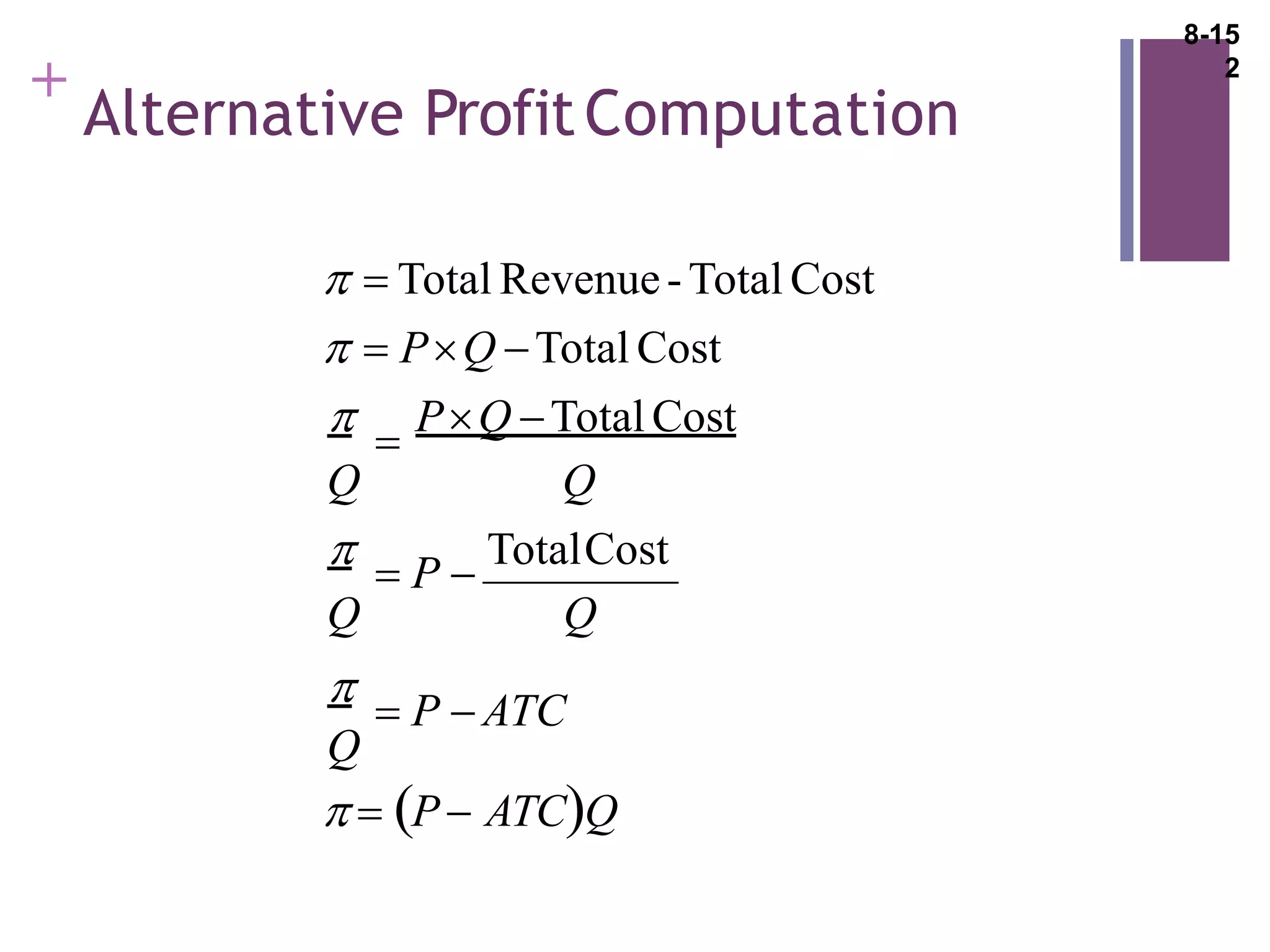
Q
  P ATCQ
  P  ATC
  Total Revenue-Total Cost
  PQ Total Cost
 
PQ Total Cost
Q Q
  P 
TotalCost
Q Q
8-15
2
Alternatively,
What’s the MR if a firm faces a linear
demand curve for its product?
P  a bQ
MR  a  2bQ,where b  0.

 
 E
MR  P1E
8-15
3
Useful Formulae
+ A Numerical Example
Given estimatesof
 P = 10 - Q
 C(Q) = 6 + 2Q
Optimal output?
 MR = 10 - 2Q
 M C = 2
 10 - 2Q = 2
 Q = 4 units
Optimal price?
 P = 10 - (4) = $6
Maximum profits?
 PQ - C(Q) = (6)(4) - (6 + 8) = $10
8-15
4
None, unless the source of
monopoly power is
eliminated.
8-15
5
Long RunAdjustments?
8-15
6
Why Government Dislikes
Monopoly?
P > M C
Too little output,at too high a price.
Deadweight loss of
monopoly.
+
$
Q
ATC
MC
MRQM
PM
D
MC
Deadweight Loss
of Monopoly
Deadweight Loss of Monopoly
8-15
7
+
Arguments forMonopoly
The beneficial effects of economies of scale, economies of
scope, and cost complementarities on price and output may
outweigh the negative effects of market power.
Encourages innovation.
8-15
8
8-15
9
Monopolistic Competition:
Environment and Implications
Numerous buyers and sellers
Differentiated products
 Implication: Since products are differentiated, each firm faces a
downward sloping demand curve.
 Consumers view differentiated products as close substitutes: there
exists some willingnessto substitute.
Free entry andexit
 Implication: Firms will earn zero profits in the long run.
Managing aMonopolistically
Competitive Firm
Like a monopoly, monopolistically
competitive firms
have market power that permits pricing above marginal cost.
level of sales depends on the price it sets.
But …
The presence of other brands in the market makes the
demand for your brand more elastic than if you were a
monopolist.
Free entry and exit impacts profitability.
Therefore, monopolisticallycompetitive
firms have limited market power.
8-16
0
QQ
P
TR
100
0 10 20 30 40 50 0 10 20 30 40 50
800
60 1200
40
20
Inelastic
Elastic Inelastic
Elastic
Unit elastic
Unit elastic
MR
8-16
1
Marginal Revenue Like a Monopolist
+
Monopolistic Competition:
Profit Maximization
Maximize profits like a monopolist
 Produce output where MR = MC.
 Charge the price on the demand curve that corresponds to that
quantity.
8-16
2
Short-Run Monopolistic
Competition
$
ATC
MC
D
MRQM
Profit
PM
ATC
Quantity of Brand X
8-16
3
+
Long RunAdjustments?
If the industry is truly monopolistically competitive,there is
free entry.
 In this case other “greedy capitalists” enter,and their new
brandssteal market share.
 This reduces the demand for your product until profits are
ultimately zero.
8-16
4
+
$
AC
MC
D
MR
Q* Quantity of Brand
XMR1
D1
Entry
P*
P1
Q1
Long Run Equilibrium
(P = AC, so zeroprofits)
Long-Run Monopolistic Competition
8-16
5
8-16
6
Monopolistic Competition
The Good (ToConsumers)
Product Variety
The Bad (To Society)
P > M C
Excess capacity
 Unexploited economiesof scale
The Ugly (To Managers)
P = ATC > minimum of
average costs.
Zero Profits (in the long run)!
+ Maximizing Profits:A Synthesizing
Example
C(Q) = 125 + 4Q2
Determine the profit-maximizing output and price, and discuss its
implications,if
 You are a price taker and other firms charge $40 per unit;
 You are a monopolist and the inverse demand for your product is P = 100
- Q;
 You are a monopolistically competitive firm and the inverse demand for
your brand is P = 100 – Q.
8-16
7
+
Marginal Cost
C(Q) = 125 + 4Q2,
So M C = 8Q.
This is independent of market structure.
8-16
8
+ Price Taker
MR = P = $40.
Set MR = MC.
 40 = 8Q.
 Q = 5 units.
Cost of producing 5 units.
 C(Q) = 125 + 4Q2 = 125 + 100 = $225.
Revenues:
 PQ = (40)(5) = $200.
Maximum profitsof -$25.
Implications: Expect exit in the long-run.
8-16
9
M+onopoly/Monopolistic Competition
MR = 100 - 2Q (since P = 100 - Q).
Set MR = MC, or 100 - 2Q = 8Q.
 Optimal output: Q = 10.
 Optimal price: P = 100 - (10) = $90.
 Maximal profits:
 PQ - C(Q) = (90)(10) -(125 + 4(100)) = $375.
Implications
 Monopolist will not face entry (unless patent or other entry barriers are
eliminated).
 Monopolistically competitive firm should expect other firms to clone, so
profits will decline over time.
8-17
0
+ Conclusion
Firms operating in a perfectly competitive
market take the market price as given.
Produce output where P = MC.
Firms may earn profits or losses in the short run.
… but,in the long run, entry or exit forces profits to zero.
A monopoly firm, in contrast, can earn persistent
profits provided that source of monopoly power
is noteliminated.
A monopolistically competitive firm can earn
profits in the short run, but entry by competing
brands will erode these profits over time.
8-17
1
+Managerial Economics &Business Strategy
Chapter 9
Basic Oligopoly Models
McGraw-Hill/Irwin
Michael R. Baye, Managerial Economics and
Business Strategy Copyright © 2008 by the McGraw-Hill Companies, Inc. All rights reserved.
+ Overview
I.Conditions for Oligopoly?
II.Role of StrategicInterdependence
III. Profit Maximization in Four Oligopoly Settings
 Sweezy (Kinked-Demand) Model
 Cournot Model
 Stackelberg Model
 Bertrand Model
9-17
3
+
Oligopoly Environment
Relatively few firms, usually less than 10.
Duopoly - twofirms
Triopoly - threefirms
The products firms offer can be either
differentiated or homogeneous.
Firms’ decisions impact one another.
Many different strategic variables are
modeled:
 No single oligopoly model.
9-17
4
Your actions affect theprofits
of your rivals.
Your rivals’actions affect
your profits.
How will rivals respond to
your actions?
9-17
5
Role of StrategicInteraction
+
An Example
You and another firm sell differentiated products.
How does the quantity demanded for your product change
when you change your price?
9-17
6
+
P
Q
D2 (Rival matches your price change)
PH
P0
PL
D1 (Rival holds its
price constant)
QL1QH1 QH2Q0QL2
9-17
7
+
P
Q
D1
Q0
D2 (Rival matches your price change)
(Rival holds its
price constant)
D
Demand if Rivals Match Price
Reductions but not Price Increases
P0
9-17
8
+
Key Insight
The effect of a price reduction on the quantity
demanded of your product depends upon whether
your rivals respond by cutting their prices too!
The effect of a price increase on the quantity
demanded of your product depends upon whether
your rivals respond by raising their prices too!
Strategic interdependence:You aren’t in complete
control of your owndestiny!
9-17
9
+ Sweezy (Kinked-Demand) Model
Environment
Few firms in the market serving many
consumers.
Firms produce differentiated products.
Barriers toentry.
Each firm believes rivals will match (or follow)
price reductions, but won’t match (or follow)
price increases.
Key feature of SweezyModel
 Price-Rigidity.
9-18
0
+ Sweezy Demand and Marginal
Revenue
P
QQ0
D1
(Rival holds its
price constant)
MR1
MR2
D2 (Rival matches your price change)
DS: Sweezy Demand
P0
MRS: Sweezy MR
9-18
1
+ Sweezy Profit-Maximizing Decision
Q
P0
Q0
DS: Sweezy Demand
MRS
MC1
MC2
MC3
P
D2 (Rival matches your price change)
D1 (Rival holds price
constant)
9-18
2
+
Sweezy Oligopoly Summary
Firms believe rivals match price cuts,but not price increases.
Firms operating in a Sweezy oligopoly maximize profit by
producing where
MRS = MC.
 The kinked-shaped marginal revenue curve implies that there exists a
range over which changes in M C will not impact the profit-maximizing
level ofoutput.
 Therefore, the firm may have no incentive to change price provided that
marginal cost remains in a given range.
9-18
3
+ Cournot Model Environment
A few firms produce goods that are either
perfect substitutes (homogeneous) or
imperfect substitutes (differentiated).
Firms’ control variable is output in contrast
to price.
Each firm believes their rivals will hold
output constant if it changes its own output
(The output of rivals is viewed as given or
“fixed”).
Barriers to entry exist.
9-18
4
Thus, each firm’s marginal revenue depends
on the output produced by the other firm.
More formally,MR1  a bQ2 2bQ1
MR2  a bQ1 2bQ2
9-18
5
Inverse Demand in a Cournot
Duopoly
Market demand in a homogeneous-product
Cournot duopoly is
P  a bQ1 Q2 
+ Best-Response Function
Since a firm’s marginal revenue in a
homogeneous Cournot oligopoly depends on both
its output and its rivals, each firm needs a way to
“respond”to rival’s output decisions.
Firm 1’s best-response (or reaction) function is a
schedule summarizing the amount of Q1 firm 1
should produce in order to maximize its profits for
each quantity of Q2 produced by firm 2.
Since the products are substitutes, an increase in
firm 2’s output leads to a decrease in the profit-
maximizing amount of firm 1’s product.
9-18
6
M C )
Firm 2’s best-response function is (c2 is firm 2’s
M C )
2b 2
 Q2
a  c1 1
Q1  r1Q2
12 2 1
Q
2b 2
 
a c2

1
Q  r Q
9-18
7
Best-Response Function fora
Cournot Duopoly
To find a firm’s best-response function, equate
its marginal revenue to marginal cost and solve
for its output as a function of its rival’s output.
Firm 1’s best-response function is (c1 is firm 1’s
+ Graph of Firm 1’s Best-Response
Function
Q1
M
Q1Q1
Q2
r1 (Firm 1’s Reaction Function)
Q2
(a-c1)/b Q1 = r1(Q2) = (a-c1)/2b - 0.5Q2
9-18
8
+ Cournot Equilibrium
Situation where each firm produces the
output that maximizes its profits, given the
the output of rival firms.
Nofirm can gain by unilaterally changing
its own output to improve its profit.
 A point where the two firm’s best-response functions intersect.
9-18
9
+ Graph of Cournot Equilibrium
*
Q2
Q1
*
Q1
Q1
M
r2
Q2
M
Q2
(a-c1)/b
r1
Cournot Equilibrium
(a-c2)/b
9-19
0
+Summary of Cournot Equilibrium
The output Q1
* maximizes firm 1’s profits,given that firm 2
*produces Q2 .
The output Q2
* maximizes firm 2’s profits,given that firm 1
*produces Q1 .
Neither firm has an incentive to change its output,given the
output of therival.
Beliefs are consistent:
 In equilibrium, each firm “thinks” rivals will stick to their current
output – and they do!
9-19
1
+
Stackelberg Model Environment
Fewfirms serving many consumers.
Firms produce differentiated or
homogeneous products.
Barriers to entry.
Firm one is theleader.
 The leader commits to an output before all other firms.
Remaining firms are followers.
 They choose their outputs so as to maximize profits, given the
leader’s output.
9-19
2
The Algebra of the Stackelberg
Model
Since the follower reacts to the leader’s
output, the follower’s output is determined by
its reaction function
The Stackelberg leader uses this reaction
function to determineits profit maximizing
2b
0.5Q1
a c2
Q2  r2Q1
2b
output level, which saimcp2lif2ice1s to
Q1 
9-19
3
+ Stackelberg Summary
Stackelberg model illustrates how commitment can enhance
profits in strategicenvironments.
Leader produces more than the Cournot equilibrium output.
 Larger market share,higher profits.
 First-mover advantage.
Follower produces less than the Cournot equilibrium output.
 Smaller market share,lower profits.
9-19
4
+
Bertrand Model Environment
Few firms that sell to many consumers.
Firms produce identical products at constant
marginal cost.
Each firm independently sets its price in order
to maximize profits (price is each firms’
control variable).
Barriers to entry exist.
Consumers enjoy
Perfect information.
Zero transactioncosts.
9-19
5
+ Bertrand Equilibrium
Firms set P1 = P2 = MC! Why?
Suppose M C < P1 < P2.
Firm 1 earns (P1 - MC) on each unit sold, while
firm 2 earns nothing.
Firm 2 has an incentive to slightly undercut
firm 1’s price to capture the entire market.
Firm 1 then has an incentive to undercut firm
2’s price. This undercutting continues...
Equilibrium: Each firm charges P1 = P2 = MC.
9-19
6
+ Conclusion
Different oligopoly scenarios give rise to
different optimal strategies and different
outcomes.
Youroptimal price and output depends on
…
Beliefs about the reactions of rivals.
 Your choice variable (P or Q) and the nature of the product market
(differentiated or homogeneous products).
 Your ability to credibly commit prior to your rivals.
9-19
7
+Managerial Economics &Business Strategy
Chapter 10
Game Theory:Inside
Oligopoly
McGraw-Hill/Irwin
Michael R. Baye, Managerial Economics and
Business Strategy Copyright © 2008 by the McGraw-Hill Companies, Inc. All rights reserved.
+
Game Environments
Players’ planned decisions are called
strategies.
Payoffs to players are the profits or losses
resulting from strategies.
Order of play is important:
 Simultaneous-move game: each player makes decisions with
knowledge of other players’ decisions.
 Sequential-move game: one player observes its rival’s move
prior to selecting a strategy.
Frequency of rivalinteraction
 One-shot game: game is played once.
 Repeated game: game is played more than once; either a finite
or infinite number of interactions.
10-1
99
+ Simultaneous-Move, One-Shot
Games: Normal Form Game
A Normal Form Game consists of:
 Set of players i ∈{1,2,… n} where n is a finite number.
 Each players strategy set or feasible actions consist of a finite
number ofstrategies.
Player 1’s strategies are S1 = {a,b,c,…}.
Player 2’s strategies are S2 = {A, B,C, …}.
 Payoffs.
Player 1’s payoff:π1(a,B) = 11.
Player 2’s payoff:π2(b,C) = 12.
10-2
00
+
Real World Examples of Collusion
Garbage Collection Industry
OPEC
NASDAQ
Airlines
10-201
+
of Game Theory
Two firms: an incumbent and potential entrant.
Potential entrant’s strategies:
Enter.
Stay Out.
Incumbent’s strategies:
 {if enter, playhard}.
 {if enter, playsoft}.
{if stay out,play hard}.
 {if stay out,play soft}.
Move Sequence:
 Entrant moves first.Incumbent observes entrant’s action and
selects an action.
10-202
Pricing to Prevent Entry: An Application
+
Entrant
Enter
Incumbent
Hard
Soft
The Pricing to Prevent Entry Game in
Extensive Form
-1, 1
5, 5
Out
0, 10
10-203
+ Identify Nash and Subgame Perfect
Equilibria
Entrant
Enter
Incumbent
Soft
-1, 1
Hard
5, 5
Out
0, 10
10-204
+ Two Nash Equilibria
Entrant
Enter
Incumbent
Soft
-1, 1
Hard
5, 5
Out
0, 10
Nash Equilibria Strategies {player 1; player 2}:
{enter; If enter, play soft}
{stay out; If enter, play hard}
10-205
+ One SubgamePerfect Equilibrium
Entrant
Enter
Incumbent
Soft
-1, 1
Hard
5, 5
Out
0, 10
Subgame Perfect Equilibrium Strategy:
{enter; If enter, play soft}
10-206
+
Insights
Establishing a reputation for being unkind to entrants can
enhance long-term profits.
It is costly to do so in the short-term,so much so that it isn’t
optimal to do so in a one-shot game.
10-207
+Managerial Economics & Business Strategy
Chapter 11
Pricing Strategies for Firms with Market Power
McGraw-Hill/Irwin
Michael R. Baye, Managerial Economics and
Business Strategy Copyright © 2008 by the McGraw-Hill Companies, Inc. All rights reserved.
+ Overview
I.Basic Pricing Strategies
 Monopoly & MonopolisticCompetition
Cournot Oligopoly
II.Extracting Consumer Surplus
 Price Discrimination ■ Two-PartPricing
 Block Pricing ■ Commodity Bundling
III.Pricing for Special Cost and Demand Structures
 Peak-Load Pricing ■ Transfer Pricing
Cross Subsidies
IV.Pricing in Markets with Intense Price Competition
 Price Matching ■ Randomized Pricing
Brand Loyalty
11-2
09
+ Standard Pricing and Profits for
Firms with MarketPower
Price
Quantity
P = 10 - 2Q
10
8
6
4
2
1 2
MC
3 4 5
MR = 10 - 4Q
Profits from standard pricing
= $8
11-2
10
+
An Algebraic Example
P = 10 - 2Q
C(Q) = 2Q
If the firm must charge a single price to all
consumers, the profit-maximizing price is
obtained by setting MR = MC.
10 - 4Q = 2,so Q* = 2.
P* = 10 - 2(2) = 6.
Profits = (6)(2) - 2(2) = $8.
11-2
11
+ A Simple Markup Rule
Suppose the elasticity of demand for the firm’s product is
EF.
Since MR = P[1 + EF]/ EF.
Setting MR = M C and simplifying yields this simple pricing
formula:
P = [EF/(1+ EF)]  MC.
The optimal price is a simple markup over relevant costs!
 More elastic the demand, lower markup.
 Less elastic the demand, higher markup.
11-2
12
+ An Example
Elasticity of demand for Kodak film is -2.
P = [EF/(1+ EF)]  M C
P = [-2/(1 - 2)]  M C
P = 2  M C
Price is twice marginal cost.
Fifty percent of Kodak’s price is margin above manufacturing
costs.
11-2
13
+Markup Rule for Cournot Oligopoly
Homogeneous product Cournotoligopoly.
N = total number of firms in the industry.
Market elasticity of demand EM .
Elasticity of individual firm’s demand is given
by EF = N x EM.
Since P = [EF/(1+ EF)]  MC,
Then, P = [NEM/(1+ NEM)]  MC.
The greater the number of firms, the lower the
profit-maximizing markup factor.
11-2
14
+ An Example
Homogeneous product Cournot industry, 3
firms.
M C = $10.
Elasticity of market demand = - ½.
Determine the profit-maximizingprice?
EF = N EM = 3  (-1/2) = -1.5.
P = [EF/(1+ EF)]  MC.
P = [-1.5/(1- 1.5]  $10.
P = 3  $10 = $30.
11-2
15
+
Extracting Consumer Surplus:
Moving From Single Price Markets
Most models examined to this point involve a
“single” equilibrium price.
In reality,there are many different prices being
charged inthe market.
Price discrimination is the practice of charging
different prices to consumer for the same good
to achieve higher prices.
The three basic forms of price discrimination
are:
 First-degree (or perfect) price discrimination.
 Second-degree price discrimination.
 Third-degree price discrimiation.
11-2
16
+ First-Degree or Perfect
Price Discrimination
Practice of charging each consumer the
maximum amount he or she will pay for each
incremental unit.
Permits a firm to extract all surplus from
consumers.
11-21
7
P+erfectPrice Discrimination
Price
Quantity
D
10
8
6
4
2
1 2 3 4 5
Profits*:
.5(4-0)(10 - 2)
= $16
Total Cost* = $8
MC
* Assuming no fixedcosts
11-21
8
+
Caveats:
In practice, transactions costs and
information constraints make this difficult to
implement perfectly (but car dealers and
someprofessionals come close).
Price discrimination won’t work if
consumers can resell the good.
11-21
9
Second-Degree
Price Discrimination
The practice ofposting
a discrete schedule of
declining prices for
different quantities.
Eliminates the
information constraint
present in first-degree
price discrimination.
Example: Electric
utilities
Price
MC
D
$5
$10
Quantity
$8
2 4
11-22
0
T+hird-Degree Price Discrimination
The practice of charging different
groupsof consumers different prices
for the same product.
Group must have observable
characteristics for third-degree price
discrimination towork.
Examples include student discounts,
senior citizen’s discounts, regional &
international pricing.
11-22
1
+ Implementing Third-DegreePrice
Discrimination
Suppose the total demand for a product is
comprised of two groups with different
elasticities, E1< E2.
Notice that group 1 is more price sensitive than
group 2.
Profit-maximizing prices?
P1 = [E1/(1+ E1)]  M C
P2 = [E2/(1+ E2)]  M C
11-22
2
+ An Example
Suppose the elasticity of demand for Kodak
film in the US is EU = -1.5,and the elasticity of
demand in Japan is EJ = -2.5.
Marginal cost of manufacturing film is $3.
PU = [EU/(1+ EU)]  M C = [-1.5/(1 - 1.5)]  $3 =
$9
PJ = [EJ/(1+ EJ)]  M C = [-2.5/(1 - 2.5)]  $3 =
$5
Kodak’s optimal third-degree pricing
strategy is to charge a higher price in the US,
where demand is less elastic.
11-22
3
+
Two-Part Pricing
When it isn’t feasible to charge different
prices for different units sold, but demand
information is known, two-part pricing may
permit you to extract all surplus from
consumers.
Two-part pricing consists of a fixed fee and
a per unitcharge.
 Example: Athletic club memberships.
11-22
4
1. Set price at marginal cost.
2. Compute consumer surplus.
3. Charge a fixed-fee equal to
consumer surplus.
Quantity
D
10
8
6
4
2
1 2 3 4 5
MC
Fixed Fee = Profits* = $16
Price
Per Unit
Charge
* Assuming no fixedcosts
11-22
5
How Two-Part Pricing Works
+ Block Pricing
The practice of packaging multiple units of an identical
product together and selling them as one package.
Examples
Paper.
 Six-packs ofsoda.
 Different sized of cans of green beans.
11-22
6
+ An Algebraic Example
Typical consumer’s demand is P = 10 - 2Q
C(Q) = 2Q
Optimal number of units in a package?
Optimal package price?
11-22
7
Quantity
D
Price
10
8
6
4
2
1 2 3 4 5
MC =AC
11-22
O+ptimal Quantity To Package: 4 Units8
+Optimal Price for the Package: $24
Price
Quantity
D
10
8
6
4
2
1 2 3 4 5
MC =AC
Consumer’s valuation of 4
units = .5(8)(4) + (2)(4) = $24
Therefore, set P = $24!
11-22
9
+ Costs andProfits with Block
Pricing
Price
Quantity
D
10
8
6
4
2
1 2 3 4 5
MC =AC
Profits* = [.5(8)(4) + (2)(4)] – (2)(4)
= $16
Costs = (2)(4) = $8
* Assuming no fixedcosts
11-23
0
+
Commodity Bundling
The practice of bundling two or more products together and
charging one price for the bundle.
Examples
 Vacation packages.
 Computers and software.
 Film and developing.
11-23
1
+ An Example that Illustrates
Kodak’s Moment
Total market size for film and developing is 4
million consumers.
Four types ofconsumers
 25% will use only Kodak film (F).
 25% will use only Kodak developing (D).
 25% will use only Kodak film and use only Kodak developing (FD).
 25% have no preference (N).
Zero costs (forsimplicity).
Maximum price each type of consumer will
pay is as follows:
11-23
2
Type Film Developing
F $8 $3
FD $8 $4
D $4 $6
N $3 $2
11-23
3
+Reservation Prices for Kodak Film
and Developing by Type of
Consumer
+ Optimal Film Price?
Type Film Developing
F $8 $3
FD $8 $4
D $4 $6
N $3 $2
Optimal Price is $8; only types F and FD buy resulting in profits
of $8 x 2 million = $16 Million.
At a price of $4, only typesF, FD, and D will buy
(profits of $12 Million).
At a price of $3, all will types will buy (profits of $12 Million).
11-23
4
O+ptimal Price for Developing?
Type Film Developing
F $8 $3
FD $8 $4
D $4 $6
N $3 $2
At a price of $6, only “D” type buys (profits of $6 Million).
At a price of $4, only “D” and “FD” types buy (profits of $8Million).
At a price of $2, all types buy (profits of $8 Million).
Optimal Price is $3, to earn profits of $3 x 3 million = $9 Million.
11-23
5
T+otalProfits byPricing Each Item
Separately?
Type Film Developing
F $8 $3
FD $8 $4
D $4 $6
N $3 $2
Total Profit = Film Profits + Development Profits
= $16 Million + $9 Million = $25 Million
Surprisingly, the firm can earn even greater profits by bundling!
11-23
6
+
Pricing a “Bundle” of Film and
Developing
11-23
7
C+onsumer Valuations of a Bundle
Type Film Developing Value of Bundle
F $8 $3 $11
FD $8 $4 $12
D $4 $6 $10
N $3 $2 $5
11-23
8
+What’s the Optimal Price for a
Bundle?
Type Film Developing Value of Bundle
F $8 $3 $11
FD $8 $4 $12
D $4 $6 $10
N $3 $2 $5
Optimal Bundle Price = $10 (for profits of $30 million)
11-23
9
Peak-Load Pricing
When demand during
peak times is higher
than the capacity ofthe
firm, the firm should
engage in peak-load
pricing.
Charge a higher price (PH)
during peak times (DH).
Charge a lower price (PL)
during off-peak times (DL).
Quantity
Price
MC
MRL
PL
QL QH
DH
MRH
DL
PH
11-24
0
+ Cross-Subsidies
Prices charged for one product are subsidized by the sale of
another product.
May be profitable when there are significant demand
complementarities effects.
Examples
Browser and server software.
Drinks and meals at restaurants.
11-24
1
D+ouble Marginalization
Consider a large firm with two divisions:
 the upstream division is the sole provider of a key input.
 the downstream division uses the input produced by the upstream
division to produce the final output.
Incentives to maximize divisional profits leads the
upstream manager to produce where MRU = MCU.
 Implication: PU > MCU.
Similarly, when the downstream division has market
power and has an incentive to maximize divisional
profits, the manager will produce where MRD = MCD.
 Implication: PD > MCD.
Thus, both divisions mark price up over marginal
cost resulting in in a phenomenon called double
marginalization.
 Result:less than optimal overall profits for the firm.
11-24
2
+
Transfer Pricing
To overcome double marginalization, the
internal price at which an upstream division
sells inputs to a downstream division should be
set in order to maximize the overall firm profits.
To achieve this goal, the upstream division
produces such that its marginal cost, MCu,
equals the net marginal revenue to the
downstream division (NMRd):
NMRd = MRd - MCd = MCu
11-24
3
+ Upstream Division’s Problem
Demand for the final product P = 10 - 2Q.
C(Q) = 2Q.
Suppose the upstream manager sets MR =
M C to maximize profits.
10 - 4Q = 2,so Q* = 2.
P* = 10 - 2(2) = $6, so upstream manager
charges the downstream division $6 per unit.
11-24
4
+
Downstream Division’s Problem
Demand for the final product P = 10 - 2Q.
Downstream division’s marginal cost is the $6
charged by the upstream division.
Downstream division setsMR = M C to maximize
profits.
10 - 4Q = 6,so Q* = 1.
P* = 10 - 2(1) = $8,so downstream division
charges $8 per unit.
11-24
5
+ Analysis
This pricing strategy by the upstream division
results in less than optimal profits!
The upstream division needs the price to be $6
and the quantity sold to be 2 units in order to
maximize profits. Unfortunately,
The downstream division sets price at $8, which is
too high; only 1 unit is sold at that price.
 Downstream division profits are $8  1 – 6(1) = $2.
The upstream division’s profits are $6  1 - 2(1) =
$4 instead of the monopoly profits of $6  2- 2(2)
= $8.
Overall firm profit is $4 + $2 = $6.
11-24
6
+ Upstream Division’s
“Monopoly Profits”
Price
Quantity
P = 10 - 2Q
10
8
6
4
2
1
MC =AC
2 3 4 5
MR = 10 - 4Q
Profit = $8
11-24
7
+ Upstream’s Profits when
Downstream Marks Price Up to
$8 Price
Quantity
P = 10 - 2Q
2
1
MC =AC
2 3 4 5
MR = 10 - 4Q
Profit = $4Downstream 10
Price 8
6
4
11-24
8
Provide upstream manager with an incentive
to set the optimal transfer price of $2
(upstream division’s marginal cost).
Overall profit with optimal transfer price:
  $62 $22  $8
11-24
9
Solutions for the OverallFirm?
+ Pricing in Markets with Intense Price
Competition
Price Matching
Advertising a price and a promise to match any lower price
offered by a competitor.
No firm has an incentive to lower their prices.
Each firm charges the monopoly price and shares the market.
Induce brand loyalty
Some consumers will remain “loyal” to a firm; even in the face
of price cuts.
Advertising campaigns and “frequent-user” style programs can
help firms induce loyal among consumers.
Randomized Pricing
A strategy of constantly changing prices.
Decreases consumers’ incentive to shop around as they cannot
learn from experience which firm charges the lowest price.
Reduces the ability of rival firms to undercut a firm’s prices.
11-25
0
+ Conclusion
First degree price discrimination, block pricing,
and two part pricing permit a firm to extract all
consumer surplus.
Commodity bundling, second-degree and third
degree price discrimination permit a firm to
extract some (but not all) consumer surplus.
Simple markup rules are the easiest to implement,
but leave consumers with the most surplus and
may result indouble-marginalization.
Different strategies require differentinformation.
11-25
1

Managerial Economis

  • 1.
    +Managerial Economics &BusinessStrategy Chapter 1 The Fundamentals of Managerial Economics McGraw-Hill/Irwin Michael R. Baye, Managerial Economics and Business Strategy Copyright © 2008 by the McGraw-Hill Companies, Inc. All rights reserved.
  • 2.
    + Managerial Economics Manager  Aperson who directs resources to achieve a stated goal. Economics  The science of making decisions in the presence of scare resources. Managerial Economics  The study of how to direct scarce resources in the way that most efficiently achieves a managerial goal. 1-2
  • 3.
    + Economic vs.Accounting Profits AccountingProfits  Total revenue (sales) minus dollar cost of producing goods or services.  Reported on the firm’s income statement. Economic Profits  Total revenue minus total opportunity cost. 1-3
  • 4.
    + Opportunity Cost AccountingCosts  The explicit costs of the resources needed to produce produce goods or services.  Reported on the firm’s income statement.  Opportunity Cost  The cost of the explicit and implicit resources that are foregone when a decision is made. Economic Profits  Total revenue minus total opportunity cost. 1-4
  • 5.
    + Profits as aSignal Profitssignal to resource holders where resources are most highly valued by society.  Resources will flow into industries that are most highly valued by society. 1-5
  • 6.
    Control VariableExamples: Output  Price Product Quality  Advertising R&D Basic Managerial Question: How much of the control variable should be used to maximize net benefits? Marginal (Incremental) Analysis 1-6
  • 7.
    + Net Benefits Net Benefits= Total Benefits - Total Costs Profits = Revenue - Costs 1-7
  • 8.
    Marginal Benefit(MB) Change intotal benefits arising from a change in the control variable,Q: Q MB  B Slope (calculus derivative) of the total benefit curve. 1-8
  • 9.
    Marginal Cost (MC) Changein total costs arising from a change in the control variable,Q: MC  C Q Slope (calculus derivative) of the total cost curve 1-9
  • 10.
    + Marginal Principle Tomaximize net benefits, the managerial control variable should be increased up to the point where MB = MC. MB > MC means the last unit of the control variable increased benefits more than it increased costs. MB < MC means the last unit of the control variable increased costs more than it increased benefits. 1-10
  • 11.
    + The Geometryof Optimization:Total Q Benefit and Cost Total Benefits & Total Costs Costs Benefits Q* B C Slope = MC Slope =MB 1-11
  • 12.
    + The Geometryof Optimization: Net Benefits Q Net Benefits Q* Maximum net benefits Slope = MNB 1-12
  • 13.
    +Managerial Economics &BusinessStrategy Chapter 2 Market Forces: Demand and Supply McGraw-Hill/Irwin Michael R. Baye, Managerial Economics and Business Strategy Copyright © 2008 by the McGraw-Hill Companies, Inc. All rights reserved.
  • 14.
    Overview I.Market Demand Curve The DemandFunction Determinants ofDemand Consumer Surplus II.Market Supply Curve The Supply Function Supply Shifters Producer Surplus III.Market Equilibrium IV.Price Restrictions V. Comparative Statics 2-14
  • 15.
    + Market Demand Curve Showsthe amount of a good that will be purchased at alternative prices, holding other factors constant. Law of Demand  The demand curve is downward sloping. D Quantity Price 2-15
  • 16.
    Determinants of Demand Income Normalgood Inferior good Prices of RelatedGoods Prices ofsubstitutes Prices ofcomplements Advertising and consumer tastes Population Consumer expectations 2-16
  • 17.
    + The Demand Function Ageneral equation representing the demand curve Qx d = f(Px ,PY ,M, H,) d Qx= quantity demand of good X.  Px = price of good X.  PY = price of a related good Y.  Substitute good.  Complement good. M = income. Normal good. Inferior good.  H = any other variable affecting demand. 2-17
  • 18.
    + Inverse Demand Function Priceas a functionof quantity demanded. Example:  Demand Function  Qx d = 10 – 2Px  Inverse Demand Function: d  2Px = 10 – Qx  Px = 5 – 0.5Qx d 2-18
  • 19.
    Change in QuantityDemanded Quantity D0 4 7 6 Price A to B:Increase in quantity demanded B 10 A 2-19
  • 20.
    Price D1 D0 Quantity 6 7 D0 to D1:Increasein Demand Change inDemand 13 2-20
  • 21.
    Consumer Surplus: The valueconsumers get from a good but do not have to pay for. Consumersurplus will prove particularly useful in marketing and other disciplines emphasizing strategies like value pricing and price discrimination. 2-21
  • 22.
    I got agreat deal! That companyoffers a lot of bang for the buck! Dell provides good value. Total value greatly exceeds totalamount paid. Consumer surplus is large. 2-22
  • 23.
    I got alousy deal! That car dealer drives a hard bargain! I almost decided not to buy it! They tried to squeeze the verylast cent from me! Total amount paidis close to total value. Consumer surplus is low. 2-23
  • 24.
    + Price Quantity 10 8 6 4 2 D 1 2 34 5 Consumer Surplus: The value received but not paid for. Consumer surplus = (8-2) + (6-2) + (4-2) = $12. Consumer Surplus: The Discrete Case 2-24
  • 25.
    C+onsumer Surplus: The ContinuousCase Price $ Quantity 10 8 6 4 2 D 1 2 3 4 5 Value of 4 units = $24Consumer Surplus = $24 - $8 = $16 Expenditure on 4 units = $2 x 4 = $8 2-25
  • 26.
    + Market SupplyCurve The supply curve shows the amount of a good that will be produced at alternativeprices. Law of Supply  The supply curve is upward sloping. Price Quantity S0 2-26
  • 27.
    Supply Shifters Input prices Technologyor government regulations Number offirms Entry Exit Substitutes in production Taxes Excise tax Ad valoremtax Producer expectations 2-27
  • 28.
    + The Supply Function Anequation representing the supply curve: Qx S = f(Px ,PR ,W,H,)  Qx S = quantity supplied of good X.  Px = price of good X.  PR = price of a production substitute.  W = price of inputs (e.g.,wages).  H = other variable affecting supply. 2-28
  • 29.
    + Inverse Supply Function Priceas a functionof quantity supplied. Example:  Supply Function  Qx s = 10 + 2Px  Inverse Supply Function:  2Px = 10 + Qx s s  Px = 5 + 0.5Qx 2-29
  • 30.
    + Change in QuantitySupplied Price Quantity S0 B 20 A 10 5 10 A to B:Increase in quantity supplied 2-30
  • 31.
    + Price Quantity75 S0 to S1:Increasein supply Change inSupply S0 S1 8 6 2-31
  • 32.
    + Producer Surplus Theamount producers receive in excess of the amount necessary to induce them to produce the good. Price QuantityQ* S0 P* 2-32
  • 33.
    Market Equilibrium The Price(P) that Balances supply and demand S d  Qx= Qx No shortage or surplus Steady-state 2-33
  • 34.
    Price Quantity S D 6 12 Shortage 12 -6 = 6 If price is too low… 7 6 5 2-34
  • 35.
    Quantity S D 14 Surplus 14 - 6= 8 6 8 If price is too high… Price 9 8 7 2-35
  • 36.
    + Price Restrictions PriceCeilings The maximum legal price that can be charged. Examples:  Gasoline prices in the 1970s.  Housing in New York City.  Proposed restrictions on ATM fees. Price Floors The minimum legal price that can be charged. Examples:  Minimum wage.  Agricultural price supports. 2-36
  • 37.
  • 38.
    + Impact of aPriceFloor Quantity S D P* Q* SurplusPrice PF Qd QS 2-38
  • 39.
    + Comparative StaticAnalysis How dothe equilibrium price and quantity change when a determinant of supply and/or demand change? 2-39
  • 40.
    + Applications ofDemand and Supply Analysis Event: The WSJ reports that the prices of PC components are expected to fall by 5-8 percent over the next six months. Scenario 1:You manage a small firm that manufactures PCs. Scenario 2:You manage a small software company. 2-40
  • 41.
    + Use ComparativeStatic Analysis to see the Big Picture! Comparative static analysis shows how the equilibrium price and quantity will change when a determinant of supply or demand changes. 2-41
  • 42.
    + Scenario 1:Implications fora Small PC Maker Step 1: Look for the “Big Picture.” Step 2:Organize an action plan (worry about details). 2-42
  • 43.
    Price of PCs Quantity of PC’s S D S* P0 P* Q0Q* Big Picture: Impact of decline in component prices on PC market 2-43
  • 44.
    + Big PictureAnalysis: PC Market Equilibrium price of PCs will fall,and equilibrium quantity of computers soldwill increase. Use this to organize an action plan  contracts/suppliers? inventories?  human resources?  marketing?  do I need quantitative estimates? 2-44
  • 45.
    + Scenario2: SoftwareMaker More complicated chain of reasoning to arrive at the “Big Picture.” Step 1:Use analysis like that in Scenario 1 to deduce that lower component prices will lead to  a lower equilibrium price for computers.  a greater number of computers sold. Step 2:How will these changes affect the “Big Picture” in the software market? 2-45
  • 46.
    Price of Software Quantity of Software S D D* Q0Q1 Big Picture:Impact of lower PC prices on the software market P1 P0 2-46
  • 47.
    + Big Picture Analysis:Software Market Software prices are likely to rise, and more software will be sold. Use this to organize an action plan. 2-47
  • 48.
    +Managerial Economics &BusinessStrategy Chapter 3 Quantitative Demand Analysis McGraw-Hill/Irwin Michael R. Baye, Managerial Economics and Business Strategy Copyright © 2008 by the McGraw-Hill Companies, Inc. All rights reserved.
  • 49.
    + Overview I.The ElasticityConcept Own Price Elasticity  Elasticity andTotal Revenue  Cross-Price Elasticity  Income Elasticity II.Linear Demand Functions 3-49
  • 50.
    + The ElasticityConcept How responsiveis variable “G” to a change in variable “S” %S E  %G G,S If EG,S > 0, then S and G are directly related. If EG,S < 0, then S and G are inversely related. If EG,S = 0, then S and G are unrelated. 3-50
  • 51.
    + The Elasticity ConceptUsing Calculus Analternative way to measure the elasticity of a function G = f(S) is dS G E  dG S G,S If EG,S > 0, then S and G are directly related. If EG,S < 0, then S and G are inversely related. If EG,S = 0, then S and G are unrelated. 3-51
  • 52.
    + Own Price Elasticityof Demand Negative according to the “law of demand.” X d E %P %QX QX ,PX QX ,PX QX ,PX 1 1 1QX ,PX Elastic: E Inelastic: E Unitary: E 3-52
  • 53.
    + Perfectly Elastic& Inelastic Demand  )QX ,PX Perfectly Elastic (E Perfectly Inelastic (EQ ,P  0) X X D Price Quantity D Price Quantity 3-53
  • 54.
    + Own-Price Elasticity and TotalRevenue Elastic Increase (a decrease) in price leads to a decrease (an increase) in total revenue. Inelastic  Increase (a decrease) in price leads to an increase (a decrease) in total revenue. Unitary  Total revenue is maximized at the point where demand is unitary elastic. 3-54
  • 55.
    + Elasticity,Total Revenueand Linear Demand QQ P TR 100 00 10 20 30 40 50 3-55
  • 56.
    + Elasticity,Total Revenueand Linear Demand QQ P TR 100 0 10 20 30 40 50 80 800 0 10 20 30 40 50 3-56
  • 57.
    + Elasticity,Total Revenueand Linear Demand QQ P TR 100 80 800 60 1200 0 10 20 30 40 500 10 20 30 40 50 3-57
  • 58.
    + Elasticity,Total Revenueand Linear Demand QQ P TR 100 80 800 60 1200 40 0 10 20 30 40 500 10 20 30 40 50 3-58
  • 59.
    + Elasticity,Total Revenueand Linear Demand QQ P TR 100 80 800 60 1200 40 20 0 10 20 30 40 500 10 20 30 40 50 3-59
  • 60.
    + Elasticity,Total Revenueand Linear Demand QQ P TR 100 80 800 60 1200 40 20 Elastic Elastic 0 10 20 30 40 500 10 20 30 40 50 3-60
  • 61.
    + Elasticity,Total Revenueand Linear Demand QQ P TR 100 80 800 60 1200 40 20 Inelastic Elastic Inelastic 0 10 20 Elastic 30 40 500 10 20 30 40 50 3-61
  • 62.
    + Elasticity,Total Revenueand Linear Demand QQ P TR 100 80 800 60 1200 40 20 Inelastic Elastic Inelastic 0 10 20 Elastic 30 40 500 10 20 30 40 50 Unit elastic Unit elastic 3-62
  • 63.
    + Demand, Marginal Revenue(MR) and Elasticity For a linear inverse demand function, MR(Q) = a + 2bQ, where b < 0. When MR > 0,demand is elastic; MR = 0,demand is unit elastic; MR < 0,demand is inelastic. Q P 100 80 60 40 20 Inelastic Elastic 0 10 20 40 50 Unit elastic MR 3-63
  • 64.
    + Factors Affecting OwnPrice Elasticity  Available Substitutes  The more substitutes available for the good, the more elastic the demand. Time  Demand tends to be more inelastic in the short term than in the long term.  Time allows consumers to seek out available substitutes.  Expenditure Share  Goods that comprise a small share of consumer’s budgets tend to be more inelastic than goods for which consumers spend a large portion of theirincomes. 3-64
  • 65.
    + Cross Price Elasticityof Demand If EQX,PY > 0, then X and Y are substitutes. If EQX,PY < 0, then X and Y are complements. Y d E %P %QX QX ,PY 3-65
  • 66.
    + Income Elasticity If EQX,M> 0, then X is a normal good. If EQX,M < 0, then X is a inferior good. E d %M %QX QX ,M 3-66
  • 67.
    + Uses ofElasticities Pricing. Managing cashflows. Impactof changes in competitors’ prices. Impact of economic booms and recessions. Impact of advertising campaigns. And lotsmore! 3-67
  • 68.
    +Example 1:Pricing andCash Flows According to an FTC Report by Michael Ward,AT&T’s own price elasticity of demand for long distance services is -8.64. AT&T needs to boost revenues in order to meet it’s marketing goals. To accomplish this goal, should AT&T raise or lower it’s price? 3-68
  • 69.
    + Answer: Lowerprice! Since demandis elastic, a reduction in price will increase quantity demanded by a greater percentage than the price decline, resulting in more revenues for AT&T. 3-69
  • 70.
    + Example 2:Quantifyingthe Change If AT&T lowered price by 3 percent,what would happen to the volume of long distance telephone calls routed through AT&T? 3-70
  • 71.
    + Answer 3% d X • Callswould increase by 25.92 percent! d d 3%8.64 %QX %Q d  25.92% X  8.64  %QX %P E  8.64  %QX QX ,PX 3-71
  • 72.
    + Example3: Impactof a change in a competitor’s price According to an FTC Report by Michael Ward,AT&T’s cross price elasticity of demand for long distance services is 9.06. If competitors reduced their prices by 4 percent,what would happen to the demand for AT&T services? 3-72
  • 73.
    + Answer • AT&T’sdemand would fall by 36.24 percent! 4% d Y d d  4%9.06  %QX %Q d  36.24% X 9.06  %QX %P E  9.06  %QX QX ,PY 3-73
  • 74.
    + Interpreting Demand Functions Mathematicalrepresentations of demandcurves. Example: Q d  10  2P 3P2M X X Y  Law of demand holds (coefficient of PX is negative).  X and Y are substitutes (coefficient of PY is positive).  X is an inferior good (coefficient of M is negative). 3-74
  • 75.
    +Managerial Economics &BusinessStrategy Chapter 4 The Theory of Individual Behavior McGraw-Hill/Irwin Michael R. Baye, Managerial Economics and Business Strategy Copyright © 2008 by the McGraw-Hill Companies, Inc. All rights reserved.
  • 76.
    + Overview I.Consumer Behavior Indifference Curve Analysis  Consumer Preference Ordering II.Constraints  The Budget Constraint  Changes inIncome  Changes inPrices III.Consumer Equilibrium IV.Indifference CurveAnalysis & Demand Curves  Individual Demand  Market Demand 4-76
  • 77.
    + Consumer Behavior ConsumerOpportunities  The possible goods and services consumer can afford to consume. Consumer Preferences  The goods and services consumers actually consume. Given the choice between 2 bundles of goods a consumer either  Prefers bundle A to bundle B:A ≻B.  Prefers bundle B to bundle A:A ≺B.  Is indifferent between the two:A  B. 4-77
  • 78.
    Indifference Curve Analysis IndifferenceCurve A curve that defines the combinations of 2 or more goods that give a consumer the same level ofsatisfaction. Marginal Rate ofSubstitution The rate at which a consumer is willing to substitute one good for another and maintain the same satisfactionlevel. I. II. III. GoodY Good X 4-78
  • 79.
    + Consumer PreferenceOrdering Properties Completeness More isBetter Diminishing MarginalRate of Substitution Transitivity 4-79
  • 80.
    Complete Preferences Completeness Property Consumeris capable of expressing preferences (or indifference) between all possible bundles. (“I don’t know” is NOT an option!) If the only bundles available to a consumer are A, B,and C, then the consumer  is indifferent between A and C (they are on the same indifference curve).  will prefer Bto A. will prefer B to C. I. II. III. GoodY Good X A C B 4-80
  • 81.
    More Is Better! MoreIsBetter Property  Bundles that have at least as much of every good and more of some good are preferred to other bundles.  Bundle B is preferred to A since B contains at least as much of good Y and strictly more of good X.  Bundle B is also preferred to C since B contains at least as much of good X and strictly more of goodY.  More generally, all bundles on ICIII are preferred to bundles on ICII or ICI.And all bundles on ICII are preferred toICI. I. II. III. GoodY Good X A C B 1 33.33 100 3 4-81
  • 82.
    Diminishing MarginalRate of Substitution MarginalRate ofSubstitution  The amount of good Y the consumer is willing to give up to maintain the same satisfaction level decreases as more of good X is acquired.  The rate at which a consumer is willing to substitute one good for another and maintain the same satisfaction level. To go from consumption bundle A to B the consumer must give up 50 units ofY to get one additional unit of X.  To go from consumption bundle B to C the consumer must give up 16.67 units ofY to get one additional unit of X.  To go from consumption bundle C to D the consumer must give up only 8.33 units ofY to get one additional unit ofX. I. II. III. GoodY Good X1 2 3 4 100 50 33.33 25 A B C D 4-82
  • 83.
    Consistent Bundle Orderings TransitivityProperty For the three bundles A, B,and C, the transitivity property implies that if C ≻B and B ≻A, then C ≻A. Transitive preferences along with the more-is-betterproperty imply that indifference curves willnot intersect. the consumer will not get caught in a perpetual cycle of indecision. I. II. III. GoodY 1 2 5 7 Good X 100 75 50 A B C 4-83
  • 84.
    The Budget Constraint OpportunitySet  The set of consumption bundles that are affordable. PxX + PyY  M. Budget Line The bundles of goods that exhaust a consumers income. PxX + PyY = M. Market Rate of Substitution  The slope of the budget line -Px / Py Y X The Opportunity Set Budget Line Y = M/PY – (PX/PY)XM/PY M/PX 4-84
  • 85.
    Changes in theBudget Line Changes inIncome Increases lead to a parallel, outward shift in the budget line (M1 > M0).  Decreases lead to a parallel, downward shift (M2 < M0). Changes inPrice A decreases in the price of good X rotates the budget line counter-clockwise (PX0 > PX ). 1  An increasesrotates the budget line clockwise (not shown). X X Y M0/PY M /P2 Y M2/PX Y M1/PY M0/PX M1/PX New Budget Line for a price decrease.M0/PY M0/PX0 M0/PX1 4-85
  • 86.
    Consumer Equilibrium The equilibrium consumptionbundle is the affordable bundle that yields the highest level of satisfaction. Consumer equilibrium occursat a point where MRS = PX /PY. Equivalently, the slope of the indifference curve equals the budgetline. I. III. II. X Y Consumer Equilibrium M/PY M/PX 4-86
  • 87.
    + Price Changes andConsumer Equilibrium Substitute Goods  An increase (decrease) in the price of good X leads to an increase (decrease) in the consumption of good Y. Examples:  Coke andPepsi.  Verizon Wireless or AT&T. Complementary Goods  An increase (decrease) in the price of good X leads to a decrease (increase) in the consumption of good Y. Examples:  DVD and DVD players.  Computer CPUs and monitors. 4-87
  • 88.
    + Complementary Goods When theprice of good X falls and the consumption of Y rises, then X and Y are complementary ) goods. (PX1 > PX2 Pretzels (Y) Beer (X) II I 0 Y2 Y1 A B X1 M/PX1 X2 M/PX2 M/PY1 4-88
  • 89.
    + Income Changes andConsumer Equilibrium Normal Goods  Good X is a normal good if an increase (decrease) in income leads to an increase (decrease) in its consumption. Inferior Goods  Good X is an inferior good if an increase (decrease) in income leads to a decrease (increase) in its consumption. 4-89
  • 90.
    + Normal Goods An increasein income increases the consumption of normal goods. (M0 < M1). Y II I 0 A B XM0/X M1/Y M1/XX0 Y0 X1 Y1 M0/Y 4-90
  • 91.
    + Decomposing the Incomeand SubstitutionEffects Initially, bundle A is consumed. A decrease in the price of good X expands the consumer’s opportunity set. The substitution effect (SE) causes the consumer to move from bundle A to B. A higher “real income” allows the consumer to achieve a higher indifference curve. The movement from bundle B to C represents the income effect (IE). The new equilibrium is achieved at point C. Y II I 0 A X C B IE SE 4-91
  • 92.
    + Other goods (Y) II I A C B F D E Pizza (X) 0 0.51 2 A buy-one, get-one free pizza deal. A Classic Marketing Application 4-92
  • 93.
    Individual Demand Curve Anindividual’s demand curve is derived fromeach new equilibrium point found onthe indifference curve as the price of good X is varied. X Y $ X D II I P0 P1 X0 X1 4-93
  • 94.
    Market Demand The marketdemand curve is the horizontal summation of individual demand curves. It indicates the total quantity all consumers would purchase at each price point. $ $ Q D2D1 Individual Demand Curves 50 40 Market Demand Curve 1 2 1 2 3 DM Q 4-94
  • 95.
    + Conclusion Indifference curve propertiesreveal information about consumers’ preferences between bundles ofgoods. Completeness. More is better.  Diminishing marginalrate of substitution. Transitivity. Indifference curves along with price changes determine individuals’demand curves. Market demand is the horizontal summation of individuals’ demands. 4-95
  • 96.
    +Managerial Economics &BusinessStrategy Chapter 5 The Production Process and Costs McGraw-Hill/Irwin Michael R. Baye, Managerial Economics and Business Strategy Copyright © 2008 by the McGraw-Hill Companies, Inc. All rights reserved.
  • 97.
    + Overview I.ProductionAnalysis  Total Product,MarginalProduct,Average Product  Isoquants  Isocosts  Cost Minimization II.Cost Analysis  Total Cost,Variable Cost, Fixed Costs  Cubic CostFunction  Cost Relations 5-97
  • 98.
    + Production Analysis Production Function Q = F(K,L) Q is quantity of output produced. Kis capital input. L is labor input. F is a functional form relating the inputs to output.  The maximum amount of output that can be produced with K units of capital and L units of labor. Short-Run vs. Long-Run Decisions Fixed vs.Variable Inputs 5-98
  • 99.
    5-99 Production FunctionAlgebraic Forms Linear productionfunction: inputs are perfect substitutes. Q  FK,L aK bL Leontief production function: inputs are used in fixed proportions. QFK,LminbK,cL Cobb-Douglas production function: inputs have a degree ofsubstitutability. Q  FK, L Ka Lb
  • 100.
    + Productivity Measures: Total Product TotalProduct (TP): maximum output produced with given amountsof inputs. Example: Cobb-Douglas Production Function: Q = F(K,L) = K.5 L.5  K is fixed at 16 units.  Short run Cobb-Douglass production function: Q = (16).5 L.5 = 4 L.5  Total Product when 100 units of labor are used? Q = 4 (100).5 = 4(10) = 40 units 5-10 0
  • 101.
    + Productivity Measures:Average Product ofan Input Average Product of an Input: measure of output produced per unit of input. Average Product of Labor: APL = Q/L. Measures the output of an “average” worker. Example: Q = F(K,L) = K.5 L.5  If the inputs are K = 16 and L = 16, then the average product of labor is APL = [(16) 0.5(16)0.5]/16 = 1. Average Product of Capital:APK = Q/K. Measures the output of an “average” unit of capital. Example: Q = F(K,L) = K.5 L.5  If the inputs are K = 16 and L = 16, then the average product of capital is APK = [(16)0.5(16)0.5]/16 = 1. 5-10 1
  • 102.
    + Productivity Measures:Marginal Productof an Input Marginal Product on an Input: change in total output attributable to the last unit of an input. Marginal Product of Labor: MPL = Q/L Measures the output produced by the last worker. Slope of the short-run production function (with respect to labor). Marginal Product of Capital: MPK = Q/K Measures the output produced by the last unit of capital. When capital is allowed to vary in the short run, MPK is the slope of the production function (with respect to capital). 5-10 2
  • 103.
  • 104.
    + Guiding the ProductionProcess Producingon the production function  Aligning incentives to induce maximum worker effort. Employing the right level of inputs  When labor or capital vary in the short run, to maximize profit a manager willhire  labor until the value of marginal product of labor equals the wage: VMPL = w,where VMPL = P x MPL.  capital until the value of marginal product of capital equals the rental rate: VMPK = r, where VMPK = P x MPK . 5-10 4
  • 105.
    5-10 5 Isoquant Illustrates the long-runcombinations of inputs (K, L) that yield the producer the same level of output. The shape of an isoquant reflects the ease with which a producer can substitute among inputs while maintaining the same levelof output.
  • 106.
    K KL MP MRTS MP  L 5-10 6 Marginal Rateof Technical Substitution (MRTS) The rate at which two inputs are substituted while maintaining the same outputlevel.
  • 107.
    Capital and labor areperfect substitutes Q = aK + bL MRTSKL = b/a Linear isoquants implythat inputs are substituted at a constant rate,independent of the input levels employed. Q1 Q2 Q3 Increasing Output L K 5-10 7 Linear Isoquants
  • 108.
    complements. Capital and laborare used in fixed-proportions. Q = min {bK, cL} Since capital and labor are consumed in fixed proportions there is no input substitution along isoquants (hence, noMRTSKL). Q3 Q2 Q1 Capital and labor are perfectK Increasing Output L 5-10 8 Leontief Isoquants
  • 109.
    Inputs are notperfectly substitutable. Diminishingmarginal rate of technical substitution.  As less of one input is used in the production process, increasingly more of the other input must be employed to produce the same output level. Q = KaLb MRTSKL = MPL/MPK Q1 Q2 Q3 K L Increasing Output 5-10 9 Cobb-Douglas Isoquants
  • 110.
    Isocost The combinations ofinputs that produce a given level of output at the same cost: wL + rK = C Rearranging, K= (1/r)C - (w/r)L For given input prices, isocosts farther from the origin are associated with higher costs. Changes in input prices change the slope of the isocost line. L L K New Isocost Line for a decrease in the wage (price of labor: w0 > w1). C C 0 1C /0 wC1 /w K C1/r C0/r C/w0 C/w1 C/r New Isocost Line associated with higher costs (C0 1< C ). 5-11 0
  • 111.
    + Cost Minimization Marginal productper dollar spent should be equal for all inputs: But,this is just w r MPK r MPL  MPK  MPL  w r KLMRTS  w 5-111
  • 112.
  • 113.
    + Optimal Input Substitution Afirm initially produces Q0 by employing the combination of inputs represented by point A at a cost ofC0. Suppose w0 falls tow1.  The isocost curverotates counterclockwise; which represents the same cost level prior to the wage change. To produce the same level of output,Q0, the firm will produce on a lower isocost line (C1)at a point B.  The slope of the new isocost line represents the lower wage relative to the rental rate of capital. Q0 A K C0/w1LC1/w10 L0 L1C0/w0 K0 K1 B 5-11 3
  • 114.
    5-11 4 Cost Analysis Types ofCosts Short-Run Fixedcosts(FC) Sunk costs Short-run variable costs (VC) Short-run totalcosts (TC) Long-Run All costs arevariable No fixedcosts
  • 115.
    Total and VariableCosts C(Q): Minimum total cost of producing alternative levels of output: C(Q) = VC(Q) + FC VC(Q): Costs that vary with output. FC: Costs that do not vary with output. $ Q C(Q) = VC + FC VC( Q) F C 0 5-11 5
  • 116.
    Sunk Cost:A costthat is forever lost after it has been paid. Decision makers should ignore sunk costs to maximize profit or minimize losses FC: Costs that do not change $ as output changes. Q F C C(Q) = VC + FC VC( Q) 5-11 6 Fixed and Sunk Costs
  • 117.
    Some Definitions Average TotalCost ATC = AVC +AFC ATC = C(Q)/Q Average Variable Cost AVC = VC(Q)/Q Average Fixed Cost AFC = FC/Q Marginal Cost MC = C/Q $ Q AF C MC ATC AVC MR 5-11 7
  • 118.
    $ Q ATC AVC MC ATC AVC Q0 AFC Fixed Cost FixedCost Q0(ATC-AVC) = Q0AFC = Q0(FC/ Q0) = FC 5-11 8
  • 119.
    Variable Cost $ Q ATC AVC MC AVC Variable Cost Q0 Q0AVC =Q0[VC(Q0)/ Q0] = VC(Q0) Minimum ofAVC 5-11 9
  • 120.
    $ Q ATC AVC MC ATC Total Cost Q0 = Q0[C(Q0)/Q0] = C(Q0) Total Cost Q0ATC Minimum ofATC 5-12 0
  • 121.
    + Cubic CostFunction C(Q) =f + a Q + b Q2 + cQ3 Marginal Cost?  Memorize: MC(Q) = a + 2bQ + 3cQ2  Calculus: dC/dQ = a + 2bQ + 3cQ2 5-12 1
  • 122.
    + An Example Total Cost: C(Q) = 10 + Q + Q2  Variable cost function: VC(Q) = Q + Q2  Variable cost of producing 2 units: VC(2) = 2 + (2)2 = 6  Fixed costs: FC = 10  Marginal cost function: MC(Q) = 1 + 2Q  Marginal cost of producing 2 units: MC(2) = 1 + 2(2) = 5 5-12 2
  • 123.
  • 124.
    + Economies ofScope C(Q1, 0)+ C(0, Q2) > C(Q1, Q2).  It is cheaper to produce the two outputs jointly instead of separately. Example:  It is cheaper for Time-Warner to produce Internet connections and Instant Messaging services jointly than separately. 5-12 4
  • 125.
    + Cost Complementarity The marginalcost of producing good 1 declines as more of good two isproduced: MC1Q1,Q2)/Q2< 0. Example:  Cow hides and steaks. 5-12 5
  • 126.
    + Conclusion To maximizeprofits (minimize costs) managers must use inputs such that the value of marginal of each input reflects price the firm must pay to employ the input. The optimal mix of inputs is achieved when the MRTSKL = (w/r). Cost functions are the foundation for helping to determine profit-maximizing behavior in future chapters. 5-12 6
  • 127.
    +Managerial Economics &BusinessStrategy Chapter 8 Managing in Competitive, Monopolistic, and Monopolistically Competitive Markets McGraw-Hill/Irwin Michael R. Baye, Managerial Economics and Business Strategy Copyright © 2008 by the McGraw-Hill Companies, Inc. All rights reserved.
  • 128.
    + Overview I. PerfectCompetition Characteristics andprofit outlook.  Effect of new entrants. II.Monopolies  Sources of monopoly power.  Maximizing monopoly profits.  Pros and cons. III.Monopolistic Competition  Profit maximization.  Long run equilibrium. 8-12 8
  • 129.
    Many buyers andsellers. Homogeneous (identical) product. Perfect information on both sides of market. No transactioncosts. Free entry andexit. 8-12 9 Perfect Competition Environment
  • 130.
    Firms are “pricetakers” (P = MR). In the short-run, firms may earn profits or losses. Entry and exit forces long-run profits to zero. 8-13 0 Key Implications
  • 131.
    + Unrealistic? Why Learn? Manysmall businesses are “price-takers,” and decision rules for such firms are similar to those of perfectly competitive firms. It is a usefulbenchmark. Explains why governments oppose monopolies. Illuminates the “danger” to managers of competitive environments.  Importance of productdifferentiation.  Sustainable advantage. 8-13 1
  • 132.
    Managing a PerfectlyCompetitive Firm (or Price-Taking Business) 8-13 2
  • 133.
  • 134.
    8-13 4 Profit-Maximizing Output Decision MR= MC. Since, MR = P, Set P = M C to maximize profits.
  • 135.
    Graphically: Representative Firm’s OutputDecision $ Qf MC ATC AVC Pe = Df = MR Qf* ATC Pe Profit = (Pe - ATC)  Qf* 8-13 5
  • 136.
    + A NumericalExample Given P=$10  C(Q) = 5 + Q2 Optimal Price? P=$10 Optimal Output?  MR = P = $10 and M C = 2Q  10 = 2Q  Q = 5 units Maximum Profits?  PQ - C(Q) = (10)(5) - (5 + 25) = $20 8-13 6
  • 137.
    $ Qf ATC AVC MC Pe = Df= MR Qf* ATC Pe Profit = (Pe - ATC)  Qf* < 0 + Should this Firm Sustain Short Run Losses orShut Down? Loss 8-13 7
  • 138.
    + Shutdown DecisionRule A profit-maximizing firm should continue to operate (sustain short-run losses) if its operating loss is less than its fixed costs.  Operating results in a smaller loss than ceasing operations. Decision rule:  A firm should shutdown when P < min AVC.  Continue operating as long as P ≥ min AVC. 8-13 8
  • 139.
    + $ Qf ATC AVC MC Qf* P minAVC Firm’s Short-RunSupply Curve: M C Above Min AVC 8-13 9
  • 140.
    + Short-Run MarketSupply Curve The market supply curve is the summation of each individual firm’s supply at each price. Firm 1 Firm 2 5 10 20 30 Market Q Q P P P 15 18 25 43Q S1 S2 SM 8-14 0
  • 141.
    + Long RunAdjustments? If firmsare price takers but there are barriers to entry,profits will persist. If the industry is perfectly competitive, firms are not only price takers but there is free entry.  Other “greedy capitalists” enter the market. 8-14 1
  • 142.
    + Effect of EntryonPrice? Firm Qf $ Market QM $ D S* Pe Pe* Df Df* S Entry 8-14 2
  • 143.
    Effect of Entryon the Firm’s Output and Profits? $ Q AC MC Pe Df Pe* Df* QL Qf* 8-14 3
  • 144.
    + Summary ofLogic Short runprofits leads to entry. Entry increases market supply, drives down the market price, increases the marketquantity. Demand for individual firm’s product shifts down. Firm reduces output to maximize profit. Long run profits are zero. 8-14 4
  • 145.
    + Features of LongRunCompetitive Equilibrium P = M C  Socially efficient output. P = minimum AC  Efficient plant size.  Zero profits  Firms are earning just enough to offset their opportunity cost. 8-14 5
  • 146.
    8-14 6 Monopoly Environment Single firmserves the “relevant market.” Most monopolies are “local” monopolies. The demand for the firm’s product is the market demand curve. Firm has control over price.  But the price charged affects the quantity demanded of the monopolist’s product.
  • 147.
    + “Natural” Sources of MonopolyPower Economies ofscale Economies ofscope Cost complementarities 8-14 7
  • 148.
    Collusion Contract... I. II. III. 8-14 8 “Created” Sources of MonopolyPower Patents and other legal barriers (like licenses) Tying contracts Exclusive contracts
  • 149.
    Market power permitsyou to price above M C Is the sky the limit? No. How much you sell depends on the price youset! 8-14 9 Managing aMonopoly
  • 150.
    QQ P TR 100 0 10 2030 40 50 0 10 20 30 40 50 800 60 1200 40 20 Inelastic Elastic Inelastic Elastic Unit elastic Unit elastic MR 8-15 0 A Monopolist’s Marginal Revenue
  • 151.
    Monopoly Profit Maximization $ Q ATC MC MRQM Profit PM ATC D Producewhere MR = MC. Charge the price on the demand curve that corresponds to that quantity. 8-15 1
  • 152.
    + Alternative ProfitComputation Q  P ATCQ   P  ATC   Total Revenue-Total Cost   PQ Total Cost   PQ Total Cost Q Q   P  TotalCost Q Q 8-15 2
  • 153.
    Alternatively, What’s the MRif a firm faces a linear demand curve for its product? P  a bQ MR  a  2bQ,where b  0.     E MR  P1E 8-15 3 Useful Formulae
  • 154.
    + A NumericalExample Given estimatesof  P = 10 - Q  C(Q) = 6 + 2Q Optimal output?  MR = 10 - 2Q  M C = 2  10 - 2Q = 2  Q = 4 units Optimal price?  P = 10 - (4) = $6 Maximum profits?  PQ - C(Q) = (6)(4) - (6 + 8) = $10 8-15 4
  • 155.
    None, unless thesource of monopoly power is eliminated. 8-15 5 Long RunAdjustments?
  • 156.
    8-15 6 Why Government Dislikes Monopoly? P> M C Too little output,at too high a price. Deadweight loss of monopoly.
  • 157.
  • 158.
    + Arguments forMonopoly The beneficialeffects of economies of scale, economies of scope, and cost complementarities on price and output may outweigh the negative effects of market power. Encourages innovation. 8-15 8
  • 159.
    8-15 9 Monopolistic Competition: Environment andImplications Numerous buyers and sellers Differentiated products  Implication: Since products are differentiated, each firm faces a downward sloping demand curve.  Consumers view differentiated products as close substitutes: there exists some willingnessto substitute. Free entry andexit  Implication: Firms will earn zero profits in the long run.
  • 160.
    Managing aMonopolistically Competitive Firm Likea monopoly, monopolistically competitive firms have market power that permits pricing above marginal cost. level of sales depends on the price it sets. But … The presence of other brands in the market makes the demand for your brand more elastic than if you were a monopolist. Free entry and exit impacts profitability. Therefore, monopolisticallycompetitive firms have limited market power. 8-16 0
  • 161.
    QQ P TR 100 0 10 2030 40 50 0 10 20 30 40 50 800 60 1200 40 20 Inelastic Elastic Inelastic Elastic Unit elastic Unit elastic MR 8-16 1 Marginal Revenue Like a Monopolist
  • 162.
    + Monopolistic Competition: Profit Maximization Maximizeprofits like a monopolist  Produce output where MR = MC.  Charge the price on the demand curve that corresponds to that quantity. 8-16 2
  • 163.
  • 164.
    + Long RunAdjustments? If theindustry is truly monopolistically competitive,there is free entry.  In this case other “greedy capitalists” enter,and their new brandssteal market share.  This reduces the demand for your product until profits are ultimately zero. 8-16 4
  • 165.
    + $ AC MC D MR Q* Quantity ofBrand XMR1 D1 Entry P* P1 Q1 Long Run Equilibrium (P = AC, so zeroprofits) Long-Run Monopolistic Competition 8-16 5
  • 166.
    8-16 6 Monopolistic Competition The Good(ToConsumers) Product Variety The Bad (To Society) P > M C Excess capacity  Unexploited economiesof scale The Ugly (To Managers) P = ATC > minimum of average costs. Zero Profits (in the long run)!
  • 167.
    + Maximizing Profits:ASynthesizing Example C(Q) = 125 + 4Q2 Determine the profit-maximizing output and price, and discuss its implications,if  You are a price taker and other firms charge $40 per unit;  You are a monopolist and the inverse demand for your product is P = 100 - Q;  You are a monopolistically competitive firm and the inverse demand for your brand is P = 100 – Q. 8-16 7
  • 168.
    + Marginal Cost C(Q) =125 + 4Q2, So M C = 8Q. This is independent of market structure. 8-16 8
  • 169.
    + Price Taker MR= P = $40. Set MR = MC.  40 = 8Q.  Q = 5 units. Cost of producing 5 units.  C(Q) = 125 + 4Q2 = 125 + 100 = $225. Revenues:  PQ = (40)(5) = $200. Maximum profitsof -$25. Implications: Expect exit in the long-run. 8-16 9
  • 170.
    M+onopoly/Monopolistic Competition MR =100 - 2Q (since P = 100 - Q). Set MR = MC, or 100 - 2Q = 8Q.  Optimal output: Q = 10.  Optimal price: P = 100 - (10) = $90.  Maximal profits:  PQ - C(Q) = (90)(10) -(125 + 4(100)) = $375. Implications  Monopolist will not face entry (unless patent or other entry barriers are eliminated).  Monopolistically competitive firm should expect other firms to clone, so profits will decline over time. 8-17 0
  • 171.
    + Conclusion Firms operatingin a perfectly competitive market take the market price as given. Produce output where P = MC. Firms may earn profits or losses in the short run. … but,in the long run, entry or exit forces profits to zero. A monopoly firm, in contrast, can earn persistent profits provided that source of monopoly power is noteliminated. A monopolistically competitive firm can earn profits in the short run, but entry by competing brands will erode these profits over time. 8-17 1
  • 172.
    +Managerial Economics &BusinessStrategy Chapter 9 Basic Oligopoly Models McGraw-Hill/Irwin Michael R. Baye, Managerial Economics and Business Strategy Copyright © 2008 by the McGraw-Hill Companies, Inc. All rights reserved.
  • 173.
    + Overview I.Conditions forOligopoly? II.Role of StrategicInterdependence III. Profit Maximization in Four Oligopoly Settings  Sweezy (Kinked-Demand) Model  Cournot Model  Stackelberg Model  Bertrand Model 9-17 3
  • 174.
    + Oligopoly Environment Relatively fewfirms, usually less than 10. Duopoly - twofirms Triopoly - threefirms The products firms offer can be either differentiated or homogeneous. Firms’ decisions impact one another. Many different strategic variables are modeled:  No single oligopoly model. 9-17 4
  • 175.
    Your actions affecttheprofits of your rivals. Your rivals’actions affect your profits. How will rivals respond to your actions? 9-17 5 Role of StrategicInteraction
  • 176.
    + An Example You andanother firm sell differentiated products. How does the quantity demanded for your product change when you change your price? 9-17 6
  • 177.
    + P Q D2 (Rival matchesyour price change) PH P0 PL D1 (Rival holds its price constant) QL1QH1 QH2Q0QL2 9-17 7
  • 178.
    + P Q D1 Q0 D2 (Rival matchesyour price change) (Rival holds its price constant) D Demand if Rivals Match Price Reductions but not Price Increases P0 9-17 8
  • 179.
    + Key Insight The effectof a price reduction on the quantity demanded of your product depends upon whether your rivals respond by cutting their prices too! The effect of a price increase on the quantity demanded of your product depends upon whether your rivals respond by raising their prices too! Strategic interdependence:You aren’t in complete control of your owndestiny! 9-17 9
  • 180.
    + Sweezy (Kinked-Demand)Model Environment Few firms in the market serving many consumers. Firms produce differentiated products. Barriers toentry. Each firm believes rivals will match (or follow) price reductions, but won’t match (or follow) price increases. Key feature of SweezyModel  Price-Rigidity. 9-18 0
  • 181.
    + Sweezy Demandand Marginal Revenue P QQ0 D1 (Rival holds its price constant) MR1 MR2 D2 (Rival matches your price change) DS: Sweezy Demand P0 MRS: Sweezy MR 9-18 1
  • 182.
    + Sweezy Profit-MaximizingDecision Q P0 Q0 DS: Sweezy Demand MRS MC1 MC2 MC3 P D2 (Rival matches your price change) D1 (Rival holds price constant) 9-18 2
  • 183.
    + Sweezy Oligopoly Summary Firmsbelieve rivals match price cuts,but not price increases. Firms operating in a Sweezy oligopoly maximize profit by producing where MRS = MC.  The kinked-shaped marginal revenue curve implies that there exists a range over which changes in M C will not impact the profit-maximizing level ofoutput.  Therefore, the firm may have no incentive to change price provided that marginal cost remains in a given range. 9-18 3
  • 184.
    + Cournot ModelEnvironment A few firms produce goods that are either perfect substitutes (homogeneous) or imperfect substitutes (differentiated). Firms’ control variable is output in contrast to price. Each firm believes their rivals will hold output constant if it changes its own output (The output of rivals is viewed as given or “fixed”). Barriers to entry exist. 9-18 4
  • 185.
    Thus, each firm’smarginal revenue depends on the output produced by the other firm. More formally,MR1  a bQ2 2bQ1 MR2  a bQ1 2bQ2 9-18 5 Inverse Demand in a Cournot Duopoly Market demand in a homogeneous-product Cournot duopoly is P  a bQ1 Q2 
  • 186.
    + Best-Response Function Sincea firm’s marginal revenue in a homogeneous Cournot oligopoly depends on both its output and its rivals, each firm needs a way to “respond”to rival’s output decisions. Firm 1’s best-response (or reaction) function is a schedule summarizing the amount of Q1 firm 1 should produce in order to maximize its profits for each quantity of Q2 produced by firm 2. Since the products are substitutes, an increase in firm 2’s output leads to a decrease in the profit- maximizing amount of firm 1’s product. 9-18 6
  • 187.
    M C ) Firm2’s best-response function is (c2 is firm 2’s M C ) 2b 2  Q2 a  c1 1 Q1  r1Q2 12 2 1 Q 2b 2   a c2  1 Q  r Q 9-18 7 Best-Response Function fora Cournot Duopoly To find a firm’s best-response function, equate its marginal revenue to marginal cost and solve for its output as a function of its rival’s output. Firm 1’s best-response function is (c1 is firm 1’s
  • 188.
    + Graph ofFirm 1’s Best-Response Function Q1 M Q1Q1 Q2 r1 (Firm 1’s Reaction Function) Q2 (a-c1)/b Q1 = r1(Q2) = (a-c1)/2b - 0.5Q2 9-18 8
  • 189.
    + Cournot Equilibrium Situationwhere each firm produces the output that maximizes its profits, given the the output of rival firms. Nofirm can gain by unilaterally changing its own output to improve its profit.  A point where the two firm’s best-response functions intersect. 9-18 9
  • 190.
    + Graph ofCournot Equilibrium * Q2 Q1 * Q1 Q1 M r2 Q2 M Q2 (a-c1)/b r1 Cournot Equilibrium (a-c2)/b 9-19 0
  • 191.
    +Summary of CournotEquilibrium The output Q1 * maximizes firm 1’s profits,given that firm 2 *produces Q2 . The output Q2 * maximizes firm 2’s profits,given that firm 1 *produces Q1 . Neither firm has an incentive to change its output,given the output of therival. Beliefs are consistent:  In equilibrium, each firm “thinks” rivals will stick to their current output – and they do! 9-19 1
  • 192.
    + Stackelberg Model Environment Fewfirmsserving many consumers. Firms produce differentiated or homogeneous products. Barriers to entry. Firm one is theleader.  The leader commits to an output before all other firms. Remaining firms are followers.  They choose their outputs so as to maximize profits, given the leader’s output. 9-19 2
  • 193.
    The Algebra ofthe Stackelberg Model Since the follower reacts to the leader’s output, the follower’s output is determined by its reaction function The Stackelberg leader uses this reaction function to determineits profit maximizing 2b 0.5Q1 a c2 Q2  r2Q1 2b output level, which saimcp2lif2ice1s to Q1  9-19 3
  • 194.
    + Stackelberg Summary Stackelbergmodel illustrates how commitment can enhance profits in strategicenvironments. Leader produces more than the Cournot equilibrium output.  Larger market share,higher profits.  First-mover advantage. Follower produces less than the Cournot equilibrium output.  Smaller market share,lower profits. 9-19 4
  • 195.
    + Bertrand Model Environment Fewfirms that sell to many consumers. Firms produce identical products at constant marginal cost. Each firm independently sets its price in order to maximize profits (price is each firms’ control variable). Barriers to entry exist. Consumers enjoy Perfect information. Zero transactioncosts. 9-19 5
  • 196.
    + Bertrand Equilibrium Firmsset P1 = P2 = MC! Why? Suppose M C < P1 < P2. Firm 1 earns (P1 - MC) on each unit sold, while firm 2 earns nothing. Firm 2 has an incentive to slightly undercut firm 1’s price to capture the entire market. Firm 1 then has an incentive to undercut firm 2’s price. This undercutting continues... Equilibrium: Each firm charges P1 = P2 = MC. 9-19 6
  • 197.
    + Conclusion Different oligopolyscenarios give rise to different optimal strategies and different outcomes. Youroptimal price and output depends on … Beliefs about the reactions of rivals.  Your choice variable (P or Q) and the nature of the product market (differentiated or homogeneous products).  Your ability to credibly commit prior to your rivals. 9-19 7
  • 198.
    +Managerial Economics &BusinessStrategy Chapter 10 Game Theory:Inside Oligopoly McGraw-Hill/Irwin Michael R. Baye, Managerial Economics and Business Strategy Copyright © 2008 by the McGraw-Hill Companies, Inc. All rights reserved.
  • 199.
    + Game Environments Players’ planneddecisions are called strategies. Payoffs to players are the profits or losses resulting from strategies. Order of play is important:  Simultaneous-move game: each player makes decisions with knowledge of other players’ decisions.  Sequential-move game: one player observes its rival’s move prior to selecting a strategy. Frequency of rivalinteraction  One-shot game: game is played once.  Repeated game: game is played more than once; either a finite or infinite number of interactions. 10-1 99
  • 200.
    + Simultaneous-Move, One-Shot Games:Normal Form Game A Normal Form Game consists of:  Set of players i ∈{1,2,… n} where n is a finite number.  Each players strategy set or feasible actions consist of a finite number ofstrategies. Player 1’s strategies are S1 = {a,b,c,…}. Player 2’s strategies are S2 = {A, B,C, …}.  Payoffs. Player 1’s payoff:π1(a,B) = 11. Player 2’s payoff:π2(b,C) = 12. 10-2 00
  • 201.
    + Real World Examplesof Collusion Garbage Collection Industry OPEC NASDAQ Airlines 10-201
  • 202.
    + of Game Theory Twofirms: an incumbent and potential entrant. Potential entrant’s strategies: Enter. Stay Out. Incumbent’s strategies:  {if enter, playhard}.  {if enter, playsoft}. {if stay out,play hard}.  {if stay out,play soft}. Move Sequence:  Entrant moves first.Incumbent observes entrant’s action and selects an action. 10-202 Pricing to Prevent Entry: An Application
  • 203.
    + Entrant Enter Incumbent Hard Soft The Pricing toPrevent Entry Game in Extensive Form -1, 1 5, 5 Out 0, 10 10-203
  • 204.
    + Identify Nashand Subgame Perfect Equilibria Entrant Enter Incumbent Soft -1, 1 Hard 5, 5 Out 0, 10 10-204
  • 205.
    + Two NashEquilibria Entrant Enter Incumbent Soft -1, 1 Hard 5, 5 Out 0, 10 Nash Equilibria Strategies {player 1; player 2}: {enter; If enter, play soft} {stay out; If enter, play hard} 10-205
  • 206.
    + One SubgamePerfectEquilibrium Entrant Enter Incumbent Soft -1, 1 Hard 5, 5 Out 0, 10 Subgame Perfect Equilibrium Strategy: {enter; If enter, play soft} 10-206
  • 207.
    + Insights Establishing a reputationfor being unkind to entrants can enhance long-term profits. It is costly to do so in the short-term,so much so that it isn’t optimal to do so in a one-shot game. 10-207
  • 208.
    +Managerial Economics &Business Strategy Chapter 11 Pricing Strategies for Firms with Market Power McGraw-Hill/Irwin Michael R. Baye, Managerial Economics and Business Strategy Copyright © 2008 by the McGraw-Hill Companies, Inc. All rights reserved.
  • 209.
    + Overview I.Basic PricingStrategies  Monopoly & MonopolisticCompetition Cournot Oligopoly II.Extracting Consumer Surplus  Price Discrimination ■ Two-PartPricing  Block Pricing ■ Commodity Bundling III.Pricing for Special Cost and Demand Structures  Peak-Load Pricing ■ Transfer Pricing Cross Subsidies IV.Pricing in Markets with Intense Price Competition  Price Matching ■ Randomized Pricing Brand Loyalty 11-2 09
  • 210.
    + Standard Pricingand Profits for Firms with MarketPower Price Quantity P = 10 - 2Q 10 8 6 4 2 1 2 MC 3 4 5 MR = 10 - 4Q Profits from standard pricing = $8 11-2 10
  • 211.
    + An Algebraic Example P= 10 - 2Q C(Q) = 2Q If the firm must charge a single price to all consumers, the profit-maximizing price is obtained by setting MR = MC. 10 - 4Q = 2,so Q* = 2. P* = 10 - 2(2) = 6. Profits = (6)(2) - 2(2) = $8. 11-2 11
  • 212.
    + A SimpleMarkup Rule Suppose the elasticity of demand for the firm’s product is EF. Since MR = P[1 + EF]/ EF. Setting MR = M C and simplifying yields this simple pricing formula: P = [EF/(1+ EF)]  MC. The optimal price is a simple markup over relevant costs!  More elastic the demand, lower markup.  Less elastic the demand, higher markup. 11-2 12
  • 213.
    + An Example Elasticityof demand for Kodak film is -2. P = [EF/(1+ EF)]  M C P = [-2/(1 - 2)]  M C P = 2  M C Price is twice marginal cost. Fifty percent of Kodak’s price is margin above manufacturing costs. 11-2 13
  • 214.
    +Markup Rule forCournot Oligopoly Homogeneous product Cournotoligopoly. N = total number of firms in the industry. Market elasticity of demand EM . Elasticity of individual firm’s demand is given by EF = N x EM. Since P = [EF/(1+ EF)]  MC, Then, P = [NEM/(1+ NEM)]  MC. The greater the number of firms, the lower the profit-maximizing markup factor. 11-2 14
  • 215.
    + An Example Homogeneousproduct Cournot industry, 3 firms. M C = $10. Elasticity of market demand = - ½. Determine the profit-maximizingprice? EF = N EM = 3  (-1/2) = -1.5. P = [EF/(1+ EF)]  MC. P = [-1.5/(1- 1.5]  $10. P = 3  $10 = $30. 11-2 15
  • 216.
    + Extracting Consumer Surplus: MovingFrom Single Price Markets Most models examined to this point involve a “single” equilibrium price. In reality,there are many different prices being charged inthe market. Price discrimination is the practice of charging different prices to consumer for the same good to achieve higher prices. The three basic forms of price discrimination are:  First-degree (or perfect) price discrimination.  Second-degree price discrimination.  Third-degree price discrimiation. 11-2 16
  • 217.
    + First-Degree orPerfect Price Discrimination Practice of charging each consumer the maximum amount he or she will pay for each incremental unit. Permits a firm to extract all surplus from consumers. 11-21 7
  • 218.
    P+erfectPrice Discrimination Price Quantity D 10 8 6 4 2 1 23 4 5 Profits*: .5(4-0)(10 - 2) = $16 Total Cost* = $8 MC * Assuming no fixedcosts 11-21 8
  • 219.
    + Caveats: In practice, transactionscosts and information constraints make this difficult to implement perfectly (but car dealers and someprofessionals come close). Price discrimination won’t work if consumers can resell the good. 11-21 9
  • 220.
    Second-Degree Price Discrimination The practiceofposting a discrete schedule of declining prices for different quantities. Eliminates the information constraint present in first-degree price discrimination. Example: Electric utilities Price MC D $5 $10 Quantity $8 2 4 11-22 0
  • 221.
    T+hird-Degree Price Discrimination Thepractice of charging different groupsof consumers different prices for the same product. Group must have observable characteristics for third-degree price discrimination towork. Examples include student discounts, senior citizen’s discounts, regional & international pricing. 11-22 1
  • 222.
    + Implementing Third-DegreePrice Discrimination Supposethe total demand for a product is comprised of two groups with different elasticities, E1< E2. Notice that group 1 is more price sensitive than group 2. Profit-maximizing prices? P1 = [E1/(1+ E1)]  M C P2 = [E2/(1+ E2)]  M C 11-22 2
  • 223.
    + An Example Supposethe elasticity of demand for Kodak film in the US is EU = -1.5,and the elasticity of demand in Japan is EJ = -2.5. Marginal cost of manufacturing film is $3. PU = [EU/(1+ EU)]  M C = [-1.5/(1 - 1.5)]  $3 = $9 PJ = [EJ/(1+ EJ)]  M C = [-2.5/(1 - 2.5)]  $3 = $5 Kodak’s optimal third-degree pricing strategy is to charge a higher price in the US, where demand is less elastic. 11-22 3
  • 224.
    + Two-Part Pricing When itisn’t feasible to charge different prices for different units sold, but demand information is known, two-part pricing may permit you to extract all surplus from consumers. Two-part pricing consists of a fixed fee and a per unitcharge.  Example: Athletic club memberships. 11-22 4
  • 225.
    1. Set priceat marginal cost. 2. Compute consumer surplus. 3. Charge a fixed-fee equal to consumer surplus. Quantity D 10 8 6 4 2 1 2 3 4 5 MC Fixed Fee = Profits* = $16 Price Per Unit Charge * Assuming no fixedcosts 11-22 5 How Two-Part Pricing Works
  • 226.
    + Block Pricing Thepractice of packaging multiple units of an identical product together and selling them as one package. Examples Paper.  Six-packs ofsoda.  Different sized of cans of green beans. 11-22 6
  • 227.
    + An AlgebraicExample Typical consumer’s demand is P = 10 - 2Q C(Q) = 2Q Optimal number of units in a package? Optimal package price? 11-22 7
  • 228.
    Quantity D Price 10 8 6 4 2 1 2 34 5 MC =AC 11-22 O+ptimal Quantity To Package: 4 Units8
  • 229.
    +Optimal Price forthe Package: $24 Price Quantity D 10 8 6 4 2 1 2 3 4 5 MC =AC Consumer’s valuation of 4 units = .5(8)(4) + (2)(4) = $24 Therefore, set P = $24! 11-22 9
  • 230.
    + Costs andProfitswith Block Pricing Price Quantity D 10 8 6 4 2 1 2 3 4 5 MC =AC Profits* = [.5(8)(4) + (2)(4)] – (2)(4) = $16 Costs = (2)(4) = $8 * Assuming no fixedcosts 11-23 0
  • 231.
    + Commodity Bundling The practiceof bundling two or more products together and charging one price for the bundle. Examples  Vacation packages.  Computers and software.  Film and developing. 11-23 1
  • 232.
    + An Examplethat Illustrates Kodak’s Moment Total market size for film and developing is 4 million consumers. Four types ofconsumers  25% will use only Kodak film (F).  25% will use only Kodak developing (D).  25% will use only Kodak film and use only Kodak developing (FD).  25% have no preference (N). Zero costs (forsimplicity). Maximum price each type of consumer will pay is as follows: 11-23 2
  • 233.
    Type Film Developing F$8 $3 FD $8 $4 D $4 $6 N $3 $2 11-23 3 +Reservation Prices for Kodak Film and Developing by Type of Consumer
  • 234.
    + Optimal FilmPrice? Type Film Developing F $8 $3 FD $8 $4 D $4 $6 N $3 $2 Optimal Price is $8; only types F and FD buy resulting in profits of $8 x 2 million = $16 Million. At a price of $4, only typesF, FD, and D will buy (profits of $12 Million). At a price of $3, all will types will buy (profits of $12 Million). 11-23 4
  • 235.
    O+ptimal Price forDeveloping? Type Film Developing F $8 $3 FD $8 $4 D $4 $6 N $3 $2 At a price of $6, only “D” type buys (profits of $6 Million). At a price of $4, only “D” and “FD” types buy (profits of $8Million). At a price of $2, all types buy (profits of $8 Million). Optimal Price is $3, to earn profits of $3 x 3 million = $9 Million. 11-23 5
  • 236.
    T+otalProfits byPricing EachItem Separately? Type Film Developing F $8 $3 FD $8 $4 D $4 $6 N $3 $2 Total Profit = Film Profits + Development Profits = $16 Million + $9 Million = $25 Million Surprisingly, the firm can earn even greater profits by bundling! 11-23 6
  • 237.
    + Pricing a “Bundle”of Film and Developing 11-23 7
  • 238.
    C+onsumer Valuations ofa Bundle Type Film Developing Value of Bundle F $8 $3 $11 FD $8 $4 $12 D $4 $6 $10 N $3 $2 $5 11-23 8
  • 239.
    +What’s the OptimalPrice for a Bundle? Type Film Developing Value of Bundle F $8 $3 $11 FD $8 $4 $12 D $4 $6 $10 N $3 $2 $5 Optimal Bundle Price = $10 (for profits of $30 million) 11-23 9
  • 240.
    Peak-Load Pricing When demandduring peak times is higher than the capacity ofthe firm, the firm should engage in peak-load pricing. Charge a higher price (PH) during peak times (DH). Charge a lower price (PL) during off-peak times (DL). Quantity Price MC MRL PL QL QH DH MRH DL PH 11-24 0
  • 241.
    + Cross-Subsidies Prices chargedfor one product are subsidized by the sale of another product. May be profitable when there are significant demand complementarities effects. Examples Browser and server software. Drinks and meals at restaurants. 11-24 1
  • 242.
    D+ouble Marginalization Consider alarge firm with two divisions:  the upstream division is the sole provider of a key input.  the downstream division uses the input produced by the upstream division to produce the final output. Incentives to maximize divisional profits leads the upstream manager to produce where MRU = MCU.  Implication: PU > MCU. Similarly, when the downstream division has market power and has an incentive to maximize divisional profits, the manager will produce where MRD = MCD.  Implication: PD > MCD. Thus, both divisions mark price up over marginal cost resulting in in a phenomenon called double marginalization.  Result:less than optimal overall profits for the firm. 11-24 2
  • 243.
    + Transfer Pricing To overcomedouble marginalization, the internal price at which an upstream division sells inputs to a downstream division should be set in order to maximize the overall firm profits. To achieve this goal, the upstream division produces such that its marginal cost, MCu, equals the net marginal revenue to the downstream division (NMRd): NMRd = MRd - MCd = MCu 11-24 3
  • 244.
    + Upstream Division’sProblem Demand for the final product P = 10 - 2Q. C(Q) = 2Q. Suppose the upstream manager sets MR = M C to maximize profits. 10 - 4Q = 2,so Q* = 2. P* = 10 - 2(2) = $6, so upstream manager charges the downstream division $6 per unit. 11-24 4
  • 245.
    + Downstream Division’s Problem Demandfor the final product P = 10 - 2Q. Downstream division’s marginal cost is the $6 charged by the upstream division. Downstream division setsMR = M C to maximize profits. 10 - 4Q = 6,so Q* = 1. P* = 10 - 2(1) = $8,so downstream division charges $8 per unit. 11-24 5
  • 246.
    + Analysis This pricingstrategy by the upstream division results in less than optimal profits! The upstream division needs the price to be $6 and the quantity sold to be 2 units in order to maximize profits. Unfortunately, The downstream division sets price at $8, which is too high; only 1 unit is sold at that price.  Downstream division profits are $8  1 – 6(1) = $2. The upstream division’s profits are $6  1 - 2(1) = $4 instead of the monopoly profits of $6  2- 2(2) = $8. Overall firm profit is $4 + $2 = $6. 11-24 6
  • 247.
    + Upstream Division’s “MonopolyProfits” Price Quantity P = 10 - 2Q 10 8 6 4 2 1 MC =AC 2 3 4 5 MR = 10 - 4Q Profit = $8 11-24 7
  • 248.
    + Upstream’s Profitswhen Downstream Marks Price Up to $8 Price Quantity P = 10 - 2Q 2 1 MC =AC 2 3 4 5 MR = 10 - 4Q Profit = $4Downstream 10 Price 8 6 4 11-24 8
  • 249.
    Provide upstream managerwith an incentive to set the optimal transfer price of $2 (upstream division’s marginal cost). Overall profit with optimal transfer price:   $62 $22  $8 11-24 9 Solutions for the OverallFirm?
  • 250.
    + Pricing inMarkets with Intense Price Competition Price Matching Advertising a price and a promise to match any lower price offered by a competitor. No firm has an incentive to lower their prices. Each firm charges the monopoly price and shares the market. Induce brand loyalty Some consumers will remain “loyal” to a firm; even in the face of price cuts. Advertising campaigns and “frequent-user” style programs can help firms induce loyal among consumers. Randomized Pricing A strategy of constantly changing prices. Decreases consumers’ incentive to shop around as they cannot learn from experience which firm charges the lowest price. Reduces the ability of rival firms to undercut a firm’s prices. 11-25 0
  • 251.
    + Conclusion First degreeprice discrimination, block pricing, and two part pricing permit a firm to extract all consumer surplus. Commodity bundling, second-degree and third degree price discrimination permit a firm to extract some (but not all) consumer surplus. Simple markup rules are the easiest to implement, but leave consumers with the most surplus and may result indouble-marginalization. Different strategies require differentinformation. 11-25 1