Reported By: Alta Gracia S. Bañacia
Group: 3
Evaluation and Control
 Are integral components of the managerial function
for three reasons:
a. Both enable policy-maker to address the
problem of resource allocation and help in prioritizing
objectives and choosing methods for achieving
them.
b. The evaluation findings may be used as
basis for justifying on-going projects and programs.
c. Result of program review and audit help
pinpoint responsibility for success or failure.
Control
 Control as a basic function in managing an
enterprise is concerned with the task of
seeing to it that what is performed is kept
within the prescribed management
channels to achieve organization
objectives and desired result.
Why the Need to Control
 Control implies organizing task in a way that
those who will perform the functions will do so
efficiently and well.
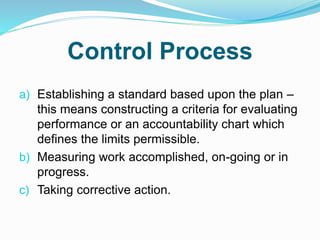
Control Process
a) Establishing a standard based upon the plan –
this means constructing a criteria for evaluating
performance or an accountability chart which
defines the limits permissible.
b) Measuring work accomplished, on-going or in
progress.
c) Taking corrective action.
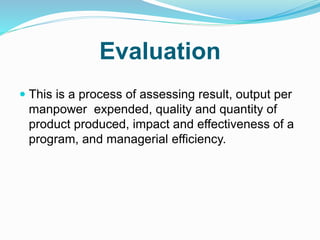
Evaluation
 This is a process of assessing result, output per
manpower expended, quality and quantity of
product produced, impact and effectiveness of a
program, and managerial efficiency.
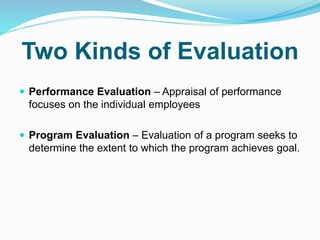
Two Kinds of Evaluation
 Performance Evaluation – Appraisal of performance
focuses on the individual employees
 Program Evaluation – Evaluation of a program seeks to
determine the extent to which the program achieves goal.
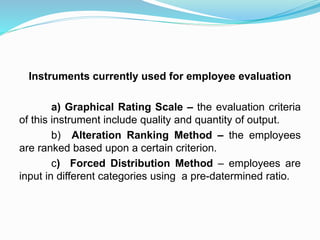
Instruments currently used for employee evaluation
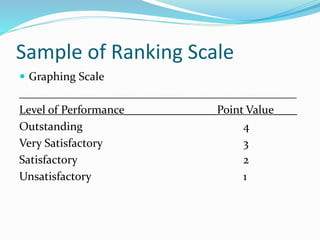
a) Graphical Rating Scale – the evaluation criteria
of this instrument include quality and quantity of output.
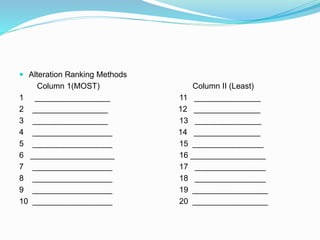
b) Alteration Ranking Method – the employees
are ranked based upon a certain criterion.
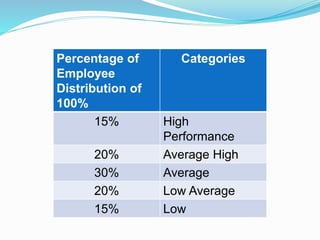
c) Forced Distribution Method – employees are
input in different categories using a pre-datermined ratio.
Sample of Ranking Scale
 Graphing Scale
________________________________________________
Level of Performance________________Point Value____
Outstanding 4
Very Satisfactory 3
Satisfactory 2
Unsatisfactory 1
 Alteration Ranking Methods
Column 1(MOST) Column II (Least)
1 _________________ 11 _______________
2 _________________ 12 _______________
3 _________________ 13 _______________
4 __________________ 14 _______________
5 __________________ 15 ________________
6 ___________________ 16 _________________
7 __________________ 17 ________________
8 __________________ 18 ________________
9 __________________ 19 _________________
10 __________________ 20 _________________
Percentage of
Employee
Distribution of
100%
Categories
15% High
Performance
20% Average High
30% Average
20% Low Average
15% Low
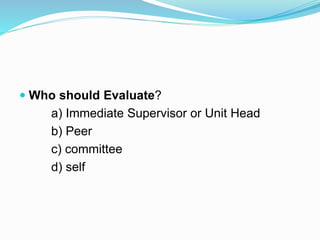
 Who should Evaluate?
a) Immediate Supervisor or Unit Head
b) Peer
c) committee
d) self
 Program Evaluation – Evaluation of a
program seeks to determine the extent to the
program achieves goal.
Two efficiency measures
a) Cost-Benefits – which tags a monetary value
to program outcomes
b) Cost Effectiveness – which employs more
qualitative standard of efficiency.
Two Variants of Evaluation of Efficiency
a) Program Monitoring – which aims to find
out whether performance matches program
objectives and reaches out the target clientele and
provides for the intended beneficiaries.
b) Discrepancy Evaluation - which is
primarily used with MBO (management by
objectives).
 Evaluation is summative if it looks into the
result of the program after its installation.
 Evaluation is formative if audit is made for the
purpose of improving the program.
 Evaluation Problems – Evaluation of a program
or of performance has both built-in problems and
those arising in the process of implementation.
 Program Evaluation in the Philippines
In the Philippines, development is perceived
primarily as socio-economic growth.
 Based on relationship with other projects, these
may be:
a) Independent Project – that which can be
implemented without need for implementing other
projects.
b) Mutually Exclusive Project – that which,
when implemented, will preclude the
implementation of other projects.
c) Complementary Project – that which will
require the implementation of other projects to
attain certain development objectives. It is a
component of an integrated area development
package.
Project development is a cycle of
activity with three general phases
 Pre-investment Phase
 Implementation Phase
 Post Investment Phase
Administrative Communication
 Communication is an integral element of an
organization. Through the communication
process, a person makes know his ideas and
feelings to others.
 Communication enhance coordination, improves
working relationship and facilities the integration
of the inputs of the different component units of
an organization.
Directional Types of
Communication
Base on directional flow, communication may be of
three types:
 Downward
 Upward
 Lateral or Horizontal
Communication Barriers
Barriers to effective directional types of
Communication may arise because of
physical distance.
Components of a Communication
System
A good communication system should have the
Following:
1) Communicator
2) Something to be communicated
3) Transmission Procedure
4) Recipient
5) Desired Response
Communicating with the Clientele
A public service-oriented organization
communicates with its clientele in a more
manifest way by undertaking programs and
projects for the clientele community.
Control Through Communication
Kinds of Control
Control may be exercised by the following:
1. Society
2. Management

Management techniques and process - Reported By: Alta Gracia S. Bañacia

  • 1.
    Reported By: AltaGracia S. Bañacia Group: 3
  • 2.
    Evaluation and Control Are integral components of the managerial function for three reasons: a. Both enable policy-maker to address the problem of resource allocation and help in prioritizing objectives and choosing methods for achieving them. b. The evaluation findings may be used as basis for justifying on-going projects and programs. c. Result of program review and audit help pinpoint responsibility for success or failure.
  • 3.
    Control  Control asa basic function in managing an enterprise is concerned with the task of seeing to it that what is performed is kept within the prescribed management channels to achieve organization objectives and desired result.
  • 4.
    Why the Needto Control  Control implies organizing task in a way that those who will perform the functions will do so efficiently and well.
  • 5.
    Control Process a) Establishinga standard based upon the plan – this means constructing a criteria for evaluating performance or an accountability chart which defines the limits permissible. b) Measuring work accomplished, on-going or in progress. c) Taking corrective action.
  • 6.
    Evaluation  This isa process of assessing result, output per manpower expended, quality and quantity of product produced, impact and effectiveness of a program, and managerial efficiency.
  • 7.
    Two Kinds ofEvaluation  Performance Evaluation – Appraisal of performance focuses on the individual employees  Program Evaluation – Evaluation of a program seeks to determine the extent to which the program achieves goal.
  • 8.
    Instruments currently usedfor employee evaluation a) Graphical Rating Scale – the evaluation criteria of this instrument include quality and quantity of output. b) Alteration Ranking Method – the employees are ranked based upon a certain criterion. c) Forced Distribution Method – employees are input in different categories using a pre-datermined ratio.
  • 9.
    Sample of RankingScale  Graphing Scale ________________________________________________ Level of Performance________________Point Value____ Outstanding 4 Very Satisfactory 3 Satisfactory 2 Unsatisfactory 1
  • 10.
     Alteration RankingMethods Column 1(MOST) Column II (Least) 1 _________________ 11 _______________ 2 _________________ 12 _______________ 3 _________________ 13 _______________ 4 __________________ 14 _______________ 5 __________________ 15 ________________ 6 ___________________ 16 _________________ 7 __________________ 17 ________________ 8 __________________ 18 ________________ 9 __________________ 19 _________________ 10 __________________ 20 _________________
  • 11.
    Percentage of Employee Distribution of 100% Categories 15%High Performance 20% Average High 30% Average 20% Low Average 15% Low
  • 12.
     Who shouldEvaluate? a) Immediate Supervisor or Unit Head b) Peer c) committee d) self
  • 13.
     Program Evaluation– Evaluation of a program seeks to determine the extent to the program achieves goal.
  • 14.
    Two efficiency measures a)Cost-Benefits – which tags a monetary value to program outcomes b) Cost Effectiveness – which employs more qualitative standard of efficiency.
  • 15.
    Two Variants ofEvaluation of Efficiency a) Program Monitoring – which aims to find out whether performance matches program objectives and reaches out the target clientele and provides for the intended beneficiaries. b) Discrepancy Evaluation - which is primarily used with MBO (management by objectives).
  • 16.
     Evaluation issummative if it looks into the result of the program after its installation.  Evaluation is formative if audit is made for the purpose of improving the program.
  • 17.
     Evaluation Problems– Evaluation of a program or of performance has both built-in problems and those arising in the process of implementation.  Program Evaluation in the Philippines In the Philippines, development is perceived primarily as socio-economic growth.
  • 18.
     Based onrelationship with other projects, these may be: a) Independent Project – that which can be implemented without need for implementing other projects. b) Mutually Exclusive Project – that which, when implemented, will preclude the implementation of other projects.
  • 19.
    c) Complementary Project– that which will require the implementation of other projects to attain certain development objectives. It is a component of an integrated area development package.
  • 20.
    Project development isa cycle of activity with three general phases  Pre-investment Phase  Implementation Phase  Post Investment Phase
  • 21.
    Administrative Communication  Communicationis an integral element of an organization. Through the communication process, a person makes know his ideas and feelings to others.  Communication enhance coordination, improves working relationship and facilities the integration of the inputs of the different component units of an organization.
  • 22.
    Directional Types of Communication Baseon directional flow, communication may be of three types:  Downward  Upward  Lateral or Horizontal
  • 23.
    Communication Barriers Barriers toeffective directional types of Communication may arise because of physical distance.
  • 24.
    Components of aCommunication System A good communication system should have the Following: 1) Communicator 2) Something to be communicated 3) Transmission Procedure 4) Recipient 5) Desired Response
  • 25.
    Communicating with theClientele A public service-oriented organization communicates with its clientele in a more manifest way by undertaking programs and projects for the clientele community.
  • 26.
    Control Through Communication Kindsof Control Control may be exercised by the following: 1. Society 2. Management