Introduction
With the role of IT focused on quality service delivery and supporting business
growth, the need to provide additional value through the evaluation and adoption
of new technologies is a naturally occurring evolution. IT must evaluate technology
and look for opportunities to extend the value of the services portfolio focusing
on practical advancements that are aligned to the mission of the business. Among
the disruptive trends WGroup sees in the marketplace, those having to do with
Big Data, the various flavors of Mobile Computing and “X-as-a-Service” stand
out as being examples of technology-based opportunities for internal exploration.
The ability to evaluate these new technologies in a practical environment
where their technological value and impact on business and IT operations can
be assessed is extremely important. Exploratory efforts should be structured
and controlled similarly to other major projects and in addition should be
evaluated for use in the production environment. In addition to evaluating
the technical capabilities and practical application of the new technology, IT
must evaluate the “fit” of the new technology in the existing service portfolio
or catalog. Concurrently, a financial business case needs to be developed with
certain caveats e.g., traditional ROI metrics may not be as applicable in these
projects. Finally, notwithstanding the potential financial challenges, the business
has to understand the benefits of the technology and fully realize the potential
risk of losing competitive advantage when competitors become early adopters.
Therefore, the research, development and new service introduction process needs
to be a core competency required to provide highly competitive services.
In response to this need WGroup has developed a new class of IT investment—
referred to as “Exploratory” along with a supporting management framework
to guide the effort through the evaluation phases and ensure a tight fit within
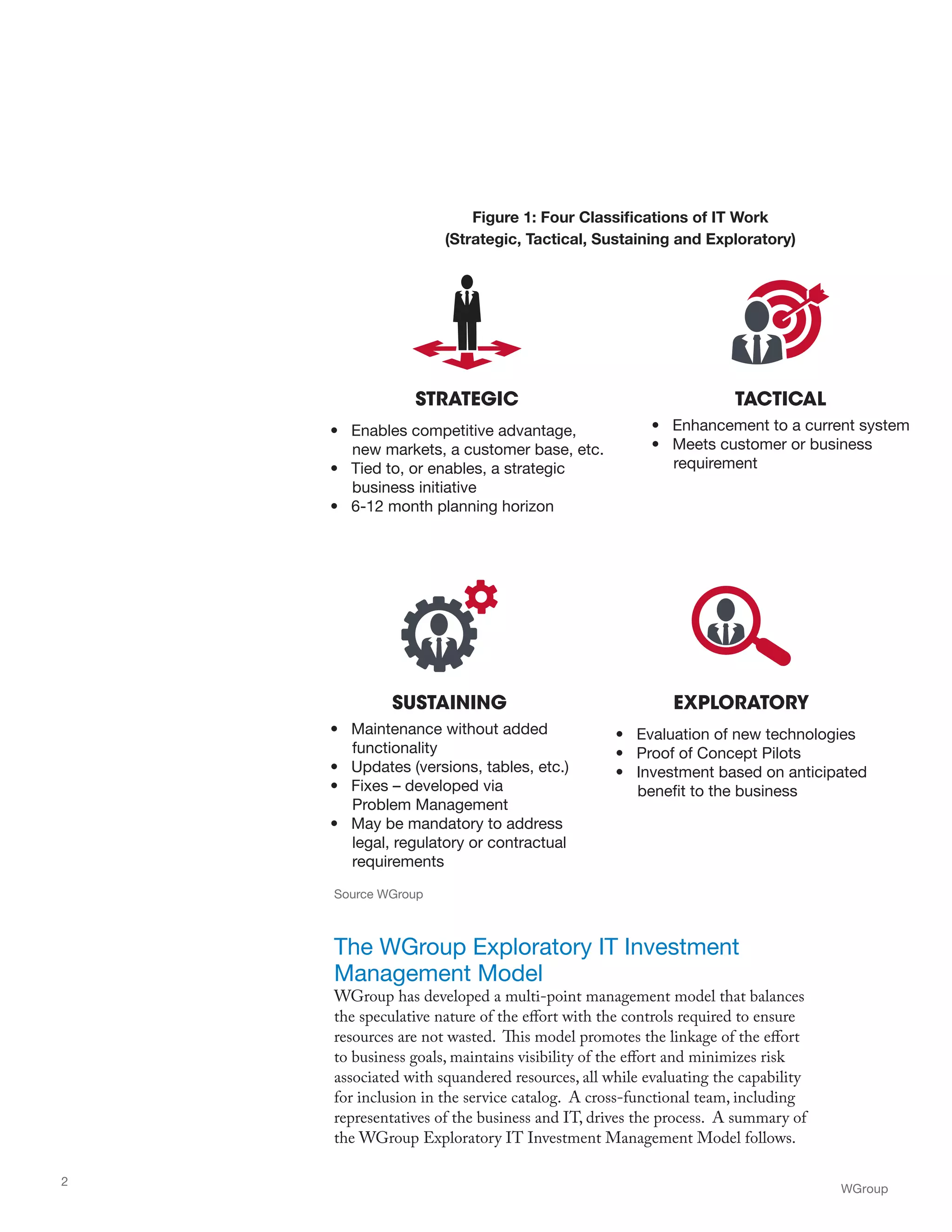
the service catalog. (See Figure one for the four classifications of IT Work.)
Drive Your Business
Management Model for
Exploratory Investment in IT
A Service Management-Integrated Approach
Strategy Brief | IT Strategy
1
WGroup has developed
a new class of IT
investment, referred to as
“Exploratory,” along with a
supporting management
model to guide the effort
through the evaluation
phases and ensure a tight fit
within the service catalog.
The WGroup Exploratory IT Investment
Management Model
WGroup has developed a multi-point management model that balances
the speculative nature of the effort with the controls required to ensure
resources are not wasted. This model promotes the linkage of the effort
to business goals, maintains visibility of the effort and minimizes risk
associated with squandered resources, all while evaluating the capability
for inclusion in the service catalog. A cross-functional team, including
representatives of the business and IT, drives the process. A summary of
the WGroup Exploratory IT Investment Management Model follows.
WGroup
2
STRATEGIC TACTICAL
SUSTAINING EXPLORATORY
• Enables competitive advantage,
new markets, a customer base, etc.
• Tied to, or enables, a strategic
business initiative
• 6-12 month planning horizon
• Enhancement to a current system
• Meets customer or business
requirement
• Maintenance without added
functionality
• Updates (versions, tables, etc.)
• Fixes – developed via
Problem Management
• May be mandatory to address
legal, regulatory or contractual
requirements
• Evaluation of new technologies
• Proof of Concept Pilots
• Investment based on anticipated
benefit to the business
Figure 1: Four Classifications of IT Work
(Strategic, Tactical, Sustaining and Exploratory)
Source WGroup
Feasibility Assessment
In the initial stage the focus is on developing enough of an understanding
of the new technology to enable design of an exploratory effort.
First, the team will develop an understanding of the new technology that will
include the expected benefits and influences on competitive value, the technical
requirements and skill requirements for support and how the technology fits
with the existing architecture and service portfolio. Additionally, the team
will assess the risks of implementation and on-going use of the technology
(business and technical) and develop a cost forecast (what does it cost
today and what is the forecast over time). The cost forecast will be updated
throughout the process to gauge the financial feasibility of the technology.
Next, the team reviews the organization’s strategic plan and operating model
for opportunities to apply the new technology. It is important to identify
a technically savvy team within the organization to work with key business
representatives to help with brainstorming ideas. Use of a skilled facilitator
can also work to the team’s advantage to stimulate and manage brainstorming
activities. Once a set of ideas is identified, the team evaluates them to determine
potential value propositions, strategic and operational opportunities and estimated
investment required. The ideas are ranked and those that carry too high a
risk or are not compelling from a cost/benefit point of view are eliminated.
Finally, the team molds the finalists into a package for the IT steering
committee to consider for investment. The package should, at minimum,
include an overview of the technology and the opportunity, the anticipated
financial business case, a risk profile and an implementation overview.
Management Model for Exploratory Investment in IT
3
FEASABILITY ASSESSMENT
PROOF OF CONCEPT PILOT DESIGN
SERVICE DESIGN SERVICE TRANSITION
• Opportunity Identification
• Assessment of Applicability
• Go-Forward Approval
• Pilot Program Planning
• Resource Recruitment
• Architecture Development
• Project Execution
• Project Wind-down and Reporting
• Technology Roll-out
• Management Plan, including
Metrics, Controls, Processes
• Service Announcement
PROJECT MANAGEMENT AND COMMUNICATIONS
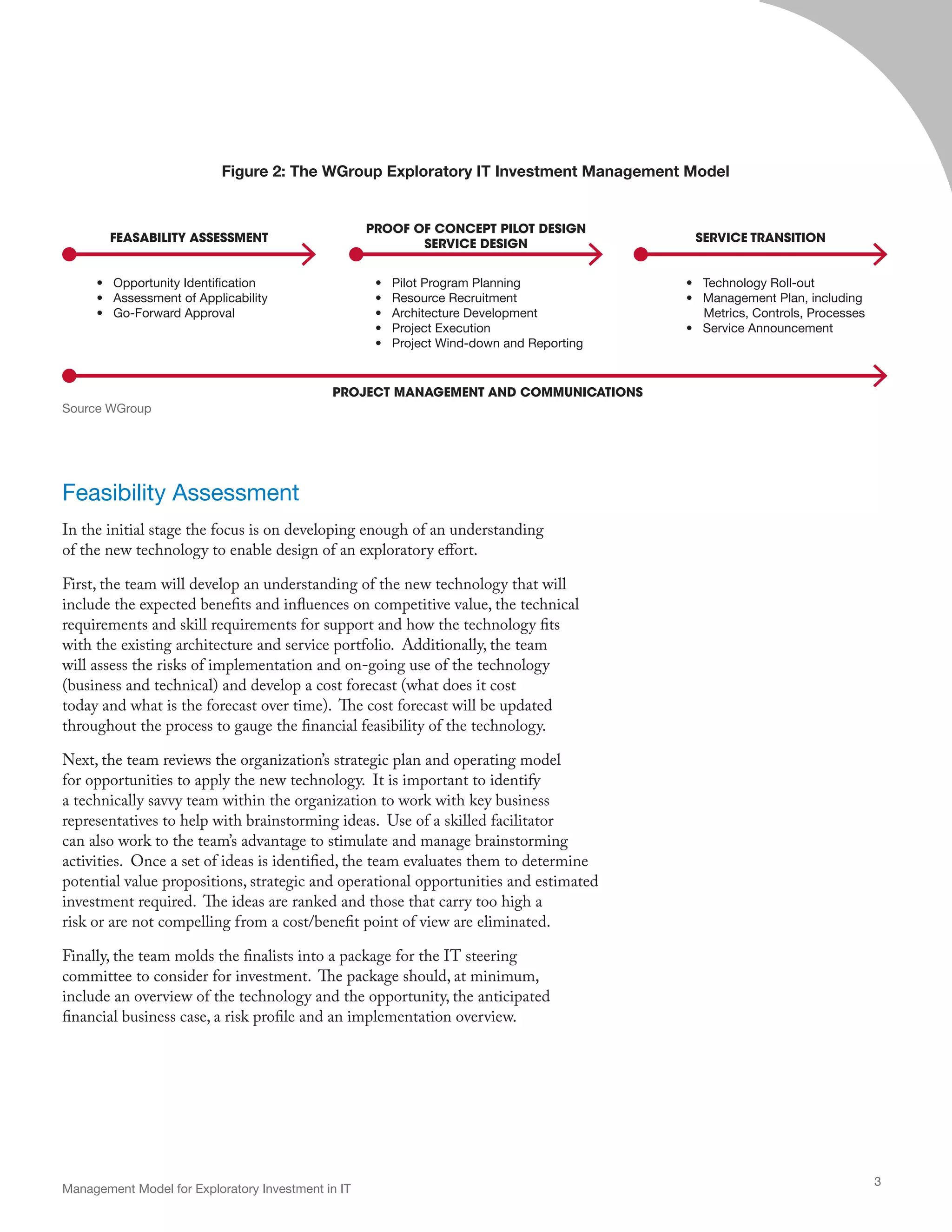
Figure 2: The WGroup Exploratory IT Investment Management Model
Source WGroup
Proof of Concept Pilot Program / Service Design
In this phase the pilot program is planned and executed. The team
concurrently evaluates the new technology while performing an evaluation
of how it will fit in the service portfolio and operate given current
policies and procedures. Support of the program through management
visibility and a strong communications plan is imperative.
The team develops a Proof of Concept Pilot (PoCP) program plan that is concise,
executable and delivers results quickly. At this point the service concept is outlined
by identifying the key service elements required to build the entry in the service
catalog. Expectations for results delivery are clearly defined and agreed-upon.
The PoCP duration should be measured in weeks or months depending on
scope and time sensitivity of the technology and should be managed via a formal
project management methodology. Depending on the breadth of the project and
investment in resources required, gates are established for approval to proceed.
This guards against over investment prior to meeting planned milestones.
In planning the effort, the team needs to inventory all the resources that
are available to be employed in the program. These should include IT staff,
staff from the business, hardware and software assets, data sources (both
internal and external), facilities and third-party subject matter experts.
Concurrently the team architects the required infrastructure and establishes an
investment plan. The architecture should cover the computing platform, facilities
and location (which should be close to the core team that will assume responsibility
for future applications of the technology). Segregation from production should be
maintained to minimize potential adverse effects on that environment. Financial
assumptions should include a minimal, if any, return on the investment.
Once the program is planned the team needs to develop, identify and/or recruit
the skills required to execute and capitalize on the PoCP. Included in this phase
are technical skills related to the technology and business skills related to the
potential area of application. The organization should also provide a path to
return to their old jobs, or equivalent, at the program’s end or ensure they have
the bandwidth while in their current jobs to give the pilot project the attention
it deserves. Face-to-face interaction with the internal team is important.
This promotes skill development and is a motivator for the technical staff.
To round out the base of resources, the team identifies potential third parties
to assist in specific parts of the process (e.g., opportunity definition, piloting,
development, etc.). Here, experience within the applicable industry is helpful.
A Request for Information (RFI) process can be conducted to vet the market
for potential candidates and an RFP issued for specific areas of assistance
In executing the PoCP the team should manage following existing
project management disciplines and follow the organizations outlined
service transition processes. There should be reports on progress to the
business—good and bad—on a regular basis. In short, there should
be a heavy emphasis on communications. The financial business case
should also be updated as more information becomes available.
WGroup
4
During execution, the
PoCP should be
integrated with all applicable
ITIL foundation processes,
e.g., change management,
request management,
incident management, etc.
This will allow the team to
evaluate the technology
operationally and identify
any adjustments that may
need to be made to policies,
processes and controls.
During execution, the PoCP should be integrated with all applicable
ITIL foundation processes, e.g., change management, request
management, incident management, etc. This will allow the team to
evaluate the technology operationally and identify any adjustments
that may need to be made to policies, processes and controls.
At the completion of the PoCP the team winds-down the program and
assesses results. The assessment should include a final report on technology
performance against expected service benefit as well as a report on integration
with existing processes. As an added-value the team should develop a
“Lessons Learned” document that covers not only the technology and
the capability of supporting the new service in the organization, but also
the PoCP process itself. If the project has been deemed a success, the
team and applicable IT organizations (Service Management) can prepare
material required to institute the pilot as a new service offering.
Service Transition
In the final phase the technology, in the form of new services, is rolled-
out to the organization following an ITSM-based process framework and
is made available via the service catalog. The team, in conjunction with
the ITSM team, should develop an organization plan and governance
model to support, manage, and leverage the expanded capability.
As part of the governance impact review, the team should assess related to policy.
For example, in a Big Data-related effort look for data security policies that may
impede access to, and analysis of data. Review the policy with the appropriate
people in the organization (e.g., legal, risk management) to determine if the policy
needs to be updated or the approach to use of the new technology needs to change.
The management plan should include tying all demand management
activities into the main demand management process employed within
IT (including an initial demand forecast), tying changes into the change
management process and linking incident and problem management.
As part of the roll-out a funding profile for a multi-year program
should be prepared. Allowance for periodic check-points to assess
viability going-forward should be made and a benefit realization
plan quantifying anticipated benefits should be drafted.
Of equal importance is the development and execution of an educational awareness
campaign (a Service Announcement) focused on what the new technology is and
possibilities associated with its use. Include discussion on potential impact on
customer relationships (interactive and contractual) and use the awareness program
as a marketing tool to generate enthusiasm both within the business and within IT.
Management Model for Exploratory Investment in IT
5
The team, in conjunction
with the ITSM team,
should develop an
organization plan and
governance model to support,
manage, and leverage the
expanded capability.
Contact Us
WGroup
301 Lindenwood Drive, Suite 301
Malvern, PA 19355
610-854-2700
Copyright © 2013 WGroup. All Rights Reserved.
008_MMEXINSB_0061413
About WGroup
Founded in 1995, WGroup is a boutique management consulting firm
that provides Strategy, Management and Execution Services to
optimize business performance, minimize cost and create value. Our
consultants have years of experience, both as industry executives and
trusted advisors, to help clients think through complicated and pressing
challenges to drive their business forward.
For more information on WGroup, visit http://thinkwgroup.com
“A strong Return-
on-Investment of IT
exploration spend,
minimization of business
risk and innovation must
be achieved through a
structured, controlled
and well communicated
management process.”
Denis Desjardins
WGroup Principal and
Consultant
Summary
New technologies have the potential to generate significant value to the
business but it is usually a multi-step, iterative journey, and the investment
risks are real. By establishing a robust operating environment CIOs can
confidently lead the organization to embrace the opportunities the new
technology can provide. Such an environment will drive the creation of
value in the form of services that support competitive business growth.
We have found that in order to ensure success CIOs need to maintain
business engagement and executive buy-in (including acceptance of the risks),
develop enthusiasm on the part of IT, maintain a controlled management
process and communicate successes (and failures) early and often.
Employment of the WGroup’s Exploratory IT Investment Management Model
in tandem with initiatives to evaluate new technologies will greatly
improve their chances of success— whether it be the successful
progression of a new technology into a production environment or an
objective report of the unsuitability of a technology in the business.
Please contact WGroup to learn more about the practical implementation
of WGroup’s Exploratory IT Investment Management Model for your
organization and other services related to IT strategy, management and finance.

Management model for exploratory investment in IT

  • 1.
    Introduction With the roleof IT focused on quality service delivery and supporting business growth, the need to provide additional value through the evaluation and adoption of new technologies is a naturally occurring evolution. IT must evaluate technology and look for opportunities to extend the value of the services portfolio focusing on practical advancements that are aligned to the mission of the business. Among the disruptive trends WGroup sees in the marketplace, those having to do with Big Data, the various flavors of Mobile Computing and “X-as-a-Service” stand out as being examples of technology-based opportunities for internal exploration. The ability to evaluate these new technologies in a practical environment where their technological value and impact on business and IT operations can be assessed is extremely important. Exploratory efforts should be structured and controlled similarly to other major projects and in addition should be evaluated for use in the production environment. In addition to evaluating the technical capabilities and practical application of the new technology, IT must evaluate the “fit” of the new technology in the existing service portfolio or catalog. Concurrently, a financial business case needs to be developed with certain caveats e.g., traditional ROI metrics may not be as applicable in these projects. Finally, notwithstanding the potential financial challenges, the business has to understand the benefits of the technology and fully realize the potential risk of losing competitive advantage when competitors become early adopters. Therefore, the research, development and new service introduction process needs to be a core competency required to provide highly competitive services. In response to this need WGroup has developed a new class of IT investment— referred to as “Exploratory” along with a supporting management framework to guide the effort through the evaluation phases and ensure a tight fit within the service catalog. (See Figure one for the four classifications of IT Work.) Drive Your Business Management Model for Exploratory Investment in IT A Service Management-Integrated Approach Strategy Brief | IT Strategy 1 WGroup has developed a new class of IT investment, referred to as “Exploratory,” along with a supporting management model to guide the effort through the evaluation phases and ensure a tight fit within the service catalog.
  • 2.
    The WGroup ExploratoryIT Investment Management Model WGroup has developed a multi-point management model that balances the speculative nature of the effort with the controls required to ensure resources are not wasted. This model promotes the linkage of the effort to business goals, maintains visibility of the effort and minimizes risk associated with squandered resources, all while evaluating the capability for inclusion in the service catalog. A cross-functional team, including representatives of the business and IT, drives the process. A summary of the WGroup Exploratory IT Investment Management Model follows. WGroup 2 STRATEGIC TACTICAL SUSTAINING EXPLORATORY • Enables competitive advantage, new markets, a customer base, etc. • Tied to, or enables, a strategic business initiative • 6-12 month planning horizon • Enhancement to a current system • Meets customer or business requirement • Maintenance without added functionality • Updates (versions, tables, etc.) • Fixes – developed via Problem Management • May be mandatory to address legal, regulatory or contractual requirements • Evaluation of new technologies • Proof of Concept Pilots • Investment based on anticipated benefit to the business Figure 1: Four Classifications of IT Work (Strategic, Tactical, Sustaining and Exploratory) Source WGroup
  • 3.
    Feasibility Assessment In theinitial stage the focus is on developing enough of an understanding of the new technology to enable design of an exploratory effort. First, the team will develop an understanding of the new technology that will include the expected benefits and influences on competitive value, the technical requirements and skill requirements for support and how the technology fits with the existing architecture and service portfolio. Additionally, the team will assess the risks of implementation and on-going use of the technology (business and technical) and develop a cost forecast (what does it cost today and what is the forecast over time). The cost forecast will be updated throughout the process to gauge the financial feasibility of the technology. Next, the team reviews the organization’s strategic plan and operating model for opportunities to apply the new technology. It is important to identify a technically savvy team within the organization to work with key business representatives to help with brainstorming ideas. Use of a skilled facilitator can also work to the team’s advantage to stimulate and manage brainstorming activities. Once a set of ideas is identified, the team evaluates them to determine potential value propositions, strategic and operational opportunities and estimated investment required. The ideas are ranked and those that carry too high a risk or are not compelling from a cost/benefit point of view are eliminated. Finally, the team molds the finalists into a package for the IT steering committee to consider for investment. The package should, at minimum, include an overview of the technology and the opportunity, the anticipated financial business case, a risk profile and an implementation overview. Management Model for Exploratory Investment in IT 3 FEASABILITY ASSESSMENT PROOF OF CONCEPT PILOT DESIGN SERVICE DESIGN SERVICE TRANSITION • Opportunity Identification • Assessment of Applicability • Go-Forward Approval • Pilot Program Planning • Resource Recruitment • Architecture Development • Project Execution • Project Wind-down and Reporting • Technology Roll-out • Management Plan, including Metrics, Controls, Processes • Service Announcement PROJECT MANAGEMENT AND COMMUNICATIONS Figure 2: The WGroup Exploratory IT Investment Management Model Source WGroup
  • 4.
    Proof of ConceptPilot Program / Service Design In this phase the pilot program is planned and executed. The team concurrently evaluates the new technology while performing an evaluation of how it will fit in the service portfolio and operate given current policies and procedures. Support of the program through management visibility and a strong communications plan is imperative. The team develops a Proof of Concept Pilot (PoCP) program plan that is concise, executable and delivers results quickly. At this point the service concept is outlined by identifying the key service elements required to build the entry in the service catalog. Expectations for results delivery are clearly defined and agreed-upon. The PoCP duration should be measured in weeks or months depending on scope and time sensitivity of the technology and should be managed via a formal project management methodology. Depending on the breadth of the project and investment in resources required, gates are established for approval to proceed. This guards against over investment prior to meeting planned milestones. In planning the effort, the team needs to inventory all the resources that are available to be employed in the program. These should include IT staff, staff from the business, hardware and software assets, data sources (both internal and external), facilities and third-party subject matter experts. Concurrently the team architects the required infrastructure and establishes an investment plan. The architecture should cover the computing platform, facilities and location (which should be close to the core team that will assume responsibility for future applications of the technology). Segregation from production should be maintained to minimize potential adverse effects on that environment. Financial assumptions should include a minimal, if any, return on the investment. Once the program is planned the team needs to develop, identify and/or recruit the skills required to execute and capitalize on the PoCP. Included in this phase are technical skills related to the technology and business skills related to the potential area of application. The organization should also provide a path to return to their old jobs, or equivalent, at the program’s end or ensure they have the bandwidth while in their current jobs to give the pilot project the attention it deserves. Face-to-face interaction with the internal team is important. This promotes skill development and is a motivator for the technical staff. To round out the base of resources, the team identifies potential third parties to assist in specific parts of the process (e.g., opportunity definition, piloting, development, etc.). Here, experience within the applicable industry is helpful. A Request for Information (RFI) process can be conducted to vet the market for potential candidates and an RFP issued for specific areas of assistance In executing the PoCP the team should manage following existing project management disciplines and follow the organizations outlined service transition processes. There should be reports on progress to the business—good and bad—on a regular basis. In short, there should be a heavy emphasis on communications. The financial business case should also be updated as more information becomes available. WGroup 4 During execution, the PoCP should be integrated with all applicable ITIL foundation processes, e.g., change management, request management, incident management, etc. This will allow the team to evaluate the technology operationally and identify any adjustments that may need to be made to policies, processes and controls.
  • 5.
    During execution, thePoCP should be integrated with all applicable ITIL foundation processes, e.g., change management, request management, incident management, etc. This will allow the team to evaluate the technology operationally and identify any adjustments that may need to be made to policies, processes and controls. At the completion of the PoCP the team winds-down the program and assesses results. The assessment should include a final report on technology performance against expected service benefit as well as a report on integration with existing processes. As an added-value the team should develop a “Lessons Learned” document that covers not only the technology and the capability of supporting the new service in the organization, but also the PoCP process itself. If the project has been deemed a success, the team and applicable IT organizations (Service Management) can prepare material required to institute the pilot as a new service offering. Service Transition In the final phase the technology, in the form of new services, is rolled- out to the organization following an ITSM-based process framework and is made available via the service catalog. The team, in conjunction with the ITSM team, should develop an organization plan and governance model to support, manage, and leverage the expanded capability. As part of the governance impact review, the team should assess related to policy. For example, in a Big Data-related effort look for data security policies that may impede access to, and analysis of data. Review the policy with the appropriate people in the organization (e.g., legal, risk management) to determine if the policy needs to be updated or the approach to use of the new technology needs to change. The management plan should include tying all demand management activities into the main demand management process employed within IT (including an initial demand forecast), tying changes into the change management process and linking incident and problem management. As part of the roll-out a funding profile for a multi-year program should be prepared. Allowance for periodic check-points to assess viability going-forward should be made and a benefit realization plan quantifying anticipated benefits should be drafted. Of equal importance is the development and execution of an educational awareness campaign (a Service Announcement) focused on what the new technology is and possibilities associated with its use. Include discussion on potential impact on customer relationships (interactive and contractual) and use the awareness program as a marketing tool to generate enthusiasm both within the business and within IT. Management Model for Exploratory Investment in IT 5 The team, in conjunction with the ITSM team, should develop an organization plan and governance model to support, manage, and leverage the expanded capability.
  • 6.
    Contact Us WGroup 301 LindenwoodDrive, Suite 301 Malvern, PA 19355 610-854-2700 Copyright © 2013 WGroup. All Rights Reserved. 008_MMEXINSB_0061413 About WGroup Founded in 1995, WGroup is a boutique management consulting firm that provides Strategy, Management and Execution Services to optimize business performance, minimize cost and create value. Our consultants have years of experience, both as industry executives and trusted advisors, to help clients think through complicated and pressing challenges to drive their business forward. For more information on WGroup, visit http://thinkwgroup.com “A strong Return- on-Investment of IT exploration spend, minimization of business risk and innovation must be achieved through a structured, controlled and well communicated management process.” Denis Desjardins WGroup Principal and Consultant Summary New technologies have the potential to generate significant value to the business but it is usually a multi-step, iterative journey, and the investment risks are real. By establishing a robust operating environment CIOs can confidently lead the organization to embrace the opportunities the new technology can provide. Such an environment will drive the creation of value in the form of services that support competitive business growth. We have found that in order to ensure success CIOs need to maintain business engagement and executive buy-in (including acceptance of the risks), develop enthusiasm on the part of IT, maintain a controlled management process and communicate successes (and failures) early and often. Employment of the WGroup’s Exploratory IT Investment Management Model in tandem with initiatives to evaluate new technologies will greatly improve their chances of success— whether it be the successful progression of a new technology into a production environment or an objective report of the unsuitability of a technology in the business. Please contact WGroup to learn more about the practical implementation of WGroup’s Exploratory IT Investment Management Model for your organization and other services related to IT strategy, management and finance.