Management A Practical Introduction Kinicki 6th Edition Test Bank
Management A Practical Introduction Kinicki 6th Edition Test Bank
Management A Practical Introduction Kinicki 6th Edition Test Bank
Management A Practical Introduction Kinicki 6th Edition Test Bank
Management A Practical Introduction Kinicki 6th Edition Test Bank
1.
Management A PracticalIntroduction Kinicki 6th
Edition Test Bank download
https://testbankmall.com/product/management-a-practical-
introduction-kinicki-6th-edition-test-bank/
Find test banks or solution manuals at testbankmall.com today!
2.
We believe theseproducts will be a great fit for you. Click
the link to download now, or visit testbankmall.com
to discover even more!
Management A Practical Introduction Kinicki 6th Edition
Solutions Manual
https://testbankmall.com/product/management-a-practical-introduction-
kinicki-6th-edition-solutions-manual/
Test Bank for Organizational Behavior: A Practical,
Problem-Solving Approach, 3rd Edition, Angelo Kinicki
https://testbankmall.com/product/test-bank-for-organizational-
behavior-a-practical-problem-solving-approach-3rd-edition-angelo-
kinicki/
Test Bank for Organizational Behavior A Practical Problem
Solving Approach 2nd Edition By Kinicki
https://testbankmall.com/product/test-bank-for-organizational-
behavior-a-practical-problem-solving-approach-2nd-edition-by-kinicki/
Solutions Manual to accompany Calculus with Applications
10th edition 0321749006
https://testbankmall.com/product/solutions-manual-to-accompany-
calculus-with-applications-10th-edition-0321749006/
3.
Test Bank forHuman Sexuality in a World of Diversity, 9/E
9th Edition Spencer A. Rathus, Jeffrey S. Nevid, Lois
Fichner-Rathus
https://testbankmall.com/product/test-bank-for-human-sexuality-in-a-
world-of-diversity-9-e-9th-edition-spencer-a-rathus-jeffrey-s-nevid-
lois-fichner-rathus/
Community and Public Health Nursing 9th Edition Test Bank
https://testbankmall.com/product/community-and-public-health-
nursing-9th-edition-test-bank/
Test Bank Professional Nursing Concepts Challenges 7th
Edition Black
https://testbankmall.com/product/test-bank-professional-nursing-
concepts-challenges-7th-edition-black/
Test bank for Information Technology for Managers 2nd
Edition by Reynolds
https://testbankmall.com/product/test-bank-for-information-technology-
for-managers-2nd-edition-by-reynolds/
Test Bank for Anatomy and Physiology 9th Edition by Patton
https://testbankmall.com/product/test-bank-for-anatomy-and-
physiology-9th-edition-by-patton/
Anderson was acaptive, in his custody. The honest, unsuspicious
Jameson complied. He wrote to Arnold to this effect, explaining how
Anderson came to be a prisoner, and concluded that the simplest
way in the matter would be to send the captive to Arnold with the
letter! He detailed Lieutenant Allen and four of the militia to take
both to headquarters, and at the same time sent the papers found in
André's boot by express to Washington, who was then on his way
from Hartford.
André was delighted by the turn affairs had taken, for now there
appeared a way of escape for both Arnold and himself. The escort
with the prisoner were some distance on their way, when Major
Benjamin Tallmadge, a vigilant and active officer of the dragoons,
returned to Jameson's quarters after a brief absence. Learning all
about the capture and the nature of the papers found on the
prisoner, he at once pronounced him a spy and Arnold a traitor. He
persuaded Jameson to order the return of the prisoner, agreeing to
bear all blame himself for the act. The captive was brought back,
but, unfortunately, Allen proceeded alone with Jameson's letter to
Arnold.
André was committed to the care of Lieutenant King, of the
dragoons, who was convinced, by the prisoner's manner and other
tokens, that he was no ordinary man. Finally, the captive requested
King to walk with him in a large yard attached to the house in which
they were, when the prisoner said, "I must make a confidant of
somebody, and I know not a more proper person than yourself, you
have treated me so kindly." He then made a full confession of his
rank, and gave a brief narrative of his career in America since his
capture at St. Johns. Procuring writing materials, he wrote the
following letter to Washington:
"Salem, the 24th September, 1780.
"Sir: What I have as yet said concerning myself was in the
justifiable attempt to be extricated. I am too little
accustomed to duplicity to have succeeded.
22.
"I beg yourExcellency will be persuaded that no alteration
in the temper of my mind, or apprehension for my safety,
induces me to take the step of addressing you, but that it
is to rescue myself from an imputation of having assumed
a mean character for treacherous purposes or self-
interest, a conduct incompatible with the principles which
actuate me, as well as my condition in life. It is to
vindicate my fame that I speak, and not to solicit security.
The person in your possession is Major John André,
adjutant-general in the British army.
"The influence of one commander with another in the
army of his adversary is an advantage taken in war. A
correspondence for this purpose I held, as confidential, in
the present instance, with his Excellency Sir Henry Clinton.
"To favor it, I agreed to meet upon ground not within the
posts of either army a person who was to give me
intelligence. I came up in the Vulture man-of-war for this
effect, and was fetched by a boat from the shore to the
beach; being there, I was told that the approach of day
would prevent my return, and that I must be concealed
until the next night. I was in my regimentals, and had
fairly risked my person.
"Against my stipulation and without my knowledge
beforehand, I was conducted within one of your posts.
Your Excellency will conceive my sensation on this
occasion, and will imagine how much more I must have
been affected, by a refusal to reconduct me back the next
night as I had been brought. Thus become a prisoner, I
had to concert my escape. I quitted my uniform, and was
passed another way in the night, without the American
posts to neutral ground, and informed I was beyond all
armed parties, and left to press for New York. I was taken
at Tarrytown by some volunteers. Thus, as I have had the
honor to relate, was I betrayed (being adjutant-general of
23.
the British army)into the vile condition of an enemy in
disguise within your posts.
"Having avowed myself a British officer, I have nothing to
reveal but what relates to myself, which is true, on the
honor of an officer and a gentleman. The request I have
to make to your Excellency, and I am conscious I address
myself well, that in any rigor feeling may dictate, a
decency of conduct toward me may mark, that, though
unfortunate, I am branded with nothing dishonorable, as
no motive could be mine but the service of my King, and
as I was an involuntary impostor.
"Another request is, that I may be permitted to write an
open letter to Sir Henry Clinton, and another to a friend
for clothes and linen.
"I take the liberty to mention the condition of some
gentlemen at Charlestown, who, being either on parole or
under protection, were engaged in a conspiracy against
us. Though their situation is not exactly similar, they are
objects who may be set in exchange for me, or are
persons whom the treatment I receive may affect.
"It is no less, sir, in a confidence in the generosity of your
mind, than on account of your superior station, that I
have chosen to importune you with this letter.
"I have the honor to be, with great respect, sir, your
Excellency's most obedient and most humble servant,
"John André, Adjutant-
General.
"His Excellency General Washington."
24.
CHAPTER VI.
Washington lodgedat Fishkill, eighteen miles from West Point, on
the night of September 24th, and early the next morning (the day
appointed for Clinton to ascend the river and receive the surrender
of the post in the Highlands) he and his companions reached the
vicinity of Arnold's quarters, where they intended to breakfast. He
and two or three officers turned aside to inspect a redoubt, while
Lafayette, Hamilton, and other young officers, rode forward with a
message from their chief to Mrs. Arnold, bidding her not to delay
breakfast on his account.
While these officers were at table with Arnold and his wife, a courier
arrived with a letter to the general. It was Jameson's letter, brought
by Allen, telling Arnold of the arrest of "John Anderson," and the
sending of the papers found in his boots to Washington. Arnold
glanced at the letter, sat a few minutes in general conversation, and
then asked to be excused. His wife perceived anxiety in his
countenance, and, leaving the table, followed him out of the room.
He commanded Allen not to mention that he had brought a letter
from Jameson; ordered a horse to be saddled and brought to the
door immediately, and ascending to his wife's chamber, to which she
had retired, he told her in a few hurried words of his perilous
situation, and that his life depended upon his instant flight and
reaching the British lines in safety.
This awful message smote the young wife and mother fearfully. She
screamed and fell at his feet in a swoon. He had not a moment to
lose. Leaving her in the care of her maid, he kissed their sleeping
babe and hurried to the breakfast-room. Telling the guests that his
wife had been taken ill suddenly, and that he was called in haste
over to West Point and would return presently, he mounted the
horse at the door, dashed down the bridle-path to the river half a
25.
mile distant, snatchedhis pistols from the holsters as he
dismounted, and, summoning the crew of his barge, he entered it
and ordered them to pull into the middle of the stream and row
swiftly down the river, for he bore a flag to the Vulture, and must
return soon to meet General Washington.
Arnold sat in the prow of his barge. When they came in sight of the
Vulture he raised a white handkerchief upon a walking-stick. They
soon reached the vessel. Arnold ascended to her deck, where he
met Colonel Robinson, and briefly related to him the unhappy state
of affairs. He tried, in vain, to lure the crew of his barge into the
king's service. "If General Arnold likes the King of England, let him
serve him; we love our country, and mean to live or die in support of
her cause," indignantly exclaimed James Larvey, the coxswain. "So
will we," said his companions. They were sent on shore at Teller's
Point by the same flag. Arnold sent a letter to Washington, covering
one to his wife. He assured the commander-in-chief that his wife
was innocent of all knowledge of his act, and entreated him to
extend his protection to her and her child. He also exonerated his
military family from all participation in his designs.
By the same flag Colonel Robinson wrote to Washington, asserting
that, under the circumstances which led to André's arrest, he could
not detain him without "the greatest violation of flags and contrary
to the usage of all nations"; and, assuming that the American
commander would see the matter in the same light, he desired that
he would order Major André to be "set at liberty, and allowed to
return immediately."
26.
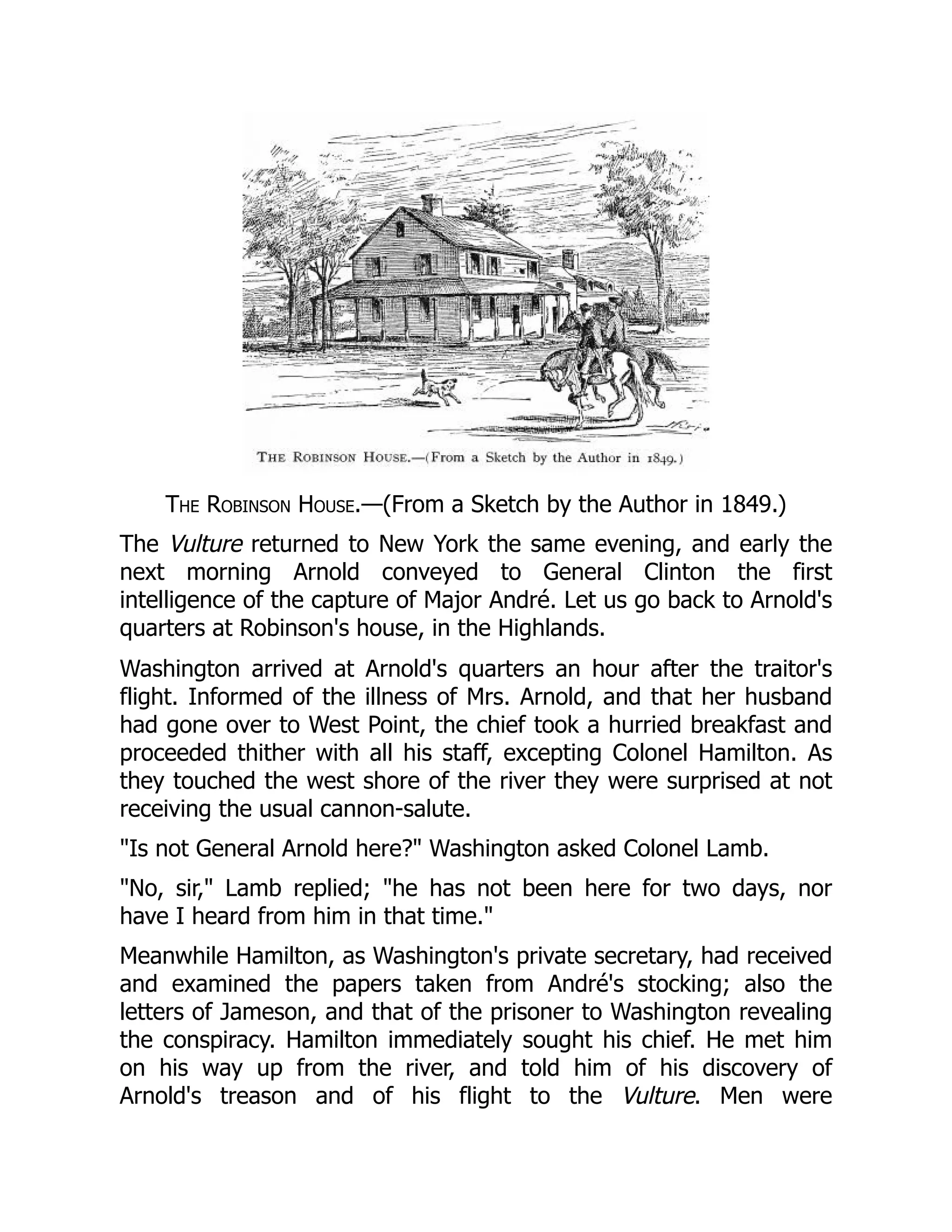
The Robinson House.—(Froma Sketch by the Author in 1849.)
The Vulture returned to New York the same evening, and early the
next morning Arnold conveyed to General Clinton the first
intelligence of the capture of Major André. Let us go back to Arnold's
quarters at Robinson's house, in the Highlands.
Washington arrived at Arnold's quarters an hour after the traitor's
flight. Informed of the illness of Mrs. Arnold, and that her husband
had gone over to West Point, the chief took a hurried breakfast and
proceeded thither with all his staff, excepting Colonel Hamilton. As
they touched the west shore of the river they were surprised at not
receiving the usual cannon-salute.
"Is not General Arnold here?" Washington asked Colonel Lamb.
"No, sir," Lamb replied; "he has not been here for two days, nor
have I heard from him in that time."
Meanwhile Hamilton, as Washington's private secretary, had received
and examined the papers taken from André's stocking; also the
letters of Jameson, and that of the prisoner to Washington revealing
the conspiracy. Hamilton immediately sought his chief. He met him
on his way up from the river, and told him of his discovery of
Arnold's treason and of his flight to the Vulture. Men were
27.
dispatched to Verplanck'sPoint to intercept him, but they arrived too
late. An order was sent to Colonel Jameson to forward André to
West Point immediately. He said to Lafayette and Knox, sadly:
"Arnold is a traitor! Whom can we trust now?" The whole plot was
revealed, and the danger impending over the post was made
manifest.
Yet Washington gave no outward sign of excitement. He sent
couriers in all directions with orders for the strengthening of every
redoubt, and ordered Greene to put the army at Tappaan in
readiness to move toward West Point at a moment's warning. But it
was soon evident that the danger was overpast. Informed of Mrs.
Arnold's sad condition, he said to one of his aides, "Go to her and
inform her that, though my duty required that no means should be
neglected to arrest General Arnold, I have great pleasure in
acquainting her that he is now safe on board a British vessel of war."
André was brought to the Robinson house early on the 26th
(September, 1780). He had been aroused from slumber at midnight
to begin a dreary journey in a falling rain, under a strong escort led
by Lieutenant King. On the way they were joined by Major Tallmadge
and one or two other officers. Tallmadge was made the special
custodian of the prisoner from that time until his execution; and on
the evening of the 26th André was conveyed to West Point.
General Greene was in chief command of the American army during
Washington's absence. Its headquarters were at Tappaan (usually
called Orangetown), a short distance from the west shore of the
Hudson. Washington sent secret orders to Greene to receive the
prisoner.
28.
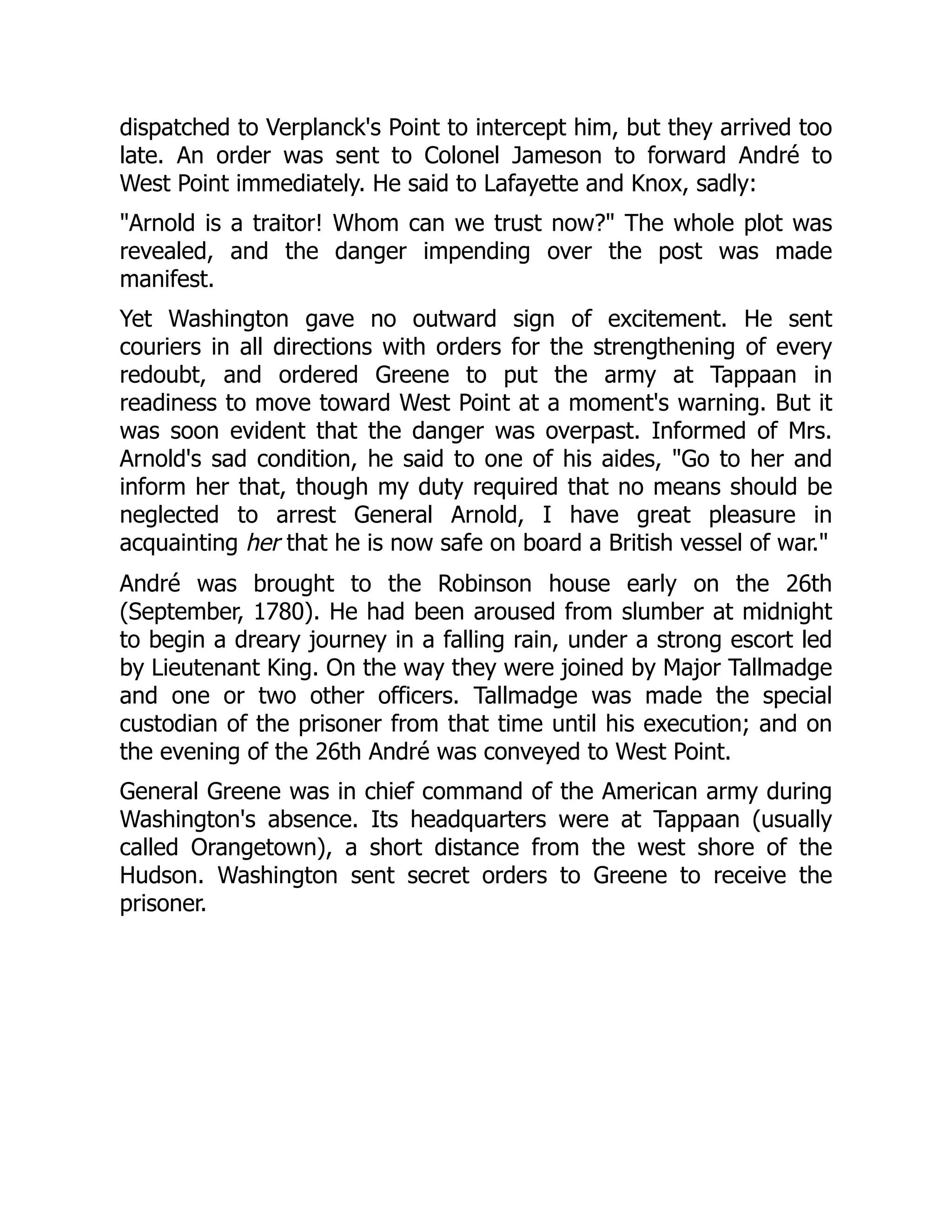
"The '76 StoneHouse."
On the morning of the 28th André, with a strong escort, went down
the river in a barge, landed at the King's Ferry, and journeyed to
Tappaan on horseback. There he was lodged in a substantial stone
dwelling belonging to Mr. Maybie, known, in our day, as a tavern, by
the name of "The '76 Stone House."
On this journey of a day, Tallmadge and André, who were about
equal in age, had much free conversation. The prisoner's custodian,
like every one else, was fascinated by the young soldier, and was
deeply impressed with sympathy for him. In reply to a question by
Tallmadge, André said that, in the enterprise in which he was
engaged, all he sought was military glory, the applause of his king
and his country, and perhaps a brigadiership. He asked Tallmadge in
what light he would be regarded by General Washington and a
military tribunal. Tallmadge tried to evade an answer, but, being
pressed, he said:
"I had a much-loved classmate in Yale College by the name of
Nathan Hale, who entered the army in 1775. Immediately after the
battle of Long Island, General Washington wanted information
respecting the strength, position, and probable movements of the
enemy. Captain Hale tendered his services, went over to Brooklyn,
and was taken just as he was passing the outposts of the enemy on
29.
his return. Doyou remember the sequel of the story?" "Yes," said
André, "he was hanged as a spy. But you surely do not consider his
case and mine alike." "Yes, precisely similar; and similar will be your
fate," said Tallmadge.
In general orders on the 26th Greene proclaimed, "Treason of the
blackest dye was discovered yesterday." He then gave a general
account of the affair to the army and the people. It created wide-
spread indignation and alarm, but the latter feeling was tempered by
the concluding words of the order: "Arnold has made his escape to
the enemy; but Major André, the adjutant-general of the British
army, who came out as a spy to negotiate the business, is our
prisoner."
The news of the capture of André, and this ominous general order,
produced intense excitement in both armies, and especially within
the British lines. The evident sympathy of Washington and some of
his officers for the prisoner when he was brought to Tappaan,
created much feeling in the American army. Some of the officers
declared that if they were not to be protected against such
treacherous conduct, and this spy be pardoned, it was time to leave
the army. In a manuscript account of the affair now before me,
written by Elias Boudinot, LL. D., the eminent American commissary
of prisoners, he observed:
"Though these were their sentiments, they were only murmured
from tent to tent. A few days convinced them that they had a
commander-in-chief who knew how to make his compassion for the
unfortunate and his duty to those who depended upon him for
protection to harmonize and influence his conduct. He treated Major
André with the greatest tenderness, while he carried the sentence of
the council into execution according to the laws of war. At New York,
when the first account of André's capture and condemnation arrived,
the officers and citizens laughed at the idea that the 'rebels' would
dare to execute the adjutant-general of the British army; but, if it
should take place, vengeance in every form should be taken
sevenfold. But, when it was known that André was no more, General
30.
Clinton shut himselfup for three days, and every one at the Coffee-
House and other public places hung their heads, and scarcely an
observation relative to it escaped their lips."
Washington's Headquarters at Tappaan.
Washington had returned to his headquarters at Tappaan,[52] and
ordered a meeting of a board of officers on the 29th, to make
careful inquiries and report their opinion "of the light in which he
[the prisoner] ought to be considered, and what punishment ought
to be inflicted." The board consisted of six major-generals and eight
brigadier-generals. The court of inquiry was held in the Dutch church
at Tappaan. General Greene presided. When André was brought
before his judges, he gave a detailed statement of the facts, and did
not deny any of the specifications presented by the judge-advocate,
John Laurance. After careful deliberation the board reported that the
prisoner "ought to be considered as a spy from the enemy, and that,
agreeably to the law and usages of nations, it is their opinion he
ought to suffer death." "André met the result," wrote Colonel
Hamilton, "with manly firmness. 'I foresee my fate,' he said, 'and
though I pretend not to play the hero, or be indifferent to life, yet I
am reconciled to whatever may happen, conscious that misfortune,
not guilt, has brought it upon me.'"
31.
Washington approved thefinding of the court of inquiry, and
sentenced André to be hung as a spy on the first day of October, at
five o'clock in the afternoon. He sent an account of the proceedings
of the court and a letter from André to Sir Henry Clinton.[53]
Meanwhile great exertions had been made to save André from his
sad fate. General Clinton wrote to Washington (September 26th)
that André was not a legal spy, for a flag of truce had been sent to
receive him, and passports were granted for his return. On receiving
the papers from Washington, Sir Henry wrote a second letter to the
American chief commander, expressing the opinion that the board
"had not been rightly informed of all the circumstances," and asked
a postponement of the execution until a conference might be held.
The request was granted. The execution was postponed one day.
General Greene met General Robertson and others at Dobb's Ferry,
not as an officer, but as a private gentleman, but nothing occurred to
warrant a change in the opinion of the board of inquiry and the
decision of Washington.[54]
The Americans would gladly have saved the life of André could
Arnold have been given up to them. Efforts to that end were made.
Unofficial overtures were made to Clinton to exchange Arnold for
André, but honor forbade the act. All efforts in this direction failed.
On the morning of October 1st, the day on which André expected to
die, he wrote the following touching note to Washington:
"Sir: Buoyed above the terror of death by the
consciousness of a life devoted to honorable pursuits, and
stained with no action that can give remorse, I trust that
the request I make to your Excellency at this serious
period, and which is to soften my last moments, will not
be rejected.
"Sympathy toward a soldier will surely induce your
Excellency and a military tribunal to adapt the mode of my
death to the feelings of a man of honor.
32.
"Let me hope,sir, that if aught in my character impresses
you with esteem toward me, if aught in my misfortune
marks me as the victim of policy and not of resentment, I
shall experience the operation of those feelings in your
breast by being informed that I am not to die on a gibbet.
"I have the honor to be your Excellency's most obedient
and most humble servant,
John André."
Colonel Hamilton urged Washington to comply with André's request,
but the commander could not grant it. Unwilling to wound the
feelings of the prisoner by a refusal, he did not reply to the note.
On the preceding evening André wrote letters to his mother, sisters,
Miss Seward, and other friends, and made a pen-and-ink sketch of
himself sitting at a table with a pen in his hand. On the following
morning he made a rude sketch, with pen and ink, depicting the
scene of his passage from the Vulture to the shore, when he went to
meet Arnold.[55]
At noon on the 2d day of October, 1780, Major André was executed
upon an eminence near Tappaan village, in the presence of a vast
concourse of people. He was dressed in full military costume and
white top-boots. He was taken to the gallows—a cross-piece
between two moderate-sized trees—by a procession of nearly all the
field-officers, excepting Washington and his staff, who remained at
headquarters. General Greene led the cavalcade, which passed
between two files of soldiers, extending from the prison up to the
fatal spot. The prisoner's step was firm, and he did not falter until he
saw the gallows, and knew he was to be hanged as a felon and not
shot as a soldier. His hesitation was only for a moment.
A baggage-wagon, bearing a plain pine coffin, had been driven
under the gallows. A grave had been dug near by. Into the wagon
the prisoner stepped and, taking the rope from the hangman,
adjusted it to his neck, and tied a white handkerchief over his eyes.
Then Adjutant-General Scammell read the order for the execution in
33.
a clear voice,and at its conclusion told André that he might speak if
he desired it. The prisoner lifted the handkerchief from his eyes and,
bowing courteously to General Greene and his officers, said in firm
voice, "All I request of you, gentlemen, is that, while I acknowledge
the propriety of my sentence, you will bear me witness that I die like
a brave man." In an undertone he murmured, "It will be but a
momentary pang." The wagon was driven swiftly from under him,
and in a few minutes he ceased to exist.
Passage from the Vulture.—(Fac-simile of a Pen-and-ink Sketch by
André.)
"Thus died in the bloom of life," wrote Dr. Thacher, a surgeon of the
Continental army, who was present, "the accomplished Major André,
the pride of the royal army and the valued friend of Sir Henry
Clinton." The same authority wrote that André's regimentals, which
had been brought up to Tappaan by his servant, were handed to
that servant, and he was buried near one of the trees which formed
the gibbet.
FOOTNOTES:
[52] This building is yet standing, and is in nearly the same
condition as it was in 1780, at which time it belonged to John de
Windt, a native of the Island of St. Thomas. By a peculiar
34.
arrangement of bricksin its front wall, the date of its construction
—1700—may be seen. In a large room which Washington
occupied as his office, and where André's death-warrant was
signed, the spacious fireplace was surrounded by Dutch pictorial
tiles, when I visited and made the above sketch, in 1849.
[53] This letter evinced great tenderness of feeling toward his
commander. He declared that the events connected with his
coming within the American lines were contrary to his own
intentions, and avowed the object of his letter to be to remove
from Sir Henry's mind any suspicion that he (André) imagined he
was bound by his Excellency's orders to expose himself to what
had happened.
[54] General Robertson bore a letter from Arnold to Washington,
which he reserved until all oral arguments had failed, when he
read it to the gentlemen of the conference. Had there been a
chance for coming to an understanding in regard to André before,
this impudent letter from the traitor would have destroyed it.
Arnold said: "If, after this just and candid opinion of Major
André's case, the board of general officers adhere to their former
opinion, I shall suppose it dictated by passion and resentment;
and, if that gentleman should suffer the severity of the sentence,
I shall think myself bound by every tie of duty and honor to
retaliate on such unhappy persons of your army as may fall in my
power, that the respect due to flags and the law of nations may
be better understood and observed."
[55] The size of the original drawing from which the above sketch
was made is twelve by seven inches. It will be observed that
André has but one oarsman, instead of two, as was the case. The
drawing was found on his table by his servant after the execution,
and delivered by him at New York to Lieutenant-Colonel Crosby of
André's regiment (the Twenty-second), and who, on his return to
England, caused a fac-simile of it to be produced by the mezzotint
process of engraving.
35.
CHAPTER VII.
Almost universalsympathy was felt and expressed for Major André.
He was undoubtedly an involuntary spy. The court of inquiry which
decided his fate came to their conclusions with regret; but duty, the
law of nations, and the exigencies of war, compelled them to give
such a verdict as they did. Washington signed his death-warrant with
reluctance and with much emotion. All the American officers were
moved by deep sympathy for him. Some of the younger officers—
Lafayette, Hamilton, Tallmadge, and others—were enamored with
him, and became attached to him. "From the few days of intimate
intercourse I had with him," wrote Tallmadge, "I became so deeply
attached to Major André that I could remember no instance when
my affections were so fully absorbed by any man." The multitude
who saw the execution were deeply moved with compassion. Dr.
Thacher says the tears of thousands fell on that occasion. The event
made a deep impression upon both armies. The king specially
honored the memory of André by ordering a notable mural
monument to be erected in Westminster Abbey, near the "Poets'
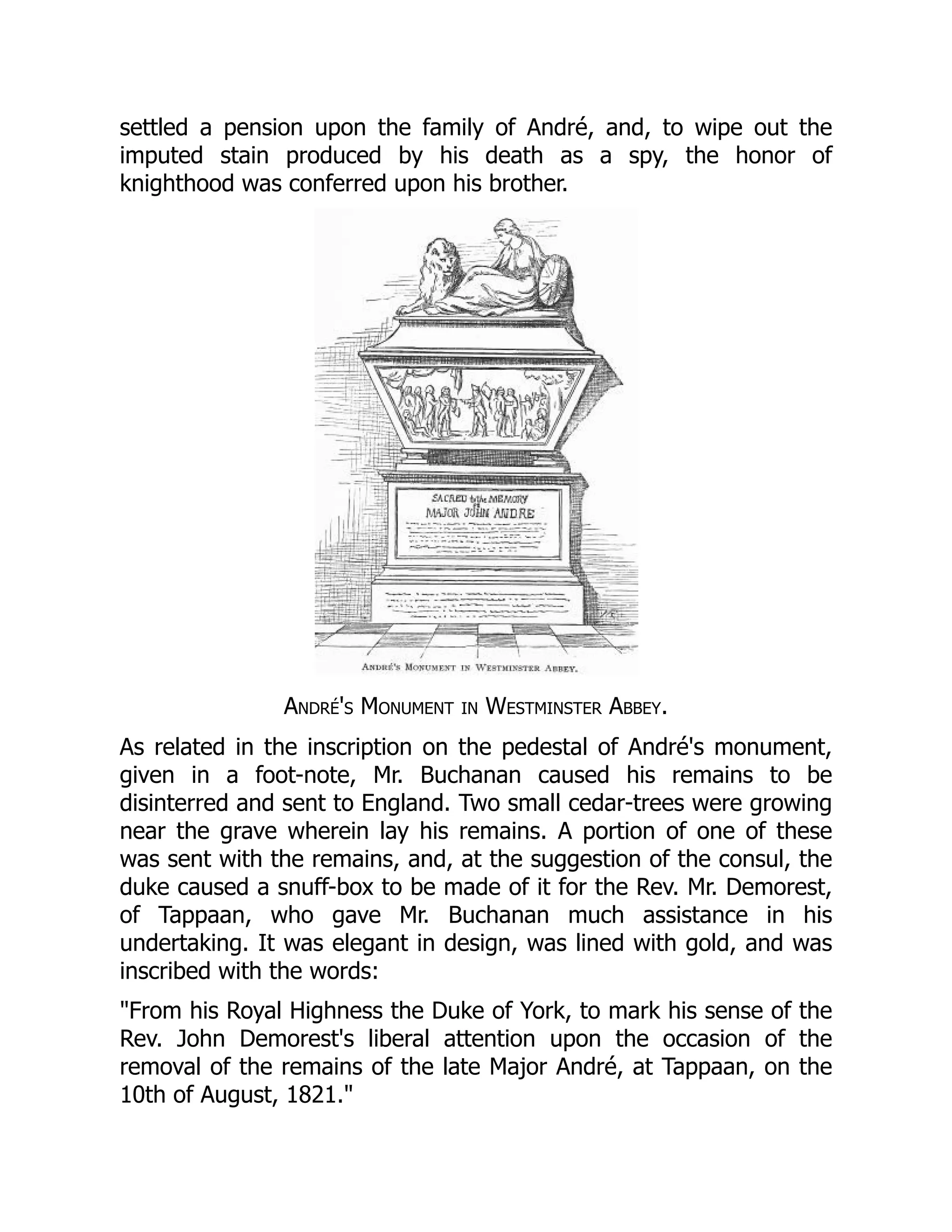
Corner." A picture of this monument is seen in the engraving.[56]
The memorial was executed in statuary marble, and is about seven
and a half feet in height. It represents a sarcophagus with a device
in low relief, and elevated upon a paneled pedestal, upon which are
appropriate inscriptions.[57] On the sarcophagus is a representation
of Washington and his officers in his tent at the moment when he
received the report of the court of inquiry; at the same time a
messenger has arrived with the letter of André to Washington asking
for a soldier's death. On the right is a guard of Continental soldiers,
and a tree on which André was executed. Two men are preparing
the prisoner for execution, while at the foot of the tree sit Mercy and
Innocence. On the top of the sarcophagus is the British lion, and the
figure of Britannia, who is lamenting the fate of André. The king
36.
settled a pensionupon the family of André, and, to wipe out the
imputed stain produced by his death as a spy, the honor of
knighthood was conferred upon his brother.
André's Monument in Westminster Abbey.
As related in the inscription on the pedestal of André's monument,
given in a foot-note, Mr. Buchanan caused his remains to be
disinterred and sent to England. Two small cedar-trees were growing
near the grave wherein lay his remains. A portion of one of these
was sent with the remains, and, at the suggestion of the consul, the
duke caused a snuff-box to be made of it for the Rev. Mr. Demorest,
of Tappaan, who gave Mr. Buchanan much assistance in his
undertaking. It was elegant in design, was lined with gold, and was
inscribed with the words:
"From his Royal Highness the Duke of York, to mark his sense of the
Rev. John Demorest's liberal attention upon the occasion of the
removal of the remains of the late Major André, at Tappaan, on the
10th of August, 1821."
37.
The surviving sistersof André sent a silver cup to Mr. Demorest, with
a suitable inscription; also an inkstand to the British consul.
Two monuments have been erected at different times on the spot
where André was executed, each with the sole purpose of
commemorating this very important event in our national history,
and to mark the exact locality of its occurrence. One of these
monuments was set up by James Lee,[58] a public-spirited New York
merchant, nearly forty years ago. It consisted of a small bowlder,
upon the upper surface of which were cut the words, "André was
executed October 2, 1780." It was on the right side of a lane which
ran from the highway from Tappaan village to old Tappaan, on the
westerly side of a large peach-orchard, and about a mile from
Washington's headquarters. I visited the spot in 1849, and made a
drawing of this simple memorial-stone for my "Pictorial Field Book of
the Revolution." In a foot-note of that work (vol. i, p. 772) I said, "A
more elegant and durable monument should be erected on the
spot."
Bowlder-Monument.
38.
A "more elegantand durable monument" was placed on the same
spot a few years ago by another public-spirited New York merchant,
Mr. Cyrus W. Field, and bears an inscription written by the late Rev.
Arthur Penrhyn Stanley, the Dean of Westminster. When that
eminent divine and earnest friend of our country and admirer of our
free institutions was about to visit the United States in 1878, he
made a list of the objects and localities which he desired to see
while here. Among these was the place of André's execution.
While Dean Stanley was visiting Mr. Field at his country residence on
the eastern bank of the Hudson, nearly opposite Tappaan, he with
his two traveling companions and their host crossed the river, and,
with one or two citizens of Tappaan, visited places of historic interest
in the vicinity. They found that nothing marked the place of André's
execution, and that it had even been a subject of controversy. The
bowlder-monument had been removed several years before. The
dean expressed his surprise and regret that no object indicated the
locality of such an important historical event, when Mr. Field said he
would erect a memorial-stone there at his own expense upon certain
conditions. A few days afterward (October, 1878) he wrote to a
citizen of Tappaan:
"I am perfectly willing to erect a monument on 'André Hill' [so
named by the people in commemoration of the event which occurred
there], and the dean will write an inscription, if the people who own
the land will make a grant of about twenty square feet for the
purpose."
So soon as it became known that Mr. Field proposed to erect a
memorial-stone at Tappaan, a correspondent of a New York morning
journal denounced the intention, upon the wholly erroneous
assumption that it was to be a "monument in honor of Major André,
the British spy." Other correspondents, equally uninformed, followed
with denunciations. A storm of apparently indignant protests, or
worse, ensued; and one writer, lacking courage to give his name,
made a threat that, if Mr. Field should set up a memorial-stone upon
the place where André was executed, "ten thousand men" were
39.
ready to pullit down and cast it into the river! These writers, many
of whom concealed their real names, created considerable feeling in
the public mind unfavorable to the project, and elicited a multitude
of appeals to the patriotism and the prejudices of the American
people, to oppose what?—a phantom!
This intemperate and unwise correspondence continued several
weeks. There were calm defenders of Mr. Field's motives in
proposing to erect a monument, by persons who were well informed
and had a clear perception of the intent and importance of such an
act. The discussion was fruitful of some good. It had the salutary
effect of calling public attention to the claims of Nathan Hale, the
notable martyr spy of the Revolution, to a memorial tribute—a public
recognition of his virtues and his deeds—which had been so long
deferred by our people. These claims were now earnestly advocated,
not only by Mr. Field's critics, but by patriotic citizens. Considerable
sums of money were offered for the laudable purpose of erecting a
suitable monument in the city of New York to the memory of Hale.
Several persons offered one hundred dollars each.
Before the visit of Mr. Field and the dean, Mr. Henry Whittemore, a
public-spirited citizen of Tappan, and Secretary of the Rockland
County Historical Society, had found four living men who were
present at the disinterment of André's remains in 1821. With these
men he went to "André Hill," where they identified the place of the
spy's grave.[59] The requisite plot of ground was secured by Mr.
Field, who was compelled to buy many surrounding acres at an
exorbitant price. Then, relying upon the good sense, the intelligence,
and the patriotism of the American people for a just appreciation of
his motives, he proceeded to have a memorial-stone prepared.
Soon after Dean Stanley returned home he wrote the promised
inscription, and, in a letter to Mr. Whittemore (January, 1879), he
said:
40.
Dean Stanley's Autograph.
"Ihave sent to Mr. Cyrus W. Field the inscription
suggested. Perhaps you will kindly see that the facts are
correctly stated. It is desirable that the inscription should
contain neither an attack nor a defense of André, but only
an expression of sympathy with him in his tragical fate,
and with Washington for the difficult circumstances in
which the judges were placed.
"A wreath of autumn leaves from the Hudson I had placed
on the monument in the abbey attracts universal
attention. I have also the silver medals of Washington's
headquarters, and the old Dutch church at Tappaan.
"I remain, yours gratefully,
"A.P. Stanley."[60]
On the 2d of October, 1879, the ninety-ninth anniversary of the
execution of André, the monument prepared by Mr. Field's order, and
placed over the spot where the spy was buried, was uncovered in
41.
the presence ofrepresentatives of the Historical Societies of New
York, and Rockland County, of officers of the army of the United
States, of the newspaper press and other gentlemen, and a few
ladies. At noon, the hour of the day when André was executed, Mr.
Field directed the workmen to uncover the memorial. There was no
pomp or ceremony on the occasion. Not a speech was uttered, nor a
token of applause given.
From "André Hill" the company went with Mr. Whittemore to his
home in Washington's headquarters and the room in which André's
death-warrant was signed. While there the neglect of the memory of
Nathan Hale, shown by the American people, was spoken of, when
Mr. Field said:
"Gentlemen, if I may be granted permission, I will erect a
monument in memory of Nathan Hale on the spot where
he suffered death in the city of New York, if the place may
be found."
Several years ago Mr. Field made a similar offer to the New York
Historical Society.[61] More than thirty years before, he was a
contributor to the fund raised to erect the modest monument in
memory of Hale at South Coventry, delineated on page 26; and he
was next to the largest contributor to the fund for procuring the
bronze statue of a captor of André that surmounts the monument at
Tarrytown, which commemorates that important event.
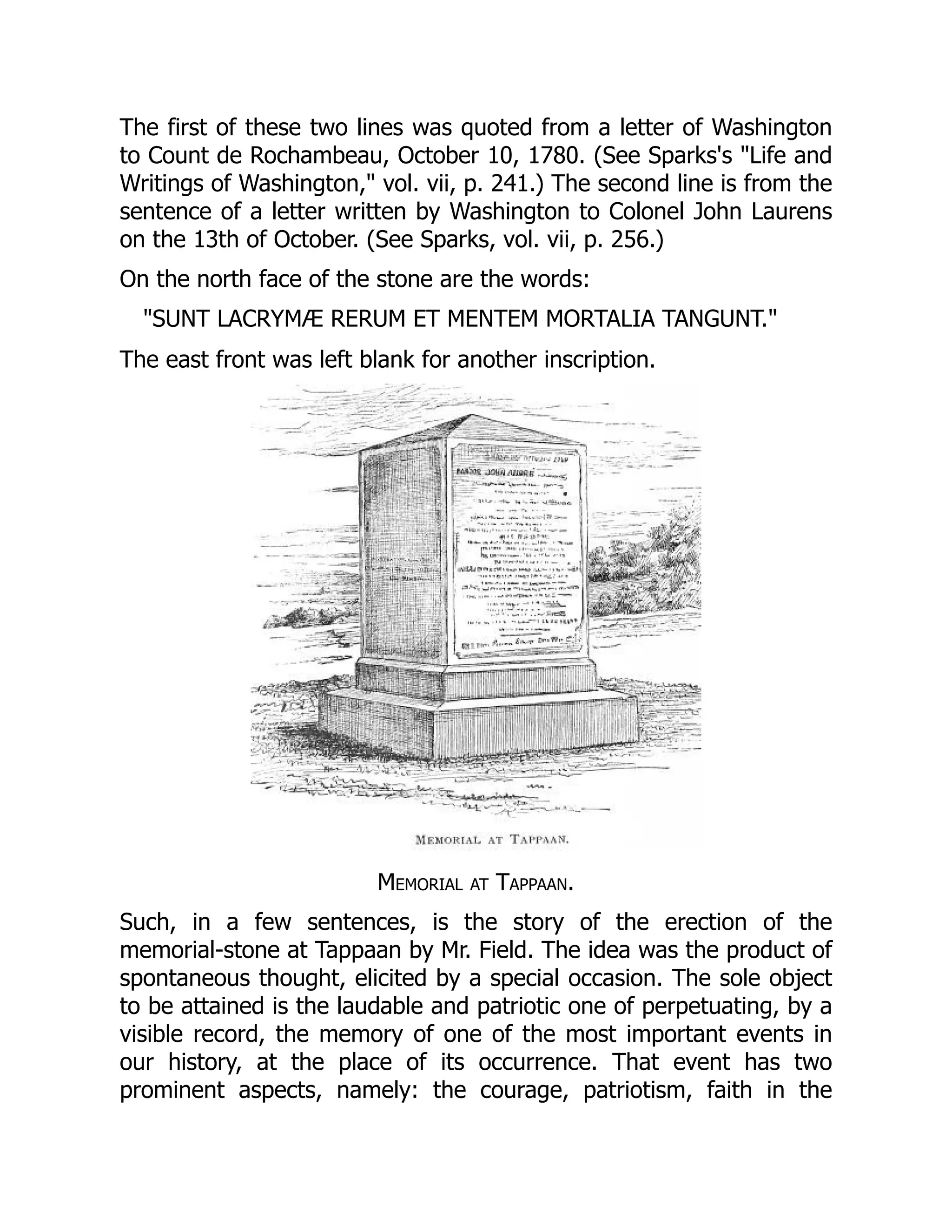
The memorial-stone erected at Tappaan is composed of a shaft of
Quincy gray granite, standing upon a pedestal of the same material.
The whole structure is about nine feet in height from the ground to
the apex. It is perfectly chaste in design. There is no ornamentation.
The granite is highly polished. It stands upon an elevation, about
two miles from the Hudson River, and thirty yards from the
boundary-line between New York and New Jersey, and overlooks a
beautiful country.[62] On its west side it bears the following
inscription, written by Dean Stanley:
42.
"HERE DIED, OCTOBER2, 1780,
MAJOR JOHN ANDRÉ, OF THE BRITISH ARMY,
WHO, ENTERING THE AMERICAN LINES
ON A SECRET MISSION TO BENEDICT ARNOLD,
FOR THE SURRENDER OF WEST POINT,
WAS TAKEN PRISONER, TRIED AND
CONDEMNED AS A SPY.
HIS DEATH,
THOUGH ACCORDING TO THE STERN RULE OF
WAR,
MOVED EVEN HIS ENEMIES TO PITY;
AND BOTH ARMIES MOURNED THE FATE
OF ONE SO YOUNG AND SO BRAVE.
IN 1821 HIS REMAINS WERE REMOVED TO
WESTMINSTER ABBEY.
A HUNDRED YEARS AFTER THE EXECUTION
THIS STONE WAS PLACED ABOVE THE SPOT
WHERE HE LAY,
BY A CITIZEN OF THE UNITED STATES,
AGAINST WHICH HE FOUGHT,
NOT TO PERPETUATE THE RECORD OF STRIFE,
BUT IN TOKEN OF THOSE BETTER FEELINGS
WHICH HAVE SINCE UNITED TWO NATIONS,
ONE IN RACE, IN LANGUAGE, AND IN RELIGION,
WITH THE HOPE THAT THIS FRIENDLY UNION
WILL NEVER BE BROKEN."
On the north face:
"HE WAS MORE UNFORTUNATE THAN
CRIMINAL."
"AN ACCOMPLISHED MAN AND GALLANT
OFFICER."
GEORGE WASHINGTON.
43.
The first ofthese two lines was quoted from a letter of Washington
to Count de Rochambeau, October 10, 1780. (See Sparks's "Life and
Writings of Washington," vol. vii, p. 241.) The second line is from the
sentence of a letter written by Washington to Colonel John Laurens
on the 13th of October. (See Sparks, vol. vii, p. 256.)
On the north face of the stone are the words:
"SUNT LACRYMÆ RERUM ET MENTEM MORTALIA TANGUNT."
The east front was left blank for another inscription.
Memorial at Tappaan.
Such, in a few sentences, is the story of the erection of the
memorial-stone at Tappaan by Mr. Field. The idea was the product of
spontaneous thought, elicited by a special occasion. The sole object
to be attained is the laudable and patriotic one of perpetuating, by a
visible record, the memory of one of the most important events in
our history, at the place of its occurrence. That event has two
prominent aspects, namely: the courage, patriotism, faith in the
44.
American people, andthe unswerving fidelity in the discharge of a
momentous trust, of our beloved Washington and his officers, in the
face of most extraordinary temptations to do otherwise; and the
execution as a spy of the adjutant-general of the British army, while
that army, twenty thousand strong, was lying only a few miles
distant, and supported by powerful ships of war.
These were the events to be commemorated by this memorial-stone,
and not the name or character of any individual. It was no more a
monument "in honor of Major André, the British spy," than was the
monument of white marble, twenty-five feet in height, which was
erected by patriotic men, in 1853, to mark the spot at Tarrytown
where the spy was captured, or the naming of the rivulet near which
it stands "André Brook." Surely every intelligent and right-minded
American, clearly comprehending the truth of the whole matter, will
award to Mr. Field the meed of praise for his generous and patriotic
deed.
An attempt was made on the night of November 3, 1885, to destroy
the beautiful memorial-stone at Tappaan by an explosion of
dynamite. The pedestal was shattered into pieces, but the shaft was
only shaken from its perpendicular position. This crime was the
logical result of persistent misrepresentation of the character and
intent of the memorial in some of the newspapers. Twice before,
attempts had been made to destroy it; the first time by a
defacement of the inscription by a misguided person who, on a dark
night, battered the letters, many of them almost beyond recognition.
The destroyer[63] left a small American flag hanging over the
monument from a stick, supported by a pile of stones, upon the
apex; also the following lines, the product, evidently, of one moved
by a spirit of conscious untruthfulness, or of profound ignorance of
the character of the object assailed:
"Too long hath stood the traitor's shaft,
A monument to shame,
Built up to praise the traitor's craft,
To sanctify ill fame.
45.
Are freemen boundto still forbear,
And meekly still implore,
When conquered foes their altars rear
Within our very door.
"This vulgar and insulting stone
Would honor for all time,
Not sneaking André's death alone,
But black Ben Arnold's crime.
And they, who thus can glorify
The traitor and his deeds,
Themselves high treason would employ
If 'twould fulfill their needs.
"Americans! resolve, proclaim
That on our own dear land,
Never, while the people reign,
Shall treason's statue stand!
And he who dares erect it next,
On fair Columbia's breast,
With furtive or with false pretext,
Shall dangle from its crest!"
The second attempt to destroy the memorial-stone was made on a
dark night. Nitro-glycerine or dynamite was used for the purpose.
The explosion was heard for miles around. The perpetrator of the
deed was not discovered. The stones of the pedestal were shattered,
but the shaft remained in an upright position.
Mr. Field had the damages to the memorial repaired. He designed to
have the acres around it fashioned into a handsome little park. He
also proposed to erect within the grounds a fire-proof building for
the use of the Rockland County Historical and Forestry Society as a
depository of historical and other relics of that county, the building to
be presented to the society, and the park to the citizens of Tappaan,
as a free gift. The outrage of November 3, 1885, may frustrate this
generous plan.
46.
Two days afterthat outrage, a New York morning journal of large
circulation and wide influence declared that "the malignity with
which the people about Tappaan regard Mr. Field's monument to
André appears to be settled and permanent." To this grave
indictment of the inhabitants of a portion of Rockland County as
participants in the crime, that people responded by resolutions
unanimously adopted at an indignation meeting held at the
Reformed Church at Tappaan on the evening of the 9th. They
denounced the charge as utterly untrue, expressed their belief that
no person in the vicinity had "the remotest connection" with the
crime; that it was desirable to have the place of André's execution
indicated by a memorial-stone with a suitable inscription, and
commended Mr. Field for his zeal in perpetuating events of the
Revolution in such a manner.[64]
In the foregoing narrative I have endeavored to present a brief,
plain, and truthful story of the memorial at Tappaan, about which so
much has been said and written. I have fashioned it from
trustworthy materials. I have simply recorded the facts, and leave
the readers to form their own conclusions.
The monument at Tarrytown has been alluded to. It was erected in
1853, on the spot where tradition says Major André was captured, to
commemorate that event. It bore upon a tablet the following
inscription:
47.
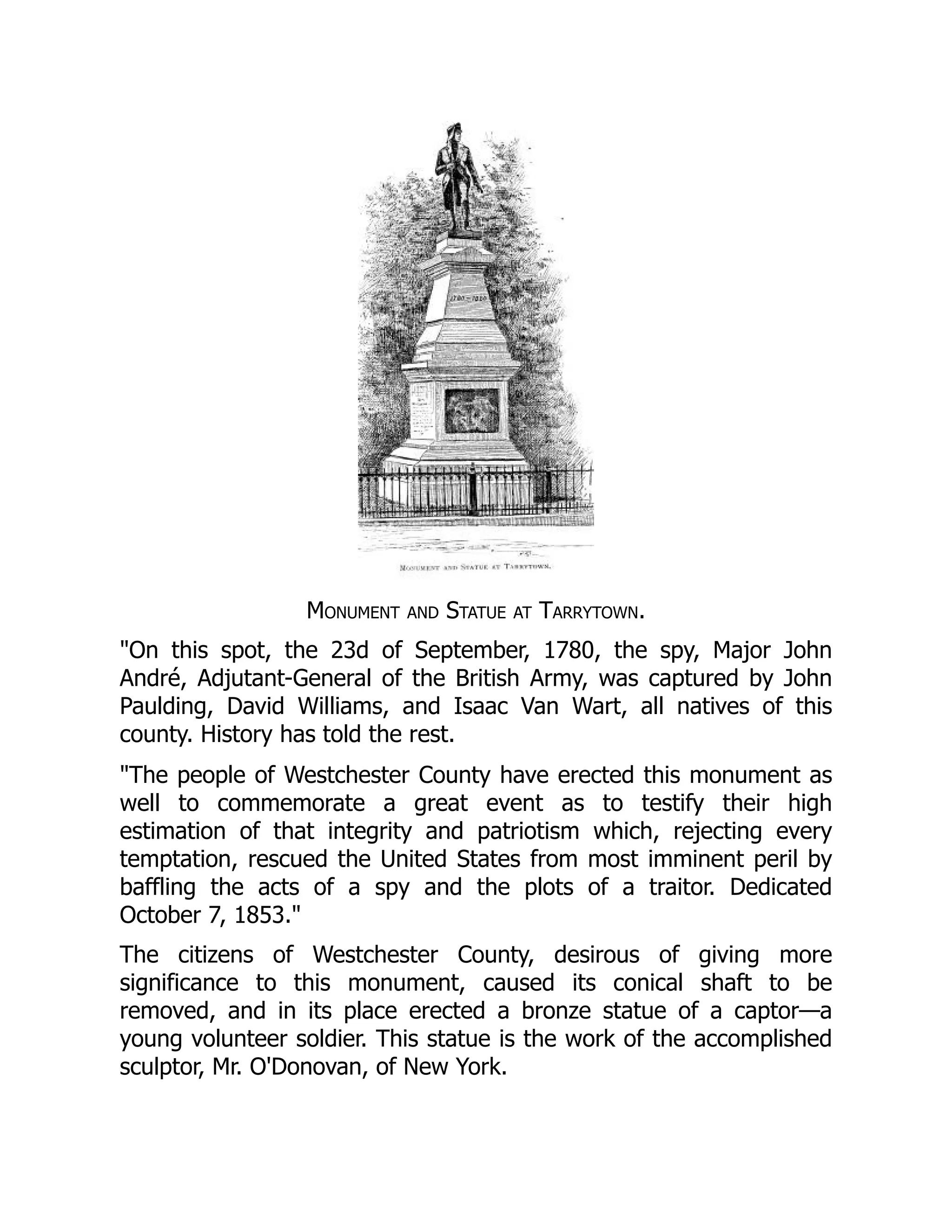
Monument and Statueat Tarrytown.
"On this spot, the 23d of September, 1780, the spy, Major John
André, Adjutant-General of the British Army, was captured by John
Paulding, David Williams, and Isaac Van Wart, all natives of this
county. History has told the rest.
"The people of Westchester County have erected this monument as
well to commemorate a great event as to testify their high
estimation of that integrity and patriotism which, rejecting every
temptation, rescued the United States from most imminent peril by
baffling the acts of a spy and the plots of a traitor. Dedicated
October 7, 1853."
The citizens of Westchester County, desirous of giving more
significance to this monument, caused its conical shaft to be
removed, and in its place erected a bronze statue of a captor—a
young volunteer soldier. This statue is the work of the accomplished
sculptor, Mr. O'Donovan, of New York.
48.
The monument andstatue were unveiled in the presence of
thousands of spectators on the centennial of the event
commemorated—the 23d of September, 1880. On that occasion
Samuel J. Tilden presided. A prayer was offered by the venerable
son of one of the captors, Isaac Van Wart, and an oration was
pronounced by Chauncey M. Depew. General James Husted was the
marshal of the day.
On one face of the monument is the old inscription, and upon
another, next to the highway, is a fine bronze bas-relief representing
the scene of the capture. This also is from the atelier of Mr.
O'Donovan. An excellent picture of this work of art and of the statue
may be found in the "Memorial Souvenir of the Monument
Association," prepared by Dr. Nathaniel C. Husted, secretary of the
association.
FOOTNOTES:
[56] The original drawing from which the engraving was made
was received from London in 1849 by the author of this little
work, together with a copy of a profile likeness of André—simply
the head and shoulders—said to have been drawn by himself.
[57] Upon a panel is the following inscription: "Sacred to the
memory of Major John André, who, raised to the rank of Adjutant-
General of the British Army in America, and employed in an
important and hazardous enterprise, fell a sacrifice to his zeal for
his king and country, on the 2d of October, a.d. 1780, eminently
beloved and esteemed by the army in which he served, and
lamented even by his foes. His gracious sovereign, King George
the Third, has caused this monument to be erected."
After the removal of André's remains to Westminster Abbey, as
mentioned in the text, the following inscription was cut upon the
base of the pedestal:
"The remains of Major John André were, on the 10th of August,
1821, removed from Tappaan by James Buchanan, Esq., his
Majesty's Consul at New York, under instructions from his Royal
Highness the Duke of York, and, with the permission of the Dean
49.
Welcome to ourwebsite – the perfect destination for book lovers and
knowledge seekers. We believe that every book holds a new world,
offering opportunities for learning, discovery, and personal growth.
That’s why we are dedicated to bringing you a diverse collection of
books, ranging from classic literature and specialized publications to
self-development guides and children's books.
More than just a book-buying platform, we strive to be a bridge
connecting you with timeless cultural and intellectual values. With an
elegant, user-friendly interface and a smart search system, you can
quickly find the books that best suit your interests. Additionally,
our special promotions and home delivery services help you save time
and fully enjoy the joy of reading.
Join us on a journey of knowledge exploration, passion nurturing, and
personal growth every day!
testbankmall.com





![Clinton shut himself up for three days, and every one at the Coffee-
House and other public places hung their heads, and scarcely an
observation relative to it escaped their lips."
Washington's Headquarters at Tappaan.
Washington had returned to his headquarters at Tappaan,[52] and
ordered a meeting of a board of officers on the 29th, to make
careful inquiries and report their opinion "of the light in which he
[the prisoner] ought to be considered, and what punishment ought
to be inflicted." The board consisted of six major-generals and eight
brigadier-generals. The court of inquiry was held in the Dutch church
at Tappaan. General Greene presided. When André was brought
before his judges, he gave a detailed statement of the facts, and did
not deny any of the specifications presented by the judge-advocate,
John Laurance. After careful deliberation the board reported that the
prisoner "ought to be considered as a spy from the enemy, and that,
agreeably to the law and usages of nations, it is their opinion he
ought to suffer death." "André met the result," wrote Colonel
Hamilton, "with manly firmness. 'I foresee my fate,' he said, 'and
though I pretend not to play the hero, or be indifferent to life, yet I
am reconciled to whatever may happen, conscious that misfortune,
not guilt, has brought it upon me.'"](https://image.slidesharecdn.com/8272-250504192736-c609a8d1/75/Management-A-Practical-Introduction-Kinicki-6th-Edition-Test-Bank-30-2048.jpg)
![Washington approved the finding of the court of inquiry, and
sentenced André to be hung as a spy on the first day of October, at
five o'clock in the afternoon. He sent an account of the proceedings
of the court and a letter from André to Sir Henry Clinton.[53]
Meanwhile great exertions had been made to save André from his
sad fate. General Clinton wrote to Washington (September 26th)
that André was not a legal spy, for a flag of truce had been sent to
receive him, and passports were granted for his return. On receiving
the papers from Washington, Sir Henry wrote a second letter to the
American chief commander, expressing the opinion that the board
"had not been rightly informed of all the circumstances," and asked
a postponement of the execution until a conference might be held.
The request was granted. The execution was postponed one day.
General Greene met General Robertson and others at Dobb's Ferry,
not as an officer, but as a private gentleman, but nothing occurred to
warrant a change in the opinion of the board of inquiry and the
decision of Washington.[54]
The Americans would gladly have saved the life of André could
Arnold have been given up to them. Efforts to that end were made.
Unofficial overtures were made to Clinton to exchange Arnold for
André, but honor forbade the act. All efforts in this direction failed.
On the morning of October 1st, the day on which André expected to
die, he wrote the following touching note to Washington:
"Sir: Buoyed above the terror of death by the
consciousness of a life devoted to honorable pursuits, and
stained with no action that can give remorse, I trust that
the request I make to your Excellency at this serious
period, and which is to soften my last moments, will not
be rejected.
"Sympathy toward a soldier will surely induce your
Excellency and a military tribunal to adapt the mode of my
death to the feelings of a man of honor.](https://image.slidesharecdn.com/8272-250504192736-c609a8d1/75/Management-A-Practical-Introduction-Kinicki-6th-Edition-Test-Bank-31-2048.jpg)
!["Let me hope, sir, that if aught in my character impresses
you with esteem toward me, if aught in my misfortune
marks me as the victim of policy and not of resentment, I
shall experience the operation of those feelings in your
breast by being informed that I am not to die on a gibbet.
"I have the honor to be your Excellency's most obedient
and most humble servant,
John André."
Colonel Hamilton urged Washington to comply with André's request,
but the commander could not grant it. Unwilling to wound the
feelings of the prisoner by a refusal, he did not reply to the note.
On the preceding evening André wrote letters to his mother, sisters,
Miss Seward, and other friends, and made a pen-and-ink sketch of
himself sitting at a table with a pen in his hand. On the following
morning he made a rude sketch, with pen and ink, depicting the
scene of his passage from the Vulture to the shore, when he went to
meet Arnold.[55]
At noon on the 2d day of October, 1780, Major André was executed
upon an eminence near Tappaan village, in the presence of a vast
concourse of people. He was dressed in full military costume and
white top-boots. He was taken to the gallows—a cross-piece
between two moderate-sized trees—by a procession of nearly all the
field-officers, excepting Washington and his staff, who remained at
headquarters. General Greene led the cavalcade, which passed
between two files of soldiers, extending from the prison up to the
fatal spot. The prisoner's step was firm, and he did not falter until he
saw the gallows, and knew he was to be hanged as a felon and not
shot as a soldier. His hesitation was only for a moment.
A baggage-wagon, bearing a plain pine coffin, had been driven
under the gallows. A grave had been dug near by. Into the wagon
the prisoner stepped and, taking the rope from the hangman,
adjusted it to his neck, and tied a white handkerchief over his eyes.
Then Adjutant-General Scammell read the order for the execution in](https://image.slidesharecdn.com/8272-250504192736-c609a8d1/75/Management-A-Practical-Introduction-Kinicki-6th-Edition-Test-Bank-32-2048.jpg)
![a clear voice, and at its conclusion told André that he might speak if
he desired it. The prisoner lifted the handkerchief from his eyes and,
bowing courteously to General Greene and his officers, said in firm
voice, "All I request of you, gentlemen, is that, while I acknowledge
the propriety of my sentence, you will bear me witness that I die like
a brave man." In an undertone he murmured, "It will be but a
momentary pang." The wagon was driven swiftly from under him,
and in a few minutes he ceased to exist.
Passage from the Vulture.—(Fac-simile of a Pen-and-ink Sketch by
André.)
"Thus died in the bloom of life," wrote Dr. Thacher, a surgeon of the
Continental army, who was present, "the accomplished Major André,
the pride of the royal army and the valued friend of Sir Henry
Clinton." The same authority wrote that André's regimentals, which
had been brought up to Tappaan by his servant, were handed to
that servant, and he was buried near one of the trees which formed
the gibbet.
FOOTNOTES:
[52] This building is yet standing, and is in nearly the same
condition as it was in 1780, at which time it belonged to John de
Windt, a native of the Island of St. Thomas. By a peculiar](https://image.slidesharecdn.com/8272-250504192736-c609a8d1/75/Management-A-Practical-Introduction-Kinicki-6th-Edition-Test-Bank-33-2048.jpg)
![arrangement of bricks in its front wall, the date of its construction
—1700—may be seen. In a large room which Washington
occupied as his office, and where André's death-warrant was
signed, the spacious fireplace was surrounded by Dutch pictorial
tiles, when I visited and made the above sketch, in 1849.
[53] This letter evinced great tenderness of feeling toward his
commander. He declared that the events connected with his
coming within the American lines were contrary to his own
intentions, and avowed the object of his letter to be to remove
from Sir Henry's mind any suspicion that he (André) imagined he
was bound by his Excellency's orders to expose himself to what
had happened.
[54] General Robertson bore a letter from Arnold to Washington,
which he reserved until all oral arguments had failed, when he
read it to the gentlemen of the conference. Had there been a
chance for coming to an understanding in regard to André before,
this impudent letter from the traitor would have destroyed it.
Arnold said: "If, after this just and candid opinion of Major
André's case, the board of general officers adhere to their former
opinion, I shall suppose it dictated by passion and resentment;
and, if that gentleman should suffer the severity of the sentence,
I shall think myself bound by every tie of duty and honor to
retaliate on such unhappy persons of your army as may fall in my
power, that the respect due to flags and the law of nations may
be better understood and observed."
[55] The size of the original drawing from which the above sketch
was made is twelve by seven inches. It will be observed that
André has but one oarsman, instead of two, as was the case. The
drawing was found on his table by his servant after the execution,
and delivered by him at New York to Lieutenant-Colonel Crosby of
André's regiment (the Twenty-second), and who, on his return to
England, caused a fac-simile of it to be produced by the mezzotint
process of engraving.](https://image.slidesharecdn.com/8272-250504192736-c609a8d1/75/Management-A-Practical-Introduction-Kinicki-6th-Edition-Test-Bank-34-2048.jpg)
![CHAPTER VII.
Almost universal sympathy was felt and expressed for Major André.
He was undoubtedly an involuntary spy. The court of inquiry which
decided his fate came to their conclusions with regret; but duty, the
law of nations, and the exigencies of war, compelled them to give
such a verdict as they did. Washington signed his death-warrant with
reluctance and with much emotion. All the American officers were
moved by deep sympathy for him. Some of the younger officers—
Lafayette, Hamilton, Tallmadge, and others—were enamored with
him, and became attached to him. "From the few days of intimate
intercourse I had with him," wrote Tallmadge, "I became so deeply
attached to Major André that I could remember no instance when
my affections were so fully absorbed by any man." The multitude
who saw the execution were deeply moved with compassion. Dr.
Thacher says the tears of thousands fell on that occasion. The event
made a deep impression upon both armies. The king specially
honored the memory of André by ordering a notable mural
monument to be erected in Westminster Abbey, near the "Poets'
Corner." A picture of this monument is seen in the engraving.[56]
The memorial was executed in statuary marble, and is about seven
and a half feet in height. It represents a sarcophagus with a device
in low relief, and elevated upon a paneled pedestal, upon which are
appropriate inscriptions.[57] On the sarcophagus is a representation
of Washington and his officers in his tent at the moment when he
received the report of the court of inquiry; at the same time a
messenger has arrived with the letter of André to Washington asking
for a soldier's death. On the right is a guard of Continental soldiers,
and a tree on which André was executed. Two men are preparing
the prisoner for execution, while at the foot of the tree sit Mercy and
Innocence. On the top of the sarcophagus is the British lion, and the
figure of Britannia, who is lamenting the fate of André. The king](https://image.slidesharecdn.com/8272-250504192736-c609a8d1/75/Management-A-Practical-Introduction-Kinicki-6th-Edition-Test-Bank-35-2048.jpg)
![The surviving sisters of André sent a silver cup to Mr. Demorest, with
a suitable inscription; also an inkstand to the British consul.
Two monuments have been erected at different times on the spot
where André was executed, each with the sole purpose of
commemorating this very important event in our national history,
and to mark the exact locality of its occurrence. One of these
monuments was set up by James Lee,[58] a public-spirited New York
merchant, nearly forty years ago. It consisted of a small bowlder,
upon the upper surface of which were cut the words, "André was
executed October 2, 1780." It was on the right side of a lane which
ran from the highway from Tappaan village to old Tappaan, on the
westerly side of a large peach-orchard, and about a mile from
Washington's headquarters. I visited the spot in 1849, and made a
drawing of this simple memorial-stone for my "Pictorial Field Book of
the Revolution." In a foot-note of that work (vol. i, p. 772) I said, "A
more elegant and durable monument should be erected on the
spot."
Bowlder-Monument.](https://image.slidesharecdn.com/8272-250504192736-c609a8d1/75/Management-A-Practical-Introduction-Kinicki-6th-Edition-Test-Bank-37-2048.jpg)
![A "more elegant and durable monument" was placed on the same
spot a few years ago by another public-spirited New York merchant,
Mr. Cyrus W. Field, and bears an inscription written by the late Rev.
Arthur Penrhyn Stanley, the Dean of Westminster. When that
eminent divine and earnest friend of our country and admirer of our
free institutions was about to visit the United States in 1878, he
made a list of the objects and localities which he desired to see
while here. Among these was the place of André's execution.
While Dean Stanley was visiting Mr. Field at his country residence on
the eastern bank of the Hudson, nearly opposite Tappaan, he with
his two traveling companions and their host crossed the river, and,
with one or two citizens of Tappaan, visited places of historic interest
in the vicinity. They found that nothing marked the place of André's
execution, and that it had even been a subject of controversy. The
bowlder-monument had been removed several years before. The
dean expressed his surprise and regret that no object indicated the
locality of such an important historical event, when Mr. Field said he
would erect a memorial-stone there at his own expense upon certain
conditions. A few days afterward (October, 1878) he wrote to a
citizen of Tappaan:
"I am perfectly willing to erect a monument on 'André Hill' [so
named by the people in commemoration of the event which occurred
there], and the dean will write an inscription, if the people who own
the land will make a grant of about twenty square feet for the
purpose."
So soon as it became known that Mr. Field proposed to erect a
memorial-stone at Tappaan, a correspondent of a New York morning
journal denounced the intention, upon the wholly erroneous
assumption that it was to be a "monument in honor of Major André,
the British spy." Other correspondents, equally uninformed, followed
with denunciations. A storm of apparently indignant protests, or
worse, ensued; and one writer, lacking courage to give his name,
made a threat that, if Mr. Field should set up a memorial-stone upon
the place where André was executed, "ten thousand men" were](https://image.slidesharecdn.com/8272-250504192736-c609a8d1/75/Management-A-Practical-Introduction-Kinicki-6th-Edition-Test-Bank-38-2048.jpg)
![ready to pull it down and cast it into the river! These writers, many
of whom concealed their real names, created considerable feeling in
the public mind unfavorable to the project, and elicited a multitude
of appeals to the patriotism and the prejudices of the American
people, to oppose what?—a phantom!
This intemperate and unwise correspondence continued several
weeks. There were calm defenders of Mr. Field's motives in
proposing to erect a monument, by persons who were well informed
and had a clear perception of the intent and importance of such an
act. The discussion was fruitful of some good. It had the salutary
effect of calling public attention to the claims of Nathan Hale, the
notable martyr spy of the Revolution, to a memorial tribute—a public
recognition of his virtues and his deeds—which had been so long
deferred by our people. These claims were now earnestly advocated,
not only by Mr. Field's critics, but by patriotic citizens. Considerable
sums of money were offered for the laudable purpose of erecting a
suitable monument in the city of New York to the memory of Hale.
Several persons offered one hundred dollars each.
Before the visit of Mr. Field and the dean, Mr. Henry Whittemore, a
public-spirited citizen of Tappan, and Secretary of the Rockland
County Historical Society, had found four living men who were
present at the disinterment of André's remains in 1821. With these
men he went to "André Hill," where they identified the place of the
spy's grave.[59] The requisite plot of ground was secured by Mr.
Field, who was compelled to buy many surrounding acres at an
exorbitant price. Then, relying upon the good sense, the intelligence,
and the patriotism of the American people for a just appreciation of
his motives, he proceeded to have a memorial-stone prepared.
Soon after Dean Stanley returned home he wrote the promised
inscription, and, in a letter to Mr. Whittemore (January, 1879), he
said:](https://image.slidesharecdn.com/8272-250504192736-c609a8d1/75/Management-A-Practical-Introduction-Kinicki-6th-Edition-Test-Bank-39-2048.jpg)
![Dean Stanley's Autograph.
"I have sent to Mr. Cyrus W. Field the inscription
suggested. Perhaps you will kindly see that the facts are
correctly stated. It is desirable that the inscription should
contain neither an attack nor a defense of André, but only
an expression of sympathy with him in his tragical fate,
and with Washington for the difficult circumstances in
which the judges were placed.
"A wreath of autumn leaves from the Hudson I had placed
on the monument in the abbey attracts universal
attention. I have also the silver medals of Washington's
headquarters, and the old Dutch church at Tappaan.
"I remain, yours gratefully,
"A.P. Stanley."[60]
On the 2d of October, 1879, the ninety-ninth anniversary of the
execution of André, the monument prepared by Mr. Field's order, and
placed over the spot where the spy was buried, was uncovered in](https://image.slidesharecdn.com/8272-250504192736-c609a8d1/75/Management-A-Practical-Introduction-Kinicki-6th-Edition-Test-Bank-40-2048.jpg)
![the presence of representatives of the Historical Societies of New
York, and Rockland County, of officers of the army of the United
States, of the newspaper press and other gentlemen, and a few
ladies. At noon, the hour of the day when André was executed, Mr.
Field directed the workmen to uncover the memorial. There was no
pomp or ceremony on the occasion. Not a speech was uttered, nor a
token of applause given.
From "André Hill" the company went with Mr. Whittemore to his
home in Washington's headquarters and the room in which André's
death-warrant was signed. While there the neglect of the memory of
Nathan Hale, shown by the American people, was spoken of, when
Mr. Field said:
"Gentlemen, if I may be granted permission, I will erect a
monument in memory of Nathan Hale on the spot where
he suffered death in the city of New York, if the place may
be found."
Several years ago Mr. Field made a similar offer to the New York
Historical Society.[61] More than thirty years before, he was a
contributor to the fund raised to erect the modest monument in
memory of Hale at South Coventry, delineated on page 26; and he
was next to the largest contributor to the fund for procuring the
bronze statue of a captor of André that surmounts the monument at
Tarrytown, which commemorates that important event.
The memorial-stone erected at Tappaan is composed of a shaft of
Quincy gray granite, standing upon a pedestal of the same material.
The whole structure is about nine feet in height from the ground to
the apex. It is perfectly chaste in design. There is no ornamentation.
The granite is highly polished. It stands upon an elevation, about
two miles from the Hudson River, and thirty yards from the
boundary-line between New York and New Jersey, and overlooks a
beautiful country.[62] On its west side it bears the following
inscription, written by Dean Stanley:](https://image.slidesharecdn.com/8272-250504192736-c609a8d1/75/Management-A-Practical-Introduction-Kinicki-6th-Edition-Test-Bank-41-2048.jpg)
![American people, and the unswerving fidelity in the discharge of a
momentous trust, of our beloved Washington and his officers, in the
face of most extraordinary temptations to do otherwise; and the
execution as a spy of the adjutant-general of the British army, while
that army, twenty thousand strong, was lying only a few miles
distant, and supported by powerful ships of war.
These were the events to be commemorated by this memorial-stone,
and not the name or character of any individual. It was no more a
monument "in honor of Major André, the British spy," than was the
monument of white marble, twenty-five feet in height, which was
erected by patriotic men, in 1853, to mark the spot at Tarrytown
where the spy was captured, or the naming of the rivulet near which
it stands "André Brook." Surely every intelligent and right-minded
American, clearly comprehending the truth of the whole matter, will
award to Mr. Field the meed of praise for his generous and patriotic
deed.
An attempt was made on the night of November 3, 1885, to destroy
the beautiful memorial-stone at Tappaan by an explosion of
dynamite. The pedestal was shattered into pieces, but the shaft was
only shaken from its perpendicular position. This crime was the
logical result of persistent misrepresentation of the character and
intent of the memorial in some of the newspapers. Twice before,
attempts had been made to destroy it; the first time by a
defacement of the inscription by a misguided person who, on a dark
night, battered the letters, many of them almost beyond recognition.
The destroyer[63] left a small American flag hanging over the
monument from a stick, supported by a pile of stones, upon the
apex; also the following lines, the product, evidently, of one moved
by a spirit of conscious untruthfulness, or of profound ignorance of
the character of the object assailed:
"Too long hath stood the traitor's shaft,
A monument to shame,
Built up to praise the traitor's craft,
To sanctify ill fame.](https://image.slidesharecdn.com/8272-250504192736-c609a8d1/75/Management-A-Practical-Introduction-Kinicki-6th-Edition-Test-Bank-44-2048.jpg)
![Two days after that outrage, a New York morning journal of large
circulation and wide influence declared that "the malignity with
which the people about Tappaan regard Mr. Field's monument to
André appears to be settled and permanent." To this grave
indictment of the inhabitants of a portion of Rockland County as
participants in the crime, that people responded by resolutions
unanimously adopted at an indignation meeting held at the
Reformed Church at Tappaan on the evening of the 9th. They
denounced the charge as utterly untrue, expressed their belief that
no person in the vicinity had "the remotest connection" with the
crime; that it was desirable to have the place of André's execution
indicated by a memorial-stone with a suitable inscription, and
commended Mr. Field for his zeal in perpetuating events of the
Revolution in such a manner.[64]
In the foregoing narrative I have endeavored to present a brief,
plain, and truthful story of the memorial at Tappaan, about which so
much has been said and written. I have fashioned it from
trustworthy materials. I have simply recorded the facts, and leave
the readers to form their own conclusions.
The monument at Tarrytown has been alluded to. It was erected in
1853, on the spot where tradition says Major André was captured, to
commemorate that event. It bore upon a tablet the following
inscription:](https://image.slidesharecdn.com/8272-250504192736-c609a8d1/75/Management-A-Practical-Introduction-Kinicki-6th-Edition-Test-Bank-46-2048.jpg)
![The monument and statue were unveiled in the presence of
thousands of spectators on the centennial of the event
commemorated—the 23d of September, 1880. On that occasion
Samuel J. Tilden presided. A prayer was offered by the venerable
son of one of the captors, Isaac Van Wart, and an oration was
pronounced by Chauncey M. Depew. General James Husted was the
marshal of the day.
On one face of the monument is the old inscription, and upon
another, next to the highway, is a fine bronze bas-relief representing
the scene of the capture. This also is from the atelier of Mr.
O'Donovan. An excellent picture of this work of art and of the statue
may be found in the "Memorial Souvenir of the Monument
Association," prepared by Dr. Nathaniel C. Husted, secretary of the
association.
FOOTNOTES:
[56] The original drawing from which the engraving was made
was received from London in 1849 by the author of this little
work, together with a copy of a profile likeness of André—simply
the head and shoulders—said to have been drawn by himself.
[57] Upon a panel is the following inscription: "Sacred to the
memory of Major John André, who, raised to the rank of Adjutant-
General of the British Army in America, and employed in an
important and hazardous enterprise, fell a sacrifice to his zeal for
his king and country, on the 2d of October, a.d. 1780, eminently
beloved and esteemed by the army in which he served, and
lamented even by his foes. His gracious sovereign, King George
the Third, has caused this monument to be erected."
After the removal of André's remains to Westminster Abbey, as
mentioned in the text, the following inscription was cut upon the
base of the pedestal:
"The remains of Major John André were, on the 10th of August,
1821, removed from Tappaan by James Buchanan, Esq., his
Majesty's Consul at New York, under instructions from his Royal
Highness the Duke of York, and, with the permission of the Dean](https://image.slidesharecdn.com/8272-250504192736-c609a8d1/75/Management-A-Practical-Introduction-Kinicki-6th-Edition-Test-Bank-48-2048.jpg)