Chapter 4: Strategic Management
Learning Objectives After studying this chapter, you should be able to: Explain what a competitive advantage is and identify its components Describe the strategic management process Explain the role an environmental analysis plays in strategy formulation List and describe the five dimensions of the general environment Explain the five forces in the industry and competitor environments
Learning Objectives Discuss how to conduct an internal analysis of a firm’s resources using value chain analysis Utilize SWOT analysis to describe the organization’s conditions and select the best strategy Identify and explain business-level, generic strategies Describe strategic actions used in strategy implementation such as acquisitions and strategic alliances
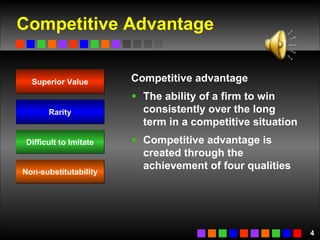
Competitive Advantage Competitive advantage The ability of a firm to win consistently over the long term in a competitive situation   Competitive advantage is created through the achievement of four qualities Superior Value Rarity Difficult to Imitate Non-substitutability
Qualities Leading to Competitive Advantage Superior value Firm provides products and services that produce value that is superior to competitors Comparative advantage Compared to others, the value is superior Distinctive competence Superior product is result of a unique competence Superior Value
Qualities Leading to Competitive Advantage Rarity How many other firms hold similar capabilities? Superior Value Rarity
Qualities Leading to Competitive Advantage Difficult to imitate Managers must create barriers that make it hard for others to copy their superiority advantages Culture Product design Marketing strategy And others Superior Value Rarity Difficult to Imitate
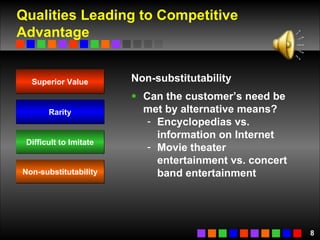
Qualities Leading to Competitive Advantage Non-substitutability Can the customer’s need be met by alternative means? Encyclopedias vs. information on Internet Movie theater entertainment vs. concert band entertainment Superior Value Rarity Difficult to Imitate Non-substitutability
Turning a Competitive Advantage into Profits A competitive advantage should generate above-average returns: profits that are greater than the average for a comparable set of firms
Strategic Management Process:  Setting Direction Strategic management process is a planning process in which managers: Set the organization's general direction and objectives Formulate a specific strategy Plan and carry out the strategy’s implementation Monitor results and make necessary adjustments
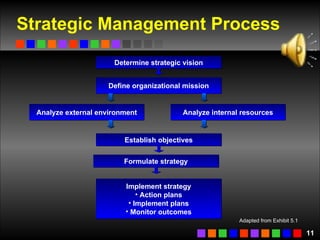
Strategic Management Process Determine strategic vision Establish objectives Formulate strategy Implement strategy Action plans Implement plans Monitor outcomes Analyze internal resources Analyze external environment Adapted from Exhibit 5.1 Define organizational mission
Determining the Strategic Vision Strategic vision: provides a view of the firm over the long term and what it should achieve in the future.  Strategic vision: Provides general identity, direction, and level of aspirations  Is the heart of the strategy and strategic plan Is short and compelling
Mission Statement Mission statement articulates fundamental purpose of the organization Company philosophy Company identity, or self-concept Principal products or services Customers and markets Geographic focus Obligations to shareholders Commitment to employees
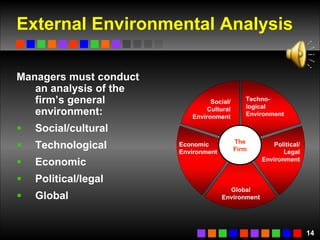
External Environmental Analysis Managers must conduct an analysis of the firm’s general environment: Social/cultural Technological Economic Political/legal Global The Firm Social/ Cultural Environment Techno- logical Environment Political/ Legal Environment Global Environment Economic Environment
General Environment Sociocultural forces include: Demographics  Societal values
General Environment Technology forces Product technological changes Process technological changes
General Environment Economic forces Current economic conditions Economic cycles Structural changes
General Environment Political and legal forces Laws and regulations Government spending
General Environment Global forces Impact on and interaction with the other forces Institutional forces Physical forces
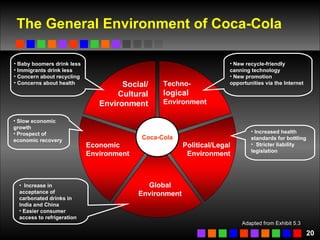
The General Environment of Coca-Cola Coca-Cola Social/ Cultural Environment Techno- logical Environment Political/Legal Environment Baby boomers drink less Immigrants drink less Concern about recycling Concerns about health New recycle-friendly canning technology New promotion opportunities via the Internet Global Environment Economic Environment Increased health standards for bottling Stricter liability legislation Increase in acceptance of carbonated drinks in India and China Easier consumer access to refrigeration Slow economic growth Prospect of economic recovery Adapted from Exhibit 5.3
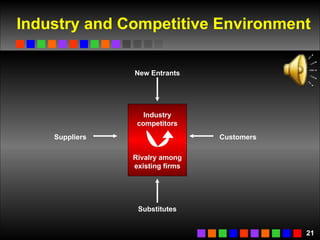
Industry and Competitive Environment Suppliers Customers New Entrants Industry competitors Rivalry among existing firms Substitutes
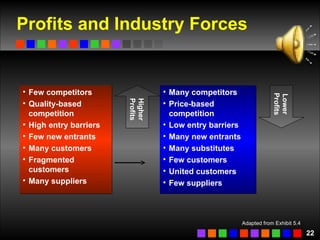
Profits and Industry Forces Few competitors Quality-based competition High entry barriers Few new entrants Many customers Fragmented customers Many suppliers Many competitors Price-based competition Low entry barriers Many new entrants Many substitutes Few customers United customers Few suppliers Higher Profits Lower Profits Adapted from Exhibit 5.4
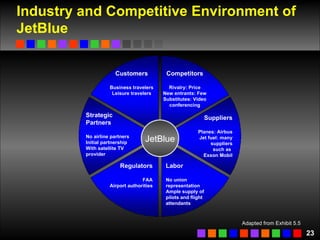
Industry and Competitive Environment of JetBlue JetBlue Customers Business travelers Leisure travelers Competitors Rivalry: Price New entrants: Few Substitutes: Video conferencing Suppliers Planes: Airbus Jet fuel: many suppliers such as  Exxon Mobil Labor No union  representation Ample supply of  pilots and flight attendants Regulators FAA Airport authorities Strategic Partners No airline partners Initial partnership With satellite TV provider Adapted from Exhibit 5.5
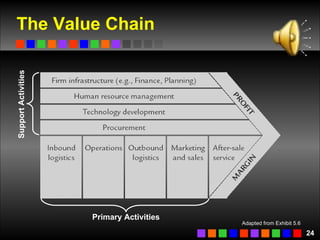
The Value Chain Primary Activities Support Activities Adapted from Exhibit 5.6
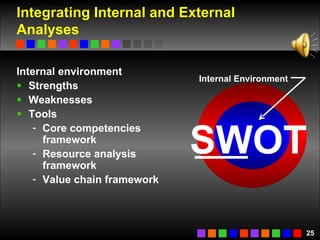
Integrating Internal and External Analyses Internal environment Strengths Weaknesses Tools Core competencies framework Resource analysis framework Value chain framework Internal Environment SWOT
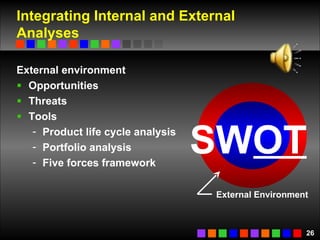
Integrating Internal and External Analyses External environment Opportunities Threats Tools Product life cycle analysis Portfolio analysis Five forces framework External Environment SWOT
Strategic Objectives Strategic objectives translate the strategic intent and mission into concrete and measurable goals Facilitates a firm's ability to Allocate resources appropriately Reach a shared understanding of priorities Delegate responsibilities Hold people accountable for results
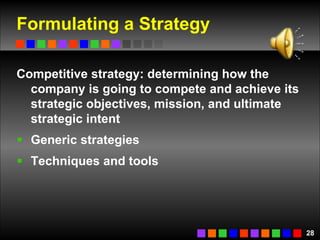
Formulating a Strategy  Competitive strategy: determining how the company is going to compete and achieve its strategic objectives, mission, and ultimate strategic intent  Generic strategies Techniques and tools
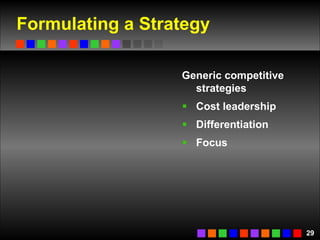
Formulating a Strategy  Generic competitive strategies Cost leadership Differentiation Focus
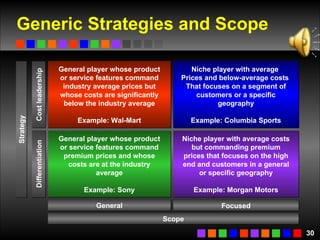
Generic Strategies and Scope General player whose product or service features command industry average prices but whose costs are significantly below the industry average Example: Wal-Mart Niche player with average  Prices and below-average costs  That focuses on a segment of customers or a specific geography Example: Columbia Sports General player whose product or service features command premium prices and whose costs are at the industry average Example: Sony Niche player with average costs but commanding premium prices that focuses on the high end and customers in a general or specific geography Example: Morgan Motors Scope General Focused Differentiation Cost leadership Strategy
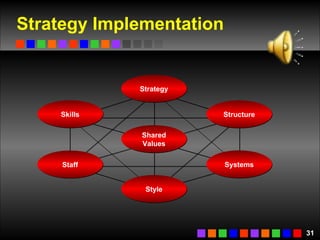
Strategy Implementation Strategy Structure Systems Shared Values Skills Staff Style

Man essentials ch4_new-1

  • 1.
  • 2.
    Learning Objectives Afterstudying this chapter, you should be able to: Explain what a competitive advantage is and identify its components Describe the strategic management process Explain the role an environmental analysis plays in strategy formulation List and describe the five dimensions of the general environment Explain the five forces in the industry and competitor environments
  • 3.
    Learning Objectives Discusshow to conduct an internal analysis of a firm’s resources using value chain analysis Utilize SWOT analysis to describe the organization’s conditions and select the best strategy Identify and explain business-level, generic strategies Describe strategic actions used in strategy implementation such as acquisitions and strategic alliances
  • 4.
    Competitive Advantage Competitiveadvantage The ability of a firm to win consistently over the long term in a competitive situation Competitive advantage is created through the achievement of four qualities Superior Value Rarity Difficult to Imitate Non-substitutability
  • 5.
    Qualities Leading toCompetitive Advantage Superior value Firm provides products and services that produce value that is superior to competitors Comparative advantage Compared to others, the value is superior Distinctive competence Superior product is result of a unique competence Superior Value
  • 6.
    Qualities Leading toCompetitive Advantage Rarity How many other firms hold similar capabilities? Superior Value Rarity
  • 7.
    Qualities Leading toCompetitive Advantage Difficult to imitate Managers must create barriers that make it hard for others to copy their superiority advantages Culture Product design Marketing strategy And others Superior Value Rarity Difficult to Imitate
  • 8.
    Qualities Leading toCompetitive Advantage Non-substitutability Can the customer’s need be met by alternative means? Encyclopedias vs. information on Internet Movie theater entertainment vs. concert band entertainment Superior Value Rarity Difficult to Imitate Non-substitutability
  • 9.
    Turning a CompetitiveAdvantage into Profits A competitive advantage should generate above-average returns: profits that are greater than the average for a comparable set of firms
  • 10.
    Strategic Management Process: Setting Direction Strategic management process is a planning process in which managers: Set the organization's general direction and objectives Formulate a specific strategy Plan and carry out the strategy’s implementation Monitor results and make necessary adjustments
  • 11.
    Strategic Management ProcessDetermine strategic vision Establish objectives Formulate strategy Implement strategy Action plans Implement plans Monitor outcomes Analyze internal resources Analyze external environment Adapted from Exhibit 5.1 Define organizational mission
  • 12.
    Determining the StrategicVision Strategic vision: provides a view of the firm over the long term and what it should achieve in the future. Strategic vision: Provides general identity, direction, and level of aspirations Is the heart of the strategy and strategic plan Is short and compelling
  • 13.
    Mission Statement Missionstatement articulates fundamental purpose of the organization Company philosophy Company identity, or self-concept Principal products or services Customers and markets Geographic focus Obligations to shareholders Commitment to employees
  • 14.
    External Environmental AnalysisManagers must conduct an analysis of the firm’s general environment: Social/cultural Technological Economic Political/legal Global The Firm Social/ Cultural Environment Techno- logical Environment Political/ Legal Environment Global Environment Economic Environment
  • 15.
    General Environment Socioculturalforces include: Demographics Societal values
  • 16.
    General Environment Technologyforces Product technological changes Process technological changes
  • 17.
    General Environment Economicforces Current economic conditions Economic cycles Structural changes
  • 18.
    General Environment Politicaland legal forces Laws and regulations Government spending
  • 19.
    General Environment Globalforces Impact on and interaction with the other forces Institutional forces Physical forces
  • 20.
    The General Environmentof Coca-Cola Coca-Cola Social/ Cultural Environment Techno- logical Environment Political/Legal Environment Baby boomers drink less Immigrants drink less Concern about recycling Concerns about health New recycle-friendly canning technology New promotion opportunities via the Internet Global Environment Economic Environment Increased health standards for bottling Stricter liability legislation Increase in acceptance of carbonated drinks in India and China Easier consumer access to refrigeration Slow economic growth Prospect of economic recovery Adapted from Exhibit 5.3
  • 21.
    Industry and CompetitiveEnvironment Suppliers Customers New Entrants Industry competitors Rivalry among existing firms Substitutes
  • 22.
    Profits and IndustryForces Few competitors Quality-based competition High entry barriers Few new entrants Many customers Fragmented customers Many suppliers Many competitors Price-based competition Low entry barriers Many new entrants Many substitutes Few customers United customers Few suppliers Higher Profits Lower Profits Adapted from Exhibit 5.4
  • 23.
    Industry and CompetitiveEnvironment of JetBlue JetBlue Customers Business travelers Leisure travelers Competitors Rivalry: Price New entrants: Few Substitutes: Video conferencing Suppliers Planes: Airbus Jet fuel: many suppliers such as Exxon Mobil Labor No union representation Ample supply of pilots and flight attendants Regulators FAA Airport authorities Strategic Partners No airline partners Initial partnership With satellite TV provider Adapted from Exhibit 5.5
  • 24.
    The Value ChainPrimary Activities Support Activities Adapted from Exhibit 5.6
  • 25.
    Integrating Internal andExternal Analyses Internal environment Strengths Weaknesses Tools Core competencies framework Resource analysis framework Value chain framework Internal Environment SWOT
  • 26.
    Integrating Internal andExternal Analyses External environment Opportunities Threats Tools Product life cycle analysis Portfolio analysis Five forces framework External Environment SWOT
  • 27.
    Strategic Objectives Strategicobjectives translate the strategic intent and mission into concrete and measurable goals Facilitates a firm's ability to Allocate resources appropriately Reach a shared understanding of priorities Delegate responsibilities Hold people accountable for results
  • 28.
    Formulating a Strategy Competitive strategy: determining how the company is going to compete and achieve its strategic objectives, mission, and ultimate strategic intent Generic strategies Techniques and tools
  • 29.
    Formulating a Strategy Generic competitive strategies Cost leadership Differentiation Focus
  • 30.
    Generic Strategies andScope General player whose product or service features command industry average prices but whose costs are significantly below the industry average Example: Wal-Mart Niche player with average Prices and below-average costs That focuses on a segment of customers or a specific geography Example: Columbia Sports General player whose product or service features command premium prices and whose costs are at the industry average Example: Sony Niche player with average costs but commanding premium prices that focuses on the high end and customers in a general or specific geography Example: Morgan Motors Scope General Focused Differentiation Cost leadership Strategy
  • 31.
    Strategy Implementation StrategyStructure Systems Shared Values Skills Staff Style