Making
Inferences and
Drawing
Conclusions
Making Inferences and Drawing
Conclusions
• Drawing conclusions refers to information that is implied or
inferred. This means that the information is never clearly
stated.
• Writers often tell you more than they say directly. They give
you hints or clues that help you "read between the lines."
Using these clues to give you a deeper understanding of your
reading is called inferring.
• When you infer, you go beyond the surface details to see
other meanings that the details suggest or imply (not stated).
When the meanings of words are not stated clearly in the
context of the text, they may be implied - that is, suggested
or hinted at. When meanings are implied, you may infer them.
Inference
• Inference is just a big word that means a conclusion or
judgment.
• You make inferences everyday. Most of the time you do so
without thinking about it. Suppose you are sitting in your car
stopped at a red signal light. You hear screeching tires, then
a loud crash and breaking glass. You see nothing, but you
infer that there has been a car accident. We all know the
sounds of screeching tires and a crash. We know that these
sounds almost always mean a car accident. But there could
be some other reason, and therefore another explanation, for
the sounds.
• Making inferences means choosing the most likely
explanation from the facts at hand.
General Sense
• The meaning of a word may be implied by the general
sense of its context, as the meaning of the word
incarcerated is implied in the following sentence:
Murderers are usually incarcerated for longer periods
of time than robbers.
• You may infer the meaning of incarcerated by
answering the question "What usually happens to
those found guilty of murder or robbery?”
• If you answered that they are locked up in jail, prison,
or a penitentiary, you correctly inferred the meaning of
incarcerated.
Examples
• When the meaning of the word is not implied by the general
sense of its context, it may be implied by examples. For
instance,
• Those who enjoy belonging to clubs, going to parties, and
inviting friends often to their homes for dinner are gregarious.
• You may infer the meaning of gregarious by answering the
question "What word or words describe people who belong to
clubs, go to parties a lot, and often invite friends over to their
homes for dinner?”
• If you guessed social or something like: "people who enjoy the
company of others", you correctly inferred the meaning of
gregarious.
Antonyms and Contrasts
• When the meaning of a word is not implied by the
general sense of its context or by examples, it may be
implied by an antonym or by a contrasting thought in a
context. Antonyms are words that have opposite
meanings, such as happy and sad. For instance,
Ben is fearless, but his brother is timorous.
• You may infer the meaning of timorous by answering
the question "If Ben is fearless and Jim is very
different from Ben with regard to fear, then what word
describes Jim?”
• If you answer a word such as timid, or afraid, or
fearful, you inferred the meaning of timorous.
• A contrast in the following sentence implies the
meaning of credence:
Dad gave credence to my story, but Mom's
reaction was one of total disbelief.
• You may infer the meaning of credence by
answering the question "If Mom's reaction was
disbelief and Dad's reaction was very different from
Mom's, what was Dad's reaction?”
• If you answer that Dad believed the story, you
correctly inferred the meaning of credence; it
means "belief."
Antonyms and Contrasts
Interpreting What
You Read
FACT or OPINION
Fact or Opinion
• Because writers don't always say things directly, you
need to learn to "read between the lines" - to take the
information the writer gives you and figure things out
for yourself.
• You will also need to learn to distinguish between
fact and opinion.
• As you read an author's views, you should ask
yourself if the author is presenting you with an
established fact or with a personal opinion. Since
the two may appear close together, even in the same
sentence, you have to be able to distinguish between
them.
• The key difference between facts and
opinions is that facts can be verified, or
checked for accuracy, by anyone. In contrast,
opinions cannot be checked for accuracy by
some outside source. Opinions are what
someone personally thinks or how he/she
feel about an issue. Opinions by definition are
subjective and relative.
Fact or Opinion
Defining A Fact
• Facts are objective, concrete bits of information.
• They can be found in official government and legal
records, and in the physical sciences. Facts can be
found in reference books, such as encyclopedias and
atlases, textbooks, and relevant publications.
• Objective facts are what researchers seek in
laboratories or through controlled studies. Facts are
usually expressed by precise numbers or quantities,
in weights and measures, and in concrete language.
The decisions of Congress, specific technological
data, birth records, historical documents, all provide
researchers with reliable facts.
• Since anyone can look up facts, facts are
generally not the subject of disputes.
However, not all facts are absolutes. Often
the problem is that facts are simply not
readily available - such as battles like the
Little/Big Horn where all the witnesses
who could give information on what
happened died in the disaster.
Defining A Fact
• In 1876, Lieutenant Colonel George
Armstrong Custer and his 7th Cavalry
engaged in a fight with Sioux Indians along
the Little/Big Horn Rivers in Montana.
Custer and his entire company were wiped
out; no one survived to tell what really
happened.
• In this instance, we can only read opinions
on how this disaster befell Custer.
Defining A Fact
To sum up, facts
• can be verified in reference books, official
records, and so forth.
• are expressed in concrete language or
specific numbers.
• once verified, are generally agreed upon
by people.
Defining A Fact
Determining An Opinion
• Opinions are based on subjective judgment and personal
values rather than on information that can be verified. An
opinion is a belief that someone holds without complete proof
or positive knowledge that it is correct. Even experts who have
studied the same issue carefully often have very different
opinions about that issue.
• Opinions are often disputed, and many times involve abstract
concepts and complex moral issues such as right or wrong,
fairness and loyalty. Abstract concepts, because they are not
easily understood, can never be defined to everyone's
satisfaction. For example, each of us holds a personal opinion
about what fairness or loyalty is, about gun control and
abortion, and these issues always remain a matter of opinion,
not fact.
• Although opinions cannot be verified for accuracy,
writers should, nevertheless, back their opinions with
evidence, facts, and reason - by whatever information
supports the opinion and convinces the reader that it
is a valid opinion.
• A valid opinion is one in which the writer's support for
his or her opinion is solid and persuasive, and one in
which the writer cites other respected authorities who
are in agreement. If a writer presents an extreme or
unconvincing opinion, the reader should remain wary
or unconvinced.
Determining An Opinion
• Writers often slip their personal opinions into
a piece of writing, even when it is suppose to
be a "factual" account; alert readers can
identify subjective opinions by studying the
writer's language.
• Opinions are often expressed as
comparisons (more, strongest, less, most,
least efficient, but):
The painter Pablo Picasso was far more
innovative than any of his contemporaries.
Determining An Opinion
• Opinions are often expressed by
adjectives (brilliant, vindictive, fair,
trustworthy):
Ronald Reagan was a convincing
speaker when he read a prepared
address but was not effective at press
conferences.
Determining An Opinion
• Opinions often involve evaluations:
The excellence of her science project was a
model for other students.
• Opinions are often introduced by verbs and
adverbs that suggest some doubt in the writer's
mind:
– It appears she was confused.
– She seems to have the qualifications for the
position.
– They probably used dirty tricks to win.
Determining An Opinion
Fact Vs. Inference
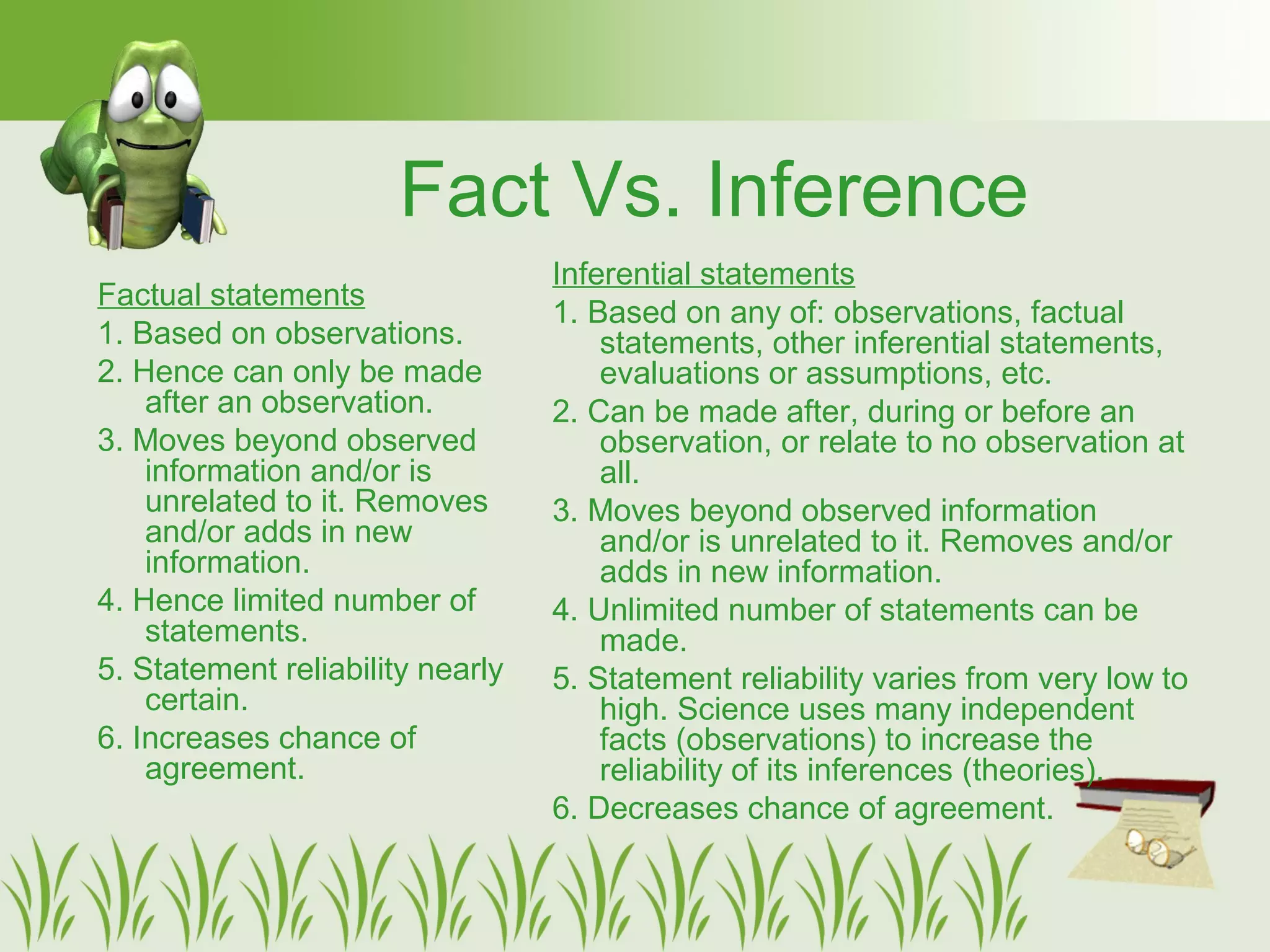
Factual statements
1. Based on observations.
2. Hence can only be made
after an observation.
3. Moves beyond observed
information and/or is
unrelated to it. Removes
and/or adds in new
information.
4. Hence limited number of
statements.
5. Statement reliability nearly
certain.
6. Increases chance of
agreement.
Inferential statements
1. Based on any of: observations, factual
statements, other inferential statements,
evaluations or assumptions, etc.
2. Can be made after, during or before an
observation, or relate to no observation at
all.
3. Moves beyond observed information
and/or is unrelated to it. Removes and/or
adds in new information.
4. Unlimited number of statements can be
made.
5. Statement reliability varies from very low to
high. Science uses many independent
facts (observations) to increase the
reliability of its inferences (theories).
6. Decreases chance of agreement.
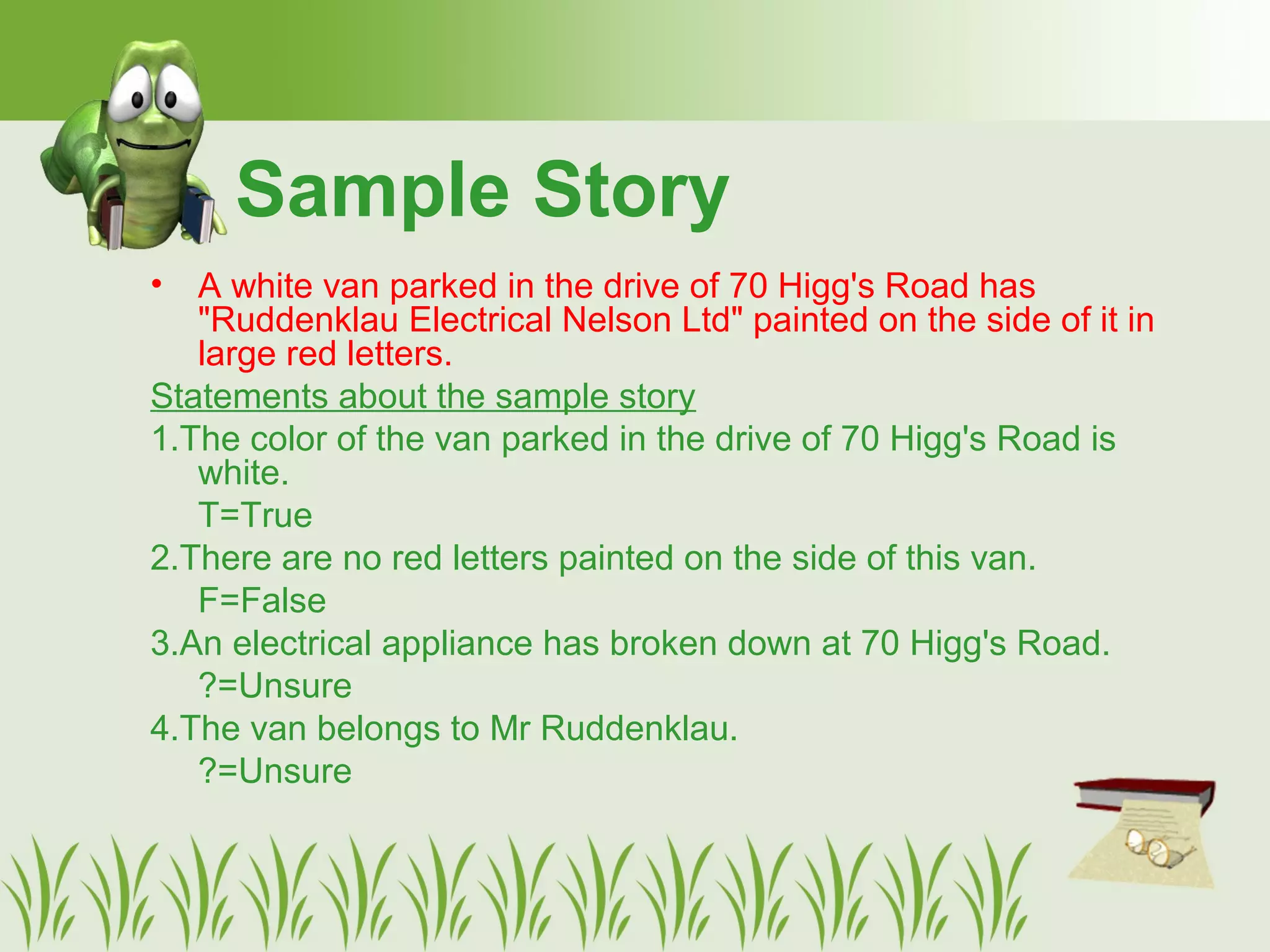
Sample Story
• A white van parked in the drive of 70 Higg's Road has
"Ruddenklau Electrical Nelson Ltd" painted on the side of it in
large red letters.
Statements about the sample story
1.The color of the van parked in the drive of 70 Higg's Road is
white.
T=True
2.There are no red letters painted on the side of this van.
F=False
3.An electrical appliance has broken down at 70 Higg's Road.
?=Unsure
4.The van belongs to Mr Ruddenklau.
?=Unsure
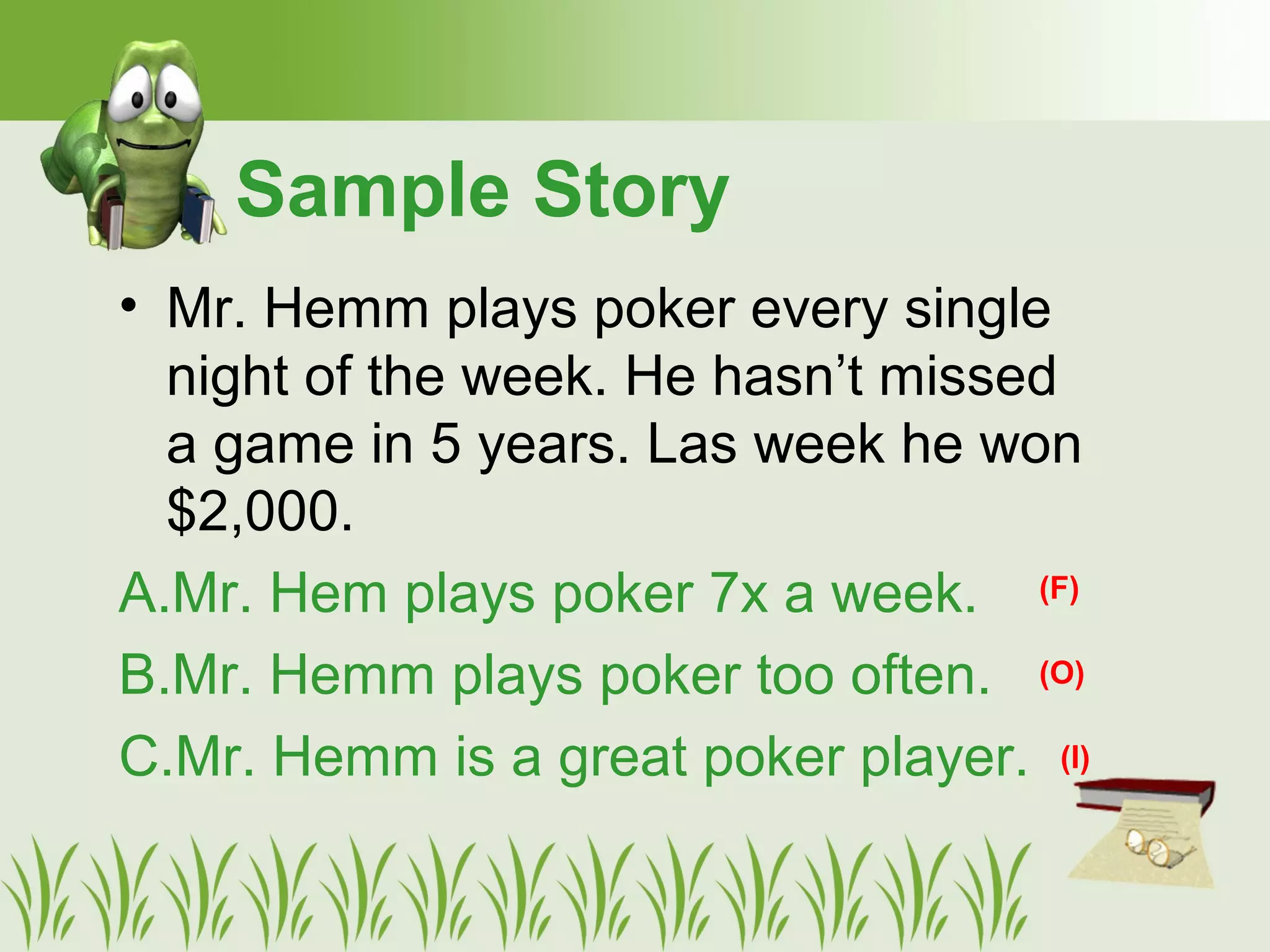
• Mr. Hemm plays poker every single
night of the week. He hasn’t missed
a game in 5 years. Las week he won
$2,000.
A.Mr. Hem plays poker 7x a week.
B.Mr. Hemm plays poker too often.
C.Mr. Hemm is a great poker player.
Sample Story
(F)
(O)
(I)
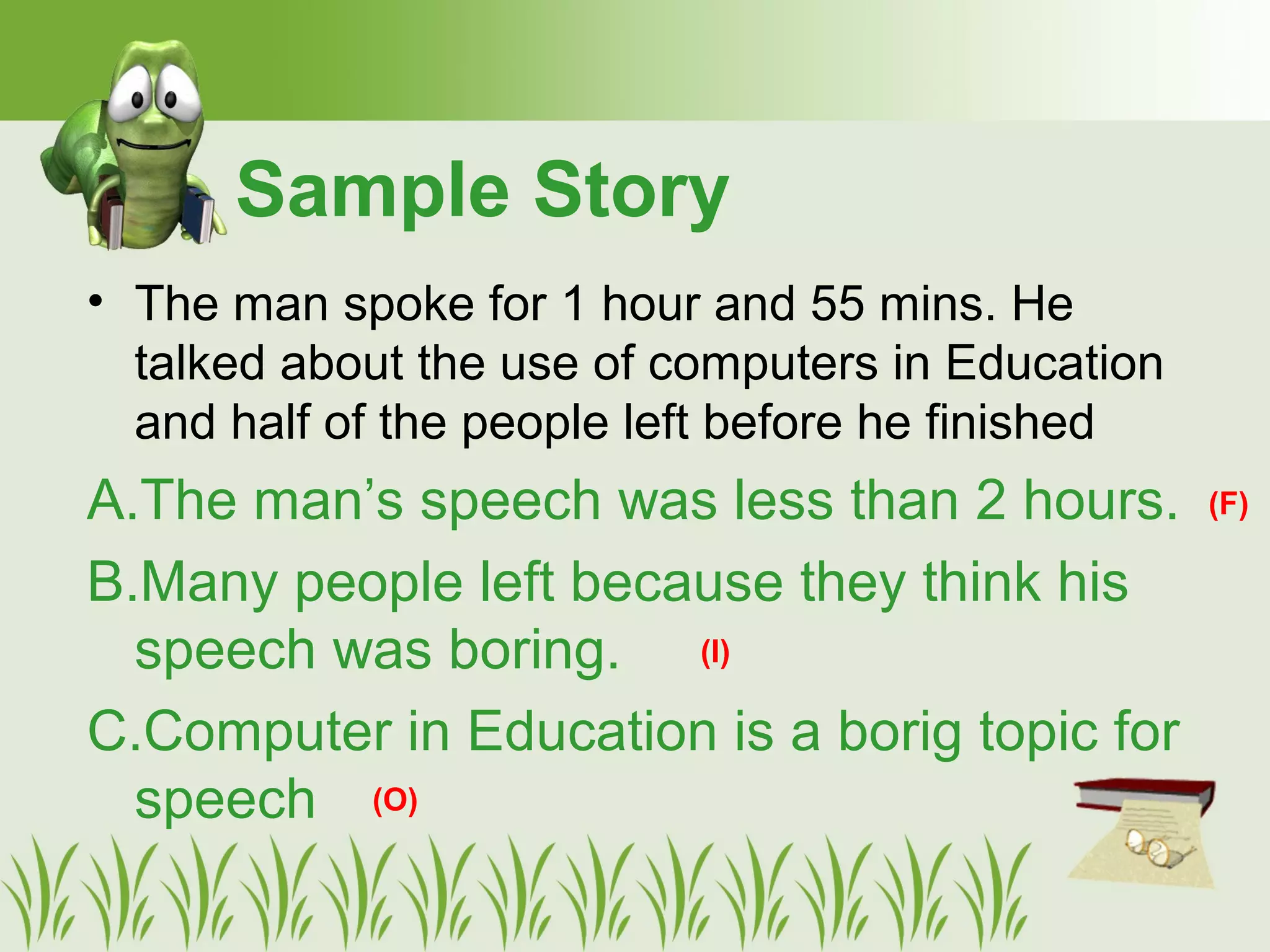
• The man spoke for 1 hour and 55 mins. He
talked about the use of computers in Education
and half of the people left before he finished
A.The man’s speech was less than 2 hours.
B.Many people left because they think his
speech was boring.
C.Computer in Education is a borig topic for
speech
Sample Story
(F)
(I)
(O)

Making inferences and drawing conclusions

  • 1.
  • 2.
    Making Inferences andDrawing Conclusions • Drawing conclusions refers to information that is implied or inferred. This means that the information is never clearly stated. • Writers often tell you more than they say directly. They give you hints or clues that help you "read between the lines." Using these clues to give you a deeper understanding of your reading is called inferring. • When you infer, you go beyond the surface details to see other meanings that the details suggest or imply (not stated). When the meanings of words are not stated clearly in the context of the text, they may be implied - that is, suggested or hinted at. When meanings are implied, you may infer them.
  • 3.
    Inference • Inference isjust a big word that means a conclusion or judgment. • You make inferences everyday. Most of the time you do so without thinking about it. Suppose you are sitting in your car stopped at a red signal light. You hear screeching tires, then a loud crash and breaking glass. You see nothing, but you infer that there has been a car accident. We all know the sounds of screeching tires and a crash. We know that these sounds almost always mean a car accident. But there could be some other reason, and therefore another explanation, for the sounds. • Making inferences means choosing the most likely explanation from the facts at hand.
  • 4.
    General Sense • Themeaning of a word may be implied by the general sense of its context, as the meaning of the word incarcerated is implied in the following sentence: Murderers are usually incarcerated for longer periods of time than robbers. • You may infer the meaning of incarcerated by answering the question "What usually happens to those found guilty of murder or robbery?” • If you answered that they are locked up in jail, prison, or a penitentiary, you correctly inferred the meaning of incarcerated.
  • 5.
    Examples • When themeaning of the word is not implied by the general sense of its context, it may be implied by examples. For instance, • Those who enjoy belonging to clubs, going to parties, and inviting friends often to their homes for dinner are gregarious. • You may infer the meaning of gregarious by answering the question "What word or words describe people who belong to clubs, go to parties a lot, and often invite friends over to their homes for dinner?” • If you guessed social or something like: "people who enjoy the company of others", you correctly inferred the meaning of gregarious.
  • 6.
    Antonyms and Contrasts •When the meaning of a word is not implied by the general sense of its context or by examples, it may be implied by an antonym or by a contrasting thought in a context. Antonyms are words that have opposite meanings, such as happy and sad. For instance, Ben is fearless, but his brother is timorous. • You may infer the meaning of timorous by answering the question "If Ben is fearless and Jim is very different from Ben with regard to fear, then what word describes Jim?” • If you answer a word such as timid, or afraid, or fearful, you inferred the meaning of timorous.
  • 7.
    • A contrastin the following sentence implies the meaning of credence: Dad gave credence to my story, but Mom's reaction was one of total disbelief. • You may infer the meaning of credence by answering the question "If Mom's reaction was disbelief and Dad's reaction was very different from Mom's, what was Dad's reaction?” • If you answer that Dad believed the story, you correctly inferred the meaning of credence; it means "belief." Antonyms and Contrasts
  • 8.
  • 9.
    Fact or Opinion •Because writers don't always say things directly, you need to learn to "read between the lines" - to take the information the writer gives you and figure things out for yourself. • You will also need to learn to distinguish between fact and opinion. • As you read an author's views, you should ask yourself if the author is presenting you with an established fact or with a personal opinion. Since the two may appear close together, even in the same sentence, you have to be able to distinguish between them.
  • 10.
    • The keydifference between facts and opinions is that facts can be verified, or checked for accuracy, by anyone. In contrast, opinions cannot be checked for accuracy by some outside source. Opinions are what someone personally thinks or how he/she feel about an issue. Opinions by definition are subjective and relative. Fact or Opinion
  • 11.
    Defining A Fact •Facts are objective, concrete bits of information. • They can be found in official government and legal records, and in the physical sciences. Facts can be found in reference books, such as encyclopedias and atlases, textbooks, and relevant publications. • Objective facts are what researchers seek in laboratories or through controlled studies. Facts are usually expressed by precise numbers or quantities, in weights and measures, and in concrete language. The decisions of Congress, specific technological data, birth records, historical documents, all provide researchers with reliable facts.
  • 12.
    • Since anyonecan look up facts, facts are generally not the subject of disputes. However, not all facts are absolutes. Often the problem is that facts are simply not readily available - such as battles like the Little/Big Horn where all the witnesses who could give information on what happened died in the disaster. Defining A Fact
  • 13.
    • In 1876,Lieutenant Colonel George Armstrong Custer and his 7th Cavalry engaged in a fight with Sioux Indians along the Little/Big Horn Rivers in Montana. Custer and his entire company were wiped out; no one survived to tell what really happened. • In this instance, we can only read opinions on how this disaster befell Custer. Defining A Fact
  • 14.
    To sum up,facts • can be verified in reference books, official records, and so forth. • are expressed in concrete language or specific numbers. • once verified, are generally agreed upon by people. Defining A Fact
  • 15.
    Determining An Opinion •Opinions are based on subjective judgment and personal values rather than on information that can be verified. An opinion is a belief that someone holds without complete proof or positive knowledge that it is correct. Even experts who have studied the same issue carefully often have very different opinions about that issue. • Opinions are often disputed, and many times involve abstract concepts and complex moral issues such as right or wrong, fairness and loyalty. Abstract concepts, because they are not easily understood, can never be defined to everyone's satisfaction. For example, each of us holds a personal opinion about what fairness or loyalty is, about gun control and abortion, and these issues always remain a matter of opinion, not fact.
  • 16.
    • Although opinionscannot be verified for accuracy, writers should, nevertheless, back their opinions with evidence, facts, and reason - by whatever information supports the opinion and convinces the reader that it is a valid opinion. • A valid opinion is one in which the writer's support for his or her opinion is solid and persuasive, and one in which the writer cites other respected authorities who are in agreement. If a writer presents an extreme or unconvincing opinion, the reader should remain wary or unconvinced. Determining An Opinion
  • 17.
    • Writers oftenslip their personal opinions into a piece of writing, even when it is suppose to be a "factual" account; alert readers can identify subjective opinions by studying the writer's language. • Opinions are often expressed as comparisons (more, strongest, less, most, least efficient, but): The painter Pablo Picasso was far more innovative than any of his contemporaries. Determining An Opinion
  • 18.
    • Opinions areoften expressed by adjectives (brilliant, vindictive, fair, trustworthy): Ronald Reagan was a convincing speaker when he read a prepared address but was not effective at press conferences. Determining An Opinion
  • 19.
    • Opinions ofteninvolve evaluations: The excellence of her science project was a model for other students. • Opinions are often introduced by verbs and adverbs that suggest some doubt in the writer's mind: – It appears she was confused. – She seems to have the qualifications for the position. – They probably used dirty tricks to win. Determining An Opinion
  • 20.
    Fact Vs. Inference Factualstatements 1. Based on observations. 2. Hence can only be made after an observation. 3. Moves beyond observed information and/or is unrelated to it. Removes and/or adds in new information. 4. Hence limited number of statements. 5. Statement reliability nearly certain. 6. Increases chance of agreement. Inferential statements 1. Based on any of: observations, factual statements, other inferential statements, evaluations or assumptions, etc. 2. Can be made after, during or before an observation, or relate to no observation at all. 3. Moves beyond observed information and/or is unrelated to it. Removes and/or adds in new information. 4. Unlimited number of statements can be made. 5. Statement reliability varies from very low to high. Science uses many independent facts (observations) to increase the reliability of its inferences (theories). 6. Decreases chance of agreement.
  • 21.
    Sample Story • Awhite van parked in the drive of 70 Higg's Road has "Ruddenklau Electrical Nelson Ltd" painted on the side of it in large red letters. Statements about the sample story 1.The color of the van parked in the drive of 70 Higg's Road is white. T=True 2.There are no red letters painted on the side of this van. F=False 3.An electrical appliance has broken down at 70 Higg's Road. ?=Unsure 4.The van belongs to Mr Ruddenklau. ?=Unsure
  • 22.
    • Mr. Hemmplays poker every single night of the week. He hasn’t missed a game in 5 years. Las week he won $2,000. A.Mr. Hem plays poker 7x a week. B.Mr. Hemm plays poker too often. C.Mr. Hemm is a great poker player. Sample Story (F) (O) (I)
  • 23.
    • The manspoke for 1 hour and 55 mins. He talked about the use of computers in Education and half of the people left before he finished A.The man’s speech was less than 2 hours. B.Many people left because they think his speech was boring. C.Computer in Education is a borig topic for speech Sample Story (F) (I) (O)