Maintenance System
A.K.Mohindru
Ex-General Manager
NTPC Ltd.
Presentation Overview
 Machinery Failure
 Maintenance Objectives
 Maintenance Types
 Maintenance Cost
 Availability
 Integration of Maintenance
 Maintenance Department
 Engineers Duties
 Efficient Maintenance Service
 Maintenance Records
 Overhaul Management
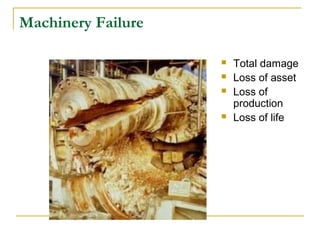
Machinery Failure
 Total damage
 Loss of asset
 Loss of
production
 Loss of life
Machinery failure
 Equipment malfunctions have a direct impact on:
 Production capacity
 Production costs
 Product and service quality
 Employee or customer safety
 Customer satisfaction
Problems in Maintenance
 Lack of management attention to maintenance
 Little participation by accounting in analyzing and
reporting costs
 Difficulties in applying quantitative analysis
 Difficulties in obtaining time and cost estimates for
maintenance works
 Difficulties in measuring performance
Problems Exist Due To:
 Failure to develop written objectives and policy
 Inadequate budgetary control
 Inadequate work quality
 Infrequent use of standards
 To control maintenance work
 Absence of cost reports to aid maintenance planning
and control system
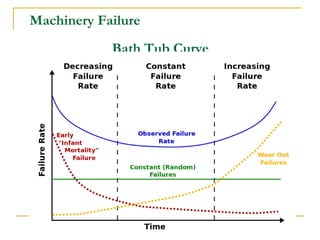
Bath Tub Curve
Machinery Failure
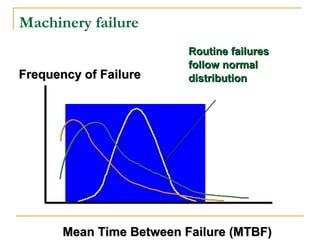
Mean Time Between Failure (MTBF)Mean Time Between Failure (MTBF)
Frequency of FailureFrequency of Failure
Routine failuresRoutine failures
follow normalfollow normal
distributiondistribution
Machinery failure
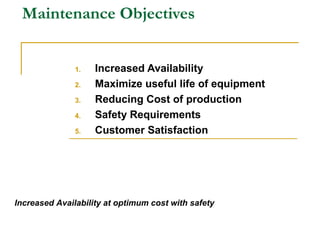
Maintenance Objectives
1. Increased Availability
2. Maximize useful life of equipment
3. Reducing Cost of production
4. Safety Requirements
5. Customer Satisfaction
Increased Availability at optimum cost with safety
Maintenance Types
 Breakdown Maintenance
 Planned Maintenance
 Preventive Maintenance
 Predictive Maintenance
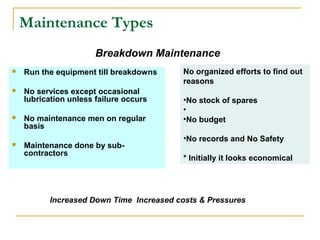
Maintenance Types
 Run the equipment till breakdowns
 No services except occasional
lubrication unless failure occurs
 No maintenance men on regular
basis
 Maintenance done by sub-
contractors
Breakdown Maintenance
Increased Down Time Increased costs & Pressures
No organized efforts to find out
reasons
•No stock of spares
•
•No budget
•No records and No Safety
* Initially it looks economical
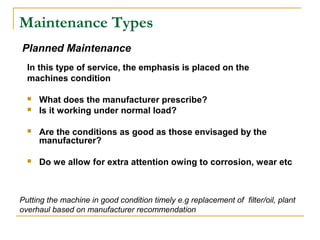
Maintenance Types
In this type of service, the emphasis is placed on the
machines condition
 What does the manufacturer prescribe?
 Is it working under normal load?
 Are the conditions as good as those envisaged by the
manufacturer?
 Do we allow for extra attention owing to corrosion, wear etc
Planned Maintenance
Putting the machine in good condition timely e.g replacement of filter/oil, plant
overhaul based on manufacturer recommendation
Maintenance Types
 Instructions are more detailed than in routine
 Schedule is drawn with dates/Hrs
 Need for establishing the work-load for the crew
 Entails considerable planning effort, faithful
implementation
and recording
 Detailed instructions reduce the chance of missing any
activity. Unforeseen work is greatly reduced
Planned Maintenance advantages
Maintenance Types
 PM increases reliability
 PM reduces work-load
 PM reduces down time
 PM reduces unplanned work
 PM reduces maintenance cost
Preventive Maintenence
Maintenance Types
 System which strives to reduce the likelihood of failures.
 Parts are replaced on time basis that could prevent failure
though the part maybe in good condition
 Locates weak spots of machinery and equipments
 Provides them periodic/scheduled inspections and minor
repairs to reduce the danger of unanticipated breakdowns
 Preventive Maintenance System is more expensive due to
more of planning and replacement of parts
Preventive Maintenance
Maintenance Types
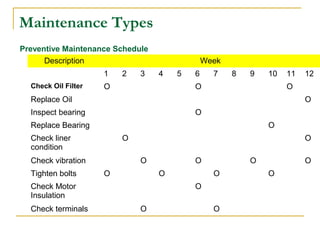
Description Week
1 2 3 4 5 6 7 8 9 10 11 12
Check Oil Filter O O O
Replace Oil O
Inspect bearing O
Replace Bearing O
Check liner
condition
O O
Check vibration O O O O
Tighten bolts O O O O
Check Motor
Insulation
O
Check terminals O O
Preventive Maintenance Schedule
Maintenance Types
System based on predicting the failure.
 In predictive maintenance, machinery conditions are
periodically monitored and this enables the
maintenance crews to take timely actions, such as
machine adjustment, repair or overhaul
 It makes use of human sense and other sensitive
instruments, such as audio gauge, vibration analyzer,
amplitude meter, pressure, temperature and resistance
strain gauges etc.
 Monitoring the condition of machine and its components
 Planning the maintenance based on deteriorating
condition parts are replaced when life is near to finish
Predictive Maintenance Type ( Condition Monitoring)
Maintenance Types
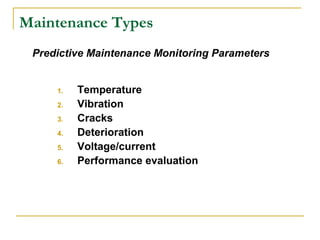
1. Temperature
2. Vibration
3. Cracks
4. Deterioration
5. Voltage/current
6. Performance evaluation
Predictive Maintenance Monitoring Parameters
Maintenance Types
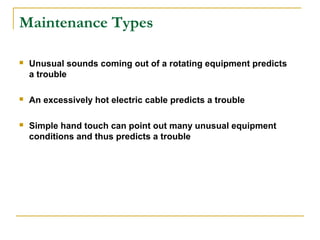
 Unusual sounds coming out of a rotating equipment predicts
a trouble
 An excessively hot electric cable predicts a trouble
 Simple hand touch can point out many unusual equipment
conditions and thus predicts a trouble
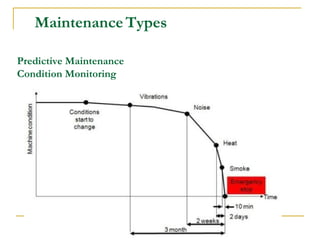
Predictive Maintenance
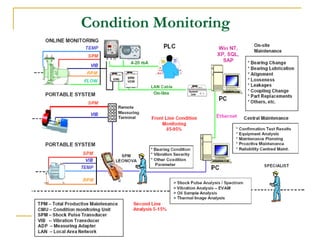
Condition Monitoring
MaintenanceTypes
Condition Monitoring
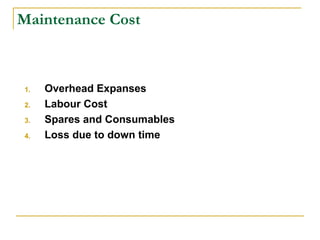
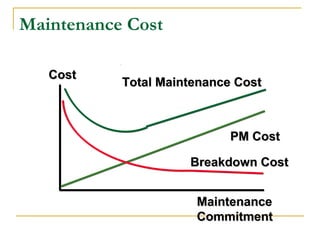
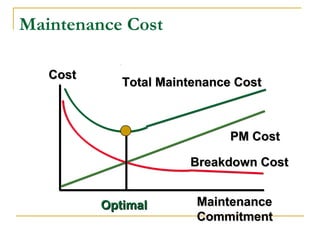
Maintenance Cost
1. Overhead Expanses
2. Labour Cost
3. Spares and Consumables
4. Loss due to down time
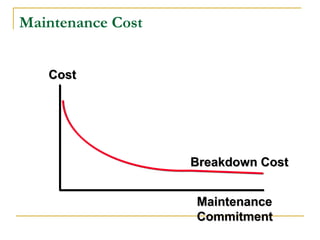
MaintenanceMaintenance
CommitmentCommitment
CostCost
Breakdown CostBreakdown Cost
Maintenance Cost
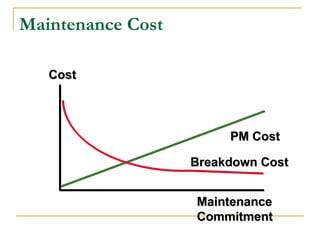
MaintenanceMaintenance
CommitmentCommitment
CostCost
PM CostPM Cost
Breakdown CostBreakdown Cost
Maintenance Cost
MaintenanceMaintenance
CommitmentCommitment
CostCost
PM CostPM Cost
Breakdown CostBreakdown Cost
Total Maintenance CostTotal Maintenance Cost
Maintenance Cost
MaintenanceMaintenance
CommitmentCommitment
CostCost
PM CostPM Cost
Total Maintenance CostTotal Maintenance Cost
Breakdown CostBreakdown Cost
OptimalOptimal
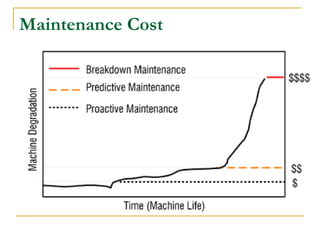
Maintenance Cost
Maintenance Cost
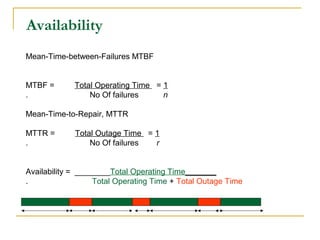
Mean-Time-between-Failures MTBF
MTBF = Total Operating Time = 1
. No Of failures n
Mean-Time-to-Repair, MTTR
MTTR = Total Outage Time = 1
. No Of failures r
Availability = ________Total Operating Time_______
. Total Operating Time + Total Outage Time
Availability
Actions For High Availability
Failure Investigation
 Find the cause of break downs
 Analyze it
 Take corrective action in next shut down
 Monitor the performance
Resource Availability
 Keep spares well in advance
 Mobilize work force quickly
 Keep job area ready to work : lighting, scaffolding, power
supply etc
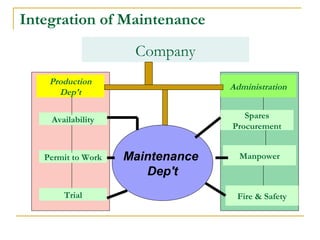
Integration of Maintenance
Company
Trial
Spares
Procurement
Maintenance
Dep't
Manpower
Fire & Safety
Availability
Permit to Work
Production
Dep't
Administration
Maintenance Departments
 A maintenance manager typically is a plant engineer
who reports to a plant manager
 Maintenance departments are usually split into two
groups:
 Buildings
 Equipment
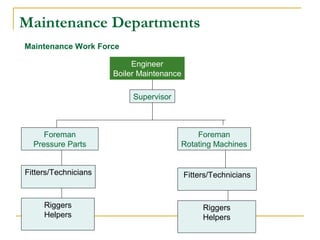
Maintenance Departments
Fitters/Technicians
Engineer
Boiler Maintenance
Supervisor
Foreman
Pressure Parts
Fitters/Technicians
Foreman
Rotating Machines
Riggers
Helpers
Riggers
Helpers
Maintenance Work Force
Maintenance Departments
 Repairs often performed on an emergency basis to:
 Minimize interruptions to production
 Correct unsafe working conditions
 Improve product/service quality
 In emergency situations:
 Specialists may work overtime
 Supervisor/engineers are nearby to collaborate
 Standby machines may be quickly put in operation
Repair Crews and Standby Machines
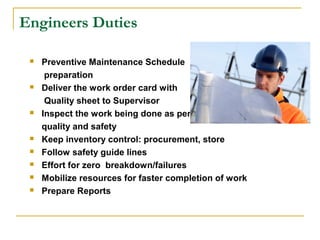
Engineers Duties
 Preventive Maintenance Schedule
preparation
 Deliver the work order card with
Quality sheet to Supervisor
 Inspect the work being done as per
quality and safety
 Keep inventory control: procurement, store
 Follow safety guide lines
 Effort for zero breakdown/failures
 Mobilize resources for faster completion of work
 Prepare Reports
Computer Assistance in Maintenance
 Scheduling maintenance projects
 Maintenance cost reports by production department,
cost category, and other classifications
 Inventory status reports for maintenance parts and
supplies
 Parts failure data
 Operations analysis studies
Efficient maintenance Service
 Ensuring work quality
 Minimum repair time
 Ensuring safety
Efficient maintenance Service
1. Developing Quality norms
2. Measurements- stage inspections
3. Corrections
4. Recording/report
Ensuring maintenance work quality
Efficient maintenance Service
 Work Order Planning and Control
 Efficient and effective maintenance requires detailed planning of repairs,
plant
 services, overhauls and projects.
This work must be co-ordinated with the requirements of production to have
the minimum effect on the overall production plan.
The maintenance plan should be easily modified to allow for major
emergency work, changes in production methods and improvements in
design.
Maintenance control indices can provide a method of assessing
maintenance activities. Control indices should function as part of the overall
maintenance information system and use dynamic data such as labour
costs, spares usage, and delay costs. Analysis of the data provides
feedback that the manager can use to assess actual performance against a
target, and so monitor the effect of changes in maintenance policy.
Efficient maintenance Service
Computerised Maintenance Management System
 A computerised maintenance management system will contain a
number of integrated programs or modules to improve the efficiency
and effectiveness of the maintenance engineering function.
 the system should be easy to use and provide the engineer with all of
the information that is required to make better decisions.
The basic modules or component part of the maintenance systems are :
 Preventive maintenance
 Asset register
 Maintenance stores system
 Purchasing
 Work order planning and control
 Plant history and analysis
Efficient maintenance Service
Asset Register
 This is an inventory of all of the plant, equipment and services for
which a manager has responsibility. Repair work that is generated
by the preventive maintenance system will in most cases need to be
planned and prepared.
 This includes technical details, serial numbers, location,
manufacturer etc. and most important a list of the spare parts used
on the machine together with the current stock balance.
 The purpose of the asset register is to centralise this data for use in
planning
 maintenance work.
 In addition to providing rapid access to information, the manager
can be sure that the relevant data is always available and has not
been misplaced.
Maintenance Records
 History Record:
 When job is done?
 What activities were done?
 When completed?
 How was the machine performance?
 Planning Sheet:
 When next to be done?
 What resources will be required?
 What will be the duration?
Maintenance Records
 Identify the equipments
 Prepare the specs (Number plate details)
Equipment Identification
Maintenance Records
 ID Fan1A
 ID Fan 1B
 FD Fan 1A
 FD Fan 1B
 PA Fan 1A
 PA Fan 1B
 Boiler Feed Pump 1A
Equipment Identification
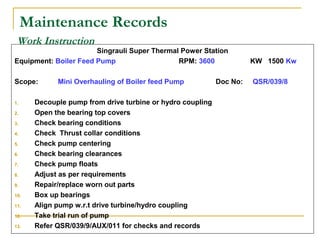
Work Instruction
Singrauli Super Thermal Power Station
Equipment: Boiler Feed Pump RPM: 3600 KW 1500 Kw
Scope: Mini Overhauling of Boiler feed Pump Doc No: QSR/039/8
1. Decouple pump from drive turbine or hydro coupling
2. Open the bearing top covers
3. Check bearing conditions
4. Check Thrust collar conditions
5. Check pump centering
6. Check bearing clearances
7. Check pump floats
8. Adjust as per requirements
9. Repair/replace worn out parts
10. Box up bearings
11. Align pump w.r.t drive turbine/hydro coupling
12. Take trial run of pump
13. Refer QSR/039/9/AUX/011 for checks and records
Maintenance Records
Maintenance Records
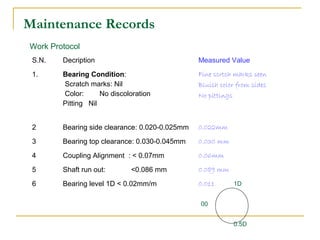
S.N. Decription Measured Value
1. Bearing Condition:
Scratch marks: Nil
Color: No discoloration
Pitting Nil
Fine scrtch marks seen
Bluish color from sides
No pittings
2 Bearing side clearance: 0.020-0.025mm 0.022mm
3 Bearing top clearance: 0.030-0.045mm 0.030 mm
4 Coupling Alignment : < 0.07mm 0.06mm
5 Shaft run out: <0.086 mm 0.089 mm
6 Bearing level 1D < 0.02mm/m 0.011 1D
00
0.5D
Work Protocol
Maintenance Records
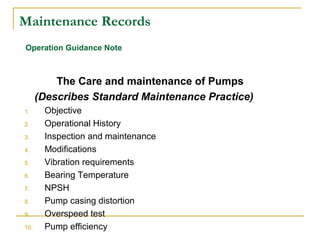
The Care and maintenance of Pumps
(Describes Standard Maintenance Practice)
1. Objective
2. Operational History
3. Inspection and maintenance
4. Modifications
5. Vibration requirements
6. Bearing Temperature
7. NPSH
8. Pump casing distortion
9. Overspeed test
10. Pump efficiency
Operation Guidance Note
Overhaul Management
 Machine needs regular overhaul
 Periodicity is based on experience or on
manufacturers recommendations
 Boiler tubes errosion normally in 2 years
 Burner life is 1 year Boiler Overhaul : every year for 10 days
 Furnace deposition 1 year
 Turbine efficiency drops 0.5%-1% in 5 years
 Turbine blade cracks appear in 5-6 years
 Turbine overhaul : 5years for 45 days
Overhaul Management
 Preparation of resources:
 Engineering Declaration: 12 months advance
 Contract: 3 months in advance
 Spares procurement; 12 months advance
 Shut down planning ; rolling plan
 Mobilization
 Pert Chart activitiy listing
 Allocation of executive team to monitor
 Daily work progress meeting
 Overhaul Execution
PERT & CPM
CPM
What is CPM?
Critical Path Method
What is Critical Path?
CPM is a mathematically based algorithm for scheduling a set of project
activities.

• A list of all activities required to complete the project,

• The dependencies between the activities, and

• The estimate of time (duration) that each activity will take to completion.
The longest time is determined
CPM example
Hang a picture on the wall
 Choose a place on the wall
 Buy the screws
 Choose the picture Drill a hole
 Screw in the screws
 Hang the picture
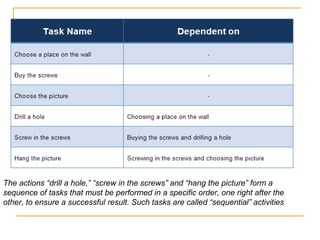
The actions “drill a hole,” “screw in the screws” and “hang the picture” form a
sequence of tasks that must be performed in a specific order, one right after the
other, to ensure a successful result. Such tasks are called “sequential” activities
CPM
 you cannot start some activities until the
others are finished. These activities need to
be completed in a sequence, with each stage
being more-or-less completed before the next
stage can begin
CPM
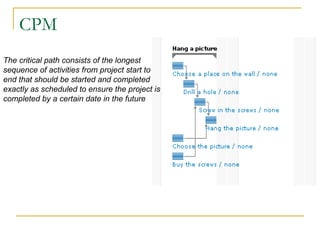
The critical path consists of the longest
sequence of activities from project start to
end that should be started and completed
exactly as scheduled to ensure the project is
completed by a certain date in the future
Maintenance planning  systems

Maintenance planning systems

  • 1.
  • 2.
    Presentation Overview  MachineryFailure  Maintenance Objectives  Maintenance Types  Maintenance Cost  Availability  Integration of Maintenance  Maintenance Department  Engineers Duties  Efficient Maintenance Service  Maintenance Records  Overhaul Management
  • 3.
    Machinery Failure  Totaldamage  Loss of asset  Loss of production  Loss of life
  • 4.
    Machinery failure  Equipmentmalfunctions have a direct impact on:  Production capacity  Production costs  Product and service quality  Employee or customer safety  Customer satisfaction
  • 5.
    Problems in Maintenance Lack of management attention to maintenance  Little participation by accounting in analyzing and reporting costs  Difficulties in applying quantitative analysis  Difficulties in obtaining time and cost estimates for maintenance works  Difficulties in measuring performance
  • 6.
    Problems Exist DueTo:  Failure to develop written objectives and policy  Inadequate budgetary control  Inadequate work quality  Infrequent use of standards  To control maintenance work  Absence of cost reports to aid maintenance planning and control system
  • 7.
  • 8.
    Mean Time BetweenFailure (MTBF)Mean Time Between Failure (MTBF) Frequency of FailureFrequency of Failure Routine failuresRoutine failures follow normalfollow normal distributiondistribution Machinery failure
  • 9.
    Maintenance Objectives 1. IncreasedAvailability 2. Maximize useful life of equipment 3. Reducing Cost of production 4. Safety Requirements 5. Customer Satisfaction Increased Availability at optimum cost with safety
  • 10.
    Maintenance Types  BreakdownMaintenance  Planned Maintenance  Preventive Maintenance  Predictive Maintenance
  • 11.
    Maintenance Types  Runthe equipment till breakdowns  No services except occasional lubrication unless failure occurs  No maintenance men on regular basis  Maintenance done by sub- contractors Breakdown Maintenance Increased Down Time Increased costs & Pressures No organized efforts to find out reasons •No stock of spares • •No budget •No records and No Safety * Initially it looks economical
  • 12.
    Maintenance Types In thistype of service, the emphasis is placed on the machines condition  What does the manufacturer prescribe?  Is it working under normal load?  Are the conditions as good as those envisaged by the manufacturer?  Do we allow for extra attention owing to corrosion, wear etc Planned Maintenance Putting the machine in good condition timely e.g replacement of filter/oil, plant overhaul based on manufacturer recommendation
  • 13.
    Maintenance Types  Instructionsare more detailed than in routine  Schedule is drawn with dates/Hrs  Need for establishing the work-load for the crew  Entails considerable planning effort, faithful implementation and recording  Detailed instructions reduce the chance of missing any activity. Unforeseen work is greatly reduced Planned Maintenance advantages
  • 14.
    Maintenance Types  PMincreases reliability  PM reduces work-load  PM reduces down time  PM reduces unplanned work  PM reduces maintenance cost Preventive Maintenence
  • 15.
    Maintenance Types  Systemwhich strives to reduce the likelihood of failures.  Parts are replaced on time basis that could prevent failure though the part maybe in good condition  Locates weak spots of machinery and equipments  Provides them periodic/scheduled inspections and minor repairs to reduce the danger of unanticipated breakdowns  Preventive Maintenance System is more expensive due to more of planning and replacement of parts Preventive Maintenance
  • 16.
    Maintenance Types Description Week 12 3 4 5 6 7 8 9 10 11 12 Check Oil Filter O O O Replace Oil O Inspect bearing O Replace Bearing O Check liner condition O O Check vibration O O O O Tighten bolts O O O O Check Motor Insulation O Check terminals O O Preventive Maintenance Schedule
  • 17.
    Maintenance Types System basedon predicting the failure.  In predictive maintenance, machinery conditions are periodically monitored and this enables the maintenance crews to take timely actions, such as machine adjustment, repair or overhaul  It makes use of human sense and other sensitive instruments, such as audio gauge, vibration analyzer, amplitude meter, pressure, temperature and resistance strain gauges etc.  Monitoring the condition of machine and its components  Planning the maintenance based on deteriorating condition parts are replaced when life is near to finish Predictive Maintenance Type ( Condition Monitoring)
  • 18.
    Maintenance Types 1. Temperature 2.Vibration 3. Cracks 4. Deterioration 5. Voltage/current 6. Performance evaluation Predictive Maintenance Monitoring Parameters
  • 19.
    Maintenance Types  Unusualsounds coming out of a rotating equipment predicts a trouble  An excessively hot electric cable predicts a trouble  Simple hand touch can point out many unusual equipment conditions and thus predicts a trouble
  • 20.
  • 21.
  • 22.
    Maintenance Cost 1. OverheadExpanses 2. Labour Cost 3. Spares and Consumables 4. Loss due to down time
  • 23.
  • 24.
  • 25.
    MaintenanceMaintenance CommitmentCommitment CostCost PM CostPM Cost BreakdownCostBreakdown Cost Total Maintenance CostTotal Maintenance Cost Maintenance Cost
  • 26.
    MaintenanceMaintenance CommitmentCommitment CostCost PM CostPM Cost TotalMaintenance CostTotal Maintenance Cost Breakdown CostBreakdown Cost OptimalOptimal Maintenance Cost
  • 27.
  • 28.
    Mean-Time-between-Failures MTBF MTBF =Total Operating Time = 1 . No Of failures n Mean-Time-to-Repair, MTTR MTTR = Total Outage Time = 1 . No Of failures r Availability = ________Total Operating Time_______ . Total Operating Time + Total Outage Time Availability
  • 29.
    Actions For HighAvailability Failure Investigation  Find the cause of break downs  Analyze it  Take corrective action in next shut down  Monitor the performance Resource Availability  Keep spares well in advance  Mobilize work force quickly  Keep job area ready to work : lighting, scaffolding, power supply etc
  • 30.
    Integration of Maintenance Company Trial Spares Procurement Maintenance Dep't Manpower Fire& Safety Availability Permit to Work Production Dep't Administration
  • 31.
    Maintenance Departments  Amaintenance manager typically is a plant engineer who reports to a plant manager  Maintenance departments are usually split into two groups:  Buildings  Equipment
  • 32.
    Maintenance Departments Fitters/Technicians Engineer Boiler Maintenance Supervisor Foreman PressureParts Fitters/Technicians Foreman Rotating Machines Riggers Helpers Riggers Helpers Maintenance Work Force
  • 33.
    Maintenance Departments  Repairsoften performed on an emergency basis to:  Minimize interruptions to production  Correct unsafe working conditions  Improve product/service quality  In emergency situations:  Specialists may work overtime  Supervisor/engineers are nearby to collaborate  Standby machines may be quickly put in operation Repair Crews and Standby Machines
  • 34.
    Engineers Duties  PreventiveMaintenance Schedule preparation  Deliver the work order card with Quality sheet to Supervisor  Inspect the work being done as per quality and safety  Keep inventory control: procurement, store  Follow safety guide lines  Effort for zero breakdown/failures  Mobilize resources for faster completion of work  Prepare Reports
  • 35.
    Computer Assistance inMaintenance  Scheduling maintenance projects  Maintenance cost reports by production department, cost category, and other classifications  Inventory status reports for maintenance parts and supplies  Parts failure data  Operations analysis studies
  • 36.
    Efficient maintenance Service Ensuring work quality  Minimum repair time  Ensuring safety
  • 37.
    Efficient maintenance Service 1.Developing Quality norms 2. Measurements- stage inspections 3. Corrections 4. Recording/report Ensuring maintenance work quality
  • 38.
    Efficient maintenance Service Work Order Planning and Control  Efficient and effective maintenance requires detailed planning of repairs, plant  services, overhauls and projects. This work must be co-ordinated with the requirements of production to have the minimum effect on the overall production plan. The maintenance plan should be easily modified to allow for major emergency work, changes in production methods and improvements in design. Maintenance control indices can provide a method of assessing maintenance activities. Control indices should function as part of the overall maintenance information system and use dynamic data such as labour costs, spares usage, and delay costs. Analysis of the data provides feedback that the manager can use to assess actual performance against a target, and so monitor the effect of changes in maintenance policy.
  • 39.
    Efficient maintenance Service ComputerisedMaintenance Management System  A computerised maintenance management system will contain a number of integrated programs or modules to improve the efficiency and effectiveness of the maintenance engineering function.  the system should be easy to use and provide the engineer with all of the information that is required to make better decisions. The basic modules or component part of the maintenance systems are :  Preventive maintenance  Asset register  Maintenance stores system  Purchasing  Work order planning and control  Plant history and analysis
  • 40.
    Efficient maintenance Service AssetRegister  This is an inventory of all of the plant, equipment and services for which a manager has responsibility. Repair work that is generated by the preventive maintenance system will in most cases need to be planned and prepared.  This includes technical details, serial numbers, location, manufacturer etc. and most important a list of the spare parts used on the machine together with the current stock balance.  The purpose of the asset register is to centralise this data for use in planning  maintenance work.  In addition to providing rapid access to information, the manager can be sure that the relevant data is always available and has not been misplaced.
  • 41.
    Maintenance Records  HistoryRecord:  When job is done?  What activities were done?  When completed?  How was the machine performance?  Planning Sheet:  When next to be done?  What resources will be required?  What will be the duration?
  • 42.
    Maintenance Records  Identifythe equipments  Prepare the specs (Number plate details) Equipment Identification
  • 43.
    Maintenance Records  IDFan1A  ID Fan 1B  FD Fan 1A  FD Fan 1B  PA Fan 1A  PA Fan 1B  Boiler Feed Pump 1A Equipment Identification
  • 44.
    Work Instruction Singrauli SuperThermal Power Station Equipment: Boiler Feed Pump RPM: 3600 KW 1500 Kw Scope: Mini Overhauling of Boiler feed Pump Doc No: QSR/039/8 1. Decouple pump from drive turbine or hydro coupling 2. Open the bearing top covers 3. Check bearing conditions 4. Check Thrust collar conditions 5. Check pump centering 6. Check bearing clearances 7. Check pump floats 8. Adjust as per requirements 9. Repair/replace worn out parts 10. Box up bearings 11. Align pump w.r.t drive turbine/hydro coupling 12. Take trial run of pump 13. Refer QSR/039/9/AUX/011 for checks and records Maintenance Records
  • 45.
    Maintenance Records S.N. DecriptionMeasured Value 1. Bearing Condition: Scratch marks: Nil Color: No discoloration Pitting Nil Fine scrtch marks seen Bluish color from sides No pittings 2 Bearing side clearance: 0.020-0.025mm 0.022mm 3 Bearing top clearance: 0.030-0.045mm 0.030 mm 4 Coupling Alignment : < 0.07mm 0.06mm 5 Shaft run out: <0.086 mm 0.089 mm 6 Bearing level 1D < 0.02mm/m 0.011 1D 00 0.5D Work Protocol
  • 46.
    Maintenance Records The Careand maintenance of Pumps (Describes Standard Maintenance Practice) 1. Objective 2. Operational History 3. Inspection and maintenance 4. Modifications 5. Vibration requirements 6. Bearing Temperature 7. NPSH 8. Pump casing distortion 9. Overspeed test 10. Pump efficiency Operation Guidance Note
  • 47.
    Overhaul Management  Machineneeds regular overhaul  Periodicity is based on experience or on manufacturers recommendations  Boiler tubes errosion normally in 2 years  Burner life is 1 year Boiler Overhaul : every year for 10 days  Furnace deposition 1 year  Turbine efficiency drops 0.5%-1% in 5 years  Turbine blade cracks appear in 5-6 years  Turbine overhaul : 5years for 45 days
  • 48.
    Overhaul Management  Preparationof resources:  Engineering Declaration: 12 months advance  Contract: 3 months in advance  Spares procurement; 12 months advance  Shut down planning ; rolling plan  Mobilization  Pert Chart activitiy listing  Allocation of executive team to monitor  Daily work progress meeting  Overhaul Execution
  • 49.
  • 50.
    CPM What is CPM? CriticalPath Method What is Critical Path? CPM is a mathematically based algorithm for scheduling a set of project activities.  • A list of all activities required to complete the project,  • The dependencies between the activities, and  • The estimate of time (duration) that each activity will take to completion. The longest time is determined
  • 51.
    CPM example Hang apicture on the wall  Choose a place on the wall  Buy the screws  Choose the picture Drill a hole  Screw in the screws  Hang the picture
  • 52.
    The actions “drilla hole,” “screw in the screws” and “hang the picture” form a sequence of tasks that must be performed in a specific order, one right after the other, to ensure a successful result. Such tasks are called “sequential” activities
  • 53.
    CPM  you cannotstart some activities until the others are finished. These activities need to be completed in a sequence, with each stage being more-or-less completed before the next stage can begin
  • 54.
    CPM The critical pathconsists of the longest sequence of activities from project start to end that should be started and completed exactly as scheduled to ensure the project is completed by a certain date in the future