WE MET ON TINDER, DIDN’T WE? f MEMORY, YOU OLD DOG
LOVE’S DEATH f PARIS, YET AGAIN f VOLUME 1, ISSUE 1
DEAR READERS
Think of a moment when a bite of something hot and greasy—say, an
empanada—grabbed hold of you and transported you to an afternoon in
your grandmother’s kitchen or a late night at a food truck counter; when the
scent of a perfume made you think of a close romantic encounter or a day
at the beach; when the touch of burlap brought you back to middle school
field day and potato sack races. All it takes is a split second of external
stimuli for nostalgia to exit the past and enter the present.
Over the past few months, we at HOPSCOTCH have asked ourselves,
what would life be like without memory? Our conclusion: It’s simply
unfathomable. A defining quality of the human experience, regardless
of personal background, is the mere existence of memory as something
that occupies a space in our mind and our beings. Despite the content,
it is undeniably a universal commonality. We all experience memory and
nostalgia in different ways. Both our individual and collective memories
amuse us, uplift us, and ground us, and for these reasons they should be
celebrate.
In the following pages, you will find visual essays, creative non-fiction,
fiction, interviews, reportage, and recipes that invite you to travel through
our memories, and hopefully inspire you to explore your own.
Please read from cover to cover, as the editors intended their memories to
be shared.
NATALIE CAMPBELL
ASTRID DA SILVA
MAXIMILÍANO DURÓN
ISABELLE ENGLISH
ETHAN JOHNS
KELLYROSE ZIMMERMAN
searching for memories
lorie novak’s work tries to make sense of our records
text by MAXIMILÍANO DURÓN
AMID THIRTY STACKS of
aging front sections of The New York
Times, some of which reached well
over 3 feet high, installation artist
and photographer Lorie Novak
tinkered with a seven-plus-year-old
MacBook Pro. Crouching among the
towers of newspapers that filled half
of her Brooklyn studio, she attempted
to boot up the dead laptop that was
precariously perched atop one of
these uneven piles.
For her latest project, temporarily
titled “Above the Fold,” Novak has
divided her collection of fifteen-
years-worth of papers into categories
and subcategories, according to her
interpretation of the front-page
image. These categories range from
the boring, “Politicians,” and the
joyful,“Celebration,” to the haunting,
“Grieving,” and the unsettling, “Men
(and 6 Women) with Guns.” Above
these different-sized piles a screen
will chronologically show every
category’s lead photo.
Novak started this hoarder-like,
obsessive collecting in 1999 in the
wake of the Kosovo War and the
related NATO bombing, as a way
to make sense of the overwhelming
amount of images of war and
displaced families that appeared
throughout The Times. These images
haunted her, as many still do today.
“My original idea was to have a
stack of papers that signified the
war,” she said.“When the war ended,
it didn’t really seem like it ended, so
I kept saving papers.”
Her use of repurposed newspapers
to create layered photographs and
multi-channel video installations
follows from her previous work in
these media. In one series, “Collected
Visions,” she compiled scores of
people’s family photographs to create
a website and installation at the
International Center of Photography
in New York that reflected her vision
of how photos affect how people
remember certain events. What
struck her were people’s relationships
to these photographs, how they were
etched in their minds, staying with
them always.
“I’ve always been interested in
how we so badly want to believe
photographs,” Novak said after
recounting a memory of her
watching her baby sister come
home from the hospital, which, she
says, must have come from a home
video, not her own memory. “When
we have photographs, those events
we remember more or become
dominant.”
2 z SIGHT
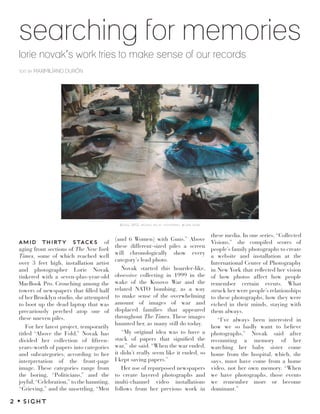
bodies, 2012, archival ink-jet photograph. ©lorie novak
the wetter the paint
There’s something almost
indescribable about standing
alone in an art gallery, just after
the walls have been painted.
The walls are beginning to dry,
as the industrial fans continue
to roar. I spin around to look at
all the works lined up against
the walls, waiting to be hung. I
close my eyes and take a deep
breath to soak up that smell of
fresh, white paint.
- M.D.
It’s a typical Southern California day.The
strong sun and warm winds are cut by
the cool ocean breeze. The grass lawn is
slightly moist from last night’s sprinklers.
My six-year-old self was enchanted with
this: sitting in damp grass, my mom
setting up finger paints, and a canvas on
my yellow and red Lakeshore easel.
- K.Z.
I liked my dirty walls, with pencil markings,
tape residue, and doodles lining it; it
had character. But my mother, well, she
disagreed. She said it looked messy, that
the once-white, now gray walls needed a
makeover.“Fresh white paint,” she repeated.
“It’ll look nice.” I can’t stand the smell, so I
never let her do it.
- A.D.
I’m in a diner in Dedham, Mass.
staring at a stack of warm
blueberry pancakes—syrup
swimming down six flapjack
stories, butter vanishing on
their surface; when in the midst
of my first fork raise, I get an
unsolicited scent of solvent
and toxic fumes. The culprit:
a freshly painted, blown-up
portrait of Elvis Presley eating,
what else, pancakes.
- I.E.
“There’s a jug of turpentine downstairs,”
Dad says. As I descend to the basement, I
rub my hands together trying to get rid of
the lacrosse tape residue that clings to them.
The chemical, gasoline-and-pine scent rises
visibly from the mouth of the jug, and once
on my hands, the tape residue glides off.
- E.J.
My friend and I plugged our
noses as we flipped open the
cap of the lavender paint can.
Being ill-prepared, we jumped
on buckets to reach the upper
part of the walls. With no
ventilation, the summer heat
heightened the stench of the
paint. Ironically, I ended up not
moving into that house, and
now a stranger has a spotted
purple ceiling.
- N.C.
SMELL z 3
We asked our editors, “What comes to mind when you smell a freshly painted wall?”
Here are their responses:
my valentine
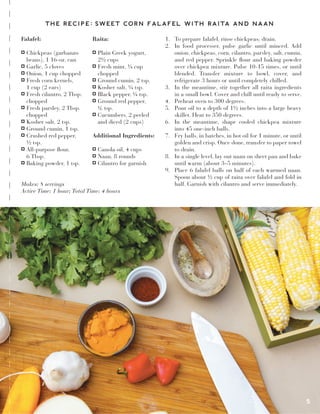
sweet corn falafel with raita and naan
text and photography by ISABELLE ENGLISH
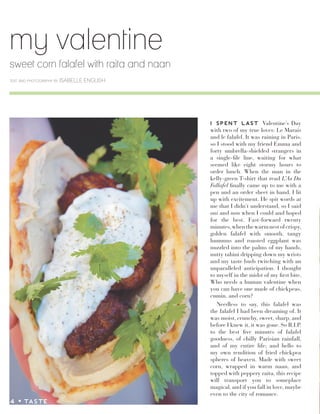
I SPENT LAST Valentine’s Day
with two of my true loves: Le Marais
and le falafel. It was raining in Paris,
so I stood with my friend Emma and
forty umbrella-shielded strangers in
a single-file line, waiting for what
seemed like eight stormy hours to
order lunch. When the man in the
kelly-green T-shirt that read L’As Du
Fallafel finally came up to me with a
pen and an order sheet in hand, I lit
up with excitement. He spit words at
me that I didn’t understand, so I said
oui and non when I could and hoped
for the best. Fast-forward twenty
minutes,whenthewarmnestofcrispy,
golden falafel with smooth, tangy
hummus and roasted eggplant was
nuzzled into the palms of my hands,
nutty tahini dripping down my wrists
and my taste buds twitching with an
unparalleled anticipation. I thought
to myself in the midst of my first bite,
Who needs a human valentine when
you can have one made of chickpeas,
cumin, and corn?
Needless to say, this falafel was
the falafel I had been dreaming of. It
was moist, crunchy, sweet, sharp, and
before I knew it, it was gone. So R.I.P.
to the best five minutes of falafel
goodness, of chilly Parisian rainfall,
and of my entire life; and hello to
my own rendition of fried chickpea
spheres of heaven. Made with sweet
corn, wrapped in warm naan, and
topped with peppery raita, this recipe
will transport you to someplace
magical, and if you fall in love, maybe
even to the city of romance.
4 z TASTE
Falafel:
Chickpeas (garbanzo
beans), 1 16-oz. can
Garlic, 5 cloves
Onion, 1 cup chopped
Fresh corn kernels,
1 cup (2 ears)
Fresh cilantro, 2 Tbsp.
chopped
Fresh parsley, 2 Tbsp.
chopped
Kosher salt, 2 tsp.
Ground cumin, 1 tsp.
Crushed red pepper,
½ tsp.
All-purpose flour,
6 Tbsp.
Baking powder, 1 tsp.
Raita:
Plain Greek yogurt,
2½ cups
Fresh mint, ¼ cup
chopped
Ground cumin, 2 tsp.
Kosher salt, ¼ tsp.
Black pepper, ¼ tsp.
Ground red pepper,
¼ tsp.
Cucumbers, 2 peeled
and diced (2 cups)
Additional Ingredients:
Canola oil, 4 cups
Naan, 8 rounds
Cilantro for garnish
1. To prepare falafel, rinse chickpeas; drain.
2. In food processer, pulse garlic until minced. Add
onion, chickpeas, corn, cilantro, parsley, salt, cumin,
and red pepper. Sprinkle flour and baking powder
over chickpea mixture. Pulse 10-15 times, or until
blended. Transfer mixture to bowl, cover, and
refrigerate 3 hours or until completely chilled.
3. In the meantime, stir together all raita ingredients
in a small bowl. Cover and chill until ready to serve.
4. Preheat oven to 300 degrees.
5. Pour oil to a depth of 1½ inches into a large heavy
skillet. Heat to 350 degrees.
6. In the meantime, shape cooled chickpea mixture
into 45 one-inch balls.
7. Fry balls, in batches, in hot oil for 1 minute, or until
golden and crisp. Once done, transfer to paper towel
to drain.
8. In a single level, lay out naan on sheet pan and bake
until warm (about 3–5 minutes).
9. Place 6 falafel balls on half of each warmed naan.
Spoon about ½ cup of raita over falafel and fold in
half. Garnish with cilantro and serve immediately.Makes: 8 servings
Active Time: 1 hour; Total Time: 4 hours
5
THE RECIPE: SWEET CORN FALAFEL WITH RAITA AND NAAN
8
hello, old friend
when you’re the only thing that’s changed about paris
text by ETHAN JOHNS
BACKPACKS WERE STOWED,
seat backs returned to their upright
positions, table trays lifted and
locked. The last time I had been
on a plane, I had been yelled at for
tapping away at a game of Solitaire
on my BlackBerry. It seemed as
though two years had at least seen
some progressive thinking on the
part of the airlines, and as I slipped
a pair of black headphones over my
ears, joining the ranks of zoned out
teenagers and middle-aged iPhone
enthusiasts alike, I immersed myself
in the low, steady, electronic hum of
Paul Kalkbrenner’s Azure: first in a
collection of songs that had kept me
tied to Paris—my home for a year—
from 3,625 miles away.
Ever since my first visit to the city
turned out to be a perfect disaster (a
classic story of a disappointing bus
tour,rudewaiters,andunfamiliarity),
I have approached returning with an
attitude of downplayed indifference
—of deflated expectations—so as to
soften the blow in the event that she
tries to break me as she has broken so
many others. And as the orange glow
from that city of light appeared on
the ground, it became clear that those
songs in my ear were not touching
me as they once had. The smoke-
filled room where they had first been
played from booming speakers was
the property of someone else now, the
young man who played them having
since returned to his home country.
With dry eyes and arms free of goose
bumps, I made my way through the
terminal and to the bus that would
carry me into the bourgeois heart of
the city.
I returned to Paris knowing
there would be obligations: family
members to meet, hands to lend, and
a party to attend. All of this I was
happy to deal with, so long as there
would be time to attain the true goal
for my trip.
It was imperative that I find my
version of the madeleine. Proust may
well have tasted his by chance, only
to realize that he never even really
liked that little cake in the first place,
but for me this quest was to be no
accidental discovery. After two years
of disappointing New York City
dollar pizza with its sweet red sauce,
I was going to eat my old standard—
ma crêpe viande hachée fromage
—and my memories were going to
come flooding back whether they
liked it or not.
The anticipation for that bite was
bothersome. As Ernest Hemingway
once supposedly said, “If you are
lucky enough to have lived in Paris
as a young man, then wherever you
go for the rest of your life, it stays
with you, for Paris is a moveable
feast.” Paris was so moveable that I
had picked her up, thrown her over
my shoulder like a picnic bundled
in a checkered blanket, and brought
her back to New York with me. And
when you can’t leave Paris behind,
it’s hard to enjoy the feast at hand.
You find it impossible not to compare
everything to the way it was there,
and the way it was there—in my
mind—was always better.
Where, then, would I find myself
if I tasted that crêpe—my usual
triangular street eat, with its Swiss
emmenthal, its seasoned Algerian
ground beef, its spicy red harissa
sauce that could bring tears to my
eyes while I devoured it, alone, on my
fold-out bed late at night—only to be
disappointed? What if that crêpe—
what if the city itself—had changed
for me while I was away?
Yet as I walk through the Place
de la République in the direction of
my old apartment I realize that the
Paris I knew is almost exactly as I
left it. Young skateboarders speed
by, cutting through the diverse
groups of high school students who
you begin
to sî the world
differently as
the Stockholm
syndrome sets in.
“
6 z TASTE
7
stand around the statue of Marianne smoking
cigarettes and speaking a French largely
incomprehensible to me: one flecked with
Arabic slang and inverted words that the
government would rather have disappear than
be spoken in schools or sung in the streets like
a new Marseillaise. Le jour de gloire n’est pas
encore arrivé.
Marianne, victim of the liberty which she
symbolizes, is draped in tattered banners
from the Charlie Hebdo manifestations. Pens
and pencils are rubber-banded to the small
hands of relief sculptures around her base. Je
suis Charlie—a declaration of solidarity with
the slain cartoonists to say that the liberty
of expression cannot so easily be slain—is
flanked by spray paint from the hand of one
who believes in and fears the growing “threat”
of French Islamicization. He fears that which
he never learned to understand.
It is Paris as I lived it, yet not the Paris that
I remember. In my short years away I had
forgotten (or maybe erased?) the beggars who
were still sitting on the same dirty corners of a
street which, in that cool grey afternoon, had
an air of impending destruction foretelling the
coming hordes of young drunks pissed out of
their heads and ready to vomit their dinners
in the middle of the sidewalk, or the coming
clown cars full of drug peddlers that would
show up around 3 a.m. singing a chorus that
sounded something like, “Cocah-een? Maree-
wana? Em-day-em-A?”
I PUSHED THROUGH the blue door of
the building that had retained its access code
after all this time and all these new students,
and when it swung open I was confronted by
the face of a dear friend, smiling at me as I
approached to kiss it on both cheeks. I knew
how much had happened to that face since the
last time I saw it here. Was he able to see a
change in mine?
As Sidney and I walked down the small
street and peered through apartment windows,
we remembered how small and lonely those
little rooms could be. Yet we also thought
back on the long, laughter-filled nights spent
among friends: nights which would frequently
turn into days as vision blurred and heads
throbbed; as we screened films, played music,
and smoked too many cigarettes. We were
all so young, living off our savings with little
responsibility, our heads full of dreams and
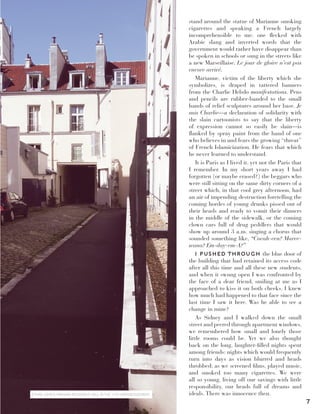
ideals. There was innocence then.ETHAN JOHN’S PARISIAN RESIDENCE HALL IN THE 11TH ARRONDISSEMENT.
8
I walked past my old ground floor
apartment with its metal shutter
rolled down. Asha lived two floors
above me in those days, and it would
rain sometimes when she watered
her plants. Aleck was two windows
down, and I do not think I will ever
forget the first of many times that he
would somehow bypass the locked
gate, bottle in hand and joint in
mouth to come by and lean on my
wrought-iron gate, listening rapt as I
strummed my guitar and sang.
“Fuah mahn, zat is beauteeful.”
In that tempestuous time, life was
paradoxically simple. To be thrown
into a foreign country with its
foreign language and its foreign pace
of life is an experience of renewal
and change. You begin to see the
world differently as the Stockholm
syndrome sets in. Some are able to
resist it; some are not taken under its
spell. I did not resist. I loved it and
ignored its faults.
Later as I stood alone, knee bent
and foot flat against the blue door,
I looked down at the crêpe in my
hands. I felt its heat through the foil
and paper towels and as I lifted it
to my mouth, I smelled the 6 a.m.
termination of a four-mile walk
home from the other side of the city,
long after the subway had shut down
for the night. I felt the crunch of the
cheese—left to crisp on the griddle
as the interior melted around the
beef—and the taste on my tongue
of so many early nights, late nights,
school nights, and early mornings
when that soft, heavy funnel was the
only thing that could fortify me.
Through the fog of returning
memories, I realized that the crêpe
tasted differently than it once had.
There was a clash between the sweet,
delicate pancake batter and the
heavy, savory, spicy filling: an affront
to the classic idea of a structured,
gastronomic meal. Flavor-wise, this
multicultural fare made no sense.
Yet in the way that a love affair
begins with the blissful ignorance
of faults and inconsistencies, so too
does it become reinforced when love
remains despite them. My return
revealed to me that my city is no
glamorous film. Just like my crêpe, it
is an amalgam of tastes and textures.
It is a resistance against tradition. It
has its faults and inconsistencies. But
as I chewed I tasted Paris. And Paris
will always be delicious.
MAXIMILÍANODURÓN
flashbackphotography by KELLYROSE ZIMMERMAN
SIGHT z 9
10
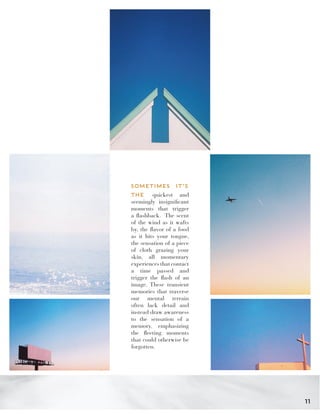
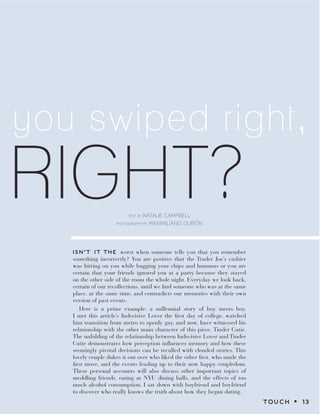
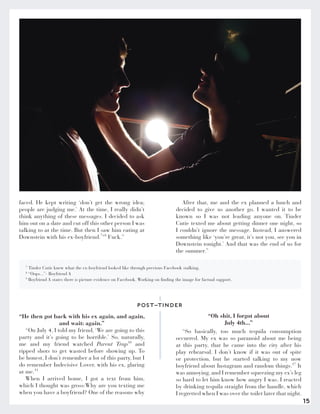
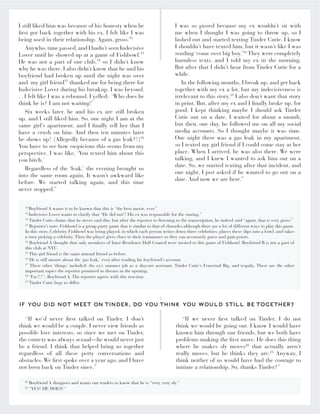
SOMETIMES IT’S
THE quickest and
seemingly insignificant
moments that trigger
a flashback. The scent
of the wind as it wafts
by, the flavor of a food
as it hits your tongue,
the sensation of a piece
of cloth grazing your
skin, all momentary
experiences that contact
a time passed and
trigger the flash of an
image. These transient
memories that traverse
our mental terrain
often lack detail and
instead draw awareness
to the sensation of a
memory, emphasizing
the fleeting moments
that could otherwise be
forgotten.
11
12
RIGHT?
you swiped right,
text by NATALIE CAMPBELL
photography by MaxiMilÍano dUrÓn
ISN’T IT THE worst when someone tells you that you remember
something incorrectly? You are positive that the Trader Joe’s cashier
was hitting on you while bagging your chips and hummus or you are
certain that your friends ignored you at a party because they stayed
on the other side of the room the whole night. Everyday we look back,
certain of our recollections, until we find someone who was at the same
place, at the same time, and contradicts our memories with their own
version of past events.
Here is a prime example: a millennial story of boy meets boy.
I met this article’s Indecisive Lover the first day of college, watched
him transition from metro to openly gay, and now, have witnessed his
relationship with the other main character of this piece, Tinder Cutie.
The unfolding of the relationship between Indecisive Lover and Tinder
Cutie demonstrates how perception influences memory and how these
seemingly pivotal decisions can be recalled with clouded stories. This
lovely couple dukes it out over who liked the other first, who made the
first move, and the events leading up to their now happy coupledom.
These personal accounts will also discuss other important topics of
meddling friends, eating at NYU dining halls, and the effects of too
much alcohol consumption. I sat down with boyfriend and boyfriend
to discover who really knows the truth about how they began dating.
TOUCH z 13
“I knew him before we matched on Tinder,
but I’d never actually spoken to him. He was my
roommate’s Little in his fraternity. At the time, I
had a different boyfriend, thought I was happy, and
did not have plans to make any moves. I saw him a
couple of times in the dining hall, Downstein, over
the summer, but we’d never spoken. I thought he
was cute, but, I was with someone else, so nothing
could happen.
But then all of the sudden, I’m single, and as
one would do, I re-download Tinder and buy a
bottle of Trader Joe’s finest: Three-Buck Chuck.
With a bottle of wine gone, and a semi-broken
heart, I swiped right and within five minutes: bam!
A match.6
I had previously talked to some of our
mutual, meddling friends, so I knew that this match
was not completely random. I knew that he knew
me, and he knew that I knew him, yadda, yadda.
This part of the story we can agree upon, but after
our Tinder match, we start to disagree.”
BOYFRIEND B (a.k.a. Indecisive Lover)
“It could be true,
it could all be true..”
BOYFRIEND A (a.k.a. Tinder Cutie)
“Look at the Tinder messages,
I have a very good memory...”
“I obviously know I swiped right because then
we would not be a match, but allegedly, he claims
I started it all with a ‘hey there!’9
Now, if you
conducted this interview three days ago I would
have said BULLSHIT. But we were actually having
this argument, and he showed me the picture
evidence. The little dick screen-shotted my first
move on May 26th. Also, this initial match was late
at night, and he answered so quickly. I just want
that on the record.
We drunkenly messaged onTinder and exchanged
numbers at some point, but then one night I may
have gotten drunk and FaceTimed my ex-boyfriend
three times.
“I remember the next part so vividly: I am tipsy,
walking to Palladium, listening to “Chandelier”
by Sia (LOL), when I get a notification that he
swiped right, so, no surprise, I did the same. He
then messaged me with a ‘hey there!’ and out of
excitement, I kept walking in circles as I figured out
my answers. The best part of our first conversation
was that we were both texting the same mutual
friend, telling her the details. So I chose the
aggressive approach, and messaged him next, ‘don’t
act like we’re both not texting her right now.’
Over the next few weeks, we drunkenly messaged
each other three other times. After those weeks, we
finally exchanged numbers when he was pretty shit-
“I knew who Indecisive Lover was, and it may1
have been through Facebook stalking. When I first
got my Big,2
I started looking through his Facebook
friends. Between my Big and my other girl friend,
I heard about this Indecisive Lover character
frequently, but I didn’t form an opinion.3
So, I knew
who he was before I saw him on Tinder, I just didn’t
know how I felt about him.
I remember everything leading up to our match
differently than he does. I do this thing with Tinder,
or I did this thing with Tinder, in which I only
match with people I know (because Tinder creeps
me out),4
and cancel out of the app if I’m unsure
about a potential match. When I re-register, Tinder
reshuffles potential matches so you view them
again. I actually was matched with Indecisive Lover
four times, but would cancel out because I couldn’t
decide if I wanted to potentially talk to him.5
Then,
I saw him in the NYU dining hall, Downstein, and
thought, Oh, he’s cute! I am going to swipe right
later tonight.”
PRE-TINDER
THE MATCH
1
“This ‘may’ should be deleted. We all know that he knew who I was through Facebook stalking.”—Boyfriend B.
2
Reporter’s note: This reference is derived from Greek life diction. In order to get a Big (like a big brother or sister), one must join a fraternity
or sorority and get randomly matched with an older member who then acts as a mentor. In this story, Tinder Cutie is a part of Kappa Sigma
Fraternity, an organization not affiliated with NYU.
3
Boyfriend B agrees that A is indecisive.
4
The reporter wishes to highlight the irony: Boyfriend A is creeped out by the very medium that facilitated his current relationship.
5
Boyfriend B claims that A had made up his mind, but he was just too shy to act upon it.
6
“This is not verbatim. I’m not that articulate. Lol.”
15
“He then got back with his ex again, and again,
and wait: again.”
“On July 4, I told my friend, ‘We are going to this
party and it’s going to be horrible.’ So, naturally,
me and my friend watched Parent Trap10
and
ripped shots to get wasted before showing up. To
be honest, I don’t remember a lot of this party, but I
do remember Indecisive Lover, with his ex, glaring
at me.11
When I arrived home, I got a text from him,
which I thought was gross:Why are you texting me
when you have a boyfriend? One of the reasons why
“Oh shit, I forgot about
July 4th...”
“So basically, too much tequila consumption
occurred. My ex was so paranoid about me being
at this party, that he came into the city after his
play rehearsal. I don’t know if it was out of spite
or protection, but he started talking to my now
boyfriend about Instagram and random things.17
It
was annoying, and I remember squeezing my ex’s leg
so hard to let him know how angry I was. I reacted
by drinking tequila straight from the handle, which
I regretted when I was over the toilet later that night.
POST-TINDER
7
Tinder Cutie knew what the ex-boyfriend looked like through previous Facebook stalking.
8
“Oops...”- Boyfriend A
9
Boyfriend A states there is picture evidence on Facebook. Working on finding the image for factual support.
faced. He kept writing ‘don’t get the wrong idea;
people are judging me.’ At the time, I really didn’t
think anything of these messages. I decided to ask
him out on a date and cut off this other person I was
talking to at the time. But then I saw him eating at
Downstein with his ex-boyfriend.7+8
Fuck.”
After that, me and the ex planned a lunch and
decided to give us another go. I wanted it to be
known so I was not leading anyone on. Tinder
Cutie texted me about getting dinner one night, so
I couldn’t ignore the message. Instead, I answered
something like ‘you’re great, it’s not you, see you in
Downstein tonight.’ And that was the end of us for
the summer.”
“If we’d never first talked on Tinder, I don’t
think we would be a couple. I never view friends as
possible love interests, so since we met on Tinder,
the context was always sexual—he would never just
be a friend. I think that helped bring us together
regardless of all these petty conversations and
obstacles. We first spoke over a year ago, and I have
not been back on Tinder since.”
“If we never first talked on Tinder, I do not
think we would be going out. I know I would have
known him through our friends, but we both have
problems making the first move. He does this thing
where he makes sly moves20
that actually aren’t
really moves, but he thinks they are.21
Anyway, I
think neither of us would have had the courage to
initiate a relationship. So, thanks Tinder?”
IF YOU DID NOT MEET ON TINDER, DO YOU THINK YOU WOULD STILL BE TOGETHER?”
10
Boyfriend A wants it to be known that this is “the best movie, ever.”
11
Indecisive Lover wants to clarify that “He did not!! His ex was responsible for the staring.”
12
Tinder Cutie claims that he never said this, but after the reporter re-listening to the transcription, he indeed said “again, that is very gross.”
13
Reporter’s note: Fishbowl is a group party game that is similar to that of charades although there are a lot of different ways to play this game.
In this story, Celebrity Fishbowl was being played, in which each person writes down three celebrities, places these slips into a bowl, and takes
a turn picking a celebrity. Then the player gives clues to their teammates so they can accurately guess and gain points.
14
Boyfriend A thought that only members of Inter-Residence Hall Council were invited to this game of Fishbowl. Boyfriend B is not a part of
this club at NYU.
15
This girl friend is the same mutual friend as before.
16
He is still unsure about the ‘gas leak,’ even after reading his boyfriend’s account.
17
These other ‘things’ included: the ex’s summer job as a daycare assistant, Tinder Cutie’s Fraternal Big, and tequila. These are the other
important topics the reporter promised to discuss in the opening.
18
“Ew!!!”- Boyfriend A. The reporter agrees with this reaction.
19
Tinder Cutie begs to differ.
20
Boyfriend A disagrees and wants our readers to know that he is “very, very sly.”
21
“YES! HE DOES!”
I still liked him was because of his honesty when he
first got back together with his ex. I felt like I was
being used in their relationship. Again, gross.12
Anywho,time passed,and I hadn’t seen Indecisive
Lover until he showed up at a game of Fishbowl.13
He was not a part of our club,14
so I didn’t know
why he was there. I also didn’t know that he and his
boyfriend had broken up until the night was over
and my girl friend15
thanked me for being there for
Indecisive Lover during his breakup. I was beyond.
. . I felt like I was a rebound. I yelled: ‘Who does he
think he is? I am not waiting!’
Six weeks later, he and his ex are still broken
up, and I still liked him. So, one night I am at the
same girl’s apartment, and I finally tell her that I
have a crush on him. And then ten minutes later
he shows up! (Allegedly because of a gas leak?!)16
You have to see how suspicious this seems from my
perspective. I was like, ‘You texted him about this
you bitch.’
Regardless of the ‘leak,’ the evening brought us
into the same room again. It wasn’t awkward like
before. We started talking again, and this time
never stopped.”
I was so pissed because my ex wouldn’t sit with
me when I thought I was going to throw up, so I
lashed out and started texting Tinder Cutie. I know
I shouldn’t have texted him, but it wasn’t like I was
sending ‘come over big boy.’18
They were completely
harmless texts, and I told my ex in the morning.
But after that I didn’t hear from Tinder Cutie for a
while.
In the following months, I break up, and get back
together with my ex a lot, but my indecisiveness is
irrelevant to this story.19
I also don’t want that story
in print. But, after my ex and I finally broke up, for
good, I kept thinking maybe I should ask Tinder
Cutie out on a date. I waited for about a month,
but then, one day, he followed me on all my social
media accounts. So I thought maybe it was time.
One night there was a gas leak in my apartment,
so I texted my girl friend if I could come stay at her
place. When I arrived, he was also there. We were
talking, and I knew I wanted to ask him out on a
date. So, we started texting after that incident, and
one night, I just asked if he wanted to go out on a
date. And now we are here.”
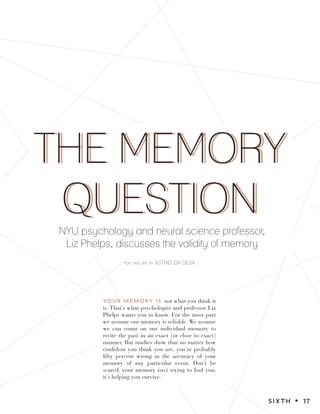
THE MEMORY
QUESTION
THE MEMORY
QUESTION
text and art by ASTRID DA SILVA
NYU psychology and neural science professor,
Liz Phelps, discusses the validity of memory
YOUR MEMORY IS not what you think it
is. That’s what psychologist and professor Liz
Phelps wants you to know. For the most part
we assume our memory is reliable. We assume
we can count on our individual memory to
recite the past in an exact (or close to exact)
manner. But studies show that no matter how
confident you think you are, you’re probably
fifty percent wrong in the accuracy of your
memory of any particular event. Don’t be
scared, your memory isn’t trying to fool you;
it’s helping you survive.
SIXTH z 17
18
At a very basic level, can you explain
how one processes an event and
encodes it into our own memory?
It’s important to note that
psychologists like to think there are
several different forms of memory.
The ability to recollect information
like an event, that’s a specific type
of memory and that is how most
people use the term memory.
The first stage of that memory is
of course, attention. If something
doesn’t come in, if you don’t receive
it and attend to it, then you won’t
remember it later. That’s not to
say that the only things that you
remember are the things you’re
focusing on. But there is this initial
processing that has to occur in order
for you to remember anything.
Next comes the storage process.
It’s seems passive, you have no
knowledge of the processing
occurring, but it’s actually a very
active process in your brain, in the
hippocampus. Storage processing
doesn’t happen instantaneously,
it takes time and we call that time
consolidation. Lots of things can
influence how well things are stored,
lack of sleep for example. Different
aspects of the situation or event
are being activated all over your
brain due to your senses. Each
region [activated] forms a network
of all these representations. Those
networks are connected because
you’re experiencing them as an
event, all the components, that
visual information, that audio
information, what you’re thinking
at the time, all that gets connected.
If there’s something that interrupts
that process of storing connections,
if I could do something to stop the
synapses from processing during
the consolidation process, I can
essentially erase that memory.
Then you have the last stage,
which is retrieval. Some memories
are so strong that they come back
to you seemingly automatic; some
don’t come back until you’re
reminded about certain things. The
thing about retrieval is you can have
a memory where it’s “I kind of know
that happened” or like “I remember
where I was and every little detail,”
so you definitely have this feeling
that goes along with retrieval, that
to you signals something about
the quality or the strength of that
memory.
What causes one to feel that a
memory is stronger or less strong
than another?
Generally people feel that their
memory is very strong if they have
a lot of detail. There’s evidence that
shows that the more, at least with
mundane, non-emotional things,
the more you’re able to remember
different little details that go along
with a memory, the more confident
you’ll be about the memory, the
stronger the association is. Now,
there are other things that can
influence confidence. If something
is being retrieved a bunch of times,
it gains confidence, even if it was
wrong the first time, because now
you’ve landed at that memory a bunch. If something is
highly emotional, it gives something a strong sense of
confidence. So people will often think that they know,
for example, exactly what they were doing on 9/11. But
what studies have shown is that you’re probably about
fifty percent wrong in what you really remember. I just
can’t convince you you’re wrong because it has that
super strong feeling. So one thing emotion does is it
makes you view things with a strong sense of confidence,
and that’s because all the vividness in detail gives us a
sense that we’re confident about that memory.
Can you talk about the ongoing research on 9/11
memories?
So the first people to study personal memory were
these Harvard researchers [Roger] Brown and [James]
Kulik, they didn’t study just one event but they were
looking at people who remembered the assassination
of JFK or Martin Luther King or Malcolm X. They
brought people into a laboratory and had them recollect
those events and they ended up coming up with this
term, “flashbulb memory.” The way people described
those events was
almost as if it was a
picture taken with a
flashbulb. They’d tell
you these detailed
memories that were
just not normal.
The thing about
Brown and Kulik is
that they assumed,
which turned out to
be wrong, that these memories were accurate, because
they certainly felt accurate. It’s next to impossible to
know how to measure someone’s memories, personal
memories.
So what researchers have done since then, starting
with Ulric Neisser and the Challenger explosion, is not
to measure accuracy but to measure consistency. If I ask
you right after what you were doing, and I ask you a year
later what you were doing, and you changed your story
then at least one of those is not accurate. But it’s not
that people forgot the event it’s the details surrounding
them, how you found out, who you were with, what
were you doing before and after. What Neisser found
was that people weren’t that accurate after a year,
but they were completely certain they were accurate,
confidence was through the roof. We’ve done studies of
memories from 9/11, and found the exact same thing.
There have been lots of studies of lots of different public
events consistent with this idea that what makes [these
memories] different isn’t the accuracy per se, but the
confidence in these memories.
If we can’t expect our memories to be consistent, what
purpose do you think our memory serves?
To say that they are not always consistent is not to
say that they have to be 100 percent accurate to be
useful. The function of memory is to be able to use the
past to act more adaptively in the future. Nobody forgot
that 9/11 happened, what they forgot were probably
the things that don’t matter. One of my favorite books,
The Seven Sins of Memory written by Dan Schacter, a
professor at Harvard, talks about all these things that
people find puzzling about memory. What he argues
is that for all these things we call memory mistakes,
there’s actually a good adaptive function for it. For
example, every time you retrieve something, the
memory might be modified slightly by the current
situation. It may, in fact, be the case that how you’re
storing it now “incorrectly” is actually relevant for the
function of that memory in the future. These things are
not necessarily memory mistakes. We want to be able to
generalize from experience as opposed to remembering
every little detail. It may not be good for the courtroom
but it’s better for when we’re faced with a threat.
How much do we
know about what
triggers memory?
Anything can be a
trigger. Sometimes
they come from
outside of you, like
being in a place
you once were, or
seeing somebody you
once knew, but they can be internal,“I’m in a bad mood,
so I’m thinking of all the bad things that happened.”
There’s not a sophisticated science of triggers, except
to say that certainly the way I evoke a memory changes
what the memory is. I can cue you in different ways
that can coax different memories out of you.
What do you want the public to know about memory?
I expect memory to be fluid and dynamic [because] I
know that that’s a good function of memory, ultimately.
To me, I know it’s not just a record of the past. It’s a
record of my past combined with my present and all
that happens in between. Most people kind of think
memory is supposed to be like a tape recorder and
are annoyed with the idea that their memories might
change and shift over time. But if something matters
to you, there are ways, techniques, and strategies, that
you can use to help remember details. People think of
memory as this immutable thing and I think it’s pretty
mutable. It’s mutable in everyday life naturally, and it’s
actually something we can have some control over if we
choose to.
it may not be good for the
courtroom, but it’s be er for
when we’re faced with a threat.““
tuscany to nyc
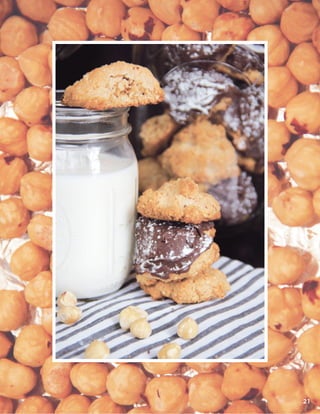
brutti ma buoni cookies (“ugly but good”)
text and photography by ISABELLE ENGLISH
MY FIRST FOOD memory
revolves around, what else, but
stuffing myself with delicious,
crumbly cookies when my parents
weren’t looking.
It is my third birthday and I am
on the outdoor patio of my parents’
friend’s restaurant in Tuscany.
Digging headfirst into a giant platter
of crispy rabbit stew and rosemary
patate fritte, I feel only the warmth
of the southern sun and the salty
tang of rabbit on my tongue.
When I finally stop to come up
for air, I spot a waiter carrying an
enormous glass jar of tiny, round
cookies.My eyes follow his movement
as he places the container on the floor
next to the hostess stand. I drop my
fork, climb down the legs of the old
rustic dining chair, and run full speed
across the restaurant and toward the
jar. On tiptoes I reach my chubby,
sunburned arm into the cookie vault
and scoop out as many as I can. I
hold them close to my belly and walk
slowly back to the table, making
sure not to leave a crumb trail. My
parents finish off the rabbit as my
brothers and I sit on the sun-warmed
stone sharing sweet and nutty cookie
clusters until we fall asleep.
Almost eighteen years later, I’m
sitting in my New York City kitchen
trying desperately to remember the
exact flavor of thoseTuscan cookies—
to return to the moment on the patio
when I first tasted their incomparable
sweet and nutty pungency. After
many failed attempts and hours of
research, I finally stumble upon a
recipe for Italian hazelnut cookies
called “ugly but good,” the English
translation for brutti ma buoni. Out
of frustration and despair, I decide
to try it. And about an hour later,
after roasting, stirring, and sifting,
when I eat one, I am transported
immediately back to my chubby
sunburnt arms, the Tuscan heat, my
brothers, my parents, the rabbit,
and, most importantly, the rich and
sugary taste of hazelnuts. So without
further ado—I present to you brutti,
the ugliest, yet most delicious, cookie
on the face of the earth.
YOU NEED YOU DO
Hazelnuts, 1½ cups
Pure vanilla extract,
3 teaspoons
Egg white, 1
Confectioners sugar,
1¾ cups
Pinch of salt
Dark chocolate, 12 oz.
(optional)
Unsalted butter, ¼ cup
(optional)
Makes: 2 dozen
Active Time: 30-45 minutes
Total Time: 1 hour
THE RECIPE: ITALIAN HAZELNUT "UGLY BUT GOOD" COOKIES
1. Set a rack in center of the oven and preheat oven to 400 degrees.
2. In a large baking sheet pan, spread hazelnuts in a single layer and toast for about
15 minutes (or until skins blisters). Transfer hazelnuts to paper bag or towel to let
cool, and then rub them together to remove skins.
3. In the meantime, beat egg white and vanilla in small bowl. Set aside.
4. In a food processer, pulse cooled hazelnuts, confectioners sugar and salt until finely
chopped and combined. Scrape hazelnut mixture into a medium bowl and stir in
egg white and vanilla until fully combined (the dough should resemble a thick,
nutty paste).
5. Line a baking sheet pan with parchment paper. Spoon ½ tablespoon-sized mounds
of hazelnut dough onto sheet pan about 1–2 inches apart.
6. Bake cookies for about 12–15 minutes (until browned in spots: 12 for chewy
cookies and 15 for crisp cookies). Let cookies cool completely before serving.
20 z TASTE
Chocolate Note: If you would like to make these cookies slightly prettier and exceedingly more
delicious, melt chocolate and butter in double boiler until thick but creamy (medium heat). Remove
from heat and let cool for 3-5 minutes. With a spoon or knife, spread chocolate over top of cooled
cookies. Let dry and sprinkle with confectioners sugar.
21
This page left unintentionally blank.
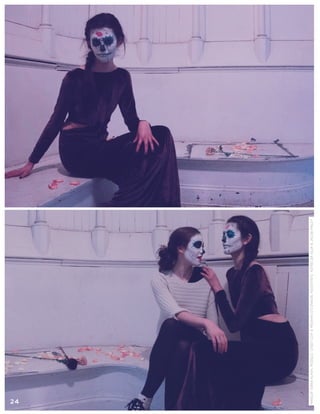
SIGHT z 23CLOTHING GENEROUSLY LENT BY: TIA CIBANI, KORDAL, & SUZANNE RAE;
VENUE: THE CLEMENTE SOTO VÉLEZ CULTURAL AND EDUCATIONAL CENTER
MAKEUP:ERIKAKLASH;MODELS:CASEYLEVY&MEGHANO’CONNOR;ASSISTANTS:ASTRIDDASILVA&JACOBPRILEY
24
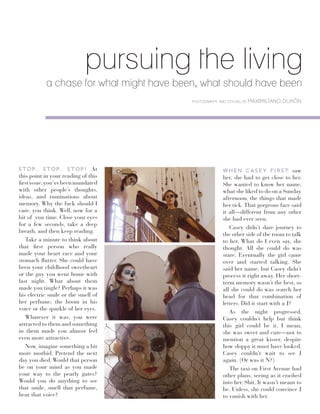
STOP. STOP. STOP! At
this point in your reading of this
firstissue,you’vebeeninundated
with other people’s thoughts,
ideas, and ruminations about
memory. Why the fuck should I
care, you think. Well, now for a
bit of you time. Close your eyes
for a few seconds, take a deep
breath, and then keep reading.
Take a minute to think about
that first person who really
made your heart race and your
stomach flutter. She could have
been your childhood sweetheart
or the guy you went home with
last night. What about them
made you tingle? Perhaps it was
his electric smile or the smell of
her perfume; the boom in his
voice or the sparkle of her eyes.
Whatever it was, you were
attracted to them and something
in them made you almost feel
even more attractive.
Now, imagine something a bit
more morbid. Pretend the next
day you died. Would that person
be on your mind as you made
your way to the pearly gates?
Would you do anything to see
that smile, smell that perfume,
hear that voice?
WHEN CASEY FIRST saw
her, she had to get close to her.
She wanted to know her name,
what she liked to do on a Sunday
afternoon, the things that made
her tick.That gorgeous face said
it all—different from any other
she had ever seen.
Casey didn’t dare journey to
the other side of the room to talk
to her. What do I even say, she
thought. All she could do was
stare. Eventually the girl came
over and started talking. She
said her name, but Casey didn’t
process it right away. Her short-
term memory wasn’t the best, so
all she could do was search her
head for that combination of
letters. Did it start with a J?
As the night progressed,
Casey couldn’t help but think
this girl could be it. I mean,
she was sweet and cute—not to
mention a great kisser, despite
how sloppy it must have looked.
Casey couldn’t wait to see J
again. (Or was it N?)
The taxi on First Avenue had
other plans, seeing as it crashed
into her. Shit. It wasn’t meant to
be. Unless, she could convince J
to vanish with her.
pursuing the living
a chase for what might have been, what should have been
photography and styling by MAXIMILÍANO DURÓN
26
27
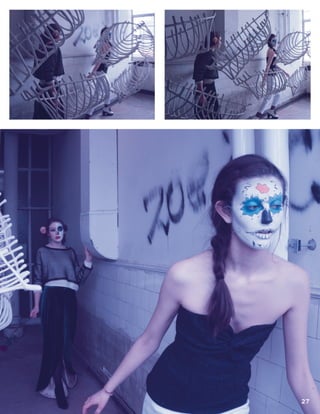
28
SIGHT z 29TEXT BY ETHAN JOHNS
booze on a stick
minty mojito pops
text by ISABELLE ENGLISH
YOU NEED
YOU DO
Superfine sugar, ¾ cup
Light rum, 5 Tbsp.
Fresh lime juice, ¼ cup
Water, 2 cups
Fresh mint sprigs,
3 large coarsely chopped
THE RECIPE: MINTY
MOJITO POPS
1. In a medium bowl, stir together sugar, rum, lime
juice, and water until combined. Stir in mint.
2. Pour mixture evenly between 8 (3-ounce) plastic
pop molds.Top with lids of pop molds and insert
popsicle sticks, leaving 1½ to 2 inches of each
stick exposed.
3. Freeze 4 hours or until sticks are solidly anchored
and pops are completely frozen. Serve.
Makes: 8 servings
Active Time: 30 minutes
Total Time: 4½ hours
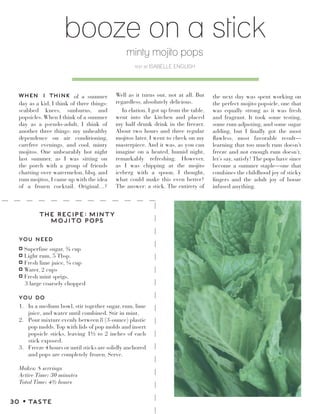
WHEN I THINK of a summer
day as a kid, I think of three things:
scabbed knees, sunburns, and
popsicles. When I think of a summer
day as a pseudo-adult, I think of
another three things: my unhealthy
dependence on air conditioning,
carefree evenings, and cool, minty
mojitos. One unbearably hot night
last summer, as I was sitting on
the porch with a group of friends
chatting over watermelon, bbq, and
rum mojitos, I came up with the idea
of a frozen cocktail. Original…?
Well as it turns out, not at all. But
regardless, absolutely delicious.
In elation, I got up from the table,
went into the kitchen and placed
my half drunk drink in the freezer.
About two hours and three regular
mojitos later, I went to check on my
masterpiece. And it was, as you can
imagine on a heated, humid night,
remarkably refreshing. However,
as I was chipping at the mojito
iceberg with a spoon, I thought,
what could make this even better?
The answer: a stick. The entirety of
the next day was spent working on
the perfect mojito popsicle, one that
was equally strong as it was fresh
and fragrant. It took some testing,
some rum adjusting, and some sugar
adding, but I finally got the most
flawless, most favorable result—
learning that too much rum doesn’t
freeze and not enough rum doesn’t,
let’s say, satisfy! The pops have since
become a summer staple—one that
combines the childhood joy of sticky
fingers and the adult joy of booze
infused anything.
30 z TASTE
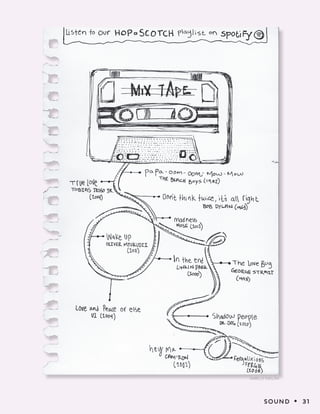
SOUND z 31
ISABELLE ENGLISH
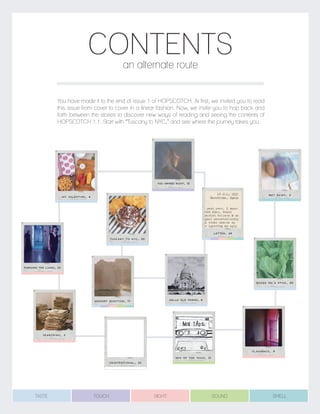
CONTENTS
You have made it to the end of issue 1 of HOPSCOTCH. At first, we invited you to read
this issue from cover to cover in a linear fashion. Now, we invite you to hop back and
forth between the stories to discover new ways of reading and seeing the contents of
HOPSCOTCH 1.1. Start with “Tuscany to NYC,” and see where the journey takes you.
an alternate route
BOOZE ON A STICK, 30
FLASHBACK, 9
MEMORY QUESTION, 17
SEARCHING, 2
MY VALENTINE, 4
TUSCANY TO NYC, 20
HELLO OLD FRIEND, 6
PURSUING THE LIVING, 23
LETTER, 29
YOU SWIPED RIGHT, 13
MIX OF THE ISSUE, 31
WET PAINT, 3
UNINTENTIONAL, 22
TASTE TOUCH SIGHT SOUND SMELL
Magazine Draft v11 (not final)

Magazine Draft v11 (not final)

  • 1.
    WE MET ONTINDER, DIDN’T WE? f MEMORY, YOU OLD DOG LOVE’S DEATH f PARIS, YET AGAIN f VOLUME 1, ISSUE 1
  • 3.
    DEAR READERS Think ofa moment when a bite of something hot and greasy—say, an empanada—grabbed hold of you and transported you to an afternoon in your grandmother’s kitchen or a late night at a food truck counter; when the scent of a perfume made you think of a close romantic encounter or a day at the beach; when the touch of burlap brought you back to middle school field day and potato sack races. All it takes is a split second of external stimuli for nostalgia to exit the past and enter the present. Over the past few months, we at HOPSCOTCH have asked ourselves, what would life be like without memory? Our conclusion: It’s simply unfathomable. A defining quality of the human experience, regardless of personal background, is the mere existence of memory as something that occupies a space in our mind and our beings. Despite the content, it is undeniably a universal commonality. We all experience memory and nostalgia in different ways. Both our individual and collective memories amuse us, uplift us, and ground us, and for these reasons they should be celebrate. In the following pages, you will find visual essays, creative non-fiction, fiction, interviews, reportage, and recipes that invite you to travel through our memories, and hopefully inspire you to explore your own. Please read from cover to cover, as the editors intended their memories to be shared. NATALIE CAMPBELL ASTRID DA SILVA MAXIMILÍANO DURÓN ISABELLE ENGLISH ETHAN JOHNS KELLYROSE ZIMMERMAN
  • 4.
    searching for memories lorienovak’s work tries to make sense of our records text by MAXIMILÍANO DURÓN AMID THIRTY STACKS of aging front sections of The New York Times, some of which reached well over 3 feet high, installation artist and photographer Lorie Novak tinkered with a seven-plus-year-old MacBook Pro. Crouching among the towers of newspapers that filled half of her Brooklyn studio, she attempted to boot up the dead laptop that was precariously perched atop one of these uneven piles. For her latest project, temporarily titled “Above the Fold,” Novak has divided her collection of fifteen- years-worth of papers into categories and subcategories, according to her interpretation of the front-page image. These categories range from the boring, “Politicians,” and the joyful,“Celebration,” to the haunting, “Grieving,” and the unsettling, “Men (and 6 Women) with Guns.” Above these different-sized piles a screen will chronologically show every category’s lead photo. Novak started this hoarder-like, obsessive collecting in 1999 in the wake of the Kosovo War and the related NATO bombing, as a way to make sense of the overwhelming amount of images of war and displaced families that appeared throughout The Times. These images haunted her, as many still do today. “My original idea was to have a stack of papers that signified the war,” she said.“When the war ended, it didn’t really seem like it ended, so I kept saving papers.” Her use of repurposed newspapers to create layered photographs and multi-channel video installations follows from her previous work in these media. In one series, “Collected Visions,” she compiled scores of people’s family photographs to create a website and installation at the International Center of Photography in New York that reflected her vision of how photos affect how people remember certain events. What struck her were people’s relationships to these photographs, how they were etched in their minds, staying with them always. “I’ve always been interested in how we so badly want to believe photographs,” Novak said after recounting a memory of her watching her baby sister come home from the hospital, which, she says, must have come from a home video, not her own memory. “When we have photographs, those events we remember more or become dominant.” 2 z SIGHT bodies, 2012, archival ink-jet photograph. ©lorie novak
  • 5.
    the wetter thepaint There’s something almost indescribable about standing alone in an art gallery, just after the walls have been painted. The walls are beginning to dry, as the industrial fans continue to roar. I spin around to look at all the works lined up against the walls, waiting to be hung. I close my eyes and take a deep breath to soak up that smell of fresh, white paint. - M.D. It’s a typical Southern California day.The strong sun and warm winds are cut by the cool ocean breeze. The grass lawn is slightly moist from last night’s sprinklers. My six-year-old self was enchanted with this: sitting in damp grass, my mom setting up finger paints, and a canvas on my yellow and red Lakeshore easel. - K.Z. I liked my dirty walls, with pencil markings, tape residue, and doodles lining it; it had character. But my mother, well, she disagreed. She said it looked messy, that the once-white, now gray walls needed a makeover.“Fresh white paint,” she repeated. “It’ll look nice.” I can’t stand the smell, so I never let her do it. - A.D. I’m in a diner in Dedham, Mass. staring at a stack of warm blueberry pancakes—syrup swimming down six flapjack stories, butter vanishing on their surface; when in the midst of my first fork raise, I get an unsolicited scent of solvent and toxic fumes. The culprit: a freshly painted, blown-up portrait of Elvis Presley eating, what else, pancakes. - I.E. “There’s a jug of turpentine downstairs,” Dad says. As I descend to the basement, I rub my hands together trying to get rid of the lacrosse tape residue that clings to them. The chemical, gasoline-and-pine scent rises visibly from the mouth of the jug, and once on my hands, the tape residue glides off. - E.J. My friend and I plugged our noses as we flipped open the cap of the lavender paint can. Being ill-prepared, we jumped on buckets to reach the upper part of the walls. With no ventilation, the summer heat heightened the stench of the paint. Ironically, I ended up not moving into that house, and now a stranger has a spotted purple ceiling. - N.C. SMELL z 3 We asked our editors, “What comes to mind when you smell a freshly painted wall?” Here are their responses:
  • 6.
    my valentine sweet cornfalafel with raita and naan text and photography by ISABELLE ENGLISH I SPENT LAST Valentine’s Day with two of my true loves: Le Marais and le falafel. It was raining in Paris, so I stood with my friend Emma and forty umbrella-shielded strangers in a single-file line, waiting for what seemed like eight stormy hours to order lunch. When the man in the kelly-green T-shirt that read L’As Du Fallafel finally came up to me with a pen and an order sheet in hand, I lit up with excitement. He spit words at me that I didn’t understand, so I said oui and non when I could and hoped for the best. Fast-forward twenty minutes,whenthewarmnestofcrispy, golden falafel with smooth, tangy hummus and roasted eggplant was nuzzled into the palms of my hands, nutty tahini dripping down my wrists and my taste buds twitching with an unparalleled anticipation. I thought to myself in the midst of my first bite, Who needs a human valentine when you can have one made of chickpeas, cumin, and corn? Needless to say, this falafel was the falafel I had been dreaming of. It was moist, crunchy, sweet, sharp, and before I knew it, it was gone. So R.I.P. to the best five minutes of falafel goodness, of chilly Parisian rainfall, and of my entire life; and hello to my own rendition of fried chickpea spheres of heaven. Made with sweet corn, wrapped in warm naan, and topped with peppery raita, this recipe will transport you to someplace magical, and if you fall in love, maybe even to the city of romance. 4 z TASTE
  • 7.
    Falafel: Chickpeas (garbanzo beans), 116-oz. can Garlic, 5 cloves Onion, 1 cup chopped Fresh corn kernels, 1 cup (2 ears) Fresh cilantro, 2 Tbsp. chopped Fresh parsley, 2 Tbsp. chopped Kosher salt, 2 tsp. Ground cumin, 1 tsp. Crushed red pepper, ½ tsp. All-purpose flour, 6 Tbsp. Baking powder, 1 tsp. Raita: Plain Greek yogurt, 2½ cups Fresh mint, ¼ cup chopped Ground cumin, 2 tsp. Kosher salt, ¼ tsp. Black pepper, ¼ tsp. Ground red pepper, ¼ tsp. Cucumbers, 2 peeled and diced (2 cups) Additional Ingredients: Canola oil, 4 cups Naan, 8 rounds Cilantro for garnish 1. To prepare falafel, rinse chickpeas; drain. 2. In food processer, pulse garlic until minced. Add onion, chickpeas, corn, cilantro, parsley, salt, cumin, and red pepper. Sprinkle flour and baking powder over chickpea mixture. Pulse 10-15 times, or until blended. Transfer mixture to bowl, cover, and refrigerate 3 hours or until completely chilled. 3. In the meantime, stir together all raita ingredients in a small bowl. Cover and chill until ready to serve. 4. Preheat oven to 300 degrees. 5. Pour oil to a depth of 1½ inches into a large heavy skillet. Heat to 350 degrees. 6. In the meantime, shape cooled chickpea mixture into 45 one-inch balls. 7. Fry balls, in batches, in hot oil for 1 minute, or until golden and crisp. Once done, transfer to paper towel to drain. 8. In a single level, lay out naan on sheet pan and bake until warm (about 3–5 minutes). 9. Place 6 falafel balls on half of each warmed naan. Spoon about ½ cup of raita over falafel and fold in half. Garnish with cilantro and serve immediately.Makes: 8 servings Active Time: 1 hour; Total Time: 4 hours 5 THE RECIPE: SWEET CORN FALAFEL WITH RAITA AND NAAN 8
  • 8.
    hello, old friend whenyou’re the only thing that’s changed about paris text by ETHAN JOHNS BACKPACKS WERE STOWED, seat backs returned to their upright positions, table trays lifted and locked. The last time I had been on a plane, I had been yelled at for tapping away at a game of Solitaire on my BlackBerry. It seemed as though two years had at least seen some progressive thinking on the part of the airlines, and as I slipped a pair of black headphones over my ears, joining the ranks of zoned out teenagers and middle-aged iPhone enthusiasts alike, I immersed myself in the low, steady, electronic hum of Paul Kalkbrenner’s Azure: first in a collection of songs that had kept me tied to Paris—my home for a year— from 3,625 miles away. Ever since my first visit to the city turned out to be a perfect disaster (a classic story of a disappointing bus tour,rudewaiters,andunfamiliarity), I have approached returning with an attitude of downplayed indifference —of deflated expectations—so as to soften the blow in the event that she tries to break me as she has broken so many others. And as the orange glow from that city of light appeared on the ground, it became clear that those songs in my ear were not touching me as they once had. The smoke- filled room where they had first been played from booming speakers was the property of someone else now, the young man who played them having since returned to his home country. With dry eyes and arms free of goose bumps, I made my way through the terminal and to the bus that would carry me into the bourgeois heart of the city. I returned to Paris knowing there would be obligations: family members to meet, hands to lend, and a party to attend. All of this I was happy to deal with, so long as there would be time to attain the true goal for my trip. It was imperative that I find my version of the madeleine. Proust may well have tasted his by chance, only to realize that he never even really liked that little cake in the first place, but for me this quest was to be no accidental discovery. After two years of disappointing New York City dollar pizza with its sweet red sauce, I was going to eat my old standard— ma crêpe viande hachée fromage —and my memories were going to come flooding back whether they liked it or not. The anticipation for that bite was bothersome. As Ernest Hemingway once supposedly said, “If you are lucky enough to have lived in Paris as a young man, then wherever you go for the rest of your life, it stays with you, for Paris is a moveable feast.” Paris was so moveable that I had picked her up, thrown her over my shoulder like a picnic bundled in a checkered blanket, and brought her back to New York with me. And when you can’t leave Paris behind, it’s hard to enjoy the feast at hand. You find it impossible not to compare everything to the way it was there, and the way it was there—in my mind—was always better. Where, then, would I find myself if I tasted that crêpe—my usual triangular street eat, with its Swiss emmenthal, its seasoned Algerian ground beef, its spicy red harissa sauce that could bring tears to my eyes while I devoured it, alone, on my fold-out bed late at night—only to be disappointed? What if that crêpe— what if the city itself—had changed for me while I was away? Yet as I walk through the Place de la République in the direction of my old apartment I realize that the Paris I knew is almost exactly as I left it. Young skateboarders speed by, cutting through the diverse groups of high school students who you begin to sî the world differently as the Stockholm syndrome sets in. “ 6 z TASTE
  • 9.
    7 stand around thestatue of Marianne smoking cigarettes and speaking a French largely incomprehensible to me: one flecked with Arabic slang and inverted words that the government would rather have disappear than be spoken in schools or sung in the streets like a new Marseillaise. Le jour de gloire n’est pas encore arrivé. Marianne, victim of the liberty which she symbolizes, is draped in tattered banners from the Charlie Hebdo manifestations. Pens and pencils are rubber-banded to the small hands of relief sculptures around her base. Je suis Charlie—a declaration of solidarity with the slain cartoonists to say that the liberty of expression cannot so easily be slain—is flanked by spray paint from the hand of one who believes in and fears the growing “threat” of French Islamicization. He fears that which he never learned to understand. It is Paris as I lived it, yet not the Paris that I remember. In my short years away I had forgotten (or maybe erased?) the beggars who were still sitting on the same dirty corners of a street which, in that cool grey afternoon, had an air of impending destruction foretelling the coming hordes of young drunks pissed out of their heads and ready to vomit their dinners in the middle of the sidewalk, or the coming clown cars full of drug peddlers that would show up around 3 a.m. singing a chorus that sounded something like, “Cocah-een? Maree- wana? Em-day-em-A?” I PUSHED THROUGH the blue door of the building that had retained its access code after all this time and all these new students, and when it swung open I was confronted by the face of a dear friend, smiling at me as I approached to kiss it on both cheeks. I knew how much had happened to that face since the last time I saw it here. Was he able to see a change in mine? As Sidney and I walked down the small street and peered through apartment windows, we remembered how small and lonely those little rooms could be. Yet we also thought back on the long, laughter-filled nights spent among friends: nights which would frequently turn into days as vision blurred and heads throbbed; as we screened films, played music, and smoked too many cigarettes. We were all so young, living off our savings with little responsibility, our heads full of dreams and ideals. There was innocence then.ETHAN JOHN’S PARISIAN RESIDENCE HALL IN THE 11TH ARRONDISSEMENT.
  • 10.
    8 I walked pastmy old ground floor apartment with its metal shutter rolled down. Asha lived two floors above me in those days, and it would rain sometimes when she watered her plants. Aleck was two windows down, and I do not think I will ever forget the first of many times that he would somehow bypass the locked gate, bottle in hand and joint in mouth to come by and lean on my wrought-iron gate, listening rapt as I strummed my guitar and sang. “Fuah mahn, zat is beauteeful.” In that tempestuous time, life was paradoxically simple. To be thrown into a foreign country with its foreign language and its foreign pace of life is an experience of renewal and change. You begin to see the world differently as the Stockholm syndrome sets in. Some are able to resist it; some are not taken under its spell. I did not resist. I loved it and ignored its faults. Later as I stood alone, knee bent and foot flat against the blue door, I looked down at the crêpe in my hands. I felt its heat through the foil and paper towels and as I lifted it to my mouth, I smelled the 6 a.m. termination of a four-mile walk home from the other side of the city, long after the subway had shut down for the night. I felt the crunch of the cheese—left to crisp on the griddle as the interior melted around the beef—and the taste on my tongue of so many early nights, late nights, school nights, and early mornings when that soft, heavy funnel was the only thing that could fortify me. Through the fog of returning memories, I realized that the crêpe tasted differently than it once had. There was a clash between the sweet, delicate pancake batter and the heavy, savory, spicy filling: an affront to the classic idea of a structured, gastronomic meal. Flavor-wise, this multicultural fare made no sense. Yet in the way that a love affair begins with the blissful ignorance of faults and inconsistencies, so too does it become reinforced when love remains despite them. My return revealed to me that my city is no glamorous film. Just like my crêpe, it is an amalgam of tastes and textures. It is a resistance against tradition. It has its faults and inconsistencies. But as I chewed I tasted Paris. And Paris will always be delicious. MAXIMILÍANODURÓN
  • 11.
  • 12.
  • 13.
    SOMETIMES IT’S THE quickestand seemingly insignificant moments that trigger a flashback. The scent of the wind as it wafts by, the flavor of a food as it hits your tongue, the sensation of a piece of cloth grazing your skin, all momentary experiences that contact a time passed and trigger the flash of an image. These transient memories that traverse our mental terrain often lack detail and instead draw awareness to the sensation of a memory, emphasizing the fleeting moments that could otherwise be forgotten. 11
  • 14.
  • 15.
    RIGHT? you swiped right, textby NATALIE CAMPBELL photography by MaxiMilÍano dUrÓn ISN’T IT THE worst when someone tells you that you remember something incorrectly? You are positive that the Trader Joe’s cashier was hitting on you while bagging your chips and hummus or you are certain that your friends ignored you at a party because they stayed on the other side of the room the whole night. Everyday we look back, certain of our recollections, until we find someone who was at the same place, at the same time, and contradicts our memories with their own version of past events. Here is a prime example: a millennial story of boy meets boy. I met this article’s Indecisive Lover the first day of college, watched him transition from metro to openly gay, and now, have witnessed his relationship with the other main character of this piece, Tinder Cutie. The unfolding of the relationship between Indecisive Lover and Tinder Cutie demonstrates how perception influences memory and how these seemingly pivotal decisions can be recalled with clouded stories. This lovely couple dukes it out over who liked the other first, who made the first move, and the events leading up to their now happy coupledom. These personal accounts will also discuss other important topics of meddling friends, eating at NYU dining halls, and the effects of too much alcohol consumption. I sat down with boyfriend and boyfriend to discover who really knows the truth about how they began dating. TOUCH z 13
  • 16.
    “I knew himbefore we matched on Tinder, but I’d never actually spoken to him. He was my roommate’s Little in his fraternity. At the time, I had a different boyfriend, thought I was happy, and did not have plans to make any moves. I saw him a couple of times in the dining hall, Downstein, over the summer, but we’d never spoken. I thought he was cute, but, I was with someone else, so nothing could happen. But then all of the sudden, I’m single, and as one would do, I re-download Tinder and buy a bottle of Trader Joe’s finest: Three-Buck Chuck. With a bottle of wine gone, and a semi-broken heart, I swiped right and within five minutes: bam! A match.6 I had previously talked to some of our mutual, meddling friends, so I knew that this match was not completely random. I knew that he knew me, and he knew that I knew him, yadda, yadda. This part of the story we can agree upon, but after our Tinder match, we start to disagree.” BOYFRIEND B (a.k.a. Indecisive Lover) “It could be true, it could all be true..” BOYFRIEND A (a.k.a. Tinder Cutie) “Look at the Tinder messages, I have a very good memory...” “I obviously know I swiped right because then we would not be a match, but allegedly, he claims I started it all with a ‘hey there!’9 Now, if you conducted this interview three days ago I would have said BULLSHIT. But we were actually having this argument, and he showed me the picture evidence. The little dick screen-shotted my first move on May 26th. Also, this initial match was late at night, and he answered so quickly. I just want that on the record. We drunkenly messaged onTinder and exchanged numbers at some point, but then one night I may have gotten drunk and FaceTimed my ex-boyfriend three times. “I remember the next part so vividly: I am tipsy, walking to Palladium, listening to “Chandelier” by Sia (LOL), when I get a notification that he swiped right, so, no surprise, I did the same. He then messaged me with a ‘hey there!’ and out of excitement, I kept walking in circles as I figured out my answers. The best part of our first conversation was that we were both texting the same mutual friend, telling her the details. So I chose the aggressive approach, and messaged him next, ‘don’t act like we’re both not texting her right now.’ Over the next few weeks, we drunkenly messaged each other three other times. After those weeks, we finally exchanged numbers when he was pretty shit- “I knew who Indecisive Lover was, and it may1 have been through Facebook stalking. When I first got my Big,2 I started looking through his Facebook friends. Between my Big and my other girl friend, I heard about this Indecisive Lover character frequently, but I didn’t form an opinion.3 So, I knew who he was before I saw him on Tinder, I just didn’t know how I felt about him. I remember everything leading up to our match differently than he does. I do this thing with Tinder, or I did this thing with Tinder, in which I only match with people I know (because Tinder creeps me out),4 and cancel out of the app if I’m unsure about a potential match. When I re-register, Tinder reshuffles potential matches so you view them again. I actually was matched with Indecisive Lover four times, but would cancel out because I couldn’t decide if I wanted to potentially talk to him.5 Then, I saw him in the NYU dining hall, Downstein, and thought, Oh, he’s cute! I am going to swipe right later tonight.” PRE-TINDER THE MATCH 1 “This ‘may’ should be deleted. We all know that he knew who I was through Facebook stalking.”—Boyfriend B. 2 Reporter’s note: This reference is derived from Greek life diction. In order to get a Big (like a big brother or sister), one must join a fraternity or sorority and get randomly matched with an older member who then acts as a mentor. In this story, Tinder Cutie is a part of Kappa Sigma Fraternity, an organization not affiliated with NYU. 3 Boyfriend B agrees that A is indecisive. 4 The reporter wishes to highlight the irony: Boyfriend A is creeped out by the very medium that facilitated his current relationship. 5 Boyfriend B claims that A had made up his mind, but he was just too shy to act upon it. 6 “This is not verbatim. I’m not that articulate. Lol.”
  • 17.
    15 “He then gotback with his ex again, and again, and wait: again.” “On July 4, I told my friend, ‘We are going to this party and it’s going to be horrible.’ So, naturally, me and my friend watched Parent Trap10 and ripped shots to get wasted before showing up. To be honest, I don’t remember a lot of this party, but I do remember Indecisive Lover, with his ex, glaring at me.11 When I arrived home, I got a text from him, which I thought was gross:Why are you texting me when you have a boyfriend? One of the reasons why “Oh shit, I forgot about July 4th...” “So basically, too much tequila consumption occurred. My ex was so paranoid about me being at this party, that he came into the city after his play rehearsal. I don’t know if it was out of spite or protection, but he started talking to my now boyfriend about Instagram and random things.17 It was annoying, and I remember squeezing my ex’s leg so hard to let him know how angry I was. I reacted by drinking tequila straight from the handle, which I regretted when I was over the toilet later that night. POST-TINDER 7 Tinder Cutie knew what the ex-boyfriend looked like through previous Facebook stalking. 8 “Oops...”- Boyfriend A 9 Boyfriend A states there is picture evidence on Facebook. Working on finding the image for factual support. faced. He kept writing ‘don’t get the wrong idea; people are judging me.’ At the time, I really didn’t think anything of these messages. I decided to ask him out on a date and cut off this other person I was talking to at the time. But then I saw him eating at Downstein with his ex-boyfriend.7+8 Fuck.” After that, me and the ex planned a lunch and decided to give us another go. I wanted it to be known so I was not leading anyone on. Tinder Cutie texted me about getting dinner one night, so I couldn’t ignore the message. Instead, I answered something like ‘you’re great, it’s not you, see you in Downstein tonight.’ And that was the end of us for the summer.”
  • 18.
    “If we’d neverfirst talked on Tinder, I don’t think we would be a couple. I never view friends as possible love interests, so since we met on Tinder, the context was always sexual—he would never just be a friend. I think that helped bring us together regardless of all these petty conversations and obstacles. We first spoke over a year ago, and I have not been back on Tinder since.” “If we never first talked on Tinder, I do not think we would be going out. I know I would have known him through our friends, but we both have problems making the first move. He does this thing where he makes sly moves20 that actually aren’t really moves, but he thinks they are.21 Anyway, I think neither of us would have had the courage to initiate a relationship. So, thanks Tinder?” IF YOU DID NOT MEET ON TINDER, DO YOU THINK YOU WOULD STILL BE TOGETHER?” 10 Boyfriend A wants it to be known that this is “the best movie, ever.” 11 Indecisive Lover wants to clarify that “He did not!! His ex was responsible for the staring.” 12 Tinder Cutie claims that he never said this, but after the reporter re-listening to the transcription, he indeed said “again, that is very gross.” 13 Reporter’s note: Fishbowl is a group party game that is similar to that of charades although there are a lot of different ways to play this game. In this story, Celebrity Fishbowl was being played, in which each person writes down three celebrities, places these slips into a bowl, and takes a turn picking a celebrity. Then the player gives clues to their teammates so they can accurately guess and gain points. 14 Boyfriend A thought that only members of Inter-Residence Hall Council were invited to this game of Fishbowl. Boyfriend B is not a part of this club at NYU. 15 This girl friend is the same mutual friend as before. 16 He is still unsure about the ‘gas leak,’ even after reading his boyfriend’s account. 17 These other ‘things’ included: the ex’s summer job as a daycare assistant, Tinder Cutie’s Fraternal Big, and tequila. These are the other important topics the reporter promised to discuss in the opening. 18 “Ew!!!”- Boyfriend A. The reporter agrees with this reaction. 19 Tinder Cutie begs to differ. 20 Boyfriend A disagrees and wants our readers to know that he is “very, very sly.” 21 “YES! HE DOES!” I still liked him was because of his honesty when he first got back together with his ex. I felt like I was being used in their relationship. Again, gross.12 Anywho,time passed,and I hadn’t seen Indecisive Lover until he showed up at a game of Fishbowl.13 He was not a part of our club,14 so I didn’t know why he was there. I also didn’t know that he and his boyfriend had broken up until the night was over and my girl friend15 thanked me for being there for Indecisive Lover during his breakup. I was beyond. . . I felt like I was a rebound. I yelled: ‘Who does he think he is? I am not waiting!’ Six weeks later, he and his ex are still broken up, and I still liked him. So, one night I am at the same girl’s apartment, and I finally tell her that I have a crush on him. And then ten minutes later he shows up! (Allegedly because of a gas leak?!)16 You have to see how suspicious this seems from my perspective. I was like, ‘You texted him about this you bitch.’ Regardless of the ‘leak,’ the evening brought us into the same room again. It wasn’t awkward like before. We started talking again, and this time never stopped.” I was so pissed because my ex wouldn’t sit with me when I thought I was going to throw up, so I lashed out and started texting Tinder Cutie. I know I shouldn’t have texted him, but it wasn’t like I was sending ‘come over big boy.’18 They were completely harmless texts, and I told my ex in the morning. But after that I didn’t hear from Tinder Cutie for a while. In the following months, I break up, and get back together with my ex a lot, but my indecisiveness is irrelevant to this story.19 I also don’t want that story in print. But, after my ex and I finally broke up, for good, I kept thinking maybe I should ask Tinder Cutie out on a date. I waited for about a month, but then, one day, he followed me on all my social media accounts. So I thought maybe it was time. One night there was a gas leak in my apartment, so I texted my girl friend if I could come stay at her place. When I arrived, he was also there. We were talking, and I knew I wanted to ask him out on a date. So, we started texting after that incident, and one night, I just asked if he wanted to go out on a date. And now we are here.”
  • 19.
    THE MEMORY QUESTION THE MEMORY QUESTION textand art by ASTRID DA SILVA NYU psychology and neural science professor, Liz Phelps, discusses the validity of memory YOUR MEMORY IS not what you think it is. That’s what psychologist and professor Liz Phelps wants you to know. For the most part we assume our memory is reliable. We assume we can count on our individual memory to recite the past in an exact (or close to exact) manner. But studies show that no matter how confident you think you are, you’re probably fifty percent wrong in the accuracy of your memory of any particular event. Don’t be scared, your memory isn’t trying to fool you; it’s helping you survive. SIXTH z 17
  • 20.
    18 At a verybasic level, can you explain how one processes an event and encodes it into our own memory? It’s important to note that psychologists like to think there are several different forms of memory. The ability to recollect information like an event, that’s a specific type of memory and that is how most people use the term memory. The first stage of that memory is of course, attention. If something doesn’t come in, if you don’t receive it and attend to it, then you won’t remember it later. That’s not to say that the only things that you remember are the things you’re focusing on. But there is this initial processing that has to occur in order for you to remember anything. Next comes the storage process. It’s seems passive, you have no knowledge of the processing occurring, but it’s actually a very active process in your brain, in the hippocampus. Storage processing doesn’t happen instantaneously, it takes time and we call that time consolidation. Lots of things can influence how well things are stored, lack of sleep for example. Different aspects of the situation or event are being activated all over your brain due to your senses. Each region [activated] forms a network of all these representations. Those networks are connected because you’re experiencing them as an event, all the components, that visual information, that audio information, what you’re thinking at the time, all that gets connected. If there’s something that interrupts that process of storing connections, if I could do something to stop the synapses from processing during the consolidation process, I can essentially erase that memory. Then you have the last stage, which is retrieval. Some memories are so strong that they come back to you seemingly automatic; some don’t come back until you’re reminded about certain things. The thing about retrieval is you can have a memory where it’s “I kind of know that happened” or like “I remember where I was and every little detail,” so you definitely have this feeling that goes along with retrieval, that to you signals something about the quality or the strength of that memory. What causes one to feel that a memory is stronger or less strong than another? Generally people feel that their memory is very strong if they have a lot of detail. There’s evidence that shows that the more, at least with mundane, non-emotional things, the more you’re able to remember different little details that go along with a memory, the more confident you’ll be about the memory, the stronger the association is. Now, there are other things that can influence confidence. If something is being retrieved a bunch of times, it gains confidence, even if it was wrong the first time, because now
  • 21.
    you’ve landed atthat memory a bunch. If something is highly emotional, it gives something a strong sense of confidence. So people will often think that they know, for example, exactly what they were doing on 9/11. But what studies have shown is that you’re probably about fifty percent wrong in what you really remember. I just can’t convince you you’re wrong because it has that super strong feeling. So one thing emotion does is it makes you view things with a strong sense of confidence, and that’s because all the vividness in detail gives us a sense that we’re confident about that memory. Can you talk about the ongoing research on 9/11 memories? So the first people to study personal memory were these Harvard researchers [Roger] Brown and [James] Kulik, they didn’t study just one event but they were looking at people who remembered the assassination of JFK or Martin Luther King or Malcolm X. They brought people into a laboratory and had them recollect those events and they ended up coming up with this term, “flashbulb memory.” The way people described those events was almost as if it was a picture taken with a flashbulb. They’d tell you these detailed memories that were just not normal. The thing about Brown and Kulik is that they assumed, which turned out to be wrong, that these memories were accurate, because they certainly felt accurate. It’s next to impossible to know how to measure someone’s memories, personal memories. So what researchers have done since then, starting with Ulric Neisser and the Challenger explosion, is not to measure accuracy but to measure consistency. If I ask you right after what you were doing, and I ask you a year later what you were doing, and you changed your story then at least one of those is not accurate. But it’s not that people forgot the event it’s the details surrounding them, how you found out, who you were with, what were you doing before and after. What Neisser found was that people weren’t that accurate after a year, but they were completely certain they were accurate, confidence was through the roof. We’ve done studies of memories from 9/11, and found the exact same thing. There have been lots of studies of lots of different public events consistent with this idea that what makes [these memories] different isn’t the accuracy per se, but the confidence in these memories. If we can’t expect our memories to be consistent, what purpose do you think our memory serves? To say that they are not always consistent is not to say that they have to be 100 percent accurate to be useful. The function of memory is to be able to use the past to act more adaptively in the future. Nobody forgot that 9/11 happened, what they forgot were probably the things that don’t matter. One of my favorite books, The Seven Sins of Memory written by Dan Schacter, a professor at Harvard, talks about all these things that people find puzzling about memory. What he argues is that for all these things we call memory mistakes, there’s actually a good adaptive function for it. For example, every time you retrieve something, the memory might be modified slightly by the current situation. It may, in fact, be the case that how you’re storing it now “incorrectly” is actually relevant for the function of that memory in the future. These things are not necessarily memory mistakes. We want to be able to generalize from experience as opposed to remembering every little detail. It may not be good for the courtroom but it’s better for when we’re faced with a threat. How much do we know about what triggers memory? Anything can be a trigger. Sometimes they come from outside of you, like being in a place you once were, or seeing somebody you once knew, but they can be internal,“I’m in a bad mood, so I’m thinking of all the bad things that happened.” There’s not a sophisticated science of triggers, except to say that certainly the way I evoke a memory changes what the memory is. I can cue you in different ways that can coax different memories out of you. What do you want the public to know about memory? I expect memory to be fluid and dynamic [because] I know that that’s a good function of memory, ultimately. To me, I know it’s not just a record of the past. It’s a record of my past combined with my present and all that happens in between. Most people kind of think memory is supposed to be like a tape recorder and are annoyed with the idea that their memories might change and shift over time. But if something matters to you, there are ways, techniques, and strategies, that you can use to help remember details. People think of memory as this immutable thing and I think it’s pretty mutable. It’s mutable in everyday life naturally, and it’s actually something we can have some control over if we choose to. it may not be good for the courtroom, but it’s be er for when we’re faced with a threat.““
  • 22.
    tuscany to nyc bruttima buoni cookies (“ugly but good”) text and photography by ISABELLE ENGLISH MY FIRST FOOD memory revolves around, what else, but stuffing myself with delicious, crumbly cookies when my parents weren’t looking. It is my third birthday and I am on the outdoor patio of my parents’ friend’s restaurant in Tuscany. Digging headfirst into a giant platter of crispy rabbit stew and rosemary patate fritte, I feel only the warmth of the southern sun and the salty tang of rabbit on my tongue. When I finally stop to come up for air, I spot a waiter carrying an enormous glass jar of tiny, round cookies.My eyes follow his movement as he places the container on the floor next to the hostess stand. I drop my fork, climb down the legs of the old rustic dining chair, and run full speed across the restaurant and toward the jar. On tiptoes I reach my chubby, sunburned arm into the cookie vault and scoop out as many as I can. I hold them close to my belly and walk slowly back to the table, making sure not to leave a crumb trail. My parents finish off the rabbit as my brothers and I sit on the sun-warmed stone sharing sweet and nutty cookie clusters until we fall asleep. Almost eighteen years later, I’m sitting in my New York City kitchen trying desperately to remember the exact flavor of thoseTuscan cookies— to return to the moment on the patio when I first tasted their incomparable sweet and nutty pungency. After many failed attempts and hours of research, I finally stumble upon a recipe for Italian hazelnut cookies called “ugly but good,” the English translation for brutti ma buoni. Out of frustration and despair, I decide to try it. And about an hour later, after roasting, stirring, and sifting, when I eat one, I am transported immediately back to my chubby sunburnt arms, the Tuscan heat, my brothers, my parents, the rabbit, and, most importantly, the rich and sugary taste of hazelnuts. So without further ado—I present to you brutti, the ugliest, yet most delicious, cookie on the face of the earth. YOU NEED YOU DO Hazelnuts, 1½ cups Pure vanilla extract, 3 teaspoons Egg white, 1 Confectioners sugar, 1¾ cups Pinch of salt Dark chocolate, 12 oz. (optional) Unsalted butter, ¼ cup (optional) Makes: 2 dozen Active Time: 30-45 minutes Total Time: 1 hour THE RECIPE: ITALIAN HAZELNUT "UGLY BUT GOOD" COOKIES 1. Set a rack in center of the oven and preheat oven to 400 degrees. 2. In a large baking sheet pan, spread hazelnuts in a single layer and toast for about 15 minutes (or until skins blisters). Transfer hazelnuts to paper bag or towel to let cool, and then rub them together to remove skins. 3. In the meantime, beat egg white and vanilla in small bowl. Set aside. 4. In a food processer, pulse cooled hazelnuts, confectioners sugar and salt until finely chopped and combined. Scrape hazelnut mixture into a medium bowl and stir in egg white and vanilla until fully combined (the dough should resemble a thick, nutty paste). 5. Line a baking sheet pan with parchment paper. Spoon ½ tablespoon-sized mounds of hazelnut dough onto sheet pan about 1–2 inches apart. 6. Bake cookies for about 12–15 minutes (until browned in spots: 12 for chewy cookies and 15 for crisp cookies). Let cookies cool completely before serving. 20 z TASTE Chocolate Note: If you would like to make these cookies slightly prettier and exceedingly more delicious, melt chocolate and butter in double boiler until thick but creamy (medium heat). Remove from heat and let cool for 3-5 minutes. With a spoon or knife, spread chocolate over top of cooled cookies. Let dry and sprinkle with confectioners sugar.
  • 23.
  • 24.
    This page leftunintentionally blank.
  • 25.
    SIGHT z 23CLOTHINGGENEROUSLY LENT BY: TIA CIBANI, KORDAL, & SUZANNE RAE; VENUE: THE CLEMENTE SOTO VÉLEZ CULTURAL AND EDUCATIONAL CENTER
  • 26.
  • 27.
    STOP. STOP. STOP!At this point in your reading of this firstissue,you’vebeeninundated with other people’s thoughts, ideas, and ruminations about memory. Why the fuck should I care, you think. Well, now for a bit of you time. Close your eyes for a few seconds, take a deep breath, and then keep reading. Take a minute to think about that first person who really made your heart race and your stomach flutter. She could have been your childhood sweetheart or the guy you went home with last night. What about them made you tingle? Perhaps it was his electric smile or the smell of her perfume; the boom in his voice or the sparkle of her eyes. Whatever it was, you were attracted to them and something in them made you almost feel even more attractive. Now, imagine something a bit more morbid. Pretend the next day you died. Would that person be on your mind as you made your way to the pearly gates? Would you do anything to see that smile, smell that perfume, hear that voice? WHEN CASEY FIRST saw her, she had to get close to her. She wanted to know her name, what she liked to do on a Sunday afternoon, the things that made her tick.That gorgeous face said it all—different from any other she had ever seen. Casey didn’t dare journey to the other side of the room to talk to her. What do I even say, she thought. All she could do was stare. Eventually the girl came over and started talking. She said her name, but Casey didn’t process it right away. Her short- term memory wasn’t the best, so all she could do was search her head for that combination of letters. Did it start with a J? As the night progressed, Casey couldn’t help but think this girl could be it. I mean, she was sweet and cute—not to mention a great kisser, despite how sloppy it must have looked. Casey couldn’t wait to see J again. (Or was it N?) The taxi on First Avenue had other plans, seeing as it crashed into her. Shit. It wasn’t meant to be. Unless, she could convince J to vanish with her. pursuing the living a chase for what might have been, what should have been photography and styling by MAXIMILÍANO DURÓN
  • 28.
  • 29.
  • 30.
  • 31.
    SIGHT z 29TEXTBY ETHAN JOHNS
  • 32.
    booze on astick minty mojito pops text by ISABELLE ENGLISH YOU NEED YOU DO Superfine sugar, ¾ cup Light rum, 5 Tbsp. Fresh lime juice, ¼ cup Water, 2 cups Fresh mint sprigs, 3 large coarsely chopped THE RECIPE: MINTY MOJITO POPS 1. In a medium bowl, stir together sugar, rum, lime juice, and water until combined. Stir in mint. 2. Pour mixture evenly between 8 (3-ounce) plastic pop molds.Top with lids of pop molds and insert popsicle sticks, leaving 1½ to 2 inches of each stick exposed. 3. Freeze 4 hours or until sticks are solidly anchored and pops are completely frozen. Serve. Makes: 8 servings Active Time: 30 minutes Total Time: 4½ hours WHEN I THINK of a summer day as a kid, I think of three things: scabbed knees, sunburns, and popsicles. When I think of a summer day as a pseudo-adult, I think of another three things: my unhealthy dependence on air conditioning, carefree evenings, and cool, minty mojitos. One unbearably hot night last summer, as I was sitting on the porch with a group of friends chatting over watermelon, bbq, and rum mojitos, I came up with the idea of a frozen cocktail. Original…? Well as it turns out, not at all. But regardless, absolutely delicious. In elation, I got up from the table, went into the kitchen and placed my half drunk drink in the freezer. About two hours and three regular mojitos later, I went to check on my masterpiece. And it was, as you can imagine on a heated, humid night, remarkably refreshing. However, as I was chipping at the mojito iceberg with a spoon, I thought, what could make this even better? The answer: a stick. The entirety of the next day was spent working on the perfect mojito popsicle, one that was equally strong as it was fresh and fragrant. It took some testing, some rum adjusting, and some sugar adding, but I finally got the most flawless, most favorable result— learning that too much rum doesn’t freeze and not enough rum doesn’t, let’s say, satisfy! The pops have since become a summer staple—one that combines the childhood joy of sticky fingers and the adult joy of booze infused anything. 30 z TASTE
  • 33.
  • 34.
    CONTENTS You have madeit to the end of issue 1 of HOPSCOTCH. At first, we invited you to read this issue from cover to cover in a linear fashion. Now, we invite you to hop back and forth between the stories to discover new ways of reading and seeing the contents of HOPSCOTCH 1.1. Start with “Tuscany to NYC,” and see where the journey takes you. an alternate route BOOZE ON A STICK, 30 FLASHBACK, 9 MEMORY QUESTION, 17 SEARCHING, 2 MY VALENTINE, 4 TUSCANY TO NYC, 20 HELLO OLD FRIEND, 6 PURSUING THE LIVING, 23 LETTER, 29 YOU SWIPED RIGHT, 13 MIX OF THE ISSUE, 31 WET PAINT, 3 UNINTENTIONAL, 22 TASTE TOUCH SIGHT SOUND SMELL