Macroeconomics 11th Edition Arnold Solutions
Manual download
https://testbankfan.com/product/macroeconomics-11th-edition-
arnold-solutions-manual/
Find test banks or solution manuals at testbankfan.com today!
We have selected some products that you may be interested in
Click the link to download now or visit testbankfan.com
for more options!.
Macroeconomics 11th Edition Arnold Test Bank
https://testbankfan.com/product/macroeconomics-11th-edition-arnold-
test-bank/
Macroeconomics 13th Edition Arnold Solutions Manual
https://testbankfan.com/product/macroeconomics-13th-edition-arnold-
solutions-manual/
Economics 11th Edition Arnold Solutions Manual
https://testbankfan.com/product/economics-11th-edition-arnold-
solutions-manual/
Effective Training 5th Edition Nick-Blanchard Test Bank
https://testbankfan.com/product/effective-training-5th-edition-nick-
blanchard-test-bank/
Physics 4th Edition Walker Solutions Manual
https://testbankfan.com/product/physics-4th-edition-walker-solutions-
manual/
Environmental Science 15th Edition Miller Test Bank
https://testbankfan.com/product/environmental-science-15th-edition-
miller-test-bank/
Nutrition A Functional Approach Canadian 3rd Edition
Thompson Solutions Manual
https://testbankfan.com/product/nutrition-a-functional-approach-
canadian-3rd-edition-thompson-solutions-manual/
Fundamentals of Organizational Behaviour Fifth Canadian
Edition Canadian 5th Edition Langton Test Bank
https://testbankfan.com/product/fundamentals-of-organizational-
behaviour-fifth-canadian-edition-canadian-5th-edition-langton-test-
bank/
Brunner and Suddarths Textbook of Medical Surgical Nursing
13th Edition Hinkle Test Bank
https://testbankfan.com/product/brunner-and-suddarths-textbook-of-
medical-surgical-nursing-13th-edition-hinkle-test-bank/
Marketing Canadian 4th Edition Grewal Test Bank
https://testbankfan.com/product/marketing-canadian-4th-edition-grewal-
test-bank/
122
© 2014 Cengage Learning. All Rights Reserved. May not be scanned, copied or duplicated,
or posted to a publicly accessible website, in whole or in part.
CHAPTER 8
Aggregate Demand and Aggregate Supply
Chapter 8 develops the aggregate demand-aggregate supply model of the economy that will be
used to analyze the material in coming chapters. It examines aggregate demand and short-run
aggregate supply (and the AD and SRAS curves) and the factors that affect them. It shows how
changes in these factors lead to changes in the price level, Real GDP, and the unemployment
rate. Finally, it defines the two equilibrium states in an economy—short-run and long-run
equilibrium—and uses the AD, SRAS, and long-run aggregate supply (LRAS) curves to depict
these states.
◼ KEY IDEAS
1. The economy has two sides. One side is the aggregate demand or the buying side. The
other is the aggregate supply or producing side.
2. There is a difference between a change in the quantity demanded of Real GDP and a
change in aggregate demand.
3. Most economists would say that a change in the money supply would shift the AD curve.
4. There is a difference between moving along a given SRAS curve and shifting to a new
SRAS curve.
5. Economic forces will eliminate shortages and surpluses.
6. A change in a factor of AD or a factor of SRAS (or both) will change the point of market
equilibrium in a predictable way.
7. Aggregate supply includes both short-run and long-run aggregates supply.
◼ CHAPTER OUTLINE
I. A WAY TO VIEW THE ECONOMY
The two sides to an economy are the buying side (aggregate demand) and the
producing side (aggregate supply.) Production in the short run is called short-run
aggregate supply (SRAS), while production in the long run is called long-run aggregate
supply (LRAS). Economists often use the AD-AS framework of analysis to discuss the
price level, GDP, Real GDP, unemployment, economic growth, and other major
macroeconomic topics. The AD-AS framework has three parts: AD, SRAS, and LRAS.
II. AGGREGATE DEMAND
Aggregate demand refers to the quantity demanded of (U.S.) Real GDP, at various price
levels, ceteris paribus. There is an inverse relationship between the price level and the
quantity demanded of Real GDP. An AD curve is the graphical representation of AD.
Aggregate Demand and Aggregate Supply 123
© 2014 Cengage Learning. All Rights Reserved. May not be scanned, copied or duplicated,
or posted to a publicly accessible website, in whole or in part.
A. Why Does the Aggregate Demand Curve Slope Downward?
The real balance effect, the interest rate effect, and the international trade effect
explain the inverse relationship between the price level and the quantity
demanded of Real GDP.
Real Balance Effect (Due to a Change in the Price Level)
The real balance effect states that the inverse relationship is established through
changes in the value of monetary wealth. As the price level changes, the
purchasing power of monetary wealth changes, causing the quantity demanded
of Real GDP to change.
Interest Rate Effect (Due to a Change in the Price Level)
The interest rate effect states that the inverse relationship is established through
changes in household and business spending that is sensitive to interest rate
changes. As the price level changes, it takes a different quantity of money to
purchase a fixed bundle of goods, and this leads to a change in savings (the
supply of credit increases). Subsequently, the price of credit, which is the interest
rate, changes, causing households and businesses to change their borrowing
levels, and changing the quantity of Real GDP to change.
International Trade Effect (Due to a Change in the Price Level)
The international trade effect states that the inverse relationship is established
through foreign sector spending. As the price level in the U.S. changes, U.S.
goods become relatively cheaper or more expensive than foreign goods. As a
result, Americans and foreigners change the amounts of U.S. goods they buy,
changing the quantity of Real GDP to change.
B. An Important Word on the Three Effects
Remember that a change in the price level causes each of these three effects.
This is important since some other things can also cause the interest rate to
change, and not everything that causes the interest rate to change leads to a
movement from one point to another along the AD curve.
C. A Change in the Quantity Demanded of Real GDP Versus a Change in
Aggregate Demand
There is a difference between a change in the quantity demanded of Real GDP
and a change in aggregate demand. A change in the quantity demanded of Real
GDP is brought about by a change in the price level and is shown by moving
from one point on another point on an AD curve, while a change in AD is brought
about by a change in a factor of AD and is shown by shifting the entire AD curve.
D. Changes in Aggregate Demand: Shifts in the AD Curve
If spending on U.S. goods by U.S. residents, firms, governments, or foreigners
increases at a given price level, then AD rises (shifts rightward). If spending on
U.S. goods by U.S. residents, firms, governments, or foreigners decreases at a
given price level, then AD falls (shifts leftward).
124 Chapter 8
© 2014 Cengage Learning. All Rights Reserved. May not be scanned, copied or duplicated,
or posted to a publicly accessible website, in whole or in part.
E. How Spending Components Affect Aggregate Demand
Total expenditures on U.S. goods and services is the sum of consumption,
investment, government purchases and net exports. If, at a given price level, one
of these components rises, then spending on U.S. goods and services will rise. If,
at a given price level, one of these components falls, then spending on U.S.
goods and services will fall.
F. Why is There More Total Spending?
Total spending can rise for one of two reasons. The first deals with a decline in
prices and leads to a movement along a given AD curve. The second deals with
a change in some factor other than prices and leads to a shift in the AD curve
G. Factors That Can Change C, I, G, and NX (EX – IM) and Therefore Can
Change AD (Shift the AD Curve)
Consumption
Changes in wealth, expectations about future prices and income, the interest
rate, or income taxes will cause consumption to change and therefore shift the
AD curve. If wealth rises, the interest rate falls, income taxes fall, or consumers
expect higher prices or incomes in the future, consumption will rise and the AD
curve will shift rightward. If wealth falls, the interest rate falls, income taxes fall, or
consumers expect lower prices or incomes in the future, consumption will fall and
the AD curve will shift leftward.
Investment
Changes in the interest rate, expectations about future sales, and business taxes
will cause investment to change and therefore shift the AD curve. If the interest
rate falls, business taxes fall, or if businesses become optimistic about future
sales, investment will rise and the AD curve will shift rightward. If the interest rate
rises, business taxes rise, or if businesses become pessimistic about future
sales, investment will rise and the AD curve will shift rightward.
Net Exports
Changes in foreign real national income and the exchange rate will cause net
exports to change and therefore shift the AD curve. If foreign real national
income rises, then U.S. exports will rise, causing U.S. net exports to rise and the
AD curve will shift rightward, and vice versa. If the dollar depreciates, U.S.
exports will rise and U.S. imports will fall, causing U.S. net exports to rise and the
AD curve will shift rightward, and vice versa.
H. Can a Change in the Money Supply Change Aggregate Demand?
Most economists would say that a change in the money supply will shift the AD
curve. One way to explain the effect is to say a change in the money supply
affects interest rates, causing changes in consumption and investment, which
affects aggregate demand.
Aggregate Demand and Aggregate Supply 125
© 2014 Cengage Learning. All Rights Reserved. May not be scanned, copied or duplicated,
or posted to a publicly accessible website, in whole or in part.
I. If Consumption Rises, Does Some Other Spending Component Have to
Decline?
Total spending in the economy is the product of the money supply times velocity,
where velocity is the average number of times a dollar is spent to buy final goods
and services in a year. If both the money supply and velocity are constant, a rise
in one spending component (such as consumption) necessitates a decline in one
or more other spending components. If either the money supply or velocity rises,
one spending component can rise without requiring other spending components
to decline.
III. SHORT-RUN AGGREGATE SUPPLY
Aggregate supply refers to the quantity supplied of Real GDP at various price levels,
ceteris paribus. Aggregate supply includes both short-run and long-run aggregate
supply.
A. Short-Run Aggregate Supply Curve: What it is and Why it is Upward-
Sloping
Economists have put forth the following explanations as to why the SRAS curve
is upward-sloping.
Sticky Wages
Firms pay nominal wages, but they often base their decision on how many
workers to hire on real wages (nominal wages divided by the price level). When
the price index falls, real wages rise and firms cut back on labor. With fewer
workers working, less output is produced.
Worker Misperceptions
Workers change the quantity of labor they are willing to supply when their real
wage changes. If workers overestimate the drop in their real wage rate, they may
reduce the quantity of labor they are willing to supply, and firms will end up
producing less.
B. What Puts the “Short Run” in the SRAS Curve?
It is only for a period of time—identified as the short run—that the issues of sticky
wages and prices and producer and worker misperceptions are likely to be
relevant. Wages will not be sticky forever, prices won’t be sticky forever,
producers will figure out that they misperceived relative price changes, and
workers will figure out that they misperceived real wage changes.
C. Changes in Short-Run Aggregate Supply: Shifts in the SRAS Curve
The factors that can shift the SRAS curve include wage rates, prices of nonlabor
inputs, productivity, and supply shocks. If wage rates or prices of nonlabor inputs
fall, or if productivity rises, or if there is a beneficial supply shock, the SRAS
curve will shift rightward. If wage rates or prices of nonlabor inputs rise, or if
126 Chapter 8
© 2014 Cengage Learning. All Rights Reserved. May not be scanned, copied or duplicated,
or posted to a publicly accessible website, in whole or in part.
productivity falls, or if there is an adverse supply shock, the SRAS curve will shift
leftward.
D. Something More to Come: People’s Expectations
In Chapter 16 we will add another factor that can shift the SRAS curve—the
expected price level.
IV. PUTTING AD AND SRAS TOGETHER: SHORT-RUN EQUILIBRIUM
Aggregate demand and short-run aggregate supply determine the price level, Real GDP,
and the unemployment rate in the short run.
A. How Short-Run Equilibrium in the Economy is Achieved
In instances of both surplus and shortage, economic forces move the economy
towards the point of short-run equilibrium where the quantity demanded of Real
GDP equals the short-run quantity supplied of Real GDP. A change in AD or
SRAS or both will affect the price level and/or Real GDP.
B. Thinking in Terms of Short-Run Equilibrium Changes in the Economy
To a large degree, economists naturally think in terms of flow charts. Economics
is about establishing a connection or link between an effect (such as a fall in Real
GDP) and a correct cause (such as an adverse supply shock that shifts the
SRAS curve to the left). If a factor change shifts AD rightward, the price level and
Real GDP will rise and the unemployment rate will fall. If a factor change shifts
AD leftward, the price level and Real GDP will fall and the unemployment rate will
rise. If a factor change shifts SRAS rightward, the price level will fall, Real GDP
will rise, and the unemployment rate will fall. If a factor change shifts SRAS
leftward, the price level will rise, Real GDP will fall and the unemployment rate
will rise.
C. An Important Exhibit
Exhibit 13 in the text brings together much of the material discussed in this
chapter.
V. Long-Run Aggregate Supply
A. Going from the Short Run to the Long Run
Short-run equilibrium identifies the Real GDP the economy produces when
wages are sticky or when there are worker misperceptions. In time, though,
wages will become unstuck and misperceptions will turn into accurate
perceptions. When this happens, the economy is said to be in the long run.
Most economists argue that in the long run, the economy produces the full-
employment Real GDP or the Natural Real GDP, which is identified by the long-
run aggregate supply (LRAS) curve.
Aggregate Demand and Aggregate Supply 127
© 2014 Cengage Learning. All Rights Reserved. May not be scanned, copied or duplicated,
or posted to a publicly accessible website, in whole or in part.
Long-run equilibrium identifies the level of Real GDP the economy produces
when wages and prices have adjusted to their (final) equilibrium levels and there
are no misperceptions. This occurs at the intersection of the AD and LRAS
curves.
B. Short-Run Equilibrium, Long-Run Equilibrium, and Disequilibrium
There are two equilibrium states in an economy—short-run equilibrium and long-
run equilibrium. In short-run equilibrium, quantity supplied and demanded of Real
GDP are either more than or less than Natural Real GDP. When the economy is
in neither short-run equilibrium nor long-run equilibrium, it is said to be in
disequilibrium.
◼ TEACHING ADVICE
1. Many principles instructors rely on multiple-choice exams, especially if they teach large
sections. However, it is critically important for students to actually learn to pick up a
pencil and draw the graphs for aggregate supply and aggregate demand shifts. The AD
and SRAS Quiz (in two versions below) is designed to accomplish the goal of requiring
students to draw while imposing minimal costs on graders (especially if no partial credit
is given). This quiz takes, at most, 30 minutes of class time to administer. For immediate
feedback, have students remain seated after they finish their quiz, and then show the
students the key after collecting their quiz papers.
2. Have your students go to http://www.federalreserve.gov/releases/h15/data.htm to see
how various interest rates have changed over the last two or three years. Use the data
as a springboard for discussing how to show these changes using the AD curve. If the
interest rate changes are due to price level changes, then we would see a movement
along the existing AD curve. If, on the other hand, the interest rate changes occur for
other reasons, then we would see a shift to a new AD curve. You may also want to visit
www.bls.gov/cpi to see how the price level (as measured by the CPI) has changed over
the period in question. If the price level has been fairly constant then you could conclude
that interest rate changes would shift the AD curve.
3. The SRAS curve shows the level of actual production at each price level. The AD curve
shows what consumers, firms, the government, and foreigners plan to buy. Use the
following graph to relate the SRAS curve to the expenditures approach to measuring
Real GDP from Chapter 7.
PC is the equilibrium price level because the amount of output that firms produce is equal
to the amount of output that consumers, firms, the government, and foreigners plan to
buy.
At a price level above equilibrium like PA, firms produce Real GDP equal to Q2, while
consumers, firms, the government, and foreigners only plan to buy Q1. (Q2 – Q1)
represents unplanned spending by firms on inventory (in essence, firms “buy” the output
that they cannot sell to others). At a price level below equilibrium like PB, firms produce
Real GDP equal to Q1, while consumers, firms, the government, and foreigners buy Q2
128 Chapter 8
© 2014 Cengage Learning. All Rights Reserved. May not be scanned, copied or duplicated,
or posted to a publicly accessible website, in whole or in part.
units of output. (Q2 – Q1) units were produced in some previous year (and represent
unplanned inventory depletion).
◼ ASSIGNMENTS FOR MASTERING KEY IDEAS
Assignment 8.1
Key Idea: The economy has two sides. One side is the aggregate demand side.
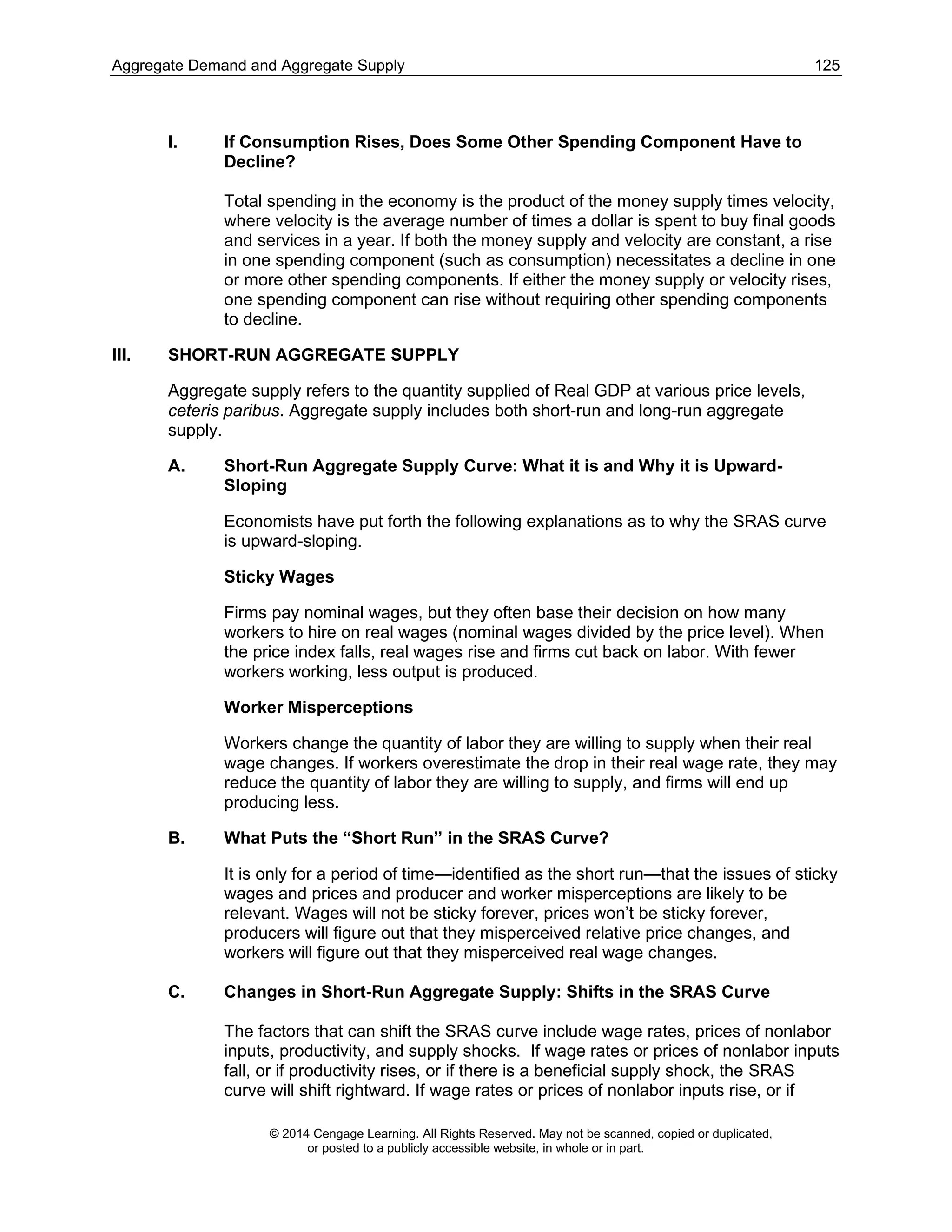
1. State the relationship between the price level and the quantity demanded of Real GDP.
2. Draw an AD curve. Label each axis.
3. List the reasons why the AD curve is sloped downward.
Assignment 8.2
Key Idea: There is a difference between a change in the quantity demanded of Real GDP and a
change in aggregate demand.
1. Explain the differences between a change in the quantity demanded of Real GDP and a
change in aggregate demand.
2. Graphically evaluate the difference between an increase in the quantity demanded of
Real GDP and an increase in aggregate demand.
3. Graphically evaluate the difference between a decrease in the quantity demanded of
Real GDP and a decrease in aggregate demand.
4. List the changes that would shift the AD curve rightward.
5. List the changes that would shift the AD curve leftward.
Assignment 8.3
Key Idea: Most economists would say that a change in the money supply would shift the AD
curve.
1. Give an explanation of how a change in the money supply will lead to a change in
aggregate demand.
Assignment 8.4
Key Idea: The economy has two sides. One side is the aggregate supply side.
Aggregate Demand and Aggregate Supply 129
© 2014 Cengage Learning. All Rights Reserved. May not be scanned, copied or duplicated,
or posted to a publicly accessible website, in whole or in part.
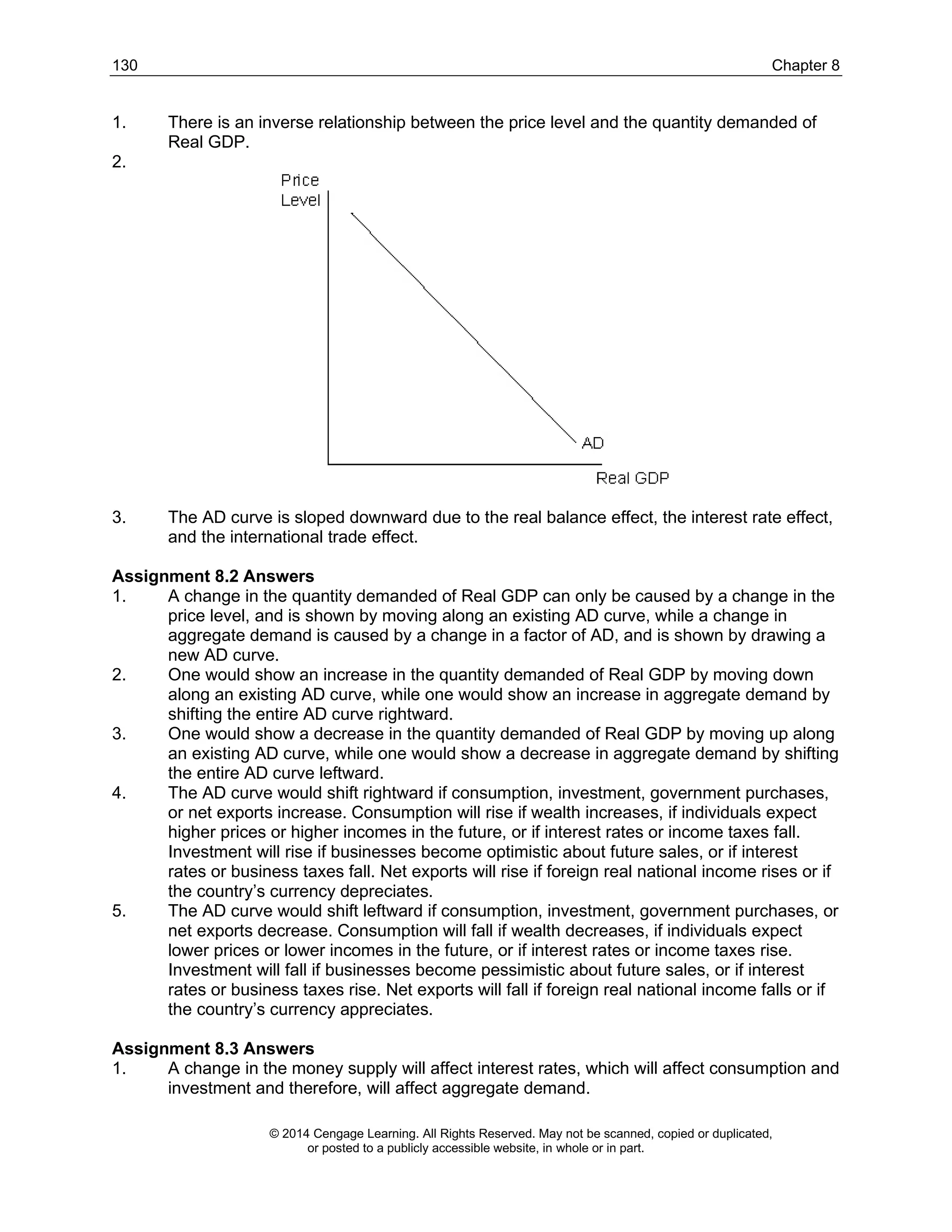
1. State the short run relationship between the price level and the quantity supplied of Real
GDP.
2. Draw an SRAS curve. Label each axis.
3. List the reasons why the SRAS curve is upward-sloping.
Assignment 8.5
Key Idea: There is a difference between moving along a given SRAS curve and shifting to a
new SRAS curve.
1. Name the one change that leads to a movement along a given SRAS curve.
2. List the changes that would will the SRAS curve rightward.
3. List the changes that would will the SRAS curve leftward.
Assignment 8.6
Key Idea: Economic forces will eliminate shortages and surpluses.
1. State what will happen to the price level when there is a surplus.
2. State what will happen to the price level when there is a shortage.
Assignment 8.7
Key Idea: A change in a factor of AD or a factor of SRAS (or both) will change the point of
equilibrium in a predictable way.
1. Tell what will happen to the price level, Real GDP, and the unemployment rate in the
following cases:
a. AD rises and SRAS is constant.
b. AD falls and SRAS is constant.
c. AD is constant and SRAS rises.
d. AD is constant and SRAS falls.
e. AD rises by more than SRAS rises.
f. AD rises by the same amount that SRAS rises.
g. AD rises by less than SRAS rises.
h. AD rises by more than SRAS falls.
i. AD rises by the same amount that SRAS falls.
j. AD rises by less than SRAS falls.
k. AD falls by more than SRAS rises.
l. AD falls by the same amount that SRAS rises.
m. AD falls by less than SRAS rises.
n. AD falls by more than SRAS falls.
o. AD falls by the same amount that SRAS falls.
p. AD falls by less than SRAS falls.
Assignment 8.8
Key Idea: Aggregate supply includes both short-run and long-run aggregate supply.
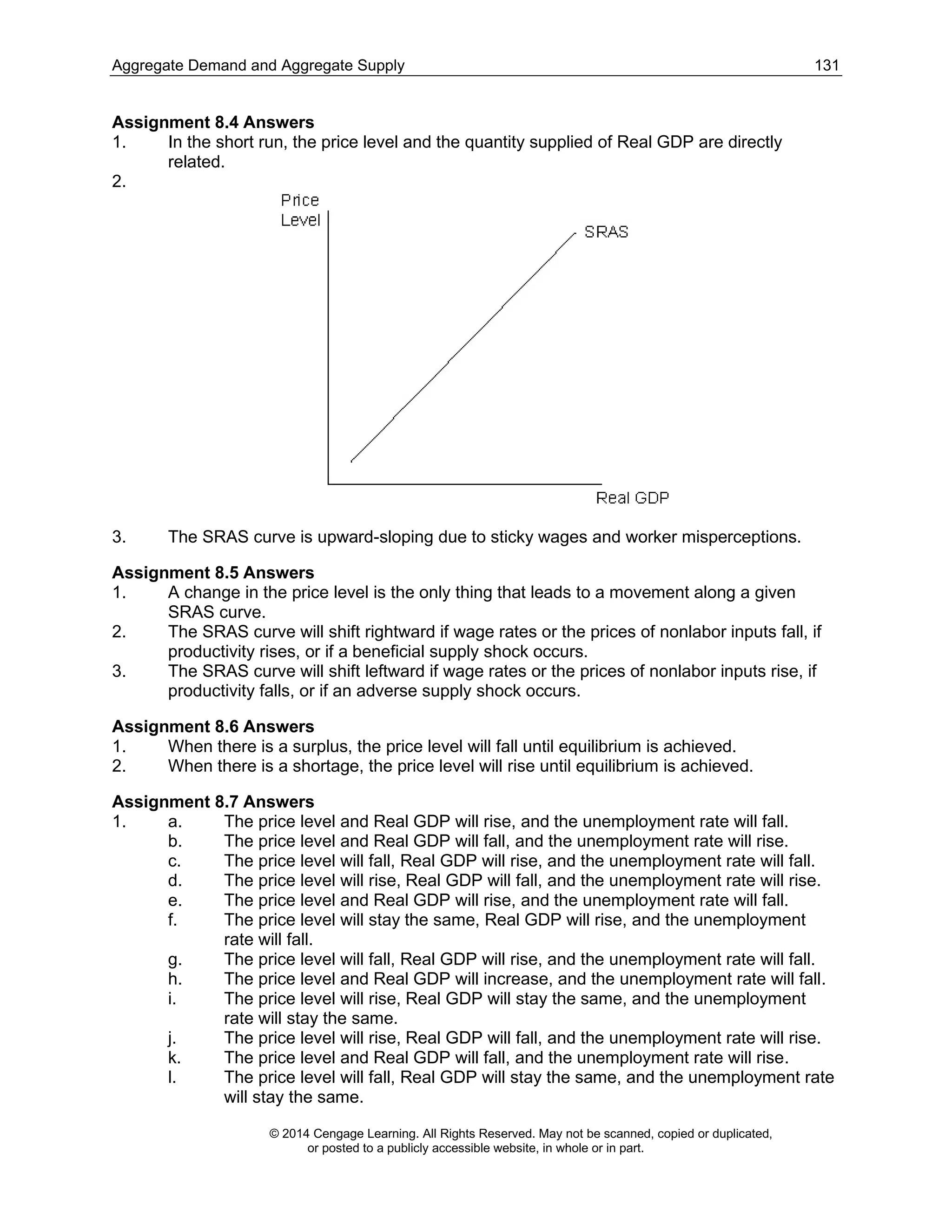
1. State the long run relationship between the price level and the quantity supplied of Real
GDP.
2. Draw an LRAS curve. Label each axis.
3. Explain why the LRAS curve is vertical.
4. Define the term “Natural Real GDP.”
◼ ANSWERS TO ASSIGNMENTS FOR MASTERING KEY IDEAS
Assignment 8.1 Answers
130 Chapter 8
© 2014 Cengage Learning. All Rights Reserved. May not be scanned, copied or duplicated,
or posted to a publicly accessible website, in whole or in part.
1. There is an inverse relationship between the price level and the quantity demanded of
Real GDP.
2.
3. The AD curve is sloped downward due to the real balance effect, the interest rate effect,
and the international trade effect.
Assignment 8.2 Answers
1. A change in the quantity demanded of Real GDP can only be caused by a change in the
price level, and is shown by moving along an existing AD curve, while a change in
aggregate demand is caused by a change in a factor of AD, and is shown by drawing a
new AD curve.
2. One would show an increase in the quantity demanded of Real GDP by moving down
along an existing AD curve, while one would show an increase in aggregate demand by
shifting the entire AD curve rightward.
3. One would show a decrease in the quantity demanded of Real GDP by moving up along
an existing AD curve, while one would show a decrease in aggregate demand by shifting
the entire AD curve leftward.
4. The AD curve would shift rightward if consumption, investment, government purchases,
or net exports increase. Consumption will rise if wealth increases, if individuals expect
higher prices or higher incomes in the future, or if interest rates or income taxes fall.
Investment will rise if businesses become optimistic about future sales, or if interest
rates or business taxes fall. Net exports will rise if foreign real national income rises or if
the country’s currency depreciates.
5. The AD curve would shift leftward if consumption, investment, government purchases, or
net exports decrease. Consumption will fall if wealth decreases, if individuals expect
lower prices or lower incomes in the future, or if interest rates or income taxes rise.
Investment will fall if businesses become pessimistic about future sales, or if interest
rates or business taxes rise. Net exports will fall if foreign real national income falls or if
the country’s currency appreciates.
Assignment 8.3 Answers
1. A change in the money supply will affect interest rates, which will affect consumption and
investment and therefore, will affect aggregate demand.
Aggregate Demand and Aggregate Supply 131
© 2014 Cengage Learning. All Rights Reserved. May not be scanned, copied or duplicated,
or posted to a publicly accessible website, in whole or in part.
Assignment 8.4 Answers
1. In the short run, the price level and the quantity supplied of Real GDP are directly
related.
2.
3. The SRAS curve is upward-sloping due to sticky wages and worker misperceptions.
Assignment 8.5 Answers
1. A change in the price level is the only thing that leads to a movement along a given
SRAS curve.
2. The SRAS curve will shift rightward if wage rates or the prices of nonlabor inputs fall, if
productivity rises, or if a beneficial supply shock occurs.
3. The SRAS curve will shift leftward if wage rates or the prices of nonlabor inputs rise, if
productivity falls, or if an adverse supply shock occurs.
Assignment 8.6 Answers
1. When there is a surplus, the price level will fall until equilibrium is achieved.
2. When there is a shortage, the price level will rise until equilibrium is achieved.
Assignment 8.7 Answers
1. a. The price level and Real GDP will rise, and the unemployment rate will fall.
b. The price level and Real GDP will fall, and the unemployment rate will rise.
c. The price level will fall, Real GDP will rise, and the unemployment rate will fall.
d. The price level will rise, Real GDP will fall, and the unemployment rate will rise.
e. The price level and Real GDP will rise, and the unemployment rate will fall.
f. The price level will stay the same, Real GDP will rise, and the unemployment
rate will fall.
g. The price level will fall, Real GDP will rise, and the unemployment rate will fall.
h. The price level and Real GDP will increase, and the unemployment rate will fall.
i. The price level will rise, Real GDP will stay the same, and the unemployment
rate will stay the same.
j. The price level will rise, Real GDP will fall, and the unemployment rate will rise.
k. The price level and Real GDP will fall, and the unemployment rate will rise.
l. The price level will fall, Real GDP will stay the same, and the unemployment rate
will stay the same.
132 Chapter 8
© 2014 Cengage Learning. All Rights Reserved. May not be scanned, copied or duplicated,
or posted to a publicly accessible website, in whole or in part.
. m. The price level will fall, Real GDP will rise, and the unemployment rate will fall.
n. The price level and Real GDP will fall, and the unemployment rate will rise.
o. The price level will stay the same, Real GDP will fall, and the unemployment rate
will rise.
p. The price level will rise, Real GDP will fall, and the unemployment rate will rise.
Assignment 8.8 Answers
1. In the long run, the price level and the quantity supplied of Real GDP are not related.
2.
3. The LRAS curve is vertical because wages and prices will eventually become unstuck
and misperceptions will turn into accurate perceptions.
4. Natural Real GDP (also called full-employment Real GDP) is the level of output the
economy produces in the long run.
◼ ANSWERS TO VIDEO QUESTIONS AND PROBLEMS
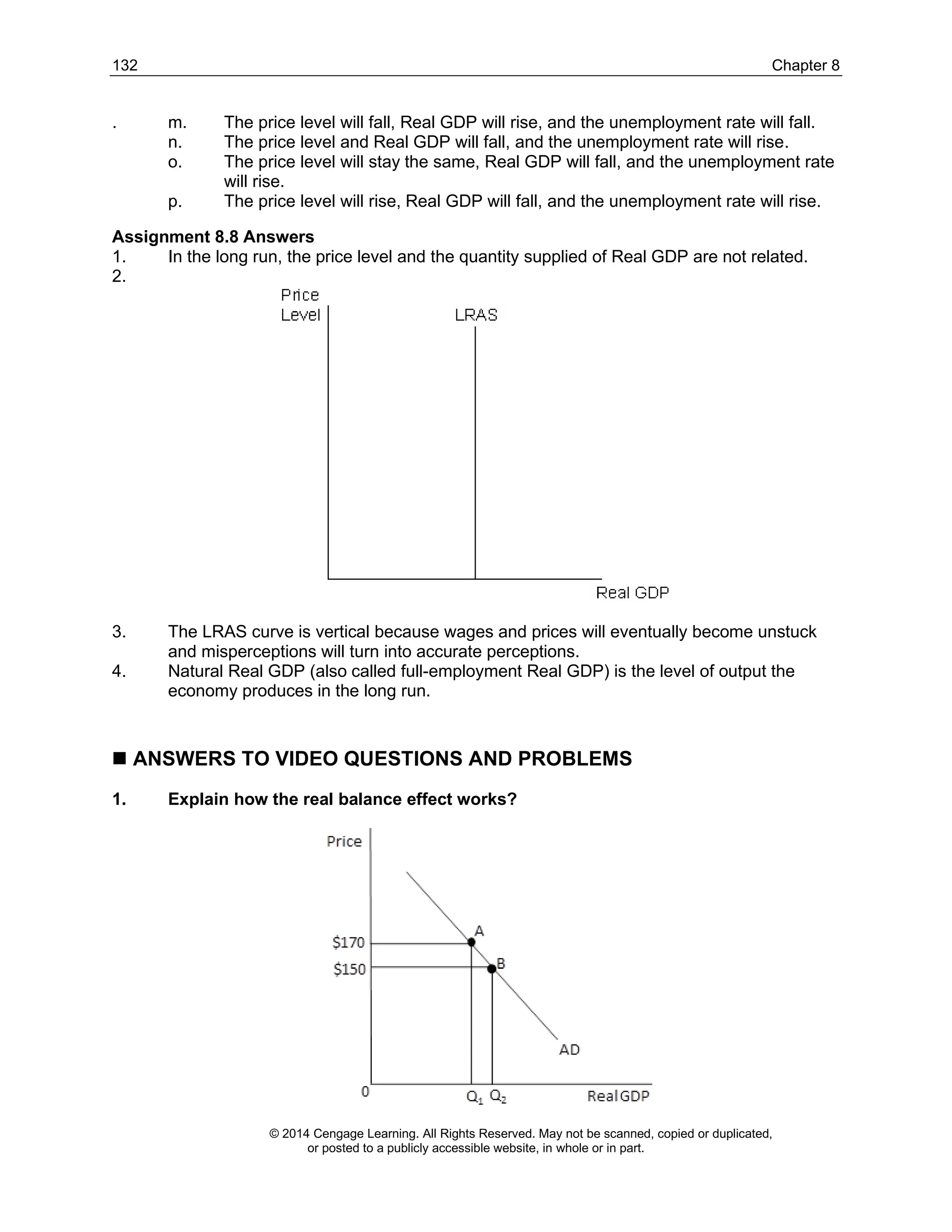
1. Explain how the real balance effect works?
Aggregate Demand and Aggregate Supply 133
© 2014 Cengage Learning. All Rights Reserved. May not be scanned, copied or duplicated,
or posted to a publicly accessible website, in whole or in part.
A fall in the price level causes purchasing power to rise, which increases a person’s monetary
wealth. As people become wealthier, they buy more goods and services and the quantity
demanded of Real GDP rises. A rise in the price level causes purchasing power to fall, which
decreases a person’s monetary wealth. As people become less wealthy, they buy fewer goods
and services and the quantity demanded of Real GDP falls.
2. Suppose that business taxes and wage rates decline and that any change in
aggregate demand is greater than any change in short-run aggregate supply.
Explain and diagrammatically represent the changes in the price level and Real
GDP in the short run.
When business taxes decrease, investment in the economy increases. Aggregate demand will
increase and the AD curve shifts to the right. When wages decrease, aggregate supply
increases and the AS curve shifts to the right. When the ΔAD is greater than the ΔAS, both the
equilibrium price and Real GDP increase.
3. How will either the AD curve or SRAS curve shift as a result of each of the
following changes:
a. A rise in the interest rate
b. An adverse supply shock
c. A rise in wealth
a. When the interest rate rises, both investment and consumption decrease. The AD curve
shifts to the left.
GDP
Price
Real GDP
0
AD1
AD2
Price
Real GDP
0
SRAS2
SRAS1
Price
Real GDP
0
AD2
AD1
(a) (b) (c)
134 Chapter 8
© 2014 Cengage Learning. All Rights Reserved. May not be scanned, copied or duplicated,
or posted to a publicly accessible website, in whole or in part.
b. When there is an adverse supply shock, short-run aggregate supply decreases. The
SRAS curve shifts to the left.
c. When there is a rise in wealth, consumption increases. The aggregate demand curve
shifts to the right.
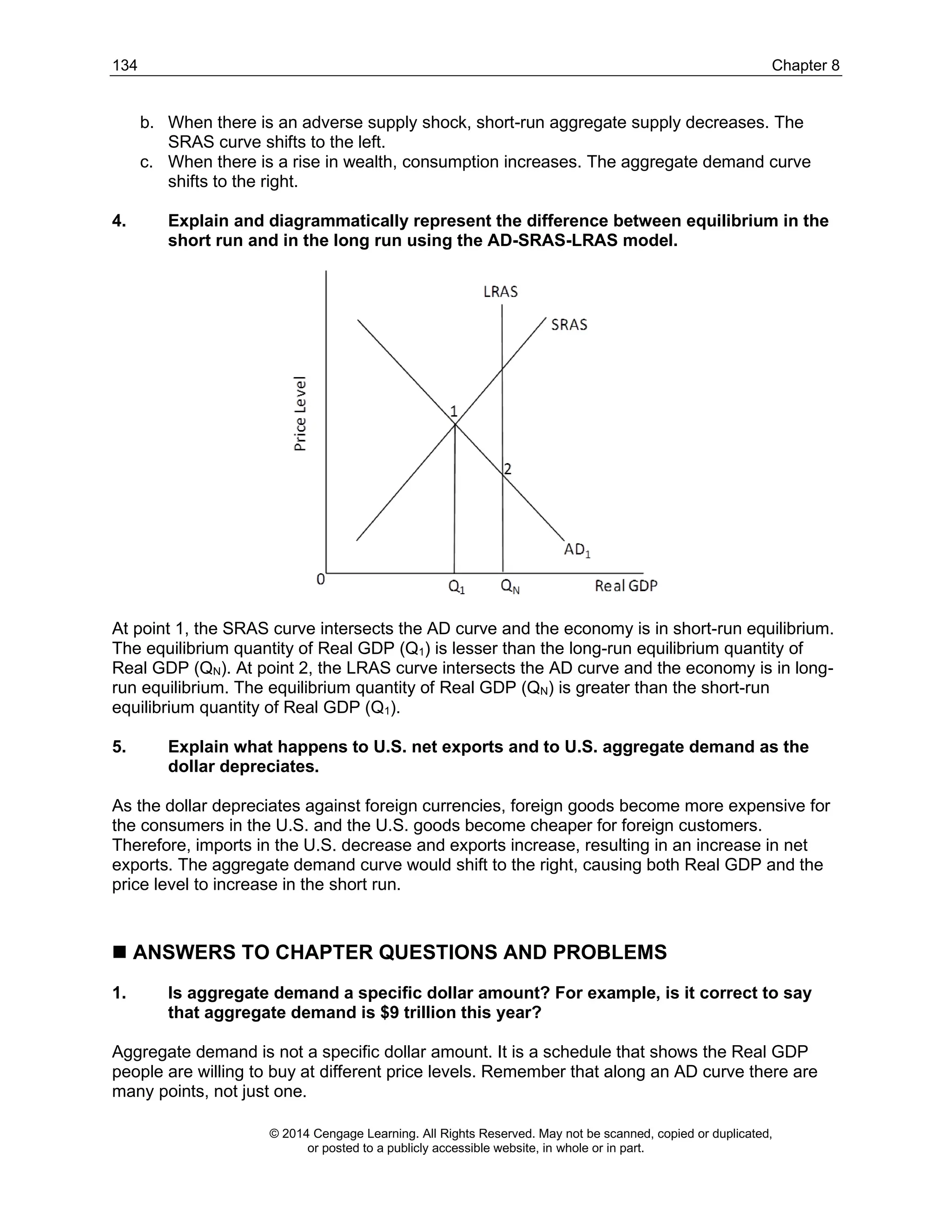
4. Explain and diagrammatically represent the difference between equilibrium in the
short run and in the long run using the AD-SRAS-LRAS model.
At point 1, the SRAS curve intersects the AD curve and the economy is in short-run equilibrium.
The equilibrium quantity of Real GDP (Q1) is lesser than the long-run equilibrium quantity of
Real GDP (QN). At point 2, the LRAS curve intersects the AD curve and the economy is in long-
run equilibrium. The equilibrium quantity of Real GDP (QN) is greater than the short-run
equilibrium quantity of Real GDP (Q1).
5. Explain what happens to U.S. net exports and to U.S. aggregate demand as the
dollar depreciates.
As the dollar depreciates against foreign currencies, foreign goods become more expensive for
the consumers in the U.S. and the U.S. goods become cheaper for foreign customers.
Therefore, imports in the U.S. decrease and exports increase, resulting in an increase in net
exports. The aggregate demand curve would shift to the right, causing both Real GDP and the
price level to increase in the short run.
◼ ANSWERS TO CHAPTER QUESTIONS AND PROBLEMS
1. Is aggregate demand a specific dollar amount? For example, is it correct to say
that aggregate demand is $9 trillion this year?
Aggregate demand is not a specific dollar amount. It is a schedule that shows the Real GDP
people are willing to buy at different price levels. Remember that along an AD curve there are
many points, not just one.
Aggregate Demand and Aggregate Supply 135
© 2014 Cengage Learning. All Rights Reserved. May not be scanned, copied or duplicated,
or posted to a publicly accessible website, in whole or in part.
2. Explain each of the following: (a) real balance effect, (b) interest rate effect, and (c)
international trade effect.
The real balance effect states that the inverse relationship between the price level and the
quantity demanded of Real GDP is established through changes in the value of monetary
wealth. As the price level changes, the purchasing power of monetary wealth changes, causing
the quantity demanded of Real GDP to change.
The interest rate effect states that the inverse relationship between the price level and the
quantity demanded of Real GDP is established through changes in household and business
spending that is sensitive to interest rate changes. As the price level changes, it takes a
different quantity of money to purchase a fixed bundle of goods, and this leads to a change in
savings (the supply of credit increases). Subsequently, the price of credit, which is the interest
rate, changes, causing households and businesses to change their borrowing levels, and
changing the quantity of Real GDP to change.
The international trade effect states that the inverse relationship between the price level and the
quantity demanded of Real GDP is established through foreign sector spending. As the price
level in the U.S. changes, U.S. goods become relatively cheaper or more expensive than
foreign goods. As a result, Americans and foreigners change the amounts of U.S. goods they
buy, changing the quantity of Real GDP to change.
3. Graphically portray each of the following: (a) a change in the quantity demanded
of Real GDP and (b) a change in aggregate demand.
A change in the quantity demanded is illustrated in Exhibit 4(a) of the text, and a change in
aggregate demand is illustrated in Exhibit 4(b).
4. There is a difference between a change in the interest rate that is brought about
by a change in the price level and a change in the interest rate that is brought
about by a change in some factor other than the price level. The first will change
the quantity demanded of Real GDP and the second will change in the AD curve.
Do you agree or disagree with this statement? Explain your answer.
Agree. Since the price level is shown on the vertical axis of an AD curve, any effect of a change
in the price level, such as the change in the interest rate that results from a change in
purchasing power from a change in the price level, will be shown by sliding along the AD curve
(which is referred to as a change in quantity demanded of Real GDP). If the interest rate
changes for any other reason, however, the entire AD curve will shift.
5. The amount of Real GDP (real output) that households are willing and able to buy
may change if there is a change in either (a) the price level, or (b) some nonprice
factor, such as wealth, interest rates, and the like. Do you agree or disagree?
Explain your answer.
Agree. Both a change in the price level and changes in nonprice factors could affect Real GDP;
however, a change in the price level would change the quantity demanded of Real GDP (shown
by sliding along an existing AD curve), and a change in a nonprice factor would cause a change
in aggregate demand (shown by shifting to a new AD curve).
136 Chapter 8
© 2014 Cengage Learning. All Rights Reserved. May not be scanned, copied or duplicated,
or posted to a publicly accessible website, in whole or in part.
6. Explain what happens to aggregate demand in each of the following cases: (a) The
interest rate rises; (b) Wealth falls; (c) The dollar depreciates relative to foreign
currencies; (d) Households expect lower prices in the future; (e) Business taxes
rise.
In examples (a), (b), (d), and (e), the aggregate demand curve would shift to the left, causing
both Real GDP and the price level to decrease in the short run. In (c), the aggregate demand
curve would shift to the right, causing both Real GDP and the price level to increase in the short
run.
7. Explain what is likely to happen to U.S. export and import spending as a result of
the dollar depreciating in value.
A depreciation of the U.S. dollar makes foreign goods more expensive for Americans and
American goods cheaper for foreigners. Therefore, U.S. exports will likely rise (foreigners will
buy more American goods since they are cheaper) and U.S. imports will likely fall (Americans
will buy fewer foreign goods since they are more expensive).
8. Explain how expectations about future prices and incomes will affect
consumption.
If individuals expect higher prices in the future, they increase current consumption expenditures
to buy goods at the lower current prices, and vice versa. If individuals expect higher incomes in
the future, they will loosen their purse strings today and increase current consumption
expenditures, and vice versa.
9. Explain how expectations about future sales will affect investment.
Businesses invest because they expect to sell the goods they produce. If they expect to sell
more goods in the future they will increase investment, and vice versa.
10. How will a change in the money supply affect aggregate demand?
A change in the money supply will change interest rates, which will change consumption and
investment, therefore changing aggregate demand.
11. Under what conditions can consumption rise without some other spending
component declining?
Consumption can rise without some other spending component declining if the money supply
rises and/or velocity rises.
12. Can total spending be a greater dollar amount than the money supply? Explain
your answer.
Total spending can be a greater dollar amount than the money supply as long as velocity is
greater than 1.
13. Will a direct increase in the price of U.S. goods relative to foreign goods lead to a
change in the quantity demanded of Real GDP or to a change in aggregate
demand? Will a change in the exchange rate that subsequently increases the price
Random documents with unrelated
content Scribd suggests to you:
b a t, bo d e e aga st ou g t
In this Lost Paradise of night.
And see—
Upflocking toward the canopy,
A-scurrying,
Those baffling forms that cling
And swarms of pudgy shapes that ride
In half-lights, side by side.
And was it chance that made
The Coral Garden’s gray arcade
And pillared it and set in place
Each tiny statuette and grotesque face;
And petrified the water-falls;
And hung the walls
And roofs of all the halls
With rows of frescoes—pendant, bright,
And gleaming like a starry night;
And made the sweetest chimes to ring—
We heard their clear notes echoing.
If it was chance, I didn’t find
It so. To me it seemed a master-mind
Was lurking there—some spirit born of endless night,
Transfusing each slow-dropping mite
Into a wonder-thing
By deft, fantastic fashioning.
Dick said
The place was uninhabited,
Except for a few bats
At times and some pack-rats
That nested near the mouth—but how could he
Tell what had been? To me
The place was just deserted—that was all!
Because we heard no laughter fall,
Nor voices ring,
Proved not a thing.
And when
The first intrusion came of mortal men,
There must have been a merry muss
And universal exodus
Down through those dark recesses there
And on to undiscovered regions where
No man may hope to go.
I would have witnessed such a show!
Those trooping little refugees
Of divers personalities
In babbling groups, by twos and threes,
With all their household goods—they must have moved
Them all—the fact is proved
Conclusively, as there’s no trace
Of such effects in any place.
Perhaps the Pix went first—
They’re fearsome, so I’ve heard, and cursed
With nerves. And then the Nixie crew,
The Pix’s shapely cousins who
Are beautiful—as Nixies go,
And no less slow
To move when trouble stirs the air.
Now comes a flare
Of lurid light—the rhythmic tramps
Of Gwelfs who bear their swinging lamps
Of cocobol;
A roll
Of music like bassoons—
The beating wings of Dragleloons,
Their patterned pinions show their sheen
And glow with iridescent green—
Out trails the light—a glint of scales
Gives hint of flashing, rainbow tails.
Now Master Goblin falls in line,
The chills are jumping in his spine
The chills are jumping in his spine,
His eyeballs bulge with speechless fear,
His mouth’s a slit from ear to ear.
He goes galumping in his boots;
Behind him thump the Dormizoots,
And then the Elves.
From all the crannies, nooks and shelves
The Wiffles come, and scrambling Wools,
And Blurbs and jibbering Gabools—
They stumble, tumble—now they run,
Each fumbles for the other one,
Mate calls for mate—
A seething flux conglomerate
Of cave-born entities.
They pant and grunt and squeak and wheeze,
They stampede, yell,
And chase pell-mell.
Through tortuous tunnels walled with light
The pigmy pageant makes its flight,
The last far turn is made,
The swinging flicker-flashes fade,
The clamor and the cries
Are dimmed—the babbling tumult dies.
The palace rooms are dark, the halls of state,
The Coral Gardens—all are desolate.
No music falls—
The conclaves and the carnivals,
The mystic rites,
The colors bathed in mellow lights,
The throbbing life and mirth
Of all this chambered, nether-earth
Are gone. Nor will one Elf return
To ring the crystal chimes or burn
Strange incense at the pillowed throne,
Because no Elf was ever known
To tread again where mortal man
Has been—nor any of the hybrid clan
Who must have scampered out of there
That day Elijah shot the bear.
HOBNOBBING WITH THE
FIRMAMENT
W
hen I was just a barefoot tike
I used to wonder what ’twas like
Up there—oh way, way up—as high
As all those screaming gulls could fly—
So white against the blue;
And where at evening too
The whippoorwills croaked, darted, swirled,
So far above my boyhood world.
Why, every youngster with two eyes
Has had his dreams about the skies—
My dreams have never quit
Although I’m getting on a bit,
So one day when it came, this chance,
I took it—over there in France.
Upholstered in
A furry skin—
I think ’twas sheep, the coat,
Or maybe cow or goat
And buckled snug round the throat,
With helmet, goggles—all the frills,
A bird-man to the very quills;
The hills are flat, the roads are streaks,
The rivers dwindle into creeks—
A crazy-quilt of gay brocades
And all the patches fields and glades.
And thus I stood—they laughed,
While I was photographed.
And out before the hangar there
Our gleaming Lizzie of the air—
A dragon-fly—just poised to stay
A moment here and then away.
A little nick dug in her side
Where one might stick a toe, then slide
Across the top and drop
Kerflop
With one more roll
Into the cockpit cubby-hole—
From here the young Observer chap
Snaps photographs and makes his map;
Since you have filled his place, you are
Lord High Observer of your car!
The first thing you observe is not
To let your feet or legs get caught
In all those shifts and sliding gears
And lifts with which the Pilot steers,
Yanks at the cranks and cable-things
That work the rudders and the wings;
And next, that life-belt should be placed
Just sort of loosely ’round the waist—
Superfluous no doubt,
But handy when you’re falling out.
The noisy motor spits and tugs
In little fits of chuggy-chugs,
With chuggy-chug—chug-chug—chug-chick,
Now chug and chick come double quick—
The stench of petrol it exhales
With reeking breath. The old prop’s flails,
Like some titanic tabby’s purr,
Churn ’round into a deafening whir
Churn round into a deafening whir.
Goliath! That’s the breed of her—
You’ll think so when you catch the stir
She kicks behind her in her wake
That moment when she starts to make
Her lovely take-off—once they’ve wheeled
Her into line upon the field!
The Pilot, turning, cries “All set?”
You grab like cripes and yell “You bet!”
The grinning ground-men wave good-bye,
And gathering speed, the dragon-fly
Moves on. The turf’s a blur—so swift
It flashes by. You feel no lift
And yet you rise—you only know
You float by seeing there below
The earth receding, while the air
Would gladly tear
The helmet from your goggled head.
You glimpse a house, a barn, a shed—
You only know them by their tops—
The profile way of seeing stops.
The hills are flat, the roads are streaks,
The rivers dwindle into creeks—
A crazy-quilt of gay brocades
And all the patches fields and glades.
And all around, the quilt is spanned
By vanishing horizon-land,
Where fading contours disappear
In wreaths of violet atmosphere
That gradually evolve into
That great inverted bowl of blue.
And are you dizzy? How absurd!
You’re not of earth—you are a bird.
You do not have that toppling feel
When all beneath you seemed to reel
e a be eat you see ed to ee
That day you peeped in timid fright
From some cathedral’s pigmy height;
You are afloat on gleaming wings,
Not propped up with terrestrial things.
But look! Hold fast! With wicked tilt
She’s swinging round. That crazy-quilt,
The spreading earth, has dropped from view—
Or so it seems somehow to you
Until your tangled vision sees
Fields and rivers, roads and trees,
Barns and houses—little town,
Smiling at you, looking down.
Another twist and there you view
The sprawling world out under you,
All right-side-up and in its place—
The play-ground of the human race—
Those insects whom you left to creep
And work and laugh and eat and sleep.
Perspectives do get twisted quite
In making one’s initial flight!
But swift! Low bridge! She mounts the loop!
You meet the onslaught with a stoop,
And with her upward-moving course,
You’re shoved against her with such force,
That little seat you’re sticking to
Seems fairly crushing into you.
Then just as quickly, all has ceased,
The sudden impact is released,
You clutch to keep from dropping now,
You clutch and wonder—marvel how
She slowly crawls across the top,
She almost stalls—you think she’ll stop!
You wonder just how long ’twould take
To make that trip should something break
Or slip,
Or should you loose your grip—
And if you’d strike a church or what—
Or just some pleasant garden spot;
Perhaps you hope a kindly fate
Would cause you to evaporate
Into an atmospheric state—
A sort of cosmic spirit-thing,
And thus take wing, just fluttering,
Up toward those pearly portals there,
So nonchalant and debonair—
Without all that formality
Of tumbling first into a tree!
But see! She’s found an even keel
At last. What joy to feel
That level glide—to know you’re still
On board—until,
Oh Lord! Another stunt!
You grab, you grunt,
But breathe you can’t,
Her nose has struck a fiendish slant!
That chuggy-chug—has it gone dead?
Or has the Pilot lost his head?
He does not swerve, his aim’s exact,
He’s Hell-bent for that timber-tract!
Oh were there ever, ever trees
With such a prickly look as these?
They’re coming closer up—and see,
They’re getting sharper—every tree!
Now look! She zooms! Agile she springs
Aloft with taut and straining wings.
In one great climb she squanders all
The power she gathered in her fall;
She leaves the woodlands in her wake
She leaves the woodlands in her wake,
She cuts across a marshy lake,
And dipping gently, circles round
Above the aviation ground,
Where field-mechanics stand about
To lend a hand and help you out—
To ask you how you liked to drop
Five thousand feet without a stop,
And if the loop was all you thought
A loop would likely be or not?
You thank them—tell them all how glad
You were to have the ride you had,
And then, a trifle limp and white,
With some slight loss of appetite,
And with two rather wobbly pegs
As proxies for your former legs,
You kick the turf up with your heel
To reassure yourself it’s real—
A little woozy still you feel,
A little dizzy—
And then you take one long, last look—at Lizzie!
Thus ends my tale—You’ve got it straight,
The way we teased and tempted fate,
Shook off this earthly dust and went
Hobnobbing with the firmament.
PEOPLE AND THINGS
HEARTH-GLOW
N
ow a man’s true heart is his home, I think,
And the hearth with the crackling pine,
With the leaping flames and the glowing stones,
Is somehow its inmost shrine.
And the stones must come from the river’s bed—
Softly colorful must they be,
Like the long-dulled rose and the faded green
Of an old-time tapestry.
And the light must fall with a fitful flare
On the logs in the lichened wall—
(Oh they must be trees where the squirrel’s shrill note
Once echoed the bluejay’s call.)
And the light will leap in the man’s dark eyes
From the flash of each burning brand,
And the man will know from its quickening touch,
The where of a woman’s hand.
And the fears that weighed till he grew afraid
Will be turned into nothingness
With the strength that comes from a tender word
And the warmth of a soft caress.
And the long-dreamed dreams of the un-lived days
Out over the rainbow’s rim—
They will be more real than the stuff of dreams
Through her wonderful faith in him.
And it’s this and that which the hearth gives back
In the glow of the crackling pine,
That endears the place to a man’s own soul
Till it’s somehow his inmost shrine.
THE WANT-AD OF MY SOUL
M
y need, which is my creed, I write upon this scroll—
Be pleased, oh gracious Lord, to heed the want-ad of my soul.
A cheer that does not lean upon digestion or the sun—
Supports itself and never asks a boost of any one.
To laugh whole-heartedly—or should ill-fortune crowd me in,
Cause me to smile—give me, oh Lord, at least the gift to grin.
Not quite too proud, oh Lord, to fight, but if the thing’s to do,
Then tutor me to battle clean—until the round is through.
If I have good to speak of men, then may that good be said—
Let me not hold like miser’s gold my say until they’re dead.
And Lord, I would be schooled to do with neither pomp nor fuss,
Some decent thing and yet not feel so thundering virtuous.
Should gossip drop around to claim my hospitality,
May I not send him forth again but bid him stop with me.
And if I have to fore-flush, Lord, to keep up with the brood
Of Fortune’s darlings, then give me the eagle’s solitude.
Make this almighty me to know that as I trudge along,
Perhaps once in ten thousand times I’m likely to be wrong;
And that by some miraculous, unprecedented flight
Of lucky stars that shelter him, my neighbor may be right.
Forbid it that my soul grow stale—let me not be defiled
Nor cloyed with surfeit—let me keep the ardor of a child.
Give me imagination, Lord, to see the unseen things—
To know the yonder, far-off feel that comes when some bird sings.
Help me to square with all the best traditions of my clan—
Make me, oh Lord, a regular, real, bang-up, manly man.
Give me imagination, Lord,
To see the unseen things—
To know the yonder, far-off feel
That comes when some bird sings.
THE BELL
I
am a cat and I am cruel!
But beautiful! My fur
Is soft. I have deep amber eyes
And a most pleasing purr.
I am a plaything for a child
To pinch or squeeze or pull
Or to adore with soft caress,
For I am beautiful.
I am a cat and I am cruel!
The upper Nile knew me,
Roaming and wild. Then hunters came,
I was no longer free.
For Egypt had great granaries,
So came a plague of rats,
They held us sacred like their gods
For Egypt needed cats.
I am a cat. Since Pharaoh’s day
I am what men call tame,
But deep in me the lust for gore
Is lurking just the same.
Stroke me, I purr—my claws relax,
I drowse—but for all that
The murderer in me sleeps not,
Sleeps not, for I’m a cat.
My mistress too is beautiful,
Blue-veined with snowy skin,
She smooths my fur and cuddles me
Close to her dainty chin.
An amorous perfume clings to
Her soft gown’s silken mesh—
I only want to smell her blood
And eat her pretty flesh!
I love to watch the agony
Of some affrighted thing,
Life ebbing scarlet, bit by bit,
Through my slow torturing.
I am a cat—this is my life,
To be a pet until
The age-long urge bestirs my soul
And I go forth to kill.
Through velvet black the paws of me
Touch oh so soft and noiselessly.
The burning amber of my eyes
Pierces the night; the rose-moon dies.
I hear a twitter in the vine,
My throat is parched—it craves red wine.
I lift a foot—and all is well
Until—until—I shake my bell!
For she has tied a bell on me,
A bell—a bell—a bell on me,
A tinkly bell to tell on me,
To tell—to tell—to tell on me;
The bell that foils each move I make,
The bell that tells my prey awake,
The single dingle jingle-bell
The little tittle-tattle bell,
The bell that holds my stroke in check,
The cursed bell around my neck.
GOSSIP
Y
ou’ve never heard Bill Sunday speak?
No more had I until last week.
Yes, every mother’s son
Was there—bar none,
And women folks—the kids all came
Just like it was a baseball game!
Up to the grove on Dobson’s Hill,
And there was Bill—
Thumpin’, jumpin’, hell-fire Bill
Right from his ranch to spill
Religion till we’d drunk our fill.
Well say,
Since Bill let loose that day
There’s not a kid ’round here for miles
But what can juggle more new styles
Of double-jointed, back-talk stuff
And compound cursin’ guff
Than they’d have picked up with their ears
In twenty years
From other folks. But to resume,
Bill started on the temperance boom!
Statistics? Gosh! Blood-curdlin’ tales—
He had ’em stacked ’round there in bales,
With starvin’ children, murdered wives,
And drunken males with guns and knives.
The way Bill talked you would have thought
Our Valley here had gone to pot
And ruin from the curse of drink.
But what I think
Is mostly wrong with this here place
Is just a simple case
Of scandal!
Why, drinkin’ doesn’t hold a candle
To all the dirty mess that’s stirred
To all the dirty mess that s stirred
With every slanderous word
That’s rolled along—and every time
It’s shoved a bit, it gathers slime.
When certain people get together
It ain’t the weather
Worries them! Not much! It’s who the heck
Deserves it hardest in the neck!
I’ve read somewhere how they could hear
A little whisper ringin’ clear
Across the dome
Of old St. Peter’s there in Rome.
Well, I have heard a whisper go
From Hillman’s ranch down there below
The base-line road, to Eric Lane’s
Then shoot across and hit MacGrain’s,
From where it kept on bouncin’ till
It struck the Hendricks on the hill,
Then glanced and hit our house kerzip,
Two days exactly on the trip!
Though whisperin’s good down there in Rome,
We’ve some acoustics here at home.
Accordin’ to Amanda Higgins,
Jim Gillan’s wild on Mrs. Wiggins;
That’s why Jim’s wife goes ’round so white
And frets her heart out day and night.
Accordin’ to Matilda Blink
“That teacher last year used to drink—
She roamed at will with Ruf MacGrore,
Who was immoral to the core;
That car Zeb Brinker bought for Blanche
Meant one more mortgage on their ranch,
While Hiram Tyler, he sets back
And drives the same old squeaky hack
And makes his wife and daughters face
d a es s e a d daug te s ace
Shame and disgrace—
Old Hiram who has laid away
Enough to pay
For twenty cars—
My stars!”
So runs the gospel link by link
Accordin’ to Matilda Blink.
Of course you can’t gainsay the claim
That some small flame
Of truth might be
Where gossip’s smoke blows ’round so free,
But oh the misery that’s begun
When each poor family skeleton
Is wakened from its peaceful trance
And made to dance
A shandigee
For all the blame community.
What’s wanted most around this place
Is supernatural grace.
If we could find
Some heavenly-antiseptic kind
Of moral mouth-wash that would take
A slanderous tongue and make
It CLEAN—and God knows there
Would have to be enough to spare
For all of us—both wives and men,
To take a gargle now and then—
If we could ever hope
To find that kind of dope,
Our little parson on the hill
As well as Bill,
Could save a precious pile
Of energy and rest a while.
LOVE’S LABOR LOST
J
ohn had the “con,” the Doctor said.
He stayed around the house and read
Most of the time or worked at such
Chores as would not exert him much
And slept on the veranda where
The Doctor thought was better air.
Each little thing the family knew
Would make him happier, they’d do.
“He won’t be with us long,” they’d say,
Then scrap and wrangle on, the way
That families do when rounding curves,
Each getting on the other’s nerves
With back-bite, spit-fire—loading full
The fleeting hours per usual.
At times of utmost unction, Bill
Would be the goat—on him they’d spill
The general peeve and blame. Bill stood
The gaff to help the common good.
One day Bill up and got the flu
And did what flu-folks sometimes do—
He died. Three days was all he took.
He lay there in a curtained nook;
It hit them sort of by surprise
To see him there with calm, closed eyes
And flowers all ’round and all so still.
They stood there looking down on Bill
And sobbed as families do when caught
So sudden like—they looked and thought
Of all the times they’d given him Hell;
And John—oh yes, poor John got well.
Welcome to our website – the perfect destination for book lovers and
knowledge seekers. We believe that every book holds a new world,
offering opportunities for learning, discovery, and personal growth.
That’s why we are dedicated to bringing you a diverse collection of
books, ranging from classic literature and specialized publications to
self-development guides and children's books.
More than just a book-buying platform, we strive to be a bridge
connecting you with timeless cultural and intellectual values. With an
elegant, user-friendly interface and a smart search system, you can
quickly find the books that best suit your interests. Additionally,
our special promotions and home delivery services help you save time
and fully enjoy the joy of reading.
Join us on a journey of knowledge exploration, passion nurturing, and
personal growth every day!
testbankfan.com


Macroeconomics 11th Edition Arnold Solutions Manual

  • 1.
    Macroeconomics 11th EditionArnold Solutions Manual download https://testbankfan.com/product/macroeconomics-11th-edition- arnold-solutions-manual/ Find test banks or solution manuals at testbankfan.com today!

  • 2.
    We have selectedsome products that you may be interested in Click the link to download now or visit testbankfan.com for more options!. Macroeconomics 11th Edition Arnold Test Bank https://testbankfan.com/product/macroeconomics-11th-edition-arnold- test-bank/ Macroeconomics 13th Edition Arnold Solutions Manual https://testbankfan.com/product/macroeconomics-13th-edition-arnold- solutions-manual/ Economics 11th Edition Arnold Solutions Manual https://testbankfan.com/product/economics-11th-edition-arnold- solutions-manual/ Effective Training 5th Edition Nick-Blanchard Test Bank https://testbankfan.com/product/effective-training-5th-edition-nick- blanchard-test-bank/
  • 3.
    Physics 4th EditionWalker Solutions Manual https://testbankfan.com/product/physics-4th-edition-walker-solutions- manual/ Environmental Science 15th Edition Miller Test Bank https://testbankfan.com/product/environmental-science-15th-edition- miller-test-bank/ Nutrition A Functional Approach Canadian 3rd Edition Thompson Solutions Manual https://testbankfan.com/product/nutrition-a-functional-approach- canadian-3rd-edition-thompson-solutions-manual/ Fundamentals of Organizational Behaviour Fifth Canadian Edition Canadian 5th Edition Langton Test Bank https://testbankfan.com/product/fundamentals-of-organizational- behaviour-fifth-canadian-edition-canadian-5th-edition-langton-test- bank/ Brunner and Suddarths Textbook of Medical Surgical Nursing 13th Edition Hinkle Test Bank https://testbankfan.com/product/brunner-and-suddarths-textbook-of- medical-surgical-nursing-13th-edition-hinkle-test-bank/
  • 4.
    Marketing Canadian 4thEdition Grewal Test Bank https://testbankfan.com/product/marketing-canadian-4th-edition-grewal- test-bank/
  • 5.
    122 © 2014 CengageLearning. All Rights Reserved. May not be scanned, copied or duplicated, or posted to a publicly accessible website, in whole or in part. CHAPTER 8 Aggregate Demand and Aggregate Supply Chapter 8 develops the aggregate demand-aggregate supply model of the economy that will be used to analyze the material in coming chapters. It examines aggregate demand and short-run aggregate supply (and the AD and SRAS curves) and the factors that affect them. It shows how changes in these factors lead to changes in the price level, Real GDP, and the unemployment rate. Finally, it defines the two equilibrium states in an economy—short-run and long-run equilibrium—and uses the AD, SRAS, and long-run aggregate supply (LRAS) curves to depict these states. ◼ KEY IDEAS 1. The economy has two sides. One side is the aggregate demand or the buying side. The other is the aggregate supply or producing side. 2. There is a difference between a change in the quantity demanded of Real GDP and a change in aggregate demand. 3. Most economists would say that a change in the money supply would shift the AD curve. 4. There is a difference between moving along a given SRAS curve and shifting to a new SRAS curve. 5. Economic forces will eliminate shortages and surpluses. 6. A change in a factor of AD or a factor of SRAS (or both) will change the point of market equilibrium in a predictable way. 7. Aggregate supply includes both short-run and long-run aggregates supply. ◼ CHAPTER OUTLINE I. A WAY TO VIEW THE ECONOMY The two sides to an economy are the buying side (aggregate demand) and the producing side (aggregate supply.) Production in the short run is called short-run aggregate supply (SRAS), while production in the long run is called long-run aggregate supply (LRAS). Economists often use the AD-AS framework of analysis to discuss the price level, GDP, Real GDP, unemployment, economic growth, and other major macroeconomic topics. The AD-AS framework has three parts: AD, SRAS, and LRAS. II. AGGREGATE DEMAND Aggregate demand refers to the quantity demanded of (U.S.) Real GDP, at various price levels, ceteris paribus. There is an inverse relationship between the price level and the quantity demanded of Real GDP. An AD curve is the graphical representation of AD.
  • 6.
    Aggregate Demand andAggregate Supply 123 © 2014 Cengage Learning. All Rights Reserved. May not be scanned, copied or duplicated, or posted to a publicly accessible website, in whole or in part. A. Why Does the Aggregate Demand Curve Slope Downward? The real balance effect, the interest rate effect, and the international trade effect explain the inverse relationship between the price level and the quantity demanded of Real GDP. Real Balance Effect (Due to a Change in the Price Level) The real balance effect states that the inverse relationship is established through changes in the value of monetary wealth. As the price level changes, the purchasing power of monetary wealth changes, causing the quantity demanded of Real GDP to change. Interest Rate Effect (Due to a Change in the Price Level) The interest rate effect states that the inverse relationship is established through changes in household and business spending that is sensitive to interest rate changes. As the price level changes, it takes a different quantity of money to purchase a fixed bundle of goods, and this leads to a change in savings (the supply of credit increases). Subsequently, the price of credit, which is the interest rate, changes, causing households and businesses to change their borrowing levels, and changing the quantity of Real GDP to change. International Trade Effect (Due to a Change in the Price Level) The international trade effect states that the inverse relationship is established through foreign sector spending. As the price level in the U.S. changes, U.S. goods become relatively cheaper or more expensive than foreign goods. As a result, Americans and foreigners change the amounts of U.S. goods they buy, changing the quantity of Real GDP to change. B. An Important Word on the Three Effects Remember that a change in the price level causes each of these three effects. This is important since some other things can also cause the interest rate to change, and not everything that causes the interest rate to change leads to a movement from one point to another along the AD curve. C. A Change in the Quantity Demanded of Real GDP Versus a Change in Aggregate Demand There is a difference between a change in the quantity demanded of Real GDP and a change in aggregate demand. A change in the quantity demanded of Real GDP is brought about by a change in the price level and is shown by moving from one point on another point on an AD curve, while a change in AD is brought about by a change in a factor of AD and is shown by shifting the entire AD curve. D. Changes in Aggregate Demand: Shifts in the AD Curve If spending on U.S. goods by U.S. residents, firms, governments, or foreigners increases at a given price level, then AD rises (shifts rightward). If spending on U.S. goods by U.S. residents, firms, governments, or foreigners decreases at a given price level, then AD falls (shifts leftward).


  • 7.
    124 Chapter 8 ©2014 Cengage Learning. All Rights Reserved. May not be scanned, copied or duplicated, or posted to a publicly accessible website, in whole or in part. E. How Spending Components Affect Aggregate Demand Total expenditures on U.S. goods and services is the sum of consumption, investment, government purchases and net exports. If, at a given price level, one of these components rises, then spending on U.S. goods and services will rise. If, at a given price level, one of these components falls, then spending on U.S. goods and services will fall. F. Why is There More Total Spending? Total spending can rise for one of two reasons. The first deals with a decline in prices and leads to a movement along a given AD curve. The second deals with a change in some factor other than prices and leads to a shift in the AD curve G. Factors That Can Change C, I, G, and NX (EX – IM) and Therefore Can Change AD (Shift the AD Curve) Consumption Changes in wealth, expectations about future prices and income, the interest rate, or income taxes will cause consumption to change and therefore shift the AD curve. If wealth rises, the interest rate falls, income taxes fall, or consumers expect higher prices or incomes in the future, consumption will rise and the AD curve will shift rightward. If wealth falls, the interest rate falls, income taxes fall, or consumers expect lower prices or incomes in the future, consumption will fall and the AD curve will shift leftward. Investment Changes in the interest rate, expectations about future sales, and business taxes will cause investment to change and therefore shift the AD curve. If the interest rate falls, business taxes fall, or if businesses become optimistic about future sales, investment will rise and the AD curve will shift rightward. If the interest rate rises, business taxes rise, or if businesses become pessimistic about future sales, investment will rise and the AD curve will shift rightward. Net Exports Changes in foreign real national income and the exchange rate will cause net exports to change and therefore shift the AD curve. If foreign real national income rises, then U.S. exports will rise, causing U.S. net exports to rise and the AD curve will shift rightward, and vice versa. If the dollar depreciates, U.S. exports will rise and U.S. imports will fall, causing U.S. net exports to rise and the AD curve will shift rightward, and vice versa. H. Can a Change in the Money Supply Change Aggregate Demand? Most economists would say that a change in the money supply will shift the AD curve. One way to explain the effect is to say a change in the money supply affects interest rates, causing changes in consumption and investment, which affects aggregate demand.
  • 8.
    Aggregate Demand andAggregate Supply 125 © 2014 Cengage Learning. All Rights Reserved. May not be scanned, copied or duplicated, or posted to a publicly accessible website, in whole or in part. I. If Consumption Rises, Does Some Other Spending Component Have to Decline? Total spending in the economy is the product of the money supply times velocity, where velocity is the average number of times a dollar is spent to buy final goods and services in a year. If both the money supply and velocity are constant, a rise in one spending component (such as consumption) necessitates a decline in one or more other spending components. If either the money supply or velocity rises, one spending component can rise without requiring other spending components to decline. III. SHORT-RUN AGGREGATE SUPPLY Aggregate supply refers to the quantity supplied of Real GDP at various price levels, ceteris paribus. Aggregate supply includes both short-run and long-run aggregate supply. A. Short-Run Aggregate Supply Curve: What it is and Why it is Upward- Sloping Economists have put forth the following explanations as to why the SRAS curve is upward-sloping. Sticky Wages Firms pay nominal wages, but they often base their decision on how many workers to hire on real wages (nominal wages divided by the price level). When the price index falls, real wages rise and firms cut back on labor. With fewer workers working, less output is produced. Worker Misperceptions Workers change the quantity of labor they are willing to supply when their real wage changes. If workers overestimate the drop in their real wage rate, they may reduce the quantity of labor they are willing to supply, and firms will end up producing less. B. What Puts the “Short Run” in the SRAS Curve? It is only for a period of time—identified as the short run—that the issues of sticky wages and prices and producer and worker misperceptions are likely to be relevant. Wages will not be sticky forever, prices won’t be sticky forever, producers will figure out that they misperceived relative price changes, and workers will figure out that they misperceived real wage changes. C. Changes in Short-Run Aggregate Supply: Shifts in the SRAS Curve The factors that can shift the SRAS curve include wage rates, prices of nonlabor inputs, productivity, and supply shocks. If wage rates or prices of nonlabor inputs fall, or if productivity rises, or if there is a beneficial supply shock, the SRAS curve will shift rightward. If wage rates or prices of nonlabor inputs rise, or if
  • 9.
    126 Chapter 8 ©2014 Cengage Learning. All Rights Reserved. May not be scanned, copied or duplicated, or posted to a publicly accessible website, in whole or in part. productivity falls, or if there is an adverse supply shock, the SRAS curve will shift leftward. D. Something More to Come: People’s Expectations In Chapter 16 we will add another factor that can shift the SRAS curve—the expected price level. IV. PUTTING AD AND SRAS TOGETHER: SHORT-RUN EQUILIBRIUM Aggregate demand and short-run aggregate supply determine the price level, Real GDP, and the unemployment rate in the short run. A. How Short-Run Equilibrium in the Economy is Achieved In instances of both surplus and shortage, economic forces move the economy towards the point of short-run equilibrium where the quantity demanded of Real GDP equals the short-run quantity supplied of Real GDP. A change in AD or SRAS or both will affect the price level and/or Real GDP. B. Thinking in Terms of Short-Run Equilibrium Changes in the Economy To a large degree, economists naturally think in terms of flow charts. Economics is about establishing a connection or link between an effect (such as a fall in Real GDP) and a correct cause (such as an adverse supply shock that shifts the SRAS curve to the left). If a factor change shifts AD rightward, the price level and Real GDP will rise and the unemployment rate will fall. If a factor change shifts AD leftward, the price level and Real GDP will fall and the unemployment rate will rise. If a factor change shifts SRAS rightward, the price level will fall, Real GDP will rise, and the unemployment rate will fall. If a factor change shifts SRAS leftward, the price level will rise, Real GDP will fall and the unemployment rate will rise. C. An Important Exhibit Exhibit 13 in the text brings together much of the material discussed in this chapter. V. Long-Run Aggregate Supply A. Going from the Short Run to the Long Run Short-run equilibrium identifies the Real GDP the economy produces when wages are sticky or when there are worker misperceptions. In time, though, wages will become unstuck and misperceptions will turn into accurate perceptions. When this happens, the economy is said to be in the long run. Most economists argue that in the long run, the economy produces the full- employment Real GDP or the Natural Real GDP, which is identified by the long- run aggregate supply (LRAS) curve.
  • 10.
    Aggregate Demand andAggregate Supply 127 © 2014 Cengage Learning. All Rights Reserved. May not be scanned, copied or duplicated, or posted to a publicly accessible website, in whole or in part. Long-run equilibrium identifies the level of Real GDP the economy produces when wages and prices have adjusted to their (final) equilibrium levels and there are no misperceptions. This occurs at the intersection of the AD and LRAS curves. B. Short-Run Equilibrium, Long-Run Equilibrium, and Disequilibrium There are two equilibrium states in an economy—short-run equilibrium and long- run equilibrium. In short-run equilibrium, quantity supplied and demanded of Real GDP are either more than or less than Natural Real GDP. When the economy is in neither short-run equilibrium nor long-run equilibrium, it is said to be in disequilibrium. ◼ TEACHING ADVICE 1. Many principles instructors rely on multiple-choice exams, especially if they teach large sections. However, it is critically important for students to actually learn to pick up a pencil and draw the graphs for aggregate supply and aggregate demand shifts. The AD and SRAS Quiz (in two versions below) is designed to accomplish the goal of requiring students to draw while imposing minimal costs on graders (especially if no partial credit is given). This quiz takes, at most, 30 minutes of class time to administer. For immediate feedback, have students remain seated after they finish their quiz, and then show the students the key after collecting their quiz papers. 2. Have your students go to http://www.federalreserve.gov/releases/h15/data.htm to see how various interest rates have changed over the last two or three years. Use the data as a springboard for discussing how to show these changes using the AD curve. If the interest rate changes are due to price level changes, then we would see a movement along the existing AD curve. If, on the other hand, the interest rate changes occur for other reasons, then we would see a shift to a new AD curve. You may also want to visit www.bls.gov/cpi to see how the price level (as measured by the CPI) has changed over the period in question. If the price level has been fairly constant then you could conclude that interest rate changes would shift the AD curve. 3. The SRAS curve shows the level of actual production at each price level. The AD curve shows what consumers, firms, the government, and foreigners plan to buy. Use the following graph to relate the SRAS curve to the expenditures approach to measuring Real GDP from Chapter 7. PC is the equilibrium price level because the amount of output that firms produce is equal to the amount of output that consumers, firms, the government, and foreigners plan to buy. At a price level above equilibrium like PA, firms produce Real GDP equal to Q2, while consumers, firms, the government, and foreigners only plan to buy Q1. (Q2 – Q1) represents unplanned spending by firms on inventory (in essence, firms “buy” the output that they cannot sell to others). At a price level below equilibrium like PB, firms produce Real GDP equal to Q1, while consumers, firms, the government, and foreigners buy Q2
  • 11.
    128 Chapter 8 ©2014 Cengage Learning. All Rights Reserved. May not be scanned, copied or duplicated, or posted to a publicly accessible website, in whole or in part. units of output. (Q2 – Q1) units were produced in some previous year (and represent unplanned inventory depletion). ◼ ASSIGNMENTS FOR MASTERING KEY IDEAS Assignment 8.1 Key Idea: The economy has two sides. One side is the aggregate demand side. 1. State the relationship between the price level and the quantity demanded of Real GDP. 2. Draw an AD curve. Label each axis. 3. List the reasons why the AD curve is sloped downward. Assignment 8.2 Key Idea: There is a difference between a change in the quantity demanded of Real GDP and a change in aggregate demand. 1. Explain the differences between a change in the quantity demanded of Real GDP and a change in aggregate demand. 2. Graphically evaluate the difference between an increase in the quantity demanded of Real GDP and an increase in aggregate demand. 3. Graphically evaluate the difference between a decrease in the quantity demanded of Real GDP and a decrease in aggregate demand. 4. List the changes that would shift the AD curve rightward. 5. List the changes that would shift the AD curve leftward. Assignment 8.3 Key Idea: Most economists would say that a change in the money supply would shift the AD curve. 1. Give an explanation of how a change in the money supply will lead to a change in aggregate demand. Assignment 8.4 Key Idea: The economy has two sides. One side is the aggregate supply side.
  • 12.
    Aggregate Demand andAggregate Supply 129 © 2014 Cengage Learning. All Rights Reserved. May not be scanned, copied or duplicated, or posted to a publicly accessible website, in whole or in part. 1. State the short run relationship between the price level and the quantity supplied of Real GDP. 2. Draw an SRAS curve. Label each axis. 3. List the reasons why the SRAS curve is upward-sloping. Assignment 8.5 Key Idea: There is a difference between moving along a given SRAS curve and shifting to a new SRAS curve. 1. Name the one change that leads to a movement along a given SRAS curve. 2. List the changes that would will the SRAS curve rightward. 3. List the changes that would will the SRAS curve leftward. Assignment 8.6 Key Idea: Economic forces will eliminate shortages and surpluses. 1. State what will happen to the price level when there is a surplus. 2. State what will happen to the price level when there is a shortage. Assignment 8.7 Key Idea: A change in a factor of AD or a factor of SRAS (or both) will change the point of equilibrium in a predictable way. 1. Tell what will happen to the price level, Real GDP, and the unemployment rate in the following cases: a. AD rises and SRAS is constant. b. AD falls and SRAS is constant. c. AD is constant and SRAS rises. d. AD is constant and SRAS falls. e. AD rises by more than SRAS rises. f. AD rises by the same amount that SRAS rises. g. AD rises by less than SRAS rises. h. AD rises by more than SRAS falls. i. AD rises by the same amount that SRAS falls. j. AD rises by less than SRAS falls. k. AD falls by more than SRAS rises. l. AD falls by the same amount that SRAS rises. m. AD falls by less than SRAS rises. n. AD falls by more than SRAS falls. o. AD falls by the same amount that SRAS falls. p. AD falls by less than SRAS falls. Assignment 8.8 Key Idea: Aggregate supply includes both short-run and long-run aggregate supply. 1. State the long run relationship between the price level and the quantity supplied of Real GDP. 2. Draw an LRAS curve. Label each axis. 3. Explain why the LRAS curve is vertical. 4. Define the term “Natural Real GDP.” ◼ ANSWERS TO ASSIGNMENTS FOR MASTERING KEY IDEAS Assignment 8.1 Answers
  • 13.
    130 Chapter 8 ©2014 Cengage Learning. All Rights Reserved. May not be scanned, copied or duplicated, or posted to a publicly accessible website, in whole or in part. 1. There is an inverse relationship between the price level and the quantity demanded of Real GDP. 2. 3. The AD curve is sloped downward due to the real balance effect, the interest rate effect, and the international trade effect. Assignment 8.2 Answers 1. A change in the quantity demanded of Real GDP can only be caused by a change in the price level, and is shown by moving along an existing AD curve, while a change in aggregate demand is caused by a change in a factor of AD, and is shown by drawing a new AD curve. 2. One would show an increase in the quantity demanded of Real GDP by moving down along an existing AD curve, while one would show an increase in aggregate demand by shifting the entire AD curve rightward. 3. One would show a decrease in the quantity demanded of Real GDP by moving up along an existing AD curve, while one would show a decrease in aggregate demand by shifting the entire AD curve leftward. 4. The AD curve would shift rightward if consumption, investment, government purchases, or net exports increase. Consumption will rise if wealth increases, if individuals expect higher prices or higher incomes in the future, or if interest rates or income taxes fall. Investment will rise if businesses become optimistic about future sales, or if interest rates or business taxes fall. Net exports will rise if foreign real national income rises or if the country’s currency depreciates. 5. The AD curve would shift leftward if consumption, investment, government purchases, or net exports decrease. Consumption will fall if wealth decreases, if individuals expect lower prices or lower incomes in the future, or if interest rates or income taxes rise. Investment will fall if businesses become pessimistic about future sales, or if interest rates or business taxes rise. Net exports will fall if foreign real national income falls or if the country’s currency appreciates. Assignment 8.3 Answers 1. A change in the money supply will affect interest rates, which will affect consumption and investment and therefore, will affect aggregate demand.
  • 14.
    Aggregate Demand andAggregate Supply 131 © 2014 Cengage Learning. All Rights Reserved. May not be scanned, copied or duplicated, or posted to a publicly accessible website, in whole or in part. Assignment 8.4 Answers 1. In the short run, the price level and the quantity supplied of Real GDP are directly related. 2. 3. The SRAS curve is upward-sloping due to sticky wages and worker misperceptions. Assignment 8.5 Answers 1. A change in the price level is the only thing that leads to a movement along a given SRAS curve. 2. The SRAS curve will shift rightward if wage rates or the prices of nonlabor inputs fall, if productivity rises, or if a beneficial supply shock occurs. 3. The SRAS curve will shift leftward if wage rates or the prices of nonlabor inputs rise, if productivity falls, or if an adverse supply shock occurs. Assignment 8.6 Answers 1. When there is a surplus, the price level will fall until equilibrium is achieved. 2. When there is a shortage, the price level will rise until equilibrium is achieved. Assignment 8.7 Answers 1. a. The price level and Real GDP will rise, and the unemployment rate will fall. b. The price level and Real GDP will fall, and the unemployment rate will rise. c. The price level will fall, Real GDP will rise, and the unemployment rate will fall. d. The price level will rise, Real GDP will fall, and the unemployment rate will rise. e. The price level and Real GDP will rise, and the unemployment rate will fall. f. The price level will stay the same, Real GDP will rise, and the unemployment rate will fall. g. The price level will fall, Real GDP will rise, and the unemployment rate will fall. h. The price level and Real GDP will increase, and the unemployment rate will fall. i. The price level will rise, Real GDP will stay the same, and the unemployment rate will stay the same. j. The price level will rise, Real GDP will fall, and the unemployment rate will rise. k. The price level and Real GDP will fall, and the unemployment rate will rise. l. The price level will fall, Real GDP will stay the same, and the unemployment rate will stay the same.
  • 15.
    132 Chapter 8 ©2014 Cengage Learning. All Rights Reserved. May not be scanned, copied or duplicated, or posted to a publicly accessible website, in whole or in part. . m. The price level will fall, Real GDP will rise, and the unemployment rate will fall. n. The price level and Real GDP will fall, and the unemployment rate will rise. o. The price level will stay the same, Real GDP will fall, and the unemployment rate will rise. p. The price level will rise, Real GDP will fall, and the unemployment rate will rise. Assignment 8.8 Answers 1. In the long run, the price level and the quantity supplied of Real GDP are not related. 2. 3. The LRAS curve is vertical because wages and prices will eventually become unstuck and misperceptions will turn into accurate perceptions. 4. Natural Real GDP (also called full-employment Real GDP) is the level of output the economy produces in the long run. ◼ ANSWERS TO VIDEO QUESTIONS AND PROBLEMS 1. Explain how the real balance effect works?
  • 16.
    Aggregate Demand andAggregate Supply 133 © 2014 Cengage Learning. All Rights Reserved. May not be scanned, copied or duplicated, or posted to a publicly accessible website, in whole or in part. A fall in the price level causes purchasing power to rise, which increases a person’s monetary wealth. As people become wealthier, they buy more goods and services and the quantity demanded of Real GDP rises. A rise in the price level causes purchasing power to fall, which decreases a person’s monetary wealth. As people become less wealthy, they buy fewer goods and services and the quantity demanded of Real GDP falls. 2. Suppose that business taxes and wage rates decline and that any change in aggregate demand is greater than any change in short-run aggregate supply. Explain and diagrammatically represent the changes in the price level and Real GDP in the short run. When business taxes decrease, investment in the economy increases. Aggregate demand will increase and the AD curve shifts to the right. When wages decrease, aggregate supply increases and the AS curve shifts to the right. When the ΔAD is greater than the ΔAS, both the equilibrium price and Real GDP increase. 3. How will either the AD curve or SRAS curve shift as a result of each of the following changes: a. A rise in the interest rate b. An adverse supply shock c. A rise in wealth a. When the interest rate rises, both investment and consumption decrease. The AD curve shifts to the left. GDP Price Real GDP 0 AD1 AD2 Price Real GDP 0 SRAS2 SRAS1 Price Real GDP 0 AD2 AD1 (a) (b) (c)
  • 17.
    134 Chapter 8 ©2014 Cengage Learning. All Rights Reserved. May not be scanned, copied or duplicated, or posted to a publicly accessible website, in whole or in part. b. When there is an adverse supply shock, short-run aggregate supply decreases. The SRAS curve shifts to the left. c. When there is a rise in wealth, consumption increases. The aggregate demand curve shifts to the right. 4. Explain and diagrammatically represent the difference between equilibrium in the short run and in the long run using the AD-SRAS-LRAS model. At point 1, the SRAS curve intersects the AD curve and the economy is in short-run equilibrium. The equilibrium quantity of Real GDP (Q1) is lesser than the long-run equilibrium quantity of Real GDP (QN). At point 2, the LRAS curve intersects the AD curve and the economy is in long- run equilibrium. The equilibrium quantity of Real GDP (QN) is greater than the short-run equilibrium quantity of Real GDP (Q1). 5. Explain what happens to U.S. net exports and to U.S. aggregate demand as the dollar depreciates. As the dollar depreciates against foreign currencies, foreign goods become more expensive for the consumers in the U.S. and the U.S. goods become cheaper for foreign customers. Therefore, imports in the U.S. decrease and exports increase, resulting in an increase in net exports. The aggregate demand curve would shift to the right, causing both Real GDP and the price level to increase in the short run. ◼ ANSWERS TO CHAPTER QUESTIONS AND PROBLEMS 1. Is aggregate demand a specific dollar amount? For example, is it correct to say that aggregate demand is $9 trillion this year? Aggregate demand is not a specific dollar amount. It is a schedule that shows the Real GDP people are willing to buy at different price levels. Remember that along an AD curve there are many points, not just one.
  • 18.
    Aggregate Demand andAggregate Supply 135 © 2014 Cengage Learning. All Rights Reserved. May not be scanned, copied or duplicated, or posted to a publicly accessible website, in whole or in part. 2. Explain each of the following: (a) real balance effect, (b) interest rate effect, and (c) international trade effect. The real balance effect states that the inverse relationship between the price level and the quantity demanded of Real GDP is established through changes in the value of monetary wealth. As the price level changes, the purchasing power of monetary wealth changes, causing the quantity demanded of Real GDP to change. The interest rate effect states that the inverse relationship between the price level and the quantity demanded of Real GDP is established through changes in household and business spending that is sensitive to interest rate changes. As the price level changes, it takes a different quantity of money to purchase a fixed bundle of goods, and this leads to a change in savings (the supply of credit increases). Subsequently, the price of credit, which is the interest rate, changes, causing households and businesses to change their borrowing levels, and changing the quantity of Real GDP to change. The international trade effect states that the inverse relationship between the price level and the quantity demanded of Real GDP is established through foreign sector spending. As the price level in the U.S. changes, U.S. goods become relatively cheaper or more expensive than foreign goods. As a result, Americans and foreigners change the amounts of U.S. goods they buy, changing the quantity of Real GDP to change. 3. Graphically portray each of the following: (a) a change in the quantity demanded of Real GDP and (b) a change in aggregate demand. A change in the quantity demanded is illustrated in Exhibit 4(a) of the text, and a change in aggregate demand is illustrated in Exhibit 4(b). 4. There is a difference between a change in the interest rate that is brought about by a change in the price level and a change in the interest rate that is brought about by a change in some factor other than the price level. The first will change the quantity demanded of Real GDP and the second will change in the AD curve. Do you agree or disagree with this statement? Explain your answer. Agree. Since the price level is shown on the vertical axis of an AD curve, any effect of a change in the price level, such as the change in the interest rate that results from a change in purchasing power from a change in the price level, will be shown by sliding along the AD curve (which is referred to as a change in quantity demanded of Real GDP). If the interest rate changes for any other reason, however, the entire AD curve will shift. 5. The amount of Real GDP (real output) that households are willing and able to buy may change if there is a change in either (a) the price level, or (b) some nonprice factor, such as wealth, interest rates, and the like. Do you agree or disagree? Explain your answer. Agree. Both a change in the price level and changes in nonprice factors could affect Real GDP; however, a change in the price level would change the quantity demanded of Real GDP (shown by sliding along an existing AD curve), and a change in a nonprice factor would cause a change in aggregate demand (shown by shifting to a new AD curve).
  • 19.
    136 Chapter 8 ©2014 Cengage Learning. All Rights Reserved. May not be scanned, copied or duplicated, or posted to a publicly accessible website, in whole or in part. 6. Explain what happens to aggregate demand in each of the following cases: (a) The interest rate rises; (b) Wealth falls; (c) The dollar depreciates relative to foreign currencies; (d) Households expect lower prices in the future; (e) Business taxes rise. In examples (a), (b), (d), and (e), the aggregate demand curve would shift to the left, causing both Real GDP and the price level to decrease in the short run. In (c), the aggregate demand curve would shift to the right, causing both Real GDP and the price level to increase in the short run. 7. Explain what is likely to happen to U.S. export and import spending as a result of the dollar depreciating in value. A depreciation of the U.S. dollar makes foreign goods more expensive for Americans and American goods cheaper for foreigners. Therefore, U.S. exports will likely rise (foreigners will buy more American goods since they are cheaper) and U.S. imports will likely fall (Americans will buy fewer foreign goods since they are more expensive). 8. Explain how expectations about future prices and incomes will affect consumption. If individuals expect higher prices in the future, they increase current consumption expenditures to buy goods at the lower current prices, and vice versa. If individuals expect higher incomes in the future, they will loosen their purse strings today and increase current consumption expenditures, and vice versa. 9. Explain how expectations about future sales will affect investment. Businesses invest because they expect to sell the goods they produce. If they expect to sell more goods in the future they will increase investment, and vice versa. 10. How will a change in the money supply affect aggregate demand? A change in the money supply will change interest rates, which will change consumption and investment, therefore changing aggregate demand. 11. Under what conditions can consumption rise without some other spending component declining? Consumption can rise without some other spending component declining if the money supply rises and/or velocity rises. 12. Can total spending be a greater dollar amount than the money supply? Explain your answer. Total spending can be a greater dollar amount than the money supply as long as velocity is greater than 1. 13. Will a direct increase in the price of U.S. goods relative to foreign goods lead to a change in the quantity demanded of Real GDP or to a change in aggregate demand? Will a change in the exchange rate that subsequently increases the price
  • 20.
    Random documents withunrelated content Scribd suggests to you:
  • 21.
    b a t,bo d e e aga st ou g t In this Lost Paradise of night. And see— Upflocking toward the canopy, A-scurrying, Those baffling forms that cling And swarms of pudgy shapes that ride In half-lights, side by side. And was it chance that made The Coral Garden’s gray arcade And pillared it and set in place Each tiny statuette and grotesque face; And petrified the water-falls; And hung the walls And roofs of all the halls With rows of frescoes—pendant, bright, And gleaming like a starry night; And made the sweetest chimes to ring— We heard their clear notes echoing. If it was chance, I didn’t find It so. To me it seemed a master-mind Was lurking there—some spirit born of endless night, Transfusing each slow-dropping mite Into a wonder-thing By deft, fantastic fashioning. Dick said The place was uninhabited, Except for a few bats At times and some pack-rats That nested near the mouth—but how could he Tell what had been? To me The place was just deserted—that was all! Because we heard no laughter fall, Nor voices ring, Proved not a thing.
  • 22.
    And when The firstintrusion came of mortal men, There must have been a merry muss And universal exodus Down through those dark recesses there And on to undiscovered regions where No man may hope to go. I would have witnessed such a show! Those trooping little refugees Of divers personalities In babbling groups, by twos and threes, With all their household goods—they must have moved Them all—the fact is proved Conclusively, as there’s no trace Of such effects in any place. Perhaps the Pix went first— They’re fearsome, so I’ve heard, and cursed With nerves. And then the Nixie crew, The Pix’s shapely cousins who Are beautiful—as Nixies go, And no less slow To move when trouble stirs the air. Now comes a flare Of lurid light—the rhythmic tramps Of Gwelfs who bear their swinging lamps Of cocobol; A roll Of music like bassoons— The beating wings of Dragleloons, Their patterned pinions show their sheen And glow with iridescent green— Out trails the light—a glint of scales Gives hint of flashing, rainbow tails. Now Master Goblin falls in line, The chills are jumping in his spine
  • 23.
    The chills arejumping in his spine, His eyeballs bulge with speechless fear, His mouth’s a slit from ear to ear. He goes galumping in his boots; Behind him thump the Dormizoots, And then the Elves. From all the crannies, nooks and shelves The Wiffles come, and scrambling Wools, And Blurbs and jibbering Gabools— They stumble, tumble—now they run, Each fumbles for the other one, Mate calls for mate— A seething flux conglomerate Of cave-born entities. They pant and grunt and squeak and wheeze, They stampede, yell, And chase pell-mell. Through tortuous tunnels walled with light The pigmy pageant makes its flight, The last far turn is made, The swinging flicker-flashes fade, The clamor and the cries Are dimmed—the babbling tumult dies. The palace rooms are dark, the halls of state, The Coral Gardens—all are desolate. No music falls— The conclaves and the carnivals, The mystic rites, The colors bathed in mellow lights, The throbbing life and mirth Of all this chambered, nether-earth Are gone. Nor will one Elf return To ring the crystal chimes or burn Strange incense at the pillowed throne, Because no Elf was ever known To tread again where mortal man
  • 24.
    To tread againwhere mortal man Has been—nor any of the hybrid clan Who must have scampered out of there That day Elijah shot the bear.
  • 25.
    HOBNOBBING WITH THE FIRMAMENT W henI was just a barefoot tike I used to wonder what ’twas like Up there—oh way, way up—as high As all those screaming gulls could fly— So white against the blue; And where at evening too The whippoorwills croaked, darted, swirled, So far above my boyhood world. Why, every youngster with two eyes Has had his dreams about the skies— My dreams have never quit Although I’m getting on a bit, So one day when it came, this chance, I took it—over there in France. Upholstered in A furry skin— I think ’twas sheep, the coat, Or maybe cow or goat And buckled snug round the throat, With helmet, goggles—all the frills, A bird-man to the very quills;
  • 26.
    The hills areflat, the roads are streaks, The rivers dwindle into creeks— A crazy-quilt of gay brocades And all the patches fields and glades.
  • 27.
    And thus Istood—they laughed, While I was photographed. And out before the hangar there Our gleaming Lizzie of the air— A dragon-fly—just poised to stay A moment here and then away. A little nick dug in her side Where one might stick a toe, then slide Across the top and drop Kerflop With one more roll Into the cockpit cubby-hole— From here the young Observer chap Snaps photographs and makes his map; Since you have filled his place, you are Lord High Observer of your car! The first thing you observe is not To let your feet or legs get caught In all those shifts and sliding gears And lifts with which the Pilot steers, Yanks at the cranks and cable-things That work the rudders and the wings; And next, that life-belt should be placed Just sort of loosely ’round the waist— Superfluous no doubt, But handy when you’re falling out. The noisy motor spits and tugs In little fits of chuggy-chugs, With chuggy-chug—chug-chug—chug-chick, Now chug and chick come double quick— The stench of petrol it exhales With reeking breath. The old prop’s flails, Like some titanic tabby’s purr, Churn ’round into a deafening whir
  • 28.
    Churn round intoa deafening whir. Goliath! That’s the breed of her— You’ll think so when you catch the stir She kicks behind her in her wake That moment when she starts to make Her lovely take-off—once they’ve wheeled Her into line upon the field! The Pilot, turning, cries “All set?” You grab like cripes and yell “You bet!” The grinning ground-men wave good-bye, And gathering speed, the dragon-fly Moves on. The turf’s a blur—so swift It flashes by. You feel no lift And yet you rise—you only know You float by seeing there below The earth receding, while the air Would gladly tear The helmet from your goggled head. You glimpse a house, a barn, a shed— You only know them by their tops— The profile way of seeing stops. The hills are flat, the roads are streaks, The rivers dwindle into creeks— A crazy-quilt of gay brocades And all the patches fields and glades. And all around, the quilt is spanned By vanishing horizon-land, Where fading contours disappear In wreaths of violet atmosphere That gradually evolve into That great inverted bowl of blue. And are you dizzy? How absurd! You’re not of earth—you are a bird. You do not have that toppling feel When all beneath you seemed to reel
  • 29.
    e a beeat you see ed to ee That day you peeped in timid fright From some cathedral’s pigmy height; You are afloat on gleaming wings, Not propped up with terrestrial things. But look! Hold fast! With wicked tilt She’s swinging round. That crazy-quilt, The spreading earth, has dropped from view— Or so it seems somehow to you Until your tangled vision sees Fields and rivers, roads and trees, Barns and houses—little town, Smiling at you, looking down. Another twist and there you view The sprawling world out under you, All right-side-up and in its place— The play-ground of the human race— Those insects whom you left to creep And work and laugh and eat and sleep. Perspectives do get twisted quite In making one’s initial flight! But swift! Low bridge! She mounts the loop! You meet the onslaught with a stoop, And with her upward-moving course, You’re shoved against her with such force, That little seat you’re sticking to Seems fairly crushing into you. Then just as quickly, all has ceased, The sudden impact is released, You clutch to keep from dropping now, You clutch and wonder—marvel how She slowly crawls across the top, She almost stalls—you think she’ll stop! You wonder just how long ’twould take To make that trip should something break
  • 30.
    Or slip, Or shouldyou loose your grip— And if you’d strike a church or what— Or just some pleasant garden spot; Perhaps you hope a kindly fate Would cause you to evaporate Into an atmospheric state— A sort of cosmic spirit-thing, And thus take wing, just fluttering, Up toward those pearly portals there, So nonchalant and debonair— Without all that formality Of tumbling first into a tree! But see! She’s found an even keel At last. What joy to feel That level glide—to know you’re still On board—until, Oh Lord! Another stunt! You grab, you grunt, But breathe you can’t, Her nose has struck a fiendish slant! That chuggy-chug—has it gone dead? Or has the Pilot lost his head? He does not swerve, his aim’s exact, He’s Hell-bent for that timber-tract! Oh were there ever, ever trees With such a prickly look as these? They’re coming closer up—and see, They’re getting sharper—every tree! Now look! She zooms! Agile she springs Aloft with taut and straining wings. In one great climb she squanders all The power she gathered in her fall; She leaves the woodlands in her wake
  • 31.
    She leaves thewoodlands in her wake, She cuts across a marshy lake, And dipping gently, circles round Above the aviation ground, Where field-mechanics stand about To lend a hand and help you out— To ask you how you liked to drop Five thousand feet without a stop, And if the loop was all you thought A loop would likely be or not? You thank them—tell them all how glad You were to have the ride you had, And then, a trifle limp and white, With some slight loss of appetite, And with two rather wobbly pegs As proxies for your former legs, You kick the turf up with your heel To reassure yourself it’s real— A little woozy still you feel, A little dizzy— And then you take one long, last look—at Lizzie! Thus ends my tale—You’ve got it straight, The way we teased and tempted fate, Shook off this earthly dust and went Hobnobbing with the firmament.
  • 32.
  • 33.
    N ow a man’strue heart is his home, I think, And the hearth with the crackling pine, With the leaping flames and the glowing stones, Is somehow its inmost shrine. And the stones must come from the river’s bed— Softly colorful must they be, Like the long-dulled rose and the faded green Of an old-time tapestry. And the light must fall with a fitful flare On the logs in the lichened wall— (Oh they must be trees where the squirrel’s shrill note Once echoed the bluejay’s call.) And the light will leap in the man’s dark eyes From the flash of each burning brand, And the man will know from its quickening touch, The where of a woman’s hand. And the fears that weighed till he grew afraid Will be turned into nothingness With the strength that comes from a tender word And the warmth of a soft caress. And the long-dreamed dreams of the un-lived days Out over the rainbow’s rim— They will be more real than the stuff of dreams Through her wonderful faith in him. And it’s this and that which the hearth gives back In the glow of the crackling pine, That endears the place to a man’s own soul Till it’s somehow his inmost shrine.
  • 35.
    THE WANT-AD OFMY SOUL M y need, which is my creed, I write upon this scroll— Be pleased, oh gracious Lord, to heed the want-ad of my soul. A cheer that does not lean upon digestion or the sun— Supports itself and never asks a boost of any one. To laugh whole-heartedly—or should ill-fortune crowd me in, Cause me to smile—give me, oh Lord, at least the gift to grin. Not quite too proud, oh Lord, to fight, but if the thing’s to do, Then tutor me to battle clean—until the round is through. If I have good to speak of men, then may that good be said— Let me not hold like miser’s gold my say until they’re dead. And Lord, I would be schooled to do with neither pomp nor fuss, Some decent thing and yet not feel so thundering virtuous. Should gossip drop around to claim my hospitality, May I not send him forth again but bid him stop with me. And if I have to fore-flush, Lord, to keep up with the brood Of Fortune’s darlings, then give me the eagle’s solitude. Make this almighty me to know that as I trudge along, Perhaps once in ten thousand times I’m likely to be wrong; And that by some miraculous, unprecedented flight Of lucky stars that shelter him, my neighbor may be right. Forbid it that my soul grow stale—let me not be defiled Nor cloyed with surfeit—let me keep the ardor of a child. Give me imagination, Lord, to see the unseen things— To know the yonder, far-off feel that comes when some bird sings. Help me to square with all the best traditions of my clan— Make me, oh Lord, a regular, real, bang-up, manly man.
  • 36.
    Give me imagination,Lord, To see the unseen things— To know the yonder, far-off feel That comes when some bird sings.
  • 37.
  • 38.
    I am a catand I am cruel! But beautiful! My fur Is soft. I have deep amber eyes And a most pleasing purr. I am a plaything for a child To pinch or squeeze or pull Or to adore with soft caress, For I am beautiful. I am a cat and I am cruel! The upper Nile knew me, Roaming and wild. Then hunters came, I was no longer free. For Egypt had great granaries, So came a plague of rats, They held us sacred like their gods For Egypt needed cats. I am a cat. Since Pharaoh’s day I am what men call tame, But deep in me the lust for gore Is lurking just the same. Stroke me, I purr—my claws relax, I drowse—but for all that The murderer in me sleeps not, Sleeps not, for I’m a cat. My mistress too is beautiful, Blue-veined with snowy skin, She smooths my fur and cuddles me Close to her dainty chin. An amorous perfume clings to Her soft gown’s silken mesh— I only want to smell her blood And eat her pretty flesh!
  • 39.
    I love towatch the agony Of some affrighted thing, Life ebbing scarlet, bit by bit, Through my slow torturing. I am a cat—this is my life, To be a pet until The age-long urge bestirs my soul And I go forth to kill. Through velvet black the paws of me Touch oh so soft and noiselessly. The burning amber of my eyes Pierces the night; the rose-moon dies. I hear a twitter in the vine, My throat is parched—it craves red wine. I lift a foot—and all is well Until—until—I shake my bell! For she has tied a bell on me, A bell—a bell—a bell on me, A tinkly bell to tell on me, To tell—to tell—to tell on me; The bell that foils each move I make, The bell that tells my prey awake, The single dingle jingle-bell The little tittle-tattle bell, The bell that holds my stroke in check, The cursed bell around my neck.
  • 40.
  • 41.
    Y ou’ve never heardBill Sunday speak? No more had I until last week. Yes, every mother’s son Was there—bar none, And women folks—the kids all came Just like it was a baseball game! Up to the grove on Dobson’s Hill, And there was Bill— Thumpin’, jumpin’, hell-fire Bill Right from his ranch to spill Religion till we’d drunk our fill. Well say, Since Bill let loose that day There’s not a kid ’round here for miles But what can juggle more new styles Of double-jointed, back-talk stuff And compound cursin’ guff Than they’d have picked up with their ears In twenty years From other folks. But to resume, Bill started on the temperance boom! Statistics? Gosh! Blood-curdlin’ tales— He had ’em stacked ’round there in bales, With starvin’ children, murdered wives, And drunken males with guns and knives. The way Bill talked you would have thought Our Valley here had gone to pot And ruin from the curse of drink. But what I think Is mostly wrong with this here place Is just a simple case Of scandal! Why, drinkin’ doesn’t hold a candle To all the dirty mess that’s stirred
  • 42.
    To all thedirty mess that s stirred With every slanderous word That’s rolled along—and every time It’s shoved a bit, it gathers slime. When certain people get together It ain’t the weather Worries them! Not much! It’s who the heck Deserves it hardest in the neck! I’ve read somewhere how they could hear A little whisper ringin’ clear Across the dome Of old St. Peter’s there in Rome. Well, I have heard a whisper go From Hillman’s ranch down there below The base-line road, to Eric Lane’s Then shoot across and hit MacGrain’s, From where it kept on bouncin’ till It struck the Hendricks on the hill, Then glanced and hit our house kerzip, Two days exactly on the trip! Though whisperin’s good down there in Rome, We’ve some acoustics here at home. Accordin’ to Amanda Higgins, Jim Gillan’s wild on Mrs. Wiggins; That’s why Jim’s wife goes ’round so white And frets her heart out day and night. Accordin’ to Matilda Blink “That teacher last year used to drink— She roamed at will with Ruf MacGrore, Who was immoral to the core; That car Zeb Brinker bought for Blanche Meant one more mortgage on their ranch, While Hiram Tyler, he sets back And drives the same old squeaky hack And makes his wife and daughters face
  • 43.
    d a ess e a d daug te s ace Shame and disgrace— Old Hiram who has laid away Enough to pay For twenty cars— My stars!” So runs the gospel link by link Accordin’ to Matilda Blink. Of course you can’t gainsay the claim That some small flame Of truth might be Where gossip’s smoke blows ’round so free, But oh the misery that’s begun When each poor family skeleton Is wakened from its peaceful trance And made to dance A shandigee For all the blame community. What’s wanted most around this place Is supernatural grace. If we could find Some heavenly-antiseptic kind Of moral mouth-wash that would take A slanderous tongue and make It CLEAN—and God knows there Would have to be enough to spare For all of us—both wives and men, To take a gargle now and then— If we could ever hope To find that kind of dope, Our little parson on the hill As well as Bill, Could save a precious pile Of energy and rest a while.
  • 45.
  • 46.
    J ohn had the“con,” the Doctor said. He stayed around the house and read Most of the time or worked at such Chores as would not exert him much And slept on the veranda where The Doctor thought was better air. Each little thing the family knew Would make him happier, they’d do. “He won’t be with us long,” they’d say, Then scrap and wrangle on, the way That families do when rounding curves, Each getting on the other’s nerves With back-bite, spit-fire—loading full The fleeting hours per usual. At times of utmost unction, Bill Would be the goat—on him they’d spill The general peeve and blame. Bill stood The gaff to help the common good. One day Bill up and got the flu And did what flu-folks sometimes do— He died. Three days was all he took. He lay there in a curtained nook; It hit them sort of by surprise To see him there with calm, closed eyes And flowers all ’round and all so still. They stood there looking down on Bill And sobbed as families do when caught So sudden like—they looked and thought Of all the times they’d given him Hell; And John—oh yes, poor John got well.
  • 47.
    Welcome to ourwebsite – the perfect destination for book lovers and knowledge seekers. We believe that every book holds a new world, offering opportunities for learning, discovery, and personal growth. That’s why we are dedicated to bringing you a diverse collection of books, ranging from classic literature and specialized publications to self-development guides and children's books. More than just a book-buying platform, we strive to be a bridge connecting you with timeless cultural and intellectual values. With an elegant, user-friendly interface and a smart search system, you can quickly find the books that best suit your interests. Additionally, our special promotions and home delivery services help you save time and fully enjoy the joy of reading. Join us on a journey of knowledge exploration, passion nurturing, and personal growth every day! testbankfan.com