Machine Learning Training
in Chandigarh
E2Matrix Training and Research Institute Jalandhar
Contact : +91 9041262727
Email : support@e2matrix.com
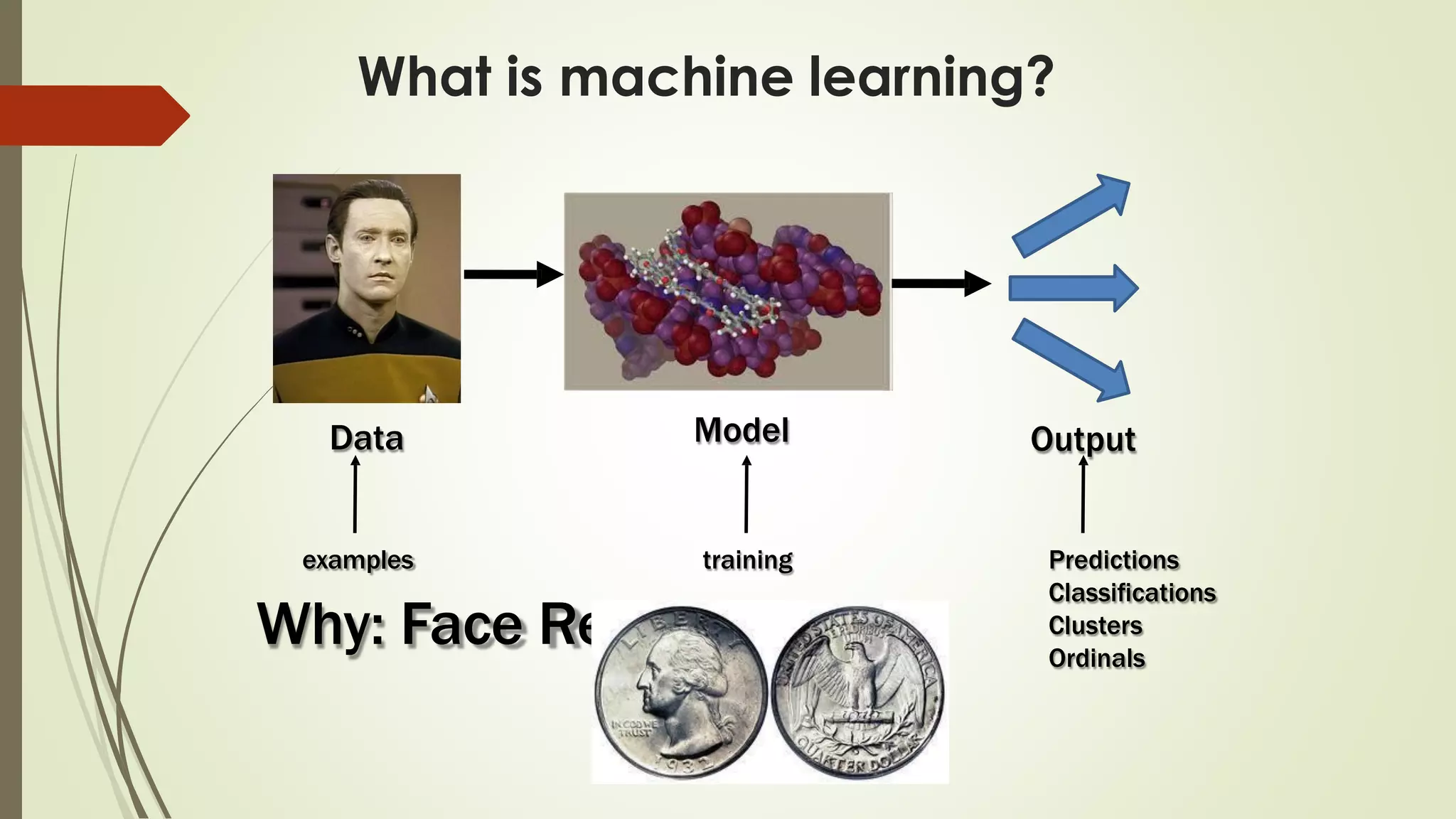
What is machine learning?
Data Model
training
Output
Predictions
Classifications
Clusters
Ordinals
examples
Why: Face Recognition?
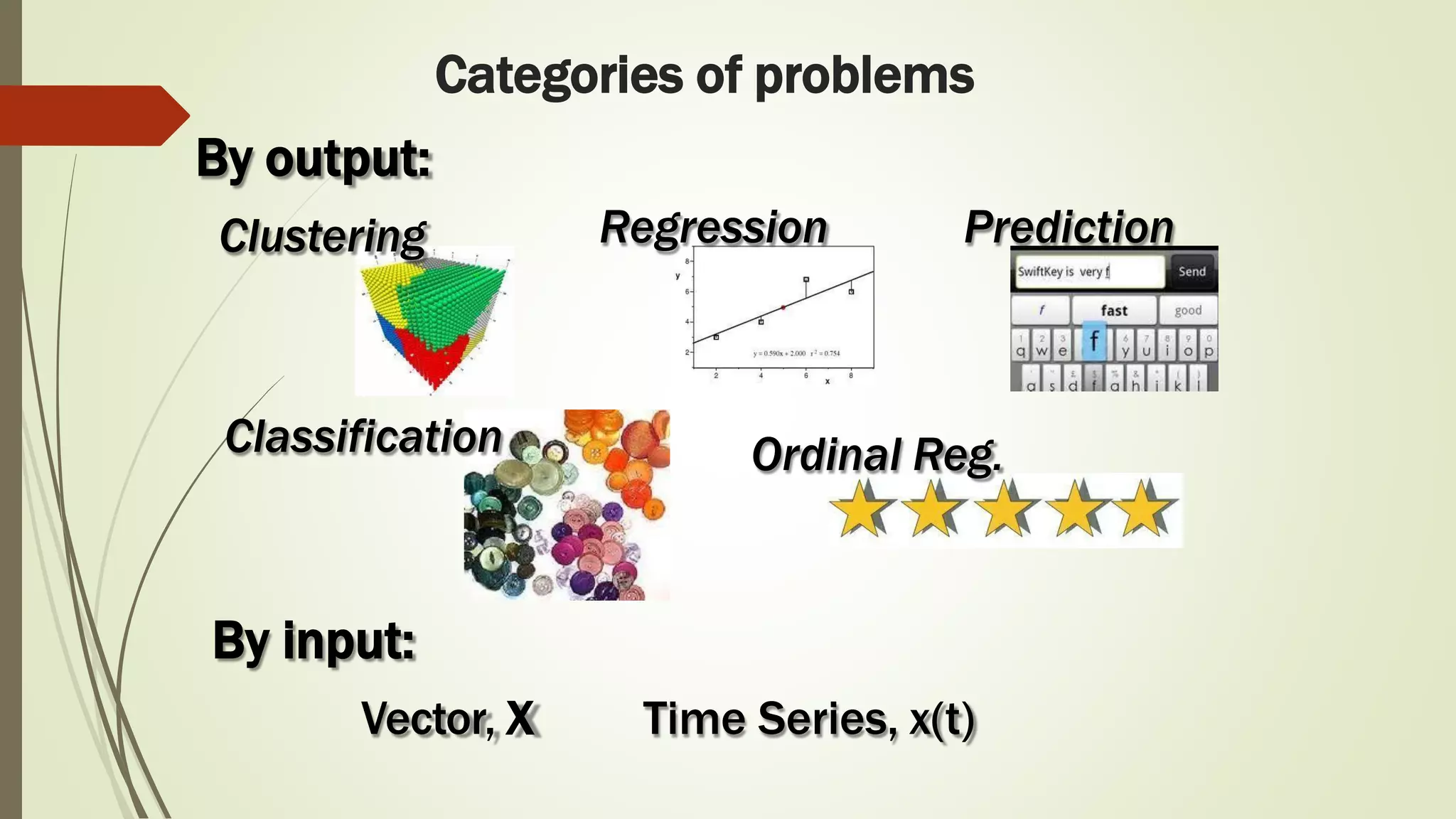
Categories of problems
Classification Ordinal Reg.
Regression Prediction
By output:
Clustering
By input:
Vector, X Time Series, x(t)
One size never fits all…
• Improving an algorithm:
– First option: better features
• Visualize classes
• Trends
• Histograms
– Next: make the algorithm smarter (more complicated)
• Interaction of features
• Better objective and training criteria
WEKA or GGOBI
-4 -2 0 2 4 6
-20
-10
0
10
20
30
40
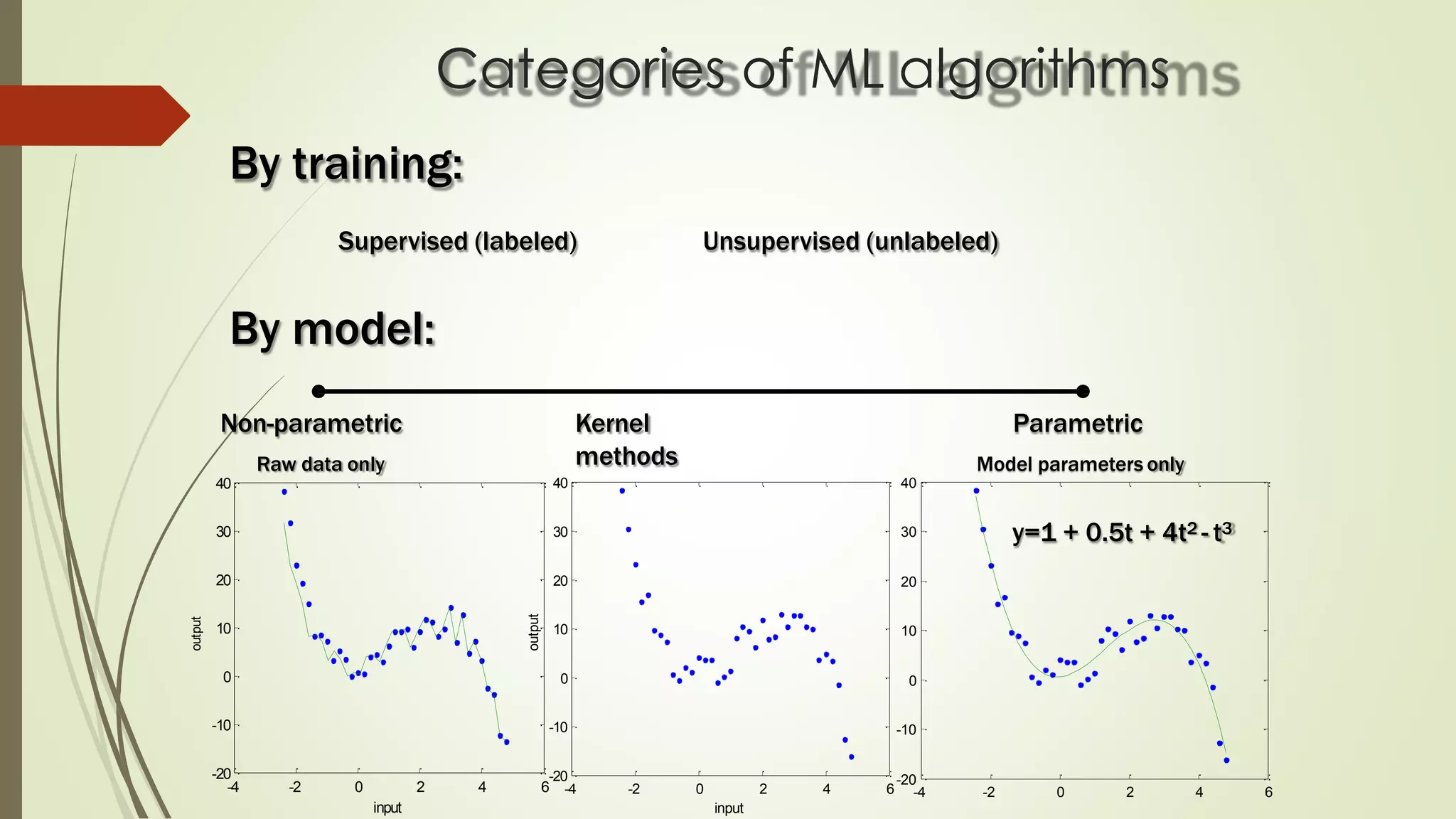
y=1 + 0.5t + 4t2 - t3
-4 -2 0 2 4 6
-20
-10
0
10
20
30
40
input
output
Categories of ML algorithms
By training:
Supervised (labeled) Unsupervised (unlabeled)
By model:
Non-parametric
Raw data only
Parametric
Model parameters only
-4 -2 0 2 4 6
-20
-10
0
10
20
30
40
input
output
Kernel
methods
-4 -2 0 2 4 6
-20
-10
0
10
20
30
40
input
output
50 100 150 200 250
0
0
0.05
0.1
0.15
0.2
-2 0 2 4 6
-20
-10
0
10
20
30
40
input
tupt
u
o
-2 0 2 4 6 -4
-20
-10
0
10
20
30
40
input
tupt
u
o
-4 -2 0 2 4 6 -4
-20
-10
0
10
20
30
40
input
output
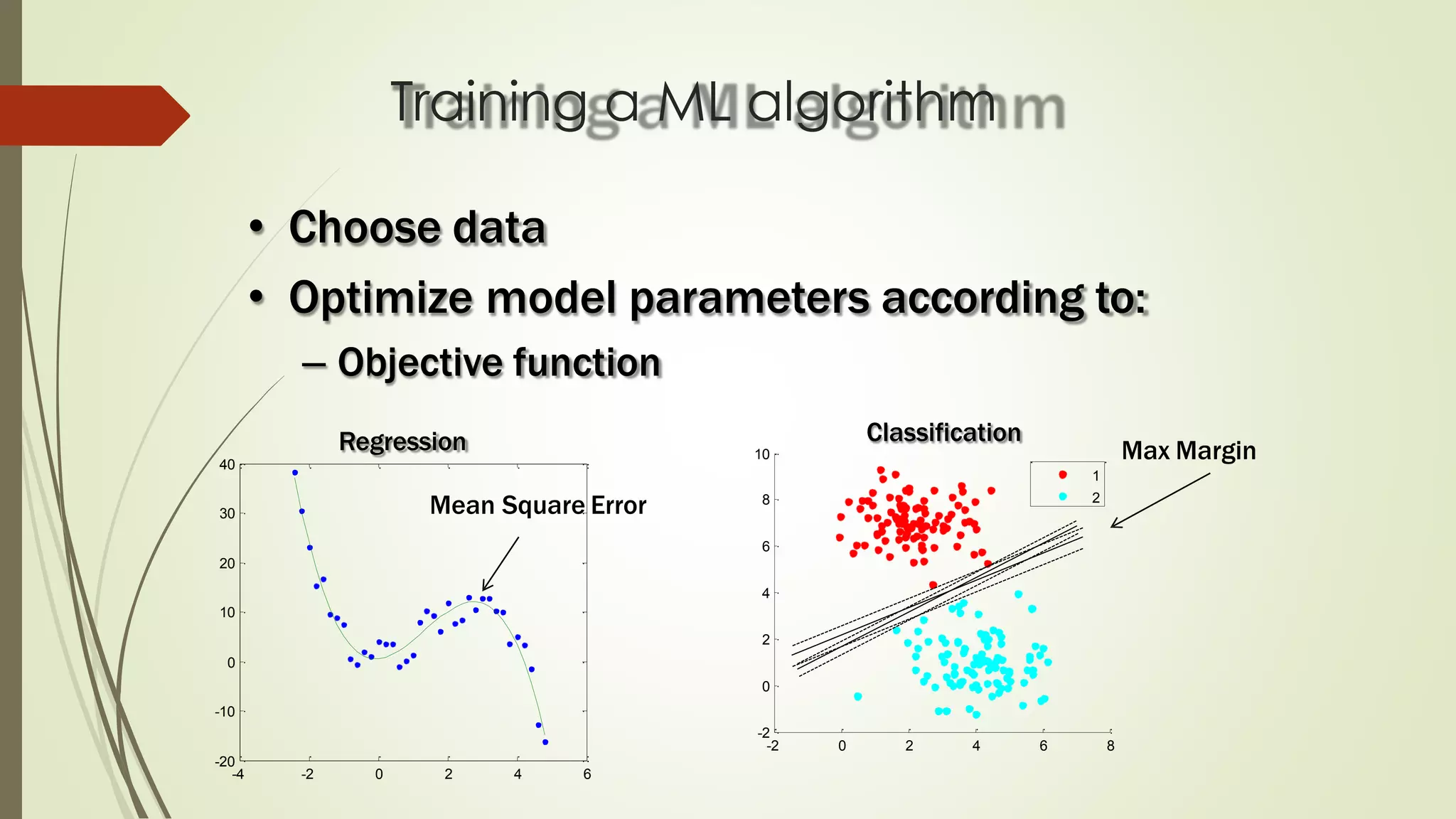
Training a ML algorithm
• Choose data
• Optimize model parameters according to:
– Objective function
-4 -2 0 2 4 6
-20
-10
0
10
20
30
40
Regression Classification
-2 0 2 4 6 8
-2
0
2
4
6
8
10
1
2
Mean Square Error
Max Margin
Pitfalls of ML algorithms
• Clean your features:
– Training volume: more is better
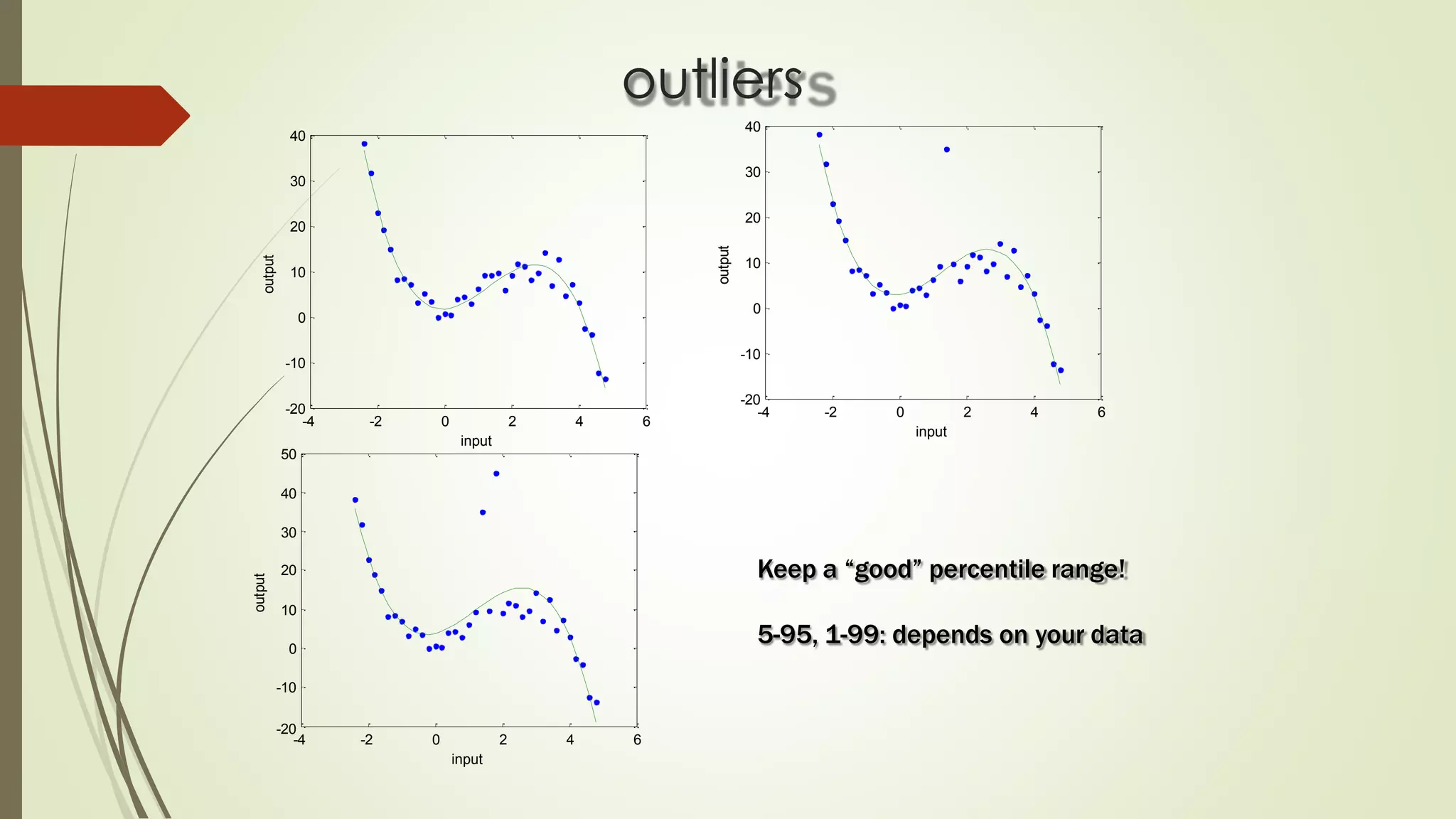
– Outliers: remove them!
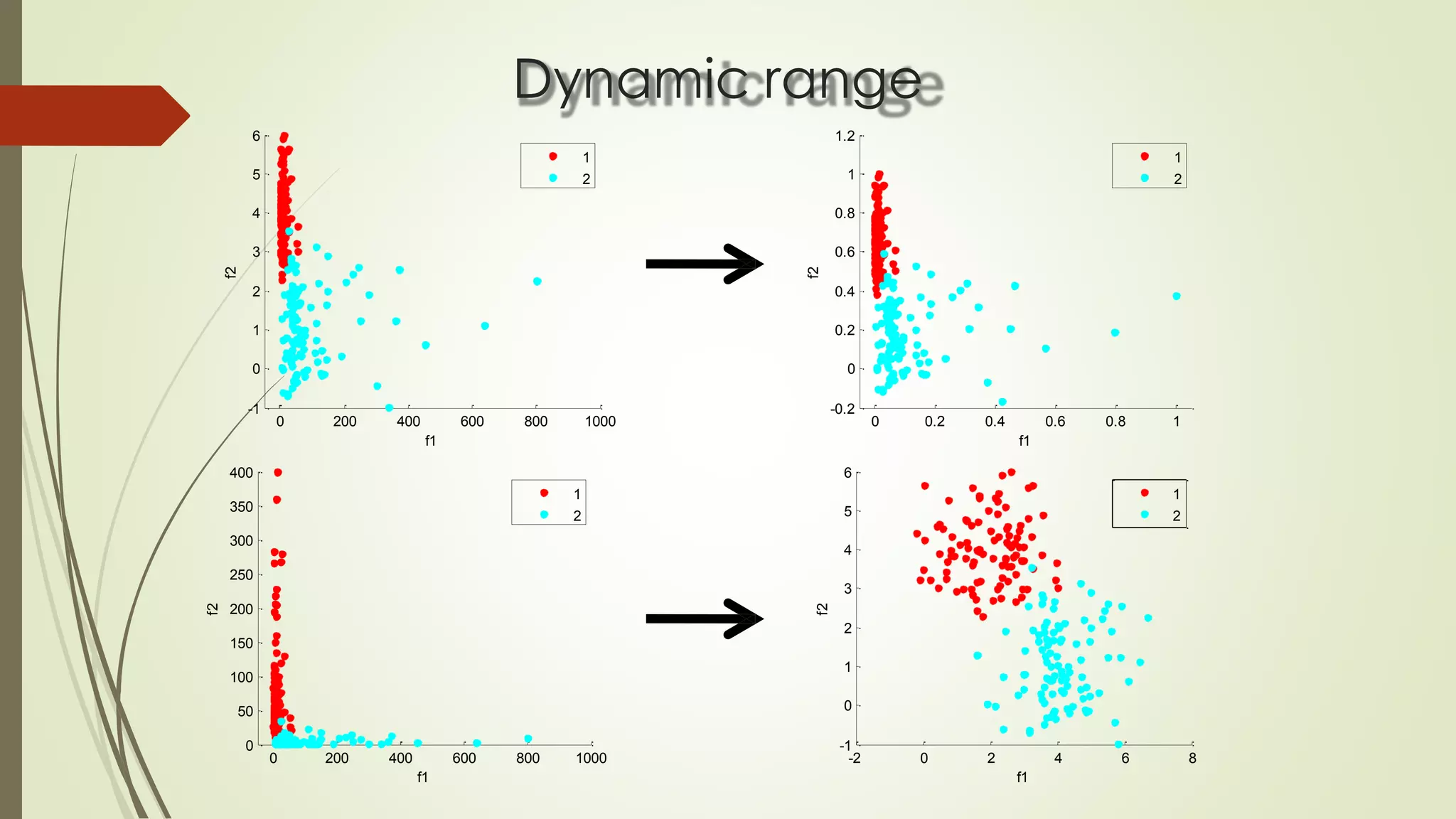
– Dynamic range: normalize it!
• Generalization
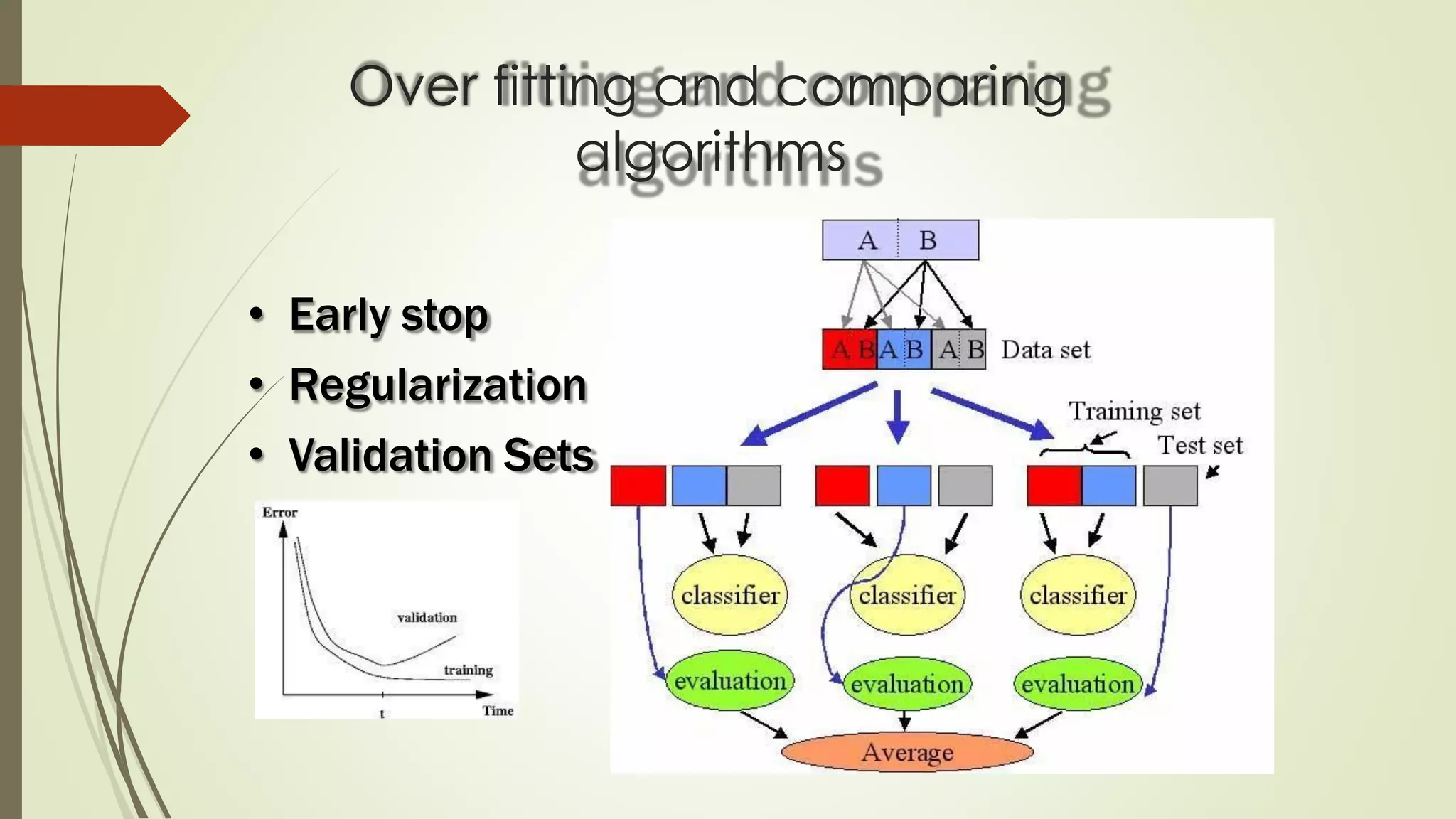
– Over fitting
– Under fitting
• Speed: parametric vs. non
• What are you learning? …features, features, features…
outliers
-4 -2 0 2 4 6
-20
-10
0
10
20
30
40
input
output
-4 -2 0 2 4 6
-20
-10
0
10
20
30
40
input
output
-4 -2 0 2 4 6
-10
-20
0
10
20
50
40
30
input
output
Keep a “good” percentile range!
5-95, 1-99: depends on your data
Dynamic range
0 0.2 0.4 0.6 0.8 1
-0.2
0
0.2
0.4
0.6
0.8
1
1.2
f1
f2
1
2
0 200 400 600 800 1000
-1
0
1
2
3
4
5
6
f1
f2
1
2
0 200 400 600 800 1000
0
50
100
150
200
250
300
350
400
f1
f2
1
2
-2 0 2 4 6 8
-1
0
1
2
3
4
5
6
f1
f2
1
2
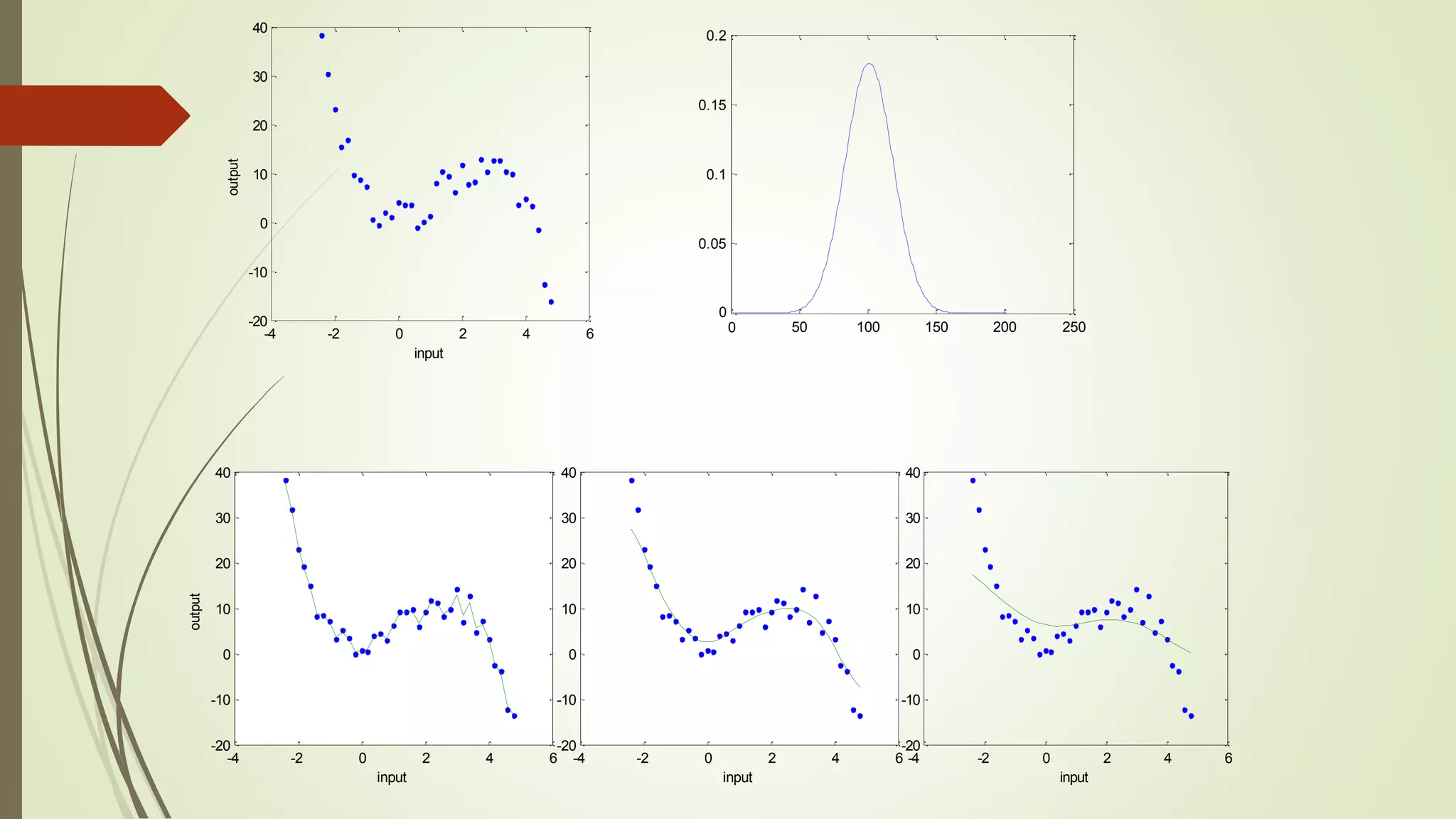
Over fitting and comparing
algorithms
• Early stop
• Regularization
• Validation Sets
Under
fitting
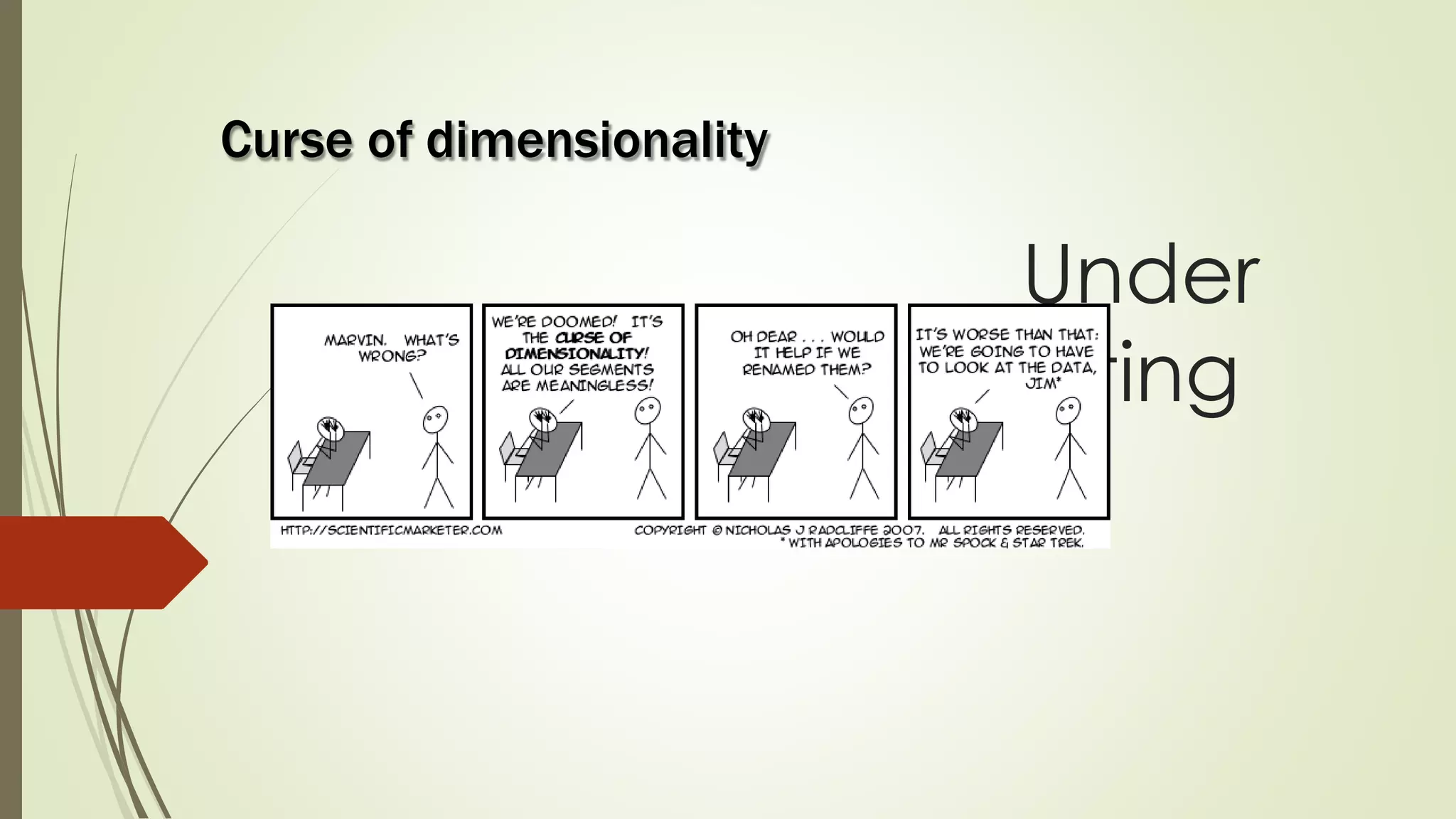
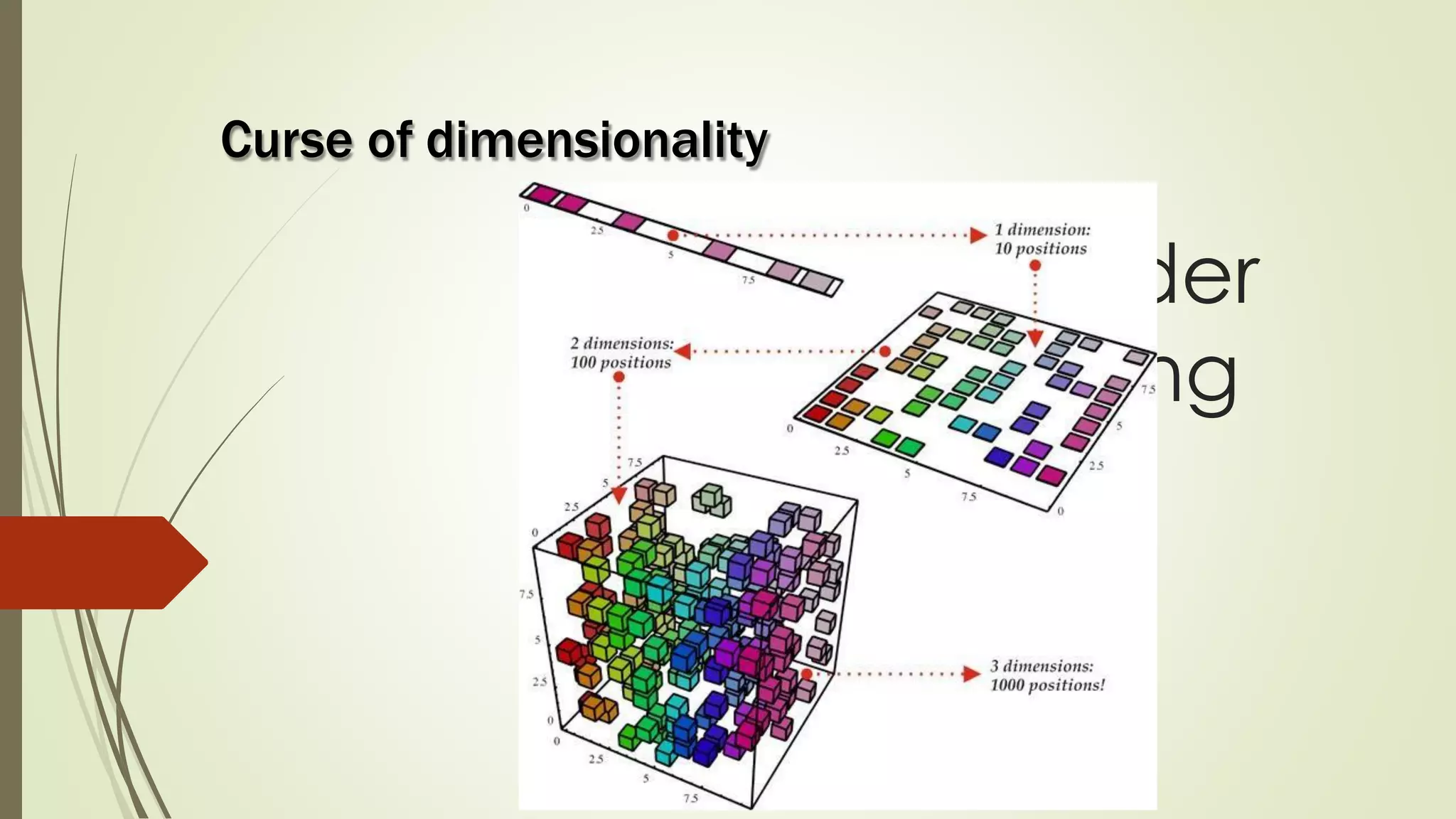
Curse of dimensionality
Under
fitting
Curse of dimensionality
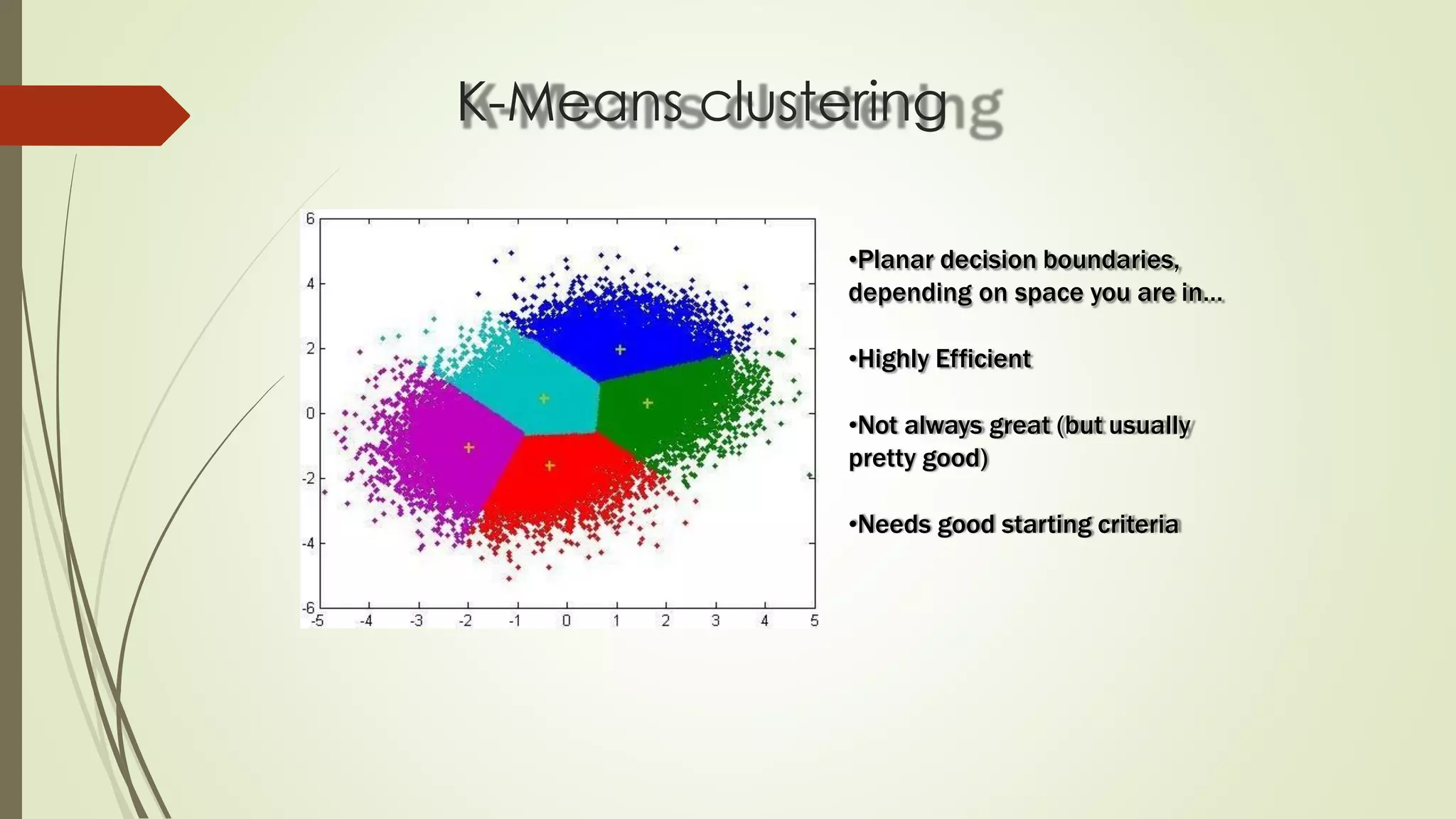
K-Means clustering
•Planar decision boundaries,
depending on space you are in…
•Highly Efficient
•Not always great (but usually
pretty good)
•Needs good starting criteria
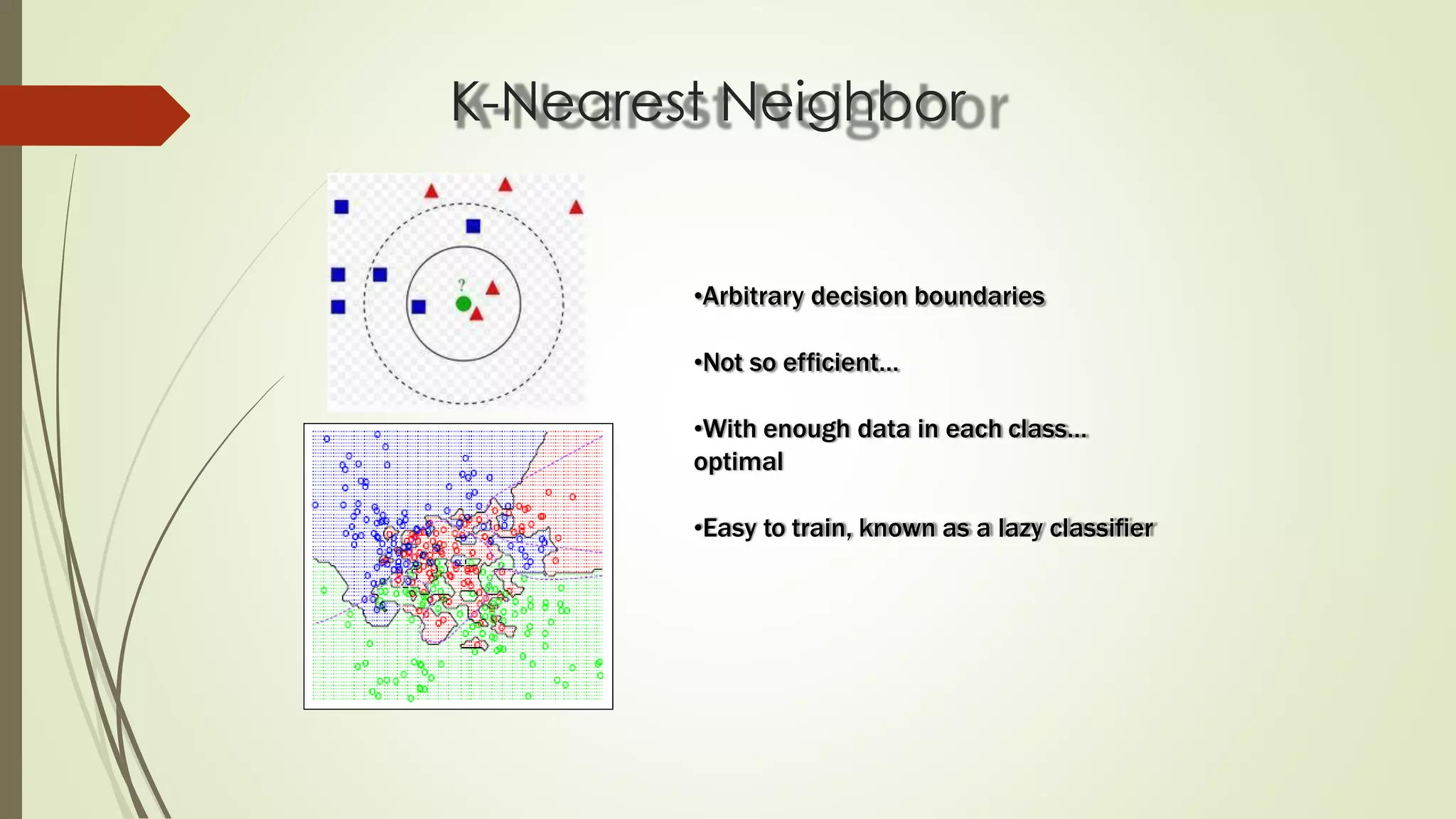
K-Nearest Neighbor
•Arbitrary decision boundaries
•Not so efficient…
•With enough data in each class…
optimal
•Easy to train, known as a lazy classifier
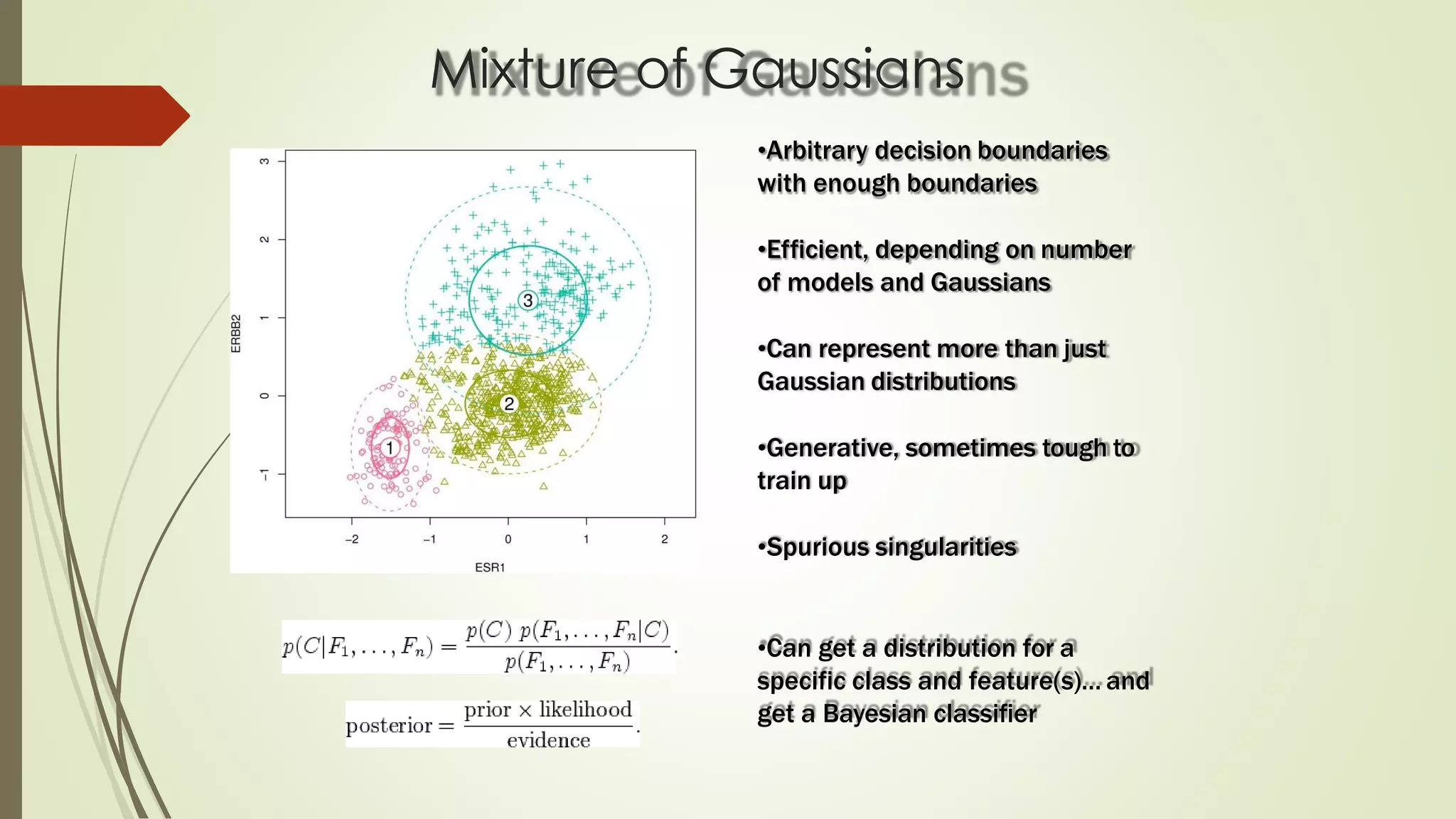
Mixture of Gaussians
•Arbitrary decision boundaries
with enough boundaries
•Efficient, depending on number
of models and Gaussians
•Can represent more than just
Gaussian distributions
•Generative, sometimes tough to
train up
•Spurious singularities
•Can get a distribution for a
specific class and feature(s)… and
get a Bayesian classifier
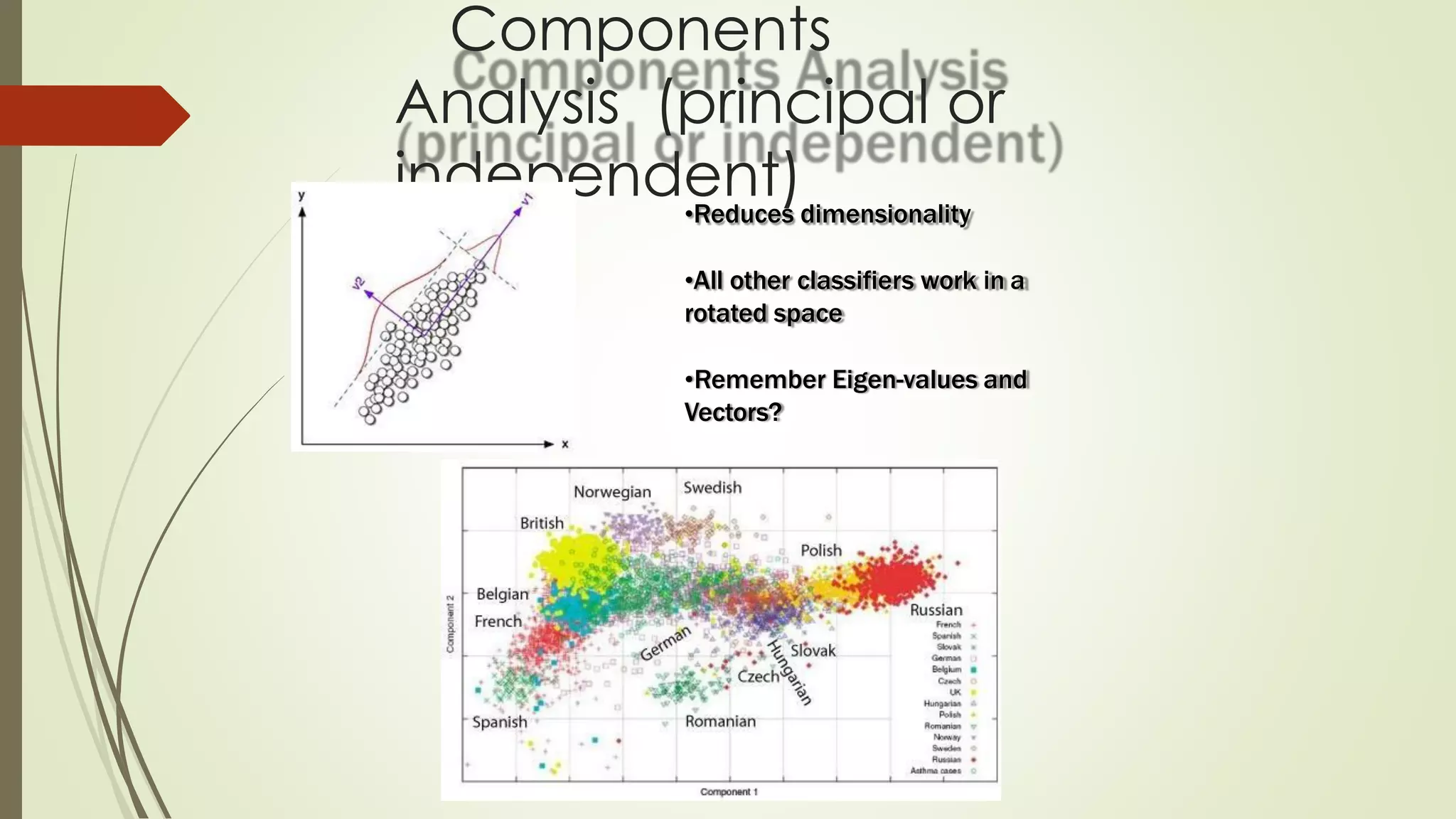
Components
Analysis (principal or
independent)•Reduces dimensionality
•All other classifiers work in a
rotated space
•Remember Eigen-values and
Vectors?
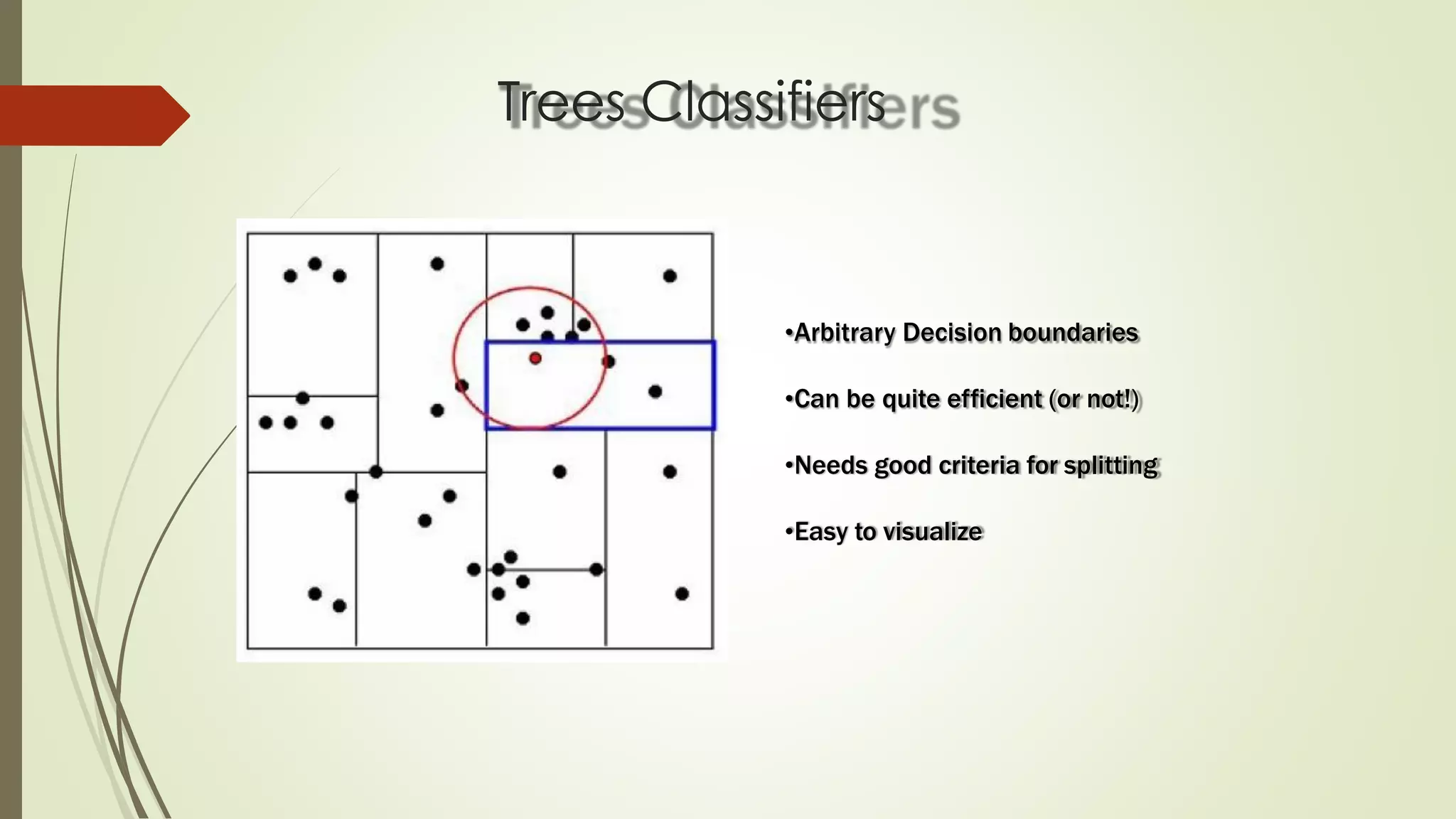
Trees Classifiers
•Arbitrary Decision boundaries
•Can be quite efficient (or not!)
•Needs good criteria for splitting
•Easy to visualize
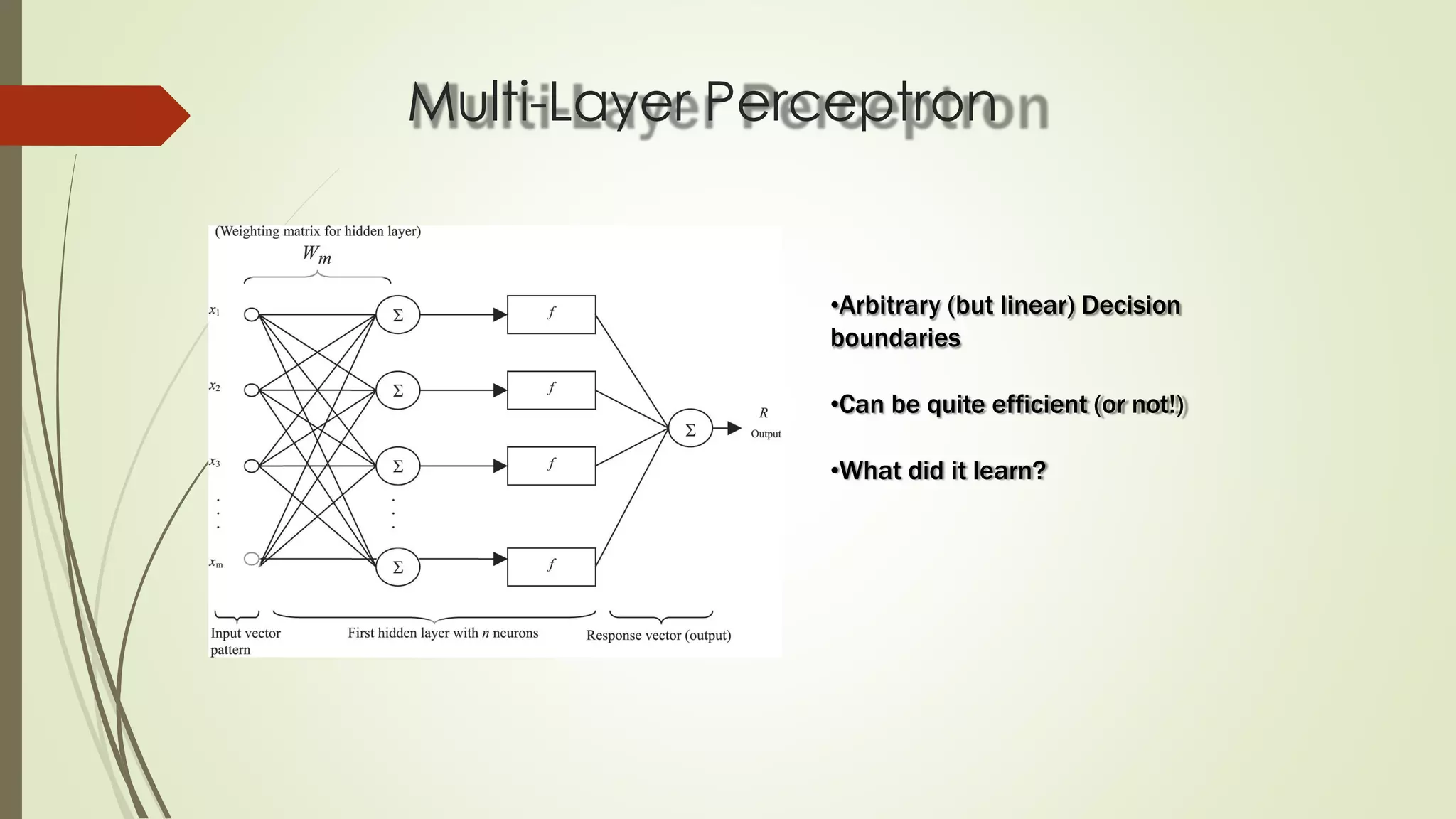
Multi-Layer Perceptron
•Arbitrary (but linear) Decision
boundaries
•Can be quite efficient (or not!)
•What did it learn?
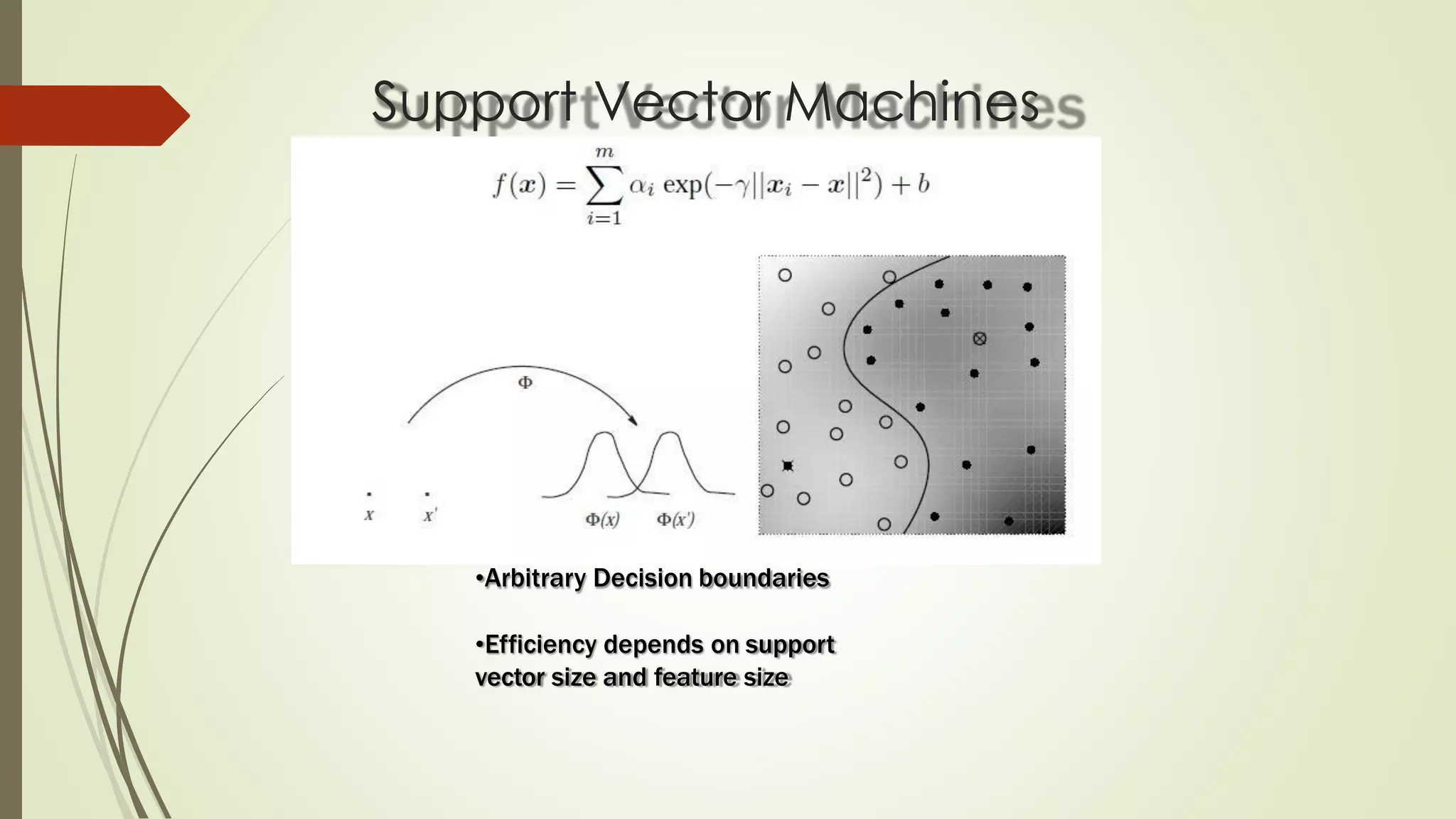
Support Vector Machines
•Arbitrary Decision boundaries
•Efficiency depends on support
vector size and feature size
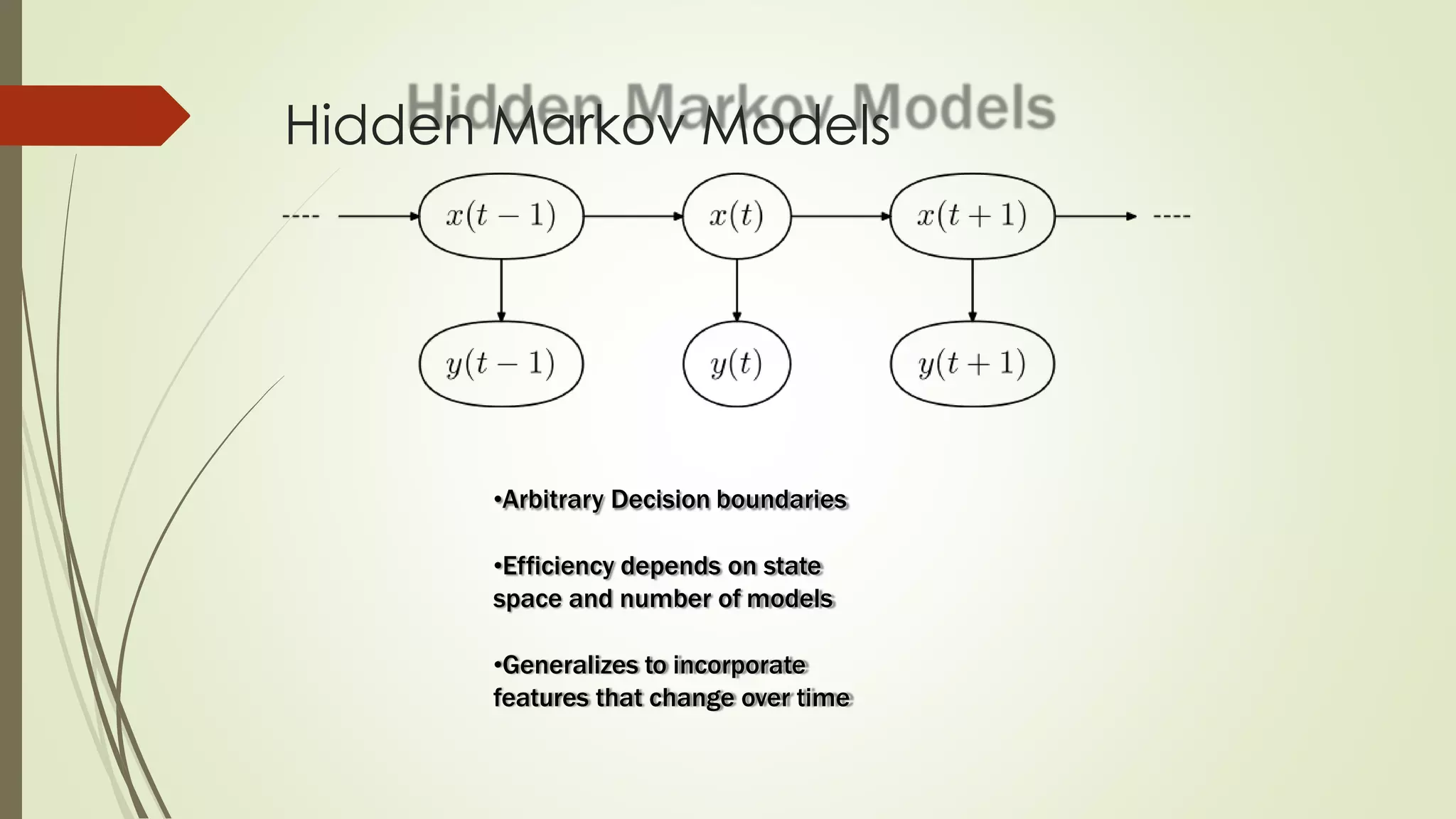
Hidden Markov Models
•Arbitrary Decision boundaries
•Efficiency depends on state
space and number of models
•Generalizes to incorporate
features that change over time
More sophisticated approaches
• Graphical models (like an HMM)
– Bayesian network
– Markov random fields
• Boosting
– Adaboost
• Voting
• Cascading
• Stacking…

Machine Learning Training in Chandigarh

  • 1.
    Machine Learning Training inChandigarh E2Matrix Training and Research Institute Jalandhar Contact : +91 9041262727 Email : support@e2matrix.com
  • 2.
    What is machinelearning? Data Model training Output Predictions Classifications Clusters Ordinals examples Why: Face Recognition?
  • 3.
    Categories of problems ClassificationOrdinal Reg. Regression Prediction By output: Clustering By input: Vector, X Time Series, x(t)
  • 4.
    One size neverfits all… • Improving an algorithm: – First option: better features • Visualize classes • Trends • Histograms – Next: make the algorithm smarter (more complicated) • Interaction of features • Better objective and training criteria WEKA or GGOBI
  • 5.
    -4 -2 02 4 6 -20 -10 0 10 20 30 40 y=1 + 0.5t + 4t2 - t3 -4 -2 0 2 4 6 -20 -10 0 10 20 30 40 input output Categories of ML algorithms By training: Supervised (labeled) Unsupervised (unlabeled) By model: Non-parametric Raw data only Parametric Model parameters only -4 -2 0 2 4 6 -20 -10 0 10 20 30 40 input output Kernel methods
  • 6.
    -4 -2 02 4 6 -20 -10 0 10 20 30 40 input output 50 100 150 200 250 0 0 0.05 0.1 0.15 0.2 -2 0 2 4 6 -20 -10 0 10 20 30 40 input tupt u o -2 0 2 4 6 -4 -20 -10 0 10 20 30 40 input tupt u o -4 -2 0 2 4 6 -4 -20 -10 0 10 20 30 40 input output
  • 7.
    Training a MLalgorithm • Choose data • Optimize model parameters according to: – Objective function -4 -2 0 2 4 6 -20 -10 0 10 20 30 40 Regression Classification -2 0 2 4 6 8 -2 0 2 4 6 8 10 1 2 Mean Square Error Max Margin
  • 8.
    Pitfalls of MLalgorithms • Clean your features: – Training volume: more is better – Outliers: remove them! – Dynamic range: normalize it! • Generalization – Over fitting – Under fitting • Speed: parametric vs. non • What are you learning? …features, features, features…
  • 9.
    outliers -4 -2 02 4 6 -20 -10 0 10 20 30 40 input output -4 -2 0 2 4 6 -20 -10 0 10 20 30 40 input output -4 -2 0 2 4 6 -10 -20 0 10 20 50 40 30 input output Keep a “good” percentile range! 5-95, 1-99: depends on your data
  • 10.
    Dynamic range 0 0.20.4 0.6 0.8 1 -0.2 0 0.2 0.4 0.6 0.8 1 1.2 f1 f2 1 2 0 200 400 600 800 1000 -1 0 1 2 3 4 5 6 f1 f2 1 2 0 200 400 600 800 1000 0 50 100 150 200 250 300 350 400 f1 f2 1 2 -2 0 2 4 6 8 -1 0 1 2 3 4 5 6 f1 f2 1 2
  • 11.
    Over fitting andcomparing algorithms • Early stop • Regularization • Validation Sets
  • 12.
  • 13.
  • 14.
    K-Means clustering •Planar decisionboundaries, depending on space you are in… •Highly Efficient •Not always great (but usually pretty good) •Needs good starting criteria
  • 15.
    K-Nearest Neighbor •Arbitrary decisionboundaries •Not so efficient… •With enough data in each class… optimal •Easy to train, known as a lazy classifier
  • 16.
    Mixture of Gaussians •Arbitrarydecision boundaries with enough boundaries •Efficient, depending on number of models and Gaussians •Can represent more than just Gaussian distributions •Generative, sometimes tough to train up •Spurious singularities •Can get a distribution for a specific class and feature(s)… and get a Bayesian classifier
  • 17.
    Components Analysis (principal or independent)•Reducesdimensionality •All other classifiers work in a rotated space •Remember Eigen-values and Vectors?
  • 18.
    Trees Classifiers •Arbitrary Decisionboundaries •Can be quite efficient (or not!) •Needs good criteria for splitting •Easy to visualize
  • 19.
    Multi-Layer Perceptron •Arbitrary (butlinear) Decision boundaries •Can be quite efficient (or not!) •What did it learn?
  • 20.
    Support Vector Machines •ArbitraryDecision boundaries •Efficiency depends on support vector size and feature size
  • 21.
    Hidden Markov Models •ArbitraryDecision boundaries •Efficiency depends on state space and number of models •Generalizes to incorporate features that change over time
  • 22.
    More sophisticated approaches •Graphical models (like an HMM) – Bayesian network – Markov random fields • Boosting – Adaboost • Voting • Cascading • Stacking…