1
2
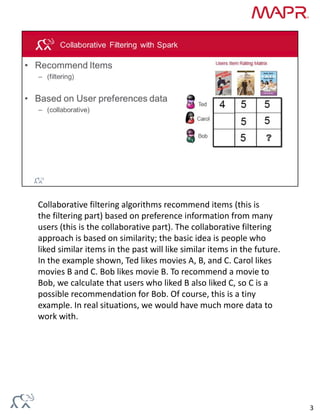
Collaborative filtering algorithms recommend items (this is 
the filtering part) based on preference information from many 
users (this is the collaborative part). The collaborative filtering 
approach is based on similarity; the basic idea is people who 
liked similar items in the past will like similar items in the future. 
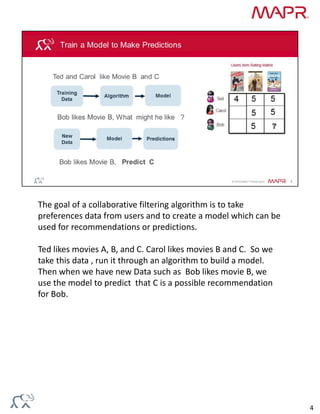
In the example shown, Ted likes movies A, B, and C. Carol likes 
movies B and C. Bob likes movie B. To recommend a movie to 
Bob, we calculate that users who liked B also liked C, so C is a 
possible recommendation for Bob. Of course, this is a tiny 
example. In real situations, we would have much more data to 
work with.
3
The goal of a collaborative filtering algorithm is to take  
preferences data from users and to create a model which can be 
used for recommendations or predictions. 
Ted likes movies A, B, and C. Carol likes movies B and C.  So we 
take this data , run it through an algorithm to build a model.
Then when we have new Data such as  Bob likes movie B, we 
use the model to predict  that C is a possible recommendation 
for Bob. 
4
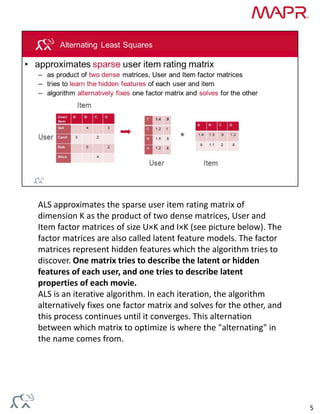
ALS approximates the sparse user item rating matrix of 
dimension K as the product of two dense matrices, User and 
Item factor matrices of size U×K and I×K (see picture below). The 
factor matrices are also called latent feature models. The factor 
matrices represent hidden features which the algorithm tries to 
discover. One matrix tries to describe the latent or hidden 
features of each user, and one tries to describe latent 
properties of each movie.
ALS is an iterative algorithm. In each iteration, the algorithm 
alternatively fixes one factor matrix and solves for the other, and 
this process continues until it converges. This alternation 
between which matrix to optimize is where the "alternating" in 
the name comes from.
5
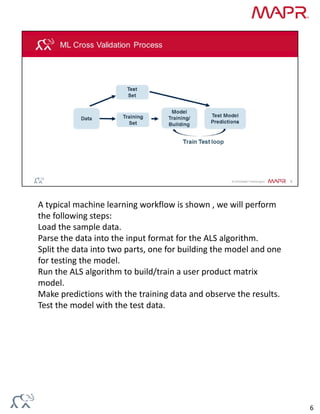
A typical machine learning workflow is shown , we will perform 
the following steps:
Load the sample data.
Parse the data into the input format for the ALS algorithm.
Split the data into two parts, one for building the model and one 
for testing the model.
Run the ALS algorithm to build/train a user product matrix 
model.
Make predictions with the training data and observe the results.
Test the model with the test data.
6
Spark is especially useful for parallel processing of distributed 
data with iterative algorithms. Spark tries to keep things in 
memory, whereas MapReduce involves more reading and 
writing from disk. As shown in the image below, for each 
MapReduce Job, data is read from an HDFS file for a mapper, 
written to and from a SequenceFile in between, and then 
written to an output file from a reducer. When a chain of 
multiple jobs is needed, Spark can execute much faster by 
keeping data in memory.
7
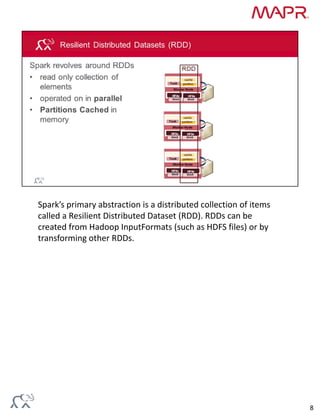
Spark’s primary abstraction is a distributed collection of items 
called a Resilient Distributed Dataset (RDD). RDDs can be 
created from Hadoop InputFormats (such as HDFS files) or by 
transforming other RDDs.
8
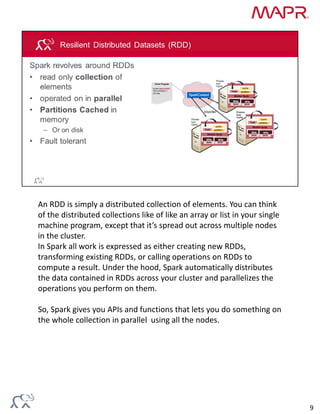
An RDD is simply a distributed collection of elements. You can think 
of the distributed collections like of like an array or list in your single 
machine program, except that it’s spread out across multiple nodes 
in the cluster.
In Spark all work is expressed as either creating new RDDs, 
transforming existing RDDs, or calling operations on RDDs to 
compute a result. Under the hood, Spark automatically distributes 
the data contained in RDDs across your cluster and parallelizes the 
operations you perform on them.
So, Spark gives you APIs and functions that lets you do something on 
the whole collection in parallel  using all the nodes.
9
10
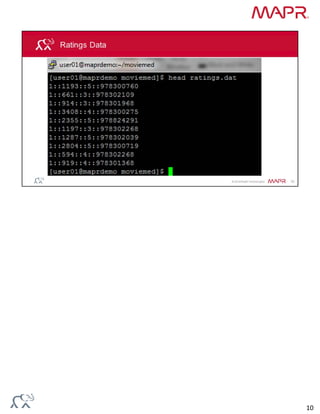
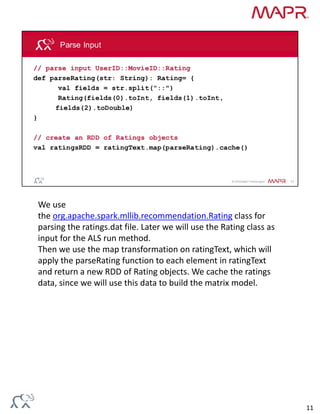
We use 
the org.apache.spark.mllib.recommendation.Rating class for 
parsing the ratings.dat file. Later we will use the Rating class as 
input for the ALS run method.
Then we use the map transformation on ratingText, which will 
apply the parseRating function to each element in ratingText 
and return a new RDD of Rating objects. We cache the ratings 
data, since we will use this data to build the matrix model.
11
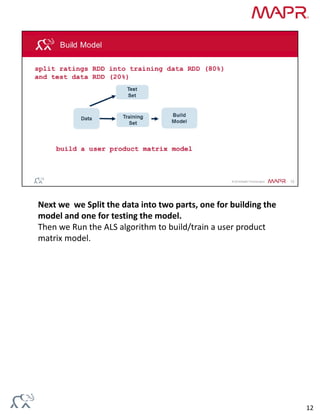
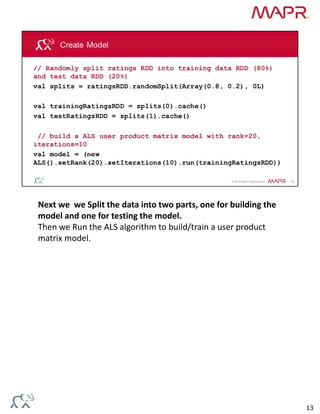
Next we  we Split the data into two parts, one for building the 
model and one for testing the model.
Then we Run the ALS algorithm to build/train a user product 
matrix model.
12
Next we  we Split the data into two parts, one for building the 
model and one for testing the model.
Then we Run the ALS algorithm to build/train a user product 
matrix model.
13
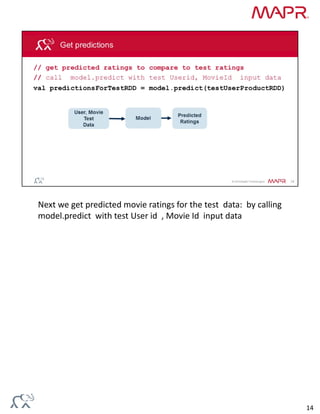
Next we get predicted movie ratings for the test  data:  by calling 
model.predict  with test User id  , Movie Id  input data
14
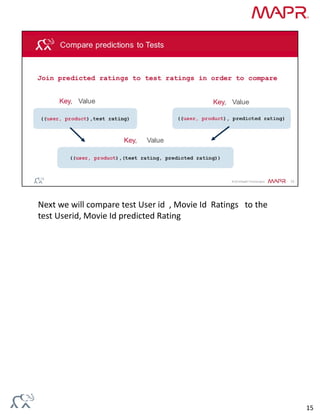
Next we will compare test User id  , Movie Id  Ratings   to the   
test Userid, Movie Id predicted Rating 
15
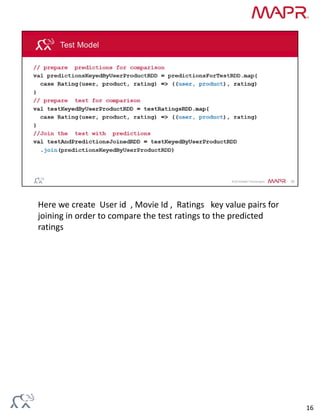
Here we create  User id  , Movie Id ,  Ratings   key value pairs for 
joining in order to compare the test ratings to the predicted 
ratings
16
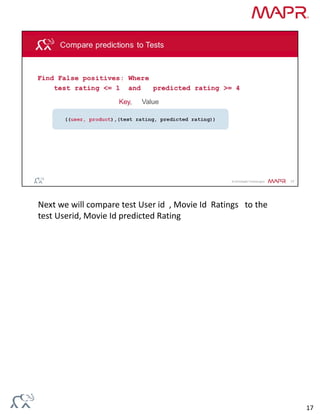
Next we will compare test User id  , Movie Id  Ratings   to the   
test Userid, Movie Id predicted Rating 
17
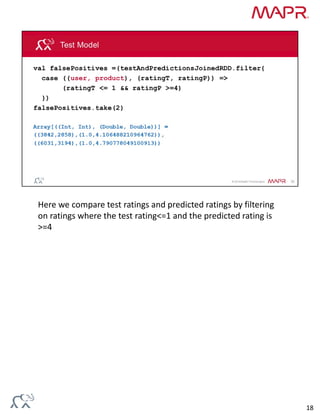
Here we compare test ratings and predicted ratings by filtering 
on ratings where the test rating<=1 and the predicted rating is 
>=4
18
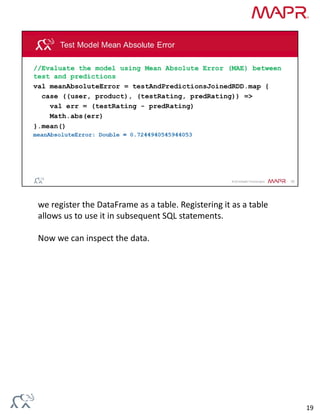
we register the DataFrame as a table. Registering it as a table 
allows us to use it in subsequent SQL statements.
Now we can inspect the data.
19
20
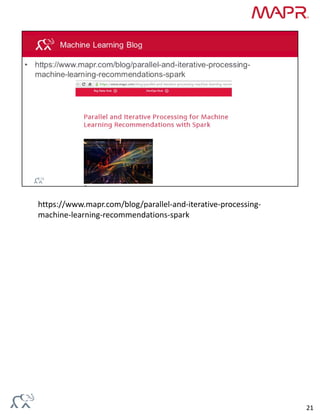
https://www.mapr.com/blog/parallel‐and‐iterative‐processing‐
machine‐learning‐recommendations‐spark
21
22
23
24

Machine Learning Recommendations with Spark