Machine Learning in
  Bioinformatics
Machine Learning Techniques
n   Introduction
n   Decision Trees
n   Bayesian Methods
n   Hidden Markov Models
n   Support Vector Machines
n   Neural Networks
n   Clustering
n   Genetic Algorithms
n   Association Rules
n   Reinforcement Learning
n   Fuzzy Sets
Software Packages & Datasets
• Weka
  • Data Mining Software in Java
  • http://www.cs.waikato.ac.nz/~ml/weka

• MLC++
  • Machine learning library in C++
  • http://www.sig.com/Technology/mlc

• UCI
  • Machine Learning Data Repository UC Irvine
  • http://www.ics.uci.edu/~mlearn/ML/Repository.html
Classification: Definition
n   assignment of objects into a set of
    predefined categories (classes)
    n   classification of applicants or patients into
        risk levels
    n   classification of protein sequences into
        families
    n   classification of web pages into topics
    n   information filter, recommendation, …
Classification: Task
n   Input: a training set of examples, each
    labeled with one class label
n   Output: a model (classifier) that assigns a
    class label to each instance based on the
    other attributes
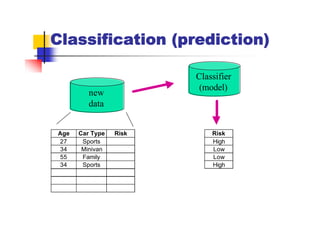
n   The model can be used to predict the
    class of new instances, for which the
    class label is missing or unknown
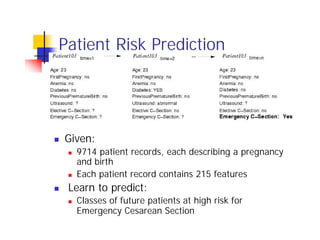
Patient Risk Prediction


n   Given:
    n   9714 patient records, each describing a pregnancy
        and birth
    n   Each patient record contains 215 features
n   Learn to predict:
    n   Classes of future patients at high risk for
        Emergency Cesarean Section
Data Mining Result


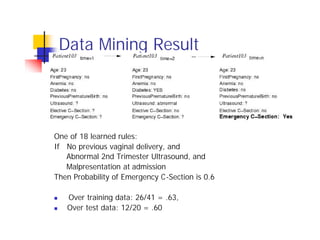
One of 18 learned rules:
If No previous vaginal delivery, and
   Abnormal 2nd Trimester Ultrasound, and
   Malpresentation at admission
Then Probability of Emergency C-Section is 0.6

n    Over training data: 26/41 = .63,
n    Over test data: 12/20 = .60
Train and Test
n   example =instance + class label
n   Examples are divided into training set +
    test set
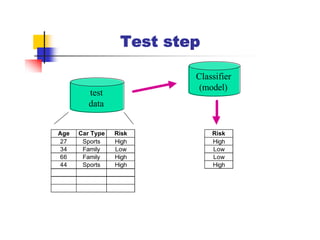
n   Classification model is built in two steps:
    n   training - build the model from the training
        set
    n   test - check the accuracy of the model
        using test set
Train and Test
n   Kind of models:
    n   if - then rules
    n   logical formulae
    n   decision trees
    n   joint probabilities
n   Accuracy of models:
    n   the known class of test samples is matched
        against the class predicted by the model
    n   accuracy rate = % of test set samples correctly
        classified by the model
Training step
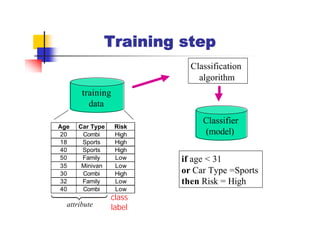
                           Classification
                             algorithm
       training
         data
                              Classifier
Age   Car Type    Risk
20     Combi      High        (model)
18     Sports     High
40     Sports     High
50     Family     Low    if age < 31
35     Minivan    Low
30     Combi      High   or Car Type =Sports
32     Family     Low    then Risk = High
14 4 class
  2 3
40     Combi      Low

  attribute      label
Test step

                          Classifier
                           (model)
         test
         data


Age   Car Type   Risk         Risk
27     Sports    High         High
34     Family    Low          Low
66     Family    High         Low
44     Sports    High         High
Classification (prediction)

                        Classifier
                         (model)
         new
         data


Age   Car Type   Risk       Risk
27     Sports               High
34     Minivan              Low
55     Family               Low
34     Sports               High
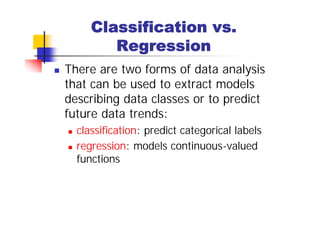
Classification vs.
              Regression
n   There are two forms of data analysis
    that can be used to extract models
    describing data classes or to predict
    future data trends:
    n   classification: predict categorical labels
    n   regression: models continuous-valued
        functions
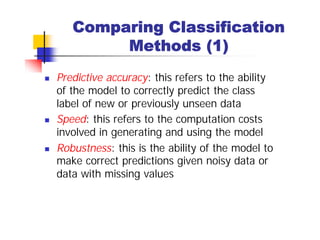
Comparing Classification
            Methods (1)
n   Predictive accuracy: this refers to the ability
    of the model to correctly predict the class
    label of new or previously unseen data
n   Speed: this refers to the computation costs
    involved in generating and using the model
n   Robustness: this is the ability of the model to
    make correct predictions given noisy data or
    data with missing values
Comparing Classification
         Methods (2)
n   Scalability: this refers to the ability to
    construct the model efficiently given large
    amount of data
n   Interpretability: this refers to the level of
    understanding and insight that is provided by
    the model
n    Simplicity:
    n   decision tree size
    n   rule compactness
n   Domain-dependent quality indicators
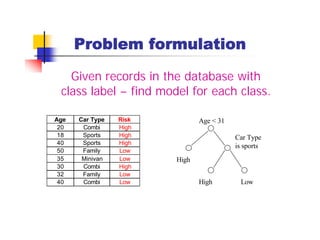
Problem formulation

   Given records in the database with
 class label – find model for each class.

Age   Car Type   Risk          Age < 31
 20    Combi     High
 18    Sports    High                     Car Type
 40    Sports    High
                                          is sports
 50    Family    Low
 35    Minivan   Low    High
 30    Combi     High
 32    Family    Low
 40    Combi     Low           High        Low
Decision Trees
Outline
n   Decision tree representation
n   ID3 learning algorithm
n   Entropy, information gain
n   Overfitting
Decision Trees
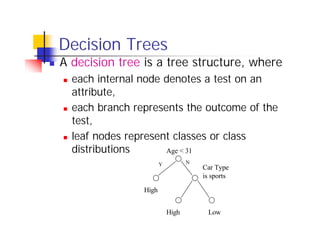
n   A decision tree is a tree structure, where
    n   each internal node denotes a test on an
        attribute,
    n   each branch represents the outcome of the
        test,
    n   leaf nodes represent classes or class
        distributions      Age < 31
                             Y          N
                                            Car Type
                                            is sports

                      High


                                 High        Low
Decision Tree
n   widely used in inductive inference
n   for approximating discrete valued
    functions
n   can be represented as if-then rules for
    human readability
n   complete hypothesis space
n   successfully applied to many applications
    n   medical diagnosis
    n   credit risk prediction
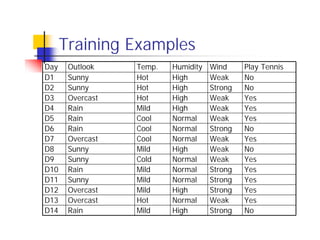
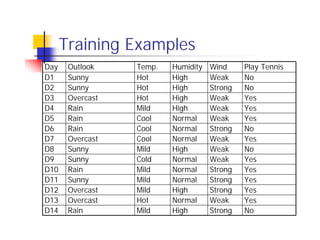
Training Examples
Day    Outlook    Temp.   Humidity   Wind     Play Tennis
D1     Sunny      Hot     High       Weak     No
D2     Sunny      Hot     High       Strong   No
D3     Overcast   Hot     High       Weak     Yes
D4     Rain       Mild    High       Weak     Yes
D5     Rain       Cool    Normal     Weak     Yes
D6     Rain       Cool    Normal     Strong   No
D7     Overcast   Cool    Normal     Weak     Yes
D8     Sunny      Mild    High       Weak     No
D9     Sunny      Cold    Normal     Weak     Yes
D10    Rain       Mild    Normal     Strong   Yes
D11    Sunny      Mild    Normal     Strong   Yes
D12    Overcast   Mild    High       Strong   Yes
D13    Overcast   Hot     Normal     Weak     Yes
D14    Rain       Mild    High       Strong   No
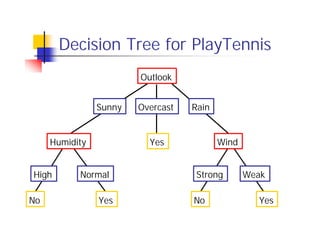
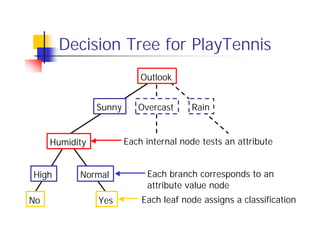
Decision Tree for PlayTennis
                        Outlook


                Sunny   Overcast   Rain


     Humidity             Yes             Wind


High       Normal                   Strong       Weak

No              Yes                No              Yes
Decision Tree for C-Section
       Risk Prediction
n     Learned from medical records of 100 women

    [833+,167-] .83+ .17-
     Fetal_Presentation = 1: [822+,116-] .88+ .12-
     | Previous_Csection = 0: [767+,81-] .90+ .10-
     | | Primiparous = 0: [399+,13-] .97+ .03-
     | | Primiparous = 1: [368+,68-] .84+ .16-
     | | | Fetal_Distress = 0: [334+,47-] .88+ .12-
     | | | | Birth_Weight < 3349: [201+,10.6 -] .95+ .05-
     | | | | Birth_Weight >= 3349: [133+,36.4 -] .78+ .22-
     | | | Fetal_Distress = 1: [34+,21-] .62+ .38-
     | Previous_Csection = 1: [55+,35-] .61+ .39-
     Fetal_Presentation = 2: [3+,29-] .11+ .89-
     Fetal_Presentation = 3: [8+,22-] .27+ .73-
Decision Tree for PlayTennis
                            Outlook


                Sunny      Overcast     Rain


     Humidity           Each internal node tests an attribute


High       Normal            Each branch corresponds to an
                             attribute value node
No              Yes         Each leaf node assigns a classification
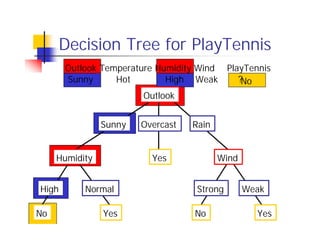
Decision Tree for PlayTennis
       Outlook Temperature Humidity Wind PlayTennis
       Sunny      Hot        High Weak      ?No
                        Outlook


                Sunny   Overcast   Rain


     Humidity             Yes             Wind


High       Normal                   Strong       Weak

No              Yes                No              Yes
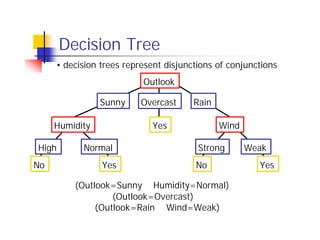
Decision Tree
     • decision trees represent disjunctions of conjunctions
                          Outlook

                Sunny     Overcast     Rain

     Humidity               Yes               Wind

High       Normal                       Strong       Weak
No              Yes                    No              Yes

         (Outlook=Sunny ∧ Humidity=Normal)
         ∨        (Outlook=Overcast)
         ∨    (Outlook=Rain ∧ Wind=Weak)
When to consider Decision
    Trees

n   Instances describable by attribute-value pairs
n   Target function is discrete valued
n   Disjunctive hypothesis may be required
n   Possibly noisy training data
n   Missing attribute values
n   Examples:
    n   Medical diagnosis
    n   Credit risk analysis
    n   Object classification for robot manipulator (Tan 1993)
Top-Down Induction of
     Decision Trees ID3

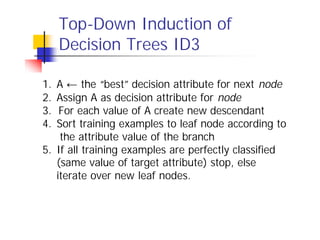
1. A ← the “best” decision attribute for next node
2. Assign A as decision attribute for node
3.  For each value of A create new descendant
4. Sort training examples to leaf node according to
    the attribute value of the branch
5. If all training examples are perfectly classified
   (same value of target attribute) stop, else
   iterate over new leaf nodes.
Which Attribute is ”best”?

[29+,35-] A1=?                         A2=? [29+,35-]


      True    False             True      False


  [21+, 5-]      [8+, 30-]   [18+, 33-]     [11+, 2-]
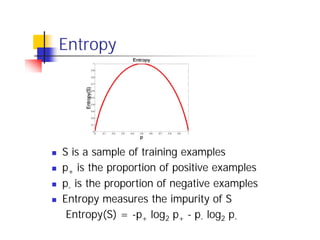
Entropy


n   S is a sample of training examples
n   p+ is the proportion of positive examples
n   p- is the proportion of negative examples
n   Entropy measures the impurity of S
     Entropy(S) = -p+ log2 p+ - p- log2 p-
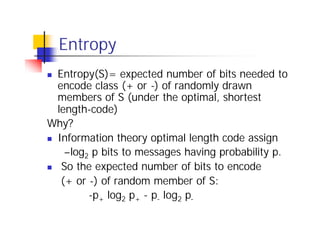
Entropy
n Entropy(S)= expected number of bits needed to
  encode class (+ or -) of randomly drawn
  members of S (under the optimal, shortest
  length-code)
Why?
n Information theory optimal length code assign

    –log2 p bits to messages having probability p.
n So the expected number of bits to encode

   (+ or -) of random member of S:
         -p+ log2 p+ - p- log2 p-
Information Gain
  n   Gain(S,A): expected reduction in entropy due
      to sorting S on attribute A
Gain(S,A)=Entropy(S) - ∑v∈values(A) |Sv|/|S| Entropy(Sv)
Entropy([29+,35-]) = -29/64 log2 29/64 – 35/64 log2 35/64
                   = 0.99

  [29+,35-]     A1=?                         A2=? [29+,35-]

         True      False              True      False

      [21+, 5-]        [8+, 30-]   [18+, 33-]     [11+, 2-]
Information Gain
 Entropy([21+,5-]) = 0.71     Entropy([18+,33-]) = 0.94
 Entropy([8+,30-]) = 0.74     Entropy([8+,30-]) = 0.62
 Gain(S,A1)=Entropy(S)        Gain(S,A2)=Entropy(S)
     -26/64*Entropy([21+,5-])     -51/64*Entropy([18+,33-])
     -38/64*Entropy([8+,30-])     -13/64*Entropy([11+,2-])
   =0.27                        =0.12


[29+,35-] A1=?                            A2=? [29+,35-]


      True    False                True      False

  [21+, 5-]      [8+, 30-]     [18+, 33-]      [11+, 2-]
Training Examples
Day    Outlook    Temp.   Humidity   Wind     Play Tennis
D1     Sunny      Hot     High       Weak     No
D2     Sunny      Hot     High       Strong   No
D3     Overcast   Hot     High       Weak     Yes
D4     Rain       Mild    High       Weak     Yes
D5     Rain       Cool    Normal     Weak     Yes
D6     Rain       Cool    Normal     Strong   No
D7     Overcast   Cool    Normal     Weak     Yes
D8     Sunny      Mild    High       Weak     No
D9     Sunny      Cold    Normal     Weak     Yes
D10    Rain       Mild    Normal     Strong   Yes
D11    Sunny      Mild    Normal     Strong   Yes
D12    Overcast   Mild    High       Strong   Yes
D13    Overcast   Hot     Normal     Weak     Yes
D14    Rain       Mild    High       Strong   No
Selecting the Next Attribute
        S=[9+,5-]                   S=[9+,5-]
        E=0.940                     E=0.940
        Humidity                    Wind


     High     Normal             Weak      Strong

  [3+, 4-]         [6+, 1-]   [6+, 2-]       [3+, 3-]
 E=0.985       E=0.592        E=0.811      E=1.0
Gain(S,Humidity)              Gain(S,Wind)
=0.940-(7/14)*0.985           =0.940-(8/14)*0.811
 – (7/14)*0.592                – (6/14)*1.0
=0.151                        =0.048
Selecting the Next Attribute
             S=[9+,5-]
             E=0.940
             Outlook

               Over
     Sunny               Rain
               cast

  [2+, 3-]    [4+, 0]      [3+, 2-]
  E=0.971     E=0.0        E=0.971
   Gain(S,Outlook)
   =0.940-(5/14)*0.971
    -(4/14)*0.0 – (5/14)*0.0971
   =0.247
ID3 Algorithm
           [D1,D2,… ,D14]     Outlook
             [9+,5-]

                   Sunny     Overcast     Rain


Ssunny=[D1,D2,D8,D9,D11] [D3,D7,D12,D13] [D4,D5,D6,D10,D14]
        [2+,3-]            [4+,0-]         [3+,2-]
            ?                  Yes                 ?
Gain(Ssunny , Humidity)=0.970-(3/5)0.0 – 2/5(0.0) = 0.970
Gain(Ssunny , Temp.)=0.970-(2/5)0.0 –2/5(1.0)-(1/5)0.0 = 0.570
Gain(Ssunny , Wind)=0.970= -(2/5)1.0 – 3/5(0.918) = 0.019
ID3 Algorithm
                                Outlook


                     Sunny       Overcast      Rain


          Humidity                 Yes                 Wind
                             [D3,D7,D12,D13]

   High         Normal                         Strong         Weak

  No                  Yes                     No                 Yes

[D1,D2]          [D8,D9,D11]                [D6,D14]          [D4,D5,D10]
Hypothesis Space Search ID3


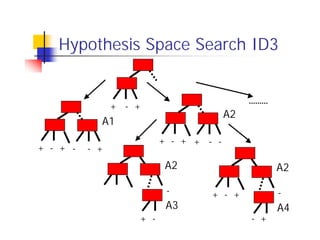
                + - +
                                        A2
            A1
                          + - + + - -
+ - + -   - +
                           A2                      A2

                           -       + - +           -
                           A3                      A4
                    + -                      - +
Hypothesis Space Search ID3
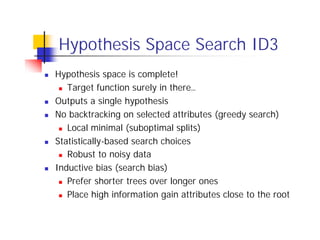
n   Hypothesis space is complete!
     n Target function surely in there…

n   Outputs a single hypothesis
n   No backtracking on selected attributes (greedy search)
     n Local minimal (suboptimal splits)

n   Statistically-based search choices
     n Robust to noisy data

n   Inductive bias (search bias)
     n Prefer shorter trees over longer ones

     n Place high information gain attributes close to the root
Inductive Bias in ID3
n   H is the power set of instances X
     n Unbiased ?

n   Preference for short trees, and for those with high
    information gain attributes near the root
n   Greedy approximation of BFS-ID3
     n   BFS through progressively complex trees to find the shortest
         consistent tree.
n   Bias is a preference imposed by search strategy for
    some hypotheses, rather than a restriction of the
    hypothesis space H
n   Occam’ razor: prefer the shortest (simplest)
            s
    hypothesis that fits the data
Occam’ Razor
            s
Why prefer short hypotheses?
Argument in favor:
   n   Fewer short hypotheses than long hypotheses
   n   A short hypothesis (5-node tree) that fits the data is unlikely to
       be a coincidence
   n   A long hypothesis (500-node tree) that fits the data might be a
       coincidence
Argument opposed:
   n   There are many ways to define small sets of hypotheses
   n   E.g. All trees with 17 leaf nodes and 11 nonleaf nodes that test
       A1 at the root, and then A 2 through A11
   n   The size of a hypothesis is determined by the representation
       used internally by the learner.
Overfitting

Consider error of hypothesis h over
n Training data: error train(h)

n Entire distribution D of data: error D(h)

Hypothesis h∈H overfits training data if there is
                                  ∈H
  an alternative hypothesis h’ such that
       errortrain(h) < errortrain(h’
                                   )
and
       errorD(h) > errorD(h’   )
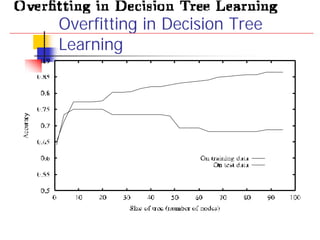
Overfitting in Decision Tree
Learning
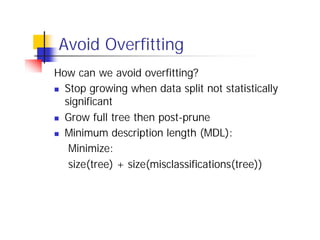
Avoid Overfitting
How can we avoid overfitting?
n Stop growing when data split not statistically
  significant
n Grow full tree then post-prune

n Minimum description length (MDL):

   Minimize:
   size(tree) + size(misclassifications(tree))
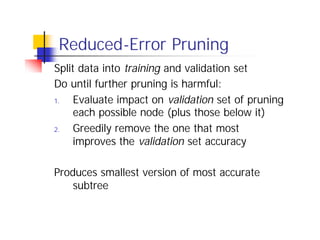
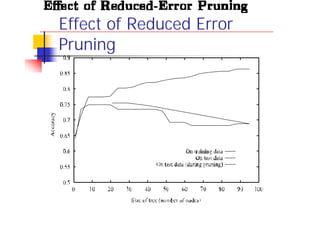
Reduced-Error Pruning
Split data into training and validation set
Do until further pruning is harmful:
1.   Evaluate impact on validation set of pruning
     each possible node (plus those below it)
2.   Greedily remove the one that most
     improves the validation set accuracy

Produces smallest version of most accurate
    subtree
Effect of Reduced Error
Pruning
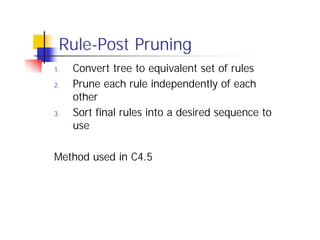
Rule-Post Pruning
1.   Convert tree to equivalent set of rules
2.   Prune each rule independently of each
     other
3.   Sort final rules into a desired sequence to
     use

Method used in C4.5
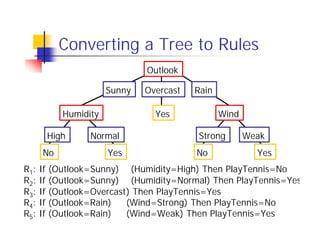
Converting a Tree to Rules
                                 Outlook

                         Sunny   Overcast   Rain

              Humidity             Yes             Wind

           High     Normal                  Strong        Weak
       No                Yes                No              Yes
R1:   If   (Outlook=Sunny) ∧ (Humidity=High) Then PlayTennis=No
R2:   If   (Outlook=Sunny) ∧ (Humidity=Normal) Then PlayTennis=Yes
R3:   If   (Outlook=Overcast) Then PlayTennis=Yes
R4:   If   (Outlook=Rain) ∧ (Wind=Strong) Then PlayTennis=No
R5:   If   (Outlook=Rain) ∧ (Wind=Weak) Then PlayTennis=Yes
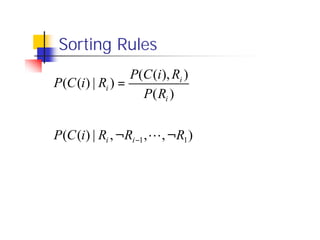
Sorting Rules
                   P(C (i ), Ri )
P (C (i ) | Ri ) =
                     P ( Ri )


P (C (i ) | Ri , ¬Ri −1 , L , ¬R1 )
Continuous Valued Attributes
Create a discrete attribute to test continuous
n Temperature = 24.5 0C

n (Temperature > 20.0 0C) = {true, false}

Where to set the threshold?

Temperatur 150C 180C 190C 220C 240C 270C
PlayTennis    No     No     Yes Yes Yes No


(see paper by [Fayyad, Irani 1993]
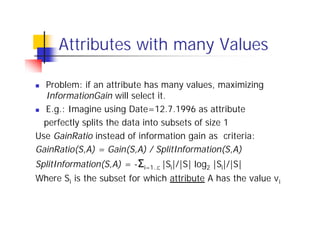
Attributes with many Values

n Problem: if an attribute has many values, maximizing
  InformationGain will select it.
n E.g.: Imagine using Date=12.7.1996 as attribute

  perfectly splits the data into subsets of size 1
Use GainRatio instead of information gain as criteria:
GainRatio(S,A) = Gain(S,A) / SplitInformation(S,A)
SplitInformation(S,A) = -Σi=1..c |Si|/|S| log2 |Si|/|S|
Where Si is the subset for which attribute A has the value v i
Attributes with Cost

Consider:
n Medical diagnosis : blood test costs 1000 SEK

n Robotics: width_from_one_feet has cost 23 secs.

How to learn a consistent tree with low expected
  cost?
Replace Gain by :
  Gain2(S,A)/Cost(A) [Tan, Schimmer 1990]
  2Gain(S,A)-1/(Cost(A)+1)w w ∈[0,1] [Nunez 1988]

Machine Learning in Bioinformatics

  • 1.
    Machine Learning in Bioinformatics
  • 2.
    Machine Learning Techniques n Introduction n Decision Trees n Bayesian Methods n Hidden Markov Models n Support Vector Machines n Neural Networks n Clustering n Genetic Algorithms n Association Rules n Reinforcement Learning n Fuzzy Sets
  • 3.
    Software Packages &Datasets • Weka • Data Mining Software in Java • http://www.cs.waikato.ac.nz/~ml/weka • MLC++ • Machine learning library in C++ • http://www.sig.com/Technology/mlc • UCI • Machine Learning Data Repository UC Irvine • http://www.ics.uci.edu/~mlearn/ML/Repository.html
  • 4.
    Classification: Definition n assignment of objects into a set of predefined categories (classes) n classification of applicants or patients into risk levels n classification of protein sequences into families n classification of web pages into topics n information filter, recommendation, …
  • 5.
    Classification: Task n Input: a training set of examples, each labeled with one class label n Output: a model (classifier) that assigns a class label to each instance based on the other attributes n The model can be used to predict the class of new instances, for which the class label is missing or unknown
  • 6.
    Patient Risk Prediction n Given: n 9714 patient records, each describing a pregnancy and birth n Each patient record contains 215 features n Learn to predict: n Classes of future patients at high risk for Emergency Cesarean Section
  • 7.
    Data Mining Result Oneof 18 learned rules: If No previous vaginal delivery, and Abnormal 2nd Trimester Ultrasound, and Malpresentation at admission Then Probability of Emergency C-Section is 0.6 n Over training data: 26/41 = .63, n Over test data: 12/20 = .60
  • 8.
    Train and Test n example =instance + class label n Examples are divided into training set + test set n Classification model is built in two steps: n training - build the model from the training set n test - check the accuracy of the model using test set
  • 9.
    Train and Test n Kind of models: n if - then rules n logical formulae n decision trees n joint probabilities n Accuracy of models: n the known class of test samples is matched against the class predicted by the model n accuracy rate = % of test set samples correctly classified by the model
  • 10.
    Training step Classification algorithm training data Classifier Age Car Type Risk 20 Combi High (model) 18 Sports High 40 Sports High 50 Family Low if age < 31 35 Minivan Low 30 Combi High or Car Type =Sports 32 Family Low then Risk = High 14 4 class 2 3 40 Combi Low attribute label
  • 11.
    Test step Classifier (model) test data Age Car Type Risk Risk 27 Sports High High 34 Family Low Low 66 Family High Low 44 Sports High High
  • 12.
    Classification (prediction) Classifier (model) new data Age Car Type Risk Risk 27 Sports High 34 Minivan Low 55 Family Low 34 Sports High
  • 13.
    Classification vs. Regression n There are two forms of data analysis that can be used to extract models describing data classes or to predict future data trends: n classification: predict categorical labels n regression: models continuous-valued functions
  • 14.
    Comparing Classification Methods (1) n Predictive accuracy: this refers to the ability of the model to correctly predict the class label of new or previously unseen data n Speed: this refers to the computation costs involved in generating and using the model n Robustness: this is the ability of the model to make correct predictions given noisy data or data with missing values
  • 15.
    Comparing Classification Methods (2) n Scalability: this refers to the ability to construct the model efficiently given large amount of data n Interpretability: this refers to the level of understanding and insight that is provided by the model n Simplicity: n decision tree size n rule compactness n Domain-dependent quality indicators
  • 16.
    Problem formulation Given records in the database with class label – find model for each class. Age Car Type Risk Age < 31 20 Combi High 18 Sports High Car Type 40 Sports High is sports 50 Family Low 35 Minivan Low High 30 Combi High 32 Family Low 40 Combi Low High Low
  • 17.
  • 18.
    Outline n Decision tree representation n ID3 learning algorithm n Entropy, information gain n Overfitting
  • 19.
    Decision Trees n A decision tree is a tree structure, where n each internal node denotes a test on an attribute, n each branch represents the outcome of the test, n leaf nodes represent classes or class distributions Age < 31 Y N Car Type is sports High High Low
  • 20.
    Decision Tree n widely used in inductive inference n for approximating discrete valued functions n can be represented as if-then rules for human readability n complete hypothesis space n successfully applied to many applications n medical diagnosis n credit risk prediction
  • 21.
    Training Examples Day Outlook Temp. Humidity Wind Play Tennis D1 Sunny Hot High Weak No D2 Sunny Hot High Strong No D3 Overcast Hot High Weak Yes D4 Rain Mild High Weak Yes D5 Rain Cool Normal Weak Yes D6 Rain Cool Normal Strong No D7 Overcast Cool Normal Weak Yes D8 Sunny Mild High Weak No D9 Sunny Cold Normal Weak Yes D10 Rain Mild Normal Strong Yes D11 Sunny Mild Normal Strong Yes D12 Overcast Mild High Strong Yes D13 Overcast Hot Normal Weak Yes D14 Rain Mild High Strong No
  • 22.
    Decision Tree forPlayTennis Outlook Sunny Overcast Rain Humidity Yes Wind High Normal Strong Weak No Yes No Yes
  • 23.
    Decision Tree forC-Section Risk Prediction n Learned from medical records of 100 women [833+,167-] .83+ .17- Fetal_Presentation = 1: [822+,116-] .88+ .12- | Previous_Csection = 0: [767+,81-] .90+ .10- | | Primiparous = 0: [399+,13-] .97+ .03- | | Primiparous = 1: [368+,68-] .84+ .16- | | | Fetal_Distress = 0: [334+,47-] .88+ .12- | | | | Birth_Weight < 3349: [201+,10.6 -] .95+ .05- | | | | Birth_Weight >= 3349: [133+,36.4 -] .78+ .22- | | | Fetal_Distress = 1: [34+,21-] .62+ .38- | Previous_Csection = 1: [55+,35-] .61+ .39- Fetal_Presentation = 2: [3+,29-] .11+ .89- Fetal_Presentation = 3: [8+,22-] .27+ .73-
  • 24.
    Decision Tree forPlayTennis Outlook Sunny Overcast Rain Humidity Each internal node tests an attribute High Normal Each branch corresponds to an attribute value node No Yes Each leaf node assigns a classification
  • 25.
    Decision Tree forPlayTennis Outlook Temperature Humidity Wind PlayTennis Sunny Hot High Weak ?No Outlook Sunny Overcast Rain Humidity Yes Wind High Normal Strong Weak No Yes No Yes
  • 26.
    Decision Tree • decision trees represent disjunctions of conjunctions Outlook Sunny Overcast Rain Humidity Yes Wind High Normal Strong Weak No Yes No Yes (Outlook=Sunny ∧ Humidity=Normal) ∨ (Outlook=Overcast) ∨ (Outlook=Rain ∧ Wind=Weak)
  • 27.
    When to considerDecision Trees n Instances describable by attribute-value pairs n Target function is discrete valued n Disjunctive hypothesis may be required n Possibly noisy training data n Missing attribute values n Examples: n Medical diagnosis n Credit risk analysis n Object classification for robot manipulator (Tan 1993)
  • 28.
    Top-Down Induction of Decision Trees ID3 1. A ← the “best” decision attribute for next node 2. Assign A as decision attribute for node 3. For each value of A create new descendant 4. Sort training examples to leaf node according to the attribute value of the branch 5. If all training examples are perfectly classified (same value of target attribute) stop, else iterate over new leaf nodes.
  • 29.
    Which Attribute is”best”? [29+,35-] A1=? A2=? [29+,35-] True False True False [21+, 5-] [8+, 30-] [18+, 33-] [11+, 2-]
  • 30.
    Entropy n S is a sample of training examples n p+ is the proportion of positive examples n p- is the proportion of negative examples n Entropy measures the impurity of S Entropy(S) = -p+ log2 p+ - p- log2 p-
  • 31.
    Entropy n Entropy(S)= expectednumber of bits needed to encode class (+ or -) of randomly drawn members of S (under the optimal, shortest length-code) Why? n Information theory optimal length code assign –log2 p bits to messages having probability p. n So the expected number of bits to encode (+ or -) of random member of S: -p+ log2 p+ - p- log2 p-
  • 32.
    Information Gain n Gain(S,A): expected reduction in entropy due to sorting S on attribute A Gain(S,A)=Entropy(S) - ∑v∈values(A) |Sv|/|S| Entropy(Sv) Entropy([29+,35-]) = -29/64 log2 29/64 – 35/64 log2 35/64 = 0.99 [29+,35-] A1=? A2=? [29+,35-] True False True False [21+, 5-] [8+, 30-] [18+, 33-] [11+, 2-]
  • 33.
    Information Gain Entropy([21+,5-])= 0.71 Entropy([18+,33-]) = 0.94 Entropy([8+,30-]) = 0.74 Entropy([8+,30-]) = 0.62 Gain(S,A1)=Entropy(S) Gain(S,A2)=Entropy(S) -26/64*Entropy([21+,5-]) -51/64*Entropy([18+,33-]) -38/64*Entropy([8+,30-]) -13/64*Entropy([11+,2-]) =0.27 =0.12 [29+,35-] A1=? A2=? [29+,35-] True False True False [21+, 5-] [8+, 30-] [18+, 33-] [11+, 2-]
  • 34.
    Training Examples Day Outlook Temp. Humidity Wind Play Tennis D1 Sunny Hot High Weak No D2 Sunny Hot High Strong No D3 Overcast Hot High Weak Yes D4 Rain Mild High Weak Yes D5 Rain Cool Normal Weak Yes D6 Rain Cool Normal Strong No D7 Overcast Cool Normal Weak Yes D8 Sunny Mild High Weak No D9 Sunny Cold Normal Weak Yes D10 Rain Mild Normal Strong Yes D11 Sunny Mild Normal Strong Yes D12 Overcast Mild High Strong Yes D13 Overcast Hot Normal Weak Yes D14 Rain Mild High Strong No
  • 35.
    Selecting the NextAttribute S=[9+,5-] S=[9+,5-] E=0.940 E=0.940 Humidity Wind High Normal Weak Strong [3+, 4-] [6+, 1-] [6+, 2-] [3+, 3-] E=0.985 E=0.592 E=0.811 E=1.0 Gain(S,Humidity) Gain(S,Wind) =0.940-(7/14)*0.985 =0.940-(8/14)*0.811 – (7/14)*0.592 – (6/14)*1.0 =0.151 =0.048
  • 36.
    Selecting the NextAttribute S=[9+,5-] E=0.940 Outlook Over Sunny Rain cast [2+, 3-] [4+, 0] [3+, 2-] E=0.971 E=0.0 E=0.971 Gain(S,Outlook) =0.940-(5/14)*0.971 -(4/14)*0.0 – (5/14)*0.0971 =0.247
  • 37.
    ID3 Algorithm [D1,D2,… ,D14] Outlook [9+,5-] Sunny Overcast Rain Ssunny=[D1,D2,D8,D9,D11] [D3,D7,D12,D13] [D4,D5,D6,D10,D14] [2+,3-] [4+,0-] [3+,2-] ? Yes ? Gain(Ssunny , Humidity)=0.970-(3/5)0.0 – 2/5(0.0) = 0.970 Gain(Ssunny , Temp.)=0.970-(2/5)0.0 –2/5(1.0)-(1/5)0.0 = 0.570 Gain(Ssunny , Wind)=0.970= -(2/5)1.0 – 3/5(0.918) = 0.019
  • 38.
    ID3 Algorithm Outlook Sunny Overcast Rain Humidity Yes Wind [D3,D7,D12,D13] High Normal Strong Weak No Yes No Yes [D1,D2] [D8,D9,D11] [D6,D14] [D4,D5,D10]
  • 39.
    Hypothesis Space SearchID3 + - + A2 A1 + - + + - - + - + - - + A2 A2 - + - + - A3 A4 + - - +
  • 40.
    Hypothesis Space SearchID3 n Hypothesis space is complete! n Target function surely in there… n Outputs a single hypothesis n No backtracking on selected attributes (greedy search) n Local minimal (suboptimal splits) n Statistically-based search choices n Robust to noisy data n Inductive bias (search bias) n Prefer shorter trees over longer ones n Place high information gain attributes close to the root
  • 41.
    Inductive Bias inID3 n H is the power set of instances X n Unbiased ? n Preference for short trees, and for those with high information gain attributes near the root n Greedy approximation of BFS-ID3 n BFS through progressively complex trees to find the shortest consistent tree. n Bias is a preference imposed by search strategy for some hypotheses, rather than a restriction of the hypothesis space H n Occam’ razor: prefer the shortest (simplest) s hypothesis that fits the data
  • 42.
    Occam’ Razor s Why prefer short hypotheses? Argument in favor: n Fewer short hypotheses than long hypotheses n A short hypothesis (5-node tree) that fits the data is unlikely to be a coincidence n A long hypothesis (500-node tree) that fits the data might be a coincidence Argument opposed: n There are many ways to define small sets of hypotheses n E.g. All trees with 17 leaf nodes and 11 nonleaf nodes that test A1 at the root, and then A 2 through A11 n The size of a hypothesis is determined by the representation used internally by the learner.
  • 43.
    Overfitting Consider error ofhypothesis h over n Training data: error train(h) n Entire distribution D of data: error D(h) Hypothesis h∈H overfits training data if there is ∈H an alternative hypothesis h’ such that errortrain(h) < errortrain(h’ ) and errorD(h) > errorD(h’ )
  • 44.
  • 45.
    Avoid Overfitting How canwe avoid overfitting? n Stop growing when data split not statistically significant n Grow full tree then post-prune n Minimum description length (MDL): Minimize: size(tree) + size(misclassifications(tree))
  • 46.
    Reduced-Error Pruning Split datainto training and validation set Do until further pruning is harmful: 1. Evaluate impact on validation set of pruning each possible node (plus those below it) 2. Greedily remove the one that most improves the validation set accuracy Produces smallest version of most accurate subtree
  • 47.
    Effect of ReducedError Pruning
  • 48.
    Rule-Post Pruning 1. Convert tree to equivalent set of rules 2. Prune each rule independently of each other 3. Sort final rules into a desired sequence to use Method used in C4.5
  • 49.
    Converting a Treeto Rules Outlook Sunny Overcast Rain Humidity Yes Wind High Normal Strong Weak No Yes No Yes R1: If (Outlook=Sunny) ∧ (Humidity=High) Then PlayTennis=No R2: If (Outlook=Sunny) ∧ (Humidity=Normal) Then PlayTennis=Yes R3: If (Outlook=Overcast) Then PlayTennis=Yes R4: If (Outlook=Rain) ∧ (Wind=Strong) Then PlayTennis=No R5: If (Outlook=Rain) ∧ (Wind=Weak) Then PlayTennis=Yes
  • 50.
    Sorting Rules P(C (i ), Ri ) P (C (i ) | Ri ) = P ( Ri ) P (C (i ) | Ri , ¬Ri −1 , L , ¬R1 )
  • 51.
    Continuous Valued Attributes Createa discrete attribute to test continuous n Temperature = 24.5 0C n (Temperature > 20.0 0C) = {true, false} Where to set the threshold? Temperatur 150C 180C 190C 220C 240C 270C PlayTennis No No Yes Yes Yes No (see paper by [Fayyad, Irani 1993]
  • 52.
    Attributes with manyValues n Problem: if an attribute has many values, maximizing InformationGain will select it. n E.g.: Imagine using Date=12.7.1996 as attribute perfectly splits the data into subsets of size 1 Use GainRatio instead of information gain as criteria: GainRatio(S,A) = Gain(S,A) / SplitInformation(S,A) SplitInformation(S,A) = -Σi=1..c |Si|/|S| log2 |Si|/|S| Where Si is the subset for which attribute A has the value v i
  • 53.
    Attributes with Cost Consider: nMedical diagnosis : blood test costs 1000 SEK n Robotics: width_from_one_feet has cost 23 secs. How to learn a consistent tree with low expected cost? Replace Gain by : Gain2(S,A)/Cost(A) [Tan, Schimmer 1990] 2Gain(S,A)-1/(Cost(A)+1)w w ∈[0,1] [Nunez 1988]