Done By :-
Facebook : Fahd .Allebdi
Twitter : @fahdalharbi13
Email : alking@hotmail.de
Artificial intelligence is a part of computer science that tries to make
computers more intelligent. One of the basic requirements for any
intelligent behavior is learning. Therefore, machine learning is one of
major branches of artificial intelligence and, indeed, it is one of the most
rapidly developing subfields of AI research.
So in this report we will discover The definition of it, history , types and
some real application in real world used.
Machine Learning is the domain of Artificial Intelligence which is
concerned with building adaptive computer systems that are able to
improve their competence and/or efficiency through learning from input
data or from their own problem solving experience.
Machine Learning is arguably the greatest export from computing to
other scientific fields.
Early enthusiasm (1955 - 1965):
• Learning without knowledge;
• Neural modeling (self-organizing systems and decision space techniques);
• Evolutionary learning;
• Rote learning (Samuel Checker’s player).
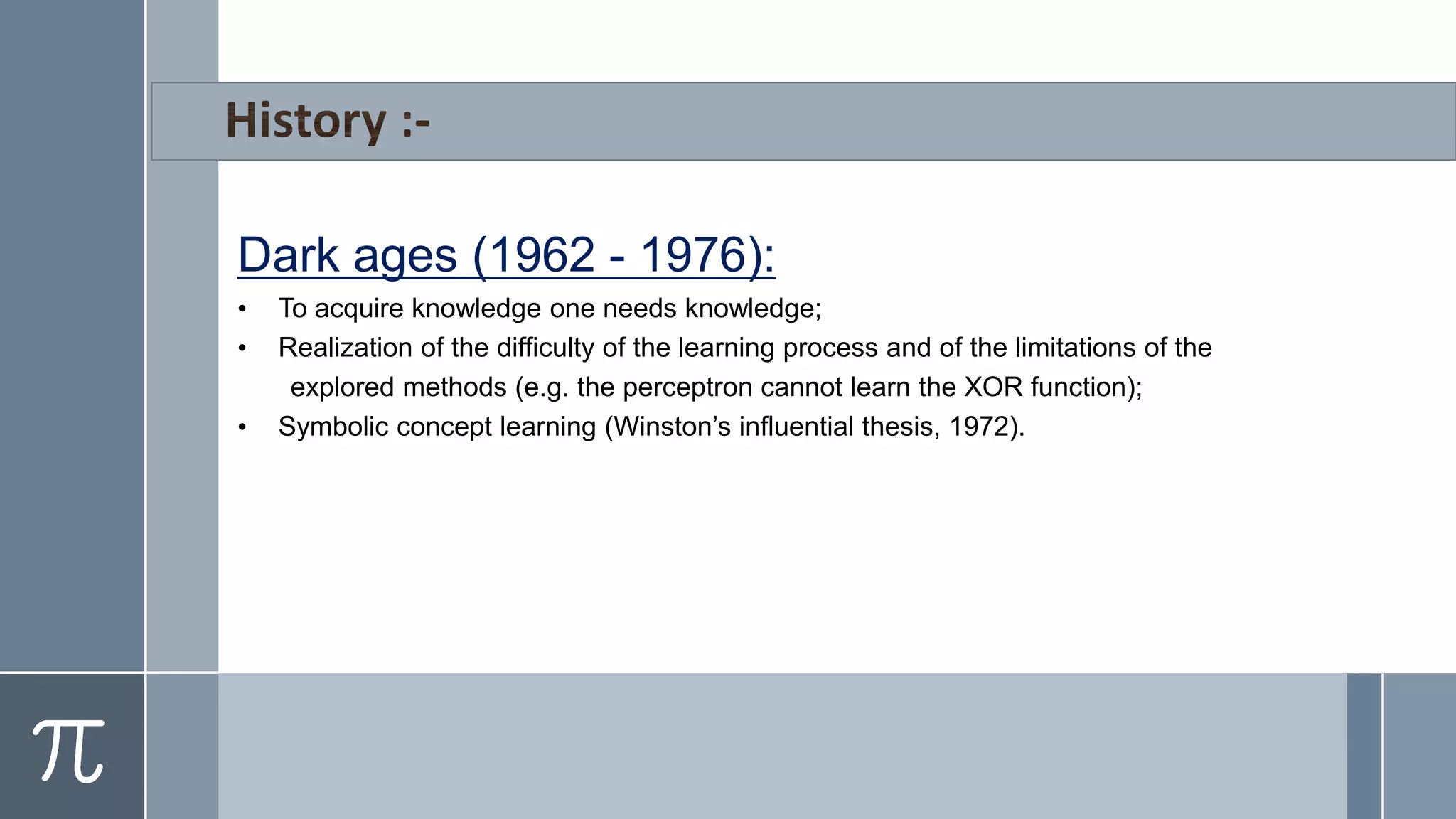
Dark ages (1962 - 1976):
• To acquire knowledge one needs knowledge;
• Realization of the difficulty of the learning process and of the limitations of the
explored methods (e.g. the perceptron cannot learn the XOR function);
• Symbolic concept learning (Winston’s influential thesis, 1972).
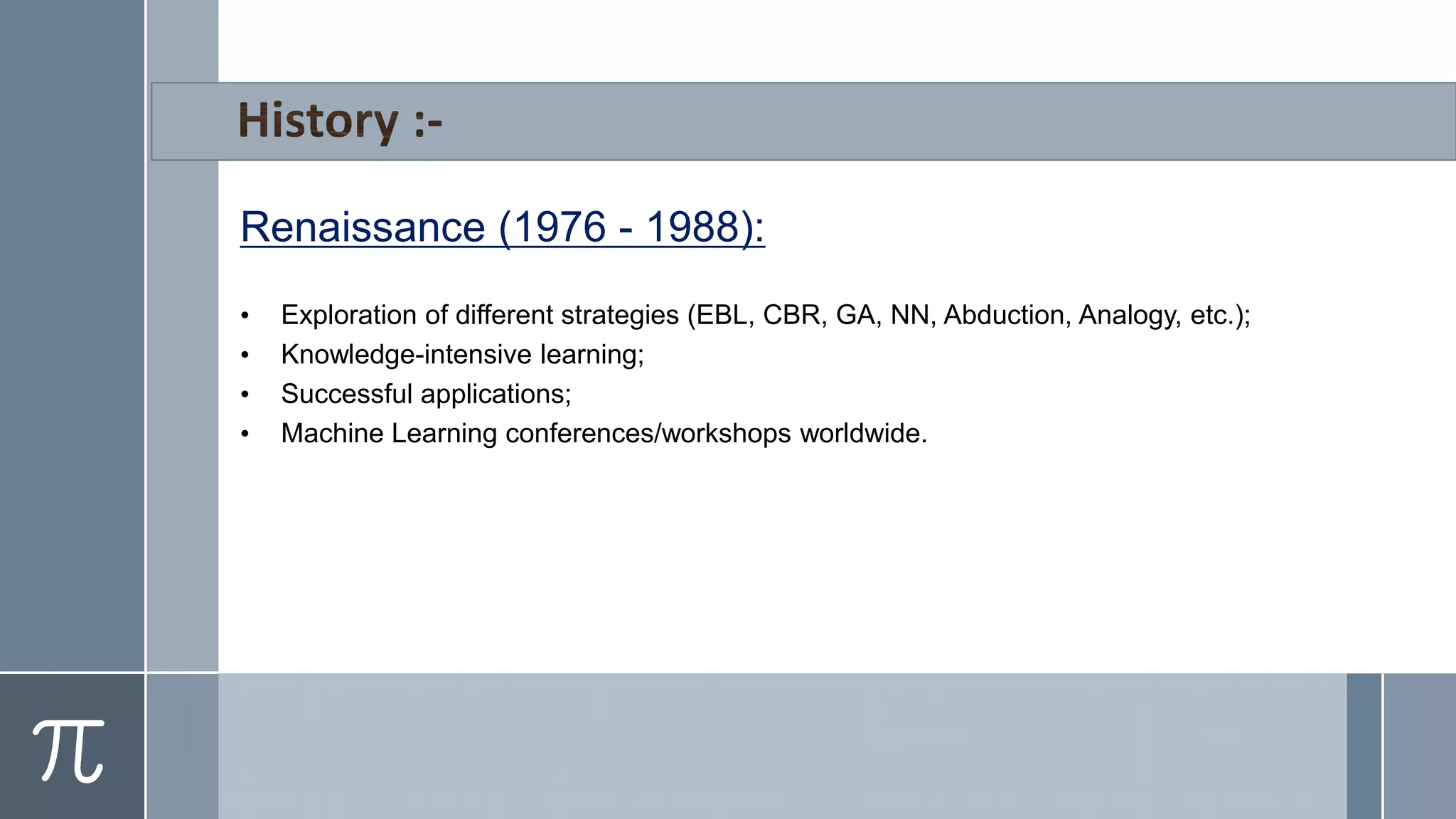
Renaissance (1976 - 1988):
• Exploration of different strategies (EBL, CBR, GA, NN, Abduction, Analogy, etc.);
• Knowledge-intensive learning;
• Successful applications;
• Machine Learning conferences/workshops worldwide.
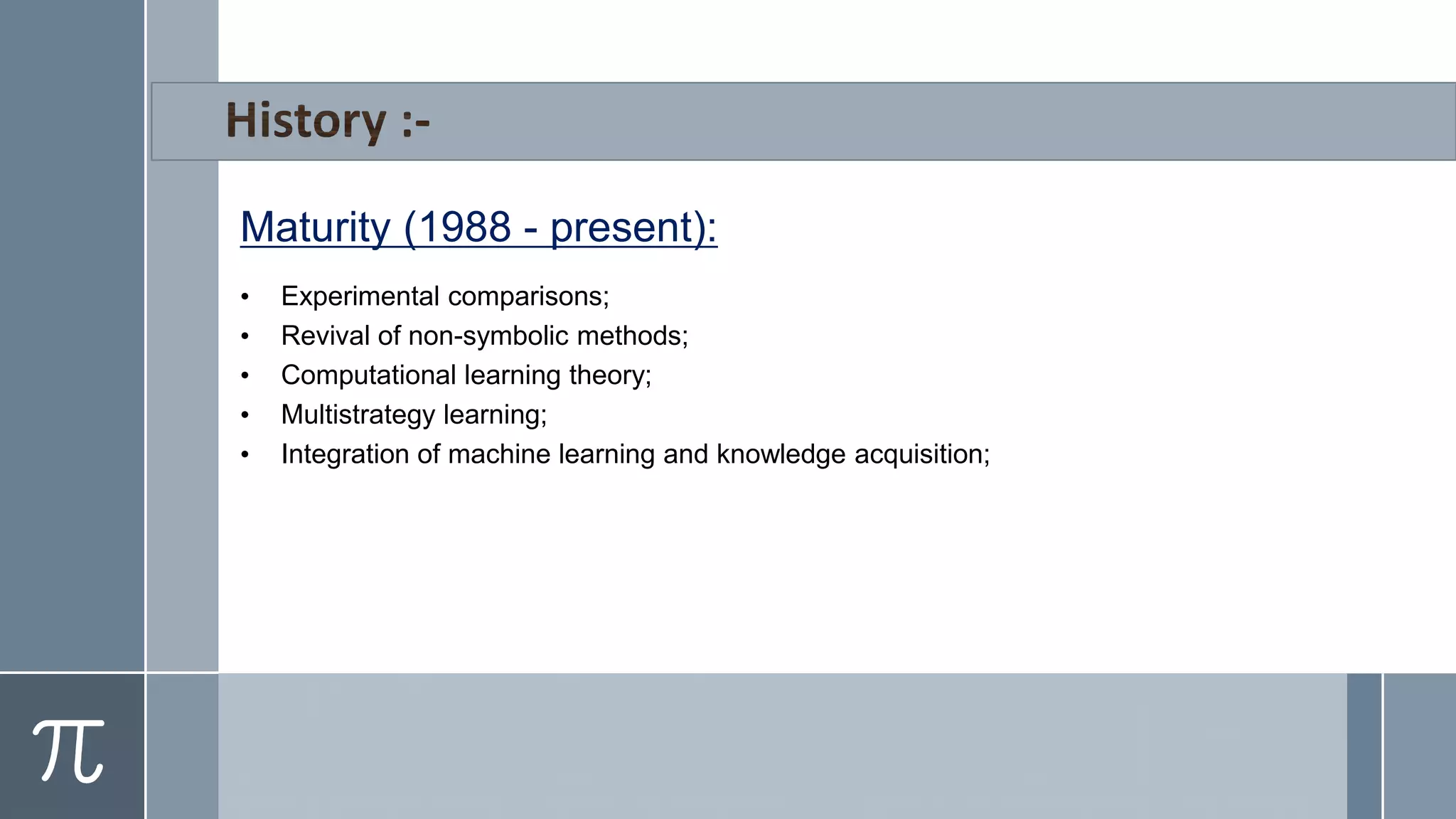
Maturity (1988 - present):
• Experimental comparisons;
• Revival of non-symbolic methods;
• Computational learning theory;
• Multistrategy learning;
• Integration of machine learning and knowledge acquisition;
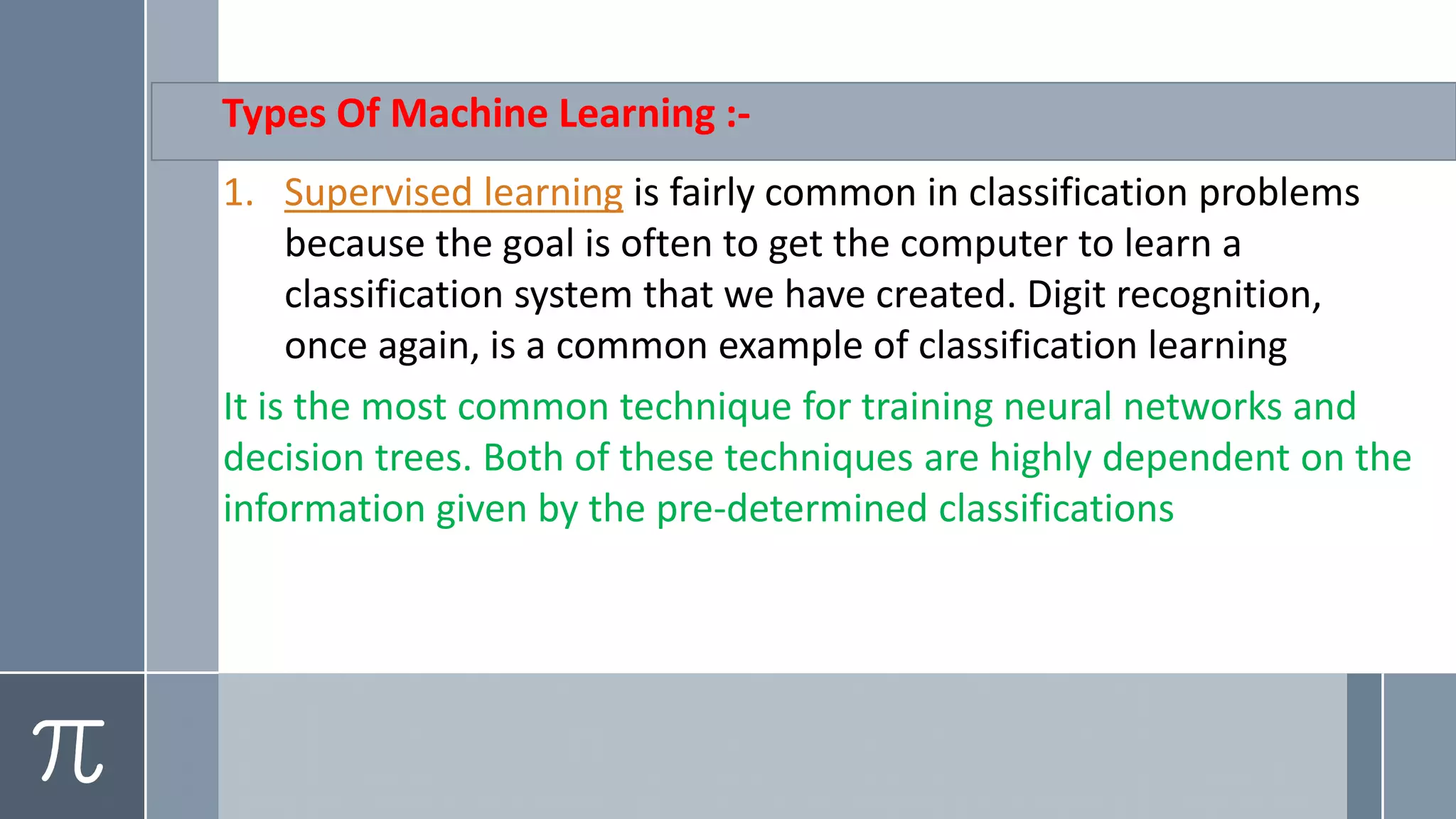
Types Of Machine Learning :-
1. Supervised learning is fairly common in classification problems
because the goal is often to get the computer to learn a
classification system that we have created. Digit recognition,
once again, is a common example of classification learning
It is the most common technique for training neural networks and
decision trees. Both of these techniques are highly dependent on the
information given by the pre-determined classifications
Types Of Machine Learning :-
a learning paradigm concerned withislearningsupervised-Semi.2
the study of how computers and natural systems such as humans
learn in the presence of both labeled and unlabeled data
supervised learning is to understand how-of semigoalThe
combining labeled and unlabeled data may change the learning
behavior, and design algorithms that take advantage of such a
combination
Types Of Machine Learning :-
3. Unsupervised learning seems much harder :
the goal is to have the computer learn how to do Something
that we don't tell it how to do! There are actually two
approaches to unsupervised learning.
However, in the few last years due to various technological advances and
research efforts (e.g. evolution of the Web). Some of these modern
applications are learning from biological sequences, learning from
email data, and learning in complex environments such as Web.
People are sending and receiving many messages per day,
communicating with partners and friends, or exchanging files and
information. Unfortunately, the phenomenon of email overload has
grown over the past years becoming a personal headache for users
and a financial issue for companies.
› Automatic Answering :
› Automatic Mail Organization into Folders :
› Email and Thread Summarization :
› Spam Filtering :
› Dynamic Feature Space and Incremental Feature Selection for Email Classification :
 Automatic Answering :
Large companies usually maintain email centers (call centers) with employees
committed to answer incoming messages. Those messages usually come from
company clients and partners and many times address the same problems
and queries .
Automatic email answering is an effort to build email centers or
personalized software that will be able to analyze an incoming message
and then propose or even send an applicable answer.
 Automatic Mail Organization into Folders
The growth of email usage has forced users to find ways to organize archive
and manage their emails more efficiently. Many of them are organizing
incoming messages into separate folders. Folders can be topic-oriented like
“work”, ”personal” and ”funny”.
many users create manually some so-called rules to classify their email
Machine learning provide this task is the automatic classification of incoming
email by observing past and current classifications made by the user Thus,
the user does not need to create the rules by himself.
A lot of research has been recorded in the field and lots of those ideas
have been implemented into useful email tools .
 Email and Thread Summarization :
 email users that receive hundreds of messages per day. Some of them
are newsletters , colleagues, appointment arrangements etc.
It would be extremely useful for them if they could avoid reading all of
those messages and instead read only the most important and necessary
parts
Data mining techniques are explored in order to build trainable tools for
summarization .
 Spam Filtering :
 A spam filter is a program that is used to detect unsolicited and
unwanted email and prevent those messages from getting to a user's
inbox.
 Many different machine learning classifiers have been tested in the
bibliography including Naïve Bayes , Support Vector Machines , Stacking
Classifiers and some of them have proved to be particularly accurate.
 1.5 Dynamic Feature Space and Incremental Feature Selection for Email Classification
 In this section we present a computationally undemanding method that tackles with
this problem . Our approach uses two components in conjunction:
a) an incremental feature ranking method.
b) an incremental learning algorithm that can consider a subset of the features during
prediction.
Such methods evaluate each word based on cumulative statistics
concerning the number of times that it appears in each different
class of documents
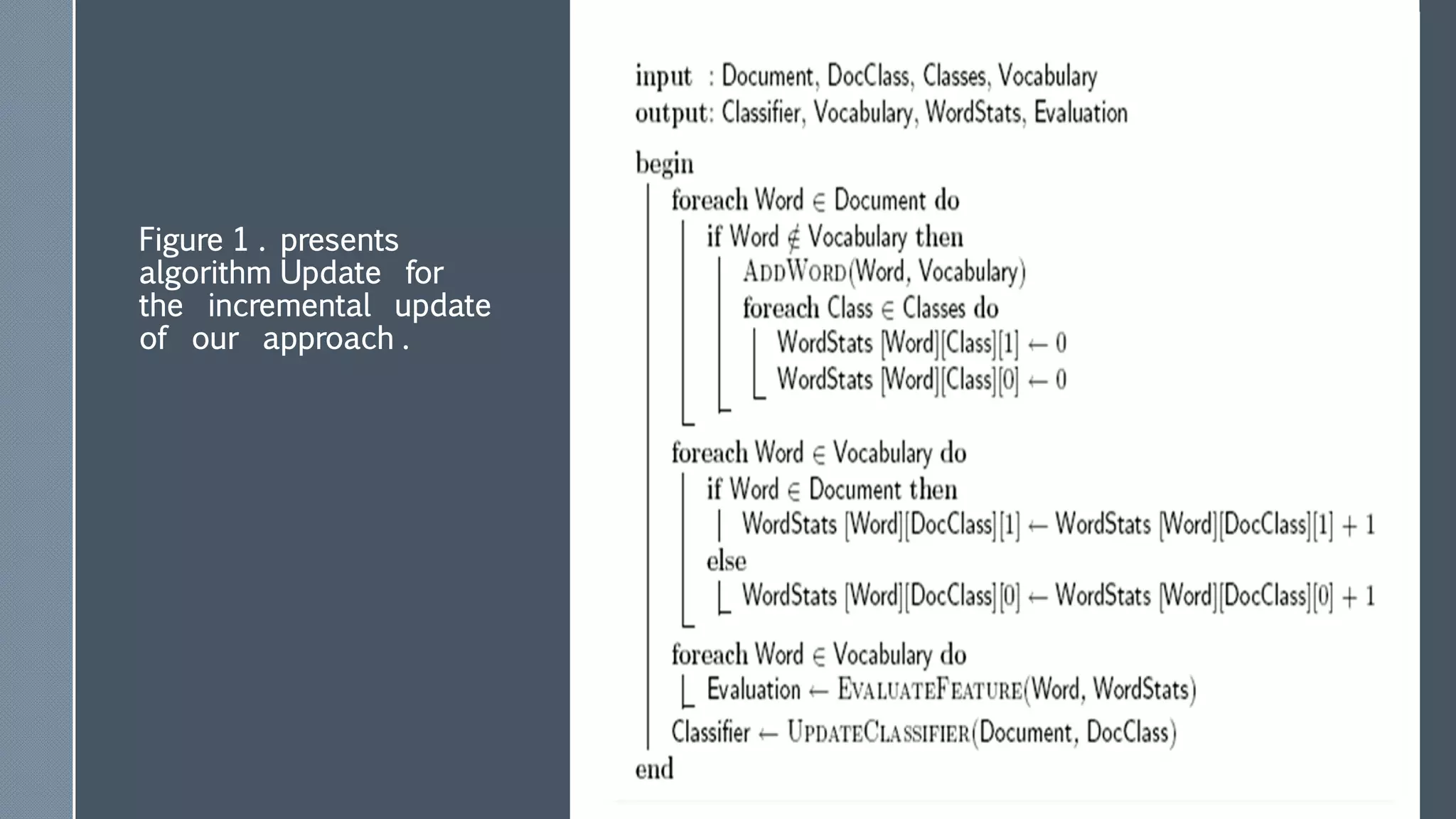
Figure 1 . presents
algorithm Update for
the incremental update
of our approach .
There are also other interesting topics that were not discussed
in this report. Some of them are applications on MRI data,
astronomical data, robotics, video games, music data etc.

Machine learning

  • 1.
    Done By :- Facebook: Fahd .Allebdi Twitter : @fahdalharbi13 Email : alking@hotmail.de
  • 2.
    Artificial intelligence isa part of computer science that tries to make computers more intelligent. One of the basic requirements for any intelligent behavior is learning. Therefore, machine learning is one of major branches of artificial intelligence and, indeed, it is one of the most rapidly developing subfields of AI research. So in this report we will discover The definition of it, history , types and some real application in real world used.
  • 3.
    Machine Learning isthe domain of Artificial Intelligence which is concerned with building adaptive computer systems that are able to improve their competence and/or efficiency through learning from input data or from their own problem solving experience. Machine Learning is arguably the greatest export from computing to other scientific fields.
  • 4.
    Early enthusiasm (1955- 1965): • Learning without knowledge; • Neural modeling (self-organizing systems and decision space techniques); • Evolutionary learning; • Rote learning (Samuel Checker’s player).
  • 5.
    Dark ages (1962- 1976): • To acquire knowledge one needs knowledge; • Realization of the difficulty of the learning process and of the limitations of the explored methods (e.g. the perceptron cannot learn the XOR function); • Symbolic concept learning (Winston’s influential thesis, 1972).
  • 6.
    Renaissance (1976 -1988): • Exploration of different strategies (EBL, CBR, GA, NN, Abduction, Analogy, etc.); • Knowledge-intensive learning; • Successful applications; • Machine Learning conferences/workshops worldwide.
  • 7.
    Maturity (1988 -present): • Experimental comparisons; • Revival of non-symbolic methods; • Computational learning theory; • Multistrategy learning; • Integration of machine learning and knowledge acquisition;
  • 8.
    Types Of MachineLearning :- 1. Supervised learning is fairly common in classification problems because the goal is often to get the computer to learn a classification system that we have created. Digit recognition, once again, is a common example of classification learning It is the most common technique for training neural networks and decision trees. Both of these techniques are highly dependent on the information given by the pre-determined classifications
  • 9.
    Types Of MachineLearning :- a learning paradigm concerned withislearningsupervised-Semi.2 the study of how computers and natural systems such as humans learn in the presence of both labeled and unlabeled data supervised learning is to understand how-of semigoalThe combining labeled and unlabeled data may change the learning behavior, and design algorithms that take advantage of such a combination
  • 10.
    Types Of MachineLearning :- 3. Unsupervised learning seems much harder : the goal is to have the computer learn how to do Something that we don't tell it how to do! There are actually two approaches to unsupervised learning.
  • 11.
    However, in thefew last years due to various technological advances and research efforts (e.g. evolution of the Web). Some of these modern applications are learning from biological sequences, learning from email data, and learning in complex environments such as Web.
  • 12.
    People are sendingand receiving many messages per day, communicating with partners and friends, or exchanging files and information. Unfortunately, the phenomenon of email overload has grown over the past years becoming a personal headache for users and a financial issue for companies. › Automatic Answering : › Automatic Mail Organization into Folders : › Email and Thread Summarization : › Spam Filtering : › Dynamic Feature Space and Incremental Feature Selection for Email Classification :
  • 13.
     Automatic Answering: Large companies usually maintain email centers (call centers) with employees committed to answer incoming messages. Those messages usually come from company clients and partners and many times address the same problems and queries . Automatic email answering is an effort to build email centers or personalized software that will be able to analyze an incoming message and then propose or even send an applicable answer.
  • 14.
     Automatic MailOrganization into Folders The growth of email usage has forced users to find ways to organize archive and manage their emails more efficiently. Many of them are organizing incoming messages into separate folders. Folders can be topic-oriented like “work”, ”personal” and ”funny”. many users create manually some so-called rules to classify their email Machine learning provide this task is the automatic classification of incoming email by observing past and current classifications made by the user Thus, the user does not need to create the rules by himself. A lot of research has been recorded in the field and lots of those ideas have been implemented into useful email tools .
  • 15.
     Email andThread Summarization :  email users that receive hundreds of messages per day. Some of them are newsletters , colleagues, appointment arrangements etc. It would be extremely useful for them if they could avoid reading all of those messages and instead read only the most important and necessary parts Data mining techniques are explored in order to build trainable tools for summarization .
  • 16.
     Spam Filtering:  A spam filter is a program that is used to detect unsolicited and unwanted email and prevent those messages from getting to a user's inbox.  Many different machine learning classifiers have been tested in the bibliography including Naïve Bayes , Support Vector Machines , Stacking Classifiers and some of them have proved to be particularly accurate.
  • 17.
     1.5 DynamicFeature Space and Incremental Feature Selection for Email Classification  In this section we present a computationally undemanding method that tackles with this problem . Our approach uses two components in conjunction: a) an incremental feature ranking method. b) an incremental learning algorithm that can consider a subset of the features during prediction.
  • 18.
    Such methods evaluateeach word based on cumulative statistics concerning the number of times that it appears in each different class of documents
  • 19.
    Figure 1 .presents algorithm Update for the incremental update of our approach .
  • 20.
    There are alsoother interesting topics that were not discussed in this report. Some of them are applications on MRI data, astronomical data, robotics, video games, music data etc.