Download the full version and explore a variety of test banks
or solution manuals at https://testbankfan.com
M Organizational Behavior 3rd Edition McShane
Solutions Manual
_____ Follow the link below to get your download now _____
https://testbankfan.com/product/m-organizational-
behavior-3rd-edition-mcshane-solutions-manual/
Access testbankfan.com now to download high-quality
test banks or solution manuals
We have selected some products that you may be interested in
Click the link to download now or visit testbankfan.com
for more options!.
M Organizational Behavior 3rd Edition McShane Test Bank
https://testbankfan.com/product/m-organizational-behavior-3rd-edition-
mcshane-test-bank/
M Organizational Behavior 2nd Edition McShane Solutions
Manual
https://testbankfan.com/product/m-organizational-behavior-2nd-edition-
mcshane-solutions-manual/
M Organizational Behavior 2nd Edition McShane Test Bank
https://testbankfan.com/product/m-organizational-behavior-2nd-edition-
mcshane-test-bank/
Sociology Your Compass for a New World Canadian 5th
Edition Brym Test Bank
https://testbankfan.com/product/sociology-your-compass-for-a-new-
world-canadian-5th-edition-brym-test-bank/
Elemental Geosystems 7th Edition Christopherson Solutions
Manual
https://testbankfan.com/product/elemental-geosystems-7th-edition-
christopherson-solutions-manual/
Supply Chain Management A Logistics Perspective 10th
Edition Coyle Solutions Manual
https://testbankfan.com/product/supply-chain-management-a-logistics-
perspective-10th-edition-coyle-solutions-manual/
Essentials of Economics 6th Edition Mankiw Test Bank
https://testbankfan.com/product/essentials-of-economics-6th-edition-
mankiw-test-bank/
Process Systems Analysis and Control 3rd Edition
Coughanowr Solutions Manual
https://testbankfan.com/product/process-systems-analysis-and-
control-3rd-edition-coughanowr-solutions-manual/
Business Law Texts And Cases 14th Edition Clarkson
Solutions Manual
https://testbankfan.com/product/business-law-texts-and-cases-14th-
edition-clarkson-solutions-manual/
Deviance Conformity and Social Control in Canada Canadian
4th Edition Bereska Test Bank
https://testbankfan.com/product/deviance-conformity-and-social-
control-in-canada-canadian-4th-edition-bereska-test-bank/
Chapter 6: Decision Making and Creativity
Instructor’s Manual to Accompany
M:Organizational Behavior 3/e
by Steven L. McShane and Mary Ann Von Glinow
Chapter 6:
Decision Making
and Creativity
Prepared by:
Steven L. McShane, The University of Western Australia
Page 6-!1
© 2016 by McGraw-Hill Education. This is proprietary material solely for authorized instructor use.Not authorized for sale or distribution in any manner.
This document may not be copied,scanned,duplicated,forwarded,distributed,or posted on a website,in whole or part.
Chapter 6: Decision Making and Creativity
Decision Making
and Creativity
LEARNING OBJECTIVES
After reading this chapter, students should be able to:
LO1 Describe the rational choice paradigm of decision making.
LO2 Explain why people differ from the rational choice paradigm when identifying
problems/opportunities, evaluating/choosing alternatives, and evaluating decision
outcomes.
LO3 Discuss the roles of emotions and intuition in decision making.
LO4 Describe employee characteristics, workplace conditions, and specific activities that
support creativity.
LO5 Describe the benefits of employee involvement and identify four contingencies that
affect the optimal level of employee involvement.
anchoring and adjustment heuristic — a natural
tendency for people to be influenced by an initial anchor
point such that they do not sufficiently move away from
that point as new information is provided.
availability heuristic — a natural tendency to assign
higher probabilities to objects or events that are easier to
recall from memory, even though ease of recall is also
affected by nonprobability factors (e.g., emotional
response, recent events).
bounded rationality — the view that people are
bounded in their decision-making capabilities, including
access to limited information, limited information
processing, and tendency toward satisficing rather than
maximizing when making choices.
creativity — the development of original ideas that
make a socially recognized contribution.
decision making — the conscious process of making
choices among alternatives with the intention of moving
toward some desired state of affairs.
divergent thinking — reframing a problem in a unique
way and generating different approaches to the issue.
employee involvement — the degree to which
employees influence how their work is organized and
carried out.
escalation of commitment — the tendency to repeat an
apparently bad decision or allocate more resources to a
failing course of action.
implicit favorite — a preferred alternative that the
decision maker uses repeatedly as a comparison with
other choices.
CHAPTER GLOSSARY
Page 6-!2
© 2016 by McGraw-Hill Education. This is proprietary material solely for authorized instructor use.Not authorized for sale or distribution in any manner.
This document may not be copied,scanned,duplicated,forwarded,distributed,or posted on a website,in whole or part.
6
Chapter 6: Decision Making and Creativity
intuition — the ability to know when a problem or
opportunity exists and to select the best course of action
without conscious reasoning.
prospect theory effect a natural tendency to feel more
dissatisfaction from losing a particular amount than
satisfaction from gaining an equal amount.
rational choice paradigm — the view in decision making
that people should—and typically do—use logic and all
available information to choose the alternative with the
highest value.
representativeness heuristic — a natural tendency to
evaluate probabilities of events or objects by the degree
to which they resemble (are representative of) other
events or objects rather than on objective probability
information.
satisficing — selecting an alternative that is satisfactory
or “good enough,” rather than the alternative with the
highest value (maximization).
scenario planning — a systematic process of thinking
about alternative futures and what the organization
should do to anticipate and react to those environments.
subjective expected utility (SEU) — the probability
(expectancy) of satisfaction (utility) resulting from
choosing a specific alternative in a decision.
CHAPTER SUMMARY BY LEARNING OBJECTIVE
LO1 Describe the rational choice paradigm of decision making.
Decision making is a conscious process of making choices among one or more alternatives with the intention of
moving toward some desired state of affairs. The rational choice paradigm relies on subjective expected utility to
identify the best choice. It also follows the logical process of identifying problems and opportunities, choosing the best
decision style, developing alternative solutions, choosing the best solution, implementing the selected alternative, and
evaluating decision outcomes.
LO2 Explain why people differ from the rational choice paradigm when identifying problems/opportunities,
evaluating/choosing alternatives, and evaluating decision outcomes.
Stakeholder framing, perceptual defense, mental models, decisive leadership, and solution-oriented focus affect our
ability to objectively identify problems and opportunities. We can minimize these challenges by being aware of the
human limitations and discussing the situation with colleagues.
Evaluating and choosing alternatives is often challenging because organizational goals are ambiguous or in conflict,
human information processing is incomplete and subjective, and people tend to satisfice rather than maximize.
Decision makers also short-circuit the evaluation process when faced with an opportunity rather than a problem.
People generally make better choices by systematically evaluating alternatives. Scenario planning can help make future
decisions without the pressure and emotions that occur during
real emergencies.
Confirmation bias and escalation of commitment make it difficult to accurately evaluate decision outcomes. Escalation
is mainly caused by self-justification, self-enhancement effect, the prospect theory effect, and sunk costs. These
problems are minimized by separating decision choosers from decision evaluators, establishing a preset level at which
the decision is abandoned or reevaluated, relying on more systematic and clear feedback about the project’s success,
and involving several people in decision making.
LO3 Discuss the roles of emotions and intuition in decision making.
Emotions shape our preferences for alternatives and the process we follow to evaluate alternatives. We also listen to
our emotions for guidance when making decisions. This latter activity relates to intuition—the ability to know when a
problem or opportunity exists and to select the best course of action without conscious reasoning. Intuition is both an
emotional experience and a rapid, nonconscious analytic process that involves both pattern matching and action
scripts.
Page 6-!3
© 2016 by McGraw-Hill Education. This is proprietary material solely for authorized instructor use.Not authorized for sale or distribution in any manner.
This document may not be copied,scanned,duplicated,forwarded,distributed,or posted on a website,in whole or part.
Chapter 6: Decision Making and Creativity
LO4 Describe employee characteristics, workplace conditions, and specific activities that support creativity.
Creativity is the development of original ideas that make a socially recognized contribution. The four creativity stages
are preparation, incubation, insight, and verification. Incubation assists divergent thinking, which involves reframing
the problem in a unique way and generating different approaches to the issue.
Four of the main features of creative people are intelligence, persistence, expertise, and independent imagination.
Creativity is also strengthened for everyone when the work environment supports a learning orientation, the job has
high intrinsic motivation, the organization provides a reasonable level of job security, and project leaders provide
appropriate goals, time pressure, and resources. Three types of activities that encourage creativity are those that
redefine the problem, associative play, and cross-pollination.
LO5 Describe the benefits of employee involvement and identify four contingencies that affect the optimal level of
employee involvement.
Employee involvement refers to the degree that employees influence how their work is organized and carried out. The
level of participation may range from an employee providing specific information to management without knowing
the problem or issue to complete involvement in all phases of the decision process. Employee involvement may lead to
higher decision quality and commitment, but several contingencies need to be considered, including the decision
structure, source of decision knowledge, decision commitment, and risk of conflict.
Page 6-!4
© 2016 by McGraw-Hill Education. This is proprietary material solely for authorized instructor use.Not authorized for sale or distribution in any manner.
This document may not be copied,scanned,duplicated,forwarded,distributed,or posted on a website,in whole or part.
Chapter 6: Decision Making and Creativity
LECTURE OUTLINE (WITH POWERPOINTÂź
SLIDES)
Decision Making and Creativity
Rational Choice Paradigm
Rational choice paradigm – the view that people should, and typically do,
use logic and all available information to choose the alternative with the
highest value
Key elements:
‱ Subjective expected utility – the probability (expectation) of
satisfaction (utility) resulting from choosing a specific alternative in a
decision – used to determine choice that maximizes
‱ Decision making process – follows the systematic process and
application of stages of decision making
Subjective Expected Utility
Foundation of rational choice paradigm and of several OB theories (e.g.
expectancy theory of motivation)
“Expected” — probability that selected alternative will result in a specific
outcome
“Utility” — selection criterion’s (outcome’s) positive/negative valence
Preferred alternative has highest positive SEU — composite calculation of
probability and valence of each outcome
NOTE: (see supplemental slide for detailed SEU calculation)
!
Decision Making and
Creativity
Slide 1
!
Rational Choice
Paradigm
Slide 2
!
Subjective Expected
Utility
Slide 3
Page 6-!5
© 2016 by McGraw-Hill Education. This is proprietary material solely for authorized instructor use.Not authorized for sale or distribution in any manner.
This document may not be copied,scanned,duplicated,forwarded,distributed,or posted on a website,in whole or part.
Chapter 6: Decision Making and Creativity
Rational Choice Decision Making Process
The rational choice paradigm assumes that decision makers follow the
systematic process illustrated
1. Identify problem/opportunity (symptom vs. problem)
‱ Problem – gap between “what is” and “what ought to be”
‱ Opportunity-- deviation between current expectations and potentially
better situation(s) not previously expected
‱ Symptom – indicators and outcomes of fundamental root causes
2. Choose the best decision process
‱ Programmed decisions – follow standard operating procedures i.e. they
have been resolved in the past
‱ Nonprogrammed decisions – require all steps in the decision model
because the problems are new, complex, or ill-defined
3. Develop alternative solutions – search for ready-made solutions first,
then develop/modify custom-made solution
4. Choose the best alternative – alternative with the highest subjective
expected utility
5. Implement the selected alternative – assumed to occur easily
6. Evaluate decision outcomes – determines whether the gap between
“what is” and “what ought to be” has narrowed
Problem Identification Challenges
Problems and opportunities are not “given” -- they are conclusions
formed from ambiguous and conflicting information
Five Problem Identification Challenges:
‱ Stakeholder framing – stakeholders frame information so decision
makers perceive a problem opportunity, or no issue
‱ Decisive leadership – leaders rewarded for decisiveness, so they
conclude problems or opportunities without careful assessment
‱ Solution-focused problems – solutions are defined as problems (e.g.
“the problem poor training”) -- feels comfortable having a solution
‱ Perceptual defense – blocking out bad news as a coping mechanism
(fail to see information that threatens self-concept)
‱ Mental models – existing mental models blind us from seeing unique
problems or opportunities
!
Rational Choice
Decision Process
Slide 4
!
Problem Identification
Challenges
Slide 5
Page 6-!6
© 2016 by McGraw-Hill Education. This is proprietary material solely for authorized instructor use.Not authorized for sale or distribution in any manner.
This document may not be copied,scanned,duplicated,forwarded,distributed,or posted on a website,in whole or part.
Chapter 6: Decision Making and Creativity
Identifying Problems Effectively
1. Be aware of perceptual and diagnostic limitations
2. Resist temptation of looking decisive when more thoughtful
examination of the situation should occur
3. Create a norm of “divine discontent” – avoid being complacent with
the status quo and adopt an aversion to complacency
4. Discuss the situation with colleagues to discover blind spots and see
different perspectives
Making Choices: Rational vs OB Views
Bounded rationality (Herb Simon) – people process limited and imperfect
information, rarely select the best choice
Problems with goals
‱ Rational – goals are clear, compatible, and agreed-upon
‱ OB – goals are ambiguous, conflicting, lack full support
Problems with information processing
‱ Rational – people can process all information about all alternatives and
their outcomes
‱ OB – people have limited information processing abilities
Problems with evaluation timing
‱ Rational – choices evaluated simultaneously
‱ OB – choices evaluated sequentially
Making Choices: Rational vs OB (con’t)
Problems with evaluation standards
‱ Rational – people use absolute standards to evaluate alternatives
‱ OB – people evaluate against an implicit favorite
Problems with information quality
‱ Rational – choices are made using factual information
‱ OB – choices are made using distorted information
Problems with decision objective
‱ Rational – people maximize i.e. choose alternative with the highest
payoff (subjective expected utility)
‱ OB – people satisfice i.e. select “good enough” alternative
!
Making Choices:
Rational vs OB Views
Slide 7
!
Making Choices:
Rational vs OB Views
Slide 8
!
Identifying Problems
Effectively
Slide 6
Page 6-!7
© 2016 by McGraw-Hill Education. This is proprietary material solely for authorized instructor use.Not authorized for sale or distribution in any manner.
This document may not be copied,scanned,duplicated,forwarded,distributed,or posted on a website,in whole or part.
Chapter 6: Decision Making and Creativity
Biased Decision Heuristics
People have built-in decision heuristics that bias evaluation of
alternatives
Anchoring and adjustment heuristic
‱ We are influenced by an initial anchor point, and don’t move away
from that point much as new information is provided
➡ e.g. high price of an initial contract tender causes negotiations to focus
around that price even though excessive
Availability heuristic
‱ Tendency to estimate the probability of something occurring by how
easily we can recall those events
➡ e.g. we easily remember emotional events (e.g. shark attack) so we
overestimate how often these emotional events occur
Representative heuristic
‱ Tendency to estimate probability of something based on its similarity
to something known than by more precise statistics
➡ e.g. class is 20% engineering and 80% business majors, yet stereotype of
engineering students biases our probability that one student is engineering
Problems with Maximization
People don’t choose the best alternative (maximization) because:
1. Alternatives appear over time and may not be available later
➡ we need to decide now, not when future choices are available
2. People lack motivation and ability to process huge amounts of
information required for maximization
➡ people are cognitive misers
!
Problems with
Maximization
Slide 10
!
Biased Decision
Heuristics
Slide 9
Page 6-!8
© 2016 by McGraw-Hill Education. This is proprietary material solely for authorized instructor use.Not authorized for sale or distribution in any manner.
This document may not be copied,scanned,duplicated,forwarded,distributed,or posted on a website,in whole or part.
Chapter 6: Decision Making and Creativity
How decision makers respond to problems with maximization
1. Satisficing
➡ choose the first alternative that exceeds a “good enough” standard
➡ much less cognitive taxing than maximization
➡ we determine if alternatives are better than our implicit favorite
2. Oversimplify decision calculations
➡ use easily identifiable factors (color, size) to remove several alternatives from
further consideration
➡ use few evaluation criteria rather than full list of factors
3. Avoid making the decision
➡ When presented with many choices, people often choose the least cognitively
challenging alternative – no decision at all
➡ Occurs even when there are clear benefits of selecting any alternative (such
as joining a company retirement plan)
Emotions and Making Choices
How emotions affect the evaluation of alternatives:
1. Emotions form preferences before cognition inferences
‱ Emotional marker process determines our preferences for each alternative
before we consciously evaluate those alternatives
2. Emotions affect the decision evaluation process
‱ moods and emotions affect how carefully we evaluate alternatives
‱ e.g. we may pay more attention to details when in a negative mood, tend
to skim over evaluating when in a good mood
3. Emotions serve as information
‱ We ‘listen in’ on our emotions for guidance when making choices
‱ e.g. visualize using product, pay attention to resulting emotion
Intuitive Decision Making
Intuition – ability to know when a problem or opportunity exists and to
select the best course of action without conscious reasoning
Intuition is an emotional experience
‱ Gut feelings are emotional signals
‱ Not all emotional signals are intuition
Intuition as rapid unconscious analysis
‱ Uses action scripts – programmed decision routines that shorten the
decision making process
!
Intuitive Decision
Making
Slide 12
!
Emotions and Making
Choices
Slide 11
Page 6-!9
© 2016 by McGraw-Hill Education. This is proprietary material solely for authorized instructor use.Not authorized for sale or distribution in any manner.
This document may not be copied,scanned,duplicated,forwarded,distributed,or posted on a website,in whole or part.
Chapter 6: Decision Making and Creativity
Making Better Choices
1. Systematically evaluate alternatives against relevant factors
2. Revisit decisions later, when in a different mood state
3. Scenario planning – disciplined method for imagining possible futures
Decision Evaluation Problems
Confirmation bias — nonconsciously bias evidence about the choice
‱ Emphasize, easier recall of the choice’s positive features
‱ Ignore/downplay negative features
Escalation of commitment -- tendency to repeat or further invest in an
apparently bad decision
Four causes of escalation of commitment:
1. Self-justification effect
➡ continue to invest in a failing project to maintain impression that the project
is still worthy -- ending project implies incompetence
2. Self-enhancement effect
➡ natural tendency to think we are above average (lucky, competent)
➡ results in (a) ignoring bad news about the decision and (b) overestimating
chance that investing more will correct the problem
3. Prospect theory effect
➡ we experience stronger negative emotions when losing something of value
than positive emotions when gaining something of equal value
➡ stopping a project hurts more than spending more on it
4. Sunk costs effect
➡ motivation to invest more in projects with large resources already invested
➡ but future investments should NOT consider size of previous investment in
the project, only the expected future gains
➡ past investment includes time -- people motivated to spend more time when
much time has been devoted to the project already
!
Making Better Choices
Slide 13
!
Decision Evaluation
Problems
Slide 14
Page 6-!10
© 2016 by McGraw-Hill Education. This is proprietary material solely for authorized instructor use.Not authorized for sale or distribution in any manner.
This document may not be copied,scanned,duplicated,forwarded,distributed,or posted on a website,in whole or part.
Chapter 6: Decision Making and Creativity
Evaluating Decisions Better
1. Separate decision choosers from decision evaluators – minimizes self-
justification effect
2. Stop loss – publicly establish a preset level at which the decision is
abandoned or re-evaluated
3. Find sources of systematic and clear feedback
4. Involve several people in the decision – may notice problems sooner
than when someone is working alone
Creative Process Model
1. Preparation
‱ Investigating problem/opportunity -- actively studying the issue
2. Incubation
‱ Reflective thought -- put problem aside, maintain low level of awareness
‱ Assists divergent thinking – reframing a problem in a unique way and
generating different approaches to the issue
‱ Contrasts with convergent thinking – calculating the conventionally
accepted “right answer” to a logical problem
3. Illumination
‱ The experience of suddenly becoming aware of a unique idea
‱ begins with “fringe” awareness (barely perceptible)
‱ short-term memory -- easily forgotten, so need to document
4. Verification
‱ Logical evaluation, experimentation, and further creative insight
!
Evaluating Decisions
Better
Slide 15
!
Creative Process Model
Slide 16
Page 6-!11
© 2016 by McGraw-Hill Education. This is proprietary material solely for authorized instructor use.Not authorized for sale or distribution in any manner.
This document may not be copied,scanned,duplicated,forwarded,distributed,or posted on a website,in whole or part.
Chapter 6: Decision Making and Creativity
Characteristics of Creative People
Cognitive and practical intelligence
‱ Cognitive intelligence to synthesize/analyze information
‱ Practical intelligence – assess potential usefulness of ideas
Persistence
‱ Based on: (a) higher need for achievement, (b) strong motivation from
the task itself, and (c) moderate or high degree of self-esteem
Knowledge and experience
‱ Expertise/subject matter knowledge – but deep knowledge may create
strong mental models that reduce divergent thinking
Independent imagination (cluster of personality traits and values)
‱ Cluster of personality traits and values
‱ Consists of: (a) high openness to experience (personality), moderately
low need for affiliation (drive/motive), higher self-direction and
stimulation (values)
Creative Work Environments
Learning orientation
‱ Encourage experimentation
‱ Tolerate mistakes as part of the creative process
Intrinsically motivating work
‱ Motivation from the job itself -- task significance, autonomy,
challenging but within employee’s competencies
Open communication and sufficient resources
‱ Includes degree of job security
‱ Providing nontraditional workspaces e.g. unique building design
Note: It isn’t clear how much pressure should be exerted on employees
to produce creative ideas or the effect of co-worker support/co-worker
competition
!
Creative Work
Environments
Slide 18
!
Characteristics of
Creative People
Slide 17
Page 6-!12
© 2016 by McGraw-Hill Education. This is proprietary material solely for authorized instructor use.Not authorized for sale or distribution in any manner.
This document may not be copied,scanned,duplicated,forwarded,distributed,or posted on a website,in whole or part.
Chapter 6: Decision Making and Creativity
Creativity Activities
Redefine the problem
‱ Revisit abandoned projects—might be seen in new ways
‱ People unfamiliar with issue explore the problem (fresh eyes)
Associative play
‱ Impromptu storytelling and acting
‱ Artistic activities
‱ Morphological analysis – listing different dimensions of a system and
the elements of each dimension and then looking at each combination
Cross-Pollination
‱ People from different parts of the organization exchange ideas or are
brought into the team
‱ Informal social interaction
Levels of Employee Involvement
Involvement — degree to which employees influence how their work is
organized and carried out
Different levels of involvement (lowest to highest)
1. Employees individually asked for specific information but the problem
is not described to them.
2. Problem is described and employees are asked individually or
collectively for information relating to that problem.
3. Problem is described to employees, who are collectively given
responsibility for developing recommendations
4. Employees responsible for entire decision-making process -- identify
the problem, discover alternative solutions, choose the best
alternative, implement choice
!
Creative Activities
Slide 19
!
Levels of Employee
Involvement
Slide 20
Page 6-!13
© 2016 by McGraw-Hill Education. This is proprietary material solely for authorized instructor use.Not authorized for sale or distribution in any manner.
This document may not be copied,scanned,duplicated,forwarded,distributed,or posted on a website,in whole or part.
Chapter 6: Decision Making and Creativity
Employee Involvement Model
Several potential benefits of involvement, but only under specific
circumstances.
1. Better problem identification
‱ Recognizing problems more quickly and defining them more accurately
2. Synergy produces more/better solutions
‱ Team members create synergy by pooling their knowledge to form new
alternatives
3. Better at picking the best choice
‱ Decision is reviewed by people with diverse perspectives and a broader
representation of values
4. Higher decision commitment
‱ Increases sense of personal responsibility for decision’s success and
representation of interests
Contingencies of Involvement
Higher employee involvement is better when:
1. Decision structure
‱ Problem is new and/or complex i.e. nonprogrammed decision
2. Source of decision knowledge
‱ The leader lacks knowledge and employees have information
3. Decision commitment
‱ Employees unlikely to accept decision without their involvement
4. Risk of conflict (two conflict risks)
(a) Employee norms support the organization’s goals
(b)Employees are likely to agree on the solution
Decision Making and Creativity
!
Employee Involvement
Model
Slide 21
!
Contingencies of
Involvement
Slide 22
!
Decision Making and
Creativity
Slide 23
Page 6-!14
© 2016 by McGraw-Hill Education. This is proprietary material solely for authorized instructor use.Not authorized for sale or distribution in any manner.
This document may not be copied,scanned,duplicated,forwarded,distributed,or posted on a website,in whole or part.
Chapter 6: Decision Making and Creativity
Subjective Expected Utility Calculation
Subjective expected utility: estimating the best possible alternative
(maximization)
‱ Depends on probabilities of outcomes and value (valence) of those
outcomes
Expected – probability of an outcome occurring
‱ As illustrated: Chance that outcome 3 will occur is 90% if choice ‘A’ is
chosen, 30% if choice ‘B’ is chosen
‱ e.g., 90% probability that applicant ‘A’ will quit within one year; only 30%
chance that applicant ‘B’ will quit within one year
Utility – value or happiness produced by each option from value of
expected outcomes
‱ As illustrated: you believe Choice ‘B’ has higher utility (i.e., will produce
greater happiness) than will Choice ‘A’
Choice ‘B’ expected utility is
(.8x7)+(.2 x -2)+(.3x1)= 6.4
Choice ‘A’ expected utility is
(.2x7)+(.5 x -2)+(.9x1)= 1.3
Note 1: Value (valence) of outcomes remain the same for both choices
e.g. you value good wireless reception (positive outcome) to the same degree
no matter which tablet (iPad, etc.) you are considering buying
Note 2: Unlike game theory models, the probabilities in this and most other
business decision scenarios do not sum to 1.0. The first endnote on this topic
in this chapter of the book provides a detailed explanation.
!
Supplemental Slide:
Subjective Expected
Utility Calculation
Slide 24
Page 6-!15
© 2016 by McGraw-Hill Education. This is proprietary material solely for authorized instructor use.Not authorized for sale or distribution in any manner.
This document may not be copied,scanned,duplicated,forwarded,distributed,or posted on a website,in whole or part.
Chapter 6: Decision Making and Creativity
S T U D E N T H A N D O U T
1. You have been asked to personally recommend a new travel agency to handle all airfare,
accommodation, and related travel needs for your organization of 500 staff. One of your
colleagues, who is responsible for the company’s economic planning, suggests that the
best travel agent could be selected mathematically by inputting the relevant factors for
each agency and the weight (importance) of each factor. What decision making approach is
your colleague recommending? Is this recommendation a good idea in this situation? Why
or why not?
2. A developer received financial backing for a new business financial center along a derelict
section of the waterfront, a few miles from the current downtown area of a large European
city. The idea was to build several high-rise structures, attract large tenants to those sites,
and have the city extend transportation systems out to the new center. Over the next
decade, the developer believed that others would build in the area, thereby attracting the
regional or national offices of many financial institutions. Interest from potential tenants
was much lower than initially predicted and the city did not build transportation systems as
quickly as expected. Still, the builder proceeded with the original plans. Only after financial
support was curtailed did the developer reconsider the project. Using your knowledge of
escalation of commitment, discuss three possible reasons why the developer was motivated
to continue with the project.
3. Two characteristics of creative people are that they have relevant experience and are
persistent in their quest. Does this mean that people with the most experience and the
highest need for achievement are the most creative? Explain your answer.
4. Employee involvement applies just as well to the classroom as to the office or factory floor.
Explain how student involvement in classroom decisions typically made by the instructor
alone might improve decision quality. What potential problems may occur in this process?
CRITICAL THINKING QUESTIONS
!
Page 6-!16
© 2016 by McGraw-Hill Education. This is proprietary material solely for authorized instructor use.Not authorized for sale or distribution in any manner.
This document may not be copied,scanned,duplicated,forwarded,distributed,or posted on a website,in whole or part.
Chapter 6: Decision Making and Creativity
C O N F I D E N T I A L I N S T R U C T O R N O T E S
1. You have been asked to personally recommend a new travel agency to handle all airfare, accommodation, and
related travel needs for your organization of 500 staff. One of your colleagues, who is responsible for the
company’s economic planning, suggests that the best travel agent could be selected mathematically by
inputting the relevant factors for each agency and the weight (importance) of each factor. What decision
making approach is your colleague recommending? Is this recommendation a good idea in this situation? Why
or why not?
The rational choice paradigm approach is being recommended for this decision.
The idea that relevant factors should be identified and weighted is good. At least this would help us think about
which factors are most important for the company. These could include such factors as, cost, speed of service,
quality of service, etc.
However, his suggestion that the best decision could be arrived at mathematically is somewhat misleading. While
the rational choice paradigm may rest on the assumption that people evaluate and choose the best alternatives
logically, that is not borne out by empirical evidence.
OB experts have demonstrated that decision-makers may not choose the best alternatives for a variety of reasons.
For example, decision makers have limited information processing abilities, evaluate alternatives sequentially and
against implicit favorites, and are influenced by perceptual errors, biases and emotions. Moreover, when it comes
to making a final choice their decisions are often made on the basis of satisficing rather than maximization.
2. A developer received financial backing for a new business financial center along a derelict section of the
waterfront, a few miles from the current downtown area of a large European city. The idea was to build several
high-rise structures, attract large tenants to those sites, and have the city extend transportation systems out to
the new center. Over the next decade, the developer believed that others would build in the area, thereby
attracting the regional or national offices of many financial institutions. Interest from potential tenants was
much lower than initially predicted and the city did not build transportation systems as quickly as expected.
Still, the builder proceeded with the original plans. Only after financial support was curtailed did the
developer reconsider the project. Using your knowledge of escalation of commitment, discuss three possible
reasons why the developer was motivated to continue with the project.
Escalation of commitment occurs when an individual repeats a bad decision or continues to allocate resources to a
failing cause of action. Students should be encouraged to consider the causes of escalation when discussing this
case.
The four causes are:
Self-justification. It is possible the developer felt that canceling construction would result in losing face. That is,
because of a personal identification and link with the project, failure would mean a loss of his/her reputation as
well.
Self-enhancement effect. People over-estimate their probability of success (e.g. are more skilled and luckier than
average), which distorts the risk of pouring more funds into a losing course of action. Self-enhancement also causes
people to nonconsciously screen out or ignore negative information about their decisions.
Prospect theory effect. The discomfort associated with losing money on this project may have outweighed the desire
for gains. In other words, knowing that stopping the project would mean certain loss, he/she was willing to go to
great lengths to avoid this, even it meant a smaller pay off in the end.
SUGGESTED ANSWERS TO CRITICAL
THINKING QUESTIONS
!
Page 6-!17
© 2016 by McGraw-Hill Education. This is proprietary material solely for authorized instructor use.Not authorized for sale or distribution in any manner.
This document may not be copied,scanned,duplicated,forwarded,distributed,or posted on a website,in whole or part.
Chapter 6: Decision Making and Creativity
Closing costs. This is closely tied to the prospect theory effect. While there is no evidence of an explicit monetary
penalty clause for non completion, the developer might have been concerned with these nonetheless. Aside from
monetary loss, costs include loss of reputation, trust, influence etc. One way to avoid these costs is to carry on with
the completion.
3. Two characteristics of creative people are that they have relevant experience and are persistent in their quest.
Does this mean that people with the most experience and the highest need for achievement are the most
creative? Explain your answer.
The answer is probably “No”. The textbook states that there is a dilemma regarding experience. On the one hand,
people need plenty of experience to be familiar with the issues. The literature on creativity suggests that it may
take several years of experience before a person has reached creative potential.
The dilemma is that the longer a person is in one field of study, the more he/she develops a mental model that
stifles creativity. Some companies prefer people with no experience in an industry so they are more creative.
These two points are not exactly contradictory – a person may be new to an industry but has many years of
experience in a particular skill or trade. However, the issue does suggest that there is an optimal level of
experience before mental models undermine creative potential.
It is less certain whether creativity continues to increase with need for achievement. The textbook explains that
need for achievement makes creative people more persistent, which is necessary in the face of short-term failures
and doubts from others. Would a very strong need for achievement undermine creative potential? This is a matter
for debate. Most likely too much need for achievement will create blind drive which can prevent people from
seeing alternative strategies and the obvious inappropriateness of existing routes.
4. Employee involvement applies just as well to the classroom as to the office or factory floor. Explain how
student involvement in classroom decisions typically made by the instructor alone might improve decision
quality. What potential problems may occur in this process?
Problem identification. Because students have a different perspective than the instructor, their involvement might
help identify issues or problems the instructor was unaware of. This could lead to improvements in the quality of
the learning experience.
Generating alternatives. Student involvement could potential improve the number and quality of solutions
generated. This typically happens when more people look for solutions, because individuals have different
perspectives.
Better solutions. The likelihood of choosing the best solution, from the list of alternatives generated, would be
increased due to diverse perspectives and values.
Increased commitment. When students are involved in identifying the issues, generating alternative solutions, and
choosing a solution they may also feel more committed to the decision taken.
Increased perception of fairness. Being involved in the process, may also promote a sense of fairness among students.
To avoid problems with this process, limits should be placed on the extent of participation, and the number of
issues requiring student involvement. For example, the determination of grades should be left up to the instructor.
The types of questions and weightings of exams should also be predetermined.
The instructor would have to make sure all students are equally involved to avoid a small influential and vocal
group of students from dominating the others.
Lastly, the instructor should be mindful that increasing student involvement requires more time, which may in
turn reduce teaching time.
Page 6-!18
© 2016 by McGraw-Hill Education. This is proprietary material solely for authorized instructor use.Not authorized for sale or distribution in any manner.
This document may not be copied,scanned,duplicated,forwarded,distributed,or posted on a website,in whole or part.
Chapter 6: Decision Making and Creativity
S T U D E N T H A N D O U T
Instructions
Read the incident below. Then, alone or in teams, decide how much you should involve your subordinates in
this decision. Select one of the following levels of involvement:
Decide alone. Use your personal knowledge and in- sight to complete the entire decision process without conferring
with anyone else.
Receive information from individuals. Ask specific individuals for information. They do not make recommendations
and might not even know what the problem is about.
Consult with individuals. Describe the problem to selected individuals and seek both their information and
recommendations. The final decision is made by you, and you may or may not take the advice from these others into
account.
Consult with the team. You bring together a team of people (all department staff or a representation of them if the
department is large), who are told about the problem and provide their ideas and recommendations. You make the final
decision, which may or may not reflect the team’s information.
Facilitate the team’s decision. The entire decision- making process is handed over to a team or commit- tee of
subordinates. You serve only as a facilitator to guide the decision process and keep everyone on track. The team
identifies the problem, discovers alternative solutions, chooses the best alternative, and implements their choice.
What factors led you to decide that this is the optimal level of employee involvement? What problems might occur if
less or more involvement occurred in this case (where possible)?
The Sugar Substitute Research Decision
You	
  are	
  the	
  head	
  of	
  research	
  and	
  development	
  (R&D)	
  for	
  a	
  
major	
  beer	
  company.	
  While	
  working	
  on	
  a	
  new	
  beer	
  
product,	
  one	
  of	
  the	
  scientists	
  in	
  your	
  unit	
  seems	
  to	
  have	
  
tentatively	
  identiBied	
  a	
  new	
  chemical	
  compound	
  that	
  has	
  
few	
  calories	
  but	
  tastes	
  closer	
  to	
  sugar	
  than	
  current	
  sugar	
  
substitutes.	
  The	
  company	
  has	
  no	
  foreseeable	
  need	
  for	
  this	
  
product,	
  but	
  it	
  could	
  be	
  patented	
  and	
  licensed	
  to	
  
manufacturers	
  in	
  the	
  food	
  industry.	
  	
  
The	
  sugar	
  substitute	
  discovery	
  is	
  in	
  its	
  preliminary	
  stages	
  
and	
  would	
  require	
  considerable	
  time	
  and	
  resources	
  before	
  
it	
  would	
  be	
  commercially	
  viable.	
  This	
  means	
  that	
  it	
  would	
  
necessarily	
  take	
  some	
  resources	
  away	
  from	
  other	
  projects	
  
in	
  the	
  lab.	
  The	
  sugar	
  substitute	
  project	
  is	
  beyond	
  your	
  
technical	
  expertise,	
  but	
  some	
  of	
  the	
  R&D	
  lab	
  researchers	
  
are	
  familiar	
  with	
  that	
  Bield	
  of	
  chemistry.	
  As	
  with	
  most	
  
forms	
  of	
  research,	
  it	
  is	
  difBicult	
  to	
  determine	
  the	
  amount	
  of	
  
research	
  required	
  to	
  further	
  identify	
  and	
  perfect	
  the	
  sugar	
  
substitute.	
  	
  You	
  do	
  not	
  know	
  how	
  much	
  demand	
  is	
  
expected	
  for	
  this	
  product.	
  Your	
  department	
  has	
  a	
  decision	
  
process	
  for	
  funding	
  projects	
  that	
  are	
  behind	
  schedule.	
  	
  
However,	
  there	
  are	
  no	
  rules	
  or	
  precedents	
  about	
  funding	
  
projects	
  that	
  would	
  be	
  licensed	
  but	
  not	
  used	
  by	
  the	
  
organization.	
  
The	
  company’s	
  R&D	
  budget	
  is	
  limited	
  and	
  other	
  scientists	
  
in	
  your	
  work	
  group	
  have	
  recently	
  complained	
  that	
  they	
  
require	
  more	
  resources	
  and	
  Binancial	
  support	
  to	
  get	
  their	
  
projects	
  completed.	
  Some	
  of	
  these	
  other	
  R&D	
  projects	
  
hold	
  promise	
  for	
  future	
  beer	
  sales.	
  You	
  believe	
  that	
  most	
  
researchers	
  in	
  the	
  R&D	
  unit	
  are	
  committed	
  to	
  ensuring	
  
company’s	
  interests	
  are	
  achieved.	
  	
  
©	
  2002	
  Steven	
  L.	
  McShane
CLASS EXERCISE: EMPLOYEE INVOLVEMENT
INCIDENT
!
Page 6-!19
© 2016 by McGraw-Hill Education. This is proprietary material solely for authorized instructor use.Not authorized for sale or distribution in any manner.
This document may not be copied,scanned,duplicated,forwarded,distributed,or posted on a website,in whole or part.
Chapter 6: Decision Making and Creativity
C O N F I D E N T I A L I N S T R U C T O R N O T E S
Suggested Answer to the Sugar Substitute Research Decision
1. To	
  what	
  extent	
  should	
  your	
  subordinates	
  be	
  involved	
  in	
  this	
  decision?	
  Select	
  one	
  of	
  the	
  following	
  levels	
  of	
  
involvement:	
  
Most teams will likely identify some level of consultation, although some tend to suggest high involvement
(facilitate the team’s decision). The answer to the next question explains why either of these medium involvement
options is probably best here.	
  
2. What	
  factors	
  led	
  you	
  to	
  choose	
  this	
  alternative	
  rather	
  than	
  the	
  others?	
  
This	
  question	
  can	
  be	
  answered	
  by	
  reviewing	
  the	
  four	
  contingencies	
  of	
  employee	
  involvement	
  discussed	
  in	
  the	
  textbook.	
  
Decision	
  structure:	
  This	
  decision	
  has	
  low	
  structure.	
  The	
  incident	
  says	
  that	
  there	
  is	
  a	
  decision	
  process	
  for	
  funding	
  
projects	
  behind	
  schedule,	
  but	
  there	
  are	
  no	
  rules	
  or	
  precedents	
  about	
  funding	
  projects	
  that	
  would	
  be	
  licensed	
  but	
  not	
  
used	
  by	
  the	
  organization.	
  Consequently,	
  some	
  level	
  of	
  involvement	
  may	
  be	
  valuable.	
  
Source	
  of	
  decision	
  knowledge:	
  The	
  incident	
  clearly	
  says	
  that	
  the	
  sugar	
  substitute	
  project	
  is	
  beyond	
  your	
  technical	
  
expertise	
  and	
  that	
  it	
  is	
  difBicult	
  to	
  determine	
  the	
  amount	
  of	
  research	
  required.	
  Scientists	
  have	
  information	
  unavailable	
  
to	
  the	
  leader,	
  but	
  they	
  would	
  not	
  have	
  sufBicient	
  information	
  to	
  make	
  the	
  decision	
  alone.	
  Overall,	
  this	
  suggests	
  that	
  some	
  
involvement	
  (probably	
  at	
  least	
  a	
  medium	
  level)	
  is	
  desirable.	
  
Decision	
  commitment.	
  This	
  might	
  be	
  debatable,	
  but	
  most	
  employees	
  know	
  that	
  funding	
  decisions	
  are	
  ultimately	
  in	
  the	
  
hands	
  of	
  executives	
  who	
  must	
  take	
  responsibility	
  for	
  those	
  decisions.	
  Also,	
  it	
  sounds	
  like	
  past	
  funding	
  decisions	
  are	
  
made	
  by	
  the	
  leader,	
  not	
  employees	
  (mainly	
  due	
  to	
  conBlict	
  problems	
  described	
  below).	
  Moreover,	
  but	
  employees	
  don’t	
  
implement	
  anything	
  as	
  a	
  result	
  of	
  this	
  decision,	
  so	
  there	
  is	
  probably	
  minimal	
  adverse	
  effect	
  of	
  low	
  commitment.	
  
Risk	
  of	
  con5lict.	
  There	
  are	
  two	
  dimensions	
  of	
  this	
  contingency.	
  	
  First,	
  with	
  respect	
  to	
  goal	
  compatibility	
  between	
  
employees	
  and	
  the	
  company,	
  the	
  incident	
  says	
  that	
  you	
  believe	
  that	
  most	
  researchers	
  in	
  the	
  R&D	
  unit	
  are	
  committed	
  to	
  
ensuring	
  company’s	
  interests	
  are	
  achieved.	
  Second,	
  it	
  is	
  almost	
  certainly	
  true	
  that	
  conBlict	
  will	
  occur	
  among	
  employees.	
  	
  
This	
  is	
  a	
  win-­‐lose	
  situation	
  where	
  funding	
  one	
  project	
  reduces	
  or	
  eliminates	
  funding	
  on	
  other	
  projects.	
  Overall,	
  the	
  
conBlict	
  among	
  employee	
  discourages	
  high	
  involvement,	
  but	
  will	
  allow	
  a	
  medium	
  level	
  of	
  involvement.	
  
3. What	
  problems	
  might	
  occur	
  if	
  less	
  or	
  more	
  involvement	
  occurred	
  in	
  this	
  case	
  (where	
  possible)?	
  
A	
  higher	
  degree	
  of	
  involvement	
  would	
  probably	
  be	
  difBicult	
  because	
  of	
  the	
  problem	
  of	
  conBlict	
  among	
  employees.	
  	
  
Employees	
  could	
  not	
  agree	
  because	
  a	
  decision	
  to	
  fund	
  the	
  project	
  would	
  reduce	
  their	
  own	
  funding.	
  
A	
  low	
  level	
  of	
  involvement	
  would	
  lose	
  some	
  of	
  synergy	
  of	
  discussion	
  about	
  the	
  issue.	
  This	
  synergy	
  brings	
  out	
  valuable	
  
information	
  and	
  potentially	
  more	
  creative	
  solutions	
  to	
  the	
  problem.	
  
CLASS EXERCISE: EMPLOYEE INVOLVEMENT
INCIDENT
!
Page 6-!20
© 2016 by McGraw-Hill Education. This is proprietary material solely for authorized instructor use.Not authorized for sale or distribution in any manner.
This document may not be copied,scanned,duplicated,forwarded,distributed,or posted on a website,in whole or part.
Another Random Scribd Document
with Unrelated Content
The Project Gutenberg eBook of The Boy
Chums in the Gulf of Mexico
This ebook is for the use of anyone anywhere in the United States
and most other parts of the world at no cost and with almost no
restrictions whatsoever. You may copy it, give it away or re-use it
under the terms of the Project Gutenberg License included with this
ebook or online at www.gutenberg.org. If you are not located in the
United States, you will have to check the laws of the country where
you are located before using this eBook.
Title: The Boy Chums in the Gulf of Mexico
Author: Wilmer M. Ely
Illustrator: J. Watson Davis
Release date: December 9, 2013 [eBook #44394]
Most recently updated: October 23, 2024
Language: English
Credits: Produced by The Online Distributed Proofreading Team at
http://www.pgdp.net
*** START OF THE PROJECT GUTENBERG EBOOK THE BOY CHUMS
IN THE GULF OF MEXICO ***
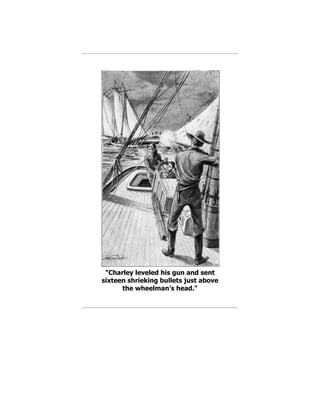
"Charley leveled his gun and sent
sixteen shrieking bullets just above
the wheelman's head."
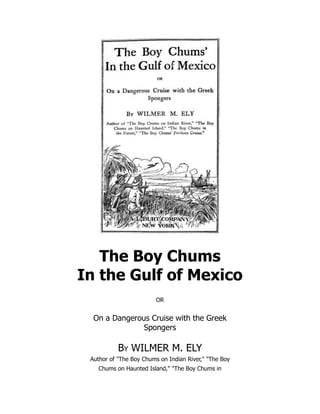
The Boy Chums
In the Gulf of Mexico
OR
On a Dangerous Cruise with the Greek
Spongers
By WILMER M. ELY
Author of "The Boy Chums on Indian River," "The Boy
Chums on Haunted Island," "The Boy Chums in
the Forest," "The Boy Chums' Perilous Cruise."
A. L. BURT COMPANY
NEW YORK
Copyright 1913
By A. L. Burt Company
THE BOY CHUMS IN THE GULF OF MEXICO
CONTENTS
I. 3
II.MR. DRIVER. 11
III.PREPARATIONS 19
IV.THE START 27
V.THE START 36
VI.FIRST TROUBLE 45
VII.SPONGING 53
VIII.TROUBLE 61
IX.MANUEL'S RELEASE 68
X.A RASH RESOLVE 76
XI.A MYSTERY 84
XII.IN A DIVING SUIT 94
XIII.A CLOSE CALL 100
XIV.THE DISCUSSION 107
XV.A DESPERATE PLAN 115
XVI.TOO LATE 122
XVII.OUTWITTED 129
XVIII.IMPRISONED 136
XIX.WRECKED 144
XX.HUNTING HELP 152
XXI.THE CASTAWAYS 159
XXII.ANOTHER DANGER 167
XXIII.THE RELAPSE 175
XXIV.THE FLOOD 182
XXV.THE FLOATING HATCH 189
XXVI.WITH THE BOYS 197
XXVII.THE JOURNEY 205
XXVIII.JUDSON 212
XXIX.THE FEUD 219
XXX.BESIEGED 225
XXXI.THE ENEMIES 233
XXXII.THE CASTAWAYS AGAIN240
XXXIII.THE RESCUE 247
XXXIV.CONCLUSION 255
THE BOY CHUMS
IN THE GULF OF MEXICO
CHAPTER I.
"It's just like stepping suddenly into a strange country. I am glad
we came even if we decide not to go into the business."
The speaker, a sturdy, manly-looking boy of eighteen, was one of
a party of four persons who were strolling along a street in the
Greek section of Tarpon Springs, a small Florida town, located on the
Anclote River, a few miles from the Gulf of Mexico. His companions
were a boy about his own age but of less robust appearance, a little
negro lad with a good-humored intelligent face, and a middle-aged,
heavily-bearded, blue-eyed man whose tattooed arms and rolling
gait told of a life spent on tossing seas and whose confident bearing
and air of authority stamped him as one above the rank of a
common sailor.
Those who have followed The Boy Chums through their many
adventures will recognize in the little party their old friends Charley
West, Walter Hazard, Captain Westfield and the Bahama lad, Chris,
who lately returned from a perilous trip along the Atlantic beach
searching for wreckage, and now seeking some promising venture in
which to invest the Fifteen Hundred Dollars they earned on that
voyage.
"You're right, Charley," agreed the other boy. "I didn't know
before that there was a sight like this in Florida. Here's a bench.
Let's set down and rest a bit. I am tired from walking."
"Golly, I reckon dis nigger's tired some too," chimed in the little
darkey, "I'se dun had de toothache in mah legs for most an hour, but
I'se had to keep up wid you-alls. Don't dare let you white chillen
prognostracate 'round a queer place like dis alone."
The seat selected was a long bench standing on the edge of the
sidewalk, its back to the sandy street. The four seated themselves at
one end and gazed around with eager interest at the strange scene,
unconscious of the curious glances bestowed upon them by a large,
deeply-tanned man, who, seated on the other end of the bench, was
languidly whittling on a piece of white pine with a large sheaf knife.
The scene was one to arouse more than passing interest. Up and
down the sidewalk hurried swarthy-faced, powerfully-built men of all
ages and appearances, but all possessed of the same clear-cut
features and straight noses. Singly and in groups of two and three,
they hurried past, picturesque in their bright-colored clothing with
gaudy sashes knotted about their waists. About all clustered an air
of energy and bustle uncommon to sleepy Florida towns.
Built up close to the inner edge of the sidewalk was a row of large
buildings startling in their coats of bright yellow, red, blue, and
green paint. Stretching away, close together in the distance, they
gave one the impression of a gigantic rainbow. Through their wide-
open doors and windows the interested onlookers could gain a plain
view of the interiors, from which came the confused jangle of foreign
tongues. To the right of where the little party sat was a busy grocery
store, its windows filled with strings of dried garlic, strange-looking
cheeses, queer nuts and fruits and a multitude of eatables strange
to American eyes. To the left of them was a tobacco factory, the
whirling machines shredding up the huge brown leaves into hair-like
fibers and binding them up into pound packages. Directly before
them was a great hall filled with little tables around which were
seated groups of the regular-featured men, playing cards, eating, or
puffing at strange pipes, with a small hose for a stem, the smoke
passing through great glass vessels partly filled with rose water
before it reached the smoker's lips.
"That's the fifteenth place of that kind I've counted to-day,"
remarked Charley West. "From their numbers, one would imagine
that these people did nothing but eat and play cards."
"I'd like to try one of them pipes," said Captain Westfield,
wistfully. "I'll bet they give a good, cool smoke."
"Let's go in and get dinner," Walter suggested. "I am hungry as a
wolf and that food smells mighty good. You can try a pipe after we
eat, Captain."
The man at the end of the bench shifted his position closer to
them.
"Strangers here?" he enquired.
"Just came in this morning. We're looking into the sponge
business a bit," replied the Captain.
Charley eyed the tanned man closely. There was a sinister
expression to the fellow's face, and his eyes shifted uneasily away
from the lad's level glance. The keen-witted boy was not favorably
impressed with the stranger's appearance, but the man's cordiality
drove away his faint feeling of distrust.
"I'll go in with you then," he offered. "Those fellows don't speak
much English and you would have a hard job making them
understand what you wanted. I know a little Greek and may be able
to help you out a bit."
"Much obliged to you," said the Captain, gratefully. "We don't
understand a word of their lingo. I'll stand treat to the dinner if you'll
eat with us."
"It's a go," agreed the stranger, quickly. "Come on. My name's
Robert, Captain Roberts," he volunteered when the little party were
seated around one of the tables, "I'm a retired ship's master."
Captain Westfield introduced himself and his companions. "As I
said, we are lookin' into this sponge business a bit, but it's hard to
pick out the proper course from these twisted-tongued furriners," he
said. "Do you happen to know anything about it?"
"I used to be in the business myself," Captain Roberts replied
promptly. "I made enough money in it to quit the sea for good."
"Then I reckon you're the very man to give us a few pointers. Is
there as much money in it as one hears tell of?"
"More," declared the other. "These Greeks are getting rich off
sponging. It is not anything unusual for a schooner's crew to clear
up three or four thousand dollars from a single trip. It takes quite a
bit of money to make a start, though."
"We have got a little change in our clothes," said the Captain,
modestly. "Do you reckon a person could get started good on a
Thousand dollars?"
"That would do nicely," declared Captain Roberts, "and I can tell
you just how to lay it out to the best advantage, but let's order
dinner first. We can talk while we are eating."
He beckoned to a dark-skinned, ill-favored waiter and gave an
order in low-pitched fluent Greek.
The waiter was back almost instantly with a tray-load of steaming
dishes which he placed upon the table. The boys could not
determine the exact nature of the strange viands, but they were too
hungry to be critical, and attacked the food with hearty appetites.
"This mutton stew is delicious," Charley declared as he took
another helping. "I don't know as I ever tasted anything better."
Captain Roberts grinned. "You don't want to make any guesses
about Greek food," he declared. "That isn't mutton, but just tough
old Billy-goat, fattened on a diet of tin cans. These fellows have the
knack of fixing up such things so they can't recognize them
themselves. Just wait till the coffee is served. You'll say you never
drank any better. But let's get back to that sponging business now,
Captain."
He and Captain Westfield were soon plunged in a tangled maze of
talk about schooners, diving boats, sponges, and divers.
The boys gave but little heed to the discussion for their attention
was partly diverted by the unusual scene around them.
"It's just like being in another country," Walter whispered to his
chum.
"Yes, but I don't like the attention we seem to receive," Charley
replied. "Those fellows are staring at us as though there was
something wrong in our being here."
The Greeks gathered around the other tables indeed seemed
more than casually interested in the little party. They stared
frequently at them and their new acquaintance, and exchanged
significant glances and low words with each other.
"I guess we appear as odd to them as they do to us," Walter said,
carelessly. "There is a man who is not a Greek. That fellow leaning
against the end of the counter in the corner."
The man indicated was unmistakably an American. He was short,
heavily-built and had a determined, aggressive face. He was
engaged in a heated discussion with the proprietor of the cafe and
his heavy face was flushed with anger. As the boys gazed curiously,
he brought down his clenched fist on the counter with a force that
shattered some of the dishes piled upon it.
"You needn't smirk, grin, and make excuses," he thundered at the
suave, smiling Greek. "You've got to pay me that bill you owe me.
It's been standing for months and I happen to know that you are
making money all the time, hand over fist. It's no use pretending
you don't understand me," he shouted, as the smiling Greek
shrugged his shoulders. "You know what I say. If you don't come up
with the money by to-morrow night I'll close up this place and have
you prosecuted for obtaining goods under false pretences. And it will
not be any use for you to try your nice little Greek trick of a knife in
my back in the dark. I go heeled and I don't go to sleep when I walk
this street. The fellow who tries that trick on me will stop enough
lead to start a cartridge factory."
He turned and was walking towards the door when his glance
rested for a moment on the boys and their companions. His glance
swept swiftly over each member of the little party. He paused,
hesitated a moment, then turning, walked swiftly towards their
table.
Captain Roberts rose hastily at his approach. "There's a friend of
mine over there," he said hurriedly, "who I want to speak to. I'll be
back in a minute."
The approaching stranger noted his departure with a grim smile.
He stopped beside the Captain and stood gazing down for one brief
minute.
"Are you fools or strangers?" he demanded, crisply.
CHAPTER II.
MR. DRIVER.
The stranger's smile robbed his words of their hardness.
"Strangers, yes," Charley replied, "Fools, no."
"No offense intended," said the man, quickly. "Strangers will
sometimes take advice but fools will not. My advice to you strangers
is to keep out of places like this and not to make friends with other
strangers. I don't suppose you know who that man is who just left
you."
"He's a retired sea captain," said Captain Westfield. "He was
giving us some pointers about the sponge business. Mighty pleasant
an' obligin' fellow. Mighty fair-spoken."
"Bless your simple little souls," exclaimed the stranger. "He's no
captain, active or retired. He's the runner for this place. Lucky you
haven't any of you drank your coffee yet. You'd be waking up in
some alley bye-and-bye with your heads aching from knock-out
drops and your pockets turned inside out. My, but you were easy."
"I don't reckon any one would dare do such a thing in broad
daylight," Captain Westfield declared.
"It's been done in this place a dozen times. And the victim's kicks
never did any good after it happened, for there was always a dozen
Greeks ready to go on the stand and swear that it was only a case of
drunkenness on the victim's part. Better get out of here."
The humbled little party arose and followed their conductor out to
the sidewalk. As they passed through the crowd they could not help
but notice the wrathful glances the sitters bestowed upon the one
who had cheated them of their victims.
"I guess we have acted pretty green," Charley admitted, as they
passed outside, "but we were so eager to learn about the sponge
business that we forgot caution. Besides, one does not look for such
tricks in a little town like this. It's not like a big city where one has to
be always on his guard against strangers."
The stranger favored the members of the little party with a closer
scrutiny than he had yet bestowed upon them.
"So you are figuring on going into the sponge business, eh?" he
asked.
"We may try it a bit if we find out that it pays as well as we have
heard tell of," answered Captain Westfield, cautiously, "but it's
mighty hard to find out anything definite about it from these
Greeks."
"Oh, there's big money in it all right," said their new friend. "You
might make a go of it. You are a pretty husky, determined-looking lot
and would soon get on to the Greekish tricks. It's a risky business,
though. I don't advise anyone to take it up."
"We've encountered a few risks in other lines," said Charlie,
modestly. "We are willing to take a few chances if there's money
enough in it to tempt us."
The stranger pulled out his watch and looked at the time. "My
name is Driver," he remarked. "I own a store over on the next street
in the American section. Business is slack at this time of day and I
will show you around a bit, if you wish. My clerks can look out for
the trade for an hour or two."
"No need of thanks," he said as the Captain accepted his offer
gratefully. "If you decide to go into the sponge business, you will
need lots of provisions and I hope to sell them to you. We Americans
do not get any of the Greek trade and we are always glad to secure
a new customer. Now I suppose you want to know about the profit
side of the business first. Well, I can not give you exact figures but I
know that all engaged in the business are making big money. All
these big buildings you see have been built out of sponging, and
they do not represent a hundredth part of the money made out of
the business. There is an enormous amount sent back to Greece
every month through the post-office and bank here. I know Greeks
who landed here only a few years ago with nothing but the clothes
on their backs—and those were mighty poor—that are wealthy men
now and they made their fortunes out of sponges. Oh, there's big
money in it all right. But you can look into that part of the business
closer later on. Now, I want to show you something of the sponges
themselves. We will go down to the harbor first."
The interested little party followed him as he led the way along a
soft sand road flanked by scrub palmettos.
Their guide paused beside one of the several large buildings
standing close to the road. "This is a clipping shed," he said.
The building was open on one side and was filled with a crowd of
old men, women and young boys, all Greeks. Before each was a pile
of rough sponges from which they were clipping the spoilt parts with
great shearing shears. In one corner, a man worked over a big
screw-press, pressing the severed fragments of sponges into huge
compact bales.
"That part isn't important enough to waste much time looking at,"
Mr. Driver said, as he turned away. "Come on and I'll show you
something worth seeing."
As they followed along behind their guide, the boys became
sensible of a strong, pleasant, appetizing odor in the air, an odor
which grew stronger as they advanced. A turn in the road brought
them suddenly upon the source of the odor. On the shore of a quiet
little land-locked harbor, blazed dozens of small camp-fires over
which sat great iron kettles. On pieces of canvas laid upon the
ground were piles of fresh beef and mutton. Over each pile worked
several Greeks cutting the meat with the sheaf knives into tiny
squares about an inch in size. Other Greeks were dumping the little
square pieces into the kettles, while still others kept the contents
stirred and the fires under the kettles burning briskly.
"They are putting down the meat for their next voyage,"
explained Mr. Driver. "They roast it in its own fat, put it into stone
jars, and pour the fat over it. As soon as the fat cools and congeals
it forms an air-tight covering which keeps the meat from spoiling."
"If it tastes half as good as it smells, it must be delicious," Charley
remarked.
Chris viewed the cooking operation with professional jealousy.
"Golly, I bet dey can't cook like dis nigger," he declared, "I spect dem
kettles ain't none too clean noway."
Captain Westfield gave but scant attention to the trying-out
process. His interest was centered on the big fleet of schooners
anchored near shore. They were over a hundred in number and
were of all sizes and designs. They made a pretty sight lying
gracefully close together in the little harbor. But the old sailor soon
strolled on to where groups of Greeks were building and repairing
boats on the shore. He inspected their work with a critical eye, but
he was soon lost in admiration.
"Lads," he exclaimed, "I never saw such workmen before. They
are turnin' out tight, neat seaworthy little crafts with no tools but a
saw and a hatchet. Ain't those queer lookin' crafts though."
The boats were about thirty feet in length, sharp at both bow and
stern, and of enormous depth for their size. True to their love for
bright colors the Greeks had painted each plank a different hue and
the little vessels looked like floating rainbows.
The captain viewed their single masts, which inclined aft at an
angle of forty-five degrees, with deep-sea scorn.
"It's clean against Nature for a mast to be set that way," he
declared. "It ain't regular or ship-shape."
"Those small crafts are used as diving boats," Mr. Driver
explained. "They carry a big square sail, but most of them are
equipped with engines also. They are great sea boats and will ride
out a gale almost as well as the schooners."
His explanations were interrupted by loud talking close at hand
and the little party, full of curiosity, hastened to the spot from which
the uproar came.
In the center of a circle of curious onlookers, a large man wearing
a marshal's badge was slipping a pair of handcuffs on the wrists of a
slender boyish-looking young fellow.
"No need to put those things on me, Mr. Officer," the lad was
protesting, passionately. "I'll go along with you without any trouble.
I've only acted within my rights and all I want is a fair trial."
"Anything you say can be used against you at your trial,"
cautioned the marshal.
"I don't care, I admit I shot two of those treacherous Greeks. It
was the only thing to do. When it came on to blow a gale, they
refused to cut the cable, and work the schooner. It was a case of
making them obey orders and get her off before the seas or lose my
ship. I only wish I had shot more of them. They have been laying for
me ever since to slip a knife into me and chuck me overboard. I
haven't dared take a wink of sleep for three days and two nights."
"Poor fellow," said Mr. Driver, as the marshal led away his
protesting captive. "I expect it happened just as he says—an open
mutiny, compelling him to shoot—but every Greek in his crew will go
on the stand and swear that it was a case of cold-blooded murder.
Fortunately, the judge is wise to Greek methods and the law deals
gently with commanders."
"He looked mighty young to be a captain," said Captain Westfield.
"It's this way," Mr. Driver explained, "the law compels the Greeks
to have an American captain for each schooner and diving boat, and
they hire the youngest and, therefore, cheapest man that they can
get. It's a dog's life, out alone for months with a gang that doesn't
speak a word of English. As long as the captain is content to be a
mere figurehead he can get along without serious trouble, but the
minute he runs counter to their wishes there is a row. But time is
flying, and I must get back to the store. If you will come back with
me I'll introduce you to a man who knows more about sponging
than another American in the country."
"Just a moment, lads," said the Captain, as they turned to go.
"Which of those schooners do you like the best?"
The two chums unhesitatingly indicated a beautiful two-masted,
snow-white schooner that seemed to rest as loftily on the water as a
floating swan. The grace and beauty of exquisite lines marked her
out from the many shapely schooners surrounding her. In large gilt
letters on either side of her bow was her name "Beauty".
"She's my choice too," declared the Captain. "I wish we owned
her. I ain't never seen a prettier model."
CHAPTER III.
PREPARATIONS.
As soon as they got back into town, Mr. Driver hunted up the man
of whom he had spoken, and, introducing him to each of the little
party, hurried back to his store.
Mr. Williams was a young man still in his twenties. He was a
stocky, well-built young fellow with an intelligent face, determined
manner, and a short, crisp way of speaking. He sized up the little
party with one quick appraising glance as Captain Westfield stated
their errand.
"If you are not willing to stand hardships, dirt, discomfort, and
danger, you want nothing to do with sponging," he declared.
"We can stand anything that it pays us to stand," Charley replied,
quickly.
"Well, that's the right kind of spirit," approved the young man,
"but, of course you don't any of you realize what you will have to
meet. I've seen others start in with the same confidence and get
cold feet before the first trip was over. It isn't any nice, ladies' pink-
tea business. It's a game for real men, but if the men are the right
kind, they get their reward for what they endure, all right, all right. I
landed here with an empty pocket and emptier stomach, and now,—
well, I am not a John D. Rockefeller yet, but I've got enough laid by
to keep the wolf from the door for a good many years. Better men
than I have done better than I have. It's like everything else, the
best man wins, and wins something worth winning, but, as I have
said, it's no business for nice, tender, little Willie boys, it's a man's
game."
Welcome to our website – the perfect destination for book lovers and
knowledge seekers. We believe that every book holds a new world,
offering opportunities for learning, discovery, and personal growth.
That’s why we are dedicated to bringing you a diverse collection of
books, ranging from classic literature and specialized publications to
self-development guides and children's books.
More than just a book-buying platform, we strive to be a bridge
connecting you with timeless cultural and intellectual values. With an
elegant, user-friendly interface and a smart search system, you can
quickly find the books that best suit your interests. Additionally,
our special promotions and home delivery services help you save time
and fully enjoy the joy of reading.
Join us on a journey of knowledge exploration, passion nurturing, and
personal growth every day!
testbankfan.com


M Organizational Behavior 3rd Edition McShane Solutions Manual

  • 1.
    Download the fullversion and explore a variety of test banks or solution manuals at https://testbankfan.com M Organizational Behavior 3rd Edition McShane Solutions Manual _____ Follow the link below to get your download now _____ https://testbankfan.com/product/m-organizational- behavior-3rd-edition-mcshane-solutions-manual/ Access testbankfan.com now to download high-quality test banks or solution manuals
  • 2.
    We have selectedsome products that you may be interested in Click the link to download now or visit testbankfan.com for more options!. M Organizational Behavior 3rd Edition McShane Test Bank https://testbankfan.com/product/m-organizational-behavior-3rd-edition- mcshane-test-bank/ M Organizational Behavior 2nd Edition McShane Solutions Manual https://testbankfan.com/product/m-organizational-behavior-2nd-edition- mcshane-solutions-manual/ M Organizational Behavior 2nd Edition McShane Test Bank https://testbankfan.com/product/m-organizational-behavior-2nd-edition- mcshane-test-bank/ Sociology Your Compass for a New World Canadian 5th Edition Brym Test Bank https://testbankfan.com/product/sociology-your-compass-for-a-new- world-canadian-5th-edition-brym-test-bank/
  • 3.
    Elemental Geosystems 7thEdition Christopherson Solutions Manual https://testbankfan.com/product/elemental-geosystems-7th-edition- christopherson-solutions-manual/ Supply Chain Management A Logistics Perspective 10th Edition Coyle Solutions Manual https://testbankfan.com/product/supply-chain-management-a-logistics- perspective-10th-edition-coyle-solutions-manual/ Essentials of Economics 6th Edition Mankiw Test Bank https://testbankfan.com/product/essentials-of-economics-6th-edition- mankiw-test-bank/ Process Systems Analysis and Control 3rd Edition Coughanowr Solutions Manual https://testbankfan.com/product/process-systems-analysis-and- control-3rd-edition-coughanowr-solutions-manual/ Business Law Texts And Cases 14th Edition Clarkson Solutions Manual https://testbankfan.com/product/business-law-texts-and-cases-14th- edition-clarkson-solutions-manual/
  • 4.
    Deviance Conformity andSocial Control in Canada Canadian 4th Edition Bereska Test Bank https://testbankfan.com/product/deviance-conformity-and-social- control-in-canada-canadian-4th-edition-bereska-test-bank/
  • 5.
    Chapter 6: DecisionMaking and Creativity Instructor’s Manual to Accompany M:Organizational Behavior 3/e by Steven L. McShane and Mary Ann Von Glinow Chapter 6: Decision Making and Creativity Prepared by: Steven L. McShane, The University of Western Australia Page 6-!1 © 2016 by McGraw-Hill Education. This is proprietary material solely for authorized instructor use.Not authorized for sale or distribution in any manner. This document may not be copied,scanned,duplicated,forwarded,distributed,or posted on a website,in whole or part.
  • 6.
    Chapter 6: DecisionMaking and Creativity Decision Making and Creativity LEARNING OBJECTIVES After reading this chapter, students should be able to: LO1 Describe the rational choice paradigm of decision making. LO2 Explain why people differ from the rational choice paradigm when identifying problems/opportunities, evaluating/choosing alternatives, and evaluating decision outcomes. LO3 Discuss the roles of emotions and intuition in decision making. LO4 Describe employee characteristics, workplace conditions, and specific activities that support creativity. LO5 Describe the benefits of employee involvement and identify four contingencies that affect the optimal level of employee involvement. anchoring and adjustment heuristic — a natural tendency for people to be influenced by an initial anchor point such that they do not sufficiently move away from that point as new information is provided. availability heuristic — a natural tendency to assign higher probabilities to objects or events that are easier to recall from memory, even though ease of recall is also affected by nonprobability factors (e.g., emotional response, recent events). bounded rationality — the view that people are bounded in their decision-making capabilities, including access to limited information, limited information processing, and tendency toward satisficing rather than maximizing when making choices. creativity — the development of original ideas that make a socially recognized contribution. decision making — the conscious process of making choices among alternatives with the intention of moving toward some desired state of affairs. divergent thinking — reframing a problem in a unique way and generating different approaches to the issue. employee involvement — the degree to which employees influence how their work is organized and carried out. escalation of commitment — the tendency to repeat an apparently bad decision or allocate more resources to a failing course of action. implicit favorite — a preferred alternative that the decision maker uses repeatedly as a comparison with other choices. CHAPTER GLOSSARY Page 6-!2 © 2016 by McGraw-Hill Education. This is proprietary material solely for authorized instructor use.Not authorized for sale or distribution in any manner. This document may not be copied,scanned,duplicated,forwarded,distributed,or posted on a website,in whole or part. 6
  • 7.
    Chapter 6: DecisionMaking and Creativity intuition — the ability to know when a problem or opportunity exists and to select the best course of action without conscious reasoning. prospect theory effect a natural tendency to feel more dissatisfaction from losing a particular amount than satisfaction from gaining an equal amount. rational choice paradigm — the view in decision making that people should—and typically do—use logic and all available information to choose the alternative with the highest value. representativeness heuristic — a natural tendency to evaluate probabilities of events or objects by the degree to which they resemble (are representative of) other events or objects rather than on objective probability information. satisficing — selecting an alternative that is satisfactory or “good enough,” rather than the alternative with the highest value (maximization). scenario planning — a systematic process of thinking about alternative futures and what the organization should do to anticipate and react to those environments. subjective expected utility (SEU) — the probability (expectancy) of satisfaction (utility) resulting from choosing a specific alternative in a decision. CHAPTER SUMMARY BY LEARNING OBJECTIVE LO1 Describe the rational choice paradigm of decision making. Decision making is a conscious process of making choices among one or more alternatives with the intention of moving toward some desired state of affairs. The rational choice paradigm relies on subjective expected utility to identify the best choice. It also follows the logical process of identifying problems and opportunities, choosing the best decision style, developing alternative solutions, choosing the best solution, implementing the selected alternative, and evaluating decision outcomes. LO2 Explain why people differ from the rational choice paradigm when identifying problems/opportunities, evaluating/choosing alternatives, and evaluating decision outcomes. Stakeholder framing, perceptual defense, mental models, decisive leadership, and solution-oriented focus affect our ability to objectively identify problems and opportunities. We can minimize these challenges by being aware of the human limitations and discussing the situation with colleagues. Evaluating and choosing alternatives is often challenging because organizational goals are ambiguous or in conflict, human information processing is incomplete and subjective, and people tend to satisfice rather than maximize. Decision makers also short-circuit the evaluation process when faced with an opportunity rather than a problem. People generally make better choices by systematically evaluating alternatives. Scenario planning can help make future decisions without the pressure and emotions that occur during real emergencies. Confirmation bias and escalation of commitment make it difficult to accurately evaluate decision outcomes. Escalation is mainly caused by self-justification, self-enhancement effect, the prospect theory effect, and sunk costs. These problems are minimized by separating decision choosers from decision evaluators, establishing a preset level at which the decision is abandoned or reevaluated, relying on more systematic and clear feedback about the project’s success, and involving several people in decision making. LO3 Discuss the roles of emotions and intuition in decision making. Emotions shape our preferences for alternatives and the process we follow to evaluate alternatives. We also listen to our emotions for guidance when making decisions. This latter activity relates to intuition—the ability to know when a problem or opportunity exists and to select the best course of action without conscious reasoning. Intuition is both an emotional experience and a rapid, nonconscious analytic process that involves both pattern matching and action scripts. Page 6-!3 © 2016 by McGraw-Hill Education. This is proprietary material solely for authorized instructor use.Not authorized for sale or distribution in any manner. This document may not be copied,scanned,duplicated,forwarded,distributed,or posted on a website,in whole or part.
  • 8.
    Chapter 6: DecisionMaking and Creativity LO4 Describe employee characteristics, workplace conditions, and specific activities that support creativity. Creativity is the development of original ideas that make a socially recognized contribution. The four creativity stages are preparation, incubation, insight, and verification. Incubation assists divergent thinking, which involves reframing the problem in a unique way and generating different approaches to the issue. Four of the main features of creative people are intelligence, persistence, expertise, and independent imagination. Creativity is also strengthened for everyone when the work environment supports a learning orientation, the job has high intrinsic motivation, the organization provides a reasonable level of job security, and project leaders provide appropriate goals, time pressure, and resources. Three types of activities that encourage creativity are those that redefine the problem, associative play, and cross-pollination. LO5 Describe the benefits of employee involvement and identify four contingencies that affect the optimal level of employee involvement. Employee involvement refers to the degree that employees influence how their work is organized and carried out. The level of participation may range from an employee providing specific information to management without knowing the problem or issue to complete involvement in all phases of the decision process. Employee involvement may lead to higher decision quality and commitment, but several contingencies need to be considered, including the decision structure, source of decision knowledge, decision commitment, and risk of conflict. Page 6-!4 © 2016 by McGraw-Hill Education. This is proprietary material solely for authorized instructor use.Not authorized for sale or distribution in any manner. This document may not be copied,scanned,duplicated,forwarded,distributed,or posted on a website,in whole or part.
  • 9.
    Chapter 6: DecisionMaking and Creativity LECTURE OUTLINE (WITH POWERPOINTÂź SLIDES) Decision Making and Creativity Rational Choice Paradigm Rational choice paradigm – the view that people should, and typically do, use logic and all available information to choose the alternative with the highest value Key elements: ‱ Subjective expected utility – the probability (expectation) of satisfaction (utility) resulting from choosing a specific alternative in a decision – used to determine choice that maximizes ‱ Decision making process – follows the systematic process and application of stages of decision making Subjective Expected Utility Foundation of rational choice paradigm and of several OB theories (e.g. expectancy theory of motivation) “Expected” — probability that selected alternative will result in a specific outcome “Utility” — selection criterion’s (outcome’s) positive/negative valence Preferred alternative has highest positive SEU — composite calculation of probability and valence of each outcome NOTE: (see supplemental slide for detailed SEU calculation) ! Decision Making and Creativity Slide 1 ! Rational Choice Paradigm Slide 2 ! Subjective Expected Utility Slide 3 Page 6-!5 © 2016 by McGraw-Hill Education. This is proprietary material solely for authorized instructor use.Not authorized for sale or distribution in any manner. This document may not be copied,scanned,duplicated,forwarded,distributed,or posted on a website,in whole or part.
  • 10.
    Chapter 6: DecisionMaking and Creativity Rational Choice Decision Making Process The rational choice paradigm assumes that decision makers follow the systematic process illustrated 1. Identify problem/opportunity (symptom vs. problem) ‱ Problem – gap between “what is” and “what ought to be” ‱ Opportunity-- deviation between current expectations and potentially better situation(s) not previously expected ‱ Symptom – indicators and outcomes of fundamental root causes 2. Choose the best decision process ‱ Programmed decisions – follow standard operating procedures i.e. they have been resolved in the past ‱ Nonprogrammed decisions – require all steps in the decision model because the problems are new, complex, or ill-defined 3. Develop alternative solutions – search for ready-made solutions first, then develop/modify custom-made solution 4. Choose the best alternative – alternative with the highest subjective expected utility 5. Implement the selected alternative – assumed to occur easily 6. Evaluate decision outcomes – determines whether the gap between “what is” and “what ought to be” has narrowed Problem Identification Challenges Problems and opportunities are not “given” -- they are conclusions formed from ambiguous and conflicting information Five Problem Identification Challenges: ‱ Stakeholder framing – stakeholders frame information so decision makers perceive a problem opportunity, or no issue ‱ Decisive leadership – leaders rewarded for decisiveness, so they conclude problems or opportunities without careful assessment ‱ Solution-focused problems – solutions are defined as problems (e.g. “the problem poor training”) -- feels comfortable having a solution ‱ Perceptual defense – blocking out bad news as a coping mechanism (fail to see information that threatens self-concept) ‱ Mental models – existing mental models blind us from seeing unique problems or opportunities ! Rational Choice Decision Process Slide 4 ! Problem Identification Challenges Slide 5 Page 6-!6 © 2016 by McGraw-Hill Education. This is proprietary material solely for authorized instructor use.Not authorized for sale or distribution in any manner. This document may not be copied,scanned,duplicated,forwarded,distributed,or posted on a website,in whole or part.
  • 11.
    Chapter 6: DecisionMaking and Creativity Identifying Problems Effectively 1. Be aware of perceptual and diagnostic limitations 2. Resist temptation of looking decisive when more thoughtful examination of the situation should occur 3. Create a norm of “divine discontent” – avoid being complacent with the status quo and adopt an aversion to complacency 4. Discuss the situation with colleagues to discover blind spots and see different perspectives Making Choices: Rational vs OB Views Bounded rationality (Herb Simon) – people process limited and imperfect information, rarely select the best choice Problems with goals ‱ Rational – goals are clear, compatible, and agreed-upon ‱ OB – goals are ambiguous, conflicting, lack full support Problems with information processing ‱ Rational – people can process all information about all alternatives and their outcomes ‱ OB – people have limited information processing abilities Problems with evaluation timing ‱ Rational – choices evaluated simultaneously ‱ OB – choices evaluated sequentially Making Choices: Rational vs OB (con’t) Problems with evaluation standards ‱ Rational – people use absolute standards to evaluate alternatives ‱ OB – people evaluate against an implicit favorite Problems with information quality ‱ Rational – choices are made using factual information ‱ OB – choices are made using distorted information Problems with decision objective ‱ Rational – people maximize i.e. choose alternative with the highest payoff (subjective expected utility) ‱ OB – people satisfice i.e. select “good enough” alternative ! Making Choices: Rational vs OB Views Slide 7 ! Making Choices: Rational vs OB Views Slide 8 ! Identifying Problems Effectively Slide 6 Page 6-!7 © 2016 by McGraw-Hill Education. This is proprietary material solely for authorized instructor use.Not authorized for sale or distribution in any manner. This document may not be copied,scanned,duplicated,forwarded,distributed,or posted on a website,in whole or part.
  • 12.
    Chapter 6: DecisionMaking and Creativity Biased Decision Heuristics People have built-in decision heuristics that bias evaluation of alternatives Anchoring and adjustment heuristic ‱ We are influenced by an initial anchor point, and don’t move away from that point much as new information is provided ➡ e.g. high price of an initial contract tender causes negotiations to focus around that price even though excessive Availability heuristic ‱ Tendency to estimate the probability of something occurring by how easily we can recall those events ➡ e.g. we easily remember emotional events (e.g. shark attack) so we overestimate how often these emotional events occur Representative heuristic ‱ Tendency to estimate probability of something based on its similarity to something known than by more precise statistics ➡ e.g. class is 20% engineering and 80% business majors, yet stereotype of engineering students biases our probability that one student is engineering Problems with Maximization People don’t choose the best alternative (maximization) because: 1. Alternatives appear over time and may not be available later ➡ we need to decide now, not when future choices are available 2. People lack motivation and ability to process huge amounts of information required for maximization ➡ people are cognitive misers ! Problems with Maximization Slide 10 ! Biased Decision Heuristics Slide 9 Page 6-!8 © 2016 by McGraw-Hill Education. This is proprietary material solely for authorized instructor use.Not authorized for sale or distribution in any manner. This document may not be copied,scanned,duplicated,forwarded,distributed,or posted on a website,in whole or part.
  • 13.
    Chapter 6: DecisionMaking and Creativity How decision makers respond to problems with maximization 1. Satisficing ➡ choose the first alternative that exceeds a “good enough” standard ➡ much less cognitive taxing than maximization ➡ we determine if alternatives are better than our implicit favorite 2. Oversimplify decision calculations ➡ use easily identifiable factors (color, size) to remove several alternatives from further consideration ➡ use few evaluation criteria rather than full list of factors 3. Avoid making the decision ➡ When presented with many choices, people often choose the least cognitively challenging alternative – no decision at all ➡ Occurs even when there are clear benefits of selecting any alternative (such as joining a company retirement plan) Emotions and Making Choices How emotions affect the evaluation of alternatives: 1. Emotions form preferences before cognition inferences ‱ Emotional marker process determines our preferences for each alternative before we consciously evaluate those alternatives 2. Emotions affect the decision evaluation process ‱ moods and emotions affect how carefully we evaluate alternatives ‱ e.g. we may pay more attention to details when in a negative mood, tend to skim over evaluating when in a good mood 3. Emotions serve as information ‱ We ‘listen in’ on our emotions for guidance when making choices ‱ e.g. visualize using product, pay attention to resulting emotion Intuitive Decision Making Intuition – ability to know when a problem or opportunity exists and to select the best course of action without conscious reasoning Intuition is an emotional experience ‱ Gut feelings are emotional signals ‱ Not all emotional signals are intuition Intuition as rapid unconscious analysis ‱ Uses action scripts – programmed decision routines that shorten the decision making process ! Intuitive Decision Making Slide 12 ! Emotions and Making Choices Slide 11 Page 6-!9 © 2016 by McGraw-Hill Education. This is proprietary material solely for authorized instructor use.Not authorized for sale or distribution in any manner. This document may not be copied,scanned,duplicated,forwarded,distributed,or posted on a website,in whole or part.
  • 14.
    Chapter 6: DecisionMaking and Creativity Making Better Choices 1. Systematically evaluate alternatives against relevant factors 2. Revisit decisions later, when in a different mood state 3. Scenario planning – disciplined method for imagining possible futures Decision Evaluation Problems Confirmation bias — nonconsciously bias evidence about the choice ‱ Emphasize, easier recall of the choice’s positive features ‱ Ignore/downplay negative features Escalation of commitment -- tendency to repeat or further invest in an apparently bad decision Four causes of escalation of commitment: 1. Self-justification effect ➡ continue to invest in a failing project to maintain impression that the project is still worthy -- ending project implies incompetence 2. Self-enhancement effect ➡ natural tendency to think we are above average (lucky, competent) ➡ results in (a) ignoring bad news about the decision and (b) overestimating chance that investing more will correct the problem 3. Prospect theory effect ➡ we experience stronger negative emotions when losing something of value than positive emotions when gaining something of equal value ➡ stopping a project hurts more than spending more on it 4. Sunk costs effect ➡ motivation to invest more in projects with large resources already invested ➡ but future investments should NOT consider size of previous investment in the project, only the expected future gains ➡ past investment includes time -- people motivated to spend more time when much time has been devoted to the project already ! Making Better Choices Slide 13 ! Decision Evaluation Problems Slide 14 Page 6-!10 © 2016 by McGraw-Hill Education. This is proprietary material solely for authorized instructor use.Not authorized for sale or distribution in any manner. This document may not be copied,scanned,duplicated,forwarded,distributed,or posted on a website,in whole or part.
  • 15.
    Chapter 6: DecisionMaking and Creativity Evaluating Decisions Better 1. Separate decision choosers from decision evaluators – minimizes self- justification effect 2. Stop loss – publicly establish a preset level at which the decision is abandoned or re-evaluated 3. Find sources of systematic and clear feedback 4. Involve several people in the decision – may notice problems sooner than when someone is working alone Creative Process Model 1. Preparation ‱ Investigating problem/opportunity -- actively studying the issue 2. Incubation ‱ Reflective thought -- put problem aside, maintain low level of awareness ‱ Assists divergent thinking – reframing a problem in a unique way and generating different approaches to the issue ‱ Contrasts with convergent thinking – calculating the conventionally accepted “right answer” to a logical problem 3. Illumination ‱ The experience of suddenly becoming aware of a unique idea ‱ begins with “fringe” awareness (barely perceptible) ‱ short-term memory -- easily forgotten, so need to document 4. Verification ‱ Logical evaluation, experimentation, and further creative insight ! Evaluating Decisions Better Slide 15 ! Creative Process Model Slide 16 Page 6-!11 © 2016 by McGraw-Hill Education. This is proprietary material solely for authorized instructor use.Not authorized for sale or distribution in any manner. This document may not be copied,scanned,duplicated,forwarded,distributed,or posted on a website,in whole or part.
  • 16.
    Chapter 6: DecisionMaking and Creativity Characteristics of Creative People Cognitive and practical intelligence ‱ Cognitive intelligence to synthesize/analyze information ‱ Practical intelligence – assess potential usefulness of ideas Persistence ‱ Based on: (a) higher need for achievement, (b) strong motivation from the task itself, and (c) moderate or high degree of self-esteem Knowledge and experience ‱ Expertise/subject matter knowledge – but deep knowledge may create strong mental models that reduce divergent thinking Independent imagination (cluster of personality traits and values) ‱ Cluster of personality traits and values ‱ Consists of: (a) high openness to experience (personality), moderately low need for affiliation (drive/motive), higher self-direction and stimulation (values) Creative Work Environments Learning orientation ‱ Encourage experimentation ‱ Tolerate mistakes as part of the creative process Intrinsically motivating work ‱ Motivation from the job itself -- task significance, autonomy, challenging but within employee’s competencies Open communication and sufficient resources ‱ Includes degree of job security ‱ Providing nontraditional workspaces e.g. unique building design Note: It isn’t clear how much pressure should be exerted on employees to produce creative ideas or the effect of co-worker support/co-worker competition ! Creative Work Environments Slide 18 ! Characteristics of Creative People Slide 17 Page 6-!12 © 2016 by McGraw-Hill Education. This is proprietary material solely for authorized instructor use.Not authorized for sale or distribution in any manner. This document may not be copied,scanned,duplicated,forwarded,distributed,or posted on a website,in whole or part.
  • 17.
    Chapter 6: DecisionMaking and Creativity Creativity Activities Redefine the problem ‱ Revisit abandoned projects—might be seen in new ways ‱ People unfamiliar with issue explore the problem (fresh eyes) Associative play ‱ Impromptu storytelling and acting ‱ Artistic activities ‱ Morphological analysis – listing different dimensions of a system and the elements of each dimension and then looking at each combination Cross-Pollination ‱ People from different parts of the organization exchange ideas or are brought into the team ‱ Informal social interaction Levels of Employee Involvement Involvement — degree to which employees influence how their work is organized and carried out Different levels of involvement (lowest to highest) 1. Employees individually asked for specific information but the problem is not described to them. 2. Problem is described and employees are asked individually or collectively for information relating to that problem. 3. Problem is described to employees, who are collectively given responsibility for developing recommendations 4. Employees responsible for entire decision-making process -- identify the problem, discover alternative solutions, choose the best alternative, implement choice ! Creative Activities Slide 19 ! Levels of Employee Involvement Slide 20 Page 6-!13 © 2016 by McGraw-Hill Education. This is proprietary material solely for authorized instructor use.Not authorized for sale or distribution in any manner. This document may not be copied,scanned,duplicated,forwarded,distributed,or posted on a website,in whole or part.
  • 18.
    Chapter 6: DecisionMaking and Creativity Employee Involvement Model Several potential benefits of involvement, but only under specific circumstances. 1. Better problem identification ‱ Recognizing problems more quickly and defining them more accurately 2. Synergy produces more/better solutions ‱ Team members create synergy by pooling their knowledge to form new alternatives 3. Better at picking the best choice ‱ Decision is reviewed by people with diverse perspectives and a broader representation of values 4. Higher decision commitment ‱ Increases sense of personal responsibility for decision’s success and representation of interests Contingencies of Involvement Higher employee involvement is better when: 1. Decision structure ‱ Problem is new and/or complex i.e. nonprogrammed decision 2. Source of decision knowledge ‱ The leader lacks knowledge and employees have information 3. Decision commitment ‱ Employees unlikely to accept decision without their involvement 4. Risk of conflict (two conflict risks) (a) Employee norms support the organization’s goals (b)Employees are likely to agree on the solution Decision Making and Creativity ! Employee Involvement Model Slide 21 ! Contingencies of Involvement Slide 22 ! Decision Making and Creativity Slide 23 Page 6-!14 © 2016 by McGraw-Hill Education. This is proprietary material solely for authorized instructor use.Not authorized for sale or distribution in any manner. This document may not be copied,scanned,duplicated,forwarded,distributed,or posted on a website,in whole or part.
  • 19.
    Chapter 6: DecisionMaking and Creativity Subjective Expected Utility Calculation Subjective expected utility: estimating the best possible alternative (maximization) ‱ Depends on probabilities of outcomes and value (valence) of those outcomes Expected – probability of an outcome occurring ‱ As illustrated: Chance that outcome 3 will occur is 90% if choice ‘A’ is chosen, 30% if choice ‘B’ is chosen ‱ e.g., 90% probability that applicant ‘A’ will quit within one year; only 30% chance that applicant ‘B’ will quit within one year Utility – value or happiness produced by each option from value of expected outcomes ‱ As illustrated: you believe Choice ‘B’ has higher utility (i.e., will produce greater happiness) than will Choice ‘A’ Choice ‘B’ expected utility is (.8x7)+(.2 x -2)+(.3x1)= 6.4 Choice ‘A’ expected utility is (.2x7)+(.5 x -2)+(.9x1)= 1.3 Note 1: Value (valence) of outcomes remain the same for both choices e.g. you value good wireless reception (positive outcome) to the same degree no matter which tablet (iPad, etc.) you are considering buying Note 2: Unlike game theory models, the probabilities in this and most other business decision scenarios do not sum to 1.0. The first endnote on this topic in this chapter of the book provides a detailed explanation. ! Supplemental Slide: Subjective Expected Utility Calculation Slide 24 Page 6-!15 © 2016 by McGraw-Hill Education. This is proprietary material solely for authorized instructor use.Not authorized for sale or distribution in any manner. This document may not be copied,scanned,duplicated,forwarded,distributed,or posted on a website,in whole or part.
  • 20.
    Chapter 6: DecisionMaking and Creativity S T U D E N T H A N D O U T 1. You have been asked to personally recommend a new travel agency to handle all airfare, accommodation, and related travel needs for your organization of 500 staff. One of your colleagues, who is responsible for the company’s economic planning, suggests that the best travel agent could be selected mathematically by inputting the relevant factors for each agency and the weight (importance) of each factor. What decision making approach is your colleague recommending? Is this recommendation a good idea in this situation? Why or why not? 2. A developer received financial backing for a new business financial center along a derelict section of the waterfront, a few miles from the current downtown area of a large European city. The idea was to build several high-rise structures, attract large tenants to those sites, and have the city extend transportation systems out to the new center. Over the next decade, the developer believed that others would build in the area, thereby attracting the regional or national offices of many financial institutions. Interest from potential tenants was much lower than initially predicted and the city did not build transportation systems as quickly as expected. Still, the builder proceeded with the original plans. Only after financial support was curtailed did the developer reconsider the project. Using your knowledge of escalation of commitment, discuss three possible reasons why the developer was motivated to continue with the project. 3. Two characteristics of creative people are that they have relevant experience and are persistent in their quest. Does this mean that people with the most experience and the highest need for achievement are the most creative? Explain your answer. 4. Employee involvement applies just as well to the classroom as to the office or factory floor. Explain how student involvement in classroom decisions typically made by the instructor alone might improve decision quality. What potential problems may occur in this process? CRITICAL THINKING QUESTIONS ! Page 6-!16 © 2016 by McGraw-Hill Education. This is proprietary material solely for authorized instructor use.Not authorized for sale or distribution in any manner. This document may not be copied,scanned,duplicated,forwarded,distributed,or posted on a website,in whole or part.
  • 21.
    Chapter 6: DecisionMaking and Creativity C O N F I D E N T I A L I N S T R U C T O R N O T E S 1. You have been asked to personally recommend a new travel agency to handle all airfare, accommodation, and related travel needs for your organization of 500 staff. One of your colleagues, who is responsible for the company’s economic planning, suggests that the best travel agent could be selected mathematically by inputting the relevant factors for each agency and the weight (importance) of each factor. What decision making approach is your colleague recommending? Is this recommendation a good idea in this situation? Why or why not? The rational choice paradigm approach is being recommended for this decision. The idea that relevant factors should be identified and weighted is good. At least this would help us think about which factors are most important for the company. These could include such factors as, cost, speed of service, quality of service, etc. However, his suggestion that the best decision could be arrived at mathematically is somewhat misleading. While the rational choice paradigm may rest on the assumption that people evaluate and choose the best alternatives logically, that is not borne out by empirical evidence. OB experts have demonstrated that decision-makers may not choose the best alternatives for a variety of reasons. For example, decision makers have limited information processing abilities, evaluate alternatives sequentially and against implicit favorites, and are influenced by perceptual errors, biases and emotions. Moreover, when it comes to making a final choice their decisions are often made on the basis of satisficing rather than maximization. 2. A developer received financial backing for a new business financial center along a derelict section of the waterfront, a few miles from the current downtown area of a large European city. The idea was to build several high-rise structures, attract large tenants to those sites, and have the city extend transportation systems out to the new center. Over the next decade, the developer believed that others would build in the area, thereby attracting the regional or national offices of many financial institutions. Interest from potential tenants was much lower than initially predicted and the city did not build transportation systems as quickly as expected. Still, the builder proceeded with the original plans. Only after financial support was curtailed did the developer reconsider the project. Using your knowledge of escalation of commitment, discuss three possible reasons why the developer was motivated to continue with the project. Escalation of commitment occurs when an individual repeats a bad decision or continues to allocate resources to a failing cause of action. Students should be encouraged to consider the causes of escalation when discussing this case. The four causes are: Self-justification. It is possible the developer felt that canceling construction would result in losing face. That is, because of a personal identification and link with the project, failure would mean a loss of his/her reputation as well. Self-enhancement effect. People over-estimate their probability of success (e.g. are more skilled and luckier than average), which distorts the risk of pouring more funds into a losing course of action. Self-enhancement also causes people to nonconsciously screen out or ignore negative information about their decisions. Prospect theory effect. The discomfort associated with losing money on this project may have outweighed the desire for gains. In other words, knowing that stopping the project would mean certain loss, he/she was willing to go to great lengths to avoid this, even it meant a smaller pay off in the end. SUGGESTED ANSWERS TO CRITICAL THINKING QUESTIONS ! Page 6-!17 © 2016 by McGraw-Hill Education. This is proprietary material solely for authorized instructor use.Not authorized for sale or distribution in any manner. This document may not be copied,scanned,duplicated,forwarded,distributed,or posted on a website,in whole or part.
  • 22.
    Chapter 6: DecisionMaking and Creativity Closing costs. This is closely tied to the prospect theory effect. While there is no evidence of an explicit monetary penalty clause for non completion, the developer might have been concerned with these nonetheless. Aside from monetary loss, costs include loss of reputation, trust, influence etc. One way to avoid these costs is to carry on with the completion. 3. Two characteristics of creative people are that they have relevant experience and are persistent in their quest. Does this mean that people with the most experience and the highest need for achievement are the most creative? Explain your answer. The answer is probably “No”. The textbook states that there is a dilemma regarding experience. On the one hand, people need plenty of experience to be familiar with the issues. The literature on creativity suggests that it may take several years of experience before a person has reached creative potential. The dilemma is that the longer a person is in one field of study, the more he/she develops a mental model that stifles creativity. Some companies prefer people with no experience in an industry so they are more creative. These two points are not exactly contradictory – a person may be new to an industry but has many years of experience in a particular skill or trade. However, the issue does suggest that there is an optimal level of experience before mental models undermine creative potential. It is less certain whether creativity continues to increase with need for achievement. The textbook explains that need for achievement makes creative people more persistent, which is necessary in the face of short-term failures and doubts from others. Would a very strong need for achievement undermine creative potential? This is a matter for debate. Most likely too much need for achievement will create blind drive which can prevent people from seeing alternative strategies and the obvious inappropriateness of existing routes. 4. Employee involvement applies just as well to the classroom as to the office or factory floor. Explain how student involvement in classroom decisions typically made by the instructor alone might improve decision quality. What potential problems may occur in this process? Problem identification. Because students have a different perspective than the instructor, their involvement might help identify issues or problems the instructor was unaware of. This could lead to improvements in the quality of the learning experience. Generating alternatives. Student involvement could potential improve the number and quality of solutions generated. This typically happens when more people look for solutions, because individuals have different perspectives. Better solutions. The likelihood of choosing the best solution, from the list of alternatives generated, would be increased due to diverse perspectives and values. Increased commitment. When students are involved in identifying the issues, generating alternative solutions, and choosing a solution they may also feel more committed to the decision taken. Increased perception of fairness. Being involved in the process, may also promote a sense of fairness among students. To avoid problems with this process, limits should be placed on the extent of participation, and the number of issues requiring student involvement. For example, the determination of grades should be left up to the instructor. The types of questions and weightings of exams should also be predetermined. The instructor would have to make sure all students are equally involved to avoid a small influential and vocal group of students from dominating the others. Lastly, the instructor should be mindful that increasing student involvement requires more time, which may in turn reduce teaching time. Page 6-!18 © 2016 by McGraw-Hill Education. This is proprietary material solely for authorized instructor use.Not authorized for sale or distribution in any manner. This document may not be copied,scanned,duplicated,forwarded,distributed,or posted on a website,in whole or part.
  • 23.
    Chapter 6: DecisionMaking and Creativity S T U D E N T H A N D O U T Instructions Read the incident below. Then, alone or in teams, decide how much you should involve your subordinates in this decision. Select one of the following levels of involvement: Decide alone. Use your personal knowledge and in- sight to complete the entire decision process without conferring with anyone else. Receive information from individuals. Ask specific individuals for information. They do not make recommendations and might not even know what the problem is about. Consult with individuals. Describe the problem to selected individuals and seek both their information and recommendations. The final decision is made by you, and you may or may not take the advice from these others into account. Consult with the team. You bring together a team of people (all department staff or a representation of them if the department is large), who are told about the problem and provide their ideas and recommendations. You make the final decision, which may or may not reflect the team’s information. Facilitate the team’s decision. The entire decision- making process is handed over to a team or commit- tee of subordinates. You serve only as a facilitator to guide the decision process and keep everyone on track. The team identifies the problem, discovers alternative solutions, chooses the best alternative, and implements their choice. What factors led you to decide that this is the optimal level of employee involvement? What problems might occur if less or more involvement occurred in this case (where possible)? The Sugar Substitute Research Decision You  are  the  head  of  research  and  development  (R&D)  for  a   major  beer  company.  While  working  on  a  new  beer   product,  one  of  the  scientists  in  your  unit  seems  to  have   tentatively  identiBied  a  new  chemical  compound  that  has   few  calories  but  tastes  closer  to  sugar  than  current  sugar   substitutes.  The  company  has  no  foreseeable  need  for  this   product,  but  it  could  be  patented  and  licensed  to   manufacturers  in  the  food  industry.     The  sugar  substitute  discovery  is  in  its  preliminary  stages   and  would  require  considerable  time  and  resources  before   it  would  be  commercially  viable.  This  means  that  it  would   necessarily  take  some  resources  away  from  other  projects   in  the  lab.  The  sugar  substitute  project  is  beyond  your   technical  expertise,  but  some  of  the  R&D  lab  researchers   are  familiar  with  that  Bield  of  chemistry.  As  with  most   forms  of  research,  it  is  difBicult  to  determine  the  amount  of   research  required  to  further  identify  and  perfect  the  sugar   substitute.    You  do  not  know  how  much  demand  is   expected  for  this  product.  Your  department  has  a  decision   process  for  funding  projects  that  are  behind  schedule.     However,  there  are  no  rules  or  precedents  about  funding   projects  that  would  be  licensed  but  not  used  by  the   organization.   The  company’s  R&D  budget  is  limited  and  other  scientists   in  your  work  group  have  recently  complained  that  they   require  more  resources  and  Binancial  support  to  get  their   projects  completed.  Some  of  these  other  R&D  projects   hold  promise  for  future  beer  sales.  You  believe  that  most   researchers  in  the  R&D  unit  are  committed  to  ensuring   company’s  interests  are  achieved.     ©  2002  Steven  L.  McShane CLASS EXERCISE: EMPLOYEE INVOLVEMENT INCIDENT ! Page 6-!19 © 2016 by McGraw-Hill Education. This is proprietary material solely for authorized instructor use.Not authorized for sale or distribution in any manner. This document may not be copied,scanned,duplicated,forwarded,distributed,or posted on a website,in whole or part.
  • 24.
    Chapter 6: DecisionMaking and Creativity C O N F I D E N T I A L I N S T R U C T O R N O T E S Suggested Answer to the Sugar Substitute Research Decision 1. To  what  extent  should  your  subordinates  be  involved  in  this  decision?  Select  one  of  the  following  levels  of   involvement:   Most teams will likely identify some level of consultation, although some tend to suggest high involvement (facilitate the team’s decision). The answer to the next question explains why either of these medium involvement options is probably best here.   2. What  factors  led  you  to  choose  this  alternative  rather  than  the  others?   This  question  can  be  answered  by  reviewing  the  four  contingencies  of  employee  involvement  discussed  in  the  textbook.   Decision  structure:  This  decision  has  low  structure.  The  incident  says  that  there  is  a  decision  process  for  funding   projects  behind  schedule,  but  there  are  no  rules  or  precedents  about  funding  projects  that  would  be  licensed  but  not   used  by  the  organization.  Consequently,  some  level  of  involvement  may  be  valuable.   Source  of  decision  knowledge:  The  incident  clearly  says  that  the  sugar  substitute  project  is  beyond  your  technical   expertise  and  that  it  is  difBicult  to  determine  the  amount  of  research  required.  Scientists  have  information  unavailable   to  the  leader,  but  they  would  not  have  sufBicient  information  to  make  the  decision  alone.  Overall,  this  suggests  that  some   involvement  (probably  at  least  a  medium  level)  is  desirable.   Decision  commitment.  This  might  be  debatable,  but  most  employees  know  that  funding  decisions  are  ultimately  in  the   hands  of  executives  who  must  take  responsibility  for  those  decisions.  Also,  it  sounds  like  past  funding  decisions  are   made  by  the  leader,  not  employees  (mainly  due  to  conBlict  problems  described  below).  Moreover,  but  employees  don’t   implement  anything  as  a  result  of  this  decision,  so  there  is  probably  minimal  adverse  effect  of  low  commitment.   Risk  of  con5lict.  There  are  two  dimensions  of  this  contingency.    First,  with  respect  to  goal  compatibility  between   employees  and  the  company,  the  incident  says  that  you  believe  that  most  researchers  in  the  R&D  unit  are  committed  to   ensuring  company’s  interests  are  achieved.  Second,  it  is  almost  certainly  true  that  conBlict  will  occur  among  employees.     This  is  a  win-­‐lose  situation  where  funding  one  project  reduces  or  eliminates  funding  on  other  projects.  Overall,  the   conBlict  among  employee  discourages  high  involvement,  but  will  allow  a  medium  level  of  involvement.   3. What  problems  might  occur  if  less  or  more  involvement  occurred  in  this  case  (where  possible)?   A  higher  degree  of  involvement  would  probably  be  difBicult  because  of  the  problem  of  conBlict  among  employees.     Employees  could  not  agree  because  a  decision  to  fund  the  project  would  reduce  their  own  funding.   A  low  level  of  involvement  would  lose  some  of  synergy  of  discussion  about  the  issue.  This  synergy  brings  out  valuable   information  and  potentially  more  creative  solutions  to  the  problem.   CLASS EXERCISE: EMPLOYEE INVOLVEMENT INCIDENT ! Page 6-!20 © 2016 by McGraw-Hill Education. This is proprietary material solely for authorized instructor use.Not authorized for sale or distribution in any manner. This document may not be copied,scanned,duplicated,forwarded,distributed,or posted on a website,in whole or part.
  • 25.
    Another Random ScribdDocument with Unrelated Content
  • 29.
    The Project GutenbergeBook of The Boy Chums in the Gulf of Mexico
  • 30.
    This ebook isfor the use of anyone anywhere in the United States and most other parts of the world at no cost and with almost no restrictions whatsoever. You may copy it, give it away or re-use it under the terms of the Project Gutenberg License included with this ebook or online at www.gutenberg.org. If you are not located in the United States, you will have to check the laws of the country where you are located before using this eBook. Title: The Boy Chums in the Gulf of Mexico Author: Wilmer M. Ely Illustrator: J. Watson Davis Release date: December 9, 2013 [eBook #44394] Most recently updated: October 23, 2024 Language: English Credits: Produced by The Online Distributed Proofreading Team at http://www.pgdp.net *** START OF THE PROJECT GUTENBERG EBOOK THE BOY CHUMS IN THE GULF OF MEXICO ***
  • 31.
    "Charley leveled hisgun and sent sixteen shrieking bullets just above the wheelman's head."
  • 32.
    The Boy Chums Inthe Gulf of Mexico OR On a Dangerous Cruise with the Greek Spongers By WILMER M. ELY Author of "The Boy Chums on Indian River," "The Boy Chums on Haunted Island," "The Boy Chums in
  • 33.
    the Forest," "TheBoy Chums' Perilous Cruise." A. L. BURT COMPANY NEW YORK Copyright 1913 By A. L. Burt Company THE BOY CHUMS IN THE GULF OF MEXICO
  • 34.
  • 35.
    I. 3 II.MR. DRIVER.11 III.PREPARATIONS 19 IV.THE START 27 V.THE START 36 VI.FIRST TROUBLE 45 VII.SPONGING 53 VIII.TROUBLE 61 IX.MANUEL'S RELEASE 68 X.A RASH RESOLVE 76 XI.A MYSTERY 84 XII.IN A DIVING SUIT 94 XIII.A CLOSE CALL 100 XIV.THE DISCUSSION 107 XV.A DESPERATE PLAN 115 XVI.TOO LATE 122 XVII.OUTWITTED 129 XVIII.IMPRISONED 136 XIX.WRECKED 144 XX.HUNTING HELP 152 XXI.THE CASTAWAYS 159 XXII.ANOTHER DANGER 167 XXIII.THE RELAPSE 175 XXIV.THE FLOOD 182 XXV.THE FLOATING HATCH 189 XXVI.WITH THE BOYS 197 XXVII.THE JOURNEY 205 XXVIII.JUDSON 212 XXIX.THE FEUD 219 XXX.BESIEGED 225 XXXI.THE ENEMIES 233 XXXII.THE CASTAWAYS AGAIN240 XXXIII.THE RESCUE 247
  • 36.
    XXXIV.CONCLUSION 255 THE BOYCHUMS IN THE GULF OF MEXICO
  • 37.
    CHAPTER I. "It's justlike stepping suddenly into a strange country. I am glad we came even if we decide not to go into the business." The speaker, a sturdy, manly-looking boy of eighteen, was one of a party of four persons who were strolling along a street in the Greek section of Tarpon Springs, a small Florida town, located on the Anclote River, a few miles from the Gulf of Mexico. His companions were a boy about his own age but of less robust appearance, a little negro lad with a good-humored intelligent face, and a middle-aged, heavily-bearded, blue-eyed man whose tattooed arms and rolling gait told of a life spent on tossing seas and whose confident bearing and air of authority stamped him as one above the rank of a common sailor. Those who have followed The Boy Chums through their many adventures will recognize in the little party their old friends Charley West, Walter Hazard, Captain Westfield and the Bahama lad, Chris, who lately returned from a perilous trip along the Atlantic beach searching for wreckage, and now seeking some promising venture in which to invest the Fifteen Hundred Dollars they earned on that voyage. "You're right, Charley," agreed the other boy. "I didn't know before that there was a sight like this in Florida. Here's a bench. Let's set down and rest a bit. I am tired from walking." "Golly, I reckon dis nigger's tired some too," chimed in the little darkey, "I'se dun had de toothache in mah legs for most an hour, but I'se had to keep up wid you-alls. Don't dare let you white chillen prognostracate 'round a queer place like dis alone."
  • 38.
    The seat selectedwas a long bench standing on the edge of the sidewalk, its back to the sandy street. The four seated themselves at one end and gazed around with eager interest at the strange scene, unconscious of the curious glances bestowed upon them by a large, deeply-tanned man, who, seated on the other end of the bench, was languidly whittling on a piece of white pine with a large sheaf knife. The scene was one to arouse more than passing interest. Up and down the sidewalk hurried swarthy-faced, powerfully-built men of all ages and appearances, but all possessed of the same clear-cut features and straight noses. Singly and in groups of two and three, they hurried past, picturesque in their bright-colored clothing with gaudy sashes knotted about their waists. About all clustered an air of energy and bustle uncommon to sleepy Florida towns. Built up close to the inner edge of the sidewalk was a row of large buildings startling in their coats of bright yellow, red, blue, and green paint. Stretching away, close together in the distance, they gave one the impression of a gigantic rainbow. Through their wide- open doors and windows the interested onlookers could gain a plain view of the interiors, from which came the confused jangle of foreign tongues. To the right of where the little party sat was a busy grocery store, its windows filled with strings of dried garlic, strange-looking cheeses, queer nuts and fruits and a multitude of eatables strange to American eyes. To the left of them was a tobacco factory, the whirling machines shredding up the huge brown leaves into hair-like fibers and binding them up into pound packages. Directly before them was a great hall filled with little tables around which were seated groups of the regular-featured men, playing cards, eating, or puffing at strange pipes, with a small hose for a stem, the smoke passing through great glass vessels partly filled with rose water before it reached the smoker's lips. "That's the fifteenth place of that kind I've counted to-day," remarked Charley West. "From their numbers, one would imagine that these people did nothing but eat and play cards."
  • 39.
    "I'd like totry one of them pipes," said Captain Westfield, wistfully. "I'll bet they give a good, cool smoke." "Let's go in and get dinner," Walter suggested. "I am hungry as a wolf and that food smells mighty good. You can try a pipe after we eat, Captain." The man at the end of the bench shifted his position closer to them. "Strangers here?" he enquired. "Just came in this morning. We're looking into the sponge business a bit," replied the Captain. Charley eyed the tanned man closely. There was a sinister expression to the fellow's face, and his eyes shifted uneasily away from the lad's level glance. The keen-witted boy was not favorably impressed with the stranger's appearance, but the man's cordiality drove away his faint feeling of distrust. "I'll go in with you then," he offered. "Those fellows don't speak much English and you would have a hard job making them understand what you wanted. I know a little Greek and may be able to help you out a bit." "Much obliged to you," said the Captain, gratefully. "We don't understand a word of their lingo. I'll stand treat to the dinner if you'll eat with us." "It's a go," agreed the stranger, quickly. "Come on. My name's Robert, Captain Roberts," he volunteered when the little party were seated around one of the tables, "I'm a retired ship's master." Captain Westfield introduced himself and his companions. "As I said, we are lookin' into this sponge business a bit, but it's hard to pick out the proper course from these twisted-tongued furriners," he said. "Do you happen to know anything about it?"
  • 40.
    "I used tobe in the business myself," Captain Roberts replied promptly. "I made enough money in it to quit the sea for good." "Then I reckon you're the very man to give us a few pointers. Is there as much money in it as one hears tell of?" "More," declared the other. "These Greeks are getting rich off sponging. It is not anything unusual for a schooner's crew to clear up three or four thousand dollars from a single trip. It takes quite a bit of money to make a start, though." "We have got a little change in our clothes," said the Captain, modestly. "Do you reckon a person could get started good on a Thousand dollars?" "That would do nicely," declared Captain Roberts, "and I can tell you just how to lay it out to the best advantage, but let's order dinner first. We can talk while we are eating." He beckoned to a dark-skinned, ill-favored waiter and gave an order in low-pitched fluent Greek. The waiter was back almost instantly with a tray-load of steaming dishes which he placed upon the table. The boys could not determine the exact nature of the strange viands, but they were too hungry to be critical, and attacked the food with hearty appetites. "This mutton stew is delicious," Charley declared as he took another helping. "I don't know as I ever tasted anything better." Captain Roberts grinned. "You don't want to make any guesses about Greek food," he declared. "That isn't mutton, but just tough old Billy-goat, fattened on a diet of tin cans. These fellows have the knack of fixing up such things so they can't recognize them themselves. Just wait till the coffee is served. You'll say you never drank any better. But let's get back to that sponging business now, Captain."
  • 41.
    He and CaptainWestfield were soon plunged in a tangled maze of talk about schooners, diving boats, sponges, and divers. The boys gave but little heed to the discussion for their attention was partly diverted by the unusual scene around them. "It's just like being in another country," Walter whispered to his chum. "Yes, but I don't like the attention we seem to receive," Charley replied. "Those fellows are staring at us as though there was something wrong in our being here." The Greeks gathered around the other tables indeed seemed more than casually interested in the little party. They stared frequently at them and their new acquaintance, and exchanged significant glances and low words with each other. "I guess we appear as odd to them as they do to us," Walter said, carelessly. "There is a man who is not a Greek. That fellow leaning against the end of the counter in the corner." The man indicated was unmistakably an American. He was short, heavily-built and had a determined, aggressive face. He was engaged in a heated discussion with the proprietor of the cafe and his heavy face was flushed with anger. As the boys gazed curiously, he brought down his clenched fist on the counter with a force that shattered some of the dishes piled upon it. "You needn't smirk, grin, and make excuses," he thundered at the suave, smiling Greek. "You've got to pay me that bill you owe me. It's been standing for months and I happen to know that you are making money all the time, hand over fist. It's no use pretending you don't understand me," he shouted, as the smiling Greek shrugged his shoulders. "You know what I say. If you don't come up with the money by to-morrow night I'll close up this place and have you prosecuted for obtaining goods under false pretences. And it will not be any use for you to try your nice little Greek trick of a knife in
  • 42.
    my back inthe dark. I go heeled and I don't go to sleep when I walk this street. The fellow who tries that trick on me will stop enough lead to start a cartridge factory." He turned and was walking towards the door when his glance rested for a moment on the boys and their companions. His glance swept swiftly over each member of the little party. He paused, hesitated a moment, then turning, walked swiftly towards their table. Captain Roberts rose hastily at his approach. "There's a friend of mine over there," he said hurriedly, "who I want to speak to. I'll be back in a minute." The approaching stranger noted his departure with a grim smile. He stopped beside the Captain and stood gazing down for one brief minute. "Are you fools or strangers?" he demanded, crisply.
  • 43.
    CHAPTER II. MR. DRIVER. Thestranger's smile robbed his words of their hardness. "Strangers, yes," Charley replied, "Fools, no." "No offense intended," said the man, quickly. "Strangers will sometimes take advice but fools will not. My advice to you strangers is to keep out of places like this and not to make friends with other strangers. I don't suppose you know who that man is who just left you." "He's a retired sea captain," said Captain Westfield. "He was giving us some pointers about the sponge business. Mighty pleasant an' obligin' fellow. Mighty fair-spoken." "Bless your simple little souls," exclaimed the stranger. "He's no captain, active or retired. He's the runner for this place. Lucky you haven't any of you drank your coffee yet. You'd be waking up in some alley bye-and-bye with your heads aching from knock-out drops and your pockets turned inside out. My, but you were easy." "I don't reckon any one would dare do such a thing in broad daylight," Captain Westfield declared. "It's been done in this place a dozen times. And the victim's kicks never did any good after it happened, for there was always a dozen Greeks ready to go on the stand and swear that it was only a case of drunkenness on the victim's part. Better get out of here." The humbled little party arose and followed their conductor out to the sidewalk. As they passed through the crowd they could not help
  • 44.
    but notice thewrathful glances the sitters bestowed upon the one who had cheated them of their victims. "I guess we have acted pretty green," Charley admitted, as they passed outside, "but we were so eager to learn about the sponge business that we forgot caution. Besides, one does not look for such tricks in a little town like this. It's not like a big city where one has to be always on his guard against strangers." The stranger favored the members of the little party with a closer scrutiny than he had yet bestowed upon them. "So you are figuring on going into the sponge business, eh?" he asked. "We may try it a bit if we find out that it pays as well as we have heard tell of," answered Captain Westfield, cautiously, "but it's mighty hard to find out anything definite about it from these Greeks." "Oh, there's big money in it all right," said their new friend. "You might make a go of it. You are a pretty husky, determined-looking lot and would soon get on to the Greekish tricks. It's a risky business, though. I don't advise anyone to take it up." "We've encountered a few risks in other lines," said Charlie, modestly. "We are willing to take a few chances if there's money enough in it to tempt us." The stranger pulled out his watch and looked at the time. "My name is Driver," he remarked. "I own a store over on the next street in the American section. Business is slack at this time of day and I will show you around a bit, if you wish. My clerks can look out for the trade for an hour or two." "No need of thanks," he said as the Captain accepted his offer gratefully. "If you decide to go into the sponge business, you will need lots of provisions and I hope to sell them to you. We Americans do not get any of the Greek trade and we are always glad to secure
  • 45.
    a new customer.Now I suppose you want to know about the profit side of the business first. Well, I can not give you exact figures but I know that all engaged in the business are making big money. All these big buildings you see have been built out of sponging, and they do not represent a hundredth part of the money made out of the business. There is an enormous amount sent back to Greece every month through the post-office and bank here. I know Greeks who landed here only a few years ago with nothing but the clothes on their backs—and those were mighty poor—that are wealthy men now and they made their fortunes out of sponges. Oh, there's big money in it all right. But you can look into that part of the business closer later on. Now, I want to show you something of the sponges themselves. We will go down to the harbor first." The interested little party followed him as he led the way along a soft sand road flanked by scrub palmettos. Their guide paused beside one of the several large buildings standing close to the road. "This is a clipping shed," he said. The building was open on one side and was filled with a crowd of old men, women and young boys, all Greeks. Before each was a pile of rough sponges from which they were clipping the spoilt parts with great shearing shears. In one corner, a man worked over a big screw-press, pressing the severed fragments of sponges into huge compact bales. "That part isn't important enough to waste much time looking at," Mr. Driver said, as he turned away. "Come on and I'll show you something worth seeing." As they followed along behind their guide, the boys became sensible of a strong, pleasant, appetizing odor in the air, an odor which grew stronger as they advanced. A turn in the road brought them suddenly upon the source of the odor. On the shore of a quiet little land-locked harbor, blazed dozens of small camp-fires over which sat great iron kettles. On pieces of canvas laid upon the
  • 46.
    ground were pilesof fresh beef and mutton. Over each pile worked several Greeks cutting the meat with the sheaf knives into tiny squares about an inch in size. Other Greeks were dumping the little square pieces into the kettles, while still others kept the contents stirred and the fires under the kettles burning briskly. "They are putting down the meat for their next voyage," explained Mr. Driver. "They roast it in its own fat, put it into stone jars, and pour the fat over it. As soon as the fat cools and congeals it forms an air-tight covering which keeps the meat from spoiling." "If it tastes half as good as it smells, it must be delicious," Charley remarked. Chris viewed the cooking operation with professional jealousy. "Golly, I bet dey can't cook like dis nigger," he declared, "I spect dem kettles ain't none too clean noway." Captain Westfield gave but scant attention to the trying-out process. His interest was centered on the big fleet of schooners anchored near shore. They were over a hundred in number and were of all sizes and designs. They made a pretty sight lying gracefully close together in the little harbor. But the old sailor soon strolled on to where groups of Greeks were building and repairing boats on the shore. He inspected their work with a critical eye, but he was soon lost in admiration. "Lads," he exclaimed, "I never saw such workmen before. They are turnin' out tight, neat seaworthy little crafts with no tools but a saw and a hatchet. Ain't those queer lookin' crafts though." The boats were about thirty feet in length, sharp at both bow and stern, and of enormous depth for their size. True to their love for bright colors the Greeks had painted each plank a different hue and the little vessels looked like floating rainbows. The captain viewed their single masts, which inclined aft at an angle of forty-five degrees, with deep-sea scorn.
  • 47.
    "It's clean againstNature for a mast to be set that way," he declared. "It ain't regular or ship-shape." "Those small crafts are used as diving boats," Mr. Driver explained. "They carry a big square sail, but most of them are equipped with engines also. They are great sea boats and will ride out a gale almost as well as the schooners." His explanations were interrupted by loud talking close at hand and the little party, full of curiosity, hastened to the spot from which the uproar came. In the center of a circle of curious onlookers, a large man wearing a marshal's badge was slipping a pair of handcuffs on the wrists of a slender boyish-looking young fellow. "No need to put those things on me, Mr. Officer," the lad was protesting, passionately. "I'll go along with you without any trouble. I've only acted within my rights and all I want is a fair trial." "Anything you say can be used against you at your trial," cautioned the marshal. "I don't care, I admit I shot two of those treacherous Greeks. It was the only thing to do. When it came on to blow a gale, they refused to cut the cable, and work the schooner. It was a case of making them obey orders and get her off before the seas or lose my ship. I only wish I had shot more of them. They have been laying for me ever since to slip a knife into me and chuck me overboard. I haven't dared take a wink of sleep for three days and two nights." "Poor fellow," said Mr. Driver, as the marshal led away his protesting captive. "I expect it happened just as he says—an open mutiny, compelling him to shoot—but every Greek in his crew will go on the stand and swear that it was a case of cold-blooded murder. Fortunately, the judge is wise to Greek methods and the law deals gently with commanders." "He looked mighty young to be a captain," said Captain Westfield.
  • 48.
    "It's this way,"Mr. Driver explained, "the law compels the Greeks to have an American captain for each schooner and diving boat, and they hire the youngest and, therefore, cheapest man that they can get. It's a dog's life, out alone for months with a gang that doesn't speak a word of English. As long as the captain is content to be a mere figurehead he can get along without serious trouble, but the minute he runs counter to their wishes there is a row. But time is flying, and I must get back to the store. If you will come back with me I'll introduce you to a man who knows more about sponging than another American in the country." "Just a moment, lads," said the Captain, as they turned to go. "Which of those schooners do you like the best?" The two chums unhesitatingly indicated a beautiful two-masted, snow-white schooner that seemed to rest as loftily on the water as a floating swan. The grace and beauty of exquisite lines marked her out from the many shapely schooners surrounding her. In large gilt letters on either side of her bow was her name "Beauty". "She's my choice too," declared the Captain. "I wish we owned her. I ain't never seen a prettier model."
  • 49.
    CHAPTER III. PREPARATIONS. As soonas they got back into town, Mr. Driver hunted up the man of whom he had spoken, and, introducing him to each of the little party, hurried back to his store. Mr. Williams was a young man still in his twenties. He was a stocky, well-built young fellow with an intelligent face, determined manner, and a short, crisp way of speaking. He sized up the little party with one quick appraising glance as Captain Westfield stated their errand. "If you are not willing to stand hardships, dirt, discomfort, and danger, you want nothing to do with sponging," he declared. "We can stand anything that it pays us to stand," Charley replied, quickly. "Well, that's the right kind of spirit," approved the young man, "but, of course you don't any of you realize what you will have to meet. I've seen others start in with the same confidence and get cold feet before the first trip was over. It isn't any nice, ladies' pink- tea business. It's a game for real men, but if the men are the right kind, they get their reward for what they endure, all right, all right. I landed here with an empty pocket and emptier stomach, and now,— well, I am not a John D. Rockefeller yet, but I've got enough laid by to keep the wolf from the door for a good many years. Better men than I have done better than I have. It's like everything else, the best man wins, and wins something worth winning, but, as I have said, it's no business for nice, tender, little Willie boys, it's a man's game."
  • 50.
    Welcome to ourwebsite – the perfect destination for book lovers and knowledge seekers. We believe that every book holds a new world, offering opportunities for learning, discovery, and personal growth. That’s why we are dedicated to bringing you a diverse collection of books, ranging from classic literature and specialized publications to self-development guides and children's books. More than just a book-buying platform, we strive to be a bridge connecting you with timeless cultural and intellectual values. With an elegant, user-friendly interface and a smart search system, you can quickly find the books that best suit your interests. Additionally, our special promotions and home delivery services help you save time and fully enjoy the joy of reading. Join us on a journey of knowledge exploration, passion nurturing, and personal growth every day! testbankfan.com